Military reference books and manuals (2009-2023, Volume 6) - page 29
STP 41-38B14-SM-TG
Subject Area 7: General
Identify the Basic Steps Involved in the Problem Solving Process
331-38B-1001
Conditions: As a Civil Affairs Soldier assigned to a civil-military operations center or Civil Affairs team,
you are given FM 5-0, Army Planning and Orders Production, and FMI 5-0.1, The Operations Process;
and tasked to identify the basic steps of the problem solving process.
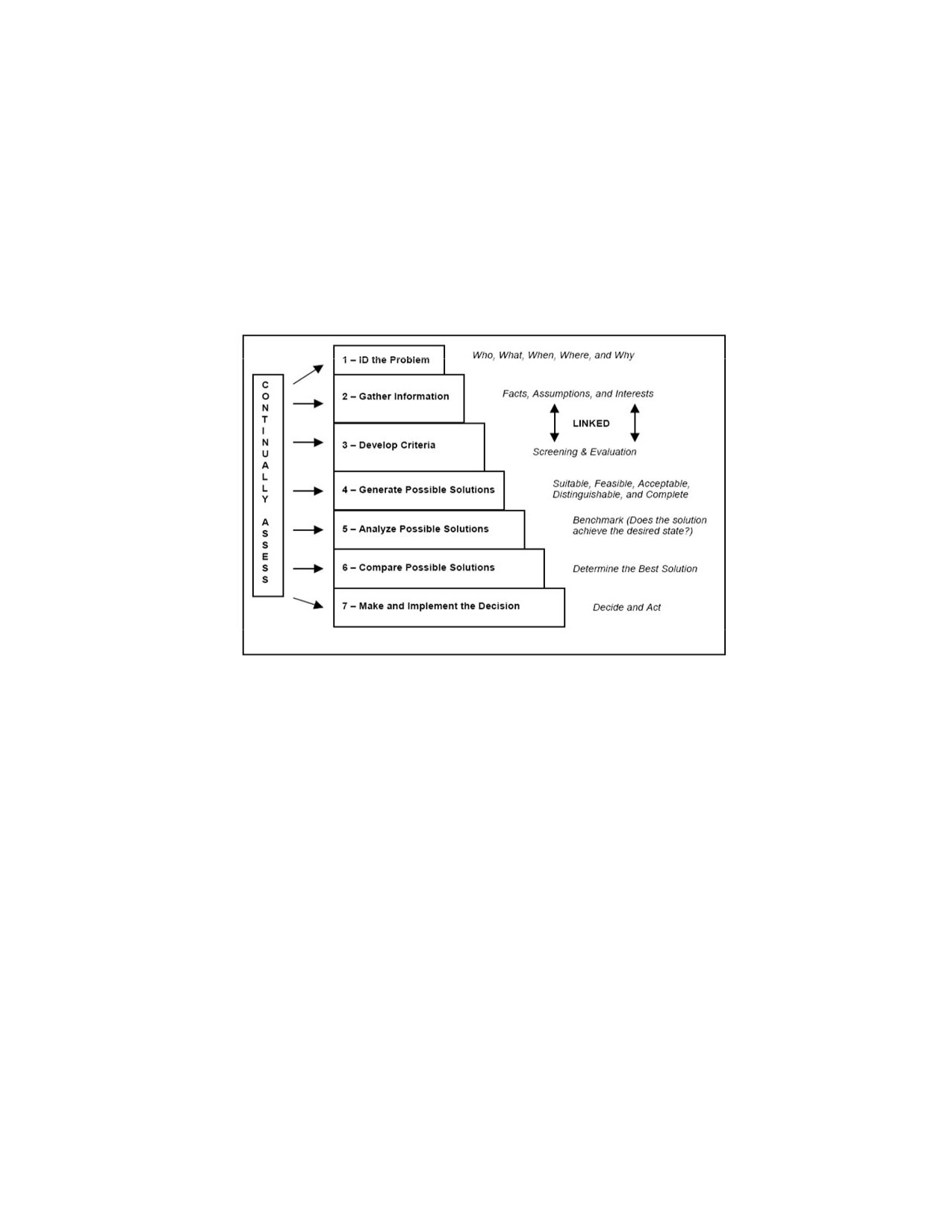
Standards: Identify the seven step problem solving model (Figure 1) in correct sequence.
Figure 1. Seven step problem solving model
Performance Steps
1. Identify the seven step problem solving model in correct sequence.
2. Identify Step 1: ID the problem.
a. Define the problem in terms of scope and limitations.
b. Identify its root cause.
c. Determine the cause of obstacles between the current situation and desired end state.
3. Identify Step 2: Gather information.
a. Gather information relevant to the problem.
b. Define unfamiliar terms.
4. Identify Step 3: Develop criteria.
a. Develop criteria to test possible solutions.
b. Criteria may be based on facts or assumptions.
5. Identify Step 4: Generate possible solutions.
a. Brainstorm possible solutions.
b. Record possible solutions.
6. Identify Step 5: Analyze possible solutions.
a. Analyze each possible solution.
b. Discard solutions that do not clearly meet specified criteria.
31 January 2008
3-73
STP 41-38B14-SM-TG
c. Establish benchmarks for performance.
d. Examine each possible solution for strengths and weaknesses.
7. Identify Step 6: Compare possible solutions.
a. Compare each solution against each other.
b. Recommend the best solution to solve the problem.
8. Identify Step 7: Make and implement the decision.
a. Select the best solution to solve the problem.
b. Implement the selected solution.
Evaluation Preparation: Setup: Provide the Soldier with adequate training/testing facilities, sufficient
time to review with task materials, pencil, paper, and needed resource materials.
Performance Measures
GO NO-GO
1. Identified Step 1: ID the problem.
——
——
2. Identified Step 2: Gather information.
——
——
3. Identified Step 3: Develop criteria.
——
——
4. Identified Step 4: Generate possible solutions.
——
——
5. Identified Step 5: Analyze possible solutions.
——
——
6. Identified Step 6: Compare possible solutions.
——
——
7. Identified Step 7: Make and implement the decision.
——
——
Evaluation Guidance: Score the Soldier GO if all performance measures are passed. Score the Soldier
NO-GO if any performance measure is failed. If the Soldier fails any performance measure, explain and
show what was done incorrectly and how to do it correctly.
References
Required
Related
FM 5-0
FMI 5-0.1
3-74
31 January 2008
STP 41-38B14-SM-TG
Define Measures of Effectiveness
331-38B-1021
Conditions: As a Civil Affairs Soldier assigned to a Civil Affairs team, civil-military operations center, or
the civil-military operations cell of a supported unit; you are given all required references and equipment
and tasked to define measures of effectiveness.
Standards: Define measures of effectiveness (MOEs) in accordance with FMI 5-0.1, The Operations
Process, Chapter 5.
Performance Steps
1. Define MOE. A measure of effectiveness is a criterion used to assess changes in system behavior,
capability, or operational environment that is tied to measuring the attainment of an end state,
achievement of an objective, or creation of an effect.
2. List the characteristics of MOEs:
a. They are measurable.
b. They are discrete actions. This means that each MOE should measure a distinct aspect of the
operation.
c. They are relevant to the measured task outcome.
d. They are responsive.
Evaluation Preparation: Setup: Provide the Soldier with adequate training/testing facilities, sufficient
time to review with task materials, pencil, paper, and needed resource materials.
Performance Measures
GO NO-GO
1. Defined MOEs.
——
——
2. Listed the four characteristics of MOEs.
——
——
Evaluation Guidance: Score the Soldier GO if all performance measures are passed. Score the Soldier
NO-GO if any performance measure is failed. If the Soldier fails any performance measure, explain and
show what was done incorrectly and how to do it correctly.
References
Required
Related
FM 3-05.40
FM 3-05.401
FMI 5-0.1
31 January 2008
3-75
STP 41-38B14-SM-TG
Identify Force Protection Measures
331-38B-1023
Conditions: As a Civil Affairs Soldier assigned to a civil-military operations center (CMOC), the
supervisor has tasked you to present a briefing identifying force protection measures. The unit’s force
protection standing operating procedure (SOP), FM 3-19.30, Physical Security, and all organic equipment
are available.
Standards: Identify physical control and personal protection measures in accordance with FM 3-19.30.
Performance Steps
1. Identify control measures. Define and establish restrictions on access and movement into critical
areas.
a. Categorize restrictions as to personnel, materials, and vehicles:
(1) Personnel access. Establishment of controls pertinent to each area or structure:
(a) Unit personnel.
(b) Visitors.
(c) Maintenance personnel.
(d) Contractor personnel.
(e) Host nation personnel, nongovernmental organizations (NGOs), and so on.
(f) Emergency response teams, quick reaction force, and so on.
(2) Identification and control.
(a) Badges.
(b) Organizational identification (ID), NGOs, and so on.
(c) Visitor rosters.
(3) Material control.
(a) Requirements for admission of material and supplies.
(b) Search and inspection of material for possible sabotage hazards.
(c) Special controls on delivery of supplies or personal shipments in restricted areas.
(d) Documentation required.
(e) Classified shipment not involving nuclear/chemical material.
(4) Vehicle control.
(a) Policy on search of military and privately owned vehicles.
(b) Parking regulations.
(c) Controls for entrance into restricted and administrative areas for military vehicles,
emergency vehicles, private owned vehicles, and vehicle registration.
(5) Security forces. General instructions that would apply to all security force personnel (fixed
and mobile). Security force facets include:
(a) Composition and organization.
(b) Tour of duty.
(c) Essential posts and routes.
(d) Weapons and equipment.
(e) Training.
(f) Method of challenging with signs and countersigns.
(g) Location.
(6) Detailed plans for situations (counterterrorism, bomb threats, hostage negotiations,
disaster, fire, and so forth).
(a) Individual actions.
(b) Alert force actions.
(c) Security force actions.
3-76
31 January 2008
STP 41-38B14-SM-TG
Performance Steps
2. Identify personal protection measures.
a. Overcome routines. The reduced probability of success in kidnapping or killing a target makes
the target far less desirable. Perform the following measures to prevent daily routines from
being observed:
(1) Vary route to and from work and arrival and departure times.
(2) Vary exercise schedule, using different routes and distances. It is best not to exercise
alone.
b. Maintain a low profile. Americans are easy to identify in an overseas area. Perform the
following measures to reduce easy ID:
(1) Dress and behave in public in a manner consistent with local customs if wearing civilian
clothing. Consult unit SOP for additional information.
(2) Avoid flashing large sums of money, expensive jewelry, or luxury items.
(3) Avoid public disputes or confrontations, and report any trouble to the proper authorities.
(4) Ensure that personal information (home address, phone number, or family information) is
not divulged.
c. Moving throughout the area of responsibility (AOR).
(1) Maintain an alert and ready posture when moving about within the AOR. Whenever
departing the perimeter of the CMOC, enforce compliance with all requirements of the
local SOP, such as:
(a) Team members always wearing individual body armor, Kevlar helmets, and eye
protection.
(b) Weapons are clean and well maintained; ammunition is issued. Weapons are loaded
and locked on safe.
(c) Communications devices are charged and tested, with current signal operating
instructions understood.
(2) Accompany or follow immediately behind combat elements of the supported command,
thereby minimizing many force protection challenges.
Evaluation Preparation: Setup: Provide the Soldier with adequate training/testing facilities, sufficient
time to review with task materials, pencil, paper, and needed resource materials.
Performance Measures
GO NO-GO
1. Identified control measures.
——
——
2. Identified personal protection measures.
——
——
Evaluation Guidance: Score the Soldier GO if all performance measures are passed. Score the Soldier
NO-GO if any performance measure is failed. If the Soldier fails any performance measure, explain and
show what was done incorrectly and how to do it correctly.
References
Required
Related
FM 3-19.30
31 January 2008
3-77
STP 41-38B14-SM-TG
Conduct Military Briefings
331-38B-1024
Conditions: As a Civil Affairs (CA) Soldier assigned to a civil-military operations center (CMOC) or Civil
Affairs team and given FM 5-0, Army Planning and Orders Production; you are tasked to conduct a
military briefing.
Standards: Identify the purpose of military briefings, describe the four types of military briefings, develop
and conduct the briefing in accordance with FM 5-0, Appendix B.
Performance Steps
1. Identify the purpose of a military briefing.
a. The purpose of a military briefing is to present information to commanders, staff, and other
designated audiences. The information can be a general overview or be very specialized,
depending on the type of briefing and mission requirements.
b. The operations process has four activities that translate the commander’s vision into action as
units conduct operations. A briefing assignment employs these four steps:
(1) Plan: Analyze the situation and prepare a briefing outline.
(2) Prepare: Construct the briefing.
(3) Execute: Deliver the briefing.
(4) Assess: Follow up.
c. An effective briefing technique uses maps, overlays, sector sketches and charts that
demonstrate how Civil Affairs operations (CAO), and civil-military operations (CMO) are
integrated into the supported organization’s action plan or scheme of maneuver.
2. Define the four types of military briefings.
a. Decision briefing.
(1) The decision briefing presents a recommended solution resulting from analysis or study of
a problem or problem area, and is designed to obtain an answer or a decision.
(2) The formality and detail of the briefing will vary depending on the level of command and
the decision maker’s knowledge of the subject. The briefer is prepared to present his
assumptions, facts, alternative solutions, reasons for recommendations, and coordination
involved.
(3) At the end of the briefing, the unit commander makes a decision, typically the course of
action (COA) that best satisfies the mission according to his guidance.
(4) Figure 1 is a sample decision briefing format.
1.
Introduction.
a. Greeting. Address the decision maker. Identify yourself and your organization.
b. Type and Classification of Briefing. For example: “This is a decision briefing. It is
UNCLASSIFIED.”
c. Problem Statement.
d. Recommendation.
2.
Body.
a. Facts. An objective presentation of both positive and negative facts bearing upon the
problem.
b. Assumptions. Necessary assumptions made to bridge any gaps in factual data.
c. Solutions. A discussion of the various options that can solve the problem.
d. Analysis. The criteria by which you will evaluate how to solve the problem (screening
and evaluation). A discussion of each course of actions relative advantages and
disadvantages.
e. Comparison. Show how the courses of action rate against the evaluation criteria.
f.
Conclusion. Show how the selected solution is best.
3.
Closing.
a. Questions?
b. Restatement of the recommendation.
c. Request a decision.
Figure 1. Decision briefing format
3-78
31 January 2008
STP 41-38B14-SM-TG
Performance Steps
b. Information briefing.
(1) The information briefing is designed to inform the listener and to gain understanding. It
deals primarily with facts and does not provide conclusions and recommendations, nor
does it require decisions.
(2) Some examples of the information briefing are:
(a) CA capabilities briefing to the supported commander.
(b) Battlefield update briefing.
(c) Cultural briefing.
(d) Shift change briefing for a CMOC or tactical operations center.
(3) Figure 2 is a sample information briefing format.
1.
Introduction.
a. Greeting. Address the audience. Identify yourself and your organization.
b. Type and Classification of Briefing. For example, “This is an information briefing. It is
classified SECRET.”
c.
Purpose and Scope. Describe complex subjects from general to specific.
d.
Outline or Procedure. Briefly summarize the key points and general approach.
Explain any special procedures (such as, demonstrations, displays, or tours). For
example, “During my briefing, I’ll discuss the six phases of our plan. I’ll refer to maps
of our area of operations. Then my assistant will bring out a sand table to show you
the expected flow of battle.” The key points may be place on a chart that remains
visible throughout the briefing.
2.
Main Body.
a. Arrange the main ideas in a logical sequence.
b. Use visual aids to emphasize main ideas.
c.
Plan effective transitions from one main point to the next.
d.
Be prepared to answer questions at any time.
3.
Closing.
a. Ask for questions.
b. Briefly recap main ideas and make a concluding statement.
c.
Announce the next speaker.
Figure 2. Information briefing format
c. Mission briefing.
(1) The mission briefing is similar to the information briefing, but it is used under operational
conditions to provide information or to give specific instructions for a mission.
(2) The format of the mission briefing is normally a standard five-paragraph operations
order.
d. Staff briefing.
(1) The staff briefing is a form of an information briefing given by a staff officer. It is used to
keep the commander and his staff abreast of the current situation.
(2) The staff briefing is intended to secure a coordinated or unified effort. It may involve the
exchange of information, the announcement of decisions within a command, the
issuance of directives, or the presentation of guidance.
(3) The staff functional area running estimate is used as an outline for the staff briefing
format.
3. Analyze the situation and prepare a briefing outline (Figure 3).
31 January 2008
3-79
STP 41-38B14-SM-TG
Performance Steps
1. Analyze situation; prepare a briefing outline.
2. Construct the briefing.
a. Audience.
a. Collect material.
•
Number?
•
Research.
•
Composition? Single service or
•
Become familiar with the subject.
joint? Civilians? Foreign
•
Collect authoritative opinions and
nationals?
facts.
•
Who are the ranking
b. Prepare the first draft.
members?
•
State problem (if necessary).
•
What are their official
positions?
•
Isolate key points (facts).
•
Where are they assigned?
•
Identify courses of action.
•
Analyze and compare courses of
•
How well do they know the
action (state advantages and
subject?
disadvantages).
•
Are they generalists or
•
Determine conclusions and
specialists?
recommendations.
•
What are their interests?
•
Prepare draft outline.
•
What are their personal
•
Include visual aids.
preferences?
•
What is the anticipated
•
Fill in appropriate material.
reaction?
•
Review with appropriate authority.
b. Purpose and type.
c. Revise the first draft and edit.
•
Information briefing (to inform)?
•
Ensure the facts are important and
•
Decision briefing (to obtain
necessary.
decision)?
•
Include all necessary facts.
•
Mission briefing (to review
•
Include answers to anticipated
important details)?
questions.
•
Staff briefing (to exchange
•
Polish material.
information)?
d. Plan use of visual aids.
c. Subject of briefing.
•
Check for simplicity and readability.
•
What is the specific subject?
•
Develop method for use.
•
What is the desired coverage?
e. Practice the briefing.
•
How much time will be
•
Rehearse (with assistants and visual
allocated?
aids).
d. Physical facilities and support needed.
•
Polish the presentation.
•
Where will the briefing be
•
Isolate key points.
presented?
•
Memorize outline.
•
What arrangements will be
required?
•
Develop transitions.
•
What are the visual aid
•
Use definitive words.
facilities?
3. Deliver the briefing.
•
What are the deficiencies?
4. Follow-up.
•
What actions are needed to
a. Ensure understanding (questions?).
overcome deficiencies?
b. Record the decision.
e. Prepare a schedule.
c. Inform proper authorities.
•
Finish analysis of the situation.
•
Prepare preliminary outline.
•
Determine requirements for
training aids, assistants, and
recorders.
•
Edit or redraft.
•
Schedule rehearsals, facilities,
and critiques.
•
Arrange for final review by
responsible authority.
Figure 3. Military briefing checklist
3-80
31 January 2008
STP 41-38B14-SM-TG
Performance Steps
a. Ensure the briefer understands the purpose of the briefing. The time allocated for the briefing
dictates the style, facilities, and the preparation effort needed.
b. Formulate a briefing outline, which is the plan for preparing, executing, and following up on
the briefing. Refine the plan as new information is received.
c. Determine the following—
(1) Subject of the briefing.
(2) Purpose and type of briefing (information, decision, mission, or staff). What is expected
of the briefer?
(3) Target audience:
(a) Who is the target audience?
(b) How much knowledge of the subject does the target audience have?
(4) Facilities and support needed.
(5) Preparation schedule.
4. Construct the briefing. The construction of the briefing will vary with its type and purpose. The
analysis provides the basis for this determination. The following are the major steps in
constructing a briefing:
a. Collect material.
b. Know the subject thoroughly.
c. Isolate the key points.
d. Arrange the key points in logical order.
e. Provide supporting data to substantially validate the key points.
f. Select visual aids, such as maps, overlays, sector sketches, and charts.
g. Establish the wording that will be used when speaking from notes.
h. Rehearse before a knowledgeable person who can critique the briefing. Time the delivery
and adjust as necessary.
5. Identify the classification of the briefing, briefing area, and measures to safeguard classified
information. Use the following procedures when presenting a classified briefing:
a. Ensure that the briefing area has been cleared to the highest level of material to be
discussed.
b. Check the attendance roster to ensure all personnel are cleared and have a need-to-know.
c. Establish a sign-in roster at the main entrance to the briefing area and control access at all
other entrances.
d. Ensure that all training/briefing aids are marked with security classification according to their
content.
e. At the beginning of the briefing, inform the audience of the security classification of the
briefing and the policy concerning note taking, and use of electronic devices such as cell
phones and personal digital assistants.
f. Repeat the security classification at the end of the briefing.
g. Ensure that automated information systems, including networks and telecommunications
systems that collect, create, communicate, compute, disseminate, process or store classified
information, have controls that:
(1) Prevent access by unauthorized persons.
(2) Ensure the integrity of the information.
6. Deliver the briefing.
a. A successful briefing depends on how it is presented:
(1) Maintain a relaxed, military bearing.
(2) Use deliberate gestures and movements and avoid distracting mannerisms.
(3) The effective briefer’s delivery is characterized by conciseness, objectivity, and
accuracy.
b. Know when your briefing occurs in the agenda of a larger meeting.
c. Arrive early and set up briefing aids as necessary prior to the meeting start time. Be prepared
to distribute handouts efficiently, if necessary.
31 January 2008
3-81
STP 41-38B14-SM-TG
Performance Steps
d. Be aware of the following:
(1) The basic purpose is to present the subject as directed and ensure that the audience
understands it.
(2) Brevity precludes a lengthy introduction or summary.
(3) Use logic when arriving at conclusions and recommendations.
(4) Interruptions and questions may occur, so allocate time for questions and answers.
7. Conduct a follow-up.
a. When the briefing is over, the briefer prepares a memorandum for record (MFR) for the
commander and staff personnel who require an MFR. The MFR records and reports the
following: subject, date, time, place of briefing, ranks, names and positions of all attendees.
b. Record the briefing’s substance concisely in this MFR. Report recommendations and their
approval, disapproval, or approval with modification, as well as any instructions or directed
actions.
Evaluation Preparation: Setup: Provide the Soldier with adequate training/testing facilities, sufficient
time to review with task materials, pencil, paper, and needed resource materials.
Performance Measures
GO NO-GO
1. Identified the purpose of a military briefing.
——
——
2. Defined the four types of military briefings.
——
——
a. Decision.
b. Information.
c. Mission.
d. Staff.
3. Analyzed the situation and prepared a briefing outline.
——
——
4. Constructed the briefing.
——
——
5. Identified the briefing classification and the briefing area as well as the measures
——
——
to safeguard classified information.
6. Delivered the briefing.
——
——
7. Conducted a follow-up after the briefing.
——
——
Evaluation Guidance: Score the Soldier GO if all performance measures are passed. Score the Soldier
NO-GO if any performance measure is failed. If the Soldier fails any performance measure, explain and
show what was done incorrectly and how to do it correctly.
References
Required
Related
FM 5-0
3-82
31 January 2008
STP 41-38B14-SM-TG
Identify Army Orders
331-38B-1033
Conditions: As a Civil Affairs Soldier assigned to a civil-military operations center, Civil Affairs team, or
civil-military operations cell of a supported unit headquarters; you are given all required references and
equipment and tasked to identify the Army orders.
Standards: Identify the purpose of Army orders, the types of orders, and the five paragraphs of an
operation order (OPORD) in accordance with FM 5-0, Army Planning and Orders Production,
Appendix G.
Performance Steps
1. Identify an Army order.
a. Army orders express commander’s intent and decisions.
b. An Army order is a communication that is written, verbal, or by signal that conveys instructions
from a superior to a subordinate.
c. In a broad sense, the term “order” and “command” are synonymous. However, an order implies
discretion as to the details of execution, whereas a command does not.
2. Identify the two general categories of Army orders.
a. Administrative orders cover supplies, maintenance, evacuation, personnel, and other
administrative details for the mission.
b. Combat orders pertain to specific operations and the service support needed to accomplish the
operation. There are five types of combat orders:
(1) OPORD.
(2) Service support orders.
(3) Movement orders.
(4) Warning orders (WARNORD).
(5) Fragmentary orders (FRAGORD).
3. Identify an OPORD. An OPORD is a directive issued by a commander to subordinate commanders
for the purpose of effecting the coordinated execution of an operation. An OPORD was traditionally
called the five paragraph field order, it contains at a minimum the following information:
a. Situation. The situation states the conditions and circumstances of the operation.
b. Mission. The mission states the specific task of the operation.
c. Execution. The execution states the time, condition, and how the operation will be carried out.
d. Administrative and logistic support. Provides a general understanding of the requirements for
logistical support, personnel policies, and administrative plans. It provides broad guidance on
how such support is to be furnished.
e. Command and signal.
(1) Command. Command states the map coordinates for command post (CP) locations and
at least one future location for each CP.
(2) Signal. Signal states the general rules concerning the use of communications and other
electronic equipment.
4. Identify a service support order. A service support order is an order that directs the service support
of an operation (for example: supplies, transportation, services provided by other units, and so on).
5. Identify a movement order. A movement order is an order that ensures the organized and
uninterrupted flow of units throughout the area of operation.
a. Information normally found in the movement order includes the destination, routes, arrival
times, scheduled maintenance halts, communications, and location of the commander.
b. The objective of a successful move is for the unit to arrive at its destination in a condition
suitable to its imminent employment.
c. The goal of all movement planning is to retain flexibility to execute a variety of scenarios to
meet ever-changing conditions.
31 January 2008
3-83
STP 41-38B14-SM-TG
Performance Steps
d. The movement order should include a strip map or overlay.
e. The commander bases his movement order on the best available information on the enemy,
terrain, weather, unit capabilities, and civil considerations.
f. The movement order addresses the possibility of ambushes, indirect fires, and air attacks.
6. Identify a WARNORD. The WARNORD is a preliminary notice of an order or action, which is to
follow.
a. A WARNORD helps subordinate units and staffs prepare for upcoming missions.
b. A WARNORD informs subordinates of tasks they must do immediately or notifies them of
possible future taskings.
c. A WARNORD increases planning time, provides details of the impending operation, and details
events that accompany preparation and execution.
d. The amount of detail a WARNORD includes depends on the information and time available
when it is issued, and the information subordinate commanders need for proper planning and
preparation.
e. A WARNORD does not authorize execution other than planning unless specifically stated.
f. WARNORDs follow the five-paragraph OPORD format. Additionally, an initial WARNORD
issued below battalion level includes—
(1) Mission or nature of the operation.
(2) Time and place for issuing the OPORD.
(3) Units or elements participating in the operation.
(4) Specific tasks not addressed by the OPORD.
(5) Time line for the operation.
7. Identify a FRAGORD. A FRAGORD is an abbreviated form of an OPORD (verbal or written) usually
issued on a day-to-day basis that eliminates the need for restating information contained in a basic
OPORD.
a. A FRAGORD is issued to reflect changes or modify the original OPORD, or to execute a
branch or sequel, based on the possible outcome to that order.
b. FRAGORDs follow the five-paragraph OPORD format.
c. After each paragraph heading, it will state either new information or “no change;” thereby,
ensuring that all recipients know they have received the entire FRAGORD.
d. Commanders may authorize members of their staff to issue FRAGORDs in their name.
Evaluation Preparation: Setup: Provide the Soldier with adequate training/testing facilities, sufficient
time to review with task materials, pencil, paper, and needed resource materials.
Performance Measures
GO NO-GO
1. Identified an Army order.
——
——
2. Identified the two general categories of orders.
——
——
3. Identified an OPORD.
——
——
4. Identified the five paragraphs of an OPORD.
——
——
5. Identified a service support order.
——
——
6. Identified a movement order.
——
——
7. Identified a WARNORD.
——
——
8. Identified a FRAGORD.
——
——
3-84
31 January 2008
STP 41-38B14-SM-TG
Evaluation Guidance: Score the Soldier GO if all performance measures are passed. Score the Soldier
NO-GO if any performance measure is failed. If the Soldier fails any performance measure, explain and
show what was done incorrectly and how to do it correctly.
References
Required
Related
FM 5-0
31 January 2008
3-85
STP 41-38B14-SM-TG
Identify Command Relations
331-38B-1037
Conditions: As a member of a Civil Affairs team conducting operations in a specific area of operations,
you are required to identify the command relationship with the supported unit.
Standards: Identify the different command relationships in accordance with FM 5-0, Army Planning and
Orders Production.
Performance Steps
1. Identify command relationships.
a. Assignment is to place units or personnel in an organization where such placement is relatively
permanent, and where the organization controls and administers the units or personnel for the
primary function, or greater portion of the functions, of the unit or personnel. Unless specifically
stated, this relationship includes administrative control (ADCON).
b. Attachment is the placement of units or personnel in an organization where placement is
relatively temporary. A unit that is temporarily placed into an organization is attached.
c. Operational control (OPCON) is transferable command authority that may be exercised by
commanders at any echelon at or below the level of combatant command.
(1) OPCON is inherent in combatant command (command authority).
(2) OPCON may be delegated and is the authority to perform those functions of command
over subordinate forces. OPCON involves organizing and employing commands and
forces, assigning tasks, designating objectives, and giving authoritative direction
necessary to accomplish the mission.
(3) OPCON includes authoritative direction over all aspects of military operations and joint
training necessary to accomplish missions assigned to the command. OPCON should be
exercised through the commanders of subordinate organizations. Normally this authority
is exercised through subordinate joint force commanders and Service or functional
component commanders.
(4) OPCON normally provides full authority to organize commands and forces, and to employ
those forces as the commander in operational control considers necessary to accomplish
assigned missions. OPCON does not, in and of itself, include authoritative direction for
logistics or matters of administration, discipline, internal organization, or unit training.
d. Tactical control (TACON) is command authority over assigned or attached forces or
commands, or military capability or forces made available for tasking, that is limited to the
detailed and, usually, local direction and control of movements or maneuvers necessary to
accomplish missions or tasks assigned.
(1) TACON is inherent in operational control.
(2) TACON may be delegated to, and exercised at any level at or below the level of
combatant command.
(3) TACON allows commanders below combatant command level to apply force and direct
tactical use of logistic assets but does not provide authority to change organizational
structure or direct administrative and logistic support.
e. ADCON is direction or exercise of authority over subordinate or other organizations in respect
to administration and support, including organization of service forces, control of resources and
equipment, personnel management, unit logistics, individual and unit training, readiness,
mobilization, demobilization, discipline, and other matters not included in the operational
missions of the subordinate or other organizations.
(1) ADCON includes personnel management, control of resources and equipment, discipline,
and other matters not included in operational missions.
(2) Attachment orders normally state whether parent unit retains ADCON of the unit. If it does
not, the attachment order specifically states that the gaining unit has ADCON.
(3) For OPCON and TACON, parent units retain ADCON.
3-86
31 January 2008
STP 41-38B14-SM-TG
Evaluation Preparation: Setup: Provide the Soldier with adequate training/testing facilities, sufficient
time to review with task materials, pencil, paper, and needed resource materials.
Performance Measures
GO NO-GO
1. Identified command relationships.
——
——
Evaluation Guidance: Score the Soldier GO if all performance measures are passed. Score the Soldier
NO-GO if any performance measure is failed. If the Soldier fails any performance measure, explain and
show what was done incorrectly and how to do it correctly.
References
Required
Related
FM 5-0
FM 6-0
31 January 2008
3-87
STP 41-38B14-SM-TG
Identify Army Staff Structure and Responsibilities
331-38B-1039
Conditions: As a Civil Affairs Soldier assigned to a civil-military operations center (CMOC), you are
tasked to present an information briefing on the Army staff structure and the responsibilities to your
section.
Standards: Identify the Army staff structure and the responsibilities of each section in accordance with
FM 6-0, Command and Control, within the time allotted by your supervisor.
Performance Steps
1. Identify the three considerations upon which military staffs are organized.
a. Military staffs are organized based upon three considerations: mission, broad fields of interest,
and regulations and laws.
(1) Mission. The mission determines which activities to accomplish. These activities
determine how commanders organize, tailor, or adapt their individual staffs to accomplish
the mission. The mission also determines the size and composition of the staff.
(2) Broad fields of interest. Regardless of mission, every Army staff has common broad fields
of interest that determine how the commander divides duties and responsibilities.
(a) The duties and responsibilities inherent in a field of interest are called functional
responsibilities. Grouping related activities allows an effective span of control and
unified effort.
(b) Fields of interest may vary slightly, depending on the echelon of command, mission,
and environment. For example, at battalion level there is no resource manager, while
certain logistic units combine intelligence and operations functions.
(3) Regulations and laws. Army regulations and laws establish special relationships between
certain staff officers and the commander. For example, AR 20-1, Inspector General
Activities and Procedures; AR 27-1, Legal Services, Judge Advocate Legal Services; and
AR 165-1, Chaplain Activities in the United States Army; require the inspector general
(IG), staff judge advocate (SJA), and chaplain to be members of the commander’s
personal staff.
b. Basic staff structure. Staffs at every echelon are structured differently; however, all staffs are
similar. The basic staff structure includes a chief of staff (COS) or executive officer (XO), and
three staff groups: coordinating, special, and personal.
Note: The number of coordinating, special, and personal staff officers within each staff group varies at
different levels of command.
2. Describe the duties of the COS or XO.
a. The COS/XO is the commander’s principal staff officer. He directs staff tasks, oversees staff
coordination, and ensures efficient and prompt staff actions.
b. The COS/XO frees the commander from routine details of staff operations. The commander
delegates authority to the COS/XO for executive management of coordinating and special staff
officers. The COS/XO does not necessarily oversee the personal staff officers, although he
normally interacts with them.
3. Describe the duties and responsibilities common to all staff members.
a. Advise and inform the commander.
b. Prepare, update, and maintain running estimates.
c. Make recommendations.
d. Prepare plans and orders.
e. Assess execution of operations.
f. Manage information within fields of interest.
g. Identify and analyze problems.
h. Perform staff coordination.
i. Conduct training.
3-88
31 January 2008
STP 41-38B14-SM-TG
Performance Steps
j. Perform staff assistance visits.
k. Perform risk management.
l. Conduct staff inspections.
m. Perform staff writing.
n. Conduct staff research.
o. Perform staff administrative procedures.
p. Exercise staff supervision.
4. Describe the commander’s three staff groups.
a. Coordinating staff group.
(1) Coordinating staff officers are the commander’s principal staff assistants. Collectively,
through the COS/XO, coordinating staff officers are accountable to their commander, and
have functional responsibilities over one or more fields of interest.
(2) Commanders may designate coordinating staff officers as assistant chiefs of staff, deputy
chiefs of staff, directors, or regular staff officers. Coordinating staff officers’ authority and
responsibility is normally limited to advising, planning, and coordinating actions within their
individual fields of interest.
(3) Coordinating staff officers coordinate actions for the commander and for special staff
sections over which they are assigned coordinating staff responsibility. Coordinating staff
responsibility include:
(a) Ensuring that special staff officers or sections have personnel, logistics, facilities, and
proper support.
(b) Coordinating actions and taskings of special staff officers across the entire staff, and
informing the COS/XO of the special staff officers’ actions.
(4) The commanding officer’s rank determines whether the staff is a G staff or an S staff.
Organizations commanded by generals have G staffs. Other organizations have S staffs.
Note: J staff is the United States military joint staff comprised of members from the Army, Navy, Air
Force, and Marine Corps. The J staff is a staff consisting of members from two or more services. C staff
is a combined staff representing two or more nations, North Atlantic Treaty Organization, or a United
Nations multinational force.
(5) Common fields of interest and the abbreviations for the staff sections to which
coordinating staff officers are assigned are:
(a) Assistant Chief of Staff (ACOS), G-1/S-1, Personnel.
- The ACOS/G-1 or S-1 is the principal staff officer for all matters concerning human
resources support (military and civilian). The G-1/S-1 also serves as the senior
adjutant general officer in the command.
- Specific responsibilities of the G-1 or S-1 include manning, personnel services,
personnel support, and headquarters management.
- A G-1/S-1 is authorized at every echelon from battalion through corps.
(b) ACOS, G-2/S-2, Intelligence.
-The ACOS/G-2 or S-2 is the principal staff officer for all matters concerning the
enemy/threat, the environment as it affects the enemy/threat, intelligence, and
counterintelligence. Additionally, the G-2/S-2 supports security programs.
- The G-2/S-2 is responsible for intelligence readiness, intelligence tasks, intelligence
synchronization, counterintelligence, and support to security programs.
- A G-2/S-2 is authorized at every echelon from battalion through corps.
(c) ACOS, G-3/S-3, Operations.
- The ACOS/G-3 or S-3 is the principal staff officer for all matters concerning training,
operations, and force development and modernization.
- A G-3/S-3 is authorized at every echelon from battalion through corps.
(d) ACOS, G-4/S-4, Logistics.
- The ACOS, G-4 or S-4 is the principal staff officer for logistic operations and plans
(general), supply, maintenance, transportation, and services.
- A G-4/S-4 is authorized at every echelon from battalion through corps.
(e) ACOS, G-5/S-5, Plans.
31 January 2008
3-89
STP 41-38B14-SM-TG
Performance Steps
- The ACOS, G-5 or S-5 is the principal staff officer for all matters concerning
planning operations for the mid- to long-range time horizons.
- A G-5/(S-5) is authorized at every echelon from battalion through corps.
(f) ACOS, G-6/S-6, Command, Control, Communications, and Computer Operations.
- The ACOS, G-6 or S-6 is the principal staff officer for all matters concerning
command, control, communications, and computer operations, to include network
operations and information management.
- A G-6/S-6 is authorized at all echelons from battalion through corps.
(g) ACOS, G-7/S-7, Information Operations.
- The ACOS, G-7 or S-7 is the principal staff officer for all matters concerning
information operations (IO), including current operations, plans, and IO-related
targeting.
- A G-7 is authorized at corps and divisions. Selected Army National Guard and
Active Army brigades are authorized an S-7.
(h) ACOS, G-8/S-8, Financial Management.
- The ACOS, G-8 or S-8 is the principal staff officer responsible for coordinating and
providing finance services, budget preparation and resource management analysis
and implementation.
- Corps and divisions are normally authorized a financial management officer. During
joint operations, financial management functions are normally transferred to the Army
forces (ARFOR) headquarters.
(i) ACOS, G-9/S-9, Civil-Military Operations.
- The ACOS, G-9 or S-9 is the principal staff officer for all matters concerning
civil-military operations (CMO).
- The G-9/S-9 establishes the CMOC, evaluates civil considerations during mission
analysis (identifying the civil ‘centers of gravity’), and prepares the groundwork for
transitioning the area of operations (AO) from military to civilian control.
- The G-9/S-9 advises the commander on the military’s effect on civilians in the AO,
relative to the complex relationship of these people with the terrain and institutions
over time.
- The G-9/S-9 is authorized at all echelons from brigade through corps. Once
deployed, units below brigade level may be authorized an S-9.
(j) Support Operations or Materiel Officer.
- The support operations or materiel officer is the principal staff officer for
coordinating logistics and combat health support.
- A support operations officer or materiel officer is authorized in support commands
and battalions.
b. Special staff group. Every staff has special staff officers. The number of special staff officers
and their responsibilities vary with authorizations, the desires of the commander, and the size
of the command.
(1) The COS/XO exercises coordinating staff responsibility over the following special staff
officers:
(a) Headquarters Commandant. Corps, divisions, and major support commands are
authorized a headquarters commandant, who is responsible for Soldiers assigned to
the headquarters.
(b) Secretary of the General Staff (SGS). The SGS is the special staff officer who acts
as XO for the COS. Corps, divisions, major support commands, and general officers
with a staff are authorized an SGS.
(c) Resource Manager or Comptroller.
- The resource manager (RM) or comptroller is responsible for budget preparation
and RM analysis and implementation. Corps and divisions are normally authorized
an RM or comptroller.
- During joint operations, comptroller functions are normally transferred to the
ARFOR headquarters. However, specific comptroller functions may occur at corps
and division level.
3-90
31 January 2008
STP 41-38B14-SM-TG
Performance Steps
(2) The ACOS, G-1/adjutant general (Army) (AG) or S-1 exercises coordinating staff
responsibility over the following special staff officers:
(a) Civilian Personnel Officer (CPO). The CPO is responsible for managing and
administering the civilian employee personnel management program. The CPO is a
civilian employee and has a permanent position on the staff at divisions and corps.
(b) Dental Surgeon. The dental surgeon is responsible for coordinating dental activities
within the command. Corps and divisions are authorized a dental surgeon.
(c) Equal Opportunity Advisor (EOA). The EOA is responsible for coordinating matters
concerning equal opportunity for Soldiers and their families. Commanders at every
echelon are authorized or appoint an EOA.
(d) Finance Officer. The finance officer is responsible for coordinating and providing
finance services to the command; the finance officer is also the finance unit
commander. Corps and divisions are authorized a finance officer.
(e) Surgeon. The surgeon is responsible for coordinating health assets and operations
within the command, and may be a medical unit commander. Organizations from
battalion through corps are authorized a surgeon.
(f) Veterinary Officer. The veterinary officer is responsible for coordinating assets and
activities concerning veterinary service within the command. Corps are authorized a
veterinary officer.
(3) The ACOS, G-2 or S-2 exercises coordinating staff responsibility over the staff weather
officer (SWO).
(a) The SWO is responsible for coordinating operational weather support and weather
service matters through the G-2/S-2. The SWO is an Air Force officer or
noncommissioned officer (NCO) who leads a combat weather team of two or more
personnel.
(b) Typically, a SWO supports corps, divisions, aviation brigades, and special operations
forces.
(4) The ACOS, G-3 or S-3 exercises coordinating staff responsibility over the following
special staff officers:
(a) Air and Missile Defense Coordinator (AMDCOORD).
- The AMDCOORD is responsible for coordinating ARFOR air and missile defense
activities and plans with the area air defense commander, joint force air component
commander, and airspace control authority.
- The AMDCOORD is the senior air defense artillery (ADA) officer in the command
and the commander of an ADA unit supporting information technology. An
AMDCOORD is authorized at corps and divisions.
(b) Air Liaison Officer (ALO).
- The ALO is responsible for coordinating aerospace assets and operations, such as
close air support, air interdiction, air reconnaissance, airlift, and joint suppression of
enemy air defenses.
- The ALO is authorized at corps, divisions, and brigades and is the senior Air Force
officer with each tactical air control party.
(c) Aviation Coordinator (AVCOORD).
- The AVCOORD is responsible for coordinating Army aviation assets and
operations.
- The AVCOORD is the senior aviation officer in the force and the commander of an
aviation unit supporting it.
(d) Chemical Officer (CHEMO).
- The CHEMO is responsible for chemical, nuclear, radiological, nuclear, and
high-yield explosives (CBRNE) defense operations, smoke operations, and chemical
asset use.
- A CHEMO is authorized at every echelon, from battalions through corps.
(e) Engineer Coordinator (ENCOORD).
- The ENCOORD is responsible for coordinating engineer assets and operations and
is usually the senior engineer officer in the force and commands an engineer unit
31 January 2008
3-91
STP 41-38B14-SM-TG
Performance Steps
supporting the command.
- The assistant or deputy ENCOORD is a permanent staff officer, representing the
ENCOORD. An ENCOORD is authorized at corps and divisions. One is normally
task-organized to brigade combat teams (BCTs) and battalions.
(f) Explosive Ordnance Disposal (EOD) Officer.
- The EOD officer is responsible for coordinating the detection, identification,
recovery, evaluation, rendering safe and final disposal of explosive ordnance.
- An EOD officer is authorized at corps and divisions, and normally serves as the
EOD group, battalion, or company commander.
(g) Fire Support Coordinator (FSCOORD).
- The FSCOORD is responsible for advising the commander on the best use of
available fire support resources, developing the fire support plan, issuing necessary
orders in the name of the commander, and implementing the approved fire support
plan.
- An FSCOORD is authorized at BCT through corps. The FSCOORD is also the
commander of the field artillery unit supporting the force.
(h) Historian.
- The historian is responsible for coordinating the documentation of the command’s
historical activities.
- The historian, normally an Army civilian, is authorized at corps and divisions.
(i) Liaison Officer. A liaison officer is responsible for representing the commander at the
headquarters of another command to coordinate and promote cooperation between
the two commands.
(j) Marine Liaison Team (MLT) Commander.
- The MLT is responsible for coordinating naval gunfire and Marine close air support
assets and operations.
- The MLT commander, a Navy or Marine officer, operates at division level and
below.
(k) Provost Marshal (PM).
- The PM is responsible for planning, coordinating, and employing all organic,
assigned, or attached military police assets. The PM is usually the senior military
police officer in the command. The PM augments the staff with a small planning cell
that typically works within the G-3.
- A PM is authorized at corps and divisions.
(l) Safety Officer.
- The safety officer is responsible for coordinating safety activities throughout the
command.
- Commanders at every echelon from battalion through corps appoint a safety officer.
(m) Theater Special Operations Command (TSOC).
- The TSOC is responsible for coordinating and integrating special operations forces
(SOF) activities.
- A TSOC is normally authorized only on corps staffs. However, whenever a special
operations force unit is attached or under operational control of the command,
someone from the staff or the attached unit fulfills the TSOC’s responsibilities.
- Below corps level, a command normally receives a special operations liaison team
to fulfill the TSOC’s responsibilities.
(n) Space Operations Officer (SOO).
- The SOO is responsible for providing space-related tactical support and
coordination of space-based capabilities available to the command.
- A SOO is authorized at corps and may be authorized at divisions in the future. If the
command has no SOO assigned, an Army space support team is often placed under
operational control of the command. The team’s officer in charge fulfills the SOO’s
responsibilities.
(o) Theater Airlift Liaison Officer (TALO).
- The TALO is responsible for advising the commander on the best use of airlift
3-92
31 January 2008
STP 41-38B14-SM-TG
Performance Steps
resources and coordinating their use.
- The TALO is an Air Force officer, normally authorized at corps, divisions, regiments,
and separate brigades.
(5) The ACOS, G-4 exercises coordinating staff responsibility over the transportation officer,
who is responsible for coordinating transportation assets and operations. A transportation
officer is authorized at corps (corps transportation officer) and divisions (division
transportation officer).
(6) The ACOS, G-7 or S-7 exercises coordinating staff responsibility over the following
special staff officers:
(a) Electronic Warfare Officer (EWO). The EWO is normally a military intelligence officer
who performs electronic warfare duties. An EWO is authorized at corps and
divisions.
(b) Military Deception Officer (MDO). The MDO is responsible for coordinating military
deception assets and operations. An MDO is authorized at corps and divisions.
(c) Operations Security Officer (OPSEC). The OPSEC officer helps the G-7/S-7 perform
OPSEC functions. Commanders at all echelons, battalion through corps, are
authorized or appoint an OPSEC officer.
(d) Psychological Operations Officer (PSYOP). The PSYOP officer is responsible for
synchronizing PSYOP operations with those of other IO elements and echelons. A
PSYOP officer is authorized at corps and divisions. If no PSYOP officer is assigned,
the commander of an attached PSYOP support element may assume the PSYOP
officer’s responsibilities.
c. Personal Staff Group. Personal staff officers work under the immediate control of, and have
direct access to, the commander. The commander establishes guidelines or gives guidance on
when a personal staff officer informs or coordinates with the COS/XO or other staff members.
By law or regulation, personal staff officers have a unique relationship with the commander.
(1) Command Sergeant Major (CSM).
(a) The CSM is the command’s senior NCO. The CSM is responsible for providing the
commander with personal, professional, and technical advice on enlisted Soldier
matters and the NCO corps as a whole.
(b) A CSM is authorized at every echelon from battalion through corps.
(2) Aide-de-Camp.
(a) The aide-de-camp serves as a personal assistant to a general officer. An aide-de-
camp is authorized for general officers in designated positions.
(b) The rank of the aide-de-camp depends on the rank of the general officer.
(3) Chaplain.
(a) The chaplain is responsible for religious support operations, advising the commander
on matters of religion, morals, and morale as affected by religion, and on the impact
of indigenous religions on military operations.
(b) A unit ministry team, usually consists of one chaplain and one chaplain assistant,
The unit ministry team is authorized at every echelon from battalion through corps.
(4) IG.
(a) The IG is responsible for advising the commander on overall welfare and state of
discipline. The IG is a confidential adviser to the commander.
(b) An IG is authorized for general officers in command and selected installation
commanders.
(5) Public Affairs Officer (PAO).
(a) The PAO is responsible for understanding and fulfilling the information needs of
Soldiers, the Army community, and the public.
(b) A PAO is authorized at corps, divisions, and major support commands.
(6) Staff Judge Advocate (SJA).
(a) The SJA is the commander’s personal legal adviser on all matters affecting the
morale, good order, and discipline of the command.
(b) An SJA serves commanders exercising general-court-martial convening authority.
31 January 2008
3-93
STP 41-38B14-SM-TG
Evaluation Preparation: Setup: Provide the Soldier with adequate training/testing facilities, sufficient
time to review with task materials, pencil, paper, and needed resource materials.
Performance Measures
GO NO-GO
1. Identified the three considerations upon which military staffs are organized.
——
——
a. Mission.
b. Broad fields of interest.
c. Regulations and laws.
2. Described the duties of the COS/XO.
——
——
a. COS/XO is the commander’s principal staff officer.
b. COS/XO frees the commander from routine details of staff operations.
3. Described the commander’s three staff groups.
——
——
a. Coordinating staff group.
b. Special staff group.
c. Personal staff group.
Evaluation Guidance: Score the Soldier GO if all performance measures are passed. Score the Soldier
NO-GO if any performance measure is failed. If the Soldier fails any performance measure, explain and
show what was done incorrectly and how to do it correctly.
References
Required
Related
FM 6-0
AR 165-1
AR 20-1
AR 27-1
3-94
31 January 2008
STP 41-38B14-SM-TG
Skill Level 2
Subject Area 1: Civil Affairs Operations
Implement the Use of Interpreters in Civil Affairs Operations
331-38B-2009
Conditions: As a Civil Affairs (CA) Soldier assigned to a Civil Affairs team, you are deployed to a region
where English is not the spoken language. The team is required to conduct Civil Affairs operations (CAO)
in the area, which will require the use of interpreters. Given FM 3-05.401, Civil Affairs Tactics,
Techniques, and Procedures, and available organic equipment, implement the use of interpreters.
Standards: Describe the interpreter selection process, the selection criteria, the training process, the
DOs and DON’Ts of working with interpreters. Maintain control of the interpreter during the meeting using
the techniques described in FM 3-05.401and the Interpreter Operations Handbook by Center for Army
Lessons Learned (CALL).
Performance Steps
1. Identify the difference between interpreter, linguist and translator.
a. Interpreters translate oral communication from one language to the oral communication of
another language.
b. Linguist is a term used by the military to designate those individuals who have varying degrees
of proficiency in a foreign language. Traditionally, this term refers to individuals in career fields
requiring a foreign language.
c. Translators interpret written text. It is better to work with a translator who is working in his/her
native language.
2. Identify the interpreter selection process.
a. Interpreters should be United States (U.S.) military personnel or at least U.S. citizens; the chain
of command or host government will assign one.
b. In some cases CA Soldiers use interpreters from a pool provided by the host government.
c. In many operational situations CA Soldiers use interpreters hired from the general host nation
(HN) population.
d. If several qualified interpreters are available, CA Soldiers should select at least two. This
practice is of particular importance if the interpreter works during long conferences or courses
of instruction. The exhausting nature of this type of work makes four hours of active interpreting
about the maximum for peak efficiency.
3. Select interpreters based on the following criteria:
a. Native speaker: Interpreters should be native speakers of the socially or geographically
determined dialect
b. Social status: In some situations and cultures, interpreters may be limited in their effectiveness
with a target audience if their social standing is considerably lower than that of the audience.
c. English fluency: The interpreter must be able to convey the information expressed by the
interviewee or the target audience
d. Intellectual intelligence: Although education does not equate to intelligence, the better educated
the interpreter, the better he will perform due to increased exposure to diverse concepts.
e. Technical ability: In certain situations, the CA Soldier may need an interpreter with technical
training or experience in special subject areas to translate the “meaning” and the “words.”
f. Reliability: The CA Soldier should beware the interpreter who arrives late for the interview. In
less developed countries time is relatively unimportant.
g. Loyalty: If the interpreter used is a local national, it is safe to assume that his first loyalty is to
the HN or subgroup, and not to the U.S. military.
h. Gender, age, and race: Gender, age, and race have the potential to seriously affect the
31 January 2008
3-95
STP 41-38B14-SM-TG
Performance Steps
mission. One example is the status of females in Muslim society. In predominantly Muslim
countries, cultural prohibitions may render a female interpreter ineffective under certain
circumstances.
i. Compatibility: The CA Soldier and the interpreter will work as a team. For the interpreter to be
most effective, he should become a psychic extension of the CA Soldier. The target audience
will be quick to recognize personality conflicts between the CA Soldier and the interpreter.
4. Identify the steps in establishing rapport with the interpreters.
a. Establish rapport before meeting the interpreter for the first time.
b. Obtain some basic facts about the HN:
(1) Population.
(2) Geography.
(3) Ethnic groups.
(4) Political System
(5) Prominent political figures.
(6) Monetary system.
(7) Business.
(8) Agriculture.
(9) Exports.
c. Obtain information on the interpreter’s backg1round by showing a genuine concern for his
family, aspirations, career, and education.
d. Established trust and confidence before embarking on sensitive issues, such as religion, likes,
dislikes, and prejudices.
5. Identify the factors in the orientation of the interpreters.
a. Ensure the interpreters were briefed on their duties and responsibilities.
b. Oriented the interpreters to the nature of their duties, standards of conduct, and so on.
(1) Current tactical situation.
(2) Background information obtained on the source, interviewee, or target audience.
(3) Specific objectives for the interview, meeting, or interrogation.
(4) Method of interpretation to be used:
(a) Simultaneous-interpreter listens and translates at the same time.
(b) Alternate-interpreter listens to an entire phrase, sentence, or paragraph, then
translates during natural pauses.
(5) Conduct of the interview, lesson, or interrogation.
(6) Need for interpreters to avoid injecting their own personality, ideas, or questions into the
interview.
(7) Need for interpreter to inform interviewer (CA Soldier) of inconsistencies in language used
by interviewee. For example, does the interviewee claim to be a college professor, yet
speak like an uneducated person?
(8) Physical arrangements of the site, if applicable.
(9) Possible need for the interpreter to assist in after action reports or assessments.
6. Identify the factors in interpreter training.
a. Convey that the instructor, interviewer, or interrogator (CA Soldier) must always direct the
interview or lesson.
b. Describe how the quality and quantity of the information sent and received is directly
dependent upon the interpreter’s skills.
c. State the importance of the interpreter as a vital communication link between the CA Soldier
and the target audience.
d. Other points for the CA Soldier to cover while training the interpreter:
(1) Importance of the training, interview, or interrogation.
(2) Specific objectives of the training, interview, or interrogation.
(3) Background information on the interviewee or target audience.
(4) Briefing, training, or interview schedules.
(5) Copy of the briefing questions, or lesson plan, if applicable. Special attention should be
3-96
31 January 2008
STP 41-38B14-SM-TG
Performance Steps
given to develop language proficiency in the technical fields in which the interpreters are
expected to be employed. This will give the interpreter time to look up unfamiliar words
and ask questions to clarify anything confusing.
(6) General backg1round information on the subject.
(7) Copies of handout material if applicable.
(8) Glossary of terms if applicable.
7. Identify the DOs and DON’Ts while working with an interpreter.
a. The CA Soldier SHOULD:
(1) Position the interpreter by his side (or even a step back). This method will keep the
subject or audience from shifting their attention or fixating on the interpreter and not on
him.
(2) Always look at and talk directly to the subject or audience; guard against the tendency to
talk to the interpreter.
(3) Speak slowly and clearly; repeat as often as necessary.
(a) In simultaneous interpreting, the interpreter listens and translates at the same time.
(b) In consecutive interpreting, the interpreter listens to an entire phrase, sentence, or
paragraph, then translates during natural pauses.
(4) Speak to the individual or group as if they understand English. The Soldier should be
enthusiastic and employ the gestures, movements, voice intonations, and inflections that
would normally be used before an English-speaking group. Considerable nonverbal
meaning can be conveyed through voice and body movements. The Soldier should
encourage the interpreter to mimic your delivery.
(5) Periodically check the interpreter’s accuracy, consistency, and clarity.
(6) Check with the audience whenever misunderstandings are suspected and clarify
immediately. Using the interpreter, the Soldier should ask questions to elicit answers that
will verify that the point is clear. The Soldier should use repetition and examples whenever
necessary to facilitate learning.
(7) Make the interpreter feel like a valuable member of the team; give the interpreter
recognition commensurate with the importance of his contribution.
(8) Keep the entire presentation as simple as possible.
(a) Use short sentences and simple words.
(b) Avoid idiomatic English.
(c) Avoid tendency toward flowery language.
(d) Avoid slang and colloquial expressions.
b. The CA Soldier should NOT:
(1) Address the subject or audience in the third person through the interpreter, for example,
“tell them I’m glad to be their instructor,” but rather should say, “I’m glad to be your
instructor.” He should address the subject or audience directly.
(2) Make side comments to the interpreter since the interpreter is not expected to translate
them.
(3) Be a distraction while the interpreter is translating and the subject or audience is listening.
for example, no pacing the floor, writing down things or carry on any other distracting
activity.
8. Control interpreters during communication.
a. DO NOT permit interpreters to ask their own questions or answer questions for the subject
during communication.
b. DO NOT permit interpreters to intimidate or berate the subject.
c. DO NOT permit interpreters to paraphrase your words or the subject’s questions and
responses.
d. DO NOT allow for the overuse of interpreters (an interpreter is usually only effective for 30 to
45 minutes at a time).
e. Direct the actions of multiple interpreters during communication.
31 January 2008
3-97
STP 41-38B14-SM-TG
Evaluation Preparation: Setup: Provide the Soldier with adequate training/testing facilities, sufficient
time to review with task materials, pencil, paper, and needed resource materials.
Performance Measures
GO NO-GO
1. Identified the differences between interpreter, linguist, and translator.
——
——
2. Identified the interpreter selection process.
——
——
3. Identified the criteria for selecting interpreters.
——
——
4. Identified the steps in establishing rapport with the interpreters.
——
——
5. Identified the factors in the orientation of the interpreters.
——
——
6. Identified the factors in interpreter training.
——
——
7. Identified the DOs and DON’Ts while working with interpreters.
——
——
Evaluation Guidance: Score the Soldier GO if all performance measures are passed. Score the Soldier
NO-GO if any performance measure is failed. If the Soldier fails any performance measure, explain and
show what was done incorrectly and how to do it correctly.
References
Required
Related
CALL HANDBOOK 04-7
FM 3-05.401
3-98
31 January 2008
STP 41-38B14-SM-TG
Identify the Capabilities of Other Organizations in Support of Civil-Military Operations
331-38B-2011
Conditions: As a Civil Affairs Soldier assigned to a Civil Affairs team, you are given FM 3-05.40, Civil
Affairs Operations, FM 3-05.401, Civil Affairs Tactics, Techniques, and Procedures, JP 3-08, Interagency,
Intergovernmental Organization, and Nongovernmental Organization Coordination During Joint
Operations Volumes I & II, and other required references and equipment; you are tasked to identify the
capabilities of other organizations in support of civil-military operations.
Standards: Identify government organizations, intergovernmental organizations (IGOs),
nongovernmental organizations (NGOs) and their capabilities. Identify other methods for obtaining
information about organizations in accordance with the stated references.
Performance Steps
1. Identify United States Government (USG) organizations and their capabilities. Other government
agencies (OGAs) are organizations or agencies of a nation that has control over its government.
They are usually the agents of executive policy. For instance, the United States (U.S.) Army is a
government organization charged with the execution of national defense-in whatever form the
executive branch deems that to be. Some that are pertinent to CA are—
a. The Department of State (DOS), also called the State Department, leads the U.S. in its
relationships with foreign governments, IGOs, and the people of other countries. It aims to
provide a freer, prosperous, and secure world.
(1) The management of all of these relationships is called diplomacy. Diplomacy is vital to the
United States in that it is the way in which the DOS formulates, implements, and
represents to other nations the foreign policy goals of the President.
(2) The DOS is a vital part of the USG because it—
(a) Represents the U.S. overseas and conveys U.S. policies to foreign governments and
IGOs through American embassies and consulates in foreign countries and
diplomatic missions.
(b) Negotiates and concludes agreements and treaties on issues ranging from trade to
nuclear weapons.
(c) Coordinates and supports international activities of other U.S. agencies and hosts
official visits.
(d) Leads interagency coordination and manages the allocation of resources for foreign
relations.
b. The Department of Defense (DOD).
(1) The DOD maintains significant resources (personnel, equipment, and supplies) that may
be available to support the Federal response to a major disaster or emergency.
(2) DOD will normally provide support only when other resources are unavailable, and only if
such support does not interfere with its primary mission or ability to respond to operational
contingencies.
(3) Program management and funding of these programs is the responsibility of the Defense
Security and Cooperation Agency.
c. United States Agency for International Development (USAID). USAID is a distinct agency that
shares certain administrative functions with DOS, and reports to and is under the direct
authority and foreign policy guidance of the Secretary of State.
(1) This agency administers and directs the U.S. foreign economic assistance program and
acts as the lead federal agency for U.S. foreign humanitarian assistance (FHA).
(2) USAID manages a worldwide network of country programs for economic and policy
reforms.
(3) Office of Foreign Disaster Assistance (OFDA). OFDA organizes and coordinates the total
USG FHA response to a disaster, performing needs assessment, and initiating necessary
procurement of supplies, services, and transportation.
31 January 2008
3-99
STP 41-38B14-SM-TG
Performance Steps
(a) It has authority to coordinate directly with the DOD for provision of defense
equipment for the affected country or procurement of DOD transportation.
(b) OFDA may deploy a disaster assistance response team into the crisis area to assist
coordination of the FHA effort.
(c) OFDA provides money for selected relief activities performed by NGOs, United
Nation (UN) agencies, and government organizations outside the U.S. and its
possessions and territories.
(4) Office of Transition Initiatives (OTI).
(a) OTI is charged with managing USAID’s assistance to nations in the wake of political,
social, and economic trauma resulting from manmade or natural disasters.
(b) Assistance to such nations supports indigenous efforts to make the transition from
crisis to fundamental socio-political stability that may serve as the foundation for
longer-term, sustainable development efforts.
2. Identify IGOs and their capabilities. An IGO is one with global mandates, generally funded by
contributions from national governments. IGOs have a permanent governing structure, regular
meetings, and a stated agenda or goals. IGOs can be global with broad goals and agendas such as
the UN, or regional with limited goals and agendas, such as the North Atlantic Treaty Organization.
IGOs are generally established by treaty or agreement, and operate at the level of consent,
recommendation, and cooperation among sovereign states rather than through compulsion or
enforcement. Some significant IGOs are:
a. The UN is an organization whose purposes are, as set forth in the Charter, to maintain
international peace and security; to develop friendly relations among nations; to cooperate in
solving international economic, social, cultural and humanitarian problems and in promoting
respect for human rights and fundamental freedoms; and to be a center for harmonizing the
actions of nations in attaining these ends.
b. The United Nations High Commissioner for Refugees (UNHCR), a subset of the UN, supports
civil-military operations by providing material assistance to refugees on their territory. Host
nation governments are responsible for the security and safety of assistance to and law and
order among, refugees on their territories.
(1) Responsibility for coordinating the response of the UN system to a refugee emergency
normally rests with UNHCR.
(2) Where no suitable operational partner is immediately available within the country, UNHCR
may initially have to assume a considerable degree of direct operational responsibility.
(3) Whatever the implementing arrangements, early involvement of the government’s central
health services is essential.
(a) To the extent possible, the services to the refugees should be integrated with
national services.
(b) Promoting the good health of the refugees is clearly in the interest of the local
population.
(4) There are World Health Organization (WHO) representatives in almost every country
working directly with the health ministry.
(a) Because the major focus of its work is health program development, WHO has only
limited financial resources available in a refugee emergency.
(b) It is able to provide advice and guidance, mobilize specialists, and through its supply
services in Geneva and certain emergency regional stocks, provide urgently needed
medications and supplies with UNHCR funds.
c. The International Monetary Fund (IMF) was conceived at a UN conference. The IMF is an
organization working to foster global monetary cooperation, secure financial stability, facilitate
international trade, promote high employment and sustainable economic growth, and reduce
poverty.
3-100
31 January 2008
STP 41-38B14-SM-TG
Performance Steps
d. The Organization for Economic Cooperation and Development (OECD) shares a commitment
to democratic government and the market economy. With active relationships with other
countries, NGOs and the host nation, it has a global reach. Best known for its publications and
its statistics, its work covers economic and social issues from macro economics, to trade,
education, development, and science and innovation.
e. The World Trade Organization (WTO) is the only global international organization dealing with
the rules of trade between nations. The goal is to help producers of goods and services,
exporters, and importers conduct their business.
f. The International Committee of the Red Cross (ICRC). Its key responsibility is to maintain
support and respect for international humanitarian law, which serves to protect the victims of
armed conflict. The First Geneva Convention first mandated its formation.
3. Identify NGOs and their capabilities. An NGO is a transnational organization of private citizens that
maintain a consultative status with the Economic and Social Council of the UN. An NGO may be a
professional association, foundation, multinational business, or simply a group with an interest in
humanitarian assistance activities (development and relief).
a. NGOs can respond quickly and effectively to crises thereby reducing the military resources that
a commander would otherwise have to devote to the civilian population in the area of
operations.
b. Though differences may exist between military forces and civilian agencies, short-term
objectives are frequently very similar-to reduce the suffering of the people. Discovering this
common ground is essential to unity of effort.
c. Activities and capabilities of NGOs must be factored into the commander’s assessment of
conditions and resources and integrated into the selected course of action. Some examples of
NGOs are:
(1) American Council for Voluntary International Action works to coordinate and promote the
activities of its members with a number of USG and international organizations through
consultation, discussion, coordination, planning, and joint action in common areas of
concern.
(2) The American Red Cross (ARC) provides relief to victims of disasters and helps people
prevent, prepare for, and respond to emergencies.
(3) Center for Voluntary Organization the focus of the center is on the organization and
management of voluntary agencies and NGOs and the implications for social and public
policy. The center attempts to develop usable theory by working together with agencies in
the resolution of current problems.
(4) The International Organization for Migration provides technical assistance and advisory
services to promote the orderly transfer of refugees, displaced persons and other
individuals compelled to leave their homeland, as well as nationals who desire to migrate
to countries where they may achieve independence through their employment, while
advancing the economic, social and cultural conditions of the receiving countries.
(5) Cooperation for Assistance and Relief Everywhere (CARE) works with poor communities
in more than 70 countries around the world to find lasting solutions to poverty.
(a) Drawing strength from its global diversity, resources and experience, it promotes
innovative solutions and advocates for global responsibility
(b) CARE facilitates lasting change by:
- Strengthening capacity for self-help.
- Providing economic opportunity.
- Delivering relief in emergencies.
- Influencing policy decisions at all levels.
- Addressing discrimination in all its forms.
(6) The Oxford Committee for Famine Relief (OXFAM) works internationally as part of a
world-wide movement to build a just and safer world.
(a) OXFAM is an independent British organization, registered as a charity, affiliated to
OXFAM International, with partners, volunteers, supporters, and staff of many
nationalities
31 January 2008
3-101
STP 41-38B14-SM-TG
Performance Steps
(b) Through global campaigns OXFAM uses the energy and commitment of people all
over the world to end poverty.
(c) OXFAM launches an emergency response whenever lives, health, and livelihoods
are threatened.
(d) It works internationally to educate people through programs that address debt, labor
rights, asylum and migration issues, participation, community development,
regeneration and race, and gender equality.
4. Identify other methods for obtaining information about organizations.
a. Before deploying and while in the area of operations (AO), the Internet is an invaluable tool for
obtaining information about organizations pertinent to the mission.
b. Introduce yourself as a CA Soldier and establish a friendly working relationship with the
civilians upon arrival, and throughout the tour of duty.
c. Networking with civilians in the AO can be helpful because they know the area, the needs of
the people, and the organizations that are in the area.
d. To gather pertinent information about organizations in the AO ask the local civilians questions
such as:
(1) Where do they work?
(2) What is their job?
(3) What information can they give about their organization?
(4) Can they arrange meetings with their supervisor?
(5) Do they know other organizations in the area?
e. The more pertinent information you gathered, the better informed the commander will be, the
more likely the mission will be successful.
Evaluation Preparation: Setup: Provide the Soldier with adequate training/testing facilities, sufficient
time to review with task materials, pencil, paper, and needed resource materials.
Performance Measures
GO
NO-GO
1. Identified government organizations and their capabilities.
——
——
a. The DOS, also called the State Department.
b. The DOD.
c. The USAID.
2. Identified IGOs and their capabilities
——
——
a. The UN.
b. The UNHCR.
c. The IMF.
d. The OECD.
e. The WTO.
f. The ICRC.
3. Identified NGOs and their capabilities.
——
——
a. The OXFAM works internationally as part of a world-wide movement to build
a just and safer world.
b. CARE works with poor communities in more than 70 countries around the
world to find lasting solutions to poverty.
c. The International Organization for Migration provides technical assistance
and advisory services to promote the orderly transfer of refugees, displaced
persons and other individuals compelled to leave their homeland, as well as
nationals who desire to migrate to countries where they may achieve
independence through their employment, while advancing the economic,
social and cultural conditions of the receiving countries.
3-102
31 January 2008
STP 41-38B14-SM-TG
Performance Measures
GO NO-GO
d. Center for Voluntary Organization. The focus of the center is on the
organization and management of voluntary agencies and NGOs, and the
implications for social and public policy.
e. The ARC provides relief to victims of disasters and helps people prevent,
prepare for, and respond to emergencies.
f. American Council for Voluntary International Action works to coordinate and
promote the activities of its members with a number of USG and
international organizations through consultation, discussion, coordination,
planning, and joint action in common areas of concern.
4. Identified other methods for obtaining information about organizations.
——
——
Evaluation Guidance: Score the Soldier GO if all performance measures are passed. Score the Soldier
NO-GO if any performance measure is failed. If the Soldier fails any performance measure, explain and
show what was done incorrectly and how to do it correctly.
References
Required
Related
FM 3-05.40
FM 3-05.401
JP 3-08vI
JP 3-08vII
JP 3-57
UNHCR
UNHCR HB
31 January 2008
3-103
STP 41-38B14-SM-TG
Conduct Liaison With Other Organizations
331-38B-2012
Conditions: As a Civil Affairs (CA) Soldier assigned to a civil-military operations center or a civil liaison
team, you are tasked to conduct liaison with other organization in order to coordinate civil-military
operations (CMO). All required references and equipment are available.
Standards: Conduct liaison with the organization after defining liaison and the qualities and duties of a
liaison officer (LNO) in accordance with the stated references.
Performance Steps
1. Define liaison and its activities.
a. Liaison is the contact or intercommunication maintained between elements of military forces or
other agencies to ensure mutual understanding and unity of purpose and action.
(1) Liaison helps reduce the fog of war through direct communications. It is the most
commonly employed technique for establishing and maintaining close, continuous
physical communication between commands.
(2) Commanders use liaison during operations and normal daily activities to help facilitate
communication between organizations, preserve freedom of action, and maintain
flexibility.
b. Liaison activities augment the commander’s ability to synchronize and focus combat power.
(1) Liaison activities include establishing and maintaining physical contact and
communication between elements of military forces and, as directed, nonmilitary
agencies.
(2) Liaison activities ensure—
(a) Cooperation and understanding between commanders and staffs of different
headquarters.
(b) Coordination on tactical matters to achieve unity of effort.
(c) Understanding of implied or inferred coordination measures to achieve synchronized
results.
c. Liaison is a tool that enhances the commander’s confidence. It helps commanders overcome
friction and synchronize operations.
d. Effective liaison assures commanders that subordinates understand implicit coordination.
2. Identify the qualities of an LNO.
a. The commander uses an LNO to transmit critical information while bypassing layers of staffs
and headquarters.
b. A trained, competent, trusted, and informed liaison officer (either an officer or a
noncommissioned officer) is the key to effective liaison.
(1) To ensure maximum effectiveness, the LNO—
(a) Must have the proper rank and experience for the mission and have the
commander’s full confidence.
(b) Has a sound and comprehensive knowledge of CMO.
(c) Has experience or training as an LNO.
3. Define the duties of an LNO.
a. LNOs provide the receiving unit’s commander or staff with knowledge of the sending unit’s
needs or requirements. The LNO’s ability to rapidly clarify questions about the sending unit can
keep the receiving unit from wasting time (thus decreasing frustration) while planning a course
of action that best supports the senior commander’s intentions.
b. Before conducting liaison, the LNO should—
(1) Become familiar with the situation of his own unit and that of the receiving organization.
(2) Clearly understand the mission and how it meshes with your supported commander’s
intent and goals of the liaison.
(3) Ensure that arrangements for communications (signal and transport) are adequate.
3-104
31 January 2008
STP 41-38B14-SM-TG
Performance Steps
(4) Obtain credentials in writing unless obviously unnecessary.
(5) Check language and interpreter requirements.
4. Establish initial contact with the supported element, indigenous populations and institutions (IPI),
intergovernmental organizations (IGOs), nongovernmental organizations (NGOs), other government
agencies (OGAs), host nation’s (HN’s) governmental and public organizations, and local key
personnel.
a. Obtain point of contact information for each organization’s personnel and key personnel.
b. Identified the responsibilities, duties and authority of all agency points of contact.
c. Determine the capability of the IPI, IGOs, NGOs, OGAs, HN’s governmental and public
organizations to provide assistance with CA/CMO programs/projects.
d. Identify operating procedures for pertinent agencies/organizations.
e. Identified the necessary identification credentials.
f. Identify interpreter requirements.
5. Conduct liaison with the supported element, IPI, IGOs, NGOs, OGAs, HN’s governmental and public
organizations.
a. Exchange procedural information with organizations working in the area of operations as
required.
b. Explain the capabilities of the CA/CMO element working in the area.
c. Update any CA/CMO related maps, overlays, charts as required.
d. Participates in/conducts meetings as appropriate.
e. Do NOT obligate the supported element for any programs/projects or other benefits without
explicit prior approval.
f. Identify potential conflicts in procedures, rules, laws or other issues and takes action to mitigate
the situation.
g. Coordinate communications between assigned unit and supported organizations.
h. Exchange information with the supported element, IPI, IGOs, NGOs, OGAs, HN’s
governmental and public organizations.
i. Maintain operational and informational security at all times.
j. Observe cultural sensitivities to such issues as gender, attire, language (idiomatic), and body
language at all times.
Evaluation Preparation: Setup: Provide the Soldier with adequate training/testing facilities, sufficient
time to review with task materials, pencil, paper, and needed resource materials.
Performance Measures
GO NO-GO
1. Defined liaison and its activities.
——
——
2. Identified the qualities of a liaison officer.
——
——
3. Defined the duties of a liaison.
——
——
4. Established initial contact with the supported element, IPI, IGOs, NGOs, OGAs,
——
——
HN’s governmental and public organizations, and local key personnel.
5. Conducted liaison with the supported element, IPI, IGOs, NGOs, OGAs, HN’s
——
——
governmental and public organizations.
Evaluation Guidance: Score the Soldier GO if all performance measures are passed. Score the Soldier
NO-GO if any performance measure is failed. If the Soldier fails any performance measure, explain and
show what was done incorrectly and how to do it correctly.
31 January 2008
3-105
STP 41-38B14-SM-TG
References
Required
Related
FM 3-05.401
FM 6-0
3-106
31 January 2008
STP 41-38B14-SM-TG
Advise the Supported Commander on Legal and Moral Obligations with Respect to Civil-Military
Operations
331-38B-2016
Conditions: As a Civil Affairs Soldier assigned to a civil-military operations center, you are tasked to
gather legal aspects as they pertain to civil-military operations (CMO) and coordinate with the Judge
Advocate General (JAG) to brief the supported commander. The JAG staff and all required references
and organic equipment are available.
Standards: Advise the supported commander on the legal aspects of CMO and maintain information flow
throughout the mission in accordance with FM 3-05.401, Civil Affairs Tactics, Techniques, and
Procedures, and JAG guidance.
Performance Steps
1. Arrange for the staff judge advocate (SJA) to brief the legal and moral obligations of the
commander. A combat commander has a duty, both as an individual and as a commander,
regardless of the circumstances under which United States forces are employed. The briefing
should include at a minimum—
a. International law.
b. International agreements:
(1) The Geneva Conventions of 1949.
(2) Hague Conventions of 1907.
2. Identify military planning in support of CMO.
a. Commanders obligations to the civilian populace during combat.
(1) The commander has the obligation to ensure that he has the capacity to know and
understand the battlefield area or the target environment.
(2) A commander must establish and maintain a system (reconnaissance, intelligence, or
target surveillance) capable of distinguishing between civilians and combatants, or the
failure to use this system to limit civilian casualties and damage.
b. Funding and logistical support of CMO. Planning for CMO includes identifying funding
resources for CMO projects in the initial planning phases (operation plan).
(1) A CA Soldier must be able to assist the commander in obtaining proper funding and
logistical support from a multitude of sources.
(2) Some sources may include indigenous populations and institutions, nongovernmental
organizations, intergovernmental organizations, and Allied Nations that have a specific
legal mandate for projects using their funds.
(3) Another planning consideration is for military supplies to supplement the local populace
until combat operations cease or a natural disaster resides and stability returns.
c. Basic subsistence of the civil population. A key point to advising the commanders on their
obligations is the basic subsistence needs of the civil population. The commander’s legal
obligation is to maintain a minimum of survival levels of subsistence. These five areas need to
be planned for and executed quickly once the commander has control of the operational area
they are—
(1) Food.
(2) Water.
(3) Shelter.
(4) Security.
(5) Medical support.
3. Advise the commander of his legal and moral obligations throughout the duration of CMO using one
of the following briefings—
a. Information briefing-the purpose is to present facts to the listeners and keep them abreast of
the current situation or to supply specific requested information. It does not require a decision;
the desired response is comprehension.
31 January 2008
3-107
STP 41-38B14-SM-TG
Performance Steps
b. Staff briefing-the staff briefing is, perhaps, the most widely used form of military briefing. It is
designed for the rapid oral exchange of information within a group of people and is, in this
sense, similar to the information briefing. It is also similar to the decision briefing whenever it
leads to a command decision. It is known and used at every military echelon to keep a
commander and staff mutually informed of the current situation.
Evaluation Preparation: Setup: Provide the Soldier with adequate training/testing facilities, sufficient
time to review with task materials, pencil, paper, and needed resource materials.
Performance Measures
GO NO-GO
1. Arranged for the SJA to brief the legal and moral obligations of the commander.
——
——
2. Identified military planning in support of CMO.
——
——
3. Advised the commander of his legal and moral obligations throughout the duration
——
——
of CMO.
Evaluation Guidance: Score the Soldier GO if all performance measures are passed. Score the Soldier
NO-GO if any performance measure is failed. If the Soldier fails any performance measure, explain and
show what was done incorrectly and how to do it correctly.
References
Required
Related
FM 27-1
FM 27-10
FM 27-2
FM 3-05.401
FM 5-0
ISBN 0-16-072925-4
JP 3-57
3-108
31 January 2008
STP 41-38B14-SM-TG
Provide Recommendations to the Supported Commander to Minimize Civilian Interference With
Military Operations
331-38B-2017
Conditions: As a Civil Affairs team member you are tasked to assist in a briefing in order to provide
recommendations to the supported commander to minimize civilian interference with military operations.
The unit’s current operation plan (OPLAN), area assessments, civil-military operations (CMO) running
estimate, the CMO annex, other required references, and all organic equipment are available.
Standards: Provide recommendations to the commander on ways to avoid or minimize civilian
interference with military operations, the effect of operations on the civilian population, and inform the
commander of considerations concerning selected courses of action (COAs).
Performance Steps
1. Review the mission’s OPLAN.
2. Estimate how operations will affect the population:
a. Political effects.
b. Economic effects.
c. Psychological effects.
d. Environmental effects.
e. Legal effects (consult with the Judge Advocate General) .
3. Identify areas that may result in friction between the civilian populace and the military forces
operating in the area, such as:
a. Military operations in the vicinity of population centers.
b. Movements of dislocated civilians (DCs) around the area of operations (AO).
c. Use of main highways for military main supply routes (MSRs).
4. Identify possible COAs to avoid civilian interaction.
a. Operations to avoid population centers and main highways.
b. Psychological Operations and public affairs campaigns to encourage civilians to stay away
from areas of current or future military operations.
c. Alternative routes and areas that are open and safe for civilians to use.
5. Provide the commander with possible COAs that will minimize the effect of civilian interference.
Since the military mission is the first priority in mission planning, it is usually impossible to
completely avoid interaction with the civilian population. In this case, the best COA is to try to
mitigate the effects of that interaction as much as possible.
a. Institute populace controls, such as:
(1) Restrict movement on MSRs to military traffic only. While preventing locals from using
their main highways may cause significant inconvenience to them, it may be necessary to
guarantee the safety of both the military forces and the civilian population.
(2) Establish DC movement and evacuation routes to keep DCs from inhibiting military
operations. It is never desirable to have large quantities of civilians displaced from their
homes. Designating and enforcing specific routes of travel for those displaced from their
homes helps to keep the DCs’ movements from interfering with troop and supply
movements, both for the safety of the civilians and for the efficiency of the military
operations.
(3) Evacuation, internment, and resettlement operations include removing and relocating
civilians from their place of residence or containing those who have left their places of
residence already. These operations should only be considered as a last resort, because
they are very disruptive to the civilian populace and because they require vast amounts of
coordination and resources.
b. Prevent or control civil unrest.
(1) Support local law enforcement. Military commanders can provide training and equipment
31 January 2008
3-109
STP 41-38B14-SM-TG
Performance Steps
support to local law enforcement agencies in order to assist in promoting a stable
environment.
(2) Minimize destruction of infrastructure. The lack of essential services, such as electricity,
fuel, and running water, is a major cause of civil disturbances and rioting. Ensuring that
these services are kept in operation should be a priority for the military commander.
(3) Promote the local economy to deter unemployment. Unemployment promotes
discontentment among the masses. Enemy forces exploit this to stir up resentment and
recruit fighters for their cause. Using local labor, goods, and services helps to build the
local economy and keep the population employed.
6. Inform the commander of considerations concerning selected COAs.
a. Promote the positive effects of considering the civilian population in mission planning.
(1) The commander can expect greater freedom of movement for troops if plans are made to
avoid or minimize interaction with civilians.
(2) Planning for contingencies involving civilians in the AO will reduce the chance of being
caught off guard by events such as civil uprisings and DC movements.
(3) The commander can expect greater popular support of the mission if the effort is made to
promote positive interaction with the local civilians.
b. Inform commander of operational issues connected with disregarding the civil considerations of
mission, enemy, terrain and weather, troops and support available, time available, and civil
considerations using area, structures, capabilities, organizations, people, and events. The
United States (U.S.) forces stand to suffer if civilian considerations are not made during the
mission. Some of the negative effects that the commander can expect to see are:
(1) Civilian casualties.
(2) Collateral damage to infrastructure and private property.
(3) Loss of popular support for operations, both locally and in the international community.
(4) Strengthening of the opposition. Enemy forces (especially in an insurgency situation) will
exploit any collateral damage or civilian casualties in order to gain support for their cause.
In this way they may gain fighters, shelter, supplies, or information from people who
otherwise might have been neutral or have supported the U.S. cause.
Evaluation Preparation: Setup: Provide the Soldier with adequate training/testing facilities, sufficient
time to review with task materials, pencil, paper, and needed resource materials.
Performance Measures
GO NO-GO
1. Reviewed the mission’s OPLAN.
——
——
2. Estimate how operations will affect the population.
——
——
3. Identified problem areas that may result in friction between the civilian populace
——
——
and the military forces operating in the area.
4. Identified possible COA to avoid civilian interaction.
——
——
5. Provided the commander with possible COAs that will minimize effect of civilian
——
——
interference.
6. Informed the commander of considerations concerning selected COA.
——
——
Evaluation Guidance: Score the Soldier GO if all performance measures are passed. Score the Soldier
NO-GO if any performance measure is failed. If the Soldier fails any performance measure, explain and
show what was done incorrectly and how to do it correctly.
3-110
31 January 2008
STP 41-38B14-SM-TG
References
Required
Related
FM 3-05.401
31 January 2008
3-111
STP 41-38B14-SM-TG
Coordinate the Evacuation and Control of Civilians From Combat Areas
331-38B-2018
Conditions: As a Civil Affairs (CA) Soldier assigned to a civil-military operations center or civil-military
operations cell of a supported unit, given FM 3-19.40, Military Police Internment and Resettlement
Operations; FM 3-05.40, Civil Affairs Operations; FM 3-05.401, Civil Affairs Tactics, Techniques, and
Procedures; and other pertinent references and planning documents, you are tasked to coordinate the
evacuation and control of civilians from combat areas. All required references and organic equipment are
available.
Standards: Coordinate the evacuation and control of civilians from combat areas (dislocated civilian
operations or noncombatant evacuation operations) in accordance with FM 3-05.401, Chapter 5.
Performance Steps
1. Identify the purpose of evacuations.
a. Controlled evacuations are a way of minimizing the chaos that exists when civilians will not or
should not stay where they are.
b. Forced evacuations may be required to protect civilians from combat operations, as well as
impending natural disasters, such as hurricanes or volcanic eruption.
c. Evacuations also may be required to protect military operations, as in the removal of civilians
from port areas or areas adjacent to main supply routes to promote the efficiency of logistics
operations and minimize the possibility of sabotage.
d. Evacuation of civilians from an area is extremely disruptive to the civilian population and is only
undertaken as a last resort.
2. Determine coordination considerations for evacuations.
a. When an evacuation is executed, time is usually limited and events must take place rapidly.
b. It is best to have an evacuation plan already in place when entering an area.
c. Coordination for an evacuation can be extensive.
(1) Close cooperation with the United States Embassy Country Team is imperative.
(a) The Country Team should have a working relationship with the host nation (HN)
government and can provide a critical point of contact close cooperation and liaison
with HN government agencies.
(b) The Country Team can provide valuable input for an evacuation plan, or they may
have an evacuation plan in place already.
(2) Use local and national agencies.
(a) It conserves military resources.
(b) Civilian authorities normally are best equipped to handle their own people.
(c) The use of local personnel reduces the need for interpreters or translators.
(3) Close coordination and cooperation with indigenous populations and institutions,
international intergovernmental organizations, nongovernmental organizations, religious
organizations, and private institutions can help to:
(a) Reduce costs to the military.
(b) Prevent duplication of effort.
(c) Lessen the friction of potential rivalry.
(d) Improve the results of the operation.
(4) Other staff sections and military units have necessary skills and resources to implement
evacuation procedures.
(a) The G-2 provides intelligence support and resources for screening evacuees.
(b) The G-4 provides logistical support, including transportation, rations, and billeting.
(c) Psychological Operations (PSYOP) and public affairs (PA) sections provide support
for informing the population of evacuation procedures.
(d) Military police (MP) units help to enforce movement controls and provide security
support.
3-112
31 January 2008
STP 41-38B14-SM-TG
Performance Steps
(e) Engineer units provide support for constructing internment facilities and repairing
damaged infrastructure components to enable the return of the evacuees.
3. Coordinate for movement control.
a. For the safety of the civilians and the effectiveness of military operations, movement of the
evacuees must be conducted in a controlled manner. Coordinate with MP units and HN law
enforcement to implement control techniques.
b. Evacuation routes must be planned so that they do not interfere with main supply routes and
combat operations. The routes must be well marked and made known to the civilian population.
4. Coordinate for public information support.
a. Coordinate with the information operations working group, PSYOP, and PA for support in
informing the population of procedures being taken during the evacuation. It is important to
stress that all measures are being taken for the safety of the civilian population. Explain the
details of the move, including:
(1) Movement routes.
(2) Movement schedules.
(3) Restrictions on personal belongings.
b. Arrange for interpreters, loudspeakers, leaflets, signs, and radio and television broadcasts, as
needed.
5. Coordinate for civilian transportation.
a. The situation will dictate whether it is desirable for the evacuees to provide their own
transportation or for mass transportation to be provided for them.
b. If mass transportation is provided, military resources should be used only after all other options
have been exhausted.
c. Whichever determination is made, it must be made known to the population.
6. Establish collection points for gathering evacuees prior to movement.
a. Collection points are not designed to hold evacuees for long periods of time.
b. They should be located away from main supply routes, and be accessible by roads that are not
main supply routes.
c. At collection points, only minimal emergency relief is provided.
7. Coordinate for water and rations for evacuees.
a. For movements lasting no more than two days, supply personnel will issue rations to evacuees
close to the time of departure.
b. For extended movements, a more detailed logistical plan for rations will have to be developed.
This should include coordination with relief agencies for humanitarian rations and supplies.
8. Coordinate for medical care.
a. The public health team should make maximum use of civilian medical personnel, equipment,
and supplies to care for the health and physical well-being of the evacuees.
b. Military medical personnel, equipment, and supplies can be used as supplements, if necessary.
c. The public health team or surgeon’s staff must take proper steps before and during the
movement to prevent the spread of infectious diseases.
9. Coordinate for security.
a. Since the civilians are being removed from the area where they can best take care of
themselves, the military provides security for them during and after evacuation.
b. Physical security will be an issue throughout the operation, since there may be widespread
destruction; looting may occur.
c. The military provides for the security of all civilian property left behind, including farm animals,
pets, and other possessions.
31 January 2008
3-113
STP 41-38B14-SM-TG
Performance Steps
10. Coordinate for screening and documentation of evacuees.
a. In some circumstances, evacuees may need identification documents showing, as a minimum,
the name and locality from which they were evacuated.
b. CA coordinates with the G-2 in security screening and documentation of evacuees.
c. As a control technique, CA Soldiers may prepare a manifest listing evacuees for movement.
11. Coordinate for internment.
a. When the situation dictates that the evacuees will not be able to return to their homes for an
extended period of time, provisions may have to be made for quartering the evacuees in a
dislocated civilian camp.
b. Long-term internment of evacuees is an option to be avoided if at all possible because of the
large amount of coordination and logistical issues involved and the potential to tie up military
resources.
12. Coordinate for return.
a. Planning must be made for evacuees to return to their homes when situation allows.
b. Requirements that must be met for returning the evacuees to their homes must be determined
at the outset of the operations.
c. When those requirements have been met, decisions must be made concerning how the return
of the evacuees will be orchestrated.
(1) Return movements must be as controlled and organized as evacuation movements.
(2) Situation may dictate that all evacuees are not returned to their homes at once.
(a) Certain geographic areas may be ready for re-population before others.
(b) Different demographic groups may be allowed to return before others, depending on
the political situation in the area.
(c) Evacuees may be returned gradually to prevent clogging supply routes with large
groups of civilians in transit.
Evaluation Preparation: Setup: Provide the Soldier with adequate training/testing facilities, sufficient
time to review with task materials, pencil, paper, and needed resource materials.
Performance Measures
GO NO-GO
1. Identified the purpose for evacuations.
——
——
2. Determined coordination considerations for evacuations.
——
——
3. Coordinated for movement control.
——
——
4. Coordinated for public information support.
——
——
5. Coordinated for civilian transportation.
——
——
6. Established collection points for gathering evacuees prior to movement.
——
——
7. Coordinated for water and rations for evacuees.
——
——
8. Coordinated for medical care.
——
——
9. Coordinated for security.
——
——
10. Coordinated for screening and documentation of evacuees.
——
——
11. Coordinated for internment, if necessary.
——
——
12. Coordinated for return.
——
——
3-114
31 January 2008
STP 41-38B14-SM-TG
Evaluation Guidance: Score the Soldier GO if all performance measures are passed. Score the Soldier
NO-GO if any performance measure is failed. If the Soldier fails any performance measure, explain and
show what was done incorrectly and how to do it correctly.
References
Required
Related
FM 3-05.401
FM 3-19.40
31 January 2008
3-115
STP 41-38B14-SM-TG
Conduct a Local Medical Health Assessment
331-38B-2020
Conditions: As a Civil Affairs Solider assigned to a civil-military operations center, you are given all
required references and equipment, and tasked to conduct a local medical health assessment in order to
assist with planning operations.
Standards: Conduct a local medical health assessment, collect health information, determine the level of
dental care, collect veterinary health information, and document the results in the designated format,
including photographs and drawings.
Performance Steps
1. Identify resources available in the village and surrounding vicinity.
a. Local medical facilities names/agency names (clinics, hospitals, and so on).
(1) Province/town/village, grid coordinate/address.
(2) Transportation available (privately owned vehicles, bus, taxi, and so on).
(3) Number of beds.
(4) Treatment/prevention programs.
(5) Surgical capabilities.
b. Health workers and staff (to include specialties).
(1) Doctors (number, type, and name).
(2) Dentists (number, type, and name
(3) Nurses (number, type, and name).
(4) Midwives (number, type, and name).
(5) Veterinarians (number, type, and name).
(6) Traditional health care providers (number, type, and name).
(7) Other key personnel (village elders, mayor, teachers, and so on).
c. Nearest pharmacy.
(1) Pharmacists (number, name).
(2) List of medications used locally.
(3) Availability and cost of medications.
(4) Stock level/types of medications.
(5) Medications needed.
2. Collect health information by general observation and by interviewing the local health care providers,
village elders/officials, teachers, and the general population. Collect the following information:
a. Size of population.
(1) Adults.
(2) Children.
(3) Infants.
b. Identify endemic diseases.
(1) Waterborne (Giardia, diarrhea, and so on).
(2) Food-borne (E. Coli, salmonella, and so on).
(3) Rodent-borne (rabies, plague, and so on).
(4) Airborne (tuberculosis, upper respiratory infections, and so on).
c. Identify leading causes of death.
(1) Disease (malaria, cholera, and so on).
(2) Age (elderly, infants).
(3) Accidents (vehicle, farming, work, and so on).
(4) War.
(5) Murder.
3. Identify the level of dental care. The local health care providers and teachers are excellent sources.
a. General level of dental health (clean, many cavities, and so on).
b. Endemic oral diseases.
3-116
31 January 2008
STP 41-38B14-SM-TG
Performance Steps
c. Availability of dental care.
d. Names and locations of dental care providers.
4. Gather veterinary information. The health of animals is very important in many areas of the world.
They provide food and labor, are used for trade and in some cases security. A good assessment will
assist you in seeing to the needs of the animals in the area, which in turn helps the local population.
a. Location of veterinary clinic (grid, address).
b. Number of—
(1) Cattle.
(2) Horses/mules.
(3) Goats.
(4) Pigs.
(5) Fowl (chickens, geese, and so on).
(6) Camels/llamas.
(7) Dogs.
(8) Cats.
(9) Other.
c. Number and type of animals that have died in the last three months.
d. Causes or reasons for death.
5. Photograph and draw maps of the areas medical facilities. Detailed maps, drawings, and
photographs will assist in finding important facilities in the village.
a. Routes to and from the area facilities (photographs, drawings).
b. Maps of the village (key areas, public places, key buildings, and so on).
c. Maps of routes in and out of the village.
Evaluation Preparation: Setup: Provide the Soldier with adequate training/testing facilities, sufficient
time to review with task materials, pencil, paper, and needed resource materials.
Performance Measures
GO NO-GO
1. Collected health information.
——
——
2. Identified the level of dental care in the area of operation.
——
——
3. Gathered veterinary information.
——
——
4. Photographed and drew maps of the area.
——
——
Evaluation Guidance: Score the Soldier GO if all performance measures are passed. Score the Soldier
NO-GO if any performance measure is failed. If the Soldier fails any performance measure, explain and
show what was done incorrectly and how to do it correctly.
References
Required
Related
FM 3-05.401
FM 8-42
31 January 2008
3-117
STP 41-38B14-SM-TG
Subject Area 2: Civil Information Management
Coordinate Civil Information With Information Operations
331-38B-2019
Conditions: As a Civil Affairs (CA) Soldier assigned to assist with the coordination of civil information into
the information operations (IO) plan, you are given the appropriate references and understand the role
CA and civil-military operations (CMO) has in IO.
Standards: Coordination of civil information into the IO plan understanding the role CA and civil-military
operations (CMO) has in IO.
Performance Steps
1. Define key terms relating to IO.
a. The information environment:
(1) Is the aggregate of individuals, organizations, and systems that collect, process, store,
display, and disseminate information; also included is the information itself.
(2) Is not an exclusively military one; in fact, the military applications of information are almost
obscured in today’s universal usage of the information spectrum by national, international,
and nonstate players.
b. IO is the employment of the core capabilities of electronic warfare, computer network
operations, psychological operations, military deception, and operations security, in concert
with specified supporting and related capabilities, to affect or defend information and
information systems, and to influence decision making.
2. Identify how CMO supports IO.
a. CMO can support IO objectives by influencing, developing, or controlling the indigenous
infrastructure in foreign AOs. It can be an alternative means to communicate with the host
nation (HN) and foreign public.
b. Contributions to IO by CMO have two forms: support to military operations and support to civil
authorities.
(1) Support to military operations.
(a) Support to military operations seeks to minimize civilian interference with military
operations, maximize support for operations, and meet the commander’s legal
responsibilities and moral obligations to civilian populations within the area of
operations (AO).
(b) Operationally, CMO supports national policy and implements United States (U.S.)
national objectives by coordinating with, influencing, developing, or accessing
indigenous infrastructures in the AO.
(c) Tactically, CMO secure local acceptance of and support for U.S. forces. It is
important to IO because CMO involve interfacing with indigenous populations and
institutions (IPI) and other essential organizations and individuals in the AO and with
intergovernmental organizations (IGOs), nongovernmental organizations (NGOs),
and other government agencies (OGAs) such as the International Committee of the
Red Cross.
(2) Support to civil authorities. Support to civil authorities includes assistance with relief,
dislocated civilian support (dislocated persons, evacuees, expellees, or refugees), and
security or technical assistance. These activities may include such actions as—
(a) Coordinating the removal of civilians from the combat zone.
(b) Interfacing between U.S./multinational forces and HN and IPI, IGOs, NGOs, and
OGAs.
(c) Exercising military control over an area, hostile government, or population.
3-118
31 January 2008
STP 41-38B14-SM-TG
Performance Steps
3. Identify how the CA methodology contributes to IO. The CA methodology contributes to IO in the
following manner:
a. Preliminary and deliberate CA assessments provide the civil perspective of the AO that round
out IO intelligence preparation of the battlefield.
b. The application of area, structures, capabilities, organizations, people, and events (ASCOPE)
during the decide phase focuses CA assets on essential aspects of the IO campaign to which
other military assets may not have access.
c. Civil-military operations center operations during the develop and detect phase and the
application of Civil Affairs operations during the deliver phase create relationships, detect
attitudes, and provide concrete actions that, in turn, contribute to the commander’s campaign to
mitigate the effects of enemy IO, as well as to mitigate adverse effects stemming from
misinformation, rumors, confusion, and apprehension.
d. Monitoring and evaluating measures of effectiveness during the evaluate phase provide
feedback on the success or failure of specific IO themes.
4. Identify the limitations on using CA forces in support of IO.
a. The need of CA forces to maintain credibility with the civil populace limits the extent to which
they can support IO.
b. The daily encounters between CA Soldiers and the people and institutions of the AO are prime
sources of information.
c. CA Soldiers collect this information and conduct assessments in order to target their relief
efforts or stabilize the civil environment.
d. CMO support IO and facilitates mission accomplishment by enhancing the relationship between
the overall force and the civilian populace. However, CA units avoid any perception that their
activities are related to IO.
5. Provide civil information as it relates to IO by—
a. Providing recommended CMO-related information requirements and essential elements of
friendly information.
b. Providing the S-2, information on aspects of the enemy situation that may affect CMO.
c. Coordinating for tactical forces to perform CMO.
d. Identifying and assists with coordination for military use of local communications systems.
e. Providing trends in public opinion.
f. Providing the public affairs office information on public media.
Evaluation Preparation: Setup: Provide the Soldier with adequate training/testing facilities, sufficient
time to review with task materials, pencil, paper, and needed resource materials.
Performance Measures
GO NO-GO
1. Defined key terms relating to IO.
——
——
2. Identified how CMO supports IO.
——
——
3. Identified how the CA methodology contributes to IO.
——
——
4. Identified the limitations on using CA forces in support of IO.
——
——
5. Provided civil information as it relates to IO.
——
——
Evaluation Guidance: Score the Soldier GO if all performance measures are passed. Score the Soldier
NO-GO if any performance measure is failed. If the Soldier fails any performance measure, explain and
show what was done incorrectly and how to do it correctly.
31 January 2008
3-119
STP 41-38B14-SM-TG
References
Required
Related
FM 3-05.401
FM 3-13
3-120
31 January 2008
STP 41-38B14-SM-TG
Subject Area 4: Leadership
Identify the Steps of Troop-Leading Procedures
331-38B-2001
Conditions: As a Civil Affairs (CA) Soldier assigned to a Civil Affairs team, given a warning order
(WARNORD), you are tasked to identify the steps of troop-leading procedure (TLP) in order to plan for
team operations and missions. All references such as FM 5-0, Army Planning and Orders Production;
FM 3-05.40, Civil Affairs Operations; and FM 3-05-401, Civil Affairs Tactics, Techniques, and Procedures;
are available.
Standards: Identify the eight steps of TLP in the correct sequence and provide an example of each in
accordance with FM 5-0, Chapter 4.
Performance Steps
1. Describe the purpose for TLP.
a. TLPs comprise a dynamic process used by small unit leaders to analyze a mission, develop a
plan, and prepare for an operation.
b. TLPs are used by company-level leaders down to team/section leaders.
2. Identify the eight TLP steps.
a. Step 1-Receive the mission.
b. Step 2-Issue a warning order.
c. Step 3-Make a tentative plan.
d. Step 4-Initiate movement.
e. Step 5-Conduct reconnaissance.
f. Step 6-Complete the plan.
g. Step 7-Issue the order.
h. Step 8-Supervise and refine.
3. Identify Step 1-Receive the mission.
a. Receipt of the mission may occur in several ways.
(1) It may begin with the initial WARNORD from higher.
(2) Or when a leader receives an operation order (OPORD). Frequently, leaders receive a
mission in a fragmentary order (FRAGORD) over the radio or Internet.
b. Upon receipt of a mission, Army leaders perform an initial assessment of the situation (mission,
enemy, terrain and weather, troops and support available, time available, and civil
considerations [METT-TC] analysis), and allocate the time available for planning and
preparation. (Preparation includes rehearsals and movement.) This initial assessment and time
allocation form the basis of their initial WARNORD.
4. Identify Step 2-Issue a warning order.
a. As soon as Army leaders finish their initial assessment of the situation and available time, they
issue a WARNORD. They issue the best WARNORD possible with the information at hand and
update it as needed with additional WARNORDs.
b. WARNORDs follow the five-paragraph OPORD format. Normally an initial WARNORD issued
below battalion level includes:
(1) Mission or nature of the operation.
(2) Time and place for issuing the OPORD.
(3) Units or elements participating in the operation. This may involve the local host nation
government and joint operations.
(4) Specific tasks not addressed by unit standard operating procedure (SOP).
(5) Time line for the operation.
31 January 2008
3-121
STP 41-38B14-SM-TG
Performance Steps
5. Identify Step 3-Make a tentative plan.
a. Once the initial WARNORD is issued, CA leaders develop a tentative plan. This step combines
the military decisionmaking process (MDMP) steps 2 through 6: mission analysis, course of
action (COA) development, COA analysis, COA comparison, and COA approval. At levels
below battalion, these steps are less structured than that for units with staffs. Often, leaders
perform them mentally. They may include their principle subordinates-especially during COA
development, analysis, and comparison.
b. A mission analysis frames the tentative plan, CA leaders perform mission analysis. This
mission analysis follows the METT-TC format, continuing the initial assessment performed in
TLP step 1.
(1) Analyze the higher headquarters WARNORD or OPORD to determine how their unit
contributes to the higher headquarters mission. Examine the following information that
affects the mission:
(a) Higher headquarters mission and commander’s intent (2 levels of command up).
(b) Higher headquarters concept of the operation (2 levels of command up).
(c) Specified, implied, and essential tasks.
(d) Constraints.
(2) Mission. The product of this part of the mission analysis is the restated mission. The
restated mission is a simple, concise expression of the essential tasks the unit must
accomplish and the purpose to be achieved. The mission statement states who (the unit),
what (the task), when (either the critical time or on order), where (location), and why (the
purpose of the operation).
(3) Enemy-with the restated mission as the focus, leaders continue the analysis with the
enemy. For small unit operations, leaders need to know about the enemy’s composition,
disposition, strength, recent activities, ability to reinforce, and possible COAs.
(4) Terrain and weather.
(a) Terrain-(also known as observation and fields of fire, avenues of approach, key
terrain, obstacles, cover and concealment [OAKOC]) .
(b) Weather-there are five military aspects of weather: visibility, winds, precipitation,
cloud cover, temperature/humidity.
(5) Troops and support available-this is perhaps the most important aspect of mission
analysis, determining the combat potential of one’s own force.
(6) Time available-leaders not only appreciate how much time is available; they understand
the time-space aspects of preparing, moving, fighting, and sustaining.
(7) Civil considerations-civil considerations are how the man-made infrastructure, civilian
institutions, attitudes and activities of the civilian leaders, populations, and organizations
within an area of operations influence the conduct of military operations. Civil
considerations are evaluated in terms of six factors, known by the memory aid ASCOPE:
(a) Areas.
(b) Structures.
(c) Capabilities.
(d) Organizations.
(e) People.
(f) Events.
c. COA development-mission analysis provides information needed to develop COAs. The
purpose of COA development is to determine one or more ways to accomplish the mission.
The steps performed to conduct COA development are:
(1) Analyze relative combat power-during this step, leaders determine whether the unit has
enough combat power to defeat the force against which it is arrayed by comparing the
combat power of friendly and enemy forces.
(2) Generate options-leaders brainstorm different ways to accomplish the mission, and
determine the doctrinal requirements for the operation to include the tactical tasks
normally assigned to subordinates. Doctrinal requirements give leaders a framework from
which to develop COAs.
3-122
31 January 2008
STP 41-38B14-SM-TG
Performance Steps
(a) The CA leader identifies where and when to assemble CA and support personnel,
equipment, materiel (with respect to terrain, enemy, and time) to achieve specific
mission results. He formulates measurable results that must be achieved at decisive
points to accomplish the mission. The leader determines the required tasks and the
amount of CA talent and other resources to be applied at these decisive points.
(b) After identifying the tasks, the leader must next determine the purpose for each task.
There is normally one primary task for each mission. The Civil Affairs team assigned
this task may be designated the main effort. The purpose of the other tasks should
support the accomplishment of the primary task.
(3) Array forces-the leader then determines what combinations of Soldiers, weapons, and
other systems should be at each location to accomplish each task. They also assign
command and control headquarters for each combination of forces.
(4) Develop a concept of operations-the concept of operations describes how the leader
envisions the operation unfolding, from its start to its conclusion or end state.
(5) Assign responsibilities-leaders assign responsibility for each task to a subordinate.
Whenever possible, they depend upon the existing chain of command.
(6) Prepare a COA statement and sketch-leaders base the COA statement on the concept of
operations for that COA. The COA statement focuses on all significant actions, from the
start of the COA to its finish. Whenever possible, leaders prepare a sketch showing each
COA.
d. Analyze courses of action (wargame)-for each COA, leaders think through the operation from
start to finish. They compare each COA with the enemy’s most probable COA and the effects
upon the civilian populace. The leader visualizes a set of actions and reactions. The object is to
determine what can go wrong and what decision the leader will likely have to make as a result.
A supported commander must be informed of the immediate and long-term civil aspect of
military actions.
e. Compare COAs and make a decision-compare COAs by weighing the advantages,
disadvantages, strengths, and weaknesses of each, as noted during the wargame. Decide
which COA to execute based upon this comparison and upon their professional judgment. Take
into account the following:
(1) Mission accomplishment.
(2) Time to execute the operation.
(3) Risk.
(4) Results from unit reconnaissance.
(5) Subordinate unit tasks and purposes.
(6) Casualties incurred.
(7) Posturing the force for future operations.
6. Identify Step 4: Initiate movement.
a. Initiate any movement necessary to continue mission preparation or position forces and
support personnel, equipment and materiel for execution, sometimes before making a tentative
plan.
b. Movements may be to an assembly area, adjacent to a battle position, or a new area of
operations (AO). The leader may include movement of reconnaissance elements, guides, or
quartering parties.
7. Identify Step 5: Conduct reconnaissance.
a. Whenever time and circumstances allow, leaders personally observe the AO for the mission.
b. Leaders use the results of the wargame to identify information requirements. Reconnaissance
operations seek to confirm or deny information that supports the tentative plan. They focus first
on information gaps identified during mission analysis.
31 January 2008
3-123
STP 41-38B14-SM-TG
Performance Steps
8. Identify Step 6: Complete the plan.
a. Incorporate the results of reconnaissance into the selected COA to complete the plan or order.
This includes preparing overlays, refining the target list, coordinating sustainment and
command and control requirements, and updating the tentative plan as a result of the
reconnaissance.
b. At lower levels, this critical step may only entail confirming or updating information contained in
the tentative plan.
9. Identify Step 7: Issue the order.
a. Small unit orders are normally issued verbally and supplemented by graphics and other control
measures. The order follows the standard five-paragraph OPORD format. Leaders below
company level do not issue a commander’s intent. They reiterate the intent of their next two
higher commanders.
b. The ideal location for issuing the order is at a point in the AO with a view of the objective and
other aspects of the terrain.
10. Identify Step 8: Supervise and refine.
a. Throughout TLPs, leaders monitor mission preparations, refine the plan, perform coordination
with adjacent units, and supervise and assess preparations.
b. A crucial component of preparation is the rehearsal. Rehearsals allow leaders to assess their
subordinates’ preparations and readiness.
Evaluation Preparation: Setup: Provide the Soldier with adequate training/testing facilities, sufficient
time to review with task materials, pencil, paper, and needed resource materials.
Performance Measures
GO NO-GO
1. Described the purpose of TLPs.
——
——
2. Identified the eight steps in TLP, in correct sequence.
——
——
3. Identified Step 1-Receive the mission and provided one example.
——
——
4. Identified Step 2-Issue a warning order, and provided one example.
——
——
5. Identified Step 3-Make a tentative plan, and provided one example.
——
——
6. Identified Step 4-Initiate movement, and provided one example.
——
——
7. Identified Step 5-Conduct reconnaissance, and provided one example.
——
——
8. Identified Step 6-Complete the plan, and provided one example.
——
——
9. Identified Step 7-Issue the order, and provided one example.
——
——
10. Identified Step 8-Supervise and refine, and provided one example of each.
——
——
Evaluation Guidance: Score the Soldier GO if all performance measures are passed. Score the Soldier
NO-GO if any performance measure is failed. If the Soldier fails any performance measure, explain and
show what was done incorrectly and how to do it correctly.
References
Required
Related
FM 3-05.40
FM 3-05.401
FM 5-0
3-124
31 January 2008
STP 41-38B14-SM-TG
Subject Area 5: Staff Skills
Recommend a Protected Target List
331-38B-2014
Conditions: As a Civil Affairs (CA) Soldier assigned to the civil-military operations cell of a supported
unit, you are given all required references, equipment, unit standing operating procedure (SOP) and
military decisionmaking process (MDMP) planning documents and are tasked to develop a protected
target list (PTL) in order to prepare for operations.
Standards: Nominate a PTL and produce a map overlay in accordance with unit SOP.
Performance Steps
1. Identify the purpose of the PTL.
a. Assist the commander in meeting his legal and moral obligations to the civilian populace and
host nation economy.
b. Assist in minimizing collateral damage to—
(1) Cultural and historical institutions to include museums, art galleries, and commemorative
parks.
(2) Religious facilities.
(3) Economic centers.
(4) Political facilities.
(5) High-density civilian population centers.
(6) Other sites protected by international law or United States (U.S.) policy.
c. Establish a control measure to reduce civilian interaction and interference with military
operations.
2. Identify CA role in producing a PTL.
a. CA Soldiers considered civil areas, structures, capabilities, organizations, people, and events
(ASCOPE) to assess the area and determine items to be placed on the CA recommended PTL
under the headings of the six functional areas.
(1) Governance.
(2) Rule of law.
(3) Economic stability.
(4) Health and welfare.
(5) Infrastructure.
(6) Public education and information.
b. Advise the commander and staff on possible CA operations during the MDMP and targeting
meetings. CA Soldiers must be able to support their selection of protected targets for the PTL
to the fire support coordinator (FSCOORD) and the commander.
3. Identify the components of the CA PTL.
a. The PTL covers all six functional areas:
(1) Governance section includes public administration, environmental management, and
public safety.
(2) Rule of law section includes international law.
(3) Economic stability section includes civilian supply, food and agriculture, economic
development.
(4) Health and welfare section includes public health and cultural relations.
(5) Infrastructure section includes public works and utilities, public transportation, and public
communications.
(6) Public education and information section includes public education, and civil information.
b. For each listed protected target the PTL includes:
(1) A description or name of the item.
(2) An eight digit grid coordinate.
31 January 2008
3-125
STP 41-38B14-SM-TG
Performance Steps
(3) The assigned designation on the protected target overlay.
(4) An overlay key explaining any symbols and colors used on the CA PTL overlay.
(5) Additional information should include why the item is being recommended as a protected
target, in the event that conditions/situations change, thereby changing the items status as
a protected target.
c. CA Soldiers produced CA recommendations to the PTL overlays annotating the location of the
listed items on the PTL.
4. Identify the process for submitting the CA recommendations to the PTL to the supported
commander’s PTL.
a. All items identified on the CA PTL are recommended for the supported commander’s PTL.
b. The CA recommendations to the PTL is submitted through the supported unit to the FSCOORD
who makes the determination as to which items will be integrated into the overall PTL.
Evaluation Preparation: Setup: Provide the Soldier with adequate training/testing facilities, sufficient
time to review with task materials, pencil, paper, and needed resource materials.
Performance Measures
GO NO-GO
1. Identified the purpose of the PTL.
——
——
2. Identified CAs’ role in producing a PTL.
——
——
3. Identified the components of the CA PTL.
——
——
4. Identified the process for submitting the CA PTL.
——
——
5. Prepared a CA PTL, with corresponding map overlays.
——
——
Evaluation Guidance: Score the Soldier GO if all performance measures are passed. Score the Soldier
NO-GO if any performance measure is failed. If the Soldier fails any performance measure, explain and
show what was done incorrectly and how to do it correctly.
References
Required
Related
FM 1-02
FM 3-05.40
FM 3-05.401
FM 5-0
3-126
31 January 2008
STP 41-38B14-SM-TG
Skill Level 3
Subject Area 1: Civil Affairs Operations
Establish a Civil-Military Operations Center
331-38B-3005
Conditions: As a Civil Affairs (CA) Soldier assigned to a civil-military operations center (CMOC) in
support of a brigade combat team (BCT), you are tasked to assist in establishing a CMOC to support
ongoing civil-military operations (CMO) in the area of operation (AO). All required references and all
organic equipment are available.
Standards: Coordinate for the establishment of the CMOC, occupy the CMOC site, and initiate CMOC
operations in accordance with FM 3-05.40, Civil Affairs Operations; and FM 3-05.401, Civil Affairs Tactics,
Techniques, and Procedures.
Performance Steps
1. Coordinate as required for the establishment of the CMOC.
a. Coordinate for a site location:
(1) Inside the security perimeter—
(a) Coordinate with the base mayor, S-3, S-4, executive officer, or chief of staff, as
required, for facilities or tent space.
(b) Coordinate with S-2, military police (MP), and base security concerning access
procedures to CMOC by nonmilitary personnel, security requirements and personnel
support.
(c) Coordinate with S-4 for required equipment.
(d) Coordinate with the S-6 for frequencies and communication connections as required.
(e) Coordinate with information operations (IO), public affairs officer (PAO),
Psychological Operations (PSYOP), indigenous populations and institutions (IPI),
intergovernmental organization (IGO), nongovernmental organization (NGO) and
other government agency (OGA) to synchronize a coordinate effort to inform and
educate the IPI, international community, and civilian populace on the role and
purpose of the CMOC.
(2) Outside the security perimeter—
(a) Coordinate with IPI officials and locals for assistance in identifying and obtaining
adequate facilities, site security by host nation (HN) personnel electrical connections
at the site as required.
(b) Coordinate with IGO and NGO for assistance in identifying and obtaining adequate
facilities.
(c) Coordinate with S-4 and finance or contracting office for funding or contracting for
site rental as required.
(d) Coordinate with the S-6 for required communication equipment, setup, frequencies,
and protocols as required.
(e) Coordinate with S-4 for CLASS IV site hardening and force protection material.
(f) Coordinate with S-3, as required, to request tasking of security personnel and quick
reaction force, engineer support, and operational planning to include route and
movement coordination.
(g) Coordinate with IO, PAO, PSYOP, IPI, IGO, NGO and OGA to synchronize a
coordinate effort to inform and educate the IPI, international community, and civilian
populace on the role and purpose of the CMOC.
(h) Coordinate a site and situation threat and vulnerability assessment with appropriate
personnel.
(i) Develop a site security plan.
31 January 2008
3-127
STP 41-38B14-SM-TG
Performance Steps
(3) Mobile CMOC.
(a) Coordinate with S-3, as required, to request tasking of security personnel, engineer
support, and operational planning to include route and movement coordination.
(b) Coordinate with the S-6 for required communication equipment, setup, frequencies,
and protocols as required.
(c) Coordinate with IPI officials and locals for assistance in identifying and establishing
meeting locations and schedules, as required, and operations security (OPSEC)
dictates.
(d) Coordinate with IGO and NGO for assistance in identifying and establishing meeting
locations and schedules, as required, and as OPSEC dictates.
(4) Coordinate for split operations as required.
2. Occupy the CMOC.
a. Conduct tactical movement to the CMOC site.
(1) Coordinate for cargo and transportation assets as required.
(2) Pack/load equipment.
(3) Conduct convoy troop-leading procedures.
(a) Receive the mission.
(b) Issue the warning order (WARNORD).
(c) Make a tentative plan.
(d) Initiate movement.
(e) Reconnoiter.
(f) Complete the plan.
(g) Issue the convoy brief.
(h) Supervise.
(4) Consider additional factors as applicable.
(a) Utilize gun trucks.
(b) Utilize forward security element.
(c) Maintain OPSEC.
(d) Develop a destruction plan.
(e) Develop a vehicle recovery plan.
(f) Coordinate medical/casualty evacuation plan.
(g) Disperse combat life savers and medics through the element.
(h) Designate aid and litter teams.
(i) Designate assault teams.
(j) Develop a rest or rotation plan for drivers.
(k) Utilize window screen to deflect grenades.
(l) Utilize supply guards.
(m) Coordinate for MP, security forces, or other escort.
(n) Develop a cross load plan.
(o) Utilize convoy signals.
(p) Develop and coordinate a fire support plan along the route.
(q) Coordinate aviation support.
(r) Develop a deception plan.
(s) Coordinate passage of lines and boundaries with adjacent elements as required.
(5) Submit movement plan to higher.
(6) Conduct rehearsals.
(7) Initiate movement as required.
(8) Conduct reconnaissance as required.
(9) Conduct the movement.
(10) Inform higher of arrival at site.
b. Establish site security by implementing the security plan.
(1) Establish perimeter security.
(a) Erect barriers and check points as required.
(b) Establish access control points and procedures.
3-128
31 January 2008
STP 41-38B14-SM-TG
Performance Steps
(c) Establish battle positions as required.
(d) Establish emergency procedures and duties.
(e) Harden the perimeter fortifications with CLASS IV, as required, to increase force
protection levels.
(2) Establish internal security.
(a) Establish internal restricted areas as required.
(b) Establish access control points and procedures.
(c) Establish emergency destruction procedures for classified materials and equipment.
(d) Harden the internal structure with CLASS IV, as required, to increase force protection
levels.
c. Establish hard site communications.
(1) Install communication equipment including radios, phones and computers as required.
(2) Connect to power source as required.
(3) Establish communications with required elements.
d. Organize the CMOC operations and meeting rooms as required.
(1) Determine the required layout.
(2) Install furniture and equipment.
3. Initiate CMOC operations.
a. Establish contact with supported unit.
(1) Establish communications with supported unit S-3, S-9, and others as applicable.
(2) Establish reporting procedures and time lines.
b. Establish contact with subordinate Civil Affairs teams (CATs).
(1) Establish communications and procedures.
(2) Establish reporting procedures and time lines.
c. Provide oversight, command and control and reachback to CATs as required.
d. Establish operational records.
(1) Establish CA logs, journals, workbooks, situation maps and overlays.
(2) Establish the operational database.
(3) Begin input of information to geographical information systems.
(4) Integrate with HN, OGA, IGO, or NGO systems as applicable.
e. Coordinate with the IPI.
(1) Develop rapport with the intent of furthering the CMO mission.
(2) Note key individuals and entities.
(3) Assess the civil component of the AO.
f. Coordinate with IGOs and NGOs and operating in the AO.
(1) Develop rapport with the intent of furthering the CMO mission.
(2) Note key individuals, entities and points of contact (POCs).
(3) Liaison as required to further the CMO mission, synchronize effort, and eliminate
duplication.
g. Coordinate with OGA operating in the AO as required.
(1) Develop rapport with the intent of furthering the CMO mission.
(2) Note key individuals, entities and POCs.
(3) Liaison as required to further the CMO mission, synchronize effort, eliminate duplication
and further United States goals and objective.
Evaluation Preparation: Setup: Provide the Soldier with adequate training and testing facilities, sufficient
time to review the task materials, pencil, paper, and needed resource materials. If computers are used for
the evaluation, ensure they have the proper software loaded.
31 January 2008
3-129
STP 41-38B14-SM-TG
Performance Measures
GO NO-GO
1. Coordinated for the establishment of the CMOC.
——
——
2. Occupied the CMOC.
——
——
3. Initiated CMOC operations.
——
——
Evaluation Guidance: Score the Soldier GO if all performance measures are passed. Score the Soldier
NO-GO if any performance measure is failed. If the Soldier fails any performance measure, explain and
show what was done incorrectly and how to do it correctly.
References
Required
Related
FM 3-05.40
FM 3-05.401
3-130
31 January 2008
STP 41-38B14-SM-TG
Analyze Civil Affairs Assessments
331-38B-3009
Conditions: As a Civil Affairs (CA) Soldier assigned to a civil-military operations center (CMOC) or
civil-military operations cell of a supported unit, you are given a completed CA assessment, FM 5-0, Army
Planning and Orders Production; FMI 5-0.1, The Operations Process; FM 3-05.40, Civil Affairs
Operations; FM 3-05.401, Civil Affairs Tactics, Techniques, and Procedures; and other pertinent
references and current planning documents, and computer with internet connectivity; you are tasked to
analyze CA assessments in order to plan civil-military operations (CMO).
Standards: Analyze a CA assessment extracting detailed information for planning CMO in accordance
with FM 3-05.401, Chapter 3.
Performance Steps
1. Review CA reference documents, orders, and command guidance.
a. Review the area study, CMO running estimate and any preliminary assessments.
(1) Determine the known situation based on the reference documents.
(2) Determine a defined norm or established standard for the area of operation (AO) and
regions within the AO.
(3) Identify any known significant issues within the AO that may impact CMO within the AO.
(4) Note any significant gaps in information concerning aspects of the AO.
b. Review operations orders, fragmentary orders, and operational plans.
(1) Base order.
(2) CMO annex.
(3) Intelligence annex.
(4) Information operations annex.
(5) Engineer Annex.
c. Review the restated mission and command guidance from the mission analysis process of the
military decisionmaking process (MDMP).
(1) Determine any critical civil information requirements.
(2) Review the specified, implied, and essential tasks as they relate to CA and CMO.
(3) Determine the directed priority intelligence requirement, commander’s critical information
requirement, and friendly forces information requirement.
2. Analyze individual CA assessments by using area, structures, capabilities, organizations, people,
and events (ASCOPE) to address the civil component of mission, enemy, terrain and weather,
troops and support available, time available, and civil considerations (METT-TC).
a. Identify areas that are of civil significance.
(1) Identify localities or aspects of the terrain that are not normally militarily significant but
have civilian significance.
(2) Identify localities that have the potential to affect military operations.
(3) Identify localities that can be affected by military operations.
(4) Identify key locations including:
(a) Areas defined by political boundaries such as districts within a city or municipalities
within a region.
(b) Locations of government centers.
(c) Social, political, religious or criminal enclaves.
(d) Agricultural and mining regions.
(e) Trade routes.
(f) Possible sites for the temporary settlement of dislocated civilians or other civil
functions.
(5) Determine any long-term, practical or environmental consequences of affecting any
identified civil area.
31 January 2008
3-131
STP 41-38B14-SM-TG
Performance Steps
b. Identify structures that are of civil significance.
(1) Identify structures that are normally considered to be traditional high-off targets or have
significant roles including—
(a) Bridges.
(b) Communication towers.
(c) Power plants.
(d) Dams.
(2) Identify cultural sites and structures that may be protected by international law or other
agreements including—
(a) Religious centers such as churches, mosques, and synagogues.
(b) National libraries, museums, and so on.
(c) Hospitals and health care facilities.
(3) Identify facilities with practical applications or that could contribute to military operations
including—
(a) Jails.
(b) Warehouses.
(c) Schools.
(d) Televisions and radio stations.
(e) Print plants.
(4) Determine how identified structures can support the mission by virtue of their location,
functions, and capabilities.
(5) Determine any possible adverse affects or consequences of using a civilian structure for
military purposes.
(6) Determine if any identified structure requires security.
c. Identify capabilities that are of civil significance.
(1) Identify existing indigenous capabilities of the populace to sustain itself through such
functions including—
(a) Public administration.
(b) Public safety.
(c) Emergency services.
(d) Food and agriculture.
(2) Identify capabilities with which the populace needs assistance including such as—
(a) Public works and utilities.
(b) Public health.
(c) Economics and commerce.
(3) Identify resources and services that can be contracted or taken in hostile territory to
support the military mission.
(a) Interpreters.
(b) Laundry services.
(c) Construction materials.
(d) Equipment.
(4) Determine capabilities based on the CA functional specialties.
(5) Identify the capabilities of partner countries and organizations operating within the AO.
(6) Consider steps to address shortfalls as well as capitalize on strengths in capabilities.
d. Identify organizations that are of civil significance.
(1) Identify organized groups that may or may not be affiliated with government agencies
including:
(a) Religious groups.
(b) Fraternal organizations.
(c) Patriotic or service organizations.
(d) Intergovernmental organizations (IGOs) of the nongovernmental organizations
(NGOs) community.
(e) Indigenous populations and institutions (IPI).
(2) Identify organizations that can assist the commander in influencing and informing the
populace.
3-132
31 January 2008
STP 41-38B14-SM-TG
Performance Steps
(3) Determine if any of the identified organizations can assist in various programs including
interim-government bodies and civil defense or other activities.
e. Identify people, both individually and collectively, that can have a positive or negative impact on
military operations.
(1) Identify civilians encountered in the AO including:
(a) Local nationals.
(b) HN civil authorities.
(c) Expatriates.
(d) Foreign employees of IGOs or NGOs.
(e) USG and third-nation government agency representatives.
(f) Contractors (United State [U.S.] citizens, local nationals, and third-nation citizens
providing contract services).
(g) DOD civilian employees.
(h) The media (journalists from print, radio, and visual media).
(2) Determine where, why and when these civilians may be encountered.
(3) Identify the activities of civilians that might affect operations including the following:
(a) Are the local nationals peacefully going about their daily life activities, or have their
daily lives been disrupted to the point that they require outside assistance?
(b) Are local nationals evacuating their homes for safer rear areas, clogging the main
supply routes, and placing a burden on CA units’ limited resources to sustain them?
(c) Are local nationals staying put in basements and other temporary shelters?
(d) Are local nationals supportive or nonsupportive of CA Soldiers’ presence?
(e) What resources do local nationals have that CA personnel can purchase or obtain by
contract to augment logistics needs?
(f) How much influence do elected and traditional leaders have over their constituents?
(g) Are the leaders supportive of CA Soldiers’ presence or are they inciting the local
nationals against CA?
(h) Do the leaders have viable civil defense plans and the capabilities to put them in
effect?
(i) Are the leaders seeking CA personnel’s direct assistance to alleviate their plight?
(j) Can the leaders provide useful information about CA personnel’s AO?
(k) Are the employees of NGOs conducting business as usual, or are they seeking to be
evacuated?
(l) What kind of security forces, if any, NGOs employ?
(m) Will logistics operations of NGOs compete with CA for resources, such as port
facilities; storage facilities; and air, rail, or ground transportation?
(n) Are NGOs supportive of the presence of CA Soldiers?
(o) What are the capabilities of NGOs, and how effective might they be in supporting the
local populace during relief operations?
(p) Do NGOs have any contractible resources or historical information that may be
useful to CA personnel?
(q) What IGOs (specifically UN agencies) are present and what are their charters?
(r) What is the relationship between Civil Affairs operations and United Nation
operations?
(s) Can CA personnel expect very important persons in their AO?
(t) What U.S. and third-nation government agencies are in the AO including members of
the Country Team, United States Agency for International Development, and similar
agencies of foreign nations involved in the operation, and how do their operations
relate to CA?
(u) What useful information might U.S. and third-nation government agencies have?
(v) Do CA units need to furnish liaison officers (LNOs) to U.S. and third-nation
government agencies?
(w) What contractors, including U.S. citizens, local nationals, and third nation citizens
providing contract services, are present and what support activities are they
providing?
31 January 2008
3-133
STP 41-38B14-SM-TG
Performance Steps
(x) Do contractors need resources from CA, such as security, subsistence, or real
estate?
(y) How many Department of Defense (DOD) civilians are in the AO?
(z) What roles do DOD civilians play in the organization?
(aa) Are the media self-sufficient or do they require support, such as transportation and
security?
(ab) Can CA personnel expect the media coverage of military activities to help or hinder
the overall mission?
(ac) What aspects of the area are the media focused on?
(4) Identify operations that affect civilian activities of the AO and impact the following areas:
(a) Political.
(b) Economic.
(c) Psychological.
(d) Environmental.
(e) Legal.
f. Identify events that are of civil significance.
(1) Identify civilian events that can affect the military mission including:
(a) Planting and harvest seasons.
(b) Elections.
(c) Riots.
(d) Evacuations (both voluntary and involuntary).
(2) Identify military events that can affect the civilian including:
(a) Combat operations.
(b) Deployments.
(c) Redeployments.
(d) Paydays.
g. Consolidate significant activities and information, changes and updates.
(1) Compare information to previous assessments.
(2) Compare current conditions to norm.
(3) Identify near-term concerns or challenges to military operations.
(4) Identify changes in the situation or conditions.
(5) Identify any issues that have potential to impact operations or the MDMP.
3. Analyze CA assessments collectively.
a. Identify any significant trends or overall changes in civilian aspects of the AO.
(1) Political.
(2) Economic.
(3) Psychological.
(4) Environmental.
(5) Legal.
b. Compare current conditions to norm.
c. Evaluate measures of effectiveness as to current versus desired effects of CMO operations.
d. Determine if current operations should continue as planned or modifications made.
e. Determine the status of near-term and long-term objectives.
f. Identify any issues that have potential to impact operations or the MDMP.
g. Evaluate competing or supporting situations or condition in the AO.
h. Determine if conditions support the commander’s intent and operational focus.
i. Identify competing or supporting operations conducted by U.S., allied or coalition forces, IPI,
IGOs, NGOs, or OGAs.
4. Record and integrate the information from the evaluated assessment in the proper report formats,
logs and operational database per the unit standing operating procedures (SOP).
a. Update records as needed to reflect the current and valid situation.
(1) Log books.
(2) Operational databases.
3-134
31 January 2008
STP 41-38B14-SM-TG
Performance Steps
(3) CA workbook.
(4) CMO estimate.
(5) Area study.
(6) Maps and overlays.
(7) Others as required.
b. Complete required reports per unit SOP.
c. Forward reports to appropriate recipients including the brigade-level CMOC.
d. Coordinate with the commander and staff as required in order to ensure information
dissemination and incorporate the updated information in the planning cycle, common
operational picture, and effects evaluation.
e. Coordinate information with IPI, IGOs, and NGOs as required and as operations security
permits.
f. Maintain the information, logs, and database for historical reference and transition as required.
Evaluation Preparation: Setup: Provide the Soldier with adequate training/testing facilities, sufficient
time to review with task materials, pencil, paper, and needed resource materials.
Performance Measures
GO NO-GO
1. Reviewed CA reference documents, orders, and command guidance.
——
——
2. Analyzed CA assessments by using ASCOPE to address the civilian component
——
——
of METT-TC.
3. Analyzed the initial and deliberate CA assessments collectively.
——
——
4. Recorded and integrated the information from the evaluated assessment in the
——
——
proper report formats, logs, and operational database per the unit SOP.
Evaluation Guidance: Score the Soldier GO if all performance measures are passed. Score the Soldier
NO-GO if any performance measure is failed. If the Soldier fails any performance measure, explain and
show what was done incorrectly and how to do it correctly.
References
Required
Related
FM 3-05.40
FM 3-05.401
FM 5-0
FMI 5-0.1
GTA 41-01-001
31 January 2008
3-135
STP 41-38B14-SM-TG
Conduct Populace and Resources Control
331-38B-3011
Conditions: As the Civil Affairs (CA) team sergeant on a CA team in a specific area of operations (AO),
you are tasked to conduct populace and resources control (PRC) operations in support of a specific
mission. You are given FM 3-05.40, Civil Affairs Operations; FM 3-05.401, Civil Affairs Tactics,
Techniques, and Procedures; an area study, the operation order (OPORD), the civil-military operations
(CMO) running estimate, area assessments, situation reports (SITREPs), all organic equipment and other
references as required are available. You have also been provided with the rules of engagement (ROE)
and rules of interaction (ROI).
Standards: Evaluate existing PRC programs, advise the commander and staff on appropriate PRC
measure and recommend guidance on implementation, publicize control measures among the indigenous
populations and institutions (IPI), assist in establishing and evaluating measures of effectiveness (MOEs)
and measures of performance (MOPs), assist in executing selected PRC measures as needed or
directed, assist in the arbitration of problems arising from the implementation of PRC measures in
accordance with the commander’s guidance and FM 3-05.401. You observed all ROE and ROI.
Performance Steps
1. Evaluate existing PRC programs as part of initial and deliberate assessments.
a. Extract relative information from the following reference materials and reports—
(1) Area study.
(2) Civil-military operations (CMO) estimate.
(3) Area assessments.
(4) SITREPs.
b. Coordinate directly with IPI officials and authorities regarding PRC programs.
(1) Verify the existence of host nation (HN), IGO, nongovernmental organizations (NGOs),
and other government agencies (OGAs) PRC programs.
(2) Determine the scope and capabilities of these programs.
(3) Identify any shortfalls of existing programs.
(4) Determine other PRC programs that the IPI anticipate a need for.
(5) Determine programs the IPI’s ability to implement additional PRC programs.
(6) Identify any intergovernmental organizations (IGOs) or NGOs support to HN PRC
programs.
(7) Question the IGOs and NGOs officials regarding all PRC programs.
(a) Effectiveness.
(b) Anticipated needs.
(c) HN programs.
(d) Legalities and human rights.
(e) Other pertinent issues.
c. Coordinate assessment of PRC programs as required.
(1) Identify the scope and purpose of PRC programs.
(2) Identify the effectiveness of PRC programs.
(3) Identify the shortfalls of PRC programs.
d. Analyze the information regarding existing PRC programs.
(1) Consolidate and organize the collected data.
(2) Determine the following for each existing PRC program:
(a) Purpose.
(b) Scope.
(c) Effectiveness.
(d) Shortfalls.
(e) Legitimacy.
(f) Anticipated duration and requirements.
3-136
31 January 2008
STP 41-38B14-SM-TG
Performance Steps
(3) Determine the combined effect of all existing PRC programs:
(a) The overall purpose of the programs.
(b) The overall scope of the programs.
(c) The overall effectiveness.
(d) If the programs are coordinated and synchronized.
(e) Gaps in coverage within the AO.
(f) Anticipated duration and requirements.
(g) Any immediate needs or emergencies that may constitute a legal or moral obligation
to provide assistance.
(4) Update the CMO estimate.
2. Advise the commander and staff on PRC measures that would effectively support the commander’s
objectives.
a. Develop courses of action (COAs) that support the mission and commander’s intent by
incorporating CMO and PRC.
(1) Analyze relative combat power.
(a) Determine the friendly capabilities that can contribute to the CMO mission.
(b) Determine the capabilities of the IPI, IGOs, and NGOs that can be used to support
the CMO and PRC aspects of the mission.
(c) Determine the availability of resources.
(d) Determine additional resources that may be required to execute CMO and PRC.
(e) Determine the types of CMO and PRC operations that are feasible.
(2) Generate options (COAs) regarding the use of CMO and PRC.
(a) Develop CMO criteria of success and evaluation criteria (MOEs and MOPs) for
analyzing and comparing COAs.
(b) Develop potential COAs that support the decisive mission, the shaping operations,
CMO objectives and utilize specific PRC measures.
(c) Assess the strengths and vulnerabilities of each COA.
(3) Recommend to the commander and staff specific COAs and PRC measures that will
contribute to the mission.
3. Recommend guidance on how to implement PRC measures.
a. Assist in the development of the OPORD, fragmentary order (FRAGORD), CMO annex, or
command guidance on the implementation of PRC.
(1) Coordinate with the commander and staff to determine how the PRC measures should be
implemented.
(a) Determine if the PRC measure should be implemented simultaneously or
sequentially with any decisive operations if applicable.
(b) Determine the purpose and scope of the PRC measures that will be conducted.
(c) Determine the availability of forces and support that will be utilized to conduct the
PRC measures.
(d) Determine the necessary coordination required between United States (U.S.) and
friendly forces, IPI, IGOs, and NGOs to ensure unity of effort.
(e) Advise the commander and staff on the roles and responsibilities of the U.S. military,
IPI, IGOs, and NGOs concerning PRC implementation.
(f) Recommend control measures, operational restrictions, and legal restrictions
concerning the implementation of PRC.
(g) Determine the measures of success for specific PRC measures that will be
implemented.
(h) Develop a time line to include the estimated requirement and duration of PRC
operations.
(i) Develop goals concerning the transition of PRC operations to IPI, IGOs, NGOs, or
OGAs as well as termination of PRC operations if applicable.
b. Recommend specific PRC implementation guidance for each of the PRC measures being
planned for implementation.
31 January 2008
3-137
STP 41-38B14-SM-TG
Performance Steps
c. Provide input as requested to the commander and staff on CMO and PRC.
(1) Continually review the situation concerning CMO and PRC.
(2) Update the staff and commander as required.
4. Publicize control measures among the IPI.
a. Coordinate with information operations (IO), public affairs officer (PAO), and Psychological
Operations (PSYOP) to develop a synchronized plan for disseminating information regarding
the PRC measures.
(1) Coordinate with IO to synchronize the message among all elements.
(a) Develop talking points to address the conduct and control measures of the PRC
operations.
(b) Provide cultural guidance as required.
(c) Assist in the development of a synchronization matrix.
(d) Provide guidance as it relates to available communication infrastructure, literacy
levels, and appropriate media.
(e) Develop a plan to inform and involve key IPI officials, as well as key officials of the
IGOs, NGOs, and OGAs.
(2) Coordinate with the PAO to plan and develop the PAO message and public information
regarding PRC measures within the AO.
(a) Provide guidance to the PAO concerning specific PRC measure concepts.
(b) Provide guidance on the concept of operations and control measures that need to be
publicized.
(c) Provide cultural guidance as required.
(d) Continually update the PAO with information concerning the conduct of PRC
operations, “news worthy” success stories and changes as required.
(3) Coordinate with PSYOP as required:
(a) Coordinate for product production to ensure that products are nested within the
framework of the PRC concept of operations.
(b) Coordinate in order to selectively target key groups, individuals and areas as it
relates to the PRC concept of operations.
(c) Coordinate for expertise in influencing and informing the local populace concerning
the PRC measures and operation.
(d) Provide cultural guidance as required.
(e) Coordinate a synchronized dissemination plan.
b. Coordinate with key officials of the IPI, IGOs, NGOs, and OGAs concerning the PRC measures
and dissemination to the local populace.
(1) Inform key officials of the IPI, IGOs, NGOs, and OGAs of the PRC measures that will be
implemented and the concept of operations.
(2) Coordinate with IPI, IGOs, NGOs, and OGAs officials concerning the best means of
information dissemination to the local populace.
(3) Involve key IPI officials in media releases and product production designed to inform the
local populace on the implementation of PRC measures.
5. Assist in establishing MOEs and MOPs to evaluate the PRC operations.
a. Assist the commander and staff in developing or adjusting MOEs and MOPs that will be used
to gauge the effectiveness of the PRC operations.
b. Ensure that the MOEs and MOPs are:
(1) Appropriate.
(2) Mission related.
(3) Measurable.
(4) Numerically reasonable.
(5) Sensitive.
(6) Useful.
3-138
31 January 2008
STP 41-38B14-SM-TG
Performance Steps
c. Coordinate with IPI, IGOs, NGOs, and OGAs in order to develop MOEs and MOPs that support
mutual goals and objectives towards the national strategy.
(1) Utilize emergency indicators of other organizations as appropriate.
(2) Coordinate the following for each MOE:
(a) Who will observe the MOE.
(b) When will the MOE be observed.
(c) How will the MOE be observed.
(d) Where will the observations be made.
(e) Who will approve and validate achievement of the MOE.
(f) What actions will be taken when the MOE is achieved.
d. Recommend changes to the MOEs or MOPs as required due to situational changes.
6. Assist in assessing MOEs and MOPs.
a. Assist in observing and reporting changes within the area of responsibility that influence the
MOEs and MOPs.
b. Assist in planning and conducting assessments to gather MOEs and MOPs data.
c. Assist in the validation of the MOEs and MOPs.
d. Assisting in developing and maintaining a trend analysis spreadsheets, charts, and situation
maps.
e. Assist in analyzing the MOE and MOP data.
f. Assist in developing CA and CMO briefings, after action reviews, and new mission
requirements.
7. Assist in the executing selected PRC operations as needed or directed.
a. Determine where available CA assets can best be utilized.
b. Assist in planning CA missions that support PRC operations as required.
(1) Incorporate recommendations involving the usage of CA assets and taskings into the
supported unit’s military decisionmaking process cycle.
(2) Assist in writing OPORDs, CMO annex, and FRAGORDs as required.
(3) Continually monitor the situation within the AO and recommend adjustments concerning
the implementation of PRC measures.
c. Execute specific PRC operations as required, tasked or directed.
8. Assist in the arbitration of problems arising from implementation of PRC measures.
a. Coordinate with IPI, IGOs, NGOs, and OGAs to resolve the problems and work toward mutually
supporting goals.
(1) Conduct interagency coordination to work through the issues.
(2) Conduct mediation and negotiation as required.
(3) Conduct arbitration as required.
(4) Facilitate the development of programs designed to inform and influence the local
populace.
b. Inform the local populace of decisions and changes related to the conduct of PRC operations.
(1) Coordinate with IO, PAO, and PSYOP to develop a synchronized plan for disseminating
information regarding the PRC measures, problems, and decisions.
(a) Coordinate with IO to synchronize the message among all elements.
(b) Coordinate with the PAO in order to plan and develop the PAO message.
(c) Coordinate with PSYOP as required.
(2) Coordinate with key officials of the IPI, IGOs, NGOs, and OGAs to concerning the best
means of information dissemination to the local populace and address the problem.
(3) Involve key IPI officials in media releases and product production designed to inform the
local populace and address the problem issues.
Evaluation Preparation: Setup: Provide the Soldier with adequate training/testing facilities, sufficient
time to review with task materials, pencil, paper, and needed resource materials
31 January 2008
3-139
STP 41-38B14-SM-TG
Performance Measures
GO NO-GO
1. Evaluated existing PRC programs as part of initial and deliberate assessments.
——
——
2. Advised the commander and staff on PRC measures that would effectively
——
——
support the commander’s objectives
3. Recommended command guidance on how to implement PRC measures
——
——
4. Publicized control measures among the IPI.
——
——
5. Assisted in establishing MOEs and MOPs to evaluate the PRC operations.
——
——
6. Assisted in assessing MOEs and MOPs.
——
——
7. Assisted in executing selected PRC operations as needed or directed.
——
——
8. Assisted in the arbitration of problems arising from implementation of PRC
——
——
measures.
Evaluation Guidance: Score the Soldier GO if all performance measures are passed. Score the Soldier
NO-GO if any performance measure is failed. If the Soldier fails any performance measure, explain and
show what was done incorrectly and how to do it correctly.
References
Required
Related
FM 3-05.401
FM 5-0
GTA 41-01-001
3-140
31 January 2008
STP 41-38B14-SM-TG
Conduct Foreign Humanitarian Assistance Operations
331-38B-3013
Conditions: As a Civil Affairs (CA) Soldier assigned to a Civil Affairs team deployed to an area of
operation (AO), you are tasked to assist in the conduct of foreign humanitarian assistance (FHA)
operations, in support of a specific operations order. All required references and equipment are available.
Standards: Conduct FHA operations in accordance with mission requirements and FM 3-05.401, Civil
Affairs Tactics, Techniques, and Procedures.
Performance Steps
1. Assist in conducting an area assessment.
a. Identify indigenous populations and institutions (IPI), intergovernmental organizations (IGOs),
nongovernmental organizations (NGOs), other government agencies (OGAs), and host nation
(HN) governmental and private organizations working in the AO.
b. Identify current operations of each organization working in the AO.
(1) Identify the capabilities of the organizations.
(2) Identify the limitations of the organizations.
c. Determine shortfalls in existing project capabilities for furthering the mission objectives.
d. Identify actual or potential conflicts in regard to current or future mission objectives.
e. Identify the type of operation required to meet mission objectives.
f. Determine the requirements for functional specialists in the AO.
g. Determine gathering areas for IPI and route congestions that may impede mission objectives.
h. Identify civil vulnerabilities and threats to civil society.
2. Assist in establishing liaison with Department of State (DOS), Country Team, IPI, IGOs, NGOs, and
HN’s governmental and public organizations.
3. Assist in establishing liaison with Psychological Operations, information operations, and public
affairs office personnel for public information support.
4. Assist in developing a nomination list of projects that support achieving the commander’s desired
effects and United States Government foreign policy objectives.
5. Assist in determining the feasibility of each project/project on the nomination list.
a. Determine the ability of the HN to support the project in the absence of United States
(U.S.)/coalition presence.
b. Compare the cost effectiveness of each project in terms of benefit in achieving U.S. mission
objectives and the benefit to the HN.
c. Determine the ability of the project to achieve mission objectives.
6. Assist in choosing a project for implementation based on the outcome of the feasibility study.
7. Assist in developing courses of action (COAs), and choosing a COA to satisfy mission objectives in
accordance with U.S. Country Team and DOS guidance.
a. Develop a time line or milestones for project implementation.
b. Identify labor requirements (military and civilian).
c. Identify specific materiel requirements.
d. Determine transportation requirements for resources and/or personnel.
e. Identify space allocation requirements.
f. Identify appropriate operational funding for the project.
g. Develop measures of effectiveness (MOEs).
h. Develop measures of performance (MOPs).
i. Develop a transition plan.
8. Assist in obtaining approval of the project in accordance with standing operating procedure and in
accordance with U.S. Country Team and DOS guidance.
31 January 2008
3-141
STP 41-38B14-SM-TG
Performance Steps
9. Assist in evaluating the operation based on established MOE/MOP.
10. Assist in transitioning the project in accordance with published command guidance.
Evaluation Preparation: Setup: Provide the Soldier with adequate training/testing facilities, sufficient
time to review with task materials, pencil, paper, and needed resource materials
Performance Measures
GO NO-GO
1. Assisted in conducting an area assessment.
——
——
2. Assisted in establishing liaison with other organizations.
——
——
3. Assisted in developing a nomination list of projects.
——
——
4. Assisted in determining the feasibility of each project.
——
——
5. Assisted in choosing a project for implementation.
——
——
6. Assisted in developing COAs and choosing a COA to satisfy the mission
——
——
objectives.
7. Assisted in obtaining project approval.
——
——
8. Assisted in evaluating the operation based on established MOEs/MOPs.
——
——
9. Entered essential data in daily journal.
——
——
10. Assisted with transition operations.
——
——
Evaluation Guidance: Score the Soldier GO if all performance measures are passed. Score the Soldier
NO-GO if any performance measure is failed. If the Soldier fails any performance measure, explain and
show what was done incorrectly and how to do it correctly.
References
Required
Related
FM 3-05.401
FMI 5-0.1
ISBN 0-16-072925-4
3-142
31 January 2008