Military reference books and manuals (2009-2023, Volume 6) - page 28
STP 41-38B14-SM-TG
Evaluation Guidance: Score the Soldier GO if all performance measures are passed. Score the Soldier
NO-GO if any performance measure is failed. If the Soldier fails any performance measure, explain and
show what was done incorrectly and how to do it correctly.
References
Required
Related
FM 3-05.40
FM 3-05.401
31 January 2008
3-3
STP 41-38B14-SM-TG
Collect Civil Affairs Area Study Data
331-38B-1005
Conditions: As a Civil Affairs (CA) Soldier you are given a mission to collect CA area study data to assist
with developing an area study. You are also given references FM 3-05.40, Civil Affairs Operations;
FM 3-05-401, Civil Affairs Tactics, Techniques, and Procedures; a laptop or desktop computer; access to
the Internet; a library; and all organic equipment necessary.
Standards: Conduct research and collect the required data for a CA area study of a designated area in
accordance with (IAW) FM 3-05.401, Appendix A, and FM 3-05.40, Appendix D.
Performance Steps
1. Define an area study. An area study contains information on a designated area and is updated as
required through area assessments.
2. Research area study data.
a. Plan research.
b. Conduct research.
c. Refine research criteria.
d. Record results.
e. Assess results.
f. List considerations.
3. Collect data for the CA area study.
a. The CA area study is divided into two major sections.
(1) The “general section” discusses the following for the area of operations:
(a) Geography.
(b) History.
(c) People.
(d) United States interests.
(e) Foreign nation support.
(2) The remainder of the CA area study covers information based on the six functional areas
and 14 functional specialties within the areas:
(a) Public administration.
(b) Cultural relations.
(c) Civil supply.
(d) International law.
(e) Public safety.
(f) Economic development.
(g) Food and agriculture.
(h) Environmental management.
(i) Public health.
(j) Public transportation.
(k) Public works and utilities.
(l) Public communication.
(m) Public education.
(n) Civil information.
Evaluation Preparation: Setup: Provide the Soldier with adequate training/testing facilities, sufficient
time to review with task materials, pencil, paper, and needed resource materials.
Performance Measures
GO NO-GO
1. Defined an area study.
——
——
3-4
31 January 2008
STP 41-38B14-SM-TG
Performance Measures
GO NO-GO
2. Researched area study data IAW FM 3-05.401, Appendix A.
——
——
3. Collected data for the CA area study IAW FM 3-05.40, Appendix D.
——
——
Evaluation Guidance: Score the Soldier GO if all performance measures are passed. Score the Soldier
NO-GO if any performance measure is failed. If the Soldier fails any performance measure, explain and
show what was done incorrectly and how to do it correctly.
References
Required
Related
FM 3-05.40
FM 3-05.401
31 January 2008
3-5
STP 41-38B14-SM-TG
Conduct a Civil Affairs Assessment
331-38B-1006
Conditions: As a Civil Affairs (CA) Soldier on a Civil Affairs team working in a specific area of operations
(AO), you are provided with the CA area assessment format, FM 3-05.40, Civil Affairs Operations;
FM 3-05.401, Civil Affairs Tactics, Techniques, and Procedures; and the requirement to conduct an area
assessment to assist in planning civil-military operations (CMO).
Standards: Conduct a CA assessment using area, structures, capabilities, organizations, people, and
events (ASCOPE) factors in accordance with (IAW) FM 3-05.40 and FM 3-05.401.
Performance Steps
1. Determine the type of assessment required.
a. The purpose of an assessment is to—
(1) Determine current conditions.
(2) Compare conditions to a defined norm and established standards.
(3) Identify needs or requirements that Civil Affairs operations (CAO) or CMO can address.
b. A preliminary assessment—
(1) Analyzes known information about the situation or conditions in the AO.
(2) Relates United States (U.S.) policy, goals, and objectives to the current situation.
(3) Determines the best use of assigned assets to meet the known challenges of the
assigned mission.
c. A deliberate assessment—
(1) Validates the preliminary assessment.
(2) Updates the staff running estimate.
(3) Finalizes or modifies operations planned before deployment into the AO.
d. The outcomes derived from the area assessments:
(1) Preliminary assessment—
(a) Provides the input for the CMO estimate.
(b) Identifies any threats.
(2) Deliberate assessments—
(a) Identifies method to observe measures of effectiveness.
(b) Develops new situations and detect conditions.
(c) Identifies enhanced force protection.
(d) Identifies any threats.
2. Conduct the assessment using ASCOPE to analyze the civil component of the AO.
a. Areas (A)-key localities or aspects of the terrain within a commander’s operational environment
not normally thought of as militarily significant.
(1) Analyze key civil areas from the following two perspectives:
(a) How these areas affect the military mission.
(b) How military operation impact on civilian activities in these areas.
(2) Some key civil areas that a commander should closely analyze are the following:
(a) Locations of government centers.
(b) Areas defined by political boundaries.
(c) Social, political, religious, or criminal enclaves.
(d) Agriculture and mining regions and trade routes.
(e) Possible sites for the temporary settlement of dislocated civilians or other civil
functions.
(f) Damaged or contaminated towns, villages, or cities.
b. Structures (S)-within the AO.
(1) High-payoff targets include—
(a) Bridges.
(b) Communication towers.
3-6
31 January 2008
STP 41-38B14-SM-TG
Performance Steps
(c) Power plants.
(d) Dams.
(2) Protected by international law or other agreements include the following—
(a) Churches and mosques.
(b) National libraries.
(c) Hospitals.
(d) Cultural sites
(3) Practical application for U.S. military purposes include the following—
(a) Jails.
(b) Warehouses.
(c) Schools.
(d) Television and radio stations.
(e) Print plants.
(4) Structures that a command should closely analyze are the following—
(a) Nuclear power plants.
(b) Facilities that employ toxic chemicals in production processes.
(c) Structurally unsound buildings.
(5) Weighing consequences of removing from civilian use in terms of the following—
(a) Political.
(b) Economic.
(c) Religious.
(d) Social.
(e) Informational implications.
(f) Reaction to populace.
(g) Replacement costs.
c. Capabilities (C)-include indigenous populations and institutions (IPI), intergovernmental
organizations (IGOs), nongovernmental organizations (NGOs), and other government agencies
(OGAs).
(1) Existing capabilities of the populace to sustain itself.
(2) Capabilities with which the populace needs assistance.
(3) Resources and services that can be contracted to support the military mission.
(4) Identify capabilities based on the following 14 CA functional specialties:
(a) Public administration.
(b) Cultural relations.
(c) International law.
(d) Public safety.
(e) Economic development.
(f) Food and agriculture.
(g) Environmental management.
(h) Public health.
(i) Public transportation.
(j) Public works and utilities.
(k) Public communications.
(l) Public education.
(m) Civil information.
(5) Threats from the civil component include the following:
(a) Indigenous communications network.
(b) Propaganda mechanisms.
(c) Ability to organize and mobilize.
(d) Existence of legal or illegal arms among populace.
(e) Paramilitary skills found among the populace.
d. Organizations (O)-organized groups that may or may not be affiliated with government
organizations include the following—
(1) Church groups.
(2) Fraternal organizations.
31 January 2008
3-7
STP 41-38B14-SM-TG
Performance Steps
(3) Patriotic or service organizations.
(4) Community watch groups.
(5) International organizations.
(6) IGOs.
(7) NGOs.
(8) Radical, social, political, religious, or criminal organizations.
(9) Terrorist organizations.
e. People (P)-encompasses the IPI.
(1) Includes all the civilians or nonmilitary personnel one can expect to encounter in an AO.
(2) Extend to those outside the AO whose actions, opinions, or political influence can affect
the military mission.
(3) Categories of civilians include the following—
(a) Local nationals.
(b) Local civil authorities.
(c) Expatriates.
(d) Foreign employees of international organizations, IGOs, and NGOs.
(e) U.S. government and third-nation government agency representatives.
(f) United Nation representatives.
(g) Contractors.
(h) Department of Defense civilian employees.
(i) Media.
(j) Enemy sympathizers.
(k) Organized criminals.
(l) Common thieves.
f. Events (E).
(1) Civilian events that may affect military mission include the following—
(a) Planting and harvesting seasons.
(b) Elections.
(c) Riots.
(d) Evacuations (voluntary and involuntary).
(2) Military events that impact civilians in the AO include the following—
(a) Combat operations.
(b) Deployments and redeployments.
(c) Paydays.
(3) Threatening events include the following—
(a) Internal feuding between competing factions.
(b) Political or anti-U.S. and coalition rallies.
(c) Accidental release of hazardous materials.
(d) Rainy, windy, or drought seasons.
(e) Outbreak of disease among the populace.
Evaluation Preparation: Setup: Provide the Soldier with adequate training/testing facilities, sufficient
time to review with task materials, pencil, paper, and needed resource materials.
Performance Measures
GO NO-GO
1. Determined which type of assessment was required.
——
——
a. Preliminary assessment.
b. Deliberate assessment.
2. Conducted an area assessment using ASCOPE IAW FM 3-05.40 and
——
——
FM 3-05.401.
a. Areas (A)-key localities or aspects of the terrain within a commander’s
operational environment not normally thought of as militarily significant.
3-8
31 January 2008
STP 41-38B14-SM-TG
Performance Measures
GO NO-GO
b. Structures (S)-within the AO.
c. Capabilities (C)-include the IPI, IGOs, NGOs, and OGAs.
(1) Existing capabilities of the populace to sustain itself.
(2) Capabilities with which the populace needs assistance
(3) Resources and services that can be contracted to support the military
mission
d. Organizations (O)-organized groups that may or may not be affiliated with
government organizations.
e. People (P)-encompasses IPI.
(1) Includes all the civilians or nonmilitary personnel one can expect to
encounter in an AO.
(2) Extend to those outside the AO whose actions, opinions, or political
influence can affect the military mission.
f. Events (E).
(1) Civilian events that may affect military mission.
(2) Military events that impact civilians in the AO.
(3) Threatening events.
Evaluation Guidance: Score the Soldier GO if all performance measures are passed. Score the Soldier
NO-GO if any performance measure is failed. If the Soldier fails any performance measure, explain and
show what was done incorrectly and how to do it correctly.
References
Required
Related
FM 3-05.40
FM 3-05.401
31 January 2008
3-9
STP 41-38B14-SM-TG
Define the Civil Affairs Functional Specialty Areas
331-38B-1010
Conditions: As a Civil Affairs (CA) Soldier assigned to a civil-military operations center, you are assisting
your team in developing a capabilities briefing. You have been tasked to define the Civil Affairs functional
specialty areas in order to complete the team briefing. All required references and equipment are
available.
Standards: Define the CA functional specialty areas. Accurately and completely list the six functional
specialty areas and the corresponding functional specialties to each (Figure 1).
Performance Steps
Rule of Law
Economic
Infrastructure
Governance
Health and
Public
Stability
Welfare
Education
and
Information
International Law
Economic
Public Works
Public
Public Health
Public
Development
and Utilities
Administration
Education
Food and
Public
Environmental
Cultural
Civil Information
Agriculture
Transportation
Management
Relations
Civilian Supply
Public
Public Safety
Communication
Figure 1. Civil Affairs functional specialty areas
1. Define the CA functional specialty areas. The CA functional specialty areas are defined as areas
in which CA specialists provide expertise using civilian-acquired education, skills, and experience
found in the departments and agencies of civilian government. These specialist may be employed
in—
a. General support of interagency operations.
b. Direct support of military operations.
2. List the six functional specialty areas:
a. Rule of law.
b. Economic stability.
c. Infrastructure.
d. Governance.
e. Health and welfare.
f. Public education and information
3. Define rule of law. Rule of law is defined as:
a. Operations to create security and stability for the civilian population by restoring and
enhancing the effective and fair administration and enforcement of justice.
b. Restore, reform, and assist the court and legal system and the public safety system.
c. The rule of law specialty area consists of one functional specialty—international law.
4. Define economic stability. Economic stability is defined as:
a. Providing recommendations or directions to maintain, sustain, and improve economic
systems and services.
b. Assisting in the efficient management of resources, goods, and services to enhance the
viability of a society’s economic system.
c. Assessing government, corporate, and private resources and systems.
3-10
31 January 2008
STP 41-38B14-SM-TG
Performance Steps
d. The economic stability specialty area consists of three functional specialties—
(1) Economic development.
(2) Food and agriculture.
(3) Civilian supply.
5. Define infrastructure. The infrastructure section is defined as:
a. Providing technical expertise, staff advice, and planning assistance to the supported
commander.
b. Conducting assessments of the indigenous public infrastructure and systems, and
determining methods to design, build, and maintain the organizations the architecture, and
the systems required to support transportation, utilities, and postal systems.
c. The Infrastructure section consists of three functional specialties—
(1) Public works and utilities.
(2) Public transportation.
(3) Public communications.
6. Define governance. The governance section is defined as:
a. Create, resource, manage, and sustain institutions.
b. Create processes through which a society is governed, protected, and prosper.
c. The governance specialty area consists of three functional specialties.
(1) Public administration.
(2) Environmental management.
(3) Public safety.
7. Define health and welfare. Health and welfare is defined as—
a. Creating, resourcing, managing, and sustaining the institutions and processes through which
a society maintains the physical, mental, and societal health of its people.
b. The health and welfare section consists of the following two functional specialties—
(1) Public health.
(2) Cultural relations.
8. Define public education and information. Public education and information is defined as—
a. Design, resource, and implement public education and information programs and systems
through media and formal education institutions.
b. Public education and information consists of the following two functional specialties—
(1) Public education.
(2) Civil information.
Evaluation Preparation: Setup: Provide the Soldier with adequate training/testing facilities, sufficient
time to review with task materials, pencil, paper, and needed resource materials.
Performance Measures
GO NO-GO
1. Defined the CA functional specialty areas.
——
——
2. Identified the six functional specialties.
——
——
a. Rule of law.
b. Economic stability.
c. Infrastructure.
d. Governance.
e. Health and welfare.
f. Public education and information
3. Defined rule of law.
——
——
31 January 2008
3-11
STP 41-38B14-SM-TG
Performance Measures
GO NO-GO
4. Defined economic stability.
——
——
5. Defined infrastructure.
——
——
6. Defined governance.
——
——
7. Defined health and welfare.
——
——
8. Defined public education and information.
——
——
Evaluation Guidance: Score the Soldier GO if all performance measures are passed. Score the Soldier
NO-GO if any performance measure is failed. If the Soldier fails any performance measure, explain and
show what was done incorrectly and how to do it correctly.
References
Required
Related
FM 3-05.40
FM 3-05.401
3-12
31 January 2008
STP 41-38B14-SM-TG
Define Foreign Humanitarian Assistance
331-38B-1012
Conditions: As a Civil Affairs (CA) Soldier assigned to a Civil Affairs team, you are given appropriate
references, which include FM 3-05.40, Civil Affairs Operations. You are tasked to assist the team in
developing a capabilities briefing. To complete the team briefing, you are tasked to define foreign
humanitarian assistance (FHA).
Standards: Define FHA accurately and completely. Include the definition and description of the different
types of FHA.
Performance Steps
1. Define FHA.
a. FHA is defined as programs conducted to relieve or reduce the results of natural or man-made
disasters or other endemic conditions.
(1) Endemic conditions include the following—
(a) Human pain.
(b) Disease.
(c) Hunger.
(d) Privation that presents threat to life or results in damage or loss to property.
(2) Natural or man-made disasters include the following—
(a) Hurricanes.
(b) Earthquakes.
(c) Floods.
(d) Oil spills.
(e) Famine.
(f) Civil conflicts.
(g) Terrorist incidents.
(h) Incidents involving weapons of mass destruction (WMD).
2. Define the types of FHA.
a. Humanitarian and civic assistance (HCA).
(1) Assistance rendered during validated unit training missions.
(2) Benefits to the local populace.
(3) Activities that are limited by law.
b. Disaster relief is conducted during domestic natural disasters to the aftermath of foreign
conflict. Disaster relief missions include the following:
(1) Technical assessments.
(2) Transportation of goods and supplies.
(3) Security for humanitarian infrastructure.
(4) Mitigating the results of natural or man-made disasters.
c. Dislocated civilian stability operations assist refugees and internally displaced persons.
Dislocated civilian stability operations include:
(1) Care.
(2) Placement.
(3) Administration camps.
(4) Technical assistance operations.
d. Consequence management.
(1) Alleviate the damage, loss, hardship, or suffering caused by emergencies abroad.
(2) Mitigate the results of intentional or inadvertent release of:
(a) WMD.
(b) Chemical, biological, radiological, nuclear, and high-yield explosives.
(3) Consequence management operations include:
(a) Assisting with restoration of essential host nation government services.
(b) Assisting with protection of host nation public health and safety.
31 January 2008
3-13
STP 41-38B14-SM-TG
Performance Steps
(c) Assisting with provision of emergency relief to host nation government, businesses,
and individuals.
(d) Identifying and assessing the threat posed by hazardous materials.
Evaluation Preparation: Setup: Provide the Soldier with adequate training/testing facilities, sufficient
time to review with task materials, pencil, paper, and needed resource materials.
Performance Measures
GO NO-GO
1. Defined FHA. Programs conducted to relieve or reduce the results of natural or
——
——
man-made disasters or other endemic conditions.
2. Defined the types of FHA.
——
——
a. HCA.
b. Disaster relief
c. Dislocated civilian stability operations.
d. Consequence management.
Evaluation Guidance: Score the Soldier GO if all performance measures are passed. Score the Soldier
NO-GO if any performance measure is failed. If the Soldier fails any performance measure, explain and
show what was done incorrectly and how to do it correctly.
References
Required
Related
FM 3-05.40
3-14
31 January 2008
STP 41-38B14-SM-TG
Define Populace and Resources Control
331-38B-1013
Conditions: You are assigned to a civil-military operations center. You must define populace and
resources control (PRC) in order to assist in preparing an information briefing for the supported element.
All required references and all organic equipment is available.
Standards: Define PRC including the two special categories and the types of dislocated civilians in
accordance with FM 3-05.40, Civil Affairs Operations.
Performance Steps
1. Define PRC operations.
a. PRC operations are the measures taken to provide security for the populace, mobilize human
resources, deny personnel to the enemy, and detect and reduce the effectiveness of enemy
agents. PRC is normally the responsibility of indigenous civil governments.
2. Describe the purpose of populace control. Populace control does the following—
a. Provides security for the populace.
b. Mobilizes human resources.
c. Denies personnel to the enemy.
d. Detects and reduces the effectiveness of enemy agents.
3. Describe the purpose of resources control. Resources control does the following—
a. Regulates movement or consumption of material resources.
b. Mobilizes material resources.
c. Denies material to the enemy.
4. Identify the special categories of PRC. PRC categories include the following—
a. Dislocated civilian (DC) operations. DC operations are conducted to—
(1) Minimize civilian interference with military operations.
(2) Protect civilians from combat operations.
b. Noncombatant evacuation operations (NEO). NEO are conducted to—
(1) Protect United States (U.S.) citizens abroad.
(2) Minimize the number of U.S. citizens at risk.
(3) Minimize the number of U.S. citizens in combat areas to avoid impairing the combat
effectiveness of military forces.
5. List the types of DC operations.
a. Displaced person.
b. Refugee.
c. Evacuee.
d. Stateless person.
e. War victim.
f. Internally displaced person.
g. Returnee.
h. Resettler.
Evaluation Preparation: Setup: Provide the Soldier with adequate training/testing facilities, sufficient
time to review with task materials, pencil, paper, and needed resource materials.
Performance Measures
GO NO-GO
1. Defined PRC operations.
——
——
a. Enforced during times of civil and military emergency
b. Responsibility of indigenous civil governments.
31 January 2008
3-15
STP 41-38B14-SM-TG
Performance Measures
GO NO-GO
2. Described the two special categories of PRC.
——
——
a. DC operations.
b. NEO.
3. Listed the types of DCs.
——
——
a. Displaced person.
b. Refugee.
c. Evacuee.
d. Stateless person.
e. War victim.
f. Internally displaced person.
g. Returnee.
h. Resettler.
Evaluation Guidance: Score the Soldier GO if all performance measures are passed. Score the Soldier
NO-GO if any performance measure is failed. If the Soldier fails any performance measure, explain and
show what was done incorrectly and how to do it correctly.
References
Required
Related
FM 3-05.104
FM 3-05.40
FM 3-05.401
JP 3-07.5
3-16
31 January 2008
STP 41-38B14-SM-TG
Assess Area for the Establishment of Dislocated Civilian Camps
331-38B-1014
Conditions: As a Civil Affairs (CA) Soldier assigned to a civil-military operations center with ongoing
military operations. The supervisor has tasked you to assess the area for the establishment of a
dislocated civilian (DC) camp. Access to open and restricted sources of information, FM 3-05.401, Civil
Affairs Tactics, Techniques, and Procedures; the United States Agency for International Development
(USAID)/Office of Foreign Disaster Assistance, Field Operations Guide for Disaster Assessment and
Response, Version 4 (ISBN 0-16-072925-4); and all organic equipment is available.
Standards: Estimate the size requirements for the site based on the estimated number of DCs and
describe site criteria used to choose the location in accordance with stated references.
Performance Steps
1. Estimate the size requirements for the DC camp.
a. The most manageable number of people in a camp is 5,000.
b. Planned camps should comprise a minimum of 45 square meters per person which includes
the following spaces—
(1) Household plot.
(2) Space for roads
(3) Foot paths.
(4) Educational facilities.
(5) Sanitation.
(6) Firebreaks.
(7) Administration.
(8) Water storage.
(9) Distribution areas.
(10) Markets and storage.
(11) Limited space for gardens for individual households.
2. Describe the criteria used for site selection.
a. Social needs, include the following:
(1) Consideration of social and cultural requirements.
(2) Land that meets needs is usually limited.
(a) Determine why the site is not already in use.
(b) Examine whether the reason would exclude use by DCs.
b. Water requirements:
(1) Minimum water is 15 liters per person per day.
(2) Availability of an adequate amount of water on a year-round basis.
(3) Professional assessment of water availability should be conducted.
(4) Caution used when assuming water availability by—
(a) Drilling.
(b) Digging.
(c) Hauling.
(5) Water drainage.
(a) Entire site located above flood level.
(b) Gently sloping area.
c. Open space.
(1) Usable space for—
(a) Communal activities.
(b) Agricultural activities.
(c) Livestock husbandry.
(2) Possibility of more DCs to camp.
d. Accessibility.
(1) Vehicle access.
31 January 2008
3-17
STP 41-38B14-SM-TG
Performance Steps
(2) Close to communication links.
(3) Close to sources of supplies and services.
e. Environmental considerations.
(1) Free of environmental health hazards.
(2) Climate conditions should be suitable for habitation throughout the year.
(3) Close to what DCs are accustomed.
f. Soil and ground cover.
(1) Soil should allow for—
(a) Water absorption.
(b) Retention of human waste.
(c) Suitable for vegetable gardens.
(2) Ground cover should—
(a) Provide shade.
(b) Reduce erosion and dust.
g. Land rights (should be exempt from)—
(1) Ownership.
(2) Grazing.
(3) Other uses by local population.
Evaluation Preparation: Setup: Provide the Soldier with adequate training/testing facilities, sufficient
time to review with task materials, pencil, paper, and needed resource materials.
Performance Measures
GO NO-GO
1. Estimated the size requirements for the DC camp.
——
——
2. Described criteria used for site selection.
——
——
Evaluation Guidance: Score the Soldier GO if all performance measures are passed. Score the Soldier
NO-GO if any performance measure is failed. If the Soldier fails any performance measure, explain and
show what was done incorrectly and how to do it correctly.
References
Required
Related
FM 3-05.401
ISBN 0-16-072925-4
3-18
31 January 2008
STP 41-38B14-SM-TG
Define Support to Civil Administration
331-38B-1018
Conditions: As a Civil Affairs (CA) Soldier assigned to a Civil Affairs team, you are given appropriate
references, which include FM 3-05.40, Civil Affairs Operations; FM 3-05.401, Civil Affairs Tactics,
Techniques, and Procedures; and JP 3-57, Joint Doctrine for Civil-Military Operations; you assist the
team in developing a capabilities briefing. To complete the team briefing, you have been tasked to define
support to civil administration (SCA).
Standards: Define SCA accurately and completely. Include considerations and limitations for SCA in
friendly territory and specific terms used in occupied territory.
Performance Steps
1. Define SCA operations.
a. SCA is defined as military operations that help to stabilize or to continue the operations of the
governing body or civil structure of a foreign nation (FN). This may be accomplished by:
(1) Assisting an established government.
(2) Establishing military authority over an occupied population.
b. SCA consists of planning, coordinating, advising, or assisting those activities that reinforce or
restore a civil administration that supports U.S. and multinational objectives.
c. SCA may fulfill obligations arising from treaties, agreements, or international law, or it may be
in unilateral or multilateral support of foreign-policy objectives in the country where troops are
deployed.
d. United States (U.S.) military commanders involved in SCA exercise authority normally
associated with civilian governments.
e. SCA occurs most often in stability operations. However, SCA on a small scale (referred to as
civil assistance) is manifested in other CA core tasks, such as population and resources
control, foreign humanitarian assistance, civil information management, and nation assistance.
2. Define SCA in friendly territory.
a. SCA in friendly territory is defined by geographic combatant commanders supporting
governments of friendly territories during peacetime, disasters, or war. Examples of support
include:
(1) Advising friendly authorities.
(2) Performing specific administrative functions within the limits of the authority and liability
established by international treaties and agreements.
b. As situations stabilize, civilian agencies regain the functions performed by the military forces.
The transition is usually a gradual process and requires detailed, long-range planning.
c. Considerations and limitations for SCA in friendly territory.
(1) Support should be temporary, ending as soon as the FN/host nation (HN) government can
resume normal activity.
(2) The nation’s people and government must be willing to accept the support.
(3) SCA must complement the experience and expectations of the supported agencies.
(4) In no case will the support exceed:
(a) FN/HN request for help.
(b) Applicable international treaties or agreements.
(c) Limitations imposed by the law of land warfare.
3. Define SCA in occupied territory.
a. SCA in occupied territory involves the establishment of a temporary government, as directed by
the Secretary of Defense (SecDef), to exercise executive, legislative, and judicial authority over
the populace of a territory that U.S. forces have taken from an enemy by force of arms until an
indigenous civil government can be established. This type of operation differs from SCA in
friendly territory in that it is imposed by force instead of being requested by the FN/HN
government.
31 January 2008
3-19
STP 41-38B14-SM-TG
Performance Steps
b. The commander of a U.S. occupying force has the right within the limits set by international
law, U.S. laws, treaties, and the Uniform Code of Military Justice to demand and enforce law
and order in an occupied area to accomplish his mission and to manage the area properly. The
occupied territory is effectively under U.S. military control.
c. During SCA in occupied territory, the following terms apply:
(1) Military governor: The military commander or other designated person who, in an
occupied territory, exercises supreme authority over the civil population subject to the
laws and usages of war and to any directive received from the commander’s government
or superior.
(2) Military government ordinance: An enactment on the authority of a military governor
promulgating laws or rules regulating the occupied territory under such control.
Evaluation Preparation: Setup: Provide the Soldier with adequate training/testing facilities, sufficient
time to review with task materials, pencil, paper, and needed resource materials.
Performance Measures
GO NO-GO
1. Defined SCA operations. Explained that SCA operations are accomplished by—
——
——
a. Assisting an established government.
b. Establishing military authority over an occupied population.
2. Defined SCA in friendly territory. Explained that SCA in friendly territory is
——
——
accomplished by—
a. Advising friendly authorities.
b. Performing specific administrative functions within limits of the authority and
liability established by international treaties and agreements.
3. Identified considerations and limitations for SCA in friendly territory. Explained
——
——
that in no case did the support exceed—
a. The FN/HN request for help.
b. Applicable international treaties and agreements.
c. Limitations imposed by the law of land warfare.
4. Defined SCA in an occupied territory. Explained that SCA in an occupied territory
——
——
differs from SCA in friendly territory because it is accomplished by:
a. Involving the establishment of a temporary government as directed by the
SecDef.
b. Imposing force instead of being requested by the FN/HN government.
c. The occupied territory is under U.S. military control.
Evaluation Guidance: Score the Soldier GO if all performance measures are passed. Score the Soldier
NO-GO if any performance measure is failed. If the Soldier fails any performance measure, explain and
show what was done incorrectly and how to do it correctly.
References
Required
Related
FM 3-05.40
FM 3-05.401
JP 3-57
3-20
31 January 2008
STP 41-38B14-SM-TG
Prepare for a Media Interview
331-38B-1022
Conditions: As a Civil Affairs (CA) Soldier assigned to a civil-military operations center, you are tasked to
assist with preparing for a media interview regarding current Civil Affairs operations. All required
equipment and references are available.
Standards: Identify the type of media conducting the interview, obtain public affairs guidance (PAG) for
conducting interviews in the area of operations (AO), observe all operations security (OPSEC)
requirements and follow the published guidance for conducting interviews with the media.
Performance Steps
1. Identify media types.
a. The commander must know the type of media (print or broadcast), the visibility of the media
(local, national, international, American, or foreign) and the style of the media (news,
information, or entertainment) covering the operation.
b. An assessment of the media should address the authority under which media representatives
are operating in the theater and their degree of access to military operations.
(1) To prepare for encounters with the media, commanders must accept and understand the
role of the news organizations and the journalists in the theater, and their capabilities in
getting information from the battlefield or AO.
(2) Commanders must provide media access to the force, keeping in mind the impact their
technology will have on operational security.
(3) Commanders have a responsibility to ensure that their public affairs (PA) operations are
positioned and resourced to adequately facilitate the media’s needs by identifying and
providing support and resources to assist the media in their mission.
(4) Commanders and staff must assess the intensity of news media interest and anticipate
the personnel, communications, transportation, and deployment requirements necessary
to communicate through the news media during all stages of the operation.
c. It is important to remember media are not the enemy.
(1) While military professionals and journalists both serve the people, their philosophies,
values, and basic outlook do not always correspond. These differences can easily lead to
misunderstandings.
(2) The vast majority of journalists and the organizations they represent are committed to the
ideals of providing responsible, accurate, balanced coverage.
(3) Good reporters will thoroughly investigate issues, and ask tough, challenging questions.
d. Commanders and news media representatives will establish basic ground rules that ensure the
free flow of information while safeguarding classified materials or operational plans.
e. The Office of the Chief of Public Affairs is the sole authority for approving requests by foreign
news media representatives to visit Army installations, activities, or agencies in the continental
United States.
(1) Foreign news media representatives are always prohibited access to classified
information, activities, and areas.
(2) Journalists in a combat zone will be credentialed by the United States (U.S.) military and
will be required to abide by a clear set of military security ground rules that protect U.S.
forces and their operations.
(3) Journalists will be provided access to all major military units. Special operations
restrictions may limit access in some cases.
2. Coordinate with PA.
a. Public affairs guidance (PAG) should be used when preparing for an interview. It is the
operational tool that guides commanders and their public affairs officers (PAOs) in the
application of doctrine and policy during major military operations, exercises, and
contingencies.
b. PAG provides mission specific guidance to support public discussion of the operation.
31 January 2008
3-21
STP 41-38B14-SM-TG
Performance Steps
(1) It establishes the command’s PA policies, identifies issues likely to be of interest,
delineates the Army perspective, and recommends appropriate themes.
(2) It addresses the methods, timing, and authority for releasing information to news media
representatives.
(3) PAOs will establish local forms and will exercise caution when issuing credentials to
anyone outside the PA office.
c. When preparing for a media interview, planning is important to ensure command directives,
Department of Defense guidance, regulations and directives stipulated by the commander’s
intent, and mission requirements are included.
d. Determine the means of identifying correspondents with a legitimate need for gathering news
about military affairs and fostering a professional relationship between the military and the
media.
(1) Accreditation does not provide correspondents any special privileges.
(2) Accessing military areas, receiving information, and using facilities remain the
commander’s prerogatives within the bounds of security.
3. Prepare for the interview.
a. CA Soldiers must always work through the PAO, as well as notify and get approval from their
chain of command before talking to the press.
b. What CA Soldiers do before they meet the media is as important as what they do when they
actually meet them.
(1) By being prepared, CA Soldiers will not only be more confident and comfortable, they will
be able to get their story across to the audience.
(2) Often, the preparatory activities will determine the success or failure of a media interview.
c. When preparing for an interview, some steps that should be taken are:
(1) Be aware of your surroundings and follow local operations security measures when
choosing a location for the interview.
(2) Set the amount of time allowed for the interview.
(3) Get the name and telephone number of the person you will be speaking to.
(4) Consider the type of questions the media will ask, and think through your responses. Ask
for questions ahead of time. When possible, ask for PA assistance.
(5) Determine what questions you will not answer prior to the interview and inform the media
of those questions prior to the interview. This will help in avoiding “No Comment”
situations.
(6) Do your homework. Make sure you are familiar with the facts supporting the commander’s
position and that they are up-to-date.
Evaluation Preparation: Setup: Provide the Soldier with adequate training/testing facilities, sufficient
time to review with task materials, pencil, paper, and needed resource materials.
Performance Measures
GO NO-GO
1. Identified the media types conducting the interview.
——
——
2. Coordinated with PA.
——
——
a. PAG should be used when preparing for an interview.
b. PAG provides mission specific guidance to support public discussion of the
operation.
3. Prepared for the interview.
——
——
a. Observed OPSEC.
b. Predetermined the duration of the interview.
c. Prepared responses for expected questions.
d. Conducted research on expected topics of discussion.
e. Obtained the name and phone number of person conducting the interview.
3-22
31 January 2008
STP 41-38B14-SM-TG
Evaluation Guidance: Score the Soldier GO if all performance measures are passed. Score the Soldier
NO-GO if any performance measure is failed. If the Soldier fails any performance measure, explain and
show what was done incorrectly and how to do it correctly.
References
Required
Related
AR 360-1
FM 3-61.1
31 January 2008
3-23

STP 41-38B14-SM-TG
Identify the Organization and Functions of Civil Affairs
331-38B-1035
Conditions: As a Civil Affairs (CA) Soldier assigned to a Civil Affairs team (CAT) attached to a unit, you
are tasked to assist in the preparation of a briefing by identifying the organization and functions of CA. All
required references and equipment are available.
Standards: Identify the CA capabilities alignment, the associated CA component, and the CA functions
by echelon in accordance with FM 3-05.40, Civil Affairs Operations.
Performance Steps
1. Identify the functions of CA.
a. The primary function of all Army CA units is—
(1) To support the warfighter by engaging the civil component of the battlefield.
(2) Interface with indigenous populations and institutions (IPI), intergovernmental
organizations (IGOs), nongovernmental organizations (NGOs), and other civilian and
government organizations, and military forces to assist the supported commander with
accomplishing his mission.
b. CA units support special operations forces and conventional forces at the tactical, operational,
and strategic levels.
c. The Army CA force is concentrated in the United States Army Reserve (USAR).
d. To enable rapid deployment of CA forces, an Active Army airborne-qualified CA brigade with a
worldwide mission was created.
e. The CA requirement is accomplished by organizing Army CA units to support allied forces, the
Services, United States Government (USG) agencies, agencies of other countries, and various
IGOs.
2. Identify the organizational structure of CA (USAR) (Figure 1). The CA force consists of four
regionally aligned Civil Affairs Commands (CACOMs) that support one of four unified combatant
commands. Each CACOM is further broken down by brigade, battalion, and company.
Figure 1. CA capabilities alignment
3-24
31 January 2008
STP 41-38B14-SM-TG
Performance Steps
3. Identify the functions of the CACOM (USAR). The functions of the CACOM are to—
a. Serve as the geographic combatant commander’s (GCC’s) senior CA advisor (CACOM
commander).
b. Serve as the theater-level focal point for civil-military coordination, collaboration, and
consensus by providing subject-matter expertise to guide strategic-level military planners in
melding their planning into a comprehensive civil-military campaign plan.
c. Provide theater-level staff plugs to the GCC, subunified, and Service component commands.
d. Formulate CA operation plans (OPLANs) to support the theater policy for populace and
resources control (PRC), foreign humanitarian assistance (FHA), civil information
management (CIM), nation assistance (NA), and support to civil administration (SCA)
operations.
e. Assist in establishing plans and policies for civil-military operations (CMO) support of all
concept plans (CONPLANs) and OPLANs for the GCC and operational plans for the
components.
f. Program (assist) and manage theater-level spending implementation plans and policies to
resource CMO projects by using various resources (Overseas Humanitarian Disaster and
Civic Aid [OHDACA], commander’s emergency response program [CERP], and commander’s
quick impact).
g. Plan and help to set the conditions for the transition of stabilization, reconstruction, and
development to civil authority.
h. Conduct short-term support to civil administration and enable host nation (HN) government
functions.
i. Routinely know and support information operations (IO) core capabilities in indigenous
government capacity—building and delivery of government services.
j. Provide theater-level analysis of specified civil information in coordination with the joint
interagency coordination group; develop strategic-level civil inputs to the supported
commander’s common operational picture (COP).
k. Conduct command and control (C2) systems management of Civil Affairs operations (CAO)
and select theater-level CMO functions and capabilities (forces).
l. Prepare to establish the theater-level core of joint civil-military operations task force
(JCMOTF) and combined joint civil-military operations task force.
m. Liaise with supported military, IPI, IGOs, NGOs, and other governmental agencies (OGAs)
in-theater.
n. Train, equip, mobilize, and deploy assigned or attached CA forces.
o. Employ modular packages of technical expertise in the six CA functional areas to plan,
coordinate, assess, or manage CAO based on mission requirements.
p. Provide predeployment C2 of assigned and attached CA brigades, battalions, and
companies.
4. Identify the organization of the CACOM. The CACOM consists of a—
a. Headquarters and headquarters company (HHC).
b. Five Civil Affairs planning teams (CAPTs).
c. One civil-military operations center (CMOC), (capable of forward and rear operations).
(1) Three functional specialty cells.
(2) Two civil liaison teams (CLTs).
(3) One CIM cell.
5. Identify the functions of the CAPTs. The functions of the CAPTs are to—
a. Develop complete CA plans, policy, and programs that support the GCC’s strategic CMO
plans.
b. Provide support at the geographic combatant command, theater special operations command
(TSOC), joint force land component command, and the Army Service component command
(ASCC) staff levels.
c. Assist CMO and other military planners with integrating the supported commander’s military
campaign plans into wider political-military or civilian-military strategic campaign plans.
31 January 2008
3-25
STP 41-38B14-SM-TG
Performance Steps
6. Identify the functions of the CMOC. A CMOC is located from the company to the CACOM level.
The functions are to—
a. Serve as the primary coordination interface for the United State armed forces and IPI,
humanitarian organizations, IGOs, NGOs, multinational military forces, and other civilian
agencies of the USG.
b. Facilitate continuous coordination among the key participants with regard to CMO and CAO
from local levels to international levels within a given area of operations (AO).
c. Develop, manage, and analyze the civil inputs to the COP.
7. Identify the functions of the CLT. CLTs are located at the CACOM, brigade, and battalion levels.
The functions of the CACOM CLT are to—
a. Provide limited civil-military interface for the exchange of information among IPI, IGOs,
NGOs, and OGAs.
b. Provide the CMOC with a storefront for CAO and CMO coordination capability without
interfering with the regular staff functions.
8. Identify the functions of the CIM cell. The CIM cell is located within the CMOC from the CA
battalion to the CACOM levels. The functions are to—
a. Collect and consolidate civil information from CATs, CLTs, other military elements, USG and
multinational agencies, IPI, IGOs, and NGOs, and act as the primary interface between the
sensors and analysts.
b. Collate information to create the civil input to the COP for the CMOC and supported unit.
c. Integrate civil information with the supported element, higher headquarters, other
USG/Department of Defense agencies and organizations as appropriate.
9. Identify the functions of the CA brigade (USAR). The functions of the CA brigade are to—
a. Provide the CA capability to support a corps/ASCC, or three-star joint task force (JTF).
b. Serve as the corps/JTF commander’s senior CA advisor (brigade commander).
c. Plan, coordinate, and enable operational-level stability operations in coordination with HN,
IGOs, NGOs, and OGAs focused on the regional to national levels of civil governments.
d. Provide the ability to assess, develop, obtain resourcing for and manage operational-level
humanitarian assistance and CMO spending implementation strategy.
e. Train, equip, and deploy assigned or attached CA battalions and companies, and other CMO
capabilities.
10. Identify the organization of the CA brigade (USAR). The USAR CA brigade consists of—
a. HHC.
b. One CAPT.
c. One CMOC.
(1) Two CLTs.
(2) One functional specialty cell.
d. One or more CA battalions.
11. Identify the functions of the CA brigade (Active Army). The functions of the CA brigade are to—
a. Rapidly deploy as an initial entry CA capability in support of the joint force special operations
component, the corps/ASCC, the JTF, the GCC, or the TSOC.
b. Serve as the initial entry ground commander’s senior CA advisor in contingency operations
(brigade commander).
c. Provide unit-level administration for the brigade.
d. Serve as the core of an expeditionary JCMOTF.
e. Train, equip, and deploy assigned or attached CA battalions and companies.
12. Identify the organization of the CA brigade (Active Army). The Active Army brigade consists of the
following—
a. HHC (maintenance and rigger sections).
b. One CAPT.
3-26
31 January 2008
STP 41-38B14-SM-TG
Performance Steps
c. One CMOC.
d. One CLT.
13. Identify the functions of the CA battalion (USAR). The functions of the CA battalion are to—
a. Plan, coordinate, and enable tactical-level stabilization and reconstruction focused on
provincial-level and below civil institutions.
b. Provide CMOC with C2 system capability to division commander.
c. Provide CMOC, CAPT, CLT, functional specialty cells, and CATs for supported unit.
d. Plan, support, and coordinate FHA, PRC, SCA, and NA.
e. Train, equip, and deploy assigned or attached CA companies.
f. Provide unit-level administration for the companies.
14. Identify the organization of the CA battalion (USAR). The USAR CA battalion consists of—
a. HHC.
b. One CAPT.
c. One CMOC.
(1) One CLT.
(2) One functional specialty cell.
(3) Four CA companies (includes one CMOC and five CATs).
15. Identify the functions of the CA battalion (Active Army). The functions of the CA battalion are to—
a. Rapidly deploy by all means of infiltration, to include static-line parachute.
b. Plan, coordinate, and enable tactical-level stabilization and reconstruction focused on the
supported commander’s AO.
c. Prepare to serve as the core of a civil-military task force.
d. Synchronize CAO with CMO, IO, and Psychological Operations plans. Receive and collate
civil information from CATs, CLTs, and CA companies into tactical-level to operational-level
civil inputs to the supported commander’s COP using classified and unclassified
communications links.
e. Operate in remote and austere environments in support of special operations forces (SOF)
and conventional forces as required.
f. Provide cross-cultural communications and linguistic capabilities to the supported maneuver
commander.
g. Provide unit-level administration for the companies.
16. Identify the organization of the CA battalion (Active Army). The Active Army CA battalion consists
of—
a. HHC.
b. One CAPT.
c. One CMOC.
(1) One CLT.
(2) Four CA line companies.
17. Identify the functions of the CA company (USAR and Active Army). The functions of the USAR
and Active Army CA company are to—
a. Rapidly deploy.
b. Conduct civil reconnaissance and plan, coordinate, and enable CAO and project
management.
c. Provide C2 system management through the company CMOC to CATs.
d. Provide a standing CMOC capability with generalist expertise in public health, public works,
and public safety (USAR only).
e. Provide five CATs to support three maneuver battalions, a CMOC, and a brigade combat
team (BCT)-directed operation.
f. Facilitate integration of civil input into the BCT’s COP.
31 January 2008
3-27
STP 41-38B14-SM-TG
Performance Steps
18. Identify the organization of the CA company (USAR and Active Army). The Active Army and USAR
CA company consists of—
a. Company headquarters.
b. One CMOC.
c. Five CATs.
19. Identify the functions of CATs (USAR and Active Army). The function of CATs is to conduct CAO
and provide CMO planning and assessment support to tactical maneuver commanders.
20. Identify the organization of CATs (USAR and Active Army). The functions of CATs are to—
a. Conduct civil reconnaissance.
b. Conduct key leader engagement by constantly vetting contacts to eventually identify elites
within the CAT’s area of responsibility.
c. Plan, coordinate, and enable CAO and project management.
d. Provide civil information to the supported unit and CMOC for inclusion of civil inputs to the
supported commander’s COP.
Evaluation Preparation: Setup: Provide the Soldier with adequate training/testing facilities, sufficient
time to review with task materials, pencil, paper, and needed resource materials.
Performance Measures
GO
NO-GO
1.
Identified the functions of CA.
——
——
2.
Identified the organizational structure of CA (USAR).
——
——
3.
Identified the functions of the CACOM.
——
——
4.
Identified the organization of the CACOM.
——
——
5.
Identified the functions of the CAPTs.
——
——
6.
Identified the functions of the CMOC.
——
——
7.
Identified the functions of the CLT.
——
——
8.
Identified the functions of the CIM.
——
——
9.
Identified the functions of the CA brigade (USAR).
——
——
10. Identified the organization of the CA brigade (USAR).
——
——
11. Identified the functions of the CA brigade (Active Army).
——
——
12. Identified the organization of the CA brigade (Active Army).
——
——
13. Identified the functions of the CA battalion (USAR).
——
——
14. Identified the organization of the CA battalion (USAR).
——
——
15. Identified the functions of the CA battalion (Active Army).
——
——
16. Identified the organization of the CA battalion (Active Army).
——
——
17. Identified the functions of the CA company (USAR and Active Army).
——
——
18. Identified the organization of the CA company (USAR and Active Army).
——
——
3-28
31 January 2008
STP 41-38B14-SM-TG
Performance Measures
GO NO-GO
19. Identified the functions of CATs (USAR and Active Army).
——
——
20. Identified the organization of CATs (USAR and Active Army).
——
——
Evaluation Guidance: Score the Soldier GO if all performance measures are passed. Score the Soldier
NO-GO if any performance measure is failed. If the Soldier fails any performance measure, explain and
show what was done incorrectly and how to do it correctly.
References
Required
Related
FM 3-05.40
31 January 2008
3-29
STP 41-38B14-SM-TG
Define Nation Assistance
331-38B-1040
Conditions: As a Civil Affairs (CA) Soldier assigned to a Civil Affairs team, you are tasked to define
nation assistance (NA). This information will aid your team in developing a capabilities brief. You have
access to FM 3-05.40, Civil Affairs Operations, and all other relevant references.
Standards: Define NA, to include the definition of security assistance (SA), foreign internal defense (FID),
and military civic action (MCA) in accordance with FM 3-05.40.
Performance Steps
1. Define NA.
a. NA is defined as civil or military assistance (other than foreign humanitarian assistance)
rendered to a nation by United States (U.S.) forces within that nation’s territory during
peacetime, crises or emergencies, or war based on agreements mutually concluded between
the United States and that nation.
b. NA operations support a host nation (HN) by promoting sustainable development and growth of
responsive institutions. The goal is to promote long-term regional stability.
c. NA programs often include, but are not limited to, SA, FID, and Title 10 United States Code
(Department of Defense) programs, such as MCA, and activities performed on a reimbursable
basis by federal agencies or intergovernmental organizations. All NA activities are normally
coordinated with the U.S. Ambassador through the Country Team.
2. Define SA. SA is defined as groups of programs authorized by the Foreign Assistance Act of 1961,
as amended, and the Arms Export Control Act of 1976, as amended. SA includes other related
statutes by which the United States provides defense articles, military training, and other defense-
related services by grant, loan, credit, or cash sales in furtherance of national policies and
objectives.
3. Define FID. FID is defined as the participation by civilian and military agencies of a government to
aid a HN in freeing and protecting its society from subversion, lawlessness, and insurgency. FID is
conducted during—
a. Times of conflict.
b. Training exercises.
c. Other activities showing U.S. resolve to and for the region.
4. Define MCA. MCA is defined as operations intended to win support of the local population for their
nation and its military.
a. MCA programs include planned, executed, and promulgated projects useful in reaching desired
U.S. objectives, and goals.
b. MCA uses indigenous or paramilitary forces, and is carried out as short-term projects with the
long-term goal of fostering national development.
c. MCA complies with U.S. fiscal laws.
d. U.S. personnel are limited to training and advising the HN military on planning and executing
projects useful to the local population.
Evaluation Preparation: Setup: Provide the Soldier with adequate training/testing facilities, sufficient
time to review with task materials, pencil, paper, and needed resource materials.
Performance Measures
GO NO-GO
1. Defined NA.
——
——
2. Defined SA.
——
——
3-30
31 January 2008
STP 41-38B14-SM-TG
Performance Measures
GO NO-GO
3. Defined FID.
——
——
4. Defined MCA.
——
——
Evaluation Guidance: Score the Soldier GO if all performance measures are passed. Score the Soldier
NO-GO if any performance measure is failed. If the Soldier fails any performance measure, explain and
show what was done incorrectly and how to do it correctly.
References
Required
Related
FM 3-05.40
31 January 2008
3-31
STP 41-38B14-SM-TG
Subject Area 2: Civil Information Management
Define Civil Information Management
331-38B-1004
Conditions: As a Civil Affair (CA) Soldier working in a civil-military operations center, you must define
civil information management (CIM) in order to assist in preparing an information briefing to the supported
element. All required references and equipment are available.
Standards: Define CIM in accordance with FM 3-05.40, Civil Affairs Operations, and FM 3-05.401, Civil
Affairs Tactics, Techniques, and Procedures.
Performance Steps
1. Define civil information.
a. Civil information is information with relations to civil area, structures, capabilities, organizations,
people, and events (ASCOPE) within the civil component for the commander’s operating
environment.
b. Civil information is processed to increase Department of Defense (DOD), interagency,
indigenous populations and institutions (IPI), intergovernmental organizations (IGOs),
nongovernmental organizations (NGOs), and—
(1) Situational awareness.
(2) Situational understanding.
(3) Situational dominance.
c. Civil information is generated through:
(1) Collection-literal gathering of relevant information.
(a) Assessments, area studies, and so on.
(b) Civil reconnaissance (CR).
(2) Collation-ordering data in groupings.
(3) Processing-physical and cognitive manipulation of separate pieces of data into
information.
(4) Analysis-sifting of information for patterns and indicators as past behaviors or ideas that
might have predictive value and application.
(5) Production-packaging of information into forms and structures easily disseminated.
(6) Dissemination-pushing knowledge products to consumers.
2. Define CIM.
a. Process whereby civil information is collected, entered into a central database, and internally
fused with supported element, higher headquarters, other United States Government and DOD
agencies, international organizations, and NGOs to ensure—
(1) Timely availability of information for analysis.
(2) Widest dissemination of the raw and analyzed civil information to military and nonmilitary
partners throughout the area of operation.
b. CIM supports the commander’s operational function and includes—
(1) Conducting CR to find, analyze, and report civil information.
(2) Coordinating with non-CA assets to achieve a coherent reconnaissance and execution
plan.
(3) Synchronizing the collection and consolidation of civil information.
(4) Developing the civil component of the common operational picture (COP).
(5) Increasing the supported commander’s environment awareness.
(6) Assisting in the development of the supported commander’s COP.
(7) Conducting interagency, international organizations, IPI, IGOs, and NGOs coordination.
3-32
31 January 2008
STP 41-38B14-SM-TG
Evaluation Preparation: Setup: Provide the Soldier with adequate training/testing facilities, sufficient
time to review with task materials, pencil, paper, and needed resource materials.
Performance Measures
GO NO-GO
1. Defined civil information.
——
——
2. Defined CIM.
——
——
Evaluation Guidance: Score the Soldier GO if all performance measures are passed. Score the Soldier
NO-GO if any performance measure is failed. If the Soldier fails any performance measure, explain and
show what was done incorrectly and how to do it correctly.
References
Required
Related
FM 3-05.40
FM 3-05.401
31 January 2008
3-33
STP 41-38B14-SM-TG
Conduct Information Gathering Through Civil Affairs Operations
331-38B-1019
Conditions: As a Civil Affairs (CA) Soldier assigned to a Civil Affairs team, you are tasked to conduct
information gathering through Civil Affairs operations (CAO) in order to assist in planning CAO and civil-
military operations (CMO). All required references, military decisionmaking process documents, and all
organic equipment are available.
Standards: Conduct information gathering through CAO in accordance with (IAW) mission requirements
and Chapter 3 of FM 3-05.401, Civil Affairs Tactics, Techniques and Procedures.
Performance Steps
1. Define key terms relating to information gathering.
a. Information-knowledge derived from study, observation, or experience.
b. Intelligence:
(1) The product resulting from the collection, processing, integration, analysis, evaluation, and
interpretation of available information concerning foreign countries or areas.
(2) Information and knowledge about an adversary obtained through observation,
investigation, analysis, or understanding.
c. Intelligence cycle-the process by which information is made available to all users.
d. Intelligence preparation of the battlefield (IPB)-a continuing process that employs an analytical
methodology to reduce uncertainties concerning the enemy, environment, and terrain for all
types of operations. The IPB process follows a basic three-step plan:
(1) Build an extensive database for each potential area in which a unit may be required to
operate.
(2) Analyze the database in detail to determine the impact of the enemy, environment, and
terrain on operations.
(3) Present the information in graphic form (overlays, sketches, charts, briefings, and so on).
e. Commander’s critical intelligence requirements (CCIR)-information required by the commander
that directly affects his decisions and dictates the successful execution of operational or tactical
operations. CCIR result in the generation of three types of information requirements:
(1) Priority intelligence requirements-what the commander needs to know about the enemy
or the area of operation.
(2) Friendly forces information requirements-what the commander needs to know about the
friendly forces.
(3) Essential elements of friendly information-what friendly information must be protected and
concealed from the enemy.
f. Collection plan-a plan for collecting information from all available sources to meet intelligence
requirements and for transforming those requirements into orders and requests to appropriate
agencies.
g. Collection management-in intelligence usage, the process of converting intelligence
requirements into collection requirements, establishing priorities, tasking or coordinating with
appropriate collection sources or agencies, monitoring results, and retasking, as required.
2. Identify collection responsibilities for CA Soldiers.
a. Support CCIR.
(1) The supported commander’s CCIR-CA units are included in the information collection
plan of the supported unit. CA units are expected to passively gather and report
information that meets the criteria of the supported unit’s collection plan.
(2) The CA commander’s CCIR-the CA commander relies on his S-2 to provide intelligence
and pertinent information. Accurate, complete, and timely civil information enables the
commander and staff to estimate, in advance, what effect CMO may have on the mission
or courses of action of the supported unit or headquarters. Ongoing civil information
support concerning popular attitudes toward civic action projects allows the commander to
fine-tune projects to better meet area needs.
3-34
31 January 2008
STP 41-38B14-SM-TG
Performance Steps
b. Establish key relationships.
(1) Relationships with the civilian populace-the nature of CAO requires that CA Soldiers
develop and maintain close relationships with the civilian population. These relationships
can be utilized to gather valuable civil information about the area of operations.
(2) Relationships with military intelligence (MI):
(a) CA elements collect information that the S-2 turns into intelligence. CA forces, if used
correctly, can complement the intelligence collection process, especially human
intelligence. In some cases, CA elements can also enhance the capabilities of
technical intelligence or intelligence concerning foreign technological development
that may have eventual application for military use. A coordinated effort of CA and MI
allows CA Soldiers with their wide range of activities and contacts to provide the
commander valuable information for mission accomplishment.
(b) Organic intelligence assets within CA units are relatively limited. Therefore, a key
component of successful CA and CMO intelligence support is the ability of CA unit
intelligence Soldiers to integrate themselves into the theater intelligence architecture
through the S-2 of their higher headquarters and supported units.
c. Record lessons learned.
(1) Record lessons learned as they are happening. The post-deployment after action review
(AAR) is not the time to start trying to remember what happened over the course of the
deployment. Do not expect that the officers or noncommissioned officers who write the
formal AAR are going to be able to accurately portray events that happened days, weeks
or months before. The Soldiers who do the mission are the only ones who can accurately
record what happened, what was learned, and what should be done differently.
(2) Transmit lessons learned to the rear as soon as possible. Trainers, training developers,
and doctrine writers update their doctrine and training based on current information from
downrange. Transitioning units use lessons learned from current operations to train-up for
deployment. Do not wait until the next rotation to transmit new information on how the
situation downrange is evolving.
Note: CA Soldiers gather information necessary to describe and define the civil situation of an area of
operations. Information gathering is obtained from classified and open sources. CMO planners organize
data collection according to the political, military, economic, social, information, infrastructure, and other
systems analysis approach.
3. Identify collection limitations for CA Soldiers.
a. Although CA Soldiers are in an ideal position to collect a variety of information that may be of
intelligence value, it is not their primary mission. Their job is to establish a close working
relationship with the local population in day-to-day operations and to provide a conduit for
information to flow from the population to the command.
b. The mission of the unit drives the intelligence cycle. CA units collect and report information;
however, CA Soldiers are not, and must avoid appearing to be, intelligence agents. They
should actively pursue only information that supports the CA mission. Other information may be
passively collected while in pursuit of the CA mission; this information should be duly noted and
turned over to the S-2 for processing.
c. By using the term “information gathering,” military forces may be able to foster better
communications with other agencies, and thereby benefit from their valuable knowledge. This
information is very valuable to military commanders as they seek to accomplish missions that
focus not on destroying an enemy, but on providing aid and assistance to the indigenous
populations and institutions of a foreign country.
(1) The term “information gathering” should be used instead of “intelligence” because CAO
and CMO involve in-depth coordination or interaction with nongovernmental organizations
and intergovernmental organizations.
31 January 2008
3-35
STP 41-38B14-SM-TG
Performance Steps
(2) The term “information gathering” is appropriate in peacekeeping operations because
peacekeepers must be neutral and impartial. Nonmilitary organizations may resent being
considered a source of intelligence. These organizations may perceive that United States
forces are seeking to recruit members of their organizations for collection efforts, or turn
the organizations into unknowing accomplices in some covert collection effort.
4. Collect information IAW issued command guidance.
Evaluation Preparation: Setup: Provide the Soldier with adequate training/testing facilities, sufficient
time to review with task materials, pencil, paper, and needed resource materials.
Performance Measures
GO NO-GO
1. Defined key terms relating to information gathering.
——
——
2. Identified collection responsibilities for CA Soldiers.
——
——
a. Support CCIR.
b. Establish key relationships.
c. Record lessons learned.
3. Identified collection limitations for CA Soldiers.
——
——
a. CA Soldiers must avoid the appearance of being intelligence agents.
b. CA Soldiers should collect only information that supports the CA mission.
4. Conducted information gathering IAW issued command guidance and
——
——
FM 3-05.401.
Evaluation Guidance: Score the Soldier GO if all performance measures are passed. Score the Soldier
NO-GO if any performance measure is failed. If the Soldier fails any performance measure, explain and
show what was done incorrectly and how to do it correctly.
References
Required
Related
FM 3-05.40
FM 3-05.401
3-36
31 January 2008
STP 41-38B14-SM-TG
Prepare a Situation Map
331-38B-1025
Conditions: As a Civil Affairs (CA) Soldier assigned to a civil-military operations center (CMOC), Civil
Affairs team, or a civil-military operations cell of a supported unit, you are tasked to prepare a situation
map. You are given all required references and equipment, current maps and overlays, and other military
decisionmaking products.
Standards: Prepare a situation map (SITMAP) in accordance with FM 1-02, Operational Terms and
Graphics.
Performance Steps
1. Define and identify the purpose of a SITMAP.
a. Definition: A map showing the tactical or administrative situation at a particular time.
b. Purpose.
(1) A SITMAP provides a rapid and understandable means for commanders and staff to
communicate an operational plan, concept, or friendly/enemy situation.
(2) Commanders require two general categories of information when analyzing the situation
map:
(a) Status of equipment and personnel.
(b) Composition of the task-organized forces.
(3) The SITMAP serves as a focal point for all collected CA data. It includes all information
regarding the supported unit, the area of responsibility (AOR) boundaries, main supply
routes, as well as unit locations.
2. Prepare the base map.
a. Secure the appropriate map or map sections representing the AOR.
b. Apply a transparent cover over the map, creating a protective surface upon which to record
only essential and critical baseline operational information. Use clear acetate film, with or
without a sticky backing, or a thin (1/8 inch) sheet of Plexiglass on plywood if available.
(1) When using a sticky-backed acetate film:
(a) Cut the film to map size, or larger.
(b) With at least one person’s help, carefully apply the film to the map, avoiding any film
wrinkles on the map.
(c) Trim excess film from the edges of the map.
(d) Apply a durable tape to the edges of the map to prevent separation of the film from
the map during normal use.
(2) When using a removable acetate film:
(a) Apply a simple reference mark on at least two opposite edges of the map.
(b) Position the film over the map on a table, and apply the same reference mark at the
same points on the film. These marks, when aligned, will ensure precise alignment of
the map with the protective layer at all times during use.
(c) Secure the map and the protective layer together with a durable tape so they will
remain aligned and not shift.
(3) When using Plexiglass:
(a) Prepare the Plexiglass sheet, and a sheet of plywood to fit behind the map.
(b) Drill holes for fasteners at the corners and edges of the Plexiglass.
(c) Fix the map sheet to the plywood, using an open stapler or tape, so that it cannot
shift.
(d) Apply the Plexiglass sheet over the map and secure it to the plywood with fasteners
such as screws or nuts and bolts.
CAUTION: Use flat washers to ensure Plexiglass does not split when tightening the fasteners.
c. Figure 1 shows an example of a map board measuring approximately 4 feet x 8 feet, with the
SITMAP in the middle.
31 January 2008
3-37

STP 41-38B14-SM-TG
Performance Steps
Figure 1. Sample situation board
d. Overlays.
(1) To avoid map clutter, supplementary information is added using map overlays. Overlays
are used on SITMAPs to depict much of this information, and are dependent upon the
operation and the security classification of the information posted.
(2) Typical CA overlays include resources, dislocated civilians, protected targets, political
boundaries, Psychological Operation product distribution areas, and critical
infrastructure.
(3) Refer to the critical task 331-38B-1026, Prepare a Civil-Military Operations Overlay, for
further understanding of the use of overlays with the situation map.
3. Depict graphic control measures on the SITMAP.
a. Graphic control measures are used to show defining features of an operation such as
boundaries, static areas, maneuver areas, targets, points, lines, and obstacles.
b. Standardize graphics. By using standard symbols to represent units, weapons, nonlethal and
civilian considerations, along with objectives, boundaries, routes of march, and other control
measures, the SITMAP becomes an indispensable tool for accurate representation of civil-
military operations (CMO) activity.
c. Control measures are placed on the map to reflect their orientation on the ground. An
example is shown in Figure 2. Note the placement of the detail labeled “CMOC.”
M
LOA
LOA
PL
PL
RED
RED
21
CA
B/96
2
CIV
M
1
X
3
19
CA
B/96
2ID
52ID
CMOC
XX
(US)
(UK)
DZ
SICILY
101
ENY
ENY
Figure 2. Example SITMAP with graphic control measures and symbols
d. Colors.
(1) Show all friendly graphic control measures in black.
3-38
31 January 2008
STP 41-38B14-SM-TG
Performance Steps
(2) Show hostile graphic control measures in red. If red is not available, place the
abbreviation “ENY” on the graphic in at least two places. Figure 2 shows an example of
an enemy location on the bottom-right corner of the map. If other colors are used to
show friendly or hostile factions, create a legend to ensure understanding. A legend is a
simple box drawn on the border of the map, containing text, colors and graphics to
explain the meaning of a symbol used on the map.
(3) When neutral or unknown graphic control measures are included on the map, use green
and yellow. If green and yellow are not available, draw neutral or unknown graphics in
black and include the abbreviations of “NEU” for neutral or “UNK” for unknown.
(4) Draw all obstacles (friendly, enemy, neutral, factional) using the color green. An
example of an obstacle is a minefield, as shown in Figure 2, at the top-left corner of the
SITMAP.
e. Labeling-boundaries.
(1) The SITMAP reader should be able to read all text labels when the bottom of the map is
closest to the reader.
(2) Use upper-case letters for all text labeling.
(3) Unit designation Figure 3.
(a) Use abbreviations next to the boundary line to label unit designations, when the
abbreviation will not cause confusion.
(b) When the boundary is between units of different countries, show the two-letter
country code in parentheses behind or below the unit designation.
(4) Unit echelon.
(a) Symbols for echelons of command are shown in Figure 3.
Echelon
Symbol
Team/Crew
/
Squad
Section
yy
Platoon/Detachment
yyy
Company/Battery/Troop
I
Battalion/Squadron
II
Regiment/Group
III
Brigade
X
Division
XX
Corps
XXX
Army
XXXX
Army Group
XXXXX
Region
XXXXXX
Figure 3. Echelon of command
(b) Label unit echelon symbols perpendicular to the boundary line, as shown in
Figure 4.
(c) When the boundary is between units of different echelons use the symbol for the
higher echelon unit on a lateral boundary, as shown in Figure 4.
31 January 2008
3-39

STP 41-38B14-SM-TG
Performance Steps
UNIT
UNIT
DESIGNATION
ECHELON
Figure 4. Friendly lateral boundaries
(d) Use English numerals to show the unit echelon for battalion and below.
(e) Use Roman numerals to show the unit echelon for brigade or higher.
f. Symbols.
(1) Figure 5 contains examples of common CMO symbols.
Figure 5. Sample of civil-military operations specific graphic symbols
(2) FM 1-02 is the resource for any and all military map symbols and graphic control
measures.
g. Lines.
(1) A phase line (PL) is used for control and coordination of military operations. A PL is
3-40
31 January 2008

STP 41-38B14-SM-TG
Performance Steps
usually defined by one or more easily identified terrain or man-made features in the
operational area, such as a ridgeline, roadways, rivers, or prominent structures.
(2) Lines of control are named as PLs for easy reference in orders and during radio
transmissions. Mark phase lines on the SITMAP as “PL (NAME)”, as shown at the top of
the SITMAP where the line of control is labeled “PL RED.”
(3) Other lines that have a specific purpose are also labeled as phase lines (no-fire line =
“NFL”; line of departure = “LD”; limit of advance = “LOA”). Place the specific label on top
of the PL, inside the lateral boundaries, at both ends of the line or as often as necessary
for clarity.
Note: Refer to FM 1-02 for further information pertaining to map symbols and graphic control
measures.
4. Depict military units on the SITMAP.
a. Standards and rules for graphic symbol design.
(1) Units, equipment, installations, and other elements relevant to military operations are
graphically depicted on a military map by the use of military symbols. As a part of
doctrine, these symbols provide a common visual language for all users.
(2) Standardization of military symbols is essential if operational information is to be passed
among military units without misunderstanding. A single standard is used to develop
and depict hand-drawn and computer-generated military symbols for situation maps,
overlays, and annotated aerial photographs for all types of military operations.
(3) Avoid using any military symbols or combinations and modifications of symbols that
differ from those shown in FM 1-02. Use the FM 1-02 index for quick reference. If, after
searching FM 1-02, you must create a new symbol, follow the rules in Chapter 5. Also
explain the new symbol on the SITMAP in a legend.
b. Building unit symbols. FM 1-02, Chapter 4, provides rules for building specific sets of military
symbols. These rules provide details of construction, but allow enough flexibility for the user
to build symbols to meet operational needs.
(1) A unit symbol is composed of four components (Figure 6).
Figure 6. Unit symbol components
(a) Frame-a geometric border.
(b) Color-filled inside the frame.
(c) Branch-functional icon of an arm of the service.
(d) Text-or other symbol modifiers.
(2) Steps for building unit symbols.
(a) Step 1: Choose the frame in Figure 7 that matches the affiliation of the unit
31 January 2008
3-41
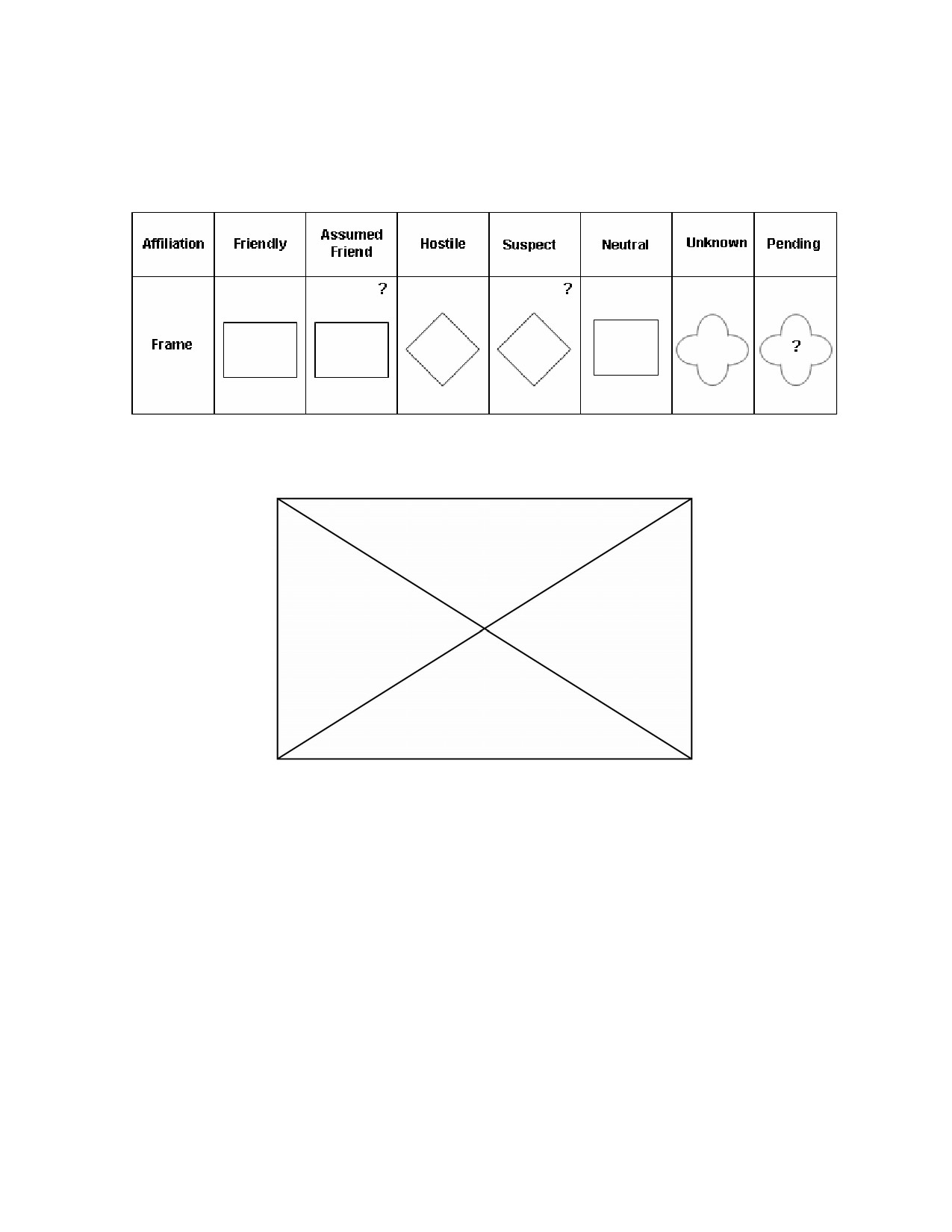
STP 41-38B14-SM-TG
Performance Steps
(friendly, hostile, neutral, and so on). The frame shape for suspect affiliation is
used for ground units not positively identified.
Figure 7. Land unit frame shapes and affiliations
(b) Step 2: Choose the branch or functional symbol for inside the frame. In Figure 8
the affiliation is friendly and the branch is infantry.
Figure 8. Friendly infantry unit
(c) Step 3: Choose the second (additional) branch symbol modifier (if required) that
further explains the capability of that unit. In this example, the branch symbol
modifier is “mechanized” or “armored”, as shown in Figure 9.
3-42
31 January 2008

STP 41-38B14-SM-TG
Performance Steps
Figure 9. Friendly mechanized infantry unit
(d) Step 4: Choose the third branch symbol modifier (if required) for the next capability.
In Figure 10 the third function or capability is “wheeled” or more appropriately
“wheeled armored vehicle.” This is called a mobility modifier. It describes the
capability of the unit to move personnel and equipment.
Figure 10. Friendly wheeled armored infantry unit
(e) Step 5: Choose a fourth branch symbol modifier for any other capability. In
Figure 11 the fourth function or capability is “gun system equipped.” It is possible to
have additional symbol modifiers; however, for this example, no further functional
or capability modifiers are required.
31 January 2008
3-43

STP 41-38B14-SM-TG
Performance Steps
Figure 11. Friendly wheeled armored infantry unit with gun systems
(f) Step 6: Choose the text or graphic modifiers as necessary to provide further
amplifying information. In Figure 12 the graphic modifier is the echelon symbol for
a battalion. Refer to Table 1 for echelon symbols.
Figure 12. Friendly wheeled armored infantry battalion with gun systems
(g) Step 7: Add a unique designation to the symbol. This is an alphanumeric
designator that uniquely identifies a particular unit. Figure 13 shows 4th Battalion
9th Infantry Regiment (MECH).
3-44
31 January 2008

STP 41-38B14-SM-TG
Performance Steps
Figure 13. Unique designation
c. Positioning unit symbols on the SITMAP.
(1) The center of mass of the unit symbol indicates the general vicinity of the center of
mass of the unit. To indicate precise location or reduce clutter on the SITMAP in an area
with multiple units, a line (without an arrow) extends from the center of the bottom of the
frame to the unit location displayed. The line may be extended or bent as required
(Figure 14).
Single Unit
Multiple Units
Figure 14. Offset and multiple unit locations
(2) When a group of units (or installations) other than a headquarters is at one location, the
grouping of the symbols may be enclosed with a bracket and the exact location
indicated by a line from the center of the bracket.
31 January 2008
3-45
STP 41-38B14-SM-TG
Performance Steps
(3) Headquarters unit symbols include a staff or line drawn from the bottom left-hand corner
of the frame (Figure 15). This staff may be bent or extended as required to indicate unit
location.
Figure 15. Offset and multiple headquarters locations
(4) When several headquarters are at one location, more than one headquarters can be on
a single staff. The highest echelon headquarters is placed on top, followed by the next
levels in descending order.
5. Determine document security classification of the SITMAP.
a. AR 380-5, Department of the Army (DA) Information Security Program, paragraph 1-9, The
Individual, states “All DA personnel, regardless of rank, grade, title, or position, have a
personal, individual, and official, responsibility to safeguard information, related to national
security, that they have access to. All DA personnel will report, to the proper authority, the
violations by others that could lead to the unauthorized disclosure of classified and sensitive
information. This responsibility cannot be waived, delegated, or in any other respect,
excused. All DA personnel will safeguard all information and material, related to national
security, especially classified information, which they access, and will follow the requirements
of this and other applicable regulations.”
b. Determine the highest overall classification of the map, or any of the information recorded on
the map or map board, by consulting with your supervisor.
c. Prominently display the highest classification (CONFIDENTIAL, SECRET, and so on) on the
map board, centered on the top and on the bottom margins of the SITMAP.
d. Comply with your unit’s standing operating procedure for handling and safeguarding
classified information.
6. Maintain the SITMAP. As time passes, update the SITMAP according to the changing situation.
This is a continuous process that includes moving graphic control measures, units, obstacles, and
updating the classification as required.
Evaluation Preparation: Setup: Provide the Soldier with adequate training/testing facilities, sufficient
time to review with task materials, pencil, paper, and needed resource materials.
3-46
31 January 2008
STP 41-38B14-SM-TG
Performance Measures
GO NO-GO
1. Defined SITMAP.
——
——
2. Identified the purpose of a SITMAP.
——
——
3. Prepared the base map.
——
——
4. Depicted graphic control measures on the SITMAP.
——
——
5. Depicted military units on the SITMAP.
——
——
6. Determined the document security classification.
——
——
7. Maintained the SITMAP.
——
——
Evaluation Guidance: Score the Soldier GO if all performance measures are passed. Score the Soldier
NO-GO if any performance measure is failed. If the Soldier fails any performance measure, explain and
show what was done incorrectly and how to do it correctly.
References
Required
Related
AR 380-5
FM 1-02
FM 3-05.40
FM 3-05.401
FM 3-25.26
31 January 2008
3-47
STP 41-38B14-SM-TG
Prepare a Civil Affairs Operations Overlay
331-38B-1026
Conditions: As a Civil Affairs (CA) Soldier assigned to a civil-military operations center, CA team, or
civil-military operations cell of a supported unit, you are tasked to prepare Civil Affairs operations (CAO)
overlays. You are given all required references and equipment, a current situation map (SITMAP), and
other military decisionmaking products.
Standards: Prepare Civil Affairs operations overlays to a given situation map in accordance with
FM 1-02, Operational Terms and Graphics.
Performance Steps
1. Define and identify the purpose of a CAO overlay.
a. Definition: A transparent layer of tactical, civil, or administrative information applied over a
SITMAP, aerial photograph or sketch, showing graphical details of the situation on the ground
at a particular time.
Note: On automated (computer) displays, map overlays are graphic layers of information joined
electronically to the base map layer, and are “turned on or off.” The scope of this task is limited to
instruction and guidance on map overlays hand-drawn on transparent sheets of clear acetate film, for use
with paper maps.
b. Purpose:
(1) A CAO overlay provides a rapid and efficient method for adding information to, or
removing information from, a SITMAP. This technique enables commanders and staff to
communicate details of an operational plan, concept, or friendly/enemy combatant force
situation, while preventing clutter or confusion, and maintaining readability of the SITMAP.
(2) Typical CAO overlays serve as layers of supplemental information and valuable details of
activities within the area of responsibility (AOR), including:
(a) Supported units.
(b) Resources.
(c) Dislocated civilians.
(d) Protected targets.
(e) Control measures.
(f) Supply routes.
(g) Obstacles.
(h) Points (target-, -of impact, -of departure, and so on).
(i) Lines (phase-, -of departure, -of contact, -of demarcation, and so on).
(j) Political boundaries.
(k) Psychological Operations product distribution areas.
(l) Critical infrastructure.
2. Prepare the base map and blank overlay sheets (Figure 1).
a. Base map.
(1) Ensure the base map is fixed to the map board to prevent shifting.
(2) Devise a method for securing an overlay sheet upon the SITMAP so that the overlay
cannot shift around while being used.
3-48
31 January 2008
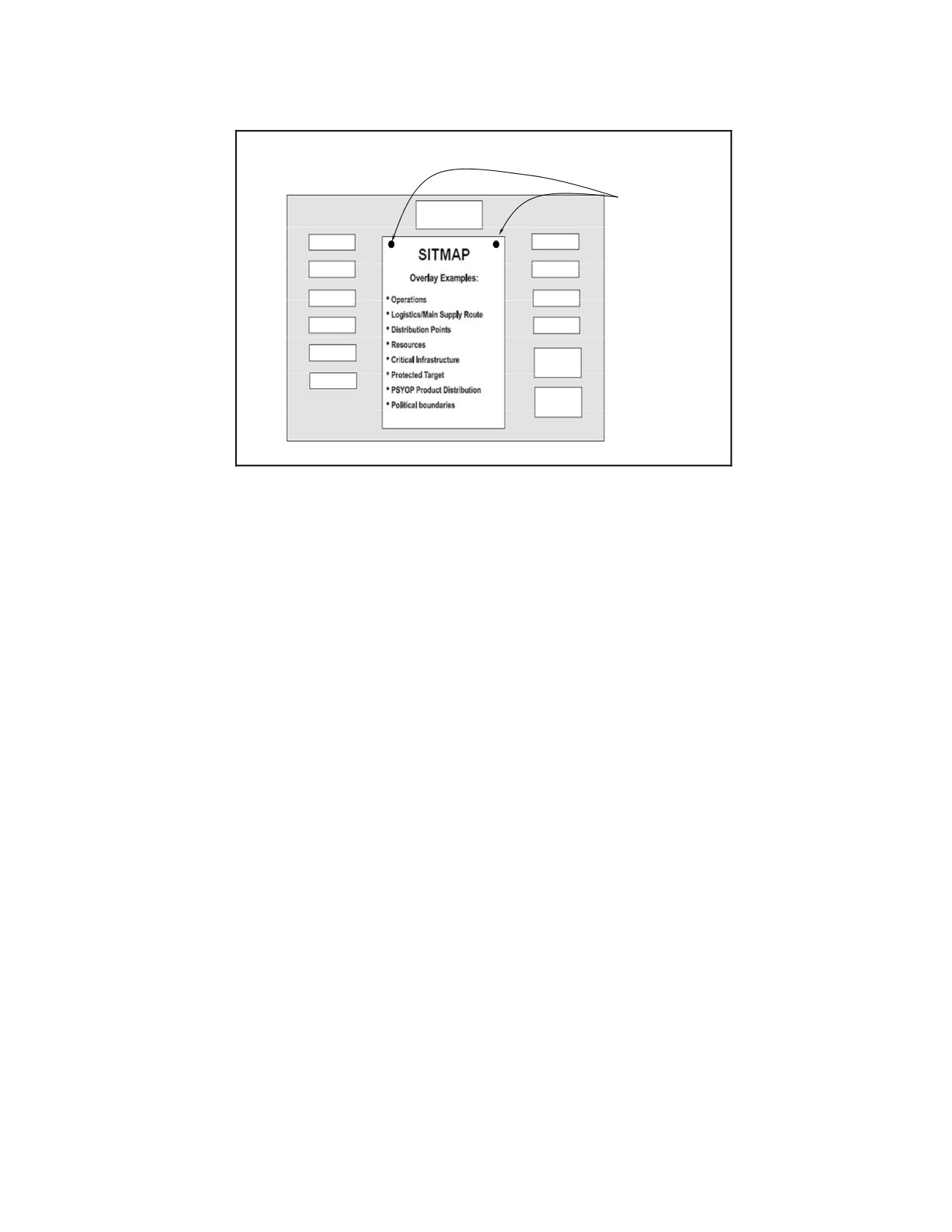
STP 41-38B14-SM-TG
Performance Steps
Position of fasteners, for hanging
overlays.
Figure 1. Map board with overlay fasteners
Note: One method is to fasten a wood screw (cup hook, binder clip, or any other fastening device) to
the top-left and top-right corners of the map board, approximately two inches in from the sides of the
SITMAP, as shown in Figure 1.
b. Blank overlays.
(1) Cut each sheet of acetate film to the same size as the base map, or slightly larger.
(2) Apply a durable cloth (2 inch duct) tape border over the top edge of each sheet of
acetate, resulting in tape on the front and back sides of the top edge.
(3) Align each acetate sheet with the map, and mark the position of the screws behind the
taped top edge of the acetate.
(4) Using a hole punch or knife, cut a clean hole through the taped edge of each acetate
sheet large enough to hang the sheet over the SITMAP. Test fit the overlay on the map
board fasteners.
3. Orient the overlay to the SITMAP.
a. Registration marks (Figure 2) show exactly where the overlay fits on the map; without them, it
is difficult to align the overlay with the map.
b. Place the overlay sheet over the SITMAP, and tape it in place so it cannot shift.
c. Using a straight edge and a permanent black ink marker, trace the grid intersections nearest
two diagonally opposite corners of the overlay, creating registration marks (crosshairs) on the
overlay (Figure 2).
CAUTION: Strive for precision when plotting the registration marks, as the smallest error will diminish
the accuracy of all information on the overlay.
d. Label each registration mark with the 4-digit coordinates for that grid intersection, as shown
in Figure 2.
31 January 2008
3-49

STP 41-38B14-SM-TG
Performance Steps
07
80
REGISTRATION
MARKS
BASE
MAP
77
OVERLAY
03
SHEET
03
04
05
06
07
Figure 2. Overlay with registration marks
4. Observe rules and standards for plotting supplemental information on an overlay.
a. FM 1-02 is the primary source for developing and depicting hand-drawn (and computer-
generated) military symbols for situation maps, overlays, and aerial photographs for all types
of military operations.
b. Use standard symbols and graphic control measures found in FM 1-02.
(1) A symbol is a graphic representation of units, equipment, installations, control
measures, and other elements relevant to military operations. These symbols provide a
common visual language for all users. Standardization of military symbols is essential if
operational information is to be passed among military units without misunderstanding.
(2) Graphic control measures are graphic directives given by a commander to subordinate
commanders to assign responsibilities, coordinate fire and maneuver, and control
combat operations. They include boundaries; lines; areas; points; targets; or nuclear,
biological or chemical attacks/events.
c. Draw graphic control measures, symbols and details on the overlay at the same scale as on
the map (aerial photograph, or other graphic) and oriented to their true position on the
ground.
d. If you have observed any topographic or cultural features on the ground that are not shown
on the base map, such as a new road or a destroyed bridge, plot their positions as accurately
as possible on the overlay and mark with the standard topographic symbols.
e. An accurate, well-organized set of overlays is an indispensable tool for representation of
current CMO activity.
5. Produce CAO overlays.
Note: The contents and details of each overlay are variable, depending upon the scope of activity in the
AOR and requirements of the primary users of the overlay. Overlays are frequently used as
supplements to orders or reports, where the recipient will have an identical map, so it may be
necessary to show only that detail with which the order or report is directly concerned.
a. Prepare a protected target overlay.
(1) Figure 3 is an example of a protected target list (PTL), which you might produce by
reconnaissance, or may be provided by your supervisor.
3-50
31 January 2008

STP 41-38B14-SM-TG
Performance Steps
Figure 3. Example of a protected target list
(2) Figure 4 shows what a protected target overlay will look like. This overlay diagram
depicts eight protected sites-two from each of the four functional areas recorded on the
PTL in Figure 3 above. It also includes the two required grid reference points, and the
security classification centered at both the top and bottom edges of the overlay.
Figure 4. Diagram of a protected target overlay
(3) Using the SITMAP and PTL provided by the supervisor for your AOR prepare a
protected target overlay.
(a) Plot and label the essential registration marks on a blank overlay sheet.
(b) Plot and label a minimum of six targets.
(c) Add the classification to the overlay.
b. Prepare a dislocated civilians (DC) overlay.
(1) Figure 5 shows what a DC overlay will look like. This overlay diagram depicts DC
movement routes, check points along the movement routes, control and assembly
points, emergency rest areas, and any DC facility. It also includes the two required grid
31 January 2008
3-51
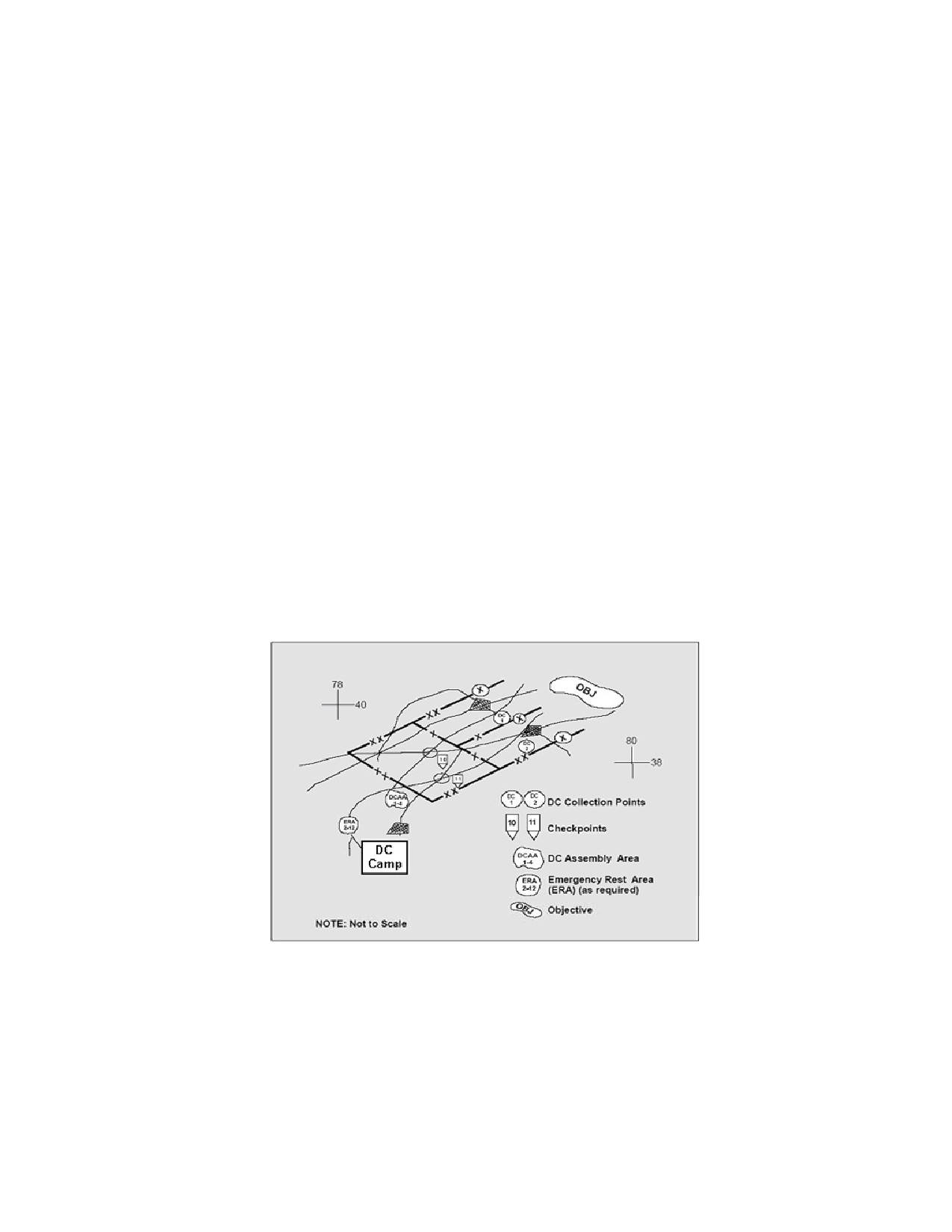
STP 41-38B14-SM-TG
Performance Steps
reference points, and the security classification centered at both the top and bottom
edges of the overlay.
(2) Depict major DC considerations on the overlay.
(a) Assembly areas. An assembly area is a temporary holding area for civilians before
they return to their homes or move to a more secure area. Assembly areas are
usually in a secure, stable environment and may include schools, churches, hotels,
and warehouses.
(b) Movement routes. All DC movements take place on designated routes that are
kept free of civilian congestion. When selecting routes for civilian movement,
consider the types of transportation common to the area.
(c) Control and assembly points. After selecting and marking the movement routes,
CA and host nation authorities establish control and assembly points at selected
key intersections. The G-9 or S-9 coordinates with the provost marshal, the
movement control center, and the G-4 for the locations of these points for inclusion
in any traffic circulation plan.
(d) Emergency rest areas. CA personnel set up emergency rest areas at congested
points to provide for the immediate needs of the DCs. These needs include water,
food, fuel, maintenance, and medical services.
(e) Dislocated civilians camp. The location of the DC camp is extremely important.
Engineer support and military construction materials are necessary when camps
are in areas where local facilities are unavailable-for example, hotels, schools,
halls, theaters, vacant warehouses, unused factories, or workers’ camps. CA
Soldiers must avoid those sites near vital communication centers, large military
installations, or other potential military targets. The location of the camp also
depends on the availability of food, water, power, and waste disposal. Additional
considerations include the susceptibility of the area to natural or man-made
disasters (for example, flooding, pollution, and fire) and the use of camp personnel
as a source of local labor support.
Figure 5. Example of a dislocated civilian overlay
(3) Using the SITMAP and detailed information provided by your supervisor for your AOR
prepare a DC overlay.
(a) Plot and label the essential registration marks on a blank overlay sheet.
(b) Plot and label assembly areas, as applicable.
(c) Plot and label movement routes, as applicable.
(d) Plot and label control and assembly points, as applicable.
(e) Plot and label emergency rest areas, as applicable.
3-52
31 January 2008
STP 41-38B14-SM-TG
Performance Steps
(f) Plot and label the DC camp, as applicable.
(g) Add the classification to the overlay.
6. Record marginal information on the overlay. When all required detail has been plotted or traced on
the overlay, print marginal information as close to the lower right-hand corner as detail permits, as
shown in Figure 6. Include the following data:
a. Title and objective -this tells the reader why the overlay was made and may also give the
actual location. For example, “Road Reconnaissance” is not as specific as “Route 146 Road
Reconnaissance.”
b. Time and date of information-the exact time the information was obtained helps users when
determining its reliability and usefulness.
c. Map reference-sheet name, sheet number, map series number, map scale. If the reader
does not have the same map that was used for the overlay, this provides the information
necessary to obtain it.
d. Author-the name, rank, and organization of the author, supplemented with a date and time of
preparation of the overlay, tells the reader if there was a time difference between when the
information was obtained and when it was reported.
e. Legend-if nonstandard symbols were invented to show the required information.
f. Security classification-the highest classification of either the map or the information placed
on the overlay. State if the information and map are unclassified.
g. Additional information-any other essential information that amplifies the overlay. Make it as
brief as possible.
TITLE: PROTECTED TARGET OVERLAY -
VUCO VILLAGE
DATE AND TIME OF INFORMATION (DTG):
270630ZAPR05
MAP REFERENCE-
SHEET NAME: VUCO AREA
SHEET NO.: 40-48 IV
MAP SERIES NO.: T7-110
SCALE: 1:25,000
PREPARED BY-
NAME: CAMAN
RANK: SGT
ORGANIZATION: CATA 11
DATE AND TIME: 271000APR05
(CLASSIFICATION) LEGEND:
Figure 6. Example of marginal information on the overlay
Evaluation Preparation: Setup: Provide the Soldier with adequate training/testing facilities, sufficient
time to review with task materials, pencil, paper, and needed resource materials.
Performance Measures
GO NO-GO
1. Defined and identified the purpose of a CAO overlay.
——
——
2. Prepared the base map and blank overlay sheets.
——
——
3. Oriented the overlay to the SITMAP.
——
——
31 January 2008
3-53
STP 41-38B14-SM-TG
Performance Measures
GO NO-GO
4. Observed rules and standards for plotting supplemental information on an
——
——
overlay.
5. Prepared a protected target overlay.
——
——
6. Prepared a DC overlay.
——
——
7. Recorded marginal information on the protected target overlay and the DC
——
——
overlay.
Evaluation Guidance: Score the Soldier GO if all performance measures are passed. Score the Soldier
NO-GO if any performance measure is failed. If the Soldier fails any performance measure, explain and
show what was done incorrectly and how to do it correctly.
References
Required
Related
FM 1-02
FM 3-05.401
FM 3-25.26
3-54
31 January 2008
STP 41-38B14-SM-TG
Integrate Civil Affairs Operations Overlays with Other Staff Sections
331-38B-1027
Conditions: As a Civil Affairs (CA) Soldier assigned to a civil-military operations center (CMOC) or the
civil-military operations (CMO) cell of a supported unit, you are tasked to integrate Civil Affairs operations
(CAO) overlays with other staff sections. A situation map with CAO overlays, overlays of other staff
sections, and all required references and equipment are available.
Standards: Integrate the CAO overlays with other staff sections in accordance with FM 1-02, Operational
Terms and Graphics.
Performance Steps
1. Identify other staff sections within your supported command requiring integration and coordination
for overlays.
a. Integration of overlays with other staff sections is a deliberate process for distributing and
receiving vital information such as enemy and friendly situations; active and planned dislocated
civilian operations; the status of arts, monuments, archives and resources; or historical event
records.
b. Confer with your supervisor to determine names and locations of staff using the same base
map as your section:
(1) Requiring overlay information that you are generating and maintaining.
(2) Providing overlay information that the CMOC requires.
WARNING: Consult with your supervisor before providing information to civilian authorities, foreign nation
organizations, intergovernmental organization, nongovernmental organizations or any individuals or
organizations outside of your command.
(3) Your supervisor will check with the principal staff officer (S-3) having staff responsibility for
operations security. The S-3 plans, coordinates, approves, and directs the S-2 section in
intelligence analysis, production, and dissemination, and is responsible for information
security.
c. Establish voice communications and digital connections (telephone, facsimile, and computer)
with the supported staff, including contingency plans for exchanging information during periods
of disrupted operations.
d. Maintain a directory of supported and supporting staff, for ready reference. Inform your
supervisor of the location of your directory.
2. Collect and record vital information from your sources.
a. CMOC and Civil Affairs team Soldiers engage in a systematic, continuous process of analyzing
the changing civil and threat environment within their assigned geographic area. Well-
maintained maps and overlays depict current and future CA activities and operations, support
running estimates of the situation, and contribute significantly to the military decisionmaking
process.
b. Establish a schedule with your sources (internal to your command and external) to receive
regular information updates required for charts, maps and overlays for which you are
responsible.
c. Receive and publish this information in a regular and dependable manner.
d. Maintain contact information on the supported staff, for ready reference.
3. Synchronize with the schedule and routine of supported staff.
a. Confirm when your CMO officer briefs the supported commander. Ensure overlays are current,
updated, and delivered to the briefing location on time.
b. Coordinate with supported staff; establish a schedule for the receipt or delivery of operational
overlay information.
c. As necessary, set up work schedules for 24-hour operations to receive, process, and deliver
information for supported staff.
31 January 2008
3-55
STP 41-38B14-SM-TG
Performance Steps
4. Deliver charts, maps, and overlays or pick up source information IAW unit standing operating
procedures (SOPs) and information security regulations.
a. AR 380-5, Department of the Army (DA) Information Security Program, paragraph 1-9, The
Individual, states: “All DA personnel, regardless of rank, grade, title, or position, have a
personal, individual, and official, responsibility to safeguard information, related to national
security that they have access to. All DA personnel will report, to the proper authority, the
violations by others that could lead to the unauthorized disclosure of classified and sensitive
information. This responsibility cannot be waived, delegated, or in any other respect, excused.
All DA personnel will safeguard all information and material, related to national security,
especially classified information, which they access, and will follow the requirements of this and
other applicable regulations.”
b. Read, understand and comply with AR 380-5, Chapter 8, Transmission and Transportation of
Classified Information.
c. Collect source information and deliver charts, maps, and overlays IAW AR 380-5, paragraph
8-12, escort or hand carrying of classified material.
d. Prepare a Standard Form (SF) 135 (Records Transmittal and Receipt) and acquire a signature
from the recipient, for each and every document you deliver. Keep and file this form in a secure
location.
e. Prepare an SF 135 for each and every document you receive (if not prepared by the provider of
the document), and insist upon signing and keeping a copy of the SF 135 for the record.
5. Maintain an SOP of your duties and responsibilities for ready reference by others. Include the
following:
a. Directory of integrated staff, with the following information, as a minimum:
(1) Supported or supporting staff section title.
(2) Location of supported or supporting staff section.
(3) Rank and name of supported or supporting Soldiers.
(4) Contact information (for example: telephone, email, radio).
b. Details of what overlay information is provided/required by your section.
c. Schedule for receipt and delivery of overlays.
(1) What are the dates and times required for receipt of information from others?
(2) What are the dates, times, and places for delivery of information to others?
Evaluation Preparation: Setup: Provide the Soldier with adequate training/testing facilities, sufficient
time to review with task materials, pencil, paper, and needed resource materials.
Performance Measures
GO NO-GO
1. Identified staff within the area of responsibility requiring integration and
——
——
coordination for overlays.
2. Collected and recorded vital information from supporting staff.
——
——
3. Synchronized with the schedule and routine of supported staff.
——
——
4. Delivered charts, maps, and overlays or picked up source information IAW unit
——
——
operations SOP and information security regulations.
5. Maintained an SOP of duties and responsibilities.
——
——
Evaluation Guidance: Score the Soldier GO if all performance measures are passed. Score the Soldier
NO-GO if any performance measure is failed. If the Soldier fails any performance measure, explain and
show what was done incorrectly and how to do it correctly.
3-56
31 January 2008
STP 41-38B14-SM-TG
References
Required
Related
AR 380-5
FM 1-02
FM 3-05.401
FMI 5-0.1
31 January 2008
3-57
STP 41-38B14-SM-TG
Process Classified Material
331-38B-1029
Conditions: As a Civil Affairs (CA) Soldier assigned to a civil-military operations center, you are tasked to
process classified material in order to safeguard information from unauthorized disclosure. All required
materials and references are available.
Standards: Process classified material in accordance with AR 380-5, Department of the Army
Information Security Program, distinguish unclassified material from properly marked classified materials,
identify the levels of classification, explain restricted access and identify methods for destroying classified
materials.
Performance Steps
1. Define classified material. AR 380-5 states classified national security information, or classified
information, is defined as: “Information and/or material that has been determined, pursuant to
Executive Order (EO) 12958, Classified National Security Information, or any predecessor order, to
require protection against unauthorized disclosure and is marked to indicate its classified status
when in documentary or readable form.”
2. Identify the three levels of classification.
a. TOP SECRET-will be applied to information in which the unauthorized disclosure could
reasonably be expected to cause exceptionally grave damage to the national security.
b. SECRET-will be applied to information in which the unauthorized disclosure could reasonably
be expected to cause serious damage to the national security.
c. CONFIDENTIAL-will be applied to information in which the unauthorized disclosure could
reasonably be expected to cause damage to the national security.
d. UNCLASSIFIED-is applied to a wide range of unclassified types of official information, which,
although not requiring protection as national security information, is limited to official use and is
not publicly releasable. Markings such as “For Official Use Only” and “Limited Official Use” are
not used to identify classified information.
3. Protect classified information through restricted access.
a. DA personnel are responsible, both personally and officially, for safeguarding classified
information for which they have access. This responsibility includes ensuring they do not permit
access to sensitive or classified information by unauthorized personnel.
b. Any person who does not have a need-to-know and who is not cleared or granted access to
information at that level, in accordance with the policy established in AR 380-67, The
Department of the Army Personnel Security Program, is considered unauthorized personnel.
c. No person will be granted access to classified information solely by virtue of rank, title, or
position.
4. Identify methods of destroying classified material.
a. Classified material will be destroyed completely to preclude recognition or reconstruction of the
classified information contained in or on the material.
b. The methods for routine destruction of classified material are approved for use by Army
commands when the “secure volume” and “data density,” concepts are employed; they are:
(1) Burning. A means of pyrolysis, such as a high temperature chemical change, by forced-air
incinerators, or by any other incinerator or incendiary equipment that reduces the material
to an ash such that reconstruction of the information is not possible. No other single
destruction method has been found to be as effective, versatile, and secure, as burning.
(2) Shredding. Crosscut shredders are the only authorized shredders approved for use in the
destruction of classified information. The crosscut shredding machine must reduce the
material to shreds no greater than 1/32d of an inch (plus 1/64th inch tolerance) by 1/2 inch
crosscut.
(3) Pulping. Standard wet process pulpers, with a 1/4-inch or smaller diameter perforated
3-58
31 January 2008
STP 41-38B14-SM-TG
Performance Steps
security screen, are approved for the destruction of classified paper-based documents.
Since the pulping process entails wetting and dissolving action, plastic-based or other
water-repellent-type papers will not be put through this system.
(4) Pulverizing. Interim Federal Specifications FF-P-00810A, with Amendment 3, covers
pulverizing as a dry destruction process. It does not specify a specific dry destruction
method; thus, within this category are hammer mills, choppers, hoggers, and hybridized
disintegrating equipment.
Evaluation Preparation: Setup: Provide the Soldier with adequate training/testing facilities, sufficient
time to review with task materials, pencil, paper, and needed resource materials.
Performance Measures
GO NO-GO
1. Identified classified material.
——
——
2. Identified the three levels of classification.
——
——
3. Described classified information access requirements.
——
——
4. Identified at least two methods of destroying classified material.
——
——
Evaluation Guidance: Score the Soldier GO if all performance measures are passed. Score the Soldier
NO-GO if any performance measure is failed. If the Soldier fails any performance measure, explain and
show what was done incorrectly and how to do it correctly.
References
Required
Related
AR 380-5
AR 380-67
31 January 2008
3-59
STP 41-38B14-SM-TG
Employ Digital Imagery Systems
331-38B-1031
Conditions: As a Civil Affairs (CA) Soldier assigned to a Civil Affairs team, given a digital imagery device,
accessories, operating instructions, computer with required imagery software, mission guidance and unit
standing operating procedures (SOPs), you are tasked to employ imagery systems to support the
collection of civil information.
Standards: Describe the reasons for use and restrictions for the use of digital imagery systems in
accordance with (IAW) unit SOPs and mission guidance. Demonstrate the operation of the given digital
imagery device IAW the operating instructions; the proper organization, storage, and dissemination of
imagery IAW the unit SOP and mission guidance.
Performance Steps
1. Identify reasons for the CA Soldier to use digital imagery systems to assist in mission
accomplishment:
a. Historical information (transition, follow-on operations, and so on).
b. Assessments (crops, livestock, wells, and so on).
c. Damage (natural, conflict, disaster, and so on).
d. Claims (residence, property, and so on).
e. Projects (progress, nominated, completed, and so on).
f. Intelligence (passive only).
g. Meetings (attendees, facilities, and so and).
h. Public gatherings (riots, humanitarian assistance distribution, special events, public affairs
office, and so on).
i. Security (checkpoints, physical security of a site, and so on).
j. Identification (host nation labor, food distribution, permits, weapons, camp control, health
facilities, and so on).
2. Identify restrictions on the use of digital imagery systems. There are times when digital media should
not be used during CA operations for cultural or military reasons. Reading the area study and
receiving a detailed briefing on the people and place you will be operating in will help clarify the dos
and don’ts. Coordinate with the S-2 as to what can and cannot be photographed or filmed. These
include:
a. Taboo subjects (women, children, prayers, and so on).
b. Cultural sites (museums, historical buildings, and so on).
c. Religious areas (places of worship, cemeteries, and so on).
d. Political (voters that fear reprisal, key figures, elected officials, and so on).
e. Sensitive areas on military bases.
3. Operate a digital device. There are many different digital devices that you may be required to use.
Utilizing the instructions that come with the device you should:
a. Inspect the various parts of the device.
b. Identify the various capabilities of the device (zoom, amount of photos/video the memory can
store, and so on).
c. Place the device into operation.
d. Adjust the device setting for the required photograph (identification, document, and so on), and
conditions (dusk, bright light, and so on).
e. Shoot the imagery.
f. Save, delete, or edit the imagery in the camera.
g. Take the camera out of operation.
h. Maintain and store the camera IAW the operating instructions.
4. Organize digital images in a computer. There are many different ways to transfer digital images to a
computer. Utilizing the instructions that came with the digital device and the proper computer
3-60
31 January 2008
STP 41-38B14-SM-TG
Performance Steps
program you should:
a. Prepare computer storage medium (hard-drive, compact disk, and so on) by creating a folder
(named and dated) to download the imagery to.
b. Download the imagery to the chosen folder.
c. Check to ensure the images can be accessed and viewed.
d. Name and date each image.
5. Disseminate digital imagery. On the battlefield by using the means available you must transmit
digital imagery to higher. Using the instructions for the particular transmitting device being used you
must:
a. Upload the imagery in the required format (size, type, and so on) for the software being used
(attach to document or report if necessary).
b. Send the imagery to end user.
Evaluation Preparation: Setup: Provide the Soldier with adequate training/testing facilities, sufficient
time to review with task materials, pencil, paper, and needed resource materials.
Performance Measures
GO NO-GO
1. Described the reasons for the use of digital imagery systems during civil-military
——
——
operations.
2. Described the restrictions for the use of digital imagery systems during civil-
——
——
military operations.
3. Demonstrated the use of the digital imagery device.
——
——
4. Demonstrated the organization of digital imagery
——
——
5. Demonstrated the storage of digital imagery.
——
——
6. Demonstrated the dissemination of digital imagery.
——
——
Evaluation Guidance: Score the Soldier GO if all performance measures are passed. Score the Soldier
NO-GO if any performance measure is failed. If the Soldier fails any performance measure, explain and
show what was done incorrectly and how to do it correctly.
References
Required
Related
FM 3-05.401
31 January 2008
3-61
STP 41-38B14-SM-TG
Subject Area 3: Civil-Military Operations
Identify the Impact of Military Operations on Civilians in the Area of Operations
331-38B-1007
Conditions: As a Civil Affairs (CA) Soldier assigned to a Civil Affairs team, you have been tasked to
assist your team in preparing a briefing for the supported commander. In the process of preparing the
briefing you are required to identify the impact of military operations on civilians in the area of operations
(AO). All required references and equipment are available.
Standards: Identify the impact of military operations on civilians in the AO in accordance with
FM 3-05.40, Civil Affairs Operations, and FM 3-05.401, Civil Affairs Tactics, Techniques, and Procedures.
Performance Steps
1. Identify the short-term and long-term effects of military operations.
a. The type/length of a military mission will affect the surrounding civilian environment. These
consequences may have an impact on the following aspects of the surrounding environment
and infrastructure:
(1) Political-interrelated issues, positions, and interests associated with the agendas of
various groups or individuals.
(2) Economic-sources and distribution of wealth.
(3) Social-family and regional.
b. Some consequences are significant and CA personnel must consider the long-term effects and
advise unit commanders and staffs of the consequences.
2. Measure and assess various facets of daily life to determine the impact of military operations on
civilians in the AO.
a. Measuring the impact of military operations on civilians in the AO by identifying:
(1) The number of civilians killed or wounded.
(2) Kilometers of ground taken.
(3) The reductions in the level of violence against Soldiers.
(4) The number of children being fed.
(5) The gallons of potable water being pumped.
(6) The number of weapons being turned in.
b. The purpose of each assessment is to determine current conditions, compare them to a
defined norm, establish standards or measures of effectiveness, and identify needs or
requirements that can be addressed by Civil Affairs operations (CAO) or civil-military
operations.
3. Identify the categories of civilians in the AO. Military forces will encounter civilians of different
backg1rounds living and operating in and around the military AO. To facilitate determining who the
civilians might be, it is useful to separate civilians into distinct categories. These categories might
include the following:
a. Indigenous populations and institutions (IPI) to include local nationals.
b. Host nation (HN) civil authorities.
c. Expatriates.
d. Foreign employees of multinational corporations.
e. United States Government (USG) and third-nation government agency representatives.
f. United Nations (UN) representatives.
g. Contractors.
h. Morale, welfare, and recreation personnel.
i. Department of Defense (DOD) civilians.
j. The media.
k. Local disaster victims.
l. Local, regional, or national domestic civil authorities.
3-62
31 January 2008
STP 41-38B14-SM-TG
Performance Steps
m. Emergency service agencies.
n. Nongovernmental organizations (NGOs).
o. Intergovernmental organizations (IGOs).
4. Identify civilian activities in the AO.
a. Civilian activities are dictated primarily by the type of environment in which they occur. Each
category of civilians should be considered separately, as their activities will impact the AO
differently. Examples of the types of questions that CA Soldiers must consider to determine the
impact of military operations on civilians in the AO are—
(1) IPI-these include the civilian population of the AO (legal citizens, legal and illegal
immigrants, and all categories of displaced civilians), governmental, tribal, commercial,
and private organizations and entities.
(a) Are the IPI peacefully going about their daily life activities, or have their daily lives
been disrupted to the point that they require outside assistance?
(b) Are they evacuating their homes for safer rear areas, clogging the main supply
routes, and placing a burden on CA units’ limited resources to sustain them?
(c) Are they staying put in basements and other temporary shelters?
(2) HN civil authorities-these include elected and traditional leaders at all levels of
government.
(a) Are they supportive of CA Soldiers’ presence or are they inciting the local nationals
against CA?
(b) Are they seeking CA personnel’s direct assistance to alleviate their plight?
(c) Are foreign employees conducting business as usual, or are they seeking to be
evacuated?
(d) What kind of security forces, if any, are they employing?
(e) Will their own logistics operations compete with CA for resources such as port
facilities, storage facilities, and rail, air, or ground transportation?
(3) IGOs and NGOs-these include high-level IGOs and NGOs and lower-level employees.
(a) What UN agencies are present and what are their charters?
(b) What is the relationship between CA’s operations and UN operations?
(c) Can CA personnel expect very important persons in their AO?
(4) USG and third-nation government representatives-these include members of the Country
Team, United States Agency for International Development (USAID), and similar agencies
of foreign nations involved in the operation. What U.S. and third-nation government
agencies are in the AO and how do their operations relate to CA?
(5) Contractors-these include U.S. citizens, local nationals, and third nation citizens providing
contract services to CA’s operation. What contractors are present and what support
activities are they providing?
(6) DOD civilians-these are members of table of organization and equipment and table of
distribution and allowances units. DOD plays an increasingly greater role in combat
support and combat service support. How many DOD civilians are in the AO?
(7) The media-this includes journalists from print, radio, and visual media.
(a) Are they self-sufficient or do they require support, such as transportation and
security?
(b) What aspects of the AO are the media focused on?
b. Military operations affect civilian activities in various ways throughout the spectrum of conflict.
In war, conflict, or stability operations and civil support operations, commanders should
consider the political, economic, psychological, environmental, and legal impact of their
operations on the categories of civilians they have identified in their AO. The following are
examples of the types of questions CA Soldiers and staff planners must consider:
(1) Political-local, regional, national, or international levels.
(a) Do CA actions tend to improperly or inappropriately favor one group, faction, or
leader over another?
(b) Can CA actions be exploited by opposing political groups, factions, or leaders?
31 January 2008
3-63
STP 41-38B14-SM-TG
Performance Steps
(2) Economic-this pertains to local economic activities, as well as the activities of
multinational corporations and NGOs.
(a) Is military seaport, airport, or highway traffic interfering with commercial or
developmental traffic in the AO?
(b) Are military operations attracting large numbers of vendors into CA’s AO?
(c) Who are the economic beneficiaries of CA personnel’s presence (legitimate local
community members or local criminal elements)?
(d) Are military payments to local individuals or groups for goods and services
contributing to shifts in the local economic or political power structure?
(3) Environmental-at some point, CA personnel must begin to consider what their role will be
to help civilians recover from the effects of CAO. What effect are CAO having on shelters,
infrastructure, and subsistence mechanisms in the AO?
(4) Legal. The commander is responsible for everything that happens within his defined
geographic or area of responsibility. The commander’s primary responsibilities are to the
mission and to the Soldiers under his command. The commander is also bound by
international law (the Geneva-Hague Conventions) to safeguard noncombatant life and
property.
(a) Do the noncombatants have the resources and capabilities to take care of
themselves?
(b) If, how, and when will the commander provide the basics of life—food, water, shelter,
and security—until this responsibility can be passed on to higher headquarters, local
civil authorities, or NGOs?
Evaluation Preparation: Setup: Provide the Soldier with adequate training/testing facilities, sufficient
time to review with task materials, pencil, paper, and needed resource materials.
Performance Measures
GO NO-GO
1. Identified the short-term and long-term effects of military operations.
——
——
2. Identified the categories of civilians in the AO.
——
——
3. Identified civilian activities in the AO.
——
——
Evaluation Guidance: Score the Soldier GO if all performance measures are passed. Score the Soldier
NO-GO if any performance measure is failed. If the Soldier fails any performance measure, explain and
show what was done incorrectly and how to do it correctly.
References
Required
Related
FM 3-05.40
FM 3-05.401
3-64
31 January 2008
STP 41-38B14-SM-TG
Describe the Organization and Functions of a Civil-Military Operations Center
331-38B-1020
Conditions: As a member of a Civil Affairs team attached to a supported unit, the supervisor, as part of
the integration process with the supported unit, has tasked you to complete the portion of a briefing that
describes the organization and functions of a civil-military operations center (CMOC). All required
references and equipment are available.
Standards: Describe the functions and capabilities of a CMOC in accordance with FM 3-05.40, Civil
Affairs Operations, and FM 3-05.401, Civil Affairs Tactics, Techniques, and Procedures.
Performance Steps
1. Define a CMOC. A CMOC is a standing capability formed by all Civil Affairs (CA) units from the
company level to the CA forces among indigenous populations and institutions (IPIs), humanitarian
organizations, intergovernmental organizations (IGOs) and nongovernmental organizations (NGOs),
multinational military forces, and other government agencies (OGAs) of the United States
Government (USG).
2. Describe the organization of a CMOC.
a. The size of the organizational structure and the operational focus of the CMOC changes from
the CACOM down to the battalion, but the roles of the various elements of the CMOC are
basically the same.
b. A CMOC will at a minimum consist of:
(1) A headquarters element.
(2) An operations and intelligence section.
(3) A civil information management (CIM) cell.
(4) A civil liaison team (CLT).
(5) A functional specialty cell.
(6) A sustainment section.
(7) A communications section.
c. Typically, the CMOC is established and run by CA assets, however, any military service can
establish and run a CMOC depending on the mission and higher guidance or availability of
supporting CA assets.
d. The location of a CMOC will vary with each mission. Factors include force protection, hostile or
nonhostile environment, and whether or not it will be located inside an established military
camp or located out in the local town.
3. Identify the functions of a CMOC. The CMOC—
a. Is modular, scalable, and enables the execution and monitoring of CAO.
b. Is the focal point for collaboration, coordination, and communication dealing with the civil
component of the commander's operational environment.
c. Coordinates the interaction of United States (U.S.) and multinational forces with OGAs, IGOs,
NGOs, and IPIs.
d. Plans, coordinates, directs, and controls CMO and provides the command and control (C2) of
forces assigned under it.
e. Manages projects within its area of responsibility (AOR) and facilitates disengagement plans.
f. Provides access and civil-military operations (CMO)-related data and information from and to
nonmilitary agencies operating away from the military headquarters (HQ).
4. Identify the types of meetings that may be conducted in a CMOC.
a. Information meetings-CMOC representatives provide information to the attendees on the
security environment (tailored to nonmilitary operations), status of requests for assistance, and
so on.
b. Coordination meetings-participants have decision-making authority to coordinate operations
and resources for their particular agency.
31 January 2008
3-65
STP 41-38B14-SM-TG
Performance Steps
c. Negotiation meetings-CMOC representatives mediate discussions and agreements between
opposing parties.
d. Information-sharing meetings-participants gather in an unstructured atmosphere to discuss
issues of their own interest with their counterparts and contemporaries. These are often the
most productive of all and may occur after more structured meetings, including interagency
coordination, mediation (with negotiation), and census building.
Evaluation Preparation: Setup: Provide the Soldier with adequate training/testing facilities, sufficient
time to review with task materials, pencil, paper, and needed resource materials.
Performance Measures
GO
NO-GO
1. Defined what a CMOC is. A standing capability formed by all CA units from the
——
——
company level to the CA forces among IPIs, humanitarian organizations, IGOs,
and NGOs, multinational military forces, and OGAs of the USG.
2. Described the organization of a CMOC. A CMOC will at a minimum consist of—
——
——
a. A headquarters element.
b. An operations and intelligence section.
c. A CIM cell.
d. A CLT.
e. A functional specialty cell.
f. A sustainment section.
g. A communications section.
3. Identified the functions of a CMOC. The CMOC—
——
——
a. Is modular, scalable, and enables the execution and monitoring of CAO.
b. Is the focal point for collaboration, coordination, and communication dealing
with the civil component of the commander's operational environment.
c. Coordinates the interaction of U.S. and multinational forces with OGAs,
IGOs, NGOs, and IPIs.
d. Plans, coordinates, directs, and controls CMO, and provides the C2 of forces
assigned under it.
e. Manages projects within its AOR and facilities disengagement plans.
f. Provides access and CMO-related data and information from and to
nonmilitary agencies operating away from the military HQ.
4. Identified the types of meetings that may be conducted in a CMOC.
——
——
a. Information meetings.
b. Coordination meetings.
c. Negotiation meetings.
d. Information sharing meetings.
Evaluation Guidance: Score the Soldier GO if all performance measures are passed. Score the Soldier
NO-GO if any performance measure is failed. If the Soldier fails any performance measure, explain and
show what was done incorrectly and how to do it correctly.
References
Required
Related
FM 3-05.40
FM 3-05.401
3-66
31 January 2008
STP 41-38B14-SM-TG
Define a Civil-Military Operations Estimate
331-38B-1034
Conditions: As a Civil Affairs (CA) Soldier assigned to a civil-military operations cell of a supported unit
headquarters, you are given all required references and equipment and are tasked to define a civil-
military operations (CMO) running estimate in order to begin the military decisionmaking process
(MDMP).
Standards: Define the CMO running estimate in accordance with FM 3-05.40, Civil Affairs Operations,
Appendix B.
Performance Steps
1. Define a running estimate.
a. A running estimate is an assessment of the situation and an analysis of those courses of action
(COAs) a command is considering that best accomplish the mission. It includes an evaluation
of how factors in a staff section’s functional area influence each COA and includes conclusions
and a recommended COA to the commander. The running estimate:
(1) Parallels the MDMP.
(2) Structure is based on mission analysis, facts and assumptions, and analysis of the factors
of mission, enemy, terrain and weather, troops and support available-time available, and
civil considerations.
(3) Consists of significant facts, events, and conclusions based on analyzed data.
(4) Recommends how to best use available resources.
(5) Is for any operational situation and all levels of command.
(6) Is written or presented orally.
(a) At the tactical level, especially during operations and exercised, estimates are
usually delivered orally, supported by charts and other decision support tools.
(b) During contingency planning, especially at corps level and above, estimates are
usually written.
(c) During deliberate planning at joint headquarters, estimates are ALWAYS written.
b. The focus of running estimates.
(1) All staff sections except the intelligence section focus on friendly COAs and their
supportability.
(2) The intelligence section focuses on the enemy and dangerous COAs.
c. Complete running estimates contain information necessary to answer any question the
commander poses to determine the appropriate COA to accomplish the mission.
d. Once the commander decides on a COA, running estimates transition to a running estimate
that supports decision making during execution.
e. Estimates are as thorough as time and circumstances permit.
f. A running estimate is continuously updated based on new information, as the operation
proceeds.
2. Identify the CMO running estimate and its role in the CA methodology.
a. The “assess” phase of the CA methodology is characterized by preliminary assessments and
their role in the mission analysis process. The products of this phase include area, structures,
capabilities, organizations, people, and events analysis of the area of operations (AO), an CA
area assessment, the civil-military operations (CMO) estimate, and a general idea of basic CA
mission requirements.
b. The CMO running estimate also feeds directly into the “decide” phase of the CA methodology
in which CA/CMO planners determine how the needs and requirements identified by the
preliminary assessments will be addressed by Civil Affairs operations and CMO.
3. Identify the CMO running estimate format. The CMO running estimate format is typically made up of
five paragraphs. FM 3-05.40, Appendix B, provides a detailed example of the CMO running estimate
format.
31 January 2008
3-67
STP 41-38B14-SM-TG
Evaluation Preparation: Score the Soldier GO if all steps are passed (P). Score the Soldier NO-GO if
any step is failed (F). If the Soldier fails any step, explain and show what was done incorrectly and how to
do it correctly.
Performance Measures
GO NO-GO
1. Defined a running estimate.
——
——
2. Identified the CMO running estimate and its role in the CA methodology.
——
——
3. Identified the CMO running estimate format.
——
——
Evaluation Guidance: Score the Soldier GO if all performance measures are passed. Score the Soldier
NO-GO if any performance measure is failed. If the Soldier fails any performance measure, explain and
show what was done incorrectly and how to do it correctly.
References
Required
Related
FM 3-05.40
FM 3-05.401
FM 5-0
FM 6-0
3-68
31 January 2008
STP 41-38B14-SM-TG
Identify the Functions and Responsibilities of the Civil-Military Operations Staff Section
331-38B-1036
Conditions: As a Civil Affairs (CA) Soldier assigned to a civil-military operations (CMO) staff section of a
supported unit, you are given FM 3-05.401, Civil Affairs Tactics, Techniques, and Procedures; and
FM 6-0, Command and Control; you are tasked to identify the functions and responsibilities of the CMO
staff section in order to assist senior CA planners conduct staff actions that facilitate the supported unit to
conduct CMO.
Standards: Identify the CMO staff section by function and by its major responsibilities in accordance with
FM 3-05.401 and FM 6-0.
Performance Steps
1. Identify the functions of the CMO staff section.
a. The CMO staff officer/planner (G/S-9) is the principal staff officer for all CMO matters and
conducts the initial assessment that determines CA force augmentation.
b. The Civil Affairs planning teams augment supported G-9 staffs to assist in this process. The
relationship between the G-9 primary staff officer to the supporting CA unit is the same
relationship as the G-2 to the supporting military intelligence unit.
2. Identify the responsibilities of the CMO staff section. The CMO staff section responsibilities are:
a. Assign and attach CA forces.
b. All aspects of the relationship between the military force and the civil component in the
environment of the supported commander.
c. Advising the commander on the effect of military operations on the civilian populations.
d. Minimizing civilian interference with operations. This includes dislocated civilians (DC)
operations, curfews, and movement restrictions, or deconflicting civilian and military activities
with due regard for the safety and rights of refugees and internally displaced person.
e. Advising the commander on legal considerations and moral obligations incurred from the long-
and short-term effects (economic, environmental, and health) of military operations on civilian
populations.
f. Coordinating, synchronizing, and integrating civil-military plans, programs, and policies with
national and combatant command strategic objectives.
g. Advising on the prioritizing and monitoring expenditures of allocated Overseas Humanitarian
Disaster and Civic Aid, commander’s emergency response program, payroll, and other funds
dedicated to CMO. The G-9 ensures subordinate units understand the movement, security, and
control of funds. The G-9 coordinates with the funds controlling authority/financial manager to
meet the commander’s objectives.
h. Coordinating and integrating deliberate planning for CMO-related products.
i. Augmenting CMO staff.
j. Coordinating and integrating area assessments and area studies in support of CMO.
k. Supporting emergency defense and civic-action projects.
l. Supporting protection of culturally significant sites.
m. Supporting foreign humanitarian assistance and disaster relief.
n. Supporting emergency food, shelter, clothing, and fuel for local civilians.
o. Supporting public order and safety applicable to military operations.
p. Cultural awareness briefings.
q. Situational and planning maps.
r. Overlays (in this instance, overlays of DC movement routes; national, religious, and cultural
monuments; hospitals; and power plants).
s. Analysis of civil information that identifies concerns of population groups within the projected.
Joint operations area/area of operations and potential flash points that can result in civil strife
and violence.
t. Threat assessments that account for potential enemy actions and reactions to planned CMO.
u. Civil inputs to the common operational picture (COP).
31 January 2008
3-69
STP 41-38B14-SM-TG
Performance Steps
v. Liaison between other government agencies, nongovernmental organizations,
intergovernmental organizations, and host nation sources to the unit commander’s COP.
Evaluation Preparation: Setup: Provide the Soldier with adequate training/testing facilities, sufficient
time to review with task materials, pencil, paper, and needed resource materials.
Performance Measures
GO NO-GO
1. Identified the functions of the CMO staff section.
——
——
2. Identified the major responsibilities of the CMO staff section.
——
——
Evaluation Guidance: Score the Soldier GO if all performance measures are passed. Score the Soldier
NO-GO if any performance measure is failed. If the Soldier fails any performance measure, explain and
show what was done incorrectly and how to do it correctly.
References
Required
Related
FM 3-05.40
FM 3-05.401
FM 6-0
3-70
31 January 2008
STP 41-38B14-SM-TG
Subject Area 6: Transition Operations
Define Transition Operations
331-38B-1032
Conditions: As a Civil Affairs Soldier assigned to a Civil Affairs team, you are given FM 3-05.40, Civil
Affairs Operations, and FM 3-05.401, Civil Affairs Tactics, Techniques, and Procedures; and tasked to
define transition operations in order to assist the team with completion of the capabilities briefing.
Standards: Define transition operations and provide a specific example of each type of transition in
accordance with FM 3-05.40 and FM 3-05.401.
Performance Steps
1. Define transition operations. Transitions operations are planned, coordinated, and synchronized acts
that formally pass the conduct of a task, program, project, or operation from United States (U.S.)
military control to that of civilian authority (host nation [HN], intergovernmental organization [IGO],
other government agency [OGA]), or a follow-on military force.
2. Identify the three types of transition operations in civil-military operations (CMO).
a. Termination of an activity or task. An activity or task may be terminated for a variety of reasons.
Some of these include—
(1) The time specified for the task has elapsed.
(2) Milestones or overall objectives have been reached.
(3) The political or security situation has deteriorated below an acceptable level.
(4) A loss of support or funding by project benefactor.
(5) A change of mission.
(6) Command directive.
b. Transition to U.S. military forces, another military force (for example, multinational or forces
from the affected country), regional organizations, the United Nations (UN), or civilian
organizations
(1) Supported unit is conducting a relief-in-place during offensive, defensive, stability, or
support operations and the incoming unit is continuing the military mission, including CMO
and Civil Affairs operations initiated or carried on by the unit being replaced.
(2) Change of operation or mission resulting in exchange of forces (for example, from United
States led operation to UN led operation).
(3) Transfer of mission to NGOs or other civilian organizations.
(4) Command directive.
c. Transition of an activity or task to the indigenous populations or institutions. Ultimately,
especially during support to civil administration operations, an activity or task may be turned
over to HN government or private sector agencies. The following are examples—
(1) Transfer of civil authority from military to civil government.
(2) Establishment of indigenous police or security forces.
(3) Privatization or return of facilities, such as public works and utilities, airports, and
seaports, to civilian control.
(4) Privatization of foreign humanitarian assistance programs.
Evaluation Preparation: Setup: Provide the Soldier with adequate training/testing facilities, sufficient
time to review with task materials, pencil, paper, and needed resource materials.
Performance Measures
GO NO-GO
1. Defined transition operations-the planned, coordinated, and synchronized act that
——
——
formally passes the conduct of a task, program, project, or operation from U.S.
military control to that of civilian authority (HN, IGO, OGA) or a follow-on military
force.
31 January 2008
3-71
STP 41-38B14-SM-TG
Performance Measures
GO NO-GO
2. Provided an example of each of the three categories of transition operations in
——
——
CMO:
a. Termination of an activity or task.
b. Transfer of an activity or task to follow-on CA forces or other military forces,
or the international community.
c. Transition of an activity or task to the indigenous populations or institutions.
Evaluation Guidance: Score the Soldier GO if all performance measures are passed. Score the Soldier
NO-GO if any performance measure is failed. If the Soldier fails any performance measure, explain and
show what was done incorrectly and how to do it correctly.
References
Required
Related
FM 3-05.40
FM 3-05.401
3-72
31 January 2008