Military reference books and manuals (2009-2023, Volume 6) - page 25
This page intentionally left blank
Glossary
AAR
after-action review
ATTN
attention
ARTEP
Army training and evaluation program
CBRN
Caribbean Basin Radar Network;
chemical, biological, radiological, or
nuclear
CCP
casualty collection point; consolidated
cryptologic program; consolidation and
containerization point
DA
Department of the Army
DRCD
domestic response casualty
decontamination
FM
field manual; frequency-modulated;
frequency modulation
gpm
gallons per minute
gta
graphic training aid
HAZMAT
all hazardous substances; petroleum,
natural gas, synthetic gas, acutely toxic
chemicals, and other toxic chemicals
(including hazardous waste)
HQ
headquarters
IC
incident commander
MANSCEN
Maneuver Support Center
MO
Missouri; monthly
Glossary-1
ARTEP 3-327-10-DRILL
MOPP4
mission-oriented protective posture
Level 4 (mask, protective suit, boots,
and gloves worn)
N/A
not applicable
NBC
nuclear, biological, and chemical
No.
number
PMCS
preventive-maintenance checks and
services
PPE
personal protective equipment
psi
pounds per square inch; the amount of
pressure exerted on one square inch of
surface often stated as PSIA, or PSIG,
signifying absolute or gauge pressure.
radiac
radiation, detection, indication, and
computation
RDD
radiological-dispersion device
SCBA
self-contained breathing apparatus;
usually descriptive of the unit consisting
of the high-pressure cylinder, the
regulator(s), the connecting hoses, and
the wearer's face mask assembly and the
harness used to don the apparatus.
SCBA units are to NEVER be used as
SCUBA (underwater).
SOP
standing operating procedure
STP
soldier training publication
TG
trainer's guide; time of stay
TM
technical manual; team
TOE
tables of organization and equipment
Glossary-2
ARTEP 3-327-10-DRILL
TRADOC
United States Army Training and
Doctrine Command
US
United States
WBGT
wet bulb globe temperature
WMD
weapons of mass destruction
WO
Warrant Officer; warning order
Glossary-3
This page intentionally left blank
References
Required Publications
Required publications are sources that users must read in order to
understand or to comply with this publication.
Army Training and Evaluation Program
ARTEP 3-627-35-MTP Mission Training Plan for Weapons of
Mass Destruction (WMD) - Civil-Support
Team (CST). 22 June 2001
Department of Army Forms
DA FORM 2028
Recommended Changes to Publications
and Blank Forms. 1 February 1974
Field Manuals
FM 3-11.22
Weapons of Mass Destruction Civil
Support Team Tactics, Techniques, and
Procedures. 6 June 2003
FM 3-5
NBC Decontamination. 28 July 2000
References-1
ARTEP 3-327-10-DRILL
Soldier Training Publications
STP 21-24-SMCT
Soldier's Manual of Common Tasks
(SMCT) Skill Levels 2-4. 1 October 1992
STP 3-54B1-SM
MOS 54B, Chemical Operations
Specialist, Skill Level 1, Soldier's
Manual. 7 November 2002
Related Publications
Related publications are sources of additional information. They are
not required in order to understand this publication.
Army Regulations
AR 200-1
Environmental Protection and
Enhancement. 21 February 1997
AR 40-13
Medical Support - Nuclear/Chemical
Accidents and Incidents.1 February 1985
Field Manuals
FM 3-19
NBC Reconnaissance [FM 11-20].
19 November 1993
References-2
ARTEP 3-327-10-DRILL
27 DECEMBER 2004
By Order of the Secretary of the Army:
PETER J. SCHOOMAKER
General, United States Army
Chief of Staff
Official:
SANDRA R. RILEY
Administrative Assistant to the
Secretary of the Army
0434904
DISTRIBUTION:
Active Army, Army National Guard, and US Army Reserve: To be
distributed in accordance with the initial distribution number
121726,
requirements for ARTEP 3-327-10-DRILL.
This page intentionally left blank
PIN: 082114-000
FM 3-38
Field Manual
Headquarters
Department of the Army
No. 3-38
Washington, DC, 12 February 2014
Cyber Electromagnetic Activities
Contents
Page
PREFACE
iv
INTRODUCTION
v
Chapter 1
FUNDAMENTALS OF CYBER ELECTROMAGNETIC ACTIVITIES
1-1
Cyber Electromagnetic Activities Defined
1-1
CEMA in an Operational Environment
1-3
The Information Environment
1-6
Cyber Electromagnetic Activities in Unified Land Operations
1-7
Chapter 2
ROLES, RESPONSIBILITIES AND ORGANIZATION
2-1
The Commander’s Role in CEMA
2-1
The Cyber Electromagnetic Activities Element
2-2
Key Personnel in Planning and Coordinating CEMA
2-3
The Cyber Electromagnetic Activities Working Group
2-5
Additional Key Personnel in The CEMA Working Group
2-6
The Soldier’s Role In CEMA
2-8
Chapter 3
CYBERSPACE OPERATIONS
3-1
Functions of Cyberspace Operations
3-1
Offensive Cyberspace Operations
3-2
Defensive Cyberspace Operations
3-5
Department of Defense Information Network Operations
3-7
Operations In and Through Cyberspace
3-8
Chapter 4
ELECTRONIC WARFARE
4-1
Electronic Attack
4-2
Electronic Protection
4-3
Electronic Warfare Support
4-4
Tasks and Terminology
4-4
Chapter 5
SPECTRUM MANAGEMENT OPERATIONS
5-1
Electromagnetic Spectrum Operations
5-1
Spectrum Management Operations Functions
5-1
Distribution Restriction: Approved for public release; distribution is unlimited.
i
Contents
Spectrum Management Operations Tasks
5-3
Chapter 6
OPERATIONS PROCESS
6-1
The Operations Process and Cyber Electromagnetic Activities
6-1
The Integrating Processes
6-11
Chapter 7
INTEGRATION WITH UNIFIED ACTION PARTNERS
7-1
Joint Operations Considerations
7-1
Homeland Defense and Defense Support of Civil Authorities Considerations ... 7-1
Interagency and Intergovernmental Considerations
7-2
Multinational Considerations
7-2
Nongovernmental Organizations Considerations
7-3
Host-Nation Considerations
7-3
Installation Considerations
7-3
Private Industry Considerations
7-4
Appendix A CEMA INPUT TO OPERATIONS PLANS AND ORDERS
A-1
GLOSSARY
Glossary-1
REFERENCES
References-1
INDEX
Index-1
Figures
Figure 1-1. Cyber electromagnetic activities
1-2
Figure 1-2.The relationships among the five domains and the electromagnetic
spectrum
1-4
Figure 1-3. The electromagnetic spectrum
1-6
Figure 1-4. Cyber electromagnetic activities operational view
1-8
Figure 2-1. The cyber electromagnetic activities element
2-2
Figure 2-2. Cyber electronic activities working group
2-6
Figure 3-1. Three interdependent functions
3-2
Figure 3-2. Cyberspace information collection from joint cyberspace actions
3-5
Figure 3-3. Cyberspace operations outside and inside the networks
3-11
Figure 4-1. The three functions of electronic warfare
4-2
Figure 5-1. Electromagnetic spectrum operations
5-1
Figure 5-2. The spectrum management operations and electronic warfare
deconfliction process
5-4
Figure 6-1. The operations process
6-1
Figure A-1. Appendix 12 (CEMA) to Annex C (Operations)
A-1
ii
FM 3-38
12 February 2014
Contents
Tables
Table 2-1. Functions of the cyber electromagnetic activities working group
2-8
Table 3-1. Examples of simultaneous and complementary effects
3-4
Table 3-2. Sample application of the layers of cyberspace
3-9
Table 3-3. Example of alignment to authorities
3-10
Table 6-1. The military decisionmaking process, step 1: receipt of mission
6-2
Table 6-2. The military decisionmaking process, step 2: mission analysis
6-4
Table 6-3. The military decisionmaking process, step 3: COA development
6-5
Table 6-4. The military decisionmaking process, step 4: COA analysis
6-6
Table 6-5. The military decisionmaking process, step 5: COA comparison
6-7
Table 6-6. The military decisionmaking process, step 6: COA approval
6-8
Table 6-7. The military decisionmaking process, step 7: orders production,
dissemination, and transition
6-9
12 February 2014
FM 3-38
iii
Preface
FM 3-38, Cyber Electromagnetic Activities, provides overarching doctrinal guidance and direction for
conducting cyber electromagnetic activities (CEMA). This manual describes the importance of cyberspace and
the electromagnetic spectrum (EMS) to Army forces and provides the tactics and procedures commanders and
staffs use in planning, integrating, and synchronizing CEMA.
This manual provides the information necessary for Army forces to conduct CEMA that enable them to shape
their operational environment and conduct unified land operations. It provides enough guidance for
commanders and their staffs to develop innovative approaches to seize, retain, and exploit advantages
throughout an operational environment. CEMA enable the Army to achieve desired effects in support of the
commander’s objectives and intent.
The principal audience for FM 3-38 is all members of the profession of arms. Commanders and staffs of Army
headquarters serving as joint task force or multinational headquarters should see applicable joint or
multinational doctrine concerning cyberspace operations, electronic warfare (EW), and spectrum management
operations (SMO). Trainers and educators throughout the Army will also use this manual.
Commanders, staffs, and subordinates ensure their decisions and actions comply with applicable U.S.,
international, and in some cases, host-nation laws and regulations. Commanders at all levels ensure their
Soldiers operate in accordance with the law of war and the rules of engagement (see FM 27-10).
FM 3-38 uses joint terms where applicable. Selected joint and Army terms and definitions appear in both the
glossary and the text. For definitions shown in the text, the term is italicized and the number of the proponent
publication follows the definition. This publication is not the proponent for any Army terms.
FM 3-38 applies to the Active Army, Army National Guard/Army National Guard of the United States, and
United States Army Reserve unless otherwise stated.
The proponent of FM 3-38 is the United States Army Combined Arms Center. The preparing agency is the
Combined Arms Doctrine Directorate, United States Army Combined Arms Center. Send comments and
recommendations on a DA Form 2028 (Recommended Changes to Publications and Blank Forms) to
Commander, U.S. Army Combined Arms Center and Fort Leavenworth, ATTN: ATZL-MCK-D (FM 3-38),
300 McPherson Avenue, Fort Leavenworth, KS 66027-2337; by e-mail to
usarmy.leavenworth.mccoe.mbx.cadd-org-mailbox@mail.mil; or submit an electronic DA Form 2028.
iv
FM 3-38
12 February 2014
Introduction
United States
(U.S.) forces operate in an increasingly network-based world. The proliferation of
information technologies is changing the way humans interact with each other and their environment,
including interactions during military operations. This broad and rapidly changing operational environment
requires that today’s Army must operate in cyberspace and leverage an electromagnetic spectrum that is
increasingly competitive, congested, and contested.
FM 3-38, Cyber Electromagnetic Activities, is the first doctrinal field manual of its kind. The integration
and synchronization of cyber electromagnetic activities (CEMA) is a new concept. The Army codified the
concept of CEMA in Army Doctrine Publication (ADP) 3-0, Unified Land Operations, and ADP 6-0,
Mission Command. The mission command warfighting function now includes four primary staff tasks:
conduct the operations process (plan, prepare, execute, assess), conduct knowledge management and
information management, conduct inform and influence activities (IIA), and conduct CEMA. The purpose
of FM 3-38 is to provide an overview of principles, tactics, and procedures on Army integration of CEMA
as part of unified land operations.
At its heart, CEMA are designed to posture the Army to address the increasing importance of cyberspace
and the electromagnetic spectrum (EMS) and their role in unified land operations. CEMA are implemented
via the integration and synchronization of cyberspace operations, electronic warfare (EW), and spectrum
management operations (SMO).
The Army continues to support the Secretary of Defense and joint requirements for information operations,
EW, and cyberspace operations through the execution of IIA, CEMA, and the integration of other
information-related activities. These separate activities are tied through mission command, but they have
distinctly different processes for carrying out their operating requirements.
FM 3-38 contains seven chapters:
Chapter 1 defines CEMA and provides an understanding of the fundamentals of the CEMA staff tasks. It
briefly describes each activity and provides a framework for the emerging operational environment that
includes cyberspace.
Chapter 2 begins with a discussion of the commander’s role in the conduct of CEMA. It then describes the
CEMA element, its role in the operations process, and how it interacts with, supports, and receives support
from other staff members.
Chapter 3 provides tactics and procedures specific to cyberspace operations.
Chapter 4 provides tactics and procedures specific to EW.
Chapter 5 provides tactics and procedures specific to SMO and the functions executed by the spectrum
manager.
Chapter 6 describes how CEMA are executed through the operations processes, including other integrating
processes.
Chapter 7 describes considerations unique to CEMA when conducting operations with unified action
partners.
Appendix A provides guidance on CEMA input to operations orders and plans.
12 February 2014
FM 3-38
v
This page intentionally left blank.
Chapter 1
Fundamentals of Cyber Electromagnetic Activities
This chapter discusses the fundamentals of cyber electromagnetic activities (CEMA),
introduces the cyberspace domain, and describes the electromagnetic spectrum within
an operational environment and the information environment. Chapter one concludes
with a discussion of the implications of CEMA in support of unified land operations.
CYBER ELECTROMAGNETIC ACTIVITIES DEFINED
1-1. Cyber electromagnetic activities are activities leveraged to seize, retain, and exploit an advantage
over adversaries and enemies in both cyberspace and the electromagnetic spectrum, while simultaneously
denying and degrading adversary and enemy use of the same and protecting the mission command system
(ADRP 3-0). CEMA consist of cyberspace operations (CO), electronic warfare (EW), and spectrum
management operations (SMO) (see figure 1-1 on page 1-2).
12 February 2014
FM 3-38
1-1

Chapter 1
Figure 1-1. Cyber electromagnetic activities
1-2. Army forces conduct CEMA as a unified effort. Integration is the arrangement of military forces and
their actions to create a force that operates by engaging as a whole (JP 1-02). Synchronization is the
arrangement of military actions in time, space, and purpose to produce maximum relative combat power at
a decisive place and time (JP 1-02). CEMA integrates and synchronizes the functions and capabilities of
CO, EW, and SMO to produce complementary and reinforcing effects. Conducting these activities
independently may detract from their efficient employment. If uncoordinated, these activities may result in
conflicts and mutual interference between them and with other entities that use the electromagnetic
spectrum (EMS). CO, EW, and SMO are synchronized to cause specific effects at decisive points to
support the overall operation.
1-3. The CEMA element is responsible for planning, integrating, and synchronizing CO, EW, and SMO
to support the commander’s mission and desired end state within cyberspace and the EMS. During
execution the CEMA element is responsible for synchronizing CEMA to best facilitate mission
accomplishment. (See chapter 2 for more information on the CEMA element.)
1-2
FM 3-38
12 February 2014
Fundamentals of Cyber Electromagnetic Activities
1-4. Cyberspace operations, EW, and SMO are essential to the conduct of unified land operations. While
these activities differ in their employment and tactics, their functions and capabilities must be integrated
and synchronized to maximize their support to unified land operations. The integration of these activities
requires an understanding of the functions and capabilities being employed.
CYBERSPACE OPERATIONS
1-5. Cyberspace operations are the employment of cyberspace capabilities where the primary purpose is
to achieve objectives in or through cyberspace (JP 3-0). Cyberspace operations consist of three functions:
offensive cyberspace operations, defensive cyberspace operations, and Department of Defense information
network operations (see chapter 3).
ELECTRONIC WARFARE
1-6. Electronic warfare is any military action involving the use of electromagnetic and directed energy to
control the electromagnetic spectrum or to attack the enemy (JP 3-13.1). EW consists of three functions:
electronic attack, electronic protection, and electronic warfare support. These functions are referred to as
divisions in joint doctrine (see chapter 4).
SPECTRUM MANAGEMENT OPERATIONS
1-7. SMO are the interrelated functions of spectrum management, frequency assignment, host-nation
coordination, and policy that enable the planning, management, and execution of operations within the
electromagnetic operational environment during all phases of military operations. SMO are the
management portions of electromagnetic spectrum operations (EMSO). EMSO also include electronic
warfare (see chapter 5)
CEMA IN AN OPERATIONAL ENVIRONMENT
1-8. An operational environment is a composite of the conditions, circumstances, and influences that
affect the employment of capabilities and bear on the decisions of the commander (JP 3-0). An analysis of
an operational environment must consider the five domains and the EMS. The four traditional domains (air,
land, maritime, and space) and the EMS exist naturally. The fifth domain, cyberspace, is manmade (see
figure 1-2 on page 1-4).
1-9. Cyberspace and the EMS provide commanders the ability to share information, communicate,
integrate, and synchronize operations across all warfighting functions and echelons. Conversely,
cyberspace and the EMS provide adversaries and enemies an effective, inexpensive, and anonymous means
for recruitment, information activities, training, and command and control. CEMA provide commanders
with the ability to gain and maintain an advantage in cyberspace and the EMS.
12 February 2014
FM 3-38
1-3

Chapter 1
Figure 1-2.The relationships among the five domains and the electromagnetic spectrum
CYBERSPACE DOMAIN
1-10. Cyberspace is a global domain within the information environment consisting of the interdependent
network of information technology infrastructures and resident data, including the Internet,
telecommunications networks, computer systems, and embedded processors and controllers (JP 1-02).
Operations in cyberspace contribute to gaining a significant operational advantage for achieving military
objectives.
1-11. Cyberspace resides in components throughout the four naturally occurring domains. For example,
network servers may reside in a land-based data complex or at sea, aboard warships. Operations in
cyberspace rely on the links and nodes that exist in the natural domains. Therefore, operations in
1-4
FM 3-38
12 February 2014
Fundamentals of Cyber Electromagnetic Activities
cyberspace enable freedom of action for operations in the four natural domains and the EMS. Operations in
the other domains create effects in and through cyberspace by affecting the EMS, the data, or the physical
infrastructure.
1-12. The cyberspace and space domains are uniquely interrelated primarily because of their current role in
telecommunications and networks. Operations in the space domain depend on cyberspace and the EMS to
execute space support. Space capabilities provide cyberspace with a global reach. These interrelationships
are important considerations when planning for CEMA.
Characteristics of the Cyberspace Domain
1-13. Cyberspace has characteristics that significantly differ from the land, air, maritime, and space
domains. Cyberspace is a system of systems in that many small and diverse systems comprise the structure
as a whole. These systems exist throughout each of the four natural domains. Changes in cyberspace are
often driven by private industry research and development, making the domain dynamic and continually
evolving as information technology capabilities continue to expand and evolve. Because cyberspace is
man-made, it is only through continued attention and maintenance that cyberspace persists.
1-14. Cyberspace reinforces the fact that an operational framework is not confined to a physical place.
Traditional battlefields were confined to physical space. While the repercussions of what happens on the
traditional battlefield can create social and political effects around the world, the actual physical impact is
limited to the physical battlefield. The inclusion of cyberspace and the EMS greatly expands and
complicates the operational framework, transforming a limited physical battlefield to a global battlefield. A
computer virus executed in cyberspace may strike its intended target and also indiscriminately strike other
systems in several nations around the world, including the United States (U.S.). Collateral damage from
this type of attack is not always predictable.
1-15. Cyberspace is an environment created and maintained for the purpose of facilitating the use and
exploitation of information, human interaction, and intercommunication. This domain co-exists with the
EMS through telecommunications systems. These systems utilize the EMS and have converged into a
worldwide network to create cyberspace. Effective CO holistically address the physical infrastructure, data
networks, and the EMS.
ELECTROMAGNETIC SPECTRUM
1-16. The electromagnetic spectrum is the range of frequencies of electromagnetic radiation from zero to
infinity. It is divided into 26 alphabetically designated bands (JP 3-13.1). (See figure 1-3 on page 1-6.)
12 February 2014
FM 3-38
1-5

Chapter 1
Figure 1-3. The electromagnetic spectrum
1-17. The increased use of wireless systems - including the use of commercial off-the-shelf items - makes
the available EMS a high-demand resource. The resulting electromagnetic environments in which forces
operate are highly contested and congested, making unencumbered access to the EMS problematic.
THE INFORMATION ENVIRONMENT
1-18. Cyberspace and the EMS are part of the information environment. The information environment is
the aggregate of individuals, organizations, and systems that collect, process, disseminate, or act on
information (JP 3-13). The three dimensions of the information environment (physical, informational, and
cognitive) apply to the conduct of CEMA. CEMA is conducted in the physical and informational
dimensions and CEMA supports objectives in the cognitive dimension. The EMS resides within the
physical dimension of the information environment. The three layers of cyberspace (physical, logical, and
cyber persona) reside within the physical and informational dimensions of the information environment.
(See chapter 3 for a detailed discussion of the layers of cyberspace.)
1-19. The physical dimension is composed of tangible elements such as telecommunications networks,
information systems and infrastructures, satellites, broadcast facilities, meeting places, printed publications,
billboards, flyers, statues, symbolic objects, organizations, groups, and people. In effect, tangible elements
are the means and methods used to enable the flow of information among producers, users, audiences, and
systems. The physical dimension also includes elements such as transmission paths in the EMS. It is within
the physical dimension that the components, or physical layer, of cyberspace exist on land, air, sea, or
space and are the easiest to measure.
1-20. The informational dimension consists of the information itself, whether it is static (at rest) or in
transit. The informational dimension refers to content and flow of the information, such as text or images,
or data that staffs can collect, process, store, disseminate, and display. For the conduct of CEMA, the
informational dimension is represented by computer data moving in and through cyberspace and
electromagnetic transmissions moving in and through the EMS. This dimension is where the logical and
cyber persona layers of cyberspace reside. The informational dimension provides the necessary link
between the physical dimension and the cognitive dimension.
1-6
FM 3-38
12 February 2014
Fundamentals of Cyber Electromagnetic Activities
1-21. The cognitive dimension is composed of the knowledge, values, beliefs, concepts, intentions, and
perceptions of individuals and groups transmitting and receiving information. This dimension focuses on
the societal, cultural, religious, and historical contexts that influence the perceptions of those producing the
information and of the target audiences receiving the information. Governments, societies, military forces,
enemy forces, and other actors all think, perceive, visualize, understand, and decide within this dimension.
These actors are the creators and users of the information that moves in and through the physical
dimension. While cyberspace and the EMS do not exist within the cognitive dimension, CEMA is
sometimes leveraged as an information-related capability to affect this portion of the information
environment.
CYBER ELECTROMAGNETIC ACTIVITIES AS AN INFORMATION-RELATED CAPABILITY
1-22. Information-related capabilities are capabilities, techniques, or activities employing information to
effect any of the three dimensions within the information environment to generate an end(s) (FM 3-13).
These capabilities include, but are not limited to, public affairs operations, military information support
operations, combat camera, Soldier and leader engagement, civil affairs operations, civil and cultural
considerations, operations security, military deception, and CEMA.
1-23. CEMA are leveraged by inform and influence activities (IIA) to effect the information environment.
CEMA are considered an information-related capability that must be integrated and synchronized with
other information-related capabilities. Inform and influence activities is the integration of designated
information-related capabilities in order to synchronize themes, messages, and actions with operations to
inform United States and global audiences, influence foreign audiences, and affect adversary and enemy
decisionmaking (ADRP 3-0). These activities occur within, through, or by means of the information
environment. The information environment can have a consequential affect on the operational environment,
and it can impact military operations and outcomes. (For additional information on IIA, see FM 3-13.)
1-24. Although IIA and CEMA are interrelated, IIA focuses on the holistic information environment. Both
IIA and CEMA are integrating and mutually supporting functions that contribute to affecting perceptions
and decisionmaking. For example, CEMA can reinforce messaging efforts by providing additional means
for message distribution. Additionally, there are offensive and defensive related CEMA capabilities that
can help reinforce the goals of other information-related capabilities, such as protecting friendly
information.
1-25. Both CEMA and IIA require uniquely different skill sets to perform the required planning processes
effectively. While both are integrated actions, effective planning requires a general understanding of the
capabilities being employed and consultation with the respective subject matter experts. CEMA can be
planned separately from IIA. However, when possible, CEMA and IIA should be planned to achieve
simultaneous and complementary effects.
CYBER ELECTROMAGNETIC ACTIVITIES IN UNIFIED LAND
OPERATIONS
1-26. Figure 1-4 on page 1-8 depicts the CEMA operational view. The ability to gain and maintain an
advantage in cyberspace and the EMS requires that the Army employ the capabilities of CEMA to conduct
the following:
z
Build, operate, and defend the network.
z
Attack and exploit enemy and adversary systems.
z
Gain situational understanding through CEMA.
z
Protect individuals and platforms.
12 February 2014
FM 3-38
1-7

Chapter 1
Figure 1-4. Cyber electromagnetic activities operational view
BUILD, OPERATE, AND DEFEND THE NETWORK
1-27. Unified land operations are increasingly dependent on net-enabled capabilities to collect, process,
store, and disseminate information. Net-enabled capabilities are supported by LandWarNet. LandWarNet is
the Army’s portion of the Department of Defense information networks (DODIN). LandWarNet is a
technical network that encompasses all Army information management systems and information systems
that collect, process, store, display, disseminate, and protect information worldwide. It provides
commanders the information they need, when they need it, in any environment, to facilitate decisive action
with unified action partners. CEMA establish this network infrastructure. Once established, the network
must be operated in a way that allows it to be shaped and preserved to meet dynamic mission requirements.
This is achieved through the management of network configurations, performance, resource allocations,
faults, and security aligned with the commander’s intent and priorities throughout the full range of military
operations.
1-28. Because of the increased dependence on net-enabled capabilities, unified land operations are very
sensitive to cyberspace and EW threats that can jeopardize the confidentiality and integrity of the mission
command system and information. Enemy offensive operations in cyberspace and the EMS can affect all
friendly operations. An adversary’s ability to access Army cyberspace can result in the manipulation of
information in Army systems. This change can influence future friendly actions (for example, delay an
attack) and lead to reduced confidence in friendly systems. Reduced confidence results in a degraded
situational understanding of the Army’s information environment.
1-29. Inherent to the operation of the network are the actions to defend it by monitoring for, detecting,
analyzing, and responding to anomalous network activity. Defense of the network provides a greater
1-8
FM 3-38
12 February 2014
Fundamentals of Cyber Electromagnetic Activities
understanding of the operational environment through finding and fixing cyber-related threats and
vulnerabilities. Attack sensing can offer leads to indications and warnings. The integration of network
build, operate, and defend operations (known as LandWarNet network operations) establishes the portion
of cyberspace commanders require to assure network and system availability, information delivery, and
information protection. (See FM 6-02.71 for more information on LandWarNet network operations.)
ATTACK AND EXPLOIT ENEMY AND ADVERSARY SYSTEMS
1-30. Attacking enemy and adversary networks and systems can disrupt and deny them freedom of action
in cyberspace and the EMS. CEMA provide the commander with capabilities that can be employed to
deceive, degrade, disrupt, deny, destroy, or manipulate across the continuum, and CEMA can exploit
enemy and adversary systems to facilitate intelligence collection. These capabilities may be used to target
enemy and adversary cyberspace and EW functions or create first-order effects in cyberspace and the EMS
to create cascading effects into natural domains to affect weapons systems, command and control
processes, and critical infrastructure and key resources.
1-31. CEMA enhance the lethality of traditional weapons systems. Examples include the use of data links
and network based targeting systems, targeting and terminal guidance through laser designators, laser range
finders, global positioning systems, and seeker weapons.
SITUATIONAL UNDERSTANDING THROUGH CEMA
1-32. To gain understanding, commanders and staffs process data to develop meaning. At the lowest level,
processing transforms data into information. Analysis then refines information into knowledge.
Commanders and staffs then apply judgment to transform knowledge into situational understanding.
CEMA provide capabilities that greatly enhance situational understanding of an operational environment.
These capabilities provide the networks, information systems, and equipment, such as blue force tracking,
command post of the future, and force XXI battle command brigade and below, that provide the common
operational picture. CEMA also provide the means for communication that facilitate a commander’s
situational understanding of an environment. Cyberspace and the EMS are leveraged by Army forces to
provide communication through voice, data, chat, video, teleconferencing, e-mail, and web interfaces such
as SharePoint and Defense Connect Online. U.S. sensors, whether optical, electro-optical, thermal,
millimeter wave, or multi-spectral, use cyberspace and the EMS to provide near real-time information to
commanders and Soldiers. Mobile global positioning enabled systems that provide awareness of Soldiers’
battlefield locations are also examples of systems that use cyberspace and the EMS.
PROTECT INDIVIDUALS AND PLATFORMS
1-33. CEMA provide Army forces with capabilities to increase survivability. Examples of survivability
enhanced by EW include the use of expendables such as flares, electronic countermeasures against
radio-controlled improvised explosive devices, and jamming to disable an enemy’s equipment or
capability. SMO enhances survivability through mitigating electromagnetic interference in systems from
friendly use of EW. Survivability is also enhanced by CO through the secure and uninterrupted flow of data
and information that allows Army forces to multiply their combat power and synchronize with other joint
capabilities.
12 February 2014
FM 3-38
1-9
This page intentionally left blank.
Chapter 2
Roles, Responsibilities, and Organization
This chapter discusses roles and responsibilities of the commander, introduces the
cyber electromagnetic activities (CEMA) element, and follows with the roles of the
assistant chief of staff, operations (G-3 [S-3]) and staff within CEMA. It concludes
with a discussion of the roles of supporting agencies and the Soldier’s role in
conducting CEMA.
THE COMMANDER’S ROLE IN CEMA
2-1. The commander is a central and critically important figure in the conduct of CEMA. Commanders
leverage CEMA as part of combined arms operations to achieve objectives in the natural domains,
cyberspace, and the electromagnetic spectrum (EMS) though lethal and nonlethal means. Commanders
conduct CEMA to seize, retain, and exploit an advantage over adversaries and enemies in the natural
domains, cyberspace, and the EMS, thereby facilitating overall mission success.
2-2. Commanders integrate and synchronize CEMA across all command echelons and warfighting
functions as part of the operations process. They develop the commander’s guidance for planning which
informs the development of desired end states and supporting desired effects. They develop the
commander’s intent which establishes key tasks that shape actions to achieve and maintain freedom of
action in cyberspace and the EMS. Specific to execution, commanders direct the timely delivery of actions
to enable simultaneous and complementary effects in support of the concept of operations.
2-3. Commanders make decisions based on recommendations provided by the G-3
(S-3) through
information received from the CEMA element. Through this process, commanders guide the integration
and synchronization of cyberspace operations (CO), electronic warfare (EW), and spectrum management
operations (SMO) into their concept of operations. Commanders designate resources to employ in support
of CEMA.
COMMANDER’S CONSIDERATIONS
2-4. Unified land operations require commanders to consider what will affect an operational environment.
Staffs, when integrating and synchronizing CEMA with other capabilities available to them, must take into
account the following considerations:
z
Execution of CEMA can involve significant legal and policy considerations.
z
Execution of CEMA may require long lead times due to availability of assets and approval
authority considerations.
z
CO require extensive coordination (for example, national level authorities) for most missions
that extend outside of LandWarNet.
z
EW can be enabled and executed at all levels and can emphasize supporting the tactical
commander.
z
CEMA offer the option to employ alternative effects to achieve objectives formerly attained only
by physical destruction.
z
CEMA can create simultaneous and near instantaneous effects across multiple domains. These
effects may occur within friendly, neutral, and adversary portions of cyberspace and the EMS.
z
Possibilities of unintended or cascading effects exist and may be difficult to predict.
z
Situational understanding of the operational environment is incomplete without the inclusion of
cyberspace and the EMS.
z
CEMA must be leveraged to protect and ensure access to the mission command system.
12 February 2014
FM 3-38
2-1

Chapter 2
THE CYBER ELECTROMAGNETIC ACTIVITIES ELEMENT
2-5. The CEMA element consists of personnel who can plan, prepare, and synchronize CO, EW, and
SMO. The CEMA element is led by the electronic warfare officer (EWO) and provides staffs expertise for
the planning, integration, and synchronization of CO, EW, and SMO. Commanders organize their staffs
based on mission requirements, strengths, and weaknesses. When the mission dictates, the CEMA element
can leverage other additional skill sets of the CEMA working group as needed to conduct both joint and
unified land operations. When operating in a joint, multinational, or intergovernmental environment,
commanders may reorganize their staffs to better align with higher headquarters. The CEMA element is an
organic organization in brigade, division, corps, and theater Army staffs. (See figure 2-1.)
2-6. The CEMA element integrates CEMA into the operations process from theater Army through
brigade. The CEMA element is responsible for coordinating organic and nonorganic CEMA capabilities in
support of the concept of operations. As a staff element, the CEMA element participates in the planning
and targeting processes to determine desired effects in support of the concept of operations. During
execution, the CEMA element is responsible for integrating and synchronizing CEMA to best facilitate
mission accomplishment. For additional information on Army planning methodologies, see ADP 5-0 and
ADRP 5-0. (See chapter 6 for a detailed discussion of how the CEMA element participates in the
operations process).
Figure 2-1. The cyber electromagnetic activities element
2-7. CO, EW, and SMO differ in their employment and tactics; however, their functions and capabilities
must be integrated and synchronized to ensure synergy with one another and other combined arms
capabilities. Throughout the operations process, staffs—
z
Consider CEMA as part of a combined arms team.
z
Integrate CEMA with other information-related capabilities through inform and influence
activities (IIA).
z
Determine how CEMA, combined with physical actions, achieve the commander’s desired end
state.
The staff determines how CEMA create effects in the operational environment. They identify internal and
external CEMA requirements and capabilities, and they comply with legal and policy constraints.
2-8. The CEMA element works to ensure that both cyberspace and the EMS are leveraged to maximum
effect in achieving the unit’s overall mission. This could include setting conditions in cyberspace and the
EMS to facilitate a unit’s mission.
2-9. The CEMA element coordinates the offensive and defensive aspects of CEMA. The element orients
on the commander’s desired end state and this informs the development and implementation of actions
designed to gain and maintain freedom of action across cyberspace and the EMS. The element informs
2-2
FM 3-38
12 February 2014
Roles, Responsibilities, and Organization
commanders and staffs about its activities and continually assesses progress toward desired conditions. It
integrates and synchronizes all appropriate capabilities in order to achieve these desired conditions. It
performs vertical and lateral coordination across Army command echelons to achieve the best results from
assigned and supporting capabilities.
2-10. The CEMA element coordinates the functions and capabilities of CEMA across all the warfighting
functions and staff elements, both vertically and horizontally, which includes integration with external
staffs, organizations, and multinational partners. Given the dynamic nature of CEMA, the CEMA element
requires a presence in the current operations integrating cell, and will need co-located representatives from
other staff elements to achieve real time awareness and direct dynamic actions and response actions to
unfolding challenges and opportunities.
KEY PERSONNEL IN PLANNING AND COORDINATING CEMA
2-11. There are several key personnel involved in the planning and coordination of CEMA in the CEMA
element. They are the—
z
EW staff.
z
Spectrum manager.
z
Assistant chief of staff, intelligence (G-2 [S-2]) staff.
z
Assistant chief of staff, signal (G-6 [S-6]) staff.
ELECTRONIC WARFARE STAFF
2-12. The EWO serves as the commander’s designated staff officer for the planning, integration,
synchronization, and assessment of CEMA and uses other members of the staff to integrate CEMA into the
commander’s concept of operations. The EWO is responsible for understanding all applicable classified
and unclassified policy relating to cyberspace, EW, and EMS in order to properly inform the commander
on the proper planning, coordination, and synchronization of CO, EW and SMO. The EWO—
z
Integrates, coordinates, and synchronizes all CEMA related functions and capabilities being
executed.
z
In coordination with the appropriate legal support, advises the commander on CEMA associated
rules of engagement impact and constraints.
z
Develops and maintains the consolidated CEMA target synchronization matrix.
z
Nominates offensive cyberspace operations and electronic warfare targets for approval from the
fire support coordinator and commander.
z
Receives, vets, and processes offensive cyberspace operations and EW targets from subordinate
units.
z
Develops and prioritizes CEMA effects and targets with the fire support coordinator.
z
Monitors execution of capabilities employed through CEMA.
z
Continuously assesses measures of performance and effectiveness against the intended plan.
z
Coordinates targeting and assessment collection with higher, adjacent, and subordinate
organizations or units.
z
Advises the commander and staff for adjustments in the plan based on the assessment.
z
Advises the commander on how CEMA can impact an operational environment.
z
Prepares to receive and integrate cyberspace operations team(s) and capabilities.
z
Coordinates with the expeditionary cyberspace support element for offensive cyberspace
operations support for approved targets.
z
Provides recommendations on commander’s critical information requirements and priority
intelligence requirements.
z
Prepares and processes the cyber effects request format and the electronic attack request format.
z
Participates in other cells and working groups as required to ensure integration of CEMA.
2-13. The EWO or EW noncommissioned officer plans, coordinates, and supports the execution of EW
within the CEMA element. The EWO or EW noncommissioned officer—
12 February 2014
FM 3-38
2-3
Chapter 2
z
Plans, coordinates, and assesses electronic attack, protect, and support requirements.
z
Supports the G-2 (S-2) during intelligence preparation of the battlefield.
z
Provides information collection requirements to the G-2 (S-2) to support the assessment of EW.
z
Supports the fire support coordinator to ensure the integration of electronic attack with all other
effects.
z
Provides electronic warfare support derived tactical targeting information to the fire support
coordinator.
z
Coordinates with the G-6 (S-6) to plan, assess, and implement electronic protection measures.
z
Prioritizes EW effects and targets with the fire support coordinator.
z
Plans and coordinates EW operations across functional and integrating cells.
z
Deconflicts EW operations with the spectrum manager within the CEMA element.
z
Maintains a current assessment of available EW resources.
z
Participates in other cells and working groups (as required) to ensure EW integration.
z
Serves as EW subject matter expert on existing EW rules of engagement.
z
Serves as the EW jamming control authority when designated.
z
Prepares, submits for approval, and supervises the issuing and implementation of fragmentary
orders for EW operations.
z
Ensures EW operations are synchronized and deconflicted with intelligence collection activities.
SPECTRUM MANAGER
2-14. The spectrum manager coordinates EMS use for a wide variety of communications and electronic
resources. The spectrum manager—
z
Issues the signal operating instructions.
z
Provides all spectrum resources to the task force.
z
Coordinates for spectrum usage with higher echelon G-6 (S-6), applicable host-nation, and
international agencies as necessary.
z
Coordinates the preparation of the joint restricted frequency list and issuance of emissions
control guidance.
z
Coordinates frequency allotment, assignment, and use.
z
Coordinates electromagnetic deception plans and operations in which assigned communications
resources participate.
z
Coordinates measures to eliminate, moderate, or mitigate electromagnetic interference.
z
Coordinates with higher echelon spectrum managers for electromagnetic interference resolution
that cannot be resolved internally.
z
Assists the EWO in issuing guidance to the unit (including subordinate elements) regarding
deconfliction and resolution of interference problems between EW systems and other friendly
systems.
z
Participates in the CEMA working group to deconflict friendly EMS requirements with planned
EW, CO, and intelligence collection.
ASSISTANT CHIEF OF STAFF, G-2 (S-2), INTELLIGENCE
2-15. The G-2 (S-2) works with the rest of the staff including the CEMA element to provide intelligence
support. The G-2 (S-2)—
z
Provides the same all-source intelligence support to CEMA as to other operations.
z
Coordinates with the intelligence community to help establish attribution for associated
adversary initiated cyberspace, electronic attack, or exploitation activities.
z
Requests reachback intelligence support and collaborates with the intelligence community for
intelligence support to CO. This support serves as a force multiplier for the CEMA element
when leveraged effectively.
2-4
FM 3-38
12 February 2014
Roles, Responsibilities, and Organization
ASSISTANT CHIEF OF STAFF, G-6 (S-6), SIGNAL
2-16. The G-6 (S-6) conducts the following LandWarNet network operations actions within the CEMA
element. The G-6 (S-6)—
z
Shares and integrates the friendly force network common operational picture with information
on adversary, allied, neutral, or other specified cyberspace areas in order to contribute to the
situational understanding of cyberspace and the EMS.
z
Receives and requests intelligence information from the G-2 (S-2) in reference to potential
threats and associated threat tactics, techniques, and procedures used against mission command
networks and systems.
z
Plans, integrates, and synchronizes Department of Defense information network operations
including LandWarNet network operations, network transport, and information services into the
unit’s operations processes and scheme of maneuver.
z
Reports information on unauthorized network activity to be integrated with other indications and
warning of adversary activities.
z
Presents a timely and accurate estimate of technical impacts resulting from threat activity and
determines detrimental effects to the unit’s mission.
z
Plans, coordinates, and synchronizes pre-approved response actions to threat activity and
assesses risk to networks and information systems, in coordination with the CEMA element.
z
Plans, requests, and coordinates the implementation of defensive cyberspace operations and
countermeasures provided by entities external to the unit, in coordination with the CEMA
element.
z
Participates in the after action reviews of an incident to determine the effectiveness and
efficiency of incident handling.
z
Assists in the prioritization of CEMA effects and targets.
z
Deconflicts defensive cyberspace operations with unified land operations, including
vulnerability assessments, in coordination with the CEMA element.
z
Supports development of techniques, tactics, and procedures for capabilities within CEMA, in
coordination with the CEMA element.
z
Assesses defensive requirements for CEMA, in coordination with the CEMA element.
z
Provides current assessment of defensive cyberspace operations resources available to the unit,
in coordination with the CEMA element.
THE CYBER ELECTROMAGNETIC ACTIVITIES WORKING GROUP
2-17. The CEMA working group, when established, is accountable for integrating CEMA and related
actions into the concept of operations. CEMA working groups do not add additional structure to an existing
organization. The CEMA working group is a collaborative staff meeting led by the EWO to analyze,
coordinate, and provide recommendations for a particular purpose, event, or function. The CEMA working
group is responsible for coordinating horizontally and vertically to support unified land operations and will
primarily deconflict detection and delivery assets through the planning and targeting processes. Staff
representation within the CEMA working group may include the G-2 (S-2), G-6 (S-6), G-7 (S-7), G-9
(S-9), fire support officer, space support element, judge advocate general representative (or appropriate
legal advisor), and a joint terminal attack controller when assigned (see figure 2-2 on page 2-6). Deletions
or modifications to the CEMA working group staff are based on requirements for certain capabilities and
assets. (See table 2-1 on page 2-8 for an outline of the functions of the CEMA working group.) The CEMA
working group augments the function of the permanently established CEMA element. When scheduled, the
CEMA working group is a critical planning event integrated into the staff’s battle rhythm.
12 February 2014
FM 3-38
2-5

Chapter 2
Figure 2-2. Cyber electronic activities working group
ADDITIONAL KEY PERSONNEL IN THE CEMA WORKING GROUP
2-18. The key personnel found in the CEMA element are central to the CEMA working group. The
working group members will vary. The personnel most likely to be involved in the majority of CEMA
working groups are—
z
G-7 (S-7) staff.
z
G-9 (S-9) staff.
z
Staff judge advocate general.
z
Space support element staff.
z
Liaisons.
ASSISTANT CHIEF OF STAFF, G-7 (S-7), INFORM AND INFLUENCE ACTIVITIES STAFF
OFFICER
2-19. The G-7 (S-7) integrates designated information-related capabilities and other organic capabilities a
commander may use for IIA (including the capabilities of CEMA). This staff officer is the information
environment subject matter expert and primary advisor to the commander when operational activity and its
direct or indirect message or perception could influence the information environment. The IIA staff
officer—
z
Integrates all information related capabilities being executed as part of the commander’s IIA.
z
Continuously assesses measures of effectiveness and measures of performance against the
intended plan.
z
Identifies information capacity and infrastructure in the area of operations.
z
Nominates and coordinates targets to the CEMA working group to ensure IIA are integrated and
deconflicts information-related capability requirements.
z
Provides requirements for the information collection plan.
z
Prioritizes effects and targets with the fire support coordinator and staff.
2-6
FM 3-38
12 February 2014
Roles, Responsibilities, and Organization
ASSISTANT CHIEF OF STAFF, G-9 (S-9), CIVIL AFFAIRS OPERATIONS
2-20. The G-9 (S-9) advises the commander and CEMA working group on the potential effects of CO and
EW on the civilian population. The civil affairs operations officer—
z
Creates conditions that contribute to CEMA in the area of operations.
z
Provides requirements for the information collection plan.
z
Identifies civilian and commercial cyber-related capacity and infrastructure within the area of
operations.
z
Assists in the prioritization of CEMA effects and targets in the area of operations.
STAFF JUDGE ADVOCATE GENERAL
2-21. The staff judge advocate advises the commander and the CEMA working group with respect to
operational law and cyberspace actions, particularly if CO may affect non-combatants. The staff judge
advocate—
z
Ensures CEMA actions comply with applicable policies and laws.
z
Reviews potential CEMA actions in accordance with relevant legal frameworks and authorities
granted at national and regional command levels.
SPACE SUPPORT ELEMENT
2-22. The space support element coordinates and synchronizes space-related activities and operations
during unified land operations. The space support element—
z Plans, coordinates, and assesses space situational awareness, space force enhancement, space
control, space force application, and space support requirements.
z Provides space-based expertise and services that enhance CEMA.
z Supports the G-2 (S-2) during intelligence preparation of the battlefield.
z Develops and maintains space segment threat assessment (in conjunction with the G-2 [S-2] and
appropriate DOD organizations), including environmental threats and potential adversary
employment counter-space activities against friendly on-orbit and ground based supporting
infrastructure, and proposes and coordinates required activities to mitigate these threats and
activities.
z Participates in other cells and working groups (as required) to ensure space integration into
CEMA.
z Supports the G-6 (S-6) in developing and maintaining the network common operating picture.
z Integrates space-related capabilities into CEMA planning.
z Analyzes and recommends the potential employment of additional space-related capabilities to
support CEMA.
THE ROLE OF OTHERS IN CYBER ELECTROMAGNETIC ACTIVITIES
2-23. The CEMA element collaborates internally with subordinate units and externally with supported,
supporting, and adjacent units and centers. The CEMA element neither owns nor controls any of the unit’s
CO or EW assets, but it must coordinate with many who do. Therefore, CEMA staff personnel cannot
support the element’s mission by themselves. To plan, integrate, and synchronize successfully, the CEMA
element, in coordination with the G-2 (S-2), collaborates via several means both internally to its unit and
externally to its supporting units. The organization’s knowledge management section can assist in
establishing mechanisms to facilitate collaboration and reachback. (See table 2-1 on page 2-8.)
12 February 2014
FM 3-38
2-7
Chapter 2
Table 2-1. Functions of the cyber electromagnetic activities working group
CEMA Working Group
CEMA Working Group Functions
Participants
Division and above
•
Plan and integrate CEMA in support of operations or command requirements.
ADAM/BAE
•
Plan and nominate targets within cyberspace and the EMS for offensive CEMA
capabilities to achieve effects that support the commander’s intent.
ALO
•
Develop and integrate CEMA actions into operation plans and operational concepts.
EWO
•
Develop information to support planning (joint restricted frequency list, spectrum
G-2
management, and deconfliction).
G-3
•
Develop and promulgate CEMA policies and support higher-level policies.
G-5
•
Identify and coordinate intelligence support requirements for CEMA functions and
G-6
capabilities.
G-7
•
Plan, coordinate, and assess offensive and defensive CEMA requirements.
G-9
•
Plan, coordinate, synchronize, deconflict, and assess CEMA functions and capabilities.
FSCOORD
•
Maintain current assessment of resources available to the commander for CEMA.
JAG
•
Prioritize effects and targets for functions and capabilities within CEMA.
KMO
•
Predict effects of friendly and enemy CEMA.
LNOs
•
Coordinate spectrum management and radio frequency deconfliction with G-6 and J-6.
Spectrum manager
•
Plan, assess, and implement friendly electronic security measures.
Space support element
•
Plan, coordinate, integrate, and deconflict CEMA within the operations process.
STO
•
Ensure CEMA actions comply with applicable policy and laws.
•
Identify civilian and commercial CEMA-related capacity and infrastructure within the
area of operations.
Brigade
•
Develop and integrate CEMA actions into operation plans and exercises.
ADAM/BAE
•
Support CEMA policies.
ALO
•
Plan, prepare, execute, and assess CEMA.
•
Integrate intelligence preparation of the battlefield into the operations process.
EWO
•
Identify and coordinate intelligence support requirements for BCT and subordinate
FSCOORD
units’ CEMA.
JAG
•
Assess offensive and defensive requirements for CEMA functions and capabilities.
KMO
•
Maintain current assessment of CEMA resources available to the unit.
S-2
•
Nominate and submit approved targets within cyberspace and the EMS for offensive
S-3
CEMA capabilities to division.
S-6
•
Prioritize BCT targets for functions and capabilities within CEMA.
S-7
•
Plan, coordinate, and assess friendly CEMA.
S-9
•
Implement friendly electronic and network security measures (for example,
LNOs
electromagnetic spectrum mitigation and network protection).
Spectrum manager
•
Ensure CEMA actions comply with applicable policy and laws.
STO
•
Identify civilian and commercial CEMA-related capacity and infrastructure
within the area of operations.
ADAM/BAE air defense air space element/brigade
aviation element
G-9
assistant chief of staff, civil affairs operations
ALO air liaison officer
JAG
judge advocate general
BCT brigade combat team
J-6
communications system directorate of a joint staff
CEMA cyber electromagnetic activities
KMO
knowledge management officer
EW electronic warfare
LNO
liaison officer
EWO electronic warfare officer
NCO
noncommissioned officer
FSCOORD fire support coordinator
STO
special technical operations
G-2
assistant chief of staff, intelligence
S-2
intelligence staff officer
G-3
assistant chief of staff, operations
S-3
operations staff officer
G-5
assistant chief of staff, plans
S-6
signal staff officer
G-6
assistant chief of staff, signal
S-7
inform and influence activities staff officer
G-7
assistant chief of staff, inform and influence
S-9
civil affairs staff officer
activities
THE SOLDIER’S ROLE IN CEMA
2-24. Routine uses of cyberspace, such as sending e-mail, using the Internet to complete an online training
course, and developing a briefing document, may occur in cyberspace, but they do not amount to what is
defined as CO. However, it is through these routine uses of cyberspace that most of the vulnerabilities on
U.S. networks are exposed to, and exploited by, adversaries. This includes communications that enter the
2-8
FM 3-38
12 February 2014
Roles, Responsibilities, and Organization
EMS. By following accepted operations security procedures, every Soldier contributes to CEMA.
Commanders, leaders, and non-commissioned officers educate Soldiers on threats in cyberspace and the
EMS. Soldiers understand the relationship between cyberspace and the EMS and maintain the necessary
protection measures when using devices that leverage this relationship between capabilities.
12 February 2014
FM 3-38
2-9
This page intentionally left blank.
Chapter 3
Cyberspace Operations
This chapter provides an overview of cyberspace operations (CO) as an activity that
is integrated into operations through cyber electromagnetic activities (CEMA). It
discusses the three functions of CO and operations in and through cyberspace.
FUNCTIONS OF CYBERSPACE OPERATIONS
3-1. Army forces coordinate and integrate CO through CEMA. They do this to gain and maintain freedom
of action in cyberspace and as required to achieve periods of cyberspace superiority.
3-2. Cyberspace superiority is the degree of dominance in cyberspace by one force that permits the
secure, reliable conduct of operations by that force, and its related land, air, maritime, and space forces at a
given time and place without prohibitive interference by an adversary (JP 1-02). Such interference is
possible because large portions of cyberspace are not under the control of friendly forces. Cyberspace
superiority establishes conditions describing friendly force freedom of action while denying this same
freedom of action to enemy and adversary actors. Ultimately, Army forces conduct CO to create and
achieve effects in support of the commander's objectives and desired end state.
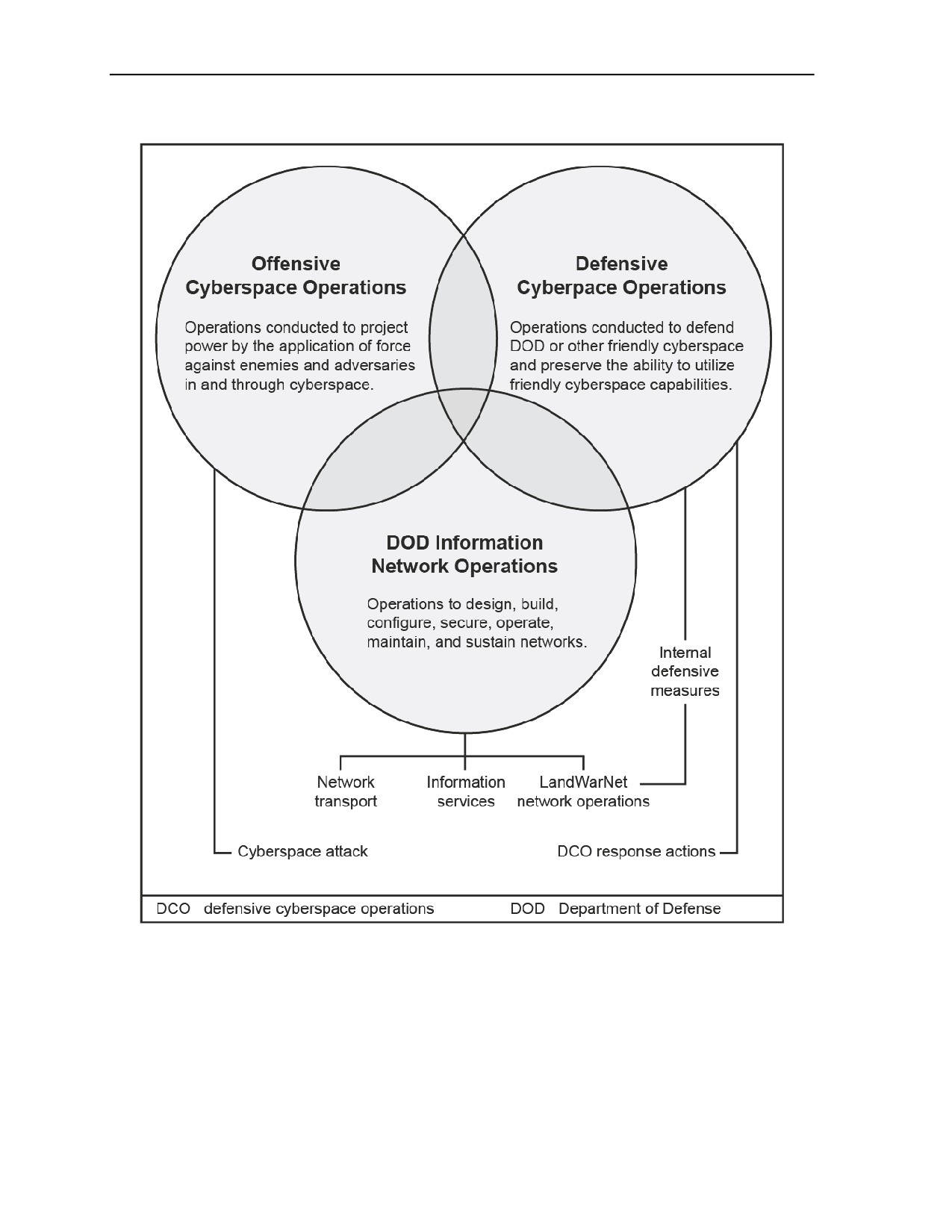
3-3. CO are categorized into three functions including offensive cyberspace operations (OCO), defensive
cyberspace operations (DCO), and Department of Defense information network operations. These functions
are described in joint doctrine as missions in cyberspace that require specific actions in cyberspace (see
joint doctrine for CO). Figure 3-1 on page 3-2 depicts the three interdependent functions of CO.
12 February 2014
FM 3-38
3-1
Chapter 3
Figure 3-1. Three interdependent functions
OFFENSIVE CYBERSPACE OPERATIONS
3-4. Offensive cyberspace operations are cyberspace operations intended to project power by the
application of force in or through cyberspace (JP 1-02). Army forces conduct OCO across the range of
military operations by targeting enemy and hostile adversary activity and related capabilities in and through
cyberspace. OCO are designed to support the commander’s objectives and intent consistent with applicable
3-2
FM 3-38
12 February 2014
Cyberspace Operations
authorities and legal frameworks. (See paragraph 3-38 for additional information on authorities and other
legal considerations.)
3-5. OCO are conducted in and through cyberspace where information technology infrastructures, along
with the people and systems that use them, exist in an area of operations and pervade an operational
environment. To varying degrees, host-nation populations, governments, security forces, businesses and
other actors rely upon these infrastructures and supporting networks or systems. Given these conditions,
OCO require deliberate coordination and integration to ensure desired effects (changes in behavior which
do not suggest the ways or means those changes were created) are created and focused at the right place
and time in support of the commander's objectives.
3-6. Using OCO, commanders can mass effects through the employment of lethal and nonlethal actions
leveraging all capabilities available to gain advantages in cyberspace that support objectives on land. For
example, cyberspace capabilities and other information-related capabilities may be directed at an enemy
weapons system consisting of the targeted platform and its operators. The cyberspace capability could
create degrading effects on the platform while an information-related capability influences, disrupts,
corrupts, or usurps the decisionmaking of the operator. (See FM 3-13 for additional information on inform
and influence activities (IIA) and information-related capabilities.)
CYBERSPACE ATTACK
3-7. A cyberspace attack consists of actions that create various direct denial effects in cyberspace (for
example, degradation, disruption, or destruction) and manipulation that leads to denial that is hidden or that
manifests in the physical domains. For the Army, cyberspace attacks are a type of cyberspace operation
employed primarily in support of OCO. Cyberspace attacks are primarily employed outside of
LandWarNet, but they are coordinated and deconflicted inside of the Department of Defense information
networks (DODIN). (See paragraph 3-24 for additional information on the DODIN.)
3-8. Army forces conduct or facilitate cyberspace attacks in support of OCO within designated areas of
operation. For example, when employed as part of an offensive cyberspace operation, a cyberspace attack
may be directed at information resident in, or in transit between, computers (including mobile phones and
personal digital assistants) and computer networks used by an enemy or adversary. Enemy or adversary
actors may be denied the ability to use resources or have their information resources used for friendly
proposes as a result of a cyberspace attack. In every instance, commanders and staffs follow appropriate
authorities and legal guidance. (See paragraph 3-38 for additional information on authorities and other legal
considerations.)
3-9. Using specific portions of cyberspace and the electromagnetic spectrum (EMS) as primary pathways
or avenues of approach, cyberspace attacks may employ capabilities such as tailored computer code in and
through various network nodes such as servers, bridges, firewalls, sensors, protocols, operating systems,
and hardware associated with computers or processors. Tailored computer code is only one example of a
cyberspace capability (a device, computer program, or technique, including any combination of software,
firmware, or hardware) designed to create an effect in or through cyberspace. The development and
employment of tailored computer code represents the core and unique technical nature of CO capabilities.
Computer code is designed to create specific effects, and when employed this code moves in the form of
data packets in and through cyberspace across wired and wireless driven communication technology and
systems. Cyberspace attacks must therefore be coordinated and integrated in support of the commander's
objectives and consistent with applicable assessment measures and indicators.
3-10. Cyberspace attack capabilities are employed to support maneuver operations by creating
simultaneous and complementary effects. For example, a cyberspace attack capability may be employed in
conjunction with electronic attack, offensive space control, fires, and information related capabilities to
deceive, degrade, destroy, and disrupt a specific enemy integrated air defense system or enemy safe haven
(see table 3-1 on page 3-4).
12 February 2014
FM 3-38
3-3

Chapter 3
Table 3-1. Examples of simultaneous and complementary effects
System
Target
Target system
Desired effects
subcomponent
description
components
by various Army capabilities
aimpoint
Destroy (primary equipment)
Early warning
Supporting
Disrupt (cueing flow)
radars
network
Degrade (sensor integrity)
Deceive (operators and leadership)
Integrated air
defense forces
Destroy (supporting nodes)
Support
Public switched
Disrupt (command and control
facilities
telephone network
systems)
Deny (secondary battery access)
Destroy (supporting nodes)
Exploit (data and information)
Virtual
Host server
Degrade (content)
locations
Disrupt (data flow)
Enemy safe
Deceive (through false bonafides)
haven
Key personnel
Disrupt (command and control
(for example,
systems)
leaders,
Smartphone
Deny (access)
facilitators, and
Deceive (through false persona)
enablers)
3-11. In table 3-1, targets are described as systems with components and subcomponents that enable the
determination of aimpoints for designated friendly force capabilities. An aimpoint is a point associated with
a target and assigned for a specific weapon impact (JP 3-60). To develop targets suitable for effects created
by a cyberspace attack requires a concerted staff effort focused on intelligence preparation of the
battlefield, cyber-enabled intelligence, the targeting process, and cyberspace information collection.
Cyberspace attacks may employ manipulation which includes deception, decoying, conditioning, and
spoofing to control or change information, information systems, and networks. Ultimately, decisions to
employ cyberspace attack capabilities alone or in conjunction with other capabilities will be determined by
commanders, with the assistance of their staffs, throughout the operations process. (See chapter 6 for
additional information on the operation process.)
CYBERSPACE INFORMATION COLLECTION
3-12. Cyberspace information collection is an extension of information collection consisting of actions that
facilitate CO primarily through deliberate network reconnaissance and surveillance and other enabling
activities
(including access to or control of those networks) in and through cyberspace. Cyberspace
information collection includes activities in cyberspace conducted to gather intelligence from target and
adversary systems that may be required to support future operations and enabling activities conducted to
plan and prepare for follow-on military operations. Cyberspace information collection aligns with joint
constructs for cyberspace intelligence, surveillance, and reconnaissance and cyberspace operational
preparation of the environment as discussed in paragraphs 3-13 through 3-15 and depicted in figure 3-2.
3-13. Consistent with joint doctrine, cyberspace intelligence, surveillance, and reconnaissance includes
activities in cyberspace conducted to gather intelligence from target and adversary systems that may be
required to support future operations, including OCO or DCO. These activities synchronize and integrate
the planning and execution of cyberspace sensors, assets, and processing, exploitation, and dissemination
3-4
FM 3-38
12 February 2014

Cyberspace Operations
systems, in direct support of current and future operations. For the Army, cyberspace information collection
expands joint cyberspace intelligence, surveillance, and reconnaissance by focusing on answering the
commander’s critical information requirements thereby enabling understanding and decisionmaking.
3-14. Consistent with joint doctrine, cyberspace operational preparation of the environment consists of the
non-intelligence enabling activities conducted to plan and prepare for follow-on military operations. This
includes identifying data, software, system and network configurations and identifiers, or physical
structures connected to, or associated with, the network for the purposes of determining system
vulnerabilities. This also includes actions taken to assure future access or control of the system, network, or
data during anticipated hostilities. (See joint doctrine for cyberspace operations for more information.) For
the Army, cyberspace information collection expands joint cyberspace operational preparation of the
environment and enables commanders and staffs to plan, prepare, and facilitate the employment of
cyberspace capabilities.
3-15. Cyberspace information collection is employed primarily in support of OCO. Accordingly,
cyberspace information collection is employed outside of LandWarNet and coordinated and deconflicted
inside of the DODIN. In every instance of cyberspace information collection, commanders and staffs
follow appropriate authorities, legal guidance, and international law. (See paragraph 3-24 for additional
information on the DODIN.)
Figure 3-2. Cyberspace information collection from joint cyberspace actions
DEFENSIVE CYBERSPACE OPERATIONS
3-16. Defensive cyberspace operations are passive and active cyberspace operations intended to preserve
the ability to utilize friendly cyberspace capabilities and protect data, networks, net-centric capabilities, and
other designated systems (JP 1-02). Army forces conduct DCO across the range of military operations by
detecting, identifying, and responding to enemies and adversaries taking or about to take offensive actions
12 February 2014
FM 3-38
3-5
Chapter 3
against friendly networks and information resident in these networks, particularly LandWarNet. (See
paragraph 3-45 for information on enemy and adversary cyberspace activity.)
3-17. DCO are designed to detect and respond to unauthorized activity or indications of activity (alerts and
threat information) against friendly networks including LandWarNet and DOD communications systems
and networks. Army forces may be required to dynamically reestablish, resecure, reroute, reconstitute, or
isolate degraded or compromised networks to ensure continuous access to specific portions of cyberspace
that enable the friendly mission command system. Enemy or adversary actions involving attack,
exploitation, intrusion, or effects of malware on friendly networks may require the notification of
counterintelligence or law enforcement agencies and it may trigger certain pre-authorized response actions
requiring the creation of effects outside of LandWarNet.
3-18. There are two major types of DCO. They are—
z
DCO response actions.
z
Internal defensive measures.
DCO RESPONSE ACTIONS
3-19. Defensive cyberspace operation response actions are deliberate, authorized defensive measures or
activities taken outside of the defended network to protect and defend Department of Defense cyberspace
capabilities or other designated systems (JP 1-02). DCO response actions are initiated by various sensors
and capabilities. Once these sensors and capabilities detect and identify sources of cyber attack, response
actions (for example, employment of tailored computer code) may be employed with the intent to protect
and defend friendly force cyberspace capabilities or other designated systems.
3-20. DCO response actions may rise to a level of physical damage or destruction of enemy or adversary
systems. In this situation, DCO response actions may require cyberspace information collection in the same
manner in which it is required for OCO. As a result of these conditions, response actions require deliberate
coordination and integration to ensure desired effects are created and achieved at the right place and time in
support of the commander's objectives.
3-21. DCO response actions may involve countermeasures. Countermeasures are designed to identify the
source of the threat to LandWarNet and use nonintrusive techniques to stop or mitigate the threat.
Countermeasures are nondestructive in nature, typically impact only malicious activity but not the
associated threat system, and are terminated when the threat stops. Countermeasures in cyberspace should
not destroy or significantly impede the operations or functionality of the network they are being employed
against, nor should they intentionally cause injury or the loss of life. In every instance of DCO response
actions and countermeasures, commanders and staffs follow appropriate authorities, legal guidance, and
international law.
INTERNAL DEFENSIVE MEASURES
3-22. Internal defensive measures are those DCO that are conducted within the DODIN. (See joint
cyberspace doctrine for more information on the DODIN.) Internal defensive measures may involve
counter reconnaissance measures within LandWarNet or other DODIN to locate internal threats and
respond to unauthorized activity or alerts and threat information. Internal defensive measures share similar
objectives and tasks associated with the defense of LandWarNet. For example, tailored computer code may
be employed inside LandWarNet to identify and mitigate threats that have bypassed routine defense
measures. (See FM 6-02.71 for additional information on network operations.)
3-23. Army forces employ various internal defensive measures to protect and defend LandWarNet. DCO
include the employment of internal defensive measures in response to an attack, exploitation, intrusion, or
an effect of malware on LandWarNet. To assist in the defense of LandWarNet, the Army uses a defense-in-
depth concept, which incorporates a layered approach for the implementation of defensive tools and
procedures. At a minimum, this includes a perimeter router, firewall, intrusion detection system or intrusion
protection system, domain name server, web proxy, and host-based security system that blocks, deceives,
or redirects the threat. Defensive tools and techniques are designed to find, fix, and finish anomalous
network activity using rule, signature, and behavioral-based techniques.
3-6
FM 3-38
12 February 2014
Cyberspace Operations
DEPARTMENT OF DEFENSE INFORMATION NETWORK
OPERATIONS
3-24. Department of Defense information network operations are operations to design, build, configure,
secure, operate, maintain, and sustain Department of Defense networks to create and preserve information
assurance on the Department of Defense information networks (JP 1-02). Accordingly, Department of
Defense information networks are the globally interconnected, end-to-end set of information capabilities,
and associated processes for collecting, processing, storing, disseminating, and managing information
on-demand to warfighters, policy makers, and support personnel, including owned and leased
communications and computing systems and services, software (including applications), data, and security
(JP 1-02). The coordination and integration of CO for the Army will occur primarily within LandWarNet,
which is the Army’s portion of the DODIN.
3-25. LandWarNet is a technical network that encompasses all Army information management systems
and information systems that collect, process, store, display, disseminate, and protect information
worldwide. LandWarNet is a single, secure, standards-based, versatile infrastructure linked by networked,
redundant transport systems, sensors, warfighting and business applications, and services that provides
Soldiers and civilians timely and accurate information in any environment and enables decisive action with
our joint, interagency, and multinational partners.
(See FM 6-02.71 for additional information on
LandWarNet.)
3-26. Army forces are involved in Department of Defense information network operations across the range
of military operations to gain and maintain access to specific portions of cyberspace by planning,
engineering, installing, operating, maintaining, controlling, and defending LandWarNet in support of both
the generating force and the operational Army. This includes the proactive technical functions of
configuration control, system patching, information assurance and user training, physical security, secure
architecture design, host-based security systems and firewalls, and encryption of data at rest.
3-27. There are three major types of Department of Defense information network operations for the Army.
They are—
z
LandWarNet network operations.
z
Network transport.
z
Information services.
LANDWARNET NETWORK OPERATIONS
3-28. LandWarNet network operations are an integrated construct of Department of Defense information
network operations involving enterprise management, network assurance, content management, situational
understanding, and the mission command activities that guide signal entities in the installation,
management, and defense of communications networks and information services necessary to support
operational forces. LandWarNet network operations are therefore a subset of the overarching network
operations which are activities conducted to operate and defend the DODIN. LandWarNet network
operations involve network and systems management to engineer, install, operate, manage, service, and
restore communication and computer networks, systems, and applications.
3-29. LandWarNet network operations protect and defend communications and computer networks,
systems, and information services. Computer network defense protects, monitors, analyzes, detects and
responds to unauthorized activity within information systems. Defending in the context of LandWarNet
network operations involves those DCO that are conducted inside of friendly force networks to respond to
unauthorized activity and to leverage intelligence, counterintelligence, law enforcement, and other military
capabilities as required. Defending may also involve DCO response actions that occur outside of
LandWarNet when deemed necessary. (See paragraph 3-19 for additional information on DCO response
actions.)
3-30. LandWarNet network operations also involve information assurance, information dissemination
management, and content staging capabilities that allow users to collect, process, store, discover, and
disseminate information. (See FM 6-02.71 for additional information on LandWarNet network operations.)
12 February 2014
FM 3-38
3-7
Chapter 3
NETWORK TRANSPORT
3-31. Network transport is a system of systems including the people, equipment, and facilities that provide
end-to-end communications connectivity for network components. The system of systems and end-to-end
communications connectivity relative to network transport enables network transport systems to transmit
and receive voice, video, and date in order to execute warfighting functions in support of unified land
operations. Network transport encompasses the integrated space, aerial, and terrestrial capabilities that
provide access from Soldier and sensor through joint and strategic levels. (See FM 6-02.71 for additional
information on LandWarNet network operations.)
INFORMATION SERVICES
3-32. Through a full suite of information services, commanders and Soldiers collect, process, store,
transmit, display, and disseminate information. They also share information and collaborate with unified
action partners through all phases of an operation anywhere in the world. Information sharing allows for the
mutual use of information services or capabilities.
OPERATIONS IN AND THROUGH CYBERSPACE
3-33. Paragraphs 3-1 through 3-32 describe the functions of CO. The employment of these functions in and
through cyberspace requires a full understanding of the following:
z
The layers of cyberspace.
z
Authorities and other legal considerations.
z
The functions and the networks.
z
Enemy and adversary cyberspace activity.
z
Targeting in cyberspace.
THE LAYERS OF CYBERSPACE
3-34. The layers of cyberspace consist of the interdependent networks of information technology
infrastructures and resident data within those structures. The interdependent networks of information
technology infrastructures and resident data that define cyberspace exist in one or more layers of
cyberspace. Commanders and staffs must consider these layers as they relate to the information
environment, the operational environment, and the area of operations. Table 3-2 provides a sample of this
analysis using the dimensions of the information environment, the operational variables associated with the
operational environment, and the mission variables associated with activities in the area of operations.
3-35. The physical network layer includes geographic and physical network components. The geographic
component is the physical location of elements of the network. The physical network component includes
all the physical equipment associated with links (wired, wireless, and optical) and the physical connectors
that support the transfer of code and data on the networks and nodes. For example, physical networks
components may include wires, cables, radio frequencies, routers, servers, computers, radars, weapons
systems, telecommunications systems, personal digital assistants, and other networked devices where data
is created, manipulated, processed and stored. Commanders and staffs identify physical entities in
cyberspace that may require specific effects and prioritize them for information collection, targeting, and
assessment.
3-36. The logical network layer consists of the components of the network that are related to one another in
ways that are abstracted from the physical network. For instance, nodes in the physical layer may logically
relate to one another to form entities in cyberspace that are not tied to a specific node, path, or individual.
Web sites hosted on servers in multiple physical locations where content can be accessed through a single
uniform resource locator or web address provide another example. Commanders and staffs identify logical
entities in cyberspace that may require specific effects and prioritize them for cyberspace information
collection, targeting, and assessment.
3-37. The cyber-persona layer is an abstraction of the logical network, and it uses the rules of the logical
network layer to develop a digital representation of an individual or entity identity in cyberspace. This layer
3-8
FM 3-38
12 February 2014
Cyberspace Operations
consists of the people who actually use the network and therefore have one or more identities that can be
identified, attributed, and acted upon. These identities may include e-mail addresses, social networking
identities, other web forum identities, computer internet protocol addresses, and cell phone numbers.
Cyber-personas hold important implications for Army forces in terms of attributing responsibility and
targeting the source of a cyberspace threat. Because cyber-personas can be complex, with elements in many
virtual locations, but normally not linked to a single physical location or form, significant intelligence
collection and analysis capabilities may be required. Commanders and staffs identify cyber-persona entities
in cyberspace that may require specific effects and prioritize them for information collection, targeting, and
assessment.
Table 3-2. Sample application of the layers of cyberspace
Layers of
Information
Operational Environment
Area of Operations
Cyberspace
Environment
Physical
• Command and
• Information technology
• Identification of
control facilities
infrastructures
physical entities in
network
and systems
- Hardware
cyberspace that may
• Key
- Systems software
require specific effects
decisionmakers
• Priorities for
- Embedded processors
• Computers and
information collection
- Controllers
laptops
and assessment
• Resident data
• Smart phones
• Priorities for targeting
• Critical infrastructure and key
and tablet
resources
computers
• Supervisory control and data
acquisition systems
• Distributed control systems
Logical
• Abstraction
• Multiple nodes forming entities
• Technical
from the
in cyberspace
considerations for
network
physical layer
• Logical relationships between
actions inside and
• Content and
nodes
outside of LandWarNet
flow of
• Data collection, processing,
• Information collection
information
storage, usage
and exploitation
(data)
Cyber-persona
• Digital representations of
• Emphasis on positive
individuals
target identification
- e-mail addresses
• Priorities for targeting
- web site or similar identities
and second-order
effects
• Abstraction from the logical
layer
AUTHORITIES AND OTHER LEGAL CONSIDERATIONS
3-38. Commanders and staffs coordinate with key agencies, including the staff judge advocate, as they
apply the functions of CO in accordance with authorities and relevant legal frameworks. The legal
framework applicable to CO depends on the nature of the activities conducted, such as offensive or
defensive military operations, stability operations, defense support to civilian authorities, service provider
actions, intelligence operations, or defense of the homeland. Army forces conducting CO will comply with
the law of war. (For more information on the law of war, see JP 1-04 and CJCSI 5810.01D.) Some
functions of CO require deconfliction in accordance with current policies.
3-39. Authorities relevant to CO are derived from the United States (U.S.) Constitution and federal laws.
These authorities establish roles and responsibilities that provide focus for organizations to develop
capabilities and expertise, including those for cyberspace.
3-40. There are several key statutory authorities that apply to the Department of Defense (DOD). They
include the United States Code (USC) Title 10 (Armed Forces) addressing the conduct of military
operations in cyberspace to secure U.S. interests; USC Title 50 (War and National Defense) addressing
12 February 2014
FM 3-38
3-9
Chapter 3
intelligence gathering through cyberspace on foreign intentions, operations, and capabilities; and USC Title
32 (National Guard) addressing domestic consequence management.
3-41. In addition to the key statutory authorities described in paragraph 3-40, Army CO may involve USC
Title 18 (Crimes and Criminal Procedure) addressing law enforcement actions to include prosecution of
criminals operating in cyberspace. They may also involve USC Title 40 (Public Buildings, Property, and
Works) addressing the establishment and enforcement of standards for acquisition and security of
information technologies and USC Title
44
(Public Printing and Documents) addressing the
implementation of information security policies and practices as required by standards and guidelines for
national security systems.
3-42. Commanders and staffs must ensure compliance with all relevant authorities and associated legal
frameworks before conducting CO. For instance, during armed hostilities involving Army forces deployed
to a foreign nation state, an OCO may involve the disruption of a target which is being used by enemy
forces but is located within public accessed infrastructure. USC Title 10 and Title 50 directly apply to
Army forces as would DOD policies and standing rules of engagement. However, given the nature of the
mission, international laws (for example, the law of war), international agreements, treaties, host-nation
domestic laws, and other legal considerations may also be applicable. Table 3-3 provides an example of
authoritative references and associated execution authorities for the three functions of CO.
Table 3-3. Example of alignment to authorities
Functions
References
Executive Authority
Offensive
• USC Title 10 and Title 50
• President of the United States
Cyberspace
• Joint doctrine for cyberspace operations
• Secretary of Defense
Operations
• Guidance from unified command plan
• Guidance from presidential policy directive
for cyberspace operations
• USC Titles 10, Title 18, and Title 50
• Combatant commanders
Defensive
• Joint doctrine for cyberspace operations
(IDM)
Cyberspace
• Guidance from unified command plan
• Joint force commanders (IDM)
Operations
• Guidance from presidential policy directive
• SROE - as required
for cyberspace operations SROE
Department of
• USC Titles 10, 18, 40, 44, and 50
• Defense Information Systems
• Guidance from unified command plan
Agency
Defense
Information
• Joint doctrine for cyberspace operations
• Network Enterprise Center
Network
• DODD 8000.01 - management of the DOD
• Army Network Enterprise
information enterprise
Technology Command
Operations
CJCSI - Chairman of the Joint Chiefs of Staff Instruction
SROE - standing rules of engagement
DODD - Department of Defense Directive
USC - United States Code
IDM - internal defensive measures
THE FUNCTIONS AND THE NETWORKS
3-43. Commanders and staffs identify physical entities in cyberspace and the location where effects are
desired. It is necessary to establish this geographic location and its relation to cyberspace because aligned
authorities (see table 3-3) and other legal considerations will be applied in each situation. The functions of
CO occur both outside and inside of the DODIN as depicted in figure 3-3.
3-44. OCO are employed primarily outside of the DODIN. DCO are employed primarily inside the
DODIN and may extend outside of the DODIN. For the Army, Department of Defense information
network operations are employed inside the DODIN and consist of LandWarNet network operations,
network transport, and information services. Cyberspace information collection expands joint cyberspace
intelligence, surveillance, and reconnaissance and joint cyberspace operational preparation of the
environment to enable commanders and staffs to plan, prepare, and facilitate the employment of cyberspace
capabilities.
3-10
FM 3-38
12 February 2014

Cyberspace Operations
Figure 3-3. Cyberspace operations outside and inside the networks
ENEMY AND ADVERSARY CYBERSPACE ACTIVITY
3-45. Similar to the land domain, cyberspace is used by host-nation populations, governments, security
forces, businesses, and other actors. In the context of military operations, in the land domain both friendly
and enemy forces strive to achieve freedom of maneuver in support of strategic, operational, and tactical
objectives. In cyberspace these same forces strive to achieve freedom of action to seize, retain, and exploit
strategic, operational, and tactical advantages. Therefore, enemy and adversary actors present a cyberspace
threat to friendly forces in both the cyberspace and land domains.
3-46. A cyberspace threat can be characterized based on intent, sponsorship, training, education, skills,
motivation, and tools. Two examples include advanced cyberspace threats and hackers. Advanced
cyberspace threats are generally supported by nation-states and have advanced education, training, skills,
and tools that allow these threats to remain undetected for extended periods of time on improperly defended
networks. Hackers have a broad range of skills, motives, and capabilities and must be assessed
independently. The level of the cyberspace threat is the combination of the actor’s ability (skills and
resources), opportunity (access to target), intent (attack, surveillance, exploit), and motive (national policy,
war, profit, fame, personal reasons, and others). Cyberspace provides adversaries an effective and
inexpensive means for recruitment, propaganda, training, and command and control. Nations and nonstate
actors may use cyberspace, supporting an information campaign in combination with lethal attacks, to
forward their interests.
3-47. Specific to CO, a cyberspace threat is any circumstance or event with the potential to intentionally or
unintentionally exploit one or more vulnerabilities in friendly force cyberspace, leading to a loss of
confidentiality, integrity, or availability. Cyberspace threats not only involve an action but also require
actors (enemy and adversary) to execute that action in order to exploit cyber weaknesses. For example,
hackers may develop and employ malicious computer code to access and exploit the DODIN including
LandWarNet. Such operations adversely affect friendly forces’ use of specific portions of cyberspace in
support of operations.
TARGETING IN CYBERSPACE
3-48. Targeting to create and achieve desired effects by the employment of cyberspace capabilities follows
standard targeting methodologies discussed in joint and Army doctrine (see JP 3-60 and FM 3-60).
12 February 2014
FM 3-38
3-11
Chapter 3
Targeting in cyberspace involves the decide, detect, deliver, and assess process.
(See chapter 6 for
additional information on targeting.)
3-49. Commanders and staffs consider three aspects when targeting in cyberspace. First, they recognize
that cyberspace capabilities are viable options for engaging designated targets. Second, commanders and
staffs understand that the employment of CO, particularly OCO, may be preferable in some cases because
they can have the advantage of low probability of detection. Third, they are aware of that due to the
interconnected nature of cyberspace, first order effects may intentionally or unintentionally cascade into
second and third order effects, impacting deliberate planning and risk management. (See ADRP 5-0 for
additional information on the operations process and risk management.)
3-50. The cyber effects request format is a format used to request effects in support of CO. The cyber
effects request format contains baseline information for coordinating and integrating cyberspace
capabilities and associated authorities to create effects outside and inside of the DODIN including
LandWarNet. Commanders and staffs ensure cyber effects request formats are developed and submitted
throughout the operations process to facilitate planning. Also, the cyber effects request format facilitates
the achievement of operational and tactical objectives by leveraging the employment of cyberspace
capabilities.
(See FM 6-99 for additional information on developing and processing the cyber effects
request format.)
3-12
FM 3-38
12 February 2014
Chapter 4
Electronic Warfare
This chapter provides an overview of electronic warfare
(EW) as an activity
integrated into operations through cyber electromagnetic activities
(CEMA). It
discusses the three functions of EW, their respective tasks, and considerations for
employment.
4-1. EW is an activity that is integrated into operations through CEMA. EW capabilities are applied from
the air, land, sea, space, and cyberspace by manned, unmanned, attended, or unattended systems. EW
capabilities are an increasingly important means by which commanders can shape operational
environments to their advantage. For example, electronic warfare may be used to set favorable conditions
for cyberspace operations (CO) by stimulating networked sensors, denying wireless networks, or other
related actions. Operations in cyberspace and the electromagnetic spectrum (EMS) depend on electronic
warfare activities maintaining freedom of action in both. (See FM 3-36 for additional information on
electronic warfare.)
4-2. EW consists of three functions. They are electronic attack (EA), electronic protection (EP), and
electronic warfare support (ES) (see figure 4-1 on page 4-2).
12 February 2014
FM 3-38
4-1

Chapter 4
Figure 4-1. The three functions of electronic warfare
ELECTRONIC ATTACK
4-3. Electronic attack is a division of electronic warfare involving the use of electromagnetic energy,
directed energy, or antiradiation weapons to attack personnel, facilities, or equipment with the intent of
4-2
FM 3-38
12 February 2014
Electronic Warfare
degrading, neutralizing, or destroying enemy combat capability and is considered a form of fires
(JP 3-13.1). EA includes—
z
Actions taken to prevent or reduce an enemy’s effective use of the EMS.
z
Employment of weapons that use either electromagnetic or directed energy as their primary
destructive mechanism.
z
Offensive and defensive activities, including countermeasures.
4-4. Actions that prevent or reduce an enemy’s effective use of the EMS include spot, barrage, and sweep
electromagnetic jamming. EA actions also include various electromagnetic deception techniques such as
false target or duplicate target generation.
4-5. EA includes using weapons that primarily use electromagnetic or directed energy for destruction.
These can include lasers, radio frequency weapons, and particle beams. Directed energy is an umbrella
term covering technologies that relate to the production of a beam of concentrated electromagnetic energy
or atomic or subatomic particles (JP 3-13.1). In EW, most directed-energy applications fit into the category
of EA. A directed-energy weapon uses directed energy primarily as a direct means to damage or destroy an
enemy’s equipment, facilities, and personnel. In addition to destructive effects, directed-energy weapons
systems support area denial and crowd control.
4-6. Unified land operations use offensive and defensive tasks for EA. Examples of offensive EA
include—
z
Jamming enemy radar or electronic command and control systems.
z
Using antiradiation missiles to suppress enemy air defenses (antiradiation weapons use radiated
energy emitted from a target as the mechanism for guidance onto the target).
z
Using electronic deception to confuse enemy intelligence, surveillance, and reconnaissance
systems.
z
Using directed-energy weapons to disable an enemy’s equipment or capability.
4-7. Defensive EA uses the EMS to protect personnel, facilities, capabilities, and equipment. Examples
include self-protection and other protection measures such as the use of expendables (flares and active
decoys), jammers, towed decoys, directed-energy infrared countermeasures, and counter radio-controlled
improvised explosive device systems.
ELECTRONIC PROTECTION
4-8. Electronic protection is a division of electronic warfare involving actions taken to protect personnel,
facilities, and equipment from any effects of friendly or enemy use of the electromagnetic spectrum that
degrade, neutralize, or destroy friendly combat capability (JP 3-13.1). For example, EP includes actions
taken to ensure friendly use of the EMS, such as frequency agility in a radio or variable pulse repetition
frequency in radar. Commanders avoid confusing EP with self-protection. Both defensive EA and EP
protect personnel, facilities, capabilities, and equipment. However, EP protects from the effects of EA
(friendly and enemy) and electromagnetic interference, while defensive EA primarily protects against lethal
attacks by denying enemy use of the EMS to guide or trigger weapons.
4-9. During operations, EP includes, but is not limited to, the application of training and procedures for
countering enemy EA. Army commanders and forces understand the threat and vulnerability of friendly
electronic equipment to enemy EA and take appropriate actions to safeguard friendly combat capability
from exploitation and attack. EP measures minimize the enemy’s ability to conduct ES and EA operations
successfully against friendly forces. To protect friendly combat capabilities, units—
z
Regularly brief friendly force personnel on the EW threat.
z
Ensure that they safeguard electronic system capabilities during exercises, workups, and
pre-deployment training.
z
Coordinate and deconflict EMS usage.
z
Provide training during routine home station planning and training activities on appropriate EP
active and passive measures under normal conditions, conditions of threat electronic attack, or
otherwise degraded networks and systems.
12 February 2014
FM 3-38
4-3
Chapter 4
z
Take appropriate actions to minimize the vulnerability of friendly receivers to enemy jamming
(such as reduced power, brevity of transmissions, and directional antennas).
z
Ensure redundancy in all systems is maintained and personnel are well-versed in switching
between systems.
4-10. EP also includes spectrum management. The spectrum manager works for the assistant chief of staff,
signal (G-6 [S-6]) and plays a key role in the coordination and deconfliction of spectrum resources
allocated to the force. Spectrum managers or their direct representatives participate in the planning for EW
operations.
4-11. The development and acquisition of communications and EMS dependent systems includes EP
requirements to clarify performance parameters. Army forces design their equipment to limit inherent
vulnerabilities. If EA vulnerabilities are detected, then units must review these programs. (See DODI
4650.01 for information on the certification of spectrum support and electromagnetic compatibility.)
ELECTRONIC WARFARE SUPPORT
4-12. Electronic warfare support is a division of electronic warfare involving actions tasked by, or under
direct control of, an operational commander to search for, intercept, identify, and locate or localize sources
of intentional and unintentional radiated electromagnetic energy for the purpose of immediate threat
recognition, targeting, planning, and conduct of future operations (JP 3-13.1). ES enables U.S. forces to
identify the electromagnetic vulnerability of an adversary’s electronic equipment and systems. Friendly
forces take advantage of these vulnerabilities through EW operations.
4-13. ES systems are a source of information for immediate decisions involving EA, EP, avoidance,
targeting, and other tactical employment of forces. ES systems collect data and produce information to—
z
Corroborate other sources of information or intelligence.
z
Conduct or direct EA operations.
z
Initiate self-protection measures.
z
Task weapons systems.
z
Support EP efforts.
z
Create or update EW databases.
z
Support information related capabilities.
4-14. ES and signals intelligence missions may use the same or similar resources. The two differ in the
person who tasks and controls the assets, the purpose for the task, the detected information’s intended use,
the degree of analytical effort expended, the detail of information provided, and the timelines required. ES
missions respond to the immediate requirements of a tactical commander. (See ADRP 2-0 and FM 2-0 for
more information on signals intelligence.)
TASKS AND TERMINOLOGY
4-15. Although new equipment, tactics, techniques, and procedures continue to be developed, the physics
of electromagnetic energy remains constant. Hence, effective EW tasks remain the same despite changes in
hardware and tactics.
PRINCIPAL TASKS
4-16. Principal EW functions support unified land operations by exploiting the opportunities and
vulnerabilities inherent in the use of the EMS. The EW activity is categorized by the EW functions with
which they are most closely associated (EA, EP, and ES).
Electronic Attack Tasks
4-17. Tasks related to EA are either offensive or defensive. These activities differ in their purpose.
Defensive EA protects friendly personnel and equipment or platforms. Offensive EA denies, disrupts, or
destroys enemy capability. Tasks related to EA include—
4-4
FM 3-38
12 February 2014
Electronic Warfare
z
Countermeasures.
z
Electromagnetic deception.
z
Electromagnetic intrusion.
z
Electromagnetic jamming.
z
Electromagnetic pulse.
z
Electronic probing.
Countermeasures
4-18. Countermeasures are that form of military science that, by the employment of devices and/or
techniques, has as its objective the impairment of the operational effectiveness of enemy activity
(JP 3-13.1). They can be deployed preemptively or reactively. Devices and techniques used for EW
countermeasures include electro-optical-infrared countermeasures and radio frequency countermeasures.
4-19. Electro-optical-infrared countermeasures consist of a device or technique employing
electro-optical-infrared materials or technology that is intended to impair the effectiveness of enemy
activity, particularly with respect to precision guided weapons and sensor systems
(JP
3-13.1).
Electro-optical-infrared countermeasures may use laser jammers, smokes, aerosols, signature suppressants,
decoys, pyrotechnics, pyrophorics, high-energy lasers, or directed infrared energy countermeasures.
4-20. Radio frequency countermeasures are any device or technique employing radio frequency materials
or technology that is intended to impair the effectiveness of enemy activity, particularly with respect to
precision-guided weapons and sensor systems (JP 3-13.1). Radio frequency countermeasures can be active
or passive. Expendable jammers used by aircraft to defend against precision guided surface-to-air missle
systems are an example of radio frequency countermeasures.
Electromagnetic Deception
4-21. Electromagnetic deception is the deliberate radiation, re-radiation, alteration, suppression,
absorption, denial, enhancement, or reflection of electromagnetic energy in a manner intended to convey
misleading information to an enemy or to enemy electromagnetic-dependent weapons, thereby degrading or
neutralizing the enemy’s combat capability. Types of electromagnetic deception include manipulative,
simulative, and imitative. Manipulative involves actions to eliminate revealing, or convey misleading,
electromagnetic telltale indicators that may be used by hostile forces. Simulative involves actions to
simulate friendly, notional, or actual capabilities to mislead hostile forces. Imitative introduces
electromagnetic energy into enemy systems that imitates enemy emissions.
Electromagnetic Intrusion
4-22. Electromagnetic intrusion is the intentional insertion of electromagnetic energy into transmission
paths in any manner, with the objective of deceiving operators or of causing confusion (JP 3-13.1).
Electromagnetic intrusion is often conducted by inserting false information. This information may consist
of voice instructions, false targets, coordinates for fire missions, or rebroadcasting prerecorded data
transmissions.
Electromagnetic Jamming
4-23. Electromagnetic jamming is the deliberate radiation, reradiation, or reflection of electromagnetic
energy for the purpose of preventing or reducing an enemy’s effective use of the electromagnetic spectrum,
and with the intent of degrading or neutralizing the enemy’s combat capability (JP 3-13.1). Examples of
targets that are subject to jamming include radios, radars, navigational aids, satellites, and electro-optics.
Electromagnetic Pulse
4-24. Electromagnetic pulse is the electromagnetic radiation from a strong electronic pulse, most
commonly caused by a nuclear explosion that may couple with electrical or electronic systems to produce
damaging current and voltage surges (JP 3-13.1). An electromagnetic pulse induces high currents and
12 February 2014
FM 3-38
4-5
Chapter 4
voltages in the target system, damaging electrical equipment or disrupting its function. An indirect effect of
an electromagnetic pulse can be electrical fires caused by the heating of electrical components.
Electronic Probing
4-25. Electronic probing is intentional radiation designed to be introduced into the devices or systems of
potential enemies for the purpose of learning the functions and operational capabilities of the devices or
systems (JP 3-13.1). This activity is coordinated through joint or interagency channels and supported by
Army forces.
Electronic Warfare Support Tasks
4-26. There are several tasks related to ES. They include—
z
Electronic reconnaissance.
z
Electronic intelligence.
z
Electronics security.
Electronic Reconnaissance
4-27. Electronic reconnaissance is the detection, location, identification, and evaluation of foreign
electromagnetic radiations (JP 3-13.1). Electronic reconnaissance is used to update and maintain the enemy
threat characteristics information. The enemy electronic threat characteristics information is used in the
planning and integrating processes.
Electronic Intelligence
4-28. Electronic intelligence is technical and geolocation intelligence derived from foreign
noncommunications electromagnetic radiations emanating from other than nuclear detonations or
radioactive sources
(JP
3-13.1). Examples of non-communications electromagnetic radiations include
radars, surface-to-air missile systems, and aircraft.
Electronics Security
4-29. Electronics security is the protection resulting from all measures designed to deny unauthorized
persons information of value that might be derived from their interception and study of noncommunications
electromagnetic radiations, e.g., radar (JP 3-13.1). Examples of electronics security are electromagnetic
spectrum mitigation and network protection.
Electronic Protection Tasks
4-30. There are several tasks related to EP. They include—
z
Electromagnetic hardening.
z
Electronic masking.
z
Emission control.
z
Electromagnetic spectrum management.
z
Wartime reserve modes.
z
Electromagnetic compatibility.
Electromagnetic Hardening
4-31. Electromagnetic hardening consists of action taken to protect personnel, facilities, and/or equipment
by blanking, filtering, attenuating, grounding, bonding, and/or shielding against undesirable effects of
electromagnetic energy (JP 3-13.1). Electromagnetic hardening is accomplished by using a comprehensive
shielding of sensitive components and by using non-electrical channels for the transfer of data and power.
4-6
FM 3-38
12 February 2014
Electronic Warfare
Electronic Masking
4-32. Electronic masking is the controlled radiation of electromagnetic energy on friendly frequencies in a
manner to protect the emissions of friendly communications and electronic systems against enemy
electronic warfare support measures/signals intelligence without significantly degrading the operation of
friendly systems (JP 3-13.1).
Emission Control
4-33. Emission control is the selective and controlled use of electromagnetic, acoustic, or other emitters to
optimize command and control capabilities while minimizing, for operations security: a. detection by
enemy sensors; b. mutual interference among friendly systems; and/or c. enemy interference with the
ability to execute a military deception plan
(JP 3-13.1). Emission control prevents the enemy from
detecting, identifying, and locating friendly forces. It is also used to minimize electromagnetic interference
among friendly systems.
Electromagnetic Spectrum Management
4-34. Electromagnetic spectrum management is planning, coordinating, and managing use of the
electromagnetic spectrum through operational, engineering, and administrative procedures (JP 6-01). The
objective of spectrum management is to enable electronic systems to perform their functions in the intended
environment without causing or suffering unacceptable interference.
Wartime Reserve Modes
4-35. Wartime reserve modes are characteristics and operating procedures of sensors, communications,
navigation aids, threat recognition, weapons, and countermeasures systems that will contribute to military
effectiveness if unknown to or misunderstood by opposing commanders before they are used, but could be
exploited or neutralized if known in advance (JP 3-13.1). Wartime reserve modes are deliberately held in
reserve for wartime or emergency use and seldom, if ever, applied or intercepted prior to such use.
Electromagnetic Compatibility
4-36. Electromagnetic compatibility is the ability of systems, equipment, and devices that use the
electromagnetic spectrum to operate in their intended environments without causing or suffering
unacceptable or unintentional degradation because of electromagnetic radiation or response (JP 3-13.1). It
involves the application of sound electromagnetic spectrum management; system, equipment, and device
design configuration that ensures interference-free operation. It also involves clear concepts and doctrines
that maximize operational effectiveness.
ELECTROMAGNETIC INTERFERENCE
4-37. Electromagnetic interference is any electromagnetic disturbance, induced intentionally or
unintentionally, that interrupts, obstructs, or otherwise degrades or limits the effective performance of
electronics and electrical equipment (JP 3-13.1). It can be induced intentionally, as in some forms of
electronic warfare, or unintentionally, as a result of spurious emissions and responses, intermodulation
products, and other similar products. Once electromagnetic interference is identified, a joint spectrum
interference report is initiated and forwarded through spectrum manager channels.
ELECTRONIC WARFARE REPROGRAMMING
4-38. Electronic warfare reprogramming is the deliberate alteration or modification of electronic warfare
or target sensing systems, or the tactics and procedures that employ them, in response to validated changes
in equipment, tactics, or the electromagnetic environment (JP 3-13.1). These changes may be the result of
deliberate actions on the part of friendly, adversary, or third parties; or they may be brought about by
electromagnetic interference or other inadvertent phenomena. The purpose of electronic warfare
reprogramming is to maintain or enhance the effectiveness of electronic warfare and target sensing system
equipment. Electronic warfare reprogramming includes changes to self defense systems, offensive weapons
systems, ES, and intelligence collection systems. The key consideration for EW reprogramming is joint and
12 February 2014
FM 3-38
4-7
Chapter 4
multinational coordination. Joint and multinational coordination of service reprogramming efforts ensures
all friendly forces consistently identify, process, and implement reprogramming requirements. (For more
information on EW reprogramming, see ATTP 3-13.10.)
EMPLOYMENT CONSIDERATIONS
4-39. EW has specific ground-based, airborne, and functional (EA, EP, or ES) employment considerations.
The electronic warfare officer (EWO) properly articulates EW employment considerations early in the
operations process. Each employment consideration has certain advantages and disadvantages that
commanders and staffs weigh when planning operations. Staffs plan for EA, EP, and ES before executing
EW operations.
Electronic Attack Considerations
4-40. There are several considerations are involved in planning for employing EA. They include—
z
Friendly communications.
z
Intelligence collection.
z
Other effects.
z
Non-hostile local EMS use.
z
Hostile intelligence collection.
z
Persistency of effect.
4-41. The electronic warfare officer (EWO), the assistant chief of staff, intelligence (G-2 [S-2]), the
assistant chief of staff, operations (G-3 [S-3]), the G-6 (S-6), the spectrum manager, and the assistant chief
of staff, inform and influence activities (G-7 [S-7]) coordinate closely to ensure effects produced by
electronic warfare operations are properly coordinated and integrated with other users of the EMS in the
operational environment. Coordination and integration ensures that EA systems’ frequencies are employed
to maximize synergies with other EMS dependent systems and to eliminate, moderate, or mitigate potential
electromagnetic interference on friendly systems. Conducting proper coordination and integration of EMS
dependent systems results in friendly EMS control while denying EMS control to the adversary and enemy.
4-42. The number of information systems, EW systems, and sensors operating simultaneously on the
battlefield makes deconfliction with communications and other EMS dependent systems a challenge. The
EWO, the G-2 (S-2), the G-6 (S-6), and the spectrum manager plan and rehearse deconfliction procedures
to quickly adjust their use of EW or communications systems.
4-43. If not properly coordinated with the G-2 (S-2) staff, EA operations may interrupt intelligence
collection by jamming or inadvertently interfering with a particular frequency being used to collect data on
the threat or by jamming a given enemy frequency or system that deprives friendly forces of that means of
collecting data. Either interruption can significantly deter intelligence collection efforts and their ability to
answer critical information requirements. Conversely, signals intelligence collectors need to be aware that
CEMA elements are charged with controlling the EMS and that this can take precedence over collections.
Coordination between the EWO, the fire support coordinator, and the G-2 (S-2) mitigates this interference.
In situations where a known conflict between the intelligence collection effort and the use of EA exists, the
CEMA working group brings the problem to the G-3 (S-3) for resolution.
4-44. Planners need to consider other effects that rely on EMS when planning for EA. For example,
military information support operations may include plans to use certain frequencies to broadcast messages,
or a military deception plan may include the broadcast of friendly force communications. In both examples,
the use of EA could unintentionally interfere or disrupt such broadcasts if not properly coordinated. To
ensure EA does not negatively impact planned operations, the EWO coordinates between fires, network
operations, and other functional or integrating cells as required.
4-45. Like any other form of electromagnetic radiation, EA can adversely affect local media and
communications systems and infrastructure. EW planners consider unintended consequences of EW
operations and deconflict these operations with the various functional or integrating cells. For example,
friendly jamming could deny the functioning of essential services such as ambulance or firefighters to a
local population. EWOs routinely synchronize EA with the other functional or integrating cells responsible
4-8
FM 3-38
12 February 2014
Electronic Warfare
for information related capabilities. In this way, they ensure that EA efforts do not cause fratricide or
unacceptable collateral damage to their intended effects.
4-46. The potential for hostile intelligence collection also affects EA. A well-equipped enemy can detect
friendly EW activities and thus gain intelligence on friendly force intentions. For example, the frequencies
Army forces jam could indicate where they believe the enemy’s capabilities lie. The EWO and the G-2
(S-2) develop an understanding of the enemy’s collection capability. Along with the red team (if available),
they determine what the enemy might gain from friendly force use of EA. (A red team is an organizational
element comprised of trained and educated members that provide an independent capability to fully explore
alternatives in plans and operations in the context of the operational environment and from the perspective
of adversaries and others [JP 2-0].)
4-47. The effects of jamming only persist as long as the jammer itself is emitting and is in range to affect
the target. Normally these effects last a matter of seconds or minutes, which makes the timing of such
missions critical. This is particularly true when units use jamming in direct support of aviation platforms.
For example, in a mission that supports suppression of enemy air defense, the time on target and duration
of the jamming must account for the speed of attack of the aviation platform. They must also account for
the potential reaction time of enemy air defensive countermeasures. The development of directed-energy
weapons may change this dynamic in the future. However, at present (aside from antiradiation missiles),
the effects of jamming are less persistent than effects achieved by other means.
Electronic Protection Considerations
4-48. Electronic protection is achieved through physical security, communications security measures,
system technical capabilities
(such as frequency hopping and shielding of electronics), spectrum
management, redundancy of systems, and emission control procedures. Planning for EP operations have the
following considerations:
z
Vulnerability analysis and assessment.
z
Monitoring and feedback.
z
Electronic protection measures and their effects on friendly capabilities.
Vulnerability Analysis and Assessment
4-49. Vulnerability analysis and assessment forms the basis for formulating EP plans. The Defense
Information Systems Agency operates the vulnerability analysis and assessment program, which
specifically focuses on automated information systems and can be useful in this effort.
Monitoring and Feedback
4-50. The National Security Agency monitors communications security. The National Security Agency’s
programs focus on telecommunications systems using wire and electronic communications, and it has
programs that can support and remediate a command’s communications security procedures when required.
Electronic Protection Measures and Their Effects on Friendly Capabilities
4-51. Electronic protection measures include any measure taken to protect the force from hostile EA
actions. However, these measures can also limit friendly capabilities or operations. For example, denying
frequency usage to counter radio-controlled-improvised-explosive-device EW systems on a specific
frequency to preserve it for a critical friendly information system could leave friendly forces vulnerable to
certain radio-controlled-improvised-explosive-devices. The EWO and the G-6 (S-6) carefully consider
these second-order effects when advising the G-3 (S-3) regarding EP measures.
Electronic Warfare Support Considerations
4-52. Operational commanders task assets to conduct ES for the purpose of immediate threat recognition,
targeting, planning the conduct of future operations, and other tactical actions (such as threat avoidance and
homing). The EWO coordinates with the G-2 (S-2) to ensure they identify all ES needed for planned EW
operations and submit that needed support to the G-3 (S-3) for approval by the commander. This ensures
12 February 2014
FM 3-38
4-9
Chapter 4
that the required collection assets are properly tasked to provide the ES. In cases where planned EA actions
may conflict with the G-2 (S-2) intelligence collection efforts, the G-3 (S-3), or commander decides which
has priority. The EWO and the G-2 (S-2) develop a structured process within each echelon for conducting
this intelligence gain-loss calculus during mission rehearsal exercises and pre-deployment work-ups.
4-10
FM 3-38
12 February 2014

Chapter 5
Spectrum Management Operations
This chapter describes spectrum management operations (SMO). It lists and briefly
discusses the four functions of SMO. Finally, it provides tasks conducted by the
spectrum manager.
ELECTROMAGNETIC SPECTRUM OPERATIONS
5-1. Electromagnetic spectrum operations (EMSO) are comprised of electronic warfare (EW) and SMO.
The importance of the electromagnetic spectrum (EMS) and its relationship to the operational capabilities
of the Army is the focus of EMSO.
5-2. EMSO include all activities in military operations to successfully control the EMS. Figure 5-1
illustrates EMSO and how they relate to SMO and EW.
Figure 5-1. Electromagnetic spectrum operations
SPECTRUM MANAGEMENT OPERATIONS FUNCTIONS
5-3. SMO are the interrelated functions of spectrum management, frequency assignment, host-nation
coordination, and policy that together enable the planning, management, and execution of operations within
the electromagnetic operational environment during all phases of military operations. The SMO functional
area is ultimately responsible for coordinating EMS access among civil, joint, and multinational partners
throughout the operational environment. The conduct of SMO enables the commander’s effective use of the
EMS. The spectrum manager at the tactical level of command is the commander’s principal advisor on all
spectrum related matters.
5-4. The conduct of SMO enables and supports the execution of cyberspace operations (CO) and EW.
SMO are also critical to all other spectrum dependent devices, including air defense radars, navigation,
sensors, EMS using munitions, manned and unmanned systems of all types (ground and air, radar, sensor),
and a host of other future systems that will use the EMS. The overall objectives of SMO are to enable these
12 February 2014
FM 3-38
5-1
Chapter 5
systems to perform their functions in the intended environment without causing or suffering unacceptable
electromagnetic interference.
5-5. The planning and coordinating of SMO is a responsibility of the assistant chief of staff, signal (G-6
[S-6]). SMO are normally performed by trained electromagnetic spectrum managers from the battalion
through Army component level. SMO are largely hierarchal processes. SMO requirements are requested
from lower echelons, but EMS resources are allocated from higher echelons. To maximize use of the EMS,
coordination between EW, the assistant chief of staff, operations (G-3 [S-3]), network operations, the
assistant chief of staff, intelligence (G-2 [S-2]), and other known users is required.
5-6. Understanding the SMO process in planning, managing, and employing EMS resources is a critical
function within cyber electromagnetic activities (CEMA) to the conduct of operations. SMO provides the
resources necessary for the implementation of the wireless portion of net-centric warfare (see FM 6-02.70).
SMO are comprised of four inter-related core capabilities: Spectrum management, frequency assignment,
host-nation coordination, and policy implementation.
SPECTRUM MANAGEMENT
5-7. Spectrum management consists of evaluating and mitigating electromagnetic environmental effects,
managing frequency records and databases, deconflicting frequencies, frequency interference resolution,
allotting frequencies, and EW coordination. Spectrum management ensures electromagnetic dependent
systems operate as intended.
5-8. The objective of Army spectrum management is to ensure access to the frequency spectrum in order
to support users conducting the Army’s operational mission. Spectrum management enables the allotment
of the vital, but limited, natural resources that directly support operational forces throughout the world. The
Army is dependent upon the radio spectrum to communicate from the strategic to the tactical levels of war
to carry out its responsibilities for national security. Spectrum management enables electronic systems,
including networks that leverage the spectrum, to perform their functions in the intended environment
without causing or suffering unacceptable interference.
FREQUENCY ASSIGNMENT
5-9. The frequency assignment function of SMO entails requesting and issuing authorizations to use
frequencies for specific equipment. Examples of frequency assignment include providing the frequencies
for combat net radio network, unmanned aerial systems, or line of sight network.
HOST-NATION COORDINATION
5-10. A host nation is a nation which receives the forces and/or supplies of allied nations and/or NATO
organizations to be located on, to operate in, or to transit through its territory (JP 3-57). Each nation has the
sovereign right to manage the use of the EMS within its borders. Unlike the United States (U.S.), most
nations have a single agency responsible for spectrum management. For many of these nations that office
will be with the ministry of communications or some similar agency. In nations where the Army has
established posts, camps, or stations there will normally be a liaison with the ministry established through
which the spectrum manager negotiates for spectrum support.
5-11. There is no standard format or process for negotiating spectrum usage with individual nations and
spectrum managers should become familiar with respective formats and processes for each nation with
which they interact. Spectrum managers should also be familiar with host-nation radio service allocations
and channeling plans. A useful tool to assist the spectrum manager in determining whether or not a piece of
equipment may be supportable in a given region is the host-nation spectrum worldwide database. The
host-nation spectrum worldwide database is a portal based tool located on the SECRET Internet Protocol
Router Network (SIPRNET). The host-nation spectrum worldwide database automates the distribution of
host-nation coordination requests and combatant command submission of host-nation supportability
comments (data).
5-2
FM 3-38
12 February 2014
Spectrum Management Operations
POLICY ADHERENCE
5-12. It is critical that all levels of command understand the inherent risk of violating the rules of proper
spectrum management. Generally, a radio signal is all that connects a Soldier, platoon, or company to
safety, by providing awareness or communications. Emitters that are turned on in a geographic area of
operations without the proper clearance and certification have the same effect as
“bootlegging” a
frequency. The term bootlegging in reference to spectrum resources is considered the unauthorized use of
frequencies to provide communication support. In the past, “bootlegging” a frequency usually only affected
the communications network. Today, this practice can have first, second, or third order effects on other
systems that are undesirable. Some of the effects of these actions have included the damaging of
multi-million dollar unmanned aerial systems, lack of communications between elements during critical
situations, and interference with safety of life frequencies (frequencies used for medical evacuation and
search and rescue).
5-13. Commanders should be informed of any equipment that does not have spectrum supportability and
the implications or consequences of employing such equipment. Spectrum managers must also be
particularly aware of equipment that potentially interferes with safety of life systems such as search and
rescue, medical, or air operations systems.
SPECTRUM MANAGEMENT OPERATIONS TASKS
5-14. The tasks necessary to accomplish these functions are generally the same across higher and lower
echelons. The difference is the size and scope of the tasks. For example, developing a corps signal
operating instructions is a much larger task than developing a signal operating instructions for a brigade,
even though the same process and tool are used to create both signal operating instructions. The SMO tasks
are staff coordination, EW coordination, joint restricted frequency list coordination, communications
security coordination, satellite coordination, frequency deconfliction, and frequency interference resolution.
STAFF COORDINATION
5-15. Spectrum managers work with many systems that are not solely communications systems. They must
be involved with other staff members to provide guidance and advice to the commander regarding the use
and prioritization of the EMS. Systems such as unmanned aerial systems, common user jammers, radars,
navigational aids, and sensors all use the EMS for operation. Their widespread use and unique operating
characteristics require special planning and coordination to mitigate frequency fratricide.
5-16. The spectrum manager must be engaged with the appropriate staffs or liaisons for these systems to
ensure that spectrum support is available. Many of these systems, particularly radars, operate on fixed
frequencies and, depending on proximity to other systems, they may induce harmful interference unless
proper coordination takes place.
5-17. The spectrum manager should be knowledgeable on the spectrum requirements of all spectrum
dependent devices. Most spectrum dependent devices are operator owned and maintained. Many of these
systems, such as high frequency automatic link establishment, airborne systems, and tactical satellite
systems, have their own communications planning software necessary to configure the systems for
operation. It is the unit’s or operator’s responsibility to configure these systems for operations. For
example, the spectrum manager provides the frequencies for a high frequency automatic link establishment
radio, but it is the unit’s responsibility to configure and operate the radio.
Note: The single channel ground and airborne radio system is an exception due to a legacy
requirement for communications planning for these radios.
12 February 2014
FM 3-38
5-3
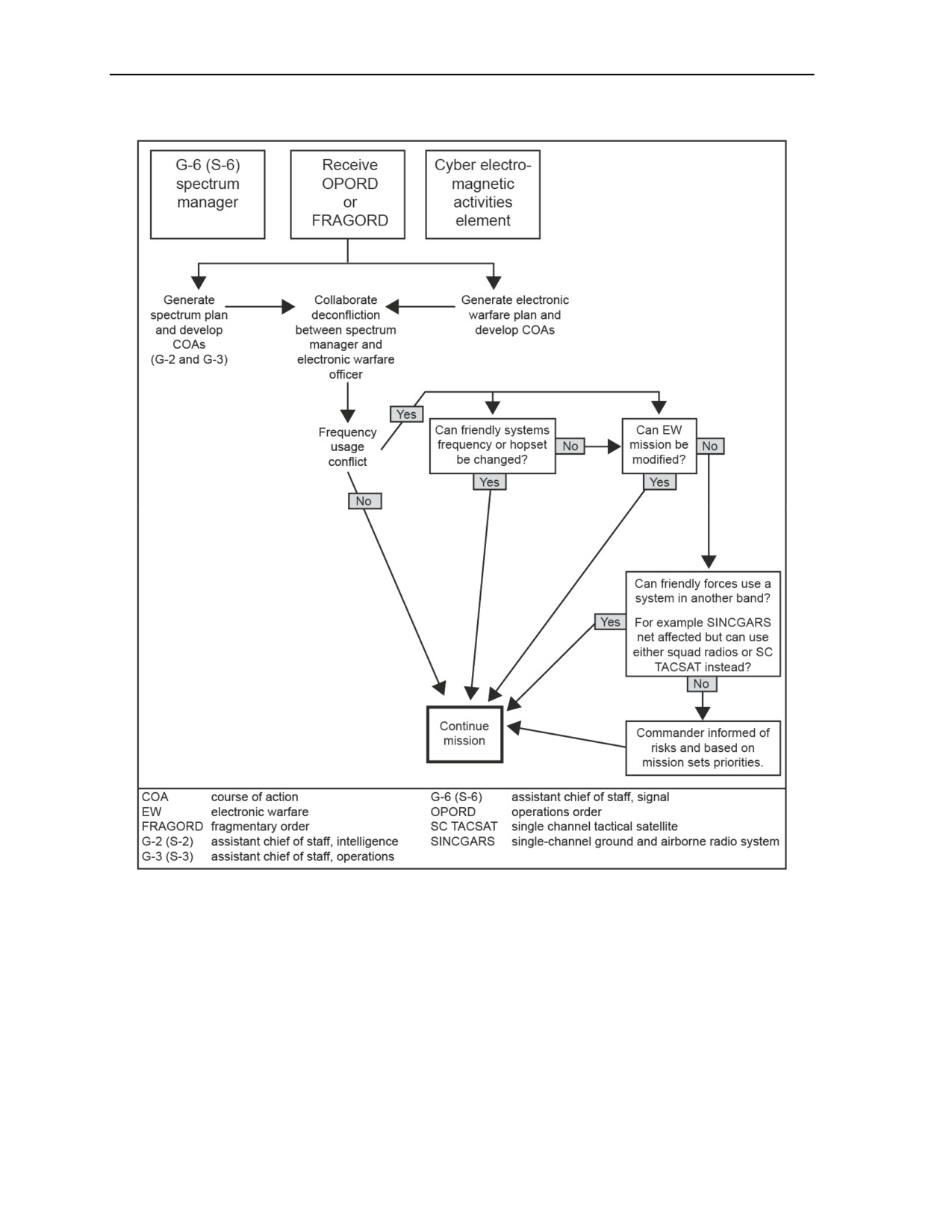
Chapter 5
Figure 5-2. The spectrum management operations and electronic warfare deconfliction
process
ELECTRONIC WARFARE COORDINATION
5-18. The spectrum manager should be an integral part of all EW planning in order to be aware of
spectrum conflicts initiated by friendly systems for personnel protection, enemy exploitation, or enemy
denial. The advent of common user “jammers” has made this awareness and planning critical for the
spectrum manager. In addition to jammers, commanders and staffs must consider non-lethal weapons that
use electromagnetic radiation. Coordination for EW will normally take place in the CEMA element. It may
take place in the EW cell if it is operating under a joint construct or operating at a special echelon. (See
figure 5-2 for SMO and EW deconfliction process.)
5-4
FM 3-38
12 February 2014
Spectrum Management Operations
5-19. Although in some respects the functions of the electronic warfare officer (EWO) and the spectrum
manager appear similar, they differ in that the spectrum manager is concerned with the proper operation of
friendly spectrum dependent devices, while the EWO is threat focused and works to protect the EMS for
friendly forces while denying the enemy use of the EMS. Commanders and staffs must realize this
distinction and avoid relying on one person or cell to manage both functions.
JOINT RESTRICTED FREQUENCY LIST
5-20. A joint restricted frequency list is normally a corps or theater product. The spectrum manager must
work closely with the G-2, G-3, and the EWO to coordinate publication of the joint restricted frequency
list. To make this product useful, the spectrum manager should work to keep it as current and brief as
possible. A restricted frequency list may be developed and published at lower levels, depending upon need
and mission.
COMMUNICATIONS SECURITY COORDINATION
5-21. The spectrum manager must work closely with communications security personnel to ensure that the
proper keying material is matched to the appropriate frequency resource for single channel ground and
airborne radio systems loadsets. Spectrum managers are concerned only with the necessary
communications security for single channel ground and airborne radio systems loadsets and do not handle
or manage communications security for other emitters.
SATELLITE COORDINATION
5-22. The spectrum manager coordinates with satellite managers to maintain awareness of channels
(frequencies) being used by satellite communications systems. The satellite manager generates and
processes satellite access requests for all very high frequency (VHF), ultra high frequency (UHF), super
high frequency (SHF), and extremely high frequency (EHF) satellite systems. Once a request is approved,
the spectrum manager enters the frequencies into the database in order to do frequency deconfliction with
all other emitters in the area of operations.
FREQUENCY DECONFLICTION
5-23. Frequency deconfliction is a systematic management procedure to coordinate the use of the
electromagnetic spectrum for operations, communications, and intelligence functions. Frequency
deconfliction is one element of electromagnetic spectrum management (JP 3-13.1). The limitations of
today’s spectrum management tools make it impossible for the spectrum manager to keep a real-time
database of frequency use. This is due to the highly dynamic nature of tactical operations and the inability
of the tools to do real-time updates automatically. In fast-paced operations the spectrum manager will
mainly be concerned with interference resolution or deconfliction by exception.
FREQUENCY INTERFERENCE RESOLUTION
5-24. Interference is the radiation, emission, or indication of electromagnetic energy; either intentionally or
unintentionally causing degradation, disruption, or complete obstruction of the designated function of the
electronic equipment affected. The reporting end user is responsible for assisting the spectrum manager in
tracking, evaluating, and resolving interference. Interference resolution is performed by the spectrum
manager at the echelon receiving the interference. The spectrum manager is the final authority for
interference resolution. For interference affecting satellite communications, the Commander, Joint
Functional Component Command for Space is the supported commander and final authority of satellite
communications interference.
(For more information on satellite communications interference, see
Strategic Instruction 714-5.)
5-25. Interference may come from signal devices (such as unintentional friendly and unfriendly radios and
radars) and from non-signal devices (such as welders or vehicle engines). The skill level of systems
operators and maintenance personnel can mean the difference between a minor inconvenience and
complete system disablement.
12 February 2014
FM 3-38
5-5
Chapter 5
5-26. When experiencing harmful interference, the operator should be able to discern whether the
interference is coming from natural phenomena or man-made sources. If natural phenomena are the cause,
the operator should try to work through the interference. An alternate frequency may be assigned if the
interference persists. If the operator suspects man-made interference, the operator makes an internal
equipment check to exclude equipment malfunctions. Improper alignment, degraded components, antenna
disorientation, or poor maintenance is usually the cause of interference. After the operator has ruled out
internal causes, a check with other friendly units in the area may reveal incompatibilities between
operations.
5-27. If a compromise cannot be worked out between the units, the case is referred to the spectrum
manager at the next higher echelon. The spectrum manager will conduct an analysis of the database, a site
survey (if possible), and coordinate with other units in the vicinity to identify the cause of the interference.
If the spectrum manager is unable to isolate the cause of the interference, the spectrum manager will submit
a report to the next spectrum management level for resolution. For interference affecting satellite
communications, a joint spectrum interference resolution report will be generated in accordance with
CJCSM 3320.02D.
5-6
FM 3-38
12 February 2014

Chapter 6
The Operations Process
This chapter discusses cyber electromagnetic activities (CEMA) in the operations
process of unified land operations. Specifically, it discusses planning, preparing,
executing, and assessing CEMA.
THE OPERATIONS PROCESS AND CYBER ELECTROMAGNETIC
ACTIVITIES
6-1. CEMA are integrated through the operations process. Figure 6-1 is a depiction of the operations
process. CEMA are planned, prepared for, executed, and assessed as part of all Army operations. (See
ADP 5-0, ADRP 5-0, and ATTP 5-01.1 for more information on the operations process.)
Figure 6-1. The operations process
CYBER ELECTROMAGNETIC ACTIVITIES IN PLANNING
6-2. CEMA involve unique planning considerations. These considerations include—
12 February 2014
FM 3-38
6-1
Chapter 6
z
Planning with interagency partners, other nations, and non-government organizations requires
close coordination, as these unified action partners may have authorities greater than or different
from the Army.
z
Understanding that possible second and third order effects in and through cyberspace and the
electromagnetic spectrum (EMS) can be difficult to predict. These unintended effects manifest
during the execution stage of operations. This does not preclude the possibility of their
occurrence from being incorporated into the planning.
z
Planning based on the physical elements of cyberspace and the EMS mapped out geographically
in the traditional domains is insufficient.
z
Understanding that the effects of cyberspace operations (CO) and electronic warfare (EW) can
take place almost instantaneously. This does not preclude these activities from moving through
the entirety of the operations process. In a time-constrained environment, the staff might not be
able to conduct a detailed military decisionmaking process. The process may be abbreviated, but
all seven steps will be accomplished.
z
Understanding that CEMA provide the commander with lethal and nonlethal actions. Choosing a
specific capability depends on the desired effect on the target and other considerations, such as
time sensitivity or limiting collateral damage. A desired outcome, such as assured information
protection or disruption of adversary communications systems, can also influence capability
choice.
z
Anticipating a protracted period between initial request for application of an effect and
execution. Even if pre-approved at the national level, significant time may be required to
develop tools, establish target access, and return a battle damage assessment.
z
Understanding that CEMA involve significant legal and policy constraints.
Military Decisionmaking Process
6-3. CEMA are integrated into plans and orders through the military decisionmaking process. (For more
information on the military decisionmaking process, see ADP
5.0, ADRP
5-0, ATTP
5-0.1, and
FM 6-02.71.)
Receipt of Mission
6-4. During the receipt of mission, the CEMA element participates in the commander’s initial assessment
actions and gathers the resources required for mission analysis. Unique to CEMA, part of the initial
assessment determines whether resources can be brought to bear on the mission at hand within a reasonable
timeframe or context through the reachback and support processes. (See table 6-1.)
Table 6-1. The military decisionmaking process, step 1: receipt of mission
Inputs
CEMA Element Actions
CEMA Element Outputs
• Higher headquarters’ plan or
• Begin updating the CEMA running
• Updated CEMA running estimate.
order or a new mission
estimate, especially the status of
• CEMA input to initial intelligence
anticipated by the commander.
friendly units and resources and key
preparation of the battlefield and
• All documents related to the
civil considerations.
information collection taskings.
mission and area of operations.
• Determine and contact outside
• Additional intelligence and
agencies and organizations included in
assessment products
the planning process.
(assessment of operational
• Provide CEMA input to the
variables including political,
development of the staff planning
military, economic, social,
timeline.
information, infrastructure,
• Provide CEMA input during formulation
physical, and time).
of the commander’s initial guidance.
• Existing CEMA running
• Provide CEMA input to the initial
estimates.
warning order.
CEMA - cyber electromagnetic activities
6-2
FM 3-38
12 February 2014
The Operations Process
Mission Analysis
6-5. The CEMA element contributes to mission analysis in order to help commanders understand the
operational environment and frame the problem. An effective mission analysis considers the potential
impact cyberspace and the EMS on an operational environment. The CEMA element does this by
participating in planning actions that help form the problem statement, mission statement, commander’s
intent, planning guidance, initial commander’s critical information requirements, essential elements of
friendly information, and updated running estimates. This analysis is conducted from the separate
perspectives of CO and EW, taking note where the two activities converge. The CEMA element
coordinates with the assistant chief of staff, intelligence (G-2 [S-2]), assistant chief of staff, operations (G-3
[S-3]), assistant chief of staff, signal (G-6 [S-6]), and other staff elements in reference to mission critical
systems, risk assessments, current defense posture, and overall operational requirements. When utilized as
an information-related capability the CEMA element works closely with the assistant chief of staff, inform
and influence activities (G-7 [S-7]) to identify the desired effects for the information environment.
6-6. The CEMA element further contributes to overall mission analysis by participating in the intelligence
preparation of the battlefield and closely coordinates with the G-2 (S-2) by providing information, advice,
and assistance. This ensures the G-2 (S-2) understands what CEMA products are needed in order for the
G-2(S-2) to tailor intelligence preparation of the battlefield products. Threats and vulnerabilities are
identified in accordance with adversary offensive cyberspace capabilities, EW capabilities, or both. A
friendly center of gravity analysis is conducted to ensure thorough planning. A key portion of this analysis
is to assess the potential impact of CEMA on friendly assets. For example, increasing security in
cyberspace or deploying additional tools to analyze networks can cause slower network operational speeds.
6-7. The CEMA element then analyzes the commander’s intent and mission from a CEMA perspective
and determines if forces have sufficient assets to perform the identified tasks for all three activities within
the CEMA construct. If organic assets are insufficient, the CEMA element drafts requests for support and
augmentation. If offensive cyberspace operations (OCO) are to be conducted a cyberspace support element
may be required to support the CEMA element. By the conclusion of the mission analysis, the CEMA
element generates or gathers the products and information listed in table 6-2 on page 6-4.
12 February 2014
FM 3-38
6-3
Chapter 6
Table 6-2. The military decisionmaking process, step 2: mission analysis
Inputs
CEMA Element Actions
CEMA Element Outputs
•
Commander’s initial guidance.
•
Analyze the higher headquarters’
• List of CEMA-related requests for
•
Higher headquarters’ plan or
plan or order and develop requests
information.
order.
for information as needed.
• CEMA specified and implied tasks.
•
Higher headquarters’ rules of
•
Collaborate with the intelligence staff
• Specified targets from higher
engagement (specific to
to perform initial intelligence
headquarters’ plan or order
cyberspace operations and
preparation of the battlefield.
requiring effects by cyberspace
electronic warfare).
•
Develop cyber and electronic warfare
operations or electronic warfare
•
Higher headquarters’
threat (for example, enemy,
means.
intelligence and knowledge
adversary, and neutral)
•
Request for CEMA-related
products.
characteristics.
capabilities and resources.
•
Knowledge products from other
•
Identify and analyze key threat
•
List of CEMA-related assumptions.
organizations.
networks, capabilities, and use of
•
Requests to modify standing rules of
cyberspace and the electromagnetic
•
Army design methodology
engagement specific to cyberspace
spectrum.
products.
operations and electronic warfare.
•
Determine CEMA-related high-value
•
List of CEMA-related essential
targets.
elements of friendly information.
•
Identify CEMA-related specified and
•
CEMA portion of the mission
implied tasks.
analysis brief.
•
Determine CEMA-related limitations
•
Updated CEMA running estimate
and constraints.
including:
•
Identify CEMA-related critical facts
- Maps.
and assumptions.
- Overlays.
•
Identify gaps in standing rules of
- Network infrastructure diagrams
engagement specific to cyberspace
and charts.
operations and electronic warfare.
- List of high-value targets for
•
Conduct initial assessment of
potential offensive and defensive
spectrum requirements and
cyberspace operations or
supportability including spectrum
electronic warfare effects.
dependent devices.
- Updated assessment of
•
Coordinate with higher headquarters
operational variables including
and the host-nation government to
political, military, economic,
develop initial spectrum plan.
social, information, infrastructure,
•
Identify and nominate CEMA-related
physical, and time.
commander’s critical information
requirements.
•
Identify and nominate CEMA-related
essential elements of friendly
information.
•
Provide CEMA input to the
development of:
- The information collection plan.
- Initial themes and messages.
- Proposed problem statement.
- Proposed mission statement.
- The mission analysis brief.
- The commander’s initial intent.
- The commander’s initial planning
guidance.
•
Participate in the mission analysis
brief as required.
• Provide CEMA input to the warning
order.
CEMA - cyber electromagnetic activities
6-4
FM 3-38
12 February 2014
The Operations Process
Course of Action Development
6-8. The CEMA element members contribute to course of action (COA) development by determining
possible friendly and enemy operations and which friendly CO and EW capabilities are available to support
the operations. The CEMA element focuses planning efforts on achieving an operational advantage at the
decision point of each COA. By the conclusion of the COA development, the CEMA element generates a
list of CEMA objectives and desired effects. It also generates a list of capabilities, information, and
intelligence required to perform the tasks for each COA (see table 6-3).
Table 6-3. The military decisionmaking process, step 3: COA development
Inputs
CEMA Element Actions
CEMA Element Outputs
•
Mission statement.
•
Provide CEMA input to the
•
For each course of action
•
Initial commander’s intent.
assessment of relative combat
developed include:
power.
- Draft CEMA concept of
•
Initial commander’s planning
guidance.
•
Identify vulnerabilities of friendly,
operations with tasks.
enemy, adversary, and neutral
- Draft CEMA input to high-payoff
•
Initial commander’s critical
actors.
target list.
information requirements.
•
Provide CEMA input to the
- Draft CEMA input to target
•
Initial essential elements of
development of options for
information folders.
friendly information.
decisive, shaping, and sustaining
•
Updated intelligence preparation
- Draft CEMA input to target
operations.
of the battlefield.
synchronization matrix.
•
Provide CEMA input to the
•
CEMA specified and implied tasks.
- Draft maps and overlays.
development of military deception
•
List of high-value targets that may
courses of action.
- Draft network infrastructure
require effects by cyberspace
diagrams and charts.
•
Develop initial scheme of CEMA
operations or electronic warfare
- Draft spectrum plan including the
for each course of action.
means.
joint restricted frequency list.
•
Develop CEMA statements and
•
Updated CEMA running estimate.
•
Updated CEMA running estimate
sketches for each course of action.
•
List of CEMA-related assumptions.
including assumptions.
•
Analyze high-value targets and
•
Draft Appendix 12 (Cyber
develop list of tentative high-payoff
Electromagnetic Activities) to
targets for offensive and defensive
Annex C (Operations).
cyberspace operations or
electronic warfare effects.
•
Draft Appendix 6 (Spectrum
Management Operations) to Annex
•
Begin cyber effects request
H (Signal).
formats.
•
Begin electronic attack request
formats.
•
Begin evaluation request
messages.
•
Develop primary, alternate,
contingency, and emergency
communications plan for each
course of action.
•
Develop CEMA input for the fire
support plan.
•
Develop CEMA input for the
operations execution matrix.
•
Provide CEMA input and
participate in the course of action
development brief as required.
CEMA - cyber electromagnetic activities
Course of Action Analysis
6-9. During COA analysis the CEMA element plans and coordinates with each of the warfighting
function staff members to integrate and synchronize CO and EW capabilities into each COA, thereby
identifying which COA best accomplishes the mission. The CEMA element addresses how CO and EW
capabilities support each COA and applies them to timelines, critical events, and decision points (see table
6-4 on page 6-6).
12 February 2014
FM 3-38
6-5
Chapter 6
Table 6-4. The military decisionmaking process, step 4: COA analysis
Inputs
CEMA Element Actions
CEMA Element Outputs
•
Updated CEMA running estimate
•
In collaboration with the staff, war-
•
For each course of action war-
including assumptions.
game enemy and adversary cyber
gamed include:
•
Revised planning guidance
and electronic warfare capabilities
- Refined CEMA input to the
specific to CEMA.
against friendly capabilities and
concept of operations with tasks.
vulnerabilities for each course of
•
Consolidated course of action
- Refined CEMA-related
action.
statements and sketches.
information requirements.
•
Integrate and synchronize CEMA
•
Draft Appendix 12 (Cyber
- Refined CEMA-related essential
into the concept of operations for
Electromagnetic Activities) to
elements of friendly information.
each course of action.
Annex C (Operations).
- Refined CEMA input to high-
•
Develop and complete the war-
•
Draft Appendix 6 (Spectrum
payoff target list.
game synchronization matrix tool
Management Operations) to
- Refined CEMA input to target
from a CEMA perspective.
Annex H (Signal).
information folders.
•
Identify and record strengths and
- Refined CEMA input to target
weaknesses associated with each
synchronization matrix.
course of action from a CEMA
perspective.
- Refined maps and overlays.
•
Integrate and synchronize CEMA
- Refined network infrastructure
into the fire support plan for each
diagrams and charts.
course of action.
- Refined spectrum plan including
•
Integrate and synchronize CEMA
the joint restricted frequency list.
in support of military deception
- Refined draft cyber effects
courses of action.
request formats.
•
Provide input for the development
- Refined draft electronic attack
of the decision support matrix and
request formats.
decision support template.
- Refined draft evaluation request
•
Provide input to CEMA-related
messages.
operation order appendices and
•
Refined draft Appendix 12 (Cyber
tabs.
Electromagnetic Activities) to
•
Provide CEMA input and
Annex C (Operations).
participate in the war-game
•
Refined draft Appendix 6
briefing as required.
(Spectrum Management
Operations) to Annex H (Signal).
CEMA - cyber electromagnetic activities
Course of Action Comparison
6-10. During COA comparison all staff members evaluate the advantages and disadvantages of each COA
from their perspectives. The CEMA element lead presents the CEMA’s element’s findings for the others’
consideration. At the conclusion of the COA comparison, the CEMA element generates a list of pros and
cons for each COA relative to CEMA. The CEMA element also develops a prioritized list of the COAs
from a CEMA perspective (see table 6-5).
6-6
FM 3-38
12 February 2014