Military reference books and manuals (2009-2023, Volume 6) - page 15
AFMAN31-201
17 MAY 2002
25
The Posse Comitatus Act restricts the use of federal military personnel to enforce civil law except as
authorized under 18 U. S. C. § 1385 and 10 U. S. C. §§ 371 et. seq. This authorizes US armed forces to
assist civilian officials by providing information, equipment, facilities, training and advice as long as it
does not interfere with military preparedness nor violate other laws. Requests for military support to civil-
ian law enforcement officials in connection with civil disturbances will be addressed in accordance with
AFI 10-802, DoDD 3025.12, and DoDD 3025.15. Viable options military commanders may recommend
to civil authorities include:
6.5.1. The Civil Disorders Act of 1968 makes it a federal offense to obstruct, impede or interfere with
any firefighter or law enforcement personnel lawfully performing their official duties. This act
includes members of the National Guard and federal troops performing law enforcement functions.
Therefore, close coordination with civil authorities can help a commander make legitimate use of civil
laws, ordinances and restrictions. The commander’s judge advocate should provide a briefing detail-
ing permissible control force actions to the troops prior to their deployment.
6.5.2. Curfew and sale restrictions are highly effective measures only to be implemented by legal
civilian authorities. The military control force can enforce these measures once legitimately estab-
lished. Before imposing curfews, joint civil-military planning must address:
6.5.2.1. Coordinated curfew starts, enforcement and termination.
6.5.2.2. Public proclamations to start and end curfews.
6.5.2.3. Curfew exemptions, written authorizations and passes--how will the system operate?
6.5.2.4. Provisions for apprehension and disposition of violators.
6.5.3. Restrictions on the sale of alcohol, drugs, gasoline, weapons, ammunition and explosives can
help reduce the likelihood and intensity of violence. Note: The term “weapons” in riot situations
extends beyond firearms and includes bricks, bottles, chains and clubs. Civil authorities can also pro-
hibit carrying the listed items. Likewise, the military control force can then enforce the prohibitions.
Persons openly carrying restricted items will have them seized. All confiscated items are accountable.
Control force members will provide a receipt for each item taken to ensure its proper return.
6.5.4. Other helpful restrictions include:
6.5.4.1. Limiting assembly (e.g., number of people, places, time).
6.5.4.2. Prohibiting interference with public functions.
6.5.4.3. Prohibiting interference with communications.
6.6. Serious Threats. Control forces may encounter high-level threats that pose grave danger to all per-
sons in the area. These threats include hostage/barricade situations, snipers, bomb threats and fires. Imme-
diate-action responses must be in place so control forces can minimize the tragedy caused by these events.
Air Force security forces shall adapt the guidance from AFI 31-101 and C-5210-41M to effectively deal
with serious threats. Fires offer unique challenges beyond the capabilities of most military control forces.
The specialization required of firefighters precludes control forces from direct engagement. Control force
members can help by remaining vigilant to the threat and reporting fires immediately. At a fire scene, mil-
itary control force members may:
6.6.1. Establish a protective cordon around the firefighters' area of operations. The cordon should
provide security for firefighters (sniper suppression) as well as hydrant and hose security.
26
AFMAN31-201 17 MAY 2002
6.6.2. Maintain observation posts (i.e., tall buildings) to prevent sniping, watch for other fires and
coordinate the approach of responding units. Ensure security forces thoroughly coordinate posting
control force members on top of buildings to preclude others from mistaking them as snipers.
6.6.3. Establish crowd and traffic control.
AFMAN31-201
17 MAY 2002
27
Chapter 7
THE RIOT BATON
7.1. Perspective. The riot baton is an invaluable tool in crowd control situations. In the hands of
well-trained control force members, it is the most appropriate tool. Simply displaying the baton provides
a powerful psychological edge. Displaying weapons, like the M-16, may incite/panic crowds to riot. Also,
unlike a rifle, losing a baton to a mob does not pose as serious a threat.
7.2. The Riot Baton. The riot baton used by the Air Force is 36 inches long. It is one and one quarter
inch in diameter and made of a dense wood (rosewood or walnut). Knurled grips are approximately six
inches from either one or both ends of the baton. A hole, nine inches above the grip end, secures the reten-
tion thong. The riot baton is an offensive tool made for civil disturbance actions. Properly applied, the
baton will serve as an extension of the arm to keep distance between control force members and suspects.
The more troops can avoid hand-to-hand confrontations, the safer they become and fewer, less severe
injuries will occur on both sides. The baton offers control force members a strong psychological advan-
tage.
7.2.1. Safety And Employment. The riot baton, in the hands of trained troops, is a formidable
weapon. But it must be used in conjunction with other measures to be most effective. The security
forces member who is skillful in using the riot baton can adequately cope with most situations that
require physical restraint. Security forces must be trained with the riot baton to the point that they use
the various techniques automatically. Security forces using riot batons must have a thorough knowl-
edge of the vulnerable points on the human body (Figure 7.1.). Security forces must deter, discourage
or disperse individuals threatening their position. However, they must also try to avoid blows striking
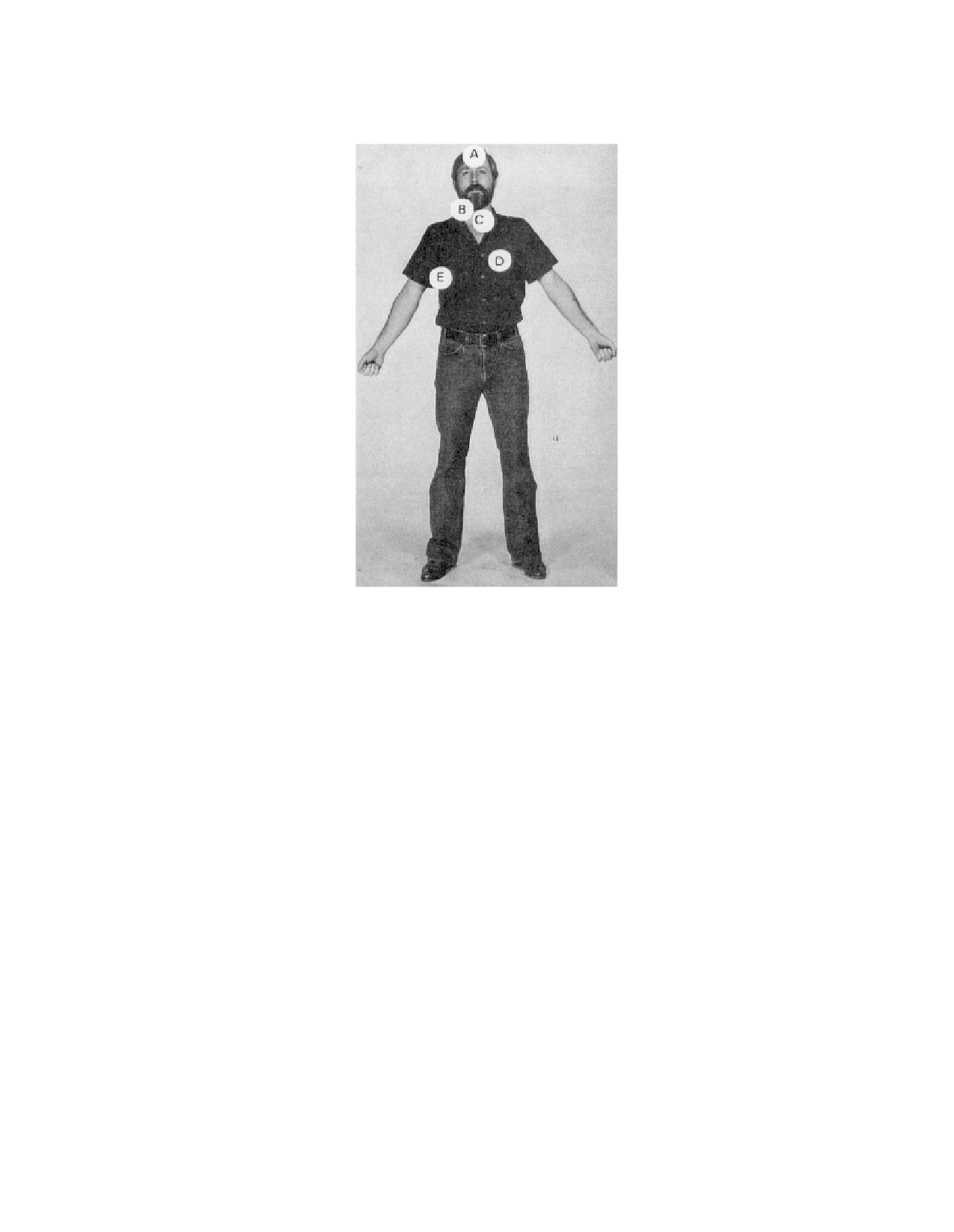
fatal impact points (Figure 7.2.) that could kill or permanently injure.

28
AFMAN31-201 17 MAY 2002
Figure 7.1. Vulnerable Body Points
1. Above clavicle
9. Groin
17. Kidney
2. Shoulder
10. Thigh
18. Coccyx
3. Outer bicept
11. Kneecap
19. Behind knee
4. Ribs
12. Side of calf
20. Calf muscle
5. Solar plexus
13. Shin
21. Ankle tendoid
6. Inner elbow
14. Ankle front
22. Ankle bone
7. Forearm
15. Toes
8. Hand
16. Behind scapula
AFMAN31-201
17 MAY 2002
29
Figure 7.2. Fatal Impact Points
A. Head
B. Side of neck
C. Throat
D. Heart area
E. Armpit
7.2.2. Gripping the Baton. There are three steps to properly grip and secure the baton in the hand.
First, place the thong around the right thumb as shown in Figure 7.3. Next, rotate the baton counter-
clockwise around the hand. The thong will be wrap around the back of the grip hand (Figure 7.4.).
The last step is simply rolling the palm of the hand onto the knurled grip and closing the hand around
the baton (Figure 7.5.). Not only does this method provide an extremely secure method to hold the
baton, but release is as simple as relaxing the hand.

30
AFMAN31-201 17 MAY 2002
Figure 7.3. Placing Baton Thong on Thumb
Figure 7.4. Wrapping Thong Around Back Of Hand
Figure 7.5. Completed Baton Grip

AFMAN31-201
17 MAY 2002
31
7.2.3. Parade Rest.
7.2.3.1. This position is a relaxed, ready position. Control force members can maintain the parade
rest position for indefinite periods of time. Assume the parade rest position with feet shoul-
der-width apart. Grasp the baton on the knurled grips with the right hand knuckles out and thumb
down. The left hand grips the striking end of the baton with the knuckles in and thumb up. The
baton rests against the thighs as shown in Figure 7.6. The opposite hand grip positions afford the
most positive control over the baton; and will be the same for all positions and tactics.
Figure 7.6. Parade Rest
7.2.3.2. The command for this position is, "Rest Position, Move!" "Rest position" is the prepara-
tory command. Execute the command on the word "move!"
7.2.4. Port Position. Control force members assume the port position from the position of attention
(baton held in the right hand and parallel with the full length of the right arm; Figure 7.7.). This posi-
tion is a ready position well suited for individual defense. As in the rest position, the feet are shoul-
der-width apart, the knees slightly flexed. The right hand and forearm are parallel to the ground. The
left hand is level with the left shoulder. The striking end of the baton bisects the angle between the
neck and left shoulder. Hold the baton approximately six inches from the body. The command for this
position is, "Port Position, Move!" "Port Position" is the preparatory command. "Move!" is the execu-
tion command. Use the port position to move units at double time as an intervening move on approach
of a crowd, when posting control force members on-line (against dissidents) for long periods of time.
See Figure 7.8.