Military reference books and manuals (2009-2023, Volume 6) - page 1
Procedure for Task Risk Assessment
Page 1 of
38
Procedure for Task Risk Assessment
AZSPU-HSSE-DOC-00063-2
Authority:
AzRPU Health & Safety
Custodian:
AzRPU CoW/Safety Systems Lead (Elman
Manager Offshore (Yuliy
Shikhkerimov)
Zaytsev)
Scope:
AzRPU
Document
Administrator:
HSE Document Coordinator
Issue Date:
09 September 2004
Issuing Dept:
AzRPU Health & Safety Offshore,
HSE & Engineering
Revision Date:
29 December 2010
Control Tier:
2
Control Tier:
<<2>>
Revision Date: <<29 December 2010>>
Document Number: << AZSPU-HSSE-DOC-00063-2>>
Print Date: 2/1/2011
PAPER COPIES ARE UNCONTROLLED. THIS COPY VALID ONLY AT THE TIME OF PRINTING. THE
CONTROLLED VERSION OF THIS DOCUMENT CAN BE FOUND AT
Procedure for Task Risk Assessment
Page 2 of
38
Next Review
29 December 2012
Date:
TABLE OF CONTENTS
1 PURPOSE / SCOPE
3
2 DEFINITIONS
4
3. GENERAL REQUIREMENTS
5
3.1
Legislation & Standards
5
3.2
Company Requirements
5
3.3
Stopping Unsafe Work
5
3.5
SSOW Specific Cross References
5
3.6
Language Facilitation
6
4. ROLES AND RESPONSIBILITIES
6
4.1
Site Manager (SM) / Site Controller (SC) / Offshore Installation
Manager (OIM)
6
4.2
Area Authority
6
4.3
Performing Authority
7
4.4
Task Risk Assessment Team Leader (Area Authority)
7
4.5
Individual TRA Member
7
4.6
People carrying out the Work
7
4.7 Marine Authority
7
4.8 AUDITING AND MONITORING
8
4.9 COMPETENCY, TRAINING AND AWARENESS
8
5. RISK ASSESSMENT LEVELS
8
5.1
Level 1 Risk Assessment Guidance Notes
9
5.2
Level 2 Risk Assessment Guidance Notes
10
5.3
NORMAL LEVEL 2 RISK ASSESSMENT
10
Manual and mechanical excavations less than 1.2m deep
11
5.3.1 OPERATIONAL RISK ASSESSMENT
12
5.3.2 STAND-ALONE RISK ASSESSMENT
14
5.3.3 ISOLATION RISK ASSESSMENT
14
5.3.4 SAFETY OVERRIDES RISK ASSESSMENT
15
5.4
Level 2 Risk Assessment Team
15
5.5 THE STAGES OF RISK ASSESSMENT
16
5.5.1
Defining the Task to be Assessed
16
5.5.2 L1RA Specific
17
5.5.3 L2RA Specific
17
5.6
Identifying the Hazards
17
5.6.1
Identifying the Hazard Effects
17
5.7 Existing Control Measures
18
5.7.1 Evaluate the Risk
19
5.7.2
Determining the Additional Controls Required
20
5.7.3
Allocating Responsibilities for Control Actions
21
5.7.4
Re-evaluate the Risks for Acceptability
21
5.7.5
Implementation of Control Measures
23
5.7.6
Task Inspection Checklist
23
Control Tier:
<<2>>
Revision Date: <<29 December 2010>>
Document Number: << AZSPU-HSSE-DOC-00063-2>>
Print Date: 2/1/2011
PAPER COPIES ARE UNCONTROLLED. THIS COPY VALID ONLY AT THE TIME OF PRINTING. THE
CONTROLLED VERSION OF THIS DOCUMENT CAN BE FOUND AT
Procedure for Task Risk Assessment
Page 3 of
38
5.7.7
Toolbox Talks
23
5.8 MANAGEMENT OF RISK
25
5.8.1
Approval
25
5.8.2
Recording the Risk Assessment
25
APPENDIX A: Hazard Checklists
25
APPENDIX B: Risk Assessment Chart
28
APPENDIX C: L2RA Form
29
APPENDIX D: Risk Assessment Flow-path
31
APPENDIX E: Risk Hierarchy Examples
32
APPENDIX F: Task Inspection Checklist (example)
33
1
PURPOSE / SCOPE
It is a requirement of the Permit to Work procedure employed within BP AzRPU that
a Task Risk Assessment is carried out before any permits are issued.
The purpose of this procedure is to describe the Task Risk Assessment process
employed by BP AzRPU in support of the Permit to Work System.
The contents of this procedure are applicable to all BP owned and managed sites /
installations in Azerbaijan and Georgia. Contractors working on BP owned or
managed sites / installations are also responsible for alignment with this procedure.
This document does not replace the procedures prepared and adopted by specialist
contractors. Neither does it supersede any national and local regulatory
requirements.
All guidelines contained shall be regarded as the minimum requirements for BP
Control Tier:
<<2>>
Revision Date: <<29 December 2010>>
Document Number: << AZSPU-HSSE-DOC-00063-2>>
Print Date: 2/1/2011
PAPER COPIES ARE UNCONTROLLED. THIS COPY VALID ONLY AT THE TIME OF PRINTING. THE
CONTROLLED VERSION OF THIS DOCUMENT CAN BE FOUND AT
Procedure for Task Risk Assessment
Page 4 of
38
owned or managed sites / installations in Azerbaijan and Georgia.
The scope covers defined activities of BP and Contractors at all BP AzRPU sites and
installations.
2
DEFINITIONS
AA
Area Authority
AAA
Affected Area Authority
AEP
Authorised Electrical Person
ALARP
As Low as Reasonably Practicable
AOM
Area Operations Manager
CBT
Computer Based Training
COSHH
Control of Substances Hazardous to Health
COW
Control of Work
CRO
Control Room Operator
CSE
Confined Space Entry
CW
Cold Work
FP
Formal Procedure
HWNF
Hot Work Naked Flame
HWSP
Hot Work Spark Potential
IA
Isolating Authority
ICC
Isolation Control Certificate
IL
Integrity level, highest of Safety Integrity Level (SIL), Environmental
Integrity Level (EIL) and Commercial Integrity Level (CIL)
IRA
Isolation Risk Assessment
L2RA
Level 2 Risk Assessment
LTI
Long-Term Isolations
MA
Marine Authority
OIM
Offshore Installation Manager
ORA
Operational Risk Assessment
PA
Performing Authority
PTW
Permit to Work
PTWC
Permit to Work Coordinator
PUL
Performance Unit Leader
REP
Responsible Electrical Person
RTC
Risk It, Talk It, Check It Pre-Task risk Assessment
SARA
Stand Alone Risk Assessment
SC
Site Controller
SM
Site Manager
SSOW
Safe System of Work
TRA
Task risk Assessment
TA
Technical Authority
TBT
Toolbox Talk
DRE
Discipline Responsible Engineers (instrumentation/ electrical process
mechanical etc)
RPU
Regional Production Unit
Control Tier:
<<2>>
Revision Date: <<29 December 2010>>
Document Number: << AZSPU-HSSE-DOC-00063-2>>
Print Date: 2/1/2011
PAPER COPIES ARE UNCONTROLLED. THIS COPY VALID ONLY AT THE TIME OF PRINTING. THE
CONTROLLED VERSION OF THIS DOCUMENT CAN BE FOUND AT
Procedure for Task Risk Assessment
Page 5 of
38
3. GENERAL REQUIREMENTS
- Operating Management System OMS Essentials 2.3, 3.1 and 4.5.
- BP Group Guidance Hazard Identification and Task Risk Assessment GG 3.1-
0002
- BP Group Defined Practice for Control of Work GDP 4.5-0001
3.1
LEGISLATION & STANDARDS
The aim of this Safe System of Work is to achieve ”no accidents”, “no harm to
people” and “no damage to the environment”. To achieve this aim, this SSOW
complies with National Legislation, the terms of the Production Sharing Agreement
(PSA) and mandatory BP Standards.
The best International Oil Industry practice and relevant goal setting legislation have
been adopted to reduce the level of risk to as low as reasonably practicable and
therefore well below that mandated by applicable statutory laws and regulations.
In the absence of local regulations, BP Group Standards will apply. In addition,
appropriate UK and US regulations and industry best practice have been considered
in setting suitable goals and targets.
3.2
COMPANY REQUIREMENTS
It is a company requirement that all tasks are subjected to an assessment of risk to
demonstrate that risks have been reduced to as low a level as reasonably practicable
(ALARP). This can be achieved by complying with the Company‟s existing standards.
Where compliance with Company standards cannot reasonably be achieved, a
formal level 2 Risk Assessment will be undertaken to identify any additional controls
and demonstrate that risks remain as low as reasonably practicable.
3.3
STOPPING UNSAFE WORK
To stop the continuation of potentially unsafe work at the earliest possible stage, the
Control of Work (CoW) Procedure and this Task Risk Assessment procedure make it
very clear that all personnel are obliged and have the obligation to “STOP” the work
that they consider to be unsafe.
3.5
SSOW SPECIFIC CROSS REFERENCES
This procedure shall, where appropriate, be used in conjunction with this suite of
AzSPU Procedures referenced below.
Document Number
Title of Procedure
AZSPU-HSSE-DOC-00060-2
Procedure for Permit To Work
AZSPU-HSSE-DOC-00063-2
Procedure for Task Risk Assessment
AZSPU-HSSE-DOC-00048-2
Procedure for Energy Isolations-Electrical
AZSPU-HSSE-DOC-00049-2
Procedure for Energy Isolations-Process
AZSPU-HSSE-DOC-00055-2
Procedure for Leak Testing
AZSPU-HSSE-DOC-00013-2
Procedure for Confined Space Entry
AZSPU-HSSE-DOC-00058-2
Procedure for Management of Radioactive Materials &
Radiation Generators
Control Tier:
<<2>>
Revision Date: <<29 December 2010>>
Document Number: << AZSPU-HSSE-DOC-00063-2>>
Print Date: 2/1/2011
PAPER COPIES ARE UNCONTROLLED. THIS COPY VALID ONLY AT THE TIME OF PRINTING. THE
CONTROLLED VERSION OF THIS DOCUMENT CAN BE FOUND AT
Procedure for Task Risk Assessment
Page 6 of
38
AZSPU-HSSE-DOC- 00002-2
Procedure for Control of Work Standard
AZSPU-HSSE-DOC-00088-2
Procedure for Control of Work Training Policy
3.6
LANGUAGE FACILITATION
Due to the various languages spoken at sites / installations, there is a necessity to
assist all with “an ease of understanding”. Therefore, the development and use of
information tools are available.
4.
ROLES AND RESPONSIBILITIES
4.1
SITE MANAGER (SM) / SITE CONTROLLER (SC) / OFFSHORE INSTALLATION
MANAGER (OIM)
The Site Manager
/ Site Controller
/ Offshore Installation Manager shall be
responsible and accountable for the application of this procedure in his area of
responsibility, He shall ensure:
That adequate numbers of Competent responsible persons are appointed to
manage and maintain the requirements of this procedure
That this procedure is strictly adhered to for all occasions when it is identified
that task risk assessments are to take place.
That formal records of all task risk assessments are maintained in accordance
with this procedure
That the task risk assessment Process is applied at sites within their area of
responsibility
Periodic internal reviews and
/ or audit of the operations of task risk
assessment
Appointing individuals to act as task risk assessment Team Leaders to
facilitate the TRA process
The review of all Level 2 Risk Assessments.
Note: It is incumbent on the SM / SC / OIM to request a higher level of Risk
Assessment should they consider that risks have not been fully addressed.
4.2
AREA AUTHORITY
The Area Authority shall be responsible for ensuring that the requirements of this
procedure are adhered to for all task risk assessments conducted within his area of
responsibility. He shall be responsible for ensuring:
That all persons are instructed on the requirements of task risk assessment,
permit to work conditions, and any risks or hazards associated with the work
activity
The level of Risk Assessment required for the task
Organising and participating in the Task Risk Assessment process
That the Performing Authority participates in Risk Assessments, and conducts
Toolbox Talks associated with the work activity
Ensure that the TRA is transferred in all appropriate languages commonly
used by the workforce, where required.
Control Tier:
<<2>>
Revision Date: <<29 December 2010>>
Document Number: << AZSPU-HSSE-DOC-00063-2>>
Print Date: 2/1/2011
PAPER COPIES ARE UNCONTROLLED. THIS COPY VALID ONLY AT THE TIME OF PRINTING. THE
CONTROLLED VERSION OF THIS DOCUMENT CAN BE FOUND AT
Procedure for Task Risk Assessment
Page 7 of
38
4.3
PERFORMING AUTHORITY
The Performing Authority shall ensure:
The compliance of all personnel under their supervision with this procedure
when involved in risk assessed activities
That a risk assessment has been performed and a toolbox talk conducted
That all personnel are informed of, and understand, the risks associated with
the task they are performing, and any associated works that may affect their
work activity
That the activity is executed in accordance with this procedure
That works are halted if an unsafe situation occurs.
That good housekeeping practices are implemented at all work areas
That work activities have been reviewed and pertinent information exchanged
with all other affected parties.
4.4
TASK RISK ASSESSMENT TEAM LEADER (AREA AUTHORITY)
The main responsibilities of the TRA Team Leader are to:
Lead the team in performing a Level 2 Risk Assessment
Ensure the team understands the assessment process
Take responsibility for maintaining the quality of the TRA
Ensure that the assessment team includes personnel with all the necessary
experience, knowledge and competence for the task involved
Ensure that the TRA includes a worksite visit
Ensure that all members of the TRA team have a full opportunity to contribute
and that the details of the assessment are agreed by all team members
Ensure that the details of the assessment are accurately recorded
4.5
INDIVIDUAL TRA MEMBER
The responsibilities of individual team members are to:
Actively participate in the TRA process
Help identify hazards and control measures to reduce the likelihood of an
incident/accident occurring
Ensure they agree with the overall TRA before approval, ensuring that risks
have been reduced to as low as reasonably practicable
4.6
PEOPLE CARRYING OUT THE WORK
The responsibilities of the people carrying out the work are to:
Understand the hazards, risks and controls associated with the task
Participate and contribute in the Toolbox Talk
Actively monitor the worksite and surroundings for changes
Stop the job at any time if they have concerns about the safety of the task
Sign to confirm that they understand the hazards and controls
4.7 MARINE AUTHORITY
MA is accountable for assigning appropriately experienced marine
practitioners to the risk assessment. He is responsible for reviewing and approving
Marine or Marine Operations Risk Assessment.
Control Tier:
<<2>>
Revision Date: <<29 December 2010>>
Document Number: << AZSPU-HSSE-DOC-00063-2>>
Print Date: 2/1/2011
PAPER COPIES ARE UNCONTROLLED. THIS COPY VALID ONLY AT THE TIME OF PRINTING. THE
CONTROLLED VERSION OF THIS DOCUMENT CAN BE FOUND AT
Procedure for Task Risk Assessment
Page 8 of
38
4.8 AUDITING AND MONITORING
Each Asset shall:
Undertake internal audits of the operation of the Risk Assessment process as
part of the Safe Systems of Work at each Operating facility: Site / Installation.
Maintain an Audit Register.
Have in place a system for tracking recommendations
Use of a Standard Audit Checklist is recommended, to allow comparison with
external audit results.
The recommended frequency of Audit is as follows:
Supervisor/ Area Authority
Minimum of 2 per week
Site Safety Adviser
Minimum of 1 permit per week
Site Manager/Site Controller/OIM
Minimum of 1 permit per month
Site Managers / Site Controllers / Offshore Installation Managers shall carry out
regular internal reviews of the findings of Risk Assessment Audits, to ensure that any
critical failings in the system, or its manner of implementation, have been identified
and appropriate actions have been, or are being, taken.
4.9 COMPETENCY, TRAINING AND AWARENESS
All personnel involved in the use of the Risk Assessment process shall be trained
and proven to be competent.
The competency of all relevant personnel shall be established during the planning
process for a particular risk assessment. The Area Authority and/or Line Supervisor
shall ensure that the personnel involved in the activity have the correct competencies
through records or requesting individuals to produce relevant certification.
All training and competency requirements shall be followed as described in CoW
Training Policy AZSPU-HSSE-DOC-00088-2
Note: Toolbox Talks are an essential part of the Risk Assessment Process. All
users of this SSOW should contribute at this point.
4.9.1 RECORDS
Records of attendance and competency will be filed for future reference / verification
by Senior Management. Risk Assessments shall be uniquely numbered and retained
(preferably in electronic format).
5.
RISK ASSESSMENT LEVELS
The process of Task Risk Assessment
(TRA) is a method for systematically
examining an individual work assignment (task), to identify the hazards, evaluate the
risks and specify appropriate controls.
Control Tier:
<<2>>
Revision Date: <<29 December 2010>>
Document Number: << AZSPU-HSSE-DOC-00063-2>>
Print Date: 2/1/2011
PAPER COPIES ARE UNCONTROLLED. THIS COPY VALID ONLY AT THE TIME OF PRINTING. THE
CONTROLLED VERSION OF THIS DOCUMENT CAN BE FOUND AT
Procedure for Task Risk Assessment
Page 9 of
38
There are 2 levels of risk assessment defined within the process:
Level 1
Level 1 is a broad overview of the task by a Area Authority (AA) (typically the Team
Leader and the Performing Authority (PA) to identify any hazards involved and
appropriate control measures which are required to be in place to allow the job to
proceed.
Level 2
Level 2 is a formal assessment, which is required only when the AA‟s judge that
there are greater hazards or complexities associated with the task, which requires a
more rigorous level of assessment. A team of minimum 2 personnel carries out this
assessment.
All Risk Assessments require input from those who will be doing the work. In addition,
some Level 2 Risk Assessments may require the input of expertise from outside the
normal site / installation team.
Previously carried out L2 Risk Assessments (L2RA) can be used for repeat tasks.
Note: Whenever a previous L2RA is re-used then it is critical that the details of the
TRA are reviewed to ensure that the scope of the task is still relevant,
conditions have not changed and that the hazards and control measures are
still appropriate. A new L2RA Front-Sheet must be completed, to capture
details of the new review team. If conditions have changed, the TRA should
be reviewed, revised and approved before it is re-used.
5.1
LEVEL 1 RISK ASSESSMENT GUIDANCE NOTES
A Level 1 Risk Assessment is based on section 1 and 2 of the Permit. The Permit
Form provides the prompt list and structured approach for this level of Risk
Assessment.
Different Permits have different prompt lists in section 2.
A Level 1 Risk Assessment involves a review of the task by the PA in consultation
with the Area Authority to identify the hazards associated with the task and
appropriate control measures required to manage these hazards. The PA‟s in using
their technical competence and task information from section 1 selects the hazards
from a list.
The PA then uses the controls listed in section 2 of the Permit to show how the work
will be controlled.
These hazards and controls are selected from a list from the permit, although the PA
should not be constrained by this and must use his judgement and expertise to
identify any further hazards or controls
- there is space on the permit to add
additional hazards and controls.
The Area Authority must decide whether the risks can be controlled adequately by
the proposed means, taking into account the controls required by any relevant local
procedure and the competence of the person in charge. If the Area Authority is not
completely assured that the risks will be adequately controlled by these measures
Control Tier:
<<2>>
Revision Date: <<29 December 2010>>
Document Number: << AZSPU-HSSE-DOC-00063-2>>
Print Date: 2/1/2011
PAPER COPIES ARE UNCONTROLLED. THIS COPY VALID ONLY AT THE TIME OF PRINTING. THE
CONTROLLED VERSION OF THIS DOCUMENT CAN BE FOUND AT
Procedure for Task Risk Assessment
Page 10 of
38
and feels a more rigorous assessment is required, they must inform the person in
charge of the work and request a Level 2 Risk Assessment. This requirement should
ideally be identified at the earliest opportunity. The Site Manager / Site Controller /
Offshore Installation Manager can direct that a Level 2 Risk Assessment shall be
undertaken at any time. Earliest communication of the task requirement and
discussion about it will identify the level of Risk Assessment process to be
conducted.
The Area Authority will review with the PA Section 1 and 2 of the permit along with
any documentation. They will visit the worksite to confirm all hazards have been
identified and controlled.
The flow-path that should be followed is provided in Appendix D.
Note: Discussing the job with the workforce involved is an important part of this
process.
ISSOW database, where RA recorded has got different layout (See attached Link)
5.2
LEVEL 2 RISK ASSESSMENT GUIDANCE NOTES
A Level 2 Risk Assessment must be carried out at any stage in the process where
the PA, AA, a member of management or any other personnel believes that
significant risks exist which will not be adequately controlled without a more rigorous
assessment and the application of additional controls. This requirement should
ideally be identified when the planning for the task is first initiated. The AA is
responsible for making a decision whether a L2 RA is required.
The reasons for a Level 2 Risk Assessment might include, for example:
The task is new and unfamiliar
It is physically impossible to comply fully with the standards in a relevant local
procedure or other recognised source of guidance
Previously used controls may not be reasonably practicable in this case
The task is complex and/or has potential impact on other activities
The decision on when a Level 2 Risk Assessment is required for a task is somewhat
subjective and will depend on the people involved, but the following rules should be
applied to ensure a consistent level of assessment is being carried out across the
organisation.
There are five types of Level 2 Risk Assessment:
Normal
Operational Risk Assessment (ORA)
Stand Alone Risk Assessment (SARA)
Isolation Risk Assessment (IRA)
Safety Overrides Risk Assessment(SORA)
A Level 2 Risk Assessment is mandatory for any job described in Table 1 below.
5.3
NORMAL LEVEL 2 RISK ASSESSMENT
Tasks identified in this section require a Normal Level 2 TRA to be performed. In the
Control Tier:
<<2>>
Revision Date: <<29 December 2010>>
Document Number: << AZSPU-HSSE-DOC-00063-2>>
Print Date: 2/1/2011
PAPER COPIES ARE UNCONTROLLED. THIS COPY VALID ONLY AT THE TIME OF PRINTING. THE
CONTROLLED VERSION OF THIS DOCUMENT CAN BE FOUND AT
Procedure for Task Risk Assessment
Page 11 of
38
event a particular task is not listed but the Task has a significant risk then a Line
Supervisor should be consulted. Some sites may have specific activities unique to
that site which they deem as mandatory Level 2 tasks, that has to be reflected in the
local rules. A Level 2 Risk Assessment must always be undertaken for any job, which
requires:
Table 1 - Mandatory Level 2 Risk Assessment
Confined Space Entry
Introduction of new Marine Vessels whether
owned, operated or chartered into operation
Work on flare systems
Changes to the operation of a Port or
Terminal
Plugging/sealing
Installation of or movement of major
equipment and facilities offshore or from
construction yards to the operating location
Hot / Odd Bolting
Change in the intended duty or mode of
operation of vessels offshore
Heavy Lifts (A load is classified as heavy when
Diving Operations
specified by the Site Lifting Coordinator)
Simultaneous Operations (SIMOPs)
Use of Explosives
Working with asbestos, NORM(other activities
Lifts over live process pipelines or process
involving exposure to substances for which
plant
there are defined exposure limit value)
Working at Heights without scaffold or
Tasks involving Ground Disturbance. Manual
structure
and mechanical excavations below 1.2m
When minimum standards of Energy Isolation
Where there is a significant potential for
cannot be achieved
injury to people outside the site boundary
Unconventional access (e.g., abseiling, crane
Hot work within 15m radius of hydrocarbons
basket)
Proof Tests (initial hydro test where no design
When the approved procedures cannot be
pressure exists)
followed.
Pneumatic test (as alternative to hydro test,
Task that may have specific hazards
up to 110% of design pressure), including
associated with Energy Isolation.
leak testing of gas lines with N2.
Non-routine
venting/draining/cleaning
of
Tasks which are judged to be unusually
equipment containing hazardous chemicals
complex (e.g., due to the number of steps or
interfaces)
Tasks which are unfamiliar, or which involve
o
Any activity involving potential exposure to
unfamiliar methods or technologies
H2S
o Removal of any part of any footing surface consisting of gratings, deck hatches, deck plates
etc., located at height, or above void. Any further activity taken place within such an area -
properly signed, controlled and barriered.
Table 2 - Advisory Level 2 Risk Assessment
Where multiple protective devices are removed
New activities being carried out for the first time
or inhibited from a system
and/or involving personnel or vendors new to the
site / installation
Blocked escape routes, off-line fire pump or
Manual and mechanical excavations less than
emergency generator
1.2m deep
Some sites / installations will have standing instructions or procedures in place
covering standard precautions for some of these activities. They can act in support of
the assessment and may adequately cover most of the required control measures.
Control Tier:
<<2>>
Revision Date: <<29 December 2010>>
Document Number: << AZSPU-HSSE-DOC-00063-2>>
Print Date: 2/1/2011
PAPER COPIES ARE UNCONTROLLED. THIS COPY VALID ONLY AT THE TIME OF PRINTING. THE
CONTROLLED VERSION OF THIS DOCUMENT CAN BE FOUND AT
Procedure for Task Risk Assessment
Page 12 of
38
The flow-path that should be followed is provided in Appendix D.
5.3.1 OPERATIONAL RISK ASSESSMENT
Operational Risk Assessments (ORAs) are associated with a piece of equipment or
plant as opposed to being associated with a specific task. They involve going through
a similar process as for raising a WCC Permit or Routine and require carrying out a
Level 2 Risk Assessment and identifying some control measures that need to be put
in place.
Examples of ORA are:
Operating a compressor with some executive action instrumentation out of
service (e.g. vibration probe), where some additional controls or monitoring is
required to allow continued operation of the compressor
If any part of a Safety Critical Element does not meet its performance
standard.
To override a trip function, unless approved by operations procedures.
Reduction of deluge cover in an area of the Installation where some additional
controls or restriction on work would be applied to that particular area of the
plant
Problem with a lifeboat where some alternative evacuation arrangements are
in place
Content of Operational Risk Assessment
The ORA shall describe:
History
The ORA shall describe the context of the situation surrounding the requirement for
the ORA. Include explicit description of equipment involved - tag numbers etc.
Consequence
The ORA shall describe the consequences of operating in accordance with the
ORA.
This will include a statement of the value (1 to 15) of highest residual risk depicted in
the Level 2 Risk Assessment Matrix (refer to Paragraph 5.7.1) and a description of
the impact on integrity or safety of this change from normal condition.
Justification
The ORA shall include a statement describing why the risk of operating in this
way is As Low As Reasonably Practicable (ALARP)
The team may need to refer to discounted alternatives to demonstrate ALARP.
Note: ALARP is the point at which the potential risk has been reduced to where any
additional reduction will be outweighed by the cost or effort that will be incurred.
(Click the Link for more guidance).
Plan to Resolve
The ORA shall include a description of the duration and the planned actions to
resolve the need for an ORA. Furthermore it shall describe what actions are required
in the event the duration of the ORA is exceeded.
Duration of ORA
The duration assigned to the ORA is agreed within the risk assessment and reflects
Control Tier:
<<2>>
Revision Date: <<29 December 2010>>
Document Number: << AZSPU-HSSE-DOC-00063-2>>
Print Date: 2/1/2011
PAPER COPIES ARE UNCONTROLLED. THIS COPY VALID ONLY AT THE TIME OF PRINTING. THE
CONTROLLED VERSION OF THIS DOCUMENT CAN BE FOUND AT
Procedure for Task Risk Assessment
Page 13 of
38
the maximum acceptable duration, consistent with maintaining risks ALARP.
The maximum possible duration for specifically numbered ORA is 28 days. This is
different to the agreed acceptable duration for which the risk may be permitted to
remain - i.e. a shorter validity period can be stated, or another duplicate ORA
generated after 28 days, if a longer duration is acceptable.
When ORAs result in the issue of a temporary eMoC they shall be cross referenced.
Approval of ORA
In addition to the normal ISSOW approvals the following engineering functional
approval is required:
All process or equipment related ORA‟s shall be reviewed and approved as a
minimum by the relevant DRE in the AESTL team.
For all ORA‟s with a risk ranking 8 and above a Technical Authority (TA) or
delegate shall endorse the ORA. In some instances more than one TA may
be required to review and endorse. In reviewing any individual ORA the TA
shall also consider the cumulative risk of existing ORAs.
Anyone with actions assigned by the ORA shall countersign it to acknowledge
that they have read and understood the ORA.
Prior to approval, the Site Controller shall consider the cumulative risk of the
proposed and existing ORAs.
The Site Controller shall carry out a physical inspection of any associated
modification to equipment/worksite prior to approval of the ORA.
Note: In exceptional circumstances the Site Controller is delegated authority to
approve the ORA without engineering review, if the Site Controller is satisfied that the
risks accepted by the ORA have been reduced to ALARP. (Click the Link for more
guidance).
In these circumstances, the ORA shall be countersigned by the relevant engineering
level within 3 days.
Operational Risk Assessment Review Process
Any abnormal change to process or equipment shall trigger an immediate
review of all ORA‟s related to that system to ensure that the ORA remains
valid.
Weekly Review: A site led review to confirm that the ORAs are still valid and
that no changes are required. (This will normally be carried out at the daily
PTW / SIMOPS meeting) and the Sentinel Pro system will warn of the
necessity to review.
Re-Authorization / Reassessment (28 days max)
A site led review to confirm that the ORA is still required. The same approval process
shall be followed as for a new ORA, with confirmation that no additional controls are
required.
To ensure history is maintained via the „view linked facility‟ the ORA that is due to
become out of date should be copied and then fully re-assessed by a suitable team
(AA, discipline expert) prior to submission the SM / SC / OIM for approval.
The Sentinel Pro software will alert personnel that a reauthorization is due.
Control Tier:
<<2>>
Revision Date: <<29 December 2010>>
Document Number: << AZSPU-HSSE-DOC-00063-2>>
Print Date: 2/1/2011
PAPER COPIES ARE UNCONTROLLED. THIS COPY VALID ONLY AT THE TIME OF PRINTING. THE
CONTROLLED VERSION OF THIS DOCUMENT CAN BE FOUND AT
Procedure for Task Risk Assessment
Page 14 of
38
Quarterly Review
All current ORA‟s shall be audited by AOM, as follows:
a. Assess and approve the cumulative risk to site (this should be ALARP).
b. Use a risk matrix to plot ORAs in order to assist with the assessment of risk.
c. Review progress to close out the ORA. Agree any changes required to action
plan; ensure that the priority of ORA close-out is consistent with Asset
requirements and the ORA residual risk.
d. All ORA‟s shall be logged as Audited (through the full cycle to SM / SC / OIM
review and any relevant findings logged in the audit report using the Sentinel Pro
software)
e. Any actions arising from the quarterly audit shall be recorded in Traction.
5.3.2 STAND-ALONE RISK ASSESSMENT
SARA‟s are not task-related but once again require that a Level 2 Risk Assessment
be conducted. A Stand-Alone Risk Assessment involves carrying out a risk
assessment, which may not be associated with either a task or specific piece of
equipment. It could for example involve performing a risk assessment associated with
a change in organisation or responsibilities. It allows direct use of the standard Level
2 Risk Assessment process.
If a SARA is required, the procedure would be:
Create a team as per L2RA procedure (Mandatory Level 2 Risk Assessment)
Complete a TRA on Front-Sheet and Work-Sheets(or ISSOW database for
electronic Permit to Work System users)
Authorise SARA - register held by SM / SC / OIM
Assign controls, and put in-place
A Stand Alone Risk Assessment has no restriction on validity duration, but should be
reviewed by the SM / SC / OIM every 28 days.
5.3.3 ISOLATION RISK ASSESSMENT
When an Energy Isolation-Process does not meet the standard as stipulated in
Energy Isolation procedure; AZSPU-HSSE-DOC-00049-2, a L2RA is required. The
risk assessment should only be on the isolation element of the task, and not the work
task element.
Examples of when an Isolation Risk Assessment (IRA) is required are:
Sufficient number of valves are not available to achieve the level of isolation
required
There is an integrity issue (e.g. leaking) of part of an isolation
An alternative means of isolation must be resourced, i.e. stopple bag, ice-plug
If an isolation requires a risk assessment, the procedure would be:
Create a team as per L2RA procedure (Mandatory Level 2 Risk Assessment)
Complete TRA Front Sheet or ISSOW database for electronic Permit to Work
System users)
The TRA Worksheet should identify controls to allow a safe and suitable
isolation
Control Tier:
<<2>>
Revision Date: <<29 December 2010>>
Document Number: << AZSPU-HSSE-DOC-00063-2>>
Print Date: 2/1/2011
PAPER COPIES ARE UNCONTROLLED. THIS COPY VALID ONLY AT THE TIME OF PRINTING. THE
CONTROLLED VERSION OF THIS DOCUMENT CAN BE FOUND AT
Procedure for Task Risk Assessment
Page 15 of
38
Authorise IRA - register held by SM / SC / OIM
Assign controls, and put in-place
An Isolation Risk Assessment is valid indefinitely, however it has to be revalidated
after 7 days by the SM / SC / OIM
5.3.4 SAFETY OVERRIDES RISK ASSESSMENT
A SORA is required for any of the following:
Protective instruments with IL 1 or above.
Riser valves; sub-sea valves; down hole safety valves
ESDV‟s
Yellow or Red Shutdown functions
Note: Even for routine tasks such as trip testing or sampling, SORA shall be required,
however a generic SORA may be prepared for repetitive tasks.
If a SORA is required, the procedure would be:
Follow up RA process detailed in Procedure for: Control of Protective System
Overrides and Alarm Blocks (AZSPU-HSSE-DOC-00015-2) using attached
form in Appendix B
Authorise SORA - register held by SM / SC / OIM (for Export Pipelines - Ops
Manager):
Assign controls, and put in-place
5.4
LEVEL 2 RISK ASSESSMENT TEAM
The objective of the Level 2 Risk Assessment is to assemble a team of persons with
intimate knowledge and expertise of the task and in a structured way, examine all the
hazards associated with that task, and then devise a set of controls which will ensure
an acceptable level of risk is achieved. Where necessary, expertise from elsewhere
(e.g. specialist vendors/contractors) may also be brought into the assessment
process.
Where larger jobs or shutdowns are planned, work should be undertaken early on to
identify potential tasks requiring Level 2 Risk Assessments in order to allow adequate
time for the assessment to be undertaken.
The Level 2 Assessment Team shall be made up of a minimum of two persons and
consist of persons having intimate knowledge and experience of the task or
equipment to be used.
Note: There should be a fully competent TRA Leader (Area Authority) capable of
acting as facilitator and leader of the assessment process.
The TRA Team Leader should make arrangements for the team to work as a group.
It is important to ensure, for example, that there is adequate space for examination of
drawings and that sufficient time is allocated to allow a rational decision to be
reached.
Control Tier:
<<2>>
Revision Date: <<29 December 2010>>
Document Number: << AZSPU-HSSE-DOC-00063-2>>
Print Date: 2/1/2011
PAPER COPIES ARE UNCONTROLLED. THIS COPY VALID ONLY AT THE TIME OF PRINTING. THE
CONTROLLED VERSION OF THIS DOCUMENT CAN BE FOUND AT
Procedure for Task Risk Assessment
Page 16 of
38
It should not normally require more than a team of five persons to carry out an
assessment.
The objective of a Level 2 Risk Assessment is to use local knowledge and specialist
knowledge in a structured way in order to achieve ALARP for any residual risk.
The Risk Assessment team should include:
The Area Authority for the area in which the task will be carried out, who will
act as TRA Team Leader
The Performing Authority
The person who will undertake the task
A specialist from inside and external to the operation as required
Note: An HSE specialist involvement may be required to ensure that the Risk
Assessment is carried out in accordance with this procedure and for recording the
results.
Note: a L2RA Team requires at least two members.
5.5
THE STAGES OF RISK ASSESSMENT
5.5.1 DEFINING THE TASK TO BE ASSESSED
The task description detail must provide information on Who, What, Why, How and
When the task will be performed. As the task becomes more complex the level of
detail and supportive documentation required will increase. The level of information
provided must take into account all people taking part in the task.
The Task Risk Assessment team must first ensure that they fully understand the task
and its implications. The overall task may need breaking into steps to facilitate
carrying out the Task Risk Assessment. When defining the task, think about such
aspects as:
Item
Issues to Consider
1. System boundaries
What is the system being worked on? The extent of
equipment, hardware, or software affected by the activity.
Will the work be carried out on isolated or un-isolated
systems? Where are the isolations, or interfaces with other
systems?
2. Area or space boundaries
What area is affected by the activity?
What area could be affected in an accident?
3. Work activities included
What do you have to do? What might be the effect of doing
it? Think about isolations, inhibits, etc.
4. People affected
People; in the team, working nearby, who might be passing
by, working on related activities and working on connected
systems.
5. Time and duration of work
Will the task take one hour or multiple shifts?
Will the work be done during the day or night or both?
6. Tools and equipment to be used
Does the activity require hand tools, power tools, ladders,
lifting equipment, etc.? Task-specific PPE
7. Interfaces with adjacent work-
How will your work affect other work going on at the same
fronts
time? How will other work affect you?
Control Tier:
<<2>>
Revision Date: <<29 December 2010>>
Document Number: << AZSPU-HSSE-DOC-00063-2>>
Print Date: 2/1/2011
PAPER COPIES ARE UNCONTROLLED. THIS COPY VALID ONLY AT THE TIME OF PRINTING. THE
CONTROLLED VERSION OF THIS DOCUMENT CAN BE FOUND AT
Procedure for Task Risk Assessment
Page 17 of
38
5.5.2 L1RA Specific
For a L1 Risk Assessment, the Task Description is recorded in box 1 of the permit.
5.5.3 L2RA Specific
The L2RA Front Sheet should be completed as far as possible. The sections that
should be completed are:
INSTALLATION
DEPARTMENT/SYSTEM/LOCATION -
complete for relevant option
PERMIT No - if known at this point. If not,
TASK DESCRIPTION - be as explicit as
complete when the PTW is initiated.
possible, for clarity and future use
REFERENCES AND OTHER RELEVANT
DATE - the date the risk assessment took
INFORMATION - enter all relevant information
place
TRA Ref No - if registered, enter number
RISK ASSESMENT TEAM - enter names and
here. This will be used when Risk
positions. No signatures required
Assessments are being stored for future
use. Site specific rules will dictate how this
is administered.
TYPE - NORMAL, IRA, SARA or ORA
Any sub task steps should be identified on the L2RA Work-Sheet columns 1 & 2.
Note that the TRA front sheet is not signed as approved initially; this section will only
be signed after worksheets are complete and the SM / SC / OIM accepts the Task
Risk Assessment.
Note: ISSOW database, where RA recorded has got different layout (See attached
Link)
5.6
IDENTIFYING THE HAZARDS
A visit to the work site by the AA or his designee and PA is MANDATORY in order to
assess the layout of the area, site conditions and adjacent plant and activities. Once
the members are all familiar with the scope of the task to be carried out, the team
should list all the significant hazards in column 3 of the TRA worksheet. For a L2RA
these are identified on the permit.
Checklists are supplied as a guide for reference purposes only. They should not be
considered as being comprehensive. A group brainstorm, with the team leader
making sure that each member is given adequate opportunity to express their views
is vital to maintain a systematic approach to using these checklists. See Appendix A
Note: ISSOW database, where RA recorded has got different layout (See attached
Link)
5.6.1 IDENTIFYING THE HAZARD EFFECTS
Note: Recording of the Hazard effects is only recorded on a L2RA. However the
hazards effects should be considered on any type of Risk Assessment.
The Team shall then identify the Hazard Effects, which will be entered into column 4
of the L2RA Work-Sheet. Hazard effects are the worst credible possible outcome of
the hazard. The Team should be as explicit as possible in the Hazard Effect details. It
Control Tier:
<<2>>
Revision Date: <<29 December 2010>>
Document Number: << AZSPU-HSSE-DOC-00063-2>>
Print Date: 2/1/2011
PAPER COPIES ARE UNCONTROLLED. THIS COPY VALID ONLY AT THE TIME OF PRINTING. THE
CONTROLLED VERSION OF THIS DOCUMENT CAN BE FOUND AT
Procedure for Task Risk Assessment
Page 18 of
38
is important to consider property damage and environmental impact and not just
personal injury.
Examples are shown below:
Sub-Task Activity / Description
Hazard
Effect
Move temporary oil decanting
Slipping/tripping hazard
sprain, graze
hoses in utilities area to new
Dropped object
broken foot bone
storage cupboard.
Decant methanol from temporary
Flammable (invisible flame) and
Burns
skid on deck to new storage
Toxic by inhalation & swallowing.
Fatality
tanks, use of temporary hoses
Welding of new earthing point in
Fire / explosion in hydrocarbon area
Multiple fatality
live operational area
Long term plant
shut down
The table below should be used to determine the hazard effect, rated A - E.
Personal Injury
Property Damage
Environmental Damage
Effect Rating
Fatality
Major Loss >$5M
Total Loss of Containment
A
Likely Permanent
Significant Damage
Significant Loss of
Disability
Loss $500k to $5M
Containment. 100bbl, Limited
B
ability to control
Hospital Stay
Moderate Damage
Significant Loss of
Loss $100k to
Containment
C
$500k
> 100bbl only Workplace
affected
DAFWC / Restricted
Minor Loss $10k to
Minor Loss of Containment
Work Case / Medical
$100k
< 100bbl only Workplace
D
Treatment
affected
Simple First Aid Injury
Loss <$10k
Slight Loss of Containment <
E
1bbl
5.7 EXISTING CONTROL MEASURES
Note: Existing Control measures are valid for both L1RA and L2RA.
When doing a risk assessment, it is normal to assume that no controls are in place.
For many tasks, some controls may be known before the risk assessment, and it is
not realistic to think of the work being done without these controls (e.g. an energy
isolation). So, if experience or normal industry or trade standards dictate, it may be
valid to assume that certain controls are in place, provided that:
They are stated in column 5 of the L2RA Work-Sheet
They are demonstrated as part of the task definition (e.g. planned isolations
must have appropriate isolation certificate and marked-up P&IDs); and
The controls are confirmed to be in place prior to the work being carried out
Controls that may be included in the definition of the task include:
Control Tier:
<<2>>
Revision Date: <<29 December 2010>>
Document Number: << AZSPU-HSSE-DOC-00063-2>>
Print Date: 2/1/2011
PAPER COPIES ARE UNCONTROLLED. THIS COPY VALID ONLY AT THE TIME OF PRINTING. THE
CONTROLLED VERSION OF THIS DOCUMENT CAN BE FOUND AT
Procedure for Task Risk Assessment
Page 19 of
38
Procedures, operating guides, etc. (supported by a valid risk assessment);
Energy isolations confirmation certificate (including P&IDs)
Entry certificate
Scaffolding request; and
Other risk assessments such as, manual handling, LSA/NORM scale.
Work permits are used for recording the controls for individual work tasks, for
controlling the interfaces between work activities and to gain the correct approvals to
start a job. However, a work permit itself is not a control for an individual work task
and should therefore not be included in the task definition.
Note: ISSOW database, where RA recorded has got different layout (See attached
Link)
5.7.1 EVALUATE THE RISK
Note: Recording of the Risk value is only recorded on a L2RA. However the risk
factors should be discussed for a L1RA.
The risks created by each hazard on the list should be evaluated according to:
The worst credible severity of the hazard effects, should anything go wrong
The probability of the hazard being realised and resulting in the specified
hazard effect
It is important to consider property damage and environmental impact and not just
personal injury. For each hazard the initial hazard effect and probability are defined
based on the Risk Assessment Chart shown in Appendix B.
Probability Guidelines:
PROBABILITY
RATING
Event likely to occur more than once per quarter
HIGH
(FREQUENTLY)
(H)
Event likely to occur at least once per year, but less than a quarter
MEDIUM
(PROBABLE)
(M)
Event likely to occur less than once per year
LOW
(OCCASIONAL)
(L)
The hazard effect (E) and probability (P) are then used to determine the risk (R),
using the risk matrix provided. The E, P & R values are written in column 6 of the
TRA worksheet.
The effectiveness of the assessment will depend entirely on the team‟s ability to
identify and evaluate all hazards associated with the task. The team should also
consider the possibility of the interaction of different hazards, including those related
to:
Location - Attention should focus on the proximity to other plant or equipment,
e.g., air intakes, shut down systems, control points, vents, drains, sample
points and ignition sources.
Critical Activities - Critical activities include isolation, flushing, inerting, confined
space entry; work at height, hot work, lifting, use of power tools, temporary
power and air supplies, pressure testing, radiography.
Simultaneous Activities. - Simultaneous activities should be investigated both
Control Tier:
<<2>>
Revision Date: <<29 December 2010>>
Document Number: << AZSPU-HSSE-DOC-00063-2>>
Print Date: 2/1/2011
PAPER COPIES ARE UNCONTROLLED. THIS COPY VALID ONLY AT THE TIME OF PRINTING. THE
CONTROLLED VERSION OF THIS DOCUMENT CAN BE FOUND AT

Procedure for Task Risk Assessment
Page 20 of
38
within the task itself and with other unrelated activities taking place nearby.
Risk Matrix (R)
HAZARD EFFECT
A
B
C
D
E
H
15
14
13
9
4
M
12
11
10
5
3
L
8
7
6
2
1
5.7.2 DETERMINING THE ADDITIONAL CONTROLS REQUIRED
Note: Recording of the Additional Controls is only completed on a L2RA column 7.
Recording of Controls for a L1RA is in section 2 of the permit.
Once the initial Assessment of Risk is complete, the team must work systematically
through the list of Hazards and specify all the Additional Control Measures needed to
mitigate each associated Risk. These are recorded in column
7 of the TRA
worksheet.
Note: Controls, which prevent the hazard being realised, should be used in
preference to controls that reduce the effect of a hazard.
The hierarchy of controls is applied in the following order:
1. Eliminate
2. Reduce (substitution, Engineering, Segregation)
3. Manage or Administration (reduce exposure, Procedures)
4. PPE - This must be the last control applied; remember that with PPE you are
inside the hazard zone.
Wherever possible, measures higher in the hierarchy should be used, providing they
are reasonably practicable, and emphasis should be placed upon control at source.
A combination of measures will usually be necessary in order to reduce the level of
Risk to As Low as Reasonably Practicable (ALARP). It should also be considered
that when specifying controls, any associated risk that they bring with them needs to
be assessed and controlled.
Control Tier:
<<2>>
Revision Date: <<29 December 2010>>
Document Number: << AZSPU-HSSE-DOC-00063-2>>
Print Date: 2/1/2011
PAPER COPIES ARE UNCONTROLLED. THIS COPY VALID ONLY AT THE TIME OF PRINTING. THE
CONTROLLED VERSION OF THIS DOCUMENT CAN BE FOUND AT
Procedure for Task Risk Assessment
Page 21 of
38
Activities such as confined space entry (ground disturbance and etc.) supported by
task risk assessments shall identify the credible potential emergencies that could
occur during the work with response and rescue plans being in place before the work
commenced.
Typical Control Measures can be placed in the following categories:
Control Measure
Typical Examples
Physical
Removal of fuses; Insert spade or blank flange in pipe work; Lock off
valve; Erect mechanical barrier; Use locked enclosure; Keep people at a
distance (e.g., signs, warning tape); Eliminate or substitute toxic
substances; Substitute noisy machinery; Use mechanical handling
equipment.
Procedural
Test for pressure build-up or leaks; Examination of flushing fluid; Test for
hazardous chemicals in liquid, solid or gaseous form; Procedure for
control of simultaneous or adjacent work; Prohibition of hot work;
Equipment lock-out; Develop contingency plan,
Human
Use of independent specialist personnel; Regular or constant monitoring
of the Task; Use of method statements / detailed procedures; Clear
instructions and warnings to workforce; Clear definitions of roles and
responsibilities during the Task; Adequate supervision; Ensure
competency of personnel for the activity
Time
Limit duration of the Task or time of day when the activity occurs; Use
time-saving measures such as hot-bolting, good work-site preparation
and planning for the movement of materials, tools.
Contingency
Emergency shutdown, deluge and blow-down systems, reduction of
(Control)
inventory.
Contingency
Temporary refuge, emergency response system, fire/blast wall, water
(Mitigation)
curtain, provision of PPE, rescue equipment, etc.
5.7.3 ALLOCATING RESPONSIBILITIES FOR CONTROL ACTIONS
Note: Recording of the Responsibilities is completed on a L2RA column
8.
Responsibilities for control actions are not recorded on a L1RA, but can be
identified in a method statement or procedure.
Once the control measures have been identified, each should be allocated to either
an individual or a role. The Risk Assessment may be completed some time before
the actual work task-taking place; therefore the delegated individual
/ role may
change. Where possible, identify both a role and a specific individual. These are
recorded in column 8 of the L2RA Work Sheet.
Column 11 is for recording the closeout of the actions. Therefore this column should
not be completed until the work is about to commence.
Note: ISSOW database, where RA recorded has got different layout (See attached
Link)
5.7.4 RE-EVALUATE THE RISKS FOR ACCEPTABILITY
Note: This is completed on a L2RA column 9. Risk re-evaluations are not recorded
on a L1RA (permit).
The team must then re-evaluate the risk for all those hazards for which controls have
been determined. The new risk level should be determined and the team should
consider whether the risk is now as low as reasonably practicable (ALARP). Column
Control Tier:
<<2>>
Revision Date: <<29 December 2010>>
Document Number: << AZSPU-HSSE-DOC-00063-2>>
Print Date: 2/1/2011
PAPER COPIES ARE UNCONTROLLED. THIS COPY VALID ONLY AT THE TIME OF PRINTING. THE
CONTROLLED VERSION OF THIS DOCUMENT CAN BE FOUND AT
Procedure for Task Risk Assessment
Page 22 of
38
10 should be identified with a „Y‟ to confirm the Risk Analysis Team has agreed
ALARP.
If the risk is not ALARP, the review team must decide what further safeguards need
to be put in place. The agreed residual E, P and R are recorded in column 9 of the
TRA Worksheet.
The team must finally decide on the acceptability of the overall remaining risk for the
task. Individual hazards with a medium risk may be acceptable provided the overall
risk of the task is considered low. If the team decides that even with the controls in
place, there are too many hazards, which still have a medium risk, this must be
recorded and the task in its present form must be abandoned.
The higher the perceived risk for any particular hazard, the greater should be the
number and/or quality of independent controls, which the team specify as necessary.
Consideration should also be given to the possibility of cumulative effects from the
interaction of several different hazards.
If the team considers that there are insufficient independent controls available, or that
the controls are likely to be ineffective against any particular risk, that risk must be
judged to be unacceptable, and the team leader must record this decision. The task
must then be abandoned or referred to higher management.
The team may also conclude that because of the complexity or degree of the risks
involved, a more detailed engineering assessment is needed. In this case, the task
must be suspended until the assessment is available.
As a final check, the team should ask itself the following questions about the
proposed task:
Have all necessary control measures been fully and effectively identified?
Is there a need for engineering change to eliminate or reduce risk further?
Is there a need to shutdown the plant or process?
Is the residual risk rating acceptable?
Is there anything else that can be done to further reduce the risk?
Only at this point can the team judge whether ALARP has been achieved.
This Table gives guidance for the residual risk criteria:
SCORE
ACTION REQUIRED
13 to 15
Immediate action.
Task must not proceed.
Serious loss potential.
Task may proceed only with additional controls in place to avoid
serious loss.
9 to 12
Plan controls to reduce risk further.
Assess the priority and agree implementation targets.
6 to 8
Monitor procedures and controls to ensure the risk is maintained as
low as reasonably practical.
Take immediate action if standards are not met.
Ensure additional controls are implemented.
Control Tier:
<<2>>
Revision Date: <<29 December 2010>>
Document Number: << AZSPU-HSSE-DOC-00063-2>>
Print Date: 2/1/2011
PAPER COPIES ARE UNCONTROLLED. THIS COPY VALID ONLY AT THE TIME OF PRINTING. THE
CONTROLLED VERSION OF THIS DOCUMENT CAN BE FOUND AT
Procedure for Task Risk Assessment
Page 23 of
38
2 to 5
Implement control measures to reduce the risk to the lowest level
reasonably practicable.
1
Prepare a plan to reduce the risk to the lowest level reasonably
practicable.
5.7.5 IMPLEMENTATION OF CONTROL MEASURES
Note: Recording of the control implementation is completed on a L2RA column 11.
Implementation of controls is not recorded on a L1RA.
Column 11 is for recording the close-out of the actions. Therefore this column should
not be completed until the work is about to commence.
There are two types of control measures that will be identified from either the Level 1
or Level 2 TRA process:
Prerequisite controls are those which must be in place prior to the job starting
Supplementary controls are those which have to be applied during the job
The prerequisite control measures must be implemented prior to the job going live.
This includes any training and/or special briefing of the PA and work party according
to an agreed plan of action.
The supplementary controls, which will be applied during the job, must be understood
fully by the PA and the work party before work commences.
The AA must satisfy himself that Competent Persons have been allocated the work;
the required controls are in place, any additional paperwork is complete, and that all
the individual risks are reduced to ALARP.
5.7.6 TASK INSPECTION CHECKLIST
In order to ensure that workers are made aware of the hazards and control measures
of a particular task, checklists should be prepared. The checklists are based on the
control measures identified in the TRA and for use by site
/ installation
supervisors/safety officers during toolbox talks and site inspections. An (example)
checklist is shown in Appendix F.
5.7.7 TOOLBOX TALKS
Note: Toolbox talks will be carried out for all tasks, whether they are L1RA or L2RA.
This is the process of transferring the methodology and controls to the people who
will carry out the work. It is vital that all persons involved in working on a particular
activity are fully aware of the details of the TRA and all the hazards and controls
associated with the job. Some of them may have been directly involved in the TRA
but others may not have been. This is particularly true of larger jobs
(e.g.
construction) where the PA who is normally the Construction Supervisor will have
been directly involved in the TRA but the rest of the work party probably have not.
A Toolbox Talk is a vital part of the process to ensure that the TRA and its associated
Control Tier:
<<2>>
Revision Date: <<29 December 2010>>
Document Number: << AZSPU-HSSE-DOC-00063-2>>
Print Date: 2/1/2011
PAPER COPIES ARE UNCONTROLLED. THIS COPY VALID ONLY AT THE TIME OF PRINTING. THE
CONTROLLED VERSION OF THIS DOCUMENT CAN BE FOUND AT
Procedure for Task Risk Assessment
Page 24 of
38
documents are reviewed prior to the start of the job and are fully understood by all
persons involved in the task.
Particular emphasis should be placed on those residual risks with a higher rating. It is
also an opportunity for those involved in the work to raise any further concerns about
the job and to identify any hazards not picked up in the TRA process.
It is crucial to the people involved in the task execution to fully understand the TRA.
Therefore, where English is not the first language for the work team, a quality
translation to appropriate languages must be made available to the team before work
starts.
Note: If anyone at this stage identifies some additional hazards that have not been
properly assessed or thinks the control measures are inadequate, then the job should
not proceed until the TRA has been re-evaluated and appropriate controls identified
to ensure the job is ALARP.
Keys to the success of this step are:
Communication of the task, the hazards and what must be done to control
them to every person involved in the task.
Language is critical, especially in complex technical tasks.
The toolbox talk is held prior to work starting
Everyone understands everything discussed
Everyone has the opportunity to voice concerns
Everyone signs to confirm that they understand the hazards and control
measures
Some example topics to cover as part of the Toolbox Talk are:
Issue
Notes
The current weather conditions
Weather
Sea State
The work party
Competence and experience
Familiarity with the installation and the system being
worked on
Anyone fatigued or distracted
The worksite
Access
Ground conditions
Awkward working position
Temperature/humidity
Lighting
The current state of the plant
Physical condition of plant and equipment
and equipment
Current operating status of plant and equipment
The current adjacent work sites
Can this job affect other work sites
Can other work sites affect this job
The pre-defined precautions
Are they as per written instructions, risk assessments,
and controls
PTW, etc
Control Tier:
<<2>>
Revision Date: <<29 December 2010>>
Document Number: << AZSPU-HSSE-DOC-00063-2>>
Print Date: 2/1/2011
PAPER COPIES ARE UNCONTROLLED. THIS COPY VALID ONLY AT THE TIME OF PRINTING. THE
CONTROLLED VERSION OF THIS DOCUMENT CAN BE FOUND AT
Procedure for Task Risk Assessment
Page 25 of
38
5.8
MANAGEMENT OF RISK
5.8.1 APPROVAL
On completion of the Risk Assessment, the Risk Assessment Front & Work Sheets
must be attached to the permit application for the job. It must be reviewed and signed
by the SM / SC / OIM before he approves the associated Permit(s) to Work.
Should the SM / SC / OIM feel that the task presents risks beyond his level of
accountability, he must refer to his Manager for guidance, and if necessary request a
more sophisticated analysis of the risks and mitigation than can be provided by the
method described in this procedure.
5.8.2 RECORDING THE RISK ASSESSMENT
Where a task is likely to be repeated, a record of the Risk Assessment should, at the
permit issuer‟s discretion, be retained for future reference. In any event Risk
Assessments, which include hazards to the health of those undertaking the task must
be attached to the permit(s) for the job and retained for 12 months.
Note: ISSOW allows you to track past records.
Where a Risk Assessment form is being re-used, it must be fully reviewed and a new
front sheet created.
APPENDIX A: HAZARD CHECKLISTS
Hazard Checklist - General
Falling from height
Noise
Manual Handling
Vibration
Lifting operations
Pressure
Falling object
Biological agents
Noise
Welding/cutting
Lighting
Power tools
Fume/dust
Hand tools
Minimise potential for ignition
Work on safety systems
Collision
Transport by sea/air
Hand tools
Storage
Machinery
Water jetting
Asphyxiation
Grit blasting
Cold/Heat
Loss of containment from nearby system
Mental Stress
Loss of containment from system being worked on
Ionising Radiation
Ignition
Chemical hazard
Fire
Inert gas
Explosion
Flammable gas
Structural damage
Flammable liquid
Personal injury
Electricity
Barriers/access restrictions
Static Electricity
Weather
Hazard Checklist - Isolations
Nature of fluid
Pressure stability of system and adjacent systems
Temperature stability of system and adjacent systems
Control Tier:
<<2>>
Revision Date: <<29 December 2010>>
Document Number: << AZSPU-HSSE-DOC-00063-2>>
Print Date: 2/1/2011
PAPER COPIES ARE UNCONTROLLED. THIS COPY VALID ONLY AT THE TIME OF PRINTING. THE
CONTROLLED VERSION OF THIS DOCUMENT CAN BE FOUND AT
Procedure for Task Risk Assessment
Page 26 of
38
H2S
Wax
Sand
LSA Scale
Hydrates
Foaming
Blockage
Trapped pressure
Type of valves and reliability
Size of pipe work
Integrity testing
Reverse flow
Pressure build-up
Migration from other systems
Inventory behind isolations
Duration of isolation
Adequacy of pipe supports
Fail position of ESD valves/blow down valves
Contingency in the event of failure of isolations
Environmental impact of spills or emissions
Electric Shock
Hazard Checklist - Breaking Containment
Note: This checklist should be used in conjunction with Hazard Checklist - Isolations.
Electrical risk of using portable tools
Flammable or toxic vapours arising from sludge in vessel
Hazardous substances trapped around bends, behind baffles, linings etc.
Chemical reactions with cleaning materials
Environmental impact of spills or emissions
LSA Scale
Pyrophoric scale
Asbestos gaskets
Trapped pressure
Residual pressure
Residual heat
Liquids remaining from flushing
Inert atmospheres
Chemical hazards
Hazard Checklist - Vessel Entry
Residual gases/vapours
Sludge which may give rise to vapours/gases when disturbed
LSA scale
Adequacy of ventilation
Need for air movers during entry.
Communication difficulties within the vessel or with the standby man
Standby man communication with the CCR
Ingress of gases/vapours from other nearby activities or systems
Use of mechanical tools/power tools/electrical equipment
Slip hazards within the vessel or at the point of entry
Ionising radiation; nucleonic instrumentation
Danger of falling into vessel boots or sumps
Noise, general
Noise when using power tools
Control Tier:
<<2>>
Revision Date: <<29 December 2010>>
Document Number: << AZSPU-HSSE-DOC-00063-2>>
Print Date: 2/1/2011
PAPER COPIES ARE UNCONTROLLED. THIS COPY VALID ONLY AT THE TIME OF PRINTING. THE
CONTROLLED VERSION OF THIS DOCUMENT CAN BE FOUND AT
Procedure for Task Risk Assessment
Page 27 of
38
Visibility within the vessel
Adequacy of lighting within the vessel
Temperature effects
Oxygen enrichment
Oxygen deficiency
Frequency of gas testing
Location of rescue kits
Competency of standby man
Disposal of vessel cleanings
Control Tier:
<<2>>
Revision Date: <<29 December 2010>>
Document Number: << AZSPU-HSSE-DOC-00063-2>>
Print Date: 2/1/2011
PAPER COPIES ARE UNCONTROLLED. THIS COPY VALID ONLY AT THE TIME OF PRINTING. THE
CONTROLLED VERSION OF THIS DOCUMENT CAN BE FOUND AT
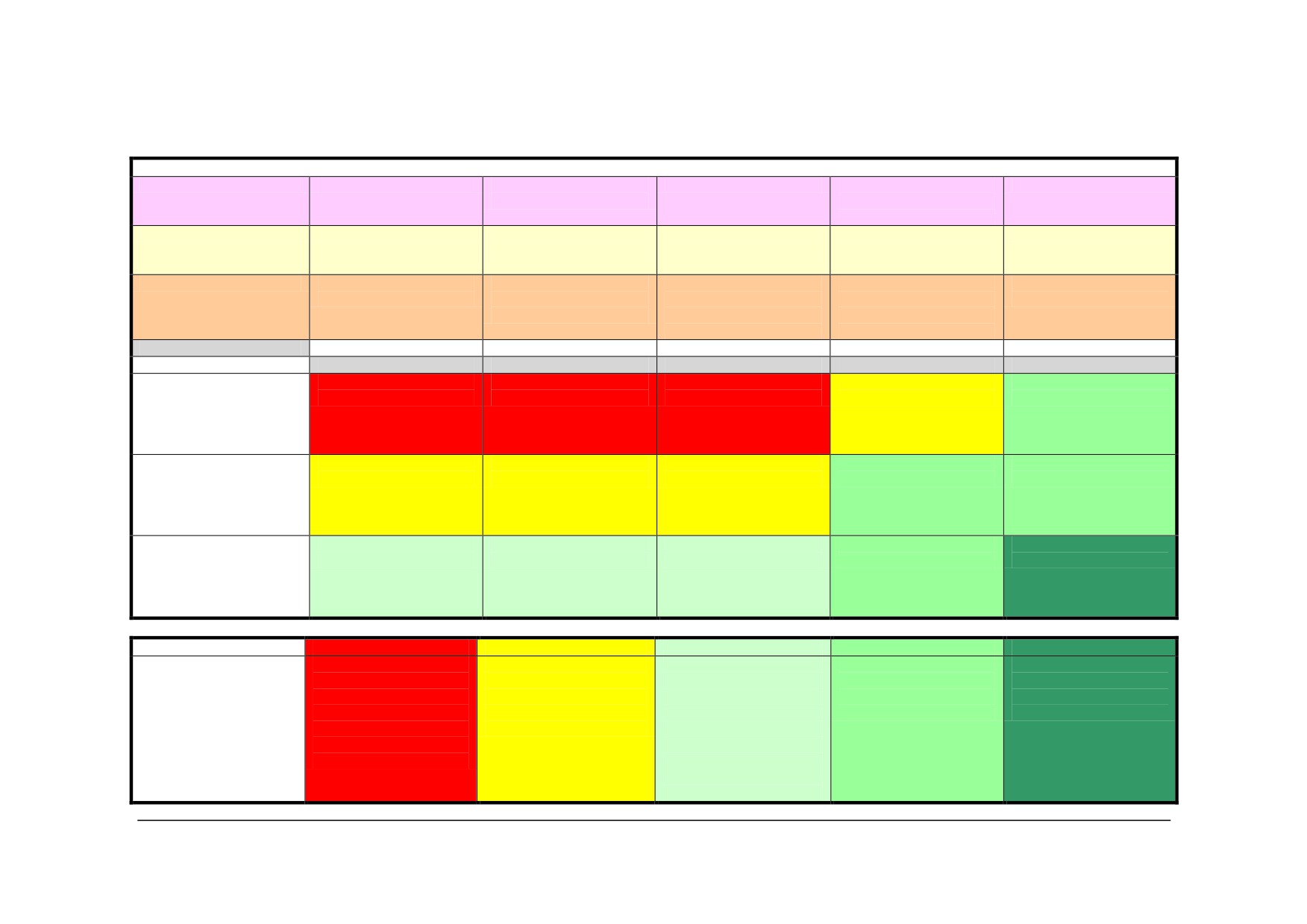
Procedure for Task Risk Assessment
Page 28 of 38
APPENDIX B: RISK ASSESSMENT CHART
HAZARD EFFECT RATING
Personal Injury
Fatality
Likely Permanent
Hospital Stay
DAFWC, Restricted
Simple First Aid Injury
Disability
Work Case, Medical
Treatment
Property Damage
Major Loss >$5M
Significant Damage Loss
Moderate Damage Loss
Minor Loss $10k to
Loss <$10k
$500k to $5M
$100k to $500k
$100k
Environmental Impact
Total Loss of
Significant Loss of
Significant Loss of
Minor Loss of
Slight Loss of
Containment
Containment. 100bbl,
Containment
Containment
Containment < 1bbl
Limited ability to control
> 100bbl only Workplace
< 100bbl only Workplace
affected
affected
A
B
C
D
E
PROBABILITY
HIGH (H)
Event likely to occur more
15
14
13
9
4
than once per quarter
(FREQUENT)
MEDIUM (M)
Event likely to occur at
12
11
10
5
3
least once per year, but
less than quarterly
(PROBABLE)
LOW (L)
Event likely to occur less
8
7
6
2
1
than once per year
(OCCASIONAL)
SCORE
13 to 15
9 to 12
6 to 8
2 to 5
1
ACTION REQUIRED
Immediate action.
Plan controls to reduce
Monitor procedures and
Implement control
Prepare a plan to reduce
Task must not proceed.
risk further.
controls to ensure the
measures to reduce the
the risk to the lowest
Serious loss potential
Assess the priority and
risk is maintained as low
risk to the lowest level
level reasonably
Task may proceed only
agree implementation
as reasonably practical.
reasonably practicable
practicable.
with additional controls
targets.
Take immediate action if
in place to avoid serious
standards are not met
loss
Ensure additional
controls are
implemented.
Control Tier:
<<2>>
Revision Date: <<29 December 2010>>
Document Number: << AZSPU-HSSE-DOC-00063-2>>
Print Date: 2/1/2011
PAPER COPIES ARE UNCONTROLLED. THIS COPY VALID ONLY AT THE TIME OF PRINTING. THE CONTROLLED VERSION OF THIS DOCUMENT CAN BE FOUND AT

Procedure for Task Risk Assessment
Page 29 of 38
APPENDIX C: L2RA FORM
Sheet 1 of __
INSTALLATION :
PERMIT No :
DATE :
TRA REF No :
DEPARTMENT/SYSTEM/LOCATION:
RISK ASSESSMENT TEAM (FIRST NAMED-TRA TEAM LEADER)
NORMAL
IRA
RISK ASSESSMENT TYPE:
SARA
ORA
NAME
POSITION
TASK DESCRIPTION:
I, the TRA Leader confirm that the TRA has been reviewed to ensure that the
risks identified are relevant and that all control measures are in place.
Name:
Date:
Sign:
REFERENCES AND OTHER RELEVANT INFORMATION :
CONFIRMED ALARP
(e.g. Emergency Provision Required, Competency requirements, Tools & Equipment, additional
TRA APPROVED BY (OIM/SC/SM):
PPE, P&IDs, Drawings, PTW, Procedures, Certificates, other Risk Assessments)
NAME (PRINT):
SIGNATURE :
POSITION :
DATE :
Control Tier:
<<2>>
Revision Date: <<29 December 2010>>
Document Number: << AZSPU-HSSE-DOC-00063-2>>
Print Date: 2/1/2011
PAPER COPIES ARE UNCONTROLLED. THIS COPY VALID ONLY AT THE TIME OF PRINTING. THE CONTROLLED VERSION OF THIS DOCUMENT CAN BE FOUND AT

Procedure for Task Risk Assessment
Page 30 of 38
Work-Sheet ___ of ___
TASK DESCRIPTION SUMMARY :
TRA REF No
:
6.
9.
INITIAL
RESIDUAL
2. SUB-TASK
3. HAZARD
4. HAZARD
5. EXISTING
RISK
7. LIST ALL CONTROL
RISK
ACTIVITY /
DESCRIPTION
EFFECT
CONTROL
MEASURES REQUIRED
DESCRIPTION
MEASURES
E
P
R
E
P
R
Control Tier:
<<2>>
Revision Date: <<29 December 2010>>
Document Number: << AZSPU-HSSE-DOC-00063-2>>
Print Date: 2/1/2011
PAPER COPIES ARE UNCONTROLLED. THIS COPY VALID ONLY AT THE TIME OF PRINTING. THE CONTROLLED VERSION OF THIS DOCUMENT CAN BE FOUND AT

Procedure for Task Risk Assessment
Page 31 of
38
APPENDIX D: RISK ASSESSMENT FLOW-PATH
Task identified - Copy of existing TRA if
available
After site visit by the AA (Team Leader) and PA, the AA
decides the level of TRA required for the task
L1 TRA
L2 TRA
Is task L1 or L2 TRA
AA, PA, where practicable HSE team
member may also be required visit work site
to identify all task hazards
Use hazard identification checklist.
TRA front sheet completed - Task details -
Complete the PTW hazard identification and
Team members and date
enter controls
Submit PTW to AA for review and arrange
TRA reviewed for sub-tasks, hazards,
site visit
hazard effect, existing controls, initial risk,
control measures, responsible persons,
residual risks and ALARP status
NO
Are all hazards
Consider
identified and
NO
L2 TRA
controlled, with correct
Have all hazards
level of TRA?
now been identified?
TRA?
YES
YES
PTW and L1 TRA submitted for SM / SC /
PTW and TRA front and work sheets
OIM authorization
submitted to SM / SC / OIM for
authorization
NO
NO
PTW and L1 TRA
PTW and L2 TRA
approved?
approved?
AA issues PTW after face to face discussion with PA
YES (L1)
YES (L2)
At TBT, any more hazards
or controls identified?
NO
Work complet
ed as per PTW and TRA. Work must “STOP” if any
new conditions introduce new hazards. Once
Control Tier:
<<2>>
Revision Date: <<29 December 2010>>
Documencomplete, TRA (if L2) to be stored and L
essons Learned reported to the AA (Team Leader)
PAPER COPIES ARE UNCONTROLLED. THIS COPY VALID ONLY AT THE TIME OF PRINTING. THE
CONTROLLED VERSION OF THIS DOCUMENT CAN BE FOUND AT
Procedure for Task Risk Assessment
Page 32 of
38
APPENDIX E: RISK HIERARCHY EXAMPLES
Examples
Elimination / Prohibition
Use of mechanical device instead of manual
handling
Maximum stacking height
Unauthorised personnel
Prohibit smoking, jewellery, mobile phones
Substitution
Solvent-based paint with water-based paint
Dusty powders with pastilles or pellets
Electric hand tools with compressed air
Reduction in size or weight of item
Engineering Controls
Local exhaust ventilation for e.g.:
Welding
Soldering
Grinding
Mechanical or electrical isolations
Lighting
Enclosure, e.g.:
Sealable containers
Noise enclosures for turbines or pumps
Segregation
Barrier or guard
Separate storage areas
Physical isolations (spade, lock-off)
Access controls
Reduction in Personnel or
Job or shift rotation
Time Exposure
Breaks
Hazardous work carried out at low activity
periods such as nights or weekends
Dispense dilute chemical
Increase airflow through work area
Automated feed process instead of manual
Personal Protective
Gloves
Equipment
Goggles
Face mask
Boots
Respiratory protective equipment
Chemical suits or gauntlets
Safety harness or inertia reel
Control Tier:
<<2>>
Revision Date: <<05 November 2010>>
Document Number: << AZSPU-HSSE-DOC-00063-2>>
Print Date: 2/1/2011
PAPER COPIES ARE UNCONTROLLED. THIS COPY VALID ONLY AT THE TIME OF PRINTING. THE
CONTROLLED VERSION OF THIS DOCUMENT CAN BE FOUND AT
Procedure for Task Risk Assessment
Page 33 of
38
APPENDIX F: TASK INSPECTION CHECKLIST (EXAMPLE)
Note: All control measures identified in the TRA should be identified in the checklist
and communicated during the pre-task Toolbox Talk.
SHOT BLASTING
FACILITY:
LOCATION:
Checklist
Yes
No
Comments
Is the method Statement and TRA available on work
site?
Is the Work Permit available?
Is shot blasting performed so that the prevailing wind
carries airborne dust away from any activity, persons
and equipment, etc?
Where dry shot blasting operations are being
performed on site, has all other activities in the area,
especially down wind, been suspended for the
duration of the operation?
Is all equipment in the vicinity of shot blasting
operations protected against impacting material and
dust by sheeting or other means?
When shot blasting in the vicinity of sensitive
equipment, such as electrical equipment, is the area
totally enclosed by sheeting or other means?
Is access by unauthorised persons prevented?
Are drains in the vicinity of shot blasting operations
covered?
Is only non-silica shot blasting medium used?
Are compressors and other equipment in good
mechanical condition?
Is the hose between the shot blasting machine and
the operator of sufficient length to ensure that the
operative feeding the machine with is clear of any
dust arising from the nozzle?
Is the nozzle of the hose fitted with a dead-man‟s
handle?
Is the nozzle earthed?
Are operatives wearing correct PPE including face
masks, hearing and eye protection?
Is efficient ventilation provided to remove airborne
contamination when work is performed in a confined
space?
Name
Signature
Date
Site Supervisor
Safety Officer
Control Tier:
<<2>>
Revision Date: <<05 November 2010>>
Document Number: << AZSPU-HSSE-DOC-00063-2>>
Print Date: 2/1/2011
PAPER COPIES ARE UNCONTROLLED. THIS COPY VALID ONLY AT THE TIME OF PRINTING. THE
CONTROLLED VERSION OF THIS DOCUMENT CAN BE FOUND AT
Procedure for Task Risk Assessment
Page 34 of
38
Control Tier:
<<2>>
Revision Date: <<29 December 2010>>
Document Number: << AZSPU-HSSE-DOC-00063-2>>
Print Date: 2/1/2011
PAPER COPIES ARE UNCONTROLLED. THIS COPY VALID ONLY AT THE TIME OF PRINTING. THE
CONTROLLED VERSION OF THIS DOCUMENT CAN BE FOUND AT
Procedure for Task Risk Assessment
Page 35 of
38
Revision/Review Log
Revision Date
Authority
Custodian
Revision Details
09 Sept 2004
CHSSE Manager
CHSSE Team Leader
Initial issue as controlled document
18 June 2007
Alan McNulty
Esmira Akhundova
General:
(CHSSE Manager)
(CHSSE Team
Throughout the procedure the document numbering
Leader)
for referred procedures has been changed.
Section 1. Introduction:
Inclusion of 1.2 Scope, 1.3 Company Requirements,
1.4 Stopping Unsafe Work, 1.5 Deviations, 1.6
Document Review, 1.10 SSOW Specific Cross
References (new doc control numbers).
Section 2. Responsibilities:
Is now “Definitions”
Section 3. Auditing and Monitoring:
I
now “Roles and Responsibilities”. Additions to the
responsibilities of SM, SC, OIM, Area Authority,
Performing Authority and Employees.
Section 4. Is now Auditing & Monitoring:
Heading - Each business asset shall; Installation ha
been added after site in the first bullet point. The
recommended frequency of Audit for supervisor / Ar
Authority changed to a minimum of 2 per week. OIM
entered into the third bullet point of the second
paragraph.
Sectio
5. Risk Assessment Levels:
Is now
“Competency, Training and Awareness”. 5.3 Record
Added to paragraph - “Risk Assessments shall be
uniquely numbered and retained (preferably in
electronic format).”.
Section 6. Is now Risk Assessment Levels:
6.1 General, The word significant removed from the
first bullet point. 6.3.1 Table 1: Classification of Heav
Lift incorporated. 6.4 Level 2 Risk Assessment Team
Third paragraph. Removed the words, "and consist o
persons having intimate knowledge and experience
the task or equipment to be used". Added to bullet
point one "who will act as TRA Team Leaders".
6.4.1”Normal Level 2 Risk Assessment”, 4 additiona
bullet points added.
Section 7. The Stages of Risk Assessment:
Hazard Checklists moved to Appendix A of the
procedure. Added to Hazard Checklist - Isolations:
Electric Shock. 7.1.1 L1RA: Added - “recorded in bo
1 of the permit”. 7.5 Evaluate the Risk: - Probability
Guidelines re-worded. 7.8 “Re-evaluate the Risks fo
Acceptability”. The table giving guidance for the
residual risk criteria changed to reflect the Risk Matr
in 7.5. 7.10 “Task Inspection Checklist” is an
additional paragraph. 7.11 Toolbox Talks: Additional
bullet point added.
Appendices.
appendices included to the document as follows:
Level 2 Risk Assessment Checklists
Risk Assessment Chart
Level 2 Risk Assessment Form:
Added at the bottom of Task Description "I the TR
Leader confirm that the TRA has been reviewed
ensure that the risks identified are relevant and
that all control measures are in place". Also, nam
date and signature.
Risk Assessment Flow Path
Risk Hierarchy Examples
Control Tier:
<<2>>
Revision Date: <<29 December 2010>>
Document Number: << AZSPU-HSSE-DOC-00063-2>>
Print Date: 2/1/2011
PAPER COPIES ARE UNCONTROLLED. THIS COPY VALID ONLY AT THE TIME OF PRINTING. THE
CONTROLLED VERSION OF THIS DOCUMENT CAN BE FOUND AT
Procedure for Task Risk Assessment
Page 36 of
38
Task Inspection Checklist (example)
Procedure Summary
RTC Pre-Task Risk Assessment Form
Feedback & Improvement Suggestions
Authority position/name and custodian position/nam
05 Dec 2008
Yuliy Zaytsev,
Adalet Mamedov,
have changed to reflect org changes in HSE&TD
Safety&Compliance
Central Safety TL
of December 1st 2008.
Systems Manager
02 April 2009
Yuliy Zaytsev,
Niyaz Mamedov,
Paragraph 3.1 additional bullet is added.
Safety&Compliance
HSE Systems -
Systems Manager
Control of Work
Paragraph 6.3 is shortly amended in regard to AA
Advisor
responsibility for making decision on L2 RA.
Paragraph 7.11 reflects now requirement that peop
involved in the task fully understand TRA whe
English language is not the first one for the work tea
14 April 2009
Yuliy Zaytsev,
Niyaz Mamedov,
The changes relate only to Marine operations,
Safety&Compliance
HSE Systems -
Offshore.
Systems Manager
Control of Work
Advisor
Paragraph 1.6 deviations related to Marine
Operations are to involve MA
Section 2, definition is given to MA
Paragraph 3.7 roles & responsibilities of Marine
Authority
Paragraph 6.3.1 Mandatory L2 RA Table is added
with 4 possible marine related operations
09 September 2009
Yuliy Zaytsev,
Niyaz Mamedov,
Section 5, Training and Competency Requirements,
reworded in compliance with CoW Training Policy.
Safety&Compliance
HSE Systems -
Systems Manager
Control of Work
Advisor
Control Tier:
<<2>>
Revision Date: <<29 December 2010>>
Document Number: << AZSPU-HSSE-DOC-00063-2>>
Print Date: 2/1/2011
PAPER COPIES ARE UNCONTROLLED. THIS COPY VALID ONLY AT THE TIME OF PRINTING. THE
CONTROLLED VERSION OF THIS DOCUMENT CAN BE FOUND AT
Procedure for Task Risk Assessment
Page 37 of
38
29 December 2010
Yuliy Zaytsev
Elman Shikhkerimov
The numbering of the Procedure is entirely
AzRPU Offshore
AzRPU CoW/Safety
changed.
Health and Safety
Systems Lead
Manager
Section 2 Definitions updated with IL and DR
abbreviations
Section 3 General Requirements: additional
lines added, which refer to relevant group
standards
Section 5 Risk Assessment Levels:
Requirement for minimum L2 Risk Assessment
team involvement changed inline with GG
HITRA 3.1-0002
Note section has been updated inline with GG
Sub-section 5.3: Normal Level 2 Risk
Assessment
Table 2 - Advisory Level 2 Risk Assessment
has been adjusted with additional tasks
Sub-Section 5.4 Level 2 Risk Assessment
Team updated, including minimum numbers of
people requirement
Paragraph 5.3.1 Operational Risk
Assessment
ORA process describing section has been
significantly altered in line with industry best
practices, with the main aim to improve overall
controls over the process
Paragraph 5.3.4 Safety Overrides Risk
Assessment
New paragraph added to point out SORA
process
Paragraph 5.7.2 Determining the additional
controls required updated with requirement to
have emergency response plans in place befor
the task commences, if identified by RA.
During the review some of the „‟should”
statements have been replaced with “shall” in
order to meet requirements of Control of Work
GDP 4.5-0001
In addition to Paper based Risk Assessment
process, ISSOW electronic PTW system risk
assessment database info added throughout th
procedure.
APPENDIX D: Risk Assessment Flow-path
HSE team member role in L2 RA process has
been slightly updated
Control Tier:
<<2>>
Revision Date: <<29 December 2010>>
Document Number: << AZSPU-HSSE-DOC-00063-2>>
Print Date: 2/1/2011
PAPER COPIES ARE UNCONTROLLED. THIS COPY VALID ONLY AT THE TIME OF PRINTING. THE
CONTROLLED VERSION OF THIS DOCUMENT CAN BE FOUND AT
Procedure for Task Risk Assessment
Page 38 of
38
Control Tier:
<<2>>
Revision Date: <<29 December 2010>>
Document Number: << AZSPU-HSSE-DOC-00063-2>>
Print Date: 2/1/2011
PAPER COPIES ARE UNCONTROLLED. THIS COPY VALID ONLY AT THE TIME OF PRINTING. THE
CONTROLLED VERSION OF THIS DOCUMENT CAN BE FOUND AT
The International Fund for Agricultural Development
For Official Use Only
The Sudan
RURAL ACCESS PROJECT (RAP)
PROJECT DESIGN REPORT
Stage: Detailed Design
Main Report and Annexes
Near East and North Africa Division
Programme Management Department
REPORT No.
October 2009
This document has a restricted distribution and may be used by recipients only in the performance of
their official duties. Its contents may not otherwise be disclosed without the authorization of the
International Fund for Agricultural Development (IFAD).
Sudan: Rural Access Project (RAP)
PROJECT DESIGN REPORT - MAIN REPORT
Table of Contents
Page
ABBREVIATIONS AND ACRONYMS
III
MAP: PROJECT AREA
IV
FIGURE 1: EXISTING AND PROPOSED ROAD NETWORK IN BUTANA
V
EXECUTIVE SUMMARY
VI
I.
INTRODUCTION
1
II.
STRATEGIC CONTEXT AND RATIONALE FOR IFAD INVOLVEMENT, COMMITMENT AND
PARTNERSHIP (KSF 1)
1
A. Rural development context
1
B. Policy, governance and institutional issues, political and economic issues
2
C. The IFAD country programme
6
III.
POVERTY, SOCIAL CAPITAL AND TARGETING (KSF 2)
6
A. Rural Poverty, Information and Analysis
6
B. The target group, including gender issues
9
C. Targeting strategy and gender mainstreaming
10
D. Geographic coverage of the project
10
IV.
PROJECT DESCRIPTION (KSF 3)
11
A. The knowledge base: Lessons from previous/ongoing projects
11
B. Opportunities for rural development and poverty reduction
12
C. Project goal and objectives
13
D. Alignment with country rural development policies and IFAD strategies
13
E. Project components
14
V.
IMPLEMENTATION AND INSTITUTIONAL ARRANGEMENTS (KSF 4)
17
A. Institutional development and outcomes
17
B. The collaborative framework
17
The main implementing agencies and their roles
17
Technical partners in implementation
18
Component wise implementation
18
Links with complementary projects
19
Integration within the IFAD country programme
19
Project supervision arrangements
19
C. Results-based M&E
20
VI.
PROJECT BENEFITS, COSTS AND FINANCING
20
A. Project benefits
20
B. Summary cost table
21
C. Project financing: IFAD financing, co-financing, government, partners and
beneficiary financing
22
D. Flow of funds, disbursement, procurement, audit
22
VII.
PROJECT RISKS AND SUSTAINABILITY (KSF 5)
23
A. Risk analysis
23
B. Exit strategy and post-project sustainability
25
VIII.
INNOVATIVE FEATURES, LEARNING AND KNOWLEDGE MANAGEMENT (KSF 6)
25
A. Innovative features
25
B. Project knowledge products and learning processes
25
C. Regional knowledge networking
26
IX.
NEXT STEPS
26
i
Sudan: Rural Access Project (RAP)
PROJECT DESIGN REPORT - MAIN REPORT
List of Tables
TABLE 1: COMPARISON OF RATES OF RETURN BASED ON THE ROAD SURFACING
5
TABLE 2: ESTIMATED DISTRIBUTION OF THE POPULATION IN BUTANA
7
TABLE 3: LIVESTOCK IN THE PROJECT AREA, BASED ON ESTIMATED FIGURES FOR 2008 (SOURCE: SOCIO-
ECONOMIC SURVEY, BDA, 2009)
8
TABLE 4: LIVESTOCK SALES IN THE MARKETS THAT SERVE THE PROJECT AREA BASED ON ESTIMATED FIGURES
FOR 2008 (SOURCE: SOCIO-ECONOMIC SURVEY, BDA, 2009)
8
TABLE 5: LIVESTOCK PRICES IN THE VARIOUS MARKETS, BASED ON ESTIMATED FIGURES FOR 2008 (SOURCE:
SOCIO-ECONOMIC SURVEY, BDA, 2009)
8
TABLE 6: SPECIFICATIONS OF THE IMPROVED ARAB 6-ES SOUBAGH-HUSHEIB ROAD
14
TABLE 7: PROJECT COSTS BY COMPONENT (USD)
22
TABLE 8: PROJECT COSTS BY FINANCIER
22
TABLE 9: DISBURSEMENT ACCOUNTS AND FINANCING RULES
23
TABLE 10: PRIOR REVIEW THRESHOLDS
23
TABLE 11: CRITICAL RISKS AND MITIGATION MEASURES
24
ANNEXES
ANNEX I: CONTENTS OF THE PROJECT LIFE FILE
1
ANNEX II: RESULT-BASED LOG FRAME
3
ANNEX III: KEY FILE
3
ANNEX III: SUMMARY OF MAIN COST TABLES
12
ANNEX IV: ORGANIZATIONAL ORGANIGRAMME
27
ANNEX VI: RESULTS-BASED M&E
29
ANNEX VII: START-UP ACTIVITIES OF THE RURAL ACCESS PROJECT
50
ANNEX VIII: THE ENVIRONMENTAL AND SOCIAL REVIEW - SUMMARY OF THE PRELIMINARY FINDINGS
54
ii
Sudan: Rural Access Project (RAP)
PROJECT DESIGN REPORT - MAIN REPORT
CURRENCY EQUIVALENTS
Currency Unit
= Sudanese Pounds (SDG)
US$ 1.00
=
2.5 Sudanese Pounds
SDG 0.4
= US$ 1
WEIGHTS AND MEASURES
1 kilogram (kg)
=
2.204 pounds (lb)
1 000 kg
=
1 metric tonne (t)
1 kilometre (km)
=
0.62 miles (mi)
1 metre (m)
=
1.09 yards (yd)
1 square metre (m2)
=
10.76 square feet (ft2)
1 acre (ac)
=
0.405 ha
1 hectare (ha)
=
2.47 acres
1 feddan (fed)
=
0.42 ha = 1.03 acre
FISCAL YEAR
1st January to 31st December
ABBREVIATIONS AND ACRONYMS
ARP
Agricultural Revival Programme
BDA
Butana Development Agency
BIRDP
Butana Integrated Rural Development Project
CRF
Community Road Fund
DSF
Debt Sustainability Framework
CRF
Community Road Fund
GONU
Government of National Unity
MPPPU
Ministry of Planning and Public Utilities
NKRDP
North Kordofan Rural Development Project
NHBA
National Highways and Bridges Authority
O&M
Operation and Maintenance
RAP
Rural Access Project
RIMS
Result Impact Management System
RRMU
Rural Road Management Unit
RTT
Rural Road Travel and Transport
iii

Sudan: Rural Access Project (RAP)
PROJECT DESIGN REPORT - MAIN REPORT
MAP: PROJECT AREA
iv

Sudan: Rural Access Project (RAP)
PROJECT DESIGN REPORT - MAIN REPORT
FIGURE 1: EXISTING AND PROPOSED ROAD NETWORK IN BUTANA
v
Sudan: Rural Access Project (RAP)
PROJECT DESIGN REPORT - MAIN REPORT
Executive Summary
Project rationale. The Rural Access Project invests in rural roads in a way that complements the
transport, production and marketing infrastructure supported in the IFAD co-financed Butana
Integrated Rural Development Project (BIRDP, SD-717) and the Government supported Agricultural
Revival Programme (ARP). Its results will be measured on the cost and time of transport, the change
in the farm gate price, and the savings in vehicle operating costs. These results are expected to
enable small producers to take better advantage of the production and marketing activities proposed
under the BIRDP and the ARP.
The approach adopted for the construction of rural roads will consist of spot improvements in the form
of the establishment of wadi crossings, spot repairs and treatment of gulley erosion. The access road
selected is the Arab 6 - Es Soubagh - Husheib alignment, a 144 km long road servicing 5 main
markets, and covering 2 localities in 2 states (figure 1). The selection criteria included (i) synergy with
on-going projects particularly the ARP and the BIRDP; (ii) clarity of the flow of benefits to small
producers; (iii) responsive to community priorities; (iv) close fit with available grant resources.
Project area. The project area covers two localities (Butana in Gadaref State, River Atbara in Kassala
State) (see figure 1). The area is characterized by silty clay and black cotton soils where relatively
poor drainage characteristics combined with flat topography results in prolonged periods of inundation
during the rainy season especially in depressions and flat plain areas. Throughout the rainy season,
general access to and from the main external markets is very difficult for vehicular access, livestock
and people especially across seasonal streams.
Project beneficiaries. The total number of beneficiaries is expected to be
130 000 persons
equivalent to about 15 000 producer households. It is also expected that there will be 1700 additional
women trading in the main markets serviced by the road. Poor households constitute 80% of the rural
population in Butana.
Targeting and gender mainstreaming strategy. The localities selected are among the poorer in the
Butana. The gender mainstreaming strategy relies on women participation in the consultation for the
prioritization of rural roads, and in the implementation of the conservation and water control works
protecting the rural roads, and for road maintenance. The RAP project area covers 21 communities
located along the road alignment in the localities of Butana and River Atbara. These 21 communities
represent a subset of the 140 communities planned to participate in the BIRDP.
Project objectives. The project will contribute to the COSOP 2009-2012 goal of empowering the rural
poor to increase their food security, incomes and resilience to shocks. The main project objective is to
improve the access of the rural population to markets and social services. Three key results are
expected from the project:
- Rural roads upgraded in Central Butana and regularly maintained. The project target is 144 km.
- Communities are trained to manage road tolls and to engage in labor based maintenance contracts.;
- State capacity is strengthened to plan, design, supervise, and maintain rural feeder roads using the
spot improvement approach.
Project activities. The project will have 3 main components:
− Physical rehabilitation and construction of rural roads which consist in the
improvement of the Arab 6 - Es Soubagh - Husheib road, implementing conservation
works to protect the road from gulley erosion; and establishing the Community Road
Fund which will act as the principal financing mechanism for the routine and periodic
maintenance of the road.
− Capacity building and institutional development that would target the Road
Departments of the State Ministries of Physical Planning and Public Utilities
(MPPPUs) with formal and on-site training as well as office support; in addition to
training of communities on soil and water conservation works to protect the road from
gulley erosion and on the management of the labour based contracts for road
maintenance. Road committees will be established to organize and implement the
conservation and maintenance works.
vi
Sudan: Rural Access Project (RAP)
PROJECT DESIGN REPORT - MAIN REPORT
− Project management. The Butana Development Agency (BDA) will be the lead
agency for this project and will be responsible for the coordination and financial
management of project activities. It constitutes a good platform for the coordination
and implementation of inter-state initiatives that promote sustainable development of
the Butana area. The BDA will maintain a close collaboration with the NHBA for the
monitoring of the performance and progress of the road works, the comparative
advantages of the spot improvement and preventative maintenance approach and its
potential replication to the rural road network.
Integration within the country programme. RAP contributes directly to the achievement of the
country programme strategic objective of increased access of the rural poor women and men to
markets and to microfinance. The RAP specifically contributes to the following milestone indicator of
approx 200 km of roads constructed in project areas; and to the outcome indicator of at least 20%
producers’ access markets in the project area.
Project costs. The total project costs (including contingencies) are estimated at USD 14.96 million.
The IFAD grant amounts to USD 12.95 million with a Government contribution of USD 1.92 million as
duties and taxes and beneficiaries’ contribution of USD 0.09 million towards the maintenance of the
road.
Scaling-up potential. Scaling up is included as a result of the project. The project will develop the
capacity of the road departments in the MPPPUs and will provide the cadre with the appropriate
design manuals to train new staff and replicate the methodology of spot improvement to the rural road
network in the 2 States of Gadaref and Kassala. Moreover, by involving the NHBA in the monitoring of
the project, the potential for the replication of the spot improvement and preventative maintenance
approach increases. The total set of road priorities identified is approx 1500 km in Butana. An amount
of approx USD 12 million is required for the improvement of each 200 km road.
vii
Sudan: Rural Access Project (RAP)
PROJECT DESIGN REPORT - MAIN REPORT
I.
INTRODUCTION
1.
The Government of National Unity and the International Fund for Agricultural Development
have agreed on 3 strategic objectives as part of the Sudan country programme strategy for the period
2009-2012. The third objective “increased access of poor rural women and men to markets and
microfinance” aims to align the IFAD co-financed country programme with the greater focus of the
Government’s Agriculture Revival Programme (ARP) on marketing. Given massive and widespread
poverty in Sudan and the breadth of challenges facing the agriculture sector, the Government and
IFAD agreed that the country programme will adopt an integrated rural development approach based
on: (i) consolidating ongoing projects to strengthen their impact and sustainability; (ii) strengthening
marketing and microfinance components in ongoing projects;
(iii)
systematically seeking
complementarities and partnerships with ongoing operations in project areas;
(iv) balancing
investments in capacity-building and productive activities.
2.
It is in this context that the Government of National Unity (GoNU) and IFAD agreed to include
the Rural Access Project as part of the 2009 pipeline. The geographic focus of the intervention is on
the Butana area in Eastern Sudan where the IFAD co-financed project, the Butana Integrated Rural
Development Project, is on-going. The investment in rural feeder roads is complementary to the
investments in road infrastructure, marketing, production and community investments in the BIRDP.
3.
IFAD fielded a design completion mission1 during the period 11th to 26th July 2009, to address
the recommendations made by the reviewers in the Government and IFAD on the initial project
design, and to develop the implementation modalities of the project with particular emphasis on
management and procurement. The mission held meetings at federal level with the Ministry of
Finance and National Economy, Ministry of Agriculture and Forestry, Ministry of Labour, National
Highways and Bridges Authority; at state level with the State Ministries of Agriculture, Animal
Resources, Physical Planning and Public Utilities, Finance, NGOs active in community mobilization
and organization; at locality level with the local government and engineering units in Butana, River
Atbara localities; at village and market level in Fuwal, Um Al Gora, Es Sadda.
4.
The design completion mission built its conclusions and recommendations on the results of a
socio-economic survey of the project area as well as the physical survey of the proposed alignment.
These studies were undertaken by the Butana Development Agency2 and the State Ministry of
Physical Planning and Public Utilities (MPPPU) in Gadaref State respectively during the period June
to July 2009.
II.
STRATEGIC CONTEXT AND RATIONALE FOR IFAD INVOLVEMENT, COMMITMENT AND PARTNERSHIP
(KSF 1)
A. Rural development context
5.
Performance of the agriculture sector. Agriculture is the main source of livelihood for the
Sudan’s rural inhabitants, roughly 60 per cent and 90 per cent of the country’s population in the north
and south respectively. Agriculture provides 90 per cent of the national food requirements, constitutes
80 per cent of non-oil exports, and accounted for 42 per cent of GDP in 2007. Traditionally, prior to
the oil wave, agriculture represented a far greater share: for instance, it accounted for 90 per cent of
exports in the early 1990s but only 8 per cent in 2006. Exports include mainly livestock, sesame,
cotton and gum arabic. The low productivity of agriculture combined with the recent appreciation of
1 The mission was composed of Dr. Elsayed Zaki, Institutional Development Specialist and Mission Team
Leader; Mr. Ian Anderson, Civil Engineer; Ms. Wadzanai Katsande, financial analyst; Dr. Asim Moghraby,
environmental specialist; Ms. Rasha Omar, Country Programme Manager, IFAD; Mubarak M. ElDawi, Ministry of
Finance and National Economy; Mr. Haytham Abdelbagui and Mr. Mohamed Abdelmotaleb, Ministry of
Agriculture and Forestry. BDA Director and BIRDP Coordinator, Rashid Abdel Aziz provided much needed
assistance during the course of the field work and participated in the state level discussions. The areas visited
included Gadaref and Kassala States.
2 The socio-economic survey was led by Dr. Abdelrahim Ibrahim, road economist, with participation from the
following BDA staff: Mr. Rashid Abdelaziz, BDA Director; Ms. Aida Adam Osman, Gender and Community
Development Officer; Mr. Mohamed El Hassan, Natural Resources Management Officer.
1
Sudan: Rural Access Project (RAP)
PROJECT DESIGN REPORT - MAIN REPORT
the Sudanese pound has further eroded the competitiveness of Sudanese agricultural products,
namely for sesame, groundnuts and sorghum.
6.
The country’s agriculture growth rate is highly variable (from -2.5 to 7 per cent within the
period 2001-2007). A distinction is usually made between the irrigated and the rainfed agriculture
subsectors. Growth in both subsectors is erratic. In the irrigated sector, this is the result of the
deferred rehabilitation and modernization of irrigation systems and their management leading to low
efficiency in water conveyance and low productivity. In the rainfed sector, disappointing growth can be
traced to the vulnerability of agricultural production to climatic variability, declining and erratic yields,
and the restrictions imposed by importing countries on Sudanese livestock due to intermittent disease
outbreaks. The traditional rainfed sector accounted for 26 per cent of the GDP in 2005, and for 67 per
cent of agriculture GDP. It is the most important sector for the agricultural economy and the
livelihoods of poor rural people, and yet it only receives from 3 to 12 per cent of expenditures on the
agriculture sector. The rainfed sector also receives a very limited share of private investments in
agriculture: this is mainly attributed to unclear land tenure arrangements and very poor infrastructure.
7.
In The Sudan, the weak performance of the agriculture sector is perpetuated by five main
factors:
(i) decades of civil conflict and underdevelopment that have ravaged traditional rainfed
agriculture; (ii) disabling agriculture policies, including delayed financing of agricultural investments,
insufficient financing of the running costs of agricultural services, and overtaxation of agriculture
commodities, particularly the exportable commodities produced mainly by the rainfed sector; (iii)
inadequate land policy; (iv) inadequate water policy; (v) inefficient marketing arrangements. Market
inefficiencies are a result of poor accessibility (the road accessibility in Sudan is among the poorest in
Africa), high internal costs of transport due to limited road infrastructure, high costs of handling
products moving to points of export, imposition of charges and taxes in the marketing chain and the
weak organization and bargaining power of small-scale producers.
8.
Rural roads, an under-developed sector. For a vast country like Sudan, the existing
transport infrastructure and facilities are poor and are considered the single most important constraint
to the development of agricultural markets and to small producers' access to these markets in rainfed
areas. The spatial road density of one kilometre of paved road per 575 km2 of land area is one of the
lowest in Africa and, with 126 km of paved roads per million population, road accessibility is less than
in other countries in Africa as well as prevailing regional averages (Vijay 2007). It also seems that
there has been an imbalance in transport development between railway and roads, where the latter
has largely dominated; covering over 90% of inland transport services.
9.
The road network, which is originally weak, has also deteriorated as a result of war and
limited budgetary allocation for maintenance and capital repairs. Most important is the lack of feeder
roads that would be conducive to the development of the agricultural sector. Rural/village access or
feeder (tertiary) roads form 20-30% of the total road network compared to 40-50% for state roads and
20-30% for national roads (Vijay 2007). The poor infrastructure situation is largely engendering high
transport and transaction costs in the movement of agricultural products. Road tariffs on tertiary
roads are 50% higher than those applied on the main national road network thus leading to high
transportation costs per km. Marketing costs, excluding charges not levied against any type of
services, varied from 32% to 49% of export price for rain-fed sorghum, sesame and groundnuts
according to the conditions of 2006 (van Holst Pellekaan and Faki, forthcoming). Such rates and
associated transaction costs reflect negatively on producers in the traditional rain-fed sector.
B. Policy, governance and institutional issues, political and economic issues
10.
The section will focus on the most salient policy, institutional, political and economic issues
that are of direct relevance to the rural transport sector in Sudan. Further detailed description is
available in working paper 1.
11.
Policy. The Agriculture Revival Programme articulates the Government's vision for agriculture
development as the engine of growth and the key catalyst for rural poverty alleviation. In this
programme, rainfed agriculture is allocated 25%3 of the total Programme budget. Rural infrastructure
(inclusive of roads) is allocated 7.5% of ARP budget, and 80% of proposed road lengths are located in
states where rainfed agriculture is the predominant production system. Such investments are aligned
with the vision to remove barriers to mobility and marketing in the rainfed areas. As a reminder,
rainfed agriculture accounts for a large share of agriculture GDP and exports.
3 This is a conservative estimate based on aggregate data available in the ARP publication, 2008.
2
Sudan: Rural Access Project (RAP)
PROJECT DESIGN REPORT - MAIN REPORT
12.
With regards the road sector, policies exist for national roads only in terms of their
construction, management and maintenance. The road transport system in Sudan is classified into
five main types of road (table 8 in working paper 1). Responsibility for the national road network lies
with the National Highways and Bridges Authority (NHBA) under the Ministry of Roads and Bridges.
The maintenance and rehabilitation of national roads is also the responsibility of NHBA and is
financed from road tolls collected by a private company and deposited in the NHBA account.
13.
Roads and structures that are not of national classification are delegated to the States who
plan and run their own programmes. States can request the assistance of NHBA in design and
supervision given its higher technical competency. Planning of roads at State level follows an ad hoc
prioritisation process rather than developing strategic plans covering all sectors with clearly
established and quantified alignments, designs and estimated costs. Limited funding and uncertainty
of flow of funds acts as a disincentive to planning. This is a structural problem in Sudan, all the more
so considering the existing budgetary crisis due to decreasing oil prices. Maintenance is not
undertaken for state level roads. Indeed, no road maintenance section or department exists at State
or locality level and although annual maintenance of roads is carried out for roads within the cities,
this is well below what is required under a preventative maintenance programme. In the rural areas no
such programme exists with states concentrating more on capital repair of the most damaged roads
as funds become available.
14.
In conclusion, it would appear that there is no specific policy framework governing rural feeder
roads in terms of planning, supervision and maintenance. Three issues appear of critical importance:
(i) planning of the rural road network to take into account marketing and social opportunities; (ii)
preventative maintenance; and (iii) predictability of financing for capital and maintenance costs.
15.
Institutions. Eight institutions of relevance will be discussed here: the National Highways and
Bridges Authority, the Ministry of Labour, the State Ministry of Physical Planning and Public Utilities,
the engineering units in the localities, the Rural Infrastructure Working Group of the Secretariat of the
Agriculture Revival Programme, the Butana Development Agency, the contractors, civil society
organizations.
16.
The National Highways and Bridges Authority (NHBA) is governed by a Presidential Act
for 1997. The NHBA has the following purposes: (i) provide and develop best services according to
Minimum Cost Principle and to realize surplus for the General Treasury; (ii) participation to increase
the national income and improvement on performance of services which the NHBA is supposed to
provide;
(iii) provide investment which the private sector has no ability to obtain individually. It
cumulates the responsibilities of studies, design, construction using its own equipment, supervision of
works, management and maintenance of national roads. It also provides assistance with design and
supervision of works to states upon demand. In addition to its headquarters, it has 7 offices that cover
the geographic areas of Sudan: 2 such offices cover the Eastern region and are staffed with a
resident engineer4. The NHBA raised a total revenue (principally from tolls) of SDG 144 million and
realized a surplus of approx SDG 12.3 million. The technical capacity of the NHBA is deemed
satisfactory. The NHBA now carries the supervision for rural roads planned under the Agriculture
Revival Programme.
17.
The Federal Ministry of Labour. The Ministry has implemented in the past labour intensive
road construction with assistance from the International Labour Organization in the White Nile state.
This experience taught the Ministry that for such works to succeed, a number of requirements should
be met: materials for construction should be available locally; the road construction should also be
linked to other activities such as afforestation, water reservoirs, soil and water conservation works;
sufficient number of engineers to supervise and backstop the works; and high level of organization of
the logistics of the work. The Ministry has an on-going project for labour intensive works in Kassala
State, targeting the control of the seasonal Gash river.
18.
The State Ministry of Planning and Public Utilities (MPPPU). A Roads Department located
in the Ministry of Physical Planning and Public Utilities is responsible for all aspects from planning
through to maintenance. In practice as funds are very limited and design capacity is constrained, the
work involves engaging the NHBA to carry out feasibility and design studies. Few experienced staff
are available with the numbers being made up of engineers and surveyors and architects who have
mostly graduated within the last four years. Although the staff appear to have good academic
4 The NHBA has an office in Khashm El Girba in the vicinity of the project area. The office also has lab facilities
for material testing.
3
Sudan: Rural Access Project (RAP)
PROJECT DESIGN REPORT - MAIN REPORT
background, the guidance that they receive in their professional working life is very limited. Good
technical staff have been taken up by contractors and consultants leaving very few experienced staff
to plan, design, supervise, and maintain roads within the states’ jurisdiction. As a result, the capacity
to oversee the private sector is limited and has resulted in inadequate quality control, poorly sited
structures and questionable sustainability. For roads of national importance, MPPPU staff are
seconded to work with the NHBA on the supervision of construction works.
19.
The engineering units in the localities of Butana and River Atbara. The localities have no
mandate with regards the design/supervision and maintenance of rural roads. They participate in the
overall planning for road construction at state level and lobby the state and federal government for
road networks within the boundary of the locality. Each locality has an engineering unit that is
responsible for the design, supervision and repair of construction works, primarily buildings for
schools and health centers. The existing cadre is limited in number, composed of young graduates
with no practical exposure to road engineering. The existing cadre is either outposted to the locality
from the MPPPU or recruited against a locality level post. The capital investments for construction
works of schools and health centers at locality level are funded from the state and federal
development budgets.
20.
The rural infrastructure working group in the secretariat of the ARP. The working group
is chaired by the Federal Minister of Irrigation and Water Resources and includes the National
Highways and Bridges Authority. The scope of work of the working group is to provide overall
guidance on the disbursement of ARP funds on these activities. The working group agrees that the
ARP has no strategic plan for the rural roads investments. In response to the serious capacity deficits
in road construction at state level, the Secretariat has requested the NHBA to carry out the
supervision of roads constructed under the ARP. Discussions are under way to explore how the
present project could be used as a catalyst for the improved planning, monitoring and sustainability of
the ARP investments.
21.
Butana Development Agency. Established in 2007 by Presidential decree, the Butana
Development Agency is a federal entity that coordinates inter-state efforts for the sustainable
development of the Butana area. The Butana area represents an agro-ecological unit that
corresponds to the rainy season grazing ground, and it covers 9 localities in 5 states (see table 1 in
working paper 1). The BDA has the mandate to (i) mobilize funds from the federal and states’
governments for project activities in addition to donor funds; (ii) facilitate the execution of the projects'
interventions through the provision of the necessary investments, capacity building and resource
deployment; (iii) strengthen stakeholders’ organization for the regulated access and use of natural
resources and for the improved efficiency in livestock marketing; (iv) facilitate the process for the
identification, negotiation, approval and monitoring of pertinent policy decisions involving the
respective states with regards land and water governance in accordance with poverty reduction
objectives; (v) ensure the replication and expansion of successful project interventions through the
mobilization of additional resources whether from the federal or state governments, national and
international NGOs, or donors; (vi) monitoring and evaluation of project activities, results and impact.
The BDA is currently managing the IFAD co-financed BIRDP (loan no. SD-717) which has a livestock
and marketing development component. The BDA is proposed as the lead agency for this project and
is also set to cooperate in a forthcoming GEF financed project on carbon sequestration with the
Forests National Corporation. The BDA does not currently have among its staff a road or civil
engineer.
22.
Contractors. There is a wide range of contractors capable of undertaking all civil work
activities in Sudan. Many are prepared to undertake rural construction works such as feeder roads
and spot improvements. Contractors are qualified by the NHBA. Contractors draw on qualified
national staff from the private sector as many Sudanese working abroad have returned.
23.
The major constraints facing road contractors is the difficulty in receiving timely payments
from Government (both Federal and State). Many contractors therefore undertake assignments
through the delay backed through bank guarantees, government bonds and bill of sales. Some
contractors will enter into contracts without guarantees and wait for payment which is sometimes
settled in land or in kind. This phenomenon has several adverse effects: increasing the cost of road
construction to include the cost of financing; low adherence of contractors to specifications; failure of
some contractors due to financial problems.
24.
Civil society organizations. The Butana area has a number of grassroots organizations
formed and trained by the UNDP-funded Area Development Scheme that closed in 2000. These
4
Sudan: Rural Access Project (RAP)
PROJECT DESIGN REPORT - MAIN REPORT
organizations are also registered under the voluntary association law. A total of 31 village based
grassroots organizations were then federated into an apex association for the development of Butana,
registered under the state level voluntary association law. The apex association has two main
activities: rental of agricultural implements; and supporting access to utilities mainly potable water and
electricity
(through generators). The association has institutional weaknesses illustrated by the
irregularity of the audit of accounts, retaining the board of directors beyond its term, and infrequent
general assembly meetings. The main lessons derived from the experience of the civil society
organizations with fund management is as follows: centralization of funds eases its management and
control; dedicated staff should be assigned to manage the funds; to the extent possible, the
association should contract out services or works rather than deliver these itself given limited staff and
business skills.
25.
In conclusion, it is clear that significant capacity building will be needed at state and
community level on the planning, design, supervision and maintenance of rural feeder roads.
Moreover, policies and mechanisms need t be put in place to ensure preventative road maintenance.
26.
Economy. As reported in the Rural Road, Travel and Transport Review (IFAD, 2007), there is
enough empirical evidence to demonstrate the strong link between the poor state of rural
infrastructure and rural poverty. Facilitating access to service and market centers by removing
physical access barriers, decreasing the costs and time of transport, results in positive impacts on
commodity sales, diversification of entrepreneurial activities, education and health. The present
economic assessment of the project benefits has taken these impacts into consideration. The
technical specifications for the rural roads need to be consistent with their potential uses, expected
traffic volume, financing capacity of Government and users. The internal rate of return was calculated
for the proposed rural road of Husheib-Es Soubagh- - Arab 6 taking into consideration 3 different
specifications: (i) spot improvements; (ii) gravelled road; (iii) asphalted road. The analysis shows that
given the traffic volume and market activity in the Butana, a spot improvement approach is warranted
and would allow maximum road coverage at reasonable km cost of improved accessibility.
Table 1: Comparison of rates of return based on the road surfacing
Project Base
Description
Cost (USD)
IRR
Spot Repairs
13 347 790
22.3%
Gravel Road
24 579 897
12.1%
Asphalt Road
38787404
6.1%
27.
Political buy-in. The Government of National Unity is committed to the development of the
agriculture sector and a number of initiatives reflect this commitment:
•
The 25 year (2007-2031) Strategic Plan
•
The Green Initiative (Nafra) for Rural Development, adopted for two seasons and then
incorporated into a sequel, the Agricultural Revival Programme.
•
The Agriculture Revival Programme
(2008-2011), a five year plan for agricultural
modernization and transformation
•
The budget allocated to agriculture increased from 25% to 44% of the national development
budget during the period 2000 to 2006.
28.
Rural roads are among the ARP popular endeavours. In the states of Kassala and Gadaref,
the roads constructed under the ARP are currently linking main towns with the irrigated and the
mechanized sectors. The RAP will extend planned roads under the ARP to the rainfed areas where
the livestock resources are concentrated in the rainy season. This is expected to facilitate livestock
trade in the rainy season and easier access to higher value markets, for example Gadaref, for
livestock export. The two states have committed to completing the alignment under ARP in
synchronization with the road proposed under the RAP.
5
Sudan: Rural Access Project (RAP)
PROJECT DESIGN REPORT - MAIN REPORT
C. The IFAD country programme
29.
The outreach of the country programme to date is about 1.6 million persons. The results
available from the completed North Kordofan Rural Development Project (NKRDP) and the two
ongoing projects that have passed their mid-term
- the South Kordofan Rural Development
Programme and the Gash Sustainable Livelihoods Regeneration Project - indicate that the country
programme has contributed to increased asset ownership, improved food security and higher farm
and off-farm incomes. Rural roads represent approximately 24% of project total costs under the 2002-
2008 country programme, the bulk of these investments being co-financed. However given the
positive impacts achieved on agriculture productivity and local economic development, as evidenced
by the Bara-El Obeid Road under the NKRDP, IFAD financing is also being increasingly allocated to
this activity. To illustrate this, the assessment of the Bara - El Obeid road, a 56 km tarmac road,
revealed the following: travel time decreased by 70%, fuel consumption of vehicles decreased by
50%, the sale price producers perceive has increased by up to 150%; and the cropped area has
increased by 200% and labour opportunities by 60% (NKRDP Project Completion Report, 2009).
Under the COSOP 2009-2012, rural roads are eligible for IFAD financing as a means to achieve the
strategic objective of increased access of poor rural women and men to markets and microfinance,
especially when these roads are complementary to integrated rural development projects that
facilitate producers' access to improved production technology and to markets.
30.
The country programme evaluation rated the overall performance of the IFAD portfolio in
support of the Government of The Sudan as moderately satisfactory The evaluation notes that the
country programme needs to improve in terms of efficiency, sustainability and scaling up of policy
dialogue from the project to the national level.
31.
The BIRDP was declared effective in July 2008. The specific objectives of the project are: (i)
establishing a coherent and cost effective governance framework that ensures a regulated access to
land and water resources of the Butana; (ii) improving the access and bargaining position of women
and men in the marketing of livestock; (iii) developing the capacity of community-based organizations
to engage in environmentally sound, socially and gender equitable development initiatives. The
project supports both production and marketing services. It has a budget of USD 4.8 million allocated
to livestock and marketing development to finance: (i) the construction and rehabilitation of 10 water
course crossings to increase accessibility to markets and social services during the rainy season for a
total budget of USD 2.7 million; (ii) the construction of a market in El Edaid El Humur village and the
rehabilitation of 5 markets Tamboul, Rattaja, Um El Gura, Es Soubagh and Seidon, for a total budget
of 0.4 million USD; (iii) the organization and training of producers to market livestock and dairy
products and access veterinary services for a total budget of USD 1.7 million. The budget available
under BIRDP for the construction of crossings however is deemed insufficient to significantly raise
producer's access to markets. Given the isolation of the central Butana area during the rainy season,
it was deemed necessary to complement the crossings' construction with the construction of a rural
feeder road linking the Central Butana area to the main rainy season livestock markets.
32.
The activities of road construction under the Rural Access Project and the activities of market
development under the BIRDP will need to be synchronized to create synergy. In particular, the
market development and market information system should be launched so as to maximise
producers' access to higher value markets and should be completed within the period 2010-2011.
III.
POVERTY, SOCIAL CAPITAL AND TARGETING (KSF 2)
A. Rural Poverty, Information and Analysis
33.
The information here is based on the appraisal report of the BIRDP (the baseline survey of
the BIRDP is not yet completed); and on the socio-economic survey completed in July 2009 in the
RAP project area.
34.
The population. The Butana are corresponds to a socio-ecological unit under 5 states and 9
locality divisions and it covers an area of 65 000 km2. It is inhabited by 3 groups: (i) a group that
resides all year round in the central Butana but practices seasonal labour migration as a coping
strategy whereby men migrate to the periphery of Butana in the dry season in search of work in the
irrigated and mechanized schemes or migrate to Khartoum where they work in the building industry,
6
Sudan: Rural Access Project (RAP)
PROJECT DESIGN REPORT - MAIN REPORT
brick making, petty trade etc…; (ii) a group who settled in the periphery of the Butana - particularly on
the outskirts of the New Halfa irrigation scheme - in the wake of the 1980s drought and who returns to
Butana in the dry season to cultivate own land in wadis or on terraces; (iii) the nomadic group who
moves to Butana from nearby states in the rainy season to make use of the open access pastures.
35.
Reliable statistics on the demographics of the Butana are difficult to obtain in view of the
administrative fragmentation and the mobility of the population. Discussions with local administration
and the local population put the estimate of the total population at one million inhabitants. The
population density is approximately 15 inhabitant/ km2 and follows a downward gradient as one
moves towards the center of Butana (around Es Soubagh).
36.
The predominant ethnic group in the RAP project area is the Shukriya tribe which constitutes
more than 80% of the population. Other ethnic groups include Khawalda, Bataheen, Jaleyin,
Lahaween, Kawahla, and Maashra, in addition to small ethnic groups like Fadnia in the northern part.
The nomadic tribes that visit the area in the rainy season include the Umbororo who are purely
nomadic cattle raisers from the Blue Nile State, as well as the Beja and Rashayda fom Kassala State.
Table 2: Estimated Distribution of the Population in Butana
Total population of Butana area
1 million inhabitants
Rural population in Butana
80% of total i.e. 800 000 inahb.
Central Butana
30% of the population, i.e. 240 000 inhab. mostly resident
settlements.
80% of this population is poor: 190 000 inhab.
Periphery of Butana (the
70% of the population, i.e. 560 000 inhab. mostly settled
irrigation areas, the semi-
communities with more limited reliance on communal or open
mechanized farming and the
access resources.
eastern parts of the Khartoum
67% of this population is poor: 375 000 inhab.
and Gezira states)
Transhumant population
Settles in central Butana during the rainy season. Estimates of
240 000 inhab.
RAP project area along the
- 63 000 inhabitants in the dry season in 21 communities along the
alignment of the road (located in
proposed road alignment Husheib-Es Soubagh - Es Sadda - Arab 6
Central Butana)
- 130 000 inhabitants in the rainy season (incl. the nomadic
population) along the road alignment.
- Livestock wealth estimated at 500 000 heads of camel, 400 000
heads of cattle, 700 000 heads of sheep, 140 000 heads of goat,
along the road alignment in the rainy season.
37.
Subsistence oriented livelihoods. Butana represents a socio-ecological unit under 5 states
and 9 locality divisions, and is characterized by the low density of the population and its seasonal
migration. On the poverty scale established by the national Multiple Index Cluster Survey carried out
by UNICEF, poverty levels are average for the states where Butana falls. The available statistics for
the project area show that almost 12% of children under-five are moderately wasted and 12% are
severely wasted. The indicators of infant mortality rate and under five mortality rate were also taken
as a proxy for poverty: in the Butana, they vary between 40 to 100‰, and 60 to 140‰ respectively.
These indicators are the lower in the states of Gadaref and Kassala which cover the central and
southern parts of the Butana area, where the RAP investments will be located.
38.
The main source of income/livelihood is subsistence oriented and is based on traditional
agriculture and pastoralism. Traditional agriculture depends essentially on harvesting of rain water
through terrace and wadi cultivation. Terrace cultivation involves the establishment of ridges to reduce
rain water run-off and increase soil moisture content. Wadi cultivation is practised on the residual
moisture following the recession of wadi or seasonal river floods. Sorghum is almost the sole crop
grown. Pastoralism entails migration to Butana during the rainy season (August-October) and out of
the Butana thereafter (October-July) to areas where crop residues and water are available. This
means that herds move to New Halfa and Gezira Schemes, as well as the large-scale mechanized
schemes in the states of Gadaref, Blue Nile and River Atbara and further south towards Upper Nile
State. The main animal species are sheep, camels, cattle and goats. Goats are sold all year round to
meet consumption needs, whereas sales of camels/ cattle and sheep are seasonal.
7
Sudan: Rural Access Project (RAP)
PROJECT DESIGN REPORT - MAIN REPORT
39.
Access to markets. About 78% of communities in Butana sell their produce and buy their
household needs at town markets. Only 13% of the communities depend on nearby village markets
and 9% on community markets. The vast majority of Butana communities depend on lorries as their
first means of transport to access markets and neighbouring villages. Women use pick-up trucks to
move between their village and the town market, namely New Halfa, a major destination for trade,
health services and social gatherings. Animals and walking are used mainly to access nearby
communities in festivals and condolences. The quality and service of transport has improved thanks
to the construction of the asphalt road connecting New Halfa to the main road between Khartoum,
Gadaref, Kassala and Port Sudan. In this regard and given the widespread and socially acceptable
use of vehicles (lorries and pick-ups) for men and women transport, the development of intermediate
means of transport will not be required.
40.
Producers chose the suitable marketing channels depending on the cost of transportation to
the market, itself a function of distance and, the number of animals to be sold. Transportation costs
during the rainy season (Kharif) increase by almost 50% due to the poor state of the roads to and
between markets which render travelling very difficult. The tables below provide a comparative view of
the herds and livestock sales in the main markets used by the population in the project area.
Table 3: Livestock in the project area, based on estimated figures for 2008 (source: socio-
economic survey, BDA, 2009)
Livestock in the
Number of heads in wet
RAP project
Number of heads in dry
season for settlers and
area
season
nomads
Difference
Camels
180900
556500
308%
Cattle
40300
394950
980%
Sheep
126000
775000
615%
Goats
37900
144200
380%
Table 4: Livestock sales in the markets that serve the project area based on estimated figures
for 2008 (source: socio-economic survey, BDA, 2009)
DRY SEASON
WET SEASON
MARKET
Camels
Cattle
Sheep
Goats
Camels
Cattle
Sheep
Goats
Rattaja
2000
21840
39090
13030
0
7207
23454
7818
New Halfa
600
35000
75000
30000
0
0
0
0
Es Soubagh
1270
600
5000
3400
2690
700
17500
2300
Al Edeid
540
360
9000
900
720
600
6000
300
Gadaref
2800
1600
6000
1200
0
0
0
0
Tamboul
8000
10000
40000
2500
3000
1500
20000
1100
Total
15210
69400
174090
51030
6410
10007
66954
11518
Table 5: Livestock prices in the various markets, based on estimated figures for 2008 (source:
socio-economic survey, BDA, 2009)
Average Price /Head in SDG
Average Price /Head in SDG
Markets
Dry season
Wet season
Camels
Cattle
Sheep
Goats
Camels
Cattle
Sheep
Goats
Es Soubagh
1050
1350
180
140
1400
1800
190
150
Rattaja
1100
1200
230
160
-
1200
160
110
Halfa
900
1200
200
70
-
-
-
-
Gedaref
1800
1100
280
180
1600
1000
230
120
Tamboul
1200
1600
220
180
900
2500
210
180
8
Sudan: Rural Access Project (RAP)
PROJECT DESIGN REPORT - MAIN REPORT
41.
It is worth noting that the dry season is 40 weeks long whereas the rainy season is 12 weeks
long. In the rainy season, the communities living in the project area find it difficult to transport their
herd to the terminal markets of Gadaref and Tamboul due to the impassability of the road and the
increase of the transportation costs by 100% to SDG 10-20/ person. The roads are blocked either by
muddy conditions or the floods from the seasonal streams. Rain shower of moderate intensity could
prevent passing over a road for 3 days or more. Such situation leads to complete cessation of
livestock supply to the market as in the case of the New Halfa Market as shown in the table 5 above
where no prices were given for the wet season. The Es Soubagh market is very active in the wet
season. Es-Soubagh market is considered a high potential market place as brokers visit it from big
markets like Tamboul, Gedaref and Khartoum. This is explained by the large numbers of animals
present in the area (see table 3). The Es Soubagh market is dominated by big merchants and brokers
who command lower prices than the terminal markets in Tamboul and Gadaref. It is estimated that
with good road access, producers in the project area would sell in the terminal markets and increase
their gross margin from SDG 16 to 45/ sheep.
42.
Poverty in Butana. The perception of poverty by communities in Butana is variable.
Communities that were found to be both poor and have a low capacity of natural resources
management have the following characteristics: reliance on agro-pastoralist and pastoralist modes of
production (i.e. no access to irrigated scheme or mechanized farms); lack of permanent water source;
absence of social services; communities situated in the areas of average to severe deterioration of the
vegetation; distance from dry season markets. These communities represent 30% of the project area
communities, and are mostly located in the Central part of the Butana region which corresponds to the
RAP project area. Poverty incidence in these communities is estimated to be 80%.
B. The target group, including gender issues
43.
In Butana, target households will include:
-
The poor households with less than 10 heads of small ruminants, cultivating only rainfed land
(either in wadis or on ‘terraces’) and lacking the means to finance tractor ploughing and
therefore cultivating no more than 5 feddans of sorghum per family, even if they have a right
to more. Women in these households are involved in milking small ruminants when they have
any, and do not have any surplus milk for processing. They make mats and other basket work
for sale. They also participate in cultivation tasks, planting seeds, weeding and harvesting
when the family fields are within walking distance. Men and women from such households
located near the irrigated schemes also work as casual seasonal labourers on the schemes
as a coping strategy to address poverty; men also gather and sell firewood as well as seek
unskilled employment in more remote towns and cities throughout Sudan. This group is
composed primarily of households who do not leave the Butana area.
-
Average households can be roughly described as those with about 30 small ruminants, up to
10 cattle and/or camels, cultivating up to 50 feddans of rainfed sorghum with mechanised
assistance for initial ploughing. They may also supplement this income through seasonal
labour of one or two family members on neighbouring irrigated schemes, in cities or even as
migrant workers in Saudi Arabia. Women in this group are usually involved in milking small
ruminants and processing their milk (as well as cow milk) into ghee and yogourt. In most of
the project area , women do not milk cattle or camels for cultural reasons. They do not
participate in cultivation, except if the fields are very near their homes in which case they may
participate in weeding and harvesting. These households are basically settled within the
Butana area, but most send their livestock towards the better pasture areas during the wet
season, accompanied by some of the male family members.
-
Wealthy households obviously have a larger area to cultivate, and own herds within the range
of 100 to 300 heads, have easier access to mechanization, engage in trade activities whether
for livestock or water, and are either settled within Butana or transhume from outside of the
project area. Mobility within and outside of the Butana is important for them to feed and water
their herds.
9
Sudan: Rural Access Project (RAP)
PROJECT DESIGN REPORT - MAIN REPORT
44.
In conclusion, the target group of the RAP in central part of Butana5 is composed of poor and
less poor households. For the poor households, the project will target them with labour intensive
activities in the context of the soil and water conservation works to protect the road from gulley
erosion. Households participating in such woks will be trained on conservation techniques and on
selecting the best vegetative cover from an environmental and economic point of view: for example
agro-forestry can support the conservation works and at the same time provide short term food
security and cash benefits to the households. For the less poor households, and who own vehicles,
the project will target them with awareness campaigns to encourage them to pay road and market
fees which proceeds will be used for the preventative maintenance of the road.
C. Targeting strategy and gender mainstreaming
45.
With regards poverty targeting, the project area corresponds to the poorer areas of central
Butana. .The targeting strategy implies that for a blanket investment like a rural road, the project
management should ensure that the poorer groups derive a larger benefit than other groups. In order
to achieve this, the project will adopt the following targeting strategy: (i) promoting labour intensive soil
and water conservation and road maintenance works in the dry season to generate income for poor
households. These activities would target the poor households who reside in Butana in the dry
season; (ii) monitoring the profile of the women and men employed on soil and water conservation as
well as road maintenance works in order to ensure that the training on soil and water conservation
works and on maintenance works as well as labour opportunities are equitably distributed along age
and gender. This will be reflected in the M&E system of the project described in annex 6. The
implementation of this target strategy is built on the following:(i) wealth ranking undertaken with
communities; (ii) identification of households who are most in need of dry season jobs and the skills of
and physical ability of women and men in these households; (iii) the road committees formed at
village will prioritize these households for training on soil and water conservation works, and for
participation in labour intensive maintenance works.
46.
With regards gender mainstreaming, and given women overall limited mobility in the Eastern
communities, the main issues to consider are : (i) the improved roads should address both concerns
of access to markets and service centers (particularly health and education) and hence women should
be represented in the planning and prioritization of the selected roads; (ii) the routine maintenance of
the roads particularly the soil and water conservation works to protect against erosion would offer
women labour opportunities during the dry season and increased production from crops and forestry;
and (iii) for the more entrepreneurial women, the road will offer the opportunity to engage in income
generating activities (petty trading, dairy processing, deferred sale of crops, etc…). The RAP design
will address points (i) and (ii) while point (iii), is already addressed as part of the BIRDP on-going
activities. It is worth mentioning that the alignment Es Soubagh - Arab 6 responds to women's
priorities in terms of mobility as it facilitates their access to New Halfa, which for women is the main
town for purchase of consumers' goods and raw material for their handicraft industries, for access to
health services and for family gatherings. Outreach to women is currently facilitated by the locality
development teams which include among their members at least two professional women, the
community development officer, range extension agent and/or the animal production extension
agents.
D. Geographic coverage of the project
47.
The project covers two states in Eastern Sudan, Gadaref and Kassala and 2 localities i.e.
Butana in Gadaref State, and River Atbara in Kassala State. The main characteristics of the project
area are described in working paper 1 para 8 to 11, and the main features summarized here.
-
There is a wide variation of soil types and properties in Butana. Texturally, the soils are
sands, sandy/clay loam and clay loam to clay with the lighter sandy soils predominating in the
north. Soils with high clay concentration and fine texture are found in the southern parts of the
plains. Gravelly weathered and sand surface sheets are found scattered in various locations
throughout with concentration in the vicinity of the mountains and outcrop rocks.
-
There are no clearly defined access routes and roads, and vehicles that utilise the area
5 The central part of Butana covers two localities, Butana and River Atbara.
10
Sudan: Rural Access Project (RAP)
PROJECT DESIGN REPORT - MAIN REPORT
especially during the dry season, take any alignment that they choose. This has meant that
wide areas have formed tracks and destroyed any form of vegetation that may still try to grow
using residual moisture. The main route into Butana during the rainy season is through the
New Halfa - Es Soubagh track road.
-
Population in central Butana increases in the rainy season with pastoralists coming from
surrounding states and the return of farmers residing in the Butana periphery to cultivate their
land in Butana. The sale of sheep also increases during the period September to November.
-
The New Halfa market is important to the inhabitants in the central plains for consumption and
trade purposes with those around the periphery travelling to a wide range of markets located
along the Nile or close to the Khartoum to Port Sudan road. The residents of central Butana
have a preference for the New Halfa market over the Tamboul market (on the western
periphery of Butana) because it is both a market for livestock and crop trade as well as for
consumer goods. Kinship ties are also stronger with the population in New Halfa where many
of the Butana residents have settled in the wake of the 1984 drought.
-
Despite the widespread poverty in Butana, the community capability assessment showed that
local communities in Butana had a reasonable level of capability, i.e., a combination of skills,
assets and attitudes that communities possess to manage resources. The community
capability assessment revealed the following key features of relevance to the RAP:
(i)
common vision; (ii) trust within communities; (iii) there is a good degree of self reliance with
communities helping themselves to organize collective initiatives and resolve problems. Main
areas that require further strengthening are fund management and management of
community initiatives.
-
There are a number of federal and state initiatives for construction of rural roads in the south
of Butana locality from the national road Khartoum- Gadaref towards Es Soubagh: This refers
to the Gadaref - Husheib road, an 80 km long road. Similarly, New Halfa is being linked
through a gravel road to Arab 6 and to Rattaga.
IV.
PROJECT DESCRIPTION (KSF 3)
A. The knowledge base: Lessons from previous/ongoing projects
48.
The major lessons from IFAD's experience to date in rural access in Sudan could be
summarized as follows:
49.
Rationale for rural roads. Poor rural access (beside lack of peace) represents the main
factor for market failure to secure remunerative prices for output and regular flow of consumer goods
and services to rural communities.
50.
Impact of rural roads. Proximity from main urban areas and access to better marketing
services are a major factor in improvement of household income. This is illustrated by the Bara - El
Obeid road in North Kordofan State whereby linking Bara, a rural town with a horticulture and
livestock production base, to the urban center of El Obeid where the wholesale market is located, led
to a decrease by 60% of travel time, decrease by 50% of fuel consumption and repair costs, and
enabled producers to double their sale prices. Evidence from the case study on Empowerment of the
Rural Poor in Volatile Policy Environments in Sudan (IFAD/IFPRI, 2005) also points to the fact that
proximity to urban centers and to markets constitutes a good determinant for higher community
capabilities.
51.
Major constraints that affect the sustainability of road projects and that will be addressed in
the design of the present project include:
-
Shortage of technically qualified staff at the lower and middle level management of
government.
-
Construction costs have risen recently due to the lack of competition and timely funding. The
contractors' resort to self financing which results in significant increase of
30%-40% in
construction costs due to the implicit inclusion of a cost of financing and the-now acceptable
11
Sudan: Rural Access Project (RAP)
PROJECT DESIGN REPORT - MAIN REPORT
practice of quota allocation of roads for construction on non-competitive bases.
52.
Additional relevant lessons drawn from the Rural Road Travel and Transport Review, RTT,
(IFAD, 2007), as well as from the Pilot Community Based Rural Infrastructure Project for Highland
Areas (669-YE) are reiterated here given their relevance to the project:
-
Current priorities and focus in the roads sector emphasise maintenance of existing
infrastructure, partial rehabilitation and spot improvements rather than new construction in
order to increase and consolidate efficient and maintainable network. A focus on maintenance
is due to resource constraints and inability of economies under stress to maintain expanded
infrastructure.
-
Project design. The mechanism and approach for delivery of RTT sub-component(s) should
include procedures for identification of needs and prioritisation of interventions and
procurement; approaches for planning and implementation of interventions; outline of
resources requirement and budgets; definition of financial flow mechanisms, institutional
interfaces and key stakeholders responsibilities; and indicators for monitoring and reporting.
-
Alignment of interventions with national policies. It is important to understand the policies
and development frameworks supporting RTT, agriculture and poverty alleviation to be able to
define interventions that are likely to be accommodated in the long
- term country
development strategies. This should for example take into account the ongoing
decentralisation reforms in various countries and define interventions in a way that they
contribute to enhancing the process of reform.
-
Capacity building. Ensure availability of adequate technical skills and capacities for planning
and implementation of RTT interventions through capacity building initiatives tailored to the
needs of local partners. Capacity building should also be geared to support decentralisation
reforms.
-
Community participation. Discuss and agree with communities on the strategy, process of
participation and the tools to be used in order to ensure transparent approach. The process
should be gender inclusive and aim at instilling accountability and local ownership. In which
case, design and cost estimates for local interventions should also involve beneficiary
participation.
-
Gender mainstreaming. Targeting of women should mainly be at the level of benefits of
investment and not only their involvement in voluntary work. Deliberate measures should be
designed through a consultative process to ensure fair participation of men and women in the
improvement of RTT infrastructure.
-
Road maintenance. Before commitment to investment, one has to ask a question: who will
maintain the road
(or basic access infrastructure) after completion, and where will the
resources come from? Any assumption on maintenance should be strongly supported by the
existence of track record of reliable financial resources.
53.
The design of RAP adopts the spot improvement approach and preventative maintenance as
the most suitable solution to rural access in Butana given the area's low population density, the
seasonal trade activity, and relatively short rainy season. The lessons learned on capacity building,
community participation and gender mainstreaming, as well as road maintenance are also integrated
in the project design.
B. Opportunities for rural development and poverty reduction
54.
Efficient Rural Roads Travel and Transport (RTT) facilitates access to basic socio-economic
goods and services, information, technologies, rural and agricultural development and markets, and
thereby contributes to poverty reduction and agricultural growth. High potential farming areas cannot
be developed without adequate access to infrastructure and services. Poor rural feeder and village
access roads severely impede access of smallholder farmers to markets (and vice versa), and
increase transaction costs due to the high economic costs of transporting goods. This is the case in
the Butana where the marketing of livestock and dairy products is hampered by impassable roads
during the rainy season. The results from the Bara-El Obeid road also confirm the significant
economic benefits generated by roads and their potential impact to reduce poverty by creating new
job opportunities and improving producers' access to markets.
12
Sudan: Rural Access Project (RAP)
PROJECT DESIGN REPORT - MAIN REPORT
55.
The IFAD financed Butana Integrated Rural Development Project addresses marketing
constraints with regards to :(i) market access through the construction of crossings, and (ii) producers'
bargaining power through the organization and training of producers, and the set up of a marketing
information system. However, the investments in crossings are judged insufficient to realize the
intended benefits of the marketing component and will now be complemented with additional
investments under RAP.
56.
In view of large needs for rural road network and limited financing available, the spot
improvement approach - first piloted in Southern Sudan - has the potential to ensure maximum road
coverage at an optimal km cost of accessibility. When combined with preventative management and
capacity building of state institutions, the approach has the potential to increase the sustainability of
road investments in rural areas. In view of the potential investments in rural roads estimated at USD
100 million under the ARP, the approach has the potential to be replicated.
C.
Project goal and objectives
57.
The project will contribute towards the COSOP 2009-2012 goal of "empowering the rural poor
to increase their food security, incomes and resilience to shocks". The main project objective is
improved access of the rural population in Central Butana to markets and social services. Three key
results are expected from the project:
-
Rural roads upgraded in Central Butana and regularly maintained. Target is 144 km.
-
Communities are trained to manage road tolls and to engage in labor based maintenance
contracts;
-
State capacity is strengthened to plan, design, supervise, manage and maintain rural feeder
roads using the spot improvement approach.
D. Alignment with country rural development policies and IFAD strategies
58.
Alignment with country rural development policies and investments. As demonstrated
earlier the project is aligned with the ARP focus on rural infrastructure for productive and marketing
purposes. The ARP has an indicative programme of rural road construction, yet this programme does
not consider spot improvement as an alternative approach to improve rural access, it does not pay
attention to much needed capacity building of the MPPPUs, and it does not address preventative
maintenance, three gap areas that RAP plans to fill.
59.
The ARP secretariat annually allocates resources destined to construct a specific length of
rural road for each state. In Gadaref, for example, ARP approved the construction of 90 km in 2008
and again in 2009. Also in New Halfa, Kassala State, the state government signed a contract for the
construction of Um Al Gora- New Halfa road. The RAP would extend the road network planned under
the ARP in Gadaref and Kassala States to the traditional rainfed areas and the site of concentration of
livestock during the rainy season.
60.
Alignment with IFAD strategies. Access of the rural poor to markets is a key IFAD strategic
objective under the Strategic Framework 2007-2010. The project is in compliance with the provisions
contained in the Learning Note on community participation in planning, priority setting, implementation
and follow up to infrastructure and rural travel and transport projects and the stock taking exercise for
Rural Travel and Transport (IFAD, 2007). Using the infrastructure checklist as reference, the design
team defined the scope and modalities for road maintenance and the mechansim for mainstreaming
the proposed capacity building and management package in Government road policy. The project
approach includes the following main elements: (i) strategic rural road plans for each state linked to a
strategic national road network plan; (ii) improved technical (particularly qualified and experienced
engineers) capacity to draw road specification, design, supervision and maintenance, (iii) competitive
and transparent bidding, (iv) preventative maintenance of roads and community awareness of and
participation in road maintenance, which should help decrease the overall capital costs of rural roads.
13
Sudan: Rural Access Project (RAP)
PROJECT DESIGN REPORT - MAIN REPORT
E. Project components
61.
The Project is organized into 3 main components: (i) physical rehabilitation and contruction of
rural feeder roads; (ii) capacity building and institutional development; (iii) project management. The
project duration is 4 years.
Component 1 - Physical Rehabilitation and Construction of Rural Feeder Roads
62.
This component would achieve result 1 "access roads upgraded in Butana and regularly
maintained". The target is 144 km of rural roads improved and regularly maintained in Butana. The
component consists of 4 main activities: the road development; the implementation of conservation
and water control works; the studies to support field activities for road development; and the
establishment of a community road fund to finance maintenance works.
63.
Road development. The spot improvement approach to road development will result in a
complete rehabilitated and upgraded road comprised of sections that will be a composite of different
classifications and specifications depending on existing soil conditions (see Table 6 below). The
access road alignments selected are the Arab 6 to Es Soubagh (84 km) and Es Soubagh to Husheib
(60 km), a 144 km long road servicing 5 main markets (Es Soubagh, Rattaga, New Halfa, Gadaref,
Tamboul), and covering
2 localities in
2 states. These road alignments were endorsed in a
memorandum of understanding signed by the Gadaref and Kassala states.
Table 6: Specifications of the improved Arab 6-Es Soubagh-Husheib road
Description
Total
Improved
Improved section
Graded sections to
Length
section to Class
to Class e.2 (spot
accompany (spot
of Road
d.3 (full gravel
improvements)
improvements)
length)
Arab 6 to Es Subagh
Arab 6 Village to Es Sadda (a)
20
20
Arab 6 Village to Es Sadda (b)
24
6
18
Es Sadda to Es Subagh
40
10
30
Sub-total
84
20
16
48
Es Subagh to Hushieb
Es Subagh to Husheib
60
15
45
Sub-total
60
0
15
45
TOTAL LENGTHS
144
20
31
93
Note: Final lengths and locations of improved sections will derive from preparation surveys and design currently underway.
In between the fully improved road sections, grading and road shaping together with improved drainage will be carried out.
The net result will be a completed road with sections improved to different standards as set out above.
64.
The physical survey and design works for the proposed alignment are currently being
developed by the MPPPU in Gadaref State and will be submitted for field verification and validation by
mid-October 2009. The field verification and validation should be conducted in collaboration between
the NHBA, the MPPPUs in Kassala and Gadaref, the representatives of the localities of Butana and
River Atbara, and the representatives of communities serviced by the road. Once the design is
validated, the tender documents will be prepared with contract award planned once the project is
approved by the IFAD Executive Board in December 2009 and the project enters into force. It is worth
noting here that the road construction will be fully undertaken by contractors.
65.
Conservation and water control works. In the Butana area, roads have not been
engineered, but have just been developed out of traditional tracks and gulley crossings. In many
places, poor alignments across gulleys and drainage lines have developed and crossing points are
often much longer and more difficult than they need be. With the increase in livestock in the area and
the lower control of over grazing, most gulleys are actively eroding and measures are needed to
ensure that these gulleys are controlled and do not undermine any roads once built. In addition to this,
14
Sudan: Rural Access Project (RAP)
PROJECT DESIGN REPORT - MAIN REPORT
improved water control and management will be needed through the construction of upslope cut-
off/interceptor drains and diversion bunds, erosion control measures and structures and turnout and
relief drains. Similarly, downstream slope control structures and checks will be needed along with
vegetative measures to stabilise the gullies.
66.
Studies. Studies will include the survey and design of the rural road as well as additional
studies as required for the design of more complex structures such as bridges on large seasonal
streams and crossings downstream from dams. It is to be noted that the survey and design works
have already started and are being carried out by the MPPPU in Gadaref State. These costs will be
retroactively financed by the IFAD grant once it becomes effective.
67.
Community Road Fund. The Community Road Fund (CRF) constitutes the proposed
financing arrangement for road maintenance. The CRF will be financed by: (i) funds from the RAP to
cover the administrative and maintenance expenditures during the first 3 years of the project; (ii) levy
of fees by the localities towards road maintenance from vehicle operators and from market agents.
The CRF will be used to finance routine, periodic and preventative maintenance works using
contracted local labour from the Butana communities as well as private sector contractors depending
on the type of maintenance works required. The annual maintenance costs for the New Halfa - Es
Soubagh - Husheib road is approx USD 95 000 at road completion. The CRF will consist of an
account with the BDA and a committee under the BDA. The committee will be composed of members
representing the communities serviced by the road, the executive officers in the localities of Butana
and River Atbara with possible extension to the localities of Central Gadaref and New Halfa, the BDA
Director and Financial Controller as well as the Road Department from the MPPPUs in Gadaref and
Kassala which will act as the secretary of this committee. The Commissioners of Butana and River
Atbara will alternate as chairpersons of this committee. The CRF will have a dedicated bank account
replenished by funds from RAP and as of 2013 the CRF will be totally funded from road tolls and
market fees. The CRF account will be managed by the Director and the Financial Controller of the
BDA. It is planned that the two localities of Butana and River Atbara pass administrative decrees in
2010 for the levy of road tolls and market fees towards the maintenance of the road. The detailed
implementation arrangements of the CRF are presented in annex 7.
Component 2: Capacity Building and Institutional Development
68.
This component would achieve result 2 "communities are trained to manage road tolls and to
engage in labor based maintenance contracts" and result 3 "state capacity strengthened to plan,
supervise, manage, and maintain rural feeder roads using the spot improvement approach". The
component consists of 3 main activities: institutional support to the Road Departments in the MPPPUs
of Kassala and Gadaref; training of the Road Departments in the MPPPPUs; and training of
communities on the implementation of soil and water conservation works and implementation of
labour based works.
69.
Institutional support to the Road Department of the MPPPUs. The project will provide
office renovation, office equipment as well as survey and design softwares. The detailed list of
equipment is provided in tables 16 and 17 in working paper 1.
70.
Training for the Road Departments in the MPPPUs. Training for the Roads Department will
include the following topics: English language course; computer assisted design and use of
specialized software; surveying; construction management and supervision; specifications and
procurement; road design; and road maintenance. The training approach will consist of :(i) on-the-job
training whereby each site proposed for spot improvement is treated as a training site for the staff of
the Road Department; and (ii) short formal courses to complement the on-the-job training. A
consultancy firm will be recruited by the BDA to provide the necessary training and technical
assistance to the MPPPUs and to produce a series of manuals and guidelines for the training of the
engineers dealing with the roads and the water control and conservation works. It is the intention that
standards for rural feeder roads will be developed for all financiers whether government or donors so
that consistent and sustainable approaches are adopted.
71.
Training for the Community Based Organizations on conservation and water control
works. The training for the communities will include the following topics: soil and water conservation
techniques that are appropriate to limit gulley erosion and to protect the road structure; the
management of labour based contracts. The training approach will consist in: (i) the training of trainers
whereby soil and water conservation extension agents from the State Ministry of Agriculture and
Irrigation and competent persons selected by community based organizations will become "master
15
Sudan: Rural Access Project (RAP)
PROJECT DESIGN REPORT - MAIN REPORT
trainers" in order to train others in step with the demand for maintenance and soil and water
conservation works; (ii) on site training whereby suitable sites are selected close to the communities
to implement on the job training and practical demonstration of the soil and water conservation
techniques; (iii) formal training of community based organizations on the management of labour based
contracts for soil and water conservation and maintenance of the rural feeder road. The training will
be delivered by the Consultancy firm recruited by the BDA.
Component 3: Project Management
72.
This component would ensure that the project is managed effectively, efficiently and in a
sustainable manner. The component consists of 3 main activities: recruitment of and the consultancy
firm by the BDA to provide supervision of the road works and capacity building to the Road
Departments of the MPPPUs and to the communities (as indicated under component 2); monitoring of
the project by the NHBA; coordination with BIRDP community based and marketing activities.
73.
Recruitment of the Consultancy firm by the BDA. The BDA will recruit through an
international competitive process a consultancy firm to supervise the road works and to build the
capacity of the road departments in the MPPPUs and the communities. The consultancy firm will
make available to the BDA a dedicated technical team that will work under the management and
supervision of the Director of the Butana Development Agency. The team will be composed of a road
engineer with substantial experience in contract supervision and management, a construction
engineer and a number of qualified national consultants in the following area of expertise, computer
assisted design, structures design, hydrologist, procurement, soil and water conservation and training.
The estimated inputs in terms of person months for the various members of the technical team are
indicated in table 25 of working paper 1.
74.
Monitoring by the NHBA. The NHBA will assign from its staff (located in headquarters and in
the field) a monitoring team who will be responsible for the following: (i) reviewing project deliverables
and clearing them from a technical view point (this covers the infrastructure development plan, road
and traffic surveys, design works, works supervision reports, the operational manuals for rural roads);
(ii) undertaking a comparative analysis of the results of the project approach versus the more
conventional approach of the construction of fully designed roads and capital repairs; (iii) assessing
the progress of the project and reporting accordingly to the Director of the NHBA, the MPPPUs and
the Board of Directors of the BDA.
75.
Coordination with BIRDP community based and marketing activities. In order to realize
maximum synergy between the RAP and the BIRDP, the BIRDP implementation approach will be
adjusted as follows:
-
BIRDP will give priority to working with the 21 communities situated along the Arab 6 - Es
Soubagh - Husheib road. These communities will receive the full environmental, production
and marketing package offered by the BIRDP;
-
The rehabilitation of the markets and the establishment of the market information system
scheduled under the BIRDP will be synchronized with the road improvement. This refers to
the markets serviced by the proposed road and included in the market rehabilitation plans of
the BIRDP, such as Es Soubagh and Um Al Gora;
-
The Edeid El Humur area where a rainy season market is expected to be established under
BIRDP, will receive the required number of crossings to make it passable and to make it
accessible from the Husheib-Es Soubagh link;
-
The crossings planned under BIRDP and for which an amount of USD 2.7 million was
budgeted, would be planned strategically to complement the alignment proposed under RAP.
In particular, crossings will be established to facilitate access to : (i) the Edeid El Humur area
where a rainy season market is expected to be established under BIRDP; (ii) the Tamboul
livestock market;
-
As part of the community mobilization undertaken by BIRDP, road committees will be formed
under the aegis of the community development committee established at village level and
already registered under the voluntary association law;
-
The Planning and Monitoring system of the BDA which now covers the BIRDP, will be
expanded to include the planning, result measurement and progress reporting for the RAP;
-
The terms of reference of the following staff of the BDA will be amended to take into
consideration the integration of the RAP in their work programmes: the Director, the Financial
Controller, the Accountant, the M&E Officer, the assistant M&E Officer, the Gender and
16
Sudan: Rural Access Project (RAP)
PROJECT DESIGN REPORT - MAIN REPORT
Community Development Officer and the Natural Resources Management Officer. Their
involvement in the RAP will entail an additional workload for this personnel that will be
remunerated through the payment of overtime and allowances.
V.
IMPLEMENTATION AND INSTITUTIONAL ARRANGEMENTS (KSF 4)
A. Institutional development and outcomes
76.
Out of the 3 project results, 2 results relate to institutional development and outcomes. These
are as follows:
-
Communities are trained to manage road tolls and to engage in labor based maintenance
contracts;;
-
State capacity strengthened to plan, design, supervise, and maintain rural feeder roads using
the spot improvement approach.
77.
These results also constitute the pillars of project sustainability as will be discussed later.
Approximately 17% of the project base costs are dedicated to the achievement of these 2 results
under component 2 capacity building and institutional development.
B. The collaborative framework
The main implementing agencies and their roles
78.
The Lead Agency is the Butana Development Agency. The BDA will play the role of
financier and quality assurance. Its role is to ensure synergy of the interventions targeting the Butana
particularly BIRDP and RAP in order to effectively reduce poverty and ensure sustainable
management of natural resources; financing project interventions and accounting for fund use;
ensuring the quality of works by hiring qualified consultancy firm to carry out the training of the Road
Departments of the MPPPUs and the communities; monitoring project performance and deciding on
corrective actions as needed. The BDA Board of Directors will be expanded to include representation
from the MPPPUs in Kassala and Gadaref at ministerial level.
79.
The consultancy firm hired by the BDA will provide a technical team responsible for
supervising the constructions works of the road as well as provision of training and backstopping to
the Road Department and the communities. More specifically, its scope of work will include: (i) review
and update designs and detailed engineering drawings to ensure that works are in accordance with
the post improvement approach and that costs are maintained within the overall budget envelope; (ii)
provide construction supervision and quality control of all works; (iii) provide structured and practical
training for all assigned staff of the Road Departments in the MPPPUs of Gadaref and Kassala in
planning, design and improvement of Rural Access Roads and on site training in construction
supervision and maintenance of rural access roads; (v) provide training to the Road Departments staff
in the design of soil & water conservation and runoff control and associated road maintenance and
assist them to provide similar training to local Communities;
(vi) provide guidance, advice and
assistance in the development of a Community Road Fund (CRF) for funding Annual Routine Road
Maintenance programme. The full scope of work of the consultancy firm is available in working paper
1 appendix G.
80.
The National Highways and Bridges Authority (NHBA). The NHBA - given its mandate
and collaboration with the states
- will undertake monitoring of the project with a view to
mainstreaming its approach in the Government policy and programmes for rural roads, and to
replicating the approach under the rural roads programme of the ARP.
81.
The State Ministry of Physical Planning and Public Utilities (MPPPU) in Gadaref and
Kassala States. The State Ministry of Physical Planning and Public Utilities in both Gadaref and
Kassala States will be the contracting authority for the proposed road. The Road Departments in the
MPPPUs will be responsible for the adaptation of the road design to the field realities, the certification
of the contractors' payments, and the planning and supervision of the road maintenance works. As the
capacity of the Road Department to undertake these activities is currently limited, the staff of the Road
Department will be receiving formal and on-the-job training to build their capacities in road planning,
design, management, supervision and maintenance. The Road Department in the MPPPU will be
17
Sudan: Rural Access Project (RAP)
PROJECT DESIGN REPORT - MAIN REPORT
responsible for the final commissioning of the road. In order to facilitate the capacity building process
and clarification of roles and tasks within the Road Departments, the director of the Road Department
will organize the existing staff in
2 teams: (i) a construction team composed of a construction
engineer, design engineer, 2 surveyors, and 2 site supervisors; (ii) a rural road maintenance team
composed of an engineer and a surveyor. The Director of the Road Department as well as the staff
involved in the 2 teams will receive allowances from the RAP (included in annex 4, the detailed costs
of component 2).
82.
The localities in Butana and River Atbara are the main localities concerned by the road
alignment proposed under RAP. The role of these two localities will be to: (i) present to the local
councils for discussion and approval an administrative decree regulating the levy of road tolls and
market fees, and the channelling of the proceeds to the Community Road Fund;(ii) coordinating with
the neighboring localities of New Halfa and Central Gadaref the levy of fees in order to avoid
duplication and over-taxation of vehicle operators and market agents; (iii) review of the plans for road
maintenance works and effectiveness of their implementation; (iv) act as the contracting authority for
the maintenance works.
83.
The communities situated along the road. There are about 21 communities serviced by the
proposed road. These communities all have village development committees registered as voluntary
associations and engaged in broad based development work. The village development committees
will establish road committees to participate in the following: (i) validation of the design works and
maintenance works proposed for the road; (ii) supervision of the construction of the road and reporting
any mishandling to the localities and the BDA; (iii) reporting road breeches during the rainy season;
(iv) applying for labour based contracts for the maintenance of the road;
(v) supervision of
maintenance works; (vi) monitoring the number, gender, age and socio-economic profile of the
community members participating in the training and employed for the soil and water conservation
and maintenance works. The communities will also elect their representatives to the Community Road
Fund.
84.
The Community Road Fund will be a committee established within the BDA. It will be
responsible for planning and financing the maintenance of the road. The committee will have its own
by-laws stipulating the role of each party with regards the collection of fees for the maintenance
works, the planning of the works, the design and supervision of the works, the contracting of the
works and finally the monitoring. The CRF will be composed of members representing the
communities serviced by the road, the executive officers in the localities of Butana and River Atbara
with possible extension to the localities of Central Gadaref and New Halfa, the BDA as well as the
Road Department from the MPPPUs in Gadaref and Kassala. The Commissioners of Butana and
River Atbara will alternate in chairing this committee.
Technical partners in implementation
85.
The project will call on other partners to assist in the implementation of the RAP. These
include:
-
The private contractors selected for the implementation of road improvement and
maintenance works;
-
The State Ministry of Agriculture to assist in the design and implementation of conservation
and water control works.
Component wise implementation
86.
Component 1 Physical Rehabilitation and Construction of Rural Roads: a qualified
contractor will be recruited through national competitive bidding and following a prequalification
process. The Road Departments of the MPPPUs will monitor the performance of the contractor and
will certify the payments for the completed works. The MPPPUs will be the contracting authority for
the construction of the road. The Consultancy firm will carry out the role of construction supervision
and will also assist the BDA in the set up of the Community Road Fund. The Community Road Fund
will be established within the BDA and will be responsible for planning, financing and reporting on
road maintenance works.
18
Sudan: Rural Access Project (RAP)
PROJECT DESIGN REPORT - MAIN REPORT
87.
Component 2 Capacity Building and Institutional Development: The BDA will hire a
Consultancy firm to organize and implement the training targeting the Road Departments of the
MPPPUs and the communities. The Gender and Community Development Officer of the BDA with
assistance from the 2 locality development teams based in Es Soubagh and New Halfa and the
Natural Resources Management Officer will carry out the community awareness raising, mobilization
and organization to form road committees, sensitize them to their role and launch a campaign to
encourage users to pay for the road maintenance. The Gender and Community Development Officer
and the locality development teams will also mobilize the road committees to nominate both men and
women for the training on soil and water conservation and for the labour opportunities created by the
maintenance works.
88.
Component
3 Project Management: The BDA will be responsible for the project
coordination and financial management, as well as for synchronizing activities between the BIRDP
and the RAP in order to improve incomes in the beneficiary communities. The NHBA will carry out
regular monitoring to the project to assess the performance of the contractor and consultancy firm, to
monitor the progress of works, and to analyze the results of the spot improvement and preventative
maintenance approach with those of more conventional road construction methods.
Links with complementary projects
89.
The links to complementary projects are presented in Key file table 3. The main projects the
RAP will link with are:
-
The BIRDP. The RAP complements the livestock development and market component of the
BIRDP. The effectiveness of this complementarity will be measured by the following
indicators:
(i) the rehabilitation of markets, the establishment of the market information
system and the construction of the road are happening in tandem; (ii) decrease in the time
and cost of transportation and increase in sale prices obtained by producers.
-
The Agriculture Revival Programme, rural feeder road programme. The project will liaise
with the rural infrastructure working group to present the project progress and results with a
focus on the comparative advantage of the project spot improvement and preventative
maintenance approach compared to more conventional approaches, as well as the level of
awareness and capacity within the MPPPUs and the communities to implement the proposed
approach. The representative from the ARP rural infrastructure working group will be invited
to participate in the project supervision missions.
-
The EU financed model project for the construction of the Kadugli-Talodi road in the
State of South Kordofan. Plans are underway to establish joint activities with the EU funded
project for establishing a forum to exchange experiences about road procurement
arrangements; road maintenance arrangements; as well as for developing a governance
framework for the recruitment and implementation of road contracts.
Integration within the IFAD country programme
90.
As described earlier, RAP contributes directly to the achievement of the strategic objective of
increased access of the rural poor women and men to markets and to microfinance identified in the
2009-2012 country programme strategy. The RAP specifically contributes to the following milestone
indicator of approx 200 km of roads constructed in project areas; and outcome indicator of at least
20% producers’ access markets in project areas.
Project supervision arrangements
91.
The project will be directly supervised by IFAD and the Government of National Unity namely
the Ministry of Finance and National Economy (representative of the Borrower), National Highways
and Bridges Authority and the ARP rural infrastructure working group. In order to ensure
institutionalization of the knowledge and results of the project, the project design stresses the
supervisory and monitoring role of the NHBA and has made budget provisions in this respect. For the
purpose of the supervision of this project, IFAD will retain the services of an international road
engineer for the full duration of the project to carry out the following:(i) visit the project sites twice a
year during the construction and maintenance period which coincides with the dry season; (ii) monitor
the progress of the works, the performance of the consultancy firm hired by the BDA; (iii) assessing
the compliance of contractors with technical specifications, and that payments effected are consistent
19
Sudan: Rural Access Project (RAP)
PROJECT DESIGN REPORT - MAIN REPORT
with the progress of works; (iv) assessing the adequacy of the budgetary estimations for the road
maintenance works. Moreover, during
2010, IFAD will recruit an economist to design the
implementation of the road tolls system in collaboration with the localities.
C. Results-based M&E
92.
The logframe in annex 2 outlines the main results expected from the project. The M&E cycle
of the project will be as follows:
-
Planning. The development of the annual work plan and budget of the RAP will be a
collaborative endeavour involving the BDA, the Road Departments and the localities. The
annual work plan will specify the length of roads to be improved and maintained, the
mobilization of maintenance funds in the CRF and the training efforts required during the
year. The AWPB will be submitted to the BDA Board of Directors for endorsement then
submitted to IFAD for no objection.
-
M&E. The M&E system will monitor performance of the project as well as its results and
sustainability. The performance monitoring will essentially consist in the supervision of the
construction and maintenance works and reporting on their progress and adherence to
agreed technical specifications and schedule of works. This technical work will be conducted
by the BDA consultancy firm supervising the road as well as the Road Department of the
MPPPUs. Monitoring project results and sustainability will be carried out at community,
locality and state levels and will involve the road committees, the BDA development team and
the BDA M&E officers, as well as the Road Departments of the MPPPUs. The result based
M&E framework is explained in annex 6.
-
Learning. The Road Departments and the NHBA will be required to compile a data base on
the physical and economic results of rural roads constructed under conventional methods and
under spot improvement. With the M&E information collected from the RAP, the Road
Departments and the NHBA will be able to draw comparative analysis between conventional
approaches and the spot improvement approach, their respective strengths and weaknesses
and further actions proposed. It is expected that this comparative analysis will also be
reflected in the selection/ technical specifications and maintenance arrangements of roads
proposed in the state level road infrastructure plan.
VI.
PROJECT BENEFITS, COSTS AND FINANCING
A. Project benefits
93.
The project detailed benefit analysis is available in working paper 2. The total number of
beneficiaries is expected to be 130 000 persons equivalent to about 15 000 producer households,
corresponding to the households directly benefiting from the increased accessibility to markets in the
rainy season. It is expected that there will be 1700 additional women trading in the main markets
serviced by the road. It is estimated that the indirect beneficiaries represent 136 000 persons, namely
the population in River Atbara locality with business and kinship ties to Butana. In terms of economic
and social benefits, the main aggregate results for the project area are as follows (summarized from
working paper 2):
-
The main benefit is an increase in the value of agricultural production by USD 46 000 in the
short term, by USD 140 000 in the medium term, and by USD 233 000 in the long term. This
is based on 25% increase in farm gate prices;
-
The savings in vehicle operating costs, which will amount to USD 5 million in 2013 and will be
increasing to USD 6.5 million in 2017 provided the roads are regularly maintained and that the
number of trucks are regularly increasing by 5% every year. This means that 70% of the total
benefits from the access road will accrue to vehicle operators;
-
The increased income from women entrepreneurial activities in the trade sector are valued at
USD 80 000.
-
The net present value of the road is estimated at USD 22 million at 12% discount rate over a
period of 20 years.
-
The internal rate of return of the road is estimated at 22%.
20
Sudan: Rural Access Project (RAP)
PROJECT DESIGN REPORT - MAIN REPORT
94.
Given the high rate of benefits accruing to vehicle operators, a quick analysis highlights the
important impact of the combined effect of interventions enhancing production and vocational skills
combined with the construction of access roads. The results at household level are based on the
impact surveys carried out under the North Kordofan Rural Development Project for integrated
interventions in the area of agriculture production and life skills training and an impact survey for the
construction of the Bara - Obeid road under the same project. The assumption here is that the
traditional production systems in the locality of Bara in North Kordofan and the central area of the
Butana are comparable. The results of the project interventions on households' incomes are as
follows:
Table 7. Household benefits from the project, based on results obtained under NKRDP
Income sources
Household income
Household income
Household income
Comments
without interventions
with
productivity
with
productivity
enhancing
enhancing
interventions and life
interventions and life
skills training
skills training, in
addition to easier
access to markets
Crop production in
1017
1242
2018
30% production sold at
SDG
25% higher price
Animal production in
1501
1501
2767
30% sale in rainy
SDG
season, with
280%
increase in
gross
margins
(higher
livestock prices and
lower transport costs
in rainy season)
Wage labour in SDG
1945
1752
2920
Increase in wage
labour
opportunities
and number of working
days
Remittances in SDG
968
1076
1076
Unchanged
as
decreased reliance on
migration
Trading activities in
1200
2110
2110
Unchanged given the
SDG
increasing competition
Collection of range
1945
2699
2699
Unchanged
given
and forestry products
diversification
of
in SDG
income sources
Total for household
8639
10380
13591
income in SDG
Total per capita in
1234
1483
1941
SDG
Total per capita in
493
593
776
USD
B. Summary cost table
95.
The total costs for the project are estimated at USD 14.96 million. Component 1 for the
physical rehabilitation and construction of rural roads represents 80% of base costs; component 2 for
capacity building and institutional development represents 17% of base costs; and component 3,
Project management, represents 3% of base costs.
21
Sudan: Rural Access Project (RAP)
PROJECT DESIGN REPORT - MAIN REPORT
Table 8: Project costs by Component (USD)
(SDP Million)
(US$ Million)
Components Project Cost Summary
%
% Total
%
% Total
Foreign Base
Foreign
Base
Local Foreign Total Exchange Costs Local Foreign Total Exchange
Costs
1. Physical Rehabilitation and Construction of Rural Roads /a
19.12
7.65
26.77
29
80
7.65
3.06
10.71
29
80
2. Capacity Building and Institutional Development
3.50
2.11
5.62
38
17
1.40
0.85
2.25
38
17
3. Project Management
0.96
0.05
1.00
5
3
0.38
0.02
0.40
4
3
Total BASELINE COSTS
23.58
9.80
33.38
29
100
9.43
3.92
13.35
29
100
Physical Contingencies
1.79
0.77
2.56
30
8
0.72
0.31
1.02
30
8
Price Contingencies
4.87
1.88
6.76
28
20
0.42
0.16
0.59
28
4
Total PROJECT COSTS
30.24
12.46
42.70
29
128
10.57
4.39
14.96
29
112
_________________________________
\a 10% Contingencies estimated for civil works
C. Project financing: IFAD financing, co-financing, government, partners and beneficiary
financing
96.
The project will be financed by IFAD, the Government and beneficiaries. IFAD financing, in
grant terms under the Debt Sustainability Framework, amounts to USD 12.95 million. Government
counterpart fund is estimated at USD 1.92 million approximately in form of exemption of taxes and
duties. Beneficiaries will contribute to the maintenance cost of the rural roads - through payment of
road tolls and market fees - to an estimated amount of USD 0.09 million.
Table 9: Project Costs by Financier
Components by Financiers
Local
(US$ Million)
The Government
IFAD
Beneficiaries
Total
For.
(Excl. Duties &
Amount
% Amount
% Amount
% Amount
% Exch. Taxes) Taxes
1. Physical Rehabilitation and Construction of Rural Roads /a
1.79
14.7
10.33
84.6
0.09
0.7
12.21
81.6
3.50
6.91
1.79
2. Capacity Building and Institutional Development
0.12
5.2
2.22
94.8
-
-
2.34
15.6
0.87
1.34
0.12
3. Project Management
0.01
2.3
0.41
97.7
-
-
0.42
2.8
0.02
0.39
0.01
Total PROJECT COSTS
1.92
12.9
12.95
86.6
0.09
0.6
14.96
100.0
4.39
8.65
1.92
_________________________________
\a 10% Contingencies estimated for civil works
D. Flow of funds, disbursement, procurement, audit
97.
Flow of funds and disbursement. The MOFNE will authorize the BDA to open a special
account in EURO for the specific purpose of the RAP, as well as a dedicated project account in local
currency to handle payments in local currency for project related activities. The special account and
project accounts will be managed under the principle of double signature by the BDA Director and the
Financial Controller. The initial deposit in the special account would amount to EURO 842 000 to
finance the first 6 months of project expenditures (please see annex 4 on the summary of main cost
tables).
98.
Disbursements for items each costing less than USD 20 000 (or equivalent) would be made
against Statements of Expenditure. The Project would retain the relevant documents and make them
readily available for inspection and review by the supervision missions and the auditors. No taxes and
duties would be financed out of the proceeds of the IFAD grant. The disbursement accounts and the
associated financing arrangement is presented below.
22
//////////////////////////