Military reference books and manuals (2009-2023, Volume 4) - page 22
AzSPU Incident Management System Manual
Page 22 of 123
3.1
BST ROLES & RESPONSIBILITIES
The following roles and responsibilities for BST members are designed to cover most issues and
incidents that have the potential to impact the Business, however, users should be aware that some
emergencies may require actions that are not listed.
3.1.1 Business Support Team Manager
Responsibilities
Decide whether to activate BST
Task BST Primary Administrative Assistant on duty to call out BST
Conduct an initial briefing to inform BST members about organizational assignments, the
incident, the response to the incident, and initial CM objectives and priorities
Assume overall responsibility for oversight of the management of incident response
operations
Organize and manage crisis management operations
If Executive Support Team is activated, ensure that there is seamless communication
between BST and Executive Support Team
Serve as Single Point of Contact (SPOC) for IMT Incident Commander and Executive
Support Team Leader
Conduct periodic briefings as new information about the incident and/or incident response
operations is received in Business Support Centre that is of interest to BST members
Provide broad strategic and policy guidance to members of BST, Incident Commander, and
other personnel involved in incident response and crisis management operations
Approve BST Crisis Strategy
Ensure that IMT‟s Strategic Objectives are compatible with the BST‟s Strategy
Review and assign Incident Commander and/or Executive Support Team Leader requests
for assistance to appropriate BST members
NOTE: The AzSPU Onshore Vice President will serve as a primary point of contact for incidents
involving mobilization of Georgia and Turkey IMT.
3.1.2 Deputy Business Support Team Manager
Responsibilities
Serve as the primary contact person for the VP of the affected Business (if the Deputy BST
Manager role is not taken up by the VP of the affected Business)
Assist Business Support Team Manager in providing oversight of the management of
incident response operations
Assist Business Support Team Manager in organizing and managing crisis management
operations
Assist Business Support Team Manager in identification of issues and concerns to be
addressed by BST members
Ensure that BST members are aware of and are addressing issues and concerns of
Business Support Team Manager
Work with Business Support Team Manager, IMT Incident Commander, and members of
BST to assess and address incident potential
Assist Business Support Team Manager in formulation of Crisis Strategy
Ensure that requests for assistance received from IMT Incident Commander and Executive
Support Team are assigned to and addressed by the BST member(s)
Ensure BST members have sufficient resources to address tasks
Stand in or replace BST Manager if required
Control Tier:
2-AzSPU
Revision Date: September 24, 2010
Document Number: AZSPU-HSSE-DOC-00107-2
Print Date: 01.02.2011
PAPER COPIES ARE UNCONTROLLED. THIS COPY VALID ONLY AT THE TIME OF PRINTING. THE
CONTROLLED VERSION OF THIS DOCUMENT CAN BE FOUNF AT
AzSPU Incident Management System Manual
Page 23 of 123
3.1.3 Situation Unit/Administrative Assistant
Responsibilities
Call out the duty BST members according to the duty BST Call-out List if and when requested by
BST Manager:
Check in at Business Support Center; report to Business Support Team Manager
Collect BST forms (refer to Appendix E) and use them to compile BST Organization Chart;
Handle security arrangements for Business Support Center
Distribute BST Member Specific Folders
Verify that all workstations are adequately equipped
Work with IT&S to ensure that all telephones, faxes, computers, and video systems in
Business Support Center are fully operational
Determine and address BST equipment, materials, and supply needs
Duplicate and distribute, as appropriate, printed materials received in BSC
Arrange for provision of refreshments in Business Support Center
3.1.4 Legal Advisor
Responsibilities
Use information from briefings, meetings, BSC Information Center, and other sources to
size up situation, identify legal problems and solutions
Utilize BST Worksheet for Determining Incident Potential (refer to Appendix E) to organize
work on requests for assistance and function-specific issues and concerns
Maintain function-specific BST Member Incident Log Sheet (refer to Appendix E)
Assist Business Support Team Manager in preparation of Crisis Strategy
Provide legal support to IMT Incident Commander if required
Determine need for, activate, and dispatch personnel to provide/augment legal capabilities
of IMT if required
Work with HSE Advisor to activate and dispatch Accident Investigation Team, if appropriate
Coordinate BP Exploration
(Caspian Sea) Limited‟s response to any civil or criminal
investigations associated with incident and/or incident response operations
Provide legal oversight in implementation of all applicable contingency plans
Assess whether an incident and/or IMT‟s response will result in new legislative and/or
regulatory initiatives; work with C&EA Advisor to develop strategy to address such
initiatives.
Liaise with the Human Resources Advisor over liabilities regarding employees, contractors,
and the public.
Arrange for assistance by outside legal support; if required.
Analyze impact of incident on contractual relationships with business partners.
3.1.5 HR Advisor
Control Tier:
2-AzSPU
Revision Date: September 24, 2010
Document Number: AZSPU-HSSE-DOC-00107-2
Print Date: 01.02.2011
PAPER COPIES ARE UNCONTROLLED. THIS COPY VALID ONLY AT THE TIME OF PRINTING. THE
CONTROLLED VERSION OF THIS DOCUMENT CAN BE FOUNF AT
AzSPU Incident Management System Manual
Page 24 of 123
Responsibilities
Utilize BST Worksheet for Determining Incident Potential (refer to Appendix E) to organize
work on requests for assistance and function-specific issues and concerns
Maintain function-specific BST Member Incident Log Sheet (refer to Appendix E)
Assist Business Support Team Manager in preparation of Crisis Strategy
Provide human resources support to IMT Incident Commander and/or Human Resources
Section Chief, as appropriate
Identify and address all human resources issues and concerns at BST level
Determine need for, activate, and dispatch personnel to provide/augment human resources
capabilities of IMT if required
Arrange for necessary human resources support for BP Exploration (Caspian Sea) Limited
employees involved in incident response operations, and their families
Work to protect jobs of Company employees assigned to response operations
If necessary, backfill positions of Company employees assigned to response operations
Ensure payroll and benefits continuity for Company employees assigned to response
operations
Evaluate and work with C&EA Advisor to address adverse impacts on employee morale
3.1.6
Communications & External Affairs (C&EA) Advisor
Responsibilities
Use information from briefings, meetings, BSC Information Center, and other sources to
size up situation, identify Communications & External Affairs problems and solutions, and
break work to be done down into manageable tasks
Assist Business Support Team Manager in assessment of incident potential and
preparation of Crisis Strategy
Identify and address all Communications & External Affairs issues and concerns at BST
level
Provide Communications & External Affairs support to IMT Incident Commander, IMT
Public Information Section Chief, and/or IMT Liaison Section Chief, if required
Determine need for, activate, and dispatch personnel to provide/augment Communications
& External Affairs capabilities of IMT if required
Ensure that Communications & External Affairs staff are aware of and are responding in a
manner consistent with Crisis Strategy
Ensure that appropriate messages are prepared and disseminated to Company employees,
public officials, and news media, as appropriate
Provide IMT Incident Commander with clear guidance on type of information needed from
IMT to prepare statements to the media and government officials
Prepare Business Support Team Manager and Senior Executives for press conferences
and meetings with government officials
Analyze implications of an incident and/or IMT response operations on Company‟s
reputation
Analyze nature and tenor of media reports and government agency reactions at and/or
away from incident scene in terms of impacts on Company‟s reputation
Develop strategy to protect/restore Company‟s reputation
Develop a strategy and messages that address broad societal concerns
Identify mechanisms for delivery of messages
Provide media information on BST‟s response to incident
Analyze credibility and effectiveness of Company spokespersons at IMT and BST levels
Determine advisability and timing of Senior Executive visit to incident scene; ensure such
visits are carried out in a manner consistent with strategy
Establish contact and interact with high level government officials
Assess security risks and deal with security issues
3.1.7
HSE Advisor
Control Tier:
2-AzSPU
Revision Date: September 24, 2010
Document Number: AZSPU-HSSE-DOC-00107-2
Print Date: 01.02.2011
PAPER COPIES ARE UNCONTROLLED. THIS COPY VALID ONLY AT THE TIME OF PRINTING. THE
CONTROLLED VERSION OF THIS DOCUMENT CAN BE FOUNF AT
AzSPU Incident Management System Manual
Page 25 of 123
Responsibilities
Utilize BST Worksheet for Determining Incident Potential (refer to Appendix E) to organize
work on requests for assistance and function-specific issues and concerns
Maintain function-specific BST Individual Incident Log Sheet (refer to Appendix E)
Assist Business Support Team Manager in assessment of incident potential and
preparation of Crisis Strategy.
Analyze Company employee and public concerns related to short-and long-term safety,
health and/or environmental impacts; develop a strategy to address the concerns.
Monitor accident investigations; work with HR Advisor to ensure adequacy of employee and
family support services.
Assess whether health, safety or environmental issues may result in new legislative and/or
regulatory initiatives; work with Legal Advisor to develop strategy to address such initiatives.
Establish program to address waste management, wildlife, and damage assessment-
related matters that extend beyond completion of incident response operations.
3.1.8
Finance Advisor
Responsibilities
Utilize BST Worksheet for Determining Incident Potential (refer to Appendix E) to organize
work on requests for assistance and function-specific issues and concerns.
Maintain function-specific BST Individual Incident Log Sheet (refer to Appendix E).
Assist Business Support Team Manager in assessment of incident potential and
preparation of Crisis Strategy.
Identify requests for assistance and function-specific issues and concerns to be included in
BST Action Plan.
Identify and communicating with stakeholders/partners who need to be notified.
Provide funds necessary to finance incident response operations.
Establish cost centers for appropriate recording and documentation of incident costs.
Analyze impact of incident and incident response-related costs on fiscal integrity of BP
Exploration (Caspian Sea) Limited.
Provide Finance-related services requested by IMT.
3.1.9
Emergency Response Coordinator
Responsibilities
Check in at Business Support Center (BSC); report to BST Manager.
Ensure an appropriate incident management structure is established.
Support the BST Manager and the Incident Commander on all internal and external
notification and reporting procedures.
Advise on company policies, precedent, and procedures covering emergency response and
crisis management and business continuity.
Assist in developing a response strategy for the incident to minimizing the external impact
on BP.
Provide recommendations on response team skills and expertise required. Identify potential
problem areas and issues that can arise during an ongoing response and advise
accordingly.
Ensure that adequate ongoing communications are maintained with IMT.
Ensure that all roles and functions identified in this BST plan are adequately covered, that
staff is all clear on their individual roles and responsibilities, both within the team and within
their own professional discipline.
Maintain visual aids that facilitate BST processes and procedures in Business Support
Center.
Assess the ongoing requirements for staff and advise BST Manager on stand-down, staff
replacement and demobilization.
3.2
Incident Management Team (IMT) Roles and Responsibilities
Control Tier:
2-AzSPU
Revision Date: September 24, 2010
Document Number: AZSPU-HSSE-DOC-00107-2
Print Date: 01.02.2011
PAPER COPIES ARE UNCONTROLLED. THIS COPY VALID ONLY AT THE TIME OF PRINTING. THE
CONTROLLED VERSION OF THIS DOCUMENT CAN BE FOUNF AT
AzSPU Incident Management System Manual
Page 26 of 123
The following roles and responsibilities for IMT members are designed to cover most issues
and incidents that have the potential to impact the Business, however, users should be aware
that some emergencies of significant potential may require additional roles within the IMT which
are not specifically identified in this Plan. These additional Roles and Responsibilities can be
found in the RRT Responder Guide.
3.2.1
On-duty IMT roles
3.2.1.1
Incident Commander
Role
Responsible for the overall management of the IMT providing support to incident response
operations.
Responsibilities
Activate IMT and delegate of specific tasks where necessary.
Ensure that personnel safety is accorded the highest priority during conduct of incident
response operations.
Establish and maintain an organization that is capable of providing management direction
to, and support for, on the scene site response operations.
Ensure that the relevant contractor notification and implication in incident management
process is appropriate for any incident with contractor involvement
Analyze incident potential.
Establish Strategic Objectives and response priorities, and ensure IMT and site response
personnel are carrying out incident response operations in a manner consistent with
objectives and priorities.
Conduct regular Time outs to ensure that all IMT members are well aware of the incident
management status and in line with the set up strategy.
Ensure that all required and appropriate notifications have been made to BP senior
management (Business Support Team Manager or Deputy and VP of the affected
Business) and government agencies.
Keep BP senior management informed of nature and status of incident and incident
response operations.
Review and approve requests for non-BP owned response resources, allocated critical
resources, and authorize demobilization of resources including Tier 3 Oil Spill Response
Contractor mobilization when required.
Review and approve press releases and statements as they relate to incident response
operations.
Ensure that concerns of government agencies and impacted citizens are adequately
considered in formulation and execution of response strategies.
Ensure determination of handover or transfer to a project or operation stage.
Consider need for an alternate or backup person for extended coverage.
Ensure that all appropriate documentation are compiled and maintained.
3.2.1.2
Operations Section Chief
Control Tier:
2-AzSPU
Revision Date: September 24, 2010
Document Number: AZSPU-HSSE-DOC-00107-2
Print Date: 01.02.2011
PAPER COPIES ARE UNCONTROLLED. THIS COPY VALID ONLY AT THE TIME OF PRINTING. THE
CONTROLLED VERSION OF THIS DOCUMENT CAN BE FOUNF AT
AzSPU Incident Management System Manual
Page 27 of 123
Role
Provide strategic direction and support to On-scene Commander. Responsible for receiving
information on nature and status of at-the-scene site response operations, and providing
information to Incident Commander and other members of IMT.
Responsibilities
Serve as primary IMT contact person for On-scene Commander; receive Field Reports
from On-scene Commander.
To have key knowledge of the Operational aspects and understand and build up a picture
of the incident.
Size up incident, identify Operations Section problems and solutions, and break work of
Operations Section down into manageable tasks.
Assist Incident Commander in the analysis of incident potential and the preparation of
Strategic Objectives and response priorities.
Review and ensure the appropriateness of strategy and tactics being employed by
On-scene Commander; provide necessary strategic direction.
Provide Planning Section Chief up-to-date information on nature and status of site
response operations.
Provide Logistics Section Chief with information on personnel, equipment, material, and
supply needs.
Represent Operations Section at all formal IMT Time outs; brief Incident Commander and
the members of the IMT on nature and status of work being done by Operations Section.
Assist Planning Section Chief in preparation of objectives and Task Assignments.
Keep On-scene Commander informed of changing weather conditions.
Consider need for an alternate or backup person for extended coverage.
Compile and maintain appropriate documentation.
Act as Incident Commander when Incident Commander is not available (refer to Incident
Commander‟s Role and Responsibilities).
Control Tier:
2-AzSPU
Revision Date: September 24, 2010
Document Number: AZSPU-HSSE-DOC-00107-2
Print Date: 01.02.2011
PAPER COPIES ARE UNCONTROLLED. THIS COPY VALID ONLY AT THE TIME OF PRINTING. THE
CONTROLLED VERSION OF THIS DOCUMENT CAN BE FOUNF AT
AzSPU Incident Management System Manual
Page 28 of 123
3.2.1.3
Planning Section Chief
Role
Responsible for provision of short-term and, if necessary, long-term planning; the compilation
and display of information on the nature and status of incidents and incident response
operations; and the compilation and retention of documentation.
Responsibilities
Size up incident, identify Planning Section problems and solutions, and break work of
Planning Section down into manageable tasks.
Collect data from all team members and summarize into concise briefing reports.
Assist Incident Commander in evaluation of incident potential; prepare IMT Worksheet for
Determining Incident Potential (refer to Appendix E), either alone or in conjunction with
other members of IMT.
Assist Incident Commander in the preparation of Strategic Objectives and response
priorities.
Address Strategic Objectives and response priorities of Incident Commander as they
relate to the work of Planning Section.
Understand the situation, predict the possible course of events and offer strategies for
emergency response.
Work with Environmental Section Chief to develop an overall strategy to protect sensitive
resources/areas.
Ensure the provision of all technical/special advice.
Represent Planning Section at all formal IMT Time outs; brief Incident Commander and
other members of the IMT on nature and status of work being done by Planning Section.
Facilitate preparation and distribution of any incident specific plans, reports, or other
required documents.
Ensure that personnel involved in response operations have the personnel, equipment,
materials, and supplies needed to carry out those operations in a safe, effective, and
efficient manner.
Ensure that status boards accurately display the current status of the on-going response
activities.
Facilitate compilation and provision of information on nature and status of incident and
incident response operations to Business Support Team (BST).
Facilitate collection and retention of appropriate documentation and forms.
Consider need for an alternate or backup person for extended coverage.
Control Tier:
2-AzSPU
Revision Date: September 24, 2010
Document Number: AZSPU-HSSE-DOC-00107-2
Print Date: 01.02.2011
PAPER COPIES ARE UNCONTROLLED. THIS COPY VALID ONLY AT THE TIME OF PRINTING. THE
CONTROLLED VERSION OF THIS DOCUMENT CAN BE FOUNF AT
AzSPU Incident Management System Manual
Page 29 of 123
3.2.1.4
Environmental Section Chief
Role
Responsible for managing all environmental matters associated with incident response
operations.
Responsibilities
Obtain initial briefing from Incident Commander, attend regular meetings and briefings
Size up incident, identify Environmental Unit-specific problems and solutions, and break
work of Environmental Unit down into manageable tasks
Mobilise Tier 2 Oil Spill Response Contractor(s) if required to the spill site
Advise IC on need to mobilize Tier 3 Oil Spill Response Contractor
Evaluate and recommend additional support in terms of environmental consultants and
contractor services
Ensure provision of technical advice to Operations Section on activities including waste
disposal, in situ burning, wildlife and sensitive habitat protection and dispersant use
Ensure provision of environmental assessment; permitting; surveillance; environmental
monitoring and damage assessment
Should be able to run OSIS application
Assist with post-incident evaluation of incident response operations
Consider need for an alternate or backup person for extended coverage
Compile and maintain appropriate documentation
3.2.1.5
Logistics Section Chief
Control Tier:
2-AzSPU
Revision Date: September 24, 2010
Document Number: AZSPU-HSSE-DOC-00107-2
Print Date: 01.02.2011
PAPER COPIES ARE UNCONTROLLED. THIS COPY VALID ONLY AT THE TIME OF PRINTING. THE
CONTROLLED VERSION OF THIS DOCUMENT CAN BE FOUNF AT
AzSPU Incident Management System Manual
Page 30 of 123
Role
Responsible for obtaining the personnel, equipment, materials, and supplies needed to mount
and sustain incident response operations, and for providing the services necessary to ensure
incident response operations are carried out in a safe and efficient fashion.
Responsibilities
Size up incident, identify Logistics Section problems and solutions, and break work of
Logistics Section down into manageable tasks
Maintain proper span-of-control
Assist Incident Commander in analysis of incident potential and preparation of Strategic
Objectives and response priorities
Address Strategic Objectives and response priorities of Incident Commander as they
relate to the work of Logistics Section
Deploy any available logistics support for emergency response (FF, Evacuation SAR and
etc.)
Work with Incident Commander and Section Chiefs to identify and ensure timely and
efficient provision of support services:
- food, water, sanitation, and shelter
- equipment
- incident facilities
- transportation (air, marine, land)
- communications systems
- security services
- Consultancy
- others, as necessary
Ensure that logistics support and service needs are met in a timely and efficient fashion,
and in a manner that maximizes personnel safety and efficiency of site response
operations.
In consultation with Environmental Section Chief mobilise Tier 2 Oil Spill Response
Contractor(s) if required to the spill site.
Ensure that guidelines, procedures, forms, and data management systems necessary to
manage acquisition of response resources and control inventory are followed.
Ensure that an overall inventory and inventory management system is maintained of all
equipment, materials, and supplies purchased, rented, borrowed, or otherwise obtained
during incident response operations.
Keep record of all cost commitments made by Logistics Section.
Provide Planning Section Chief with up-to-date information on destination and ETA of all
equipment and personnel resources obtained for response operations.
Provide Operations Section Chief with recommendations on timing of release of logistics
services and support personnel and equipment.
Consider need for an alternate or backup person for extended coverage.
Compile and maintain appropriate documentation and status board.
3.2.1.6
Medical Section Chief
Control Tier:
2-AzSPU
Revision Date: September 24, 2010
Document Number: AZSPU-HSSE-DOC-00107-2
Print Date: 01.02.2011
PAPER COPIES ARE UNCONTROLLED. THIS COPY VALID ONLY AT THE TIME OF PRINTING. THE
CONTROLLED VERSION OF THIS DOCUMENT CAN BE FOUNF AT
AzSPU Incident Management System Manual
Page 31 of 123
Role
Responsible for managing all medical aspects of incident response operations, including
coordination of communication between the injured employee(s), site medical personnel, HR,
nominated medical providers and others as appropriate.
Responsibilities
Activate and manage appropriate medical evacuation procedures, mobilize appropriate
medical provider if required
Advise on general emergency medical support requirements, e.g. first aid, medic, clinic
ambulance, etc.
Work with the Chief Medical Officer / Duty Doctor of medical provider in clinic to ensure
provision of optimal quality care
Monitor and oversee case management process at all stages as required
Advise on potential health risks at incident site, e.g. chemicals, snakes, infectious
diseases, etc
Provide a central point of communication regarding the case in medically confidential
manner
Activates and approves Out-of-Country Medical Evacuation
Consider need for an alternate or backup person for extended coverage
3.2.1.7
HR Section Chief
Role
Responsible for addressing human resources issues that arise for response personnel, for
arranging grief counselling for response personnel adversely impacted by incident-and/or
response-related injuries and fatalities, and for arranging humanitarian assistance to the
families of individuals injured or killed by the incident or during response operations.
Responsibilities
Size up incident, identify Human Resources-specific problems and solutions, and break
work down into manageable tasks
Assist Incident Commander in analyzing incident potential and preparing Strategic
Objectives and response priorities
Identify number of people and their names and companies at the incident site, activate
vantage system
During a mass casualty incident, serve as a principal advisor to Incident Commander on
measures to handle and treat injured personnel, handle the bodies of dead personnel and
interact with families
During an evacuation in consultation with Incident Commander activate the Evacuation
Management Plan, if required
Ensure that all required and appropriate notifications are made to the families of injured
or deceased personnel
Activate HR Emergency Support Group (ESG), if required
Ensure that the names of injured and deceased personnel are protected until notifications
of next of kin are completed
Provide Humanitarian Assistance for BP personnel and/or their families impacted by an
incident or response operations
Advise Incident Commander and other personnel regarding status of Humanitarian
Assistance activities
Arrange for grief counseling for members of site response team, as necessary
Activate outside assistance (clergy, psychologists, counselors, etc.), as necessary
Assist in notifying Company personnel and contractors as to when/where to report to
work
Compile and maintain appropriate documentation and status board
Consider need for an alternate or backup person for extended coverage
3.2.1.8
Liaison Section Chief
Control Tier:
2-AzSPU
Revision Date: September 24, 2010
Document Number: AZSPU-HSSE-DOC-00107-2
Print Date: 01.02.2011
PAPER COPIES ARE UNCONTROLLED. THIS COPY VALID ONLY AT THE TIME OF PRINTING. THE
CONTROLLED VERSION OF THIS DOCUMENT CAN BE FOUNF AT
AzSPU Incident Management System Manual
Page 32 of 123
Role
Responsible for organizing and managing all government and community affairs activities
associated with incident response operations.
Responsibilities
Organize and manage all government and community affairs activities
Serve as principal advisor to Incident Commander on all matters relating to external
communications and interactions with non-directly involved government agencies,
communities and non-governmental organizations
Obtain necessary approvals from Incident Commander prior to the release of information
to non-directly involved government agencies and non-governmental organizations
Notify governmental agencies as per the Notification Matrix (refer to Appendix C)
Serve as IMT contact person for government agencies and non-governmental
organizations
Identify government agency and non-governmental organization audiences and their
concerns
As appropriate, arrange meetings with government agencies and non-governmental
organizations
As appropriate, organize and conduct/assist in arranging tours for government agencies
and non-governmental organizations
Consider need for an alternate or backup person for extended coverage
3.2.1.9
Public Information Section Chief
Role
Responsible for organizing and managing all public affairs activities associated with incident
response operations.
Responsibilities
Organize and manage all media-related activities
Serve as principal advisor to Incident Commander on all matters relating to external
communications and interactions with the media
Advise Incident Commander on public affairs impacts of an incident and incident
response operations
Identify “public” audiences and their concerns
Develop proactive methods for addressing “public” concerns:
- Press releases
- Internal Communications to staff
- PIER Web-site
- Others as necessary
Agree wording and time of issuing the press release with HR and Liaison Officers
Obtain necessary approvals from Incident Commander prior to the release of information
to the public
Provide Planning Section Chief with information on scheduled press briefings and
conferences for posting in IMC Information Center
Monitor press reports
Keep Incident Commander informed about the content and tenor of media reports
Select, retain, and supervise public affairs specialists, when needed
Consider need for an alternate or backup person for extended coverage
Compile and maintain appropriate documentation
3.2.1.10
Emergency Response Coordinator
Control Tier:
2-AzSPU
Revision Date: September 24, 2010
Document Number: AZSPU-HSSE-DOC-00107-2
Print Date: 01.02.2011
PAPER COPIES ARE UNCONTROLLED. THIS COPY VALID ONLY AT THE TIME OF PRINTING. THE
CONTROLLED VERSION OF THIS DOCUMENT CAN BE FOUNF AT
AzSPU Incident Management System Manual
Page 33 of 123
Role
Responsible for ensuring appropriate incident management structure has been established,
advising on the AzSPU IMS processes and ensuring appropriate facility has been set up i.e.
activate supporting tools and equipment as necessary.
Responsibilities
Check in at Incident Management Centre (IMC); report to Incident Commander
Ensure an appropriate incident management structure is established and staffed by
qualified individuals. Communicate roles and responsibilities to all team members, as
necessary
Fully understand the procedures and the facility, so that all required support needed
during an incident can be made available
To be a source of advice and assistance to the IMT members.
Support the Incident Commander on all internal and external notification and reporting
procedures
Advise on company policies, precedent, and procedures covering emergency response
and crisis continuity management
Assist in developing a response strategy for the incident to minimizing the external impact
on BP
Provide recommendations on response team skills and expertise required. Identify
potential problem areas and issues that can arise during an on-going response and
advise accordingly
Ensure that adequate ongoing communications are maintained between all sites and
command centres (IMC, BSC)
Ensure that all roles and functions identified in this IMS are adequately covered, that staff
are all clear on their individual roles and responsibilities, both within the team and within
their own professional discipline
Assess the on going requirements for staff and advise Incident Commander on stand-
down, staff replacement and demobilization
Ensure that all required documentation, equipment and tools in IMC are appropriately
activated and used
Consider need for an alternate or backup person for extended coverage
3.2.1.11
Geographic Information System (GIS) Officer
Role
Responsible for acquiring key information from the GIS computer package and to undertake oil
spill response modeling.
Responsibilities
Run the emergency response software OSIS and GIS
Provide IMT members with site specific information contained on the GIS
Access GIS information either for hard copy format or via GIS Laptop
Start and maintain an individual Log
Establish exact location of incident from status boards and assess direction/s of potential
impact
Using either format acquire information regarding the local key receptor (environmental,
economic, human) and inform the Environmental, Planning Section Chief and Incident
Commander. Provide either electronic or hard copy information to support findings
Establish possible routes where oil may migrate
If oil enters a water course where possible model the oil flow
Upon request from team members provide GIS related information
3.2.2
Non-duty Incident Management Team roles:
3.2.2.1
Situation Unit/Administrative Assistant
Control Tier:
2-AzSPU
Revision Date: September 24, 2010
Document Number: AZSPU-HSSE-DOC-00107-2
Print Date: 01.02.2011
PAPER COPIES ARE UNCONTROLLED. THIS COPY VALID ONLY AT THE TIME OF PRINTING. THE
CONTROLLED VERSION OF THIS DOCUMENT CAN BE FOUNF AT
AzSPU Incident Management System Manual
Page 34 of 123
Role
Responsible to assist Planning Section Chief for gathering and displaying information on the
nature and status of the incident and incident response operations, for preparing Situation
Status Reports.
Responsibilities
Obtain briefing from Planning Section Chief, attend regular meetings and briefings
Assume responsibility for any task(s) delegated by Planning Section Chief
Assist Planning Section Chief in preparation of Planning Section-specific Strategic
Objectives
Provide Planning Section Chief periodic status reports
Assist Planning Section Chief to ensure that status boards accurately display the current
status of the on-going response activities
Assist in preparing IMT Incident Status Report forms and provide them to Incident
Commander for transmission to Business Support Team (BST)
Track status of incident-specific plans
Consider need for an alternate or backup person for extended coverage
This role is not on duty and will be fulfilled by CCM&ER team members.
3.2.2.2
Safety Section Chief
Role
Responsible for supporting the Incident Commander and Operation Section Chief for providing
expertise on safety issues that may arise during the conduct of incident response operations.
Responsibilities
Brief Incident Commander on hazards present at incident scene and measures being
instituted to protect response personnel against hazards
Ensure compliance with all relevant BP and governmental safety requirements
Brief Section Chiefs on safety concerns and precautions; ensure key personnel are
familiar with site safety issues
Monitor company personnel and contractors for conformance with incident-specific safety
rules and associated requirements
Set up a system to identify and eliminate safety hazards in all aspects of incident
response operations
Ensure support resources provided by IMT have necessary level of safety training
Coordinate safety related communications
Provide information and advice to Incident Commander, Section Chiefs regarding toxic
properties of, and immediate and long-term public health issues associated with,
chemicals involved in incidents
Assist Public Information Officer in describing any toxic hazards to media and public
Obtain and provide Site Safety Officer copies of Material Safety Data Sheets (MSDSs) for
spilled/emitted materials
Provide Incident Commander advice on when it is safe to enter or return to an impacted
area
Consider need for an alternate or backup person for extended coverage
3.2.2.3
Finance Section Chief
Control Tier:
2-AzSPU
Revision Date: September 24, 2010
Document Number: AZSPU-HSSE-DOC-00107-2
Print Date: 01.02.2011
PAPER COPIES ARE UNCONTROLLED. THIS COPY VALID ONLY AT THE TIME OF PRINTING. THE
CONTROLLED VERSION OF THIS DOCUMENT CAN BE FOUNF AT
AzSPU Incident Management System Manual
Page 35 of 123
Role
Responsible for managing and supervising financial and administrative aspects of incident
response operations, including: accounting, invoice processing, contracts, cost control,
insurance coordination, financial reporting, and office services.
Responsibilities
Size up incident, identify Finance/Administration Section problems and solutions, and
break work of Finance/Administration Section down into manageable tasks
Assume responsibility for tasks delegated by Incident Commander
Assist the Incident Commander in analysis of incident potential and preparation of
Strategic Objectives
Address Strategic Objectives and response priorities of Incident Commander as they
relate to work of Finance/Administration Section
Work with Logistics Section Chief to institute a requisition procedure
Prepare short- and long-term cost information for Incident Commander
Facilitate preparation and distribution of guidelines, procedures, forms, and establishment
of a data management systems necessary to account for expenditures made during
incident response operations
Review all relevant insurance programs and ensure notification of insurers and
appointment of loss adjusters
Ensure that appropriate cost and accounting control systems are established
Ensure that an expenditure tracking system is utilized and kept current
Provide adequate accounting systems, including: auditing, billing, and documenting
labor, material, and services used
Oversee administration of vendor contracts, and service and equipment rental
agreements
Ensure that adequate pool of personnel is retained and compensated
Consider need for an alternate or backup person for extended coverage
Compile and maintain appropriate documentation
3.3
Site Response Team
3.3.1
On-scene Commander
Control Tier:
2-AzSPU
Revision Date: September 24, 2010
Document Number: AZSPU-HSSE-DOC-00107-2
Print Date: 01.02.2011
PAPER COPIES ARE UNCONTROLLED. THIS COPY VALID ONLY AT THE TIME OF PRINTING. THE
CONTROLLED VERSION OF THIS DOCUMENT CAN BE FOUNF AT
AzSPU Incident Management System Manual
Page 36 of 123
Responsible for organizing and managing at the scene tactical response operations in a safe
and effective fashion utilizing all available on-scene resources according to the specific site
ERP and for keeping the balance of the Incident Management Team (IMT) informed about the
nature and status of the incident and tactical response operations.
For the detailed information about the whole site response organizations, roles and
responsibilities please refer to the site specific emergency response plans.
3.4
Switchboard Operator (Baku office)
Role
Responsible for making initial phone notifications as directed by the Incident Commander,
Operation Section Chief or On-scene Commander.
Responsibilities
Complete the Switchboard Emergency Notification Form (refer to Appendix E4, SOP) by
obtaining information from the Incident Commander
During an emergency all received calls should be recorded in Emergency Related Calls
Log
Activate the BP IMT as directed by the Incident Commander by sending a group text
message to all or certain IMT members. Phone those IMT members who did not confirm
the receipt of the text message within 5 minutes
Upon receiving the initial notification call regarding the emergency:
- Complete the Switchboard Emergency Notification Form by obtaining information
from the caller
- Notify the Incident Commander immediately, relaying the information entered on the
Switchboard Emergency Notification Form
- Notify additional IMT members as directed by the Incident Commander
Follow instructions of the Incident Commander on screening callers that request
information.
If contacted by Government Organization Representatives, BP Employees and Relatives,
Media and General Public forward the call to the respective Incident Management Team
function i.e. HR Relative Response Team, Media Response Team.
3.5
Country Support Team - Refer to Appendix A1
3.6
Business Continuity Team - Refer to Appendix A2
4
Notification / Communications Structure
4.1
Incident of BP Origin
Control Tier:
2-AzSPU
Revision Date: September 24, 2010
Document Number: AZSPU-HSSE-DOC-00107-2
Print Date: 01.02.2011
PAPER COPIES ARE UNCONTROLLED. THIS COPY VALID ONLY AT THE TIME OF PRINTING. THE
CONTROLLED VERSION OF THIS DOCUMENT CAN BE FOUNF AT
AzSPU Incident Management System Manual
Page 37 of 123
BP‟s three-tier emergency response system defines a clear pathway for notification of an incident or
crisis. The following are the country specific notification process:
In Azerbaijan:
In an incident where the Incident Management Team (IMT) has been activated, the Incident
Commander will formally notify by telephone (at a minimum):
1. BST Manager or deputy
2. VP of the affected Business
In Georgia and Turkey:
Upon receiving the call from the relevant country IMT, Head of Country shall notify by
telephone (at a minimum):
1. AzSPU BST Manager and AzSPU Midstream Vice President or his/her delegate
2. Members of the Country Support Team if required
If the incident has the potential for Group wide impacts, AzSPU BST Manager may contact
the following teams:
1. DUTY Senior Executive (The HoC of the affected business may contact EST directly)
and Line GVP
2. Relevant Businesses
At the Executive Support Team stage:
The Lead Senior Executive will, upon being notified of the incident:
Focus upon the extent to which co-ordination or escalation is necessary beyond the
existing management of the incident
Consider whether a worst case scenario evaluation of the incident potential has the ability
to impact Group reputation, operability, viability or earning power
Focus on the priorities:
-
People
-
Environment
-
Property
-
Business
Members of the EST are selected as appropriate to the situation and the team may be
quite small in number
For relevant Contact numbers please refer to the Contact Directory in Appendix B4.
4.2
Incident of Non-BP Origin
There may be incidents that are National/Regional in scope (i.e. pandemic event), and while not
attributed to a BP facility or operation, may have severe implications on BP businesses in the
Control Tier:
2-AzSPU
Revision Date: September 24, 2010
Document Number: AZSPU-HSSE-DOC-00107-2
Print Date: 01.02.2011
PAPER COPIES ARE UNCONTROLLED. THIS COPY VALID ONLY AT THE TIME OF PRINTING. THE
CONTROLLED VERSION OF THIS DOCUMENT CAN BE FOUNF AT
AzSPU Incident Management System Manual
Page 38 of 123
region. In such situations it is possible that the Executive Support Team may know about these
incidents before the businesses.
In these cases, the Executive Support Team will promptly contact the Head of Countries to inform
them of the incident and the EST strategy for handling the incident.
If there is a serious incident at a non BP or contractor sites, if requested, IMT can be mobilized and
will provide any possible support to third party or contractor to manage their own emergencies. If
there is an immediate or potential risk to BP employees, assets or operations, BP IMT needs to
ensure that required and adequate response is provided to protect BP employees, assets or
operations.
Control Tier:
2-AzSPU
Revision Date: September 24, 2010
Document Number: AZSPU-HSSE-DOC-00107-2
Print Date: 01.02.2011
PAPER COPIES ARE UNCONTROLLED. THIS COPY VALID ONLY AT THE TIME OF PRINTING. THE
CONTROLLED VERSION OF THIS DOCUMENT CAN BE FOUNF AT

AzSPU Incident Management System Manual
Page 39 of 123
BP AzSPU Azerbaijan Emergency Management Notification Chain
Public/Authorities
Contractors/Partners
Incident
Operational
Response
ON-SCENE
24 Hour Switchboards
COMMANDER
INCIDENT
INCIDENT COMMANDER
MANAGEMENT TEAM
Azerbaijan
Activate
AzSPU BST MANAGER
(SPUL or delegate)
BUSINESS SUPPORT
&
TEAM (BST)
VP of the Impacted Businesses
Activate
Other Impacted
Mutual Response
Businesses
Team
DUTY SENIOR EXECUTIVE
EXECUTIVE SUPPORT
and
TEAM (EST)
Activate
Line GVP
Control Tier:
2-AzSPU
Revision Date: September 24, 2010
Document Number: AZSPU-HSSE-DOC-00107-2
Print Date: 01.02.2011
PAPER COPIES ARE UNCONTROLLED. THIS COPY VALID ONLY AT THE TIME OF PRINTING. THE
CONTROLLED VERSION OF THIS DOCUMENT CAN BE FOUNF AT

AzSPU Incident Management System Manual
Page 40 of 123
5
Activation Procedure
5.1
Switchboard Operator
Any Emergency Incident Report submitted to the Switchboard in Baku office:
Switchboard Operator:
(+994 12) 497-90-00; 497-99-99
Additionally the following mobile phones are available for emergency use at BP Switchboard in
Baku on 24/7 basis in case of the above land line failure:
(+994 50) 250 30 30
-
Complete Switchboard Emergency Notification Form (Refer to Appendix E4)
-
Contact the Incident Commander and when unsuccessful call Operations Section Chief
5.2
Notification and Callout Procedures in AzSPU
When an emergency occurs, On-Site personnel are responsible for immediate assessment and the
determination on notification.
Once the initial assessment has been completed, the On-scene Commander will contact the
Incident Commander or his designee (Operations Section Chief). The Incident Commander will in
turn, if needed, activate the Incident Management Team through the BP Switchboard. The Incident
Commander will then notify the BST Business Support Team Manager or his designee and VP of
the affected Business.
It is advised that any information should be released from the IMT only. No call should overwhelm
the involved facility.
ON-SCENE COMMANDER
PUBLIC
GOVERNMENT
ORGANISATION
SWITCHBOARD
INCIDENT
OPERATIONS
OPERATOR
COMMANDER
SECTION
CHIEF
INCIDENT
BUSINESS SUPPORT TEAM
MANAGEMENT
MANAGER
EXECUTIVE
TEAM
AND VP OF THE AFFECTED
SUPPORT TEAM
BUSINESS
LONDON
BUSINESS
SUPPORT
TEAM
5.3
Notification and Callout Procedures in Georgia
Control Tier:
2-AzSPU
Revision Date: September 24, 2010
Document Number: AZSPU-HSSE-DOC-00107-2
Print Date: 01.02.2011
PAPER COPIES ARE UNCONTROLLED. THIS COPY VALID ONLY AT THE TIME OF PRINTING. THE
CONTROLLED VERSION OF THIS DOCUMENT CAN BE FOUNF AT

AzSPU Incident Management System Manual
Page 41 of 123
In the event of an emergency at BP facilities in Georgia the notification procedures are as follows:
Contractors
Incident
Public
Authorities
Operational
Response
ON SCENE
BP 24 hrs contacts
COMMANDER
822 59 34 00
899 14 00 83
N
O
T
INCIDENT
Activate
OPERATION
IC
MANAGEMENT
SECTION CHIEF
Baku IMT
I
T
TEAM, Geo
Geo IC/IMT
F
E
I
A
COUNTRY
HEAD OF
C
Activate
M
SUPPORT TEAM,
COUNTRY
A
Geo
Geo
S
T
I
MIDSTREAM VP
Baku
O
AzSPU BST
N
Baku
Activate
AzSPU BST
Manager
Baku
EXECUTIVE
SUPPORT TEAM
LONDON
5.4
Notification and Callout Procedures in Turkey (Pipeline Operations Incidents)
For the Turkey Notification Procedures please Refer to BTC CO Baku-Tbilisi-Ceyhan Pipeline
Company - Turkish Section Emergency Response Plan, BTC-PLN-HSM-GEN-001.
5.5
Mutual Response Team
Control Tier:
2-AzSPU
Revision Date: September 24, 2010
Document Number: AZSPU-HSSE-DOC-00107-2
Print Date: 01.02.2011
PAPER COPIES ARE UNCONTROLLED. THIS COPY VALID ONLY AT THE TIME OF PRINTING. THE
CONTROLLED VERSION OF THIS DOCUMENT CAN BE FOUNF AT
AzSPU Incident Management System Manual
Page 42 of 123
The Mutual Response Team (MRT) [formerly known as Regional Response Team] is an Incident
Management Team (IMT) resource available to all businesses. The majority of team members are
not full time emergency response personnel but they have specialist skills and experience that may
benefit the responding IMT.
MRT‟s exist in BP America (BART), and Eastern Hemisphere (EHRT).
The resources of the MRT may be utilised to supplement an existing IMT and/or country resources.
The MRT is activated by contacting the relevant Crisis and Continuity Management Team member,
who will assess the response needs and, if necessary, mobilise the appropriate MRT members.
Once the MRT has been activated, it is the responsibility of the requestor to ensure that the
following tasks are carried out:
Assist in the provision of visas to MRT members (If required).
Arrange transportation from the airport to the Incident Command Post.
Arrange logistics for the transportation and storage of any equipment brought by MRT
members.
Arrange accommodation for MRT members.
Brief the MRT members of the incident events prior to integration of the teams.
5.6
Medical Emergency Response Plans. Please refer to the following documents
AzSPU Mass Casualty Medical Management Plan (AZSPU-HSSE-DOC-00256-2)
AzSPU Medical Case Management Programme (AZSPU-HSSE-DOC-00110-2)
AzSPU Offshore Medical Evacuation Procedure (AZSPU-HSSE-DOC-00085-2)
Export Pipelines Azerbaijan Emergency Medical Evacuation (AZSPU-HSSE-DOC-00103-4)
Sangachal Terminal Multi Casualty Procedure (AZSPU-HSSE-DOC-00095-4)
5.7
Security Contingency Planning. Alert States and Measures - Refer to Civil Crisis Plan
(AzSPU-HSSE-DOC-00276-2)
APPENDIXES
Control Tier:
2-AzSPU
Revision Date: September 24, 2010
Document Number: AZSPU-HSSE-DOC-00107-2
Print Date: 01.02.2011
PAPER COPIES ARE UNCONTROLLED. THIS COPY VALID ONLY AT THE TIME OF PRINTING. THE
CONTROLLED VERSION OF THIS DOCUMENT CAN BE FOUNF AT
AzSPU Incident Management System Manual
Page 43 of 123
Appendix A:
Associated Plans
Appendix A1
Azerbaijan Country Support Plan
Appendix A2
Business Continuity Plan
Appendix A3
Pandemic Response Plan
Appendix A4
Oil Sill Response Framework
Appendix B:
Contacts
Appendix B1
BST/IMT Contacts
Appendix B2
BP Country Support Team Contacts
Appendix B3
BCP Contacts
Appendix B4
BP Executive Support Team Contacts
Appendix B5
International SOS Medical Emergencies
Appendix B6
JV Contacts
Appendix B7
Contractors‟ Contacts
Appendix B8
Non-BP Contacts
Appendix B9
External Contacts
Appendix C:
Incident Notification Matrix
Appendix D:
Training and Exercises Guidelines
Appendix E:
Forms/Tools, Procedures
Appendix E1
BST Response Forms
Appendix E2
IMT Response Forms
Appendix E3
IMT Dispensation Proforma
Appendix E4
Standard Operating Procedures (SOP)
Appendix E5
BCP Tools
Appendix F:
IMT Resourcing Strategy
Appendix G:
Guidelines for Time out meetings
Appendix A1:
Azerbaijan Country Support Plan
1.1
Objectives
Control Tier:
2-AzSPU
Revision Date: September 24, 2010
Document Number: AZSPU-HSSE-DOC-00107-2
Print Date: 01.02.2011
PAPER COPIES ARE UNCONTROLLED. THIS COPY VALID ONLY AT THE TIME OF PRINTING. THE
CONTROLLED VERSION OF THIS DOCUMENT CAN BE FOUNF AT
AzSPU Incident Management System Manual
Page 44 of 123
The Country Support Plan (CSP) documents the coordination of the overall response to incidents
and issues at the country-wide level. The CCP includes planning for instances where incidents may
arise from:
- resident business operations
- non-resident (no substantial SPU presence)
- non - represented business operations
- non-BP origins that may have severe implications on BP businesses in the Country/Region,
e.g. terrorist activity, natural disasters. In the event of a pandemic a specific Pandemic Group
Crisis Plan will be implemented.
A Head of Country coordinates the country-wide response effort. The Head of Country may also
activate in-country resources and / or request the Mutual Response Team (for the details on the
MRT refer to Section 5) to assist with Incident Management Team (IMT) level response.
1.2
Scope
Country Support Plan describes the roles, responsibilities, and processes that Country Leadership
has to / must follow in responding to an actual or potential incident (whether of BP origin or not) of
national and/or regional scale, that may become of Group significance.
1.3
Roles and Responsibilities
Country Support Team will be represented by the Business Support Team with the following
additional roles to support the scope of the Country Support Plan issues:
- Security Advisor
- Medical Advisor
- Relevant Business Representative
The responsibilities of the CST are to:
- co-ordinate the flow of information regarding the incident to all in-Country Businesses
- align the activities of any in-Country PU, which may be inadvertently affected by the incident
If required, an in-Country „Operational Response‟ may need to be activated by the HoC. This can
consist of either of the following:
- Representatives from multiple resident PUs forming an IMT, or
In either case it is important that the teams are pre-identified and exercised accordingly. This
„Operational Response‟ is responsible for providing:
- an operational in-Country response to an incident related to a non-resident PU or a resident
PU with limited resource
- support to any IMT if required
The following are additional roles and responsibilities to the existed Business Support Team that will
be activated during the incidents related to the Country Support Plan scope of work:
Head of Country:
- Establish a Country Support Team comprising relevant Business and Functional
representation, if deemed necessary
- Facilitate cross-segment/SPU resources in terms of response to an incident
- Co-ordinate out-of-country resources (i.e. Response Resources Team)
Where disagreements on CCM&ER arise between two or more Business Segments and/or
Functions, the Head of Country will have authority to develop a single integrated coherent position.
The three broad areas of focus are highlighted below along with the key elements for each area:
External Issues of National Scope
- Government Relations
- Public Relations
Control Tier:
2-AzSPU
Revision Date: September 24, 2010
Document Number: AZSPU-HSSE-DOC-00107-2
Print Date: 01.02.2011
PAPER COPIES ARE UNCONTROLLED. THIS COPY VALID ONLY AT THE TIME OF PRINTING. THE
CONTROLLED VERSION OF THIS DOCUMENT CAN BE FOUNF AT
AzSPU Incident Management System Manual
Page 45 of 123
- Media Relations
- Investor Relations
- NGO Relations
- Brand
Internal Issues of National Scope
- Impact on other BP businesses
Communication Activities
- Regional cross business segment
- Regional employees
To help the Head of Country discharge these responsibilities he/she is supported by the Country
Support Team (CST). The list below, which is not all-inclusive, provides an additional level of detail
that the Country Support Team should consider:
- Assess whether the incident is an opportunity for BP to distinguish itself from other companies
and industries by actions that reflect BP‟s Core Values.
(This most likely applies for non-BP
incidents, however it should be considered for all incidents.)
- Determine whether other BP operations in-country, are vulnerable to the same incident and
whether immediate corrective actions are required.
Communications and External Affairs
- Monitor national and inter-national news coverage.
- Arrange for media assistance by outside consultants prior to and during the response.
- Maintain contact with public affairs consultants to keep track of activities.
- Advise the CST on any investor relations issues arising from the incident and the future
impact on the BP‟s activities.
- Assess investor relation‟s community reaction (if relevant).
- Counsel the CST on investor relation‟s issues associated with the response.
- Represent the Company‟s position at investor meetings held by others.
- Maintain a log of investor relation‟s contacts and activities.
Legal Advisor
Legal Advisor‟s responsibilities will be the current BST Legal Advisor‟s responsibilities with the
expansion to other affected businesses in the country.
HR Advisor
- Advise the Country Support Team (CST) the effects or future implications of the crisis on the
Group‟s policy to employees, contractors, next of kin and the public at large. Implement any
decisions of the CST.
- Advise the CST on effects or future implications of the crisis on the Group‟s policy to
employees, contractors, next of kin and the public at large.
HSE Advisor
- Advise the CST of the impact and future implications of the incident on BP‟s activities in-
country.
- Advise the CST on any health, safety or environmental issues arising from the incident and the
future impact on the Group‟s HSSE activities.
- Prepare fact sheets on toxicological effects, environmental effects and safety matters.
- Establish contact with the relevant Government Environmental and/or Safety Institution.
- If the incident is an oil spill, obtain forecasts of the likely trajectory of the spill.
- Liaise with Businesses concerning the influence of the incident on any other environmentally
sensitive activities they might be involved in, e.g. permitting.
- Identify problems that may arise out of the disposal of potentially toxic waste material.
- Liaise with the Business Security Representative working for the businesses affected by the
incident and the appropriate Regional Security Advisors.
- Obtain an assessment of the Medical implications of the incident to the country wide workforce.
Control Tier:
2-AzSPU
Revision Date: September 24, 2010
Document Number: AZSPU-HSSE-DOC-00107-2
Print Date: 01.02.2011
PAPER COPIES ARE UNCONTROLLED. THIS COPY VALID ONLY AT THE TIME OF PRINTING. THE
CONTROLLED VERSION OF THIS DOCUMENT CAN BE FOUNF AT

AzSPU Incident Management System Manual
Page 46 of 123
Finance Advisor
- Provide an assessment of the financial implications of the incident, and its effect on the
company‟s funds flow.
- Mobilise funds that the Businesses might require to deal with mitigating the effects of the
incident.
- Provide an assessment of any tax implications of the incident.
- Provide an assessment of any insurance implications of the incident.
Emergency Coordinator
- Work with the CST to determine the impact of the crisis on the company in country in terms of
image, operability, liability and loss potential.
- Analyze information and determine the strategy for managing the crisis, including both internal
and external implications.
- With Situation Unit ensure received information is captured and compiled for onward distribution
to appropriate recipients
- Keep Head of Country advised of schedule for meetings
- Maintain a total overview of all CST actions, providing advice and assistance where necessary
to ensure strategy aligns to BP core values
Situation Unit/Admin Support
- Act as the hub for all information flow in/out of the Incident Management Centre
- Safeguard that important information is not released without authority from the Head of Country
- Complete all available reports that are required for the incident response
- Capture all information e.g. status boards and time outs and summarise in Situation Reports
Business Representative
- Ensure that the Business liaises with the Communications and External Affairs representative in
the preparation of press statements.
Structure of Country Support Team
Colors:
Business
Green BST Roles
Support Team
Red
CST Specific Roles
Manager
Emergency
Sit. Rep / Admin
Response
Support
Coordinator
Deputy Business
Support Team
Manager
Communications
Finance
HSE Advisor
HR Advisor
Legal Advisor
and External Affairs
Advisor
Advisor
Security Advisor
Medical Advisor
Business
Representative
1.4
Notification
Notification/Activation Procedures will be the same as for the Business Support Team.
1.5
Identification of Country Support Team (CST) Issues and Concerns
CST Issues of Responsibility:
Control Tier:
2-AzSPU
Revision Date: September 24, 2010
Document Number: AZSPU-HSSE-DOC-00107-2
Print Date: 01.02.2011
PAPER COPIES ARE UNCONTROLLED. THIS COPY VALID ONLY AT THE TIME OF PRINTING. THE
CONTROLLED VERSION OF THIS DOCUMENT CAN BE FOUNF AT
AzSPU Incident Management System Manual
Page 47 of 123
- Identification of BP Country resources and personnel that could be made available to support
the BST and/or IMT response
- Development of the BP Group‟s strategic response to protect BP‟s overall reputation and limit
liabilities or loss potential that might threaten the BP Group in country
- Co-ordination of cross business segment and performance unit issues
- Communication with National and international media
- Addressing in-country investment community concerns
While the Country Support Team (CST) members will focus their response at the country level, they
should also consider regional implications to the extent they are able.
Please refer to Appendix B for Contact Directory.
Appendix A2: Business Continuity Plan
1.1
Purpose and Objectives
Business continuity plan (BCP) is fundamental to the wellbeing of AzSPU. It provides for continuity
of business operations in the face of unforeseen disruption. The purpose is to ensure that business
activities can continue, or resume as soon as possible following an occurrence of catastrophic
event or a declared disaster.
Control Tier:
2-AzSPU
Revision Date: September 24, 2010
Document Number: AZSPU-HSSE-DOC-00107-2
Print Date: 01.02.2011
PAPER COPIES ARE UNCONTROLLED. THIS COPY VALID ONLY AT THE TIME OF PRINTING. THE
CONTROLLED VERSION OF THIS DOCUMENT CAN BE FOUNF AT
AzSPU Incident Management System Manual
Page 48 of 123
The BCP is intended to provide the information and building blocks to enable informed decision-
making. It is a guide, not all tasks will be required in all situations and additional tasks will need to
be identified to accommodate changing circumstances based on the actual business situation at the
time of the disaster. The plan provide useful information, and structure to enable Business
Continuity Team, the integral part of AzSPU Incident Management System, to make informed
decisions during what may be a stressful and chaotic period. Procedures are included where a
specific task requires more detailed directions.
It is virtually impossible to address every risk or scenario individually, however many incidents have
common consequences resulting in a loss or temporary exclusion from a key resource.
The BCP focuses on the steps required by critical process areas to minimize the impact of critical
resource outages and continue to work at a minimum level that is acceptable to management until
the resources are recovered. It also focuses on the recovery of critical resources within the
timeframes specified by the business. Regular testing is the only mean of confirming the
completeness and validity of the BCP.
1.2
Scope
Threats and risks
The following threats were identified as possible for the Azerbaijan site:
- Major Fire/Explosion
- Major Equipment/Facilities Failure
- Security/Terrorism
- Political Instability
- Natural Disaster
BCP Scenarios
In terms of disaster scenarios Azerbaijan Leadership Team (ALT) identified two scenarios that Azerbaijan
BCP should be focused on:
1. Loss of Baku office facilities (operations site are not covered)
2. Loss of IT&S capability
Scope not covered in AzSPU BCP
Loss of Operational Sites
- Loss of Platforms:
Offshore PU have detailed sub-sea pipeline repair plans and have repair materials either here in
country, or available through the participation in a global pipeline repair materials program. There
are high level plans in place for restoring operations in case of loss of one of the platforms, though
there would be a long term production impact of such an event.
Control Tier:
2-AzSPU
Revision Date: September 24, 2010
Document Number: AZSPU-HSSE-DOC-00107-2
Print Date: 01.02.2011
PAPER COPIES ARE UNCONTROLLED. THIS COPY VALID ONLY AT THE TIME OF PRINTING. THE
CONTROLLED VERSION OF THIS DOCUMENT CAN BE FOUNF AT
AzSPU Incident Management System Manual
Page 49 of 123
- Loss of Pipeline (pipeline sections, pump stations, etc):
There are pipeline (facility) repair plan and resources in place. The short term option - fill storage
tanks at Sangachal Terminal.
Georgia BCP
Georgia Office has its own Business Continuity Plan which will be activated during the incident
associated with AzSPU Georgia Office (Refer to AZSPU-HSSE-DOC-00019-4)
Turkey BCP
Turkey Office has its own Business Continuity Plan which will be activated during the incident
associated with Turkey offices (refer to Turkey BCP)
1.3
Critical Processes
The list of the organization departmental business requirements are maintained on a yearly basis.
Please refer to Appendix E5 for the list of AzSPU departmental critical business processes.
1.4
Stages in BCP Process
BCP
Description
Note
Phase
The period from the disaster declaration to the time
that critical alternate business assets are re-
Many activities will not be
established to meet the minimum business
possible and those
Phase 1:
requirements. Recovery of basic operations within
operations that are available
Response
the specified Recovery Time Objective (RTO) will
may not function in an
entail providing critical services to clients and other
efficient manner.
stakeholders.
The time period from establishment of alternate
Phase 2:
resources and / or manual workarounds until the
Since it is not possible to
Maintain
“normal” business environment is re-established. If
predict the details for these
Critical
the incident results in a total destructive loss of
stages, for purposes of this
operations
assets and / or people at the primary location this
plan those are objective-
phase may continue for a number of months.
driven. The detailed action
plan will be prepared by the
The time period from re-establishment of the primary
Phase 3:
resources, either at a new location or the old
Incident Management and
Business Continuity Teams.
Restoration
salvaged location, until all processes have returned
to “normal”.
1.5
Business Continuity Team Organization
Control Tier:
2-AzSPU
Revision Date: September 24, 2010
Document Number: AZSPU-HSSE-DOC-00107-2
Print Date: 01.02.2011
PAPER COPIES ARE UNCONTROLLED. THIS COPY VALID ONLY AT THE TIME OF PRINTING. THE
CONTROLLED VERSION OF THIS DOCUMENT CAN BE FOUNF AT

AzSPU Incident Management System Manual
Page 50 of 123
BST Manager
HSE & Engineering VP
(BCP Advisor)
Damage Assessment
CCM&ER Manager
and Recovery Team
(BCP Coordinator)
(DA&RT)
Functional
BCP SPAs
Note: Please refer to Appendix B for the BCP Contacts
Integration with AzSPU three-tiered response organization
How BCP f its into the three-tiered Crisis Mana gement Model
IMS Incident Management System
OSCP Office Space Continuity Plan
DRP Disaster Recovery Plan
SRT
Az SPU IMS
(BCP)
IMT
Office Space
Disaster Recovery Plan
Continuity Plan
(IT & S )
(B us iness S ervic es )
BST/EST
1.6
Roles & Responsibilities
1.6.1 Business Continuity Planning (BCP) Advisor
Control Tier:
2-AzSPU
Revision Date: September 24, 2010
Document Number: AZSPU-HSSE-DOC-00107-2
Print Date: 01.02.2011
PAPER COPIES ARE UNCONTROLLED. THIS COPY VALID ONLY AT THE TIME OF PRINTING. THE
CONTROLLED VERSION OF THIS DOCUMENT CAN BE FOUNF AT
AzSPU Incident Management System Manual
Page 51 of 123
Provides professional, specialized skills, including business continuity planning, project
management and problem analysis and resolution
advise on AzSPU BCP scope and stages in BCP process and outline of response actions
coordinate business functions with assessment of potential business impact and definition
of critical, time-sensitive functions
recommend recovery strategies and options, and assist with the implementation of recovery
solutions
capitalize on business opportunities to mitigate exposure during disruptions of service and
possibly improve day-to-day operations
responsible in leading and managing teams in Business Continuity and Disaster Recovery.
develop, and implement case specific expedited decision making framework
ensure provision of crisis and continuity planning tools including but not limited to:
- Business Impact Analysis (BIA) - questionnaires to prioritize business unit critical
processes
- Disaster Recovery Plan - IT&S business continuity planning tool
support the continuity risk assessment framework for all business areas as required
1.6.2 Business Continuity Planning (BCP) Coordinator
Business Continuity Planning
(BCP) Coordinator is the Crisis, Continuity Management and
Emergency Response Manager. The responsibilities include:
provision of the guidance to and coordination of the efforts of BCP Recovery Teams
periodical revision of resources to assure the effectiveness of the recovery procedures and
back-up capabilities
ensure the business impact analysis are conducted and the company functional areas
critical business processes are determined
ensure the resources, required for the successful resumption of business operations in the
event of disaster are established
close connection with the Damage Assessment and Recovery Team and Functional SPAs
1.6.3 Business Continuity Team Single Point of Accountability (SPA)
There is a nominated Business Continuity SPA assigned per function/department. The roles and
responsibilities of this person are similar among the groups. Specifically:
assigned by the Line Vice-President
understands the general mission and critical business processes of the department
develops and updates the departmental BCP information
support the execution of critical business processes during the incident
coordinates the department‟s response to business recovery activities, tests/drills
1.6.4 Damage Assessment and Recovery Team
Depending on the nature of the incident DA&RT members will be composed of the specialists from
the respective functions/departments. The Damage Assessment and Recovery Team (DA&RT)
members may include contractors and consultants.
Main Responsibilities
Assess the actual damage caused by the incident
Determine potential escalation
Build and implement strategy and planning for recovery in close cooperation with BST and
IMT
1.7
Activation
Control Tier:
2-AzSPU
Revision Date: September 24, 2010
Document Number: AZSPU-HSSE-DOC-00107-2
Print Date: 01.02.2011
PAPER COPIES ARE UNCONTROLLED. THIS COPY VALID ONLY AT THE TIME OF PRINTING. THE
CONTROLLED VERSION OF THIS DOCUMENT CAN BE FOUNF AT
AzSPU Incident Management System Manual
Page 52 of 123
Incident Management System (IMS) is the primary emergency management document for any
incident within the AzSPU. The BCP is a part of the IMS with the procedures and information
designed for specific business continuity/recovery incidents.
1.8
Business Continuity Recovery Strategy
Loss of IT&S systems
It is important to note that IT&S connection originates from Villa Petrolea (VP) building. In case of
disaster at the VP it won‟t be possible to operate at other BP office facilities. The alternate
communication room and identified critical back-up equipment are stored at Hyatt that will provide
the quick access after the disaster. The list of back-up equipment has been identified based on the
departmental critical business requirements (please refer to Appendix E5 for the list of critical
requirements).
Loss of Office Complex
Below is the option approved by Azerbaijan Leadership Team (ALT) to support the SPU office
requirements:
Options
Advantages
Disadvantages
Utilize unaffected BP
The most cost-effective
Can affect other teams, which are not
Azerbaijan Office
option as these facilities are
affected by the actual incident,
Facilities
currently in use
Back up offices still within the city
Note: that a disaster scenario involving the loss or inaccessibility of one of the BP Azerbaijan office
facilities are assumed to have occurred. The detailed list of offices and spaces for in country
relocation is available in Business Services Office Space Continuity Plan (OSCP).
Control Tier:
2-AzSPU
Revision Date: September 24, 2010
Document Number: AZSPU-HSSE-DOC-00107-2
Print Date: 01.02.2011
PAPER COPIES ARE UNCONTROLLED. THIS COPY VALID ONLY AT THE TIME OF PRINTING. THE
CONTROLLED VERSION OF THIS DOCUMENT CAN BE FOUNF AT
AzSPU Incident Management System Manual
Page 53 of 123
Outline of Response Actions
Phase 1: Initiation - Overview of Objectives
No
Action
Who
Resources
Completed
;
1
Business Continuity incident declared
IMT / BST
2
Business Continuity Coordinator notified
IMT
3
BCT activated
BCP Coordinator
BCP core team:
Affected business(s) BCP
SPAs
DA&RT
4
Complete additional external/internal
IMT liaison officer
communications
5
Initial BC briefing
IC/BC Coordinator
6
Verify BCT assignments
BCP Team
7
Get impact assessment and development of
DAT Leader / IC
action plan
8
Implement/execute action plan. Get Business
BCT Coordinator
Business Services
Services and IT&S to activate DR and OSCP
IT&S
9
Ensure operations recovery
BCT
10
Identify operational period for next meeting
Incident Commander
11
Ensure execution cycle
BC Coordinator,
Monitor recovery operations
IC/BST
DA&RT
Reassess action plan with BST
Update action plan
Issue/execute action plan for new
operational period
Identify operational period for next
meeting
Operations recovered
12
Restoration of normal operations
BCT,
DA&RT
Phase 2: Maintain Critical Operations - Overview of Objectives
…ONCE INCIDENT IS UNDER CONTROL
No
Action
completed
;
1
Perform critical operations as normal where possible
2
Maintain contact with key stakeholders (internal and external) during the interim period
3
Periodically assess the progress and criticality of activities and amend scheduling of staff allocations
accordingly
4
Assess well-being of staff and identify any needs for the BCT‟s support
5
Maintain contact with BCT reporting on progress and changes
6
Conduct regular briefings on progress and strategy
7
Review the recovery process, debrief staff and document improvements in the plans
8
Liaise with BCT to prepare for relocation back to the primary site and /or migration back to primary IT
systems when advised
9
Ensure that any deviation from these procedures or “normal” business procedures are authorized and
documented
Phase 3: Restoration - Overview of Objectives
…ONCE THE ASSETS HAVE BEEN RECOVERED
No
Action
completed
;
1
Move operations when notified by DAT Leader that the permanent site is ready
2
When notified by IT&S that the IT primary systems are ready, confirm critical applications are
operational and perform data validation procedures
3
Notify key stakeholders of new contact numbers and return to “business as usual”
4
Review the recovery process, debrief staff and document improvements in the plans
1.9
Linked Plans:
- IT&S Disaster Recovery Plan (IT&S department)
- Office Space Continuity Plan (Business Services department)
Control Tier:
2-AzSPU
Revision Date: September 24, 2010
Document Number: AZSPU-HSSE-DOC-00107-2
Print Date: 01.02.2011
PAPER COPIES ARE UNCONTROLLED. THIS COPY VALID ONLY AT THE TIME OF PRINTING. THE CONTROLLED
VERSION OF THIS DOCUMENT CAN BE FOUNF AT http://docs.bpweb.bp.com/dkazspu/component/hssesms
AzSPU Incident Management System Manual
Page 54 of 123
Appendix A3:
Pandemic Response Plan
1.1
Executive Summary
BP has a legal obligations and duty of care to provide a safe working environment for its workforce
taking into consideration economic, reputation and business issues. During a pandemic response BP‟s
key priority is to keep employees safe while continuing to run the business as effectively as possible.
The principles that underpin BP‟s approach to pandemic planning are:
1 To be consistent with Group values and ensure that people are always a first priority.
2 BP‟s business is managed by applying risk assessment principles and processes.
3 Deliver legal obligations/duty of care with commitment to no harm as a minimum.
4 Seek to protect BP‟s reputation and business capability post-pandemic.
5 BP will seek and use the World Health Organisation (WHO) as the recognized international source
for public health information and advice upon which to base decisions.
These principles cover the five key areas that BP's pandemic preparedness planning addresses,
namely:
- Medical
- HR
- Communications (internal & external)
- Business Continuity
- Crisis Management
The purpose of this document is to outline how AzSPU will respond in the event of a pandemic alert or
event.
AzSPU Pandemic Response Plan (PRP) is an addendum to the AzSPU Business Continuity Plan
(BCP). AzSPU response to a pandemic alert or pandemic event is a Head of Country (HOC)
responsibility. In addition, HOC has accountability to ensure that other BP businesses are covered.
AzSPU pandemic preparation covers the E&P business value chain which includes offshore
exploration, drilling, production operations, onshore infrastructure operations and offices. Pandemic
preparation covers BP workforce and dependants, some arrangements also applied to agencies
personnel as specified throughout the plan and specifically in Response Actions/Checklist. PRP‟s have
also been prepared in Georgia and Turkey consistent with the Azerbaijan PRP.
The PRP response strategy is set out as follows:
- Business as Usual - Planning
- Business as Usual - Activation
- Business as Usual - Minimal Staffing
- Emergency Service Level
- Safe Suspension of Operations
- Safe Return to Operation
The response strategy has been set out so that it can be used in a practical way by the Incident
Management Team (IMT) working with the Business Support Team
(BST). However, specific
conditions during an actual pandemic event will dictate the actions and responses required.
1.2
Pandemic Overview
External Context
Control Tier:
2-AzSPU
Revision Date: September 24, 2010
Document Number: AZSPU-HSSE-DOC-00107-2
Print Date: 01.02.2011
PAPER COPIES ARE UNCONTROLLED. THIS COPY VALID ONLY AT THE TIME OF PRINTING. THE CONTROLLED
VERSION OF THIS DOCUMENT CAN BE FOUNF AT http://docs.bpweb.bp.com/dkazspu/component/hssesms

AzSPU Incident Management System Manual
Page 55 of 123
The World Health Organisation (WHO) and other experts have warned that the virus has the potential
to cause an influenza pandemic. It is not certain that this virus will materialize into a pandemic;
however, expert advice is that companies (and countries) should begin preparing contingency plans.
The WHO uses a series of six phases of pandemic alert as a system for informing the world of the
seriousness of the threat. The latest information on the pandemic alert phase and the number of
human cases can be found on the WHO website1.
BP has established contacts with the relevant Government bodies to exchange information and to
obtain regular updates in development of local cases and also to monitor possible changes in
legislation. There is no direct collaboration with the government / industry in the country in terms of
medical preparedness. BP will seek to keep Government / Industry informed, and sharing the BP
practices and guidelines as appropriate.
Pandemic Alert Levels
The AzSPU will use the WHO Alert Stages (as outlined below) as the recognized international source
for public health information and advice upon which to base action decisions:
WHO
Medical Description - WHO Pandemic
PRP Phase
Phase
Inter-pandemic Period
No new influenza virus subtypes detected in humans, but a virus that has
P1
caused human infection may be present in animals. Infection risk low.
No new influenza virus sub-types detected in humans, though virus
Monitoring -
P2
circulating in animals poses substantial risk of human disease
prepare
Pandemic Alert
(WHO P 1-3)
Human infection with a new sub-type, but no human-to-human spread, or
P3
at most rare instances of spread to a close contact
Small clusters in Azerbaijan with limited human-to-human transmission
P4
but spread is highly localised, suggesting virus is not well adapted to
humans
Large clusters in Azerbaijan but human to human transmission human to
P5
human spread still localised, suggesting virus is now better adapted to
Phase 2: BP
humans, but may not yet be fully transmissible (substantial pandemic risk).
Pandemic
Pandemic Period
Strategies
Pandemic Phase; increased and sustained transmission in general
P6
(WHO P 4-6)
population
Subsided
Next wave of infection
Post-P6
Return to inter-pandemic period
Restoration
Monitoring - prepare:
Focus on monitoring the Pandemic Azerbaijan Alert Status and preparing
plans and projects to mitigate the Pandemic Risk to critical assets.
Critical Operations:
Focus on keeping people safe, employing the BP Pandemic Strategies of
Remote Working, Minimal Staffing, Emergency Operations, Safe Suspension.
Restoration:
Focus on restoring all the activities of all areas in the Country to get back to Pre-
Pandemic levels.
Internal Context
BP has a legal obligations and duty of care to provide a safe work environment for its workforce taking
into consideration economic, reputation and business issues. In circumstances where governments
Control Tier:
2-AzSPU
Revision Date: September 24, 2010
Document Number: AZSPU-HSSE-DOC-00107-2
Print Date: 01.02.2011
PAPER COPIES ARE UNCONTROLLED. THIS COPY VALID ONLY AT THE TIME OF PRINTING. THE CONTROLLED
VERSION OF THIS DOCUMENT CAN BE FOUNF AT http://docs.bpweb.bp.com/dkazspu/component/hssesms
AzSPU Incident Management System Manual
Page 56 of 123
may not be able to fully provide appropriate health care management, BP will be prepared to provide
additional health care support through its internal and contracted health care services to the workforce
and their immediate families.
Business Continuity Planning is a „Head of Country‟ accountability and covers the E&P business Value
Chain within the AzSPU. This includes the exploration, drilling and production operations in the
Caspian Sea to the Onshore Sangachal Terminal, and the oil and gas export pipelines transporting oil
and gas to destinations in, and through the countries of Azerbaijan, Georgia and Turkey. E&P Points
of Contact in Georgia and Turkey are working in cooperation with the Baku Pandemic Response
planning team to ensure E&P operations along the entire Value Chain are covered by the countries
PRPs.
Business Impacts and Planning Assumptions
BP Group Threat Scenario offers the following likely Business Impacts and Planning Assumptions:
The key disruption is anticipated to be human-resource oriented. Plans should assume up
People
to 50% staff absence for periods of about 2 to 3 weeks at the height of the severe
pandemic wave (lasting 8 weeks total). There will be several waves lasting up to 6 months.
Assume 15% of the workforce is absent for the full 8 weeks; 2% of workers who become ill
die.
- Offices may be closed by health authorities;
Offices &
- Litigation may result from claims centered around air conditioning, duty of care, etc;
Facilities
- Facilities may be used for temporary quarantining;
- Maid service/canteen/security /admin. operations may be impacted or lost completely.
- People will be seeking information - telephone communication systems may fail;
IT
- Demand for internet access is likely to increase, stressing local providers capabilities
systems
- Communication infrastructure may not cope with the increase of remote traffic;
- The fear factor may start to keep key IT personnel away from work leading to
deterioration of systems support and systems may become unavailable
- Supplies of materials needed for ongoing activity may be disrupted, and suppliers closed
Supply
- Availability of services from sub-contractors may be impacted (this may affect
Chain
maintenance of key equipment).
- Customer base may decline as client organizations are forced to close, or people avoid
populated environments such as shopping centers;
- Logistics/transport providers may cease to operate.
1.3
Organization
Executive Support Team
Control Tier:
2-AzSPU
Revision Date: September 24, 2010
Document Number: AZSPU-HSSE-DOC-00107-2
Print Date: 01.02.2011
PAPER COPIES ARE UNCONTROLLED. THIS COPY VALID ONLY AT THE TIME OF PRINTING. THE CONTROLLED
VERSION OF THIS DOCUMENT CAN BE FOUNF AT http://docs.bpweb.bp.com/dkazspu/component/hssesms
AzSPU Incident Management System Manual
Page 57 of 123
Executive Support Team
London
Djan Suphi
Duty Senior Executive
HoC Turkey
London
Neil Dunn
Rashid Javanshir
HoC Georgia
HOC Azerbaijan and AzSPU BST
Manager
BCP - Pandemic Response
Azerbaijan BST
Georgia IMT
Turkey IMT
Incident Commander
Incident Commander
1.4
Roles and Responsibilities
Name
Rashid Djavanshir
Role
BST Manager
job title
AzSPU President
(Head of Country)
Control Tier:
2-AzSPU
Revision Date: September 24, 2010
Document Number: AZSPU-HSSE-DOC-00107-2
Print Date: 01.02.2011
PAPER COPIES ARE UNCONTROLLED. THIS COPY VALID ONLY AT THE TIME OF PRINTING. THE CONTROLLED
VERSION OF THIS DOCUMENT CAN BE FOUNF AT http://docs.bpweb.bp.com/dkazspu/component/hssesms
AzSPU Incident Management System Manual
Page 58 of 123
Phone number:
+99450 250 60 89 (mobile)
Responsibilities
Alternative:
Duty BST Advisor
Engage in dialogue with BP Group and agree
instructions to activate BP Azerbaijan Pandemic
Response Plan
Announce the pandemic status
(Who Phases)
change at local level.
Assesses incident potential and approves BST crisis
strategies and objectives.
Reviewing and approving all holding statements or
press releases. Make the decision to shut down
processes/activities if needed.
In agreement with Executive Support Team, stand
down the Azerbaijan PRP by convening a general
briefing with the response teams. Officially notify the
termination of the pandemic response in Azerbaijan
and assure all internal and external notifications of
the change in status are complete.
Assure that business continuity / recovery plans are in
place to put the business back to normal operations
in a safe and timely manner
As soon as practical
(preferably immediately),
convene a meeting with the response teams to
review the incident response and identify the most
significant successes and weaknesses.
Name
Mike Barnes
Role
AzSPU BCP/Pandemic Response
job title
VP - HSE & Engineering
SPA
Phone number:
+ 99455 250 79 53 (mobile)
Responsibilities:
Activate PRP on instructions from BST Manager and
assume overall responsibility for oversight of the
management of business continuity operations.
Assure clear decisions are made and the response is
aligned with agreed actions.
Assure local hospital capabilities and status are
monitored and understood
Assure agreed protocol for management of Tami flu
stock is adhered to
Work with C&EA to ensure processes are in place to
meet required internal/external communication
obligations.
Assure business continuity plans to recover the
operation are being worked. Coordinate activities
following an incident (especially coordination of
Health, C&EA, HR, Ops and other functions that need
to activate recovery plans).
Invoke other plans as appropriate (Disaster
Recovery/Office Space Continuity/Functions, etc.)
Name
Seymur Khalilov
Role
Communication and External
job title
C&EA VP
Affairs SPA
Phone number:
+99455 250 60 35
(mobile)
Responsibilities
Alternative:
Communications Manager
Liaise with Group Press Office to prepare/disseminate
communications
Travel advisory communication
Activate and manage the PIER website
Control Tier:
2-AzSPU
Revision Date: September 24, 2010
Document Number: AZSPU-HSSE-DOC-00107-2
Print Date: 01.02.2011
PAPER COPIES ARE UNCONTROLLED. THIS COPY VALID ONLY AT THE TIME OF PRINTING. THE CONTROLLED
VERSION OF THIS DOCUMENT CAN BE FOUNF AT http://docs.bpweb.bp.com/dkazspu/component/hssesms
AzSPU Incident Management System Manual
Page 59 of 123
Name
Sue Adlam-Hill
Role
HR SPA
job title
HR VP
Phone number:
+ 99455 4504759 (mobile)
Responsibilities
Alternative:
HR Manager
Communication with the staff on changes/updates of
the working procedures
Activate repatriation policies
Ensure staff contact information is available
Name
Almaz Agazade
Role
Health SPA
job title
Health Manager
Phone number:
+ 994 55 425 22 53 (mobile)
Responsibilities
Alternative:
Health Advisor
Activate and manage Medical Plan
Manage the medical contractors during the incident
Ensure availability and accessibility of secondary care
facilities
Ensure that all medical resources are available for
immediate use
Ensure isolation procedures are implemented as
appropriate
Name
Eldar Nurizade
Role
Security SPA
job title
Country Security Mgr
Phone number:
+99455 4200040 (mobile)
Responsibilities
Alternative:
Rauf Rustamov
Activate evacuation procedures
Compliance & Assurance
People tracking/warden system control
Team Leader
Advise on country security status
Phone number:
+99455 2250678 (mobile)
1.5
Notification and Activation
The IMT and / or BST may be activated in two ways:
1) through the IMT locally, in response to illness with suspected Influenza symptoms;
2) by BP Group based on a move or anticipated move by WHO to Pandemic Alert Phase 4.
The local process will follow the regular notifications to Incident Commander who stands up the IMT,
evaluates the situation, and informs the BST Manager of the information on suspected Influenza cases
within the business. If the notification is from outside the AzSPU, it will follow the External (WHO)
Notification process described below.
Pandemic Crisis Response
AzSPU Initiated based on Actual AI Cases
AzSPU Suspected Cases
External (WHO) Notification
BP Activation
Suspected AI Cases
WHO Announce
In AzSPU
Pandemic
Press / Media
BP Medical
Executive Support Team
Calls to Incident Commander
• IC Stands up IMT (Baku)
Executive Support Team
• Incident Potential Assessed
Member
Activate
IC Calls BST Manager
• BST Mgr Activates BST
• Review Incident Potential
Duty Senior Executive
Country Support Team
BST Manager Calls:
• Head of Country
• Segment GVP
In country business
• Other Impacted Businesses
Rashid Javanshir
Businesses in Country
BP E&P - Rashid Javanshir
Control Tier:
2-AzSPU
Revision Date: September 24, 2010
Document Number: AZSPU-HSSE-DOC-00107-2
Print Date: 01.02.2011
PAPER COPIES ARE UNCONTROLLED. THIS COPY VALID ONLY AT THE TIME OF PRINTING. THE CONTROLLED
VERSION OF THIS DOCUMENT CAN BE FOUNF AT http://docs.bpweb.bp.com/dkazspu/component/hssesms
AzSPU Incident Management System Manual
Page 60 of 123
1.6
Response Strategy
Business continuity planning assumptions to cope with a pandemic are very different to those used in
infrastructure
„Disaster Recovery‟ planning scenarios. Business Continuity Planning has been
predominantly based upon reacting to a sudden and catastrophic loss of premises or computer
systems. In a pandemic; it is the people who operate the facilities and use the systems to maintain
business continuity that will be affected. In the event of a pandemic, the response strategy will follow
BP‟s operating principle “to keep our employees safe while continuing to run the business relative to
the local risk”.
Response Stages:
1. Business as Usual - Planning
4. Emergency Service levels
2. Business as Usual - Activation
5. Safe Suspension
3. Business as Usual - Minimum Staffing
6. Return to Normal Operations
These strategies are related to the WHO Pandemic Alert Levels as a guide. In practice, the choice and
timing of when to activate each strategy will depend on the risks and possible business impacts.
Business as Usual - Planning (WHO Phase P3)
- Develop, communicate & test PRP within AzSPU and communicate PRP with third parties
- Obtain & store sufficient antiviral stock, put in place secondary care facilities, communicate
policies & procedures and distribute pandemic medical grab bags to staff & dependants
- Ensure robust remote communications (voice and data) in place including satellite phones,
sufficient bandwidth, capability for remote e-mail and application access. Distribute
smartphones to key staff.
- Review security issues, update Civil Crisis Plan, review travel options. Update & test warden
system (Ex-Pat). Develop staff location database with HR
- Minimize dependency on supply shipments and suppliers. Increase stock-levels to support
critical processes, identify alternative sources of supply.
- Ensure data centre resilience. Key data centers must be adequately protected.
- Identify and train back-up staff and alternates for critical staff.
- Use knowledge retention & document activities of critical staff to simplify handover.
Business as Usual - Activation (WHO P4, P5 or P6)
- Remote working where feasible for all activities that do not require the individual to be on-site,
note this may be enforced by health authorities.
- Protect staff at site: Where remote working is not feasible (e.g. offshore operations, refining)
implement procedures for minimizing risk of infection or transmission of disease at work -
including isolation procedures.
- Review Azerbaijan Medical Plan: distribute anti-viral drugs, review procedures for isolating or
quarantining suspected cases at sites; ensure availability and accessibility of secondary care
facilities
Business as Usual - Minimum Staffing at Site(s) (WHO P4, P5 or P6)
- Minimum manning levels: Implement procedures for running facilities/plant at minimum manning
levels.
- Those staff not part of minimum manning told to remain at home: Either working remotely or
told not to work.
Emergency Service levels (WHO P4, P5 or P6)
- Suspend non-critical processes, scale down critical processes safely: Implement procedures for
safe suspension/scale down (both operational areas and systems support).
- Develop alternative methods / workarounds: Investigate temporary alternatives.
- Ration stocks: Operate at reduced levels, to extend time before stock-outs.
Safe Suspension (WHO P6 (or earlier)
- Suspend critical processes safely: Develop procedures for suspension of critical processes and
sites.
Return to Normal Operations
- All operations are risk assessed.
- Transition team is identified and a plan is effected to safely resume normal operations
1.7
Azerbaijan Response Actions / Checklist
Control Tier:
2-AzSPU
Revision Date: September 24, 2010
Document Number: AZSPU-HSSE-DOC-00107-2
Print Date: 01.02.2011
PAPER COPIES ARE UNCONTROLLED. THIS COPY VALID ONLY AT THE TIME OF PRINTING. THE CONTROLLED
VERSION OF THIS DOCUMENT CAN BE FOUNF AT http://docs.bpweb.bp.com/dkazspu/component/hssesms

AzSPU Incident Management System Manual
Page 61 of 123
Business as Usual - Planning
Triggers:
WHO Pandemic Phase 1&2, and 3 Alert
AzSPU E&P Emergency Response Planning
Human infection with a new sub-type, but no human-to-
human spread, or at most rare instances of spread to a
Includes Azerbaijan, Georgia & Turkey
close contact
Action
Inputs
Status
Accountable
Required
;
Monitoring of WHO Pandemic Alert announcements -
Keep track of current WHO status on a daily basis
C&EA
WHO.
;
com
Ensure antiviral stocks are ordered and in place
Issue of Anti-
Health
Review antiviral distribution Plan A and B (Emergency) are in place
Virals to
;
Manager
Employees
Have plans in place to isolate sites in close proximity to localized
HoC with
human-to-human spread and/or send non-critical personnel home
input from
;
HR, Health
Alignment with London (servers) to identify and resolve any policy
IT&S -
AzSPU IT&S
issues, affecting AzSPU business continuity
(Az)
;
DRP
(London)
Identify local IT&S constraints and set up projects to mitigate, e.g.
IT&S
identify the bottlenecks in communications. Distribute Sat Phones
;
Manager
and Smartphones to key staff.
Test PRP and ensure that everyone has a clear understanding of
CCM&ER
BST & IMT
;
roles and responsibilities
Mgr
Review AzSPU Medical Preparedness Plan; Grab Bags, Local
Procedures as defined by Group requirements
Promotion of Health related Information to staff
Bird handling protocol for sites and residential areas issued
Health
Health Team
;
Put in place secondary care facility
Manager
Develop Isolation control procedures for sites
Distribute medical “Grab Bags” to BP direct hires and agencies
personnel
Finalize AzSPU HR procedures on repatriation & develop staff
HR
HR
;
location database
Manager
Review AzSPU communications; prepare communication to staff,
C&EA
identify audiences for staff communications for pandemic phases,
C&EA
;
Director
develop holding statements
Review AzSPU security issues, develop staff location plan with HR,
Security
evacuation plan for ex-pats, update & test warden system, and
Security
;
Manager
update Civil Crisis Plan
Review legal aspects of BP obligations and responsibilities to BP
Legal
Legal
;
workforce in Azerbaijan, Georgia, and Turkey
Advisor
Implement strategy for communications with government
HSE&Eng
CHSE
;
authorities/contractors and embassies
VP
Control Tier:
2-AzSPU
Revision Date: September 24, 2010
Document Number: AZSPU-HSSE-DOC-00107-2
Print Date: 01.02.2011
PAPER COPIES ARE UNCONTROLLED. THIS COPY VALID ONLY AT THE TIME OF PRINTING. THE CONTROLLED
VERSION OF THIS DOCUMENT CAN BE FOUNF AT http://docs.bpweb.bp.com/dkazspu/component/hssesms

AzSPU Incident Management System Manual
Page 62 of 123
Business as Usual - Activation
Triggers:
WHO Pandemic Phase 3 or 4 Alert
AzSPU countries have limited human-to-human
Small clusters in Azerbaijan with limited human-to-
transfer creating concern; or,
human transmission but spread is highly localised,
suggesting virus is not well adapted to humans
Difficulty for travel throughout the country.
WHO announced Pandemic Phase 4 Alert
Action
Inputs
Status
Accountable
Required
;
Stand up IMT; (monitors & manages incidents & activities across the
sites)
Gather available facts and information on nature and status of the
Incident
1.
Site Info
pandemic response activities; medical specifics of any suspected
Comm-er
cases of influenza
Contact Georgia and Turkey IMT‟s to put on stand-by
BST Manager receives call from Incident Commander with information on
possible Influenza infections at sites.
Note: Azerbaijan Head of Country is the same as BST Leader for AzSPU
Activates the Business Support Team
Review status of number of suspected influenza cases at sites
BST
Site Info
2.
Establish and schedule regular communications with Duty EST
Manager
Executive
Establish contact with Heads of Country; Georgia and Turkey
Discuss Group requirements and recommendations; agree AzSPU
actions for next 24, 48 & 72 hours…
Activate the Business Continuity / Pandemic Response Plan:
PRP,
Stand up the BCP (Departmental Pandemic Resources)
BST
Country
3.
Identify the BP Country resources and personnel that could be made
Manager
Support
available to support the BST
Plan
Analyze the Incident/Event Potential
First BST meeting Philosophy and Objectives:
“to keep our employees safe while continuing to run the
business relative to the local risks”
Assignments to members of the BST; in line with Roles &
Responsibilities. BST are lead for Pandemic response; IMT is lead for
Executive
the incident response and implement actions agreed at BST.
Support
BST
Agree on regular updates from IMT - Incident Commander
Team,
4.
Manager
Schedule regular communications/updates from Executive Support
WHO
Team
and/or
In consultation with Executive Support Team; agree on triggers that
local Govt‟s
would activate remote working at affected site(s) and monitor other
sites
Review this action plan and identify key decision points
Prepare a staff communication on status of developing situation
Activate remote working, following the triggers
Staff notified to prepare for remote working
Review what is known, possible actions
- How many cases of influenza suspected; what locations
- Review travel restrictions
- Review evacuation procedures & evaluate situation
- Review CCP Coverage (Section 3.4.1.6)
BST
CST, IMT,
- Review BCP pandemic requirements data table of critical
5.
Manager &
IT&S,
processes & positions
Team
C&EA, HR
- Review Water and food stocks at sites, supplement as
appropriate
Notify partners of status
Notify customers of possible disruption in delivery of oil & gas
Notify BP Shipping of possible disruption in supply
Status updates from:
Health, HR,
BST
6.
Health
C&EA,
Manager
HR
Security,
Control Tier:
2-AzSPU
Revision Date: September 24, 2010
Document Number: AZSPU-HSSE-DOC-00107-2
Print Date: 01.02.2011
PAPER COPIES ARE UNCONTROLLED. THIS COPY VALID ONLY AT THE TIME OF PRINTING. THE CONTROLLED
VERSION OF THIS DOCUMENT CAN BE FOUNF AT http://docs.bpweb.bp.com/dkazspu/component/hssesms

AzSPU Incident Management System Manual
Page 63 of 123
Communication
Legal,
Security
HSE&Eng.,
Legal
Commer-
cial Mgr
Tax
Government Discussions
Embassy Discussions
StatOil (Gas Sales Operator)
Review AzSPU Plan; Grab Bags, Local Procedures as defined by Group
requirements
Activate Plan A (non-Emergency) distribution of Anti-virals to BP
Health
staff & dependants & agency staff
Manager,
Health
7.
Activate isolation procedures
Operations
Team
Ensure availability and accessibility of secondary care facilities -
Managers
SPS, other; and staff to manage
Review necessary provisional pack at the sites (water, food stocks
etc.)
Activate AzSPU HR policies
8.
Review repatriation procedure & implement as appropriate
HR Rep.
HR
Liaise w/Agency for backfill workers
Implement AzSPU Communications Plan
Activate Third Parties
HSE&Eng
C&EA Rep.
9.
Communication to staff on status of pandemic phase and BP
VP
response activities
Other, as directed by BST Manager, e.g. Contractors / Media
Review AzSPU Security issues
Security
10.
Review security status
Security
Manager
Implement staff location process
11.
Review and address any legal concerns and issues
Legal
Legal
Call Government to:
HSE, IMT
HSE&Eng
12.
Inform authorities that BP medical support plans are activated
Liaison
VP
Call agreed list of NGO‟s
Officer
Call Embassy representatives to maintain communication on status of
HSE&Eng
13.
C&EA
travel restrictions and emergency MedEvac options
VP
Review Emergency Response & Contingency plans at operating sites to
Offshore /
BCP
take into account the possible reductions in personnel availability; i.e
Terminal /
Critical
14.
Remote work, and preparation for Minimal Staffing
Pipeline
Positions/
SPA‟s
People
Review status of operations and impact on Value Chain Azerbaijan,
Georgia, and Turkey - include Customers and BP Shipping:
Offshore: Review plans for shift changes including quarantine periods;
instigate if platform(s) are affected, discuss shutdown with senior
management if competent staff are not available.
BCP
Sangachal Terminal: Review plans for shift changes including
Critical
quarantine periods; instigate plant areas are affected, discuss potential
Processes
Offshore,
15.
shutdown with senior management if competent staff are not available.
and
Terminal,
Pipelines: Gas. Contact gas customers to determine their ability to
People
Pipelines
continue to receive gas
SPA‟s
Pipelines: Oil. Contact oil customers to determine their ability to
continue to receive oil shipments; maintain low tank inventories
Logistics Supply Base: Liaise with helicopter and supply vessel
companies to maintain supplies/crew change to offshore; interchange
between helicopter and vessel if required
Review and update recommended actions PRP and attachments to
continually improve the response capability:
BST
If the situation escalates to Minimal Staffing at sites
Manager
Lessons
16.
Review critical processes and people and availability of and
or
Learned
succession for alternates lists (ref. BCP, Critical Processes
delegate
Database)
Control Tier:
2-AzSPU
Revision Date: September 24, 2010
Document Number: AZSPU-HSSE-DOC-00107-2
Print Date: 01.02.2011
PAPER COPIES ARE UNCONTROLLED. THIS COPY VALID ONLY AT THE TIME OF PRINTING. THE CONTROLLED
VERSION OF THIS DOCUMENT CAN BE FOUNF AT http://docs.bpweb.bp.com/dkazspu/component/hssesms

AzSPU Incident Management System Manual
Page 64 of 123
Business as Usual - Minimal Staffing at Site(s)
Triggers:
WHO Pandemic Phase 3 or 4 or 5 Alert
Site is suspected to have an infection
Small clusters in Azerbaijan with limited human-to-
Site cannot support full staffing
human transmission but spread is highly localised,
Transport to/from site is restricted
suggesting virus is not well adapted to humans
Support services are restricted
Action
Inputs
Status
Accountable
Required
;
Maintain BP Internal Contacts
BST
1.
Executive Support Team
C&EA
Manager
Heads of Country; Georgia and Turkey on forward plans
Activate Minimal Staffing at Sites
Review what is known, possible actions
- Update on how many cases of influenza suspected; locations
- Increase travel restrictions & review security level
- Send all Visitors home; stop all unnecessary travel into
Azerbaijan, Georgia and Turkey
Health,
BST
- SPUL approval for critical travel (regular shift changes if not in
Security,
2.
Manager
quarantine) (BST Mgr)
HR, C&EA,
& Team
- Review options available for medical evacuation if necessary
Legal
(confirm receiving facility / country has no travel restrictions)
- Legal advice on duty of care for staff and families
Prepare Communications to BP Staff re:
- Status of pandemic phases and BP response activities; e.g.
Minimal staffing at sites
Status updates from:
Health, HR,
Health
C&EA,
HR
Security,
Communication
BST
3.
Legal,
Security
Manager
HSE&Eng
Legal
Government Discussions
Embassy Discussions
Review AzSPU Medical Plan:
Medical Staff resources and availability to support BP Secondary
Care facilities and site medical facilities
Review effectiveness and accessibility of secondary care facilities
Health
Health
4.
(SPS, other) - adjust as appropriate
Manager
Team
Activate remaining Health Plan related procedures e.g. Workplace
cleaning / disinfection procedures
Review and update isolation procedures
Update AzSPU HR policies as required in consultation with Group
HR
5.
HR
Manager
Implement AzSPU Communication Plan
Continue with Third-Party Communication
BST
6.
Communication to staff on Status of Pandemic Phase and BP
C&EA Rep.
Group
Response Activities
approvals
Other, as directed by BST Mgr e.g. Contractors / Media
Review AzSPU Security issues
Security
7.
Review travel restrictions & security status
Security
Manager
Organise evacuation of ex-pats if required
Review and address Legal concerns or issues raised by Government.
Legal,
8.
Legal Rep.
HSE&Eng
Continue to work closely with Government Authorities on:
9.
BP Provided Medical support to staff and families
HSE&Eng,
C&EA
Agree on level of interaction and communication
Control Tier:
2-AzSPU
Revision Date: September 24, 2010
Document Number: AZSPU-HSSE-DOC-00107-2
Print Date: 01.02.2011
PAPER COPIES ARE UNCONTROLLED. THIS COPY VALID ONLY AT THE TIME OF PRINTING. THE CONTROLLED
VERSION OF THIS DOCUMENT CAN BE FOUNF AT http://docs.bpweb.bp.com/dkazspu/component/hssesms
AzSPU Incident Management System Manual
Page 65 of 123
Review Pandemic and Emergency contingency plans at operating sites
IMT,
BCP
to take into account possible further reductions in personnel; i.e.
Offshore /
Critical
10.
review risks to operations of activating Emergency Services
Terminal /
positions,
Pipeline
people
SPA‟s
Review status of operations and impact on Value Chain
Azerbaijan, Georgia, and Turkey - include Customers and BP
Shipping:
Offshore: Review plans for shift changes including quarantine periods;
instigate if platform(s) are affected, discuss shutdown with Senior
Management if competent staff are not available).
Critical
Sangachal Terminal: Review plans for shift changes including
Processes
quarantine periods; instigate plant areas are affected, discuss potential
11.
and People
shutdown with Senior Management if competent staff are not available.
SPA‟s
Pipelines: Gas. Contact gas customers to determine their ability to
continue to receive gas
Pipelines: Oil. Contact oil customers to determine their ability to
continue to receive oil shipments; maintain low tank inventories
Logistics Supply Base: Liaise with helicopter and supply vessel
companies to maintain supplies/ crew change to offshore; interchange
between helicopter and vessel if required
Emergency Services Level
Control Tier:
2-AzSPU
Revision Date: September 24, 2010
Document Number: AZSPU-HSSE-DOC-00107-2
Print Date: 01.02.2011
PAPER COPIES ARE UNCONTROLLED. THIS COPY VALID ONLY AT THE TIME OF PRINTING. THE
CONTROLLED VERSION OF THIS DOCUMENT CAN BE FOUNF AT

AzSPU Incident Management System Manual
Page 66 of 123
Triggers:
WHO Pandemic Phase 5
Site is infected
Large clusters in AzSPU but human to human
Transport to/from site is on “opportunity basis”
transmission and human to human spread still
Support services are on “opportunity basis”
localised, suggesting virus is now better adapted to
Production and/or transport is disrupted
humans, but may not yet be fully transmissible
(substantial pandemic risk).
Action
Inputs
Status
Accountable
Required
;
1.
Activation as in Business as Usual - Remote
BST Mgr
Maintain Internal Contacts
Executive Support Team
BST
2.
Country Support Teams
Manager
Heads of Country; Georgia and Turkey on forward plans
Review status of operations and impact on Value Chain in
Azerbaijan, Georgia, and Turkey - include all Customers.
Discuss and agree on orderly shutdown
BCP Critical
Offshore:
Processes
3.
Sangachal Terminal:
and People
Pipelines: Gas. Manage gas customers
SPA‟s
Pipelines: Oil. Manage oil customers
Logistics Supply Base: Liaise with helicopter and supply
vessel companies to maintain supplies/crew change to ofshore
Activate Emergency Services Level at Sites
Review what is known, possible actions
- Update on how many cases of influenza suspected;
locations
- Status of patients and infected staff and family
- Increase travel restrictions
- SPUL approval for critical travel (regular shift changes if not
in quarantine)
(BST Mgr)
Health,
Operations,
- Legal advice on duty of care for staff and families
Security,
4.
Logistics
Review Critical processes & people
Legal,
Rep‟s.
- Review business processes (review Critical processes and
C&EA
define 24 hr, 48hr and 1 week action plans), (e.g. IMT
handover type info)
- Continue isolation and quarantine operations
- Respond as in WHO Phase 6 Pandemic
Prepare Communications to BP Staff re:
- Emergency Services at sites (C&EA) 2 day plan for
implementation
Status updates from:
Health,
Health, HR Communication
HR,
Security, Legal
BST
C&EA,
5.
Government Discussions
Manager
Security,
Embassy Discussions
Legal,
Operations
HSE
Review AzSPU Medical Plan:
Medical staff resources and availability to support BP
Medical
Secondary Care facilities and site medical facilities
data from
Review effectiveness and accessibility of secondary care
BST
ISOS,
6.
facilities (SPS, other) - adjust as appropriate
Manager
Mediclub,
Activate remaining Health Plan related procedures e.g.
Health
Workplace cleaning / disinfection procedures
Manager
Review and update isolation procedures for sites
7.
Review HR procedures for expats to return to Host Country to work
HR Mgr
HR
Review travel restrictions & security status
Security
8.
Security
Organise evacuation of ex-pats if possible
Manager
9.
Review and respond to legal concerns and issues
HSE, Legal
Legal
10.
Continue to work with government authorities
HSE&Eng
C&EA
Review and update actions of PRP
BST and
Lessons
11.
IMT
Learned
Safe Suspension
Control Tier:
2-AzSPU
Revision Date: September 24, 2010
Document Number: AZSPU-HSSE-DOC-00107-2
Print Date: 01.02.2011
PAPER COPIES ARE UNCONTROLLED. THIS COPY VALID ONLY AT THE TIME OF PRINTING. THE
CONTROLLED VERSION OF THIS DOCUMENT CAN BE FOUNF AT

AzSPU Incident Management System Manual
Page 67 of 123
Triggers:
WHO Pandemic Phase 6
Infection is spreading throughout the site
Pandemic Phase; increased and sustained transmission in
Site cannot maintain services
general population
Transport to/from site is rare
Support Services are unavailable
NOTICE that the virus may subside and that there may be
a new wave of infection later.
Production and/or transport is unavailable
Action
Accountable
Inputs
Status
Required
;
Continue with BST; or Activation as in Business as Usual -
BST
1.
IMT
Remote
Manager
Maintain Internal Contacts
Executive Support Team
BST
2.
C&EA
Country Support Teams
Manager
Heads of Country; Georgia and Turkey on forward plans
Review status of operations and impact on Value Chain in
Azerbaijan, Georgia, and Turkey - include all Customers.
Discuss and agree on orderly shutdown
Critical
Offshore:
Processes
3.
Sangachal Terminal:
and People
Pipelines: Gas. Manage gas customers
SPA‟s
Pipelines: Oil. Manage oil customers
Logistics Supply Base: Liaise with helicopter and supply vessel
companies to maintain supplies/ crew change to offshore
Offshore: initiate procedures for orderly and safe shut down
OIM / Asset
BST
4.
& Operations
Manager
Managers
Sangachal Terminal: initiate procedures for orderly and safe shut
Terminal /
BST
5.
down
Operations
Manager
Manager
Pipelines: Gas. Liaise with gas customers to determine their ability
Terminal /
BST
6.
to continue to receive gas. Initiate procedures for orderly and safe
Operations
Manager
shut down
Manager
Pipelines: Oil. Liaise with customers to determine their ability to
continue to receive oil shipments; increased focus on IST for
BST
Terminal /
7.
international sales. Initiate procedures for orderly and safe shut
Manager
Commercial
down
Logistics Supply Base. Liaise with helicopter and supply vessel
BST
Logistics
8.
companies to maintain supplies/crew change to offshore for safe
Manager
Manager
suspension of operation.
Control Tier:
2-AzSPU
Revision Date: September 24, 2010
Document Number: AZSPU-HSSE-DOC-00107-2
Print Date: 01.02.2011
PAPER COPIES ARE UNCONTROLLED. THIS COPY VALID ONLY AT THE TIME OF PRINTING. THE
CONTROLLED VERSION OF THIS DOCUMENT CAN BE FOUNF AT

AzSPU Incident Management System Manual
Page 68 of 123
Safe Return to Operations
Triggers:
WHO
Site is dis-infected
Pandemic is considered over or in long term (more
Transport to/from site is fully operational
than 2 months) remission.
Support services have returned to normal
Production and transportation facilities are ready
for start-up / ramp-up
Action
Inputs
Status
Accountable Required
;
Activate the IMT:
A transition team is identified and a plan is effected to safely
BST
1.
resume normal operations
IMT
Manager
All operations are risk assessed and mitigations are in place for
orderly start-up
Incident
2.
Create a team to manage the transition
IMT, BCP
Com-der
Liaise with IT&S, Business Services, HR and other parties to
establish the
Business
requirements for return to operation:
Services,
3.
Confirm with IT&S that all systems are operational
IMT
IT&S, HR,
Confirm with Business Services that facilities are accessible
C&EA
Update the staff
Update shareholders, suppliers, government and others
Business
4.
Migrate/transfer to normal operations
IMT
Services,
IT&S
Maintain Internal Contacts
Executive Support Team
BST
5.
C&EA
Country Support Team
Manager
Heads of Country; Georgia and Turkey on forward plans
Review status of operations and impact on Value Chain in
Azerbaijan, Georgia, and Turkey - include all Customers :
Discuss and agree on orderly Start-up
Logistics Supply Base: Liaise with helicopter and supply
Logistics/
BST
6.
vessel companies to maintain supplies / crew change to
Terminal/
Manager
offshore
Pipelines
Pipelines: Gas. Manage gas customers
Pipelines: Oil. Manage oil customers
Sangachal Terminal
Control Tier:
2-AzSPU
Revision Date: September 24, 2010
Document Number: AZSPU-HSSE-DOC-00107-2
Print Date: 01.02.2011
PAPER COPIES ARE UNCONTROLLED. THIS COPY VALID ONLY AT THE TIME OF PRINTING. THE CONTROLLED
VERSION OF THIS DOCUMENT CAN BE FOUNF AT http://docs.bpweb.bp.com/dkazspu/component/hssesms
AzSPU Incident Management System Manual
Page 69 of 123
1.8
Group and AzSPU Pandemic Response Procedures
The following procedures will be worked in conjunction with AzSPU Pandemic Response Plan once
the plan is activated:
1.
Medical (Please refer to AzSPU Pandemic Preparedness Medical Response Plan AZSPU-
HSSE-DOC-00132-2)
2.
Human Resources (Please refer to BP Azerbaijan Human Resources - Emergency
Procedures AZSPU-HSSE-DOC-00260-2)
3.
Communications (Please refer to Media Response Plan AZSPU-HSSE-DOC-00147-2)
4.
Security (Please refer to BP Azerbaijan Civil Crisis Plan AZSPU-HSSE-DOC-00276-2)
Legal Issues
Azerbaijan Government Laws on Pandemic - Summary
Under the provisions of the ACG and Shah Deniz Production Sharing Agreements, BP has an
obligation to comply with Azerbaijani laws and regulations of general applicability with respect to public
health and safety to the extent these laws are no more stringent than international standards and
practices outlined in appendix 9 to the PSA. Appendix 9 is silent on health standards and therefore
local laws will apply.
The Labor Code requires employers to provide safe work environment for all employees and to
observe local normative acts prescribing statutory standards on safety. The main principle of providing
for safe environment is priority of life and health of employees over the results of production activity.
For purposes of pandemic planning we need to consider the following laws:
- Law on Immuno-Prophylaxis of Infection Diseases
- Law of Health and Safety of the Population
- Law on Sanitary Well-Being
The key provisions are contained in the Law on Sanitary Well-Being which requires all entities,
including private companies to provide timely measures on prevention and spread of infectious
diseases; in addition, if a threat of spread of an infection disease arises, the Government of
Azerbaijan, chief state sanitary doctors within their authority and within the relevant territories and
facilities adopt special conditions on work regime, transportation and as necessary provide for
disinfection, isolation to prevent, limit and liquidate the consequences of the spread of infection
deceases. Furthermore, according to the law, all activities related to quarantine, prophylaxis,
hospitalization of infectious diseases is carried out by the relevant health authorities (Ministry of Health,
State Sanitary Control Service).
In the event of a Pandemic affecting our facilities, BP will be required to work with the above health
authorities to be able to implement the measures in dealing with the pandemic. Pursuant to the Law on
Health and Safety of Population, people are free to deny medical care, and provision of health care to
protect the workforce against epidemics without individual consent can only be carried as described
above, i.e. in cooperation with health authorities. The same will apply to requesting staff to work extra
hours, or limiting people's movements, staff being isolated and away form families. We will be able to
implement our policies and procedures / work place restrictions provided our measures are agreed
with health authorities, because they are responsible for establishing special work conditions.
The primary responsibility for health care management in the event of pandemic remains with
Government and established health care providers; and where the Government is not fully able to
provide appropriate health care management, BP will attempt to facilitate additional support.
Appendix A4:
Oil Sill Response Framework
Control Tier:
2-AzSPU
Revision Date: September 24, 2010
Document Number: AZSPU-HSSE-DOC-00107-2
Print Date: 01.02.2011
PAPER COPIES ARE UNCONTROLLED. THIS COPY VALID ONLY AT THE TIME OF PRINTING. THE CONTROLLED
VERSION OF THIS DOCUMENT CAN BE FOUNF AT http://docs.bpweb.bp.com/dkazspu/component/hssesms
AzSPU Incident Management System Manual
Page 70 of 123
TABLE OF CONTENTS
ACRONYMS
1
STRUCTURE AND SCOPE
1.1 STRUCTURE OF BP OIL SPILL PLANS
1.2 SCOPE OF THE DOCUMENT
6
AZSPU TIERED RESPONSE CONCEPT IN PRACTICAL TERMS
2.1 ESCALATION OF RESPONSE
2.2 CONTRACTORS OPERATIONS
7
NOTIFICATIONS
REPORTING AND NOTIFICATION OF SPILLS
TRANS-BOUNDARY ISSUES
NOTIFICATION/MOBILISATION OF OSR - TIER 3 CONTRACTOR
8
RESPONSE SELECTION GUIDELINES
9
NOTES ON PROPERTIES AND BEHAVIOR OF HYDROCARBONS
5.1 AZERI, CHIRAG, DWG CRUDE OILS, PIPELINE BLEND AND SD CONDENSATE
5.2 FATE AND BEHAVIOR OF NON CRUDE OILS
5.3 FATE AND TRAJECTORY MODELLING
10
PROTECTION PRIORITIES, SENSITIVE AREAS
6.1 OFFSHORE/SANGACHAL - SHORELINE
6.2 ONSHORE EXPORT PIPELINES
11
WASTE MANAGEMENT
12
DEALING WITH OILED WILDLIFE
8.1 LEVELS OF WILDLIFE RESPONSE
8.2 WILDLIFE BRANCH
9
LOGISTICAL SUPPORT
10
APPENDIX 1 - MENR AND SOCAR VERBAL NOTIFICATION FORM
11
APPENDIX 2 - OSR NOTIFICATION AND ACTIVATION FORMS
11.1 NOTIFICATION FORM
11.2 OSR ACTIVATION AUTHORISATION FORM
ACRONYMS
Control Tier:
2-AzSPU
Revision Date: September 24, 2010
Document Number: AZSPU-HSSE-DOC-00107-2
Print Date: 01.02.2011
PAPER COPIES ARE UNCONTROLLED. THIS COPY VALID ONLY AT THE TIME OF PRINTING. THE CONTROLLED
VERSION OF THIS DOCUMENT CAN BE FOUNF AT http://docs.bpweb.bp.com/dkazspu/component/hssesms
AzSPU Incident Management System Manual
Page 71 of 123
BMES
Briggs Marine Environmental Services limited
BP
BP Azerbaijan
BST
AzSPU Business Support Team
BUE
BUE Caspian Ltd
Dk……………………… BP electronic HSE library
ERC ……………………. Duty Emergency Response Coordinator
EST …………………….. BP Group Executive Support Team
ERP
Emergency Response Plan
ERRV……………………Emergency Response and Rescue Vessel
ESIA
Environmental and Socio-economic Impact Assessment
EWH
East West Helicopter ltd
IC
Duty Incident Commander
IMS
Incident Management System
IMT
Incident Management Team
ITOPF
International Tanker Owners Pollution Federation
LSC
Logistics Section Chief
MENR
Ministry of Ecology and Natural Resources of the Azerbaijan Republic
MES …………………….Ministry of Emergency Situations of the Azerbaijan Republic
OC
On -scene Commander
OSR
Oil Spill Response (process)
OSR
Oil Spill Response - (company) Tier 3 Contactor
RCC
Regional Crisis Centre
SOCAR
State Oil Company of the Azerbaijan Republic
SRT
Site Response Team
UNDP……………………United Nations Development Program
Control Tier:
2-AzSPU
Revision Date: September 24, 2010
Document Number: AZSPU-HSSE-DOC-00107-2
Print Date: 01.02.2011
PAPER COPIES ARE UNCONTROLLED. THIS COPY VALID ONLY AT THE TIME OF PRINTING. THE CONTROLLED
VERSION OF THIS DOCUMENT CAN BE FOUNF AT http://docs.bpweb.bp.com/dkazspu/component/hssesms

AzSPU Incident Management System Manual
Page 72 of 123
1
Structure and Scope
Structure of BP Oil spill plans.
Recognising that:
Response to oil spill will vary and will be specific to field/facility/asset
Incident Management Team (IMT) response procedures / organisation will be common to all
BP terminals, offshore facilities / fields and onshore export pipelines
The set of BP Oil Spill Response Plans have been structured in two levels:
A facility/assets specific plans covering initial actions also containing specific risk, fate of oil
and environmental sensitivity information
Oil Spill Response Framework - covering BP generic Incident Management Team actions for
hydrocarbon spills of a Tier 2/3 level (this document).
The Framework document is not designed to be a reference for OSR techniques and do not
duplicate common IMS processes, such as organisation structures, roles and responsibilities,
mobilisation and notification, contact database, etc.
HARD COPIES OF ALL DOCUMENTS, THIS FRAMEWORK DOCUMENT REFERS TO, ARE
AVAILABLE IN BAKU INCIDENT MANAGEMENT CENTRE
Figure A - AzSPU OSR contingency documentation structure (for Azerbaijan).
BP AzSPU IMS
OSR framework
embedded
Offshore
Onshore
Wildlife
Offshore OSRP
Caspian CM
Az Export PLs
Azerbaijan
Baku to Iranian
OSRP
WRP
border
Annex 1
Az Export
Baku to Russian
PLs CM
border
ST
CM - oil spill Containment Manual
PL - Pipeline
IMS - Incident Mngm System
OSRP
ST - Sangachal Terminal
OSR - Oil Spill Response
WRP - Wildlife Response Plan
OSRP -Oil Spill Response Plan
Scope of the document
All production and exploration offshore platforms and rigs within the ACG and SD fields.
Control Tier:
2-AzSPU
Revision Date: September 24, 2010
Document Number: AZSPU-HSSE-DOC-00107-2
Print Date: 01.02.2011
PAPER COPIES ARE UNCONTROLLED. THIS COPY VALID ONLY AT THE TIME OF PRINTING. THE CONTROLLED
VERSION OF THIS DOCUMENT CAN BE FOUNF AT http://docs.bpweb.bp.com/dkazspu/component/hssesms

AzSPU Incident Management System Manual
Page 73 of 123
In-field sub sea pipelines
24” oil pipeline from Chirag, 30” oil pipelines from Azeri and 22‟ pipeline from SD¹
Marine maintenance, repair, survey and supply traffic in field.
Sangachal Terminal
BTC
WREP
This coverage can be further illustrated in Figure B overleaf
Note - spills can be part of a wider emergency such as a fire or explosion. Safety of life always
takes priority. When the oil spill forms part of a wider emergency other emergency plans will take
precedent over this document.
Figure B - Geographic scope of the OSR framework document
2
AzSPU tiered response concept in practical terms
Escalation of response
BP has adopted the internationally recognised Tiered response concept to oil spill response which
gives BP the means to escalate their response in line with the level of spill complexity.
Control Tier:
2-AzSPU
Revision Date: September 24, 2010
Document Number: AZSPU-HSSE-DOC-00107-2
Print Date: 01.02.2011
PAPER COPIES ARE UNCONTROLLED. THIS COPY VALID ONLY AT THE TIME OF PRINTING. THE CONTROLLED
VERSION OF THIS DOCUMENT CAN BE FOUNF AT http://docs.bpweb.bp.com/dkazspu/component/hssesms
AzSPU Incident Management System Manual
Page 74 of 123
Tier 1 (Minor Spill)
Tier 1 spills are defined as small operational spills that can be can be handled by on-site personnel
immediately. Tier 1 spills can result from normal operations such as well control problems,
refuelling and pig launching and receiving, valve and flange leaks, and routine operation and
maintenance activities. In most cases, the response will be to clean up using on site resources or
monitor the spill with a view to it dispersing naturally.
Tier 2 spill (Major Spills)
Tier 2 spills are defined as spills that require additional local (in-country) resources and manpower.
Tier 2 spills are likely to result from large fuel losses, loading hose failure or small to medium pipe
failures (hole size up to 50 mm). The site response team will carry out cleanup, aided by the
dedicated Tier 2 oil spill contractor.
Tier 3 spill (Crisis Event)
Tier 3 spills are usually very large, possibly ongoing spills, which will require additional resources
from outside the country of spill origin. Such spills are very rare and would only occur through
events such as a well blow-out, full diameter pipe rupture, or an uncontrolled tank failure. This will
involve Business Support Team and likely Group Executive Support Team (EST). All available spill
contractors (from within and outside Azerbaijan) would carry out the physical response.
In general terms tiered response concept is not based on volumes of spilt oil, but consequences.
For BTC pipeline planning volumes for each tear have been established based on environmental
risks associated with different pipeline failure modes.
Tier corresponding planning volumes are summarized below:
Tier 1
≈ 2 m³ (2000 litres)
Tier 2 (pipeline hole
≤50 mm)
≈ 2268 m³ (1928 tonnes)
Tier 3 (full-bore rupture)
≈ 22,000 m³ (18,700 tonnes).
For subsea pipelines planning volume for tier 3 event (worst case scenario - full-bore rupture of the
Phase-2 Oil Pipeline at sea depth of 10m at flow rate of 350,000 bbls/day) is sudden release of
1,000 barrels of oil followed by lower rate discharge for several days. The total release is estimated
to be ≈ 108,485bbls or ≈ 17,247m3.
For offshore blow-out planning volume is for unconstrained blow out rate which is closer to
50mbd. Most likely maximum would be a ≈ 35mbd or ≈ 5,560 m³/day
It is important to recognize that in actual practice, the Tier of spill will be determined by incident-
specific parameters and may differ from these planning volumes
The following figure overleaf shows graphically the escalation of a response and the availability of
additional resources to assist in the response.
Figure C - Escalation of response diagram
Control Tier:
2-AzSPU
Revision Date: September 24, 2010
Document Number: AZSPU-HSSE-DOC-00107-2
Print Date: 01.02.2011
PAPER COPIES ARE UNCONTROLLED. THIS COPY VALID ONLY AT THE TIME OF PRINTING. THE CONTROLLED
VERSION OF THIS DOCUMENT CAN BE FOUNF AT http://docs.bpweb.bp.com/dkazspu/component/hssesms
AzSPU Incident Management System Manual
Page 75 of 123
Tier1
Site
Facility
Response
in situ
resources
Team
Tier2
added to
SRT/IMT
BMES
1-2 hrs to
activates
operated oil
OSR base +
tier2
spill
driving or
contractor
response
sailing time to
(BMES)
equipment
location*
Tier3
added to
IMT
activates
OSR
mob within 24
Tier3
equipment
hrs from UK
contractor
stockpile
or Bahrain
(OSR)
* another guidance on timing for for onshore export pipelines:
12 hrs from initial call to safe deployment at two containment sites
Contractors operations
Control Tier:
2-AzSPU
Revision Date: September 24, 2010
Document Number: AZSPU-HSSE-DOC-00107-2
Print Date: 01.02.2011
PAPER COPIES ARE UNCONTROLLED. THIS COPY VALID ONLY AT THE TIME OF PRINTING. THE CONTROLLED
VERSION OF THIS DOCUMENT CAN BE FOUNF AT http://docs.bpweb.bp.com/dkazspu/component/hssesms

AzSPU Incident Management System Manual
Page 76 of 123
For contractors operations a “bridging document” describes the relationships with respect to
emergency operations. For oil spill response BP provides complete access of its response
resources to contractors and will manage any response on behalf of contractors if designated in
the interface document. When drilling contractors are operating on a field on behalf of BP then they
will follow a BP facility specific plan. Figure E shows how the spill response resources (e.g. Tier 2 &
3 contractors) fit into that structure.
Figure D - Contractors resources integrated into BP response organization
INCIDENT
INCIDENT
MANAGEMENT
COMMANDER
CENTER
INCIDENT
MANAGEMENT
TEAM
ON-SCENE
SITE RERSPONSE TEAM
OSR and OTHER
COMMANDER
CONTRACTORS
ER
ORGANISATION
SITE
CONTRACTORS
RESPONSE
ER RESOURCES
RESOURCES
OSR task may be one of the number of tasks are being carrying on scene. Whatever a number of
tasks is, once at scene, OSR contractors’ resources, even if mobilised through IMT, become
an integral part of SRT and report (OSR contractors‟ site supervisors inclusive) to On Scene
Commander
OSR contractor has responsibility, if there is a need, to fulfil the BP requirements for specialist
members for the IMT.
Note that where BP has responsibility or where employees or assets of BP are involved BP
maintains the control of the incident irrespective of tier of the event.
OSR contractor shall ensure that no independent actions are taken by subcontractors that may be
in conflict with the ongoing response activity without first informing and obtaining the consent of the
BP Incident Commander (from On Scene Commander, if at site or field)
3
Notifications
When the spill forms part of a wider emergency other emergency plans will take precedent over the
spill response plan. Notifications should be carried out as per common IMS procedure.
Control Tier:
2-AzSPU
Revision Date: September 24, 2010
Document Number: AZSPU-HSSE-DOC-00107-2
Print Date: 01.02.2011
PAPER COPIES ARE UNCONTROLLED. THIS COPY VALID ONLY AT THE TIME OF PRINTING. THE CONTROLLED
VERSION OF THIS DOCUMENT CAN BE FOUNF AT http://docs.bpweb.bp.com/dkazspu/component/hssesms

AzSPU Incident Management System Manual
Page 77 of 123
Reporting and notification of spills
A spill is defined as an accidental or unplanned loss of primary containment from a BP or
contractor operation, irrespective of any secondary containment or recovery.
The reporting process described in „Azerbaijan SPU Internal & External Material Release Reporting
& Notification Procedure”, document No AZSPU-HSSE-DOC-00075-2, which is a guidance for
conducting BP internal and external agency material release reporting at Azerbaijan SPU sites in
order to meet internal (BP Group) and external compliance obligations.
The figure overleaf represents the notification flow diagram
A Group Major Incident, if it meets the criteria for a Major Incident or a HiPo Incident, namely:
Spill of more than 100 barrels, or less if it at a sensitive location (1 barrel = 159 litres = 42 US
gallons, ~ 0,135 ton)
should be reported ASAP, but at most within 24 hrs to the group‟s appropriate distribution¹
Notifications of the state agencies, NGOs and communities are carried out by the IMT Liaison
Section Chief, but are still the responsibility of the IMT Incident Commander.
Any chemical spill should be reported using the same procedure as a spill.
Trans-boundary issues
BP Azerbaijan is responsible for providing overall co-ordination of the response to a spillage from
the BP Azerbaijan operated or contracted facilities both onshore and offshore within the boundaries
of Azerbaijan. There is a remote, but feasible risk of a spillage impacting outside the boundaries of
Azerbaijan; this is referred to as a trans-boundary impact.
In case of potential/actual trans-boundary spill Azerbaijan government takes responsibility of trans-
boundary notifications.
At present, In the event of a trans-boundary spill, BP will notify the MES and MENR and consult
with them on the best strategy to use. The standard IMS notification procedure will be used as per
the above
It is expected the trans-boundary issue will be covered in National OSRP, which is now under
development.
¹ Reporting of MIAs and HIPOs is a line responsibility and is not carried out via IMT
Figure E - Notification flow diagram 1
AzSPU Incident Management System Manual
Page 78 of 123
Control Tier:
2-AzSPU
Revision Date: September 24, 2010
Document Number: AZSPU-HSSE-DOC-00107-2
Print Date: 01.02.2011
PAPER COPIES ARE UNCONTROLLED. THIS COPY VALID ONLY AT THE TIME OF PRINTING. THE CONTROLLED
VERSION OF THIS DOCUMENT CAN BE FOUNF AT http://docs.bpweb.bp.com/dkazspu/component/hssesms
AzSPU Incident Management System Manual
Page 79 of 123
Notification/mobilization of OSR - tier 3 contractor
Figure F - OSR notification and mobilisation flow diagram
Oil spill or threat of oil spill occurs
Call OSR
OSR duty manager calls back within 10 min
Send Notification form to OSR
Sec 11.1 of this document
On Site Technical Advisory Service will be
provided at no cost for the first 48 hrs of the
incident or potential incident
NO
Activation required?
OSR on standby
YES
YES
Activation required?
Fax/e-mail Mobilisatio aithirisation form to OSR
( signed by duty IC)
Sec
NO
YES
11.2 of this document
Continue to standby?
OSR is mobilised
NO
END
Notes
Only the Duty Incident Commander can MOBILISE the services of Oil Spill Response However,
anyone in the Incident Management Team can NOTIFY Oil Spill Response
There is procedure facilitating trans-boundary movement of equipment in case of emergency
titled “Instructions on Customs Legalization of Goods Carried through the Customs Frontier of
the Azerbaijan republic in connection with Elimination of Consequences of Extraordinary
Situations on Export Pipelines” and approved by the order of the State Customs Committee.
For the full text of document refer to OSRP back up folder located in IMT library, Incident
Control Centre.
Control Tier:
2-AzSPU
Revision Date: September 24, 2010
Document Number: AZSPU-HSSE-DOC-00107-2
Print Date: 01.02.2011
PAPER COPIES ARE UNCONTROLLED. THIS COPY VALID ONLY AT THE TIME OF PRINTING. THE CONTROLLED
VERSION OF THIS DOCUMENT CAN BE FOUNF AT http://docs.bpweb.bp.com/dkazspu/component/hssesms

AzSPU Incident Management System Manual
Page 80 of 123
4
Response Selection Guidelines
The following tables give guidance that will assist in choosing a response strategy
Figure G - Strategy decision making flow diagram
Spill location & movement -
Material spilled - Spill/potential
Confirmation, initial assessment,
spill size - Safety hazards - Is the
shutdown
spill is on going
Site response activated.
yes
refer to asset/site
Can the spill be dealt with?
specific OSRP
no
IMT activated
OSIS, GIS software, wether
Identify sensitive areas at risk and
forecast, maps.
Consider
resources
all resources, MES (CBARS)
inclusive.
When conditions permit, this is
the preferred option.
Consideration must be given to
the public, media and authority
perception of doing nothing. Put
response resources on standby.
Will oil disperse naturally under
Be prepared to react, if situation
prevailing conditions before any
yes
Monitor and evaluate.
changes. Take the samples of
environmental impact?
oil. At least one of the samples
should be delivered to Akvamiljo
Caspian Environmental
laboratory. Other samples - as
advised by IMT Environmental
Section Chief.
no
Is it safe to mount a „contain and
Establish priorities for control and
recovery‟ response? Consider
Mount 'contain and
clean up. Consider coastal
yes
weather conditions and gas
recover' operations.
protection and/or response at
hazards
river containment sites
no (offshore)
IMT must consult with
Is it safe to mount
MENR to obtain
Approved dispersant for import to
dispersant
permission to spray. If
Azerbaijan: Corexit EC 9527A
operations? Will
approval given mount a
and Superdispersant 25. The
application of
yes
dispersant spraying
latter is available at BMES OSR
dispersant offer Net
operations. Mobilise or
base and pre-equipped onboard
Environmental
put on stand-by
of vessels. Corexit is available at
Benefit?
containment and
OSR base in Southampton
recovery equipment
no
Monitor and evaluate spill. Put
In situ burning (ISB) - the alternative method of response.
response resources on standby. Be
Seek advise from Tier3 OSR contractor, before
prepared to react, if situation
undertaking any actions associated with ISB
changes
Note! - Approval must be sought from MENR by IMT prior to any spraying and ISB operations
Control Tier:
2-AzSPU
Revision Date: September 24, 2010
Document Number: AZSPU-HSSE-DOC-00107-2
Print Date: 01.02.2011
PAPER COPIES ARE UNCONTROLLED. THIS COPY VALID ONLY AT THE TIME OF PRINTING. THE CONTROLLED
VERSION OF THIS DOCUMENT CAN BE FOUNF AT http://docs.bpweb.bp.com/dkazspu/component/hssesms
AzSPU Incident Management System Manual
Page 81 of 123
5
Notes on properties and behavior of hydrocarbons
Azeri, Chirag, DWG crude oils, Pipeline blend and SD condensate
Azeri crude
Laboratory investigations suggests that a spill of Azeri crude will more than treble in volume as a
result of emulsification despite evaporation of up to 26% of the spilt oil, and will form viscous
emulsions. Summer spills will also more than treble in volume but the resulting emulsion is much
softer. The behaviour modelling of Azeri crude with OSIS indicated that it is likely to persist for long
periods of time at sea.
In summary, Azeri crude forms a stable viscous emulsion that is likely to persist at sea for long
periods of time especially at low temperatures (6ºc). In summer conditions (27ºc) the oil is less
viscous and consequently less persistent.
Chirag crude
Modelling indicates the oil is amenable to dispersion for up to 48 hours under conditions in the
summer temperature range. The same modelling also shows that under winter conditions
dispersant is unlikely to be effective after 1 hour in medium wind conditions. The water/oil emulsion
reaches the optimum viscosity for efficient mechanical recovery after only several hours
weathering, except under low/medium wind speeds. During winter conditions of stable emulsion
disc skimmers are unlikely to be effective, as the oil will be too viscous.
The general indications are that the oil will disperse in summer conditions except under calm
conditions. Current knowledge of wind tendencies indicates that calm conditions are short lived. In
winter the oil is likely to be highly persistent for a long period.
Shah Daniz condensate
Laboratory Analysis indicates that Shah Daniz Condensate will not easily emulsify. This will only
happen at low temperatures and high energy conditions. Even then, the emulsifications will be
loose, unstable and will break down easily. During summer conditions, the condensate will not
emulsify. The condensate will also loose as much as 58% of its volume due to evaporation.
The Behaviour modelling of the condensate with OSIS indicated that is unlikely to persist for long
periods at sea.
DWG crude
Laboratory investigations on DWG Caspian crude oil suggest that it will lose approximately 18% by
volume within the first few hours of a spill and a total of 34% after 24-48 hours. This loss in volume
will be offset by an approximate three-fold increase in volume as a result of emulsification. The oil
is expected to form dark brown slightly unstable emulsions in the early stages of weathering, and
light brown more stable emulsions after being subject to heavier weathering. Once emulsified, the
oil has a maximum water content of 72%.
In winter conditions the crude oil and the resulting residues from a spill are fairly persistent,
particularly at low wind speeds of 2-5 m s-1 where the oil is predicted to remain for up to 13-18
days. At higher wind speeds of 10-20 m s-1 the oil is predicted to be less persistent and may last
for 4-6 days. In summer conditions the model suggests that the oil is slightly less persistent at low
wind speeds of 2-5 m s-1 predicting that the oil may last for approximately 11-16 days. At higher
wind speeds the models prediction is that the oil may also be less persistent in summer conditions,
lasting approximately 3-5 days.
Onshore Pipeline blend
There are three main types of crude oil; Azeri, Chirag, and Gunashi, as well as small quantities of
other crude oils from the region, transported through the WREP / BTC pipeline systems. Azeri
crude has been used to typify the behaviour of spilled oil.
Azeri crude is relatively waxy and may exhibit a wide range of viscosities depending on
environmental conditions and how the oil has been transportation through the system. When the
oil is fresh, and contained in the pipeline system Azeri crude behaves as a light to medium crude oil
however, the volatile components of the oil will rapidly evaporate if spilled. The oil may also
emulsify and this emulsification will increase its viscosity and thus may present recovery and waste
disposal challenges. High viscosity, and the tendency to solidify, also reduces or eliminates the
probability of spilled oil penetrating into sediments
Fate and behavior of non crude oils
Control Tier:
2-AzSPU
Revision Date: September 24, 2010
Document Number: AZSPU-HSSE-DOC-00107-2
Print Date: 01.02.2011
PAPER COPIES ARE UNCONTROLLED. THIS COPY VALID ONLY AT THE TIME OF PRINTING. THE CONTROLLED
VERSION OF THIS DOCUMENT CAN BE FOUNF AT http://docs.bpweb.bp.com/dkazspu/component/hssesms

AzSPU Incident Management System Manual
Page 82 of 123
Type of spillage
Fate of oil
Total evaporation can be expected. Safety hazard. Classified as non-
Petroleum Spirit
persistent. Highly toxic
Rapid spreading and up to 5 % evaporation. May emulsify and increase
Diesel Fuel
viscosity. Will disperse naturally with strong mixing energy. Classified as non-
persistent. Toxic
Minimal evaporation. May emulsify and increase viscosity but any emulsion
Hydraulic Oil
will be unstable Will disperse naturally with strong mixing energy. Slow to
biodegrade, low toxicity.
Minimal evaporation. May emulsify and increase viscosity but any emulsion
Lubricating Oil
will be unstable. Will disperse naturally with strong mixing energy. Low toxicity
Rapid spreading and up to 10 % evaporation. Discoloration of the sea
surface. May emulsify and increase viscosity but any emulsion will be
Synthetic Oil
unstable. Will disperse naturally with strong mixing energy. Will biodegrade
readily. Low toxicity
Synthetic and oil
Will sink, and give off sheens of oil. Localised smothering of seabed
based mud
communities. Will readily biodegrade. Low toxicity
DRA will be injected into the BTC pipeline in concentrations typically up to 15
parts per million (ppm), which is equivalent to approximately half a teaspoon
Drag Reducing
of DRA in a barrel of oil.
Agent (DRA)
Significantly less toxic than crude oil and typical oilfield chemicals
As the DRA is primarily a hydrocarbon, any response to a spill of DRA will be
treated as if responding to an oil spill.
Fate and trajectory modeling
Fate and trajectory studies with Azeri crude and Shah Deniz Condensate produced the results
indicated in the table below. These results are regarded as worst case conditions: a release of
4,770 m3day-1 over 42 days and a 10 ms-1 (20 knots) continual onshore wind. Azeri crude was used
as it is more persistent oil than Chirag crude; and for Shah Deniz 53,000m3 for a period of ten days
free flow.
10 ms-1 wind
Time to initial
Volumes
towards
beaching
Azeri
Beached
Shah Deniz
Beached
crude
emulsion
Condensate
Condensate
released
Apsheron
72 hours (3 days)
200,340
650,000 m3
32, 882
3,536
Peninsula
m3
Turmenistan
87 hours (3.6
200,340
710,000 m3
_
_
(Krasnovodskiy
days)
m3
Bay)
IR Iran (Sefid Rud
203 hours (8.5
200,340
400,000 m3
_
_
river mouth)
days)
m3
Table: Results from fate and trajectory modelling studies for offshore blow-out
For oil slick trajectory maps refer to 2003 BMT Cordah study ( figures 2, 4a and 5a respectively).
Located at IMT library in „OSRP back up” folder
For Phase 3 platform facilities: Summary of the deterministic model results for a blow-out
Model volumes
Location of beaching
Aspheron peninsula
Turkmenistan
Iran
Summer conditions:
Time to initial beaching
59 hrs
90 hrs
185 hrs
Beached Volume (over 1008 hours)
381,330 m
3
339,339 m
3
162,418 m
3
Total Volume
595,729 m
3
564,371 m
3
405,390 m
3
Winter conditions:
Control Tier:
2-AzSPU
Revision Date: September 24, 2010
Document Number: AZSPU-HSSE-DOC-00107-2
Print Date: 01.02.2011
PAPER COPIES ARE UNCONTROLLED. THIS COPY VALID ONLY AT THE TIME OF PRINTING. THE CONTROLLED
VERSION OF THIS DOCUMENT CAN BE FOUNF AT http://docs.bpweb.bp.com/dkazspu/component/hssesms
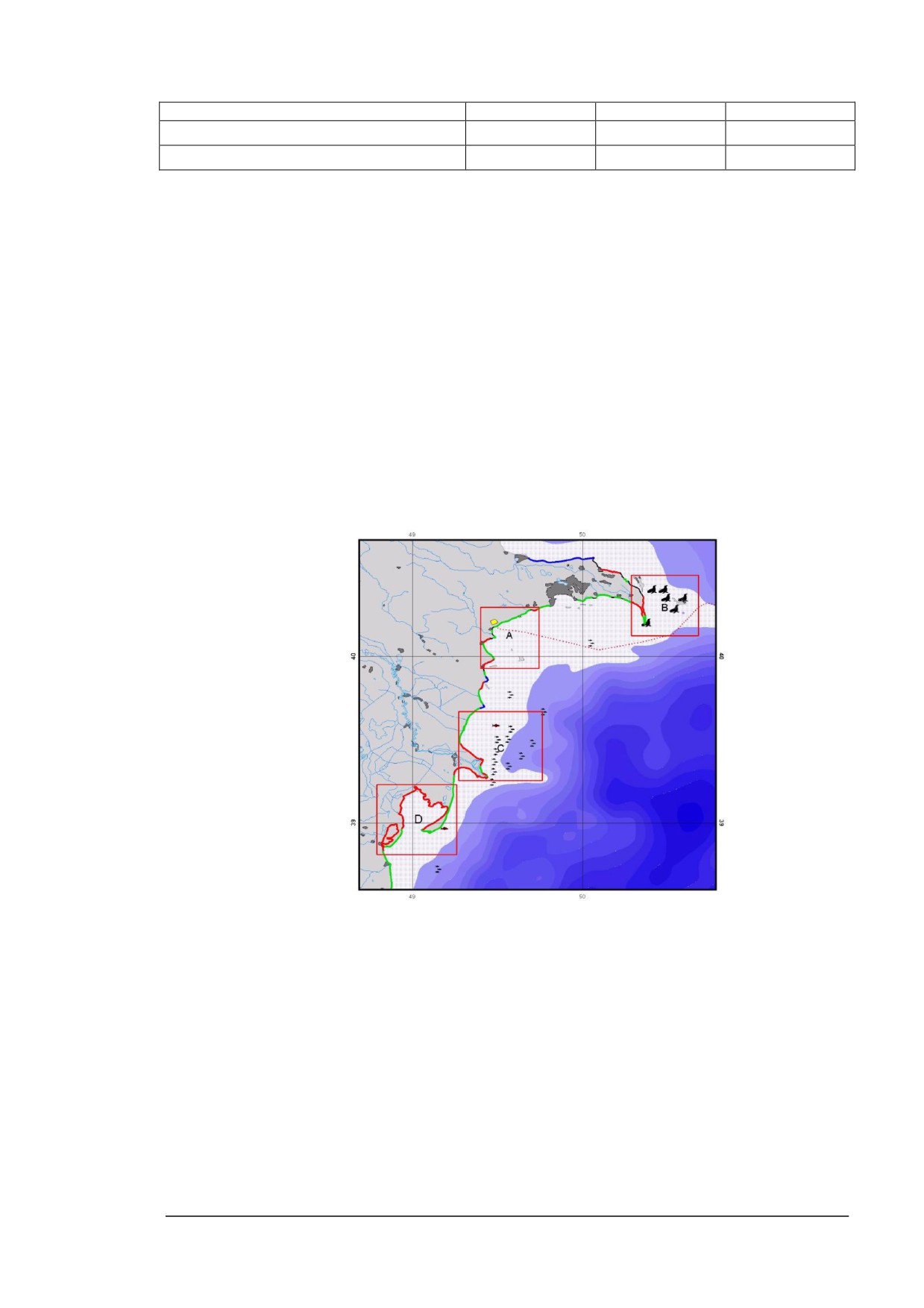
AzSPU Incident Management System Manual
Page 83 of 123
Time to initial beaching
56 hrs
90 hrs
185 hrs
Beached Volume (over 1008 hours)
498,497 m
3
419,499 m
3
270,406 m
3
Total Volume¹
699,915 m
3
640,367 m
3
528,963 m
3
¹ Representing the extrapolated volumes after 1,008 hours, the largest volume of oil occurring
during the spill scenario.
From Table it is evident that while a blow out occurring at any time could result in the beaching of
substantial quantities of oil, a blow out in winter would be most damaging if left to disperse without
implementing any response measures.
6
Protection Priorities, Sensitive areas
Offshore/Sangachal - Shoreline
In the event of a spill along the coastal zone of the Sangachal Terminal / pipeline route, the
following areas have been identified as the most sensitive:
Figure H - shoreline sensitive areas
Area A is the area in the vicinity of the landfall at Sangachal. The area has a high probability of
contamination from a pipeline leak and rupture. The entire area has water depths less than 10 m,
and seagrass communities are observed within the area. In addition, seabirds are distributed in
these nearshore waters throughout the year. Area A also includes the Pirsagat Islands, which are
important for birds.
Area B includes the eastern part of the Absheron peninsula, Shakdilli Spit and islands. This area
has a high probability of oil contamination from a pipeline leak or rupture. It also has a high
probability of oil from an offshore blowout in the winter season. Caspian seals are frequent in this
area in summer. The area also contains shoreline of high sensitivity.
Area C includes the Kura River delta. This area is within the area of influence from an offshore
blowout in the winter season. The area is important for fisheries, is a nursing ground for juvenile
sturgeons, and also has high density of seabirds throughout the year. A significant part of the
shoreline in this area is of high sensitivity.
Control Tier:
2-AzSPU
Revision Date: September 24, 2010
Document Number: AZSPU-HSSE-DOC-00107-2
Print Date: 01.02.2011
PAPER COPIES ARE UNCONTROLLED. THIS COPY VALID ONLY AT THE TIME OF PRINTING. THE CONTROLLED
VERSION OF THIS DOCUMENT CAN BE FOUNF AT http://docs.bpweb.bp.com/dkazspu/component/hssesms
AzSPU Incident Management System Manual
Page 84 of 123
Area D includes the Kyzyl-Agach Bay. It is designated a risk area since it is a Ramsar site 1 and
state reserve, containing bird populations of global significance. This, combined with a high
sensitivity shoreline ranks this area as extremely vulnerable.
Note - when considering any clean-up strategy, reference should be made to the following tools:
Coastal Protection Strategy - (Baku - Iranian border) AZSPU-HSSE-DOC-00077-2
o Annex 1. Coastal Protection Strategy - (Baku - Russian border)
OSIS (Oil Spill Information System) software
Sensitive sites potentially vulnerable to a trans-boundary oil spill incident
Area
Sensitivity
Azerbaijan
Kyzyl-Agach region (Kyzyl-
Ramsar site1 and State reserve. Supports
Agach Bay, Kura spit and Kura
significant bird populations year round and is an
River Delta)
important nearshore fish feeding ground. Oil spill
clean-up operations likely to cause significant
damage.
Kura River Delta is an important site for wintering
and migratory wader s, some of which are of
global conservation importance
Shakdilli Spit, Yuznaya Kosa
Main haul-out sites for the Caspian Seal. Highest
Cape on Zhiloy Island and the
numbers of seals are present at these locations
Dardanelli Reef System
in spring
around the Absheron
Peninsula
Shirvan area
State reserve. Some bird species of global
importance. Although inland, birds may fly to the
coast to feed.
Islands of Garasu and
The offshore islands support large numbers of
Gliniyaniy
breeding seabirds
The coastline from Primorsk to
Important fishing area
the Kura Delta
Coastline and coastal waters
Seagrass communities- important fish feeding
of the Absheron Peninsula
and nursery areas.
south to Kyzyl-Agach
Iran
Miankaleh Peninsula, Gorgan
Ramsar site1 and state reserve.
Bay and Lapoo-Zaghmarz Ab-
bandan
Anzali Mordab (Talab)
Ramsar site1 and state reserve.
complex
Bandar Kiashahr Lagoon and
Ramsar site1 and state reserve.
mouth of Sefid Rad
Amirkelayeh Lake
Ramsar site1 and state reserve. Although inland,
birds may fly to the coast to feed.
Turkmenistan
Krasnovodsk & North-
Ramsar site1 and State Nature Reserve
Cheleken Bays
(Zapovednik). The site is a very important
staging and wintering area for migratory
waterbirds. Also supports a limited commercial
fishery.
Onshore Export Pipelines
Sites or areas of particular importance for nature conservation are designated as protected areas.
There are a number of different levels of protection, ranging from the Nature Reserve (where no
public access is allowed) through Hunting Areas (where licensed hunting is possible) to the
protection of individual trees and paleontological sites. Several of the Protected Areas have been
assigned a Management Category by IUCN (1994).
Control Tier:
2-AzSPU
Revision Date: September 24, 2010
Document Number: AZSPU-HSSE-DOC-00107-2
Print Date: 01.02.2011
PAPER COPIES ARE UNCONTROLLED. THIS COPY VALID ONLY AT THE TIME OF PRINTING. THE CONTROLLED
VERSION OF THIS DOCUMENT CAN BE FOUNF AT http://docs.bpweb.bp.com/dkazspu/component/hssesms
AzSPU Incident Management System Manual
Page 85 of 123
Six Protected Areas and 4 proposed Protected Areas are within 10 km of the pipeline corridor.
However there are four of particular concern and these are identified below:
Area
Description
directly downstream from the Kura East River crossing.
The Barda State Forbidden Area
This State Forbidden Area comprises 7,500 ha of Tugay
river forest in the Barda/Agdas Regions
downstream of the Kurudera River crossing and
The Karayazi Reserve*
comprises 17,873 ha of Tugay river forest in the Kazakh
Region;
covers 40,424 ha of primarily wetland habitats and
The Samukh State Hunting Area
includes part of the Mingechaivr Reservoir
which is under UNDP, is of particular importance due to
Gobustan State National Park
the presence of mugwort and other desert plant
communities.
Notes
The Special Response Plan (SRP) for the Karayazi aquifer details additional protection
strategies for the area between KP 411-443 (Azerbaijan Exports Pipelines OSRP AzSPU-
HSSE-DOC-00031-5, Appendix 3 - Karayazi SRP)
When considering any clean -up strategy, reference should be made to the following tools:
-
AZSPU-HSSE-DOC-00126-4 Azerbaijan Export Pipelines Oil Spill Containment Site
Manual
- AGT Map Viewer software (web-based GIS interactive maps)
More detailed information can be found in Azerbaijan Exports Pipelines OSRP AzSPU-
HSSE-DOC-00031-5, Appendix 2 - Environmental sensitivities)
Locations of environmental sensitive areas are summarized in the figure overleaf
Figure I - Onshore pipelines route environmental sensitive areas
Control Tier:
2-AzSPU
Revision Date: September 24, 2010
Document Number: AZSPU-HSSE-DOC-00107-2
Print Date: 01.02.2011
PAPER COPIES ARE UNCONTROLLED. THIS COPY VALID ONLY AT THE TIME OF PRINTING. THE CONTROLLED
VERSION OF THIS DOCUMENT CAN BE FOUNF AT http://docs.bpweb.bp.com/dkazspu/component/hssesms
AzSPU Incident Management System Manual
Page 86 of 123
7
Waste Management
Guidance on waste management issues can be obtained from the following documents - AzSPU
Waste management strategy AZSPU-HSSE-DOC-00068-2, AzSPU Approved Waste Management
Contractors AZSPU-HSSE-DOC-00069-2 and AzSPU Waste Stream Register AZSPU-HSSE-
DOC-00084-2. These documents form the basis for the AzSPU Waste management strategy and
guiding principles for the treatment and disposal of all AzSPU waste streams, regardless of their
source.
Waste management after an oil recovery/clean-up process can potentially create logistical
difficulties and can frustrate the entire operation by causing bottlenecks (e.g. the need to switch off
skimmers in the event of insufficient transport or storage capacity may limit the rate at which oil can
Control Tier:
2-AzSPU
Revision Date: September 24, 2010
Document Number: AZSPU-HSSE-DOC-00107-2
Print Date: 01.02.2011
PAPER COPIES ARE UNCONTROLLED. THIS COPY VALID ONLY AT THE TIME OF PRINTING. THE CONTROLLED
VERSION OF THIS DOCUMENT CAN BE FOUNF AT http://docs.bpweb.bp.com/dkazspu/component/hssesms

AzSPU Incident Management System Manual
Page 87 of 123
be recovered). The following guiding principles should be followed to ensure an effective waste
management process:
Wherever practicable, it is best to treat and dispose of wastes at the point of generation or as
close as possible i.e. employ the proximity principle.
Segregate wastes and label at source. As per procedure, unidentified wastes should be
quarantined until it can be properly identified (by inspection or analysis).
Waste management matrix
Waste Stream
Oily Liquids
Oily Solids
Recovery
Recovery system(s)
Temporary
Emulsified
Non
Biodegradable
Non-
Sand
Pebbles
Area
storage area &
emulsified
debris
biodegradable
resource
debris
Barges, pillow
tanks, offloaded
At sea
Single ship system
at port into
99
99
9
9
8
8
skips and
trucks.
Vacuum truck,
oleophillic &
Heavy-duty
Shoreline
mechanical skimmers,
plastic bags,
999
9
99*
9 *
99
9
manual labour,
skips, lined pits.
adsorbent material.
Gully sucker,
oleophillic &
Heavy duty
Inland
mechanical skimmers,
plastic bags,
8
99
99
9
99
99
manual labour,
skips, lined pits.
adsorbent material.
Non-
Non
Biodegradable
biodegradable
Emulsified
emulsified
debris
debris
Sand
Pebbles
Separation
Separation
Biodegradation
Land fill
Biodegradation
Land fill
And:
And:
And/or:
And / or:
And / or:
Waste Management Method
Processing
Processing
Land fill
Land Fill
(in order of preference):
Incineration
Incineration
Stabilisation
999
Relatively large amounts of waste produced
99
Relatively moderate amounts of waste produced
9
Relatively low amounts of waste produced
8
Negligible amounts of waste produced
* Endeavour to remove debris from identified areas of coastline before oil impacts shoreline. This will severely reduce
waste volumes.
8
Dealing with oiled wildlife
Levels of wildlife response
The Azerbaijan Wildlife Response Plan AZSPU-HSSE-DOC-00090-2 will be implemented if there
is an impact or a potential for wildlife to become oiled during a spill incident. Please refer to the
WRP in any such instances (hard copy available in IMT room)
It has been agreed that the Environment Section Chief, acting on behalf of the Incident
Commander (IC) will determine the potential severity of the incident and will arrange for notification
depending on the anticipated level of a wildlife response.
Specific levels of a wildlife response have been determined and this is based on the likely numbers
of animals affected and the following:
The need for expert and experienced personnel from outside Azerbaijan to support, coach and
advise local personnel for any level of wildlife response.
It is feasible that a relatively small volume of spilled oil could lead to a significant number of
oiled wildlife if circumstances were unfavourable.
There are three levels of wildlife response activation:
Wildlife Level 1: Involves those incidents likely to lead to 10* or fewer oiled animals needing
rehabilitation. It is anticipated that this level of response will be dealt with by a local
veterinarian and depending on the conservational value of the oiled animals, may involve
euthanization. Additional resources from overseas may be mobilized.
Wildlife Level
2: Involves those incidents likely to lead to
10-20* animals needing
rehabilitation. The Wildlife Branch (an international animal welfare organization that BP can
call on for guidance and support) will be activated and overseas expertise mobilized to lead
response (1 person), with assistance from local personnel. Additional support is available
from the wildlife response capacity established by BP within Georgia.
Control Tier:
2-AzSPU
Revision Date: September 24, 2010
Document Number: AZSPU-HSSE-DOC-00107-2
Print Date: 01.02.2011
PAPER COPIES ARE UNCONTROLLED. THIS COPY VALID ONLY AT THE TIME OF PRINTING. THE CONTROLLED
VERSION OF THIS DOCUMENT CAN BE FOUNF AT http://docs.bpweb.bp.com/dkazspu/component/hssesms

AzSPU Incident Management System Manual
Page 88 of 123
Wildlife Level 3: Involves incidents likely to lead to greater than 20* oiled animals needing
rehabilitation. The Wildlife Branch will be activated and overseas expertise mobilized to lead
response (3 persons). Additional support is available from the wildlife response capacity
established by BP within Georgia, however additional resources from overseas may be
mobilized.
This number is for guidance only and the need to escalate to a higher level will be based on
incident specific factors including the type of oil, the severity of oiling on individual animals and the
species involved.
Wildlife branch
The Wildlife Branch has the functional responsibility for all aspects of oiled wildlife response
operations and incorporates:
Reconnaissance, search and collection
Protection strategies
Oiled wildlife capture
Cleaning and rehabilitation facilities
Release and monitoring
Collection and documentation of dead oiled wildlife
Reporting to the IMT
Overall objectives and priorities for the Wildlife Branch are agreed within the IMT, with inputs and
advice from the Wildlife Branch Director, the Environmental Section Chief and the Ministry of
Environment and Natural Resources (MENR).
Figure J - Wildlife response organization
9 Logistical Support
Logistics support is an integral part of successful response operations and will be coordinated by
IMT duty Logistics Section Chief (LSC). LSC is responsible for obtaining the personnel, equipment,
materials, and supplies needed to mount and sustain incident response operations, and for
providing the services necessary to ensure incident response operations are carried out in a safe
and efficient fashion. (AZSPU-HSSE-DOC-00087-2, Section 5.2.4).
Depending on the size and extent of a spill, logistics support could range from simply notifying the
Tier2 OSR Contractor to securing the Tier3 resources
Control Tier:
2-AzSPU
Revision Date: September 24, 2010
Document Number: AZSPU-HSSE-DOC-00107-2
Print Date: 01.02.2011
PAPER COPIES ARE UNCONTROLLED. THIS COPY VALID ONLY AT THE TIME OF PRINTING. THE CONTROLLED
VERSION OF THIS DOCUMENT CAN BE FOUNF AT http://docs.bpweb.bp.com/dkazspu/component/hssesms

AzSPU Incident Management System Manual
Page 89 of 123
Please refer to Azerbaijan IMT OSR resources guide AZSPU-HSSE-DOC-00104-2. The guide
provides information under following titles:
Oil Spill Response Equipment
Catering Services Providers
Sheltering
Heavy Equipment
Waste Management
PSCM Tags, OSR and Wildlife Response Consultants
Helicopters
Vessels
Medical Resources
Local Authorities
10 Attachment - MENR and SOCAR Verbal Notification form
Material Release / Spill Verbal Notification Log followed by the letter to MENR and other groups
Report No. (As recorded in Material Release/Spill Notification Log) Filled by CHSE Env. Team
Incident date and time:
To include (if confirmed); cause of release, material released, an
Description:
approximate indication of volume and status (e.g. contained).
Location:
Name of Asset/Facility and stating if the spill is to water or land.
Mitigation measures:
Describe the actions taken thus far.
Actions planned:
Including next communication/reporting to regulator.
Spill Review (Y/N):
Justification to be provided if not.
Company contact:
Contact name provided in correspondence with the regulator
Title
Date
Signature
PU/Asset Manager
CHSE AzSPU
Environmental Manager
Legal Advisor
HSE Director or delegate
Amendments/additional
To include amended/additional information provided to the
information provided:
regulator(s) following completion of the incident investigation report
(if applicable) e.g. volume of unrecovered material, preventative
actions etc.
Notification status
Date &
Notifier
Who should be notified
Contact phones:
Time
Name/Position
Director of the Department for
439 67 87/ 438 71 81/ 050
Environment Protection, MENR
327 18 19
Head of CCEMA, MENR
4716047 / 471 39 01
Expert of Foreign Investment
4925093/ 050 3435411
Department, SOCAR
SOCAR HSE Manager
4921130 / 0503209418
Control Tier:
2-AzSPU
Revision Date: September 24, 2010
Document Number: AZSPU-HSSE-DOC-00107-2
Print Date: 01.02.2011
PAPER COPIES ARE UNCONTROLLED. THIS COPY VALID ONLY AT THE TIME OF PRINTING. THE CONTROLLED
VERSION OF THIS DOCUMENT CAN BE FOUNF AT http://docs.bpweb.bp.com/dkazspu/component/hssesms
AzSPU Incident Management System Manual
Page 90 of 123
11 Attachment - OSR Notification and Activation Forms
11.1
Notification form
Notification form (page 1 of 2)
WARNING! Ensure telephone contact has been established with the Duty Manger before using e-mail and
fax communications. Telephone: Southampton: +44 (0)23 8033 1551
Southampton
Name of
To:
Duty Manger
Duty Manager:
E-mail of Duty Manager
Date
Southampton Emergency
+ 44 (0) 23 8072 4314
fax:
From
Position:
Company
Contact Number
Subject
Incident Name:
Obligatory Information Required - Please Complete All Details
Name of person in
charge:
Position:
Company:
Contact Tel Number
Contact Fax Number
E-mail address
Spill Details
Location of spill
Description of slick: (size,
direction, apperance)
Latitude/Longitute
Situation (cross box)
Land
River
Estuary
Coastal
Offshore
Port
Date and time of spill
GMT
ocal
Source of spill:
Quantity: (if known)
Cross box if estimate
Spill staus: (cross box)
On going
Controlled
Unknown
Action taken so far
Oil Type Characteristics
Product name
Viscosity
API/SG
Pour point
Asphaltene
Weather
Wind speed and direction
Sea state
Sea temperature
Tides
Forecast
COMPLETE BOTH PAGES
Control Tier:
2-AzSPU
Revision Date: September 24, 2010
Document Number: AZSPU-HSSE-DOC-00107-2
Print Date: 01.02.2011
PAPER COPIES ARE UNCONTROLLED. THIS COPY VALID ONLY AT THE TIME OF PRINTING. THE CONTROLLED
VERSION OF THIS DOCUMENT CAN BE FOUNF AT http://docs.bpweb.bp.com/dkazspu/component/hssesms
AzSPU Incident Management System Manual
Page 91 of 123
Notification form (page 2 of 2)
Additional Information Required.
Please
complete details if known
Resources at risk
Clean up resources
Nearest airport, if known
Runway length
Handling facilities
Customs
Handling agent
Vessel Availability
Equipment deployed
Recovered oil starage
Equipment Logistics
Transport
Secure storage
Port of embarkation
Location of command
centre
Other designated
contacts
Special requirements of Country
Security
Visa
Medical advise
Vaccinations:
Other: (specify)
Climate Information
Other Information
COMPLETE BOTH PAGES
Control Tier:
2-AzSPU
Revision Date: September 24, 2010
Document Number: AZSPU-HSSE-DOC-00107-2
Print Date: 01.02.2011
PAPER COPIES ARE UNCONTROLLED. THIS COPY VALID ONLY AT THE TIME OF PRINTING. THE CONTROLLED
VERSION OF THIS DOCUMENT CAN BE FOUNF AT http://docs.bpweb.bp.com/dkazspu/component/hssesms