Military reference books and manuals (2009-2023, Volume 4) - page 15
AzSPU Compliance Task Verification Procedure
Page 9 of 12
6. Procedure for Operating Area /Asset Verification
The Operating Area Environmental Adviser should verify tasks contained in the Task
Spreadsheet using the following ten steps:
Step 1 - Confirm Entity Assignment
Locate the Entity column and confirm that all Compliance Tasks are located at the correct
Entity (e.g. Sangachal Terminal). If the Entity is not correct put the correct Entity in the
adjacent “Entity (new)” column. Do not amend the Entity column.
Step 2 - Confirm Task Description
Read and understand the Task Description together with the Requirement Citation Text.
Confirm that the Task Description adequately addresses the Requirement Citation Text,
i.e. it demonstrates how the requirement will be met. If the Task Description does not
adequately address the Requirement Text or is not SMART, put the new task description
in the “Task Description (new)” column. Do not amend the “Task Description” column.
Before completing the draft Task Description you need to check that the task has not been
duplicated. You also need to consider whether it can be consolidated with other tasks -
See “Optional Steps” below.
Step 3 - Confirm Task Title
Confirm that the Task Title is an appropriate summary of the Task Description. If you
have changed the Task Description you may wish to amend the Task Title to reflect the
changes you have made. Add the new task title into the “Task Title (new)” column. Do
not amend the “Task Title” column.
Step 4 - Identify or Confirm Team / Supervisor Team
Assign the Team and Supervisor Team for each valid task. If the Team and Supervisor
Team are already assigned confirm that they are correct. You must ensure that the
correct Position Title is given for both the Team and the Supervisor.
Step 5 - Complete the Position Title List
Select the Position Title List tab in the Task Spreadsheet and add Position Titles as
needed checking that:
Control Tier:
2-AzSPU
Revision Date: August 6, 2010
Document Number: AZSPU-HSE-DOC-00094-2
Print Date: 2/1/20118/25/2010
PAPER COPIES ARE UNCONTROLLED. THIS COPY VALID ONLY AT THE TIME OF PRINTING. THE CONTROLLED
VERSION OF THIS DOCUMENT CAN BE FOUND AT http://docs.bpweb.bp.com/dkazspu
AzSPU Compliance Task Verification Procedure
Page 10 of 12
Each name behind a Position Title has a BP NT ID (login name) and BP e-mail
address assigned. Note: If a BP email is not available it either needs to be created
(via IT Help Desk) or the task should be re-assigned to a BP employee.
All Position Titles have a full list of all names currently holding the position, e.g.
for rotator positions such as OIM, two full names would normally be required.
Position Titles included in the Position Title List match the titles included in the
Task Spreadsheet.
Step 6 - Complete Due Date & Frequency
The Due Date is only required for recurring tasks and must be entered in US Date Format
i.e. MM/DD/YYYY. Once you have entered the Due Date select the appropriate value
from the drop down list in the “Frequency” column.
If a frequency has already been provided it is normally because this is a requirement from
the Source document (e.g. an ESIA commitment to conduct annual stack emissions
monitoring) or as a result of the procedural requirements within an Operation Control.
By leaving the Frequency cell blank the Task will automatically be assigned as
Continual.
Step 7 - Assign Operational Controls
Assign Operational Controls (Description and Location). Provide specific document
details (Full Title/Reference Number) and avoid general statements where possible.
Step 8 - Assign Task to BP or Contractor
Select either “BP” or “Contractor” from the drop down list.
Step 9 - Assign Task Group
Select the most appropriate value from the drop down list in the “Task Group-Other”
column.
Step 10 - Assign Task State
This is the last step in Task Verification. Assign „Close‟ in the Task State cell if a
Compliance Task has been completed and will not recur, i.e. one-off design or
construction related Compliance Tasks. A Compliance Task can only be closed once the
full evidence record (document description & location) has been provided. Note: this
action will not delete the Compliance Task from CTM, but will ensure that the
Compliance Task is not listed in the current view of any user.
Control Tier:
2-AzSPU
Revision Date: August 6, 2010
Document Number: AZSPU-HSE-DOC-00094-2
Print Date: 2/1/20118/25/2010
PAPER COPIES ARE UNCONTROLLED. THIS COPY VALID ONLY AT THE TIME OF PRINTING. THE CONTROLLED
VERSION OF THIS DOCUMENT CAN BE FOUND AT http://docs.bpweb.bp.com/dkazspu
AzSPU Compliance Task Verification Procedure
Page 11 of 12
Optional Steps:
Marking Duplicate Tasks for Deletion
If you have two or more duplicate tasks in the Task Spreadsheet you should mark the
duplicated task(s) for deletion by indicating in the “Comments (Operating Area /Asset)”
column, in the appropriate row, that the task should be deleted e.g.
“DELETE:
DUPLICATES TASK ID 456”. Do not delete any rows. When referencing the task that
is duplicated use only the value in the ID column, do not reference rows in the
spreadsheet.
Marking Tasks for Consolidation
If you have two or more similar tasks in the Task Spreadsheet that can be combined into a
single task you should identify the task that is to be retained and indicate that it is to be
retained in the “Comments (Operating Area /Asset)” column, e.g.
“RETAIN THIS TASK BUT CONSOLIDATE WITH TASK ID 954 (TO BE
DELETED)”
Review the Task Description for the task to be retained and verify that it accurately
reflects the requirements it has been consolidated with. If it does not, put the new task
description in the “Task Description (new)” column.
Marking a Task to be Split
Only split tasks if strictly necessary - e.g. they are conducted by different people. Insert
new rows immediately below the original task and copy and paste the task information
into these rows. Amend the task language and other requirements as needed in
accordance with the preceding steps. Do not delete the original task. Indicate in the
“Comment (Operating Area /Asset)” column next to the original task that it is to be split,
i.e. “TASK TO BE SPLIT”
Control Tier:
2-AzSPU
Revision Date: August 6, 2010
Document Number: AZSPU-HSE-DOC-00094-2
Print Date: 2/1/20118/25/2010
PAPER COPIES ARE UNCONTROLLED. THIS COPY VALID ONLY AT THE TIME OF PRINTING. THE CONTROLLED
VERSION OF THIS DOCUMENT CAN BE FOUND AT http://docs.bpweb.bp.com/dkazspu

AzSPU Compliance Task Verification Procedure
Page 12 of 12
Appendix 1- Column Headings in Task Spreadsheet
COLUMN HEADING
WARNING
REQUIREMENTS FOR DATA ENTRY
ID
DO NOT AMEND
Colour Code Comments (Central)
DO NOT AMEND
Comments (PU/Asset)
Provide comments as required, e.g. "THIS REQUIREMENT IS NOT
APPLICABLE AS THE OFFSHORE PU DOES NOT CONDUCT
AMBIENT AIR MONITORING."
Entity
DO NOT AMEND
Entity (New)
If the assigned entity is wrong insert the correct entity here.
State
REQUIRED
The current state of the Compliance Task i.e. whether the Task is
‘Open’ (to be completed and/or recurring) or ‘Closed’ (completed and
non-recurring)
High Level Requirement 1
DO NOT AMEND
Detailed Requirement 1
DO NOT AMEND
Requirement Citation Text 1
DO NOT AMEND
Task Title
DO NOT AMEND
Task Title (New)
Maximum length of 100 characters
Task Description
DO NOT AMEND
Task Description (New)
If the task needs rewording the new text must be included here
Due Date
REQUIRED (ONLY FOR
Enter the date only in US Date format - MM/DD/YYYY
RECURRING TASK)
Frequency
REQUIRED (UNLESS A
Select a value from the drop down list
CONTINUOUS TASK)
Owner
REQUIRED
Full name(s) as included in the Position Title List spreadsheet
Team
REQUIRED
Position Title as included in the Position Title List
Supervisor
REQUIRED
Full name as included in the Position Title List Spreadsheet
Supervisor Team
REQUIRED
Position Title as included in the Position Title List
Operational Control Description 1
REQUIRED
Name of control, e.g. document ID of the procedure
Operational Control Location 1
REQUIRED
Location of the procedure, e.g. "HSSE MS Documentum"
Task Group - BP/Contractor Performed
REQUIRED
Select a value from the drop down list
Task Group Other 1
REQUIRED
Select a value from the drop down list
Operational Control Description 2
Operational Control Location 2
Include only if necessary - it is recommended to avoid multiple
AVOID USING IF POSSIBLE
Operational Control Description 3
controls where possible
Operational Control Location 3
Evidence Document Description 1
Include only if required. Evidence of completion, e.g. "Site Inspection
Checklist August 2009"
Evidence Document Location 1
Include only if required. Location of completion evidence, e.g.
"HSSE_MS_Shared_Drive\Monitoring Reports"
Evidence Document Description 2
Evidence Document Location 2
AVOID USING IF POSSIBLE
Evidence Document Description 3
Evidence Document Location 3
High Level Requirement 2
Detailed Requirement 2
Requirement Citation Text 2
High Level Requirement 3
Detailed Requirement 3
Requirement Citation Text 3
DO NOT AMEND
High Level Requirement 4
Detailed Requirement 4
Requirement Citation Text 4
High Level Requirement 5
Detailed Requirement 5
Requirement Citation Text 5
Note: Column headings colored bright green (heavy shading) must be completed if
applicable.
Control Tier:
2-AzSPU
Revision Date: August 6, 2010
Document Number: AZSPU-HSE-DOC-00094-2
Print Date: 2/1/20118/25/2010
PAPER COPIES ARE UNCONTROLLED. THIS COPY VALID ONLY AT THE TIME OF PRINTING. THE CONTROLLED
VERSION OF THIS DOCUMENT CAN BE FOUND AT http://docs.bpweb.bp.com/dkazspu
AzSPU Compliance Task Verification Procedure
Page 13 of 12
Revision/Review Log
Revision Date
Authority
Custodian
Revision Details
08 January 2007
Y.Zaytsev
M.Neale
Initial Issue
29 March 2007
Y.Zaytsev
M.Neale
1st Review
30 April 2007
Y.Zaytsev
M.Neale
2nd Review
29 August 2007
Y.Zaytsev
J.Elliott
No changes
3 March, 2008
Y.Zaytsev
J.Elliott
Section 2, table is updated as per task
N. Amirmatova
verification lessons learnt
19 May 2009
Y. Zaytsev
N. Amirmatova
Added
definitions,
roles
&
responsibilities and revised procedure for
Operating Area/Asset verification. Added
new Appendix 1.
07 May 2010
A. Naghiyev
N. Amirmatova
Annual Review; Amended as per new
Organizational MOC
06 August 2010
A. Naghiyev
N. Amirmatova
Annual Review; Amended as per new
Organizational MOC
Control Tier:
2-AzSPU
Revision Date: August 6, 2010
Document Number: AZSPU-HSE-DOC-00094-2
Print Date: 2/1/20118/25/2010
PAPER COPIES ARE UNCONTROLLED. THIS COPY VALID ONLY AT THE TIME OF PRINTING. THE CONTROLLED
VERSION OF THIS DOCUMENT CAN BE FOUND AT http://docs.bpweb.bp.com/dkazspu
Azerbaijan SPU Continuous Improvement Strategy
Azerbaijan SPU Continuous Improvement
Strategy
AZSPU-HSSE-DOC-00091-2
Authority:
VP Offshore Operations/
Custodian:
OMS/CI Program Manager/Kieron Wilson
Mark Thomas
Scope:
HSE & Technical
Document
OMS/CI Planner/Hagigat Hasanova
Directorate/Operations
Administrator:
Issue Date:
07/01/10
Issuing Dept:
Operations
Revision Date:
30/07/10
Control Tier:
2
Next Review
31/10/10
Date:
Control Tier:
2
Revision Date: 30 July 2010
Document Number: << AZSPU-HSSE-DOC-00091-2>>
Print Date: 2/1/2011
PAPER COPIES ARE UNCONTROLLED. THIS COPY VALID ONLY AT THE TIME OF PRINTING. THE
CONTROLLED VERSION OF THIS DOCUMENT CAN BE FOUND AT
Azerbaijan SPU Continuous Improvement Strategy
Azerbaijan SPU Continuous Improvement Strategy
Context
BP Group, E&P and AzSPU are in the process of implementing OMS with a view to building a culture
of performance improvement. There is an opportunity to use Continuous Improvement (CI)
behaviours to differentiate BP from its competitors to achieve sector leadership. In AzSPU, CI is
already embedded in a number of specialised areas and processes; however, a continuous
improvement culture is not embedded in the way we work.
Objective
To enhance the capability of everyone in the SPU with Continuous Improvement techniques to
create a culture that eliminates defects and non value adding activities to enable better performance.
Approach
The AzSPU approach to Continuous Improvement will be to use continuous improvement techniques
to support existing procedures and practices and incorporate them into the way we work each day,
rather than adding additional activities.
Strategy
1. Enhance capability through training office-based and site leaders in BP’s CI tools: BP 7 Step
Problem Solving Methodology (A3); 5S; Value Stream Mapping.
2. Make Continuous Improvement part of our work routine. Every leader will define what good
performance looks like (including appropriate KPIs, as required) and review performance with their
team at the end of an appropriate period, identifying defects that, if eliminated, would improve
performance. (for Site Leaders this should be daily, for non site teams this should be at least every
week).
3. Each site will have a process for encouraging and formally capturing identified defects.
4. For those defects which will not be solved by existing processes, ones that require multi
disciplinary input or if they could have a large impact on team performance, the team leader may
decide to develop a CI project. Each site/team will have a controlled number of CI projects running at
any one. This will allow leadership to prioritise the projects and ensure that they have adequate
resources and coaching. As one project gets closed out another one should be started.
5. Identify and train key individuals to develop AzSPU Continuous Improvement coaching capability.
6. Local Continuous Improvement Forums will be created where local leadership will meet at least
once per month to discuss continuous improvement activities, manage quality, identify areas
requiring support and success stories for sharing.
7. An AzSPU CI Forum will be held every 3 months, attended by key operational, engineering and
functional leaders representing the CI Forums. The objectives of the CI Forum is to ensure
consistent continuous improvement approach across the SPU, share good practices, share success
stories and update strategy.
8. Utilise EPT CI capability to coach and support leaders until sufficient capability is developed within
the SPU
Control Tier:
2
Revision Date: 30 July 2010
Document Number: << AZSPU-HSSE-DOC-00091-2>>
Print Date: 2/1/2011
PAPER COPIES ARE UNCONTROLLED. THIS COPY VALID ONLY AT THE TIME OF PRINTING. THE
CONTROLLED VERSION OF THIS DOCUMENT CAN BE FOUND AT

Azerbaijan SPU Continuous Improvement Strategy
Continuous Improvement in AzSPU
People
People
OMS
Performance
Improvement
Exec.
Local Business
Processes
O.A
• Review
• Prioritize
Existing Procedures &
C.I. Projects
• Support
Practices
M.L.L.
How did it go today?
Continuous
O.E
?
Improvement
Improve it
Control Tier:
2
Revision Date: 30 July 2010
Document Number: << AZSPU-HSSE-DOC-00091-2>>
Print Date: 2/1/2011
PAPER COPIES ARE UNCONTROLLED. THIS COPY VALID ONLY AT THE TIME OF PRINTING. THE CONTROLLED VERSION OF THIS DOCUMENT CAN BE
FOUND AT
Azerbaijan SPU Continuous Improvement Strategy
Revision/Review Log
Revision Date
Authority
Custodian
Revision Details
30/07/10
VP Offshore
OMS Program
1) The custodian name has been changed.
Operations/ Mark
Manager/Ian
Kieron Wilson is now a custodian
Thomas
Ham
2) The wording in Paragraph 7 has been
changed. AzSPU Steering Team was
changed to AzSPU CI Forum
Control Tier:
2
Revision Date: 30 July 2010
Document Number: << AZSPU-HSSE-DOC-00091-2>>
Print Date: 2/1/2011
PAPER COPIES ARE UNCONTROLLED. THIS COPY VALID ONLY AT THE TIME OF PRINTING. THE
CONTROLLED VERSION OF THIS DOCUMENT CAN BE FOUND AT
AzSPU Contractor HSE Audit Procedure
Page 1 of 13
AzSPU Contractor
HSE Audit Procedure
AZSPU-HSSE-DOC-00142-2
Authority:
Yuliy Zaytsev
Custodian:
Rahim Rahimov
Offshore Health and Safety
Contractor Sr. HSE Specialist
Manager
Scope:
AzSPU Functions &
Document
HSE Document Coordinator
Operating Areas
Administrator:
Issue Date:
14 May 2008
Issuing Dept:
HSE
Revision Date:
25 October 2010
Control Tier:
2
Next Review
31 March 2011
Date:
Control Tier:
2
Revision Date: 25 October 2010
Document Number: AZSPU-HSSE-DOC-00142-2
Print Date: 2/1/2011
PAPER COPIES ARE UNCONTROLLED. THIS COPY VALID ONLY AT THE TIME OF PRINTING. THE CONTROLLED
VERSION OF THIS DOCUMENT CAN BE FOUND AT http://docs.bpweb.bp.com/dkazspu/component/hssesms
AzSPU Contractor HSE Audit Procedure
Page 2 of 13
TABLE OF CONTENTS
1
Introduction ----------------------------------------------------------------------------------------------- 3
2
Objective--------------------------------------------------------------------------------------------------- 3
3
Audit -------------------------------------------------------------------------------------------------------- 3
3.1
Audit Scheduling ------------------------------------------------------------------------------ 3
3.2
Roles & Responsibilities -------------------------------------------------------------------- 4
4
HSE Audit Process ------------------------------------------------------------------------------------- 5
5
Pre-Audit Activities ------------------------------------------------------------------------------------- 6
6
On-site Activities ---------------------------------------------------------------------------------------- 7
7
Post-site Activities-------------------------------------------------------------------------------------- 9
Revision/Review Log --------------------------------------------------------------------------------------- 13
Control Tier:
2
Revision Date: 25 October 2010
Document Number: AZSPU-HSSE-DOC-00142-2
Print Date: 2/1/2011
PAPER COPIES ARE UNCONTROLLED. THIS COPY VALID ONLY AT THE TIME OF PRINTING. THE CONTROLLED
VERSION OF THIS DOCUMENT CAN BE FOUND AT http://docs.bpweb.bp.com/dkazspu/component/hssesms
AzSPU Contractor HSE Audit Procedure
Page 3 of 13
1 Introduction
The Contractor HSE Audit Program is designed to evaluate progress towards HSE targets,
the effectiveness of the contractor HSE management systems and regulatory compliance. It
is a part of the HSE Assurance Program, which is designed to confirm that processes are in
place and working effectively in order to ensure delivery of both Contractor and BP’s HSE
expectations and legal compliance.
2 Objective
The purpose of this document is to provide guidance for conducting contractor health, safety
and environmental (HSE) audits within AzSPU.
Audits shall be used as a tool for verification of compliance with Contract HSE requirements
and continuous monitoring and improvement of the effectiveness of the HSE Management
Systems and of the companies contracted by AzSPU. The audit process ensures that the
audits meet applicable regulatory and both Contractor and BP’s HSE expectation and that
HSE risks are being adequately managed.
3 Audit
HSE Audits are performed to verify potentially high-risk contractor’s conformance to:
Contractor’s HSE management system and/or HSE work plan
HSE requirements for contractors performing work on BP facilities
Contract HSE clauses
Hazards and risks and how they are managed
Competency
Plant & equipment
Management of change
Emergency response
Waste Management
Compliance with legal and other requirements
Sub-contractor audits may also be conducted.
3.1 Audit Scheduling
The audit schedule will be based upon previous year’s HSE scorecard, incidents, audit
findings, Safety & Operations (S&O) assessments, and current year’s activities and key
risks.
Control Tier:
2
Revision Date: 25 October 2010
Document Number: AZSPU-HSSE-DOC-00142-2
Print Date: 2/1/2011
PAPER COPIES ARE UNCONTROLLED. THIS COPY VALID ONLY AT THE TIME OF PRINTING. THE CONTROLLED
VERSION OF THIS DOCUMENT CAN BE FOUND AT http://docs.bpweb.bp.com/dkazspu/component/hssesms
AzSPU Contractor HSE Audit Procedure
Page 4 of 13
3.2 Roles & Responsibilities
Audit Team
Formally trained or experienced personnel, who are independent of the function / activity to
be audited, shall perform the audits.
The Audit Team can consist of Health & Safety and Environmental auditors and will be led by
a Lead Auditor.
The Lead Auditor will act as a focal point for findings resolution issues and will communicate
with Contractor on behalf of Audit Team.
It is a requirement that the Technical Specialist (TS) responsible for the Contractor or activity
audited is present as a minimum at the kick-off and close out meetings of the Audit.
TS(owner) is responsible for:
Coordinating between the Contractor and the Audit team
Providing support to audit team
Managing the closure of findings
Reviewing with the Audit Team any action items that they consider to be inappropriate
Ensuring that all their action items are closed by the target date
Taking appropriate action with the Contractor if action items are not completed by the
target date
Identifying the necessity of audit and focus areas.
Contractor (auditee) is responsible for:
Co-operating with the auditors to permit the audit objectives to be achieved
Informing their employees about the objectives and scope of the audit
Providing the facilities needed for the audit team
Appointing staff to accompany members of the audit team and to act as guides
Providing access to the audited facilities including personnel and other materials
Developing, tracking and closing action items
Participating In the audit
Audit Team Leader is responsible for:
Obtaining relevant backg1round information necessary to meet the objectives of the audit
Forming the audit team after having given consideration to representations of the
contractor and the appropriate parties
Preparing the audit plan
Communicating the final audit plan to the TS, audit team and the Contractor
Coordinating the preparation of working documents and detailed procedures, and briefing
the audit team
Directing the activities of the audit team
Preparing the audit report
Representing the audit team in discussions with the contractor prior to, during and after
the audit
Notifying the contractor of observations on critical non-conformities without delay
Reporting on the audit clearly and conclusively within the time agreed with the TS and
contractor
Control Tier:
2
Revision Date: 25 October 2010
Document Number: AZSPU-HSSE-DOC-00142-2
Print Date: 2/1/2011
PAPER COPIES ARE UNCONTROLLED. THIS COPY VALID ONLY AT THE TIME OF PRINTING. THE CONTROLLED
VERSION OF THIS DOCUMENT CAN BE FOUND AT http://docs.bpweb.bp.com/dkazspu/component/hssesms
AzSPU Contractor HSE Audit Procedure
Page 5 of 13
Making clear and concise recommendations to the contractor for corrective actions,
ensuring that these represent the fair opinion of the team
Maintaining the independence and objectivity of the team and the audit report
Reviewing audit recommendations with TS/Contractor or designee
Audit Team Member is responsible for:
Following the directions of and supporting the Audit Team Leader
Planning and carrying out the assigned task objectively, effectively and efficiently within
the scope of the audit
Collecting and analyzing relevant and sufficient evidence to allow findings to be made
and conclusions to be drawn regarding the contractor’s system
Preparing working documents under the direction of the Audit Team Leader
Documenting individual audit findings
Safeguarding documents pertaining to the audit and returning such documents as
required
Assisting in writing the audit report
4 HSE Audit Process
The process for conducting HSE Audits is summarized below:
Pre-Audit Activities
Setting the Objectives and Scope of the Audit
Defining the Audit Criteria
Developing the Audit Protocol/Checklist
Selecting the Audit Team Members
Developing the Audit Plan
Preparing Contractor Management for the Audit
Planning and Preparing the Audit Team for the Site Visit
On-Site Activities
Opening Meeting
Typical Activities
o Records/Documentation Review
o Interviews with Contractor Staff
o Site Observations
Assessing Internal Controls
Reviewing the Audit Plan
Debriefing the Audit Team
Closing Meeting
Post-Site Activities
Outstanding Issues
Identifying and Gathering Additional Data
Regulatory Reviews
Refining the List of Findings
Substantiating the Findings
Prioritizing the Findings
Clarifying Assignments for Audit Team Members
Control Tier:
2
Revision Date: 25 October 2010
Document Number: AZSPU-HSSE-DOC-00142-2
Print Date: 2/1/2011
PAPER COPIES ARE UNCONTROLLED. THIS COPY VALID ONLY AT THE TIME OF PRINTING. THE CONTROLLED
VERSION OF THIS DOCUMENT CAN BE FOUND AT http://docs.bpweb.bp.com/dkazspu/component/hssesms
AzSPU Contractor HSE Audit Procedure
Page 6 of 13
Report Preparation And Follow-Up
Communicating Significant Findings to both Contractor and BP Management
Writing the Audit Report
Reviewing the Draft Report
Distributing the Final Report
Developing Action Plans and Corrective Measures
Entering Audit Findings and Recommendations Into a Formalized Tracking System
Follow-Up Audits and Verification that Corrective Measures Have Been Implemented
5 Pre-Audit Activities
Setting the Objectives and Scope of the Audit
The audit should be based on objectives defined by the Audit team. The scope describes
the extent and boundaries of the audit.
Defining Audit Criteria
Audit criteria should be determined prior to the audit based upon the audit scope and
objectives. Audit criteria include the HSE scorecard, incidents, audit findings, S&O
assessments, and current year’s activities and key risks codes, regulations, policies,
practices, procedures or requirements, against which the auditor judges the audited facility.
Developing Audit Protocol/Checklist
Audit protocols, which may be in checklist format, are based on the audit criteria and outline
a series of activities or steps to undertake in reviewing the specific subject matter of the
audit. The protocol should be developed to suit the circumstances of a particular audit
assignment. The auditor uses the protocol to compare collected audit evidence about the
subject matter.
Developing the Audit Plan
The Audit Team Leader should obtain relevant information prior to the audit in order to assist
with development of the Audit Plan (sometimes referred to as the Terms of Reference).
Examples of relevant information may include but are not limited to:
Organizational charts
HSE management system (policies, procedures, guidelines)
Previous audit reports, and follow-up
Incident reports and follow-up
The Audit Plan should include, if applicable:
The audit scope and objectives
The audit criteria / protocol / procedures
Identification of any activities that are of high priority
Identification of audit team members
The expected time and duration for audit activities
Audit preparation
The Audit Plan should be communicated to TS, audit team members, and the contractor.
The TS should review and approve the plan. The contractor should be prepared to make
available the appropriate interviewees, guides for the site visit, and general access to the
facilities and required documentation and records.
Control Tier:
2
Revision Date: 25 October 2010
Document Number: AZSPU-HSSE-DOC-00142-2
Print Date: 2/1/2011
PAPER COPIES ARE UNCONTROLLED. THIS COPY VALID ONLY AT THE TIME OF PRINTING. THE CONTROLLED
VERSION OF THIS DOCUMENT CAN BE FOUND AT http://docs.bpweb.bp.com/dkazspu/component/hssesms
AzSPU Contractor HSE Audit Procedure
Page 7 of 13
Planning and Preparing the Audit Team for the Site Visit
The Audit Team Leader should obtain relevant information prior to the audit for review by the
Audit Team. Examples of relevant information may include, but are not limited to:
Organizational charts
Audit Protocol
HSE management system (policies, procedures, guidelines)
Previous audit reports, and follow-up
Incident reports and follow-up
List of hazardous materials
Environmental impact assessment / hazard analysis
Environmental management plan(s)
Emergency preparedness plans
Training records
Contractual documents
6 On-site Activities
Opening Meeting
Each audit should begin with an opening meeting with contractor management, HSE staff
and the audit team to:
Introduce the audit team
Review the audit scope, objectives and criteria
Establish contacts
Clarifying opening issues, and
Reaffirm the schedule for the closing meeting
Typical Audit Activities
The primary goal in performing an audit is to collect sufficient objective evidence to draw
conclusions regarding compliance with HSE requirements. The Audit Team Leader will
direct the audit to collect this evidence. Typical audit activities include:
Overview
- Presentation from a key person covering an overview of operations,
organization, and basic site information. It may also include an orientation of site safety
procedures.
Records/Documentation Review
- Review relevant HSE management system
documents (policies, procedures, guidelines) that are the basis of HSE requirements
Interviews with Contractor Staff - Conduct interviews with key personnel to ensure
accurate conclusions can be drawn
Site Observations - Process area walk-through, inspection of equipment and activities
within the audit scope. An initial brief orientation tour presents an opportunity to identify
areas to return for more in-depth observation/follow-up.
Each member of the audit team completes his/her assigned portion of the audit, collects and
records objective evidence and keeps the Audit Team Leader informed. Each member uses
the Audit Protocol to compare collected audit evidence about the subject matter, and may
annotate the protocol with brief comments and notations, which become the audit working
papers. The completed protocol may be supplemented with additional working papers/notes.
Control Tier:
2
Revision Date: 25 October 2010
Document Number: AZSPU-HSSE-DOC-00142-2
Print Date: 2/1/2011
PAPER COPIES ARE UNCONTROLLED. THIS COPY VALID ONLY AT THE TIME OF PRINTING. THE CONTROLLED
VERSION OF THIS DOCUMENT CAN BE FOUND AT http://docs.bpweb.bp.com/dkazspu/component/hssesms
AzSPU Contractor HSE Audit Procedure
Page 8 of 13
To perform an efficient audit and offer a well thought out review of findings at the Closing
Meeting, it is important to avoid the “final crunch” of leaving evaluation of the collected audit
evidence to the last minute. Each auditor should clean up their working papers and
summarize their findings clearly.
Interviewing Contractor Staff
Interviewing is a key technique used by auditors to gather information, however, to be
effective, interviews need to be carefully planned and conducted.
Planning the Interview
Iron out logistics
Define the desired outcomes
Organize thoughts; establish a general sequence for questioning
Get the right setting. Try to conduct the discussion in the interviewee’s work area.
Try to keep it “one-on-one”
Opening the Interview
Introduce yourself; state the purpose of the audit and interview.
Ensure appropriateness of time
Explain how information will/will not be used
Record interviewee’s name, date, and location
Conducting the Interview
Request a brief overview of the interviewee’s responsibilities with respect to audit
topic(s)
Ask open-ended questions (e.g. What…? How…?)
Avoid simple Yes/No questions (e.g. Do you…?)
Get the interviewee to do most of the talking
Avoid making assumptions. Avoid leading questions.
Tolerate silences in order to allow the interviewee to formulate thoughts and
responses
Take notes of key points during the interview. Do not attempt a verbatim
transcript.
Closing the Interview
Do not exceed the agreed upon time limit without concurrence
End on a positive note
Summarize your understanding of key points discussed
Thank the interviewee for his/her assistance
Post-Interview
After the interview, summarize the outcome and overall conclusions.
Assessing Internal Controls
An essential element of many HSE audits is to evaluate the soundness of internal controls
and management systems. In particular, this serves to identify features that the auditor can
rely on in gathering evidence, and potential weaknesses the auditor will test. Key areas to
probe are:
Are responsibilities and accountabilities clearly defined, established and
communicated?
Control Tier:
2
Revision Date: 25 October 2010
Document Number: AZSPU-HSSE-DOC-00142-2
Print Date: 2/1/2011
PAPER COPIES ARE UNCONTROLLED. THIS COPY VALID ONLY AT THE TIME OF PRINTING. THE CONTROLLED
VERSION OF THIS DOCUMENT CAN BE FOUND AT http://docs.bpweb.bp.com/dkazspu/component/hssesms
AzSPU Contractor HSE Audit Procedure
Page 9 of 13
What formal training have key personnel had to assist in performing key HSE
functions?
How does the contractor manage changes in HSE risks, procedures and equipment?
What measures have been taken to reduce the likelihood of non-conformance with
established criteria?
Has the contractor fully implemented the various HSE programs?
To what extent does contractor management review, measure, and evaluate results
achieved against established criteria?
What records are routinely developed and retained in carrying out various functions?
Reviewing the Audit Plan
The Audit Team Leader should periodically review the Audit Plan during the on-site activities
to ensure that adequate progress is being maintained to achieve the audit objectives. If
necessary, the audit plan and/or protocol should be modified to ensure that the objectives
are met by making the most efficient and effective use of the audit team’s resources.
Debriefing the Audit Team
Periodically during the audit, and upon completion of the on-site activities, the audit team
should meet privately to share their objective evidence and agree their collective conclusions
regarding compliance with HSE requirements. The team should summarize and agree their
preliminary findings, and, where possible, start to identify appropriate recommendations.
This process may be facilitated by each auditor writing up his/her findings and suggested
recommendations on a daily basis, and then copying these notes to other team members.
It is often appropriate to offer a regular debrief to contractor management, especially
contractor HSE staff, during the on-site activities to share the team’s observations and
conclusions as they are reached. This offers the opportunity for contractor staff to correct
any inaccuracies or misunderstandings by identifying additional interviewees and other
documents for review, and also helps to avoid any “surprises” at the more formal Closing
Meeting.
Closing Meeting
At the completion of on-site activities, each audit should end with a closing meeting involving
the audit team and contractor management to:
Recognize any HSE “good/best practices” identified
Review the preliminary audit findings and recommendations
Confirm a schedule and distribution for the audit report and any site-specific facility
response to the findings and recommendations
The Audit Team Leader should stress the preliminary nature of the findings, and that the
recommendations may not be fully developed at this stage; pointing out that further research
may be necessary to confirm the applicability of some items.
7 Post-site Activities
Outstanding Issues
Following completion of the On-Site Activities, there may be a number of outstanding issues
remaining to be resolved. These issues may arise as a result of:
Comments received at the Closing Meeting
Additional information requests and documents requiring review
Items requiring further research or substantiation
Control Tier:
2
Revision Date: 25 October 2010
Document Number: AZSPU-HSSE-DOC-00142-2
Print Date: 2/1/2011
PAPER COPIES ARE UNCONTROLLED. THIS COPY VALID ONLY AT THE TIME OF PRINTING. THE CONTROLLED
VERSION OF THIS DOCUMENT CAN BE FOUND AT http://docs.bpweb.bp.com/dkazspu/component/hssesms
AzSPU Contractor HSE Audit Procedure
Page 10 of 13
Items requiring interpretation of regulations and corporate standards
Identifying and Gathering Additional Data
It may be necessary to obtain additional information and documents for review to enable
response to comments received from contractor, and/or to substantiate preliminary findings.
Refining the List of Findings
If not already prepared at the Audit Team Debrief, a list of all findings should be developed.
Each auditor should review all working papers to ensure that all topics were covered, and
that working paper notes corroborate all findings.
Substantiating the Findings
Each Audit Team Member should critically review their findings to ensure that the audit
evidence fully supports each conclusion, and that conclusions are limited to information
developed during the audit.
Prioritizing the Findings
The list of findings should be prioritized to identify Significant or Principal Findings.
Identification of common findings, issues or themes may be used to eliminate redundancies
and emphasize important patterns or trends that emerged. Be alert to systemic issues
where the symptoms observed may be manifestations of a more fundamental management
system weakness.
Clarifying Assignments for Audit Team Members
The Audit Team Leader should delegate assignments to team members to address any
outstanding issues, refine and substantiate the preliminary findings, and assist with report
writing. These assignments should be addressed in a timely manner to facilitate preparation
of the draft audit report.
REPORT PREPARATION AND FOLLOW-UP
Communicating Significant Findings to Contractor and BP Management
The Audit Team Leader should communicate any significant findings to the TS without
delay, and without waiting for preparation of the draft report.
Writing the Audit Report
The audit findings must be communicated to the TS, the contractor, and the appropriate HSE
support group in a written report.
Audit-related information that should be included in all HSE audit reports includes:
Audit Name - name of the audit
Audit Number - number assigned by the asset (optional)
Contractor / TS - the names of individual or job position
Audit Type - the type of audit
Audit Date - the period covered by the audit and the date(s) the audit was conducted
Audit Objectives and Scope
Criteria against which the audit was conducted
Audit Findings
Recommendations to address the findings
Observations (optional)
Audit Conclusions (optional)
Control Tier:
2
Revision Date: 25 October 2010
Document Number: AZSPU-HSSE-DOC-00142-2
Print Date: 2/1/2011
PAPER COPIES ARE UNCONTROLLED. THIS COPY VALID ONLY AT THE TIME OF PRINTING. THE CONTROLLED
VERSION OF THIS DOCUMENT CAN BE FOUND AT http://docs.bpweb.bp.com/dkazspu/component/hssesms
AzSPU Contractor HSE Audit Procedure
Page 11 of 13
List of reference documents (optional)
Distribution List for the audit report
Wording Audit Findings and Recommendations
The fundamental objective in audit reporting is to clearly and accurately communicate the
facts. Several principles in wording audit reports are important to keep in mind as an aid in
achieving this objective, and also minimizing legal liability.
BP standards are usually higher than those required by law, and the use of words, such as
“inadequate” or “deficient”, could be misconstrued. Remember, every word you write down
may be read by others and can result in action or in-action, as appropriate.
The following fundamental principles should help in writing audit reports:
•
Facts: In presenting the information, it is important to stick to the facts. State the facts
clearly and concisely. Do not draw unsubstantiated conclusions. Avoid opinions.
•
Findings: As with facts, state the nature of the problem clearly and exactly. Weigh the
evidence for your conclusions carefully. If in doubt, give the reasons behind your
findings. Communicate the extent of the problem fully, and avoid non-definitive words,
such as “few” and “some”. Do not focus criticism on individuals or their mistakes, by
avoiding naming their involvement in a finding or as a source of information.
•
Recommendations: If you are making recommendations, think about what you are
saying carefully. Make sure you are not reinventing the wheel by, for example,
recommending something that is already done or by recommending something in an
area you know little about. Before finalizing your recommendations, ask and find out
about what is currently done. In short, do not recommend a hammer to crack a nut and
ensure it is the correct “nut” you want to crack!
•
General: Be careful of your use of any adjectives and superlatives, which should
generally be avoided or qualified. Avoid extreme language. Do not use depreciating
words, such as “careless”, “dangerous”, “intentional”, “incompetent”, etc. These often
give an emotional effect to what you are saying, and any reader will react to it. After
you have written your report, re-read it and ensure that it says what you want it to say.
For example, the sentence
“Procedures were insufficient and totally inadequate”
contains generalities and emotional adjectives. Consider the replacement: “Procedures
should be improved by including practices for sampling and analyzer calibration to
prevent similar incidents in future.” To the reader, the first sentences suggests a
negligent lack of procedures indicating blame, while the second points out that
procedures existed but did not prevent the incident and need updating to cover such
situations. It is often more constructive to recommend that improvements or additions
are necessary.
Avoid the use of acronyms, abbreviations and jargon. Spell out any terms when initially
used, and include definitions if necessary to convey a clear understanding.
Control Tier:
2
Revision Date: 25 October 2010
Document Number: AZSPU-HSSE-DOC-00142-2
Print Date: 2/1/2011
PAPER COPIES ARE UNCONTROLLED. THIS COPY VALID ONLY AT THE TIME OF PRINTING. THE CONTROLLED
VERSION OF THIS DOCUMENT CAN BE FOUND AT http://docs.bpweb.bp.com/dkazspu/component/hssesms
AzSPU Contractor HSE Audit Procedure
Page 12 of 13
Do not draw legal conclusions by using words and phrases, such as “compliance”,
“violation”, however, do quote regulatory or company policy references with the
appropriate citation.
These same principles should be applied to the preparation of working papers and notes,
although these may identify individuals by name.
Audit Report Format and Layout
There are several general principles that should be observed, and the report should include:
The audit-related information (listed above)
Each page of the report should be marked with the appropriate confidentiality
wording, such as “Privileged And Confidential”, where necessary.
One-page Executive Summary, identifying Principal/Significant Findings
Individually numbered findings and recommendations to facilitate follow-up
Clear linkage between a finding and its corresponding recommendation to
demonstrate the substantiation
(backg1round, justification, etc.) for the
recommendation
Identification of findings and recommendations to be communicated to contractors
Identification of lessons learned to be communicated to other BP organizations
Reviewing the Draft Report
The Audit Team Leader should prepare a draft report, which is circulated to all audit team
members and TS for their concurrence and comment. The Audit Team Leader should then
incorporate any appropriate changes and resolve any conflicting comments.
Distributing the Final Report
Upon receipt of any factual accuracy comments from the audited facility, the Audit Team
Leader should prepare a final report for distribution as determined by the TS.
Developing Action Plans and Corrective Measures
After both Contractor and BP management has formally accepted the audit findings, the
TS/Contractor are accountable for ensuring that an action plan of corrective measures is
developed within
5 working days of the audit final report to address all findings and
recommendations.
Each action item should be prioritized as per an equivalent risk ranking system. The intent is
to prioritize all action items so that ones with the highest risk are addressed first.
The target completion date should be based upon the prioritization.
The TS/Contractor is also responsible for ensuring that the action items are followed through
to completion.
Follow-Up Audits and Verification that Corrective Measure Have Been Implemented
The Audit Advisor, in liaison with the TS, should take into account the findings of previous
HSE audits when determining the future Audit Program. In the event of an audit, which
identifies a number of significant findings and/or non-conformances, consideration should be
given to conducting a follow-up audit to verify that corrective actions have been properly
implemented.
Control Tier:
2
Revision Date: 25 October 2010
Document Number: AZSPU-HSSE-DOC-00142-2
Print Date: 2/1/2011
PAPER COPIES ARE UNCONTROLLED. THIS COPY VALID ONLY AT THE TIME OF PRINTING. THE CONTROLLED
VERSION OF THIS DOCUMENT CAN BE FOUND AT http://docs.bpweb.bp.com/dkazspu/component/hssesms
AzSPU Contractor HSE Audit Procedure
Page 13 of 13
Revision/Review Log
Revision Date
Authority
Custodian
Revision Details
14 May 2008
Safety Team
Contractor HSE
Initial issue
Leader Islamov
Compliance Lead
Abbas
Amir Shah
14 August 2009
Safety Team
Contractor HSE
The procedure was revised due to recent
Leader Adalat
Assurance Advisor
changes in PSCM definitions.
Mamedov
Ramiz Hajiyev
25 October 2010
Yuliy Zaytsev
Rahim Rahimov
Document Custodian and Authority
Offshore Health
Contractor HSE
updated. Validity of this procedure extended
and Safety
Specialist
until the end of 1Q 2011.
Manager
Control Tier:
2
Revision Date: 25 October 2010
Document Number: AZSPU-HSSE-DOC-00142-2
Print Date: 2/1/2011
PAPER COPIES ARE UNCONTROLLED. THIS COPY VALID ONLY AT THE TIME OF PRINTING. THE CONTROLLED
VERSION OF THIS DOCUMENT CAN BE FOUND AT http://docs.bpweb.bp.com/dkazspu/component/hssesms
AzSPU Control of Work Training Policy
AzSPU
Control of Work Training Policy
AZSPU-HSSE-DOC-00088-2
Authority:
Operations Authority
Custodian:
HSE L&OD Advisor
Scope:
AzSPU Operational PUs
Document
Administrator:
AzSPU HSSE MS Document Coordinator
Issue Date:
20 February 2007
Issuing Dept:
HSE & Engineering
Revision Date:
20 December 2010
Control Tier:
2 - AzSPU
Next Review
20 December 2011
Date:
Control Tier:
2
Revision Date 20 December 2010
Document Number: AZSPU-HSSE-DOC-00088-2
Print Date: 2/1/2011
PAPER COPIES ARE UNCONTROLLED. THIS COPY VALID ONLY AT THE TIME OF PRINTING. THE CONTROLLED
VERSION OF THIS DOCUMENT CAN BE FOUND AT http://docs.bpweb.bp.com/dkazspu/component/hssesms
AzSPU Control of Work Training Policy
TABLE OF CONTENTS
1.0
Purpose/Scope
2
2.0
Definitions
3
3.0
Deviations
4
4.0
General Requirements
4
1) PTW Performing Authorities
4
2) PTW Area Authorities
5
3) Energy Isolations Electrical
6
4) Confined Space Entry
6
5) Authorized Gas Testing (Level 1, Level 2 or Level 3)
6
5.0
Policy for COW Training
7
5.1
Training and Competency Requirements
7
Table 1: Training and Competency Requirements for Authorization
8
5.2.
Training Methodology
12
5.3.
Training Arrangements
12
6.0
Key Responsibilities over Training Program
13
1.0 Purpose/Scope
The purpose of this document is to describe the process for Control of Work (COW)
Training & Competency in the Azerbaijan Strategic Performance Unit (AzSPU). This
policy is to ensure that all relevant personnel are trained to the appropriate level
according to the requirements of their job role.
This document is for all Core staff including sub contract personnel and contractors that
they should be fully conversant in what is required by all personnel with roles &
responsibilities in the AzSPU within the competency process that is defined in this
policy. The COW program forms part of the core HSE training program providing
consistency of standards across all operating units.
This Training Policy covers COW procedures associated with:
Document Number
Title of Procedure
AZSPU-HSSE-DOC-00060-2
PTW Procedure
AZSPU-HSSE-DOC-00063-2
Task Risk Assessment
AZSPU-HSSE-DOC-00048-2
Energy Isolations-Electrical
AZSPU-HSSE-DOC-00049-2
Energy Isolations-Process
AZSPU-HSSE-DOC-00013-2
Confined Space Entry
AZSPU-HSSE-DOC-00058-2
Management of Radioactive Materials & Radiation
Generators
AZSPU-HSSE-DOC-00012-2
Procedure for Authorization
AZSPU-HSSE-DOC-00002-2
BP Control of Work Standards
AZSPU-HSSE-DOC-00011-2
SSOW, Deviations from Regulations and Procedures
Control Tier:
2
Revision Date 20 December 2010
Document Number: AZSPU-HSSE-DOC-00088-2
Print Date: 2/1/2011
PAPER COPIES ARE UNCONTROLLED. THIS COPY VALID ONLY AT THE TIME OF PRINTING. THE CONTROLLED
VERSION OF THIS DOCUMENT CAN BE FOUND AT http://docs.bpweb.bp.com/dkazspu/component/hssesms
AzSPU Control of Work Training Policy
2.0 Definitions
AA - Area Authority.
AEP - Authorized Electrical Person.
AGT - Authorized Gas Tester.
AIP - Authorized Instrument Person.
AMI - Authorized Mechanical Isolator.
AzSPU - Azerbaijan Strategic Performance Unit.
CBT - Computer Based training.
CMAS - Competency Management assessment system.
COW - Control of Work.
CTTC - Caspian Technical Training Center located in Sangachal Terminal.
Competency Assessment - assessment that delegate must complete to
demonstrate
knowledge of the relevant standard by Authorized Person.
Delegate - an individual nominated for a training course.
HSEA - Health, Safety and Environmental Advisor.
IA - Isolating Authority.
ISSOW - Integrated Safe Systems Of Work.
OIM - Offshore Installation Manager.
OPITO - Offshore Petroleum Industry Training Organization.
PA - Performing Authority.
PTW - Permit to Work.
REP - Responsible Electrical Person.
SAEP - Senior Authorized Electrical Person.
Control Tier:
2
Revision Date 20 December 2010
Document Number: AZSPU-HSSE-DOC-00088-2
Print Date: 2/1/2011
PAPER COPIES ARE UNCONTROLLED. THIS COPY VALID ONLY AT THE TIME OF PRINTING. THE CONTROLLED
VERSION OF THIS DOCUMENT CAN BE FOUND AT http://docs.bpweb.bp.com/dkazspu/component/hssesms
AzSPU Control of Work Training Policy
SC - Site Controller.
SSOW - Safe Systems of Work.
TA - Technical Authority.
Training Venue - the location of the training.
VTA - Virtual Training Assistant, web based portal with training history for each
employee, training calendar for courses delivered across AzSPU.
3.0 Deviations
This procedure is written in sufficient detail that it should be able to be applied
consistently at all sites / installations. There may still be the requirement for some local
rules covering site / installation specific logistical/administrative arrangements and local
variations in responsibilities to reflect differences in organizational arrangements. These
local rules should not deviate from the core processes within this document. Any form of
deviation from this procedure, including but not limited to local rules, shall be requested
and authorized in accordance with SSOW, Deviations from Regulations and Procedures
procedure (Doc. No: AZSPU-HSSE-DOC-00011-2).
Should there be a requirement to deviate from any particular training, the HSSE training
waiver VTA grandfathering/dispensation form (Appendix 1) must be used, this form
should then be passed onto Learning Coordinator.
4.0 General Requirements
Overall description for the courses is provided below:
1) PTW Performing Authorities
All personnel acting or standing-in as a Performing Authority (succession planning)
should attend this course. The course is split into three primary sections:
Task Risk Assessment
6 Risk Assessment breakdown - hazard effect, probability, controls, risk
matrix etc
6 Specifics of the Risk Assessment Procedure
6 Scenarios (specific to the individuals role and Performance Unit) for
competency assessment
Energy Isolations Process
6 Scope & Responsibilities
6 Isolation Standards and Planning
Control Tier:
2
Revision Date 20 December 2010
Document Number: AZSPU-HSSE-DOC-00088-2
Print Date: 2/1/2011
PAPER COPIES ARE UNCONTROLLED. THIS COPY VALID ONLY AT THE TIME OF PRINTING. THE CONTROLLED
VERSION OF THIS DOCUMENT CAN BE FOUND AT http://docs.bpweb.bp.com/dkazspu/component/hssesms
AzSPU Control of Work Training Policy
6 Isolation Implementation & Control
6 Plant Preparation for Breaking Containment
6 Confined Space Entry
6 Plant Reinstatement and Leak Testing
Performing Authorities
6 Specifics of the PTW Procedure relevant to a Performing Authority
6 Scenarios
(specific to role and Performance Unit) for competency
assessment, applicable to a Performing Authority
There is ongoing assessment after each of the section of the course.
Training is available in the form of Computer Based training (CBT) at the frequency of
every five years for Core Operations personnel - CoW practitioners and users at the site
on a daily basis; and every 2 years for non-core Operations personnel, contractors,
vendors and those that are away from the site for more than 6 months.
Note. a) The computer based training (CBT) is sufficient for BP staff first time attendees
given their backg1round and knowledge from CTTC Foundation program.
b) Contractor personnel first time course attendees may either attend classroom
based training or Computer based training
(CBT), which depends on contractor‟s
previous backg1round and experience, which is defined by contractor management.
2) PTW Area Authorities
All personnel acting or standing-in as an Area Authority (succession planning) should
attend this course. The course is split into four primary sections:
Task Risk Assessment
6 Risk Assessment breakdown - hazard effect, probability, controls, risk
matrix etc
6 Specifics of the Risk Assessment Procedure
6 Scenarios (specific to the individuals role and Performance Unit) for
competency assessment
Energy Isolations Process
6 Scope & Responsibilities
6 Isolation Standards and Planning
6 Isolation Implementation & Control
6 Plant Preparation for Breaking Containment
6 Confined Space Entry
6 Plant Reinstatement and Leak Testing
Performing Authorities
6 Specifics of the PTW Procedure relevant to a Performing Authority
6 Scenarios
(specific to role and Performance Unit) for competency
assessment, applicable to a Performing Authority
Area Authorities
6 Specifics of the PTW Procedure relevant to an Area Authority
Control Tier:
2
Revision Date 20 December 2010
Document Number: AZSPU-HSSE-DOC-00088-2
Print Date: 2/1/2011
PAPER COPIES ARE UNCONTROLLED. THIS COPY VALID ONLY AT THE TIME OF PRINTING. THE CONTROLLED
VERSION OF THIS DOCUMENT CAN BE FOUND AT http://docs.bpweb.bp.com/dkazspu/component/hssesms
AzSPU Control of Work Training Policy
6 Scenarios
(specific to role and Performance Unit) for competency
assessment
There is ongoing assessment after each of the section of the course.
Training is available in the form of Computer Based training (CBT) at the frequency of
every five years for Core Operations personnel - CoW practitioners and users at the site
on a daily basis; and every 2 years for non-core Operations personnel, contractors,
vendors and those that are away from the site for more than 6 months.
3) Energy Isolations Electrical
This is a 1 day classroom-based course. All personnel associated with Electrical Energy
Isolations should attend this course. The course is focused on the following areas:
6 Electrical Safety Guidelines
6 Energy Isolations - Electrical
6 Authorization
There is ongoing assessment after each of the course.
Refresher training is required only by nomination of authorizing person.
4) ISSOW - Integrated Safe System of Work
This training is available for all personnel who need access to ISSOW system and teaches
how to use electronic system.
Level 1 training - Computer Based training (CBT) for Performing Authorities .
Level 2 training - 2-day training for Area Authorities, Isolating Authorities, Site
Controller‟s/OIM‟s.
Level 3 training - 3-day training for “super users” - ISSOW champions who can provide
focal points and ongoing coaching - i.e., facility and node administrators.
5) Confined Space Entry
This is a Computer Based training (CBT). The aim of the course is to provide a basic
understanding of the hazards associated with confined space entry and how to implement
effective safety controls to prevent injury or damage when working in a confined space.
6) Authorized Gas Testing
This is a Computer Based training (CBT). Gas testing involves testing for oxygen, toxic
and flammable gases using portable gas detection equipment.
Control Tier:
2
Revision Date 20 December 2010
Document Number: AZSPU-HSSE-DOC-00088-2
Print Date: 2/1/2011
PAPER COPIES ARE UNCONTROLLED. THIS COPY VALID ONLY AT THE TIME OF PRINTING. THE CONTROLLED
VERSION OF THIS DOCUMENT CAN BE FOUND AT http://docs.bpweb.bp.com/dkazspu/component/hssesms
AzSPU Control of Work Training Policy
This course meets the requirements of the Authorized Gas Tester AGT 1 & 2 Unit of
Competence published by the Offshore Petroleum Industry Training Organization
(OPITO).
Refresher training is available in the form of Computer Based training at the frequency of
every five years.
7) Excavation Safety
This is classroom based training with practice for first time attending Site
Managers/Controllers and Area Authorities.
Refresher training deemed necessary by authorizing person is available in the form of
Computer Based training.
Note. Descriptors of all other courses identified for certain Functions as per Table 1 in
Section 5.0 of this policy are available in Virtual Training Assistant course catalogue.
5.0 Policy for COW Training
5.1 Training and Competency Requirements
The requirements for training and competency evaluation are given in Table 1.
Following classroom or CBT training, onsite training and assessment should be
conducted to:
• Build on the knowledge and skills attained at the offsite training centre or CBT
• Be conducted by a person or persons who are competent (a) in the subject
matter and, (b) delivering the training.
Notes:
a) For any authorization the requirements can be only satisfied by completion of the
appropriate training course and assessment by the authorizing person.
b) Permanent site personnel shall be authorized for a period of not more than 5 years.
c) Temporary personnel who are not permanently based on site shall be authorized for a
period of not more than 3 years.
d) Authorization shall cease if the person moves to a new post, even if the new post is on
the same site.
(Exceptions will be reviewed on a case by case basis by the site controller
with position holder and documented appropriately on the authorization document).
Control Tier:
2
Revision Date 20 December 2010
Document Number: AZSPU-HSSE-DOC-00088-2
Print Date: 2/1/2011
PAPER COPIES ARE UNCONTROLLED. THIS COPY VALID ONLY AT THE TIME OF PRINTING. THE CONTROLLED
VERSION OF THIS DOCUMENT CAN BE FOUND AT http://docs.bpweb.bp.com/dkazspu/component/hssesms
AzSPU Control of Work Training Policy
e) If personnel have not been on site for more than 1 year, the authorization shall cease. It
is the Site Manager / OIM / SC responsibility to ensure that authorization registers are
annually reviewed and updated accordingly.
(Exceptions will be reviewed on a case by
case basis by the site controller with position holder and documented appropriately on the
authorization document).
f) CoW Performing Authorities, CoW Area Authorities and CoW Authorized Gas Testing
Training is available in the form of Computer Based training (CBT) at the frequency of
every five years for Core Operations personnel - CoW practitioners and users at the site
on a daily basis; and every 2 years for non-core Operations personnel, contractors,
vendors and those that are away from the site for more than 6 months..
Table 1: Training and Competency Requirements for Authorization
Training
Authorized
Function
Training Reqs
Competence Verification
Valid (yrs)
by
Site Manager/
PTW Area
5
Course evaluation test and
Area
Authority.
competency assessment by
Operations
Site Controller
Area Operations Manager
Manager
Excavation Safety
Refresher
(for onshore only).
Excavation Safety part is
Excavation
identified by
assessed by Excavation
Safety part
authorizing
Safety Supervisor
is assessed
person
by
Excavation
n/a
ISSOW Level 2
Safety
Supervisor
Area Authority
PTW Area
5
Course evaluation test and
Site
(AA)
Authority.
competency assessment by
Controller/S
Excavations (for
Site Controller/DH/HSEA
ite Manager
Refresher
onshore only).
Excavation Safety part is
Excavation
identified by
assessed by Excavation
Safety part
authorizing
Safety Supervisor
is assessed
person
by
ISSOW Level 2
n/a
Excavation
Safety
Supervisor
Performing
PTW Performing
5 for core /
Course evaluation test and
Area
Authority (PA)
Authority.
competency assessment by
Authority
2 for non-core
Area Authority/DH/HSEA
ISSOW Level 1
n/a
Control Tier:
2
Revision Date 20 December 2010
Document Number: AZSPU-HSSE-DOC-00088-2
Print Date: 2/1/2011
PAPER COPIES ARE UNCONTROLLED. THIS COPY VALID ONLY AT THE TIME OF PRINTING. THE CONTROLLED
VERSION OF THIS DOCUMENT CAN BE FOUND AT http://docs.bpweb.bp.com/dkazspu/component/hssesms

AzSPU Control of Work Training Policy
Training
Authorized
Function
Training Reqs
Competence Verification
Valid (yrs)
by
Authorized Gas
AGT Level 1.
5
Course evaluation test and
Site
Tester Level 1
competency assessment by
Controller/S
PTW Performing
5
HSEA /Prod Supv/Site
ite Manager
Authority.
Controller
ISSOW Level 1.
n/a
Breathing
in line with
Apparatus and
AzSPU-
other criteria in
HSSE-DOC-
accordance with the
00136-2
AZSPU-HSSE-
DOC-00136-2
AzSPU Respiratory
Protection
Programme
Authorized Gas
AGT Level 2.
5
Course evaluation test and
Area
Tester Level 2
competency assessment by
Authority
ISSOW Level 1
n/a
HSEA/AGT Level1/Prod
Supv/Site Controller
Authorized Leak
PTW Performing
5
Course evaluation test and
Site
Tester
Authority.
competency assessment by
Controller/S
Area Authority/DH/HSEA
ite Manager
AGT Level 1.
5
ISSOW Level 1
n/a
Process Isolator
PTW Performing
5
Course evaluation test and
Site
(IAP)
Authority.
competency assessment by
Controller/S
Process Isolator Assessor
ite Manager
ISSOW Level 2
n/a
Process Isolator
PTW Performing
5
Course evaluation test and
Site
Assessor (for
Authority.
competency assessment by
Controller/S
Sangachal only)
Ops Supervisor
ite Manager
ISSOW Level 2
n/a
Excavation Safety
Trenching and
Refresher
Course evaluation test and
Site
Supervisor (for
Excavation Safety
identified by
competency assessment by
Controller/S
onshore only)
authorizing
Area Authority/Civil
ite Manager
person
Engineer/HSEA
Control Tier:
2
Revision Date 20 December 2010
Document Number: AZSPU-HSSE-DOC-00088-2
Print Date: 2/1/2011
PAPER COPIES ARE UNCONTROLLED. THIS COPY VALID ONLY AT THE TIME OF PRINTING. THE CONTROLLED
VERSION OF THIS DOCUMENT CAN BE FOUND AT http://docs.bpweb.bp.com/dkazspu/component/hssesms
AzSPU Control of Work Training Policy
Training
Authorized
Function
Training Reqs
Competence Verification
Valid (yrs)
by
Senior
PTW Performing
5
Course evaluation test and
Site
Authorized
Authority.
competency assessment by
Controller/S
Electrical Person
BP Electrical TA / or
ite Manager
Electrical Energy
Refresher
(SAEP)
nominated delegate for the
Isolation.
identified by
first time. Subsequent
authorizing
assessments by Site
person
Responsible Electrical
2
First aid Level 1
Person (REP)
plus AED/CPR
module.
Comp‟Ex (on
5
hydrocarbon sites).
HV/LV switching.
5
ISSOW Level 2
n/a
Authorized
PTW Performing
5
Course evaluation test and
Site
Electrical Person
Authority.
competency assessment by
Controller/S
(AEP)
Site Responsible Electrical
ite Manager
Electrical Energy
Refresher
Person (REP)
Isolation.
identified by
authorizing
person
2
First aid Level 1
plus AED/CPR
module.
Comp‟Ex (on
5
hydrocarbon sites).
ISSOW Level 2
n/a
Competent
PTW Performing
5
Course evaluation test and
Site
Isolator
Authority.
competency assessment by
Controller/S
Site Responsible Electrical
ite Manager
ISSOW Level 2
n/a
Person (REP)
Control Tier:
2
Revision Date 20 December 2010
Document Number: AZSPU-HSSE-DOC-00088-2
Print Date: 2/1/2011
PAPER COPIES ARE UNCONTROLLED. THIS COPY VALID ONLY AT THE TIME OF PRINTING. THE CONTROLLED
VERSION OF THIS DOCUMENT CAN BE FOUND AT http://docs.bpweb.bp.com/dkazspu/component/hssesms

AzSPU Control of Work Training Policy
Training
Authorized
Function
Training Reqs
Competence Verification
Valid (yrs)
by
Authorized
PTW Performing
5
Course evaluation test and
Site
Instrument Person
Authority.
competency assessment by
Controller/S
(AIP)
Site Responsible Electrical
ite Manager
Electrical Energy
Refresher
Person (REP) and
Isolation.
identified by
competency assessment by
authorizing
Process Isolator Assessor
person
5
Comp‟Ex (on
hydrocarbon sites).
First aid Level 1
2
plus AED/CPR
module.
ISSOW Level 2
n/a
Authorized
PTW Performing
5
Course evaluation test and
Site
Mechanical
Authority.
competency assessment by
Controller/S
Isolator (AMI)
a person nominated by
ite Manager
Hydra-tight
n/a
(for Sangachal
Maintenance
torquing.
only)
Superintendent
Hydra-tight bolting
n/a
and tensioning.
Banksman &
3
Slinger (if lifting
required).
ISSOW Level 2
n/a
Basic Fire
Fire Watcher
3
Course evaluation test and
Area
Fighting* (if
competency assessment by
Authority #
OPITO approved
Area Authority
BOSIET/FOET is
done, no need to
undertake BFF
training)
Facility
PTW Area
5
Course evaluation test and
Site
Administrator
Authority.
competency assessment by
Controller/S
Site Controller/HSEA/DH
ite Manager
n/a
ISSOW Level 3
Radiological
Radiological
3
Course and written
Site
Protection
Protection.
examination by external
Controller/S
Supervisor
trainer
ite Manager
Control Tier:
2
Revision Date 20 December 2010
Document Number: AZSPU-HSSE-DOC-00088-2
Print Date: 2/1/2011
PAPER COPIES ARE UNCONTROLLED. THIS COPY VALID ONLY AT THE TIME OF PRINTING. THE CONTROLLED
VERSION OF THIS DOCUMENT CAN BE FOUND AT http://docs.bpweb.bp.com/dkazspu/component/hssesms
AzSPU Control of Work Training Policy
Training
Authorized
Function
Training Reqs
Competence Verification
Valid (yrs)
by
Responsible
PTW Area
5
Course evaluation test and
Site
Electrical Person
Authority.
competency assessment by
Controller/S
(REP)
BP Electrical TA / or
ite Manager
Electrical Energy
Refresher
nominated delegate
Isolation.
identified by
authorizing
person
2
First aid Level 1
plus AED/CPR
module.
Comp‟Ex (on
5
hydrocarbon sites).
HV/LV switching
5
(if site has HV
systems).
n/a
ISSOW Level 2
Confined Space
Confined Space
n/a
Course evaluation test and
Area
Attendant
Entry
competency assessment by
Authority
Area Authority
Authorized
Briefing by
n/a
n/a
n/a
Entrant
Performing
Authority,
Supervisor or CSE
Attendant.
5.2. Training Methodology
The pass mark for all course assessments is 80%. All CBT format trainings are designed
with post-class assessment test.
5.3.Training Arrangements
The primary venue for Training is Vendor‟s Training Center and/or CTTC as per course
details available in Virtual Training Assistant (VTA).
All classroom-based and CBT courses are available for enrolment by delegates via
Virtual Training Assistant (VTA) upon getting approval from Line Managers.
Control Tier:
2
Revision Date 20 December 2010
Document Number: AZSPU-HSSE-DOC-00088-2
Print Date: 2/1/2011
PAPER COPIES ARE UNCONTROLLED. THIS COPY VALID ONLY AT THE TIME OF PRINTING. THE CONTROLLED
VERSION OF THIS DOCUMENT CAN BE FOUND AT http://docs.bpweb.bp.com/dkazspu/component/hssesms
AzSPU Control of Work Training Policy
6.0 Key Responsibilities over Training Program
AzSPU HSE Learning & Organizational Development Team Leader and/or
designee
Provides assurance oversight for this policy;
Communicates AzSPU COW training requirements to AzSPU and periodically
assesses training completion;
Identifies approved Training Vendor to deliver the COW training in joint work
with Procurement & Supply Chain Management and Technical Authorities;
Ensures approved Training Vendor delivers the COW training;
Accountable for the performance management of the Vendor providing COW
training;
Ensures approved course materials are utilized in the delivery of COW training;
Accountable for managing all aspects of COW training implementation defined
within this document;
Maintain training completion records within VTA;
Ensures online customer response forms and standardized attendance forms are
utilized with each COW training course;
Manages the logistics of providing the COW training.
Technical Authorities
Provide technical oversight and guidance for COW training course content (e.g.,
objectives, required audiences, delivery methods);
Recommend new COW course development as well as revision to existing COW
training programs in accordance with BP policies and procedures.
Sites
Ensure delegates attend the program as per training requirements table;
Retain the assessment record sheet and its attachments. The assessor will issue
Competence Certificates to the candidate.
Supervisors
Assure individuals working for them attend required training and effective in
performing assigned compliance tasks;
Nominate relevant personnel for the training;
Ensure on the job assessment after completion of the training is done by
authorized person.
Course Instructors
Provide courses according to approved course specifications and with approved
Control Tier:
2
Revision Date 20 December 2010
Document Number: AZSPU-HSSE-DOC-00088-2
Print Date: 2/1/2011
PAPER COPIES ARE UNCONTROLLED. THIS COPY VALID ONLY AT THE TIME OF PRINTING. THE CONTROLLED
VERSION OF THIS DOCUMENT CAN BE FOUND AT http://docs.bpweb.bp.com/dkazspu/component/hssesms
AzSPU Control of Work Training Policy
course materials;
Have attendees sign course registers, and ensure attendance is documented within
the Virtual Training Administration by delivering the attendance register to a
Virtual Training Administration Administrator.
Control Tier:
2
Revision Date 20 December 2010
Document Number: AZSPU-HSSE-DOC-00088-2
Print Date: 2/1/2011
PAPER COPIES ARE UNCONTROLLED. THIS COPY VALID ONLY AT THE TIME OF PRINTING. THE CONTROLLED
VERSION OF THIS DOCUMENT CAN BE FOUND AT http://docs.bpweb.bp.com/dkazspu/component/hssesms
AzSPU Control of Work Training Policy
APPENDIX 1
AzSPU Training Dispensation Form
Name of Individual(s):
Company Name:
Date of Dispensation:
Start Date:
Stop Date:
Dispensation Type:
XXX Training
Reason for Dispensation:
Name & Signature:
Supervisor
Name & Signature:
Subject Technical Authority / Authorizing Person
Asset:
Control Tier:
2
Revision Date 20 December 2010
Document Number: AZSPU-HSSE-DOC-00088-2
Print Date: 2/1/2011
PAPER COPIES ARE UNCONTROLLED. THIS COPY VALID ONLY AT THE TIME OF PRINTING. THE CONTROLLED
VERSION OF THIS DOCUMENT CAN BE FOUND AT http://docs.bpweb.bp.com/dkazspu/component/hssesms
AzSPU Control of Work Training Policy
Revision/Review Log
Revision Date
Authority
Custodian
Revision Details
20 February 2007
CHS & CM
HSSE
Initial Issue
Manager
Training Co-
ordinator
12 November 2007
CHS & CM
HSE L&D
General revision with no changes
Manager
Specialist
to the content
6 February 2008
CHSE L&OD
HSE Training
Title of the document changes
Team Leader
Coordinator
from SSOW to CoW training;
Sequence of training has been
reflected as per recent changes in
the training scope
22 February 2008
CHSE L&OD
CHSE
CoW
Document custodian is changed to
Team Leader
Safety
CoW Safety Advisor
Advisor
14 March 2008
CHSE L&OD
CHSE
CoW
Updated table
of
training
Team Leader
Safety
requirements
Advisor
8-14 April 2008
CHSE L&OD
CHSE
CoW
Updated table
of
training
Team Leader
Safety
requirements following meetings
Advisor
with Ops team representatives and
reflecting current training needs as
defined in the procedures/policies
of the Operating units.
Training descriptor is included
into the document, and
2 COW
courses CSE and Authorized Gas
Testing have been added.
Table of Content is included into
the document and definitions have
been changed to reflect current
abbreviations used within the
document.
Purpose/scope of the document
changed to reflect contractor staff
expectations in CoW trainings and
deviations section is included.
A note regarding tutors‟
qualifications has been added.
Reference to the responsibilities of
the sites has been added.
Description
on
functions/responsibilities
and
Control Tier:
2
Revision Date 20 December 2010
Document Number: AZSPU-HSSE-DOC-00088-2
Print Date: 2/1/2011
PAPER COPIES ARE UNCONTROLLED. THIS COPY VALID ONLY AT THE TIME OF PRINTING. THE CONTROLLED
VERSION OF THIS DOCUMENT CAN BE FOUND AT http://docs.bpweb.bp.com/dkazspu/component/hssesms

AzSPU Control of Work Training Policy
detailed authorization process is
removed as fully described within
Authorization document.
24 April 2008
CHSE L&OD
CHSE
CoW
Energy
Isolation
Electrical
Team Leader
Safety
refresher requirement set as per
Advisor
discretion of authorized person.
Electrical EI requirement is
removed for Competent Isolator as
per confirmation of Electrical TA.
5 May 2008
CHSE L&OD
CHSE
CoW
Energy Isolation - E reflected as
Team Leader
Safety
refresher requirement set as per
Advisor
discretion of the SEP in the
training description section.
9 July 2008
CHSE L&OD
CHSE
CoW
Changed duration of CoW training
Team Leader
Safety
programs as per recent review.
Advisor
10 Feb 2009
CHSE L&OD
CHSE
CoW
Added reference to CoW refresher
Team Leader
Safety
CBTs.
Advisor
Changed requirement of FA Level
2 into First Aid Level
1 with
AED/CPR module.
10 March 09
CHSE L&OD
CHSE
CoW
Separated AGT into L1 and L2.
Team Leader
Safety
Removed PTW PA requirement
Advisor
for Fire Watchers.
Added column with authorization
validity.
Amended SAEP authorization by
BP Electrical TA for first time
only.
17 March 09
CHSE L&OD
HSE Training
Detailed descriptor on AGT.
Team Leader
Coordinator
1 April 09
CHSE L&OD
HSE Training
Changed assessor level for PIA in
Team Leader
Coordinator
Sangachal to be done by Ops
Supvs
22 April 09
CHSE L&OD
HSE Training
Changed Function‟s names into
Team Leader
Coordinator
ones aligned with ISSOW reqs
Added reference to Procedure for
Authorization
Dispensation form aligned with
Deviation procedure.
17 August 09
CHSE L&OD
HSE Training
Amendment to Fire Watcher
Team Leader
Coordinator
training requirement in relation to
BOSIET training
Control Tier:
2
Revision Date 20 December 2010
Document Number: AZSPU-HSSE-DOC-00088-2
Print Date: 2/1/2011
PAPER COPIES ARE UNCONTROLLED. THIS COPY VALID ONLY AT THE TIME OF PRINTING. THE CONTROLLED
VERSION OF THIS DOCUMENT CAN BE FOUND AT http://docs.bpweb.bp.com/dkazspu/component/hssesms
AzSPU Control of Work Training Policy
07 September 09
CHSE L&OD
HSE Training
Changed AGT descriptor in line
Team Leader
Coordinator
with Atlas (vendor) outline
Expanded wording of onsite
assessment to all trainings
Removed wording in Section 5.0
„in line with Procedure for
Authorization‟
Added need for approval from
Line Managers prior to enrolling
on courses
Changed function names and
training requirements for CS
Attendant and Authorized Entrant
15 September 09
CHSE L&OD
HSE Training
Added AMI requirements for ST
Team Leader
Coordinator
specifically.
12 March 10
CHSE L&OD
Narmina
Added ISSOW related training
Team Leader
Mamedzade
requirements.
02 August 10
Yelena M
Leyla
Changed document custodian and
Mamedova
issuing department.
25 September10
Yelena M
Leyla
Changed refresher requirements
Mamedova
for PA/AA and AGT trainings
from
2 to
5 to align it with
authorization validity.
Removed requirement to refresher
ISSOW trainings.
Added comment regarding ISSOW
Level 1 e-learning availability.
15 October 10
Yelena M
Leyla
Changed refresher requirements
Mamedova
for PA/AA separating core and
non core ops personnel
01 November10
Godjat Nuriyev
Yelena M
Changed refresher requirements
for PA only as they may be non-
core personnel.
10 December10
Godjat Nuriyev
Yelena M
Clarified
requirement
for
contractor PA training.
Added clarification on Excavation
safety training.
20 December10
Godjat Nuriyev
Yelena M
Added BA training requirement
for AGT Level 1.
Control Tier:
2
Revision Date 20 December 2010
Document Number: AZSPU-HSSE-DOC-00088-2
Print Date: 2/1/2011
PAPER COPIES ARE UNCONTROLLED. THIS COPY VALID ONLY AT THE TIME OF PRINTING. THE CONTROLLED
VERSION OF THIS DOCUMENT CAN BE FOUND AT http://docs.bpweb.bp.com/dkazspu/component/hssesms
AzSPU Compliance Task Development
Procedure
AZSPU-HSE-DOC-00114-2
Authority:
Faig Askerov, AzSPU
Custodian:
Anar Naghiyev, HSE Compliance Team
Regulatory Compliance and
Leader
Environment Manager
Scope:
AzSPU
Document
HSSE MS Document Coordinator
Administrator:
Issue Date:
19 August, 2009
Issuing Dept:
AzSPU Regulatory Compliance &
Environment, HSE & Engineering
Revision
19 August, 2010
Control Tier:
2 - AzSPU
Date:
Next Review
19 August, 2011
Date:
Control Tier:
2-AzSPU
Revision Date: Aug 19, 2009
Document Number: AZSPU-HSE-DOC-00114-2
Print Date: 2/1/2011
PAPER COPIES ARE UNCONTROLLED. THIS COPY VALID ONLY AT THE TIME OF PRINTING. THE CONTROLLED
VERSION OF THIS DOCUMENT CAN BE FOUND AT http://docs.bpweb.bp.com/dkazspu
AzSPU Compliance Task Development Procedure
Page 1 of 18
1. Introduction
The Azerbaijan Strategic Performance Unit (AzSPU) must ensure that it has an effective
system in place to manage its compliance with applicable Legal and Regulatory
Requirements. Legal and Regulatory Requirements (Requirements) derive from a variety
of documents including national legislation, Production Sharing Agreements
(PSA),
Environmental & Social Impact Assessment (ESIAs) and other documents shared with
regulatory agencies (collectively known as Source Documents). In order to effectively
demonstrate and manage compliance with its Requirements, AzSPU has developed and
implemented a database - known as the Compliance Task Manager (CTM) - to contain all
of these Requirements and their associated Compliance Tasks. A Compliance Task is the
specific action(s) needed to ensure compliance with the Requirement. Figure 1 depicts
the relationship between Source Documents, Requirements and Compliance Tasks.
This work instruction describes the process of identifying Requirements from Source
Documents and developing Compliance Tasks from these Requirements. This process is
the responsibility of the Task Developer (often a third party contractor) and is supervised
by the AzSPU HSE Compliance Team (see Section 4).
Requirements and their associated Compliance Tasks are initially captured using an Excel
Spreadsheet (the Task Template). This Task Template should be referred to while reading
this procedure. Figure 2 below depicts the Task Template and indicates the key actions -
Steps 1 to 7 - needed to properly record Requirements and Compliance Tasks. Section 7
describes the Task Template in more detail.
Only the initial stage of Compliance Task development is included in this procedure.
Subsequent stages of Task development up to the point where the Tasks are uploaded
from the completed Task Template into the CTM database are described in a related
procedure (Compliance Task Verification Procedure, AzSPU-HSE-DOC-00094-2).
All capitalized terms used in this procedure are defined in Section 2 of this document.
Control Tier:
2-AzSPU
Revision Date: Aug 19, 2009
Document Number: AZSPU-HSE-DOC-00114-2
Print Date: 2/1/2011
PAPER COPIES ARE UNCONTROLLED. THIS COPY VALID ONLY AT THE TIME OF PRINTING. THE CONTROLLED
VERSION OF THIS DOCUMENT CAN BE FOUND AT http://docs.bpweb.bp.com/dkazspu

AzSPU Compliance Task Development Procedure
Page 2 of 18
Figure 1 - Examples of Source Documents, Requirements and Compliance Tasks
LAW OF THE AZERBAIJAN REPUBLIC
Source
ON TECHNICAL SAFETY
Document
Article 9. Technical safety requirements for the potentially dangerous
production objects
Legal entities and physical persons which operate the potentially
dangerous objects should:
Meet the requirements of this Law, other Laws and normative-legal
acts, as well as other technical normative documents;
Provide compliance of staff in potentially dangerous objects with
technical safety and qualification requirements, as well as other
requirements established by the legislation and medical fitness;
"Provide compliance of staff in potentially
dangerous objects with technical safety and
qualification requirements, as well as other
Requirement
requirements established by the legislation and
medical fitness"
Task 1: Ensure that staff working in hazardous
facilities are qualified and trained in accordance
with their roles.
Compliance
Tasks
Task 2: Conduct a medical fitness assessment
of all staff working in hazardous facilities
Control Tier:
2-AzSPU
Revision Date: Aug 19, 2009
Document Number: AZSPU-HSE-DOC-00114-2
Print Date: 2/1/2011
PAPER COPIES ARE UNCONTROLLED. THIS COPY VALID ONLY AT THE TIME OF PRINTING. THE CONTROLLED
VERSION OF THIS DOCUMENT CAN BE FOUND AT http://docs.bpweb.bp.com/dkazspu

AzSPU Compliance Task Development Procedure
Page 3 of 18
Figure 2 - Completing the Task Template
Control Tier:
2-AzSPU
Revision Date: Aug 19, 2009
Document Number: AZSPU-HSE-DOC-00114-2
Print Date: 2/1/2011
PAPER COPIES ARE UNCONTROLLED. THIS COPY VALID ONLY AT THE TIME OF PRINTING. THE CONTROLLED
VERSION OF THIS DOCUMENT CAN BE FOUND AT http://docs.bpweb.bp.com/dkazspu
AzSPU Compliance Task Development Procedure
Page 4 of 18
2. Definitions
Compliance Task
(Task): A clearly defined action that is developed from a
Requirement. The Compliance Task is contained in the Task Description column in the
Task Template.
Compliance Task Manager (CTM): An electronic compliance matrix
(database)
enabling businesses to manage the relationship between applicable legal and other
requirements, compliance tasks, accountable BP employee positions, and operational
controls.
Detailed Requirement: The Column in the Task Template where the specific reference
for the Requirement is given, e.g. “Article 5.2.1”.
Driver: See Source Document.
High Level Requirement: The Column in the Task Template where the title of the
Source Document is given, e.g. “ACG Phase 1 ESIA”.
Requirement/Requirement Citation Text: Actual language taken from the Source
Document which the Compliance Task is developed from.
Source Document (Driver): Documents that are reviewed for the purposes of identifying
requirements and developing tasks. These documents include, but are not necessarily
limited to; PSAs, HGAs, ESIAs, technical notes and correspondence with the regulators.
Task: See Compliance Task.
Task Description: The column in the Task Template that contains the text of the
Compliance Task.
Task Developer: The person responsible for identifying Requirements and developing
Tasks from them.
Task Template: The excel spreadsheet to be used for recording Requirements and
Compliance Tasks (the template to be used is AzSPU-HSE-DOC-00094-A2).
Task Title: The column in the Task Template containing a title summarizing the
Compliance Task, limited to 100 characters.
Task Verifier: The person(s) responsible for verifying the Task Description provided by
the Task Developer and providing additional information such as the position (job) title
of the person responsible for completing the task.
Control Tier:
2-AzSPU
Revision Date: Aug 19, 2009
Document Number: AZSPU-HSE-DOC-00114-2
Print Date: 2/1/2011
PAPER COPIES ARE UNCONTROLLED. THIS COPY VALID ONLY AT THE TIME OF PRINTING. THE CONTROLLED
VERSION OF THIS DOCUMENT CAN BE FOUND AT http://docs.bpweb.bp.com/dkazspu
AzSPU Compliance Task Development Procedure
Page 5 of 18
3. Purpose
The purpose of this document is to provide guidance to Task Developers on:
Reviewing documents and identifying legitimate Compliance Requirements.
Developing a Compliance Task from a Requirement.
4. Roles & Responsibilities
4.1 Task Developer
The Task Developer will comply with the applicable requirements of this procedure and,
under the direction of the AzSPU HSE Compliance Team Leader, or delegate, is
responsible for:
Conducting a thorough review of Source Documents to identify legitimate
Compliance Requirements.
Developing Compliance Tasks from Compliance Requirements using the required
template.
Providing documented information/justification for key decisions taken during the
task identification/development process.
Consulting with Technical Experts to ensure accurate identification and interpretation
of Compliance Requirements and Tasks.
4.2 AzSPU Regulatory Compliance and Environment
AzSPU HSE Compliance Team Leader (or delegate)
The AzSPU HSE Compliance Team Leader, or delegate, will comply with the applicable
requirements of this procedure and is responsible for ensuring that:
Task Developers (SME) understand the requirements of this procedure and
comply with them.
Task Developers are provided with the correct Source Documents for review.
Task Developers are provided with the Task Template, instructed in its proper
use and provided with additional guidance as necessary.
There is effective Quality Assurance of Task development.
There is effective engagement with Technical Experts.
Legal opinion is sought as appropriate prior to identifying applicable documents
for Task Development.
Control Tier:
2-AzSPU
Revision Date: Aug 19, 2009
Document Number: AZSPU-HSE-DOC-00114-2
Print Date: 2/1/2011
PAPER COPIES ARE UNCONTROLLED. THIS COPY VALID ONLY AT THE TIME OF PRINTING. THE CONTROLLED
VERSION OF THIS DOCUMENT CAN BE FOUND AT http://docs.bpweb.bp.com/dkazspu
AzSPU Compliance Task Development Procedure
Page 6 of 18
5. Identifying and extracting Compliance Requirements
5.1 Introduction
The first stage of task development requires the Task Developer to review Source
Documents to:
(a)
Identify Requirements; and,
(b)
Extract the Requirement and paste it into the Task Template.
Identifying legitimate Requirements is the most critical element in the entire task
development process as it is the first step in what is often a time consuming process of
developing, reviewing and verifying the Compliance Task. Several people are likely to be
involved in this process and if this first step is not conducted correctly this will result in a
considerable amount of resources being poorly allocated.
5.2 Identifying Requirements
Compliance Requirements are statements making a definite commitment to do
something.
Table 1 below lists examples of legitimate Requirements and Table 2 provides examples
of statements that are not legitimate Requirements.
Control Tier:
2-AzSPU
Revision Date: Aug 19, 2009
Document Number: AZSPU-HSE-DOC-00114-2
Print Date: 2/1/2011
PAPER COPIES ARE UNCONTROLLED. THIS COPY VALID ONLY AT THE TIME OF PRINTING. THE CONTROLLED
VERSION OF THIS DOCUMENT CAN BE FOUND AT http://docs.bpweb.bp.com/dkazspu
AzSPU Compliance Task Development Procedure
Page 7 of 18
Table 1 - Examples of Legitimate Requirements
Legitimate Requirement
Interpretation
“The legal and physical entities shipping
Use the IMDG hazard classification when
hazardous goods have the following
shipping hazardous goods.
responsibilities
b) to correctly attribute the hazardous goods to
the class, sub-class, category and group in
accordance with the International Code on
International Maritime Dangerous Goods
”
“Employees and emergency crew of the port
Instruct handlers of flammable goods and
engaged in loading operations with fire
emergency response personnel in the hazards
hazardous goods shall be instructed on
associated with dangerous goods and in the
dangerous properties of such goods and fire
fire safety regulations that apply.
safety regulations.”
“undertake requisite measures for decreasing
Although it’s not clear what is to be done, it is
the level of operational tension and tiredness of
clear that something needs to be done to avoid
drivers”.
tiredness in drivers, e.g. limiting driving
hours.
Table 2 - Examples of Statements that are NOT Legitimate Requirements
Not a Legitimate Requirement
Interpretation
“Water injection to the reservoir will initially be
This is a description of a process, not a
via one pre-drilled platform well and the six to
legitimate commitment for inclusion in
eight subsea water injection wells ”
CTM.
“A number of contingency chemicals will be
This provides an example of the chemicals
retained for use in the event that hazards are
that may be used it is not a definite
encountered during drilling. Table 5.7 provides a
commitment only to use specific
list of the chemicals that are typically used for
chemicals.
contingency purposes”
(c) Discharge [cooling water] to suitable water
When the context of this requirement was
body
reviewed it was evident that it was
referring to cooling water discharged from
an offshore platform. Clearly there is only
one water body to discharge to and this
“requirement” is therefore meaningless.
It is anticipated that more than 95% of the process
Anticipating that something will happen is
and utilities on each platform will be commissioned
not the same as committing to it.
onshore before the facilities are loaded-out for
offshore installation.
Control Tier:
2-AzSPU
Revision Date: Aug 19, 2009
Document Number: AZSPU-HSE-DOC-00114-2
Print Date: 2/1/2011
PAPER COPIES ARE UNCONTROLLED. THIS COPY VALID ONLY AT THE TIME OF PRINTING. THE CONTROLLED
VERSION OF THIS DOCUMENT CAN BE FOUND AT http://docs.bpweb.bp.com/dkazspu
AzSPU Compliance Task Development Procedure
Page 8 of 18
When reading Source Documents such as ESIAs and Technical Notes, it is important to
distinguish between text that simply describes a situation or process in order to provide
context, and text which states requirements. The following abstract from an ESIA
illustrates this point:
“Following cementing, as for pre-drill wells, a number of clean up chemicals will be
circulated to the wells. Estimated chemicals and usage is provided in table 5.8. The
preferred option for disposing of clean up fluids will be to recover and inject via the
CRI well or, if this is unavailable, to ship to shore.”
Only the text highlighted in bold should be extracted and included in the Task Template
as a requirement.
It is important that you seek advice if you are uncertain about the validity of
Requirements that you are reviewing. In particular, you should bear in mind the
following:
When reviewing technical documents for requirements it is important to obtain
clarification from Technical Experts on any text that is unclear before identifying
requirements.
If you are uncertain about the legal applicability of a document or any sections of the
document, legal opinion should be sought via the AzSPU HSE Compliance Team Leader,
or delegate, prior to identifying Requirements.
5.3 Providing sufficient context for the Requirement
Extracting text from a Source Document and copying it into the Task Template as a
Requirement without considering the context is likely to result in subsequent
misinterpretation. To avoid this, the Source Document must be carefully reviewed to
ensure that the context of all Compliance Requirements is understood. To ensure that
an extracted Requirement is understandable it is often necessary to take text from more
than one place in the Source Document and combine it into a single Requirement and/or
to provide additional explanatory text. Figure 3 below provides an example; the text
shaded in green in the Source Document has been extracted and combined to form the
“Extracted Requirement”.
Note that an ellipsis (“…”) has been used to indicate missing text in the extracted
Requirement and square brackets (“[
]”) have been used to indicate text added by the
Task Developer. You should add text to the Requirement to provide information on
applicability and to explain acronyms or specific legal, technical or other terms.
Control Tier:
2-AzSPU
Revision Date: Aug 19, 2009
Document Number: AZSPU-HSE-DOC-00114-2
Print Date: 2/1/2011
PAPER COPIES ARE UNCONTROLLED. THIS COPY VALID ONLY AT THE TIME OF PRINTING. THE CONTROLLED
VERSION OF THIS DOCUMENT CAN BE FOUND AT http://docs.bpweb.bp.com/dkazspu

AzSPU Compliance Task Development Procedure
Page 9 of 18
Figure 3 - Example of Identifying and Extracting Requirement Citation Text
Extracted Requirement:
“The [PCWU and DUQ] platform cooling systems … Once
used, cooling water will be routed to the water injection
system for disposal. There will however, be two scenarios
where it will be discharged to sea, namely: 1. Prior to
installation of the PCWU platform (i.e. when only the DUQ
platform is installed) and there will be no injection water
treatment or pumping system; and 2. When the PCWU is
installed but when the water injection system is unavailable
… Under the second scenario, cooling water will be
discharged via a caisson at 45 m below the sea surface and at
a temperature of between 20˚C and 25˚C.”
5.4 Dealing with ambiguous Requirements
Some requirements may be inherently ambiguous, for example, where a Requirement
refers to standards or guidelines, e.g.
“applicable PSA requirements”, but does not
specify which requirements. Unless you are confident in your understanding of
Operations and the relevant standards or guidelines you should not attempt to determine
applicability.
Control Tier:
2-AzSPU
Revision Date: Aug 19, 2009
Document Number: AZSPU-HSE-DOC-00114-2
Print Date: 2/1/2011
PAPER COPIES ARE UNCONTROLLED. THIS COPY VALID ONLY AT THE TIME OF PRINTING. THE CONTROLLED
VERSION OF THIS DOCUMENT CAN BE FOUND AT http://docs.bpweb.bp.com/dkazspu
AzSPU Compliance Task Development Procedure
Page 10 of 18
5.5 Dealing with repeated Requirements
Many Source Documents include requirements that have been repeated. Where this is the
case you may:
(a) consolidate the references to the repeated Requirement in a single cell in the Task
Template, or
(b) exercise judgment and extract a single Requirement that addresses all duplicate
requirements.
You should provide an explanatory comment in the Comments column of the Task
Template (Column B in Figure 2), e.g. “This Requirement has been repeated throughout
the document and is provided once in this spreadsheet”
5.6 Dealing with similar Requirements
Many Source Documents include several requirements that are similar and can be
combined into a single Requirement, an example is provided below:
Figure 4 - Example of Consolidating Multiple Requirements
Multiple Requirements
ESIA Chapter 11/3. .. Each batch of barite supplied for use in WBM is
tested by the supplier to confirm cadmium and mercury content...
ESIA Chapter 5/56. ..Batches of barite supplied for use in WBM
formulations meet applicable heavy metals concentration standards.
ESIA Chapter 9/26 …applicable heavy metals concentration standards
are mercury<1 mg/kg and cadmium <3 mg/kg dry weight (total).
Consolidated Requirement
Each batch of barite supplied for use in WBM is tested by the supplier to
confirm that they do not exceed the following concentration limits
mercury<1 mg/kg and cadmium <3 mg/kg dry weight (total).
When working with a large Task Template with hundreds of rows containing
requirements it may be difficult to identify similar requirements for consolidation. One
way to consolidate requirements is to insert a temporary column in the Task Template
and to include key words in this column for categorizing the requirements, e.g. “Fuel
Storage”, “Fuel use” etc. (See Figure 5). If the “AutoFilter” function is applied to the
Control Tier:
2-AzSPU
Revision Date: Aug 19, 2009
Document Number: AZSPU-HSE-DOC-00114-2
Print Date: 2/1/2011
PAPER COPIES ARE UNCONTROLLED. THIS COPY VALID ONLY AT THE TIME OF PRINTING. THE CONTROLLED
VERSION OF THIS DOCUMENT CAN BE FOUND AT http://docs.bpweb.bp.com/dkazspu
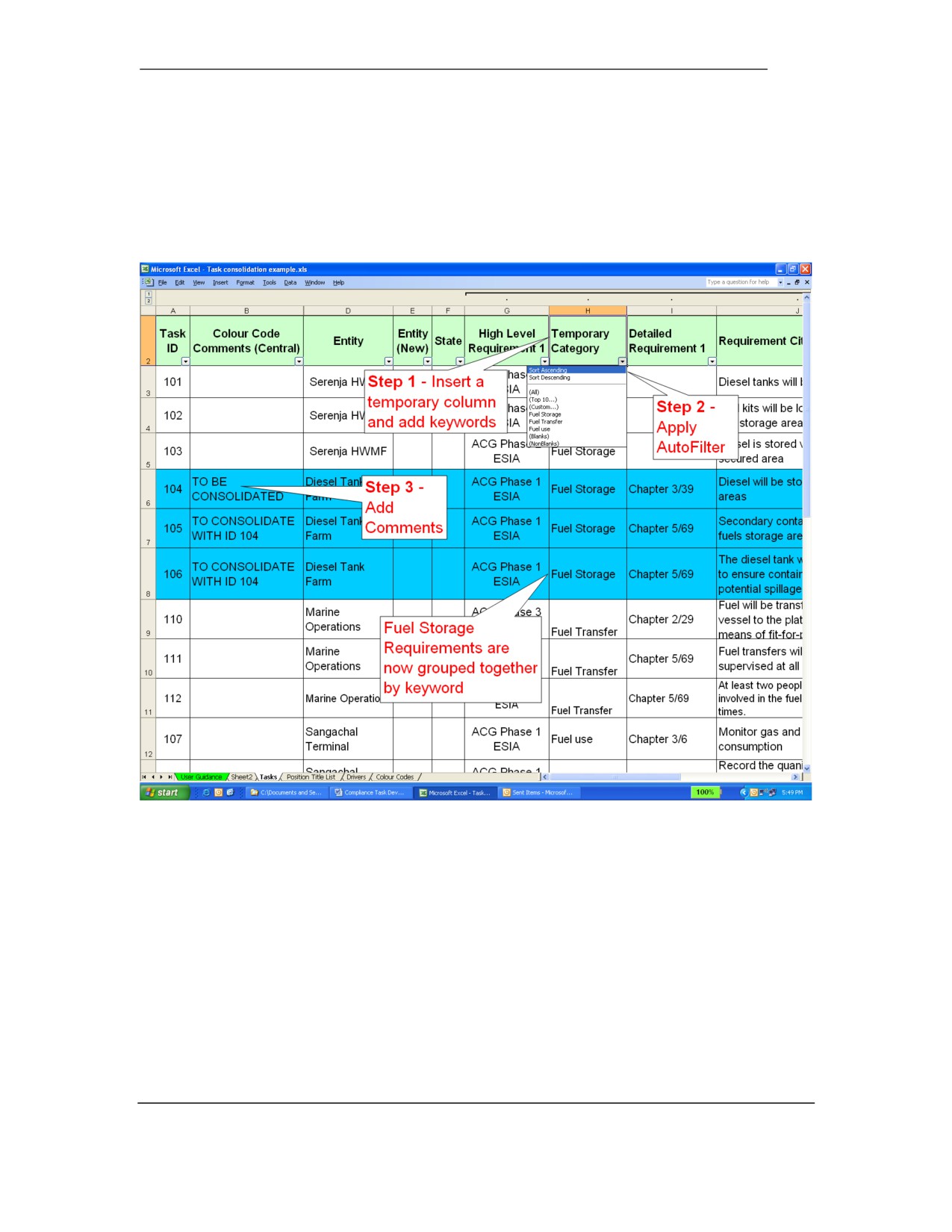
AzSPU Compliance Task Development Procedure
Page 11 of 18
spreadsheet and the temporary column filtered alphabetically by key word, related
requirements can be grouped together - see the shaded blue rows in Figure 5. Note that
comments have been added in the designated column to indicate that the highlighted
requirements are to be consolidated into a single Requirement.
Figure 5 - Using a Temporary Column to Group Similar Requirements
5.7 Dealing with complex Requirements
In some cases the Source Document may reference a complex list or table that it is not
practicable or sensible to incorporate into the Task Template.
If the table is a summary of requirements included elsewhere in the Source Document
there is no need to attempt to incorporate it into the Task Template, however, an
explanatory comment should be provided.
If the table includes multiple requirements these should be included as separate rows in
the Task Template.
Control Tier:
2-AzSPU
Revision Date: Aug 19, 2009
Document Number: AZSPU-HSE-DOC-00114-2
Print Date: 2/1/2011
PAPER COPIES ARE UNCONTROLLED. THIS COPY VALID ONLY AT THE TIME OF PRINTING. THE CONTROLLED
VERSION OF THIS DOCUMENT CAN BE FOUND AT http://docs.bpweb.bp.com/dkazspu
AzSPU Compliance Task Development Procedure
Page 12 of 18
If the table is a single legitimate Requirement it should simply be referenced and a
comment included in the comment column of the Task Template, e.g. “Requirement too
lengthy to incorporate in Task Template, recommend including in a procedure”.
5.8 Dealing with conflicting Requirements
Some Source Documents may include conflicting or apparently conflicting requirements.
These should be highlighted in the Comment Column for legal review.
6. Developing Tasks
6.1 Task Description
Compliance Tasks should be worded as simply as possible whilst still addressing the
Requirement. One way to determine if a Compliance Task has been well written is to
assess whether it is SMART, i.e.:
Specific - Stand alone, clear and direct.
Measurable - I can say it is done.
Actionable - Starts with an action orientated verb (e.g. collect, record).
Reasonable - Stick to tasks the site is already performing, whenever possible.
Timely - Set the right frequency, don’t overdo it.
An example of a badly worded task that does not pass the SMART test:
“Comply with environmental standards and practices generally observed by the
international community with respect to comparable petroleum pipeline projects,
including standards and practices that specifically relate to ecological management and
monitoring in the IUCN Guidelines for the Prevention of Biodiversity Loss Caused by
Alien Invasive Species (2000); the IFC OP 4.04, Natural Habitats, November 1998; and
IFC OP 4.01 Environmental Assessment (1998), and specifically Guidance Note C:
Outline of an Environmental Action Plan.”
The above “Task” is still in the form of a Requirement and will require further work in
order to develop a meaningful task. A possible SMART version of this “Task” could be:
“Conduct an annual environmental audit of Exports using a checklist including
applicable requirements from IUCN and IFC Guidelines”
Note that the Task Developer has made the assumption that the task can be written as an
audit task. Where assumptions are made in developing the Compliance Task these
should be stated in the comments column.
Control Tier:
2-AzSPU
Revision Date: Aug 19, 2009
Document Number: AZSPU-HSE-DOC-00114-2
Print Date: 2/1/2011
PAPER COPIES ARE UNCONTROLLED. THIS COPY VALID ONLY AT THE TIME OF PRINTING. THE CONTROLLED
VERSION OF THIS DOCUMENT CAN BE FOUND AT http://docs.bpweb.bp.com/dkazspu
AzSPU Compliance Task Development Procedure
Page 13 of 18
It is important to realize that as the Task Developer you are not responsible for finalizing
the Task but you must ensure as a minimum that the Requirement is accurately
stated and is understandable to someone who is not familiar with the Source
Document. All Tasks will be finalized by the AzSPU HSE Compliance Team in
consultation with the individuals responsible for implementing them, and may be
reworded.
6.2 Other Task Information
Once you have completed the Task Description, several other columns in the Task
Template should be completed including:
Task Title
Add a Task Title. This should be an appropriate summary of the Task Description, not
more than 100 characters in length.
Entity
Include the Entity, i.e. the site or facility
(e.g. Sangachal Terminal) where the
Requirement applies. Unless you are certain which Entity the Requirement applies to
leave this column blank.
Assign Task Group
Select the most appropriate value from the drop down list in the “Task Group-Other”
column.
Complete Due Date & Frequency
If the Task you are developing has a specific due date or frequency stated in the Source
Document you will need to complete the Due Date column in the Task Template. Dates
must be entered in US Date Format i.e. MM/DD/YYYY. Once you have entered the Due
Date, if the task is repeated, you will need to select an appropriate value from the
adjacent “Frequency” column. Values in the “Frequency” column are included in a drop
down list.
If you need help in completing any column in the Task Template simply select the
relevant column to see a “pop up” guidance note1 - see Figure 6 below.
1 The first cell in the relevant column can also be selected to view the “Pop-up”.
Control Tier:
2-AzSPU
Revision Date: Aug 19, 2009
Document Number: AZSPU-HSE-DOC-00114-2
Print Date: 2/1/2011
PAPER COPIES ARE UNCONTROLLED. THIS COPY VALID ONLY AT THE TIME OF PRINTING. THE CONTROLLED
VERSION OF THIS DOCUMENT CAN BE FOUND AT http://docs.bpweb.bp.com/dkazspu

AzSPU Compliance Task Development Procedure
Page 14 of 18
Figure 6 - Pop-Up Guidance Note
Please note that the “DO NOT AMEND” warning shown in the top row in Figure 6
is provided for Task Verifiers only and does NOT apply to you as a Task Developer.
7. Guidance on completing the Task Template
Although there are several worksheets in the Task Template there are only three that you
need to be concerned with as a Task Developer, these are:
User Guidance
Tasks
Drivers
Control Tier:
2-AzSPU
Revision Date: Aug 19, 2009
Document Number: AZSPU-HSE-DOC-00114-2
Print Date: 2/1/2011
PAPER COPIES ARE UNCONTROLLED. THIS COPY VALID ONLY AT THE TIME OF PRINTING. THE CONTROLLED
VERSION OF THIS DOCUMENT CAN BE FOUND AT http://docs.bpweb.bp.com/dkazspu
AzSPU Compliance Task Development Procedure
Page 15 of 18
A brief description of each follows:
User Guidance: This worksheet provides brief guidance on completing the Task
Template.
Tasks: This is the main worksheet where you need to include the Requirements and
associated Compliance Tasks - See Figure 2.
A full list of the columns in the Tasks worksheet is provided in Appendix 1. It is
important to recognize that most of these columns are not relevant to initial task
development and will therefore not concern you. Most of these columns will be
completed as part of the subsequent task verification process and should be ignored.
If you are unsure about the columns and guidance that apply to you as a Task
Developer please seek clarification from the AzSPU HSE Compliance Team Leader.
Drivers: This is where you need to record details of the Source Documents reviewed -
See Figure 7 below.
Please do not amend the other worksheets contained in the Task Template unless
directed specifically to do so.
Control Tier:
2-AzSPU
Revision Date: Aug 19, 2009
Document Number: AZSPU-HSE-DOC-00114-2
Print Date: 2/1/2011
PAPER COPIES ARE UNCONTROLLED. THIS COPY VALID ONLY AT THE TIME OF PRINTING. THE CONTROLLED
VERSION OF THIS DOCUMENT CAN BE FOUND AT http://docs.bpweb.bp.com/dkazspu

AzSPU Compliance Task Development Procedure
Page 16 of 18
Figure 7 - List of Source Documents Reviewed
Provide the Title
If any sections of the
of each Source
Source Document
Document
were not reviewed
state why here
Control Tier:
2-AzSPU
Revision Date: Aug 19, 2009
Document Number: AZSPU-HSE-DOC-00114-2
Print Date: 2/1/2011
PAPER COPIES ARE UNCONTROLLED. THIS COPY VALID ONLY AT THE TIME OF PRINTING. THE CONTROLLED
VERSION OF THIS DOCUMENT CAN BE FOUND AT http://docs.bpweb.bp.com/dkazspu

AzSPU Compliance Task Development Procedure
Page 17 of 18
Appendix 1- Column Headings in Task Template
COLUMN HEADING
WARNING
REQUIREMENTS FOR DATA ENTRY
ID
DO NOT AMEND
Colour Code Comments (Central)
DO NOT AMEND
Comments (PU/Asset)
Provide comments as required, e.g. "THIS REQUIREMENT IS NOT
APPLICABLE AS THE OFFSHORE PU DOES NOT CONDUCT
AMBIENT AIR MONITORING."
Entity
DO NOT AMEND
Entity (New)
If the assigned entity is wrong insert the correct entity here.
State
REQUIRED
The current state of the Compliance Task i.e. whether the Task is
‘Open’ (to be completed and/or recurring) or ‘Closed’ (completed and
non-recurring)
High Level Requirement 1
DO NOT AMEND
Detailed Requirement 1
DO NOT AMEND
Requirement Citation Text 1
DO NOT AMEND
Task Title
DO NOT AMEND
Task Title (New)
Maximum length of 100 characters
Task Description
DO NOT AMEND
Task Description (New)
If the task needs rewording the new text must be included here
Due Date
REQUIRED (ONLY FOR
Enter the date only in US Date format - MM/DD/YYYY
RECURRING TASK)
Frequency
REQUIRED (UNLESS A
Select a value from the drop down list
CONTINUOUS TASK)
Owner
REQUIRED
Full name(s) as included in the Position Title List spreadsheet
Team
REQUIRED
Position Title as included in the Position Title List
Supervisor
REQUIRED
Full name as included in the Position Title List Spreadsheet
Supervisor Team
REQUIRED
Position Title as included in the Position Title List
Operational Control Description 1
REQUIRED
Name of control, e.g. document ID of the procedure
Operational Control Location 1
REQUIRED
Location of the procedure, e.g. "HSSE MS Documentum"
Task Group - BP/Contractor Performed
REQUIRED
Select a value from the drop down list
Task Group Other 1
REQUIRED
Select a value from the drop down list
Operational Control Description 2
Operational Control Location 2
Include only if necessary - it is recommended to avoid multiple
AVOID USING IF POSSIBLE
Operational Control Description 3
controls where possible
Operational Control Location 3
Evidence Document Description 1
Include only if required. Evidence of completion, e.g. "Site Inspection
Checklist August 2009"
Evidence Document Location 1
Include only if required. Location of completion evidence, e.g.
"HSSE_MS_Shared_Drive\Monitoring Reports"
Evidence Document Description 2
Evidence Document Location 2
AVOID USING IF POSSIBLE
Evidence Document Description 3
Evidence Document Location 3
High Level Requirement 2
Detailed Requirement 2
Requirement Citation Text 2
High Level Requirement 3
Detailed Requirement 3
Requirement Citation Text 3
DO NOT AMEND
High Level Requirement 4
Detailed Requirement 4
Requirement Citation Text 4
High Level Requirement 5
Detailed Requirement 5
Requirement Citation Text 5
Control Tier:
2-AzSPU
Revision Date: Aug 19, 2009
Document Number: AZSPU-HSE-DOC-00114-2
Print Date: 2/1/2011
PAPER COPIES ARE UNCONTROLLED. THIS COPY VALID ONLY AT THE TIME OF PRINTING. THE CONTROLLED
VERSION OF THIS DOCUMENT CAN BE FOUND AT http://docs.bpweb.bp.com/dkazspu
AzSPU Compliance Task Development Procedure
Page 18 of 18
Revision/Review Log
Revision Date
Authority
Custodian
Revision Details
August 19, 2009
AzSPU Safety &
AzSPU
HSE
Initial Issue
Compliance
Compliance
Manager
(Yuliy
Team Leader
Zaytsev)
(Anar Naghiyev)
August 19, 2010
AzSPU
AzSPU
HSE
Title changed in 4.2
Regulatory
Compliance
Compliance and
Team Leader
Environment
(Anar Naghiyev)
Manager - Faig
Askerov
Control Tier:
2-AzSPU
Revision Date: Aug 19, 2009
Document Number: AZSPU-HSE-DOC-00114-2
Print Date: 2/1/2011
PAPER COPIES ARE UNCONTROLLED. THIS COPY VALID ONLY AT THE TIME OF PRINTING. THE CONTROLLED
VERSION OF THIS DOCUMENT CAN BE FOUND AT http://docs.bpweb.bp.com/dkazspu
AzSPU Display Screen Equipment Management Programm
Display Screen Equipment Management
Programme
AZSPU-HSSE-DOC-00006-2
Authority:
AzSPU Health Manager
Custodian:
Industrial Hygiene Advisor
Almaz Agazade
Hijran Jafarova
Scope:
AzSPU
Document
Administrator:
Rafiga Huseynova
Issue Date:
10/04/2004
Issuing Dept:
HSE&TD
Revision Date:
21/12/2009
Control Tier:
2
Next Review
21/12/2010
Date:
Control Tier:
<<2>>
Revision Date: 21 December 2009
Document Number: << AZSPU-HSSE-DOC-00006-2>>
Print Date: 2/1/2011
PAPER COPIES ARE UNCONTROLLED. THIS COPY VALID ONLY AT THE TIME OF PRINTING. THE
CONTROLLED VERSION OF THIS DOCUMENT CAN BE FOUND AT
AzSPU Display Screen Equipment Management Programm
Purpose/Scope
BP is committed to the HSE policy of “no harm to people” and so recognizes that
working with DSE is an area where ill health can arise. The majority of staff in BP
has jobs that involve some level of working with DSE. There have been health
issues, primarily with problems of neck, shoulders, arms, hands and back, that
have been associated with DSE use. Although these conditions are unusual, it is
important that the company is aware of any health issues associated with its
activities therefore any illness that is associated with work should be recorded
and reported via BP HSE reporting procedures.
The problems that primarily arise associated with working with DSE relate to the
layout of the workstation and the environment where the work is performed, the
pace of the work, the work scheduling and very occasionally software issues.
This controlled document provides the information on the risks to health and
safety associated with work with DSE, on the measures to reduce those risks
and corrective actions to control the risks identified.
This controlled document applies to Azerbaijan Strategic Performance Unit
engaged in the exploration, drilling, production and transportation of oil, including
all related construction activities.
2.0 Definitions
DSE
Display Screen Equipment - it is equipment that is
usually part of a computer system e.g. computer
screen‟s microfiche and liquid crystal display, any
text, number or graphic on display screen,
regardless of the display process involved
Workstation
Encompasses the display screen, keyboard,
mouse and immediate peripherals, plus your desk,
chair, telephone, and the immediate environment
DSE Users
Anyone who works at DSE on most days for more
than one hour continuously or for more than two
hours intermittently on 3 or more days a week
DSE Champion
Person nominated by Line Management and
responsible for ensuring that the requirements of
the DSE programme are successfully implemented
within their area of responsibility
Control Tier:
<<2>>
Revision Date: 21 December 2009
Document Number: << AZSPU-HSSE-DOC-00006-2>>
Print Date: 2/1/2011
PAPER COPIES ARE UNCONTROLLED. THIS COPY VALID ONLY AT THE TIME OF PRINTING. THE
CONTROLLED VERSION OF THIS DOCUMENT CAN BE FOUND AT
AzSPU Display Screen Equipment Management Programm
DSE Coordinator
Systems Coordinator in Central Health responsible
for ensuring that the requirements of the DSE
programme are successfully implemented
Ergonomics
Science of fitting the job to the worker.
Health Team
BP Central Health, Safety and Environment AzSPU
department, Health Team
3.0 General Requirements
BP Getting Health Right
BP Occupational Hygiene Network Best Practice Documents
4.0 Key Responsibilities
Line Managers/Supervisors shall
Be responsible for the implementation of DSE programme
Appoint DSE champion. Ideally there should be one DSE
Champion for every 20 DSE users
o When appointing a DSE Champion Line Managers shall
ensure that individuals have the necessary competencies
and adequate time to be able to perform this task, i.e.
consider individuals‟ capabilities and the level of their
training, knowledge and experience.
Ensure that daily work routines are interrupted by changes of task
or rest breaks
Ensure that there is a system in place ensuring that any new
computing equipment is assessed for its health and safety risks
before purchase or installation
Ensure that employees have means of reporting any illness /
problem that may be associated with work and that this problem is
addressed by competent people
DSE Champions shall
Be responsible for ensuring that the requirements of the DSE programme are
successfully implemented within their area of responsibility. Specific duties
include:
the identification of DSE users;
the provision of both initial and refresher training for users;
Ensure that workstation self-assessments are carried out by
all individuals under their responsibility, that they are recorded
and the identified deficiencies are addressed
Control Tier:
<<2>>
Revision Date: 21 December 2009
Document Number: << AZSPU-HSSE-DOC-00006-2>>
Print Date: 2/1/2011
PAPER COPIES ARE UNCONTROLLED. THIS COPY VALID ONLY AT THE TIME OF PRINTING. THE
CONTROLLED VERSION OF THIS DOCUMENT CAN BE FOUND AT
AzSPU Display Screen Equipment Management Programm
the collation and completion of workstation assessments;
the management of actions arising from assessment;
the periodic review of assessments to ensure that they are still
valid.
Participate in DSE Champions forum led by DSE Co-ordinator
Health Manager (or designee) shall
Ensure that the DSE management programme is implemented
effectively, monitored and reviewed at regular intervals
Appoint a DSE Coordinator
Ensure that DSE Coordinator is provided with appropriate training
DSE Coordinator shall
Be responsible for ensuring that the requirements of the DSE
management programme are successfully implemented in Az SPU
Be responsible for the provision of both initial and refresher training for
DSE Champions
Provide up-to-date technical and professional advice
Assist in management of concerns and problems arising
Arrange suitable eye / eyesight testing facility as required for DSE users
Advise on and assist with purchase of ergonomics equipment with the
involvement of the company Industrial Hygienist
Be responsible for ergonomics assessment of the offices prior to move
jointly with building operations team and company Industrial Hygienist
Be responsible for holding DSE Champions forum at least annually
Periodically review and update this document
Company office services and building operations team shall:
Be responsible for ensuring that office layouts and workstations are set
in compliance with ergonomics requirements
Be responsible for timely notification of the company DSE coordinator
about any office moves (Reference 12, Section 6.0)
Be responsible for ensuring implementation of recommendations from
findings
DSE Users shall
Adopt relevant information and training provided
Complete workstation assessments
Notify respective DSE Champion or DSE Coordinator of any problems or
any significant changes to their workstation or to the nature of their work
Control Tier:
<<2>>
Revision Date: 21 December 2009
Document Number: << AZSPU-HSSE-DOC-00006-2>>
Print Date: 2/1/2011
PAPER COPIES ARE UNCONTROLLED. THIS COPY VALID ONLY AT THE TIME OF PRINTING. THE
CONTROLLED VERSION OF THIS DOCUMENT CAN BE FOUND AT
AzSPU Display Screen Equipment Management Programm
Make the necessary adjustments to their workstations to address the
identified problems
5.0
Procedure
5.1
DSE assessments
All DSE assessments should be performed as per guidance provided in this
document.
A system should also be in place to educate staff about the problems associated
with computer use and for them to report any difficulties.
Any new computing equipment should be assessed for its health and safety risks
before purchase and or installation.
All DSE Users should have an assessment of their workstation and work
practices at once every two years and/or when there is reason to suspect that it
is no longer valid for example in the light of changes to the worker population,
changes in individual capability, or where there has been significant change to
the workstation.
The primary aim of any workstation assessment should always be to identify
problems relating to the computer work and to rectify them.
Assessment should cover the following aspects:
Knowledge of how to set up and adjust the chair and desk (if adjustable).
Knowledge of how to set up and adjust the computer, keyboard, mouse
and screen.
The size, comfort and support offered by the chair.
Environmental lighting (e.g. screen is affected by glare or flicker).
Correct positioning of hands and forearms.
Work scheduling and rest breaks.
Any additional equipment (e.g. foot rests, document rests etc.).
The fundamental aim of a risk assessment is to ensure that the precautions,
which need to be taken, are related to the risks created by the work.
DSE Assessment Flow Chart demonstrates the steps to be taken in making a
suitable and sufficient assessment.
5.2
Control measures
The importance of good posture cannot be over emphasized and this is
encouraged by a well-designed and correctly adjusted chair, see Working
posture for DSE Users.
Control Tier:
<<2>>
Revision Date: 21 December 2009
Document Number: << AZSPU-HSSE-DOC-00006-2>>
Print Date: 2/1/2011
PAPER COPIES ARE UNCONTROLLED. THIS COPY VALID ONLY AT THE TIME OF PRINTING. THE
CONTROLLED VERSION OF THIS DOCUMENT CAN BE FOUND AT
AzSPU Display Screen Equipment Management Programm
1. Breaks or changes of activity
When planning a day DSE Users should include tasks, which take them away
from the DSE. For example, carrying out non-DSE work at another desk or
office will provide exercise and provide visual change. If it is not possible to take
informal breaks away from the DSE, then formal breaks should be programmed
into the work routine. The breaks should be short and frequent, rather than
occasional and longer, e.g. a 5 minute break every hour. A short pause every 15
- 20 minutes can also be beneficial for DSE Users to use this time to quickly
stretch and to look into the distance. Several researchers also advocate the
adoption of a „micro-pause‟ technique, that is, short breaks of 10 - 20 seconds
taken every 5 - 10 minutes. See
DSE Users Keepfit Guide.
5.4
Eye and eyesight testing
Advice on the eye and eyesight procedure adopted can be obtained from Health
website and/or DSE Coordinator.
2. Information and training
DSE Users should receive information on all aspects of health and safety relating
to their workstation together with adequate instruction and training on how to use
the equipment properly and how to tilizin any risks. Particular attention should
be paid to the users role in completing DSE Assessments on paper (see DSE
assessment checklist) or by tilizing Healthy Computing tool.
The information to be provided should include reminders of health and safety
risks associated with the use of DSE, the measures taken to reduce them, the
provisions made for breaks and changes of activity, the system for reporting
problems and the procedure for requesting an eye and eyesight test. These
issues are addressed in the Healthy Computing Guide (home workers should be
asked to read this note and to adopt the guidance given but they will have to
take responsibility for the final design of the workstation in their home).
DSE training can be arranged through the DSE Coordinator or through sending
request to Occupational Health AzSPU (OccupHth@bp.com).
All training shall be documented in VTA.
3. Record keeping
Actions arising from the assessment should be recorded on paper (see DSE
Form 3 DSE Action Register) or in Healthy Computing tool and tracked until they
have been completed.
Control Tier:
<<2>>
Revision Date: 21 December 2009
Document Number: << AZSPU-HSSE-DOC-00006-2>>
Print Date: 2/1/2011
PAPER COPIES ARE UNCONTROLLED. THIS COPY VALID ONLY AT THE TIME OF PRINTING. THE
CONTROLLED VERSION OF THIS DOCUMENT CAN BE FOUND AT
AzSPU Display Screen Equipment Management Programm
4. Key Documents/Tools/References
5. Health issues associated with DSE use
6. DSE Assessment Flow Chart
7. DSE Form 1 DSE Users Control Sheet
8. DSE Form 2 DSE Assessment Checklist
9. DSE Form 3 DSE Action Register
10. Working posture for DSE Users
11. Requirements for Workstations
12. Eyesight Procedure
13. DSE Leaflets
DSE Users Keepfit Guide
Healthy Computing Guide
Making Friends With Your Notebook Computers
Are You Sitting Comfortably
Do You Hot Desk
Hot Tips for Computer Users
Repetitive Strain Injury
Understanding Ergonomics at Work
Keyboard Shortcuts
Office Protocol
14. TypingMaster iTutor
16. Office move form
Revision/Review Log
Revision Date
Authority
Custodian
Revision Details
14/12/2007
Almaz
Ayten Seidova
Periodic review
Aghazade
21/04/2009
Almaz
Jafarova
Roles and responsibilities
Aghazade
Hijran
have been revised
Office move document
has been added
21/12/09
Almaz
Ayten Seidova
Frequency of DSE
Aghazade
Assessments has been
changed
Control Tier:
<<2>>
Revision Date: 21 December 2009
Document Number: << AZSPU-HSSE-DOC-00006-2>>
Print Date: 2/1/2011
PAPER COPIES ARE UNCONTROLLED. THIS COPY VALID ONLY AT THE TIME OF PRINTING. THE
CONTROLLED VERSION OF THIS DOCUMENT CAN BE FOUND AT
Driver Fatigue & Tiredness Management Procedure
Page 1 of 11
BP AzSPU
Driver Fatigue & Tiredness Management
Procedure
AZSPU-HSSE-DOC-00003-2
Authority:
AzSPU Midstream H&S
Custodian:
Driving Safety Compliance Technical
Manager
Authority
Scope:
AzSPU
Document
AzSPU Document Management Coordinator
Administrator:
Issue Date:
07 June 2007
Issuing Dept:
Safety & Compliance Systems
Revision Date:
26 October 2010
Control Tier:
2
Next Review
26 October 2011
Date:
Control Tier:
2
Revision Date: 26 October 2010
Document Number: AZSPU-HSSE-DOC-00003-2
Print Date: 2/1/2011
PAPER COPIES ARE UNCONTROLLED. THIS COPY VALID ONLY AT THE TIME OF PRINTING. THE
CONTROLLED VERSION OF THIS DOCUMENT CAN BE FOUND AT
Driver Fatigue & Tiredness Management Procedure
Page 2 of 11
Section 1.
SCOPE AND PURPOSE
Fatigue has been shown to be a root cause in as many as 41% of all accidental injuries
and deaths caused by human error, including high-profile tragedies such as Three
Mile Island, the Challenger space shuttle and Exxon Valdez.
It‟s estimated that 20-30% all road traffic incidents related to driver fatigue and
tiredness.
Sleep related accidents tend to be more serious than other road accidents. Sleepy
drivers kill more people than drink drivers.
Fatigue is a general term used to describe the feeling of being tired, drained or
exhausted. Fatigue is accompanied by poor judgment, slower reactions to event, and
decreased skills, such as in vehicle control.
Importantly, fatigue impairs driver‟s judgment of his / her own state of fatigue. This
means the effective management of fatigue should not be a responsibility of the driver
alone. Both employers and employees have a role to play in making sure any risks
associated with fatigue are minimized. Fatigue can accumulate over period of time
and can result from long or arduous work, poor sleep, health or emotional issues. The
body‟s natural rhythms (body clock) also have an impact, particularly for those who
work at night or for extended periods. Night workers are six times more likely to have
a crash than day workers. The risk of an accident increases with the number of nights
worked, with a 45% increase by the fourth night and 90% by the seventh night.
Controlling fatigue requires cooperation between employers and employees.
Driving remains one of the biggest risks for BP AzSPU, as for the rest of BP.
Complexity of driving operation within BP AzSPU presents driving fatigue, if
inappropriately managed.
The risk of falling asleep at the wheel increases when drivers are driving at times
when they would normally be asleep, particularly in the pre-dawn hours. There is also
an increased risk during the mid-afternoon “siesta hours”.
This document outlines guidelines of eliminating driver fatigue and tiredness risk.
To eliminate driver fatigue and tiredness risk within BP AzSPU, company
implemented “Fatigue Management Plan”, which includes but not limited to:
Drivers and Transport Supervisors mandatory “Fatigue and Tiredness
Management” (F&TM) training with three yearly refreshment for drivers.
Maximum working hour‟s plan, which meets the OMS AzSPU Procedure for
Driving Safety Standards, BP Group Recommended Practice GRP 3.4-0001 on
Fatigue Management and in-line with local legal requirements and work
specifics (see appendix 1).
Advanced scheduling of professional drivers‟ roster / working schedule (see
example appendix 2).
Safety Instruction for Azerbaijan Pipelines Self-Driving Personnel
Safety Instruction for Georgian Pipelines Self-Driving Personnel
Control Tier:
2
Revision Date: 26 October 2010
Document Number: AZSPU-HSSE-DOC-00003-2
Print Date: 2/1/2011
PAPER COPIES ARE UNCONTROLLED. THIS COPY VALID ONLY AT THE TIME OF PRINTING. THE
CONTROLLED VERSION OF THIS DOCUMENT CAN BE FOUND AT
Driver Fatigue & Tiredness Management Procedure
Page 3 of 11
A responsible person must ensure that there is a record for each vehicle driver at the
workplace. The responsible person must be a person in control of workplace.
This procedure contributes to compliance with the OMS Part
2 - Elements of
Operating Including Group essentials, 3 - OMS Performance Improvement Cycle and
4 - Governance and Implementation.
The procedure supports delivery of the following OMS Group Essentials.
Sub-element
Group Essentials
2.2 People and Competence
2.2.3, 2.2.5
3.2 Personal Safety
3.2.1
3.4 Health and Industrial Hygiene
3.4.4, 3.4.5
3.7 Transportation
3.7.1, 3.7.2, 3.7.3,
3.7.4, 3.7.5, 3.7.6
5.3 Asset Operation
5.3.1
5.4 Inspection and Maintenance
5.4.2, 5.4.3, 5.4.4
All guidelines contained in this procedure shall be regarded as the minimum
requirements for BP owned or managed project, operation, sites, structure and other
asset in Azerbaijan SPU.
Section 2.
DEFINITIONS
Fatigue - deterioration in mental or physical performance due to prolonged
physical or mental work and in general term used to describe feeling of being
tired, drained or exhausted, is accompanied by poor judgment, slower reactions
to events, and decreased skills, such as vehicle control.
Tiredness - (or sleepiness) relates to the likelihood of falling asleep and is primarily related
to how long you have been awake and how much sleep you have had.
AzSPU - Azerbaijan Strategic Performance Unit
Working hours - All paid hours on BP business, inclusive of work breaks.
BP RTDB - BP Road To Better Driving Road Safety Handbook edition 2002
Driving Time - The time a driver spends driving a vehicle on BP business whether the
vehicle is in motion or not. This excludes any time spent operating other functions of the
vehicle e.g. loading, unloading and work breaks.
Control Tier:
2
Revision Date: 26 October 2010
Document Number: AZSPU-HSSE-DOC-00003-2
Print Date: 2/1/2011
PAPER COPIES ARE UNCONTROLLED. THIS COPY VALID ONLY AT THE TIME OF PRINTING. THE
CONTROLLED VERSION OF THIS DOCUMENT CAN BE FOUND AT
Driver Fatigue & Tiredness Management Procedure
Page 4 of 11
“Non-work time” - means time off at home, away from vehicle or, if on a trip in the
vehicle, includes sleep in an appropriate sleeper berth. It doesn’t include driving and
work incidental to driving. It includes commuting.
Commuting - is the process of traveling between a place of residence and a normal place of
work.
Self Driver -“A Self-driver” is defined as a person provided with company vehicle for
business purposes and driving activity is listed in his
/ her formal Roles
and
Responsibilities
Section 3.
DENERAL REQUREMENTS
1. Drivers‟ working hours are to be strictly controlled and comply with BP
requirements. Working hours must be closely monitored and recorded, which
should including time off work, rest breaks and any occasions of deviation from
BP requirements, see (BP RTBD Part 1)
Rest:
Half an hour after each 3 hrs of driving
A minimum of 12 hrs after a full 12 hrs shift. If you feel tired at any time,
always take a break
Welfare:
Drivers must be able to:
Lodge in adequate accommodation, which has been approved by BP, if they
are required to stay overnight. If tired, Drivers should never be ordered to
drive or continue driving
Receive adequate meals - or have expenses to purchase such meals
Phone home
Find out their duty in reasonable time in order to make necessary preparations
Driver Hours of Work
The following hours of work comply with the OMS AzSPU Procedure for Driving
Safety Standards and BP Group Recommended Practice on Fatigue Management. It is
recognised however, that it may be impractical to strictly follow these standards in all
cases and as such deviations may be authorised. Drivers who operate in excess of their
maximum daily hours are only to do so to complete essential work and these
occurrences are to be kept to an extreme minimum. All deviations must be reported to
BP Driving Compliance Technical Authority and Drivers carefully monitored and
controlled.
Requirements
Rules
Maximum working hours within a
12 hours total
rolling 24 hour period
Rest after full 12 hours shift
Minimum 12 hours unbroken
Control Tier:
2
Revision Date: 26 October 2010
Document Number: AZSPU-HSSE-DOC-00003-2
Print Date: 2/1/2011
PAPER COPIES ARE UNCONTROLLED. THIS COPY VALID ONLY AT THE TIME OF PRINTING. THE
CONTROLLED VERSION OF THIS DOCUMENT CAN BE FOUND AT