Military reference books and manuals (2009-2023, Volume 2) - page 47
The Chaplain’s Role in the Army
them at the appropriate level of the chain of command. By being
proactive, the chaplain assists in building unit morale.
28.
Chaplains can act as a unifying force in the unit. They can
affirm the chief responsibilities of the Army to protect vital national
interests, contribute to international peace and security, and promote
national unity and well-being. They can help give soldiers a sense of
community as they build confidence in the morality of the mission.
29.
The chaplain has a role to play in helping the Army to
become more reflective of Canadian society. Chaplains, by the nature
of their calling, respect the dignity and the value of every human
being. Chaplains can help integrate new people into the unit and
encourage their acceptance by all.
30.
Chaplains assist in the collective readiness of the unit by
conducting pre-deployment and reintegration briefings. They also
encourage members of their unit to have a personal discipline of
regular prayer and devotions.
31.
There are various traditions around mess life in the Army.
The chaplain is a member of the Officers’ Mess and should play a part
in that mess life. In many units, the chaplain is afforded the privilege
of also being a member of non-commissioned member messes. New
chaplains should not assume that they are automatically entitled to
enter non-commissioned member messes. The permission of the
appropriate President of the Mess Committee (PMC) should always be
sought before entering any mess. In those places where the chaplain is
invited and encouraged to participate in all messes the chaplain should
be respectful of the confidential nature of conversations in each mess.
RELATIONSHIP WITH CO AND OTHER SENIOR OFFICERS
32.
Chaplains need to be sensitive to the fact that they also have
responsibility for the pastoral care of those senior officers who serve
in their units. A good chaplain is able to play the role of confidant to
those who are senior in rank. The chaplain can lift some of the burden
of command by being an effective listener.
33.
In their role as specialist advisors, chaplains will be called
upon especially during operations and exercises to make specific
recommendations to the commanding officer on the need for members
to be repatriated. This very sensitive issue can significantly influence
the morale of the unit. Chaplains must always remember that
repatriation decisions are the responsibility of the commanding officer.
B-GL-346-001/FP-001
13
The Chaplain’s Manual
The chaplain must provide the commanding officer with as much
information as possible, and then support the decision even when it
does not conform to the chaplain’s recommendation.
34.
The chaplain is also the subject matter expert on religion. It
is imperative that chaplains familiarize themselves with the religious
and cultural dynamic of the area of operations. Commanding officers
will expect the chaplain to be knowledgeable and so will the other
members of the unit. Religion is often one of the causes of conflict
but can also be one of the resources for reconciliation. Chaplains
should supplement their already considerable knowledge with
additional study on the specifics of the area where they will be
operating.
ROLE OF THE CHAPLAIN IN SOLDIER CARE
35.
The chaplain has a large role to play in the care of soldiers.
The foundation of a chaplain’s counselling must be a holistic approach
to a soldier’s well-being. This gives the chaplain credibility with the
troops. Chaplains want the soldiers in their units to be mentally,
physically and spiritually well and fit. Chaplains see and value the
soldiers in their units as human beings first and then as soldiers. There
are times when a chaplain will have to advocate for individual
soldiers. The unit is stronger when individual soldier’s needs are
being attended to.
36.
Every soldier has the right to see a chaplain at any time. This
is a fundamental right that chaplains must ensure is respected at every
level of the chain of command. The leadership of a unit must be
reminded of the dividend that is realized when soldiers know that this
resource (their chaplain) is available at any time.
37.
There is no more difficult yet rewarding job than to minister
effectively to soldiers in crisis. In today’s Army, every chaplain will
encounter soldiers who are suffering from various degrees of stress.
For some this will be an accumulation of pressure from work and
home. For others it will be a direct result of their experience in
serving Canada overseas. Some will readily welcome a chaplain’s
intervention while others will as quickly reject it. For chaplains what
is clear is that we do not reject them. Chaplains have the opportunity
and the responsibility to journey with those who, because they are
broken in some way, cannot continue to walk alongside us. The
present generation of soldiers will judge our Army and our chaplains
by how well we care for our wounded.
B-GL-346-001/FP-001
14
The Chaplain’s Role in the Army
38.
Chaplains are required to offer pastoral care when soldiers
are dying. In some cases, they will minister to people who are dying a
natural death. They have to be prepared to provide terminal care and
grief counselling to family members and members of the unit. On
other occasions, chaplains will be there in the field when an accident
or a combat situation is responsible for the death of members of their
unit. What the chaplain says at those times may not have lasting
effects. The fact that they were there sharing the pain and the sorrow
will be the message. It is also at those times when the chaplain will
realize that they too are not alone. Chaplains are lifted up as people of
faith, and they share this ministry with many others.
CHAPLAIN RESOURCES
39.
In the field and on exercise it is imperative that the chaplain
be provided with a vehicle and driver. This will give chaplains the
flexibility to perform the job that the Army expects of them. The
driver also gives the chaplain, an unarmed non-combatant, some
degree of protection. Chaplains need to be aware that the driver is not
a personal servant. The chaplain must still possess basic field skills
such as knowing correct radio procedure. This will enable the
chaplain to function in an emergency if the driver is injured or killed.
40.
Army chaplains, both Regular Force and Reserve, are entitled
to a number of clothing and personal issue items. Annex B to this
chapter describes the entitlements for Protestant chaplains, and Annex
C describes the entitlement for Roman Catholic chaplains.
41.
The issue of what to bring when a chaplain is deploying is a
difficult one. Annex D is a recommended list of supplies that a
chaplain might consider taking to the field. This is by no means an
exhaustive list. Each operational theatre will be unique and there will
be unique needs.
ACTIVITIES OF A CHAPLAIN
42.
Army chaplains will be involved in a number of activities and
one of the most important will be the provision of religious services.
Chaplains will celebrate or facilitate rites, sacraments and ordinances
required by the religious demographics of the personnel in their unit or
base. It is Branch practice and convention that Christian worship,
when celebrated in the field or on operational deployments, would
normally afford soldiers the opportunity to receive communion.
B-GL-346-001/FP-001
15
The Chaplain’s Manual
43.
Chaplains will provide pastoral care to the members of their
unit and their families, including pre-deployment screenings and
counselling, and post-deployment reintegration care. In some
instances, the pastoral care provided by the unit chaplain will include
ministry within institutions, such as hospitals and detention barracks.
44.
New chaplains and their supervisors should use the Army
section of the Chaplains Environmental Orientation Requirements
Record (Annex F). The series of tasks identified in this document
provides a guideline of the basic skills that a new chaplain will need to
learn in order to be effective. This is a useful tool for ensuring that
new chaplains receive support and mentoring early in their ministry.
ETHICS TRAINING
45.
The chaplain’s job is not to be a unit’s cheerleader but to be
its conscience. Chaplains should be prepared to deliver ethical
training and provide ethical advice when asked. Paragraph 8 of this
chapter refers to the chaplain’s need to exercise a ministry of prophecy
in assisting the unit to attain the highest ethical standard (see A-CG-
001/JD-000 CF Chaplain Branch Manual, Chapter 6, paragraph 20).
PADRE’S HOURS
46.
One of the unique opportunities that chaplains have is the
delivery of Padre’s Hours. This can be a means to establish contact
with unit personnel and create a positive perception of the chaplain. It
is an occasion for teaching and building relationships. Chaplains
should be well-prepared, and present material and lead discussions that
are current and relevant.
LEAVE
47.
CFAO 16-1 is the authority for all leave in the CF. Chaplains
are expected to use their leave. In the unit, it will be assumed that
chaplains will usually take their leave during the unit’s block leave
period. There will however be circumstances when the chaplains
responsibilities to share in the broader ministry of the brigade and/or
garrison chaplain team, and in the worship life of the military chapel
communities, will preclude them from taking leave during unit block
leave periods. Leave planning must be flexibly managed so as to
address the needs of the chaplain, the unit and the shared ministry of
B-GL-346-001/FP-001
16
The Chaplain’s Role in the Army
the chapel and chaplain team (see also A-CG-001/JD-000 CF
Chaplain Branch Manual, Chapter 14, paragraphs 23-31).
GENDER INCLUSIVE CHAPLAINCY
48.
Female chaplains have served in Canada’s Army since the
1980s, and they continue to serve today as team members and team
leaders, within garrison and headquarters settings, as well as in
theatres of operation - both domestically and abroad.
49.
Although the chaplaincy is represented by those whose
denominational/faith tradition polity and practice may vary greatly
with respect to understanding the role of women as spiritual leaders, in
this military ministry context both male and female chaplains are
called to serve and work together, and to accept and respect fully the
legitimacy and richness of one another’s ministry.
50.
The commitment to creating an inclusive team ministry
setting, in which both male and female “padres” are valued equally,
contributes to enhancing the Army Chaplaincy's overall effectiveness
in responding to the pastoral needs of the men and women in uniform
and the families who support them.
CULTURAL SENSITIVITY
51.
Chaplains are identified as a resource for commanders when
dealing with issues of cultural sensitivity. Chaplains must make every
effort to aid both members and the commanding officer when trying to
accommodate unit members who have dietary needs, clothing or
calendar issues related to their cultural or religious expression.
52.
On deployment it is the chaplain who will often have to
explain to the chain of command the deeper role that religion can play
in many regions of the world. For example, in 2003 when American
forces were entering the town of Nasyryah in Iraq the local leadership
bypassed senior officers and went straight to the chaplain. They
approached him, the interpreter explained, because he was the one
who was wearing the cross and therefore clearly in charge.
B-GL-346-001/FP-001
17
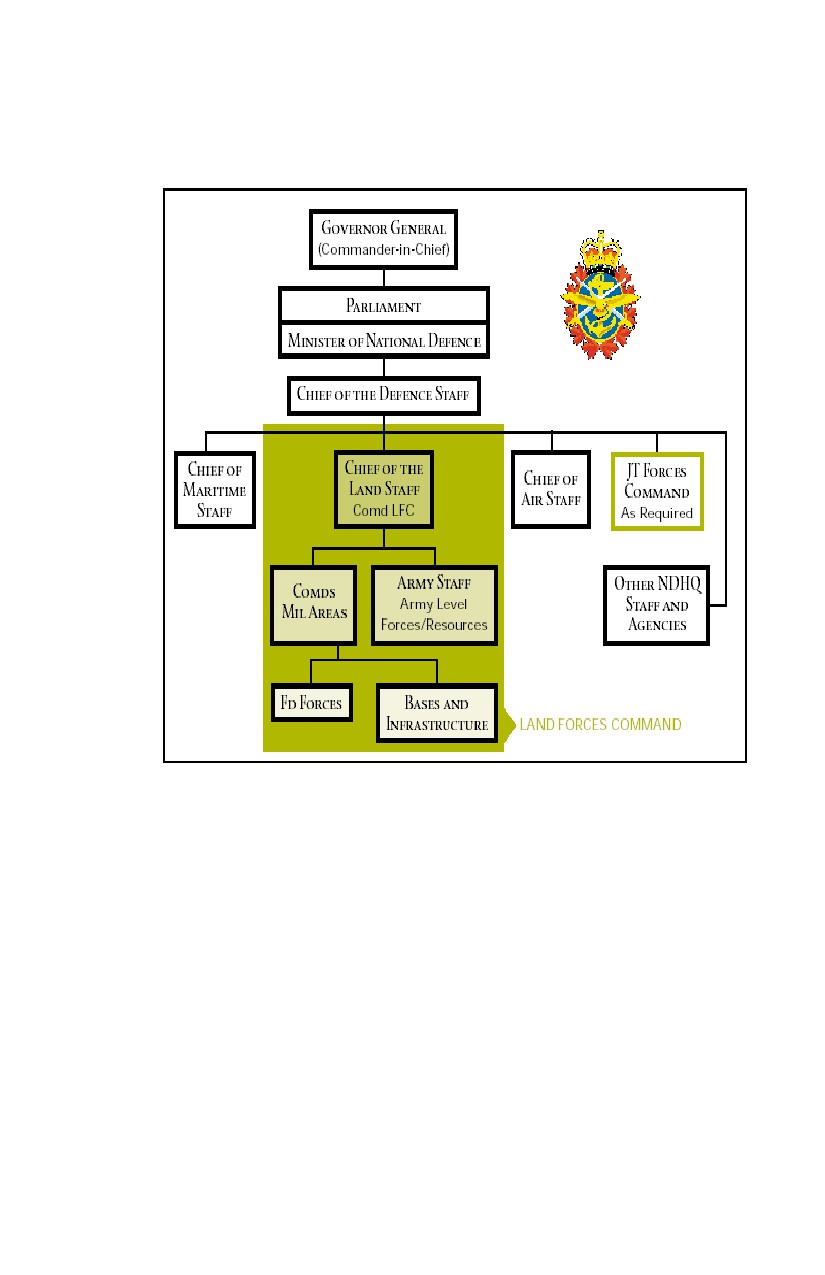
The Chaplain’s Manual
ANNEX A
ARMY COMMAND STRUCTURE WITHIN THE CF
B-GL-346-001/FP-001
19

The Chaplain’s Manual
ANNEX B
SCALE OF ISSUE: PROTESTANT CHAPLAIN
SCALE
GROUP
CODE
DESCRIPTION
UI
QTY
REMARKS
D01305AA
8415
218897728
Shirt,man's
EA
2
Female or
male,
Clerical,
includes
cotton/polyester, black,
primary
coat style, button
reserve
closure, military collar,
chaplains.
Size any acceptable
D01305AA
9925
009265205
Chaplain's kit (p), c/o
SE
1
Regular
altarcloths, plastic
force and
bottles, candle holder,
primary
carrying case, chalice,
reserve
paten, ciborum w/ host
chaplains
box, Communion paten,
upon
corporals, Anodized
successful
completion
of basic
officer
training.
D01305AA
9925
219078044
Clerical cloak
EA
1
All chaplains
of all
Custom tailored, c/w
denominatio
arm slits, full circular
ns.
cloak half-lined, collar
can be same material as
cloak, fastened at breast
with chain and clasp.
D01305AA
9925
218036773
Stole set (P), chaplains
SE
1
Regular
(chaplains of all
force
denominations), c/o
chaplains of
stoles (olive green,
all
purple, red, white), as
denominatio
per scale of issue B13-
ns.
012
B-GL-346-001/FP-001
21
The Chaplain’s Manual
SCALE
GROUP
CODE
DESCRIPTION
UI
QTY
REMARKS
D01305AA
9925
215302606
Cassock,chaplains (P),
EA
1
For anglican
black, bengaline,
chaplains of
double-breasted w/
the regular
adjustable cincture,
forces and 1
fastened at left shoulder
for the
by 2 black cassock
chaplain (P)
buttons and at right
students of
shoulder by 1 black
the
cassock
subsidized
university
training
plans
(MCTP and
UTPNCM),
anglican and
lutheran.
D01305AA
9925
215302612
Gown,geneva (P), black
EA
1
Other than
or blue bengaline, open
anglican and
front,voluminous gown,
lutheran
bishop-type
chaplains. 1
sleeves,demands to state
for chaplain
arm length, chest girth,
(P) students
waist girth and height
of the
subsidized
university
training
plans
(MCTP and
UTPNCM),
all except
anglican and
lutheran.
B-GL-346-001/FP-001
22

Scale of Issue: Protestant Chaplain
SCALE
GROUP
CODE
DESCRIPTION
UI
QTY
REMARKS
D01305AA
9925
215302621
Surplice, chaplains (P),
EA
2
Anglican
white nylon, 39-1/2 in
and lutheran
long at back, 37-1/2 in
chaplains
long at front, 110 in
only.1 for
bottom circumference,
chaplain (P)
14 in neck diameter, 1
students of
size only
the
subsidized
university
training
plans
(MCTP and
UTPNCM).
anglicans
and
lutherans
only.
D01305AA
9925
215302622
Tabs, ecclesiastical (P),
EA
4
Other than
white linen, 7 in long, 3
anglican and
in wide, c/o a back panel
lutheran
and 2 narrow front
chaplains.
panels, the front panels
forming the tabs
D01305AA
9925
218741485
Scarf, chaplain's
EA
1
All chaplains
protestant, black, CF
of all
chaplain service insignia
protestant
at each end, size, tall
denominatio
ns.
B-GL-346-001/FP-001
23

The Chaplain’s Manual
SCALE
GROUP
CODE
DESCRIPTION
UI
QTY
REMARKS
D01305AA
9925
218722466
Alb (RC), open cassock
EA
1
All chaplains
type, white, off-white or
of all
light beige, polyester
denominatio
and vicose,
ns including
unembroidered, sized as
primary
required
reserve
chaplain 1
for the
chaplain (P)
students of
the
subsidized
university
training
plans
(MCTP and
UTPNCM).
for all.
D01305AA
9925
218809564
Breviary, anglican book
EA
1
Anglican
containing the divine
chaplains
office for each day,to be
only.
recitedby those in
orders, 1 each bishop,
priest and deacon
D01305AA
9925
218809565
Robe, baptismal (white
EA
1
Baptist
or black) clergyman’s
chaplains
robe especially designed
only.
to be worn over
baptismal trousers
during sacrament of
baptism by immersion
D01305AA
9925
218809567
Trousers and boots,
PR
1
Baptist
baptismal trousers
chaplains
reaching up to the
only.
chest,and secured at the
bottom to rubber
boots,worn by the clergy
when administering the
sacrment of baptism by
immersion
B-GL-346-001/FP-001
24

Scale of Issue: Protestant Chaplain
SCALE
GROUP
CODE
DESCRIPTION
UI
QTY
REMARKS
D01305AA
9925
218962918
Vestment set (set
SE
1
1 set per
includes tussah
regular force
chasuble, matching stole
anglican and
and veil).
lutheran
chaplain
after
successful
completion
of basic
officer
training.
B-GL-346-001/FP-001
25

The Chaplain’s Manual
ANNEX C
SCALE OF ISSUE: ROMAN CATHOLIC CHAPLAIN
SCALE
GROUP
CODE
DESCRIPTION
UI
QTY
REMARKS
D01306AA
8415
218897728
Shirt, man's, clerical,
EA
2
cotton/polyester, black,
coat style, button
closure, mili tary collar,
size any acceptable
D01306AA
9925
218741486
Scarf, chaplain's roman
EA
1
catholic, purple, CF
chaplain service insignia
at each end, size any
acceptable
D01306AA
9925
219022775
Chaplain's kit (RC),
SE
1
active combat, c/o 1
carrying bag, 1
ethafoam interior, 1
stole, 1 chalice, 1 host
box, 2 corporals, 2
purificators, 1 glass
cruet, 1 oil stock, 1
pocket
D01306AA
9925
219078044
Clerical cloak custom
EA
1
tailored, c/w arm slits,
full circular cloak half-
lined, collar can be same
material as cloak,
fastened at breast with
chain and clasp, c/w
D01306AA
9925/NIC-
Sunday mass book, size
EA
1
117761
(CCCB) 9.00
B-GL-346-001/FP-001
27

The Chaplain’s Manual
SCALE
GROUP
CODE
DESCRIPTION
UI
QTY
REMARKS
D01306AA
9925
218036762
Sick call kit, chaplains
SE
1
Repair/repla
(RC), c/o anointing set,
cement of
burse, case chaplains
pyx and
sick call kit, crucifix,
anointing set
manual, roman ritual,
shall be
pyx, stole as per scale of
authorized
issue b13-013
by DPOCS
2.
D01306AA
9925
218722466
Alb. (RC), open
EA
1
Issued to
cassock type, white, off-
new chaplain
white or light beige;
upon
polyester and vicose,
enrolment.
unembroidered, sized as
required
D01306AA
9925
219217251
Book eucharistique
EA
1
Liturgy book
chaplains RC (French
used by
version), soft cover,
pastoral
title: assemblees
associate RC
dominicale
chaplains
D01306AA
9925
219217250
Book eucharistque
EA
1
Liturgy book
chaplains RC (English
used by
version), soft cover,
pastoral
title: celebration of the
associate RC
word
chaplains;
D01306AA
9925/NIC-
Cross for the pastoral
EA
1
117762
associate
B-GL-346-001/FP-001
28
The Chaplain’s Manual
ANNEX D
SUGGESTED CHAPLAIN KIT LIST
(Source: suggestions of individual chaplains recently deployed)
1.
Adminstrative:
a.
This manual
b.
CF Chaplain Branch manual (on disk)
c.
Chaplain telephone directory
d.
Accordion file and file folders
e.
Field message pads
f.
Binder
g.
Blank disks
h.
Envelopes/stationary
i.
Pencils/pens/felt tips/ruler/erasers
j.
Laptop and field printer
k.
Set of two-way Motorola radios(for contact with
driver)
l.
GPS system
m.
Cell Phone
n.
Record of service book
2.
Personal:
a.
Geneva convention card
b.
ID and identification disk
c.
Passport and visas
d.
DND 404 driver permit
e.
Certificate of Vaccination
3.
Ecclesiastical Supplies:
a.
Communion wine/wafers/powdered grape juice
b.
Plastic containers/bottles for above
c.
Mass/communion kit
B-GL-346-001/FP-001
29
The Chaplain’s Manual
d.
Liturgical calendar
e.
Rosaries and religious medals
f.
Devotional materials
g.
Liturgical resources
h.
Music resources
i.
Bibles/Tracts
j.
Communion cups
k.
Vestments and other religious needs (PA cross)
l.
Software resources (music, liturgical, and sermon
preparation)
m.
Missals
n.
Resources for other faith groups
o.
Multi-faith calendar
p.
Candles, linens
q.
Holy oil
r.
Prepared services for special commemorations (e.g.
Remembrance Day)
s.
Musical instruments
t.
Field Communion kit
4.
Other Suggestions:
a.
Water purification tablets
b.
First Aid Kit
c.
Coffee/soup/teapot/cups
d.
Digital Camera or Camera/film
e.
Matches/lighter
f.
Tissues
g.
Canadian Flag
h.
AA material
i.
Pocket tape recorder
B-GL-346-001/FP-001
30
Suggested Chaplain Kit List
j.
Clothes pins
k.
Area travel guide/archaeological books
l.
Alarm clock
m.
Gum
n.
Aspirin
o.
Stamps
p.
Lock
q.
Deck of cards
r.
Roll of plastic
s.
Cam paint
t.
Glow sticks
u.
Bungee cord
v.
Gun tape
w.
Flashlight
B-GL-346-001/FP-001
31
The Chaplain’s Manual
ANNEX E
SUGGESTED TASK LISTS
SECTION 1
SUGGESTED TASK LIST
UNIT CHAPLAIN
Reference: CF Chaplain Branch Manual, Chapter 7, General Duties
and Areas of Responsibility for Chaplains
1.
Perform ministry of presence within the unit.
a.
Establishes a pastoral relationship of mutual trust
and respect with the members of the unit, while
remaining sensitive at all times to the interpersonal
differences which may exist, as well as to the dignity
of each member of the unit.
b.
Parades regularly with unit and participates in unit
Field Training Exercises wherever possible.
2.
Provide unit personnel with access to pastoral support and
counsel.
a.
Effectively gathers and interprets information
relative to counseling situations; offers comfort,
encouragement or other appropriate assistance in
times of individual need.
b.
Is able to recognize own counseling limitations and
facilitate referral to appropriate care-giving
professionals, such as Social Work Services,
Medical Services, other Faith Leaders.
3.
Offer advice and/or recommendations to commanding officer
and supervisors (at the most appropriate level within the unit) on
matters pertaining to the moral, ethical and spiritual well-being of their
subordinates.
4.
Promotes the well-being of all members of the unit and
contributes to the problem-solving process within the unit through
making appropriate recommendations based on training and
experience.
5.
Provide appropriate support to deployed unit members.
B-GL-346-001/FP-001
33
The Chaplain’s Manual
a.
Conducts pre- and post-deployment screening in a
timely manner and in accordance with chain of
command directives.
b.
Assists in the development of support plans for
families of deployed members who are experiencing
difficulties.
c.
Develops liaison with other helping agencies as
necessary.
d.
Supports DAG/AAG/Reintegration process with
members/families when deploying/returning.
6.
Take responsibility for provision and form of all religious
celebrations and observances conducted within the unit. Ensure,
insofar as able, that appropriate access to worship, pastoral care and
nurture is afforded unit personnel and their families, regardless of
religious faith expression.
a.
Advocates for the provision of appropriate time,
space and means for unit personnel to access
worship and spiritual nurture within the unit as
appropriate, including during unit exercise and
deployments.
b.
Promotes the spiritual well-being of all personnel,
regardless of their faith of expression.
c.
Advises the commanding officer on matters of
religious accommodation.
d.
Conducts all military public and voluntary services
in accordance with Branch and ICCMC directives.
7.
Pursue opportunities for professional development.
a.
Participates in formal and informal programs for
enhancement of chaplaincy skills, such as:
(1)
professional reading,
(2)
seminars,
(3)
continuing education courses,
(4)
CFChCS courses, and
(5)
brigade and area-level chaplain
conferences.
B-GL-346-001/FP-001
34
Suggested Task Lists
b.
Seeks to expand ability to care for members of other
faiths within appropriate parameters.
8.
Demonstrate Leadership. (e.g. respecting the unit chain of
command, leading by example, and developing chaplain leadership
skills.)
a.
Seeks to know the unit well and contributes to the
enhancement of life within the unit. Strives to
achieve “active” presence by participating, to the
extent possible, in the life and work of the unit.
b.
Demonstrates a working knowledge of the unit, and
is able to balance the concerns of individuals with
the exigencies of the service.
c.
Is responsible to the commanding officer and
Brigade Chaplain for all ministry performed within
the unit.
d.
Establishes a good working relationship with the
unit commanding officer and other supervisors, such
as sub-unit officers commanding and sergeant-
majors, and works to instill a deepening appreciation
of the value a chaplain can bring to the unit.
e.
Maintains personal physical fitness standards.
f.
Develops and maintains basic military skills (with
the exception of weapons handling) appropriate to
environment.
g.
Carries out other duties as assigned by the
commanding officer or Brigade Chaplain within the
limitations established by QR&O 33.03
9.
Demonstrate communication skills. (e.g. in pastoral
counselling, worship, teaching, and staff work.)
a.
Exercises active listening skills and empowers
individuals to find their own solutions.
b.
Seeks to be emotionally present whilst remaining
professionally objective.
c.
Offers worship and teaching that is planned,
relevant, varied and joyous (especially during
extended field exercises).
B-GL-346-001/FP-001
35
The Chaplain’s Manual
d.
Employs proper military staff procedures in writing
reports and communications.
e.
Completes, in a timely fashion, all reports and other
administrative tasks assigned, including After
Action Reports, and Chaplain Monthly and Annual
Reports.
10.
Maximize personal abilities (be organized, available and
accountable)
a.
Establishes a routine of visitation in all accessible
unit work areas.
b.
With the concurrence of PMCs, shares appropriately
in the life of all messes.
c.
Offers routine feedback to the unit commanding
officer and the Brigade Chaplain on ministry in the
unit, and seeks their guidance in order to enhance
effectiveness.
d.
Maintains necessary records in a responsible and
appropriate manner.
11.
Display professionalism. (demonstrate integrity of vocation,
professional knowledge, confidentiality and credibility.)
a.
Displays a high level of motivation and
professionalism by maintaining integrity and
credibility as a servant of a higher power and as a
commissioned officer.
b.
Reads, adheres to, and indicates an understanding of
commanding officer’s direction and unit routine
orders.
c.
Demonstrates working knowledge of CF and Branch
policies and directives, especially those impacting
on chaplain services, including but not limited to:
Harassment Policy, Statement of Defence Ethics,
and Diversity.
d.
Respects the confidentiality of all who place their
trust in the chaplain.
e.
Routinely reads scripture, studies and prays.
B-GL-346-001/FP-001
36
Suggested Task Lists
SECTION 2
SUGGESTED TASK LIST
BRIGADE/BASE/ASG CHAPLAIN
Reference:
CF Chaplain Branch Manual, Chapter 7, Duties and
Responsibilities of Team Leaders
12.
Be responsible to the brigade, base or area support group
(ASG) commander, and to the Area Chaplain, for all chaplain services
within their respective brigade/base/ASG. Be responsive to the
commanding officers of all brigade/base/ASG units concerning
chaplain services within their units.
a.
Meets routinely with commander and staff to discuss
Chaplaincy issues and issues impacting the moral
and spiritual well being of brigade/base/ASG
personnel and their families.
b.
Conducts periodic liaison visits to brigade/base/ASG
units in order to discuss such issues with unit
commanding officers and staff, and with each unit
chaplain.
c.
Offers advice to commanders and staff on all matters
affecting the moral and spiritual well being of
brigade/base/ASG personnel and their families.
d.
Participates in chaplain team-leader
meetings/conference calls at the area level.
e.
Facilitates the passage of chaplaincy information
between brigade/base/ASG and area levels of the
Chaplain Branch.
f.
Provides Monthly and Annual Chaplain Reports to
the commander and to the Area Chaplain for review,
comment and onward submission to NDHQ.
13.
Promote throughout the brigade/base/ASG an awareness of
the operational importance of chaplain services.
a.
Establishes good working relationships with the
brigade/base/ASG commander and staff, and with
the commanding officers of all units, routinely
seeking feedback from them in an effort to enhance
the provision of chaplain services.
B-GL-346-001/FP-001
37
The Chaplain’s Manual
b.
Instills in all unit chaplains, and amongst those they
serve, a deepening awareness of the “value-added”
that chaplain services can contribute to a unit’s
operational effectiveness.
c.
Promotes the development of a collaborative
approach to ministry between unit chaplain and unit
chain of command, and amongst the unit chaplain
team as a whole.
d.
Displays a preparedness and proficiency for
participating in brigade/base/ASG and unit level
training and deployments.
e.
Seeks to provide and coordinate chaplain support to
units with chaplain vacancies, or whose chaplains
are absent on deployments or tasking.
f.
Advocates for provision of resources necessary to
support effective delivery of chaplain services at the
unit and brigade/base/ASG level.
14.
Be responsible for the provision, and form, of all religious
celebrations and observances conducted within the brigade/base/ASG,
and by all unit chaplains, in connection with their military duties, and
be responsible for seeing that appropriate access to worship, pastoral
care and spiritual nurture, is provided to brigade/base/ASG personnel,
regardless of their religious faith expression.
a.
Advocates for the provision of appropriate time,
space and means for brigade/base/ASG personnel to
access worship and spiritual nurture, within their
units (as appropriate), and during brigade/base/ASG
exercises and deployments.
b.
Promotes the spiritual well being of all
brigade/base/ASG personnel, regardless of their
faith expression, advising commanders at all levels
on matters of religious accommodation.
c.
Conducts all military public and voluntary worship
services in accordance with Branch and ICCMC
directives.
d.
Ensures that chapel worship, programming,
organizations and policies are implemented in
accordance with Branch directives, and are
B-GL-346-001/FP-001
38
Suggested Task Lists
appropriately supported by all members of the
chaplain team.
e.
Ensures annual chapel congregational meetings are
held, and reports and audited financial statements
are prepared and submitted, in accordance with
Branch directives.
15.
Be responsible for the administration and stewardship of all
assigned resources.
a.
Prepares, submits and implements Chaplain Services
Operational/Business Plan.
b.
Ensures sound budgetary management of all public
funds allocated to chaplain services, ensuring all
expenditures are made in accordance with DND
directives.
c.
In consultation with Coordinator of Shared Chapel
Ministries (CSCM), advises on chapel budgets and
ensures all disbursements are carried out in
accordance with directives governing Protestant and
Roman Catholic chapel funds.
d.
Advocates for ongoing attention to matters of chapel
infrastructure maintenance, repair, and enhancement.
16.
Be responsible for supervising the work and ministry of, and
for promoting the development of skills amongst, all chaplain team
members within the brigade/base/ASG.
a.
In partnership with unit commanding officers and
staffs, oversees the work and ministry of unit
chaplains within the brigade/base/ASG.
b.
Maintains a unit chaplain nominal roll, and
supervising chaplain dossiers. Ensures all unit
chaplains receive required training, and seeks to
foster their professional development through formal
and informal training opportunities.
c.
Through use of Canadian Forces Personnel
Assessement System (CFPAS), provides Personnel
Development Review (PDR) task descriptions,
periodic feedback and mentoring, and prepares
B-GL-346-001/FP-001
39
The Chaplain’s Manual
Chaplain Professional Assessments for each
chaplain.
d.
Makes recommendations concerning suitability for
career coursing, operational tasking, component
transfer, and promotion, etc.
e.
Ensures provision of chaplain coverage to
brigade/base/ASG level training and deployments,
and coordinates and supervises deployed team
ministry, as required.
f.
Supports the career development, and evaluates the
work performance, of civilian staff assigned to
support chaplain services. In consultation with
Civilian Personnel Officer (CPO), ensures that
support staff are given the opportunity to improve
skills through appropriate training.
17.
Be responsible to the Area Chaplain for all Chaplaincy
recruiting within the brigade/base/ASG.
a.
Seeks prospective chaplain candidates for enrolment
in the Reserve and Regular Forces.
b.
Maintains a knowledge of, and proficiency in, all
Chaplaincy recruitment procedures.
c.
Provides liaison, as appropriate, with civilian
Church authorities and regional theological colleges,
in order to promote military Chaplaincy, and to find
suitable Chaplaincy candidates.
d.
Arranges for chaplaincy and commanding officer
interviews with prospective candidates to discuss
mutual expectations of ministry; provides
information and assistance in endorsement and
recruiting processes; and offers pastoral support to
chaplaincy candidates, as appropriate.
18.
Display a high level of motivation and professionalism.
a.
Maintains a high level of personal integrity and
credibility, as a servant of a higher power, and as a
commissioned officer.
b.
Demonstrates a thorough working knowledge of CF
and Branch policies and directives.
B-GL-346-001/FP-001
40
Suggested Task Lists
c.
Respects the confidentiality of those who give their
trust.
d.
Participates in formal and informal programs for the
enhancement of chaplaincy and military skills, as
appropriate.
e.
Maintains a high level of physical and spiritual
fitness.
f.
Fosters a high level of motivation and
professionalism amongst all chaplains in the
brigade/base/ASG.
g.
Functions effectively as a staff specialist and adviser
within the brigade/base/ASG headquarters.
h.
Carries out other appropriate duties assigned by the
brigade/base/ASG commander or the Area Chaplain.
SECTION 3
SUGGESTED TASK LIST
AREA CHAPLAIN
Reference:
CF Chaplain Branch Manual, Chapter 10, Duties
and Responsibilities of Strategic and Operational Chaplains
19.
Responsible to Area Commander and Chaplain General for
all chaplain services within a Land Force area. Responsive to
commanders of area brigades, bases, training establishments, and the
ASG for the chaplain services provided to their commands.
a.
Meets routinely with Area Commander and staff to
discuss Chaplaincy issues and issues impacting the
moral and spiritual well being of area personnel and
their families.
b.
Conducts periodic liaison visits to commanders and
staffs of area brigades, bases, training
establishments, and the ASG to discuss issues within
their span of control.
c.
Meets with individual unit commanding officers as
required. Offers advice to commanders and staff on
all matters affecting the moral and spiritual well
being of area personnel and their families.
B-GL-346-001/FP-001
41
The Chaplain’s Manual
d.
Participates in the Chaplain General’s Operational
Level Council, and facilitates the passage of
information between the tactical and strategic levels
of the Chaplain Branch.
e.
Provides monthly and annual chaplain services
reports to the Area Commander for review and
comment, and to the Chaplain General.
20.
Promote throughout the Land Force area an awareness of the
operational importance of Chaplain Services.
a.
Establishes good working relationships with the
Area Commander and staff, and with the
commanders and staff of all area formations,
routinely seeking their feedback, in an effort to
enhance the provision of chaplain services.
b.
Instills in all chaplains within the area, and amongst
those they serve, a deepening awareness of the
“value-added” that chaplain services can contribute
to a unit’s operational effectiveness.
c.
Promotes the development within the area of a
collaborative approach to ministry, and the creation
and enhancement of multi-disciplinary care teams.
d.
Represents the CF Chaplaincy, as directed, on
regional and national Church bodies, interfaith
councils, local ministerials, etc.
21.
Responsible for provision, and form, of all religious
celebrations and observances conducted within area military
establishments, and by all area chaplain personnel in connection with
their military duties. Responsible to ensure, in so far as possible, that
appropriate access to worship, pastoral care and spiritual nurture is
provided to area personnel and their families.
a.
Advocates for the provision of appropriate time,
space, and means for area personnel to access
worship and spiritual nurture, within their units,
during exercises and deployments, and within
training establishments.
b.
Maintains and implements (in consultation with
Chaplain Branch authorities, members of the
Interfaith Committee, and area chaplain personnel)
B-GL-346-001/FP-001
42
Suggested Task Lists
the standards for religious preparation, nurture and
public worship, as well as guidelines for use of all
area chapels.
c.
Ensures that all area chapel ecclesiastical records
and registers are maintained in accordance with
Branch Policy.
d.
Promotes the spiritual well being of all area
personnel regardless of religious expression.
Advises as appropriate on matters of religious
accommodation.
e.
Ensures that all Civilian Officiating Clergy
employed within the area are approved and
mandated by the Chaplain General Division.
22.
Responsible for supervising the work and ministry, and for
promoting the skill development, of all chaplains within the area.
a.
In partnership with brigade/base/ASG commanders
and their staffs oversees the work and ministry of all
chaplains within the area.
b.
Provides regular feedback and mentoring to each, in
an effort to help them hone their leadership and
ministry skills.
c.
Ensures that adequate supervision is provided by all
brigade/base/ASG chaplains to each of their
subordinate chaplains.
d.
Prepares annual chaplain professional assessments
for the Deputy Area Chaplain, and for all area
brigade/base/ASG Chaplains.
e.
Serves as reviewing officer for other chaplain
professional assessments in the area.
f.
Plans and coordinates annual chaplain professional
development conferences.
g.
Ensures all area chaplains receive required training.
h.
Makes recommendations concerning the
appointment of the Deputy Area Chaplain and
Reserve Brigade Chaplains, as well as the posting of
all Regular Force chaplains.
B-GL-346-001/FP-001
43
The Chaplain’s Manual
23.
Responsible to the Chaplain General for all Chaplaincy
recruiting within Land Force Area.
a.
Seeks prospective chaplain candidates for enrolment
in the Regular and Reserve Forces.
b.
Maintains a knowledge of, and proficiency in, all
Chaplaincy recruitment procedures.
c.
Liaises, as appropriate, with civilian Church
authorities and regional theological colleges, in
order to promote military Chaplaincy, and to find
suitable Chaplaincy candidates.
d.
Arranges for interviews with prospective candidates
to discuss mutual expectations of ministry; provide
information and assistance in endorsement and
recruiting processes; and to offer pastoral support, as
appropriate.
24.
Display a high level of motivation and professionalism.
a.
Maintains a high level of personal integrity and
credibility, as a servant of a higher power, and as a
commissioned officer.
b.
Demonstrates a thorough working knowledge of:
Statement of Defence Ethics; Statement of Ethics for
Chaplains in the CF; Canadian Forces Harassment
Policy; Interim Policy on Religious
Accommodation; and other relevant CF and
ecclesiastical policies and directives.
c.
Respects the confidentiality of those who give their
trust.
d.
Participates in formal and informal programs for the
enhancement of chaplaincy and military skills, as
appropriate. Maintains high level of physical and
spiritual fitness.
e.
Fosters a high level of motivation and
professionalism amongst all other chaplains in the
area.
f.
Functions effectively as a staff specialist and adviser
within the area headquarters.
B-GL-346-001/FP-001
44
Suggested Task Lists
g.
Carries out other appropriate duties assigned by the
area commander or the Chaplain General.
SECTION 4
SUGGESTED TASK LIST
DEPUTY AREA CHAPLAIN
Reference:
CF Chaplain Branch Manual, Chapter 10, Duties
and Responsibilities of Strategic and Operational Chaplains
25.
Responsible to act as Area Chaplain when required.
26.
Maintains a thorough knowledge of, and performs effectively
when in an acting capacity, the tasks of the Area Chaplain (see Annex
D, Suggested Task List Area Chaplain).
27.
Assists the Area Chaplain in the completion of his/her
mandate.
a.
Serves as a technical advisor on matters pertaining
to the Reserve Force in general, and of the unique
challenges of Reserve Chaplaincy, in particular.
b.
Assists the Area Chaplain in providing oversight and
mentorship to the Reserve Brigade Chaplains, and
prepares their annual chaplain professional
assessments.
c.
Assists in coordinating Chaplaincy recruiting within
the Area.
d.
Participates in chaplain team leader
meetings/conference calls at the Area level.
e.
Assists in planning and organizing Area Chaplain
Conference.
28.
Displays a high level of motivation and professionalism.
a.
Maintains a high level of personal integrity and
credibility, as a servant of a higher power, and as a
commissioned officer.
b.
Demonstrates a thorough working knowledge of:
Statement of Defence Ethics, Statement of Ethics for
Chaplains in the CF, Canadian Forces Harassment
Policy, Interim Policy on Religious
B-GL-346-001/FP-001
45
The Chaplain’s Manual
Accommodation, and other relevant CF and
ecclesiastical policies and directives.
c.
Respects the confidentiality of those who give their
trust.
d.
Participates in formal and informal programs for the
enhancement of chaplaincy and military skills, as
appropriate.
e.
Maintains high level of physical and spiritual fitness.
f.
Fosters a high level of motivation and
professionalism amongst all other chaplains in the
Area.
g.
Carries out other appropriate duties assigned by the
Area Chaplain.
B-GL-346-001/FP-001
46

The Chaplain’s Manual
ANNEX F
CHAPLAINS ENVIRONMENTAL ORIENTATION
REQUIREMENTS RECORD
NAME:
NAVY
No.
Requirement
Date
Initial
1.
Prepare an Annual Chaplain Report
(Common Task)
2.
Conducted a Padre’s Hour Ashore (Common
Task)
3.
Conducted a Military Funeral (Common
Task)
4.
Notified NOK of illness or death (Common
Task)
5.
DAG Screening (Common Task)
B-GL-346-001/FP-001
47
The Chaplain’s Manual
No.
Requirement
Date
Initial
6.
Presided at worship in a Naval Chapel
7.
Drafted a Compassionate Message for review
prior to releasing
8.
Drafted and Released Compassionate
Message with review not required
9.
Sea Environmental Course
10.
Led Prayers on Divisions
11.
Conducted a Shipboard Baptism
12.
Stood duty watch (with back-up)
13.
Stood duty watch (without back-up)
14.
Recommended and administered repatriation
of a member of ship's company to Naval
authorities (briefing, message, follow-up, etc)
15.
Recommended and administered repatriation
of a member of Air detachment to Naval/Air
authorities (briefing, message, follow-up, etc)
16.
Deployed to sea for a single ship exercise or
operation other than NATO
17.
Deployed to sea for a multi ship exercise or
operation other than NATO
18.
Deployed to sea with a NATO or other,
international Fleet
19.
Prepared a post-deployment report (sea)
B-GL-346-001/FP-001
48

Chaplain’s Environmental Orientation Requirements Record
No.
Requirement
Date
Initial
20.
Attended at a Battle of Atlantic public
ceremony
21.
Performed Committal of Ashes at sea
22.
Officiated at a Navy Mess Dinner
ARMY
No.
Requirement
Date
Initial
1.
Prepared an Annual Chaplain Report
(Common Task)
2.
Conducted a Padre’s Hour (Common Task)
3.
Conducted a Military Funeral (Common
Task)
4.
Notified NOK of illness or death (Common
Task)
5.
DAG Screening (Common Task)
6.
Presided at worship in an Army Chapel
7.
Drafted a Compassionate Message for review
prior to releasing
8.
Led Prayers on Parade
9.
Duty chaplain (with back-up)
10.
Duty chaplain (without back-up)
11.
Short field deployment (2 to 5 days)
B-GL-346-001/FP-001
49

The Chaplain’s Manual
No.
Requirement
Date
Initial
12.
Deployed on a field exercise (1 week to
1 month)
13.
Deployed on overseas operation
14.
Prepared a post-deployment report
15.
Attended a Remembrance Day Parade
16.
Attended a Regimental Memorial Parade
AIR
No.
Requirement
Date
Initial
1.
Prepare an Annual Chaplain Report
(Common Task)
2.
Conducted a Padre’s Hour (Common Task)
3.
Conducted a Military Funeral (Common
Task)
4.
Notified NOK of illness or death (Common
Task)
5.
DAG Screening (Common Task)
6.
Conducted funeral/memorial service (Air
Force)
7.
Preside at worship in an Air Force Chapel
8.
Drafted a Compassionate Message with
review prior to releasing
B-GL-346-001/FP-001
50

Chaplain’s Environmental Orientation Requirements Record
No.
Requirement
Date
Initial
9.
Drafted a Compassionate Message with
review not required for repatriation of service
member
10.
Led prayers on Parade
11.
Performed duty chaplain on Wing with
supervision
12.
Performed duty chaplain on Wing without
supervision
13.
Recommended repatriation of a member to
squadron commanding officer after dealing
with family and other professionals involved
14.
Deployed with squadron on exercise (e.g.
Box Top) and operations with NATO and
other Allied Countries
15.
Advised the commanding officer of a
squadron or commander of a wing regarding
morale
(with supervision)
16.
Prepare a post-deployment report after
exercise or deployment
17.
Conducted funeral or memorial service at the
Wing or on deployment
18.
Performed Committal of Ashes from an
aircraft with supervision
B-GL-346-001/FP-001
51
The Chaplain’s Manual
CHAPTER 3
THE ROLE OF THE CHAPLAIN IN COMBAT
GENERAL
1.
In combat, the role of the chaplain is to provide spiritual care
to members of the Army, and this means that the chaplain must be
integrated with, and in close proximity to, our combat forces.
CHAPLAIN SUPPORT PRIORITIES
2.
The senior chaplain of an Army formation, upon receiving
operational orders, will develop a Chaplain Support Plan (CSP) for the
formation (see Chapter 10). This plan ensures chaplain coverage is
provided to units or elements in the following priority:
a.
those in close proximity to the enemy;
b.
those likely to handle the wounded, dying and dead;
c.
those providing combat service support; and
d.
those providing headquarters, communications and
command elements.
3.
A unit chaplain, upon receiving operational orders, will
develop a CSP for the unit or elements to which he/she is assigned,
and will coordinate this CSP with the CSPs of the other unit chaplains
within the formation, and with the formation CSP as a whole.
4.
The chaplain shall be located as far forward as possible in
order to provide:
a.
spiritual encouragement and support to combatants;
b.
spiritual care to the wounded and dying; and
c.
spiritual advice to the commanding officer.
5.
The chaplain shall prepare appropriate services or Padre’s
Hours to strengthen the soldiers for the spiritual rigours of combat.
These could include:
a.
prayers for members, their families back home,
leaders, and the enemy;
b.
opportunities for discussion and information sharing
about issues related to the conflict;
B-GL-346-001/FP-001
53
The Chaplain’s Manual
c.
commissioning and thanksgiving services; and
d.
services of remembrance and burials.
DEPLOYMENT OF CHAPLAINS IN COMBAT
6.
The deployment of chaplains in combat is normally guided
by two general considerations:
a.
where will chaplains provide the best spiritual
example and encouragement to soldiers directly
involved in combat; and
b.
where will chaplains most effectively provide for the
sick, wounded, dying, and dead?
7.
In the First World War, most chaplains were initially situated
at Field Hospitals, and thereafter at Surgical and Convalescent
Hospitals. Later, as the horror of trench warfare became more
obvious, chaplains were encouraged to be with their front-line units to
set an example of moral courage in the face of adversity.
8.
In the Second World War, Field Marshall Montgomery asked
chaplains to volunteer for the assault units in the breakout from Egypt;
again to set an example of moral courage.
9.
In Korea, due to long periods of static warfare, permanent
camps were established behind the front lines. At first, chaplains were
assigned to units in such camps, but later they rotated to the front
lines. As in previous conflicts, the most effective chaplains were the
ones deployed closest to the soldiers.
DOCTRINE OF CHAPLAINS IN COMBAT
10.
The doctrine of chaplains in combat flows from their calling
as servants of God, and caregivers to Humanity. Whether in word and
sacrament, or prayer and witness, chaplains are endorsed spiritual
leaders who:
a.
Nurture the Living:
(1)
Chaplains should pursue opportunities for
exercising a ministry of presence and
spiritual friendship with and amongst
soldiers, senior non-commissioned
B-GL-346-001/FP-001
54
The Role of the Chaplain in Combat
members, and officers, even on the
battlefield.
(2)
Chaplains should seize opportunities for
formal and informal worship with due
regard to the tactical setting and local
security.
(3)
Chaplains should exploit opportunities for
Padre’s Hours, religious instruction, study
and pastoral counselling during breaks in
operations both in formal and informal
settings.
b.
Care for the Wounded:
(1)
Chaplains by their very presence among the
wounded and dying bear peace and
assurance of care.
(2)
Chaplains should maintain appropriate
spiritual resources and prayers for those of
various faith groups.
(3)
Chaplains, while cooperating with medical
personnel, should be proactive in offering
prayers and sacramental ministry to the
wounded and dying.
c.
Honour the Dead:
(1)
Commendation of the Dying or Last Rites
should always be offered. This provides a
peaceful release to both the dying and those
who have laboured to save their life.
(2)
Chaplains shall ensure that appropriate
funeral arrangements are made whether in
theatre or at home.
(3)
When there is a break in operations,
appropriate Remembrance Services will be
held for the dead.
d.
Protect Civilians and Prisoners of War:
(1)
Chaplains, as advisers on moral and ethical
issues, are to ensure that the rights and
B-GL-346-001/FP-001
55
The Chaplain’s Manual
privileges of civilians and prisoners of war
are not overlooked.
(2)
Chaplains shall be knowledgeable of the
Geneva Accord and Provisions for
treatment of civilians and prisoners of war
(see Chapter 9).
(3)
Chaplains may engage in humanitarian
assistance as authorized by the chain of
command, and as battle rhythm permits
(see Chapter 4).
OPERATIONAL CONSIDERATIONS FOR CHAPLAINS IN
COMBAT
11.
The nature of combat is such that, at the tactical level, a
battlefield is rarely static, and can rapidly change. Chaplains, of
necessity, must remain flexible and ready to provide spiritual care to
soldiers in a variety of conditions. For example, a change from a
defensive position to offensive manoeuvre will affect chaplain
deployment, open terrain rather than an urban setting will influence
suitable sites for worship or Padre’s Hour, and the overall level of
security and enemy threat may affect access to unit members.
B-GL-346-001/FP-001
56
The Chaplain’s Manual
CHAPTER 4
CHAPLAIN’S ROLE IN PEACE SUPPORT OPERATIONS
GENERAL
1.
Military chaplains are members both of the peace support
team and a broader community of faith. They are thus in a unique
position to contribute to the success of peace support operations. The
chaplain’s primary role in peace support operations is to support the
mission by providing care to its soldiers.
2.
Chaplains need to be prepared to work through difficult
questions with soldiers who encounter poverty, torture, sexual
violence, barbaric atrocity, destruction, hunger and death—sometimes
for the first time. A chaplain needs to be constantly aware of all those
in the unit who are tested by these experiences.
3.
A unit chaplain, upon receiving operational orders, will
develop a Chaplain Support Plan (CSP) for the units or elements to
which he/she is assigned
DEPARTURE ASSISTANCE GROUPS
4.
When a unit prepares for peace support operations, chaplains
and other care-giving professionals are normally involved in personnel
screening during the Departure Assistance Group (DAG). Chaplains
assist in determining the readiness of individual soldiers for
deployment. The chaplains’ detailed knowledge of family and
community helps them give valuable advice to commanding officers,
while preserving the confidence of soldiers.
5.
When a unit deploys, it may take one or more chaplains with
it, while others remain with the home garrison rear-party, responsible
for the military community and families.
THEATRE MINISTRY
6.
In long-standing and static missions in an established theatre
of operations planning the work of chaplains is comparatively easy.
Chaplains can schedule regular tours of camps, platoon houses, or
outposts. During these visits, they can assess the general state of
morale and learn about individual worries, stresses, and personal
problems. Chaplains are uniquely placed outside of the chain of
B-GL-346-001/FP-001
57
The Chaplain’s Manual
command with unrestricted access to it. This makes the chaplain a
trusted confidante and valuable resource.
7.
During the mission, the theatre chaplain will provide the full
range of religious support and pastoral care to the soldiers deployed,
and liaise regularly with rear-party chaplains concerning the religious
support and pastoral care provided to families. An important aspect of
chaplain services is the redeployment training and support provided to
soldiers and their families in preparation for post-deployment
reintegration.
8.
During the deployment chaplains will normally discuss
morale and collective concerns with commanding officers and other
appropriate leadership personnel. Chaplains usually have several
means to deal with a soldier’s personal problems. These might include
arranging calls back home, visits to family from chaplains on rear
party, and, when required, flights or visits home for compassionate
reasons.
CRITICAL INCIDENT STRESS MANAGEMENT
9.
Sometimes a soldier's problems are more directly attributable
to the nature of the peace support mission. In difficult and dangerous
missions soldiers may be exposed to specific incidents which cause
critical levels of stress, e.g. seeing dead bodies, disinterring mass
graves, experiencing casualties or suicides in the unit, and witnessing
atrocities. In previous wars, psychological problems arising from
operations were likely called shell shock or combat stress. Today we
refer to critical-incident stress or post-traumatic stress.
10.
Chaplains help soldiers deal with the immediate impact of
critical incidents through active listening and the provision of pastoral
care and comfort. Chaplains also assist mental health professionals in
the provision of critical incident stress education, and interventions as
required.
THE CHAPLAIN’S ROLE IN RECONCILIATION
11.
Chaplains have a unique opportunity, as well as a calling, to
bring communities together and help with conflict reconciliation.
They often have relatively free movement across dividing lines, and
contact with local inhabitants through relief and community work.
The chaplain’s status as a neutral noncombatant should never be
underestimated. Working with the chain of command, the chaplain
B-GL-346-001/FP-001
58
Chaplain’s Role in Peace Support Operations
may contribute to the creation or strengthening of meaningful
relationships with leaders of political or religious factions that will
assist in reducing conflict and building a foundation for peace.
12.
Central to their potential for conflict resolution is the fact that
all religions have at their core strong moral and social impulses.
Religious leaders can inspire respect by representing, and often
exemplifying, the high moral standards which their religion demands.
Working with the chain of command and civil-military cooperation
(CIMIC) staff, the chaplain can tap into their resources, bringing
together religious leaders and their respective communities.
LIAISON WITH LOCAL CLERGY
13.
Often chaplains will seek to contact local clergy when they
are on peace support operations. This is more than a professional
courtesy. Clergy have a common backg2round and training, in much
the same way as military officers, doctors or other professionals. They
often understand each other, even when common language may be
limited. They are well placed to identify opportunities for religious
leaders from different factions to meet together and to establish
foundations for building trust, which can lead to possibilities for
cooperation and ultimately reconciliation. Chaplains must be careful
not to make promises that cannot be fulfilled and must be patient with
the process. The process will be long and will involve seeking out,
engaging with, and listening to, one another.
14.
Contact with local clergy can also be beneficial to building
bridges between the indigenous population and the military force.
Contacts and relationships made by chaplains with local religious
leaders may result in military leaders being invited to important civic
and religious events. Such opportunities can significantly contribute
to the overall effectiveness of the peace support mission.
15.
The chaplain also possesses expertise on religions and
denominations. This expertise can serve the military contingent well.
Knowledge of dietary traditions, sacred days, and religious customs
can assist the unit to build bridges with the local population.
PRAYING AND WORSHIPING WITH LOCAL
COMMUNITIES
16.
The indigenous population may call upon the chaplain to
preside or participate in worship with their community. Although the
B-GL-346-001/FP-001
59
The Chaplain’s Manual
chaplain may provide valuable ministry in such instances, care and
caution must be exercised when doing so, in order to avoid the
appearance of taking sides. Such opportunities for ministry with
indigenous populations should, therefore, be discussed in advance with
the chain of command and a supervising chaplain.
THE CHAPLAIN’S ROLE WITH MILITARY LIAISON
OFFICERS, CIMIC, AND NGOS
17.
Every peace support operation includes personnel whose role
is to work to promote stability and reconstruction. This includes
CIMIC operations, which are seen as an integral part of building trust
and respect between unit and local communities. CIMIC may be
responsible for such things as restoring electrical grids, renovating
hospitals or schools, or supervising food distribution. Even before the
deployment, the chaplain should try to establish a positive and
supportive relationship with personnel who have been assigned these
roles. The experience, maturity and knowledge that the chaplain can
share will usually be welcomed by the CIMIC team.
18.
Relief and community work is also a means of enhancing
soldier morale during a deployment. Helping to identify projects in
conjunction with CIMIC and the chain of command can be an
important function of chaplains.
19.
Before deploying the chaplain should seek to get an accurate
picture of the Humanitarian Assistance (HA) opportunities and
requirements for the mission. This can be accomplished through
liaison with unit reconnaissance parties, personnel already in theatre
(if appropriate), CIMIC teams, and the chain of command. Normally
several sea containers are allocated for HA resources with each
mission. Chaplains, in conjunction with the chain of command, can
assist in gathering appropriate items to fill these containers. It is
important to initiate this process early in the planning for the
operation.
20.
The chaplains’ training and vocation also make them valuable
participants in the relationships between the military and non-
governmental organizations (NGOs) working in the area of operations.
Both chaplains and NGO personnel possess invaluable training in
humanitarian issues, and both have a desire to bring an end to
suffering in people’s lives. The chaplain can clarify the NGO point of
view when advising the commander, or explain to NGO personnel the
perspective of military leaders.
B-GL-346-001/FP-001
60
The Chaplain’s Manual
CHAPTER 5
THE CHAPLAIN’S ROLE IN DOMESTIC OPERATIONS
GENERAL
1.
Domestic operations are conducted within Canada in
response to formal requests for assistance from outside the CF. There
are two categories of events which could result in such a formal
request for military involvement:
a.
humanitarian emergency, natural or human-caused,
the magnitude of which overwhelms both the
municipal and the provincial capacity to manage the
situation; and
b.
disturbance of the peace, the extent of which
overwhelms provincial and federal law enforcement
authorities.
HISTORY
2.
Historically the CF has been called upon to provide
assistance in the wake of several significant humanitarian
emergencies. These include:
a.
Natural Disasters:
(1)
Hurricanes—Hurricane Hazel in Southern
Ontario in 1954, and Hurricane Juan in
Nova Scotia 2003;
(2)
Tornados—Barrie, Ontario in 1985, and
Edmonton, Alberta in 1988;
(3)
Floods—Saguenay River, Quebec in 1995,
and Manitoba in 1997;
(4)
Severe winter weather—Eastern Ontario
and Western Quebec, 1998; and
(5)
Forest Fires—British Columbia, 2003.
b.
Other Disasters
(1)
Swissair Flight 111, Peggy’s Cove, Nova
Scotia, 1998
B-GL-346-001/FP-001
61
The Chaplain’s Manual
3.
The CF has also been involved in domestic operations during
periods of civil unrest. Historically, the military has assisted with:
a.
Grand Trunk Railway Strike, 1876;
b.
Winnipeg General Strike, 1919;
c.
October Crisis, 1970; and
d.
confrontations with First Nations at Oka and
Chateauguay in 1990,
4.
Chaplains have been involved in these domestic operations
both as members of Regular Force battalions and of Primary Reserve
composite formations.
AUTHORITY, REQUESTS AND PLANNING PRIORITIES
5.
Humanitarian emergency response remains the responsibility
of provincial authorities. Any CF humanitarian support is based on a
formal, written request from the responsible provincial agency.
Likewise, any assistance to law enforcement agencies (ALEA) or aid
to the civil power (ACP) support will be based upon established
standard procedures. The CF may also be requested to provide
support to another federal government department.
6.
The CF will be prepared to assist civil authorities with the
provision of military support to a domestic emergency, which is
beyond the capacity of the responsible agency to resolve or manage, in
order to save lives, prevent human suffering, and mitigate property
damage. Thus, the priorities of such an undertaking are:
a.
the prevention of immediate loss of life and undue
suffering;
b.
the provision of accurate and timely direction and
information to all levels of command and effective
liaison with civil authorities; and
c.
maintenance of support for:
(1)
DND and CF Command and Control,
(2)
military personnel and their families, and
(3)
the operation and security of CF
infrastructure.
B-GL-346-001/FP-001
62
The Chaplain’s Role in Domestic Operations
CHAPLAIN SERVICES
7.
Typically, the Army will include in its domestic response
organization provision for chaplain services. Commanders are
responsible to ensure their chaplains are provided with vehicles,
dedicated drivers and proper means of communication. Experience
suggests that the chaplain can most effectively support the troops
when traveling and quartered with them.
PRIMARY RESERVE SERVICE
8.
In a situation involving reserve units, the first involvement of
the chaplain may come in Departure Assistance Group (DAG)
screening and preparation of troops for the operation. Their
enthusiasm notwithstanding, reservists may have to be encouraged to
examine the impact of their commitment on civilian employment,
education and/or family. The chaplain may become aware of
conflicts, between reservists and their civilian employers, which could
be resolved through the intervention of the commanding officer or the
Canadian Forces Liaison Council (CFLC), which facilitates CF-
employer mutual understanding.
9.
Reserve chaplains, in particular, need to attend to the issues
surrounding their civilian responsibilities which may conflict with
their commitment to the CF. On-going communication with those
who will be affected by one’s absence, e.g. fellow pastoral team or
staff members, governing bodies/employers,
congregations/parishioners or spiritual dependents, before a
deployment happens, may help to thwart resistance and resentment
and allow for the development of contingency plans.
PRE-DEPLOYMENT
10.
The chaplain will participate in the DAG and attend briefings
and preparatory training. Where the need is anticipated, and time
allows, Padre’s Hours may be offered. The chaplain must assemble
personal kit including resources for ministry. Consideration should be
given to the anticipated length of the deployment, the mission, and
location and methods of travel. The adage that one should plan for the
worst and hope for the best may well apply here.
11.
At the earliest opportunity possible, the chaplain should
prepare a Chaplain Support Plan (CSP), outlining Chaplaincy
B-GL-346-001/FP-001
63
The Chaplain’s Manual
responsibilities in the pre-deployment, deployment and re-deployment
phases of the operation. In a critical, emergent situation, this plan may
be very rudimentary; however, especially for the less experienced
chaplain, having a plan can preclude the omission of essentials. The
maintenance of a generic plan on file can be of considerable worth
when time is of the essence (see Chapter 10, Chaplain Support Plan).
MINISTRY ACTIVITIES
12.
In domestic operations, the chaplain’s involvement might
entail any or all of the following activities:
a.
direct support to troops; ministry of presence;
counselling; assistance in managing boredom;
b.
debriefing troops exposed to injuries among civilian
populace (note that formal Critical Incident Stress
interventions should only be done in collaboration
with authorized CF Medical personnel);
c.
liaison with appropriate civil authorities, such as
Emergency Measures Organization (EMO) officials,
to coordinate assistance to affected civilians;
d.
advice to commanders on all levels about the
welfare of CF personnel engaged in emergency
relief work, including monitoring of morale;
e.
key liaison between rear party, staff and soldiers in
case of family crisis (NOK) and emergencies at
home, including recommendations for
compassionate leave and arrangements to attend
funerals as required;
f.
regular visits to medical facilities and hospitals to
attend CF personnel injured in the course of their
duties, and to provide pastoral support to medical
personnel;
g.
provision of worship services for deployed troops;
h.
physical presence and assistance to troops engaged
in sandbagging, providing firewood to isolated
homes, etc;
i.
liaison with local religious authorities to provide
relief and pastoral support to civilians;
B-GL-346-001/FP-001
64
The Chaplain’s Role in Domestic Operations
j.
interpretation and/or advocacy between civilian and
CF/civilian authorities; and
k.
providing assistance to the ongoing soldier screening
and reintegration process.
13.
Chaplains will normally be located as close to forward
elements as possible, allowing for ministry of presence with soldiers in
order to provide spiritual and moral support. The presence of a
chaplain in the context of a critical incident may be seen as both a
comfort and a source of strength. It is frequently reiterated by
experienced chaplains that their most important role is to offer the
ministry of presence without being intrusive.
14.
Support to first response providers (civilian police, fire, and
emergency medical services) requires that chaplains be available, but
also choose their moments of intervention wisely so as not to interfere
with the serious work of emergency services personnel. Similarly,
great care and wisdom has to be exercised in approaching survivors
and family members of victims in a tragic incident.
15.
The skills of a chaplain can be invaluable in communicating
with civilians and civilian faith communities in a disaster situation.
16.
In domestic operations the chaplain should be conscientious
about self-care. Ongoing readiness for the potential deployment
includes maintenance of one’s spiritual health as well as physical and
military training.
POST-DEPLOYMENT
17.
After redeployment the chaplain should monitor members for
any untoward residual effects on them personally, on their family
relationships, and for reservists, on their employment or studies.
B-GL-346-001/FP-001
65
The Chaplain’s Manual
CHAPTER 6
THE CHAPLAIN’S ROLE IN GARRISON
GENERAL
1.
It is in the garrison context that the full complexity of
military chaplaincy is most evident. An Army chaplain in garrison is
expected to provide ministry within unit lines, to the families of unit
members, within the chapel communities, and to the broader military
community.
2.
Unique to the Army is the practice of posting chaplains to a
specific unit. Army chaplains take a great deal of justifiable pride in
their connection to their unit, and the sense of ownership that is
engendered in the unit by the chaplain’s posting to them can be very
beneficial.
3.
All chaplains, however, are equally members of the local
chaplain team. As stated in the CF Chaplain Branch Manual, “as
professional officers, chaplains are responsible to the Chaplain
General and their military commanders”. It is only through
collaborative team ministry that comprehensive, effective pastoral care
can be provided to those we serve.
4.
The requirement to provide pastoral care during periods of
leave, temporary duty, courses, and deployments make it inevitable
that all chaplains will require the support of their fellow chaplains in
providing ministry. Equally, all will be expected to assist in providing
coverage for other members of their team.
5.
It is incumbent upon every chaplain to ensure that their unit
chain of command is aware of the value of the ministry they provide
beyond unit lines. The pastoral services provided to the military
community are vital to the overall preparedness of a unit, and each
chaplain has a part to play in their provision.
UNIT LINES MINISTRY
6.
While in garrison unit chaplains will spend the majority of
their time engaged with ministry in unit lines. Amongst the varied
tasks that a chaplain should expect to be involved with are ministry of
presence, teaching ministry, pastoral counselling, home visitation,
participation in unit orders groups or conferences, participation in unit
physical fitness programs and unit sport events, and social activities.
B-GL-346-001/FP-001
67
The Chaplain’s Manual
Many of these expectations will be delineated within the chaplain’s
Professional Development Review (PDR).
7.
The development and implementation of an annual Unit
Ministry Plan (UMP) is a key component in providing effective
pastoral care within the unit. The UMP requirement is described in
the Chaplain Branch Manual (Chapter 6, paragraph 7), which includes
a basic outline, and additional material is contained within the
Chaplain BOTC course “Unit Ministry” lecture notes, available
through the CFChSC.
CHAPEL MINISTRY
8.
Support of the chapel communities is a responsibility shared
by all chaplains (see Chaplain Branch Manual, Chapter 6, paragraph
16). As detailed in the Chaplain Branch Manual, every chaplain will
conduct services of worship in accordance with denominational/faith
group guidelines. Chaplains are to ensure the provision of sacramental
preparation and chapel councils, and are also to ensure the provision of
chapel program activities such as: youth ministries, choirs, Sunday
School programs, ministry to children, Bible Studies, Vacation Bible
School, Men’s groups (e.g. Knights of Columbus), the Protestant
Chapel Guild, the Catholic Women’s League, etc.
9.
All chaplains are expected to be actively present to the
Sunday chapel congregation even when they do not have a principle
active role. Under normal circumstances, each chapel will be
supported by a Chapel Life Coordinator (CLC) who, as the title
implies, is responsible to coordinate the provision of pastoral services
to their chapel community (see CF Chaplain Branch Manual, Chapter
15 paragraph 15, and Chapter 16, paragraphs 141 and 143). It is not
the CLC’s responsibility to personally provide all the services. They
are responsible to distribute effectively and equitably the various
ministry tasks, and are accountable to the Base Chaplain regarding the
performance of their duties as CLC.
10.
The active cooperation of all chaplains in providing
appropriate pastoral care is expected. This will frequently require that
unit chaplains actively manage their own schedules and unit
expectations in order to fulfill their obligations to the chapel/faith
community and the chaplain team. Strong, vibrant chapel
communities are a vital component in the health of our military
communities and in the operational readiness of our units (see CF
B-GL-346-001/FP-001
68
The Chaplain’s Role in Garrison
Chaplain Branch Manual, Chapter 15 paragraphs 17 and 18, and
Chapter 16 paragraphs 76, 105 and 136).
11.
Home visitation of unit families and the families of the chapel
community is a natural extension of the ministry in unit lines and to
the chapel community.
MINISTRY TO THE MILITARY COMMUNITY
12.
Chaplains are expected to participate in a wide variety of
tasks in support of the military community and the Chaplain Branch.
Amongst these are:
a.
Administration. All chaplains are responsible for
providing a monthly report to their supervising
chaplain, completing an annual report, and providing
a Briefing Note when responding to a military
casualty. In the course of their duties, chaplains will
be required on occasion to prepare written
correspondence and/or oral briefings for their chain
of command and for their chaplain supervisor.
b.
Duty Chaplain. The availability of emergency
chaplain services on a 24 hour/7 day a week basis is
the Branch standard. All chaplains will regularly
serve as Duty Chaplain to ensure ministry continuity
during quiet hours. It is strongly recommended that
the Duty Chaplain be available on a 24 hour basis,
and not just during quiet hours. There are occasions
when it is vital to contact a chaplain in a specific
location immediately. This can only be ensured if at
least one chaplain has an active pager or cell phone
at all times. Normal etiquette requires the disabling
of such devices in meetings, orders groups,
counselling sessions, etc, however simply informing
the meeting chair that the chaplain is serving as the
Duty Chaplain will normally create the flexibility to
respond if needed. It is normal practice to grant one
day of short leave after a chaplain completes a week
as Duty Chaplain. The formal mechanism for this
would be a recommendation given by the
supervising chaplain and authorization by the
appropriate commanding officer.
B-GL-346-001/FP-001
69
The Chaplain’s Manual
c.
Support of Branch Activities. Chaplains can expect
over the course of their career to be involved in a
number of activities in support of the Chaplain
Branch. These tasks are quite varied and could
include providing local logistical support to a
chaplain conference or training event, participating
as a member of a Chaplain General Working Group,
being the OPI for a Branch event, representing the
Branch at a national or international event, or
providing a teaching ministry to developing
chaplaincies, to name just a few. These tasks are not
always convenient, but are critical to the health and
the ministry of the Branch, and require steadfast
support.
d.
DAG/AAG. Chaplains, as well as personnel
selection officers (PSOs), are identified as alternates
to Social Work Officers for conducting screening
interviews. Historically, chaplains have performed
the vast majority of screening interviews, and many
in the chain of command assume that chaplains will
organize and conduct these interviews. It is prudent
that a plan for the delivery of screening interviews
be developed by any chaplain team that will be
supporting a deployment. This task would normally
be the responsibility of the unit chaplain of the lead
unit, but could be assigned to any team member.
Though spouses cannot be obligated to participate in
the screening interview every effort should be made
to encourage and facilitate their participation. A
standardized screening interview form has been
developed by D Chap Pol and should be utilized by
all teams to ensure that uniform standards are
applied.
e.
Base Programs. Chaplains, as a member of the
broader military community, are on occasion
requested to participate in base programs. These
requests should be supported unless the task would
in some fashion undermine the mandate of the
chaplain or jeopardize the ability to meet the
primary mission of providing pastoral care.
B-GL-346-001/FP-001
70
The Chaplain’s Role in Garrison
f.
Military Family Resource Centre (MFRC). Military
Family Resource Centres provide a wide variety of
programs and activities for the families of military
members. It is preferable that a chaplain sits as a
member of the MFRC board. The various activities
of the MFRC can be a useful venue for interaction
with military families, and should be attended by a
member of the chaplain team as circumstances
permit.
B-GL-346-001/FP-001
71
The Chaplain’s Manual
CHAPTER 7
CHAPLAIN SELF-CARE
GENERAL
1.
Professionals from all walks of life who are involved in the
day to day emotional or physical care of others often come face to face
with the imperative need to “care for self”, if they are to be truly able
to “care for others”.
2.
Chaplains involved in ongoing spiritual care for others often
nod in agreement and energetically support other professionals’ “self
care”, while wistfully longing for the permission or freedom to do so
for themselves. Unfortunately, too many chaplains neglect the care of
self, which can lead to burnout and disillusionment, and lead some
chaplains to continue to minister while feeling depleted, both
physically and spiritually.
3.
Chaplains can sometimes feel conflicted by the demands of
caring for self and the pressure to care for others. Much in religion
teaches that forgetting oneself in the service of others is the highest
pinnacle of personal spiritual development. All too often religious
lore admonishes followers to punish, or deprive, themselves in order to
be more worthy of their calling. While some of these directives
represent authentic spiritual wisdom, when embraced immaturely, or
carried to extremes, they can also become destructive and pathological
in people’s lives. Realistically speaking, one is only able to
authentically care for others to the extent that one also cares for self.
Self care and caring for others are reflexive processes.
4.
In a recent study on clergy burnout, it was discovered that
pastors who cultivate personal relationships among family, friends,
and colleagues have the lowest incidence of depression and the
feelings associated with burnout. This research also revealed that, for
most pastors, “care-giving” was frequently focused on at the expense
of “care-taking”.
5.
The ability to care for self creates within each one an internal
locus of control, enabling them to feel empowered in meeting life’s
demands and challenges. Feeling empowered, they then have a sense
they can create a space for themselves in the world, despite the
challenges and struggles confronting them. They have what it takes to
make their mark, to claim their rightful place. They feel a sense of
entitlement to the goodness that life has to offer.
B-GL-346-001/FP-001
73
The Chaplain’s Manual
6.
Self-care has, as its goal, chaplains who are fully alive and
vibrant in their ministry. People who have developed healthy self-care
skills are notable for their joy and exuberance. They are a pleasure to
be around and we seek them out. Not only is there an apparent high
level of job-satisfaction, but also a sense of fulfilment in their personal
lives. Freud noted that the two most important ingredients of a
fulfilled adult life were “work and love”. If these two important areas
have a balance we see individuals who engage life with zest.
7.
Healthy self-care is an adult developmental achievement. A
sense of autonomy, spontaneity, the ability to be creative, to have
quality time for relaxing hobbies, and the nurturing of important
relationships in one’s life, are all key ingredients necessary in the mix
of a healthy sense of self.
COMPASSION FATIGUE
8.
One of the more challenging areas for military chaplains is
“compassion fatigue”. “Compassion fatigue” refers to a physical,
emotional and spiritual fatigue or exhaustion that takes place over
time, and that causes a decline in a chaplain’s ability to experience joy
or to feel and care for others.
9.
Although it often affects people working in care-giving
professions it can affect people in any kind of situation or setting
where they are doing a great deal of “care giving”. It is a process that
develops over time, sometimes taking years to surface. One’s ability to
feel and care for others becomes seriously eroded through overuse of
their skills of compassion. Care-givers may also experience emotional
blunting - where they react to situations differently than would
normally be expected.
10.
For those dealing with compassion fatigue, the most critical
need is the acknowledgement they may be experiencing this. The first
thing to do is to start refocusing on self-care (see Annex A,
Compassion Fatigue Prevention through Self-Care). This can be as
simple as getting plenty of rest, becoming more aware of dietary and
recreational habits, and cutting out negative addictions. Preventing
compassion fatigue is really the key.
B-GL-346-001/FP-001
74
Chaplain Self-Care
SECTION 1
SELF-CARE AND SPIRITUALITY
11.
Many authors on self-care primarily address the need for
physical, emotional and psychological self-care, yet omit or only
superficially address spirituality. In his book Selfcare/Wellcare, Keith
Sehnert’s balanced approach to life includes spirituality as one of the
pillars of health. Chaplains can take heart from his focus on spiritual
needs:
Any stress management program will fail unless
there is an enhancement of spiritual resources.
Religion, worship, prayer, and meditation are
integral parts of such a program. An individual is
“whole” only if body, mind, and spirit are
nourished.1
CHAPLAIN MUTUAL SUPPORT
12.
The Chaplain Branch provides key elements that are
intrinsic to the concept of community. The authentic sense of
vocational camaraderie, combined with an on-going program of
professional military chaplain development, provides chaplains with
tangible opportunities for lived spiritual community.
13.
Chaplains often find themselves supporting one another
through praying together. Prayer is central to all religious persons,
and is linked to grace, community and identity. Chaplains feel
nourished and supported by their common fidelity to prayer and love
of theology. As endorsed spiritual leaders, from distinct
faith communities, it is often through prayer that chaplains unite in
their shared vocation and offer one another mutual support.
14.
Chaplains are people of faith who at the core of their being
are re-created through prayer. The imperative of chaplain self-care
must then safeguard and facilitate a life rooted in prayer. The chaplain
who prays will draw upon that fundamental connection with a higher
power for personal health and thus enable others to recover their own
spiritual health through his/her ministry. A time-tested method in
most world religions is one of spiritual mentorship.
1 Sehnert, Keith W. Selfcare/Welcare: What you can do to live a healthy,
happy, longer life. Minneapolis: Augsburg Publishing House, 1985, p. 60.
B-GL-346-001/FP-001
75
The Chaplain’s Manual
SECTION 2
CHAPLAIN SELF-CARE AND RELATIONSHIPS
15.
Chaplains who have families can be prone to feeling torn
between the love of their ministry and the love of their family. The
challenge of giving and setting personal boundaries is the pivotal point
that married chaplains have to negotiate in order to maintain a healthy
balance between their professional and personal lives.
OTHER RESOURCES FOR CHAPLAIN CARE
16.
The way to total wellness is self-care. However, chaplains
also have available to them a number of additional resources which
support them in their ministry and contribute to enhancing their well-
being. These include participation in the annual Chaplain Branch
retreat, regional professional development conferences, and
opportunities to pursue training and development courses at the
CFChSC and elsewhere.
17.
Chaplain team leaders should take care, through annual
operational planning processes, to include financial resource allocation
to support acquisition of spiritual library resources and professional
publications, and to allow for personal retreats and participation in
denominational/faith group formation activities. These resources and
opportunities for ongoing faith development will contribute
significantly to chaplain well-being.
B-GL-346-001/FP-001
76
The Chaplain’s Manual
ANNEX A
COMPASSION FATIGUE PREVENTION THROUGH SELF
CARE
1.
Ideally chaplains should continually practice good emotional
health by seeking to achieve and maintain a balance in life. There has
to be a portion of life in which you need to take, rather than give. As
discussed earlier in this chapter, preventing compassion fatigue is
really the key, and one of the most effective preventive measures is
effective self-care.
2.
Michele Chaban’s2 ten steps for self-care is as follows:
a.
Embody Healing. Practise what you preach to your
patients and families about caring for the self. Be a
living example of bio-psycho-social-spiritual health
and wellness.
b.
Adopt principles of balance in your life. We spend
so much time thinking, communicating, decision-
making, planning, deciphering, solving. We need to
integrate equal attention to our body and soul so
there can be a balance.
c.
Use time differently. Each one of us is usually
doing three things in the same moment of time.
How can we be attentive and be mindful of what we
are doing if we layer ourselves in this way? Each of
us has limits in our ability “to do”. We are not
machines, yet we often push ourselves like
machines, until we break down. Pacing ourselves
with realistic expectations about time and
productivity makes for a balanced healing practice.
d.
Honour your own differences and limits. Each
person, each discipline and each age of our life has
its own energy and spirit. The process of care and
the outcomes of healing will be all the more evident
2 Chaban, Michele, MSW, CDW, PhD. A guide to spiritual care of the
caregiver. The Temmy Letner Centre for Palliative Care. Supplement to Hot
Spot, Rapid Response Radiotherapy Program of Toronto-Sunnybrook
Regional Cancer Center, May 2001.
B-GL-346-001/FP-001
77
The Chaplain’s Manual
if we practise honouring these differences in each
other and ourselves.
e.
Realistically recognize environmental and
vocational stressors. Compassion fatigue is a very
real occupational phenomenon within the caregiver
community…. When we feel tired and worn,
perhaps it is not solely because we need a vacation,
but rather because we are involved in more complex
care and are at greater risk than those who provided
health care 25 years ago.
f.
Implement the basic building blocks of longevity
and health. Remember the lessons of Robert
Fulghum in his book: All I Really Need to Know I
Learned in Kindergarten—to eat well, take naps and
sleep deeply, exercise and play nicely in the sand
box and with others!
g.
Reflect on life, its meaning and purpose. We can
learn from research that shows that suicide is the
number one cause of death in adolescents, but is
infrequent in a sub-group that has strong religious
and spiritual views integrated into their culture. It is
difficult to imagine caring for the ill and dying
without a strong belief system. Whether that belief
is science, nature, god or loving kindness, research
supports that belief and a personal value system can
help sustain and fortify us in times of challenge and
despair.
h.
Tend to relationships in your professional and
personal life. Philosopher Jean Paul Sartre said
“Hell is other people”. Each of us has been to hell.
It is a part of adult life. Yet each of us has found our
way out of hell by resolving, avoiding or developing
relationships with others. “Heaven can be other
people” as well. Many of us are good at what we
do, but our care is strengthened when we do it
together, practising as a community of caregivers,
each with one’s own expertise. Revive the support,
collegiality and strength that can come from
substantial relationships in both our personal and
professional life.
B-GL-346-001/FP-001
78
Compassion Fatigue Prevention through Self Care
i.
Practise being with yourself and others more
authentically. There is an African saying that claims
that “God made the world round so whatever we
walk away from, we must always come back to.”
You cannot walk away from yourself or your
potential for being wounded by someone or
something. As healers we are human, as humans we
are vulnerable, yet we pretend to be invincible. We
are not. We cannot walk away from our own needs
for too long before we find ourselves coming face to
face with what we thought we had left behind. Walk
with yourself every minute of the day and feel how
much better it feels than getting ahead of yourself or
leaving yourself behind.
j.
Embrace the lessons of failure. When you fail at
steps one through nine, forgive yourself, and try
again. Poet T. S. Eliot said “For us there is only the
trying, the rest is not our business.” Don’t waste
your time ruminating on failure. Focus on what you
have achieved, and you will more realistically feel
and acknowledge your accomplishments.
The End … which is only the beginning…
B-GL-346-001/FP-001
79
The Chaplain’s Manual
CHAPTER 8
MINISTRY IN AN INTERFAITH ENVIRONMENT
GENERAL
1.
Since the early 1990’s, the Army has been deployed to a
number of areas where there has been interfaith conflict. In addition,
terrorist events such as those of September 11, 2001 have underscored
the tragic consequences of interfaith conflict and strife in our world.
2.
Closer to home, religious insensitivity has even played a role
in the history of the CF Chaplain Branch. The insensitivity of
Protestants to the religious needs of Roman Catholics in the First
World War contributed to the formation of two separate and distinct
Chaplain Branches, (P) and (RC), in 1939 (see CF Chaplain Branch
Manual, Chapter 1 paragraph 10). It was only in 1995 that the two
Branches amalgamated under the ecclesiastical authority of the
Interfaith Committee on Canadian Military Chaplaincy.
3.
Although the 2001 Canada Census data indicated that over
70% of Canadians continued to identify themselves as either Roman
Catholic or Protestant (see 2001 Census data on the website
Canada.gc.ca), the data also indicated that there had been a significant
increase in the number of Canadians who identify themselves with
another religion, especially Islam, Hinduism, Sikhism and Buddhism,
or with no religion, up to 16% of the population from 12% a decade
earlier. It is imperative, therefore, that chaplains take a visible lead in
promoting goodwill and understanding among the faith groups
represented in Canada’s Army.
4.
One of the main objectives for today's Army is to connect
with Canadians to ensure institutional credibility. The Chaplain
Branch can advance the Army strategy by assuring all Canadians that,
regardless of religious affiliation, their spiritual needs can be met in
the CF. The aim of this chapter is to set out a general policy that will
advance positive interfaith relations. This policy may be summarized
the following way:
a.
Chaplains minister to their own.
b.
Chaplains facilitate the worship of others.
c.
Chaplains care for all.
5.
Chaplains are accountable to both an ecclesiastical and a
military authority to fulfill their ministry in an interfaith environment.
B-GL-346-001/FP-001
81
The Chaplain’s Manual
ECCLESIASTICAL AUTHORITY
6.
The Interfaith Committee on Canadian Military Chaplaincy
(ICCMC) is the chaplain’s ecclesiastical authority and serves as a
channel of communication between faith groups in Canada and the
Federal Government on all matters concerning chaplaincy (see CF
Chaplain Branch Manual, Chapter 10). In the Statement of
Ecclesiastical Policy entitled Our Ecumenical Way, the ICCMC
regards all Christian bodies as integral parts of the Church founded by
Christ. The ICCMC also recognizes the spiritual validity of the
ministry rendered by representatives of other faiths. Ministry in an
interfaith environment allows all:
a.
to learn of the distinctive features of denominations
and faith groups other than their own;
b.
to help others represent and fulfill their own
denomination’s or faith group's ministry;
c.
to be sensitive and responsive to the needs and rights
of others for ministry and worship within the
traditions of their own denominations and faith
groups; and
d.
to be living examples of spiritual unity in diversity.
7.
The goal of this Christian community fellowship and the
mutually supportive ministry within the chaplaincy is thus inclusive of
all our diverse traditions and, indeed, transcends them (see CF
Chaplain Branch Manual, Chapter 15 paragraph 19).
8.
The United States Army Chaplain's Branch has already
worked in a multi-faith environment for many years and Canadian
chaplains can benefit by their experience. The following statement
based on the Code of Ethics for US chaplains is applicable to the
Canadian context and is commended by the ICCMC:
I will hold in trust the traditions and practices of my
religious body. I understand that, as a chaplain in
the Armed Forces, I must function in a pluralistic
environment with chaplains of other religious bodies
to provide for ministry to all military personnel and
their families entrusted to my care; I will seek to
provide for pastoral care and ministry to persons of
religious bodies other than my own within my area
of responsibility with the same investment of myself
B-GL-346-001/FP-001
82
Ministry in an Interfaith Environment
as I give to members of my own religious body. I
will work collegially with chaplains of religious
bodies other than my own as together we seek to
provide as full a ministry as possible to our people.
I will respect the beliefs and traditions of my
colleagues and those to whom I minister.
9.
The ICCMC is also responsible for endorsing potential
chaplain candidates. The willingness to work within an interfaith
environment is crucial to a chaplain's suitability for employment
within the CF.
MILITARY AUTHORITY
10.
As officers in the CF, chaplains are also responsible to the
Government of Canada and military authority. The Canadian Charter
of Rights and Freedoms guarantees every individual freedom of
conscience and religion. Religious discrimination is prohibited under
the Canadian Human Rights Act. The document which most pertains
to chaplains, however, is the Interim Policy-Religious
Accommodation (IPRA) which is at Annex A. The IPRA states that
“It is the policy of the CF that every reasonable effort shall be made to
permit the observance of religious practices by individual members,
when to do so will not impose undue hardship on the organizational
element responsible for the accommodation” (see IPRA, paragraph 5).
The policy statement considers the following categories most likely to
arise as requests for accommodation:
a.
religious worship;
b.
religious dietary practices;
c.
religious dress and appearance; and
d.
religious medical requirements.
11.
Should a service member bring forward a request for
religious accommodation in the unit, the following steps are
recommended:
a.
the commanding officer shall normally consult the
base or unit chaplain;
b.
the chaplain is then responsible to consult with a
leader of the appropriate religious community or, if
B-GL-346-001/FP-001
83
The Chaplain’s Manual
necessary, direct the request to the Chaplain
General; and
c.
the findings should be documented using the form
provided (see Annex A).
12.
“If the practice in question is confirmed as a fundamental
religious requirement, the commanding officer must next determine if
the requirement can be reasonably accommodated” (IPRA,
paragraph 9). Factors that may be taken into consideration when
assessing a request include operational readiness and effectiveness,
cost, health, and safety.
13.
The IPRA amplifies and clarifies the process of dealing with
religious accommodation. Chaplains should be familiar with this
document because it is their military authority for conducting ministry
in an interfaith environment.
CHAPLAINS MINISTER TO THEIR OWN
14.
The obligation to be sensitive and accommodating to those of
other faiths is not intended to compromise the individual chaplain's
own religious convictions or the duty to minister to his/her own.
Indeed, chaplains in the CF are sent by their respective faith
communities to provide ministry to "their own". Furthermore,
working in an interfaith environment can strengthen and enrich one's
own faith.
TEAM COHESION
15.
For ministry in an interfaith environment to be effective,
chaplain teams must model "unity within diversity". In a stressful
military environment, it is important that the chaplain team "ministers
to their own" in the sense of caring for one another. When this
involves the team coming together for worship, it is imperative that
each member of the team feel included. If a conflict arises concerning
a matter of faith or religious practice, it may be referred to the
Principal Protestant or Principal Roman Catholic Chaplain or, when
the issue concerns a non-Christian chaplain, to the ICCMC in
consultation with the appropriate advisor.
16.
Team leaders are encouraged to provide team-building
opportunities locally and regionally in order to promote goodwill and
B-GL-346-001/FP-001
84
Ministry in an Interfaith Environment
understanding. Conflict within a team is toxic to the team and
counterproductive to the chaplain's mission.
CHAPLAINS FACILITATE WORSHIP FOR OTHERS
17.
Chaplains may only conduct worship according to the rites
and traditions of their own faith group. Nevertheless, it is the
chaplain's responsibility to facilitate worship for those of other faiths.
The following resources and guidelines will assist this task.
INTERFAITH ADVISORY GROUP
18.
Each base should form an interfaith advisory group wherever
possible. It is understood that bases in isolated or rural areas will not
have access to the religious diversity that may be found in urban areas.
Chaplains are expected to be pro-active in reaching out to the faith
groups that exist within their area, and in identifying and connecting
soldiers with their respective faith communities. An established
interfaith advisory group will also help the chaplain to fulfill his/her
role as consultant to the commanding officer should a request for
religious accommodation be brought forward (see IPRA, Chapter 9).
RELIGIONS IN CANADA
19.
In March 2003 the Directorate of Military Gender Integration
and Employment Equity (DMGIEE) published a book entitled
Religions in Canada (Catalogue Number D2-147/2003, and ISBN: 0-
662-67193-7). This CF publication is an invaluable resource for the
chaplain to understand and facilitate the religious requirements and
practices of different faith groups. It contains a description of the
major religions found in Canada including holy days; observances;
and dress, dietary, medical and health requirements. It provides
relevant information about worship practices including burial rites. It
also includes addresses and web sites for further information. Those
involved in forming an interfaith advisory group will find this
publication useful.
THE INTERNET
20.
Most faith groups today have web sites on the Internet. The
Canadian Jewish Congress (www.cjc.com) and the Canadian Islamic
Congress (www.canadianislamiccongress.com) are two excellent
B-GL-346-001/FP-001
85
The Chaplain’s Manual
examples. They include descriptions of their faith and religious
practices which are more detailed than those in Religions in Canada.
They offer up-to-date news concerning their faith groups, free
publications, relevant articles, and lots of links. Wherever the
technology is available, the soldier can feel connected with his/her
faith community.
SACRED SPACE
21.
Faith communities, other than those which are traditionally
part of the Protestant or Roman Catholic communities, may wish to
gather for worship, study or fellowship at CF bases, wings and
formations. While longer term multi-faith sacred space strategies are
pursued, direction on interim chapel interfaith accommodation has
been issued by the Director of Chaplain Policy (see 5111-31
(ChapGen), dated 24 Jun 04, and Annex B to this chapter).
22.
Chaplains who become involved with major renovations or
new construction of chapel buildings shall ensure that consideration is
given to the provision of appropriate sacred space for other faith
communities (see CF Chaplain Branch Manual, Chapter 14,
paragraphs 85 and 86).
23.
In the field, the chaplain must be flexible and imaginative in
creating sacred space for worship. One advantage is that there will be
no fixed furnishings or symbols to offend anyone. To facilitate
worship for a member of another faith group in the field, the chaplain
can let the soldier guide him/her as to his/her worship needs. The
following are very general examples of how a soldier belonging to one
of these faith groups might be accommodated in the field.
24.
On deployment, Muslims may observe Friday Congregational
Prayer at noon if three Muslims are present. A clean, quiet space is
preferred. The service takes about 30 minutes. The most important
religious symbol would be the Qur'an (ideally in Arabic), but a devout
Muslim may also bring a head covering, prayer beads, and perfume.
(Reference: Dr. Mohammed Elmasry, National President Canadian
Islamic Congress.)
25.
In the field, Jewish worship can be very simple. A quiet,
private space is preferred. Prayers may be said three times a day, but
the Jewish day of worship is the Sabbath. The Sabbath begins 18
minutes before sundown on Friday and ends 42 minutes after sunset
on Saturday. A Prayer book and Hebrew Bible are required. A
B-GL-346-001/FP-001
86
Ministry in an Interfaith Environment
Kiddush cup and candles would be appreciated. (Reference: Rabbi C.
Feinberg, Beth Israel Synagogue, Vancouver.)
26.
Hindus believe that "interior" religion is more important than
"external" forms of religious expression and therefore no particular
sacred time or space is needed for a Hindu to worship in the field.
Hindus in Canada may go to Church on Sunday since that is the
practice here. In India, there is a great deal of variation around sacred
days and, while attending congregational worship has become a
practice for some, many Hindus do not feel that this is necessary.
(Reference: Dr. G.N. Sharma.)
27.
Buddhism is primarily a "way of life" and therefore a special
"sacred" space or time for worship is not necessary. Buddhists can
meditate anytime although a quiet, peaceful space would be
appreciated. (Reference: Dr.Akira Ichikawa.)
28.
In the field, Sikh devotional practice will be centered around
personal dress and grooming in the morning and evening. The five
emblems of the khalsa (the 5 Ks) are an essential part of the Sikh's
religious identity. These are: Kesa (hair, which must remain uncut),
Kangha (comb, worn in the hair), Kacch (an undergarment worn by
soldiers), Kirpan (the dagger), and Kara (a steel bracelet worn on the
right arm). A Sikh's morning and evening personal preparation is a
devotional act that will require some extra time. No other sacred
space or time is needed. (Reference: Anne Lowthian, Executive
Director, World Sikh Organization.)
BURIAL SERVICES
29.
Normally, the chaplain shall contact the appropriate religious
leader to provide ministry at time of death or burial services. The
chaplaincy history contains numerous examples where, under extreme
conditions, the chaplain acted out of compassion for human suffering,
and colour, race, and creed faded into insignificance. Every effort,
however, shall be made to ensure the religious affiliation of the soldier
is respected. The resource Religions in Canada provides information
about burial rites and customs for different faith groups. The
following examples are meant to provide direction in extreme
circumstances.
30.
Burials are a unit responsibility and chaplains must not be left
to improvise burial parties. Friendly force and enemy dead should be
buried quickly and with all dignity possible in the conditions
prevailing. When a chaplain is not available to conduct a burial
B-GL-346-001/FP-001
87
The Chaplain’s Manual
service, and circumstances permit, the officer in charge of the burial
party will use the order of service appropriate to the faith tradition of
the deceased. Chaplains should be acquainted with Annex H to CFAO
24-5, Emergency War Burial Procedures (see CF Chaplain Branch
Manual, Chapter 12, paragraph 28).
31.
At the time of death, a Muslim should recite the Islamic
Creed, or Shahadah (La Ilaha Illa-Allah Muhammadur Rasuulullaah,
meaning, "there is no god but Almighty God/Allah and Muhammad is
His messenger"). If another Muslim is available, some chapters from
the Qur'an should be read, especially the Surah Ya-seen (Chapter 36).
After death, the person's eyes should be shut and the body washed,
shrouded, and buried with the head facing Makkah, if possible. A
funeral prayer, Salaatul Janaazah, would be said by other Muslims
present. If no Muslim is available, a unit officer or soldier shall mark
the place of burial. The body shall be returned to the NOK at the
earliest possibility.
32.
If a Jewish soldier is killed on the battlefield, the body should
be buried in the ground with honour and dignity within 24 hours. The
reading of Psalms such as Psalm 23 or 130 is appropriate. The
following prayer may be said: "O God, exalted and full of compassion,
grant perfect peace in Your sheltering presence among the holy and
pure to the soul of (name of deceased) who has gone to his/her eternal
home. Master of mercy, we beseech You, remember all the worthy
and righteous deeds that he/she performed in the land of the living.
May his/her soul be bound up in the bond of life. The Lord is his/her
portion. May he/she rest in peace. Let us say Amen."
33.
Hindus are normally cremated on the day of death and the
ashes scattered on water. If this is not possible, every attempt should
be made to preserve the body until such time as the body can be
retrieved and the proper rites can be carried out. Religious ceremony
must be conducted by a Hindu priest.
34.
Sikhs are normally cremated. If this is not possible on the
battlefield, every attempt should be made to preserve the body until it
can be retrieved. There is no burial ritual. However, at the time of
death a passage from Sikh scripture, Sri Guru Granth Sahib, may be
read. Sikhs place a high value on community service. Therefore, if
the soldier's unit performed an act of community service in his/her
memory, this would hold greater value to the family than any other
form of ceremony.
B-GL-346-001/FP-001
88
Ministry in an Interfaith Environment
35.
There is a great deal of flexibility and variation among the
different expressions of Buddhism. Because Buddhism is more of a
way of life or philosophy than religion in the Christian sense, members
of other faiths are welcome to participate in the prayers. The
following prayer, to be said at the time of death, is one example:
This body is not me. I am not limited by this body.
I am life without boundaries. I have never been
born and I have never died. Look at the ocean and
the sky filled with stars, manifestations from my
wondrous true mind. Since before time, I have been
free. Birth and death are only doors through which
we pass. Sacred Thresholds on our journey. Birth
and death are a game of hide and seek. So laugh
with me, hold my hand, let us say good-bye, to meet
again soon. We meet today, we will meet again
tomorrow. We will meet at the source every
moment. We meet when the lotus blooms. We
touch the reality of no birth and no dying. May
Buddhas and bodhisattvas be our companions on the
wonderful path of practice. May we end all
afflictions so that understanding can arise. The
obstacles of unwholesome acts be dissolved and the
fruit of awakening be fully realized.3
36.
These examples are meant to be taken as general guidelines
in extreme circumstances. Religions in Canada describes the burial
practices of the different faith groups under normal conditions. It must
be emphasized that there is considerable diversity of practice within
each faith group.
FIRST NATIONS SPIRITUALITY
37.
Most Aboriginal Canadians today identify themselves with
one of the main Christian denominations. Recently, however, there
has been a renaissance of interest in First Nations culture and
spirituality. In the ten years between the 1991 census and the 2001
census, Statistics Canada registered a 175% increase in the number of
people who identify their religion as "Aboriginal Spirituality".
3 Rev. Thay Phap Hoa
B-GL-346-001/FP-001
89
The Chaplain’s Manual
38.
First Nations traditions have been passed down orally through
the generations so there is no body of doctrine or theology to which
one may specifically refer. There are some central themes such as
reverence for life, respect for Mother Earth, and responsibility for
creation, that may be associated with First Nations peoples and may
resonate with Christian belief.
39.
To accommodate a request for Aboriginal worship, the
chaplain must contact an appropriate elder, preferably from the
member's own community or the local Friendship Centre, since local
tradition and ritual vary widely.
CHAPLAINS CARE FOR ALL
40.
Chaplains care for all members of the CF and their families
irrespective of belief. Most often, the chaplain is called upon to deal
with human need where difference of religious doctrine or practice
does not intrude.
41.
In addition to pastoral care, however, chaplains may be
invited to participate in military ceremonies where people of many
faiths or no faith may be attending. In such cases, the following
guidelines shall be followed:
CHAPLAIN GENERAL'S POLICY ON PUBLIC PRAYER
42.
The Chaplain General encourages CF chaplains, who lead
worship or prayer during public services and ceremonies where
members of many religious groups may be attending, to be sensitive in
their use of sacred phrases. Examples of these public services would
include, for instance, annual Remembrance Day services, the
interment of the Unknown Soldier in May 2000, or the consecration of
the National Military Cemetery in June 2001. The goal is simply to
ensure that all believers, of all faith groups, feel included in public
prayer that is led by CF chaplains.
43.
The Chaplain General's guidelines are not meant to ban
people from expressing their faith. It does not change the nature of
voluntary Christian religious worship for CF members in chapel, in the
field or on board ship. Rather, it is an inclusive measure that reflects
the multicultural and multi-faith nature of the CF and Canadian society
as a whole.
B-GL-346-001/FP-001
90
Ministry in an Interfaith Environment
44.
The text of the guidelines, which was sent by the Chaplain
General, Commodore (the Venerable) Timothy Maindonald, to all
Canadian Forces chaplains in July 2001, is as follows:
Within the context of voluntary worship, either
within a chapel or a field service or on board ship,
chaplains are free to lead Christian worship
according to their denomination tradition within the
established practice of Canadian Forces Roman
Catholic or Protestant Chapels. Likewise, in the
context of ecumenical or interfaith worship where a
number of religious leaders are participating,
chaplains may conduct themselves in accordance
with their denominational tradition. "Within the
context of a public ceremony the chaplain is the sole
representative of all faith groups. Where various
faith groups and a wide range of beliefs are likely to
exist, normally prayers should be inclusive in nature
respecting the wide range of faith groups and
believers who may be present. The religious
celebrant is encouraged to be sensitive in the use of
specific sacred faith formulas to allow for greater
inclusivity.
GUIDELINES FOR PUBLIC LITURGY
45.
In addition to the military ceremonies addressed in the
Chaplain General's policy on public prayer, religious ceremony
involving members of more than one religious tradition is appropriate
on public occasions when the wider community comes together to
celebrate, or to mourn following tragedy. Such religious ceremonies
grow out of, and reflect, respect for all traditions present. This respect
needs to be present in the planning as well as in the actual event.
46.
Introductory bidding prayers should be inclusive, in the form
of an invocation that opens the community to the divine presence.
Sensitivity toward all participants ought to guide all activities.
47.
Each participating leader should be free to pray from within
his or her own tradition, and to read from texts that are considered
sacred in his or her own tradition.
48.
Leaders may speak positively about their own tradition, not
negatively about other faith traditions.
B-GL-346-001/FP-001
91
The Chaplain’s Manual
49.
It is appropriate to pray individually and collectively for the
good and well being of the whole community gathered. It is
inappropriate in this context to offer prayers which imply the
incompleteness of another faith tradition.
50.
The aim of such religious ceremonies is to foster that
respectful presence which enables members of a community to support
and affirm each other. These guidelines give all participants the
freedom to speak from their own traditions faithfully, and the
responsibility to respect other traditions fully. (Reference: The
Canadian Council of Churches.)
B-GL-346-001/FP-001
92