Military reference books and manuals (2009-2023, Volume 1) - page 5
MONITOR(ING)
1. Maintain(ing) sensor awareness on specified GROUP.
2.* (AIR-MAR) Directive call to an aircraft to maintain
contact/targeting information on a maritime surface contact.
MOTHER
(AIR-MAR) Parent ship.
MOVE BURN
(A/S) Directive call to AC-130 to move GLINT in specified
(bearing)**
direction. NOTE: Do not use LEFT/RIGHT for moving a
BURN.
MOVER(S)**
Unidentified surface vehicles(s) in motion.
MUD (type w/direction/
Informative call Indicating RWR ground threat displayed
range if able)
with no launch indication.
MUSIC
Radar electronic deceptive jamming.
NAILS (direction)
1. RWR indication of AI radar in search. (NOTE: NATO
term is SPOTTED).
2.* (A/S) 2.75-inch flechette rockets.
NAKED
No RWR indications.
NEAR-FAR**
Fighter term depicting a radar-apparent description of two
or more contacts within a GROUP separated in range.
NEGATIVE
Sensor information on a friendly aircraft is lost.
CONTACT**
Termination of CONTACT, track plotting is not warranted.
NEGATIVE LASER**
(A/S) Aircraft has not acquired Laser energy.
NEW PICTURE
Used by controller or aircrew when tactical picture has
changed. Supersedes all previous calls and re-establishes
picture for all players.
NO FACTOR
Not a threat.
NO JOY
Aircrew does not have visual contact with the
target/bandit/landmark. Opposite of TALLY.
NOTCH(ING)
Directive/informative call that an aircraft is in a defensive
(direction)
position and maneuvering with reference to an air-to-air
threat.
OCCUPIED**
Ground equipment present at tasked target location.
Opposite of VACANT.
OFF (direction)
Informative call indicating attack is terminated and
maneuvering to the indicated direction.
OFFSET (direction)
Directive/informative call indicating maneuver in a specified
direction with reference to the target.
OILFIELD
[NATO] Activated friendly MEZ (Opposite of KOBOLD)
(system) OKAY
System indicated is fully operative (cancels BENT).
ON STATION
Informative call that unit/aircraft has reached assigned
station.
II-16
OPENING
Increasing in separation.
ORBIT(ING)
Directive(descriptive) call to hold on current or indicated
position.
OUT (direction)
Informative call indicating a turn to a cold aspect relative to
a known threat.
OUTLAW**
Informative call that a BOGEY has met point of origin
criteria for ROE.
PACKAGE
Geographically isolated collection of GROUPs.
PACMAN
[NATO] Informative call that the fighters have found the end
of the threat formation and are converting; given in range
and bearing from the BULLSEYE (e.g. “BLUE 4 is
PACMAN 290/5”).
PADLOCKED
Informative call indicating aircrew cannot take eyes off an
aircraft, ground target, or surface position without risk of
losing TALLY/VISUAL.
PAINT(S)
An interrogated group/radar contact that is responding with
any of the specified IFF/SIF modes and correct codes
established for the ID criteria.
PANCAKE
[NATO] Land or I wish to land (reason may be specified,
e.g. PANCAKE AMMO, PANCAKE FUEL).
PARROT
IFF/SIF transponder.
PASSING**
Descriptive term for when two GROUPs initially separated
in range, decrease range separation and pass each other.
PEDRO
[NATO] Rescue helicopter.
PICTURE
A request to provide air information pertinent to the mission
in a digital bullseye format.
PIG(S)**
(A/S) Friendly glide weapon(s) (e.g. JSOW). See (weapon)
AWAY.
PIGEONS
Magnetic bearing and range to HOMEPLATE.
PINCE
Threat maneuvering for a bracket attack.
PINNACLE
[NATO] (EW) An emission believed to originate from a
platform assumed to be FRIENDLY.
PITBULL
1. Informative call that the AIM-120 is at MPRF active
range.
2. Informative call that the AIM-54 is at active range.
PITCH/ PITCHBACK
Directive call for fighter or flight to execute a nose-high
LEFT/RIGHT
heading reversal.
PLAYMATE
Cooperating aircraft.
II-17
PLAYTIME
Amount of time aircraft can remain on station, given in
hours plus minutes (e.g. ONE PLUS THIRTY equals one
hour and thirty minutes).
(freq) POGO (freq)
Switch to communication channel number preceding
POGO. If unable to establish communications, switch to
channel number following POGO. If no channel number
follows POGO, return to this channel.
POINT**
Datalink sensor point/track of interest.
POLAR BEAR
[NATO] Friendly aircraft has VISUAL/contact on the
(direction)
FRIENDLY PACKAGE and is joining.
POP
1. (A/S) Starting climb for A/S attack.
2. Max performance climb out of low-altitude structure.
POPCORN**
CSAR aircraft departing the landing zone (LZ). Usually
followed by number of recovered personnel, (e.g. "STING
1, POPCORN PLUS 2")
POPEYE
Flying in clouds or area of reduced visibility.
POP-UP
1. (A/A) Informative call of a GROUP that has suddenly
appeared inside of briefed range.
2. (S/A)* Criteria used as a self-defense method, within the
ROE, to protect friendly air defense elements from
HOSTILE aircraft.
POSIT
Request for friendly position; response in terms of a
geographic landmark or from a common reference point.
POST HOLE
Rapid descending spiral.
PRESS
Directive call that a requested action is approved and
mutual support will be maintained.
PRINT (type)
Active NCTR reply.
PULSE**
Informative/Directive call used to illuminate an enemy
position with flashing IR energy.
PUMP
A briefed maneuver to minimize closure on the threat or
geographical boundary with the intent to re-engage. Used
to initiate a Grinder tactic.
PURE
Informative call indicating pure pursuit is being used or
directive to go pure pursuit.
PUSH (channel)
Directive to switch to designated frequency; no
acknowledgment required.
PUSHING
Departing designated point.
QUAIL**
Enemy air-/surface-launched cruise missile.
RACKET
(EW) Intercepted electronic emission that has been
assigned to a number of the trackblock.
II-18
RANGE**
A picture label describing two GROUPs separated in
distance along the same line of bearing. Groups names will
be LEAD GROUP / TRAIL GROUP.
RAYGUN (position/
Indicating a radar lock-on to unknown aircraft. A request
heading/ altitude)
for a BUDDY SPIKE reply from friendly aircraft meeting
these parameters.
RED LIGHT**
Time when search and rescue (SAR) aircraft is no longer
SAR capable.
REFERENCE
Directive to assume stated heading.
(direction)
RENO
[NATO] (A/A) Indicates that more than one radar contact is
observed and the pilot is able to distinguish his assigned
target.
RENT
(EW) Report of characteristics of an intercepted signal.
REPEAT**
1. (S/S) Directive call (during adjustment) to fire again
using the same firing data.
2. (S/S) Directive call (during fire for effect) to fire the same
number of rounds using the same method of fire for effect.
REPORTED
Information provided is derived from an off-board source.
(information)**
RESET
Proceed to a pre-briefed position or area of operations.
RESTAKE**
Request for Joint STARS to drive a new STAKE at the
target centroid reported with direction of travel and
elevation. Initiated by aircrew.
RESUME
Resume last formation/route/mission ordered.
RETROGRADE
Directive/informative call to withdraw in response to a
threat, continue mission as able, may RESET/RESUME if
threat is negated.
RIDER
A BOGEY that is conforming to safe passage routing,
airspeed, or altitude procedures.
RIFLE
(A/S) Friendly air-to-surface missile launch.
RIPPLE
(A/S) Two or more munitions released or fired in close
succession.
ROGER
Indicates the receipt of radio transmission; does not
indicate compliance or reaction.
ROLEX (+/- time)
Time line adjustment in minutes always referenced from
original preplanned mission execution time. PLUS means
later; MINUS means earlier.
ROPE
Circling an IR pointer around an aircraft to help the aircraft
identify the friendly ground position.
II-19
ROTATOR**
Joint STARS MTI returns that signifies a high probability of
a rotating antenna.
RUMBA
1.
*Radar has detected jamming/mutual interference but
has not resolved the type.
2.
[NATO] Own ship maneuvering for ranging.
SADDLED
Informative call from wingman or element indicating the
return to briefed formation position.
SAM (direction)
Visual acquisition of a SAM in flight or a SAM launch,
should include position.
SAME
Informative reply indicating that the aircrew has the
identical information as was just stated.
SANDWICHED
Aircraft or element is between opposing aircraft or
elements.
SAUNTER
Fly at best endurance.
SCAN
[NATO] Search sector indicated and report any contacts.
SCHLEM**
(A/A) Training term for simulated high off boresight IR
missile launch. Not assessable for simulated kill/kill
removal.
SCRAM (direction)
1. Directive/informative call to egress for defensive or
survival reasons; no further HVAA mission support is
expected.
2. [NATO] Directive call to cease the intercept and take
immediate evasive action. Implies that the target aircraft is
being engaged by SAMs or other air defense fighters.
SCRAMBLE
Takeoff as quickly as possible.
SCRUB**
Joint STARS Moving Target Indicator (MTI) return that
signifies a low slow airborne target
SCUD
Any threat theater ballistic missile (TBM).
SEARCHER
(EW) Unit having intercept equipment without DF
capability. All references to DUFFERs are applicable to
searchers within their capabilities.
SEPARATE(ING)
Leaving a specific engagement; may or may not reenter.
SEPARATION**
Request for separation between two GROUPS. Response
will include the follow-on GROUP's separation, altitude, and
fill-ins.
SET ___
A command to set (or have set) a particular speed. May be
in knots/indicated or in Mach.
SHACKLE
One weave, a single crossing of flight paths; maneuver to
adjust or regain formation parameters.
SHADOW
Follow indicated target.
II-20
SHIFT (direction)
Directive call to shift laser/IR/radar/device energy.
SHOOTER
Aircraft/unit designated to employ ordnance.
SHOPPING**
An aircraft request to Joint STARS for a target.
SHOT**
(S/S) Informative call indicating round(s) has(ve) been
fired.
SHOTGUN
1. Pre-briefed weapons state.
2. [NATO] Pre-briefed weapons state at which
separation/bugout should begin.
(system) SICK**
System indicated is degraded/partially operative. (NOTE:
NATO term is SOUR)
SIDE-SIDE**
Fighter term depicting a radar-apparent description of two
or more CONTACTs within a GROUP separated in
azimuth.
(system) SILENT
1. (time) System will be unavailable for time indicated.
2. *Directive/informative call to indicate datalink is, or
should be placed, in receive only.
3. [NATO] (EW) Broadcast station is not transmitting. May
also be used as an order and must be followed by a
frequency or station designator. If possible it should be
followed by an estimated time of return to the air.
SINGER
Informative call of RWR indication of SAM launch.
(type/direction)
SINGLE
Descriptive call indicating one GROUP, CONTACT, etc.
SKATE
(A/A) Informative or directive call to execute launch-and-
leave tactics.
SKINNY**
Current survivor coordinates.
SKIP IT
Veto of fighter COMMIT, usually followed with further
directions.
SKOSH
(A/A) Aircraft is out of/or unable to employ active radar
missiles.
SKUNK
A maritime surface contact that has not yet been identified.
SLAPSHOT
Directive call for an aircraft to immediately employ a best
(type/bearing)
available HARM against a specified threat at the specified
bearing.
SLICE/ SLICEBACK
Directive calls to perform a high-G descending turn in the
(LEFT/RIGHT)
stated direction, usually 180-degree turn.
SLIDE**
Directive/informative call to/from HVAA to continue present
mission while flowing from station in response to perceived
threat, implies intent to RESET.
II-21
SLIP(PING)
(A/S) Directive (or informative) call indicating the attacker
will attack the target at the alternate TOT.
SLOW*
Contact with ground speed of less than 200 knots. (NOTE:
NATO = 200 to 400 knots)
SMASH (ON/OFF)
Directive call to turn on/off anti-collision lights.
SMOKE
(A/S) Smoke marker used to mark a position.
SNAKE
(A/S) Directive call to oscillate an IR pointer about a target.
SNAP
1.* Fighter request for immediate BRAA call (with
appropriate fill-ins) to the group described. Indicates fighter
intent to intercept/join.
2. (heading) Urgent directive call to turn to a heading.
SNAPLOCK (BRAA)**
Informative call indicating fighter has obtained a radar
contact inside briefed range, aspect, or radar mode.
SNEAKER
[NATO] (EW) An intelligence-gathering vessel.
SNIFF (type)
(EW) Passive sensor indication of a radar emitter.
SNIPER (type, location
Directive call for an aircraft to employ a range-known
[range, bearing])
HARM against a specified threat at the specified location.
SNOOPER
[NATO] An aircraft employed in the detection and reporting
of opposing forces while avoiding detection by those
forces.
SNOOZE
Directive or informative call indicating initiation of EMCON
procedures. Opposite of ALARM.
SORT
Directive call to assign responsibility within a GROUP;
criteria can be met visually, electronically (radar), or both.
SORTED
Sort responsibility within a GROUP has been met.
SOUR
(Opposite of SWEET).
1. (mode/type) Invalid/no response to an administrative
IFF/SIF check.
2. (link name)* (e.g. " TIMBER SOUR ") Indicates there
are potential problems with net entry and initiates pre-
mission link troubleshooting.
3.
[NATO] Equipment indicated is not operating efficiently
SPADES
An interrogated group/radar contact that lacks all of the
ATO (or equivalent) IFF/SIF modes and codes required for
the ID criteria.
SPARKLE
1. (A/S) Target marking by IR pointer.
2. (A/S) Target marking by gunship/ FAC-A using
incendiary rounds.
SPIKE(D) (direction)
RWR indication of an AI threat in track or launch.
II-22
SPIN
Directive or informative call to execute a timing/spacing
maneuver.
SPITTER (direction)
An aircraft that has departed from the engagement or is
departing the engaged fighter’s targeting responsibility.
SPLASH(ED)
1.
(A/A) Target destroyed.
2.
(A/S) Weapons impact.
3.*
(S/S) Informative call to observer or spotter five
seconds prior to estimated time of impact.
SPLIT
Informative/directive call that flight member is leaving
formation to pursue a separate attack; VISUAL may not be
maintained.
SPOOFER
(EW) An entity employing electronic or tactical deception
measures.
SPOOFING
Informative call that voice deception is being employed.
SPOT
(A/S) Acquisition of laser designation.
SQUAWK (mode/code)
Operate IFF/SIF as indicated or IFF/SIF is operating as
indicated.
SQUAWKING (mode #)
An informative/descriptive call denoting a BOGEY is
responding with an IFF/SIF mode or code other than that
prescribed by the ATO/identification criteria.
STACK
Two or more CONTACTs within GROUP criteria with an
altitude separation in relation to each other.
STAKE**
Joint STARS reference point for A/S targeting operations.
STARE (w/ laser code
Directive call to cue the laser spot search/tracker function
and reference point)**
on the specified laser code in relation to the specified
reference point. Reference point may include the following:
INS steerpoint, GEOREF, bearing and range or datalink
point.
STATUS
1. Request for an individual’s tactical situation.
2.
(GROUP) Request for a full positional update in digital
bullseye format on the specified group.
STEADY
(A/S) Directive call to stop oscillation of IR pointer.
STERN
Requests for, or directive to, intercept using STERN
geometry.
STINGER
1. (A/A) Three-ship inner GROUP formation with two lead
CONTACTs line abreast and the SINGLE in trail.
2.* (S/A) An IR man portable air defense system
(MANPADS).
II-23
STOP
1. (A/S) Stop IR illumination of a target.
2.* (BURN) (A/S) Directive call to AC-130 to stop GLINT.
3. (abort code) [NATO] (A/S) JTAC directs aircrew to
abort the attack. This is a mandatory instruction.
STRANGER
Unidentified traffic that is not a participant with the action in
progress.
STRANGLE ( )
Turn off equipment indicated.
STRIPPED
Informative call that aircraft is out of prebriefed formation.
STROBE(S) (bearing)
Radar indication(s) of noise jamming.
SUNRISE
Informative call that C2 radar functions are available.
Opposite of MIDNIGHT.
SUNSHINE**
(A/S) Directive or informative call indicating illumination of
target is being conducted with artificial illumination.
SWEET
(Opposite of SOUR.)
1. (mode/type)* Valid response to an administrative
IFF/SIF check request.
2. (link name)*. (e.g. TIMBER SWEET) Confirms receipt
of datalink information.
3.
[NATO] Equipment indicated is operating efficiently
SWITCHED
Indicates an attacker is changing from one aircraft to
another.
TACTICAL
(A/A) Request/directive to switch to tactical control.
TAG (system,
(EW) Response to an emitter ambiguity resolution request
location)**
(COLOR).
TALLY
Sighting of a target, non-friendly aircraft, landmark, or
enemy position. Opposite of NO JOY.
TARGET ( )
Directive call assigning targeting responsibilities.
TARGETED
Informative call that GROUP responsibility has been met.
TEN SECONDS
(A/S) Directive to terminal controller to standby for LASER
ON call in approximately 10 seconds.
TERMINATE
1. (A/S) Stop laser illumination of a target.
2. In training, cease local engagement without affecting the
overall exercise.
THREAT (direction)
Untargeted HOSTILE/BANDIT/ BOGEY is within a briefed
range of a friendly aircraft.
THROTTLES
Reminder to set throttles appropriately considering the IR
threat and desired energy state.
THUNDER**
(A/S) Informative call one minute prior to A/S weapons
impact.
II-24
TIED
Positive radar contact with element or aircraft.
TIGER
Enough fuel and ordnance to accept a commitment.
TIMBER
The Link 16 network
TIMECHECK
Informative call to check/change IFF code.
TOGGLE**
Execute a briefed change of an avionics setting.
TOY**
HARM targeting system (HTS) pod.
TRACK (direction)
GROUP/CONTACT's direction of flight/movement.
TRACK NUMBER (#)**
Datalink information file.
(system) TRACKING**
Enemy air defense system is maintaining situational
awareness on friendly.
TRAVEL
[NATO] (EW) Change radar frequency.
TRASHED
Informative call that missile has been defeated.
TRESPASS (system,
The addressed flight is entering the threat SAM ring of a
position)
specific (system) at the stated location.
TROUT
[NATO] (EW) Take a DF bearing on transmission
indicated.
TUMBLEWEED
Indicates limited situational awareness, (i.e., NO JOY,
BLIND) and is a request for information.
UNABLE
Cannot comply as requested or directed.
UNIFORM
UHF/AM radio.
VACANT**
Ground equipment not present at tasked target location.
Opposite of OCCUPIED.
VAMPIRE
Hostile anti-ship missile.
VECTOR
Alter heading to magnetic heading indicated. (Use of true
headings to be established before operation commences).
VERY FAST**
Target speed greater than 900 knots / 1.5 Mach
VIC
Picture label with three groups with the single closest in
range and two groups, azimuth split, in trail. *Group names
should be LEAD GROUP and NORTH TRAIL GROUP and
SOUTH TRAIL GROUP or EAST TRAIL GROUP and
WEST TRAIL GROUP.
VICTOR
VHF/AM radio.
VISUAL
Sighting of a friendly aircraft or ground position. Opposite
of BLIND.
WALL
Picture label with three or more groups primarily split in
azimuth. *Group names should be NORTH GROUP,
MIDDLE GROUP, SOUTH GROUP or WEST GROUP,
MIDDLE GROUP, EAST GROUP.
II-25
WARNING (color)
Hostile attack is:
(RED) Imminent or in progress.
(YELLOW) Probable.
(WHITE) Improbable (all clear).
WEAPONS ( )
(S/A) Fire only:
1.
(FREE) - at targets not identified as FRIENDLY IAW
current ROE.
2.
(TIGHT) - at targets positively identified as HOSTILE
IAW current ROE.
3.
(HOLD/SAFE) - in self-defense or in response to a
formal order.
WEDGE**
Three-ship inner GROUP formation with a single
CONTACT closest in range and two trail CONTACTs line
abreast.
WEEDS
Indicates that aircraft are operating close to the surface.
WEIGHTED (cardinal
Descriptive term used for a multiple GROUP formation
direction)**
(WALL, LADDER, VIC, CHAMPAGNE) that is offset in one
direction.
WHAT LUCK
Request for results of missions or tasks.
II-26
WHAT STATE
Request for amount of fuel and missiles remaining.
Response to WHAT STATE is--
1. (US response)*
(1st number) number of active radar missiles remaining.
(2nd number) number of semi-active radar missiles
remaining.
(3rd number) number of IR missiles remaining.
BY
(4th number) thousands of pounds of fuel (given to one
decimal point), or time remaining. Example response to
WHAT STATE: “BLUE TWO IS 3-1-2 BY 7 POINT 5” is
equivalent to 3 AIM-120s, 1 AIM-7, 2 AIM-9s and 7,500 lbs
of fuel remaining.
2. (item) Ammunition and oxygen are reported only when
specifically requested or critical.
3. [NATO response]
WEAPONS___-___(-___) I have ___semi-active plus___
IR missiles. Remaining and gun ammunition is (PLUS,
MINUS, ZERO).
(PLUS) - Gun(s) fitted and sufficient ammunition for a gun
attack.
(MINUS) - Gun(s) fitted but not sufficient ammunition for a
gun attack.
(ZERO) -No gun(s) fitted. A fourth character can be given
to indicate the number of front hemisphere capable
missiles available (e.g. an aircraft with a serviceable radar,
loaded with 2 Sparrows, 2 Phoenix, 2 Sidewinder AIM-9L,
and fully loaded gun would report its state as “WEAPONS
4-2-PLUS-6”).
WIDE**
Descriptive term used to indicate the separation between
the farthest GROUPs in azimuth in a relative formation of
three or more groups, used to describe a WALL, VIC,
CHAMPAGNE, or BOX.
WILCO
Will comply with received instructions.
WINCHESTER
No ordnance remaining.
WOOFER
[NATO] (EW) Off board active radar decoy.
WORDS
Directive or interrogative call regarding further information
or directives pertinent to the mission.
WORKING
1. (system w/location) Platform gathering EOB on a
designated emitter.
2. Platform executing EID on a specific aircraft/group to
obtain identification necessary for BVR employment.
YARDSTICK
Directive to use A/A TACAN for ranging.
ZAP**
Request for data link information.
ZIPLIP
Directive call to minimize radio transmissions.
II-27
Chapter III
CATAGORY SYNOPSIS
1. GENERAL AIR OPERATIONS
Note:(General operating terms for aircrew and units that operate with aircraft)
[N] = NATO brevity word
ABORT
CONS/CONNING
IN PLACE
ACTION
CONTACT
INDIA
ALFA CHECK
CONTINUE
INTRUDER
ALARM
CRUISE [N]
JINK
ANCHOR(ED)
CYCLOPS
JOKER
ANGELS
DASH
KILL
ANYFACE
DEPLOY
KNOCK IT OFF
AS FRAGGED
DIVERT
KOBOLD [N]
AUTHENTICATE
ECHO
LAME DUCK
AUTOCAT
ESTIMATE
LAST
BASE
FADED
LEAN
BANDIT
FEET WET/DRY
LINER [N]
BEAD WINDOW
FENCE
MARKING
BENT
FLARE(S)
MARSHAL(ING)
BINGO
FLASH
MICKEY
BITTERSWEET
FLAVOR
MIDNIGHT
BLIND
FLOAT
MOTHER
BOGEY
FOX MIKE
MUSIC
BRAA
FRIENDLY
NEGATIVE CONTACT
BREAK
GADABOUT [N]
NO FACTOR
BREAKAWAY
GADGET
NO JOY
BREVITY
GATE
(system) OKAY
BROADCAST
GINGERBREAD
ON STATION
BUGOUT
GLOWWORM [N]
ORBIT(ING)
BULLSEYE
GO ACTIVE
OUTLAW
BUSTER
GO CLEAR
PADLOCKED
BUTTON
GO SECURE
PAINT(S)
BUZZER
GOODWILL
PANCAKE [N]
CAP/CAPPING
GREEN
PARROT
CAV-OK
GREYHOUND
PIGEONS
CEASE ENGAGEMENT
HARD
PITCH / PITCHBACK
CEASE FIRE
HEADS UP
PLAYMATE
CHATTERMARK
HIT(S)
PLAYTIME
CHECK
HOLDING HANDS
POGO
CHERUBS
HOLD FIRE
POLAR BEAR [N]
CHICKS
HOME PLATE
POP
CLEAN
HOOK
POPEYE
CLEARED
HOSTILE
POSIT
COLD
HOTDOG
PRESS
COMEBACK
HOTEL FOX
PUSH
CONFETTI
ID
PUSHING
III-1
REFERENCE
SICK
TRACKING
REPORTED
SILENT
TRESPASS
RESET
SLICE/SLICEBACK
TUMBLEWEED
RESUME
SKUNK
UNABLE
RETROGRADE
SNOOZE
VAMPIRE
RIDER
SOUR
VECTOR
ROGER
SPIN
VISUAL
SADDLED
SPADES
WARNING
SAM
SPOOFING
RED
SAME
SQUAWK
YELLOW
SANDWICHED
SQUAWKING
WHITE
SAUNTER
STATUS
WEEDS
SCAN [N]
STRANGER
WELL
SCRAM
STRIPPED
WHAT LUCK
SCRAMBLE
STROBES
WHAT STATE
SCRUB
SUNRISE
WILCO
SCUD
SWEET
WINCHESTER
SET
TALLY
WORDS
SHACKLE
TERMINATE
YARDSTICK
SHADOW
TIED
ZIPLIP
SHOTGUN
TIGER
TIMECHECK
III-2
2. AIR-TO-AIR
Note: (General air-to-air employment terms for fighters and controllers
ACTION
CONS/CONNING
HARD
ABORT
CONTACT
HEADS UP
ACTION
CONTAINER
HEADBUTT
ALARM
CONTINUE
HEAVY
ALPHA CHECK
COVER
HIGH
ANCHOR(ED)
CRANK
HIT(S)
ANGELS
CROSSING
HOLDING HANDS
ARM
CRUISE
HOLD FIRE
AZIMUTH
CUTOFF
HOOK
BASE
CYCLOPS
HOSTILE
BANDIT
DASH
HOT
BANZAI
DECLARE
HOUNDOG [NATO]
BEAM
DEEP
HUSKY
BEARING
DELOUSE
ID
BITTERSWEET
DEFENSIVE
IN
BLIND
DEPLOY
IN PLACE
BLOW THROUGH
DRAG
INDIA
BOGEY
DROP(PING)
INTERROGATE
BOGEY DOPE
DUCK [NATO]
JINK
BOX
ECHELON
JUDY
BRAA
ECHO
KILL
BRACKET
ENGAGED
KNOCK IT OFF
BREAK
ESTIMATE
LADDER
BROADCAST
EXTEND(ING)
LAST
BROKE LOCK
EYEBALL
LEAD-TRAIL
BUDDY LOCK
FADED
LEAKER(S)
BUDDY SPIKE
FAST
LEAN
BUGOUT
FLANK
LEVEL
BULLSEYE
FLARE
LINE ABREAST
BUSTER
FLASH
LINER [NATO]
CAP/CAPPING
FLASHLIGHT
LOCKED
CEASE
FLOAT
LOW
ENGAGEMENT
FLOW
MADDOG
CEASE FIRE
FOX THREE
MANEUVER
CHAMPAGNE
2ND FOX THREE
MARKING
CHEAPSHOT
FOX 3 (X)-SHIP
MARSHAL(ING)
CHECK
FRIENDLY
MEDIUM
CHERUBS
FURBALL
MERGE(D)
CHICKS
GADGET
MIDNIGHT
CLEAN
GATE
MONITOR(ING)
CLEARED
GIMBALL
MUSIC
CLOSING
GOPHER
NAILS
COLD
GORILLA
NAKED
COMEBACK
GRAND SLAM
NEAR-FAR
COMMIT
GREEN
NEGATIVE
COMPOSITION
GROUP
CONTACT
CONFETTI
GUNS
NEW PICTURE
III-3
NO FACTOR
RESUME
SPOOFER
NO JOY
RETROGRADE
SQUAWK
NOTCH(ING)
RIDER
SQUAWKING
OFF
RUMBA
STACK
ON STATION
SADDLED
STATUS
OPENING
SANDWICHED
STERN
OUT
SAUNTER
STINGER
OUTLAW
SCHLEM
STRANGER
PACKAGE
SCRAM
STRANGLE
PACMAN [NATO]
SCRAMBLE
STRIPPED
PADLOCKED
SCRUB
STROBES
PAINT(S)
SEPARATE(ING)
SUNRISE
PARROT
SEPARATION
SWEET
PASSING
SHACKLE
SWITCHED
PICTURE
SHADOW
TACTICAL
PITBULL
SHOOTER
TALLY
PITCH /
SHOTGUN
TARGET
PITCHBACK
SIDE-SIDE
TARGETED
PINCE
SILENT
TERMINATE
PITBULL
SINGLE
THREAT
PLAYMATE
SKATE
THROTTLES
POLAR BEAR
SKIP IT
TIED
POP
SKOSH
TIGER
POP-UP
SLICE/SLICEBACK
TRACK
POPEYE
SLIDE
TRASHED
POSIT
SLOW
TUMBLEWEED
POST HOLE
SNAP
VERY FAST
PRESS
SNAPLOCK
VIC
PRINT (type)
SNIFF
VISUAL
PUMP
SNOOZE
WALL
PURE
SORT
WEEDS
PUSH
SORTED
WEDGE
PUSHING
SOUR
WEIGHTED
RANGE
SPADES
WHAT LUCK
QUAIL
SPIKE(D)
WHAT STATE
RAYGUN
SPIN
WIDE
RENO
SPITTER
WINCHESTER
REPORTED
SPLASH(ED)
WORKING
RESET
SPLIT
YARDSTICK
III-4
3. AIR-TO-SURFACE
Note: (Terms for general air-to-surface employment for attack aircraft and
controllers)
ABORT
GREYHOUND
OCCUPIED
ATTACK(ING)
GUNS
OFF
(weapon) AWAY
HIT(S)
PIG(S) AWAY
BRACKET
HOT
POP
BRUISER
IN
RIFLE
BUMP/BUMP-UP
KILL
RIPPLE
CAPTURED
LONG RIFLE
ROLEX
CLEARED HOT
LOOKING
SCAN
COLD
LOW DOWN
SCUD
COMEOFF
LEAN
SKUNK
CONTACT
MAGNUM
SLIPPING
CONTINUE
MAPPING
SPLASH(ED)
CONTINUE DRY
MARK
TALLY
DANGER CLOSE
MILLER TIME
THUNDER
DIVERT
MONITOR(ING)
VACANT
ENGAGE
NO JOY
VISUAL
4. CLOSE AIR SUPPORT (CAS)
ATTACK(ING)
THUNDER
ATTACK COMPLETE
(weapon) AWAY
BUMP/BUMP-UP
CAPTURED
CLEARED
CLEARED HOT
CLEARED TO
ENGAGE
COLD
COME OFF
CONTACT
CONTINUE
CONTINUE DRY
DANGER CLOSE
ENGAGE
GUNS
HIT(S)
HOT
IN
LONG RIFLE
LOOKING
OFF
OFFSET
RIFLE
SMOKE
SPARKLE
STOP (ABORT
CODE) [NATO]
III-5
5. COMBAT SEARCH AND RESCUE (CSAR/SAR)
FLASHLIGHT
MILLER TIME
RED LIGHT
HOLD DOWN
PEDRO [NATO]
SKINNY
MARK
POPCORN
6. LASERS
BUDDY LASE/GUIDE
DIAMONDS
SPARKLE
BUMP/BUMP-UP
LASER ON
SPLASH(ED)
CAPTURED
LASING
SPOT
CEASE (activity)
NEGATIVE LASER
STARE
CONTACT
PULSE
TEN SECONDS
DEADEYE
SHIFT (direction)
TERMINATE
7. BASIC NVD/IR/ILLUMINATION
BURN
GOGGLE/DEGOGGLE
SMASH
CLOAK
GOGGLES ON/OFF
SNAKE
DEADEYE
LIGHTBULB
SPARKLE
DIAMONDS
LIGHTS ON/OFF
STEADY
EYEBALL
MOVE BURN (bearing)
STOP
FLASH (system)
NEGATIVE LASER
STOP BURN
FLASHLIGHT
ROPE
SUNSHINE
FREEZE BURN
SHIFT (direction)
III-6
8. DATA LINKS
Note: (Terms for surveillance, air control, and tactical aircraft data links)
ALLIGATOR
DOLLY
SOUR (link name)
BEANSTALK
HANDSHAKE
SWEET (link
BLOTTER
HOLLOW
name)
CHANNEL
HOOK (descriptor)
TAG
CHECKPRINT
JACKAL
TARGET
(track#)
MARKPOINT
TIMBER
COLOR
POINT
TRACK NUMBER (#)
DATA
SILENT
ZAP
DIRTY
SORT
9. JSTARS
DETAILS
RESTAKE
SILENT
IDLE
ROTATOR
STAKE
LOWDOWN
SCRUB
MOVERS
SHOPPING
10. MARITIME AIR OPERATIONS
BULLRING
FAKER
MONITOR(ING)
CHARLIE
FATHER
PANCAKE
DELTA ( ) ( )
FUEL STATE
SKUNK
III-7
11. BASIC SEAD/SIGINT/EW INTEGRATION
(system) ACTIVE
FEELER [NATO]
SINGER
ADD
FERRET [NATO]
SNEAKER [NATO]
(system/category)
GENIE
SNIFF
ALLIGATOR
GRIDIRON [NATO]
SNIPER
ARIZONA
HOLLOW
SNOOPER[NATO]
ASLEEP
HUFFDUFF [NATO]
SPLASH(ED)
AWAKE
LOWDOWN
SPOOFER
BAY [NATO]
MAGNUM
TAG
CANDYGRAM
MIKEDUFF [NATO]
THUNDER
CAPTURED
MUD
TOY
CLAM [NATO]
PINNACLE [NATO]
(system)
CLOWN [NATO]
RACKET
TRACKING
COLOR
RENT
TRAVEL [NATO]
DANCE [NATO]
RETROGRADE
TROUT [NATO]
DATA
ROTATOR
TRESPASS
(system) DOWN
SAM
WOOFER [NATO]
DROP (PING)
SCRAM
WORKING
DUFFER
SEARCHER
ZAP
EMPTY
SLAPSHOT
FAN_TACK_ [NATO]
SLIDE
III-8
12. SURFACE-TO-AIR
Note: Terms for surface-to-air units for coordination and deconfliction
ABORT
GRANDSLAM
SQUAWKING
BIRD
GREYHOUND
STRANGLE
BIRD(S) AFFIRM
GUNS
SWEET
BIRD(S) NEGAT
HIGH
TRACKING
BITTERSWEET
HOLD FIRE
UNABLE
CEASE ENGAGEMENT
KILL
VAMPIRE
CEASE FIRE
LEAKER(S)
VERY FAST
CHERUBS
LOW
WARNING
COMPOSITION
MEDIUM
RED
CONTACT
RESET
YELLOW
CONTINUE
RIDER
WHITE
COVER
SCRAM
WEAPONS
ENGAGE
SCRUB
FREE
FADED
SLOW
TIGHT
FAST
SOUR
HOLD/SAFE
FEET WET/DRY
SPADES
(system) WELL
FRIENDLY
SPLASH(ED)
WILCO
GADGET
SPOOFING
WINCHESTER
13. SURFACE-TO-SURFACE
BULLDOG
GO ACTIVE
LASING
CEASE
GO CLEAR
MARK
ENGAGEMENT
GO SECURE
REPEAT
CEASE FIRE
GREYHOUND
SHOT
CEASE LASER
HOLD FIRE
SPLASH(ED)
CHECK FIRING
KILL
DANGER CLOSE
LASER ON
14. NATO-SPECIFIC TERMS
BAY
(EW)
KOBOLD (AIR-GEN)
BEANSTALK
(Datalink)
LINER
(AIR-GEN)
BLOTTER
(EW)
MIKEDUFF
(EW)
CLAM
(EW)
OILFIELD(AIR-GEN)
CLOWN
(EW)
PACMAN
(A/S, A/A)
CRUISE
(AIR-GEN)
PANCAKE (AIR-GEN /AIR-MAR)
DANCE
(EW)
PEDRO
(CSAR/SAR)
DUCK
(AIR-GEN)
PINNACLE
(EW)
FAKER
(AIR-MAR)
POLAR BEAR (AIR-GEN)
FAN__TACK__
(EW)
RENO
(A/A)
FEELER
(EW)
SCAN
(AIR-GEN /AIR-MAR)
FERRET
(EW)
SNEAKER
(EW)
GADABOUT
(AIR-GEN)
SNOOPER
(EW)
GLOWWORM
(AIR-GEN)
STOP (abort code)
(CAS)
GRIDIRON (EW)
TRAVEL (EW)
HOUNDOG
(A/A)
TROUT
(EW)
HUFFDUFF
(EW)
WOOFER
(EW)
III-9
Glossary
A
A/A
air-to-air
AAA
anti-aircraft artillery
AGL
above ground level
AGM
air-to-ground missile
AI
air interdiction/air intercept
AIC
air intercept control
AIM
air intercept missile
AM
amplitude modulation
AO
area of operations
ARM
anti-radiation missiles
A/S
air-to-surface
ASCM
anti-ship cruise missiles
ASM
anti-ship missile
ATM
air tasking message
ATO
air tasking order
AWACS
airborne warning and control system
B
BRAA
bearing, range, altitude, and aspect
BVR
beyond visual range
C
C2
command and control
CAP
combat air patrol
CSAR
combat search and rescue
D
DF
direction finding
DR
decision range
E
ECM
electronic countermeasures
EID
electronic identification
EMCON
emission control
EO
electro optical
EOB
electronic order of battle
EW
electronic warfare
F
F-POLE
distance between shooter and target at impact
FAC-A
forward air controller-airborne
FT
feet
FM
frequency modulation
G
GCI
ground control intercept
GEOREF
geographical reference
Glossary-1
GLINT
gated laser intensifier
H
HARM
high-speed anti-radiation missile
HF
high frequency
HIGH-G
high gravity
HPRF
high pulse repetition frequency
HTS
HARM targeting system
HVAA
high value airborne assets
I
IAW
in accordance with
ICAO
International Civil Aviation Organization
ID
identification
IDM
improved data modem
IFF
identification, friend or foe
INS
inertial navigation system
IR
infrared
J
JTAC
joint terminal attack controller
JSOW
joint stand-off weapon
L
LOS
line of sight
LZ
landing zone
M
MALD
miniature air launch decoy
MAR
minimum abort range
MEZ
missile engagement zone
MFDF
medium frequency direction finding
MPRF
medium pulse repetition frequency
MSL
mean sea level
MTI
moving target indicator
N
NCTR
noncooperative target recognition
NM
nautical mile
NPG
network participation group
NVD
night vision device
O
OPTASK
operational tasking
P
PPI
plan position indicator
PRF
pulse repetition frequency
PZ
pickup zone
R
ROE
rules of engagement
Glossary-2
RWR
radar warning receiver
S
S/A
surface-to-air
SAM
surface-to-air missile
SEAD
suppression of enemy air defenses
SIF
selective identification feature
S/S
surface-to surface
T
TACAN
tactical air navigation
TAD
tactical air direction
TADIL
tactical digital information link
TALD
tactical air-launched decoy
TBM
tactical/theater ballistic missile
TIDS
tactical imagery dissemination system
TLAM
Tomahawk land-attack missile
TN
track number
TOD
time of day
TOT
time on target
U
UAV
unmanned aerial vehicle
UHF
ultra high frequency
V
VHF
very high frequency
W
WP
white phosphorus
Glossary-3
FM 3-54.10
MCRP 3-25B
NTTP 6-02.1
AFTTP(I) 3-2.5
JUNE 2003
By Order of the Secretary of the Army:
Official:
ERIC K. SHINSEKI
General, United States Army
Chief of Staff
JOEL B. HUDSON
Administrative Assistant to the
Secretary of the Army
XXXXXXX
DISTRIBUTION:
Active Army, Army National Guard, and U.S. Army Reserve: Distribute in accordance
with the initial distribution number 115456 requirements for FM 3-54.10
By Order of the Secretary of the Air Force:
DAVID F. MacGHEE, JR.,
Major General, USAF
Commander
Headquarters Air Force Doctrine Center
Air Force Distribution: F
Handling and Releasability Caveats for
JCISFA Published Electronic and Print Media
The JCISFA designates this document for official use by US government agencies with specific
releasability (REL) caveats to participating nations of the NATO Training Mission Iraq (NTM-I) and the
Iraqi Police Forces. Certain operating and generating force concepts provided within this document may
not be approved or currently in use by US Joint and Service doctrine and or policy.
Official, US military/government personnel to include their supporting contractors, as well as current
coalition and allied partners may restate, cite, integrate sentences, phrases, paragraphs, and graphics
contained within this document for inclusion into their official products or research. However, the
integration of JCISFA “US UNCLASSIFIED, FOR OFFICIAL USE ONLY [FOUO]” information into
official products or research renders them FOUO. As such, originators or official holders of said products
and research must maintain and control the information within official channels and may not release said
products containing JCISFA FOUO to the public without the expressed written consent of the JCISFA.
The JCISFA furnishes this information with the expressed understanding that holders of this information
will use it for official defense-related purposes only. All information contained within this document
must have the same degree of protection that the United States affords information marked “US
UNCLASSIFIED, FOR OFFICIAL USE ONLY [FOUO]” in accordance with Joint/Service Regulations,
the NATO Codification System (NCS), and coalition agreements.
Participating partner nations of NATO and ISAF will not release information within this document to
another country or international organization beyond the established coalitions of NATO Training
Mission Iraq (NTM-I) and the Iraqi Police Forces without the express written permission from the
JCISFA.
The JCISFA has expanded the marking on the face of the document in order that non-DoD holders of the
information (e.g. DoS, USAID) understand the handling requirements and sensitivity of the document.
Such expanded marking facilitates an understanding in context to DoD FOUO to that of DoS SENSITIVE
BUT UNCLASSIFIED (SBU) as controlled unclassified information (CUI). Specifically, “This JCISFA
published document contains information exempt from mandatory disclosure under FOIA. Exemptions(s)
2 and 5 apply.” See DoD 5200.01R and DoD 5400.7R for additional exemptions that may apply.
Official holders of this document may place it on protected UNCLASSIFIED intranets within military
organizations provided access to these information systems (IS) is restricted through user ID and
password or other authentication means. This ensures that only properly accredited military and
government officials have access to these documents. Joint Directives strictly forbid posting “U.S.
UNCLASSIFIED, FOR OFFICIAL USE ONLY [FOUO]” documents to Department of Defense (DOD)
Websites that do not restrict access to authorized personnel. DOD Web Site Administration Policy and
Procedures require appropriate mechanisms to protect sensitive information. You can view these handling
requirements at the following website: www.defense.mil/webmasters
When no longer needed, holders of JCISFA- designated “U.S. UNCLASSIFIED, FOR OFFICIAL USE
ONLY [FOUO]” print and electronic media will shred and destroy using approved paper shredders,
CDROM destroyers, or magnetic reimaging means.
Table of Contents
Section 1: Iraq; History, Demographics and Government
5
Description of Iraq
5
Land
5
Rivers
6
Climate
6
Population and Ethno-religious Breakdown
7
Language
7
History of Iraq
8
Ancient History of Iraq
8
Influence of Islam on Iraqi History
8
Modern History of Iraq
9
Organization and Security Roles of the Iraqi Government
11
Federal Government
11
Local Government
12
Iraqi Security Forces
13
Ministry of Defense
13
Ministry of Interior
13
Federal Police Overview
14
Iraqi Police Service
15
Department of Border Enforcement
16
Law and Justice
16
Rule of Law
16
2
US UNCLASSIFIED
REL NTM-I, Iraqi Police
FOR OFFICIAL USE ONLY
Justice System
17
Court System
17
Warrant, Investigation and Trial
17
Tribal System
18
Section 2: Iraqi Federal Police Operations and Effects
20
Part I: Counterinsurgency (COIN) and the Role of Police
20
Police as a Counterinsurgency Force
20
Principal Adversaries of the Federal Police
21
Police Effectiveness in the Spectrum of Conflict
22
COIN Principal: Securing the Environment
22
COIN Principal: Winning the Support of the People
22
Part II: The Iraqi Federal Police Organization and Structure
23
Organization
23
Personnel
27
Leadership
27
Rank
28
Pay and Food
29
Equipment
30
Communications
30
Weapons
31
Vehicles
32
Facilities
33
Uniforms
34
Systems
35
Staff Systems
36
3
US UNCLASSIFIED
REL NTM-I, Iraqi Police
FOR OFFICIAL USE ONLY
In the future the FP Divisions are proposed have a fully manned Medical Company to support its
subordinate units. In addition to the lack of command emphasis the major constraints to the
medical system in the FP is a severe shortage of medical doctors in Iraq overall, and especially in
the FP, leaving the organization with very little medical expertise or leadership as well as pay being
more than 40% below MOD & Ministry of Health (MOH), restraining the recruiting of trained
medical employees
45
Section 3: Advisor Challenges and Strategies
46
Leadership Challenges and Strategies
46
Ineffective Leadership
46
Nepotism and Corruption
47
NCO Corps
47
Rapport
48
Working with Coalition Forces
48
Capabilities Challenges and Strategies
49
Systems
49
Para-military vs. police organization
49
Policing Strategy
50
Conclusion
54
4
US UNCLASSIFIED
REL NTM-I, Iraqi Police
FOR OFFICIAL USE ONLY

Section 1: Iraq; History, Demographics and Government
Overview
This section gives a brief history of Iraq, basic demographics and languages that may be
encounters and an overview of the Iraqi government. The Iraqi Federal Police (FP) is a
microcosm of the nation of Iraq and is influenced by history and culture as much as any
organization in the security forces. The governments roles in security and rule of law and how
the FP interface with the numerous governing, justice and security agencies and outside the
Ministry of Interior are important issues to be considered.
Description of Iraq
Land
The geography of Iraq is defined in terms of four main zones or regions: the desert in the west
and southwest; the rolling upland between the upper Tigris and Euphrates rivers; the highlands
in the north and northeast; and the alluvial plain through which the Tigris and Euphrates flow.
The desert zone, lying west and southwest of
the Euphrates River, is part of the Syrian Desert,
which covers sections of Syria, Jordan, and
Saudi Arabia. The region, sparsely inhabited by
pastoral nomads, consists of a wide, stony plain
interspersed with rare sandy stretches. A wide
pattern of wadis runs from the border to the
Euphrates. Some wadis are over 250 miles long
and carry torrential floods during the winter
rains.
The uplands region, between the Tigris north of
Samarra and the Euphrates north of Hit, is
known as Al Jazira, and is part of a larger area
that extends westward into Syria between the
two rivers and into Turkey. Water in the area
flows in deeply cut valleys, and irrigation is
much more difficult than it is in the lower plain.
Much of this zone may be classified as desert.
The northeastern highlands begin just south of a line drawn from Mosul to Kirkuk and extend to
the borders with Turkey and Iran. High ground and steppes give way to mountains ranging
from 1,000 to nearly 4,000 meters near the Iranian and Turkish borders. Except for a few
5
US UNCLASSIFIED
REL NTM-I, Iraqi Police
FOR OFFICIAL USE ONLY
valleys, the mountain area is suitable only for grazing in the foothills and steppes. There are
large oil fields near Mosul and Kirkuk.1
An alluvial plain begins north of Baghdad and extends to the Persian Gulf. Here the Tigris and
Euphrates rivers lie above the level of the plain in many places, and the whole area is a river
delta interlaced by the channels of the two rivers and by irrigation canals. Intermittent lakes,
fed by the rivers in flood, also characterize southeastern Iraq. A large area just above the
confluence of the two rivers at Al Qurnah and extending east of the Tigris beyond the Iranian
border is marshland, known as Hawr al Hammar, the result of centuries of flooding and
inadequate drainage. Much of it is permanent marsh, but some parts dry out in early winter,
and other parts become marshland only in years of great flood.
Vegetation is scarce throughout Iraq as the southern, southwestern, and western parts of the
country are enveloped in deserts. The country has few trees, except for the cultivated date,
palm and the poplar,
The fauna in Iraq includes the cheetah, gazelle, antelope, hyena, wolf, jackal, wild pig, hare, and
bat. Numerous birds of prey are found in Iraq, including the vulture, buzzard, raven, owl, and
various species of hawk as well as other birds including the duck, goose, partridge, and sand
grouse. Lizards are also fairly common.
Rivers
The Tigris flows from the mountains of southeastern Turkey through Iraq. Baghdad, the capital
of Iraq, stands on the banks of the Tigris. The port city of Basra straddles the Shatt al-Arab.
The Euphrates is the longest and historically one of the most important rivers of Southwest
Asia. The river originates in the Taurus Mountains and then flows through Syria and Iraq.
The Tigris unites with the Euphrates near Basra, and from this junction to the Persian Gulf the
mass of moving water is known as the Shatt-al-Arab.
Climate
Average temperatures in Iraq range from higher than 48 °C (120 °F) in July and August to below
freezing in January. Most of the rainfall occurs from December through April and averages
between 4 to 7 inches annually. The mountainous region of northern Iraq receives much more
precipitation than the central or southern desert regions.
1 Helen Chapin Metz, ed. Iraq: A Country Study. Washington: GPO for the Library of Congress, 1988.
6
US UNCLASSIFIED
REL NTM-I, Iraqi Police
FOR OFFICIAL USE ONLY

Roughly 90% of the annual rainfall occurs between November and April, most of it in the winter
months from December through March. The remaining six months, particularly the hottest
ones of June, July, and August, are dry.
The summer months are marked by two types of wind phenomena. The southern and
southeasterly sharqi, a dry, dusty wind with occasional gusts of more than 50 mph, occurs from
April to early June and again from late September through November. It may last for a day at
the beginning and end of the season but for several days at other times. This wind is often
accompanied by violent dust storms that may rise to heights of several thousand meters and
close airports for brief periods. From mid-June to mid-September the prevailing wind, called
the shamal, is from the north and northwest. It is a steady wind, absent only occasionally
during this period. The very dry air brought by this shamal permits intensive sun heating of the
land surface, but the breeze has some cooling effect.
Population and Ethno-religious Breakdown
The 2009 estimates of Iraq’s population vary between 28 million and more than 31 million
people. There has not been an accurate census in many years. Nearly 75% of the population
lives in the region stretching southeast from Baghdad to Basra and the Persian Gulf.
Iraq is home to several ethnic groups, the most numerous being Arabic speaking people at
between 75-80%, followed by Kurds at 15-17%. Iraqi Turkmen and Assyrians follow with other
distinct minority groups
including Armenians, Persians,
Shabaks and Lurs.
Shia Islam is the predominant
religion, followed by Sunni
Islam and a Christianity
minority. Small communities
of Baha'is, Mandaeans, and
Yezidis also exist. Until 1948,
there was also a 150,000
strong Jewish community but
it has dwindled down to no
more than a few today. Most
Kurds are Sunni Muslim, with
about 10% being Shia in
central Iraq.
Language
Arabic is the most commonly spoken language. Kurdish, Iraqi Turkish and Syriac are spoken in
the north, and English is the most commonly spoken and taught Western language.
7
US UNCLASSIFIED
REL NTM-I, Iraqi Police
FOR OFFICIAL USE ONLY
History of Iraq
The country of Iraq has a rich and remarkable history going back to the foundation of
civilization. The people of Iraq today are well informed and take great pride in their role in the
history of the world. It is a common topic of discussion in many settings. Advisors should have
a basic knowledge of not only ancient Iraqi history, but also of Iraq’s ties to Islamic history and
the modern history of the county.
Ancient History of Iraq
Iraq lies in what commonly referred to historically as the Fertile Crescent. Running through the
heart of the country are the great Tigris and Euphrates rivers which fed and nourished the
beginnings of civilization. For the first time farmers were able to produce crops in an
abundance allowing people in society to develop concepts such as industry, government and
religion instead of devoting themselves to subsistence and survival.
The nation of Sumeria arose in this area around 4000 B.C. The Sumerians developed irrigation
canals, and the first known form of writing. Later civilizations in the region include the
Chaldeans, Hittites, Assyrians and Babylonians. Over the centuries empires such as the Greeks,
Romans, Parthians, Arabs, Mongols, Ottoman Turks, and the British controlled and conflicted
over the region known as Mesopotamia. Iraq conspicuously and strategically lies at the crux of
three continents, Asia, Africa, and Europe.
Mesopotamia and specifically the city of Baghdad were devastated by the Mongols in 1258.
During the late 14th and early 15th centuries, sects of Turkmen ruled the area. Later, most of
Iraq would become part of the Safavid Empire that arose in Iran in 1501. In the 16th century
Iraq became a part of the Ottoman Empire lasting through the end of World War I.
Influence of Islam on Iraqi History
Islam came to Iraq from the Arabian Peninsula, where in A.D.610, Muhammad, a merchant of
the Arabian town of Mecca, began to preach about a series of revelations granted him by God
through the angel Gabriel. An ardent monotheist, Muhammad denounced the polytheism of
the Meccans. Mecca’s economy was based on a thriving pilgrimage to the numerous pagan
religious sites in the area, earning him the hostility of the town's leaders. In A.D.622 accepted
an invitation to settle with group of followers in what is now known as Medina. The move, or
hijra, marks the beginning of the Islamic era and of Islam as a force in history. The Muslim
calendar begins in A.D.622.
In Medina Muhammad continued to preach and eventually defeated his detractors in battle.
His followers regarded his words as coming directly from God and after his death in A.D.632
compiled them into the Quran, the holy scriptures of Islam.
8
US UNCLASSIFIED
REL NTM-I, Iraqi Police
FOR OFFICIAL USE ONLY
After Muhammad's death the leaders of the Muslim community consensually chose Abu Bakr,
the Prophet's father-in-law and one of his earliest followers, to succeed him as the caliph
(successor). Some favored Ali, Muhammad's cousin and the husband of his daughter Fatima,
but Ali and his supporters recognized the community's choice. The next two caliphs were
recognized by the entire community. When Ali finally succeeded to the caliphate in A.D.656 the
governor of Syria rebelled. After the ensuing civil war, Ali moved his capital to present day Iraq,
where he was later murdered, leading to the divisions of Shia and Sunni Islam.
Originally political, the differences between Sunni and Shia took on theological and
metaphysical overtones as well. In principle a Sunni approaches God directly and there is no
clerical hierarchy. Sunni imams are primarily a prayer leader and are usually men of
importance in their communities, but they need not have any formal training.
In Shia Islam is the distinctive institution of Imamate, a much more exalted position than the
Sunni imam. In contrast to Sunni Muslims, who view the caliph only as a temporal leader and
who lack a hereditary view of Muslim leadership, Shia Muslims believe the Prophet Muhammad
designated Ali to be his successor as Imam, exercising both spiritual and temporal leadership
and that the rightful successor must be a descendant of Ali.
Modern History of Iraq
In the late 19th and early 20th centuries, the Ottoman Empire planned to construct a Baghdad
Railway that would be under German control. The railway became a source of international
tension because it would link Berlin to the Persian Gulf providing Germany with a connection to
her colonies in Africa free from the influence of the British Navy. These tensions played a minor
role in the origins of the First World War
The Ottomans allied with Germany in the war and Iraq became a secondary battleground for
the British Empire. Emir Faisal, from of the ruling Hashemite family of Mecca, led an Arab
revolt against the Ottoman sultan during the World War I with the advice and assistance of T. E.
Lawrence, famously known as Lawrence of Arabia. After the war he obtained the throne of the
newly formed nation of Iraq, under the influence of the British mandate. Although the
monarch was legitimized and he was proclaimed King in 1921, nominal independence was only
achieved in 1932, when the British mandateofficially ended.
King Faisal I was later succeeded by his son King Ghazi who unsuccessfully claimed Iraqi
sovereignty over Kuwait as his most significant contribution. King Ghazi died in 1939 after
crashing his racecar into a lamppost. His four-year old son King Faisal II was proclaimed king
while Ghazi’s brother, Abd al-Ilah acted as regent until 1953 when Faisal came of age.
In 1945, Iraq joined the United Nations and became a founding member of the Arab League. In
1948, Iraq and five other Arab countries fought a war against the newly-declared State of Israel.
Iraq was not a part of the May 1949 cease-fire agreement. The cost of the war had a
significantly negative impact on Iraq's economy.
9
US UNCLASSIFIED
REL NTM-I, Iraqi Police
FOR OFFICIAL USE ONLY
The Hashimite monarchy was overthrown on 14 July 1958 under the leadership of Brigadier
Abdul-Karim Qassem. King Faisal II and Abd al-Ilah were executed and their bodies displayed in
public. The new government proclaimed Iraq to be a republic. Qassem soon withdrew Iraq
from the pro-Western Baghdad Pact of the previous regime establishing friendly relations with
the Soviet Union. He demanded the annexation of Kuwait and paved the ground for the Iran-
Iraq war. It was also during Qassem's rule as Prime Minister that confrontation with the
Kurdish minority began.
In 1961 Kuwait gained independence from Britain and Iraq immediately claimed sovereignty.
Britain reacted strongly to Iraq's claim on Kuwait and sent troops to deter Iraq. Qassem was
forced to back down and Iraq recognized the sovereignty of Kuwait 1963.
A period of considerable instability followed the failed confrontation with the British over
Kuwait. Qassem was assassinated and the Ba'th Party took power. Nine months later a
successful coup against the Ba`th government ousted them, but about five years later the Ba'th
Party again took power in a 1968 revolution. Ahmad Hasan al-Bakr became president and
chairman of the Revolutionary Command Council (RCC).
In July of 1979, Bakr resigned and Saddam Hussein assumed the offices of both President and
Chairman of the Revolutionary Command Council. Under Saddam Hussein, the Sunni Arab
minority dominated political and economic life. Hussein’s territorial disputes with Iran led to an
inconclusive and costly war with Iran from 1980 to 1988 which again devastated Iraq’s economy
and treasury. The war left Iraq with the largest military in the Persian Gulf, but with huge debts
and an ongoing rebellion by Kurdish elements in the north.
In 1990 Iraq invaded Kuwait resulting in the Gulf War in which Iraq was quickly defeated by a
U.S. led coalition that included for the first time other Arab nations warring against Arabs.
United Nations economic sanctions were imposed and operations Northern and Southern
watch, declared "air exclusion zones" north of the 36th parallel and south of the 32nd parallel.
These sanctions continued until 2003.
In March 2003, the United States, with military aid from other nations, invaded Iraq. After
another relatively quick victory by the coalition a violent insurgency formed against the
occupation forces. Saddam Hussein was captured on December 13, 2003. On June 28, 2004,
the occupation was formally ended by the U.S.-led coalition, which transferred power to an
interim Iraqi government. In January of 2005 and again in January of 2008 successful
parliamentary elections were held.
10
US UNCLASSIFIED
REL NTM-I, Iraqi Police
FOR OFFICIAL USE ONLY
Organization and Security Roles of the Iraqi Government
Federal Government
The federal government of Iraq is defined under the current Constitution as an Islamic,
democratic, federal parliamentary republic. The federal government is composed of the
executive, legislative, and judicial branches, as well as numerous independent commissions.
The executive branch is composed of the President and the Council of Ministers.
The President of the Republic is the head of state, elected by two-thirds majority of the Council
of Representatives and is limited to two four-year terms. The President ratifies treaties and
laws passed by the Council of Representatives, issues pardons on the recommendation of the
Prime Minister, and performs the "duty of the Higher Command of the armed forces for
ceremonial and honorary purposes,” according to the Constitution of Iraq. In essence, the
President is a figurehead and has very little real power or authority.
The Council of Ministers is composed of the Prime Minister and his cabinet. The Prime Minister
is the direct executive authority responsible for the general policy of the State and the
commander-in-chief of the armed forces. He directs the Council of Ministers, and presides over
its meetings and has the right to dismiss the Ministers on the consent of the Council of
Representatives.
The cabinet is responsible for overseeing their respective ministries, proposing laws, preparing
the budget, negotiating and signing international agreements and treaties, and appointing
undersecretaries, ambassadors, the Chief of Staff of the Armed Forces, the Director of the
National Intelligence Service, and heads of security institutions.
The legislative branch is composed of the Council of Representatives and a Federation Council.
The Federation Council will be composed of representatives from the regions and the
governorates that are not organized in a region. As at 2009, the Federation Council had not yet
come into being.
The Council of Representatives is the main elected body of Iraq. Members are elected for
terms of 4 years. The Constitution of Iraq defines the "number of members at a ratio of one
representative per 100,000 Iraqi persons representing the entire Iraqi people.”
The council elects the President of Iraq, approves the appointment of the members of the
Federal Court of Cassation, the Chief Public Prosecutor, and the President of Judicial Oversight
Commission on proposal by the Higher Juridical Council. Additionally the council approves the
appointment of the Army Chief of Staff, and those of the rank of division commanders and
above, and the director of the intelligence service, on proposal by the Cabinet.
11
US UNCLASSIFIED
REL NTM-I, Iraqi Police
FOR OFFICIAL USE ONLY
The federal judiciary is composed of the Higher Judicial Council, the Supreme Court, the Court
of Cassation, the Public Prosecution Department, the Judiciary Oversight Commission, and
other federal courts that are regulated by law. One such court is the Central Criminal Court.
The Higher Judicial Council manages and supervises the affairs of the federal judiciary. It
oversees the affairs of the various judicial committees, nominates the Chief Justice and
members of the Court of Cassation, the Chief Public Prosecutor, and the Chief Justice of the
Judiciary Oversight Commission, and drafts the budget of the judiciary.
The Central Criminal Court of Iraq is the main criminal court of Iraq. The CCCI is based on an
inquisitorial system and consists of two chambers: an investigative court, and a criminal court.
The Supreme Court is an independent judicial body that interprets the constitution and
determines the constitutionality of laws and regulations. It acts as a final court of appeals,
settles disputes amongst or between the federal government and the regions and
governorates, municipalities, and local administrations, and settles accusations directed against
the President, the Prime Minister and the Ministers. It also ratifies the final results of the
general elections for the Council of Representatives.
There are several independent commissions described in the constitution of Iraq. The High
Commission for Human Rights, the Independent High Electoral Commission, and the
Commission on Public Integrity are independent commissions subject to monitoring by the
Council of Representatives. The Central Bank of Iraq, the Board of Supreme Audit, the
Communications and Media Commission, and the Endowment Commission are financially and
administratively independent institutions. The Foundation of Martyrs is attached to the Council
of Ministers. The Federal Public Service Council regulates the affairs of the federal public
service, including appointment and promotion.
Local Government
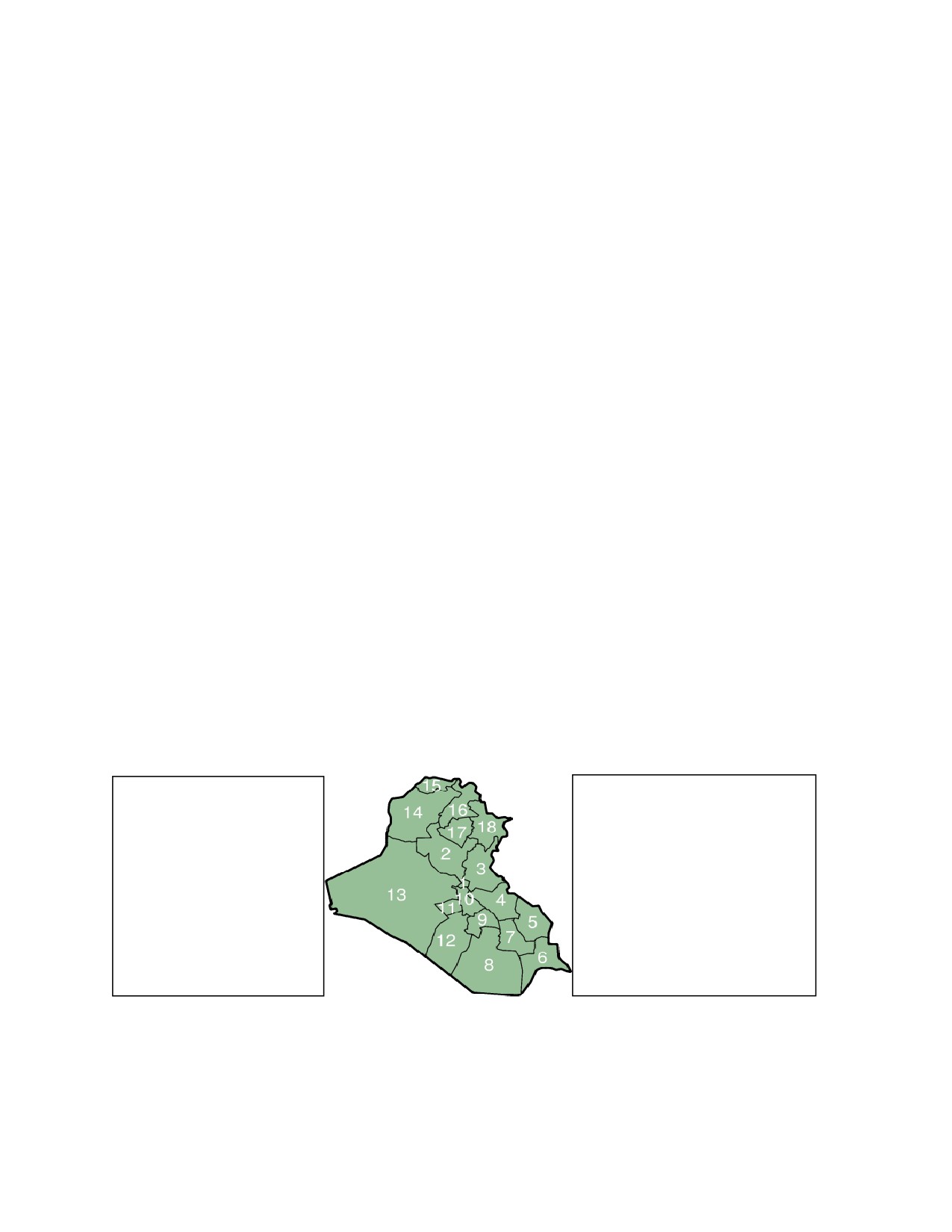
1. Baghdād
10. Bābil
2. Salāh ad-Dīn
11. Al-Karbalā'
3. Diyālā
12. An-Najaf
4. Wāsit
13. Al-Anbar
5. Maysān
14. Nīnawā
6. Al-Basrah
15. Dahūk
7. Dhī Qār
16. Arbīl
8. Al-Muthannā
17. Kirkuk
9. Al-Qādisiyyah
18. As-Sulaymāniyyah
The basic subdivisions of Iraq are the autonomous regions and the governates. Governates are
most commonly referred to as Provinces. Iraq is divided into 18 governorates (muhafazah). The
governorates are further divided into districts (qadhas). Local elections for the governates
were held in the 2009 Iraqi Provincial elections on 31 January 2009. The constitutionally
12
US UNCLASSIFIED
REL NTM-I, Iraqi Police
FOR OFFICIAL USE ONLY
recognized Kurdistan Autonomous Region includes parts of a number of Northern provinces,
and is largely self-governing in internal affairs.
Iraqi Security Forces
The Iraqi Security Forces (ISF) are the military, paramilitary and civilian law enforcement
entities that serve under the Government of Iraq for the protection and stability of the nation.
The armed forces are administered by the Ministry of Defense (MOD), and the Iraqi Police
Services are administered by the Ministry of Interior (MOI).
Ministry of Defense
MOD forces are the army, the air force and the navy. The Iraqi Army is currently an objective
counter-insurgency force positioned throughout the county to provide security and other
services on a local level by using infantrymen on dismounted patrols. Eventually the Iraqi Army
is meant to become a more traditional military force focused on defense against external
threats to the nation. The Light infantry brigades are equipped with small arms, machine guns,
RPGs, body armor and light armored vehicles. Mechanized infantry brigades are equipped with
T-54/55 main battle tanks and BMP-1 infantry fighting vehicles. There are a number of T-72
main battle Tanks in the force and Iraq has ordered a number of U.S. made M1A1 Tanks for
2010 and 2011. The FP commonly works with and alongside the Army.
The Iraqi Navy is a small force with about 1,500 sailors and officers, including 800 Iraqi Marines.
The forces are designed to protect shoreline and inland waterways infiltration. The navy is also
responsible for the security of offshore oil platforms.
The Iraqi Air Force is designed to support ground forces with surveillance, reconnaissance and
troop lift. The two reconnaissance squadrons use light aircraft, three helicopter squadrons are
used to move troops and one air transportation squadron uses C-130 transport aircraft to move
troops, equipment, and supplies. The Air Force is has about 3000 personnel, but is planned to
grow nearly nine times larger by 2020.
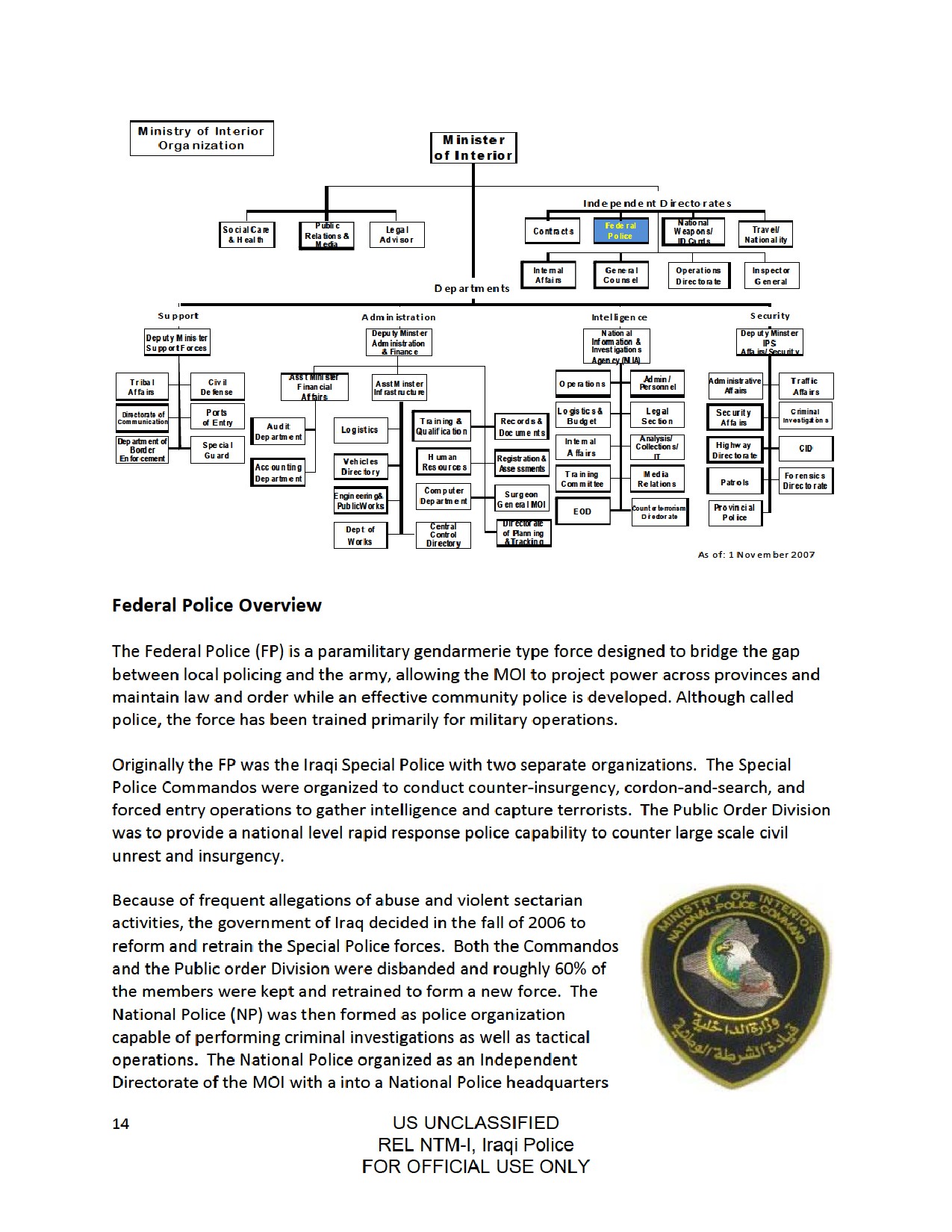
Ministry of Interior
The Iraqi Ministry of Interior (MOI) is responsible for the overall internal security of Iraq. MOI
commands a number of uniformed security forces, including the FP, Iraqi Police Service (IPS),
and Department of Border Enforcement (DBE). MOI also runs the Iraqi Civil Defense
Directorate (firefighters and emergency response organization). MOI also has
criminal/domestic intelligence capabilities, and regulates Private Security Companies operating
in Iraq.
13
US UNCLASSIFIED
REL NTM-I, Iraqi Police
FOR OFFICIAL USE ONLY
directly under the Minister of Interior and two national police divisions.
Under the command of LTG Hussain Al-Awadi, the National Police ranks grew to approximately
42,000 personnel, improved training and professionalism, worked to remove corruption,
improved the ethnic and religious diversity in the ranks and implement a police code of ethics.
The Iraqi National Police re-designated as the Federal Police effective 1 August 2009. Aside
from the name, there were no major changes to the structure or operations of the force.
Iraqi Police Service
The Iraqi Police Service (IPS) falls under the Security Department of MOI. The Police are
administered at the provincial level and are generally called Iraqi Police or IPs. Each provincial
police force has Patrol, Station, Traffic and Highway Patrol branches. The Patrol Police answer
calls for assistance, take suspects into custody and deliver them to Police Stations for
subsequent holding or release. The Station Police compile and maintain crime reports, respond
to requests for assistance from the public and assist Investigative Judges in criminal cases. The
Traffic Police have duties such as directing traffic, enforcing traffic laws, registering vehicles,
and issuing driver’s licenses. Provinces also have Highway Patrol Police who patrol the major
highways, provide law enforcement and internal security along Iraq’s highways. The IPS are
recruited locally and are generally reflective of the demographic makeup of its neighborhoods.
Historically, Iraqi police do not have a good reputation. Because they were not essential to the
[former] regime’s survival, the Iraqi police were typically under-resourced and poorly paid, with
the average policeman making around $5 or less per month. Because of the poor pay and
resources, police were not highly regarded and often supplemented their income through
corruption. Though the police had a reputation among citizens for being able to maintain
order, this security depended a great deal on their reputation for human rights abuse.2 It
should also be considered that the role of police in Iraq and the Arab societies is different than
that of western police. Police in western society are generally proactive and work to deter,
detect and defeat crime. Historically, Iraqi police have been more reactionary and respond to
crime only after it has been committed.
The FP often work with the Iraqi Police because of overlapping geographical responsibilities,
but it is a strained and difficult relationship. The FP generally view the IP as inferior within the
MOI and as a security force. The chain of command is often not clear and the roles and
responsibilities are seldom well defined. The FP view the IP as lazy and corrupt (often
stemming from the historical perceptions) and are reluctant to actively work with or train them
because commanders and staffs do not want to be held responsible for what the IPs do or fail
2 Tony Pfaff, Development and Reform of the Iraqi Police Forces, Strategic Studies Institute United States
Army War College, January 2008
15
US UNCLASSIFIED
REL NTM-I, Iraqi Police
FOR OFFICIAL USE ONLY
to do. The IPs are often a scapegoat for the FP. Some of these views are founded in fact.
There are lazy, corrupt and ineffective IPs.
However, there has not been the focus from the Iraqi Government or the Coalition Forces on
the IPS that there has been on the Army and FP. They are not as well trained and equipped.
Additionally, members of the IPS and their families were directly targeted by multiple insurgent
groups during the sectarian violence and suffered significant casualties. Until the duties,
responsibilities and chain of command become clear; and until the FP cooperate with and/or
train them, the situation for the IPS will remain unchanged and it will provide little mutual
benefit to the FP.
Department of Border Enforcement
Iraq's borders are controlled by the Department of Border Enforcement (DBE) and the
Department of Ports of Entry (POE) collectively. The DBE operates over 40 border facilities.
Organized into five regions, there are 14 land points of entry and more than 28,000 trained DBE
personnel.
The DBE and the FP rarely conduct combined missions or operate together. Since both are
elements of the uniformed MOI security forces it is possible for an officer to transfer between
the two organizations, although not common.
Law and Justice
The current Constitution of Iraq was approved in a national referendum in October 2005 and
stipulates the format of the republican government, and the rights, and responsibilities of the
Iraqi people. The Constitution promises several civil liberties including freedom of speech,
freedom of religion, freedom of peaceful assembly, freedom of expression, a free press, and a
right to have a private life. All such personal liberties contain two main exemption clauses: the
Iraqi Council of Representatives has the power to define what these freedoms mean, and that
no freedom may conflict with Islamic morality. Islam is the official state religion, and no law
may be enacted or enforced that violates “the undisputed teachings of Islam”.
Rule of Law
The heart of having a successful government in Iraq and the ability of the military, and
especially the police, to protect and serve the people is through the application and
enforcement of the rule of law.
The rule of law means that the law is above everyone and it applies to everyone. Whether
governor or governed, rulers or ruled, no one is above the law, no one is exempted from the
law, and no one can grant exemption to the application of the law. This is a common concept in
the U.S. and much of the developed world, but Iraq spent 30 years under the Saddam Hussein
16
US UNCLASSIFIED
REL NTM-I, Iraqi Police
FOR OFFICIAL USE ONLY
regime where the rule of law or any rules that did not benefit the regime did not apply. The
military and especially police were instruments of the regimes application, or lack of application
when fitting, of the rules. Those rules contradicted the rule of law in every way. The
government’s police, commanders, and those in authoritative positions were above the law
and/or exempted from it and could grant exemption to its application as they saw fit. It is a
difficult concept to move beyond; not only for the police, but for the courts and corrections
systems too.
Justice System
The Iraqi judicial system is based on the inquisitorial system similar to the French legal system.
It is a system where part of the court is actively involved in determining the facts of the case. It
is very different than the U.S. justice system which is an adversarial system where the role of
the court is solely that of an impartial referee between parties. Additionally, the Iraqi legal
system places more of an emphasis on testimonial evidence, usually from two or more
witnesses, and less on forensic evidence.
Court System
The Central Criminal Court of Iraq (CCCI) consists of two chambers: an investigative court and a
criminal court. In the Iraqi system the investigative court is actively involved in determining the
facts of the case. Evidence is gathered by military and police forces and presented to an
Investigative Judge (IJ). The IJs determine if there is evidence that a crime was committed and
if the case will get a warrant and ultimately go to criminal court. The IJ in a sense is similar to a
U.S. grand jury, but the IJs have wide and sweeping powers. It is up to the individual judge’s
discretion to decide on the standards of evidence and may vary by individual. Most judges will
place weight in witness and victim statements as well as pictures and video evidence; and much
less in science and forensics. The IJ is the part of the justice system that the FP will interact
with the most, primarily the FP S2 because they are involved in the warrant process.
Warrant, Investigation and Trial
The Iraqi system is logical, but not a simple process. All forces (ISF and Coalition) are required
to attain a warrant from an Iraqi Judge before any arrest or detention is made. Multiple
officers must sign off on a warrant packet before it even reaches the IJ who issues the warrant.
It is not necessarily a time sensitive process as officials may take time making sure everything is
in order. Once the warrant is issued the security force may execute a raid to detain the
suspect.
Once the warrant is executed and a suspect is arrested a detention order must be issued.
Within 24 hours, the Investigate Judge holds a hearing to determine whether there is enough
evidence to hold the detainee. The detention order must be renewed every two weeks until
17
US UNCLASSIFIED
REL NTM-I, Iraqi Police
FOR OFFICIAL USE ONLY
the person is convicted or released. Judges are more likely to approve a detention order if they
signed the warrant.
Once a judge determines there is enough information for a trial, an investigative hearing is held.
Evidence is presented and the witnesses and accused may testify. Witnesses can testify
anonymously because Iraqis have no right to confront their accusers, but the judge will usually
want to have the testimony given to him in person. The judge will make a recommendation on
the verdict and then forwards the case to the criminal court.
A three judge panel of the criminal court reviews the case, including the evidence and records
of the testimony. They may question witnesses again, but they are not required to do so. Once
they’ve concluded, the panel will render a verdict and impose a sentence, if appropriate.
The FP usually have little to do with the process after the detention order is issued unless a
judge wants the testimony of a member of the FP, or they are transporting a witness to the
court.
The FP generally have no significant interaction with the Iraqi corrections system.
Tribal System
The tribe is an extremely important factor in Iraq, even in a republic. The vast majority of Iraqi
people identify themselves as members of one of the country's 150 tribes. Even those Iraqi
citizens without a tribal backg0round often turn to a neighborhood sheikh for representation or
assistance with the government.
Tribes have always been, and continue to be, a stabilizing force within Iraq. Historically the
tribes have fulfilled the functions of conflict resolution and resource management. This is a
positive for the nation as a whole as tribal leaders are key in providing resolution to disputes
and conflict. However, the tribal system and tribal law will often come into conflict with the
rule of law, Iraq’s federal justice system and the FP.
It is common for tribal leaders to solicit the FP, or judges, to release a detained suspect to them
or to let the tribal leaders handle an incident that that came under the scrutiny of the law. A FP
Commander may come under intense pressure to consider to the tribes and tribal law in these
instances. He is often a member of a tribe and this will have a great deal of influence on him.
But he is an enforcer of federal law and obligated to serve the rule of law. The commander
must be considerate and strike the right balance with the tribal leaders.
The FP must be considerate and interact positively with the tribes in their operational
environment as well as be able to uphold the law of the republic. If the tribes are ignored the
units will become ineffective and not have the trust or support of the people. If a sheikh is
ignored he is shamed, and his legitimacy threatened. Often the commander will spend a great
deal of time negotiating with the tribal leaders, but he does not cave to them and submit to
18
US UNCLASSIFIED
REL NTM-I, Iraqi Police
FOR OFFICIAL USE ONLY
their wishes. He will often compromise and let the tribes handle situations where it is
appropriate. The rule of law must be upheld, but the tribes are also important. The FP
Commanders must find the right balance.
19
US UNCLASSIFIED
REL NTM-I, Iraqi Police
FOR OFFICIAL USE ONLY
Section 2: Iraqi Federal Police Operations and Effects
Part I: Counterinsurgency (COIN) and the Role of Police
“Few military units can match a good police unit in developing an accurate human
intelligence picture of their area of operation. Because of their frequent contact with the
populace, police are often the best force for countering small insurgent bands supported by
the local populace.”
FM 3-24 Counterinsurgency pg 6-19
Overview
This section outlines the fundamental counterinsurgency (COIN) principals found in FM 3-24
and applies these principals to the role of the Federal Police (FP) in the COIN environment.
Success in COIN operations requires establishing a legitimate government that is supported by
the people. Achieving this goal requires the host nation (HN) to render the insurgent irrelevant,
uphold the rule of law, and provide a basic level of essential services and security for the
populace. Key to all of these tasks is developing an effective HN security force.
The goal of policing in a COIN environment is to provide political legitimacy to the government
through the population’s acceptance of authority. Since the police are best positioned to affect
the population’s perception of the government on a daily basis, they become the frontline COIN
force.
The Iraqi FP are presently employed to fight insurgents and militias and were originally
designed to fill the gap between the local police and Iraqi military. The force has transitioned
to establish security; enforce the rule of law; and fight organized crime. The principals of
fighting organized crime and addressing criminal activities is not very different than fighting in a
COIN environment. In fact much of the crime in Iraq is insurgent related; either in financing it
or effects of it. The mission and operational set of the FP make it a natural counterinsurgency
force.
Police as a Counterinsurgency Force
The primary counterinsurgency objective is to provide security and the rule of law to enable
local institutions to grow and increase in effectiveness while decreasing the ability of the
insurgency to execute operations. Because of their frequent contact with the populace, police
are often the best force for countering small insurgent bands supported by and residing within
the populace. However, in the case of larger and more mature insurgencies, the relatively small
groups of local police are likely not adequate and will be ineffective and overwhelmed. A
larger, more military oriented police force such as the FP may be more effective because these
forces commonly are better equipped, trained at a higher level, and can draw from intelligence
resources at the national level.
20
US UNCLASSIFIED
REL NTM-I, Iraqi Police
FOR OFFICIAL USE ONLY
Additionally an organization like the FP can be given the mandate of working primarily as a
counterinsurgency force, providing focus to the mission. The FP have the ability to mass forces
in an area and then engage and defeat the threat. The trade off is that the FP are less likely and
often less capable of providing the community policing functions as local police. The FP will
often been seen as outsiders and the population may be less willing to cooperate and pass
information on the insurgents as they would be to local police. In the more urban areas such as
Baghdad the federal and local police overlap and are most effective working together.
Principal Adversaries of the Federal Police
Within the current operational environment, the FP face four principal adversaries that disrupt
order within the community:
• Militias
• Insurgents
• Terrorists
• Criminals
Although four separate entities, these four elements are often interrelated. From 2004 to 2007
the principal adversaries of the FP were militias. These militias were part of the sectarian based
insurgencies in Iraq. The largest and best example is the Jayesh al-Mahdi (JAM) militia headed
by Muqtada al-Sadr. There were/are also other insurgent bands operating outside of the
militias. In the summer of 2007 most of the militia groups were broken and the remnants
formed splinter organizations, i.e. Special Groups from the remnants of JAM.
Terrorist organizations also operate within the environment. The largest example of this is Al
Qaeda in Iraq (AQI). In the complex environment of Iraq, terrorist organizations may act in
collusion with Militias or be adversaries of each other. It is also important to note that many of
the FP leaders do not distinguish a difference between insurgents and terrorists, and do not
recognize Iraq as having an insurgency problem, but only a terrorist problem.
The final category is the criminals, and should not be overlooked or dismissed. Many of the
insurgent leaders were former criminals and a large portion of the insurgent group and militia
members are criminals who are looking to get paid for their services. Additionally, many of the
militia groups became organized criminals after 2007, or the splinter groups resort to criminal
activity to finance insurgency operations.
The FP combat these adversaries either as para-military or as police, depending on the
situation. The path to success against any and all of these enemies is through good intelligence
that has to come from the population. Whether the FP is in a military or a police orientation,
the intelligence gathering processes and the requirement to secure the environment and the
populace remains key to success.
21
US UNCLASSIFIED
REL NTM-I, Iraqi Police
FOR OFFICIAL USE ONLY
Police Effectiveness in the Spectrum of Conflict
As mentioned earlier, it depends on the level, maturity and size of the insurgency as to how
effective a police force can be in counterinsurgency operations and will determine if the police
unit acts as more of a military or police force . Effectiveness is also dependant on level of
training, resources and intelligence the unit has. Every unit and every situation is different for
many reasons.
Police advisors usually can help increase effectiveness in the following areas:
• Development of intelligence and sources
• Warrant based targeting within the rule of law
• Detainee operations
• Security operations planning
• Resource and logistics management
COIN Principal: Securing the Environment
Long term success in COIN depends on the people taking charge of their own affairs and
consenting to government rule. The first step to gaining trust and confidence in the
government is to provide a safe and secure environment for the populace to live and work.
Initially this involves securing the populace and establishing / securing essential services.
Countering an insurgency requires a police force that is visible night and day. If the populace
believes that insurgents and criminals control the streets it is impossible for the government to
gain any credibility. The FP maintain a presence through checkpoints and patrols.
The purpose of the checkpoints is to secure key infrastructure or other sites thus assisting in
creating a safe environment in the community. The FP in effect use the checkpoints as mini
police stations. When the police at the checkpoints and on patrol are proactive and efficient in
their duties and display competence and commitment, showing genuine interest in safety and
security of the local population, they will contribute significantly to not only their own success,
but to the legitimacy of the government.
COIN Principal: Winning the Support of the People
The FP must understand that winning the support of the people is a fundamental principal to
their COIN fight and that it is a necessity to accomplish their mission. The police are the most
visible agents of the government and are expected to protect the people from any and all
elements that would do them harm and must be actively engaged and interact with the
community. They must treat the people with respect and decency while maintaining authority
and providing adequate security.
22
US UNCLASSIFIED
REL NTM-I, Iraqi Police
FOR OFFICIAL USE ONLY
The support of the people is not a given for the police in Iraq. Corruption among police at all
levels is a persistent problem. Police using their position for personal financial gain is relatively
common. Acceptance of bribes from insurgent groups, criminals or even tribal leaders is also a
problem. Additionally, the first forms of the FP were disbanded and reformed because of
looking the other way during incidents of sectarian violence or even participation in the
violence. It can be difficult for the people to trust the police and accept that they are there for
the good of the people. This is especially true in Iraq where the police were used by Saddam
Hussein to control the population and brutally crush dissent. The police were seen as corrupt
and not as protectors. The Iraqi FP must go out of their way to prove themselves as stewards of
security and protection.
The relationship between the police and the people should be mutually beneficial. The police
protect and secure the population and the people give the police information on criminals and
insurgents. The police can then convert the information into intelligence and actions to arrest
the enemy or prevent the criminal acts can be taken further securing the population.
The police must understand how to get information from someone while protecting the person
who is giving it to them from harm. The criminals or insurgents punish anyone giving up
information that would stop one of their acts of violence. Protecting the people and families of
those who choose to trust the police is very important.
Part II: The Iraqi Federal Police Organization and Structure
The following information is to assist the advisor in understanding the overall organization of
the FP and how a typical unit will be organized and structured. Every unit will vary and the
Brigades and Battalions are very much personality based and will differ based on the
commander. Additionally, there are differences in units according to the situation and
geographic location. It is the duty of each advisor to determine and work within these lines.
However, there is a base model of FP organization and structure that the MOI intends to retain
as the force is expanded.
Organization
Currently, the FP are comprised of four motorized divisions with 15 brigades, including a
mechanized brigade and a sustainment brigade. There is currently a plan to expand to a fifth
mechanized division and an overall strength of approximately 21 brigades and several special
protection forces. The MOI plans to place a FP brigade in each Province by 2012.
Each fully formed Division commands four brigades, usually with three FP battalions and a
Special Troops Battalion (STB). The Divisions also have a STB and a Commando or QRF battalion
directly under their HQ. The QRF battalions are proposed to be Air Assault qualified in the
future. Future proposals call for a Sustainment Brigade with a Sustainment Battalion, a
Maintenance Battalion and a Motor Transport Battalion in each Division. A standard FP
Battalion has four Police companies and a Recon Platoon. The Brigade STBs tend to be
underdeveloped and undermanned at this time, but these battalions do contain the brigade
23
US UNCLASSIFIED
REL NTM-I, Iraqi Police
FOR OFFICIAL USE ONLY
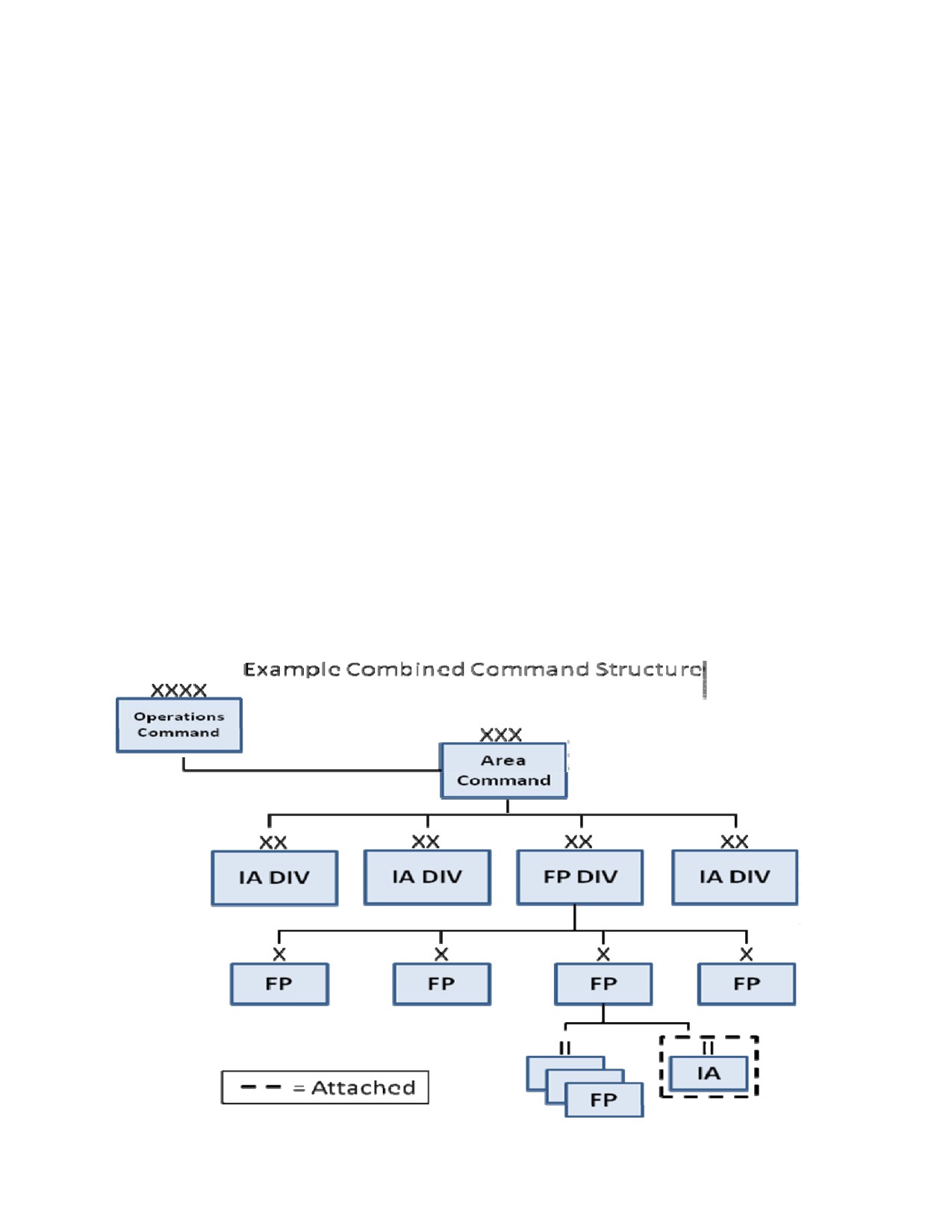
staff, maintenance and fuel support troops, a Commando company and the brigade security
company.
The brigades of 1st and 2nd Divisions are numbered 1 through 8 similar to the Iraqi Army. The
3rd Division Brigades are named in honor of an Iraqi hero or the region it is assigned. Other
elements are in flux as the 4th and 5th Divisions are formed. For example the 1st Mech Brigade
is proposed to be transferred to the planned 5th Mech Division and the planned Diyala Brigade
may form under the 4th Division.
The Federal Police Command HQ retains control of the FP Sustainment Brigade, the supply
depots and the training centers, as well as currently having command and control of the Mech
Brigade. The Divisions in the field have an administrative and logistical relationship with the FP
Command HQ, but operationally fall under the command and control of the Area Commands
(equivalent to Corps echelon). The Area Commands fall under the regional Operations
Commands. Ultimately they answer to the Iraqi Ground Forces Command (IGFC).
This command relationship often results in a combined Task Organization that deviates from
the IFP standard order of battle. For example: An Area Command may be assigned two Iraqi
Army (IA) Divisions and one FP Division. Further, a FP Battalion may be attached to an IA
Brigade and vice versa.
It is important to note that the Area Commands are joint, so a FP Commander is eligible to
command an Area Command and future plans call for the two Area Commands in Bagdad to be
all FP.
24
US UNCLASSIFIED
REL NTM-I, Iraqi Police
FOR OFFICIAL USE ONLY
Iraqi Federal Police (IFP) Standard Order of Battle3
Federal Police Command Headquarters - Baghdad
IFP Basic Training Academy - Numaniyah
IFP Academy - Al Amarah
Sader Al-Kanat Training Academy
IFP Training School (Carabinari Training)
IFP Al Muthanna Vehicle Supply Depot
IFP Supply Depot
IFP Sustainment Brigade
Sustainment Brigade Special Troops Battalion (Med Co and HQ Co)
Sustainment Battalion
Maintenance Battalion
Motor Transport Battalion
1st IFP Mechanized Brigade
1st Mechanized Brigade Special Troops Battalion
1st Mech Battalion
2nd Mech Battalion
3rd Mech Battalion
4th Mech Battalion
Diyala Brigade - Planned
Diyala Brigade Special Troops Battalion - Planned
1st Diyala Motorized Battalion - Planned
2nd Diyala Motorized Battalion - Planned
3rd Diyala Motorized Battalion - Planned
IFP Central Bank Protection Force - Planned
IFP Embassy Protection Force - Planned
IFP Antiquities/Ruins Security Force - Planned
1st Federal Police Motorized Division
1st Division Special Troops Battalion
1st (Seyafiyaa) Commando Battalion
1st Motorized Brigade
1/1 Brigade Special Troops Battalion
1-1/1 Motorized Battalion
2-1/1 Motorized Battalion
3-1/1 Motorized Battalion
2nd Motorized Brigade
2/1 Brigade Special Troops Battalion
1-2/1 (Wolf) Motorized Battalion
2-2/1 Motorized Battalion
3-2/1 Motorized Battalion
3rd Motorized Brigade
3/1 Brigade Special Troops Battalion
1-3/1 Motorized Battalion
2-3/1 Motorized Battalion
3-3/1 Motorized Battalion
4th Motorized Brigade
4/1 Brigade Special Troops Battalion
1-4/1 Motorized Battalion
2-4/1 Motorized Battalion
3-4/1 Motorized Battalion
3 Open source, current as of October 2009 and subject to change. Planned units are displayed in italics.
25
US UNCLASSIFIED
REL NTM-I, Iraqi Police
FOR OFFICIAL USE ONLY
2nd Federal Police Motorized Division
2nd Division Special Troops Battalion
2nd (Unity) Commando Battalion
5th (Sword) Motorized Brigade
5/2 Brigade Special Troops Battalion
1-5/2 Motorized Battalion
2-5/2 Motorized Battalion
3-5/2 Motorized Battalion
6th Motorized Brigade
6/2 Brigade Special Troops Battalion
1-6/2 Motorized Battalion
2-6/2 Motorized Battalion
3-6/2 Motorized Battalion
7/2 (Lightning) Motorized Brigade
7/2 Brigade Special Troops Battalion
1-7/2 Motorized Battalion
2-7/2 Motorized Battalion
3-7/2 Motorized Battalion
8/2 (Falcon) Motorized Brigade
8/2 Brigade Special Troops Battalion
1-8/2 Motorized Battalion
2-8/2 Motorized Battalion
3-8/2 Motorized Battalion
3rd Federal Police Motorized Division
3rd Division Special Troops Battalion
3rd (Justice) (AAslt) Commando Battalion
Al Askarian Motorized Brigade
Al Askarian Brigade Special Troops Battalion
1st Motorized Battalion
2nd Motorized Battalion
3rd Motorized Battalion
Knights Raider Light Brigade
Knights Raider Brigade Special Troops Battalion
1st Battalion
2nd Battalion
3rd Battalion
Abu Risha Light Brigade
Abu Risha Brigade Special Troops Battalion
1st Battalion
2nd Battalion
3rd Battalion
Al Mosuli Motorized Brigade
Al Mosuli Brigade Special Troops Battalion
1st (Salah) Motorized Battalion
2nd (Jalil) Motorized Battalion
3rd Motorized Battalion
4th Federal Police Motorized Division
4th Division Special Troops Battalion - Forming
4th Division QRF Battalion - Planned
1/4 (Basra) Motorized Brigade
1/4 INP Brigade Special Troops Battalion
1-1/4 INP Motorized Battalion
2-1/4 INP Motorized Battalion
3-1/4 INP Motorized Battalion
Other 4th Division Brigades - Planned
5th Mechanized Federal Police Division - Planned
5th Mechanized Division Special Troops Battalion - Planned
5th Mechanized Division QRF Battalion - Planned
Other 5th Division Brigades - Planned
Personnel
The FP is manned with para-military type soldiers called Shurta (Police). It is common for
leadership to call the Shurta Jundee (Arabic for soldier), especially if he has a previous army
backg0round. In the MOI the Shurta are considered employees, and do not sign enlistments as
they do in MOD.
The requirements for employment in the FP are to apply for entry, be able to read and write,
pass a physical and pass basic police training. Recruiting is usually held in drives in Baghdad and
other larger cities. A part of the vetting process is examining the recruit for scars caused by
bullets or knives and questionable tattoos (may indicate criminal or militia affiliation). These
things indicate possible involvement in criminal or insurgent activity or past prison time.
Recruits cannot have been a member of Sadaam Hussein’s former Intelligence Agency, Special
Forces or Sadaam’s personal security detail.
There are backg0round checks that are conducted, but the effectiveness of these checks can be
questionable. The ability to read and write is stated a requirement, but many Shurta have
entered the force without the ability. The vetting process has improved since prior to 2007.
The FP senior command has placed a greater emphasis on quality over quantity. But it still has
much room for improvement.
The ranks of the FP are Shiite dominated, but beginning in 2008 a new push to integrate Sunnis
in order to diversify the force and shed its sectarian reputation was made. The lack of female
Shurta is a persistent problem. There are very few, if any, women in the FP and any that are do
not perform policing duties. This cultural issue is difficult for the FP to deal with. The
conventional thought is that men protect women in the culture and not the other way around.
Yet the FPs run into the problem of dealing with females in their daily tasks such as security
voting sites or searching people at religious festivals.
Leadership
Officers have two methods to enter the FP. First, to have been prior commissioned officers of
the old Iraqi Army (usually Military Academy graduates) or commissioned Police Officers in the
previous regime. Second, to have a college degree, be accepted and pass a basic officer’s
academy. Most officer’s in the second category work in specialized fields that are aligned with
their college degree such as communications.
The majority of the Officer and senior NCO leadership of the FP were former army and may be
limited on their knowledge of policing operations, but have significant experience managing
and employing infantry forces. It is common to see a bias among the officers and within the
Shurta against officers who were not previously professional military officers.
It must be considered that some of the officers are politically connected and reached their
positions through nepotism. It is also an open secret that commands are “purchased.”
Although this comes across as very corrupt, it is their system and is also common in many
27
US UNCLASSIFIED
REL NTM-I, Iraqi Police
FOR OFFICIAL USE ONLY
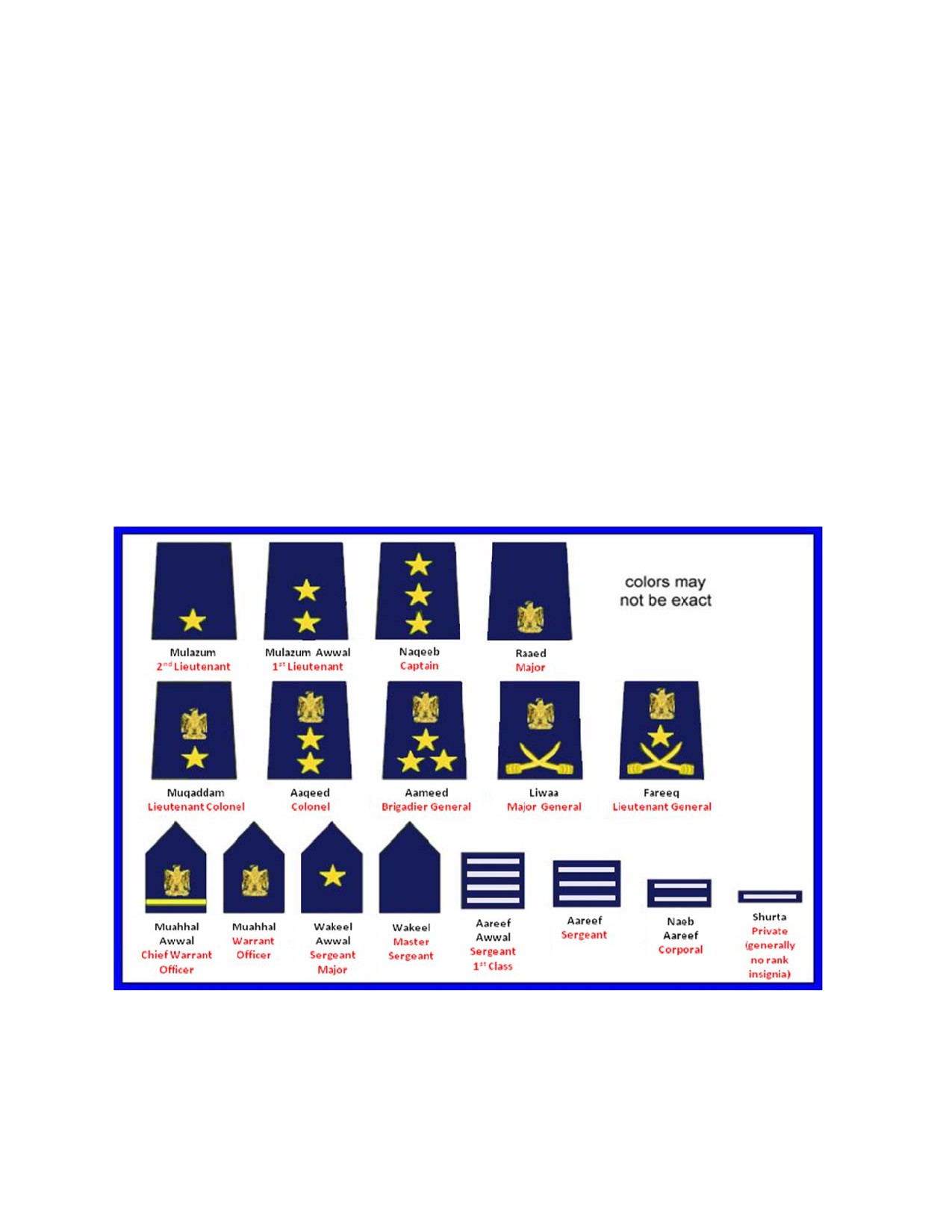
military forces outside of Iraq. The result, however, is a lack of consistent effective leadership
with commanders ranging from proficient, to ineffective, to completely corrupt.
The NCO Corps is present, but holds very little true authority. Dependant on individual
commanders, a sergeant major may hold a great deal of influence with the commander but it
varies by unit and situation. A Shurta is promoted to Sergeant by time in service (four years)
and not by merit or potential. The Company Sergeants (First Sergeant) are usually selected
because of ability and other qualities.
Leadership positions within the units are generally rank heavy. Majors (Raaed) command
companies (although Captains and Lieutenants can command), Colonels (Aqeed) command
battalions and Brigadier Generals (Aameed) command brigades. There is usually a large
number of Colonels at the brigade staff level.
Rank
Rank insignia for the FP is identical to that of the Iraqi Army except that shoulder boards are
dark blue (or digi-blue). The rank is worn on the shoulder of the uniform.
The former military officers usually have gold stars while former police use white stars,
however this designation is unofficial. It is rare for the enlisted Shurta, to include NCOs, to
wear any rank insignia. It is also common to see a FP Sergeants Major and Warrant Officers
wearing U.S. style Command Sergeant Major insignia on their collars.
28
US UNCLASSIFIED
REL NTM-I, Iraqi Police
FOR OFFICIAL USE ONLY
FP Officers who have a red stripe on their rank are graduates of the
Iraqi Command and General Staff College and outrank fellow officers
of the same rank without the red stripe. The red stripe brings with it
the denotation of ―Staff (Rokum) to the titled rank. A FP Battalion
Commander who is a LTC (Moquaddam), and has the red stripe on
his rank is a Staff LTC (Moquaddam Rokum), outranks other LTC
Battalion Commanders without the stripe. It is important to
recognize the Rokum status when referring to an Officer‘s rank. The
Rokum status is prestigious and is present in the Iraqi Army, FP,
Border Police and local IP rank structure. An Iraqi Officer will
maintain his Rokum status throughout his career, and it will
represent his formal military education on the Iraqi staff process.4
Pay and Food
The process of paying and feeding Shurta is very different than the systems used by U.S. Forces.
It is essentially an analog system that is based on cash changing hands. Obviously there is a
high possibility for corruption anytime cash is exchanged.
The basic process is personnel rosters are sent to the FP HQ by each unit. These rosters are
verified by both the FPHQ and the MOI. The Ministry of Finance (MOF) allocates the money
and each units Pay officer picks up the money. Each unit sets a date and time for payment
distribution. There are no electronic transfers; all payments are cash.
Included in the pay is a 90 thousand Dinar (around $78) monthly per Diem for food. Each
Shurta turns over his 90K Dinar to the unit Food Officer where the money is combined and food
is locally purchased. Each unit generally has a dining facility of some sort for the Shurta and a
smaller one for the Officers. Personnel are employed as kitchen staff and prepare all meals.
Unit (BN and higher) Commanders may also have their own kitchen staff that prepare their
personal meals and chai as well as food for entertainment or meetings.
4 How the Iraqi Army Operates, Edition 1.2, JCISFA
29
US UNCLASSIFIED
REL NTM-I, Iraqi Police
FOR OFFICIAL USE ONLY

The critical points for corruption in the process are with the records and the Per Diem. It is
common to find that the units books are “cooked,” i.e. - nonexistent employees are carried on
the rosters. At first glance this seems to be a prime example of personal corruption, but in
some instances there are good intentions behind this. Some examples may be that the families
of Shurta killed in the line of duty are being taken care of by carrying the deceased on the books
and giving the families the pay. Other less charitable instances are a Commander using the
money for bribes or simply enriching himself.
The 90K Dinars per diem is often used in a corrupt manner. Common examples are
substandard food being purchased as a low price and pocketing the extra money or using some
of the money to purchase fuel for the unit on the black market.
Equipment
Each FP unit is equipped by MOI based on a standardized and published MTOE. Generally the
units are fairly well equipped with hardware and the FP has gone through several iterations of
fielding for vehicles and uniforms. The major problem is that the end item is issued in
compliance with the MTOE, but many units lack the subcomponents of an end item or have the
inability to replace worn out parts or items and the inability to effectively maintain the
authorized equipment. This often results in units or individuals purchasing their own
equipment (often black market) or the unit using funds marked for food to purchase repair
parts.
Communications
The FP rely on two means for primary communications; Motorola ICOM radios (or compatible
models) and cellular telephones. There are very few tactical radio systems available and few if
any subject matter experts available for maintenance and repair. The major challenge
presented with this hardware is communications security.
30
US UNCLASSIFIED
REL NTM-I, Iraqi Police
FOR OFFICIAL USE ONLY

It is very common for the FP leadership to carry several cell phones and is the principal means
of communicating with other commanders and senior staff officers as well as with their
Coalition forces partners and even the Advisors. Cell phones have the potential to be
monitored and present a security risk as they could be captured and/or stolen and exploited by
insurgents or criminals. Coalition Forces Electronic Countermeasure (ECM) devices also have a
disruptive effect on the use of cell phones as communication. However, to the FP leadership
the convenience of cell phones, and the fact that it is often the only means of communicating
with each other, will outweigh the associated risks and complications.
Cell phones have become very accessible in Iraq and most of the Shurta have their own phone.
This tends to be a double edged sword as it helps the enlisted members of the units stay in
contact with the unit and their families; but on the negative side it can be at best a distraction
and at worst an OPSEC breach. Most units have a stated policy that personal cell phones are
not allowed to be used on duty, but the results of enforcement of this policy are mixed.
The ICOM radios are more secure because they have encryption
capability but also have the risk of being monitored and exploited.
The ICOMs are usually located with the checkpoint commanders and
patrol leaders as well as at the operations headquarters of each
echelon. Each echelon will have its assigned frequencies and net.
The traffic on the radio can be very high at times, but it gives the
benefit of increased situational awareness across the units. As with
the other FP equipment there tends to be problems in maintenance
and replacing parts and accessories, especially batteries.
Communications suffers from the immature and often ineffective
MOI supply system. Accountability can also be a problem.
The majority of staff to staff communication is conducted via staff couriers delivering reports to
headquarters. The FP have made significant improvements in automation, but limit the use of
computers to generating reports and briefings. Computer viruses are a major problem for the
FP and tend to cripple their ability to network among units and headquarters.
Weapons
The FP are armed much more heavily than a traditional police
force. The Shurta carry rifles and patrol vehicles are heavily
armed. However, the FP are not as heavily armed as the Iraqi
Army. Standard weapons include pistols, light and heavy
machine guns, and assault rifles.
Most officers carry a Glock 19 (9mm) pistol in a hip holster. The
Glock is the most common pistol used by both MOI and MOD.
Some Officers and NCOs may carry a pistol that is personal
weapon. The types these weapons vary.
31
US UNCLASSIFIED
REL NTM-I, Iraqi Police
FOR OFFICIAL USE ONLY
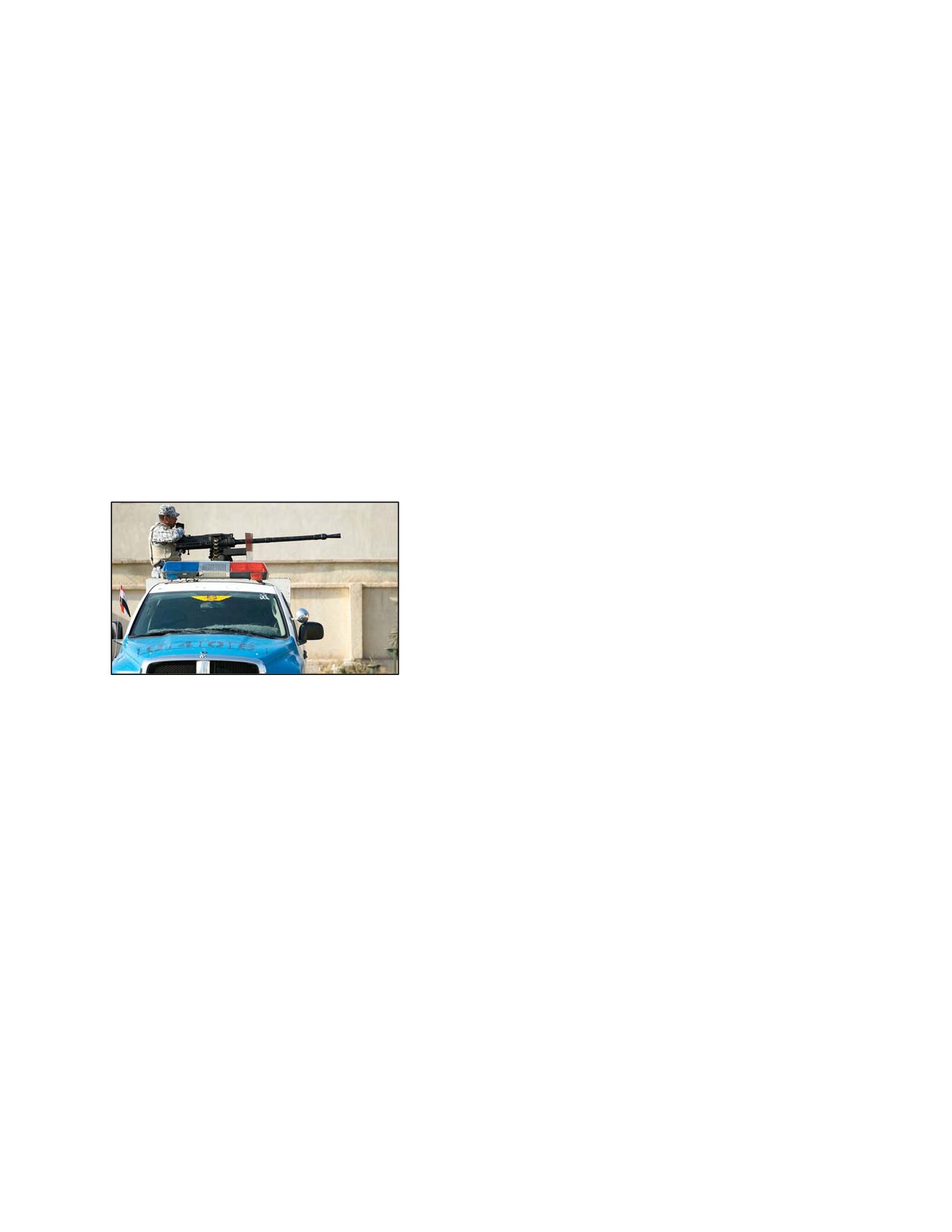
The standard weapon for a Shurta is the AK-47. Most of these rifles are surplus from the
former regime and the Iraqi government has redistributed. The level of maintenance varies
from very good to poor depending on the unit and the skill of the individual armorer at that
unit. Generally the rifles are not zeroed, but Shurta are assigned individual weapons.
Accountability also varies from unit to unit, but is usually decent because individuals do not
want to give up or lose their weapons.
The most common light machine gun used by the FP is the PK Machine Gun. The PKM fires belt
fed 7.62x54mm ammunition from an open bolt. It has open sights similar to that of an AK. The
maintenance of the PKM also varies among units. Muzzle awareness and safety are larger
concerns with the PKM. The Shurta that carry the PKM rarely have any significant training with
the weapon and are usually selected because of their body size. The PKM is common at the
checkpoints, but is often employed incorrectly or ineffectively (i.e. - not oriented on high speed
avenues of approach or on high ground supporting the position).
Many units use the DShK 12.7mm anti aircraft machine guns mounted to patrol trucks. The
weapons are mostly previously captured or were discarded by the former Iraqi Army and most
are reconditioned or rebuilt by cannibalizing other
discarded weapons. The DShK is usually mounted in the
bed of a patrol vehicle and rigged with a gunner’s seat
mounted to the base of the weapon. There is very little
training conducted with these heavy weapons and
safety is a major concern. In most cases the gunner or
the weapon are not capable of depressing or rotating
the weapon to prevent “flashing” other personnel or
vehicles. Additionally, the drivers will tend to drive at
high speeds and make erratic movements while the gunner is positioned behind the loaded
weapon. Personnel should be extremely careful and vigilant when operating around these
weapons.
There is a proposal to equip the FP with light 60mm mortars in the future, but it is unclear if it
will be approved for a government force other than the army to have that type of weapon.
It is common for FP units to keep some captured weapons and ammunition if confiscated. This
is authorized, but the unit is supposed to report any weapons retained. Often units will keep
RPGs, which are not authorized by MTOE, to use for base defense. Sniper rifles are also often
retained. The FP are NOT authorized to keep mortars, munitions or explosives. Those items
are to be turned over to Iraqi EOD, or can be turned over to Coalition Forces for forensic
exploitation.
Vehicles
The Iraqi FP use several types of vehicles ranging from pick-up trucks to armored vehicles. The
FP use a blue and white paint scheme associated with police forces. Red and Blue police light
bars are usually mounted on top of the vehicles.
32
US UNCLASSIFIED
REL NTM-I, Iraqi Police
FOR OFFICIAL USE ONLY
The most common vehicles are pick-ups. These vehicles range from small Chevy LUVs and Ford
Rangers, Ford F-150 and Chevy Silverado, to bigger models like the F-350. Most of the pickups
are modified with fabricated steel plates on the doors and in the bed for small arms protection.
The FP are also equipped with a significant number of M1114 Armored HMMWVs which have
been reconditioned and transferred from U.S. forces. The M1114 has armor on both sides as
well as the bottom providing better protection than the “add on” armored pickups the FP use.
Another benefit is the weapons turret that
provides a platform meant to hold and fire
the weapon. However, the mounts usually
have to be modified to hold the PKM type
weapons of the FP. The M114s have also
been painted in the blue and white police
scheme of the FP. The major challenge is
in maintenance. The FP have a training
program established, but still are limited
on certified and capable HMMWV mechanics. U.S. forces partnered with the FP are able to
help as far as maintenance training; however ordering parts is a significant problem. The U.S.
forces use M1151 model HMMWVs, and although the vehicles look similar, especially to an
Iraqi, the parts association is only 40% the same. The MOI is establishing a contract for M1114
parts but it is unclear how efficient the contract will be, how long it will last, and how it will fit
with unit level field maintenance of the FP.
REVA armored vehicles are present usually at the Brigade HQ level. The Brigade will usually
have 10-12 of the vehicles. REVAs are a
4x4 personnel carrier that offers more
protection against IEDs, RPGs and sniper
fire than the ad hoc armored pick-ups. It
can seat 10 passengers and is equipped
with two hatches for light machine guns.
Maintenance and parts replacement are a
concern for these vehicles. It is common
for the vehicles to be static at important points such as bridge crossings but many units
effectively use the vehicles for route clearance operations.
The Mechanized Brigade is equipped with the BRDM armored vehicles, mostly BDRM-2s. The
Mech Brigade maintained the desert sand color scheme on the vehicles. The vehicles are often
used to establish strong points and for route clearance.
Facilities
The FP occupy a variety of established facilities. Many are buildings and compounds that
belonged to former regime MOI and MOD. Some facilities are abandoned factories or similar
33
US UNCLASSIFIED
REL NTM-I, Iraqi Police
FOR OFFICIAL USE ONLY

locations. These types of facilities are generally tied into the city power grids and electricity is
available, but they experience the rolling brown and blackouts common in the cities.
At the checkpoints the FPs often build plywood structures for shelter. These small buildings are
austere but do provide shelter from the sun and wind. The Shurta live at the checkpoints so
there are bunks and amenities such as portable stoves or hot plates to prepare food and make
tea. Electricity is usually pirated into the shacks by an extension cord. Living and working at
these checkpoints is difficult at best.
The living conditions are improved if the facility is a Joint Security Station (JSS). The biggest
improvement is the consistent power that the Coalition Forces bring with their generators. The
Iraqis may have generators of their own, but often lack the fuel to run them on a consistent
basis. Still, living on a JSS is difficult for Iraqis and Americans alike.
Uniforms
The FP have adopted a uniform consisting of pixilated black
and blue camouflage uniform similar to the U.S. Army Combat
Uniform. The uniform includes a patrol cap, body armor and
PASGT Kevlar helmet. Officers and Warrant Officers/Sergeants
Major wear either a black or maroon beret (officially the black
beret is for FP and the maroon for IA) with the Iraqi national
eagle symbol affixed on the left side. The body armor tends to
be a mix of camouflage patters or solid black or tan colors.
The Shurta required to wear body armor are issued a ballistic
vest and have some form of plate insert. However, it is very
rare to see the officers wear body armor due to machismo and
cultural perceptions.
The Shurta usually wear desert combat boots. Officers may
wear combat boots or shoes. There is no standard foot gear in
the FP. Boots are a common item that FP troops (including
officers) will request from their advisors or coalition force partners.
Many of the FP Shurta tend to wear excessive amounts of equipment. It is common to see a
Shurta on a checkpoint wearing kneepads on his calves and knees, elbow pads, sunglasses and
goggles on his helmet. Some will purchase modified uniforms with extra pockets and Velcro at
their own expense. Flashlights and other accessories are common parts of the uniform. Shurta
will often ask for batteries for their accessory equipment.
34
US UNCLASSIFIED
REL NTM-I, Iraqi Police
FOR OFFICIAL USE ONLY

Systems
Work-Leave Schedule
The Iraqi Security Forces (both MOI and MOD) employ what to western standards is a very
liberal work leave policy. Generally, a Shurta in the FP works for 21 days and is entitled to
seven days of leave (FPs refer to the time off as jasim which roughly translates to vacation or
time of rest). In some cases there are two key personnel that occupy one billet and share a
weekon week-off schedule.
This schedule can be disruptive and frustrating to the advisor and coalition partners working
with the FP, and causes some resentment. There are reasons for this policy that make cultural
sense.
The Iraqis work what can be described as a firehouse schedule. They live at the HQ, or at the
checkpoints, often in very austere conditions, for the entire time that they are on duty. Rarely
does a Shurta work near their home and they do not see their families for the entire time they
are on duty. With no centralized pay system or electronic payment into a bank account the
Shurta have to return home to support their families and give them their pay. This system is
similar to the old Iraqi Army system. It can be frustrating but is an established method and
system that is an embedded part of the FP culture.
The FP doctors at the medical clinics are authorized to give Shurta’s up to 3 days of sick leave.
The Shurta are not authorized to leave the unit site area during sick leave.
Training
One of the biggest obstacles for the FP is training. Operations will always take precedence over
training. Resourcing the training can also be difficult and is often a low priority or an entirely
new concept.
The FP have three main national training centers. Basic Recruit Training (BRT) should take place
at Numiniya training center south of Baghdad. Numiniya is also home to the FPs mortar
training school. The second step of FP training is held at Solidarity in northern Baghdad. This
training is the FP specialty training course designed to take basic
recruits and turn them into Federal Police. The 3rd training
facility is the Federal Police Specialty Training Center at Camp
Dublin on Victory Base Complex. The main training event at
Camp Dublin is Special Unit Training run by the Italian Carabinieri
(Italy’s national police force) under the NATO training mission.
The 12 week course provides training in Public Disorder, Law
Enforcement, Investigations, Forensics, SWAT and Urban
Operations. The course also focuses on leadership and train-the-
trainer type of training.
35
US UNCLASSIFIED
REL NTM-I, Iraqi Police
FOR OFFICIAL USE ONLY
The object of Carabinieri training is to professionalize the FP and increase the capabilities of
entire battalions. Training units are pulled from operations and remain at the Camp Dublin site
throughout the course. This does present challenges to the national command as these units
have to be temporarily replaced in their area of operations and requires high level planning and
coordination with the operations centers which maintain command and control of FP units
while in their AO.
As the ISF gain more control over the security of Iraq, the focus of the FPs will continue to shift
to training and professionalizing the force. The HQ FP Commander and staff are focused on
training and will accept training from any source to better their organization.
Staff Systems
The Iraqi military was originally trained and heavily influenced by the British military, hence
they are more comfortable with the British model of staff systems. The FP are organized and
operate along the same lines as the Iraqi Army as far as systems and planning. The FP may be
more centralized in execution and loose in the process of planning. It is important to
understand the process that the FP Commander and staff will use in planning and how to
engage within it.
Generally the FP staff officers will reject the highly structured Military Decision Making Process
(MDMP) that American forces use and gravitate to the British Estimate Process, which is most
similar to what they learned in the old Iraqi Army (especially Staff College graduates).
The British Estimate Process consists of seven components:
1) What is the enemy doing and why?
2) What have I been told to do and why?
3) What effects do I want to have on the enemy and what direction must I give to develop
a plan?
4) Where can I best accomplish each action/effect?
5) What resources do I need to accomplish each action/effect?
6) When and where does each action take place in relation to each other?
7) What control measures do I need to impose?
As previously stated, the FP Commander and S3 tend to do all the planning in a vacuum and do
not always involve the staff. They may use this process, but very loosely, or they may not use it
at all.
The Iraqi staff systems are similar to the American systems but are influenced by culture and
traditions (Arab, Iraqi, military) and differ in ways ranging from subtle to distinct. In the
American system the staff is in place to help the commander make decisions and to control the
unit while the commander commands. The Iraqis tend to be more compartmentalized in their
duties and processes. Each officer and section has their own lane and are discouraged from
36
US UNCLASSIFIED
REL NTM-I, Iraqi Police
FOR OFFICIAL USE ONLY
even inquiring about other’s areas. The commanders tend to command and control their
formations making all decisions. Unity of effort is viewed through a different lens than an
American, but that does not diminish the need for efficient and effective staff systems and
personnel.
Administration
The Administrative Officer (S1) is often considered just as important as the S3 and is often the
same rank or possibly a higher rank than the S3. The S1 handles the human resource aspects of
the units as well as being the officer that engages MOI and other government agencies. For
example, the S1 may have to register the vehicles for the entire brigade at the Department of
Traffic. Generally, the S1 is a very experienced, skilled and intelligent officer. Most S1s have a
solid handle on personnel numbers and other administrative records. At brigade and higher
levels there may be additional officers responsible for finance and mail.
Intelligence and Investigations
The most unique staff section and staff function that the FP have is the Intelligence section.
The S2 in the FP is very different from the S2 in the American system. The FP S2 Officers are a
part of the National Iraqi Intelligence Agency (NIIA), the MOI intelligence organization and are
assigned to units of all levels by NIIA. The units Investigators are also members of NIIA. This
results in the S2's serving two masters, the MOI and their FP unit Commander. How much they
work with or work for the commander is based on the personal relationship with that
commander. The relationship therefore varies by unit. Some have a good relationship and will
work well with the unit; others will not work together at all. Usually the S2’s allegiance to the
MOI will take precedence over his allegiance the unit. Often it can be an adversarial
relationship in which the commander considers the S2 a spy or the S2 conducts his own
independent operations outside the control or even knowledge of the battalion or brigade.
The FP S2 tends to be a master Human Intelligence (HUMINT) collector, managing multiple
sources and collecting on individuals or networks within their geographically assigned area. The
S2 section may conduct independent raids to capture and detain suspects. The interrogators
and investigators of the unit work for the S2. The section also handles and conducts the
detainee operations within the unit.
The concept of targeting is also different. Targeting for the Iraqi S2 is rarely a proactive process
as U.S. Forces apply it. All targeting in Iraq is now warrant based and the S2 usually has the
responsibility of submitting evidence and acquiring the warrant, however most warrants are
pushed down from Division or higher levels. For the most part the S2s and their investigators
do not put very much effort into targeting. They often see it as a waste of time and get
frustrated with the Iraqi Judges and the justice system.
Generally the S2 is also very secretive and severely stovepipes information. Again, it depends
on the relationships within the unit, but the S2 rarely works with the operations staff. It is
common for neither section to know or understand what the other section is doing.
37
US UNCLASSIFIED
REL NTM-I, Iraqi Police
FOR OFFICIAL USE ONLY
Operations
Operations in the FP hold the most potential for the advisor to influence and improve. The
focus of the operations sections is to manage the day to day business of the unit. The sections
will have an operations room where the radios and phones are located. The S3 or a watch
officer is on duty in the ops room. Generally the unit will receive and generate a fairly large
amount of paper reports. Most units can effectively battle track on maps and keep a very
detailed operations log book. But there is rarely the ability or interest in conducting predictive
analysis or gaining more advanced situational awareness.
The S3 of the units plan and coordinate missions but, depending on the strengths and
experience of the unit, this area can be lacking. The planned missions tend to be canned or “off
the shelf” operations. Often planning is conducted by the Commander and S3 in late night
sessions without other staff members. Because the S2 and S3 rarely work together the
operations are seldom intelligence based. The level of detail and the effectiveness of the
planning depend on the capabilities of the S3. Often, it specifically depends on if the S3 is a red
striper (Staff College graduate) or not. Generally most planning and coordination takes place at
brigade and higher levels. Written orders are unit dependant. The FP use the same format and
process (British) for orders as the Iraqi Army but may not produce written orders in advance of
a mission for fear of compromising the mission. At battalion and below the orders are usually
simply patrol schedules. Occasionally, and dependant on the unit, brigades will produce
written orders. At Division and higher it is common to see written orders. It is also common for
these headquarters to keep orders of successful mission and shelve the order to be used again
the next time there is a similar requirement.
Operational security (OPSEC) is a persistent and overriding issue with the operations of the FP.
Often, subordinate commanders are not told of a mission until the last possible moment. That
is also why it is common to see planning held close to a commander and S3. The S3 may plan a
large and complex mission on his own, never telling his own operations staff about the
operation. The prevailing thought is that once sensitive information is out, it will quickly be
spread and the enemy will know. This belief is not unfounded. There is a web of personal,
family, tribal and other issues that will affect the security of information in any unit. If the
Shurta know details of the mission there is a good chance the criminal or insurgent groups will
know as well.
Logistics
Logistics can be considered the weakest link in the FP system. The MOI logistics system is
established but the same suppliers that supply the U.S. Forces, also supply the Iraqi system.
Manufacturers have a relationship with the U.S. Forces to fill and ship all orders to U.S. Forces,
both in Iraq and Afghanistan, before filling any other orders. Since the Iraqi Army has been the
priority of the U.S. since 2003, they have had time to develop an ASL and increase stock level of
their emergency reserve. The MOI has been handled in a different manner since the focus has
shifted.
38
US UNCLASSIFIED
REL NTM-I, Iraqi Police
FOR OFFICIAL USE ONLY

Although the logistics system is established, it has not been tested to its fullest due to the lack
of supplies arriving to theater. The system is not necessarily broken, but nothing is pushed if
there is nothing to push. The FP have developed many ‘work arounds’ that is normal for them,
but not for U.S. Forces. Methods from charging the user for the supplies he uses or punishing a
Shurta for losing or damaging equipment. Many Shurta take their own money to buy parts to
keep their trucks running, but it is still not enough to meet the demand of their requirements.
When the supplies are available, they are pushed in equal portions to all units so no favoritism
is shown. Due to the lack of supplies, the logistics organization of the FP operates within a tight
centralized management structure resulting in a very reactive process.
There are seven categories of general supply used by the Federal Police:
• Personal Supply - uniforms, individual equipment, law enforcement equipment, and
hand tools.
• General Materials - office equipment, stationary, housekeeping supplies, and
equipment.
• Fuels - petroleum fuels, lubricants, hydraulic and insulating oils, preservatives, liquids
and gases, coolants, de-icer and anti-freeze compounds.
• Weapons and Ammunitions - ammunition (40mm, 7.62mm, and 9mm calibers),
pyrotechnics, cleaning kits, and other associated items.
• Vehicles - armored vehicles, pickup trucks, sedan, SUVs, water and fuel tankers,
motorcycles and ambulances.
• Repair Parts - repair parts and components include kits, assemblies, and subassemblies
(repairable or non-repairable) which are required to maintain organic MOI fleets and
equipment.
• Medical Supplies - medications, equipment and general medical supplies.
The FP is supported through the
national warehouse located at Baghdad
Police College and Abu Ghraib for
centrally procured and U.S. issued
items. The Federal Police Sustainment
Brigade manages the logistics at the
national level.
The Sustainment Brigade’s tasks are to
move personnel, supply, and fuel
distribution capabilities; maintain the
fleet vehicles owned by the FP; sustain
the FP with all classes of supply,
maintain a national stock level
requirement of the supplies; and
provide Level I and II medical
39
US UNCLASSIFIED
REL NTM-I, Iraqi Police
FOR OFFICIAL USE ONLY

treatment, medical supply, and ground evacuation capability. The Sustainment Brigade is
severely constrained by lack of equipment and personnel and is often not capable of supporting
the FP organization at the national level.
At the every unit (battalion and higher) there is an officer responsible for supply and a separate
officer responsible for maintenance and fuel. Often either officer or both are called the
Administrative Officer. The supply officer is usually a part of the S3 shop while the
maintenance and fuel officer is considered a
primary staff officer. These two officers do not
necessarily coordinate with each other or
synchronize efforts.
Sustainment in the FP is accomplished through a
pull request process. The process is usually “Fill
or Kill”; meaning that if the items requested are
not on hand at the warehouse the request is
outright denied. Since everything is done
manually, there is no backorder process and
they cannot hold requests until items arrive.
The one exception to the pull request process is
fuel distribution.
The method for request in most of these categories is the Form 101. The form is actually an
Iraqi Army standard form, but it is used by MOI and the FP for supply purposes. The exception
to the use of the Form 101 is the Fuels category.
The request must be an MTOE authorized item and must be physically checked against the
MTOE quantity. Often the unit is required to write a cover letter for the Form 101 that justifies
the need of the item. The 101 and the cover letter must be signed by the unit commander and
is taken directly by the unit supply officer to the Commander of the FP Sustainment Brigade.
Although the Administrative Officer is supposed to inform the next higher HQ of the request,
and inquire to see if the higher HQ can fill the request, they do not necessarily have to do so. In
reality, a battalion supply officer is authorized to go direct to the Sustainment Brigade. The
same officer is required to receive the supplies in person for the unit.
The Sustainment Brigade Commander reviews the request and either approves it and sends the
request and supply officer to the warehouses run by the supply battalion, or disapproves the
request.
If the items requested are on hand and the request is converted to a Form 102 designating
what items warehouse is required to issue and the unit supply officer receives the items. This is
often based on the relationship that the unit supply officer has with the Brigade Commander.
40
US UNCLASSIFIED
REL NTM-I, Iraqi Police
FOR OFFICIAL USE ONLY

If the items requested are not on hand and the units are allowed to purchase items direct from
a vendor, but most likely lack the money to do so as there is not an established budget for the
FP. If the unit does not have cash available and the value of the request is less than 50 million
Dinars, additional steps are taken for approval to purchase the items from a local vendor
through MOI Finance and MOI Contracting. If requested a Finance officer validates the request
by physically going to the unit to verify there is a valid need of the requested supplies or
equipment. Based on the validation, the request can be reduced or disapproved by the finance
office. If approved a check is made to the vendor and the item is purchased by contracting at
the MOI Warehouse and then issued to the unit supply officer.
If the items requested are not on hand and the value of the request is over 50 million Dinars the
process is elevated to MOI and becomes much more complex. Contracting runs an
advertisement in newspapers for ten days for bids. The bids are reviewed and screened by a
committee from the Legal, Inspector General, Finance and Contracting directorates at MOI. A
second committee (must be different personnel from first committee) is formed to review a
minimum of three qualified bids and chose the best vendor based on price, and requirements.
Once the vendor is chosen Finance reviews the proposed contract and Contracting creates a
binding contract with the vendor which must be signed by the Minister of Interior. A special
committee is formed to oversee the contract to make sure the vendor is performing to the
requirements of the contract. The committee also oversees the distribution of supplies and
equipment.
The current exception to this is the FP 2nd Division. The 2nd Division has established a
Sustainment Battalion out of its own troops to man and operate as a supply organization. All of
the units within or attached to 2nd Division must submit its entire request to this battalion and
they will submit the request to the Sustainment BDE. The Sustainment Battalion will receive all
41
US UNCLASSIFIED
REL NTM-I, Iraqi Police
FOR OFFICIAL USE ONLY

of the supplies and issue the items requested to their units. They do have the capabilities to
stock an ASL, but due to the lack of supplies at the MOI level, they are not issued supplies to
stock. The current stock at the BDE level is for emergency and reserve requests from the entire
force.
Ammunition is a highly controlled item and requests for ammunition differ from the normal
supply process, but the unit supply officer is still responsible for the category of supply. The
unit prepares an Ammunition Expenditure Report signed by battalion, brigade, and division
commanders and presents it to the Federal Police Commanding General. Operational ammo is
based upon the Unit Basic Load on the MTOE. Training ammunition allocation is based on the
experience of the shooter (years in service) and on a yearly schedule of marksmanship practice.
The request is supposed to be forecasted and may literally take months to fill. The FP CG
retains approval authority for all ammunition and may deny the request, reduce the amount, or
approve the full amount. The final approval for ammo is granted by the MOI Deputy Minister
of Finance & Administration.
Maintenance
There are three categories of repair for the Federal Police:
• Field Maintenance Repair - Consists of general and routine vehicular maintenance
checks, services, adjustments, or minor repairs conducted by unit mechanics at the
battalion and brigade level or from the local service stations where available. Generally
there is no budget available to contract work at local service stations.
• Medium Factory Repair - Conducted by Sustainment Brigade at their repair facility in
Baghdad. Services include general repair, partial reconditioning, modification, and
42
US UNCLASSIFIED
REL NTM-I, Iraqi Police
FOR OFFICIAL USE ONLY
minor rebuilding. Medium factory repair is used when repair exceeds field maintenance
capabilities.
• Base Factory Repair - Consists of full reconditioning, major conversions, or major
repairs (similar to depot-level repair).5
The majority of the maintenance done is the unit level field maintenance repair. The quality of
maintenance is unit dependant. Most have experienced mechanics that are capable of
maintaining the pickup trucks in the fleet. Maintenance of the M1114 HMMWVs and the REVA
Armored vehicles is more challenging. Even the Sustainment Brigade is limited on knowledge
and experience with these vehicles. The Sustainment Brigade does have the facilities and
equipment to properly diagnose and repair all types of FP vehicles, but many units are reluctant
to evacuate their vehicles to the Sustainment Brigade. Vehicles are assessed and repaired in
the order they arrive. The lack of prioritization results in long delays for some vehicles that
have reality minor problems. This results in the commanders having little faith in the system.
Often the FP Commander fears corruption or theft will occur if he lets another unit touch his
vehicles or he has an unrealistic expectation that his problems have an immediate fix.
Additionally, the all of the FP repair facilities are located in or near Baghdad and it is difficult for
units in outlying Provinces to evacuate their vehicles that distance.
Fuel
Fuel is handled differently than the other types of supply in the FP. Fuel is a scheduled push to
units at the beginning of each month. Each FP unit send memo listing all vehicles and the type
of fuel required. Iraqi vehicles use either benzene (gasoline) or diesel. This monthly push does
not include generator fuel, which is requested separately through the MOI Logistics
Department and approved by the Deputy Minister for Administration. Forecasting is simply not
something in the Iraqi mindset. An allocation of fuel is provided on a monthly basis based on
the number of vehicles without consideration for operations or the fluctuating prices of fuel.
Some Brigades have large storage containers at their HQ for storage. Generally each brigade
will distribute an equal amount to each battalion and hold 10 to 20% as a reserve. The Brigades
have the ability to request emergency resupply through the Division HQ, but this is seen as
showing weakness and subordinate units are rarely willing to ask.
5 Ministry of Interior Logistic Handbook v2.1, Iraqi Ministry of Interior.
43
US UNCLASSIFIED
REL NTM-I, Iraqi Police
FOR OFFICIAL USE ONLY

Fuel is a contentious issue throughout the FP. The problems range from poor unit level
management to national disputes between MOI and MOO, all resulting in fuel shortages.
Corruption is a major problem concerning fuel in the FP. Fuels are easily pilfered and easily sold
on the black market. It is also common for government officials (local, Provincial, MOI) to
literally pull up to fuel tanks and take what they want, with threats of retribution to the Shurta
if they try to stop them. Even the FPs might steal unit fuel for use in their personal vehicles or
generators. Regardless of the reasons, the result is degraded capabilities for the FP.
Medical
The medical system is underutilized and often dismissed in the FP. Medics are selected and
trained at unit level, but they are often used as regular Shurta. The confidence in the medics is
often very low and the Shurta do not want to use them. There often little command emphasis
placed on the medical systems of the units. Medics are able to distribute some medications
and may know basic life saving techniques, but commonly have significant shortages in supply.
This limits what their effectiveness and makes the Shurta even less confident in their abilities.
Units usually have an agreement with a local hospital or medical clinic for medical care. During
field operations a medic and ambulance driver are supposed to evacuate casualties to that
location. Rarely do they inform the medical facilities of possible operations or mass casualties
due to OPSEC.
Medical supply works similar to general supply, using the Form 101 and 102. Requests are filled
at the lowest level; unfulfilled requests continue up the chain of command until filled. Supplies
are acquired through local vendors. Medical supply may periodically be push packages to all
MOI organizations based on number of employees.
44
US UNCLASSIFIED
REL NTM-I, Iraqi Police
FOR OFFICIAL USE ONLY

In the future the FP Divisions are proposed have a fully manned Medical Company to support
its subordinate units. In addition to the lack of command emphasis the major constraints to the
medical system in the FP is a severe shortage of medical doctors in Iraq overall, and especially
in the FP, leaving the organization with very little medical expertise or leadership as well as pay
being more than 40% below MOD & Ministry of Health (MOH), restraining the recruiting of
trained medical employees.
45
US UNCLASSIFIED
REL NTM-I, Iraqi Police
FOR OFFICIAL USE ONLY
Section 3: Advisor Challenges and Strategies
“You Will Never Win… Nor Should You. One of the hardest things for U.S. leaders to
understand is what success looks like. Advising is the decisive military component of
building partner capacity (BPC) and COIN. In BPC and COIN, there are few if any
noticeable victories. Progress tends to occur at a glacial pace and cannot usually be
tracked on a day-to-day basis. The advisor attaining a tactical objective does not
achieve success; success is achieved by the Foreign Force (FF) achieving the objective.
Conversely, failure belongs to the advisor. In a more immediate sense, advisors will
likely never please their own Service with regard to the forces they are advising, and
they will never fully satisfy the demands of the FF unit. Advisors are figuratively and
literally caught in the middle. Advising is the art of striving to make a win-win
situation for all parties. Thus, the advisor and FF relationship is like the offensive line
and quarterback on a football team: The advisor removes the obstacles in the way of
the FF and takes the blame when the quarterback gets sacked. Only a FF plan will
succeed—and it will only succeed if it is their plan.”
FM 3-07.10
Advising the Iraqi Federal Police (FP) in the midst of an insurgency is a challenging and often
frustrating undertaking. The environment is complex with a mix of insurgent and criminal
activity as well as the FP being unique organization that is a mix of both military and police.
There is no comparable organization in the United States and everything concerning the FP and
the individuals in it are influenced by cultural and ethno-religious factors and previous
experience.
The task may seem daunting if not impossible, but these difficulties can be overcome through
patience, understanding, knowledge and determination. The information in this section is
drawn from After Action Reviews, interviews and Best Practices of many Advisors and
Transition Teams taking in account years of experience and ideas as well as academic and
military/police studies. Common problems and issues are discussed. Every FP unit,
Commander and Staff will be different and require a unique advisory approach. There is no one
solution or a cookie cutter approach that will work. However, this information will help the
advisor develop strategies and provide tools to make an impact on the Iraqi FP.
Leadership Challenges and Strategies
Ineffective Leadership
The FP leadership at the unit level varies in quality. The problems are compounded by the fact
that the units are extremely command centric. If the commander is ineffective, the unit is
46
US UNCLASSIFIED
REL NTM-I, Iraqi Police
FOR OFFICIAL USE ONLY
usually ineffective. Advisors will often find themselves in a leadership development role. This
may be difficult due to differences in rank and leadership styles and traits, but for the long term
stability and growth of the FP, must be done.
Leadership development includes the delegation of authority, decision making at the
appropriate level, leaders taking initiative, and counseling. Some [FP] commanders delegate
effectively by ensuring their executive officers or deputy commanders can make decisions in
their absence, others do not.6 Advisors can encourage the Iraqis to delegate and empower
their subordinates. But the most successful technique is for the Advisor to demonstrate the
value in this and as it achieves results, slowly the Iraqi commander may grant more authority
and gain trust in his subordinates. Iraqis are notorious for avoiding development of junior
leaders. It is often threatening to them. Advisors must encourage change and convince their
counterparts to develop leadership within their units, for long term progression of the FP.
Nepotism and Corruption
Corruption, favoritism and nepotism are a common aspect of the FP. The level it is found in an
individual unit is the function of the leadership. There is very little chance that an advisor could
eliminate corruption, but through vigilance and mentorship it can be limited. Nepotism also
has to be acknowledged, but the advisor does not choose the leader and is best served by
fostering continued development regardless of how the leadership position was attained.
Advisors cannot detect, nor can they fight all corruption in the FP. But Advisors working
together at all levels and help limit and influence against it.
NCO Corps
The quality of the NCOs in the FP also varies. Many of the senior NCOs are veterans of the Iran-
Iraq war and as a result may hold some influence with the commanders. Junior NCOs are often
promoted only because of time in service and there is little to no professional development for
FP NCOs. The overriding challenge is that FP Officers do not value their NCOs, and the Shurta
do not respect the position.
NCOs need authority and the capability to solve Shurta problems. The instinct of the average
Shurta is to go to an officer for every problem. Unless NCOs are given authority and develop
the ability the Shurta will not respect them and they will hold little value to the officers. The
NCO Advisor is therefore critical. Advisors provide the example, not only to the Shurta, but to
the officers as well. They show the value of NCOs. Additionally, they can teach and assist in
NCO professional development, even at the unit level. There is no quick solution. NCOs will
only be developed by time, training and experience.
6 Decker B. Hains, Thoughts on Advising Iraqi Security Forces Using and Organized Development Approach, Small
Wars Journal, Small Wars Foundation, 2009
47
US UNCLASSIFIED
REL NTM-I, Iraqi Police
FOR OFFICIAL USE ONLY
Rapport
To be effective at implementing strategies and solutions an advisor must build a relationship
based on mutual understanding, respect and trust with their counterpart. It may not be easy
considering that your counterpart may be ineffective as a leader, corrupt or in his positions
because of politics or favoritism. But it will be impossible to advise or influence the Iraqi leader
without the establishment positive rapport.
To establish rapport understanding is key. This includes understanding of the FP organization,
doctrine and methods as well as understanding the Iraqi and local cultures. The advisor must
also be willing to share his culture and experiences to help his counterpart gain an
understanding of him.
Mutual respect is also key. This is gained by living with, eating with and fighting alongside the
FP. Shared experiences and dangers will build respect. The counterpart should grow to respect
who the advisor is, what he knows, and how he performs. If that sounds like the old Be-Know-
Do of Army leadership doctrine, it is, and it works.7
Trust is extremely important and comes over time as understanding and respect are solidified.
As with all elements of rapport, trust is mutual. Reliability is critical to trust, and it can be
difficult and frustrating. Iraqi’s are seldom punctual and tend to do things on their time when
they feel like it. The advisor cannot afford to do the same. Regardless of local customs, the
advisor should do everything he says he’ll do.8 Failure to do so is seen as a broken promise and
trust is diminished. Be careful what you say and what you state that can be interpreted as a
promise.
Working with Coalition Forces
The FP may or may not have a good reputation with U.S. forces and the relationship and
partnership may or may not be a good one with respective units. The advisor is the critical link
between the FP and the U.S. Force. By living with and assisting the FP in both day to day
activities and on security operations trust will be developed. But when it concerns their own
Army, advisors are often considered different and not part of them. The relationships can
become very frustrating and difficult.
To do the right thing the advisor must relate to and empathize with the FP on a personal and
cultural level. However, it is important to avoid “going native” and pursuing the agenda of the
FP to the determent of the U.S. or Coalition Forces. The advisor is there to coach, assist and
advise the FP. The U.S. Forces are there to partner with the FP. The end state for both the
7 Rapport Primer, JCISFA, pg. 2, 2008
8 Rapport Primer, JCISFA, pg. 3, 2008
48
US UNCLASSIFIED
REL NTM-I, Iraqi Police
FOR OFFICIAL USE ONLY
advisor and the U.S. unit are the same; to establish conditions that develop a legitimate,
credible, competent, capable, committed and confident security force. Still, there may be a
tense or strained relationship between the advisors and the U.S. force they work with. There
will likely be times of conflict between the FP and U.S. partner forces. The advisors will be in
the middle of this. However, the advisor is also in the best position to mediate an agreement
and help each party understand each other’s wants, needs and position.
Capabilities Challenges and Strategies
Systems
One of the biggest impacts an advisor can make on the FP is to help them embrace, develop
and execute their systems in an efficient and effective manner. There are many ways to
influence FP systems, but doing so is not easy. It requires creativity and working within their
systems. Doing the work for them may present a short term solution, but does not accomplish
the long term goals.
Shadow tracking is a method to influence their systems without doing it for them. It can be
especially effective in logistics and can affect change in training management and troops to task
as well. Simply monitor what they are doing within their systems in these areas and report that
information up the advisor chain. If done right each higher headquarters also tracks the
information and can help influence bottlenecks or road blocks. To do this effectively as an
advisor requires attention to detail and development of your own systems to function
effectively. But it is a great way to gradually affect change and provide assistance in the FP.
The reluctance to share intelligence and stovepipe information is another FP problem that can
be influenced. A good way to do this is to establish a joint operations center with the FP units,
either by the advisory team or the partnered U.S. unit. OPSEC will have to be considered, but
the sharing of assets and knowledge will lead to the sharing of intelligence that becomes a two
way road. Additional benefits to a joint ops center would be getting the intelligence and
operations staffs in a situation to work together as they work together with the U.S./CF intel
and ops staffs. It also provides the opportunity to teach analysis, in order to turn information
into intelligence and then demonstrate how to take action upon that intelligence.
Para-military vs. police organization
The FP is a unique organization that falls somewhere between the military and the police. The
FP is a para-military organization designed to be a quick strike commando force, but they are
usually employed as a law and order security force. This is not likely to change anytime soon,
and most FP units have not received the training to function as a regular police force.
Compounding this gap in training is the fact that the vast majority of the FP leadership are
trained military officers and have very little practical policing experience. The result is a great
deal of friction concerning FP operations.
49
US UNCLASSIFIED
REL NTM-I, Iraqi Police
FOR OFFICIAL USE ONLY
The advisor can help reduce this friction by knowing and understanding the Iraqi systems and
operating through the FP within these systems as well as be being creative and finding methods
to coach and advise the FP on subjects that they may not be familiar with, or even resistant to.
Some of the most important subjects are rule of law, security and policing methods.
Within the rule of law Warrant Based Targeting has emerged as a critical article for the FP. An
advisor must understand how warrant based targeting works and how to coach and assist the
FP to use it properly and make it advantageous. Acquiring warrants is key to the rule of law,
but is a new concept as a requirement for military forces, as well as a new concept for Iraq as a
whole after 30 plus years of dictatorship. It is often seen as a hindrance and a waste of time by
the FP and they are often frustrated by the justice system. Regardless of their view, the FP
must operate within the system to be effective.
The process of acquiring warrants is described in section one, but the most important part is
convincing the FP to properly use the process and coaching them in the collection of evidence
and the handling of witnesses. Collecting evidence and building a warrant is the same process
as targeting, and there is no difference whether the target is a criminal, a terrorist or an
insurgent. The principles of D3A (Decide, Detect, Deliver and Assess) and F3EAD (Find, Fix,
Finish, Exploit, Analyze, and Disseminate) remain valid. The change is in the standards the FP
has to meet in order to find, arrest and convict the enemy within the rule of law.
Policing Strategy
If the FP continue to fill the role and operate as police they need to form and implement
strategies to address law enforcement, crime prevention and counter-insurgency / counter-
terrorism issues they face. In the following paragraphs are several policing strategies that the
advisor may introduce to the FP. These strategies are not mutually exclusive, but can be
employed together to better address the challenges the FP face. Nor are these strategies a
silver bullet solution. Arab/Iraqi culture and local environment will affect how or if the
strategies are employed. These methods have proven effective in various parts of the world
and if coached to the FP and integrated with effective COIN strategies may address many of the
problems the FP face.
Intelligence-Led Policing (also known as intelligence-driven policing) originated in the United
Kingdom in the early 1990’s. Due to an increase in property crime, the Kent constabulary began
prioritizing calls for service and referring the less serious calls to other entities. This concept
allowed the police to focus their resources on groups or individuals who were responsible for
the majority of the property crime. The concept resulted in a dramatic reduction in crime and
better use of police resources. The emphasis was shifted from crimes to criminals. The
intelligence developed on targeted criminals resulted in arrest of those responsible for the
majority of crimes and produced a more efficient and effective law enforcement effort.
50
US UNCLASSIFIED
REL NTM-I, Iraqi Police
FOR OFFICIAL USE ONLY
The purposes of Intelligence-led policing are:
• Targeting repeat or active offenders
• Identify and address hot spots
• Linking crimes and incidents
• Application of measures to prevent crime and disorder9
FM 3-24 describes COIN as an intelligence-driven endeavor and that among other things; the
function of intelligence in COIN is to facilitate an understanding of the insurgents. In a sense
this policing strategy is the method to do just that as well as take action on the results of the
analysis. In intelligence led policing the key is shifting the focus from the crime to the specific
criminals, developing intelligence on and targeting them or the areas they operate. The same
can be done for an insurgency. Shifting the emphasis to the insurgent (or groups) would allow
the FP to become pro-active and engage the individual or group before a catastrophic event
occurs and simply react to it.
Community Policing is a philosophy that promotes organizational strategies, which support the
systematic use of partnerships and problem-solving techniques, to proactively address the
immediate conditions that give rise to public safety issues such as crime, social disorder, and
fear of crime.
Community policing is comprised of three key components:
• Community Partnerships - Collaborative partnerships between the law enforcement
agency and the individuals and organizations they serve to develop solutions to problems
and increase trust in police.
• Organizational Transformation - The alignment of organizational management,
structure, personnel, and information systems to support community partnerships and
proactive problem solving.
• Problem Solving - The process of engaging in the proactive and systematic examination
of identified problems to develop and rigorously evaluate effective responses. 10
Community policing is on the Mission Essential Task List (METL) of most FP units, but very few
understand the theory let alone implement it. Conventional wisdom among many of the FP
(and many advisors) is that community policing is a western concept and does not fit culturally
in Iraq. In reality, many units already incorporate aspects of community policing because of the
Iraqi culture.
9 Stephen L. Mallory, The Concept of Asymmetrical Policing, International Police Executive Symposium Working
Paper No 12, September 2007
10 Community Policing Defined, Office of Community Oriented Policing Services, U. S. Department of Justice, April
2009
51
US UNCLASSIFIED
REL NTM-I, Iraqi Police
FOR OFFICIAL USE ONLY
The first component of community policing is building community partnerships between the
agency and individuals/organizations in the community they serve. Example of these may be
local government agencies, tribal leaders, business, service providers and media. These
partnerships are meant to develop solutions and increase trust in the police. Most FP
commanders have already built these relationships within their Operational Environment out of
necessity. It is culturally necessary to have communication with the tribal leadership and it is
the duty and expectation of the tribes to solve problems within the community.
The next component is organizational transformation, and may be the largest road block to
effective community policing for the FP. The FP mandate is to be a quick reaction force to
project power across the Provinces to maintain law and order. However, the FP is currently
employed to bridge the gap while local police are developed. The FP are organized as para-
military force but employed as community police. If the FP are to be a community police force
changes to the organizational structure need to be made. The climate and culture of the force
from military to police would have to take place. The focus of geographic assignment would
have to shift from unit based (military) to personnel based (police). Additionally the
organizational training would have to change to match the mission.
The final component, problem solving, is simply becoming proactive; identifying and
acknowledging problems; and evaluating and implementing effective solutions to the problems.
Community policing emphasizes proactive problem solving in a systematic and routine fashion.
Rather than responding to crime only after it occurs, community policing encourages agencies
to proactively develop solutions to the immediate underlying conditions contributing to public
safety problems.11 Again this strategy applies to insurgency the same as it does crime. Simply
responding to an insurgent event will not quell the insurgency in the long run.
The major hurdles to implementing the proactive solutions are cultural. First, the problem has
to be identified and then acknowledged. Culturally the commander has a difficult time
acknowledging problems because to admit the problems in the first place would cause him to
lose face in front of superiors and subordinates. Often the course with the least personal risk is
to do nothing and deny the problem exists. This goes back to the need for structural change in
the culture and climate of the FP.
Preventative policing is a defining characteristic of most modern police forces in much of the
world. It is complementary to intelligence led policing and incorporates many aspects of
community policing. Preventive policing [gives] police a chance to get ahead of crime and
criminals - to give [police] the tools they need to effectively cut crime and make the community
safer, and to do so in partnership with - not in opposition to - the people they serve.12 This is
accomplished by partnering with the communities and pushing the police force to solve
11 Community Policing Defined, Office of Community Oriented Policing Services, U. S. Department of Justice, April
2009
12 David A. Harris, Making a Case for Preventive Policing, http://www.calea.org/online/newsletter/No90, 2006
52
US UNCLASSIFIED
REL NTM-I, Iraqi Police
FOR OFFICIAL USE ONLY