Kia Niro Hybrid / Plug-in Hybrid (2022 year). Manual in english - page 2
Refuel to prevent Hybrid battery
Charging stopped. Check the
Low/High System Temp.
Damage
cable connection
Maintaining Hybrid mode
(Plug-in hybrid vehicle)
This message is displayed when the
This warning message is displayed
fuel tank is nearly empty.
when charging is stopped because
This message is displayed when the
the charging connector is not cor-
temperature of the high-voltage
You should refill the fuel tank to pre-
rectly connected to the charging inlet
(hybrid) battery is too low or too high.
vent hybrid battery damage.
In this case, separate the charging
This warning message is to protect
connector and re-connect it and
the battery and the hybrid system.
Check Virtual Engine Sound
check whether there is any problem
System
(external damage, foreign sub-
stances, etc.) with the charging con-
Low/High System Temp.
This message is displayed when
there is a problem with the Virtual
nector and charging inlet.
Switching to Hybrid mode
Engine Sound System (VESS).
(Plug-in hybrid vehicle)
In this case, have the system
Remaining charge time
This message is displayed when the
inspected by an authorized Kia deal-
temperature of the high-voltage
(Plug-in hybrid vehicle)
er.
(hybrid) battery is too low or high.
The message is displayed to notify
This warning message is to protect
the remaining time to fully charge the
the battery and the hybrid system.
battery.
Charging stopped. Please check
the AC charger (Plug-in hybrid
vehicle)
This message is displayed when
there is a problem with the charger.
H33
DRIVING THE HYBRID/PLUG-IN HYBRID VEHICLE (CONT.)
Switching to Hybrid mode to allow
Wait until fuel door opens
Fuel door open
heating (Plug-in hybrid vehicle)
(Plug-in hybrid vehicle)
(Plug-in hybrid vehicle)
•
When the outdoor temperature is
This message is displayed when you
This message is displayed when the
lower than 8.6°F (-13°C), and you
attempt to open the fuel filler lid with
fuel filler lid is opened.
turn the climate control On for
the fuel tank pressurized. Wait until
Also means "Ready to refuel".
heating, this message will be dis-
the fuel tank is depressurized.
played in the cluster. Then, the
vehicle will automatically switch to
Check fuel door
✽ NOTICE
HEV mode.
(Plug-in hybrid vehicle)
• It may take up to 20 seconds to
•
When the outdoor temperature is
This message is displayed when the
open fuel filler lid.
higher than 14°F (-10°C), or you
fuel filler lid is open or an abnormal-
• When the fuel filler lid is frozen
turn the climate control Off, the
ity has occurred.
and does not open after 20 seconds
vehicle will automatically return to
at freezing temperature, slightly
EV mode.
tap the fuel filler lid and then
Charging Door Open
attempt to open it.
(Plug-in hybrid vehicle)
This message indicates that the
charging door is open.
(Driving with the charging door open
may result in moisture inflow or dam-
age. This message is used to prevent
such occurrences.)
H34
Unplug vehicle to start
(Plug-in hybrid vehicle)
This message is displayed when you
start the engine without unplugging
the charging cable. Unplug the
charging cable, and then start the
vehicle.
Maintaining Hybrid mode to con-
tinue heating
(Plug-in hybrid vehicle)
This message is displayed when
heating is in operation and the HEV
mode is maintained to meet the
heating operating conditions when
attempting to switch to EV mode by
pressing the [EV/HEV] button.
EV / HEV modes
(Plug-in hybrid vehicle)
A corresponding message is dis-
played when a mode is selected by
pressing the [EV/HEV] button.
H35
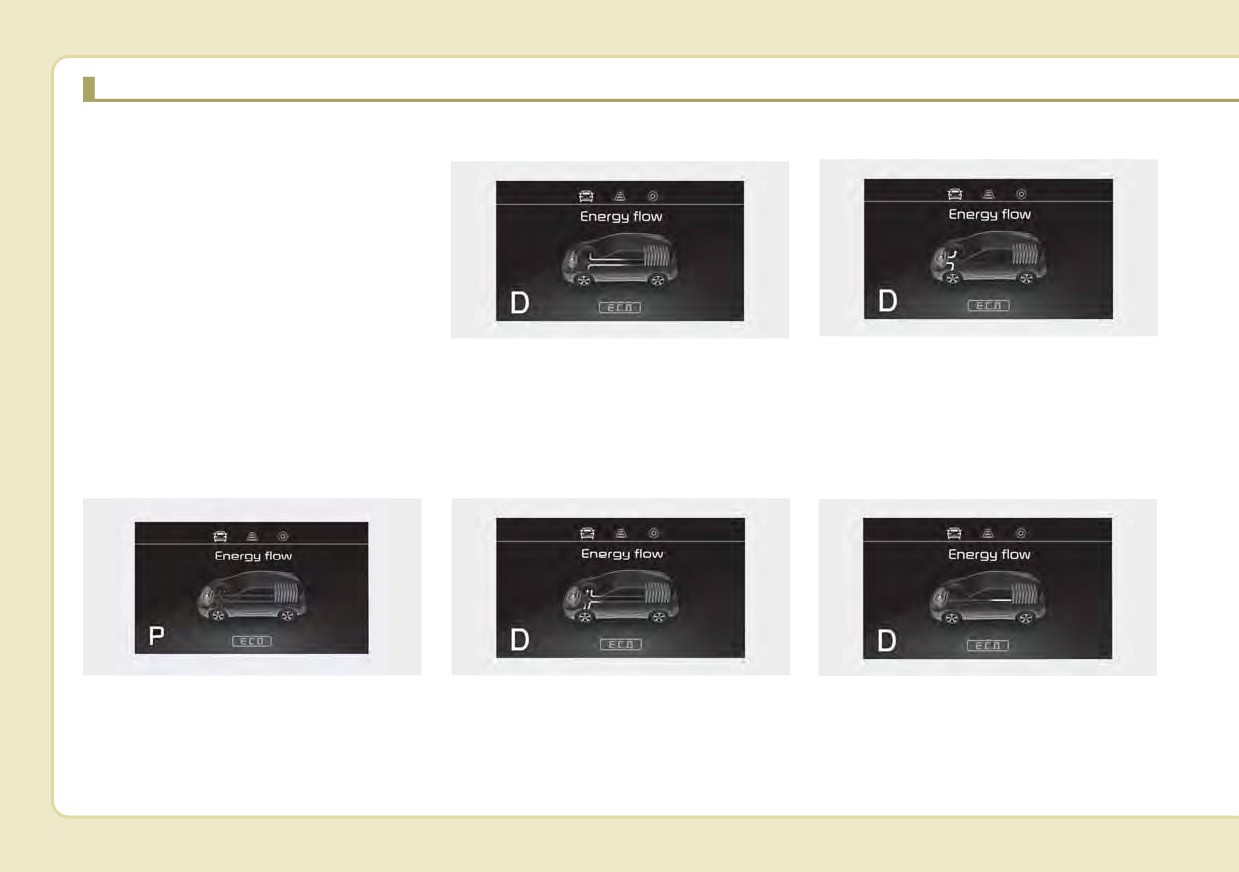
ENERGY FLOW
Kia hybrid system notifies the drivers
EV Propulsion
Engine Only Propulsion
of energy flow in various operating
modes. Eleven Modes show drivers
the current operating condition.
ODEP040202N
ODEP040204N
Electric power is used to move the
Engine power is used to move the
vehicle.
vehicle.
(Battery ➞ Wheel)
(Engine ➞ Wheel)
Vehicle Stop
Power Assist
Engine Generation
ODEP047201N
ODEP040203N
ODEP040205N
This mode means the vehicle is at a
Electric and Engine power are used
Vehicle is stopped with the Engine
stop. (There is no energy flow.)
to move the vehicle.
charging the hybrid battery.
(Battery & Engine ➞ Wheel)
(Engine ➞ Battery)
H36
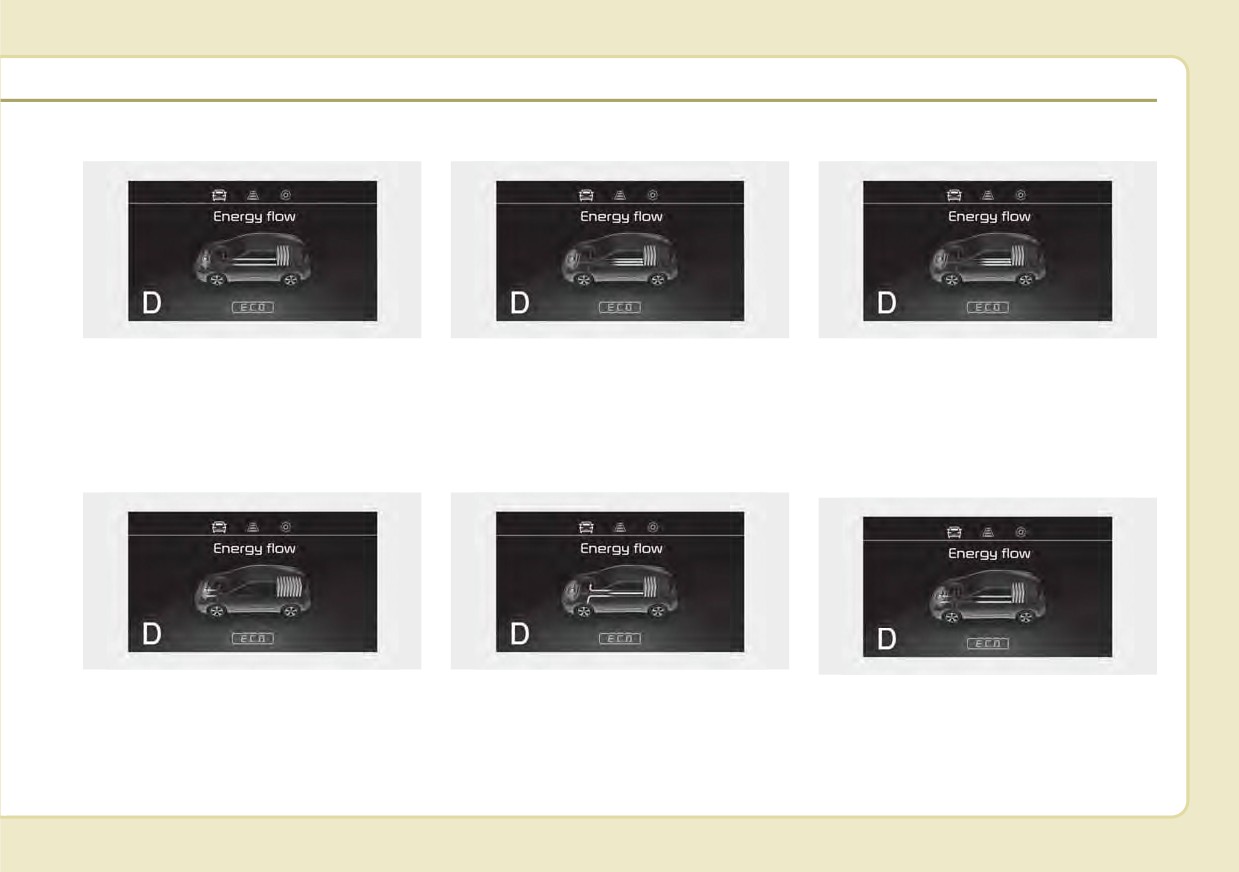
Regeneration
Power Reserve
Engine Generation/Regeneration
ODEP040206N
ODEP040207N
ODEP040207N
Hybrid battery is being charged by
Engine is both driving the vehicle
The engine and regenerative braking
regenerative braking.
and charging the hybrid battery.
system charge the hybrid battery
driving deceleration.
(Wheel ➞ Battery)
(Engine ➞ Wheel & Battery)
(Engine & Wheel ➞ Battery)
Engine Brake
Engine Generation/Motor Drive
Engine Brake/Regeneration
ODEP040208N
ODEP040209N
ODEP040210N
The vehicle is being slowed by
The engine charges up the high-volt-
The engine compression can be
engine compression.
age battery. The motor power is used
used to slow the vehicle. The regen-
to drive the vehicle.
(Wheel ➞ Engine)
erative braking system can be used
(Engine ➞ Battery ➞ Wheel)
to charge the hybrid system.
(Wheel ➞ Engine & Battery)
H37
PLUG-IN HYBRID ENERGY FLOW
AUX. BATTERY SAVER+ (For
Mode
✽ NOTICE
Plug-in Hybrid, if equipped)
• Cycle Mode :
The Aux. Battery Saver+ activates
The Aux. Battery Saver+ is a function
When the vehicle is OFF with all
for a maximum of 20 minutes. If the
that monitors the charging status of
doors, hood and liftgate closed, the
Aux. Battery Saver+ function acti-
the 12V auxiliary battery.
Aux. Battery Saver+ periodically acti-
vates more than 10 times consecu-
vates according to the auxiliary bat-
tively, in the Automatic Mode, this
If the auxiliary battery level is low, the
tery status.
function will stop activating, judg-
main high voltage battery charges
ing that there is a problem with the
the auxiliary battery.
auxiliary battery. In this case, drive
• Automatic Mode :
the vehicle for some period of time.
✽ NOTICE
When the engine start/stop button is
The function will start activating if
in the ON position with the charging
the auxiliary battery returns to nor-
The Aux. Battery Saver+ function will
connector plugged in, this function
mal.
be ON when the vehicle is delivered. If
activates according to the auxiliary
the function is not needed, you may
battery status to prevent over-dis-
turn it off in the Users Settings mode
CAUTION
charge of the auxiliary battery.
on the LCD display. For more infor-
The Aux. Battery Saver+ func-
mation, refer to the "System setting"
tion cannot prevent battery dis-
on the following page.
charge if the auxiliary battery is
damaged, worn out, used as a
power supply or if unauthorized
electronic devices are used.
✽ NOTICE
If the Aux. Battery Saver+ function
was activated, the high voltage bat-
tery level may have decreased.
H38
System setting
WARNING
The driver can activate the Aux.
Battery Saver+ function by placing
The Aux. Battery Saver+ relies
the engine start/stop button to the
on the high voltage battery to
ON position and by selecting:
charge the
12V battery. The
charging indicator lamp will blink
"User Settings ➞ Other Features ➞
rapidly when this is occurring.
Aux. Battery Saver+"
To reduce the risk of electrical
shock, do not touch any high
voltage components
(orange-
colored) or other electrical
devices while charging is occur-
ring.
H39
STARTING THE HYBRID/PLUG-IN HYBRID VEHICLE (SMART KEY)
Starting the Hybrid System
• When the engine start/stop but-
If the starting procedure is fol-
ton is in the ACC or ON position
lowed, the " " symbol on the
1.Carry the smart key into the vehicle.
and if any door is open, the sys-
instrument cluster will turn on. For
2.Make sure the parking brake is
more details, Please check chap-
tem checks for the smart key. If
firmly applied.
the smart key is not in the vehicle,
ter 4.
3.Place the shift lever in the P(Park)
the warning, "Key is not in vehi-
position.
cle" will come on, and if all doors
are closed, the chime will also
In N (neutral) position, you cannot
sound for about 5 seconds. The
start the vehicle.
indicator will turn off while the
4.Depress the brake pedal.
vehicle is moving. Keep the smart
5.Press the engine start/stop button.
key in the vehicle when using the
6.The engine should be started with-
ACC position or if the vehicle
out pressing the accelerator. In
engine is on.
extremely cold weather or after the
vehicle has not been operated for
several days, let the engine warm up
without depressing the accelerator.
• Even if the smart key is in the
vehicle, if it is far away from you,
the engine may not start.
H40

ECONOMICAL and SAFE
✽ NOTICE
OPERATION of Hybrid system
When the hybrid system is in ready
•
Drive smoothly. Accelerate at a
mode, the engine will automatically
moderate rate and maintain a
start and stop as needed.
steady cruising speed. Don't make
The " " symbol will illuminate in
"jack-rabbit" starts. Don't race
the cluster when the system is oper-
between stoplights.
ational.
Avoid heavy traffic whenever pos-
sible. Always maintain a safe dis-
CAUTION - Extended
tance from other vehicles so you
cranking
can avoid unnecessary braking.
Do not crank the engine for a
This also reduces brake wear.
prolonged period of time with-
•
The regenerative brake generates
out the engine starting. This
energy when the vehicle deceler-
could result in damage to the
ates.
HEV battery and result in total
•
When the hybrid battery power is
discharge.
low, the hybrid system automatical-
ly recharges the hybrid battery.
•
When the engine runs in "N" posi-
tion, the hybrid system cannot gen-
erate electricity. The hybrid battery
cannot recharge in "N" position.
Please refer to chapter 6.
H41
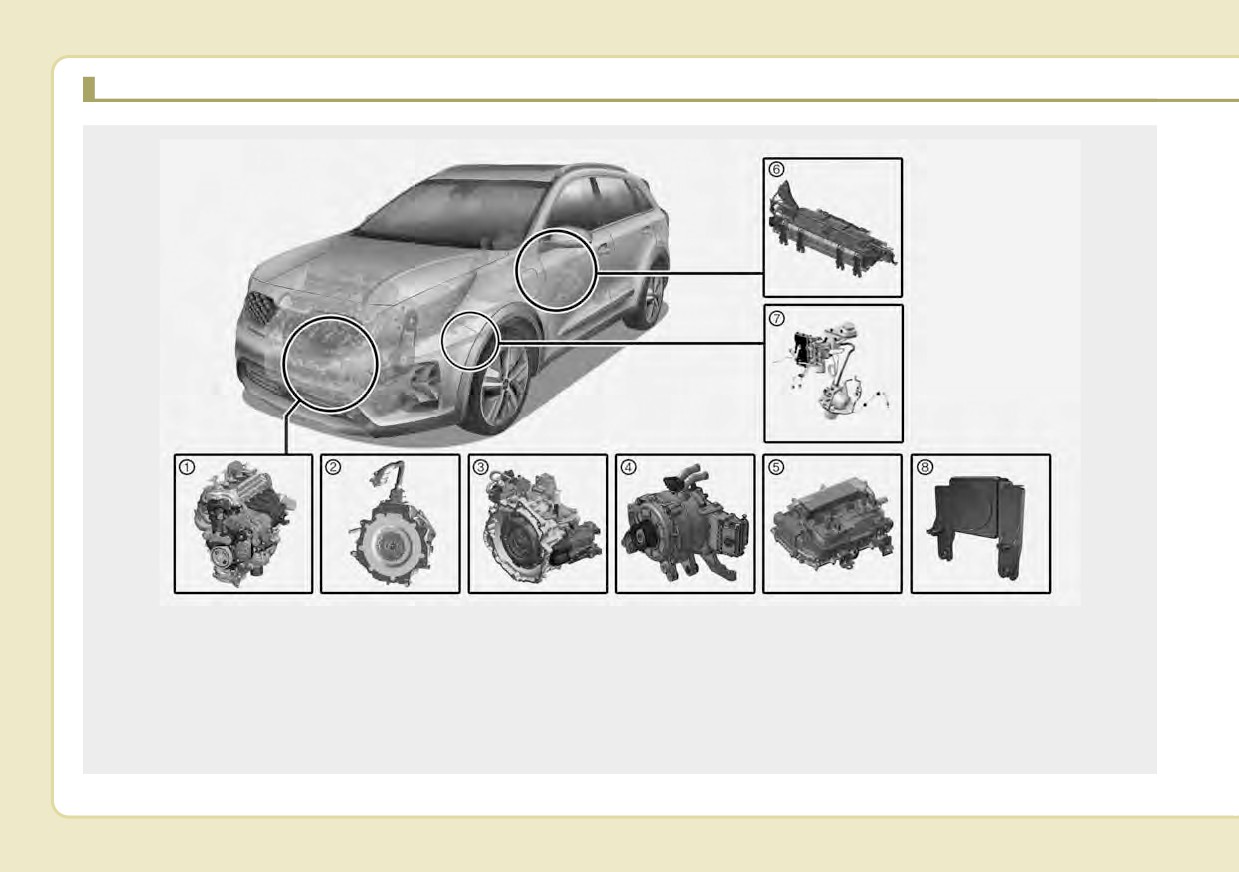
COMPONENTS OF THE HYBRID/PLUG-IN HYBRID VEHICLE
1. Engine : 1.6L
5. HPCU (Hybrid Power Control Unit)
2. Motor : 32kW (HEV)/ 44.5kW (PHEV)
6. High voltage battery system
3. Transmission : 6DCT
7. Regenerative brake system
4. Hybrid starter generator (HSG)
8. Virtual Engine Sound System (VESS)
❈ The actual shape may differ from the illustration.
ODEPQ011001L
H42
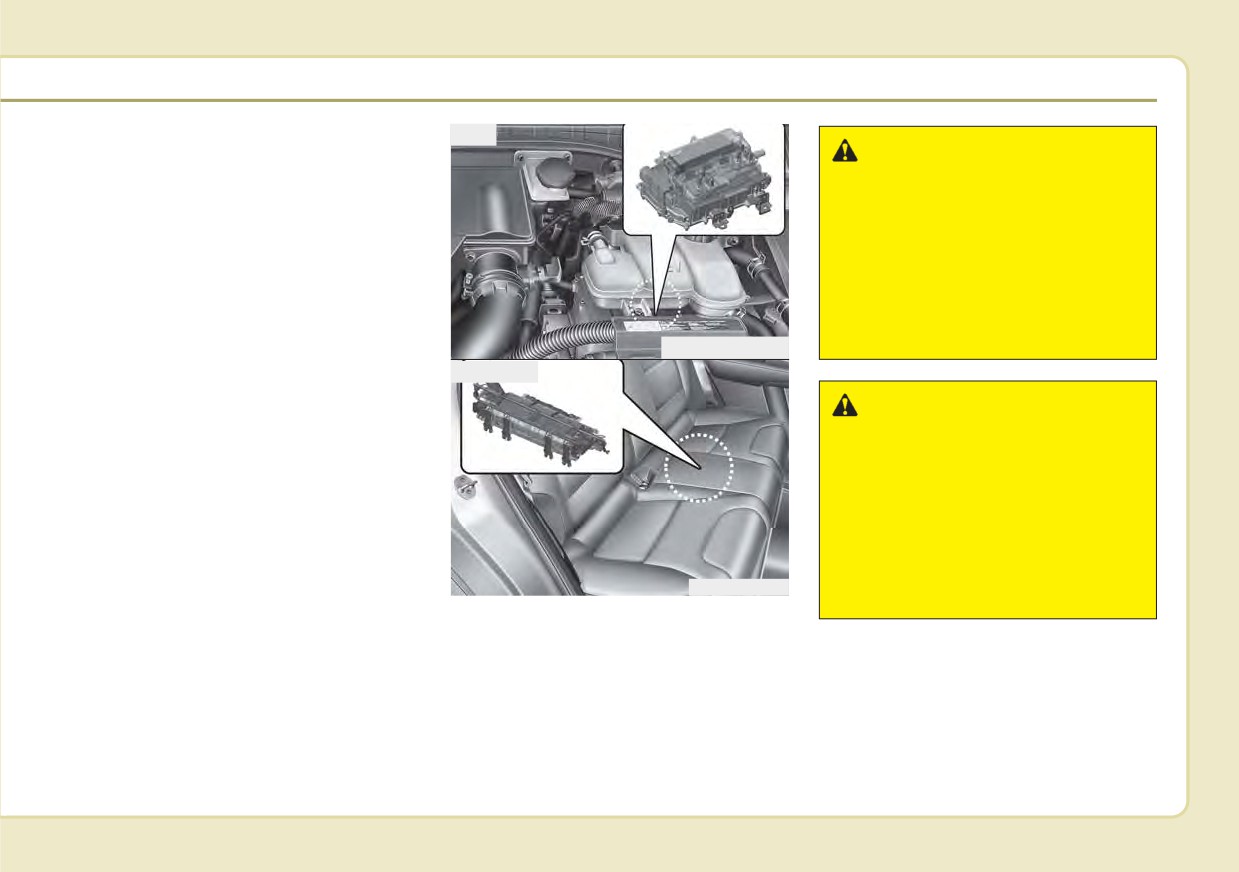
The Hybrid battery uses high voltage
HPCU
to operate the electric motor and
WARNING - High voltage
other components. High voltage is
components
dangerous if touched.
Never touch orange-colored or
Your vehicle is equipped with orange
high voltage labeled compo-
colored insulation which covers over
nents including wires, cables,
the high voltage components to pro-
and connectors. If the insula-
tect people from electric shock. High
tors or covers are damaged or
voltage warning labels are attached
removed, severe injury or death
to some system components as addi-
from electrocution may occur.
ODEPQ019002L
tional warnings. Have your vehicle
HEV Battery
serviced by an authorized Kia dealer.
WARNING - Avoid
Touching Hybrid Power
Control Unit
When replacing the fuses in the
engine compartment, never
touch the HPCU. The HPCU car-
ries high voltage. Touching the
HPCU could result in electrocu-
ODEQ016003
tion, serious injury, or death.
H43
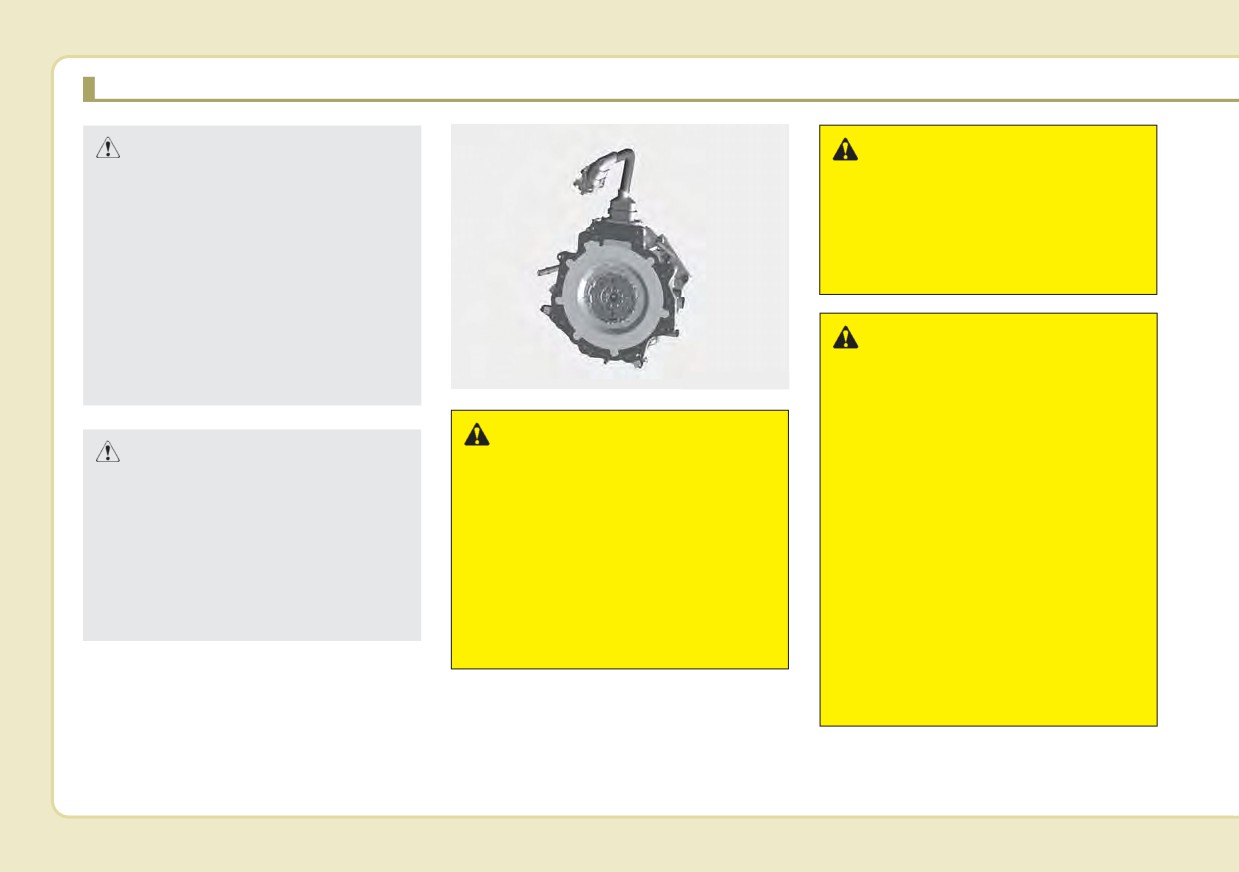
COMPONENTS OF THE HYBRID/PLUG-IN HYBRID VEHICLE (CONT.)
Motor
CAUTION - High Voltage
WARNING - After market
Battery Damage
battery charger
When loading your vehicle, be
Do not use an after-market bat-
careful of transporting items in
tery charger to charge the
a manner that could damage the
Hybrid battery. Doing so may
high voltage battery. Do not
result in death or serious injury.
store items on top of the high
voltage battery or overload the
trunk area. Such actions may
WARNING - High Waters
ultimately damage the high volt-
•
Avoid high waters as this may
age battery unit.
ODEQ016004
result in your vehicle becom-
ing saturated with water and
WARNING - Battery elec-
could compromise the high
CAUTION
- Carrying
voltage components.
trolyte
Liquids in Trunk
As with all batteries, avoid fluid
•
Do not touch any of the high
Do not load large amounts of
voltage components within
contact with the Hybrid battery.
liquid in open containers in the
If the battery is damaged and if
your vehicle if your vehicle
vehicle. If spilled onto the HEV
has been submerged in water
electrolyte comes in contact
battery, the liquid may cause a
with your body, clothes or eyes,
equal to half of the vehicle
short or further damage to the
height. Touching high voltage
immediately flush with a large
battery.
quantity of fresh water and seek
components once submerged
in water could result in severe
medical attention.
burns or electric shock that
could result in death or seri-
ous injury.
H44

✽ NOTICE - Prolonged parking
CAUTION - Cleaning
WARNING -
Use of Water
Prolonged parking might cause bat-
Engine
or Liquids
tery discharge and operation failure
When you clean the engine com-
If water or liquids come into
due to natural discharge. Driving
partment, do not wash using
contact with the hybrid system
the vehicle approximately once
water. Water may cause electric
components, and you are also
every 2 months, more than 9 miles
arcing to occur and damage elec-
in contact with the water, severe
(15 km) is recommended. The bat-
tronic parts and components.
injury or death due to electrocu-
tery will be charged automatically
tion may occur.
when driving the vehicle.
WARNING - Exposure to
High Voltage
WARNING - Hot
• High voltage in the hybrid bat-
Components
tery system is very dangerous
When the hybrid battery system
and can cause severe burns
operates, the HEV battery system
and electric shock. This may
can be hot. Heat burns may result
result in serious injury or death.
from touching even insulated
• For your safety, never touch,
components of the HEV system.
replace, dismantle or remove
any portion of the hybrid bat-
tery system including compo-
nents, cables and connectors.
H45
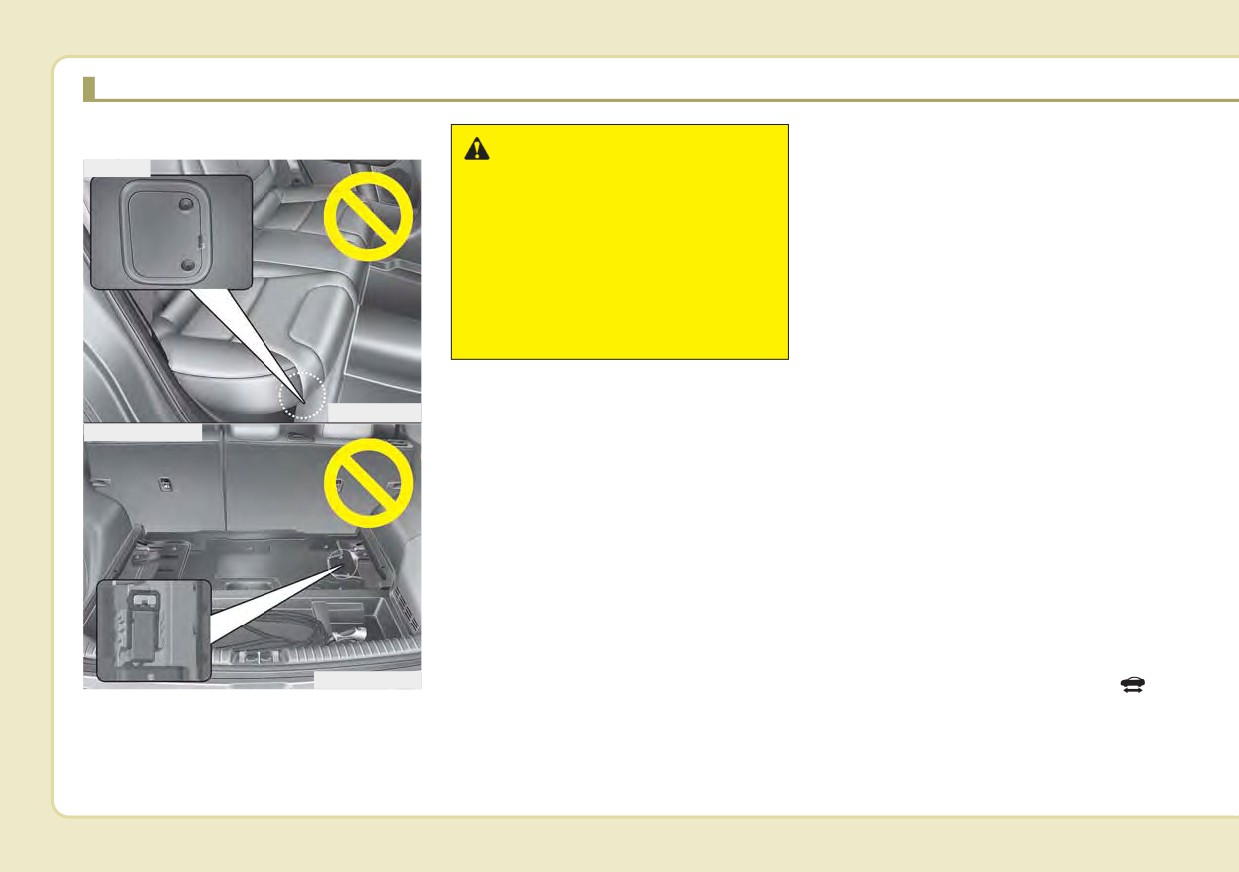
COMPONENTS OF THE HYBRID/PLUG-IN HYBRID VEHICLE (CONT.)
Safety plug
Some Special Features of the
WARNING - Safety Plug
Hybrid Vehicle.
■ Hybrid
Never touch the safety plug.
Hybrid vehicles sound different than
The safety plug is attached to
gasoline engine vehicles. When the
the high voltage hybrid battery
hybrid system operates, you may
system. Touching the safety
hear a sound from the hybrid battery
plug may result in death.
system behind the rear seat. If you
Service personnel should fol-
apply the accelerator pedal rapidly,
low the appropriate procedures
you may hear a sound. When you
in the service manual.
apply the brake pedal, you may hear
a sound from the regenerative brake
system. When the hybrid system is
turned off or on, you may hear a
ODEQ016006
■ Plug-in Hybrid
sound in the engine compartment. If
you depress the brake pedal repeat-
edly when the hybrid system is
turned on, you may hear a sound in
the engine compartment. None of
these sounds indicate a problem.
They are characteristics of hybrid
vehicles.
When the hybrid system is turned on,
the engine may run. This does not
ODEPQ017038
indicate a malfunction. If the "
"
symbol is on, the hybrid system is
operating. Even if the gasoline engine
is off, you can operate the vehicle.
H46

The HEV system may emit electro-
Virtual Engine Sound System
magnetic waves which can affect the
WARNING - Turning off
(VESS)
performance of electronic devices
HEV system
The Virtual Engine Sound System
appliances, such as laptop comput-
When you leave the vehicle, you
generates engine sound for pedestri-
ers, which are not part of the vehicle
should turn off the hybrid sys-
ans to hear vehicle sound because
design.
tem. If you depress the acceler-
there is limited sound while electric
ator pedal by mistake and the
motor power is used.
vehicle is not in the "P" posi-
If you park the vehicle for a long time,
• If the vehicle is moving at low
the hybrid system will discharge. You
tion, the vehicle will accelerate.
speed, the VESS will operate.
This may result in serious injury
need to drive the vehicle approximate-
• When the gear is shifted to R
ly once every 2 months, more than 9
or death.
(Reverse), an additional warning
miles (15 km) is recommended.
sound will be heard.
When you start the hybrid system in
the "P" transmission position, the
"
" symbol is illuminated in the
cluster. The driver can drive the vehi-
cle even if the engine is stopped.
H47
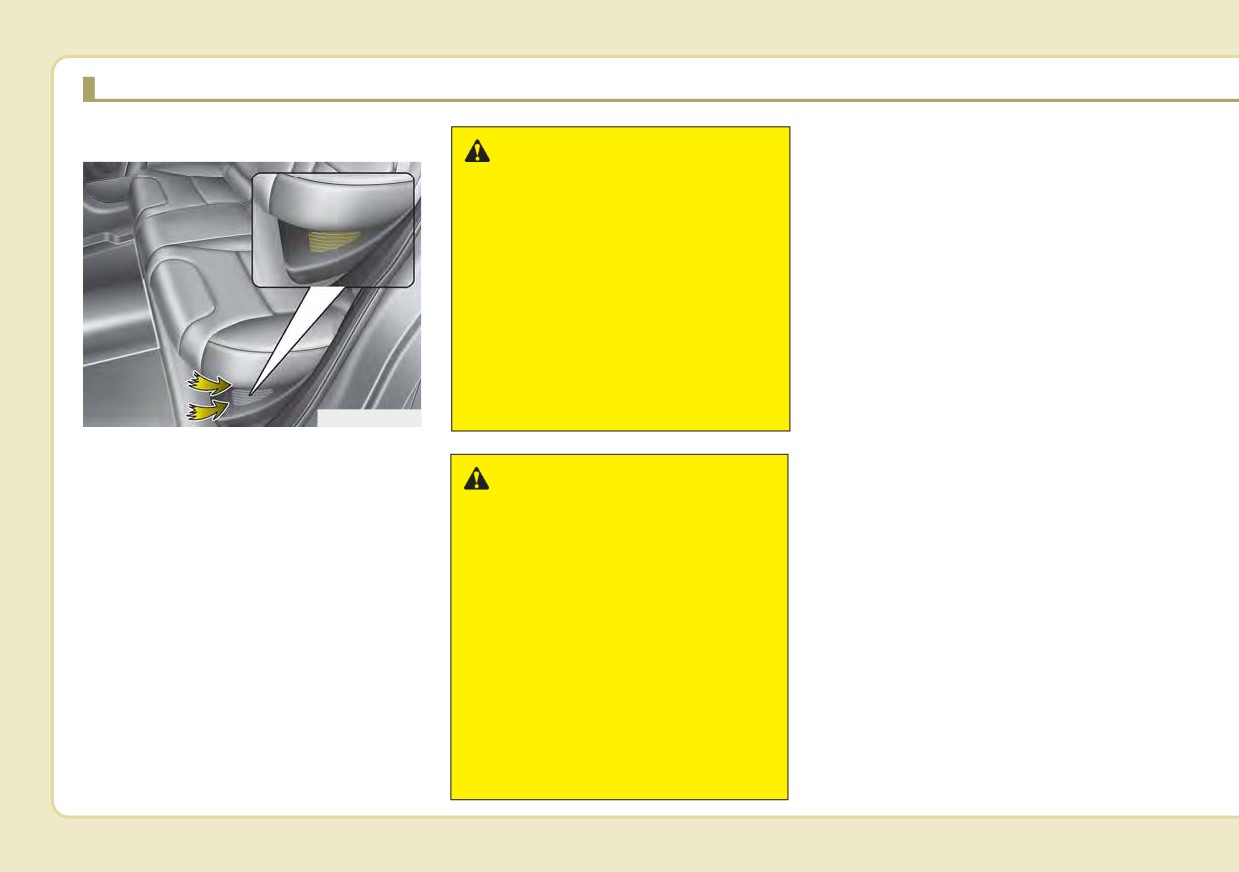
COMPONENTS OF THE HYBRID/PLUG-IN HYBRID VEHICLE (CONT.)
High Voltage Battery Air Intake
If An Accident Occurs
WARNING - Air Intake
•
Avoid the engine compartment.
•
Blocking the air intake behind
•
Avoid making contact with any
the rear seats may damage
orange or high voltage wires,
the HEV battery.
cables, or components.
•
Do not allow any water into
•
Assume that a high voltage compo-
the air intake even when
nent is exposed and move away from
cleaning. If any water enters
the vehicle as promptly as possible.
the air intake, the Hybrid bat-
•
Refer to Chapter 7 for towing infor-
tery may cause an electric
mation.
shock which can cause seri-
ous injury or death due to
electrocution.
ODEQ016007
The hybrid battery air intake is locat-
ed on bottom and side of the rear
WARNING
seats. The air intake cools down the
- Interference with electron-
hybrid battery. When the hybrid bat-
ic medical devices
tery air intake is blocked, the hybrid
battery may be overheated. Do not
Electromagnetic waves that are
obstruct the air intake with any other
generated from the charger can
objects.
impact medical electric devices
such as an implantable cardiac
pacemaker. When using such
medical electric devices, ask
your medical professional and
the
device
manufacturer
whether charging your electric
vehicle will impact the operation
of the medical electric devices.
H48
•
After parking the vehicle, shift the
If a vehicle accident occurs:
transmission into "P" position. Turn
WARNING
1.Stop the vehicle and shift the trans-
off the hybrid system by pushing
•
If a small scale fire occurs,
mission into "P" position and then
the Engine Start/Stop button.
use a fire extinguisher (ABC,
depress the parking brake.
•
For your safety, do not touch high
BC) that is meant for electrical
2.Turn off the Hybrid system by
voltage cables, connectors and
fires.
pushing the Engine Start/Stop
package modules. High Voltage
If it is impossible to extin-
Button.
components are orange in color.
guish the fire in the early
3.Step away from the vehicle and go
•
Exposed cables or wires may be
stage, remain a safe distance
to a safe place.
visible inside or outside of the vehi-
from the vehicle and immedi-
4.Call emergency services for help
cle. Never touch the wires or
ately call your local fire emer-
and let them know the vehicle is a
cables, because an electrical
gency responders. Also,
Hybrid vehicle.
shock may occur causing injury or
advise them that a hybrid
death.
vehicle is involved.
Do not touch high voltage cables,
connectors and package modules.
If the fire spreads to the high
High voltage components are
voltage battery, large amount
orange in color.
of water is needed to put out
Exposed cables or wires may be vis-
the fire.
ible inside or outside of the vehicle.
Using small amount of water
Never touch the wires or cables,
or fire extinguishers not
because an electrical shock may
meant for electrical fires
occur causing injury or death.
could cause serious injury or
death from electrical shocks.
•
If you need towing, refer to
chapter 6.
H49
COMPONENTS OF THE HYBRID/PLUG-IN HYBRID VEHICLE (CONT.)
When the hybrid vehicle shuts
WARNING
off
WARNING - Vehicle
If submersion in water occurs:
Accident
When the high voltage battery or 12-
If your vehicle was flooded and
volt battery discharges, or fuel tank is
Never touch electric wires or
has soaked carpeting or water
empty, the hybrid system may not
cable. If exposed electric wires
on the flooring, you should not
operate.
or cables are visible inside or
try to start the Hybrid system.
outside of your vehicle, an elec-
If the Hybrid system stops operating
Never touch the high voltage
tric shock may occur.
while the vehicle is moving, reduce
cables, connectors or package
the vehicle speed gradually, pull your
modules, because an electrical
vehicle off the road to a safe area,
shock may occur causing injury
WARNING - Putting out
and shift the transmission in to Park
or death. High Voltage cables
fire
(P) position and;
are orange in color.
Never use a small quantity of
1. Turn on the hazard warning flashers.
If this occurs. have the vehicle
water to put out a fire in your
2. Set the start button at OFF, and try
towed to and inspected by an
vehicle. If a fire occurs, evacu-
to start the Hybrid system by
authorized Kia dealer.
ate the car immediately and
applying the brake pedal and
contact the fire department.
pushing the start button.
3. If the Hybrid system will not oper-
ate, refer to "EMERGENCY
STARTING" in chapter 6.
Before you try to jump start the vehi-
cle, confirm the fuel level. If the fuel
level is low add more fuel before
attempting as emergency start.
H50
Introduction
Fuel requirements
1-2
1
• Gasoline containing alcohol and methanol
1-2
• Do not use methanol
1-3
• Fuel additives
1-4
• Operation in foreign countries
1-4
Vehicle modifications
1-5
Vehicle break-in process
1-5
HEV/PHEV powertrain
1-5
Vehicle data collection and event data recorders. . 1-6

Introduction
FUEL REQUIREMENTS
Your new vehicle is designed to use
Pursuant to EPA regulations, ethanol
only unleaded fuel having a pump
WARNING - Refueling
may be used in your vehicle.
octane number
((R+M)/2) of
87
• Do not “top off” after the noz-
Do not use gasohol containing more
(Research Octane Number 91) or
zle automatically shuts off.
than 15% ethanol, and do not use
higher. (Do not use methanol blend-
Attempts to force more fuel
gasoline or gasohol containing any
ed fuels.)
into the tank can cause fuel
methanol. Ethanol provides less
overflow onto you and the
energy than gasoline and it attracts
ground, causing a risk of fire.
water, and it is thus likely to reduce
Your new vehicle is designed to
obtain maximum performance with
• Always check that the fuel cap
your fuel efficiency and could lower
is installed securely to pre-
your MPG results.
UNLEADED FUEL, as well as mini-
mize exhaust emissions and spark
vent fuel spillage, especially
Methanol may cause drivability prob-
plug fouling.
in the event of an accident.
lems and damage to the fuel system,
engine control system and emission
Never add any fuel system cleaning
agents to the fuel tank other than
control system.
Gasoline containing alcohol and
what has been specified. (Consult an
Discontinue using gasohol of any
methanol
authorized Kia dealer for details.)
kind if drivability problems occur.
Gasohol, a mixture of gasoline and
• Tighten the cap until it clicks one
Vehicle damage or drivability prob-
ethanol (also known as grain alco-
time, otherwise the Check Engine
lems may not be covered by the
hol), and gasoline or gasohol con-
light will illuminate.
manufacturer’s warranty if they result
taining methanol
(also known as
from the use of:
wood alcohol) are being marketed
1. Gasoline or gasohol containing
along with or instead of leaded or
methanol.
unleaded gasoline.
2. Leaded fuel or leaded gasohol.
3. Gasohol containing more than
15% ethanol.
1
2
Introduction
"E85" fuel is an alternative fuel com-
Other fuels
Gasoline containing MMT
prised of 85 percent ethanol and 15
Using fuels that contain Silicone (Si),
Some gasoline contains harmful man-
percent gasoline, and is manufac-
MMT (Manganese, Mn), Ferrocene
ganese-based fuel additives Such as
tured exclusively for use in Flexible
(Fe), and Other metalic additives,
MMT(Methylcyclopentadienyl
Fuel Vehicles. “E85” is not compati-
may cause vehicle and engine dam-
Manganese Tricarbonyl). Kia does not
ble with your vehicle. Use of “E85”
age or cause misfiring, poor acceler-
recommend the use of gasoline con-
may result in poor engine perform-
ation, engine stalling, catalyst melt-
taining MMT. This type of fuel can
ance and damage to your vehicle's
ing, clogging, abnormal corrosion,
reduce vehicle performance and affect
engine and fuel system. Kia recom-
life cycle reduction, etc.
your emission control system. The
mends that customers do not use
Malfunction Indicator Lamp on the
Also, the Malfunction Indicator Lamp
fuel with an ethanol content exceed-
cluster may come on.
(MIL) may illuminate.
ing 15 percent.
Do not use methanol
✽ NOTICE
✽ NOTICE
Fuels containing methanol
(wood
Damage to the fuel system or per-
Your New Vehicle Limited Warranty
alcohol) should not be used in your
formance problem caused by the use
does not cover damage to the fuel sys-
vehicle. This type of fuel can reduce
of these fuels may not be covered by
tem or any performance problems
vehicle performance and damage
your New Vehicle Limited
caused by the use of “E85” fuel.
components of the fuel system,
Warranty.
engine control system and emission
control system.
✽ NOTICE
Never use any fuel containing
methanol. Discontinue use of any
methanol containing product which
may inhibit proper drivability.
1
3
Introduction
Fuel Additives
Operation in foreign countries
Kia recommends that you use good
If you are going to drive your vehicle
quality gasolines treated with deter-
in another country, be sure to:
gent additives such as TOP TIER
•
Observe all regulations regarding
Detergent Gasoline, which help pre-
registration and insurance.
vent deposit formation in the engine.
•
Determine that acceptable fuel is
These gasolines will help the engine
available.
run cleaner and enhance perform-
ance of the Emission Control System.
For more information on TOP TIER
Detergent Gasoline, please go to the
website (www.toptiergas.com)
For customers who do not use TOP
TIER Detergent Gasoline regularly,
and have problems starting or the
engine does not run smoothly, addi-
tives that can be purchased sepa-
rately may be added to the gasoline.
If TOP TIER Detergent Gasoline is
not available, one bottle of additive
should be added to the fuel tank at
every 8,000 miles
(13,000 km) or
every engine oil change is recom-
mended. Additives are available from
your authorized Kia dealer along with
information on how to use them. Do
not mix other additives.
1
4
Introduction
VEHICLE MODIFICATIONS
VEHICLE BREAK-IN
HEV/PHEV POWERTRAIN
This vehicle should not be modified.
PROCESS
By following a few simple precautions
Modification of your vehicle could
By following a few simple precautions
for the first 600 miles (1,000 km) you
affect its performance, safety or
for the first 600 miles (1,000 km) you
may add to the performance, econo-
durability and may even violate gov-
may add to the performance, econo-
my and life of your vehicle.
ernmental safety and emissions reg-
my and life of your vehicle.
•
Do not race the engine.
ulations.
•
Do not race the engine.
•
Avoid hard stops, except in emer-
In addition, damage or performance
gencies, to allow the brakes to seat
•
While driving, keep your engine
problems resulting from any modifi-
speed
(rpm, or revolutions per
properly.
cation may not be covered under
minute) between 2,000 rpm and
warranty.
bellow 4,000 rpm.
•
If you use unauthorized electronic
•
Do not maintain a single speed for
devices, it may cause the vehicle to
long periods of time, either fast or
operate abnormally, wire damage,
slow. Varying engine speed is
battery discharge and fire. For your
needed to properly break-in the
safety, do not use unauthorized
engine.
electronic devices.
•
Avoid hard stops, except in emer-
gencies, to allow the brakes to seat
properly.
•
Don't tow a trailer during the first
1,200 miles (2,000 km) of opera-
tion.
•
Fuel economy and engine perform-
ance may vary depending on vehi-
cle break-in process and be stabi-
lized after 4,000 miles (6,000 km).
New engines may consume more oil
during the vehicle break-in period.
1
5
Introduction
VEHICLE DATA COLLECTION AND EVENT DATA RECORDERS
This vehicle is equipped with an
These data can help provide a bet-
To read data recorded by an EDR,
event data recorder
(EDR). The
ter understanding of the circum-
special equipment is required, and
main purpose of an EDR is to
stances in which crashes and
access to the vehicle or the EDR is
record, in certain crash or near
injuries occur. NOTE: EDR data
needed. In addition to the vehicle
crash-like situations, such as an
are recorded by your vehicle only
manufacturer, other parties, such
air bag deployment or hitting a
if a non-trivial crash situation
as law enforcement, that have the
road obstacle, data that will assist
occurs; no data are recorded by
special equipment, can read the
in understanding how a vehicle's
the EDR under normal driving
information if they have access to
systems performed. The EDR is
conditions and no personal data
the vehicle or the EDR.
designed to record data related to
(e.g., name, gender, age, and
vehicle dynamics and safety sys-
crash location) are recorded.
tems for a short period of time,
However, other parties, such as
typically 30 seconds or less. The
law enforcement, could combine
EDR in this vehicle is designed to
the EDR data with the type of per-
record such data as:
sonally identifying data routinely
acquired during a crash investiga-
• How various systems in your
tion.
vehicle were operating;
• Whether or not the driver and
passenger safety belts were
buckled/fastened;
• How far (if at all) the driver was
depressing the accelerator
and/or brake pedal; and,
• How fast the vehicle was travel-
ing.
1
6
Your vehicle at a glance
Exterior overview
2-2
Interior overview
2-4
Instrument panel overview
2-5
2
Engine compartment
2-6
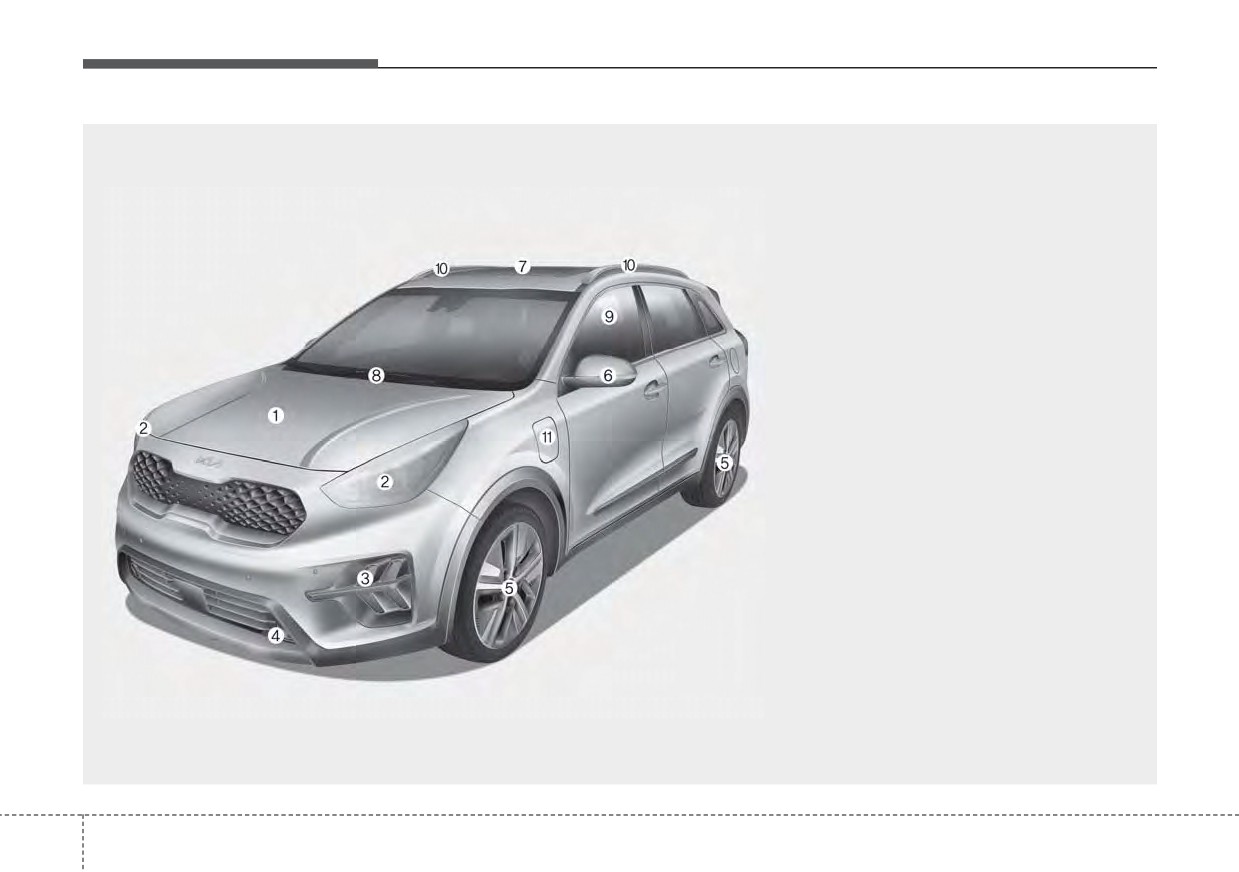
Your vehicle at a glance
EXTERIOR OVERVIEW
■ Front view
1. Hood
4-36
2. Head lamp (Features of your vehicle) ...4-125
Head lamp (Maintenance)
7-87
3. Daytime running light
(Features of your vehicle)
4-125
Daytime running light (Maintenance)
7-89
4. Fog lamp (Features of your vehicle) ...4-131
Fog lamp (Maintenance)
7-89
5. Wheel and tire (Maintenance)
7-43
Wheel and tire (Specifications)
8-5
6. Outside rearview mirror
4-63
7. Sunroof
4-44
8. Front windshield wiper blades
(Features of your vehicle)
4-132
Front windshield wiper blades
(Maintenance)
7-38
9. Windows
4-31
10. Roof rack
4-176
11. Charging door (plug-in)
Hybrid System
Overview
❈ The actual shape may differ from the illustration.
ODEP011001N
2 2
Your vehicle at a glance
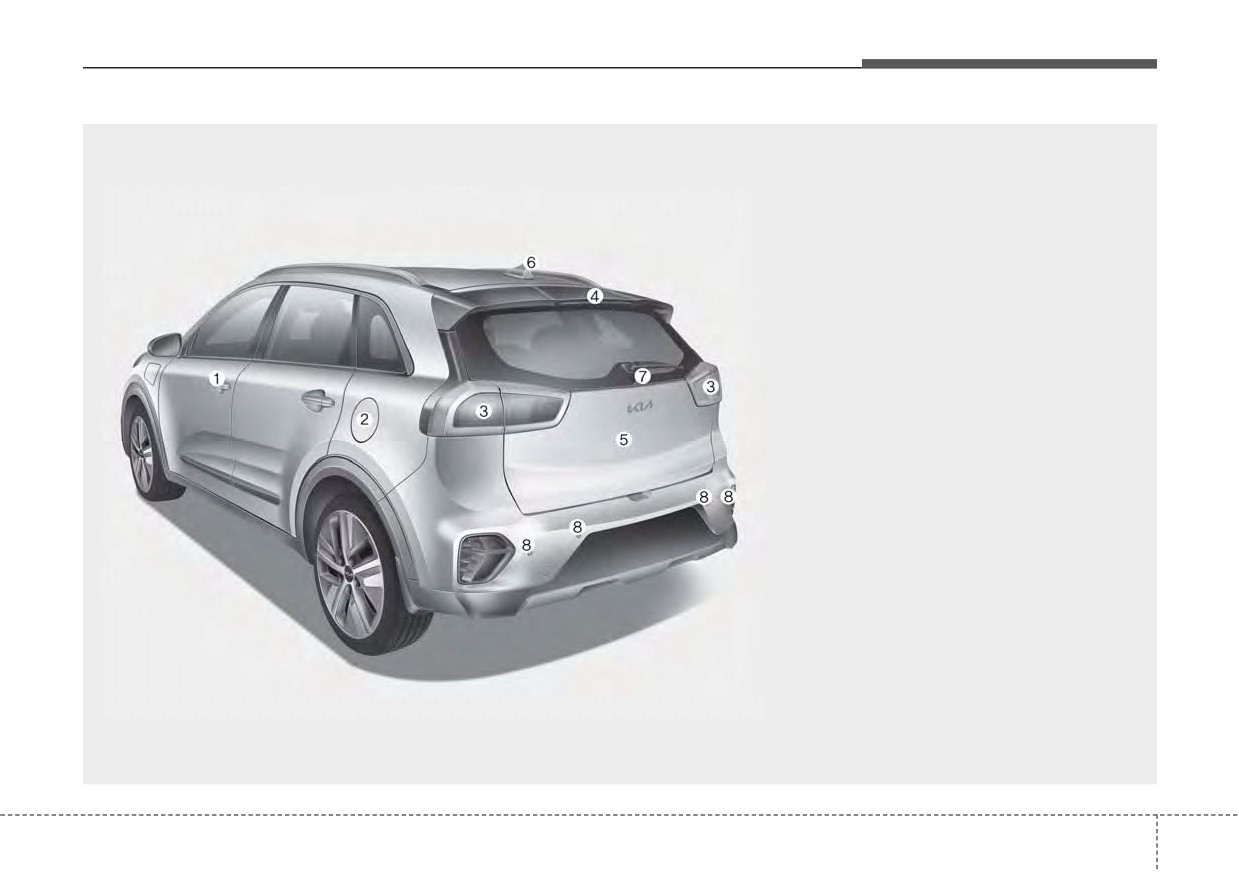
■ Rear view
1. Door locks
4-22
2. Fuel filler door
4-38, 4-40
3. Rear combination lamp
(Maintenance)
7-89
4. High mounted stop lamp
(Maintenance)
7-90
5. Liftgate
4-28
6. Antenna
4-178
7. Rear wiper and Rear view
camera (Features of your
vehicle)
4-132, 4-121
Rear window wiper blade (Maintenance)...7-39
8. Rear ultrasonic sensors
4-122
❈ The actual shape may differ from the illustration.
ODEP011002N
2 3
Your vehicle at a glance
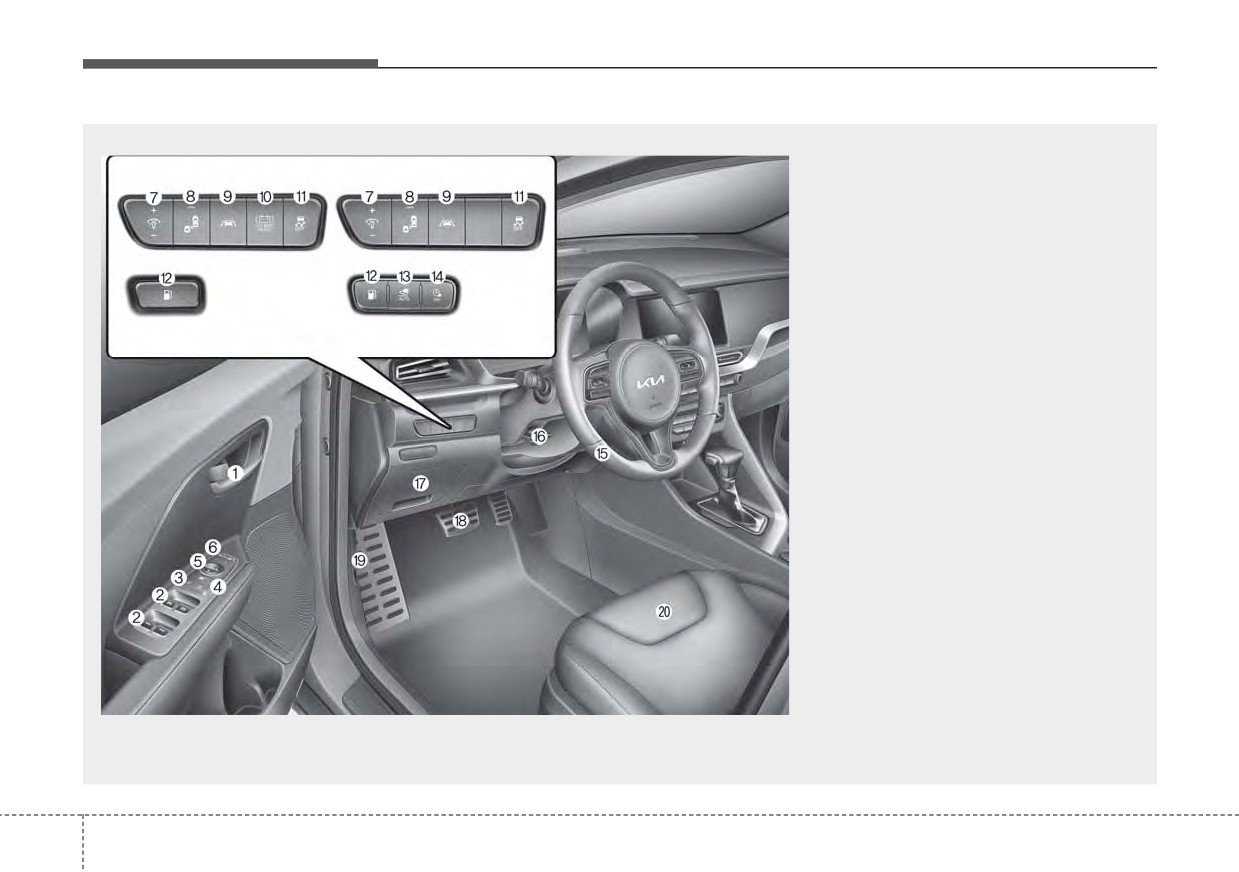
INTERIOR OVERVIEW
1. Inside door handle
4-23
• HEV
• PHEV
2. Power window switch
4-32
3. Central door lock switch
4-24
4. Power window lock button
4-34
5. Outside rearview mirror control
4-64
6. Outside rearview mirror folding
4-65
7. Instrument panel illumination control
4-67
8. Blind-Spot Safety button
5-97
9. Lane Safety button
5-88
10. 12V Battery Reset switch (For Hybrid)..6-5
11. ESC off button
5-47
12. Fuel filler door open button
4-38, 4-40
13. Auto Lock mode button
(For Plug-in Hybrid)
Hybrid System
Overview
14. Scheduled charging deactivation button
(For Plug-in Hybrid)
Hybrid System
Overview
15. Steering wheel
4-49
16. Tilt and telescopic steering control
lever
4-50
17. Inner fuse panel
7-59
18. Brake pedal
5-33
19. Hood release lever
4-36
20. Seat
3-4
❈ The actual shape may differ from the illustration.
ODEP011003N
2 4
Your vehicle at a glance
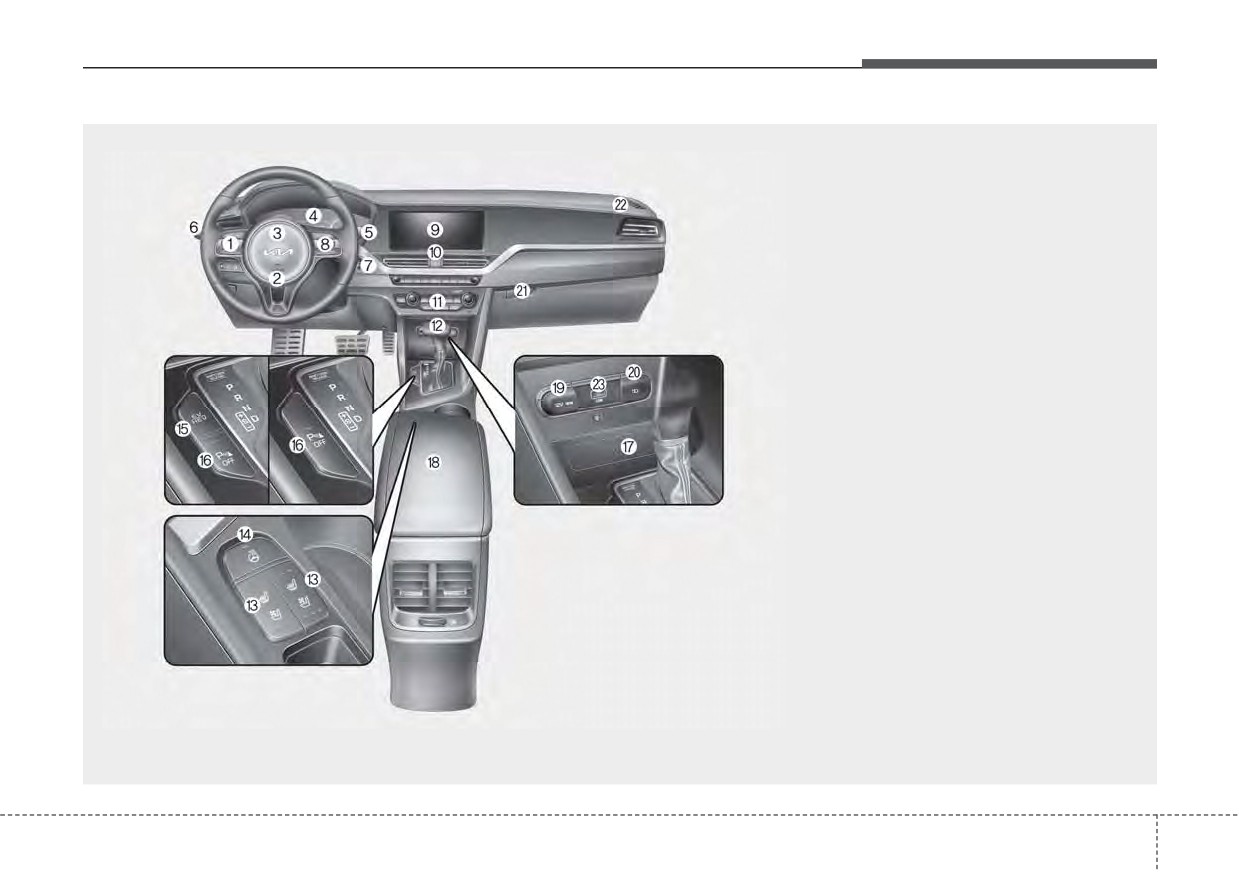
INSTRUMENT PANEL OVERVIEW
1. Steering wheel audio controls
Refer to
"Car Infotainment System Quick Reference
Guide".
2. Driver`s front air bag
3-62
3. Horn
4-52
4. Instrument cluster
4-67
5. Wiper and washer control lever
(Right)
4-132
6. Lighting control lever (Left)
4-126
7. Ignition switch
5-7
ENGINE START/STOP button
5-11
8. Driving Assist button
5-119
9. Infotainment system
Refer to "Car
Infotainment System Quick Reference
Guide".
10. Hazard warning flasher
6-2
11. Climate control system
4-141
12. Shift lever DCT
5-16
13. Front seat warmer
4-164
Front air ventilation seat
4-166
14. Heated steering wheel button
4-51
15. Changing plug-in hybrid mode
button
Hybrid System Overview
16. Parking Distance Warning Off
button
4-122
17. Smart phone wireless charger
4-169
18. Center console storage box
4-161
19. Power outlet
4-167
20. USB charger
4-168
21. Glove box
4-161
22. Passenger`s front air bag
3-62
23. USB port
4-178
❈ The actual shape may differ from the illustration.
ODEP011004N
2 5
Your vehicle at a glance
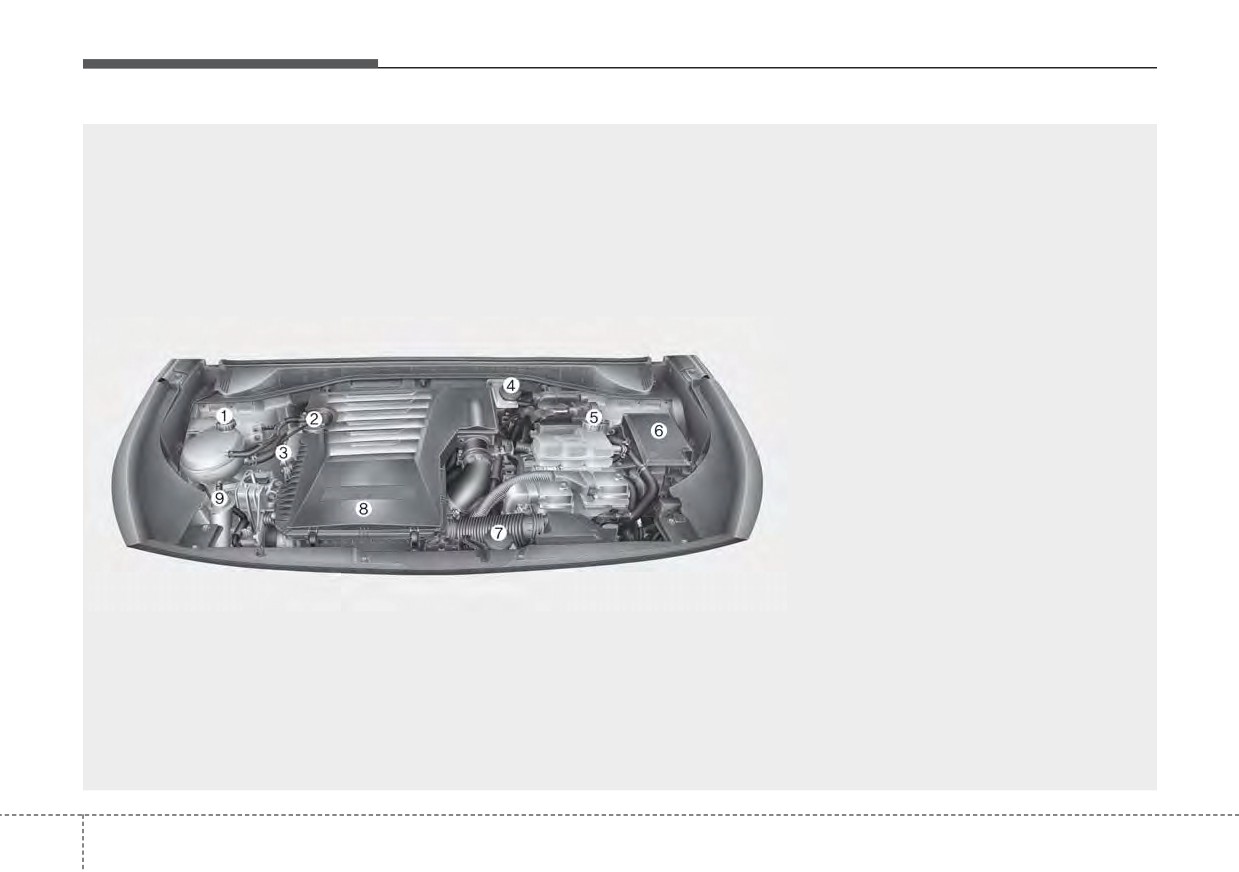
ENGINE COMPARTMENT
■ (Gasoline) 1.6 GDi
1. Engine coolant reservoir
7-22
2. Engine oil filler cap
7-19
3. Engine oil dipstick
7-19
4. Brake fluid reservoir
7-27
5. Inverter coolant reservoir
7-23
6. Fuse box
7-62
7. Engine clutch actuator reservoir tank.7-29
8. Air cleaner
7-33
9. Windshield washer fluid reservoir
7-31
❈ The actual engine room in the vehicle may differ from the illustration.
ODEP079115
2 6
Safety features of your vehicle
Important safety precautions
3-2
Air bag - advanced supplemental restraint
• Always wear your seat belt
3-2
system
3-47
• Restrain all children
3-2
• How does the air bag system operate?
3-48
• Air bag hazards
3-2
• Air bag warning light
3-50
• Driver distraction
3-2
• SRS components and functions
3-51
• Control your speed
3-3
• Occupant Detection System (ODS)
3-54
• Keep your vehicle in safe condition
3-3
• Driver's and passenger's front air bag
3-62
3
Seat
3-4
• Side air bag
3-65
• Front seat adjustment - manual
3-7
• Curtain air bag
3-67
• Front seat adjustment - power
3-8
• SRS Care
3-72
• Driver position memory system (for power seat). . . 3-10
• Adding equipment to or modifying your
• Headrest (for front seat)
3-12
air bag-equipped vehicle
3-73
• Seatback pocket
3-15
• Air bag warning label
3-73
• Rear seat adjustment
3-15
Seat belts
3-21
• Seat belt restraint system
3-21
• Pre-tensioner seat belt
3-29
• Seat belt precautions
3-31
• Care of seat belts
3-33
Child Restraint System (CRS)
3-35
• Children always in the rear
3-35
• Selecting a Child Restraint System (CRS)
3-36
• Installing a Child Restraint System (CRS)
3-39
Safety features of your vehicle
IMPORTANT SAFETY PRECAUTIONS
You will find many safety precautions
Restrain all children
Driver distraction
and recommendations throughout
All children under age 13 should ride
Driver distraction presents a serious
this section, and throughout this man-
in your vehicle properly restrained in
and potentially deadly danger, espe-
ual. The safety precautions in this sec-
a rear seat, not the front seat. Infants
cially for inexperienced drivers.
tion are among the most important.
and small children should be
Safety should be the first concern
restrained in an appropriate child
when behind the wheel and drivers
Always wear your seat belt
restraint. Larger children should use
need to be aware of the wide array of
a booster seat with the lap/shoulder
potential distractions, such as drowsi-
A seat belt is your best protection in
belt until they can use the seat belt
ness, reaching for objects, eating,
all types of accidents. Air bags are
properly without a booster seat.
personal grooming, other passen-
designed to supplement seat belts,
gers, and using cellular phones.
not replace them. So even though
your vehicle is equipped with air
Air bag hazards
Drivers can become distracted when
they take their eyes and attention off
bags, ALWAYS make sure you and
While air bags can save lives, they
your passengers always wear their
the road or their hands off the wheel
can also cause serious or fatal
to focus on activities other than driv-
seat belts, and wear them properly.
injuries to occupants who sit too
ing. To reduce your risk of distraction
close to them, or who are not prop-
or getting into an accident:
erly restrained. Infants, young chil-
• ALWAYS set up your mobile
dren, and shorter adults are at the
devices (i.e., MP3 players, phones,
greatest risk of being injured by an
navigation units, etc.) when your
inflating air bag. Follow all instruc-
vehicle is parked or safely stopped.
tions and warnings in this manual.
3
2