Volkswagen Jetta (2023 year). Manual in english - page 6

Mobile online services
myVW with Connected Features by Car-Net®
Introduction
VW Car-Net Ready
Your vehicle is equipped with VW Car-Net hardware, including a three-button module in the roof console. In order to use the VW Car-Net services, you need a
subscription to them and to activate them. Many of the services come at an additional cost. Some services may be offered as a trial subscription for a limited period
of time.
VW Car-Net requires a mobile network connection and GPS signal availability.
WARNING
Using apps while driving can distract from traffic. Driver distraction can cause serious accidents and fatal injuries.
Only use apps and functions when the vehicle is stationary.
Always drive attentively and responsibly.
Once you have registered with VW Car-Net, positional information from the vehicle is transmitted every time one of the VW Car-Net buttons is tapped. This
also occurs in the event of an automatic emergency call or periodically in conjunction with using the VW Car-Net functions. Volkswagen has the capability to
determine the exact position of the vehicle at any time, should this be required legally, by order or compulsory measure, or be necessary in emergencies,
provided that the VW Car-Net equipment has not been deactivated. For further information, please contact the VW Car-Net Response Center on 1-833-648-
2735. Calls may be monitored or recorded.
Volkswagen collects, processes, shares and transmits information about you and your vehicle in compliance with the VW Car-Net terms and conditions and
privacy provisions. For more information, please visit our website at:
Situations that can affect system functions
Please read the introductory information and heed the Warnings and Notice ⇒
Introduction.
Even if requirements for the usage of these services have been met, the performance of VW Car-Net may be impaired or blocked by various factors that are outsid
of the control of Volkswagen. In particular, this includes:
Maintenance, repairs, deactivations, software updates, and technical improvements to the telecommunications systems, satellites, servers, and databases.
Switching the mobile network standard to transmit mobile data through the telecommunications provider, for example, from UMTS to EDGE or GPRS.
Switching off an existing mobile network standard via the telecommunications provider.
Malfunction, impairment, or interruption of the mobile network and GPS reception, for example due to high speeds, solar storms, weather conditions, regional
circumstances, malfunctioning equipment, and high mobile network usage in the applicable radio cells.
If you are in a location with no or very poor cell phone or GPS reception. These locations may include tunnels, areas between tall buildings, garages, parking
ramps, underpasses, mountains, and valleys.
Limited availability of information or incomplete or incorrect information from third-party providers, such as on map displays.
In countries, federal states and regions where VW Car-Net not offered.
VW Car-Net® Portfolio
Please read the introductory information and heed the Warnings and Notice ⇒
Introduction.
VW Car-Net is part of Connected Vehicle Services and makes driving a Volkswagen more convenient. The In-Vehicle Services can be used via the control for voice
services in the roof console.
Emergency Call Service
If you or your passengers require medical assistance or help from the police, press the emergency call button. You will be connected to a contact partner at the
Volkswagen emergency call center, who will assess your situation and, if required, will send the police or medical help to the GPS location of your vehicle.
Only press the emergency call button if you require medical assistance or help from the police via VW Car-Net.
Volkswagen is not responsible for the reaction time of police or medical emergency services, or the assistance they provide on site.
Roadside assistance call
In the event of a breakdown, press the roadside assistance call button. You will be connected to a contact partner at VW Roadside Call Assist, who will send help to
your GPS location.
Do not use the roadside assistance call button or the information call button to request police or medical help.
Information call
2 3

Press the information call button. You will be connected to a contact parter at the VW Car-Net call center, who can help you in the following cases, amongst others:
Logging in and registering services.
Finding and sending routes to the navigation system.
Locating VW service partners.
Registration required
If you want to use VW Car-Net, you must log in and activate the functions. Many functions require a paid subscription. Some functions can be provided with a time-
limited trial subscription. For more information on VW Car-Net functions, visit our website at:
After registering successfully, inform all users of the vehicle that the following data from the vehicle is sent or automatically received:
Speed
Location.
Further information.
Functions and services of VW Car-Net and every trial or paid subscription may be adjusted, ended, deactivated, reactivated or enhanced without additional
notifications. You can read details regarding subscription, Terms of Use and privacy policy at:
If you have any questions or would like to start a subscription, contact our VW Car-Net Response Center on 1-833-648-2735, or visit our website at:
2 4
Infotainment system
First steps
Introduction
The functions and settings of the Infotainment system depend on the vehicle equipment and are not available in all countries.
Prior to the first use
Before using the Infotainment system for the first time, read the following points to be able to fully use the available functions and settings:
Observe the safety instructions ⇒ Safety instructions.
Reset the Infotainment system to factory settings ⇒ System and sound settings.
Find your favorite radio stations, also referred to in the following as stations, and save them on the station preset buttons to quickly access them
⇒ Radio
mode.
Only use suitable audio sources and data carriers ⇒ Media mode.
Use current map data for the navigation system.
Pair a cell phone in order to use the phone interface to make calls
⇒ Mobile phone interface.
Register on VW Car-Net® to use related services.
Other applicable documents
In addition to this manual, please refer to the following documentation when using this Infotainment system and its components:
Supplements to your Owner's Manual.
Operating instructions for the cell phone or audio sources.
Operating instructions for external data carriers and players.
Instructions for retrofitted or additional Infotainment accessories.
Safety instructions
Refer to ⇒
and
Some functions may contain links to websites that are administered by third parties. Volkswagen does not assume ownership of third-party sites reached
through links and is not responsible for their content.
Some functions may contain third-party information that originates from third-party providers. Volkswagen is not responsible for the accuracy, currentness, and
completeness of this non-proprietary information, and for ensuring that the rights of third parties are not violated.
The radio stations and owners of the data carriers and audio sources are responsible for the transmitted content.
Parking buildings, garages, underpasses, tunnels, tall buildings, mountains and valleys or electrical devices such as battery chargers can also interfere with
cell phone, GPS and radio signal reception.
Foil stickers or stickers with a metal layer placed on the antenna and on the windows can impair radio reception.
Read and follow the applicable manufacturer's operating instructions when using cell phones, data carriers, external devices, and external audio and media
sources.
WARNING
The Infotainment system's central processor is networked with the control modules installed in the vehicle. If the central processor is incorrectly repaired,
removed or reinstalled, there is an increased risk of accident and injury due to the control module not functioning properly or at all.
Never replace the central processor with a used central processor from a scrap vehicle or from recycling.
Always have the central processor repaired, removed and reinstalled by suitably qualified professionals. Volkswagen recommends contacting an
authorized Volkswagen dealer or authorized Volkswagen Service Facility.
WARNING
Reading information on the screen, operating the Infotainment system and connecting, inserting or removing a data carrier or audio source while driving can
distract from traffic. Driver distraction can cause accidents and injuries.
Always drive attentively and responsibly.
WARNING
Displays and information on the screen may be difficult to read if the lighting conditions are unfavorable or if the screen is damaged or dirty.
2
5

Never allow displays and information on the screen to cause you to engage in behavior that poses a safety risk. Always drive attentively and responsibly.
WARNING
Setting the volume too high can prevent you hearing audible signals. Failing to hear external audible signals could result in accidents.
Adjust the volume settings in the Infotainment system so that audible signals from outside the vehicle (such as sirens on emergency service vehicles)
can still be heard.
WARNING
Setting the volume too high can cause hearing damage, even if you are exposed to a loud volume for only a short time.
Select a volume level that is comfortable for all vehicle occupants.
Avoid excessively high volume levels.
WARNING
Sudden volume fluctuations, e.g. when the audio or media source is changed or connected, could distract the driver, which could result in accidents and injuries.
Reduce the volume level before changing or connecting an audio or media source, for example.
WARNING
The following conditions may prevent or cause interruptions to emergency calls, phone calls, and data transmission:
If you are in a location with no or very poor cell phone or GPS reception.
If you are in a location where there is good cell phone and GPS reception, but the telecommunications provider's mobile communications network is
malfunctioning or unavailable.
If the vehicle components required for emergency calls, phone calls, and data transmission are damaged, not operating, or have insufficient power.
If the cell phone battery is drained or if the battery charge level is too low.
WARNING
Radio stations can broadcast messages about disasters and dangers. It may not be possible to receive or send messages under the following conditions:
If you are in a location with no radio reception, or insufficient reception.
If the radio station's frequency bands are malfunctioning or not available.
If the speakers and vehicle components required for radio reception are damaged, not operating, or have insufficient power.
WARNING
In some countries and mobile networks, emergency calls can only be made under the following conditions:
A cell phone with an unlocked SIM card and sufficient calling credit is connected to the vehicle's phone interface.
Adequate network coverage is available.
WARNING
Using a cell phone or CB radio inside the vehicle without a separate outside antenna that is installed correctly may create electromagnetic energy that exceeds
permissible limits. This may be dangerous to the health of all vehicle occupants.
Keep the cell phone antenna at least approximately 20 cm (8 inches) away from any active medical implants, such as pacemakers, because cell phones
can impair the function of active medical implants.
Do not place a cell phone that is turned on directly above or in the immediate vicinity of any active medical implants, for example by keeping the phone in
a shirt pocket.
Immediately switch off cell phones if you suspect there is interference with an active medical implant, such as a pacemaker, or other medical device.
WARNING
2 6
Loose, unsecured or incorrectly mounted cell phones, external devices, and accessories can be thrown through the vehicle interior and cause accidents and
severe injuries in the event of sudden driving or braking maneuvers or a collision.
Secure cell phones, external devices and accessories outside of the airbag deployment zone or stow them securely.
Always safely secure or stow cell phones, external devices, audio sources and accessories in the provided storage compartments and holders within the
vehicle to prevent them being thrown through the vehicle interior and thereby avoid hindering the driver.
Never leave heavy, hard or sharp objects in clothing pockets.
Arrange cables for external devices and audio sources so that they are not in the way of the driver.
WARNING
Driving recommendations and traffic signs displayed in the navigation system may differ from the actual traffic situation and must not be allowed to mislead you
into undertaking actions that present a safety risk.
Always drive attentively and be ready to intervene at any moment.
Always be aware that traffic signs, signal systems, and traffic regulations take priority over the driving recommendations and displays in the navigation
system.
Always adapt your speed and driving style to the current visibility, weather, road and traffic conditions.
NOTICE
Radiation from cell phones that are switched on can interfere with sensitive technical and medical devices, potentially causing malfunctions or damage to the
devices.
Always switch off the cell phone in areas with special regulations relating to or prohibiting the use of cell phones.
NOTICE
Setting the volume too high and excessively loud or distorted playback can damage the speakers.
Select the volume setting so that the speakers are not damaged.
User information
Refer to ⇒
and Safety instructions.
The Infotainment system requires a few seconds to perform a complete system start, and will not respond to inputs during that time. During the system start,
only the Rear Assist camera can be displayed.
The Infotainment system must start completely before all displays can appear and functions can be performed. The length of time that it takes for the system to
start depends on the scope of functions in the Infotainment system, and it can take longer to start at low and high temperatures.
Observe local regulations and legal requirements when using the Infotainment system and corresponding accessories, such as a headset or headphones.
For the Infotainment system to function, it must be switched on and the vehicle must be set to the current date and time if necessary.
A missing function key in the screen is not the result of a device error, but instead corresponds to the country-dependent equipment.
Some Infotainment system functions can only be selected when the vehicle is stationary. In some countries, the selector lever must also be in the
or
selector lever position. This is not a malfunction, but rather compliance with legal regulations.
Some countries may have restrictions regarding the use of Bluetooth® devices. Information can be obtained from the local authorities.
If the 12 V vehicle battery has been disconnected, switch on the ignition before switching on the Infotainment system.
Displays on the screen may vary due to differences in the settings, and the Infotainment system may function differently than described in this manual.
The Infotainment system will switch off automatically when the engine stops and if the 12 V vehicle battery charge level is low.
In some vehicles with a parking system, the volume of the current audio source may be automatically lowered when you shift into reverse. The volume
reduction level can be adjusted.
The Infotainment system contains information about the software contained in the system and the licensing terms under: Setup
Copyright.
If selling or loaning your vehicle, make sure that all saved data, files and settings are deleted, and that the external SD card, external audio sources and data
carriers are removed, if necessary.
Certain functions in the Infotainment system require an active VW Car-Net account for the vehicle and an online connection to the Internet. In order to enable
functions to be carried out, data transfer must not be restricted.
Overview and controls of the 8" version and 6.5" version
Refer to ⇒
and Safety instructions.
2 7
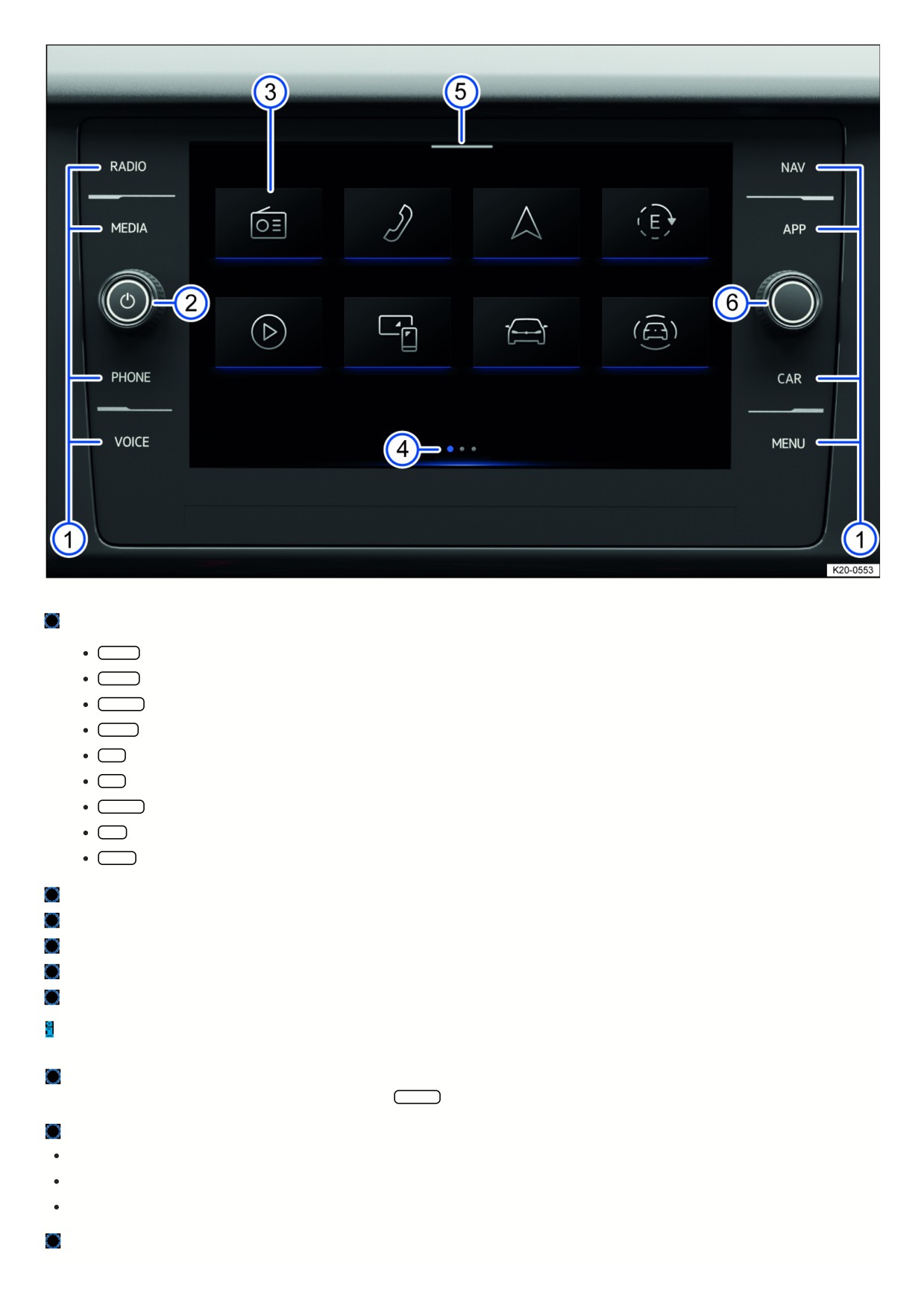
Fig. 129 Overview: display and control unit, 8" version.
Possible sensor areas for opening main menus:
RADIO ⇒ Radio mode.
MEDIA ⇒ Media mode.
PHONE ⇒ Mobile phone interface.
VOICE ⇒ Voice control. The sensor area does not have a function in some countries.
NAV ⇒ Navigation.
APP ⇒ App-Connect. The sensor area does not have a function in some countries.
SOUND .
CAR .
MENU Opens the home screen.
Rotary knob.
Function keys for main menus.
Views (current view is highlighted).
Control Center.
Menu knob.
Further information and tips for operating the Infotainment system are available at
⇒ Operating the Infotainment system .
Touch-sensitive fields
1. To open a main menu, tap the corresponding sensor area, e.g. PHONE for the phone interface.
Rotary knob
Press to switch the Infotainment system on or off.
Turn left to decrease the volume.
Turn right to increase the volume.
Function keys for main menus
2
8
It is not possible to configure the position of the function keys.
1. To open a main menu, tap the corresponding function key e.g.
for the phone interface.
Views (current view is highlighted)
Certain menus and functions have multiple views with different content. The current view is highlighted.
Tap a selection to switch to a view.
Swipe left or right on the screen to switch between views.
Control Center
The Control Center contains additional function keys for functions and notifications. Displayed functions can be configured
⇒ Personalizing the Infotainment syste
1. Tap the selection and swipe down to open the Control Center.
Menu knob
1. Turn to control the list selection.
2. Press to confirm a selection.
Screen (touchscreen) (without position numbers)
You can operate the Infotainment system functions via the screen. You will find detailed explanations of the different finger movements in the digital manual for the
Infotainment system, if available.
1. Tap MENU
Operation.
Scroll bars (without position numbers)
Certain menus and functions contain additional content above and below the content currently displayed on the screen.
1. Tap the scroll bar and swipe down or up to display additional content.
Gesture control (without position numbers)
Gesture control can also be switched on. If gesture control is switched on, this is shown on the screen.
1. Tap MENU
Screen Hand gesture.
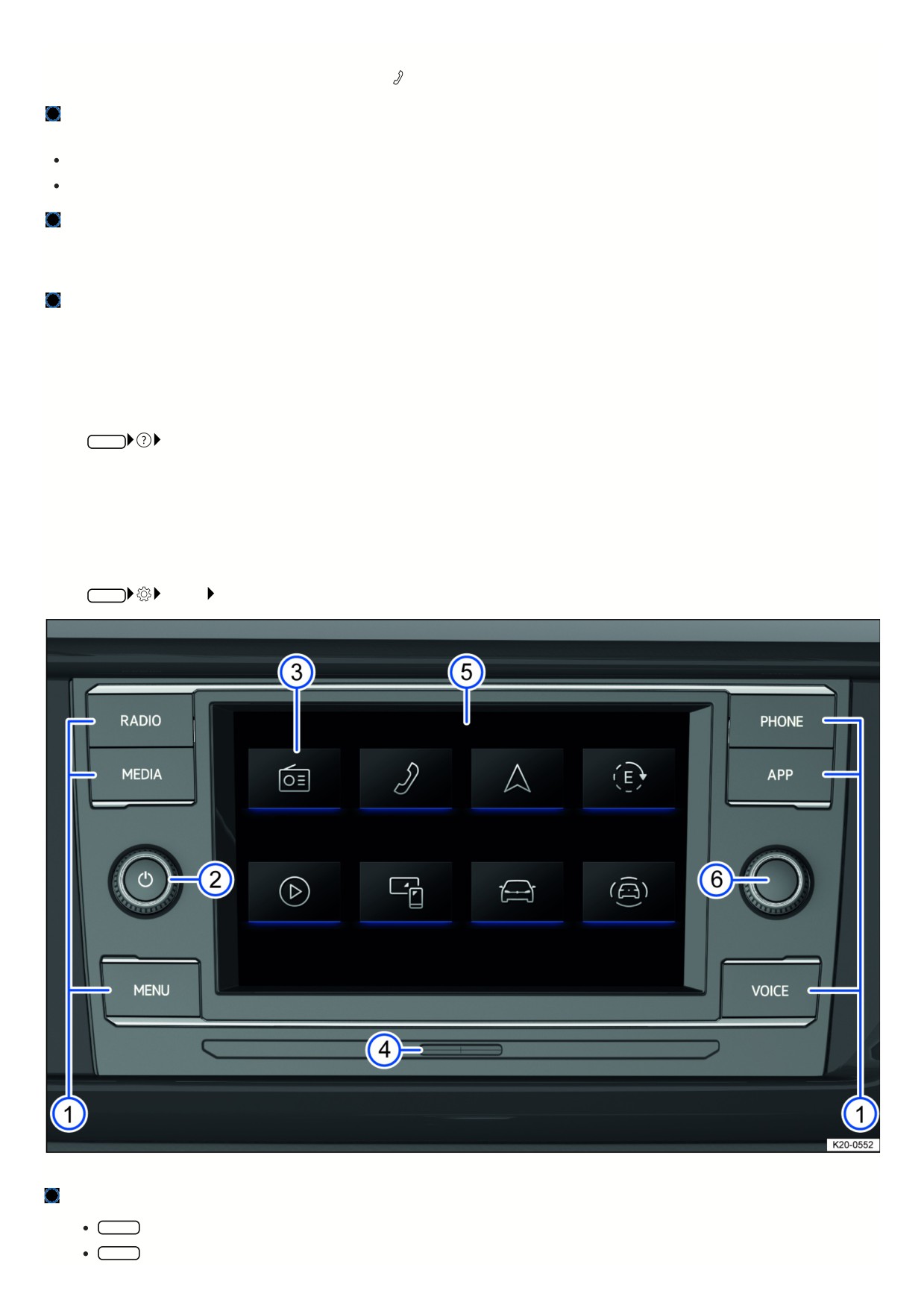
Fig. 130 Overview: display and control unit, 6.5" version.
Function keys for opening main menus:
RADIO ⇒ Radio mode.
MEDIA ⇒ Media mode.
2 9
MENU Opens the home screen.
PHONE ⇒ Mobile phone interface.
APP ⇒ App-Connect. The button does not have a function in some countries.
VOICE ⇒ Voice control. The button does not have a function in some countries.
Rotary knob.
Function keys for main menus.
ID card slot ⇒ Media drives.
Screen (touchscreen).
Menu knob.
Function keys
To open a main menu, press the corresponding function key, e.g. PHONE for the phone interface.
To open the home screen, press MENU .
To start voice control of the connected cell phone, press and hold VOICE .
Rotary knob
Press to switch the Infotainment system on or off.
Turn left to decrease the volume.
Turn right to increase the volume.
Function keys for main menus
It is not possible to configure the position of the function keys.
1. To open a main menu, tap the corresponding function key e.g.
for the phone interface.
Screen (touchscreen)
You can operate the Infotainment system functions via the screen. You will find detailed explanations of the different finger movements in the digital manual for the
Infotainment system, if available.
1. Tap MENU
Operation.
Menu knob
1. Turn to control the list selection.
2. Press to confirm a selection.
Media drives
Refer to ⇒
and Safety instructions.
SD card slot
An SD card slot may be present, depending on the vehicle equipment. This is not available in all Infotainment systems or in all countries.
Insert a compatible SD card into the SD card slot to use saved media such as audio files or media files in the Infotainment system. Supported file formats are
displayed in the Infotainment system. Other file formats are ignored.
Dimensions for compatible SD cards:
32 mm x 24 mm x 2.1 mm (approx. 1 in x 0.94 in x 0.083 in)
32 mm x 24 mm x 1.4 mm (approx. 1 in x 0.94 in x 0.055 in)
Securely inserting an SD card
1. Insert an SD card carefully into the SD card slot with the angled corner inserted first and the contact surfaces facing down until you feel it click into place.
If the SD card cannot be inserted, check whether the SD card is compatible and ensure you are inserting it in the correct position.
NOTICE
Forcing the SD card into the slot, using an SD card with incorrect dimensions or using an SD card adapter can result in damage to the SD card slot, the SD card
or both.
Inserting other objects such as SIM cards into the SD card slot can result in damage to the object, the SD card slot or both.
Do not use force when inserting SD cards.
Note the dimensions for compatible SD cards.
Do not use an SD card adapter.
21
If the Infotainment system cannot read the data on an SD card, a corresponding message will be displayed on the screen.
An SD card with navigation data cannot be used as a storage medium for other files. Any saved files will not be recognized by the Infotainment system.
Operating the Infotainment system
Refer to ⇒
and Safety instructions.
Opening the digital manual of the Infotainment system (if available)
Further information and tips on operation can be found in the digital manual for the Infotainment system.
1. Tap HOME
Guide.
Or: tap MENU
Guide.
Switching the Infotainment system on and off
The Infotainment system starts up when the ignition is switched on, unless it was previously switched off manually.
The Infotainment system starts at the volume that was last set, as long as this does not exceed the preset maximum switch-on volume.
Vehicles with ignition lock: The Infotainment system switches off automatically if the vehicle key is removed from the ignition lock.
Vehicles with starter button: If the driver door is opened while the ignition is not active, the Infotainment system switches off automatically.
If you switch on the Infotainment system manually while the ignition is not active, it will switch off automatically after approximately 30 minutes without user
input.
Opening the home screen
1. Tap MENU⇒ Overview and controls of the 8" version and 6.5" version .
Main menus on the home screen
The following main menus may be shown as function keys on the home screen:
Ambient lighting ⇒ Interior/reading lights, ambient lighting.
App-Connect ⇒ App-Connect.
Apps.
Driver assistance ⇒ Driver assistance
systems.
Vehicle ⇒ Driver information.
Help: Here, you can find additional information about Infotainment system functions and operation, e.g. the
quick guide .
or
Sound ⇒ System and sound settings.
Climate control ⇒ Heating and air conditioning system .
Media ⇒ Media mode.
Navigation ⇒ Navigation.
User, User management.
Radio ⇒ Radio mode.
Legal.
Setup ⇒ System and sound settings. Auxiliary heater.
Telephone ⇒ Mobile phone interface.
Configuring the home screen
In the display and control unit, you can configure the arrangement of the function keys on the home screen. The home screen cannot be configured in all available
Infotainment systems.
1. Tap the function key and hold until the function key is highlighted.
2. Move the function key to the preferred position and release it.
Scrolling through lists, switching titles
Select your desired function, setting or track via the touchscreen or the control knob.
Moving objects, adjusting volume
To adjust settings, e.g. those using sliders, or move areas of a menu around, move the objects around on the screen.
Personalize function keys and views depending on the vehicle equipment
⇒ Personalizing the Infotainment system .
Zooming in or out of pictures and maps shown on the screen
Recommendation: Use thumb and index finger.
1. Tap and hold the screen with two fingers at the same time.
To zoom in on the pictures and maps shown, slowly move your fingers apart.
To zoom out of the pictures and maps shown, slowly move your fingers together.
Personalizing the Infotainment system
Refer to ⇒
and Safety instructions.
Depending on the vehicle equipment,
you can personalize the Infotainment
system to access your favorite and
frequently used functions quicker.
The Infotainment system views contain tiles for accessing additional menus and functions.
Adjusting tiles
211
Adjust the tiles and displayed tile functions in the Infotainment system views to manage the Infotainment system as you wish.
1. Tap and hold tiles until an additional window appears.
2. Tap the desired function in the additional window. Various functions are available depending on the size of the tile.
Or: to return to View, tap any free area of the screen.
There are always at least two views available. They cannot be removed. Depending on the vehicle equipment, you can add two further views. A maximum of
four views can be displayed.
For some tiles, more functions are available than can be seen initially in the additional window. To see all the functions, swipe up or down in the additional
window.
Adjusting the control center
Personalize the Infotainment system Control Center to access your favorite and frequently used functions quicker.
1. Tap and hold the function until an additional window appears.
2. Tap the desired function in the additional window and hold until the function is highlighted.
3. Move the function to the preferred position and release it.
The active function is automatically removed from the control center and added to the additional window.
For the control center, more functions are available than can be seen initially in the additional window. Swipe to the left or right in the additional window to see
all the functions.
Opening personalization tips (if available)
Further information and tips on personalization can be found in the digital manual for the Infotainment system.
1. Tap HOME
Adjustment.
System and sound settings
Refer to ⇒
and Safety instructions.
Changing settings
The meanings of the following symbols apply to all system and sound settings.
Changes will be automatically applied when the menu is closed.
or
The setting is selected and activated or switched on.
or
The setting is not selected and deactivated or switched off.
or
Open the
drop-down list. Increase the set value. Reduce the set value. Go back stepwise. Go forward stepwise.
Use the slide control to continuously change the
set value.
System settings
The system settings may include the following functions, information, and setting options:
Screen.
Time and date.
Language.
Additional keyboard languages.
Units.
Voice control.
Wi-Fi.
Data connection.
Manage mobile devices.
Restore factory settings.
System information.
Copyright.
Configuration assistant.
Opening system settings
1. Tap HOME Setup.
Or: Tap MENU Setup.
Sound settings
The sound settings may include information and setting options for equalizer, position, volume and setup.
212
Opening sound settings
1. Tap HOME Sound.
Or: tap MENU Sound.
Adjusting the volume of external audio sources
Lower the volume of the Infotainment system before turning up the volume of an external audio source.
If the connected audio source plays too quietly, increase the output volume of the external audio source. If that does not correct the problem, set the input volume to
Medium or Maximum.
If the connected external audio source plays too loudly or the sound is distorted, lower the output volume of the external audio source. If that does not correct the
problem, set the input volume to Medium or Quiet.
Cleaning the screen
Refer to ⇒
and Safety instructions.
When cleaning the screen, please note this checklist:
The Infotainment system is switched off.
Use a soft, clean cloth that has been moistened with water.
Or: use a cleaning cloth which is available from an authorized Volkswagen dealer or authorized Volkswagen Service Facility.
For stubborn dirt:
NOTICE
If the screen is cleaned with incorrect cleaning agents or when dry, it may be damaged.
Only apply gentle pressure.
Do not use any aggressive cleaners or products which contain solvents. These types of cleaners can damage the device and cause glare on the screen.
NOTICE
If the cloth used to clean the screen is too moist, the screen can no longer be operated or switched off.
Dry the screen and then leave the vehicle locked from the outside for at least two minutes.
Brands, licenses, copyright
Refer to ⇒
and Safety instructions.
Brands and licenses
Certain terms in this manual have the ® or ™ symbols. These symbols indicate emblems or registered trademarks. However, the absence of this symbol does not
constitute a waiver of any rights associated with intellectual property.
Other product names are registered trademarks for the respective rights holder.
Manufactured under license from Dolby Laboratories. Dolby and the double-D symbol are trademarks of Dolby Laboratories.
Manufactured under license from Dolby Laboratories. Dolby, Pro Logic and the double-D symbol are trademarks of Dolby Laboratories.
All SiriusXM services require a subscription. See the SiriusXM Customer Agreement for complete terms at www.siriusxm.com (US) or www.siriusxm.ca
(Canada). All fees, content and features are subject to change. Satellite and steaming lineups may vary. SiriusXM, Pandora and all related logos are
trademarks of Sirius XM Radio Inc. and its respective subsidiaries. All rights reserved.
HD Radio Technology manufactured under license from iBiquity Digital Corporation. U.S. and Foreign Patents. For patents see http://dts.com/patents. HD
Radio, Artist Experience, and the HD, HD Radio, and “ARC” logos are registered trademarks or trademarks of iBiquity Digital Corporation in the United States
and/or other countries.
Apple Music is a trademark of Apple Inc.
SPOTIFY and the Spotify logo are among the registered trademarks of Spotify AB. Compatible vehicle and Spotify Premium subscription required, where
available.
Android Auto™ is a certified trademark of Google, Inc.
Apple CarPlay™ is a certified trademark of Apple, Inc.
Bluetooth® is a registered trademark of Bluetooth® SIG, Inc.
iPod®, iPad®, and iPhone® are registered trademarks of Apple Inc.
MirrorLink® and the MirrorLink® logo are certified trademarks of the Car Connectivity Consortium LLC.
213
MPEG-4 HE-AAC audio coding technology and patents licensed from Fraunhofer IIS.
SD® and SDHC® are trademarks or registered trademarks of SD-3C LLC in the USA and other countries.
Windows® is a registered trademark of Microsoft Corporation, Redmond, USA.
This product is protected by the intellectual property rights of Microsoft Corporation. Use or distribution of such technology outside of this product is prohibited
without a license from Microsoft or an authorized Microsoft subsidiary.
Copyright
Audio and video files saved on data carriers and audio sources are generally subject to copyright regulations in compliance with applicable international and nation
laws. Observe legal regulations.
Radio mode
Introduction
In radio mode you can receive various available radio stations on different frequencies and save your favorites to the station buttons for quick access.
Available reception modes and bands depend on the vehicle equipment and are not available in all countries. Frequency bands in individual countries may be
discontinued, switched off or no longer offered.
The radio stations are responsible for transmitted content.
Other electrical devices connected in the vehicle can impair radio signal reception and cause noise in the speakers.
Decals or metal-coated stickers on the vehicle windows can impair radio reception in vehicles with window antennas.
Functions and radio symbols
Refer to ⇒
and Safety instructions.
Radio
The available scope of functions and also possible reception modes and bands depend on the vehicle equipment and are not available in all countries.
AM tuner.
FM dual tuner (diversity aerial).
Station list of FM stations.
Summarized memory list.
Merging of all stations stored on station preset buttons in a list.
Up to 36 station preset buttons as storage locations for favorites.
Station logos.
Antenna amplifier
Internet radio.
HD Radio™.
Satellite radio:
SiriusXM™.
SiriusXM™ online.
General symbols for radio operation
The symbols may look different depending on the Infotainment system.
1. To open the main menu, open the home screen and tap
⇒ Overview and controls of the 8" version and 6.5" version .
AMSelect a AM reception mode.
FMSelect a FM reception mode.
Internet RadioSelect the Internet Radio reception mode.
SXMSelect the
satellite radio reception mode.
Display the selected station with additional information. Select the previous station from the station list or station on the
previous station preset button. Select the next station from the station list or station on the next station preset button.
Display the preset list with station
preset buttons.
Stations already stored on a station preset button in a station list.
or
Opening the settings.
Symbols in the AM frequency band
Show the station list of AM stations.
Manually update the station list.
Display the frequency band for manual selection of the AM frequency.
Symbols in the FM frequency band
Show the station list of FM stations.
Display the frequency band for manual selection of the FM frequency.
Only possible when the summarized station list is switched off.
214

Symbols for Internet Radio operation
Open full-text search.
Unable to receive Internet radio.
Display the last internet radio station.
Display the 100 most popular internet radio
stations.
Display the available Internet Radio podcasts.
Display Internet Radio stations that originate from the preferred country.
Display Internet Radio
stations that transmit their program in the preferred language.
Display Internet Radio stations whose programs are of the preferred genre.
Display the
station selection.
Symbols for HD Radio operation
Station supports HD Radio.
or
Tune the HD Radio substations.
Open the Emergency list of the “HD Radio Emergency Alerts” function.
HD Radio logo.
Symbols for satellite radio operation
Display the channel list.
Open the window for entering the channel number.
Adjusting, tuning, and storing stations
Refer to ⇒
and Safety instructions.
Selecting the frequency band or reception mode
Before selecting a station, you must first select a frequency band or reception mode. Various stations are available, depending on the selected frequency band or
reception mode. The available bands and reception modes depend on the vehicle equipment and are not available in all countries.
1. Tap Source to open the list of frequency bands and reception modes.
2. Select the band or reception mode, e.g. FM.
Searching for and selecting a station
There are different ways to search for and select stations. The options vary based on the frequency band and reception mode.
Selecting via the frequency band (AM and FM)
1. Display the frequency band.
2. Tap the cursor to press and slide to the frequency band and release at the desired frequency.
Or: tap a point on the frequency band. The cursor automatically jumps to the corresponding frequency.
The station at the set frequency will be tuned.
Selecting from a station list (AM and FM)
The station list displays the stations that currently can be received. Depending on the vehicle equipment, it is possible that the station list must be manually updated
if you have left the area since the last time the station list was opened. The station list in the FM frequency band generally updates automatically.
1. Open the station list.
2. Tap the desired station.
The selected station will be tuned. In the FM frequency band, the best reception mode is selected automatically depending on station availability.
Searching for and filtering stations (Internet Radio)
In Internet Radio mode, stations can be filtered according to category or searched for using a full-text search.
1. Open the station selection.
2. Select the categories by which to filter the stations.
Or: to start the full-text search, tap
The input line is displayed.
3. Enter the name of the desired station.
The list of the found stations updates automatically during input.
4. Tap the desired station.
The selected station will be tuned.
SCAN Searching in SCAN mode (AM and FM)
In SCAN mode, the stations in the frequency band are set automatically in succession and played for approx. 5 seconds each.
1. To start SCAN mode, tap
SCAN.
SCAN mode starts and the current station is shown on the display.
The SCAN function key is shown.
2. To select a station, tap SCAN.
SCAN mode stops and the station is tuned. The SCAN function key is hidden.
Storing stations on the station preset buttons
215

You can save up to 36 stations from different frequency bands and reception modes as favorites on the station preset buttons.
1. Tune the desired station.
2. Open station preset buttons.
Or: tap and hold the station on the station list.
The station preset buttons are displayed.
3. Tap and hold the station preset button until the station is saved.
4. Tap the station preset button.
The station is saved on the selected station preset button.
If a station was already saved on the station preset button, this station will be removed from the station preset button and replaced by the new station.
Special functions in radio mode
Refer to ⇒
and Safety instructions.
The special functions in radio mode listed below are not available for all Infotainment systems, depending on the vehicle equipment, and may not be available in all
countries.
Internet radio
Internet radio is a reception mode for Internet radio stations and podcasts independent of AM, FM and DAB . Due to its transmission over the internet, receipt is no
regionally limited.
Internet radio is only available if the Infotainment system has an active Internet connection. Costs for streaming data online may result when using Internet radio.
This function of the Internet Radio in some countries depends on your vehicle privacy settings.
Station logos
Station logos can be preinstalled for some frequency bands in the Infotainment system.
If the Automatic station logo selection function is activated in the settings, the station logos are automatically assigned to the stations.
In Internet radio mode, the Infotainment system obtains the station logos from an online database and assigns them automatically to the stations.
Assigning station logos manually
Station logos cannot be assigned manually in the AM frequency band.
1. Tap
Station logos in radio mode.
2. Select the station to which a station logo should be assigned.
3. Select the station logo.
4. This process can be repeated for additional stations.
5. To finish assigning station logos, tap
Online functions in radio mode
Refer to ⇒
and Safety instructions.
Depending on the vehicle equipment, the Infotainment system features online functions in radio mode.
Online functions in radio mode are not available in all countries and vehicle models.
Online functions in radio mode include Internet Radio, for instance.
Prerequisites for using online functions in radio mode:
The vehicle is equipped with VW Car-Net.
You have registered and you have an active VW Car-Net user account.
The vehicle is assigned to your VW Car-Net user account.
You have purchased a corresponding active data package for an Internet connection and have also purchased a “Plus Online Radio subscription” via the
VW Car-Net app or the VW Car-Net website, USA: vw.com/carnet, Canada: vw.ca.
SiriusXM
Refer to ⇒
and Safety instructions.
SiriusXM is a satellite radio station that can be received in the USA and Canada. Satellite radio services are subject to fees and must be enabled for the
Infotainment system by phone or online.
SiriusXM subscriptions can be activated via cell phone.
The current status of the subscription can be shown in the settings in satellite radio mode.
Further information can be found in the settings in satellite radio mode under Help and support and on the Internet:
In the USA:
216

In Canada:
Displaying the SiriusXM ID
Each radio has its own SiriusXM ID with which you can manage your subscription.
1. In satellite radio mode: Tap
Subscription Information.
Or: In satellite radio mode: Tap
and enter channel number “0”.
The SiriusXM ID, the website and phone number for the SiriusXM activation hotline will be displayed on the screen.
SiriusXM with 360L
Your vehicle can be equipped with SiriusXM with 360L. SiriusXM with 360L offers both satellite and streaming connectivity for a multitude of music, news, sports, ta
and entertainment channels and content. With SiriusXM with 360L, you have a personalized listening experience with recommendations and functions based on
your listening habits.
SiriusXM live channels
The channels available depend on the enabled services. All available channels are displayed in the channel list.
Each channel is assigned a channel number.
The channels are sorted in the channel list according to their channel number. The channels can be opened directly via their channel number under
All channels are sorted according to categories. Within the categories, the channels are sorted according to genre. Channels can be browsed in categories, e.g.
music.
Setting SiriusXM live channels
Available channels can be set in various ways depending on the vehicle equipment.
1. In satellite radio mode: Tap
and set the preferred channel using the channel number.
Or: Tap the title image of the preferred channel.
Or: turn the knob, select the preferred channel and press it.
2. Optional: To search for channels with content related to the content currently being played, tap Related in the station display.
A list with related content will be displayed.
On Demand
SiriusXM with 360L offers access to a multitude of on-demand content, e.g. concerts.
Opening on-demand content
1. Select a channel category, e.g. music, and select a genre, e.g. rock.
2. Tap On Demand.
3. Optional: To search for on-demand content related to the content currently being played, e.g. shows, tap Related in the station display.
A list with related content that is currently playing will be displayed.
Live Sports
With the category of “Live Sports”, you can call up transmissions of games that are being aired on SiriusXM.
Opening Live Sports
1. Select the category “Live Sports”.
2. Select the preferred transmission of a game.
Play Ahead Controls
With the “Play Ahead Controls” function, both live and on-demand content can be played and paused, and you can jump forwards or backwards in the playback.
Presets
SiriusXM live channels and on-demand shows can be saved as a preset. Up to 36 presets can be saved.
Saving SiriusXM content as Presets
1. To save a live channel currently being played back or an on-demand show currently being played back as a preset, press and hold a preset bank.
Or: In the channel list or the list of on-demand shows, press and hold the preferred content and select a preset bank.
Listening profile
The personalized listening profile saves recommendations based on the program content currently being listened to and the latest listening history, and is regularly
updated.
217

The listening profile can be set up in the Volkswagen user account and used with the SiriusXM app.
Setting up a listening profile
1. In satellite radio mode: To create a new listening profile, tap
Or: In satellite radio mode: Tap
Create new listening profile.
Personalized SiriusXM recommendations
A collection of personalized SiriusXM recommendations is available for each listening profile.
The personalized SiriusXM recommendations are regularly updated, based on what you're listening to.
Displaying personalized SiriusXM recommendations
1. Tap For You.
Listening history
For each listening profile, a list of SiriusXM content recently listened to is displayed. This listening history can be displayed and reset at any time.
HD Radio
Refer to ⇒
and Safety instructions.
HD Radio is a digital radio station that can be received in the USA and Canada.
HD Radio Technology
Some AM and FM radio stations also transmit their content digitally via HD Radio Technology.
When the function is activated in settings in the AM or FM band and the current station supports HD Radio Technology, the
function key appears on the
Infotainment system display. The Infotainment system switches automatically between digital and analog reception depending on the reception quality. If the station
is currently received in analog mode, the function key is grayed out.
Some stations offer additional substations via HD Radio Technology (multicast programming). If this is the case, HD1 is displayed after the station frequency of the
main station. Substations are marked with HD2, HD3, etc.
Tuning the HD Radio Substations
1. Tap
to cycle through the available substations.
Or: Select an additional station from the station list.
Or: to cycle through the additional stations individually, tap < or >.
The substation that is currently selected is displayed after the main station on the screen (for example ... HD3 for the second substation).
The available substations of the current stations are displayed on the station list.
Additional HD Radio Technology services
1. To select your chosen additional service, tap View.
HD Radio Emergency Alerts
The “HD Radio Emergency Alerts” function can be used to receive reports of unusual, potentially life-threatening events, such as natural disasters. These
notifications are played as pop-up notifications while the radio is on. This function is activated in the factory.
If you tap Remind me later when a notification appears, the notification will appear again about ten minutes later. If you tap Close, the notification will be moved to th
Alert list. If the “HD Radio Emergency Alerts” function is deactivated, these notifications are moved directly to the Alert list and indicated by
and a number in the
status bar. The number on the symbol displays the number of notifications.
Activating or deactivating HD Radio Emergency Alerts
1. In radio mode, activate or deactivate
Radio Emergency notifications.
Opening the Alert list
Up to five notifications can be displayed in the Alert list.
1. Tap
in radio mode.
Media mode
Introduction
In media mode, you can play back media files from data carriers in the Infotainment system.
Depending on the vehicle equipment, the following data carriers can be used:
USB storage medium, e.g. USB flash drive.
Bluetooth device, e.g. cell phone.
SD card.
218
Depending on the vehicle equipment, the following types of media files can be played:
Audio files, e.g. music.
Video files.
Streaming services
You can also use streaming services, depending on the vehicle equipment and in some countries
⇒ Online functions in media mode .
Restrictions and instructions for data carriers
Dirty, overheated or damaged data carriers are not to be used. Read and heed the information provided by the manufacturer.
Difference in quality between data carriers from different manufacturers can cause problems with media playback.
Wrong configuration of data carriers can lead to the data carriers being unreadable.
The storage volume, condition (copy and delete processes), file system, folder structure and the amount of saved data can increase the time taken to read data
carriers.
Playlists only define the order of play and refer to the saved location of the media files within the folder structure. No media files are saved in playlists. To play a
playlist, the media files must be present in the data storage device memory location, to which the playlist refers.
Volkswagen is not responsible for damaged, altered or lost files on data carriers.
Functions and media symbols
Refer to ⇒
and Safety instructions.
Audio, media, connectivity
The available scope of functions and possible media formats depend on the vehicle equipment and are not available in all countries.
The symbols may look different depending on the Infotainment system.
Media playback and media control via Bluetooth.
Audio playback in these formats:
AAC.
APE.
ALAC.
FLAC.
MP2.
MP3.
MP4.
Vorbis.
OPUS.
WMA.
WAV.
Video playback in these formats:
MPEG-1 and MPEG-2 (.mpg, .mpeg, .mkv, .avi).
ISO MPEG-4 ASP; Xvid (.mp4, .m4v, .mov, .mkv, .avi).
ISO MPEG-4 AVC/H.264 (.mp4, .m4v, .mov, .mkv, .avi).
Windows Media Video 9 (.wmv, .asf, .mkv, .avi).
Cross-device playlists.
Cross-source media database:
Data from all media sources connected to the Infotainment system are stored in a media database.
Media streaming (online).
Media search.
General symbols for media operation
1. To open the main menu, open the home screen and tap
⇒ Overview and controls of the 8" version and 6.5" version .
Or: Press MEDIA .
Start replay. Pause replay. Go to the previous track. Skip to the next track.
Repeats the current track.
Repeats all tracks.
Activate random
219

playback.
Search current media source (list view).
Close list view.
Opening the settings.
Go back one folder level in the media source. Open the
favorites list.
Symbols for media sources
Select My media as a media source. Connected USB devices may be selected under My media. Select a device connected via Bluetooth as a media
source.
Set up available streaming services.
Streaming services which have already been set up are represented by their own logos in the list of media sources.
Symbols for categories and groups of media files
Music tracks.
Videos.
Playlists.
Albums. Artists.
Genres. Podcasts.
Audiobooks.
Video replay symbols
Replay video in full-screen mode.
Minimize replay.
Selecting and playing a media source
Refer to ⇒
and Safety instructions.
Selecting a media source
1. If you want playback from an external media source, connect the external media source.
2. Select the connected media source to be used for playback.
Playing audio and video files
A media source must be connected before media files can be played back.
There are different ways to search for and play media files from an available media source.
Searching the folder structure
All media files from USB devices are filtered by category (e.g. albums). This category view is always displayed In My Media. The classic folder structure of the
individual USB data carriers can also be found under My Media.
1. Display the folder structure.
The folder structure of the selected media source is displayed. If My Media is selected, the categories (e.g. music) and connected media sources are displayed
2. Searching the folder structure for a desired track.
Or: to start the full-text search, tap
The input line is displayed.
3. Enter the name of the desired track.
The list of the found tracks updates automatically during input.
4. Tap the desired track.
When playback starts, if the selection is located in a folder on a media source, all of the media files located in the folder will be added for playback.
If a playlist is played back, all available tracks on the playlist will be added for playback.
5. Close the selection with
Selecting from favorites
You can save individual tracks, albums, artists and genres under favorites for playback.
1. Open the favorites list.
2. Tap on your favorites.
Depending on the selection, all tracks heard during the current playback will be added to favorites.
Save favorites
Only media files that are saved in My Media in the music and video folders can be saved as favorites. You can save individual tracks, albums, artists and genres as
favorites.
1. Start playback of the desired track.
2. Open the favorites list.
3. Tap the free favorite position.
Or: tap on an already occupied favorite position, and press and hold for approx. three seconds.
4. Select from the selection list:, e.g. title.
The selection is saved in the selected favorite position as a favorite. If the favorite position was already occupied, the previously saved favorite is overwritten.
The selection options in the selection list depend on the data attached to the media file. If a genre is not indicated for music files, the genre cannot be saved as a
favorite.
22
If a video file is currently being replayed, only this video can be saved as a favorite.
Setting up streaming services
Depending on the vehicle equipment and in some countries, you can use streaming services directly through the Infotainment system
⇒ Introduction. There
must be an internet connection to use streaming services ⇒
Introduction.
1. Select Media Streaming as the media source.
A list of available streaming services is displayed.
2. Select the desired streaming service.
The input field for entering login data is displayed.
3. Enter the login data for the desired user profile and confirm.
The streaming services will be added as a new function key in the list of media sources.
Depending on the country, you may need to log in to the streaming service again if you change your privacy settings, for example.
Entertainment playback via the Infotainment system
Refer to ⇒
and Safety instructions.
The Infotainment system can play music and videos.
Video mode
In video mode, the Infotainment system display can play a video from a data carrier
⇒ Selecting and playing a media source .
Depending on the vehicle equipment and in some countries, video from a streaming service can also be played back
⇒ Selecting and playing a media source .
The video sound is played back via the vehicle speakers.
A stable Internet connection is required for playback via a streaming service. There may be costs associated with your mobile network provider for doing so.
The video image is only displayed when the vehicle is stationary. The Infotainment system display will be switched off when the vehicle is moving. The video sound
will continue to be played.
Online functions in media mode
Refer to ⇒
and Safety instructions.
Depending on the vehicle equipment, the Infotainment system features online functions in media mode.
Online functions in media mode are not available in all countries and vehicle models.
Online functions in media mode include streaming services, for instance.
Prerequisites for using online functions in media mode:
The vehicle has VW Car-Net.
You have registered and you have an active VW Car-Net user account.
Your vehicle is assigned to your user account.
You have purchased a corresponding active data package for an Internet connection via the VW Car-Net app or via the VW Car-Net website, USA:
vw.com/carnet, Canada: vw.ca.
Streaming services
Depending on the vehicle equipment, you can also use streaming services.
Streaming services are not available in all countries and vehicle models.
Prerequisites for using streaming services:
The prerequisites for using online functions in media mode must be fulfilled.
You have your own user account for the relevant streaming service.
Navigation
Introduction
The current vehicle position is determined by a global satellite system. In order to enable optimum navigation to your destination, all measured values and possible
traffic information are compared with the available map material.
Acoustic navigation announcements and graphic displays lead you to your destination.
In some countries, it may not be possible to select some Infotainment system functions on the screen when driving above a certain speed. This is not a malfunction
but rather compliance with legal regulations.
WARNING
If settings are adjusted, destinations entered and changes made to navigation information while driving, the driver may be distracted and cause accidents and
221

injuries.
Always drive attentively and responsibly.
Only adjust settings, enter destinations, or change navigation information when the vehicle is stationary.
If you missed a turn on your route, the navigation system may recalculate the route.
The quality of the driving directions depends on the available navigation data and any reported traffic incidents.
Traffic information is only given in the navigation system if the available VW Car-Net service has been activated.
Navigation restrictions
If the Infotainment system cannot receive data from GPS satellites, for example in a tunnel, navigation will still be possible using the vehicle's sensors.
In areas that are not digitized or only partially digitized in the Infotainment system memory, the Infotainment system will still try to provide route guidance.
If navigation data is missing or incomplete, the vehicle position may not be determined accurately. This may result in navigation that is not as accurate as usual.
Routing is subject to ongoing changes, like new streets, construction zones, road closures, or changes to street names or house numbers. Using outdated
navigation data can lead to errors or uncertainty when using route guidance.
Function descriptions
Please read the introductory information and heed the Warnings and Notice ⇒
and Safety instructions.
Voice guidance
Navigation messages are acoustic driving directions for the current route.
The type and frequency of navigation messages depends on the settings and the driving situation, like the start of the route guidance and whether you are driving o
a highway or roundabout.
If the destination cannot be reached exactly, for example because it is not in a digitized area, there will be a navigation announcement that the Destination area has
been reached. Messages about the direction and distance to your destination will also be displayed on the screen.
During dynamic route guidance, reported traffic incidents on the route are announced. There will be an additional navigation announcement if the route is
recalculated due to a traffic incident or a change in driving style.
You can adjust or mute the volume during a traffic announcement. All other navigation announcements will be given at that volume or will be muted.
Navigation messages will not be given if the Infotainment system is muted.
Adapting the Navigation Map
To ensure an optimum view, you can also adapt the navigation map and map view using enhanced finger movements.
Moving the navigation map
Recommendation: Use index finger.
1. Move the navigation map with your finger.
Zooming in or out on the map view
Recommendation: Use index finger.
1. Tap and hold the map twice in a row.
2. To zoom out of the map view, move your finger upwards. To zoom in on the map view, move your finger downwards.
Zooming in or out on the map view
Recommendation: Use thumb and index finger.
1. Tap and hold the map with two fingers at the same time.
2. To zoom out of the map view, slide your fingers towards each other. To zoom in on the map view, slide your fingers away from each other.
Tilting the map view
Recommendation: Use index and middle finger.
1. Tap and hold the map with two fingers at the same time, held horizontally next to each other.
2. To tilt the map view to the front, move your fingers upwards. To tilt the map view to the back, move your fingers downwards.
Rotating the map view
Recommendation: Use thumb and index finger.
1. Tap and hold the map with two fingers at the same time.
2. Turn your fingers clockwise or anti-clockwise to turn the map view.
222

Route plan
The route plan contains information about relevant events, such as waypoints and destination suggestions, if the relevant data is available to the navigation system
Tapping an event will open a dialog box with additional options. The options available depend on the event and the current settings.
Opening and closing the route plan
1. Tap the route plan to open.
2. To stop route guidance, tap
3. To stop the route guidance to the destination or waypoint, tap
next to the destination in the route plan.
Editing route guidance
To edit route guidance, move the stopovers or the destination in the route plan.
1. Tap and hold the desired destination until it is visibly highlighted.
2. Move the destination to the desired position and release it.
The route will be recalculated.
Additional dialog box in the route plan
Tapping the route plan entries may cause a dialog box to open with additional options for these entries. The options available depend on the entry that is tapped.
Functions in the split screen:
Display on map
Displays the selection on the map.
Add waypointAdds a waypoint to the route guidance.
Direct route
Starts direct route guidance.
Delete
Delete waypoint from route guidance.
Avoid
Avoid traffic disruptions. The route will be recalculated.
Stop route guidance Ends the current route guidance.
Closing an additional dialog box in the route plan
1. Tap a free area outside of the additional window.
Setting preferred POI categories
The system offers different points of interest, e.g. gas stations, using the quick select symbol when entering destinations, in the route plan and on the map. You can
prioritize how these symbols are displayed under
Basic function settings Preferred POI categories. The system also automatically learns your preferred
categories.
Saved data
In order to enable you to enter destinations quickly and to optimize route guidance, the Infotainment system saves certain data, such as frequently driven routes an
positioning data.
Delete saved data
1. Tap
Basic functions Delete usage pattern.
2. Tap confirm to delete the data.
Learning usage patterns
While driving, the Navigation system saves routes traveled and destinations reached in order to create automatic destination suggestions. Destinations are learned
with reference to the time of day and the day of the week.
The navigation system can suggest pre-learned routes.
1. Tap
to show the suggested routes.
Selecting one of the suggested routes will cause route guidance to begin.
The route guidance follows the selected route until you deviate from it. The route will then be recalculated and will lead back to the selected route via the most direc
path.
Relevant traffic disruptions are taken into consideration in route guidance. If an alternative route and the navigation data are available, relevant disruptions will be
avoided.
If you are driving a pre-learned route without active route guidance, the destination is added to the route plan. Route guidance does not need to be actively started
for a journey to a pre-learned destination. You are warned about traffic disruptions if necessary.
A predicted arrival time is displayed.
You can activate or deactivate this function at any time as well as delete the saved data for this function.
223
Activating or deactivating “Learn usage pattern”
1. To open this function's settings, tap
Basic function settings.
2. Tap Learn usage pattern.
Deleting saved “Learn usage pattern” data
1. To open this function's settings, tap
Basic function settings.
2. Tap Delete usage pattern.
Functions and symbols of the navigation system
Please read the introductory information and heed the Warnings and Notice ⇒
and Safety instructions.
Navigation
The functions and symbols of the navigation system may differ depending on the vehicle equipment and are not available in all countries.
Functions
Entering a destination and route calculation.
Simultaneous display of two navigation maps (screen and instrument cluster).
Personal destinations.
3D City Maps.
Online Map Update.
Online Traffic Information.
Symbols on the map
The function keys and displays shown depend on the settings and the current driving situation.
Symbols for traffic information, e.g. traffic disruptions, and POIss, e.g. gas stations, are displayed on the map if the data is available to the navigation system
⇒ Traffic information.
1. To open the main menu, open the home screen and tap
⇒ Overview and controls of the 8" version and 6.5" version .
Display current position.
Destination search.
Destinations and stopovers along the current route.
Personal destination suggestions (home address,
work address, favorite POIss nearby). Display route options.
Fully automatic map mode (orientation in direction of travel, position, zoom and tilt).
Determine driving direction and map tilt.
Map scale.
Display destination memory.
Display dialog box with additional options. Map menu with
settings for navigation and navigation announcements.
Symbols in the dialog box
1. To open the additional window, tap on
Display route overview and alternative routes to the current route guidance.
Repeats the last navigation announcement.
Mute or adjust volume of
navigation instructions.
Navigation settings.
Additional symbols
Destination search: detailed destination input for an address.
Symbols in the route plan
Display current position. Destination for the current route guidance. Ends the current route guidance. Close route plan.
Traffic disruptions
Traffic disruptions are displayed on the map if the data is available to the navigation system ⇒ Traffic information.
1. Tap a traffic disruption to open a dialog box with details
⇒ Function descriptions.
Traffic jam.
Accident.
Ice.
Road closed.
Slip hazard.
Danger.
Construction zone.
Strong wind.
Inputting destinations and starting route guidance
Please read the introductory information and heed the Warnings and Notice ⇒
and Safety instructions.
Depending on the vehicle equipment, different functions are available for inputting destinations. Some functions are only available in some countries.
The various functions for inputting destinations are located in the navigation system main menu
⇒ Introduction.
You can further restrict your search with specific suggestions in the results list, e.g. “nearby”.
For further information about symbols on the Infotainment system screen, see
⇒ Functions and symbols of the navigation system in this Owner's Manual.
Enter address
Start route guidance by entering an address. During input, the navigation system suggests already known destinations. You can also enter a new, unknown address
for route guidance.
224

When inputting the address, input the name of the destination, not the postcode of the destination.
Selecting the destination and starting the navigation system
1. Tap
2. Enter the destination address and select your desired destination.
Or: tap
and enter the address via the input screen.
3. Tap Route.
Quick start
1. Tap
2. Enter the address of the destination, tap the desired destination and hold for a few seconds.
Enter the destination as accurately as possible. If there is an error in the destination entered, route guidance cannot take place or may lead to the wrong
destination.
Destination suggestions
Navigation uses saved data such as your last destinations, learned destinations, favorites, home address and work address to provide you with route guidance.
Selecting the destination and starting the navigation system
1. Tap
2. Tap on the desired destination.
The route guidance starts automatically.
Last destinations
The navigation system saves up to ten of the most recent destinations to make them available for route guidance. A new destination automatically overwrites the
oldest destination.
Selecting the destination and starting the navigation system
1. Tap
2. Tap on the desired destination.
3. Tap Route.
Quick start
1. Tap
2. Tap and hold the preferred destination for a few seconds.
Favorite destinations
You can save up to 50 journey destinations as favorites.
Saving a journey destination as a favorite
1. While entering a destination, tap on
in the additional window.
Selecting the destination and starting the navigation system
1. Tap
2. Tap on the desired destination.
3. Tap Route.
Quick start
1. Tap
2. Tap and hold the preferred destination for a few seconds.
Selecting on the map
The navigation map contains active areas at many points which are suitable for the input of a destination. To enter a destination, tap on your preferred position or
preferred location on the map. If map data is available at this point, you can launch route guidance.
Entering a destination via the navigation map is dependent on data status and not possible for all positions.
Use the Offroad navigation system to enter a destination to a selected destination point with unknown data.
Offroad navigation
The Offroad navigation system calculates routes to selected destinations with unknown data. If the destination is not located on a known road or at a known
position, the navigation system will calculate the route up to the next point on the known road and then complete the route to the destination using a straight line.
225
In order to start an Offroad navigation, tap on a free area without positioning data.
Starting the navigation
1. Tap
2. Press and slide the map view until you can select your desired position. You can operate the navigation map using extended finger touches ⇒
Introduction.
3. Tap the preferred destination or any destination point on the map without positioning data.
4. Tap Route.
Using a contact's address data
Start route guidance via the saved address data for a contact. You cannot use contacts for whom you have not saved any address data for route guidance.
Starting the navigation
1. Tap
2. Tap on the preferred contact and address data.
3. Tap Route.
NOTICE
If the address data for your contact is out of date, the route guidance will nevertheless direct you to the stored address. Please ensure the address for your
contact is up to date.
Navigation data
Please read the introductory information and heed the Warnings and Notice ⇒
and Safety instructions.
The Infotainment system is equipped with an internal navigation data storage medium. Depending on the country, the required navigation data may already be
installed.
The Infotainment system always requires up-to-date navigation data to ensure that route guidance can be implemented correctly and that the functions provided are
fully available.
NOTICE
If you use outdated navigation data, there may be adverse effects on the navigation system. It may not be possible to determine up-to-date routes, or route
guidance may guide you to an incorrect destination.
Always ensure that your navigation data is kept up-to-date.
Navigation Data Online - Additional Information
Regions in the navigation data that you do not use can be removed from the system under certain circumstances, e.g. navigation data memory low on space. If you
subsequently need these regions again at a later time, the navigation system will download them again on request. No contract for mobile online services is
needed. This service depends on the vehicle equipment and is only available in some countries.
1. Switch the ignition on.
2. Establish an Internet connection if you have not already done so.
Navigation data is automatically updated in the background.
Updating navigation data manually
Up-to-date navigation data for larger regions, such as Western Europe, can be downloaded online at www.volkswagen.com and stored on a suitable USB data
carrier, available to buy in stores. If the Infotainment system is switched off during the process, installation will be interrupted and it will continue automatically once
the system is turned on again.
1. Download and save the navigation data onto a USB data storage device.
2. Switch the vehicle ignition on.
3. Link the USB data carrier to the Infotainment system when the vehicle is stationary.
The navigation data for frequently driven regions is automatically updated in the background.
While and after updating the navigation data, no message appears in the Infotainment system.
If you update the navigation data manually, the USB data carrier must remain permanently connected. You will not receive a notification when the update is
complete.
Do not disconnect the USB data carrier from the Infotainment system for a few days until the navigation data for visited regions has been fully downloaded
and installed. The installation will start automatically in the background during the journey. Doing so will cancel the update process. If you disconnect the data
carrier and visit a new region, the navigation data is not updated due to the lack of a USB data carrier.
Displaying the map data version
1. Tap HOME
System information.
226
Or: tap MENU
System information.
Traffic information
Please read the introductory information and heed the Warnings and Notice ⇒
and Safety instructions.
Depending on the vehicle equipment, the reception of traffic information may not be available in all Infotainment systems or in all countries.
The Infotainment system automatically receives detailed traffic information when there is an active Internet connection. This information is displayed on the map via
symbols and color coding on the road network.
Reception of traffic information is possible in some countries if permitted by the privacy settings selected. No traffic information is received in offline mode.
Traffic disruptions
Traffic disruptions such as traffic jams are displayed on the navigation map as symbols ⇒ Functions and symbols of the navigation system .
The route plan displays current traffic disruptions if the relevant data is available to the Navigation system.
If route guidance is active, traffic disruptions on the current route will be displayed on the route plan. You can avoid these traffic disruptions by modifying the route
plan.
Avoiding traffic disruptions
1. Tap the traffic disruption.
2. Tap Avoid.
The route will be recalculated.
Only one traffic disruption can be avoided in this manner for each route guidance.
Local warnings, e.g for severe weather, can be played via the Infotainment system as a pop-up notification.
Traffic flow display
The traffic flow for current traffic disruptions is displayed on the navigation map via color coding on the road network.
OrangeStop-and-go traffic.RedTraffic jam.
Mobile phone interface
Introduction
Using the phone interface, you can connect your cell phone to the Infotainment system and control the phone functions via the Infotainment system. The sound is
played back via the vehicle speakers. Depending on the vehicle equipment, you can connect up to two cell phones to the Infotainment system at the same time
⇒ Coupling, connecting and managing.
Availability of functions may differ depending on the cell phone used and its operating system and the vehicle equipment, and functions are not available in all
countries.
High speeds, poor weather and road conditions, a lot of background noise, even outside the vehicle, and the network quality can impair phone calls in the vehicle.
The phone interface may contain an antenna amplifier that improves the reception quality of the cell phone.
You generally only need to pair a device like a cell phone once. You can reestablish the device's connection to the Infotainment system at any time via
Bluetooth or Wi-Fi without re-pairing your device.
For a phone call via the hands-free system or at a high volume, a conversation may also be heard by third parties outside the vehicle.
Locations with special regulations
Switch off the cell phone and phone interface at locations where there is a risk of explosions. These locations are not always clearly identified. These include, for
example:
Areas near pipes and tanks containing chemicals
Lower decks in ships and ferries
Areas near vehicles powered by liquefied petroleum gas, such as propane and butane.
Areas with chemicals or particles in the air, such as flour, dust, or metal powder
All other locations where the engine or the cell phone must be switched off.
WARNING
In locations where there is a risk of explosion, e.g. near to gas stations, and in areas with specific regulations, sparks such as those caused by electrostatic
discharges or cell phones can cause explosions or fires, resulting in serious injuries or death.
Switch off cell phones and the phone interface in locations where there is a risk of explosions, e.g. near to gas stations, and in locations with specific
regulations.
227

Do not operate cell phones or the phone interface in locations where there is a risk of explosions, e.g. near to gas stations, and in locations with specific
regulations.
NOTICE
Radiation from cell phones that are switched on can interfere with sensitive technical and medical devices, potentially causing malfunctions or damage to the
devices.
Always switch off the cell phone in areas with special regulations relating to or prohibiting the use of cell phones.
Types of phone interface
Depending on the country and vehicle equipment, your vehicle may have the following mobile phone interfaces:
Phone interface basic configuration.
The phone interface uses the Hands-free profile (HFP) Bluetooth profile for transmission. This enables the use of phone functions via the Infotainment system
and played back via the vehicle speakers.
Convenience phone interface.
Just like the basic configuration of the phone interface, the Convenience phone interface uses the HFP Bluetooth profile.
The Convenience phone interface can be equipped with the wireless charging function ⇒ Charging Options for Mobile Devices. In order to use the features of
the wireless charging function, you need to place a suitable cell phone correctly in the storage compartment. If you place a suitable cell phone in the storage
compartment, the cell phone will be connected to the vehicle antenna depending on the vehicle equipment. This improves reception and call quality.
Functions and symbols of the phone interface
Please read the introductory information and heed the Warnings and Notice ⇒
and Safety instructions.
The range of functions and symbols may differ depending on the vehicle equipment and functions are not available in all countries. The available functions depend
on the cell phone used and its operating system. The symbols may look different depending on the Infotainment system.
The vehicle may be equipped with a hands-free system.
Symbols in the main menu
1. To open the main menu, depending on the vehicle equipment, open the home screen and tap
⇒ Overview and controls of the 8" version and 6.5" version .
Or: Tap the PHONE sensor area ⇒ Overview and controls of the 8" version and 6.5" version .
Or: Press the PHONE function key ⇒ Overview and controls of the 8" version and 6.5" version .
Open contact list.
Open incoming and outgoing calls lists.
Dial telephone number.
Open messages (SMS and, depending on your country, e-
mail).
Change active device.
or
Opening the settings.
Symbols for telephone calls
Handle and display a call.
End or decline a call.
Mute the hands-free system.
Put a call on hold.
Continue a call.
Add participants to a
phone conference or begin a phone conference.SOS or
Make an emergency call (SOS).
Receive breakdown assistance.
Voice mail. Receive
information about Volkswagen and various value added traffic and travel services.
Call list symbols
1. To open the call lists, tap on
or
Received incoming call.
or
Outgoing call.
or
Missed call.
Frequent calls or favorites from your cell phone, if supported by your
cell phone.
Telephone number (company).
Telephone number (private). Cell phone number.
Fax device.
Fax device (company).
Fax device
(private).
Coupling, connecting and managing
Please read the introductory information and heed the Warnings and Notice ⇒
and Safety instructions.
Pair a cell phone with the Infotainment system to use the functions of the phone interface.
Depending on the vehicle equipment, you can connect up to two cell phones to the Infotainment system at the same time. However, only one device is active at a
time and can be used to make calls. The second connected device can receive calls via the Infotainment system and be used to play media.
The following listed functions may not be available in all Infotainment systems in some countries and depending on the vehicle equipment.
Pairing a cell phone
Before connecting for the first time, you need to pair the cell phone with the Infotainment system. A user profile is then automatically saved in the Infotainment
system . The coupling process may take a few minutes.
Requirements:
Bluetooth is activated on the cell phone.
Bluetooth is activated on the Infotainment system.
228

1. Open the list of available Bluetooth devices on your cell phone and select the device name for the Infotainment system.
2. Pay attention to messages on the cell phone and in the Infotainment system and confirm these if necessary.
If the pairing is successful, the data on the cell phone will be saved in the user profile.
3. Optional: Confirm the message for transferring the data on the cell phone.
WARNING
If you carry out the coupling when driving, this may cause accidents or injuries.
Only carry out the coupling when the vehicle is stationary.
When pairing some cell phones, a PIN may be displayed on the cell phone screen. Type this PIN into the Infotainment system to finish pairing.
Depending on the vehicle equipment, pairing and connecting is also possible in some vehicles via quick access on the home screen by tapping
on the home
screen.
Depending on the vehicle equipment, wireless charging may be deactivated while you are using the Known cell phones menu. The cable-free charging function
is reactivated if you leave the menu.
Connecting a cell phone
Precondition:
A cell phone is paired with the Infotainment system.
1. Activate Bluetooth in the cell phone.
Connection management
Precondition:
The cell phone is paired and connected.
1. Open the home screen and tap
Mobile Devices.
2. Tap to connect the desired technology.
Active and passive connection
In order to use the phone interface functions, at least one cell phone must be connected to the Infotainment system. If several cell phones are connected to the
Infotainment system, you can switch between an active and an inactive connection. In order to operate the phone interface with your preferred cell phone, establish
an active connection to the Infotainment system.
Difference between the types of connection
ActiveThe cell phone is paired and connected. You can carry out phone interface functions using data from this cell phone. PassiveThe cell phone is paired and
connected. You can only take incoming calls via the mobile phone interface. Other functions are not available.
Paired cell phones are saved in the Infotainment system even if they are not currently connected.
Change connection type (inactive to active)
Precondition:
Several cell phones are connected to the Infotainment system simultaneously.
1. Tap
Or: tap on the name for the active cell phone.
Or: tap Replace.
The actively connected cell phone is highlighted.
2. Tap the name for the preferred cell phone.
The connection with the other cell phones will be inactivated automatically.
User profiles
An individual user profile is automatically created for each paired cell phone. Data from this cell phone, e.g. contact data, is stored in the user profile. A maximum of
ten user profiles may be saved in the Infotainment system simultaneously.
Completely delete saved data
1. Reset the Infotainment system to factory settings ⇒ System and sound settings.
Using a phone
Please read the introductory information and heed the Warnings and Notice ⇒
and Safety instructions.
Using a phone
229

Select a telephone number to make a call. Various functions are available for selecting a telephone number.
Using contact data
If a contact has multiple telephone numbers, you must select the number you wish to call accordingly.
1. Tap
Or: to search for a contact, tap
and enter the name of the contact in the input field.
Or: To call a favorite, tap Favorites in the main menu of the phone interface.
2. Tap on a contact in the list to make the call.
When searching for a contact, enter the last name and first name separated by a space.
Using a call list
The phone interface displays the call list for the cell phone. Make a call via the call list.
1. Tap
All.
Or: Tap
and filter entries in the call list, e.g. by missed calls.
2. Tap on a number or, where applicable, a contact in the list to make the call.
Manually entering the telephone number
1. Tap
and enter a telephone number.
2. Tap to make the call.
While you are entering a telephone number, the contact related to the number is displayed on the Infotainment system screen.
Phone directory, favorites and speed dial keys
Please read the introductory information and heed the Warnings and Notice ⇒
and Safety instructions.
Phonebook
This first time a cell phone is paired with the Infotainment system, the phonebook is saved in the Infotainment system. If necessary, confirm the transfer on the cell
phone.
Depending on the vehicle equipment, you can save up to 5000 contacts in your phonebook.
The phone directory is updated after each new connection. During the update, the present phone directory can still be used.
If teleconferences are supported, the phonebook can be opened during a phone call and another participant can be added to the phone call.
If an image is stored for the contact, it can be displayed in the list next to the entry.
The symbols may look different depending on the Infotainment system.
Favorites and speed dial keys
A speed dial key can be assigned with a favorite from the phone directory. If the entry contains an image, this is displayed on the speed dial key.
Speed dial keys must be programmed manually and are assigned to a user profile
⇒ Coupling, connecting and managing, ⇒ Bluetooth® interface.
Programming a speed dial key
1. Tap a free speed dial key.
2. Tap a contact in the phone directory or search for it using the search bar. If a contact has multiple telephone numbers, tap a number on the list.
Editing the speed dial key
1. Tap and hold the speed dial key until the phonebook opens.
2. Tap the new contact in the phone directory. If a contact has multiple telephone numbers, tap a number on the list.
Calling a favorite
1. Tap a programmed speed dial key.
Favorites are not automatically updated. If the phone number for a contact changes, the speed dial key must be reassigned.
Deleting a favorite from the speed dial key
1. Tap
Manage favorites.
To delete a favorite, tap the preferred speed dial key
Or: tap
Or: to delete all favorites from all speed dial keys, tap Delete all.
2. Tap confirm to delete the data.
23

Voice control
Introduction to using voice control
With voice control, you can have certain
functions carried out by voice
command.
Depending on the language set in the Infotainment system, command-based voice control (standard) is available in the vehicle.
Does my vehicle have voice control?
If there is a Talk button
on the multi-function steering wheel or the VOICE button is available in the Infotainment system or your vehicle understands the
activation word, voice control is installed in the vehicle.
In black with blue background: Voice control is active and recognizes spoken words.
Test voice control before a journey to get to know the function.
Differences in the voice controls
Command-based voice control (standard)
Only grammatically correct voice commands are recognized by the voice control. Voice commands must follow a fixed syntax in order to be recognized correctly,
e.g. “Navigate to [city, street name, house number]”. You can find further examples in the Infotainment system. The command-based voice control can be carried
out in any available language.
Enhanced voice control (offline or online)
Speech commands can be freely worded in common speech. For example, in response to the question “How long is left to drive?”, the system gives the remaining
time until arrival at the destination. Suggestions for voice commands depend on the set language and can be found in the Infotainment system.
Enhanced voice control works both online and offline. By evaluating voice commands, online mode offers improved POIs, media and online radio station search
functionality. Additionally, messages can be dictated. For online mode, you need a VW Car-Net contract valid for the vehicle.
If enhanced voice control is available in your language, it is used to activate voice control.
Supported languages
The number of languages available in your country depends on the vehicle equipment.
Start voice control by saying the activation word available in your country
⇒ Activation word.
Starting and ending voice control
Voice commands
Voice control only recognizes voice commands in the language selected in the infotainment system.
Observe the following tips for successful voice commands:
Speak clearly and at normal volume. Speak a little louder at higher speeds.
Avoid excessive emphasis and strong accents.
Do not leave long pauses in speech.
Avoid external and background noise.
Do not direct the air flow from the vents towards the microphone or headliner.
Open suggestions for speech commands
1. Tap HOME
To ensure that names in the phonebook are identified correctly, you may need to switch the order of the first and last names of the desired contact, depending
on how the phonebook entry is structured.
Starting voice control
You can use different methods to start voice control, depending on the vehicle equipment:
Start via speech: Say the activation word ⇒ Activation word.
Start via multi-function steering wheel: Press the Talk button
Starting up via the Infotainment system: Tap on VOICE .
Depending on the cell phone and operating system, voice control of a connected cell phone can be started by pressing and holding
or the VOICE button
⇒ App-Connect.
Ending voice control
You can use different methods to end voice control, depending on the vehicle equipment:
231

End via speech: To open suggestions for a voice command to cancel, tap HOME
General.
End via the multi-function steering wheel: press the Talk button
End automatically: If you use functions within the Infotainment system, activate the parking system; if telephone calls or tasks involving speech and navigation
warnings occur, the voice control ends automatically.
Activation word
In the ring memory of the Infotainment system, the words spoken in the vehicle are checked for the activation word. If the Infotainment system detects the activation
word, voice control will begin. A ring memory is automatically overwritten approximately every 15 seconds. There is no transmission of data or words spoken in the
vehicle. The ring memory is inactive when the activation word is switched off.
Switching activation word on and off
If the activation word is switched off, voice control cannot be activated via the activation word.
1. Open the home screen and tap
Voice control Voice control start/end sound or Activation word.
Speaking and recognizing the activation word
Precondition:
The Activation word is switched on in the settings.
Bonjour Volkswagen.
Hola Volkswagen.
Hello Volkswagen.
Troubleshooting
Voice control is not responding
Voice control is not available in your language.
Set the correct system language in the Infotainment system.
Start voice control by using the activation word or the Talk button on the multi-function steering wheel.
Voice commands are not recognized due to a system error. Contact suitably qualified professionals for assistance. Volkswagen recommends contacting an
authorized Volkswagen dealer or authorized Volkswagen Service Facility.
Voice control is giving unsuitable responses
Voice control has misinterpreted the question.
Clearly give your voice command again.
Voice control is not performing the function
This function cannot be performed by voice control.
The function is not available in all languages. You can find suggestions for voice commands in the set language in the Infotainment system.
Settings within the function are preventing the device from switching on or carrying out the function.
Voice control did not understand the voice command.
There is insufficient data.
232

Transporting
Stowing luggage and cargo
Stowing luggage securely in the vehicle
Distribute luggage as evenly as possible in the vehicle. Do not cover any vent openings.
Always stow luggage and heavy objects in the luggage compartment and place them as far forward in the compartment as possible
⇒
Adhere to the Gross Axle Weight Rating and Gross Vehicle Weight Rating
⇒ Technical data.
Also store small objects securely.
If necessary, fold the rear seat backrest down and lock it securely.
If necessary, adjust the headlight range. Vehicles with dynamic headlight range control will adjust automatically.
Adjust the tire pressure based on the load. Follow the tire pressure label
⇒ Checking the tire pressure .
WARNING
Objects or animals that are not secured or are secured incorrectly can cause serious injuries or death in the event of sudden driving and braking maneuvers or a
collision. This is especially true if the airbags deploy and strike objects, causing them to fly through the vehicle interior.
Store all objects securely in the vehicle. Follow the legal regulations whilst doing so.
Stow objects in the vehicle interior in such a way that they will not enter the airbag deployment zone while you are driving.
Secure animals in the vehicle restraint systems that are appropriate for their weight and size.
Always keep the storage compartments closed while driving.
Do not leave hard, heavy, or sharp objects loose in the open storage compartments in the vehicle, on the surface behind the rear seat backrest, or on the
instrument panel.
Remove hard, heavy, or sharp objects from clothing and bags in the vehicle interior and store them securely.
WARNING
If objects stowed in the vehicle cause people to sit in the wrong position, serious or fatal injuries may occur in the event of sudden driving and braking
maneuvers or accidents.
Never stow objects on a seat if a person is going to use it.
WARNING
When transporting heavy objects, the vehicle’s handling performance may change because of the altered center of gravity and the braking distance may
increase. Heavy loads that have not been stowed or secured properly may change the vehicle handling, e.g. if the load slides around. This can result in a loss of
vehicle control and lead to serious or fatal injuries.
Never overload the vehicle. Both the load and the distribution of the load in the vehicle affect driving behavior and braking efficiency.
Always distribute the load evenly and as low down in the vehicle as possible.
Secure heavy objects in the luggage compartment as far in front of the rear axle as possible.
Secure any loose objects to prevent them from sliding around.
Always adapt your speed and driving style to the visibility, weather, road and traffic conditions.
Accelerate with extra care and caution.
Avoid sudden braking or driving maneuvers.
Brake earlier than usual if the vehicle has a heavy load.
NOTICE
Abrasive objects on the rear windows can cause damage, for example to the heating elements for the rear window defroster.
Do not load the luggage compartment to a height where objects rest against the rear window.
NOTICE
Carrying systems fixed to the rear spoiler may damage the vehicle.
233
Do not attach a luggage rack or any other kind of carrying system, e.g. bicycle rack, to the vehicle's rear spoiler.
Luggage compartment floor
Opening and closing the luggage compartment floor
Fig. 131 In the luggage compartment: opening the luggage compartment floor.
Luggage compartment floor.
Opening the luggage compartment floor
1. Grasp the opening or tab in the luggage compartment floor fig. 131 (arrow) and lift the luggage compartment floor.
Closing the luggage compartment floor
1. Carefully lay down the luggage compartment floor in the original position.
NOTICE
Improper use may damage the luggage compartment floor or the luggage compartment trim.
When closing the luggage compartment floor, always carefully guide it downward, and do not drop it.
Always distribute loads as evenly as possible across the entire luggage compartment floor to avoid concentrating the load in a single place.
Trailer towing technically not possible
Trailer towing information
The vehicle is not designed for towing a trailer. No trailer hitch may be retrofitted.
WARNING
Mounting a trailer hitch on the vehicle can result in damage to the vehicle, accidents and serious or fatal injuries when operating the vehicle.
Never mount a trailer hitch on the vehicle.
Roof rack
Introduction
Depending on the model, the vehicle may be designed to have a roof rack installed.
Bulky objects can be transported on the vehicle roof using the roof rack.
If you are not sure if your vehicle is designed to have a roof rack installed, check with an authorized Volkswagen dealer or authorized Volkswagen Service Facility.
Volkswagen recommends contacting an authorized Volkswagen dealer or authorized Volkswagen Service Facility.
Only use roof racks that are approved by Volkswagen for use with your vehicle.
Do not use or retrofit a roof rack if this is not approved for your vehicle.
234
WARNING
When transporting large, heavy, long, or flat loads on the roof rack, the vehicle's driving characteristics and aerodynamics change because of the different center
of gravity and increased wind resistance. This may cause accidents and serious or fatal injuries.
Always secure cargo correctly with suitable and undamaged cords, fixation belts or tensioning straps.
Avoid abrupt and sudden driving and braking maneuvers.
Always adapt your speed and driving style to the visibility, weather, road and traffic conditions.
WARNING
If the use of a roof rack is not approved for your vehicle or a roof rack that is incompatible with the vehicle is fitted, it may detach and fall from the roof of the
vehicle while you are driving. This may cause accidents and serious or fatal injuries.
Only use roof racks that are approved by Volkswagen for the vehicle.
Do not fit roof racks if they are not approved for your vehicle.
NOTICE
Installing any type of roof rack onto a vehicle that is not approved for use of a roof rack can cause serious damage.
Do not fit roof racks if they are not approved for your vehicle.
Driving with a roof rack fitted increases the air resistance of the vehicle and thus also the fuel consumption. This reduces the potential range of the vehicle. This
applies to all roof racks and any objects transported on them, such as bicycles and skis.
Mounting a roof rack
Please read the introductory information and heed the Warnings and Notice ⇒
and Introduction.
Fig. 132 Mounting points for base supports.
Mounting points for base supports.
Attachment point.
Holes or markings.
For safety reasons, special roof racks are needed to transport luggage, bicycles, surfboards, skis and boats safely.
Only use roof racks that are provided for the vehicle model, model year and vehicle equipment by the corresponding manufacturer.
Volkswagen recommends the use of Volkswagen original parts or Volkswagen original accessories, which you can acquire from an authorized Volkswagen dealer
or authorized Volkswagen Service Facility.
Mounting a roof rack (vehicles without roof rail)
Mount the roof rack in accordance with the instructions supplied.
The holes or markings for securing the roof rack can only be seen when the doors are open. If necessary, unscrew the plastic screw from the hole opening.
235
The front holes or markings are located on the undersides of the roof pillars near the door seal.
The rear holes or markings are located on the undersides of the roof pillars near the door seal or, depending on the vehicle equipment, at the top of the rear side
windows.
After the roof rack has been mounted, the rack base can now be secured to it
⇒
Remove the roof rack in the following scenarios
If the roof rack is no longer needed.
Before driving through an automatic car wash
If the height of the vehicle exceeds the maximum height limit, for example in a garage
NOTICE
The height of the vehicle changes when a roof rack is installed and when there is cargo secured on it. The vehicle may be badly damaged if you drive into
entrances with low heights, e.g. underpasses and garages.
Compare the height of the vehicle with the clearance height.
NOTICE
If parts on the roof of your particular vehicle (depending on the vehicle equipment), e.g. the roof antenna, and the trunk lid's range of movement are impaired by
the roof rack and the luggage, the vehicle may be damaged.
Ensure that the roof rack is positioned correctly on the roof and that it will not affect any components of the vehicle.
WARNING
Securing the roof rack and base incorrectly or using them incorrectly may cause the luggage or the entire assembly to come loose from the vehicle roof. This can
result in accidents and serious injury or death.
Always mount the roof rack and base correctly in accordance with the manufacturer's instructions.
Secure the roof rack only at the locations intended for this.
Always mount special rack assemblies for bicycles, skis, surfboards, etc. correctly and in accordance with the manufacturer's installation instructions.
Only use the roof rack and base if they are undamaged and secured correctly.
Check the roof rack mounts before starting a journey and, if necessary, retighten them after a short distance.
On long trips, check the threaded connections and fasteners each time you take a break.
Do not make any modifications or repairs to the roof rack or base.
A fitted roof rack increases air resistance and therefore may reduce the vehicle's range.
Loading the roof rack
Please read the introductory information and heed the Warnings and Notice ⇒
and Introduction.
Maximum permissible roof weight
The maximum permissible roof load is 75 kg (165 lbs).
The roof load consists of the weight of the roof rack and the items carried on the roof rack
⇒
Always check the weight of the roof rack and the items that will be transported on it. Weigh the items if necessary.
When using a roof rack with a low load limit, do not load the rack with the maximum permissible roof load. In this case, only load the roof rack to the weight limit list
in the installation guide.
Distributing the load
Distribute the load evenly and secure it correctly
⇒
Checking that everything is secure
Once you have fitted the roof rack, drive a short distance and then check all the fasteners. Keep checking them regularly
⇒
WARNING
Accidents, vehicle damage and serious or fatal injuries can result if the maximum permissible roof load is exceeded.
Never exceed the specified roof load, the Gross Axle Weight Rating, and the Gross Vehicle Weight Rating of the vehicle.
236

Do not exceed the load limit of the roof rack, even if the roof load is below the limit.
WARNING
If loose and incorrectly secured luggage falls off the roof rack, accidents and serious or fatal injuries may occur.
Use only suitable and undamaged tie-downs, fixing and tensioning straps.
NOTICE
If the trunk lid hits the roof load, the vehicle may be damaged.
Make sure the trunk lid does not run into the roof load when opening the lid.
237
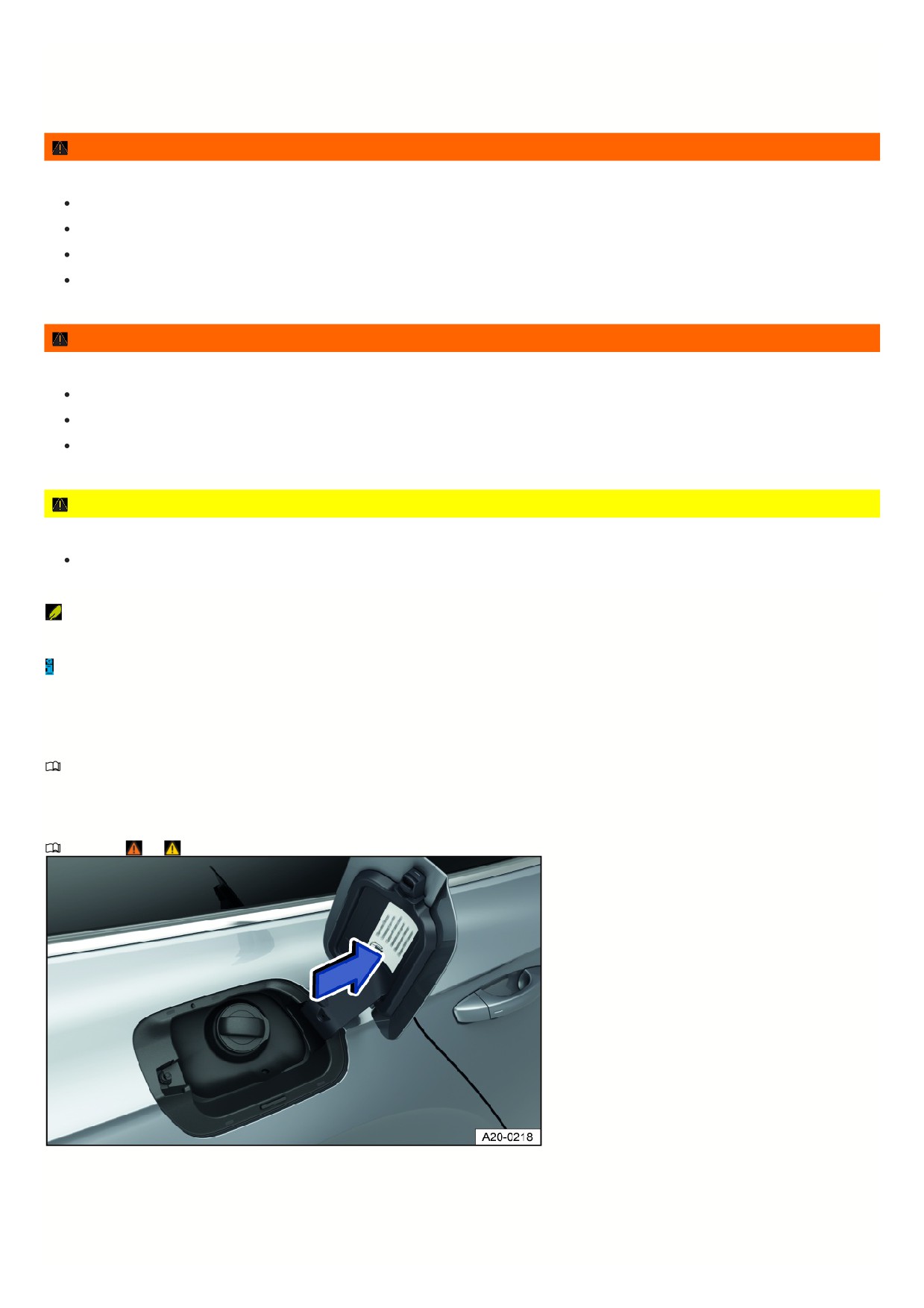
Fuel and emissions control system
Safety precautions for handling fuel
WARNING
Handling fuel incorrectly can cause explosions, fires, severe burns, and other injuries.
Before refueling, switch off the engine, the ignition and your cell phone, as well as other radio equipment.
To reduce the risk of discharging static electricity, do not enter the vehicle while refueling.
Make sure that the fuel tank cap is sealed correctly and no fuel is leaking out.
Note the applicable safety precautions and local regulations for handling fuel.
WARNING
Refueling incorrectly can cause fires, serious or fatal injuries, and vehicle damage.
Only use fuel that is approved for your vehicle.
Do not use any fuels containing metal and only use service additives approved by Volkswagen in the respective proportion.
Immediately remove any fuel that has spilled on vehicle components.
CAUTION
Fuel may leak out of reserve canisters and ignite. This can cause fires and injuries.
Do transport any reserve canisters in the vehicle.
Fuels can contaminate the environment. Collect any leaking operating fluids and dispose of them according to legal regulations.
The fuel filler flap does not have an emergency release. If necessary, contact an authorized Volkswagen dealer or authorized Volkswagen Service Facility for
assistance.
Fuel types and refueling
Introduction
The fuel filler flap is located on the right rear side of the vehicle.
Designation of fuels and fuel standards
Refer to ⇒
and Safety precautions for handling fuel.
Fig. 133 On the inside of the fuel filler flap: fuel label (general example)
Fuel label
The type of fuel to use depends on the vehicle engine. When your vehicle leaves the factory there is a fuel information sticker inside the tank flap with notes about
the minimum required fuel type for your vehicle fig. 133.
The name specifies which fuels are suitable for the vehicle. This is a minimum requirement. You must not refuel the vehicle with other fuel types or fuels of lower
238

quality ⇒
Fuel standards
The fuel used must meet one of the following standards. The vehicle must not be refueled with other fuels
⇒
If fuel with the specified standards is not available, contact suitably qualified professionals for information about which fuels are suitable for the vehicle. Volkswagen
recommends contacting an authorized Volkswagen dealer or authorized Volkswagen Service Facility.
Gasoline
Gasoline and methanol mixture
AKI 87 or higher.
Maximum 3% methanol.
Gasoline and ethanol mixture
AKI 87 or higher.
Maximum 15% ethanol.
Gasoline and MTBE mixture
AKI 87 or higher.
Maximum 15% MTBE.
NOTICE
Refueling with non-standard and non-approved fuels can cause reduced performance and considerable damage to the engine and the fuel system.
Before refueling, check if the fuel specification at the fuel pump meets the vehicle specifications.
Only use fuel that conforms to the specified standard and label.
Gasoline
Refer to ⇒
and Safety precautions for handling fuel.
Gasoline types
The gasoline types differ in terms of their Anti-Knock Index (AKI) specification, which is given from the formula (RON
+MON) / 2, or the Research Octane Number
(RON) specification. The vehicle may also be fueled with gasoline that has a higher AKI or RON than what is required by the engine. However, this will not improve
fuel consumption or engine power.
Arteon, Atlas 2.0 and Jetta GLI: Volkswagen recommends using premium-grade fuel with AKI 91 or RON 95 in order to achieve the specified power and torque.
The fuel label may include multiple types of gasoline, e.g. AKI 93 (AKI min. 91). The highlighted gasoline type, AKI 93 in this example, is the preferred gasoline typ
for which the vehicle is designed and optimized. The listed alternative gasoline type, AKI 91 in this example, should only be used if the preferred type, AKI 93 in this
example, is not available.
If your vehicle has a gasoline engine, fuel it only with gasoline that does not contain any metal (no lead, manganese or iron)
⇒
The most frequently purchased gasoline types in the USA and Canada have the following octane values, which are normally listed on the fuel pump:
Regular (normal gasoline): AKI 87 to 90 or RON 91.
Premium (super gasoline): AKI 91 to 93 or RON 95.
Volkswagen recommends using “TOP TIER Detergent Gasoline”, which is available in some regions, for example North America, Central America and South
America. For more information on “TOP TIER Detergent Gasoline”, visit the official website at:
NOTICE
The use of gasoline that does not meet the minimum requirements for the octane number can impair engine performance. The use of poor-quality gasoline or
gasoline with an AKI of under 87 or a RON of under 91 can cause engine damage.
Only fuel with gasoline that meets or exceeds the specified octane number, Research Octane Number (RON) or Anti-Knock Index (AKI).
Refueling
Refer to ⇒
and Safety precautions for handling fuel.
239
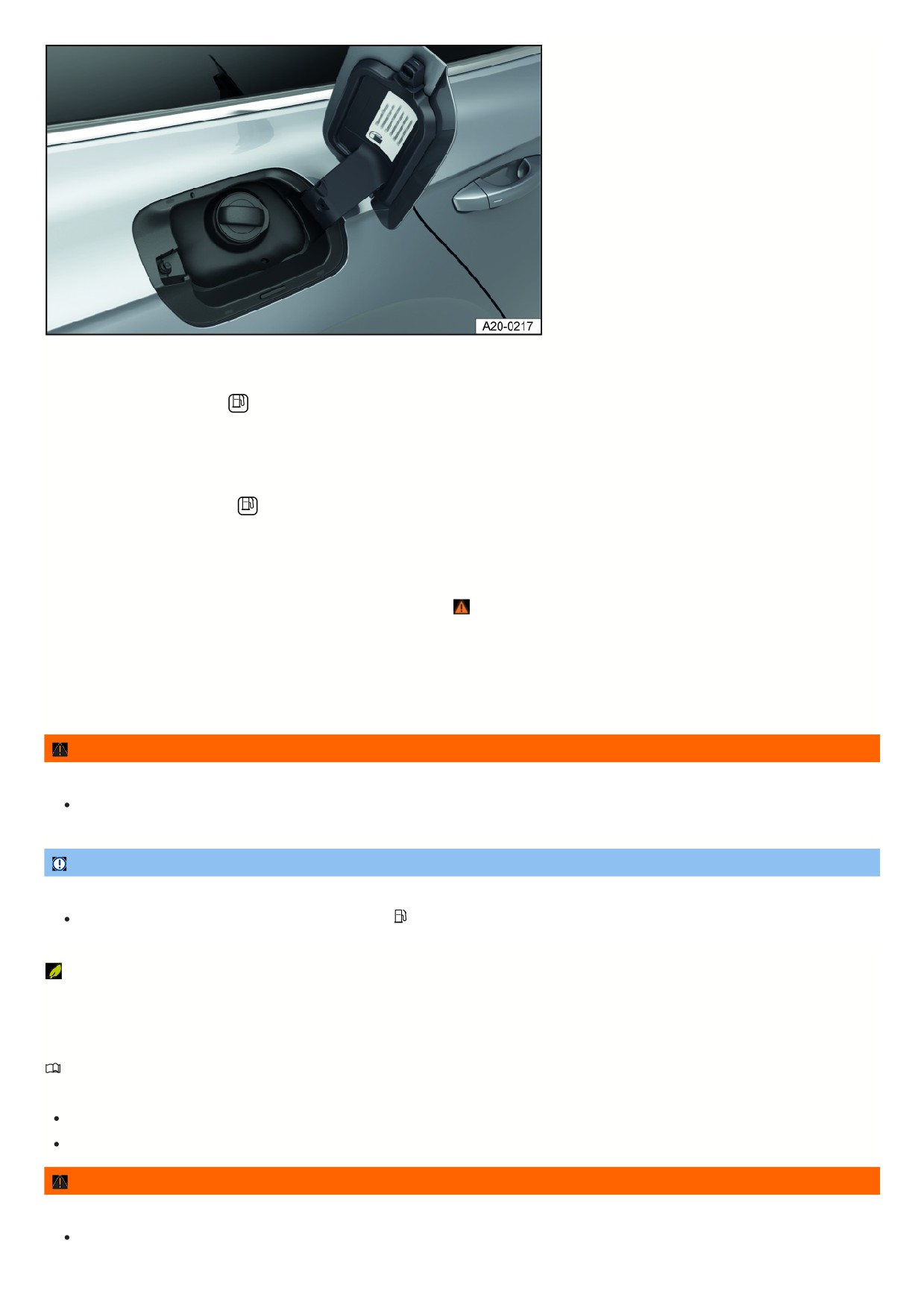
Fig. 134 Behind the fuel filler flap: fuel tank cap (general example)
Venting the fuel tank
When you press the release button
in the driver door, the fuel tank is automatically vented.
A warning chime sounds and an automatic venting message is displayed in the Volkswagen Digital Cockpit.
If you cannot open the fuel filler flap, pay attention to the messages in the instrument cluster display.
Refueling procedure
1. Unlock the fuel filler flap with the
button in the driver door.
2. Open the fuel filler flap.
3. Remove the fuel tank cap and insert it into the opening at the fuel filler flap provided for this fig. 134.
4. Hold the fuel pump nozzle handle down to ensure optimum refueling.
The fuel tank is full once the fuel pump nozzle turns off for the first time
⇒
5. Screw the fuel tank cap onto the fuel filler neck.
6. Close the fuel filler flap.
Do not continue filling after disconnection. The expansion area in the fuel tank may fill with fuel, e.g. due to heating. This may mean that the fuel overflows or the
automatic ventilation process cannot work ⇒ Troubleshooting.
WARNING
Fuel may spray out and overflow if the fuel tank is overfilled. This can cause explosions, fires, and serious or fatal injuries.
Do not continue filling after the pump nozzle switches off for the first time.
NOTICE
If the tank is not emptied up to the reserve level at regular intervals, it might not be possible to maintain the fuel quality and system function required for driving.
At least every six months, only refuel when the warning light
turns on.
Fuels can contaminate the environment. Collect any leaking operating fluids and dispose of them according to legal regulations.
Exhaust system
Introduction
The exhaust-relevant components reduce exhaust emissions:
Catalytic converter ⇒ Catalytic converter.
Particulate filter (depending on the vehicle equipment) ⇒ Particulate filter.
WARNING
If the engine runs in enclosed spaces, poisonous gases may enter the vehicle interior. This can cause serious injuries and death due to asphyxiation.
Never start the engine in confined spaces.
24

Do not allow the engine to run in confined spaces.
Do not leave your vehicle unattended while the engine is running.
WARNING
Hot vehicle parts and exhaust can ignite flammable or explosive materials in the vicinity. This can lead to a fire and cause accidents and serious or fatal injuries.
Never park the vehicle in such a way that parts of the exhaust system come into contact with flammable materials under the vehicle, such as dry grass.
Never use additional underbody protection or corrosion protection on exhaust pipes, catalytic converters, particulate filters or heat shields.
Catalytic converter
Please read the introductory information and heed the Warnings and Notice ⇒
and Safety precautions for handling fuel.
To ensure that the exhaust system and the engine catalytic converter can work correctly for a long time, observe the following:
Only refuel with fuel permitted for the vehicle.
Never drive until the fuel tank is completely empty ⇒ Refueling.
Never add too much engine oil ⇒ Checking the engine oil level and adding oil .
Do not tow-start the vehicle; use jump-start assistance instead ⇒ Preparing and Performing a Jump-start.
If there are engine misfires, loss of power, or poor engine operation while driving, reduce the speed immediately and have the vehicle checked by suitably qualified
professionals ⇒ Troubleshooting. Volkswagen recommends contacting an authorized Volkswagen dealer or authorized Volkswagen Service Facility. Otherwise,
uncombusted fuel could be present in the exhaust system and then enter the atmosphere. The catalytic converter may also be damaged from overheating.
The exhaust may smell like sulfur when the emissions control system is running correctly.
Particulate filter
Please read the introductory information and heed the Warnings and Notice ⇒
and Safety precautions for handling fuel.
Function
The particulate filter (depends on how your vehicle is equipped) filters out soot from the exhaust gas.
Regeneration
With normal vehicle usage, the filter cleans itself. If the filter is unable to clean itself, e.g. if you only make short trips for an extended period of time, the filter can
become blocked with soot. The particulate filter needs to be cleaned (regenerated).
Noises, light odors, and increased engine speeds may occur during the regeneration. The radiator fan may continue to run while driving and after turning off the
engine.
To assist in particulate filter regeneration, Volkswagen recommends avoiding driving short distances too frequently.
The soot in the particulate filter is burned periodically at high temperatures. The yellow
indicator light does not turn on during a periodic regeneration.
Troubleshooting
Please read the introductory information and heed the Warnings and Notice ⇒
and Safety precautions for handling fuel.
If the engine does not run smoothly and malfunctions
If the engine does not run smoothly or malfunctions while driving, it can indicate poor fuel quality.
1. Reduce your speed immediately.
2. Drive with a moderate RPM and low engine load to the nearest suitably qualified professional. Volkswagen recommends contacting an authorized Volkswagen
dealer or authorized Volkswagen Service Facility.
3. If these symptoms occur directly after refueling, stop the engine immediately to prevent subsequent damage.
4.
Do not continue driving! Contact an authorized Volkswagen dealer or authorized Volkswagen Service Facility for assistance.
Particulate filter clogged with soot
The yellow
indicator light turns on.
The particulate filter is clogged with soot and a regeneration is necessary.
Prerequisite for the regeneration drive: The engine is at operating temperature.
For gasoline engines
1. Drive at a speed of between 50 km/h and 120 km/h (30 mph and 75 mph).
241
The resulting temperature increase burns off the soot in the filter.
2. Only end the regeneration drive once the indicator light turns off.
3. If the indicator light is still illuminated after driving for approximately 40 minutes, drive immediately to suitably qualified professionals for assistance. Volkswagen
recommends contacting an authorized Volkswagen dealer or authorized Volkswagen Service Facility.
If, during the regeneration drive, the prompt to refuel appears in the Volkswagen Digital Cockpit, the particulate filter regeneration process can be interrupted.
Refuel if necessary and then continue the regeneration drive.
Automatic fuel tank ventilation malfunction
If the fuel tank is opened without prior ventilation, fuel vapors will escape from the filler neck. This may lead to temporary odors.
Opening the fuel tank without ventilation:
1. Press the release button
The fuel filler flap will release without ventilation.
2. Open the fuel filler flap.
Refueling with an automatic fuel tank ventilation malfunction:
1. Hold the fuel pump nozzle handle down to ensure optimum refueling.
2. Only continue carefully in this case until the fuel tank is full.
3. If the automatic ventilation process is still not working, contact a suitably qualified professional and have the ventilation system checked. Volkswagen
recommends contacting an authorized Volkswagen dealer or authorized Volkswagen Service Facility.
The fuel pump nozzle may turn off prematurely when refueling due to the lack of ventilation.
Exhaust-related malfunction
The yellow
indicator light turns on.
An exhaust-related component is malfunctioning, which could damage the vehicle.
1. Contact a suitably qualified professional and have the engine and the exhaust system checked. Volkswagen recommends contacting an authorized Volkswagen
dealer or authorized Volkswagen Service Facility.
Misfire
The yellow
indicator light flashes.
There is misfire which could damage the vehicle.
1. Contact a suitably qualified professional and have the engine and the exhaust system checked. Volkswagen recommends contacting an authorized Volkswagen
dealer or authorized Volkswagen Service Facility.
WARNING
Sudden braking or driving maneuvers, e.g. if an indicator light turns on or the engine does not run smoothly, may cause accidents. This can result in serious
injury or death.
Always adapt your speed and driving style to the visibility, weather, road and traffic conditions.
Follow the road traffic laws and regulations that apply in the country you are driving in.
If the indicator lights are on or flashing, it is likely that there is an engine malfunction and that fuel consumption will increase.
242