Volkswagen Golf GTI (2023 year). Manual in english - page 1

About this Owner's Manual
This Owner's Manual is valid for all models and versions of your Volkswagen model and model year. The Owner's Manual describes all equipment and models
without indicating special equipment or model versions. This may include descriptions of equipment that your vehicle may not have or that may only be available in
some countries.
You can find details of your actual vehicle equipment in your sales documentation or by contacting an authorized Volkswagen dealer or authorized Volkswagen
Service Facility. Volkswagen recommends contacting an authorized Volkswagen dealer or authorized Volkswagen Service Facility.
This Owner's Manual describes a passenger vehicle.
All information in this Owner's Manual was correct at the time of printing. Due to continuous vehicle development, there may be differences between your vehicle
and the information in this Owner's Manual. No legal commitment can be derived from the information, illustrations, or descriptions in this manual.
Due to legal and technical requirements, the vehicle may be provided with different Owner's Manual variants depending on the country.
Printed Owner's Manual
The printed Owner's Manual describes the range of functions of the vehicle at the time of release. Additions and amendments to the Owner's Manual may also be
added in the form of supplements.
An alphabetically ordered keyword index as well as a list of abbreviations that explains technical abbreviations and designations are included to assist with
orientation and understanding of the printed manual.
Make sure that the printed documents are in the vehicle if you wish to sell or lend the car. Volkswagen also recommends resetting the Infotainment system to its
factory settings in order to delete all personal data.
4

Explanations
Brief definitions are placed in front of some sections in a different color to summarize the topic in question. Detailed information about the systems and equipment
along with their properties, conditions, and system limitations is included in the associated sections.
The following section explains phrasings and terms found in the Owner's Manual to help understanding.
Directions
Directions (left, right, front, back) are in reference to the driving direction unless noted otherwise.
Units and speeds
The display in miles instead of kilometers or mph instead of km/h is determined by the versions of the instrument cluster and Infotainment system that are installed,
which varies depending on the country where the vehicle is sold.
Illustrations
Illustrations are only for orientation and are simply used to provide a visual display of descriptions and instructions. The illustrations may differ from your vehicle.
This Owner's Manual was created for left-hand drive vehicles. For vehicles with right-hand drive steering , controls are sometimes arranged differently from what is
shown in the illustrations or described in the text.
Form of address
To improve readability, plural pronouns are used here to refer to a singular subject of any gender. This applies to all genders equally. The use of abbreviations are
for editorial purposes and do not contain any evaluation.
Terms used and their meanings:
Sunroof
The term "power sunroof" is used as a synonym for all variants of the tilting and sliding panoramic sunroof depending on the vehicle equipment.
Authorized Volkswagen dealer or authorized Volkswagen Service Facility
Authorized Volkswagen dealer or authorized Volkswagen Service Facility refers to
workshops with instructed or trained personnel that specialize in servicing passenger vehicles. A qualified professional can be an authorized
Volkswagen dealer or authorized Volkswagen Service Facility or an independent workshop.
Authorized Volkswagen dealer or authorized Volkswagen Service Facility
Authorized Volkswagen dealer or authorized Volkswagen Service Facility refers to
workshops that have a contractual relationship with Volkswagen. This contractual relationship means that they have access to more information as well
as a direct line of communication to the manufacturer.
Contact an authorized Volkswagen dealer or authorized Volkswagen Service Facility
In some situations, it is necessary for you to drive your vehicle to an
authorized Volkswagen dealer or authorized Volkswagen Service Facility so that it can be checked.
Contact an authorized Volkswagen dealer or authorized Volkswagen Service Facility for assistance If it is no longer possible to continue driving your
vehicle, it is necessary to have it checked directly where it is by a professional. A decision regarding whether the vehicle can continue to be driven
following inspection or whether it needs to be towed must then be made depending on the circumstances.
5

Explanation of symbols
Indicates a reference to a section within a chapter containing important information and safety warnings
that should always be
heeded.
The arrow indicates the end of a section.
This symbol indicates situations where the vehicle must be stopped as quickly as possible.
The symbol means “Trademark” and indicates a recognized but not (yet) officially registered trademark. However, the absence of this
TM
symbol does not constitute a waiver of any rights associated with intellectual property.
This symbol indicates a registered trademark. However, the absence of this symbol does not constitute a waiver of any rights associated
with intellectual property.
⇒
Symbols of this type refer to warnings in the same section or on the specified page, pointing out possible risks that can cause accidents
⇒
and personal injuries and how to help prevent them.
⇒
⇒
Cross-reference to a warning of potential property damage, in the same section or on the specified page.
DANGER
DANGER indicates a hazardous situation which, if not avoided, will result in death or serious injury.
WARNING
WARNING indicates a hazardous situation which, if not avoided, could result in death or serious injury.
CAUTION
CAUTION indicates a hazardous situation which, if not avoided, could result in minor or moderate injury.
NOTICE
NOTICE is used to address practices not related to physical injury, but related to damage to the vehicle.
Texts with this symbol contain information about the environment and how you can help to protect it.
Texts with this symbol contain supplementary information.
6
Vehicle overviews
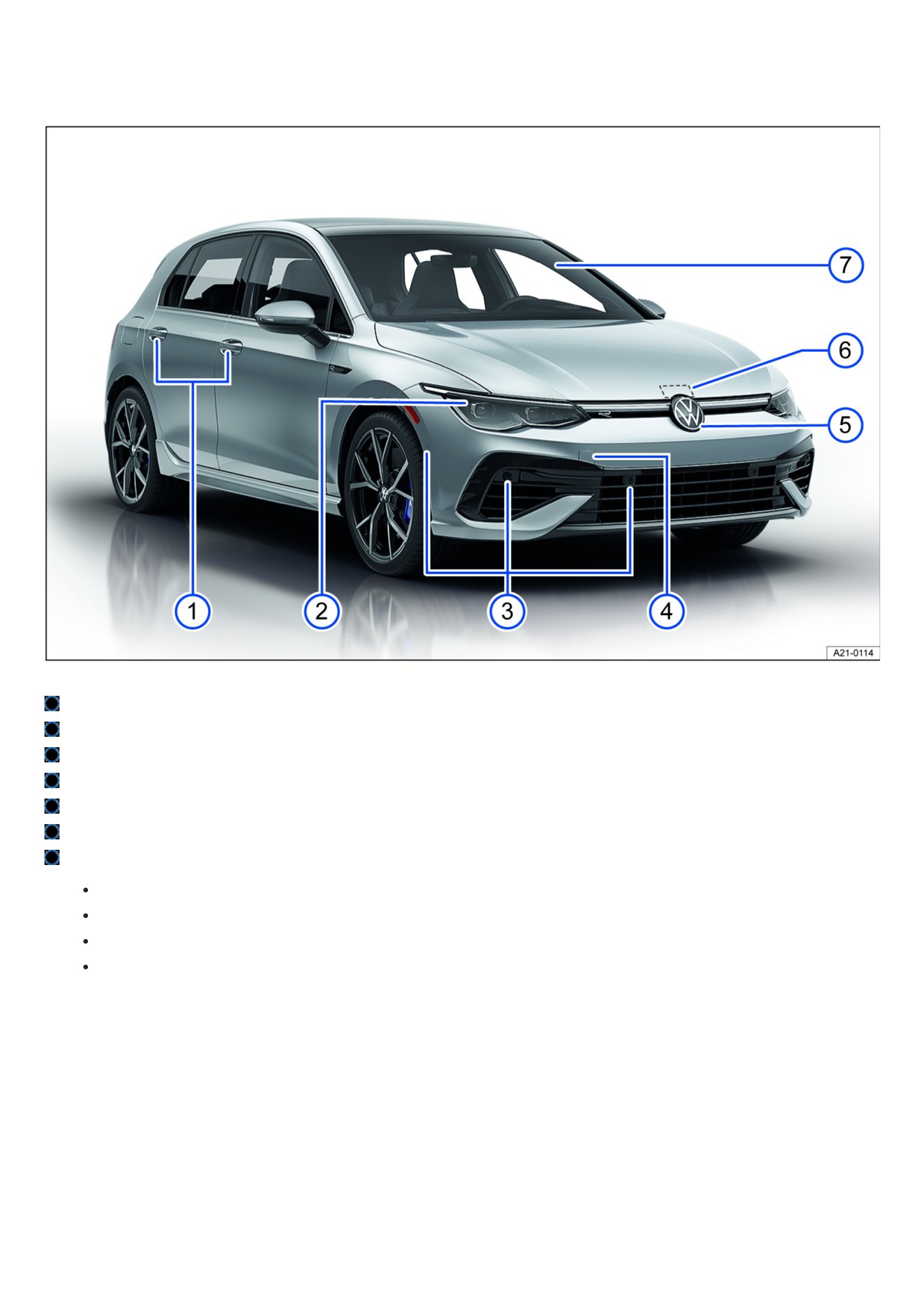
View from the front
Fig. 2 Overview of vehicle from the front.
Door handles ⇒ Doors and central locking button
Headlights ⇒ Exterior lighting
Sensors for assistance systems ⇒ Exterior care and cleaning
Behind a cover: mount for towing eye ⇒ Towing
Behind the Volkswagen emblem: radar sensor for assistance systems ⇒ Exterior care and cleaning
Opening lever for the hood ⇒ Opening and closing the hood
Windshield:
With VIN ⇒ Technical data
With windshield wipers ⇒ Operating the windshield wiper lever
With camera for assistance systems in the interior rearview mirror area
⇒ Exterior care and cleaning
With rain/light sensor in the interior rearview mirror area
⇒ Rain/light sensor, ⇒ Exterior care and cleaning
Rear view
7
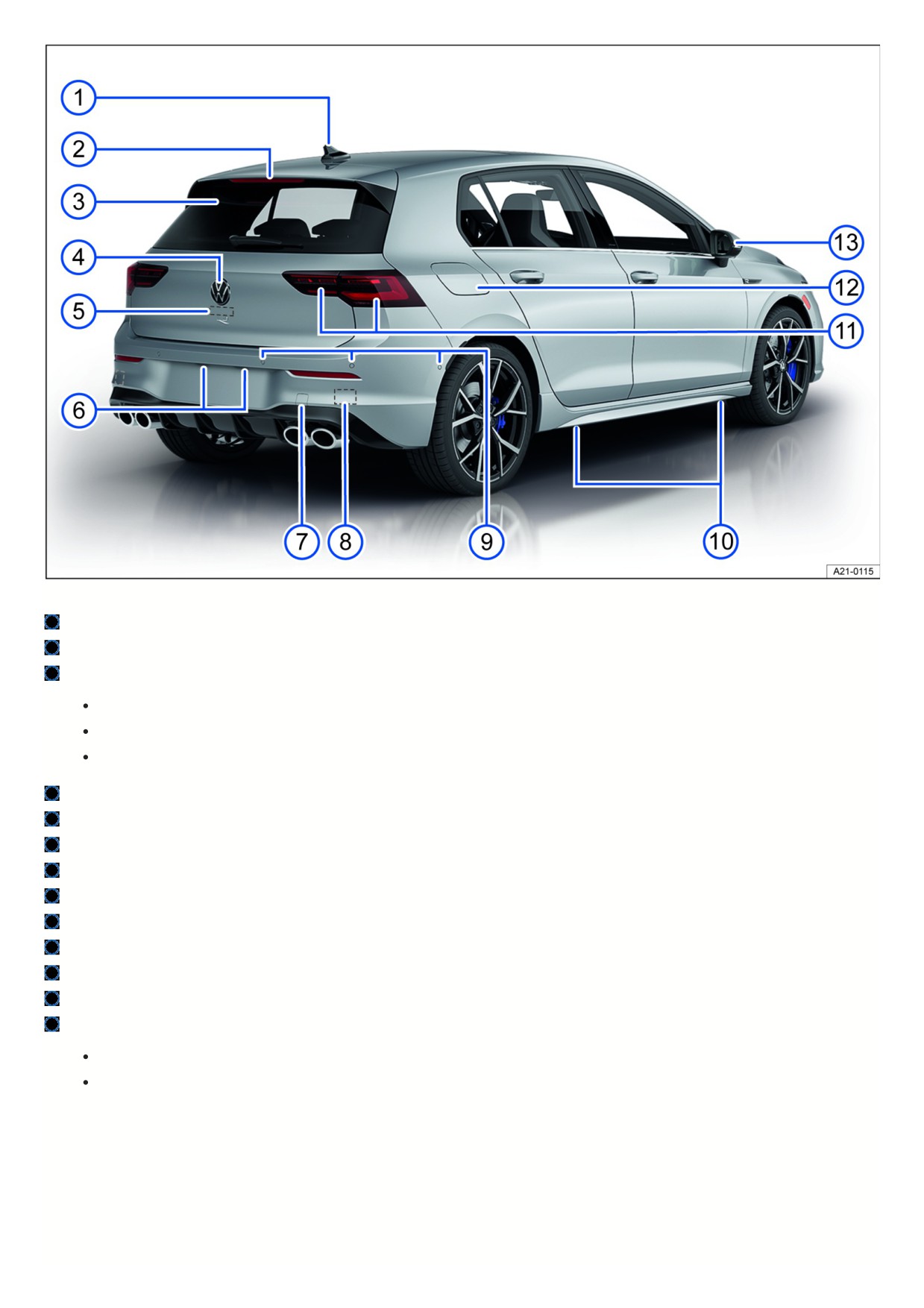
Fig. 3 Rear vehicle overview.
Roof antenna ⇒ Infotainment system and aerials
High-mounted brake light
Rear window:
With rear window defroster ⇒ Rear window defroster
With rear window wiper ⇒ Operating the windshield wiper lever
With window antenna ⇒ Infotainment system and aerials
Volkswagen emblem for opening the trunk lid ⇒ Trunk lid
Parking systems camera area ⇒ Rear View Camera , ⇒ Exterior care and cleaning
Number plate light ⇒ Exterior lighting
Behind a cover: mount for towing eye ⇒ Towing
Behind the bumper: radar sensor for assistance systems ⇒ Exterior care and cleaning
Sensors for assistance systems ⇒ Exterior care and cleaning
Mounting points for the vehicle jack ⇒ Wheel change
Taillights ⇒ Exterior lighting
Fuel filler flap ⇒ Fuel types and refueling
Outside mirrors ⇒ Outside mirrors
with Lane Change System (Side Assist) display ⇒ Lane Change System
with exit warning system indicator ⇒ Exit warning system
Driver door
8
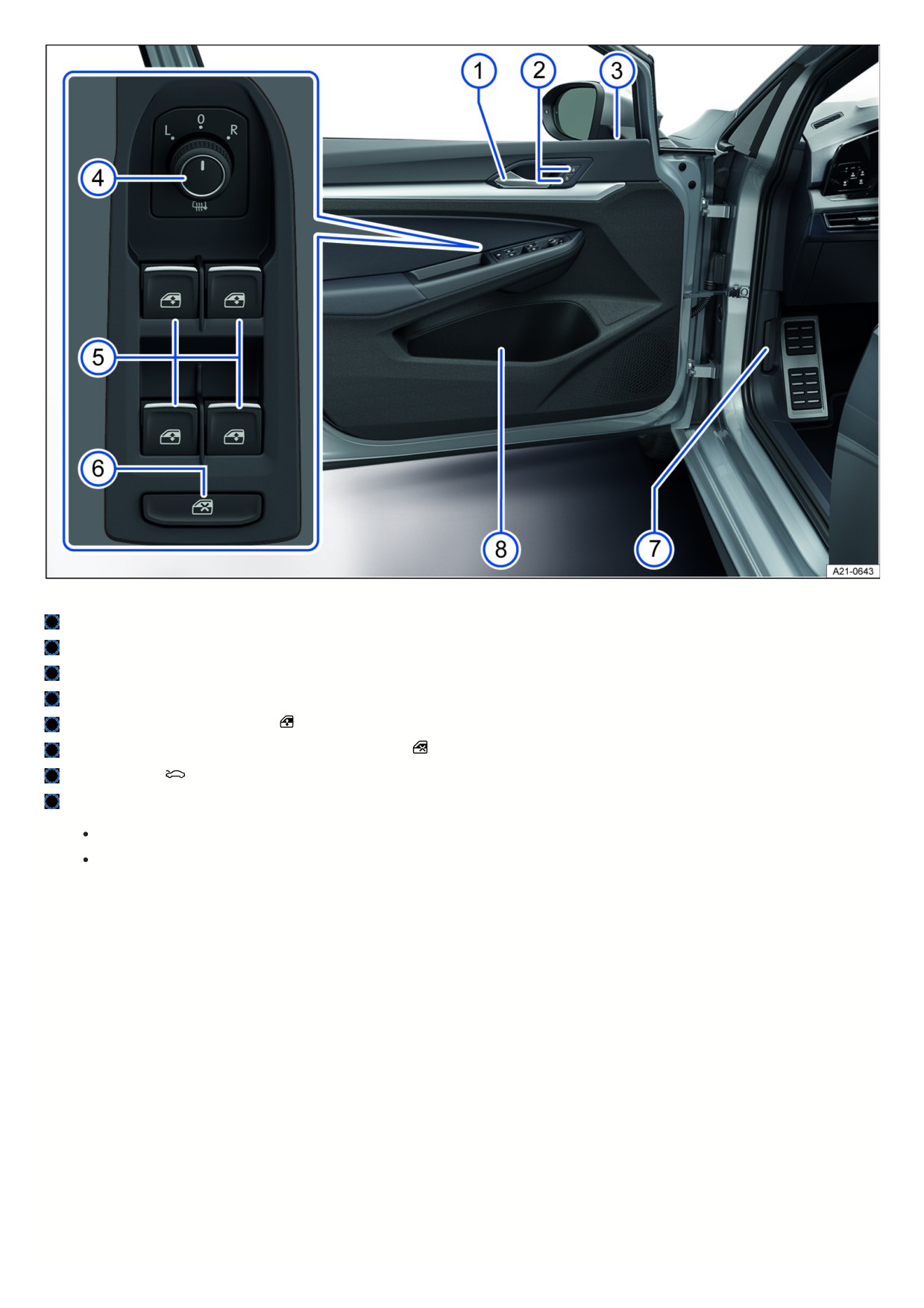
Fig. 4 Driver door: Controls.
Door handle
Central locking button to lock and unlock the vehicle ⇒ Central locking button
Central locking indicator light ⇒ Indicator light in the driver's door
Knob for outside mirror positions and functions ⇒ Outside mirrors
Buttons for operating the power windows
⇒ Opening and closing the windows
Button for deactivating the power window buttons in the rear doors
⇒ Opening and closing the windows
Hood release lever
⇒ Opening and closing the hood
Storage compartment
With cup holder
With storage option for a reflective vest ⇒ Emergency equipment
Driver side
9
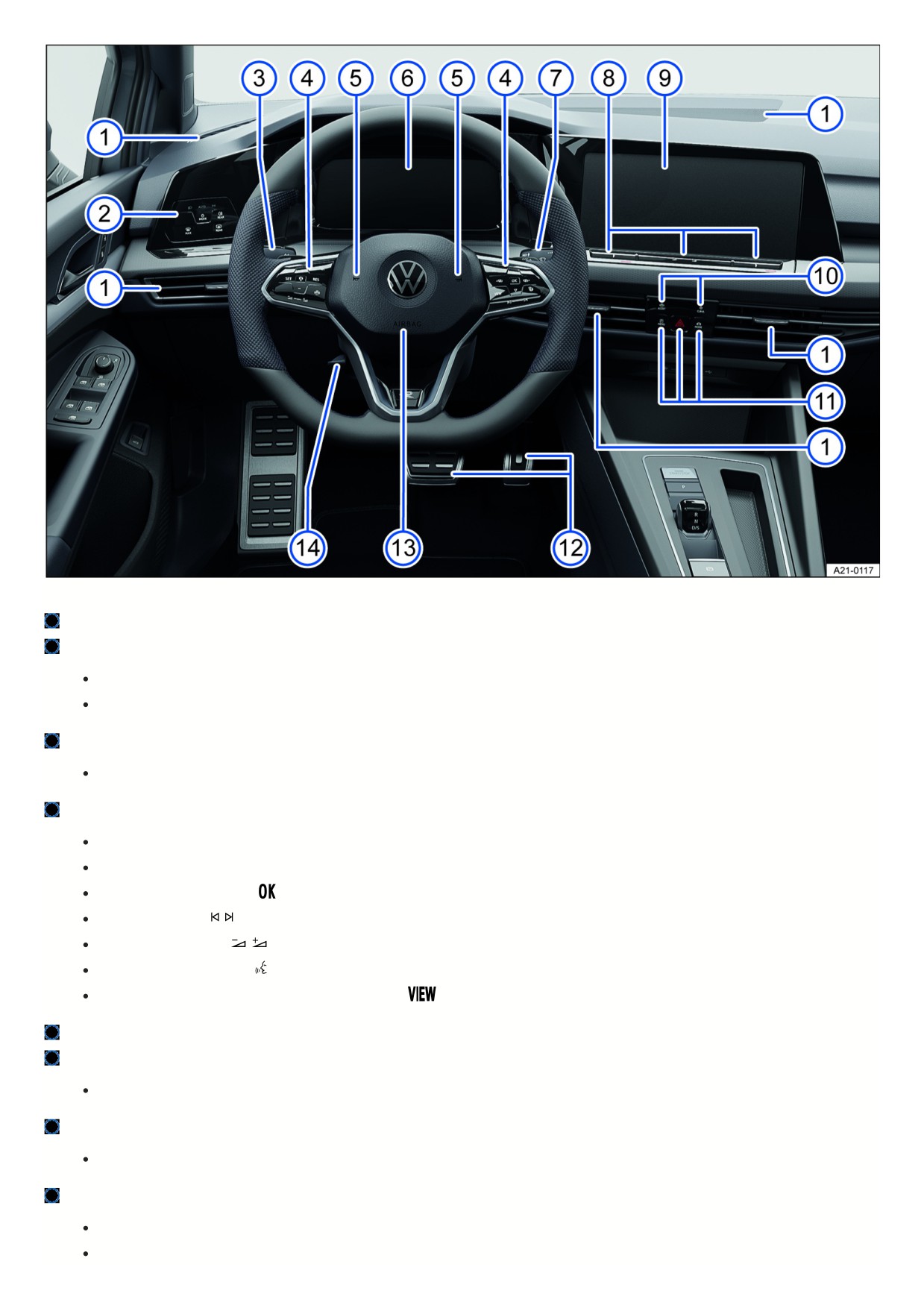
Fig. 5 Driver’s side overview.
Vents ⇒ Air distribution and blower speed
Control panel:
For light functions ⇒ Headlights
For window heating and ventilation ⇒ Rear window defroster, ⇒ Air distribution and blower speed
Turn signal and high beam lever ⇒ Switching the turn signals on and off , ⇒ Switching the high beam headlights on and off
With switch and buttons for driver assistance systems
⇒ Driver assistance systems
Multi-function steering wheel controls:
For driver assistance systems ⇒ Driver assistance systems
For menu selection ⇒ Operating the Volkswagen Digital Cockpit
For accepting telephone calls
For audio, navigation
,
⇒ Infotainment system, ⇒ Navigation
For adjusting the volume
For voice operation activation
(may not function depending on the equipment) ⇒ Voice control
In order to switch between the current and previous menus
⇒ Operating the Volkswagen Digital Cockpit
Horn
Instrument cluster ⇒ Overview of Volkswagen Digital Cockpit
With warning and indicator lights ⇒ Symbols in the instrument cluster
Windshield wiper/washer lever ⇒ Window wipers
With buttons for menu operation ⇒ Operating the Volkswagen Digital Cockpit
Controls:
For setting the temperature of the air conditioning system ⇒ Heating and air conditioning system
For adjusting the volume
1
Infotainment system ⇒ Infotainment system
Controls:
For the air conditioning system ⇒ Heating and air conditioning system
For Driving Mode Selection ⇒ Driving Mode Selection
Controls:
For driver assistance systems ⇒ Driver assistance systems
Button for switching the emergency flashers on or off
⇒ In case of an emergency
For parking and maneuvering assist systems
⇒ Parking and maneuvering
Pedals ⇒ Information on the pedals
Installation location of driver’s front airbag ⇒ Airbag system
Lever for adjusting the steering wheel position ⇒ Steering wheel
Bottom section of the center console
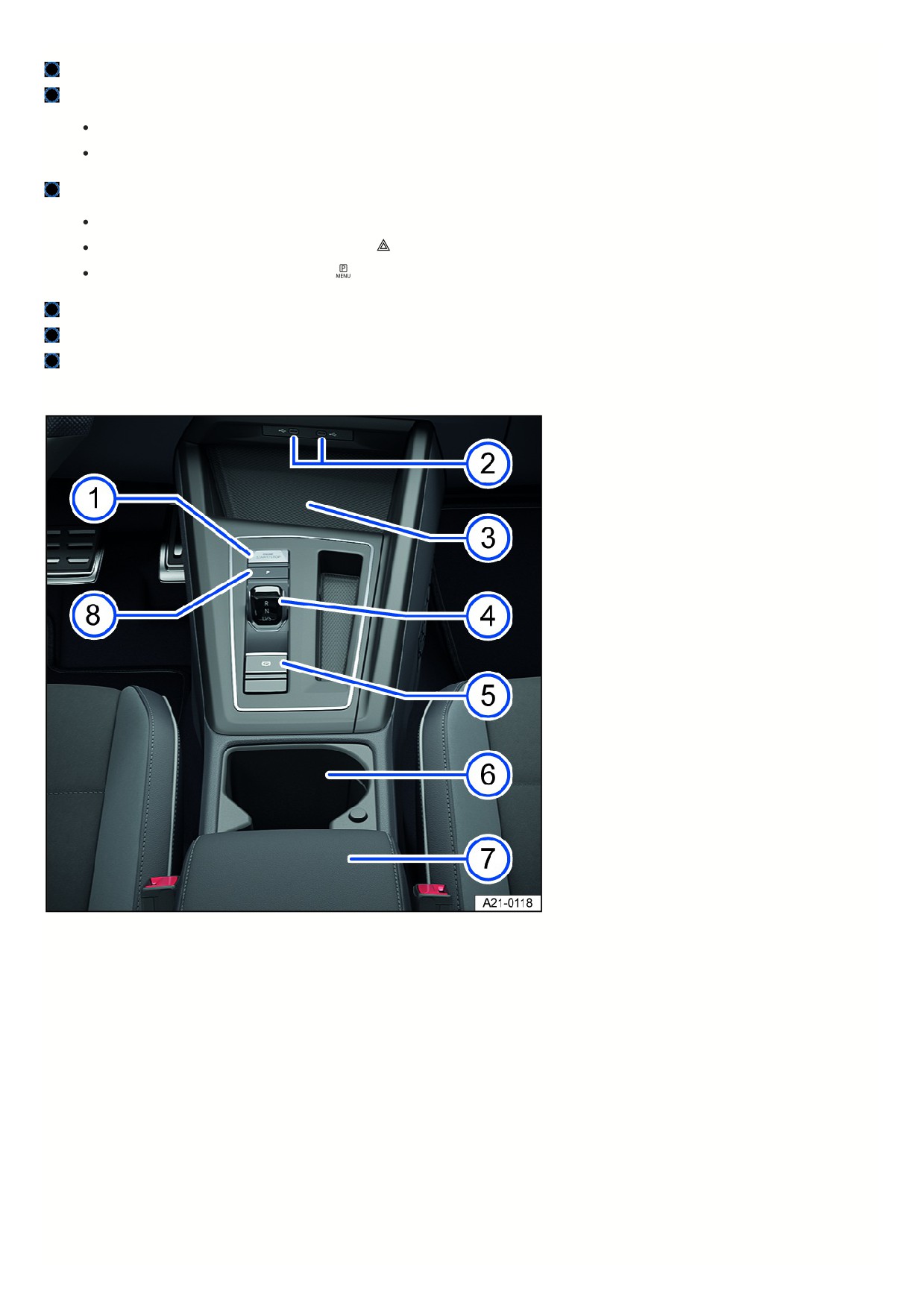
Fig. 6 Overview of the lower section of the center console in vehicles with a DSG automated transmission.
11
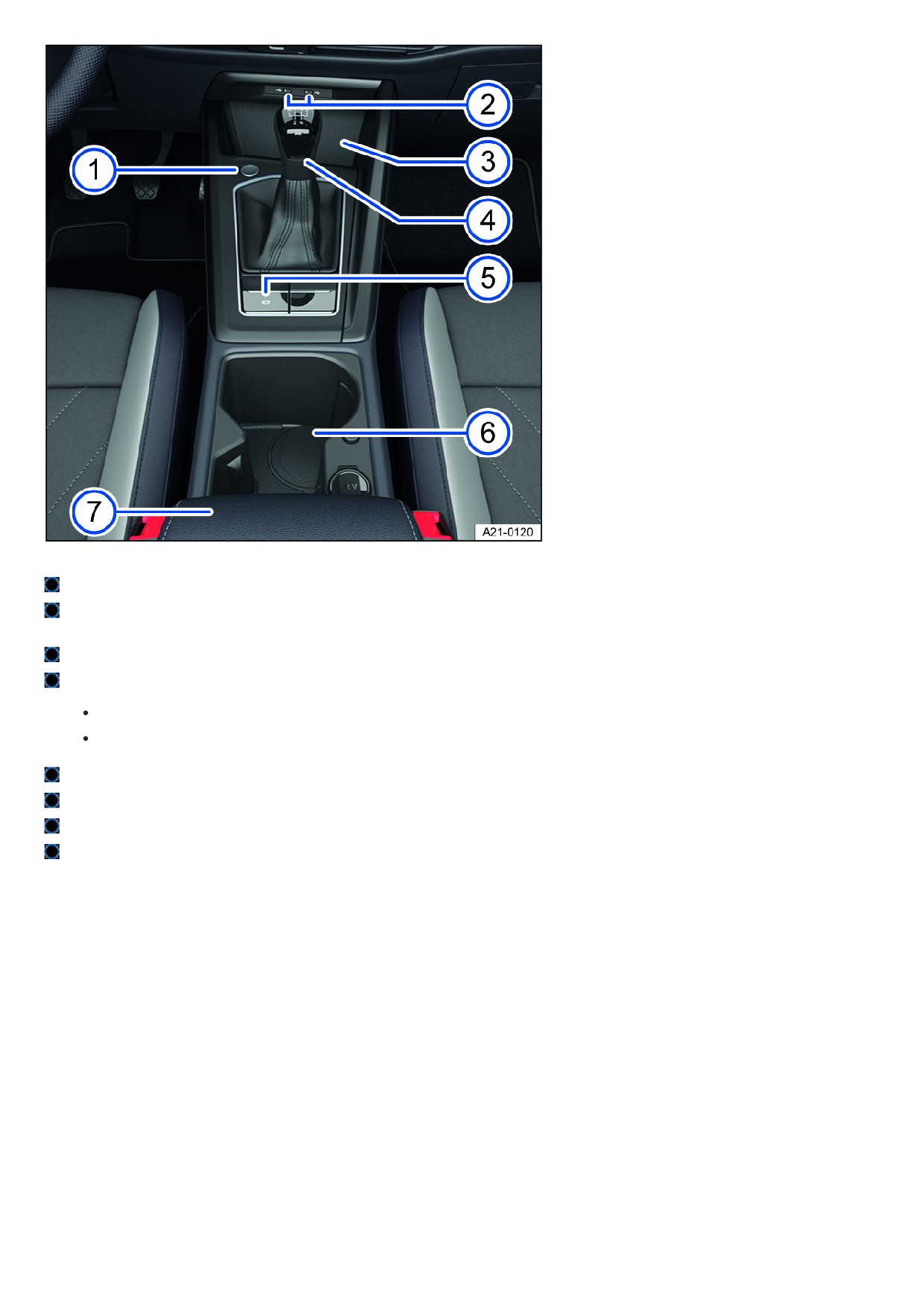
Fig. 7 Overview of the lower section of the center console for vehicles with manual transmission.
Button to start and stop the engine (Keyless Start) ⇒ Starter button
USB sockets with charge function for external device rechargeable batteries (depending on the vehicle equipment)
⇒ Wired and wireless connections,
⇒ Charging Options for Mobile Devices
Storage compartment with function for wireless charging according to QI standard ⇒ Charging Options for Mobile Devices
Lever or knob:
For DSG® automated transmission ⇒ Automatic transmission
or manual transmission ⇒ Manual transmission
Electronic parking brake ⇒ Electronic parking brake
Storage compartment with cup holder
Center armrest with storage compartment
Parking lock P in vehicles with DSG ® automated transmission ⇒ Automatic transmission: Selecting a position
Passenger’s side
12
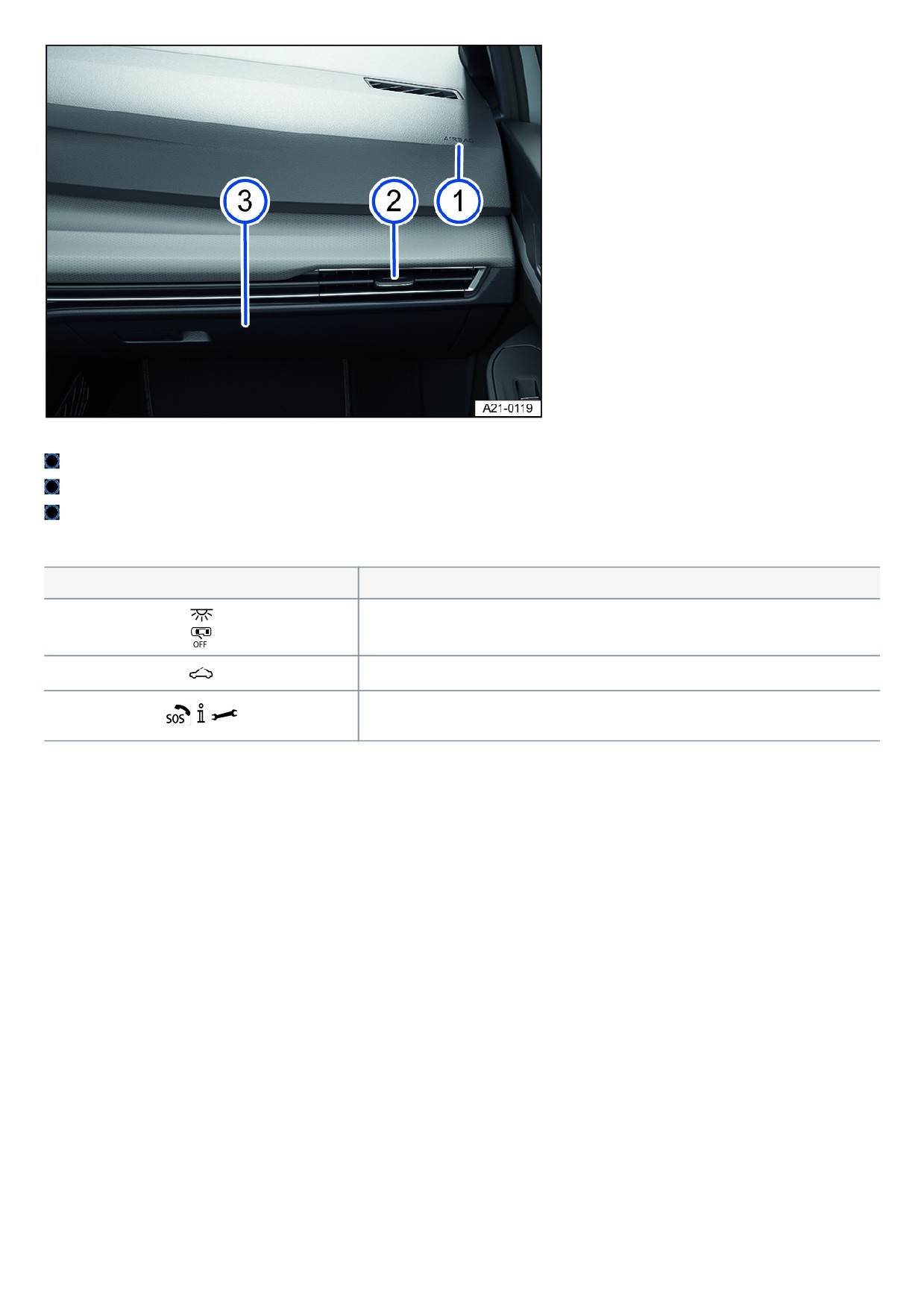
Fig. 8 Passenger's side: instrument panel overview
Installation location of the front passenger’s airbag in the instrument panel
⇒ Airbag system
Adjustable vent ⇒ Air distribution and blower speed
Glove compartment with handle
Controls in the headliner
Symbol
Meaning
Buttons for interior/reading lights ⇒ Interior/reading lights, ambient lighting.
Sunroof switch ⇒ Sunroof.
Buttons for Emergency Call, Information Call and Roadside Assistance Call
⇒ Information Call,
Roadside Assistance Call and Emergency Call Service.
13
Driver information
Symbols in the instrument cluster
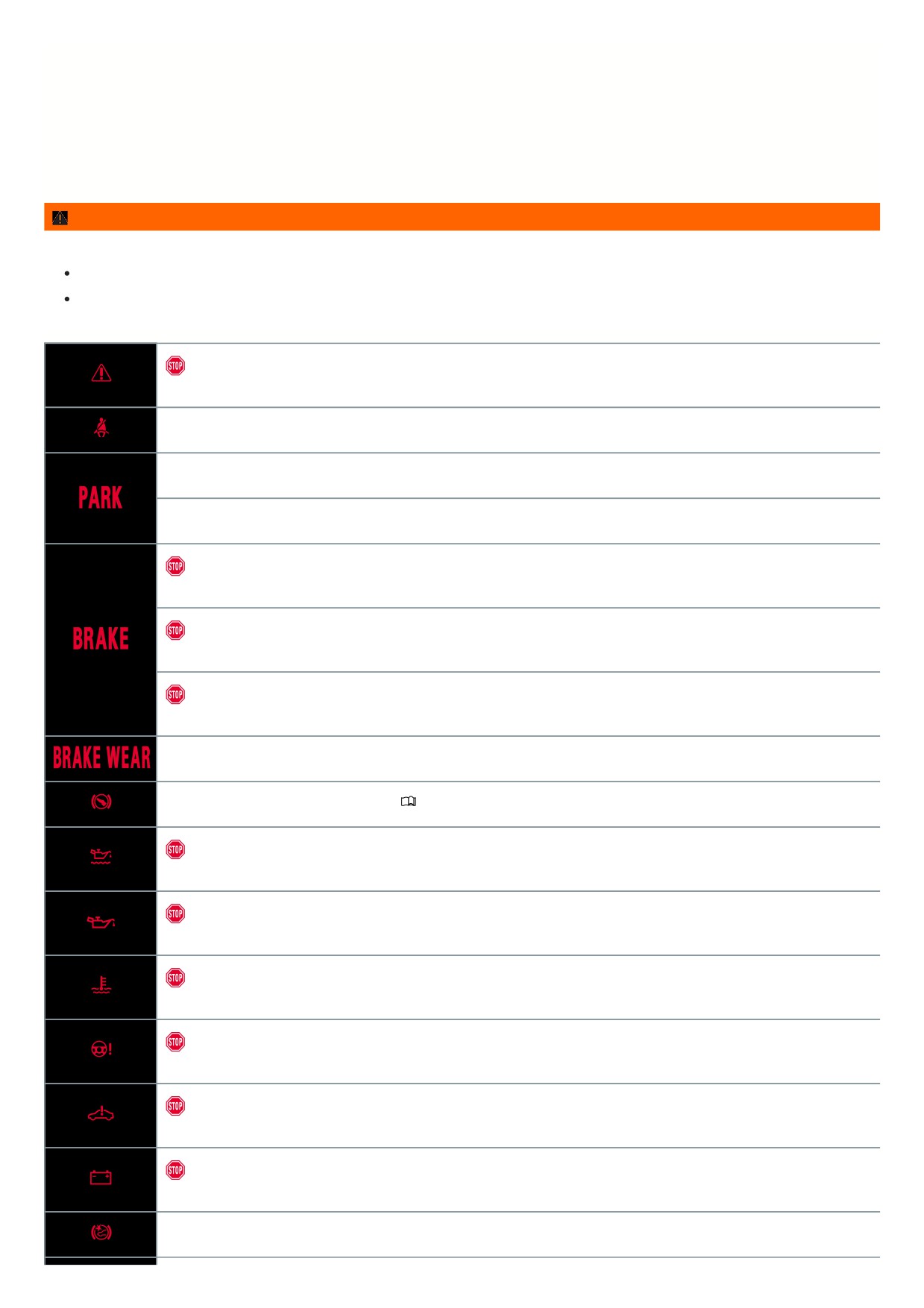
The warning and indicator lights can turn on individually or in combination with each other and indicate warnings, malfunctions and certain functions. Some warning
and indicator lights come on when you switch the ignition on and must turn off after some time.
Indicator lights that turn on in the light switch are described in the “Lights” chapter ⇒ Switching the lights on and off .
WARNING
Failure to respond to illuminated warning lights and messages may result in a vehicle breakdown, accidents and serious injuries or death.
Never ignore illuminated warning lights and messages.
Stop the vehicle as soon as it is safe to do so.
Do not continue driving!
Central warning light ⇒ Priority 1 warning message
Fasten safety belt ⇒ Fasten seat belts reminder and seat belt safety indicator
Electronic parking brake switched on ⇒ Electronic parking brake
Holding force of the electronic parking brake too low ⇒ The holding force is too low for the current situation
Do not continue driving!
Brake system malfunction ⇒ Brake system malfunction
Do not continue driving!
Electromechanical brake booster failed ⇒ Electromechanical brake servo failure
Do not continue driving!
Brake fluid level too low ⇒ Brake fluid level
Check brake system ⇒ Brake pad wear indicator
Take over steering and be ready to brake. ⇒
Introduction
Do not continue driving!
Engine oil level too low ⇒ Engine oil level very low
Do not continue to drive!
Engine oil pressure too low ⇒ Engine oil pressure too low
Do not continue to drive!
Engine coolant system malfunction ⇒ Engine coolant
Do not continue driving!
Steering malfunction ⇒ Steering malfunction
Do not continue driving!
Engine control malfunction ⇒ Engine control malfunction, ⇒ The engine no longer starts automatically
Do not continue driving!
12 V energy supply malfunction ⇒ 12-volt power supply
Collision warning ⇒ Warning levels and braking support
14
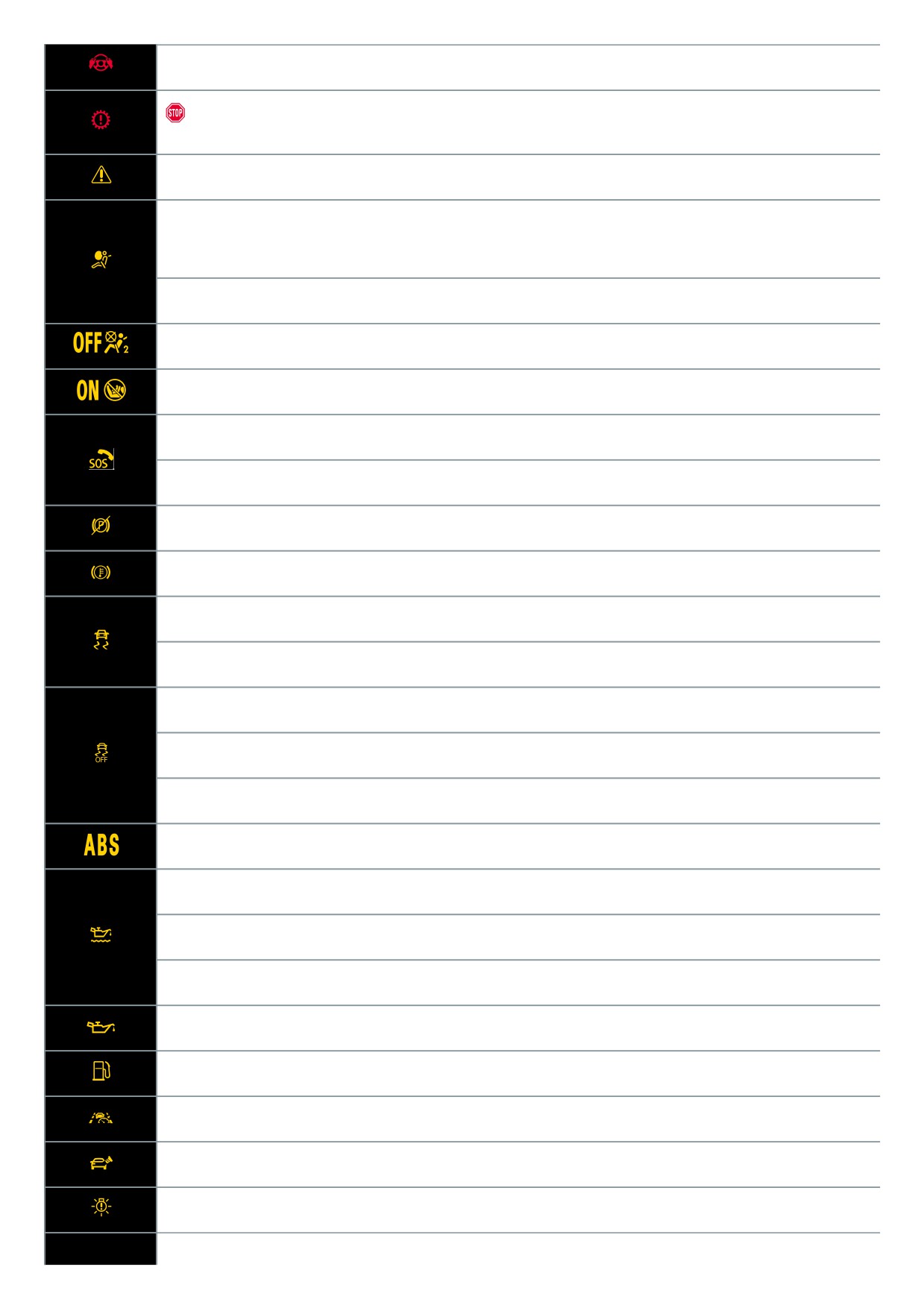
Take over the steering immediately ⇒ Take over the steering immediately
Do not continue to drive!
Transmission overheating ⇒ Transmission overheating
Central warning light ⇒ Priority 2 warning message , ⇒ The brake is too hot
Airbag or safety belt pretensioner system deactivated with diagnostic equipment
⇒ Airbag system or safety belt pretensioners
deactivated with diagnostic device
Airbag system or safety belt pretensioner malfunction ⇒ Airbag system or safety belt pretensioners malfunction
Front passenger's front airbag deactivated ⇒ Front passenger's front airbag switched off
Front passenger’s airbag enabled ⇒ Front passenger's front airbag enabled
Emergency Call Service limited ⇒ Emergency Call Service limited
Emergency Call Service malfunctioning ⇒ Emergency Call Service malfunction
Electronic parking brake malfunction ⇒ Electronic parking brake malfunction
Brake too hot ⇒ The brake is too hot
Comes on: Electronic Stability Control (ESC) malfunction ⇒ ESC malfunction
Flashes: Electronic Stability Control (ESC) or Anti-slip regulation (ASR) in operation
⇒ Electronic Stability Control (ESC)
ESC Sport switched on ⇒ ESC Sport
Electronic Stabilization Control (ESC) switched off ⇒ ESC Off
Anti-Slip Regulation (ASR) switched off ⇒ ASR
Anti-Lock Braking System (ABS) malfunction ⇒ ABS failure or malfunction
Engine oil system malfunction ⇒ Engine oil system malfunction
Engine oil level too low ⇒ Engine oil level too low
Engine oil level too high ⇒ Engine oil level too high
Engine oil system malfunction ⇒ Engine oil system malfunction
Tank almost empty ⇒ Fuel tank almost empty
Semi-automated driving assistance (Travel Assist) not available ⇒ Travel Assist is not available or is not functioning as expected
Tank cap not closed ⇒ Fuel tank cap open
Driving light failure ⇒ Exterior lighting malfunction
15
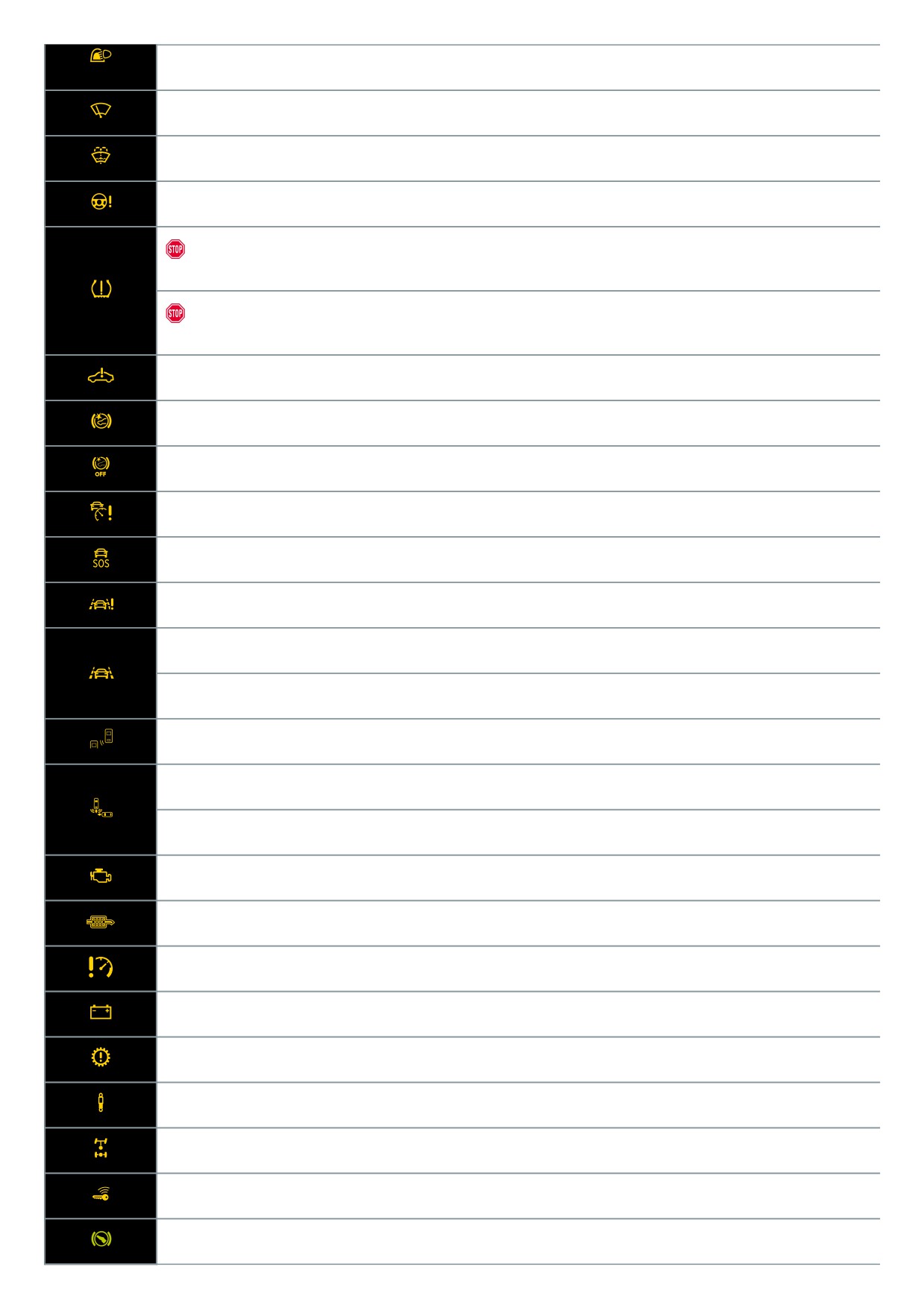
Rain/light sensor malfunction ⇒ Rain/light sensor malfunction, ⇒ Rain/light sensor malfunction
Windshield wiper malfunction ⇒ Windshield wiper malfunction
Washer fluid level too low ⇒ Washer fluid level too low
Steering malfunction ⇒ Steering malfunction
Do not continue to drive!
Tire pressure low ⇒ Tire pressure low
Do not continue to drive!
Tire pressure monitoring system malfunction ⇒ Tire Pressure Monitoring System malfunction
Engine control is malfunctioning ⇒ Engine control malfunction
Autonomous Emergency Braking (Front Assist) not available ⇒ Autonomous Emergency Braking
Autonomous Emergency Braking (Front Assist) switched off ⇒ Using Front Assist
Adaptive cruise control (ACC) not available ⇒ ACC is not available
Emergency Assist not available ⇒ Semi-automatic vehicle control in a medical emergency
Lane Keeping System (Lane Assist) not available ⇒ Lane Assist not available
Semi-automatic vehicle control in a medical emergency (Emergency Assist) is functioning ⇒ Driving with Emergency Assist
Lane Assist in control ⇒ Driving with Lane Assist
Side Assist malfunction ⇒ Side Assist malfunction
Rear Traffic Alert malfunction ⇒ Rear Traffic Alert
Rear Traffic Alert brakes ⇒ Rear Traffic Alert
Exhaust system malfunction ⇒ Exhaust-related malfunction
Particulate filter clogged with soot ⇒ Particulate filter clogged with soot
Engine speed limited ⇒ Engine speed limited
12-volt power supply malfunction ⇒ 12-volt power supply
Transmission malfunction ⇒ Clutch “slips”, ⇒ Transmission overheating
Adaptive chassis control (DCC) malfunction ⇒ Adaptive chassis control malfunction
All-wheel drive (4MOTION) ⇒ Malfunction in the all-wheel drive
Vehicle key not in vehicle ⇒ Valid vehicle key cannot be detected
Press the brake pedal. ⇒ The engine is not starting
16
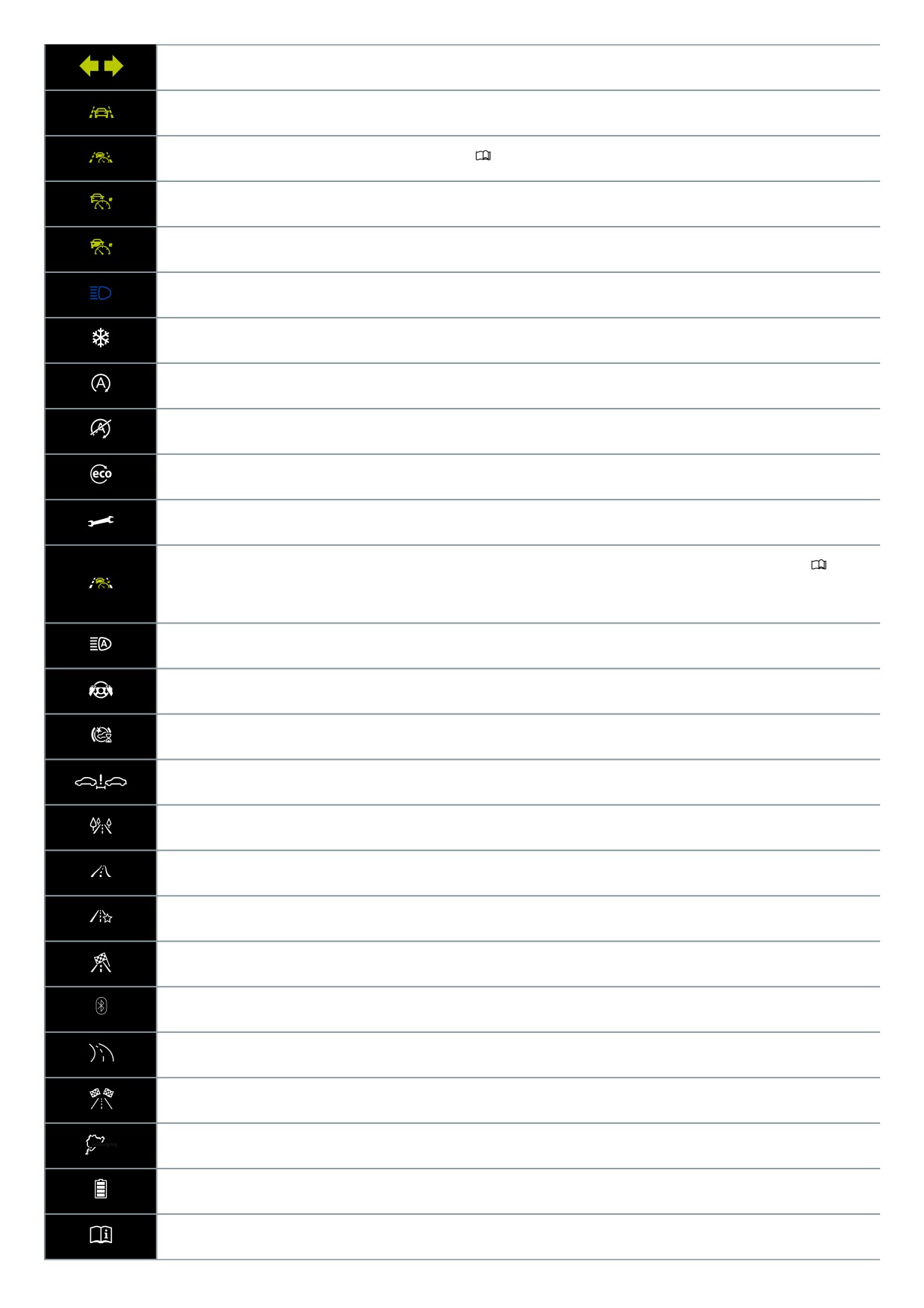
Turn signals ⇒ Turn signal indicator light
Lane Assist active ⇒ Driving with Lane Assist
Semi-automated driving assistance (Travel Assist) active ⇒
Introduction
Adaptive Cruise Control (ACC) regulates, no vehicle driving ahead is detected ⇒ Switching ACC on and off
Adaptive Cruise Control (ACC) regulates, vehicle driving ahead is detected ⇒ Switching ACC on and off
High beams or headlight flasher ⇒ Switching the high beam headlights on and off
Outside temperature is below +39 °F (+4 °C) ⇒ Volkswagen Digital Cockpit information displays
Start/Stop system active ⇒ Start-stop system
Start/Stop system not available ⇒ Start-stop system
Economical driving condition ⇒ Fuel-efficient driving
Service due ⇒ Service interval display
Semi-automated driving assistance (Travel Assist) active, Adaptive Cruise Control active, adaptive lane guidance inactive
⇒
Introduction
High beam control active ⇒ Switching on high beam control
Take over the steering ⇒ Take over the steering
Autonomous Emergency Braking (Front Assist) starts ⇒ Autonomous Emergency Braking starts
Distance warning ⇒ Warning levels and braking support
Eco driving mode ⇒ Driving mode properties
Comfort driving mode ⇒ Driving mode properties
Individual driving mode ⇒ Driving mode properties
Sport driving mode ⇒ Driving mode properties
Mobile phone connected via Bluetooth® ⇒ Volkswagen Digital Cockpit information displays
Drift driving mode ⇒ Driving mode properties
Race driving mode ⇒ Driving mode properties
Special driving mode ⇒ Driving mode properties
Mobile phone battery charge level ⇒ Volkswagen Digital Cockpit information displays
Note about information in the Owner's Manual ⇒ Note about information in the Owner's Manual
17

Warning and information texts
The status of some functions inside the vehicle and vehicle components are checked when the ignition is switched on or while driving. Malfunctions are indicated by
red and yellow warning symbols in the instrument cluster display and may also be signaled audibly in some cases. The appearance of texts and symbols may vary
depending on the instrument cluster version.
Any malfunctions currently occurring can also be manually called up. To do this, open the Vehicle status or Vehicle menu
⇒ Vehicle settings menu.
Priority 1 warning message
The red central warning light flashes or comes on, in some cases together with warning tones or additional symbols.
Do not continue driving! There is a haza
Check the malfunction. Contact an authorized Volkswagen dealer or authorized Volkswagen Service Facility immediately for assistance.
Priority 2 warning message
The yellow central warning light flashes or comes on, in some cases together with warning tones or additional symbols. Malfunctions or insufficient operating fluids
can cause vehicle damage and vehicle malfunctions. Check the malfunction as soon as possible. Immediately contact an authorized Volkswagen dealer or
authorized Volkswagen Service Facility to have the system checked. Volkswagen recommends contacting an authorized Volkswagen dealer or authorized
Volkswagen Service Facility.
Note about information in the Owner's Manual
You can find more information about the existing warning message in the Owner's Manual.
Informational text
Information about various processes in the vehicle.
If there are multiple warning messages, the symbols will appear consecutively for several seconds. The symbols will appear until the malfunction is corrected.
If warning messages about malfunctions appear when the ignition is switched on, settings or information displays may not appear as described. If the
malfunction persists, contact a suitably qualified professional. Volkswagen recommends contacting an authorized Volkswagen dealer or authorized Volkswagen
Service Facility.
Introduction to the instrument cluster
The vehicle is equipped with a Volkswagen Digital Cockpit. The instrument cluster shows essential information, such as speed.
In addition, the following functions, among others, are available depending on the equipment:
Various menus, such as for the driver assistance systems.
Status displays for the driver assistance systems.
Display messages.
Warning and indicator lights.
Information about economy and range.
Content can be individually adapted and settings can be changed in the menus.
WARNING
Operating the Volkswagen Digital Cockpit and Infotainment system can distract you from traffic. If the driver is distracted while driving, accidents and serious or
fatal injuries can occur.
Always drive attentively and responsibly.
Never operate the instrument cluster while driving.
Only adjust any settings in the instrument cluster or Infotainment system when the vehicle is stationary.
WARNING
If there is a serious fault in the instrument cluster, the display may be turned off. The warning light
may also come on here. No further warnings can be
displayed. This may result in vehicle breakdowns while driving, accidents and serious or fatal injuries.
Safely stop the vehicle.
See an authorized Volkswagen dealer or authorized Volkswagen Service Facility for assistance.
After starting the engine when the 12 V vehicle battery is severely drained or when it has been replaced or jump-started, the system settings, e.g. personal
convenience settings and programming, and user profiles may be changed or erased. Check and correct the settings after the 12 V vehicle battery is sufficiently
recharged.
18
Digital Instrument cluster
Overview of Volkswagen Digital Cockpit
The Digital Cockpit is a digital instrument cluster with a high-resolution TFT color display. By selecting different secondary displays, other displays can be shown in
addition to the standard dials, such as the tachometer. The term “Volkswagen Digital Cockpit” is also used to refer to the digital instrument cluster in the following.
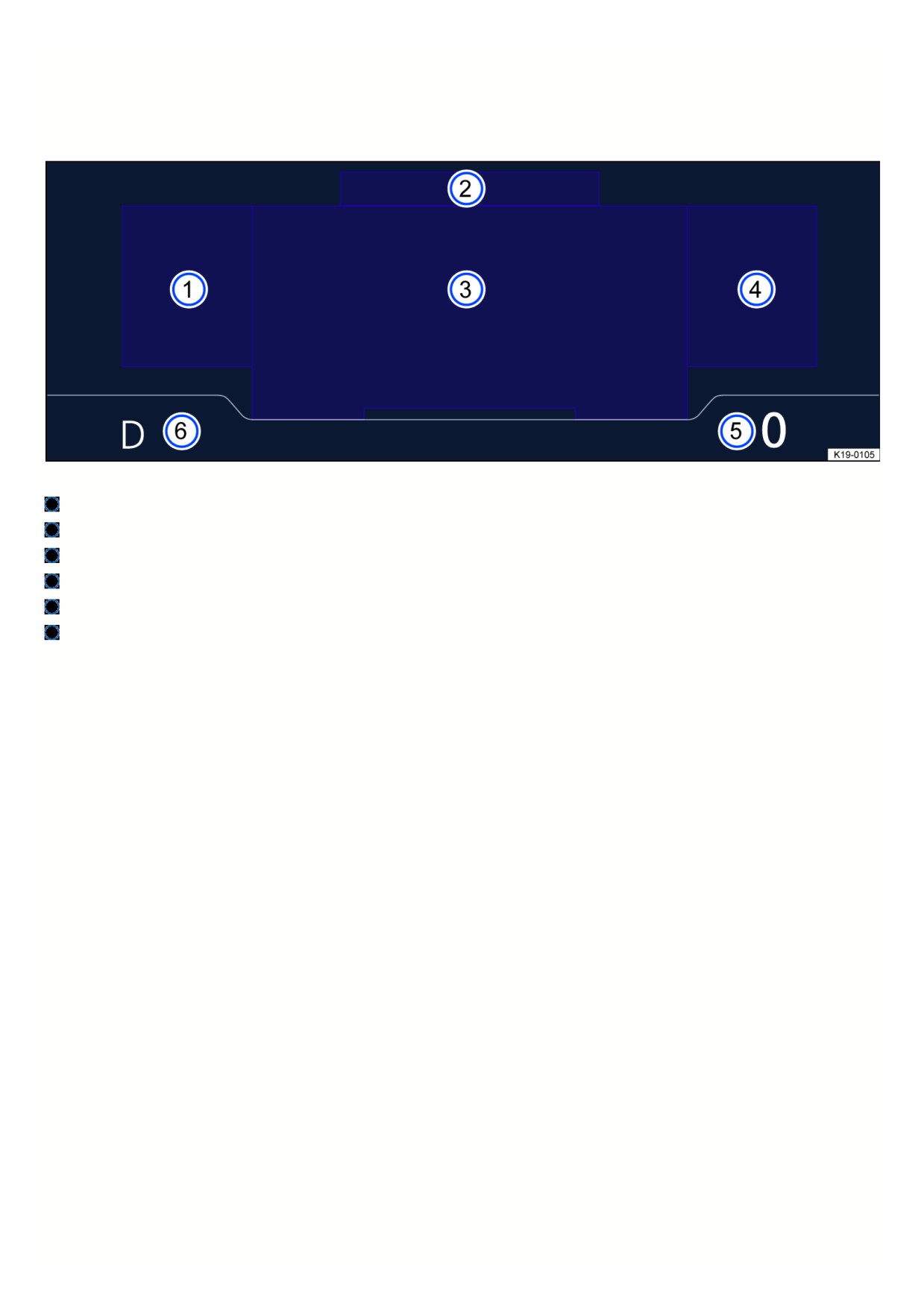
Fig. 9 Digital instrument cluster in the instrument panel (general example).
Secondary displays.
Pop-ups: Situation-related messages, e.g. navigation information.
Main display area.
Secondary displays.
Digital speed display.
Currently engaged gear or selector lever level.
Operating the Volkswagen Digital Cockpit
19
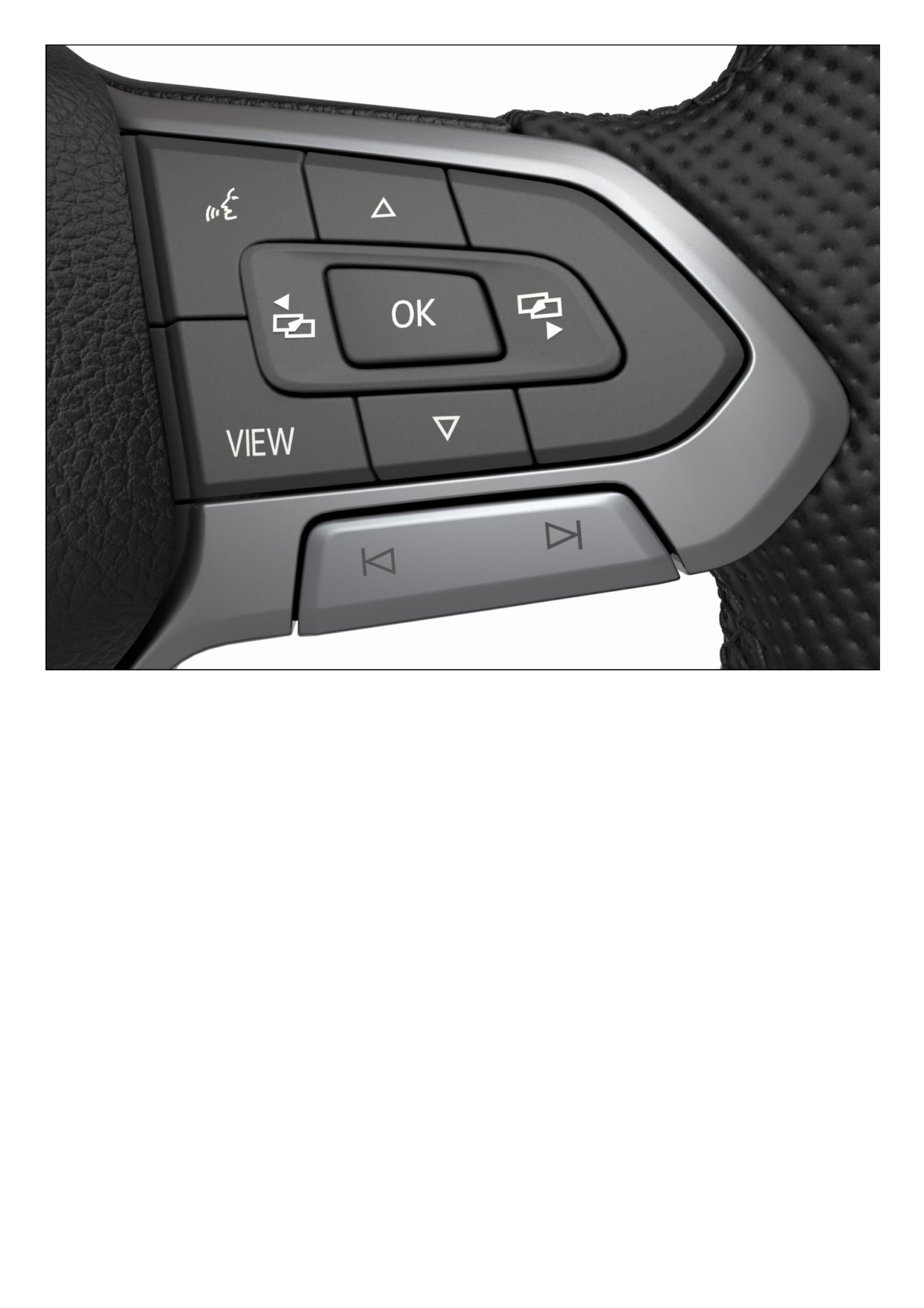
Fig. 10 Right side of the multi-function steering wheel: Operating the Volkswagen Digital Cockpit (variant 1).
2
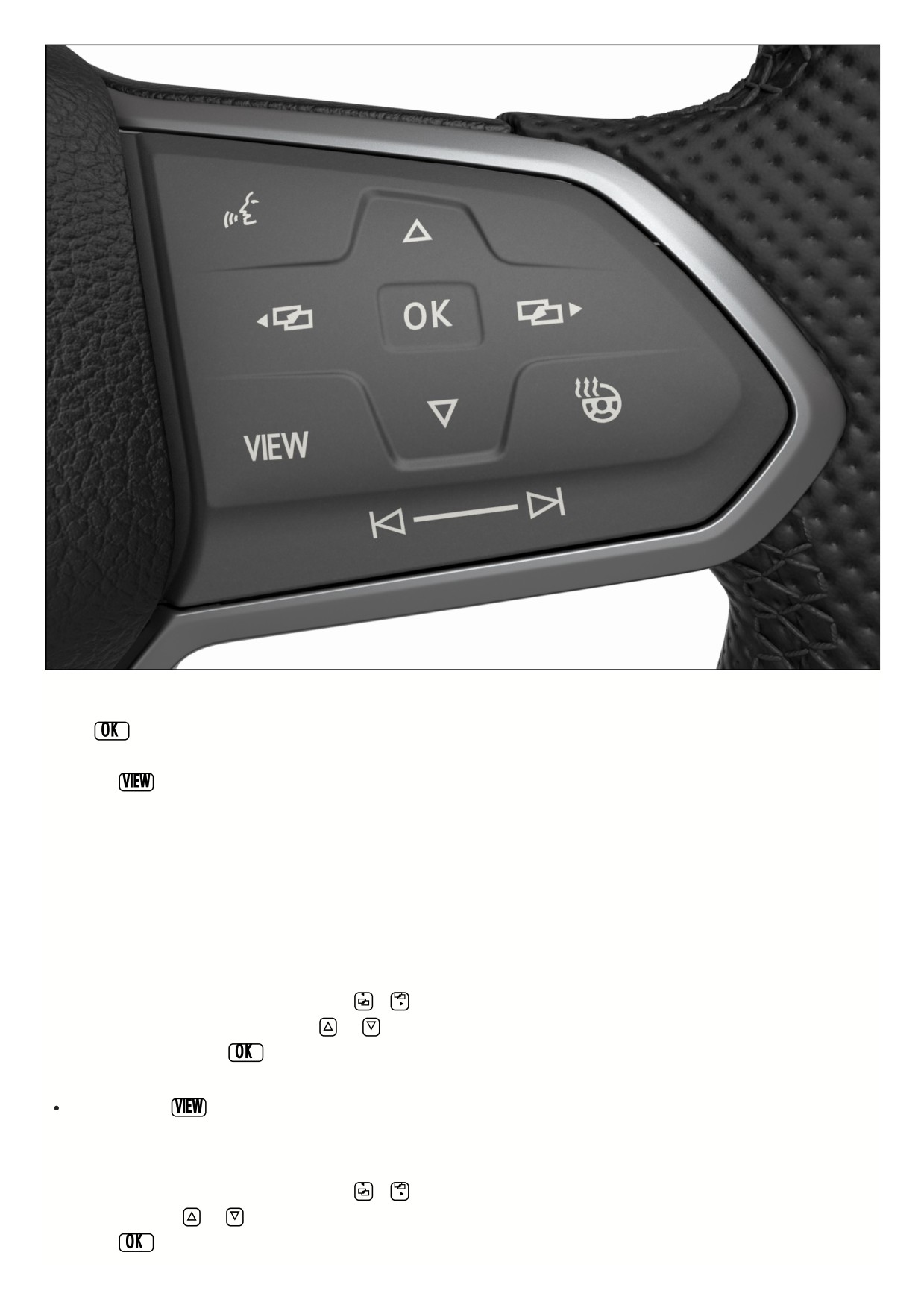
Fig. 11 Right side of the multi-function steering wheel: Operating the Volkswagen Digital Cockpit (variant 2).
Menus cannot be accessed when a priority 1 warning message is displayed → page , Warning and information texts. You can confirm and hide some messages
using the
button on the multi-function steering wheel fig. 10, fig. 11.
Views in the display
1. Press the
button to switch the main display ⇒ Overview of Volkswagen Digital Cockpit.
The following views can be shown in the display area:
Summary
Before starting and after switching off the engine: Display with information about the vehicle status, e.g. total mileage.
Classic
Display of dials.
Navigation
Navigation map and route guidance information.
Driver assistance systems
Display of the active driver assistance systems.
Special Depending on vehicle equipment, it may be possible to display alternative displays here, e.g. sport displays.
Selecting secondary displays
1. Select the right or left secondary display area using the
or
buttons.
2. Select the preferred secondary display using the
and
arrow buttons.
3. Confirm your selection with the
button.
Showing and Hiding the Secondary Displays
Press and hold the
button.
Configuring secondary displays
You can configure the secondary displays to select which secondary displays are available in the secondary display area:
1. Select the right or left secondary display area using the
or
buttons.
2. Use the arrow buttons
and
to navigate to and select the Settings menu.
3. Press the
button to apply changes.
21
A check mark
indicates that the respective secondary display is activated.
4. To return to the menu selection, press the
or
button.
The secondary displays can be configured or hidden independently of each other.
Navigation map in the digital instrument cluster
Depending on the vehicle equipment, the digital instrument cluster may display a detailed navigation map.
The size of the navigation map can be adjusted continuously. To select the desired map size, proceed as follows:
1. To open the Navigation display area, press the
button.
2. Press the
or
arrow buttons on the multi-function steering wheel to zoom in or out.
3. Press and hold the
button on the multi-function steering wheel to show or hide the secondary displays.
If warning messages about malfunctions appear when the ignition is switched on, settings or information displays may not appear as described. If the
malfunction persists, contact a suitably qualified professional. Volkswagen recommends contacting an authorized Volkswagen dealer or authorized Volkswagen
Service Facility.
WARNING
Operating the instrument cluster and the Infotainment system can distract from traffic. If the driver is distracted while driving, accidents and serious or fatal
injuries can occur.
Always drive attentively and responsibly.
Never operate the instrument cluster while driving.
Only adjust any settings in the instrument cluster or Infotainment system when the vehicle is stationary.
Volkswagen Digital Cockpit information displays
Possible displays in the main display area of the digital instrument cluster
The main displays depend on the vehicle equipment and may show different information ⇒ Overview of Volkswagen Digital Cockpit:
Outside temperature display.
Time and date.
Driver assistance systems ⇒ Driver assistance systems.
Gear recommendation ⇒ Gear recommendation.
Open doors, hood and trunk lid.
Speed warning for winter tires.
Radiator fan run-on.
Engine code ().
Infotainment system and navigation information.
Range ⇒ Digital fuel gauge.
Service interval display.
Depending on the vehicle equipment: Status display for Active Cylinder Management (ACT ) ⇒ Eco tips.
Detected road sign from the traffic sign recognition.
Fuel-efficient driving
Selector lever position for automatic transmission.
Warning and information texts.
Warning and indicator lights.
Outside temperature display
When outside temperatures are colder than approximately +4 °C (+39 °F), a snowflake symbol also appears on the outside temperature display
. This symbol
remains on until the outside temperature rises above +6 °C (+43 °F).
In the following situations, the temperature displayed may be higher than the actual outside temperature due to heat radiating from the engine:
When the vehicle is stationary
When the driving speed is very low
The measurement range is from -45 °C (-49 °F) to +76 °C (+169 °F)
22

WARNING
Roads may be icy at low outside temperatures, even above the freezing point. On icy roads, there is an increased risk of accident. This could result in serious or
fatal injuries.
If the
symbol appears in the instrument cluster display, drive with particular care.
Always adapt your speed and driving style to the visibility, weather, road and traffic conditions.
Never rely solely on the outside temperature display.
Gear recommendation
A recommendation to select a fuel-saving gear may be displayed while driving ⇒ Gear recommendation.
Open doors, hood and trunk lid
If, after unlocking the vehicle and while driving, any doors and/or the hood or trunk lid are open, this is displayed in the Volkswagen Digital Cockpit and an audible
signal may also sound.
Speed warning for winter tires
If the set maximum speed is exceeded, this will be shown in the digital instrument cluster.
Settings for the speed warning can be adjusted in the vehicle settings in the Infotainment system
⇒ Vehicle settings menu.
Radiator fan run-on
This indicator appears after the engine has been switched off, if the radiator fan continues to run.
The radiator fan may continue running due to:
Exhaust gas post-treatment, through particulate filter regeneration, for example.
Active brake cooling after descent.
Dissipation of engine heat after high load, e.g. trailer mode.
Engine code
1. Open the service menu ⇒ Service menu.
2. Select the Engine code menu item.
Fuel-efficient driving
If the vehicle is driving in a fuel-efficient manner, this will be indicated while driving
Selector lever position for automatic transmission
The selector lever position and, depending on the driving mode, the gear that is engaged, are shown on the selector lever and in the digital instrument cluster. The
gear shift pattern is displayed when the brake or the selector lever in the instrument cluster is actuated ⇒ Automatic transmission: Selecting a position.
Possible secondary displays in the Volkswagen Digital Cockpit
In the secondary display area of the digital instrument cluster, other views can be configured and displayed via a configuration menu, depending on the vehicle
equipment ⇒ Overview of Volkswagen Digital Cockpit:
Operating temperatures.
Time and date.
Driving data menus, e.g. Travel time/distance driven.
Compass display.
Charge pressure.
Output.
Torque splitter.
Navigation information.
Phone information.
Destination information.
Operating temperatures
Depending on the vehicle equipment, the following operating temperatures may be displayed:
Engine oil.
Engine coolant.
23

Transmission.
Compass display
If the Compass secondary display is activated, the direction in which you are currently driving is shown as a blue arrow with a depiction of the vehicle and a
compass.
Torque splitter
In the Torque splitter secondary display, the current torque for each wheel is displayed.
Navigation information
When route guidance is activated, the Navigation instruction auxiliary display shows the direction of travel as an arrow.
The submenu lists your home address and a list of your most recent destinations. Route guidance can be started with the
button ⇒ Navigation.
Phone
If the Phone secondary display is activated and a cell phone is connected via Bluetooth, the Bluetooth symbol
will be displayed in the Volkswagen Digital Cockp
display. The symbol also indicates the charge level of the mobile device.
In the submenu, a list of the most recent phone calls is shown and you have the option to call the displayed contacts back.
Destination information
When route guidance is activated, the Destination information secondary display shows the predicted journey time and distance from the destination in km or miles
Some displays in the Volkswagen Digital Cockpit may be hidden due to events that occur suddenly, e.g. incoming phone calls.
Depending on the equipment, some settings and displays may also appear in the Infotainment system.
Tachometer
The start of the red area on the tachometer indicates the maximum permissible engine speed for all gears when the engine is run in and at operating temperature.
Before reaching the red area, shift to the next highest gear, select the selector lever position D/S or take your foot off the accelerator pedal.
NOTICE
A heavy engine load, especially when the engine is cold, can lead to engine damage.
Avoid high engine speeds, full acceleration and heavy engine loads when the engine is cold.
To prevent engine damage, the tachometer indicator may only be in the red area of the scale briefly.
Shifting up early helps save fuel and reduce operating noises.
Fuel gauge
Digital fuel gauge
Fig. 12 Fuel gauge on the Volkswagen Digital Cockpit (general example).
WARNING
If the fuel level is too low, this can result in an irregular fuel supply and “sputtering” or stalling of the engine, particularly when going uphill or downhill. This can
cause breakdowns in road traffic, accidents and serious or fatal injuries. The steering, all driver assistance systems and braking assistance systems will not
work if the engine cuts out due to fuel shortage or irregular fuel supply.
Make sure that the fuel tank is always sufficiently filled.
Always refill the fuel tank once it reaches a fill level of 1/4.
24
NOTICE
Irregular fuel supply can result in misfiring and unburnt fuel entering the exhaust system.
Never drive with a completely empty fuel tank.
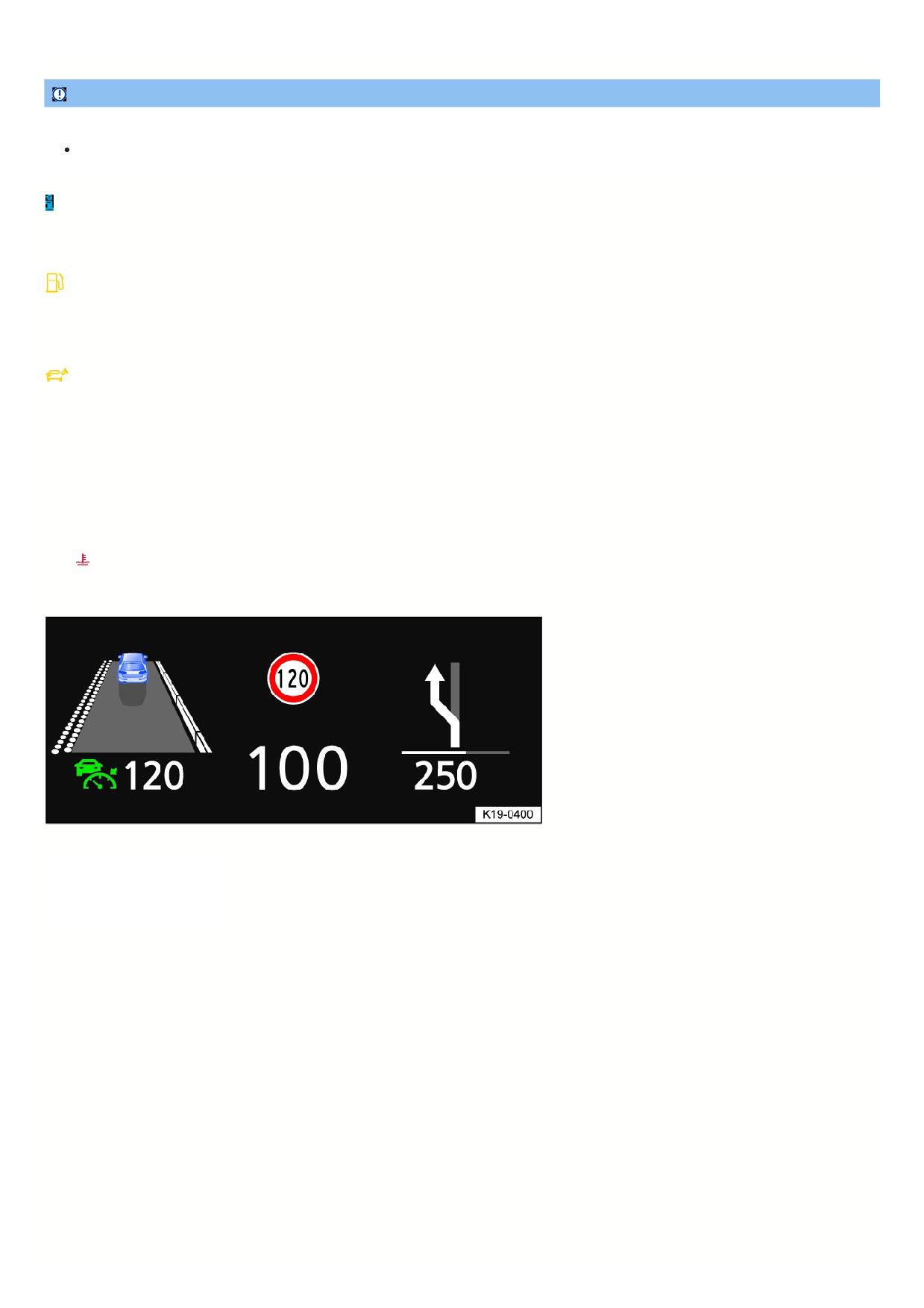
The small arrow next to the fuel pump symbol on the fuel gauge indicates which side of the vehicle the fuel filler flap is on.
Troubleshooting
Fuel tank almost empty
The yellow indicator light turns on. The reserve supply (red marking ) is being used.
1. Refuel at the next opportunity.
Fuel tank cap open
The yellow indicator light turns on.
1. Close the fuel tank cap.
Engine coolant temperature gauge
Digital coolant temperature gauge
Depending on the vehicle equipment, the coolant temperature may be displayed in the Operating temperatures secondary display.
If the
warning light flashes, the coolant temperature is too high or the coolant level is too low
⇒ Troubleshooting.
Head-up display (HUD)
Fig. 13 In the driver's field of vision: sample indicators on the head-up display.
The head-up display projects selected
information displays or warning
messages from assist systems or from
the Infotainment system in the visual
range of drivers.
Switching the head-up display on and off
The head-up display (HUD) fig. 13 can be switched on and off using the vehicle settings in the Infotainment system.
Height adjustment
To individually adapt the angle of view, set the head-up display in the corresponding menu on the instrument cluster or in the vehicle settings of the Infotainment
system:
1. Setting the optimal seat position.
2. Set your preferred position and inclination of the head-up display with the function keys or the buttons on the multi-function steering wheel.
The rotation can also be adjusted in the vehicle settings of the Infotainment system.
Settings in the Infotainment system
Additional settings for the head-up display can be adjusted in the Vehicle menu in the Infotainment system.
1. In the Vehicle menu, select the Inner view.
2. Tap the Head-up display function key.
25
The following setting options are available:
Setting the display brightness and the color scheme of the head-up display.
Selection of the display contents for the head-up display, e.g. driver assist system or Infotainment system displays.
Alternative head-up display colors in poor weather conditions, e.g. snow.
Some display contents cannot be hidden, such as warning messages.
The brightness of the display reduces automatically as the ambient brightness decreases. The basic brightness is set together with the instrument illumination
⇒ Instrument and switch illumination.
Reflections are possible due to unfavorable sunlight.
Sunglasses with polarization filters can negatively influence the readability.
The optimal readability of the head-up display depends on the position of the seat and the height adjustment of the head-up display.
Driving data menu
The driving data menu shows driving and consumption data, such as the driving duration or kilometers driven. Multiple driving data displays are available in the
auxiliary display area ⇒ Digital Instrument cluster, ⇒ Volkswagen Digital Cockpit information displays.
Depending on the vehicle equipment, various driving data can be displayed. The displayed driving data is dependent on the current driving style, the vehicle status,
e.g. particle filter regeneration, and the current driving situation, e.g. city traffic. The driving data is determined as an average value over sections of different
distances and the currently displayed value may therefore differ from the actual average value.
Since start memory
If the trip is interrupted for more than two hours, the memory is erased.
Since refuel memory
Display and memory of the collective driving and consumption data. The memory is erased when the vehicle is refueled.
Extended period memory
The memory stores driving statistics for up to 4166 days of driving time or 99999.9 km (mi) distance driven. If one of these maximum thresholds is met, the memory
is erased.
Reset driving data menus
1. Press the
or
button.
2. Select the corresponding driving data menu in the configuration menu with the
and
arrow buttons.
An arrow behind the entry in the configuration menu indicates a submenu.
3. In the submenu, select Reset data and confirm by pressing the
button.
If you would like to know how many kilometers are driven in the course of a day, reset the Long-term memory before you start driving and read it again at the
end of the day.
WARNING
If the driver is distracted while driving, accidents and serious injuries can occur. Operating the instrument cluster and the Infotainment system can distract from
traffic.
Always drive attentively and responsibly.
Never operate the instrument cluster while driving.
Only adjust any settings in the instrument cluster or Infotainment system when the vehicle is stationary.
Service
Service menu
Depending on the equipment, settings can be applied in the service menu.
Opening the Service Menu
1. Select the Travel time/distance driven information profile in the secondary display.
2. Press and hold the
or
button on the multi-function steering wheel for approximately six seconds.
3. Use the
and
arrow buttons to navigate the menu.
Resetting the service interval display
26

1. Select Service menu.
2. Follow the instructions in the instrument cluster display.
Resetting the oil change service
1. Select Reset oil change service menu.
2. Follow the instructions in the instrument cluster display.
Engine code
1. Select Engine code menu.
The engine code is shown on the instrument cluster display.
Setting the time
1. Select Time menu.
2. Set the time with the
and
arrow buttons.
Displaying copyright information
1. Select the Copyright menu to access the copyright information.
Service interval display
Displays about service events appear in the Volkswagen Digital Cockpit and in the Infotainment system. There are different versions of the Volkswagen Digital
Cockpit and Infotainment system; therefore, the appearances of the displays may vary.
Service appointments at Volkswagen are divided into oil change services and inspections. The service interval display informs the driver about the next service
appointment which includes an engine oil change and about the next inspection.
The service intervals are specified for vehicles with the fixed oil change service interval.
Intervals are determined individually on vehicles with the flexible oil change service interval. Oil change services only need to be performed if the vehicle requires it
The specific operating conditions and the personal driving style are also taken into consideration. The service early warning message is first displayed 30 days prio
to the calculated oil change service due date. The displayed remaining distance to be traveled is always rounded to 100 km (miles) and the remaining time is
rounded to whole days.
Service notification
If an oil change service or an inspection service is due in the near future, a service notification will be displayed when the ignition is switched on.
The specified mileage or time is the distance or time until the next service can be completed.
Service event
When an oil change service or an inspection service is due, a chime will sound when switching on the ignition and you can then see a wrench symbol
for a fe
seconds in the instrument cluster display together with one of the following displays:
Inspection now!
Oil change now!
Oil change service and inspection now!
Checking a service due date
When the ignition is on, the engine is off, and the vehicle is stationary, the current service due date can be viewed at any time:
1. Tap the Vehicle function key.
2. Select the Status menu item and tap the Service function key to display the service information.
The service due date can also be checked via the service menu ⇒ Service menu.
Resetting the service interval display
If the service interval display was not reset after the oil change service or inspection service, the display can be reset as follows:
The service interval display can only be reset through the service menu ⇒ Service menu.
Do not reset the service interval display between service intervals or incorrect information will be displayed.
If the oil change service interval was manually reset, the service interval display then also switches to a fixed service interval, even on vehicles with the flexible oil
change service interval.
The service message disappears automatically after a few seconds when the engine is running or when the
button on the multi-function steering wheel
is pressed.
If the 12 V vehicle battery in a vehicle with the flexible service interval has been disconnected for an extended period, the time for the next oil change service
cannot be calculated. Therefore, the service interval displays may show incorrect calculations. If this is the case, follow the maximum permissible maintenance
intervals.
27

Time and date
Setting the time and date in the Infotainment system
1. Tap the Settings function key ⇒ Vehicle settings menu.
2. Select the Time and date menu item to set the time and date.
3. Select time source:
Automatic.
Manual.
The time and date are only displayed in the Infotainment system.
Setting the time in the Volkswagen Digital Cockpit
1. Open the service menu ⇒ Service menu.
2. Select the Time menu.
3. Set the time with the
and
arrow buttons.
Sport displays
Lap timer in the instrument cluster
The lap timer offers the option to
measure and save the individual lap
times on a race course manually in the
vehicle as well as compare these times
to the best times previously recorded.
Depending on the equipment, the lap timer can be displayed in the instrument cluster.
The following main menus can be displayed:
Lap timer.
Lap (with current lap specification).
Statistics.
Switching between menus
1. Press the
or
button on the multi-function steering wheel.
For example, the following list will show the layout of the menus in the instrument cluster display. The actual scope of the menus and the names of individual menu
items depend on the instrument cluster version and the vehicle electronics.
Menu displays and functions
Lap timer menu:
Start
The time measurement of a lap is started.
Since start
The time measurement begins when the vehicle begins to drive. If it is already moving, the time measurement starts when the vehicle comes to a
stop in the meantime.
StatisticsAn overview of the laps previously recorded is displayed.
Lap menu:
Stop
The active time measurement is paused. The lap is not finished.
Resume
The paused time measurement is resumed.
Split time
A split time is displayed for approximately five seconds. The active time measurement continues to run simultaneously.
New lap
The time of the current lap is stopped and a new lap is started. The time for the finished lap is transferred to the statistics.
Cancel lap
The time measurement is stopped and discarded. The current lap will not be recorded in the statistics.
End
The time measurement is finished. The lap will be recorded in the statistics.
Statistics menu:
Back
The display switches back to the previous menu.
Reset All saved statistics data is reset.
The previously driven lap times are displayed in the Statistics menu. If the maximum lap number of 99 laps or the maximum total duration of 99 hours, 59 minutes
and 59 seconds is reached, a new time measurement can be started before the statistics are reset.
28
WARNING
If the driver is distracted, accidents and serious injuries can occur. Operating the lap timer can distract you from traffic.
Only adjust lap timer presets and open the statistics when the vehicle is stationary.
Only operate the lap timer while driving if the driving situation is easy to control and monitor.
Exit menu
You can adjust the settings of some
functions in the exit menu before
leaving the vehicle. The exit menu will
be displayed in the Infotainment system
when you switch off the ignition.
The entries shown depend on the vehicle equipment and may only be available under certain conditions. The adjustable functions include, for example:
Hide
The exit menu is automatically hidden when you leave the vehicle. The exit menu will also be hidden after a short time, depending on the vehicle equipment.
1. To hide the exit menu manually, tap
Settings
You can adjust the order of the entries shown.
1. Tap
2. Reorder entries as required.
3. Tap
again.
Vehicle settings menu
You can switch individual functions and
systems on and off and adjust settings
in the vehicle settings menu in the
Infotainment system.
Opening the Vehicle settings Menu
1. Switch the ignition on.
2. If necessary, switch on the Infotainment system.
3. Tap the Vehicle function key.
4. Depending on the equipment: Tap the Vehicle menu item and choose between the Interior and
Exterior function keys.
Or: select the
menu item.
5. Open the preferred item from the submenus and set as desired.
System settings and vehicle information display
Depending on the version, information can be displayed or settings set in the Vehicle settings menu:
Depending on the vehicle equipment: 3D vehicle view (Interior or Exterior).
Depending on vehicle equipment: Performance monitor.
Depending on vehicle equipment: Lap timer.
Driving Data.
Vehicle status.
After starting the engine when the 12 V vehicle battery is severely drained or has been replaced or jump-started, system settings, e.g. personal convenience
settings and programming, may be adjusted or deleted. Check and correct the settings after the 12 V vehicle battery is sufficiently recharged.
WARNING
If the driver is distracted, accidents and serious injuries can occur. Operating the Infotainment system can distract you from traffic.
Always drive attentively and responsibly.
Adjust settings in the Infotainment system only when the vehicle is stationary.
Driver Alert System
Introduction
29
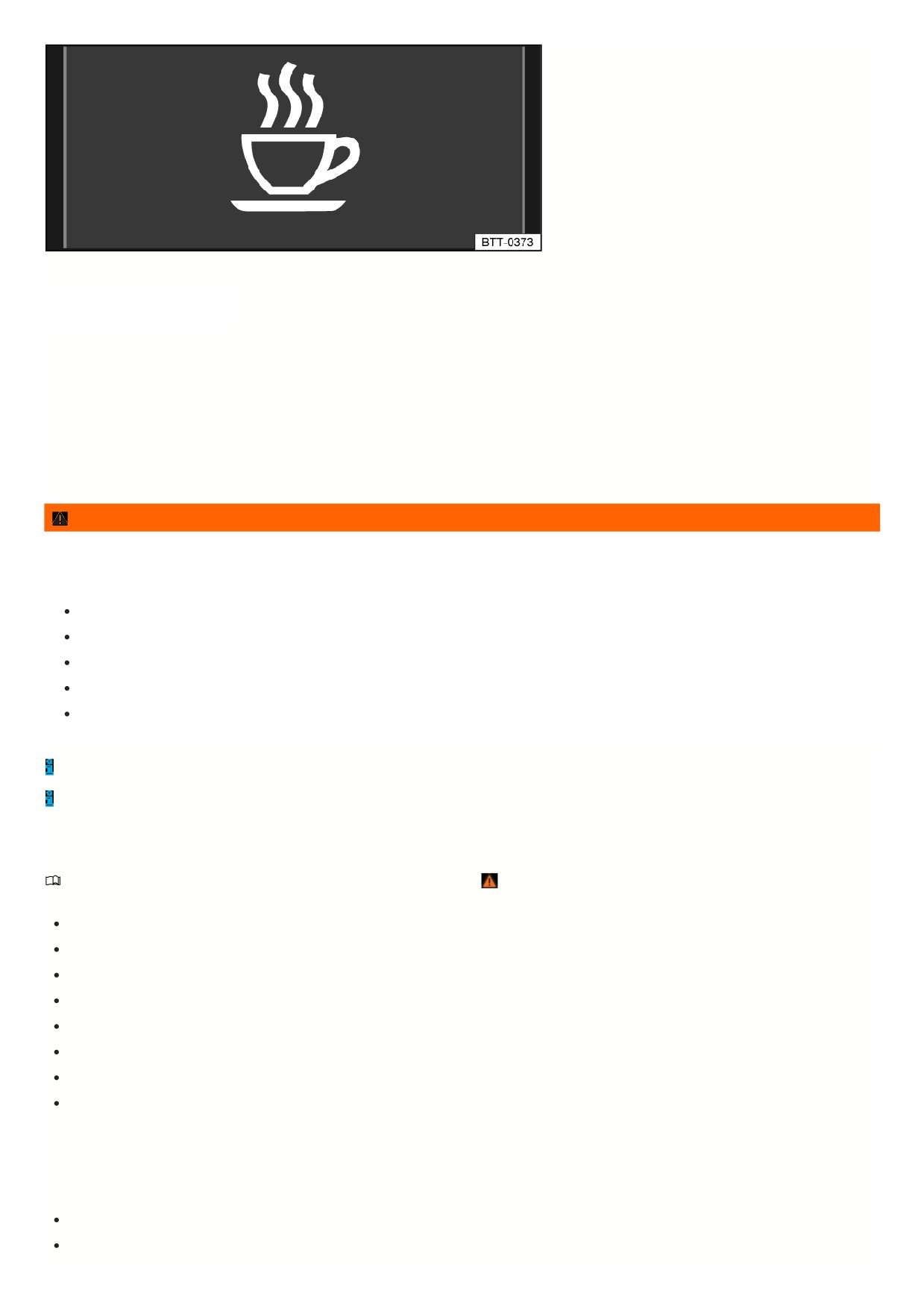
Fig. 14 Driver Alert System symbol on the instrument cluster display.
The Driver Alert System tells you if your
driving behavior suggests that you are
tired.
At the beginning of your journey, the Driver Alert System observes your driving behavior and uses this observation to assess how tired you are. It continually
compares its initial assessment with your current driving behavior. If the system detects that you are tired, it issues an audible warning, as well as visually alerting
you by displaying a symbol and accompanying message on the instrument cluster display fig. 14. The message will remain on the instrument cluster display for
approximately five seconds, and will be repeated once if necessary. The system saves the message that was most recently issued.
When is it active?
Your driving behavior will only be evaluated when you are traveling at speeds of more than approximately 60 km/h (approximately 37 mph), up to approximately
200 km/h (approximately 125 mph).
WARNING
The Driver Alert System is not a replacement for the driver's attention and works only within the system limitations. This means that the Driver Alert System
cannot detect tiredness in the driver in all situations, and may not react, may react late or may react in a way that is undesired. There is a risk of accidents and
serious or fatal injuries.
Always stay attentive and do not rely solely on the system. It is always your responsibility to make sure that you are fit to drive.
Observe the system limitations ⇒ Limits of the Driver Alert System .
Never drive a vehicle when tired.
On longer journeys, take regular breaks and make sure that you feel adequately rested before setting off again.
Pay attention to indicators in the instrument cluster display and respond to the prompts accordingly.
The Driver Alert System is designed exclusively for driving on highways and good road surfaces.
In the event of a malfunction, have the system checked by suitably qualified professionals. Volkswagen recommends contacting an authorized Volkswagen
dealer or authorized Volkswagen Service Facility.
Limits of the Driver Alert System
Please read the introductory information and heed the Warnings and Notice ⇒
Introduction.
The Driver Alert System has certain limitations. The following conditions may limit the effectiveness of the Driver Alert System or prevent it from working at all:
Speeds of less than approximately 60 km/h (approximately 37 mph).
Speeds of over approximately 200 km/h (approximately 125 mph).
Winding roads.
Poor road surfaces.
Inclement weather.
Construction sites.
Sporty driving.
If you are very distracted.
Momentary dozing:
Please note that the system is not configured to issue an immediate warning in the event that you doze off momentarily.
The Driver Alert System will be reset in the following situations:
When the ignition has been switched off.
When you have taken off your safety belt and opened the driver door.
3
When the vehicle is stationary for more than approximately 15 minutes.
On long, slow journeys when traveling at less than approximately 60 km/h (approximately 37 mph), the system automatically resets its assessment of how tired you
are. If you then start driving faster, it will start assessing your driving behavior once again.
Operating the Driver Alert System
Please read the introductory information and heed the Warnings and Notice ⇒
Introduction.
Hiding a message
The message in the instrument cluster display can be hidden as follows:
1. Press the
button on the multi-function steering wheel.
Switching on and off
You can switch the Driver Alert System on and off using the Assistance menu in the Infotainment system. Upon starting the engine, the Driver Alert System is alway
activated ⇒ Vehicle settings menu.
Dynamic Road Sign Display
Introduction
The Dynamic Road Sign Display detects
standard road signs using a camera in
the interior rearview mirror base and
informs the driver of detected speed
limits and passing restrictions. Within
the system limits, the system also
displays an additional sign to indicate
special restrictions. The system may
also continue to display the valid speed
limit on roads without signs.
The traffic signs recorded by the Dynamic Road Sign Display are shown in the display of the Volkswagen Digital Cockpit. Depending on the Infotainment system
installed in the vehicle, the road signs may also be displayed there.
Depending on the vehicle equipment, a display may also appear in the head-up display (HUD).
Dynamic Road Sign Display is always active when the ignition is started.
Road sign display
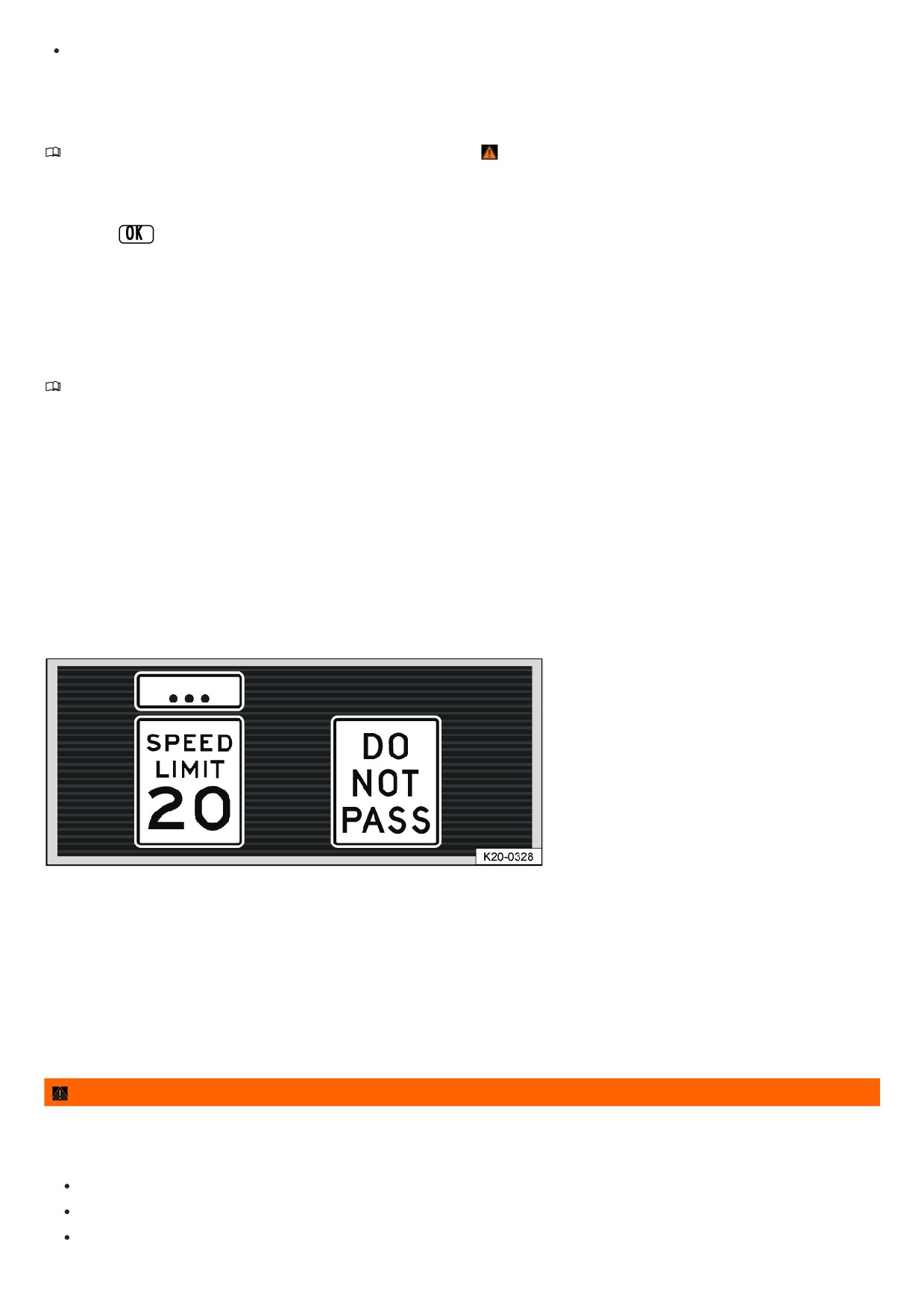
Fig. 15 In the instrument cluster display: Example of detected speed limits.
After checking and evaluating the information from the camera, the Infotainment system, and the current vehicle data, the Dynamic Road Sign Display function
displays up to two valid traffic signs and a generic additional sign fig. 15:
1st position:The traffic sign that currently applies is shown on the left side of the display, for example a speed limit of 20 mph (35 km/h).
2nd position: Another road sign can be displayed in the second position, such as a passing restriction.
Additional signs: A recognized additional sign is displayed above the applicable traffic sign. Depending on the system, a generic additional sign is displayed
instead of the actually recognized additional sign. The applicable traffic sign in the display of the instrument cluster is supplemented by the generic
additional sign.
WARNING
The Dynamic Road Sign Display is not a replacement for the driver's attention and works only within the system limitations. Consequently, the Dynamic Road
Sign Display cannot detect all road signs and may not react, or may react with a delay, or may react in a way that is not desired. Driving recommendations and
road signs displayed in the Dynamic Road Sign Display may differ from the actual traffic situation.
Observe the system limitations ⇒ Limits of the Dynamic Road Sign Display .
Always stay attentive and do not rely solely on the system. The driver is always responsible for control of the vehicle.
Traffic signs on the roads and traffic regulations must always take precedence over driving recommendations and displays from the Dynamic Road Sign
Display function.
31

Always adapt your speed and driving style to the visibility, weather, road and traffic conditions.
Limits of the Dynamic Road Sign Display
Please read the introductory information and heed the Warnings and Notice ⇒
Introduction.
Error messages
No road signs available.
The system is in the initialization phase.
Or: the vehicle has not detected any road signs.
Error: Dynamic Road Sign Display.
System malfunction. If the malfunction persists, contact a suitably qualified professional. Volkswagen recommends
contacting an authorized Volkswagen dealer or authorized Volkswagen Service Facility.
Speed Alert currently not available.
The speed alert from the Dynamic Road Sign Display is malfunctioning. If the malfunction persists, contact a suitably
qualified professional. Volkswagen recommends contacting an authorized Volkswagen dealer or authorized Volkswagen Service Facility.
Dynamic Road Sign Display: Clean windshield!
The windshield is dirty in the area around the camera or weather conditions are interfering with the camera
view. Clean the windshield.
Dynamic Road Sign Display is currently limited.
Data is not being transmitted by the Infotainment system. Check that valid map data is loaded in the
Infotainment system.
Or: the vehicle is located in an area that is not detected on the map stored in the Infotainment system.
No data available. The Dynamic Road Sign Display function is not supported in the country where the vehicle is currently being operated.
Functional limitations
The Dynamic Road Sign Display is subject to system limitations. The following conditions may cause the Dynamic Road Sign Display function to be limited or to no
operate at all:
High ambient temperature or long exposure to direct sunlight.
Poor visibility, such as in snow.
Glare, for example from oncoming traffic or the sun
High speeds
If the camera is obstructed or dirty
If road signs are outside of the camera’s visual field
If road signs are partially or completely covered, for example by trees, snow, dirt, or other vehicles.
If road signs are not in the standard format
If there are damaged or bent road signs
If there are variable traffic signs on overhead signs (variable display of road signs with LED s or other lighting).
If there is outdated map material in the Infotainment system
If there are stickers on vehicles that indicate road signs, such speed limits on commercial vehicles
Operating the Dynamic Road Sign Display
Please read the introductory information and heed the Warnings and Notice ⇒
Introduction.
Speed warning
If the Dynamic Road Sign Display function detects that a valid speed limit is being exceeded, it may warn the driver audibly or visually with a message in the
instrument cluster display.
The speed warning can be set or completely deactivated in the Infotainment system in the Assistance systems menu
⇒ Vehicle settings menu. The speed warning
can be set to a value of 0 km/h (0 mph), 5 km/h (3 mph) or 10 km/h (5 mph) above the maximum permissible speed.
32

Safety
General information
Driving preparations and driving safety
Observe the following points before and during every trip, for your own safety and for the safety of your passengers and others on the road
⇒
:
Make sure the vehicle lighting and turn signals are functioning correctly.
Check the tire pressure and fuel level ⇒ Checking the tire pressure, ⇒ Fuel gauge.
Check the washer fluid level ⇒ Washer fluid.
Ensure that the windows are clear and provide good visibility ⇒ Exterior care and cleaning.
The air intake for the engine must not be blocked. The engine must not be covered with covers or insulation
⇒ Safety precautions for working in the engine
compartment.
Secure all objects and luggage in the storage compartments and the luggage compartment
⇒ Transporting.
It must be possible to press the pedals without interference.
Secure children with child restraint systems that are appropriate for their weight and height
⇒ Transporting children safely.
Adjust the front seats, head restraints, and mirrors according to the size of the occupants
⇒ Seating position, ⇒ Mirrors.
Wear shoes that give your feet good grip for operating the pedals.
The floormat in the driver side footwell must be kept clear from the pedal area and be secured.
Assume the correct seating position before driving and remain that way while driving. This also applies to all passengers
⇒ Seating position.
Fasten the safety belt correctly before you begin driving and keep it fastened while driving. This also applies to all passengers
⇒ Safety belts.
The number of passengers must not exceed the number of seats and safety belts.
Never drive when impaired, for example by medication, alcohol, or drugs.
Never allow yourself to be distracted from traffic, such as by adjusting settings, by opening menus, by passengers, or by phone calls.
Always adapt your speed and driving style to the current visual, weather, road, and traffic conditions.
Follow driving rules and posted speed limits.
Take regular breaks on long trips. You should take a break at least every two hours.
Secure animals in the vehicle restraint systems that are appropriate for their weight and size.
Driving in other countries
Some countries have special safety standards and regulations that differ from the vehicle configuration. Volkswagen recommends that you inform yourself about
legal regulations and about the following points from an authorized Volkswagen dealer or authorized Volkswagen Service Facility before driving in other countries.
Volkswagen recommends contacting an authorized Volkswagen dealer or authorized Volkswagen Service Facility.
Do technical modifications need to be made to the vehicle before driving in other countries, such as covering or adjusting the headlights?
Are the tools, diagnostic equipment, and replacement parts that are needed for maintenance and repair work available?
Is there an authorized Volkswagen dealer or authorized Volkswagen Service Facility in the country where you will be driving?
Are fluids that meet Volkswagen specifications available in the country where you will be driving
⇒ Operating fluids and operating equipment ?
Will the navigation function in the factory-installed Infotainment system work with the existing navigation data in the country where you will be driving?
Are special tires needed in the country where you will be driving?
Is a fire extinguisher required in the country where you will be driving?
What are the requirements for a safety vest?
Is fuel with sufficient quality available ⇒ Fuel and emissions control system?
Checks when refueling
Only perform work on the engine and in the engine compartment if you are familiar with the necessary steps and the general safety precautions, and if the correct
operating equipment, fluids, and suitable tools are available ⇒ Safety precautions for working in the engine compartment ! Have all work performed by suitably
qualified professionals. Volkswagen recommends contacting an authorized Volkswagen dealer or authorized Volkswagen Service Facility. Make sure that the
following items are checked regularly:
Washer fluid level ⇒ Washer fluid.
Engine oil level ⇒ Engine oil.
Engine coolant level ⇒ Engine coolant.
Brake fluid level ⇒ Brake fluid specifications.
Tire inflation pressure ⇒ Checking the tire pressure .
33
Vehicle lighting ⇒ Headlights which is necessary for traffic safety:
Information on changing bulbs ⇒ Exterior lighting.
DANGER
Read and heed the important safety instructions for the front passenger's front airbag
⇒ Safety notes on using child restraints .
WARNING
Alcohol, drugs, medication, and prescription narcotics can considerably impair perception, reaction times, and driving safety, which can result in loss of vehicle
control. This can cause accidents and serious or fatal injuries.
Do not drive under the influence of alcohol, drugs, medication or prescription narcotics.
WARNING
Not paying attention to road traffic can cause accidents and serious or fatal injuries.
Always comply with the applicable driving regulations and speed limits and think ahead while driving.
Take regular breaks on long drives. You should take a break at least every two hours.
NOTICE
Volkswagen is not responsible for damage to the vehicle caused by substandard fuel, insufficient maintenance, or unsuitable replacement parts.
Volkswagen recommends the use of Volkswagen original parts or Volkswagen original accessories, which you can acquire from an authorized
Volkswagen dealer or authorized Volkswagen Service Facility.
Having the vehicle serviced regularly not only maintains the value of the vehicle, but also contributes to operational safety and roadworthiness. Therefore, have
maintenance procedures performed according to Volkswagen instructions. Under extreme operating conditions, some work may need to be performed before the
next service is due. Extreme operating conditions can include frequent stop-and-go driving or driving in areas with a lot of dust in the air. For further information,
contact an authorized Volkswagen dealer or authorized Volkswagen Service Facility. Volkswagen recommends contacting an authorized Volkswagen dealer or
authorized Volkswagen Service Facility.
Seating position
Introduction
Number of seats
The vehicle has a total of five seats: two seats in the front and three seats in the back.
Every seat is equipped with a safety belt.
WARNING
Sitting incorrectly in the vehicle can increase the risk of serious or fatal injuries during sudden driving or braking maneuvers, in the event of a collision or
accident, and if the airbags are deployed.
Before the vehicle starts to move, all vehicle occupants must always be in the correct seating position and maintain it while driving. Safety belts must
also be fastened and remain fastened.
The number of persons in the vehicle must not exceed the number of seats with safety belts.
Always secure children in the vehicle with an approved and suitable child restraint system according to the child's body size and weight
⇒ Transporting
children safely and ⇒ Airbag system.
Always keep feet in the footwell while driving. For example, never rest feet on the seat or on the instrument panel and never hold feet out of the window.
Otherwise, if the airbag and the safety belt deploy, they could increase the risk of injury in the event of an accident instead of providing protection.
Risk of injury due to an incorrect seating position
Please read the introductory information and heed the Warnings and Notice ⇒
Introduction.
The risk of serious or fatal injuries will increase if safety belts are not worn or are incorrectly fastened. Safety belts can only achieve the optimum protection if they
are routed correctly. An incorrect seating position significantly impairs the protective function of the safety belt. This could result in serious or fatal injuries. The risk o
serious or fatal injuries increases even more if a deployed airbag strikes a passenger who is sitting in an incorrect seating position. The driver is responsible for all
vehicle occupants and especially for children who are being transported in the vehicle.
The following list includes examples of seating positions that could be dangerous for all vehicle occupants.
34
The following points always apply when the vehicle is in motion:
Never stand inside the vehicle.
Never stand on the seats.
Never kneel on the seats.
Never tilt your seat backrest too far back.
Never lean against the instrument panel.
Never lay down in the seats in the vehicle interior or on the rear bench seat.
Never sit only on the front section of the seat.
Never sit sideways on the seat.
Never lean against the window.
Never place your feet out of the window.
Never place your feet on the instrument panel.
Never place your feet on the seat cushion or on the seat backrest.
Never ride in the footwell.
Never sit on the armrests.
Never drive or ride in a seat without fastening your safety belt.
Never ride in the trunk.
WARNING
Incorrect seating positions in the vehicle increase the risk of serious or fatal injuries in the event of an accident or sudden driving and braking maneuvers,
especially if the airbags are deployed and exert force on a vehicle occupant who is not sitting correctly.
All vehicle occupants must always sit in the correct seating position and have their own safety belts correctly fastened while driving.
Correct seating position
Please read the introductory information and heed the Warnings and Notice ⇒
Introduction.
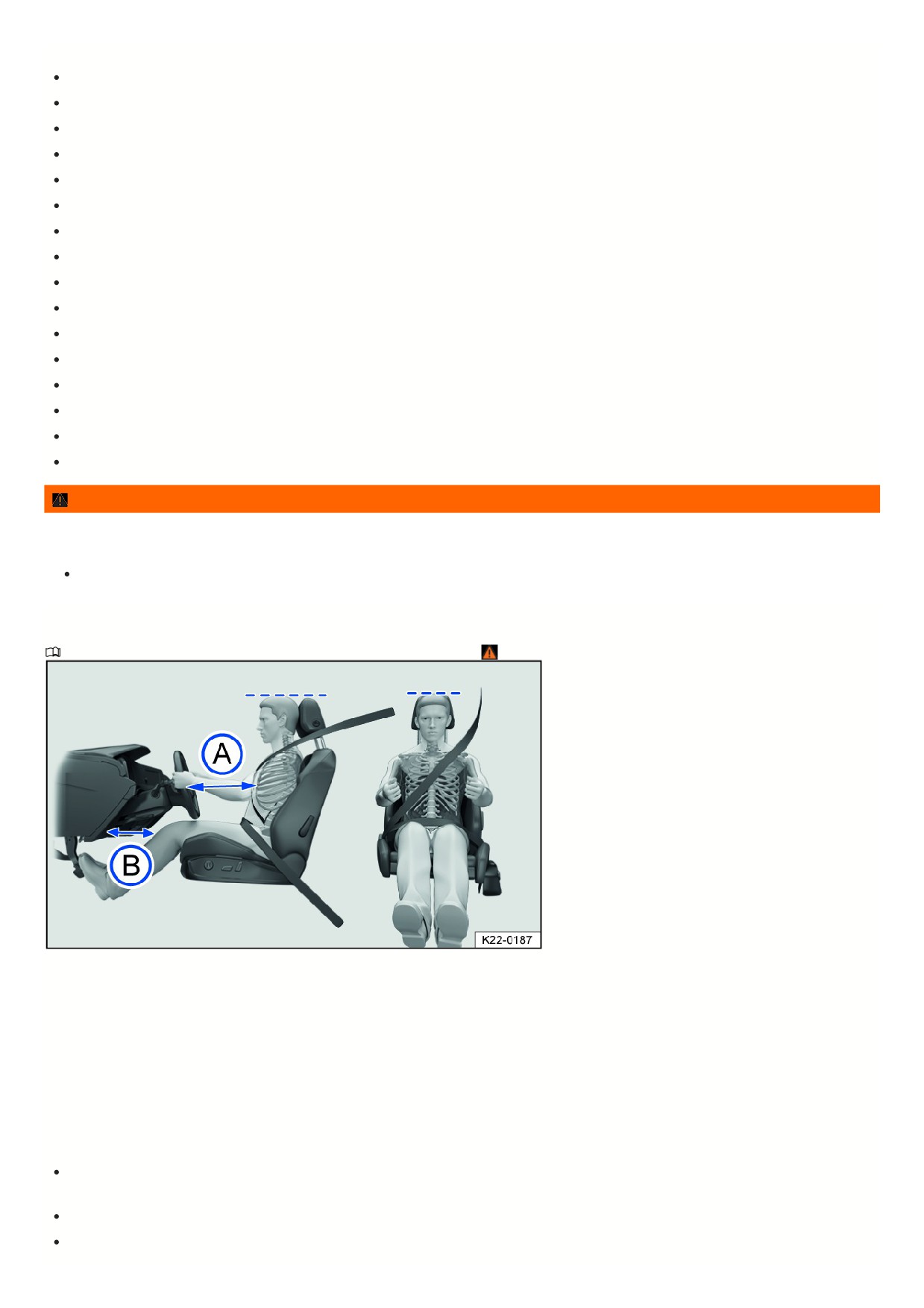
Fig. 16 General example: correct distance between the driver and the steering wheel, correct safety belt routing and correct head restraint adjustment.
The correct seating positions for the driver and passengers are specified in the information that follows. The safety belt and airbags only provide the optimum
protection when vehicle occupants are seated in a correct seating position.
If you have a physical impairment that prevents you from sitting correctly on the driver seat with a correctly worn safety belt and reaching the pedals, special
modifications to your vehicle may be necessary. For information on possible changes to your vehicle, contact an authorized Volkswagen dealer or authorized
Volkswagen Service Facility qualified for this. Volkswagen recommends contacting an authorized Volkswagen dealer or authorized Volkswagen Service Facility.
Alternatively, contact the Volkswagen Customer CARE Center at +00 (1) 800 822 8987.
For your safety and to reduce the risk of injuries in the event of a sudden braking maneuver or accident, Volkswagen recommends the following seating positions:
The following applies to all vehicle occupants:
Adjust the head restraint so that the upper edge of the head restraint is in line with the upper portion of the head as much as possible, but not lower than eye
level. Position the back of the head as close as possible to the head restraint fig. 16.
For shorter individuals, slide the head restraint all the way downward, even if the head is then below the upper edge of the head restraint.
For taller individuals, move the head restraint upward all the way.
35

Keep both feet in the footwell while driving.
Adjust and fasten the safety belts correctly ⇒ Safety belts.
The following additional points apply to the driver:
Adjust the forward/back position of the driver seat so that you can press the pedals while your legs are slightly bent and there is at least 10 cm (around
4 inches) of space between the instrument panel and your knees fig. 16.
Adjust the driver seat so that the top point of the steering wheel can be reached.
Position the seat backrest in an upright position, so that your back rests completely on the seat backrest.
Adjust the steering wheel so that the distance between the steering wheel and your chest is at least 25 cm (around 10 inches) fig. 16 and you can hold the
steering wheel firmly at the sides with both hands and your elbows slightly bent.
When adjusted, the steering wheel must always face your chest and not be directed toward your face.
In vehicles with head restraints that can be moved forward or back, position the head restraint so that it is as close as possible to the back of the head.
Always keep both feet in the footwell to keep control of the vehicle at all times.
The following additional points apply to the front passenger:
In vehicles with head restraints that can be moved forward or back, position the head restraint so that it is as close as possible to the back of the head.
Position the seat backrest in an upright position, so that your back rests completely on the seat backrest.
Move the front passenger seat back as far as possible so that the airbag can provide optimum protection if it deploys.
Safety belts
Introduction
Check the condition of all of the safety belts regularly. If there is damage to the belt fabric, the belt connections, the automatic safety belt retractor or the buckle,
have the affected safety belt replaced immediately by suitably qualified professionals ⇒
. The authorized Volkswagen dealer or authorized Volkswagen Service
Facility must use the correct parts for the vehicle, equipment and model year. Volkswagen recommends contacting an authorized Volkswagen dealer or authorized
Volkswagen Service Facility.
WARNING
The risk of serious and fatal injuries increases if the safety belts are not worn or are worn incorrectly.
Safety belts are the most effective way to reduce the risk of serious and fatal injuries in a collision. Before every trip, vehicle occupants must therefore
seat themselves correctly, fasten the safety belt that belongs to the seat they are using, and keep it fastened while the vehicle is in motion. This applies to
all passengers and at all times, including during city driving.
Secure only one person with a safety belt.
Secure children in the vehicle with a child restraint that is appropriate for their weight and height and with the safety belt used correctly
⇒ Transporting
children safely.
Never allow children or infants to ride on anyone's lap and never strap children or infants to another person with the same safety belt.
Only ever insert and latch the buckle tongue in the belt buckle for the corresponding seat. Using a buckle from another seat reduces the protection
provided by the safety belt and can cause serious injuries.
Do not wear extremely bulky, loose clothing in the vehicle, such as a coat over a sports jacket, because this could impair the fit and function of the safety
belt.
WARNING
If the belt webbing or other parts of the safety belts are damaged, the safety belts could tear during a collision or sudden braking maneuver and cause serious or
fatal injuries.
Never damage the safety belts by trapping them or chafing them on sharp edges.
Have damaged safety belts replaced immediately with new safety belts that are approved for the vehicle by Volkswagen. Safety belts that are stretched
during a collision must be replaced by an authorized Volkswagen dealer or authorized Volkswagen Service Facility. Volkswagen recommends contacting
an authorized Volkswagen dealer or authorized Volkswagen Service Facility. It may be necessary to replace them even if there is no visible damage.
Check the safety belts' anchorage points as well.
Never try to repair, modify, or remove the safety belts yourself. Have all repairs to safety belts, safety belt retractors, and buckle components performed
only by an authorized Volkswagen dealer or authorized Volkswagen Service Facility. Volkswagen recommends contacting an authorized Volkswagen
dealer or authorized Volkswagen Service Facility.
Fasten seat belts reminder and seat belt safety indicator
Please read the introductory information and heed the Warnings and Notice ⇒
Introduction.
36
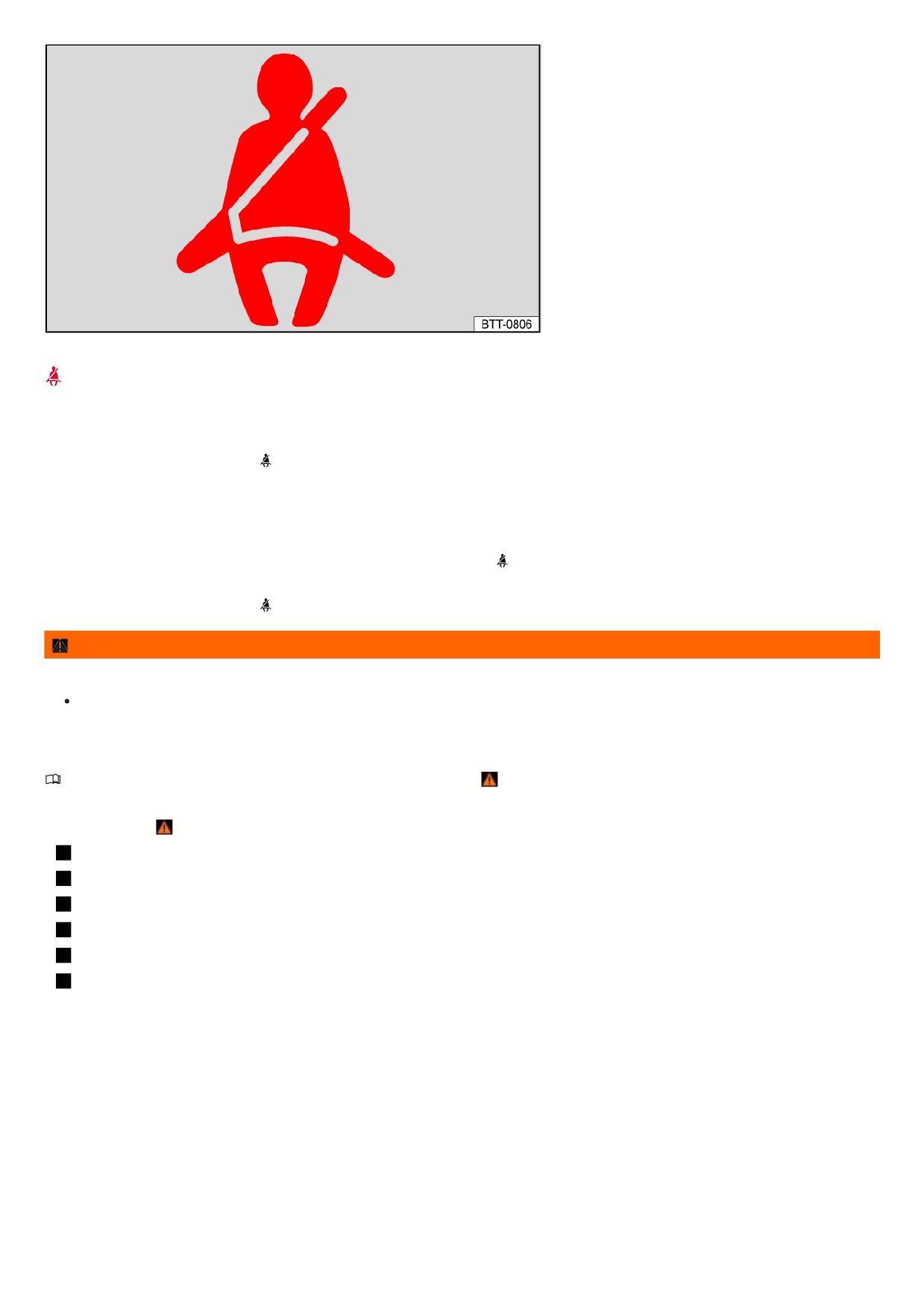
Fig. 17 In the instrument cluster display: warning light.
The driver or front passenger has not fastened their safety belt. Fasten all safety belts.
When the ignition is switched on, several warning and indicator lamps light up temporarily as a function check. They then turn off after a few seconds.
A chime also sounds.
When the ignition is switched on, the red
warning light comes on for six seconds. A chime also sounds for up to six seconds if the driver safety belt is not
fastened. The chime ends when the driver fastens their safety belt. The warning lamps and chime go off when the driver and front passenger have fastened their
safety belts.
If the driver and front passenger do not both fasten their safety belts within 10 seconds after the warning chime has ended and the vehicle is driving at a speed
above approx. 25 km/h (approx. 15 mph), the chime sounds again for approx. 6 seconds, then stops for approx. 24 seconds, and then sounds again for approx. 6
seconds. The same happens if one of the safety belts is released while driving. The red
warning light comes on. A warning chime also sounds for up to two
minutes at 24-second intervals. The chime does not sound at speeds below approx. 8 km/h (approx. 5 mph).
When the ignition is switched on, the red
warning light comes on until the driver and front passenger have both fastened their safety belts.
WARNING
The risk of serious and fatal injuries increases if the safety belts are not worn or are worn incorrectly.
Fasten the safety belts and use them correctly to ensure that they provide optimum protection.
Using safety belts
Please read the introductory information and heed the Warnings and Notice ⇒
Introduction.
Checklist
Using safety belts ⇒
:
Check the condition of all of the safety belts regularly.
Keep safety belts clean.
Always keep foreign objects and fluids far away from the safety belt, the safety belt buckle, and the slot in the safety belt buckle.
Do not pinch or damage the safety belt and/or belt buckle, for example closing it in a door.
Never remove, modify, or repair the safety belt and belt fastening elements.
Always fasten the safety belt correctly before you begin driving and keep it fastened while driving.
Twisted safety belt
If the safety belt is difficult to pull out of the belt guide, the safety belt may have been pulled out too quickly when positioning the belt and may have become twisted
within the side trim panel:
1. Slowly and carefully pull the safety belt out completely by the belt buckle.
2. Untwist any twisted sections of the safety belt and guide the belt back slowly by hand.
If you cannot untwist the safety belt, fasten the safety belt anyway. The twist must not be in a section of the belt that rests directly on the body. Go to an authorized
Volkswagen dealer or authorized Volkswagen Service Facility immediately to have the belt untwisted. Volkswagen recommends contacting an authorized
Volkswagen dealer or authorized Volkswagen Service Facility.
Lockable safety belt
The safety belts on the rear seats and the safety belt on the front passenger seat are lockable and have an emergency locking function. With the locking function,
you can adjust the safety belt so that a child restraint is properly installed ⇒ Securing a child restraint with a safety belt .
37
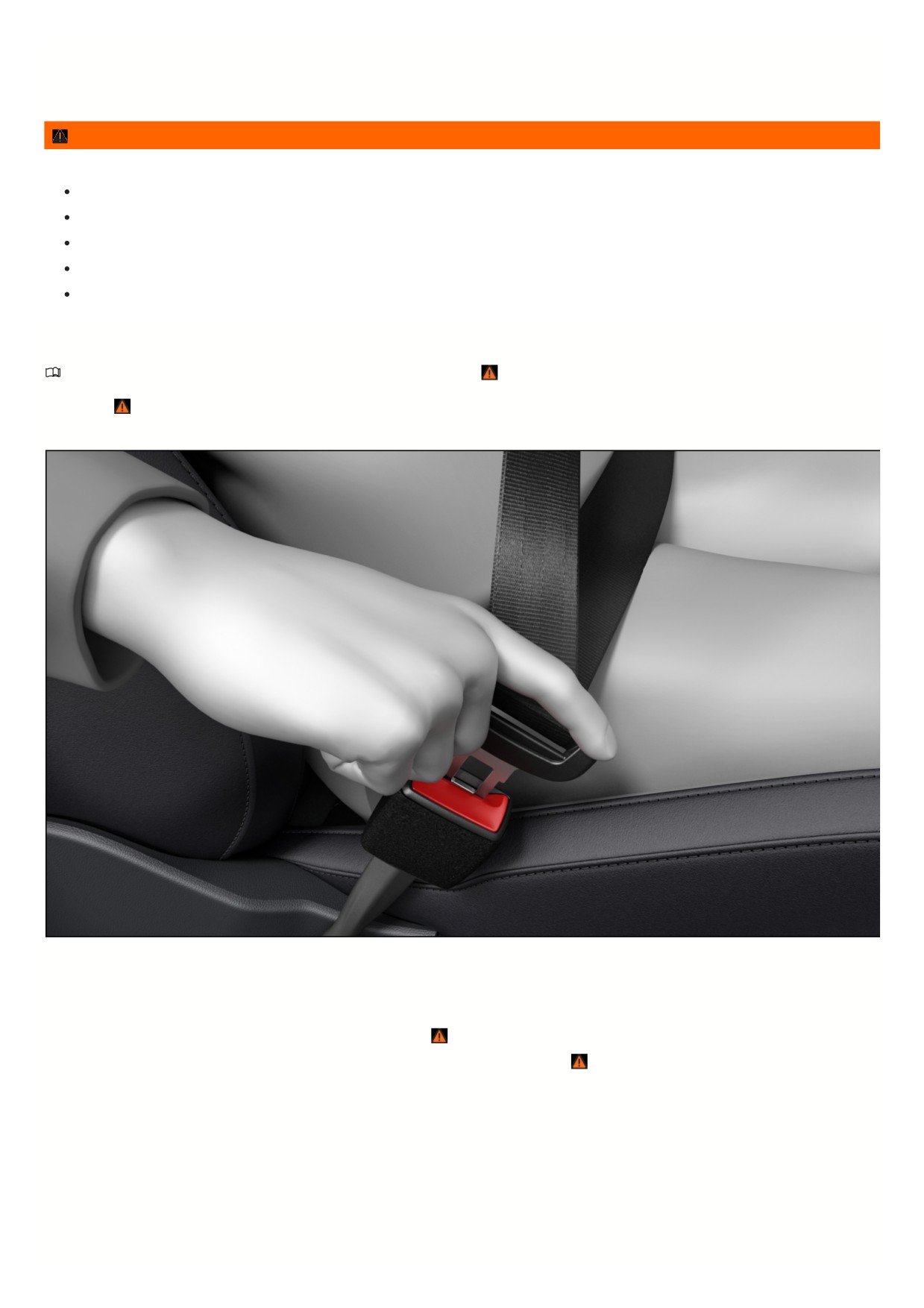
Safety belts may only be locked for certain child restraint systems ⇒ Child restraints - overview.
An activated locking mechanism must be released when a vehicle occupant fastens their safety belt. To release the locking mechanism, push the red button in the
belt buckle and guide the belt back fully by hand.
WARNING
Incorrect handling of the safety belts increases the risk of severe or fatal injuries.
Check the safety belts and associated components regularly to ensure they function correctly.
Never attempt to repair safety belts. Have damaged safety belts replaced.
Always keep the safety belts clean.
Never damage the safety belts by trapping them or chafing them on sharp edges.
Always keep the belt buckle and insertion guide for the belt buckle free of foreign objects and fluids.
Fastening and unfastening the safety belts
Please read the introductory information and heed the Warnings and Notice ⇒
Introduction.
Safety belts that are fastened correctly hold vehicle occupants in the correct position during braking maneuvers or in a collision, in order to provide the maximum
protection ⇒
Fastening the safety belt
Fig. 18 Inserting the buckle tongue into the safety belt buckle.
Always fasten the safety belts before driving.
1. Adjust the front seat and head restraint correctly
⇒ Seating position.
2. Have the rear seat backrest locked into place in an upright position
⇒
3. Grab the belt and pull it evenly over the chest and pelvis. Do not twist the belt while doing this
⇒
4. Insert the buckle tongue securely in the safety belt buckle for that seat fig. 18.
5. Pull on the safety belt to make sure the buckle tongue is latched correctly in the safety belt buckle.
Unfastening the safety belt
38
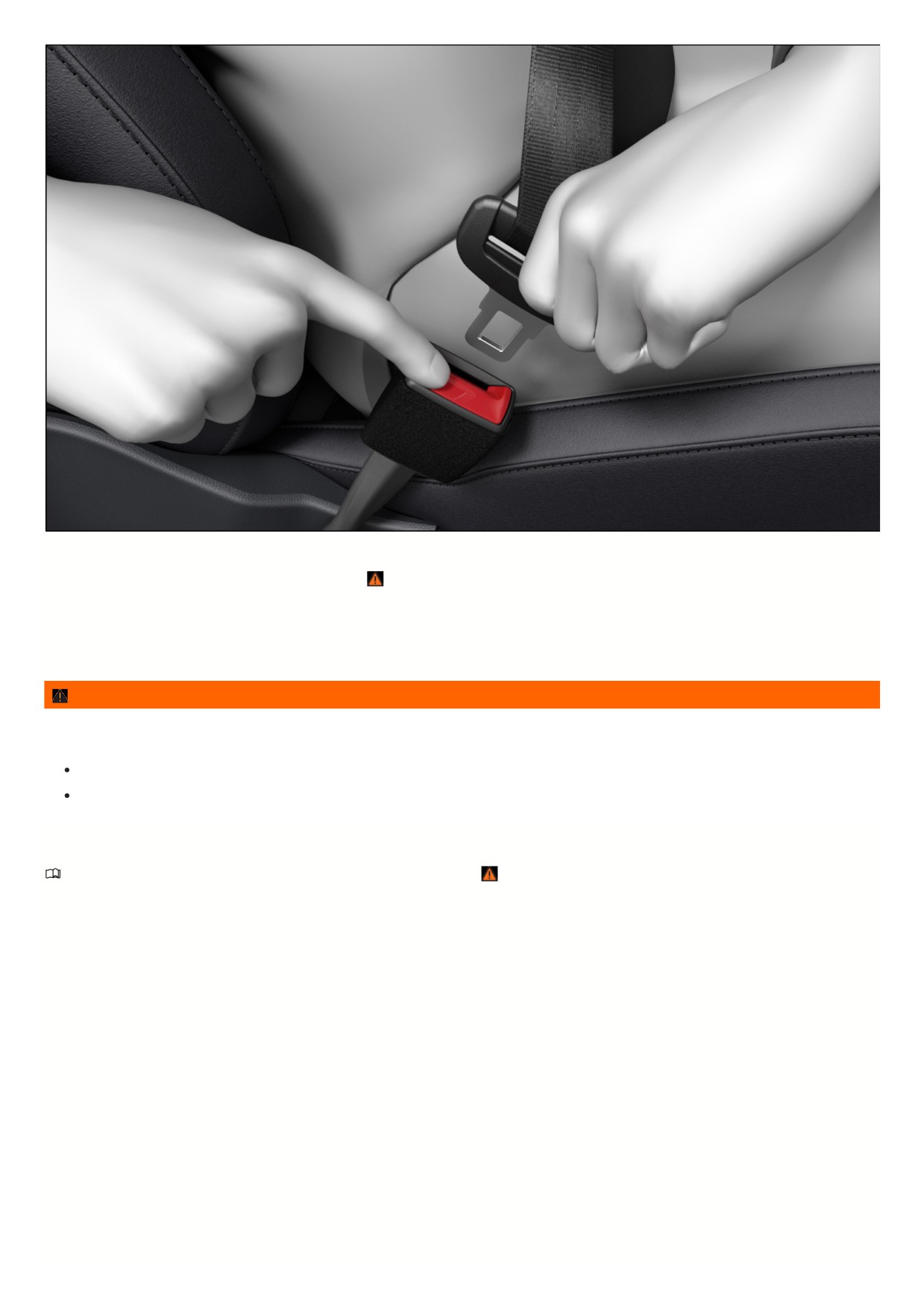
Fig. 19 Releasing the buckle tongue from the safety belt buckle.
Only unfasten the safety belt while the vehicle is stationary ⇒
1. Press the red button in the safety belt buckle fig. 19.
The buckle tongue will pop out.
2. Guide the belt back by hand so that the belt rolls up easily, the belt does not twist, and the trim panel is not damaged.
WARNING
Incorrect safety belt positioning or unfastening the safety belt while the vehicle is in motion can lead to serious or fatal injuries in the event of an accident or
braking maneuver.
Place the backrest in an upright position and position your safety belt correctly for your size to maximize the protective function of the safety belt.
Never unfasten the safety belt while the vehicle is in motion.
Safety belt positioning
Please read the introductory information and heed the Warnings and Notice ⇒
Introduction.
Safety belts only offer the optimum protection during a collision and reduce the risk of serious injury or death if they are fastened and positioned correctly. The
correct safety belt position also holds the vehicle occupant in place so that the airbags can provide their maximum protection if they deploy. Therefore, all vehicle
occupants should always fasten their own safety belts and make sure they are positioned correctly fig. 20.
An incorrect seating position can cause severe or fatal injuries ⇒ Seating position.
Correct safety belt positioning
39
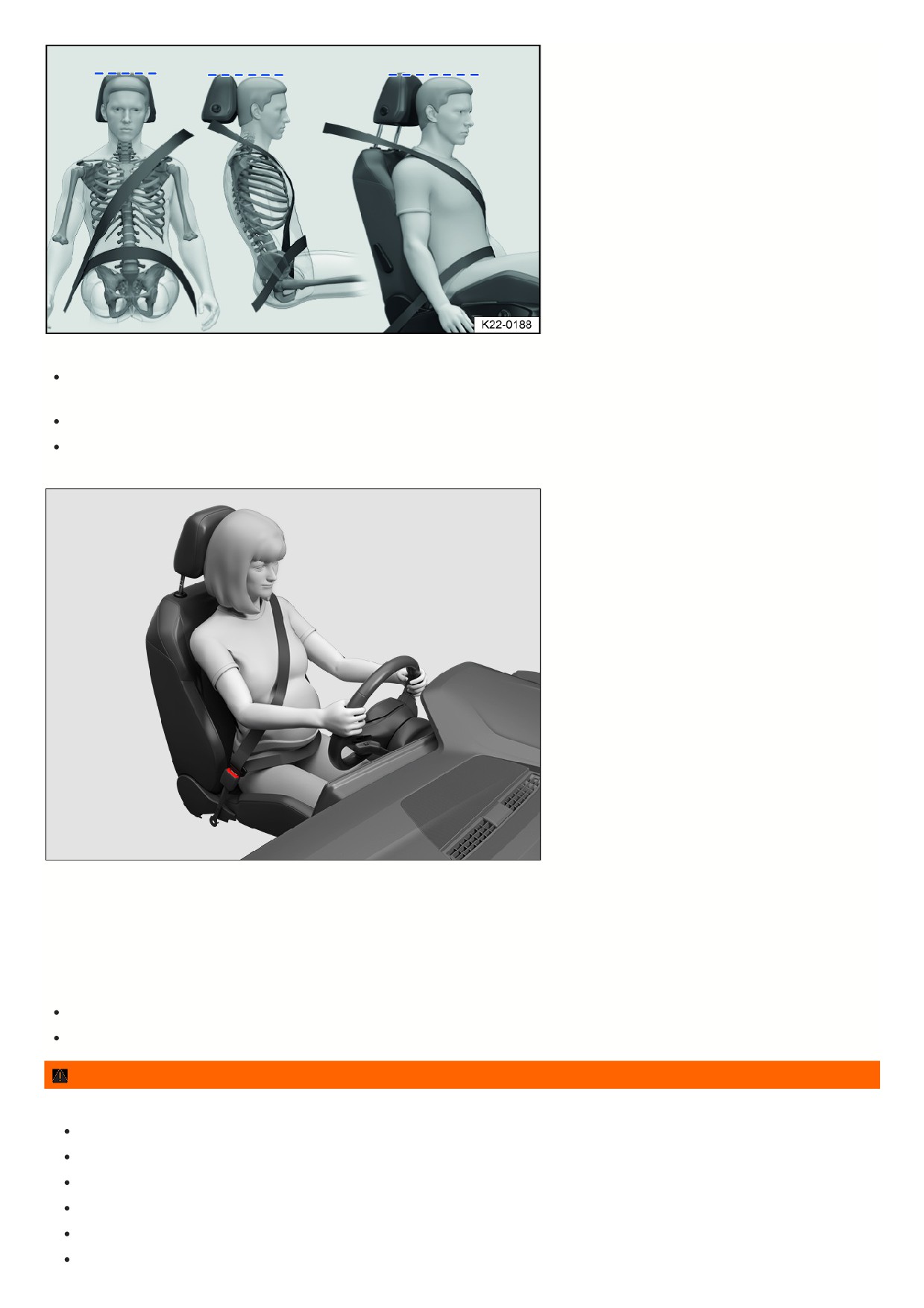
Fig. 20 Correct safety belt positioning and correct head restraint adjustment.
The shoulder belt section of the safety belt must always be positioned over the center of the shoulder and never across the neck, above the arm, under the
arm, or behind the back.
The lap section of the safety belt must always lie across the lap and never over the stomach.
The safety belt must always rest flat and securely on the body. Retighten the belt if necessary.
Correct safety belt positioning for pregnant women
Fig. 21 Correct safety belt positioning for pregnant women.
For pregnant women, the safety belt must rest evenly across the chest and as low and flat as possible on the lap, so that no pressure is applied to the lower
abdomen. This should be done throughout the entire pregnancy fig. 21.
Adjusting the safety belt position to body size
The belt positioning can be adjusted with the following equipment:
Belt height adjusters for the front seats ⇒ Safety belt height adjuster.
Height-adjustable front seats ⇒ Seating position.
WARNING
Incorrect safety belt positioning can cause serious injuries in the event of an accident or during sudden braking or driving maneuvers.
Ensure your safety belt is positioned correctly.
Place the backrest in an upright position and position your safety belt correctly for your size to maximize the protective function of the safety belt.
Place the shoulder portion of the safety belt over the center of your shoulder, and never under your arm or across your neck.
Lay the safety belt flat and securely on the upper part of the body and pelvis. Retighten the belt if necessary.
Ensure the lap section of the safety belt lies across your lap and never over your stomach.
Throughout your pregnancy, ensure the safety belt rests evenly across your chest and as low and flat as possible on your lap. This will prevent pressure
4
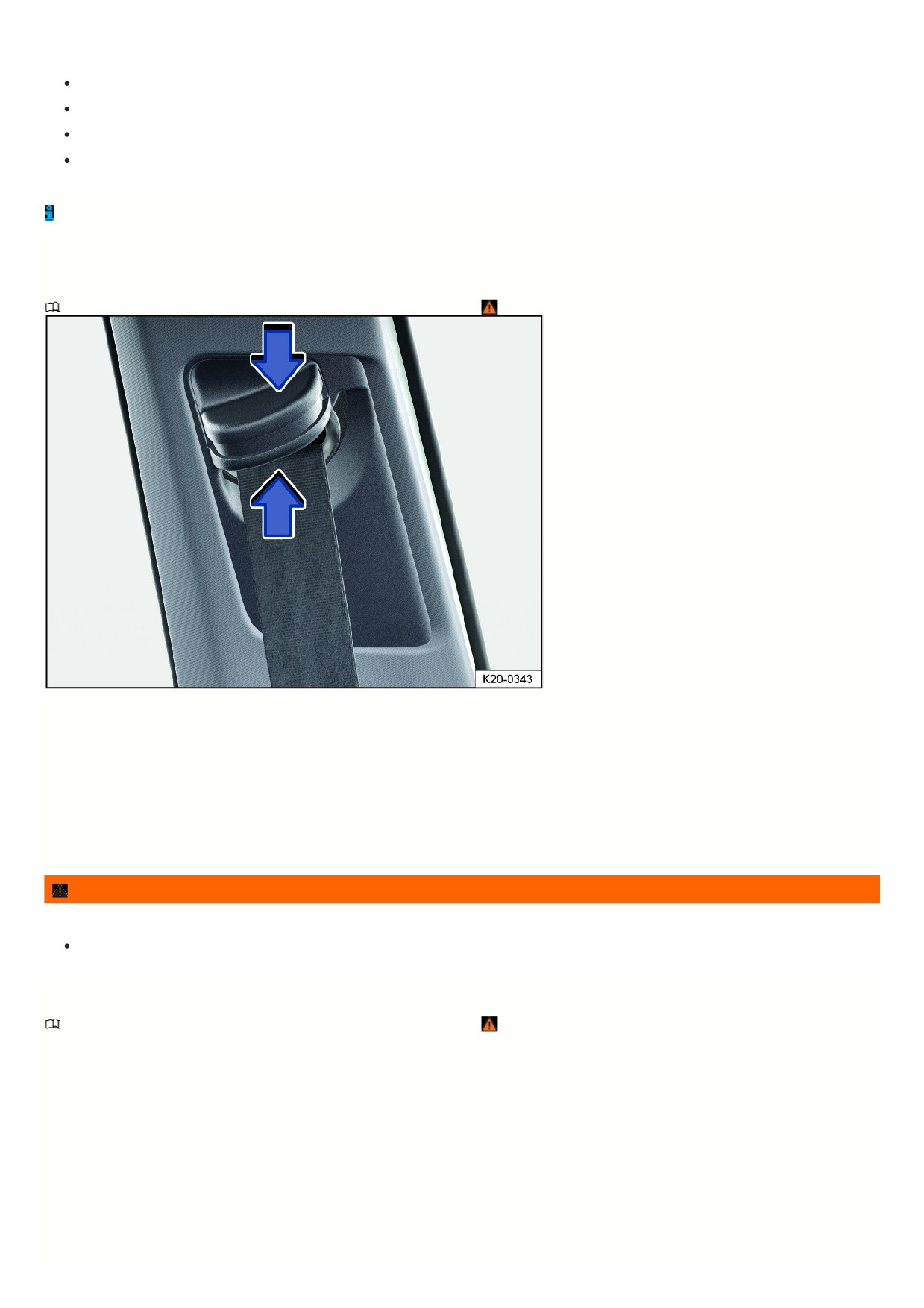
being applied to your lower abdomen.
Do not twist the safety belt while wearing it.
Never hold the safety belt away from the body with your hand.
Do not guide the safety belt over hard or breakable objects, such as eyeglasses, pens, or keys.
Do not modify how the safety belt is routed using belt clips, retaining loops, or similar objects.
Persons who cannot achieve the optimum belt routing due to physical conditions should contact an authorized Volkswagen dealer or authorized Volkswagen
Service Facility about possible special modifications that can be used to achieve the best possible protection with the safety belt and airbags. Volkswagen
recommends contacting an authorized Volkswagen dealer or authorized Volkswagen Service Facility.
Safety belt height adjuster
Please read the introductory information and heed the Warnings and Notice ⇒
Introduction.
Fig. 22 Next to the front seats: safety belt height adjuster.
You can use the safety belt height adjuster to adjust the safety belt routing in the shoulder area according to your individual body size, so that the safety belt can be
correctly fastened:
1. Push down and hold the safety belt height adjustment button in the direction of the arrows fig. 22.
2. Slide the safety belt height adjuster upward or downward until the safety belt lies over the center of the shoulder
⇒ Safety belt positioning.
3. Release the safety belt height adjustment button.
4. Pull hard on the safety belt to check that the safety belt height adjuster is engaged.
WARNING
Changing the safety belt height while driving may cause serious or fatal injuries.
Never adjust the safety belt height while driving.
Automatic safety belt retractor, safety belt pretensioner, safety belt load limiter
Please read the introductory information and heed the Warnings and Notice ⇒
Introduction.
The vehicle seat belts are part of the vehicle safety concept ⇒ Airbag system. The vehicle safety concept has the following key functions:
Automatic safety belt retractor
Every safety belt is equipped with an automatic safety belt retractor on the shoulder belt section. If the safety belt is pulled slowly or while driving normally, the
shoulder belt will be able to move freely. The automatic safety belt retractor blocks the safety belt from moving if the safety belt is pulled out quickly, for example
during sudden braking maneuvers, when driving on hills, when driving around curves and when accelerating.
Safety belt pretensioners
The safety belts for the vehicle occupants in the front seats and in the outer seats in the rear of the vehicle have safety belt pretensioners.
Safety belt pretensioners are activated by sensors and tighten the safety belts in the event of severe front-on, side and rear collisions or if the vehicle rolls over. If
the safety belt is loose, it retracts. This can reduce the forward movement of the vehicle occupants and movement of the vehicle occupants in the direction of the
collision. The safety belt pretensioner works together with the airbag system. The safety belt pretensioner is only activated during a rollover accident if the Side
41

Curtain Protection® airbags are deployed.
Fine dust may appear if airbags deploy. This is completely normal and does not indicate a fire in the vehicle.
WARNING
The safety belt pretensioners only provide protection for one deployment. If the safety belt pretensioners deploy, the system must be replaced.
Have deployed safety belt pretensioners and affected system components replaced immediately with new parts that are approved by Volkswagen for the
vehicle.
Only have suitably qualified professionals make repairs or modifications to a vehicle. Authorized Volkswagen dealers and authorized Volkswagen Service
Facilities have the required tools, diagnostic devices, repair information, and qualified personnel. Volkswagen recommends contacting an authorized
Volkswagen dealer or authorized Volkswagen Service Facility.
Never install safety belt pretensioner components removed from scrap vehicles or from recycling.
Never modify any components of the safety belt pretensioners.
Safety belt load limiter
Safety belt load limiters reduce the force placed on the body by the safety belts during a collision.
When disposing of the vehicle or of individual system components, all safety precautions must be observed. An authorized Volkswagen dealer or authorized
Volkswagen Service Facility will be familiar with these provisions ⇒ Safety belt pretensioner servicing and disposal. Volkswagen recommends contacting an
authorized Volkswagen dealer or authorized Volkswagen Service Facility.
Safety belt pretensioner servicing and disposal
Please read the introductory information and heed the Warnings and Notice ⇒
Introduction.
When working on safety belt pretensioners, as well as when removing and installing other vehicle components as part of repair work, the safety belts can become
damaged without you noticing. This may cause the safety belt pretensioner to function incorrectly or prevent it from functioning in the event of an accident.
The instructions must be followed so that the effectiveness of the safety belt pretensioner is not impaired and removed components do not cause injuries and
environmental pollution. An authorized Volkswagen dealer or authorized Volkswagen Service Facility will be familiar with these provisions. Volkswagen recommend
contacting an authorized Volkswagen dealer or authorized Volkswagen Service Facility.
WARNING
Repairs that you perform yourself or that are performed incorrectly on the safety belts, automatic safety belt retractors, and safety belt pretensioners can
increase the risk of severe or fatal injuries. The safety belt pretensioner may not deploy when it should, or it may deploy unexpectedly.
Never perform repairs, adjustments, or removal and installation of components of the safety belt pretensioners or safety belts yourself. Only have these
procedures performed by suitably qualified professionals ⇒ Accessories, replacement parts, repairs, and modifications. Volkswagen recommends
contacting an authorized Volkswagen dealer or authorized Volkswagen Service Facility.
Safety belts, safety belt pretensioners and automatic safety belt retractors cannot be repaired. These components must be replaced.
Some parts of the vehicle, such as the airbag module and safety belt pretensioners, may contain perchlorate. Special handling may be necessary. For further
information, visit https://dtsc.ca.gov/perchlorate.
Airbag system
Introduction
The vehicle is equipped with a front airbag for the driver and one for the front passenger. The front airbags can offer additional protection for the chest and head of
the driver and front passenger as long as the seat, the safety belt, the head restraint, and the steering wheel are adjusted and used correctly. Airbags are only
designed to offer supplementary protection. Airbags are not a replacement for safety belts. Safety belts must always be worn, even if the front seats are fitted with
front airbags.
WARNING
Never rely only on the airbag system for protection.
Even when an airbag deploys, it only offers supplementary protection.
The airbag system provides optimum protection when the safety belt is worn correctly and it reduces the risk of injury
⇒ Safety belts.
Before every trip, everyone in the vehicle must seat themselves correctly, fasten the safety belt that belongs to the seat they are using, and keep it
fastened while the vehicle is in motion. This applies to all passengers and at all times, including during city driving.
WARNING
42

Sitting too close to the steering wheel or the instrument panel reduces the effectiveness of the airbags and increases the risk of injury in the event of a collision.
Adjust the driver seat so that there is a distance of at least 10 inches (25 cm) between your chest and the center of the steering wheel.
Adjust the front passenger seat so that there is the greatest possible distance between the front passenger and the instrument panel.
If body characteristics mean that this is not possible, see an authorized Volkswagen dealer or authorized Volkswagen Service Facility to have special
modifications made. Volkswagen recommends contacting an authorized Volkswagen dealer or authorized Volkswagen Service Facility.
If you have not fastened your safety belt correctly, if you lean forwards, sit sideways or are in any way seated outside the intended sitting position, the
risk of you being injured is far higher.
Make sure that your safety belt is fastened correctly to reduce the risk of injury if an airbag deploys.
When using a rear-facing child restraint on the front passenger’s seat, the risk of life-threatening or fatal injuries in the event of a collision increases for
the child. Never use rear-facing child restraints on the front passenger’s seat.
Make sure that children under 12 years of age always sit on a rear seat. Children that are not correctly strapped in can suffer serious or even fatal injuries
if the airbag deploys.
Secure children in the vehicle with a child restraint that is appropriate for their weight and height and with the safety belt used correctly.
Adjust the front seats correctly.
Never drive with the backrest angled too far back or forward.
Position the seat backrest in an upright position, so that your back rests completely on the seat backrest.
Always keep feet in the footwell while driving. For example, never rest feet on the seat or on the instrument panel and never hold feet out of the window.
Otherwise, if the airbag and the safety belt deploy, they could increase the risk of injury in the event of an accident instead of providing protection.
WARNING
The risk of injury if the airbag deploys increases if there are objects located between vehicle occupants and the airbag deployment zone. These objects could
change the deployment zone of the airbag or could strike the vehicle occupants.
Never hold objects in your hands or on your lap while driving.
Never transport objects on the front passenger's seat. During sudden braking or driving maneuvers, the objects could move into the airbag deployment
zone and then be thrown through the vehicle interior if the airbag deploys.
There should be no people, animals, or objects between the occupants of the front seats or outer rear seats and the airbag deployment zone. Make sure
that child and adult passengers also follow these instructions.
WARNING
The airbag system only provides protection for one deployment. If the airbags deploy, the system must be replaced.
Have deployed airbags and affected system components replaced immediately with new parts approved by Volkswagen for the vehicle.
Only have suitably qualified professionals make repairs or modifications to a vehicle. Suitably qualified professionals have the required tools, diagnostic
devices, repair information, and qualified personnel. Volkswagen recommends contacting an authorized Volkswagen dealer or authorized Volkswagen
Service Facility.
Never install airbag components removed from scrap vehicles or from recycling.
Never modify any components of the airbag system.
WARNING
Fine dust and water vapor can develop when the airbags deploy. This is normal and does not indicate a fire in the vehicle.
The fine dust can irritate the skin and mucous membranes in the eyes and can cause breathing problems, particularly for individuals who have asthma or
other respiratory conditions. To reduce the risk of breathing problems, exit the vehicle or open the windows or doors for fresh air.
If you come into contact with the dust, wash your hands and face with mild soap and water before eating anything.
Do not allow the dust to come into contact with your eyes or any open wounds.
Flush your eyes with water if dust enters them.
WARNING
Cleaners that contain solvents can make the surface of the airbag module porous. Plastic pieces that come loose could cause serious injuries in the event of a
collision with airbag deployment.
Never treat the instrument panel and the surface of the airbag modules with cleaners that contain solvents.
43
//////////////////////////////////////////