Volkswagen Corrado (1993 year). Manual - part 149
 

  Index      Volkswagen     Volkswagen Corrado - service repair manual 1993 year


Search            


Content   ..  147  148  149  150   ..


Volkswagen Corrado (1993 year). Manual - part 149


GENERAL COOLING SYSTEM SERVICING 

         Heater Core
         Flush heater core as described for radiator. Ensure heater
control valve is set to maximum heat position before flushing heater.

         REFILLING

         To prevent air from being trapped in engine block, engine
should be running when refilling cooling system. After system is full,
continue running engine until thermostat is open, then recheck fill
level. Do not overfill system.

         TESTING

         THERMOSTAT

         1) Visually inspect thermostat for corrosion and proper
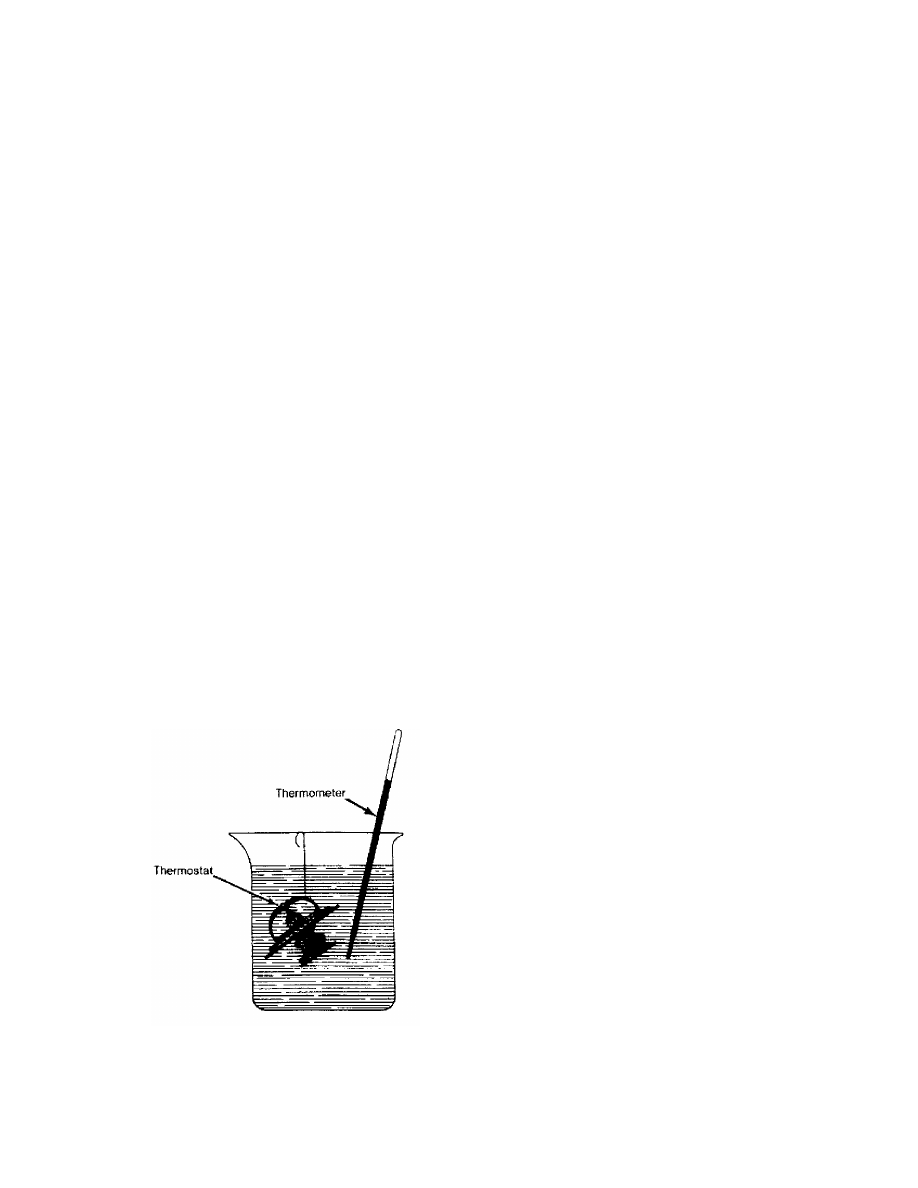
sealing of valve and seat. If okay, suspend thermostat and thermometer
in a 50/50 mixture of coolant and water. See Fig. 1. Do not allow
thermostat or thermometer to touch bottom of container. Heat water
until thermostat just begins to open.
         2) Read temperature on thermometer. This is the initial
opening temperature and should be within specification. Continue
heating water until thermostat is fully open and note temperature.
This is the fully opened temperature. If either reading is not to
specification, replace thermostat.

Fig. 1:  Testing Thermostat in Anti-Freeze/Water Solution

         PRESSURE TESTING

         A pressure tester is used to check both radiator cap and
complete cooling system. Test components as follows, following tool

GENERAL COOLING SYSTEM SERVICING 

         Radiator Cap
         Visually inspect radiator cap, then dip cap into water and
connect to tester. Pump tester to bring pressure to upper limit of cap
specification. If cap fails to hold pressure, replace cap.

Fig. 2:  Testing Radiator Pressure Cap

         Cooling System
         1) With engine off, wipe radiator filler neck seat clean.
Fill radiator to correct level. Attach tester to radiator and pump
until pressure is at upper level of radiator rating.
         2) If pressure drops, inspect for external leaks. If no leaks
are apparent, detach tester and run engine until normal operating
temperature is reached. Reattach tester and observe. If pressure
builds up immediately, a possible leak exists from a faulty head
gasket or crack in head or block.

NOTE:    Pressure may build up quickly. Release any excess pressure
         or cooling system damage may result.

         3) If there is no immediate pressure build up, pump tester to
within system pressure range (on radiator cap). Vibration of gauge
pointer indicates compression or combustion leak into cooling system.
Isolate leak by shorting each spark plug wire to cylinder block. Gauge
pointer should stop or decrease vibration when leaking cylinder is
shorted.

END OF ARTICLE

H - TESTS W/O CODES 

         1993 ENGINE PERFORMANCE
         Volkswagen Trouble Shooting - No Codes

         Cabriolet, Corrado SLC, EuroVan, Fox
         Golf, GTI, Jetta, Passat GL, Passat GLX

         INTRODUCTION

         PRELIMINARY INFORMATION

         Before diagnosing symptoms or intermittent faults, perform
steps in the F - BASIC TESTING article in this section. Use this
article to diagnose driveability problems existing when a hard fault
code is not present or vehicle is not equipped with a self-diagnostic
system.

NOTE:    Some driveability problems may have been corrected by
         manufacturer with a revised computer calibration chip or
         computer control unit. Check with manufacturer for latest
         chip or computer application.

         Symptom checks can direct the technician to malfunctioning
component(s) for further diagnosis. A symptom should lead to a
specific component, system test or an adjustment.
         Use intermittent test procedures to locate driveability
problems that DO NOT occur when the vehicle is being tested. These
test procedures should also be used if a soft (intermittent) trouble
code was present, but no problem was found during self-diagnostic
testing.

NOTE:    For specific test procedures, see the I - SYS/COMP TESTS
         article in this section. For adjustment procedures, see the
         appropriate D - ADJUSTMENTS article. For Engine Performance
         related specifications, see appropriate C - SPECIFICATIONS
         article in this section. See the following menus:

         C - SPECIFICATIONS ARTICLES MENU

NOTE:    For the appropriate C - SPECIFICATIONS article, go to:

      *  For Cabriolet, see:  C - SPECIFICATIONS
      *  For Corrado SLC, see:  C - SPECIFICATIONS
      *  For EuroVan, see:  C - SPECIFICATIONS
      *  For Fox, see:  C - SPECIFICATIONS
      *  For Golf, GTI, Jetta, see:  C - SPECIFICATIONS
      *  For Passat, see:  C - SPECIFICATIONS

         D - ADJUSTMENTS ARTICLES MENU

NOTE:    For the appropriate D - ADJUSTMENTS article, go to:

H - TESTS W/O CODES 

         I - SYS/COMP TESTS ARTICLES MENU

NOTE:    For the appropriate I - SYS/COMP TESTS article, go to:

      *  For Cabriolet, see:  I - SYSTEM/COMPONENT TESTS
      *  For Corrado SLC, see:  I - SYSTEM/COMPONENT TESTS
      *  For EuroVan, see:  I - SYSTEM/COMPONENT TESTS
      *  For Fox, see:  I - SYSTEM/COMPONENT TESTS
      *  For Golf, GTI, Jetta, see:  I - SYSTEM/COMPONENT TESTS
      *  For Passat GL 2.0L 4-Cylinder, see:
         I - SYSTEM/COMPONENT TESTS - 4-CYL
      *  For Passat GLX 2.8L VR6, see:
         I - SYSTEM/COMPONENT TESTS - VR6

         SYMPTOMS

         SYMPTOM DIAGNOSIS

         Symptom checks cannot be used properly unless the problem is
actually happening while the vehicle is being tested. To reduce
diagnostic time, ensure battery voltage is okay and starter motor
turns engine over before attempting to diagnose a symptom.
         Check engine mechanical condition (compression pressure,
valve timing, etc.), wiring harness and connections (terminals not
corroded or pushed back), and vacuum hose (not disconnected or
leaking).
         Also check for correct tire sizes, as recommended by
manufacturer. Ensure wheels rotate freely (brake drag or bad wheel
bearings). Ensure no speed reducing accessories are installed.
Symptoms available for diagnosis include the following.

      *  Engine Does Not Start Or Is Difficult To Start When Cold
      *  Engine Does Not Start Or Is Difficult To Start When Warm
      *  Uneven Idle Or No Idle With Cold Engine Or During Warm-Up
      *  Engine Starts But Stalls
      *  Idle Speed Exceeds Specification
      *  Poor Acceleration With Cold Engine Or During Warm-Up
      *  Engine Stalls While Driving
      *  Poor Performance
      *  Engine Run-On (Dieseling)
      *  High Fuel Consumption
      *  Engine Knock
      *  Engine Runs Unevenly Over Entire Speed Range


Content   ..  147  148  149  150   ..