Volkswagen Corrado (1993 year). Manual - part 138
 

  Index      Volkswagen     Volkswagen Corrado - service repair manual 1993 year


Search            


Content   ..  136  137  138  139   ..


Volkswagen Corrado (1993 year). Manual - part 138


ENGINE OVERHAUL PROCEDURES - GENERAL INFORMATION 

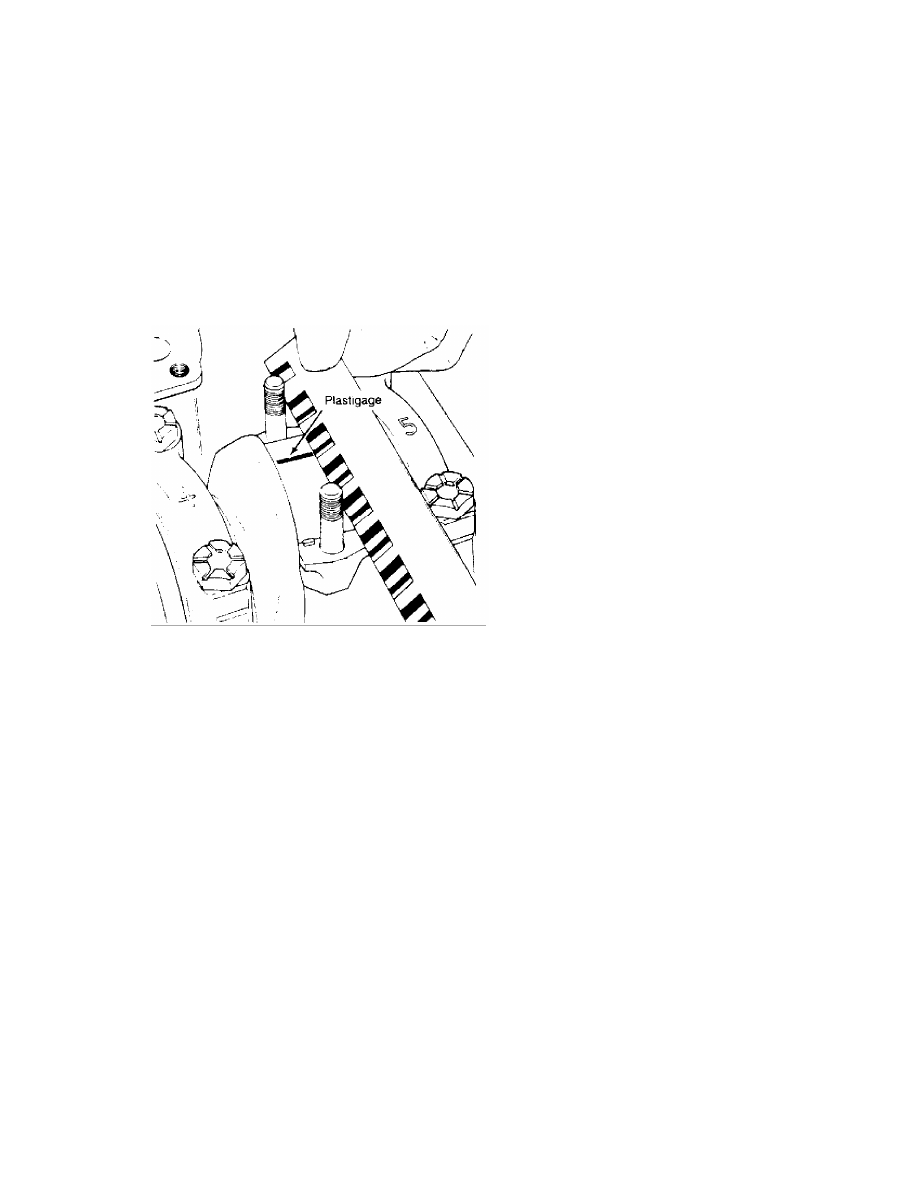
         Remove bearing cap. Compare Plastigage width with scale on
Plastigage container to determine bearing clearance. See Fig. 19.
Rotate crankshaft 90 degrees. Repeat procedure. this is done to check
journal eccentricity. This procedure can be used to check oil
clearance on both connecting rod and main bearings.

Fig. 19:  Measuring Bearing Clearance - Typical
This Graphic For General Information Only

         Micrometer & Telescopic Gauge Method
         A micrometer is used to determine journal diameter, taper and
out-of-round dimensions of the crankshaft. See CLEANING & INSPECTION
under CRANKSHAFT & MAIN BEARINGS in this article.
         With crankshaft removed, install bearings and caps in
original location on cylinder block. Tighten bolts to specification.
On connecting rods, install bearings and caps on connecting rods.
Install proper connecting rod cap on corresponding rod. Ensure bearing
cap is installed in original location. Tighten bolts to specification.
         Using a telescopic gauge and micrometer or inside micrometer
measure inside diameter of connecting rod and main bearings bores.
Subtract each crankshaft journal diameter from the corresponding
inside bore diameter. This is the bearing clearance.

         CRANKSHAFT & MAIN BEARINGS

         * PLEASE READ THIS FIRST *

NOTE:    Always refer to appropriate engine overhaul article in the
         ENGINES section for complete overhaul procedures and
         specifications for the vehicle being repaired.

         REMOVAL

ENGINE OVERHAUL PROCEDURES - GENERAL INFORMATION 

         CLEANING & INSPECTION

         Thoroughly clean crankshaft using solvent. Dry with
compressed air. Ensure all oil passages are clear and free of sludge,
rust, dirt, and metal chips.
         Inspect crankshaft for scoring and nicks. Inspect crankshaft
for cracks using Magnaflux procedure. Inspect rear seal area for
grooving or damage. Inspect bolt hole threads for damage. If pilot
bearing or bushing is used, check pilot bearing or bushing fit in
crankshaft. Inspect crankshaft gear for damaged or cracked teeth.
Replace gear if damaged. Check that oil passage plugs are tight (if
equipped).
         Using micrometer, measure all journals in 4 areas to
determine journal taper, out-of-round and undersize. See Fig. 20.
Some crankshafts can be reground to the next largest undersize,
depending on the amount of wear or damage. Crankshafts with rolled
fillet cannot be reground and must be replaced.

Fig. 20:  Measuring Crankshaft Journal - Typical
This Graphic For General Information Only

         Crankshaft journal runout should be checked. Install
crankshaft in "V" blocks or bench center. Position dial indicator
with tip resting on the main bearing journal area. See Fig. 21.
Rotate crankshaft and note reading. Journal runout must not exceed
specification. Repeat procedure on all main bearing journals.
Crankshaft must be replaced if runout exceeds specification.

ENGINE OVERHAUL PROCEDURES - GENERAL INFORMATION 

         INSTALLATION

         Install upper main bearing in cylinder block. Ensure lock
tab is properly located in cylinder block. Install bearings in main
bearing caps. Ensure all oil passages are aligned. Install rear seal
(if removed).
         Ensure crankshaft journals are clean. Lubricate upper main
bearings with clean engine oil. Carefully install crankshaft. Check
each main bearing clearance using Plastigage method. See
MAIN & CONNECTING ROD BEARING CLEARANCE in this article.
         Once clearance is checked, lubricate lower main bearing and
journals. Install main bearing caps in original location. Install rear
seal in rear main bearing cap (if removed). Some rear main bearing
caps require sealant to be applied in corners to prevent oil leakage.
         Install and tighten all bolts except thrust bearing cap to
specification. Tighten thrust bearing cap bolts finger tight only.
Thrust bearing must be aligned. On most applications, crankshaft
must be moved rearward then forward. Procedure may vary with
manufacturer. Thrust bearing cap is then tighten to specification.
Ensure crankshaft rotates freely. Crankshaft end play should be
checked. See CRANKSHAFT END PLAY in this article.

         CRANKSHAFT END PLAY

         Dial Indicator Method
         Crankshaft end play can be checked using dial indicator.
Mount dial indicator on rear of cylinder block. Position dial
indicator tip against rear of crankshaft. Ensure tip is resting
against flat surface.
         Pry crankshaft rearward. Adjust dial indicator to zero.
Pry crankshaft forward and note reading. Crankshaft end play must be
within specification. If end play is not within specification, check
for faulty thrust bearing installation or worn crankshaft. Some
applications offer oversized thrust bearings.

         Feeler Gauge Method
         Crankshaft end play can be checked using feeler gauge. Pry
crankshaft rearward. Pry crankshaft forward. Using feeler gauge,
measure clearance between crankshaft and thrust bearing surface. See
Fig. 22.

ENGINE OVERHAUL PROCEDURES - GENERAL INFORMATION 

         Crankshaft end play must be within specification. If end
play is not within specification, check for faulty thrust bearing
installation or worn crankshaft. Some applications offer oversized
thrust bearings.

         CYLINDER BLOCK

         * PLEASE READ THIS FIRST *

NOTE:    Always refer to appropriate engine overhaul article in the
         ENGINES section for complete overhaul procedures and
         specifications for the vehicle being repaired.

         BLOCK CLEANING

         Only cast cylinder blocks should be hot tank cleaned.
Aluminum cylinder blocks should be cleaned using cold tank method.
Cylinder block is cleaned in order to remove carbon deposits, gasket
residue and water jacket scale. Remove oil galley plugs, freeze plugs
and cam bearings prior to block cleaning.

         BLOCK INSPECTION

         Visually inspect the block. Check suspected areas for cracks
using the Dye Penetrant inspection method. Block may be checked for
cracks using the Magnaflux method.
         Cracks are most commonly found at the bottom of the
cylinders, the main bearing saddles, near expansion plugs and between
the cylinders and water jackets. Inspect lifter bores for damage.
Inspect all head bolt holes for damaged threads. Threads should be
cleaned using tap to ensure proper head bolt torque. Consult machine
shop concerning possible welding and machining (if required).


Content   ..  136  137  138  139   ..