Volkswagen Golf Variant / Jetta. Manual - part 435
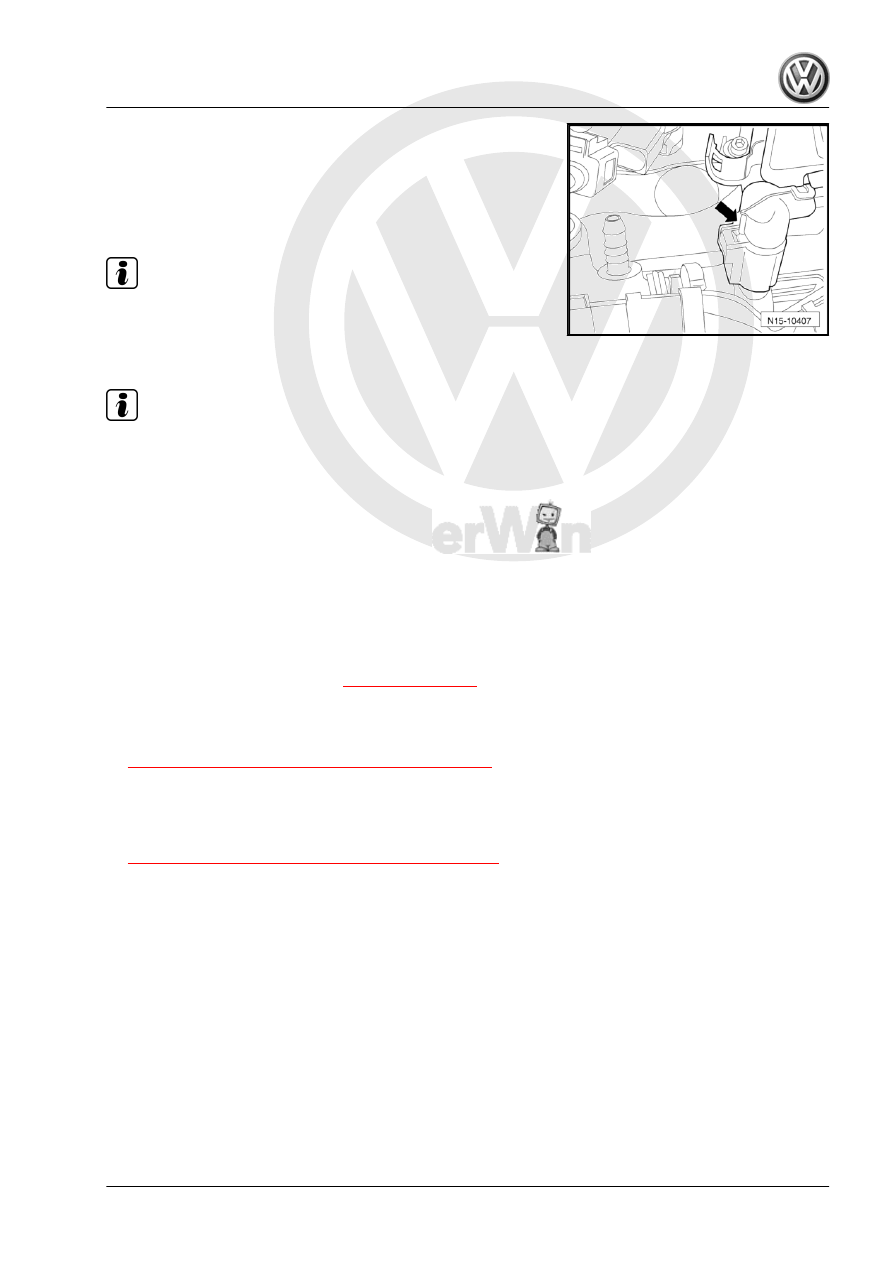
Valve - N276- -arrow-.
– Counterhold at the housing hex bolt and loosen the union nut.
Then remove it by hand.
– Extract the contamination from the rail element bore (threads
and sealing surface). Do not use mechanical tools.
Note
Seal the rail element bore immediately with a suitable plug to pre‐
vent contaminants from entering.
Installing:
Note
♦
Check the Fuel Pressure Regulator Valve - N276- sealing sur‐
face and threads for damage.
♦
Check the sealing surface on the rail element bore.
♦
The threads on the Fuel Pressure Regulator Valve - N276-
must be free of oil and grease.
– First tighten the union nut on the Fuel Pressure Regulator
Valve - N276- by hand.
– Align the Fuel Pressure Regulator Valve - N276- so the con‐
necting line is not taut after connecting the electrical connec‐
tor.
– Counterhold at the housing hex bolt and tighten the union nut:
• Tightening specification -item 6-
– After installing, let the engine run at a moderate speed for a
few minutes and then stop it.
– Check the fuel system for leaks. Refer to
⇒ “3.10 Fuel System, Performing Leak Test”, page 329
– Read the DTC memory for the Engine Control Module - J623-
again. Refer to Vehicle Diagnostic Tester in “Guided Func‐
tions”.
– Install the engine cover. Refer to
⇒ “1.4 Engine Cover, Removing and Installing”, page 90
.
3.7
Fuel Pressure Sensor - G247- , Remov‐
ing and Installing
Function
The Fuel Pressure Sensor - G247- (rail pressure sensor) is loca‐
ted in the rail element (high pressure reservoir). It measures the
current fuel pressure in the high pressure system and delivers a
voltage signal to the Engine Control Module - J623- .
If the Fuel Pressure Sensor - G247- malfunctions, the pressure is
controlled via an Engine Control Module - J623- characteristic
map (maximum engine speed is limited to approximately 3000
RPM in emergency operation mode).
Special tools and workshop equipment required
♦ Torque Wrench 1332 40-200Nm - VAG1332-
3. Diesel Direct Injection System
323