Mercedes-Benz Sprinter / Dodge Sprinter. Service manual - part 503
 

  Index      Mercedes     Mercedes-Benz Sprinter / Dodge Sprinter - service and repair manual 2006 year


Search            copyright infringement  


Content   ..  501  502  503  504   ..


Mercedes-Benz Sprinter / Dodge Sprinter. Service manual - part 503


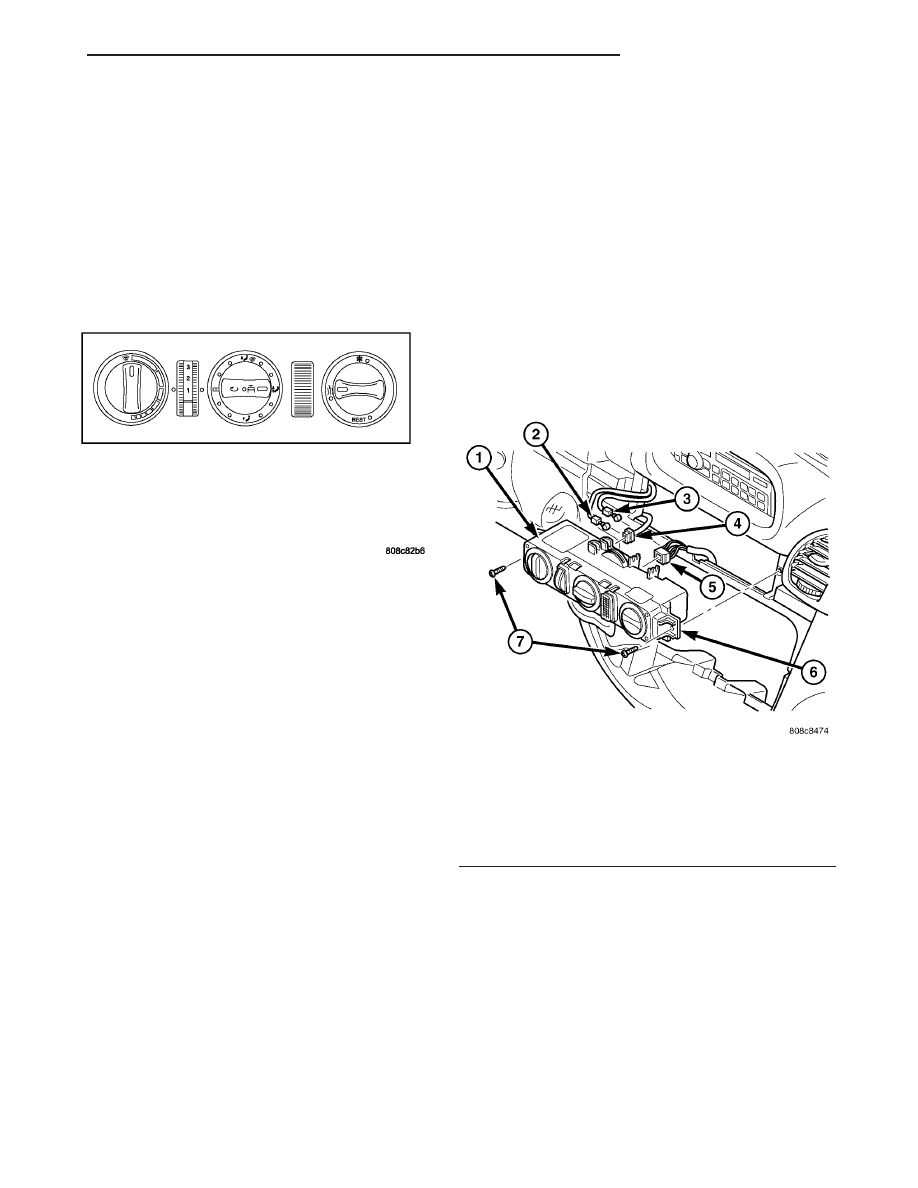
radio (Fig. 7). The A/C-heater control contains a rota-
ry-type temperature control, a rotary-type mode con-
trol, a thumbwheel-type blower motor speed control
and an A/C mode push button switch and indicator
lamp. The A/C-heater control also features a push
button switch and indicator lamp for the residual
engine heat utilization (REST) function, cabin heater
or the heater booster (as equipped).

OPERATION

To control the interior temperature, the A/C-heater

control uses the actual values from the temperature
sensors and the CAN bus and compares them with
the nominal value of the temperature control switch.
The A/C-heater control is diagnosed using a DRBIII

t

scan tool. Refer to Body Diagnostic Procedures.

The A/C-heater

control

is

diagnosed

using

a

DRBIII

t scan tool. Refer to Body Diagnostic Proce-

dures.

The A/C-heater control cannot be adjusted or

repaired and, if faulty or damaged, it must be
replaced.

REMOVAL

WARNING: To avoid personal injury or death, on
vehicles equipped with airbags, disable the supple-
mental

restraint

system

before

attempting

any

steering wheel, steering column, airbag, seat belt
tensioner, impact sensor, or instrument panel com-
ponent diagnosis or service. Disconnect and isolate
the battery negative (ground) cable, then wait two
minutes for the system capacitor to discharge
before performing further diagnosis or service. This
is the only sure way to disable the supplemental
restraint system. Failure to take the proper precau-
tions could result in accidental airbag deployment.

(1) Disconnect and isolate the negative battery

cable.

(2) Remove the center bezel from the instrument

panel. (Refer to 23 - BODY/INSTRUMENT PANEL/
INSTRUMENT

PANEL

CENTER

BEZEL

-

REMOVAL).

(3) Remove the two screws that secure the A/C-

heater control to the instrument panel (Fig. 8).

(4) Pull the A/C-heater control away from the

instrument panel far enough to access the connec-
tions on the back of the control.

(5) Mark and disconnect the two control cables

from the A/C-heater control.

(6) Disconnect the two wiring harness connectors

from the A/C-heater control.

(7) If A/C-heater control is to be replaced, remove

the two mounting brackets from the A/C-heater con-
trol.

INSTALLATION

(1) If removed, install the two mounting brackets

to the A/C-heater control.

(2) Connect the two wire harness connectors into

the back of the A/C-heater control.

(3) Connect the two control cables to the A/C-

heater control.

NOTE: Install the control cable of bottom adjust-
ment lever to the front adjustment wheel of the A/C-
heater control.

(4) Position the A/C-heater control into the instru-

ment panel.

Fig. 7 A/C-Heater Control

Fig. 8 A/C-Heater Control

1 - A/C-HEATER CONTROL
2 - CONTROL CABLE
3 - CONTROL CABLE
4 - WIRE HARNESS CONNECTOR
5 - WIRE HARNESS CONNECTOR
6 - MOUNTING BRACKET (2)
7 - SCREW (2)

VA

CONTROLS-FRONT

24 - 13

(5) Install the two A/C-heater control retaining

screws. Tighten the screws to 2 N·m (17 in. lbs.).

(6) Install the center bezel onto the instrument

panel (Refer to 23 - BODY/INSTRUMENT PANEL/
INSTRUMENT PANEL CENTER BEZEL - INSTAL-
LATION).

(7) Reconnect the negative battery cable.

A / C PRESSURE TRANS-
DUCER

DESCRIPTION

The A/C pressure transducer is installed on the liq-

uid line fitting located at the top of the receiver/drier
(Fig. 9). A rubber O-ring seals the connection
between the transducer and the fitting. Three termi-
nals within a molded plastic connector receptacle on
the top of the transducer connect it to the vehicle
electrical system through a wire lead and connector.

The A/C pressure transducer cannot be adjusted or

repaired and, if faulty or damaged, it must be
replaced.

OPERATION

The A/C pressure transducer monitors the pres-

sures in the high side of the refrigerant system

through its connection to a fitting on the liquid line.
The transducer will change its internal resistance in
response to the pressures it monitors. The ATC con-
trol module provides a five volt reference signal and
monitors the output voltage of the transducer on the
transducer return circuit to determine refrigerant
pressure. The ATC module is preprogrammed to
respond to this and other sensor inputs by controlling
the operation of the air conditioning compressor
clutch and the auxiliary radiator cooling fan to help
optimize air conditioning system performance and to
protect the system components from damage. The
A/C pressure transducer input to the ATC module
also prevents the A/C compressor clutch from engag-
ing when the ambient temperature is below 0.556° C
(33° F) due to the pressure/temperature relationship
of the refrigerant.

The A/C pressure transducer is diagnosed by per-

forming the ATC Function Test using the DRBIII

t

scan tool. Refer to Body Diagnostic Procedures.

The A/C pressure transducer cannot be adjusted or

repaired and, if faulty or damaged, it must be
replaced.

DIAGNOSIS AND TESTING

A / C PRESSURE TRANSDUCER

The A/C pressure transducer is tested using a

DRBIII

t scan tool. Refer to Body Diagnostic Proce-

dures. Before testing the A/C pressure transducer, be
certain that the transducer wire harness connections
are clean of corrosion and properly connected. For
the air conditioning system to operate, an A/C pres-
sure transducer voltage reading between 0.7 and 4.56
volts is required. Voltage outside this range indicate
a low or high refrigerant system pressure condition
to the ATC control module. The control module is
programmed to respond to a low or high refrigerant
system pressure by suppressing operation of the com-
pressor. Refer to the A/C Pressure Transducer Volt-
age chart for the possible condition indicated by the
transducer voltage readings.

Fig. 9 A/C Pressure Transducer

1 - A/C PRESSURE TRANSDUCER
2 - PIEZORESISTIVE ELEMENT
3 - WIRE CONNECTOR

24 - 14

CONTROLS-FRONT

VA

A/C PRESSURE TRANSDUCER VOLTAGE

Voltage

Possible Cause

0.0

1. No transducer supply voltage from ATC control module.

2. Shorted transducer circuit.

3. Faulty transducer.

0.150 to 0.450

1. Ambient temperature below 10° C (50° F).

2. Low refrigerant system pressure.

0.451 to 4.519

1. Normal refrigerant system pressure.

4.520 to 4.850

1. High refrigerant system pressure.

5.0

1. Open transducer circuit.

2. Faulty transducer.

REMOVAL

WARNING: Refer to the applicable warnings and
cautions for this system before performing the fol-
lowing operation (Refer to 24 - HEATING & AIR
CONDITIONING/PLUMBING - WARNINGS) and (Refer
to 24 - HEATING & AIR CONDITIONING/PLUMBING -
CAUTIONS). Failure to follow the warnings and cau-
tions could result in possible personal injury or
death.

(1) Recover the refrigerant from the refrigerant

system (Refer to 24 - HEATING & AIR CONDITION-
ING/PLUMBING - STANDARD PROCEDURE).

(2) Disconnect and isolate the battery negative

cable.

(3) Disconnect the wire harness connector from the

A/C pressure transducer (Fig. 10).

(4) Using an open end wrench, remove the A/C

pressure transducer from the fitting on the liquid
line.

(5) Remove the O-ring seal from the A/C pressure

transducer and discard.

INSTALLATION

(1) Lubricate a new O-ring seal with clean refrig-

erant oil and install it on the A/C pressure trans-
ducer.

(2) Using an open end wrench, install and tighten

the A/C pressure transducer into the fitting on the
liquid line. Tighten the transducer to 12 N·m (106 in.
lbs.).

(3) Reconnect the wire harness connector to the

transducer.

(4) Reconnect the battery negative cable.
(5) Evacuate the refrigerant system (Refer to 24 -

HEATING & AIR CONDITIONING/PLUMBING -
STANDARD PROCEDURE).

Fig. 10 A/C Pressure Transducer

1 - WIRE HARNESS CONNECTOR
2 - A/C PRESSURE TRANSDUCER
3 - O-RING SEAL
4 - LIQUID LINE FITTING

VA

CONTROLS-FRONT

24 - 15

(6) Charge the refrigerant system (Refer to 24 -

HEATING & AIR CONDITIONING/PLUMBING -
STANDARD PROCEDURE).

AIR OUTLET TEMPERATURE
SENSOR

DESCRIPTION

The air outlet temperature sensor is a two-wire

temperature sensing element that detects the tem-
perature of the air coming out of the heater housing
unit (Fig. 11). The sensor is attached to heater hous-
ing unit directly behind the ATC heater-A/C control
panel. The thermistor will change resistance as the
temperature changes.

OPERATION

The air outlet temperature sensor monitors the

temperature of the air coming out of the heater hous-
ing unit. The sensor will change its internal resis-
tance in response to the temperatures it monitors.
The ATC control module is connected to the sensor
through a sensor ground circuit and a sensor signal
circuit. As the air temperature increases, the resis-
tance of the sensor decreases and the voltage moni-
tored by the module decreases. The operating range
of the air outlet temperature sensor is 0° C (32° F)
and 95° C (203° F). The module uses this monitored
voltage reading to an indication of the outlet air tem-
perature. The ATC control module makes adjust-
ments

to

maintain

the

requested

interior

temperature by cycling both the A/C compressor and
solenoid heater valve on and off.

The air outlet temperature sensor is diagnosed by

performing the ATC Function Test using the DRBIII

t

scan tool. Refer to Body Diagnostic Procedures.

The air outlet temperature sensor cannot be

adjusted or repaired, and if faulty or damaged, it
must be replaced.

REMOVAL

(1) Disconnect and isolate the battery negative

cable.

(2) Remove the heater-A/C control from the instru-

ment panel (Refer to 24 - HEATING & AIR CONDI-
TIONING/CONTROLS/A/C HEATER CONTROL -
REMOVAL).

(3) Disconnect the wire harness connector from the

air outlet temperature sensor (Fig. 12).

(4) Remove the air outlet temperature sensor from

the heater housing.

INSTALLATION

(1) Install the air outlet temperature sensor onto

the heater housing.

(2) Connect the wire harness connector to the air

outlet temperature sensor.

(3) Install the heater-A/C control into the instru-

ment panel (Refer to 24 - HEATING & AIR CONDI-
TIONING/CONTROLS/A/C HEATER CONTROL -
INSTALLATION).

(4) Reconnect the battery negative cable.

Fig. 11 Air Outlet Temperature Sensor

1 - AIR OUTLET TEMPERATURE SENSOR
2 - NTC THERMISTOR
3 - WIRE CONNECTOR

Fig. 12 Air Outlet Temperature Sensor

1 - HEATER HOUSING
2 - AIR OUTLET TEMPERATURE SENSOR

24 - 16

CONTROLS-FRONT

VA


Content   ..  501  502  503  504   ..