Mercedes-Benz ML320. Service manual - part 817
 

  Index      Mercedes     Mercedes-Benz ML320 - service and repair manual 1997-2005 year


Search            copyright infringement  


Content   ..  815  816  817  818   ..


Mercedes-Benz ML320. Service manual - part 817


AR46.10-P-0100GH

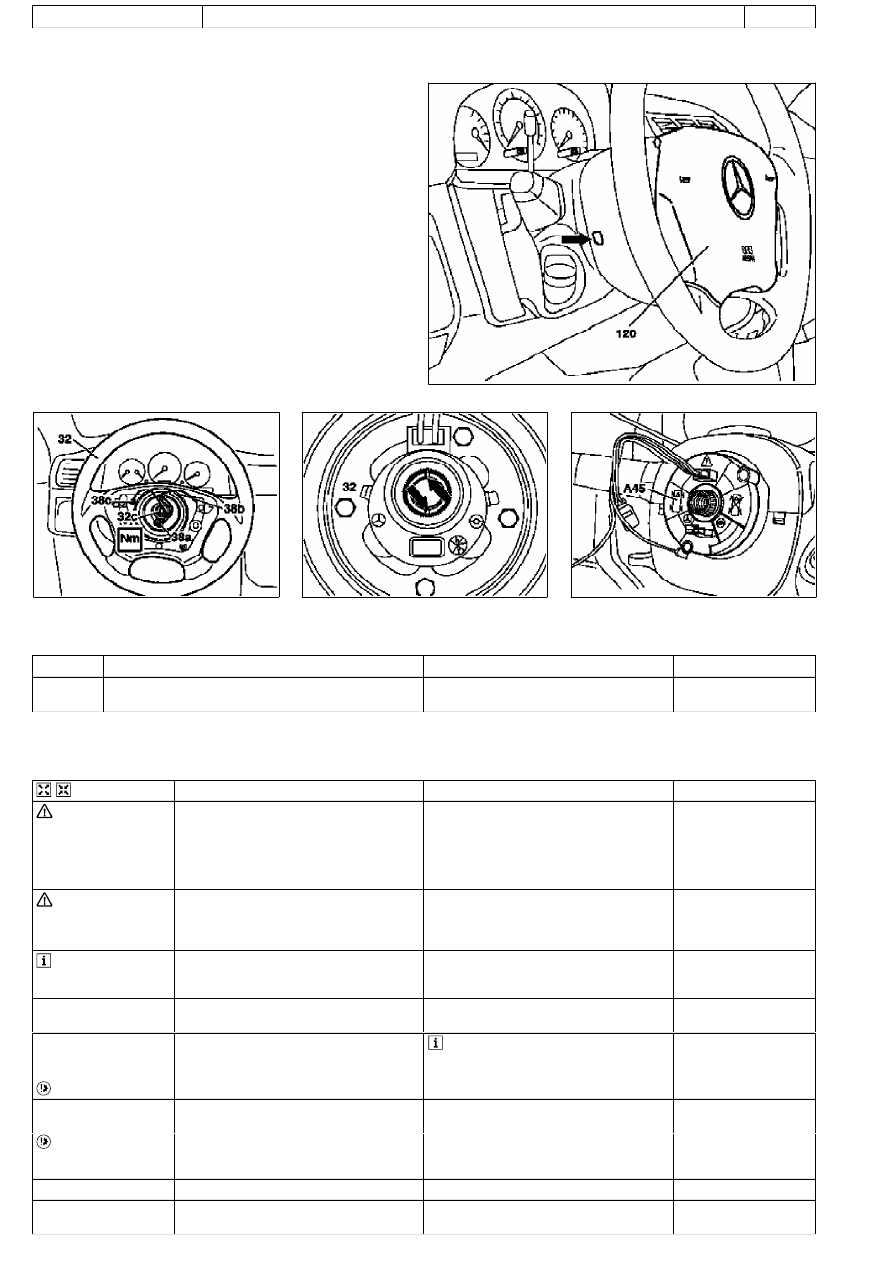
Removing and installing steering wheel

1.3.97

MODEL 

163.113 /128 /136 /154 /157 /172 /174 /175

P46.10-0449-11

P46.10-0450-01

P46.10-0458-01

P46.10-0459-01

Modification notes

10.9.03

Connecting quiescent current retention unit deleted

Step 1

10.9.03

Reference to adjusting toe on front axle replaced by 
reference to chassis alignment check

Step 10


Removing, installing


Danger!

Risk of explosion caused by explosive gas. 
Risk of poisoning and caustic burns 
caused by swallowing battery electrolyte. 
Risk of injury caused by burns to skin and 
eyes from battery acid or when handling 
damaged lead-acid batteries

No fire, sparks, open flames or smoking. 
Wear acid-resistant gloves, clothing and eye 
protection. Pour battery electrolyte only into 
suitable and appropriately marked containers.

AS54.10-Z-0001-01A


Danger!

Risk of injury when carrying out test or repair 
work on airbag or emergency tensioning 
retractor units

Store airbag units with deployment side facing 
up; do not expose to temperatures greater 
than 100 °C. When working on these units, 
disconnect the power supply.

AS91.00-Z-0001-01A


Legal provisions concerning handling and 
storage of airbag and emergency tensioning 
retractor units

AH91.00-P-0004-01A

o


Notes on disposing of airbag and emergency 
tensioning retractor units

OS91.00-P-0001-01A

1

Disconnect ground cable from battery


Protect the ground cable to prevent 

unintentional contact with the battery ground 
terminal.

AR54.10-P-0003A

Notes on battery

AH54.10-P-0001-01A

2

Remove airbag unit (120) from steering wheel 
(32)

AR91.60-P-0660GH


Instructions for performing repair, body work 
and welding on vehicles with airbags and 
ETR units

AH91.00-P-0002-01B

3

Unplug connectors (38b, 38c) for horn

4

Turn steering wheel (32) to horizontal position 
(front wheels in straight-ahead position)

Copyright DaimlerChrysler AG  09.05.2006 CD-Ausgabe G/10/04 . This WIS print-out will not be recorded by Modification services.

Page 1

5

Remove key and engage steering lock

6

Unscrew bolt (32c)

 Hold the steering wheel (32).


Installation: Replace bolt (32c).


*BA46.10-P-1001-02A

7

Pull off steering wheel (32)

 Pass cables carefully through the openings.


Installation: Align recesses of the splines 

in the steering wheel with the markings on the 
steering shaft (arrows).

8

Check fanfare horns and airbag clock spring 
contact (A45) for damage

 The clock spring contact must not be 

turned while the steering wheel is removed 
otherwise it will be damaged.

 Visual inspection, replace clock spring 

contact if necessary: 

#

Removing and installing clock spring contact

AR46.10-P-0200GH

9

Install in the reverse order

10

Carry out road test


Tests during the road test: 

Turn signal canceling:

 When the steering wheel is offset by 

more than 1 tooth, satisfactory resetting of the 
turn signal is no longer guaranteed.

Airbag indicator lamp:

 The SRS indicator lamp must not light up 

on full steering lock in both directions.

Steering wheel position:

 If the steering wheel is crooked, adjust it 

by max. 1 tooth. If the difference is greater: 

#

Check toe on front axle and adjust if 
necessary, see: 

#

Performing chassis alignment check

AR40.20-P-0200A

 Steering wheel

Number

Designation

Model 163

BA46.10-P-1001-02A

Bolt, steering wheel to steering shaft

Nm

80

Copyright DaimlerChrysler AG  09.05.2006 CD-Ausgabe G/10/04 . This WIS print-out will not be recorded by Modification services.

Page 2

GF54.30-P-3009A

Stepper motor, location/design/function

7.7.99

MODEL 

129, 140 as of 1.6.96, 

163, 168, 170, 
202 as of 1.8.96, 
208, 
210 as of 1.6.96, 
215, 220

P54.30-0521-06

General
Stepper motors are motors which, like most 
electric motors, consist of a fixed stator and a 
moveable rotor. The rotary motion is not 
continuous, rather the rotor turns in steps, a 
certain angle at a time, for example 90°.

Design
The illustration shows the basic design of a 
stepper motor with 1 pole pair and 2 phases. 
The stator is made of magnetically soft iron 
and holds the windings. Opposite windings 
belong together and form a phase (in this 
case, a and b). The rotor consists of a 
permanent magnet. In the illustration the rotor 
has 1 pole pair.

Function
The rotor is turned by applying current 
through phase aor b (see illustration). The 
magnetism in the stator changes according to 
the polarization (I) of the phases. 

The rotor will turn so that its south pole (S) is at the north pole (N) of 
the stator and its north pole (N) is at the south pole (S) of the stator.
The illustration shows a full rotation of the rotor. The rotor moves in 
steps of 90° from positions 1 through 4 and back to its starting 
position.
Unlike normal electric motors, the motor can stop in each of these 
positions with a certain holding torque. This type of motor is therefore 
particularly suitable for use as a servomotor for exact positioning.

The size of the steps can be reduced considerably by increasing the 
number of pole pairs and phases.
Theoretically, it is even possible to make the steps infinitely small 
with just a few poles and phases by using complicated electronic 
phase control (sine-cosine control).

Stepper motors (with sine-cosine control) are used, for example, for 
pointing instruments in the instrument cluster (A1).

Copyright DaimlerChrysler AG  04.06.2006 CD-Ausgabe G/10/04 . This WIS print-out will not be recorded by Modification services.

Page 1

BT27.35-P-0004-01A

Strainer for modulating pressure and shift 
pressure control solenoid valve, new

Transmission 722.6

k

TRANSMISSION 

722.6## ## as of 0538312

P27.35-0248-06

70

Strainer

Strainer to protect against dirt and metal 
shavings for the modulating pressure and 
shift pressure control solenoid valves in the 
valve housing. 
As a result also new control solenoid valves 
with a new part number.

Copyright DaimlerChrysler AG  28.05.2006 CD-Ausgabe G/10/04 . This WIS print-out will not be recorded by Modification services.

Page 1


Content   ..  815  816  817  818   ..