Mercedes-Benz ML320. Service manual - part 668
 

  Index      Mercedes     Mercedes-Benz ML320 - service and repair manual 1997-2005 year


Search            copyright infringement  


Content   ..  666  667  668  669   ..


Mercedes-Benz ML320. Service manual - part 668


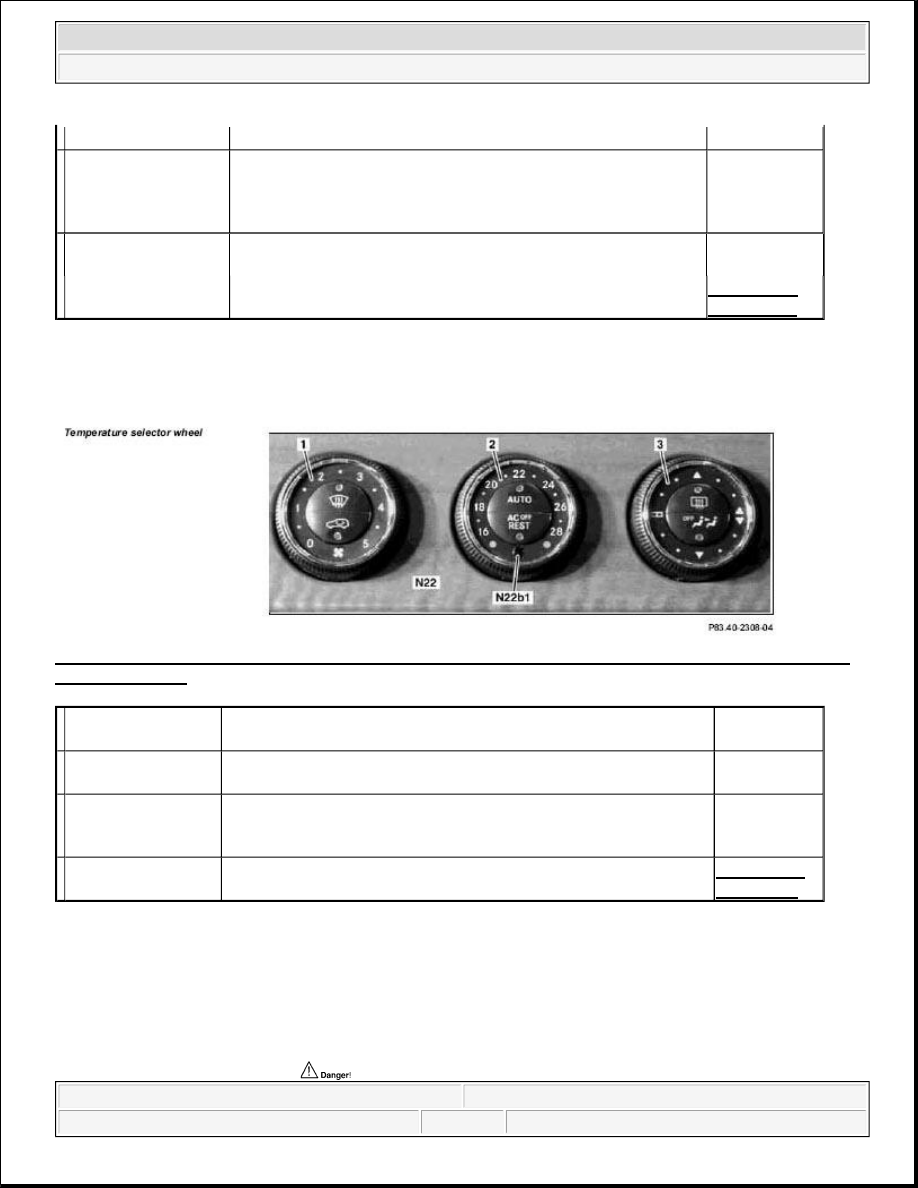
TEMPERATURE SELECTOR WHEEL, LOCATION/TASK/DESIGN/FUNCTION - GF83.25-P-2102GI 

MODEL 163 as of 1.9.01 with code (580a) Automatic air conditioning  

Fig. 49: Identifying Temperature Selector Wheel - Model 163 As Of 1.9.01 With Code (580a) Automatic 
Air Conditioning
 

AIR CONDITIONING (TAC) FUNCTION - GF83.30-P-0001GH 

MODEL 163 up to 31.8.01 with CODE (580) Air conditioning or Tempmatic for USA  

Function  

The air conditioning's electronically controlled cooling, heating and ventilation system keeps the desired in-car 
temperature constant. AC button (

 ) pressed (illuminates).

wheel, task

temperature desired in the vehicle interior.


Temperature selector 
wheel design

Heater:  
Rotary switch with disk cam, pivot, control-sleeve levers, as well 
as micro stops and end stops Air conditioning Rotary switch with 
potentiometer


Temperature selector 
wheel, function

Model 168

GF83.25-P-
2102-01GC


Model 163

GF83.25-P-
2102-01GH


Temperature selector 
wheel, location

The temperature selector wheel (2) is located in the center in the 
AAC push-button control module (N22).


Temperature selector 
wheel, task

The temperature selector wheel (2) serves to preselect the 
temperature desired in the vehicle interior.


Temperature selector 
wheel design

The temperature selector wheel (2) is equipped with a rotary ring, 
with which the temperature values can be set. The LEDs in the 
rotary ring display the set temperature level.


Temperature selector 
wheel, function


GF83.25-P-
2102-01GI


2001 Mercedes-Benz ML320 

1998-2005 HVAC Climate Control - 163 Chassis


me 


After starting, the refrigerant compressor starts up. If cooling is not necessary, the refrigerant compressor's 
output is lowered and switched off via the icing inhibitor. 

The air conditioning is always ready for operation after the engine has been started, and operates according to 
the so-called "reheat" principle. This means: The refrigerant compressor always operates at an ambient 
temperature in excess of 1°C, therefore also cools cold incoming air. Following the cooling process, the dried 
air is heated at the heat exchanger. 

On the one hand, this effect serves the purpose of comfort, because cooling also simultaneously causes air 
dehumidification which, in turn, is an important prerequisite for a pleasant interior climate. On the other hand, 
the air is dried as a result of this cooling and heating, thereby preventing window fogging. 

Pressing the AC button again (

 ) (does not illuminate) switches off the cooling. 

Heating mode  

The in-car temperature sensor measures the air temperature in the interior of the vehicle. 

The air conditioning control module electronics compares the in-car temperature with the desired temperature 
which has been set at the temperature selector wheels. 

The microprocessor adjusts the air conditioning electronics or keeps the relevant setting constant as required. 

Heater operation with heater booster in vehicles with engine 612.963 as of 12/99  

In vehicles equipped with direct-injection diesel engines, an electrical heater booster is additionally installed in 
the evaporator housing downstream of the heat exchanger, in order to compensate any heater output deficit 
which exists under certain operating conditions. 

The 3 heating elements in the heater booster are supplied with current, whereupon they are heated and they start 
to glow. As a result of the structural conditions, it is ensured that the drawn in fresh air flows directly past the 
electric heater booster, and is therefore heated. 

Cooling mode  

The icing inhibitor measures the temperature at the evaporator air outlet, while the interior temperature sensor 
determines the relevant in-car temperature. 

The air conditioning control module electronics compares the various measured values with the desired 
temperature which has been set at the temperature selector wheels. 

The microprocessor adjusts the air conditioning or keeps the relevant setting constant as required. 

  In-car temperature sensor replaced by new type

as of 1.12.99

BT83.57-P-0001-04GH


Ventilation, function


GF83.10-P-2000GH


Heater circuit function


GF83.20-P-2003GH


2001 Mercedes-Benz ML320 

1998-2005 HVAC Climate Control - 163 Chassis


me 


AIR CONDITIONING, LOCATION OF COMPONENTS - GF83.30-P-0003-01GH 

Location of components in passenger compartment  

Fig. 50: Identifying Air Conditioning Components In Passenger Compartment (1 Of 2) 

Location of components in passenger compartment


Air conditioning control module function


GF83.30-P-2001GH


Refrigerant circuit function


GF83.40-P-2001GH


Temperature control, function


GF83.57-P-2000GH


Heater booster (ZUH), function

 Engine 612.963 GF83.70-P-0005GH


2001 Mercedes-Benz ML320 

1998-2005 HVAC Climate Control - 163 Chassis


me 


Fig. 51: Identifying Air Conditioning Components In Passenger Compartment (2 Of 2) 

Location of components in passenger compartment as of 12/99  

Fig. 52: Identifying Air Conditioning Components - Location Of Components In Passenger 


2001 Mercedes-Benz ML320 

1998-2005 HVAC Climate Control - 163 Chassis


me 


Content   ..  666  667  668  669   ..