JAC S2 (Chassis). Instruction - part 11
 

  Index      JAC     JAC S2 (Chassis). Instruction


Search            copyright infringement  


Content      ..     9      10      11      12     ..


JAC S2 (Chassis). Instruction - part 11


Parking Brake System


Parking brake system 


          150 

(I) In-car check 

△Notice  Check and adjust parking brake system only 
when the brake works normally 
△Notice  While checking parking brake system, the car 
must be parked on even ground, with wheels being fixed 
by wedges 

Check spare parts 

1. Check whether all spare parts are fixed normally  
2. Check whether the brake handle is crooked, broken or has cracks, and change the handle if necessary  
3.Check whether the fibre-drawings are worn or broken, and change them if necessary 
4. Check whether the indicator lamp switch works normally, and repair&change the lamp if it doesn’t 
work 
5. Dismantle the switch connector of parking brake, and check the continuity between positive terminal 
and car body. The circuit should be on when the handle is pulled up, and off when the handle is pulled 
down 

Check the working distance of parking brake 

1. Pull up the parking brake, and confirm that when the handle is pulled up, the number of teeth that the 
handle passed stays in standard 

Standard teeth number: 7~9 
△Notice  there will be a tick every time when the handle 
passes a tooth, by counting the tick, you can judge 
whether the brake handle works in standard when pulled 
up  

Adjust the working distance of parking brake 

1. Open the engine hood  
2. Dismantle the vice dashboard, please refer to “vice dashboard” 
3. Adjust the working distance of parking brake handle 

1). Adjust the adjusting nut on the parking brake system, 
and ensure the distance (L) between the adjusting nut and 
the final part of fibre-drawing stays in standard 

Standard: L=20~25mm 

Standard teeth number: 7~9  
△Notice  Decrease L if the number of passed teeth is less 
than 7, and increase L if the number of passed teeth is 
more than 9  

4. Pull down the parking brake 
5. Check whether the rear wheels are delayed when parking 

IV Parking brake switch 

(I) Disassembly 

1. Open the engine hood  
2. Disconnect the negative cable of battery  
3. Dismantle the vice dashboard, please refer to “vice 
dashboard”  

-------------------------------------------------------------------------------------------------------------------------------------------------------------


Parking Brake System


Parking brake system 


          151 

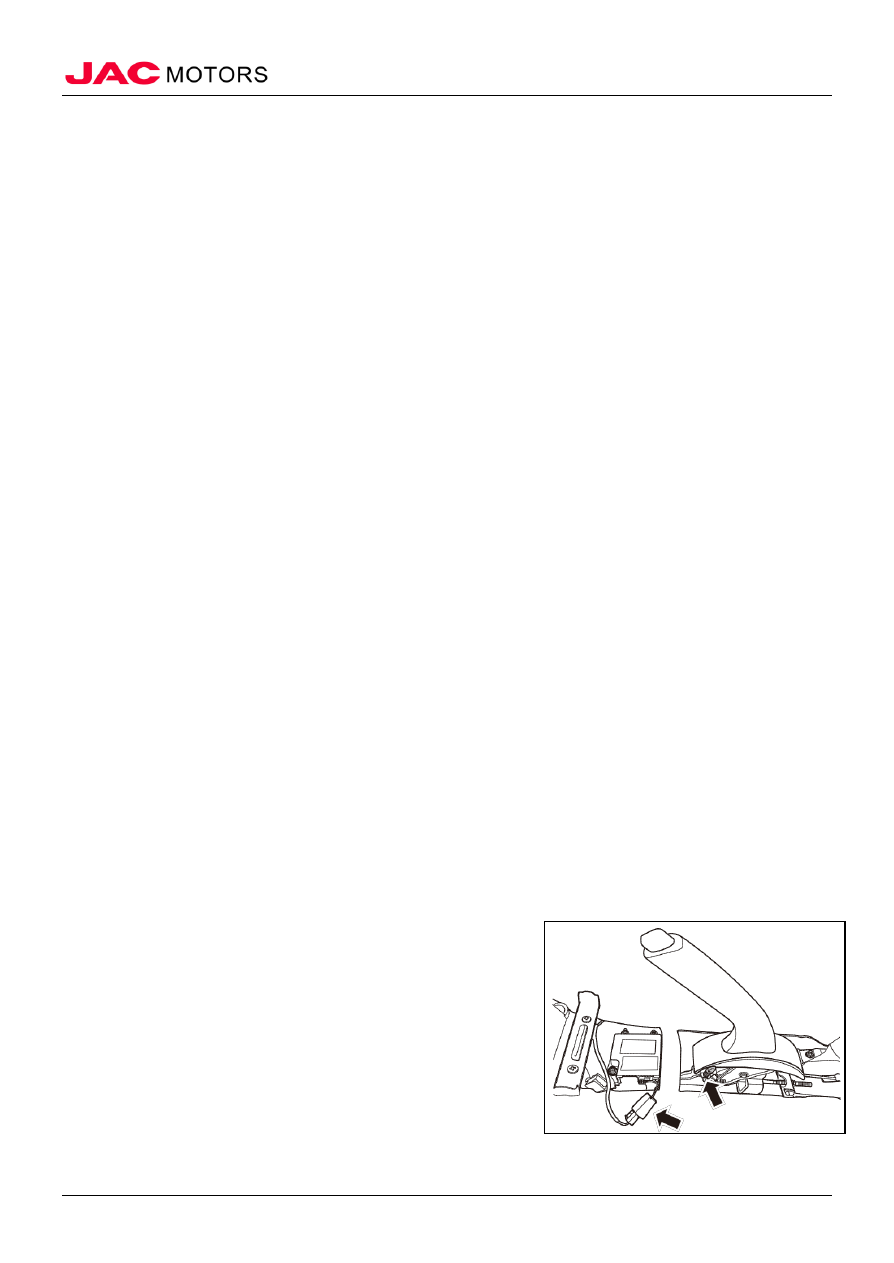
4. Remove the parking brake switch  

1). Pull down the parking brake handle 

2). Disconnector the harness connector of parking brake 
lamp 

3). Loosen the fixed bolt of parking brake switch and take 
off the switch 

(II) Installation 

1. Install the parking brake switch  

1). Install the fixed bolt of parking brake switch 

Tightening torque 6~8N.m 

2). Connect the harness connector of parking brake 
switch 

2. Install the vice dashboard  
3. Connect the negative cable of battery  
4. Close the engine hood 
 

V Parking brake system assembly  

(I) Disassembly 

1. Open the engine hood  
2. Disconnect the negative cable of battery  
3. Dismantle the vice dashboard, please refer to “vice dashboard”  
4. Disassemble the parking brake switch, please refer to “parking brake switch”  
5. Disassemble the parking brake system assembly 

1). Loosen the nut on the adjusting sprial 


2). Loosen the two fixed bolts that connect parking brake 
system assembly and car body 

3). Disconnect fibre-drawing from balance bar 

4). Take off the parking brake system 


-------------------------------------------------------------------------------------------------------------------------------------------------------------


Parking Brake System


Parking brake system 


          152 

(II) Installation 


1. Install the parking brake system assembly 

1). Tighten the two fixing bolts that connect parking brake 
system assembly and car body 

Tightening torque 20~25N.m 


2). Adjust the nut into a proper position on the final part 
of threaded rod, and install the fibre-drawing on the 
balance bar  

2. Check and adjust the parking brake system assembly, 
please refer to “Check and adjustment on the assembly of 
parking brake system”  
3. Install the parking brake switch  
4. Install the vice dashboard  
5. Connect the negative cable of battery  
6. Close the engine hood 


VI Parking brake fibre-drawing assembly 

(I) Disassembly 


1. Open the engine hood  
2. Disconnect the negative cable of battery  
3. Dismantle the vice dashboard, please refer to “Vice dashboard”  
4. Disassemble the parking brake system assembly, please refer to “Parking brake system assembly”  
5. Remove the rear wheels, please refer to “Wheel” 
6. Disassemble the rear brake caliper, please refer to 
“Front brake caliper assembly” 
7. Remove thermal baffle I and II, please refer to 
“Thermal baffle” 
8. Disassemble the parking brake fibre-drawing assembly 

1). Adjust the nut on the final part of thredded rod 

2). Disconnect the left-rear and right-rear parking brake 
fibre-drawing from balance plate 


-------------------------------------------------------------------------------------------------------------------------------------------------------------


Parking Brake System


Parking brake system 


          153 

3). Remove the bolts and nuts on the fixing support 


4). Take out the fibre-drawing from the mounting sleeves 
that locate in the bottom of the car 


5). Disconnect the parking brake fibre-drawing and 
parking brake disc 

6). Take off the parking brake fibre-drawing assembly 


(II) Installation 

1. Install the parking brake fibre-drawing 

1). Connect the parking brake fibre-drawing and parking 
brake disc 


-------------------------------------------------------------------------------------------------------------------------------------------------------------


Parking Brake System


Parking brake system 


          154 


2). Tighten the bolts and nuts on the fixing support of 
parking brake fibre-drawing 

Tightening torque 7~11N.m 
△Notice   the route of fibre-drawings should be smooth 


3). Install the fibre-drawings into the mounting sleeves 
that locate on the bottom of the car. 


4). Install the left-rear and right-rear parking brake 
fibre-drawings on the balance plate 


2. Check and adjust the parking brake system assembly, please refer to “Check and adjustment on the 
assembly of parking brake system”  
3. Install the vice dashboard  
4. Install the rear brake caliper assembly  
5. Install the rear wheels  
6. Install the thermal baffle I and II 
7. Connect the negative cable of battery 
8. Close the engine hood

-------------------------------------------------------------------------------------------------------------------------------------------------------------


Brake Control System


Brake Control System 


         155 

Brake Control System 


I General introduction 

(I) Brief introduction on structure 

Structural diagram of brake system (front & rear braking disc model) 

1. Front wheel’s ABS speed sensor assembly                      3. ESP controller assembly 
2. Rear wheel’s ABS speed sensor assembly                      4. ESP controller’s fixing support 


(II) System function 


1. ABS 

ABS (anti-skid brake system) can control the hydraulic brake force on wheels during emergency braking 
or braking when the road situation is dangerous, and prevent wheels from skidding. ABS has the 
following advantages:  

(1) Steering will be reliable when facing obstacles during 
emergency braking 

(2) The vehicle can stop steadily on curve roads during 
emergency braking  

2. ESP  

ESP (electronic stability program) is an active safety system. It is a dependent system based on other 

-------------------------------------------------------------------------------------------------------------------------------------------------------------


Brake Control System


Brake Control System 


         156 

driving control system. ESP includes all functions of ABS, and increases TCS (traction control system). 
Meanwhile, additional functions can be applied on it by adding sensors and input signals. 

Basic functions: 

ABS (anti-skid brake system)  

EBD (electric brake force distribution)  

AYC (active yawing control)  

TCS (traction control system) 

Braking assistance: 

HBA (hydraulic braking assistance) 

Static control system: 

HAS (hill-start assist system) 

ESP can judge the working conditions of vehicles by analyzing signals provided by steering sensor, wheel 
sensor, yawing sensor, transverse acceleration sensor and etc. After analysis, it sends rectifying signals to 
ABS and ASR, so as to help the vehicle to maintain mobile balance and achieve utmost stability under 
various situations. Its performance will be more apparent when the steering process is excessive or 
insufficient. 

3. EBD 

Each wheel’s adhesion coefficient provided by ground will be different as the situation of road to which 
the wheel sticks will be different. What’s more, the vehicle’s barycenter will change during emergency 
brake, which may lead to vehicle’s skid, bias or roll-over. During the moment of emergency brake, EBD 
can instantly figure out the friction’s numerical difference due to wheels’ different adhesion coefficients. 
Then it adjusts the electromagnetic valves in hydraulic units, so they can adjust themselves instantly 
during dynamic situation. It can achieve the match of break force and friction, and ensure the vehicle’s 
stability and safety. During emergency brake, EBD will balance each wheel’s valid traction before ABS, 
and prevents the vehicle from whipping or side-swing. Generally speaking, EBD is an additional function 
of ABS. it can distribute brake force automatically according to the changes of road situation and carrying 
capacity, and improve ABS’s performance. 

EBD can control each wheel’s break force precisely and ensure the vehicle’s stability. On normal 
breaking situation, it can effectively equal each wheel’s speed. By controlling the input & output oil 
valves of hydraulic adjustment module in ABS, EBD can control each wheel’s breaking pressure in order 
to provide effective breaking and stability for vehicles. 

4. TCS 

TCS can monitor the slippage rate of driving wheels. If the rate is too big, TCS will send signals to engine, 
decreasing the amount of fuel injected by nozzle, or the opening of throttle valve, thus decreasing the 
torque output, and optimizing the drive wheel’s slippage rate, which promises drive wheels with bigger 
adhesion force. If the difference between the drive wheels’ adhesion coefficients is too large, TCS will 
actively impose break force to the drive wheel which has low coefficient, prevent the wheel from skidding, 
and ensure the drive wheel which has larger coefficient to gain bigger drive force. 

5. Failure protection  

If electric failure happens in ABS or ESP, the warning light of ABS or ESP will automatically turn on. If 
electric failure happens in EBD, the brake warning light and ABS warning light will turn on. Meanwhile, 
ABS will change into one of the following failure protection: 

1) For ABS’s failure, only EBD will be activated, and the 

-------------------------------------------------------------------------------------------------------------------------------------------------------------


Brake Control System


Brake Control System 


         157 

vehicle’s condition will be the same as the one without 
ABS. 

2) For EBD’s failure, neither EBD nor ABS will be 
available, and the vehicle’s condition will be the same as 
the one without ABS or EBD. 


(III) Working principle 

Diagram of ABS’s hydraulic working principle


-------------------------------------------------------------------------------------------------------------------------------------------------------------


Brake Control System


Brake Control System 


         158 

Diagram of ABS  


-------------------------------------------------------------------------------------------------------------------------------------------------------------


Brake Control System


Brake Control System 


         159 

Diagram of ESP’s hydraulic working principle


Anti-skid brake mode 

During vehicle’s brake, should the wheels skid, ABS will be activated into anti-skid brake mode. During 
this period, all wheels’ hydraulic pressure will be under control in case of slippage. Each wheel has its 
own hydraulic pipeline and valve. ABS can change, or maintain each wheel’s hydraulic pressure during 
vehicle’s brake. However, ABS cannot increase the hydraulic pressure to the amount which the master 
cylinder transfers during brake. Thus, during anti-skid brake, the brake pedal will vibrate quickly. The 
vibration is triggered by the quick changes of each valve’s position. This kind of vibration will appear 
during anti-skid brake mode, and stop during normal brake or when the vehicle completely stops. As the 
electromagnetic valve circulates quickly, there will be some noise. If the anti-skid mode is activated when 
the vehicle is on dry roads, harsh noise will appear intermittently when the wheels are close to slippage. 
All these noise and vibration are normal circumstances during anti-skid brake. When you stamp the pedal 
during narmal brake, the operation should be the same when you drive the one without ABS. keeping the 
power balance during stamping pedal can promise shortest braking distance while maintaining the 
vehicle’s stability. 


-------------------------------------------------------------------------------------------------------------------------------------------------------------


Brake Control System


Brake Control System 


         160 

During anti-skid brake period, the brake system’s pressure adjustment can be divided into three phases. 
1. Pressure maintenance 

When the slippage was detected by ABS control module, it will close oil inlet valve, and close the oil 
outlet valve in hydraulic assembly to isolate the system. This will maintain the pressure stability of 
arrester and keep the hydraulic pressure still. 

2. Pressure reduction 

Should slippage still was detected by ABS control mode under pressure maintenance mode, ABS will 
reduce the pressure of the wheel which was affected. It will close oil inlet valve, and open oil outlet valve. 
Redundant fluid or pressure will be stored temporally in the power accumulator of hydraulic assembly 
until when the pump motor sends the brake fluid back to the reservoir of master cylinder  

3. Pressure increase 

If ABS control module detects that the wheel slippage has reduced under pressure maintenance or 
reduction mode, the module will use the pressure of cylinder to increase the affected wheel’s pressure. 
The oil inlet valve will open, and the oil outlet valve will be closed. Part or all pressure from brake 
system’s master cylinder will be added to wheels. 


The working process of ABS 

When the vehicle is moving, rach wheel speed sensor will produce an voltage signal which is proportional 
to the wheel’s rotational speed. ABS controller will receive the speed data and determine whether one or 
more wheels’ speed reduction is too fast, and activate control module if needs. The module will control 
and optimize each wheel’s brake pressure. 

II ABS&ESP control module 

(I) Components  

The front-disc-rear-drum model applies BOSCH ABS 9, with ABS control module and hydraulic 
assembly being integrated together; the front-disc-rear-disc model applies BOSCH ESP 9, with ESP 
control module and hydraulic assembly being integrated together.  

(II) Illustration of the stitch on ABS, ESP control module 


Illustration of stitch in ABS control module 

Stitch 
No. 

Illustration 

Stitch 
No. 

Illustration 

Motor’s battery terminal (positive) 

Speed sensor output (right-front wheel) 

Active EBD warning light 

Speed sensor’s signal terminal (right-
front) 

N.C. 

K line 

N.C. 

Speed sensor’s signal terminal (left-
front) 

N.C. 

10 

N.C. 

11 

N.C. 

12 

N.C. 

13 

Motor’searth terminal 

14 

CAN-low 

15 

N.C. 

16 

Speed sensor’s power terminal (right-
front) 

17 

Speed sensor’s power terminal (right-
rear) 

18 

Speed sensor’s signal terminal (left-
rear) 

19 

Speed sensor’s power terminal (left-
front) 

20 

N.C. 

21 

N.C. 

22 

N.C. 

-------------------------------------------------------------------------------------------------------------------------------------------------------------


Brake Control System


Brake Control System 


         161 

23 

N.C. 

24 

N.C. 

25 

Valve relay’s power terminal 

26 

CAN-high 

27 

Active ABS warning light 

28 

ECU’s power terminal (ignition cable) 

29 

Speed sensor’s signal terminal (right-
rear) 

30 

Brake light switch input 

31 

Speed sensor’s signal terminal (left-
rear) 

32 

N.C. 

33 

Speed signal output 

34 

N.C. 

35 

N.C. 

36 

N.C. 

37 

N.C. 

38 

ECU’s earth wire 


Diagram of the stitch’s position in ABS control module 


Illustration of stitch in ESP control module 


Stitch 
No. 

Illustration 

Stitch 
No. 

Illustration 

Motor’s battery terminal (positive) 

Speed sensor output (right-front wheel) 

N.C. 

Speed sensor’s signal terminal (right-
front) 

N.C. 

N.C. 

N.C. 

Speed sensor’s signal terminal (left-
front) 

N.C. 

10 

N.C. 

11 

N.C. 

12 

ESP switch 

13 

Motor’s earth terminal 

14 

CAN- low 

15 

N.C. 

16 

Speed sensor’s power terminal (right-
front) 

17 

Speed sensor’s power terminal (right-
rear) 

18 

Speed sensor’s signal terminal (left-
rear) 

-------------------------------------------------------------------------------------------------------------------------------------------------------------


Brake Control System


Brake Control System 


         162 

19 

Speed sensor’s power terminal (left-
front) 

20 

N.C. 

21 

N.C. 

22 

N.C. 

23 

N.C. 

24 

N.C. 

25 

Valve relay’s power terminal 

26 

CAN- high 

27 

N.C. 

28 

ECU’s power terminal (ignition cable) 

29 

Speed sensor’s signal terminal (right-
rear) 

30 

Brake light switch input 

31 

Speed sensor’s power terminal (left-
rear) 

32 

N.C. 

33 

N.C. 

34 

N.C. 

35 

N.C. 

36 

N.C. 

37 

N.C. 

38 

ECU’s earth wire 


Diagram of the stitch’s position in ESP control module 


(III) Check on ABS&ESP control module 

△Notice  please go on basic check on brake system first 

Basic check on brake system 

1. Check the liquid level of brake fluid, and add brake fluid if necessary 
2. Check whether any leakage exists in brake pipeline or ABS hydraulic assembly. Should the leakage 
exists, please make the following checks: 

a: If the connector part of ABS hydraulic assembly is 
loosen, please tighten the tubing nut to the designated 
torque (16~18N.m), check the leakage situation again, and 
make sure no brake fluid leaks. 

-------------------------------------------------------------------------------------------------------------------------------------------------------------


Brake Control System


Brake Control System 


         163 

b: If the connector part’s tubing nut or the actuator’s 
whorl part is broken, please replace the broken parts and 
check the leage again. Make sure no break fluid leaks. 

c: If no leakage exists except in actuator’s connector part, 
use clean rags to wipe the stain and check again. Should 
the leakage still exists, please replace the broken part. 

d: If the leakage exists on hydraulic assembly, use clean 
rags to wipe the stain and check again. Should the leakage 
still exists, please replace the hydraulic assembly. 
△Notice  do not disassemblr ABS or ESP hydraulic 
assembly unless with special needs. 

3. Check whether the filler block or the shoe plate is broken. 
4. Check whether the circuit terminal or the battery is loosen. 

△Notice  check whether the battery’s positive/negative 
terminal is loosen, and confirm whether the battery’s 
voltage is normal 

Check the warning light of ABS and brake system 

1). Check whether when the ignition switch turns to “ON”, 
the ABS warning light will light for 3 seconds, and the 
brake warning light keep lighting. If they don’t light, 
please refer to “common failures and analysis process of 
ABS”  

2). Check whether after 3 seconds when the ignition 
switch turns to “ON”, the ABS warning light will go out, 
and the brake warning light will go out after the engine 
starts. If not, please refer to “common failures and 
analysis process of ABS” 

3). If the ABS warning light doesn’t go out in 10 seconds 
after the engine starts, please refer to “common failures 
and analysis process of ABS” 
△Notice  the brake warning light will turn on during 
parking brake process (when the switch is at “ON” 
position) and when the brake fluid’s liquid sensor is 
working  

Use fault diagnosis instrument to check ABS control module 

Use fault diagnosis instrument to check the data and failure code of control module, and repair the vehicle 
according to the failure codes. Please refer to “failure diagnosis” 


(IV) Torque parameter 

No.  Project 

Torque (N·m) 

Remark 

Fixing bolt of speed sensor 

8~10 


Collar nut of brake pipe 

16~18 


-------------------------------------------------------------------------------------------------------------------------------------------------------------


Brake Control System


Brake Control System 


         164 

The bolt that connects ABS 
controller and car body 

20~25 


(V) Maintenance precautions 

During the maintenance of ABS and ESP, please pay attention to the following precautions, or they may 
suffer unnecessary damages due to improper maintenance 

1. Before undertake the electric welding, disconnect the connector assembly from ABS control module 
2. The spare parts in ABS is very sensitive to EMI, please confirm that no interference exists in all 
parts’ traces, position, installation, connectors and supports.  
3. Do not use quick charger to start the engine or charge the battery which is connected to the engine, 
because this will make battery invalid or cause damage to the spare parts in ABS. 
4. Make sure the ignition switch be closed first, then disconnect the negative terminal of battery, and 
disconnect the connector of ABS control module  
5. Do not try to repair any spare parts in ABS, since all parts of ABS can only be replaced 
6. Do not hang the suspension’s parts on the harness of speed sensor, in case of damage on sensor’s 
harness. 

7. The ABS control module cannot be placed under situation whose temperature is higher than 105 ℃. 

8. Chlorine, sulphur and relevant inorganic substances cannot exist in brake circuit, nor the mineral oil 
or ester/lubricant plasticizer, including parts that may ooze these kinds of substances.  
9. During ABS operation, the brake pedal will vibrate mildly with mechanic noise. These are normal 
circumstances. 
10. When the ignition switch is turned to “ON” position and the car is started, the brake pedal may 
vibrate, and the motor in ABS hydraulic assembly may make some noises. These are normal 
circumstances during operation check.  
11. When the vehicle is running on bumpy, sand or deep fresh-snow road, the brake distance may be 
longer than vehicles without ABS. 


(VI) Special tools 

No. 

Tools 

Mechanical dimensions 

Illustration 

Fault diagnosis 
instrument 


ABS&ESP fault diagnosis 

III Failure diagnosis 

(I) Brief introduction of failure diagnosis 

1). Failure diagnosis can thoroughly understand every 
system of the vehicle 

2). Understand the customer’s complaint before the check, 
and inquire their dissatisfaction in detail after fighting out 
the failure. 

3). Make sure check the vehicle’s failure from the 

-------------------------------------------------------------------------------------------------------------------------------------------------------------


Brake Control System


Brake Control System 


         165 

beginning in order to comprehensively repair the fault. For 
intermittent failure, it is very important try to reappear the 
failure according to the talk with customer and past cases. 
Do not check under some special situations, as most 
intermittent failures are caused by poor contacts. Under 
this situation, swaying suspectable harness or connectors 
with hands is an effective way. 

4). After the diagnosis, be sure to “clear trouble codes” 

(II) Fault diagnosis chart 

Failure code chart for ABS 

Trouble code 

Failure illustration 

C190104 

Inadequate ECU’s voltage 

C100004 

Failure of ECU’s hardware  


Failure diagnosis chart for ABS 

No. Symptom 

Analysis on symptom 

Solutions 

Remark 

1  Cannot read the data stream 

of ABS control module 

Poor contact of diagnosis port 

Check and connect 

Please refer to 
“diagnostic flow 
chart of 
unabling to read 
ABS data 
stream” 

ABS control module unearthed 

Check and replace  

The battery hasn’t provided 
voltage to ABS control module 

Check and replace 

The ignition switch hasn’t 
provided voltage to ABS  control 
module 

Check and replace 

The data circuit is broken or in 
short-cut 

Check, connect or 
replace 

Excessive data circuit’s electric 
resistance 

Check and replace 

2  ABS warning light cannot be 

lighted 

ABS warning light fails/socket 
loosening 

Check, connect or 
replace 

Please refer to 
“diagnostic flow 
chart of 
unlighted ABS 
warning light, 
no trouble 
codes” 

Dashboard’s fuse broken 

Check and replace 

Drive module of dashboard’s 
warning light fails 

Check and replace 

ABS control module fails 

Check and replace 

The circuit between dashboard 
and ABS control module is broken 
or in short-cut 

Check, connect or 
replace 

3  ABS warning light keeps 

lighting 

Open circuit between dashboard 
and ABS control module 

Check and connect 

Please refer to 
“diagnostic flow 
chart of ABS 
warning light 
keeps lighting, 
no trouble 

Short circuit between dashboard 
and ABS control module 

Check and replace 

Drive module of dashboard’s 
warning light fails 

Check and replace 

-------------------------------------------------------------------------------------------------------------------------------------------------------------


Content      ..     9      10      11      12     ..