Infiniti QX50 (2019 year). Instruction - part 34
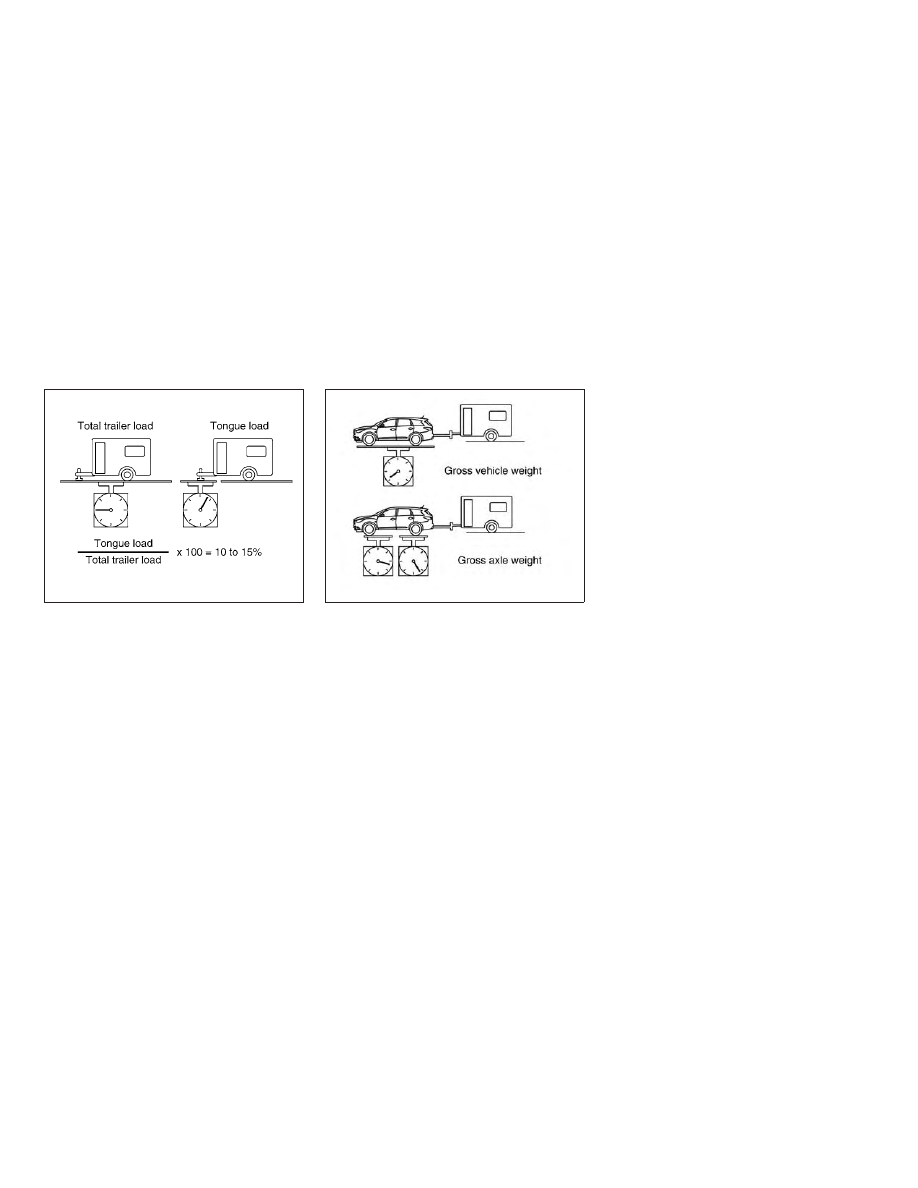
Tongue load
When using a weight carrying or a weight
distributing hitch, keep the tongue load be-
tween 10 - 15% of the total trailer load or use
the trailer tongue load specified by the trailer
manufacturer. The tongue load must be
within the maximum tongue load limits
shown
in
the
following
“Towing
Load/Specification” chart. If the tongue load
becomes excessive, rearrange cargo to allow
for proper tongue load.
Maximum Gross Vehicle Weight
(GVW)/maximum Gross Axle
Weight (GAW)
The GVW of the towing vehicle must not
exceed the Gross Vehicle Weight Rating
(GVWR) shown on the F.M.V.S.S./C.M.V.S.S.
certification label. The GVW equals the com-
bined weight of the unloaded vehicle, pas-
sengers, luggage, hitch, trailer tongue load
and any other optional equipment. In addi-
tion, front or rear GAW must not exceed the
Gross Axle Weight Rating (GAWR) shown on
the F.M.V.S.S./C.M.V.S.S. certification label.
Towing capacities are calculated assuming a
base vehicle with driver and any options re-
quired to achieve the rating. Additional pas-
sengers, cargo and/or optional equipment,
such as the trailer hitch, will add weight to the
vehicle and reduce your vehicle’s maximum
towing capacity and trailer tongue load.
The vehicle and trailer need to be weighed to
confirm the vehicle is within the GVWR,
Front GAWR, Rear GAWR, Gross Combined
Weight Rating (GCWR) and Towing capacity.
All vehicle and trailer weights can be mea-
sured using platform type scales commonly
found at truck stops, highway weigh stations,
building supply centers or salvage yards.
To determine the available payload capacity
for tongue/king pin load, use the following
procedure.
1. Locate
the
GVWR
on
the
F.M.V.S.S./C.M.V.S.S. certification label.
2. Weigh your vehicle on the scale with all
of the passengers and cargo that are
normally in the vehicle when towing a
trailer.
3. Subtract the actual vehicle weight from
the GVWR. The remaining amount is the
available maximum tongue/king pin
load.
WTI0160
LTI2031
10-20
Technical and consumer information