Infiniti Q50 (2018 year). Instruction - part 21
 

  Index      Infiniti     Infiniti Q50 (2018 year) - instruction in english


Search            copyright infringement  


Content      ..     19      20      21      22     ..


Infiniti Q50 (2018 year). Instruction - part 21


6-2

In case of emergency

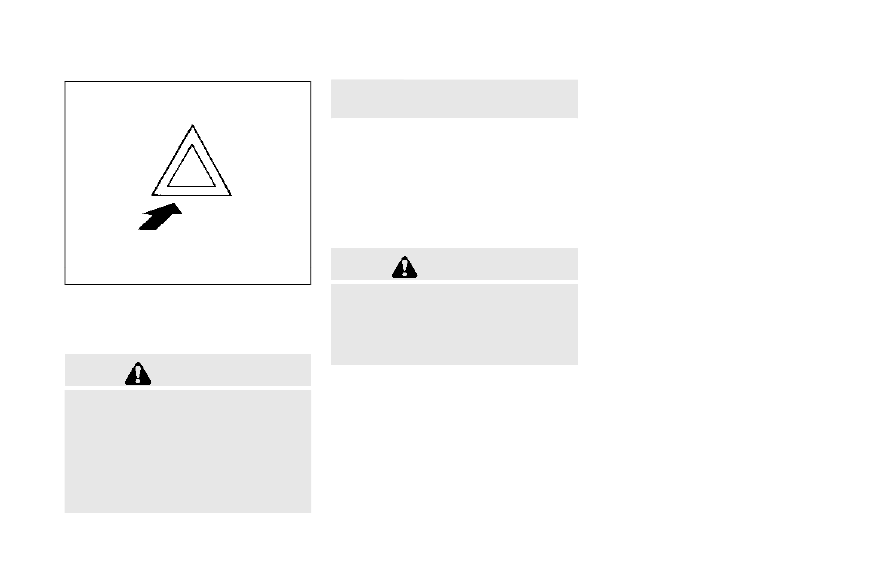
SIC2574

Push the switch on to warn other drivers
when you must stop or park under emer-
gency conditions. All turn signal lights will
flash.

WARNING

If stopping for an emergency, be sure

to move the vehicle well off the road.

Do not use the hazard warning

flashers while moving on the highway
unless unusual circumstances force
you to drive so slowly that your
vehicle might become a hazard to
other traffic.

Turn signals do not work when the

hazard warning flasher lights are on.

The flasher can be actuated with the ignition
switch in any position.
When an impact that could activate the
supplemental air bags is detected, the
hazard warning flasher lights blink automa-
tically. If the hazard warning flasher switch is
pushed, the hazard warning flashers will turn
off.

WARNING

Do not turn the hazard warning flasher
switch to off until you can make sure
that it is safe to do so. Also, the hazard
flasher warning may not blink automa-
tically depending on the force of impact.

Some state laws may prohibit the use of the
hazard warning flasher switch while driving.

In the event of a roadside emergency,
Roadside Assistance Service is available to
you. Please refer to your Warranty Informa-
tion Booklet (U.S.) or Warranty & Roadside
Assistance Information Booklet (Canada) for
details.

HAZARD WARNING FLASHER SWITCH

ROADSIDE ASSISTANCE PROGRAM

-------------------------------------------------------------------------------------------------------------------------------------------------------------

To shut off the engine in an emergency
situation while driving, perform the follow-
ing procedure:
. Rapidly push the push-button ignition

switch 3 consecutive times in less than
1.5 seconds, or

. Push and hold the push-button ignition

switch for more than 2 seconds.

If you have a flat tire, follow the instructions
in this section.

TIRE PRESSURE MONITORING
SYSTEM (TPMS)

This vehicle is equipped with the Tire
Pressure Monitoring System (TPMS). It
monitors tire pressure of all tires except the
spare. When the low tire pressure warning
light is lit and the “Tire Pressure Low - Add
Air” warning appears in the vehicle informa-
tion display, one or more of your tires is
significantly under-inflated. If the vehicle is
being driven with low tire pressure, the
TPMS will activate and warn you of it by
the low tire pressure warning light. This
system will activate only when the vehicle is
driven at speeds above 16 MPH (25 km/h).
For more details, see “Warning lights, in-
dicator lights and audible reminders” (P.2-
10) and “Tire Pressure Monitoring System
(TPMS)” (P.5-5).

WARNING

Radio waves could adversely affect

electric medical equipment. Those
who use a pacemaker should contact
the electric medical equipment man-
ufacturer for the possible influences
before use.

If the low tire pressure warning light

illuminates while driving, avoid sud-
den steering maneuvers or abrupt
braking, reduce vehicle speed, pull
off the road to a safe location and
stop the vehicle as soon as possible.
Driving with under-inflated tires may
permanently damage the tires and
increase the likelihood of tire failure.
Serious vehicle damage could occur
and may lead to an accident and
could result in serious personal injury.
Check the tire pressure for all four
tires. Adjust the tire pressure to the
recommended COLD tire pressure
shown on the Tire and Loading
Information label to turn the low tire
pressure warning light OFF. If the
light still illuminates while driving
after adjusting the tire pressure, a
tire may be flat. If you have a flat tire,
replace it with a spare tire (if so
equipped).

Since the spare tire is not equipped

with the TPMS, when a spare tire is
mounted or a wheel is replaced, the
TPMS will not function and the low
tire pressure warning light will flash
for approximately 1 minute. The light
will remain on after 1 minute. Have
your tires replaced and/or TPMS
system reset as soon as possible. It

In case of emergency

6-3

EMERGENCY ENGINE SHUT OFF

FLAT TIRE

-------------------------------------------------------------------------------------------------------------------------------------------------------------

6-4

In case of emergency

is recommended you visit an INFINITI
retailer for these services.

Replacing tires with those not origin-

ally specified by INFINITI could affect
the proper operation of the TPMS.

Do not inject any tire liquid or aerosol

tire sealant into the tires, as this may
cause a malfunction of the tire pres-
sure sensors.

RUN-FLAT TIRES (if so equipped)

Run-flat tires are those tires that can be
used temporarily if they are punctured. See
“Run-flat tires” (P.8-39).
Also, refer to “Important Tire Safety Infor-
mation” (US) or “Tire Safety Information”
(Canada) in the INFINITI Warranty Informa-
tion Booklet.

WARNING

Although you can continue driving

with a punctured run-flat tire, re-
member that vehicle handling stabi-
lity is reduced, which could lead to an
accident and personal injury. Also,
driving a long distance at high speeds
may damage the tires.

Do not drive at speeds above 50

MPH (80 km/h) and do not drive
more than approximately 93 miles
(150 km) with a punctured run-flat
tire. The actual distance the vehicle
can be driven on a flat tire depends on
outside temperature, vehicle load,
road conditions and other factors.

Drive safely at reduced speeds. Avoid

hard cornering or braking, which may
cause you to lose control of the
vehicle.

If you detect any unusual sounds or

vibrations while driving with a punc-
tured run-flat tire, pull off the road
to a safe location and stop the vehicle
as soon as possible. The tire may be
seriously damaged and need to be
replaced.

CAUTION

Never install tire chains on a punctu-

red run-flat tire, as this could damage
your vehicle.

Avoid driving over any projection or

pothole, as the clearance between
the vehicle and the ground is smaller
than normal.

Do not enter an automated car wash

with a punctured run-flat tire.

It is recommended you have the

punctured tire inspected by an
INFINITI retailer or other authorized
repair shop. Replace the tire as soon
as possible if the tire is seriously
damaged.

CHANGING A FLAT TIRE

If you have a flat tire, follow the instructions
in this section to replace the tire with a spare
tire (if so equipped). For the vehicles with
run-flat tires, you can continue driving to a
safe location even if they are punctured. (See
“Run-flat tires” (P.6-4) and “Run-flat tires”
(P.8-39).)
This section also contains the information
about the vehicle jack-up procedures.

Stopping the vehicle

1. Safely move the vehicle off the road and

away from traffic.

2. Turn on the hazard warning flashers.
3. Park on a level surface and apply the

parking brake. Move the shift lever to the
P (Park) position.

4. Turn off the engine.

-------------------------------------------------------------------------------------------------------------------------------------------------------------

5. Raise the hood to warn other traffic, and

to signal professional road assistance
personnel that you need assistance.

6. Have all passengers get out of the

vehicle and stand in a safe place, away
from traffic and clear of the vehicle.

WARNING

Make sure the parking brake is

securely applied and the automatic
transmission into P (Park).

Never change tires when the vehicle

is on a slope, ice or slippery areas.
This is hazardous.

Never change tires if oncoming traf-

fic is close to your vehicle. Wait for
professional road assistance.

MCE0001A

Blocking wheels

Place suitable blocks

at both the front and

back of the wheel diagonally opposite the
flat tire to prevent the vehicle from moving
when it is jacked up.

WARNING

Be sure to block the wheel as the vehicle
may move and result in personal injury.

JVE0105X

Jacking tools

In case of emergency

6-5

-------------------------------------------------------------------------------------------------------------------------------------------------------------

6-6

In case of emergency

SCE0702

Spare tire (if so equipped)

Getting the spare tire (if so
equipped) and tools

Raise the trunk floor cover

.

Remove jacking tools located inside the
trunk as illustrated.
Remove the cap

holding the spare tire.

Jacking up the vehicle and removing
the damaged tire

WARNING

Never get under the vehicle while it is

supported only by the jack. If it is
necessary to work under the vehicle,
support it with safety stands.

Use only the jack provided with your

vehicle to lift the vehicle. Do not use
the jack provided with your vehicle on
other vehicles. The jack is designed
for lifting only your vehicle during a
tire change.

Use the correct jack-up points. Never

use any other part of the vehicle for
jack support.

Never jack up the vehicle more than

necessary.

Never use blocks on or under the jack.
Do not start or run the engine while

vehicle is on the jack, as it may cause
the vehicle to move. This is especially
true for vehicles with limited slip
differentials.

Do not allow passengers to stay in

the vehicle while it is on the jack.

Carefully read the caution label attached to
the jack body and the following instruc-
tions.

-------------------------------------------------------------------------------------------------------------------------------------------------------------

CE1089-A

Jack-up point

1. Place the jack directly under the jack-up

point as illustrated so the top of the jack
contacts the vehicle at the jack-up point.
Align the jack head between the two
notches in the front or the rear as shown.
Also fit the groove of the jack head
between the notches as shown.
The jack should be used on level firm
ground.

SCE0504

2. Loosen each wheel nut one or two turns

by turning counterclockwise with the
wheel nut wrench. Do not remove the
wheel nuts until the tire is off the
ground.

3. Carefully raise the vehicle until the tire

clears the ground. To lift the vehicle,
securely hold the jack lever and rod with
both hands as shown above. Remove the
wheel nuts, and then remove the tire.

In case of emergency

6-7

-------------------------------------------------------------------------------------------------------------------------------------------------------------

6-8

In case of emergency

SCE0661

Installing the spare tire

The T-type spare tire (if so equipped) is
designed for emergency use. (See specific
instructions under the heading “Wheels and
tires” (P.8-32).)
1. Clean any mud or dirt from the surface

between the wheel and hub.

2. Carefully put the spare tire on and

tighten the wheel nuts finger tight.
Models equipped with different sized
tires in the front and rear:
When replacing a front tire, make sure
that the hole in the spare tire wheel is
aligned with the pin on the brake rotor.

3. With the wheel nut wrench, tighten

wheel nuts alternately and evenly in the
sequence illustrated ( ,

,

,

,

) until

they are tight.

4. Lower the vehicle slowly until the tire

touches the ground. Then, with the
wheel nut wrench, tighten the wheel
nuts securely in the sequence as illu-
strated. Lower the vehicle completely.

WARNING

Incorrect wheel nuts or improperly

tightened wheel nuts can cause the
wheel to become loose or come off.
This could cause an accident.

Do not use oil or grease on the wheel

studs or nuts. This could cause the
nuts to become loose.

Retighten the wheel nuts when the

vehicle has been driven for 600 miles
(1,000 km) (also in cases of a flat tire,
etc.).

.

As soon as possible, tighten the wheel

nuts to the specified torque with a
torque wrench.
Wheel nut tightening torque:

80 ft-lb (108 N·m)

The wheel nuts must be kept tigh-
tened to specification at all times. It
is recommended that wheel nuts be
tightened to specifications at each
lubrication interval.

.

Adjust tire pressure to the COLD

pressure.
COLD pressure:

After the vehicle has been parked for
three hours or more or driven less
than 1 mile (1.6 km).

COLD tire pressures are shown on
the Tire and Loading Information
label affixed to the driver side center
pillar.

-------------------------------------------------------------------------------------------------------------------------------------------------------------

JVE0106X

5. Securely store the flat tire and jacking

equipment in the vehicle.

6. Place the spare tire cover (if so equipped)

and the trunk floor carpeting over the
damaged tire.

7. Close the trunk.

WARNING

Always make sure that the spare tire

(if so equipped) and jacking equip-
ment are properly secured after use.
Such items can become dangerous
projectiles in an accident or sudden
stop.

The T-type spare tire and small size

spare tire (if so equipped) are de-
signed for emergency use. See spe-
cific instructions under the heading
“Wheels and tires” (P.8-32).

To start your engine with a booster battery,
the instructions and precautions below must
be followed.

WARNING

If done incorrectly, jump starting can

lead to a battery explosion, resulting
in severe injury or death. It could also
damage your vehicle.

Explosive hydrogen gas is always

present in the vicinity of the battery.
Keep all sparks and flames away from
the battery.

Do not allow battery fluid to come

into contact with eyes, skin, clothing
or painted surfaces. Battery fluid is a
corrosive sulphuric acid solution
which can cause severe burns. If the
fluid should come into contact with
anything, immediately flush the con-
tacted area with water.

Keep the battery out of the reach of

children.

The booster battery must be rated at

12 volts. Use of an improperly rated
battery can damage your vehicle.

Whenever working on or near a

battery, always wear suitable eye
protectors (for example, goggles or

In case of emergency

6-9

JUMP STARTING

-------------------------------------------------------------------------------------------------------------------------------------------------------------

6-10

In case of emergency

industrial safety spectacles) and re-
move rings, metal bands, or any other
jewelry. Do not lean over the battery
when jump starting.

Do not attempt to jump start a

frozen battery. It could explode and
cause serious injury.

Your vehicle has an automatic engine

cooling fan. It could come on at any
time. Keep hands and other objects
away from it.

For 2.0L turbo gasoline engine models:

The vehicle has 2 batteries, a main
battery and an auxiliary battery. The
engine cannot be started if either bat-
tery is discharged. First, apply the
following procedure to the main battery
to jump-start the engine.

If the engine does not start, apply the
procedure to the auxiliary battery. For
the position of the batteries, see “Engine
compartment check locations” (P.8-4)
or “Battery” (P.8-16).
Use the special battery that is dedi-

cated for the Idling Stop System,
with enhanced charge-discharge ca-
pacity and life performance. Using
the non-special battery could cause
early deterioration of the battery
and/or malfunction of the Idling Stop

System. For the special battery, it is
r e c o m m e n d e d t o u s e G e n u i n e
NISSAN parts. For more information,
it is recommended you contact an
INFINITI retailer.

It may take some time until the Idling

Stop System activates when the
battery is replaced or the battery
terminal is disconnected for extended
periods and then reconnected.

-------------------------------------------------------------------------------------------------------------------------------------------------------------

JVE0282X

VR30DDTT engine

In case of emergency

6-11

-------------------------------------------------------------------------------------------------------------------------------------------------------------

6-12

In case of emergency

JVE0184X

2.0L turbo gasoline engine

MAIN BATTERY (for all models)

WARNING

Always follow the instructions below.
Failure to do so could result in damage to
the charging system and cause personal
injury.

1. If the booster battery is in another

vehicle

, position the two vehicles

and

to bring the batteries into close

proximity to each other.

CAUTION

Do not allow the two vehicles to

touch.

2. Apply parking brake. Move the shift lever

to the P (Park) position. Switch off all
unnecessary electrical systems (light,
heater, air conditioner, etc.).

3. Remove vent caps on the battery (if so

equipped). Cover the battery with a
firmly wrung out moist cloth

to reduce

explosion hazard.

-------------------------------------------------------------------------------------------------------------------------------------------------------------

JVE0194X

2.0L turbo gasoline engine

4. For 2.0L turbo gasoline engine model:

Pull up the engine cover and remove it.

5. Connect jumper cables in the sequence

as illustrated (

?

?

? ).

CAUTION

Always connect positive (+) to posi-

tive (+) and negative (−) to body
ground (as illustrated) − not to the
battery.

Make sure the jumper cables do not

touch moving parts in the engine
compartment and that clamps do
not contact any other metal.

6. Start the engine of the booster vehicle

and let it run for a few minutes.

7. Keep the engine speed of the booster

vehicle

at about 2,000 rpm, and start

the engine of the vehicle being jump
started

.

CAUTION

Do not keep the starter motor engaged
for more than 10 seconds. If the engine
does not start right away, push the
ignition switch to the OFF position and
wait 10 seconds before trying again.

8. After starting your engine, carefully

disconnect the negative cable and then
the positive cable (

?

?

? ).

9. Replace the vent caps (if so equipped).

Be sure to dispose of the cloth used to
cover the vent holes as it may be
contaminated with corrosive acid.

10. Put the battery cover and the engine

cover back to the original location.

NOTE:
For 2.0L turbo gasoline engine models, if
the engine cannot be started after the
procedure above, the auxiliary battery
may be discharged. Connect the jumper

cables to the auxiliary battery and apply
the procedure shown in “Auxiliary battery
(for 2.0L turbo gasoline engine models)”
(P.6-14).

In case of emergency

6-13

-------------------------------------------------------------------------------------------------------------------------------------------------------------

6-14

In case of emergency

JVE0142X

2.0L turbo gasoline engine

AUXILIARY BATTERY (for 2.0L
turbo gasoline engine models)

1. If the booster battery is in another

vehicle

, position the two vehicles

and

to bring the batteries into close

proximity to each other.

CAUTION

Do not allow the two vehicles to

touch.

2. Apply the parking brake.

3. Move the shift lever to the “P” (Park)

position.

4. Switch off all unnecessary electrical

systems (headlights, heater, air condi-
tioner, etc.).

5. Push the ignition switch to the “OFF”

position.

-------------------------------------------------------------------------------------------------------------------------------------------------------------

JVE0143X

6. Open the trunk.
7. Remove the clip

, then remove the

trunk trim.

8. Remove the vent caps, if so equipped, on

the battery.

9. Connect the jumper cables in the se-

quence as illustrated ( ,

,

,

).

CAUTION

Always connect positive to posi-

tive

and negative to body

ground, NOT to the battery’s nega-
tive

7.

Be sure that the jumper cables do not

touch moving parts in the engine
compartment.

Be sure that the jumper cable’s

clamps do not contact any other
metal.

10. Start the engine of the booster vehicle

and let it run for a few minutes.

11. Depress the accelerator pedal of the

booster vehicle

at about 2,000 rpm.

12. Start the engine of the jumped vehicle

in the normal manner.

CAUTION

Never keep the starter motor engaged
for more than 10 seconds. If the engine
does not start right away, push the
ignition switch to the “LOCK” position
and wait at least 10 seconds before
trying again.

13. After the engine is started, carefully

disconnect the jumper cables in the
opposite sequence from that illustrated
( ,

,

,

).

14. Replace the vent caps, if removed.
15. Replace the trunk trim.

NOTE:

If the engine cannot be started after the

procedure above, both the main and the
auxiliary batteries may be discharged.
Jump-start the vehicle by connecting
one set of the jumper cables to the main
battery and another set of the jumper
cables to the auxiliary battery at the
same time, using the procedure for
jump-starting each battery.

If the engine cannot be started, even

when the main and the auxiliary bat-
teries are jump-started at the same
time, it is recommended you contact an

In case of emergency

6-15

-------------------------------------------------------------------------------------------------------------------------------------------------------------

6-16

In case of emergency

INFINITI retailer.

Do not attempt to start the engine by
pushing.

CAUTION

Automatic Transmission (AT) models

cannot be push-started or tow-
started. Attempting to do so may
cause transmission damage.

Three-way catalyst equipped models

should not be started by pushing
since the three-way catalyst may be
damaged.

Never try to start the vehicle by

towing it; when the engine starts,
the forward surge could cause the
vehicle to collide with the tow vehi-
cle.

CAUTION

Do not continue to drive if your

vehicle overheats. Doing so could
cause engine damage or a vehicle fire.

To avoid the danger of being scalded,

never remove the radiator cap while
the engine is still hot. When the
radiator cap is removed, pressurized
hot water will spurt out, possibly
causing serious injury.

Do not open the hood if steam is

coming out.

If your vehicle is overheating (indicated by an
extremely high temperature gauge reading),
or if you feel a lack of engine power, detect
abnormal noise, etc., take the following
steps:
1. Move the vehicle safely off the road,

apply the parking brake and move the
shift lever to the P (Park) position.
Do not stop the engine.

2. Turn off the climate control. Open all the

windows, move the heater or air condi-
tioner temperature control to maximum
hot and fan control to high speed.

3. If engine overheating is caused by climb-

ing a long hill on a hot day, run the engine

PUSH STARTING

IF YOUR VEHICLE OVERHEATS

-------------------------------------------------------------------------------------------------------------------------------------------------------------

at a fast idle (approximately 1,500 rpm)
until the temperature gauge indication
returns to normal.

4. Get out of the vehicle. Look and listen for

steam or coolant escaping from the
radiator before opening the hood. (If
steam or coolant is escaping, turn off the
engine.) Do not open the hood further
until no steam or coolant can be seen.

5. Open the engine hood.

WARNING

If steam or water is coming from the
engine, stand clear to prevent getting
burned.

6. Visually check drive belts for damage or

looseness. Also check if the cooling fan is
running. The radiator hoses and radiator
should not leak water. If coolant is
leaking or the cooling fan does not run,
stop the engine.

WARNING

Be careful not to allow your hands, hair,
jewelry or clothing to come into contact
with, or get caught in, engine belts or the
engine cooling fan. The engine cooling

fan can start at any time.

7. After the engine cools down, check the

coolant level in the reservoir tank with
the engine running. Add coolant to the
reservoir tank if necessary. Have your
vehicle repaired. It is recommended you
visit an INFINITI retailer for this service.

When towing your vehicle, all State (Pro-
vincial in Canada) and local regulations for
towing must be followed. Incorrect towing
equipment could damage your vehicle. Tow-
ing instructions are available from an
INFINITI retailer. Local service operators
are familiar with the applicable laws and
procedures for towing. To assure proper
towing and to prevent accidental damage to
your vehicle, INFINITI recommends that you
have a service operator tow your vehicle. It is
advisable to have the service operator care-
fully read the following precautions.

WARNING

Never ride in a vehicle that is being

towed.

Never get under your vehicle after it

has been lifted by a tow truck.

CAUTION

When towing, make sure that the

transmission, axles, steering system
and powertrain are in working con-
dition. If any unit is damaged, dollies
must be used.

Always attach safety chains before

In case of emergency

6-17

TOWING YOUR VEHICLE

-------------------------------------------------------------------------------------------------------------------------------------------------------------


Content      ..     19      20      21      22     ..