FM 4-02.7 MULTISERVICE TACTICS, TECHNIQUES, AND PROCEDURES FOR HEALTH SERVICE SUPPORT IN A CHEMICAL, BIOLOGICAL, RADIOLOGICAL, AND NUCLEAR ENVIRONMENT (JULY 2009) - page 3
to a CB agent, even though they are physically well and do not actually display the signs
and symptoms of being exposed to a CB agent.
b. The actual cause is usually psychological, rather than medical among worried well
people. Psychological problems commonly associated with worried well people include—
• Clinical depression.
• Severe anxiety disorders.
• Phobias.
• Obsessive-compulsive disorder.
• Other psychological disorders.
c. These psychological problems can only be diagnosed by a qualified behavioral
health (BH) professional such as a BH counselor, a psychologist, or a psychiatrist. When a
Service member presents himself to an MTF during a CBRN incident, he should be
considered at some risk of exposure until he has been tested and examined by the above-
mentioned BH professionals and can they be ruled out and called worried well. It is only
through examination, testing, and history taking that the potential of being exposed to a CB
agent can be discounted.
d. During the sarin gas release in the Tokyo subway system in 1995, the hospitals were
presented with over 5,500 possible casualties. Only 1,000 were casualties related to the
attack and only 12 deaths were related to this catastrophe. The total number of those who
presented themselves to the hospital with complaints of postexposure symptoms exceeded
the number who did require medical treatment caused by exposure.
e. The importance of the appropriate response to the worried well during a CBRN
incident has to be considered. Medical personnel and BH treatment providers must be
prepared to provide some level of treatment for individuals showing acute or transient
emotional and behavioral signs and symptoms. While the acutely ill patients have priority of
treatment, attention must also be paid to the worried well and others affected
psychologically. If the worried well personnel are not cared for immediately, the command
or community will experience BH consequences, even long after the CBRN crisis is over.
15 July 2009
FM 4-02.7/MCRP 4-11.1F/NTTP 4-02.7/AFTTP 3-42.3
III-29
Chapter IV
PATIENT MOVEMENT
1. General
a. Patient movement in combat areas is normally a Service responsibility using organic
assets (personnel, ground vehicles, watercraft, and aircraft). The CCDR, with the advice of
the JFS, is responsible for moving casualties within the theater and deciding the extent to
which evacuation assets will be committed to contaminated areas. The Commander,
USTRANSCOM is the DOD single manager for intertheater patient movement. The CCDRs
are responsible for intratheater patient movement. The primary mission of the DOD patient
movement system is to safely transport US military casualties from the combat zone to fixed
MTFs and/or to Role 3 MTFs rearward in or out of the combat zone, as required.
b. Medical evacuation may be conducted in conjunction with combat operations, troop
movements, or logistics movements within an AO. The JFCs should integrate and
coordinate the use of evacuation resources towards the common purpose of reducing
mortality while maintaining medical treatment, in support of the theater, and subordinate
joint force objectives. Thus, it is critical that each Service component properly plan to
operate its portion of the overall patient movement system.
c. The techniques and procedures that govern medical evacuation operations in full
spectrum operations almost universally apply when operating in a CBRN environment
however, casualties contaminated with CBRN agents will normally be decontaminated prior
to evacuation. Decontamination and processing procedures must be in place to prevent the
spread of CBRN agents and to ensure the appropriate protection for casualties, crew, and
evacuation asset.
d. A CBRN incident also has the potential to instantaneously produce a very large
number of casualties, severely impacting the entire medical treatment and evacuation
systems. The resulting casualties can be at seriously ill or injured and may require ventilator
support.
2. Medical Evacuation in a Chemical, Biological, Radiological, and Nuclear
Environment
a. A CBRN environment forces the unit leadership to consider to what extent they will
commit medical evacuation assets to the contaminated area. If the unit or task force is
operating in a contaminated area, most of or the entire number of organic medical
evacuation assets will operate there. However, efforts should be made to keep some
ambulances free of contamination. For conventional medical evacuation operations see JP
4-02 and FM 4-02.2.
b. Tactical and Operational Medical Evacuation.
(1) Once the use of CBRN weapons has been confirmed and areas of
contamination identified, subordinate commanders must decide the extent to which they will
commit evacuation assets not already contaminated during the attack. Depending on the
situation, there may already be adequate numbers of vehicles, watercraft, and aircraft
operating within the affected areas to transport the number of casualties sustained. Full use
of these assets should be made while keeping the safety and operational exposure of the
personnel operating them in mind. These platforms (if not otherwise damaged) can respond
15 July 2009
FM 4-02.7/MCRP 4-11.1F/NTTP 4-02.7/AFTTP 3-42.3
IV-1
relatively quickly to transport the wounded to designated areas where they can undergo
patient decontamination and receive medical treatment.
(2) On the modern battlefield, land forces have three basic modes of evacuating
patients (personnel [litter bearers], ground vehicles, and aircraft). Watercrafts may also be
used to conduct patient evacuation for waterborne forces (see MCRP 4-11.1E).
(3) Using litter bearers to carry the patients involves a great deal of stress.
Cumbersome MOPP gear, added to climate, increased workload, and the fatigue of battle
will greatly reduce personnel effectiveness. If personnel must enter a radiologically
contaminated area, an operational exposure guide (OEG) record must be established. In
addition, either a thermoluminescent dosimeter or electronic radiation dosimeter (such as
the AN/UDR-13) should be worn. Radiation exposure records are maintained by the CBRN
officer/NCO and made available to the commander, staff, and command surgeon. The
exposure is entered into the individual’s medical record, (refer to FM 4-02.4 for information
on maintenance of field medical records). Based on the OEG, the commander and leaders
will decide which medical evacuation assets will be sent into the contaminated area.
(4) Every effort is made to limit the number of ground medical evacuation assets
that are contaminated. Medical evacuation considerations include—
(a) A number of ambulances will become contaminated in the course of battle.
Optimize the use of resources; use those already contaminated (medical or nonmedical
[CASEVAC]) before employing uncontaminated resources.
(b) Use ground ambulances instead of air ambulances in contaminated areas;
they are more plentiful, are easier to decontaminate, and are easier to replace.
(c) Use ground vehicles to cross the line separating clean and contaminated
areas. The ground ambulance proceeds to an MTF with a PDS; the patient is
decontaminated and treated. If further medical evacuation is required, a clean ground or air
ambulance is used. The routes used by ground vehicles to cross between contaminated
and clean areas are considered dirty routes and should not be crossed by clean vehicles, if
the mission permits. Consider the effects of wind and time upon the contaminants; some
agents will remain in the area for extended periods of time.
(5) The relative positions of the contaminated area, forward line of troops, and
threat air defense systems will determine where rotary wings or aircraft may be used in the
medical evacuation process. One or more rotary-wing or aircraft may be restricted to
contaminated areas.
(a) Once a rotary-wing or aircraft has entered a contaminated area, it is highly
unlikely that it can be spared long enough to undergo thorough decontamination or DED.
However, spot or operational decontamination should be performed to the greatest extent
possible. This will depend upon the contaminant, the operating tempo (OPTEMPO), and the
resources available. Normally, contaminated vehicles
(air, water, and ground) will be
confined to dirty environments. See FM 3-11.5/MCWP 3-37.3/NTTP 3-11.26/AFTTP(I)
3-2.60 for details on decontamination procedures.
(b) Keep the rotary-wing rotorwash and the aircraft propeller blast in mind
when evacuating patients, especially in a contaminated environment. The intense
rotorwash and propeller blast will disturb the contaminants and further aggravate the
condition. The aircraft must be allowed to land and reduce to flat pitch before patients are
brought near it. Additionally, a rotary-wing aircraft must not land too close to a PDS
(especially upwind) because any trace of contaminants in the rotorwash will compromise the
decontamination procedure.
IV-2
FM 4-02.7/MCRP 4-11.1F/NTTP 4-02.7/AFTTP 3-42.3
15 July 2009
(6) Immediate or spot decontamination of vehicles, watercraft, and aircraft is
accomplished to minimize crew exposure. Spot decontamination is an immediate
decontamination technique that will normally be performed on aircraft that have been
recovered and will be quickly turned around for continued flight operations. Units must
include decontamination procedures in their SOP. For additional information on DED, refer
to FM 3-11.5/MCWP/3-37.3/NTTP 3-11.26/AFTTP(I) 3-2.60.
(7) Evacuation of patients must continue, even in a CBRN environment. The HSS
leader must recognize the constraints CBRN places on operations, then plan and train to
overcome these deficiencies.
(8) To minimize the spread of contamination inside the ground ambulance,
watercraft, or aircraft, plastic sheeting should be placed under the litter to catch any
contaminant that drips off the patient or litter. The plastic sheeting can be removed with the
patient, removing any contamination with it. When plastic sheeting is not available, placing
a blanket under the litter will reduce the amount of agent that makes contact with the inside
of the ground ambulance, watercraft, or aircraft.
Note: The key to mission success is detailed preplanning. A FHP and HSS plan
must be prepared for each support mission. Ensure that the FHP and HSS
plan is in concert with the tactical plan. Use the plan as a starting point and
improve on it while providing HSS.
(9) Patient protection during evacuation must be maintained. Patients that have
been decontaminated at the MTF PDS will have had their MOPP ensemble removed. The
forward deployed MTFs will not have replacement MOPP ensembles for the patients. These
patients must be placed in a PPW before they are removed from the clean treatment area
for evacuation. The PPW provides the same level of protection as the MOPP ensemble.
The patient does not have to wear a protective mask when inside the PPW. The patient is
placed inside the PPW that is on a litter. The PPW has a battery-operated blower that can
provide a reduction of the body heat load and reduce the carbon dioxide level within the
PPW. The PPW will provide protection for the patient for up to 6 hours and is a onetime use
item. The blower is reusable and is a decontaminable PMI. Refer to FM 4-02.1 for a
discussion of PMI.
WARNING
Do not place contaminated patients in the PPW. This
will cause gas chamber effects on patient. It is for use
with uncontaminated/decontaminated patients only.
c. Strategic Medical Evacuation.
(1) Both intertheater and intratheater, medical evacuation by USAF aircraft will be
severely limited until decontamination has occurred. Aerial flights from contaminated areas
into uncontaminated airspace and destinations may be impossible for extended periods of
time; some nations will not allow patients from contaminated areas to travel through or over
their country. Therefore, patient holding onsite (or in theater) for an extended period of time
must be anticipated.
(2) If a fixed-wing aircraft becomes contaminated as a result of transporting
contaminated casualties that aircraft would have to divert to a remote or designated site for
decontamination after its mission. This will place the aircraft out of service for an extended
15 July 2009
FM 4-02.7/MCRP 4-11.1F/NTTP 4-02.7/AFTTP 3-42.3
IV-3
period of time. Therefore, contaminated casualties will require special validation from the
Patient Movement Requirements Center for aeromedical evacuation by both the theater
CCDR and the Commander, USTRANSCOM.
(3) If the decision is made to move CBRN contaminated casualties using AE
resources, the AE crew will need to be in protective posture. When in protective gear, AE
crews are severely limited in their ability to assess the casualty and problems can exist in
trying to palpate, auscultate, or visually examine the casualty.
(4) Casualties exposed to CW agents or TIM agents must be decontaminated prior
to AE. Once casualties are thoroughly decontaminated, further AE decisions are based on
actual or suspected clinical diagnosis and casualty medical condition. Commanders, AE
elements, and medical personnel should apply specific contamination control measures.
(5) Normally, BW casualties may be evacuated using standard precautions.
However, casualties suspected of having highly contagious diseases (such as smallpox and
pneumonic plague) will not be placed on AE aircraft unless placed in high-level containment
such as patient isolation unit (PIU) or aircraft transport isolator (ATI). The PIU or ATI is a
biological agent controlled containment for casualty isolation with treatment access and is
transportable by land and air. Ideally, the USAMRIID US Army Aeromedical Isolation Team
(AIT) should escort these individuals under high-level containment. This team does not
have the resources for mass patient transport.
(6) If the theater situation dictates a mass patient movement with individuals who
have infectious diseases, validation for movement must be obtained through the Patient
Movement Requirements Center from both the theater combatant commander, and the
USTRANSCOM commander. Evacuating contaminated casualties and/or potentially
contaminated casualties requires approval of the destination country, overflight privileges,
and approval of any country where the aircraft will land for servicing or where casualties will
remain overnight. Close coordination between the CCDR and the DOS is required for such
movement.
3. Medical Air Evacuation Under High Level Biosafety Containment
a. Air evacuation of patients with potentially lethal, contagious infections poses unique
challenges and risks to air crews and medical personnel. Evacuation of such patients is
relevant to military contingency operations because troops may be placed at risk for
hemorrhagic fevers and other infections during deployment to tropical environments or by
adversaries’ use of BW agents.
b. Evacuation of patients to the USAMRIID would afford the immediate availability of
biosafety Level
(BSL)
4 laboratories
(designed for the study of pathogens requiring
maximum biological containment for laboratory safety) and facilitate rapid diagnosis of
diseases due to pathogens posing extraordinary laboratory safety hazards. To safely
evacuate a limited number of patients to the containment-care suite and provide medical
care while minimizing the risk for transmission to air crews, caregivers, and civilians,
USAMRIID maintains an aeromedical isolation team.
c. Maximum biological containment is designed to prevent transmission of highly
hazardous pathogens and is accomplished in two steps. First, the health-care worker wears
an Occupational Safety and Health Administration (OSHA)-approved protection gear for
working in environments with respiratory hazards; second, the patient is isolated within a
sealed container under negative air pressure maintained by a battery-powered high
efficiency particulate air (HEPA)-filtered ventilation system providing five air exchanges per
IV-4
FM 4-02.7/MCRP 4-11.1F/NTTP 4-02.7/AFTTP 3-42.3
15 July 2009
hour. Two isolators are used, the stretcher isolator, a lightweight unit for initial patient
retrieval and the ATI, a larger unit for definitive transport and in-flight care.
d. Portable isolation units have been used to treat inpatients with suspected Ebola,
Lassa, and Marburg hemorrhagic fevers. The transport isolators, the only available technical
means of reliably maintaining airborne isolation in a military transport aircraft, have been
successfully used for the AE of patients with suspected Ebola fever and suspected and
proven Lassa fever.
4. Aeromedical Evacuation Process
a. The patient must be evaluated and stabilized before transport to ensure survival en
route. Only patients likely to survive transport would be evacuated. The physiologic effects
of altitude, effect of confinement on patient-care delivery, and psychologic effect of
confinement within the isolator must be considered. Mechanical ventilation cannot be
provided in the ATI and suction capabilities are limited; therefore, acute respiratory failure
and presence of gas trapped within closed body cavities that may pressurize at high
altitudes (for example, pneumothorax or intestinal gas due to ileus or bowel obstruction)
contraindicate evacuation. Evacuation of patients with conditions requiring special in-flight
management, for example, hemodynamic fluctuations and severe anemia, may also be
contraindicated.
b. The patient is placed inside the stretcher isolator and carried to a transfer point near
the aircraft. There the stretcher isolator and team members’ equipment is decontaminated
with a quaternary ammonium compound. The ATI is maintained under negative air pressure
until decontaminated at USAMRIID. Equipment is removed, placed in bags, and returned to
USAMRIID for decontamination of respirators and radios and disposal or decontamination of
coveralls.
c. The patient is transported on standard military transport aircraft (C-130, C-5, C-17,
KC-135, and CH-47), which maintain an internal cabin atmosphere equivalent to
approximately 8,000 feet above sea level while at altitude (26,000 feet to 35,000 feet). This
level of air pressure is considered adequate to protect commercial airline passengers and
results in an arterial blood hemoglobin oxygen saturation of approximately 90 percent in
healthy persons.
d. Design features of the ATI that facilitate in-flight care include its larger size,
additional glove ports, two half-suits, cones at the base of the envelope for introducing wires
and tubing, sleeves for IV therapy, and large pockets for placing waste supplies. Diagnosis
and therapy, which can be delivered in the ATI, include monitoring cardiac function, blood
pressure, and oxygen saturation of the blood; providing oxygen supplementation, IV
therapy, and phlebotomy; and determining hemoglobin and hematocrit levels and serum
electrolytes (by using a portable handheld laboratory analyzer). Because the use of glove
ports limits manual dexterity, team members practice these skills on each other during on-
ground and in-flight training exercises. To minimize the risk of puncturing the isolator, no
glass bottles or instruments with rough or sharp edges are used. Phlebotomy is minimized
and a needleless IV system is used.
e. After arriving at USAMRIID, the patient is transferred from the ATI into the
containment-care suite through a plastic sleeve connected to a port on an outside wall.
15 July 2009
FM 4-02.7/MCRP 4-11.1F/NTTP 4-02.7/AFTTP 3-42.3
IV-5
5. Patient Isolation Unit
a. Recent developments have driven concern regarding the isolation and transport of
contagious patients aboard AE flights. First, while treat in place is the primary means of
caring for contagious patients, recent theater evacuation policy changes permitted the
evacuation of patients on AE missions that resulted in the possible exposure of the aircraft
and crew to contagious pathogens. Second, the change from dedicated AE aircraft to the
use of opportune airlift means the contamination of mobility aircraft significantly impacts the
overall air mobility mission because that aircraft will be rendered unavailable for missions
until decontaminated. The decontamination method for aircraft exposed to contagious
pathogens has not been developed. Third, the emergence of possible terrorist use of
biological pathogens leads to a higher probability of US forces exposure. Fourth, the
emergence of new infectious diseases in the civilian sector, such as severe acute
respiratory syndrome (SARS) and avian flu, increases the probability of military personnel,
their dependents, or government civilian personnel contracting these diseases and thus
requiring AE to a definitive MTF. The challenge is to transport these patients without
experiencing adverse consequences.
b. The mission of AE is fixed-wing movement of patients requiring supervision and care
by AE personnel to locations offering appropriate levels of medical care. The AE system
can operate as far forward as fixed-wing aircraft are able to conduct secure operations. The
AE is a Total Force system prepared to support the full spectrum of military and
humanitarian operations at anytime, and anywhere. Aeromedical evacuation crew members
(AECMs) are prepared to move patients on any available fixed-wing, mobility airlift platform.
The PIU allows AECMs to take advantage of transiting platforms and enhances mobility
airlift platforms capable of performing the AE mission.
c. Contaminated or contagious patients may come from many sources. Events may be
the result of a BW attack, terrorist attack, or from exposure to an existing or emerging
infectious disease. There may be political pressures to transport these casualties to
CONUS for treatment or pressure to leave them OCONUS to avoid the spread of the
infection to the general population. Diplomatic efforts may be undertaken to permit AE
flights to fly in foreign air space or land for emergency repairs. The decision to move
contagious casualties will be directed through USTRANSCOM and the theater CCDR.
d. The PIU provides a capability to move a small number of highly contagious patients
through the AE system. In most situations, it is recommended that the necessary medical
resources be moved to the event location (treat in place) rather than moving the contagious
patient. The PIU will enhance force protection by providing medical personnel the capability
to transport contagious patients without fear of contamination to caregivers, other patients,
passengers, and transport vehicles. The PIU will be light enough for use in the field and
rugged enough to support movement through the DOD patient movement system.
Evacuation of potentially contagious patients requires close coordination with multiple
agencies both military and civilian (such as the DOS, Centers for Disease Control and
Prevention [CDC], USAMRIID). The USAF Initial procurement is projected at 20 units; IOC
was in fiscal year (FY) 07 and fully operational capable expected in FY 09. The PIU will be
strategically placed at locations based on risk vulnerability to a pathological event and is not
intended to be included in the PMI inventory.
e. The procurement of more PIUs does not mean that more biologically
contaminated/contagious patients can or will be transported to MTFs. Factors such as the
theater CBRN evacuation policy, the AE crew’s PIU level of training, and most importantly,
the ability of a destination facility to accept them have to be considered.
IV-6
FM 4-02.7/MCRP 4-11.1F/NTTP 4-02.7/AFTTP 3-42.3
15 July 2009
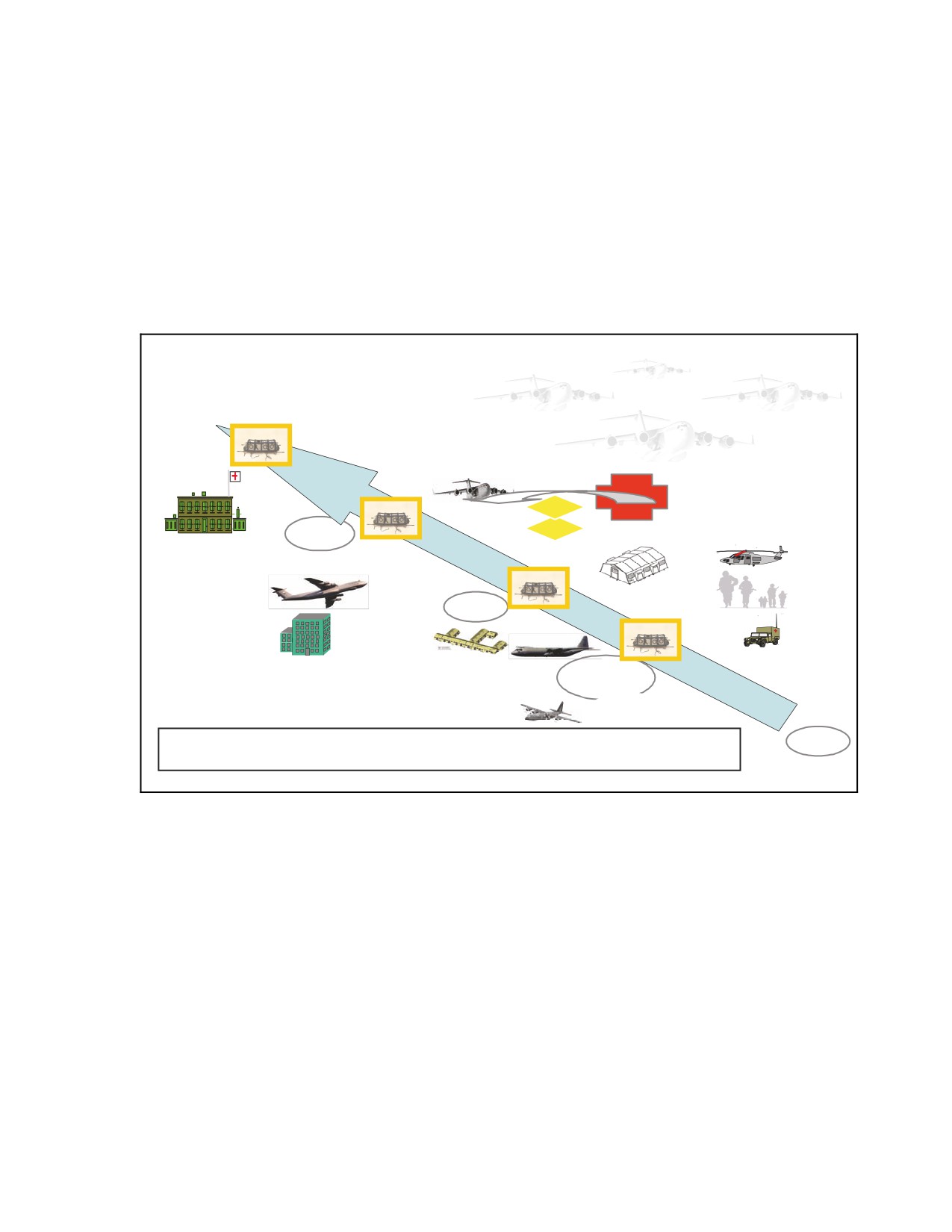
f.
The desired operational effects and goals of PIUs are to—
• Ensure no additional infections occur as a result of transporting contagious
patients.
• Provide quality medical care to the contagious patients while they are isolated.
• Ensure the level of isolation is consistent with medical practices and disease
severity.
• Minimize disruption to the aircraft’s primary mission or AE patient movement
system during patient transport.
• Maximize the comfort of the patient within the constraints of the AE environment.
High Level Operational Concept
C
CONUS
A
PIU
S
E
V
A
Crew
B
PIU
C
A
CCATT
MASF/AELT
ROLE 4
T
T
CASF/AESMT
L
PIU
E
F
ROLE 3
COMBAT ZONE
I
PIU
E
L
CSH
BAS/CCP
Secure Airfield
D
EMEDS/CASF
ROLE 2
INTERTHEATER
INTRATHEATER
INTRATHEATER
FOA
PIU PROVIDES THE ABILITY TO TRANSPORT BIOLOGICALLY CONTAGIOUS PATIENTS
ROLE 1
THROUGH ROLES OF CARE
Figure IV-1. Patient Isolation Unit Roles of Care Operational Concept
g. Table IV-1 lists some of the contagious diseases that require patient isolation during
AE.
15 July 2009
FM 4-02.7/MCRP 4-11.1F/NTTP 4-02.7/AFTTP 3-42.3
IV-7
Table IV-1. Contagious Diseases
• Arenavirus infection
Argentine hemorrhagic fever (Junin virus)
Bolivian hemorrhagic fever (Machupo virus)
Brazilian hemorrhagic fever (Sabiá virus)
Lassa fever
Venezuelan hemorrhagic fever (Guanarito virus)
• Avian flu
• Bunyavirus infection
Congo-Crimean hemorrhagic fever
• Filovirus infection
Ebola
Marburg
• Orthopoxvirus infection
Monkeypox
Variola
• Tuberculosis
• Pneumonic plague until sputum cultures are negative
• Any unknown virulent communicable disease pending diagnosis
• Suspected BW-caused infection
IV-8
FM 4-02.7/MCRP 4-11.1F/NTTP 4-02.7/AFTTP 3-42.3
15 July 2009
Chapter V
PATIENT DECONTAMINATION
1. General
a. The purpose of this chapter is to describe patient decontamination from initial exposure
on the battlefield to the patient’s admission to the MTF whether on land or on the sea. This
chapter addresses non-Service-specific technical and operational principles, techniques,
procedures, methods, equipment, and issues associated with the performance of patient
decontamination after a CBRN incident. Patient decontamination must be in place at the MTFs
at all roles of medical care.
(1) The principles and processes of patient decontamination are generally identical
throughout the Services, with some variances based on METT-TC. Common aspects will be
emphasized in this chapter. Suggested patient decontamination procedures are noted in this
chapter but are not Service-specific. They are based on the available equipment as follows—
(a) Patient decontamination with minimal equipment (for example, litter stands,
buckets).
(b) Patient decontamination using plumbed tentage, showers, and roller systems.
(c) Patient decontamination on a water vessel.
(2) Contaminated patients potentially create increased hazard to first responders,
CASEVAC/medical evacuation teams, medical personnel, and medical facilities. The three key
purposes of patient decontamination are to—
(a) Protect the MTF staff and material.
(b) Protect evacuation team and equipment along the evacuation route.
(c) Remove contamination from the patient to reduce agent exposure.
(3) In some CBRN scenarios, little or no decontamination may be necessary to
process a patient—especially if lifesaving measures are time critical. The extent to which a
patient requires decontamination is dependant on various factors—
(a) Agent (chemical, biological, radiological) and its characteristics (for example,
persistent versus relatively nonstable agents, overall severity of effects).
(b) Conditions of the release and resulting exposure (for example, liquid versus
vapor only).
b. Patient decontamination is different from troop or personnel decontamination as patients
going through decontamination also have medical conditions that must be managed. With the
exception of the Air Force and some ship-based units, which deploy trained medical
decontamination teams composed of medical personnel, the patient decontamination process is
carried out by nonmedical augmentees who are supervised by trained medical personnel.
These nonmedical augmentees are designated by the supported unit commander.
c. Patients who present themselves for decontamination may suffer from the effects of
exposure to a CBRN agent, or TIM. They can also have conventional wounds; psychological
stress reactions; combat and operational stress reactions
(COSR); worried well; and
malingerers; or any combination of these. In addition, patients may have heat injuries induced
by extended time spent in MOPP Level 4. It is important to quickly determine whether there is
potential for residual contamination on a patient or in bodily fluids for certain infectious biological
agent that may pose a continued hazard to the patient or a cross-contamination to
15 July 2009
FM 4-02.7/MCRP 4-11.1F/NTTP 4-02.7/AFTTP 3-42.3
V-1
responders/MTF personnel. While not all CBRN agents/scenarios require decontamination (see
Table V-1), when in doubt utilize most protective personal protection and decontamination
actions feasible.
d. The protective ensemble is worn in a military combat situation where there is an
expected CBRN threat. Casualties wearing the ensemble are protected from warfare agents in
either dry solid, liquid, vapor, and gas form. Removing a contaminated uniform or protective
ensemble will remove approximately 95 percent or more of the agent. Foreign objects in
wounds (for example, shrapnel) or torn ensemble will cause a breach in the protective
ensemble, allowing agents to reach and contaminate the tissues. Individuals not wearing a
protective ensemble will have little or no protection when exposed to an agent. Regular
clothing can absorb liquid agent, allowing it to touch the skin. Fabric weave can also hold
chemical vapors or aerosolized biological agents. In general however, external clothing
removal and rinsing of exposed skin and hair with water or soap and water is generally
considered adequate decontamination for most chemical vapor only exposures or biological
aerosols. Refer to Tables V-1 and V-2.
e. While these guidelines apply specifically to the wartime battlefield scenario, the same
principles and techniques can be readily applied to a homeland, garrison/installation, or civilian
setting.
WARNING
Cross-contamination of patients by decontamination
personnel can result in further injury to the patient.
Decontamination personnel handling patients must not
have been involved in decontamination operations or be
thoroughly decontaminated prior to handling patients.
Bleach requires contact time with agent for complete
neutralization dependent on the ambient temperature.
Ensure decontamination personnel have waited a
sufficient amount of time before handling patients to allow
for this contact time to neutralize agent.
2. Levels of Decontamination
a. General. The levels of decontamination used for patients are similar to those levels
used for the decontamination of personnel and equipment. There are three levels of patient
decontamination in the conflict area—
• Immediate (gross) decontamination.
• Operational decontamination.
• Thorough decontamination.
b. Immediate (gross) Decontamination. Patient decontamination begins at the time of
exposure. To significantly reduce agent absorption and the damaging effects of an agent,
decontamination should be performed within the first two minutes after exposure, though later
decontamination still has benefits. Decontamination also reduces the possibility of cross-
contamination from the exposed Service member’s garments to equipment or other persons.
The contaminated Service member performs immediate (gross) personal decontamination
using the appropriate decontaminant. Contaminated areas on the protective ensemble and
exposed intact skin are decontaminated. If Service members are not able to decontaminate
themselves due to injury or incapacitation then a buddy performs this function.
V-2
FM 4-02.7/MCRP 4-11.1F/NTTP 4-02.7/AFTTP 3-42.3
15 July 2009
c. Operational Decontamination.
This is performed at the unit level to reduce
contamination on designated in-theater evacuation assets. It is done prior to loading the
patient on a vehicle for evacuation within the tactical area. The patient remains in protective
ensemble and mask. Any liquid or solid hazard on the ensemble and skin are decontaminated
so that the spread of contamination within the evacuation vehicle is minimized.
d. Thorough Decontamination. This is the final level of patient decontamination. It
generally involves at least removal of all outer garments and removal of residual agents on skin
or in hair. Table V-1 provides some guidance’s to what degree of decontamination may be
necessary to achieve thorough decontamination for different types and forms of agents.
Equipment and technical decontamination where a fourth level of decontamination called
clearance decontamination is doctrinally described FM 3-11.5/MCWP 3-37.3/NTTP 3-11.26/
AFTTP(I) 3-2.60 for verification that all residual hazard has been mitigated to levels acceptable
for unprotected personnel. While it is critical to prevent exposure to medical staff, excessive
decontamination procedures should be avoided to prevent delays to medical treatment. This
process ensures that the patient has been properly decontaminated and all necessary records
regarding decontamination, monitoring results, type and duration of exposure and location of
incident are properly recorded to facilitate future medical surveillance and ensure the safety of
all personnel after the patient’s release or transfer to a medical facility location outside the
CBRN environment. This level of decontamination is performed by augmentees who are
closely supervised by medical personnel or, in the Air Force and some Navy ship-based units,
by trained decontamination teams of medical personnel. Much of this chapter is devoted to
discussing various ways to conduct patient thorough decontamination.
3. The Importance of Early Contaminant Removal and Medical Monitoring of
Patients
a. Many liquid chemical agents (such as liquid nerve, blister, and cyanide) can sequester in
the skin if not promptly removed from the patient through patient decontamination. In liquid form
the agents take time to work their way through the skin and into the blood stream to cause
systemic effects. The systemic effects from liquid chemical agent on the skin or solid agent on
sweaty skin may not be seen for minutes to hours after exposure depending on the toxicity of
the agent and amount of agent contacted. Even after patient decontamination, a patient
exposed to a dry or liquid agent may continue to show worsening symptoms. With these types
of exposures, patients must continue to be treated after decontamination.
b. All patients need close medical monitoring and medical treatment before, during, and
after patient decontamination at the medical facility.
c. Decontamination of HR is a mortuary affairs responsibility as described by JP 4-06.
Medical and or PVNTMED assets may need to support the process by assisting with the
assessment of residual hazard and determining when residual CBRN risks have been
adequately mitigated. Decontamination of HR while much less time critical than that of patients
is still a real-time process that can be facilitated by proper assessment of the potential residual
hazard (contamination). Human remains, as with patients, inherently pose some level of
disease risk from potential bloodborne pathogens for which established standard or universal
precautions and PPE are designed to mitigate. This does not mean they are contaminated.
Human remains are considered contaminated if a residual CBRN agent is present and poses a
known or plausible hazard to personnel beyond those addressed by routine precautions used to
handle HR. For many CBRN agents and scenarios, it may not be necessary to classify remains
as contaminated. The determination of whether HR are CBRN contaminated and pose a risk
greater that that posed by normally anticipated bloodborne pathogens will depend on many
15 July 2009
FM 4-02.7/MCRP 4-11.1F/NTTP 4-02.7/AFTTP 3-42.3
V-3
factors to include the type of agent and its characteristics and the conditions of the release and
its environment. Some general considerations are provided below:
(1) Biological hazards. Regardless of CBRN conditions, all HRs inherently have the
potential to release transmissible disease agents (for example, bloodborne pathogens) that
have been internalized and which then may be released in a viable form in blood, body fluids,
feces, or gastrointestinal contents. Established procedures and PPE are designed to protect
against such risks for common and endemic diseases. For more information, refer to TG 195.
These same procedures will protect against similar risks associated with many less common
biological agents including some of those identified as potential warfare agents. However,
additional safety precautions and PPE for potentially released internal fluids are especially
necessary for certain highly infectious, easily transmissible pathogens for which effective
treatment and preventive measures are not usually available (such as certain hemorrhagic
fevers [Ebola, Marburg, and so forth]) as well as variola virus (smallpox), and Yersinia pestis
(pneumonic plague). For a complete list of such agents refer to the WHO Risk Group IV
agents. Special handling and additional precautions are also advised for certain other agents
such as CDC’s select (Category A) agents that include Bacillus anthracis (inhalational anthrax),
Burkholderia mallei
(glanders), Yersinia pestis
(pneumonic plague), Francisella tularensis
(tularemia), and Variola virus (smallpox), as well as the WHO Risk Group IV agents. It is noted
that for most biological pathogens the risk is due to internal contamination source that cannot
be mitigated/eliminated through decontamination. However, certain CBRN scenarios that
involve the intentional release of a persistent aerosolized biological agent may have the added
consideration of the external biological hazard on clothing or skin. This may be a concern
particularly if there is concern of reaerosolization—for example, in the event of an aerosol
release of anthrax spores or toxins.
(2) Chemical hazards. The hazards associated with chemical releases are primarily
associated with the potential for residual external contamination (for example, on clothing, skin,
and hair). This is primarily a concern for persistent chemical agents (such as sulfur mustard
and nerve agent [VX]), which have low volatility and can remain present at hazardous levels for
several hours or days). Nonpersistent chemicals including TICs of military concern
(for
example, chlorine gas) as well as highly volatile CW agents such as sarin, are typically
released as a vapor and dissipate/volatilize quickly so the hazard is naturally
degraded/mitigated to negligible levels. While mitigation of even nonpersistent warfare agents
are generally processed through decontamination and verified through monitoring (for example,
ICAM), decontamination and monitoring of HR from a TIC incident is not necessary.
(3) Radiological hazards.
Determination of the degree of contamination risk,
appropriate personal protective measures, and other control measures depend on radiation
type, dose and dose rates. Internal radiation exposure (generally caused by inhalation or
ingestion) will likely pose little health risk to persons exposed to the remains. External
contamination can be mitigated by removing clothing and washing the skin.
V-4
FM 4-02.7/MCRP 4-11.1F/NTTP 4-02.7/AFTTP 3-42.3
15 July 2009

Table V-1. General Recommended Decontamination Actions by
Type and Category of Agent
Carefully cut off and roll back outergarments to con-
Minimal decon for dusty/solid agents of any type
tain dust particles. May need to remove inner gar-
(chemical, biological, radiological)
ments (upwind) if covered in solid dusty agent. HEPA
vacuum can be used on garments or garments
misted with water prior to garment removal to
minimize reaerosolization. Wet towels may be laid
over garments first to
minimize reaerosolization
during misting.
Additional decontamination guidance by hazard type:
Chemical
Biological
Nuclear/Radiological
Liquid CW agents
- Remove all clothing
– Outer wear removal.
- Minimize reaerosoliza-
and equipment.
tion.
- Thorough soap and
- Physically remove mass
agent from skin, mask.
water rinse.
- Dry brushing/shaking.
- Thoroughly wash with
NOTE 1: No monitoring
Additional precautions if
soap and water or use
equipment is available to
feasible/time allows:
0.5 percent hypochlorite
“clear.”
solution.
- Soap and water rinse.
NOTE 2: The external
- Air monitoring (for
decon measures will not
example, ICAM).
address hazards associ-
Vapor persistent agents
- Remove all clothing and
ated
with
internal
(for example, HD, VX)
equipment.
sources such as bodily
fluids and so forth that
- Wash with soap and
for certain highly infec-
and
water or water rinse
tious and communicable
will do.
(transmissible) disease
organisms (for example,
Additional precautions for
Liquid TICs
Ebola, Marburg, and
thorough decon:
(for example, liquid
various
hemorrhagic
chlorine)
- Air monitoring (for
fevers) are of greatest
example, ICAM) for
concern and must be
CW agent.
managed appropriately.
Vapor nonpersistent
- Remove all clothing
agents (sarin)
and equipment.
Additional precautions for
thorough decon:
- Wash with soap and
water or water rinse
hair and exposed skin.
- Air monitoring (for
example, ICAM) for
CW agent.
- No decon needed.
Vapor TICs
(for example, chlorine
Additional precautions for
gas)
thorough decon:
- Outer wear removal.
- Wash with soap and
water or water rinse
hair and exposed skin.
NOTE: Wastewater from decontamination that involves solution (soap and water; water; 0.5 percent
hypochlorite solution) should be collected and disposed of properly.
15 July 2009
FM 4-02.7/MCRP 4-11.1F/NTTP 4-02.7/AFTTP 3-42.3
V-5
4. Zones of Contamination
a. In interagency operations, a contaminated area is divided into zones of contamination
modified following the guidelines prescribed in the Environmental Protection Agency (EPA)
Standard Operating Safety Guidelines and the OSHA Act (29 Code of Federal Regulations
[CFR] 1910.120). To more effectively manage the contaminated area, a variety of control lines
and points are designated depending upon the level of contamination. These same areas hold
true in the battlefield.
b. Hot Zone. The hot zone is also called the isolation zone (Emergency Response
Guidebook 2008) and exclusion zone (OSHA’s hazardous waste operations and emergency
response course). This is the area that is directly contaminated by CBRN agents. In combat,
this is the contaminated battlefield or TIM release. Casualties usually undergo immediate
(gross) decontamination in the hot zone or near it. The MOPP Level 4 posture will provide
protection against warfare agents (for example, chlorine, phosgene, mustard, nerve agents, and
cyanide) in an open battlefield environment where the vapor is dispersed by the wind currents.
The military protective ensemble is not intended for oxygen-depleted areas or for long term use
in confined spaces with high concentrations of TIC. In a confined space or where nonbattlefield
TIC (for example, ammonia or carbon monoxide) is used, a SCBA, or special filters that will
protect against the specific TIC must be used. Other names for the hot zone include the
contaminated area, predecontam-ination zone, hazard area, dirty area, area of release, or red
zone. Refer to Figure V-1 below.
HOT ZONE
WARM ZONE
COLD ZONE
WIND DIRECTION
WIND DIRECTION
AMBULATORY PNT
DECON
CAM CHECK
CAM CHECK
SHUFFLE PIT
6
4
TRIAGE
&
PATIENT
5
MEDICAL
DROP
DECON AREA
TREATMENT
OFF
POINT
SKIN
LITTER
30
EXCHANGE
45
DECON
METERS
7
2 METERS
TRIAGE
75-100
3
EMT
DISPOSITION
AREA
METERS
1
CLOTHING
TRIAGE
REMOVAL
CAM CHECK
AREA
LITTER
DIRTY
(LOG-IN)
EXCHANGE
60
CAM CHECK
METERS
DUMP
MEDICAL
LITTER PNT
TREATMENT
DECON
SHUFFLE PIT
EQUIPMENT
CAM CHECK
EQUIPMENT
DECON
REISSUE
CONTAMINATED
WASTE DISPOSAL
HOT LINE
VAPOR
LIQUID CONTROL LINE
CONTROL LINE
Figure V-1. Patient Decontamination Site Layout
c. Warm Zone. This is an area where low levels of dry, liquid, and vapor contamination
can be expected once contaminated individuals enter this area. The contamination hazard is
essentially the agent that remains on the patients that are brought into this zone (for example,
the primary hazard comes from liquid or dry agent on clothing or the off gassing of vapors from
liquid contaminated garments and equipment). While the direct hazards to workers is much
V-6
FM 4-02.7/MCRP 4-11.1F/NTTP 4-02.7/AFTTP 3-42.3
15 July 2009
reduced compared to those working in the hot zone, the protective ensemble must be worn by
decontamination team members as vapors and particles, even in small amounts, can pose a
hazard to those working directly with the patients. The warm zone is located outside of the hot
zone.
In this zone, immediate
(gross), patient operational, and patient thorough
decontamination take place upwind of the hot zone incident location. The PDS is initially set up
in an area free of contamination. This area becomes part of the warm zone once contaminated
casualties begin to arrive. This zone includes control points in and out of the patient
decontamination area so that contamination spread is controlled. Protective ensemble at
MOPP Level 4 or OSHA Level C provides adequate protection in the warm zone. Other names
for the warm zone include the contamination reduction corridor, contamination reduction zone,
yellow zone, dirty zone, limited access zone, decontamination zone, decontamination corridor,
or protective action zone. Refer to Figure V-1.
d. Evacuation Corridor. This corridor is within the warm zone. This includes land
evacuation routes for casualties who may still be contaminated. The PDS is located in that
corridor. All patients are routed through this corridor toward the MTF. In some instances
patients who have only undergone immediate (gross) and patient operational decontamination
may be dirty evacuated over or through a clean area for decontamination at a larger MTF. In
this case, a separate warm area would be created at the vehicle drop-off point and
decontamination area at the destination MTF.
e. Cold Zone. The cold zone is an area free from liquid and vapor contamination. The
PDS and MTF are initially set up in the cold zone. All personnel and patient’s entering this zone
have been decontaminated. Protective ensemble and mask are usually not required for
personnel downwind of the cold zone unless the area becomes contaminated. Standard
precautions must be practiced if a patient is infected with an infectious BW agent. Other names
for the cold zone include clean zone, support zone, postdecontamination zone, or green zone.
Refer to Figure V-1.
5. Personal Protective Equipment Worn by Decontamination Operators
a. Solid, liquid, and vapor hazards can be present in contaminated patient clothing, skin,
and hair. In the PDS, hazardous CBRN agents are typically not present in the large quantities
seen in the hot zone. The PDS team members assume MOPP Level 4 or OSHA Level C.
Higher OSHA Levels of protection (for example, OSHA Levels A and B) are not usually
indicated at the PDS as these levels place undue heat stress and strain on decontamination
workers. However, personnel may still need to have them (if available) depending upon the
hazards present.
b. The PDS team members using dry decontaminants, water, soap and water, or other
liquid decontaminants
(see Table V-2) must keep their protective ensemble dry and
contamination free by wearing a butyl rubber toxicological agent protective (TAP) apron. An
alternative is to wear a chemical resistant, splash protective garment. The TAP aprons and
other water-resistant materials can be easily wiped down prior to performing patient lifts.
Standard military protective ensemble, such as the joint service lightweight integrated suit
technology (JSLIST), cannot be adequately wiped down and exposure to significant moisture
will reduce its protective ability.
15 July 2009
FM 4-02.7/MCRP 4-11.1F/NTTP 4-02.7/AFTTP 3-42.3
V-7

Table V-2. General Chemical, Biological, Radiological, and Nuclear Decontaminants/Hazard
Mitigation Techniques and Applications
Type of Contaminant
Type of Application
Chemical
Biological
Nuclear/Radiological
Personnel:
Surface/
Personnel:
Surface/
(immediate and
Surface/
Personnel:
Material/Area
(not time critical)
Material/
Decontaminants/Techniques
time critical)
Material/Area
(less time critical)
Area
Misting hair/clothes
minimize
minimize
minimize
reaerosolization
reaerosolization
reaerosolization
Physical removal
dry
remove outer
remove outer
dry brushing/shaking
brushing/
garments
garments
shaking
Water only
X
X
X
Soap and Water
X
X
X
X
X
X
Weathering
X
X
X
Skin Decontamination
X
X
Individual Equipment
equipment
equipment
Decontamination Kit
STB/HTH
X*
X*
M100 SDS reactive powder
X
X*
X*
Household bleach solution
(5% sodium hypochlorite)
X*
X*
Dilute bleach solution (0.5%
X
sodium hypochlorite)
^
^
X
Absorbents (earth/soil,
for liquid decon
sawdust, ashes, rags)
X
X
Sealants/physical covers
X
(concrete, asphalt, paint, soil)
Steam
§
X
X
Heat/Fire/Incineration
X
X
* These particularly corrosive decontaminants are specifically not to be used on certain aircraft and other equipment (a soap and water alternative
is doctrinally mandated. See FM 3-11.5/MCWP 3-37.3/NTTP 3-11.26/AFTTP(I) 3-2.60 for more details.
^ While military doctrine allows this for decon of persons, federal guidance stipulates that only water or soap and water should be used for
personnel/mass decon. See Best Practice Guidelines for CBR Mass Personnel Decontamination, 2004.
§ Steam, as well as certain vaporized gases (ammonia, hydrogen peroxide, chlorine dioxide) may be used for the decontamination of interior
buildings/heating, ventilation, and air conditioning. These can be logistically involved operations. See hazard chapters of above-mentioned
guidelines for specific subject matter expert support.
c. The standard military M40, MCU2P, or new M50 mask can be worn by decontamination
team members. An alternative is to wear a powered air-purifying respirator (PAPR) which has a
blower motor that pulls air through the filters and into the mask hood. The circulated air blown
into the mask hood keeps the decontamination team member cooler, requires no effort from the
wearer to pull air through the filter, and reduces carbon dioxide buildup in the mask during
heavy work. Masks of this type should be NIOSH-approved and must have an assigned
protection factor of 1,000 per OSHA first receiver guidance. When working with soap and water
and other liquids, the PAPR blower motor and filters can be worn under the TAP apron or to the
rear of the body to keep the filters from getting wet.
d. Patient decontamination is a complex operation and labor intensive that requires special
equipment to complete the mission. Some of the special equipment includes—
(1) Litters, backboards, and wheeled carriers. Only decontaminable litters, which have
a mesh material that can be readily decontaminated, are to be used for transporting the patient
into the PDS. If no decontaminable litters are available then plastic sheeting must be placed on
canvas litters to reduce their cross-contamination by liquid or solid contaminants. Cloth litters
will rapidly break down when decontaminated with 5 percent hypochlorite solution for longer
periods of time. Backboards and wheeled carriers can be decontaminated with hypochlorite
V-8
FM 4-02.7/MCRP 4-11.1F/NTTP 4-02.7/AFTTP 3-42.3
15 July 2009
solution between patients but must be rinsed thoroughly with soap and water. The use of
wheeled litter carriers in the PDS makes it easy to transport patients between zones.
(2) Voice amplifiers. These should be made available for medical personnel and
decontamination team members. This will allow the staff to better communicate while wearing
military protective masks such as the M40. Other amplifiers are also available for the MCU2P
mask and M50 mask.
(3) Radios. Radios should be made available for the decontamination team officer in
charge (OIC) or noncommissioned officer in charge (NCOIC) and leaders for the ECP, drop-off
point, triage area, dirty EMT area, decontamination line, hot line, and MTF. This will
significantly improve communications which is vital to the smooth operation of the PDS. If
handheld radios are used, they can be wrapped inside clear plastic bags and taped if
contamination is a concern.
(4) Night operations. Chemical lights and 4-inch wide engineering marking or police
yellow tape can be used to designate areas in the PDS. These are primarily needed for night
operations. See paragraph 39 of this chapter for more information on night operations.
(5) Toxicological agent protective aprons. These aprons are essential to keep the
decontamination team member’s protective ensemble dry and to allow for thorough
decontamination of the team member’s ensemble before lifting patients. They are not needed if
a waterproof protective ensemble is worn that can be adequately decontaminated between
patients.
(6) Chemical agent monitor. The CAM/ICAM or other chemical detection device must
be used to monitor residual contamination or determine if decontamination was successful after
the patient has gone through the PDS.
6. Decontamination Materials
a. Physical removal of contaminants is the primary method of decontamination for
personnel. Physical removal includes washing and wiping, but never vigorous scrubbing that
could abrade the skin. Skin abrasions whether through rubbing or harmful chemical reaction
(for example, when 5 percent hypochlorite is mistakenly used as a decontamination solution on
the skin), allow agents to move more rapidly through the skin barrier.
b. Recommended materials for patient decontamination include:
(1) Skin.
(a) M291 Skin Decontamination Kit. The SDK is a pad containing an absorbent
resin. The M291 has been in the military inventory for many years. The resin pad picks up
liquid agent on the skin. It is effective for immediate (gross) decontamination of chemical agent
liquid on intact skin, especially in areas where water is not readily available. The SDK can be
used for the decontamination of intact skin around wounds, but should not be used in wounds or
on abraded skin. It is not effective for removing dry biological or radiological agents or for
neutralizing them.
(b) Soap and water. This is the most preferred method. This is a low cost
material that removes agents by washing them away. It is effective for removing chemical,
biological, and radiological contaminants. It does not kill biological agents or neutralize
radiological agents. Water runoff must be collected and treated before disposal. Liquid soap
attracts the chemical agent and loosens it so that the action of the water can wash it away. Fat-
based soaps and emulsifiers (for example, baby shampoo, castile liquid soap, or soft soap) are
much more effective than liquid or powder detergents. Detergents tend to dry the skin and
15 July 2009
FM 4-02.7/MCRP 4-11.1F/NTTP 4-02.7/AFTTP 3-42.3
V-9
should not be used. Soap and water is best used during patient thorough decontamination, but
can also be used for immediate (gross) and operational patient decontamination if available and
practical. It is not practical to use soap and water on the JSLIST or similar protective garment
as it will dampen the garment and reduce its protective abilities. It is also not advisable to use
hot water for skin decontamination since it will open skin pores allowing chemical agents to
easily penetrate and absorb into the skin. For better results, use tepid or lukewarm water with
soap.
(c) Other locally available absorbent material. Any material that can absorb a
liquid and then be brushed or scraped from the skin without abrading it, can be used as an
effective skin or equipment decontaminant to remove liquid agents. Clean sawdust, clay dirt,
baking powder, fuller’s earth, baby wipes, can be put on the agent found on the skin or
equipment, allowed to absorb it, and then carefully wiped away. Large quantities of thickened
liquid agent can be removed from clothing and skin by initially scraping it off with an
uncontaminated stick or similar device. Clean sand can be used on equipment but it is not
advisable to be used on skin since it might be too abrasive and may cause the skin pores to
open thus absorbing the chemical agent.
(d) The
0.5 percent hypochlorite
(1/2 percent, dilute household hypochlorite)
solution. This is the least preferred and only used as an alternative skin decontaminant where
there is limited water and dry decontaminants are not available. It can be used for washing off
chemical, biological, and radiological agents. This may offer some neutralization of the
chemical and biological agents, but not for radiological agents. A 0.5 percent hypochlorite
concentration poses little risk of causing skin damage if mixed correctly in 9 parts water to 1 part
hypochlorite solution, however, it may cause skin irritation and opens skin pores. To work
effectively, it should be wiped on the contaminated areas of the skin with gentle scrubbing of
those areas so that contamination is not spread. It can then be left on the skin for several
minutes and later rinsed with clean water (several seconds to minutes later). Its oxidation
effects are limited and its protective ratio is not significantly different than soap and water.
Using copious amounts of soap and water is preferred and will better loosen the agent and help
lift it off of the skin with washing. The
0.5 percent hypochlorite solution is used for skin
decontaminant as a last resort.
(e) Reactive skin decontamination lotion
(RSDL). The RSDL is a liquid
decontaminant dispensed on a sponge. The Food and Drug Administration (FDA) has cleared
RSDL for use by the US military intended to remove or neutralize CW agents and T-2 fungal
toxin from the skin. It is expected to replace the M291, SDK. It washes away chemical agent
contamination and also neutralizes the effects of many agents. The RSDL can be used for the
decontamination of intact skin around wounds, but is not approved for the decontamination of
wounds. The RSDL is a Class VIII item with a basis of allocation of one packet per individual.
For more information regarding RSDL, refer to FM
4-02.285/MCRP
4-11.1A/NTRP
4-02.22/AFTTP (I) 3-2.69.
(2) Wounds.
(a) Clean or sterile water (such as an IV bag of saline) is the most appropriate
material for the irrigation of the eyes and contaminated open wounds. Soft tissue closed
wounds can be irrigated with clean water, IV saline, or soap and water. Deeper wounds, such
as contaminated abdominal or thoracic cavity wounds or contaminated open intracranial (head)
injuries should not be irrigated in the field.
(b) Wound irrigation does not necessarily completely decontaminate the wound,
but can help dislodge foreign material (such as pieces of clothing or metal which could hold
agent) for recovery by aspiration with a large bore sucker, forceps, or other no-touch technique.
V-10
FM 4-02.7/MCRP 4-11.1F/NTTP 4-02.7/AFTTP 3-42.3
15 July 2009
(3) Equipment.
(a) The
5 percent hypochlorite
(full strength household liquid hypochlorite)
solution. This is effective for decontaminating equipment contaminated by CW agents or
biological agents. It is not necessary to use this type of solution for radiological contamination
as water or soap and water is best for this. The 5 percent hypochlorite solution works by rinsing
away the agent while causing an oxidative, burning, chemical reaction with the agent which will
neutralize chemical agent toxicity and kill biological agents. This solution should never be
allowed to touch the skin as its alkalinity will redden, burn, and damage skin. Damaged skin will
loose its protective qualities and will allow chemical agent to travel through it more rapidly and in
greater amounts. To effectively neutralize a chemical agent, the 5 percent hypochlorite solution
must be in contact with it for at least 10 minutes to 30 minutes. Equipment decontaminated with
hypochlorite should be thoroughly rinsed with water or soap and water before use. It is
important that hypochlorite not be used on sensitive electronic equipment as it will cause
oxidation and rust the equipment. Because of its highly reactive, very strong base, high pH
level, and oxidative characteristic, this solution may react with some TIC.
CAUTION
Five percent hypochlorite
(full strength household liquid
hypochlorite) solution is highly reactive and oxidative. It should
NEVER be used on skin. It can damage sensitive electrical
equipment. Equipment decontaminated with hypochlorite
solution must be thoroughly rinsed with clean water before use.
(b) Soap and water. Generous amounts of soap and water work well to
decontaminate equipment contaminated by chemical, biological, radiological, and nuclear
contaminants. Soap and water dilute most chemical agents but do not neutralize them. It
removes biological agents, but will not destroy anthrax spores. Runoff should be collected and
killed with hypochlorite or sporicides. Soap and water will remove radiological particles, but
runoff must be contained as it contains particles that remain radioactive.
Note: Soap and water does not destroy biological or radiological contamination. Water
runoff should be collected.
(c) M295 Equipment Decontamination Kit (EDK). This can be used on equipment
contaminated by liquid chemical agent. The EDK is not effective for dry agents such as
biological spores, radioactive particles, or dry chemical agents. The EDK contain the same
resin material that is in the M291 SDK only the M295 is stronger in concentration. See Table
V-3 for more information.
(4) Marking buckets. During the decontamination of chemically contaminated patients,
cutting tools should be placed in buckets of 5 percent hypochlorite solution. It is critical that
these buckets be well marked (color coded and labeled) so that the 5 percent solution is not
used on the skin. Darker colored buckets such as red or orange can be used for this solution.
Lighter colored buckets can be used for soap and water or 0.5 percent hypochlorite solutions if
used when soap is not available. Hypochlorite in solutions above 0.5 percent will cause skin
alkaline burns that damage the skin and increase agent absorption.
15 July 2009
FM 4-02.7/MCRP 4-11.1F/NTTP 4-02.7/AFTTP 3-42.3
V-11

Table V-3. Summary of Appropriate Uses for Decontaminants
Decontaminant
Type of PDS
When and where used
M291.
All types of PDS with limited water
For dry decontamination of liquid
or freezing temperature
chemical agents only; if water is
conditions.
not available or the ambient
temperature is freezing; used on
skin and equipment.
M295.
All types of PDS with limited water
For dry decontamination of liquid
or freezing temperature
chemical agents only, used on
conditions.
equipment.
Soap and water.
Used at all PDS and is most
Used for—
preferred.
• Skin (copious amounts).
• Equipment (copious amounts).
Note: This is the primary
• Best for washing away
decontaminant that is used for
chemical, biological, and
PDS with plumbed tentage and on
radiological agents. Does not
water vessels.
neutralize or kill these.
• Used to wash down TAP
aprons of decontamination
team members and rinse
decontamination team member
gloves washed with 5 percent
hypochlorite (bleach) solution.
0.5 percent hypochlorite (1/2
PDS with minimal equipment.
On skin. This is the least
percent, dilute household bleach)
preferred and used as the last
solution.
resort. If used, not for full body
wash.
5 percent hypochlorite (full
PDS with minimal equipment:
Used only on equipment, NOT on
strength household liquid bleach)
patient mask hood; decon team
skin. Not used with radiological
solution.
member gloves.
agents. Used for chemical and
biological agents to—
Decontamination equipment (10
• Wipe down rubber mask
to 30 minutes contact time then
hoods.
rinse).
• Wash patient and
decontamination team member
All PDS:
gloves (then rinse with fresh
Soak cutting tools (chemical and
water).
biological agents only); for
• Fill/pail/bucket for cutting tools.
radiation use soap and water.
• Decontaminate litters (then
rinse with fresh water).
• Wipe down equipment (wait for
10 to 30 minute contact time
and then rinse).
Locally available absorbent
Any PDS.
For dry decontamination of liquid
material—
chemical agents only on skin and
• Clean sand.
equipment; used if water and
• Baking powder.
M291 (skin/equipment) or M295
(equipment only) are not available
• Fuller’s earth.
or ambient temperature is
• Baby wipes.
freezing.
• Flour or bread.
• Other dry, nontoxic,
absorbent items.
V-12
FM 4-02.7/MCRP 4-11.1F/NTTP 4-02.7/AFTTP 3-42.3
15 July 2009
Table V-3. Summary of Appropriate Uses for Decontaminants (Continued)
Reactive skin decontamination
Any PDS.
Will replace M291. Used for skin
lotion (RSDL).
and equipment for all types of
agents to wipe the contaminant
away. Can neutralize some
chemical agents and biological
toxins.
7. Detection Devices Used During Patient Decontamination
a. Detectors can be used at the drop-off point, to assess which patients require
decontamination or after the decontamination process to check for thoroughness of
decontamination. Their use is dictated by unit operating plans and specific Service tactics,
techniques, and procedures (TTPs) and CONOPS.
b. There are currently no hand-held detectors for biological agents that would be
appropriate for patient decontamination operations.
c. There are a variety of RADIAC meters appropriate for patient decontamination
operations. The RADIAC meters used for this purpose should measure alpha, beta, and
gamma radiation and should have a pancake probe. Suggested military models include
AN/PDR-77, AN/VDR-2, or ADM-300 RADIAC set. In the event of radiological contamination,
these can be deployed at the same locations as the chemical monitors, such as the ICAM.
They can be used to screen for radiologically contaminated casualties and equipment at the
ECP and to verify the effectiveness of decontamination.
d. Currently fielded CW agent detection/monitoring equipment does not identify all possible
CW agents or TICs. Military detection devices that are currently fielded include, but are not
limited to—
(1) Chemical Detector Paper, M8. Detects liquid G nerve agents but does not
differentiate between them. It identifies liquid V nerve agent. Detects liquid H blister agents but
does not differentiate between them. It does not detect vapors. This could be used by
decontamination personnel to help detect liquid agent residue on a patient before or after
decontamination.
(2) Chemical Detector Tape, M9. Detects liquid H, G, and V agents but does not
differentiate between them. It does not detect vapors but can detect aerosol sprays. This is
typically worn on protective gear and can be checked by decontamination teams before the
individual’s protective ensemble is removed. It is normally not used as a detector during the
decontamination process but examining the patient’s M9 can help to determine if the individual
was exposed to liquid and aerosol forms of a chemical agent.
(3) Chemical Agent Monitor/Improved Chemical Agent Monitor. This device monitors
levels of nerve and blister agent vapors in the air (but only one agent at a time). It does not
monitor liquid, except for the vapors that a liquid agent might give off. It is typically used after
the presence of nerve or blister agent has been established to pinpoint contaminated areas on
clothing and protective ensemble. The ICAM may be used at the ECP to assist in determining
if decontamination is required and at the end of the decontamination process to verify the
effectiveness of decontamination. It may also be used within airlocks on chemically protected
MTFs to verify decontamination of individuals inside the airlock entry way. The ICAM can be
deployed in pairs, with one on G (nerve agent) mode and one on H (vesicant) mode, or
individually if the threat is known and medical signs and symptoms give an indication of the
type of agent exposure (for example, the patients present with reddened skin or blisters then
15 July 2009
FM 4-02.7/MCRP 4-11.1F/NTTP 4-02.7/AFTTP 3-42.3
V-13
the hazard is likely mustard (H), but if the patients are sweating profusely, have difficulty
breathing, are vomiting, and have muscle twitches, then it is likely nerve agent). For
instructions on the use and operation of the ICAM refer to Technical Manual (TM) 3-6665-331-
10/TO 11H2-20-1. There are similar commercial off-the-shelf equivalents that can detect vapor
hazards. These must first be approved for military field use.
Note: Chemical Agent Monitor Maintenance.
The ICAMs employed in the
decontamination station must be operated
6 to
8 hours every 2 weeks to
maintain acceptable performance. This regular operation should be achieved
using the alternating current power supply with D-Cell adapter or the lithium
battery. Alkaline D-Cell batteries (4 per CAM/ICAM) and lithium batteries should
be checked/replaced at regular intervals.
(4) Automatic Chemical Agent Alarm M8A1. This consists of the M43A1 detector and
one or more M42 remote alarms (up to 5 alarms). This is not used to detect agent on a patient,
but is used to monitor an area for possible air contamination in clean areas (the cold zone) and
areas upwind of the decontamination area and MTF. It can be used as a monitor to establish a
vapor control line (VCL) between the hot line and the MTF. It serves as an early warning alarm
for G nerve agent and HD vesicant vapors only.
(5) The M22A Automatic Chemical Agent Detector Alarm. This is replacing the M8A1
and consists of the M88 chemical detector and one or more M42 remote alarms (up to 5
alarms).
8. Safety, Heat Injury Prevention, and Water Consumption
a. Of greatest concern to decontamination team members is heat injury and
musculoskeletal injury from performing moderate to heavy (patient triage and treatment) and
heavy work (carrying litter patient and decontaminating patients) while wearing the protective
ensemble. The frequency of accidents, in general, appears to be higher in hot environments
than in more moderate environmental conditions. One reason is that working in a hot
environment lowers the mental alertness and physical performance of an individual. Increased
body temperature and physical discomfort promote irritability, anger, and other emotional
stresses which sometime cause workers to overlook safety procedures or divert their attention
from hazardous tasks. It is critical that these issues be addressed throughout PDS operations.
b. A safety officer must be appointed for PDS operations. This can be the PDS NCOIC or
appointed individual selected by the commander. The primary duty of this individual is to
conduct an initial and ongoing risk assessment prior to setting up the PDS and to personally
monitor the status of decontamination team members working on the warm side of the hot line
at all stations from the ECP to the hot line. This individual must not be involved in PDS tasks
such as triage, treatment, litter carry, or patient decontamination. They must be free to move
around the warm zone. In addition to personally checking with decontamination team members
and observing them closely for signs of heat or musculoskeletal injury, this individual also
manages work/rest cycles, monitors temperature and wet bulb heat category conditions,
ensures adequate fluids are available for decontamination team members, and enforces safe
patient lifting techniques.
V-14
FM 4-02.7/MCRP 4-11.1F/NTTP 4-02.7/AFTTP 3-42.3
15 July 2009
c. Worker musculoskeletal injury can easily occur from long periods of patient lifting and
litter carrying or injuries caused by falls while wearing protective ensemble. To reduce these
injuries the following strategies can be implemented:
• Clear routes within the PDS to reduce tripping hazards.
• Establish multiple decontamination lanes far enough apart to reduce cluttered work
areas.
• Ensure that garbage bags containing contaminated waste material are moved from
the decontamination lanes to the dirty dump on a regular basis to reduce tripping
hazards in the decontamination area.
• Ensure that litter teams move litter patients at a safe speed and do not run.
• Reduce distances that litters need to be transported by litter teams.
• Triage areas and litter transport lanes should be well marked for night operations.
• Enforce proper lifting and litter carry techniques throughout PDS operations.
• Ensure that personnel performing litter carries and patient lifting are fit for the
demands of the task.
• Enforce frequent rest breaks.
• Use equipment (for example, roller systems, litter stands, or NATO litter carriers)
when available.
9. Heat Injury
a. Excessive exposure to a hot work environment, which is the case when the protective
ensemble is worn, can bring about a variety of heat-induced disorders/injuries. Chemical
protective ensembles make it difficult for the body to cool itself as the ensemble prevents sweat
from readily making contact with the air to help cool the skin. This inhibits heat transfer from the
body. Refer to Technical Bulletin, Medical (TB MED) 507/Air Force Pamphlet (AFPAM) 48-
152(I) for more information.
(1) Heat stroke. This is a life-threatening medical condition associated with working in
hot environments. It occurs when the body’s temperature regulatory system fails and sweating
becomes inadequate. The body’s only effective means of removing excess heat is
compromised with little warning to the victim that a crisis stage has been reached.
DANGER
Unless the heat stroke victim receives quick and
appropriate medical treatment death can occur.
(2) Heat exhaustion. This includes several clinical disorders having symptoms which
may resemble the early symptoms of heat stroke. Heat exhaustion is caused by the loss of
large amounts of fluid by sweating, sometimes with excessive loss of salt.
(3) Heat cramps. Heat cramps are painful spasms of the muscles that occur among
those who sweat profusely in the heat and who drink large quantities of water but do not
adequately replace the body’s salt loss.
b. Humans are, to a large extent, capable of adjusting to heat. This adjustment to heat,
under normal circumstances, usually takes about 5 to 7 days, during which time the body will
undergo a series of changes that will make continued exposure to heat more endurable.
Measures that can be taken to reduce heat load on the individual include—
15 July 2009
FM 4-02.7/MCRP 4-11.1F/NTTP 4-02.7/AFTTP 3-42.3
V-15

• Ensure that work/rest cycles are enforced and that manning is adequate to
accomplish this.
• Provide shaded areas for rest on the warm side of the hot line.
• Provide shaded covering (for example, camouflage netting or open tentage) over
decontamination and warm side triage and treatment areas.
• Reduce MOPP level when appropriate.
• Maintain adequate supplies of drinking potable water for decontamination team
members.
c. It is critical that the workload for decontamination teams be distributed among the
members so that workers do not keep working to the point of heat or musculoskeletal injury. In
a high OPTEMPO, team members may disregard this important guidance. Not enforcing
appropriate work/rest cycles will increase the risk for decontamination team member injury and
will deplete the manpower pool. Work/rest cycles ensure adequate team member hydration
giving the body an opportunity to get rid of excessive heat and break the effects of fatigue.
Refer to Table V-4 for work/rest cycles and water consumption information.
Table V-4. Work/Rest Cycles and Water Consumption (Without Protective Ensemble)
Heat
WBGT
Easy Work
Moderate Work
Hard Work
Category
Index
WORK/
WATER
WORK/
WATER
WORK/
WATER
DEGREES
REST
INTAKE
REST
INTAKE
REST
INTAKE
° F
MIN
QT/HR
MIN
QT/HR
MIN
QT/HR
1 (WHITE)
78-81.9
NL
½
NL
¾
40/20
¾
2 (GREEN)
82-84.9
NL
½
50/10
¾
30/30
1
3 (YELLOW)
85-87.9
NL
¾
40/20
¾
30/30
1
4 (RED)
88-89.9
NL
¾
30/30
¾
20/40
1
5 (BLACK)
> 90
50/10
1
20/40
1
10/50
1
– The work/rest times and fluid replacement volumes will sustain performance and hydration for at
least 4 hours of work in the specified heat category.
- Hourly fluid intake should not exceed 1 quart (qt) and daily fluid intake should not exceed 12
quarts.
- NL means no limit to work time per hour (hr).
- Rest means minimal physical activity while sitting or standing, accomplished in the shade if
possible.
CAUTION
Wearing protective overgarments adds 10°F (5.6°C) to the wet
bulb globe temperature (WBGT) index and wearing body armor
increases this by another 5°F (2.8°C). The TAP apron adds an
additional 10 degrees to the WBGT index.
V-16
FM 4-02.7/MCRP 4-11.1F/NTTP 4-02.7/AFTTP 3-42.3
15 July 2009
d. A worker may produce as much as 2 to 3 gallons of sweat in the course of a day’s work.
Because many heat disorders/injuries involve excessive dehydration of the body, it is essential
that water intake during the workday be about equal to the amount of sweat produced.
e. Most workers exposed to hot conditions drink less fluids than needed because of an
insufficient thirst drive. A worker, therefore, should not depend on thirst to indicate when and
how much to drink. Five to seven ounces of liquid should be consumed every 15 to 20 minutes
to replenish the necessary fluids in the body. Water intake should not exceed 1 quart per hour
or 12 quarts per day, as excessive water consumption (overhydration or hyponatremia) can
dilute the salt content of the blood to the point where it interferes with brain, heart, and muscle
function. This water poisoning can result in confusion, nausea, vomiting and/or seizures.
CAUTION
Hourly fluid intake should not exceed 1 quart (one canteen),
and daily fluid intake should not exceed
12 quarts
(12
canteens).
f.
Heat acclimated workers lose much less salt in their sweat than do workers who are not
adjusted to the heat. The average Service member diet contains sufficient salt to acclimatized
workers even when sweat production is high. If for some reason, salt replacement is required,
the best way to compensate for the loss is to add a little extra salt to the food. Salt tablets
should not be used unless directed by a physician.
g. Persons with heart problems or those on low sodium diets who work in hot environments
should consult a physician about what to do under these conditions.
10. Core Components of the Patient Decontamination Site and Patient Flow
a. All military services and all roles of medical care use a similar patient flow during patient
decontamination operations. Each Service may use different types of equipment and
procedures. This paragraph provides an overview of core components that are found in all
PDSs, whether they are set up using minimal resources, plumbed tentage with showers and
roller systems, or on board ship.
b. When establishing a PDS, all component areas noted in this paragraph should be
considered and addressed.
(1) Entry control point and drop-off point is an area downwind from the triage and
decontamination areas. This is where patients arrive at the PDS. On land, this incorporates
road access for evacuation vehicles as well as medical evacuation rotary-wing landing areas.
These avenues must be organized so that smooth traffic flow occurs during patient drop-off. On
a water vessel this area would consist of the flight deck or area where aircraft and water landing
craft discharge patients to the ship.
(a) Entry control point when on land is located along an access road to the drop-
off point. Security must be provided to control access to the PDS. Security personnel must
meet vehicles upon arrival, quickly interview drivers/escorts, and get information from the
drivers/escorts as to the number of patients, types of injuries, and types of contamination. They
relay this information by radio to the drop-off point and PDS OIC/NCOIC. On watercraft, the
ECP might be located at the transport air or watercraft loading area on land.
(b) The drop-off point is where patients are off loaded from vehicles and brought
to the triage area. The drop-off point is staffed by augmentees who direct traffic flow, unload
15 July 2009
FM 4-02.7/MCRP 4-11.1F/NTTP 4-02.7/AFTTP 3-42.3
V-17
vehicles and move patients to the triage area, remove patient weapons and equipment, and
perform quick pat-down searches of patients.
(c) If adequate chemical and radiological monitoring devices and trained staff are
available, a monitoring station can be set up at the drop-off point to determine who are
contaminated and require decontamination. Personnel at the ECP and drop-off point assume
MOPP Level 4 or equivalent OSHA Level C when contaminated casualties are expected.
(2) Warm side (dirty side) triage area. The triage area is located near the drop-off
point in the PDS warm zone. Patients are moved to this area from the drop-off point.
(a) Casualties are simultaneously triaged as to their need for medical care, their
priority for patient thorough decontamination, and their priority for evacuation to the next role of
care. One patient may be medically triaged as Immediate, but not have priority for
decontamination until they are medically stable. Another may have priority for medical
evacuation, but be Expectant or Delayed. The purpose of triage is to effectively allocate the
medical resources available.
(b) This area should initially be large enough to allow for an influx of many
patients. The triage area is located adjacent to or can be collocated with the warm side (dirty
side) EMT area.
(c) Within the triage area, casualties are moved to either the Immediate (warm
side, dirty, EMT), Delayed, Minimal, or Expectant treatment areas. A patient is retriaged as his
condition changes. The following is suggested as a placement for specific treatment areas to
improve patient flow through the PDS:
• The Immediate category patients are moved to the warm (dirty side) EMT
area. This area is located between patient triage (closer to triage area to
minimize the time it takes to move from triage area to dirty EMT) and the
entrance to the litter decontamination lanes. This way they can be moved
to litter decontamination without interfering with the traffic flow from other
patient categories.
• The Delayed patient area should be positioned near the entrance to both
the litter and ambulatory decontamination lines. This way delayed patients
can be processed through either the litter or ambulatory lanes when the
lanes become available.
• The Minimal category patients should be positioned near the ambulatory
patient area so that if medical care on the clean side of the hot line is
needed they can process through the ambulatory lane when it becomes
available and will not interfere with the flow to the litter lanes.
• The Expectant category patients should be located near the EMT area, but
farther away from the decontamination lanes, so that they can be retriaged
and stabilized for decontamination if the EMT area no longer has patients
in it. The expectant patient should not be abandoned, but should be
separated from the view of other casualties.
(d) Casualties are retriaged as they progress through the EMT and
decontamination process.
(e) Personnel in the triage area wear MOPP Level 4 or equivalent OSHA Level C.
One triage officer, but preferably two or more (if available), is assigned to this area. The triage
officer should be trained in triage. These are typically experienced medical personnel (senior
health care specialist, senior corpsman), nurses, or physician’s assistants. A discussion of
medical triage and treatment protocols for CBRN casualties can be found in FM 4-02.285/
V-18
FM 4-02.7/MCRP 4-11.1F/NTTP 4-02.7/AFTTP 3-42.3
15 July 2009
MCRP 4-11.1A/NTRP 4-02.22/AFTTP (I) 3-2.69; FM 8-284/NTRP 4-02.23/AFMAN (I) 44-
156/MCRP 4-11.1C; and FM 4-02.283/NTRP 4-02.21/AFMAN 44-161(I)/MCRP 4-11.1B.
(3) Warm side (dirty side) emergency treatment area.
(a) Patients triaged as Immediate for medical treatment are sent to the warm side
dirty EMT until their condition is stabilized for patient thorough decontamination or stabilized for
dirty evacuation to another MTF. It is suggested that this area be located between the patient
triage and the entrance to the litter decontamination lanes.
(b) An initial quantity of medical supplies is located in this area and procedures for
resupply must be established. It is important to only put enough supplies here for the
anticipated number of patients so that unused supplies are not in danger of becoming
contaminated.
(c) The warm side EMT area should be large enough to expand and handle an
influx of patients.
(d) Personnel in the warm side EMT area assume MOPP Level 4 or equivalent
OSHA Level C. Two or more trained medical personnel are assigned to this area to retriage
patients and provide lifesaving medical care while wearing protective ensemble. Staffing should
consist of trained and experienced medical personnel
(health care specialist, corpsman),
nurses, or physician’s assistants.
(4) Warm side disposition (dirty evacuation). This is an area located in the vicinity of
the warm side EMT area.
(a) Patients who require rapid evacuation to another MTF and who have
undergone operational decontamination are medically stabilized, and staged for pick up and
transport by designated dirty evacuation assets (ground, water, or rotary-wing aircraft) are
located here.
(b) Gross contamination is removed from their protective ensemble before being
loaded onto the designated dirty evacuation vehicle.
(5) Contaminated waste dump area.
This area is located away from the
decontamination area and clean areas. On land it is at least 75 meters downwind from the
drop-off point. On ship, it is at the aft of a ship and away from air intake areas. Bags of
contaminated clothing and bandages are taken to this area.
(a) On land, contaminated waste are buried and marked with the appropriate
hazard markers. The locations are marked on maps and communicated to headquarters so
that the waste can be picked up and properly disposed of. These locations should be guarded
to prevent looting of hazardous waste materials by locals who are not aware of the hazards.
This may not be possible on the fluid battlefield.
(b) On a water vessel these items are contained until they can be disposed of by
proper removal or disposed of in the ships incinerators.
(6) Temporary morgue. This is a location for patients who died of wounds (DOW) after
arrival at the MTF or while going through the decontamination process at the PDS. Supported
units do not bring their dead to this area. This is only for the temporary storage of the remains
of those who DOW. This should be in a cool shaded area away from the triage area. The
following steps should be taken:
• Service member’s assigned unit should be notified as soon as the contaminated
HR are placed in the temporarily established morgue.
• Tag the contaminated HR with DD Form 1380.
15 July 2009
FM 4-02.7/MCRP 4-11.1F/NTTP 4-02.7/AFTTP 3-42.3
V-19
• Secure the contaminated HR by placing them in a contaminated human remains
pouch (CHRP). If the CHRP is not available at the PDS, contact the battalion
S-4/the HSL section to acquire the CHRP.
• The contaminated HR will remain on the warm side of the hot line (temporary
morgue) and handled according to theater policy until they are retrieved by the
Service members’ unit or mortuary affairs to be transported to the MADCP.
(7) Litter patient decontamination line. This is an area located between the warm side
EMT and the hot line.
(a) Patients must be medically stable enough to undergo decontamination before
they are brought to the litter patient decontamination area.
(b) Litter patient decontamination lanes are established in this area. Ideally, more
than one litter patient decontamination lane should be established depending on the number of
patients expected.
(c) Personnel assigned to this area assume MOPP Level 4 or equivalent OSHA
Level C. Those performing decontamination also wear a TAP apron over their protective
ensemble to keep their protective ensemble dry and to allow them to decontaminate their
aprons before conducting patient transfers. With the exception of the Air Force, and some Navy
units who have trained medical teams throughout the decontamination process, this area is
manned by augmentees who are closely supervised by medical personnel.
(8) Ambulatory patient decontamination line. This area is usually located parallel to the
litter patient decontamination line.
(a) Ambulatory patients who need to see the physicians at the MTF are processed
through this area.
(b) Patients who can be treated in the warm side EMT area and then sent back to
their unit should not go through ambulatory patient decontamination.
(c) Ambulatory individuals who do not have medical complaints should be
processed through troop decontamination lanes and not through the medical ambulatory
decontamination lane.
(d) Medical and decontamination team members can be processed to the clean
side through this area or processed through troop decontamination, if it is collocated.
(e) Personnel assigned to this area assume MOPP Level 4 or equivalent OSHA
Level C. Those performing decontamination also wear a TAP apron to keep their protective
ensemble dry. This area is usually manned by augmentees and at least one medical personnel
if available to supervise ambulatory patients as they process through the line and assist one
another.
(9) Clean and wastewater storage bladders. These are only used for a PDS with
plumbed tentage and shower systems. The bladders are located in the proximity of the
decontamination tent. The PDS must be located in areas where the bladders can easily be
accessed by vehicles to fill the clean bladder and pump out or pick up and transport the
wastewater bladder. The clean and wastewater bladders must not be located next to each
other, but ideally should be on opposite sides of the tent. The wastewater bladder must be
located farther away from the tent if possible.
V-20
FM 4-02.7/MCRP 4-11.1F/NTTP 4-02.7/AFTTP 3-42.3
15 July 2009
(10) Contamination check area. This area is located between the decontamination lines
and the hot line.
(a) Here thoroughness of decontamination is checked for chemically and
radiologically contaminated patients using the appropriate monitoring devices (for example,
chemical: ICAM or M8 paper, radiological: AN/PDR- 77 or AN/VDR-2). Self-sealing plastic bags
containing the patient’s personal items can also be unzipped and the monitors used to check for
contamination of the items inside them. If the items are contaminated they can be
decontaminated and placed in a new bag once they are determined to be free of contamination
or contaminated items can be bagged and sent to a secure holding area for later disposition.
(b) The station can be set up between the litter patient and ambulatory patient
decontamination lines if detectors and those trained to use them are in limited supply.
(c) For shipboard decontamination, this often takes place in the second
compartment of the water vessel before the patient and decontamination team members are
allowed inside the ship.
(d) The decontamination check area may not be used in some instances such as
with the Air Force’s small shelter patient decontamination system. This system supplies ample
amounts of soap and water for thorough patient decontamination rendering the need for a
contamination check unnecessary due to the completeness of the process.
(e) Locating this station inside a plumbed decontamination tent may pose
challenges as the spray inside these tents will often create some aerosolization of agent
causing the ICAM alarm to activate.
(11) Litter decontamination station. For the decontamination operation with minimal
resources, this is located on the dirty side of the hot line. It is located where warm side litters
are washed and readied for use by new patients. Buckets and sponges with 5 percent
hypochlorite solution are available, as well as water to rinse the litters. With a shower/roller
system litter decontamination may only entail sending the litter back through the
decontamination station for a wash.
(12) Weapons and contaminated personal effects storage area. This is a guarded area
where weapons and patient personal effects are secured and inventoried. This is located on
the warm side of the hot line. Items from this area are moved through the contamination check
area and decontaminated as needed before being moved across the hot line. If personnel are
limited, this area may need to be well organized and under the observation of personnel serving
as security augmentees.
(13) Warm (dirty) side rest area. This area is located on the warm side of the hot line.
This should be a shaded area (for example, trees, a building, or tentage). The PDS team
members can rest and drink water in this area while remaining in their protective ensemble.
The warm side water point is located here. Water that will be used for decontamination can be
stored here so that it is out of the way of the areas of greatest contamination (drop-off point,
dump, and decontamination lines) but still accessible to decontamination team members.
(14) Hot line and shuffle pit. This is the line that separates the PDS warm zone (dirty
side) from the cold zone
(clean side) where the MTF is located. No liquid or solid
contamination crosses the hot line. The line must be indicated in some way (such as by a
barrier, tape line, or airlock) so that all personnel know not to cross the line unless they are
properly decontaminated. It is best to indicate this area with a specific barrier such as
concertina wire to protect the MTF. See Figure V-1.
15 July 2009
FM 4-02.7/MCRP 4-11.1F/NTTP 4-02.7/AFTTP 3-42.3
V-21
(a) A shuffle pit or boot rinse is located at the hot line to ensure that footwear worn
by individuals working in the shuffle pit area is decontaminated. A shuffle with a sand
hypochlorite mixture is only used for a PDS with minimal equipment and is only useful when
chemical or biological contamination is evident. A boot rinse can be used on a water vessel or
with a plumbed decontamination tent with sprayers. The hot line may also be referred to as the
liquid control line (LCL).
(b) At the hot line, information on the patient’s FMC is transferred to a clean card
and litter patients are transferred to a clean litter to ensure that contaminated FMCs or litters do
not cross the hot line. Litters used on warm side of the hot line will stay on the warm side and
those used on the cold side of the hot line stay on the cold side.
(c) Team members on the warm side of the hot line are the decontamination team
members who have decontaminated the patient. They will bring the patient to the hot line from
the warm side. They are still wearing their protective ensemble with TAP aprons. The patient
is received on the clean side of the hot line by a team of at least one medical personnel and two
augmentees. They take the patient from the decontamination team while trying to avoid
physical contact with the warm side decontamination team members. Those assigned to the
clean side of the hot line should be at MOPP Level 4 or OSHA Level C but do not require TAP
aprons.
(15) Vapor control line. This is a line that encompasses the warm zone and is also
located between the hot line and the clean side triage area and MTF. It is typically just upwind
of the hot line by 10 meters. Patients and PDS team members remain masked until they cross
this line. This line can be established using chemical vapor detectors such as the ACADA. A
VCL is not needed for a radiological and biological agent hazard as there are no hazardous
vapors from these agents.
(16) Triage/emergency medical treatment area (cold zone). This is an area beyond the
hot line and VCL, where patients are retriaged and treated before entry or movement to the
MTF. All patients entering this area are free of contamination. With large numbers of patients,
this can be a holding and staging area for admission to an MTF or for clean evacuation to
another MTF or for ambulance transport from a collocated decontamination area for a nearby
MTF. Personnel assigned to this area do not need to wear protective equipment. The staff
should protect themselves from infectious patients by practicing standard precautions and
wearing appropriate respiratory protection to protect against infectious particles from coughing
or sneezing patients.
(17) Disposition (cold zone/clean evacuation). This is an area adjacent to the cold zone
triage/EMT area. Patients who have been decontaminated and stabilized can be staged for
transport to another treatment facility. Personnel assigned to this area do not need to wear
protective equipment unless standard precautions are required to protect them from infectious
biological hazards however, periodic monitoring for hazards still need to occur.
(18) Clean side supply point. This is located on the clean side of the hot line, outside of
the VCL. The PDS supplies are kept here and are handed across the hot line to the warm side
when needed. This way all of the PDS supplies are not exposed to possible contamination.
This area should be covered from the elements and protected in the event of chemical,
biological, radiological, or nuclear attack or a wind shift from the battle area. Clean side water
storage can also be located here for easy movement in water cans across the hot line.
V-22
FM 4-02.7/MCRP 4-11.1F/NTTP 4-02.7/AFTTP 3-42.3
15 July 2009
11. Collocating a Land-Based Patient Decontamination Operation with Troop
Decontamination Operations
a. If personnel and material resources allow, it is ideal to collocate the PDS with troop
decontamination so that manpower assets can be shared. Patient and troop decontamination
lanes can be near to or parallel to one another, but must not be in the same lanes. Troop
decontamination must not interfere with patient decontamination operations as timeliness of
patient movement through decontamination once the patient is stabilized, is critical.
b. If a CW agent is used, the contaminated unit and the medical unit are collocated for
decontamination, it is critical that there is ample room to establish a dirty side triage area just
forward of the patient decontamination lanes as ongoing medical stabilization of patients
throughout the decontamination process.
c. There must be adequate medical staff to man both the PDS areas (for example, conduct
triage, supervise patient decontamination and provide EMT during decontamination) and also
the supported MTF. An MTF will typically lack the medical personnel to staff both a collocated
troop patient decontamination facility and another separate decontamination line immediately
adjacent to the MTF. For more information on roles and responsibilities during DTD and patient
decontamination, refer to Chapter III.
d. This collocated decontamination area must be close enough to the supported MTF so
that the decontaminated patients can be easily transported to the MTF by designated clean
ambulances or other vehicles.
12. Litter Patient Mask, Protective Ensemble, and Clothing Removal Procedures
a. Procedures for Protective Ensemble and Clothing Removal. The steps to remove litter
patient’s protective ensemble are outlined here. The same procedures are used whether
decontamination takes place using minimal equipment, a plumbed tent and roller system, or on
a watercraft. Services differ slightly on how to cut overgarments (all are noted here), however,
the focus is to contain any contamination in and on the protective ensemble so that it does not
spread and contaminate the patient.
b. Mask Decontamination.
(1) Wipe/sponge down the voicemitter, eyelets and outserts of the mask with the M295
or 5 percent hypochlorite solution. While wiping down the filter, cover the inlet of the C2A1 filter
canister with a hand or gauze momentarily to keep liquid out of the inside of the canister where
it could wet the charcoal, reduce filter efficiency, and clog the filter. Rinse the sponge well or
replace the sponge if needed.
(2) If the mask has an attached rubber hood, then wipe down the hood using the M295
or 5 percent hypochlorite solution. Do this by starting at the top of the head and wiping down
towards the litter and shoulders. Rinse the sponge well or replace the sponge if needed.
c. Remove The Hood. Hoods are of two general types: those that are part of the
overgarment and those that attach to the mask.
(1) For integral hoods that are part of the overgarment (such as the JSLIST, USN
garment, or Saratoga), the hood is removed by cutting it starting from the top center and cutting
toward the rear of the hood. In the case of the litter patient, the material of the cut hood will lie
flat on the litter. No decontamination of this hood is necessary. See Figure V-2 below.
15 July 2009
FM 4-02.7/MCRP 4-11.1F/NTTP 4-02.7/AFTTP 3-42.3
V-23
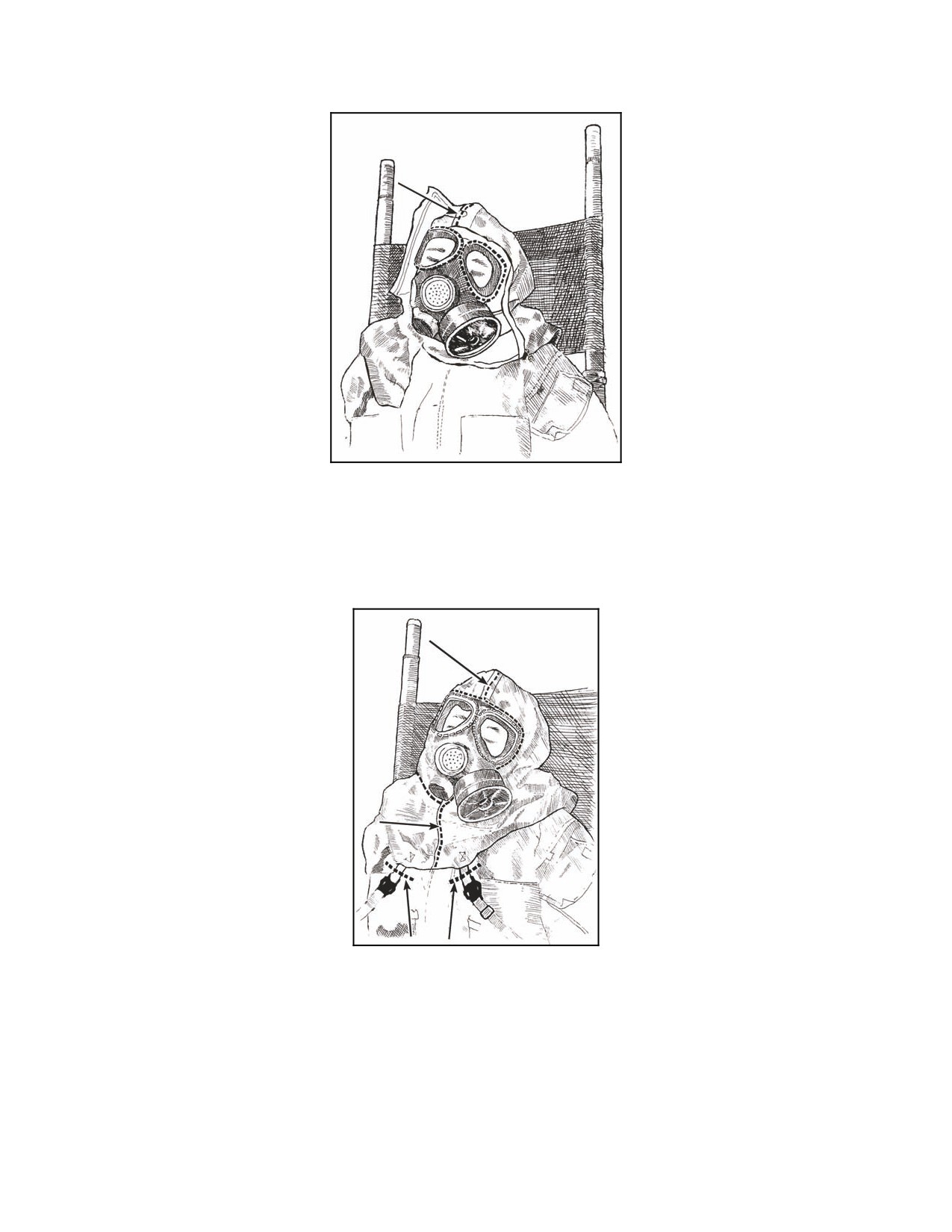
Figure V-2. Cutline for Hoods Integral to Overgarments
(2) For hoods attached to the mask, first unfasten or cut the shoulder straps. Then
begin cutting at the bottom front of the hood and cut up to the bottom of the mask. Then cut
any hood straps that connect the hood to the mask. Finally, cut from the center of the forehead,
over the top of the head (towards the litter) to the back of the head, so that the hood will lay flat
on the litter under the patient’s head. See Figure V-3 below.
Figure V-3. Cutline for Hoods Attached to Mask
d. Decontaminate Head. After the hood is laying flat on the litter under the patient’s head,
decontaminate any exposed areas of the patient’s head, hair, back of the ears, and neck that
were not protected by the hood. The mask remains on the patient. This exposed skin is
decontaminated using either the M291, soap and water, or
0.5 percent
(1/2 percent)
hypochlorite solution (least preferred). Do not use 5 percent hypochlorite solution on skin.
V-24
FM 4-02.7/MCRP 4-11.1F/NTTP 4-02.7/AFTTP 3-42.3
15 July 2009
e. Remove the Field Medical Card.
(1) The medical personnel at the litter patient decontamination area should view the
FMC prior to removal.
(2) Cut the patient’s FMC tie wire, allowing the FMC to fall into a self-sealing plastic
bag. Seal the plastic bag and decontaminate the outside of the bag with the M291, M295, or
rinse the outside of the bag with a 0.5 percent hypochlorite solution or soap and water for
radioactive contaminants. Place the plastic bag with the FMC under the back of the protective
mask head harness straps. The FMC will remain with the patient until at the hot line where it
will be transcribed on to a clean FMC.
f. Remove Patient’s Personal Effects from Overgarment. Remove all items from the
protective overgarment pockets and place them in a self-sealing plastic bag. Label the bag with
the patient’s identification and seal the bag. If the articles are not contaminated, place them in
a separate bag from suspected contaminated items. Wipe down the outside of the bag with the
M295 or dip it in a bucket of 5 percent hypochlorite solution. Dip in soap and water if the
contamination is radiological. The bags are sent on the litter with the patient and checked for
contamination at the contamination check area.
Note: The patient’s identification tags stay around the patient’s neck throughout the
decontamination process. They are decontaminated with M291, soap and water,
or 0.5 percent hypochlorite solution.
g. Cut the Patient’s Overgarment.
(1) The overgarment jacket and trousers may be cut simultaneously. Two persons
may be cutting clothing at the same time.
(2) Cutting is performed using sharp bandage scissors or long-handled seat belt
cutters (for example, V-blade knife). Three or more cutting tools are needed for each team
member who is cutting off patient clothing, as the tools typically become dull after cutting off the
garments of 5 patients.
(3) Cut around bandages, tourniquets, and splints, leaving them in place. Only
medical personnel remove bandages, tourniquets, and splints.
Note: Put the cutting device in a bucket of 5 percent hypochlorite solution after each
complete line of cut and get another cutting tool, which has been sitting in the
hypochlorite solution bucket, for the next cut. EXAMPLE: Cutting the sleeve from
the cuff to the jacket collar is one cut. If a bucket of 5 percent hypochlorite
solution is not available then the cutting tools must be scrubbed using the M295
or M291 between each cut or rinsed thoroughly in running soapy water.
CAUTION
Bandages may have been applied to control severe bleeding
and are treated like tourniquets. Only medical personnel
remove bandages, tourniquets, and splints.
h. Remove Overgarment Jacket.
(1) Unfasten or cut the hook and pile closures at the wrists.
15 July 2009
FM 4-02.7/MCRP 4-11.1F/NTTP 4-02.7/AFTTP 3-42.3
V-25
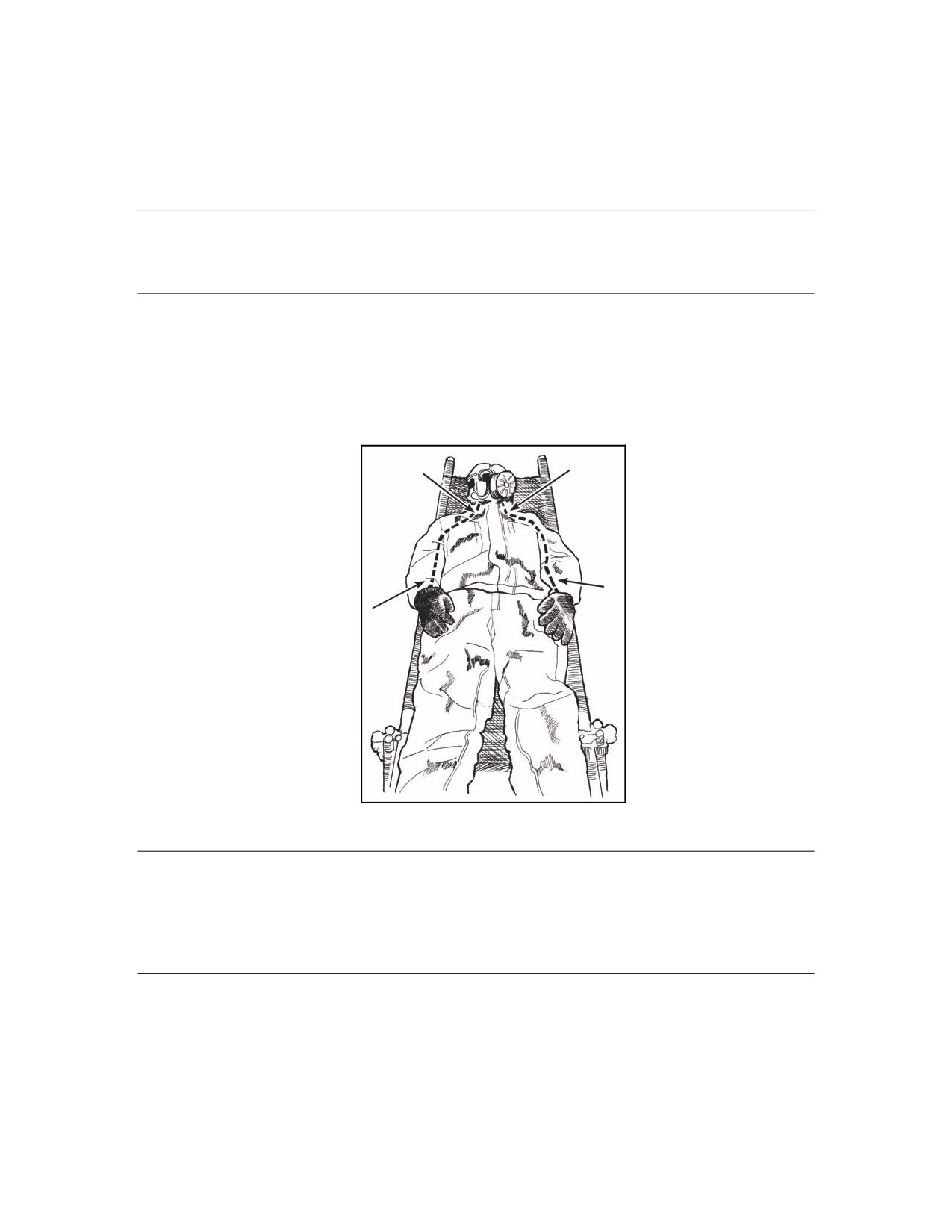
(2) Make a cut, one up each sleeve from the wrist to the shoulder and then to the
collar. Keep the cuts close to the insides of the arms so that most of the sleeve material is
folded outward. An alternative is to start at the collar and cut down the sleeve to the wrist. See
Figure V-4.
Note: It is essential that cutting tools be replaced as soon as they become dull. Dull
tools make cutting difficult and can aerosolize dried agent particles as material is
tugged by the cutting tool. A new cutting tool blade will be needed about every 5
patients.
(3) Cut the jacket drawstring at the bottom of the jacket and unfasten the hook and pile
closures, moving from the waist to the neck and then unzip the jacket. If the jacket will not
unzip then make a cut parallel to the zipper.
(4) Carefully fold the sleeves of the overgarment away from the patient’s arms,
exposing only the black liner. Avoid aerosolizing any dust particles on the garment or allowing
the outside of the garment to touch the patient.
Figure V-4. Cutline for Overgarment Jacket
Note: To reduce aerosolization of dry agent on the protective overgarment, the
overgarment can be lightly misted with water from a manually operated,
compressed air sprayer before the patient’s mask hood is removed or cutting
begins. This will dampen the dry agent which can reduce its aerosolization. The
spray from the mister must be very light so that it does not blow the dry agent
into the air.
(5) Instruct the patient to keep his hands to the sides, away from the pieces of
overgarment that are lying on his chest. If the patient is unable to lift his arms then one
decontamination team member will hold the patient’s gloved hand and perform this action.
Another team member then carefully folds the chest sections over the outside of the litter. The
patient’s arms are then lowered to the sides, keeping the arms away from the area where the
overgarment has been removed.
V-26
FM 4-02.7/MCRP 4-11.1F/NTTP 4-02.7/AFTTP 3-42.3
15 July 2009
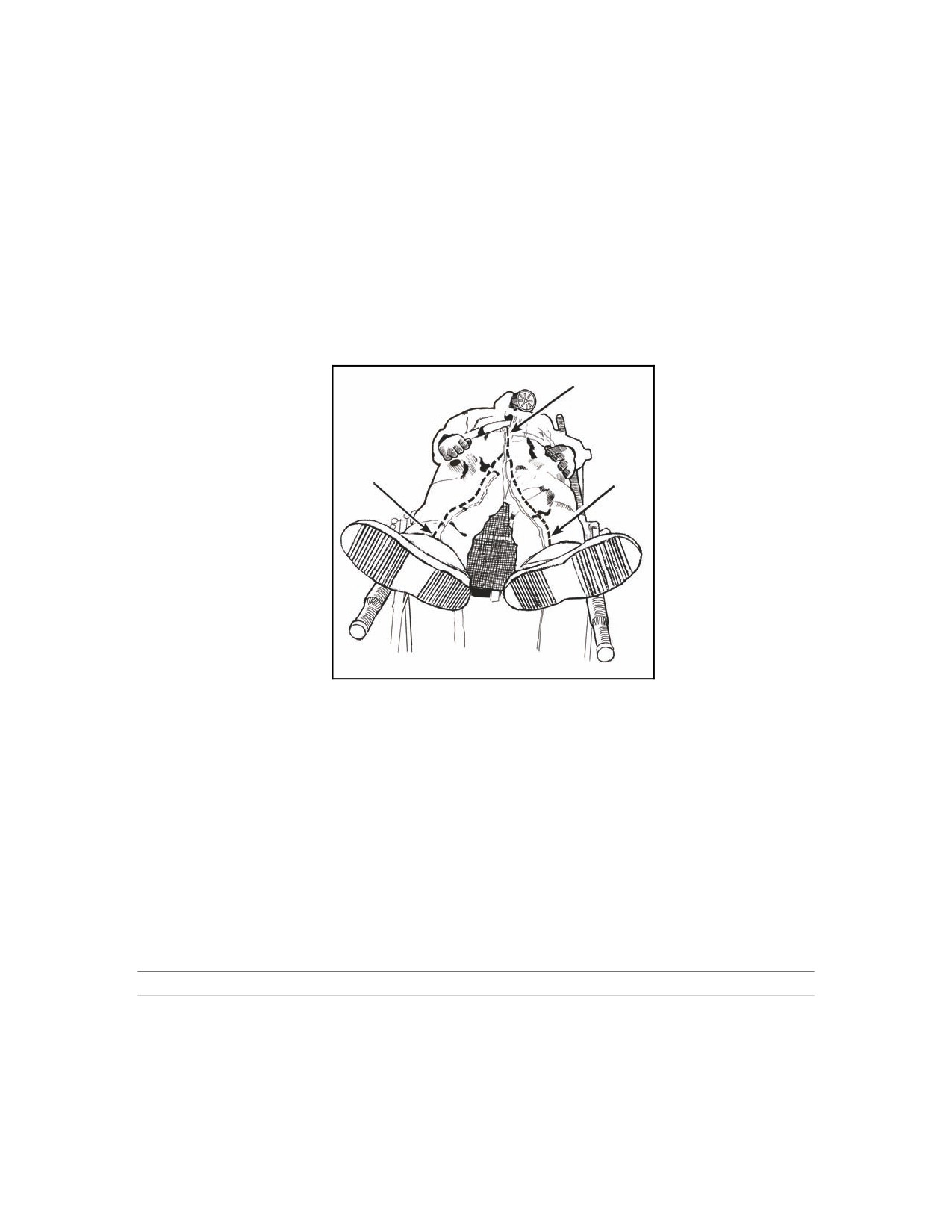
i.
Remove Overgarment Trousers.
(1) Cut the trouser suspenders.
(2) Cut the leg closure cord and hook and pile fasteners at the ankle cuff.
(3) Using the cutting tool, cut from the ankle along the inseam of the left trouser leg
until the crotch area is reached, and then cut across the zipper. An alternative is to start at the
waist and cut from the waist, along the inseam of the trousers, to the ankle cuff.
(4) Allow the trouser halves to drape over the sides of the litter. Carefully roll and tuck
the remaining cloth (at the crotch and on the inside of the legs) in on itself ensuring that only the
black liner of the cloth is showing. Contain any dust or liquid that may be on the outside of the
garment as you roll it. See Figure V-5 below.
Figure V-5. Cutline for Overgarment Trousers
j.
Remove Outer Gloves. This procedure can be done with one person on each side of the
patient working simultaneously. Do not remove the patient’s inner gloves (glove inserts) during
this step.
(1) The decontamination team members will decontaminate their gloves with the M295
or dipping them in a
5 percent hypochlorite solution or soap and water for radiological
contamination.
(2) Next, decontaminate the patient’s gloves with the M295, a 5 percent hypochlorite
solution or soap and water for radiological contamination.
(3) Instruct the patient to hold his arms away from the litter and upper body or, if he is
not able to do this then hold the patient’s gloves at the fingers.
Note: Always remove the patient’s gloves over the sides of the litter.
(4) Grasp the cuff of the rubber glove, turning the glove inside out, and remove it. See
Figure V-6 below.
15 July 2009
FM 4-02.7/MCRP 4-11.1F/NTTP 4-02.7/AFTTP 3-42.3
V-27
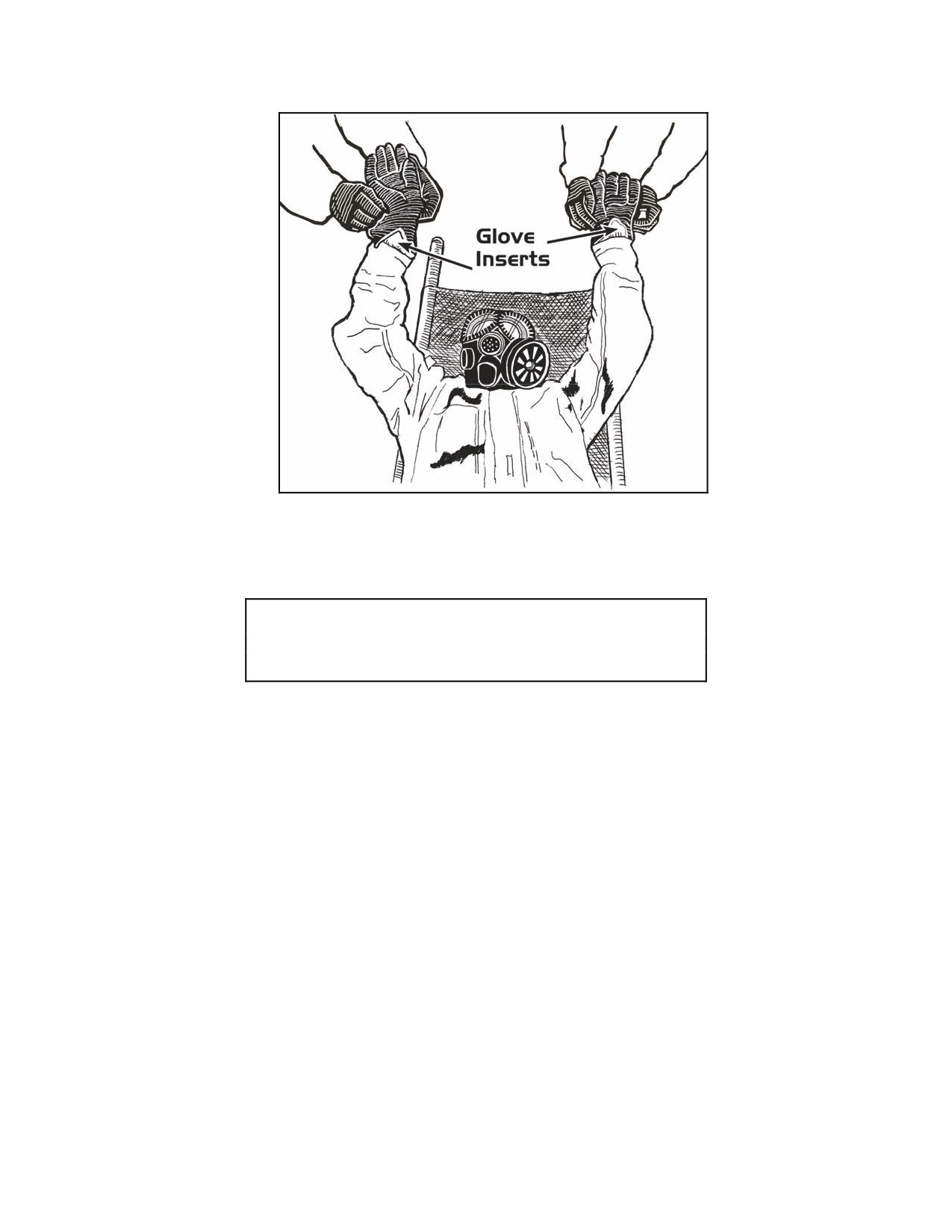
Figure V-6. Outer Gloves Removal
(5) Carefully lower the patient’s arms across his chest as each glove is removed.
Avoid touching the patient’s cloth glove liner or arm with your rubber glove.
CAUTION
Do not allow the patient’s arms to contact the exterior
(camouflage) side of the overgarment.
(6) Dispose of the contaminated rubber gloves by placing them in the designated
contaminated trash bag.
(7) Decontamination team members then decontaminate their own gloves with the
M295, or dipping them in a 5 percent hypochlorite solution, or use soap and water for
radiological contamination.
k. Remove Overboots.
(1) Unfasten the boot closures.
(2) If the overboot will not come off, cut the boot from top to bottom along the
centerline of the boot or along the inside of the boot. Fold the overboot down and gently pull on
the heel until the boot is removed.
(3) If the older laced overboot is worn, then cut the overboot laces and fold the lacing
eyelets flat outwards, and then remove the boot as noted above.
(4) Remove the two overboots simultaneously. This reduces the likelihood of
contaminating one of the combat boots. While holding the heels off the litter, have a
decontamination team member wipe the end of the litter with the M295 or
5 percent
hypochlorite solution to neutralize any liquid chemical contamination that was transferred to the
litter from the overboots. Soap and water can be used for radiological contamination.
(5) Lower the patient’s heels onto the decontaminated litter.
V-28
FM 4-02.7/MCRP 4-11.1F/NTTP 4-02.7/AFTTP 3-42.3
15 July 2009
(6) Place the overboots in the contaminated trash.
(7) Decontamination personnel dip their gloves in the
5 percent hypochlorite
(full
strength household liquid bleach) solution.
l.
Remove the Patient’s Personal Effects from his battle dress overgarment (BDO) or other
work uniform (that is, battle dress uniform [BDU]/Army combat uniform [ACU]) pockets. Place
personal effects in a self-sealing plastic bag. This can be the same bag used for items taken
from the overgarment pockets if they were not contaminated, otherwise place these items in a
separate bag. Seal the bag. A card with the patient’s name and identification number must be
placed inside the bag. Decontaminate the outside of the bag. Keep the bag with the patient or
send it to a contaminated-item holding area where the items in it can be decontaminated or
properly inventoried and disposed of.
m. Remove Combat Boots. Cut the bootlaces along the tongue. Remove the boots by
pulling them towards you. Place the boots in the designated contaminated waste bag. Do not
touch the patient’s skin with contaminated gloves when removing his boots.
n. Remove Inner Clothing.
(1) Decontamination team members decontaminate their gloves and cutting tools.
(2) Cut or unbuckle the uniform belt.
(3) Cut the uniform jacket and trousers
(such as work uniform) worn under the
protective overgarment in the same manner as described above for the protective overgarment.
Roll the jacket and trousers as described for the protective overgarment.
Note: For litter patient decontamination in a PDS, removal of inner clothing immediately
follows removal of overgarment and both take place before the first patient lift.
For shipboard decontamination the inner clothing is not removed until the patient
enters the ship’s first compartment. Once in the first compartment the same
clothing cut off procedures noted above are used.
o. Remove Undergarments.
(1) Remove the patient’s T-shirt. Dip the cutting device in the 5 percent hypochlorite
solution between each cut. Cut both sleeves from the inside, starting at the elbow, up to the
armpit. Continue cutting across the shoulder to the collar. Cut around bandages or splints,
leaving them in place. Next, peel the T-shirt away from the body to avoid spreading
contamination.
(2) If the patient is wearing a brassiere, cut it between the cups. Cut both shoulder
straps where they attach to the cups and lay them back off of the shoulders.
CAUTION
The cutting tools must be decontaminated frequently
(after each cut) to keep any contamination from
contacting the patient’s bare skin.
(3) Remove the patient’s undershorts/panties by cutting from the lower side of the hip
to the waist on both sides. Fold the front flap of the shorts/panties down between the patient’s
legs onto the litter. Do not allow the outside of the garment to touch the patient’s skin.
(4) Remove the socks and cotton glove liners.
15 July 2009
FM 4-02.7/MCRP 4-11.1F/NTTP 4-02.7/AFTTP 3-42.3
V-29
(5) Remove the patient’s inner cotton gloves. Keep the patient’s arms crossed over
the chest if possible.
(6) Do not remove the patient’s identification tags. These stay with the patient at all
times. If not yet decontaminated then decontaminate the tags with the M291 or soap and water.
13. Ambulatory Patient Mask, Protective Ensemble, and Clothing Removal
Procedures
a. General. The step-by-step procedure outlined below describes the process for removing
the clothing of the ambulatory patient. By using this method the correct and essential steps are
not omitted. The focus is to carefully remove the overgarment so that cross-contamination from
the protective ensemble to the patient’s skin does not occur.
• This same clothing cut off procedure is used in all types of ambulatory patient
decontamination settings.
• Monitoring for contamination may differ depending on the agent and the
decontamination assets/equipment available.
• Bandages, splints, and tourniquets are only removed by medical personnel
(medic/corpsman, physician, nurse, and physician assistant). A buddy or augmentee
will cut around bandaged areas.
• One or more litter stands or chairs will be needed in the ambulatory decontamination
area to help the patients steady themselves while having their clothing cut off (Note:
These are not used on deck during shipboard patient decontamination as they can
cause a safety hazard).
b. Decontaminate the Mask and Hood.
(1) Wipe/sponge down the voicemitter, eyelets and outserts with the M295 or 5 percent
hypochlorite solution.
(2) While wiping around the filter, cover the inlet of the C2A1 canister with a hand or
gauze momentarily to keep liquid out of the inside of the canister where it could wet the
charcoal, reduce filter efficiency, and clog the filter.
(3) Hoods are of two types: those that are part of the overgarment and those that are
attached to the mask.
(4) For integral hoods that are part of the overgarment, such as the JSLIST, no
decontamination of this hood is necessary.
(5) For quick-doff hoods attached to the mask, first wipe down the hood using 5
percent hypochlorite solution, wiping the mask, and then the hood (starting at the top of the
head wiping down towards the shoulders).
c. Remove Hood.
(1) Remove the quick-doff hood of the M40 mask.
(a) Dip the cutting device in a bucket of
5 percent hypochlorite solution or
decontaminate/scrub the cutting tool with the M295.
(b) Cut the hood shoulder straps.
(c) Cut the neck cord, hood straps, and drawstring.
(d) Cut the quick-doff hood from the front bottom center up to the chin through the
elastic band under the chin.
V-30
FM 4-02.7/MCRP 4-11.1F/NTTP 4-02.7/AFTTP 3-42.3
15 July 2009
(e) Carefully roll back the hood away from the shoulders, keeping the outside of
the hood away from the patient’s skin and hair.
(f)
Cut the hood straps that connect the hood to the mask.
(g) Place the hood in the designated contaminated trash bag.
(2) Remove the Hood of the JSLIST.
(a) Dip the cutting device in a bucket of
5 percent hypochlorite solution or
decontaminate/scrub the cutting tool with the M295.
(b) Cut the hood starting at the front center and continue cutting across the top of
the head toward the back.
(c) Fold the left and right sides of the hood away from the head and place on the
shoulders. With an ambulatory patient the hood will lie on the shoulders of the individual.
Note: To cut the hood and the overgarment use sharp bandage scissors or a long
handled seat belt cutter. Replace the cutter blades and scissors when they no
longer make a smooth cut. Typically after cutting 5 complete uniforms/protective
clothing, blades or scissors will need to be replaced. This is evident when the
blades snag on the clothing and do not cut smoothly. After every complete
segmental cut, decontaminate the scissors and long handled seat belt cutter
along with the gloved hands of the Service member doing the cutting. This is
done by dipping gloved hands and cutting tools in a bucket of
5 percent
hypochlorite solution. If water is limited, scrub the tools with the M295. Use
soap and water for radioactive contamination.
d. Decontaminate Head.
(1) Use soap and water, M291, or 0.5 percent hypochlorite solution (least preferred).
Soap and water is appropriate for radioactive contamination.
(2) Cover inlet port of filter canister to prevent wetting or congesting it. The patient
continues to wear their mask until they cross the VCL.
(3) Wipe any exposed areas of the patient’s face that were not protected by the hood.
This include the—
• Chin.
• Neck.
• Back of ears.
Note: After completing the hood removal, instruct the patient to move to the next station
for the following steps. This station should be 10 to 20 meters upwind from the
hood removal station for field decontamination with minimal resources. For
plumbed tent systems all mask hood and clothing removal takes place in the
clothing cut-off area. On ship, this takes place on the deck before movement into
the first compartment.
e. Remove the Field Medical Card.
(1) The medical personnel at the litter patient decontamination area should view the
FMC prior to removal.
(2) Cut FMC tie wire.
15 July 2009
FM 4-02.7/MCRP 4-11.1F/NTTP 4-02.7/AFTTP 3-42.3
V-31