FM 44-80 VISUAL AIRCRAFT RECOGNITION (30 September 1996) - page 1
FIELD MANUAL
*FM 44-80
No. 44-80
Headquarters
Department of the Army
Washington, DC, 30 September 1996
DISTRIBUTION RESTRICTION: Approved for public release. Distribution is unlimited.
*This publication supersedes FM 44-80, 20 July 1993.
Cover
Acknowledgements
FM 44-80 VISUAL AIRCRAFT RECOGNITION
PREFACE
This manual is primarily a ready reference to assist the ground observer in aircraft recognition and identification.
It provides information on current operational aircraft of the United States and foreign countries, which may be
observed worldwide in the combat area. It can be used as source material for personnel conducting unit training in
visual aircraft recognition.
The procedures in this publication apply throughout the US Army. The data is based on the best information
available at the time of publication; however, it is not all-inclusive because of some classification guidelines. This
publication, by nature, has a built-in time lag, and some aircraft may still be under development or classified at the
time of writing, but may be fielded or unclassified at, or after, publication.
The provisions of this publication are the subject of international agreement QSTAG, 699, Aircraft Recognition
Training.
The proponent of this publication is USAADASCH. Submit changes for improving this publication on DA Form
2028 and forward it to Commandant, US Army Air Defense Artillery School, ATTN: ATSA-DT-T, Fort Bliss, TX
79916-3802.
Unless this publication states otherwise, masculine nouns and pronouns do not refer exclusively to men.
CONTENTS
*FM 44-80
30 September 1996
Chapter 1 - Need for Visual Aircraft Recognition
Chapter 2 - Factors That Affect Detection, Recognition, and Identification
Chapter 3 - Description of Aircraft
Chapter 4 - Instruction Program
Chapter 5 - Ground Attack, Close Air Support, and Fighter-Bomber Aircraft
Chapter 6 - Air Superiority and Interceptor Aircraft
Chapter 7 - Bomber Aircraft
Chapter 8 - Cargo and Transport Aircraft
Chapter 9 - Utility Aircraft
Chapter 10 - Helicopter Aircraft
Chapter 11 - Early Warning, Observation, and Reconnaissance Aircraft
Chapter 12 - Unmanned Aerial Vehicles and Cruise Missles
Appendix - Master Aircraft List
Glossary
References
DISTRIBUTION RESTRICTION: Approved for public release. Distribution is unlimited.
*This publication supersedes FM 44-80, 20 July 1993.
ACKNOWLEDGEMENTS
The US Army Air Defense Artillery School wishes to thank the following persons and organizations/corporations
who have provided and/or given permission to use their photographs in this manual and other US Army aircraft
recognition products. This furnished material should be used for training purposes only. Some of the
organizations/corporations have reorganized, combined, renamed, or have been dissolved since their submissions.
If you have aircraft photographs (to include unmanned aerial vehicles) that you would like to include in the next
edition of this manual and/or other US Army visual aircraft training products, please forward them, with
release/permission to use the photographs, to Commandant, US Army Air Defense Artillery School, ATTN:
ATSA-DT-T, Fort Bliss, TX 79916-3802.
CHAPTER 1
Need for Visual Aircraft Recognition
This chapter provides the causes for the decline in recognition skills in the past, the reasons for visual aircraft recognition today, and an
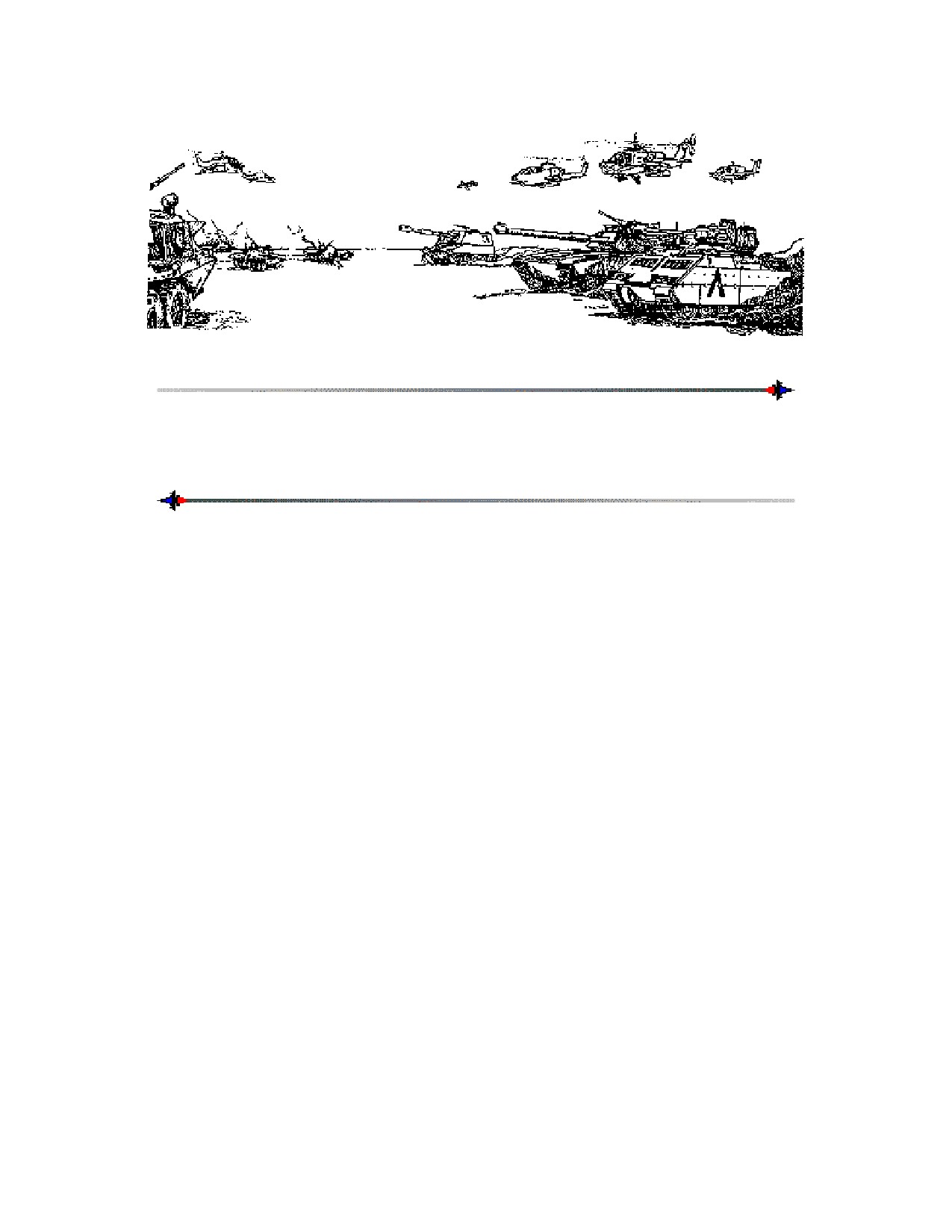
overview of the potential threat. Aircraft are as much a part of the battlefield as tanks and artillery. These aircraft add a vertical
dimension and their presence must be accepted and dealt with by every soldier in the field.
On today’s battlefield, a soldier must recognize and identify both threat and friendly aircraft. Since there may be many of each type,
aircraft recognition training is necessary for every soldier in the combat force.
REASONS FOR VISUAL AIRCRAFT RECOGNITION
Following World War II, the emphasis on visual aircraft recognition declined as a required skill for ground-based weapons crew
members. Causes of the decline were—
• The substitution of guided missiles for large antiaircraft guns.
• The assumption that US forces would continue to maintain air superiority.
• The reliance on electronic equipment for aircraft identification as hostile or friendly.
The need for visual aircraft recognition skills has become more critical since—
• An analysis of past military actions shows aircraft losses to air defense guns and small arms. It has reestablished that the soldier on the
ground is capable of inflicting heavy losses on aircraft operating at low altitudes.
• Continued air superiority over every battlefield is not possible.
• Electronic identification has limitations and small units or individual soldiers do not always have access to these devices.
• Visual recognition and identification of specific aircraft types and timely reporting provide the S2 and G2 additional information of a
passive nature in the form of early warning, threat air capability, or information on a possible new tactical situation such as supply
drops, defoliation, or photographic reconnaissance.
The provision of large numbers of AD weapon systems to all divisional and some nondivisional ground combat forces generates
additional emphasis on the need for visual aircraft recognition. Crew and team members of these weapon systems depend on visual
recognition and identification of aircraft when making engagement decisions. The effectiveness of
CHAPTER 2
Factors That Affect Detection, Recognition, and Identification
This chapter covers early recognition and identification, aircraft confusion, physical factors, and search techniques. It also covers
markings and camouflage, the use of binoculars, and other recognition considerations.
Every attempt made at visual aircraft recognition involves two events. First, an aircraft must be detected. Second, the aircraft must be
inspected to distinguish the characteristics or shape that makes it recognizable as a particular aircraft.
Since detection, identification, and recognition are all visual processes, an aircraft must be detected, and then recognized at the farthest
range possible, to make a timely engagement decision and or to report the aircraft. The task requires good, corrected if necessary,
eyesight.
EARLY AIRCRAFT RECOGNITION AND IDENTIFICATION
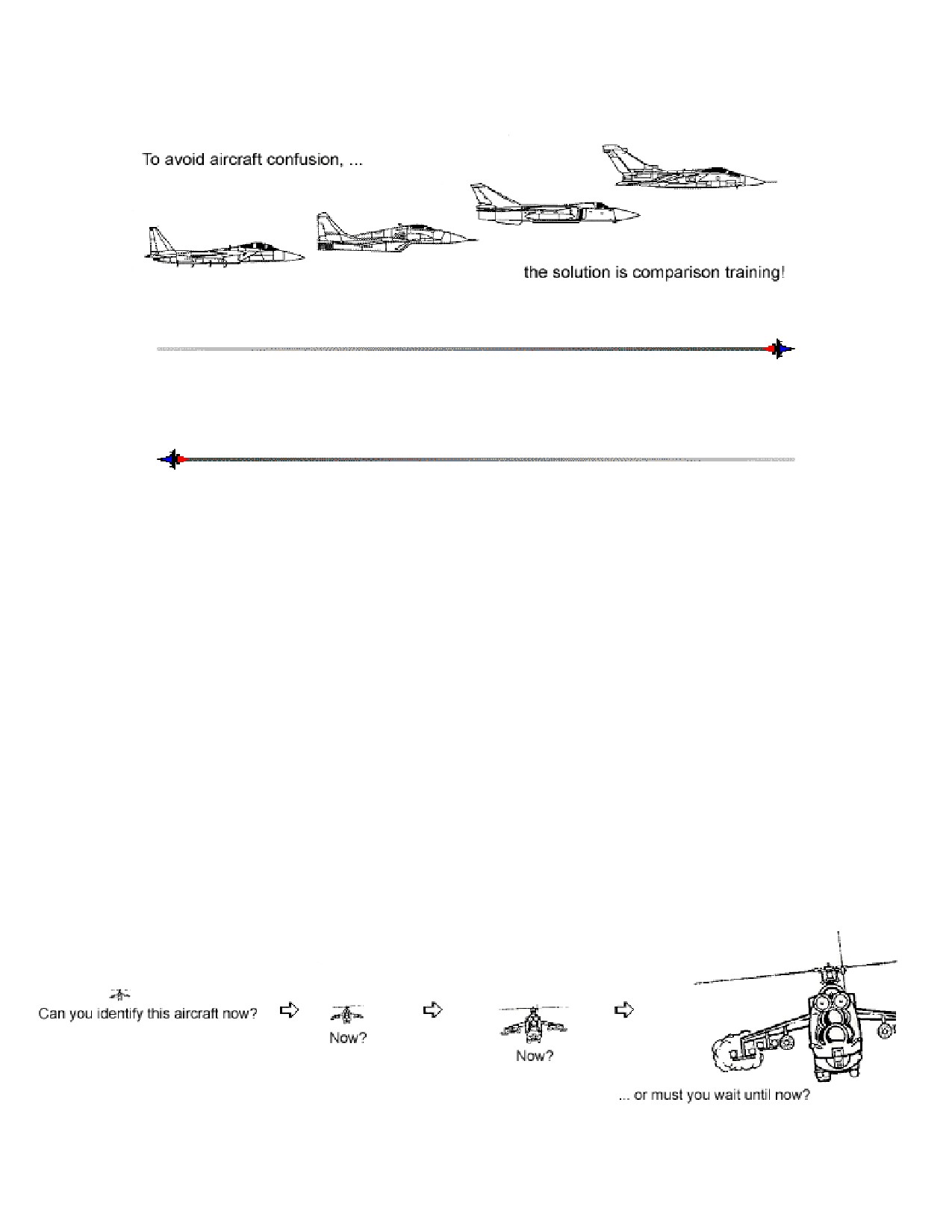
The farther out an aircraft can be detected, recognized, and identified, the more time a gunner has to make an engagement decision. If
the gunner is not going to engage the aircraft, then early recognition and identification will allow time to seek cover and or report the
aircraft. The importance of early identification is demonstrated in the following illustration.
CHAPTER 3
Description of Aircraft
This chapter shows the features of aircraft that make recognition and identification possible, and sorts out similar and dissimilar aircraft.
Additionally, it shows examples of how aircraft are named and or numbered.
All of the possible aircraft configurations are not covered in this chapter. When instructing aircraft recognition, an instructor or small
unit leader can follow the descriptive methods used in the examples and derive his own descriptions for features or configurations that
are not covered in the text.
AIRCRAFT RECOGNITION AND IDENTIFICATION FEATURES
All aircraft are built with the same basic elements: wings to provide lift, engine(s) to provide motive power, a fuselage to carry the
payload and controls, and a tail assembly which usually controls the direction of flight. These elements differ in shape, size, number,
and position. The differences distinguish one aircraft type from another. An instructor can isolate the individual components for
description and study as separate recognition and identification features, but it is the composite of these features that must be learned to
recognize and identify an aircraft. The WEFT Features illustration shows wings, engine(s), fuselage, and tail features of aircraft. Allied
countries may teach more or fewer features of aircraft in their recognition and identification programs.
WEFT FEATURES
WINGS
ENGINES
FUSELAGE
TAIL
Type
Type
Shape
Location
Position
Number
Nose
Slant
Slant
Location
Mid
Number
Shape
Intakes
Rear
Shape
Taper
Exhausts
Cockpit
Special
CHAPTER 4
Instruction Program
This chapter describes training methods and the fundamentals of VACR. In addition, the chapter features training aids and slide kit
training which are used to develop and implement aircraft recognition training.
All soldiers are required to recognize a selected number of threat and friendly aircraft for survival and intelligence gathering. When the
mission is to defend the airspace above the battlefield to protect friendly assets, the ability to recognize and identify aircraft becomes
even more important. These skills make it possible to discriminate between friendly and hostile aircraft by name and or number and
type which will help avoid destruction of friendly aircraft, and at the same time, recognize, identify, and engage hostile aircraft.
TRAINING PROGRAM
Aircraft recognition and identification proficiency skills are gained through training. The training functions of plan, prepare, present,
practice, and perform are the same in VACR training as for other classroom subjects. The skill level to which the unit will train depends
on the unit’s mission. A VACR training program should be based on established training methods, clearly defined individual skill levels
that must be met, and the fundamentals of VACR.
CHAPTER 5
Ground-Attack, Close Air Support,
and Fighter-Bomber Aircraft
In this chapter, there are examples of both hostile and friendly ground-attack, CAS, and fighter-bomber aircraft. These aircraft will
perform a variety of missions to include reconnaissance and interdiction in the forward areas.
Most aircraft shown can and will perform several roles. For example, the F/A-18 Hornet and MiG-21 Fishbed are used in many roles,
depending on the model and type of the aircraft. For the most part, all the aircraft depicted here will be seen performing missions over
the modern battlefield.
For each aircraft, there are line drawings, general data, WEFT descriptions, user countries, photographs, and aircraft manufacturer
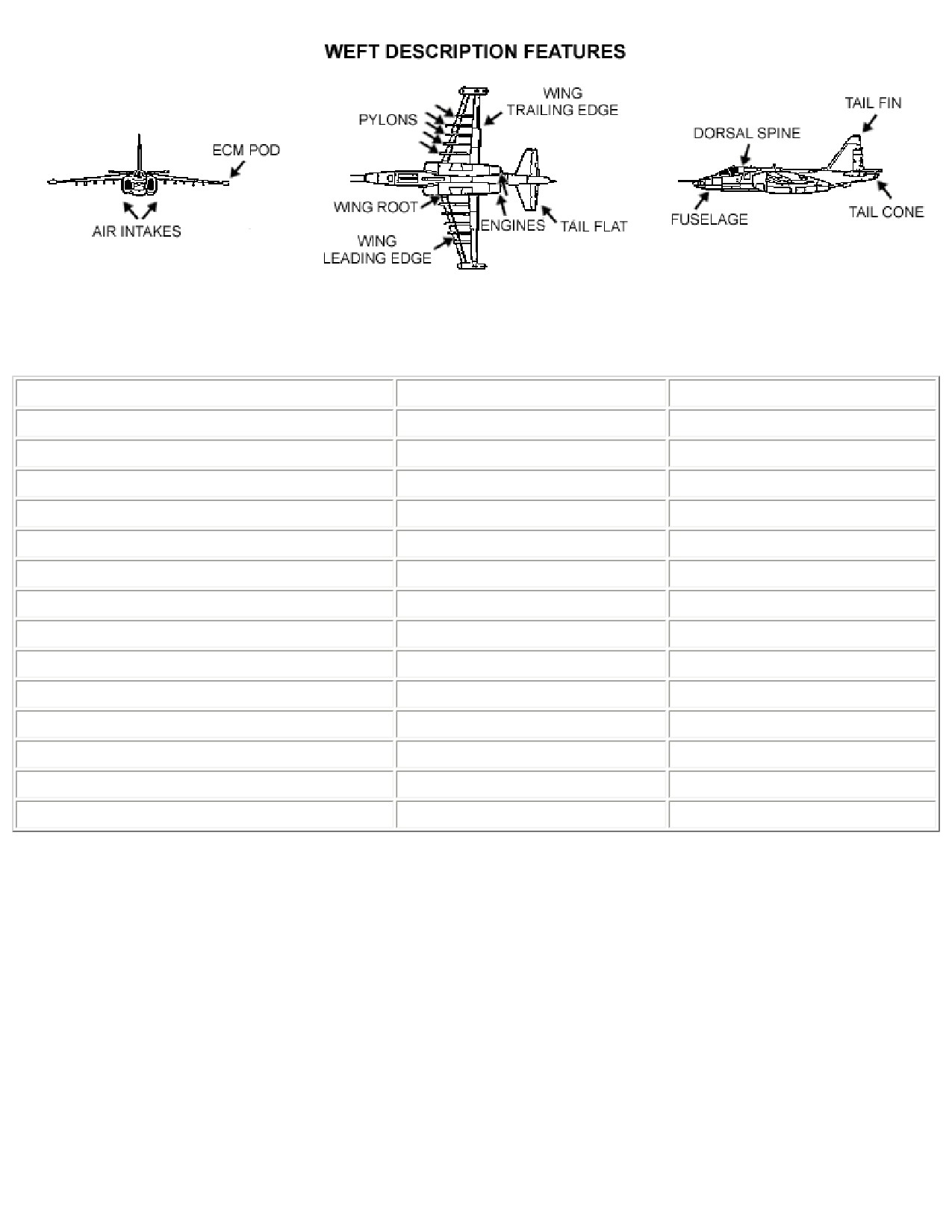
information. Line drawings are not to scale. The following illustration shows general-attack, CAS, and fighter-bomber aircraft WEFT
description features.
Chapter 5 Aircraft List
A-4 Skyhawk
F-104 Starfighter
MiG-27 Flogger D,J
A-6 Intruder
F-111 Aardvark
MiG-29 Fulcrum
A-7 Corsair II
F-117A Night Hawk
Mirage III/5
A-10A Thunderbolt II
Fantan A, Q-5
Mirage F1
A-37 Dragonfly
G.91Y
SF.260W
Alpha Jet
Galeb/Jastreb
Su-7B Fitter A
AMX
Hawk
Su-17,-20,-22 Fitter
AV-8B Harrier II
Jaguar
Su-24 Fencer
Buccaneer
Kfir
Su-25 Frogfoot
Draken
L-39 Albatross
Super Etendard
F-1
Magister CM.170
Tornado IDS
F-4 Phantom II
M.B. 326
Viggen AJ-37
F-5 Freedom Fighter/Tiger II
M.B. 339A
Yak-28 Brewer
F-16 Fighting Falcon
MiG-17 Fresco
Yak-38 Forger
F/A-18 Hornet
MiG-21 Fishbed
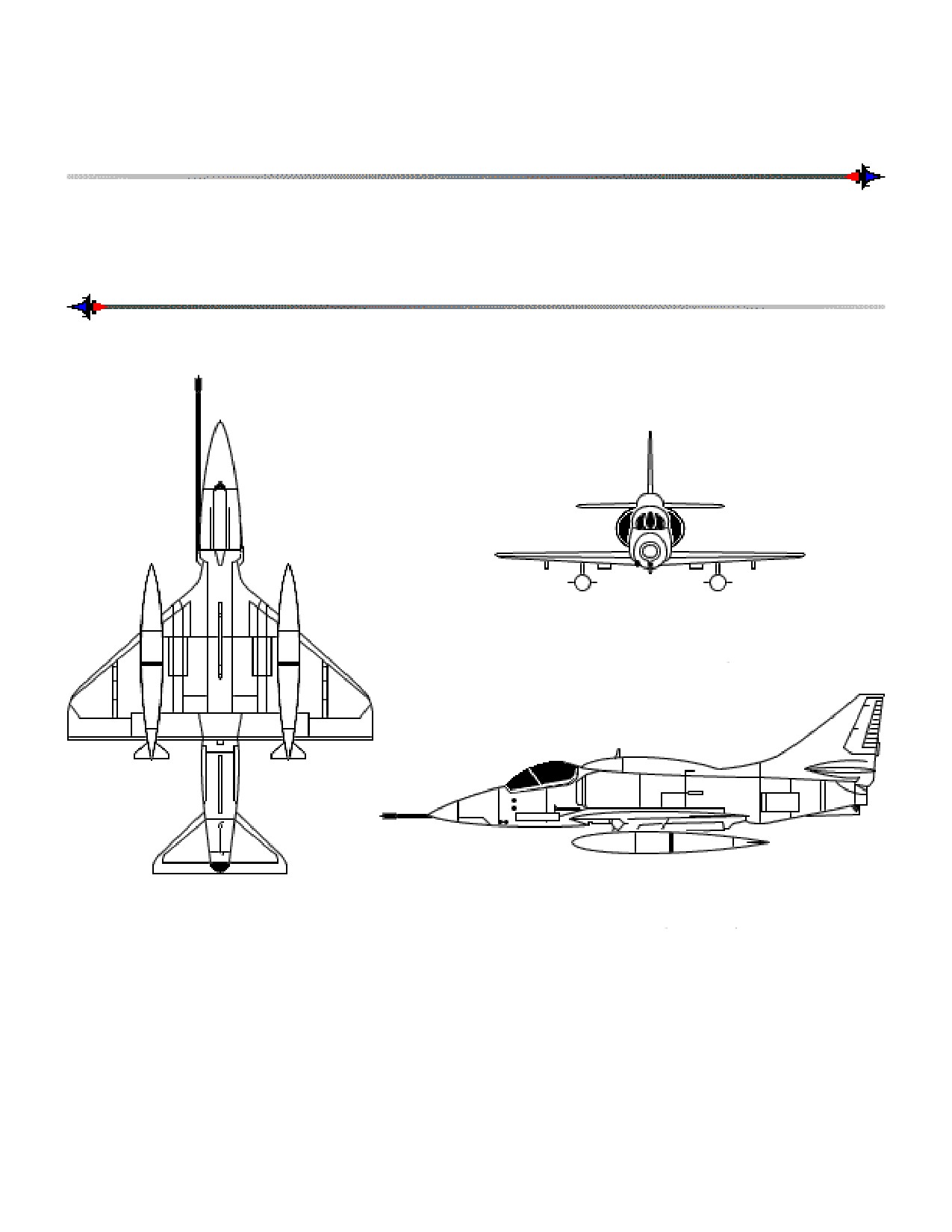
A-4 SKYHAWK (McDONNELL DOUGLAS)
GENERAL DATA
Country of Origin. USA.
Similar Aircraft. Hawk, Mirage III/5, Yak-38 Forger, F-4 Phantom II.
Crew. One; Trainer--two.
Role. Attack, CAS.
Armament. Bombs, rockets, missiles, gun pods, two cannons.
Dimensions. Length: 40 ft, 3 in (12.28 m). Span: 27 ft, 6 in (8.38 m).
WEFT DESCRIPTION
Wings. Low-mounted delta with curved tips.
Engine(s). Single turbojet inside body. Air intakes semicircular and mounted on the body above and
forward of the wings' leading edges.
Fuselage. Barrel-shaped with solid, pointed nose. Humped dorsal spine. Body widens at air intakes and
tapers to the rear. Bubble canopy. Some versions have an extended nose.
Tail. Delta-shaped tail flats mounted low on a swept-back, tapered tail fin with a square tip.
USER COUNTRIES
Argentina, Indonesia, Israel, Kuwait, Malaysia, New Zealand, Singapore, USA.
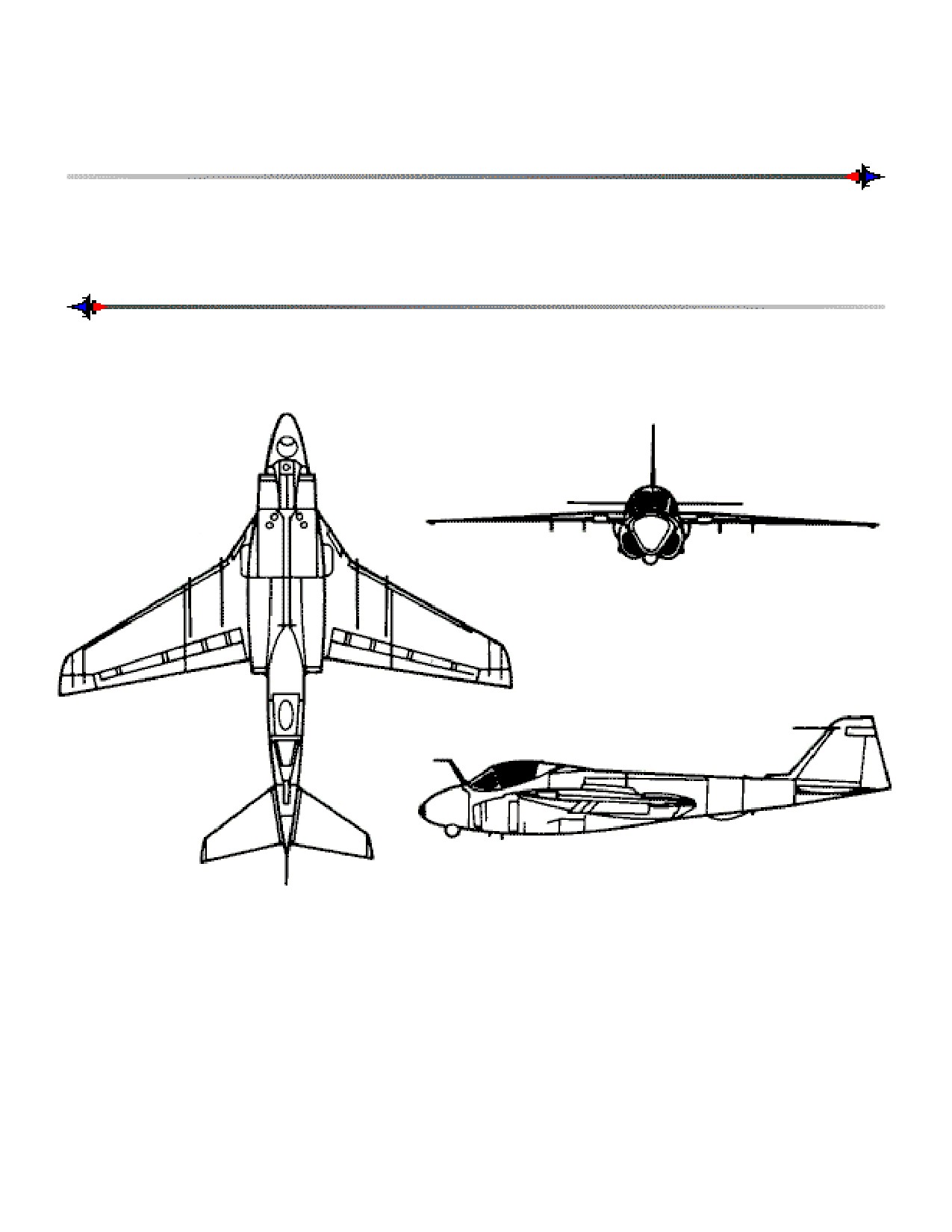
A-6 INTRUDER (GRUMMAN)
GENERAL DATA
Country of Origin. USA.
Similar Aircraft. Hunter.
Crew. Two.
Role. US Marine Corps all-weather attack bomber, tanker.
Armament. Bombs, missiles.
Dimensions. Length: 54 ft, 7 in (16.64 m). Span: 53 ft (16.15 m).
WEFT DESCRIPTION
Wings. Mid-mounted, swept-back, and tapered with blunt tips.
Engine(s). Two turbojets mounted on body midsection. Semicircular air intakes below and forward of the
wing roots. Exhausts are in the trailing edges of the wing roots.
Fuselage. Teardrop-shaped with a rounded nose. Body tapers to the rear section. Bubble canopy.
Tail. Unequally tapered tail fin with a square tip and small, stepped fairing in the leading edge. Swept-
back, tapered tail flats, high-mounted on the fuselage with blunt tips.
USER COUNTRY
USA
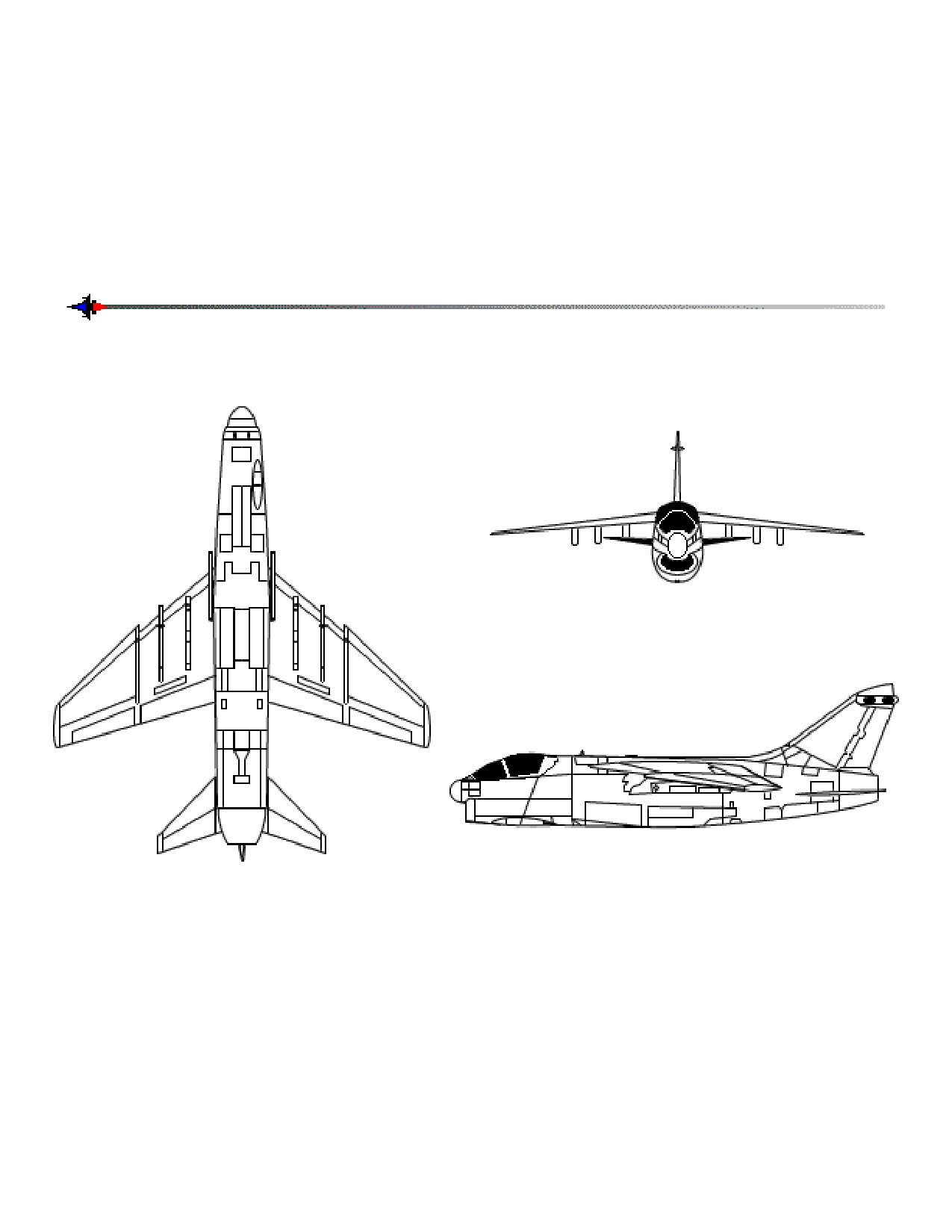
A-7 CORSAIR II (VOUGHT)
GENERAL DATA
Country of Origin. USA.
Similar Aircraft. F-16 Fighting Falcon, G-91Y, Su-17 Fitter.
Crew. One; TA-7H and A-7K--two.
Role. Attack, CAS.
Armament. Bombs, rockets, missiles, cannon, gun pods.
Dimensions. Length: 46 ft (14.06 m ). Span: 38 ft, 8 in (11.8 m).
WEFT DESCRIPTION
Wings. High-mounted, swept-back, and tapered with blunt tips and a negative slant. Sawtooth in the
leading edges on some models.
Engine(s). One turbofan inside the body; oval air intake under a round nose. Single exhaust.
Fuselage. Wide, thick body with rounded nose and blunt tail section. Bubble canopy is located well
forward on the nose.
Tail. Flats mid-mounted on the body, swept-back and tapered, with a positive slant. The fin is swept-
back with a curved tip.
USER COUNTRIES
Greece, Portugal, USA.
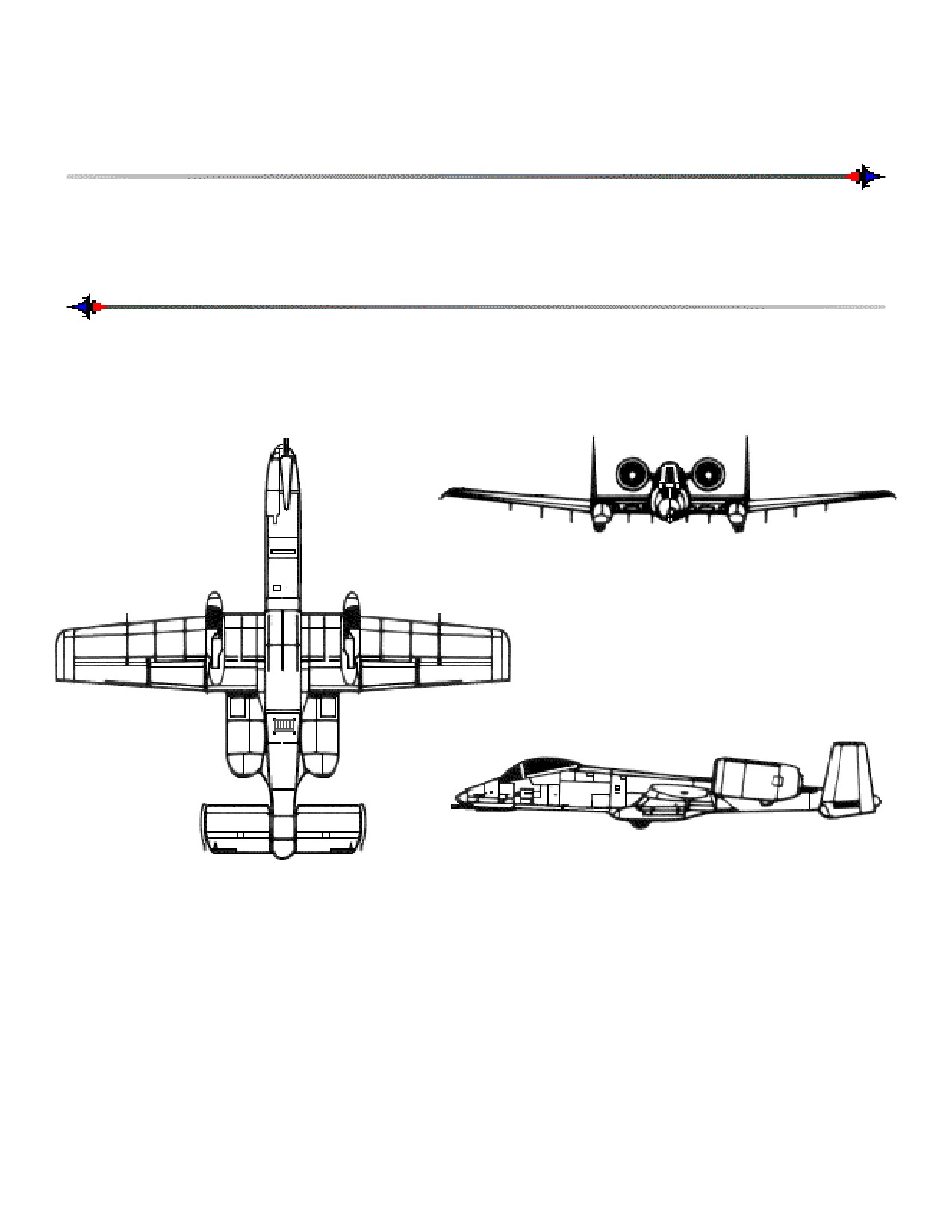
A-10A THUNDERBOLT II (FAIRCHILD REPUBLIC)
GENERAL DATA
Country of Origin. USA.
Similar Aircraft. None, but compare with the Su-25 Frogfoot.
Crew. One.
Role. CAS, ground attack.
Armament. 30-mm cannon, bombs, rockets, Hellfire missiles, gun pods.
Dimensions. Length: 53 ft, 4 in (16.27 m). Span: 57 ft, 6 in (17.54 m).
WEFT DESCRIPTION
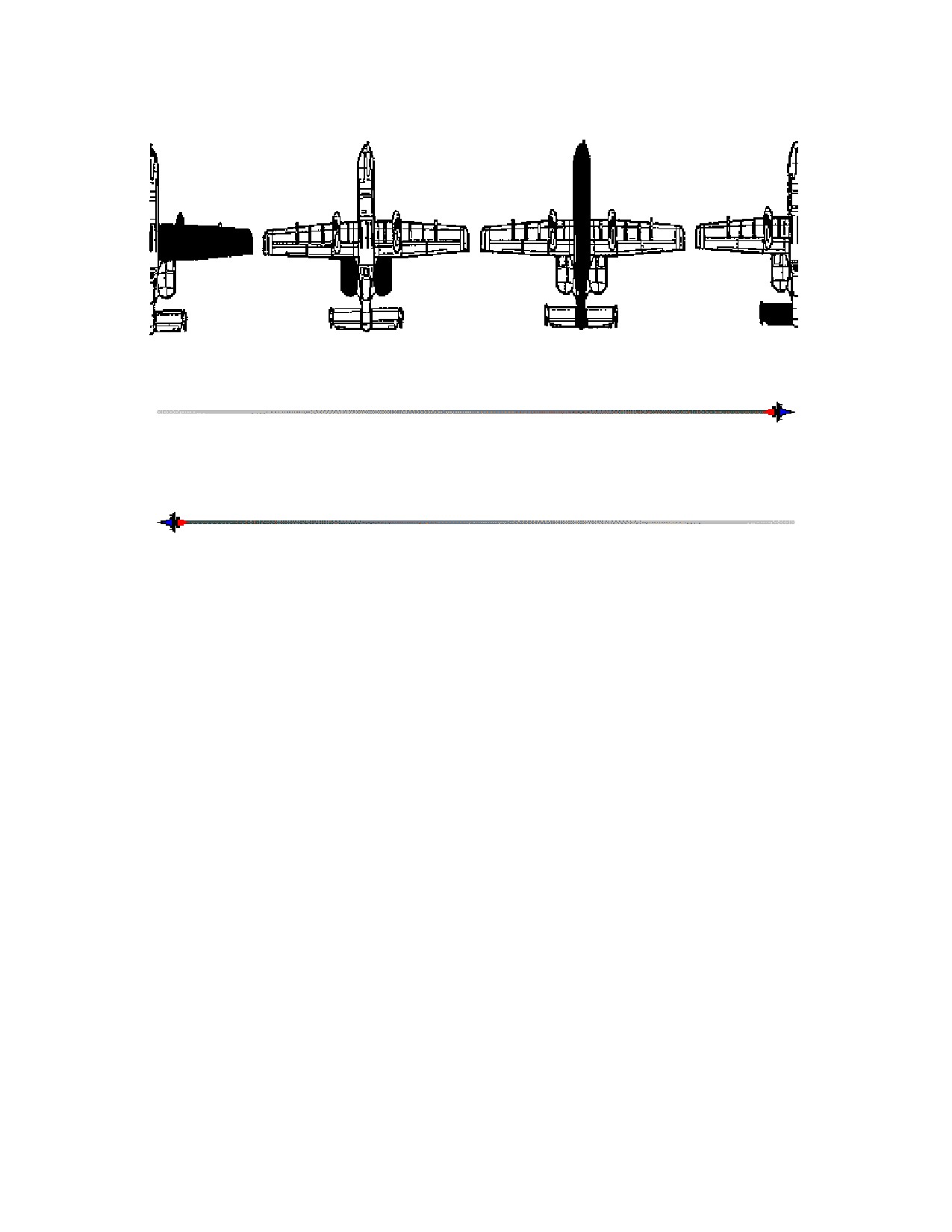
Wings. Low-mounted on the fuselage, untapered to the wheel pods, and equally tapered from the wheel
pods to the blunt, curled under tips. Landing gear pods are under the wings.
Engine(s). Two turbofan engines in pods, mounted high on the rear of the body between the wings and
the tail section.
Fuselage. Rounded nose, tapered rear, bubble canopy. Protrusion in the left side of the nose section is the
30-mm GAU-8 cannon.
Tail. Two tail fins on the tips of a rectangular tail flat; unequally tapered fins extend above and below the
tail flat. Flat is low-mounted on a sharply tapered rear fuselage.
USER COUNTRY
USA.
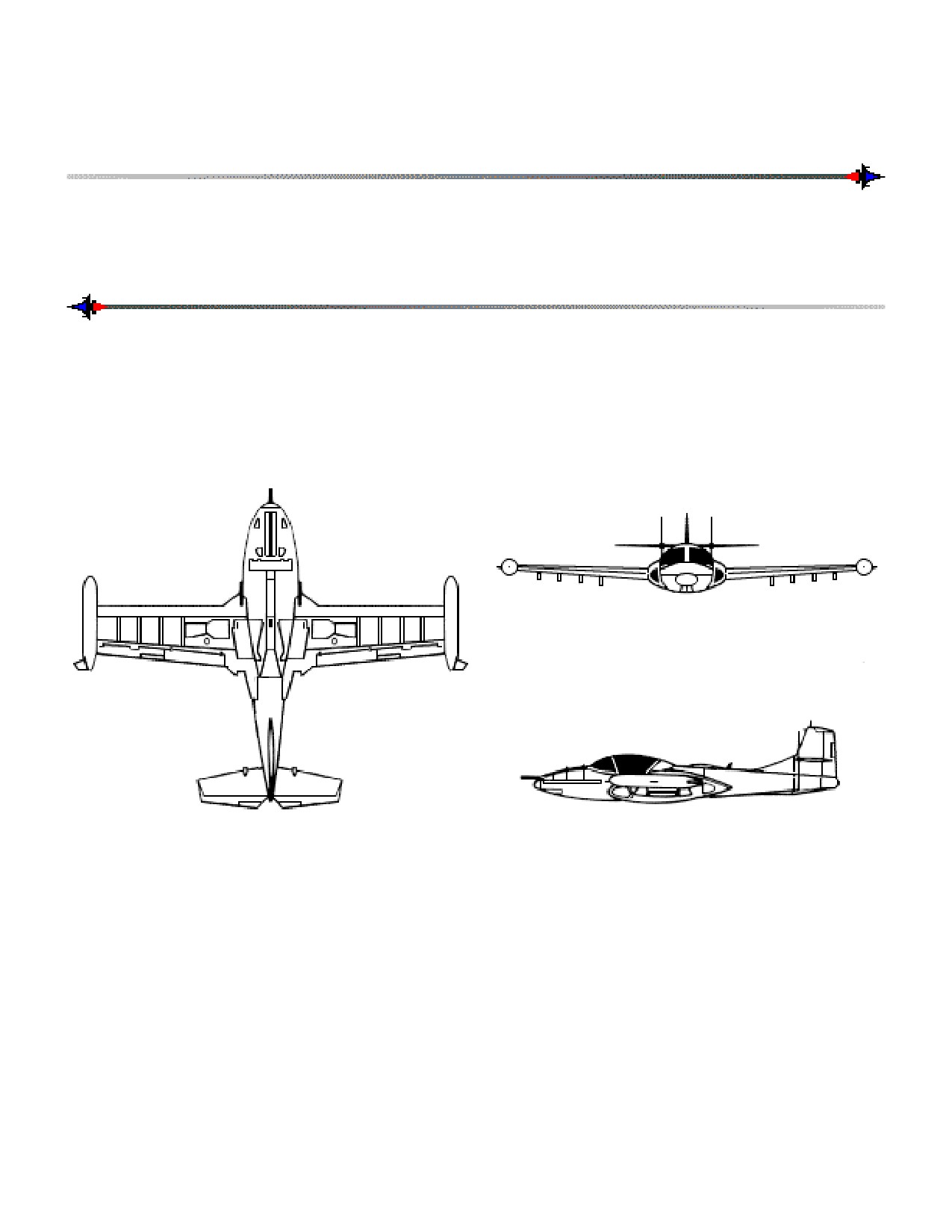
A-37 DRAGONFLY (CESSNA)
GENERAL DATA
Country of Origin. USA.
Similar Aircraft. Galeb-Jastreb, M.B.326, M.B.339, Hawk.
Crew. Two.
Role. Light-attack, forward air control, reconnaissance, observation.
Armament. Bombs, rockets, gun pods, minigun.
Dimensions. Length: 29 ft, 3 in (8.94 m). Span: 33 ft, 9 in (10.32 m).
WEFT DESCRIPTION
Wings. Mid-mounted, straight leading edge, and slight forward taper in the trailing edge with square tips
(generally fuel tanks).
Engine(s). Two turbojets mounted internally. Small semicircular air intakes and round exhausts are
located in the wing roots.
Fuselage. Flattened, oval front section tapered to the rear. Bubble canopy.
Tail. Flats mid- to low-mounted on the fin, equally tapered with blunt tips. Fin is tapered with a blunt tip
and a small fairing in the leading edge.
USER COUNTRIES
Chile, Colombia, Dominican Republic, Ecuador, El Salvador, Guatemala, Honduras, Panama, Peru,
South Korea, Thailand, Uruguay, USA, Vietnam.
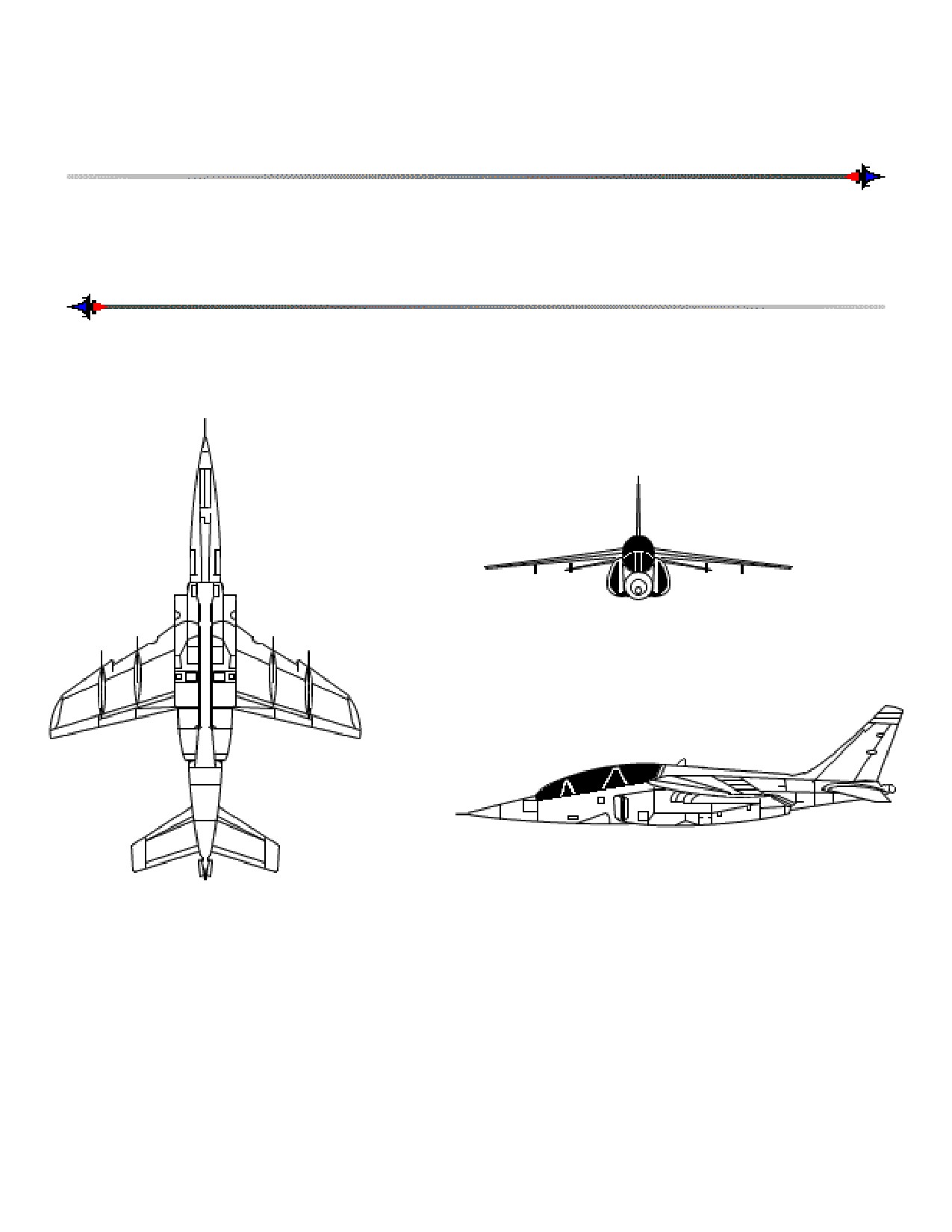
ALPHA JET (DASSAULT-BREGUET, DORNIER)
GENERAL DATA
Countries of Origin. France, Germany.
Similar Aircraft. Hawk, AMX, Mirage F1, AV-8B Harrier II.
Crew. Two.
Role. Light-attack, advanced trainer.
Armament. Gun pods, bombs, rockets, missiles.
Dimensions. Length: 40 ft, 3 in (12.3 m). Span: 30 ft (9.14 m).
WEFT DESCRIPTION
Wings. High-mounted, swept-back, and tapered with curved tips and negative slant.
Engine(s). Two alongside the body under the wings. Oval-shaped air intakes forward of the wings’
leading edges. Exhausts are at the rear of the wings’ trailing edges.
Fuselage. Slender, pointed nose and tail. Two-seat cockpit with a bubble canopy.
Tail. Swept-back and tapered tail fin with a clipped tip. Swept-back and tapered tail flats mid-mounted
on the body with a negative slant and square tips.
USER COUNTRIES
Belgium, Cameroon, Egypt, France, Germany, Ivory Coast, Morocco, Nigeria, Portugal, Qatar, Togo.
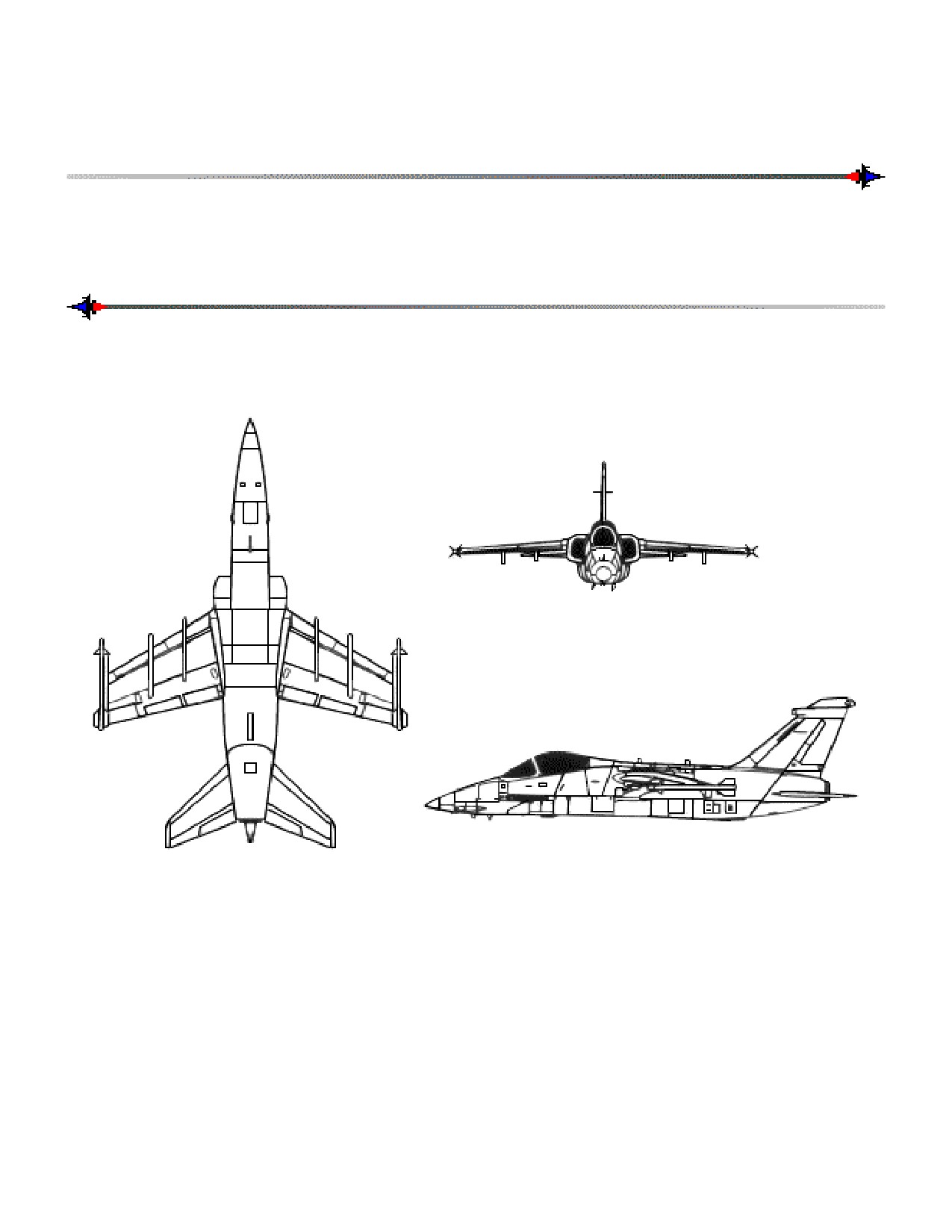
AMX (AERITALIA, AERMACCHI, EMBRAER)
GENERAL DATA
Countries of Origin. Italy, Brazil.
Similar Aircraft. Alpha Jet, Mirage F1, AV-8B Harrier II.
Crew. One.
Role. Light bomber, fighter.
Armament. Bombs, cluster bombs, rockets, AAMs, ASMs.
Dimensions. Length: 44 ft, 6 in (13.58 m). Span: 29 ft (8.84 m).
WEFT DESCRIPTION
Wings. High-mounted, swept-back, and tapered with square tips (AAMs usually mounted).
Engine(s). One turbofan inside body. Two air intakes forward of the wing roots. Single exhaust.
Fuselage. Pointed nose and bubble canopy. Body widens at the air intakes and tapers to the rear section.
Tail. Flats mid-mounted on fuselage, swept-back, and tapered with blunt tips. Swept-back and tapered fin
with a blunt tip.
USER COUNTRIES
Brazil, Italy.
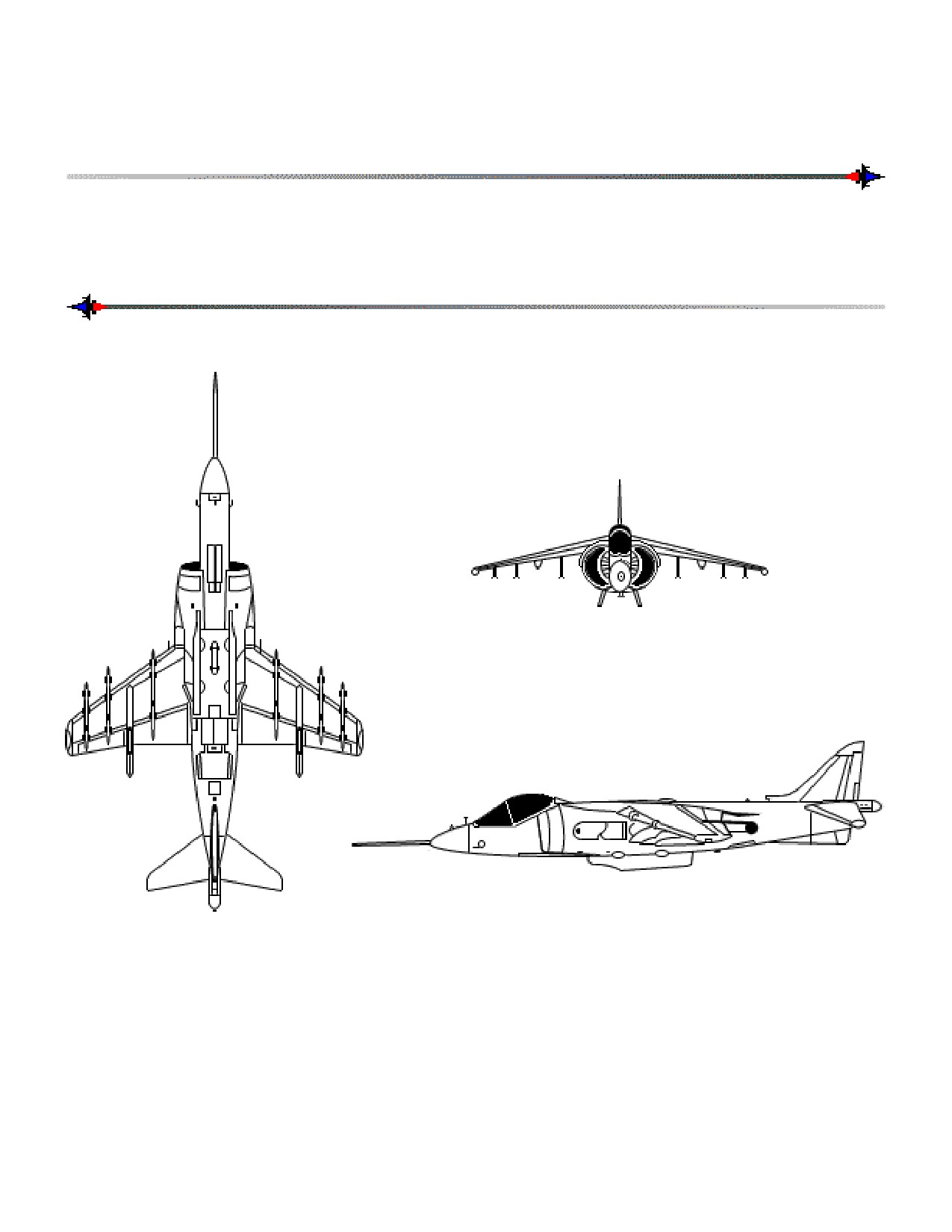
AV-8B HARRIER II (McDONNELL DOUGLAS, BAe)
GENERAL DATA
Countries of Origin. USA, UK.
Similar Aircraft. Yak-38 Forger, Mirage F1, AMX.
Crew. One.
Role. VSTOL fighter, CAS.
Armament. Cannon, missiles, bombs, rockets, gun pods.
Dimensions. Length: 46 ft, 4 in (14.13 m). Span: 30 ft, 4 in (9.25 m).
WEFT DESCRIPTION
Wings. High-mounted, swept-back, and tapered, negative slant and blunt tips.
Engine(s). One vectored thrust turbofan mounted in the body. Large, semicircular air intakes that give
the body a rounded appearance from the head-on view.
Fuselage. Thick, rounded, and tapering to a slender tail. Pointed nose and bubble canopy.
Tail. Fin swept-back and tapered with curved tip. Small step in the leading edge. Tail flats high-mounted
on fuselage are swept-back with a negative slant and blunt tips. Pointed rear tail cone.
USER COUNTRIES
India, Italy, Spain, UK, USA.
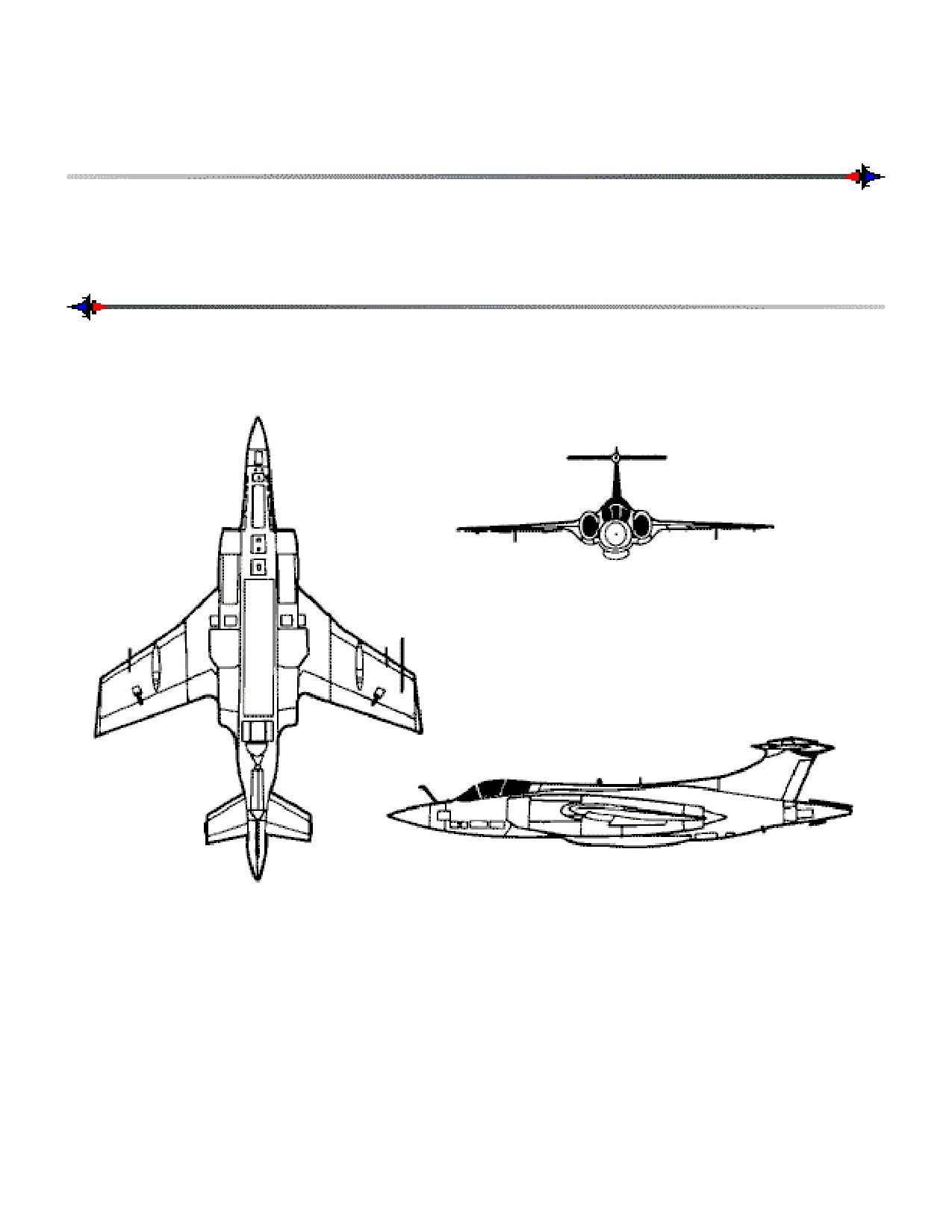
BUCCANEER (HAWKER SIDDELEY)
GENERAL DATA
Country of Origin. UK.
Similar Aircraft. AV-8 Harrier, F-4 Phantom, Jaguar.
Crew. Two.
Role. Maritime duties, reconnaissance.
Armament. Bombs (internal and under wings), missiles, rockets, gun pods.
Dimensions. Length: 63 ft, 5 in (19.34 m). Span: 44 ft (13.5 m).
WEFT DESCRIPTION
Wings. Mid-mounted, wide wing roots, swept-back, and tapered with square tips.
Engine(s). Two mounted alongside the fuselage in the wing roots. Circular air intakes below the canopy.
Exhausts at rear of the trailing edges of the wings.
Fuselage. Bulging midsection and a pointed nose. Large bubble canopy.
Tail. Flats swept-back and tapered with square tips, high-mounted on a swept-back tail fin forming a T.
Tail cone extends beyond the tail.
USER COUNTRIES
South Africa, UK.
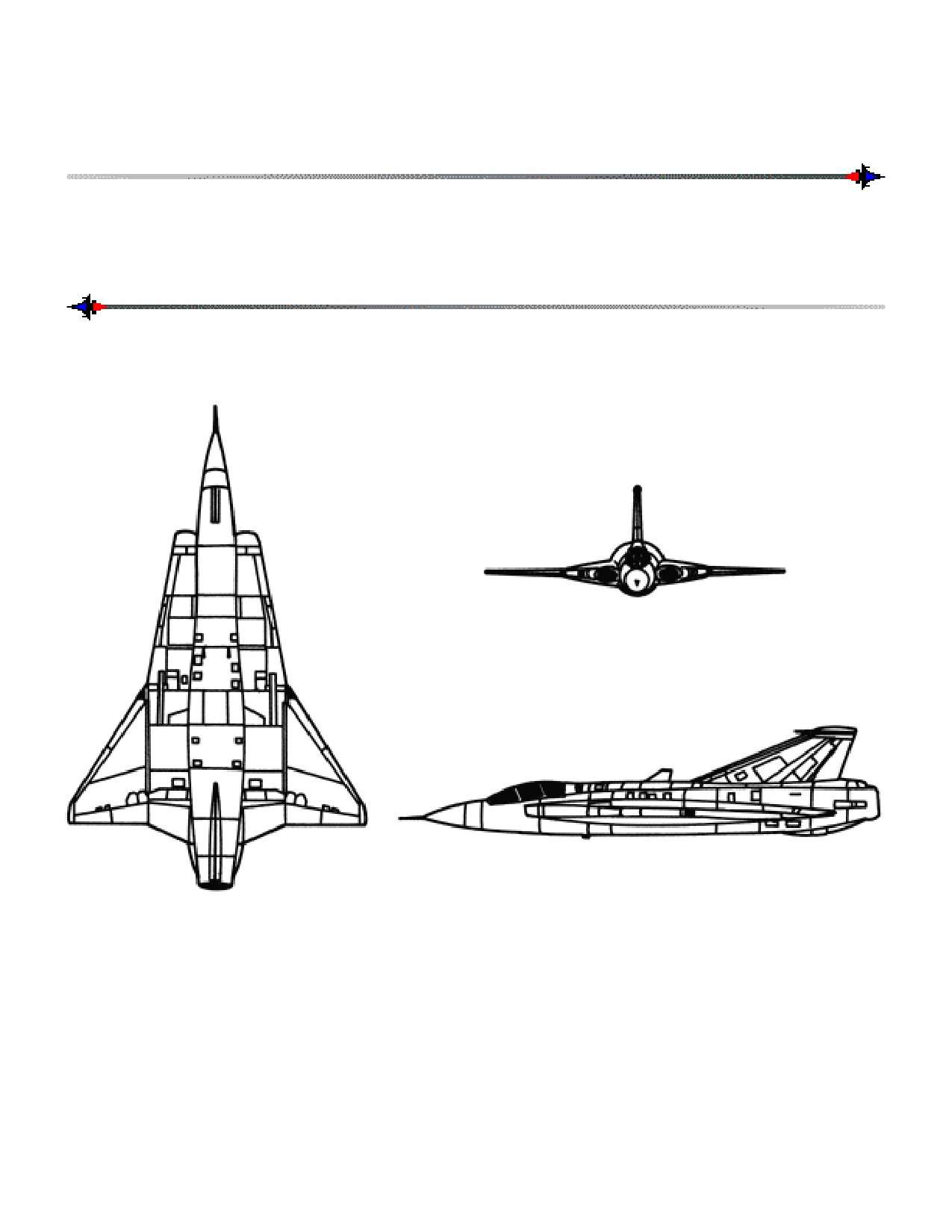
DRAKEN (SAAB)
GENERAL DATA
Country of Origin. Sweden.
Similar Aircraft. Hunter.
Crew. One.
Role. Fighter-attack, reconnaissance.
Armament. Bombs, cannon, rockets, missiles.
Dimensions. Length: 50 ft, 4 in (15.5 m). Span: 30 ft, 10 in (9.5 m).
WEFT DESCRIPTION
Wings. Mid-mounted, double-delta extending from the canopy to the tail section.
Engine(s). One turbojet located inside the body. Oval air intakes in the leading edges of the wing roots.
Large, single exhaust.
Fuselage. Tubular body blending into the delta wings. Long, pointed nose and a bubble canopy mounted
forward of the air intakes.
Tail. No tail flat. Large, swept-back, tapered tail fin with square tip mounted on the dorsal spine.
USER COUNTRIES
Austria, Denmark, Finland, Sweden.
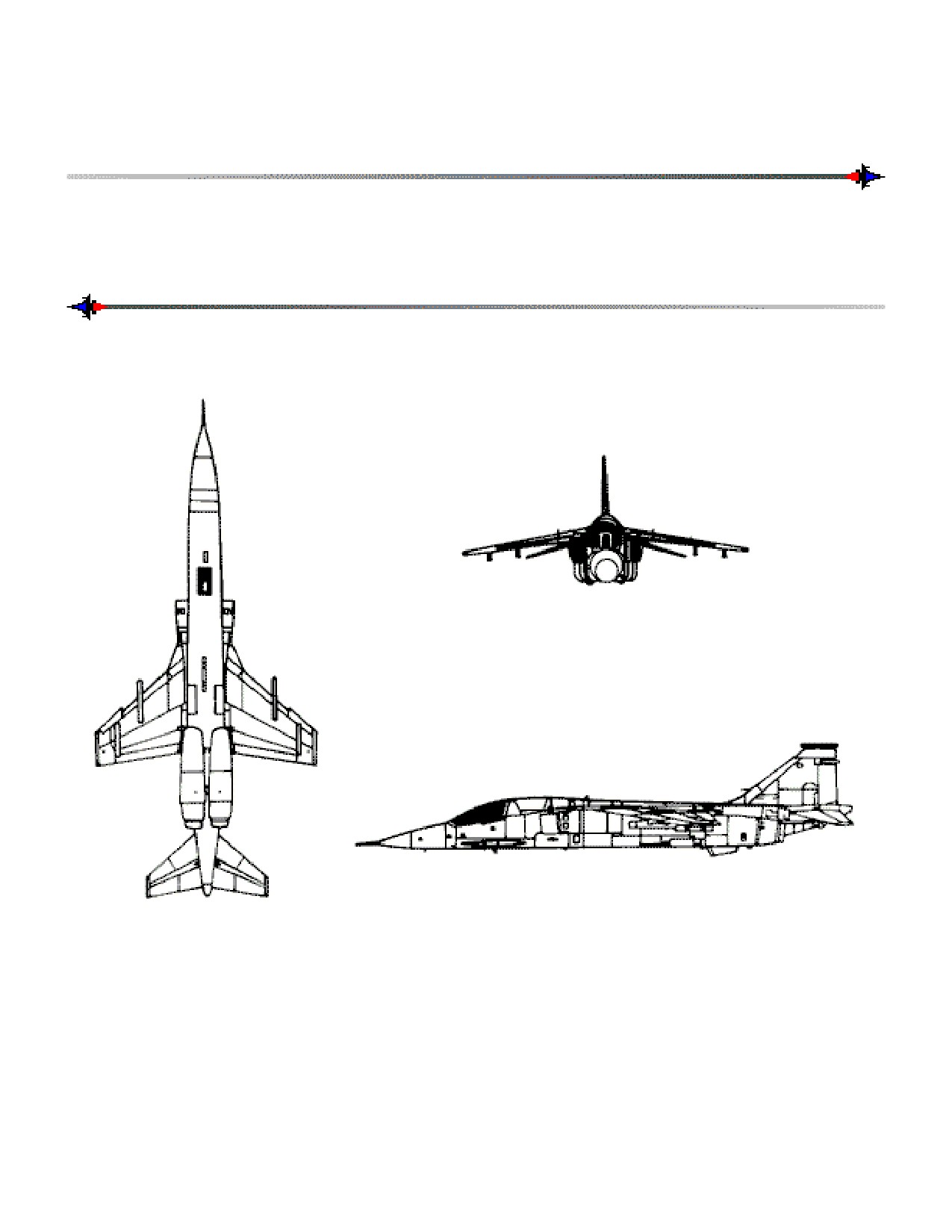
F-1 (MITSUBISHI)
GENERAL DATA
Country of Origin. Japan.
Similar Aircraft. Mirage F1, Super Etendard, Yak-38 Forger.
Crew. One; T-2 trainer--two.
Role. CAS, fighter.
Armament. Cannon, bombs, rocket pods, ASMs, AAMs.
Dimensions. Length: 58 ft, 8 in (17.86 m). Span: 26 ft (7.9 m).
WEFT DESCRIPTION
Wings. High-mounted, swept-back, and tapered with square tips. Sawtooth in leading edges. Negative
slant.
Engine(s). Two turbofans. Semicircular air intakes well forward of the wing roots, tapering to the rear.
Exhausts flare outward at the forward bottom of the overhanging tail section.
Fuselage. Long, slender with sharply pointed nose. Tapers to the rear. Bubble canopy that blends with a
tapered dorsal spine behind the cockpit.
Tail. Back-tapered fin with square tip. Flats high-mounted on the tapered fuselage, swept-back, and
tapered with square tips and a negative slant.
USER COUNTRY
Japan.
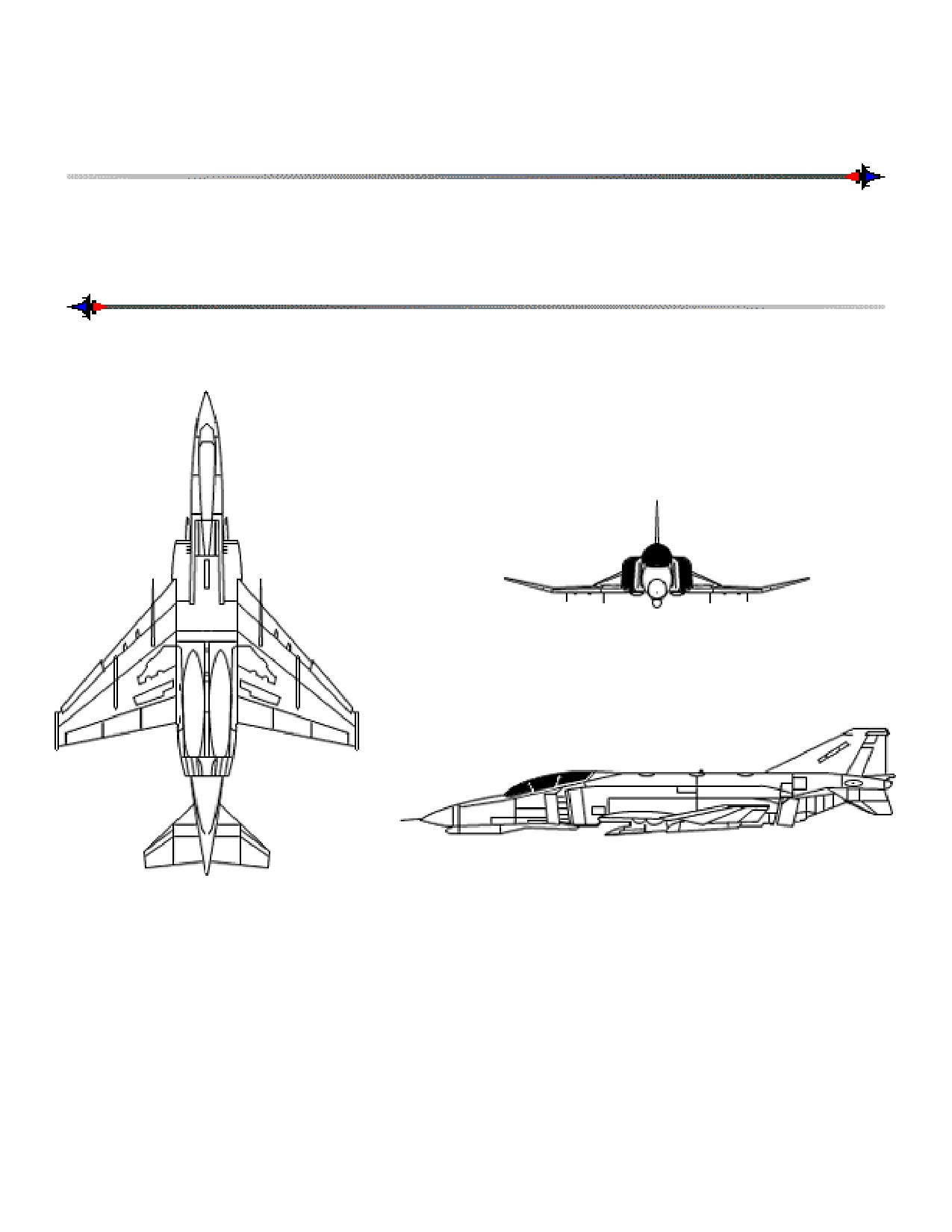
F-4 PHANTOM II (McDONNELL DOUGLAS)
GENERAL DATA
Country of Origin. USA.
Similar Aircraft. Jaguar, Buccaneer, A-4 Skyhawk, Super Etendard.
Crew. Two.
Role. Fighter-bomber, CAS, ECM, reconnaissance.
Armament. Cannon, rockets, missiles, bombs.
Dimensions. Length: 63 ft (18.7 m). Span: 38 ft, 5 in (11.77 m).
WEFT DESCRIPTION
Wings. Low-mounted, swept-back, and semidelta with square tips. Positive slanted wing tips. There is a
sawtooth in leading edges of the wings.
Engine(s). Two engines inside the body with rectangular air intakes alongside the body in front of the
wings. Twin exhausts beneath a large overhanging rear section.
Fuselage. Rectangular midsection, pointed droopy nose, and a bubble cockpit.
Tail. Flats are mid-mounted on the body, delta-shaped with a negative slant. Sharply back-tapered fin
with a square tip.
USER COUNTRIES
Egypt, Germany, Greece, Iran, Israel, Japan, South Korea, Turkey, USA.
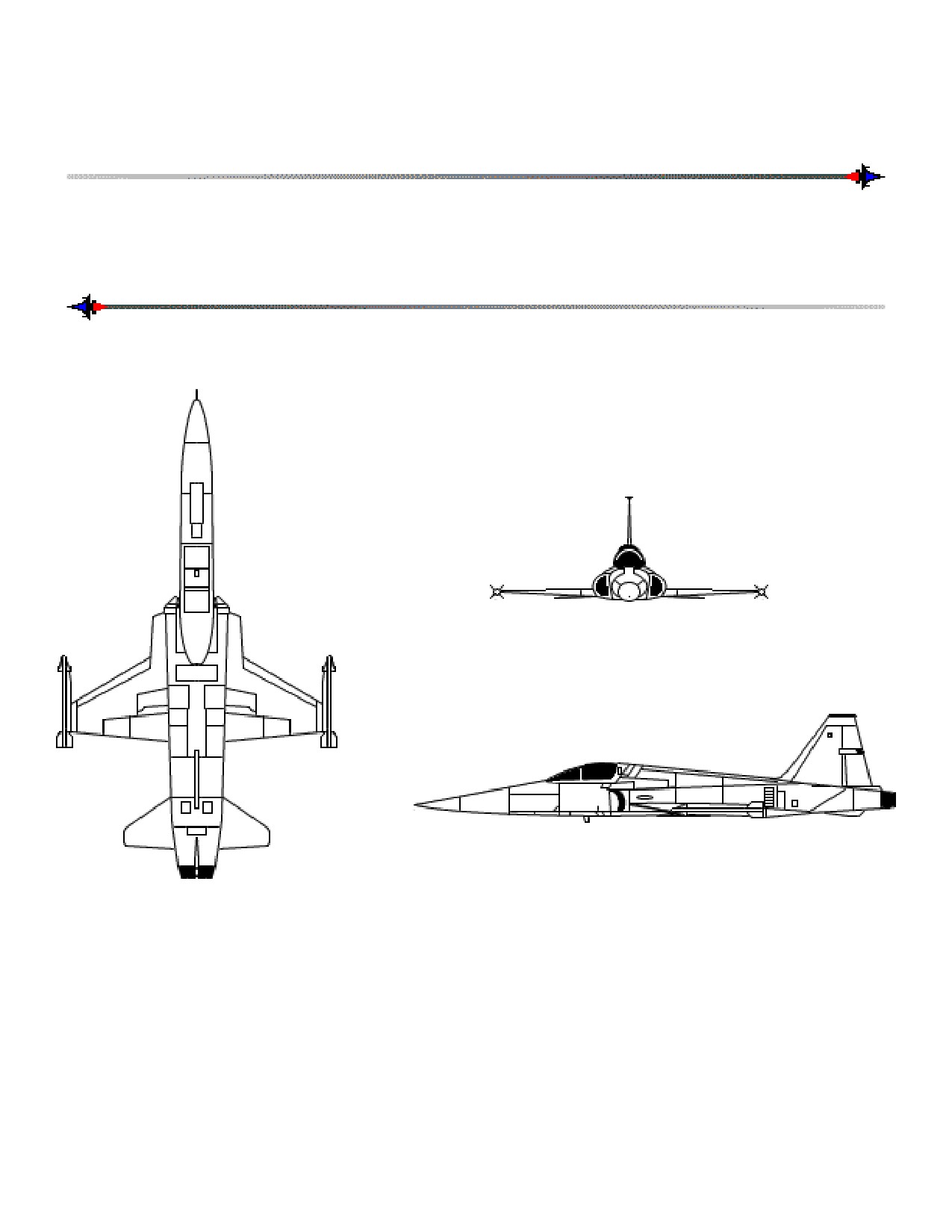
F-5 FREEDOM FIGHTER/TIGER II (NORTHROP)
GENERAL DATA
Country of Origin. USA.
Similar Aircraft. F-104 Starfighter, Hawk, M.B.339, Yak-38 Forger.
Crew. One; F-5F and T-38 Talon--two.
Role. Fighter-bomber, CAS.
Armament. Cannons, rockets, bombs.
Dimensions. Length: 48 ft (14.65 m). Span: 26 ft, 8 in (8.14 m).
WEFT DESCRIPTION
Wings. Low-mounted, stubby, and unequally tapered. Missiles or fuel tanks are normally carried on the
square tips.
Engine(s). Two engines inside the body, semicircular air intakes forward of the wing roots. Shotgun
exhausts.
Fuselage. Bullet-shaped, long, drooping pointed nose. Bottom is flat from the air intakes to the dual
exhausts. Bubble canopy.
Tail. Flats are low-mounted and unequally tapered. Fin is large and equally tapered with a square tip.
USER COUNTRIES
Bahrain, Brazil, Canada, Chile, Greece, Honduras, Indonesia, Iran, Jordan, Kenya, Malaysia, Mexico,
Morocco, North Yemen, Norway, Philippines, Saudi Arabia, Singapore, South Korea, Spain, Sudan,
Switzerland, Taiwan, Thailand, Tunisia, Turkey, Venezuela.
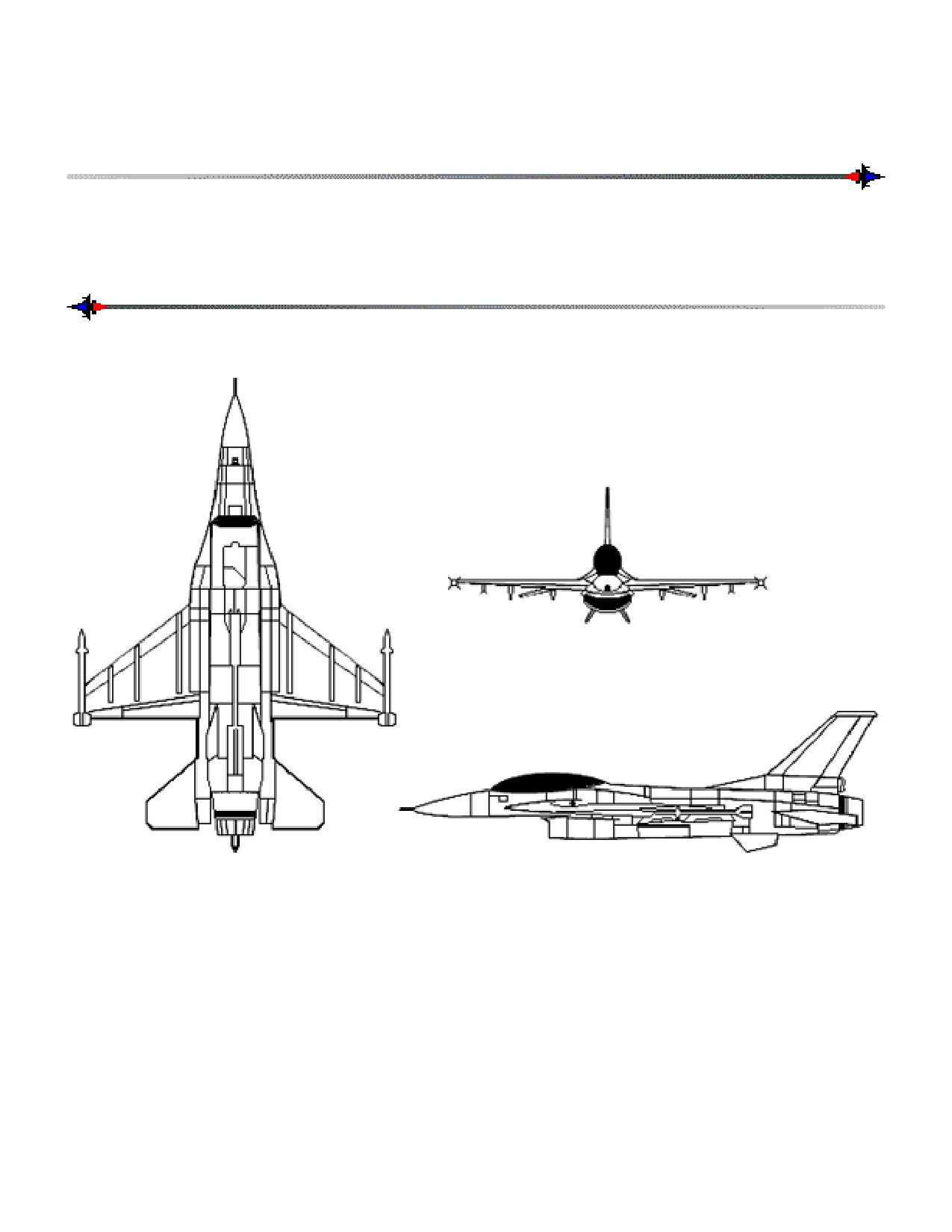
F-16 FIGHTING FALCON (GENERAL DYNAMICS)
GENERAL DATA
Country of Origin. USA.
Similar Aircraft. F/A-18 Hornet, MiG-29 Fulcrum, Mirage F1.
Crew. One; F-16B--two.
Role. Multirole ground-attack/fighter.
Armament. Cannon, missiles, bombs.
Dimensions. Length: 47 ft, 8 in (14.54 m). Span: 31 ft (9.46 m).
WEFT DESCRIPTION
Wings. Mid-mounted, delta-shaped. Missiles are normally mounted at the wing tips.
Engine(s). One in body. Oval air intake under the center of the fuselage. Single exhaust.
Fuselage. Long, slender body, widens at air intake. Pointed nose. Bubble canopy.
Tail. Swept-back, tapered fin with square tip. Flats mid-mounted on the fuselage, delta-shaped with
square tips, and a slight negative slant. Two belly fins.
USER COUNTRIES
Bahrain, Belgium, Denmark, Egypt, Greece, Indonesia, Israel, Netherlands, Norway, Pakistan, South
Korea, Portugal, Singapore, Taiwan, Thailand, Turkey, USA, Venezuela.
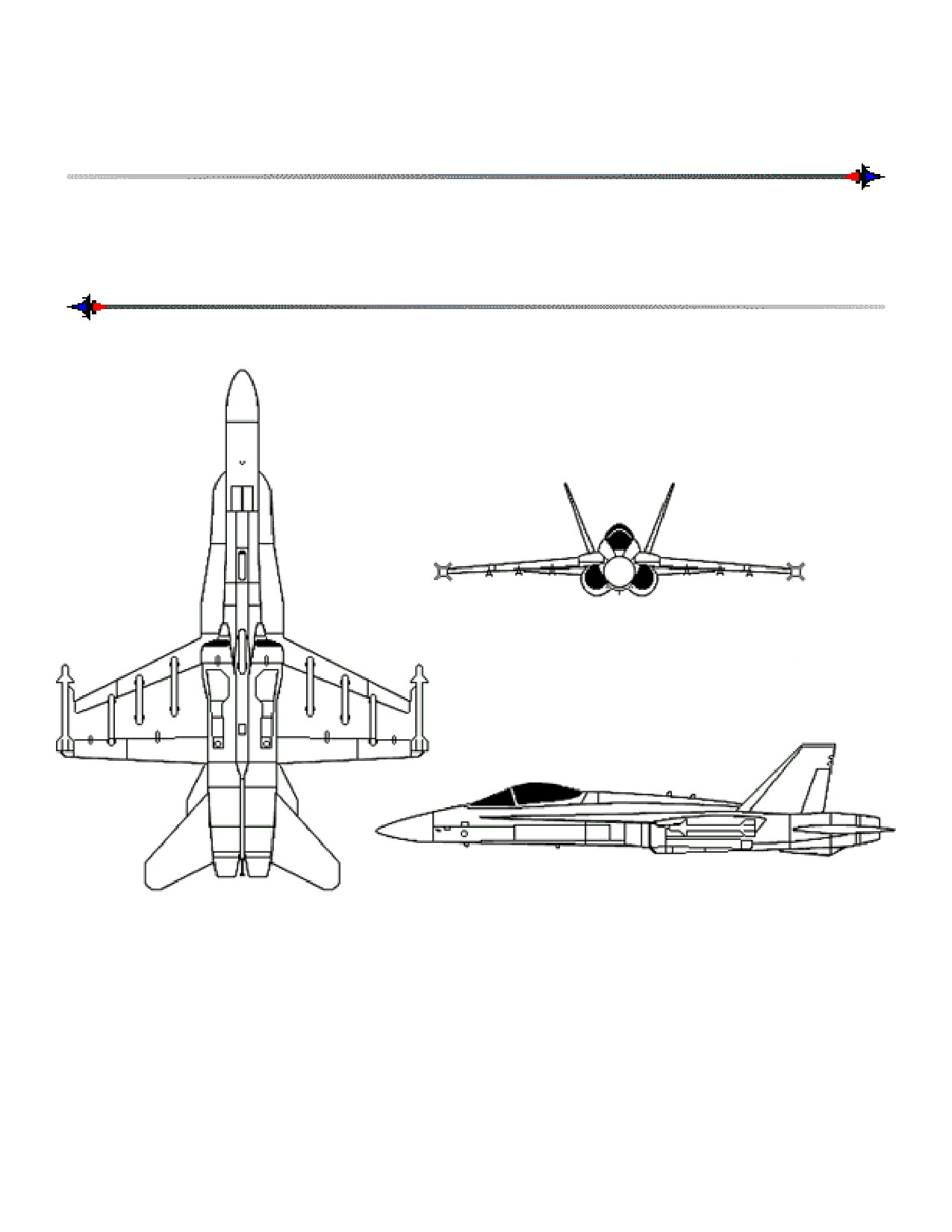
F/A-18 HORNET (McDONNELL DOUGLAS)
GENERAL DATA
Country of Origin. USA.
Similar Aircraft. F-16 Fighting Falcon, MiG-29 Fulcrum, Su-27 Flanker, F-15 Eagle.
Crew. One; TF/A-18--two.
Role. US Marine Corps fighter, strike.
Armament. Cannon, bombs, missiles, rockets.
Dimensions. Length: 56 ft (17.08 m). Span: 37 ft, 6 in (11.44 m).
WEFT DESCRIPTION
///////////////////////////////////////