FM 3-28 Civil Support Operations (Draft) (June 2010) - page 1
FM 3-28
Field Manual
Headquarters
Department of the Army
No. 3-28
Washington, DC, (Signature Draft, 4 June 2010)
Civil Support Operations
Signature Draft—Not for Implementation
Contents
Page
PREFACE
viii
INTRODUCTION
x
Chapter 1
THE DOMESTIC ENVIRONMENT
1-1
The Army and Civil Support Operations
1-1
Defense Support Of Civil Authorities
1-1
National Guard Civil Support
1-2
The United States Constitution and the Army
1-3
Components of the Army and Civil Support
1-4
Unit Status
1-6
Key Aspects of Domestic Operations
1-8
Primary Civil Support Tasks
1-11
Fundamentals of Civil Support
1-13
Training for Civil Support Operations
1-16
Chapter 2
A COMPREHENSIVE APPROACH FOR CIVIL SUPPORT
2-1
National Policy for Domestic Emergencies
2-1
Tiered Response
2-11
National Guard Civil Support
2-20
Federal Military Civil Support
2-22
Chapter 3
PROVIDE SUPPORT FOR DOMESTIC DISASTERS
3-1
The Nature of a Disaster
3-1
Responsibility for Disaster Response
3-2
Initial Response from Local and State Authorities
3-3
National Guard Disaster Response
3-4
Federal Military Forces Disaster Response
3-9
Phases of Disaster Response
3-14
Considerations For Disaster Response
3-15
Distribution Restriction: The material in this manual is under development. It is not approved doctrine and
cannot be used for reference or citation until this draft is approved and authenticated. Upon publication, this
manual will be approved for public release; distribution will be unlimited.
iii
Contents
Chapter 4
PROVIDE SUPPORT FOR DOMESTIC CBRNE INCIDENTS
4-1
Potential Consequences of CBRNE Incidents
4-1
Civilian Response to CBRNE Incidents
4-6
National Guard CBRNE Incident Response Capabilities
4-7
Department of Defense CBRNE Response
4-8
Pandemic Disease Outbreaks
4-12
Agricultural Diseases
4-16
Considerations for CBRNE Incident Response
4-16
Chapter 5
PROVIDE SUPPORT FOR DOMESTIC CIVILIAN LAW ENFORCEMENT
AGENCIES
5-1
Principal Authorites for Support to Domestic Civilian Law Enforcement
Agencies
5-1
Types of Support Missions to Domestic Civilian Law Enforcement Agencies
5-4
Protection Against Terrorism
5-7
Law Enforcement Considerations
5-8
Chapter 6
PROVIDE OTHER DESIGNATED SUPPORT
6-1
Types of Designated Support
6-1
Requests for Other Designated Support
6-5
Chapter 7
LEGAL CONSIDERATIONS
7-1
Powers of a State Governor
7-1
Authorities for Federal Military Support
7-1
The Posse Comitatus Act
7-5
The Insurrection Act
7-6
The National Emergencies Act
7-7
Mobilization of the Reserve Component
7-7
Rules for the Use of Force
7-7
Intelligence Oversight—Rules and Restrictions
7-10
Isolation and Quarantine
7-13
Liability
7-14
Chapter 8
SUSTAINMENT—LOGISTICS AND PERSONNEL SERVICES
8-1
The Sustainment Warfighting Function Defined
8-1
Logistics in Civil Support Operations
8-1
Personnel Services in Civil Support
8-19
Chapter 9
ARMY HEALTH SERVICE SUPPORT
9-1
Medical Capabiilities for Domestic Incidents
9-1
Considerations for Medical Support to Domestic Incidents
9-5
Medical Logistics for Domestic Incidents
9-10
Appendix A
PLANNING CHECKLISTS
A-1
Appendix B
SAFETY
B-1
Appendix C
NATIONAL GUARD CIVIL SUPPORT TEAMS
C-1
Appendix D
CBRNE ENHANCED RESPONSE FORCE PACKAGE
D-1
Appendix E
CBRNE CONSEQUENCE MANAGEMENT RESPONSE FORCE
E-1
Appendix F
AIRSPACE COMMAND AND CONTROL
F-1
Appendix G
SEARCH AND RESCUE
G-1
iv
FM 3-28 (Signature Draft—Not for Implementation)
4 June 2010
Contents
Appendix H UNMANNED AIRCRAFT SYSTEMS IN CIVIL SUPPORT
H-1
Appendix I
INCIDENT COMMAND SECTIONS AND SUPPORT FUNCTIONS
I-1
Appendix J AUTL CROSSWALK FOR STABILITY AND CIVIL SUPPORT
J-1
Appendix K MEDIA CONSIDERATIONS
1
GLOSSARY
Glossary-1
REFERENCES
References-Error! Bookmark not defined.
INDEX
Index-1
Figures
Introductory figure—full spectrum operations
x
Figure 1-1. Range of response
1-2
Figure 1-2. Primary civil support tasks with examples
1-12
Figure 2-1. NIMS incident command system staff
2-4
Figure 2-2. Example of NIMS command and management structure
2-5
Figure 2-3: Expanding command and coordination under NIMS
2-6
Figure 2-4. An overview of tiered response under the National Response Framework
2-8
Figure 2-5. FEMA regions and headquarters
2-17
Figure 2-6. An example joint field office showing command staff, sections, and
branches
2-20
Figure 2-7. An example of National Guard organization within a state
2-22
Figure 2-8. Example of defense coordinating officer and defense coordinating
element organization
2-24
Figure 2-9. USNORTHCOM and USARNORTH structure
2-26
Figure 2-10. A pre-scripted mission assignment for communications support
2-29
Figure 3-1. Forces required for a typical incident
3-2
Figure 3-2. Military requirements in a major catastrophe
3-3
Figure 3-3. State response and National Guard echelons—Illinois example
3-6
Figure 3-4. Relationship of National Guard forces to area commands
3-7
Figure 3-5. The federal request for assistance process
3-11
Figure 3-6. Example of USNORTHCOM structure for DSCA
3-12
Figure 3-7. USNORTHCOM phases of disaster response
3-14
Figure 3-8. Example parallel command structure
3-18
Figure 3-9. Multi-state disaster requiring major commitment of federal military forces
3-19
Figure 4-1. World health Organization pandemic influenza phases
4-12
Figure 6-1. Geographic area coordination centers for wildland firefighting
6-4
Figure 7-1. An example of a dual-status command
7-5
Figure 7-2. Illustration of the continuum of force
7-8
Figure 7-3. Example rules for the use of force card carried by National Guard forces
7-9
Figure 8-1. FEMA logistics centers
8-3
4 June 2010
FM 3-28 (Signature Draft—Not for Implementation)
v
Contents
Figure 8-2. USARNORTH sustainment structure
8-7
Figure 8-3. Example base support installation selection
8-11
Figure 8-5. Example joint movement center organization
8-18
Figure D-1. Example of CBRNE enhanced response force package organization
D-2
Figure D-2. Example of patient flow
D-3
Figure E-1. State and federal CBRNE response forces
E-2
Figure E-2. Organization of the CBRNE consequence management response force
E-3
Figure E-3. Joint disaster response phases
E-5
Table G-1. Comparison of disaster response and civil search and rescueError! Bookmark not defined.
Figure I-1. The fully manned joint field office
I-1
Figure I-2. The operations section of a joint field office
I-2
Figure I-3. The plans branch of a joint field office
I-3
Figure I-4. The logistics section of a joint field office
I-4
Figure I-5. The Finance and administration section of a joint field office
I-4
Tables
Table 1-1. Comparison of state active duty, Title 32, and Title 10 status
1-8
Table 1-2: Key military aspects of domestic operational environments
1-9
Table 2-1. Emergency support function annexes
2-9
Table 2-2. National Planning Scenarios
2-11
Table 4-1. National planning scenarios related to CBRNE
4-2
Table 4-2. National Guard CBRNE response capabilities
4-7
Table 4-3. Department of Defense CBRNE response capabilities
4-10
Table 7-1. Individuals and groups protected by intelligence oversight rules
7-10
Table 7-2. Intelligence oversight authorities
7-10
Table 7-3. Current Incident awareness and assessment support modules
7-11
Table 7-4. Prohibitions on information acquisition
7-12
Table 8-1. USARNORTH Phase I sustainment actions
8-8
Table 8-2. USARNORTH Phase II sustainment actions
8-8
Table 8-3. USARNORTH Phase III sustainment actions
8-9
Table 8-4. USARNORTH phase IV sustainment actions
8-9
Table 8-5. Costs eligible for reimbursement
8-14
Table 8-6. Costs ineligible for reimbursement
8-15
Table 8-7. Mortuary services under ESF #8
8-16
Table 9-1. Functional support areas covered by ESF #8
9-2
Table 9-2. DOD public health and medical support responsibilities in ESF #8
9-2
Table 9-3. Integrated medical surveillance tasks
9-6
Table 9-4. Disaster-related health threats
9-7
Table 9-5. Common emotional and physical symptoms related to disaster response
9-8
Table 9-6. Examples of preventive measures for behavioral health
9-8
vi
FM 3-28 (Signature Draft—Not for Implementation)
4 June 2010
Contents
Table 9-7. Examples of preventive measures for handling human remains
9-9
Table 9-8. Veterinary concerns affecting public health
9-9
Table 9-9. Precautions related to handling animal carcasses
9-10
Table A-1. Initial situational awareness and assessment checklist
A-1
Table A-2. Joint task force initial checklist
A-2
Table A-3. Organizational and unit initial checklist
A-3
Table A-4. Planning checklist for S-1
A-5
Table A-5. Planning checklist for S-2
A-5
Table A-6. Initial planning checklist for S-3
A-5
Table A-7. Initial planning checklist for S-4
A-6
Table A-8. Planning checklist for S-6
A-7
Table J-1. Stability and civil support AUTL cross walk
J-1
4 June 2010
FM 3-28 (Signature Draft—Not for Implementation)
vii
Preface
PURPOSE
This manual provides keystone Army doctrine for civil support operations. It expands on the discussion of civil
support operations, the fourth element of full spectrum operations, in FM 3-0. This manual focuses on the
planning, preparation, execution, and assessment of civil support operations, which are conducted within the
United States and its territories. It discusses the role of Army forces cooperating with and supporting civilian
organizations in domestic operational environments, with particular emphasis on how operations conducted by
Army forces within the United States differ from full spectrum operations conducted overseas.
All civil support operations buttress the capabilities of civil authorities within the United States. The
mechanisms for regulating this support exist in law, policy, and directive. Civil support operations require Army
leaders to understand an environment shaped primarily by federal, state, local, and tribal agencies, and
circumscribed by law. Nowhere is this more relevant than in understanding the roles of the National Guard. In
sharp contrast to stability operations, Army forces may conduct civil support operations with National Guard
forces responding under the direction of a governor; or alongside active duty forces as part of a coordinated
national response. FM
3-28 explains the reasons for this division of forces and provides a range of
considerations for the entire Army, including all three components: Regular Army, Army Reserve, and Army
National Guard.
Civil support doctrine informs and guides employment of Army forces providing civil support. It cannot,
however, be prescriptive. To a greater degree than any other element of full spectrum operations, state and
federal law, military directive (Department of Defense and National Guard), and government policy impose
constraints and restraints on civil support operations. In all cases where Army doctrine differs with law, policy,
and directive, the latter take precedence.
SCOPE
The manual’s primary focus is on the operational Army echelons that conduct civil support operations. These
include battalions, brigades, division headquarters, and Army service component headquarters. However, these
echelons require extensive support from the generating force, including Army civilians and contractors, and the
FM addresses that support as applicable.
Although two combatant commands, United States Pacific Command and United States Northern Command,
conduct defense support of civil authorities, this manual uses United States Northern Command terminology and
methods throughout. Users located in the United States Pacific Command area of responsibility should refer to
theater plans and standing operating procedures for specific defense support of civil authorities procedures in
that theater. The fundamentals of civil support operations remain the same, but the unique characteristics of the
Pacific region alter some of the details of defense support of civil authorities and National Guard civil support
within the United States Pacific Command area of responsibility.
FM 3-28 is organized into nine chapters and eleven supporting appendixes. Chapters 1 and 2 provide an
overview of domestic operations and the Army’s role in civil support. Chapters 3, 4, 5, and 6 explain the
primary civil support tasks—provide support for domestic disasters, provide support for domestic CBRNE
incidents, provide support for domestic civilian law enforcement agencies, and provide other designated
support. Chapter 7 provides a legal discussion aimed primarily at unit commanders, providing them with
sufficient information to understand what their staff judge advocates should tell them. Chapters 8 and 9 address
sustainment (logistics, personnel services, and health service support), but due to the complexity of the subject,
logistic and personnel services are in chapter 8, and health service support receives separate discussion in
chapter 9.
4 June 2010
FM -3-28 (Signature Draft—Not for Implementation)
viii
Preface
The appendixes address specific details pertinent to civil support operations—planning, safety, specialized
response forces, airspace command and control, search and rescue, unmanned aircraft systems, incident
command, media considerations, and Army tactical tasks. Appendixes C, D, and E provide a review of the three
Army forces organized specifically for chemical, biological, radiological, nuclear, or high-yield explosives
incidents. These three appendixes provide nascent doctrine on these organizations, pending the development of
more detailed tactics, techniques, and procedures for each.
Just as civil support and incident management and response continue to evolve within all echelons of
government, so too will FM 3-28. The Combined Arms Center plans to replace this edition in 18 months with a
multi-service publication written in conjunction with the U.S. Marine Corps. This follow-on publication will
address land force civil support operations and capitalize on the upcoming release of new material, such as the
DSCA Tactical Commander’s Handbook (scheduled to be released in late July, 2010) in order to streamline the
content of the next FM 3-28.
INSTRUCTIONS ON EFFECTIVE USE OF THIS MANUAL
Civil support operations use principles, policies, and terminology strikingly different from military operations
overseas. Therefore, readers are strongly encouraged to avoid isolating parts of this manual from the whole. At a
minimum, readers unfamiliar with the mechanisms of civil support and the distinct role of the National Guard
should read the first two chapters before reading the remainder of the FM. Chapter 3, ―Provide Support for
Domestic Disasters,‖ is central to the FM and contains important information that each of the next three chapters
builds upon, since certain aspects of disaster response are common to all four of the primary civil support tasks.
All readers should understand Chapter 3 before applying any of the other content. This is particularly important
for chapter 4, ―Provide Support to Domestic CBRNE Incidents.‖ Domestic CBRNE incident response mirrors
disaster response but requires specialized procedures, equipment, training, and organizations.
APPLICABILITY
This publication applies to the Regular Army, the Army National Guard, and U.S. Army Reserve unless
otherwise stated. The target audience for this manual is broad. It includes the commanders, leaders, and staff of
Army forces involved in civil support operations. It also provides general information to civil authorities at
federal, state, local, and tribal levels for use when coordinating with Army forces engaged in civil support
operations. This manual is suitable for use by other services coordinating with Army forces engaged in civil
support operations and other organizations (including the U.S. Coast Guard) providing support to civilian
agencies.
This doctrine does not apply to Army forces engaged in counterterrorism operations, nor does it apply to any
state defense force that is not part of the National Guard. It also does not cover operations of the United States
Army Corps of Engineers, a direct reporting unit of the Army that exists to provide civil support in accordance
with U.S. law and other applicable regulations. Finally, this doctrine does not apply to military activities
conducted within a military installation.
ADMINISTRATIVE INFORMATION
Headquarters, U.S. Army Training and Doctrine Command, is the proponent for this publication. The preparing
agency is the Combined Arms Doctrine Directorate, U.S. Army Combined Arms Center. Send written comments
and recommendations on a DA Form 2028 (Recommended Changes to Publications and Blank Forms) to
Commander, U.S. Army Combined Arms Center and Fort Leavenworth, ATTN: ATZL-MCK-D (Operational
Level Doctrine), 300 McPherson Avenue (Building 463), Fort Leavenworth, KS 66027-2337. The point of
contact for FM 3-28 is the Combined Arms Doctrine Directorate at (913) 684-4884; or by e-mail:
michael.d.burke@conus.army.mil.
4 June 2010
FM 3-28 (Signature Draft—Not for Implementation)
ix
Introduction
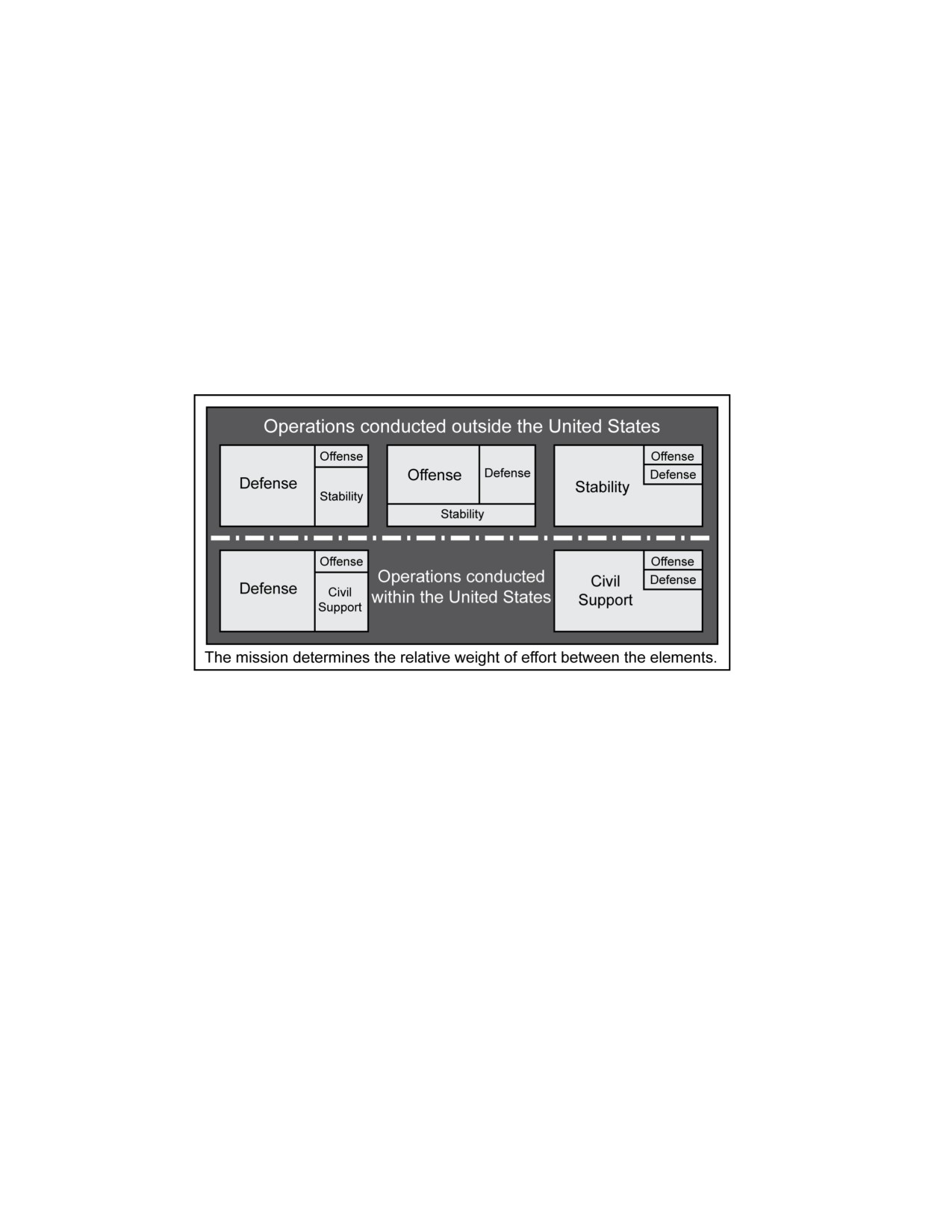
FM 3-0 states that ―Army forces combine offensive, defensive, and stability or civil support [emphasis
added] operations simultaneously as part of an interdependent joint force to seize, retain, and exploit the
initiative, accepting prudent risk to create opportunities to achieve decisive results. They employ
synchronized action—lethal and nonlethal—proportional to the mission and informed by a thorough
understanding of all variables of the operational environment. Mission command that conveys intent and an
appreciation of all aspects of the situation guides the adaptive use of Army forces.‖ The introductory figure
illustrates how the elements of full spectrum operations can be combined.
Introductory figure—full spectrum operations
FM 3-28 explains how the Army conducts civil support operations, the fourth element of full spectrum
operations. It discusses similarities and differences between civil support operations and the other elements
of full spectrum operation. Stability operations and civil support operations are similar in several ways.
Both revolve around the civilians on the ground within land areas of operation. Both stability and civil
support tasks require Army forces to provide essential services and work with civilian authorities. However,
domestic operational environments are quite different in terms of law, military chain of command, use of
deadly force, and interagency process.
Protecting the United States from direct attack is the highest priority of the Armed Forces. Since the First
World War, the armed services have focused primarily on defending the United States by projecting power
overseas. The Army is organized and equipped primarily for this purpose; for ― . . . prompt and sustained
combat incident to operations on land.‖ (Title 10, USC, Section 3062) However, when civil authorities
request assistance or if directed by the President, the Armed Forces also have great capability to respond to
domestic emergencies and disasters. Department of Defense conducts these operations under civilian
control in accordance with the Constitution of the United States. Based on the Constitution, and consistent
with America’s history, the military does not lead the federal response except by the direction of the
President, under conditions of extreme domestic emergency, or threat of war.
Civil support operations encompass support provided by the components of the Army to civil authorities
within the United States and its territories. This includes support provided by the Regular Army, Army
Reserve, and National Guard. They conduct civil support operations, either in combination with offensive
and defensive operations, or singly, in support of civil authorities.
4 June 2010
FM -3-28 (Signature Draft—Not for Implementation)
x
Introduction
Substantial portions of the Army’s strength reside in the Army National Guard, including 33 of 73 Brigade
Combat Teams, and almost half of the Army’s multi-functional brigades. The Army National Guard has a
dual role for civil support operations. It may serve in a federal capacity, under the command of the
President, and integrated with Regular Army units as part of a federal military joint task force. The Army
National Guard also provides the states and territories with the ―organized militia‖ ordained in the sixteenth
clause of Section 8, Article I, of the Constitution. As the direct descendants of the militia formations pre-
dating the Revolution, today’s National Guard provides each state, territory, and the District of Columbia
with military capability to conduct civil support operations when directed by their respective Governors, as
part of a joint task force-state.
When operating overseas, the distinction between the three components of the Army—Regular, Reserve and
National Guard—is irrelevant. All are conducting full spectrum operations under a single joint force
commander. When operating overseas the National Guard is federalized and operates under the same rules,
regulations, and guidance as the Regular Army. The majority of Regular and Reserve Soldiers will serve
with their National Guard counterparts in this environment and will see them operate under exactly the same
rules and conditions as themselves. However, this is not the case when the Regular Army, Army Reserve,
and National Guard conduct civil support operations. There are important differences in the rules,
regulations, laws, and guidance that guide employment of the components of the Army when operating
within the United States, its trusts and territories. This manual highlights those differences and explains why
it is important for each component to understand what these differences are and how they affect the conduct
of civil support operations.
For military forces conducting civil support operations, there is a federal response under the control of the
President; and a state response, under the control of that states’ governor. The federal military forces
(referred to as federal military forces) operate under the command and control of the President, the
Secretary of Defense, and the supported combatant commander. The state’s military forces (referred to as
state National Guard) operate under the command and control of the governor, exercised through a state
joint force headquarters which is headed by the adjutant general of that state. While federal and state forces
operate in proximity to one another, they remain under their respective chains of command. Unity of
command, as the military defines it, is not applicable between state and federal government agencies in
these circumstances. It is also not applicable to the federal military forces and state National Guard, unless
the President and the governor formally agree to appoint a dual-status commander. Therefore achieving
unity of effort in civil support operations becomes essential.
Federal military forces normally operate
Federal military forces: Regular Army, Navy, Marine and Air
under a joint task force formed by the
Force personnel and units; mobilized Army, Navy, Air Force
combatant commander and deployed in
and Marine Reserve forces and personnel, and any National
support of a federal primary agency.
Guard forces and personnel mobilized for federal service in
Combatant commanders have authority to
accordance with Title 10 USC. The President of the United
alert forces under their command to
States is their Commander in Chief.
prepare for civil support, but actual
conduct of civil support operations
State National Guard forces: Air and Army National Guard
requires authorization from the Secretary
personnel and units that are serving under state control, in
of Defense or designated authority.
accordance with Title
32 USC. The governor of their each
Federal military forces normally augment
respective state has overall command responsibility for the
the federal agencies’ ability to provide
National Guard in that state and is their Commander in Chief.
assistance to state and local governments.
state National Guard forces do not include state defense forces
The response effort typically begins with
organized outside of the National Guard.
a declaration of a disaster or emergency
by the President, but may also be initiated
by a request for assistance from another federal agency or a state governor. The President may mobilize
units of the National Guard for federal Service within the United States, but the laws governing the
domestic operations of the Regular Army also regulate National Guard Soldiers in federal service.
State National Guard forces normally operate as part of a state National Guard joint task force formed from
units of the state’s Air National Guard and Army National Guard. The governor of each state has overall
command and has the authority to alert and deploy their state’s National Guard units to support state
4 June 2010
FM 3-28 (Signature Draft—Not for Implementation)
xi
Introduction
agencies. The National Guard provides the Governors with military capabilities that are can be applied to
various emergencies in their state. Because of their proximity, the National Guard is typically the first
military force to respond to domestic emergencies. Unless placed in Title 10 status, the National Guard
continues to operate under the command of the state governor and state National Guard chain of command.
When operating as part of the state National Guard, the National Guard falls under state laws and generally
has more flexibility in supporting local authorities.
Supported combatant commanders communicate through the National Guard Bureau to the National Guard
joint force headquarters-state. The National Guard Bureau serves as the ―channel of communications‖ to
the several states. If an adjutant general establishes a subordinate task force or joint task force, the
supported combatant commander may be given direct liaison authority with the task force or joint task
force. In a disaster response situation, the combatant commander may receive permission to coordinate
directly to the states or to subordinate commands within the states.
Homeland security and homeland defense are complementary components of the National Security Strategy.
Homeland defense is the protection of U.S. sovereignty, territory, domestic population, and critical defense
infrastructure against external threats and aggression, or other threats as directed by the President. Missions
are defined as homeland defense if the nation is under concerted attack from a foreign enemy. Department
of Defense leads homeland defense and is supported by the other federal agencies. In turn, Department of
Defense supports the Nation's homeland security effort, which is led by the Department of Homeland
Security. Homeland security is the concerted national effort to prevent terrorist attacks within the United
States; reduce America's vulnerability to terrorism, major disasters, and other emergencies; and minimize
the damage and recover from attacks, major disasters, and other emergencies that occur. In both homeland
defense and homeland security, the Army conducts civil support operations. The discussion in this field
manual emphasizes civil support operations in support of homeland security.
Note: United States Coast Guard forces are unique in that they normally operate under Title 14,
United States Code, as part of the Department of Homeland Security, but they may come under
the operational control of Department of Defense for some missions. In some homeland security
missions the Coast Guard may exercise tactical control of federal military forces.
Civil support operations require mastery of a specialized vocabulary derived from national laws and
policies. In the interest of clarity, the Combined Arms Center avoids using shortened forms (acronyms and
abbreviations). However, in a few cases the shortened form is easier to say and remember than the full term.
In other cases, the shortened form has become commonly used (such as FEMA for Federal Emergency
Management Agency), and this manual uses it as such. See the glossary in the back of this manual.
xii
FM 3-28 (Signature Draft—Not for Implementation)
4 June 2010
Chapter 1
The Domestic Environment
This chapter provides a broad overview of civil support and how it differs from
operations conducted outside the United States. This overview includes definitions
of terms related to civil support operations. This chapter reviews the Army’s
Constitutional foundation. It also discusses components of the Army and unit status
as they relate to civil support operations. The chapter then discusses key aspects of
domestic operations. It specifies four primary civil support tasks and identifies five
fundamentals that apply to all components of the Army. It concludes with a summary
of training requirements.
THE ARMY AND CIVIL SUPPORT OPERATIONS
1-1. Civil support is the fourth element of full spectrum operations. Civil support operations encompass
support provided by the components of the Army to civil authorities within the United States and its
territories. This includes support provided by the Regular Army, Army Reserve, and National Guard. They
may conduct civil support operations either in combination with offensive and defensive operations, as part
of homeland defense, or exclusively in support of civil authorities.
1-2. Although not the primary purpose for which the Army is organized, trained, and equipped, civil
support operations are a vital aspect of the Army’s service to the Nation. The skills that allow Soldiers to
accomplish their missions on today’s battlefields can support local, state, and federal civilian officials,
especially when domestic emergencies overwhelm the ability of these agencies to support fellow Americans.
That is not the only thing that the Army can provide. Army equipment developed for combat can assist law
enforcement agencies, rescue operations, and a host of other requirements. Army trainers can apply their
skills to mentor their civilian counterparts in those things at which the Army excels. The Army has a long
history of civil support operations, back to its inception. In any given year, thousands of Soldiers provide
support to civilian agencies in missions ranging from disaster response to support for major sporting events.
1-3. Just as commanders need to understand each operational environment in campaigns conducted
outside the United States, they need to understand the domestic operational environments within which they
conduct full spectrum operations. However, there are important differences about operations conducted in
support of civil authorities—principally, the roles of civilian organizations and the relationship of military
forces to federal, state, and local agencies. How, when, where, and what support Army forces provide
depends upon specific circumstances. Soldiers and civilians need to understand this environment so they
can employ the Army’s capabilities efficiently, effectively, and legally.
DEFENSE SUPPORT OF CIVIL AUTHORITIES
1-4. Civil support is defined as Department of Defense support to U.S. civil authorities for domestic
emergencies, and for designated law enforcement and other activities (JP 3-28). Department of Defense
Directive (DODD) 5111.13 defines defense support of civil authorities (DSCA) as:
Support provided by U.S. Federal military forces, National Guard forces performing duty
in accordance with Reference (m) [title 32 United States Code], DOD civilians, DOD
contract personnel, and DOD component assets, in response to requests for assistance
from civil authorities for special events, domestic emergencies, designated law
enforcement support, and other domestic activities. Support provided by National Guard
forces performing duty in accordance with Reference (m) [title 32 United States Code], is
4 June 2010
FM -3-28 (Signature Draft—Not for Implementation)
1-1
Chapter 1
considered DSCA but is conducted as a State-directed action. Also known as civil
support.
DODD 5111.13
Note: Civil authorities are defined as those elected and appointed officers and employees who
constitute the government of the United States, the governments of the 50 states, the District of
Columbia, the Commonwealth of Puerto Rico, United States possessions and territories, and
political subdivisions thereof (JP 3-28).
1-5. DSCA will replace two older terms. The first term, military support to civil authorities, was defined
as a mission of civil support consisting of support for natural or man-made disasters, chemical, biological,
radiological, nuclear, or high-yield explosive consequence management, and other support as required
(DODD 3025.1). In addition, the term military assistance to civil authorities, defined as the broad mission
of civil support consisting of the three mission subsets of military support to civil authorities, military
support to civilian law enforcement agencies, and military assistance for civil disturbances (DODD 3025.1)
will be replaced. The meanings of these terms are included in the definition of DSCA.
1-6. Although many civil support operations fall under the broad heading of DSCA, the term DSCA is not
all encompassing. Civil support includes National Guard civil support as a part of DSCA.
NATIONAL GUARD CIVIL SUPPORT
1-7. When state National Guard forces conduct civil support in a purely state capacity—the state both
controls and pays for the support—the support is National Guard civil support and not DSCA. National
Guard civil support refers to support provided by the National Guard of the several states while in state
active duty status or Title 32 duty status to civil authorities for domestic emergencies, and for designated
law enforcement and other activities. This definition is expected to be adopted by National Guard
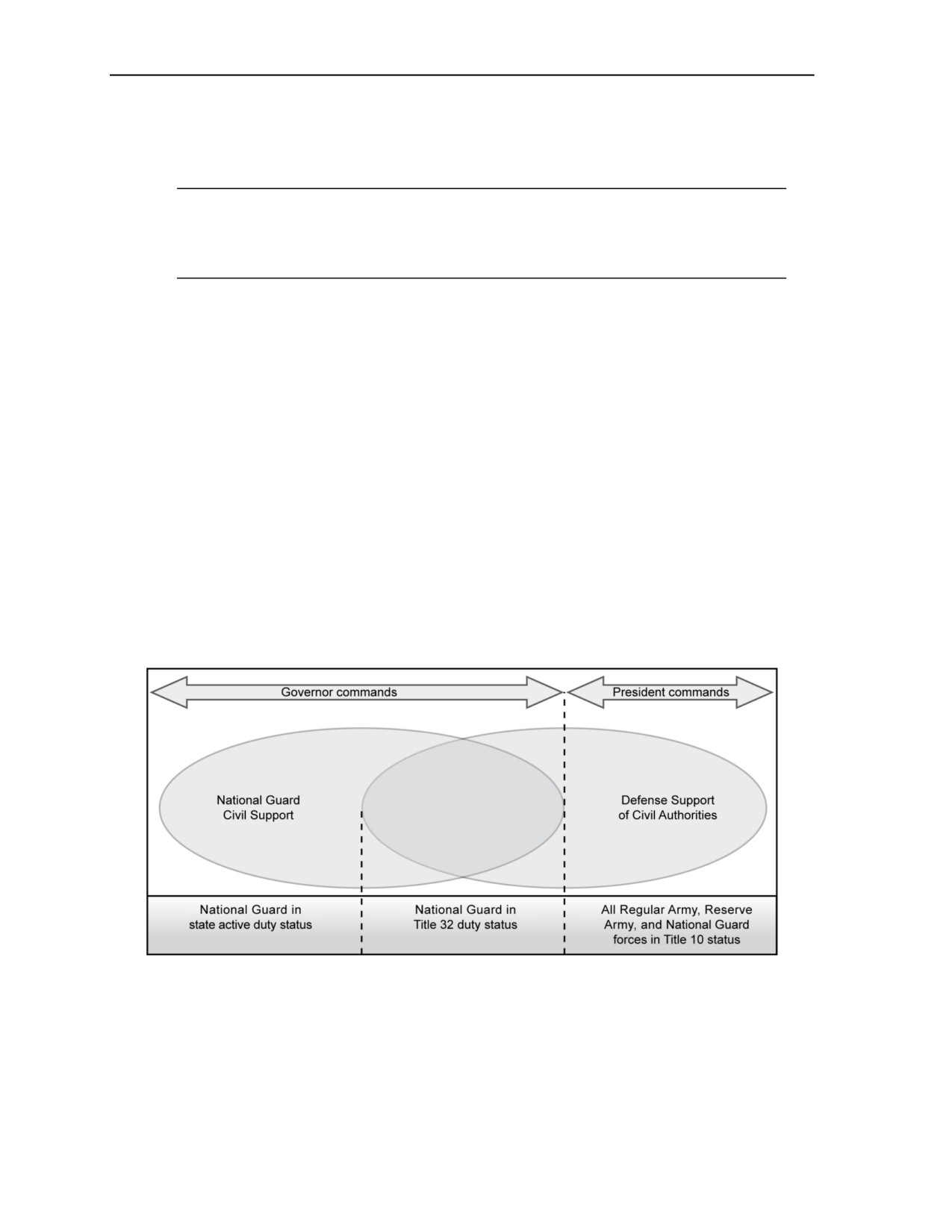
Regulation 500-1. Figure 1-1 depicts the range of response provided by Soldiers.
Figure 1-1. Range of response
1-2
FM 3-28 (Signature Draft—Not for Implementation)
4 June 2010
The Domestic Environment
Note. The definitions of DSCA and National Guard civil support will be modified to incorporate
the new definition of DSCA when a new DODD 3025.1 is signed. The new DODD 3025.1 will
supersede the existing version, and the definition of military support to civil authorities will be
eliminated from the joint dictionary. When updated, National Guard Regulation 500-1 will reflect
the new definitions of DSCA and National Guard civil support.
1-8. Although the definitions of DSCA and National Guard civil support currently overlap, the most
important distinction—and the one that affects field operations—deals with the status of the forces
providing the support. By law, the National Guard remains under the command of the governor unless
federalized, and the all forces in Title 10 status remain under the President’s command. The Army supports
elected officials with complementary capabilities when and where needed through a unified effort, despite
overlapping definitions. DODD 1200.17 states—
Homeland Defense and Defense Support to Civil Authorities (DSCA) are total force
missions. Unity of effort is maintained consistent with statutory responsibilities in
operations involving Federal forces and non-federalized National Guard forces with
Federal forces under Federal command and control and non-federalized National Guard
forces under State command and control‖
DODD 1200.17
1-9. Commanders and key staff need to understand why state National Guard forces and federal military
forces operate under different chains of command in civil support. The following sections summarize some
of the impacts in terms of: 1) the structure of the United States under the U.S. Constitution and its impact on
the Army; 2) the roles of the components of the Army—Regular, Reserve, and National Guard—and their
requirements for providing civil support; and 3) specific military aspects of civil support operations and
how they differ from operations conducted outside the United States.
THE UNITED STATES CONSTITUTION AND THE ARMY
1-10. Under the Constitution, the United States is a republic comprising of 50 states, together with various
territories and possessions. This system, in which the states share powers with a central national
government, is called federalism, and is the basis for division of powers between state and federal
government. The Constitution carefully apportions power within the federal government between the
branches of the federal government (executive, legislative, and judicial) and the individual states. This
applies to the armed forces, about which the Constitution states,
―Congress shall have power . . . To raise and support Armies . . . To provide and
maintain a Navy; To make Rules for the Government and Regulation of the land and
naval Forces; To provide for calling forth the Militia to execute the Laws of the Union,
suppress Insurrections and repel Invasions; To provide for organizing, arming, and
disciplining, the Militia, and for governing such Part of them as may be employed in the
Service of the United States, reserving to the States respectively, the Appointment of the
Officers, and the Authority of training the Militia according to the discipline prescribed
by Congress;
―The President shall be Commander in Chief of the Army and Navy of the United States,
and of the Militia of the several States, when called into the actual Service of the United
States; Article II, Section 3 states the President, ―..shall take care that the Laws be
faithfully executed.‖
(The Constitution of United States, Article II Section 2)
1-11. Note the authorities the framers granted to the states concerning the militia, the predecessor of today’s
National Guard. This requirement is the constitutional basis for the separation of the National Guard from
the Regular Army and Air Force. It is the authority that permits the state governors retain command over the
National Guard within their respective states. There is not a chain of command in the military sense between
4 June 2010
FM 3-28 (Signature Draft—Not for Implementation)
1-3
Chapter 1
the President and the governors. Each has certain powers under the Constitution. The President as head of
Executive branch of the federal government and military commander in chief may only exercise the
authorities granted by the Constitution and U.S. law. Within their respective states, the governors retain
executive authority, including command over their state’s National Guard until the President mobilizes it for
federal service. The practical impact of this on the Army forces operating domestically is a legal division
between the National Guard and federal military forces. This is unique to domestic operational
environments, and commanders at all levels need to understand how it impacts operations.
1-12. The Constitution also outlines the antipathy of the founding fathers towards the large militaries of the
European powers. These men viewed a large standing army answering to the head of state as a continuous
threat to civil liberty. Although the founders shared a fear of a large standing army, they also saw the
necessity of a national army for the common defense. They balanced this requirement by providing the
states with military capabilities. They had ample reasons for this balancing act.
1-13. The Articles of Confederation (1784 to 1787) failed to provide the National government with
authority and means to act in the National interest. This led to the Constitutional convention to restructure
the Nation’s government. The U.S. Constitution (ratified in 1787) included provisions for federal and state
forces to enforce the law. It was not long before this was tested. In 1794, the Whiskey Rebellion forced the
first President to use armed forces to restore order. President Washington’s guidance was that the military
was to support local civil authorities, not pre-empt them. President Washington’s response established the
fundamental precept that the military supports civil authority and remains in law today.
COMPONENTS OF THE ARMY AND CIVIL SUPPORT
1-14. Civil support provided by Regular, Army Reserve, and Army National Guard units varies according
to domestic law and DOD policies. Each component has different civil support capabilities, requirements,
and restrictions. Regular Army forces and Army Reserve units always remain under the command of the
President of the United States, exercised through the Secretary of Defense and the various combatant
commanders. The National Guard (including the Army National Guard and Air National Guard) are state
forces and remain under the command of the governors of their respective states, unless mobilized for
federal service under Title 10, United States Code (USC). This creates a unique environment where Regular
Army, mobilized Army Reserve, federalized National Guard, and National Guard forces under state
command may conduct civil support operations simultaneously and in proximity while different agencies
and under different chains of command. Commanders and civilian agencies need to keep in mind the
distinctions between the components of the Army. The following sections highlight the components and
their capabilities.
THE REGULAR ARMY
1-15. The Regular Army consists of approximately
550,000 professional Soldiers organized into
operational forces intended for deployment and ground combat operations, and the generating force—
professional Soldiers supported by civilians that sustain, train, and equip not only the Regular Army, but the
other components of the Army as well. The operational forces and the generating force provide DSCA as
directed by the Secretary of Defense. The Regular Army provides civilian leaders a menu of capabilities that
capitalize on their expeditionary and campaign qualities. The most important of these are size, training and
equipment levels, flexibility, and endurance.
1-16. The ability of the Regular Army to generate large forces rapidly and sustain them for long periods in
an emergency is the component’s primary attribute for civil support. The Regular Army can provide large
forces in the interim between the time when a governor calls out the state’s National Guard, and the arrival
of substantial civilian responders from outside the state (see chapter 3). When directed and with the support
of USTRANSCOM, the Regular Army deploys forces ranging from small detachments to corps-sized
formations of
100,000 troops or more, supported by the full resources of DOD. Because they are
professionals, Soldiers of the Regular Army spend much more time in training than their reserve
counterparts. They are also not under pressure from civilian employers to return to their occupations. In
most cases Regular Army units have more modern equipment than do the reserve components. All these
1-4
FM 3-28 (Signature Draft—Not for Implementation)
4 June 2010
The Domestic Environment
factors make units of the Regular Army highly adaptive and flexible; mission focused and capable of
prodigious effort.
1-17. The limitations on domestic employment of Regular forces include proximity, legal, and operational
commitments. Regular Army units are concentrated at several large installations spread across the country
and may be based far from an incident location. Their ability to respond is less a factor of their readiness
than one of intra-theater transportation. While legal considerations affect all Soldiers, there are additional
legal limitations on the use of Regular Soldiers, discussed in detail in subsequent chapters. Perhaps the most
important limitation on the use of Regular forces is their operational tempo; the rapidity with which Regular
Army forces are committed to support ongoing campaigns and other missions outside the United States. The
nearest or most suitable Regular Army unit may be committed to operations elsewhere, with some or all of
its equipment and personnel in route to another theater.
THE ARMY RESERVE
1-18. The Army Reserve is one of two reserve components of the Army. It consists of approximately
206,000 Soldiers. It includes both units and individuals. Although it does not have any brigade combat
teams, it does include supporting units of almost every type. Army Reserve units are located throughout the
country.
1-19. The law currently restricts the use of Army Reserve units for civil support missions. In general, Army
Reserve units can only conduct civil support operations in two circumstances. First, Army Reserve units
may be mobilized by the President in response to a chemical, biological, radiological, nuclear, and high-
yield explosives incident. Second, Army Reserve units already on active duty for training may provide
immediate response or other civil support when authorized by DOD. However, any time spent on civil
support operations is counted against the total training time for that year, and may not exceed the total
active duty for training time allotted for that year.
1-20. Individual call-up and augmentation of Regular Army units conducting civil support follows similar
rules to those applied in a limited Presidential call-up. Refer to Chapter 7 for additional discussion on the
restrictions on the use of Army Reserve forces for domestic operations.
THE ARMY NATIONAL GUARD
1-21. The Army National Guard is the other reserve component of the Army. It consists of approximately
360,000 Soldiers. Each state, each territory, and the District of Columbia have National Guard forces, for a
total of 54 state and Territorial Army National Guard elements. These forces are organized into modular
formations identical to those of the Regular Army and Army Reserve. Unlike the Regular Army, however,
the Army National Guard has a dual role. As a reserve component of the Army, the President may mobilize
the National Guard for federal service. In this capacity the Army National Guard provides an operational
reserve for the Regular Army, including eight of the Army’s 18 division headquarters; 33 of the Army’s 73
brigade combat teams; 47% of the Army’s multi-functional support brigades; and 40% of the Army’s
functional support brigades. Until such time as the President brings any unit of the National Guard into
federal service, National Guard forces remain under the command of their respective state or territorial
governor. As state forces, the Army National Guard units provide the majority of the Soldiers committed to
civil support, and are critical to the state’s support of its citizens.
1-22. Army National Guard units have advantages and disadvantages when employed in a civil support
role. Their significant advantages are proximity, responsiveness, knowledge of local conditions, tactical
flexibility in civil support missions, and closer association with state and local officials. The important
disadvantages of National Guard forces are unit distribution between states, limited endurance, and the
ability of the states to fund them.
1-23. Because they are state resources, the governor can activate National Guard units based on
requirements in that state. During an emergency, Army National Guard units often task-organize with Air
National Guard units from that state in state joint task forces. In state service, the National Guard is more
flexible in terms of law enforcement, and in the range of missions they may be assigned in support of first
4 June 2010
FM 3-28 (Signature Draft—Not for Implementation)
1-5
Chapter 1
responders. Quite often, their leaders are personal acquaintances of the other key state officials, which tend
to speed communication through state channels.
1-24. Possibly the most important limitation of the Army National Guard is its endurance. Each day the
National Guardsman is deployed is a day away from civilian employment. Most employers are generous in
allowing time for National Guard call-ups, but deployments for annual training, state civil support missions,
and deployment overseas, create serious strains. The endurance of the National Guard is also limited by
fiscal considerations. The state has limited funds to pay personnel and operational costs, including health
care costs. A third limitation is structural. Although the Army tries to align unit organizations as closely as
possible within that state’s National Guard, units may still be distributed across more than one state. Thus
the combat organizations with which National Guard units train in annual training may be different than the
units that command them in civil support operations.
UNIT STATUS
1-25. The particular status of a unit—the legal standing of the organization—determines its chain of
command, and in some cases the missions it may undertake within the United States and its territories.
Depending on its status, units may be described as federal military forces or state National Guard forces.
However, the inclusion of National Guard forces within either category will vary, as discussed below.
FEDERAL MILITARY FORCES (TITLE 10 STATUS)
1-26. Title 10, USC, governs all federal military forces. For the Army, these forces include the Regular
Army, the Army Reserve, and all National Guard units ordered to federal active duty in Title 10 status. For
the other services, federal military forces include all of their components except the Air National Guard
unless it mobilizes for federal service. Federal military forces are federal assets under the command of the
President. Forces in Title 10 status are restricted by the Posse Comitatus Act (see chapters 5 and 7).
1-27. In a large-scale disaster, the President may direct that federal military forces support federal agencies,
but these forces will remain under federal, not state command. In most cases, there are separate federal and
state chains of command assisting numerous organizations on the ground. Unity of effort across
jurisdictions and involving multiple organizations requires significant effort in establishing effective
communication.
STATE NATIONAL GUARD FORCES IN STATE ACTIVE DUTY OR TITLE 32 STATUS
1-28. National Guard forces under the control of the governor may be in either a state active duty status or
Title 32 status. Although there are legal distinctions between the two statuses, there is no difference in their
tactical employment. Therefore this manual refers to National Guard forces in either status as state National
Guard forces. Some states have uniformed forces that are not part of the National Guard and are not
considered state National Guard forces. These are ―state defense forces‖ and are discussed below.
STATE ACTIVE DUTY STATUS
1-29. When the governor mobilizes the state National Guard, the forces are in state active duty status,
under the command and control of the governor. The state government pays the expenses for forces in state
active duty status. National Guardsmen on state active duty conduct all missions in accordance with the
needs of the state and within the guidelines of state laws and statutes. National Guardsmen on state active
duty receive pay from that state and are subject to the state military codes (not the uniform code of military
justice). National Guard forces in state active duty status can perform civil law enforcement missions in
accordance with the laws and statutes of their state. Generally, National Guard forces assist with incident
management and homeland security operations within the state.
TITLE 32 STATUS
1-30. Under certain circumstances, a governor may request that the federal government pay for the costs
associated with a state call up of the National Guard for responding to an emergency. When the Secretary of
1-6
FM 3-28 (Signature Draft—Not for Implementation)
4 June 2010
The Domestic Environment
Defense approves, National Guard forces change from state active duty status to Title 32 status. Title 32,
USC, is the principal federal statute covering the National Guard. Even though the National Guard forces
are on active duty and funded by the federal government, in Title 32 status, National Guardsmen, remain
under the command of the governor. Although the distinction between funding lines is important to the
respective state and federal treasuries, it has no tactical impact. For Army commanders, the important
distinction is that National Guard units in Title 32 status remain under state control and therefore have
authority for some missions that Regular Army and Army Reserve units do not. Because forces in Title 32
status remain under the command of the governor, National Guard units may conduct law enforcement
missions and are not subject to the restriction of the Posse Comitatus Act.
1-31. The National Guard of one state can assist other states responding to a disaster through formal
agreements, such as the Emergency Management Assistance Compact (known as EMAC). Typically, this
occurs in state active duty, and may transition to Title 32 status upon approval by the Secretary of Defense.
When requested by the supported state’s governor and authorized by the supporting state’s governor under a
separate memorandum of agreement, National Guard elements deploy to the supported state. The
supporting National Guard operates under the operational control of the supported state’s Adjutant General.
Typically, deployments under an assistance memorandum are limited to a specific period, such as 30 days.
Often military and civilian officials refer to all National Guard forces as ―state National Guard forces‖
notwithstanding that some of them may be in a purely state active duty status, without federal funding. Table
1-1 summarizes the types of National Guard duty status.
1-32. State and Territorial National Guard forces have primary responsibility for providing military support
to state and local authorities in emergencies. In most civil support situations, the President will not
federalize National Guard forces. National Guard units conduct advance planning with civilian responders
Together these organizations—civilian and military—establish coordination plans and procedures based on
National policy such as the National Incident Management System, the National Response Framework, and
national planning scenarios. Command and control follows the authority under which service members are
ordered to duty: state active duty and state National Guard forces remain under the authority of the
respective governor; and federal military forces under federal command and control.
4 June 2010
FM 3-28 (Signature Draft—Not for Implementation)
1-7

Chapter 1
Table 1-1. Comparison of state active duty, Title 32, and Title 10 status
State Active Duty
Title 32
Title 10
Command and
Governor
Governor
President
control by—
Where missions
Within respective state or
Within respective state or territory and
Worldwide
are performed:
territory and according to
according to emergency management
emergency management
assistance compact or state-to-state
assistance compact or
memorandum of agreement
state-to-state
memorandum of
agreement
Funded by—
State government
Federal government funds administered
Federal government
by the state
Types of
Under state law—includes
Includes service for annual training;
Worldwide training
missions:
riot control, law
drills; disaster and law enforcement
and operations, as
enforcement, and
missions; and other federal military
assigned by joint
emergency (incident)
requirements. Title 32 status for incident
commander
response
response requires a disaster or
emergency declaration by the President
Discipline:
State military code
State military code
Uniform Code of
Military Justice
Conduct law
Yes, as authorized by the
Yes, as authorized by the supported
No, strictly limited by
enforcement?
supported governor
governor
the Posse Comitatus
Act, standing execute
orders, and
Department of
Defense directives
Pay determined
State law
DOD 7000.14-R
DOD 7000.14-R
by—
Travel, lodging,
State law
Department of Defense travel regulations
Department of
and benefits
and public law
Defense travel
determined by—
regulations and public
law
STATE DEFENSE FORCES
1-33. Not all individuals wearing an Army uniform are part of the Army. State defense forces may be
present during civil support operations. Twenty-four states have a state defense force of some description,
organized under a separate provision of Section 109(c) of Title 32, USC. A state defense force may be a
―state organized defense force‖ or ―state guard,‖ or even a named militia unit. However, these forces are not
National Guard forces, although they are the responsibility of the state Adjutant General. They are always
under the governor’s command. Each state continues to fund its state defense forces regardless of the nature
of the disaster response—Title 32 status does not apply. State defense forces may conduct law enforcement
missions consistent with states laws and orders by the governor. In some states and territories, the state
defense force has law enforcement authority similar to a credentialed law enforcement officer. Many of
these units wear standard Army uniforms when in state service. This can lead to confusion, since to civilians
they appear to be members of the Armed Forces. The state often employs these elements within their county
of residence.
KEY ASPECTS OF DOMESTIC OPERATIONS
1-34. Either a governor or federal civilian agencies may request help from the military when the situation
exceeds their capacity to respond. However, DOD support, especially the active components of the military,
are only temporary help until local, state, and federal authorities resume their normal roles. Commanders
keep in mind that federal laws require the supported federal agency (such as the Federal Emergency
Management Agency) to reimburse DOD for any support the latter provides. That can be very expensive;
1-8
FM 3-28 (Signature Draft—Not for Implementation)
4 June 2010

The Domestic Environment
Hurricane Katrina expenses billed to the Federal Emergency Management Agency by DOD exceeded five
billion dollars.
1-35. Civil support operations are generally not the top priority mission of the DOD. War fighting and the
Homeland Defense mission are the top priority, but DOD must be prepared to conduct civil support
missions. DOD is not the lead in civil support operations, but supports a primary agency. The primary
agency establishes priorities and maintains overall direction of the civil support. DOD anticipates
requirements from the primary agency, and plans, prepares, and trains accordingly for such contingencies.
Specific requirements are identified within the Defense Support of Civil Authorities Execution Order,
published by the Joint Chiefs of Staff. In any DSCA contingency involving federal military forces, the
defense coordinating officer is the Secretary of Defense's primary DOD agent for coordinating support to
the federal coordinating officer.
1-36. In civil support operations there is a federally-led response, one or more state-led responses, and one
or more local-led (city, county, tribal) responses. The federal-led response is under the command and
control of the President, Secretary of Defense and supported Combatant Command Commander. The state-
led response is under the command and control of the governor. The local-led response is under the control
of the mayor/local official. In civil support operations, all of these levels of responses, local, state, and
federal, may be occurring simultaneously. Commanders and staffs need to understand key military aspects
of the domestic environment. These aspects are summarized in Table 1-2.
Table 1-2: Key military aspects of domestic operational environments
Military aspect
Impact on military operations
Army forces conduct civil support operations only in the
Civil support operations do not include activities
United States and its possessions and territories. Army
occurring solely within a military installation.
forces do not conduct civil support operations overseas.
Army forces do not conduct stability operations within the
United States and its territories. Disaster relief operations
overseas in support of a foreign nation are stability
operations—foreign humanitarian assistance or foreign
consequence management—and Department of State is
normally the lead agency.
Department of Defense is not in the lead in civil support
Although Soldiers always remain under their military
operations; Department of Defense supports a primary
chain of command, a primary civilian agency establishes
agency.
the priorities. Missions develop in response to civilian
requests for assistance.
The state National Guard is not the primary agency for
civil support to its respective state. State National Guard
forces support state agencies.
In civil support operations, numerous relief efforts—local,
Military and civilian organizations support a primary
state, and national—may occur simultaneously. Each has
agency but in most cases are not directly subordinate to
its own chain of command. A city mayor may control a
it. Each level of government is sovereign within the limits
local response. A tribal leader may control a tribal
of the law: a governor is not subordinate to the President,
response. A governor may control a state response. The
nor is a mayor subordinate to a governor. Two or more
President controls the national response and the federal
distinct military chains of command may operate within
military response. The Secretary of Defense and
the same area. For example, active component and
supported combatant commander command and control
National Guard forces may support and report to different
federal military forces.
agencies, under different commanders.
Civil support is neither homeland defense nor homeland
Army forces support federal and state homeland security
security. Federal military forces contribute to homeland
requirements but are not part of Department of
security by conducting homeland defense and civil
Homeland Security or similar state agencies. However,
support operations. The same is true for state National
an adjutant general may be dual-hatted as a state’s
Guard forces.
director of homeland security or emergency
management.
The top priorities of Department of Defense are
Unless the Nation comes under attack by foreign forces,
warfighting and homeland defense, not civil support.
civil support will be the only element of full spectrum
Department of Defense must be prepared, however, with
operations conducted in the Homeland. Should Army
trained and ready forces to conduct civil support
forces be required to conduct homeland defense
missions.
operations, they may conduct civil support operations
simultaneously with offensive and defensive operations.
4 June 2010
FM 3-28 (Signature Draft—Not for Implementation)
1-9

Chapter 1
Department of Defense and State National Guard forces
Planning and preparation for civil support are continuous.
work with the Department of Homeland Security and other
They are based on national policy and federal
agencies to anticipate requirements. This includes
government plans. State National Guard forces prepare
planning, preparation, and training for contingencies
to support state, regional, and national contingencies.
involving state National Guard and federal military forces.
In a civil support operation, a defense coordinating officer
Within a joint (multiagency) field office, a defense
coordinates with a federal coordinating officer as the
coordinating officer interfaces between the supported
Secretary of Defense's primary agent.
federal agencies and supporting federal military forces.
Federal military forces conduct civil support as part of a
Army forces—state National Guard forces and federal
joint Service and interagency effort, under the command
military forces—cooperate as part of a joint force in
and control of the supported combatant commander.
support of civil authorities, based on national policy.
Military forces coordinate with local, state, and federal
civil authorities according to the National Response
Framework and the National Incident Management
System.
Effective civil support operations depend on coordination
Coordination with civil authorities is critical. The structure
with state and federal Interagency partners.
of civilian government within the United States makes
unity of command during incident response operations
impractical, so commanders must do everything in their
power to ensure unity of effort.
Military forces conduct civil support operations under
Staff judge advocates are critical to mission success.
state and federal laws.
State and federal laws determine how military forces
operate within the United States; they limit the tasks
military forces may perform. Due to legal requirements,
commanders accept a certain amount of inefficiency.
Many tactical civil support tasks are similar to tactical
Although stability and civil support operations share most
stability tasks, with some important differences.
tactical tasks, the conditions for these tasks are quite
different. Therefore, proficiency in stability tasks must be
reinforced with specialized training for civil support
operations.
Military forces receive reimbursement for the costs of civil
In most cases, the law requires civilian agencies to
support missions only if they maintain a detailed record of
reimburse the military for any operational costs
operations and associated costs.
associated with civil support missions. To obtain
reimbursement, military forces must account for specific
actions and costs in detail and present these figures to
the appropriate agency for payment.
DIFFERENCES BETWEEN STABILITY AND CIVIL SUPPORT OPERATIONS
1-37. Civil support operations are conducted only within the United States and U.S. possessions and
territories. Civil support is not conducted outside the United States. If DOD conducts disaster relief
operations in support of a foreign nation, for example, it is a stability operation and is called foreign
humanitarian assistance or foreign consequence management. The Department of State, not DOD, is in the
lead for this type of effort.
1-38. Within homeland defense, Army forces combine offensive, defensive, and civil support operations as
part of a joint operation to defend the United States from external attack or other threats. Within the
framework of homeland security, Army forces, as part of a joint response at the state level, federal level, or
both, will normally conduct civil support operations exclusively, often employing capabilities developed for
other elements of full spectrum operations as part of civil support.
1-39. Stability operations and civil support have similar tasks. Both revolve around the civilians on the
ground within land areas of operation. Both stability and civil support tasks require Army forces to provide
essential services and work with civilian authorities. However, domestic operational environments are quite
different in terms of law, military chain of command, use of deadly force, and the interagency process.
1-40. When operating overseas, the distinction between the three components of the Army—Regular,
Reserve and National Guard—is irrelevant. All are conducting full spectrum operations under a single joint
force commander. When operating overseas the National Guard is federalized and operates under the same
rules, regulations, and guidance as the Regular Army. The majority of active component soldiers will have
most of their interaction with the National Guard in this environment and will see them operate under
exactly the same rules and conditions as themselves. However, this is not the case when the Regular Army,
1-10
FM 3-28 (Signature Draft—Not for Implementation)
4 June 2010
The Domestic Environment
Army Reserve, and National Guard conduct civil support operations. There are important differences in the
rules, regulations, laws, and guidance that guide employment of the components of the Army when
operating within the United States, its trusts and territories. It is important for to understand what these
differences are and how they affect the conduct of civil support operations.
HOMELAND SECURITY AND HOMELAND DEFENSE
1-41. Civil support is not synonymous with homeland security or homeland defense. Civil support
contributes to both homeland security and homeland defense. DOD supports homeland security and
conducts homeland defense.
1-42. Joint doctrine defines homeland security as a concerted national effort to prevent terrorist attacks
within the United States; reduce America's vulnerability to terrorism, major disasters, and other
emergencies; and minimize the damage and recover from attacks, major disasters, and other emergencies
that occur (JP 3-28).
1-43. The Department of Homeland Security describes homeland security as follows:
Homeland security is a widely distributed and diverse—but unmistakable—national
enterprise. The term
―enterprise‖ refers to the collective efforts and shared
responsibilities of Federal, State, local, tribal, territorial, nongovernmental, and private-
sector partners—as well as individuals, families, and communities—to maintain critical
homeland security capabilities. The use of the term connotes a broad-based community
with a common interest in the public safety and well-being of America and American
society that is composed of multiple actors and stakeholders whose roles and
responsibilities are distributed and shared. As the Commander-in-Chief and the leader of
the Executive Branch, the President of the United States is uniquely responsible for the
safety, security, and resilience of the Nation. The White House leads overall homeland
security policy direction and coordination. Individual federal agencies, in turn, are
empowered by law and policy to fulfill various aspects of the homeland security mission.
The Secretary of Homeland Security leads the federal agency as defined by statute
charged with homeland security: preventing terrorism and managing risks to critical
infrastructure; securing and managing the border; enforcing and administering
immigration laws; safeguarding and securing cyberspace; and ensuring resilience to
disasters. However, as a distributed system, no single entity is responsible for or directly
manages all aspects of the enterprise.
Quadrennial Homeland Security Review Report, February 2010
1-44. Joint doctrine defines homeland defense as the protection of United States sovereignty, territory,
domestic population, and critical infrastructure against external threats and aggression or other threats as
directed by the President (JP 3-0). The operative phrase is ―external threats and aggression‖. Homeland
defense begins far from the territory of the United States and depends upon U.S. forces and the assistance of
immediate neighbors including Canada and Mexico. DOD takes the lead for homeland defense, and other
federal government organizations provide support. For more information concerning homeland defense,
refer to JP 3-27.
PRIMARY CIVIL SUPPORT TASKS
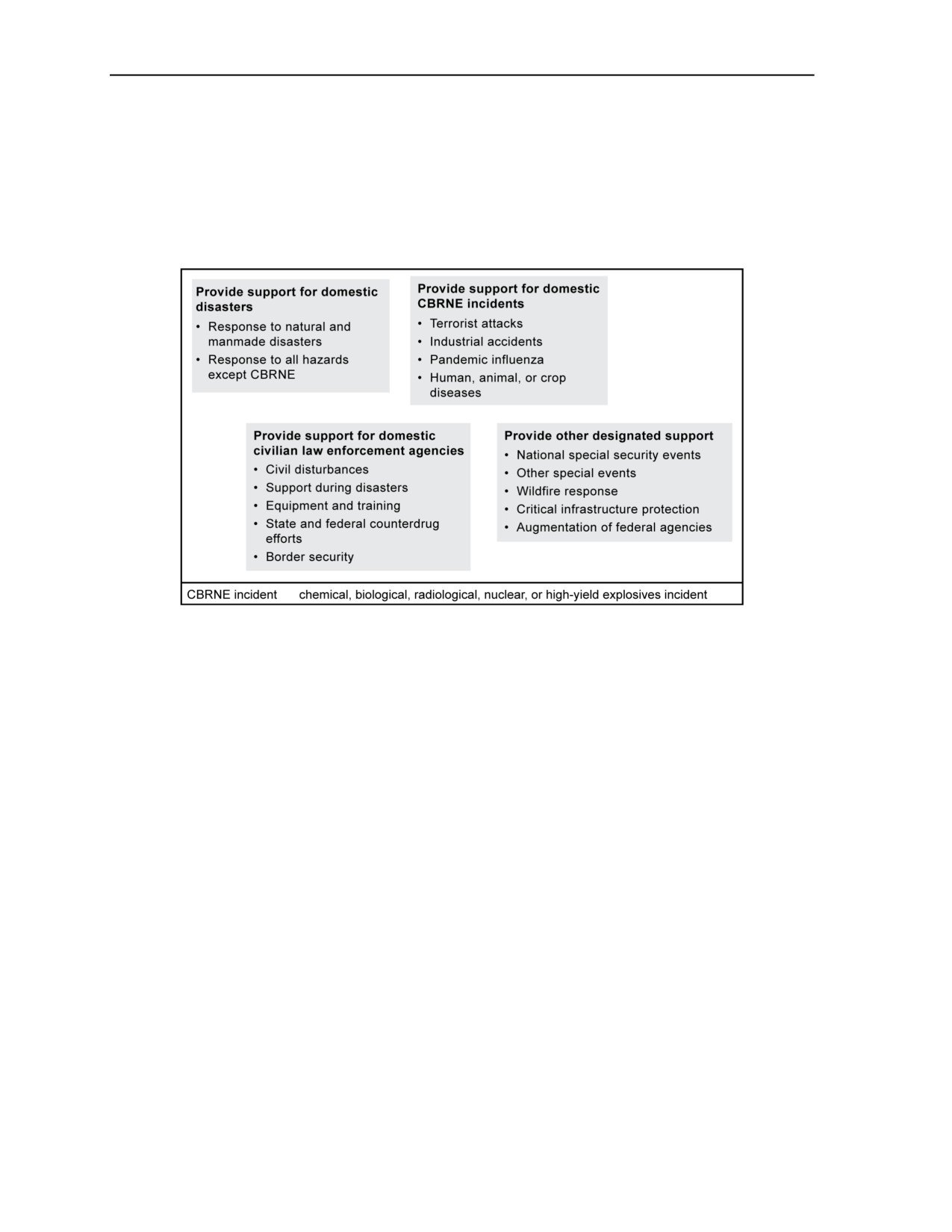
1-45. FM 3-0, 27 February 2008, specifies three primary civil support tasks. FM 3-28 now adds an
additional primary civil support task to those specified in FM 3-0, making four primary civil support tasks:
z
Provide support for domestic disasters.
z
Provide support for domestic chemical, biological, radiological, nuclear, or high-yield explosives
incidents.
z
Provide support for domestic civilian law enforcement agencies.
z
Provide other designated support.
4 June 2010
FM 3-28 (Signature Draft—Not for Implementation)
1-11
Chapter 1
1-46. The expansion to four tasks recognizes the increased emphasis placed on chemical, biological,
radiological, nuclear, or high-yield explosives incident response, particularly if terrorist groups employ
weapons of mass destruction. Incidents involving chemical, biological, radiological, nuclear, or high-yield
explosives threats require specialized capabilities, and the effects of weapons of mass destruction on
domestic operational environments may be considerably more complex than other disasters. Similar
considerations apply to pandemic response. Figure 1-2 illustrates the four primary civil support tasks with
examples of missions for each.
Figure 1-2. Primary civil support tasks with examples
PROVIDE SUPPORT FOR DOMESTIC DISASTERS
1-47. There are many types of disasters, but they all have one thing in common: people in the disaster area
have their lives upended and all too often, lose loved ones. Natural disasters occur throughout the United
States and its territories. Some disasters afford some warning beforehand, such as hurricanes, ice storms, or
even volcanic eruptions. The Department of Homeland Security, and specifically the Federal Emergency
Management Agency, marshals available support in advance of these events and assists local and state
officials with evacuation plans and recovery after the disaster. For other disasters, such as an earthquake or
a chemical accident, there is usually no warning. Emergency services and law enforcement at every level
respond according to prior planning and the availability of resources. Military response occurs at four
levels:
z
At the direction of the governor for state National Guard forces;
z
A declaration by the President requested by the governor of the affected state
z
At the direction of Service Secretaries for capabilities not assigned to the combatant commanders
(for example, bases and installations);
z
Through immediate response authority.
PROVIDE SUPPORT FOR DOMESTIC CBRNE INCIDENTS
1-48. Since September 11, 2001, Americans understand the seriousness of an attack on the homeland by
terrorists. Congress created the Department of Homeland Security to meet this threat in the wake of the
attacks in 2001. The most dangerous threats to the homeland come from terrorist groups armed with
weapons of mass destruction. The majority of scenarios in the National Response Framework deal with
accidental or deliberate threats posed by chemical, biological, radiological, nuclear, and high-yield
1-12
FM 3-28 (Signature Draft—Not for Implementation)
4 June 2010
The Domestic Environment
explosives. In the aftermath of an attack with a weapon of mass destruction, federal military and state
National Guard forces provide specialized capabilities and general-purpose forces in support of civil
authorities.
1-49. Not every chemical, biological, radiological, nuclear, or high-yield explosive threat is from terrorists,
or even manmade. Pandemic disease outbreaks (known as pandemics) fall under this civil support task. A
pandemic is a global disease outbreak. A pandemic occurs when a new disease emerges for which people
have little or no immunity and for which there is no vaccine immediately available. The disease spreads
easily person-to-person, produces serious illness, and can sweep across the country and around the world in
very short time. Pandemic influenza, for example refers to an influenza virus that infects humans across a
large area and proves very difficult to contain. The word ―pandemic‖ confuses many people, particularly
those who equate it with mass casualties. Actually, the designation of pandemic does not relate to the
lethality of the disease, but its spread. Influenza outbreaks are always serious because the virus may mutate
into something more lethal as it spreads. Army support to pandemic response is both external and internal.
Externally, Army forces respond to lead federal and state agencies request for support in dealing with the
disease. Internally, Army installations take all applicable measures to maintain the combat readiness of the
force.
1-50. Other outbreaks of infectious disease may prove more serious than a contagious influenza. These
include animal diseases such as hoof and mouth disease and crop infestations caused by fungus, bacteria, or
viruses. In these incidents, the Army provides support when requested by state or federal agencies, such as
the Departments of Agriculture. Although technically not pandemics, these incidents could entail significant
support from DOD and the National Guard.
PROVIDE SUPPORT FOR DOMESTIC CIVILIAN LAW ENFORCEMENT AGENCIES
1-51. This task applies to the restricted use of military assets to support civil law enforcement personnel
conducting civil law enforcement operations within the United States and its territories. These operations
are significantly different from operations outside of the boundaries of the United States. Army forces
support civilian law enforcement under U.S. Constitutional and statutory restrictions and corresponding
directives and regulations. Army leaders must understand the statutes governing the use of military assets
for civil law enforcement. By understanding these statutes, Soldiers can avoid violating laws while
achieving desired objectives.
PROVIDE OTHER DESIGNATED SUPPORT
1-52. This task denotes pre-planned, routine, and periodic support not related to a disasters or emergencies.
Most often, this is support to major public events, and consists of participatory support, special
transportation, and additional security. These events are national special security events such as the
Olympics, an Inauguration, or a state funeral. Some missions may involve specific support requested by a
federal or state agency to augment their capabilities due to labor shortages or a sudden increase in demands.
Such support may extend to augmentation of critical government services by Soldiers, as authorized by the
President and directed by the Secretary of Defense. For example, President Reagan replaced striking Air
Controllers in the Federal Aviation Administration with like skilled military personnel, until newly hired
civilians completed training. Other presidents have used Soldiers to move coal during strikes, or even take
over key commercial enterprises when the President believed security considerations justified such radical
action.
1-53. One of the missions that either federal military or state National Guard forces receive on a regular
basis is firefighting within state and national lands. This is a hybrid mission, sharing aspects of disaster
response and planned support to an agency or community. (See Chapter 6.)
FUNDAMENTALS OF CIVIL SUPPORT
1-54. A broad set of fundamentals applies to any of the civil support tasks and guides Army leaders at every
echelon. While every civil support mission is unique, these fundamentals shape the actions of commanders
and leaders in the accomplishment of any civil support mission. Army forces may or may not be among the
4 June 2010
FM 3-28 (Signature Draft—Not for Implementation)
1-13
Chapter 1
first organizations to arrive in an incident response operation. However, Army forces should be among the
first organizations to complete their tasks, transition responsibilities to civil agencies, and leave. Civil
support operations succeed when they create the conditions for civil authorities and nonmilitary groups to
carry on the effort without military support. The fundamentals of civil support are—
z
The primary purposes of civil support are to save lives, alleviate suffering, and protect property.
z
The law defines every aspect of civil support operations - who has jurisdiction; who responds;
and the restraints and constraints imposed on Soldiers.
z
Civilian officials direct civil support operations. They set the priorities. The Army supports them.
z
All costs associated with civil support missions must be documented.
z
The military end state is reached when civilian authorities can fulfill their responsibilities without
military assistance
THE PRIMARY PURPOSES OF CIVIL SUPPORT ARE TO SAVE LIVES, ALLEVIATE SUFFERING,
AND PROTECT PROPERTY
1-55. While there are many potential missions for Soldiers as part of civil support, the overarching
purposes of these missions are, in order, to save lives, alleviate suffering, and protect property. Some
missions may accomplish these purposes directly. An aircraft crew participating in a search and rescue
operation is there to save lives. Regular Army Soldiers fighting fires in a National Forest are guarding
public property, as are the National Guard Soldiers patrolling streets in the aftermath of a tornado. Some
civil support missions accomplish these purposes indirectly. The Soldiers and civilians assisting with the
load-out of medical supplies that are being shipped from an installation to a municipal shelter will not meet
the citizens housed there, but their actions help reduce the distress of their fellow citizens. In the absence of
orders, or in uncertain and chaotic situations, each Soldier governs their actions based on these three
purposes.
THE LAW DEFINES EVERY ASPECT OF CIVIL SUPPORT OPERATIONS—WHO HAS
JURISDICTION, WHO RESPONDS, AND THE RESTRAINTS AND CONSTRAINTS IMPOSED ON
SOLDIERS
1-56. The law defines almost every aspect of civil support operations. It prohibits many Soldiers from
undertaking certain missions, in particular those associated with law enforcement. The law also specifies
professional requirements for skills such as medical treatment. Commanders should consult with the staff
judge advocate before authorizing Soldiers to execute any task outside of the mission received through the
chain of command.
1-57. Domestic operational environments are quite different from other environments outside the United
States because of U.S. law. Military forces operating in the domestic environment do not have a status-of-
forces agreement as they would when deployed overseas. Disregard of the laws regarding civil support can
cause military units to enter a legal minefield that will cripple mission accomplishment. Leaders at every
level ensure that their Soldiers comply with applicable U.S. law, even when it hampers rapid
accomplishment of the mission. For example, an Army unit storing or transporting ordnance and
ammunition may be subject to Environmental Protection Agency restrictions. Unless waived by legal
authority, laws restrict Army chaplains from conducting religious services for local citizens.
1-58. Every deploying headquarters requires a staff judge advocate or ready access to a staff judge
advocate. Army staff judge advocates know and assess the applicability of federal and state laws when Army
forces conduct civil support operations. Commanders concentrate particularly on legal limitations,
especially those concerning law enforcement support by Regular Army forces and Army National Guard
forces serving in Title 10 status. Unless there is an imminent risk to life or limb, commanders in doubt about
the legal consequences of an action ask their higher headquarters for clarification.
1-59. Crises can bring out the best and worst in human nature, including military forces. With this in mind,
military units, particularly early responding National Guard units, must be prepared to enforce the laws in
environments where civilians’ behavior is at its worst. The rules for use of force are restrictive, and leaders
1-14
FM 3-28 (Signature Draft—Not for Implementation)
4 June 2010
The Domestic Environment
review them with their subordinates before every mission. All personnel must understand the standing rules
for the use of force (SRUF) and any approved mission-specific rules for the use of force (RUF). The rules
for the use of force (RUF) are the equivalent of the rules of engagement (ROE), except that they apply in
domestic, noncombat situations. The ROE used in combat are permissive; the RUF are restrictive in nature.
They give the same emphasis to rules for the use of force as to rules of engagement in a restrictive
environment. Commanders always keep in mind that the first purpose of civil support is to save lives; lethal
force is always a measure of last resort. (See chapter 7 for a discussion of legal restrictions on the use of
force.)
1-60. In civil support, military capability comprises—
z
The ability to perform a task effectively and efficiently;
z
The ability to perform a task safely;
z
The legal authority to perform a task.
1-61. Soldiers are mission-focused and trained to exercise initiative in combat. Even if they lack resources,
Soldiers often accomplish missions through non-doctrinal tactics, techniques, and procedures. Soldiers
make up for a lack of resources by combining anything at hand with unlimited effort. While effective, it is
inefficient. In civil support operations, commanders maintain a balance between the willingness of their
subordinates to tackle any mission against the capability to do it.
1-62. Safety and risk management are paramount. Soldiers sometimes attempt to perform tasks without the
appropriate training or equipment. In combat, their action may win the engagement. In civil support
operations, it could lead to a lawsuit, legal action, an injury, or all three. Therefore, commanders ensure that
Soldiers avoid improvising and adhere to all safety procedures. To illustrate, a collapsed building in the
aftermath of an earthquake becomes one of the most hazardous places imaginable. If Soldiers attempt an
improvised rescue, they may become victims themselves and kill the trapped survivors. Subsequent
investigations may assign liability to the commander that proceeded without authority.
CIVILIAN OFFICIALS DIRECT CIVIL SUPPORT OPERATIONS: CIVILIANS SET THE
PRIORITIES; THE ARMY SUPPORTS THEM
1-63. In civil support operations, the military works for the civilian agency. The command of military
forces remains within military channels, but missions begin as requests for assistance from the supported
civilian authorities. One of the biggest mistakes that tactical commanders may make is to assume that they
need to take charge upon arrival at the scene of an incident. Military forces operating freely within civilian
jurisdictions risk upsetting the balance between civilian authority and the private sector. While a
commander may view sidestepping local authority as a faster means of accomplishing the mission, long-
term recovery may be negatively affected. Commanders begin by viewing their areas of operations as a
mosaic of civil authorities, each with primacy in its jurisdiction. While the mission may constitute a specific
military task, commanders realize the end state requires that state, territorial, local, and tribal authorities
provide effective support to their citizens, with the assistance of military forces.
1-64. Military forces are not organized or equipped to operate efficiently within the domestic environment,
although they may be the most effective means of response early in an emergency. For example, a sapper
engineer unit can remove enough debris to clear emergency routes, but a commercial construction company
can usually do the job better, faster, and more cheaply when they arrive. In addition, the civilian
construction contributes to economic recovery by putting local businesses and people back to work.
1-65. The primary civilian agency establishes the priority of effort in any civil support operation. At the
federal level, this is typically the Federal Emergency Management Agency. At the state level, it is the state
emergency management agency or equivalent. However, the civilian agencies do not issue orders to military
units. Military planners located within a multi-agency command structure integrate federal and state
National Guard capabilities within priorities established by the primary agency. Typically, this is the defense
coordinating officer at the federal joint field office and the state director of military support working with
the state emergency manager. These individuals and their staffs ensure that military forces receive the
correct priority of effort, and then translate the civilian guidance into mission assignments.
4 June 2010
FM 3-28 (Signature Draft—Not for Implementation)
1-15
Chapter 1
1-66. Army forces, regardless of their duty status, plan to accomplish their tasks and hand over any
remaining tasks or duties to appropriate civil organizations as soon as feasible. Army forces complete their
missions and redeploy in the least amount of time needed civil authorities to resume providing for citizens
and carry on the response without military support. Federal military forces normally complete their tasks
before the end state of complete recovery. National Guard forces often experience a double transition. In the
first phase, they may take over missions previously assigned to joint federal military forces or National
Guard forces sent from other states. In the second phase, they support the transition to a fully civilian-run
recovery operation.
1-67. Because the National Guard of each state and territory builds relationships with its civilian
counterparts continuously, when National Guard forces arrive to support an incident response they usually
integrate with first responders very quickly. Federal forces benefit from the National Guard’s contacts to
develop amicable and efficient operations with local civil authorities.
ALL COSTS ASSOCIATED WITH CIVIL SUPPORT MISSIONS MUST BE DOCUMENTED
1-68. Another major distinction in domestic operations is the requirement for supported civilian agencies to
reimburse DOD for any support provided by joint forces. All civil support provided by DOD is provided on
a reimbursable basis unless otherwise directed by the President, or reimbursement is waived by the
Secretary of Defense. Cost reimbursement for civil support is usually according to Section 1535 of Title 31,
USC, (commonly called the Economy Act), which mandates cost reimbursement by the federal agency
requesting support. The Stafford Act sets the guidelines for reimbursements to federal agencies and states
from federal funds set aside to support missions in response to a Presidential declaration. Federal law also
mandates that the States reimburse the Federal Emergency Management Agency for a portion (usually 25%)
of any request for assistance that is passed to the federal level. This requires detailed documentation of what
civil support state and federal military forces actually provided. Therefore all military forces engaged in
civil support maintain a detailed record of operations, and not just direct expenditures.
1-69. The practical effect on Army commanders is a requirement to document activities in much more
detail than they normally would outside the United States. In particular, commanders ensure they document
and report all transfers of equipment and supplies (including expendables) to another agency. As a rule,
battalion and higher units designate a responsible staff section to document all costs associated with civil
support missions and establish procedures for documenting costs within the unit. Subordinate leaders ensure
that their subordinates keep logbooks, automated documentation systems, and reports up-to-date. Even in
the initial response to a major catastrophe, leaders urge subordinates to record actions taken and resources
transferred from their unit to civilians and other military units.
THE MILITARY END STATE IS REACHED WHEN CIVILIAN AUTHORITIES CAN FULFILL
THEIR RESPONSIBILITIES WITHOUT MILITARY ASSISTANCE
1-70. The military end state for civil support missions, tactically and operationally, is based on the
capabilities of civilian authorities to discharge their responsibilities without military assistance. Measures of
effectiveness should be based upon civilian capability to do that particular task without military assistance.
As soon as that threshold is achieved, Commanders report it to the supported agency through the military
chain of command. Note that this does not imply a complete return to normalcy; rather, that means other
than military are available to do the mission. For example, an Army unit may be tasked to deliver food and
water to a community isolated by a disaster. As soon as the roads reopen, civilian relief organizations move
in and begin supplying necessities using contracted vehicles. Although life is not back to normal, civilians
can meet the communities’ most basic requirements without the military.
TRAINING FOR CIVIL SUPPORT OPERATIONS
1-71. Civil support operations require specialized training for military forces, although many of the tasks
implemented at the tactical unit level can be similar to some of the tasks conducted in stability operations.
Both focus on the civilians within an area of operations. Mission accomplishment depends on the success of
civilian agencies, and not on battlefield victory. Both stability and civil support operations stress the
1-16
FM 3-28 (Signature Draft—Not for Implementation)
4 June 2010
The Domestic Environment
employment of non-destructive means rather than the use of traditional lethal combat power that Soldiers
employ during combat operations against enemy forces. However, in other aspects, the two elements of full
spectrum operations are different. Operations conducted inside the borders of the United States require
Army forces to provide support to civilian agencies through a comprehensive approach laid out in national
doctrine and directives. Operations are constrained by different laws to a greater degree than prescribed by
the Law of Land Warfare and The Hague and Geneva Conventions. It is accurate to say that both stability
operations and civil support operations require similar capabilities—and achieve similar purposes—but
Soldiers conduct them under radically different conditions.
COMMON TASKS BY WARFIGHTING FUNCTION
1-72. FM 7-15 (The Army Universal Task List, known as the AUTL) identifies a comprehensive list of
Army tactical tasks (ARTs) and groups them into six warfighting functions. The warfighting functions
(ARTs 1 through 6) address movement and maneuver (ART 1); intelligence (ART 2); fires (ART 3);
sustainment; (ART 4); command and control (ART 5); and protection (ART 6). Additional larger tasks
appear under army tactical task (ART 7), which includes tactical missions, full spectrum operations, and
operational themes.
1-73. Appendix J of FM 7-15 provides a breakdown of the ARTs and indicates which tasks are common for
both stability and civil support operations. It also highlights tasks unique to stability operations, and those
that exclusively belong to civil support. Trainers should note that appendix omits the fires warfighting
function, which does not contain ARTs directly applicable to stability or civil support operations. Excluding
the fires tasks, there is a 78 % correlation between stability tasks and civil support tasks. That is, over three-
fourths of the tasks units execute in stability operations also occur in civil support operations. The reverse,
tasks unique to civil support, is currently very small (only five out of 630). The number of unique tasks will
grow as forces cycle through civil support missions and identify additional tasks for the AUTL. For
example, civil support operations require the unit to establish unclassified communication bridges between
networks with federal, state, and local agencies.
1-74. Although units will perform the same tasks in either stability or civil support, the conditions and
standards required for civil support operations will be different. For example, ART 7.3.1, establish civil
security, has 19 different measures. Army forces conducting civil support also support civil security, but
only in seven measures. The conditions and standards for the task are quite different for security provided in
civil support.
TRAINING PRIORITY FOR CIVIL SUPPORT TASKS
1-75. Commanders tasked to prepare for civil support missions assess their unit’s proficiency in three
warfighting functions; in order of priority, they are command and control, sustainment, and protection.
These three take priority because disasters usually occur without warning. The requirement to deploy into a
restrictive operational environment, and operate with joint and interagency elements requires a well-drilled
command and control system, with flexible Soldiers able to improvise and adapt systems intended for
combat into a robust civilian disaster response system based upon National Incident Management System.
The majority of missions given to Army forces in a disaster will stress the sustainment warfighting
functions. Mission success will hinge upon the units ability to deliver personnel, medical support, supplies,
and equipment, while maintaining their equipment and their Soldiers. This will normally occur in an area
devastated by a disaster and lacking potable water, power, and sanitation. This generates the third priority,
protection. Even without the threat of attacks by terrorists, a disaster area is a dangerous place. In the event
of a chemical, biological, radiological, nuclear, or high-yield explosives incident, it can become a deadly
environment for those without proper training and equipment. For those units that have a specific chemical,
biological, radiological, nuclear, or high-yield explosives mission, this function becomes their top training
priority.
4 June 2010
FM 3-28 (Signature Draft—Not for Implementation)
1-17
Chapter 2
A Comprehensive Approach for Civil Support
This chapter builds on the principles introduced in chapter 1. It describes the national
system for integration of all government agencies involved responding to domestic
emergencies. It gives an overview of the National Incident Management System and
the National Response Framework. After that, it clarifies responsibilities and
relationships among civil authorities, Department of Defense, and the Army. In
conjunction with defense support of civil authorities, the planning, policies, and
procedures established in the national policy documents provide a comprehensive
approach to civil support.
NATIONAL POLICY FOR DOMESTIC EMERGENCIES
2-1. The National Incident Management System (NIMS) establishes the national approach for incident
management across local, state, and federal levels. (All types of emergencies and disasters generally are
known as incidents.) In military terms, the NIMS contains the capstone doctrine for coordinated incident
management in the United States. The incident management systems described in the NIMS is the
foundation for the additional response procedures described in the National Response Framework (NRF).
The NIMS and NRF also provide the foundation for National Planning Scenarios, developed for a range of
threats from a terrorist nuclear attack to the outbreak of a deadly infectious disease. The Department of
Homeland Security (DHS) promulgates and updates the NIMS, NRF, and supporting planning documents.
The NIMS and NRF provide policy and guidance for federal agencies, including Department of Defense
(DOD). Federal agencies develop supporting plans that implement the requirements established in the
NIMS and NRF. Virtually all state, county, and city emergency managers use the NIMS and NRF.
2-2. The NIMS and NRF apply not only across all levels of government, but they also include military
forces and nongovernmental organizations. This policy forms a comprehensive approach for responding to
domestic emergencies. The NIMS and NRF provide guidance on how to achieve unity of effort across all
participating organizations.
2-3. Incident response is a federally planned but bottom-up system, usually progressing from local, to
state, to federal level as the magnitude of a particular incident exceeds the resources of the first responders.
This is known as a ―tiered response.‖ Local first responders take initial action, whether an incident is a
routine small-scale emergency or a major disaster requiring further assistance. Initially, local, state, and
tribal officers rely on their own law enforcement, firefighting, and other resources, which may include the
state’s National Guard. Within each state, local chief executive officers
(such as mayors, county
commissioners, and tribal chief executive officers) assess the situation. If necessary, they request assistance
from a neighboring county or municipality. Normally, assistance from neighboring jurisdictions follows
established agreements. If an incident overwhelms these capabilities, the local civil authorities request state
assistance. If necessary, the governor requests federal support. Federal military installations near the
disaster may respond when asked by the local civil authorities (see chapter 3); in such instances they may be
the first Soldiers at the scene of an incident.
2-4. The leaders of tribal nations have the right to request certain federal assistance directly, bypassing the
state in which tribal lands are located. In general, tribal nations have authority similar to state authority for
incident response operations. However, a request for a Presidential declaration under the Stafford Act must
go through the governor of the state.
4 June 2010
FM -3-28 (Signature Draft—Not for Implementation)
2-1
Chapter 2
2-5. Even though they support civilian authority, all military forces remain under the operational and
administrative control of their respective military chains of command. For the National Guard, this extends
upward through the state National Guard command structure to the governor. Regular Army, mobilized
Army Reserve, and Marine forces always remain under the command of the President through the Secretary
of Defense and through the supported combatant commander or Service secretary. Military units support
civilian organizations that follow the national policy in the NIMS and NRF (described below), but Soldiers
remain under military command and follow military doctrine, including this manual. Thus, a joint task force
providing civil support plans according to the principles and processes described in JP 5-0. An Army
brigade under operational control of a joint task force follows the Army operations process—plan, prepare,
execute, and assess—and uses the military decisionmaking process. Similarly, Army forces exercise
command and control through their existing structures; they do not modify their operations center to
conform to the NIMS. However, they adapt their procedures and liaison arrangements to interface with their
civilian counterparts.
THE NATIONAL INCIDENT MANAGEMENT SYSTEM
2-6. The NIMS has five components: preparedness, communications and information management,
resource management, command and management, and ongoing management and maintenance. This
discussion highlights the central construct of the NIMS—the command and management component.
Individual responders and agencies manage and coordinate their efforts using these flexible elements of the
NIMS command and management component:
z
The incident command system.
z
Multiagency coordination systems.
z
Public information.
z
NIMS planning process. Broadly similar to the military decision making process, the NIMS
planning process guides responders in each tier as they respond to the situation with an incident
action plan.
This field manual does not provide an exhaustive discussion of the NIMS. For the complete document, see
the Federal Emergency Management Agency (FEMA) Web site at http://www.fema.gov.
Incident Command System
2-7. The NIMS establishes the incident command system as the standardized organizational structure for
managing all domestic incidents. The incident command system includes common terminology, modular
organization, management by objectives, reliance on an incident action plan, manageable span of control,
and integrated communications (see the NIMS document for a thorough discussion). Every incident
command organization shares these characteristics, but each incident command structure adapts to the
requirements of situation. In the immediate aftermath of any incident, local responders arrive first on the
scene. First responders normally include law enforcement, fire, emergency medical services and hazardous
materials teams. At the incident site, local authorities organize the various responders based on the incident
command structure.
2-8. Civilian incident management terms such as single incident command, unified command, and area
command (explained further later in this chapter) do not include the idea of giving and receiving military
orders. A civilian incident commander directs subordinates within his or her chain of authority. But for the
most part, this civilian commander manages other participating organizations and individuals. In this
civilian usage of command—within a multiagency environment—groups and individuals generally carry out
tasks they are willing to perform. Therefore, Army leaders adapt their leadership style not only to cooperate
fully with other groups but also to encourage cooperation among all participating organizations and
individuals. Army leaders keep in mind that they serve in a supporting role.
2-9. The incident command system prescribes five major functional areas: command, operations, logistics,
planning, and finance. As required, information and intelligence functions are located in the planning
section. However, if the situation warrants, the incident command system recommends that the organization
break intelligence out as a sixth functional area. The incident command system is flexible to accommodate
2-2
FM 3-28 (Signature Draft—Not for Implementation)
4 June 2010
A Comprehensive Approach for Civil Support
all circumstances including floods, hazardous material accidents, aircraft crashes, or earthquakes—it is an
all-hazards system. It is flexible enough to manage catastrophic incidents involving thousands of response
personnel; several levels of command are possible. Options include a single incident command structure, a
unified command structure, and an area command
2-10. A single incident command structure refers to situations in which one incident commander has
manageable span of control. The single incident commander is normally the senior responder of the local
civilian organization with the responsibility for the incident, such as a fire chief or police chief. When there
is only one incident commander, he or she establishes an incident command post at a safe distance from but
not near the scene of the emergency to direct operations.
2-11. The incident command system provides the flexibility for agencies to coordinate and combine any
number of independent efforts in an effective and efficient response. Based on the situation, a unified
command structure enables agencies with different legal, geographic and functional responsibilities to plan
and coordinate operations. In a unified command structure, the individuals designated by their jurisdictional
authorities jointly determine objectives, plans, and priorities and work together to execute them. By
working as a team, the unified command overcomes much of the inefficiency and duplication of effort that
can occur when agencies from different functional and geographic jurisdictions, or agencies at different
levels of government, operate without a common organizational framework.
2-12. The primary difference between the single incident command structure and the unified command
structure is that in a single incident command structure, one incident commander is solely responsible for
establishing incident management objectives and strategies. Unified command strives for unity of effort as
all responding agencies and organizations support the unified command without giving up individual agency
authorities, responsibilities, or accountability.
2-13. An incident large enough to require federal military support will usually be multijurisdictional and
use a unified command structure. In addition, a very large or complex incident may have separate incident
command organizations (any combination of single or unified commands). The primary federal agency may
establish an area command to coordinate separate incident commands responding to a larger emergency.
(State authorities managing a complex, multijurisdictional response without federal assistance may also use
an area command.) An area command does not have operational responsibilities—it is a management
organization. Its functions include setting priorities, allocating resources according to established priorities,
ensuring effective communications, and ensuring that incident management objectives are met and do not
conflict with each other or with policy. (An area command becomes a unified area command when it is
managing more than one multijurisdictional incident. This is different from a unified command responding
to a single multijurisdictional incident.)
Incident Command Staff
2-14. When an incident requires a team of responders, the incident commander establishes an incident
command post as close to the incident as practical. In a small incident command post, the incident command
staff typically includes a public information officer, a safety officer, and a liaison officer. Depending on the
nature of the incident, the incident commander adds additional staff support as needed. The incident
command staff typically consists of operations, planning, logistics, and finance and administration section
chiefs. These individuals, along with an incident commander (or unified command) and other qualified
emergency management personnel, are known as an incident management team. Figure 2-1 illustrates the
incident command staff developed by NIMS. (See Appendix I for more details about the incident command
staff.)
4 June 2010
FM 3-28 (Signature Draft—Not for Implementation)
2-3
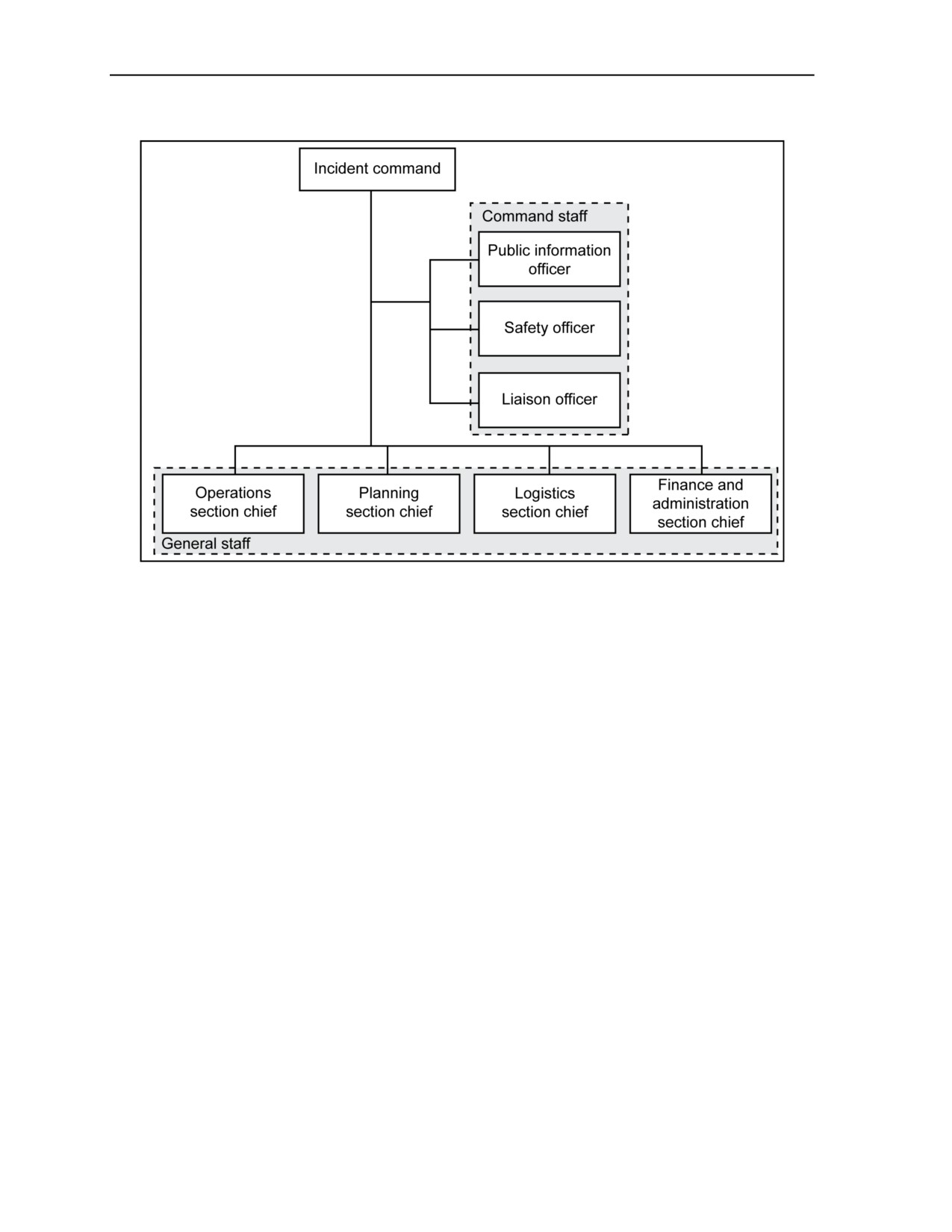
Chapter 2
Figure 2-1. NIMS incident command system staff
2-15. The incident command staff has three sections identified as command staff. These are the public
information officer, the safety officer, and liaison officer. The public information officer is responsible for
interfacing with the public, the news media, and other agencies with incident-related information. The
public information officer assembles accurate, accessible, and complete information on the incident’s cause,
size, and current situation; the resources committed; and other matters of general interest for both internal
and external audiences. The safety officer monitors incident operations and advises the incident command
on all matters relating to operational safety. The safety officer is responsible for developing the incident
safety plan. The incident safety plan is a set of systems and procedures for ongoing assessment of hazardous
environments, coordination of interagency safety efforts, and implementation of measures to promote
incident personnel safety, as well as the general safety of incident operations. The liaison officer is the
incident command’s point of contact for representatives of governmental organizations, nongovernmental
organizations, and private sector organizations. The liaison officer provides information on the incident
command's policies, resource availability, and other incident-related matters. In either a single or unified
command structure, representatives from cooperating organizations coordinate through the liaison officer.
2-16. An incident complex refers to two or more incidents located in the same general area and assigned to
a single incident command or a unified command. This management system is used when multiple
incidents, such as separate fires burning relatively close together, are more efficiently managed by one
incident command system organization
Multiagency Coordination Systems
2-17. Multiagency coordination systems are flexible coordination processes established among related
groups of supporting organizations in response to specific incidents. These organizations normally
coordinate resources above the field level. The two most common elements of NIMS multiagency
coordination systems are multiagency coordination groups and emergency operations centers.
2-4
FM 3-28 (Signature Draft—Not for Implementation)
4 June 2010
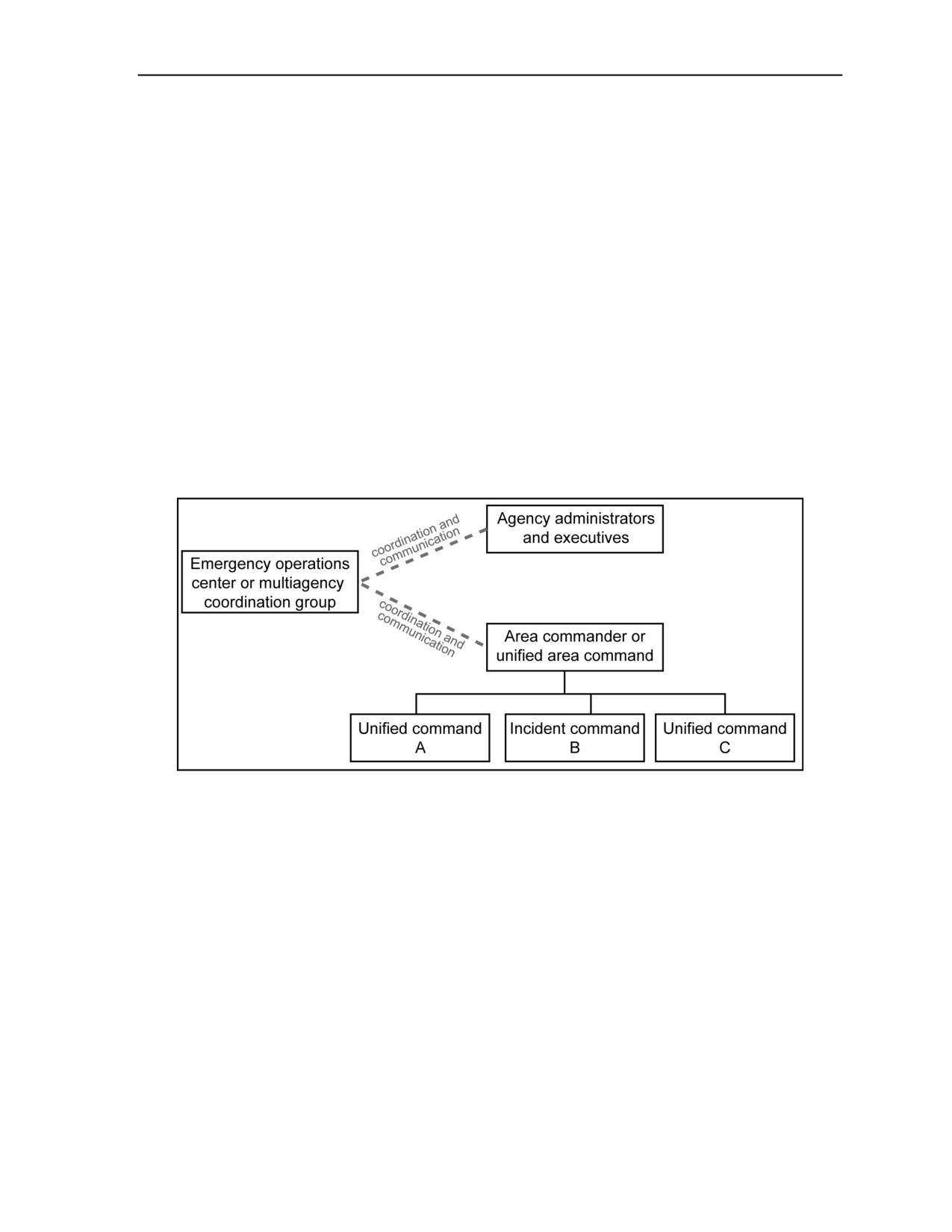
A Comprehensive Approach for Civil Support
2-18. A multiagency coordination group is an ad hoc coordination group usually consisting of
administrators, executives, or their representatives. They commit agency resources and funds to support an
incident response. Multiagency coordination groups establish coordination procedures (systems) that bridge
members’ jurisdictional lines and disciplines to support operations on the ground. Multiagency coordination
groups communicate and coordinate with the incident command or unified command, usually by placing
personnel at or near an emergency operations center (see figure 2-2).
2-19. An emergency operations center is a facility where the coordination of information and resources to
support on-site incident management activities normally occurs. An emergency operations center may be a
relatively small, temporary facility or a permanently established facility. Many cities, most counties, and
most states have permanent emergency operations centers. These may be organized by major functional
disciplines (such as fire, law enforcement, and medical services), by jurisdiction (such as federal, state,
regional, county, city, and tribal), or by some combination (see JP 3-41). Emergency operations centers are
called by a variety of different names. An emergency operations center normally includes a full incident
command staff performing coordination; communications; resource allocation and tracking; and information
collection, analysis, and dissemination. An emergency operations center serves as a central communication
point between organizations participating in the incident command system and multiagency coordination
groups. In a complex operation, several emergency operations centers may be operating at different
jurisdictional levels. An area command may interface between multiple incident command posts and an
emergency operations center (see figures 2-2 and 2-3).
Figure 2-2. Example of NIMS command and management structure
4 June 2010
FM 3-28 (Signature Draft—Not for Implementation)
2-5
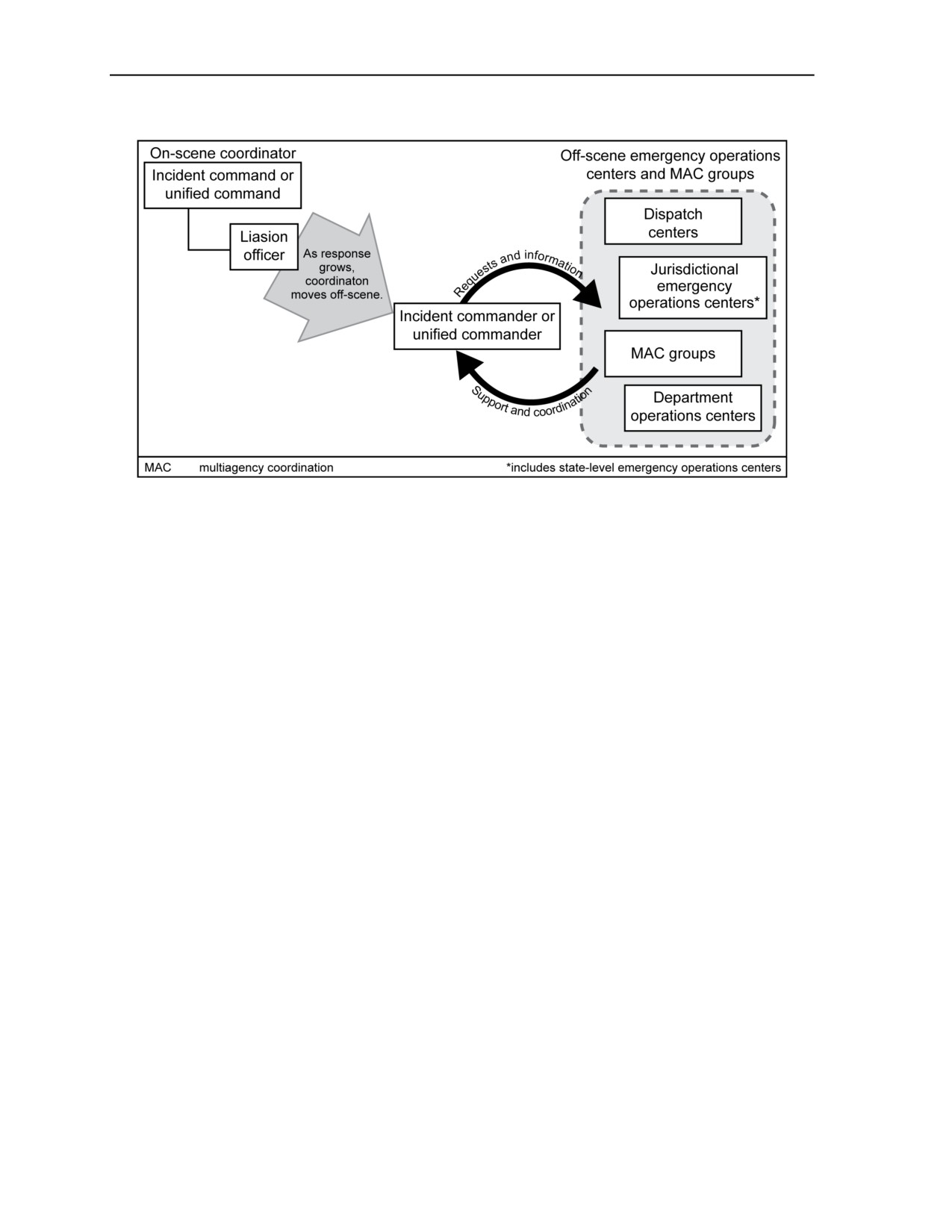
Chapter 2
Figure 2-3: Expanding command and coordination under NIMS
Public Information
2-20. In the NIMS, public information refers to flexible processes, procedures, and systems used by
incident managers to communicate timely, accurate, and accessible information about an incident to the
public, responders, and additional stakeholders. In a large, multiagency incident response, the NIMS public
information system includes a public information officer, a joint information system, and a joint information
center.
(The word ―joint‖ means ―multiagency‖ in this context.) A civilian public information officer
supports the incident command and management structure as a member of the command staff (refer to
figure 2-2).
2-21. A multiagency joint information center (a feature of the NIMS communications and information
management component) serves as the central location for exchanging public information. A large incident
may require more than one joint information center. This component emphasizes the need for a common
operating picture (similar to the common operational picture in Army doctrine) and interoperability of
systems and components. Participating organizations cooperate to establish communications interoperability
and standardize their types of communication and their equipment. (See appendix K for more information
about media considerations.)
The National Incident Management System Planning Process
2-22. The NIMS describes a planning process for developing an incident action plan. Army officers should
be familiar with the NIMS planning process to synchronize planning with civilian counterparts. The NIMS
planning process represents a template for planning that includes all steps that an incident commander or
unified command and other members of the command and general staffs should take to develop and
disseminate an incident action plan. A clear, concise incident action plan template is essential to guide the
initial incident management decision process and the continuing collective planning activities of incident
management teams.
2-23. The process contains five primary phases that are designed to enable the accomplishment of incident
objectives within a specified time. The planning process may begin with the scheduling of a planned event,
the identification of a credible threat, or the initial response to an actual or impending incident. The process
follows a series of formalized steps for developing a written incident action plan.
2-6
FM 3-28 (Signature Draft—Not for Implementation)
4 June 2010
A Comprehensive Approach for Civil Support
2-24. The incident action plan must provide clear strategic direction and include a comprehensive listing of
the tactics, resources, reserves, and support required to accomplish each overarching incident objective. The
comprehensive incident action plan states the sequence of events for achieving multiple incident objectives
in a coordinated way. However, the incident action plan is a living document that is based on the best
available information at the time of the planning meeting. Planning meetings should not be delayed in
anticipation of future information.
2-25. The primary phases of the planning process are essentially the same for the incident commander who
develops the initial plan, for the incident commander and operations section chief revising the initial plan
for extended operations, and for the incident management team developing a formal incident action plan.
During the initial stages of incident management, planners should develop a simple plan that can be
communicated through concise oral briefings. Frequently, this plan must be developed very quickly and
with incomplete situation information. As the incident management effort evolves, additional lead time,
staff, information systems, and technologies enable more detailed planning and cataloging of events and
lessons learned.
2-26. The five primary phases in the planning process are—
z
Understand the situation.
z
Establish incident objectives and strategy.
z
Develop the plan.
z
Prepare and disseminate the plan.
z
Execute, evaluate, and revise the plan.
Understand the Situation
2-27. The first phase includes gathering, recording, analyzing, and displaying situation, resource, and
incident-related information to facilitate increased situational awareness of the magnitude, complexity, and
potential impact of the incident. In this phase, the goal is to determine the resources needed to develop and
implement an effective incident action plan.
Establish Incident Objectives and Strategy
2-28. The second phase includes formulating and prioritizing measurable incident objectives and
identifying an appropriate strategy. The incident objectives and strategy must conform to the legal
obligations and management objectives of all affected agencies; they may need to include specific issues
relevant to critical infrastructure. Reasonable alternative strategies that will accomplish overall incident
objectives are identified, analyzed, and evaluated to determine the most appropriate strategy for the
situation at hand. Evaluation criteria include public health and safety factors, estimated costs, and various
environmental, legal, and political considerations.
Develop the Plan
2-29. The third phase involves determining the tactical direction and the specific resources, reserves, and
support requirements for implementing the selected strategies and tactics for the operational period. Before
the formal planning meetings, each member of the command and general staffs is responsible for gathering
certain information to support the proposed plan.
Prepare and Disseminate the Plan
2-30. The fourth phase involves preparing the plan in a format that is appropriate for the level of
complexity of the incident. For the initial response, the format is a well-prepared outline for an oral briefing.
For most incidents that will span several operational periods, the plan will be developed in writing
according to incident command system procedures.
4 June 2010
FM 3-28 (Signature Draft—Not for Implementation)
2-7
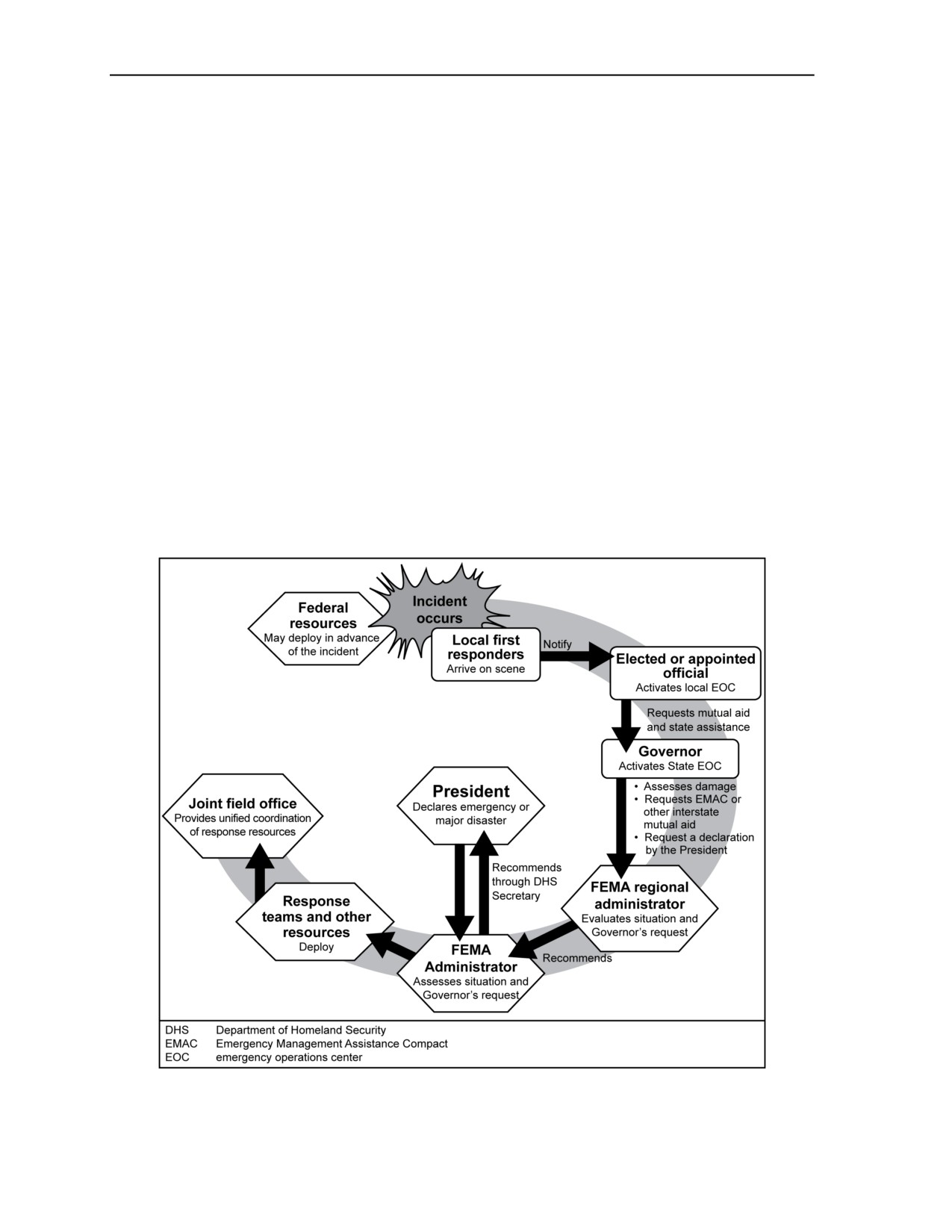
Chapter 2
Execute, Evaluate, and Revise the Plan
2-31. The planning process includes the requirement to execute and evaluate planned activities and check
the accuracy of information to be used in planning for subsequent operational periods. The general staff
should regularly compare planned progress with actual progress. When deviations occur and when new
information emerges, it should be included in the first step of the process used for modifying the current
plan or developing the plan for the subsequent operational period.
THE NATIONAL RESPONSE FRAMEWORK
2-32. The NRF replaced the earlier National Response Plan in 2004 as the all-hazards doctrine for
managing domestic incidents. It elaborates the principles in the NIMS, focusing on prevention,
preparedness, response, and recovery. It provides the structure and mechanisms for coordinating federal
support to state and local incident managers and for exercising federal authorities and responsibilities based
on the NIMS.
2-33. The NRF emphasizes a tiered response structure, with the lowest possible jurisdictional level
retaining incident management responsibility. Figure
2-4 illustrates tiered response. Local authorities
provide the initial response to every incident, including manmade and natural disasters. When local
authorities are overwhelmed, they request assistance from neighboring jurisdictions. When incidents are of
such a magnitude that these resources are overwhelmed, local authorities request resources from the state.
The state then draws on its own internal emergency response capabilities or requests assistance from
neighboring states through mutual-aid agreements. States often deal with large and devastating events this
way without any federal assistance. When state resources are overwhelmed, the governor requests federal
support.
Figure 2-4. An overview of tiered response under the National Response Framework
2-8
FM 3-28 (Signature Draft—Not for Implementation)
4 June 2010
A Comprehensive Approach for Civil Support
2-34. The NRF establishes a systematic and coordinated approach to incident response at the field,
regional, and federal headquarters levels. It establishes protocols for such activities as reporting incidents,
issuing alerts and notification, coordinating response actions, and mobilizing resources. Though the NRF
generally seeks to preserve the primary role of state and local bodies as first responders, it recognizes
catastrophic events will require a federal government response.
The Five Principles of the National Response Framework
2-35. According to the NRF, the overarching objectives for incident response center on saving lives,
reducing suffering, and protecting property and the environment. Five key NRF principles of operations are
the basis of the overarching objectives:
z
Leaders at all levels communicate and actively support engaged partnerships (cooperation) by
developing shared goals and aligning capabilities so no one is overwhelmed in times of crisis.
z
Incidents are managed at the lowest possible jurisdictional level and supported by additional
capabilities when needed, through a tiered response.
z
As incidents change in size, scope, and complexity, the response is adapted to meet requirements
through scalable, flexible, and adaptable operational capabilities.
z
Organizations participating in a multiagency or multijurisdictional response achieve unity of
effort through unified command.
z
Individuals, households, communities, and governments maintain readiness to act balanced with
an understanding of risk.
Emergency Support Function Annexes
2-36. A key component of the NRF is the emergency support function annexes (referred to as ESFs). The
ESFs group federal resources and capabilities into fifteen support categories most likely needed for national
incident response. ESFs outline responsibilities agreed to by each participating entity. Each ESF designates
one entity as the ESF coordinator (sometimes referred to as the lead). Each ESF also has primary and
supporting agencies. Table
2-1 lists the ESFs with the ESF coordinator for each. Below each ESF
coordinator are the specific functions organized in that annex. DOD is a supporting agency for 14 of the 15
emergency support functions, and the ESF coordinator for one—Public Works and Engineering (U.S. Army
Corps of Engineers). The ESF coordinators work through a regional defense coordinating officer and
federal coordinating officer to obtain federal military support under each ESF.
Table 2-1. Emergency support function annexes
ESF #1 - Transportation
ESF Coordinator: Department of Transportation
Aviation/airspace management and control
Transportation safety
Restoration and recovery of transportation infrastructure
Movement restrictions
Damage and impact assessment
ESF #2 - Communications
ESF Coordinator: Department of Homeland Security (Federal Emergency Management Agency)
Coordination with telecommunications and information technology industries
Restoration and repair of telecommunications infrastructure
Protection, restoration, and sustainment of national cyber and information technology resources
Oversight of communications
ESF #3 - Public Works and Engineering
ESF Coordinator: Department of Defense (United States Army Corps of Engineers)
Infrastructure protection and emergency repair
Infrastructure restoration
Engineering services and construction management
4 June 2010
FM 3-28 (Signature Draft—Not for Implementation)
2-9
Chapter 2
Emergency contracting support for life-saving and life-sustaining services
ESF #4 - Firefighting
ESF Coordinator: Department of Agriculture (United States Forest Service)
Coordination of federal firefighting activities
Support to wild land, rural, and urban firefighting operations
ESF #5 - Emergency Management
ESF Coordinator: Department of Homeland Security (Federal Emergency Management Agency)
Coordination of incident management and response efforts
Issuance of mission assignments
Resource and human capital
Incident action planning
Financial management
ESF #6 - Mass Care, Emergency Assistance, Housing, and Human Services
ESF Coordinator: Department of Homeland Security (Federal Emergency Management Agency)
Mass care
Emergency assistance
Disaster housing
Human services
ESF #7 - Logistics Management and Resource Support
ESF Coordinator: General Services Administration and Department of Homeland Security
(Federal
Emergency Management Agency)
Comprehensive, national incident logistics planning, management, and sustainment capability
Resource support (facility space, office equipment and supplies, contracting services, and others)
ESF #8 - Public Health and Medical Services
ESF Coordinator: Department of Health and Human Services
Public health
Medical
Mental health services
Mass fatality management
ESF #9 - Search and Rescue
ESF Coordinator: Department of Homeland Security (Federal Emergency Management Agency)
Life-saving assistance
Search and rescue operations
ESF #10 - Oil and Hazardous Materials Response
ESF Coordinator: Environmental Protection Agency
Oil and hazardous materials (chemical, biological, radiological, and nuclear) response
Environmental short- and long-term cleanup
ESF #11 - Agriculture and Natural Resources
ESF Coordinator: Department of Agriculture
Nutrition assistance
Animal and plant disease and pest response
Food safety and security
Natural and cultural resources and historic properties protection
Safety and well-being of household pets
ESF #12 - Energy
ESF Coordinator: Department of Energy
Energy infrastructure assessment, repair, and restoration
Energy industry utilities coordination
Energy forecast
2-10
FM 3-28 (Signature Draft—Not for Implementation)
4 June 2010

A Comprehensive Approach for Civil Support
ESF #13 - Public Safety and Security
ESF Coordinator: Department of Justice
Facility and resource security
Security planning and technical resource assistance
Public safety and security support
Support to access, traffic, and crowd control
ESF #14 - Long-Term Community Recovery
ESF Coordinator: Department of Homeland Security (Federal Emergency Management Agency)
Social and economic community impact assessment
Long-term community recovery assistance to states, tribes, local governments, and the private sector
Analysis and review of mitigation program implementation
ESF #15 - External Affairs
ESF Coordinator: Department of Homeland Security
Emergency public information and protective action guidance
Media and community relations
Congressional and international affairs
Tribal and insular affairs
National Planning Scenarios
2-37. The NRF builds preparedness using the National Preparedness Guidelines and the National
Infrastructure Protection Plan. The National Planning Scenarios are part of the National Preparedness
Guidelines. DHS provides these scenarios for use at local, state, and national level to conduct exercises and
estimate response capabilities. There are currently fifteen planning scenarios. Each scenario provides the
basis for planning and national level exercises. Table 2-2 lists the scenarios, and illustrates how the
scenarios fit into eight key related scenario sets. Additional information is available at the FEMA website:
Table 2-2. National Planning Scenarios
Key Scenario Sets
National Planning Scenarios
Set 1: Explosives Attack—Bomb Using
Scenario 12: Explosives Attack— Bomb Using Improvised
Improvised Explosive Device
Explosive Device
Set 2: Nuclear Attack
Scenario 1: Nuclear Detonation—Improvised Nuclear Device
Set 3: Radiological Attack—Radiological
Scenario 11: Radiological Attack—Radiological Dispersal Device
Dispersal Device
Set 4: Biological Attack—with annexes for
Scenario 2: Biological Attack—Aerosol Anthrax
different pathogens
Scenario 4: Biological Attack—Plague
Scenario 13: Biological Attack—Food Contamination
Scenario 14: Biological Attack—Foreign Animal Disease
Set 5: Chemical Attack—with annexes for
Scenario 5: Chemical Attack—Blister Agent
different agents
Scenario 6: Chemical Attack—Toxic Industrial Chemicals
Scenario 7: Chemical Attack—Nerve Agent
Scenario 8: Chemical Attack—Chlorine Tank Explosion
Set 6: Natural Disaster—with annexes for
Scenario 9: Natural Disaster—Major Earthquake
different disasters
Scenario 10: Natural Disaster—Major Hurricane
Set 7: Cyber Attack
Scenario 15: Cyber Attack
Set 8: Pandemic Influenza
Scenario 3: Biological Disease Outbreak—Pandemic Influenza
TIERED RESPONSE
2-38. The NRF is based on the capability of civil authorities at each level to respond to extraordinary
situations. Each level of government maintains enough capability to carry out its legal responsibilities
4 June 2010
FM 3-28 (Signature Draft—Not for Implementation)
2-11
///////////////////////////////////////