FM 4-02.6 THE MEDICAL COMPANY: TACTICS, TECHNIQUES, AND PROCEDURES (AUGUST 2002) - page 5
FM 4-02.6
(3) Applicability. Except when modified by TSOPs and OPLANs/OPORDs of higher
headquarters, this document applies to this unit and to all assigned, attached, or OPCON elements/units for
combat operations. In cases of nonconformity, the document of the higher headquarters governs.
(4) References. This paragraph can include any pertinent regulations, policy letters, higher
headquarters TSOP, or other appropriate documents.
(5) General information. This paragraph discusses the required state of readiness of the
unit; primary, secondary, and contingency missions; procedures for operating within another command’s
AO; and procedures for resolution of conflicts with governing regulations, policies, and procedures.
b. The second section of the TSOP discusses the unit’s organization.
(1) Organization. This unit is organized and equipped in accordance with the applicable
MTOE.
(2) Task organization. Task organization is contingent on the mission and is approved by
the headquarters ordering deployment.
(3) Organizational charts. Contained in Annex A.
c.
The third section of the TSOP discusses the unit functions.
(1) Company headquarters. The unit provides Echelons I and II medical care to supported
units and area support medical care to those units operating in the AO without organic CHS resources. The
company headquarters supervises movements, internal arrangements, area layout, physical security, and
operation of the unit.
(2) Ground and air ambulances (to include attached, assigned, or OPCON of corps
evacuation elements). These provide medical evacuation of patients; emergency movement of whole blood,
biologicals, and medical supplies; transportation of medical personnel and equipment; and serve as
messengers in medical channels.
(3) Staff responsibilities. This paragraph lists the unit’s key personnel and their duties as
prescribed in FMs 8-10 and 101-5 and any command-directed duties.
d. The fourth section of the TSOP pertains to staff operations and is subdivided into annexes.
G-5. Sample Tactical Standing Operating Procedure (Annexes)
Annexes are used to provide detailed information on a particular function or area of responsibility. The
commander determines the level of detail required for the TSOP. Depending upon the complexity of the
material to be presented, the annex may be further subdivided into appendixes and tabs. If the annex
contains broad guidance or does not provide formats for required reports, paragraphs may be used and the
G-3
FM 4-02.6
annex need not be further subdivided. However, as the material presented becomes more complex,
prescribes formats, or contains graphic material, the annex will require additional subdivision. This
paragraph discusses the subdivision of the annex by appendixes. It does not contain examples of subdividing
into tabs the information presented in the appendixes. Applicable references, such as ARs, FMs, and TMs,
should be provided in each annex. The number of annexes and their subdivisions presented below are not
to be considered as an all-inclusive listing. Different commands will have unique requirements; therefore,
supplementation of the information presented is permitted.
a. Annex A.
(Organizational Charts).
b. Annex B.
(Command Post).
(1) General. The company may operate a CP depending on the mission and tactical situation.
Personnel staffing of the CP is tailored to plan, coordinate, and provide C2 of assigned, attached, and
OPCON elements. The area location for the CP is selected by the commander; he also designates who will
staff it. Staffing usually consists of the commander and/or XO, 1SG, communications personnel, and NBC
NCO, if assigned.
(2) Camouflage. This appendix discusses what camouflage procedures are required to
include—
• Type and amount of required camouflage materials (such as nets and shrubs).
• Display of the Geneva Conventions distinctive emblem on facilities, vehicles, and
aircraft on the ground (STANAG 2931).
• Other pertinent policies, guidance, or procedures.
(3) Message distribution. This establishes procedures for the handling of messages (both
classified and unclassified); provides procedures for picking up and delivering messages; and establishes
procedures for preparing outgoing messages.
c.
Annex C.
(Human Resources Support). This annex outlines procedures relating to human
resources support and associated activities. The battalion S1 has primary responsibility for providing and
coordinating all human resources support functions, usually via the intermediate staging base or through
reach operations. These functions include manning, personnel services, personnel support, and personnel
information management.
(Field Manual 12-6 is the capstone manual on personnel doctrine and should be
used for developing specific operational plans and standard operating procedures.)
(1) Personnel accounting and strength reporting. Personnel accounting and strength
reporting is a critical function and is primarily conducted via Personnel Situation Report (PERSITREP)
from the unit to the battalion S1. For nondigitized units, other reports available for use are battle rosters,
personnel summary, and personnel requirements reports.
(2) Replacement management. Individual replacements will not be readily available during
the initial phases of operations. The battalion S1 automatically initiates replacement requests for personnel
G-4
FM 4-02.6
who are reported on the PERSITREP as wounded in action (WIA), missing in action (MIA), or killed in
action (KIA).
(3) Casualty operations management. Casualty operations management includes the record-
ing, reporting, verification, and processing of information from the unit level. Casualty operations require
100 percent personnel accounting reconciliation. All commanders, soldiers, and deployed civilians must be
sensitive to the accuracy and sensitive nature of casualty information. Casualty reports will be submitted to
the battalion S1 on DA Form 1155/1156 within 24 hours of incident.
(4) Personnel accountability.
• Personnel Daily Summary. This appendix provides the procedures for preparing
and submitting a Personnel Daily Summary (PDS) report. The instructions may include requirements for
encrypting the report prior to transmission, specific guidance on time of submission, corrections, or other
administrative details.
• Casualty Feeder Report. This report is submitted on DA Form 1155/1156. Instruc-
tions on the completion of the form and submission requirements are included.
• Witness statements on individuals. This statement needs to be completed only when
the recovery of a body is not possible or cannot be identified. It should be submitted to the battalion S1
within 24 hours of the incident. The procedure should contain information on obtaining the form,
instructions for completing it, and other relevant information.
(5) Personnel management.
• Replacements. Individual replacements will not be readily available during the
initial phases of operations. The battalion S1 automatically initiates replacement requests for personnel who
are reported on the PDS report as WIA, MIA, or KIA.
• Personnel actions. All personnel actions are channeled through the battalion S1.
The company XO and 1SG are the company points of contact. Actions are handled expeditiously and meet
suspense dates (tactical situation permitting).
• Efficiency reports. This paragraph provides pertinent information on the completion
and submission of these reports.
• Award recommendations. This paragraph delineates the responsibilities for and
guidance concerning the submission of recommendations for awards and for scheduling and conducting
award ceremonies.
• Promotions. This paragraph discusses the procedures for submitting recom-
mendations for promotion and conducting promotion ceremonies.
• Correspondence. All correspondence addressed to higher headquarters is submitted
through the battalion S1. Requirements for submission, preparation, and approval are also provided.
G-5
FM 4-02.6
• Personnel records. This paragraph discusses requirements for coordination for this
support and the procedures for having correspondence included in the official military personnel files of
personnel assigned and attached.
(6) Personnel services. Personnel services are those activities pertaining to soldiers as
individuals. Unless prohibited by the tactical situation, the services listed below are normally available to
all assigned and attached elements.
• Sporting activities and morale and welfare activities.
• American Red Cross.
• Finance. Finance units provide individual and organizational support on an area
basis. Individual support includes casual payments, check cashing, currency conversion, and pay inquiries.
Organizational support covers contracting support and commercial vendor operations and reimbursement of
impress fund cashiers and Class A Agent. Before deployment, units will have officer appointments
prepared and be trained for Class A Agent duties.
• Legal services. Information and guidance on administrative boards, court-martial
authority and jurisdiction, legal assistance, and general services should be provided.
• Religious activities. Religious activities include unit ministry teams, services
available from different faiths, schedule of services, and hospital visitations.
• Postal services. This includes hours of operation and services available.
• Post exchange services. This includes hours of operation and availability.
• Distribution. Pick up and delivery schedules and any command-specific issues and
procedures are provided.
(7) Mortuary affairs. Commanders at all levels are responsible for the recovery, identifi-
cation, and evacuation of US dead. This section discusses the responsibilities and procedures for unit-level
MA activities for assigned and attached personnel.
• Responsibilities. This paragraph discusses unit requirements.
• Disposition. Guidance on graves registration procedures, collection points, trans-
portation requirements, and the handling of remains are provided.
• Hasty burials. Requirements for conducting hasty burials, marking the grave, and
reporting the location of the grave site are included.
• Personal effects. Guidance on the accounting for personal effects and requirements
should a hasty burial be required.
G-6
FM 4-02.6
• Disposition of civilian and EPW remains. The local civilian government is
responsible for burial of remains of their citizens. The burial of the remains of EPW should be accomplished
in separate cemeteries from US, allied, and coalition personnel. If this is not possible, separate sections of
the same cemetery should be used.
• Contaminated remains. This paragraph discusses the handling and disposition
requirements (including protective clothing), procedures, and marking and reporting of the contaminated
burial site.
(8) Public information. This paragraph contains procedures for obtaining approval on the
public release of information.
(9) Maintenance of law, order, and discipline. This appendix should provide applicable
regulations, policy, and command guidance on topics such as serious incident reports, notifications, and
submission format, straggler control, confinement of military prisoners, and EPW.
(10) Enemy prisoners of war. This appendix discusses the responsibilities of EPW surrendered
to the medical unit. (These procedures DO NOT pertain to EPW patients captured by other units. Medical
personnel DO NOT guard, search, or interrogate EPW while they are in the CHS channels; guards are
provided by nonmedical personnel designated by the tactical commander for these duties.) Until EPW
personnel can be evacuated to an EPW collection point, medical personnel should remember and enforce
the soldier basic skills: segregate, safeguard, silence, secure, and speed.
(The speed portion of evacuating
EPW to designated collection points is of paramount importance to medical units.)
NOTE
The treatment of EPW is governed by international and US law and
the provisions of the Geneva Conventions. Personnel should be aware
of these requirements and have ready access to the applicable regula-
tions and policy guidance.
d. Annex D.
(Intelligence and Security). This annex pertains to intelligence requirements and
procedures and OPSEC considerations.
(1) Intelligence. Intelligence requirements are submitted to the battalion Intelligence Officer
(US Army, S2). These requirements include the essential elements of information, commander’s critical
intelligence requirements, medical threat, and other intelligence information/products.
(2) Counterintelligence. This appendix discusses camouflage, COMSEC, signals and
countersigns, SOI, and document security.
G-7
FM 4-02.6
(3) Weather.
(4) Captured personnel, equipment, supplies, and documents. This appendix provides
guidance on the procedures required for disposition of these personnel, equipment, supplies, and documents.
The Geneva Conventions have a specific bearing on this area.
(5) Security. Security issues, such as weapons security, checkpoints, SOI, required reports,
and escape and evasion training requirements, are included.
e.
Annex E. (Operations). This annex establishes procedures for company operations on issues
such as readiness levels, threat levels, warning levels, camouflage, security, and area damage control.
(1) Operational situation report. Report requirements for format, preparation, and sub-
mission are discussed.
(2) Operations security. This appendix provides guidance and procedures for secure planning
and conduct of combat operations.
(3) Operations security countermeasures. This appendix discusses camouflage, light
discipline, physical information, and signal security.
(4) Communications-electronics. This appendix establishes communications policies, proce-
dures, and responsibilities for the installation, operation, and maintenance of CE equipment.
• Concept of operations.
• Radio communications.
• Command and control.
• Radio teletypewriter communications.
• Message/communications center service.
• Message handling.
• Wire communications.
• Switchboard operations.
• Communications security and operations.
• Intelligence security.
• Meaconing, intrusion, jamming, and interference reporting and CE counter-
measures.
G-8
FM 4-02.6
• Security violations.
• Daily shift inventory.
• Physical security.
• Security areas.
• Inventory of classified materials.
• Safety.
• Power units.
(5) Rear battle responsibilities. This appendix discusses rear battle responsibilities, task
organization, and CHS for reaction/response forces.
(6) Unit location update. This appendix provides timely information on the location of main
and forward CPs, MSRs, and POL points.
f.
Annex F. (Unit Layout). This appendix discusses the establishment and breakdown of the unit
area. As this is a medical company, a smooth and even flow of patients through the treatment areas is
necessary.
(1) Site selection. This appendix provides information on considerations for site selection,
such as amount of terrain required, drainage, and coordination requirements.
(2) Establishment of treatment areas. This can be graphically displayed.
(3) Establishment of area for the handling of contaminated patients. This can be graphically
displayed.
(4) Establishment of administrative areas and motor pool. This can be graphically displayed.
g. Annex G.
(Nuclear, Biological, and Chemical Defense). This annex prescribes the policy,
guidance, and procedures for NBC defensive measures.
(1) Responsibilities.
(2) Nuclear, biological, and chemical reporting requirements and procedures.
• Contamination avoidance.
• Protection. Protection pertains to those measures each soldier must take before,
during, and after an NBC attack to survive and continue the mission.
G-9
FM 4-02.6
• Decontamination. This discusses equipment requirements, procedures, types of
decontamination (such as hasty), and patient decontamination.
• Mission-oriented protection posture. This appendix provides guidance on garments
required for the different MOPP levels and identification procedures for personnel in MOPP.
• Operational exposure guidance. This appendix contains guidance that establishes
the permissible radiation exposure level for the operation. It discusses determining what constitutes a
radiologic hazard; prescribes acceptable limits of potential casualty-producing doses of radiation, minimizing
exposure, and protecting against electromagnetic pulses.
• Masking and unmasking procedures.
• Radiological monitoring and survey operations.
h. Annex H.
(Logistics). This annex establishes logistics procedures for the company.
(1) General supply and services. A discussion of the applicability, responsibilities, policy,
classes of supply, requisition and delivery procedures, hours of operation, and other supply relevant topics
and available services (such as laundry and bath) can be addressed in this section.
(2) Combat health logistics support. The CHL concept of operations, requisition and
distribution procedures, accountability, and reports are provided in this appendix.
(3) Food service. This appendix discusses responsibilities, hours of operation, Class I
supplies, sanitation requirements, layout of field kitchen, fuel storage, maintenance, safety precautions, and
administration (such as head counts, meals, ready to eat, and inspections).
(If the field feeding function is
consolidated at battalion level, this annex would detail support and coordination requirements for the field
feeding operation.)
(4) Transportation and movement requirements. The appendix may cover the following
areas: applicability; responsibilities; policies on speed, vehicle markings, transporting flammable materials,
transporting ammunition and weapons, and so on; convoy procedures; safety; and accident reporting.
(5) Fire prevention and protection. This annex provides guidance on—
• Use of the tent stove and flammable materials.
• Use of cigarettes, matches, and lighters.
• Operation or use of electrical wiring and appliances.
• Safety of tents and occupants.
• Spacing of tents, stoves, and ranges.
G-10
FM 4-02.6
• Installation of British thermal units heaters.
• Availability of fire-fighting equipment.
(6) Field hygiene and sanitation. This appendix provides uniform guidance and procedures
for the performance of functions related to field hygiene and sanitation. It includes the following topics:
• Communicable disease control.
• Field sanitation team.
• Field water supply, water containers and cans, and water purification bags and
procedures.
• Food sanitation.
• Latrines.
• Liquid waste, garbage, and rubbish disposal.
(7) Conventional ammunition download and upload procedures. This appendix delineates
responsibilities and provides guidance and procedures for the requisition, storage, and distribution of
ammunition and weapons, reporting requirements, and safety. It also includes procedures for securing
patient weapons and organization equipment while the patient is being held or evacuated.
(8) Petroleum, oils, and lubricants accounting.
(9) Maintenance. This appendix includes information on the maintenance requirements of
the company and the location and hours of operation of maintenance units and collection points. Maintenance
for medical equipment, vehicles, and communications and other categories of equipment are discussed.
i.
Annex I.
(Safety). This annex establishes minimum essential safety guidance for the unit. It
includes—
• Accident reporting.
• Safety measures.
• Emergency procedures.
• Vehicle safety.
• Ground guide procedures.
• Fire prevention and protection.
G-11
FM 4-02.6
• Climate and survival training.
• Animal and arthropod hazards.
• Personal protective measures.
• Hearing conservation program.
• Threat of carbon monoxide poisoning.
j.
Annex J.
(Civil-Military Operations [CMO]). This annex discusses participation in CMO.
Medical elements are often involved in CMO, humanitarian assistance, and disaster relief operations. The
activities that may be covered include—
• Providing DS for medical evacuation.
• Providing guidance on developing a medical infrastructure in a HN.
• Providing training to HN personnel.
k.
Annex K. Clearing Station Clinical Activities. Refer to the CSOP (Appendix H.)
G-12
FM 4-02.6
APPENDIX H
CLINICAL STANDING OPERATING PROCEDURE
H-1. General
a. This appendix provides a sample CSOP for use within a clearing station. It is different than
the TSOP as it focuses on the clinical aspects of the unit’s operation.
b. Appendix G contains information on the format of the TSOP. This format may also be used
when developing the CSOP, if desired.
c.
The sample CSOP provided in this appendix is merely an outline and should not be considered
as all-inclusive. The information contained in this sample is not sufficiently detailed to enable a unit to
implement the CSOP as it is written. The addition of treatment protocols, command guidance, clearing
station policies, and other pertinent regulations, directives, and procedures is required.
H-2. Purpose of the Clinical Standing Operating Procedure
a. This CSOP prescribes policy and provides guidance on the routine operation of patient
treatment and support elements within the clearing station. Each clinical element is required to develop,
maintain, and update their CSOP.
b. Once completed, it is reviewed and approved by the senior clinician.
c.
The content of the CSOP should not contradict or impede the implementation of the TSOP.
Should differences in the two documents occur, they are to be resolved by the commander.
H-3. Sample Clinical Standing Operating Procedure
a. Treatment Platoon. The following topics should be considered:
(1) Treatment section.
• Triage procedures.
• Treatment protocols.
• Routine and emergency patient care management.
• Staffing, length of shift, and relief procedures and requirements.
• Controlled substance procedures and records.
• Coordination requirements with the patient administration specialist, to include
medical evacuations, release of RTD, and maintenance of the field individual medical records (including
disposition of the FMC).
H-1
FM 4-02.6
• Coordination for radiology and medical laboratory services, to include blood and
blood products.
• Procedures for the collection and safeguarding of weapons, munitions, and sensitive
military equipment which may arrive with patients.
• Policy on disposition of patient’s personal protective gear (such as mask and MOPP
overgarments).
• Logistic requirements and procedures for obtaining supply/resupply (both general
and medical), to include property exchange (litters and blankets).
• Notification requirements as directed by the commander.
• Death procedures.
• Scope of practice of MOS 91W personnel.
• Mass casualty operations (see paragraph e below.)
• Procedures for the disposal of medical waste.
• Reporting of unusual occurrences.
• Policy and procedures for the care and treatment of nonmilitary personnel.
• Policy and procedures for the care and treatment of non-US personnel.
• Policy and procedures for the care and treatment of EPW.
• Medical evacuation, to include receiving patients arriving by helicopter and ground
assets.
• Establishment of a triage area, to include a patient decontamination station, should
contaminated casualties be evacuated to the facility.
• Supervision of nonmedical patient decontamination teams.
• Training and use of litter teams.
• Procedures for the release of medical information on patients.
• Coordination requirements for power generation and refrigeration capabilities, if
required.
H-2
FM 4-02.6
• Procedures for medical activities affected by the Uniformed Code of Military Justice
(UCMJ) such as treating soldiers with self-inflicted wounds, rape, or other similar situations.
• Procedures for medical equipment maintenance.
• Safety.
• Fire evacuation plan.
(2) Area support section.
(a) Area support treatment squad. Same as (1) above.
(b) Area support squad. The following topics should be considered:
• Procedures for controlled substance inventory, dispensing requirements,
registry, destruction procedures, discrepancy reports, and requisitions.
• Key control.
• Requirements for refrigeration support.
• Rotation of medication stocks.
• Preparation of required reports.
• Infection and chemical hazard control procedures.
• Procedures for obtaining specimens.
• Procedures and requirements for shipping specimens to more sophisticated
laboratories.
• Procedures for medical waste disposal.
• Procedures for storing blood and blood products.
• Blood planning factors.
• Establishment of x-ray exposure area.
• Procedures for the operation of the darkroom.
• Film control procedures.
H-3
FM 4-02.6
• Security.
• Radiation safety rules.
• Shielding of patients and medical personnel.
• Electrical and mechanical safety rules.
• Procedures for the performance of routine radiographic views.
• Accomplishment of weekly processor tests.
• Establishing quality control procedures.
• Maintenance of equipment records.
• Procedures for disposition of radiographs.
• Dental protocols and procedures.
• Procedures for personal protection (gloves, masks) measures during dental
procedures.
(c)
Patient-holding squad. The following topics should be considered:
• Scope of nursing practice (MOS 91W [M-6]).
• Patient accountability.
• Shift change policies and procedures.
• Holding area staffing.
• Establishment of methods and procedures for documentation.
• Establishment of infection control procedures.
• Care for injection sites and IV treatments.
• Maintenance of equipment.
• Establishment of bedpan and urinal washing procedures.
• Procedures for disinfecting facilities.
H-4
FM 4-02.6
• Infectious waste disposal.
• Procedures for hand washing.
• Location and access to field sinks and latrines for both patients and staff.
• Controlled substance procedures and reports.
• Death procedures to include notifications, as required.
• Preparing required reports.
• Procedures for taking hold patients to field feeding site(s).
NOTE
Patients requiring modified diets are evacuated to corps/COMMZ
hospitals where both patient rations (Medical B Rations) and personnel
trained in providing modified diets (MOS 91M) are available. Patients
held in the holding squad are normally ambulatory and on a regular
diet and may require minimal assistance in obtaining rations.
b. Ambulance Platoon. The following topics should be considered:
• Procedures for inspecting and maintaining medical equipment sets.
• Procedures for the supply/resupply of medical supplies and equipment.
• Treatment protocols for the provision of en route medical care.
• Protocols for the use of pneumatic anti-shock trousers.
• Procedures for the rotation of medication stocks.
• Procedures for the property exchange (litters and blankets).
• Procedures for mass casualty situations, to include the use of ambulance shuttles.
• Procedures for staffing AXPs, if required.
H-5
FM 4-02.6
• Procedures for the evacuation of outpatient treatment to the next echelon care and RTD.
c.
Augmentation.
(1) Surgical.
• Surgical procedures, to include emergency surgeries.
• Operating room staffing, to include duty rosters and on-call rosters.
• Aseptic technique practices.
• Procedures for preparation of the maintenance register.
• Preparation of the patient for surgery.
• Emergency blood requests.
• Sterile instruments and supplies.
• Treatment protocols for medical emergencies, such as for anaphylaxis reaction.
• Provision of immediate postoperative care (inpatient holding area).
(Registered
nurses are part of the augmentation).
• Scrub attire and surgical hand-scrub procedures.
• Environmental safety.
• Medical waste disposal procedures.
• Operating room sanitation.
• Patient deaths, to include notifications requirements.
• Procedures for performing cardiac arrest procedures.
• Procedures for handling contaminated sharps.
• Preparation of required reports.
• Equipment checklists.
• Inventory and maintenance of controlled substances.
H-6
FM 4-02.6
• Infection control procedures.
• Combustibles and cleaning products storage.
• Quality control procedures for equipment.
(2) Combat operational stress control. The following topics should be considered:
• Procedures for segregating battle fatigue casualties from other patients being held.
• Patient accountability procedures.
• Procedures for ensuring sufficient holding capability is available.
• Delineation of responsibilities and actions required of the combat stress control per-
sonnel in the management of their patients.
• Procedures for arranging transportation for battle fatigue casualties (BFC).
d. Temporary Morgue Area.
• Site selection for this area to ensure adequate shielding from other patients.
• Establish procedures for the management of this area and the immediate arrangement for
collection of remains by mortuary affairs personnel.
(See FM 8-10-6, Chapter 4 for initiating the FMC on
decease personnel.)
e.
Mass Casualty Situations. When mass casualty situations occur, all nonessential patient care
activities and support services (such as logistic and personnel) are temporarily suspended. The traffic pat-
terns within the MTF are also temporarily changed and marked in order to move patients to holding and treat-
ment areas based on their medical condition and assigned treatment precedence. Other activities include—
• Establishment of a control cell to coordinate hospital activities.
• Establishment of the triage area.
(Normally a senior NCO or medical officer performs
the triage function.)
• Establishment of a patient decontamination station, if required. (This includes supervising
the patient decontamination process performed by nonmedical personnel.)
• Patient triage and assignment of a treatment precedence.
• Establishment of a litter bearer pool of nonmedical personnel.
(These teams will move
patients from evacuation vehicles to the triage point and within the MTF to the various diagnostic and
treatment areas.)
H-7
FM 4-02.6
• Internal patient movements to appropriate holding and treatment areas based on their
assigned precedence for treatment, monitoring, or observation.
• Internal traffic pattern to ensure a smooth patient flow without having to overlap and/or
retrace traffic patterns.
• Procedures for limiting access to MTF area by visitors or other nonessential personnel.
• Provision of updates on the medical situation periodically and through a central point.
f.
Patient Support Services.
(1) Logistics. The logistics SOP can be addressed in either the CSOP or the TSOP, or it may
be addressed in both with emphasis on the health service logistics portion in the CSOP. Logistics functions
include—
• Inventory control procedures and preparation of requisitions.
• Procedures for maintenance and repairs on medical equipment.
• Coordination for repairs that cannot be accomplished by organic capability.
• Pickup and delivery of medical supplies to include controlled substances.
• Property exchange procedures.
• Coordination for waste disposal, to include medical waste.
• Coordination for pest management support.
• Coordination for laundry and bath services.
(2) Patient administration.
• Procedures for the maintenance of individual field medical records.
• Compilation of medical statistics and preparation of reports.
• Coordination for medical evacuation support.
• Policies regarding the inventorying and safeguarding of patient property and
weapons.
H-8
FM 4-02.6
APPENDIX I
COMMUNICATIONS, AUTOMATION, AND POSITION
NAVIGATION SYSTEMS
Section I. COMMUNICATIONS AND EQUIPMENT
I-1.
General
Communications systems are essential for gathering and disseminating data. Commanders use them to
perform C2 functions and to supervise performance. Effective management of CHS functions depends on
adequate communications to keep abreast of changing situations and requirements. The medical company
relies on both its organic communications assets and the support assets of its parent unit and signal elements
of the division and/or corps.
I-2.
Frequency-Modulated Radios
Frequency-modulated, AM and single-channel tactical satellite (SCTACSAT) radios comprise the family of
radios discussed in this appendix as combat net radios (CNRs). When discussing the operational facility
rules for the medical company, the SINCGARS radios constitute the FM slice; the improved high-frequency
radio (IHFR) and the Harris Corporation commercial radios constitute the AM component; the AN/PSC-5
fills the SCTACSAT requirement; and the near-term digital radio is a TOC to TOC data hauler.
a. Single Channel Ground and Airborne Radio System. The SINCGARS radios (AN/PRC-119
and AN/VRC-87F, -88F, -89F, and -90F) operate in the 30- to 88-megahertz (MHz) frequency range (the
very high-frequency [VHF] band) in 25-kilohertz (kHz) segments for a total of 2,320 channels. They can
operate in either a single-channel or frequency-hopping mode and have embedded communications security
(COMSEC) for secure operations.
b. AN/PRC-119. The AN/PRC-119 is a short-range, manpacked radio designed for dismounted
operations. It consists of a receiver-transmitter (RT), an antenna, a handset, and a battery box. The system
uses rechargeable or nonrechargeable batteries with each lasting approximately 8 hours, depending on
usage.
c.
AN/VRC-88F/87F. The AN/VRC-88F is a short-range, vehicular-mounted radio, which has
an antenna and a battery case as additional components. The radio can be removed from the vehicle and can
be reconfigured as the AN/PRC-119 manpack radio by installing the antenna and the battery case. It
consists of one RT, a radio mount, a mounting adapter, a vehicular antenna, and associated handset and
cabling. The AN/VRC-87F radio is identical, except without the dismounted capability/components. The
radio has an 8-km range. Treatment Team B normally uses this radio.
d. AN/VRC-89F. The AN/VRC-89F radio is a vehicular-mounted, dual configuration radio
consisting of one short-range and one long-range RT mounted in a single vehicular mount. It is basically
two vehicular-mounted, short-range radio sets with an added power amplifier that provides one of the radio
sets with a long-range communications capability up to 35 km. This radio is normally used by the medical
company/troop CP, company/troop commander, and treatment squads.
I-1
FM 4-02.6
e.
AN/VRC-90F. The AN/VRC-90F radio is a vehicular-mounted, single configuration radio,
consisting of a long-range RT (RT plus power amperes) capable of operation up to 35 km. This radio is
especially suitable for ambulance teams, PVNTMED sections, and company/troop commanders who require
unimpeded, long-range communications.
I-3.
Amplitude-Modulated Radios
The AM radios operate in the high-frequency band of 1.5 to 30 MHz. They can be operated in manpacked,
vehicular, base station modes and have ranges from 0 to 2,000 miles. The systems in the AMEDD’s in-
ventory include the AN/GRC-106 (legacy system, not described), the AN/GRC-213, and the AN/GRC-246.
a. AN/GRC-213 (Improved High-Frequency Radio). The AN/GRC-213 is a low-power manpack
or vehicular-mounted configuration of the IHFR system. It provides a reliable high frequency coverage
with voice only capability of 2 to 30 MHz for medical troops/companies. It has the capability to pass secure
medical C2 and CHS information over medium- to long-range distances. It also can be used over varying
terrain features that would normally preclude the use of FM CNRs (SINCGARS).
b. AN/GRC-246. The AN/GRC-246 is a state-of-the-art digital signal processing RT providing
upper sideband, lower sideband, continuous wave for Morse code, and AM equivalent operation over the
1.6- to 30-MHz frequency range. The configurations available are a 20-watt, manpacked version, a 125-
watt vehicular version, and a 400-watt base station. The transceiver provides an impressive list of standard
features, including active squelch, retransmission capability, and NVG compatibility. Built-in options
include a high-speed 2400-baud data modem, a frequency shift keying data modem, automatic link
establishment controller, digitized voice, and full remote control.
c.
AN/PSC-5. The AN/PSC-5 SPITFIRE is a multiservice, nondevelopmental item/commercial
off-the-shelf
(COTS), small, lightweight, manpackable, single-channel, ultrahigh-frequency satellite
communications (SATCOM) radio that includes embedded COMSEC, a 5/25 kHz demand assigned multiple
access capability, line of sight communications, and SATCOM (voice and data). It has an extended
frequency range of 30 to 400 MHz.
I-4.
Ancillary Radio Equipment
The medical company/troop requires two main categories of ancillary equipment associated with its
SINCGARS equipment. These are remote control devices and data fill/variable transfer and storage devices.
a. Control Receiver-Transmitter (C11561). The control receiver/transmitter (CRT) C11561
provides SINCGARS vehicular radios with a remote capability of up to 4 km. It is able to remotely control
all front panel controls on the radio. This CRT C11561 may also be adapted with detachable control panels
for frequency hopping and COMSEC. The COMSEC and data adapter devices may be attached directly to
the CRT for secure communications over the transmission line and optimal interface with digital data
terminals. The CRT C11561 is an incremental change package for the medical company/troop. It will
replace the AN/GRA-39, discussed below.
I-2
FM 4-02.6
b. Radio Set Control Group (AN/GRA-39). The AN/GRA-39, a legacy system is used to remote
single channel radios. It is compatible with integrated and nonintegrated communications radios (integrated
communications with embedded COMSEC and nonintegrated communications with external COMSEC).
The AN/GRA-39 controls only remote keying of radios from a terminal set. The operator must set the
other functions at the location of the radio.
c.
Data Fill Devices. Data fill devices provide the capability to transfer the required frequency
hopping and COMSEC variables from unit to unit. The medical company/troop is authorized the following
two devices for this requirement:
(1) Automated net control device (AN/CYZ-10). The automated net control device (ANCD)
is a handheld device capable of receiving, storing and transferring data between compatible equipment. The
primary application will be the transfer of variable length electronic keying material such as frequency
hopping data, partial or complete SOI information, and other COMSEC variables. The ANCD is sufficiently
programmable to replace and prevent the development of equipment tailored to a unique system. Interaction
between the ANCD and the operator is via the 35-key keyboard and the 2- by 24-character window in the
liquid crystal display. The emergence of ANCD replaces the need for the following fill devices:
• Electronic counter-countermeasure fill device (MX-10579 or MX-18290). The MX-
10579 is used with the nonintegrated communications radio only and the MX-18290 is used with both the
integrated communications radios or the nonintegrated communications radios. The MX-10579 and the
MX-18290 do not provide the capability to store or transfer COMSEC variables and SOI information.
• Electronic notebook (AN/CYZ-7A). The electronic notebook (EN) is a small
handheld data memory device similar to a small calculator. It can be loaded with partial or complete SOI
information and frequency hopping variable. The EN replaces the need for paper SOI, but does not provide
the capability to store and transfer COMSEC variables.
• Cryptographic fill devices (KYX-13 and KYX-15/TSEC). The KYX-13 is a battery
operated fill device that provides storage and transfer of up to 6 COMSEC variables. The KYX-15 is a
battery-operated fill device that provides storage and transfer of up to 16 COMSEC variables, and provides
the capability to create cryptographic variables. The KYX-13 and KYX-15 do not provide the capability to
store or transfer frequency hopping data and SOI information.
(2) Secure voice and FM communications devices. The following are descriptions and
applications of this equipment used by the company in its CNR operations:
(a) Speech security equipment (KY-57). The KY-57 is a half-duplex, tactical wide band
COMSEC device for FM radio equipment. This device permits secure radio transmissions and is required
with legacy VRC-12 systems and nonintegrated communications SINCGARS radios (no internal COMSEC).
Most SINCGARS used today have built in COMSEC (except avionics models) and do not require this
device.
(b) Net control device (KYX-15/TSEC). The net control device (NCD) KYX-15 is a
battery-operated control device that provides for storage and transfer of 1 to 16 COMSEC variables. When
I-3
FM 4-02.6
it is connected to COMSEC equipment, the KYX-15 performs the automatic remote keying function and
other cryptovariable operations. The NCD KYX-15 is required by the NCSs operated by the medical com-
pany’s CP, treatment platoon, and ambulance platoon for secure CNR operation.
I-5.
Mobile Subscriber Equipment
Mobile subscriber equipment is the Area Common-User System (ACUS) for corps and below units. All
medical companies are allocated several MSE telephones such as the DNVT (TA-1042/U); some are
authorized the AN/UXC-7, tactical lightweight digital FAX. The DNVT is a prime subscriber terminal that
provides full-duplex digital voice communications and a voltage reference signal for limited data use.
a. Area Coverage. The MSE system provides ACUS support to a geographic area, as opposed to
dedicated support to a specific unit or customer. The hubs of the system are called nodes and are under the
control of the corps signal officer.
b. Subscriber Terminal (Fixed). The MSE telephone, mobile radiotelephone, FAXs, and data
terminals (as part of the ACUS) are user-owned and operated. The using unit is responsible for running
wire to the designated distribution boxes. Those boxes tie the medical company’s MSE telephones into the
extension switches, which access the system. The subscriber terminals used by the unit are digital, four-
wire voice as well as data ports (DNVTs [TA-1042]) for interfacing with the AN/UXC-7 FAX and the
medical transportable computer unit (MEDTCU).
c.
Wire Subscriber Access.
(1) Wire subscriber access points provide the entry points (interface) between fixed subscriber
terminal equipment and the MSE area system operated by the supporting signal unit. The two types of
interface equipment are—
• The signal distribution panel J-1077 (each panel provides up to 13 subscriber access
points).
• Remote multiplexer combiners (RMCs) that provide access for 8 subscriber access
points.
(2) The medical company/troop is responsible for installing and operating fixed subscriber
terminal instruments (DNVT TA-1042). It must also install and maintain the WF-16 field wire from the
instruments to the interface point (J-1077 distribution panel).
I-6.
Position/Navigation Equipment
a. The medical company, along with other CS, CSS, and combat units has been allocated
sufficient quantities of GPS devices commensurate with their missions. Normally, they are provided for
each vehicle, particularly those deployed in the forward areas.
I-4
FM 4-02.6
b. This is a handheld (may be vehicular mounted), battery-powered position and navigation set
that receives its signal from GPS satellites, performs calculations, and displays position, velocity, time, and
navigational data. These devices provide a very accurate position location capability for determining and/or
reporting self-location; however, it is not a communications device.
c.
The company/troop ambulance teams, treatment teams, and wrecker operators will employ the
GPS device.
Section II. COMBAT NET RADIOS
I-7.
Combat Net Radio Systems
The SINCGARS radio, the IHFR, the Harris Corporation radios, and the PSC-5 SCTACSAT radios
comprise the CNR in the AMEDD inventory. These systems serve as the primary means for voice
transmission of C2 information and as a secondary means to MSE for data transmission.
a. The AM (high frequency) radios provide mid- to far-range communications capabilities. They
interface with other AM high-frequency radios that provide secure voice and data capability, and have push-
button frequency selection. The AN/GRC-246 digital high-frequency radio system from the Harris Corp-
oration provides reliable tactical communications through enhanced digital voice, data performance, and net-
working protocol capabilities. This radio is user friendly, menu-driven, owner-operated, and with a com-
puter interface that makes operation relatively easy. It uses new technology features unavailable in previous
high- frequency radio equipment. The digital radio has automatic link establishment and a serial tone modem
that employs data transport protocols with error detection and correction. The radio uses micro-processor
technology features to overcome nearly all of the limitations (propagation and frequency management)
commonly associated with high frequency beyond line of sight communications. It replaces the need for the
operator to search for the best operating frequency, attempt to establish or maintain communications, and
overcome the problems caused by ever-changing propagation conditions and noise interference.
NOTE
While the radio is easier to use than previous systems, the operator
must still acquire USEABLE frequencies from a frequency manage-
ment office. Not all frequencies between 1.5 and 30 MHz will work
depending on the location of the sender and the receiver, time of day,
and time of year. Commercial software programs are available to
check the propagation of high-frequency radios and are a wise invest-
ment for units planning to use such radios. If high-frequency radios
are critical to your mission, it is recommended the unit acquiring as
many frequencies as possible (10 should be enough) and confirming
the propagation characteristics of each prior to deployment. Frequen-
cy management offices have been known to provide high-frequency
radios that will not propagate for the specific mission requested.
I-5
FM 4-02.6
b. The SINCGARS has a 16-element keypad for push-button tuning for simple and quick
operation. The system is capable of short-range operation for voice or digital data communications. It is
also capable of interfacing with the AN/VRC-12 series or other FM radios. The SINCGARS radios can
operate in a jam-resistant, frequency-hopping mode that can be changed as needed.
(Refer to FMs 11-1,
11-32, and 11-50 for communications operations in the corps, division, and below.). The SINCGARS can
monitor or scan up to five frequencies simultaneously and transmit on the one selected.
c.
The SCTACSAT provides a strategic reach-back and range extension capability. It is primarily
used to transmit voice, but has a limited data capability (limited due to narrow bandwidth). The “reach-
back” capability is critical for deployed forces prior to the ACUS network becoming operational. However,
due to satellite availability, the network is often oversubscribed and presented on a priority basis. The
“range extension” technique provides a retransmission capability for FM radios greatly extending broadcast
ranges.
I-8.
Radio and Wire Nets
The medical company/troop establishes radio nets to maintain an information link for command and
technical control of its elements. It is also essential that this Echelon II unit establishes radio communication
links with supporting corps medical elements and supported medical platoons to ensure that timely CHS is
provided throughout its support area. The medical company/troop, under its parent support battalion/
squadron, employs its SINCGARS radios in three separate FM nets: command net, treatment platoon
medical operations net, and an ambulance platoon medical evacuation net. It also employs an AM (high
frequency) net.
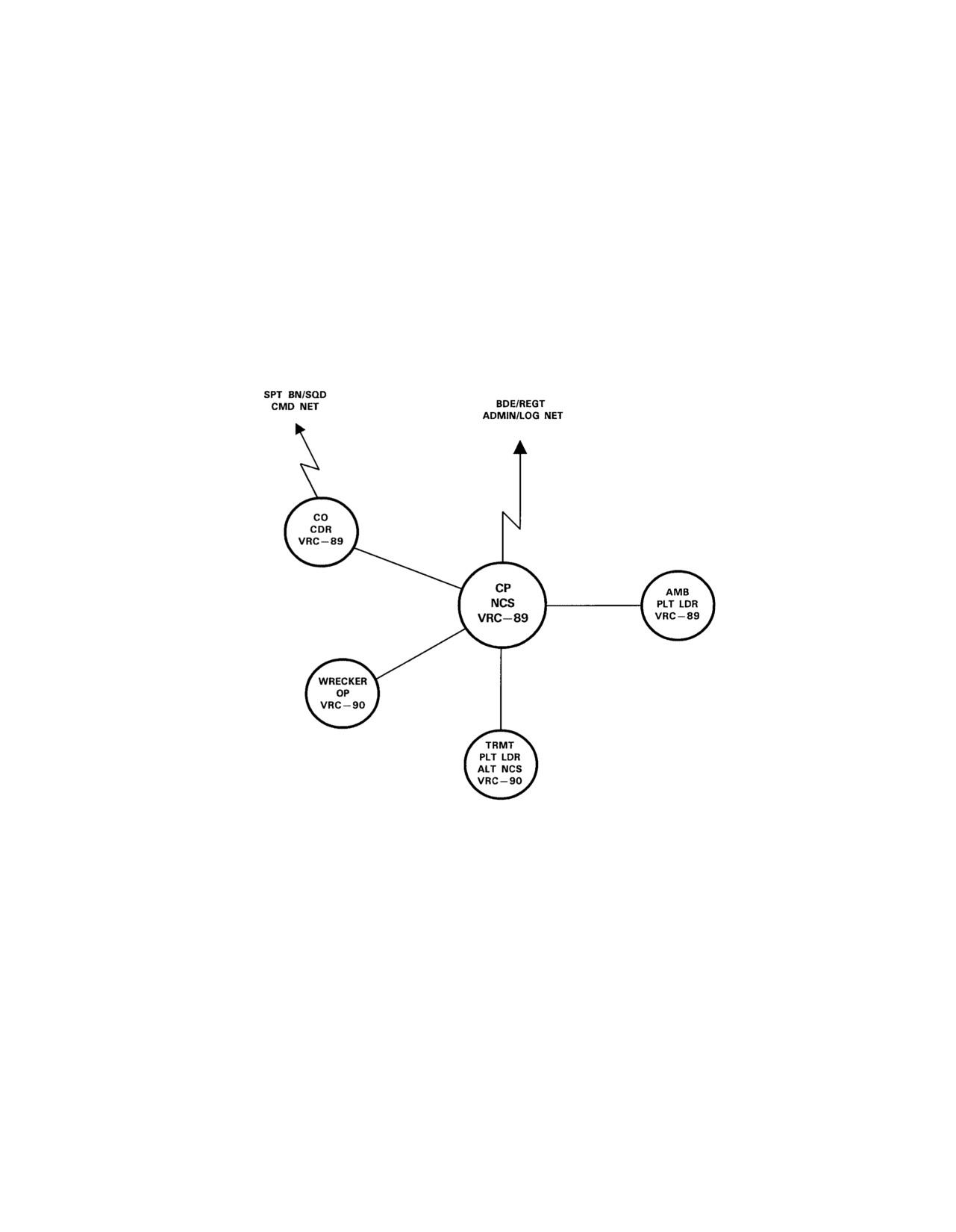
a. Command Frequency-Modulated Net. For C2, the commander establishes a command net
(Figure I-1). The NCS, operated by the unit CP, is normally comprised of the commander’s station,
treatment platoon leader’s station, ambulance platoon leader’s station, MH station, PVNTMED station, and
a wrecker operator/maintenance station. The commander’s station is also deployed in the battalion/squadron
command net. The CP/NCS may be employed in the brigade or regimental administrative/logistics net.
The CP is authorized the NCD KYX-15/TSEC for its NCS operation. The treatment platoon’s NCS may
also serve as the alternate NCS for the command net.
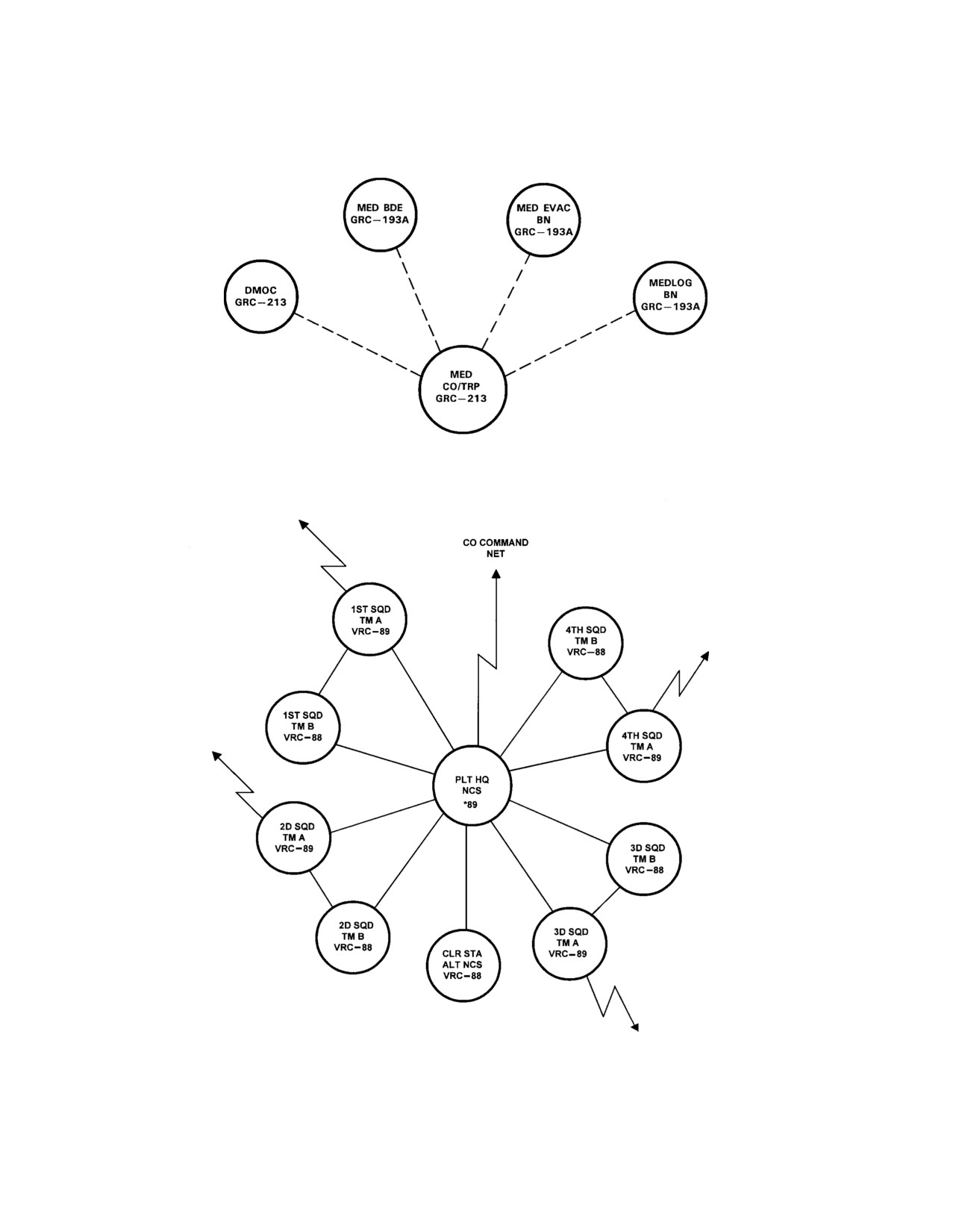
b. High-Frequency Radio Net (Amplitude Modulated). If the unit is a divisional medical company,
it is required to net with the DMOC medical operations net to ensure the external flow of CHL and air/
ground evacuation support. If the unit belongs to a nondivisional brigade or regiment, it will have access to
the supporting medical group medical operations net. Nondivisional medical companies/troops may also
access high-frequency nets of the MEDLOG and medical evacuation battalions. The signal officer of the
parent support battalion/squadron assists the medical company/troop in obtaining adequate SOI to allow it to
access these dedicated medical networks. The unit’s CP operates its high-frequency station (Figure I-2).
c.
Treatment Platoon Medical Operations Frequency Modulated Net. For OPCON of its treatment
elements, the treatment platoon establishes a medical operation net (Figure I-3). The platoon headquarters
operates the NCS. The platoon headquarters may also serve as an alternate NCS for the command net, and
the clearing station may serve as the alternate NCS for the treatment platoon. Approaching air ambulances
I-6
FM 4-02.6
for patient pickup also use this net. When treatment squads/teams of the medical company/troop are
deployed in DS, or are attached to supported maneuver battalions/squadrons, they will normally operate in
the medical operations net of the supported BAS/SAS. They must be provided appropriate SOI for support
operations.
Figure I-1. Medical company/troop command frequency-modulated net.
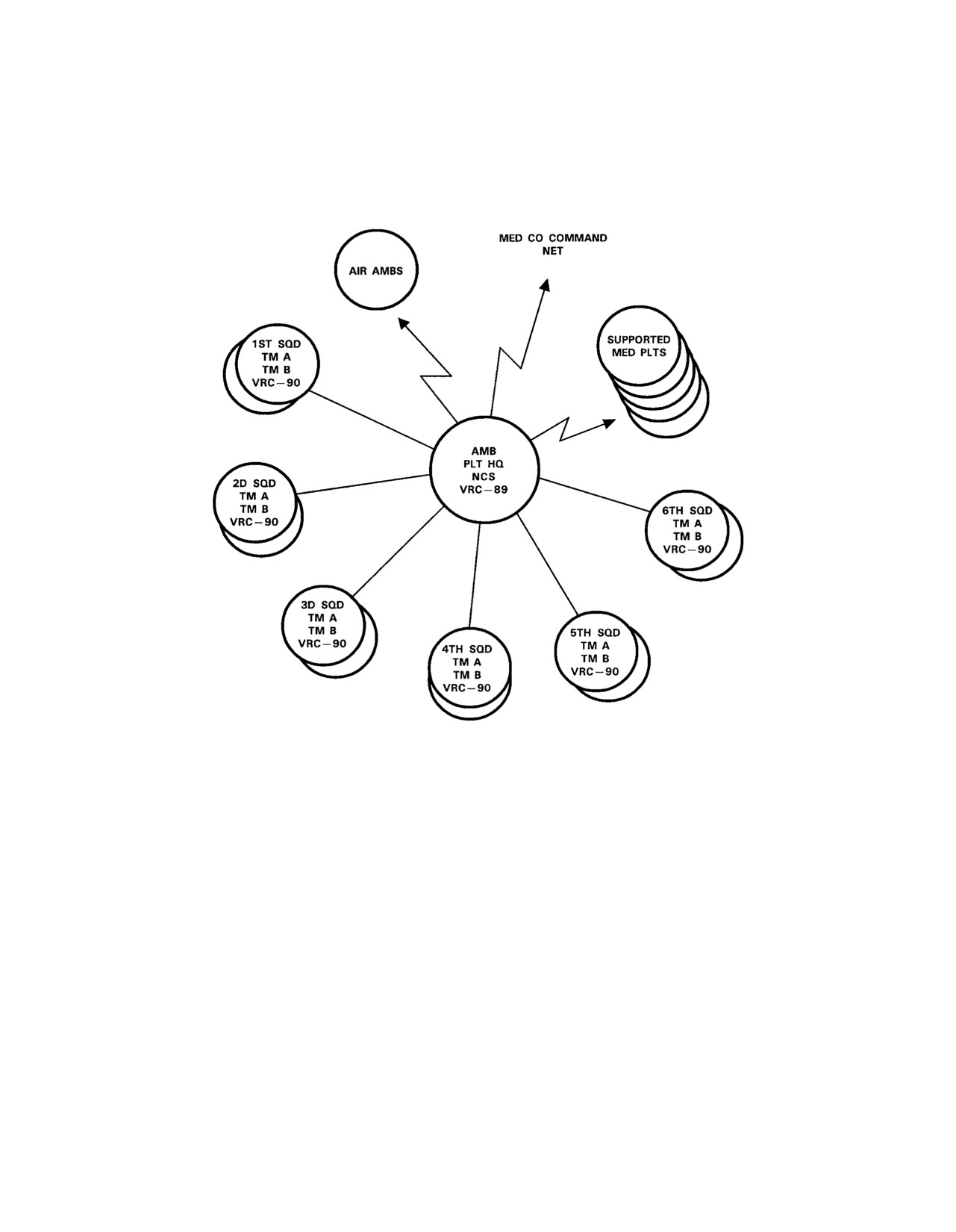
d. Ambulance Platoon (Dedicated) Medical Evacuation Frequency-Modulated Net. The ambu-
lance platoon, under the control of its parent unit, establishes an FM net (Figure I-4) primarily dedicated to
air and ground medical evacuation radio traffic for the supported area. This net, operated by the platoon
headquarters, provides for the control of organic ambulances and for coordination of air and ground patient
evacuation in the supported area. The supported BAS/SAS and supporting corps air and ground ambulances
all operate on this net for the evacuation of patients out of the supported area. Supported aid stations also
use this net for the coordination of CHL support.
I-7
FM 4-02.6
Figure I-2. Medical company/troop medical operations high-frequency net access.
Figure I-3. Treatment platoon medical operations frequency-modulated net.
I-8
FM 4-02.6
Figure I-4. Dedicated medical evacuation frequency-modulated net.
e.
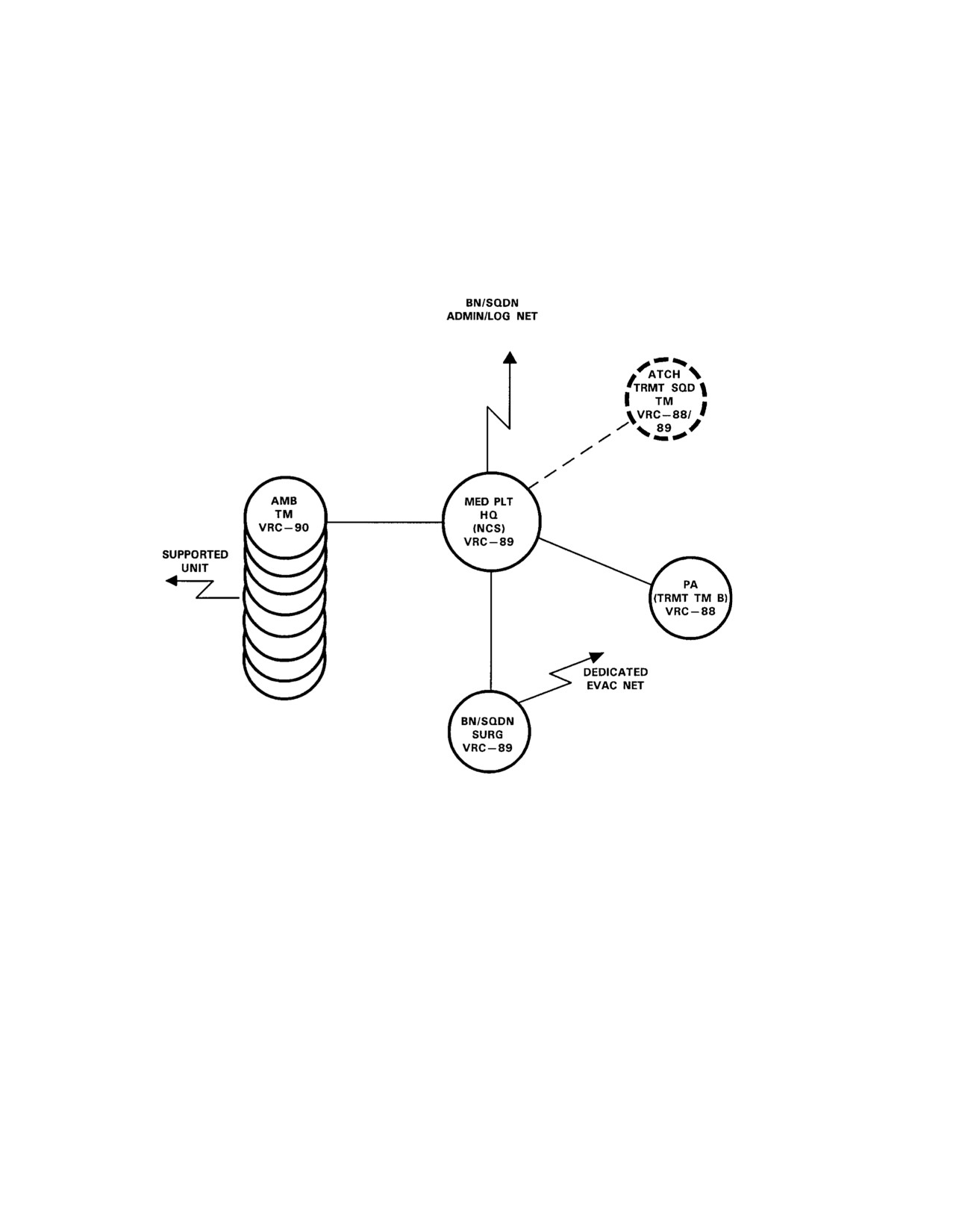
Supported Medical Platoon. This supported Echelon I element employs a medical operations
net (Figure I-5) under the headquarters and headquarters company/troop of the parent maneuver battalion/
squadron. The platoon headquarters serves as the NCS. Its station is also deployed in the administrative/
logistics net. Other stations of this medical operation net include Treatment Team A (battalion/squadron
surgeon’s station), Treatment Team B (PA station), ambulance team stations, and the attached treatment
squad/team from the supporting medical company/troop. The medical platoon is provided appropriate SOI
sufficient to net with both supported and supporting units.
NOTE
Each ambulance team is a separate station and will require separate
call signs.
I-9
FM 4-02.6
Figure I-5. Sample battalion aid station/squadron aid station medical operations
frequency-modulated net.
f.
Internal Wire Communications Net. The medical company/troop employs DNVT MSE for
internal communications. These phones will be replaced by regular garrison desk telephones when the
MSE is replaced by the Warfighter Information Network (WIN) system. The small extension node (SEN)
assigned to the unit will not change much in appearance, but the communications capability upgrade will be
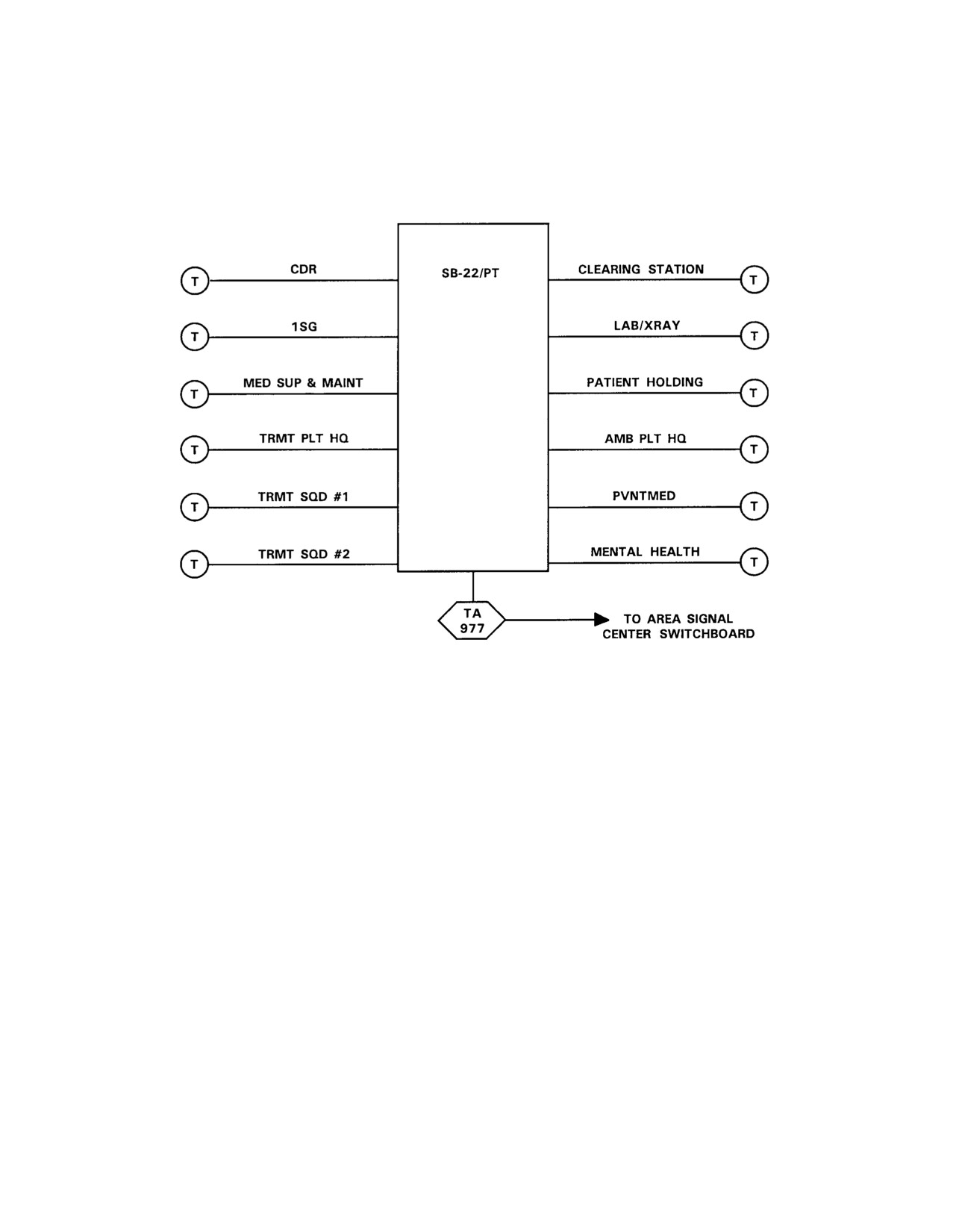
substantial. Figure I-6 depicts a typical wire net for an MSMC and a medical company of a heavy separate
brigade.
I-10
FM 4-02.6
Figure I-6. Sample medical company/troop internal wire net.
Section III. AUTOMATION AND DIGITIZATION
I-9.
Warfighter Information Network
a. The WIN is Force XXI’s communications network that will replace tri-service tactical
communications and MSE (from theater to battalion CP/TOC) and provide a C2 on-the-move capability to
the warfighter. The system uses commercial products and technology; provides wired and wireless
communications to support voice, data, and video information exchange requirements; provides seamless
connectivity among Army Battle Command Systems (ABCS) and weapons platforms within the battle space;
supports multiple security levels (unclassified, secret, and top secret/sensitive compartmented information);
and integrates terrestrial, airborne, and satellite-based transport systems.
b. The WIN is the designated ACUS to replace the MSE system. The terminal equipment will
include COTS desk telephones, COTS FAXs, secure terminal equipment telephones, networked automation
devices and video teleconferencing equipment. The secure terminal equipment telephones are compatible
with secure telephone unit-III telephones in garrison.
I-11
FM 4-02.6
I-10. Tactical High-Speed Data Networks
The tactical high-speed data network is an MSE upgrade providing increased bandwidth to support the video
and high-speed data requirements as an interim step towards the WIN. Components include a high-speed
multiplexer II, an enhanced-trunk group modem order-wire, Cisco routers, forward error correction,
network management, and security to support the data network. The link from a SEN to a node center will
increase in capacity from 16 kilobits per second (kbps) to 512 kbps. An internodal link will increase from
64 kbps to 3,000 kbps.
I-11. Medical Company Automation/Digitization Enablers
The automation and digitization enablers to be made available for the medical company consists of the
MC4; the FBCB2; the GCSS-A; the TC-AIMS), the MTS, and various COTS office computers purchased
by individual units.
a. Medical Communications for Combat Casualty Care. The best way to visualize the MC4
system capability is as a piece of the Army digital computer network where all 10 CHS functional areas
have been digitized and this CHS information is freely shared with everyone on the Army network with a
need to know. The MC4 system will be a theater-automated CHS system that links commanders, health
care providers, and medical support providers, at all echelons, with integrated medical information. Two of
the most significant capabilities that the MC4 system will bring the warfighter are enhanced ability to clear
the battlefield and in-transit visibility of soldiers.
b. Force XII Battle Command Brigade and Below System. The FBCB2 system is a digitized
BCIS that provides on-the-move, real-time and near-real-time battle command information to tactical combat,
CS, and CSS leaders and soldiers. The FBCB2 system, as a key component of the ABCS, seamlessly
integrates with the other components of ABCS at the brigade and battalion level. FBCB2 supports situational
understanding down to the soldier/platform level across all battlefield functional areas and echelons. The
FBCB2 system also provides the means for brigade- and battalion-level commanders to command when
away from their TOCs, interoperating with subordinate commanders and leaders also equipped with FBCB2.
c.
Global Combat Support System-Army. This system ties in all CSS data to C2 and provide CSS
situational understanding. This is the Army’s new automated system that will, over time, replace or
interface with all of the existing CSS automated systems. The title specifies CSS rather than logistics
system, because the new system will encompass personnel, financial, medical, and other nonlogistics CSS
functions. The GCCS-A will be made up of a series of functional modules such as supply, property,
maintenance, and management. Each module will run at any level or organization where the Army
performs that function.
d. Transportation Coordinators’-Automated Information Management System. The TC-AIMS is
a system that provides an integrated information transportation system capability for routine deployment,
sustainment, and redeployment/retrograde operations.
e.
Movement Tracking System. The MTS is a satellite-based tracking/communications computer
found on ambulances and in the company CP. The system’s primary purpose is to maintain visibility of
I-12
FM 4-02.6
vehicles, like ambulances, that move individually and continuously across the battlefield. The system has
the ability to send and receive free text messages for coordination and C2.
NOTE
Army of Excellence division ambulances have the MTS. Force XXI
division ambulances will have FBCB2.
f.
Commercial-Off-the-Shelf Office Automation. The computer devices present in tactical units
essentially mirror the office place automation. Full-sized COTS personal computers and laptops, all with
bubble jet or laser printers, are standard operating equipment. The systems host contemporary office
software with PowerPoint, Word and Excel, to name a few.
Section IV. MEDICAL COMMUNICATIONS FOR COMBAT CASUALTY
CARE SYSTEM CONCEPT
I-12. General
a. The digitized medical companies of the Force XXI division will employ the MC4 system, once
the system becomes operational. They will operate under the CSS Standard Army Management Information
System. The MC4 system is a theater, automated CHS system, which links commanders, health care
providers, and medical support providers, at all echelons, with integrated medical information. The system
provides digital enablers to connect both vertically and horizontally, all 10 CHS functional areas.
b. The MC4 system receives, stores, processes, transmits, and reports medical C2, medical
surveillance, casualty movement/tracking, medical treatment, medical situational understanding, and
MEDLOG data across all echelons of care. This is achieved through the integration of a suite of medical
information systems linked through the Army data telecommunications architecture.
c.
The MC4 system begins with the individual soldier and continues throughout the health care
continuum. The best way to visualize the MC4 system capability is as a piece of the Army digital computer
network where all ten CHS functional areas have been digitized and this CHS information is freely shared
with everyone in the Army with a need to know. Not only will the MC4 system provide Army commanders
with CHS information, but it will also provide them with a seamless transition to the joint CHS environment.
The MC4 system will consist of three basic components: software, hardware, and telecommunications
systems.
(1) Software. The joint TMIP will provide government off-the-shelf (GOTS)/COTS software
and interoperability standards to support joint theater operations. The software provides an integrated med-
ical information capability that will support all echelons of care in a TO with links to the sustaining base.
I-13
FM 4-02.6
Medical capabilities provided by the software to support commanders in the theater will address medical C2
(including medical capability assessment, sustainability analysis, and medical intelligence); MEDLOG
(including blood product management and medical maintenance management); casualty evacuation; and
health care delivery. The MC4 system supports Army-unique requirements and any software needed to
interface with Army information systems such as CSSCS, GCSS-A, FBCB2, warrior programs, and the
MTS.
(2) Hardware systems. The hardware will consist of COTS automation equipment supporting
the above software capabilities. Examples include, but are not limited to, computers, printers, networking
devices, and the EIC.
(3) Telecommunications systems. The MC4 system will rely on current and proposed Army
solutions for tactical, operational, and strategic telecommunications systems to transmit and receive digitized
medical information throughout the theater and back to the sustaining base. There will be no separate
AMEDD communications system. Telecommunications at brigade and below will be accomplished through
the tactical Internet; above brigade level, telecommunications will be accomplished through the WIN
architecture. The MC4 system includes hardware or software required to interface with current and
emerging technologies, supporting manual, wired, and wireless data transmission. At end-state, the MC4
system users will exchange data electronically via the WIN architecture. In the interim, commercial
satellites will be fielded to selected medical units (for example, MDT) receiving the MC4 system to support
high bandwidth requirements until the WIN architecture is fully fielded. Personnel operating satellite assets
are resourced in the MDT TOE and will be located with the MDT. The MC4 system employs a three-block
incremental development approach that incorporates the spiral systems engineering life-cycle methodology
designed to reduce development risk, improve manageability, increase maintainability, and accelerate
benefits to the warfighter. The MC4 system will be the Army’s medical information system to modernize,
digitize, and integrate medical information and make it available for the warfighting commander’s use.
1-13. Medical Digitization of the Combat Brigades
All soldiers have long required the ability to carry medical information with them for purposes of individual
readiness, continuity of care, medical surveillance, and post-deployment health care follow-up.
a. Under the MC4 system, medical information about every IBCT soldier will be entered into a
local database and maintained at the supporting BAS or troop medical clinic. This information will include
the soldier’s immunization status, medical deployability status, and dental deployability status. A commander
faced with a deployment will be able to simply query the database to gain the deployability status of the
entire command.
b. Commanders will have, for the first time, readiness tracking and reporting during all phases of
deployment. The DOD standard automated systems will enhance commanders’ ability to track/report
qualification for worldwide deployment by tracking such items as blood type, dental readiness, immuni-
zations, allergies, flight status, physical profile, eyeglass prescriptions, current medical condition and
medications, thereby ensuring that the commander deploys a fit and healthy force. These digital tools signi-
ficantly enhance theater clearance and manifesting which ultimately streamlines the soldier readiness process.
I-14
FM 4-02.6
c.
Fielding of modular/tailorable CHS units, combined with the digital enablers, allows
optimization of the CHS footprint within a TO minimizing strategic lift and ensuring early deployment of
critical CHS assets. Digital enablers and reach capabilities will also optimize theater assets. Teleconsultation
provides specialty medical information to maximize the effectiveness of deployed personnel.
I-14. The Application of Medical Communications for Combat Casualty Care in Combat Health
Support Echelons of Care
The following paragraphs discuss how MC4 applies at each echelon of CHS in an operation involving the
combat brigade.
a. Echelon I.
(1) The 91W/trauma specialist (combat medic) will be the first point where a casualty
interfaces with MC4. Each 91W/trauma specialist will be equipped (when made available) with an MC4
Type I handheld Personal Digital Assistant (PDA) computing device capable of reading from and writing to
the casualty’s EIC. Medical care provided to the casualty by the 91W/trauma specialist will be recorded on
the EIC. Where communication assets allow, this information will also be transmitted to the supporting
BAS.
(2) If a casualty’s injuries or illness require treatment beyond the 91W/trauma specialist’s
abilities, the 91W/trauma specialist (combat medic) will notify the platoon sergeant who will relay a request
for support/evacuation using the FBCB2 system to the company’s 1SG. The 1SG, who normally has
control over the ambulances operating in DS support of the maneuver company, will dispatch an ambulance
to the location. The casualty will then be evacuated to a higher level of medical care, most likely the BAS.
During this evacuation, an on-board 91W/health care specialist will use digital equipment to monitor the
patient and provide en route care as required. Under MC4, each ambulance will be equipped with an on-
board MC4 computing device, which will interface with the casualty’s EIC. En route care provided by the
91W/trauma specialist will be recorded on the patient’s EIC and will also be transmitted to the destination
medical treatment facility. Digital linkages to medical C2 units/medical regulators allow for redirecting the
casualty en route should the need arise. The request for evacuation from the 91W/trauma specialist’s site
may also be made over FBCB2 system, utilizing a built-in MEDEVAC request.
(3) At the BAS, the medical staff will use MC4 Type II computing devices to read from the
patient’s EIC, ascertaining information on the care that the patient has received demographic information,
and any relevant medical history. Using the MC4 computing device, the BAS medical personnel will
record care provided onto the patient’s EIC. This information, along with any information generated by the
treatment that the casualty receives at the BAS will be recorded onto the local database. The information
will also be transmitted to the next higher level of medical care (medical company) and ultimately to the
interim theater database.
(4) The present MEDLOG system at Echelon I is a totally manual system. Under MC4 the
91W/trauma specialist will utilize FBCB2 to request medical supplies from the BAS. This request will be a
built-in report in FBCB2. At the BAS, requests for Class VIII resupply will be made utilizing the MC4
system.
I-15
FM 4-02.6
b. Echelon II.
(1)
At the Echelon II MTFs (for example, the medical company/FST), MC4 will provide the
same augmentations to treatment documentation, evacuation, and MEDLOG that will be seen at Echelon I.
Through the use of the MDT, the medical company will have the ability to digitize medical data (x-rays,
pictures, etc.) and transmit it to medical experts at EAB/EAD. This teleconsultation ability will result
in some casualties being treated farther forward in the theater and will increase the RTD rate and reduce
overevacuation.
(2) The MC4 system will automate linkage of Class VIII to the transportation system. The
management of the complex medical sets along with the quality control of Class VIII materiel is also
automated improving efficiency over the current manual system.
c.
Echelon III. The MC4 will allow reach capability to Echelon III CHS and beyond. Echelon III
contains hospitals and all of the specialized medical units required to support the theater. The MC4 system
will link all of these medical functions. This system will equip corps treatment and evacuation teams with
personally carried and mobile computers for the collection and forwarding of medical information to the
forward, division, or ASMC. Likewise, CSC teams, veterinary teams, dental teams, and PVNTMED
teams operating in the brigade rear area will be equipped with personally carried or mobile computers.
These MC4-provided devices will be loaded with the appropriate software functionality. Corps/theater
medical regulators/medical C2 will be able to rapidly and accurately match treatment capability with the
soldier’s need for care. The MC4 corps medical regulating system (TRANSCOM’s Regulating and
Command and Control Evacuation System) provides this functionality via WIN. A seamless Class VIII
(including blood) automated system links the theater to prime vendor systems in CONUS.
I-15. Medical Command and Control Application
a. Under MC4, medical information on soldiers will be stored at different levels. This will allow
commanders and command surgeons at the various echelons to access medical information on their soldiers
to find out specific information and to conduct analysis of disease/injury trends. These lower echelon
databases also provide a means for information redundancy should destruction of an information node or
communications outage occur. Each database will feed the databases above it. Personnel (medical
commanders, staff surgeons) at each echelon with MC4 management functionality will be able to query the
database. The CHS information required by the CSSCS will pass from the MC4 system through GCSS-A to
CSSCS.
b. The brigade surgeon will maintain a database containing medical information relevant to the
soldiers in the brigade. This will be the interim theater database that provides information to update
sustaining base medical information systems such as the computer based patient record and health
surveillance system.
c.
At all echelons, MC4 will automatically provide information such as evacuation status, current
fitness for combat, and hazard exposure information to the commander’s situational understanding system.
The MC4 system will provide the commander with the ability to track and record the date and location of
I-16
FM 4-02.6
exposure to health hazards, which include environmental, occupational, industrial, and NBC hazards. This
information is critical to the force health protection hazard analysis necessary to identify emerging DNBI
problems and trends. Commanders will have real-time information on food sources safety/quality,
operationally significant zoonotic disease, health surveillance/trends, and near-real-time health hazard
assessment data for NBC/endemic disease threats and occupational or environmental health threats. This
information will be provided to the commander from the MC4 functional digital systems through GCSS-A
to CSSCS. Commanders, for the first time, will have a complete picture of the battle space, which will
allow them to accurately influence current operations while synchronizing CHS with other activities.
d. The capabilities of the medical assets available to the combat brigade will be optimized with
technological enablers for equipment and supplies, and with digital enablers to include FBCB2, CSSCS,
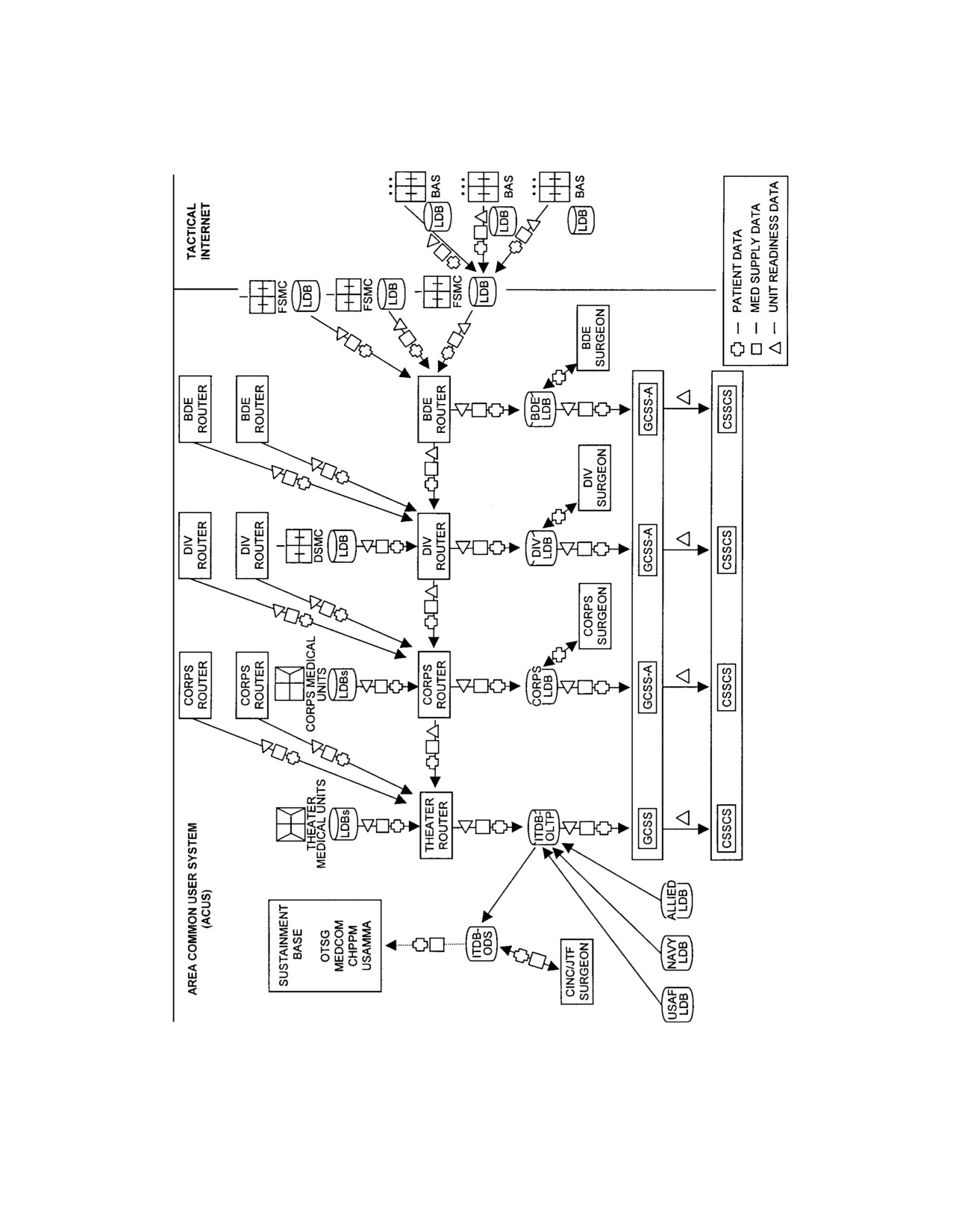
MC4, TMIP, WIN, and the EIC. Figure I-7 provides an example of the MC4/TMIP database structure.
I-17
FM 4-02.6
Figure I-7. Medical communications for combat casualty care/Theater Medical Information
Program database structure.
I-18
FM 4-02.6
APPENDIX J
CLEARING STATION OPERATIONS ON URBANIZED TERRAIN
J-1.
Employment
In military operations on urbanized terrain (MOUT), the medical company’s/troop’s treatment units may be
required to deploy forward to provide Echelon I augmentation.
J-2.
Site Selection and Unit Layout
Site selection and unit layout requirements of the medical company/troop, as discussed in Chapter 3,
are still valid considerations in MOUT scenarios. However, MOUT-specific issues must also be con-
sidered.
a. Locations Within the City. If the area selected for the medical company to occupy is within the
city, it is important that the site be—
• Adequate for the number of casualties expected.
• That avenues of approach and egress are readily available.
• That there be a smooth flow of traffic within the site.
• That the location is reasonably secure easily defended and that it affords protection from
observation and the direct and indirect fires that are likely to result from that observation.
b. Existing Buildings. Combat in urban environments generally results in serious damage to
existing buildings. This damage may compromise the structural integrity of these buildings and render them
unsafe. If medical company operations must be established within existing battle damaged structures, they
should be inspected by engineers and declared safe for occupation.
c.
Basements. In many areas of the world, basements and subbasements are routine parts of
construction. Although basements afford protection from small arms and automatic weapons fire, they also
pose many potential hazards. Combat in urban areas may damage or destroy gas, water and sewer mains
(distribution systems). As the leaking gas may be heavier than air, it will settle into the low lying spaces
creating poisoning as well as fire and explosion hazards. Another hazard presented by establishing the
MTF in a basement or series of basements is that the building may collapse due to artillery fire or aerial
bombing, trapping medical personnel and patients under the rubble.
d. Fortifying the Building. If ground and upper level floors of a building are used, fortifica-
tions to the building can lower the threat from small arms and automatic weapons fire. This can be
accomplished by barricading windows and using sandbags; observation/firing ports (holes) can be left
open. By covering these observation/firing ports at night, light discipline can be maintained in the MTF
operational area.
J-1
FM 4-02.6
J-3.
Forward Surgical Team
The forward surgical team FST will collocate with the clearing station during MOUT operations. This
element provides forward surgical intervention for nontransportable trauma patients. Once stabilized by the
FST these patients can be evacuated further to the rear for more definitive care.
J-4.
Mass Casualty Operations
Mass casualty situations are chaotic events the throw large numbers of people together under less than ideal
circumstances. When anticipated and prepared for, through detailed planning, coordination, regular
rehearsals and tough realistic training the chaos associated with this type of event can be minimized. These
actions require proactive command level emphasis for units to be able to effectively deal with these
situations
a. Planning. To ensure efficient management of MASCAL situations, the CHS planner must
develop an effective plan and then rehearse it on a periodic schedule.
b. Rehearsal and Training. The response to a MASCAL situation is determined in large part by
how well the unit is prepared before the event occurs. Rehearsals are an invaluable tool for assessing the
strengths, weaknesses and training required to make personnel proficient in their individual and collective
tasks when responding.
c.
Additional Information. For additional information on MASCAL operations, see Appendix C.
J-5.
Forward Deployed Medical Treatment, Preventive Medicine, and Medical Evacuation Assets
a. Medical Treatment. The medical company will augment and/or reinforce aid stations as
needed during MOUT operations. Combat health support planners should consider pushing additional
Class VIII items forward to the aid stations in response to the increased number of casualties that are
generally sustained during MOUT operations. During the initial fight, the focus of the aid station is to treat
and stabilize severe trauma patients for evacuation. As a result, routine sick call services will usually be
passed to the medical company. The medical company/troop must, therefore, provide this support.
b. Preventive Medicine. Throughout history, disease nonbattle injury (DNBI) resulting from
medical threats (including, but not limited to, heat, cold, and disease) have accounted for more losses to
fighting forces than combat-related injuries. The need for effective preventive medicine measures cannot be
overemphasized, especially in MOUT operations. Combat in urbanized terrain by its nature creates some
unique hazards and situations. Despite considerable advances in the technology of war, the medical threat
still presents a significant danger to our forces. For detailed information concerning preventive medicine
refer to FMs 8-10-7 and 21-10.
c.
Medical Evacuation. Conducting medical evacuation operations in the MOUT environment
challenges the CHS planner. He must ensure that the CHS plan includes special or unique materiel
J-2
FM 4-02.6
requirements or improvised use of standard equipment. The plan must be sufficiently flexible to support
unanticipated situations. For detailed information concerning patient evacuation in MOUT operations refer
to FM 8-10-6, Chapters 5 through 10.
J-3
FM 4-02.6
APPENDIX K
MANAGEMENT OF INDIVIDUAL HEALTH RECORDS
IN THE FIELD
K-1. General
a. This appendix provides guidance on the maintenance of the soldier’s individual HREC and
CEMRs in the field. The governing regulation is AR 40-66.
b. Health records are maintained by the MTF that provides primary care for the soldier.
c.
Unit commanders will ensure that HRECs are always available to AMEDD personnel who
require such records in the performance of their duties. Unit commanders will also ensure that the
information in the HRECs is kept private and confidential in accordance with law and regulations governing
patient records administration.
d. Health records located at an Echelon I MTFs are maintained by unit medical personnel. The
AMEDD officer-in-charge serves as the custodian of the HRECs and CEMRs. Army Medical Department
officers are in charge of the HRECs and CEMRs for the members of the units and civilian employees for
whom they supply primary medical care. They are also in charge of the HRECs, CEMRs, and the records
of other individuals that are receiving treatment from the MTF. Health records are important for the
conservation and improvement of the patient’s health. Therefore, AMEDD officers will ensure that all
pertinent information is promptly entered in the HRECs/CEMRs in their custody. If any such pertinent
information has been omitted, the AMEDD officer will take immediate action to obtain such information
from the proper authority and include it in the HREC/CEMR.
K-2. Health Records of Deployed Soldiers
a. Health Records. The HRECs (DA Form 3444 or DA Form 8005 Series [Medical and Dental
Treatment Records]) of deployed soldiers and the CEMR of deployed civilians will not accompany them to
the combat area.
(1) The supporting MTF will initiate a DD Form 2766 (Adult Preventive and Chronic Care
Flowsheet), DD Form 2766C (Adult Prevention and Chronic Care Flowsheet Continuation), DD Form
2795 (Pre-Deployment Health Assessment Questionnaire), and DD Form 2796 (Post-Deployment Health
Assessment Questionnaire). If an individual deploys, the DD Form 2766 and DD Form 2766C will be
photocopied prior to deployment and the copy will be kept in the medical record. The original DD Form
2766 and any DD Forms 2766C will accompany the individual to the field. The DD Form 2766 serves as
the treatment folder for the individual that is deployed; other forms, such as DD Form 2766C, DD Form
2795, DD Form 2796, and SF 600 (Health Record-Chronological Record of Medical Care) will be filed on
the fastener inside DD Form 2766. The photocopies of the DD Form 2766 and DD Form 2766C will be
removed and shredded when the originals are placed back into the HREC or CEMR. Forms that had been
filed inside the DD Form 2766 folder will be removed and place in the HREC or CEMR (in the regular
treatment folder).
K-1