FM 4-02.12 Army Health System: Command and Control Organizations (26 May 2010) - page 5

Chapter 4
Table 4-28. S-2/S-3 section (campaign support element)
Paragraph title
AOC/MOS
Grade
Title
Branch
S-2/s-3 section (CSE)
68W4O
E7
Plans sergeant
NC
LEGEND
AOC area of concentration
MOS military occupational specialty
CSE campaign support element
NC noncommissioned officer
S-4 SECTION
4-127. The S-4 section (Table 4-29) is responsible for coordination, control, and management of logistics
for assigned and attached units.
Table 4-29. S-4 section (campaign support element)
Paragraph title
AOC/MOS
Grade
Title
Branch
S-4 section (CSE)
70K67
O3
S-4
MS
LEGEND
AOC area of concentration
MOS military occupational specialty
CSE campaign support element
MS Medical Service Corps
FORCE HEALTH PROTECTION OPERATIONS
4-128. The FHP operations (Table 4-30) plans and coordinates the health care mission within the MMB
AO when collocated with the EEE. It provides advice on the operation of MEDLOG, operations,
PVNTMED, and mental health in the support provided to supported organizations.
Table 4-30. Force health protection operations (campaign support element)
Paragraph title
AOC/MOS
Grade
Title
Branch
Force health protection
68Z5O
E9
Chief operations sergeant
NC
operations (CSE)
LEGEND
AOC area of concentration
MOS military occupational specialty
CSE campaign support element
NC noncommissioned officer
MEDICAL LOGISTICS SECTION
4-129. The MEDLOG section (Table 4-31) plans and organizes Class VIII supply support (including
blood and medical equipment management) in coordination with the MEDLOG section of the EEE.
4-28
FM 4-02.12
26 May 2010

MEDICAL BATTALION (MULTIFUNCTIONAL)
Table 4-31. Medical logistics section (campaign support element)
Paragraph title
AOC/MOS
Grade
Title
Branch
Biomedical equipment
68A4O
E7
NC
noncommissioned officer
Senior optical laboratory
68H4O
E7
NC
noncommissioned officer
Medical logistics section (CSE)
Medical laboratory noncommissioned
68K4O
E7
NC
officer
68J3O
E6
Medical logistics sergeant (2)
NC
LEGEND
AOC area of concentration
MOS military occupational specialty
CSE campaign support element
NC noncommissioned officer
MEDICAL OPERATIONS SECTION
4-130. The medical operations section (Table 4-32) plans and coordinates the medical area support
mission to include management of the area medical and dental support (Roles 1 and 2).
Table 4-32. Medical operations section (campaign support element)
Paragraph title
AOC/MOS
Grade
Title
Branch
70H67
O3
Medical operations officer
MS
68E4O
E7
Dental noncommissioned officer
NC
Medical operations section
68W4O
E7
Operations sergeant
NC
(CSE)
68W4O
E7
Plans sergeant
NC
Patient administration
68G3O
E6
NC
noncommissioned officer
LEGEND
MOS military occupational specialty
AOC area of concentration
MS Medical Service Corps
CSE campaign support element
NC noncommissioned officer
PREVENTIVE MEDICINE SECTION
4-131. The PVNTMED section (Table 4-33) plans and coordinates PVNTMED/veterinary support to
subordinate organizations.
26 May 2010
FM 4-02.12
4-29

Chapter 4
Table 4-33. Preventive medicine section (campaign support element)
Paragraph title
AOC/MOS
Grade
Title
Branch
Chief veterinary noncommissioned
68R5O
E8
NC
Preventive medicine section
officer
(CSE)
Preventive medicine
68S3O
E6
NC
noncommissioned officer
LEGEND
AOC area of concentration
MOS military occupational specialty
CSE campaign support element
NC noncommissioned officer
MENTAL HEALTH SECTION
4-132. The mental health section (Table 4-34) plans and coordinates mental health support to subordinate
organizations.
Table 4-34. Mental health section (campaign support element)
Paragraph title
AOC/MOS
Grade
Title
Branch
Mental health noncommissioned
Mental health section (CSE)
68X3O
E6
NC
officer
LEGEND
AOC area of concentration
MOS military occupational specialty
CSE campaign support element
NC noncommissioned officer
S-6 SECTION
4-133. The S-6 section (Table 4-35) provides advice and support to subordinate organizations for CE
support and information management.
Table 4-35. S-6 section (campaign support element)
Paragraph title
AOC/MOS
Grade
Title
Branch
25A00
O3
Signal officer
SC
S-6 section (CSE)
25B1O
E4
Information system specialist
25U1O
E3
Signal support system specialist
LEGEND
MOS military occupational specialty
AOC area of concentration
NC noncommissioned officer
CSE campaign support element
SC Signal Corps
DETACHMENT HEADQUARTERS
4-134. The detachment headquarters (Table 4-36) provides coordination with the EEE in support of the
field feeding and administration mission of the detachment headquarters.
4-30
FM 4-02.12
26 May 2010

MEDICAL BATTALION (MULTIFUNCTIONAL)
Table 4-36. Detachment headquarters (campaign support element)
Paragraph title
AOC/MOS
Grade
Title
Branch
Chemical, biological, radiological,
74D1O
E4
and nuclear decontamination
specialist
Detachment headquarters
(CSE)
92G1O
E4
Cook
92G1O
E3
Cook
LEGEND
CSE campaign support element ‘
AOC area of concentration
MOS military occupational specialty
BATTALION MAINTENANCE SECTION
4-135. The battalion maintenance section (Table 4-37) provides unit level maintenance management
support to assigned and attached units in coordination with the battalion S-4 and the battalion maintenance
section of the EEE.
Table 4-37. Battalion maintenance section (campaign support element)
Paragraph title
AOC/MOS
Grade
Title
Branch
Automotive maintenance warrant
915A0
W2
WO
Battalion maintenance section
officer
(CSE)
91B2O
E5
Wheeled vehicle mechanic
NC
LEGEND
AOC area of concentration
NC noncommissioned officer
CSE campaign support element
WO warrant officer
MOS military occupational specialty
UNIT MINISTRY TEAM
4-136. The unit ministry team (Table 4-38) provides religious support and pastoral ministry for assigned
staff and patients.
Table 4-38. Unit ministry team (campaign support element)
Paragraph title
AOC/MOS
Grade
Title
Branch
56A00
O3
Chaplain
CH
Unit ministry team (CSE)
56M1O
E4
Chaplain assistant
LEGEND
CH Chaplain Corps
AOC area of concentration
MOS military occupational specialty
CSE campaign support element
26 May 2010
FM 4-02.12
4-31
This page intentionally left blank.
Chapter 5
Army Health System Operations
The MEDCOM (DS) is the medical force provider for the theater. As the medical
force provider it identifies HSS and FHP requirements throughout the AO and task-
organizes and deploys the required medical resources to accomplish the complex
challenges faced by the health care delivery mission in a deployed theater. The
MEDCOM (DS) also provides subordinate medical units the ability to obtain
information, resources, and personnel from the medical generating force in CONUS
or other safe havens. Army operations are inherently joint in nature and often times
are conducted with multinational forces. The MEDCOM (DS) may also be tasked to
conduct multinational operations with the armed forces of other nations in pursuit of
common objectives. Each multinational operation is unique, and key considerations
involved in planning and conducting multinational operations vary with the
international situation and perspectives, motives, and values of the organization’s
members. See Appendix D for information for medical planning considerations for
both joint and multinational medical operations. This chapter provides a brief
overview of the AHS and discusses operations plan and directed by the MEDCOM
(DS).
SECTION I — OPERATIONAL THEMES
CHARACTER OF THE OPERATION
5-1. An operational theme describes the character of the dominant major operation being conducted at
anytime within the land force commander’s AO. The operational theme helps convey the nature of the
major operation to the force to facilitate common understanding of how the commander broadly intends to
operate. For an in-depth discussion of operational themes refer to FM 3-0.
5-2. As all major operations are joint in nature, the operational themes can be used to group similar types
of activities under the predominant theme. Major operations normally are characterized by the offense and
defense but may also include stability operations. Further within the operational environment all three
types of operations can be occurring simultaneously. There are five operational themes which span full
spectrum operations. They are discussed in ascending order of violence.
PEACETIME MILITARY ENGAGEMENT
5-3. The purpose of peacetime military engagement is to shape the operational environment and to
support the commander's objectives within the security cooperation plan. This operational theme
encompasses activities such as multinational training events and exercises; security assistance; joint
combined exchange training; recovery operations; arms control; and counterdrug activities.
5-4. Medical support to counterdrug operations is limited and is generally directed to supporting US
forces in the AO. The veterinary service provides care and treatment of the MWD used in these
operations. Further, the veterinary support may become involved in developing animal husbandry
programs which can, in turn, lead to the economic growth of the host nation and reduce its dependence on
income generated by drug-related agriculture. United States Army medical evacuation resources may also
be used to evacuate injured, ill, or wounded Soldiers involved in these operations.
26 May 2010
FM 4-02.12
5-1
Chapter 5
5-5. Through security assistance programs, the US provides defense materiel, and military training.
Security assistance programs employ medical civic action teams and small detachments to fulfill specific
mission requests. Ideally, this force would be specially trained, area-oriented, mostly language qualified,
and available for immediate deployment. Health service support/FHP augmentation to the foreign internal
defense augmentation force can be provided to some extent in all of the AMEDD functions. Particularly
effective in this arena are medical treatment, nursing, PVNTMED services, dental, and veterinary
resources.
LIMITED INTERVENTION
5-6. The commander uses limited interventions to achieve an end state that is clearly defined and limited
in scope. Activities included in this category are noncombatant evacuation operations, strikes, raids, shows
of force, foreign humanitarian assistance, consequence management, sanction enforcement, and elimination
of weapons of mass destruction.
5-7. During noncombat evacuation operations, those persons who are injured, wounded, or ill are
treated and stabilized by the medical element accompanying the noncombatant operations force. Once
stabilized, they are evacuated by the force. During these types of operations conducted in a permissive
environment, when there is no apparent physical threat to the evacuees, sick, injured, or wounded persons
should be evacuated on dedicated medical evacuation platforms, if at all possible. In an uncertain or
hostile environment, the transportation assets used to insert and extract the noncombatant evacuation force
are normally used to evacuate the patients. The medical personnel accompanying the force provide en
route medical care until the force reaches an intermediate staging base or safe haven. Those evacuees
requiring medical care are provided the required care or are stabilized for further evacuation to MTFs
capable of providing the required care.
5-8. Medical support for show of force follows the traditional role of providing HSS/FHP to a combat
force.
5-9. Foreign humanitarian assistance programs can relieve or reduce the results of natural or man-
made disasters or other conditions such as human pain, disease, hunger, or deprivation that present a
serious threat to life or result in great property damage or loss. Humanitarian assistance provided by US
forces is limited in scope and duration. It is designed to supplement or complement the efforts of host
nation civil authorities or agencies that may have primary responsibility for providing foreign humanitarian
assistance. Most of these operations are conducted as joint or multinational operations and is funded by the
Department of State and are in compliance with Title 10 of the US Code.
PEACE OPERATIONS
5-10. The category of peace operations encompasses a number of various types of activities that are
focused on keeping the violence from spreading, containing the violence that has already occurred, and
reducing tensions among the factions. These activities include peacekeeping operations, peace building,
peacemaking, peace enforcement, and conflict prevention.
5-11. The AHS role in peace operations is to provide HSS/FHP to the US-lead peacekeeping force. This
force may consist of elements from the other Services or may be a multinational force. It may also include
US government civilian employees, civilian contractors, and United Nations officials.
IRREGULAR WARFARE
5-12. Irregular warfare is a violent struggle among state and nonstate actors for legitimacy and influence
over a population. Special operations forces conduct most of the irregular warfare operations. This broad
grouping includes foreign internal defense, support to an insurgency, counterinsurgency, combating
terrorism, and unconventional warfare.
5-2
FM 4-02.12
26 May 2010
Army Health System Operations
Foreign Internal Defense
5-13. In determining the HSS/FHP needs for foreign internal defense, the AHS planner must tailor
support of the foreign internal defense programs to the environment and to the specific needs of the
supported host nation. The goals and objectives of military HSS/FHP in this environment are defined in
the commander’s regional strategy. Each host nation has circumstances which differ from its neighbors’
and are unique to its own situation. These characteristics include social, economic, cultural, military, and
political realities within the host nation. The AHS planner needs to develop specific goals and objectives
for each country within the region.
Support for Insurgencies and Counterinsurgencies
5-14. The arena of support for insurgencies and counterinsurgencies provides the greatest challenge
and is the most complex program in stability operations. In this area, the possibility exists that the
traditional roles and methods of employment of US military forces may be reversed (sustainment elements
entering the AO prior to the combat units). The uniqueness of these settings requires thoroughly
coordinated planning and flexibility on the part of the medical planner to successfully accomplish his
mission. Agencies of the federal government (other than DOD) normally exercise overall direction of
efforts in support for insurgency. The US military actions serve a supporting role. Once legally tasked by
the President and the Secretary of Defense for commitment to support or defeat an insurgency, US military
forces assist either host nation governments or insurgent movements.
Support for Insurgencies
5-15. In the establishment of a viable medical infrastructure to attend to the medical needs of the
insurgents the HSS/FHP organization supporting the insurgents is normally minimally staffed. It must
provide, on a limited basis, all facets of the health care spectrum from emergency medical treatment at the
point of injury through hospitalization and convalescent care. Medical personnel may serve as trainers
emphasizing those skills necessary for emergency medical treatment, triage, mass casualty management,
and nursing aspects of pre- and postoperative management. These nurses may also provide first-aid
training to the insurgent personnel.
5-16. One of the key factors in maintaining high morale among Soldiers is the knowledge that if wounded,
medical care will be available. Depending on the tactical situation, terrain, and other environmental
conditions, treatment stations may be housed in caves, tunnels, existing buildings, or temporary shelters.
Due to the fluidity of these operations, the treatment facility established should be no larger than that
necessary to accomplish the mission. It should be 100 percent mobile.
5-17. The medical requirements in support of these operations, must be quickly identified. They are
determined by—
z
Needs of the insurgent movement.
z
Political, social, and economic issues involved.
z
Resources available.
z
Existence of clear, legal authority.
5-18. Refer to FM 4-02.43 and FM 8-42 for additional information.
Counterinsurgencies
5-19. Counterinsurgency is those military, paramilitary, political, economic, psychological, and civic
actions taken by a government to defeat insurgency (JP 1-02). In counterinsurgency, host-nation forces
and their partners operate to defeat armed resistance, reduce passive opposition, and establish or reestablish
the host-nation government’s legitimacy.
5-20. In support of counterinsurgency operations quality of life issues, such as the availability of health
care, can be prominent issues that motivate insurgents to demand change. A thoroughly planned and
coordinated strategy (which implements the needed health care reforms and focuses on other quality of life
issues) can motivate the population to support the host nation government rather than the insurgent group.
26 May 2010
FM 4-02.12
5-3
Chapter 5
Health care programs can enhance the legitimacy of the host nation government while undermining the
legitimacy of the insurgent group.
Combating Terrorism
5-21. The tactics used by terrorists include bombings, hijackings, assassinations, and kidnappings.
Terrorism is a tactic that is used across all civilian and military continuums. The AHS commander must
plan for and conduct active programs which reduce his unit’s vulnerability to terrorist actions. A balance
must be reached that maintains an appropriate level of vigilance, security, and confidence. This balance
should not adversely impact on the mission and result in undue suspicion and stress. The AHS planner
must be aware of the terrorist threat in the AO. He must incorporate appropriate safeguards and
considerations into the HSS/FHP OPLAN.
z
Antiterrorism consists of those defensive measures used to reduce the vulnerability of
personnel, Family members, facilities, and equipment to terrorist acts. This includes the
collection and analysis of information to accurately assess the magnitude of the threat.
z
Counterterrorism is comprised of those offensive measures taken to prevent, deter, and respond
to terrorism. Medical elements are not directly involved in the counterterrorism aspects of an
operation. However, these medical elements provide traditional AHS support to US and
friendly forces engaged in these operations.
5-22. Army Health System commanders must be well-versed in the existing threat (both the health threat
and the general threat) in the AO. They must be aware of the tactics used by terrorists at incidents sites
because first responders are often the target of terrorists. The terrorist creates the initial incident and plans
a follow-on strike on the first responders which creates more casualties and sensationalizes the incident
creating more media coverage. Further, terrorists do not adhere to the provisions of the Geneva
Conventions and will intentionally target medical personnel, units, transports, and facilities. The display of
the Geneva Conventions Emblem will not deter an attack and could, in fact, make the medical units and
their transports a more lucrative target. Since one of the main goals of a terrorist is to bring attention to his
cause or belief, the more audacious and the more sensational the target, the more likely the event will be
covered by the media.
Unconventional Warfare
5-23. The goals of HSS/FHP operations in support of unconventional warfare are to conserve the
guerrilla forces fighting strength and to assist in securing local population support for US and guerrilla
forces operating within joint special operations areas. Medical elements supporting the guerrilla forces
must be mobile, responsive, and effective in preventing disease and returning the sick and wounded to
duty. There is no safe rear area where the guerrilla takes his casualties for treatment. Wounded and ill
personnel become a tactical rather than a logistical problem.
5-24. In an unconventional warfare situation, indigenous medical personnel may provide assistance during
combat operations by establishing casualty collecting points. This permits the remaining members of the
guerrilla force to continue fighting. Casualties at collecting points are later evacuated to the guerrilla base
or to a guerrilla medical facility. As the operation develops, evacuation of the more seriously wounded,
injured, or diseased personnel to friendly areas is accomplished by establishing clandestine evacuation nets
if security does not permit using aeromedical evacuation. Medical requirements within the joint special
operations area differ from those posed by conventional forces. In unconventional warfare, battle
casualties are normally fewer and the incidence of disease and malnutrition is often higher. Overlaying
conventional military medical assets on unconventional warfare operations can only be accomplished if it
does not compromise the security of the mission.
5-25. For additional information on conventional medical force support to these types of operations, refer
to FM 4-02.43.
5-4
FM 4-02.12
26 May 2010
Army Health System Operations
SECTION II — ARMY MEDICAL DEPARTMENT COMMAND AND CONTROL
OPERATIONS
5-26. The most important component of the tactical commander’s weapons systems is the Soldier. The
AMEDD’s mission to conserve the fighting strength focuses on the promotion of wellness, the prevention
of DNBIs, the provision of acute trauma care, and the provision of definitive, rehabilitation, and
convalescent care for our injured or ill Warriors. Providing effective and timely health care to our
deployed forces requires the synchronization of a myriad of personnel, organizations, and materiel
resources across the AMEDD, the MHS, and the Department of Veterans Affairs. The highly technical
nature of providing medical care requires the synchronization of support across all medical disciplines and
ancillary services. Highly trained medical professionals have the requisite knowledge and skills to
leverage support from a multitude of different resources to maximize the effectiveness of the care provided
and to optimize patient outcome. In addition to the direct support to the Soldier, the MEDCOM (DS) must
also have a regional focus to fully support and facilitate the GCC’s theater engagement plan for his area of
responsibility.
5-27. Based on the effectiveness, timeliness, and seamlessness of medical care, to rapidly clear the
battlefield of casualties and to reduce the killed in action rate of our Soldiers, the Soldier sees a highly
efficient but, on the surface at least, simple system of dedicated professionals doing what they do best—
caring for our Soldiers. Since our health care delivery system is synchronized and effective, it is
transparent to the Soldier and appears to be almost effortless. This impression of simplicity and
transparency is deceiving. As discussed in paragraph 1-9, the AHS is a complex system of systems which
requires extensive knowledge and skill within the Army, DOD, and civilian medical communities to be
able to capture the diverse and highly scientific resources needed to provide state-of-the-art care to our
deployed forces. The ten medical functions are essential considerations at all roles of the health care
continuum, however, the organic AHS assets in the BCTs are focused on rapidly locating, acquiring,
treating, and evacuating battlefield casualties, providing essential casualty prevention services, and
providing the MEDLOG support required to facilitate AHS operations. Within BCTs, the AHS assets are
limited not only in numbers but also in the type, scope, and complexity of medical conditions that can be
treated. Any patients who cannot recover from their wounds or illness within 3 days are rapidly evacuated
from the forward area to an MTF that is staffed and equipped to provide the requisite specialty care.
Further, as the AMEDD mission is to conserve the fighting strength of the tactical commander, medical
issues which cannot be resolved by the multifunctional logistics command and control organization in the
BCT, are referred to the medical technical channel for assistance and resolution. This places the
responsibility on the MEDCOM (DS) commander, who is the medical force pool provider, to rapidly task-
organize a medical augmentation support package and to reallocate his resources to resolve issues arising
in the forward areas. The MEDCOM (DS) commander must have an intimate knowledge of the intricacies
of the health care delivery system to be able to rapidly pinpoint and leverage the necessary capabilities to
provide a timely resolution to battlefield medical issues.
5-28. Medical C2 of medical elements in an AO allows disseminated knowledge management systems to
capture, analyze, and transform health reporting from multiple sources both horizontally and vertically for
organizational situational awareness and decision support. This builds tailored responsiveness to the
changing operational environment that is sustainable over the future event horizon. Medical C2 reduces
the cost of MHS knowledge management. Medical C2 is networked to communicate a common operating
picture, horizontally integrated to share the analysis of reported information, and with authority to act on
this analysis at the operator level. The medical C2 organization uses communications interconnectivity to
provide collaboration across disciplines, organizations, and facilitates and optimizes the sharing of scarce,
unique resources. Medical C2 is structured to establish and manage contracting for services, public-private
partnerships, and public partnerships from multiple agencies and multiple layers of government.
5-29. It is essential that C2 of medical units rests with the senior medical headquarters. The
noncontiguous nature and fluidity of the current and future operational environment has dictated a redesign
of combat formations to enhance mobility, agility, scalability, and versatility. This, in turn, requires that
the AHS concept of support and the continued refinement of organizational designs evolve to support the
tactical commander’s concept of operation and scheme of maneuver. The full breadth of medical specialty
26 May 2010
FM 4-02.12
5-5
Chapter 5
expertise and services are provided to the tactical commander by the medical force provider in the theater
and the CONUS-support base. In order to synchronize the provision of responsive, effective, and efficient
medical specialty care to the BCT and EAB commanders and to capitalize on the myriad of medical
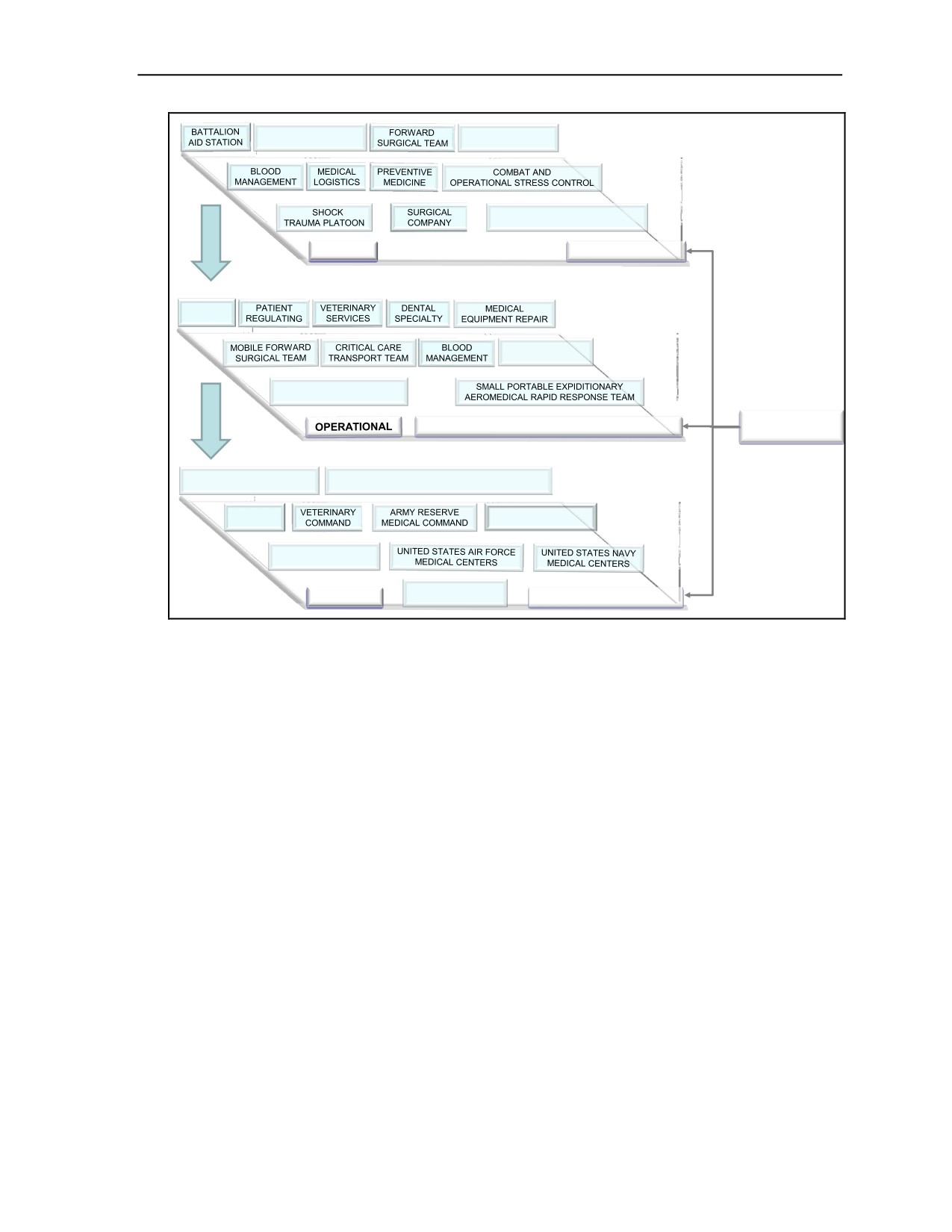
specialty expertise and resources resident in the MHS (Figure 5-1), the vertical and horizontal integration
of the AHS from the point of injury to the CONUS-support base is not only crucial but also critical. To
navigate this highly complex and interdependent system which crosses Service, DOD, interagency, and
civilian boundaries and leverage the support required to satisfy theater requirements, a leader-developed
medical commander is required. As the number of medical specialty providers and support staffs deployed
to the theater decrease, the medical command presence must remain within the theater and be placed at
strategic points to best orchestrate and control AHS support operations is paramount.
VERTICAL AND HORIZONTAL INTEGRATION
5-30. Just as maintaining a common operational picture is essential to the successful prosecution of tactical
operations, the medical commander and his staff must be fully cognizant of all health threats and events
which impact the health of the command. As increased modularity diminishes the size of professional,
operational, and planning staffs of functional modules, the situation becomes increasingly more important
to have medical commanders vertically and horizontally integrated at decisive points within the theater.
These medical commanders and their professional staffs can analyze, assess, and evaluate the aggregate of
real-time health data generated in their AO to identify trends of adverse health impacts and deploy or
reallocate the necessary resources to mitigate the effects and maintain the health of the command.
Deviations from base-line health data may be the first indication to the tactical commander that an
adversary has employed, for example, a biological warfare agent against US forces.
5-31. The dispersion of forces within future operational environments will pose significant challenges
toward ensuring a seamless AHS is continually provided to the Soldier. The ability of the medical
commander to rapidly organize functional modules and deploy the right mix of medical specialties based
on METT-TC is enhanced through the vertical and horizontal integration of AHS resources. Current and
future medical information systems will enable the medical force provider to reallocate resources to
anticipate shifting centers of patient density and to tailor the medical force package with greater accuracy
and speed.
5-6
FM 4-02.12
26 May 2010
Army Health System Operations
MEDICAL EVACUATION
BRIGADE SUPPORT
GROUND AND AIR
MEDICAL COMPANY
MOBILE
AEROMEDICAL STAGING FACILITY
TACTICAL
MEDICAL BRIGADE
HOSPITAL
SHIPS
HOSPITALIZATION
UNITED STATES AIR FORCE
AEROMEDICAL EVACUATION
MEDICAL FORCE
MEDICAL COMMAND (DEPLOYMENT SUPPORT)
PROVIDER
DEPARTMENT OF VETERANS
UNITED STATES ARMY CENTER FOR HEALTH
AFFAIRS MEDICAL CENTERS
PROMOTION AND PREVENTIVE MEDICINE
DENTAL
UNITED STATES ARMY
COMMAND
MEDICAL COMMAND
UNITED STATES ARMY
MEDICAL CENTERS
NATIONAL DISASTER
STRATEGIC
MEDICAL SYSTEM
JOINT FORCES COMMAND
Figure 5-1. Integrated Military Health System
BATTLE RHYTHM
5-32. The AMEDD battle rhythm coincides with that of the tactical commander.
As the tactical
commander engages the enemy, AHS resources are employed to rapidly clear the battlefield enabling the
tactical commander to capitalize on opportunities as they present themselves during the fight. Human
physiology is fragile and perishable, Soldiers receiving traumatic injuries on the battlefield must receive
timely and effective lifesaving interventions as close to the time of wounding as is possible. Therefore,
unlike other sustainment assets, the AMEDD cannot wait for lulls in the battle to locate, acquire, treat, and
evacuate battlefield casualties; they must act quickly to find, triage, and stabilize the patient and evacuate
him to an MTF that can provide him essential care to save life, to reduce morbidity and mortality, and to
potentially reduce long-term disability. To do otherwise would be measured in the loss of the lives of our
Soldiers. Through innovations in emerging medical technologies, enhanced medical training, protective
equipment, and advances in vaccines and immunizations, the AMEDD has been able to increase the
survivability of the battlefield casualty while projecting a smaller footprint in the deployed theater. The
ability and authority of the medical commander to rapidly task-organize the scarce medical resources to
ensure that the right mix of medical specialties is available at the right time and place is essential.
Expeditionary medical operations will further test the agility of the AHS until the theater matures to a more
campaign-quality infrastructure. The medical commander must be able to cross-level MEDLOG and shift
assets to the points of patient density within the AO. As the entire focus of the AMEDD is to save the lives
of our wounded and ill Soldiers, the medical commander does not have the luxury to wait for logistical
supplies that are due out or delayed. The medical commander must have the ability and authority to
reposition his resources within the operational environment even if it must be accomplished across
command boundaries.
26 May 2010
FM 4-02.12
5-7
Chapter 5
DIRECT ACCESS TO THE TACTICAL COMMANDER
5-33. One of the most important aspects of medical C2 is that the medical commander, as a functional
command commander, has direct and unfettered access to the tactical commander. This access is
fundamental to the medical commander’s ability to understand and appreciate the tactical commander’s
intent and concept of the operation. The medical commander must not only be cognizant of the overall
plan and mission objectives, he must be able interpret the nuisances of what is said and what is left unsaid
to be able to accurately forecast emerging medical requirements and the implications of the various courses
of action on the health of the command. For example, the tactical plan indicates that the battle will be
fought on relatively flat, open terrain and due to the technologically advanced weapons and superior
number of friendly forces, it is anticipated that the enemy will be defeated quickly. During the planning
process, however, the commander mentions that should any enemy forces escape the battle ground he
intends to pursue them and defeat them where he finds them. Although the battle ground is flat, open
terrain it borders a rugged mountainous area to the north and a marshy, swamp-like area to the east. For
the medical commander, this is extremely important information as the character of the injuries Soldiers are
likely to receive and the medical equipment and supplies required to treat them varies significantly as the
topography changes. As Soldiers enter rugged mountainous terrain, they will incur more crush injuries and
fractured bones than forces operating on flat terrain. Additionally, whereas evacuation of casualties on flat
terrain may be efficiently conducted by both ground and air evacuation assets, evacuation from
mountainous areas poses many obstacles. Injured or wounded Soldiers who might be ambulatory on flat
terrain, become litter patients in rugged terrain as they cannot transverse the obstacle laden paths. This
requires that the medical commander must augment his deployed medical personnel with additional
splinting and casting materials, personnel to perform litter evacuations, and possibly additional tenting and
supplies to provide a patient holding capability in the event evacuation is delayed. Should the enemy
decide to flee into the swamp-like area, the medical commander is faced with a different set of medical
treatment requirements which include immersion injuries, infections, potential for injury from toxic flora
and fauna, and increased evacuation requirements, because injured and wounded ambulatory Soldiers will
not be able to navigate this hostile terrain either and will become litter patients.
5-34. The medical commander provides the tactical commander with relevant, timely, and critical
information during the concept development and planning process for military operations on medical
aspects of his operations. This is not limited only to the AHS concept of support for developed OPLANs,
but rather encompasses health risk communications on the potential health threats, the impact of physical
and psychological stressors on human physiology and mental well-being, and the potential detrimental
effects of various courses of action on the health of the command. The medical commander with his
extensive education and training in human physiology can rapidly recognize, distinguish, and articulate the
potential detrimental effects on the health of command of proposed actions or situations. The medical
commander can anticipate potential outcomes and quickly advise the tactical commander on measures to
mitigate or reduce the potential adverse impacts. For example, in one sector of the AO the supply routes
have been interdicted and the vehicles carrying the resupply of rations have been destroyed. This will
necessitate that the affected units will have to go to half rations until the destroyed rations can be replaced.
Depending upon the length of delay this situation can create significant morale issues with the affected
troops. The medical commander can quickly deploy a COSC team to the affected units to assist the unit
commanders in alleviating and managing the stress resulting from this situation.
5-35. When the medical commander’s access to the tactical commander is limited by intermediate layers of
command, the tactical commander will not receive the same quality of timely and comprehensive advice on
the medical aspects of his operations as he receives when his medical commander has direct access. It
takes the trained mind of a medical professional to be able to rapidly recognize, analyze, and mitigate
potential detrimental impacts on the health of the command. The more layers of an organization for which
information must be sifted, the less detailed and complete the information becomes. The more detailed the
information that the medical commander is provided, the more accurate, thorough, and timely the analysis
of the potential adverse impacts will be and the smaller the number of US forces experiencing potentially
disabling illness or injuries will be. As discussed previously, to be responsive to the tactical commander
and to be able to be proactive and rapidly responsive to the dynamics of the battlefield, the medical
commander must have direct access to the tactical commander. Layering medical resources under a
5-8
FM 4-02.12
26 May 2010
Army Health System Operations
logistics staff diffuses the focus of the medical effort, results in a longer response time, and can adversely
impact the timely care provided to our wounded Soldiers. Although a staff surgeon assigned to a
nonmedical staff (such as a sustainment command) can monitor ongoing AHS operations and can provide
advice and can assist in planning for future operations, he is not empowered to act decisively to resolve
emerging medical requirements. He serves in an advisory capacity where he must recommend courses of
action and await the decision of a nonmedical commander. This layering of the medical C2 structure under
a sustainment command, effectively negates the medical commander’s ability to affect change rapidly
through task organization of his assets and the reallocation of critical medical personnel and equipment to
keep pace with the emerging medical requirements on the battlefield.
5-36. The Geneva Conventions affords protections to medical personnel and nonmedical personnel
assigned to medical units who are exclusively engaged in the search for, or the collection, transport, or
treatment of the wounded or sick, or in the prevention of disease, (and) staff exclusively engaged in the
administration of medical units and establishments. Medical personnel, who by their profession and
training are entitled to these protections, but who are assigned to the staff of a nonmedical unit are not
afforded these protections as they do not meet the exclusively engaged criteria required for protection.
Medical personnel assigned to nonmedical staffs who fall into the hands of the enemy are not considered
retained personnel but rather are prisoners of war and may not be permitted to provide medical care to their
fellow prisoners. Refer to FM 4-02 for a detailed discussion
5-37. The tactical commander is responsible for ensuring that his Title 10 responsibilities are successfully
accomplished. In regards to the health of his command and the provision of AHS support on the
battlefield, he can only be assured that he is fulfilling these duties by having a medical commander who is
decisive and who has the authority to execute the AHS mission unencumbered by staff processes.
EMPLOYMENT OPTIONS
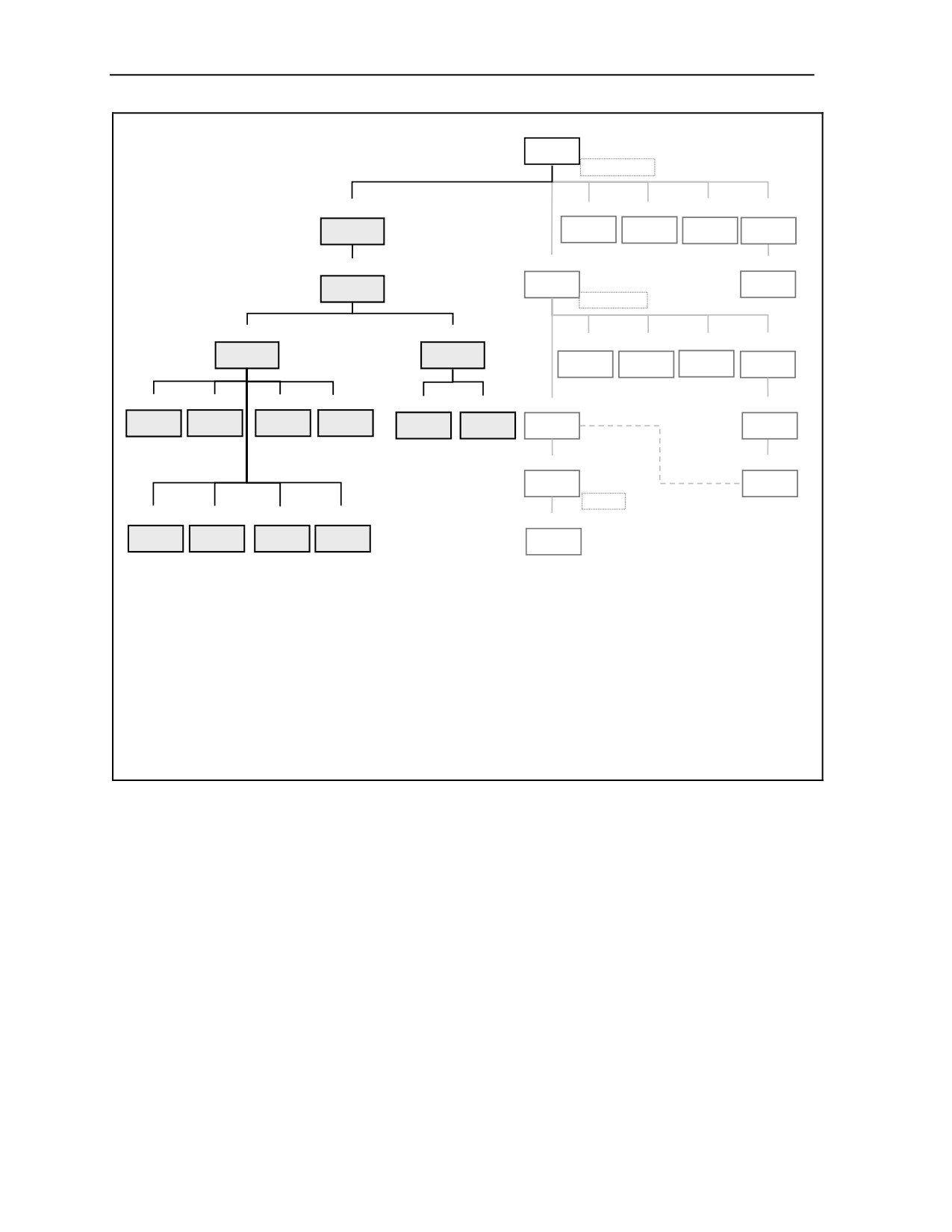
5-38. The medical C2 organizations (Figure 5-2) to support the Army modular force were designed to
provide the theater commander with various employment options and provide the flexibility to
incrementally deploy medical resources as required by emerging battlefield requirements. Theater task
organization is ultimately the ASCC commander’s decision. This decision is based on METT-TC and
relevant operational considerations. The medical commander must have direct access to the tactical
commander to be able to identify the AHS support requirements and to ensure that the AHS plan is
synchronized with the maneuver operations.
26 May 2010
FM 4-02.12
5-9
Chapter 5
XXXX
ARMY
Surgeon Section
++
X
X
++
++
MEDCOM
CA/CMO
THTR
ME
TSC
(DS)
BDE
AVN CMD
X
XXX / XX
X
CORPS/DIV
SUST
MEDBDE
Surgeon Section
II
II
X
X
X
X
MMB
CSH
FIRES
ME
BFSB
CAB
BDE
●●
●●
●●
●●
Ø
Ø
X
II
VET SVCS
COSC
PVNTMED
BLOOD
HOSP TM
FST
BCT
GSAB
II
I
BSB
AIR AMB
SPO Med
I
I
I
I
I
DENTAL
MEDLOG
GA
ASMC
BSMC
LEGEND
AMB
ambulance
COSC
combat and operational stress control
MMB
multifunctional medical battalion
ASMC
area support medical company
CSH
combat support hospital
PVNTMED
preventive medicine
AVN
aviation
DEN
dental
SUST
sustainment
BCT
brigade combat team
DIV
division
SVC
services
BDE
brigade
DS
deployment support
SPO
security, plans, and operations
BFSB
battlefield surveillance brigade
FST
forward surgical team
THTR
theater
BSMC
brigade support medical company
GA
ground ambulance
TM
team
BSB
brigade support battalion
GSAB
general support aviation battalion
TSC
theater sustainment command
BSD
blood support detachment
HOSP
hospital
VET
veterinary
CA
civil affairs
ME
maneuver enhancement brigade
CAB
combat aviation brigade
MEDBDE
medical brigade
CMD
command
MEDCOM
medical command
CMO
civil-military operations
MEDLOG
medical logistics
Figure 5-2. Army Medical Department command and control organizations
for support to the modular force
5-39. Each of the medical C2 organizations (MEDCOM [DS], MEDBDE, and multifunctional medical
battalion) was designed to provide scalable and tailored medical C2 modules for early entry and
expeditionary operations which could be expanded and augmented as the theater matures and a campaign-
quality health care infrastructure is established. This flexibility in employment, the ability to adjust the
medical force to the theater’s health care delivery requirements, and the ability to leverage and capitalize
on medical resources throughout, not only the Army but the joint MHS, enables the AMEDD to maintain
the smallest deployed medical footprint in history while facilitating a reduction of the killed in action rate
and sustaining the highest casualty survival rate to yet be recorded.
Regional Focus
5-40. For a discussion of the regional focus of the MEDCOM (DS) refer to paragraphs 2-4 through 2-7.
5-10
FM 4-02.12
26 May 2010
Army Health System Operations
Direct Support
5-41. The most effective support relationship is for the medical force pool provider (MEDCOM [DS]) to
provide a MEDBDE and associated medical units in direct support of the division or corps. This
arrangement provides the greatest flexibility to support major combat operations and also simultaneously
execute stability operations within the AO. It provides the MEDCOM (DS) commander with the ability to
task-organize the theater’s scarce medical resources and to rapidly reallocate medical resources in response
to changing conditions on the battlefield. It also ensures that the medical specialty expertise on both the
staff of the MEDCOM (DS) and MEDBDE is fully engaged in the resolution of complex medical issues
arising in the division and corps AOs. The MEDCOM (DS) and MEDBDE have experienced staffs of
medical subject matter experts who know how to leverage the medical expertise resident in the CONUS-
support base or MHS and can provide the reach capability to obtain needed support from US Army
Medical Command’s TDA organizations specializing in research, materiel development, OEH hazard
assessment, and an immense number of other medical centers of excellence.
Attached/Under the Operational Control to a Division/Corps
5-42. Attaching or placing the MEDBDE under the operational control of the division headquarters
provides the unfettered access of the medical commander to the tactical commander. However, it does
limit the ability of the medical commander to rapidly task-organize and reallocate his resources across
command lines as dictated by the tactical situation. It also limits the medical force pool from which he can
draw support should the medical requirements exceed the workload recognized by the rules of allocation
for those units. In this arrangement, the medical commander and the command surgeon have a unity of
purpose and direction as they both work for the same commander. This arrangement also increases the
visibility of ongoing AHS operations within the division.
SECTION III — OFFENSE
OFFENSIVE OPERATIONS
5-43. Offensive operations are operations which aim at destroying or defeating an enemy. They impose
US will on the enemy and achieve decisive victory. Commanders carry the fight to the enemy by seizing,
retaining, and exploiting the initiative to attack enemy forces, territory, and vital resources. Table 5-1
describes the primary tasks and purposes of offensive operations.
26 May 2010
FM 4-02.12
5-11

Chapter 5
Table 5-1. Offensive operations—primary tasks, purposes, and key medical considerations
Primary tasks
Purposes
Key medical considerations
● Movement to contact
● Dislocate, isolate, disrupt, and
● All medical functions fully
destroy enemy forces
synchronized by medical command
● Attack
and control.
● Seize key terrain
● Exploitation
● Medical information management to
● Deprive the enemy of resources
document health threat exposures and
medical encounters, to report health
● Pursuit
surveillance data and information on
● Develop intelligence
the health of the command, and to
accomplish medical regulating and
● Deceive and divert the enemy
patient tracking operations.
● Create a secure environment for
● Trauma care, forward resuscitative
stability operations
care, and en route medical care to
sustain the patient through medical
● Create a secure environment for
evacuation to the appropriate role of
stability operations
care.
● Responsive medical logistics which
facilitates and sustains the treatment of
combat casualties during the fight.
● Theater hospitalization to provide
essential care in theater to all
categories of patients.
ARMY HEALTH SYSTEM SUPPORT TO THE OFFENSE
5-44. When considering the AHS plans to support an offensive action, the medical planner must consider
many factors (FM 8-55). The forms of maneuver, as well as the enemy’s capabilities, influence the
character of the patient workload and its time and space distribution. The analysis of this workload
determines the allocation of AHS resources and the location or relocation of MTFs.
5-45. The higher casualty rates associated with offensive operations increase the burden on medical
resources. Combat support hospitals may move forward to prepare for offensive operations. If the
increased numbers of casualties overwhelm medical resources, nonmedical transportation assets may be
needed for evacuation. Following an offensive operation, combat and operational stress casualties may be
more prevalent and require deploying COSC teams into the maneuver area.
5-46. Army Health System support of offensive operations must be responsive to several essential
characteristics. As operations achieve success, the areas of casualty density move away from the
supporting facilities. This causes the routes of medical evacuation to lengthen. Heaviest patient workloads
occur during disruption of enemy main defenses, at terrain or tactical barriers, during the assault on final
objectives, and during enemy counterattacks.
5-47. In traditional combat operations, the major casualty area of the BCT is normally the zone of the main
attack. As the main attack accomplishes the primary objective of the BCT, it receives first priority in the
allocation of combat power. The allocation of combat forces dictates roughly the areas which are likely to
have the greatest casualty density. As a general rule, all brigade MTFs are located initially as close to the
supported troops as combat operations permit. This allows the maximum use of these MTFs before
lengthening evacuation lines force their displacement.
5-12
FM 4-02.12
26 May 2010

Army Health System Operations
5-48. In combat operations in noncontiguous areas, significant challenges to maintaining a seamless
continuum of care from the point of injury, through successive roles of care, to definitive and rehabilitative
care in the CONUS-support base or other safe haven will exist.
5-49. On the noncontiguous battlefield, unsecured and unassigned areas may limit the effectiveness and
range of ground evacuation assets and they may be required to move as a part of a convoy outside of
forward operating bases. This will result in a heavier reliance on rotary-wing evacuation platforms. As
rotary-wing aircraft use is limited in some environmental conditions and the enemy’s air defense
capability, the medical evacuation plan must be continually synchronized to ensure that if patients cannot
be moved by using one mode of evacuation, medical evacuation operations will continue to move through
the seamless continuum of care from the point of injury.
SECTION IV — DEFENSE
DEFENSIVE OPERATIONS
5-50. Defensive operations are operations that defeat an enemy attack, buy time, economize forces, or
develop conditions favorable for offensive or stability operations (Table 5-2). They can create conditions
for a counteroffensive that allows Army forces to regain the initiative or for stability operations to create
conditions for a stable peace. Defensive operations counter enemy offensive operations. They defeat
attacks, destroying as many attackers as necessary. Defensive operations preserve control over land,
resources, and populations. They retain terrain, guard populations, and protect critical capabilities.
Defensive operations also buy time and economize forces to allow the conduct of offensive operations
elsewhere. Defensive operations not only defeat attacks but also create the conditions necessary to regain
the initiative and go on the offensive or execute stability operations.
Table 5-2. Defensive operations—primary tasks, purposes, and key medical considerations
Primary tasks
Purposes
Key medical considerations
● Mobile defense
● Deter or defeat enemy offensive
● All medical functions fully
operations
synchronized by medical C2.
● Area defense
● Gain time
● Medical information management to
document health threat exposures and
● Retrograde
● Achieve economy of force
medical encounters, to report health
surveillance data and information on
● Retain key terrain
the health of the command, and to
accomplish medical regulating and
● Protect the populace, critical
patient tracking operations.
assets, and infrastructure
● Emphasis is placed on the rapid
● Develop intelligence
acquisition, stabilization, and
evacuation of patients generated by
units in contact. This enhances the
mobility of supporting medical units
and facilitates the tactical
commander’s ability to exploit
opportunities and leverage the
momentum to mount a counterattack
or perform other maneuvers.
● Responsive medical logistics which
facilitates and sustains the treatment of
combat casualties during the fight.
● Theater hospitalization to provide
essential care in theater to all
categories of patients.
26 May 2010
FM 4-02.12
5-13

Chapter 5
ARMY HEALTH SYSTEM SUPPORT TO THE DEFENSE
5-51. The provision of timely and effective AHS presents challenges to the medical planner in defensive
operations. The patient load reflects lower casualty rates, but forward area patient acquisition is
complicated by enemy actions and the maneuver of combat forces. Medical personnel are permitted much
less time to reach the patient, complete vital emergency medical treatment, and remove the patient from the
point of injury. Increased casualties among exposed medical personnel further reduce the medical
treatment and evacuation capabilities. Heaviest patient workloads, including those produced by enemy
artillery and CBRN weapons, may be expected during the preparation or initial phase of the enemy attack
and in the counterattack phase. The enemy attack may disrupt ground and air routes and delay evacuation
of patients to and from treatment elements. The depth and dispersion of the defense create significant time
and distance problems for evacuation assets. Combat elements may be forced to withdraw while carrying
their remaining patients with them. The enemy exercises the initiative early in the operation which may
preclude accurate prediction of initial areas of casualty density. This makes the effective integration of air
assets into the evacuation plan essential.
SECTION V — STABILITY OPERATIONS
5-52. As discussed in JP 3-0, stability operations encompass various military missions, tasks, and activities
conducted outside the US in coordination with other instruments of national power to maintain or
reestablish a safe and secure environment, provide essential government services, emergency infrastructure
reconstruction, and humanitarian relief. The primary tasks relating to the conduct of stability operations
are discussed in Table 5-3.
Table 5-3. Stability operations—primary tasks, purposes, and key medical considerations
Primary tasks
Purposes
Key medical considerations
● Civil security
● Provide a secure environment
● Regionally focused medical
command and control to promote unity
● Civil control
● Secure land areas
of purpose of all engaged medical
assets.
● Restore essential
● Meet the critical needs of the
services
populace
● Medical information management to
provide health risk communications,
● Support to governance
● Gain support for host-nation
coordinate multinational force and
government
interagency medical interoperability
● Support to economic
issues, and document health
and infrastructure
● Shape the environment for
encounters.
development
interagency and host nation success
● Traditional medical support to a
deployed force engaged in these
operations.
● Medical expertise and consultation to
enhance medical capacity building in
the public, private, and military health
sectors of the host nation.
● Development of regional theater
security cooperation plans aimed at
mitigating or resolving the underlying
causes of health issues prevalent
within the region.
5-14
FM 4-02.12
26 May 2010
Army Health System Operations
ARMY HEALTH SYSTEM SUPPORT TO STABILITY OPERATIONS
5-53. Historically, the AMEDD has planned, participated in, and executed stability-type operations across
the full spectrum of conflict. Many regions in the world are medically underserved and when US forces
deploy to these areas requirements to assist the host nation military and civilian medical infrastructure and
to reduce human suffering through the provision of foreign humanitarian assistance occur. The AMEDD
has always responded to and planned for the increased workload which could potentially occur during
these operations. By anticipating these requirements and planning for the additional workload, the medical
commander has been able to mitigate the adverse impact of diverting scarce medical assets from the
primary mission of supporting the Soldier. With the publication of DODI 3000.05 and FM 3-0, the
importance of these operations to the national strategic strategy and the successfully accomplishment of the
national strategic goals was recognized and emphasized. In an era of persistent conflict, it is essential that
the tactical commander can influence and mitigate or resolve the underlying causes and factors which
contribute to the instability in the region. One of principle means, he has to shape the environment, is to
provide assistance in the form of military-to-military and military-to-civilian medical capacity building to
enhance the host nation’s ability to provide effective and responsive health care to its population, to reduce
human suffering, and to improve the host nation quality of life. In some scenarios, the assistance will
extend to restoring the essential services in the host nation that have been destroyed as a result of military
action, terrorist attacks, or man-made or natural disasters. Prompt and responsive support in this arena
ensures that the situation in the area will not deteriorate because of epidemic disease outbreaks caused by
disrupted sanitation services, unavailability of potable water, and lack of medical care to include
immunizations.
5-54. The GCC’s theater engagement plan provides the blueprint for conducting stability operations within
the deployed AO. Civil Affairs is the proponent for conducting CMO within the Army and the MEDCOM
(DS) and MEDBDE staffs have CA staff members to assist in providing advice and consultation to the
supporting ASCC G-9 in determining the feasibility of and planning for proposed health care activities and
programs. Stability operations are normally conducted in an interagency, multinational force, and NGO
environment and the responsibilities for and the execution of specific missions must be clearly articulated
and carefully synchronized to ensure the maximum effectiveness of all assets are achieved and that
duplication of the same services by different agencies does not occur. Military medicine provides the
initial lifeline for the continuation of essential medical care during transition operations and response to
major medical emergencies, but these services are then transitioned to the host nation or are provided by
other governmental and civilian agencies.
5-55. The AMEDD participates across all of the primary tasks within stability operations as it provides
AHS support to all US Army forces involved in the operation, however, its direct support in certain tasks is
limited to the traditional support to our forces, such as in civil control and civil security. Medical support
and medical capacity building are major contributors to the three remaining primary tasks and, may in fact,
be the principle tool in shaping the environment, as military medicine assistance is often times more readily
accepted by the host nation. For a detailed to discussion of stability operations, refer to FM 3-0, FM 3-07,
and FM 8-42.
SECTION VI — CIVIL SUPPORT OPERATIONS
CIVIL SUPPORT OPERATIONS
CIVIL SUPPORT OPERATIONS
5-56. Civil support operations use Army forces to assist civil authorities, foreign and domestic, as they
prepare to respond to crises and relieve suffering within the US and its territories. In civil support
operations, Army forces provide essential support, services, assets, or specialized resources to help civil
authorities deal with situations beyond their capabilities
(Table 5-4). The purpose of civil support
operations is to meet the immediate needs of designated groups for a limited time, until civil authorities can
26 May 2010
FM 4-02.12
5-15

Chapter 5
do so without Army assistance. In civil support operations, Army forces always support civil authorities—
local, state, and federal. For additional information on support operations refer to FM 3-0.
Table 5-4. Civil support operations—primary tasks, purposes, and key medical considerations
Primary tasks
Purposes
Key medical considerations
● Provide support in
● Save lives
● Medical command and control to
response to disaster or
coordinate, integrate, and synchronize
terrorist attack
● Restore essential services
Army Health System resources into the
interagency efforts. Further, providing
● Support civil law
● Maintain or restore law and order
medical expertise to identify and
enforcement
analyze critical needs emerging within
the operational area.
● Protect infrastructure and property
● Provide other support
as required
● Medical information management to
● Maintain and restore local
facilitate medical regulating of victims
government
to facilities outside of the
disaster/incident site and to document
● Shape the environment for
medical treatment.
interagency success
● Support is provided to assist affected
medical infrastructure in saving lives,
reducing long-term disability, and
alleviating human suffering.
● Support is provided to assist the
local government in conducting rescue
operations and providing medical
evacuation of victims to facilities
capable of providing the required care.
● Preventive measures to respond to
and resolve emerging health threats
caused by the disaster/incident.
5-57. Army support to civil support operations supplements the efforts and resources of state and local
governments and organizations. A presidential declaration of a major disaster or emergency usually
precedes civil support operations. Civil support operations require extensive coordination and liaison
among many organizations—interagency, joint, active Army, reserve, and National Guard units—as well
as with state and local governments. The National Response Framework provides a national level
architecture to coordinate the actions of all supporting federal agencies. The National Response
Framework uses the foundation provided by the Homeland Security Act, Homeland Security Presidential
Directive-5, and the Robert T. Stafford Disaster Relief and Emergency Assistance Act (Stafford Act) to
provide a comprehensive, all-hazards approach to domestic incident management. For more information
on CBRN response guidelines, refer to the National Response Framework, DODI 2000.18 and FM 4-02.7.
5-58. The Constitution permits the use of Army forces to protect the states against invasion and, upon
request of a state, to provide the nation with critical capabilities, such as missile defense, necessary to
secure and defend the homeland. It is the responsibility of civil authorities to preserve public order and
carry out governmental operations within their jurisdiction. Restrictions on the use of Army forces
providing assistance to civil authorities are contained in the Posse Comitatus Act, as amended, and the
Stafford Act. The primary reference for military assistance to civil authorities is DODD 3025.15. It is
wide-ranging, addressing such actions as civil disturbance control, counterdrug activities, combating
terrorism, and law enforcement.
5-16
FM 4-02.12
26 May 2010
Army Health System Operations
CIVIL SUPPORT MISSIONS
5-59. During civil support operations, Army forces perform relief operations, support to CBRN
consequence management, support to civil law enforcement, and community assistance.
Relief Operations
5-60. Relief operations may be required in response to natural or man-made disasters. Civil authorities are
responsible for restoring essential services in the wake of the incident. To assist the civil authorities in
accomplishing this action, the President can deploy Army forces. Relief operations consist of—
z
Disaster relief. Disaster relief involves the restoration of critical infrastructure such as hospitals
and other health care facilities, water and sewage systems, electricity, and communications
capabilities. It includes establishing and maintaining the minimum safe working conditions
necessary to protect relief workers and the affected population.
z
Humanitarian relief. This focuses on those lifesaving measures that alleviate the immediate
needs of the population in crisis.
Civilian relief organizations
(governmental or
nongovernmental) are best suited to provide this type of relief. Army forces conducting
humanitarian relief usually facilitate civil relief efforts. Activities within these types of
operations include the provision of medical care and medications, food, water, clothing,
blankets, and shelter.
Support to Civil Chemical, Biological, Radiological, and Nuclear Consequence Management
5-61. Support to CBRN incidents may be required due to the deliberate or unintentional events involving a
release or use of CBRN agents that produce catastrophic loss of life and property.
Civil Preparedness
5-62. This encompasses all activities that prepare the nation to rapidly respond to natural or man-made
disasters and to terrorist or weapons of mass destruction incidents. The pillars of civil preparedness
include training, exercises, expert assistance, and response.
Protection of Critical Assets
5-63. Hostile forces (including terrorists) may attack facilities essential to society, the government, and the
military. These assaults can disrupt civilian commerce, government operations, and military capabilities.
In order for the Army to conduct full spectrum operations, this infrastructure must be protected. In
conjunction with civil law enforcement, Army forces may protect these assets and temporarily restore lost
capability.
Response to Chemical, Biological, Radiological, and Nuclear Incidents
5-64. The National Response Framework is the key plan that affects the use of Army forces in CBRN
incidents. The resources required to deal with CBRN incidents differ from those needed during
conventional disasters. Mass casualties may require decontamination and a surge of medical resources (to
include MEDLOG, such as antidotes, vaccines, and antibiotics). The sudden onset of a large number of
casualties may pose public health threats related to food, vectors, water, waste, and mental health. Damage
to chemical and industrial plants and secondary hazards such as fires may cause toxic environmental
hazards. Mass evacuation may be necessary. The Army possesses capabilities suited to respond to CBRN
incidents. The MEDCOM has the capability, through its experienced clinicians, planners, and support
staffs to accomplish assessments, triage, medical treatment
(for conventional and CBRN casualties),
hospitalization, and follow-up care, and provide consultation and advice.
Support to Civil Law Enforcement
5-65. Support to civil law enforcement involves activities related to counterterrorism, counterdrug
operations, military assistance to civil disturbances, and general support. Although the AMEDD does not
26 May 2010
FM 4-02.12
5-17
Chapter 5
directly participate in these operations, they do provide medical support to those forces participating.
Further, veterinary personnel may also be required to support government-owned animals engaged in these
operations.
Community Assistance
5-66. Community assistance is a broad range of activities that provide support and maintain a strong
connection between the military and civilian communities. Community assistance activities provide
effective means of projecting a positive military image, providing training opportunities, and enhancing the
relationship between the Army and American public. They should fulfill community needs that would not
otherwise be met.
ARMY MEDICAL DEPARTMENT ACTIVITIES IN CIVIL SUPPORT OPERATIONS
5-67. The AMEDD may have numerous support roles in civil support operations. Some of the major
AMEDD areas of participation are:
z
In coordination with federal, state, and local health organizations, the AMEDD annually teaches
courses in the medical management of CBRN casualties.
z
Army Medical Department resources can provide direct care capabilities.
z
Each Army MTF develops and supports their installation with emergency medical management
plans in coordination with the installation commander.
z
The US Army Center for Health Promotion and Preventive Medicine in coordination with other
federal agencies, such as the US Environmental Protection Agency, develops appropriate
products (reports, protocols, and enhanced monitoring) to enhance security of the Army’s
critical infrastructure and to develop appropriate guidance to counter acts of bioterrorism.
Further, the US Army Center for Health Promotion and Preventive Medicine is a reachback
center for medical information on CBRN incidents and is capable of providing specialists in the
medical arena, if required.
z
Army Medical Department resources can assist in conducting vulnerability assessments of
drinking water systems.
5-68. Refer to FM 4-02.7 and FM 8-42 for additional information on AMEDD support to civil support
operations.
SECTION VII — EXPEDITIONARY AND CAMPAIGN-QUALITY MEDICAL
OPERATIONS
5-69. Expeditionary capability is the ability to promptly deploy combined arms forces worldwide into any
operational environment and operate effectively upon arrival. Expeditionary operations require the ability
to deploy quickly with little notice, shape conditions in the operational area, and operate immediately on
arrival. Uncertainty as to the operational area, the possibility of a very austere environment, and the need
to match forces to available lift drive expeditionary capabilities.
5-70. Expeditionary capabilities assure friends, allies, and foes that the Nation is able and willing to deploy
the right combination of Army forces to the right place at the right time. Forward-deployed units, forward
positioned capabilities, peacetime military engagement, and force projection—from anywhere in the
world—all contribute to expeditionary capabilities. Expeditionary capabilities enable the Army to respond
rapidly under conditions of uncertainty to areas with complex and austere operational environments with
the ability to fight not only on arrival but also through successive operations. Fast deploying and
expansible Army forces provide the means to introduce operationally significant land forces into a crisis on
short notice, providing preemptive options to deter, shape, fight and win if deterrence fails, and to sustain
these options for the duration necessary to achieve success. Providing joint force commanders with
expeditionary capability requires forces organized and equipped to be modular, versatile, and rapidly
deployable with agile institutions capable of supporting them. Rapidly deployed expeditionary force
packages provide immediate options for seizing or retaining the operational initiative. With their modular
5-18
FM 4-02.12
26 May 2010
Army Health System Operations
capabilities, these forces can be swiftly deployed, employed, and sustained for extended operations without
an unwieldy footprint. These forces are tailored for the initial phase of operations, easily task-organized,
and highly self-sufficient. Army installations worldwide serve as support platforms for force projection,
providing capabilities and information on demand.
5-71. Expeditionary capabilities are more than physical attributes; they begin with a mindset that pervades
the force. Soldiers with an expeditionary mindset are ready to deploy on short notice. They are confident
that they can accomplish any mission. They are mentally and physically prepared to deploy anywhere in
the world at any time in any environment against any adversary. Leaders with an expeditionary mindset
are adaptive. They possess the individual initiative needed to accomplish missions through improvisation
and collaboration. They are mentally prepared to operate within different cultures in any environment. An
expeditionary mindset requires developing and empowering adaptive thinkers at all levels, from tactical to
strategic.
EXPEDITIONARY MEDICAL OPERATIONS
5-72. The operational environment of today is joint and multinational in nature. Army units are employed
in concert with the forces from each of the Services, combatant commands, and often with multinational
forces. Multinational forces will encounter some unique problems in terms of providing and structuring
the medical support. Instead of being able to establish an integrated structure of roles of care with
consistent quality and a seamless continuum, the US military will potentially face a cobbled together
medical force which may contain holes and gaps and be of variable capacity. Therefore, AHS planners
must understand not only the capabilities and limitations of Army medical units, but must also understand
what capabilities are present in the joint and multinational forces employed in the AO, capabilities of the
host nation, and what support requirements will be generated. Coordination and planning must emphasize
the interdependence of these units in the concerted effort to support the GCC’s OPLAN and to ensure
mission success.
TASK ORGANIZATION OF MEDICAL UNITS/ELEMENTS
5-73. Significant advances are being made toward fielding a responsive field medical force that is modular,
mobile, and adaptive to the AHS mission requirements. Providing the best care possible at the right place
and at the right time for every wounded or injured Soldier is the goal of AMEDD. In addition to medical
organizations, medical staff elements located at battalion-, brigade-, corps-, and Army-levels are essential
for planning, coordinating synchronizing AHS support for their respective organizations. Developing the
AHS plan is a coordinated effort and requires timely reporting and frequent updates on the status of
medical units/elements. Our medical staff elements should be staff-trained and thoroughly integrated into
the planning and operations process of their headquarters. Running estimates by subordinate medical
units/elements and the frequent exchanges of operations information are essential to maintaining a common
operating picture for the surgeons, medical planners, MEDLOG officers, medical commanders, and
medical leaders. All medical units/elements operating in the AO must be integrated into the theater AHS
and be included into the planning and operations process. The MEDCOM (DS) as the senior medical
headquarters and medical force pool provider in theater must ensure that the vertical and horizontal
integration of medical resources is achieved to ensure a seamless continuum of care from the point of
injury through the essential care provided in theater, and if required, to the definitive and rehabilitative care
in the CONUS-support base.
5-74. Essential to successful task organization is a thorough understanding of existing command and
control relationships. Command and control relationships are discussed in FMs 3-0 and 6-0. Recent
operations have resulted in units receiving support from or providing support to units that have not
traditionally provided/received this support. Therefore, medical commanders and planners must ensure
that C2 relationships are clearly articulated in OPLANs and OPORDs and that these are disseminated to
the lowest level. Whether support is received from traditional organizations or it is received from new
sources, such as from another Service or multinational force, it is paramount that the flow of support
services is continuous. If each Soldier and organization knows where to expect the support, it facilitates
the process, avoids confusion, and enables those on the ground to establish the contacts and procedures to
26 May 2010
FM 4-02.12
5-19
Chapter 5
make it happen. Clearly articulating these support relationships assists both the planner and the operator in
accomplishing the mission.
5-75. Medical units must be prepared to operate in areas where traditional support bases are either absent
or not fully developed. Due to the humanitarian nature of medical operations, medical assets may be
deployed to areas ahead of other sustainment units/resources. For example, refugees fleeing areas of
combat may spontaneously establish camps in remote areas. If the GCC directs that humanitarian
assistance be provided, medical units may deploy PVNTMED, medical treatment, and medical evacuation
assets to support this population before signal support can be established in the area. Therefore, medical
planners must foresee and plan for such a contingency to ensure continuing requirements can be
communicated and follow-on resupply in areas where logistical bases have not been established. Although
communications may not be a problem in this scenario, transportation routes may not be established and
innovative measures may be required to move resupply items to the forward areas. The modes of
transportation used to move supplies and equipment may also be inadequate; for example, host nation
buses, trucks, and pack animals may have to be used to distribute medical supplies and equipment around
the AO.
5-76. Task organization has traditionally been accomplished by selecting whole units with the required
capabilities to form a task force. Due to troop ceiling limitations, availability of transportation assets, and
size of the population to be supported, task organization of units can also involve using unit increments or
selected capabilities. Further, task organization can be done by combining incremental assets from units
from different Services to achieve a composite mix of medical specialties that is the right size for the
operation. For example, the Army FST is a 20-man team which provides a far forward surgical
intervention capability. The FST is not, however, a self-sufficient unit. It is designed to be collocated with
a medical company. The medical company provides the x-ray, laboratory, patient administration, and
patient holding capability for the team, as well as some of its power generation requirements. In some
scenarios, it may be determined that the footprint of these two units is too large. To reduce the size of the
footprint, a support package that includes the required capabilities that are not as robust as the medical
company may be task-organized to support the FST. The assets used for this support may be provided by
another Service. The requirements for the use of medical assets and resources will vary on the type and
duration of the operation and the availability of medical resources.
CAMPAIGN-QUALITY MEDICAL OPERATIONS
5-77. Campaign capability, a joint construct, is the ability to sustain operations as long as necessary to
conclude operations successfully. Many conflicts are resolved only by altering the conditions that
prompted the conflict. This requires combat power and time. The campaign capability extends its
expeditionary capability well beyond deploying combined arms forces that are effective upon arrival. It is
an ability to conduct sustained operations for as long as necessary, adapting to unpredictable and often
profound changes in the operational environment as the major operations battles and engagements unfold.
Army forces are organized, trained, and equipped for endurance. Their endurance stems from the ability to
generate, protect, and sustain landpower—regardless of how far away it is deployed, how austere the
environment, or how long the GCC requires it. It includes taking care not only of Soldiers but also of
Families throughout the complete cycle of deployment, employment, and redeployment. This involves
anticipating requirements across the entire Army and making the most effective use of all available
resources—deployed or not. Finally, major operations battles and engagements capability draws on
iterative and continuous learning based on operational experience. This requirement extends to training at
all echelons, from individual Soldier skills to operational-level collective tasks. Campaign-quality medical
operations combines the medical resources of the deployed Services, synchronizes the delivery of care
across Services boundaries, and facilitates reachback support to the MHS. Campaign-quality medical
operations maximizes the use of scarce medical resources and enables access to all deployed medical
specialty care.
5-78. Campaigning requires a mindset and vision that complements expeditionary requirements. Soldiers
understand that no matter how long they are deployed, the Army will take care of them and their Families.
They are confident that the loyalty they pledge to their units will be returned to them, no matter what
5-20
FM 4-02.12
26 May 2010
Army Health System Operations
happens on the battlefield or in what condition they return home. Tactical leaders understand the effects of
protracted land operations on Soldiers and adjust the tempo of operations whenever circumstances allow.
Senior commanders plan effective campaigns and major operations. They provide the resources needed to
sustain operations, often through the imaginative use of joint capabilities.
5-79. The Army’s preeminent challenge is to balance expeditionary agility and responsiveness with the
endurance and adaptability needed to complete a campaign successfully, no matter what form it eventually
takes. Landpower is a powerful complement to the global reach of American airpower and sea power.
Prompt deployment of landpower gives joint force commanders options—for either deterrence or decisive
action. Once deployed, landpower may be required for months or years. The initially deployed Army
force will evolve constantly as the operational environment changes. Operational success depends on
flexible employment of Army capabilities together with varying combinations of joint and interagency
capabilities.
5-80. The MEDCOM (DS) ensures campaign-quality medical operations are established and implemented
as the theater matures from early entry expeditionary-style operations to a sustained presence. They
accomplish this by continually identifying, assessing, and evaluating health care requirements of the
deployed force and, when directed of multinational forces and host nation personnel. The MEDCOM (DS)
provides operational reach to the Generating Force to leverage the resources (personnel, infrastructure, and
materiel) of the US Army Medical Command and its subordinate research, educational, and training
institutions and assets to ensure deployed Soldiers receive the best possible health care regardless of their
geographic location.
SECTION VIII — ENEMY PRISONER OF WAR AND/OR DETAINEE MEDICAL
CARE OPERATIONS
5-81. As the senior AHS C2 organization within the theater, the MEDCOM (DS) is responsible for
ensuring that the medical care provided to EPWs and other personnel in US custody such as detained or
retained personnel is provided in compliance with international and US law and military policies and
regulatory guidance. The MEDCOM (DS) plans for and coordinates support for internment facilities
located within its AO. The MEDCOM (DS) commander or his designee (normally the deputy commander,
professional services) serves as the detainee operations medical director and provides oversight, guidance,
and policy on medical ethics issues, standards and availability of care, requirements for field hygiene and
sanitation, nutrition and maintenance of weigh-in registers, and all other medical aspects of confinement
health care. For specific information on the conduct of these operations, refer to FMI 4-02.46.
26 May 2010
FM 4-02.12
5-21
Appendix A
Eligibility Determination for Medical/Dental Care
During interagency and multinational operations, one of the most pressing questions
is who is eligible for care in a US Army established MTF and the extent of care
authorized. Numerous categories of personnel seek care in US facilities that are
located in austere areas where the host nation civilian medical infrastructure is not
sufficient to provide adequate care. A determination of eligibility and whether
reimbursement for services is required is made at the highest level possible and in
conjunction with the supporting SJA. Additionally, Department of State and other
military staff sections (such as the assistant chief of staff, plans) may also need to be
involved in the determination process.
Each operation is unique and the
authorization for care is based on the appropriate US and international law, DODD
and DODI, ARs, doctrine, and standing operating procedures. Other factors
impacting on the determination of eligibility are command guidance, practical
humanitarian and medical ethics considerations, availability of US medical assets (in
relationship to the threat faced by the force), and the potential training opportunities
for medical forces. The sample format provided in paragraph A-5 is just one
approach to delineate and disseminate this information to MTF personnel and may
not be all inclusive based on specific scenarios.
Note. The examples for the authority to provide treatment are only illustrative in nature and
should not be used as the basis for providing or denying medical care.
DOCUMENTATION
A-1. Basic documents required for determining eligibility of beneficiaries include AR 40-400; FM 27-10;
relevant sections of Title
10, US Code; relevant DODD and DODI; international standardization
agreements
(ISAs); acquisition and cross servicing agreements; orders from higher headquarters;
interagency agreements (memorandum of understanding or agreement); status of forces agreements; and
appropriate multinational or international agency guidance for the specific operation. If contractor
personnel are present, a copy of the relevant sections of their contracts should be on file to delineate
specific medical services to be rendered. Additionally, for contract personnel a point of contact (POC) for
the contracting company and a POC for the administration of the contract should be maintained. Finally,
the political-military environment of the AO must be taken into account as the medical C2 headquarters
and its higher headquarters develop the eligibility matrix.
A-2. The eligibility matrix should be as comprehensive as possible. If necessary, it should include
eligibility determination by name (see example in paragraph A-5). If individuals arrive at the emergency
medical service section of the MTF who are not included in the medical/dental support matrix, the MTF
must always stabilize the individual first, and then determine the patient’s eligibility for continued care.
The command POC for eligibility determination should be contacted immediately. Further, care will be
provided in accordance with the standing operating procedure pending eligibility determination.
(For
example, a host nation civilian presents himself at the gate and requests medical treatment. Although on
the surface it may appear that he is not eligible for care, this determination can only be made after a
medical assessment is completed by competent medical personnel. In some cases, the individual may have
to be brought into the MTF to accomplish an adequate medical assessment. Conducting a medical
26 May 2010
FM 4-02.12
A-1

Appendix A
assessment does not obligate the US military to provide the full spectrum of medical care. Although it
does obligate the MTF to provide immediate stabilization for life-, limb-, and eyesight-threatening medical
conditions and to prepare the patient for evacuation to the appropriate civilian or national contingent MTF
when the patient’s medical condition permits.)
Note. Any individual requesting medical care should receive a timely medical assessment of his
condition. Even though the individual is not eligible for treatment, life-, limb-, or eyesight-
saving procedures warranted by the individual’s medical condition are provided to stabilize the
individual for transfer to the appropriate civilian or other nation medical treatment facility.
KNOWLEDGE OF HEALTH CARE CAPABILITIES
A-3. The MTF staff must be familiar with the medical care available in the AO from other sources. These
sources could include multinational or host nation military (tactical and strategic), NGO or international
organization (such as the United Nations), and local civilian resources. When appropriate, and by knowing
the level and types of care available, the MTF staff can plan for the continued care of the patient after
initial stabilization is provided in the US MTF and the patient can be transferred to another facility for
continued care.
DISSEMINATION OF ELIGIBILITY FOR CARE INFORMATION
A-4. It is essential that eligibility for medical care guidance is disseminated and understood by the chain
of command and all civilians and military members of the deployed force. The AHS commander must be
able to articulate the basic concepts for medical eligibility determinations. This means that he will need to
condense them into simple, easily understood instructions, and widely disseminate them through electronic
means or other media (such as pocket-sized cards). As the chief planner for AHS operations, the AHS
commander must ensure that this information is contained in appropriate OPLANs and OPORDs and
briefed to the appropriate senior leadership of the command.
SAMPLE ELIGIBILITY OF CARE MATRIX
A-5. Table A-1 provides a sample of an eligibility of care matrix for treatment in a US Army MTF.
Table A-1. Sample eligibility for medical/dental care support matrix
ELIGIBILITY FOR MEDICAL/DENTAL CARE
SUPPORT MATRIX
(DATE)
(THIS DOCUMENT IS SUBJECT TO FURTHER VERIFICATION AND/OR MODIFICATION)
Category
Medical/dental
Information/authority*
Multinational military personnel
Yes1
The following nations have ACSAs
and ISAs with the US which are
administered by (combatant
command): List nations.
Coalition military personnel
Yes1
The following nations have ACSAs
and ISAs with the US which are
administered by (combatant
command): List nations
DOD civilian employees
Yes
Invitational travel orders (ITOs).
US Government employees
ITOs.
Yes2
(non-DOD)
A-2
FM 4-02.12
26 May 2010

Eligibility Determination for Medical/Dental Care
Table A-1. Sample eligibility for medical/dental care support matrix (continued)
Category
Medical/dental
Information/authority*
US Embassy personnel
Yes
US citizens on official business.
US Congressional personnel
Yes
US citizens on official business.
Army and Air Force Exchange
Yes
ITOs.
Service US citizen employees
Army and Air Force Exchange
US law.
Yes3
Service local national employees
Nonappropriated fund
Yes
ITOs.
instrumentality
MWR US employees
Nonappropriated fund
US law.
Yes3
instrumentality
MWR
Local national employees
Other persons on DOD ITOs
Yes
ITOs.
US Governmental Agency (such as
Yes
ITOs.
US Agency for International
Development or Drug Enforcement
Agency) US citizen employees
US Governmental Agency (such as
Yes3
After stabilization, coordinate with
US Agency for International
the US Governmental Agency POC
Development or Drug Enforcement
to evacuate the patient to his
Agency) non-US citizen employees
country of citizenship. AR 40-400
authorizes limited care. Contact
Mr. Bannon, DSN XXX-XXXX.
Contractor employees who are US
Yes4
AR 40-400.
military retirees
Contracted college instructors
Yes
ITOs.
United Nations personnel (includes
Yes3
US law.
all personnel employed by the
United Nations and its agencies,
such as the United Nations High
Commissioner for Refugees)
American National Red Cross
ITOs.
Yes3
Nongovernmental organizations
US law.
Yes3
personnel
Contractor #1
Yes
Have copy of relevant contract.
expatriate employees
POC: Ms. Scott
(XXX) XXX-XXXX
ADMIN: Mr. Elliott
DSN XXX-XXXX
Contractor #1
Yes3
Have copy of relevant contract.
local national employees
US law and SOFA.
POC: Ms. Scott
(XXX)XXX-XXXX
ADMIN: Mr. Elliott
DSN XXX-XXXX
26 May 2010
FM 4-02.12
A-3

Appendix A
Table A-1. Sample eligibility for medical/dental care support matrix (continued)
Category
Medical/dental
Information/authority*
Contractor #2 all employees
Contractor did not contract for the
Yes3
provision of medical care by military
MTFs. Contractor stated in writing
POC: Mr. Franklin
No5
that they contracted with the host
(XXX) XXX-XXXX
nation medical infrastructure for the
ADMIN: Mr. Elliott
required care. NOTE: A separate
determination may be required for
DSN XXX-XXXX
individual cases, as the individual
may be eligible for care under a
different provision. Contact Mr.
Bannon, DSN XXX-XXXX if
additional information is required.
Contractor #3
Yes3
ITOs.
Communications Section
NOTE: This entry for Contractor #3
does not include personnel
assisting project XYZ. Those
POC Ms. Jo Alce
personnel are contracted with a
(XXX) XXX-XXXX
division of the contractor and are
ADMIN: Mr. Elliott
subject to separate contract terms.
Contractor #3 in support of project
DSN XXX-XXXX
XYZ has not submitted any
information for determining
eligibility for medical care and
logistical support of these
personnel.
Contractor #4
Yes
Per Mr. Bannon, Mr. Lee is entitled
to full medical and dental support
Mr. Edward Lee
without reimbursement. The terms
(company name classified)
of the contract and the name of the
contracting company are classified.
POC: Ms. Hannah
Contact Mr. Bannon, DSN XXX-
XXXX, if additional information is
(XXX) XXX-XXXX
required.
ADMIN: Mr. Elliott
DSN XXX-XXXX
Contractor #5
Yes6
Per Mr. Bannon, Mr. James is
entitled to full medical and dental
Mr. Noah James
support, however, this care is
(company name classified)
reimbursable. The terms of the
contract and the name of the
POC: Ms. Hannah
contracting company are classified.
Contact Mr. Bannon, DSN XXX-
(XXX) XXX-XXXX
XXXX, if additional information is
ADMIN: Mr. Elliott
required.
DSN XXX-XXXX
Dependents of US active duty or
Yes4
Only if space is available and
retired military personnel.
appropriate medical services/care
are available in the operational
setting. AR 40-400. Contact Mr.
Bannon, DSN XXX-XXXX, if
additional information is required.
A-4
FM 4-02.12
26 May 2010

Eligibility Determination for Medical/Dental Care
Table A-1. Sample eligibility for medical/dental care support matrix (continued)
Category
Medical/dental
Information/authority*
Personnel in custody of US military
Yes
US and international law. This
forces
category includes personnel in
protective custody, EPW, retained,
or detained personnel. Extent of
care rendered is the same as that
provided to US military forces (FM
4-02, FM 27-10, and FMI 4-02.46).
Contact Mr. Bannon, DSN XXX-
XXXX, if additional information is
required.
Individual injured as a result of
Yes
US and international law (FM 27-
military operations
10) and SOFA. If the US military
injures an individual (such as in an
automobile accident involving a
military vehicle), the US is
responsible for providing immediate
care (or paying for local care).
Coordinate with Mr. Bannon, DSN
XXX-XXXX and LTC Brian, support
SJA, DSN XXX-XXXX.
LEGEND
* Illustrative in nature only.
1 Multinational forces member nations are provided food, water, fuel, and medical treatment pursuant to reciprocal
agreements. The amount of food, water, fuel, and medical care provided must be accounted for by the providing nation
to the G-5, multinational liaison. Logistical support is not permitted for those nations with whom the US does not have
both an ACSA and ISA. However, the ACSA and ISA requirements may be waived for those nations whom the task force
commander, in conjunction with the supporting SJA, feels are supporting the missions of the task force.
2 If not working for, contracted to, or on DOD ITO for logistical support, non-DOD US Government employees must pay for
meals received at DOD dining facilities.
3 Emergency medical and dental care only. Emergency care is that care required to save life, limb, or eyesight.
4 Space available.
5 Routine.
6 Reimbursable.
ADMIN administrator
MTF medical treatment facility
ACSA acquisition and cross servicing agreement
ISA international standardization agreement
AR Army regulation
ITO invitational travel order
DOD Department of Defense
MWR morale, welfare, and recreation
DSN Defense Secure Network
POC point of contact
FM field manual
SOFA status of forces agreement
FMI field manual interim
US United States
G-5 assistant chief of staff, plans
26 May 2010
FM 4-02.12
A-5
Appendix B
Command Post Operations
SECTION I — COMMAND POST OPERATIONS
The MEDCOM (DS) and/or MEDBDE standing operating procedure establishes the MEDCOM
(DS)/MEDBDE CP organization and composition. The CP consists of a main and an alternate location.
The alternate locations are planned for in order to enhance the security and survivability of the main CP.
MAIN COMMAND POST
B-1. The main CP consists of those elements of the command group, staff sections, and administrative
support personnel required for C2, staff supervision, personnel staff support, and life support. It also
includes planning cells or liaison officers from higher and subordinate commands to synchronize AHS
support plans. The CP includes the life support and perimeter defense areas.
B-2. The CP configuration reflects broad specialized relationships, continuity of operations, and
information flow among sections. The availability of existing facilities and terrain determines actual
location of elements and supporting staff sections. The HHC commander plans the physical layout of the
CP.
B-3. The life support area includes facilities for providing field feeding, billeting, and organizational
supply and maintenance. The HHC commander coordinates these support activities, as well as other
essential support services, such as shower, laundry, and latrines. Life support services are incorporated
within the base perimeter.
B-4. An alternate CP provides continuity of C2 in case of destruction or incapacitation of the main CP.
The MEDCOM (DS)/MEDBDE G-3/S-3 select alternate CP locations. The HHC commander is
responsible for establishing the alternate CP.
COMMAND POST SECURITY
B-5. Command posts use several measures to improve the survivability of critical C2 elements. If a
chemical/biological protected or nuclear hardened site is not available, CP dispersal enhances survivability,
as does reducing the size and signature of the CP.
B-6. The HHC commander is responsible for coordinating internal security and local defense of the main
CP. Command post security includes establishing—
z
Prepared defensive positions and a warning system.
z
Barrier systems and obstacles outside the perimeter.
z
Manned guard posts.
z
Sentries and guards for local internal security.
z
Alternate and supplementary positions.
z
Access control.
26 May 2010
FM 4-02.12
B-1

Appendix B
Note. The Geneva Convention for the Amelioration of the Condition of the Wounded and Sick
in Armed Forces in the Field does not itself prohibit the use of Article 24 personnel in perimeter
defense of nonmedical units such as sustainment areas or base clusters under overall security
defense plans, but the policy of the US Army is that Article 24 personnel will not be used for
this purpose. Adherence to this policy should avoid any issues regarding their status under the
Geneva Convention for the Amelioration of the Condition of the Wounded and Sick in Armed
Forces due to a temporary change in their role from noncombatant to combatant. Medical
personnel may guard their own unit without any concurrent loss of their protected status. For
additional information on the medical aspects of the Geneva Conventions refer to FM 4-02.
B-7. Unless the main CP is within the perimeter of a larger secure base, the HHC commander controls
access to the main CP. The MEDCOM (DS)/MEDBDE G-3/S-3 operations branch is responsible for
preparing and issuing passes. The HHC commander is responsible for employing alarm devices. The
CBRN officer designates the location of chemical detectors/alarms. The HHC commander establishes an
airborne early warning network and implements an area alert system for ground and/or air attacks. He also
notifies the supporting base cluster operations of attacks and immediately forwards requests for quick
reaction forces through the MEDCOM (DS)/MEDBDE G-3/S-3.
REPORTS
B-8. One means of maintaining situational understanding is to receive situation and status reports from
higher and subordinate AHS units. The C2 headquarters designates what reports are required, what format
will be used, period covered by the report, frequency and submission times, and means of transmission.
Table B-1 depicts a sample report submission schedule.
Table B-1. Sample report submission schedule
REPORT SUBMISSION SCHEDULE
Report
As of
Arrive not later
Precedence
Sent to
than
MEDCOM
Medical spot report
As needed
Immediately
Priority
(DS)/MEDBDE/
MMB commander
MEDCOM
Medical situation report
0600
1000
Routine
(DS)/MEDBDE/
MMB commander
MEDCOM
0600
Medical status report
1000
Routine
(DS)/MEDBDE/
Daily
MMB commander
2359
1200
MEDCOM
Disease and nonbattle injury
Saturday
Monday
Routine
(DS)/MEDBDE/
report
weekly
weekly
MMB commander
LEGEND
MEDCOM (DS) medical command (deployment support)
MEDBDE medical brigade
MMB medical battalion (multifunctional)
B-2
FM 4-02.12
26 May 2010

Appendix C
Medical Units Which May Be Assigned or Attached to a
Medical Command (Deployment Support), Medical Brigade
(Support), or Medical Battalion (Multifunctional)
This appendix provides information on the TOE number, basis of allocation, and
assignment of medical units which may be assigned or attached to a MEDCOM (DS),
MEDBDE, or MMB. Some units are assigned or attached to subordinate units of the
MEDCOM (DS), MEDBDE, or MMB. If the parent headquarters is not deployed,
these units could be assigned or attached directly to the deployed MEDCOM (DS),
MEDBDE, or MMB.
C-1. Table C-1 depicts units designed under the Medical Reengineering Initiative.
Table C-1. Medical Reengineering Initiative units
TOE
Nomenclature
Basis of allocation
Assignment
Reference
Number
Headquarters and
Headquarters Company,
1 per corps.
08411A000
Assigned to an ASCC
FM 4-02
Medical Command
(Corps)
Headquarters and
Up to 4 per corps
Assigned to MEDCOM
08422A100
Headquarters Company,
FM 4-02
MEDCOM (DS).
(DS)
Medical Brigade (Corps)
1 per 50 to 200
government-owned
animals in support of all
Medical Detachment
Assigned to a MEDCOM
08423A000
branches of the military
FM 4-02.18
(Veterinary Medicine)
(DS)
service or other
supported units as
assigned.
1 per 17,000 supported
Medical Detachment
personnel in the corps
Assigned to a MEDCOM
08429A000
FM 4-02.17
(Preventive Medicine)
and echelons above
(DS), MEDBDE, or MMB
corps.
1 per 60,000 personnel
Medical Detachment
Assigned to a MEDCOM
08440A000
supported; 1 per 50
FM 4-02.18
(Veterinary Services)
(DS) or MEDBDE
MWDs supported.
Medical Company
Assigned to a MEDBDE
08453A000
1 per division.
FM 4-02.2
(Ground Ambulance)
or MMB
1 per 15,000
Medical Company (Area
08457A000
nondivisional troops in
Assigned to an MMB
FM 4-02.6
Support)
EAB.
Medical Detachment
1 per division; 1 per
Assigned to a MEDCOM
08463A000
FM 4-02.51
(Combat Stress Control)
theater.
(DS) or MEDBDE
(Date Pending)
FM 4-02.12
C-1

Appendix C
Table C-1. Medical Reengineering Initiative units (continued)
TOE
Nomenclature
Basis of allocation
Assignment
Reference
Number
1 per 43,000 Army
Dental Company (Area
Assigned to a MEDCOM
08473A000
population supported
FM 4-02.19
Support)
(DS) or MEDBDE
in the theater.
1 per 100,000
Medical Detachment
08489A000
Soldiers in the
Assigned to an MMB
FM 4-02.1
(Blood Support)
theater.
Headquarters and
1 per 3-6 subordinate
Assigned to a MEDCOM
08496A000
Headquarters Detachment,
FM 4-02.1
units.
(DS) or MEDBDE
Medical Logistics Battalion
Medical Detachment
1 per 650
Assigned to a MEDCOM
08527AA00
(Hospital Augmentation
conventional hospital
(DS), MEDBDE, or
FM 4-02.10
Team, Head and Neck)
patients in the theater.
attached to a hospital
Medical Detachment
1 per 2,360
Assigned to a MEDCOM
08537AA00
(Hospital Augmentation
conventional hospital
(DS), MEDBDE, or
FM 4-02.10
Team, Pathology)
patients in the theater.
attached to a hospital
Medical Detachment
Assigned to a MEDCOM
08538AA00
(Hospital Augmentation
1 per theater.
(DS), MEDBDE, or
FM 4-02.10
Team, Special Care)
attached to a hospital
Medical Laboratory (Area
Assigned to a MEDCOM
08668A000
1 per theater.
FM 4-02.17
Laboratory)
(DS) or MEDBDE
Medical Center (Logistics
Assigned to a MEDCOM
08699A000
1 for the Army.
FM 4-02.1
Management)
(DS)
Medical Detachment (Area
1 unit required in the
Assigned to a MEDCOM
08753A000
FM 4-02.6
Support)
force.
(DS)
Supports the
requirement for all
assigned intensive
care unit and
intermediate care
ward bed
Combat Support Hospital
requirements (50
Assigned to a MEDCOM
08855A000
(248 Bed) (Echelons
FM 4-02.10
percent of total bed
(DS) or MEDBDE
Above Corps)
requirements).
To support minimal
care beds must be
augmented by the
medical detachment
(minimal care).
3.78/1000
conventional,
Combat Support Hospital
3.957/1000 blister,
Assigned to a MEDCOM
08945A000
FM 4-02.10
(248 Bed) (Corps)
and 1.315/1000 nerve
(DS) or MEDBDE
hospital patients in the
corps.
Supports the
requirement for all
Medical Detachment,
08949A000
combat zone minimal
Assigned to a MEDBDE
FM 4-02.10
Minimal Care
care ward bed
requirements.
MEDBDE medical brigade
LEGEND
MEDCOM (DS) medical command (deployment support)
ASCC Army service component command
MMB medical battalion (multifunctional)
EAB echelons above brigade
MWD military working dog
FM field manual
C-2
FM 4-02.12
26 May 2010

Medical Units Which May Be Assigned or Attached to a Medical Command (Deployment Support),
Medical Brigade (Support), or Medical Battalion (Multifunctional)
MEDICAL FORCE 2000 UNITS
C-2. The organizations listed in Table C-2 were initially designed under the Medical Force 2000 force
design process. Some units were revised under the Medical Reeingineering Initiative; however, these units
retain the “L” designator. As Medical Reengineering Initiative units and/or newly designed units support
the Modular Army are fielded, the Medical Force 2000 TOEs will transition to the new TOEs.
Table C-2. Medical Force 2000 units
TOE Number
Nomenclature
Basis of allocation
Assignment
Reference
Headquarters and
Headquarters
1 per 3-7 battalion-
Assigned to a MEDCOM
08422L200
FM 8-55
Company, MEDBDE
sized units.
(DS)
(COMMZ)
Headquarters and
Headquarters
3 to 4 per HHC,
08432L000
Assigned to a MEDBDE
FM 8-55
Company, Medical
MEDBDE.
Group
Assigned to a MEDCOM
(DS) or MEDBDE and
1 per division and 1
further attached to the
Medical Detachment
08463L000
per 2 separate
medical company, combat
FM 4-02.51
(Combat Stress Control)
brigades.
stress control or
supported medical
company
Medical Company,
Assigned to a MEDCOM
08467L000
1 per 2 divisions.
FM 4-02.51
Combat Stress Control
(DS) or MEDBDE
Medical Company
1 per each 20,000
Assigned to a MEDCOM
08478L000
FM 4-02.19
(Dental Services)
troops supported.
(DS) or MEDBDE
Medical Battalion
08485L000
1 per corps
Assigned to a MEDBDE
FM 4-02.1
(Logistics) (Forward)
Medical Detachment
1 per 22,500
08498L000
(Preventive Medicine)
personnel and 1 per
Assigned to a MEDBDE
FM 4-02.17
(Sanitation)
50,000 EPWs.
Medical Detachment
1 per 45,000
08499L000
(Preventive medicine)
personnel and 1 per
Assigned to a MEDBDE
FM 4-02.17
(Entomology)
100,000 EPWs.
2 per AAST division; 3
Medical Team (Forward
per LID and heavy
Assigned to a MEDCOM
08518LA00
FM 4-02.25
Surgical)
division; 1 per
(DS) or MEDBDE
ACR/SOSB.
2 per airborne
Medical Team (Forward
division; 1 per
Assigned to a MEDCOM
08518LB00
FM 4-02.25
Surgical) (Airborne)
sustainment brigade
(DS) or MEDBDE
special operations.
Assigned to a MEDCOM
Medical Detachment
.25 per CSH
(DS), MEDBDE, or further
08527LA00
FM 4-02.10
(Head and Neck)
attached to a hospital
Assigned to a MEDCOM
Medical Detachment
.37 per CSH.
08527LB00
(DS), MEDBDE, or further
FM 4-02.10
(Neurosurgery)
attached to a hospital
Medical Detachment
Assigned to a MEDCOM
08527LC00
.25 per CSH
FM 4-02.10
(Eye Surgery)
(DS), MEDBDE, or further
attached to a hospital
26 May 2010
FM 4-02.12
C-3

Appendix C
Table C-2. Medical Force 2000 units (continued)
Toe Number
Nomenclature
Basis of allocation
Assignment
Reference
Assigned to a
Medical Detachment
08537LA00
1 per theater.
MEDCOM (DS),
FM 8-55
(Pathology)
MEDBDE, or further
attached to a hospital
1 per 550
Assigned to a
Medical Detachment
conventional
MEDCOM (DS),
08537LB00
FM 4-02.10
(Renal Hemodialysis)
hospital patients in
MEDBDE, or further
the theater.
attached to a hospital
1 per 800
Assigned to a
Medical Detachment
conventional
MEDCOM (DS),
08537LC00
FM 4-02.10
(Infectious Disease)
hospital patients in
MEDBDE, or further
the theater.
attached to a hospital
Medical Battalion
Assigned to a
08695L000
1 per 2 corps.
FM 4-02.1
(Logistics) (Rear)
MEDCOM (DS)
Combat Support
2.4 hospitals per
Assigned to a
08705L000
FM 4-02.10
Hospital
division.
MEDBDE
1 per division or
armored cavalry
regiment not
supported by a
Medical Logistics
MMB; 1 per 25,000
08903L00
(Support
joint service
Assigned to a MMB
FM 4-02.1
Detachment)
population in the
combat zone; 1 per
50,000 joint service
population in
theater Army area.
LEGEND
FM field manual
ACR armored cavalry regiment
HHC headquarters and headquarters company
AAST air assault
LID light infantry division
COMMZ communications zone
MEDBDE medical brigade
CSH combat support hospital
MEDCOM (DS) medical command (deployment support)
EPW enemy prisoner of war
MMB medical battalion (multifunctional)
ESB separate brigade/enhanced separate brigade
SOSB special operations support battalion
C-4
FM 4-02.12
26 May 2010

Medical Units Which May Be Assigned or Attached to a Medical Command (Deployment Support),
Medical Brigade (Support), or Medical Battalion (Multifunctional)
UNITS TO SUPPORT THE MODULAR ARMY
C-3. The organizations listed in Table C-3 were initially designed to support the Modular Army.
Table C-3. Units designed to support the Modular Army
TOE Number
Nomenclature
Basis of allocation
Assignment
Reference
Headquarters and
1 per 2 to 6
See Chapter 2,
Headquarters
subordinate
Assigned to a MEDCOM
08420G000
Section I, of
Company, Medical
battalions or like
(DS)
this publication.
Brigade (Support)
units such as CSHs.
1 per general
Medical Company, Air
Employed in the division
08443G000
support aviation
FM 4-02.2
Ambulance (HH-60)
and corps
battalion.
Headquarters and
1 per 3 to 6
Headquarters
subordinate
Assigned to a MEDBDE
08485G00
Company, Medical
company-sized
FM 4-02.1
or MEDCOM (DS)
Battalion
units plus the Blood
(Multifunctional)
Detachment
Medical Detachment
Employed in the theater
.05 per tactical
(Combat and
of operations in support
08460G000
division/corps; 2 per
FM 4-02.51
Operational Stress
of tactical division/corps
theater Army.
Control)
and theater Army
1 per 11.1 short
Medical Company
08488A000
tons of Class VIII
Assigned to an MMB
FM 4-02.1
(Logistics)
issued per day.
Medical Company
2 per 5 division
08497A000
Assigned to an MMB
FM 4-02.1
(Logistics Support)
corps.
1 per 15,000
Medical Detachment,
Assigned to a MEDCOM
08567GA00
population
FM 4-02.21
Optometry
(DS) or MMB
supported in an AO.
Headquarters and
Headquarters
08640G000
Company, Medical
1 per theater.
Assigned to an ASCC
FM 4-02.12
Command (Deployment
Support)
Medical Logistics
1 unit required in
Assigned to a MEDCOM
08670G000
FM 4-02.1
Management Center
the force.
(DS)
LEGEND
FM field manual
AO area of operations
MEDCOM (DS) medical command (deployment support)
ASCC Army service component commands
MMB medical battalion (multifunctional)
CSH combat support hospital
HUMAN DIMENSION TEAM
C-4. The human dimension team conducts field research on Soldier and unit cohesiveness, readiness,
morale, and stressors affecting well-being and combat effectiveness. It also provides rapid feedback of
results for use in the determination of operational and strategic policy. This team conducts surveys based
on standard protocols. It receives focused guidance on human dimensions issues to be investigated
through the MEDCOM (DS) commander, the Office of The Surgeon General, US Army Medical Research
and Materiel Command, and the DA staff. The human dimension team, supported by US Army Medical
Research and Materiel Command—
z
Develops questionnaires and survey methodologies.
z
Coordinates administration and collection of questionnaires within units.
z
Conducts and supervises unit survey interviews of working sections at all levels.
26 May 2010
FM 4-02.12
C-5
Appendix C
z
Analyzes data and transmits data to US Army Medical Research and Materiel Command, US
Army Center for Health Promotion and Preventive Medicine, and other appropriate agencies for
further analysis.
z
Prepares reports and presentations of the findings.
z
Gives briefings and disseminates results to user units.
z
Publishes findings when appropriate.
C-5. The human dimension team has the capability to have two teams of an officer
(research
psychologist) and two enlisted personnel conducting mobile surveys in the field while one officer and
NCO receive, analyze, and transmit data at the command headquarters. The human dimension team
utilizes the COSC assets of the MEDCOM (DS) in collecting data and disseminating results.
C-6
FM 4-02.12
26 May 2010
Appendix D
Planning Considerations for Joint and
Multinational Operations
The information in this appendix is written to provoke thought and is not intended or
designed to encompass all situations which may arise during joint and multinational
operations. The fundamental planning considerations for all AHS operations must
include the requirements for each of 10 medical functions. The type of operation
being conducted dictates which aspects of the 10 medical functions will play a
primary role in any specific scenario. In joint and multinational operations, although
the considerations are generally similar, differences in force structure, capabilities,
treatment protocols, and medical equipment dictate that the medical planner and
clinician understand variances between the Services and the multinational force. It is
essential that chain of command issues be clearly articulated and that coordination
between the various participants is ongoing.
SECTION I — PLANNING CONSIDERATIONS FOR JOINT OPERATIONS
MEDICAL PLANNING CHECKLIST FOR JOINT OPERATIONS
GENERAL PLANNING CONSIDERATIONS
D-1. General planning considerations affect the initial factors influencing how the operation will be
planned for and implemented. It may include both medical and nonmedical considerations. Army forces
that may be designated as a joint task force must be familiar with not only US Army planning procedures
but those of the joint Services also. The following list of questions is provided to assist in the planning
process.
z
What C2 infrastructure will be established for the operation?
(Is a joint task force established?
Will specific US Army medical assets be assigned/attached to another Service? Will an ASCC
be established? Which Service component command surgeon has been designated as the joint
task force surgeon? Does the joint force surgeon have a planning staff designated?)
z
What is the nature of the operation and its anticipated duration?
(What type of operation is
being conducted? Will it be short-term in nature? Will it be a long-term commitment of forces
[such as in limited interventions]?)
z
What is the anticipated level of violence to be encountered?
(Are the operations being
conducted? Combat or stability operations? What is the potential for terrorist attacks/
incidents? Is it anticipated that CBRN weapons will be employed?)
z
What are the capabilities of all Service component medical assets in theater?
(The specific
capabilities of all medical assets within theater must be determined to ensure that a duplication
of services does not exist and that the use of scarce resources is maximized. Specific
considerations are contained within the medical function discussions.)
z
Are communications systems and automation equipment interoperable?
(Do all C2
headquarters have interoperability of communications equipment? If not, how will this be
corrected? Are liaison officers and/or teams required? Can automated reports be transmitted
to all Services? If not, can reports be completed and transmitted manually? Do all joint task
26 May 2010
FM 4-02.12
D-1
Appendix D
force subordinate medical units have the capability to document the electronic medical record
with Defense Health Information Medical System?)
z
What are the rules of engagement?
(How do the rules of engagement impact medical
operations?)
Note. There are no medical rules of engagement; this is a misnomer. The term, rules of
engagement, refers to constraints on the use of force. Some commands use the term eligibility
of care determination to delineate the determination of eligible beneficiaries for care in US
military MTFs. For a discussion on eligibility determinations see Appendix A.
z
What are the protection warfighting function activities/measures for medical activities?
(Are
ground ambulances or other medical vehicles required to move in convoys rather than
individually? Do medical evacuation [rotary-wing] aircraft require armed escort to perform
their missions? Has the composite risk management process been used to determine these
requirements?)
z
Is contracting for host nation support feasible for medical activities?
(Can host nation support
be used for the support of housekeeping, food service, or other administrative requirements for
deployed hospitals?)
Note. Due to stringent federal requirements for the standards of pharmaceuticals and the
provision of medical care, contracting may be restricted to nonmedical functions.
MEDICAL TREATMENT (AREA SUPPORT)
D-2. The medical treatment (area support) considerations are essential in the planning for support for units
operating in the joint operational area that do not have organic medical assets. In the joint environment,
consideration of all available Service medical assets must be included in the analysis. Army medical
planners in the joint environment must ensure that they have a clear understanding of the capabilities and
limitations of deployed medical assets. Although the various Service components may use similar naming
conventions for their units, the actual capabilities may not be similar. This is often the case with unit
mobility, survivability, sustainability, and communications capabilities.
z
What units will provide Role 1 and Role 2 medical care?
(Do all Service components have
organic assets to provide Roles 1 and 2 medical care? What units do not have organic medical
assets and must receive Roles 1 and 2 medical care on an area support basis? Will units
providing this support require augmentation to accomplish the mission?)
z
Will troop clinics/dispensaries be established in areas of troop concentrations?
(Which Service
component will provide this service? What will the operating hours be? Where do Soldiers go
for emergency medical care after troop clinic hours are over? Is this information disseminated
to the lowest possible level?)
z
Do any operations security requirements exist which must be accommodated?
(Do special
operations forces require Role 2 medical care on an area support basis? Are there existing
operations security requirements that impact on providing Role 2 care to special operations
forces personnel?)
DENTAL SERVICE
D-3. Dental services may be provided in austere locations throughout the operational environment. Role
1 MTFs normally only have the ability to provide emergency dental care (emergency procedures to
alleviate pain and control infection) as they have no organic dental assets; while other locations in the
operational environment can provide the full range of operational care (emergency care and essential care).
As the theater matures, comprehensive dental care may become available, but this type of care requires
facilities such as those found in a CSH.
D-2
FM 4-02.12
26 May 2010