FM 4-02 FORCE HEALTH PROTECTION IN A GLOBAL ENVIRONMENT (FEBRUARY 2003) - page 4
FM 4-02
APPENDIX C
PHASES OF PATIENT CARE AND TREATMENT
C-1. Introduction
a. This appendix provides a description of the phases of patient treatment within the HSS system.
It describes and defines the skills and training required to provide medical treatment to patients from the
point of injury, through successive levels of care, to the CONUS-support base.
b. Essential care is medical treatment and care within the TO and which is METT-TC dependent.
It includes, first response, resuscitative care, and en route care, as well as care to either return the patient to
duty within the theater evacuation policy, or to begin initial treatment required for optimization of outcome,
and/or to ensure the patient can tolerate further evacuation.
• First response care is the initial essential stabilizing first aid and/or medical care rendered
to ill or injured casualties at the point of initial illness or injury.
• Resuscitative care the aggressive management of life-, limb-, and eyesight-threatening
injuries as they are identified. Interventions include protection/securing of the airway, ventilation and
oxygenation, hemorrhage control, vigorous shock therapy, and protection from hypothermia.
• En route care is the care required to maintain phased treatment initiated prior to
evacuation and sustainment of the patient’s medical condition during evacuation.
This paragraph is in consonance with QAP 82.
C-2. Emergency Medical Treatment (Trauma Specialist Care)
a. Emergency medical treatment, also referred to as care provided by the trauma specialist, is the
first medical treatment that a sick, injured, or wounded soldier receives from a soldier who holds a medical
MOS. Any emergency or lifesaving measures required prior to EMT must be performed by a soldier
trained in first aid (self-aid/buddy aid) or enhanced first aid (CLS). Trauma specialist care entails the
skillful application of examining techniques; performing emergency or lifesaving measures; and continuing
observation and care to ensure that the airway remains open, that bleeding has been controlled, and that
shock, infection, and further injury are prevented. It involves the effective use of medical supplies not
available to the nonmedical soldier and arrangement for evacuation by dedicated medical ground or air
evacuation resources, as appropriate.
NOTE
First aid (self-aid/buddy aid) and enhanced first aid (CLS) are the
emergency or lifesaving care given to a sick, injured, or wounded
persons when a medical MOS-trained soldier (trauma specialist) is not
available. Every soldier is trained in applying lifesaving first aid
C-1
FM 4-02
measures. First aid is administered until the casualty can be treated
by medically-trained personnel (trauma specialist, PA, or physician).
Lifesaving measures are applied to maintain breathing and circulation,
to control bleeding, and to prevent shock and infection. These
procedures include first aid for agent casualties with particular
emphasis on lifesaving tasks. First aid also entails—
1.
The application of measures to prevent a casualty’s condition
from deteriorating.
2.
The use of proper methods in moving a casualty to a relatively
safe point to await evacuation and care by medically-trained personnel.
(Refer to FM 8-10-6 and FM 21-11 [4-25.11].)
b. Emergency medical treatment focuses on the initial stabilization of the patient and is initiated
by medically trained (MOS-specific) personnel as far forward as feasible and as soon after wounding or
onset of illness as feasible. Emergency medical treatment is within the capability of Level I care. This type
of care includes—
• Maintenance of patient airway.
• Maintenance of circulation (stop the bleeding).
• Prevention of shock through vascular volume replacement (with IV fluids).
• Relief of pain.
• Application of dressings and splints (stabilize fractures).
• Protection from the elements.
C-3. Advanced Trauma Management
The ATM or initial resuscitation and stabilization treatment phase is distinguished by the application of
clinical judgment and skill of physicians or PAs at Levels I and II MTFs. The physician and PA at the BAS
provide this care. At Level II, the medical company treatment teams are supported by a staff, basic
laboratory and x-ray capabilities, broad range of medicinal drugs, equipment and supplies, IV fluids,
packed RBCs (liquid), and a short-term holding capability where the necessary examinations, observations,
and treatment can be accomplished in a deliberate manner. For those patients who must be evacuated for a
more comprehensive, long-term scope of treatment, arrangements are made for evacuation by ground or air
to a corps hospital where the patient is treated and returned to duty or further stabilized for evacuation from
the theater depending upon the theater evacuation policy.
C-2
FM 4-02
C-4. Forward Resuscitative Surgery
a. The forward resuscitative surgery or stabilization treatment phase is for patients whose
conditions require—
• Preoperative diagnostic procedures.
• Immediate preparation for surgery.
• Presence of an FST capability.
• Capability to administer general anesthesia.
• Provision for an adequately-equipped OR.
• Adequate postoperative recovery care environment.
b. The objective of this phase of treatment is to perform those emergency (urgent) surgical
procedures without which death or loss of eyesight, limb, or body function is inevitable.
C-5. Theater Hospitalization Phase
The theater hospitalization phase provides essential care (paragraph C-1b) in theater. It embraces those
endeavors that complete the recovery of the patient who can RTD within the stated theater evacuation policy
or prepares the patient for further evacuation the CONUS-support base rehabilitative and convalescent care.
Consultative telemedicine from the CONUS-support base is provided for those medical specialties not
available within the theater.
C-6. Convalescent Care
a. The convalescent care phase of HSS entails guiding the patient from the acute phase of
treatment, through recovery and rehabilitation to the level of self-sufficiency. This phase involves clinical
judgment as to the proper time for the patient to move to successively more intense reconditioning (in order
that he is not challenged beyond the capabilities of his strength). Convalescent care is provided at Level V
hospitals.
b. The phases of patient care and treatment addressed in paragraphs C-2 through C-5 are in
relation to combat wounds and injuries. The philosophy expressed also applies to patients who suffer from
DNBI; however, the manner of providing treatment for disease-related conditions is somewhat different.
For relatively minor conditions, virtually all of the phases can be accomplished at the lower operational
levels. Deviations in the patient care and treatment phases may take place due to conditions beyond the
control of the theater HSS system.
C-3
FM 4-02
c.
Restorative treatment and rehabilitative treatment are normally not available in the theater.
The medical assets to achieve this type of care are in the CONUS-support base.
C-7. Definitive Care
That care which returns an ill or injured soldier to full function, or the best possible function after a
debilitating illness or injury. Definitive care can range from self aid when a soldier applies a dressing, to a
grazing bullet wound that heals without further intervention, to two weeks bed rest in theater for dengue
fever, to multiple surgeries and full rehabilitation with a prosthesis at a CONUS medical center (MEDCEN)
or VA hospital after a traumatic amputation. Doctrinally, definitive care is delivered at the lowest possible
level. Definitive care is not a phase of patient treatment.
C-4
FM 4-02
APPENDIX D
RISK MANAGEMENT
D-1. General
a. Risk management is the thought process of making operations safer without compromising the
mission. Commanders must continually perform a risk assessment of the conditions under which they
operate to prevent the unnecessary loss of personnel or equipment and the degradation of mission success.
b. Within the AMEDD, risk management techniques are applied in patient treatment, medical
unit administrative and logistical support operations, and force protection operations, and in all HSS
operations (to include operations conducted in an NBC environment).
c.
This appendix provides an overview of risk management; HSS commanders and planners must
institutionalize the risk management thought process, so that they can apply it automatically as they plan and
execute missions. Risk management is a continuous process. As scenarios change, new or modified risks
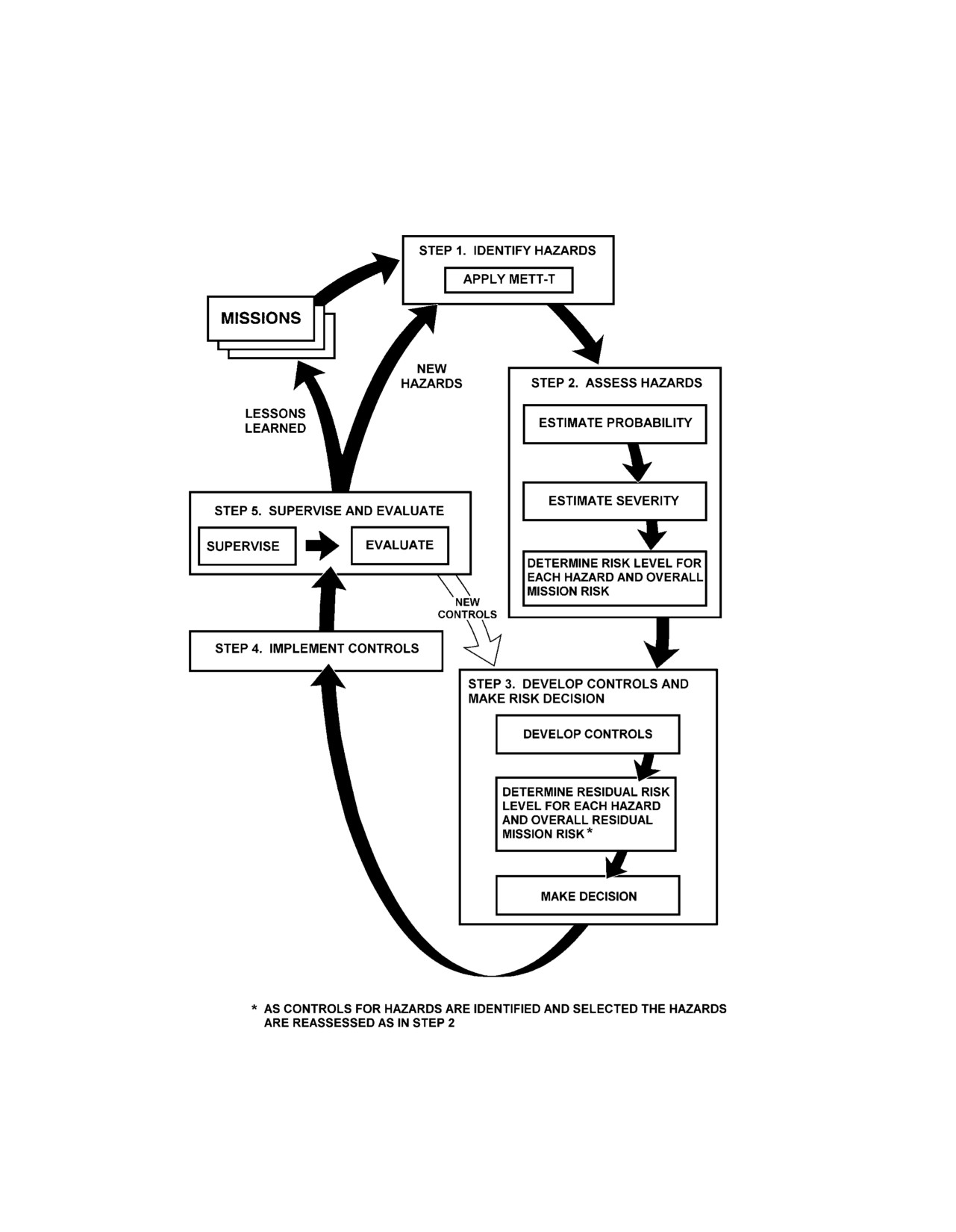
are identified and, therefore, continual assessment is required (Figure D-1). Changes or adjustments to
current or future operations may be required to mitigate the adverse impact of identified risks and to ensure
mission accomplishment.
d. For additional information on the risk management process refer to FM 100-14.
D-2. Risk Management
a. One of the critical tasks for all operations is to minimize risk. Every military plan must make
this a priority. It is an inherent part of every mission and a basic responsibility of commanders.
Commanders must issue clear risk guidance. Minimizing risk—eliminating unnecessary risk—is the
responsibility of everyone in the chain of command. This responsibility begins with the highest commander,
is continued through his subordinate leaders, and down to the individual soldier.
b. Risk management is a five-step approach for ensuring that operations and mission accomplish-
ment are not compromised by hazards and accidents.
c.
The five steps of risk management are—
(1) Identify hazards. Identify the most probable hazards for the mission. Hazards are
conditions with the potential of causing injury to personnel, damage to equipment, loss of material, or
lessening the ability to perform a task or mission. The most probable hazards are those created by readiness
shortcomings in the operational environment. When a list of frequently recurring hazards is applied to a
specified task or mission, the most probable hazards can be identified.
(2) Assess hazards. Once the most probable hazards are identified, analyze each to determine
the probability of its causing an accident and the probable effect of the accident. Also, identify control
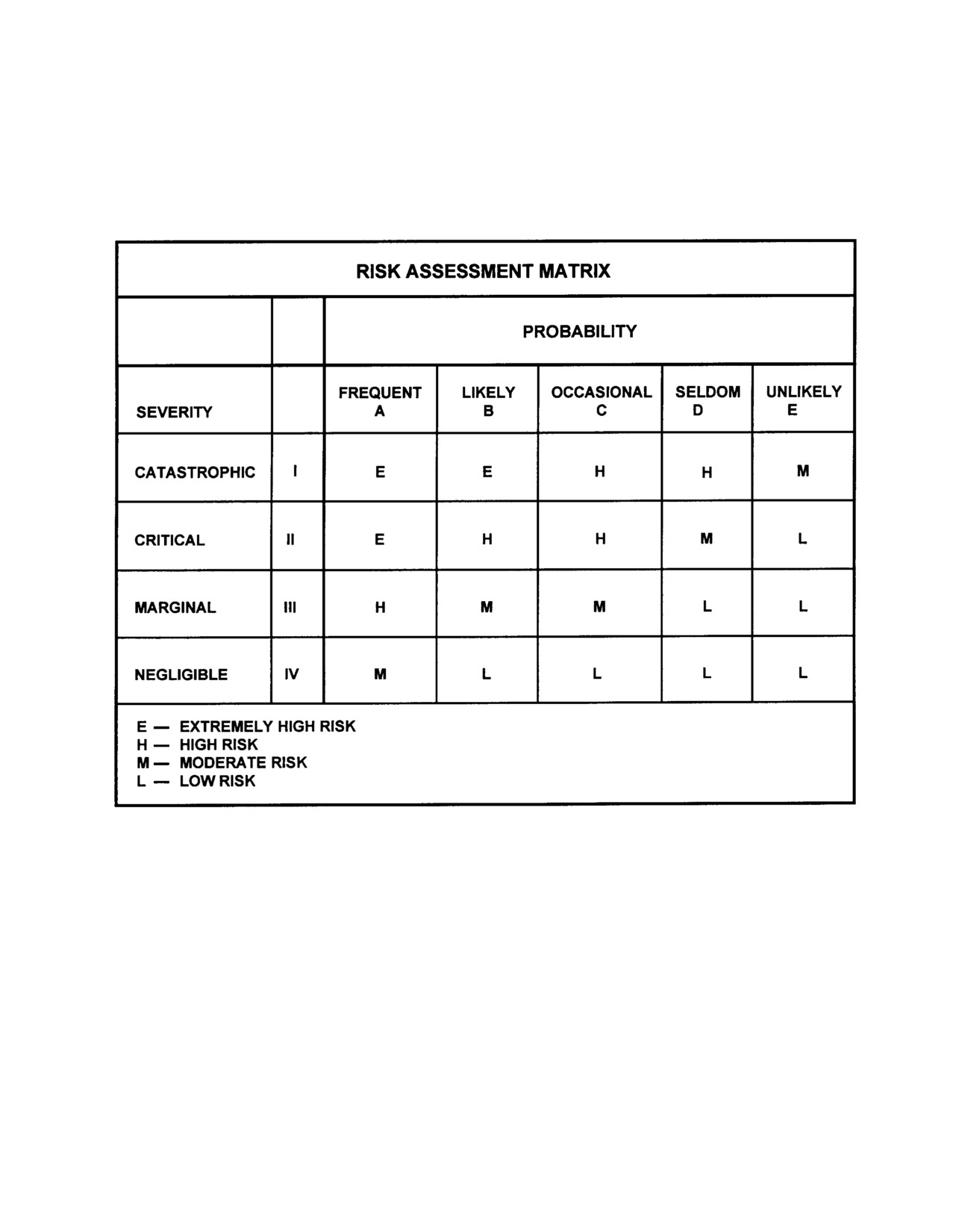
options to eliminate or reduce the hazard. A tool to use in this assessment is the Army standard risk
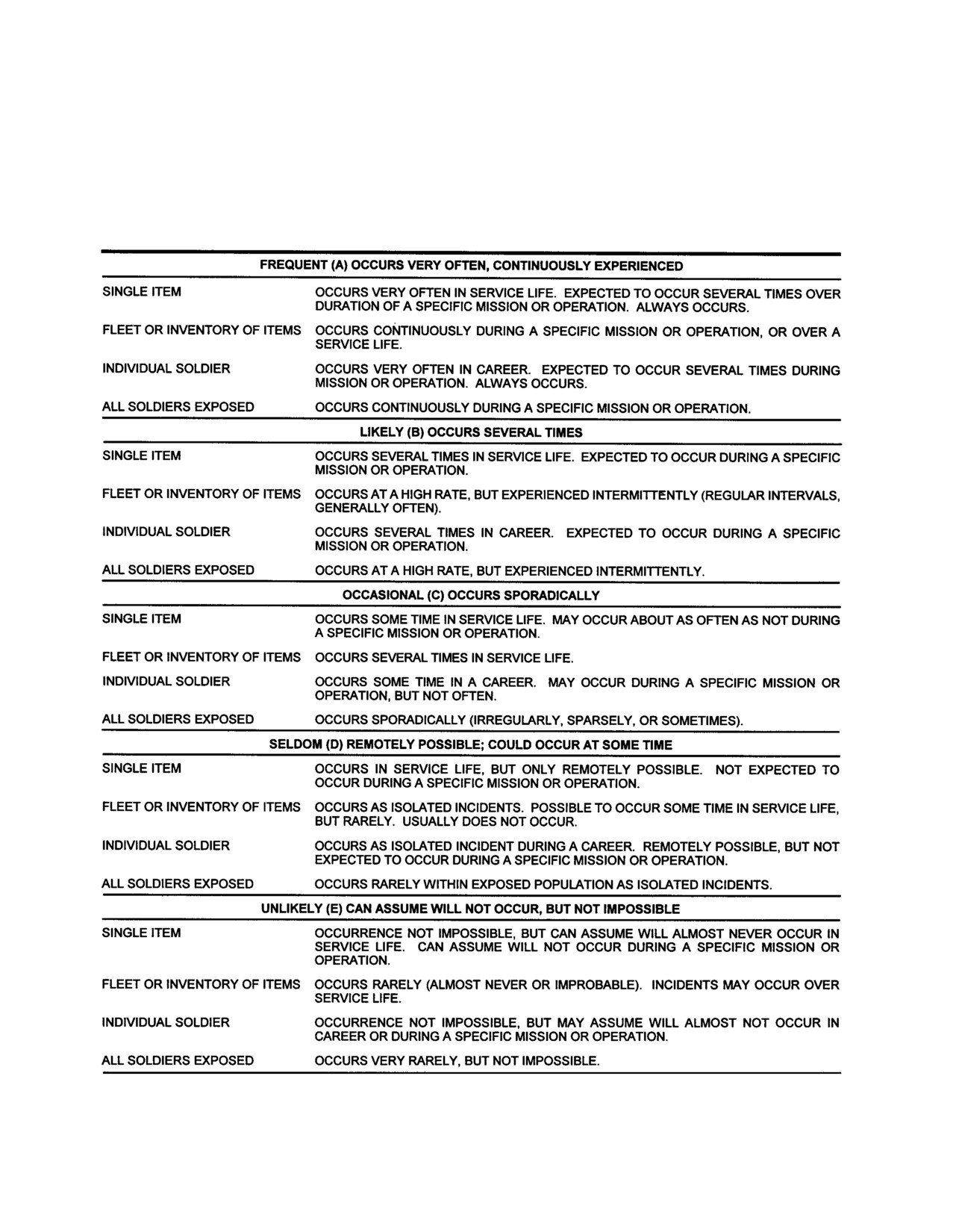
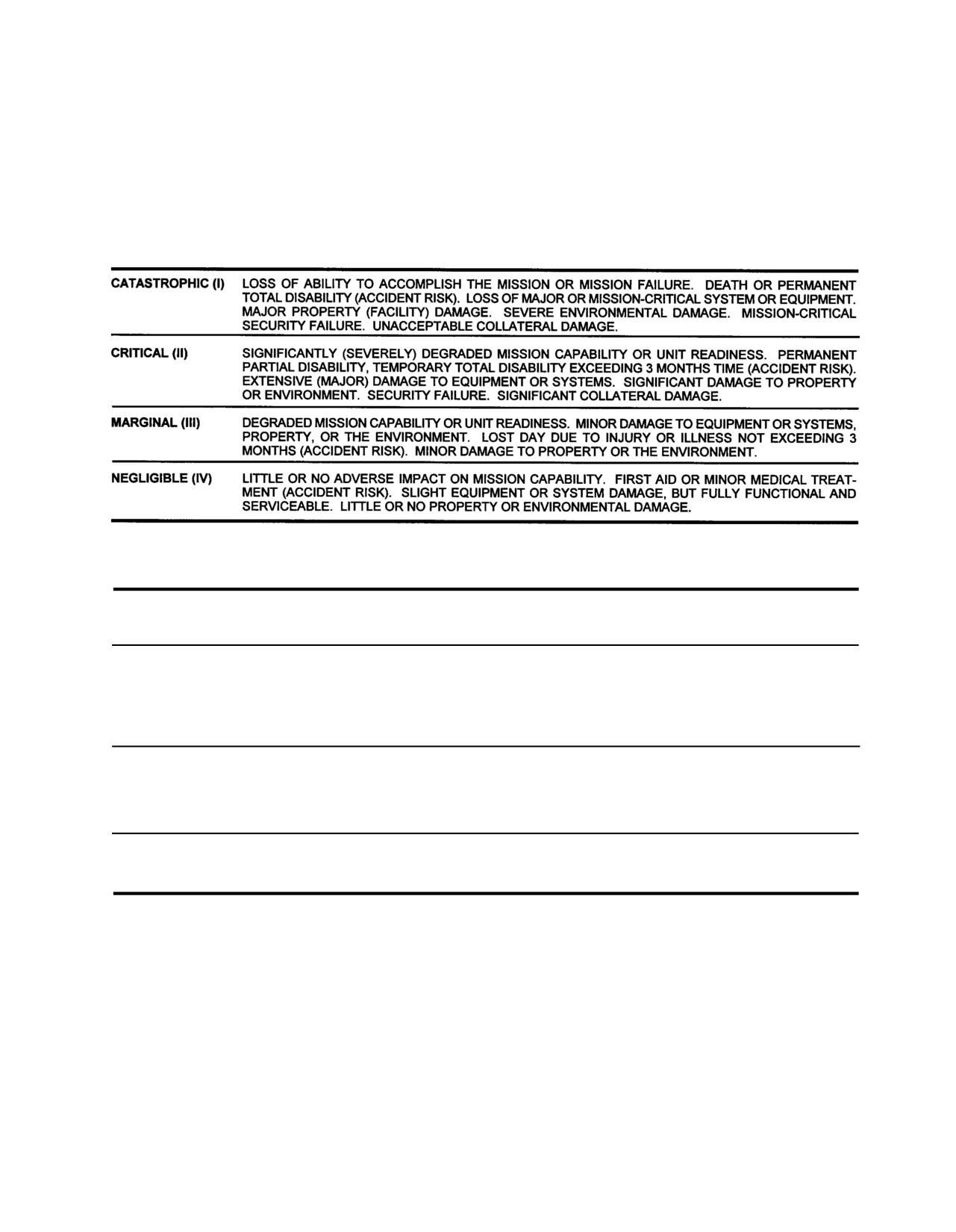
assessment matrix (Figure D-2). Tables D-1 through D-3 define the terms used in the risk assessment
matrix.
(Table D-1 provides information on hazard probability. Table D-2 provides information on hazard
severity. Table D-3 discusses the levels of risk.)
D-1
FM 4-02
Figure D-1. Risk management process.
D-2
FM 4-02
Figure D-2. Army standard risk assessment matrix.
(3) Make risk decisions. Weigh the risk against the benefits of performing the operation.
Accept no unnecessary risks and make any residual risk decisions at the proper level of command.
(4) Implement controls. Integrate specific controls into plans, orders, TSOPs, and rehearsals.
Communicate controls down to the individual soldier.
(5) Supervise. Determine the effectiveness of controls in reducing the probability and effect
of identified hazards. Ensure that risk control measures are performing as expected. Include follow-up
reviews during and after actions to ensure all went according to plan, reevaluating or adjusting the plan as
required, and developing lessons learned.
D-3
FM 4-02
Table D-1. Probability of Hazards
D-4
FM 4-02
Table D-2. Severity of Hazards
Table D-3. Levels of Risk
EXTREMELY HIGH RISK LOSS OF ABILITY TO ACCOMPLISH THE MISSION IF HAZARDS OCCUR DURING MISSION. A
FREQUENT OR LIKELY OF CATASTROPHIC LOSS OR FREQUENT PROBABILITY OF CRITICAL
LOSS EXISTS.
HIGH RISK
SIGNIFICANT DEGRADATION OF MISSION CAPABILITIES IN TERMS OF THE REQUIRED MIS-
SION STANDARD, INABILITY TO ACCOMPLISH ALL PARTS OF THE MISSION, OR INABILITY TO
COMPLETE THE MISSION TO STANDARD IF HAZARDS OCCUR DURING MISSION. OCCASIONAL
TO SELDOM PROBABILITY OF CATASTROPHIC LOSS EXISTS. A LIKELY TO OCCASIONAL
PROBABILITY EXISTS OF A CRITICAL LOSS OCCURRING. FREQUENT PROBABILITY OF
MARGINAL LOSSES EXIST.
MODERATE RISK
EXPECTED DEGRADED MISSION CAPABILITIES IN TERMS OF THE REQUIRED MISSION STAN-
DARD WILL HAVE A REDUCED MISSION CAPABILITY IF HAZARDS OCCUR DURING MISSION.
AN UNLIKELY PROBABILITY OF CATASTROPHIC LOSS EXISTS. MARGINAL LOSSES OCCUR
WITH A LIKELY OR OCCASIONAL PROBABILITY. A FREQUENT PROBABILITY OF NEGLIGIBLE
LOSSES EXISTS.
LOW RISK
EXPECTED LOSSES HAVE LITTLE OR NO IMPACT ON ACCOMPLISHING THE MISSION. THE
PROBABILITY OF CRITICAL LOSS IS UNLIKELY, WHILE THAT OF MARGINAL LOSS IS SELDOM
OR UNLIKELY. THE PROBABILITY OF A NEGLIGIBLE LOSS IS LIKELY OR LESS.
D-3. Rules of Risk Management
The rules which guide the risk management process are—
(1) Integrate risk management into planning.
(2) Accept no unnecessary risks.
D-5
FM 4-02
(3) Make risk decisions at the proper level.
(4) Accept risk if benefits outweigh the cost.
D-4. Three-Tier Approach
The Army has established a three-tier approach to risk management.
a. The foundation tier is command level. This level is responsible for a safety plan, setting
standards, training consistent with abilities of those being trained, providing resources, and making risk
acceptance decisions.
b. The leader level is next. The leader places emphasis on adherence to standards, assesses and
balances risks, and is the implementer of the safety controls to eliminate or control risks. Further, he
teaches the individual soldier his responsibilities within the risk management process.
c.
The individual level is last. The individual soldier must understand safety responsibilities,
recognize unsafe conditions and acts, and perform duties to standard.
D-5. Factors to Consider in Risk Management
Some factors that might be considered in the risk management process are presented in this paragraph. This
is not a complete listing of all factors that should be considered, but rather some of the more routine
categories. Factors for each mission will be dependent upon the actual mission and METT-TC considerations.
a. Level of Activity. This can include both individual and unit activity. With regard to the
individual, it can include the type of activity (such as heavy, physical labor or sedentary desk work) or the
pace required (such as continuous work with few, if any, breaks). With regard to the level of unit activity,
it can include the OPTEMPO (such as a mass casualty situation or the slower pace of running daily sick call)
or the phase of the operation (such as setting up or disestablishing the unit area, reinforcing hasty defensive
positions, or the unit standing down).
b. Inherent Dangers of Equipment Used. Inherent dangers of the equipment used by the unit can
include the potential for accidents if the equipment is used improperly or if it is not working correctly. In
medical units if the medical equipment is not correctly calibrated or is otherwise malfunctioning, it presents
a danger not only to the operator but also to the patient (such as an improperly calibrated x-ray machine).
Further, in the unit there is an abundance of medical and nonmedical equipment which could cause fires or
explosions, resulting in collateral damage to personnel or equipment if the equipment malfunctioned.
Further, nonmechanical equipment can result in injury to patients and/or care providers if it is not inspected,
maintained, and repaired as required (such as litters and litter straps).
c.
Hazardous Materials Used or Produced. In medical units, there are numerous hazardous
materials that are used to perform unit functions (such as petroleum, oils and lubricants [POL] and solvents)
D-6
FM 4-02
or are produced as a by-product of the mission (medical waste). Units must ensure that hazardous materials
are properly handled and disposed of to ensure that they do not create a hazard for medical personnel,
patients, and the environment. This is of particular importance for medical units and the two types of
medical waste—regulated and nonregulated. For a discussion of waste disposal refer to paragraph A-8c,
and FM 4-02.10, FM 4-25.12, and FM 21-10.
d. Occupational and Environmental Concerns. Environmental concerns encompass a number of
areas which must be considered by a medical unit. Extremes in temperature can cause heat/cold injuries to
medical personnel and increase the patient workload. They may also complicate a patient’s medical
condition (for example: during mountain operations there may be a delay in medical evacuation due to the
treacherous terrain. Medical personnel will have to sustain the patient for a longer period of time and may
have to provide a field expedient shelter and warmth, to ensure the patient’s medical condition is not
complicated by hypothermia). Commanders must ensure that areas occupied by soldiers/units are free from
industrial contamination, such as that found around chemical plants, petroleum storage areas, or iron
foundries. Terrestrial elevations upon which operations are conducted can lead to mountain illness and
increased numbers of crush (impact) injuries. Commanders must also consider the effect of the mission on
the environment. Such effects can cause an imbalance in the ecosystem, which may lead to unhealthy
conditions for soldiers and for indigenous and refugee populations.
(Refer to FM 4-02.17 and FM 8-10-6
for additional information.)
e.
Availability of Protective Equipment. This factor includes items common to all military units
(such as fire extinguishers, mission-oriented protective posture [MOPP] gear, or ear plugs) as well as items
that are primarily found in medical units (such as patient protective wraps and items used for universal
protective measures). Medical units must consider the equipment available to the unit members as well as
that required for the patients in their care. Clinical SOPs should contain information on procedures for
ensuring patient safety from accidental injury and also from the hazards of tactical operations (such as
preparing patient bunkers or sandbagging patient treatment areas).
f.
Accident Frequency. The commander should focus on what types of accidents occur in the
unit, their frequency, and areas in which they occur. If the frequency of accidents increases or if the
accidents continue to occur in one operational area, it may be necessary to tighten control measures in these
specific areas while instituting more generalized measures throughout the other operational areas.
g. Supervision. Supervision can serve as a control measure in areas where the frequency of
accidents and/or other indications of hazards exist. The lack of supervision or inadequate supervision can
result in an increase of hazards and accidents. The commander is challenged by the need to balance
supervision to decrease hazards, but not stifle productivity.
h. Weather. Weather conditions can increase the hazards of accomplishing the HSS mission as
they can make it difficult to accomplish tasks, increase the risk associated with operating equipment/
vehicles/aircraft, or complicate a patient’s medical condition (such as a patient with traumatic injuries who
has also been exposed to extreme cold weather conditions may develop more profound shock). For
example: weather which impacts adversely on the use of air ambulances results in increasing the patient
load and the number of missions that are accomplished by ground ambulance. Adverse weather may also
result in a BAS or Level II MTF having to hold patients longer than is normally required. This can result in
D-7
FM 4-02
overcrowding the facility and rapidly depleting the stocks of medical supplies during a time when resupply
may be difficult or impossible to accomplish.
i.
Operational Conditions. These will vary with each mission. Units operating in remote
locations or in underdeveloped areas have a higher potential of exposure to endemic and epidemic diseases
(due in part to poor sanitation, contaminated drinking water, improper preparation and storage of food, and
lack of immunizations and/or chemoprophylaxis against infectious diseases). Unimproved roads, rudimen-
tary sanitation, and difficult terrain coupled with extremes in weather can create unique hazards.
j.
Condition of Personnel. Soldiers who are well-conditioned physically, acclimated to the
climate in the AO, and well-trained and motivated perform tasks to a higher standard than do soldiers who
are not. Continuous operations or high noise levels in rest areas which restrict the amount of rest soldiers
receive, strenuous activity in soldiers who are not acclimated to the climate, untrained, and unmotivated
soldiers, and those who are not physically well-conditioned are some factors which can result in—
• More frequently occurring accidents.
• Job performance standards not being met.
• Preventive maintenance not being accomplished on unit equipment.
k.
Personnel/Organizational Proficiency. Health service support personnel are normally well-
trained within their medical specialties due to the length of training and the standards required to be met for
award of their specialties. Many HSS personnel, however, are not as familiar with field duties as they are
with those performed in tables of distribution and allowances (TDA) facilities. The commander must assess
how familiar his soldiers are with the field medical equipment contained in their MESs and with the
common soldier tasks they are required to perform in the field and take necessary actions to resolve
deficiencies noted.
l.
Adequacy of Site. The HSS commander must carefully evaluate the area assigned for the
establishment of the MTF. Sufficient real estate must be allotted for establishing the MTF; providing an
ambulance turnaround point and other traffic flow considerations; establishing an LZ; permitting
augmentation of the HSS assets; providing a patient decontamination area; and, permitting the establishment
of administrative and logistical areas, motor pools, and sleep areas. Trying to establish an MTF in too
restrictive of an area can increase traffic jams, resulting in accidents and injuries to personnel. A restrictive
terrain may not permit the safe positioning of hazardous equipment within the unit area. It could also
disrupt the patient flow within the facility resulting in the degradation of medical care. For a discussion of
site selection criteria refer to FM 4-02.4, FM 4-02.6, and FM 4-02.10.
m. Level of Planning. Planning is the key to mission success and the safe operation of the unit.
Planning includes more than the planning required to support the tactical plan. Every phase of the operation
requires detailed and continuous planning to ensure that deployment, mission execution, and redeployment
are accomplished in the most efficient and safe manner possible. For example, if the unit field sanitation
plan is not developed and executed, combat ineffectiveness can result from the spread of disease and
contamination.
D-8
FM 4-02
n. Complexity of Movement. When a unit is deploying or redeploying, a number of transportation
means may be used to accomplish the move (such as by rail to a port of embarkation, by ship to the port of
debarkation, or by convoy from the port of debarkation to the AO). Each of these modes of transportation
have special requirements to ensure that the personnel, vehicles, and equipment are safely transported from
one point to another. The commander must evaluate the plan for the move, assess the hazards it presents,
and institute controls to ensure the move is accomplished in a safe manner. This same planning and hazard
assessment is required for moves of much smaller scope such as when a Level II unit deploys a treatment
team forward to augment a BAS using organic vehicles.
o. Adequacy of Directions Given. Leaders must always ensure that the directions they give are
clear and concise and that the soldiers receiving the directions understand what they are expected to do.
Accidents, substandard job performance, and mission failure can result if the personnel performing the tasks
do not understand what they are to do, when they are to do it, and how they are to do it.
D-6. Occupational and Environmental Health Risk Assessment Process
a. Traditionally, deployment medical risk analysis and assessments have concentrated on the
historically proven threats posed by infectious disease as a major cause of DNBI. However, recent
indications are that the risks of exposure to chemical and physical hazards from environmental contamination
are an increasingly important element of the medical threat, whether as the result of an accidental release,
existing contamination, or a directed action by an adversary.
b. Occupational and environmental health hazards can adversely impact mission accomplishment.
These hazards include exposures to harmful levels of environmental contaminants such as TIMs, radiation,
or biological agents.
“Harmful levels” include high-level exposures that result in immediate health effects
and significant impacts to mission capabilities. Health hazards may also include low-level exposures that
could result in delayed or long-term health effects that would not ordinarily have a significant impact on the
mission. Commanders must use OEH surveillance to identify these hazards, assess the potential risks,
determine appropriate risk control measures, and communicate these risks to their forces via the risk
management process.
c.
Risk management is a process for identifying, assessing, and controlling risks from operational
hazards, including OEH hazards. Risk is determined by estimating the probability and severity of a
potential adverse impact that may result from hazards due to the presence of an adversary or some other
hazardous condition (such as environmental contamination). Risks range from low through extremely high.
Leaders seek to mitigate risk by evaluating hazards and implementing risk management options during
operational planning. When applied by medical personnel this process allows planners to include the
assessment of the severity of hazards, characterize the risks in the context of the proposed operation, and
then effectively communicate the risk assessments and appropriate PVNTMED control measures to the
commander. Commanders then make informed decisions by balancing the OEH risks and other operational
risks with mission requirements.
d. The matrix (Figure D-2) summarizes the risk management process. It is a qualitative tool, but
the process of categorizing the health effects is largely quantitative. The quantitative parameters include,
D-9
FM 4-02
but are not limited to: dose, exposure time, route of exposure (such as skin, inhalation, or ingestion), and
comparisons to established acute and chronic toxic thresholds.
(1) Hazard probability (horizontal-axis). The likelihood of a soldier encountering a hazard.
Effective employment of mitigation strategies, such as personal protective equipment or avoidance, usually
shifts the Hazard Probability to the right, thereby decreasing health risk.
(2) Hazard severity (vertical-axis). A measure of the impact of the interaction of the hazard
with the soldier, this relates biochemical and/or physiological side effects (short and long term) to health
outcome.
(3) Risk estimate. The body of the matrix defines the risk estimate ranging from extremely
high to low.
e.
Occupational and environmental health risk assessments should include an evaluation of
occupational health exposures from deployed operational tasks and ambient environmental health exposures:
air, soil, potable and nonpotable waters, ionizing and non-ionizing radiological sources, vectorborne threats,
and other physical hazards. Occupational and environmental health hazards may be present as contamination
from historical site usage, battle damage, stored stockpiles, and adjacent commercial or residential sites.
The OEH risk assessment requires initial and continued surveillance of the following criteria components:
(1) Ambient air. The assessment should monitor for volatile organic compounds (VOCs),
semi-volatile organic compounds (SVOCs), polynuclear aromatic hydrocarbons (PAHs), pesticides, metals,
radiation, total and respirable particulate matter, and combustion-related pollutants such as carbon monoxide,
sulfur dioxide, ozone, and nitrogen oxides. Other contaminants may include: CW agents, military smokes
and obscurants, riot control agents, and other TIMs expected to be present in the AO.
(2) Soil. The assessment should monitor for heavy metals, pesticides, herbicides, VOCs,
SVOCs, explosives, and radiation. Additional samples should be collected following hazardous material,
POL spills, and prior to closure of the site to document final conditions.
(3) Water. The assessment should include an evaluation for chemical, metal, biological, and
radiological content of potable and nonpotable waters according to the DOD Tri-Service Field Water
Guidance (Sanitary Control and Surveillance of Field Water Supplies, Technical Bulletin Medical [TB
MED] 577). This criteria includes water-vulnerability assessments identifying difficulties in maintaining a
potable water source, essential nonpotable water availability needs (such as sanitary and fire fighting) and
vulnerability to sabotage or process upsets. This assessment also includes the identification and evaluation
of proposed wastewater collection and treatment or disposal systems.
(4) Radiological surveys. The assessment should include an evaluation of the need to survey
sites for background radiation, ionizing and non-ionizing radiation sources, and radiological contamination.
If battle damage is present, perform a rapid hazard assessment for radiation sources and radioactive
contamination.
(5) Noise. An environmental noise assessment should be performed if industrial or other
noise-producing hazards exist.
D-10
FM 4-02
(6) Occupational health. Assess occupational hazards and determine whether control
measures are in place and adequate. Recommend appropriate PVNTMED measures, document occupational
health exposures, and report results to immediate supervisors and commanders.
f.
Specific record keeping and reporting requirements are set forth in JCS Memorandum MCM
0006-02.
D-11
FM 4-02
APPENDIX E
INTEGRATED CONCEPT TEAM APPROACH
E-1. General
This appendix discusses the ICT approach to the FHPGE functional area alignment. In aligning with the
three pillars described in JHSS Vision (healthy and fit force, casualty prevention, casualty care and
management), overlap occurs in the preventive and curative aspects of some of the AMEDD functional
areas (Chapter 5). This necessitates a regrouping of the functional areas as they pertain to the three pillars.
E-2. Integrated Concept Team Approach
a. The ICTs conducted by the Commander, USAMEDDC&S are panels of experienced AMEDD
personnel who analyze existing systems and then determine the future concepts, organizations, and materiel
required to move the AMEDD from its current state to support future Army operational concepts. The
objectives of the ICTs are to—
• Develop concepts and define capabilities requirements.
• Determine modernization solutions across the doctrine, organizations, training, materiel,
leadership and education, personnel, and facilities (DOTMLPF) domains.
• Compliment and facilitate transition to Integrated Product Teams (IPTs).
• Shorten the requirements determination process.
• Preclude dead end requirements.
• Build consensus on major initiatives and issues facing the AMEDD.
• Leverage functional area expertise for model development.
b. The ICTs are grouped as: medical C4I; casualty care; medical evacuation; casualty prevention;
and medical logistics.
E-3. Medical Command, Control, Computers, Communications, and Intelligence
The medical C4I ICT develops the transition C2 infrastructure to support AMEDD operations across full
spectrum operations. It develops C4I functionality while considering the implications of C2 force structure
changes based on technological, organizational, and resource modernization. This includes coordination
throughout the USAMEDDC&S and the USAMRMC to facilitate requirements determination, reengi-
neering, and realignment of automation with the AMEDD core business processes.
E-1
FM 4-02
E-4. Casualty Care
Casualty care encompasses a number of AMEDD functional areas. It groups area medical support,
hospitalization, the treatment elements of dental care and MH, clinical laboratory services, and the treatment
of NBC-contaminated patients. All issues pertaining to the provision of clinical services on the battlefield
are dealt with by this ICT. The team provides future concept and requirements recommendations for the
full spectrum of deployed clinical care issues, including the trauma specialist, division HSS, and corps and
EAC clinical operations. The preventative aspects of dentistry and COSC are addressed in casualty
prevention (paragraph E-6).
E-5. Medical Evacuation
The medical evacuation ICT is charged with developing operational concepts and defining operations
capabilities for medical evacuation by AMEDD resources. This ICT provides recommendations for platform
modernization requirements, future capabilities determination based on evacuation modeling, and fielding
rational for medical evacuation vehicle acquisition programs.
E-6. Casualty Prevention
Casualty prevention is the AMEDD’s integrated and focused approach enabling the Army to promote and
sustain a healthy and fit force and to prevent casualties from disease, nonbattle injuries, and combat
operational stress reactions. The casualty prevention ICT addresses issues and needed capabilities in
support of broad spectrum medical and OEH surveillance, NBC (to include TIMs), force protection
initiatives, and PVNTMED support with respect to all phases of mobilization, deployment/redeployment,
and demobilization. This ICT develops future concepts, modernization plans, and future operational
capabilities for all casualty prevention areas (PVNTMED, veterinary, medical laboratory, dental, and
COSC).
E-7. Medical Logistics
The medical logistics ICT develops future operational capabilities that provide enhanced medical logistics
support including medical supply/resupply to the joint services, blood distribution, optical fabrication and
repair, medical equipment maintenance and repair, and Class VIII situational understanding. The medical
logistics ICT is charged with developing a holistic concept in support of the JHSS Vision. The ICT also
addresses modernization plans, assesses technology-based initiatives, and provides recommendations to
support materiel solutions leading to Milestone I decisions.
E-2
FM 4-02
APPENDIX F
HEALTH SERVICE SUPPORT ASPECTS OF JOINT AND
MULTINATIONAL OPERATIONS AND DETERMINATION OF
ELIGIBILITY FOR CARE
Section I. PLANNING CONSIDERATIONS FOR JOINT OPERATIONS
F-1. Joint Operations
a. Future operations will be joint in nature. United States Army HSS planners must anticipate
this fact and plan accordingly. Specific doctrine for HSS in joint operations is contained in Joint Pubs 4-02,
4-02.1, and 4-02.2.
b. This checklist addresses some interagency and/or HN considerations. Section II provides a
checklist for multinational operations. Section III provides an eligibility for medical care matrix.
F-2. Health Service Support Planning Checklist for Joint Operations
a. General Planning Considerations.
(1) What C2 infrastructure will be established for the operation? (Is a JTF established? Will
specific US Army HSS assets be assigned/attached to another Service? Will an ASCC be established?
Which Service component command surgeon has been designated as the JTF surgeon? Does the JFS have a
planning staff designated?)
(2) What is the nature of the operation and its anticipated duration?
(What type of operation
is being conducted? Combat? Peacekeeping? FHA? Will it be short-term in nature [such as a raid or a
strike]? Will it be a long-term commitment of forces [such as in peacekeeping operations or support to an
insurgency]?)
(3) What is the anticipated level of violence to be encountered?
(Are the operations being
conducted? Combat? Stability operations? Support operations? What is the potential for terrorist attacks/
incidents? Is it anticipated that NBC weapons will be employed?)
(4) What are the capabilities of all Service component HSS assets in theater?
(The specific
capabilities of all HSS assets within theater must be determined to ensure that a duplication of services does
not exist and that the use of scarce resources is maximized. Specific considerations are contained within the
functional area discussions.)
(5) Are communications systems and automation equipment interoperable?
(Do all C2
headquarters have interoperability of communications equipment? If not, how will this be corrected? Are
liaison officers and/or teams required? Can automated reports be transmitted to all Services? If not, can
reports be completed and transmitted manually?)
F-1
FM 4-02
(6) What are the rules of engagement (ROE)?
(How do the ROE impact HSS operations?
NOTE: There are no medical rules of engagement; this is a misnomer. The term ROE refers to constraints
on the use of force. Some commands use the term medical rules of eligibility [MROE] to delineate the
determination of eligible beneficiaries for care in US military MTFs. For a discussion on eligibility
determinations see Section III below.)
(7) What are the security requirements and force protection measures for HSS activities?
(Are ground ambulances or other medical vehicles required to move in convoys rather than individually?
Do medical evacuation aircraft require armed escort to perform their missions? Has the risk management
process been used to determine force protection requirements?)
(8) Is the contracting for HNS feasible for medical activities?
(Can HNS be used for the
support of housekeeping, food service, or other administrative requirements for deployed hospitals? NOTE:
Due to stringent federal requirements for the standards of pharmaceuticals and the provision of medical
care, contracting is normally restricted to nonmedical functions.)
b. Preventive Medicine and the Medical Threat.
(1) Do all Services have PVNTMED assets deployed in the theater?
(If no, which Service
will provide PVNTMED support on an area support basis? Will augmentation be required to accomplish the
mission?)
(2) What is the medical threat in the AO?
(What are the endemic and epidemic diseases in
the AO? Are disease outbreaks seasonally related? Have any of the Services previously conducted extended
operations in the AO? How is medical intelligence obtained for the joint force? What are the OEH hazards
faced by the joint force [to include TIMs]? Are there hazardous flora and fauna in the AO?)
(3) Have site surveys been conducted for areas to be inhabited by US forces?
(Are the
individual Services responsible for providing this function in their individual areas? Will this function be
performed for the joint force by one specific Service? Were any areas determined to be hazardous [such as
sewage runoff, fly or other arthropod infestation, or soil contaminated by TIMs]? Can adverse environmental
conditions be corrected? Is selection of another site required? Was the site previously used by other forces?
Are sanitation facilities adequate? Are the methods of human waste disposal in compliance with applicable
environmental laws/policies of the US and HN [such as chemical toilets and individual waste collection bags]?)
(4) Is it anticipated that refugee, internally displaced persons
(IDP), retained/detained
persons, and/or EPW operations will be required?
(Are sufficient PVNTMED assets deployed in theater to
support these types of operations without adversely impacting the delivery of health care to US forces? Is
augmentation required? Are sufficient sanitation facilities available to support the refugee, IDP, retained/
detained persons, and EPW populations? Is sanitation maintained on public food service facilities? Are
water supplies adequate and potable?)
(5) Do units have field hygiene and sanitation supplies and equipment on hand?
(Do all the
Services have adequate field hygiene and sanitation supplies and equipment on hand? Are teams [such as
the unit field sanitation team] trained to apply PVNTMED measures to counter the medical threat?)
F-2
FM 4-02
(6) How will medical waste be collected and disposed of?
(Does a command policy exist on
the collection, handling, and disposition of medical waste?)
(7) Do service members have personal protective supplies and equipment available and/or
issued?
(Are sunscreen, sunglasses, insect repellent, bed nets, or other personal protective supplies/
equipment on hand or available for issue?)
(8) If continuous operations are anticipated, have work/rest schedules (sleep plans) been
developed and implemented when appropriate?
(Continuous operations without adequate amounts of sleep
can lead to serious performance degradation [such as faulty decision making or lowering resistance to
diseases].)
(9) Is a command policy established and disseminated on water discipline?
(In operations
conducted in hotter climates, extreme cold weather, or in MOPP equipment, command emphasis must be
given to a water discipline program to ensure heat injuries are minimized. NOTE: Dehydration can occur
in extreme cold weather operations as well as in operations conducted in hotter climates.)
c.
Medical Treatment (Area Support).
(1) What units will provide Level I and Level II medical care?
(Do all Service components
have organic assets to provide Levels I and II medical care? What units do not have organic HSS and must
receive Levels I and II medical care on an area support basis? Will units providing this support require
augmentation to accomplish the mission?)
(2) Will troop clinics/dispensaries be established in areas of troop concentrations?
(Which
Service will provide this service? What will the operating hours be? Where do service members go for
emergency medical care after troop clinic hours are over? Is this information disseminated to the lowest
possible level?)
(3) Do any operations security (OPSEC) requirements exist which must be accommodated?
(Do special operations forces [SOF] units require Level II medical care on an area support basis? Do
OPSEC requirements exist which impact on providing Level II HSS to SOF personnel?)
d. Hospitalization.
(1) What hospital resources will be in the theater?
(Identify hospital units from all Service
components within the theater. What is the ratio between medical beds and surgical beds? What ancillary
services are provided within the theater [such as PT, OT, or other convalescence and rehabilitative services]?
Are hospital units being phased into the theater as the operation progresses and the theater matures?)
(2) What hospitals will be designated for the care of retained/detained persons and EPW? (If
significant numbers of retained/detained persons and EPW are anticipated, will a hospital or hospitals be
designated only to receive these patients? If not, will all hospitals receive and treat retained/detained
persons and EPWs? Will the echelon commander provide security [guards] for EPW treated and evacuated
through medical channels?)
F-3
FM 4-02
(3) Has an eligibility determination been made for care in US facilities?
(The eligibility
determination is made at the highest level possible in coordination with the Staff Judge Advocate (SJA). The
determination should address personnel such as DOD civilians, other governmental agencies, DOD
contractors, NGOs, HN civilians, or any other personnel/groups/organizations who may seek medical care
in a US facility. Once the policy has been determined, it should be disseminated to the lowest level possible.
[Refer to Section III below.])
(4) Are there any hospital resources within the theater that can operate as shared resources
with hospitals from the other Services?
(To ensure that a duplication of services does not occur, the HSS
planner must determine if there is any state-of-the-art medical equipment [high dollar cost] which all
Services could use at one location rather than equipping each Service hospital separately?)
e.
Medical Evacuation and Medical Regulating.
(1) What is the theater evacuation policy?
(The theater evacuation policy is a significant
factor in determining what the medical infrastructure will be within the theater. The shorter the evacuation
policy, the less treatment assets [especially hospitals] will be required in theater. Is the theater evacuation
policy anticipated to change during the operation? Are there exceptions to the theater evacuation policy
permitted [such as for SOF]?)
(2) What are the specific responsibilities for each Service component?
(Each Service
component is usually responsible for the medical evacuation of their own forces from Levels I and II to Level
III. Will one Service component be responsible for this function for all joint forces within the AO [such as
the US Army providing medical evacuation for USMC ground forces to hospital ships and/or casualty
receiving and treatment ships (CRTSs)]?)
(3) Will a TPMRC or a GPMRC be activated for the operation? (Will the joint TPMRC and/
or GPMRC be established to coordinate medical regulating operations? What units will coordinate with the
TPMRC for medical regulating information [this is normally accomplished by the MRO of the medical
command (MEDCOM) or medical brigade; however, a Level II unit may coordinate for this support if other
C2 units are not deployed within the AO].)
(4) Will a MASF or aeromedical staging facility (ASF)/ASTS be established for staging
patients awaiting medical evacuation aircraft?
(Where will they be located? Is it anticipated that they will
be required to relocate during the operation? How much time is required to relocate the units? Once
patients have arrived at the MASF/ASF/ASTS how long can they be held? If the incoming flight is canceled
who will pick up the patients and sustain them until the next scheduled flight? )
(5) What other USAF aeromedical evacuation resources will be available in theater?
(This
should include a discussion of aeromedical evacuation liaison teams, aeromedical evacuation crews, and
critical care air transport (CCAT) teams. Will the USAF have sufficient CCATs to provide en route medical
care on the aircraft? Does the Army OMF have to plan on providing medical attendants to provide en route
medical care of critical care patients?)
(6) How will patient movement items be handled? (Related to [3] above. How will property
exchange between US Army units/organizations be conducted? US Army and USMC? US Army and the
F-4
FM 4-02
USAF [MASF/ASF/ASTS]? US Army and USN? US Army and USCG? [Refer to FM 4-02.1 for additional
information.])
(7) Are US Army aeromedical evacuation unit personnel deck-landing qualified for USN
ships?
(Have pilots received the necessary training and certification to accomplish the shore-to-ship
mission?)
f.
Health Service Logistics (to Include Blood Management).
(1) Has the combatant commander designated a SIMLM for the operation?
(Which Service
has been designated to execute the integrated HSL mission? What procedures and/or formats are required
to requisition supplies and medical equipment?)
(2) How will medical equipment maintenance and repair be accomplished?
(What units/
organizations will provide this support? Can this support be contracted for?)
(3) What units/organizations will provide optical fabrication support?
(Where will units
providing this support be located? Within the theater? In the support base?)
(4) Are there donated medical supplies and equipment for use in accomplishing the mission?
(Are donated medical supplies and equipment available for use in FHA or disaster relief operations? Who is
responsible for receiving, repackaging, storing, and distributing these items? What type of security is
required to safeguard these supplies and equipment? Who will provide the required security?)
(5) Are there any Service specific HSL requirements?
(Do the individual Services have any
special requirements for HSL materiel or requirements which the Service providing the SIMLM function
would normally not have/stock?)
(6) How are blood management functions/activities conducted?
(The HSS planner must
identify the medical units which will have blood requirements, the organizations that will support these
requirements, and the responsibilities of the units requesting this support.)
g. Dental Service.
(1) What dental resources are deployed in theater?
(Which Services have dental assets
deployed in the theater? Can these assets provide support to Services without organic dental services on an
area support base? What categories of dental care will be provided in theater [such as emergency or
essential]?)
(2) Is it anticipated that dental personnel will be required to perform their alternate wartime
role during the operation?
(Are mass casualty operations anticipated? Will dental personnel be used to
augment medical resources in mass casualty operations? Do dental personnel from all the Services have the
training in ATM to perform the alternate wartime role?)
(3) Where will dental resources be located?
(At the hospitals? In field dental units? In
clinics or other outpatient settings?)
F-5
FM 4-02
h. Veterinary Service.
(1) Although the US Army is the Executive Agent for Veterinary Support for all Services,
will the USAF conduct its own subsistence inspection on USAF installations?
(The HSS planner needs to
determine if the USAF will conduct its own subsistence inspections on USAF installations. How does this
impact the veterinary service support plan for the operation?)
(2) What types of rations are to be used by the forces in theater?
(The type of ration used
[such as MREs versus A rations versus unitized group rations (UGRs)] will determine the anticipated work
load for the operation. Are medical supplemental rations available?)
(3) Will military working dogs (MWD) and/or other government-owned animals be used in
the operation?
(What Services/units will be employing MWD and/or government-owned animals? Where
will these units/animals be located? What functions will the animals perform? Will there be other
government-owned animals belonging to other governmental agencies [non-DOD] which must be sustained?)
(4) Does a command policy exist on unit mascots or pets?
(What is the theater policy on
maintaining unit mascots or pets? Have they been screened for diseases transferable to man? Have they
been immunized?)
(5) How will animals requiring evacuation be managed?
(What vehicles will be used to
perform the evacuation [such as dedicated medical vehicles or general transportation assets]? Will the
handler accompany the animal? If the handler cannot accompany the animal, will the animal require
sedation for the evacuation?)
i.
Combat Operational Stress Control/Mental Health Activities.
(1) Do all the Services have MH personnel deployed to the theater?
(Do all of the Services
have organic COSC/MH resources? Are there any Services which will require COSC/MH support on an
area support basis?)
(2) During the operation is it likely that a mass casualty situation will develop?
(What is the
type of operation? What is the level of violence likely to be encountered? What is the likelihood of a mass
casualty situation arising? Are assets available to provide COSC interventions during mass casualty
operations?)
(3) What is the likelihood of a terrorist attack?
(What is the terrorist threat? Would the
likely target be a military installation and/or unit? Would the likely target be in a civilian area [such as in a
subway, transportation hub, or public building]? Are COSC assets available to provide interventions for
victims, care givers, or rescue personnel?)
j.
Medical Laboratory Support.
(1) What medical laboratory assets will be deployed to the theater?
(Will all Services have
organic medical laboratory assets to assist in the diagnosis of diseases? Will any of the Services require
medical laboratory support from the other Services?)
F-6
FM 4-02
(2) What medical laboratory will provide the identification of suspect BW and CW agents?
(Will an intheater laboratory have this capability? How will specimens/samples of suspect BW and CW
agents be obtained? Are there any special handling requirements for suspect BW and CW agent specimens/
samples? How will the chain of custody be maintained for suspect BW and CW agents while in transit?)
(3) Will a near-patient testing capability be present in any of the in-theater medical units?
(Will medical units without organic laboratory support be able to do any near-patient testing [such as
dipsticks]? What units will have this capability?)
(4) Will any intheater medical laboratory assets have a split-base operating capability?
(Can
any of the intheater laboratories conduct split-base operations? Can laboratory teams be deployed to collect
specimens/samples of suspect BW and CW agents? Can teams be deployed to investigate and/or collect
samples/specimens from disease outbreaks?)
k.
Operations in a Nuclear, Biological, and Chemical Environment.
(1) Is the use of NBC weaponry anticipated? (Is there an imminent threat for the use of NBC
weaponry by the enemy/opposition? What is the potential threat for a terrorist incident involving the use of
NBC weapons/devices to occur during the operation? Is there a TIMs threat that can be exploited by the
enemy of terrorists in the AO?)
(2) What is the potential for accidental contamination? (Is there the potential of contamination
from an accidental release of radiation and/or chemicals by a commercial source [such as a nuclear power
plant or chemical manufacturing facility]?)
(3) What medical units have the capability to perform patient decontamination operations?
(Do all Services have an organic patient decontamination capability? If no, what units will provide this
support on an area support basis? Is nonmedical augmentation required to conduct these operations [such
as nonmedical personnel performing this function under the supervision of medical personnel]? Patient
decontamination is a responsibility of all levels of medical care.)
(4) What are the reporting and notification requirements in the event of a suspect NBC
incident?
(Are report formats and required submission time factors standardized across the Services for
reporting suspect NBC incidents?)
(5) Is collective protection available for MTFs?
(Do all Services have organic collective
protection shelters for MTFs? If no, will certain MTFs with collective protection be designated as the units
to provide patient decontamination support?)
(6) Are veterinary personnel available to inspect NBC contaminated subsistence?
(If not,
who makes the decision that contaminated subsistence items can be decontaminated and determined to be
safe for consumption? Are these procedures standardized in unit SOPs?)
(7) Are PVNTMED personnel available to inspect NBC contaminated water supplies?
(If
no, who determines that contaminated potable water can be treated and consumed?)
F-7
FM 4-02
(8) Are immunizations, chemoprophylaxis, antidotes, pretreatments, and barrier creams
available?
(Are soldiers immunized against the most likely BW agents which might be employed? Are there
any chemoprophylaxis available for the most likely BW agents which might be employed? Are there any
pretreatments for potential exposure to nerve agents and/or other CW agents which might be employed? Are
barrier creams available?)
Section II. PLANNING CONSIDERATIONS FOR
MULTINATIONAL OPERATIONS
F-3. Multinational Operations
Multinational operations present new challenges to the HSS planner. In addition to ensuring the rapid,
effective, and efficient delivery of health care on the battlefield for US forces, the planner must coordinate
support with the health authorities of all participating nations. Thorough coordination is required to
ensure that a duplication of services does not occur and that maximum use and benefit is achieved from
scarce medical resources. Health service support in multinational operations is a national responsibility
(Joint Pub 4-02).
F-4. Multinational Operations Health Service Support Planning Checklist
a. Planning Considerations.
(1) What is the mission of the force and how does it effects HSS operations?
(Does the
mission involve combat operations? Peacekeeping? FHA? How does the type of mission affect the
composition of the HSS force [far forward surgical capability for combat wounded or pediatric, geriatric,
obstetric, and general medicine requirements for FHA or refugee operations]? Is this operation being
conducted under the auspices of an organization such as the UN and how does that effect the HSS
infrastructure?)
(2) What is the composition of the force?
(What is the composition and size of the US
contingent? How many other nations are participating? What is the size of each national contingent?)
(3) What are the HSS capabilities of the force? (What is the medical troop ceiling for the US
forces? What medical personnel, units, and equipment do the other national contingents have? Can US
forces be treated by another nation’s medical personnel or in another nation’s treatment facilities? Can
members of other national contingents be treated in US facilities? What is the education, training, and
experience level of health care professionals from participating nations?)
(4) Who has been designated to provide HSS to the multinational force?
(Is each national
contingent providing all aspects of medical care for their forces? Has one nation been designated to provide
HSS to all nations? Does each national contingent have separate responsibilities [such as one nation
providing medical evacuation support and/or another nation providing dental support]?)
F-8
FM 4-02
(5) Has a command surgeon been identified to oversee and coordinate medical activities
within the multinational force? (If yes, what nation? What are the roles and responsibilities of this position?
Is there a multinational medical staff section to plan for HSS operations? If no, how will medical issues be
resolved among the nations? Are there medical liaison officers assigned to the participating nations’
surgeons offices? What authority/technical supervision does this staff officer have over US HSS operations?)
(6) Are there any ISAs among the participating nations? (Are all of the countries participating
a part of NATO or the ABCA armies? If no, will nations not a party to the ISAs abide by the medical
protocols, procedures, and techniques identified in the ISAs? NOTE: Many of the ISAs deal with medical
materiel standards such as the size of the NATO standard litter. It is unlikely that coalition forces would
adopt/purchase a different type of litter just for the operation. However, other ISAs pertain to medical
treatment protocols, report formats, notification requirements, and procedural tasks. These ISAs may be
easily adapted to the current operation.)
(7) What is the anticipated level of compliance with the provisions of the Geneva Conventions
(friendly and enemy)?
(Are all participating nations signatories to these conventions? Are command
policies and procedures in consonance with these conventions? How will conflicts be resolved? What is the
likely disposition of the enemy to honor the protections afforded under the Geneva Conventions?)
(8) Will all nations have interoperable communications and automation systems?
(If no, will
one country equip the multinational force C2 elements with compatible systems? What reports are required
using automated systems? Can these reports be completed by hand and submitted using a courier or
messenger? How will requests for medical evacuation be received? Is using wire communications more
feasible than radio transmissions? Are interpreters available at each C2 headquarters?)
(9) Has a determination of eligible beneficiaries (in conjunction with the SJA) been made for
care in US facilities?
(Has a policy statement been formulated and disseminated? Refer to Section III below
for additional information.)
(10) If (when) members of the participating nations are treated in US facilities, what is the
mechanism for returning them to their parent nation for continuing medical care?
(Do the other nations
have treatment facilities established in the AO to which these patients could be transferred after receiving
emergency, stabilizing care? If there are only US facilities within the AO, who will evacuate these patients
to their homelands? What coordination is required to return a patient to his nation’s facilities and/or
evacuate him from the AO?)
(11) What is the anticipated level of violence to be encountered? (Should the primary focus of
HSS be on combat trauma or DNBI [in stability operations and support operations unit/personnel
ineffectiveness usually results from DNBI rather than combat-related injuries]? Is it anticipated that a
change in the level of violence will be experienced during the operation? Are there sufficient medical
supplies and equipment available to transition from one environment to another? Will augmentation of HSS
resources be required if the OPTEMPO changes?)
(12) What are the ROE?
(How do they impact on the HSS mission? NOTE: Rules of
engagement are constraints on the use of force, they are not the procedures by which operations are executed.)
F-9
FM 4-02
(13) What are the mechanisms for reimbursement of services? (How will the country providing
support be reimbursed for the services provided? Will repayment come directly from national contingents or
through an international organization such as the UN? What restrictions apply to the use of funds from US
forces? What services/support provided by US forces can be reimbursed [such as medical supplies and
equipment used, hospitalization costs, or medical evacuation support]?)
b. Preventive Medicine and the Medical Threat.
(1) What are the diseases (endemic and epidemic) in the AO and/or in the separate national
contingents?
(How is medical intelligence on the proposed AO obtained [intelligence preparation of the
battlefield, AFMIC, USACHPPM, or other sources]? Have any of the participating nations conducted
lengthy operations in the proposed AO and documented the medical threat? Are the disease outbreaks
seasonally related [such as during monsoons]? Have disease surveillance missions been previously conducted
in the proposed AO?)
(2) Are immunizations or chemoprophylaxis available to counter the disease threat?
(Have
US forces been immunized and/or provided chemoprophylaxis? Have other national contingents been
immunized and/or provided chemoprophylaxis?)
(3) Have site surveys been conducted in areas US forces will inhabit?
(Have bivouac areas
been inspected prior to establishing the site? Will US forces be housed with members of other national
contingents? Were any areas determined to be hazardous [such as sewage runoff, fly or other arthropod
infestation, or soil contaminated by TIMs]? Can adverse environmental conditions be corrected? Is
selection of another site required? Was the site previously used by other forces? Are sanitation facilities
adequate? Are the methods of human waste disposal being used in compliance with environmental laws/
policies of the HN [such as using chemical toilets or individual waste collection bags])?
(4) What PVNTMED support will US forces provide other national contingents?
(Will pest
management programs be implemented in all unit areas or only in US forces AOs? Will US PVNTMED
personnel inspect water supplies for all nations or just US forces? Will US PVNTMED personnel conduct
dining facility inspections for all nations or just US forces? Will medical surveillance operations be
conducted for all nations or for US forces only?)
(5) What is the level of training in field hygiene and sanitation for US forces and other national
contingents?
(Is an active PVNTMED education program required for US forces? For other national
contingents? If so, who will provide the training? Are field hygiene and sanitation standards being enforced?)
(6) Is it anticipated that refugee, IDP, retained/detained persons, and/or EPW operations
will be required? (Which nation will be responsible for field hygiene and sanitation if refugee and/or EPW
camps must be established? Are sufficient PVNTMED assets available within country to provide this
support? Is augmentation required? What would be the impact on the provision of PVNTMED to US forces
if augmentation was not available?)
(7) How will medical waste be collected and disposed of?
(Command policy must be
established to ensure the proper collection and disposal of medical waste generated by MTFs or other
medical operations.)
F-10
FM 4-02
(8) Do units have required field hygiene and sanitation supplies and equipment on hand?
(Do US forces? Do other national contingents? If the national contingents do not have adequate supplies
and equipment available, will these supplies/equipment be provided by the US forces? Is training required
for use of this equipment?)
(9) Do soldiers have personal protective supplies and equipment available and/or issued?
(Are sunscreen, sunglasses, insect repellent, bed nets, or other personal protective supplies/equipment on
hand or available for issue? Do the national contingents have these items? If they do not, will they be
provided by US forces?)
c.
Medical Treatment (Area Support).
(1) Are interpreters available to translate patient complaints to the attending medical personnel?
(Is DA Pam 40-3 available? Has a local language guide been developed if the patients speak languages which
are different from those contained in DA Pam 40-3? NOTE: This also applies to hospitalization.)
(2) What units are providing Levels I and II medical care?
(Are Levels I and II medical care
being provided to non-US units/personnel on an area support basis? What units are providing this support?
What are the capabilities of the units providing this support? Do Level II units have a holding capability?
For how long? Do Level II units have x-ray, laboratory, MH [COSC], and PVNTMED capability?)
d. Hospitalization.
(1) What hospitals are established in the AO?
(Are these US facilities? What are the
capabilities of these hospitals? What is the anticipated length of stay [theater evacuation policy and hospital
capability will affect the time factors for length of stay]?)
(2) What ancillary services are offered by the hospitals?
(This will be affected by the
anticipated duration of the operation and the theater evacuation policy. If convalescence for some injuries/
illnesses is anticipated to occur within the theater, ancillary support such as PT or OT may be available
within the hospital. If the theater evacuation policy is short [essential care in theater], the majority of
patients would be stabilized and evacuated from the theater for definitive care in the support base.)
(3) What is the surgical capability of in-theater hospitals?
(Does a far forward surgical
capability exist [such as a FST]? Is there a surgical backlog?)
(4) What procedures/notifications are required when a non-US soldier is admitted to a US
facility?
(Who notifies the soldier’s national contingent? How and when is the patient transferred to his
national contingent?)
(5) Will non-US physicians be permitted to treat patients in a US facility? (What will the scope
of practice be? What credentialing processes must occur? Who provides technical/professional oversight?)
(6) Has a formulary been established for prescription drugs?
(Does it include medications
for diseases endemic to the multinational force, as well as to the AO? Does it include medications for FHA
operations, if appropriate?)
F-11
FM 4-02
(7) What outpatient services will be provided? (Will there be outpatient clinics conducted on
a recurring basis? Does the hospital/clinics have an area support mission?)
(8) How will patients be transferred from one hospital to another within the theater?
(Who
will provide the transportation assets? What coordination is required to affect the transfer?)
e.
Medical Evacuation and Medical Regulating.
(1) What is the theater evacuation policy?
(Is it the same for all national contingents? Are
there any exceptions to the evacuation policy permitted [such as for SOF personnel?)
(2) What units are conducting medical evacuation operations?
(Can US forces be evacuated
by another nation’s assets? Can US forces be evacuated to another nation’s MTFs? Are US forces
providing medical evacuation support on an area support basis to the other national contingents?)
(3) What types of evacuation assets are available? (Air or ground? Dedicated or nonstandard
evacuation platforms? Vehicle or aircraft of opportunity? Do all participating nations have organic
evacuation assets?)
(4) How are requests for evacuation transmitted? (Is there a prescribed standard evacuation
request format established? Are dedicated medical evacuation radio frequencies established or are land
lines used? Do all units have access to communications equipment to initiate a request? If no, how will
specific units submit requests?)
(5) How will units requesting medical evacuation be located and identified?
(Have
procedures for identifying units from the air been standardized [such as using colored smoke]? Have ground
evacuation units been provided strip maps, overlays, or other navigational aids/information?)
(6) Do medical evacuation vehicles/aircraft require armed escort while performing their
mission?
(If yes, what units will provide this support? What is the response time? Can medical vehicles
only move as part of convoys or are they permitted to move independently?)
(7) How will patient movement items (PMI) be managed? (Will direct exchange for PMI be
made? If equipment remains with the patient and direct exchange does not occur, how will the OMF’s
equipment be replaced? Are PMI interoperable with other national contingents? Can other national
contingents’ medical equipment be used on-board US aircraft [airworthy certification] and ground evacuation
vehicles?
(8) Will MASFs/ASFs/ASTSs [or similar organizations] be established at airheads to sustain
patients awaiting evacuation from the theater?
(If yes, what nation will provide these organizations or
functions for the multinational force? If no, how will patients awaiting evacuation from the theater be
sustained?)
(9) What nation will provide the medical regulating function?
(Will each nation perform the
medical regulating function for their facilities? Will the US perform this function for the multinational force?
F-12
FM 4-02
Will the TPMRC (or similar organization) be activated? Will each country provide its own strategic medical
evacuation function? Will the USAF provide the strategic capability for the multinational force?)
f.
Health Service Logistics (to Include Blood Management).
(1) What is the Class VIII stockage level?
(Has theater policy been established and
disseminated concerning the days of supply required for Class VIII in US medical units?)
(2) What is the impact of multinational operations on blood management?
(Are there any
cultural, religious, or social prohibitions on the use of blood and blood products for any of the national
contingents? May US forces receive blood from other nations? If yes, how will the blood be tested before
use? Can blood testing and collection be accomplished in the theater? Can blood requirements be fulfilled
by collecting blood from members of the participating nations? What is the capability to store and maintain
blood and blood products in the theater? Will the US provide blood support to the other national contingents?
What reporting system will be established to track patients who have been transfused? What reports are
required on a daily or weekly basis [such as the blood reports discussed in Joint Pub 4-02 or FM 8-55]?)
(3) Is the US tasked to provide HSL support to the multinational force?
(Has the US Army
been designated as the SIMLM for US forces? For the multinational force?)
(4) Are there donated medical supplies and equipment for use in accomplishing the mission?
(Are donated medical supplies and equipment available for use in HA or disaster relief operations? Who is
responsible for receiving, repackaging, storing, and distributing these items? What type of security is
required to safeguard these supplies and equipment? Who will provide required security?)
(5) How will resupply be affected?
(Are units using line item requisitioning or are combat
configured loads being used? Will supply point distribution be used? Will medical vehicles/aircraft provide
backhaul for medical supplies, equipment, and blood?)
(6) What reports are required to be submitted to the supporting HSL facility? (Are these reports
automated? Are automated systems interoperable? What are the report formats and suspense times/dates?)
(7) Can medical supplies and equipment from non-US sources be used for US forces?
(Do
foreign pharmaceuticals meet FDA guidelines? Can foreign made medical equipment be maintained and
repaired by US forces?)
(8) If operations are conducted under the auspices of an international organization (such as the
UN) how do their supply/resupply procedures and requirements impact on US Class VIII operations?
(Will
US forces be constrained to only using designated sources? Do these sources meet appropriate guidelines?)
g. Dental Service.
(1) What units will provide dental services for the multinational force?
(Does each national
contingent have field dental assets deployed in the theater? Will one nation provide dental support to the
multinational force?)
F-13
FM 4-02
(2) What is the scope of dental services to be provided within theater?
(Emergency or
essential?)
(3) Do all members of the multinational force have panographs on file for identification
purposes?
(United States forces have panographs on file for forensic identification, if required. Will all
national contingents have these x-rays taken?)
(4) Will a preventive dentistry program be implemented for US forces and/or multinational
forces in theater?
(What activities will comprise the preventive dentistry program in theater? Dental
screenings? Mandatory training/education program? Will these activities be extended to the other national
contingents in the multinational force?)
(5) What dental conditions will necessitate the evacuation of patients from the theater?
(What oral conditions cannot be treated satisfactorily in theater? What coordination is required to arrange
for the evacuation of dental patients?)
h. Veterinary Service.
(1) What type of rations are to be used in theater?
(This is dependent upon the anticipated
duration of the operation and the availability of food sources within the theater.)
(2) Will Class I operations be consolidated for the multinational force?
(Will each national
contingent cultivate its own food sources or will all contingents receive their subsistence from the same
sources?)
(3) Will US forces provide veterinary inspection of subsistence for food safety and quality
assurance for multinational forces? (Will veterinarians only inspect food sources used for subsistence for US
forces or for the entire multinational force?)
(4) Will government-owned animals be used in the operation?
(Will MWDs or pack animals
be used in the operation? Will US forces provide animal medical care to US forces animals or for the
multinational force?)
(5) Has a command policy been disseminated on unit mascots/pets?
(If unit mascots are
permitted, who will provide care for these animals? Have they been vaccinated for zoonotic diseases
transmissable to humans?)
(6) How will animals be evacuated?
(If animals require evacuation will they be evacuated on
dedicated medical vehicles/aircraft? On general transportation assets? Will the handlers accompany the
animals? If the handlers do not accompany the animals, are special precautions [such as muzzles or sedation]
required? If animals are not US-owned, where will they be evacuated to? Will each nation evacuate its own
animals? How will animals evacuated/treated by US forces be returned to their national contingent?)
(7) Will the operation involve nation assistance activities?
(Will veterinary support require-
ments include animal husbandry activities for the HN populace? Are agencies [such as the United States
F-14
FM 4-02
Agency for International Development (USAID)] conducting veterinary activities within the AO? Do the
other national contingents participating in the operation have resources which could be used in these
activities?)
(8) What veterinary PVNTMED activities will be implemented in-theater?
(Will zoonotic
disease surveillance be conducted? Will epidemiological investigations be conducted when outbreaks of
transmissible diseases occur? Who will conduct these activities? What coordination is required with the HN
or other national contingents?)
i.
Combat Operational Stress Control/Mental Health Activities.
(1) Is each national contingent responsible for its own MH programs and treatment?
(Who
will provide mental health services to each national contingent? If one nation is providing these services to
the multinational force, what accommodations will differences in language require?)
(2) How will NP and/or COSC patients be evacuated? (On dedicated medical vehicles? On
general transportation assets? Will NP patients require an escort, sedation, or restraints for evacuation by
aircraft?)
(3) What preventive programs will be implemented in theater? (Will preventive programs be
implemented for US forces? For the multinational force?)
(4) Who will conduct critical event debriefings?
(Is each national contingent responsible for
its own COSC activities? Will all soldiers [regardless of nationality] affected by the traumatic/catastrophic
event be debriefed at the same time? Who provides follow-up care, if required?)
j.
Medical Laboratory Services.
(1) What laboratory capability exists within the national contingents?
(Do the field medical
units have a laboratory capability? What is the scope of diagnostic laboratory services available in the
hospitals? Are there any independent military laboratory units within the multinational force?)
(2) How are suspect BW and CW specimens and samples collected, handled, stored, and
transferred? (Who collects suspect BW/CW specimens and samples? How is the chain of custody maintained
on suspect BW/CW specimens and samples? What special handling requirements exist for storing and
transporting suspect BW/CW specimens and samples? Is there a medical laboratory within the theater
which can analyze suspect BW/CW specimens and samples? What coordination is required to transfer
suspect BW/CW specimens and samples out of the theater to an appropriate testing facility?)
k.
Operations in a Nuclear, Biological, and Chemical Environment.
(1) What is the potential threat for use of NBC weaponry during the operation?
(Is there an
imminent threat for the use of NBC weaponry by the enemy/opposition? What is the potential threat that a
terrorist incident involving the use of NBC weapons/devices may occur during the operation?
F-15
FM 4-02
(2) What is the level of protection for each national contingent?
(Do all national contingents
have MOPP equipment? If yes, what level of protection is afforded? If no, will one nation supply the needed
equipment to the participating nations without the equipment?)
(3) Is collective protection available to the MTFs?
(Are collective protection shelter systems
available to all participating nations? If no, will one nation supply the needed shelters to the participating
nations without shelters?)
(4) Have patient decontamination teams been identified from supported units?
(Have
designated personnel been notified? Do all nations have the organic ability to conduct patient decon-
tamination? Is augmentation required [nonmedical soldiers performing the function under the supervision of
medical personnel]?)
(5) What are the reporting and notification requirements in the event of a suspect NBC
incident?
(Are there standard formats for reporting any suspected incidents? How will the entire force be
alerted to the possibility of an NBC attack? Will the US NBC warning system be used or will another system
be established for the operation?)
(6) Are veterinary personnel available to inspect NBC contaminated subsistence?
(If not,
who makes the decision that contaminated subsistence items can be decontaminated and determined to be
safe for consumption? Are these procedures standardized in the multinational force [such as in unit SOPs]?)
(7) Are PVNTMED personnel available to inspect NBC contaminated water supplies?
(If
no, who determines that contaminated potable water can be treated and consumed?)
(8) Are treatment protocols established for the treatment of NBC casualties?
(Are all the
participating nations in agreement on the treatment protocols to be used? Do all participating nations have
the necessary medications and medical equipment to treat these casualties?)
(9) Are immunizations, chemoprophylaxis, antidotes, pretreatments, and barrier creams
available?
(Are soldiers immunized against the most likely BW agents which might be employed? Are there
any chemoprophylaxis available for the most likely BW agents which might be employed? Are there any
pretreatments for potential exposure to nerve agents and/or other CW agents which might be employed? Are
barrier creams available?)
Section III. ELIGIBILITY DETERMINATION FOR
MEDICAL/DENTAL CARE
F-5. Eligibility for Care in a United States Army Medical Treatment Facility
a. During interagency and multinational operations, one of the most pressing questions is who is
eligible for care in a US Army established MTF and the extent of care authorized. Numerous categories of
F-16
FM 4-02
personnel seek care in US facilities that are located in austere areas where the HN civilian medical
infrastructure is not sufficient to provide the adequate care. A determination of eligibility and whether
reimbursement for services is required is made at the highest level possible and in conjunction with the
supporting SJA. Additionally, Department of State and other military staff sections (such as the Assistant
Chief of Staff [Civil-Military Operations] [G5]) may also need to be involved in the determination process.
Each operation is unique and the authorization for care is based on the appropriate US and international
law, DODD and DODI, Army regulations, doctrine, and SOPs. Other factors impacting on the
determination of eligibility are command guidance, practical humanitarian and medical ethics considerations,
availability of US HSS assets (in relationship to the threat faced by the force), and the potential training
opportunities for HSS forces. The sample format provided in paragraph F-6 is just one approach to
delineate and disseminate this information to MTF personnel and may not be all inclusive based on specific
scenarios.
NOTE
The examples for the authority to provide treatment are only
illustrative in nature and should not be used as the basis for providing
or denying medical care.
b. Basic documents required for determining eligibility of beneficiaries include AR 40-400; FM
27-10; relevant sections of Title 10, United States Code; relevant DODD and DODI; ISAs; Acquisition and
Cross Servicing Agreements (ACSAs); orders from higher headquarters; interagency agreements (MOU
and MOA); and appropriate allied, coalition, or international agency guidance for the specific operation. If
contractor personnel are present, a copy of the relevant sections of their contracts should be on file to
delineate specific medical services to be rendered. Additionally, for contract personnel a point of contact
(POC) for the contracting company and a POC for the administration of the contract should be maintained.
Finally, the political-military environment of the AO must be taken into account as the medical C2
headquarters and its higher headquarters develop the eligibility matrix.
c.
The eligibility matrix should be as comprehensive as possible. If necessary, it should
include eligibility determination by name (see example in paragraph F-6). If individuals arrive at the
emergency medical service (EMS) section of the MTF who are not included in the medical/dental support
matrix, the MTF must always stabilize the individual first, then determine the patient’s eligibility for
care. The command POC for eligibility determination should be contacted immediately. Further, care
will be provided in accordance with the SOP pending eligibility determination.
(For example, a HN
civilian presents himself at the gate and requests medical treatment. Although on the surface it may
appear that he is not eligible for care, this determination can only be made after a medical assessment is
completed by competent medical personnel. In some cases, the individual may have to be brought into
the MTF to accomplish an adequate medical assessment. Conducting a medical assessment does not
obligate the US military to provide the full spectrum of medical care. Although it does obligate the MTF
to provide immediate stabilization for life-, limb-, and eyesight threatening medical conditions and to
prepare the patient for evacuation to the appropriate civilian or national contingent MTF when the
patient’s medical condition permits.)
F-17
FM 4-02
NOTE
Any individual requesting medical care should receive a timely medical
assessment of his condition. Even though the individual is not eligible
for treatment, life-, limb-, or eyesight-saving procedures warranted
by the individual’s medical condition are provided to stabilize the
individual for transfer to the appropriate civilian or other nation MTF.
d. The MTF staff must be familiar with the medical care available in the AO from other
sources. These could include allied, coalition, or HN military (tactical and strategic) forces, NGO or
international organizations (such as the UN), and local civilian resources. When appropriate and by
knowing the level and types of care available, the MTF staff can plan for the continued care of the patient
after initial stabilization is provided in the US MTF and the patient can be transferred to another facility
for continued care.
e.
It is essential that eligibility for medical care guidance is disseminated and understood by the
chain of command and all civilians and military members of the deployed force. The HSS commander must
be able to articulate the basic concepts for medical eligibility determinations. This means that he will need
to condense them into simple, easily understood instructions, and widely disseminate them through electronic
means or other media (such as pocket-sized cards). As the chief planners for medical operations, the HSS
commander must ensure that this information is contained in appropriate OPLANs and OPORDs and
briefed to the appropriate senior leadership of the command.
F-6. Sample Support Matrix for Eligibility of Care in a United States Army Medical Treatment
Facility
ELIGIBILITY FOR MEDICAL/DENTAL CARE SUPPORT MATRIX
(DATE)
(THIS DOCUMENT IS SUBJECT TO FURTHER VERIFICATION AND/OR MODIFICATION)
MEDICAL
INFORMATION/AUTHORITY*
CATEGORY
DENTAL
ALLIED MILITARY PERSONNEL
YES1
THE FOLLOWING NATIONS HAVE ACSAs AND ISAs WITH
THE US WHICH ARE ADMINISTERED BY (UNIFIED
COMMAND): LIST NATIONS
COALITION MILITARY PERSONNEL
YES1
THE FOLLOWING NATIONS HAVE ACSAs AND ISAs WITH
THE US WHICH ARE ADMINISTERED BY (UNIFIED
COMMAND): LIST NATIONS
DOD CIVILIAN EMPLOYEES
YES
INVITATIONAL TRAVEL ORDERS (ITOs)
US GOVERNMENT EMPLOYEES (NON-DOD)
YES2
ITOs
US EMBASSY PERSONNEL
YES
US CITIZENS ON OFFICIAL BUSINESS
F-18
FM 4-02
MEDICAL
INFORMATION/AUTHORITY*
CATEGORY
DENTAL
US CONGRESSIONAL PERSONNEL
YES
US CITIZENS ON OFFICIAL BUSINESS
ARMY AND AIR FORCE EXCHANGE SERVICE
YES
ITOs
(AAFES) US CITIZEN EMPLOYEES
AAFES LOCAL NATIONAL EMPLOYEES
YES3
US LAW
NONAPPROPRIATED FUND INSTRUMENTALITY
YES
ITOs
(NAFI) MORALE, WELFARE, AND RECREATION
(MWR) US EMPLOYEES
NAFI (MWR) LOCAL NATIONAL EMPLOYEES
YES3
US LAW
OTHER PERSONS ON DOD ITOs
YES
ITOs
US GOVERNMENTAL AGENCY (SUCH AS USAID
YES
ITOs
OR THE DEA) US CITIZEN EMPLOYEES
US GOVERNMENTAL AGENCY (SUCH AS USAID
YES3
AFTER STABILIZATION, COORDINATE WITH THE US
OR DEA) NON-US CITIZEN EMPLOYEES
GOVERNMENT AGENCY POC TO EVACUATE THE
PATIENT TO HIS COUNTRY OF CITIZENSHIP.
AR 40-400 AUTHORIZES LIMITED CARE. CONTACT MR.
BANNON, DSN XXX-XXXX.
CONTRACTOR EMPLOYEES WHO ARE US
YES4
AR 40-400
MILITARY RETIREES
CONTRACTED COLLEGE INSTRUCTORS
YES
ITOs
UNITED NATIONS PERSONNEL (INCLUDES ALL
YES3
US LAW
PERSONNEL EMPLOYED BY THE UN AND ITS
AGENCIES, SUCH AS THE UN HIGH COMMIS-
SIONER FOR REFUGEES [UNHCR])
AMERICAN NATIONAL RED CROSS
YES3
DODD 1330.5
NON-GOVERNMENTAL ORGANIZATIONS
YES3
US LAW
PERSONNEL
CONTRACTOR #1 EXPATRIATE EMPLOYEES
YES
HAVE COPY OF RELEVANT CONTRACT.
POC: MS SCOTT (XXX)XXX-XXXX
ADMIN: MR. ELLIOTT DSN XXX-XXXX
CONTRACTOR #1 LOCAL NATIONAL EMPLOYEES
YES3
HAVE COPY OF RELEVANT CONTRACT.
POC: MS SCOTT (XXX)XXX-XXXX
US LAW AND SOFA.
ADMIN: MR. ELLIOTT DSN XXX-XXXX
CONTRACTOR #2 ALL EMPLOYEES
YES3
CONTRACTOR DID NOT CONTRACT FOR THE
POC: MR. FRANKLIN (XXX) XXX-XXXX
PROVISION OF MEDICAL CARE BY MILITARY MTFs.
ADMIN: MR. ELLIOTT DSN XXX-XXXX
NO5
CONTRACTOR STATED IN WRITING THAT THEY CON-
TRACTED WITH THE HN MEDICAL INFRASTRUCTURE
FOR THE REQUIRED CARE. HAVE COPY OF RELEVANT
CONTRACT. NOTE: A SEPARATE DETERMINATION MAY
BE REQUIRED FOR INDIVIDUAL CASES, AS THE
INDIVIDUAL MAY BE ELIGIBLE FOR CARE UNDER A
DIFFERENT PROVISION.
CONTACT MR. BANNON, DSN XXX-XXXX IF ADDITIONAL
INFORMATION IS REQUIRED.
F-19
FM 4-02
MEDICAL
INFORMATION/AUTHORITY*
CATEGORY
DENTAL
CONTRACTOR #3
YES3
ITOs.
COMMUNICATIONS SECTION
NOTE: THIS ENTRY FOR CONTRACTOR #3 DOES NOT
POC: MS. JO ALCE (XXX) XXX-XXXX
INCLUDE PERSONNEL ASSISTING PROJECT XYZ.
ADMIN: MR. ELLIOTT DSN XXX-XXXX
THOSE PERSONNEL ARE CONTRACTED BY A
DIFFERENT DIVISION OF THE CONTRACTOR AND ARE
SUBJECT TO SEPARATE CONTRACT TERMS.
CONTRACTOR #3 IN SUPPORT OF PROJECT XYZ HAS
NOT SUBMITTED ANY INFORMATION FOR
DETERMINING ELIGIBILITY FOR MEDICAL CARE AND/OR
LOGISTICAL SUPPORT OF THESE PERSONNEL.
CONTRACTOR #4 MR. EDWARD LEE
YES
PER MR. BANNON, MR. LEE IS ENTITLED TO FULL
(COMPANY NAME CLASSIFIED)
MEDICAL AND DENTAL SUPPORT WITHOUT
POC: MS. HANNAH (XXX) XXX-XXXX
REIMBURSEMENT. THE TERMS OF THE CONTRACT
ADMIN: MR. ELLIOTT DSN XXX-XXXX
AND NAME OF THE CONTRACTING COMPANY ARE
CLASSIFIED.
CONTACT MR. BANNON, DSN XXX-XXXX IF ADDITIONAL
INFORMATION IS REQUIRED.
CONTRACTOR #5 MR. NOAH JAMES
YES6
PER MR. BANNON, MR. JAMES IS ENTITLED TO FULL
(COMPANY NAME CLASSIFIED)
MEDICAL AND DENTAL SUPPORT, HOWEVER, THIS
POC: MS. HANNAH (XXX) XXX-XXXX
CARE IS REIMBURSABLE. THE TERMS OF THE
ADMIN: MR. ELLIOTT DSN XXX-XXXX
CONTRACT AND THE NAME OF THE CONTRACTING
COMPANY ARE CLASSIFIED.
CONTACT MR. BANNON, DSN XXX-XXXX IF ADDITIONAL
INFORMATION IS REQUIRED.
DEPENDENTS OF US ACTIVE DUTY OR RETIRED
YES4
ONLY IF SPACE IS AVAILABLE AND APPROPRIATE
MILITARY.
MEDICAL SERVICES/CARE ARE AVAILABLE IN THE
OPERATIONAL SETTING. AR 40-400. CONTACT MR.
BANNON, DSN XXX-XXXX IF ADDITIONAL INFORMATION
IS REQUIRED.
PERSONNEL IN CUSTODY OF US MILITARY
US AND INTERNATIONAL LAW. THIS CATEGORY
FORCES
YES
INCLUDES PERSONNEL IN PROTECTIVE CUSTODY,
EPW, RETAINED, OR DETAINED PERSONNEL. EXTENT
OF CARE RENDERED IS THE SAME AS THAT PROVIDED
TO US MILITARY FORCES (FM 4-02, CHAPTER 4, LAW
OF LAND WARFARE, AND FM 27-10).
INDIVIDUALS INJURED AS A RESULT OF MILITARY
YES
US, INTERNATIONAL LAW (FM 27-10), SOFA. IF THE US
OPERATIONS.
MILITARY INJURES AN INDIVIDUAL (SUCH AS IN AN
AUTOMOBILE ACCIDENT INVOLVING A MILITARY
VEHICLE), THE US IS RESPONSIBLE FOR PROVIDING
IMMEDIATE CARE (OR PAYING FOR LOCAL CARE).
COORDINATE WITH MR. BANNON, DSN XXX-XXXX AND
LTC BRIAN, SUPPORTING SJA, DSN XXX-XXXX.
LEGEND:
* ILLUSTRATIVE IN NATURE ONLY.
1 ALLIED/COALITION FORCES MEMBER NATIONS ARE PROVIDED FOOD, WATER, FUEL, AND MEDICAL TREATMENT
PURSUANT TO RECIPROCAL AGREEMENTS. THE AMOUNT OF FOOD, WATER, FUEL, AND MEDICAL CARE PROVIDED
MUST BE ACCOUNTED FOR BY THE PROVIDING NATION TO THE G5, MULTINATIONAL LIAISON. LOGISTICAL SUPPORT
IS NOT PERMITTED FOR THOSE NATIONS WITH WHOM THE US DOES NOT HAVE BOTH AN ACSA AND ISA. HOWEVER,
THE ACSA AND ISA REQUIREMENTS MAY BE WAIVED FOR THOSE NATIONS WHOM THE TF COMMANDER, IN
CONJUNCTION WITH THE SUPPORTING SJA, FEELS ARE SUPPORTING THE MISSIONS OF THE TF.
F-20
FM 4-02
2 IF NOT WORKING FOR, CONTRACTED TO, OR ON DOD ITO FOR LOGISTICAL SUPPORT, NON-DOD US GOVERNMENT
EMPLOYEES MUST PAY FOR MEALS RECEIVED AT DOD DINING FACILITIES.
3 EMERGENCY MEDICAL AND DENTAL CARE ONLY. EMERGENCY CARE IS THAT CARE REQUIRED TO SAVE LIFE, LIMB,
OR EYESIGHT.
4 SPACE AVAILABLE.
5 ROUTINE.
6 REIMBURSABLE.
F-21
FM 4-02
APPENDIX G
TABLES OF ORGANIZATION AND EQUIPMENT NUMBERS
MEDICAL FORCE 2000, MEDICAL REENGINEERING
INITIATIVE, AND FORCE XXI UNITS
G-1. Tables of Organization and Equipment Information
This appendix provides the TOE numbers and nomenclature for Medical Force 2000 and MRI units.
Detailed information on TOE specifics is contained in the appropriate functional area manuals. These
manuals are referenced for each AMEDD functional area in Chapter 5.
G-2. Medical Force 2000—Tables of Organization and Equipment Numbers and Nomenclature
TOE NUMBER
NOMENCLATURE
08057L000
Medical Company (Main Support Battalion) (Heavy Division)
08058L100
Medical Company (Forward Support Battalion) (Heavy Division)
08059L200
Medical Company (Forward Support Battalion) (Supporting Two Heavy Battalions)
08267L000
Medical Company, Main Support Battalion, Airborne
08268L000
Medical Company, Forward Support Battalion, Airborne
08277L000
Medical Company, Main Support Battalion, Air Assault Division
08278L000
Medical Company, Forward Support Battalion, Air Assault Division
08279L000
Medical Company, Air Ambulance (Air Assault)
08297L000
Medical Company, Main Support Battalion, Light Infantry Division
08298L000
Medical Company, Forward Support Battalion, Light Infantry Division
08403L000
Medical Detachment, Veterinary Service Headquarters
08413L000
Medical Detachment, Veterinary Service
08422L100
Headquarters and Headquarters Company, Medical Brigade (Corps)
08423L000
Medical Detachment, Veterinary Medicine
08422L200
Headquarters and Headquarters Company, Medical Brigade (COMMZ)
08432L000
Headquarters and Headquarters Company, Medical Group
08433L000
Medical Detachment, Veterinary Service (Small)
08437L000
Medical Company, Heavy Support Brigade
08438L000
Medical Company, Separate Infantry Brigade (Arctic)
08438L100
Medical Company, Separate Infantry Brigade
08443L100
Medical Company, Air Ambulance (UH-1)
08443L200
Medical Company, Air Ambulance (UH-60)
08446L000
Headquarters and Headquarters Detachment, Medical Evacuation Battalion
08453L000
Medical Company, Ground Ambulance
08455L000
Medical Battalion, Area Support
G-1
FM 4-02
TOE NUMBER
NOMENCLATURE
08456L000
Headquarters and Support Company, Area Support Medical Battalion
08457L000‘
Medical Company, Area Support
08458L000
Medical Company, Holding
08463L000
Medical Detachment, Combat Stress Control
08467L000
Medical Company, Combat Stress Control
08476L000
Headquarters and Headquarters Detachment, Medical Battalion, Dental Service
08477L000
Medical Company, Support Squadron, Armored Cavalry Regiment
08478L000
Medical Company, Dental Services
08485L000
Medical Battalion, Logistics (Forward)
08486L000
Headquarters and Headquarters Detachment, Medical Battalion, Logistics (Forward)
08487L000
Logistics Support Company, Medical Battalion, Logistics (Forward)
08488L000
Distribution Company, Medical Battalion, Logistics (Forward)
08489L000
Medical Troop, Support Squadron, Armored Cavalry Regiment
08498L000
Medical Detachment, Preventive Medicine, Sanitation
08499L000
Medical Detachment, Preventive Medicine, Entomology
08518LA00
Forward Surgical Team
08518LB00
Forward Surgical Team (Airborne)
08527LA00
Medical Team, Head and Neck Surgery
08527LB00
Medical Team, Neurosurgery
08527LC00
Medical Team, Eye Surgery
08537LA00
Medical Team, Pathology
08537LB00
Medical Team, Renal Hemodialysis
08537LC00
Medical Team, Infectious Diseases
08611L000
Medical Command
08657L000
Theater Army Medical Laboratory
08695L000
Medical Battalion, Logistics (Rear)
08696L000
Headquarters and Headquarters Detachment, Medical Battalion, Logistics (Rear)
08967L000
Logistics Support Company, Medical Battalion, Logistics (Rear)
08698L000
Distribution Company, Medical Battalion, Logistics (Rear)
08705L000
Combat Support Hospital
08715L000
Field Hospital
08725L000
General Hospital
08736L100
Hospital Unit, Base (Combat Support Hospital)
08736L200
Hospital Unit, Base (Field Hospital)
08736L300
Hospital Unit, Base (General Hospital)
G-2
FM 4-02
TOE NUMBER
NOMENCLATURE
08737L000
Hospital Unit, Surgical
08738L000
Hospital Unit, Medical
08739L000
Hospital Unit, Holding
08863L000
Mobile Army Surgical Hospital
08903L000
Medical Logistics Support Detachment
G-3. Medical Reengineering Initiative—Tables of Organization and Equipment Numbers and
Nomenclature
TOE NUMBER
NOMENCLATURE
08411A000
Headquarters and Headquarters Company, Medical Command (Corps)
08416A000
Headquarters and Headquarters Detachment, Veterinary Support Battalion
08417A000
Food Procurement Detachment
08418A000
Animal Surgery Detachment
08419A000
Veterinary Service, Surveillance Detachment
08422A100
Headquarters and Headquarters Company, Medical Brigade (Corps)
08422A200
Headquarters and Headquarters Company, Medical Brigade (EAC)
08429A000
Medical Detachment, Preventive Medicine
08453A000
Medical Company, Ground Ambulance
08456A000
Headquarters and Headquarters Detachment, Area Support Medical Battalion
08457A000
Medical Company, Area Support
08463A000
Medical Detachment, Combat Stress Control
08473A000
Dental Company, Area Support
08488A000
Medical Logistics Company
08489A000
Blood Support Detachment
08496A000
Headquarters and Headquarters Detachment, Medical Logistics Battalion
08497A000
Logistics Support Company
08527AA00
Hospital Augmentation Team, Head and Neck
08537AA00
Hospital Augmentation Team, Pathology
08538AA00
Hospital Augmentation Team, Specialty Care
08539AA00
Medical Detachment, Telemedicine
08611A000
Headquarters and Headquarters Company, Medical Command (Theater)
08668A000
Area Medical Laboratory
08699A000
Medical Logistics Management Center
08753A000
Medical Detachment, Area Support
G-3