FM 4-02 FORCE HEALTH PROTECTION IN A GLOBAL ENVIRONMENT (FEBRUARY 2003) - page 1
FM 4-02 (FM 8-10)
FORCE HEALTH
PROTECTION
IN A GLOBAL
ENVIRONMENT
HEADQUARTERS, DEPARTMENT OF THE ARMY
FEBRUARY 2003
DISTRIBUTION RESTRICTION: Approved for public release; distribution is unlimited.
C1, FM 4-02 (FM 8-10)
Change 1
HEADQUARTERS
DEPARTMENT OF THE ARMY
Washington, DC, 30 July 2009
FORCE HEALTH PROTECTION IN A
GLOBAL ENVIRONMENT
1.
Change FM 4-02, 13 February 2003, as follows:
Remove old pages
Insert new pages
v and vi
v and vi
5-3 and 5-4
5-3 and 5-4
Glossary-7 and Glossary-8
Glossary-7 and Glossary-8
2.
New or changed material is indicated by a star (
).
3.
File this transmittal sheet in front of the publication.
DISTRIBUTION RESTRICTION: Approved for public release, distribution is unlimited.
By order of the Secretary of the Army:
GEORGE W. CASEY, JR.
General, United States Army
Chief of Staff
Official:
JOYCE E. MORROW
Administrative Assistant to the
Secretary of the Army
0919001
DISTRIBUTION:
Active Army, Army National Guard, and United States Army Reserve: Not to be distributed.
Electronic media only.
*FM 4-02 (FM 8-10)
FIELD MANUAL
HEADQUARTERS
NO. 4-02
DEPARTMENT OF THE ARMY
Washington, DC, 13 February 2003
FORCE HEALTH PROTECTION IN A GLOBAL ENVIRONMENT
TABLE OF CONTENTS
Page
PREFACE
vi
CHAPTER
1.
FORCE HEALTH PROTECTION
1-1
1-1.
Overview
1-1
1-2.
Joint Vision 2020
1-1
1-3.
Joint Health Service Support Vision
1-1
1-4.
Healthy and Fit Force
1-1
1-5.
Casualty Prevention
1-2
1-6.
Casualty Care and Management
1-2
CHAPTER
2.
FUNDAMENTALS OF FORCE HEALTH PROTECTION IN A
GLOBAL ENVIRONMENT
2-1
2-1.
The Health Service Support System
2-1
2-2.
Principles of Force Health Protection in a Global Environment
2-2
2-3.
The Medical Threat and Medical Intelligence Preparation of the Battle-
field
2-3
2-4.
Levels of Medical Care
2-5
2-5.
Planning for Global Force Health Protection Operations
2-7
2-6.
Army Medical Department Information Management
2-10
2-7.
Health Service Support for Army Special Operations Forces
2-10
2-8.
Global Force Health Protection Operations in a Nuclear, Biological, and
Chemical Environment
2-11
2-9.
Mass Casualty Situations
2-11
2-10.
Risk Management
2-11
2-11.
Health Service Support for Contractors on the Battlefield
2-11
CHAPTER
3.
ARMY MEDICAL DEPARTMENT TEAM AND COMMAND
SURGEONS
3-1
3-1.
The Army Medical Department Team
3-1
3-2.
Command Surgeon
3-3
3-3.
Health Service Support and the Command Surgeon in Joint Operations ..
3-7
DISTRIBUTION RESTRICTION: Approved for public release; distribution is unlimited.
*This publication supersedes FM 8-10, 1 March 1991.
i
FM 4-02
Page
CHAPTER
4.
FORCE HEALTH PROTECTION IN A GLOBAL ENVIRONMENT
AND THE EFFECTS OF THE LAW OF LAND WARFARE
4-1
4-1.
The Law of Land Warfare
4-1
4-2.
Sources of the Law of Land Warfare
4-1
4-3.
The Geneva Conventions
4-1
4-4.
Protection of the Wounded and Sick
4-2
4-5.
Protection and Identification of Medical Personnel
4-5
4-6.
Protection and Identification of Medical Units, Establishments, Buildings,
Materiel, and Medical Transports
4-7
4-7.
Loss of Protection of Medical Establishments and Units
4-10
4-8.
Conditions not Depriving Medical Units and Establishments of Protec-
tion
4-11
4-9.
The 1977 Protocols to the Geneva Conventions
4-12
4-10.
Compliance with the Geneva Conventions
4-12
4-11.
Medical Care for Retained and Detained Personnel
4-13
CHAPTER
5.
ARMY MEDICAL DEPARTMENT FUNCTIONAL AREAS
5-1
5-1.
Functional Areas
5-1
5-2.
Command, Control, Communications, Computers, and Intelligence
5-1
5-3.
Medical Treatment
5-2
5-4.
Medical Evacuation and Medical Regulating
5-2
5-5.
Hospitalization
5-4
5-6.
Preventive Medicine Services
5-5
5-7.
Dental Services
5-6
5-8.
Veterinary Services
5-7
5-9.
Combat Operational Stress Control
5-8
5-10.
Health Service Logistics
5-9
5-11.
Medical Laboratory Services
5-9
CHAPTER
6.
FORCE HEALTH PROTECTION IN GLOBAL OPERATIONS
6-1
6-1.
The Continuum
6-1
6-2.
Offensive Operations
6-1
6-3.
Defensive Operations
6-6
6-4.
Stability Operations
6-7
6-5.
Support Operations
6-8
CHAPTER
7.
HEALTH SERVICE SUPPORT IN INTERAGENCY AND
MULTINATIONAL OPERATIONS
7-1
7-1.
Interagency and Multinational Environments
7-1
7-2.
Interagency Operations
7-1
7-3.
Multinational Operations
7-2
7-4.
Planning Considerations
7-3
ii
FM 4-02
Page
7-5.
Rationalization, Standardization, and Interoperability in Multinational
Operations
7-3
CHAPTER
8.
DOMESTIC SUPPORT OPERATIONS
8-1
8-1.
Support Operations
8-1
8-2.
Domestic Support Operations
8-1
8-3.
Domestic Support Operations Missions
8-1
8-4.
Army Medical Department Activities in Domestic Support Operations ...
8-3
APPENDIX
A.
CLINICAL POLICY AND GUIDELINES
A-1
A-1.
Joint Readiness Clinical Advisory Board
A-1
A-2.
Assumptions
A-1
A-3.
Deployable Medical Systems and Logistical Considerations
A-5
A-4.
Patient Estimates
A-7
A-5.
Changes to Medical Materiel Sets
A-8
A-6.
Treatment Guidelines
A-9
A-7.
Clinical Guidelines
A-9
A-8.
Support Guidelines
A-12
A-9.
Medical Guidelines
A-17
A-10.
Surgical Guidelines
A-20
A-11.
Dentistry Guidelines
A-22
A-12.
Special Topics
A-22
A-13.
Numerical Listing of Patient Condition Codes
A-23
APPENDIX
B.
MEDICAL INTELLIGENCE
B-1
B-1.
Aspects of Medical Intelligence
B-1
B-2.
Significance of Medical Intelligence
B-1
B-3.
Sources of Medical Intelligence
B-2
B-4.
Medical Intelligence Preparation of the Battlefield
B-2
B-5.
Medical Intelligence Preparation of the Battlefield Template
B-3
APPENDIX
C.
PHASES OF PATIENT CARE AND TREATMENT
C-1
C-1.
Introduction
C-1
C-2.
Emergency Medical Treatment (Trauma Specialist Care)
C-1
C-3.
Advanced Trauma Management
C-2
C-4.
Forward Resuscitative Surgery
C-3
C-5.
Theater Hospitalization Phase
C-3
C-6.
Convalescent Care
C-3
C-7.
Definitive Care
C-4
APPENDIX
D.
RISK MANAGEMENT
D-1
D-1.
General
D-1
D-2.
Risk Management
D-1
iii
FM 4-02
Page
D-3.
Rules of Risk Management
D-5
D-4.
Three-Tier Approach
D-6
D-5.
Factors to Consider in Risk Management
D-6
D-6.
Occupational and Environmental Health Risk Assessment Process
D-9
APPENDIX
E.
INTEGRATED CONCEPT TEAM APPROACH
E-1
E-1.
General
E-1
E-2.
Integrated Concept Team Approach
E-1
E-3.
Medical Command, Control, Computers, Communications, and
Intelligence
E-1
E-4.
Casualty Care
E-2
E-5.
Medical Evacuation
E-2
E-6.
Casualty Prevention
E-2
E-7.
Medical Logistics
E-2
APPENDIX
F.
HEALTH SERVICE SUPPORT ASPECTS OF JOINT AND MULTI-
NATIONAL OPERATIONS AND DETERMINATION OF ELIGI-
BILITY FOR CARE
F-1
Section
I.
Planning Considerations for Joint Operations
F-1
F-1.
Joint Operations
F-1
F-2.
Health Service Support Planning Checklist for Joint Operations
F-1
Section
II.
Planning Considerations for Multinational Operations
F-8
F-3.
Multinational Operations
F-8
F-4.
Multinational Operations Health Service Support Planning Checklist
F-8
Section
III.
Eligibility Determination for Medical/Dental Care
F-16
F-5.
Eligibility for Care in a United States Army Medical Treatment
Facility
F-16
F-6.
Sample Support Matrix for Eligibility of Care in a United States Army
Medical Treatment Facility
F-18
APPENDIX
G.
TABLES OF ORGANIZATION AND EQUIPMENT NUMBERS
MEDICAL FORCE 2000, MEDICAL REENGINEERING
INITIATIVE, AND FORCE XXI UNITS
G-1
G-1.
Tables of Organization and Equipment Information
G-1
G-2.
Medical Force 2000—Tables of Organization and Equipment Numbers
and Nomenclature
G-1
G-3.
Medical Reengineering Initiative—Tables of Organization and Equipment
Numbers and Nomenclature
G-3
G-4.
Force XXI—Tables of Organization and Equipment Numbers and
Nomenclature
G-4
iv
C1, FM 4-02
Page
APPENDIX
H.
ANTITERRORISM, FORCE PROTECTION, AND FIELD
DISCIPLINE
H-1
H-1.
Protection
H-1
H-2.
Force Protection
H-1
H-3.
Force Protection and the Risk Management Process
H-2
H-4.
Vulnerability Assessments
H-2
H-5.
Field Discipline
H-3
H-6.
Combatting Terrorism
H-3
H-7.
Terrorism Considerations
H-3
H-8.
Estimate of the Situation for a Security Assessment
H-4
APPENDIX
I.
SPECIAL MEDICAL AUGMENTATION RESPONSE TEAMS
I-1
I-1.
Introduction
I-1
I-2.
Responsibilities
I-1
I-3.
Requests for Assistance
I-2
I-4.
Team Composition and Specialty-Specific Equipment
I-2
I-5.
Deployability and Continuous Operations
I-3
I-6.
Trauma/Critical Care Team
I-3
I-7.
Nuclear/Biological/Chemical Team
I-3
I-8.
Stress Management Team
I-4
I-9.
Medical Command, Control, Communications, and Telemedicine Team.
I-4
I-10.
Pastoral Care Team
I-5
I-11.
Preventive Medicine/Disease Surveillance Team
I-5
I-12.
Burn Team
I-6
I-13.
Veterinary Team
I-7
I-14.
Health Systems Assessment and Assistance Team
I-7
I-15.
Aeromedical Isolation Team
I-8
APPENDIX
J.
FORCE HEALTH PROTECTION IN A GLOBAL ENVIRONMENT
FOR THE DIGITIZED FORCE
J-1
J-1.
Introduction
J-1
J-2.
Theater Army Medical Management Information System
J-1
J-3.
Medical Communications for Combat Casualty Care
J-2
J-4.
System Description
J-2
J-5.
Operational Concept
J-2
GLOSSARY
Glossary-1
REFERENCES
References-1
INDEX
Index-1
30 July 2009
v
C1, FM 4-02
PREFACE
This field manual (FM) provides the keystone doctrine for force health protection (FHP) in a
global environment (FHPGE) in support of the Force Projection Army. Force health protection in a
global environment is the overarching concept of support for providing timely medical support to the
tactical commander; it is executed by the health service support (HSS) system. It discusses the current
HSS force structure modernized under the Department of the Army
(DA)-approved Medical
Reengineering Initiative (MRI) and Force XXI redesign initiatives. This publication further addresses
future capabilities and requirements.
As the Army’s keystone FHPGE doctrine statement, this publication identifies functions and
procedures essential for operations covered in other Army Medical Department (AMEDD) functional area
and reference manuals. This publication depicts HSS operations from the point of injury, illness, or
wounding through successive levels of care within the theater and evacuation to the continental United
States (CONUS) support base. It presents a stable body of operational doctrine rooted in actual military
experience and serves as a foundation for the development of tactics, techniques, and procedures
manuals. It also provides information on homeland security, antiterrorism, and force protection.
This publication is for use by HSS commanders and their staffs, command surgeons, and nonmedical
unit commanders and their staffs. It is to be used as a guide in obtaining as well as providing HSS in a
theater of operations (TO). Information in this publication is applicable to the full spectrum of military
operations. It is compatible with the Army’s combat service support (CSS) doctrine in support of the
Force Projection Army and is in consonance with Joint Health Service Support (JHSS) Vision and
doctrine as provided in Joint Publication 4-02.
This publication implements or is in consonance with the following North Atlantic Treaty
Organization
(NATO) Standardization Agreements (STANAGs), American, British, Canadian, and
Australian (ABCA) Quadripartite Standardization Agreements (QSTAGs), and Quadripartite Advisory
Publication (QAP) 82, ABCA Armies Medical Interoperability Handbook.
TITLE
STANAG
QSTAG
Identification of Medical Materiel to Meet Urgent Needs
248
Blood Supply in the Area of Operations
815
Identification of Medical Materiel for Field Medical Installations
2060
248
Emergency War Surgery
2068
322
Medical Employment of Air Transport in the Forward Area
2087
NATO Table of Medical Equivalents—AMedP-1(E)
2105
Multilingual Phrase Book for Use by the NATO Medical Services—
AMedP-5(B)
2131
vi
30 July 2009
FM 4-02
TITLE
STANAG
QSTAG
Documentation Relative to Medical Evacuation, Treatment,
and Cause of Death of Patients
2132
470
Regulations and Procedures for Road Movements and
Identification of Movement Control and Traffic Control
Personnel and Agencies—AMovP-1
2454
Orders for the Camouflage of the Red Cross and Red Crescent
on Land in Tactical Operations
2931
Medical Requirements for Blood, Blood Donors and
Associated Equipment
2939
Aeromedical Evacuation
3204
The proponent of this publication is the United States (US) Army Medical Department Center and
School (USAMEDDC&S). Send comments and recommendations in a letter format directly to Commander,
USAMEDDC&S, ATTN: MCCS-FCD-L, 1400 East Grayson Street, Fort Sam Houston, Texas 78234-
5052, or at e-mail address: Medicaldoctrine@amedd.army.mil. All recommended changes should be
keyed to the specific page, paragraph, and line number. A rationale should be provided for each
recommended change to aid in the evaluation of that comment.
Unless this publication states otherwise, masculine nouns and pronouns do not refer exclusively to
men.
The AMEDD is in a transitional phase with terminology. This publication uses the most current
terminology; however, other FM 4-02-series and FM 8-series may use the older terminology. Changes in
terminology are a result of adopting the terminology currently used in the joint and/or NATO and ABCA
Armies publication arenas. Therefore, the following terms are synonymous—
•
Health service support and combat health support (CHS).
•
Health service logistics (HSL) and combat health logistics (CHL).
•
Levels of care, echelons of care, and roles of care.
vii
FM 4-02
CHAPTER 1
FORCE HEALTH PROTECTION
1-1.
Overview
Force health protection is comprised of the military health system’s (MHS) capabilities to deliver health
care across the continuum of military operations. Force health protection encompasses the pillars of a
healthy and fit force, casualty prevention, and casualty care and management.
1-2.
Joint Vision 2020
Joint Vision 2020 promulgated by the Chairman, Joint Chiefs of Staff (CJCS), provides the overarching
guidance to synchronize the efforts of each Service in doctrine, organizational design, capabilities, and
requirements for future operations. In a resource constrained environment, Joint Vision 2020 maximizes
the individual Service contribution, leverages technology, and channels human vitality and innovation to
effectively accomplish the joint mission.
1-3.
Joint Health Service Support Vision
a. The JHSS Vision is currently under revision to support the new Joint Vision 2020. It will
describe how the MHS will support and perform health care delivery across the full spectrum of military
operations. The JHSS Vision is the conceptual framework for developing and providing medical services to
support the combatant commander’s warfighting mission. It provides the focus for the Services, commands,
and defense health agencies to ensure a unity of effort by all participants in accomplishing the health care
delivery mission.
b. One of the keys of the previous JHSS concept was to provide definitive care in the TO and to
return the greatest number of soldiers to duty as possible within the stated theater evacuation policy. In
order to support force projection operations, to decrease the size of the medical footprint within the theater,
and to provide FHP during military operations other than war (MOOTW), the concept has shifted to
providing essential care within the theater and to medically evacuate patients to CONUS or another safe
haven for definitive care. Returning soldiers to duty within the stated theater evacuation policy is still a key
element of the JHSS concept, but it is recognized that with a shortened evacuation policy (7 days in the
combat zone [CZ] and 15 in echelons above corps) the number of soldiers able to return to duty (RTD) will
be decreased and a stronger reliance on timely medical evacuation with en route medical care will be
required. For a discussion of definitive versus essential care and the Joint Readiness Clinical Advisory
Board (JRCAB) Deployable Medical Systems (DEPMEDS) Administrative Procedures, Clinical and Support
Guidelines, and Patient Treatment Briefs, refer to Appendix A. To obtain a copy of the JRCAB DEPMEDS
Administrative Procedures, Clinical and Support Guidelines, and Patient Treatment Briefs, go to the JRCAB
1-4.
Healthy and Fit Force
In a constrained resource environment, a healthy and fit force is essential to ensure mission accomplishment
and to maximize the effectiveness of limited manpower. Starting with entry into the Army and continuing
1-1
FM 4-02
through to separation or retirement the promotion of wellness, emphasis on physical and mental fitness, and
occupational and environmental health (OEH), strengthen the human component of the warfighter’s weapons
system. An aggressive wellness component of the JHSS strategy promotes quality of life and decreases
demand for expensive curative health care. Moreover, stronger, more fit soldiers are less likely to be
injured accidentally, more readily withstand exposure to disease and stress, and promptly heal from wounds
or injuries.
1-5.
Casualty Prevention
The second pillar of JHSS Vision concerns both the enemy threat and the medical threat. The enemy threat
produces combat casualties and is dependent upon the types of weapons used, the will of the enemy to fight,
and other operational concerns. The medical threat, which has historically caused the most significant
combat ineffectiveness is comprised of disease and nonbattle injuries (DNBI). To counter the medical
threat, comprehensive medical and OEH surveillance activities, preventive medicine (PVNTMED) measures
(such as immunizations, pretreatments, chemoprophylaxis, and barrier creams), and field hygiene and
sanitation combined with personal protective measures (such as the correct wear of the uniform and the use
of insect repellent, sun screen, and insect netting) must be instituted and receive command emphasis. These
activities must be conducted continuously—during mobilization, predeployment, deployment, postdeploy-
ment, and demobilization. For additional information on the medical threat and PVNTMED (casualty
prevention) refer to Chapter 5, Appendix B, and Appendix E.
1-6.
Casualty Care and Management
The third pillar of the JHSS Vision is casualty care and management. To implement this strategy and to
support operational scenarios across the full spectrum of military operations, medical units must be smaller,
lighter, more flexible (to allow for force tailoring), and more mobile. The components of casualty care and
management are first response, prehospitalization treatment, forward resuscitative surgery, tailorable hospital
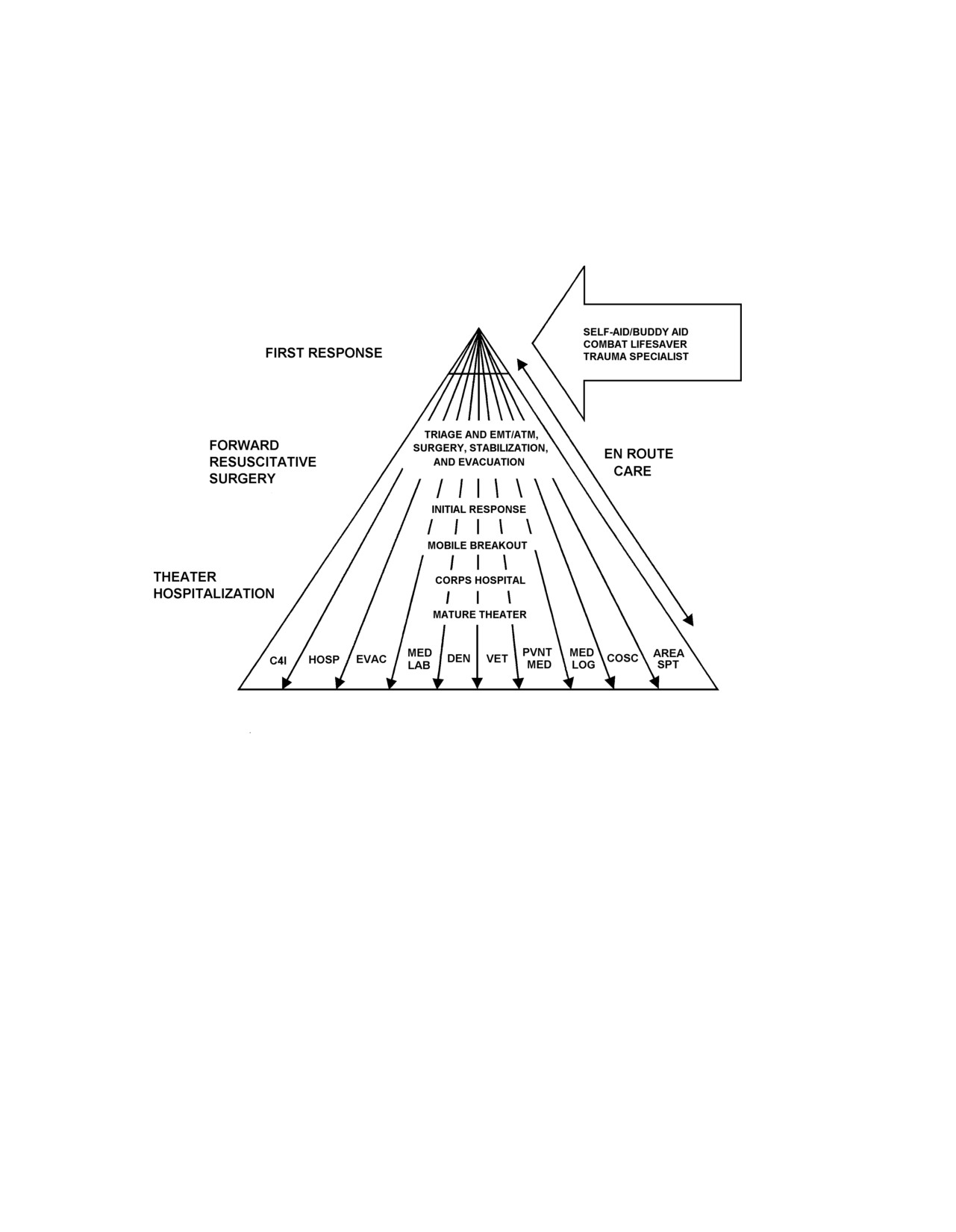
care, and en route care (Figure 1-1).
a. First Response. First response is defined as the initial, essential stabilizing medical care
rendered to wounded, injured, or ill soldiers at the point of initial injury or illness. The first responder is
the first individual to reach a casualty and provide either first aid, enhanced first aid, or emergency medical
treatment (EMT). First aid can be performed by the casualty (self-aid) or another individual (buddy aid),
while enhanced first aid is provided by the combat lifesaver (CLS). The first person who has medical
military occupational specialty (MOS)-training is the trauma specialist. He provides EMT for life-threatening
trauma and stabilizes the patient for evacuation to the battalion aid station (BAS). This timely stabilizing
care is required to increase survivability, decrease morbidity and mortality, enhance the prognosis of
recovery, and minimize long-term disability.
b. Forward Resuscitative Surgery. Forward resuscitative surgery is the initial emergency
resuscitative surgery coupled with life- and limb-saving actions, provided in forward areas. The location of
the facility is dependent upon mission, enemy, terrain and weather, troops and support available, time
available, and civil considerations (METT-TC) and support requirements (such as, the Army forward
1-2
FM 4-02
surgical team [FST] must collocate with a medical company to provide necessary x-ray and medical
laboratory support). It focuses on specific lifesaving practices and preparation for further evacuation for
specific categories of injuries. It is not intended to be a substitute for hospital-level care. Medical
conditions which warrant forward resuscitative surgery include interventions for severe uncontrolled
bleeding, airway compromise, life-threatening chest injuries, and some soft tissue and orthopedic injuries.
c.
Theater Hospitalization. Theater hospitalization will consist of one modularly designed
hospital. This hospital is tailorable and can be deployed as functional modules permitting the capability to
be increased incrementally as required. The future hospital will have four functional elements—initial
response, mobile breakout, core, and mature theater. These four elements when deployed as a whole form
a single hospitalization facility, while simultaneously possessing the capability to independently perform as
separate entities. As an example, the initial element would most likely include an operating room (OR)
module, intensive care module, evacuation liaison, and limited diagnostic capability (x-ray and laboratory
services). As the theater matures and lift is available for follow-on modules, the HSS commander would
deploy these elements in the appropriate number and mix to accomplish the mission. The breakout element
allows the theater hospital to be employed and function in a split-based mode.
d. En Route Care.
(1) There are three major goals for en route care—ensure patients are properly prepared by
providing essential care prior to evacuation; ensure the medical evacuation system is able to transport/
evacuate critically ill or injured patients on any available mode of transportation; and preserve (retain)
forward deployed medical personnel.
(2) The en route care team must be flexible and able to use a variety of modes of
transportation. The important impact of operational factors on en route care, such as the mode of
transportation, operational range
(time and distance factors), space and lift limitations, and tactical
considerations must be considered at each level of planning and implementation of en route care.
(3) En route care teams will leverage technological advances in communications, computers,
and medical equipment to facilitate and enhance medical treatment provided to patients while they are en
route to or from a facility.
(4) The essential care initiated to stabilize patients prior to medical evacuation must not be
interrupted. During transport/evacuation stabilized patients will continue to have physiologic and
hemodynamic fluctuations which necessitate close monitoring and, as required, timely intervention to
ensure their conditions do not deteriorate during evacuation.
e.
Definitive Care. Definitive care is the treatment provided to return the soldier to health from a
state of injury or illness, and can be accomplished at any level depending on the specific medical condition.
A soldier’s disposition may range from RTD to medical discharge from the military. Definitive care is not
a phase of patient treatment; it is a characterization of the type of care provided. A robust health care
delivery system in CONUS to support the Army in the field is required because of the reduced medical
footprint within theater and reduced medical capability (Levels I-IV) outside continental United States
(OCONUS).
1-3
FM 4-02
Figure 1-1. Components of the joint health service support system.
1-4
FM 4-02
CHAPTER 2
FUNDAMENTALS OF FORCE HEALTH PROTECTION
IN A GLOBAL ENVIRONMENT
2-1.
The Health Service Support System
a. Force health protection in a global environment involves the delineation of support responsi-
bilities by capabilities
(levels of care) and geographical area (area support). The HSS system which
executes the FHPGE initiatives is a single, seamless, and integrated system. It is a continuum from the
forward edge of the battle area (FEBA) or point of injury or wounding through successive levels of care to
the CONUS-support base.
b. The HSS system encompasses the promotion of wellness and preventive, curative, and
rehabilitative medical services. It is designed to maintain a healthy and fit force and to conserve the fighting
strength of deployed forces.
c.
Consistent with military operations, HSS operates in a continuum across strategic, operational,
and tactical levels. In addition to maintaining a healthy and fit force, the effectiveness of the HSS system is
focused and measured on its ability to—
• Provide prompt medical treatment consisting of those measures necessary to recover,
resuscitate, stabilize, and prepare patients for evacuation to the next level of care (paragraph 2-4) and/or
RTD.
• Employ standardized air and ground medical evacuation units/resources. The use of air
ambulance is the primary and preferred means of medical evacuation on the battlefield. Its use, however, is
METT-TC driven and can be affected by weather, availability of resources, nuclear, biological, and
chemical (NBC) conditions, and air superiority issues. Refer to FM 8-10-6 and FM 8-10-26 for additional
information on medical evacuation operations.
• Provide a field flexible, responsive, and deployable hospital designed and structured to
support a Force Projection Army and its varied missions. This hospital provides essential care to all
patients who are evacuated out of theater and definitive care to those soldiers capable of returning to duty
within the theater evacuation policy.
• Provide a HSL system (to include blood management) that is anticipatory and tailored to
continuously support missions throughout full spectrum operations. Refer to paragraph 5-10 of this
publication and FM 4-02.1 and FM 8-10-9 for additional information.
• Establish PVNTMED programs to prevent casualties from DNBI through medical
surveillance, OEH surveillance, behavioral surveillance, health assessments, PVNTMED measures (PMM),
and personal protective measures. Refer to paragraph 5-6 of this publication and Army Regulation (AR)
40-5, FM 4-02.17, FM 4-25.12, and FM 21-10 for additional information on PVNTMED services.
• Provide veterinary services to protect the health of the command through food inspection
services, animal medical care, and veterinary PVNTMED. As the Department of Defense (DOD) Executive
2-1
FM 4-02
Agent, the Army provides veterinary services to the US Air Force (USAF), US Navy (USN), US Marine
Corps (USMC), and Army forces, as well as other federal agencies, host nation (HN), allies, and coalition
forces, when directed. For additional information on veterinary operations and activities refer to paragraph
5-8 of this publication and AR 40-70, AR 40-656, AR 40-657, AR 40-905, and FM 8-10-18.
• Provide dental services to maximize the quick RTD of dental patients by providing
operational dental care (paragraph 5-7) and maintaining the dental fitness of theater forces. For additional
information refer to FM 4-02.19.
• Provide combat operational stress control (COSC)/mental health (MH) to enhance unit
and soldier effectiveness through increased stress tolerance and positive coping behaviors. For additional
information refer to FM 6-22.5, FM 8-51, and FM 22-51.
• Provide medical laboratory functions in HSS operations to—
•
Assess disease processes (diagnosis).
•
Conduct OEH surveillance laboratory support.
•
Monitor the efficacy of medical treatment.
•
Identify and confirm use of suspect biological warfare (BW) and chemical warfare
(CW) agents by enemy forces.
• Deploy command and control (C2) units capable of providing the requisite C2 to enhance
split-base operations capability.
• Ensure maximum use of emerging technology to improve battlefield survivability.
d. The challenge facing the FHPGE concept is to simultaneously provide medical support to
deploying forces; provide health care services to the CONUS-support base; and to establish a theater HSS
system. The system provides HSS to mobilization, deployment (reception, staging, onward movement, and
integration [RSO&I]), reconstitution, redeployment, and demobilization operations.
2-2.
Principles of Force Health Protection in a Global Environment
The six principles of FHPGE are conformity, continuity, control, proximity, flexibility, and mobility.
a. Conformity. Conformity with the tactical plan is the most basic element for effectively
providing HSS. By taking part in the development of the commander’s operation plan (OPLAN), the HSS
planner can—
• Determine requirements.
2-2
FM 4-02
• Develop a comprehensive plan in support of the tactical commander’s concept of
operation and plan.
b. Continuity. Health service support must be continuous since an interruption of treatment may
cause an increase in morbidity, mortality, and long-term disability. No patient is evacuated farther to the
rear than his physical (medical) condition and/or the military situation requires.
c.
Control. Technical control and supervision of HSS activities, missions, operations, and
medical resources must remain with the appropriate command-level surgeon. Health service support staff
officers must be proactive and keep their commanders’ apprised of all health aspects (to include the medical
threat) of the operation.
d. Proximity. The location where HSS assets are employed in support of combat operations is
dictated by the tactical situation (METT-TC), time and distance factors, theater evacuation policy, medical
troop ceiling, and availability of evacuation resources. Patients are evacuated to the medical treatment
facility (MTF) or the MTF is moved to the area where the patient population is the greatest. Health service
support commanders and staffs, through continuous coordination and synchronization, ensure that treatment
elements or MTFs are not placed in areas that interfere with ongoing combat operations.
e.
Flexibility. The HSS plan must be flexible to enhance the capability of shifting HSS resources
to meet changing requirements. Changes in the tactical situation or OPLAN make flexibility essential.
Since all HSS units are used somewhere within the TO and none are held in reserve, the commander makes
alternate plans for redistribution of critical medical resources, as required.
f.
Mobility. Mobility is required to ensure that HSS assets remain close enough to support
maneuvering combat forces. The mobility and survivability (such as armor protection) of medical units
organic to maneuver elements must be equal to the forces being supported. Major medical headquarters in
the corps and echelon above corps (EAC) continually assess and forecast unit movement and redeployment.
Through the use of organic and nonorganic transportation resources, commanders can rapidly move HSS
units to best support combat operations. For example, if one unit is immobilized, a similar unit may be
leapfrogged past it. An immobilized unit may be given priority in evacuating its patients as they become
stabilized and its resources may be moved forward by echelon. The only means for increasing the mobility
of forward deployed medical units is to evacuate the patients being held.
2-3.
The Medical Threat and Medical Intelligence Preparation of the Battlefield
a. The medical threat is a collective term used to designate all potential or continuing enemy
actions and environmental situations that may render a soldier combat ineffective. The medical threat is
important because it applies (as a whole) to the troops deployed on a specific mission and/or operation and
may result in the unit being unable to satisfactorily complete its mission. A health threat is more
individualized in nature and may not be of military significance. Threats to an individual soldier’s health
can include genetic and/or hereditary conditions which manifest themselves in adulthood, an individual
(single) exposure to a toxic industrial material (TIM) or other toxin where others are not exposed, or other
allergies, diseases, injuries, and traumas which affect a single individual’s health rather than the health of
2-3
FM 4-02
the unit. For example, an individual who has a food allergy inadvertently eats the offending food; he may
become incapacitated with diarrhea after the exposure. This incapacitation causes the soldier to be combat
ineffective; but the remainder of the unit is not affected by his condition. However, in a unit where 40 to 50
percent of its personnel contract Salmonella (an infectious disease which causes diarrhea), the unit can no
longer complete its mission. The significant difference in these terms lies with the effects on the ability of a
military unit to successfully execute its mission. Predeployment medical screening is used to determine if
an individual soldier is physically and mentally ready to be deployed; medical conditions, such as diabetes,
fractures, severe sprains, or other diseases and injuries, can disqualify the individual from being deployed.
Soldiers who are deployed are healthy, fit, and emotionally prepared for the deployment; the medical threat
they are to face in the area of operations (AO) is operationally significant as it affects the entire unit, rather
than the individual soldier.
b. The medical threat is comprised of the following categories:
• Occupational and environmental health hazards such as TIMs and noise. This category
also includes climatic injuries resulting from inadequate acclimation to the AO and inadequate clothing and
equipment for the environmental conditions.
• Endemic and epidemic diseases in the AO include diseases of military significance,
diarrheal diseases caused by drinking contaminated or impure water (not adequately treated), eating
contaminated foods, and not practicing good individual and unit PMM. These diseases may also be the
result of disease transmission by arthropod vectors.
• Diseases and injuries caused by contact with domesticated animals, wild animals, reptiles,
and poisonous or toxic plants (flora and fauna).
• Diseases and injuries caused by physical or mental unfitness resulting from continuous
operations, inadequate diet, and mental stressors.
• Diseases and injuries resulting from exposure to NBC weaponry to include BW and CW
agents and high yield explosive weapons.
c.
Medical intelligence preparation of the battlefield (MIPB) is a systematic process (Appendix B)
that is designed to aid HSS planners in analyzing various enemy and medical threats in a specific AO. The
MIPB is the initial step in the mission analysis phase of the deliberate planning process. The information
derived from conducting proper MIPB is the cornerstone to developing detailed and effective HSS plans and
estimates. The purpose of MIPB is to—
• Define the battlefield environment.
• Describe the battlefield effects on deployed forces and HSS operations.
• Conduct threat integration (enemy/medical) and information consolidation.
d. For additional information on the medical threat and medical intelligence, refer to Appendix B
of this manual and FM 4-02.7, FM 4-02.17, FM 8-10-8, and FM 8-42.
2-4
FM 4-02
2-4.
Levels of Medical Care
A basic characteristic of organizing modern HSS is the distribution of medical resources and capabilities to
facilities at various levels of location and capability, which are referred to as levels. Echelonment is a
matter of principle, practice, and organizational pattern; not a matter of rigid prescription. Scopes and
functions may be expanded or contracted on sound indication. As a general rule, no level will be bypassed
except on grounds of efficiency or battlefield expediency. The rationale for this rule is to ensure the
stabilization/survivability of the patient through advanced trauma management (ATM) and far forward
resuscitative surgery prior to movement between MTFs (Levels I through III).
(A discussion on the phases
of patient treatment is contained in Appendix C.)
a. Level I. The first medical care a soldier receives is provided at Level I (also referred to as
unit-level medical care). This level of care includes—
• Immediate lifesaving measures.
• Disease and nonbattle injury prevention.
• Combat operational stress control preventive measures.
• Patient location and acquisition (collection).
• Medical evacuation from supported units (point of injury or wounding, company aid
posts, or casualty collecting points [CCP]) to supporting MTFs.
• Treatment provided by designated trauma specialists or treatment squads (BASs). (Major
emphasis is placed on those measures necessary for the patient to RTD, or to stabilize him and allow for his
evacuation to the next level of care. These measures include maintaining the airway, stopping bleeding,
preventing shock, protecting wounds, immobilizing fractures, and other emergency measures, as indicated.)
(1) Nonmedical personnel performing first-aid procedures assist the trauma specialist in his
duties. First aid is administered by an individual (self-aid, buddy aid) and by the CLS.
(a) Self-aid and buddy aid. Each individual soldier is trained to be proficient in a
variety of specific first-aid procedures. These procedures include aid for chemical casualties with particular
emphasis on lifesaving tasks. This training enables the soldier or a buddy to apply first aid to alleviate a
life-threatening situation.
(b) Combat lifesaver. The CLS is a nonmedical soldier selected by his unit commander
for additional training beyond basic first-aid procedures. A minimum of one individual per squad, crew,
team, or equivalent-sized unit should be trained. The primary duty of this individual does not change. The
additional duty of the CLS is to provide enhanced first aid for injuries based on his training before the
trauma specialist arrives. Combat lifesaver training is normally provided by medical personnel assigned,
attached, or in direct support (DS) of the unit. The senior medical person designated by the commander
manages the training program. Urban operations (UO) may require a heavier reliance on CLSs due to the
2-5
FM 4-02
isolating effects of urban areas. Before engaging in this type of operation, training of additional CLSs may
be prudent.
(2) Level I medical treatment is provided by the trauma specialist and emergency care
specialist or by the physician, the physician assistant (PA), or the health care specialist in the BAS. In
Army special operations forces (ARSOF), Level I treatment is provided by special operations combat
medics (SOCMs), special forces medical sergeants (SFMSs), or physicians and PAs at forward operating
bases (FOBs), special forces (SF) operating bases (SFOBs), or in joint special operations task force (JSOTF)
areas of responsibilities (AOR).
(a) Emergency medical treatment (immediate far forward care) consists of those
lifesaving steps that do not require the knowledge and skills of a physician. The trauma specialist is the first
individual in the HSS chain who makes medically-substantiated decisions-based on medical MOS-specific
training.
(b) At the BAS, the physician and the PA in a treatment squad are trained and equipped
to provide ATM to the battlefield casualty. This element also conducts routine sick call when the tactical
situation permits. Like elements provide this level of medical care to brigades, division, corps, and EAC
units.
b. Level II.
(1) At this level (also referred to as division-level), care is rendered at the Level II MTF
which is operated by the treatment platoon of divisional and nondivisional medical companies/troops. Here
the patient is examined and his wounds and general medical condition are evaluated to determine his
treatment and evacuation precedence, as a single patient among other patients. Advanced trauma
management and EMT including beginning resuscitation is continued, and, if necessary, additional
emergency measures are instituted, but they do not go beyond the measures dictated by immediate
necessities. The Level II MTF has the capability to provide packed red blood cells (RBCs) (liquid), limited
x-ray, laboratory, and dental support.
(2) Level II HSS assets are located in the—
• Division (forward support medical company [FSMC], main support medical
company [MSMC]), and medical company-sized units in the separate brigades and armored cavalry
regiments (ACRs) in the Army of Excellence (AOE).
• Division support medical company (DSMC) in the digitized force.
• Brigade support medical company (BSMC) in the Stryker brigade combat team
(SBCT).
• Division troop support medical company (DTSMC) or division air cavalry medical
company (DACMC), and aviation support medical company (AVSMC) in the interim division (IDIV).
• Area support medical company in the corps and EAC.
2-6
FM 4-02
(3) Preventive medicine and COSC assets are also located in the MSMC, DSMC, BSMC,
and area support medical company (ASMC).
(4) Those patients who can RTD within 1 to 3 days are held for treatment. Patients who are
nontransportable due to their medical condition may require resuscitative surgical care from a FST collocated
with a medical company/troop.
(A discussion of the FST is contained in FM 8-10-25.)
(5) This level of care provides medical evacuation from Level I MTFs and also provides
Level I medical treatment on an area support basis for units without organic Level I resources.
c.
Level III. At Level III, the patient is treated in an MTF staffed and equipped to provide care to
all categories of patients, to include resuscitation, initial wound surgery, and postoperative treatment. This
level of care expands the support provided at Level II. Patients who are unable to tolerate and survive
movement over long distances receive surgical care in a hospital as close to the division rear boundary as
the tactical situation allows. This level includes provisions for—
• Evacuating patients from supported units.
• Providing care for all categories of patients in an MTF with the proper staff and
equipment.
• Providing support on an area basis to units without organic medical assets.
d. Level IV. Depending upon the anticipated duration of the operation, the mission of deployed
forces, and other METT-TC factors, Level IV units and facilities may not be located within the TO. If
Level IV resources are deployed, the patient is treated in a hospital staffed and equipped for general and
specialized medical and surgical care to stabilize the patient for further evacuation out of the theater or for
preparation for RTD within the stated theater evacuation policy.
e.
The Continental United States Support Base (Level V). Level V medical care is found in
support base hospitals. Mobilization requires expansion of military hospital capacities and the inclusion of
Department of Veterans Affairs (VA) and civilian hospital beds in the HSS system to meet the increased
demands created by the evacuation of patients from the TO. The support-base hospitals represent the most
definitive medical care available within the HSS system.
2-5.
Planning for Global Force Health Protection Operations
a. Force projection is the ability to rapidly alert, mobilize, stage, deploy, and operate anywhere
in the world. The President and the Secretary of Defense (SECDEF) direct force projection operations
responding to specific circumstances affecting US national interests. The primary military organization that
conducts tactical operations as part of force projection is the joint task force (JTF). Within a JTF, the corps
or a major subelement of it (a division) is the principal Army force projection entity because it contains the
C2, combat, combat support (CS), and CSS assets necessary to execute the force projection mission. The
basic tenets of FHPGE in support of force projection forces involve strict adherence to the AMEDD
battlefield rules listed in the order of precedence in Table 2-1.
2-7
FM 4-02
Table 2-1. Army Medical Department Battlefield Rules
BE THERE (MAINTAIN A MEDICAL PRESENCE WITH THE SOLDIER)
MAINTAIN THE HEALTH OF THE COMMAND
SAVE LIVES
CLEAR THE BATTLEFIELD OF CASUALTIES
PROVIDE STATE-OF-THE-ART MEDICAL CARE
ENSURE EARLY RETURN TO DUTY OF THE SOLDIER
b. Health service support units must be able to mobilize, deploy, and support a crisis-response
force. Commanders task organize HSS assets on the basis of analysis of METT-TC, strategic lift, pre-
positioned assets, and, depending upon the type of operation, availability of host nation support (HNS).
c.
During the initial stages of establishing a CSS base, it may become necessary to perform HSS
operations in one or more areas simultaneously. With secure lines of communications (LOCs) and signal/
satellite communications capabilities, the medical unit may provide support from an intermediate staging
base (ISB), a lodgment area, at CONUS installations, or afloat. Army MTFs will be able to provide
diagnostic and consultative services to forward-deployed forces. Enhanced telecommunications capability
also reduces the requirement to employ medical specialty physicians into forward deployed MTFs (this is
accomplished through telementoring and teleconsultation). It permits strategic managers to centralize
critical professional skills and services. In force projection operations in remote areas, Level III facilities
may be located in a safe haven or CONUS-support base. Telecommunications provide a link between the
forward operating forces and the medical specialties contained in the Level III and above facilities.
d. Force health protection in a global environment considerations include—
(1) Strategic considerations. Strategic HSS and supportive services include activities under
the control of DA, DOD, and SECDEF. These include depots, arsenals, data banks, plants, research
laboratories, and factories associated with the US Army Medical Research and Materiel Command
(USAMRMC) (including the US Army Medical Materiel Agency [USAMMA], and DNBI surveillance
centers (such as US Army Centers for Health Promotion and Preventive Medicine [USACHPPM]), the
Defense Logistics Agency (DLA), National Inventory Control Point (NICP), MHS, and VA and civilian
hospital systems of the National Disaster Medical System (NDMS). Strategic HSS focuses on—
• Supporting force deployment by ensuring soldier medical readiness.
• Medical surveillance and OEH surveillance.
2-8
FM 4-02
• Early employment/deployment of PVNTMED and veterinary services.
• Medical laboratory services for in-theater confirmatory identification of suspect
NBC samples/specimens.
• Mobilizing industrial base.
• Determining requirements and acquiring medical equipment, supplies, blood, and
pharmaceuticals to support force projection operations.
• Stockpiling and pre-positioning medical materiel (pre-positioning of medical materiel
configured to unit sets and afloat pre-positioning).
• Supporting the HN.
• Medical evacuation, medical regulating, and hospitalization.
• Mobilizing.
• Preserving the force by returning injured soldiers to full health.
(2) Operational considerations.
(a) Operational HSS encompasses all of the medical activities to support the force
employed in campaigns, major operations, stability operations, and support operations. Operational HSS
focuses on—
• Early entry of PVNTMED elements to reduce DNBI and to establish medical
and OEH hazard surveillance activities and programs.
• Support of deployed operations (RSO&I).
(Refer to FM 100-17-3 for
additional information.)
• Medical treatment facilities in the theater.
• Distribution management of medical materiel, and blood and blood products.
• Support of forward deployed forces.
• Reconstitution of medical units in theater.
• Support of redeployment operations.
(b) At the operational level, managers balance current requirements with the need to
extend capabilities along the LOCs and to build up support services for subsequent major operations.
2-9
FM 4-02
Whenever possible, planners take advantage of available HN support (infrastructure and contracted services).
Within the medical arena, however, caution must be exercised when contracting for professional service,
medical facilities, and medical materiel. Due to stringent government guidelines, laws, and standards on
the quality of pharmaceuticals, medical equipment, and medical professional services, it is often not
possible to contract for HNS in these areas. The surgeon is an essential advisor in the development of
health related contracting and such contracts should not be established without his explicit approval.
(3) Tactical considerations.
(a) Tactical planning is proactive rather than reactive. Force health protection in a
global environment must be thoroughly integrated with tactical plans and orders. Commanders reallocate
medical resources as tactical situations change. Health service support commanders task organize medical
support to adapt to the flow of battle and to meet reinforcement or reconstitution requirements. Elements to
reconstitute attrited medical units normally come from the next higher level of care.
(b) Due to the mass destruction and disabling capabilities of modern conventional,
directed energy (DE), and NBC weapons, and high yield explosives, HSS units can anticipate large
numbers of casualties in a short period of time. These mass casualty situations will probably exceed the
capabilities of local medical units. Medical units are flexible. They alter the normal scope of operations to
provide the greatest good for the greatest number. Key factors for effective mass casualty management are
on-site triage, emergency resuscitative care, early surgical intervention, reliable communications, and
skillful use of standard and nonstandard air and ground evacuation platforms.
(Refer to paragraph 2-9 of
this publication and STANAG 2068, FM 4-02.6, and FM 8-42 for additional information on mass casualty
operations.)
(c) Medical personnel may also have to defend themselves and their patients within
their limitations. In certain situations, HSS units in rear areas must be able to defend against Level I threats
and survive NBC strikes while continuing the operation. Refer to paragraph 4-8 for additional information
on the effects of the Geneva Conventions on the issue of defense of medical units, personnel, and patients.
(Refer to FM 4-02.7 for additional information on HSS in an NBC environment.)
2-6.
Army Medical Department Information Management
Army Medical Department information management provides the foundation and architectural design for all
information activities conducted by the AMEDD. The information environment is a global one,
encompassing not only the AMEDD, but also the other Services, DOD, and other governmental departments
and agencies, and HN, allied, and coalition forces. For an additional discussion on information operations
refer to AR 25-1, FM 100-6 (FM 3-13), FM 101-5 (FM 5-0), and on AMEDD information management
refer to FM 8-10-16.
2-7.
Health Service Support for Army Special Operations Forces
Army special operations forces require support from conventional forces when their medical requirements
exceed their organic capability. Comprehensive planning, coordination, and synchronization are required
2-10
FM 4-02
to ensure prompt medical intervention by conventional resources without compromising the ARSOF mission.
Due to the shortage of ARSOF personnel and criticality of MOS skills within the theater, an exception to the
theater evacuation policy may be required for ARSOF to facilitate the RTD of these patients within the TO.
Refer to FM 8-43 for additional information.
2-8.
Global Force Health Protection Operations in a Nuclear, Biological, and Chemical Environment
The potential for the employment of NBC weaponry against a deployed US force, must be considered as a
condition of the battlefield by commanders at all levels. The ease of NBC employment, the difficulty of
identification and treatment, and most importantly, the publicity value of even an isolated BW or CW agent
attack dictates the requirements for NBC defensive equipment, training, immunizations, chemoprophylaxis/
barrier creams, and pretreatments. For an in-depth discussion of HSS operations in an NBC environment,
refer to FM 4-02.7. For treatment information refer to FM 4-02.283, FM 8-9, FM 8-284, and FM 8-285.
2-9.
Mass Casualty Situations
Mass casualty situations occur when the number of casualties exceeds the available medical capability to
rapidly treat and evacuate them. Therefore, the actual number of casualties required before a mass casualty
situation is declared varies from situation to situation depending upon the availability of HSS resources.
Planning for mass casualty situations is essential. Once established, mass casualty plans should be exercised/
rehearsed on a periodic basis. For information on mass casualty situations, refer to FM 4-02.6, FM 8-42,
and STANAG 2068.
2-10. Risk Management
Risk management is the process of identifying, assessing, and controlling risks arising from operational
factors and making decisions that balance risk costs with mission benefits. It applies to all missions and
environments across the wide range of Army operations. Risk management is fundamental in developing
confident and competent leaders and units. Proficiency in applying risk management is critical to conserving
the fighting strength. Refer to Appendix D of this manual and FM 100-14 for information on the risk
management process.
2-11. Health Service Support for Contractors on the Battlefield
The employment of contractors on the battlefield had its inception before the establishment of the United
States Army in 1775. Since that time, in both peace and war, selected functions of CS and CSS have been
entrusted to contractors. When deployed in an AO in support of military contingencies, the Army may
provide HSS and other support services commensurate with those provided to DOD civilian personnel.
(Refer to FM 100-21 for additional information.)
2-11
FM 4-02
CHAPTER 3
ARMY MEDICAL DEPARTMENT TEAM
AND COMMAND SURGEONS
3-1.
The Army Medical Department Team
a. The AMEDD mission of conserving the fighting strength entails the integration of all aspects
of HSS on the battlefield. The HSS system is comprised of functional areas which delineate clinical and
support functions (medical evacuation and medical regulating, hospitalization, medical treatment [includes
area medical support], PVNTMED support, dental services, veterinary services, HSL, COSC, and medical
laboratory services), and medical command, control, communications, computers, and intelligence (C4I).
Under the FHPGE initiative and the integrated concept team (ICT) (Appendix E) approach, these functional
areas are aligned in the following groupings:
• Command, control, communications, computers, and intelligence. For additional
information refer to paragraph 5-2.
• Casualty care. This grouping is comprised of the medical treatment aspects of
hospitalization, area medical support, COSC/MH, dental services, clinical laboratory services, and the
treatment of NBC contaminated patients. For additional information refer to paragraphs 5-3, 5-5, 5-7, 5-9,
and 5-11.
• Medical evacuation and medical regulating. For additional information refer to
paragraphs 5-4.
• Casualty prevention. This grouping encompasses promoting a healthy and fit force;
PVNTMED (including OEH) support; medical surveillance activities (to include OEH surveillance); the
preventive aspects of COSC/MH; preventive dentistry; nutrition care; veterinary support (to include the
animal care mission, food inspection mission, and veterinary PVNTMED mission); medical laboratory
services which support casualty prevention functions to include the identification and confirmation of
suspect BW and CW agents; and the preventive aspects of NBC defense. For additional information refer to
paragraphs 5-6 through 5-9.
• Medical logistics. For additional information refer to paragraph 5-10.
b. The provision of HSS on the battlefield is a complex process and requires continuous
synchronization and comprehensive planning. The AMEDD has adopted a policy that the best qualified
individual will be selected for leadership positions. Leaders who have trained with, have gained the
confidence of, and have supported combat, CS, and CSS units in a tactical environment are more effective
in planning for and executing real-world HSS missions. The issue that requires continuous synchronization
is the relationship of the operational aspects of the mission (normally represented by the Medical Service
Corps [MS] officer) and the clinical aspects of the mission (normally represented by a Medical Corps [MC]
officer, PA, or other health care provider).
(1) The clinical aspects of the operation involve the provision of medical care to sick,
injured, and wounded soldiers (or other designated beneficiaries) by medically trained individuals and the
prevention of DNBI. The care extends from the place of injury or wounding and is usually provided
3-1
FM 4-02
initially by the trauma specialist or at the BAS through the successive levels of care to the CONUS-support
base, if the patient’s medical condition so warrants. As the patient is evacuated between levels of care, he
receives en route medical care to sustain him, thus reducing the potential for his medical condition to
deteriorate while in-transit.
(2) The operational aspects of the mission include such military tasks as—
• Maintaining situational understanding (SU) on the battlefield.
• Providing timely support to the maneuver forces.
• Maintaining the unit’s readiness posture.
• Ensuring the survivability of the unit (such as unit perimeter defense, hasty firing
positions, and patient bunkers).
• Ensuring compliance with the Law of Land Warfare (to include the Geneva
Conventions [Chapter 4]).
c.
In most tables of organization and equipment (TOE) units, when the unit is not deployed on an
operation or exercise, the unit is staffed with administrative personnel and only limited clinical resources.
When the unit is mobilized, the professional staff designated under the Professional Filler System (PROFIS)
is notified of the mobilization and is directed to report to the unit. The administrative staff that maintains
the unit’s readiness posture when the unit is not deployed are the individuals who have worked on a daily
basis with supported maneuver units and commands. Although the TOE may indicate that an incoming
officer be designated as the unit commander/platoon leader, the appointing authority may determine that the
mission can best be accomplished by maintaining the same command structure that existed prior to
mobilization.
d. To accomplish the AMEDD mission, a synchronization of the clinical and operational aspects
must be achieved. It accomplishes nothing for a unit to provide the best clinical care, if it cannot survive the
battle. Likewise, a unit that can execute all of its military tasks is not successful if the patients entrusted to
its care die or their conditions deteriorate because no consideration was given to their clinical needs during
an operational relocation.
e.
A balance must be achieved in prioritizing the requirements generated from both the operational
and clinical aspects of the mission. Without synchronizing the response to overall requirements, both
operational and clinical, a short-fall in one sphere may have serious ramifications on mission success. A
shortage of scalpel blades for a FST adversely impacts the patient care mission as would a shortage of
ammunition for use in perimeter defense which could lead to mission failure in an operational sense. If
neither item is available, the FST cannot provide the required surgical care to stabilize patients for further
evacuation and the unit cannot survive on the battlefield because it lacks a means for defense.
f.
To enhance the delivery of health care on the battlefield and to provide a seamless HSS system
from the point of injury or wounding through progressive levels of care to the CONUS-support base, the
3-2
FM 4-02
AMEDD team must integrate their special skills and knowledge, leverage technology, maximize the use of
scarce resources, and synchronize their collective efforts. The accomplishment of the AMEDD mission
necessitates a cohesive unit of effort to provide the care our soldiers deserve.
3-2.
Command Surgeon
a. At all levels of command, a command surgeon is designated. This AMEDD officer is a
special staff officer charged with planning for and monitoring the execution of the HSS mission. Depending
upon the level of command, this officer may be dual-hatted as a HSS unit commander; further, he may have
a small staff section to assist him in his planning, coordinating, and synchronizing the HSS effort within
his AO.
b. The command surgeon is responsible for ensuring that all AMEDD functional areas (Chapter 5)
are considered and included in OPLANs and operation orders (OPORDs). The command surgeon retains
technical supervision of all HSS operations. At the higher levels of command, the scope of duties and
responsibilities expand to include all subordinate levels of command.
c.
The duties and responsibilities of command surgeons may include, but are not limited to—
• Advising the commander on the health of the command.
• Ensuring early presence/arrival of PVNTMED resources into the TO.
• Developing and coordinating the HSS portion of OPLANs to support the combatant/
tactical commander’s decisions, planning guidance, and intent.
• Determining the medical workload requirements (patient estimates) based upon the
casualty estimate developed by the Assistant Chief of Staff (Personnel) (G1) and/or Adjutant, US Army
(S1).
• Maintaining SU by coordinating for current HSS information with surgeons of the next
higher, adjacent, and subordinate headquarters.
• Recommending task organization of HSS units/elements to satisfy all mission require-
ments.
(A discussion of the medical multifunctional task force [MMTF] and recommended augmentation
staffing is provided in FM 8-55.)
• Recommending policies concerning support of civil-military operations (CMO).
• Monitoring the availability of and recommending the assignment, reassignment, and
utilization of AMEDD personnel within his AO.
• Developing, coordinating, and synchronizing health consultation services (to include
telemedicine and teleconsultation, as appropriate).
3-3
FM 4-02
• Evaluating and interpreting medical statistical data.
• Recommending policies and determining requirements and priorities for HSL (to include
blood and blood products, medical supply/resupply, medical equipment maintenance and repair services,
production of medicinal gases, optometric support, and fabrication of single-and multi-vision optical lens,
and spectacle fabrication and repair).
• Recommending medical evacuation policies and procedures.
• Monitoring medical regulating and patient tracking operations.
• Determining HSS training policies and programs (to include CLS, unit field sanitation
team, MOS 91W refresher training, and training on the administration of pain medication (paragraph 3-1d
below).
• Developing policies, protocols, and procedures pertaining to the medical and dental
treatment of sick, injured, and wounded personnel. These policies, protocols, and procedures will be in
consonance with applicable regulations, directives, and instructions; higher headquarters policies; standing
operating procedures (SOPs); applicable STANAGs and QSTAGs; memorandums of understanding (MOU)
or agreement (MOA); Status of Forces Agreements (SOFAs); and the DEPMEDS Administrative
Procedures, Clinical and Support Guidelines, and Patient Treatment Briefs (Appendix A).
• Ensuring field medical records are maintained on each soldier at the primary care MTF
in accordance with AR 40-66 and FM 4-02.4.
• Ensuring compliance with the theater blood bank service program.
• Ensuring a viable veterinary program (to include inspection of subsistence and OCONUS
food production and bottled water facilities, veterinary PVNTMED, and animal medical care) is established.
• Ensuring a medical laboratory capability or procedures for obtaining this support from
out of theater resources are established for the identification and confirmation of the use of suspect BW and
CW agent by opposition forces. This also includes the capability for specimens/samples packaging and
handling requirements and escort/chain of custody requirements.
(Refer to FM 4-02.7 and FM 8-284 for
additional information.)
• Planning for and implementing PVNTMED operations (to include PVNTMED programs
and initiating PVNTMED measures to counter the medical threat). (Refer to Appendix B of this publication
and FM 4-02.17 for additional information on the medical threat.)
• Planning for and ensuring pre- and postdeployment health assessments are accomplished.
• Establishing and executing a medical surveillance program (refer to DOD Directive
[DODD] 6490.2, DOD Instructions [DODI] 6490.3, AR 40-66, and FM 4-02.17 for an in-depth discussion).
3-4
FM 4-02
• Establishing and executing an OEH surveillance program (FM 3-100.4).
• Recommending COSC/MH and substance abuse control programs.
• Coordinating for medical intelligence with the supporting intelligence officer/section/
unit. Pursuing other avenues to obtain medical intelligence and/or medical information such as the—
•
Armed Forces Medical Intelligence Center (AFMIC).
•
United States Army Center for Health Promotion and Preventive Medicine.
•
Centers for Disease Control and Prevention (CDC).
•
United States Public Health Services.
•
International organizations (United Nations [UN], the World Health Organization
[WHO], or the Pan American Health Organization [PAHO], and other nongovernmental organizations
[NGOs]).
•
Information gathered from site visits to HN medical facilities.
• Ensuring that the general threat, medical threat, and medical intelligence considerations
are integrated into HSS plans and orders.
• Identifying commander’s critical information requirements (CCIR) which include priority
information requirements (PIR), essential elements of friendly information (EEFI), and friendly forces
information requirements (FFIR) as they pertain to the medical threat; ensuring they are incorporated into
the command’s intelligence requirements.
• Coordinating for humanitarian assistance, disaster relief, medical response to NBC or
terrorist incidents, and refugee and domestic support operations (DSO), when authorized and so directed.
• Advising commanders on HSS NBC defensive actions (such as immunizations, use of
chemoprophylaxis, antidotes, pretreatments, and barrier creams).
• Ensuring that investigational new drug (IND) protocols are established and implemented.
• Assessing special equipment and procedures required to accomplish the HSS mission in
specific environments such as UO, mountainous terrain, extreme cold weather operations, jungles, and
deserts. Requirements are varied, depending upon the scenario, and could include—
•
Obtaining pieces of equipment or clothing not usually carried (piton hammers,
extreme cold weather parkas, jungle boots, or the like).
•
Adapting medical equipment sets (MESs) for a specific scenario to include adding
items based on the forecasted types of injuries to be encountered (such as more crush injuries and fractures
3-5
FM 4-02
in UO or mountain operations). In certain scenarios (such as UOs), some medical supplies and equipment
may not be carried into the fight initially (such as sick call materials), but rather brought forward by follow-
on forces. In mountain operations, bulky or heavy items (such as extra tentage) may not accompany the
force because of the difficulty in traversing the terrain.
•
Having individual soldiers carry additional medical items, such as bandages and
intravenous (IV) fluids.
•
Conducting training on: pain management techniques (paragraph 3-2d below);
extrication of patients from armored vehicles; extraction from above, below, and at ground level and from
under rubble and debris; refresher or initial training for CLSs; and other topics necessitated by the
operational mission.
• Recommending disposition instructions for captured enemy medical supplies and
equipment. Under the provisions of the Geneva Conventions, medical supplies and equipment are protected
from intentional destruction and should be used to initially treat sick, injured, or wounded enemy prisoners
of war (EPW). (Refer to Chapter 4 for additional information.)
• Submitting to higher headquarters those recommendations on professional medical
problems/conditions that require research and development.
• Coordinating and monitoring patient decontamination operations (FM 4-02.7) to include—
•
Layout and establishment of patient decontamination station.
•
Use of collective protection.
•
Use of nonmedical soldiers to perform patient decontamination procedures under
medical supervision.
This paragraph implements STANAGs 2132 and 2350 and QSTAGs 230 and 470.
d. The command surgeon is responsible for the standard of care which is provided to sick,
wounded, and injured soldiers by subordinate medical personnel.
(1) The command surgeon must ensure that standardized protocols for the alleviation of pain
(to include the administration of pain relief medications by nonphysician health care providers) are
established and disseminated. Further, he must ensure and certify that each trauma specialist (MOS 91W),
working under the supervision of a physician, has received sufficient training to—
• Recognize when pain management measures and medications are required.
3-6
FM 4-02
• Provide pain management measures (elevation, immobilization, and ice [when
available]).
• Select the appropriate medication (such as acetaminophen, ibuprofen, or morphine
sulfate); determine the mode of administration (oral or parenteral); and be knowledgeable of the possible
side effects and how to treat them; and administer the appropriate medication.
• Document the treatment provided (Department of Defense [DD] Form 1380) to
include the marking of individuals who have received morphine sulfate.
NOTE
When morphine is administered to a casualty in the field the dose,
ZULU time, date, route of entry, and name of the drug must be
entered onto the DD Form 1380. Additionally, the trauma specialist
(or other health care provider) must mark the casualty with the letter
“M” (for morphine) and the hour of injection (such as “M 0830”) on
the patient’s forehead with a skin pencil or another semipermanent
marking substance. The empty syrette, injection device, or its
envelope should be attached to the patient’s clothing.
(2) The command surgeon is also responsible for ensuring that all controlled substances are
stored, safeguarded, issued, and accounted for in accordance with the provisions of AR 40-3. The MES for
the trauma specialist includes morphine sulfate. When the mission supported involves a high risk of trauma,
the command surgeon may authorize the trauma specialist to carry morphine sulfate to alleviate severe pain
caused by trauma or wounding. This medication must be accounted for when issued to the trauma specialist
and upon mission completion.
3-3.
Health Service Support and the Command Surgeon in Joint Operations
a. In joint operations, each Service operates its own health care delivery system. However,
health care facilities, medical equipment, supplies, and personnel may be provided on a joint basis, when
directed by the joint force commander (JFC). Although joint staffing is not a requisite to joint use, staff
augmentation from Service components may be required. When one Service uses personnel or medical
elements from another Service, the borrowing Service assumes operational control (OPCON) over those
elements. However, administrative responsibility remains with the lending Service.
b. Upon activation of a JTF, a command surgeon is designated from one of the component
Services. Joint Publication (Joint Pub) 4-02 states that a joint force surgeon (JFS) should be appointed for
each combatant command, subunified command, and JTF. As a specialty advisor, the JFS reports directly
to the JFC or the joint land force component commander. The JFS coordinates HSS matters for the JFC.
The JFS’s staff should be jointly manned (when possible) and should be of sufficient size to effectively
3-7
FM 4-02
facilitate joint coordination of HSS initiatives; rationalization, standardization, and interoperability (RSI);
review of plans; and integration with overall operations. The command surgeon must assess component
forces HSS requirements and capabilities and provide guidance to enhance effectiveness of HSS through
shared use of assets. The JFSs usually have responsibility for—
• Assisting the JFC in formulating a recommended medical evacuation policy for the TO.
• Assisting component commands in identifying what HSS capabilities each component
requires and who is responsible for providing these services/support.
• Advising the JFC on the HSS aspects of combat operations, COSC, reconstitution
policies, PVNTMED programs and activities, and other factors that could effect operations.
• Advising the JFC on HSS aspects of NBC defensive actions/issues of immunizations,
chemoprophylaxis, antidotes, pretreatments, and barrier creams.
• Informing the JFC about the status of HSS units, identifying any shortfalls or deficiencies,
and recommending solutions.
• Monitoring the status of patient beds, HSL (including blood and blood products), staffing,
designation of a single integrated medical logistics manager (SIMLM), and other issues effecting medical
readiness; and recommending solutions to the JFC.
• Informing the JFC about the status of medical assistance and PVNTMED support required
and provided to detained and retained persons and EPW.
• Coordinating the delivery of health care to or received from allies, coalition partners,
HN, other friendly nations, or contractors on the battlefield.
• Supervising the activities of the Theater Patient Movement Requirements Center
(TPMRC) and Joint Blood Program Office (JBPO).
• Preparing the HSS portions of the CSS annexes to joint force plans.
(Refer to Appendix F
for a planning checklist for joint operations.)
• Preparing patient estimates based on casualty planning factors established by the
component commands.
• Coordinating veterinary support within the TO/AO.
• Advising the JFC on HSS aspects of the Geneva Conventions.
• Informing the JFC on the available medical laboratory support required for the
identification and confirmation of suspect BW and CW agent use against US forces.
3-8
FM 4-02
c.
Liaison must be established between the JFS and each Service component command surgeon
to ensure that mutual understanding of technical medical and dental procedures, unity of purpose and
action, and joint HSS is maintained.
3-9
FM 4-02
CHAPTER 4
FORCE HEALTH PROTECTION IN A GLOBAL ENVIRONMENT
AND THE EFFECTS OF THE LAW OF LAND WARFARE
4-1.
The Law of Land Warfare
a. The conduct of armed hostilities on land is regulated by the Law of Land Warfare. This body
of law is inspired by the desire to diminish the evils of war by—
• Protecting both combatants and noncombatants from unnecessary suffering.
• Safeguarding certain fundamental human rights of persons who fall into the hands of the
enemy, particularly prisoners of war (POWs), the wounded and sick, and civilians.
• Facilitating the restoration of peace.
b. The Law of Land Warfare places limits on the exercise of a belligerent’s power in the interest
of furthering that desire (diminishing the evils of war), and it requires that belligerents—
• Refrain from employing any kind or degree of violence which is not actually necessary
for military purposes.
• Conduct hostilities with regard for the principles of humanity and chivalry.
c.
For additional information on the Law of Land Warfare, refer to DA Pamphlet 27-1 and FM
27-10.
4-2.
Sources of the Law of Land Warfare
a. The Law of Land Warfare is derived from two principal sources.
(1) Lawmaking treaties or conventions (such as the Hague and Geneva Conventions).
(2) Custom (practices which by common consent and long-established uniform adherence
has taken on the force of law).
b. Under the US Constitution, treaties constitute part of the Supreme Law of the Land, and thus
must be observed by both military and civilian personnel. The unwritten or customary Law of Land
Warfare is also part of the US law. It is binding upon the US, citizens of the US, and other persons serving
this country.
4-3.
The Geneva Conventions
The US is a party to numerous conventions and treaties pertinent to warfare on land. Collectively, these
treaties are often referred to as the Hague and Geneva Conventions. Whereas the Hague Conventions
4-1
FM 4-02
concern the methods and means of warfare, the Geneva Conventions concern the victims of war or armed
conflict. The Geneva Conventions are four separate international treaties, signed in 1949. The Conventions
are very detailed and contain many provisions, which are tied directly to the HSS mission. These
Conventions are entitled—
a. Geneva Convention for the Amelioration of the Condition of the Wounded and Sick in Armed
Forces in Field (GWS).
b. Geneva Convention for the Amelioration of the Condition of the Wounded, Sick, and Ship-
wrecked Members of the Armed Forces at Sea (GWS Sea).
c.
Geneva Convention Relative to the Treatment of Prisoners of War (GPW).
d. Geneva Convention Relative to the Protection of Civilian Persons in Time of War (GC).
4-4.
Protection of the Wounded and Sick
The essential and dominant idea of the GWS is that the soldier who has been wounded or who is sick, and
for that reason is out of the combat in a disabled condition, is from that moment protected. Friend or foe
must be tended with the same care. From this principle, numerous obligations are imposed upon parties to
a conflict.
a. Protection and Care. Article 12 of the GWS imposes several specific obligations regarding
the protection and care of the wounded and sick.
(1) The first paragraph of Article 12, GWS, states “Members of the armed forces and other
persons mentioned in the following Article, who are wounded or sick, shall be respected and protected in all
circumstances.”
(a) The word respect means “to spare, not to attack,” and protect means “to come to
someone’s defense, to lend help and support.” These words make it unlawful to attack, kill, ill-treat, or in
any way harm a fallen and unarmed enemy soldier. At the same time, these words impose an obligation to
come to his aid and give him such care as his condition requires.
(b) This obligation is applicable in all circumstances. The wounded and sick are to be
respected just as much when they are with their own army or in no man’s land as when they have fallen into
the hands of the enemy.
(c) Combatants, as well as noncombatants, are required to respect the wounded. The
obligation also applies to civilians; Article 18, GWS, specifically states:
“The civilian population shall
respect these wounded and sick, and in particular abstain from offering them violence.”
(d) The GWS does not define what “wounded or sick” means, nor has there ever been
any definition of the degree of severity of a wound or a sickness entitling the wounded or sick combatant
4-2
FM 4-02
to respect. Any definition would necessarily be restrictive in character and would thereby open the door to
misinterpretation and abuse. The meaning of the words “wounded and sick” is thus a matter of common
sense and good faith. It is the act of falling or laying down of arms because of a wound or sickness which
constitutes the claim to protection. Only the soldier who is himself seeking to kill may be killed.
(e) The benefits afforded the wounded and sick extend not only to members of the
armed forces, but to other categories of persons as well, classes of whom are specified in Article 13, GWS.
Even though a wounded person is not in one of the categories enumerated in the Article, we must still
respect and protect that person. There is a universal principle which says that any wounded or sick person
is entitled to respect and humane treatment and the care which his condition requires. Wounded and sick
civilians have the benefit of the safeguards of the GC.
(2) The second paragraph of Article 12, GWS, provides that the wounded and sick “...shall
be treated humanely and cared for by the party to the conflict in whose power they may be, without any
adverse distinction found on sex, race, nationality, religion, political opinions, or other similar criteria...”
(a) All adverse distinctions are prohibited. Nothing can justify a belligerent in making
any adverse distinction between wounded or sick who require his attention, whether they be friend or foe.
Both are on equal footing in the matter of their claims to protection, respect, and care. The foregoing is not
intended to prohibit concessions, particularly with respect to food, clothing, and shelter, which take into
account the different national habits and backgrounds of the wounded and sick.
(b) The wounded and sick shall not be made the subjects of biological, scientific, or
medical experiments of any kind which are not justified on medical grounds and dictated by a desire to
improve their condition.
(c) The wounded and sick shall not willfully be left without medical assistance, nor
shall conditions exposing them to contagion or infection be created.
(3) The only reason which can justify priority in the order of treatment are reasons of med-
ical urgency. This is the only justified exception to the principle of equality of treatment of the wounded.
(4) Paragraph 5 of Article 12, GWS, provides that if we must abandon wounded or sick, we
have a moral obligation to, “as far as military considerations permit,” leave medical supplies and personnel
to assist in their care. This provision is in no way bound up with the absolute obligation imposed by
paragraph 2 of Article 12 to care for the wounded. A belligerent can never refuse to care for enemy
wounded on the pretext that his adversary has abandoned them without medical personnel and equipment.
b. Enemy Wounded and Sick. The protections accorded the wounded and sick apply to friend
and foe alike without distinction. Certain provisions of the GWS, however, specifically concern enemy
wounded and sick. There are also provisions in the GPW which, because they apply to POWs generally,
also apply to enemy wounded or sick.
(1) Article 14 of the GWS states that persons who are wounded and then captured have the
status of POWs. However, that wounded soldier is also a person who needs treatment. Therefore, a
4-3
FM 4-02
wounded soldier who falls into the hands of an enemy who is a Party to the GWS and the GPW, such as the
US, will enjoy protection under both Conventions until his recovery. The GWS will take precedence over
the GPW where the two overlap.
(2) Article 16 of the GWS requires the recording and forwarding of information regarding
enemy wounded, sick, or dead. (See AR 190-8 for disposition of an EPW after hospital care.)
(3) When intelligence indicates that large numbers of EPWs may result from an operation,
medical units may require reinforcement to support the anticipated additional EPW patient workload.
Procedures for estimating the medical workload involved in the treatment and care of EPW patients are
described in FM 8-55.
c.
Search for and Collection of Casualties. Article 15 of the GWS imposes a duty on combatants
to search for and collect the dead and wounded and sick as soon as circumstances permit. It is left to the
tactical commander to judge what is possible and to decide to commit his medical personnel to this effort. If
circumstances permit, an armistice or suspension of fire should be arranged to permit this effort.
d. Assistance of the Civilian Population. Article 18, GWS, addresses the civilian population. It
allows a belligerent to ask the civilians to collect and care for wounded or sick of whatever nationality. This
provision does not relieve the military authorities of their responsibility to give both physical and moral care
to the wounded and sick. The GWS also reminds the civilian population that they must respect the wounded
and sick, and in particular, must not injure them.
e.
Enemy Civilian Wounded and Sick. Certain provisions of the GC are relevant to the HSS
mission.
(1) Article 16 of the GC provides that enemy civilians who are “wounded and sick, as well
as the infirm, and expectant mothers shall be the object of particular protection and respect.” The Article
also requires that, “as far as military considerations allow, each Party to the conflict shall facilitate the steps
taken to search for the killed and wounded (civilians), to assist...other persons exposed to grave danger, and
to protect them against pillage and ill-treatment [emphasis added].”
(a) The “protection and respect” to which wounded and sick enemy civilians are
entitled is the same as that accorded to wounded and sick enemy military personnel.
(b) While Article 15 of the GWS requires Parties to a conflict to search for and collect
the dead and wounded and sick members of the armed forces, Article 16 of the GC states that the Parties
must “facilitate the steps taken” in regard to civilians. This recognizes the fact that saving civilians is the
responsibility of the civilian authorities rather than of the military. The military is not required to provide
injured civilians with medical care in a CZ. However, if we start providing treatment, we are bound by the
provisions of the GWS. Provisions for treating civilians (enemy or friendly) will be addressed in EAC
regulations.
(2) In occupied territories, the Occupying Power must accord the inhabitants numerous
protections as required by the GC. The provisions relevant to medical care include the—
4-4
FM 4-02
• Requirement to bring in medical supplies for the population if the resources of the
occupied territory are inadequate.
• Prohibition on requisitioning medical supplies unless the requirements of the civilian
population have been taken into account.
• Duty of ensuring and maintaining, with the cooperation of national and local
authorities, the medical and hospital establishments and services, public health, and hygiene in the occupied
territory.
• Requirement that medical personnel of all categories be allowed to carry out their
duties.
• Prohibition on requisitioning civilian hospitals on other than a temporary basis and
then only in cases of urgent necessity for the care of military wounded and sick and after suitable
arrangements have been made for the civilian patients.
• Requirement to provide adequate medical treatment to detained persons.
• Requirement to provide adequate medical care in internment camps.
4-5.
Protection and Identification of Medical Personnel
Article 24 of the GWS provides special protection for “Medical personnel exclusively engaged in the search
for, or the collection, transport, or treatment of the wounded or sick, or in the prevention of disease, [and]
staff exclusively engaged in the administration of medical units and establishments . . . [emphasis added].”
Article 25 provides limited protection for “Members of the armed forces specially trained for employment,
should the need arise, as hospital orderlies, nurses, or auxiliary stretcher-bearers, in the search for or the
collection, transport, or treatment of the wounded and sick . . . if they are carrying out those duties at the
time when they come into contact with the enemy or fall into his hands [emphasis added].”
a. Protection. There are two separate and distinct forms of protection.
(1) The first is protection from intentional attack if medical personnel are identifiable as such
by an enemy in a combat environment. Normally this is facilitated by medical personnel wearing an
armband bearing the distinctive emblem (a red cross or red crescent on a white background), or by their
employment in a medical unit, establishment, or vehicle (including medical aircraft and hospital ships) that
displays the distinctive emblem. Persons protected by Article 25 may wear an armband bearing a miniature
distinctive emblem only while executing medical duties.
(2) The second protection provided by the GWS pertains to medical personnel who fall into the
hands of the enemy. Article 24 personnel are entitled to “retained person” status. They are not deemed to
be POWs, but otherwise benefit from the protections of the GPW. They are authorized to carry out medical
duties only, and “shall be retained only in so far as the state of health . . . and the number of POWs require.”
4-5
FM 4-02
Article 25 personnel are POWs, but shall be employed to perform medical duties in so far as the need
arises. They may be required to perform other duties or labor, and they may be held until a general
repatriation of POWs is accomplished upon the cessation of hostilities.
b. Specific Cases. Army Medical Department personnel and non-AMEDD personnel assigned to
medical units fall into the category identified in Article 24 provided they meet the “exclusively engaged”
criteria of that article. The US Army does not have any personnel who officially fall into the category
identified in Article 25. While it is not a violation of the GWS for Article 24 personnel to perform
nonmedical duties, it should be understood, however, that Article 24 personnel lose their protected status
under that article if they perform duties or tasks inconsistent with their noncombatant role. Should those
personnel later take up their medical duties again, a reasonable argument might be made that they cannot
regain Article 24 status since they have not been exclusively engaged in medical duties and that such
switching of roles might at best cause such personnel to fall under the category identified in Article 25.
(1) While only Article 25 refers to nurses, nurses are Article 24 personnel if they meet the
“exclusively engaged” criteria of that article.
(2) The AMEDD officers and noncommissioned officers (NCOs) assigned to nonmedical
positions in a forward support battalion (FSB), main support battalion (MSB), division support battalion
(DSB), or a division support command (DISCOM) are neither Article 24 nor Article 25 personnel. Such
assignments place them in the role of a combatant. Examples of such personnel are—
(a) The AMEDD officers serving as commanders of FSBs, MSBs, or DSBs with
responsibility for base or base cluster defense as well as C2 of medical and nonmedical units.
(b) The AMEDD officers and NCOs assigned to nonmedical staff positions with an
FSB, MSBs, or DSB with responsibility for planning and supervising the logistics support for a combat
maneuver brigade or other combat unit.
(3) Article 24 personnel who might become Article 25 personnel by virtue of their switching
roles could include the following:
(a) A medical company commander, a physician, or the executive officer (an MS
officer) detailed as convoy march unit commander with responsibility for medical and nonmedical unit
routes of march, convoy control, defense, and repulsing attacks.
(b) Helicopter pilots who are permanently assigned to a dedicated medical aviation unit
to fly medical evacuation helicopters, but fly helicopters not bearing the red cross emblem on standard
combat missions during other times.
(4) The GWS does not itself prohibit the use of Article 24 personnel in perimeter defense of
nonmedical units such as unit trains logistics areas or base clusters under overall security defense plans, but
the policy of the US Army is that Article 24 personnel will not be used for this purpose. Adherence to this
policy should avoid any issues regarding their status under the GWS due to a temporary change in their role
from noncombatant to combatant. Medical personnel may guard their own unit without any concurrent loss
of their protected status.
4-6
FM 4-02
c.
Identification Cards and Armbands. Medical personnel who meet the “exclusively engaged”
criteria of Article 24, GWS, are entitled to wear an armband bearing the distinctive emblem of the red cross
and carry the medical personnel identification card authorized in Article 40, GWS (in the US armed
services, DD Form 1934). Article 25 personnel and medical personnel serving in positions that do not meet
the “exclusively engaged” criteria of Article 24 are not entitled to carry the medical personnel identification
(ID) card or wear the distinctive emblem armband. Such personnel carry a standard military ID card (DD
Form 2A) and, under Article 25, may wear an armband bearing a miniature distinctive emblem when
executing medical duties.
This paragraph implements STANAGs 2060, 2454, 2931, and QSTAG 248.
4-6.
Protection and Identification of Medical Units, Establishments, Buildings, Materiel, and
Medical Transports
a. Protection. There are two separate and distinct forms of protection.
(1) The first is protection from intentional attack if medical units, establishments, or
transports are identifiable as such by an enemy in a combat environment. Normally, this is facilitated by
medical units or establishments flying a white flag with a red cross and by marking buildings and transport
vehicles with the distinctive emblem.
(a) It follows that if we cannot attack recognizable medical units, establishments, or
transports, we should allow them to continue to give treatment to the wounded in their care as long as this is
necessary.
(b) All vehicles employed exclusively on medical transport duty are protected on the
battlefield. Medical vehicles being used for both military and medical purposes, such as moving wounded
personnel during an evacuation and carrying retreating belligerents, are not entitled to protection.
(c) Medical aircraft, like medical transports, are protected from intentional attack, but
with a major difference—they are protected only “while flying at heights, times, and on routes specifically
agreed upon between the belligerents concerned,” (Article 36, GWS). Such agreements may be made for
each specific case or may be of a general nature, concluded for the duration of hostilities. If there is no
agreement, belligerents use medical aircraft at their own risk and peril.
(d) Article 37, GWS specifies that “medical aircraft of Parties to the conflict may fly
over the territory of neutral Powers, land on it in case of necessity, or use it as a port of call.” The medical
aircraft will “give the neutral Powers previous notice of their passage over the said territory and obey all
summons to alight, on land or water.” The aircraft will be “immune from attack only when flying on
routes, at heights and at times specifically agreed upon between the Parties to the conflict and the neutral
Power concerned.” It further states that “the neutral Powers may, however, place conditions or restrictions
on the passage or landing of medical aircraft on their territory.”
4-7
///////////////////////////////////////