FM 6-22 Leader Development (june 2015) - page 1
*FM 6-22
Field Manual
Headquarters
Department of the Army
No. 6-22
Washington, DC,
-XQH
Leader Development
Contents
Page
PREFACE
v
ACKNOWLEDGEMENTS
Y
INTRODUCTION
vi
Chapter 1
LEADER DEVELOPMENT
1-1
Tenets of Army Leader Development
1-1
The Challenge for Leader Development
1-2
Leadership Requirements
1-3
Cohesive and Effective Teams
1-5
Growth Across Levels of Leadership and by Cohorts
1-7
Transitions across Organizational Levels
1-8
Chapter 2
PROGRAM DEVELOPMENT
2-1
Unit Leader Development Programs
2-2
Evaluation of Leader Development Programs
2-18
Chapter 3
FUNDAMENTALS OF DEVELOPMENT
3-1
Section I - Setting Conditions
3-2
Learning Environment
3-3
Knowledge of Subordinates
3-6
Section II - Providing Feedback
3-8
Observation Planning
3-8
Accurate Observations and Assessments
3-8
Feedback Delivery
3-11
Section III - Enhancing Learning
3-16
Leader Role Models
3-17
Mentorship
3-17
Guided Discovery Learning
3-22
Coaching
3-25
Study
3-26
Section IV - Creating Opportunities
3-28
Challenging Experiences
3-29
Leader Selection
3-30
Leader Succession
3-31
Career Development and Management
3-32
Distribution Restriction: Approved for public release; distribution unlimited.
*This publication supersedes FM 6-22, dated 12 October 2006.
i
Contents
Chapter 4
SELF-DEVELOPMENT
4-1
Strengths and Developmental Needs Determination
4-1
Goal Setting
4-5
Self-enhanced Learning
4-9
Learning in Action
4-16
Chapter 5
UNIQUE ASPECTS FOR DEVELOPMENT
5-1
Character
5-1
Judgment and Problem Solving
5-2
Adaptability
5-7
Chapter 6
LEADER PERFORMANCE INDICATORS
6-1
Accurate and Descriptive Observations
6-1
Application of the Performance Indicators
6-1
Chapter 7
LEARNING AND DEVELOPMENT ACTIVITIES
7-1
Capability Evaluation and Expansion
7-1
Developmental Activities
7-2
Leads Others
7-5
Builds Trust
7-10
Extends Influence Beyond the Chain of Command
7-12
Leads by Example
7-15
Communicates
7-23
Creates a Positive Environment/Fosters Esprit de Corps
7-28
Prepares Self
7-38
Develops Others
7-46
Stewards the Profession
7-51
Gets Results
7-53
GLOSSARY
Glossary-1
REFERENCES
References-1
INDEX
Index-1
Figures
Introductory Figure 1. Integrating diagram
vii
Figure 1-1. Army leadership requirements model
1-4
Figure 1-2. Army team building process model
1-6
Figure 2-1. Example unit leader development program outline
2-8
Figure 2-2. Example unit leader development program
2-9
Figure 2-3. Example battalion NCO development program
2-12
Figure 2-4. Example battalion platoon sergeant development program
2-13
Figure 2-5. Example battalion leader development program for lieutenants
2-15
Figure 2-6. Example unit leader development scorecard
2-19
Figure 3-1. Fundamentals of developing leaders
3-2
Figure 3-2. Example IDP
3-7
Figure 3-3. Example SOAR feedback notes
3-10
Figure 4-1. Example of self-development goal development
4-8
ii
FM 6-22
-XQH
Contents
Tables
Table
1-1. Principles of mission command linkage to Army leadership requirements
1-5
Table
1-2. Signs of ineffective and effective teams
1-7
Table
2-1. Goals and end states of the leader development plan
2-4
Table
2-2. Enablers for learning
2-5
Table
2-3. Developmental activities and opportunities
2-6
Table
3-1. Learning principles
3-5
Table
3-2. Mentor roles and responsibilities
3-18
Table
5-1. Examples of reflective questions
5-3
Table
5-2. Example questions to focus thinking
5-5
Table
5-3. Skills and characteristics of adaptability
5-7
Table
6-1. Framing the Army Values, empathy, Warrior/Service ethos, and discipline
6-3
Table
6-2. Framing presence
6-4
Table
6-3. Framing intellect
6-5
Table
6-4. Framing leads
6-6
Table
6-5. Framing develops
6-7
Table
6-6. Framing achieves
6-8
Table
7-1. Identification of developmental goal
7-1
Table
7-2. Methods to implement developmental activities
7-2
Table
7-3. Evaluation model
7-3
Table
7-4. Leadership competencies and actions listing
7-4
Table
7-5. Uses appropriate methods of influence to energize others
7-6
Table
7-6. Provides purpose
7-7
Table
7-7. Enforces standards
7-8
Table
7-8. Balances mission and welfare of followers
7-9
Table
7-9. Sets personal example for trust
7-10
Table
7-10. Takes direct actions to build trust
7-11
Table
7-11. Sustains a climate of trust
7-12
Table
7-12. Understands sphere, means, and limits of influence
7-13
Table
7-13. Negotiates, builds consensus, and resolves conflict
7-14
Table
7-14. Displays Army Values
7-16
Table
7-15. Displays empathy
7-17
Table
7-16. Exemplifies the Warrior Ethos/Service Ethos
7-18
Table
7-17. Applies discipline
7-19
Table
7-18. Leads with confidence in adverse situations
7-20
Table
7-19. Demonstrates tactical and technical competence
7-21
Table
7-20. Understands and models conceptual skills
7-22
Table
7-21. Seeks diverse ideas and points of view
7-23
Table
7-22. Listens actively
7-24
Table
7-23. Creates shared understanding
7-25
Table
7-24. Employs engaging communication techniques
7-26
-XQH
FM 6-22
iii
Contents
Table
7-25. Sensitive to cultural factors in communication
7-27
Table
7-26. Fosters teamwork, cohesion, cooperation, and loyalty
7-29
Table
7-27. Encourages fairness and inclusiveness
7-30
Table
7-28. Encourages open and candid communications
7-31
Table
7-29. Creates a learning environment
7-32
Table
7-30. Encourages subordinates
7-34
Table
7-31. Demonstrates care for follower well-being
7-35
Table
7-32. Anticipates people’s duty needs
7-36
Table
7-33. Sets and maintains high expectations for individuals and teams
7-37
Table
7-34. Maintains mental and physical health and well-being
7-39
Table
7-35. Expands knowledge of technical, technological, and tactical areas
7-40
Table
7-36. Expands conceptual and interpersonal capabilities
7-41
Table
7-37. Analyzes and organizes information to create knowledge
7-42
Table
7-38. Maintains relevant cultural awareness
7-43
Table
7-39. Maintains relevant geopolitical awareness
7-44
Table
7-40. Maintains self-awareness
7-45
Table
7-41. Assesses developmental needs of others
7-46
Table
7-42. Counsels, coaches, and mentors
7-47
Table
7-43. Facilitates ongoing development
7-48
Table
7-44. Builds team skills and processes
7-50
Table
7-45. Supports professional and personal growth
7-51
Table
7-46. Improves the organization
7-52
Table
7-47. Prioritizes, organizes, and coordinates taskings
7-54
Table
7-48. Identifies and accounts for capabilities and commitment to task
7-55
Table
7-49. Designates, clarifies, and deconflicts duties and responsibilities
7-56
Table
7-50. Identifies, contends for, allocates, and manages resources
7-57
Table
7-51. Removes work obstacles
7-58
Table
7-52. Recognizes and rewards good performance
7-59
Table
7-53. Seeks, recognizes, and takes advantage of opportunities
7-60
Table
7-54. Makes feedback part of work processes
7-61
Table
7-55. Executes plans to accomplish the mission
7-62
Table
7-56. Identifies and adjusts to external influences
7-63
iv
FM 6-22
-XQH
Preface
FM 6-22 Leader Development provides a doctrinal framework covering methods for leaders to develop other
leaders, improve their organizations, build teams, and develop themselves.
The principal audience for FM 6-22 is all leaders, military and civilian, with an application focus at the operational
and tactical levels. Trainers and educators throughout the Army will also use this manual.
Commanders, staffs, and subordinates ensure their decisions and actions comply with applicable U.S.,
international, and, in some cases, host-nation laws and regulations. Commanders at all levels ensure their Soldiers
operate in accordance with the law of war and the rules of engagement (see FM 27-10).
FM 6-22 uses joint terms where applicable. Selected joint and Army terms and definitions appear in both the
glossary and the text. Terms for which FM 6-22 is the proponent publication (the authority) are marked with an
asterisk (*) in the glossary. Definitions for which FM 6-22 is the proponent publication are boldfaced in the text.
For other definitions shown in the text, the term is italicized and the number of the proponent publication follows
the definition.
This publication incorporates copyrighted material.
FM 6-22 applies to the Active Army, Army National Guard/Army National Guard of the United States, and United
States Army Reserve unless otherwise stated.
The proponent of FM 6-22 is Headquarters, U.S. Army Training and Doctrine Command. The preparing agency
is the Center for Army Leadership, U.S. Army Combined Arms Center—Mission Command Center of
Excellence. Send comments and recommendations on DA Form 2028 (Recommended Changes to Publications
and Blank Forms) to Center for Army Leadership, ATTN: ATZL-MCV-R, 290 Stimson Avenue, Fort
Leavenworth, KS 66027-1293; by e-mail to usarmy.leavenworth.tradoc.mbx.6-22@mail.mil; or submit an
electronic DA Form 2028.
LIVING DOCTRINE
Bringing Doctrine to Life
The Army is committed to delivering doctrine to our Soldiers and civilians through the various media used in
everyday life. FM 6-22 is available in an eReader format for download to commercial mobile devices from the
Army Publishing Directorate (www.apd.army.mil ). A platform-neutral application (LeaderMap) has also been
developed to augment the content of the manual with additional multi-media material. LeaderMap is available
thru the Central Army Registry (www.adtdl.army.mil ) and can be found by typing LeaderMap into the search
function after signing in. A fully enhanced interactive version of FM 6-22 for commercial devices will be available
at the Army Training Network (https://atn.army.mil/ ). The fully enhanced interactive version integrates video,
audio, and interactivity to enhance the overall learning and reading experience. An announcement will be made
Armywide as soon as the interactive version is fielded.
Acknowledgements
This manual contains copyrighted material as indicated:
Chapter 2, paragraphs 2-6, 2-7, and 2-28 and the example scorecard; Chapter 3, paragraphs 3-4-3-5, 3-7-3-9,
3-11-3-13,4, 3-20-3-34, 3-57-3-60, 3-106, 3-117-3-122, 3-124-3-126, 3-134-3-136, and special callout texts
within these paragraphs; and chapter 4, paragraphs 4-57-4-59 and the personal after action review (AAR) on page
4-12 come from Commander’s Handbook for Unit Leader Development, Copyright © 2007 United States
Government, as represented by the Secretary of the Army. All rights reserved.
Chapter 4, paragraphs 4-8-4-15, 4-19-4-57, and 4-61-4-74 and the analysis exercises on pages 4-4 and 4-5 come
from Self-Development Handbook, Copyright © 2008 United States Government, as represented by the Secretary
of the Army. All rights reserved.
-XQH
FM 6-22
v
Introduction
Army leaders are the competitive advantage the Army possesses that technology cannot replace nor be substituted
by advanced weaponry and platforms. Today’s Army demands trained and ready units with agile, proficient
leaders. Developing our leaders is integral to our institutional success today and tomorrow. It is an important
investment to make for the future of the Army because it builds trust in relationships and units, prepares leaders
for future uncertainty, and is critical to readiness and our Army’s success. Leader development programs must
recognize, produce, and reward leaders who are inquisitive, creative, adaptable, and capable of exercising mission
command. Leaders exhibit commitment to developing subordinates through execution of their professional
responsibility to teach, counsel, coach, and mentor subordinates. Successful, robust leader development programs
incorporate accountability, engagement, and commitment; create agile and competent leaders; produce stronger
organizations and teams; and increase expertise by reducing gaps between knowledge and resources.
Leader development involves multiple practices that ensure people have the opportunities to fulfill their goals and
that the Army has capable leaders in position and ready for the future. The practices include recruiting, accessions,
training, education, assigning, promoting, broadening, and retaining the best leaders, while challenging them over
time with greater responsibility, authority, and accountability. Army leaders assume progressively broader
responsibilities across direct, organizational, and strategic levels of leadership.
FM 6-22 integrates doctrine, experience, and best practices by drawing upon applicable Army doctrine and
regulations, input of successful Army commanders and noncommissioned officers, recent Army leadership
studies, and research on effective practices from the private and public sectors.
FM 6-22 provides Army leaders with information on effective leader development methods by:
z
Translating Army leader feedback into quick applications.
z
Prioritizing leader development activities under conditions of limited resources.
z
Integrating unit leader development into already occurring day-to-day activities.
z
Integrating ADRP 6-22 leader attributes and competencies consistently across Army leader
development doctrine.
FM 6-22 contains seven chapters that describe the Army’s view on identifying and executing collective and
individual leader development needs:
Chapter 1 discusses the tenets of Army leader development, the purpose of developing leaders to practice the
mission command philosophy, building teams, and development transitions across organizational levels.
Chapter 2 discusses the creation of unit leader development programs.
Chapter 3 addresses the fundamentals for developing leaders in units by setting conditions, providing feedback,
and enhancing learning while creating opportunities.
Chapter 4 provides information on the self-development process including strengths and developmental needs
determination and goal setting.
Chapter 5 discusses character, judgment and problem solving, and adaptability as situational leader demands.
Chapter 6 provides information on leader performance indicators to enable observations and feedback.
Chapter 7 provides recommended learning and developmental activities.
The References section includes pertinent links to recommended leader development readings and Web sites.
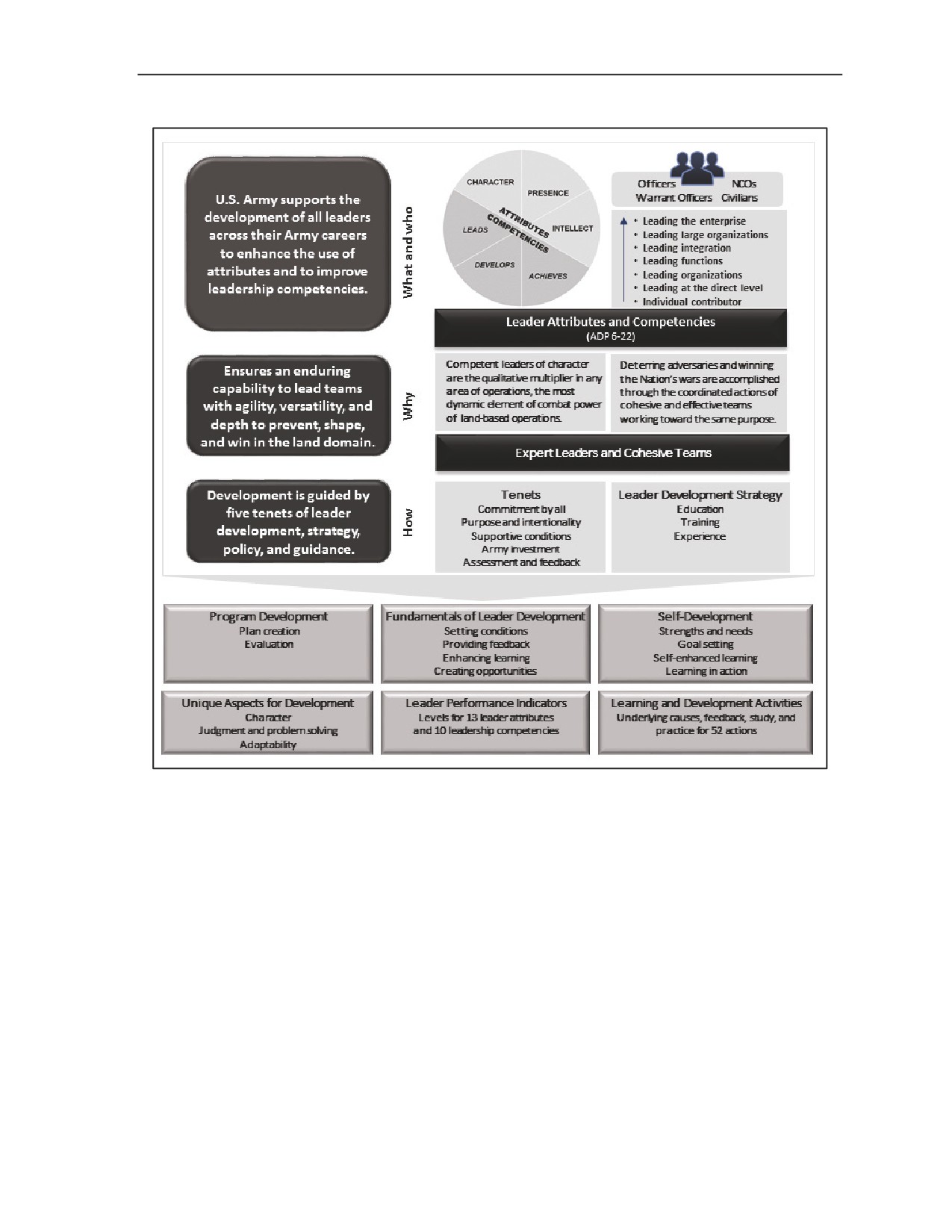
Introductory figure 1 illustrates how the information within this manual fits together.
vi
FM 6-22
-XQH
Introduction
Introductory Figure 1. Integrating diagram
-XQH
FM 6-22
vii
Chapter 1
Leader Development
1-1. The Army depends upon itself to develop adaptable leaders able to achieve mission accomplishment
in dynamic, unstable, and complex environments. A robust, holistic leader development program is essential.
Through a mix of education, training, and experience, Army leader development processes produce and
sustain agile, adaptive, and innovative leaders who act with boldness and initiative in dynamic, complex
situations to execute missions according to doctrine, orders, and training. Furthermore, it also produces
leaders that possess the integrity and willingness to act in the absence of orders, when existing orders, doctrine
or their own experience no longer fit the situation, or when unforeseen opportunities or threats arise. Properly
designed leader development programs develop trusted leaders of character, competence, and commitment.
The goal is to develop Army leaders who clearly provide purpose, direction, motivation, and vision to their
teams and subordinates while executing missions to support their commander’s intent. Leaders at all levels
need to be prepared to understand the strategic context for execution and success of any mission.
1-2. Leader development is fundamental to our Army—leader development is the deliberate, continuous,
sequential, and progressive process—founded in Army values—that grows Soldiers and Army Civilians into
competent and confident leaders capable of decisive action. Leader development is achieved through the life-
long synthesis of the knowledge, skills, and experiences gained through the training and education
opportunities in the institutional, operational, and self-development domains (AR 350-1). A key component
of leader development is remaining focused on the professionalism of our leaders and those they lead. By
developing and promoting a professional force, the Army develops trust on several levels: between Soldiers;
between Soldiers and leaders; between Soldiers and Army Civilians; between the Soldiers, their families and
the Army; and between the Army and the American people. This is why the Army is committed to providing
quality institutions of education and training along with challenging experiences throughout a career.
TENETS OF ARMY LEADER DEVELOPMENT
1-3. The tenets of Army leader development provide the essential principles that have made the Army
successful at developing its leaders. The tenets also provide a backdrop for the Army principles of unit
training (see ADRP 7-0). The overarching tenets of Army leader development are—
z
Strong commitment by the Army, superiors, and individuals to leader development.
z
Clear purpose for what, when, and how to develop leadership.
z
Supportive relationships and culture of learning.
z
Three mutually supportive domains (institutional, operational, and self-development) that enable
education, training, and experience.
z
Providing, accepting, and acting upon candid assessment and feedback.
1-4. Development of people is an Army priority. Commitment represents intention and engagement from
the individual, from supportive leaders, and from the Army. Beyond their directed responsibility to develop
subordinates, leaders want to serve in an organization that values camaraderie and teamwork and improves
the capabilities of others. Leaders have a directed responsibility to develop their subordinates; accountability
for implementation follows responsibility. Leaders must be committed to the development of others and
themselves. Teams change and organizations change when individuals choose to engage and improve.
1-5. Development depends on having clear purpose for what, when and how to develop. Good leader
development is purposeful and goal-oriented. A clearly established purpose enables leaders to guide, assess,
and accomplish development. The principles of leader development describe goals for what leaders need to
be developed to do: leading by example, developing subordinates, creating a positive environment for
learning, exercising the art and science of mission command, adaptive performance, critical and creative
thinking, and knowing subordinates and their families. The core leader competencies and attributes identified
-XQH
FM 6-22
1-1
Chapter 1
in ADRP 6-22 and the Army Leader Development Strategy (ALDS) provide additional detail of what leaders
need to be able to do.
1-6. Supportive relationships and a culture of learning recognize that for development to occur a willingness
to engage with others must exist. This tenet relates to two of the principles of leader development: creating a
learning environment and knowing subordinates and their families (see ADRP 7-0). Leaders, organizations,
and the entire Army must set the conditions for development to occur. Leader development is a mindset
incorporated into all organizational requirements and mission accomplishment. Leaders must balance leader
development against organizational requirements and mission performance. In operational units and other
organizations, development can occur concurrently with training and mission performance, especially when
leaders create an environment that places real value and accountability on leader development activities and
the Soldiers and civilians to be developed.
1-7. Development occurs through both formal systems and informal practices. Reception and integration,
newcomer training, developmental tasks and assignments, individual and collective training, educational
events, transition or succession planning, and broadening are all activities where development occurs and
should be encouraged. Development involves experiential learning that is consistent with the principle of
train as you fight. The performance of duties is always an opportunity for learning while doing. Any
experience that shapes and improves performance enhances development.
1-8. Feedback is necessary to guide and gauge development. Formal and informal feedback based on
observation and assessment provide information to confirm or increase self-awareness about developmental
progress. The Army established performance monitoring, evaluation reports, coaching, mentoring, and
growth counseling processes to engage leaders and individuals. Each is essential for development.
THE CHALLENGE FOR LEADER DEVELOPMENT
1-9. The Army must develop leaders comfortable making decisions with available information and
prepared to underwrite the honest mistakes subordinates make when learning. These same leaders must also
be capable of developing others to be adaptive, creative, professional, and disciplined to execute any mission.
Leaders should place emphasis on holistic programs that range across grades from enlisted through senior
officers and the Army Civilian Corps.
1-10. Developing leaders involves a holistic, comprehensive, and purposeful group of activities. More than
any set of activities, success stems from a culture where leaders with a mindset and passion for developing
others use daily opportunities to learn and teach. Leader development occurs at home station, in offices,
laboratories, depots, maintenance bays, during exercises, and while deployed. Limited day-to-day interaction
with their units and subordinates challenges Reserve Component leaders. At the same time, they benefit from
the civilian skills of their subordinates. Reserve Component leaders should use the experience and leadership
acquired by their Soldiers from their civilian careers and develop strategies that can be executed on-duty and
off, keeping in mind the balance that must be achieved between their subordinate’s Army duties, civilian
position, and family life. For all cohorts, the Army must sustain the continuous development of future leaders.
1-11. Successful leaders recognize that they must continually develop their subordinates by maximizing
opportunities in the institutional, operational, and self-development domains. It is critical to the long-term
sustainment of the Army. Leaders are responsible for ensuring their organizations develop subordinates,
perform missions, apply doctrinally sound principles in training, and exercise stewardship of resources.
Along with responsibility comes accountability. Accountability speaks to two levels: leaders held
accountable for how well they have developed their subordinates and individuals held accountable for their
own professional development.
1-12. The ALDS lays out the Army's vision, mission, and framework for leader development. The strategic
vision emphasizes competence, commitment, character, skills, and attributes needed by Army leaders to
prevail in unified land operations and leading the Army enterprise. The Army's leader development mission
relies on training, education, and experience components to contribute to the development of leaders. The
ALDS also identifies the ends, ways and means for the leader development process. Will and time applied to
development are the essential means for success, and this is why a professional culture and individual
mindsets committed to development are important. The ALDS starts with leaders at all levels understanding
their responsibility for developing other leaders and themselves and creating conditions that provide the
1-2
FM 6-22
-XQH
Leader Development
opportunities for teaching, training, and providing developmental experiences. The ALDS integrates leader
development domains with the training, education and experience lines of effort to show how leaders can be
prepared through diverse, aligned activities. The desired ends are leaders developing and improving to meet
the expectations identified in the Army leadership requirements model.
LEADERSHIP REQUIREMENTS
1-13. An Army leader, by virtue of assumed role or assigned responsibility, inspires and influences people
to accomplish organizational goals. Army leaders motivate people both inside and outside the chain of
command to pursue actions, focus thinking, and shape decisions for the greater good of the organization
(ADP 6-22). These occur through leadership--the process of influencing people by providing purpose,
direction, and motivation to accomplish the mission and improve the organization (ADP 6-22). The nation
and the Army has articulated the expectations of leaders in the Army. The Army leadership requirements
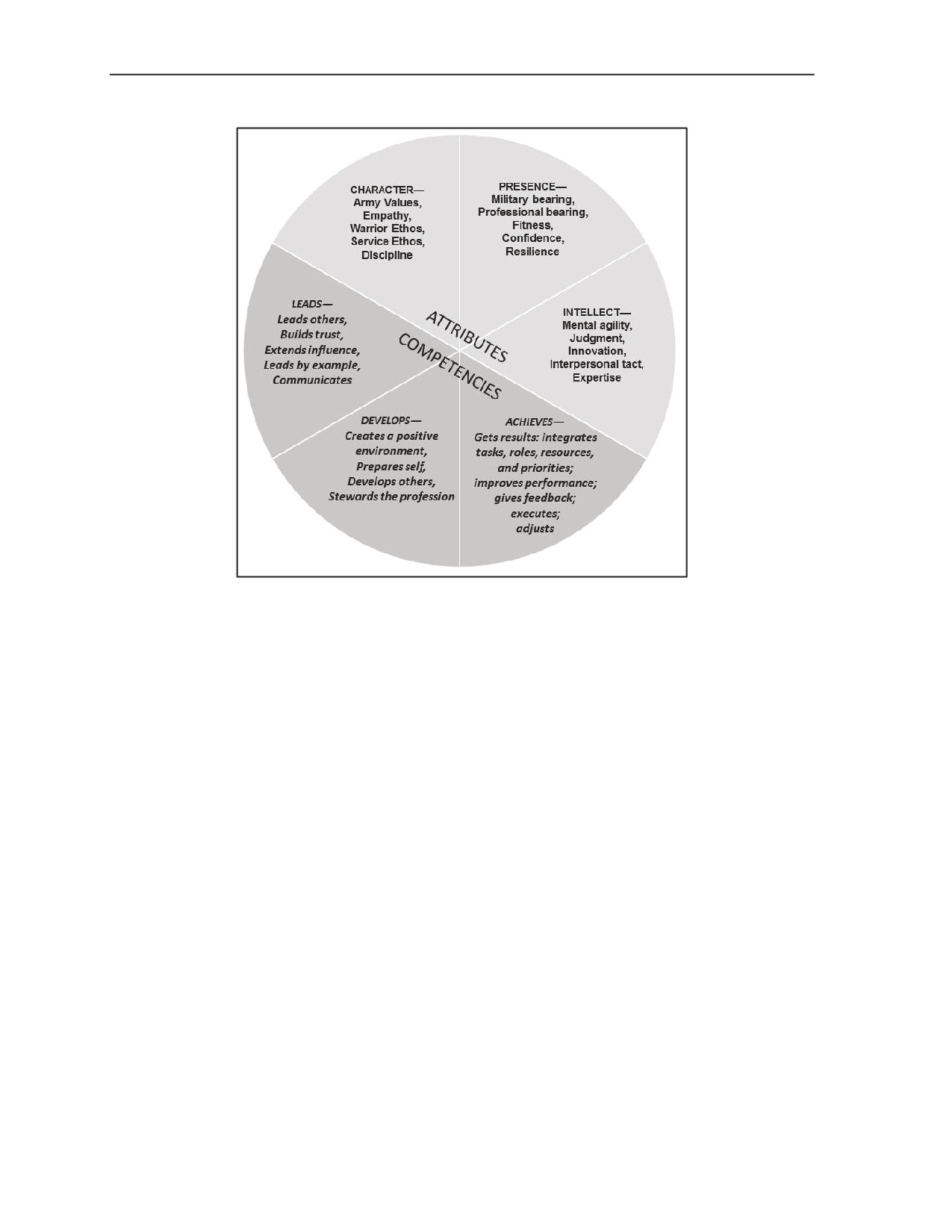
model (see figure 1-1 on page 1-4) illustrates expectations of every leader, whether military or civilian, officer
or enlisted, active or reserve. This model aligns the desired outcome of leader development activities and
personnel practices to a common set of characteristics valued throughout the Army. It covers the core
requirements and expectations of leaders at all levels of leadership. Attributes are the desired internal
characteristics of a leader—what the Army wants leaders to be and know. Competencies are skills and
learnable behaviors the Army expects leaders to acquire, demonstrate, and continue to enhance—what the
Army wants leaders to do.
1-14. The competency of getting results requires special mention to counter beliefs that only the end result
matters. While the other elements in the model address enablers, conditions, and processes, the achieves
category is where leadership is most direct and most challenging. The actions for gets results integrate all
other components in a way that brings people, values, purpose, motivation, processes, and task demands
together to make the difference in outcomes related to the mission. The integrating actions of this competency
also affect all other attributes and competencies. Getting results must simultaneously address improvements
to the organization, Soldier and civilian well-being and motivation, adjustments due to situational changes,
ethical mission accomplishment, and so on. All the competencies and attributes together lead to trust between
the leader and the led, trust that lays the foundation for mission command and effective teamwork.
-XQH
FM 6-22
1-3
Chapter 1
Figure 1-1. Army leadership requirements model
1-15. The leadership requirements and principles of mission command are mutually supportive.
Understanding and practicing the principles of mission command are imperative for all leaders: officers,
warrant officers, noncommissioned officers (NCOs), and Army Civilians. Mission command is the exercise
of authority and direction by the commander using mission orders to enable disciplined initiative within the
commander’s intent to empower agile and adaptive leaders in the conduct of unified land operations (ADP
6-0). While commanders exercise mission command, the actions of subordinates influence effectiveness.
1-16. Through practices in all domains of leader development, the philosophy of mission command becomes
ingrained in the Army’s ethos and culture. Army leaders, Soldiers, and Civilians at every echelon throughout
the operating force and the institutional Army apply mission command principles in the conduct of routine
functions and daily activities.
1-17. To best prepare leaders for the uncertainty associated with Army operations, leaders must develop and
create opportunities to understand and become proficient in employing the mission command principles. This
development requires continual assessment and refinement throughout the individual’s service. Leaders who
fail to assess or develop their people or teams will not have prepared them to take disciplined initiative.
Additionally, the leaders will not understand what individuals and teams are capable of doing and will not be
in a position to capitalize on using mission orders.
1-18. Army leaders exercise mission command. Table 1-1 shows the linkage between the principles of
mission command and the competencies and attributes of Army leaders in the leadership requirements model.
Leader development activities must maintain the vision of developing leaders to execute mission command.
1-4
FM 6-22
-XQH
Leader Development
Table 1-1. Principles of mission command linkage to Army leadership requirements
Principles of
Army Leadership Requirements (ADRP 6-22)
Mission Command
Develops others—builds effective teams.
Builds trust—sets personal example; sustains a climate of trust.
Build cohesive
Demonstrates the Army Values and decisions consistent with the Army Ethic.
teams through
Leads others—balances subordinate needs with mission requirements.
mutual trust
Extends influence beyond the chain of command—builds consensus and resolves
conflict.
Creates a positive environment—fosters teamwork.
Communicates—creates shared understanding.
Demonstrates interpersonal tact—interaction with others.
Leads others—provides purpose, motivation, and inspiration.
Create shared
Extends influence beyond the chain of command--uses understanding in
understanding
diplomacy, negotiation, consensus building.
Builds trust—uses appropriate methods of influence to energize others.
Creates positive environment--supports learning.
Gets results—designates, clarifies and deconflicts roles.
Leads others—provides purpose.
Provide a clear
Communicates—employs engaging communication techniques.
commander’s intent
Gets results—prioritizes taskings.
Leads others—influence others to take initiative.
Demonstrates the Army Values—duty.
Exercise disciplined
Demonstrates self-discipline—maintains professional bearing and conduct.
initiative
Demonstrates mental agility—anticipates uncertain or changing conditions.
Gets results—accounts for commitment to task.
Leads others—provides purpose without excessive, detailed direction.
Use mission orders
Develops others—expands knowledge.
Gets results—executes plans to accomplish the mission the right way.
Leads others—assesses and manages risk.
Accept prudent risk
Gets results—identifies, allocates, and manages resources.
Stewardship—makes good decisions about resources.
COHESIVE AND EFFECTIVE TEAMS
1-19. Teams are an essential configuration of how people come together to accomplish missions. In the
Army, teams occur throughout every structure level of the organization. The Army as a whole is teams of
teams. It begins with buddy teams--two military members who look after each other in a variety of positions
and environments. The missions of the Army demand that leaders and teams be developed and ready. It is
proven that a team is more effective than an individual when members work together, using their unique
skills, experiences, and capabilities. The Army leadership competency categories cover how Army leaders
lead; develop themselves, their subordinates, and organizations; and bring efforts together to achieve results.
Army leaders are charged with developing others and conducting team building. Holistic leader development
programs contribute to unit cohesion, resilience, and agility by producing leaders and teams that are creative,
life-long learners, adaptable, and capable of exercising mission command.
1-20. The mission command philosophy helps to set the conditions for developing teams. Creating a shared
understanding is the first step and most important in developing a team. It gives the team a unifying purpose.
The leader sets the tone; in a team-focused climate, members understand how they contribute to the overall
success of the organization. Knowing the ‘why’ drives each action taken. Developing an overall sense of
team and building an effective high quality team are two separate actions that should be parts of the overall
leader development program. The goal of team building is to improve the quality of the team and how it
works together to accomplish the mission.
-XQH
FM 6-22
1-5
Chapter 1
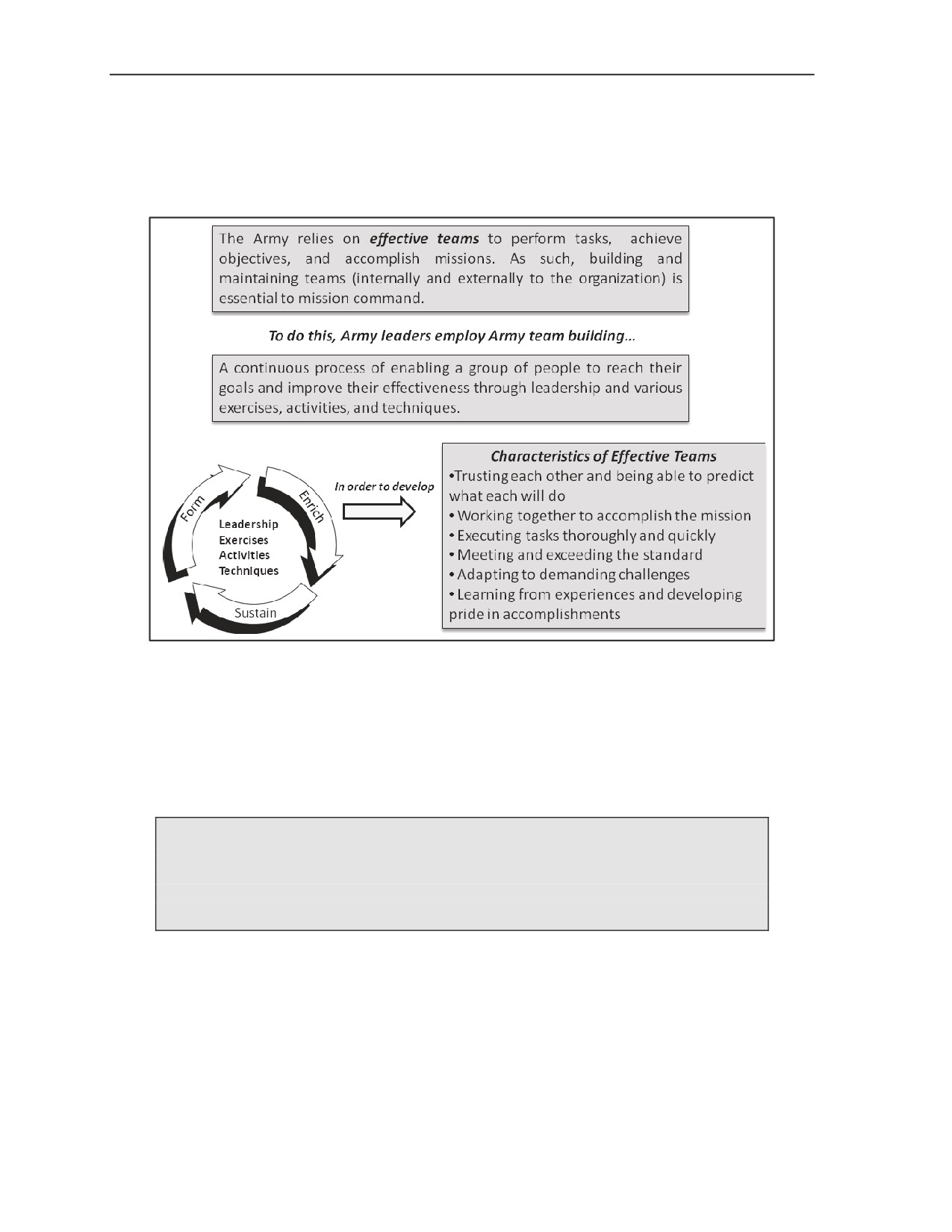
1-21. The Army relies on effective teams to perform tasks, achieve objectives, and accomplish missions.
Building and maintaining teams that operate effectively is essential to both internal and external
organizations. To do this, Army leaders employ Army team building, a continuous process of enabling a
group of people to reach their goals and improve their effectiveness through leadership and various
exercises, activities, and techniques. Figure 1-2 outlines the Army team building process.
Figure 1-2. Army team building process model
1-22. Three qualities measure good teamwork: identity, cohesion, and climate. Team identity develops
through a shared understanding of what the team exists to do and what the team values. Cohesion is the unity
or togetherness across team members and forms from mutual trust, cooperation, and confidence. Teamwork
increases when teams operate in a positive, engaging, and emotionally safe environment. An engaging
environment is one where team members desire to work together on required missions; they feel a sense of
self-worth and they are accomplishing something more important than they are. A safe environment occurs
when team members feel they can be open and are not threatened by unwarranted criticism.
Team building
From a first sergeant: Team building is a vital part of the Army because Soldiers need
to feel as though they are a part of a team if they are going to be willing to fight and die
for a teammate and their country. Soldiers need to learn their position and responsibility
within that team.
1-23. Teamwork fosters open communication, improves professional relations, and contributes to unit
motivation and building trust. Teamwork pulls together the knowledge and experience of a diverse group of
people to accomplish the mission. Knowing the elements of effective teams and developing teamwork helps
leaders assemble the team, orient them, create an identity, cultivate trust, engage in solving problems, manage
processes, regulate team dynamics, and deliver results to other organizations and stakeholders. High
performing teams enforce high standards and hold each other accountable for their actions and their level of
performance or output. Motivation and discipline are keys to teams that surpass normal expectations. Table
1-2 compares characteristics of effective teams and ineffective teams. Time management and prioritization
of effort are important for self and team discipline. Teams that find themselves continually operating in a
crisis management mode need to break out of the cycle with better prioritization, effective delegation and
1-6
FM 6-22
-XQH
Leader Development
dedicated time for planning. See Army doctrine on team building and the Virtual Improvement Center for
specific techniques.
Table 1-2. Signs of ineffective and effective teams
Ineffective Teams
Effective Teams
Fail to listen to relevant input of a team member.
Emphasize what is common among members
Speak despairingly about other members.
rather than focus on characteristics that could
cause subgroups to form.
Fail to enforce or encourage discipline in the team.
Hold a shared vision about operating as a team.
Compete, rather than cooperate, with other team
members.
Share information that may be useful to other team
members.
Argue with other team members in front of
counterparts or other individuals.
Ensure team members periodically engage in
group activities (such as sports, meals, or
Fail to act or make decisions on issues that have
other off-duty activities).
implications for the team.
Act quickly to promote togetherness when schisms
Focus more on self-interest than the well-being of
in the group appear or morale drops.
the team.
Show appreciation and concern for team members.
Give less than full effort because of low morale or
lack of confidence in other team members.
Act as a team instead of individuals; take pride in
team accomplishments.
1-24. The mental dimension is an often overlooked part of teaming and team building. Shared cognition of
teamwork includes learning, situational understanding, and critical thinking; motivation is common to all.
The leader has a role in building team capacity in each area.
1-25. Teams that have a positive learning culture are eager to understand new areas and current situations.
High performance teams are motivated to be inquisitive, to find better ways of doing their work, to acquire
new information, and to create new knowledge. Leaders can establish a culture of learning by making
learning part of the team's goals. Leaders can build up beliefs in the power of learning by how they
demonstrate the value of learning to them personally and how they make learning interesting. Leaders can
trigger learning by calling for reflection on shared events and individual experiences.
1-26. Teams that thoroughly engage in active situation assessment and understanding will have the best
information available to work on required tasks. Asking questions and sensemaking are valuable processes
for teamwork. Sensemaking is a process of creating meaning of an experience through discussion. Individual
experiences and insights have greater value through a collaborative situation assessment. The depth of
understanding achieved is pivotal in how the team handles complex problems. Developing accurate
assessments and the ability to make precise distinctions comes from teams that are motivated to practice at
discussing problems critically.
GROWTH ACROSS LEVELS OF LEADERSHIP AND BY COHORTS
1-27. Leaders develop the confidence, leadership, and the competence needed for more complex and higher-
level assignments through education, training, and experience gained throughout a career. The Army balances
education, training, and experience to develop leaders at all ranks and in all cohorts (officer, warrant officer,
NCO, and Army Civilian). While the core leader competencies and attributes remain the same across levels,
fine points in application and of expectations change. See ADRP 6-22 for discussions on leadership at the
direct, organizational, and strategic levels.
1-28. The processes and expectations for each cohort are similar, while the outcomes are slightly different.
Grounded in the Army Values, the Army expects all cohorts to be resilient, adaptive, and creative throughout
careers of service to the Nation.
1-29. The Army develops officers, at all echelons, to understand and practice the mission command
philosophy to lead and execute unified land operations. The Army expects officers to integrate leader
development practices with collective and individual training to accomplish the Army’s missions and develop
subordinates for future responsibilities. They routinely operate at direct-level interactions with others and
work at the organizational and strategic levels to plan, prepare, execute, and assess leader development
policies, systems, and practices. Warrant officers serve at all echelons as the primary integrators and
-XQH
FM 6-22
1-7
Chapter 1
managers of Army systems. They bring an unequalled depth of knowledge, experience, and perspective in
their primary areas of expertise. Warrant officers, at all echelons, understand and practice the mission
command philosophy to execute unified land operations. See DA PAM 600-3 for descriptions of the full
spectrum of developmental opportunities throughout a career.
1-30. NCOs are responsible for setting and maintaining high-quality standards and discipline while
conducting daily missions and making intent-driven decisions. NCOs serve as standard-bearers and role
models vital to training, educating, and developing subordinates. Through training, coaching, mentoring,
counseling, and informal interaction, they guide the development of Soldiers in an everyday basis and play a
role in the development of junior officers. NCOs, at all echelons, understand and practice the mission
command philosophy to execute unified land operations. NCOs advise officers at all levels and are an
important source of knowledge and discipline for all enlisted matters. See DA PAM 600-25 for professional
development opportunities.
1-31. Army Civilians provide crucial continuity that complements the roles of Soldiers. Army Civilian
leaders require a broad understanding of military, political, and business-related strategies, as well as, high
levels of managerial, leadership, and decision-making skills. Army Civilians create and practice leader
development for other Army Civilians and support the development of military personnel while serving as
supervisors, mentors, and instructors. At all echelons, Army Civilians should understand and exercise the
mission command philosophy while providing mission-based capabilities to support Army missions. See
DOD Instruction 1430.16 and AR 690-950 for specifics.
TRANSITIONS ACROSS ORGANIZATIONAL LEVELS
1-32. Cultural and individual mindsets that promote continuous learning are the cornerstone for creating and
sustaining an agile Army. Through activities in the institutional, operational, and self-development domains,
personnel obtain education, training, and experiences in order to grow and be able to succeed at positions of
greater responsibility. As Army leaders progress in leadership responsibilities, it is necessary for them to
develop new mindsets and to refine how they will lead at the next level.
1-33. Understanding key shifts in requirements across the progression of levels, helps individuals prepare
for what may be ahead of them and helps prepare others to acquire capabilities for their next level. For the
Army, the refinement of requirements across levels helps with management of talent. The Army provides
opportunities for developmental experience before assigning leaders to positions of greater responsibility.
1-34. The timing of development is especially important in the military because personnel join and move
through a series of alternating and progressive education, training, and operational experiences. The approach
applies to Army Civilians as well; however, Army Civilians understand that federal service does not program
advancement opportunities for most positions. Army Civilians move across positions based on the governing
regulations and laws relating to applying for and filling vacated or newly created positions. Ideally, the best
of the direct-level leaders are developed into organizational level leaders and ultimately into strategic and
enterprise level leaders.
1-35. A clear framework of leadership requirements provides leaders the basis to assess their strengths and
developmental needs and to determine goals for improvement. Created through lengthy study and practice,
the Army’s leadership requirements model (see figure 1-1) specifically provides leaders with an enduring set
of attributes and competencies expected of them. The model provides a consistent reference point throughout
the progression of professional and personal development. Leaders must improve in all the leader
competencies, become more knowledgeable about the way the military operates, and understand how to
operate in complex geopolitical situations. In addition to the leadership requirements model, leaders must
grow in their ability to understand, visualize, describe, direct, lead, and assess under differing conditions that
change at each level of leadership. As leaders progress, they will experience greater challenges based on the
scope of the situation, the consequences and risks involved, and the time horizon. As the scope increases, the
number of people and outside parties involved also increases. The consequences of decisions increase, as do
the risks that leaders must address. The length of time that leaders’ decisions apply tend to increase at higher
levels as well as the time over which leaders can apply influence.
1-36. Transitioning to the next stage in a career can be difficult, regardless of demonstration of performance
and potential at prior levels. When moving into new positions with different demands, individuals may not
1-8
FM 6-22
-XQH
Leader Development
perform at a previous high level. Individuals must have a developmental mindset to improve what is within
their capability and be motivated to do their best. The Army endorses a culture where individuals continually
strive to learn, broaden personal skills, and improve regardless of whether such efforts lead to promotion.
1-37. For military leaders there are six transition points spanning the full range of organizational levels. The
changing requirements across levels are illustrative of the relative amount of emphasis needed on certain
skills or attributes. Not all levels and transitions apply to all cohorts, military fields, or functions and there
will be positions that do not fit neatly into the model. For Army Civilians, there are similar transition points,
each of which requires additional leadership skills at progressive levels of responsibility. Personnel begin by
managing themselves. Leading and preparing self is something that remains through the entire process no
matter where one enters and exits the leadership continuum. In this role of leading self, the individual is
primarily a follower. Self-management and self-preparation are important steps in preparing for the initial
leadership responsibilities. Six transitions that apply to Army organizations are--
z
Leading at the direct level. Initial-entry Soldiers and civilians transition from a focus on self to
providing direct leadership to others. Junior leaders learn how to plan daily tasks and activities,
understand organizational constructs, and how to interact with subordinates, peers, and superiors.
z
Leading organizations. The second transition occurs when leaders begin to lead at the
organizational level. This level begins at company, battery, troop, staff, and similar organization
levels for Army Civilians. Direct level leadership still occurs at this level, but the leaders become
leaders of leaders and will rarely be performing individual tasks, unless out of emergency or in
undermanned organizations. Coaching subordinate, direct-line leaders and setting a positive
example as a leader are two characteristics that stand out for managers.
z
Leading functions. The third transition is from leading an organization (as a leader of direct-line
leaders) to leading functions. This level involves directing functions beyond a single individual’s
experience path. Operating with other leaders of leaders and adopting a longer-term perspective
are key characteristics of this phase. Functional leaders typically include majors, mid-level warrant
officers, and mid-level NCOs.
z
Leading integration. A fourth transition occurs when leaders assume command and leadership
responsibility for battalion and similar sized generating force organizations. These leaders must
become more adept at establishing a vision, communicating it, and deciding on goals and mission
outcomes. They need to find more time for reflection and analysis and value the importance of
making trade-offs between future goals and current needs. Positive attitudes related to trust,
accepting advice, and accepting feedback will pay dividends during this phase and into the future.
z
Leading large organizations. A fifth transition happens when leaders operate at the brigade-
equivalent and higher levels of operational and institutional organizations. These leaders develop
strategy for organizational and strategic-level operations. They are operating outside of their
experience paths while leading others operating beyond theirs as well. Leaders in this phase will
only be successful by valuing the expertise and success of others and operating within the multiple
layers of their organization. Humility is a desired characteristic of organizational and strategic
leaders who should recognize that others have specialized expertise indispensable to success. A
modest view of one's own importance helps underscore an essential ingredient to foster
cooperation across organizational boundaries. Even the most humble person needs to guard against
an imperceptible inflation of ego when constantly exposed to high levels of attention and
opportunities.
z
Leading the enterprise. A final step occurs in the transition to serving as an enterprise leader.
Enterprise leaders must be long-term, visionary thinkers who spend considerable time interacting
with agencies beyond the military. This level of leader must be willing to relinquish control of the
pieces of the enterprise to strategic and lower-level leaders.
-XQH
FM 6-22
1-9
Chapter 2
Program Development
2-1. Leader development occurs for the benefit of both individuals and the organization. The Army is
known for its success in developing leaders rapidly. Multiple leader development opportunities occur in
organizations, though not always used for their learning value. Without intent, plans, or a program for leader
development, organizational emphasis on learning is based on commander interest and unit climate. Leader
development programs leverage the opportunities for development to address individual and organizational
goals for development.
2-2. Commanders are responsible for training and leader development in their units and for providing a
culture in which learning takes place. They must deliberately plan, prepare, execute, and assess training and
leader development as part of their overall operations. Commanders and leaders must integrate leader
development into their organizational training plans or leader development programs.
2-3. Developing Army leaders at all levels, military and civilian, is the best means to ensure the Army can
adapt to the uncertainties the future holds. Individuals who feel that the Army and their leaders are interested
in them are motivated to demonstrate greater initiative and to engage fully in leader development. Leader
development programs that are individualized and that have a multi-leveled aspect are the most effective.
The content of leader development programs need to account for the individual’s levels of competence,
character, and commitment.
2-4. Organizational leader development plans must nest in purpose and guidance of the higher
organization’s plan. Plans should be consistent with Army enterprise concepts, strategy, and guidance on
leader development. Leader development plans should provide guidance to subordinate units yet allow them
freedom to determine practices and schedules most conducive to their missions. Plans up and down an
organizational structure need to align to create synergy and unity of effort. A battalion leader development
plan or equivalent-sized unit will identify specific processes supporting leader development. Generating force
organizations headed by a colonel or similar ranking Army Civilian are a good target for leader development
plans that detail specific processes. The battalion plan should anticipate the needs of and execution by its
subordinate units.
2-5. Variations in programs will occur across echelons depending on the type and size of the organization.
For example, a division has greater latitude in selecting leaders for special assignments than does a battalion
due to the wider scope of opportunities and larger number of leaders. A Reserve Component unit has fewer
training days to plan and schedule team building events, so there may be a greater role for self-development
and mentoring. Detached and dispersed units have fewer organic assets to prepare and conduct special events
but may have access to external opportunities, such as a training detachment on a university campus.
2-6. The Army holds commanders accountable for unit leader development by regulation (see AR 350-1).
Accountability can be included as part of the organizational inspection program
(see AR 1-201).
Responsibility for leader development cuts across all leader and staff roles. Some examples of roles and
responsibilities for developing leaders are—
z
Each leader develops subordinates.
z
The senior warrant officer, noncommissioned officer, and civilian leaders take ownership for their
cohorts’ leader development in the organization.
z
Each leader (as well as those who aspire to positions of leadership) takes responsibility for their
own leader development.
2-7. The next-higher echelon commander, human resources and operations staff, and senior cohort leaders
must clarify leader development roles and responsibilities. These individuals directly and indirectly affect
the efficiency and effectiveness of leader development.
-XQH
FM 6-22
2-1
Chapter 2
DELINEATING RESPONSIBILITIES
Efficient implementation of leader development programs depends on a clear
definition and allocation of responsibilities across leaders and staff both in and
outside the organization. Develop a matrix to document notes on the roles and
responsibilities for developing leaders in the organization.
UNIT LEADER DEVELOPMENT PROGRAMS
2-8. Leader development is a mindset and process, not merely an event, reflected by everything leaders do.
An opportunity for leader development exists in every event, class, assignment, duty position, discussion,
physical training formation, briefing, and engagement. Leader development is a continuous and purposeful
process. It is an ongoing process intended to achieve incremental and progressive results over time. Chapter
3 covers the fundamentals of implementing the process to create a leader development culture and to promote
a mindset for leader development.
PLAN CREATION
2-9. Various types and echelons of commands and organizations label their leader development guidance
with different descriptions such as strategy, philosophy, policy, memorandum, plan, or standing procedure.
The title and format are less important than having a good plan—one that aligns with the tenets of leader
development: committed organization; clear purpose; supportive learning culture; enabler of education,
training, and experience; and feedback. The plan helps to inspire and guide the organization to engage in
leader development. Plans that incorporate leader development into daily operations without creating extra
events will be well received and have the greatest chance for effective implementation. The imperative of
having a plan is to bring attention to leader development, provide focus and purpose, encourage the mindset,
set the conditions, show how development should occur, and coordinate efforts across the organization.
2-10. Developing a leader development plan follows the same steps used in the operations process (see ADP
5-0). Planning involves understanding a situation, envisioning a desired future, and planning effective ways
of achieving that future. The plan should allow for disciplined initiative by subordinate units and individual
leaders. A leader development plan is specific because the outcomes need to address both organizational and
individual goals as well as both short-term and long-term goals. The long-term focus extends beyond a
military commander’s tour and beyond the military personnel’s time in the unit. Most Army Civilian leaders
are not reassigned based on time, though leader development plans similar to those in operational units can
serve their needs. Once the commander’s visualization is described and the plan is developed, it directs
preparation and execution of the unit’s leader development program. The commander and unit leaders lead
the execution of the program and assess its progress. The leader development program will create change in
the organization and in individuals—it is a living document. As the program creates change and as leaders
develop, the plan can be updated.
Understand
2-11. To aid in understanding, command teams can use formal assessments such as command climate
surveys, unit Multi-Source Assessment and Feedback (MSAF) 360 assessments, training center after action
review (AAR) take-home packages, and command inspection program results to focus on conditions
indicating unit strengths and developmental needs. The command team takes these various sources of
information along with their own observations and discussions with subordinates and colleagues to determine
an appropriate focus.
2-2
FM 6-22
-XQH
Program Development
ASSESSMENT CONSIDERATIONS
Planning a holistic leader development program starts with an assessment.
Leaders gain the information needed to shape and inform an assessment
from multiple external and internal sources. These are some sources for
leaders to consider when developing an assessment:
External:
Review the Army Leader Development Strategy, Army Campaign Plan, and
command guidance.
Meet with personnel who focus on the organization’s well-being such as
the higher headquarters’ chaplain, Staff Judge Advocate, Inspector
General, other staff, and support agencies.
Review higher headquarters’ leader development guidance, programs, and
plans.
Review prior command inspection program results.
Internal:
Mission essential task list assessment.
Exercise or deployment results and after action reviews.
Operational and training exercise performance records.
Upcoming events or training calendars.
Organizational climate surveys.
Multi-Source Assessment and Feedback unit rollup report.
Personnel roster and personnel qualification records.
Personal assessment of subordinates’ education and experience.
Social media.
Tour work areas and facilities.
Evaluations and support forms.
Initial counseling feedback.
Individual development plans.
2-12.
The leadership team may not always have existing formal assessments to use. Additionally, the unit
mission or composition may change so those sources may no longer apply. In these cases, leaders align goals
with their observational assessments and any changes to organizational mission and goals.
One source to determine an organizational developmental baseline is to schedule and complete a
unit-level MSAF event. The unit rollup report provides information on organizational leadership
strengths and developmental needs that can focus planning and identifying developmental
priorities. In addition, assessed leaders receive an individual feedback report highlighting personal
leadership strengths and developmental needs. Individuals can use this information to develop
their individual development plan (IDP). During periodic developmental counseling sessions,
leaders can review subordinate IDPs to gain insight on current developmental priorities and
possible program improvements.
Visualize
2-13. There are several sources to inform decisions about setting the desired future end states for leader
development. For the philosophy aspects, the team can examine the ALDS, Army Campaign Plan, and the
intent in higher and sister organization’s leader development plans. The most important and enduring
outcomes are stated in a statement of vision or intent, depending on the preference of the commander.
2-14. An organizational leader development plan establishes the goals for specific end states. Each leader
development plan has four mutually supporting purposes. The leader of each organization has a designated
-XQH
FM 6-22
2-3
Chapter 2
responsibility to 1) accomplish the mission, 2) improve the organization, 3) enable personnel to be prepared
to perform their current duties and 4) develop leaders for future responsibilities and other assignments.
Different from unit training plans, the leader development plan addresses long-term outcomes for individuals
and the organization (see table 2-1).
Table 2-1. Goals and end states of the leader development plan
Individual
Organization
Short-term outcomes
Improve personnel capabilities for unit duties
Accomplish the mission
Long-term outcomes
Increase personnel capabilities beyond current
Improve the organization
assignment
2-15. Outcomes should address at least these four areas. The planning and execution of the leader
development program is a responsibility of the leaders in the organization and the individual. The vision or
intent helps to focus and synchronize the leader development actions across the organization to achieve the
greatest effects.
Leaders who recognize and approach leader development as a process are able to balance the long-
term needs of the Army, the short-term and career needs of their subordinates, and the immediate
needs of their organizations to determine how and when to integrate leader development
opportunities in already-busy schedules
Plan
2-16. To start a plan, the leadership team goes through a conceptual process to consider how to achieve its
desired end state. The end state and enduring purpose help guide the detailed phase of planning that involves
the selection of activities to emphasize in the unit’s program.
Leaders with a mindset, clear-cut vision, and a passion for developing others, themselves, and
teams are the most important elements of a successful leader development program. They
capitalize on every opportunity.
2-17. The activities cover both unit and individual development for short-term and long-term development.
The following factors provide ways to structure a plan:
z
Phases of a leader’s cycle within a unit.
Reception.
Integration.
Utilization.
Assignment rotation within the unit.
Transition.
z
Unit cycles.
Sustainable readiness model.
Deployment schedule.
Green-amber-red time management and training cycles.
z
Cohort programs.
Sergeant’s time.
Preparation for Soldier and sergeant excellence boards.
NCO professional development.
Warrant officer professional development.
Officer professional development.
Command team.
Civilian leader development seminars.
Combined leader development programs.
2-4
FM 6-22
-XQH
Program Development
z
Developmental focus—common core for the team and all leaders.
Essential characteristics of the profession (see ADRP 1).
Command climate (see AR 600-20).
Mission command principles (see ADRP 6-0).
Core leadership competencies (see ADRP 6-22).
Core leader attributes (see ADRP 6-22).
Performance qualities, such as adaptability, resilience, versatility, creativity.
Core unit mission and functions.
z
Developmental focus—career paths for groups of leaders.
Career leadership responsibilities (see DA PAM 600-3, DA PAM 600-25, Army Civilian
Training, Education, and Development System (ACTEDS)).
Career Management Field.
Functional area.
Army Civilian Career Programs.
2-18. Successful programs integrate formal, semiformal, and informal practices. Policy or regulation direct
formal techniques. Addressed in doctrine, semiformal activities are commonly practiced and may be required,
but failure to conduct them does not carry punitive consequences. Informal leader development consists of
opportunities with a focus on learning. Table 2-2 lists ways to enable learning. Setting conditions for
development, goal setting, assessments, and advice and counsel all contribute to improved learning. Table 2-
3 on page 2-6 provides additional opportunities and developmental activities. Both tables separate various
techniques into formal, semiformal, and informal categories.
Table 2-2. Enablers for learning
Learning
Formal
Semiformal
Informal
enablers
x
Integration and
x
Understand individual
x
Getting to know and
Setting
reception counseling.
differences in strengths,
understand subordinates.
conditions
x
Initial performance
interests, potential, and
x
Build rapport to enable
counseling.
development methods.
supportive development.
x
Short-term and long-term
x
Individual
personal and professional
Goal setting
x
5-year plan.
Development Plan.
goals.
x
Stretch goals.
x
Performance
x
Organizational certifications.
evaluation.
x
Unit acculturation program.
x
Certifications.
x
Day-to-day observations.
x
Core unit mission and
x
Inspection program.
functions review.
x
Asking others about a
Assessment
x
Command climate.
leader.
x
Multi-Source Assessment and
x
Commander 360°
Feedback-Leader 360° for
x
Sensing sessions.
assessment.
self-assessment.
x
General Officer 360°
x
Unit 360° assessment.
assessment.
x
5-minute feedback.
x
Mentoring.
x
Peer discussions.
x
Performance
x
Coaching.
x
Indirect questioning
Advice and
counseling.
(What have you planned
x
Training center counterpart
guidance
x
Professional growth
or done for your
feedback.
counseling.
development lately?
x
Instructor feedback.
What have done to help a
Soldier today?).
-XQH
FM 6-22
2-5
Chapter 2
Table 2-3. Developmental activities and opportunities
Developmental
Formal
Semiformal
Informal
opportunities
x
Unit succession planning/
x
Opportunities to operate
Talent management:
in unfamiliar situations.
Challenging
x
Broadening
x
Stretch assignments.
x
Broadening tasks,
experiences
assignments.
x
Developmental assignments.
casualty assistance, staff
duty, food service duty.
x
Rotational assignments.
x
Officer professional
development.
x
Professional reading and
x
Leader Training
x
Noncommissioned officer
writing program.
Group leader
Program.
development
professional development.
x
Sharing experiences.
x
After action reviews.
x
Combined events.
x
Excellence competitions.
x
Team building events.
x
Professional military
education courses.
x
Scheduling or supporting
x
Encourage utilization of
Education
x
Functional, branch,
leaders to attend institutional
new skills and knowledge
career program, or
education
of recent graduates.
special training.
x
Self-assessment.
x
Reflective journaling.
Self-
x
Structured self-
x
Guided self-development.
x
Personalized self-
development
development.
development.
x
Study and practice.
x
Incorporate leader
Collective
development goals
x
Shared stories of
x
Team building exercises.
training
and processes into
development.
training objectives.
2-19. From considering the learning enablers and developmental opportunities, the command team will
create a plan for scheduling events. The schedule assists those leading and supporting the execution. The
schedule maintains a reasonable number of activities and direction of emphasis to help ensure quality. Some
events are required, such as performance evaluations and professional growth counseling, and the plan’s
emphasis triggers other activities. The plan should encourage a mindset where leaders take the initiative to
incorporate development into daily activities. Such activities include raising questions in an AAR about what
was learned about leadership or asking leaders what self-development they are doing.
2-20. The leader decides the best method to describe the leader development program, such as annual
concept, quarterly concept with specific events, or theme based. The plan needs to be synchronized with the
overall unit schedule considering the training calendar, significant higher headquarter events that need to be
supported, and other significant events.
Execute
2-21. Once completed, the leaders distribute the plan throughout the unit to direct program preparation and
execution. Depending on the echelon, the leaders will review subordinate unit plans for leader development.
The leadership team sets, directs, and leads the organizational goals, shaping the conditions for individual
development. Individual leader development is based on the interest and the effort of individuals who develop
others and themselves. It is up to each individual to learn, grow, and develop as an Army professional. An
individual's IDP is a personal version of a unit leader development plan. Ideally, individuals and their raters
work together to develop the IDP. Execution of the leader development plan can become a regular reported
item in reviews, situation reports, and training briefs.
2-22. Leaders must ensure the plan affects development positively. The plan is a way to emphasize leader
development and desired outcomes for individuals and for units. Leaders develop the plan with an intent to
2-6
FM 6-22
-XQH
Program Development
seeing it through. Reviewed, assessed, and updated periodically, the plan is a living document. Leaders
commit to creating an open learning environment where leader development becomes second nature. This
occurs when leaders integrate leader development into daily administrative and training events, as well as
deployed operations.
Assess
2-23. The leadership team needs to ensure that individual development stays the main effort and that the
focus does not become the plan or running events. The documented plan can be either an enabler or a detractor
to successful execution and achievement of the desired outcomes depending on the degree of mission
command and disciplined initiative.
2-24. Leaders assess implementation and execution against the established vision and end states. Just as
assessments help set goals for the unit leader development plan, assessments focused on implementation and
execution provide useful information on how well the end states are being achieved and areas for adjustment.
The leadership team can also assess whether the vision and end states were adequate or need improvement
(see Section IV in Chapter 3).
2-25. Leaders must conduct required leader development activities such as performance evaluations,
professional growth counseling, IDPs, and command climate surveys. Assessment of a leader in developing
others can occur through reviewing how leaders used formal, semi-formal, and informal activities in the
program. The leadership requirements model establishes the expectations for these functions and
performance evaluations have provided the mechanism for checking. The 360° leader assessments provide
personal feedback to the leader on what they have done to establish a positive climate, engage in developing
others, and steward the profession. The 360° feedback provides an opportunity to leaders to address and
improve their approaches before evaluation.
2-26. Leader development is a holistic process that occurs every day aligning training, education, and
experience to prepare leaders to improve. Leader development is critical to all cohorts—enlisted, officer, and
civilian—the source of the Army’s future leaders. The process balances long-term Army needs, short-term
and career needs of subordinates, and immediate needs of the organization.
EXAMPLE PROGRAMS
2-27. Figures 2-1 through 2-5 provide examples of leader development guidance and programs for units.
Figure 2-1 on page 2-8 is a sample battalion plan template followed by an example using that template (see
figure 2-2 starting on page 2-9.). Program guidance may have annexes for special events or specific cohort
programs. Figures 2-3 through 2-5 (see pages 2-12 through 2-18) show example development programs for
battalion NCOs, platoon sergeants, and lieutenants. These example programs illustrate the necessity of
developing leaders through daily events and not relying solely on a singular program for development.
-XQH
FM 6-22
2-7
Chapter 2
Figure 2-5. Example battalion leader development program for lieutenants (continued)
EVALUATION OF LEADER DEVELOPMENT PROGRAMS
2-28. Developing a set of formal and informal indicators that accurately assess the health of unit leader
development in the organization is essential. Leaders can use these locally developed indicators to develop a
leader development scorecard (see figure 2-6). Indicators may be different for different types of units, such
as operational vice institutional. Employing a red/amber/green status suggests indicators requiring further
2-18
FM 6-22
-XQH
Program Development
investigation, which may or may not relate directly to unit leader development efforts. The purpose is to
identify trends over time and not react adversely to a single occurrence of an indicator.
Add locally-developed leader development indicators to the unit training brief for subordinate
units to track and report on indicators of leader development like other key unit systems (such as
training, maintenance, or budget). Refine the measures to those that accurately indicate the health
of leader development.
Figure 2-6. Example unit leader development scorecard
-XQH
FM 6-22
2-19
Chapter 3
Fundamentals of Development
3-1. Every part of the Army is vested in maximizing its human capital to prevent, shape, and win in the
land domain. Every individual that makes up this capital is—or can become—a pivotal leader. While the
Army employs many strategies in the development of leaders, the most influential of these coincide with the
time spent in operational assignments for Soldiers and while at work for Army Civilians. Working in real
settings—solving real problems with actual team members—provides the challenges and conditions where
leaders can see the significance of and have the opportunity to perform leadership activities. Leaders
encourage development and learning in their subordinates in every aspect of daily activities and should seek
to learn something new every day. Self-development can occur anywhere, so it is an important aspect of
development in organizations. Other settings, such as education, can apply the principles that are effective
and efficient for development in units. Units and organizations operate in a more decentralized manner than
educational and training centers. Decentralization makes the sharing of effective practices necessary and
beneficial. Educational institutions and training centers are organizations that can adopt these same leader
development principles for their own staffs, students, and trainees.
3-2. The fundamentals of development simplify and span the formal leader development activities that the
Army has advocated, such as assessing, counseling, coaching, mentoring, broadening, and team building.
The fundamentals are common across formal and informal leader development activities and serve to
reinforce an Army developmental culture and a developmental mindset. Other sources provide guidance on
techniques associated with the formal activities, such as AR 350-1 on MSAF assessments, AR 623-3 on the
evaluation process, ATP 6-22.1 on the counseling process, ADRP 6-22 and MSAF resources on coaching,
AR 621-7 and DA PAM 600-3 on broadening, and emerging doctrine on team building.
3-3. Efforts to implement leader development will yield better results if the focus is on methods that have
already proven effective. Army leadership requires the establishment of interpersonal relationships based on
trust and setting the example for everyone--subordinates, peers, and superiors. In leader development
surveys, leaders ranked leading a unit, personal examples, and mentoring as the three most effective ways to
develop their leadership qualities. Integrating the fundamentals of leader development into the organization
creates a positive, learning climate and builds a mindset among leaders that development is a priority.
Experience is a powerful learning tool, however, learning from experience is not guaranteed. As the tenets
of leader development convey, learning requires commitment and purpose. For learning to occur, experiences
need to be interpreted. This chapter covers setting the conditions for development, gathering and providing
feedback, enhancing learning, and creating opportunities where experiential learning thrives.
3-4. The following sections focus on the fundamentals of leader development (see figure 3-1 on page 3-2):
z
Setting conditions for leader development. Leaders personally model behaviors that encourage
leader development, create an environment that encourages on-duty learning, apply principles that
accelerate learning, and get to know the leaders in the organization.
z
Providing feedback on a leader’s actions. Provide opportunities for observation, assessment, and
feedback. Immediate, short bursts of feedback on actual leader actions enhance leader
development in operational assignments as well as regular counseling.
z
Enhancing learning. Use leaders as role models in the organization. Encourage mentoring,
training, reflection, and study. Learning from other leaders is one of the most effective and
efficient methods of development.
z
Creating opportunities. Modify position assignments to challenge leaders. Be deliberate about the
selection and succession of leaders. Integrate leader development across day-to-day activities.
Evaluate its effectiveness.
-XQH
FM 6-22
3-1
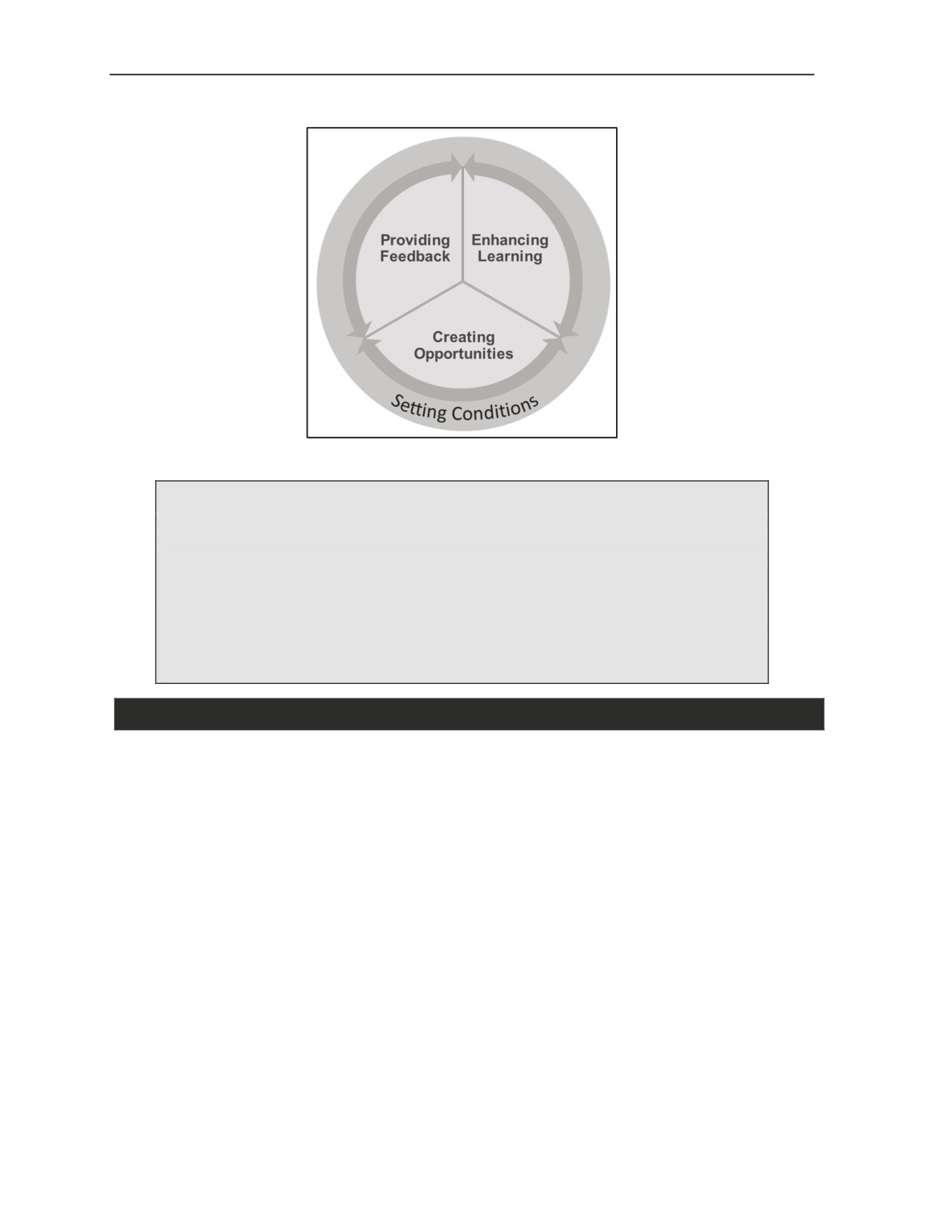
Chapter 3
Figure 3-1. Fundamentals of developing leaders
Shared Commitment to Development
From a battalion commander:
Coming into command, I told myself I was going to do it right. I was going to spend
seventy-five percent of my time on training and leader development and twenty-five
percent on admin. Once in command, no matter how hard I tried, seventy-five percent
was admin. To make the change, I had to spread my intent for informal leader
development throughout the formation so all understood and were practicing it. Tell
those going into command that they have to be deliberate about having a plan for
leader development. Then from day one in command, they have to integrate and
implement day-to-day, informal leader development or else it will fall by the wayside.
SECTION I - SETTING CONDITIONS
3-5. Establishing a culture that promotes leader development throughout the organization is necessary. The
organizational culture needs to embrace leader development to reinforce it as an expected part of daily
operations. The culture is affected by leaders who share a mindset that leader development is important and
is achievable as part of what they do each day. Leaders need to designate and protect time for leader
development and develop a culture that encourages and rewards professional development.
3-6. Leaders create a pro-development culture through the same behaviors they use for any task. Individuals
will accomplish what leaders view as important. How leaders react under pressure or during organizational
crises will shape what the organization views as important. Leaders’ assignment and prioritization of
resources also speaks to what is valued and important. What coaching, teaching, mentoring, and counseling
that leaders do sends a message of what is important. Leaders’ treatment of others through rewards,
recognition, and feedback is another sign of what is important. Leaders who demonstrate behaviors
supportive of learning and development create a learning environment for the whole organization. ADRP 6-
22 describes the importance of leaders setting the example.
3-7. Two other keys are addressed as part of setting conditions:
z
Leaders establish a learning environment by encouraging subordinates to take reasonable risks,
grow, and develop on their own initiative.
z
Leaders gain knowledge of subordinates in the organization as individuals with unique skills,
abilities, backgrounds, and goals.
3-2
FM 6-22
-XQH
Fundamentals of Development
LEARNING ENVIRONMENT
3-8. Leaders set the conditions for leader development by performing their tasks and missions in ways that
signal to subordinates throughout the organization that leader development is important. It can have a big
effect in return for minimal personal time and resource investment.
Be receptive to individuals input, recommendations, and advice. Be receptive and shut down
others who belittle someone’s suggestion to take a different or creative approach. Good leaders
back subordinates trying to do the right thing and learn something new at the same time. A positive
leadership climate encourages a learning environment.
3-9. Being a role model—setting the example—for leader development is essential. Leaders who model
these leader actions encourage effective development in others and signal that leader development is valued:
z
Encourage development.
Are you actively and directly engaged in the development of others.
Are leaders visibly present and actively engaged in the development of others?
Are leaders inspiring others through genuine concern for their growth?
Are leaders readily available to provide guidance and answer questions?
Do leaders defer to others to develop their subordinates?
z
Encourage learning.
Do leaders feel free to ask themselves what went right and wrong in planning and executing
an operation? Is there tolerance for discussing mistakes?
Do others observe you engaged in learning? Do you develop yourself? Are you prepared to
meet mission challenges as they arise?
Do you actively listen to what others have to say? Are followers encouraged to provide candid
feedback?
Do you create a positive environment? Do you enjoy being a leader and does your example
motivate subordinates to emulate you?
Do you develop subordinates? Do you know their strengths, developmental needs, goals, and
life activities that extend beyond the workday? Are you serving as a teacher and mentor?
z
Promote learning from mistakes.
When mistakes occur, is the focus on assigning blame or on why the mistakes occurred and
how to reduce the likelihood of a reoccurrence? Do you avoid criticizing individuals publicly?
Do you speak openly about personal leadership mistakes and lessons learned?
z
Encourage innovation.
Are leaders restricted to operating strictly according to standing operating procedures? Do
leaders dismiss new ideas in favor of tried and true practices?
Do you promote innovation? Can leaders debate with you, exchange issues, or challenge each
other’s perspectives?
z
Allow for risk taking and encourage exercise of disciplined initiative.
Do you delineate the boundaries or prioritize the areas where subordinates can take risk? Is it
clear what is or is not acceptable?
Are leaders willing to accept the challenges in unit performance that come with new ideas?
Do you show empathy? Do you consider the situations of others relating to their challenges?
z
Encourage effective decisionmaking.
Are leaders well informed when they make important decisions? Do they consider and
understand the relevant consequences for Soldiers, Army Civilians, and the mission?
-XQH
FM 6-22
3-3
Chapter 3
Be aware of personal reactions during times of crisis. Easily remembered, leader behavior sends
a strong message about beliefs and values. Before making off-the-cuff remarks, leaders should
collect their thoughts and ask themselves what they want less-experienced leaders to learn from
this reaction to a crisis. What should subordinates do when they face a similar situation?
Approachability Enables Development
From a battalion staff officer:
An open door policy is critical for demonstrating approachability to subordinates.
However, it is not enough just to say you have an open door policy. I think my
commander is nonjudgmental and seems levelheaded on any issue, which makes it
easy to bring issues to his attention. He is humble, genuine, and patient. At unit
functions, I watch him and his wife circulate. He drops down to eye level with the kids
and gets a laugh from them for some remark. They both give their full time and attention
to whomever they are talking to.
Because of his style, laid-back but concerned and competent, he elicits open
communication from subordinates. He starts out by asking about the individual and
their family before getting to unit issues by asking, “How’s it going?” I noticed that
people open up when he uses this approach. He puts them at ease and they know he
is genuinely concerned. His approach had a positive effect throughout the battalion.
TECHNIQUES FOR CREATING CONDITIONS CONDUCIVE TO DEVELOPMENT
3-10. Subtle actions on the leader’s part build trust and communicate the role of trainer and developer.
Experienced leaders use the following techniques to create a developmental culture:
z
Be present to observe enough key activities without smothering the leader. After initial
observations, give them time and space to exercise leadership without being under the observation
spotlight. This helps establish the leader’s role as a supportive resource rather than an evaluative
note taker. It also builds trust, self-confidence, and creativity in the follower.
z
Take an indirect approach. Start by providing descriptions of observations along with positive and
negative outcomes. Allow the subordinate to understand what is going well and what needs
improvement. The opposite of an indirect approach is to be micromanaging and overly
prescriptive, outlining specifics for completion.
z
Give each leader a fresh, objective start. Make comparisons between subordinates and an objective
standard. Avoid subjective comparisons to past leaders or units (including personal experiences).
It is appropriate to reflect on and use personal experience. The bottom line is to observe and assess
each leader on individual merit. Avoid thinking of the observation process to grade leaders.
Mistakes occur in all organizations and operational environments. Leaders foster a learning
environment by acknowledging that honest mistakes come with challenging missions. Tell leaders
about a time you took on a risky, challenging mission. Recount the mistakes made in trying to
accomplish it. Wrap up the discussion with the lessons learned from the experience.
3-4
FM 6-22
-XQH

Fundamentals of Development
Taking an Indirect Approach
From a battalion commander:
I do not walk around the unit with my list of goals to check them off, but I informally
encourage leaders to strive for and achieve goals, for both themselves and the unit.
For example, during a conversation with a subordinate, I will ask a question like, “What
have you done lately to improve yourself?” That catches some by surprise, but it lets
everyone know I am serious about leaders setting personal goals and taking action on
them. I also ask questions like, “What have you done for a Soldier today, or what have
you done to improve the unit?” It is just one question, but it sets an achievement
expectation. Sometimes leaders get into a rut where they are executing for the sake of
executing; I want leaders to avoid going through the motions since this kills morale.
LEARNING PRINCIPLES
3-11. Development is a process of change. Developmental growth is the same as learning. Learning is
gaining knowledge or skill through study, practice, experience, or instruction. Knowing ways to promote
learning is key to those who set up and conduct leader development. Applying learning principles throughout
leader development practices will accelerate and improve learning. Table 3-1 presents common principles
used to design instruction to promote effective, efficient, and appealing learning.
Table 3-1. Learning principles
Principles
How each principle works to encourage development
Being task- or
Learners are engaged in solving real-world problems. Intellect is stimulated with
problem-centered
learning that will affect leader and unit performance.
Activation
Existing knowledge is activated as a foundation for new knowledge.
Demonstration
New knowledge is demonstrated to the learner.
Application
The learner applies new knowledge. Repetition and practice across varying
conditions enhances application—through interaction with role models and mentors,
from feedback and reflection, and by studying other leaders.
Integration
New knowledge is integrated into the learner’s world.
3-12. These principles are important for Army leader development because they are compatible and
supportive of learning that occurs while completing duties or during professional development sessions or
other modes of learning. Opportunities that challenge the individual and allow learning to occur enhance
development in operational assignments, as well as in generating force assignments. Learning best occurs
when the area to be learned has real-world relevance; what an individual learner already knows related to the
subject is activated; new knowledge and skills are demonstrated to the learner; the skills are actually tried
and applied by the learner; and the learner has the opportunity to integrate, absorb, or synthesize new insights
or create their own take on the knowledge. Training and developmental projects enhance learning when the
learner has an interest in the material and sees its relevance. Learning can accelerate when existing, related
knowledge that an individual has comes to mind. Providing an example and using new knowledge enhance
learning. The mind absorbs knowledge better when there is time for integration by the learner.
Survey subordinates on the top three skills they need to improve unit performance or review their
IDPs to determine what they need to learn. In doing so, subordinates are motivated and increase
their reception to the leader skills they need to learn.
3-13. Purposeful learning starts when learners are challenged to know more and do better. Purposeful
learning occurs when practice at mastery of tasks and skills are integrated into leaders’ day-to-day activities.
Applying the learning principles will result in leaders who actively engage in learning, quickly retain and
recall information, and transfer learning to novel situations.
-XQH
FM 6-22
3-5
Chapter 3
KNOWLEDGE OF SUBORDINATES
3-14. For effective leader development, individual relationships with each subordinate are necessary.
Leaders who interact with subordinates on-and off-duty better understand their subordinates’ backgrounds
and experiences. This may enable discovery of special skills and experiences to support specific mission
requirements. Likewise, leaders must avoid establishing or being perceived as having improper relationships.
Generally, getting to know subordinates communicates a genuine interest in them as individuals. This builds
confidence and generates trust. Trust is key to having candid talks with leaders about their development
needs.
There are boundaries to what leaders should know about the personal lives of organization
members. Some personal issues may be sensitive and leaders must be aware and understand the
sensitivity. Interacting with subordinates in varied on- and off-duty situations enables leaders to
build appropriate relationships and develop the trust necessary to discuss sensitive situations.
TEAM TRUST AND UNIT COHESION
3-15. An initial and ongoing objective of a leader is to create a culture that supports leader development. A
key accomplishment is for subordinates to accept you as part of the team. This means they trust you as an
advisor and coach who facilitates their success. Starting with the first encounter, leaders position themselves
as trusted advisors by communicating and modeling attributes and competencies to create a developmental
culture. Initial communications might start like this—
z
“The only thing I want out of this is to help you (or your staff or unit) maximize capability.”
z
“I am a developmental resource. The measuring stick for success here is for you to look back when
it’s all over and see the progress you have made”
z
“Tell me a little about yourself—what have you been going through leading up to this assignment?
How much experience do you have in your current leadership role? What comes next for you?
3-16. The objective of engaging in this communication with subordinates is as much about listening to their
response and understanding their situation as it is about clarifying your role and willingness to be a
developmental resource. It is important to build rapport by sharing something about yourself.
From a master sergeant: Without trust, Soldiers will not level with you--at best, you learn either
non-truths or part truths. The best way to start building trust is to take the time and talk to your
Soldiers from the first day that you become their leader.
3-17. Early in interactions with subordinates, briefly share personal experiences—including areas of
specialized expertise and areas of less experience. Candor helps build credibility while at the same time role
modeling that it is okay to bring up personal leader developmental needs. It is important to establish trust and
a developmental culture. Subordinates have to be receptive, engaged, and ready to develop. With some
individuals, it may take extra interaction time to build the necessary level of rapport. Some individuals will
seek additional attention and feedback and some will want less.
INDIVIDUAL DEVELOPMENT PLAN (IDP)
3-18. Counseling and feedback provide clear, timely, and accurate information concerning individual
performance compared to established criteria. As a part of professional growth counseling and feedback
sessions, leaders should help subordinates in identifying strengths and developmental needs. As part of this
process, leaders should help subordinates design an IDP. IDPs enable developing an objective approach to
professional development. Army Career Tracker (ACT) provides the central location to develop and track
IDPs over a service career for both military members and Army Civilians. Reserve Component IDPs should
include career development plans that relate to the individual’s civilian career as well as Army career and
focus on balancing Army careers with civilian careers and family life. Figure 3-2 provides an example IDP.
3-6
FM 6-22
-XQH
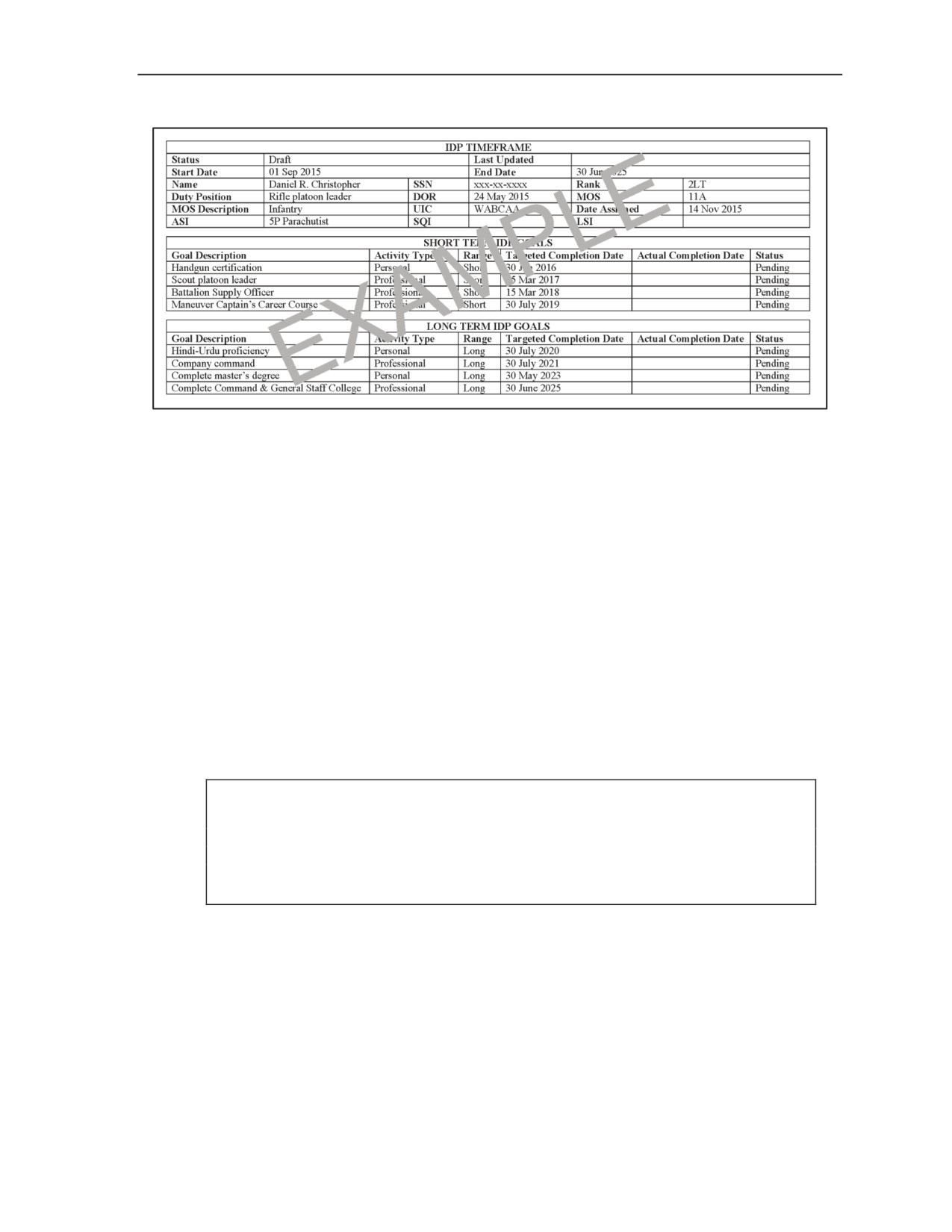
Fundamentals of Development
Figure 3-2. Example IDP
INSPIRATION SOURCES
3-19. To maintain the momentum of leader development activities, leaders need to reinforce purpose and
provide inspiring examples. The Army promotes three reasons for leader development:
z
To sustain and improve the immediate performance of the organization. Better leaders translate
into better performing teams and units, and better units accomplish their mission.
z
To improve the long- and short-term performance of the Army. Better-prepared leaders will be
better equipped to fulfill the Army’s leadership needs in the future.
z
For the well-being of the individual leader. Leader development will let good leaders know that
the Army values them and fulfill their desire to learn and to meet personal goals.
3-20. Personal experiences with leaders and leader development that provide inspiration are—
z
An exceptional leader, peer, or subordinate who deliberately puts you in challenging situations to
grow and learn.
z
A leadership challenge where prior experiences prepared you.
z
An exemplary professional role model who inspires and motivates others.
z
Leaders who, at their own initiative, took responsibility for their own development.
PERSONAL INSPIRATION
Note sources of personal inspiration for investing in leader development. Use
these notes to communicate with others and personally understand the importance
of developing leaders when distractions threaten implementation.
-XQH
FM 6-22
3-7
Chapter 3
SHARING EXPERIENCES
Learning from the experiences of others can be invaluable. The purpose of
this discussion is to give leaders the opportunity to share their experiences
in terms of the leader competencies (see ADRP 6-22).
Discussion Questions:
Choose a competency. Discuss the listed behaviors that support it.
Describe a situation where you or someone you observed demonstrated
the competency well.
What actions did they take?
What was the outcome?
Why do you consider this a good demonstration of the competency?
Describe a situation where you or someone you observed did not
demonstrate this competency well, but could have.
What actions did they take?
What was the outcome?
What actions would have been more effective?
SECTION II - PROVIDING FEEDBACK
3-21. Leaders need to learn how to observe subordinates and provide developmental feedback. Using
multiple methods of assessment and feedback provides a robust and more accurate picture of the individual
and provides better developmental opportunities.
3-22. A leader’s ability to provide feedback to subordinates will significantly contribute to their
development. It will enhance and accelerate learning from the day-to-day work experience—the most valued
and effective environment for leader development. Timely, accurate feedback should translate into better
leader performance, which will in turn have an effect on unit performance and mission success. Providing
accurate feedback starts with planned observation and accurate observation and assessment.
OBSERVATION PLANNING
3-23. The first step to having a legitimate role in a subordinate’s leader development process is to observe
them. To use available time productively, plan to—
z
See them challenged by a developmental need.
z
See them excel by applying a personal strength.
z
Observe their actions during critical times of unit performance.
z
See them reach their limits of strength and endurance.
z
Observe decisionmaking and conduct.
z
Observe their effect on subordinate leaders and Soldiers.
z
See them relaxed and available for conversation.
Do not draw a lasting impression of a leader from a single observation. It usually takes multiple
observations before a pattern of behavior emerges. Take time to gather information from others
observing the same leader, as different people focus on different aspects.
ACCURATE OBSERVATIONS AND ASSESSMENTS
3-24. Observing other leaders may seem like a difficult task. However, it is a valuable outcome once a leader
is familiar with the methods for making accurate observations and providing feedback.
3-8
FM 6-22
-XQH
Fundamentals of Development
3-25. The Army possesses tools and measures for unit readiness and performance. Training briefs are full of
these metrics and leaders generally receive continual feedback on their units’ performance. This performance
assessment and feedback, however, does not provide leaders with an assessment of their leadership behaviors.
Leadership assessment—
z
Speaks to the leader behaviors that contributed to the unit’s performance.
z
Combines perception and reality, with reality best confirmed by multiple sources.
z
Occurs through two-way communication between leader and the led.
z
Has a common language defined by the doctrinal language of ADRP 1 and ADRP 6-22.
3-26. Effective commanders observe training, participate in operations, and interact with subordinates and
their units. Personnel other than the commander or rater make observations contributing to leader
development. Peers, trainers, operations officers, first sergeants, and others can all make accurate
observations that can contribute to assessment and coaching.
Accurate, Descriptive Observations
3-27. Observing leadership requires an understanding of leadership, ability to discern the quality of
behaviors, and practice. Observing leader behaviors occurs by watching how a leader interacts with and
influences others. These observations focus on what was done well, what was not done well, and what could
be done differently. Written directives, verbal communications, and leader actions all provide indications of
how a leader influences others. Leaders learn about their subordinate’s leadership by observing reactions by
peers, subordinates, and superiors.
3-28. Three key components ensure observations are accurate and descriptive:
z
Observations are planned around key events.
z
Observations for patterns of behavior.
z
Recording important observations immediately.
Use words that depict action.
Link to effects and outcomes.
Observations Planned around Key Events
3-29. Leaders can use the training calendar to identify events that are likely to compel a leader to demonstrate
a considerable number of leadership competencies and attributes.
Observations for Patterns of Behavior
3-30. With time and frequent observation, leaders gain confidence and start to see a consistent pattern of
behavior. It is a judgment call as to when to consider an observation as a pattern of behavior. To observe for
a pattern, make a note of how often a leader exhibits the same behavior in a given time. The frequency of
behavior may indicate a pattern. If sufficient time has passed and the observer can predict the leader’s actions,
then a pattern of behavior has likely emerged.
3-31. When observing leadership, it is important to frame observations in a context consistent with Army
doctrine. Chapter 6 provides performance indicators for the competencies and attributes in ADRP 6-22. A
way to capture observations and assessment is to use a quick, accurate, and complete way to take notes that
makes for an effective feedback session such as a situation, observation, associate and assess, and reinforce
and recommend (SOAR) format. Figure 3-3 on page 3-10 provides an example of SOAR feedback notes.
Details for the SOAR elements are—
z
Situation—Describe the situation and conditions of the assessment. This should include the time,
location, event, or other context of the situation. If known, capture the prevailing leadership
relationship or climate between the leader and the led. In later discussions, this information will
help leaders and subordinates recall the event and circumstances surrounding it.
z
Observation—Describe the leadership behaviors that the leader exhibits. Focus on competencies
within the lead, develop, and achieve categories. Likewise, note evidence of the attributes in the
-XQH
FM 6-22
3-9
Chapter 3
character, presence, and intellect categories. Leaders use this section to note both strengths and
developmental needs and the effect of the subordinate’s behavior on the mission or Soldiers.
z
Associate and Assess—Identify and associate the competency or attribute that best describes the
leader actions. Leaders assess the subordinate’s actions to determine whether they meet the
standard or represent a strength or developmental need. Leaders record the competency and
observed behaviors.
z
Reinforce and Recommend—Record how to reinforce the leader’s behavior through praise or
correction. The supervisory leader will identify actions for the subordinate to sustain or improve
and other recommendations for change. Recording these notes help plan the feedback to discuss
with the subordinate.
Figure 3-3. Example SOAR feedback notes
3-10
FM 6-22
-XQH
Fundamentals of Development
Often a leader will not directly observe the leadership behavior of a subordinate, but will receive
a report on unit performance. Leader assessment in this situation requires the leader to
communicate the performance indicator to the subordinate. Then, together, move the discussion
to the causes of the unit performance. Ask, “What part did your leadership play in the unit’s
performance?”
Recording Important Observations
3-32. Important details of a leadership observation may be lost or be inaccurately recorded if not written
down soon after they occur. Accurate and complete notes are useful when providing leaders with feedback.
As described earlier, using the SOAR format is one way to record observations.
Use words that depict action
3-33. A leader needs to describe what the subordinate is doing when they are in the act of leading. By writing
down an observation using action words, the leader can be sure the subordinate will be able to recognize it
when communicating it back to them. An observation written down using action words appears like this:
Sergeant Jenkins’s voice was barely audible and monotone; Soldiers participating in
the mission rehearsal could not hear him.
CPT Rider looked directly into the eyes of each platoon leader as he issued the order.
Link to effects and outcomes
3-34. The immediate effect of a subordinate’s leadership may be observed in the verbal and nonverbal
reactions of others in direct proximity. Leaders and Soldiers in subordinate echelons will feel the positive or
negative consequences of a leader’s action. Leadership can affect task or mission accomplishment. Trace
mission results and look for leader actions that contribute to success or lack of success. There could be a
delay in time between the leader’s actions and their consequences. The effect may not be obvious for hours
or days. The following is a correct example of an observation that includes an effect:
Observation: Sergeant Jenkins voice was barely audible and monotone, so that Soldiers
participating in the mission rehearsal could not hear it.
Effect: One vehicle missed a turn on the convoy route; vehicle drove down a road
banned from traffic due to IED’s. Vehicle attacked by IED. 2 wounded and 1 destroyed
vehicle.
FEEDBACK DELIVERY
3-35. When experienced leaders reflect on their own leader development, they place high importance on
day-to-day, two-way communication with their senior leaders because they do the same with their
subordinates. Feedback is less effective if a leader waits until there is time for a formal sit-down counseling
session to provide feedback. Leaders should provide feedback as soon as possible after observing a particular
leader behavior to encourage positive effects.
3-36. Day-to-day informal feedback makes sitting down with subordinates for developmental counseling
much easier. This informal feedback develops a shared understanding of the subordinate’s strengths and
developmental needs. Still, many leaders find it difficult to sit down with a subordinate to engage in
developmental counseling. ATP 6-22.1 provides extensive guidelines on the counseling process.
-XQH
FM 6-22
3-11
Chapter 3
Providing feedback on every observed act, response, or behavior will overwhelm a subordinate.
Provide feedback based on established competencies and attributes. Focus feedback on a few key
behaviors that, if changed, will contribute the most to improved leader and unit performance.
Having a focus for improvement will also motivate the subordinate to implement change.
GIVING FEEDBACK IN 60 SECONDS OR LESS
Day-to-day feedback is important to ensure improved leader and unit
performance. The following example can guide feedback delivery.
Situation: Commander walks in on a patrol debriefing that one of his
company commanders is conducting. He approaches CPT Philips after the
debriefing.
Commander provides brief description of the situation: “CPT Phillips, I was
in the back of the room while you debriefed the platoon. Let’s talk for a
minute.”
Commander describes the leader behavior observed: “When I came in,
Sergeant Jones was describing the suspects he had detained. You listened
intently to his general descriptions and asked some pretty probing
questions to get details.”
CPT Phillips: “Yes sir, I want patrol leaders to understand how important
their gathering information is to developing our intelligence efforts.”
Commander: “That’s a great technique to ask a few questions to confirm
what Sergeant Jones is saying and probe for details. He said the suspects
were not local. You noticed that. From the excitement in Sergeant Jones’s
voice, I think he knows the suspects are up to something, but he wasn’t
sure just what.”
Ask the observed leader for a self-assessment before providing personal views. Do this by first
recounting back to the leader the situation and observation (the first two parts of the SOAR
format). Then ask the leader to provide an assessment and recommendation. This reinforces three
important leader development principles: leader self-assessment and self-awareness, individual
leader responsibility for leader development, and leader ownership of the recommendation.
DELIVERY OF OBSERVATIONS FOR EFFECT
3-37. It is important to plan how a leader will deliver observations to a subordinate. The delivery methods
that follow, when done correctly, provide a leader with an understanding of the effect behaviors have on
consequences, all based on careful and planned observations. The two-way communication techniques used
for delivering an observation should motivate subordinates to start acting in ways that improve leader and
unit performance.
PREPARATION AND TIMING OF FEEDBACK DURING TRAINING
3-38. Before the start of training, leaders should explain the SOAR format or any feedback tool to the unit
and its leaders. Leaders should emphasize the developmental nature of the feedback. Armed with this
knowledge, unit leadership should be supportive of efforts to deliver of feedback.
3-39. The timing of a discussion of leadership observations can be critical and a deciding factor between
whether perceiving a situation as evaluative or developmental. Ultimately, determining the appropriate time
3-12
FM 6-22
-XQH
Fundamentals of Development
for the delivery of an observation is at the discretion of the leader. Consider whether delivery should occur
during the action, at a break in action, or at the end of the day or event completion.
During the Action
3-40. Sometimes, leaders deliver observations as they occur. Part of guided discovery learning relies on
“during the action” feedback. This is especially true when pointing out to the leader that actions must occur
“in the moment” while they can be observed. However, care must be taken not disrupt the training exercise.
Finding a Break in the Action
3-41. Find the right ‘break’ in the action to deliver observations. This could be during a lull after a major
event has occurred (a major success or a failure).
End-of-Day or at Completion of a Major Event
3-42. Consider waiting until the end of the day, especially if observations are lengthy and require discussion.
To enable better collective learning, wait until after conducting the unit or team AAR. Then, deliver
observations to the subordinate privately, as a mentoring session away from others. This also allows aligning
the delivery of observations of the subordinate’s strengths and areas for improvement with those of the unit
or team as identified in the AAR, assuming they are compatible.
3-43. If observation delivery is best done at the completion of an event, consider letting the subordinate set
the time for the discussion. At a minimum, provide a “heads up” about a situation or circumstance to be
discussed. This allows the leader an opportunity to reflect and psychologically prepare to listen and receive.
This approach reduces the likelihood the subordinate will be preoccupied, nervous, or defensive. Examples
of a leader employing this approach include—
z
“I’ll be back in about 30 minutes and I’d like to talk about how things went this morning. I’m
going to ask about how you led the team through the scenario and some of the approaches you
took during the decision-making task.” [SOAR, Situation]
z
“The simulation you led the staff through this afternoon was successful, though I’ve noted some
areas that you could work on. Is there a time you’d prefer to talk later today so I can share my
observations and discuss with you?” [SOAR, Situation]
OBSERVATION DELIVERY
3-44. The following steps are an effective way to deliver an observation. These steps represent an indirect
approach to providing leadership observations. Once the SOAR outline is completed, leaders are ready to
discuss observations and reinforce and recommend actions. The following steps provide a framework for
delivering observations, and flow in a logical sequence.
Confirm the Situation
3-45. Start by orienting the subordinate’s attention to the observed situation. State the situation and clarify
that the observation is about leadership. Reiterate the information recorded: “I would like to discuss the
actions you took in the battlefield simulation you just led with your staff.” [SOAR, Situation]
Ask for a Self-Assessment
3-46. Ask the subordinate for a self-assessment of the situation and personal leader actions. Guide
questioning to the subordinate’s leadership during the given event or situation. The subordinate’s response
should match the leader’s assessment. If it does not, the leader should ask additional specific questions:
z
“How effective was the communication between you and the subordinates you were leading? And
how could you tell?” [SOAR, Associate and Assess]
z
“What factors did you observe that may have contributed to miscommunication or a vague
understanding among the troops?” [SOAR, Associate and Assess]
-XQH
FM 6-22
3-13
Chapter 3
Clarify and Come to an Agreement
3-47. Leaders confirm the subordinate either agrees with the assessment or acknowledges a difference in
opinion if the subordinate does not share the assessment. Confirm agreement or acknowledgement before
proceeding to the assessment, linkages, and observations:
z
“That is what I saw as well”
z
“Actually, in my observations I noted that you were directive in your message and didn’t ask for
questions. Would you agree that this is the approach you took?” [SOAR, Observation]
Add your Observations
3-48. Leaders may include observations that the subordinate is not aware. Leaders build on what the
subordinate has already said to increase personal self-awareness. Specific behaviors that had an effect on the
consequence or outcome include—
z
“Your assessment is correct. When you asked for other viewpoints, a good sharing of information
followed.” [SOAR, Observation]
z
“It was clear some of the staff had differing opinions or other points to add, though the opportunity
to share really didn’t arise.” [SOAR, Observation]
WAYS TO FURTHER ENGAGE LEADERS
3-49. Leaders raise questions that will prompt subordinates to think about how to act or respond in the future.
Leaders should ask for recommendations about how the subordinate will take better actions in the future,
avoid problems, and take advantage of an opportunity. Here are some possible questions—
z
“How will you handle a similar situation next time?” [SOAR, transition to Reinforce and
Recommend]
z
“What steps can you take to avoid this outcome in the future?” [SOAR, transition to Reinforce
and Recommend]
Reinforce—Validate a Strength
3-50. Once the leader and subordinate agree on the behaviors that contributed to a consequence and a
recommendation for the future, the leader should provide reinforcement on what the subordinate is doing
correctly. Here are some examples—
z
”Your influencing strategies are working for you, keep it up.”
[SOAR, Reinforce and
Recommend]
z
“Consider closing out staff meetings with opportunities for questions or discussion. Your pre-
meeting planning and organizing is effective—you should continue that.” [SOAR, Reinforce and
Recommend]
Additional Tips for Providing Feedback
3-51. There are several other items to consider when providing feedback:
z
Focus on the leader’s behavior and actions.
z
Identify what the leader has control over to change.
z
Use focused questions as a form of feedback to create discovery learning.
z
Give the leaders the opportunity to come up with a recommendation to the observation. This
promotes their taking ownership and responsibility for it.
z
Be familiar with improvement actions described in appendix A and offer appropriate ones. Remind
leaders that this source is available to guide development, including improving their understanding
of positive and negative behaviors and underlying causes.
3-14
FM 6-22
-XQH
Fundamentals of Development
Providing Feedback on Developmental Needs
From a battalion sergeant major:
It is tough to address or provide feedback on developmental needs, but you have to
have a face-to-face conversation right away when someone is not meeting the
standard. If not, they might think they are meeting the standard and that I am okay with
substandard performance. In general, I make it about strengths and developmental
needs of the organization and not a personal attack. This is a career that they have
poured their life into, so I am sensitive about that.
Let me share step-by-step how I give people frank, in-the-moment feedback when they
need it. How do you get them to engage in a candid two-way conversation and then
actually make the changes needed? I start out positive, then talk about the
developmental need, then go with something positive again (I term this the sandwich
method). I communicate an understanding of the challenges and talk about what they
are doing right as well as the shortcomings. Then I pause and ask them for their
assessment. We may go back and forth on the issue, getting to what is really going on.
Throughout this conversation, I am citing indicators, what I am using to assess them,
what I see as a trend. Sometimes, I relate a story about a similar incident or situation
to highlight what they can learn from what I saw. In the end, I say, “You own these
problems. You can blame it other people, but there is a way ahead.” Then we transition
to things they could and should be doing. I ask them how they ought to fix the issue,
and sometimes they will come up with a better solution than I could have. At other
times, I have to go into a “if you do this and this, you can get back on a path to success.”
I tolerate a certain amount of venting on their part, but in the end, I emphasize that it is
their problem to fix. I tell them, “Let’s talk about your way ahead, what right looks like,
and let’s come to consensus on what you need to do.”
LESSONS FROM DELIVERING OBSERVATIONS
3-52. Leaders should avoid delivering some kinds of feedback to a subordinate. These are especially
important to avoid—
z
Vague and general ideas: “You are a good leader.”
z
Using absolutes or generalities, such as always or never: “You never follow-up after meetings.”
z
Observations applied to general traits or the total person: “Your personality is that of an introvert.”
z
Untimely feedback that the leader is unable to apply: “Two days ago you gave ambiguous
instructions at the mission rehearsal.”
3-53. It is also important for leaders to learn from the delivery of their observations and realize it takes
practice. It is helpful after an interaction for leaders to reflect on their delivery. Self-reflective questions
include—
z
Was my subordinate receptive to what we discussed?
z
Based on my questions, how easily did they identify the behaviors that needed to change?
z
Did my subordinate ask for techniques or ideas on how to change or improve?
z
Is there agreement on the next step of development and its timeframe?
z
Is there evidence that my subordinate is taking action on the observations?
3-54. After delivering observations, leaders look for the next opportunity to observe the subordinate’s
leadership. Then, gauge how well the subordinate received the observation, what steps the leader has taken
to change behavior, and what effect the change is having on unit outcomes.
-XQH
FM 6-22
3-15
Chapter 3
SUBORDINATE RECEPTIVENESS TO FEEDBACK
3-55. Trust and a developmental culture are critical to ensuring reception of leader observations. If
subordinates perceive a leader to be genuinely interested in helping subordinates, the subordinate will be
receptive to observations than if there is doubt or mistrust about motives.
3-56. To gauge receptiveness, leaders must remain attuned to verbal and nonverbal cues. These may occur
as verbal disagreement or resistance, or nonverbal gestures such as folded arms, rolling eyes, or a lack of
attentiveness. Refocus the subordinate by—
z
Reaffirming the intent of your feedback is to maximize the subordinate’s capabilities to achieve
optimal unit performance.
z
Reminding the subordinate that your observations are for development—not evaluation or
judgment. You are a developmental resource for the leader and the unit.
z
Reiterating what went well and note any incremental progress made thus far.
Overcoming Resistance to Feedback, Going the Extra Step
From a battalion commander:
I had one platoon leader who could not do anything right. Falling out of battalion runs
was the least of his problems. Whenever you talked to him, he always had an attitude.
He was also the one whose fire point you’d roll up to, only to find him and his platoon
lying there with no gear on underneath a shade tree, and think, “Okay, enough of this.
What is going on here?”
With this particular officer, I moved him from one battery to another thinking that with
another commander he would be okay. He started to show little improvements, but
then he would slip. He started having moments of brilliance followed by moments of
misery. Regardless, I saw something in him. I said, “Okay, he’s beginning to get some
momentum. How can I help him keep it up?” About that time, part of the unit was
deploying. In one unit, the battery commander, first sergeant, and all the platoon
leaders were going, and I needed a rear detachment commander for this unit. I could
have given it to a senior staff sergeant, but I gave this young officer an opportunity. I
sat him down in my office, and frankly said, “I’m going to give you a chance to hit a
homerun here, and the good news is you have to hit a homerun. You cannot fail. If you
fail, you’ll get a relief for cause report card as a commander and might as well find
another job.” Maybe there was a little bit of a threat there, but he looked at me and
said, “Sir, I’m up for the challenge and I’m not going to disappoint you.” For the past
three months, he has been fantastic—I do not know where he came from.
My sergeant major and I had our fingers crossed for a month that everything would
work out, because if he failed, we failed. We took extra steps and precautions to make
sure this young man would be successful. We gave him a very strong NCO to be his
rear detachment first sergeant. We spent a little more time with him. We tried to set
him up for success, and I think it worked. We created a lot of confidence in this young
man who was in the doghouse for a long time. Now he thinks, “Hey, I can do this and
do it pretty well.”
SECTION III - ENHANCING LEARNING
3-57. Setting conditions and providing feedback and advice are two of the fundamentals of development.
Applying practices to enhance learning will make development more effective. Enhancing learning draws on
the developmental value from learning opportunities. Learning from experience can be enhanced by
facilitating what an experience means. Making sense of an experience requires interpretation of the event to
create personal understanding. This process requires observation, feedback, dialogue, and reflection. A
leader-subordinate pair, coach, or mentor can use these four steps with a leader, any group, or adapted for an
individual learner. This section focuses on how dialogue can bolster the process of reflection and
3-16
FM 6-22
-XQH
Fundamentals of Development
understanding. Chapter 4 addresses how an individual uses this learning process. At the individual level,
experiential learning is learning while doing. At the organizational level, experiential learning is improving
while doing. Experiential learning is consistent with the principle of train as you fight.
3-58. Practical approaches to enhance learning include leader role models, mentoring, guided discovery
learning, and individual and group study. These practices are not events that come up on a schedule. They
are powerful ways to integrate and promote learning in the day-to-day operations of the organization.
LEADER ROLE MODELS
3-59. Because leaders vary in their skill and experience level, an effective way to learn is directly from unit
role models. Positive role models exhibit leadership behaviors that others should emulate. Leveraging role
models for leader development is an efficient use of time and resources. They are a resource right in the
organization. Supervisors should identify role models for each key position (such as company commander or
platoon sergeant) and may want to identify role models possessing special skills that other leaders need to
master. Leaders should resource these role models appropriately for the responsibilities. Likewise they should
create opportunities for less experienced individuals for interaction. For example, supervisors may assign—
z
A role model to new leaders for their reception and integration.
z
A role model to coach a leader due to possessing a particular skill or special expertise.
z
Role models to run leader certification programs.
z
An inexperienced leader to shadow a role model for a specified period.
THE 5-MINUTE SHADOW
Bring in a subordinate to observe or participate in an aspect of work that
will make them a better leader. To maximize the experience--
- Communicate the situation, decision, or issue.
- Convey the importance of acting appropriately or making the right
decision.
- Describe possible consequences, second- and third-order effects.
- Discuss the decision or actions and reasoning behind them.
MENTORSHIP
3-60. Mentoring can benefit leader development efforts. Mentorship is the voluntary developmental
relationship that exists between a person of greater experience and a person of lesser experience that is
characterized by mutual trust and respect (AR 600-100). A mentor is a leader who assists personal and
professional development by helping a mentee clarify personal, professional, and career goals and develop
actions to improve attributes, skills, and competencies. A mentee is the individual receiving mentorship.
Individuals are encouraged to participate in mentoring as a voluntary experience. Age or seniority is not a
prerequisite for providing mentoring. A junior individual may mentor a senior individual based on experience
or specialized expertise as a subject matter expert.
3-61. Mentoring will occur while individuals are in operational and institutional assignments; however, the
mentor-mentee connections are best if they occur outside the chain of command. This is not contrary to the
requirement that superiors have the responsibility to develop subordinates. It is differentiating between the
role of a mentor and the role of a leader to develop, counsel, teach, and instruct subordinates. Supervisors
should refrain from appointing mentors or formally matching individuals with mentors. Participant self-
selection leads to the most effective mentoring relationship.
3-62. Leaders foster mentorship by—
z
Educating leaders in the organization on mentor responsibilities.
z
Participating as a mentor.
z
Inviting experienced leaders to visit and share their mentoring experiences.
-XQH
FM 6-22
3-17
Chapter 3
Senior experienced leaders will visit occasionally. Schedule time for them to meet with a less
experienced group. Provide some structure to this group mentoring experience by having members
generate questions in advance. Their experience and perspectives offer new ideas for focusing
development. Communicate intent with the experienced leaders and provide the questions to them.
MENTOR ROLES AND RESPONSIBILITIES
3-63. Selection as a mentor is a compliment to one’s professional abilities and competence. Table 3-2
highlights the general roles and responsibilities of mentors.
Table 3-2. Mentor roles and responsibilities
Role
Responsibility
Encouragement and motivation.
Candid feedback about perceived strengths and developmental needs.
Provides
Advice on dealing with obstacles.
Guidance on setting goals and periodically reviews progress.
Experiences that contributed to personal success.
Shares
An understanding of the Army, its mission, and formal and informal operating processes.
Appropriate training and developmental opportunities.
Encourages
Sense of self-awareness, self-confidence, and adaptability.
Efficient and productive performance.
As a confidant, counselor, guide, and adviser.
Serves
As an advisor for career development ideas or opportunities.
As a resource for enhancing personal and professional attributes.
3-64. Mentoring is a powerful tool for personal and professional development. Mentoring generally
improves individual performance, retention, morale, personal and professional development, and career
progression. Mentoring offers many opportunities for mentors and mentees to improve their leadership,
interpersonal, and technical skills as well as achieve personal and professional objectives.
3-65. It is not required for leaders to have the same occupational or educational background as those they
coach or counsel. In comparison, mentors generally specialize in the same area as those they mentor. Mentors
have likely experienced what their mentees are experiencing or will experience. Consequently, mentoring
relationships tend to be occupation-specific, focused primarily on developing a better prepared leader.
MENTORING RELATIONSHIPS
3-66. The appearance of favoritism or creating conflict with raters or senior raters should keep leaders from
mentoring subordinates within their chain of command. Subordinates should avoid approaching superiors in
their chain of command to be mentors.
3-67. Mentoring relationships can be described by purpose and relationship:
z
Traditional mentoring. Focuses primarily on the mentee, examining the career path through goal
setting, with overall development of the individual as the focus. This mentoring is a process where
the mentor and mentee join by their own volition.
z
Peer mentoring. Occurs when a mentor has extensive knowledge and experience but not higher
rank or grade than the mentee. Mentoring relationships may occur between peers and often
between senior NCOs and junior officers. This relationship can occur across many grades or ranks.
3-68. Regardless of purpose, a successful mentoring relationship is based on several elements:
z
Respect. Established when a mentee recognizes desirable attributes, skills, and competencies that
the mentor has and when the mentor appreciates the attitude, effort, and progress of the mentee.
z
Trust. Mentors and mentees should work together to build trust through open communication,
forecasting how decisions could affect goals, frequent discussion of progress, monitoring changes,
and expressing enthusiasm for the relationship.
3-18
FM 6-22
-XQH
///////////////////////////////////////