FM 1-04 Legal Support to the Operational Army (April 2009) - page 1
*FM 1-04 (27-100)
Field Manual
Headquarters
Department of the Army
No. 1-04
Washington, DC, 15 April 2009
Legal Support to the Operational Army
Contents
Page
PREFACE
iii
INTRODUCTION
iv
Chapter 1
LEGAL SUPPORT TO OPERATIONS: AN OVERVIEW
1-1
The Judge Advocate General’s Corps Mission
1-1
Legal Issues in Operations
1-1
The Evolution of Operational Law
1-1
The Judge Advocate’s Role
1-2
The Legal Administrator’s Role
1-2
The Paralegal Soldier’s Role
1-3
Chapter 2
FUNDAMENTAL CONCEPTS OF ARMY DOCTRINE
2-1
Army Doctrine Fundamental Concepts
2-1
Full Spectrum Operations
2-1
Operational Themes
2-3
The Warfighting Functions
2-6
The Operations Process
2-9
Chapter 3
REQUIREMENTS IN THE MODULAR FORCE
3-1
Transformation
3-1
Brigade Combat Teams
3-2
The Division
3-2
The Corps
3-3
Theater Sustainment Command
3-3
Theater Army
3-3
The Judge Advocate General’s Corps Materiel Requirements
3-4
Chapter 4
ROLES, RESPONSIBILITIES, AND WORKING RELATIONSHIPS
4-1
Working Relationships and Professional Responsibility Considerations
4-1
Brigade Legal Section
4-1
The Office of the Staff Judge Advocate
4-5
Distribution Restriction: Approved for public release; distribution is unlimited.
*This publication supersedes FM 27-100, 1 March 2000.
i
Contents
The Office of the Staff Judge Advocate-Brigade Legal Section Relationship
4-7
U.S. Army Trial Defense Service
4-9
The Office of the Staff Judge Advocate’s Brigade Legal Section-U.S. Army
Trial Defense Service Relationship
4-10
Chapter 5
THE CORE LEGAL DISCIPLINES
5-1
Military Justice
5-1
International and Operational Law
5-3
Administrative and Civil Law
5-5
Contract and Fiscal Law
5-7
Claims
5-8
Legal Assistance
5-9
Chapter 6
PLANNING
6-1
The Judge Advocate General’s Corps Support to Planning
6-1
The Planning Process
6-1
The Military Decisionmaking Process
6-2
Appendix A
RULES OF ENGAGEMENT, RULES FOR THE USE OF FORCE, AND
TARGETING
A-1
Appendix B
DETAINEE OPERATIONS
B-1
Appendix C
STABILITY OPERATIONS
C-1
Appendix D
RULE OF LAW
D-1
Appendix E
LEGAL SUPPORT IN CIVIL AFFAIRS UNITS
E-1
Appendix F
CIVIL SUPPORT OPERATIONS
F-1
Appendix G
FINANCIAL MANAGEMENT AND DEPLOYMENT CONTRACTING
G-1
Appendix H
LESSONS LEARNED
H-1
GLOSSARY
Glossary-1
REFERENCES
References-1
INDEX
Index-1
Figures
Figure 2-1. Full spectrum operations
2-2
Figure 2-2. Operational themes
2-3
Figure 2-3. The operations process
2-9
Figure A-1. A sample targeting decision model
A-9
Figure H-1. Sample lessons learned
H-2
ii
FM 1-04
15 April 2009
Preface
FM 1-04, Legal Support to the Operational Army, replaces FM 27-100, Legal Support to Operations, as the
Army’s keystone manual for operational legal doctrine. This manual provides authoritative doctrine and
practical guidance for commanders, judge advocates, legal administrators, and paralegal Soldiers across the
spectrum of conflict. It outlines how the Judge Advocate General’s Corps (JAGC) will be organized in
accordance with the Army’s modular force design. It also discusses the delivery of legal support to the modular
force.
Traditionally, the JAGC identified its core legal disciplines as military justice, international law, administrative
law, civil law, claims, and legal assistance. This manual recognizes the importance of these critical areas;
however, it expands and reorganizes the concept of core legal disciplines to help synchronize these concepts
with operational experience and Army doctrine. The core legal disciplines are now military justice,
international and operational law, administrative and civil law, contract and fiscal law, claims, and legal
assistance.
This manual does not address the law of armed conflict, The Hague Conventions, or the Geneva Conventions in
detail. For a more comprehensive treatment of those areas, refer to FM 27-10, The Law of Land Warfare.
This publication applies to the Active Army, the Army National Guard (ARNG)/Army National Guard of the
United States (ARNGUS), and the United States Army Reserve (USAR) unless otherwise stated.
The proponent of this publication is the United States Army Training and Doctrine Command (TRADOC). The
preparing agency is The Future Concepts Directorate, The Judge Advocate General’s Legal Center and School
(TJAGLCS), U.S. Army. Send written comments and recommendations on DA Form 2028 (Recommended
Changes to Publications and Blank Forms) directly to Commander, The Judge Advocate General’s Legal
Center and School, U.S. Army, ATTN: CTR-FC, 600 Massie Road, Charlottesville, VA 22903-1781. Send
comments and recommendations by e-mail to TJAGLCS-Doctrine@conus.army.mil. Follow the DA Form 2028
format or submit an electronic DA Form 2028.
15 April 2009
FM 1-04
iii
Introduction
Transforming the Army into a force capable of meeting the unique challenges of the 21st century is a
monumental task. To this end, the Army has been involved in the most significant institutional change in its
history. Using lessons learned from training, combat, and contingency operations, and drawing on the collective
knowledge and experience of Soldiers and leaders at every level, the Army has undertaken an innovative
redesign of its organizations, force structure, and doctrine.
All of these changes have been undertaken with a single goal in mind: to make the Army a more relevant, ready
force; one that is capable of rapidly projecting overwhelming land combat power to the right place at the right
time. In concert with these efforts, the Army has gone to great lengths to develop many technologically
advanced systems that will enhance its success on the battlefield. Finally, in the midst of these sweeping
changes, the Army’s senior leadership has continued to emphasize that the individual Soldier is the Army’s
most important asset; that humans are always more important than hardware. In keeping with these themes,
there is a continued emphasis throughout the Army on the Warrior Ethos and on the idea that Soldiers,
whatever their branches or military occupational specialties, are warriors first.
The Judge Advocate General’s Corps (JAGC) has been fully engaged in the Army transformation processes
from the outset, and it remains engaged today. Continuing its proud tradition of providing superior legal
support to commanders and Soldiers, the JAGC works diligently to ensure that judge advocates, legal
administrators, and paralegal Soldiers are integrated in the right places in the Army’s modular force structure.
THE IMPORTANCE OF DOCTRINE
The Army is a doctrine-based organization. Doctrine links theory, experimentation, and practice. Army doctrine
is not prescriptive. It provides an authoritative statement on how the Army conducts full spectrum operations
and gives a common language to describe how the Army fulfills its roles and responsibilities. Army doctrine is
outlined in the two capstone manuals: FM 1 and FM 3-0. Together, these two publications establish a
framework for a range of supporting doctrinal publications. FM
1-04 is one of the keystone doctrinal
publications that support the capstone manuals. Doctrine provides the framework under which the JAGC
fulfills its mission.
This manual reflects how judge advocates are increasingly operating individually, or in smaller teams, in
support of split-based operations, specialized operational cells, and headquarters required to run mobile,
tailored forces. Judge advocates train and prepare to operate independently across the spectrum of conflict,
standing by the commander’s side. To succeed in today’s operational environment, judge advocates are master
general practitioners effective in their roles as lawyers, ethics advisors, counselors, and rule of law
practitioners. Judge advocates increase their knowledge as Soldiers and leaders. Judge advocates remain
constantly aware of the operational situation and work proactively to promote the mission and serve Army
personnel and their families.
Legal administrators and paralegal Soldiers successfully complete the Battle Staff NCO course. They are
proficient in completing legal tasks and in managing a legal office whether in the field or in garrison. Paralegal
specialists (enlisted Soldiers with military occupational specialty 27D) identify potential legal issues and raise
these issues for resolution. Paralegal specialists operate under judge advocate supervision across the range of
core legal disciplines and the spectrum of conflict. Noncommissioned officers also perform traditional
noncommissioned officer functions. In addition to legal training, JAGC personnel train to proficiency in Soldier
common tasks.
Commanders, supported by Staff Judge Advocates (SJAs), are responsible for training and supporting judge
advocates and their subordinates to ensure robust legal support to operations. Training is conducted according
to the Army’s training principles including training for combat proficiency, under realistic conditions, to
iv
FM 1-04
15 April 2009
Introduction
standard, and in accordance with appropriate doctrine. The training plan includes training that integrates and
trains JAGC personnel with the units they support in various environments, settings, and exercises. Without
active, realistic training, JAGC Soldiers will not develop the Soldier and lawyer skills needed to provide legal
support to operations.
THE PURPOSE OF FM 1-04
The purpose of this manual is to assist commanders and judge advocates in assigning roles and responsibilities
for legal support for operations. In keeping with current trends in Army doctrine, this manual will not repeat
information found in other manuals and publications. Where appropriate, this manual will provide the reader
with citations to those sources. Similarly, this manual is not intended to provide detailed guidance on every
single aspect of legal support to operations. Every operation is different, and each one requires its own unique
kind of legal support. As such, commanders and judge advocates will have to work together to task-organize
legal support for operations in a way that makes sense and helps accomplish the mission.
15 April 2009
FM 1-04
v
Chapter 1
Legal Support to Operations: An Overview
This chapter provides an overview of the Judge Advocate General’s Corps (JAGC)
legal support to operations. It describes the evolution of operational law and outlines
the various roles that JAGC Soldiers have to support of operations. Finally, this
chapter looks at key components of Army doctrine and illustrates how legal issues
and legal support are important to the planning and conduct of operations.
THE JUDGE ADVOCATE GENERAL’S CORPS MISSION
1-1. The JAGC provides proactive legal support on all issues affecting the Army and the joint force, and
delivers quality legal services to Soldiers, retirees, and their families.
LEGAL ISSUES IN OPERATIONS
1-2. Legal issues are a fundamental part of modern military operations. Accordingly, JAGC Soldiers are
assigned to operational billets throughout the Army. Assigning JAGC Soldiers directly to warfighting units
has become commonplace. Leaders have recognized that plans, initiatives, and decisions—even those
made at the tactical level—can have far-reaching strategic and policy implications in complex operational
environments.
1-3. While the legal intensity of military operations is a relatively recent phenomenon, lawyers in uniform
are not new. In June 1775, the Continental Congress selected Boston attorney, William Tudor, to serve as
Judge Advocate of the Army. Tudor was assigned to General George Washington’s staff where he helped
Washington regulate force discipline and advised him on military justice matters. In this regard, the Army
lawyer’s role has remained unchanged. Judge advocates still advise commanders on military justice matters
and issues related to the good order and discipline of the force. The judge advocate’s role in support of
military operations, however, has changed dramatically.
1-4. Judge advocates serve at all levels in today’s operational environment and advise commanders on a
wide variety of operational legal issues. These issues include the law of war, rules of engagement, lethal
and nonlethal targeting, treatment of detainees and noncombatants, fiscal law, foreign claims, contingency
contracting, the conduct of investigations, and military justice. They also serve as staff officers and on
boards, centers, and cells, where they fully participate in the planning process within their respective
headquarters.
THE EVOLUTION OF OPERATIONAL LAW
1-5. Operational law encompasses all relevant aspects of military law that affect the conduct of
operations and are now recognized as a core legal discipline. Throughout most of the Army’s history,
however, the judge advocate’s role during operations centered on the practice of military justice, not
operational law. This paradigm began to shift in 1964, when Colonel George Prugh, Staff Judge Advocate
(SJA) for Military Assistance Command Vietnam, expanded the role of his judge advocates. Under
Colonel Prugh, the role included determining the status of captured enemy personnel, investigating and
reporting of war crimes, and assisting the South Vietnamese with programs designed to help control
government resources important to the enemy.
1-6. By 1966, judge advocates in Vietnam had expanded their practice to include foreign claims,
international law, and initiatives to help reform the South Vietnamese judicial system. As U.S. troop levels
15 April 2009
FM 1-04
1-1
Chapter 1
in Vietnam expanded, attorneys were assigned to division- and brigade-level headquarters. In a precursor
to what would one day be common practice, these lawyers were deployed forward, providing legal
assistance to Soldiers or trying courts-martial in outposts and fire bases throughout South Vietnam.
1-7. Operational legal practice matured significantly in the post-Vietnam era. In 1974, the Department of
Defense (DOD) implemented the DOD Law of War Program. This initiative—a result of the Peers Report
detailing American atrocities at My Lai—mandated that henceforth, military lawyers would review all
operation plans, policies, and directives for compliance with the law of war. Based on the program’s
requirements, judge advocates became members of planning staffs at various levels of command.
1-8. In 1983, JAGC Soldiers from the 82nd Airborne Division and XVIII Airborne Corps participated in
Operation Urgent Fury in Grenada. Legal issues on the battlefield and the demand for judge advocate
support in Grenada changed military legal practice forever. Among its many lessons learned, the Grenada
operation demonstrated that Army lawyers could no longer focus on performing traditional peacetime legal
functions in what had become a contingency oriented Army. Recognizing some of the training shortfalls
identified by judge advocates during Urgent Fury, the Judge Advocate General’s School created a
formalized operational law curriculum with full-time operational law instructors. This initiative, first begun
in 1986, was followed two years later by the creation of the Center for Law and Military Operations. This
organization was dedicated to collecting and disseminating lessons learned by judge advocates
participating in contingency operations. See appendix H for more information on the current techniques for
capturing lessons learned.
1-9. Judge Advocate General’s Corps Soldiers participated in military operations throughout the 1980s,
including Operation Just Cause in Panama (1989). In 1990, a large number of JAGC Soldiers deployed in
support of Operations Desert Shield and Desert Storm.
1-10. Legal support became an even more important aspect of military operations in the 1990s as the U.S.
military embarked on several politically sensitive contingency missions. In support of these operations,
JAGC Soldiers deployed to Somalia, Haiti, the Balkans, and Southwest Asia. During this period, the Army
recognized the important and ever-expanding role of legal issues in operations. As a result, more legal
issues were injected into training events and judge advocate observer/controllers were assigned to the
Army’s combat training centers. The first operational law observer/controller was assigned to the Joint
Readiness Training Center in 1995. Today judge advocate observer/controllers are permanent fixtures at all
combat training centers, including the Battle Command Training Program.
1-11. Following the terrorist attacks of
11 September 2001, JAGC Soldiers have deployed in large
numbers in support of operations in Afghanistan, Iraq, and elsewhere. Both Operations Enduring Freedom
and Iraqi Freedom continue to give rise to significant legal issues. As a result, judge advocates are in high
demand in both operations. As such, the practice of operational law has become an essential component of
command and control (C2). In the modular force design, brigade combat teams and support brigades
include a brigade legal section headed by a judge advocate major. A brigade legal section offers legal
capabilities once found only at the division level or higher. As a result, unit commanders can now draw on
organic legal assets for real-time advice and expertise in all of the JAGC’s core disciplines instead of
having to reachback to higher echelons for legal support.
THE JUDGE ADVOCATE’S ROLE
1-12. No matter the level of command to which assigned, judge advocates have several roles. They are
counselors, advocates, and trusted advisors to commanders and Soldiers. They are Soldiers, leaders, and
subject matter experts in all of the core legal disciplines. In every aspect of their professional lives, judge
advocates serve the Army and the Nation with their expertise, dedication, and selflessness.
THE LEGAL ADMINISTRATOR’S ROLE
1-13. The legal administrator is an integral part of JAGC team. In addition to their well-recognized role as
technical experts, legal administrators provide their organizations with many knowledge, skills, and
leadership competencies that contribute significantly to mission accomplishment. Legal administrators also
1-2
FM 1-04
15 April 2009
Legal Support to Operations: An Overview
manage systems and resources for the delivery of legal services across the spectrum of conflict. They
actively plan, prepare, and execute military legal operations. Finally, legal administrators mentor and guide
officers, noncommissioned officers, enlisted Soldiers, and Army civilians. In general, however, the legal
administrator assigned to an operational unit is expected to be a technical expert, legal office manager,
advisor, and leader. (Chapter 4 discusses the day-to-day responsibilities of legal administrators assigned to
SJA offices.)
THE PARALEGAL SOLDIER’S ROLE
1-14. Today’s paralegal Soldiers are highly trained professionals with a critical role of delivering legal
services to operational units. Given the Army’s high tempo and the complex, often decentralized nature of
modern operations, the knowledge, expertise, and dedication of paralegal Soldiers are indispensable.
1-15. For much of the Army’s history, paralegal Soldiers were considered technical experts, not leaders or
combat Soldiers. During World War II, for example, paralegal Soldiers held the ranks of technical sergeant
or technician third through fifth class. As technicians, these Soldiers lacked the authority to give commands
or orders. Consequently, the paralegal Soldiers who served during these years received little training in
leadership or Soldier skills. In contrast, today’s paralegal Soldier—while still a technical expert—is also a
leader and a warrior. In addition to receiving technical instruction, paralegal Soldiers receive training in
leadership and Soldier skills at every level of the Noncommissioned Officer Education System. The result
is a confident, competent Soldier, warrior, and leader. This Soldier is capable of providing not only superb
legal support to operations, but also expertise to fight and win in any operational environment. (Chapter 4
details the duties of paralegal Soldiers assigned to SJA offices.)
15 April 2009
FM 1-04
1-3
This page intentionally left blank.
Chapter 2
Fundamental Concepts of Army Doctrine
This chapter discusses certain fundamental concepts of Army doctrine and explores
some of the key legal issues in operations. It also outlines the types of operations and
operational themes. This chapter provides Judge Advocate General’s Corps (JAGC)
Soldiers with a working knowledge of important doctrinal concepts and a basic
framework for identifying legal issues that may arise while planning and executing
Army operations.
ARMY DOCTRINE FUNDAMENTAL CONCEPTS
2-1. Legal support to operations involves its own set of unique challenges. Judge advocates look to
certain fundamental concepts of Army doctrine to help them identify and address operational legal issues.
These fundamental concepts are as follows:
z
Full spectrum operations.
z
Operational themes.
z
The warfighting functions.
z
The operations process.
o Lines of effort and lines of operations
o Mission command and mission orders.
2-2. This chapter discusses the warfighting functions, mission command and mission orders, operational
themes, and full spectrum operations as they relate to legal support. Chapter 6 discusses the operations
process. Additional information can be found in FM 3-0, FM 3-90, and FMI 5-0.1.
FULL SPECTRUM OPERATIONS
2-3. Full spectrum operations is the name applied to the Army’s operational concept—the basic approach
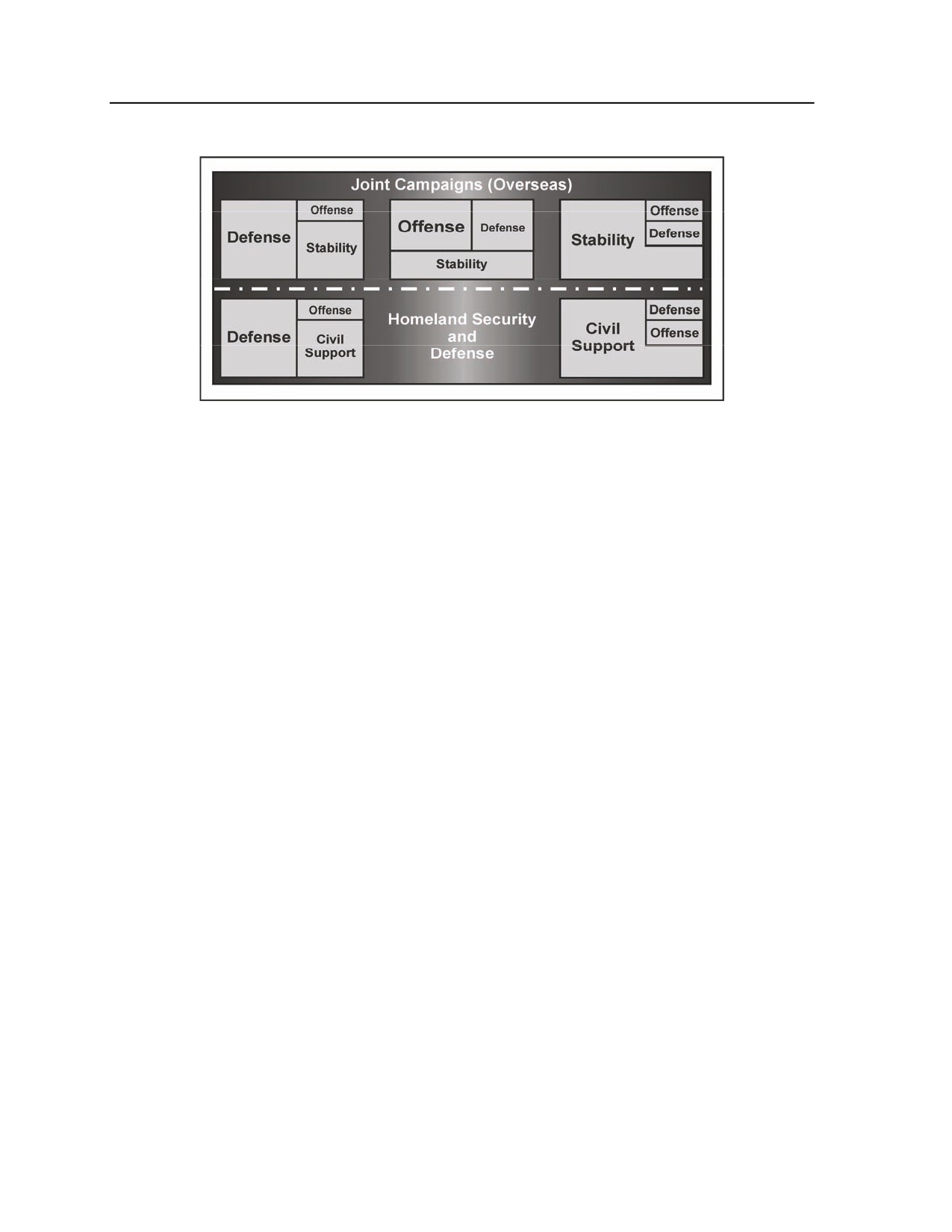
taken by the Service to the conduct of all land operations. Full spectrum operations require continuous,
simultaneous combinations of offensive, defensive, and stability or civil support tasks. (See figure 2-1.) In
all operations, commanders seek to seize, retain, and exploit the initiative while synchronizing their actions
to achieve the best effects possible. Operations conducted outside the United States and its territories
simultaneously combine three elements—offense, defense, and stability. Within the United States and its
territories, operations combine the elements of civil support, defense, and offense in support of civil
authority. Army forces operate using mutually supporting lethal and nonlethal capabilities.
15 April 2009
FM 1-04
2-1
Chapter 2
Figure 2-1. Full spectrum operations
2-4. Army forces use offensive and defensive operations to defeat the enemy on land. Simultaneously,
Soldiers execute stability or civil support operations to interact with the populace and civil authorities.
Combinations of offensive, defensive, and stability operations are typical in campaigns and other
operations conducted outside the United States. In some instances, combat may be continuous. In other
cases, stability tasks may dominate; peace operations, peacetime military engagement, and some limited
interventions focus almost exclusively on stability tasks. For example, foreign humanitarian assistance
operations involve primarily stability tasks with minor defensive tasks and no offensive element. In most
domestic operations, Army forces perform only civil support tasks. However, an extreme emergency, such
as an attack by a hostile foreign power, may require simultaneous combinations of offensive, defensive,
and civil support tasks.
2-5. The operational concept recognizes that current conflicts defy solution by military means alone and
that landpower, while critical, is only part of each campaign. Success in future conflicts will require the
protracted application of all the instruments of national power—diplomatic, informational, military, and
economic. Because of this, full spectrum operations equally weights tasks dealing with the population—
stability or civil support—with those related to offensive and defensive operations. This parity is critical; it
recognizes that
21st century conflict involves more than combat between armed opponents. While
defeating the enemy with offensive and defensive operations, Army forces simultaneously shape the
broader situation through nonlethal actions to restore security and normalcy to the local populace.
2-6. Each element of full spectrum operations—offense, defense, stability, civil support—has its own
doctrinal definition and its own particular legal issues. Because the elements of full spectrum operations
are often conducted simultaneously, judge advocates prepare to provide legal support to operations across
the spectrum of conflict.
2-7. Legal issues are prevalent in full spectrum operations and—with the exception of issues found in
civil support operations—are discussed under the various operational themes. (See paragraphs 2-8 to 2-24.)
Civil support operations address the consequences of natural or man-made disasters, accidents, and
incidents within the United States and its territories. Since these operations are domestic in nature, most
legal issues will revolve around properly using manpower, resources, and sustainment assets from the
various organizations and agencies involved in the operation. Judge advocates advising on civil support
operations should be familiar with the relevant Federal law, including the Posse Comitatus Act and related
case law, and the rules for the use of force (RUF). See appendix F for a detailed discussion of legal issues
frequently encountered in civil support operations.
2-2
FM 1-04
15 April 2009
Fundamental Concepts of Army Doctrine
OPERATIONAL THEMES
2-8. Army doctrine employs the concept of operational themes to describe the character of different
Army operations. A major operation is a series of coordinated tactical actions to achieve strategic or
operational objectives in an operational area. An operational theme describes the character of the dominant
major operation at any time within an area. An operational theme helps convey to the force the
characteristics of an operation. It also influences the doctrinal and legal principles that govern its
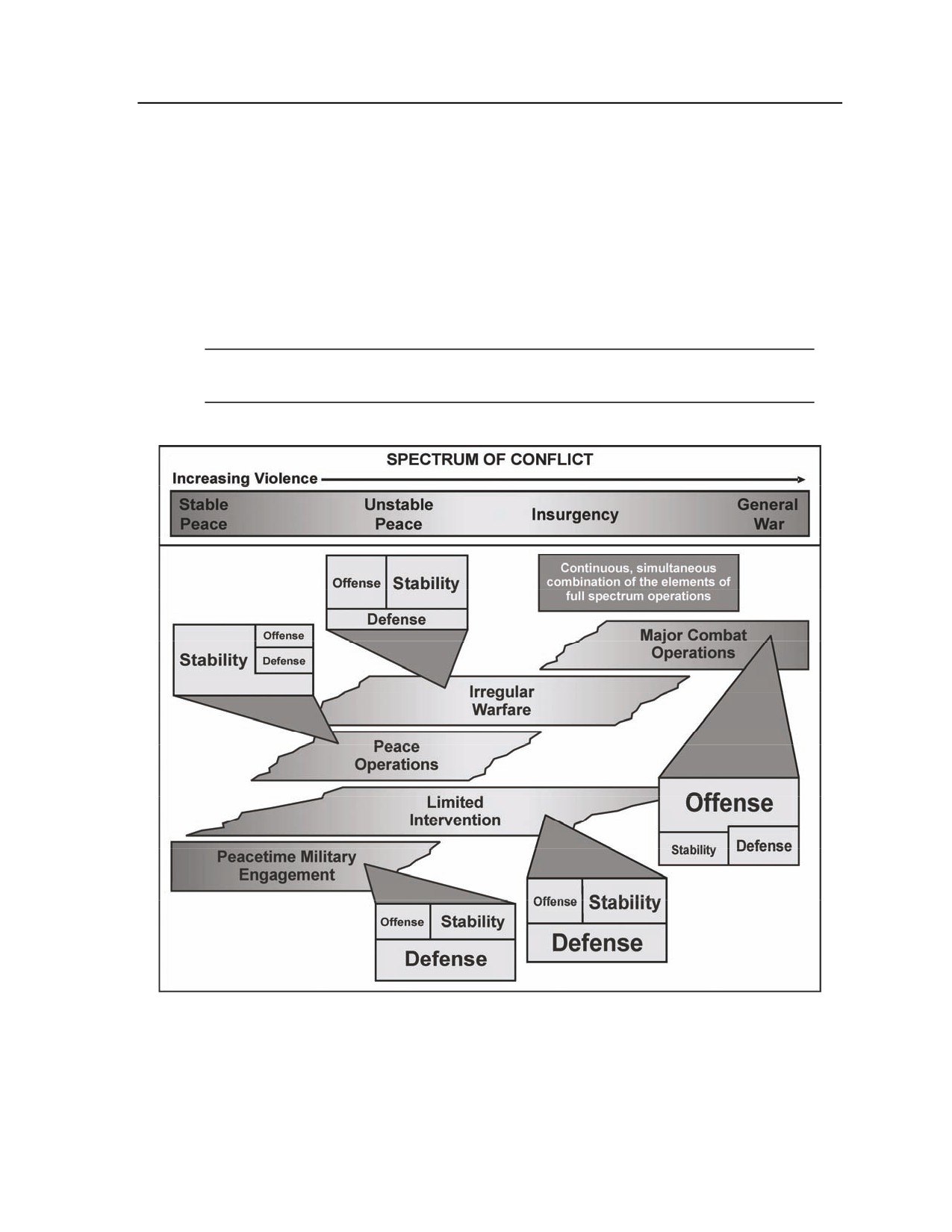
execution. As figure 2-2 indicates, the five operational themes range in intensity across the spectrum of
conflict from peacetime military engagement to major combat operations. Operational themes are
important to operational legal advisors because they affect a number of areas of the operational law
practice, from fiscal law to the RUF and rules of engagement (ROE). The operational theme will affect the
types of legal issues that judge advocates will confront during a given operation.
Note: Within the operational themes, the combinations of offense, defense, and stability
operations are illustrative and in practice will vary considerably, depending on the situation.
Figure 2-2. Operational themes
15 April 2009
FM 1-04
2-3
Chapter 2
PEACETIME MILITARY ENGAGEMENT
2-9. Peacetime military engagement consists of operations and activities conducted by the United States
in an effort to help shape the international security environment. Examples include exercises or training
exchanges with other nations, security assistance operations, and other programs designed to promote
stability and build closer ties with other nations.
2-10. Typically, peacetime military engagements are influenced and governed by policy, regulations,
security cooperation agreements, and when applicable, host-nation law and status-of-forces agreements.
These engagements are tremendously legally intensive in nature. Judge advocates must therefore take a
proactive role in planning these engagements. Examples of joint military operations conducted within this
operational theme include multinational training exercises, joint combined exchange training, security
assistance, recovery operations, and counterdrug activities. Judge advocates must fully understand the legal
authorities specific to their operations, including the international agreements and funding authorities and
limitations that may be specific to a particular operation. Judge advocates ensure commanders fully
understand and account for these considerations during the planning of any peacetime military
engagement.
2-11. United States military operations occurring outside the United States will invariably result in claims
against the government. Claimants may include local residents, host-nation governments, and multinational
forces. To ensure successful peacetime military engagements, U.S. forces must maintain positive
relationships with all involved. Therefore, judge advocates ensure the planning phase of these operations
includes preparations to process claims expeditiously and effectively until the statute of limitations expires.
2-12. Another legal issue less operational in nature, but also important in multinational environments, falls
under the core discipline of administrative law. Peacetime military engagements, such as multinational
cooperation exercises, generally involve numerous protocol events in which difficult issues arise involving
the Joint Ethics Regulation. The exchange of gifts at ceremonies or at the conclusion of exercises is
common. Commanders ensure all U.S. personnel are fully briefed on the requirements of the Joint Ethics
Regulation to avoid potential embarrassing situations or violations of U.S. law. Most multinational partners
do not have the same restrictive ethical limitations as those placed on Department of Defense personnel. As
a result, multinational officers often give expensive gifts to U.S. commanders and key staff officers during
official ceremonies or at the conclusion of exercises. If commanders do not contemplate such events in
advance, what may appear to be a minor issue can lead to a cultural misunderstanding and insult that may
ultimately thwart the purpose of the peacetime military engagement or violations of U.S. laws by senior
officers.
2-13. Judge advocates must be well versed in the myriad of legal issues arising during peacetime military
engagements. To ensure a successful operation, the judge advocate ensures that commanders properly
consider these issues during the planning process and throughout all aspects of the military engagement.
LIMITED INTERVENTION
2-14. A limited intervention has a clearly defined purpose and a specified end state. As the name implies,
these operations are limited in scope and, in principle, duration. Examples include foreign humanitarian
assistance, consequence management, noncombatant evacuation operations, sanction enforcement, raids,
strikes, shows of force, and elimination of weapons of mass destruction. Legal issues arising within a
limited intervention will vary depending on the type of operation.
2-15. Operations requiring the use of force such as strikes, raids, sanction enforcements, and elimination of
weapons of mass destruction, require judge advocates to understand the legal basis for the use of force and
the impacts of legal authorities and limitations. Additionally, judge advocates must ensure all participants
understand and incorporate applicable law of war provisions into clear, easily executed, legally and
tactically sound ROE. See appendix A.
2-16. Some operations such as foreign humanitarian assistance and consequence management are heavily
regulated by U.S. Federal law and aspects of international law that often dictate limits. In addition,
2-4
FM 1-04
15 April 2009
Fundamental Concepts of Army Doctrine
specialized units, such as civil affairs units, possess a specialty in conducting these types of missions. For
more discussion regarding judge advocate roles in civil affairs units, see appendix E.
PEACE OPERATIONS
2-17. Peace operations encompass multiagency and multinational crisis response and limited contingency
operations involving all instruments of national power. Peace operations include peacekeeping, peace
enforcement, peacemaking, peace building, and conflict prevention. These operations contain conflict,
redress the peace, and shape the environment to support reconciliation and rebuilding and to facilitate the
transition to legitimate governance.
2-18. Peace operations are generally conducted under international supervision and often under the
sponsorship of the United Nations or another international organization. United States participation may
occur unilaterally or as a part of a coalition. By their nature, peace operations and the laws that govern their
execution are complex and legally intensive. Peace operations are often further complicated by the absence
of the rule of law, gross human rights violations, collapse of civil infrastructure, and the presence of
dislocated civilians. Commanders will therefore rely heavily on judge advocate support when performing a
myriad of tasks associated with such operations.
2-19. In peace operations, judge advocates will encounter many of the same legal issues presented by both
peacetime military engagements and limited interventions. However, they may be further complicated by
additional challenges often associated with stability operations and the difficulties of establishing the rule
of law in failed or failing states. For detailed discussions of legal aspects of stability operations and rule of
law, see appendixes C and D.
IRREGULAR WARFARE
2-20. The term “irregular warfare” encompasses a broad array of conflicts in which the principal activities
are foreign internal defense, support to insurgency, counterinsurgency, combating terrorism, and
unconventional warfare. Generally, irregular forces are the most active in irregular warfare; however,
regular forces may also be heavily involved, especially in counterinsurgencies. Irregular warfare generally
avoids direct military confrontation, combining irregular forces with unconventional methods such as
terrorism. It also typically occurs within and among the civilian populace. Convoluted and controversial
legal issues governed by combinations of U.S. Federal law, international law, and host-nation law often
complicate irregular warfare. See FM 3-24 and FM 3-07.
2-21. Legal issues involved in irregular warfare are numerous and complex. In many irregular warfare
operations, U.S. forces often participate in operations with host-nation consent and therefore often heavily
governed by host-nation law. Effective judge advocates are versed in applicable host-nation law as well as
familiar with status-of-forces agreements and other agreements or applicable diplomatic notes. They
understand and are prepared to articulate the law of war as interpreted by the U.S. and other multinational
partners. Any differences of interpretation affect the planning and execution of operations, especially if
judge advocates contemplate the use of force. Another major legal issue to be considered in irregular
warfare operations is fiscal law. Judge advocates understand how specific operations are funded and what
bilateral or regional cooperation programs apply to their operation. Finally, judge advocates possess a
thorough knowledge of the law of war and principles and laws governing detention operations. Further
guidance regarding legal aspects of irregular warfare is found in appendixes A and B.
MAJOR COMBAT OPERATIONS
2-22. Major combat operations are conducted to defeat or destroy the enemy’s armed forces and to seize
terrain. They occur in circumstances generally characterized as general war. Legal issues found in major
combat operations are considered “traditional” operational law issues. Often legal issues involve law of
war issues, legality of weapons, targets, tactics, and the treatment of enemy prisoners of war. Appendixes
A and B discuss the legal issues most commonly encountered during major combat operations. Judge
advocates must be proactive and heavily involved in the planning phase of all major combat operations.
This participation ensures the applicable law of war is considered from the U.S. perspective as well as any
15 April 2009
FM 1-04
2-5
Chapter 2
multinational partners. However, the tempo of major combat operations requires judge advocates to be
thoroughly knowledgeable in the law of war as commanders and staffs rely on them to provide almost
immediate law of war advice.
2-23. Effective judge advocates know each of the operational themes and understand how each creates its
own set of unique legal issues. By thoroughly understanding these concepts, judge advocates provide
effective operational law support and help the commander set the proper tone for the organization. For a
detailed discussion of operational themes, see FM 3-0.
THE WARFIGHTING FUNCTIONS
2-24. A warfighting function is a group of tasks and systems (people, organizations, information, and
processes) united by a common purpose that commanders use to accomplish missions and training
objectives (FM 3-0). The warfighting functions are the basis of combat power. Commanders employ the
warfighting functions to conduct full spectrum operations. Synchronized and applied to a mission, they
become combined arms, and form combat power greater than the additive strength of each function
individually. The warfighting functions are movement and maneuver, intelligence, fires, sustainment,
command and control, and protection. When conducting operations, commanders work to synchronize
each of the tasks and systems in the various warfighting functions at every level of command, from tactical
to strategic. Judge advocates and paralegal Soldiers should use the warfighting functions as a template for
reviewing and analyzing operation plans for legal issues. When JAGC personnel address legal issues
within and across the warfighting functions, they set the conditions for mission accomplishment.
MOVEMENT AND MANEUVER
2-25. The movement and maneuver warfighting function revolves around tasks and systems that move
forces to achieve a position of advantage over the enemy. This includes employing forces in combination
with direct or indirect fires, force projection into a given area, and measures taken to increase friendly
mobility or deny the enemy freedom of movement (countermobility). Commanders use the movement and
maneuver warfighting function to ensure that their forces are in the best position possible to capitalize on
friendly strengths and exploit enemy weaknesses.
2-26. Like all of the warfighting functions, the movement and maneuver warfighting function involves its
own set of unique legal issues. Judge advocates analyzing operation plans and orders should ask several
questions when considering how the movement and maneuver warfighting function affects pending
operations. Judge advocates might ask—
z
Does the plan entail the movement of friendly forces into an area with a large civilian
population? If so, how will civilians be affected by the presence of friendly forces? If
applicable, does the plan adequately address the likelihood that operations will result in large
numbers of dislocated civilians?
z
What precautions should the commander take to minimize injuries to noncombatant and
collateral damage caused by the movement of friendly forces?
z
Will civilian movement need to be curtailed or restricted? Will roadblocks, checkpoints, or
curfews be necessary? What are the applicable ROE for Soldiers manning checkpoints or
roadblocks?
z
Does the operation plan call for using any countermobility measures to deny the enemy’s
movement? If so, what measures should the commander consider to prevent noncombatant
casualties and minimize disruptions to civilian movement? If operating with multinational
partners, are any countermobility measures prohibited, such as the use of scatterable mines?
INTELLIGENCE
2-27. The intelligence warfighting function involves those tasks and systems that help commanders
understand the enemy as well as how other variables of an operational environment (political, military,
economic, social, information, infrastructure, physical environment, time) are likely to affect operations.
2-6
FM 1-04
15 April 2009
Fundamental Concepts of Army Doctrine
2-28. The legal issues related to the intelligence warfighting function are numerous; in fact, intelligence
law has become a discrete area of expertise within the field of operational law. Judge advocates analyzing
intelligence-related legal issues in operation plans and orders at the tactical level should begin their
analysis with certain threshold questions:
z
What collection methods are being proposed? Does the operation plan call for the collection of
information by friendly forces such as scouts, long-range surveillance teams, or special
operations forces? If so, are appropriate antifratricide control measures in place to ensure
friendly forces do not fire on them? Under what ROE will these teams operate?
z
Does the operation plan contemplate the use of human intelligence, signals intelligence, or some
other means of collection, such as overflights by aircraft or the use of unmanned aircraft
systems? Are there any legal considerations, restrictions, or prohibitions relevant to the use of
these systems?
z
What is the operation plan for gathering information from enemy prisoners of war and
detainees? Does the operation plan address tactical questioning and interrogations? What
provisions have been made to ensure Soldiers adhere to the proper standards for treatment of
detainees?
FIRES
2-29. The fires warfighting function is the related tasks and systems that provide collective and
coordinated use of Army indirect fires, joint fires, and command and control (C2) warfare, including
nonlethal fires, through the targeting process (FM 3-0).
2-30. Due to the potentially devastating nature of their effects, the use of lethal fires—particularly indirect
fires—is often closely regulated by the ROE and other control and coordination measures to minimize
fratricide and collateral damage. When planning operations or reviewing completed operation plans and
orders, judge advocates carefully review all aspects of the plan that deals with the use of fires to ensure that
it aligns with ROE and the law of war. At the tactical level, judge advocates work proactively with
commanders and fire support experts to ensure that plans include safeguards to help minimize collateral
damage and reduce the risk of fratricide. The following are suggested lines of inquiry and areas of
emphasis for judge advocates analyzing the fires warfighting function:
z
Are there provisions for the use of lethal fires contained in portions of the operation plan or
order beyond the fire support annex (such as lethal fires by air defense or aviation assets)? If so,
are these measures consistent with the ROE for the operation and the law of war?
z
Are there any protected places, including cultural property, in the unit’s area of operations? If
so, where in the operation order are they specified (such as fires, special instructions, or civil
affairs annexes)? Are they referenced in the ROE annex? What steps have been taken to ensure
potential indirect fire targets or target areas have been deconflicted with protected places?
z
What fire support coordination measures (restricted fire areas, no fire areas, or protected places)
are in place to mitigate the risk of fratricide and collateral damage by lethal fires?
z
Are there specific release authorities for direct and indirect fire systems in the ROE or in the
unit’s tactical standing operating procedures? If so, what is the plan for delegating authority in
the event the authorizing commander is unavailable to make the decision?
z
What is the blast radius and accuracy of particular available weapons systems? What are the
fires procedures for both deliberate and hasty targeting?
SUSTAINMENT
2-31. The sustainment warfighting function is the related tasks and systems that provide support and
services to ensure freedom of action, extend operational reach, and prolong endurance
(FM 3-0).
Sustainment is the provision of the logistics, personnel services (to include legal support), and health
service support necessary to maintain operations until mission accomplishment.
15 April 2009
FM 1-04
2-7
Chapter 2
2-32. Sustainment is the lifeblood of operations. Without sustainment—including health, legal, financial
management, and all of the other sustainment functions—Army forces could not deploy or conduct
continuous operations. Many key legal issues are inherent in the sustainment warfighting function. They
range from contingency contracting issues to the applicable fiscal rules for providing medical support to
civilians and paying claims for property loss, injury, or death. (FM 4-02.12 discusses eligibility for care in
U.S. Army medical treatment facilities.) Operational law practitioners can ask the following when
analyzing this function:
z
Does the operation plan call for contracting support? If so, where, when, and how much? If
there is a contracting annex, what does it say? Will goods or services be purchased from the
local economy? If so, what types? To what extent can the commander use existing contract
vehicles, including the logistics civil augmentation program and acquisition and cross-servicing
agreements? Will it be necessary to lease land or facilities? The answers to these questions help
the commander determine the amount and type of funds to use.
z
Does the operation plan call for financial management support? Is so, where are the units
located? Are there resource managers on brigades’ staff? What types of funding sources will
they use? Legal support may be critical in making purpose, time, and amount decisions to
support command requirements.
z
Might it be necessary to provide medical treatment to non-U.S. personnel? If so, what are the
criteria for treatment? What are the fiscal law implications of providing medical treatment or
humanitarian and civil assistance to non-U.S. personnel?
z
Will U.S. forces be expected to ensure that civilians receive medical supplies, food, and other
essential services?
COMMAND AND CONTROL
2-33. The command and control warfighting function is the related tasks and systems that support
commanders in exercising authority and direction (FM 3-0). It involves acquiring and managing friendly
information and directing and leading subordinates. The most important aspect of legal support to
command and control is having a judge advocate who takes initiative, participates at the appropriate C2
nodes, and develops the trust of the staff.
2-34. The authorization for a mission directly impacts C2 and has considerable legal importance. In
particular, C2 dictates which types of funds to expend and the purposes for which they may be used.
2-35. Soldier discipline is an integral component of the C2 warfighting function. During operations,
discipline is regulated, enhanced, and enforced through various means, including orders, regulations,
command policies, and the Uniform Code of Military Justice. Judge advocates participating in planning
should ask the following questions:
z
Are there general orders or other command policies in force in the operational area that will
affect any aspect of the operation plan?
z
Are there any status-of-forces or jurisdictional matters that need to be resolved in advance of the
operation?
z
Are there provisions in place for the delivery of military justice in the operational area once
operations reach steady state?
PROTECTION
2-36. The protection warfighting function consists of the related tasks and systems that preserve the force
so the commander can apply maximum combat power (FM 3-0). Preserving and protecting the force allows
commanders to maintain combat power. The protection warfighting function entails numerous legal issues;
many related to the use of force, such as ROE or the RUF. Both ROE and RUF provide rules that govern
Soldiers’ application of force for self-defense and mission accomplishment. ROE provide guidance on
using force in combat or overseas military operations, while RUF govern force protection in domestic or
permissive environments and in other “nonoperational” circumstances. See appendix A. Judge advocates
ask the following questions about protection:
2-8
FM 1-04
15 April 2009
Fundamental Concepts of Army Doctrine
z
Are there policies, directives, or regulations that deal specifically with protection issues?
z
What ROE or RUF, operation orders, or procedures are in effect for Soldiers tasked with
securing facilities, equipment, and other items of value to U.S. forces?
z
If the U.S. plans to use private security contractors, under what ROE or RUF will they operate?
Which organization will be responsible for prescribing and monitoring the contractors’ ROE or
RUF? How will their ROE or RUF be synchronized with U.S. military ROE or RUF?
THE OPERATIONS PROCESS
2-37. While differing significantly in design and application, all operations follow the operations process.
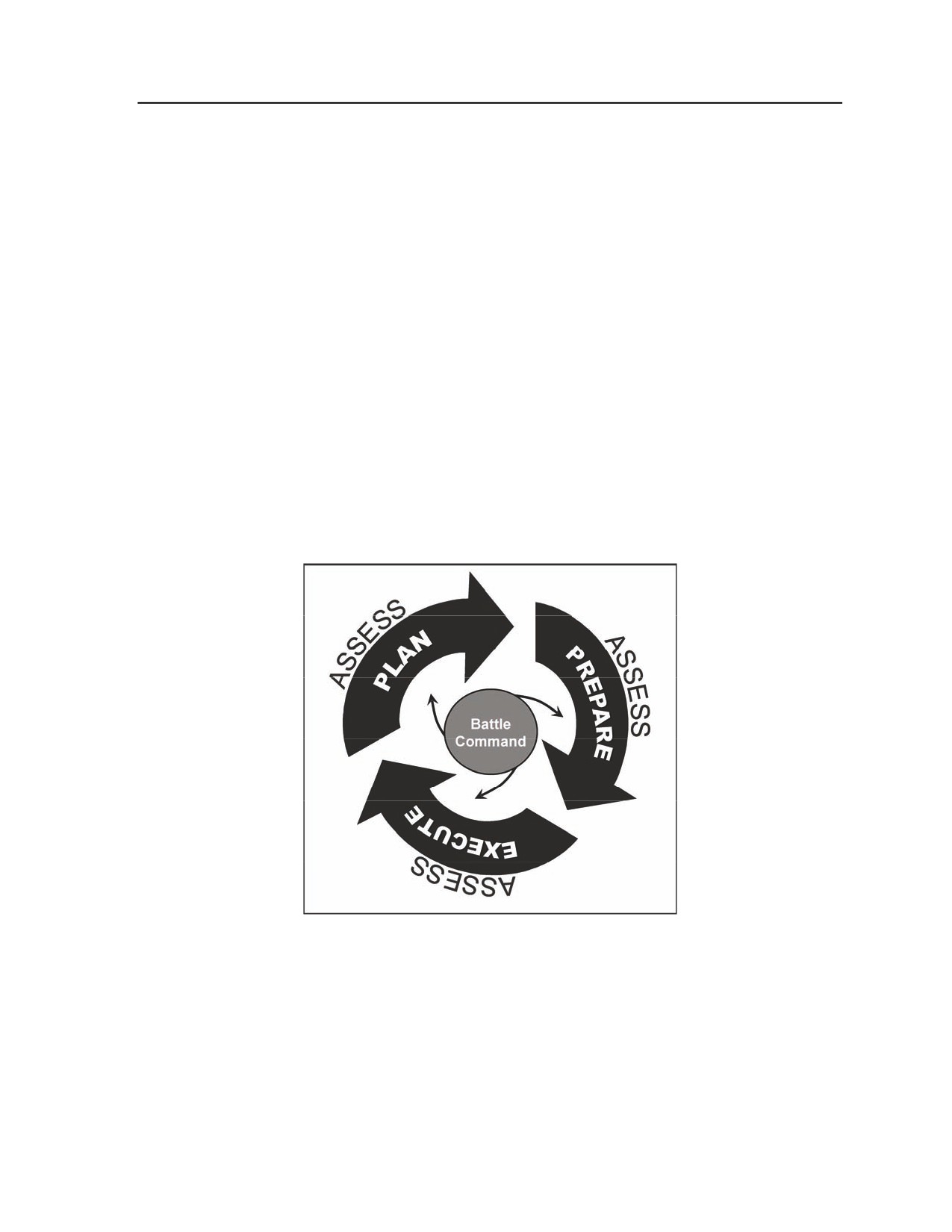
The operations process consists of the major command and control activities performed during operations:
planning, preparing, executing, and continuously assessing the operation. The commander drives the
operations process (FM 3-0). (See figure 2-3.) These activities may be sequential or simultaneous. They are
usually not discrete; they overlap and recur as circumstances demand. Commanders use the operations
process to help them control operations, provide command presence, and decide when and where to make
decisions. Commanders drive the operations process through battle command—understand, visualize,
describe, direct, lead, and assess. (See FM 3-0.)
2-38. Throughout the operations process, commanders synchronize forces and warfighting functions to
accomplish missions. This synchronization is essential to achieving synergistic effects. However,
synchronization is not an end in itself. It is useful only as it contributes to the greater effectiveness of the
force. Unnecessary synchronization or synchronization for limited gains degrades tempo, impedes
initiative, and allows the enemy to act within the friendly force decision cycle.
Figure 2-3. The operations process
2-39. Judge advocates are active in every aspect for the operations process. They remain attuned to the
course of the operation and provide critical information. More than ever, full spectrum operations require
informed legal support. As Army forces confront increasingly challenging and dynamic operating
environments, legal issues arise in circumstances unforeseen in previous military engagements. From lethal
and nonlethal targeting to the proper use of specific funds in coalition and interagency operations, legal
issues abound in the current and emerging operating environments. As a result, commanders recognize the
value of personnel trained to spot legal issues related to offensive, defensive, stability, and civil support
operations.
15 April 2009
FM 1-04
2-9
Chapter 2
2-40. Judge advocates have become fully integrated into the operations process to provide real time
support to the planning, execution, and assessment activities. Chapters 4 and 5 discuss in detail the roles
and responsibilities of JAGC personnel in the operations process and the core disciplines impacting full
spectrum operations.
LINES OF OPERATIONS AND LINES OF EFFORT
2-41. Major combat operations are normally designed using lines of operation that define the directional
orientation of a force in time and space. Stability and civil support operations are designed along lines of
effort that link multiple tasks and missions using the logic of purpose to focus efforts toward establishing
operational and strategic conditions. They are vital in helping to achieve unity of effort in operations that
involve civilian organizations and multinational forces. (See FM 3-0.)
2-42. In an operational design, lines of operations and lines of effort bridge full spectrum operations to link
tactical and operational objectives to the end state. A line of operation defines the directional orientation of
a force in time and space with relation to the enemy toward a geographic or force-oriented objective. A line
of effort links multiple tasks across the spectrum of conflict using the logic of purpose to focus on the end
state. In full spectrum operations, the four types of operations may occur simultaneously or sequentially;
commanders synchronize and sequence tasks across multiple lines of operations and lines of effort.
Commanders establish the military end state and supporting conditions for each operation, developing lines
of operations that help shape conditions that produce the end state. Subordinate commanders adjust the
level of effort and missions along each line of operations. Commanders formulate lines of operation and
continually refine them through assessment. Commanders may describe an operation along lines of
operations that are physical, logical, or a combination of both.
2-43. Lines of effort describe how decisive points are linked to operational and tactical objectives; they
connect the force with its base of operations and its objectives. Lines of effort define the operational design
when positional references to an adversary have little relevance. Rather than focus on physical objectives,
operations designed using lines of effort center on creating the conditions that define the end state. Ideally,
lines of effort combine the complementary, long-term effects of stability tasks with the cyclic, short-term
events typical of combat operations. Lines of effort also help commanders visualize how military means
can support nonmilitary instruments of national power. Judge advocates should refer to FM 3-0 to
understand these operational concepts and learn the commander’s language to participate in operations
planning and to provide legal support to full spectrum operations along the lines of effort.
2-44. Judge advocates must understand the framework of full spectrum operations and its potential merits
for ensuring that operations are synchronized across lines of operations and lines of effort. Where the
natural inclination for execution might be to phase or execute operations sequentially, the lines of effort
model helps ensure that operations are executed simultaneously and in synchronization. In full spectrum
operations, planners
(including judge advocates) identify and seek to avoid potential conflicts. This
deconfliction ensures momentum gained along each line of effort is not compromised. Visualization of
operations using this model further ensures that during the planning process, judge advocates are able to
anticipate legal issues and take a proactive role in their resolution.
MISSION COMMAND AND MISSION ORDERS
2-45. Mission command is the conduct of military operations through decentralized execution based on
mission orders. Successful mission command demands that subordinate leaders at all echelons exercise
disciplined initiative, acting aggressively and independently to accomplish the mission within the
commander’s intent (FM 3-0). Mission orders are instructions and directions that provide a broad concept
for mission success but leave the details of execution to subordinate leaders.
2-46. Mission command and mission orders allow small-unit leaders and their subordinates to maximize
their experience, judgment, and initiative to accomplish the mission. As such, they are particularly well
suited to an operational environment where operations are often decentralized and flexibility is required to
defeat an adaptive enemy.
2-10
FM 1-04
15 April 2009
Fundamental Concepts of Army Doctrine
2-47. Judge advocates and paralegal Soldiers supporting operations understand the concepts of mission
command and mission orders because these principles significantly influence legal support to future
operations. Two specific examples follow:
z
As operations become more decentralized and more responsibility is vested in small-unit
leaders, legal advice is required at lower levels of command. As a result, judge advocates and
paralegal Soldiers will increasingly find themselves assigned or task-organized to smaller units
and at lower levels of command.
z
Today’s battlefield is a noncontiguous environment where the tempo is incredibly rapid. In
providing legal support to fast-moving, decentralized operations, judge advocates and paralegal
Soldiers will rarely have the time or the means to seek detailed guidance from senior leaders on
complex legal issues. Judge advocates often have to rely on their own expertise, intellect, and
good judgment to provide timely, operational legal advice. They also have to empower paralegal
Soldiers by giving them a proactive role in providing operational legal support.
15 April 2009
FM 1-04
2-11
Chapter 3
Requirements in the Modular Force
This chapter provides an overview of the modular force concept that relates to the
Army’s ability to provide flexible and responsive functional capabilities to joint force
commanders. It describes the new organizational structure of the Army and identifies
where Judge Advocate General’s Corps (JAGC) Soldiers will be assigned throughout
this modular force. The redesign of the Army force structure will have a significant
impact on legal operations across all core competencies. The chapter further
describes materiel requirements necessary to provide legal support at various
echelons, along with some of the information resources that judge advocates should
have access to for mission accomplishment.
TRANSFORMATION
3-1. The global security environment changed dramatically after the terrorist attacks of 11 September
2001. Since those attacks, the U.S. has faced more unconventional threats ranging from rogue nations
aligned with terrorist groups to insurgents and guerillas. Recognizing that U.S. forces can no longer
exclusively organize, train, and equip for conventional war, the Army and the Department of Defense have
made significant changes to the Army’s force structure, doctrine, training, and equipment. The Army has
undergone its most dramatic change since World War II-era transformation.
3-2. The overall force structure redesign changes the nature of military competition and cooperation
through new combinations of concepts, capabilities, people, and organizations. These new combinations
exploit the nation’s advantages and protect against U.S. asymmetric vulnerabilities to sustain the U.S.
strategic position, which helps underpin peace and stability in the world. Transformation is a continuing
process that requires the active participation of all major components in the organization. The overall
objective of transformation is to sustain the United States’ competitive advantage in war.
3-3. One of the major objectives of transformation is to shift the “center of gravity” for Army operations
from division to brigade level. Brigade combat teams are the Army’s basic tactical maneuver units and the
smallest combined arms units that can be committed independently. Their core mission is to close with the
enemy using fires and maneuver to destroy or capture enemy forces, or to repel their attacks by fire, close
combat, and counterattack. Under the Army’s new operational paradigm, an operational commander can
select the number and type of brigades needed to accomplish a particular mission, and build a force
package consisting of only those units. These brigade-based force packages have organic logistic support,
thereby reducing the need to rely on outside logistic assets.
3-4. In another major change to past practices, a deployed brigade does not always operate under the
command and control (C2) of its “parent” division—that is, the division that normally acts as the brigade’s
higher headquarters in garrison. Under the new construct, brigades deploy and operate under a variety of
different C2 arrangements depending upon the mission. The brigade’s headquarters element may be a
division headquarters, a corps headquarters, or even a joint task force (JTF) headquarters. This new
approach allows Army forces greater flexibility to task-organize more efficiently and effectively for
meeting uncertain and irregular threats.
15 April 2009
FM 1-04
3-1
Chapter 3
BRIGADE COMBAT TEAMS
3-5. Under the modular force design, the brigade combat team (BCT) is the building block of land
combat power. The BCT is designed to operate as an autonomous unit that is independent of the standard
C2 relationship between a division and an organic brigade. There are three types of BCTs: infantry BCTs,
Stryker BCTs, and heavy BCTs. In addition, there are five types of support brigades: battlefield
surveillance brigades, fires brigades, combat aviation brigades, maneuver enhancement brigades, and
sustainment brigades. (See FMI 3-0.1.)
3-6. Consistent with the modular concept, a BCT may operate as a self-contained task force or it may fall
in on a higher headquarters element, perhaps even one from a different home station. This “plug and play”
concept and the Army’s brigade-centric approach have a number of impacts on the JAGC. Although the
brigade judge advocate serves as the legal advisor to the BCT commander and will normally be in his
rating chain, the brigade judge advocate is always under the technical supervision of a superior Staff Judge
Advocate (SJA), in accordance with Title 10, U.S. Code, section 806 (2000). SJAs and brigade judge
advocates work together to foster productive technical-channel relationships and communications to
provide effective and accurate legal advice and support across all echelons of the modular force.
3-7. Brigade legal section personnel are prepared to operate under the C2 and under the technical
supervision of a higher headquarters with which they have no habitual relationship. In those instances,
close coordination, uniformity, and consistency of practice become even more essential. Given the Army’s
increased utility of modular BCTs, there is an ongoing shift in responsibility for the delivery of legal
support from corps and division SJA offices to the brigade legal sections. The Army force management
system provides for organic legal positions in BCTs. In addition to the BCT-level legal positions, paralegal
Soldiers are also directly assigned to subordinate battalions. For additional information on BCTs and
support brigades, refer to FM 3-90.6.
THE DIVISION
3-8. The transformed modular division headquarters operates, in order of priority, as a tactical
headquarters to BCTs; as the Army component headquarters for a joint force (ARFOR); as a joint force
land component headquarters; and then as a JTF. The division is the primary tactical warfighting
headquarters for C2 of land force BCTs. In this role, it employs land forces as part of a joint, interagency,
and multinational force conducting full spectrum operations. The division executes simultaneous offensive,
defensive, and stability or civil support operations in an area of operations to establish specific conditions.
It assigns tactical tasks and missions to BCTs, organizing decisive, shaping, and sustaining operations to
accomplish its mission.
3-9. The division may serve as an ARFOR headquarters in small-scale contingencies without additional
Army augmentation. With staff augmentation, the division may also serve as a joint forces land component
or JTF headquarters. When serving as a JTF the division will organize and operate in accordance with joint
doctrine.
3-10. The division headquarters is organized with a division headquarters and headquarters battalion, two
command posts (division main and division tactical), and a mobile command group. The division will be
tailored or task-organized with a mix of BCTs and support brigades to conduct operations. To conduct a
major combat operation, the division requires the appropriate mix of the three types of BCTs (infantry,
Stryker, and heavy BCTs) and at least one of each of the five types of support brigades—combat aviation,
battlefield surveillance, maneuver enhancement, and fires. Typically, the sustainment brigade supporting
the division has a command relationship with the theater sustainment command (TSC) and a support
relationship with the division.
3-11. The Offices of the Staff Judge Advocate (OSJAs) at the division-level support and have oversight of
subordinate brigade legal sections with which they may or may not have a traditional C2 relationship. As
the higher-echelon component, the division OSJA ensures the employment of generally uniform standards
of practice across all core competencies. The division OSJA must maintain awareness of brigade personnel
issues so to provide support as needed. In deployed settings, the diversity of areas of operation will impact
3-2
FM 1-04
15 April 2009
Requirements in the Modular Force
mission planning and conduct of operations. Division OSJAs bear the responsibility of helping brigade
legal sections bridge capability gaps based on those differing challenges. For additional information on
divisions, refer to FM 3-0 and FMI 3-0.1. Approved organic legal positions in the division SJA office are
discussed in the Army force management system.
THE CORPS
3-12. The transformed modular Army corps headquarters is designed to operate, in order of priority, to
command and control tactical Army forces, to leverage joint capabilities, and to command and control joint
forces for small-scale contingencies. The corps headquarters has the capability to provide the nucleus of a
joint headquarters. However, the ability of the corps to transition to a JTF headquarters or joint force land
component command headquarters depends heavily on Army and other Service augmentation. The
transition of a modular corps headquarters to a joint headquarters relies on a timely filling of joint
positions, receipt of joint enabling capabilities, and comprehensive preactivation training as a joint
headquarters.
3-13. The modular corps headquarters consists of two C2 nodes plus a mobile command group. The main
command post contains the command group, the commander’s personal and special staff, and a mix of six
functional cells (movement and maneuver, intelligence, fires, sustainment, command and control, and
protection) and three integrating cells (current operations, future operations, and plans) under the general
supervision of the chief of staff. The tactical command post is an integrating node with representatives of
all warfighting functions and others as required. When directed the corps headquarters can create a mobile
command group built around the corps commander. Additionally, the main command post can field an ad
hoc early entry command post to precede the rest of the corps headquarters into an area of operations.
3-14. The modular corps headquarters can control a mix of division headquarters, BCTs, and support and
functional brigades. Based on its mission, the corps headquarters receives the attachment, operational
control, or tactical control of tailored support from national, strategic, or theater army assets.
3-15. Corps OSJAs provide legal support to strategic-level planning of operations. They further support
the efforts of division OSJAs and brigade legal sections to advise commanders. Corps OSJAs also provide
analysis and advice regarding lower-echelon legal actions that require broader oversight, due to law,
regulation, or policy. When deployed, irregular operational efforts may require direct contact between
brigade and corps legal personnel. Corps OSJAs maintain the capability to analyze specific brigade mission
requirements. As with a better-resourced organization, reporting requirements flow upward, but the general
burden of support flows from the corps OSJA to the division OSJA to the brigade legal section. For
additional information on corps, refer to FM 3-0 and FMI 3-0.1. Approved organic legal positions in the
division SJA office are discussed in the Army force management system.
THEATER SUSTAINMENT COMMAND
3-16. The TSC, provides sustainment planning, guidance, and support to forces in a theater of operation
and is assigned to a theater army headquarters. A TSC is not a fixed organization and subordinate units are
assigned, attached, or operational control based on the mission requirements. For additional information on
theater sustainment commands, refer to FM 3-0 and FM 4-93.4. The Army force management system
discusses approved table of organization and equipment legal positions in the TSC SJA office.
THEATER ARMY
3-17. The Army Service component command (ASCC) assembles and supports Army forces within the
supported geographic combatant commander’s (GCC’s) area of responsibility and supports Army, joint,
and other forces in that area of responsibility as required by the GCC. In almost all cases, the ASCC
sustainment functions are executed by the theater army’s TSC. Theater army is the doctrinal name for the
ASCC of a GCC and is the primary vehicle for Army support to Army, joint, interagency, and
multinational forces operating in the area of responsibility.
15 April 2009
FM 1-04
3-3
Chapter 3
3-18. The ASCC integrates Army forces into execution of theater security cooperation plans as well. For
additional information on ASCC, refer to FM 3-0 and FMI 3-0.1. The Army force management system
discusses approved table of organization and equipment legal positions in the ASCC SJA office.
THE JUDGE ADVOCATE GENERAL’S CORPS MATERIEL
REQUIREMENTS
3-19. Legal personnel are well equipped to be able to deliver timely legal support in garrison and during
deployments. The most critical categories of equipment are legal automation, mobility, and
communications.
AUTOMATION
3-20. The JAGC requires a dedicated system of automation to provide responsive legal services at all
echelons of command. That system is the Legal Automation Armywide System (LAAWS). This system
integrates legal information and services into a network that projects automated legal services down to
battalion level and permits sharing of legal work product. LAAWS provides for standardized software
throughout the JAGC and includes modules and databases for all core legal disciplines. LAAWS programs
process, transmit, receive, and display essential information. Legal references compiled by LAAWS are
available in compact disc and via databases on the Judge Advocate General’s Corps Information Network
(JAGCNet), a work group consisting of more than seventy computer servers and thousands of clients
throughout the world. JAGC Soldiers use the LAAWS and JAGCNet to provide accurate and responsive
operational legal services. JAGC Soldiers also require access to classified databases and information
through the SECRET Internet Protocol Router Network. Despite advances in information technology, legal
personnel are always prepared to provide operational support in circumstances without that technology.
JAGC Soldiers should acquire legal resources prior to deployment rather than expect to be able to
download them from the Internet once deployed.
3-21. The JAGC operates The Judge Advocate General’s Legal Center and School to train and educate
military, civilian, and international legal personnel in legal and leadership skills. It has developed the Judge
Advocate General’s University (JAGU) with state-of-the-art technology to deliver education and training.
The training from JAGU meets the emerging challenges in all environments. The JAGU uses real-time
information and video presentations. It provides legal personnel with quick and easy Internet access
worldwide. Legal personnel access informative Web sites to incorporate warrior lessons learned and other
important information into daily legal practice. The JAGU offers legal personnel a dynamic tool for
professional development and mission accomplishment in today’s and future operational environments.
MOBILITY
3-22. Legal personnel depend on the units to which they are assigned or attached for transportation.
Separate legal organizations, such as legal support organizations or mobilization support organizations,
require organic transportation assets. Sufficient vehicles are required for legal personnel, such as the SJA
or command judge advocate and staff, military judges, and defense counsel. The number and type of
vehicles will depend on the commander’s requirements for legal services. Normally, a division or corps
SJA office requires four high-mobility multipurpose wheeled vehicles (HMMWVs), one 5-ton truck, and
four cargo trailers. Brigade judge advocate or command judge advocate sections typically require one
HMMWV and one cargo trailer. Additionally, each military judge in theater of operations and each trial
defense section requires one HMMWV with trailer. Mobility serves three distinct functions:
z
Control of legal assets.
z
Effective delivery of operational law and personnel service support.
z
Service of geographic areas.
3-4
FM 1-04
15 April 2009
Requirements in the Modular Force
Control
3-23. The SJA delivers legal services throughout the area of operations. The SJA supervises and exercises
administrative control over SJA section personnel. To administer legal services effectively, the SJA knows
what, where, and when legal services are required and directs the appropriate employment of legal
personnel. The SJA provides technical advice and guidance to judge advocates that fall under the SJA’s
statutory technical supervision. Moreover, as the primary legal advisor to the commander and staff, the
SJA has the mobility to be wherever and whenever required.
Delivery
3-24. JAGC Soldiers provide legal services to lower echelons of command. These Soldiers require
mobility for several reasons:
z
Reviewing allegations of war crimes and violations of the Uniform Code of Military Justice.
z
Receiving, investigating, and paying foreign claims.
z
Conducting rule of law activities.
z
Providing legal assistance.
z
Advising commanders on time-sensitive, mission-essential legal problems, particularly those
encountered during stability operations.
Service
3-25. Military judges provide judicial legal services on an area basis. Courts-martial will be conducted in
the accused’s unit’s area of operations as far forward as the commander deems appropriate. Trying courts-
martial as far forward as possible will minimize disruption of the unit, provide better availability of
witnesses, and speed the administration of military justice. Military judges must have the mobility to
preside over courts-martial and perform magistrate duties where and when needed. Defense counsels
provide defense legal services to the units for which they are assigned responsibility or on an area basis.
Defense counsel maintains the mobility to interview and consult with widely scattered clients and
witnesses and to represent their clients before courts-martial and adverse administrative proceedings.
COMMUNICATIONS
3-26. Operations often occur in a fluid, chaotic, and dangerous environments in which mobility is
constrained. Legal advice is time-sensitive and often critical. JAGC Soldiers require access to
communications that link them with the commander, the subordinate commanders, the staff, and the SJAs
at higher echelons. JAGC Soldiers utilize communications available within their commands, to include the
Army Battle Command System, combat net radios, common-user networks, Army Data Distribution
System equipment, and Broadcast System equipment. In addition, JAGC Soldiers have a dedicated digital
sender to transmit critical, time-sensitive documents. These documents can be simultaneously scanned and
e-mailed to any location.
15 April 2009
FM 1-04
3-5
Chapter 4
Roles, Responsibilities, and Working Relationships
This chapter examines the roles, responsibilities, and working relationships of Judge
Advocate General’s Corps (JAGC) organizations and JAGC personnel assigned to the
operating force. It outlines the primary doctrinal missions of the legal sections and
legal offices at various levels of command and information regarding the roles and
responsibilities of JAGC personnel.
WORKING RELATIONSHIPS AND PROFESSIONAL
RESPONSIBILITY CONSIDERATIONS
4-1. Chapter 3 of this field manual outlines changes in the Army’s operational force structure. While
operational command and control may have changed, the JAGC’s mission remains the same: provide
proactive legal support on all issues affecting Army and joint forces and deliver quality legal services to
Soldiers, retirees, and their families. To accomplish this mission, judge advocates, legal administrators, and
paralegal Soldiers work together proactively and professionally. To this end, JAGC personnel at every
level of command are expected to forge and maintain strong working relationships with each other.
4-2. Working relationships are the key to success. When faced with vagueness or ambiguity, JAGC
Soldiers use their intelligence, initiative, and ingenuity to craft courses of action that will help accomplish
the mission legally, morally, and ethically.
4-3. Army doctrine requires JAGC personnel to comply with the military and civilian codes of
professional responsibility and ethics that govern the practice of law. While all JAGC personnel are
Soldiers first, judge advocates are prohibited from providing legal support in any way that violates an
applicable rule of legal ethics. Judge advocates may not, for example, engage in conflicts of interest. These
conflicts often arise when a judge advocate represents the command, but the command asks the judge
advocate to give legal advice to Soldiers. In cases of ethical conflict, an additional judge advocate is
involved. This and other rules of professional responsibility govern both judge advocate attorneys and the
legal administrators and paralegal Soldiers who assist them. Judge advocates are subject to professional
discipline from their bar licensing organizations for violating any applicable rule, even in an operational
environment. Judge advocates identify and explain to their commanders any issues of legal ethics that may
affect operations. JAGC personnel should also inform and consult their Staff Judge Advocates (SJAs)
regarding any matters of professional legal ethics.
BRIGADE LEGAL SECTION
4-4. In keeping with the Army’s brigade-centric approach to operations, the JAGC enhances brigade-
level legal support. In the past, judge advocates and paralegals were assigned to the division Office of the
Staff Judge Advocate
(OSJA) and task organized into brigade operational law teams for specific
operations. Under the new design, the brigade operational law team has been replaced by the more robust
brigade legal section. This organization is directly assigned to the brigade headquarters and not to the
division OSJA.
4-5. Whether in garrison or deployed, the brigade legal section provides legal services across the core
legal disciplines. The section’s priorities are based on the brigade commander’s guidance and direction, the
SJA’s legal priorities across the area of operations, and the brigade judge advocate’s professional
judgment. The breadth of service that a brigade legal section provides will depend on several factors. These
15 April 2009
FM 1-04
4-1
Chapter 4
factors include the brigade’s tempo, the brigade’s deployment status, the experience level of brigade legal
section personnel, the availability of additional judge advocates or paralegal support during
“surge”
periods, and the existence of actual conflicts of interest. As a field grade officer and an experienced judge
advocate, the brigade judge advocate is expected to make sound, well-reasoned decisions regarding the
level of service that the brigade legal section can provide. When faced with situations where the brigade
legal section cannot provide the proper breadth of service, the brigade judge advocate should use the
brigade chain of command and JAGC technical channels to address shortfalls.
4-6. The brigade legal section performs the following tasks:
z
Provide the brigade commander and brigade staff with legal advice and support across the core
legal disciplines.
z
Provide the brigade commander and brigade staff with legal advice and support in full spectrum
operations.
z
Provide the brigade commander and brigade staff with legal advice and support in military
justice, administrative separations, command policies, and other issues related to the good order
and discipline of the brigade.
z
Oversee the administration of military justice for the brigade, to include conducting military
justice proceedings up to and including general courts-martial, in coordination with the OSJA
for the general court-martial convening authority (GCMCA).
z
Provide legal assistance services
(including Soldier readiness processing) to the brigade
consistent with all applicable laws, regulations, rules of professional responsibility, and the
requirements of the brigade’s mission.
z
Administer a preventive law program designed to educate commanders, staff, Soldiers, and their
families on legal issues that they may confront on a regular basis.
z
Ensure that all brigade legal personnel are trained and ready to deploy in support of the
brigade’s mission.
BRIGADE LEGAL SECTION PERSONNEL
4-7. A brigade legal section includes two judge advocates: a brigade judge advocate and a trial counsel.
The brigade judge advocate is a major who serves as the brigade commander’s legal advisor and officer in
charge of the brigade legal section. A trial counsel is a captain whose primary responsibility is to
administer all military justice matters for the brigade combat team (BCT). Additionally, the trial counsel
will provide operational law advice and assist the brigade judge advocate with legal issues across all
operational law disciplines. The brigade legal section also includes a brigade senior paralegal
noncommissioned officer (NCO). BCTs are authorized a sergeant first class to fill the position of a brigade
senior paralegal NCO. Support brigades are authorized a staff sergeant to fill the same position. Finally,
paralegal Soldiers, E-1 through E-5, are assigned to each subordinate battalion of a BCT or support
brigade. All JAGC Soldiers in a BCT work under the direction and of the brigade judge advocate.
4-8. During deployments, a brigade legal section frequently requires augmentation to meet its mission
requirements. If augmented, the brigade legal section may include an additional judge advocate, usually a
captain. This captain’s duties include operational law, administrative law, and legal assistance support to
the brigade. When augmented by a third judge advocate, the brigade legal section can provide superior
operational law coverage. The brigade legal section can avoid ethical conflicts when providing client
services and administrative law support. For example, during client services, rules of professional
responsibility prevent the same judge advocate from advising the commander and a Soldier in an adverse
action. Administrative law support also avoids conflicts. For example, a judge advocate is needed to serve
as a neutral advisor to an AR 15-6 investigator. When deployed, duties of the brigade legal section may
include foreign claims and detention operations. Ultimately, the brigade judge advocate determines the
duties and responsibilities of the third judge advocate in light of mission requirements.
4-9. The brigade judge advocate is the primary legal advisor to the brigade commander. The brigade
judge advocate, the trial counsel, and the brigade senior paralegal NCO are assigned to the brigade. The
brigade headquarters is the primary place of duty for the brigade judge advocate and the senior paralegal
4-2
FM 1-04
15 April 2009
Roles, Responsibilities, and Working Relationships
NCO as well as for a judge advocate augmenting the brigade legal section. The trial counsel will work at
the OSJA military justice section while in garrison to foster effective training and ensure consistency in the
quality of legal services delivered. The trial counsel will deploy with the BCT headquarters for training
exercises and missions. The trial counsel will maintain a close working relationship with the BCT for both
effective military justice support and deployments. Fostering this relationship may include participation in
the BCT physical training program, BCT officer development, and other events. As a member of the
brigade commander’s personal and special staff, the brigade judge advocate requires a direct line of
communication to the brigade commander.
4-10. Though the SJA serves as the brigade judge advocate’s rater, the brigade commander or designated
representative (ordinarily the deputy commander or executive officer) typically determines the brigade
judge advocate’s routine duties in support of the brigade. The brigade judge advocate supervises the trial
counsel during training exercises and missions. The OSJA chief of military justice in garrison directly
supervises the trial counsel. While not directly supervising all brigade legal personnel, the SJA of the
higher echelon does have responsibility for legal oversight, training, and technical guidance.
(See
paragraphs 4-20 through 4-33.)
4-11. The rating scheme for judge advocates assigned to brigades is in accordance with relevant Army
regulations. Accordingly, the brigade judge advocate normally is rated by the SJA and senior-rated by the
BCT commander. The trial counsel is rated by the brigade judge advocate, may be intermediate-rated by
the brigade deputy commander or executive officer, and is be senior-rated by the SJA. Judge advocates
augmenting the brigade legal section normally share the same rating scheme as the trial counsel. The senior
paralegal NCO is rated by the brigade judge advocate, senior-rated by the brigade deputy commander or
executive officer, and reviewed by the brigade commander.
4-12. These rating schemes ensure that judge advocates receive both leadership and mentoring from their
unit chain of command as well as professional guidance on the practice of law from a senior judge
advocate. The rating schemes outlined herein are intended to achieve these goals while providing
maximum flexibility to the brigade. Variations may be necessary, especially in a deployed environment.
Each judge advocate assigned to a brigade should have another judge advocate in the rating scheme to
ensure that unique professional matters are addressed in evaluations.
DUTIES AND RESPONSIBILITIES OF BRIGADE LEGAL SECTION PERSONNEL
4-13. Paragraphs 4-14 through 4-19 outline the primary duties and responsibilities of personnel assigned to
the brigade legal section. While not all-inclusive, these duty descriptions provide a good overview of each
Soldier’s role in providing legal support to the brigade. The actual day-to-day duties and priorities of
brigade legal section personnel vary based on the brigade commander’s priorities, the SJA’s legal priorities
within the GCMCA’s area of operations, the brigade’s mission, and the unit’s deployment status.
Brigade Judge Advocate
4-14. The brigade judge advocate advises the commander and staff on operational law, military justice,
administrative law, fiscal law, and other areas of the law as required. This judge advocate ensures the
delivery of legal services to the brigade across the core legal disciplines. The brigade judge advocate
participates in operations planning and targeting processes. This participation includes reviewing operation
plans and orders, training concepts, and other key actions for legal sufficiency. The brigade judge advocate
deploys as a member of the brigade staff and serves as the officer in charge of the brigade legal section.
This officer plans, coordinates, and oversees client services, Soldier readiness programs, and preventive
law programs for the brigade. The brigade judge advocate supervises, trains, and mentors the trial counsel,
judge advocate augmentee, and the brigade senior paralegal NCO, and bears supervisory responsibility for
the overall professional development of brigade legal section personnel.
Brigade Trial Counsel
4-15. The brigade trial counsel advises commanders and staff in all areas of military justice in garrison and
during deployments. The trial counsel prosecutes courts-martial arising within the BCT. The trial counsel
15 April 2009
FM 1-04
4-3
Chapter 4
coordinates with law enforcement agencies on pending cases and investigations within the BCT. The trial
counsel represents the government at Article 32(b) investigations and administrative boards. The trial
counsel reviews adverse administrative actions, Article 15 punishments, and other military justice matters
arising within the BCT. Additionally, the trial counsel assists the brigade judge advocate on operational
law issues including the Department of Defense Law of War Program, detainee operations, status-of-forces
and other international agreements, general orders, and predeployment legal preparation. The trial counsel
serves as a standing member of operations planning groups, targeting boards, and the fires section. The
trial counsel participates in planning for operations and conducts legal reviews of operation plans,
contingency plans, and exercise plans. The trial counsel deploys as necessary for training exercises or
combat and contingency operations. The trial counsel also serves as the acting brigade judge advocate
when the brigade judge advocate is absent.
Brigade Senior Paralegal NCO
4-16. The brigade senior paralegal NCO is the senior enlisted advisor and assistant to the brigade judge
advocate, and serves as the noncommissioned officer in charge of the brigade legal section. The senior
paralegal NCO supervises, trains, and mentors subordinate paralegal Soldiers and paralegal NCOs assigned
to battalions. The senior paralegal NCO serves as a member of the brigade’s staff. This NCO should have
successfully completed the Battle Staff NCO course and received an additional skill identifier. This NCO
coordinates and conducts required training on legal issues, including law of war and rules of engagement.
The senior paralegal NCO coordinates with the brigade judge advocate, the OSJA command or chief
paralegal NCO, and the career developments manager at Army Human Resources Command, to requisition
vacant paralegal Soldiers’ positions at the battalion level. Additionally, the brigade senior paralegal NCO
regularly advises Human Resources Command of personnel actions that can potentially impact the
brigade’s legal strength.
Battalion Paralegal Soldiers
4-17. Paralegal Soldiers, E-1 through E-5, are assigned to the S-1 section of each subordinate battalion of a
BCT or support brigade. Their assignment to the battalion S-1 section is designed to provide legal support
to battalion commanders and Soldiers. These paralegal Soldiers act under the direction and supervision of
the brigade judge advocate and brigade senior paralegal NCO, and their duties should be restricted to those
of a legal nature.
4-18. Brigade judge advocates and brigade senior paralegal NCOs retain the flexibility to coordinate the
consolidation of legal assets at the BCT and support brigade headquarters. The ability to consolidate legal
assets varies based on available space within the headquarters, training requirements, and deployments.
Brigade judge advocates and senior paralegal NCOs should strongly consider consolidation during periods
of reduced paralegal strength to maximize the efforts of all legal personnel assigned to the BCT.
Consolidation also allows the brigade judge advocate and senior paralegal NCO to train, supervise, and
develop paralegal Soldiers to the required level of expertise prior to deployment. Consolidation of legal
assets is coordinated with the brigade commander, executive officer, and command sergeant major.
Judge Advocate Augmentation
4-19. If additional judge advocate augmentation is necessary and provided, that judge advocate provides
legal advice to commanders and staff on operational law, administrative law, fiscal law, and all other areas
of the law as required. The judge advocate provides support to plans cells. The additional judge advocate
provides legal assistance, Soldier readiness, and preventive law support to the brigade. The judge advocate
performs legal advocacy tasks on behalf of the Soldiers of the brigade, especially where conflicts of
interest exist. The brigade judge advocate determines the scope of the judge advocate augmentee’s duties
and responsibilities based upon mission requirements.
4-4
FM 1-04
15 April 2009
Roles, Responsibilities, and Working Relationships
THE OFFICE OF THE STAFF JUDGE ADVOCATE
4-20. The OSJA provides legal support to the commander, staff, Soldiers, retirees, families, and other
eligible individuals supported by a given command. Divisions, corps, and Army Service component
commands (ASCCs) are supported by organic OSJAs.
THE OFFICE OF THE STAFF JUDGE ADVOCATE TASKS
4-21. The OSJA performs the following tasks:
z
Provide the commander and staff with legal support and advice in full spectrum operations.
z
Advise the commander and staff on military justice, administrative separations, command
polices, and other issues related to the good order and discipline of the command.
z
Oversee the administration of military justice for the GCMCA and provide supervision, training,
and oversight of the brigade trial counsel in the administration of military justice matters while
in garrison.
z
Provide the commander and staff with legal support and advice in all legal disciplines.
z
Administer claims and legal assistance programs consistent with all applicable laws, regulations,
and rules of professional responsibility.
z
Administer a preventive law program designed to educate commanders, staff, Soldiers, retirees,
and their families on legal issues that they may confront regularly.
z
Ensure that personnel directly assigned to the OSJA are trained and ready to deploy in support
of the unit’s mission.
z
Provide legal oversight, training, and guidance to brigade legal sections under the SJA oversight
authority.
DUTIES AND RESPONSIBILITIES OF THE OFFICE OF THE STAFF JUDGE ADVOCATE
PERSONNEL
4-22. The senior leadership of the OSJA at the division, corps, and ASCC levels consists of the SJA, the
deputy SJA, the legal administrator, and the command or chief paralegal NCO. Each senior leader has
specific duties and responsibilities, but all four leaders work together to ensure that the OSJA is led,
trained, equipped, and supported in a manner to accomplish the mission. Each division within the OSJA
has a division chief and a noncommissioned officer in charge who receives direction, guidance, and
support from senior leadership. They in turn provide direction, guidance, and support that are more specific
to those who work in their division—subordinate judge advocates, civilian attorneys, and paralegal NCOs
and Soldiers. Paragraphs 4-23 through 4-32 discuss each leader’s responsibilities.
The Staff Judge Advocate
4-23. The SJA is the field representative of The Judge Advocate General (TJAG). As TJAG’s assigned
representative, the SJA has responsibility to deliver legal services within a command. The SJA is the
officer in charge of the OSJA. This officer is responsible for planning and resourcing legal support as well
as conducting training, assignments, and the professional development of JAGC personnel assigned to the
command and its subordinate units. The SJA is authorized to communicate with TJAG and other
supervisory judge advocates of superior or subordinate commands as necessary.
4-24. The SJA serves as the primary legal advisor to the commander exercising GCMCA as prescribed by
the Uniform Code of Military Justice (UCMJ), the Manual for Courts-Martial, and applicable regulations.
As a member of the commander’s personal staff, the SJA communicates directly with the commander on
all legal matters affecting the morale, good order, and discipline of the command. Additionally, the SJA is
a member of the commander’s special staff and hence under the general supervision of the chief of staff.
The SJA provides legal advice and support to the staff and coordinates actions with other staff sections to
ensure the timely and accurate delivery of legal services throughout the command.
15 April 2009
FM 1-04
4-5
Chapter 4
4-25. The SJA will perform the following duties:
z
Provide military justice advice and perform military justice roles, functions, and duties
prescribed in the UCMJ.
z
Provide legal advice regarding administrative boards, investigations, or other military tribunals.
z
Provide oversight and training of legal personnel in the command and its subordinate units,
including professional responsibility training to those judge advocates under the SJA’s direct
and technical supervision.
z
Ensure that OSJA personnel are ready to deploy.
z
Provide legal advice and support in the areas of administrative and civil law.
z
Provide international and operational law advice, including training and support to the
Department of Defense Law of War Program.
z
Provide legal advice and support on contract and fiscal law, health care law, and environmental
law matters.
z
Operate the command’s legal assistance, claims, procurement fraud, Federal magistrate court,
victim-witness assistance, and military justice training programs.
z
Provide legal advice and support to the civilian personnel office and equal employment
opportunity office.
z
Provide legal advice and support to the Family Advocacy Case Review Committee.
z
Serve as the command ethics counselor.
z
Assist with litigation in which the United States has an interest.
z
Support training programs for Reserve Components legal personnel and units.
z
Provide legal advice and support concerning intelligence activities.
The Deputy Staff Judge Advocate
4-26. The deputy SJA is the second-most-senior judge advocate assigned to the OSJA and serves as the
SJA’s executive officer. While the SJA is the primary legal advisor to the command, the deputy SJA is
responsible for the day-to-day administration, training, and execution of the OSJA activities. As the second
member of the OSJA’s senior leadership team, the deputy SJA coordinates the efforts of the legal
administrator and command or chief paralegal NCO throughout the OSJA. The deputy SJA ensures that
every member of the OSJA receives the mentorship, training, equipment, and support to meet mission
requirements consistent with the SJA’s intent. The deputy SJA serves as the acting SJA in the SJA’s
absence and therefore is always prepared to assume the SJA’s duties and responsibilities. The deputy SJA
may supervise legal services at a separate location during split-based operations. Such operations may
include serving as the SJA of the rear detachment when the SJA deploys with the forward element.
The Legal Administrator
4-27. The legal administrator is an Army warrant officer with special training in law office management
and operations. The legal administrator is the third member of the OSJA’s senior leadership team and the
officer in charge of the administrative section. Legal administrators are directly responsible for OSJA
human resources management and support, information management systems, facilities and equipment,
resource management, and the security of OSJA facilities, equipment, and classified materials.
Additionally, legal administrators contribute to and support the training requirements of OSJA personnel.
The legal administrator builds and maintains effective working relationships with key personnel throughout
the area of operations to enable OSJA personnel to meet their mission requirements.
The Command or Chief Paralegal NCO
4-28. The command or chief paralegal NCO is the senior enlisted Soldier in the OSJA of a division, corps,
or ASCC, and the fourth member of the OSJA’s senior leadership team. A command paralegal NCO is
normally a sergeant major who serves at division and corps OSJAs, while a chief paralegal NCO is
normally a master sergeant who serves at ASCC OSJAs. This senior enlisted leader advises SJAs,
4-6
FM 1-04
15 April 2009
///////////////////////////////////////