Snowmobile Ski Doo REV SERIES (2006 year). Instruction - part 55
 

  Index      Snowmobiles / ATV     Snowmobile Ski Doo REV SERIES - instruction 2006 year


Search            copyright infringement  


Content   ..  53  54  55  56   ..


Snowmobile Ski Doo REV SERIES (2006 year). Instruction - part 55


Section 05 ENGINE MANAGEMENT (POWER TEK)
Subsection 03 (COMPONENT INSPECTION, REPLACEMENT AND ADJUSTMENT)

Before replacing an ECM, always check electrical
connections. Make sure that they are very tight
and they make good contact and that they are
corrosion- free. Particularly check ECM ground
connections. Ensure that contacts are good and
clean. A “defective module” could possibly be
repaired simply by unplugging and replugging the
ECM. The voltage and current might be too weak
to go through dirty wire pins. Check carefully if
pins show signs of moisture, corrosion or if they
look dull. Clean pins properly and then coat them
prior to assembling as follows:

NOTE: Do not apply dielectric grease or other lu-
bricant on the ECM connectors.

If the newly replaced ECM works, try the old one
and recheck if it works.

Ensure that all electronic components are gen-
uine.Any modification on the wiring harness may
lead to generate fault codes or bad operation.

NOTE: For diagnostics purposes, use Vehicle
Communication Kit (VCK). See DIAGNOSTIC
PROCEDURES for proper connectors/adaptors.

NOTE: After disconnecting ECM connector for a
test and then reconnecting it, it will be neces-
sary to READ data from vehicle again to re-enable
B.U.D.S. communication. Otherwise, the follow-
ing message will appear at some point.

A33C57A

After a problem has been solved, ensure to clear
the fault(s) in the ECM using the VCK. Refer to
DIAGNOSTIC PROCEDURES subsection.

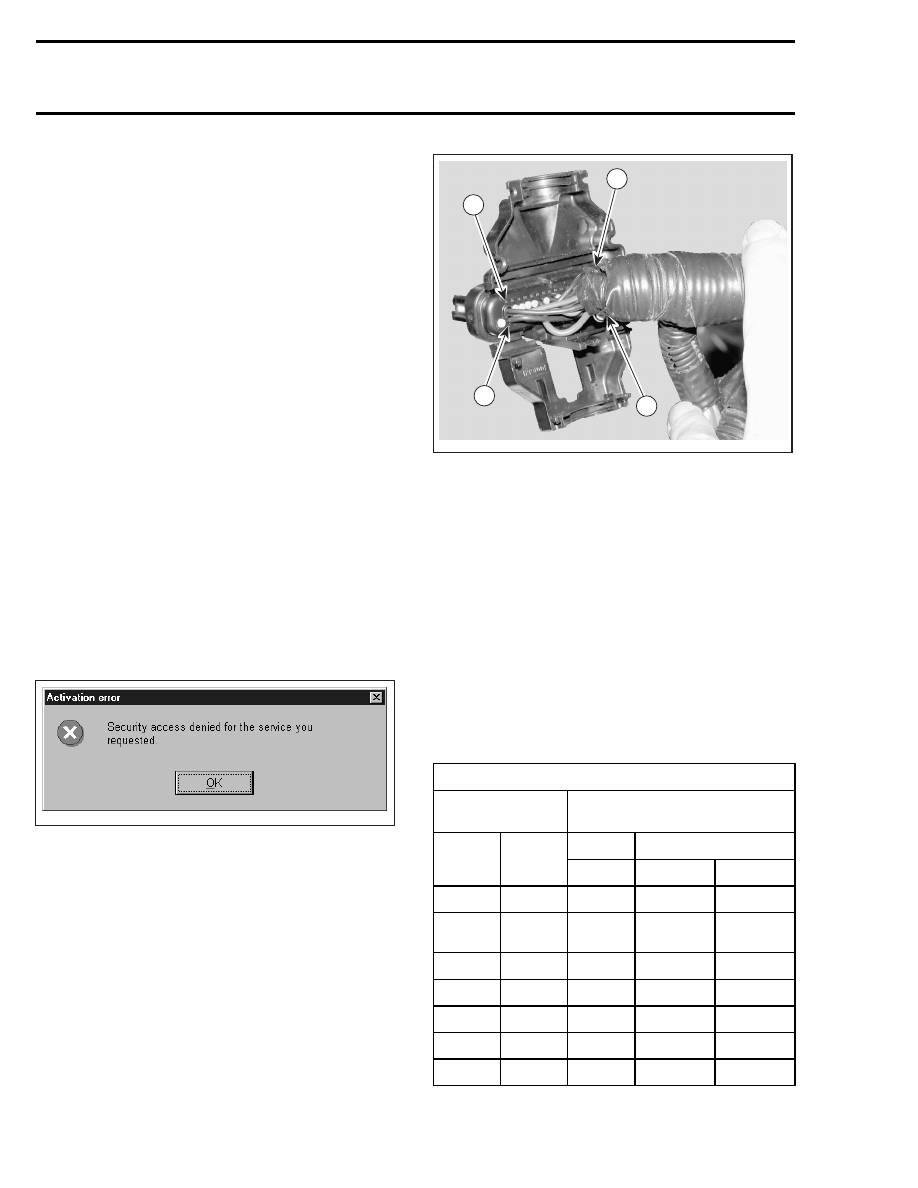
ECM Connector

Use this diagram to locate the pin numbers on
the ECM connector of the wiring harness when
performing tests.

A34E0LB

32

17

16

1

ECM CONNECTOR PIN-OUT (WIRING HARNESS SIDE)

Resistance Measurement

When measuring the resistance with an ohmme-
ter, all values are given for a temperature of 20°C
(68°F). The resistance value of a resistance varies
with the temperature. The resistance value for
usual resistor or windings (such as solenoid) in-
creases as the temperature increases. However,
our temperature sensors are NTC types (Negative
Temperature Coefficient) and work the opposite
which means that the resistance value decreases
as the temperature increases. Take it into account
when measuring at temperatures different from
20°C (68°F). Use this table for resistance variation
relative to temperature for temperature sensors.

TEMPERATURE SENSOR TABLE

TEMPERATURE

RESISTANCE (ohms)

ATS

CTS FOR

°C

°F

GAUGE

ECM

- 40

- 40

72412

- 35

- 31

52637

- 30

- 22

28000

38681

- 25

- 13

28718

- 20

- 4

14500

733.8

21529

- 15

5

587.7

16288

- 10

14

474

12431

214

mmr2005-107

Section 05 ENGINE MANAGEMENT (POWER TEK)

Subsection 03 (COMPONENT INSPECTION, REPLACEMENT AND ADJUSTMENT)

TEMPERATURE SENSOR TABLE

TEMPERATURE

RESISTANCE (ohms)

ATS

CTS FOR

°C

°F

GAUGE

ECM

- 5

23

384.8

9565

0

32

5500

314.3

7418

5

41

258.4

5807

10

50

213.7

4582

15

59

177.7

3644

20

68

2500

148.7

2919

25

77

125

2355

30

86

105.6

1912

35

95

98.69

1562

40

104

1200

76.5

1284

45

113

65.54

1062

50

122

56.38

882.6

55

131

48.72

738.9

60

140

600

42.28

622

65

149

36.82

526.3

70

158

32.19

447.5

75

167

28.24

382.3

80

176

320

24.86

328.1

85

185

21.95

282.8

90

194

19.45

244.8

95

203

17.28

212.8

100

212

180

15.4

185.6

105

221

162.4

110

230

142.7

115

239

125.9

120

248

111.5

125

257

99.02

130

266

90

88.26

135

275

78.93

140

284

70.81

TEMPERATURE SENSOR TABLE

TEMPERATURE

RESISTANCE (ohms)

ATS

CTS FOR

°C

°F

GAUGE

ECM

145

293

63.71

150

302

57.49

The resistance value of a temperature sensor may
test good at a certain temperature but it might be
defective at other temperatures. If in doubt, try a
new sensor.

Also remember this validates the operation of the
sensor at room temperature. It does not validate
the over temperature functionality. To test it, the
sensor could be removed from the engine/air si-
lencer and heated with a heat gun while it is still
connected to the harness to see if the ECM will
detect the high temperature condition and gener-
ate a fault code.

FUEL SYSTEM

Refer to FUEL SYSTEM as necessary.

Check that the throttle slides move freely and
smoothly when depressing throttle lever.

Before replacing any part, check the following as
these could be causing the fault. Perform the test
while the engine is not running.

– Throttle cable adjustment too tight or there is

not enough free-play. Not returning fully to idle
stop.

– Throttle idle set screw is loose or worn.
– TPS is loose.
– Corroded or damaged wiring or connectors.
– Throttle cable or carburetor(s) has(ve) been re-

placed and the Closed Throttle reset has not
been performed.

– ECM has been replaced and the Closed Throt-

tle reset has not been performed.

DPM (Digital Performance
Management)

To test DPM manifold, refer to FUEL SYSTEM.
The DPM solenoid verification is covered in this
section.

mmr2005-107

215

Section 05 ENGINE MANAGEMENT (POWER TEK)
Subsection 03 (COMPONENT INSPECTION, REPLACEMENT AND ADJUSTMENT)

ENGINE MANAGEMENT
SYSTEM

ENGINE CONTROL MODULE
(ECM)

General

Prior to replacing a suspected ECM, ensure that all
the recommendations in the general introduction
of this section have been followed.

NOTE: All information from the ECM will be lost
and will have to be reentered using B.U.D.S. soft-
ware.

ECM Replacement

Disconnect battery cables on electric start mod-
els.

WARNING

Battery BLACK (-) cable must always be dis-
connected first and connected last.

Disconnect connector from ECM.

Unscrew retaining screws and remove the engine
ECM from its support.

A33C4VA

1

2

3

1. ECM
2. ECM connector
3. Retaining screws

Install the new ECM to its support.

Replug ECM connector and then battery cables (if
applicable).

Manually enter information in Vehicle tab.

IMPORTANT: Pay particular attention when typing
the VIN and model numbers. Once Write Data
button is pressed, numbers cannot be modified.

Reprogram DESS tether cord(s) in Keys tab.

Perform Closed throttle and Ignition offset in
Setting tab. Refer to appropriate sections.

Start the engine and increase engine speed above
5500 RPM to be sure no fault appears.

POWER RELAY

A33C4ZA

1

LH SIDE OF VEHICLE
1. Power relay

Connect vehicle communication kit (VCK) and use
B.U.D.S. software.

Energize relay from Activation.

A33C5IA

Listen to or touch relay to feel it clicks.

If the relay does not work, disconnect the connec-
tor from the relay to test the input side.

216

mmr2005-107

Section 05 ENGINE MANAGEMENT (POWER TEK)

Subsection 03 (COMPONENT INSPECTION, REPLACEMENT AND ADJUSTMENT)

A33C50A

1

2

LH SIDE OF VEHICLE
1. Relay
2. Power relay connector

Connect a voltmeter between wires as indicated
in the following table.

FROM

TO

VEHICLES

CONNECTOR

Manual start

models

ORANGE/WHITE

Engine ground

Electric start

models

WHITE/GREEN

Battery ground

Voltage should be 12 V.

If voltage reads 12 V, check continuity of wire
between BLACK wire of relay connector and pin
DA-28 of ECM connector. If faulty, repair/replace
wire/connector. If wire/connector tests good, try
a new ECM.

If voltage does not read 12 V, check continuity
of wire on supply side. If faulty, repair/replace
wire/connector. If wire/connector tests good, re-
fer to ELECTRICAL SYSTEM to test output side or
relay.

THROTTLE POSITION SENSOR
(TPS)

General

The throttle position sensor (TPS) is a potentiome-
ter that sends a signal to the ECM which is propor-
tional to the throttle shaft angle.

A33C4WA

1

1. Throttle position sensor (TPS)

IMPORTANT: Prior to testing the TPS, ensure
that mechanical components/adjustments are
adequate according to CARBURETOR in AIR IN-
DUCTION SYSTEM above.

IMPORTANT: Pin-out of TPS harness connector
does not match the TPS sensor pin-out. The pin-
out used in the following tests is the TPS harness
connector pin-out.

CORRESPONDING PIN-OUT OF TPS HARNESS

AND TPS SENSOR

TPS HARNESS

CONNECTOR

TPS CONNECTOR

pin 1

pin 3

pin 2

pin 2

pin 3

pin 1

The ECM may generate several fault codes per-
taining to the TPS. Refer to SYSTEM FAULT
CODES in DIAGNOSTIC PROCEDURES section
for more information.

Wear Test

While engine is not running, activate throttle and
pay attention for smooth operation without physi-
cal stops of the cable.

Connect vehicle communication kit (VCK) and use
B.U.D.S. software.

Use the Throttle Opening display under Monitor-
ing.

mmr2005-107

217


Content   ..  53  54  55  56   ..