Snowmobile Arctic Cat (2008 year). Instruction - part 57
 

  Index      Snowmobiles / ATV     Snowmobile Arctic Cat - instruction 2008 year


Search            copyright infringement  


Content   ..  55  56  57  58   ..


Snowmobile Arctic Cat (2008 year). Instruction - part 57


2-166

CM150

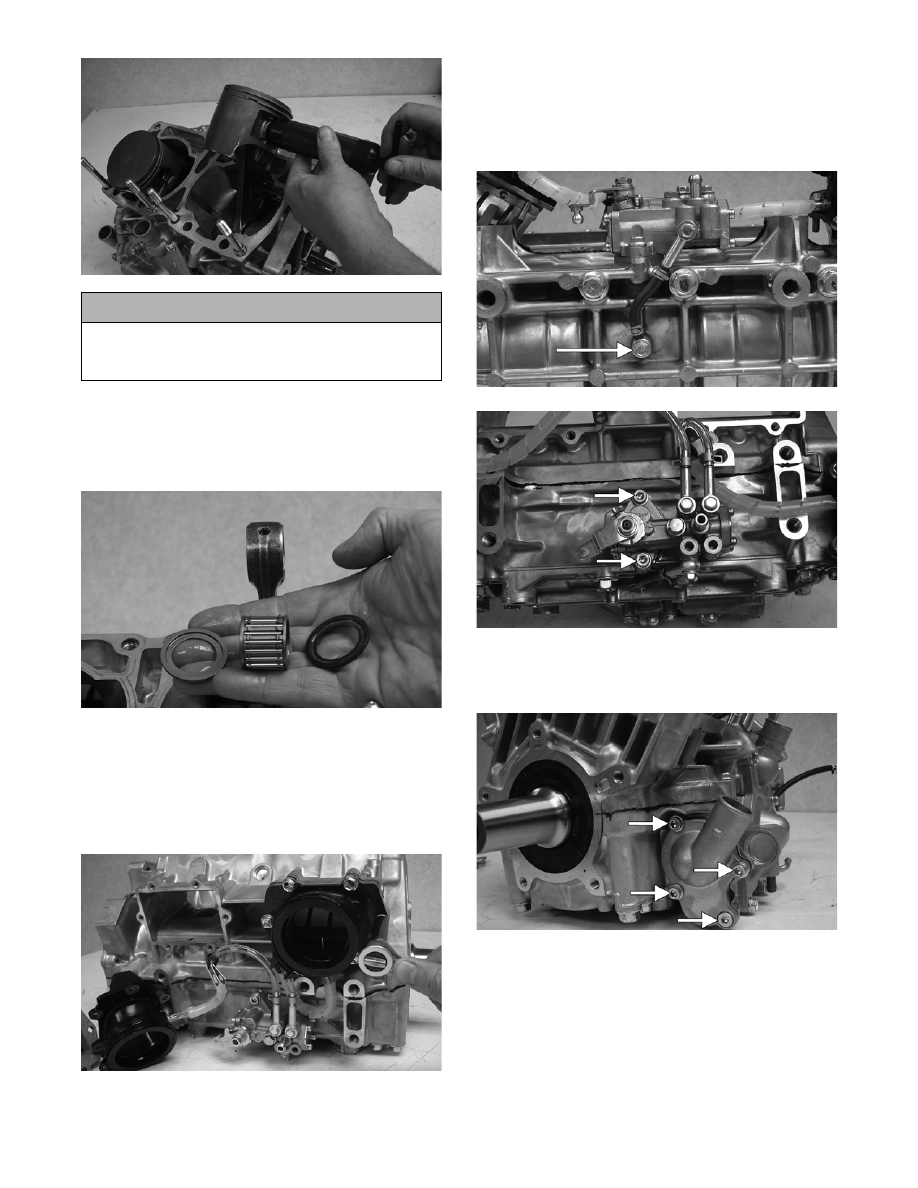
14. Lift the pistons clear of the connecting rods and

remove the small-end connecting-rod bearings

(account for two washers); then remove the piston

rings. Keep each piston with its rings; keep each

piston pin and bearing together as a set.

CM151

„NOTE: Place a suitable length of rubber hose
around the connecting rods. This will prevent the
connecting rods from damaging the crankcase.

15. Remove the cap screws securing intake flanges

and reed valve assemblies to the crankcase.

CM152

16. Remove the lower union cap screw securing the

lower check valve assembly to the crankcase; then

remove the two screws securing the oil-injection

pump to the crankcase. Remove the pump,

retainer, and O-ring and account for the two

washer gaskets from the lower union.

CM153A

CM154A

17. Remove the four cap screws securing the thermo-

stat cap; then remove the cap, gasket, and thermo-

stat.

CM155A

„NOTE: For assembling purposes, note that the
positioning of the bypass/check valve is directed
up.

! CAUTION

DO NOT use any type of punch to drive the piston
pin free of the piston; damage may result. Use a pis-
ton-pin puller only.

2-167

2

CM157A

18. Remove the seven cap screws securing the water

pump cover to the crankcase and remove the

cover. Account for the O-ring gasket and the align-

ment pins.

CM156A

19. Remove the cap screw securing the water pump

impeller; then slide the impeller free of the shaft.

20. Prior to turning the engine upside down on the 800

cc, remove the two crankcase cap screws (A) from

the water pump side of the engine; then remove

the two cap screws (B) from the magneto housing.

On the 1000 cc, remove the one crankcase cap

screw (C) located above the thermostat housing.

742-198B

742-197B

21. Turn the engine upside down on support blocks,

cut the cable tie, and remove the water tempera-

ture sensor switch.

22. With its bottom side up on two support blocks,

remove the cap screws securing the crankcase

halves.

„NOTE: The end bearings are not pressed onto
the crankshaft.

23. Separate the crankcase halves by installing two

crankcase cap screws in opposite corners leaving

the heads approximately 6 mm (1/4 in.) out. Using

a plastic hammer and lifting on the ends of the

crankshaft, tap on each cap screw head until the

case halves separate. Remove the cap screws.

CM158

24. Lift the bottom half of the crankcase off the top

half.

! CAUTION

DO NOT drive any tool between halves to separate
the crankcase. Damage to the sealing surfaces will
result.

! CAUTION

Care must be taken to not allow the connecting rods
to drop onto the sealing surface of the bottom case
half.

2-168

25. Lift the crankshaft free from the top half of the

crankcase and slide the crankshaft oil seals off the

crankshaft. Account for the C-ring (A). Remove

the bearing retaining pins (B) and account for the

crankcase dowel pins (C).

CM165C

26. Remove the oil-injection pump/water pump drive-

shaft from the lower crankcase half. Account for

the thrust washer on the outer end of the shaft.

CM159A

„NOTE: Do not replace the inner seals unless the
water pump shows signs of leaking coolant out of
the small bleed hole in the bottom half of the
crankcase. If a water pump seal is to be replaced,
use the Water Pump Bearing and Seal Tool Kit.

27. Place the crankcase on the bench with the water

pump side down. Using the long seal driver, drive

the mechanical water pump seal from the crank-

case.

FC036

28. Using a pair of snap ring pliers, remove the snap

ring securing the inner seal in the crankcase.

29. Using the hooked end of the tool, pull the inner

seal free of the crankcase.

30. Using the hooked end of the tool, pry the seal ring

from the backside of the water pump impeller.

AN327D

Cleaning and Inspecting 

Engine

„NOTE: Whenever a part is worn excessively,
cracked, or damaged in any way, replacement is
necessary.

CYLINDER HEAD

1. Using a non-metallic carbon removal tool, remove

any carbon buildup from the combustion chambers

being careful not to nick, scrape, or damage the

combustion chambers or the sealing surfaces.

2. Inspect the spark-plug holes for any damaged

threads. Repair damaged threads using a heli-coil

insert.

3. Inspect the cylinder head for flatness using a

straightedge and a feeler gauge. Acceptable

warpage must not exceed 0.05 mm (0.002 in.).

„NOTE: If the warpage exceeds specification,
resurface the cylinder head using procedures
identified in step 4.

2-169

2

4. Place the cylinder heads on a Surface Plate cov-

ered with #400 grit wet-or-dry sandpaper. Using

light pressure, move each cylinder head in a figure

eight motion. Inspect the sealing surface for any

indication of high spots. A high spot can be noted

by a bright metallic finish. Correct any high spots

before assembly by continuing to move the cylin-

der head in a figure eight motion until a uniform

bright metallic finish is attained.

CYLINDERS

1. Using a non-metallic carbon removal tool, remove

carbon buildup from the exhaust ports.

2. Wash the cylinders in parts-cleaning solvent.

3. Inspect the cylinders for pitting, scoring, scuffing,

and corrosion. If marks are found, repair the sur-

face with a Ball Hone and honing oil.

„NOTE: To produce the proper 45° crosshatch
pattern, maintain a low drill RPM. If honing oil is
not available, use a lightweight, petroleum-based
oil. Thoroughly clean the cylinders after honing
using detergent soap and hot water and dry with
compressed air; then immediately apply oil to the
cylinder bores. If a bore is severely damaged or
gouged, the cylinder will have to be replaced.

4. Place the head surface of each cylinder on the sur-

face plate covered with #400 grit wet-or-dry sand-

paper. Using light pressure, move each cylinder in

a figure eight motion. Inspect the surface for any

indication of high spots. A high spot can be noted

by a bright metallic finish. Correct any high spots

before assembly by continuing to move the cylin-

der in a figure eight motion until a uniform bright

metallic finish is attained.

PISTON ASSEMBLY

1. Using a non-metallic carbon removal tool, remove

the carbon buildup from the dome of each piston.

2. Take an old piston ring and snap it into two pieces;

then grind the end of the old ring to a 45° angle

and to a sharp edge. Using the sharpened ring as a

tool, clean carbon from the ring-grooves. Be sure

to position the ring with its tapered side up.

3. Inspect each piston for cracks in the piston pin and

skirt areas.

4. Inspect each piston for seizure marks or scuffing.

Repair with #400 grit wet-or-dry sandpaper and

water or honing oil.

AN135

„NOTE: If scuffing or seizure marks are too deep
to correct with the sandpaper, it will be necessary
to replace the piston.

5. Inspect the perimeter of each piston for signs of

excessive “blowby.” Excessive “blowby” indicates

worn piston rings or an out-of-round cylinder.

„NOTE: If synthetic oil is being used, a certain
amount of “blowby” may be visible under normal
use.

CRANKCASE

1. Wash the crankcase halves in parts-cleaning sol-

vent.

„NOTE: Before washing the crankcase halves,
make sure the four bearing dowel pins have been
removed and accounted for.

2. Inspect the crankcase halves for scoring, pitting,

scuffing, or any imperfections in the casting.

3. Inspect all threaded areas for damaged or stripped

threads.

4. Inspect the bearing areas for cracks or excessive

bearing movement. If evidence of excessive bear-

ing movement is noted, the crankcase must be

replaced.

! CAUTION

Water or parts-cleaning solvent must be used in
conjunction with the wet-or-dry sandpaper or dam-
age to the sealing surface may result.

! CAUTION

Water or parts-cleaning solvent must be used in
conjunction with the wet-or-dry sandpaper or dam-
age to the sealing surface may result.

! CAUTION

Improper cleaning of the ring-grooves by the use of
the wrong type of ring-groove cleaner will result in
severe damage to the piston.


Content   ..  55  56  57  58   ..