Snowmobile Arctic Cat (2006 year). Instruction - part 13
 

  Index      Snowmobiles / ATV     Snowmobile Arctic Cat - instruction 2006 year


Search            


Content   ..  11  12  13  14   ..


Snowmobile Arctic Cat (2006 year). Instruction - part 13


48

MAINTENANCE

7. Test the throttle control lever by

compressing and releasing it

several times. The lever must

return to the idle position

quickly and completely.

ADJUSTING CARBURETORS — 
TM-STYLE

The carburetors have been cali-

brated at the factory for average

riding conditions; however, alti-

tude, temperature, and general wear

may necessitate certain carburetor

adjustments. Be sure the correct

carburetor main jets for the oper-

ating temperature, altitude, and

type of gasoline are being used

(see Selecting Carburetor Main

Jet(s) section). Since carburetor

adjustments critically affect engine

performance, Arctic Cat recom-

mends that all changes in internal

carburetor calibration be made by an

authorized Arctic Cat Snowmobile

dealer; however, four external

adjustments can be made on each

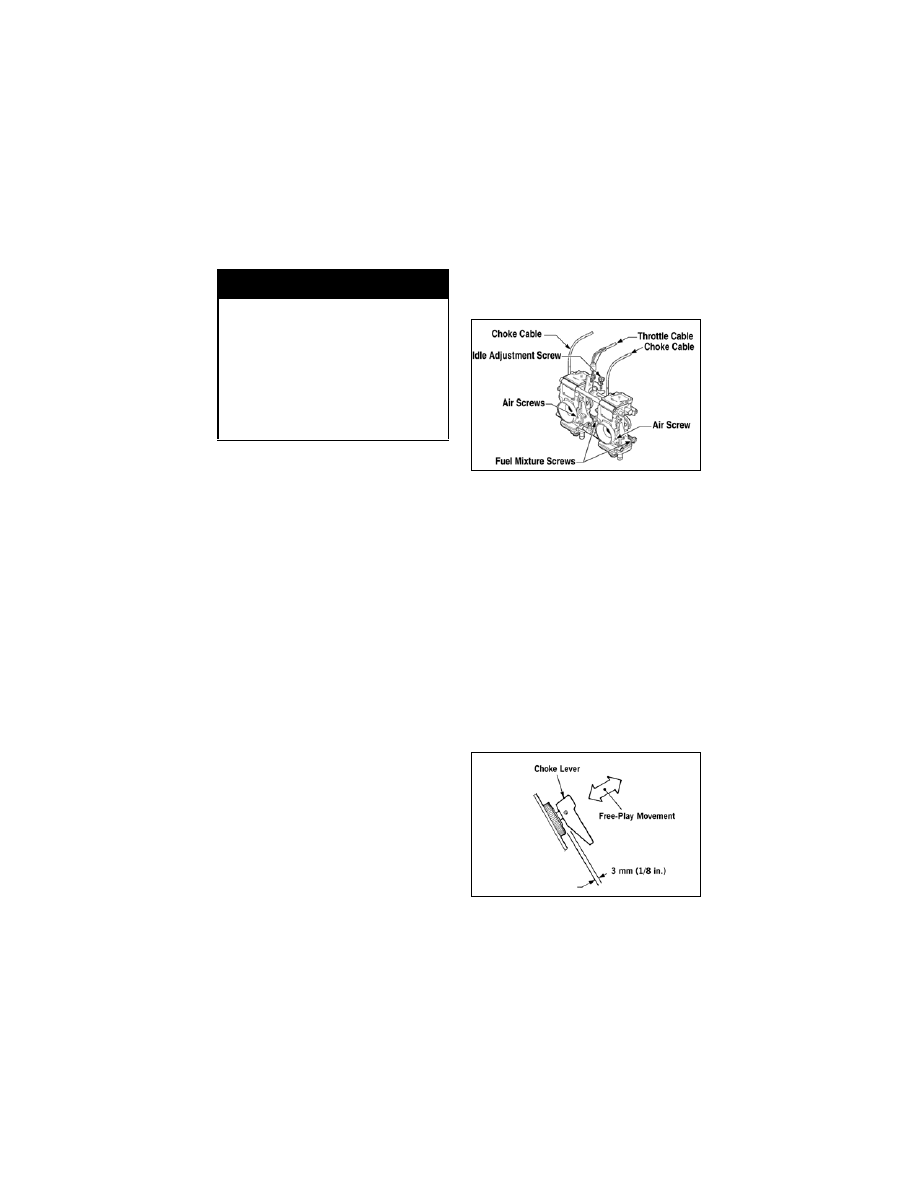
carburetor. These are the choke

cable travel, fuel mixture screws, air

screws, and idle speed screw.

 NOTE: Carburetor adjustments

and changing main jets may be
done by the snowmobile owner if
qualified to do so. If the owner
does not feel qualified, take the
snowmobile to an authorized Arc-
tic Cat Snowmobile dealer for this
service. This service is at the dis-
cretion and expense of the snow-
mobile owner.

Adjusting Choke Cable

1. Be sure the ignition switch key

is in the OFF position and the

brake lever lock is set.

2. Loosen the jam nut securing

each choke cable adjuster on

the side of the carburetor.

0735-774

3. Slowly rotate one choke cable

adjuster while checking the

choke lever for free-play. As

soon as all free-play has been

removed from the end of the

lever, stop rotating the adjuster.

4. With free-play removed from

the lever, slowly rotate the

adjuster once ag ain while

checking the choke lever for

free-play. Adjust until 3 mm (1/

8 in.) free-play between front

bottom edge of lever and hous-

ing is attained. Securely tighten

the jam nut.

732-848B

5. Repeat steps 3 and 4 on the

other carburetor.

! WARNING

DO NOT operate the snowmo-
bile when any component in the
throttle system is damaged,
frayed, kinked, worn, or improp-
erly adjusted. If the snowmobile
is operated when the throttle
system is not functioning prop-
e r l y,   p e r s o n a l   i n j u r y   c o u l d
result.

MAINTENANCE

49

Fine-Tuning Fuel Mixture 
Screws, Air Screws, and Idle 
Speed Screw

1. While counting the rotations,

carefully rotate the fuel mixture

screws clockwise until lightly

seated.

0735-774

2. Rotate the fuel mixture screws

counterclockwise the exact

number of rotations ± 1/4 turn

from the seated position as an

initial setting.

3. While counting the rotations,

carefully rotate the air screws

clockwise until lightly seated.

4. Rotate the air screws counter-

clockwise the exact number of

rotations ± 1/4 turn from the

seated position as an initial set-

ting.

5. With the snowmobile on a

shielded safety stand, start the

engine, release the brake lever

lock, and thoroughly warm up.

 NOTE: Make engine idle adjust-

ment only after the engine has
reached running temperature.
Allow engine to warm up for 2-3
minutes.

6. After the engine has been thor-

oughly warmed up, fine-tune

the idle speed screw until the

engine idles smoothly.

 NOTE: If a tachometer is being

used, engine idle speed should
be approximately 1500 RPM.

! CAUTION

D o   n o t   fo rc e   a   f u e l   m i x t u r e
screw when rotating it clock-
wise; damage to the fuel mix-
ture screw taper will result.

! CAUTION

The fuel mixture screw setting is
very critical to engine perfor-
mance; therefore, do not rotate
the fuel mixture screws less
than the recommended number
of turns counterclockwise or
engine damage will occur.

! CAUTION

Do not force an air screw when
rotating it clockwise; damage to
the air screw will result.

! WARNING

It is important that the rear of
the snowmobile is on a shielded
safety stand. If not, personal
injury could result.

! WARNING

DO NOT stand behind the snow-
m o b i l e   o r   n e a r   t h e   ro t a t i n g
track. NEVER run the track at
high speed when the track is
suspended.

! WARNING

If a tachometer is not available,
care must be taken not to adjust
engine idle speed too high.

50

MAINTENANCE

7. Test the throttle control lever by

compressing and releasing it

several times. The lever must

return to the idle position

quickly and completely.

SELECTING CARBURETOR 
MAIN JET(S)

Altitude, temperature, and the use of

oxygenated gasoline affect the car-

buretion needed for optimum engine

performance. The carburetor main

jet(s) must be changed in conjunc-

tion with changes in operating alti-

tude, oxygenated gasoline usage,

and temperature. As the ambient

temperature rises or as the snowmo-

bile is operated at a higher altitude,

the main jet(s) must be replaced with

leaner main jet(s). The original

equipment (production) main jet(s)

may need to be changed (depending

on the type of gasoline you are

using, your operating altitude, and

temperature). A Main Jet Chart

decal is located beneath the hood of

the snowmobile. It should be noted

that when selecting the proper main

jet(s), it is better to be too rich rather

than too lean. To change carburetor

main jet(s), use the following proce-

dure:

 NOTE: Carburetor main jet(s)

may be changed by the snowmo-
bile owner if qualified to do so. If
the owner does not feel qualified,
take the snowmobile to an autho-
r i z e d  A rc t i c   C a t   S n ow m o b i l e
dealer for this service. This ser-
v i c e   i s   a t   t h e   d i s c r e t i o n   a n d
e x p e n s e   o f   t h e   s n o w m o b i l e
owner.

Changing Main Jet(s) (VM-Style)

1. Loosen each carburetor flange

clamp and remove each carbu-

retor from the intake flange and

boot.

2. Remove each drain plug and O-

ring from the carburetor float

chamber and drain the gas into

a small container or shop tow-

els.

! WARNING

DO NOT operate the snowmo-
bile when any component in the
throttle system is damaged,
frayed, kinked, worn, or improp-
erly adjusted. If the snowmobile
is operated when the throttle
system is not functioning prop-
e r l y,   p e r s o n a l   i n j u r y   c o u l d
result.

! CAUTION

Use only GENUINE Mikuni brass
main jets. Also, if using an oxy-
genated gasoline (up to 10%
ethanol or up to 15% MTBE), the
carburetor main jet must be one
size larger than the main jet
required for regular unleaded
gasoline.

! CAUTION

A main jet which is too small
will cause severe engine dam-
age. Engine damage caused by
lean jetting WILL NOT BE cov-
ered by our warranty policy.

! WARNING

Whenever any maintenance is
performed on the fuel system,
there should be no welding,
smoking, open flames, etc., in
the area.

MAINTENANCE

51

3. Using the main jet wrench

(from the tool kit), thread the

main jet out of each carburetor.

Account for the baffle ring/

washer. Install the new main jet

and the existing baffle ring/

washer. Tighten the main jet

securely.

0728-054

4. Install each drain plug and O-

ring; then tighten securely.

5. Install and secure the carbure-

tors.

Changing Main Jets (TM-Style)

1. Remove all components from

the front of the air-intake

silencer.

2. Remove the screws securing the

air-intake silencer; then move

the silencer forward and out of

the engine compartment.

3. Loosen the carburetor flange

clamps; then slide the carbure-

tors out of the intake flanges.

4. Tilt the carburetors to access the

main jets.

5. Remove each drain plug and O-

ring from the carburetor float

chamber and drain the gas into

a small container or shop tow-

els.

6. Using the main jet wrench

(from the tool kit), thread the

main jet out of each carburetor.

Account for the washer. Install

each new main jet and the exist-

ing washer. Tighten the main jet

securely.

0734-280

7. Install each drain plug and O-

ring; then tighten securely.

8. Push the carburetors back into

position and into the intake

flanges; then tighten the carbu-

retor flange clamps securely.

9. Place the air-intake silencer into

position in the engine compart-

m e n t   a n d   s e c u r e   w i t h   t h e

screws.

10. Install all components onto the

air-intake silencer and secure

with existing hardware.

SPARK PLUGS

 NOTE: Always use the recom-

m e n d e d   s p a r k   p l u g s   i n   t h e
engine. See the appropriate spec-
ifications chart for correct spark
plug gap.

Varying terrain conditions and oper-

ating usage may require spark plugs

of a different heat range. For exam-

ple, sustained cross-country riding

will usually require colder heat-

range spark plugs while trail riding

or other continual slow speed opera-

tion will usually require hotter heat-

range spark plugs.


Content   ..  11  12  13  14   ..