Snowmobile Arctic Cat (2007 year). Instruction - part 122
 

  Index      Snowmobiles / ATV     Snowmobile Arctic Cat - instruction 2007 year


Search            


Content   ..  120  121  122  123   ..


Snowmobile Arctic Cat (2007 year). Instruction - part 122


9-103

9

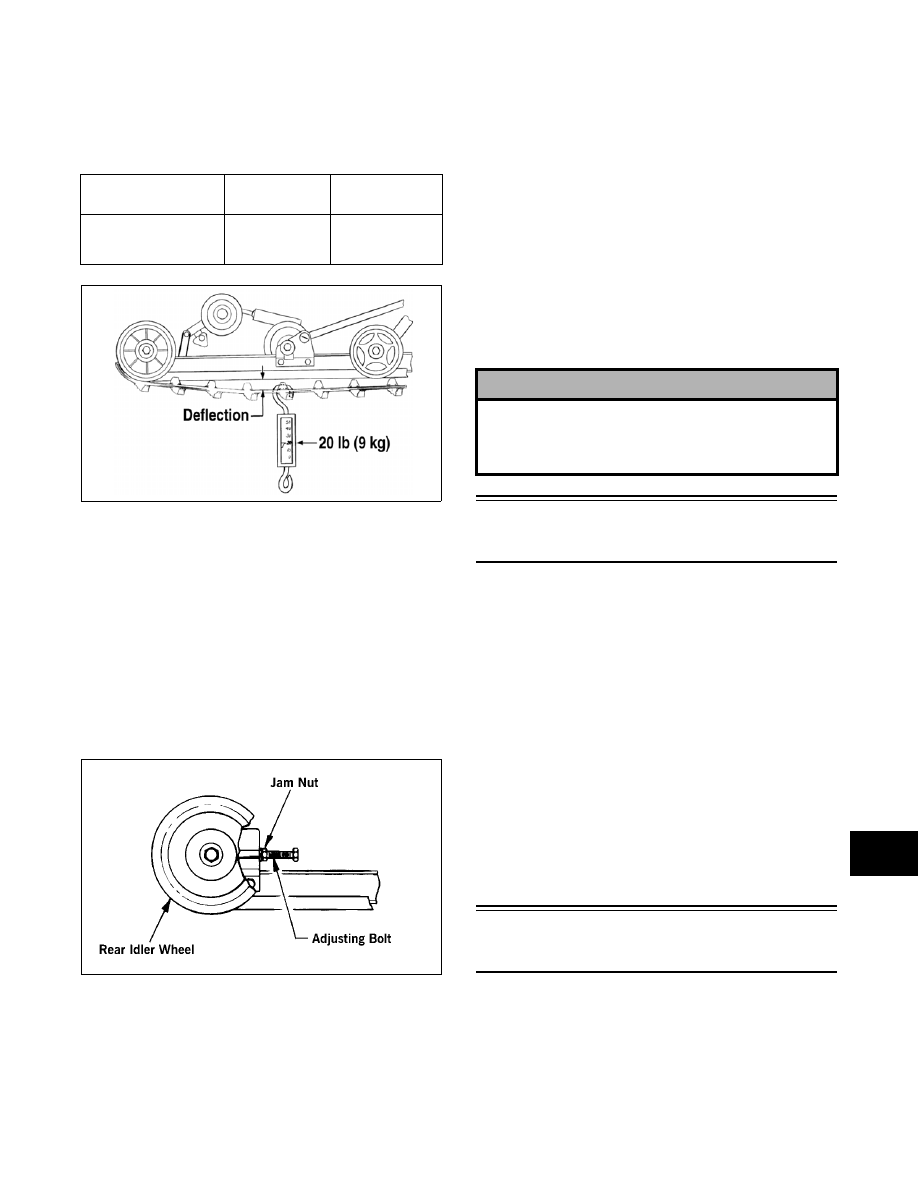
2. Hook a spring scale around a track clip at mid-

span; then pull the track down with the scale to 9

kg (20 lb) and measure the distance between the

bottom of the wear strip and the inside surface

of the track clip. Track deflection must be within

specifications.

729-429A

„ NOTE: If the track is new, it will stretch slightly
and take a “set” within the first 300 to 500 miles of
operation.

ADJUSTING DEFLECTION

1. Place the snowmobile up on a shielded safety

stand. Check to make sure the track is 2-3 in. off

the floor.

2. If the measurement is not as specified, loosen

the jam nuts of the adjusting bolts.

0727-456

3. If the measurement obtained in step 2 is more

than specified, tighten the adjusting bolts. If the

measurement obtained is less than specified,

loosen the adjusting bolts. When the measure-

ment is within specification range, lock the

adjustment by bottoming the jam nuts against

the axle housings.

„ NOTE: If the track tension must be loosened, it
may be necessary to loosen the rear axle assem-
bly slightly.

„ NOTE: Vigorously push the underside of the
track up and down. Track must not hit the top of
the tunnel or slap the skid frame.

4. After correct track tension is obtained, check

track alignment (see Track Alignment in this

sub-section).

„ NOTE: Track tension and track alignment are
interrelated; always check both even if only one
adjustment seems necessary. Always establish
correct track tension before checking and/or
adjusting alignment.

Repair Procedure 4 -

Track/Rear Suspension

This Track/Rear Suspension sub-section (Repair

Procedure 4) has been organized so each procedure

can be completed individually and efficiently. Each

sub-section has (as necessary) Removing, Disas-

sembling, Cleaning and Inspecting, Assembling,

and Installing procedures. Some components may

vary from model to model. The technician should

use discretion and sound judgment when removing

and installing components.

„ NOTE: Some illustrations and photographs used
in this sub-section are used for clarity purposes
only and are not designed to depict actual condi-
tions.

„ NOTE: Critical torque specifications are located
on page 140 of this section.

Removing

Skid Frame

„ NOTE: Many service procedures can be per-
formed without removing the skid frame. Closely
observe the note introducing each sub-section for
this important information.

Rear Suspension 

Style

Setup

Tension

After Break-In

Tension

FasTrack w/Torque 
Sensing Link
(121 in. Track)

38-44 mm
(1 1/2-1 3/4 in.)

44-51 mm
(1 3/4-2 in.)

! CAUTION

After proper track tension and alignment have been
attained, make certain that the rear axle assembly is
tightened to specifications or component damage
will occur.

9-104

1. To avoid having the adjuster bushings binding

during loosening of the track, remove the rear

idler wheel caps and loosen the cap screws on

the rear axle.

FS082A

2. Loosen the jam nuts and two track-tension

adjusting bolts.

MS062A

3. Place a support stand under the rear bumper;

then while holding the flared bushing, remove

the rear cap screws securing the skid frame to

the tunnel. Account for lock washers and flat

washers.

„ NOTE: The support stand should hold the snow-
mobile level but not raised off the floor.

4. Remove the support stand; then tip the snow-

mobile onto one side using a piece of cardboard

to protect against scratching.

5. Slide the skid frame rearward far enough to drop

the front arm out of the slider axle; then remove

the skid frame.

Wear Strips

REMOVING

„ NOTE: The skid frame does not have to be
removed for this procedure; however, if wear strip
binding or slide rail damage has occured, the skid
frame should be removed for this procedure (see
Removing Skid Frame in this sub-section).

1. Remove the machine screw and lock nut secur-

ing the wear strip to the front of the slide rail.

MS016B

„ NOTE: If the skid frame has been removed due to
difficulty in removing the wear strip, it may be nec-
essary to use a pipe wrench, start from either end,
and hook the edge of the wear strip with the pipe
wrench jaw and twist the wear strip off the slide
rail. Move the pipe wrench 7.5 cm (3 in.) and again
twist the wear strip off the rail. Repeat this proce-
dure until the wear strip is free of the rail.

2. Align the wear strip with the openings (win-

dows) in the track; then using a suitable driving

tool, drive the wear strip rearward off the slide

rail.

739-884A

9-105

9

CLEANING AND INSPECTING

„ NOTE: Whenever a part is worn excessively,
cracked, or damaged in any way, replacement is
necessary.

1. Clean the slide rail using parts-cleaning solvent

and compressed air.

2. Inspect the slide rail for cracks. If any cracks are

found, replace the slide rail.

3. Using a straightedge, inspect the slide rail for

any unusual bends. With the slide rail removed,

place the straightedge along the bottom surface

of the slide rail. If the rail is found to be bent, it

must be replaced.

AG536D

INSTALLING

„ NOTE: Apply a light coat of grease to the slide
rail surface to aid in installing a new wear strip. If
there are any sharp edges on the lower portion of
the rail, use a file to remove them.

1. Align the wear strip with the openings (win-

dows) in the track and from the back, start the

wear strip onto the rail; then using a block of

wood and a hammer, drive the wear strip for-

ward into position.

739-884A

2. Secure with a machine screw and lock nut.

Tighten to specifications.

End Caps

„ NOTE: The skid frame does not have to be
removed for this procedure.

REMOVING

1. Remove the lock nut, washers, and cap screw

securing the end cap.

MS016A

2. Using a hammer, tap the end cap off the rail.

CLEANING AND INSPECTING

„ NOTE: Whenever a part is worn excessively,
cracked, or damaged in any way, replacement is
necessary.

1. Inspect the end cap area of the slide rail for

cracks and wear.

! WARNING

Always wear an approved pair of safety glasses
when using compressed air.

9-106

MS017A

2. Inspect the end cap for any signs of cracking or

wear.

MS290A

3. Clean both the slide rail area and the end cap.

Using compressed air, clean the areas of dirt and

gravel.

4. Inspect the cap screw for cracked, stretched, or

damaged threads. Use a new lock nut when

assembling.

INSTALLING

1. Position the end cap on the slide rail; then align

the hole in the end cap with the hole in the slide

rail.

2. Secure with a cap screw, washers, and lock nut.

Tighten to specifications.

Shock Pads

„ NOTE: The skid frame does not have to be
removed for this procedure.

REMOVING

„ NOTE: The shock pads should be removed only
if being replaced.

1. Using a 3/16-in. drill bit, drill out the rivets

securing the shock pads to the slide rail.

Account for the retaining brackets.

2. Remove the shock pads.

INSPECTING

„ NOTE: Whenever a part is worn excessively,
cracked, or damaged in any way, replacement is
necessary.

1. Inspect the pads for damage or wear.

2. Inspect the rivet holes in the slide rail for dam-

age or elongation.

INSTALLING

1. Place the pads and retaining brackets into posi-

tion on the slide rail.

2. Secure the pads with rivets.

Front Outer

Idler Wheels

„ NOTE: The skid frame does not have to be
removed for this procedure.

REMOVING

1. Remove the cap screw and lock nut securing the

front outer idler wheel and the idler wheel

mounting block. Account for flat washers.

MS133A

! WARNING

Always wear an approved pair of safety glasses
when using compressed air.


Content   ..  120  121  122  123   ..