Snowmobile Arctic Cat (2007 year). Instruction - part 16
 

  Index      Snowmobiles / ATV     Snowmobile Arctic Cat - instruction 2007 year


Search            


Content   ..  14  15  16  17   ..


Snowmobile Arctic Cat (2007 year). Instruction - part 16


2-49

2

GEN-0021

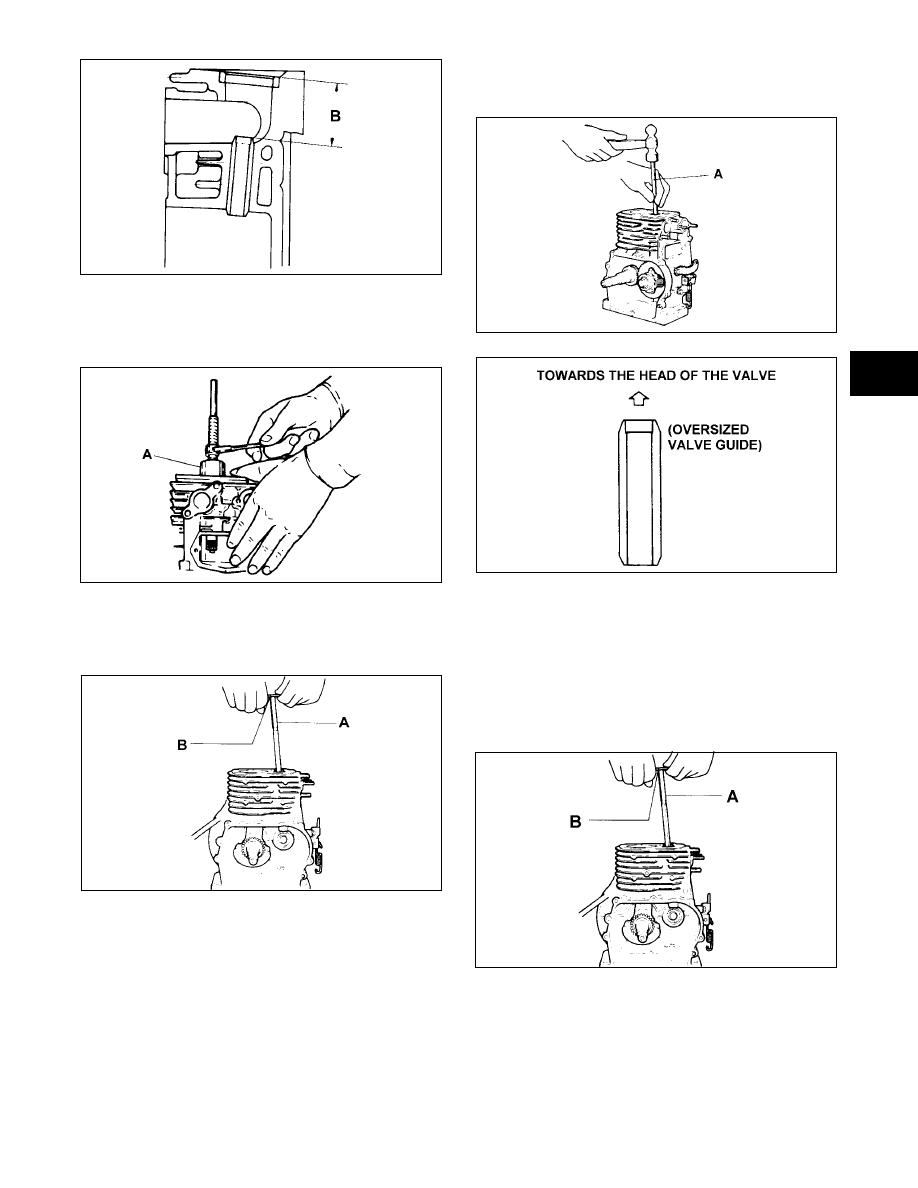
2. To replace a valve guide (A), use a valve guide

remover from the top side of the cylinder to gen-

tly pull the valve guide out of the cylinder.

GEN-0017

3. Using a valve guide reamer (A) and handle (B),

remove any burrs or tight areas from the valve

guide journals.

GEN-0018

4. Valve guide hole diameter (after reaming) intake

and exhaust must be within specifications.

5. To install an oversized valve guide at room tem-

perature, use a valve guide installer (A) and gen-

tly drive a valve guide into the bore from the top

side until the guide is set to the distance noted

before removal.

„ NOTE: Install the valve guide so the stepped part
on the guide wall faces the head of the valve.

.

GEN-0019

GEN-0020

6. After installing the guide, measure the inside

diameter of the guide. The measurement must

be within specifications. If the measurement

does not fall within the specification or the valve

does not move freely in the guide, use a standard

valve guide reamer (A) and handle (B) to

remove all burrs and tight areas that may remain

in each valve guide.

GEN-0022

2-50

SNO-0107

Measuring Valve Guide/Valve Stem 
Clearance

1. Using a micrometer and small bore gauge, take

diameter readings on the valve stems and inside

the guides.

2. The stem clearance inside the guide must not

exceed specifications.

„ NOTE: Be sure to take readings at more than one
place along the length of each stem and guide.

Lapping Valves

„

NOTE: Ensure that all carbon has been removed

from the valves.

1. Using a valve lapper, produce a contact pattern

on each valve face by applying a uniform coat of

valve lapping compound to the valve seat and by

rotating and tapping the valve head.

2. Acceptable width of valve seat contact width

(measurement A) must be within specifications.

GEN-0023

GEN-0024

„ NOTE: Do not grind the valves. If a valve is dam-
aged, it must be replaced.

3. Lubricate each valve stem with lightweight oil;

then apply a small amount of valve lapping

compound to the entire seating face of each

valve.

4. Attach the suction cup of a valve lapping tool to

the head of the valve.

5. Rotate the valve until the valve and seat are

evenly polished.

6. Clean all compound residue from the valve and

seat.

2-51

2

Valve Seat Repair

„

NOTE: If the valve seat is beyond servicing, the

cylinder must be replaced.

GEN-0025

A valve seat not producing a uniform contact with

its valve or showing a seating contact width that is

not within the specified range must be repaired by

cutting.

1. Insert the expandable pilot shaft into a valve

guide; then install a 45° cutter onto the pilot

shaft. Grind the valve seat by turning the cutter

1-2 turns using a T-handle.

2. Remove the pilot shaft and cutter; then coat the

valve seat with a blueing compound and insert

the valve into the valve guide. Rotate the valve

while tapping the valve head; then remove the

valve and inspect the valve seat and valve face

for proper width.

3. The pattern produced on the seating surface of

the valve and valve seat must be a continuous

ring without any break and the width of the pat-

tern must be within specifications. Grind the

valve seat width to 0.8-1.0 mm (0.032-

0.039 in.).

4. Inspect for dents or burning on the valve seat

and, if necessary, rotate the 45° cutter another

turn to smooth out the valve seat.

5. If the position of the valve face width is low,

grind the valve seat using a 75° cutter to raise

the position of the valve seat. If the position of

the valve face width is high, grind the valve seat

using a 15° cutter to lower the position of the

valve seat.

GEN-0026

GEN-0027

6. After reconditioning the valve seat, the valve

seat could be narrow. In this case, recondition

the valve seat using the 45° cutter. After recon-

ditioning, thoroughly remove any burrs which

may be caused by grinding. The valve seat sur-

face should be smooth but not too glossy.

Repeat the valve seat repair procedure on the

remaining valve.

„ NOTE: After reconditioning all valve seats, thor-
oughly clean the seat and its vicinity.

Valve Springs

1. When the valve springs are weak, the valve and

valve seat fail to form a good seal, thus allowing

gas to leak past the valve seat causing a loss of

power. Whether or not a valve spring is weak

can be determined by its free length.

! CAUTION

Do not over-grind the valve seats. Grind the seats
only as necessary to ensure a continuous contact
with the valve seating surface.

! CAUTION

Avoid using a lapping compound after this proce-
dure.

2-52

GM128D

2. Minimum valve spring free length must not

exceed speficiations.

„ NOTE: With the crankshaft at top dead center on
the compression stroke, install the valve springs
and spring retainers; then compress the valve
springs and install the valve keepers.

PISTON ASSEMBLY

„ NOTE: Oversized pistons are available allowing
the cylinder to be bored oversized.

„ NOTE: Whenever a piston, rings, or pins are out
of tolerance, they must be replaced.

Cleaning/Inspecting Piston

1. Using a non-metallic carbon removal tool,

remove any carbon buildup from the dome of

the piston.

2. Inspect the piston for cracks in the piston pin,

dome, and skirt areas.

3. Inspect the piston for seizure marks or scuffing. 

„ NOTE: If seizure marks or scuffing is detected,
the piston must be replaced.

4. Inspect the perimeter of each piston for signs of

excessive “blowby.” Excessive “blowby” indi-

cates worn piston rings or an out-of-round cylin-

der.

Removing Piston Rings

1. Starting with the top ring, slide one end of the

ring out of the ring-groove.

2. Remove each ring by working it toward the

dome of the piston while rotating it out of the

groove.

„ NOTE: If the existing rings will not be replaced
with new ones, note the location of each ring for
proper installation. When installing new rings,
install as a complete set only.

Cleaning/Inspecting Piston Rings

„ NOTE: If replacing the rings, make a ring-groove
cleaning tool by taking an old piston ring and
snapping it into two pieces; then grind the end of
the old ring to a 45° angle and to a sharp edge.

Using a ring-groove cleaning tool, clean carbon

from the ring-grooves. Be sure to position the ring

with its tapered side up.

Measuring Piston-Ring End Gap 
(Installed)

1. Place each piston ring in the wear portion of the

cylinder. Use the piston to position each ring

squarely in the cylinder.

„ NOTE: When measuring a piston ring, it should
be placed into the area of the cylinder where wear
is least (the area is about 3 mm (0.12 in.) from the
upper or lower edge of the cylinder).

2. Using a feeler gauge, measure each piston-ring

end gap. Acceptable ring end gap must be

within specifications.

GEN-0043

Piston Ring/Groove Clearance

1. Using a thickness gauge, measure the side clear-

ances of the 1st and 2nd rings.

2. If any of the clearances exceeds the specifica-

tion limit, replace both piston and piston rings.

Measuring Piston Pin Bore 

Diameter

1. Insert an inside dial indicator into the piston-pin

bore. Take two measurements to ensure accu-

racy.

! CAUTION

Improper cleaning of the ring-grooves by the use
of the wrong type of ring-groove cleaner will
result in severe damage to the piston.


Content   ..  14  15  16  17   ..