Snowmobile Arctic Cat (2004 year). Instruction - part 115
 

  Index      Snowmobiles / ATV     Snowmobile Arctic Cat - instruction 2004 year


Search            


Content   ..  113  114  115  116   ..


Snowmobile Arctic Cat (2004 year). Instruction - part 115


8-60

AF417

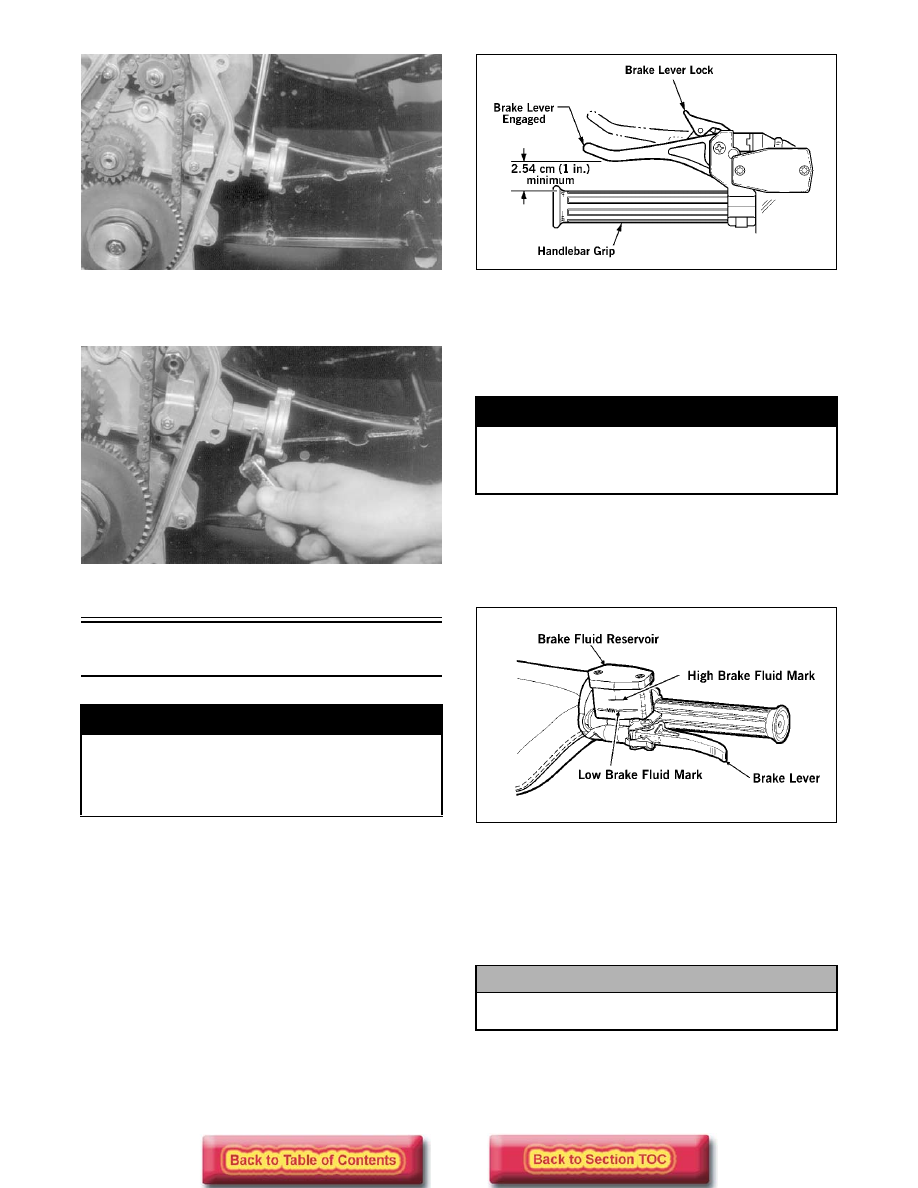
12. Remove the set screw from the adjuster housing

and install the cap screw.

AF416

Brake System

(Hydraulic)

CHECKING BRAKE LEVER TRAVEL

1. Compress the brake lever fully.

„ NOTE: Do not pump the brake lever as it will pro-
duce an inaccurate reading.

2. Measure the distance between the brake lever and

the handlebar. The distance must be greater than
2.54 cm (1 in.).

734-505A

3. If the distance is less than specified, check the

brake fluid level (see Checking and Adding Brake
Fluid in this sub-section), inspect for leakage, and
check the brake pads (see Checking and Replacing
Brake Pads in this sub-section).

CHECKING AND ADDING BRAKE FLUID

1. With the master cylinder in a level position, check

fluid level in the reservoir. The brake fluid level
must be just below the high mark.

0734-397

2. If the brake fluid level is below the low mark,

remove the reservoir cover and add approved
brake fluid until the fluid level is just below the
high mark. Install and secure the reservoir cover.
DO NOT allow moisture to contaminate the brake
system.

! WARNING

Use only Arctic Cat approved Hi-Temp Brake Fluid
(p/n 0638-315). Never substitute or mix different
types or grades of brake fluid. Brake loss may
occur. Brake loss can result in severe injury or even
death.

! WARNING

Do not operate the snowmobile if the distance
between the compressed brake lever and handlebar
is less than 2.54 cm (1 in.). Brake loss may occur.
Brake loss can result in severe personal injury.

! CAUTION

Brake fluid is highly corrosive. Do not spill brake
fluid on any surface of the snowmobile.

8-61

8

CHANGING BRAKE FLUID

The brake fluid must be changed on a regular basis
and/or whenever the brake fluid has been overheated
or contaminated. The brake fluid should be changed
every 1000 miles or at the end of the snowmobiling
season, whichever occurs first.

Arctic Cat recommends the removal and disassembly
of the brake caliper assembly when changing the brake
fluid (see Removing/Installing Caliper in this sub-sec-
tion).

1. Slide a piece of flexible tubing over the ball of the

bleeder valve and direct the other end into a
container.

0730-434

2. Slowly compress the brake lever and hold. Open

the bleeder valve to release the fluid; then
compress the brake lever repeatedly until all brake
fluid is expelled. Close the bleeder valve.

3. Add new approved brake fluid to the reservoir;

then compress the brake lever and hold. Open the
bleeder valve. Repeat the compression until brake
fluid flows free of air bubbles and appears clean.

„ NOTE: It may be necessary to refill the reservoir
a number of times to eliminate all air bubbles in
the system.

4. When the brake fluid is free of all air and the brake

lever feels firm when compressed, fill the
reservoir to a level just below the high mark; then
install and secure the cover. Remove the tube from
the bleeder valve.

5. Proceed to bleed the brake system (see Bleeding

Brake System in this sub-section).

BLEEDING BRAKE SYSTEM

If the brake lever feels spongy when applied, the brake
system may need to be bled. To bleed the brake sys-
tem, use the following procedure.

1. Remove the master cylinder reservoir cover and

fill the reservoir to the high mark with approved
brake fluid.

2. Slide a piece of flexible tubing over the ball of the

bleeder valve and direct the other end into a
container.

0730-434

3. Slowly compress the brake lever and hold. Open

the bleeder valve to release the fluid and air. When
the fluid stops flowing, close the bleeder valve;
then release the brake lever.

4. Repeat step 3 until the brake fluid flows free of air

bubbles.

„ NOTE: It may be necessary to refill the reservoir
during the bleeding process.

! WARNING

Do not overfill the master cylinder reservoir. Over-
filling the reservoir may cause the brake system to
hydraulically lock. Use only approved brake fluid.
Never substitute or mix different types or grades of
brake fluid. Brake loss may occur. Brake loss can
result in severe injury or even death.

! CAUTION

Brake fluid is highly corrosive. Do not spill brake
fluid on any surface of the snowmobile.

! WARNING

Use only Arctic Cat approved brake fluid. Any sub-
stitute may result in a loss of brakes.

! CAUTION

Brake fluid is highly corrosive. Do not spill brake
fluid on any surface of the snowmobile.

! WARNING

Use only approved brake fluid. Any substitute may
result in a loss of brakes.

! WARNING

Do not use brake fluid from a container that has
been opened for a long period of time. Unsealed
brake fluid containers will absorb moisture and can
contaminate the fluid inside.

8-62

5. When the brake fluid is free of all air and the brake

lever feels firm when compressed, fill the
reservoir to a level just below the high mark; then
install and secure the cover. Remove the tube from
the bleeder valve.

CHECKING AND REPLACING 
BRAKE PADS

To check and replace the brake pads, use the following
procedure.

1. Measure the thickness of both brake pads. The

brake pad thickness must be greater than 3.2 mm
(0.125 in.). If the brake pad thickness is less than
specified, replacement of both pads is necessary.

0730-434

2. Remove the retaining pin securing the brake pads

to the caliper assembly.

3. Pull both brake pads out of the caliper assembly.

AF255D

4. Using a large screwdriver, slowly push both brake

pistons into the caliper.

5. Position the new brake pads into the caliper and

secure with the retaining pin.

„ NOTE: When installing new brake pads, always
install them as a set. Never install just one pad or
use brake pads which have been used in another
snowmobile.

AF255D

6. Compress the brake lever repeatedly to ensure

correct positioning of the brake pads; then release.

„ NOTE: When new brake pads are installed, a bur-
nishing process is required. Drive the snowmobile
slowly and compress the brake lever repeatedly
until the pads just start to heat up; then allow them
to cool down. This process stabilizes the pad
material and extends the life of the pads.

REMOVING CALIPER

1. Slide a piece of flexible tubing over the ball of the

bleeder valve and direct the other end into a
container.

0730-434

2. Open the bleeder valve and compress the brake

lever several times to drain the reservoir of fluid.

3. Remove the brake hose from the caliper. Use an

absorbent towel to collect any remaining brake
fluid.

! CAUTION

Care must be taken not to pry against the brake
disc when pushing on the pistons or severe
damage may occur.

8-63

8

AF262D

4. Remove the retaining pin securing the brake pads

to the caliper assembly; then remove the brake
pads.

AF255D

5. Loosen the upper cap screws securing the caliper

halves; then remove the two cap screws, lock
washers, and flat washers securing the brake
caliper to the chain case.

AF261D

6. Remove the caliper assembly from the engine

compartment.

DISASSEMBLING

1. Position a piece of wood between the pistons.

Using low-pressure compressed air, blow into the
caliper brake hose fitting to remove the brake
pistons.

AF248

2. Remove the two cap screws securing the caliper

halves. Account for the small O-ring.

3. Remove the piston O-rings and discard.

AF264

CLEANING AND INSPECTING

„ NOTE: Whenever a part is worn excessively,
cracked, or damaged in any way, replacement is
necessary.

1. Inspect the brake pistons for gouges, cracks,

pitting, scuffing, or corrosion. If any of these
conditions exist, replace the piston.

! CAUTION

Brake fluid is highly corrosive. Do not spill brake
fluid on any surface of the snowmobile.

! CAUTION

Never use an impact driver on models with
composite chain case. Damage to the chain case
will occur.

! WARNING

Always wear safety glasses when using com-
pressed air.


Content   ..  113  114  115  116   ..