Snowmobile Arctic Cat (2002 year). Instruction - part 175
 

  Index      Snowmobiles / ATV     Snowmobile Arctic Cat - instruction 2002 year


Search            


Content   ..  173  174  175  176   ..


Snowmobile Arctic Cat (2002 year). Instruction - part 175


9-178

AG845

AG846

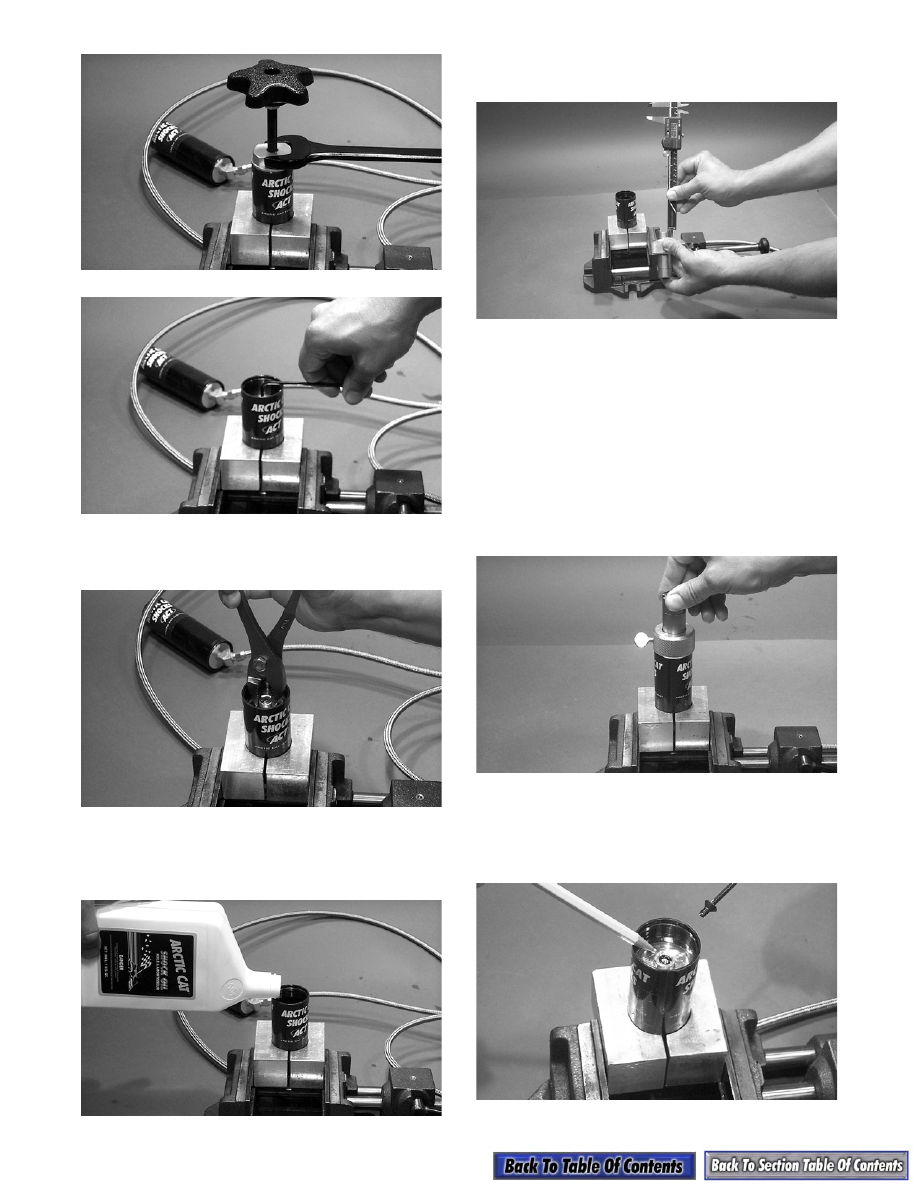
2. Remove the floating piston from the adjuster

assembly.

AG847

3. Pour oil into the adjuster body until it reaches the

bottom of the threads. Allow time for all air bub-

bles to dissipate.

AG848

4. Adjust the piston location tool (see Rebuildable

Shock Piston Depth Chart in this section).

AG824

5. Using a good low-temperature grease, lightly

grease the O-ring of the floating piston.

6. Using a long needle-nose pliers, insert the floating

piston into the adjuster body until the piston is

flush with the top of the body.

7. Using the piston location tool as a handle, push the

piston down into the adjuster body until the adjust-

ment stop of the tool comes in contact with the

adjuster body. The piston should now be located

correctly.

AG825

8. Install the Allen-head screw with a new O-ring

into the floating piston; then while securing the

piston with a 9/16-in. wrench, tighten the Allen-

head screw.

AG826

9-179

9

AG827

9. Pour out the excess oil from the adjuster assembly;

then grease the tip of the floating piston adjuster

screw using a good quality grease.

AG828

10. Install the adjuster knob making sure the knob is

turned out (counterclockwise) completely. Tighten

securely.

AG829

AG830

11. There must be a 1/4 to 1 turn of free-play on the

knob. If handle free-play is not within specifica-

tions, repeat steps 1-10.

Installing Internal 

Travel Limiting Spacers

These spacers are used to shorten the travel of the

shock absorber to fine tune the suspension to the oper-

ator's driving style.

If installing the spacers in the internal floating piston

shock absorbers, follow these steps.

1. Disassemble the shock absorber as covered in this

manual.

2. Place the shock shaft eyelet into a vise and remove

the nut securing the piston to the shock shaft.

AP028

3. Carefully remove the piston and its valving plates

stacked on either side of the piston from the end of

the shock shaft.

„

NOTE: When removing the piston and valve

plates from the shock shaft, place the piston
assembly on a 5/16 x 3-in. cap screw and secure
with a nut to keep the assembly in its proper order.

9-180

AP032

„

NOTE: If the piston assembly should become

mixed, the large slots of the piston must be
located next to the lock nut of the shaft. Refer to
the appropriate Illustrated Parts Manual for valve
plate location.

„

NOTE: If a rubber washer is found on the shock

shaft next to the bottom side of the bearing cap, it
must be removed before installing the limiting
spacers. The rubber washer must not be used with
the spacers installed.

4. Measure the length of the limiting spacer(s) that

are being installed on the shock shaft. Write down

this measurement as it will be required to properly

calculate the floating piston depth later in the

assembly process.

AP053

5. Install the desired number of limiting spacers on

the shock shaft.

AP054

6. Install the heavy spacer washer and then the piston

with valve plates located on either side onto the

shock shaft. Check to make sure the piston has

been installed with its large slots positioned next

to the lock nut which secures the assembly to the

shaft.

7. Install the lock nut and tighten to 2.1-2.8 kg-m

(15-20 ft-lb).

AP055

„

NOTE: For installing spacers on an IFP shock,

proceed to step 8. For installing spacers on a
remote reservoir shock, proceed to the appropri-
ate assembly procedure for the type of shock
being serviced.

8. Apply a light coat of oil on the O-ring and piston

ring. Install piston and the shock shaft assembly

into the shock body.

AP033

9. Place the shaft bearing cap into the shock body

and tighten securely.

! CAUTION

Do not over-tighten the lock nut. If excess torque
is applied, damage to the piston and valves will
occur.

9-181

9

AP026

10. Remove the shock body from the vise and re- posi-

tion the shock body and holding blocks in the vise

so its open end is “up.” Extend the shock shaft

fully out; then fill the shock body with Shock Oil

(p/n 1639-245) to within 1-in. from the top.

Slowly stroke the shaft up and down to remove air

from under the piston. Oil may need to be added to

keep the shock full. Fill shock to within 1/4-in.

from the top. Allow 5 minutes for all air bubbles to

rise to the top.

„

NOTE: Before installing the internal floating pis-

ton, refer to the illustration below and calculate the
new piston depth using the measurement taken
earlier of the spacer(s) installed and the formula
provided in the illustration.

0730-266

11. After calculating the new piston depth, measure

out this distance on the shock piston location tool;

then adjust and secure the location knob.

AP050

12. Apply a light coat of oil on the floating piston ring

and O-ring and install the floating piston in the

shock body.

AG850

13. Using a long needle-nose pliers, insert the floating

piston into the adjuster body until the piston is

flush with the top of the body; then using the pis-

ton location tool as a handle, push the piston down

into the adjuster body until the adjustment stop of

the tool comes in contact with the adjuster body.

The piston should now be located correctly.

AG339

„

NOTE: As the floating piston is pushed into the

shock absorber body, air and excess oil will come
out through the hole in the piston. If no oil comes
out through the hole in the piston, remove the pis-
ton and add more oil to the shock body.

14. Install the Allen-head screw and O-ring into the

bottom of the floating piston. Tighten the Allen-

head screw.

15. Pour out the excess oil from the shock body.

16. Install the lower end cap on the shock body.

17. Using Retaining Blocks (p/n 0644-142), hold the

shock body in place and tighten the end cap using

an adjustable wrench. Pressurize the shock follow-

ing the shock pressurizing procedure.

When using shock internal travel limiting
spacers on rebuildable shocks with IFP’s
(I nterna l F loati ng Piston ), the IFP dep th
setting must be reduced to compensate for
the spacer height. Use the following formula to
adjust your shock depth setting.

Example:
Spacer height = .500 in.
Old IFP depth = .750 in.
IFP Depth Adjustment = .1165 x .500 = .058 in.
New IFP depth = .750 - .058 = .692 in.


Content   ..  173  174  175  176   ..