Snowmobile Arctic Cat (2002 year). Instruction - part 17
 

  Index      Snowmobiles / ATV     Snowmobile Arctic Cat - instruction 2002 year


Search            


Content   ..  15  16  17  18   ..


Snowmobile Arctic Cat (2002 year). Instruction - part 17


2-51

2

ATV-0107

Measuring Valve Guide/Valve Stem 

Clearance

1. Using a micrometer and small bore gauge, take

diameter readings on the valve stems and inside

the guides.

2. Determine the stem clearance inside the guide.

„

NOTE: Be sure to take readings at more than one

place along the length of each stem and guide.

Lapping Valves

„

NOTE: Ensure that all carbon has been removed

from the valves.

1. Using a valve lapper, produce a contact pattern on

each valve face by applying a uniform coat of

valve lapping compound to the valve seat and by

rotating and tapping the valve head.

2. Acceptable width of valve seat contact width

(measurement A) is within a range of 0.8-1.0 mm

(0.032-0.039 in.).

GEN-0023

GEN-0024

„

NOTE: Do not grind the valves. If a valve is dam-

aged, it must be replaced.

3. Lubricate each valve stem with lightweight oil;

then apply a small amount of valve lapping

compound to the entire seating face of each valve.

4. Attach the suction cup of a valve lapping tool to

the head of the valve.

5. Rotate the valve until the valve and seat are evenly

polished.

6. Clean all compound residue from the valve and

seat.

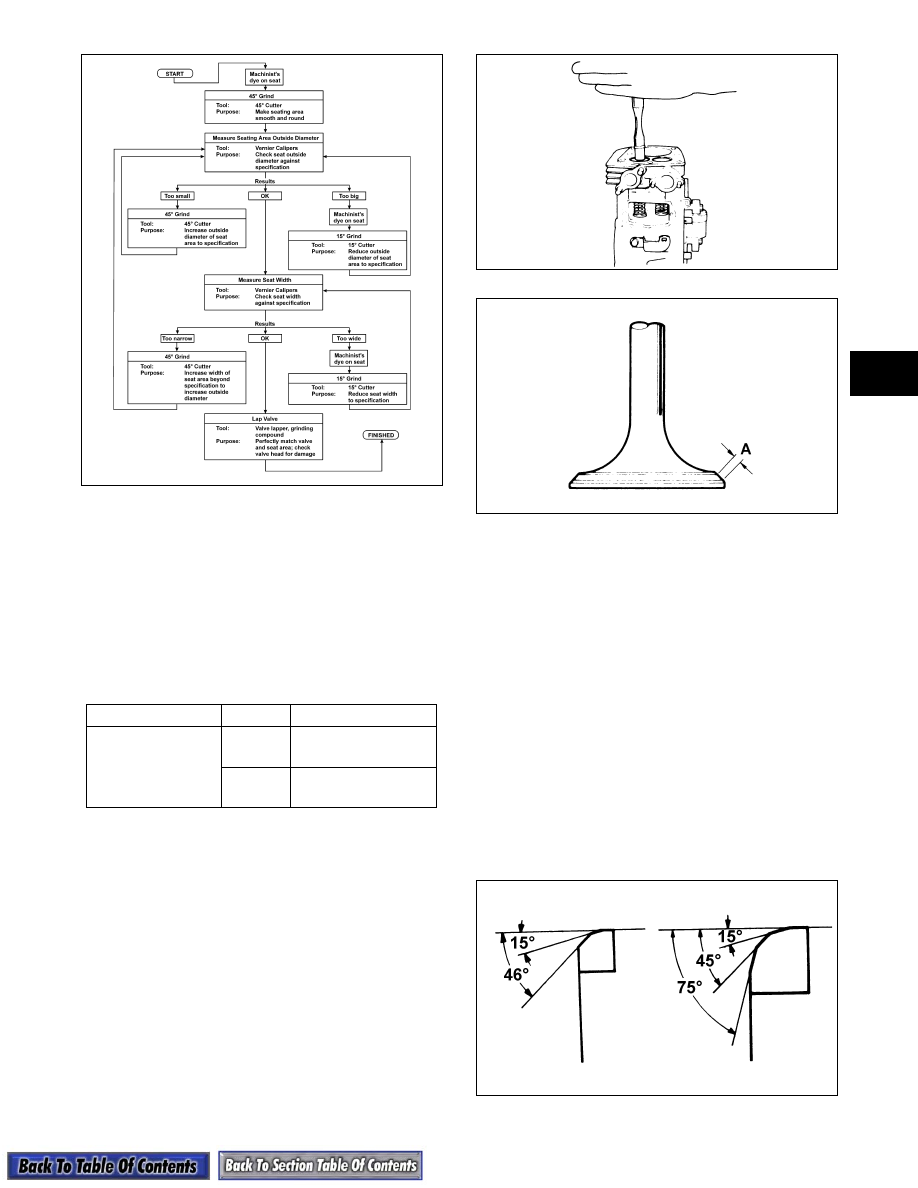
Valve Seat Repair

„

NOTE: If the valve seat is beyond servicing, the

cylinder must be replaced.

GEN-0025

ITEM

SPECIFICATION

Valve Guide/Valve 

Stem Clearance

Intake 

(max)

0.080 mm

(0.0031 in.)

Exhaust

(max)

0.100 mm

(0.0039 in.)

2-52

A valve seat not producing a uniform contact with its

valve or showing a seating contact width that is not

within the specified range must be repaired by cutting.

1. Insert the expandable pilot shaft into a valve

guide; then install a 45° cutter onto the pilot shaft.

Grind the valve seat by turning the cutter 1-2 turns

using a T-handle.

2. Remove the pilot shaft and cutter; then coat the

valve seat with a blueing compound and insert the

valve into the valve guide. Rotate the valve while

tapping the valve head; then remove the valve and

inspect the valve seat and valve face for proper

width.

3. The pattern produced on the seating surface of the

valve and valve seat must be a continuous ring

without any break and the width of the pattern

must be within specifications. Grind the valve seat

width to 0.8-1.0 mm (0.032-0.039 in.).

4. Inspect for dents or burning on the valve seat and,

if necessary, rotate the 45° cutter another turn to

smooth out the valve seat.

5. If the position of the valve face width is low, grind

the valve seat using a 75° cutter to raise the

position of the valve seat. If the position of the

valve face width is high, grind the valve seat using

a 15° cutter to lower the position of the valve seat.

GEN-0026

GEN-0027

6. After reconditioning the valve seat, the valve seat

could be narrow. In this case, recondition the valve

seat using the 45° cutter. After reconditioning,

thoroughly remove any burrs which may be

caused by grinding. The valve seat surface should

be smooth but not too glossy. Repeat the valve seat

repair procedure on the remaining valve.

„

NOTE: After reconditioning all valve seats, thor-

oughly clean the seat and its vicinity.

Valve Springs

1. When the valve springs are weak, the valve and

valve seat fail to form a good seal, thus allowing

gas to leak past the valve seat causing a loss of

power. Whether or not a valve spring is weak can

be determined by its free length.

GM128D

2. Minimum valve spring free length is 31.0 mm

(1.22 in.).

„

NOTE: With the crankshaft at top dead center on

the compression stroke, install the valve springs
and spring retainers; then compress the valve
springs and install the valve keepers.

PISTON ASSEMBLY

„

NOTE: Oversized pistons are available allowing

the cylinder to be bored oversized.

! CAUTION

Do not over-grind the valve seats. Grind the
seats only as necessary to ensure a continuous
contact with the valve seating surface.

! CAUTION

Avoid using a lapping compound after this
procedure.

2-53

2

„

NOTE: Whenever a piston, rings, or pins are out

of tolerance, they must be replaced.

Cleaning/Inspecting Piston

1. Using a non-metallic carbon removal tool, remove

any carbon buildup from the dome of the piston.

2. Inspect the piston for cracks in the piston pin,

dome, and skirt areas.

3. Inspect the piston for seizure marks or scuffing.

Repair with #400 grit wet-or-dry sandpaper and

water or honing oil.

AN135

„

NOTE: If scuffing or seizure marks are too deep

to correct with the sandpaper, replace the piston.

4. Inspect the perimeter of each piston for signs of

excessive “blowby.” Excessive “blowby” indicates

worn piston rings or an out-of-round cylinder.

Removing Piston Rings

1. Starting with the top ring, slide one end of the ring

out of the ring-groove.

2. Remove each ring by working it toward the dome

of the piston while rotating it out of the groove.

„

NOTE: If the existing rings will not be replaced

with new ones, note the location of each ring for
proper installation. When installing new rings,
install as a complete set only.

Cleaning/Inspecting Piston Rings

„

NOTE: If replacing the rings, make a ring-groove

cleaning tool by taking an old piston ring and
snapping it into two pieces; then grind the end of
the old ring to a 45° angle and to a sharp edge.

1. Using a ring-groove cleaning tool, clean carbon

from the ring-grooves. Be sure to position the ring

with its tapered side up.

Measuring Piston-Ring End Gap 

(Installed)

1. Place each piston ring in the wear portion of the

cylinder. Use the piston to position each ring

squarely in the cylinder.

„

NOTE: When measuring a piston ring, it should

be placed into the area of the cylinder where wear
is least (the area is about 3 mm (0.12 in.) from the
upper or lower edge of the cylinder).

2. Using a feeler gauge, measure each piston-ring

end gap. Acceptable ring end gap must be within

specifications.

GEN-0043

Piston Ring/Groove Clearance

1. Using a thickness gauge, measure the side

clearances of the 1st and 2nd rings.

2. If any of the clearances exceeds the limit, replace

both piston and piston rings.

Measuring Piston Pin Bore Diameter

1. Insert an inside dial indicator into the piston-pin

bore. The diameter must be within specifications.

Take two measurements to ensure accuracy.

2. Piston pin bore must be within a range of 15.006-

15.030 mm (0.5908-0.5917 in.).

! CAUTION

Improper cleaning of the ring-grooves by the use
of the wrong type of ring-groove cleaner will
result in severe damage to the piston.

PISTON RING END GAP

1st & 2nd 

Range

0.20-0.70 mm

(0.0079-0.0280 in.)

PISTON RING GROOVE WIDTH

1st & 2nd 

Range

1.52-1.54 mm

(0.060-0.061 in.)

Oil Range

2.51-2.53 mm

(0.098-0.099 in.)

PISTON RING THICKNESS

1st & 2nd 

Range

1.47-1.49 mm 

(0.058-0.059 in.)

PISTON RING/GROOVE CLEARANCE

1st & 2nd 

Range

0.03-0.10 mm

(0.0012-0.0039 in.)

2-54

ATV-1069

Measuring Piston Skirt/

Cylinder Clearance

1. Measure the cylinder front to back in six places

using a cylinder bore gauge. The amount of wear

is the difference between the largest and smallest

readings. If the determined wear exceeds the limit

indicated, bore to the next oversize by using a

boring machine or replace the cylinder.

GEN-0032

2. Measure the corresponding piston diameter at a

point 14 mm (0.551 in.) above the piston skirt at a

right angle to the piston-pin bore. Piston diameter

must be within a range of 59.880-59.990 mm

(2.3575-2.3618 in.).

GEN-0033

3. Piston skirt to cylinder clearance must be within a

range of 0.020-0.120 mm (0.0008-0.0047 in.).

4. If the piston/cylinder clearance exceeds the limit,

bore the cylinder and use an oversized piston or

replace both cylinder and piston.

Installing Piston Rings

1. Install the rings in the appropriate grooves.

Stagger the gaps of the rings.

Measuring Piston Pin Diameter

1. Measure the piston pin diameter at each end and in

the center. If measurement is less than minimum

specifications, the piston pin must be replaced.

2. Piston pin diameter must be within a range of

14.980-14.995 mm (0.5898-0.5904 in.).

ATV-1070

CYLINDER/CYLINDER HEAD

„

NOTE: If the cylinder/cylinder head assembly

cannot be trued, they must be replaced.

Cleaning/Inspecting Cylinder Head

1. Using a non-metallic carbon removal tool, remove

any carbon buildup from the combustion chamber

being careful not to nick, scrape, or damage the

combustion chamber or the sealing surface.

2. Inspect the spark plug hole for any damaged

threads. Repair damaged threads using a “heli-

coil” insert.

! CAUTION

Incorrect installation of the piston rings will
result in engine damage.


Content   ..  15  16  17  18   ..