Snowmobile Polaris Two Stroke (2007 year). Instruction - part 22
 

  Index      Snowmobiles / ATV     Snowmobile Polaris Two Stroke - instruction 2007 year


Search            


Content   ..  20  21  22  23   ..


Snowmobile Polaris Two Stroke (2007 year). Instruction - part 22


4.5

FUEL DELIVERY

4

Maintenance

The impulse operated diaphragm fuel pump does not require any
specific scheduled maintenance. However, the following
procedures should be observed:

• Operation

The pump may be checked for operation by removing the fuel
supply line from the carburetor and placing it into a container.
With the engine idling at approximately 2000 RPM, a steady
flow of fuel should be visible.

• Cleaning

The pump and impulse line must be disassembled and cleaned
of foreign material in the event of piston or other internal engine
part failures which produce fragments.

• Inspection

Disconnect impulse line from pump. Connect a Mity Vac to
impulse fitting (or line) and apply 4-6 PSI pressure. Diaphragm
should hold pressure indefinitely.

The diaphragms and check valves must be carefully examined
for cracks, holes, or other damage. If in doubt as to the condition
of any internal parts, replace all diaphragms, check valves, and
gaskets.

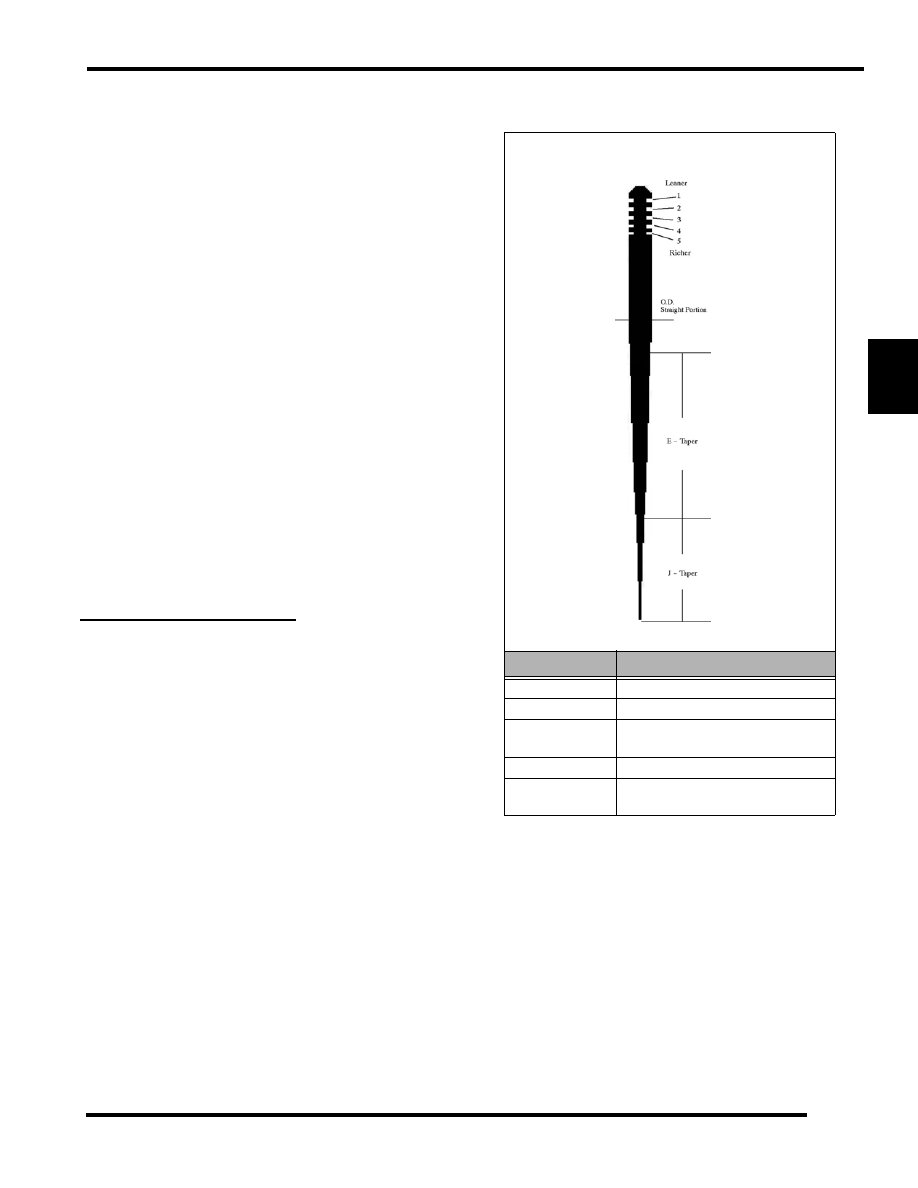
MIKUNI JET NEEDLE 

Overview

This needle (example) is a 9DH01-57. The first number is the
approximate overall length in 10mm increments of the jet
needle. The 9 indicates the needle is approximately 90mm but
less that 100mm in length. 

The letters on the jet needle indicate the angle of both tapers. The
first letter designates the taper angle of the top section (closest
to the grooves) and the second letter designates the angle of the
bottom taper. The taper angles are graduated in 15' (15 minute)
increments. The jet needle marked 9DH01-57 would have a top
taper of 1_0' and a bottom taper of 2_0'. 

The number following the letters on the jet needle is the serial
number and it varies with individual jet needles. 

The last number, 57 indicates that the outside diameter is
2.57mm. The smaller the O.D., the richer the mixture.

9DH01-57

DESIGNATOR

DESCRIPTION

9

Overall length in 10mm increments

D

Taper of the top section of the needle

H

taper of the bottom section of the 
needle

01

Serial number

-57

Outside diameter (O.D.) of the straight 
portion

4.6

FUEL DELIVERY

MIKUNI TM 38

Carburetor Overview

The advantages of the TM flatslide system include improved
throttle response and a significant reduction in throttle effort
due to rack style carbs and the use of cable cam. The following
are the main components of TM carburetors and the functions
of each components.

Pilot Air Jet (A): The pilot air jet controls the amount of air
entering the engine in the idle circuit. The pilot air jet size is
imprinted on it. Bigger pilot air jets allow more air to enter,
leaning the idle mixture. If engine loads up at idle, first try
turning fuel screw in. If not correct, try larger pilot air jet.

Starter Jet (B): The starter jet's function is to meter fuel
entering the engine when choked. Larger numbered starter jets
pass more fuel, therefore more fuel will enter the system when
jetting to a larger size. Like the pilot air jet, the jet size is
imprinted.

Jet Needle (C): The jet needle performs the same functions as
on Mikuni VM carburetors. However, the needles in the TM-38
carburetors are longer and are not interchangeable with VM
needles. To raise or lower the needle, remove the top cap (D)
and loosen the 2.5mm Allen screw holding the needle in place.

Reach inside with a long nose pliers and pull the needle out. The
C-clip can then be adjusted for the desired effect.

Needle Jet (D): The needle jet is press fit into carbs and is not
replaceable.

Piston Valve or Throttle Valve): The throttle valve controls the
rate of engine air intake by moving up and down inside the main
bore. At small throttle openings, air flow control is performed
chiefly by the cutaway. By controlling air flow the negative
pressure over the needle valve is regulated, in turn varying the
fuel flow

Main Jet and Pilot Jet (F): The main jets (hex) and pilot jets
(air bleed type) are identical in style and function as the Mikuni
VM carbs. There is a washer on a main jet that is staked and
should not come out. The part numbers for main jets and pilot
jets are the same as Mikuni VM round slide carburetors.

Fuel Screw (G): The fuel screw controls the low speed air/fuel
mixture at idle. Turning the fuel screw out makes the mixture
richer and can be adjusted up to three turns out.

4.7

FUEL DELIVERY

4

Float/Needle & Seat Assembly (H): The float/needle & seat are
sold as an assembly and cannot be replaced as individual
components. The float level is pre-set in the molding and cannot
be adjusted. 

Carburetor Synchronization: Remove the top caps on all
carburetors. In the body of the carburetors, there is a Phillips
head set screw (I) that connects the slide lever to the throttle
lever shaft. The carburetor with the fixed set screw is the base
carburetor (middle carburetor on triples, PTO carburetor on
twins) and the remaining carbs are synchronized to it.
Carburetor synchronization is measured at wide open throttle.
Open the throttle to wide open. The bottom of the slide should
be flush with the top of the throttle bore. If it is not flush, locate
the wide open throttle stop screw (J) and turn it until the base
carburetor is set flush. Loosen the Phillips head set screw in the
remaining carburetor(s). Turn the adjusting nut (K) that
surrounds the set screw until the throttle slide is set the same as
the base carburetor. Tighten all set screws and replace the top
caps making sure gaskets are properly positioned.

MIKUNI CARBURETOR

Function

The function of a carburetor is to produce a combustible air/fuel
mixture by breaking fuel into tiny particles in the form of vapor,
to mix the fuel with air in a proper ratio, and to deliver the
mixture to the engine. A proper ratio means an ideal air/fuel
mixture which can burn without leaving an excess of fuel or air.
Whether the proper mixture ratio is maintained or not is the key
to efficient engine operation.

The engine of a vehicle is operated under a wide range of
conditions, from idling with the throttle valve remaining almost
closed, to full load or maximum output with the throttle valve
fully opened. In order to meet the requirements for the proper
mixture ratio under these varying conditions, a low speed fuel
system, or pilot system, and a main fuel system are provided in
Mikuni type carburetors. The Mikuni carburetor has varying
operations depending upon varying driving conditions. It is
constructed of a float system, pilot system, main system, and
starter system or initial starting device.

WARNING

 DO NOT pressurize the fuel system by forcing compressed 
air through the fuel tank. Forcing air through the needle and 
seat will cause damage and the float/needle & seat assembly 
will have to be replaced.

4.8

FUEL DELIVERY

Float System

The float system is designed to maintain a constant height of
gasoline during operation. When the fuel flowing from the fuel
pump into the float chamber through the needle valve reaches
the constant fuel level, the floats rise. When the buoyancy of the
float and the fuel pressure of the fuel pump balance, the needle
valve sticks fast to the needle seat, preventing further delivery
of gasoline, thereby holding the standard level of gasoline.

The fuel level in the bowl assists in controlling the amount of
fuel in the fuel mixture. Too high a level allows more fuel than
necessary to leave the nozzle, enriching the mixture. Too low a
level results in a leaner mixture, since not enough fuel leaves the
nozzle. Therefore, the predetermined fuel level should not be
changed arbitrarily.

Fuel Metering

Mikuni carburetors use a starter enricher system rather than a
choke. In this type of carburetor, fuel and air for starting the
engine are metered with entirely independent jets. The fuel
metered in the starter jet is mixed with air and is broken into tiny
particles in the emulsion tube. The mixture then flows into the
plunger area, mixes again with air coming from the air intake
port for starting and is delivered to the engine through the fuel
discharge nozzle in the optimum air/fuel ratio. The starter is
opened and closed by means of the starter plunger. The starter
type carburetor is constructed to utilize the negative pressure of
the inlet pipe, so it is important that the throttle valve is closed
when starting the engine

Fuel Delivery

The pilot system's
main function is to
meter fuel at idle
and low speed
driving. Though its
main function is to
supply fuel at low
speed, it does feed
fuel continuously
throughout the
entire operating
range.

Fuel for the pilot
jet is drawn from
the float bowl,
mixed with air jet,
and delivered to
the engine through the pilot outlet.

The mixture is regulated to some degree by adjusting the fuel
screw.

The main system is designed to deliver fuel between low speed
and high speed operation. This system is made up of the jet
needle, needle jet, and main jet. The main system begins to take
effect as soon as there is enough air flow into the carburetor
venturi to draw fuel up through the main jet and needle jet
assembly. This system works in conjunction with the needle jet
system.

During low speed driving, there is very little clearance between
the jet needle and the needle jet; therefore, very little fuel from
the main jet can pass between the jet needle and the needle jet.
As the throttle valve opening is increased, the tapered jet needle
is raised farther out of the needle jet, allowing greater fuel flow.
Under full throttle opening, the cross sectioned area of
clearance between the jet needle and the needle jet becomes
greater than the cross sectioned area of the main jet. Thus the
main jet is now controlling the amount of fuel flow.

Pilot Jet

From idling to low speeds, the fuel supply is metered by the pilot
jet. There are several air bleed openings in the sides of the pilot
jet which reduce the fuel to mist. The number stamped on the jet
is an indication of the amount of fuel in cc's which passes
through the jet during a one minute interval under a given set of
conditions.

FUEL METERING


Content   ..  20  21  22  23   ..