Snowmobile Polaris Trail RMK (2010 year). Instruction - part 7
 

  Index      Snowmobiles / ATV     Snowmobile Polaris Trail RMK - instruction 2010 year


Search            


Content   ..  5  6  7  8   ..


Snowmobile Polaris Trail RMK (2010 year). Instruction - part 7


29

THE PERFECT FIT

Front Suspension Adjustments

Break in the suspension for approximately 150 miles (240 km) and re-

grease all suspension parts before making any fine-tuning adjustments.
Settings will vary from rider to rider, depending on rider weight, vehicle 

speed, riding style, and trail conditions. We recommend starting with 

factory settings and then customizing each adjustment individually to 

suit rider preference. The machine should be methodically tested under 

the same conditions after each adjustment (trail and snow conditions, 

vehicle speed, riding position, etc.) until the best ride is achieved. 

Adjustments should be made to one area at a time in order to properly 

evaluate the change.

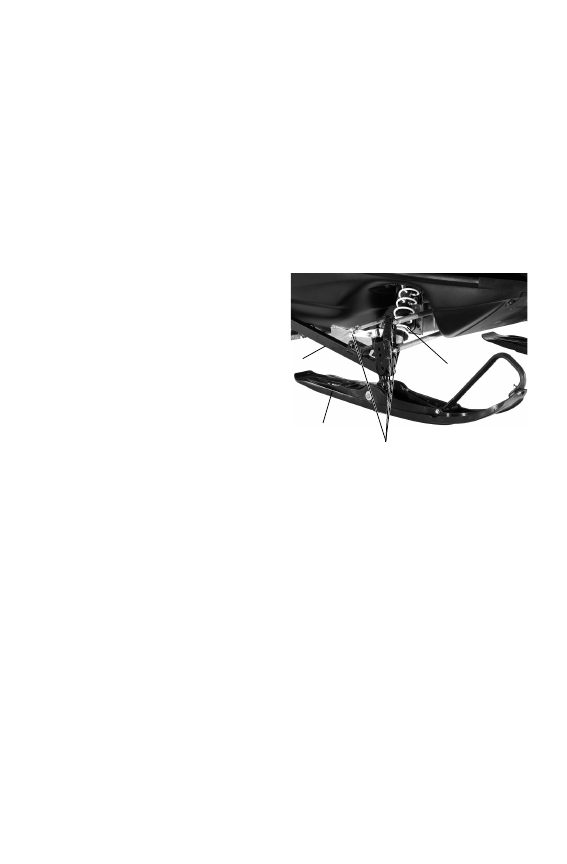
IFS Components

1. Skis
2. Front shocks and springs
3. Rod ends
4. Trailing arms

IFS Adjustment Options

• Front shock spring preload
• Optional springs

1

2

3

4

30

THE PERFECT FIT

Front Suspension Adjustments

WARNING! Improper ski alignment or adjustment may cause loss of steering 

control, resulting in serious injury or death. Always verify ski alignment before 

making adjustments to the IFS. See page 98 to check alignment. Do not attempt 

to change the ski alignment or camber adjustment. See your Polaris dealer.

The tension at which the shock coil spring is set is called spring preload. 

For the best ride, the spring preload should be set as low as possible to 

use the full travel of the ski shock, with occasional light bottoming. To 

determine if your machine is using full travel of the ski shock, push the 

jounce bumper down as far as it will go on the shock rod and test ride 

the machine. The bumper will move up on the rod in direct relation to 

the amount of travel. If the shock travel is full, the bumper will be seated 

at the top of the shock.

Shock Components

1. Retainer
2. Shock Rod
3. Jounce Bumper
4. Body
5. Threaded Spring Preload 

Adjuster Nut

1

3

4

5

2

31

THE PERFECT FIT

Front Suspension Adjustments

Front Springs

For models without externally adjustable or revalvable shocks, the front 

springs can be changed if spring preload alone isn’t sufficient and fur-

ther adjustment is desired to control suspension stiffness. See your 

Polaris dealer for more information.

32

THE PERFECT FIT

Front Suspension Adjustments

Shock Spring Preload

Increasing spring preload will 

increase ski-to-ground pressure. 

Decreasing spring preload will 

decrease ski-to-ground pressure. 

When adjusting, be sure the springs 

on both the left and right sides of the 

machine are at the same adjustment.
To increase front shock spring pre-

load, grasp the spring and turn it to 

the right. Turn it to the left to decrease 

preload.
Increasing the spring preload too 

much may adversely affect the han-

dling of the snowmobile and the per-

formance of the suspension. Never 

exceed one inch of preload beyond 

the factory settings, and ensure that 

both sides are adjusted the same. 

When decreasing preload, make sure 

at least two turns of preload are holding the spring between the retainer 

on top of the shock and the threaded spring preload adjuster nut on the 

shock body.

Tip: Some models do not have shocks with thread adjustable spring preload. 

See your dealer for more information.

NOTICE: Always leave one thread showing above the adjuster nut. On models 

equipped with a plastic adjuster nut, if the nut is unscrewed from the 

threaded body, the nut will break.

Low

Preload

High

Preload


Content   ..  5  6  7  8   ..