Polaris Sportsman 570 (2018 year). Instruction - part 5
 

  Index      Snowmobiles / ATV     Polaris Sportsman 570 - instruction 2018 year


Search            


Content   ..  3  4  5  6   ..


Polaris Sportsman 570 (2018 year). Instruction - part 5


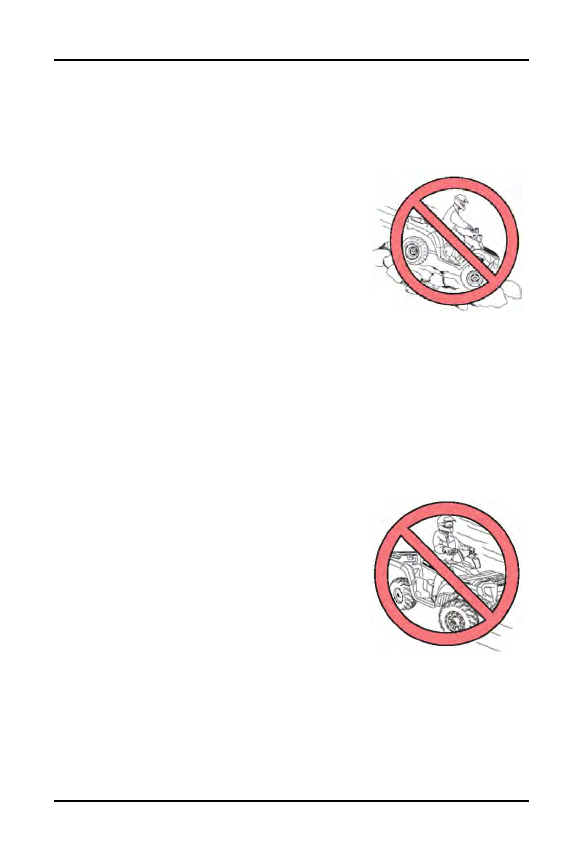
OPERATING ON STEEP HILLS

Operating on excessively steep hills could cause an overturn. Never operate on
hills too steep for the ATV or for your abilities. Never operate the ATV on hills
steeper than 15 degrees.

OPERATING ON SLIPPERY TERRAIN

Failure to use extra caution when operating on
excessively rough, slippery or loose terrain could
cause loss of traction, loss of control, accident or
rollover.
Do not operate on excessively rough, slippery or
loose terrain. Always use extra caution on rough,
slippery or loose terrain.

OPERATING IN UNFAMILIAR TERRAIN

Failure to use extra caution when operating on unfamiliar terrain could result in
an accident or rollover.

Unfamiliar terrain may contain hidden rocks, bumps, or holes that could cause
loss of control or rollover.

Travel slowly and use extra caution when operating on unfamiliar terrain. Always
be alert to changing terrain conditions.

OPERATING IMPROPERLY IN REVERSE

Improperly operating in reverse could result in a
collision with an obstacle or person. Always follow
proper operating procedures as outlined in this
manual.
Before shifting into reverse gear, always check for
obstacles or people behind the vehicle. When it's
safe to proceed, back slowly.

21

SAFETY

OPERATING AT EXCESSIVE SPEEDS

Operating the ATV at excessive speeds increases
the operator's risk of losing control.
Never operate at excessive speeds. Travel at
speeds appropriate for your skills, your passenger's
skills, and operating conditions.

IMPROPER TIRE MAINTENANCE

Operating this vehicle with improper tires or with improper or uneven tire
pressure could cause loss of control or accident. Always use the size and type of
tires specified for your vehicle. Always maintain proper tire pressure as
described in the owner's manual and on safety labels.

OPERATING OVER OBSTACLES

Improperly operating over obstacles could cause
loss of control or rollover.
Before operating in a new area, check for obstacles.
Avoid operating over large obstacles such as rocks
and fallen trees. If unavoidable, use extreme caution
and always follow proper operating procedures as
outlined in this manual.

SKIDDING OR SLIDING

Skidding or sliding can cause loss of control or
overturn (if tires regain traction unexpectedly). On
slippery surfaces such as ice, travel slowly and use
extra caution to reduce the chance of skidding or
sliding.

22

SAFETY

OPERATING A DAMAGED VEHICLE

Operating a damaged vehicle can result in an accident. After any rollover or
other accident, have a qualified service dealer inspect the entire machine for
possible damage, including (but not limited to) seat belts, rollover protection
devices, brakes, throttle and steering systems.

OPERATING THROUGH DEEP WATER

Operating the ATV through deep or fast-flowing water could cause the tires to
float, causing loss of control or overturn.

Avoid operating the ATV through deep or fast-flowing water. If it's unavoidable to
enter water that exceeds the recommended maximum depth:

• Travel slowly.
• Balance your weight carefully.
• Avoid sudden movements.
• Maintain a slow and steady forward motion. Do not make sudden turns or

stops, and do not make sudden throttle changes.

• Wet brakes may have reduced stopping ability. After leaving water, test the

brakes. Apply them lightly several times while driving. The friction will help dry
out the pads.

IMPROPER CARGO LOADING

Overloading the ATV or carrying/towing cargo may
cause changes in handling, which could cause loss
of control or an accident.

• Never exceed the stated load capacity for this

ATV.

• Cargo should be properly distributed and securely

attached.

• Reduce speed when carrying cargo or pulling a

trailer. Allow a greater distance for braking.

• Always follow the instructions in the owner's

manual for carrying cargo or pulling a trailer.

• Always follow the instructions in the owner's

manual for operating with a passenger.

23

SAFETY

OPERATING ON FROZEN BODIES OF WATER

Operating on frozen bodies of water may result in
serious injury or death if the ATV and/or riders fall
through the ice.
Never operate the ATV on a frozen body of water
unless you have independently verified that the ice
is sufficiently thick to support the weight and moving
force of the ATV, you and your cargo, together with
any other vehicles in your party. Variances in snow
depth and/or water currents may result in uneven ice
thickness. Always check with local authorities and
residents to confirm ice conditions and thickness
over your entire route. ATV operators assume all risk
associated with ice conditions on frozen bodies of
water.

POOR VISIBILITY

Operating the ATV in darkness or inclement weather could result in a collision or
accident, especially if operating on a road or street. This ATV is not equipped
with highway-approved lights. Operate this vehicle off-road only. Use caution
and drive at reduced speeds in conditions of reduced visibility such as fog, rain
and darkness. Clean headlights frequently and replace burned out head lamps
promptly.

PHYSICAL SKILLS

Safe operation of this rider-active vehicle requires good judgement and physical
skills. Persons with cognitive or physical disabilities who operate this vehicle
have an increased risk of overturn and loss of control.

HOT EXHAUST SYSTEMS

Exhaust system components are very hot during and after use of the vehicle.
Hot components can cause burns and fire. Do not touch hot exhaust system
components. Always keep combustible materials away from the exhaust
system. Use caution when traveling through tall grass, especially dry grass.

UNAUTHORIZED USE OF THE VEHICLE

Leaving the keys in the ignition can lead to unauthorized use of the vehicle by
someone under the age of 16, without a drivers license, or without proper
training. This could result in an accident or rollover. Always remove the ignition
key when the vehicle is not in use.

24

SAFETY


Content   ..  3  4  5  6   ..