Snowmobile Polaris 600 RUSH, 600 RUSH PRO-R, 800 RUSH, 800 RUSH PRO-R (2013 year). Instruction - part 12
 

  Index      Snowmobiles / ATV     Snowmobile Polaris 600 RUSH, 600 RUSH PRO-R, 800 RUSH, 800 RUSH PRO-R - instruction 2013 year


Search            copyright infringement  


Content   ..  10  11  12  13   ..


Snowmobile Polaris 600 RUSH, 600 RUSH PRO-R, 800 RUSH, 800 RUSH PRO-R (2013 year). Instruction - part 12


50

THE PERFECT FIT

Front Suspension Adjustments

Independent Front Suspension (IFS)

Factory settings, combined with user adjustments to the rear shock 
spring, should be all that’s necessary to provide the best riding experi-
ence for most riders. If all rear shock spring adjustments have been 
exhausted and rider weight is at the very high or very low weight range 
for the stock spring, additional adjustments are possible to the IFS.

Settings will vary from rider to rider, depending on rider weight, vehicle 
speed, riding style, and trail conditions. We recommend starting with 
factory settings and then customizing each adjustment individually to 
suit rider preference. The snowmobile should be methodically tested, 
one change at a time, under the same conditions (trail and snow condi-
tions, vehicle speed, riding position, etc.) after each adjustment until the 
best ride is achieved. 

Break in the suspension for about 150 miles (240 km) before making 
adjustments to the front suspension.

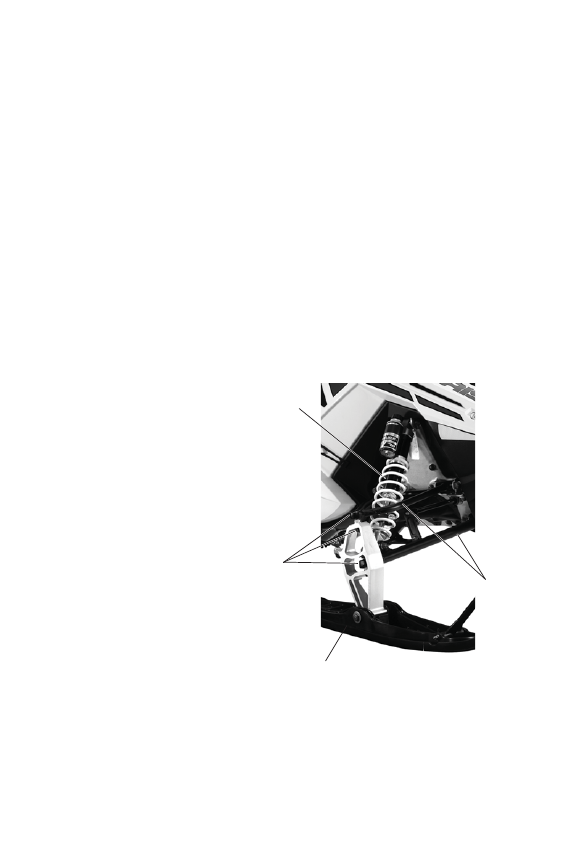
IFS Components

1. Skis

2. Front shocks and springs

3. Rod ends

4. A-arms

IFS Adjustment Options
• Front shock spring preload
• Compression damping
• Optional springs
• Optional shock valving

1

2

3

4

51

THE PERFECT FIT

Front Suspension Adjustments

IFS Shock Spring Preload

Increasing spring preload will increase ski-
to-ground pressure. Decreasing spring pre-
load will decrease ski-to-ground pressure. 
When adjusting, be sure the springs on both 
the left and right sides of the machine are at 
the same adjustment.

Always perform shock spring preload 
adjustments with the weight of the vehicle 
removed from the shock and with the shock 
at full extension.

To change shock spring preload, grasp the 
spring retainer and rotate it.

Increasing the spring preload too much 
may adversely affect the handling of the 
snowmobile and the performance of the 
suspension. Never exceed one inch (2.54 
cm) of preload beyond the factory settings.

NOTICE: When decreasing preload, make sure at least two turns of preload are 

holding the spring between the retainer on the top of the shock and 
the threaded spring preload adjuster nut on the shock body. Failure to 
do so could cause the retainer to fall off when the suspension is fully 
extended.

TIP: Other spring options are available. Please see your POLARIS dealer.

Initial IFS Preload Setting

(from body end to spring)

FOX shocks

3.75 inches

(9.5 cm)

Pro-R premium shocks

3.00 inches

(7.6 cm)

800 LE shocks

3.00 inches

(7.6 cm)

Measure 

here

52

THE PERFECT FIT

Front Suspension Adjustments

IFS Shock Compression Damping

Make adjustments to the shock clickers to control bottoming. Make the 
adjustments in 1-to-2-click increments, then test ride. Repeat the adjust-
ment until the desired result is achieved.

TIP: Initially, heavier riders may want to set the shock clickers 2-4 clicks higher 

than lighter riders.

The standard clicker setting is 6 clicks from 
the softest position. 

• Turn the clicker clockwise for a stiffer ride 

(as viewed from the top).

• Turn the clicker counter-clockwise for a 

softer ride.

When adjusting, we recommend that you turn 
the clicker only one or two clicks, then test 
ride. Always adjust both shocks equally.

Shock Valving

Some shocks can be revalved if spring preload alone isn't sufficient and 
further adjustment is desired to control suspension stiffness. Please see 
your POLARIS dealer.

WARNING! Changing shock valving requires special tools and a sound 
knowledge of mechanical theory, tool use, and shop procedures to perform the 
work safely and correctly. Shocks contain high-pressure nitrogen gas. Use 
extreme caution when handling high-pressure service equipment. We 
recommend that this work be performed by a POLARIS dealer.

Rebound Clicker (800 LE)

The rebound adjustment clicker is located on the bottom end of the 
shock. This adjuster has 16 possible adjustments. The factory setting is 
8 clicks clockwise from full soft.

When adjusting, turn the clicker two clicks, then test ride. Always adjust 
both shocks equally. Repeat the adjustment until the desired result is 
achieved.

• Turn the clicker clockwise to slow rebound control (shock extends 

slower).

• Turn the clicker counter-clockwise to increase rebound control (shock 

extends faster).

Softer

Ride

Stiffer

Ride

53

THE PERFECT FIT

Rear Suspension Adjustments

Rider weight, riding style, trail conditions, and vehicle speed all affect 
suspension action.

Each rear suspension can be adjusted to suit rider preference and deliver 
excellent performance for a given set of conditions. However, all sus-
pension designs and adjustments involve a compromise, or trade-off. 
For example, a suspension set up for snowcross racing would provide a 
very stiff ride on the trail. A suspension set up for trail riding would bot-
tom out harshly on a snowcross course.

Additional adjustments should be made after initial setup. Make adjust-
ments to one area at a time so you can evaluate the change. For further 
assistance, see your dealer.

Suspension Performance Tips

• Rider weight usually determines the position at which the spring pre-

load should be set. However, this may vary with riding style. With a 
little experimentation, each rider can find a preferred set-up. 

• In deep snow, a new rail slide will offer improved performance over 

worn rail slide. It can also improve top speed.

• When riding on ice or hard-packed snow, adding a set of bogie wheels 

to the rail may enhance the snowmobile's performance. Bogie wheel 
kits are available from your dealer.

Track Tension

Track adjustment is critical for proper handling. Always maintain cor-
rect tension and alignment. Refer to the track tension maintenance sec-
tion beginning on page 106.


Content   ..  10  11  12  13   ..