Snowmobile Polaris 340 Edge / 550 LX (2008 year). Instruction - part 14
 

  Index      Snowmobiles / ATV     Snowmobile Polaris 340 Edge / 550 LX - instruction 2008 year


Search            copyright infringement  


Content   ..  12  13  14  15   ..


Snowmobile Polaris 340 Edge / 550 LX (2008 year). Instruction - part 14


56

OPERATION

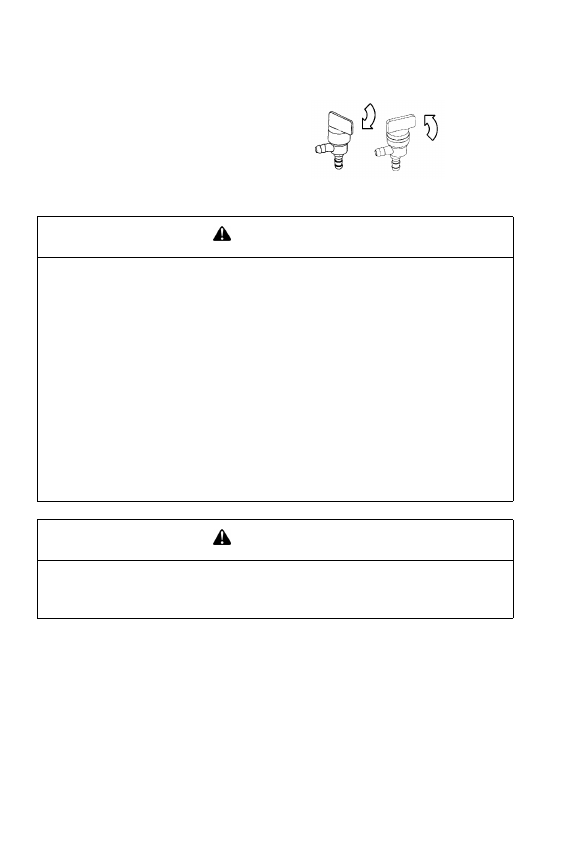
Fuel Valve

Turn the fuel valve clockwise 

to OFF to shut off the fuel 

supply. Turn the valve 

counter-clockwise to ON to 

turn the fuel supply on.

Fuel

WARNING

Gasoline is highly flammable and explosive under certain conditions.

Always exercise extreme caution whenever handling gasoline.

Always refuel outdoors or in a well-ventilated area. 

Always turn off the engine before refueling.

Do not overfill the tank. Do not fill the tank neck.

Do not smoke or allow open flames or sparks in or near the area where 

refueling is performed or where gasoline is stored.

If gasoline spills on your skin or clothing, immediately wash it off with 

soap and water and change clothing.

Never start the engine or let it run in an enclosed area. Engine exhaust 

fumes are poisonous and can cause loss of consciousness or death in a 

short time.

Turn the fuel valve off whenever the snowmobile is stored or parked.

WARNING

The engine exhaust from this product contains chemicals known to cause 

cancer, birth defects or other reproductive harm. Operate this vehicle only 

outdoors or in well-ventilated areas.

OFF

ON

57

OPERATION

Fuel

Your Polaris engine is designed to run on 87 octane non-oxygenated or 

89 octane oxygenated pump gasoline. There's a great deal of variability 

in the quality of the 87 octane gasoline available across the country, so 

we encourage the use of premium fuel when possible. Do not use lower 

than 87 octane fuel. Do not use fuel containing more than 10% ethanol 

(including E85).

Fuel Reserve Capacity (Mechanical Gauge)

There are approximately two gallons of fuel left in the tank when the 

mechanical fuel gauge reads RES.

Fuel System Deicers

If you use non-oxygenated fuel, Polaris recommends the regular use of 

isopropyl-based fuel system deicer. Add one to two ounces per gallon 

(8-16 ml per liter) of gasoline to prevent engine damage resulting from 

fuel system icing and lean fuel mixtures. Never use deicers or additives 

containing methanol. Polaris also recommends the use of Carbon Clean 

Plus. See page 113 for the part numbers of Polaris products.

If you use oxygenated fuel containing ethanol, additional alcohol deic-

ers or water absorbing additives should not be used.

CAUTION

Prolonged exposure to petroleum based products may damage paint. Always 

protect painted surfaces when handling fuel.

58

OPERATION

n

Oil

Low Oil Indicator Light

The low oil indicator light will alert the operator if the oil level is low. 

Visually check for oil in the bottle. Add oil before further operation of 

the snowmobile.

Low Oil Level

Maintaining the proper oil level will prevent system aeration and possi-

ble loss of pumping action, which could result in engine damage. This is 

especially important when the machine is operated in mountainous ter-

rain.

Always check the oil level when refueling. Maintain the oil level above 

the tank's low level line. When the oil reaches the low level mark, add 

one U.S. quart of recommended oil. See page 54 for oil recommenda-

tions.

NOTE: The Polaris oil cap on the oil bottle is vented to allow proper oil 

flow. See your Polaris dealer for recommended replacement 

parts.

CAUTION

Operating the snowmobile without adequate engine lubrication can result in 

serious engine damage. Always check the oil level when refueling. Add oil as 

needed.

59

OPERATION

Carburetion

Proper carburetor adjustment is critical. A lean mixture (too much air, 

too little fuel) may result in piston burning, bearing failure, or complete 

engine failure. A rich mixture (too much fuel, too little air) may foul 

plugs and cause generally poor engine performance.

A lean mixture may be caused by things like fuel line restrictions, for-

eign matter in the carburetor or clogged fuel filters. A rich mixture may 

be caused by snow build-up on the pre-filter in the air intake system. 

Either condition may be caused by improper carburetor adjustment.

WARNING

Improper carburetor adjustments may result in operator safety hazards as 

well as serious engine damage. Always have your Polaris dealer perform any 

carburetor adjustments.


Content   ..  12  13  14  15   ..