Snowmobile Polaris (2006 year). Instruction - part 41
 

  Index      Snowmobiles / ATV     Snowmobile Polaris - instruction 2006 year


Search            copyright infringement  


Content   ..  39  40  41  42   ..


Snowmobile Polaris (2006 year). Instruction - part 41


7.18

CLUTCHING

Drive Clutch Weights

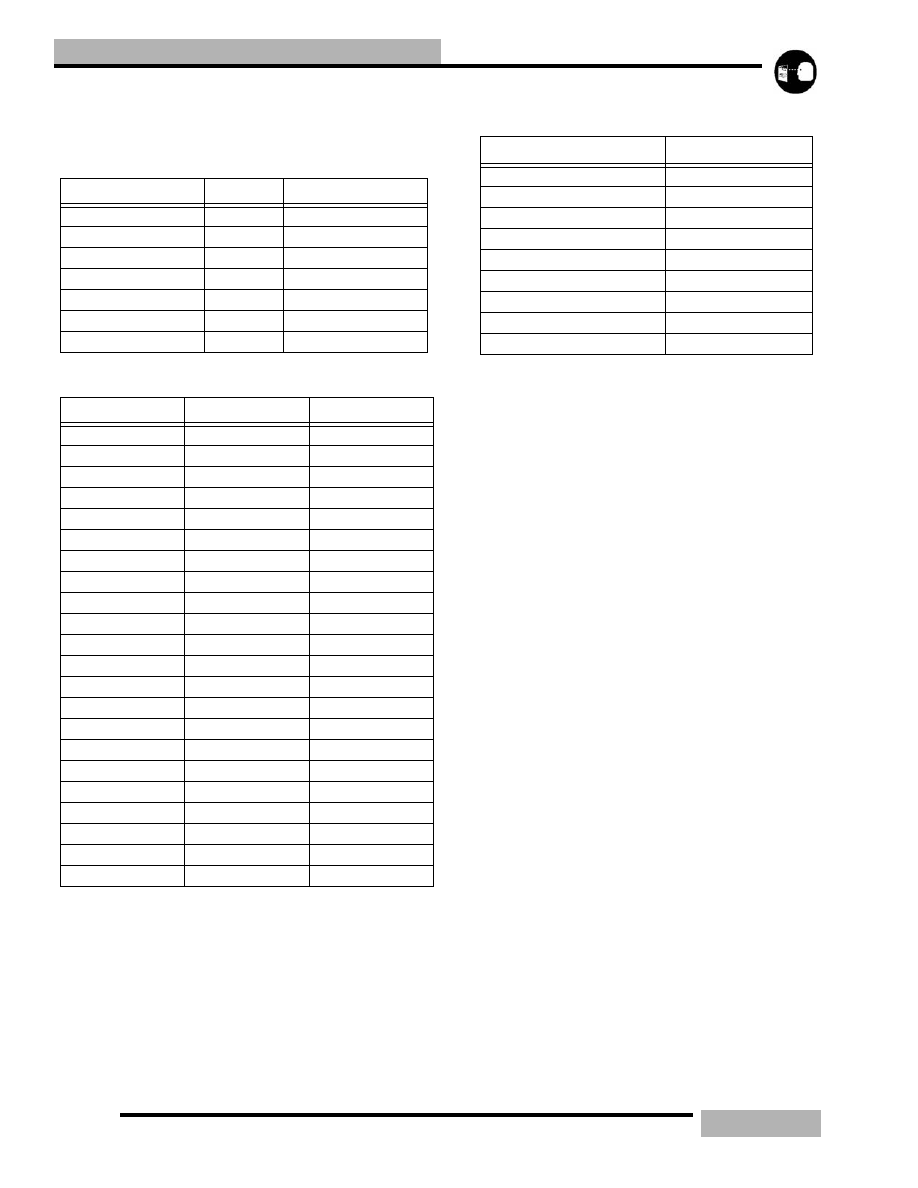
Table 7-5: Full Tail Weights

WEIGHT

GRAMS

PART NUMBER

S43H

43

1321849

S45H

45

1321850

S47H

47

1321851

S49H

49

1321730

S51H

51

1321731

S53H

53

1321759

S55H

53

1322004

Table 7-6: 10 Series Weights

WEIGHT

GRAMS(+/- 1g)

PART NUMBER

10M-R Bushed

44

1321530

10M-W Bushed

46

1321527

10M Blue Bushed

47.5

1321529

10M Bushed

49.5

1321531

10 Bushed

51

1321531

10 AL Bushed

53

1321589

10-54

54

1321685

10-56

56

1321684

10-58

58

1321588

10-60

60

1321587

10-62

62

1321586

10-62M

61.5

1321614

10-64

64

1321585

10-64M

63.5

1321615

10-66

66

1321584

10-68

68

1322427

10-70

70

1322414

10-72

72

1322428

10-74

74

1322429

10-76

76

1322478

10-76

76

1322585

10-78

78

1322586

Table 7-7: 11 Series Weights 

WEIGHT GRAMS(+/- .8g)

PART NUMBER

11-50

1322589

11-52

1322595

11-64

1322604

11-66

1322559

11-68

1322558

11-70

1322523

11-72

1322524

11-74 1322525

11-76

1322526

7.19

CLUTCHING

DRIVE CLUTCH INSTALLATION

NOTE:  Always clean the clutch taper before re-
installing clutch on engine.

1.

Place a clutch taper reamer (PN 2870576) in a vise (A) and
lubricate the cutting edges with cutting oil. Clean the
clutch taper by manually rotating the clutch clockwise on
the reamer one or two revolutions. Only use the weight of
the clutch and do not push down on the clutch while
turning. This will clean up any galling or scoring of the
bore taper.

2.

Check crankshaft taper for galling or scoring. If necessary
clean the taper evenly with 200 grit emery cloth (B).

3.

The clutch taper and the crankshaft taper should be clean
and dry. Do not use harsh cleaners which may cause clutch

taper to corrode, or damage to the crank seal. This may
cause difficulty when removing clutch in the future.

4.

Clean clutch taper with lacquer thinner or isopropyl
alcohol (C).

5.

Slide clutch fully onto crankshaft taper (D).

6.

Install the retaining bolt with all spacers and washers or o-
rings (E) that were on the bolt when it was removed.

7.

Hold the clutch with the holding wrench (F) PN 931417-
A. Re-check torque after first operation or test ride.

8.

Torque retaining bolt to specification see Table 7-8.

9.

Run engine then re-torque the retaining bolt to
specification.

Table 7-8: Drive Clutch Bolt Torque

ENGINE

BOLT

TORQUE

Fuji 340/500/550

7/16” - 20

40-45 ft-lb (55-62Nm)

Liberty 440/500/600

14 mm

50 ft-lb (68Nm)

Liberty 700 / 900

14mm

96 ft-lb

FS/FST

14mm

50 ft-lb (68Nm)

7.20

CLUTCHING

DRIVEN CLUTCH

DRIVEN CLUTCH OVERVIEW

The driven, or secondary, clutch is a torque (load) sensing 
device. The driven clutch performs several important roles in 
the drive system. First, the driven clutch must provide enough 
side force on the drive belt to transmit the engine torque to the 
ground while minimizing both belt slippage and excessive belt 
wear. Second, the driven clutch must act as a load feedback 
device (drive shaft torque) to the drive clutch and backshift to 
compensate.

The vehicle load from the track is transmitted through the 
snowmobile's gearing to the helix ramps via the drive shaft 
and jackshaft. The helix ramps function like a torque 
multipliers and are in constant contact with the moveable 
sheave rollers or buttons.

The driven clutch components, along with the final drive 
gearing and vehicle load, combine to generate their own shift 
force which opposes the shift force generated by the drive 
clutch. This shift force always wants to close the moveable 
sheave.

The driven clutch will open, or upshift, when the shift force 
generated by the drive clutch is greater than the shift force 
generated by the driven clutch. The driven clutch will close, or 
backshift, whenever the driven clutch shift force is greater 
than the shift force generated by the drive clutch.

DRIVEN CLUTCH TYPES

Polaris utilizes two types of driven clutches, the P-85 driven 
clutch and the Team driven clutch.

NOTE:  Replacement driven clutches do not come 
with a spring or the helix (ramp).

NOTE:  To service the Team driven clutches, use the 
clutch compression tool extensions with the clutch 
compression tool. Tool part numbers can be found 
on Table 7-1 on page 7.3.

DRIVEN CLUTCH REMOVAL

1.

Remove the belt See “DRIVE BELT” on page 7.4.

2.

Apply and lock the parking brake.

3.

Remove the driven clutch bolt and washers (A).

NOTE:  Keep track of the washers and how they are 
placed on the bolt.

4.

Slide the driven clutch off the jackshaft.

5.

Inspect the keyway if equipped and replace the key if any
damage is found.

DRIVEN CLUTCH INSTALLATION

1.

Install the driven clutch bolt with the same amount of
washers (B) at removal.

2.

Torque the bolt to 17 ft-lb (23Nm).

3.

Check for correct belt deflection see page See “BELT
DEFLECTION” on page 3.17
.

A

7.21

CLUTCHING

TEAM RAMPS EXPLAINED 

The ramps for the Team roller clutch is designated by the angle and length of the angle on the back side of the ramp. You will see 
that the first number (A) designates the steepest angle, which is the starting angle of the ramp. The second number (B) designates 
the lowest angle that it progresses to. The last number (C) is the measurement (length) at which the transition takes place. Electric 
reverse ramps have only one set of angles.

The non reverse ramps have two sets of angles that can be used for the desired angles. The non reverse ramps can not be used on 
a sled that has electric reverse. Using reverse with a non reverse ramp may cause damage to the driven clutch. 

NON ER RAMP

ER RAMP


Content   ..  39  40  41  42   ..