Sea-man Delta-test. Tests with answers (2023) - page 1
Deck Operational Oil Tanker
Количество отображаемых вопросов: 687.
Правильные ответы отмечены знаком (+)
Code: QPKF What will you serve seafarers who have been exposed to heat?
Cold drinks and salt. (+)
Warm fresh water only.
Hot and spicy food.
Strong cocktails with plenty ice.
Code: EERA If whistles are fitted on a vessel at a distance apart of more than
100 metres, will manoeuvring and warning signals, as defined by rule 34 of
the International regulations for Preventing Collisions at Sea, be given on
one or both whistles?
They shall be given on one whistle only. (+)
They shall be given on both whistles simultaneously.
They shall first be given on the forward whistle, followed by the after whistle, with a 5 second interval in between.
Manoeuvring signals will be given only on the forward whistle; warning signals will be given on both whistles
simultaneously.
Code: PHLT With an InmarsatC terminal the option PSTN fir addressing is
available. This option:
Is to deliver a message by telephone via a modem on the computer of the subscriber. (+)
Delivers the message as a fax.
Have the operator read the message by phone.
Delivers a message as a telegram.
Code: LWXH A message is send by the InmarsatC set. The land earth station
will:
Only send a positive delivery notification (PDN) to the sender if the sender requested, so in the send menu. (+)
Automatically send a positive delivery notification (PDN) to the sender.
The sender has to confirm delivery by sending another separate message.
Never send a positive delivery notification (PDN) to the sender. The addressed will have to confirm the message through
the groundstation and request for further information, if desired.
Code: DKGL With reference to oil tanker equipment, the abbreviation VECS
stands for:
Vapour Emission Control System. (+)
Vapour Emission Control Standard.
Vapour Ejection Control System.
Vapour Emission Calibration System.
Code: IACL What is the name given to the risk assessment programme
developed by OCIMF, under which tankers are inspected and the results
made available to potential charterers through a database of records?
The Ship Inspection Report Programme (SIRE). (+)
The Tanker Inspection and Reporting System (TIRS).
The Enchanced Survey Programme.
The Chemical Distribution Institute (CDI) Inspection Programme.
Code: LXMG What is the general emergency alarm signal as specified in
Code: LXMG What is the general emergency alarm signal as specified in
SOLAS?
Seven or more short blasts followed by one long blast. (+)
One long blast.
Three short blasts followed by three long blasts then three short ones.
One long blast followed by seven short blasts or more.
Code: CHRB The purpose of the decanting line between two slop tanks,
where fitted, is:
To enable most of the recovered oil to be retained in the primary slop tank, while the cleaner part of the water will flow into
the secondary slop tank, where it can be reused as washwater.
(+)
To enable both the primary and secondary slop tank to be filled without using the main cargo lines.
To enable the filling of the secondary slop tank via the primary slop tank.
To avoid a buildup of static electricity during water washing, caused by air being drawn in as the primary slop tank
empties.
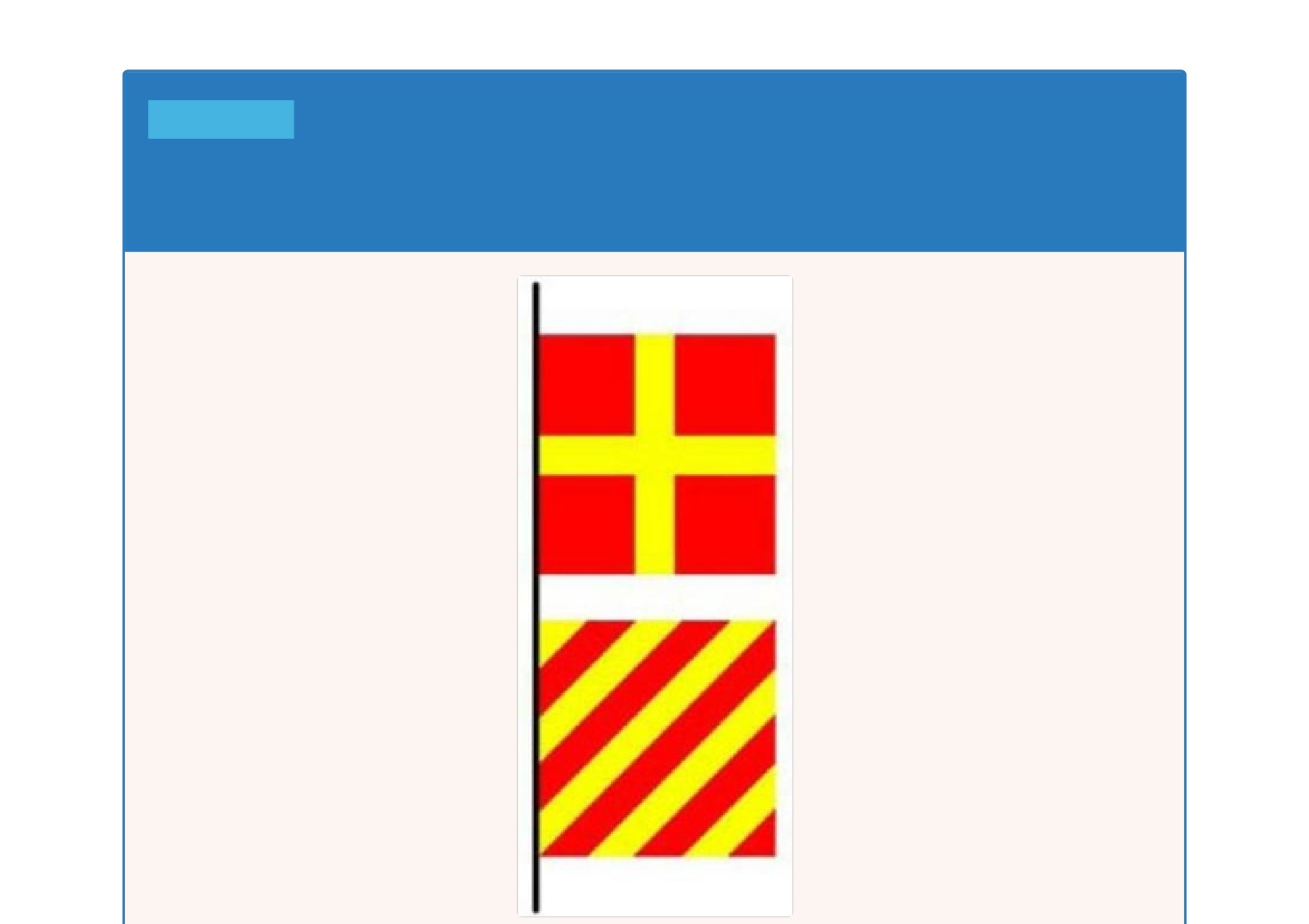
Code: DPTB You are proceeding up a river, with berths on both banks. You
see this flag hoist on a vessel moored on a berth ahead. What does it
mean?
You should proceed at slow speed when passing me. (+)
I am about to depart the berth.
My engine is disabled.
Caution! I have an anchor down.
Code: WMBK What do you understand by the term “luffing”?
The raising or lowering of a crane jib, moving the head of the crane and therefore a suspended load horizontally towards
or away from the crane. (+)
The initial phase of hoisting a load, where the crane wire and structure takes the weight of a suspended load.
The rotating of a ship’s jib in a circular movement about the crane.
The combined movement of hoisting a load and slewing the crane, employed when lifting a load from a dockside over and
into a ship’s hold, or vice versa.
Code: BCAR If the oxygen level in the cargo tanks during Crude Oil Washing
rises beyond 8 %, as an OOW you should:
Stop the washing operation and resume only after a level of less than 8 % by volume has again been achieved. (+)
Continue washing, but increase the delivery rate of inert gas from the IG generator.
Continue to wash tanks as it is safe to wash till the oxygen level reaches beyond 11 %.
Stop using crude oil to wash and immediately change over to water washing.
Code: QEAB To get priority with radiocommunication, one must notify the
coast station that the call is:
An urgent call. (+)
A personal call.
A priority call.
A collect call.
Code: SIUA The vessel is to anchor with Pilot onboard. Which of the
suggested answers most accurately define the main duties of the Officer of
the Watch on bridge?
Assist the Master and pilot and monitor the ships position. (+)
Follow the Master’s orders at all times.
Follow Pilots orders and ensure the anchorage is carried out successfully.
Monitor the bridge equipment and keep the Master informed of all outputs.
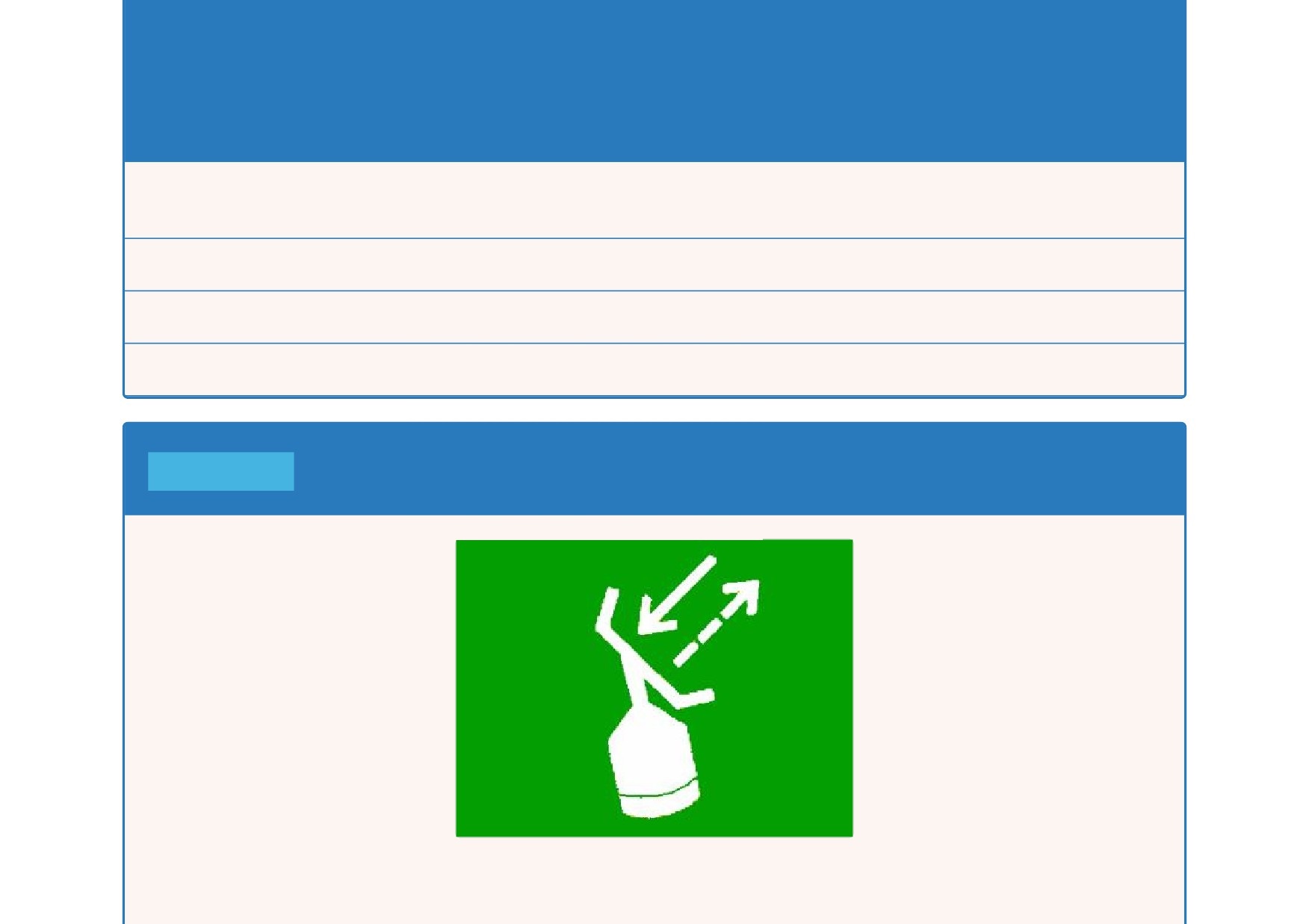
Code: BLDC Give the meaning of the following symbol:
Radar transponder. (+)
Epierb.
Survival craft distress pyrotechnic signals.
Rocket parachute flares.
Code: YQXU Which part of the magnetic compass error changes with a
change in the course steered?
Deviation. (+)
Variation.
Induced magnetism.
All of the suggested answers.
Code: GWGP Which one of the listed requirements regarding the stowage of
a survival craft corresponds to present SOLAS regulations? Each survival
craft shall be stowed:
In a secure and sheltered position and protected from damage by fire or explosion. (+)
On the starboard side of the ship.
In a state of readiness so that two crewmembers can prepare for embarkation and launching in less than 15 minutes.
Wherever space is available.
Code: NGQJ Which of the following hull shapes would normally provide a
directionally stable ship?
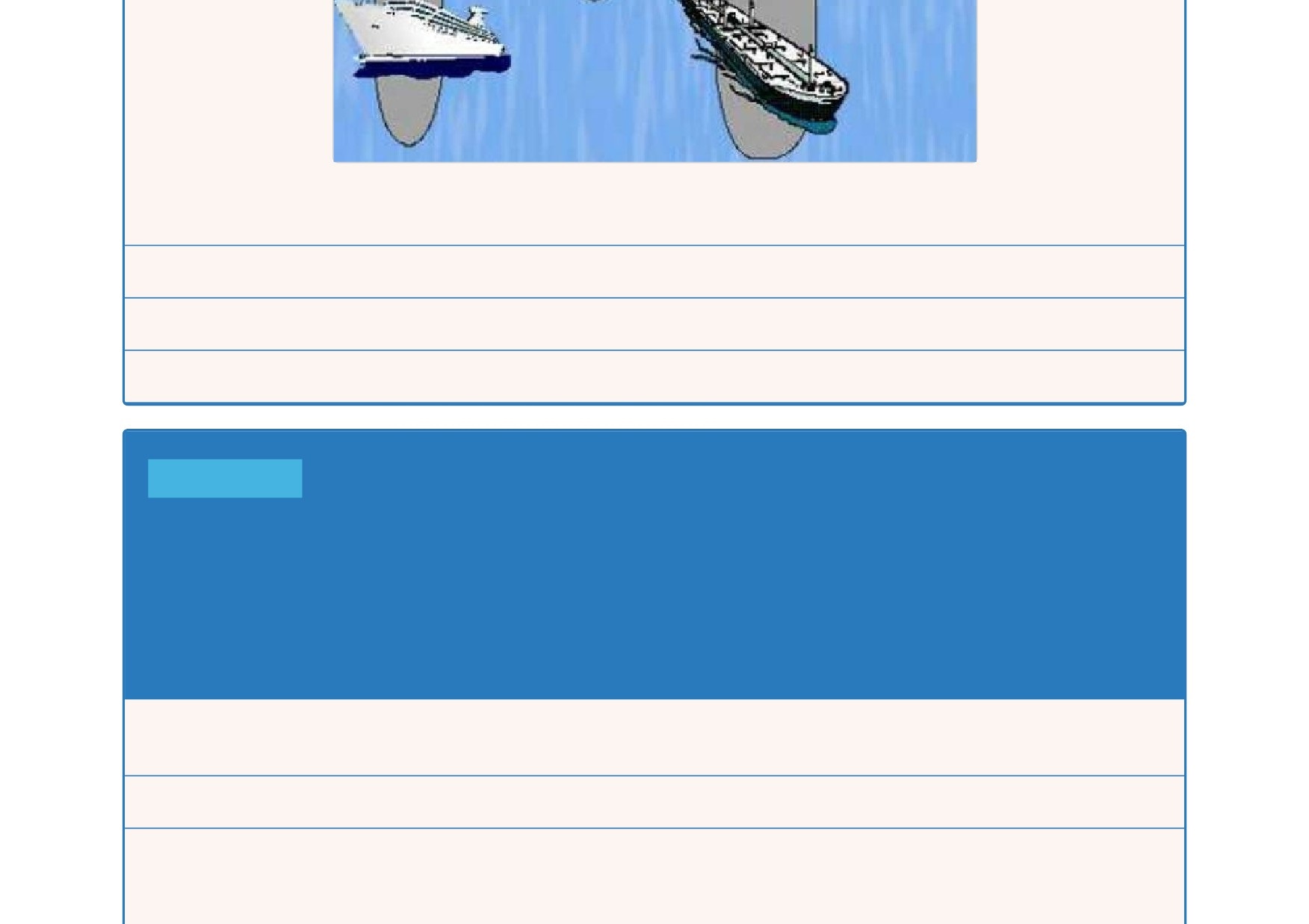
A long ship with a narrow beam. (+)
A short ship with a wide beam.
A short ship with a narrow beam.
A long ship with a wide beam.
Code: HGON The following vessels are all required to make the same sound
signal when in or near an area of restricted visibility: a vessel not under
command; a vessel restricted in her ability to manoeuvre; a vessel
constrained by her draught/a sailing vessel; a vessel engaged in fishing; a
vessel engaged in towing or pushing another vessel. What is that signal?
One prolonged blast, followed by two short blasts, at intervals of not more than 2 minutes. (+)
One prolonged blast, followed by two short blasts, at intervals of not more than 1 minute.
One prolonged blast at intervals at not more than 2 minutes.
Two prolonged blasts, followed by one short blast, at intervals of not more than 2 minutes.
Code: MMMU If your vessel is fitted with wires on selfstowing “split drum”
winches, the advantage of having these split drum winches is:
All the listed alternatives. (+)
Increased brake holding capacity due to the ability to keep the paid out wire in a single layer on the drum.
Less chance of the wire being jammed in the reel.
No crushing of the wire.
Code: DYLL How will you start a cancelling message after you send by
mistake a distress call on your VHF DSC equipment?
All Stations - This is “SAINTROMAIN”. (+)
MAYDAY - All Stations - This is “SAINTROMAIN”.
PANPAN - All Stations - This is “SAINTROMAIN”.
SECURITE - All Stations - This is “SAINTROMAIN”.
Code: RTLE The chemical characteristics of effluent water from an inert gas
scrubber and the condensate which collects in the deck mains would be:
Acidic in nature. (+)
Demineralised in nature.
Alkaline in nature.
Neutral in nature.
Code: SGYJ Which among the following list is particularly required for a totally
enclosed lifeboat?
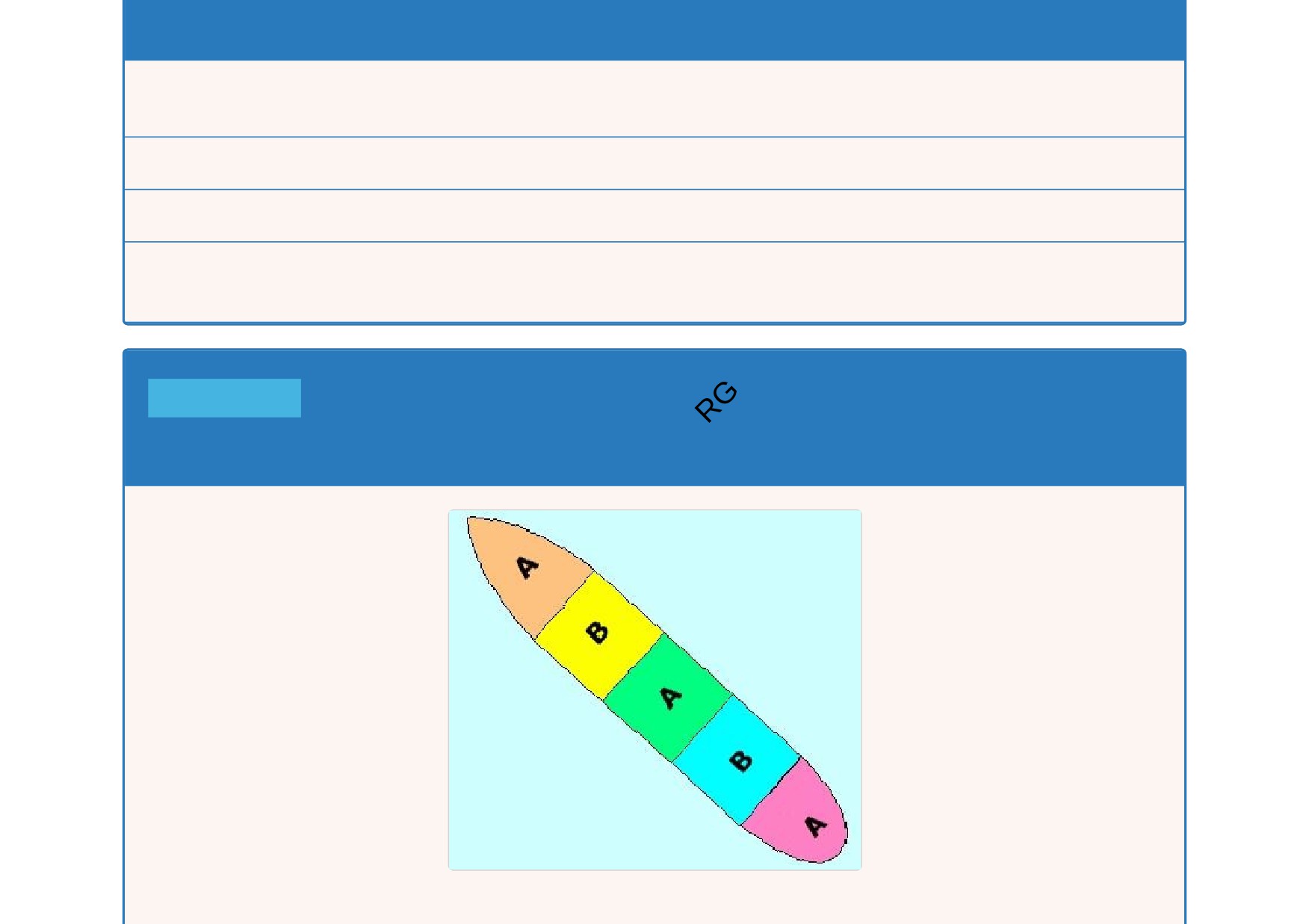
Windows on both sides can be closed watertight and opened for ventilation. (+)
Selfbailing arrangements.
Handrails inside for persons moving to their seats.
Hatches positioned so as to allow launching and recovery operations to be performed without any occupant having to
leave the enclosure.
Code: CUCG Where would you find out which fire sections are enclosed by
“A” or “B” class divisions on a ship?
On the Ship’s fire control plans. (+)
On the capacity plan.
On the general arrangement plan.
All the mentioned alternatives.
Code: KDBI During a bomb search, which of the following is an important
principle to follow?
Do not touch any suspicious packages. (+)
Throw any suspicious items overboard.
Know exactly what a bomb looks like.
Try to reach behind bulkheads to find a bomb.
Code: FSOS What immediate actions should the Officer of the Watch take
when the ship goes aground on an uncharted shoal in the middle of the
ocean?
Stop engines and call the Master. (+)
Sound the General Alarm and plot the ships position.
Stop engines and immediately request “Full Astern”.
Stop engines and tell the engine room to switch over to high suctions.
Code: KHTO Which spaces, in regard to fire protection, shall be separated
from the rest of the ship by thermal and structural boundaries? (SOLAS II
2/2.2.2).
Accommodation. (+)
Cargo compartments.
Storage rooms for inflammable materials.
Machinery spaces.
Code: MFAM What new stability problems would be caused by having deep
Code: MFAM What new stability problems would be caused by having deep
double bottom tanks on double hull oil tankers?
The Metacentric Height (GM) would have to be considered. (+)
The depth of the Double bottom would require additional strength members.
The vessel would be “stiff” and have a sharp rolling period.
There are no new stability considerations.
Code: FDJI What is the two letter signal, to be used by flags, radiotelephony
or radiotelegraphy, meaning “Calling All Ships”?
CQ. (+)
AS.
TT.
CA.
Code: OFXF Via a coaststation radio medical advice is asked using NBDP.
Code: OFXF Via a coaststation radio medical advice is asked using NBDP.
What command has to be given after ga +?
med +. (+)
pan +.
38 +.
Medical.
Code: DMAY What would the Second Officer report to the Master when
entering an area where the visibility is reduced to 2 n. miles?
The Second Officer would report to the Master that the visibility is reduced to probable range of 2 n. miles and the engines
are on standby. (+)
The Second Officer would report to the Master that he is having difficulty seeing other ships.
The Second Officer would call the Master to the bridge because he is needed there.
The Second Officer would tell the Master he is calling him in compliance with the instructions in the Night Order Book.
Code: WDCV The aerial system of an InmarsatC terminal consist of:
An omnidirectional aerial.
(+)
A dish aerial.
A rod aerial.
A flexible wire aerial.
Code: TPEO The approximate Lower Flammable Limit of Crude Oil when
measured as a percentage volume in air is:
2,2 %. (+)
0,2 %.
9,5 %.
5 %.
Code: TDKQ Maximum shearing forces are likely to occur on an oil tanker:
At the bulkhead between empty and full tanks. (+)
At the midlength of the ship.
At the forward collision bulkhead.
At the tank lids.
Code: WSEL With maintenance of batteries it is of primary importance that:
The space where the batteries are stored is properly ventilated. (+)
There is proper relative humidity in the space where the batteries are stored.
The space is not oily.
There is an absolute free access to the battery space.
Code: PRDJ If bad weather is anticipated during ballast voyage of a vessel
fitted with segregated ballast tanks, the cargo tanks which must be crude oil
washed as a priority would be:
The dedicated heavy weather ballast tank(s). (+)
All slop tanks that were used to carry cargo in the past two voyages.
All the cargo tanks that were not Crude Oil Washed in the last discharge port.
Those nominated by the Chief Officer, forming a minimum of 30 % of the cargo capacity.
Code: IKCT The free volume of carbon dioxide (CO2) of a fixed gas fire
extinguishing system shall be calculated at:
0,56 m3/kg. (+)
2,03 m3/kg.
3,14 m3/kg.
1,26 m3/kg.
Code: MCIV The Second Officer, when on watch on the bridge, is often
referred to as the OOW. What does OOW actually stand for?
Officer of the Watch. (+)
On official watch.
Operator of the watch.
On official watchkeeping.
Code: MIWH What is the correct lifting technique?
Legs bent, back straight, using leg muscles to lift. (+)
Legs straight, back bent and twisted to the right or to the left while lifting.
Legs bent, back bent, using both back and leg muscles to lift.
Legs straight, back bent, using back muscles to lift.
Code: KMWH What does ISM stand for?
The International Management Code for the Safe Operation of Ships and for Pollution Prevention. (+)
Internal Ship Safety Management.
International Safe Manning Certification.
International Ship Measurement and Pollution Control.
Code: TEIE When navigating along a coastline what should be considered the
most accurate method of navigating?
Use of Differential GPS. (+)
Passing close to navigational buoys.
Bearings of navigational shore marks such as lighthouses.
Use of radar ranges and bearings.
Code: UHFQ When is a visitor onboard required to present an ID?
On SECURITY Level 1, 2 & 3. (+)
Only on SECURITY Level 3.
On SECURITY Level 2 & 3.
Never.
Code: IVGY Which of the suggested navigational systems is a “Hyperbolic”
navigational system and has hyperbolae as position lines?
Loran C. (+)
Radio Direction Finder.
GPS.
All of the suggested systems.
Code: QFBP Where on board can you find the different types of protection
equipment, the placement, how much equipment etc?
The ship’s safety plan. (+)
Stated in your cabin.
In cargo control room.
The engine room.
Code: MYBP In radio telephony what is the “URGENCY CALL” which should
be used to indicate that you have a very urgent message to transmit
concerning the safety of another vessel or person?
PANPAN (3 times). (+)
VictorVictor (3 times).
MAYDAYMAYDAY (3 times).
SECURITESECURITE (3 times).
Code: GJVG A nonvolatile petroleum is defined as that which:
Has a flashpoint of 60 °C or above. (+)
Has a flashpoint of 100 °C or above.
Has a flashpoint of 60 °C or below.
Has a flashpoint of 15,6 °C or below.
Code: HQGU Buoyant smoke signals shall be so designed as to burn or emit
smoke:
Continuously after having been immersed for a period of 10 seconds under 100 mm of water when underwater.(+)
When under water.
Continuously after having been immersed for a period of 1 minute under 1 m of water.
Only when not in the water.
Code: JMMT If you detect a fire on board the ship, dependent on the situation,
which of the following actions is the first to be taken?
Raise the fire alarm. (+)
Try to kill the fire immediately by use of fireextinguishers or other adequate appliances.
Call the officer on duty.
Check all nearby compartments for survivors.
Code: ECTN H2S is a chemical abbreviation for:
Hydrogen Sulphide. (+)
Halogenated Sulphide.
Hydrogen Separation.
Hydrogenated Sour Crude.
Code: VEMB When onboard channel 16 is used for a shore radioconnection,
you always work:
Simplex. (+)
Duplex.
On low power.
Semiduplex.
Code: NPXS When a ships derrick or crane lifts a weight off the deck of a
ship, from which position can the centre of gravity of the weight be
considered to act?
From the head of the derrick or crane. (+)
From the centre of the weight lifted.
From the position on the deck from which the weight was lifted.
From a position on the deck at the base of the derrick or crane.
Code: FLCN Are there any restrictions about how much sludge we can pump
overboard on the sea voyage?
Maximum is 30 litre pr nautical mile and total is 1/30 000 part of full cargo on the ballast voyage. (+)
Maximum is 30 litre pr nautical mile and total is 1/10 000 part of full cargo on the ballast voyage.
There isn’t any restrictions of pumping sludge from ships outside special areas.
Maximum is 60 litre pr nautical mile and total is 1/30 000 part of full cargo on the ballast voyage.
Code: SBGQ What are the limits of a passage or voyage plan?
From berth to berth. (+)
From Full Away On Passage (FAOP) to End Of Passage (EOP).
It is dependant on the voyage and if there are any river or canal transits.
From pilot to pilot.
Code: BFXK What are the required data inputs into most gyro compasses to
reduce any possible compass error?
Latitude and Speed. (+)
Deviation and Variation.
Maximum helm angle and rolling period.
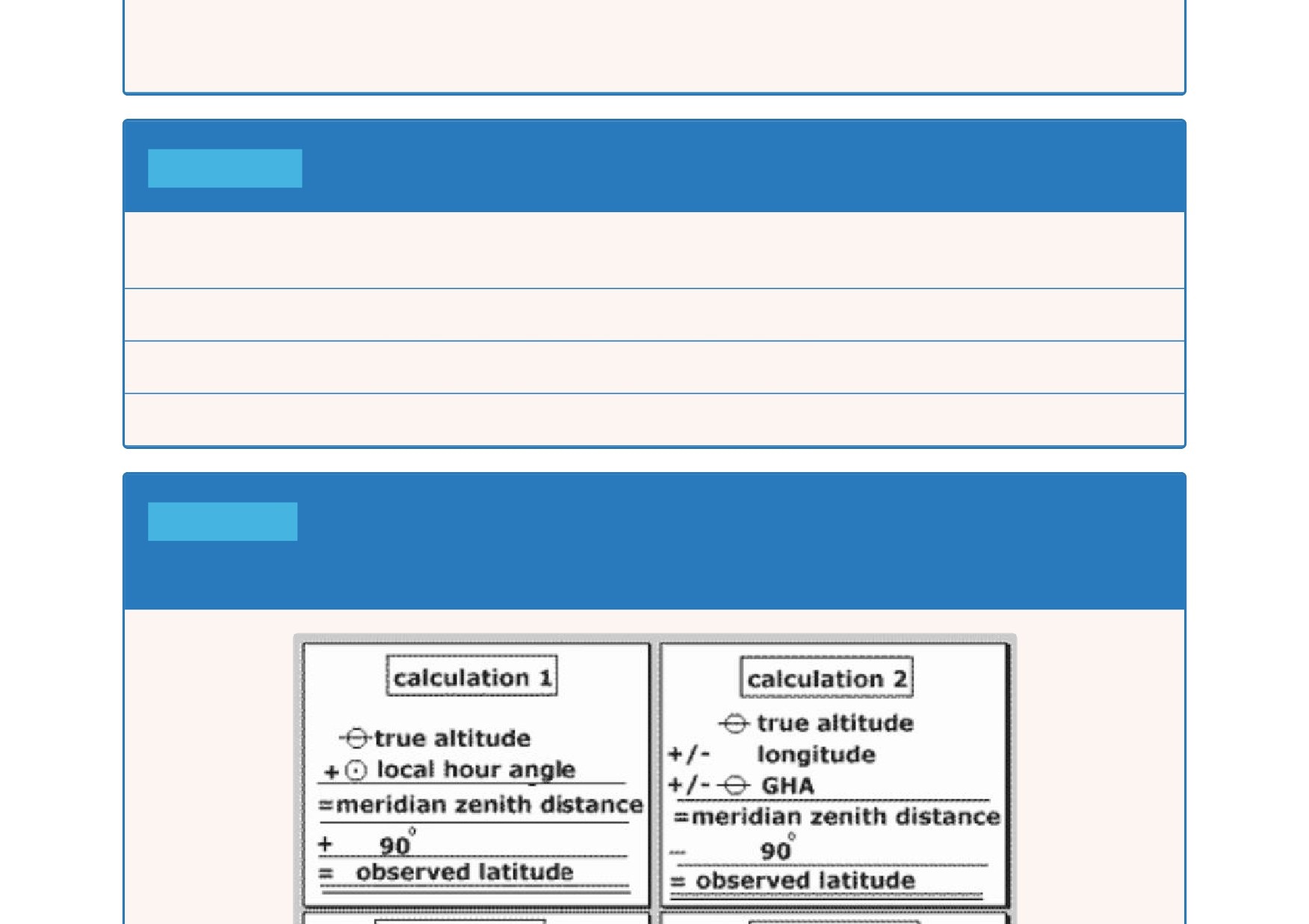
All of the data in the suggested answers.
Code: PWEN Operator connected R/T calls are charged:
On the basis of a three minute minimum charge with one minute incremental steps. (+)
On the basis of a six second minimum charge with one second incremental steps.
On the basis of a six second minimum charge with six second incremental steps.
On the basis of a one minute minimum charge with one minute incremental steps.
Code: BCXU Which of the four calculations illustrated is the correct one to
determine the latitude of the observer when the sun is on the meridian?
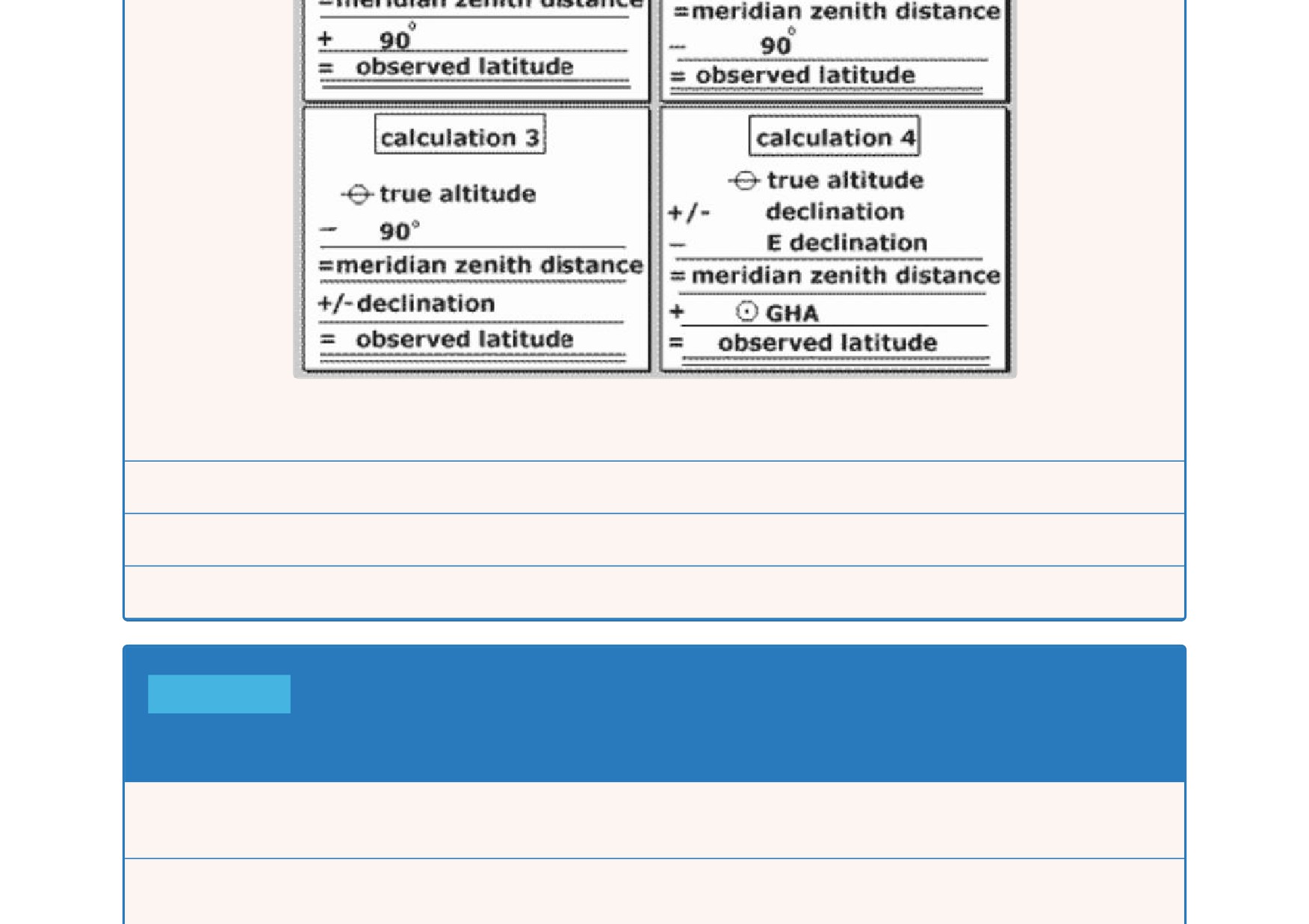
Calculation 3 is correct. (+)
Calculation 4 is correct.
Calculation 2 is correct.
Calculation 1 is correct.
Code: QPIQ Which approved publication should be used by a seafarer to help
overcome any misunderstanding in communications?
The (IMO) Standard Marine Communication Phrases (SMCP) booklet. (+)
The Oxford Concise Dictionary.
The (ISC) Bridge Procedures Guide.
Standard Marine Navigational Vocabulary.
Code: EMMF The ship has a righthanded propeller and is swinging to
starboard when the engines are slow ahead and the rudder is to starboard.
The engines are stopped and the rate of swing rapidly slows down. How
could the swing to starboard be maintained without the ship making much
headway.
Astern on the engines will allow Transverse Thrust to continue the swing. (+)
By applying the rudder hard over to starboard and going ahead on the engines.
The only effective method is by using the bow thruster to push the bow to starboard.
Transverse Thrust will reduce the swing and therefore a kick ahead is necessary with full starboard helm applied.
Code: XLBJ What is the main theme of modern safety practice?
Making use of Risk Assessment as a means to improving safety. (+)
Health & Safety at Work Act.
Consult the chief officer before commencing work.
Use the same practice that has been in place for some time.
Code: YWFH Crude Oil Washing of a cargo tank using oil containing
substantial amount of water could result in:
Generation of an electrically charged mist inside the tank. (+)
Better cleaning of the tank due to oil and water mixture.
Better draining and less clingage, resulting in reduced slop quantity.
Better drainage and less clingage but excessive slop quantity.
Code: NFDV On a MF/HFŧransmitterreceiver there is a volume control.
Another name for this is:
LFgain. (+)
RCgain.
HFgain.
Sensitivity.
Code: NLEG What is understood by the term “Marine Pollution”?
Marine Pollution means that the marine environment is contaminated by harmful or unacceptable liquids, substances or
particles. (+)
Marine Pollution only means that there has been an oil spill in the location and there needs to be effective cleaning up
process.
Marine Pollution only means that the sea has been contaminated by substances which are not acceptable in that location.
The term Marine Pollution refers only to the spill of oil and garbage into sea environment.
Code: GWCT A ship moving through heavy seas is affected by the water
pressure at the bows causing an effect known as “Panting”. What structure
in the forward region of the ship combats the effects of Panting?
Panting beams and stringers. (+)
Double bottom tanks and floors.
Centreline bulkhead.
Collision bulkhead and deck.
Code: VUET Which of the following precautions should be taken when work is
to be carried out on the radar scanner unit on the mast?
A “Not to be used” sign on all radars and fuses for the complete radar systems to be removed. (+)
Only the electrical fuses for the radar undergoing repairs needs to be removed, allowing the ship to retain a workable
radar.
Only the electrical fuses for the scanner motor needs to be removed.
A sign needs to be attached to all the radars warning the bridge officers of repairs and the fact the radars are “Not to be
used”.
Code: KEGJ The quantity of oil obtained after deducting the volume of oil and
free water in the tank prior loading, from the total observed volume after
loading, is called the:
Gross Observed Volume (GOV). (+)
Net Observed Volume (NOV).
Total Calculated Volume (TCV).
Gross Standard Volume (GSV).
Code: UAAG In the Beaufort Scale of Wind Force, what is the Beaufort
number associated with the wind force known as a “Gale”? This should not
be confused with a “Near Gale” or “Strong Gale”?
Eight (8). (+)
Nine (9).
Seven (7).
Ten (10).
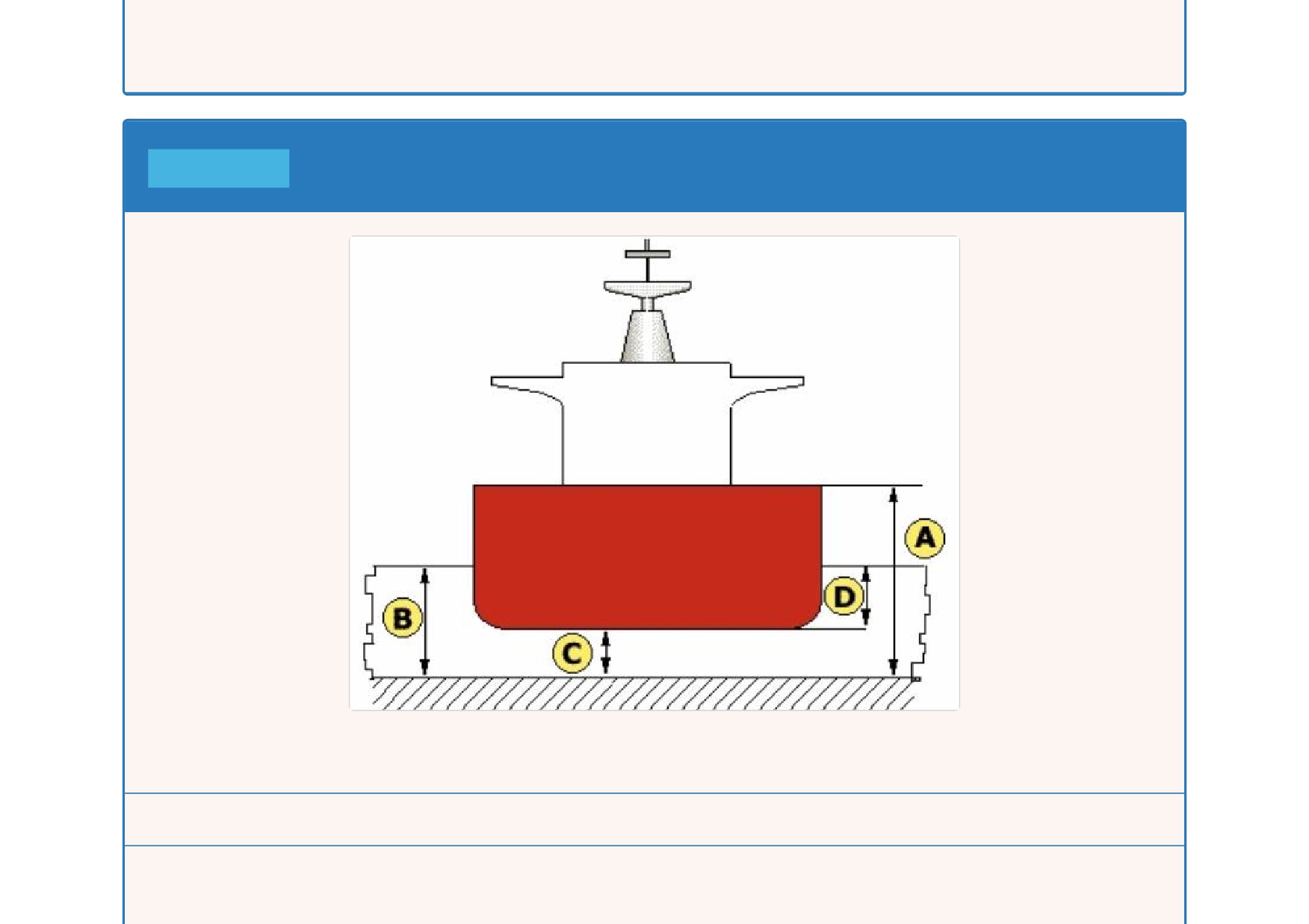
Code: KLTB What is “DRAUGHT”, in the figure?
Draught is indicated by D, in the figure. (+)
Draught is indicated by C, in the figure.
Draught is indicated by B, in the figure.
Draught is indicated by A, in the figure.
Code: AGCP What types of fire extinguishers shall be used in the engine
room?
Fire extinguishers equipped for powder or CO2 only. (+)
Any fire extinguishers with a weight of less than 100 lbs.
Fire extinguishers of the handysize types only.
Fire extinguishers filled with fresh water only.
Code: MOMN A wire aerial for an MF/HFŧransmitter must be suspended
between isolators:
To prevent contact with earth. (+)
To prevent burns when touching the aerial.
To make the way for aerial currents as long as possible.
To save energy.
Code: HWLK When cargo discharge reaches stripping levels on an oil tanker,
it is necessary to reduce the inert gas pressure so as to:
Minimise blowback. (+)
Avoid locking the cargo pump impeller.
Comply with the requirement of MARPOL Annex VI.
Avoid overcapacity in the IG generator.
Code: OHUC Tanks lids and other access points on an oil tanker are usually
shaped round so as to:
Avoid localized stress points at any corners. (+)
Avoid injuries to crew members from the sharp ends of such openings.
Allow several people to have visual access to the tank at the same time.
Provide easy access to tank washing machinery.
Code: FRGY If the radar is set onto the Relative Motion Display, what would
an echo of a target with no trail indicate? Note this the trail of the echo and
not a vector.
The target is on the same course and speed as own ship. (+)
The target is on a constant bearing and getting closer to own ship.
The target is stopped and making no way through the water.
The target is on a collision course with own ship.
Code: CSFC Which class of emission is used for ARQ NBDP transmissions?
F1B. (+)
J3E.
G2B.
G3E.
Code: JKDV The one particular hazard to be taken care against, when using
portable steam driven blowers for ventilating oil cargo tanks is:
That the exhaust does not vent into the cargo tank, in order to prevent possible buildup of static electricity. (+)
That the steam outlet must point vertically upwards to avoid possibly burning the legs of passing personnel.
That plastic extension tubes should not be used, in case the top collar overheats and melts, causing the tube to drop into
the tank.
That prolonged use may cause the core material of the fan to heat up to a point where it may become a source of ignition.
Code: DRVC On area A3 the function “Reception of shore to ship distress
alerts” is mainly based on:
The use of HF DSC and INMARSAT C SAFETYNET. (+)
The use of VHF DSC and NAVTEX.
The use of MF DSC and INMARSAT C SAFETYNET.
The use of SARSAT COSPAS Epirbs and NAVTEX.
Code: RTTQ What action should the Officer of the Watch (OOW) take if he is
forced to make a major deviation from the voyage plan?
Inform the Master. (+)
Make an appropriate entry in the Log Book.
There is no special action necessary.
Check that the deviation will not lead into danger.
Code: RQDE Wire antenna of 12 metres long is probably:
A MF/HFantenna. (+)
SatC antenna.
A VHFantenna.
An Inmarsatantenna.
Code: GCEQ For how long time must the printout from the Oil Discharge
Monitoring Equipment (ODME) be retained onboard?
3 years. (+)
4 years.
2 years.
6 months.
Code: HWQG The passage of electrical current through the body may result in
severe and sometimes fatal injuries. You are witness to man getting electric
current through his body and is stuck to the dangerous area. It is impossible
to switch off the current by any main switch. How to break the current
safely?
Stand on dry insulating material and pull the person away with isolating material. (+)
Stand on dry insulating material and pull the person away with isolating material.
Call the electrician immediately.
Apply fish oil on your hands and cut the cords by the use of any metallic pliers.
Just take the casualty in your arms and pull the person away.
Code: UAAG What is understood by the term “Dew point” of the air?
The temperature at which condensation in the air forms into water droplets. (+)
The temperature of the water vapour in a cloud.
The “Dew point” is the point at the centre of an Anticyclone.
All of the suggested answers.
Code: PUYV What actions should the Officer of the Watch take when the
ship’s steering gear fails?
All of the suggested answers. (+)
Request the engine room to check the steering gear.
Call the Master and advise him of the situation.
Display the NUC signal and consider stopping the engines.
When substantial quantities of oil are sighted in water around the vessel
whilst loading in port, the OOW should:
Tell the terminal authority to cease all loading operations immediately and inform the Chief Officer.(+)
Check the Oil Discharge Monitoring Equipment Confirm that all overboard valves are shut tight, and continue with the
loading.
Get the ships lifeboats ready to launch so as to collect samples of the oil and water around the vessel.
Advise the watchmen to look out for any port police craft, and inform the Master immediately.
Code: XLOO The examples of Aromatic Hydrocarbons will include:
Benzene, Toluene and Xylene. (+)
Propane, Butane and Pentane.
Carbon Dioxide and Hydrogen Peroxide.
Hydrogen Sulphide and Carbon Monoxide.
Code: EVNT What is the correct setting of the “Anti sea clutter” control on the
radar?
A few sea returns remaining on the screen. (+)
All of the suggested answers.
A removal of all the sea returns down to about a mile from own ship.
No sea returns left on the screen which may confuse with small target echoes near the ship.
Code: CLUY Is the location of the Compass Binnacle critical?
Yes, for the reasons stated in all of the suggested answers. (+)
Yes, it should be on the fore and aft centreline of the ship.
Yes, it should be away from all electrical power cables.
Yes, it should be sited on a nonmetallic base if possible.
Code: LVVO When is the Officer of the Watch officially relieved of his
responsibilities of being in charge of the watch?
When the Master informs the Officer of the Watch that he is taking over the “con” (watch responsibilities). (+)
The Master and the Officer of the Watch share the responsibility when they are both on the bridge together.
When the Master enters the bridge.
The Officer of the Watch remains in charge of the watch for the full watch, when the vessel is deep sea.
Code: NRCB What kinds of checks must be carried out on slings, wires and
other items of lifting equipment before they are used in routine operations?
They must be visually inspected and ascertained, so far as is possible, as being in good working order and fit for purpose.
(+)
They do not need to be checked. They are checked under the vessel’s planned maintenance system every 12 months.
They must be tested under load, to ensure they can bear the planned weight.
They must be visually inspected to ensure that the ID and SWL marks are clearly legible.
Code: IUCL What material should boiler suits be made of?
Cotton. (+)
Nylon.
Wool.
Asbestos.
Code: NGFM From which locations is it normally possible to close watertight
doors?
Watertight doors can be closed adjacent to the door and remotely from bridge and also one emergency remote control
station. (+)
A watertight door can only be closed by a control adjacent to the door.
Watertight doors can be closed locally and also a remote control station within the accommodation.
Watertight doors can be closed from the bridge and an alarm sounds at the door.
Code: BOTI By a “geographical area call” in the DSC system is meant:
A DSCmessage for all vessels within a certain area marked by a reference position, given in the DSC message and the
degrees are given in southerly and easterly direction. (+)
A DSCmessage for all ships heading towards a certain geographical area.
A DSCmessage for all ships in a particular ocean region.
A DSCmessage for all vessels within a certain area from a position in the DSCmessage, and the degrees are given in
northerly and westerly direction.
Code: BFCW The whipantenna of the MF transceiver was lost in bad
weather. The MF transceiver can be used again:
If the whipantenna is replaced by an antenna of about the same length as the original one. (+)
If the whipantenna is replaced by a SatC antenna.
If instead of the whipantenna, another whipantenna such as the spare VHF antenna is connected.
Only if the whipantenna is replaced by another whipantenna of the same length.
Code: TDDV The gyro compass can suffer from a compass error and may
need to be allowed for, when steering a course in a dangerous navigational
area. What is the probable cause of the error?
An uncorrected course and speed error. (+)
Compass Deviation.
Fluctuations in the electrical supply to the compass.
Variation.
Code: LHMF What is the purpose of explosimeters?
Measure the amount of explosive gases in % of LEL. (+)
Check how much time you have before an explosion.
Measure electric charging in the atmosphere.
Check the power of the explosion in a combustion engine.
Code: CTLR The ship is required to be stopped in the water as quickly as
possible, but without major changes to the ship’s heading. What is the most
effective method to achieve this?
The use of the rudder hard over both sides combined with reducing engine power, a method known as “high frequency
rudder cycling”. (+)
Put the engine full astern and keep the rudder amidships.
Make a complete turn while reducing the engine power.
Make a zig zag manoeuvre while reducing the engine power.
If the ship’s Oil Discharge Monitoring Equipment is inoperational, the items
to record in the Oil Record Book include:
The time/reason of the failure, and the time at which it is made operational again. (+)
The time/reason of the failure and the name of the service contractor who has been called for repairs.
The identity of the repair engineer and the date on which the repair was carried out eventually.
The amount of oily water discharged whilst the equipment was out of commission.
Code: CTLR The ship is required to be stopped in the water as quickly as
possible, but without major changes to the ship’s heading. What is the most
effective method to achieve this?
The use of the rudder hard over both sides combined with reducing engine power, a method known as “high frequency
rudder cycling”. (+)
Put the engine full astern and keep the rudder amidships.
Make a complete turn while reducing the engine power.
Make a zig zag manoeuvre while reducing the engine power.
Code: WAIW The approximate Upper Flammable Limit of Crude Oil when
measured as a percentage volume in air is:
9,5 %. (+)
12,6 %.
2,2 %.
15 %.
Code: UYCL Treatment of burns and scalds depends on the severity of the
injury. What is the correct thing to do for minor burns and scalds?
Place the injured part under slowly running cold water for at least 10 minutes, but preferably until the pain is gone. If no
water is available, use any cold, harmless liquid. (+)
Break blisters, remove any loose skin or foreign objects from the injured area.
Remove all sticky clothing from the casualty.
Apply lotions, ointments or fat to the injury.
Code: RAMF What is the required number of hours that a SART’s battery
must be able to operate the unit in the standby mode?
Four (4) days. (+)
Four (4) days. (+)
Eight (8) hours.
Three (3) days.
Fortyeight (48) hours.
Code: LWXH A message is send by the InmarsatC set. The land earth station
will:
Only send a positive delivery notification (PDN) to the sender if the sender requested, so in the send menu. (+)
Never send a positive delivery notification (PDN) to the sender. The addressed will have to confirm the message through
the groundstation and request for further information, if desired.
Automatically send a positive delivery notification (PDN) to the sender.
The sender has to confirm delivery by sending another separate message.
Code: FRYG The Master arrives on the bridge obviously under the influence
of alcohol and states he is taking over the “con” of the ship. What actions
should the Officer of the Watch (OOW) take in this situation?
Attempt to diplomatically avoid taking any actions that would put the ship or crew into danger and call the Chief Officer for
assistance. (+)
Watch the actions made by the Master and if not dangerous, wait until the Master becomes more capable to take control
or leaves the bridge.
Tell the Master you consider him incapable of taking over the responsibility of the watch and that he should retire to his
cabin and sleep it off.
Tell the Master you do not think this is a good idea and retain control of the watch.
Code: AJSP The frequency 121,5 MHz is used for:
SARSATCOSPAS EPIRBS. (+)
DSS VHF calls.
SART transponder.
INMARSAT E EPIRBS.
Code: PTDV The transmitting power of the mariphone is adjusted by setting:
High/Low power. (+)
Squelch.
Dual watch.
PTT.
Code: VJGX The fire integrity of any bulkhead shall be maintained:
At the openings and penetrations. (+)
Only at the continuous/solid part of the bulkhead.
Up to 5 metres above the deck level.
Up to 5 metres below the upper deck.
Code: MJPN On what mode is a radioŧelex traffic list transmitted?
FEC. (+)
JRC.
SELFEC.
ARQ.
Code: AFQY What is the weather associated with being in the centre of an
Anticyclone (a region of High Pressure)?
Light winds and fair weather, sometimes fog. (+)
Persistent rain and very humid weather.
Strong winds but with very little rain.
Strong winds and heavy rain.
Code: IOBI If one wishes to make a collect call from a vessel to a shore
subscriber, one must:
Request for a collect call. (+)
Inform the telephone number on whom to charge the call.
Request for a personal call.
Request for telephone message stating name, address and telephone number.
Code: WLEH With respect to the ISM, what training in additional to lifeboat
and fire drills must be carried out?
Familiarization, and other drills identified as necessary by the ship. (+)
Bridge Team Management.
The boat drill and fire drill should be adequate to meet your needs.
Mooring operations.
Code: IXFW What is the meaning of the medical term “Hypothermia”?
Hypothermia is the condition when the core temperature of the body is lower than normal. (+)
Hypothermia is the condition when a diabetic person is suffering from too much sugar intake.
Hypothermia is the term when a person is suffering from a high temperature.
Hypothermia is the condition of a person who has severe dehydration.
Code: BEPR What facility exists under the ISM Code for the provision of
individual control measures for specific workrelated tasks?
The Permit to Work system. (+)
The definition of supervisory responsibilities.
The due diligence clause.
The documentation of individual job descriptions.
Code: LCVH The use of combustible material is restricted in the
accommodation spaces in order to:
Contain and suppress fire and explosion in the compartment of origin. (+)
Reduce cost of construction.
Make the ship light.
Prevent occurrence of fire and explosion.
Code: YDUN A faint is a brief loss of consciousness of no more than
momentary duration caused by a temporary reduction in the flow of blood to
the brain. How to prevent anyone from fainting?
Tell the person to sit down and lean forward with the head between the knees taking deep breaths.(+)
If standing in a crowd, flex the leg muscles and toes to aid circulation.
Try to keep the person in an upstanding position.
Tell the person to sit down in a sitting position breathing normally.
Code: GOCO OPA90 notification requirements:
Notify as soon as you have knowledge of any spill, or threat of a spill. (+)
Notify only if you mean that own vessel might be tracked and charged.
Notify as soon as you have knowledge of a spill exceeding 10 gallons of oil.
Notify only if you mean that own vessel might be responsible.
Code: TVTQ How would you report containers with dangerous goods lost
overboard?
My vessel has lost containers with dangerous goods of IMDG Class… in position… (+)
My vessel has lost containers in position…
My vessel has lost containers overboard.
My vessel has lost containers with dangerous goods of IMDG Class…
Code: QJMW Small oil spills on deck can be kept from going overboard by
doing what?
Plugging the scuppers. (+)
Driving wooden plugs into the vents.
Plugging the sounding pipes.
Closing the lids on the vents.
Code: JKDV The one particular hazard to be taken care against, when using
portable steam driven blowers for ventilating oil cargo tanks is:
That the exhaust does not vent into the cargo tank, in order to prevent possible buildup of static electricity. (+)
That prolonged use may cause the core material of the fan to heat up to a point where it may become a source of ignition.
That the steam outlet must point vertically upwards to avoid possibly burning the legs of passing personnel.
That plastic extension tubes should not be used, in case the top collar overheats and melts, causing the tube to drop into
the tank.
Code: ENYM When using the echo sounder in a river the soundings indicated
may be incorrect, what would be the most probable cause of the error?
The density of the water. (+)
Shallow water effects.
There should be no error with a properly working echo sounder.
The strength of the tide and current in the river.
Code: DERP What kind of measure is the division of the vessel in upright
areas by using thermic and structural separations?
It is both a prevention and protection measure. (+)
It is neither a prevention nor a protection measure.
It is a protection measure.
It is a prevention measure.
Code: DCQC Give the meaning of the following symbol:
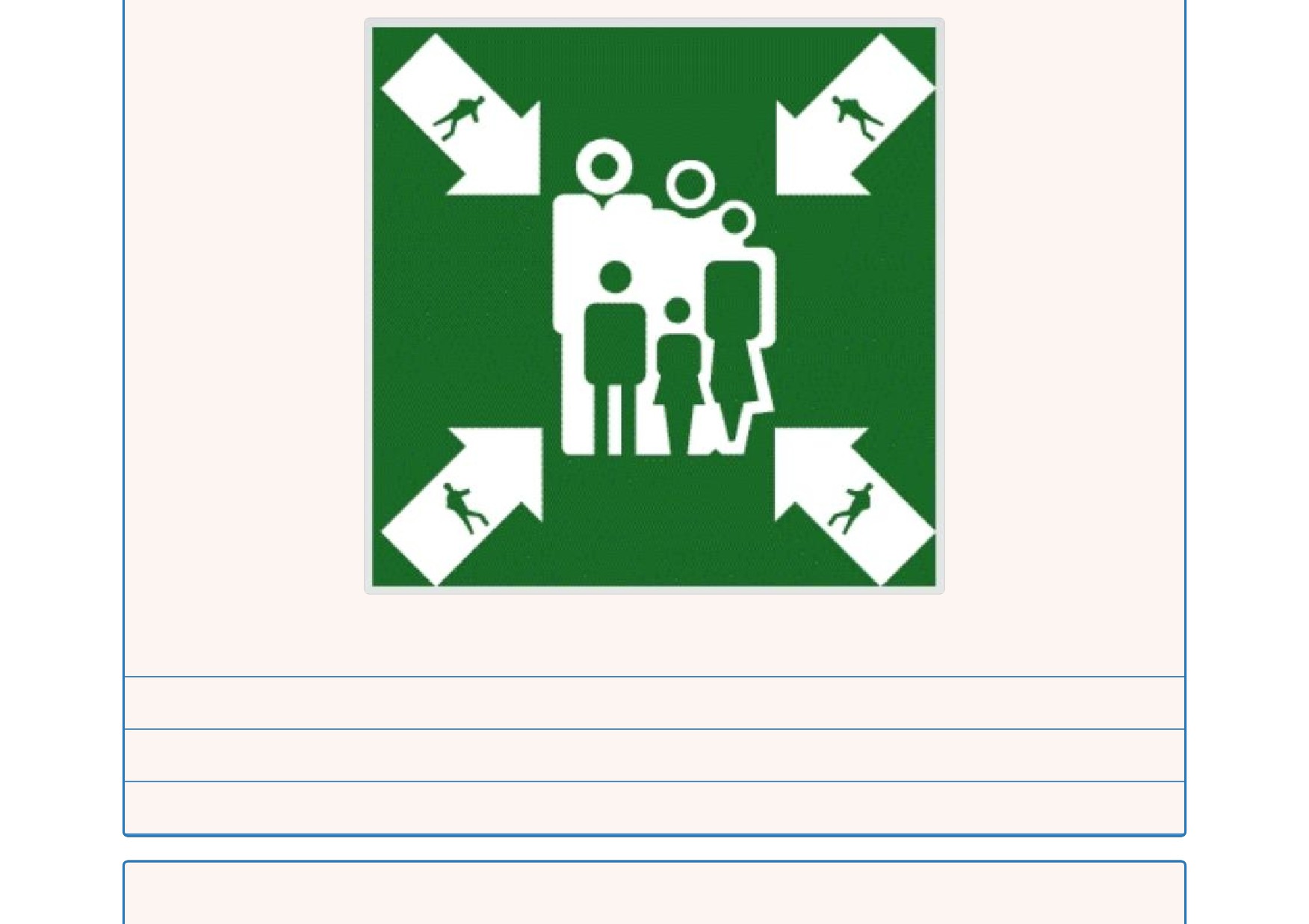
Muster station. (+)
Gathering place for embarkation formalities.
Muster station for unaccompanied minors (UM).
Muster station for families only.
Code: NJMP Which of these actions should crew take if a suspicious object
that may be a bomb is located during a search?
Confirm with their search partner that the object found is suspicious. (+)
Place the object in a desk drawer or file cabinet.
Throw the object overboard.
Cover the suspicious object with a box or blanket.
Code: TAIP What is the period of validity of the Safety Management
Certificate?
5 years. (+)
2 years.
1 year.
6 months.
Code: VIMQ When you join a new ship, how are you informed about safety
rules, alarm instructions and your own duties in case of an emergency?
By muster lists exhibited in conspicuous places. (+)
By alarm instructions in all crew cabins.
By oral instructions by the Captain.
By folder distributed to each crewmember.
Code: TEIE When navigating along a coastline what should be considered the
most accurate method of navigating?
Use of Differential GPS. (+)
Bearings of navigational shore marks such as lighthouses.
Use of radar ranges and bearings.
Passing close to navigational buoys.
When decanting water overboard from the slop tank, it is recommended:
To leave a small quantity of water in the slop tank, to avoid accidental discharge of oil from the surface and thus minimise
the risk of polluting the sea. (+)
Discharge below the waterline so that the discharged water is broken up by the propeller and no oily sheen is visible in the
wake.
Add dispersant chemicals to the water in the slop tank at a ratio of 1 litre of dispersant per 10 cubic metres of water.
Maintain a speed of at least 12 knots when pumping overboard.
Code: SBGQ When decanting water overboard from the slop tank, it is
recommended:
From berth to berth. (+)
From pilot to pilot.
It is dependant on the voyage and if there are any river or canal transits.
From Full Away On Passage (FAOP) to End Of Passage.
Prior commencement of tank washing it is recommended to measure the
tank atmosphere in two places, which are:
Middle of the ullage space and 1 metre below the deck. (+)
Directly above the surface of the remaining cargo and the bottom of the cargo tank.
At the corner of the tank furthest from the vent outlet and the bottom of the tank.
In the tank hatch coaming and 1 metre below the deck.
Code: JNDM Satellites which receive the 406 MHz CospasSarsat EPIRB are:
Capable to determine the position of the EPIRB. (+)
Not capable to determine the position of the EPIRB.
Only capable to determine the position of the EPIRB in certain circumstances.
Capable to determine position only in day time.
Code: APLT You are starting to get low on water in the lifeboat. What should
you do?
Collect rain water. (+)
Mix sea water with 50 % fresh water.
Drink urine.
Use sea water.
Code: CHRB The purpose of the decanting line between two slop tanks,
where fitted, is:
To enable most of the recovered oil to be retained in the primary slop tank, while the cleaner part of the water will flow into
the secondary slop tank, where it can be reused as washwater.
(+)
To enable both the primary and secondary slop tank to be filled without using the main cargo lines.
To enable the filling of the secondary slop tank via the primary slop tank.
To avoid a buildup of static electricity during water washing, caused by air being drawn in as the primary slop tank
empties.
Code: SUCA What are Primary fenders, with regard to shipŧoship transfer
operations?
Primary fenders are large fenders meant to float between vessels and absorb considerable impact. (+)
Primary fenders are fixed to the bow of the ship to prevent damage when manoeuvring alongside.
Primary fenders are small fenders suspended between the ship’s bows or stern to protect from inadvertent angular
contact.
Primary fenders are tyreŧype fenders kept on deck for emergency use.
Code: THBE The button or switch “dimmer” of a mariphone serves:
To regulate the light. (+)
To suppress the noise.
To reduce the volume.
To regulate the transmitting power.
Why shall a duly qualified officer supervise any potential
Code: ACBX Why shall a duly qualified officer supervise any potential
polluting operation?
To avoid pollution. (+)
To relieve the master.
To inform the authorities.
To restrict pollution.
Code: GHLS Which of the following is a ship MMSI?
227530000. (+)
2275300.
1227200.
22753000.
Code: OFPR A “sour crude” is defined as:
A crude oil or products containing appreciable amounts of hydrogen sulphide and/or mercaptans. (+)
A crude oil from West Africa.
A crude oil cargo which has left substantial residues in the bottom of the tank after discharge.
A petroleum product which reacts with water during tankwashing leading to a distinctive odour about the tank deck.
On an oil tanker fitted with an Inert Gas System, prior to commencement of
tank washing, the oxygen content within the cargo tanks shall be:
Not greater than 8 % oxygen content by volume. (+)
Less than 2 % oxygen content by volume.
21 % by volume.
Not more than 5 % oxygen content by volume.
Code: EYJG The authority to order the use of distress signal or distress alerts
is:
Only with the master. (+)
Company safety officer.
The person designated to maintain communication during distress situations.
The first person to discover the distress situation.
Code: RTTQ What action should the Officer of the Watch (OOW) take if he is
forced to make a major deviation from the voyage plan?
Inform the Master. (+)
Make an appropriate entry in the Log Book.
Check that the deviation will not lead into danger.
There is no special action necessary.
Code: MFAM What new stability problems would be caused by having deep
double bottom tanks on double hull oil tankers?
The Metacentric Height (GM) would have to be considered. (+)
There are no new stability considerations.
The vessel would be “stiff” and have a sharp rolling period.
The depth of the Double bottom would require additional strength members.
Code: SBXE Which position is the best to stop bleeding from the nose?
Sitting on a chair, leaning forward, with two fingers pressing the nose together. (+)
Laying on the back, leaning the head as much back as possible.
Laying on the back, holding a wet, cold towel on the top of the nose.
Holding the nose above steamed water.
Code: WQXT A radioŧelex call to a coaststation is generally started up in the:
ARQsystem. (+)
SELFECsystem.
FECsystem.
J2Bsystem.
Code: UNUM What would be the correct form of response to the question:
What is the visibility in your position?
Visibility in my position is two hundred meters. (+)
Visibility is medium.
Visibility is okay.
Visibility is poor.
Code: PVJO When the temperature of the air increases with height it is known
as a “Temperature Inversion” and may influence the performance of some
instruments on the ship. What should the bridge Officer of the Watch be
prepared to happen?
Abnormal ranges of VHF RT and Second Trace Returns on the radar. (+)
The GPS may give errors of position because of interference of incoming signals from the satellites.
The bearings obtained from the Directional Finder (DF) will not be as accurate as normal.
The radar will be show abnormal sea clutter as the pulse is trapped by the inversion.
Code: VYBS The ship is involved in a collision, what is the immediate action
by the Officer of the Watch after the incident has taken place?
Sound the General Alarm and stop engines. (+)
Call the Master and check the position for any immediate dangers.
Contact the other ship and send the bridge lookout down to start taking soundings.
Stop engines and check over the side for any signs of pollution.
Code: NTXB If you are called upon to reeve a new wire onto a selfstowing
winch drum you would, after looking at brake arrangement, reeve it to pay
out as follows:
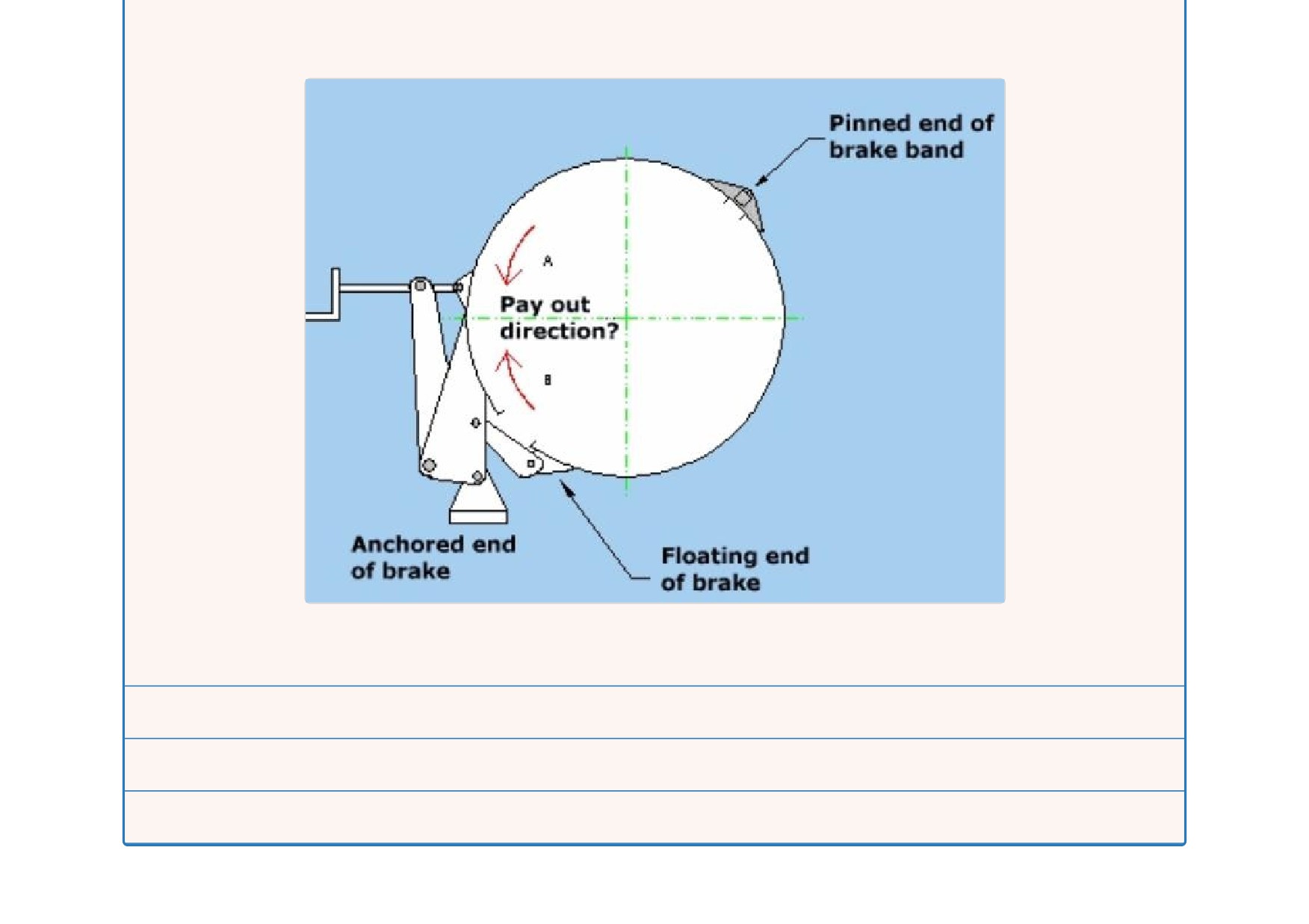
Direction B. (+)
Depends on the lay of the wire strands.
Direction A.
Doesn’t matter which direction.
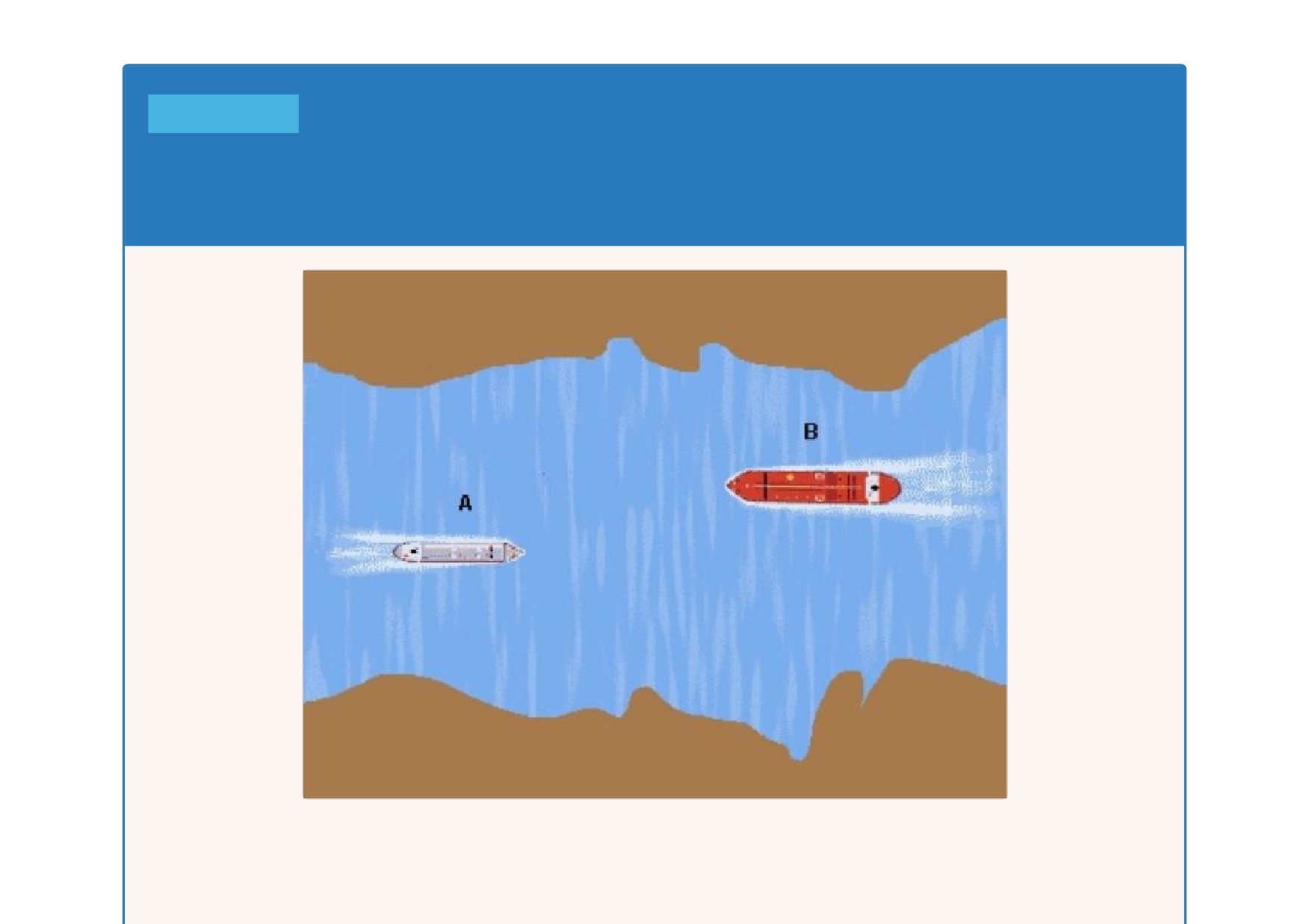
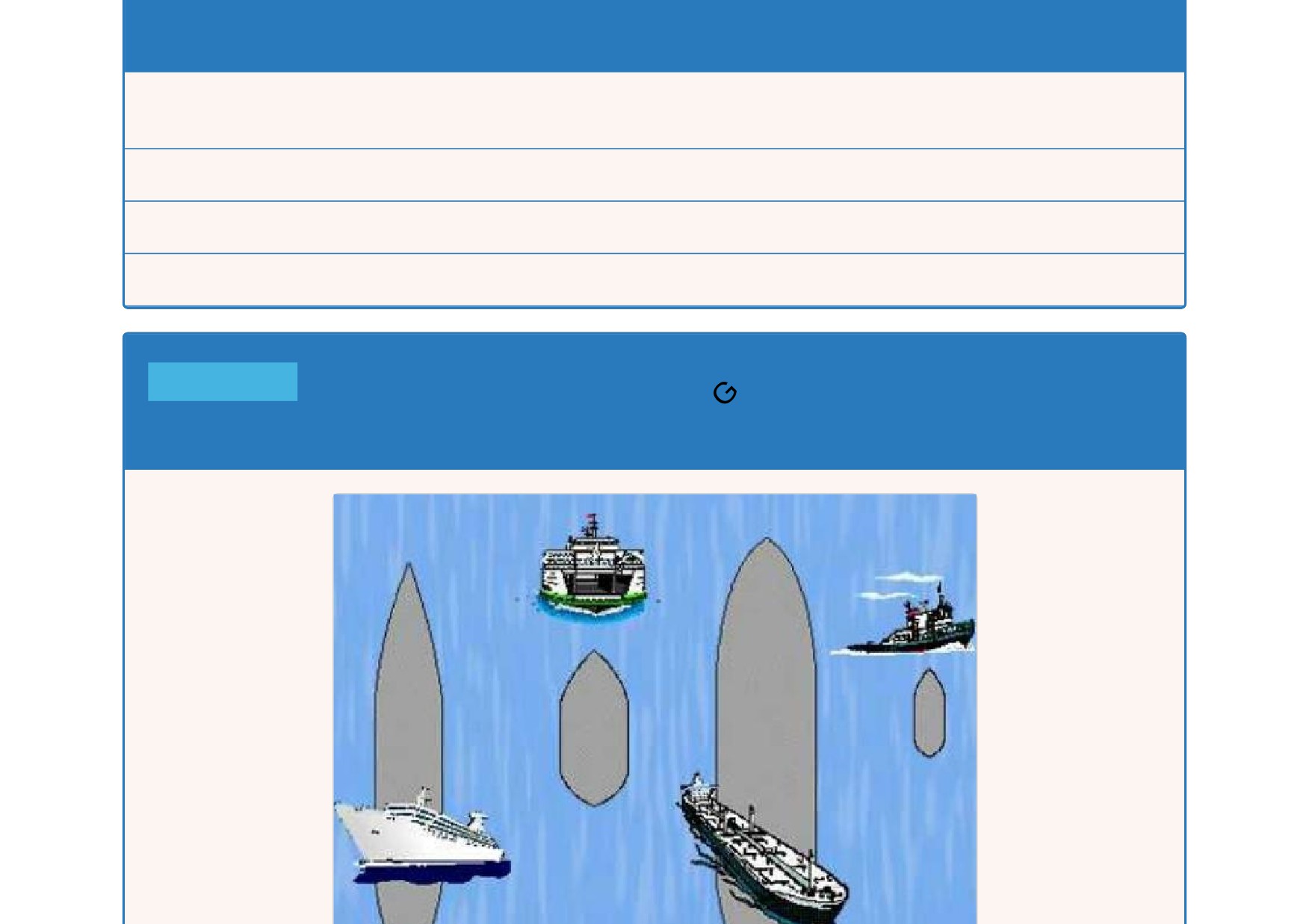
Code: PGKC Two ships are meeting in a restricted channel as illustrated.
Which of the following actions would be the most suitable to take on both
vessels as they approach and pass each other?
Slow down if possible without losing steerage and be prepared for prompt application of rudder to counteract any swing as
they approach and pass each other. (+)
Keep as far as possible on the starboard side of the channel and maintain speed to retain effective steerage.
Increase speed slightly to pass each other as quickly as possible and thereby reduce the effects of “ship to ship”
interaction.
Maintain speed and a straight course on the starboard side of the channel.
Code: MILK In context of cargo oil depth and ullage measurements, the
abbreviation UTI stands for:
Ullage Temperature Interface. (+)
Uniform Tank Indicator.
Uncorrected Tank Innage.
Ullage Topping Instrument.
Code: QLHH Which of the following types of fire extinguishers must be found
in an engine room containing an internal combustion engine?
All of the mentioned must be provided. (+)
At least one set of portable airfoam equipment.
A sufficient number of foam type fire extinguisher of at least 45 litre capacity (or equivalent).
At least two portable foam extinguishers (or equivalent).
Code: ENMD Which of the following is a coast station MMSI?
2275300. (+)
22753000.
227005300.
227530000.
Code: FRGY If the radar is set onto the Relative Motion Display, what would
an echo of a target with no trail indicate? Note this the trail of the echo and
not a vector.
The target is on the same course and speed as own ship. (+)
The target is on a collision course with own ship.
The target is stopped and making no way through the water.
The target is on a constant bearing and getting closer to own ship.
Code: KLRW What action should be taken by the Officer of the Watch in the
event of fire being reported to the bridge during the 00.00 to 04.00 watch?
Sound the Fire Alarm. (+)
Stop engines and inform the engine room.
Send the bridge lookout down to investigate.
Call the Master
SOLAS requires the tank coatings in dedicated seawater ballast tanks on oil
tankers to be of:
Preferably any light colour. (+)
Preferably white colour only.
Preferably dark red colour only.
Preferably any dark colour.
Code: FRFG With an EPIRB:
You must check the date the battery must be replaced. (+)
You must check if it is attached properly to a railing with the required line.
You must check the manufacturer of the battery.
You must check the working of the charger and check the loaded condition of the battery.
Code: SGIK The freeboard of a lifeboat, measured from the waterline to the
lowest opening through which the lifeboat may become flooded:
Should exceed 1,5 % of the lifeboat length when loaded with 50 % of the number of persons the lifeboat is permitted to
accommodate, these persons being seated to one side of the centreline. (+)
accommodate, these persons being seated to one side of the centreline. (+)
Should exceed 1,5 % of the lifeboat length when fully loaded.
Should exceed 0,5 metres when fully loaded.
Should exceed 0,5 metres when loaded with 50 % of the number of persons the lifeboat is permitted to accommodate,
these persons being seatd to one side of the centreline.
Code: JRUR You are on a powerdriven vessel underway in open water. You
observe this vessel, directly ahead, on a steady bearing, with the distance
closing steadily. What can you tell about this vessel from the lights it is
displaying?
This vessel is not under command and is not making way through the water. I cannot tell its aspect. (+)
This vessel is restricted in its ability to manoeuvre and is stopped in the water. I am seeing it from astern.
This is a fishing vessel, not making way through the water, with its nets fast upon an obstruction, seen from astern.
This vessel is aground and is seen from directly ahead.
Code: SLGL By “collect call” is meant:
A call for account of the receiver. (+)
A group call.
A call to collect the charges in office.
An urgent call.
Code: QONU Injuries resulting from slips and falls constitute the largest
percentage of accidents that occur in the catering department. What shall be
done to reduce this high accident rate?
Keep the floors and decks free from fat and grease. (+)
Do not wash off all rubbish to prevent persons slipping.
Install thermostats to avoid water from freezing to ice.
Ensure that slippery substances are not left where several persons are expected to be around.
Code: OGNG The receipt of a distress alert is to be pronounced as followed:
Mayday (1x), callsign of ship in distress (3x) / this is / own callsign (3x) / received mayday.
(+)
Mayday (3x) / this is / own callsign (1x) / received mayday / callsign of ship in distress (1x).
Mayday (1x) / this is / own callsign (3x) received mayday.
Mayday (1x) / distress alert / own ship call sign.
Code: SHNN What is the minimum number of “international shore
connections” that should be provided on vessels of 500 gross tonnage and
upwards?
1. (+)
2.
3.
0. Such connections only have to be provided on vessels over 1 000 gross tonnage.
Code: LCVH The use of combustible material is restricted in the
accommodation spaces in order to:
Contain and suppress fire and explosion in the compartment of origin. (+)
Reduce cost of construction.
Prevent occurrence of fire and explosion.
Make the ship light.
Code: QQNT Which of these types of information is considered sensitive?
Code: QQNT Which of these types of information is considered sensitive?
Voyage itinerary and departure and arrival times. (+)
Planned maintenance schedule and emergency response procedures.
Way points and training records.
Ship schematic and HR policies.
Code: POVX When loading oil in oil tankers, why are you only allowed to load
maximum 98 % of the tank capacity?
Due to temperature expansion. (+)
Danger of overloading.
Danger to vessel stability and strength.
It is company policy.
Code: IYTO How much lifeboat capacity should be provided on a conventional
cargo ship of more than 85 metres in length?
100 % of the ship’s complement on each side. (+)
150 % of the ship’s complement on each side.
125 % of the ship’s complement on each side.
50 % of the ship’s complement on each side.
Code: DTHW The position of the ship provided by the GPS should always be
confirmed by other means, when possible. Which of the following suggested
methods would be the most accurate?
The ranges of three distinctive shore objects on the radar. (+)
Bearing using the Radio Direction Finding of three radio beacons.
Compass bearings of three shore objects.
Bearing and distance from a navigational Buoy.
Code: AXEV The receiver of the InmarsatC installation, if the login
Code: AXEV The receiver of the InmarsatC installation, if the login
procedure has been carried out, is turned on:
NCS common channel. (+)
NCC information channel.
LES message channel.
RCC common channel.
Code: BACN You are part of a team of two First Aiders in a resuscitation
situation. What is the rythm of resuscitation with two First Aiders?
5 compressions after every 1 inflation. (+)
3 compressions after every 1 inflation.
10 compressions within every 3 inflations.
7 inflations before every 5 compressions.
Code: AQLC What is meant by the term “segregation”?
Code: AQLC What is meant by the term “segregation”?
The planned, separated stowage of cargoes that may react dangerously with each other in the event of leakage or other
damage. (+)
The stowage of cargoes when calculated by a computerized load program.
The planned adjacent stowage of packaged goods, thereby confining a listed hazard within the same area of the ship.
The process of electronically transferring the data on cargoes loaded on a vessel between the load port and the discharge
port, such that import documentation is prepared in advance of the vessel’s arrival.
Code: FQLG Which of the following figures drawn on the plane of the Meridian
is correct for an observer in position Latitude 30° 00′ North; Longitude 15°
00′ West, when observing the sun on the meridian, if the sun’s Declination is
15° 00′ South?
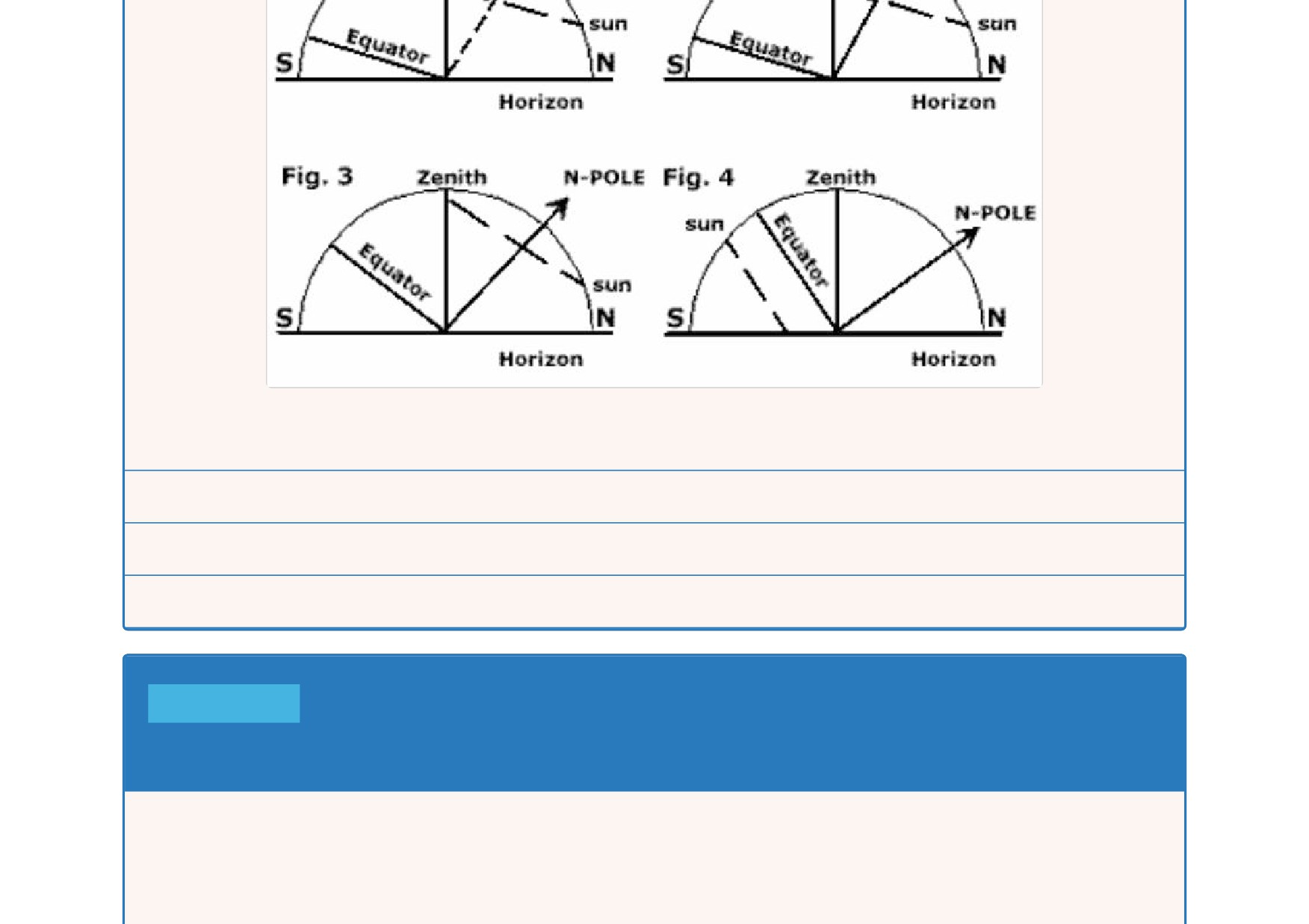
Figure 4 is correct. (+)
Figure 3 is correct.
Figure 2 is correct.
Figure 1 is correct.
Code: XDGC With reference to the exposure of vapours from oil cargoes,
“Short Term Exposure Limit” value is determined by:
The airborne concentration of a toxic substance averaged over any 15 minute period, usually expressed in ppm. (+)
The airborne concentration of a toxic substance averaged over any 30 minute period, usually expressed in ppm.
The airborne concentration of a toxic substance averaged over any 25 minute period, usually expressed in ppm.
The airborne concentration of a toxic substance averaged over any 10 minute period, usually expressed in ppm.
Code: GQNX The chemical group that Hydrocarbons belong to is:
Organic substances. (+)
Carbohydrates.
Inorganic substances.
Alkanes.
Code: VNNX You wish to send a DSCmessage because of a m. o. b.
situation and assistance by other ships is required. You have to choose the
category:
Distress. (+)
Safety.
Urgency.
Individual.
Code: BAEB The term “Load on Top” is referred to as:
Loading a new compatible cargo “on top” of the oil and water residues from a previous cargo in the sloptanks. (+)
Loading an oil cargo into the tanks through hoses inserted through the tank hatches and lashed in position.
Loading part of an oil cargo in one port, then loading a different type of cargo “on top” in the next loadport.
Loading part of an oil cargo in one port, then loading the same type of cargo “on top” in a subsequent port.
Code: RUXQ If the strength of the wind is related to the pressure gradient and
the space between the isobars, which of the following statements is correct?
The closer the isobars are together the stronger will be the predicted wind. (+)
The wind force is related to the difference in pressures and blows directly between the centres of high and the low
pressure.
The pressure gradient is a measurement of the distance between the high and the low pressures and is not associated
with isobars.
Strong winds are found in areas where the isobars are not close together.
Code: EXUJ What should the Third Officer do, if he finds something missing
from a lifeboat?
If he finds something missing from a lifeboat, the Third Officer should notify the Chief Officer. (+)
If he finds something missing from a lifeboat, the Third Officer should replace the missing item.
If he finds something missing from a lifeboat, the Third Officer should search for the missing item.
If he finds something missing from a lifeboat, the Third Officer should make a note of it in the lifeboat register.
Code: NGFM From which locations is it normally possible to close watertight
doors?
Watertight doors can be closed adjacent to the door and remotely from bridge and also one emergency remote control
station. (+)
station. (+)
Watertight doors can be closed from the bridge and an alarm sounds at the door.
A watertight door can only be closed by a control adjacent to the door.
Watertight doors can be closed locally and also a remote control station within the accommodation.
Code: MFDQ In making VHF communication or test transmission you must:
Identify yourself with your call sign and/or ship’s name. (+)
With DSC use, first broadcast the carrier wave for at least three seconds.
Warn all ships in the vicinity.
First tap on the mike several times, but not more than 10 times.
Code: ISVS Special Areas as per MARPOL are:
Specific geographical sea areas in which special mandatory measures for the prevention of sea pollution by oil are
required. (+)
Limited ocean and sea areas, listed under the OPA90 Act, inside which the discharge of oil is prohibited and the penalty
for doing so is an unlimited fine and jail sentence.
Specific geographical sea areas, designated as Marine Conservation Areas by the United Nations, in which any discharge
from the cargo area of an oil tanker is strictly controlled.
All sea areas within 50 miles from the nearest land, where that coastal state is a signatory to MARPOL.
Code: OJHX The prescribed test of an approved portable VHF radio set
(portophone) must be done once a:
Month. (+)
Week.
Year.
Quarter.
Code: ENLD A ship in distress should transmit the appropriate alarm signal
followed by the distress call and message on one or all of the international
distress frequencies. Which of frequencies is in accordance with the present
recommendations?
500 kHz, 2 182 kHz and 156,8 MHz. (+)
500 kHz, 2 367 kHz and 243 MHz.
550 kHz, 2 367 kHz and 121,5 MHz.
550 kHz, 2 182 kHz and 121,5 MHz.
Code: RSSX The temperature control system of the main engine crankshaft
bearings indicates high temperature. What would be the correct way to open
and check the crankcase?
Stop the engine immediately and keep the lube oil pump running for at least 20 minutes before opening the crankcase.(+)
Stop the engine immediately, stop the lube oil pump, and inspect the crankcase after 5 minute.
Stop the engine and open crankcase down immediately for inspection.
Reduce the RPM to a minimum and open the crankcase doors carefully.
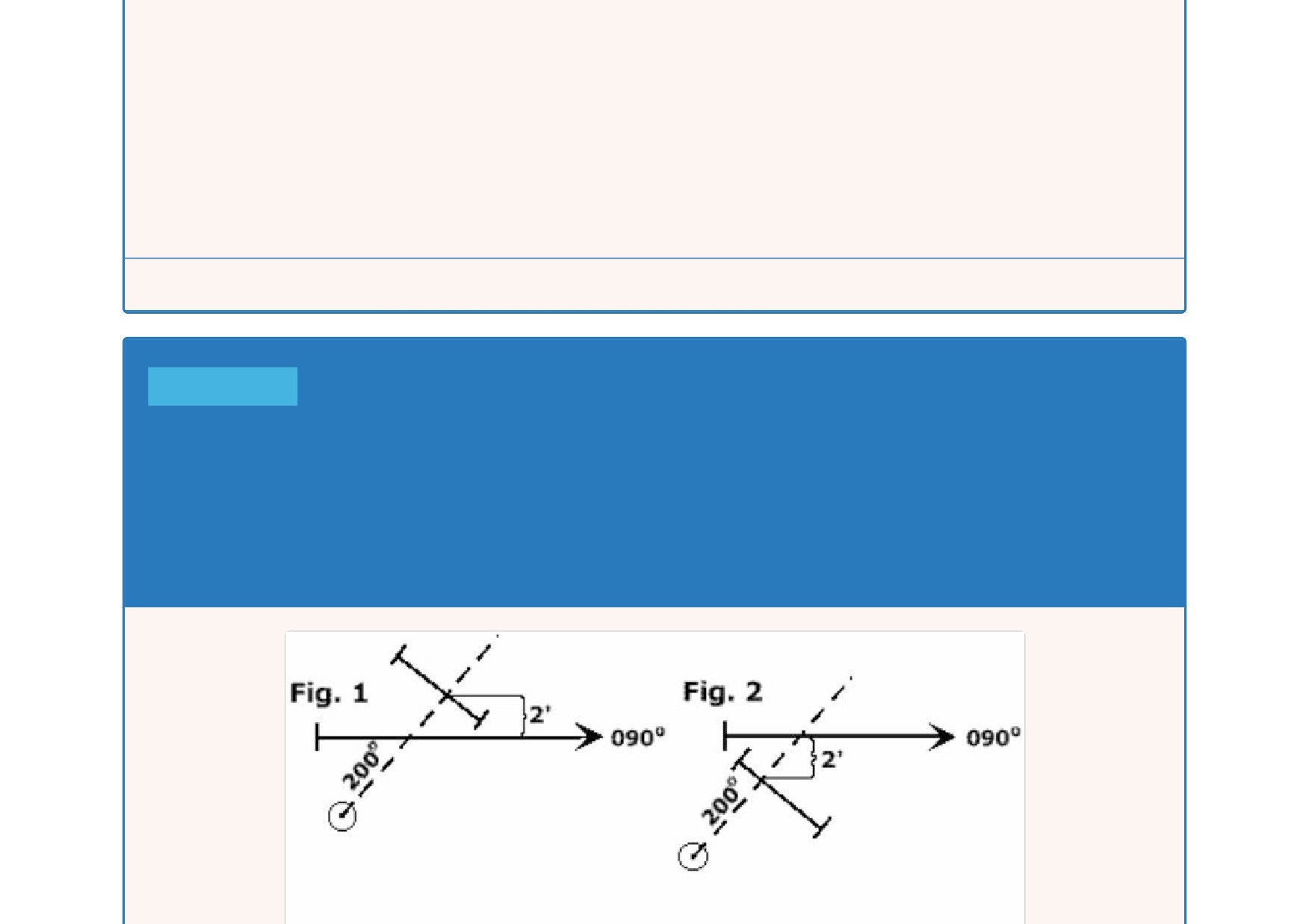
Code: HEVD Which of the four figures illustrated shows the correct position
line for the following situation: Latitude 50° 00′ N, Longitude 30° 00′ W, Time
1200 GMT. Course steered: 090° True, Speed: 12 knots, bearing of the sun:
200°, Intercept correction: 00° 02′ Towards (observed altitude - computed
altitude).
//////////////////////////////////////////