Asylum Report 2023 - page 6
EUROPEAN UNION AGENCY FOR ASYLUM
Recognition rates at higher instances for specific nationalities
Overall, the Top 20 nationalities receiving the most decisions at second or higher instances
overlapped with those receiving most first instance decisions, with just four exceptions:
nationals of The Gambia, Iran, Russia and Senegal. However, nearly all of these four countries
of origin (except for The Gambia) featured among the Top 30 citizenships with most decisions
issued at first instance.
Among the Top 20 nationalities which received the most decisions at second or higher
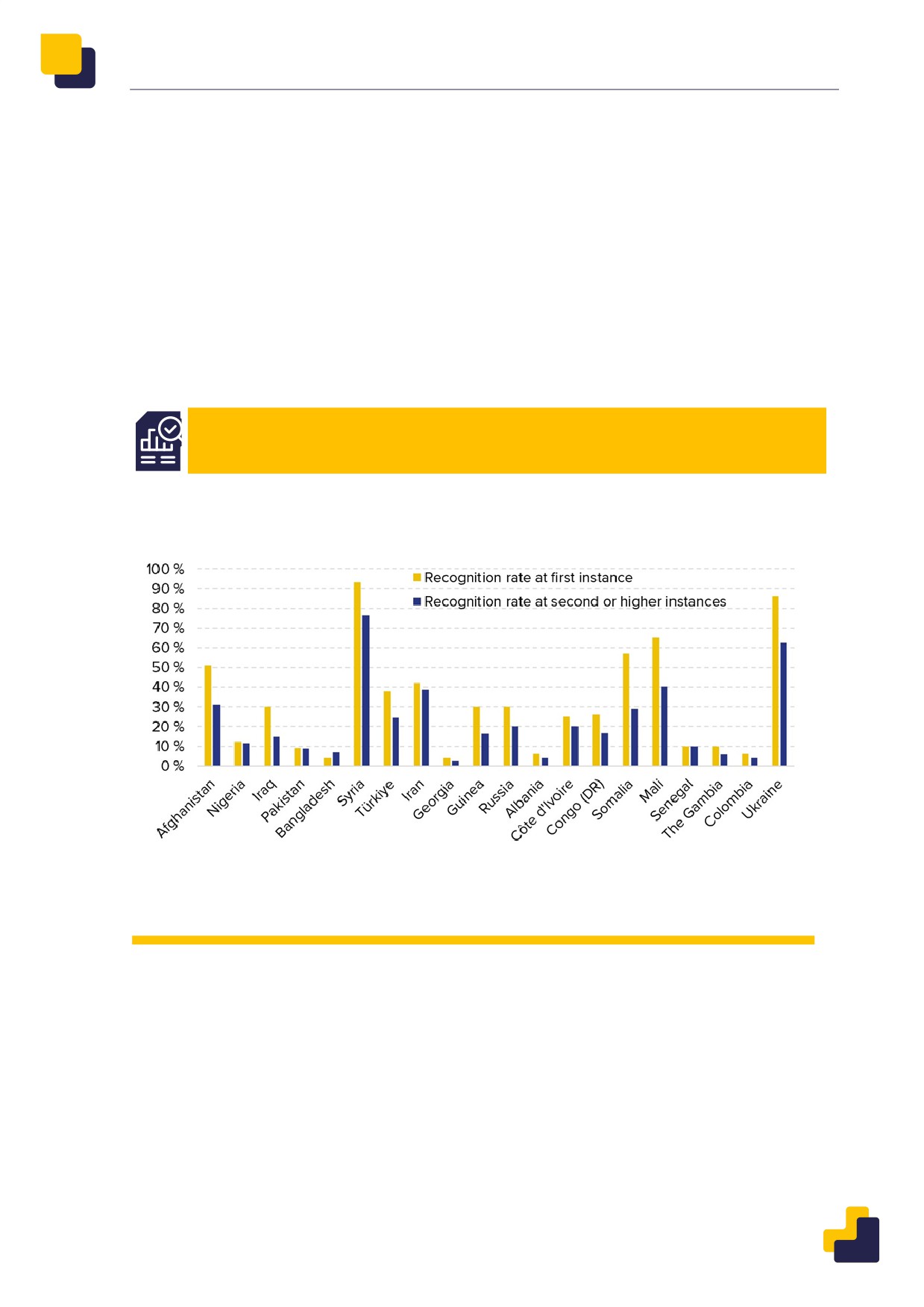
instances, Syrians (76%) had the highest recognition rate in 2022 (see Figure 28), followed by
Ukrainians (62%). Other groups with recognition rates above the overall EU+ average included
nationals of Mali (40%), Iran (39%), Afghanistan (31%), Somalia (29%) and Türkiye (25%).
Syrians and Ukrainians had the highest recognition rates at
second or higher instances
Figure 28. Recognition rates for the Top 20 nationalities with the most decisions issued in
EU+ countries, 2022
Note: These 20 nationalities received the highest number of decisions at second or higher instances in
EU+ countries in 2022. They are ordered (from the left to the right side) in terms of the number of decisions
received.
Source: Eurostat [migr_asydcfsta] as of 13 April 2023.
For the remainder of the Top 20 nationalities, fewer than one-quarter of decisions issued at
second or higher instances granted international protection. Recognition rates were especially
low for Georgians (2%), Albanians (4%), Colombians (4%) and Gambians (6%). All these
nationalities had low recognition rates also at first instance in 2022.
For one-half of the Top 20 nationalities, recognition rates at second or higher instances were
similar to those at first instance, and for few of them - Nigerians, Pakistanis and Senegalese -
there was no difference between recognition rates at the two decision-making instances (see
Figure 28). While only one of the Top 20 nationalities received higher recognition rates in
appeals than at first instance (Bangladeshis), for several of them - such as Somalis, Malians,
Ukrainians, Afghans, Syrians, Iraqis, Guineans, Turks, Russians and Congolese (DR) -
250
ASYLUM REPORT 2023
recognition rates at second or higher instances were significantly lower compared to those at
first instance, the gap varying between 28 percentage points (for Somalis) and 9 percentage
points (for nationals of the Democratic Republic of the Congo).
Outside the Top 20 nationalities receiving decisions, recognition rates at higher instances
were high for Yemenis (71%), Belarusians (49%), Eritreans (39%) and Sudanese (35%).lxi At the
other end of the spectrum were nationals of India (1%), North Macedonia (1%), Moldova (1%),
Serbia (2%), Comoros (2%), Haiti (3%), Armenia (4%), Ghana (5%) and Tunisia (6%). As was the
case at first instance, low recognition rates partially coincided with countries exempt from visa
requirements to enter the EU (for example applicants from North Macedonia, Moldova and
Serbia).
4.14.2. Building perspectives: Legal status and family
reunification
4.14.2.1. National forms of protection and regularisation measures
Several countries provided national forms of protection to persons fleeing
Ukraine prior to the activation of the Temporary Protection Directive, and
continued to do so for some Ukrainian citizens who did not fall under the
scope of the Council Implementing Decision.1058 In parallel, some
EU+ countries continued with initiatives which offered a right to stay to former
applicants who could not be returned and had reached a certain level of
integration.
The Finnish Ministry of the Interior published a report on potential solutions for people who
had resided in the country for a long period without having the legal right to residence,
including rejected applicants for international protection who could not be returned to their
country of origin.1059 The same project investigated the possibility of issuing a residence
permit and an alien’s passport to applicants whose lack of a valid travel document is the sole
impediment to granting the residence permit. The aim of these investigations was to identify
possibilities to prevent social exclusion and the emergence of a parallel society.
In Germany, the draft of the Second Law for the Introduction of a Right of Opportunity to Stay
was presented and debated in the parliament. Among other objectives, the law would end the
accumulation of tolerated stay periods (Kettenduldung), which would no longer be counted
towards residence rights.1060
The Irish government launched a scheme with a strand for undocumented migrants and
another for applicants for international protection. Asylum seekers who have been in the
asylum procedure for at least 2 years can apply for unrestricted access to the labour market
and a pathway to Irish citizenship. They can continue with the asylum procedure in parallel
with the regularisation process. The scheme was open for 6 months between February and
August 2022.1061
A report published in December 2021 by the Federation Red Acoge highlighted that Spanish
Immigration Law makes citizenship conditional to a set of criteria which are very difficult to
lxi Only nationalities with more than 1,000 decisions issued in 2022 were considered.
251
EUROPEAN UNION AGENCY FOR ASYLUM
meet for migrants, thus leaving many of them in a situation of social exclusion. With the aim of
promoting a people’s legislative initiative to regularise 500,000 persons by collecting
500,000 signatures, a group of organisations (including a political party) joined to form the
platform “EsencialES”. In December 2022, the campaign reached 700,000 signatures that
were submitted to the Office for the Electoral Roll in order to start the parliamentary
procedure. A gathering in front of the Congress was also organised by the Platform
EsencialES, with the aim of celebrating the great support received for this Popular Legislative
Initiative. The parliamentary procedure foresees a maximum of 6 months to analyse the
popular initiative and to submit it to the congress for its consideration.1062
Some other countries, like Italy and Malta, amended existing procedures for granting national
forms of protection, while in the Netherlands, some cases needed to be re-assessed, following
clarifications about the criteria for qualifying for a special residence permit.
In Poland, changes were made to issuing humanitarian visas and humanitarian stays for
citizens of Belarus. The requirements were eased for those with a visa which was about to
expire or those who had fled the regime to Ukraine and then entered Poland through a
special procedure.1063
The Italian Ministry of the Interior published a new circular in January 2022 which clarified the
connection between the special protection status (a national form of protection) and the
Dublin procedure (see Section 4.2), as well as subsequent applications. For example, it
addressed that special protection cannot be assessed merely on the basis of documentation
attached to a subsequent application; the applicant always must be heard.1064
The Supreme Court of Cassation provided additional guidance for the assessment of special
protection and consolidated its judgments from 2021. The court confirmed that certified
attendance in an Italian language course or a fixed-term employment contract should be
considered signs of serious intention to integrate.1065 The court followed the same reasoning
and sent back cases due to a lack of the appropriate assessment of the applicants’ level of
integration, for example in the case of a Gambian applicant.
Medical conditions are another factor that courts assessed for granting special protection. The
Tribunal of Bari granted this form of protection to a Pakistani citizen suffering from serious
psychiatric problems.
The Spanish Supreme Court established that national authorities are obliged to assess a
request for residence on humanitarian grounds within the asylum procedure, if this is
requested by the applicant. Authorities should have a proactive approach for applicants with
vulnerabilities and assess the option to provide humanitarian protection, even when there is
no evident request from the applicant.
The International Protection Act was amended in Malta and - amongst other provisions - it
modified the Temporary Humanitarian Protection procedure, which is a national form of
protection. A new provision allows the International Protection Agency to revoke, end or
refuse to renew this status when it is established that the person did not originally meet the
criteria for it. The decision to not grant international protection but grant Temporary
Humanitarian Protection can be appealed.1066 While welcoming the legislative changes, MOAS
noted grey zones in the implementation of the laws and regulations on Temporary
Humanitarian Protection that would need to be clarified.1067
252
ASYLUM REPORT 2023
In the Netherlands, the final regulation implemented a children’s pardon (kinderpardon) that
allowed a certain group of rejected minor applicants and their family members to request a
residence permit before 25 February 2019.1068 The IND re-assessed approximately 30 files in
2022, following a confirmation from the Minister for Migration that in some cases a permit can
be granted, even though an asylum application was not submitted on behalf of the
children.1069 The Dutch Council of State provided guidance on the assessment of these
requests in two cases, noting that the authorities can assess the behaviour of the family
member when deciding on the application. However, when this element is held against the
child, courts have a wider scope for reviewing the cases on appeal.
In June 2022, the Council of State in the Netherlands ruled that there are three possible
situations for unaccompanied minors who do not qualify for an asylum permit:
i)
There is adequate reception in the county of return and a return decision is issued;
ii)
There is no adequate reception and the unaccompanied minor must be granted a
residence permit on national grounds; or
iii) Further research is needed. In this situation, the unaccompanied minor retains lawful
residence on the basis of Article 8, preamble and under f, Aliens Act. The investigation
can lead to two conclusions: either there is adequate reception so that a return
decision can be issued, or there is no adequate reception and the unaccompanied
minor receives a residence permit on national grounds. The unaccompanied minor can
appeal the decision stating that further research is needed. The Council of State
further rules that the fact that the applicant is no longer a minor does not mean that the
Secretary of State can refrain from investigating whether they should have been
granted a permit based on national grounds.
The Finnish Supreme Court analysed whether a rejected applicant for international protection,
who submitted false information during the asylum procedure and founded a family in the
meantime, could still be given a residence permit based on family ties. While in one of the
cases the court confirmed that the reasons for rejecting the residence permit application were
more weighty than reasons for the protection of family life and the best interests of the child,
in the other, it came to the opposite conclusion. In the first case, the court underlined that
attempts to evade law had been long-lasting and continuous until requesting the residence
permit, while in the second case, the applicant’s evasion of the rules focused only on a certain
period, dating before 2016.
PICUM published a report on regularisation mechanisms and programmes, citing examples of
regularisation processes involving former applicants for international protection.1070
4.14.2.2. Review, cessation and revocation of international protection
International protection status ceases in circumstances when the
status is no longer necessary or justified. It may also be revoked when
the person should have been excluded from international protection
earlier, when the status was obtained through misrepresenting or
omitting facts, or when the beneficiary is considered to be a danger to
the security of the state or the community.
253
EUROPEAN UNION AGENCY FOR ASYLUM
Legislative changes were initiated in Malta, where amendments to the International Protection
Act adjusted the criteria for exclusion from subsidiary protection status and the right to appeal
in that case.1071
NOAS observed delays in status reviews, often because authorities were looking into
potential fraud.1072 Amendments to the Immigration Act would allow authorities to expulse
refugees without first making a decision on the cessation of the status, when the person has
been convicted and sentenced for a crime that is punishable by 2 or more years of prison.1073
UNHCR underlined that committing a serious crime is not a reason for cessation under the
Geneva Convention, and cessation reasons should be differentiated from the termination of
refugee status. The organisation assessed that “(t)he proposed parameters fall short of the
required analysis of the degree of seriousness of a crime that would constitute a danger to the
security of the country or a danger to the community”.1074
Similar amendments were proposed in Denmark. Any foreigner who is sentenced to an
unconditional prison sentence would be deported, regardless of the length of stay in the
country. UNHCR regretted that the proposal was not sufficiently detailed to assess Denmark’s
compliance with international obligations and urged the Danish government to give special
consideration to beneficiaries of international protection.1075
In Germany, as of January 2023, the Act on the Acceleration of Asylum Court Proceedings
and the Asylum Procedure entered into force. The most important changes of the reform
include the complete abandoning of the routine revision of the status under the former
Section 73(2a) of the Asylum Act. Prior to the reforms, a revision of the status was initiated
automatically by BAMF 3 years after the first final decision on the status.1076
In Greece, throughout 2022, the Greek Council of Refugees reported a significant increase in
the number of cessation decisions for beneficiaries under the “old procedure’’. According to
this reporting, beneficiaries whose countries of origin were included in the list of safe
countries of origin by Joint Ministerial Decisions were served with decisions of a few
paragraphs long without an individualised assessment, citing only the Joint Ministerial
Decision as a reasoning. Beneficiaries must wait months until their case is given an asylum
case number before their appeal can be examined by the Appeals Authority. They then must
wait months after their appeal has been heard to be called for an oral hearing by the Appeals
Authority. Throughout this time, they are in possession of the certificate of filing an appeal,
which does not give them access to the labour market, health care or the social assistance
system.1077
In Hungary, as of January 2022, the grounds for exclusion from subsidiary protection were
complemented by an additional case. Accordingly, a foreigner is not granted subsidiary
protection if there are reasonable grounds to believe that, prior to their admission by Hungary,
they committed an offence in their country of origin which is punishable in Hungary by a term
of imprisonment of up to 3 years or more and there are reasonable grounds for believing that
the applicant left their country of origin only in order to avoid the penalty for the offence. This
ground serves as a basis for the withdrawal of subsidiary protection status as well.1078
The courts continued to interpret practices associated with reviews and withdrawal grounds
and procedures. The CJEU concluded that asylum authorities cannot be required to
automatically take into account the non-reasoned opinion of specialist bodies for national
security - like the secret service - when deciding on withdrawing international protection. The
court underlined that the authorities must have all available information to conduct an
254
ASYLUM REPORT 2023
assessment freely, and information may partially be provided by the secret service, but it
cannot be binding on the authority.
The Dutch Council of State referred several questions to the CJEU for a preliminary ruling to
provide guidance on the interpretation and assessment of a particularly serious crime when
national authorities intend to withdraw the international protection status. The court asked
whether the final conviction for a particularly serious crime was enough to demonstrate a
threat to society or must the authorities prove that the threat to society continues to exist even
after a conviction.
In another instance, the council referred for re-examination the case of an Afghan national
whose refugee status was withdrawn in 2020. Noting that there was a radical change in the
circumstances in Afghanistan in 2021, the withdrawal decision needed to be reconsidered in
the light of these changes.
The Tribunal of Brescia in Italy confirmed that the renewal of subsidiary protection status must
not be conditional on holding a passport.
The Council of State in Belgium sent a case back for reconsideration by CALL, as it found that
the court did not substantiate properly the reasons which justify the 10-year time limit for
withdrawing international protection based on one ground mentioned in the law, while there
was no time limit on withdrawing protection on other grounds.
The Irish Supreme Court confirmed that the revocation of refugee status cannot have a
retrospective effect, unless it is specifically stated in national legislation. Thus, the appellant
could keep his Irish citizenship acquired at birth, even though his father’s refugee status was
later revoked.
The French Council of State reiterated that, when refugee status is withdrawn, a person can
only be returned if the authorities undertake an in-depth, individual assessment of the
personal situation and the risk of ill treatment in the country of origin. The council noted that
refugee status may be withdrawn, but the person is still considered to be a refugee and a
removal is possible only after an individual assessment of the personal situation and of the
absence of risk in the country of return.
The ECtHR underlined this in two cases related to the return of persons whose application for
international protection had been revoked. In R. v France, the court observed that the French
Administrative Court pronounced a decision with the reasons for rejecting the applicant’s
request against a deportation decision only after the deportation had taken place, and thus it
could have not remedied the inadequacy of the earlier risk analysis. In W. v France, the court
found that the person would face a real risk of inhuman or degrading treatment, as the
prefecture disclosed details about his personal situation to the consulate when requesting
readmission.
The courts were also called upon to assess the impact of withdrawal procedures in other
EU+ countries when deciding on the cases of applicants who had already obtained
international protection status in a Member State but then moved onward to ask for
international protection again in another. For example, the Dutch Court of The Hague granted
interim measures for a Syrian family and then decided against their readmission to Bulgaria,
where they would risk losing their international protection status. The Bulgarian authorities
may revoke an international protection status when the beneficiary does not extend the
identity document or residence permit on time.
255
EUROPEAN UNION AGENCY FOR ASYLUM
4.14.2.3. Residence permits and travel documents
Member States must issue a residence permit to beneficiaries of
international protection: refugees should receive a permit for at least 3
years which is renewable and beneficiaries of subsidiary protection
should receive a permit for at least 1 year which is renewable. Refugees
are entitled to travel documents as foreseen in the Geneva Convention,
while beneficiaries of subsidiary protection may receive the national
passport of their host country, under specific conditions. Obtaining
documentation is often an administrative criterion for accessing other
permits and rights for beneficiaries of international condition.
With EU+ countries prioritising the ivssuance of permits to beneficiaries of temporary
protection, delays were reported in the issuance of residence permits for beneficiaries of
international protection.1079
In Belgium, where the country’s reception system was under pressure in 2022, it was reported
that some applicants received international protection without having access to the reception
system, thus being largely homeless. Without an address, it was difficult to obtain a residence
permit (A-card) at the local commune when receiving a positive decision. Without this permit,
the status holder can encounter difficulties in obtaining financial aid, opening a bank account
and renting a place to live.1080
In Finland, the delivery of residence permits, aliens’ passports and refugee travel documents
was temporarily delayed due to a shortage of staff and a backlog in the processing of aliens’
passports and refugee travel documents.1081
In France, it was reported that beneficiaries of international protection encountered difficulties
in obtaining their residence permits due to the implementation of a digital system which
presented several shortcomings and issues with accessing prefectures for the issuance of
residence permits.1082 In June 2022, the Council of State ordered the Ministry of the Interior to
establish a solution as an alternative to the solely digitalised procedure.1083
Refugee Support Aegean continued to observe important delays in the delivery of residence
permits for beneficiaries of international protection in Greece,1084 especially those re-admitted
from other EU+ countries.1085 This document is a pre-requisite to access many other rights and
services, including health care and employment.
In January 2022, a new Immigration Service appointment scheduling system, which would
streamline and further improve the registration process, was announced in Ireland. The interim
ISD Registration Office Burgh Quay created a free phone number to call, so that applicants
residing in Dublin could book a first-time registration appointment. As of January 2023, the
revised appointment and scheduling system was fully operational, however, applicants
continued to experience significant delays in obtaining appointments.1086
256
ASYLUM REPORT 2023
The Irish government also suspended the Council of Europe’s Agreement on the Abolition of
Visas for Refugees for 12 months, in an effort to protect the integrity of the Irish asylum and
reception systems. The decision came after an increase in the number of applicants who had
already been granted international protection in another EU Member State.1087
Aditus foundation in Malta carried out research on obstacles to receive relevant
documentation for several target groups, including family members of beneficiaries of
international protection. The organisation made several recommendations to speed up the
delivery of residence cards.1088 The International Protection Agency added that protection
cards for beneficiaries of international protection were delivered promptly, on the same day as
the decision.
The Italian Council of State clarified that beneficiaries of subsidiary protection and
humanitarian (special) protection must be granted travel documents from authorities, without
having to prove that they cannot obtain a passport from their country of origin. The council
noted that frequently the national authority in the country of origin prevents a beneficiary from
acquiring a passport. In addition, a circular simplified the procedure for a refugee to marry in
Italy: documentation from the country of origin is no longer needed and a sworn statement is
sufficient.1089
In Germany, higher administrative courts found it unreasonable to expect that a passport be
obtained from the embassy of the country of origin, for example, for beneficiaries of subsidiary
protection from Eritrea and Syria who refused to do their military service.
The EctHR condemned Lithuania for not issuing a travel document to a former beneficiary of
subsidiary protection with long-term residence. The national authorities found that the person
did not justify why he had been unable to obtain a valid passport from his country of origin.
However, the court concluded that the authorities rejected the request for a travel document
on formalistic grounds, without examining the particular circumstances of the person.
For acquiring long-term residence in Sweden, the government appointed an inquiry
commission to assess making language knowledge and knowledge of the Swedish society
requirements for permanent residence.1090
In Denmark, amendments were adopted to the criteria to acquire permanent residence. The
person should not be convicted of ‘negative social control’ (for example, sending a child
abroad for religious re-education) and could be barred from being granted a permanent
residence permit for a minimum of 6 years depending on the type and length of the sentence.
Similar changes were introduced as criteria for family reunification (see Section 4.14.2.4).1091
The Romanian High Court of Cassation and Justice reviewed a decision to refuse long-term
residence for a beneficiary of international protection based on a classified note from the
Romanian Intelligence Service. The court found that the reasoning of the decision was
insufficient, as the decision should include all reasons and elements of evidence that form its
basis.
257
EUROPEAN UNION AGENCY FOR ASYLUM
4.14.2.4. Family reunification
Amendments were adopted to family reunification rules in Denmark. As a
rule, the sponsor living in Denmark or the sponsor's spouse or cohabitant
should not be convicted of ‘negative social control’ (for example, sending a
child abroad to conditions that seriously endanger the child's health or
development) for a period of 10 years to be able to proceed with family
reunification with a child. Similar changes were introduced as a criterion for
acquiring a permanent residence permit (see Section 4.14.2.3).1092
The Finnish Aliens Act was amended, and as of 1 February 2023, minors who have received
international protection became exempted from the requirement of having sufficient financial
resources. Family members can now be granted a residence permit, even when the minor
sponsor does not fulfil this requirement,1093 as recommended by UNHCR and civil society
organisations in 20211094 and the Finnish Human Rights Centre in June 2022.1095 However,
contrary to the recommendations, the requirement remained unchanged for adult
beneficiaries of subsidiary protection.1096
Due to an increase in the number of family reunification applications, the Finnish Immigration
Service announced a backlog in their processing in October 2022. The backlog concerned
only a limited number of applications, and 60% of the requests submitted in 2022 received a
decision within 3 months.1097
The Finnish Supreme Administrative Court analysed a family reunification request in light of
the CJEU judgment in B.M.M. and others from 2020. The court underlined that, in principle, a
final and binding decision should not be overturned as a matter of legal certainty. However, in
the particular case, the incorrect application of the law could not be corrected by a new
application. Thus, the court annulled the final decision and ordered the authorities to process
the case again, listing the sponsor’s son as a minor.
The Icelandic government approved a proposal to allow family reunification for young Afghan
refugees who received protection shortly after turning 18 years. In principle, only persons
under the age of 18 can apply for family reunification with their parents and siblings under
18 years old.1098
In Germany, in 2021 and 2022, several federal states (Berlin, Bremen, Hessen, Schleswig-
Holstein and Thuringia) decided to put regional family reunification programmes, which were
approved by the federal government, in place for family members of Afghan refugees. For
Syrian refugees, some regional programmes for family reunification are still in place. These
programmes are reserved for first- and second-degree relatives of persons living in Germany
with refugee status or another legal residential status. In contrast to the ‘normal’ family
reunification procedure, the family members living in Germany must act as sponsors by
declaring that they will cover the cost of living of their relatives (either from their own
resources or with the help of external sponsors).1099
Italy launched a new digital platform to facilitate the family reunification procedure. It allows,
for example, a request to be submitted online.1100
In Austria, civil society organisations expressed concern about the time limit to apply for family
reunification, given that applications must be submitted personally to an Austrian embassy
and waiting times were often lengthy.1101
258
ASYLUM REPORT 2023
UNHCR in Spain was concerned by the long processing times for family reunification. The
organisation observed that the procedure could take more than 18 months, as it involves a
complex procedure with several authorities, and guidelines seemed to be lacking on their
cooperation. The organisation also noted that beneficiaries usually received very little
information on the status of their request.
The Belgian government announced its intention to create a separate right of residence
through family reunification of parents of children who are recognised beneficiaries of
international protection, but who themselves do not qualify for international protection.1102
The Dutch IND announced several measures in April 2022 to shorten the waiting time for
family reunification and close the backlog. Other measures aimed to speed up the process
once family members were in the Netherlands, for example, by creating a separate location
and strand for the registration of their application (see Section 4.1).1103 However, a new
judgment from the Council of State advised the IND to always weigh the different interests
before taking a decision in a family reunification case. For example, it was no longer sufficient
to conclude a lack of emotional ties without weighing further elements. The additional steps
would likely extend processing times rather than reducing them.
Likewise, the Council of State delivered a judgment on the right to be heard in family
reunification cases. Dutch law allows to waive the obligation to hear an applicant in family
reunification cases when the person’s objection against a planned decision is considered to
be manifestly unfounded. In the specific case, the council concluded that the applicants
submitted additional evidence and substantiated special individual circumstances that should
have led to a hearing.
A study published in June 2022 found that Dutch family reunification legislation was
perceived to be more lenient than in other EU+ countries. This led to many unaccompanied
children applying for asylum in the country with the objective to be reunited with their families
afterwards.1104
In August 2022, the new policies to accelerate procedures in the Netherlands were halted
due to a lack of places in reception. The temporary measures aimed to restrict family
reunification until 31 December 2023. A visa was only issued to a family member when the
assigned municipality notified that suitable accommodation had been found for the
recognised beneficiary and the family members planning to join. The procedure was foreseen
to take a maximum of 15 months: 9 months to check the family reunification application and
6 months to issue the visa. If no accommodation was found within the 15-month period, the
family members would be issued a visa immediately. The government has proposed an
amendment to relevant legislation to increase the formal decision time limit for family
reunification cases from 6 to 9 months, the maximum allowed by the Family Reunification
Directive.1105
Following the entry into force of the temporary measures, several courts have granted interim
protection against decisions to refuse a family reunification visa due to a lack of reception
places. The Council of State pronounced a ruling on this matter related to three cases in
February 2023.1106 In all three cases, the council ruled that the measure was against national
and EU laws.1107 Following the rulings, the measure was immediately abolished.
259
EUROPEAN UNION AGENCY FOR ASYLUM
The ECtHR considered the suspension of family reunification introduced by the Temporary
Law in Sweden, in contrast to its judgment in M.A. v Denmark, where it assessed the 3-year
waiting period for family reunification. The court concluded that Swedish legislation was not in
breach of the ECHR, Article 8, as the suspension had been applicable in this particular case
for less than 2 years, the difference in treatment between refugees and beneficiaries of
subsidiary protection was objectively justified, and the effect of the differential treatment was
not disproportionate. The court also underlined that “the best interests of a child, of whatever
age, could not constitute a ‘trump card’ that required the admission of all children who would
be better off living in a Contracting State”.
During the course of the year, the CJEU addressed several questions on determining minority
for the purposes of family reunification. The court underlined that the main objective of the
Family Reunification Directive was to favour reuniting families and the directive must be
applied toward the best interests of a child (see Section 2.6). Hence, it was contrary to EU law
that German authorities took into account the date of the decision on the entry and residence
visa as determining the minority or majority of the applicant or the sponsor. In another ruling
delivered on the same day, the CJEU concluded that the date of the sponsor’s application for
international protection needs to be taken into account to determine the minority of the
sponsor’s child.
The court gave guidance on assessing the existence of a real family relationship in these
particular cases. The German civil society organisation, PRO ASYL, welcomed the ruling to
strengthen family reunification rights across the EU.1108 The SMA in Sweden updated its legal
guidance following the decision.1109 Still, the Belgian Council of State referred again questions
for a preliminary ruling and asked which moment should be decisive when determining the
minority of the person to be reunited with the sponsor: the moment when the sponsor
submitted the application for international protection or when the protection is granted.
In addition, the CJEU ruled on the family reunification of unaccompanied minors and
concluded that the child does not have to be unmarried to benefit from the right to family
reunification with the parents.
In light of recent CJEU case law, the Administrative Court in Luxembourg found in one case
that a refugee child could not be considered to be unaccompanied for the purpose of family
reunification after her adult brother was appointed as her guardian. However, the authorities
should have taken other circumstances into account when deciding on her request to reunite
with her parents, such as the child’s young age and her psychological distress since her
separation from the parents. The Human Rights Committee recommended to the
Luxembourgish government to cease imposing strict deadlines for family reunification under
more favourable conditions for beneficiaries of international protection.1110
The Finnish Supreme Administrative Court considered the validity of proxy marriages for
family reunification procedures. In one case, the court noted that the request cannot be
refused only because the marriage certificate was not legalised or because it was not entered
in the Finnish population registry. The court underlined that the authorities need to assess the
reason for the proxy marriage, which was legal in the spouse’s country of origin. In addition,
the authorities should assess the duration and stability of family life and the intention to start
family life as a married couple
260
ASYLUM REPORT 2023
In another case, the court observed that the reasons invoked to marry by video link did not
seem convincing. However, the facts indicated the couple’s intention to establish a family life,
and thus, the marriage was considered as valid.
In Cyprus, IPAC issued a positive decision (YT v RoC via CRMD, ΔΔΠ 500/2019, decision date
10 November 2022) in a case of a recognised refugee who had applied for family reunification
with the spouse and 4 underage children. As the applicant had applied 3 months after the
status was granted, the application was subject to material conditions. The application had
been rejected by the Civil Registry and Migration Department (CRMD) on the basis of financial
criteria. Although the applicant was employed, it was deemed that the income was insufficient
to support the family. IPAC annulled the decision on the basis of insufficient research of the
material facts by the CRMD and provided clear guidance on the examination of family
reunification applications of refugees, emphasising the need for the CRMD to take into
consideration the special circumstances of refugees and the best interests of the child.1111
The Tribunal of Brussels submitted an urgent request to the CJEU for a preliminary ruling on
the legality of family members of a beneficiary of international protection having to submit
their request for family reunification at a Belgian diplomatic or consular office. In parallel, the
Flemish Refugee Action made recommendations on facilitating the family reunification
procedure for beneficiaries of international protection. It demanded that the government
change the legislation and allow family members to apply digitally, without the need to travel
to the nearest consular post or embassy.1112
Assessing the requirement for documentary evidence in family reunification procedures, the
Belgian CALL overruled the decision of the Immigration Office to reject a request by an
Afghan beneficiary of subsidiary protection because he was unable to present a marriage
certificate or the results of a DNA test proving family ties. The applicant’s wife was requested
to provide a criminal record, as a precondition for the DNA test. CALL concluded that it was
unfair to make the DNA test preconditional on submitting a criminal record, taking into account
the overall situation in Afghanistan. Based on the Family Reunification Directive, Article 11(2),
the office should have taken into account other pieces of evidence and circumstances to
assess the existence of a family relationship.
In contrast, the Finnish Supreme Administrative Court confirmed the rejection of a family
reunification request because a valid travel document from the country of origin was not
submitted. One of the parents wanted to be reunited with the spouse (sponsor) who had
obtained a residence permit on individual humanitarian grounds and with the child who had
refugee status in Finland. However, the parent’s application for international protection was
rejected and the authorities found no reasons for which he could not contact his home
country’s authorities. The court underlined that residence permits for family reunification can
only be issued in exceptional cases when the travel document is lacking and no special
circumstances affected the child’s best interests to justify an exemption.
In another case, the Finnish Supreme Administrative Court sent back a case for re-
examination, as it found that the child’s best interests were not sufficiently analysed when the
authorities rejected one of the parent’s request for family reunification based on the suspicion
that his request intended to circumvent general migration regulations.
The Dutch Council of State reiterated that the authorities should assess information in a
holistic way and consider whether the benefit of doubt can be given to the applicant following
this examination. In family reunification cases involving nationals of Eritrea, the authorities
261
EUROPEAN UNION AGENCY FOR ASYLUM
must take into account the limited availability of documents and not hold it against the
applicant that the birth certificate is missing.
In the case of a request to reunite an Afghan mother with her child and husband who already
received protection in Belgium, CALL annulled the rejection as the administrative documents
did not show evidence of the authority’s examination of the best interests of the child or the
child’s serious illness.
In June 2022, the Civil Court of Rome accepted an appeal presented by a Somali beneficiary
of international protection against the refusal of a family visa for his wife based on the
absence of sufficient documentation certifying the marriage bond. The applicant was not
present at the time of the registration of the marriage and his signature had been affixed by a
third person. The court highlighted the limits faced by a holder of international protection in
producing the required documentation and insisted on the need to highlight further elements
for the purpose of verifying the genuineness of the link.1113
In Germany, in December 2022, the Federal Administrative Court ruled that a distinction
between refugees and beneficiaries of subsidiary protection for the right to family reunification
does not violate the Constitution.1114 Another discussion in 2022 concerned the additional
criteria for family reunification when minor children were the sponsors and wish to reunite with
their parents. Parents of unaccompanied minors may only be granted a visa if the family
already existed in the country of origin. In a particular case of interest, the child was born in
Germany, so it was argued that the ‘family’ did not exist yet at the time the parents were in the
country of origin. However, in June 2022, the Higher Administrative Court decided that the
criterion of the ‘already-existing family’ does not necessarily require identical persons but that
the family already exists as a family.1115
In Sweden, the Migration Court of Appeal found that, when determining the age of the
sponsor for family reunification, the relevant time should be the time of the application for
family reunification. If the person is under 18 years when the application for family reunification
is lodged, there should be no condition that the application must be lodged within 3 months
from the decision of the residence permit.
In addition to this precedent ruling, the Swedish SMA issued a legal position in 2022 on the
relevant time to determine the age of an applicant or a sponsor. According to the legal
position, for a child who applies to reunite with a parent in Sweden, the relevant time is the
time of application for family reunification or, when the application for family reunification is
made within 3 months from when the parent was granted a residence permit and protection
status, the relevant time is when the parent applied for asylum. For a parent who applies to
reunite with a child in Sweden, the relevant time for determining the age of the child is the
time of the application for family reunification or, when the child was under 18 years when
applying for asylum but has turned 18 years at the time of application for family reunification,
that child is still considered as a child if the application for family reunification was lodged
within 3 months from the date the child was granted a residence permit.1116
In February 2023, ECRE published a comparative report providing an overview of current state
legislation and practices in family reunification for beneficiaries of international protection in
23 European countries based on ECRE’s Asylum Information Database (AIDA). The report
focuses on both good practices and trends at the national level which may compromise the
effectiveness of the right to family reunification for beneficiaries of international protection.1117
262
ASYLUM REPORT 2023
4.14.3. Developing policies: Integration plans and their
evaluation
4.14.3.1. Developing and updating integration strategies
The arrival of persons in need of temporary protection prompted many
countries to quickly establish dedicated integration programmes and make
additional funding available. This was seen in particular in Member States
near Ukraine, such as Czechia,1118 Poland,1119 Slovakia1120 and Romania.1121
A dedicated, new strategy for the integration of applicants and beneficiaries
of international protection was published for consultation in Greece in January 2022.1122
Several organisations provided their comments, including recommendations to speed up the
delivery of necessary documentation (see Section 4.14.2.3) and facilitating children’s access to
education (see Section 4.14.4.2).1123
A new ministerial instruction defined the priorities of the integration policy for 2022 in France.
The instruction re-confirmed that integration through employment was a priority.1124 To this
end, the Accompagnement global et individualisé des réfugiés (AGIR) programme was
launched, proposing an individualised and comprehensive maximum 24-month integration
pathway to all beneficiaries of international protection. Focusing on access to long-term
housing, training and employment, the government deemed that this a significant
enhancement of the public efforts in supporting refugees with their professional integration.
The programme was rolled out in 26 departments in 2022, while 26 departments are planned
to follow in 2023, with the complete implementation throughout France planned for 2024.1125
The Icelandic parliament adopted a resolution for the implementation of an action plan for
immigration issues for 2022-2025. One of the main objectives of the plan is to implement a
long-term integration strategy.1126 Based on the resolution, a steering group was established to
formulate a comprehensive integration strategy, with a focus on labour market integration.1127
The European Commission launched a joint project with the IOM to support the Portuguese
High Commission for Migration in improving its capacity to address the evolving integration
needs of migrants and beneficiaries of international protection. The project focuses especially
on ensuring access to housing, education, employment, health services and related legal
counselling.1128
The Swedish SMA proposed that the government covers 8,200 beneficiaries of international
protection in its new instruction for municipalities for 2023, including 5,000 resettled refugees
(see Section 4.15). This represents the number of persons who are distributed across the
country’s municipalities for whom municipal authorities must arrange housing.1129 In addition,
since 1 July 2022, municipalities were assigned the task to arrange for the accommodation of
23,500 persons with temporary protection. In total, 16,400 were accommodated in 2022, and
7,100 was foreseen for 2023. Municipalities receive SEK 10,000 per person.1130
A new financing system in the asylum sector entered into force in Switzerland in
January 2023, intended to coordinate the tasks of care, social assistance and integration
support for refugees, provisionally admitted persons and persons in need of protection. The
cantons receive a lump sum of approximately EUR 18,000/year for each person in these three
categories aged 18 to 25 years if they are in vocational training or gainful employment. This
263
EUROPEAN UNION AGENCY FOR ASYLUM
provides additional incentives for vocational training for youth and young adults. A correction
factor for low incomes was introduced for the 25-60-year age group in order to avoid
undesirable disincentives to vocational training or part-time employment. SEM underlined that
the new financing system is implemented in a cost-neutral manner. It intends to achieve the
rapid and sustainable integration of these persons and to reduce their dependency on social
assistance.1131
The European Commission against Racism and Intolerance (ECRI) noted that national
integration programmes for beneficiaries of international protection were discontinued in
Bulgaria, and initiatives at the local level did not adequately fill the gap.1132 Thus, civil society
organisations, Multi Kulti Collective and the Bulgarian Council on Refugees and Migrants,
together with UNHCR, drafted a Manifesto on Refugee Integration, proposing that the National
Programme for Refugees’ Integration is restored, a new institutional structure for integration is
set up with an increased role for the State Agency for Refugees and a comprehensive
integration process is developed.1133 The document was developed as part of the National
Integration Evaluation Mechanism (NIEM) project, co-funded by AMIF, and it builds on the
results of the comprehensive monitoring report.1134
Researchers analysed Poland’s rapid transition from transit to host country for beneficiaries of
international protection and summarised the opportunities and limitations in the integration
process.1135
4.14.3.2. Revising legislation on integration
The revision of integration acts continued in Finland and the Netherlands,
with a greater focus on language requirements and the involvement of
municipalities. In Slovakia, the scope of persons who can benefit from
integration support and the offer of services were both increased. In Belgium,
a Flemish decree stipulated that as of January 2022 applicants for
international protection would not be able to follow the trajectory until they
were officially granted a protection status. With this decree, a third pillar (employment
services) was added to the first (social orientation) and second (Dutch language courses),
while another, fourth pillar focused on the participation in a network trajectory of 40 hours.
This pillar aims to extend a newcomer’s social network to increase their chances of integrating
into the local society.1136
The Finnish government put a legislative proposal to consultation on the comprehensive
reform of integration. The new system would increase the responsibility of municipalities in the
integration process, and services supporting integration would be organised in the framework
of a new municipal integration programme. Municipalities would assess the skills of migrants
and agree on a personal integration plan which includes services and goals.1137 The
programme would include an exam in the Finnish or Swedish language.
A corresponding legislative proposal was made to amend three different acts, transferring the
responsibility of health care and social services from municipalities to ‘wellbeing services
counties’. The proposal clarified their roles and responsibilities in the integration process.1138
When integration customers are clients of employment services and welfare areas, the
Integration Act has taken into account the transfer of social and health services from
municipalities to welfare areas from the beginning of 2023 and the transfer of employment
services from the state to municipalities from the beginning of 2025.
264
ASYLUM REPORT 2023
Amendments to the Slovak Asylum Act entered into force in June 2022, regulating the initial
integration of beneficiaries of international protection. The law extends the provision of a one-
time financial contribution to foreigners who have been granted subsidiary protection and
introduces an integration allowance to all beneficiaries of international protection. Social and
psychological counselling and a cultural orientation course are provided as part of the initial
integration process, and integration centres are able to provide accommodation not only for
refugees but also for foreigners who have been granted subsidiary protection.1139
The new Civic Integration Law entered into force on 1 January 2022 in the Netherlands, where
newcomers under an integration obligation are guided through the process by
municipalities.1140 The Education Agency started to impose the integration obligation from the
beginning of the year but had to temporarily halt the process until March 2022, as for some
persons the old legislation from 2013 should have applied.1141 The process resumed in
March 2022 without further complications. Evaluating the first year of the law’s
implementation, the Minister for Social Affairs and Employment noted the lack of qualified
Dutch language teachers, which could hinder the integration process.1142
4.14.3.3. Fostering cooperation among stakeholders
The trend continued in 2022 to involve various stakeholders and improve
collaboration on the integration of beneficiaries of international protection.
The urgent, large-scale need to provide integration support for persons in
need of temporary protection further catalysed this process. Countries had
the potential to pilot some new, innovative ways of working together in the
integration of persons in need of protection.1143 Efforts to implement the rights
enlisted in the Temporary Protection Directive seemed to have fostered a new degree of
cooperation among stakeholders.1144
The Urban Agenda for the EU Partnership on Inclusion of Migrants and Refugees followed up
on its new action plan for 2021-2022 and delivered recommendations for all seven action
areas related to access to health care, treatment of mental health concerns, the role of art and
culture in integration, specific concerns of LGBTIQ migrants, evidence-based policymaking in
cities, financial instruments to be used for integration by cities and children in migration.1145
A policy brief in the framework of the REGIN project observed that migrant and refugee
integration policies at the regional level were the most favourable in the areas of health and
education, while the least favourable policies concerned employment, housing and vocational
training. The brief also noted gaps in the participation of external stakeholders in regional
governance mechanisms for integration. The authors argued that the EU Action Plan on
Integration and Inclusion 2021-2027 was a significant opportunity to address policy gaps at
the regional level and made recommendations for regions, Member States and the European
Commission to use this potential for improvement.1146 In the MIPEX-R analysis, the authors’ key
finding was the lack of data on integration outcomes, especially for beneficiaries of
international protection.1147
Following the partnership signed by the European Commission and the Committee of the
Regions, a declaration was signed on the integration of migrants by the Italian Ministry of
Labour and Social Affairs, the Conference of Regions and Autonomous Provinces, and the
National Association of Italian municipalities. The group pledged to improve coordination,
ensure consistent funding and work toward the same objectives. In addition, UNHCR launched
a Charter for the Integration of Refugees with six Italian cities.1148 The municipalities committed
265
EUROPEAN UNION AGENCY FOR ASYLUM
to developing multifunctional integration centres, where beneficiaries of international
protection can find all the applicable information and services for their integration process.1149
In 2022, 235 partnerships were concluded between the French Ministry of the Interior and the
local authorities, amounting to EUR 10.5 million. Based on these partnerships, the local
authorities could develop measures to respond to the needs of the beneficiaries of
international protection to facilitate their integration, such as childcare, professional or driving
licence training, and cultural and sport activities with local communities.
A knowledge platform was developed in Czechia as part of the “Cities and Inclusive
Strategies” project, which is led by civil society organisations. The system stores all integration
projects in the country between 2004-2020 that received public or private funding.1150
The Cypriot Ministry of the Interior launched a call for civil society organisations to participate
in the Advisory Committee for the Integration of Migrants. The committee is foreseen to
include a maximum of three NGO members for a 2-year term.1151
The Cities Network for Integration continued its activities in Greece and launched a new
website,1152 showcasing for example the outcomes of the network’s first research project (see
Section 4.14.4.3).1153
The Ministry of Social Affairs and Labour in Iceland allocated funds to several municipalities for
the harmonised integration of beneficiaries of international protection. The projects covered
diverse areas depending on the priorities of the municipality and included, for example, a
course in parentings skills to help beneficiaries to support their children with trauma, training
in online banking and training for primary school staff to strengthen their skills in supporting
beneficiary children.1154
The Communities Integration Fund has been in place in Ireland since 2017, and in 2022,
124 community projects were chosen to receive EUR 566,500 to support the integration of
beneficiaries of international protection and migrants in general. Projects received priority
when involving women, children and youth, labour market integration and community
volunteering.1155
While the number of applicants for international protection was very low in Denmark (see
Section 4.1.3) and hundreds of municipal staff working on integration were made redundant in
recent years, municipalities signalled that it became challenging to ensure integration support
for Ukrainians in need of protection.1156
Coordinated by one of the Finnish Centres for Economic Development, Transport and
Environment (ELY Centres), a new AMIF-funded campaign was launched to promote the
participation of beneficiaries of international protection in the development of integration
services and improve the knowledge of municipality and employment services staff about
integration issues.1157
Civil society organisations from Cyprus, Greece, Italy, Malta, the Netherlands and ECRE
drafted a training kit - with the involvement of several other stakeholders, including
representatives from national administrations - to empower refugee-led community
organisations to become active advocacy partners at the national and European levels.1158
266
ASYLUM REPORT 2023
A report from the Migration Institute of Finland and the Innonlink Group found that municipal
integration programmes increased cooperation between municipalities, different sectors and
different authorities. However, programmes should be more target-oriented, instead of simply
promoting integration, and municipalities do not always have the competence or resources to
implement such demanding programmes. More support and more detailed instructions were
needed. The results of the report fed into the integration reform process that was launched
in 2022 (see Section 4.14.3.2). The Ministry of Economic Affairs and Employment already
granted EUR 3 million to municipalities for projects to develop guidance and counselling
services for migrants regionally or in cooperation with several municipalities.1159
4.14.3.4. Evaluating integration plans and support
To support evidence-based policymaking, various stakeholders, including
national authorities, academia, think tanks and civil society organisations,
continued to evaluate components of integration programmes throughout
2022. Lessons learnt through efforts to integrate beneficiaries of temporary
protection will provide further insights on the impact of different approaches
in the future.
Finalising the 6-year transnational project to establish a mechanism for a biennial,
comprehensive evaluation of the integration of beneficiaries of international protection, the
National Integration Evaluation Mechanism project delivered the second set of national
evaluation reports for Bulgaria,1160 Czechia,1161 France,1162 Greece,1163 Hungary,1164 Italy,1165
Latvia,1166 Lithuania,1167 the Netherlands,1168 Poland,1169 Slovenia,1170 Spain1171 and Sweden.1172 The
summary presents the achievements and recommendations of the project.1173 Thematic
outputs in 2022 addressed the participation of beneficiaries of international protection in the
public sphere,1174 the impact of underdeveloped integration policies for beneficiaries of
international protection, the challenge to integrate persons in need of temporary protection,1175
the response of Latvia and Lithuania on the influx of irregular migrants from Belarus,1176
a refugees’ perspectives on integration policies in Czechia,1177 and data gaps in refugee
integration in Europe.1178
In Croatia, the Office for Human Rights and Rights of National Minorities published a report on
the social inclusion of persons granted international protection, evaluating integration policies
using different indicators.1179
The German BAMF published an analysis of the internal mobility of persons with a protection
status who have entered the country between 2015 and 2019. Married, displaced women
between 30 and 49 years were particularly immobile and not likely to move from one place to
another. Persons over 49 years (for both sexes) were also considered to be very immobile.
Urban areas remained the most attractive for beneficiaries of international protection, even
though these areas had a relatively high level of unemployment.1180
The French Scientific Committee for the Evaluation of the Plan for Investing in Skills evaluated
the inclusion of labour market integration measures in local policies for the integration of
beneficiaries of international protection. The assessment involved eight departments on
policies which were implemented during 2018-2021. The report found that coordination was
progressing among the various measures but some fragmentation remained. Labour market
measures seemed to be particularly impacted by the lack of accommodation, thus the
committee suggested to involve stakeholders implementing social housing measures.1181
267
EUROPEAN UNION AGENCY FOR ASYLUM
The Swedish Institute for Evaluation of Labour Market and Education Policy researched the
impact of the length of the asylum procedure on integration and found that beneficiaries who
had to wait longer for their final decision had lower earnings.1182
The Council of Europe published a report assessing integration policies in Cyprus, looking
also into the specific challenges of beneficiaries of international protection.1183
Researcher in Greece evaluated refugee integration measures which were adopted after an
assessment of court decisions and integration indicators in the field of housing, health care,
social services, education and employment. The authors acknowledged the challenge to
integrate continuous flows of refugees from different countries and cultures, and argued that
more human and financial resources were necessary to be able to establish accessible, good
quality services for integration.1184
The Rockwool Foundation and University College London analysed Danish integration policies
over 40 years and found that reduced social benefits and early job training improved the
employment rate of beneficiaries of international protection in the short run. But early job
training may not have long-term consequences, as the participants will be less likely to learn
the necessary language skills to find higher-paying jobs. In contrast, targeted placement and
language courses had a positive long-term effect on the salaries and employment
opportunities of beneficiaries. Restricting criteria of permanent residence may hinder the
integration of less-resourceful groups, which may be discouraged by the strict criteria.1185
The Danish Institute of Human Rights focused on the impact of changes in the rules for a
beneficiary to obtain a residence permit and noted several legal uncertainties in the process
of withdrawing international protection.1186 Civil society organisations published a joint position
paper arguing to re-introduce more stable permits and to count periods of education as work
experience for the purpose of the permit.1187
Aditus foundation and the Jesuit Refugee Service Malta investigated the socio-economic
integration of beneficiaries of international protection and concluded that they had little
chance to emerge from poverty and social exclusion. The report notes that the lack of
language and vocational training during the reception phase were missed opportunities that
could support prospective beneficiaries towards self-sufficiency. The organisations urged
policymakers to revise legislation and allow beneficiaries of international protection to vote in
national elections and hold public positions.
In addition, the organisations requested the government to tackle racism in a firm manner.1188
Indeed, aditus foundation issued a press statement expressing its concerns over violence
against and exploitation of migrants, including beneficiaries of international protection.1189
Following reports of police violence against black people,1190 the Malta Refugee Council
welcomed the swift action and the zero tolerance approach of the Malta Police Force to
investigate the serious allegations.1191
The Bulgarian Red Cross commissioned a study on public attitudes towards refugees, which
showed a positive change in the attitudes of citizens, with 62% having a positive or rather
positive opinion. In 2022, 49% indicated they felt empathy towards refugees, a number which
was only 3% in 2017.1192
Lithuanian NGOs came to similar conclusions and observed that hostility towards refugees
decreased in 2022 and the share of residents supporting integration measures also
increased. However, the survey in Lithuania also found that the majority of people still
268
ASYLUM REPORT 2023
considered the impact of beneficiaries of international protection as a negative one on the
host society.1193
A publication from the think tank ODI examined public attitudes towards refugees in Poland
and noted a dichotomy in perceptions between ‘not real’ and ‘genuine’ refugees, depending
on the country of origin. While those arriving from Ukraine were seen as in need of support,
the report warns that the positive narrative might change in the long term with concerns about
rising living costs.1194 Researchers presented selected integration practices at the local level in
Warsaw, which could inspire policies in other cities which are less experienced with migrant
and refugee integration.1195 Another paper focused on the integration experiences of
Ukrainian refugees in Krakow.1196
In Croatia, the Office for Human Rights and Rights of National Minorities, as part of the
Intersectoral Cooperation in the Empowerment of the Third-Country Nationals (INCLuDE)
project, analysed media coverage in 2018 and 2019 of migrants in the country, especially
beneficiaries of international protection and resettled refugees. The analysis will help to
formulate guidelines and recommendations for media reporting.1197
4.14.4. Support for integration
4.14.4.1. Social orientation and daily administration
The Global Refugee-Led Network, the European Coalition of Migrants and
Refugees, and New Women Connectors published a briefing paper with
recommendations on operationalising the concept of ‘meaningful refugee
participation’ in decision-making processes that impact refugees’ lives.1198
In 2022, the majority of initiatives were targeted towards beneficiaries of
temporary protection to support them in adjusting quickly to the daily life in their host
country.1199
Among legislative changes on establishing rules for orientation courses for beneficiaries of
international protection, new rules entered into force in Austria on 1 January 2022, and the
obligatory orientation course was extended from 8 to 24 hours (from 1 to 3 days) to include
modules on gender equality, antisemitism and the importance of voluntary work.1200
In Belgium, integration programmes for newcomers became mandatory in Brussels as of
April 2022, including for beneficiaries of international protection.1201 These programmes were
already mandatory in Flanders and Wallonia. Plans were delayed to include a list of Flemish
cultural, historical and scientific reference points in the integration of programme of Flanders.
The independent expert committee was to finalise the list by October 2022, but the deadline
was postponed to spring 2023 due to the COVID-19 pandemic.1202
In Latvia, the Society Integration Fund took over the information centre for newcomers,1203 and
it launched a one-stop shop to provide information, support and services to beneficiaries of
international protection and third-country nationals.1204
269
EUROPEAN UNION AGENCY FOR ASYLUM
A new AMIF-funded pilot project in Greece offers intercultural tours of Athens for beneficiaries
of international protection to better understand Greek culture and history.1205
In France, the Ministry of the Interior signed a partnership agreement with the centre of
national monuments that allows the beneficiaries of international protection who signed the
contrat d’intégration républicaine (CIR, republican integration contract) to visit monuments in
the country for free.
In Poland, integration centres for foreigners were opened in two provinces in March 2022 as
part of the project implemented by the Ministry of Family and Social Policy and co-financed by
the AMIF fund, “Building structures for the integration of foreigners in Poland - Stage II -
Piloting Foreigner Integration Centres”. In the Opolskie Voivodeship, the centre is operated by
the Voivodeship Labour Office, and in the Wielkopolskie Voivodeship, by the Regional Centre
for Social Policy. In Wielkopolska, five centres were established, each in a different city. The
aim of the pilot is to shape and improve the way Foreigner Integration Centres should work.
Third-country nationals can benefit from services offered at the integration centres, for
example Polish language courses, adaptation courses, and legal and psychological support.
National authorities have highlighted that the one-stop shop approach offers comprehensive
services and helps to expand services with additional modules. The pilot project runs until the
end of September 2023.
Many initiatives focused on offering social orientation more rapidly to persons with temporary
protection,1206 building on experiences with social orientation for beneficiaries of international
protection. For example, in Sweden, special digital social introduction programmes were
launched for beneficiaries of temporary protection.1207 The programme has been in place for
beneficiaries of international protection since 2021, but it is delivered through in-person
information sessions.
Beneficiaries of international protection may be faced with several administrative challenges
when re-establishing themselves in a new country. For example, in Bulgaria, a beneficiary of
subsidiary protection tried to open a bank account, but the bank did not provide a reply on his
request. The Supreme Administrative Court confirmed the lower court’s assessment that the
bank had a legal obligation to provide a written reasoned decision when refusing to open a
bank account. The law provides an exhaustive list of refusal grounds in this case, and the
refusal can only be based on one of these grounds.
4.14.4.2. Children’s education
In 2022, national authorities and civil society organisations focused on
facilitating access to education for Ukrainian children, which entailed several
legislative changes, the creation of new information material and the provision
of special guidance and support to schools and educators.1208 The European
Trade Union Committee for Education (ETUCE) reported on European and
national initiatives to support Ukrainian children’s access to education.1209
For child beneficiaries of international protection, a new guide for the integration of refugee
children was disseminated to schools in Portugal, including practical suggestions for raising
awareness.1210
The Italian Ministry of the Interior made 100 university scholarships available for beneficiaries
of international protection for the 2022-2023 school year.1211
270
ASYLUM REPORT 2023
DFUNK, the youth branch of the Danish Refugee Council and the Danish Youth Council (DUF),
developed a flyer for local civil society organisations on providing support for the integration
of children and youth beneficiaries of international protection and encouraging enrolment in
formal education. The recommendations were formulated to be transferable to other national
contexts as well.1212 In general, the Danish Ministry for Immigration and Integration found that
more and more non-Western immigrants (who arrived to Denmark at an early age) and
descendants of beneficiaries of international protection and other immigrants complete higher
education, and while there still was a gap with native Danes, it has significantly narrowed over
the past years.1213 According to the national integration barometer, education was the area
where the greatest improvement was observed over the past 10 years.1214
UNHCR Slovenia published support material for primary and secondary school teachers on
teaching child beneficiaries of international protection and teaching children in general about
refugees.1215
The civil society organisation France Terre d’Asile published a special newsletter focusing on
access to higher education for beneficiaries of international protection. The publication shows
some support measures which are in place and notes administrative and financial challenges
in beneficiaries’ access to higher education studies. For example, it notes that refugees can
be exempted from university fees by the head of the university, but this may not be widely
known.1216
Several NGOs working in Ireland launched a new online learning platform for beneficiaries of
international protection who have restricted access to education, focusing on language
learning and IT skills.1217
The University of East London released a series of reports related to the digitalisation of
support services for refugee children and youth in the aftermath of the COVID-19 pandemic.
The reports make recommendations on supporting unaccompanied children in developing
digital skills,1218 designing hybrid forms of support services in a suitable manner1219 and
supporting civil society staff on providing emotional assistance online.1220
4.14.4.3. Employment
While the majority of initiatives in 2022 focused on supporting persons with
temporary protection to rapidly find employment, initiatives continued to also
facilitate the integration of beneficiaries of international protection through
employment. Policies were reviewed to enhance their efficiency. The European
Commission launched the EU Talent Pool Pilot initiative to help people fleeing
the war in Ukraine in finding employment in the EU. The Croatian Ministry of
the Interior underlined that people with temporary protection were given free access to the
labour market and they are referred to the EU Talent Pool initiative to support them in finding
a job.
The Belgian Fedasil’s new management plan (see Section 4.7) requires the agency to put
more emphasis on preparing residents for life after reception, for example, through
employment support and the acquisition of skills.1221
In France, the agents of the employment service (“pôle emploi”) intervene during workshops
dedicated to accessing the labour market during the civic training under the republican
integration contract. In addition, an “employment space” was created in the single desks for
271
EUROPEAN UNION AGENCY FOR ASYLUM
beneficiaries of international protection to inform them of support services. A translation
device was also rolled out for the agencies of the employment service to facilitate access of
beneficiaries of international protection to their services. New specific devices and pilots were
developed under the supervision of the Ministry of Labour and the Ministry of Education to
facilitate the recognition of qualifications and skills.
A new online platform was launched by UNHCR Greece in partnership with the Catholic Relief
Services to connect asylum seekers and beneficiaries of international protection with
prospective employers. The platform supports the general work of the Adama Integration
Centre, run by the Catholic Relief Services, Caritas Hellas in partnership with UNHCR.1222
The Cities Network for Integration published its first study identifying obstacles for the
employment of beneficiaries of international protection in Greece and suggested solutions for
overcoming them.1223
In order to familiarise employers with a beneficiary’s right to full access to the labour market,
the Cyprus Refugee Council, in collaboration with the UNHCR Representation in Cyprus,
launched the online digital platform, ‘HelpRefugeesWork’, which connects employers and
training providers with beneficiaries and acts as an advocacy tool. Between 2018 and 2022,
more than 900 beneficiaries of international protection registered in the platform, applied for
jobs and received employment-related guidance and support. At the same time, more than
50 well-known businesses covering a wide spectrum of employment sectors have posted
positions.1224
The Danish government and social partners (representatives of employer organisations and
trade unions) agreed to continue with the Initial Integration Training scheme, offering paid
internships and training for beneficiaries of international protection, which is complementary
to other schemes offering work placements, wage subsidies and mentoring. The scheme was
launched in 2016 and was originally planned as a 3-year pilot.1225
In Italy, the National Association of Employment Agencies and four trade unions signed an
agreement to facilitate the labour market integration of beneficiaries of international and
national forms of protection.1226 The association also launched a partnership with UNHCR with
the same objective.1227 As a result of these collaborations, a new online platform was launched
in four languages to present the support measures which are available.1228 In addition, UNICEF
published a practical guide in cooperation with the Ministry of Labour and Social Affairs on
supporting young beneficiaries of international protection in their transition to the labour
market.1229
In Malta, the Human Rights Directorate entered into an agreement with the Directorate for
Research, Lifelong Learning and Employability to provide literacy courses in Maltese and
English from January to June 2022. The completion of these courses was intended to
facilitate students’ admission into the ‘I Belong’ Programme, which aims to provide a holistic
approach to integration.1230 In addition, Jobsplus and the Maltese Public Employment Service
administer an AMIF-funded project, Employment Support Services for Migrants. The aim of the
project is to focus on increasing the employability of migrant job seekers. Jobsplus has set up
a specific unit to offer eligible migrants guidance, upskilling and other professional support
services. It offers guidance services, job brokerage and training courses, including language
training in Maltese and English.1231
272
ASYLUM REPORT 2023
In the Netherlands, COA and United Work implemented an employment pilot for recognised
beneficiaries of international protection in the Eindhoven region. 90 people underwent an
assessment, and when their skills matched employment opportunities, they could start
working within 1 month, after an initial training. After the trial period, they receive an
employment contract which is valid for at least 6 months.1232
The Spanish Ministry of Inclusion, Social Security and Migration and Reporters without Borders
signed an agreement for the integration of beneficiaries of international protection working in
communications and journalism.1233 In addition, to expedite the process of recognising
academic qualifications of beneficiaries, which according to reports used to range from
9 months to 2 years, a new law was passed in October 2022 establishing a deadline of
6 months for relevant authorities to decide on diploma recognition.1234
The law firm DLA Piper launched a legal education training programme in 2021 for applicants
and beneficiaries of international protection in Ireland, through the Irish Refugee Council. In
2022, the programme was completed with a partnership with Deloitte, providing three 6-
month internship opportunities for the programme’s participants.1235 DLA Piper offered similar
training in Spain1236 as part of their global collaboration framework with UNHCR.1237
Transparency International Ireland and the Irish Refugee Council launched a joint project
encouraging vulnerable workers - especially beneficiaries of international protection - to
speak up about unsafe working conditions. Workers are offered guidance and free legal
advice on their rights.1238
In Switzerland, SEM published the results of the third edition of the pre-apprenticeship
integration pilot programme in 2020-2021. 60% of the participants accessed initial vocational
training after the programme, despite the challenges encountered during the COVID-19
pandemic. During the fourth edition in 2021-2022, slightly less people applied and 55% of the
participants accessed initial vocational training.1239 The continuation of the programme was
approved by the Swiss parliament in 2021, and it will become a permanent programme in
2024.1240
The Swedish Public Employment Service published a report showing an important increase in
the number of unemployed people who lack upper secondary-level education, with the
majority of them being female beneficiaries of international protection. The report argues to
establish more efforts to identify and eliminate obstacles for these women to enter the labour
market.1241
The Nordic Council of Ministers published a comparative analysis of the labour market
integration of beneficiaries of international protection between 2008 and 2019 in Denmark,
Norway and Sweden. The study found that policies in all three countries were reasonably
efficient. All three Scandinavian countries have substantial earnings and employment gaps
between refugee men and women, but these gaps narrow somewhat after several years of
residence. The analysis noted that Norway and Sweden have similar labour market integration
outcomes for beneficiaries, but employment and earning levels were significantly lower in
Denmark, both in the short and long term (see Section 4.14.3.4).
273
EUROPEAN UNION AGENCY FOR ASYLUM
4.14.4.4. Health
Following a peak in reviewing access to health care in many countries, which
was prompted by the COVID-19 pandemic, in 2022 many initiatives focused on
facilitating access to health care for persons fleeing the war in Ukraine,1242 but
fewer initiatives were captured specifically for beneficiaries of international
protection.
In May 2022, the organisation CEAR and the Fundación Sanitas signed an
agreement to provide comprehensive health assistance to refugees in Spain. The project will
provide mental health care, dental assistance and support for emotional well-being to more
than 75 refugees.1243
An AMIF-funded project in Italy aims to develop a training curriculum for cultural mediators in
the health sector.1244
The Finnish Institute for Health and Welfare produced a multilingual video series on mental
health for beneficiaries of international protection. Beneficiaries themselves were included in
the development of the material and they also appear in the video (see Section 4.9).1245
The civil society organisation Are You Syrious drafted a handbook on accessing health care
for beneficiaries of international protection in Croatia. The publication explains the legal
framework and provides recommendations for practitioners in treating beneficiaries.1246
In Greece, a Ministerial Decision that came into effect in March 2022 provided that the
prescription of medicine, therapeutic operations and diagnostic examinations for patients
without health insurance will be possible only by doctors of public hospitals and primary
health care structures, not private doctors. According to the Greek Council of Refugees, this
affected the vast majority of beneficiaries of international protection, since most of them do
not have health insurance and will therefore no longer be able to visit private doctors.1247
‘I have rights’, an NGO from Greece, applied for interim measures to the ECtHR concerning
the cases of two people with Hepatitis B who were denied urgent medical care for months in
Samos. The interim measures were granted and the beneficiaries of international protection
were transferred to the mainland for their medical treatment.1248
Following the lifting of free interpretation in the health care sector in 2018, researchers from
the University of Copenhagen interviewed general practitioners on the experiences with
consultations with non-Danish speaking foreigners - many of them being beneficiaries of
international protection. The study concluded that this policy led to a lack of understanding
between doctors and patients, risked inadequate treatment and created an inequality in
accessing knowledge.1249
4.14.4.5. Welfare
In Germany, the legal framework on social benefits for German nationals and
beneficiaries of international protection was revised completely, with the new
rules entering into force on 1 January 2023. The amount of financial benefits
was raised for several categories of beneficiaries, according to their profile.
Additionally, grounds for penalties upon non-compliance with obligations to
cooperate were reduced and the amount of financial reserves and extra
income next to the unemployment benefits were raised. To soften the continued effects of the
274
ASYLUM REPORT 2023
COVID-19 pandemic and inflation, the federal government introduced several additional
measures, including monthly support for certain categories of beneficiaries.1250
The list of persons eligible for maternity allowance was extended in Italy; however, it still does
not include persons with asylum application permits or beneficiaries of international
protection.1251 According to ASGI, this exclusion might amount to illegal discrimination under
Italian law.1252 The Tribunal of Bergamo referred a question to the CJEU for a preliminary ruling
on whether national law could require beneficiaries of subsidiary protection to have a total of
10 years of residence in Italy, with 2 years of continuous residence, immediately before
applying for welfare benefits, such as basic income.
As of January 2022, a new Civic Integration Act entered into force in the Netherlands. A part
of this new system entails that beneficiaries of international protection will no longer be
entitled to social benefits during the first 6 months of their legal stay in a Dutch municipality.
Instead, the municipality will pay their costs for housing, energy bills and health care
insurance, as far as the social benefits reach. The beneficiaries will receive the rest of the
amount as an allowance, in addition to the benefits provided by the Tax Office and the Social
Security Bank. The goal of this system is to support refugees from the start so they can focus
more on their integration into Dutch society.1253
In Cyprus, beneficiaries of international protection have a right to apply for financial aid
through the national Guaranteed Minimum Income (GMI) scheme. The Cyprus Refugee
Council reported that throughout 2021 and 2022 the examination of GMI applications,
including the rental allowance, reached or passed 12 months, even in cases of vulnerable or
homeless persons. During the examination period, an emergency allowance is provided which
varies from district to district and is considered extremely low, at about EUR 100-150 for one
person/month and approximately EUR 150-280 for a family/month.1254
DRC Greece noted issues for beneficiaries of international protection in accessing social
benefits unless they could prove certain years of legal stay in Greece.1255
On several occasions, UNHCR reiterated its concerns from 20191256 on the fact that
beneficiaries of subsidiary protection were entitled to a significantly lower level of basic
care.1257
4.14.4.6. Housing
In several countries, for example, in Belgium, Germany, Ireland, Portugal and
Spain, a lack of or limited social housing alternatives and a shortage of low-
cost housing made it difficult for beneficiaries of protection to find
accommodation.1258, 1259, 1260, 1261
The general housing crisis in the Netherlands had a significant impact on the
outflow of recognised beneficiaries of international protection from the reception system (see
Section 4.7). Municipalities were given the task in spring 2022 to establish
13,500 accommodation places by the end of the year, but according to later forecasts, they
were expected to accommodate more than 20,000 by the end of 2022. For 2023, the target
was set between 20,400-23,900 persons. The establishment of a general Housing
Construction Programme was announced.1262 The Hotel and Accommodation Regulation was
extended until the end of 2022, offering funds for municipalities which arrange temporary
accommodation for beneficiaries in anticipation of their long-term housing.1263
275
EUROPEAN UNION AGENCY FOR ASYLUM
The Spanish Ministry of Inclusion, Social Security and Migration, Bank Santander Foundation
and Accenture are developing a solidarity platform called "Techo" to help beneficiaries of
international protection and temporary protection find accommodation. The project will create
an NGO-managed database of apartments which are available for rent.1264
Considering the risk of homelessness, the Higher Administrative Court in Baden-Württemberg
annulled the inadmissibility decision for an applicant and his wife, who were recognised as
beneficiaries of international protection in Greece. The court observed that they would not be
eligible for the HELIOS or ESTIA housing programmes, would not have access to social or
private housing, and the mere fact that civil society organisations provide some
accommodation does not mean that there would be sufficient housing capacity. The court
concluded that even healthy and able-bodied single men would face a real risk of
homelessness and a treatment contrary to the EU Charter of Fundamental Rights, Article 4. As
this situation could persist for an unforeseen period, the court added that it was not relevant to
examine whether the applicant would have access to employment to cover his living needs.
276
ASYLUM REPORT 2023
Section 4.15.
Resettlement and
humanitarian
admissions
Resettlement involves the selection
Resettlement and complementary
and transfer of refugees from a country
pathways for admission are an expression
in which they have sought protection
of international solidarity, involving several
to a third country which has agreed to
national and international stakeholders.
admit them as refugees with
EU resettlement schemes are based on
permanent residence status.lxii, 1265 In
national pledges corresponding to the
the EU context, resettlement
number of third-country nationals that
programmes are voluntary and
Member States commit to admit. They aim
persons in need of protection are
to manage migration based on predictable
identified as eligible by UNHCR.
timelines and ensure common grounds for
eligibility, while carrying out rigorous
security checks.
lxii Practices at the EU+ level may vary in granting
refugee status and permanent residence in
resettlement cases.
277
EUROPEAN UNION AGENCY FOR ASYLUM
After scaling back on resettlement activities during the COVID-19 pandemic, countries began
to gradually reactive programmes in 2021 and 2022. While new developments were not
identified in this field, countries continued efforts to fulfil their commitments. This required
adjusting priorities and programmes to the new challenges during the year, such as the
continued crisis in Afghanistan and the mass arrival of displaced persons from Ukraine.
The role of civil society organisations, private companies and faith groups was reinforced with
new agreements as they play an important role in the reception of resettled refugees and the
selection and referral process. To measure their impact, EU+ countries and civil society
organisations undertook evaluations and monitored programmes to identify lessons learned
and good practices.
4.15.1. Pledges for resettlement and humanitarian
admissions
EU resettlement schemes are based on national pledges
corresponding to the number of third-country nationals that
Member States commit to admit yearly. To support resettlement
efforts, every year the European Commission launches a pledging
exercise through AMIF,1266 by which countries commit to receive a
certain number of refugees as part of resettlement and
humanitarian admission programmes. Although not all national
commitments are connected to AMIF funding, pledges submitted
to the European Commission give an idea of the overall number of
refugees to be received in the EU under these programmes in the
following year.
4.15.1.1. Annual pledging exercise
In October 2022, the European Commission published its report on migration
and asylum with the breakdown of pledges for the period 2021-2022.1267 In
total, 15 countries agreed to resettle almost 30,000 refugees, in addition to
about 37,000 Afghans who were at risk during that period. In reality, however,
the number of refugees who were successfully resettled into the EU during
2021-2022 was considerably lower.1268
At the end of November 2022, following the High-Level Forum on Legal Pathways to
Protection and Resettlement Cooperation,1269 the European Commission published for the first
time the breakdown of country pledges for the following year, 2023.1270 Although the number
of participating countries remained similar (16), countries reflected challenges encountered
in 2022 in their commitments. Thus, the overall number of refugees that countries committed
to receive under these programmes decreased significantly to about 29,000 refugees.
Additional countries - such as Bulgaria, Ireland and Slovakia - made pledges for 2023, but
the numbers did not balance the overall drop.
278
ASYLUM REPORT 2023
Some countries intended to continue increasing their annual quotas as planned in their
national programmes. Belgium, for example, has been gradually increasing its quotas
since 2013, with 1,250 refugees pledged in 2022 and a promise to reach 1,400 people in 2023
and 1,500 people in 2024. However, due to the asylum and reception crisis, the 2022 quota
was not reached and the targets set for 2023 and 2024 were lowered. In October 2022,
Belgium pledged to resettle 500 refugees and to admit 125 people under humanitarian
admission programmes.
In Finland, selection missions were resumed in 2022, with an increased budget and quota
(about 500 additional refugees), making a total of 1,500 refugees pledged for 2022.1271
However, commitments for 2023 dropped to 1,075, around 400 fewer people than in 2022,
which meant returning to a pledge similar to 2021.
Following a decision of the new Swedish parliament, Sweden reduced its annual refugee
quota from 5,000 to 900 refugees for 2023.1272 France also adjusted its resettlement quota
from 5,000 to 3,000 for 2023, due to the arrival of more than 100,000 displaced persons from
Ukraine in 2022 and its commitments under the new Voluntary Solidarity Mechanism
(3,000 relocations by mid-2023), in a context of substantial increases in asylum applications.
The unprecedented shortage in reception places in the Netherlands also resulted in the
government’s decision on 26 August 2022 to temporarily pause resettlement selections out of
Turkey,1273 which will have an impact on the Dutch quota for 2023. Under AMIF, the country
pledged 750 refugees under resettlement programmes, with no commitments to receive
refugees under humanitarian admissions programmes. This represents a quota of about
4,000 less refugees pledged than in the previous period (2021-2022 pledges).1274
4.15.1.2. Implementing pledges
Several challenges were encountered by national administrations in
implementing their resettlement programmes in 2022, which had an impact
on national priorities in this area.
Some challenges were still linked to the COVID-19 pandemic, such as delays
in the selection of people previously referred by UNHCR1275 and difficulties in
organising missions in certain geographical areas. Other challenges were directly due to
crises in national reception systems1276 due to the mass arrival of displaced citizens of Ukraine
and the admission of hundreds of Afghan citizens at risk.
Some countries continue to face a major challenge with the reception crisis, resulting in a lack
of sufficient accommodation places for resettled refugees. After the suspension of the Belgian
resettlement programme in 2019 due to the lack of reception capacity, operations restarted
in 2021. However, Belgium re-announced a deceleration of the programme in April 2022.1277
Consequently, Fedasil was exploring alternative reception models to support resettled
refugees upon their arrival, including the creation of a specific resettlement reception centre
in 2023 that would better withstand fluctuations in the overall reception network (see
Section 4.7). It also planned to launch an awareness-raising campaign for local authorities and
civil society organisations in the first quarter of 2023 to attract more reception partners for
resettled refugees.
279
EUROPEAN UNION AGENCY FOR ASYLUM
Similarly, the implementation of Dutch commitments was affected by shortages in housing.
In August 2022, the Dutch government announced several measures to alleviate the situation
in the national reception system (see Section 4.7). In this context, temporary measures were
introduced until the end of 2023, aimed at municipalities which are responsible for the
provision of housing to beneficiaries of international protection, including resettled
refugees.1278
The new regulation for the national reception system for applicants and beneficiaries of
international protection, including resettled refugees1279 (see Section 4.7), establishes different
conditions for the stay of resettled refugees in each reception phase. It becomes 6 months in
the first phase (reception phase) and a maximum of 12 months in the second phase (autonomy
phase).
Other impediments were related to the fragile security situation in some countries of first
asylum, making selection missions and the transfer of selected refugees difficult. This included
natural disasters such as the earthquakes in Türkiye and Syria. Other challenges related to the
management of expectations of refugees who are to be resettled, when misunderstandings
and frustration can arise for them and their families. Extra resources and additional efforts are
needed to provide sufficient information in these situations.1280
In the face of these challenges, civil society organisations have stressed the need for national
administrations to urgently invest and prepare their systems, for instance, with long-term
planning of reception capacity and resettlement programming. Their resettlement
programmes would then not need to be placed on hold, delayed or suspended. In this
context, a joint statement was signed by several NGOs in June 2022, where several
recommendations were made for countries to increase their efforts in this area.1281
Several studies evaluating resettlement programmes were carried out during 2022. The Irish
Ministry for Children, Equality, Disability, Integration and Youth published a report, "Voices of
Syrians-Resettled Refugees in Ireland", in August 2022 which presents lessons to improve
future integration outcomes of resettled Syrian nationals. Key areas identified in the report
include planning, cooperation between stakeholders and housing security.1282
Similarly, in the framework of the research project “Reorienting Integration” of the Aarhus
University, a report was published in November 2022 with key recommendations for national
authorities on the resettlement of Congolese refugees from Rwanda arriving in Denmark.1283
New studies were already in the pipeline in some countries to optimise the implementation of
national programmes. In Belgium, Fedasil, with the support of the Migration Policy Institute
(MPI) Europe, is developing a monitoring and evaluation framework for their programmes, in
particular for community sponsorship schemes. The first results are expected by the end
of 2023.1284
To assess integration capacity and the needs of resettled refugees, the German Research
Centre of BAMF will launch a 3-year research project in 2024. The study will cover
recommendations for decision-makers and contribute to the development of the
programmes.1285
280
ASYLUM REPORT 2023
4.15.2. Complementary pathways for admission
Complementary pathways are safe and regulated avenues that
complement resettlement programmes by providing a lawful stay in a
third country where international protection needs are met. They are
additional to resettlement and do not substitute the protection afforded
to refugees under the international protection regime. Programmes are
diverse by nature and can benefit refugees in a variety of ways
depending on their specific objectives.1286
4.15.2.1. Humanitarian admission programmes
Humanitarian admission programmes are complementary pathways to
international protection through which a country, following a referral from the
EUAA, UNHCR or another relevant international body, admits third-country
nationals or stateless persons from a third country to which they have been
forcibly displaced to the territory of the Member State. They are granted
international protection or a humanitarian status under national law, which
provides them rights and obligations equivalent to those of beneficiaries of subsidiary
protection, which are defined in the recast QD, Articles 20 to 34.1287 Different practices prevail
in the implementation of these programmes at the national level.
During 2022, humanitarian admission programmes mainly focused on the arrival of
Afghan nationals at risk. While countries continued activities for the evacuation of Afghans
through humanitarian visas or other forms of protection, other countries developed new
programmes with the support of civil society organisations.
In Ireland, the deadline for applications for the Afghan Admission Programme was extended to
March 2022. It is an immigration programme which offers temporary residence to people at
risk who have family members in Ireland, whether resident in Afghanistan or neighbouring
countries where they fled since 1 August 2021. A total of 528 applications were received,
mainly from minors. The programme no longer accepts applications.
In Germany, a new federal admission programme was launched in October 2022 to approve
the admittance of around 1,000 vulnerable Afghan nationals per month. Under this
programme, submissions are done by authorised agencies and NGOs with experience in
Afghanistan, and not by UNCHR.1288 The target group is Afghans who have exposed
themselves to a particular risk through their commitment to women’s and human rights or their
work in the spheres of justice, politics, the media, education, culture, sport or academia, and
are thus vulnerable. The programme also targets persons who are particularly vulnerable due
to their gender, sexual orientation, gender identity or their religion. Special focus is placed on
serious individual women’s rights violations and homophobic or transphobic human rights
violations.1289
A new Memorandum of Understanding was signed between Italian authorities and several
institutions, civil society organisations and international bodies, through which a new 2-year
humanitarian corridors programme was established to transfer 1,200 Afghans from Iran and
Pakistan. Th first group of people was received through this programme in July 2022.1290
281
EUROPEAN UNION AGENCY FOR ASYLUM
Likewise, and based on experience from other countries, the Belgian State Secretary for
Migration and Asylum signed a Memorandum of Understanding in December 2021 with the
Sant’ Egidio community to start a humanitarian corridor during the period 2022-2024. The aim
was to resettle 250 vulnerable refugees residing in Afghanistan, Lebanon, Libya and Syria.
The quota established for 2022 was 75 people. However, the reception crisis in the country
delayed the start of the programme and the first group of refugees, 26 people, arrived only in
November 2022. In contrast to the process under resettlement programmes, under this
humanitarian corridor, beneficiaries follow the same path as regular applicants for
international protection.
In 2022, civil society organisations continued activities in close cooperation with the Italian
authorities, UNHCR and the IOM. Under existing humanitarian corridors programmes, they
transferred more than 1,200 people from Afghanistan, Libya, Jordan, Lebanon and Niger. A
new protocol for humanitarian corridors from Ethiopia, Jordan and Niger was signed by the
Italian Ministry of the Interior in October 2022, with the aim to provide 2 years of protection to
600 people in need.
4.15.2.2. Community sponsorship programmes
As a safe and legal pathway to protection, community-based sponsorship
programmes are gaining ground as an alternative to support refugees arriving
to EU+ countries. This type of programme allows individuals, private
companies and organisations to directly engage in financial, emotional and
practical support to refugees who are resettled in their communities.1291
Although some countries continued to rely on these initiatives as
complementary to their resettlement programmes, not many developments were identified
during 2022 in terms of community sponsorship programmes.
The EMN found that the main challenges encountered during the year were difficulties to find
new sponsor groups, insufficient involvement of municipalities, delays in transfers due to
medical reasons and administrative procedures, and questions on how to continue and scale
initiatives to more participants.1292
In 2022, in the framework of a pilot project called "Univ'R", implemented with UNHCR and the
Agence universitaire de la Francophonie, France opened university corridors for 20 refugee
students. In addition, in 2022, France carried out the transfers of Syrians and Iraqis in need of
protection in Lebanon who were hosted by faith-based organisations under the humanitarian
corridors scheme, in line with protocols renewed in 2021.
In Germany, the federal government announced in July 2022 the consolidation of the
Neustart im Team (NesT) programme as of January 2023, after the 3-year pilot phase.1293 The
programme is in addition to governmental humanitarian admission programmes, offering up to
200 places in 2023, with an increase planned in subsequent years. NesT is based on support
provided by mentoring groups (consisting of legal or natural people) who jointly finance and
provide accommodation and non-material support to participants.1294 As the programme
became permanent, adjustments were made based on the experience of the pilot phase, such
as shortening the funding for suitable housing from 2 years to 1 year. After the pandemic-
related delays in taking in refugees and the concentration of volunteer involvement in
Germany on the refugees from Ukraine in 2021, current efforts focus on the recruitment of
282
ASYLUM REPORT 2023
new mentoring groups. Further findings can be found in the formative evaluation of the
programme by the BAMF Research Centre.1295
Several initiatives were developed by civil society organisations to overcome some of the
challenges and further develop different programmes. The 3-year programme, EU-Passworld,
emerged in 2022, linking community sponsorship to labour and education pathways.
The AMIF-funded project will be implemented by a multi-stakeholder consortium in Belgium,
Ireland and Italy, where new complementary programmes will be designed and piloted to
create a minimum of 200 new places for refugees.1296
Some evaluation reports were published during the year to assess challenges, in combination
with an analysis of good practices and lessons learned. For instance, in its report on
monitoring and the evaluation of community sponsorship programmes in Belgium, France,
Germany, Ireland, Italy, Spain and the United Kingdom, the organisation Share Network issued
a series of recommendations to support the development of new programmes and enhance
the quality and sustainability of current ones.1297 Furthermore, to support countries with the
planning and implementation of their community sponsorship programmes, the Global
Refugee for Sponsorship Initiatives (GRSI) developed a monitoring and evaluation toolkit
which is available for national administrations and stakeholders involved in the programmes
since October 2022.1298
Box 7. Return of former applicants
The EU legal framework on the return of former applicants for international protection
falls within the remit of general immigration law. An effective and humane return of
rejected asylum seekers is an integral part of a credible asylum system, as is the
possibility to return to a country of origin voluntarily if an application for international
protection is withdrawn. For the practical functioning of CEAS, returning a rejected
asylum applicant effectively to the country of origin is essential, since an inability to
return such a person in an efficient and sustainable way may corrode confidence in the
system and stigmatise migration. Indeed, Frontex has identified several risks and
challenges leading to a widening gap between return decisions and effective returns.1299
Return options include:
Voluntary return and departure: when a person withdraws a claim and
voluntarily returns to the country of origin (voluntary return) or a person
complies with a return decision (voluntary departure); and
Forced return/removal: the return of persons who are required by law to leave
but have not consented to do so and who are subject to coercion in order to
carry out the removal.
In many cases, returnees can receive support under assisted return schemes prior to
departure. In addition, reintegration support is available after arrival to the country of
return in various forms.
283
EUROPEAN UNION AGENCY FOR ASYLUM
Relevant publications
EMN, Inform on Incentives and motives for voluntary departure was
published in July 2022. It covers the reasons for accepting, or refusing, available
assistance for a voluntary departure. As such, incentives are currently not usually
developed to target specific motivations.
FRA, Forced return monitoring systems - 2022 update: Since 2014, FRA publishes an
annual update on forced return monitoring systems that EU Member States have set
up under Article 8(6) of the recast Return Directive (2008/115/EC).
ECRE Policy Note: Monitoring the Implementation of Returns: A Complex Puzzle with
Missing Pieces: The note addresses that there is no specific, independent monitoring
framework to report on fundamental rights compliance by Member States that covers
pre-return, the return process as well as follow-up in and with the country of return.
Relevant developments in 2022
ERRIN came to an end on 30 June 2022 and has now been taken over by the Frontex
Joint Reintegration Programme and the ICMPD Return and Reintegration Facility (RRF).
Initiatives to support voluntary returns were launched in Austria,1300 Finland,1301 Greece,
lxiii
Norway,1302
Lithuania1303 and Italy.
Legislative changes concerning relevant procedures were reported in Romania.1304
Civil society organisations raised concerns over the expulsion procedure, for example in
Bulgaria.
Bilateral agreements were signed to enhance cooperation with third countries in
Lithuania1305 and Greece.
lxiii
The Central Control Section on the management of State Administrations of the Court of Auditors published a
report on “Voluntary and assisted repatriation in the management of migratory flows” on 12 May 2022. The
document outlined the state of play and the evolution of assisted voluntary returns in Italy, including experiences of
other EU countries. It is accompanied by a long series of data on migration flows and on forced and voluntary
returns. The Court of Auditors included some final recommendations. Court of Auditors, Il rimpatrio volontario ed
assistito nella gestione dei flussi migratori, 12 May 2022, available at:
284
ASYLUM REPORT 2023
The situation of children and
applicants with special needs are
described in Section 5.
The section combines quantitative,
Section 5.
qualitative, and legal information to
provide an overview of the situation
Children and
for minors, women, victims of violence
and human trafficking, and lesbian,
people
gay, bisexual, trans-gender, intersex
and queer (LGBTIQ) asylum
with special needs
applicants. The section focuses in
particular on unaccompanied minors,
in the asylum
reviewing changes to legal
representation, age assessments and
procedure
reception conditions.
To include diverse perspectives,
observations by civil society
organisations and other stakeholders
are presented throughout the report
by topic. In 2022, concerns often
centred around access to the asylum
procedure, reception conditions and
applicants with special needs.
285
EUROPEAN UNION AGENCY FOR ASYLUM
EU legislation contains provisions to address the special needs of applicants who may be
considered particularly vulnerable in the asylum system. These provisions ensure that
vulnerable applicants receive adequate support to benefit from their rights and comply with
the obligations which are defined under CEAS so that they can be on an equal footing with
other applicants.
The recast APD, Article 2(d) defines applicants in need of special procedural guarantees as
those with a limited ability to benefit from rights and fulfil the obligations granted in the
directive due to individual circumstances. Recital 29 gives examples of these
circumstances: age; gender; sexual orientation; gender identity; disability; serious illness;
mental disorders; consequences of torture, rape or other serious forms of psychological;
and physical or sexual violence.
The term ‘unaccompanied minor’ refers to “a minor who arrives on the territory of the
Member State unaccompanied by the adult responsible for them by law or by the practice
of the Member State concerned, and for as long as they are not taken into the care of such
a person. It includes a minor who is left unaccompanied after he/she has entered the
territory of the Member State”.
The recast APD, Article 24 outlines the special procedural guarantees for applicants in
general, and Article 25 specifies the guarantees for unaccompanied minors. Member
States are required to assess within a reasonable time whether there is a need to
implement these guarantees for individual applicants and provide adequate support.
The recast RCD defines applicants with special reception needs. It also lists examples,
which are non-exhaustive, but they cover a slightly different scope. It explicitly mentions
unaccompanied minors, single parents with minor children, victims of human trafficking and
victims of FGM, but it does not refer to gender, sexual orientation or gender identity.
Detailed provisions are listed in the recast RCD, Chapter IV and require Member States to
take into account the specific situation of a vulnerable applicant, assess vulnerabilities
within a reasonable period and ensure that the needs are addressed. Chapter IV also lists
specific provisions for minors, unaccompanied minors and victims of torture and violence.
Article 11 lists the conditions for detaining vulnerable persons and applicants with special
reception needs.
All instruments of the EU asylum acquis must be applied and interpreted by taking into
consideration the Charter of Fundamental Rights of the European Union, as it is part of
primary EU law. Article 24 of the Charter concerns the rights of the child and specifies that
children have the right to protection and care as necessary for their well-being. The right to
express their view freely and have them taken into consideration are also guaranteed. In all
actions relating to children, whether taken by public authorities or private institutions, the
child's best interests must be a primary consideration. Every child has the right to maintain
a personal relationship and direct contact with both parents on a regular basis, unless it is
contrary to the child’s interests.
286
ASYLUM REPORT 2023
Unaccompanied child applicants on the rise
in Europe
42,000
applications by unaccompanied
2021
2022
minors lodged in 2022
18,000
applications by unaccompanied
Applications by unaccompanied
minors were withdrawn, twice as
minors increased by 3/5
many as in 2021
compared to the previous year
2/3
The increase in the number of
unaccompanied children seeking
of all unaccompanied minor
protection exerted additional pressure
applicants were from Syria
on asylum processes.
and Afghanistan
Growth in asylum applications by
unaccompanied minors in EU+ countries
70,000
60,000
50,000
40,000
30,000
20,000
10,000
0
2016
2017
2018
2019
2020
2021
2022
#AsylumReport2023
EUROPEAN UNION AGENCY FOR ASYLUM
Since persons in need of temporary protection comprised mainly women and children,
EU+ countries needed to adjust their support services in 2022, which were generally geared
towards applicants for international protection who are predominantly men.1306 Women and
children fleeing Ukraine were at a heightened risk of being trafficked, so several
EU+ countries revised legislation, policies and practices on prevention and identifying victims
more rapidly and providing them with adequate support.1307
With the increased arrivals of both persons in need of international and temporary protection,
the majority of EU+ countries needed to mobilise additional resources - staff, budget,
reception places and experts - to meet the new demand in needs. The dramatic situation in
reception (see Section 4.7.) meant that identifying special needs and offering timely
accommodation and support to the most vulnerable became even more challenging. In
addition, several Member States and civil society organisations noted that applicants for
international protection arrived in the EU in worse states of health than in previous years.
Undue delays in the asylum procedure (see Section 4.4.) can negatively impact the integration
prospectives of vulnerable applicants and children (see Section 4.14.).
Compared to 2021, even more countries reported an alarming increase in the number of
unaccompanied children, putting a strain on specific processes, such as appointing a
guardian, assessing the age of self-proclaimed minors, remaining within the time limits for
processing and providing adequate material reception conditions and support.
5.1. Comprehensive approaches to identify and support
children and applicants with special needs
The German BAMF published updated methodology for the identification of
vulnerable persons in the asylum procedure, which provides detailed
guidance and identifies special procedural guarantees. In addition, the
organisation developed two forms for transmitting data to ensure that
information flows rapidly to the authorities responsible at the federal and
federal-state levels.1308
In Portugal, a new sub-working group was established to foster cooperation and coordination
between stakeholders involved in the identification and referral of applicants with special
needs. The sub-group is organised under the umbrella of the Single Operative Group,
established in 2020 to improve cooperation in general in the asylum procedure, reception and
integration.
The Icelandic Ministry of Education established a steering group on refugee children’s issues.
The group was tasked to monitor the situation of refugee children, provide advice, assess
government measures and ensure that measures are aligned with international standards.1309
The UN Human Rights Committee issued its Concluding Observations on Ireland with
recommendations. It requested the government to establish a robust system of vulnerability
assessments.1310
A legislative proposal amending the Refugee Act was approved by the Council of Ministers in
Cyprus. If adopted by the parliament, the Asylum Service will be obliged to obtain a health
care professional’s advice for an applicant’s ability to be interviewed.1311 The Cyprus Refugee
288
ASYLUM REPORT 2023
Council underlined that standard operating procedures and referral pathways were still
lacking, even though authorities were working on their elaboration. The organisation
acknowledged that in the meantime the vulnerability team conducts regular meetings to
discuss challenges and harmonise approaches on identification and follow-up.1312
Face-to-face training was co-organised by OFPRA, UNHCR, and the Asylum Directorate with
the participation of the Red Cross for various stakeholders working with unaccompanied
minors in France. The Asylum Directorate developed an online version of the training, which
would be deployed soon. The directorate also financed training courses organised by
specialised partners. In addition, the Themis association launched a guide to the asylum
procedure for unaccompanied minors in February 2022 with the financial support of the
French Ministry of the Interior. Training for reception staff on vulnerabilities was ongoing, with
three regions covered in 2022.
The Greek RIS, with support from the EUAA, created and deployed a team of case
management reception assistants for reception facilities under its responsibility throughout
Greece. Their task was to ensure the identification of needs, referral and follow-up for all
persons residing in reception facilities. A standard operating procedure was drafted to create
a harmonised system for case management in first- and second-line reception. The NGO
Network for Children’s Rights highlighted gaps in the identification of vulnerable applicants
after the launch of the online registration platform for applying for international protection (see
Section 4.1). The organisation encouraged the relevant ministry to set up an identification
system that addresses these gaps.1313 The Greek Council for Refugees observed delays in
vulnerability assessments and referrals, which led to applicants being interviewed prior to
establishing their eventual specific needs.1314
On 31 December 2022, the ESTIA II scheme - designed to accommodate vulnerable
applicants - ended in Greece. Applicants were transferred to larger mainland structures.1315
Several civil society organisations and UNHCR expressed their concern about the modalities
of the move and the fact that the needs of vulnerable applicants could not be adequately
addressed in larger facilities (see Section 4.7.).1316
The Human Rights Committee of the Seimas in Lithuania discussed the situation of applicants,
and its chairperson highlighted that the committee had repeatedly raised the lack of
vulnerability assessment criteria as an issue. The committee also noted that psychological
support was rarely available in reception facilities.1317 The Lithuanian Red Cross published a
thematic monitoring report on the rights of vulnerable groups in reception and detention
centres. The organisation concluded that the availability of vulnerability assessments and
support services significantly improved in the second half of 2022, due to a decrease in the
number of residents, newly-employed specialists and the freedom of movement which
allowed foreigners to choose the services independently. However, it noted that the newly-
established reception agency should design an effective system for identifying
vulnerabilities.1318
The Danish Immigration Service launched a tender for providing accommodation to applicants
who cannot receive the necessary support within ordinary reception centres. These profiles
include applicants suffering from mental and physical disabilities, substance abuse, trauma or
mental illness. This service was previously offered by a different service provider, but the
Immigration Service did not renew the contract due to unsatisfactory collaboration.1319 The
new centre, operated by the Red Cross, started operating in Sjælsmark as a separate,
independent centre from the already-existing ordinary reception facility.1320
289
EUROPEAN UNION AGENCY FOR ASYLUM
The Romanian Ombudsperson carried out visits to several reception facilities throughout
2022. In Marumures-Somcuta Mare, recommendations were made to organise training for
staff on identifying and supporting persons with special needs.1321 In Giurgiu, the
Ombudsperson recommended adjustments to make all areas accessible for persons with
physical disabilities and set up a special, fully-accessible room for their accommodation.1322
Improving vulnerable applicants’ reception conditions and support, the Romanian National
Council for Refugees (CNRR) and AIDRom launched the second part of their AMIF-funded
project, “Complex social assistance for asylum applicants”. Among other services, the project
offers accommodation and support to vulnerable applicants in Bucharest and Timișoara for a
maximum of 6 months.1323
The Italian NGO Don Bosco 2000 launched its Child Safeguarding Policy, which ensures that
all staff are specifically trained and their work is adequately monitored.1324
Input from the Swiss NGO Platform for Human Rights to the Universal Periodic Review of
Switzerland highlighted gaps in the detection of applicants with special needs and suggested
to address these through the involvement of trained translators and systematic access to
medical care.1325 Asylex added that follow-up measures and referral to medical professionals
were particularly sporadic for applicants in the Dublin procedure.1326
The AIDA report for Bulgaria highlighted persisting gaps in the identification of applicants’
vulnerabilities at registration and their follow-up during the asylum procedure. The report
notes, for example, that social reports are prepared for unaccompanied children, but these are
rarely shared with asylum case officers.1327
The Finnish Non-Discrimination Ombudsperson launched a project monitoring the
identification of and support to vulnerable persons in return procedures. The project aims to
help authorities develop structure and guidance in the preparation for the return of a
vulnerable person, since the Ombudsperson identified some weaknesses in previous
monitoring projects.1328
In Belgium, in addition to efforts made by national authorities (see Sections 5.2 and 5.6), the
civil society organisation NANSEN organised a workshop on several dimensions of special
needs, including applicants with disabilities, applicants with health issues, victims of torture
and LGBTIQ+ applicants.1329
5.2. Protecting women and girls
In 2022, the EUAA published COI focusing on FGM/C in Mali1330 and in
Ethiopia (see Section 4.12).1331 EIGE announced new research to map
applicant and beneficiary women’s access to specialised health care
services, in particular related to reproduction and sexual health. The
outcome of the research is planned to be published in 2023.1332
On the occasion of International Women’s Day, the Belgian CGRS provided
an overview of the authority’s activities related to supporting women and girl applicants. The
gender unit, which was created in 2005 and operates through geographical and horizontal
sections of the CGRS, is involved in designing the content of draft directives. These aim to
290
ASYLUM REPORT 2023
advise protection officers and identify and relay their needs to better manage these files, as
well as to monitor the quality of files related to gender.1333
The Luxembourgish government adopted a proactive approach to raise awareness about the
impact of FGM/C. The ONA has collaborated with the Group for the Abolition of Female
Genital Mutilation since 2017, and training on this profile of applicants is compulsory for staff
working with women and girls in reception.
In accordance with the Swedish government’s national strategy for preventing and combating
men’s violence against women, the SMA continued its collaboration with other national
authorities in various government assignments. Efforts mainly focused on training staff and
adequately informing applicants. The agency’s website includes information on domestic
violence and support sources, in order to encourage women to seek support.
The Council of Europe’s Expert Group on Action against Violence against Women and
Domestic Violence (GREVIO) published its baseline evaluation report on Switzerland in
November 2022. The group encouraged Swiss authorities to improve the identification of
cases of violence against applicant women and assess whether countries of origin are able to
provide effective protection.1334
The implementation of the Spanish Protocol against Gender Violence in the Reception System
continued,1335 with support from UNHCR1336 and NGOs, such as CEAR.1337
French authorities focused on the creation of suitable accommodation and since 2020,
300 reception places were made available for female applicants who were victims of violence
or trafficking.
In Lithuania, the Vilnius Regional Prosecutors Office launched a pre-trial investigation into the
sexual abuse of residents in one of the foreigners’ registration centres by an
SBGS employee.1338
In H.M. and others v Hungary, among other issues (see Sections 4.8 and 5.6.5), the court
observed that a pregnant mother had received the necessary medical attention. Nonetheless,
the constraints she had to suffer during the advanced stage of her pregnancy (such as the
conditions in the transit zone, as well as seeing her husband handcuffed and on a leash)
resulted in anxiety and mental issues that were serious enough to find a violation of the ECHR,
Article 3.
The Austrian Supreme Administrative Court referred two questions to the CJEU for a
preliminary ruling (C-608/22 and C-609/22), inquiring whether the situation of Afghan women
in their country of origin could be regarded as sufficiently severe to qualify as persecution.
The court also asked whether it is enough that a woman is affected by the measures merely
on the basis of gender or if her individual situation still needs to be assessed.
In Denmark, the Coordination Committee of the Refugee Appeals Board decided to change its
approach to women and girls from Afghanistan at the end of January 2023. They may now be
granted international protection solely on the basis of their gender.1339
The CNDA granted international protection to a woman, holding that she belonged to the
particular social groups of Ethiopian women and girls having escaped forced marriage and
Ethiopian women, adolescent and children of Amhara ethnicity at risk of FGM/C. The court
291
EUROPEAN UNION AGENCY FOR ASYLUM
underlined that the authorities in the country of origin were powerless to provide effective
protection to victims.
In another case, the court granted international protection to a young girl, recognising she
belonged to the particular social group of Egyptian women and children who are exposed to
the risk of FGM/C. The court also considered that her maternal aunts supported this practice
and that her father, a refugee in France, would be unable to protect her. The CNDA was also
asked to review the case of a woman whose application based on a risk of forced marriage
and FGM/C was rejected at first instance, but on appeal, she claimed that her daughter, born
after the first instance decision, had her own fears of persecution due to FGM/C. The court
observed the absence of special provisions for this situation and concluded that the child’s
claims should be examined in a separate, child-specific asylum application.
The NGO NANSEN published an analysis of jurisprudence related to FGM/C in Belgium. The
organisation noted that authorities provide protection to women and girls in a broad manner,
but a more coherent approach is needed to address these claims.1340 In their shadow report
on the implementation of the Convention on the Elimination of All Forms of Discrimination
Against Women (CEDAW), NANSEN made recommendations on how the authorities can
improve the use of medical reports in FGM/C cases.1341
The Irish High Court quashed IPAT’s decision on a claim by a Nigerian family whose daughters
were at risk of FGM/C by family members if returned. The tribunal did not consider all
documents submitted by the applicants, did not determine the validity of one document and
incorrectly stated that the piece of document was post-dated after their departure for Ireland.
The Federal Administrative Court in Austria concluded that having to watch one’s daughter
undergoing FGM/C amounts to the parent’s persecution.1342 The Danish Refugee Appeals
Board reopened the case of a woman whose daughter was at risk of FGM/C in Somalia,
following a communication from the UNCRC in 2021. The committee had assessed that the
board failed to consider the best interests of the child and ensure the child’s well-being upon
a return. The board considered the parents’ will and ability to withstand social pressure and
noted that the girl’s father resided in the United States and her mother would need to face the
pressure on her own. Thus, the board concluded that the girl would be at risk of FGM/C and
should be given a residence permit.
The Danish Refugee Board reopened another case, following a communication from the
UNCRC in 2022. In that case, the committee disagreed with the board’s original conclusions
that the applicant and her daughter could receive state protection in India against the
husband’s violence. The committee reiterated concerns about widespread violence, abuse
and neglect, the lack of implementation of the Domestic Violence Act and the deeply-
entrenched patriarchal attitudes of police officers, prosecutors and judges who handle
domestic violence cases. Consequently, the Danish Refugee Board re-examined the case and
concluded that the applicant and her daughter would be in a concrete and individual risk of
abuse if returned to India.
The Irish High Court sent back a case to IPAT, as it failed to adequately consider the need for
a hearing in the case of an applicant who was a victim of domestic violence in Georgia. The
court acknowledged that there was no statutory right to a hearing in an appeal for applicants
from a safe country of origin. However, in the particular case, the applicant submitted
additional written evidence and IPAT modified its reasoning for the rejection compared to the
292
ASYLUM REPORT 2023
IPO, but without allowing the applicant to clarify some additional adverse findings. In addition,
IPAT did not make a reference to the applicant’s request to submit further medical evidence.
The court sent back a similar case to IPAT, as it was unclear how the tribunal approached the
concept of a safe country of origin and the availability of state protection for another victim of
domestic violence from Georgia. In a third case, the High Court quashed IPAT’s decision to
reject the claim of a victim of sexual abuse and rape in Georgia. The court found that IPAT was
incorrect in concluding that the applicant was not credible, as her husband did not mention
this attack in his own international protection claim and she had not sought to call him as a
witness.
When authorities assess the availability of internal protection alternatives for victims of
domestic violence, the Supreme Administrative Court in Lithuania held that they must
specifically examine what consequences the applicant may face if she requested assistance.
The Dutch Court of The Hague considered that the authorities did not sufficiently investigate a
case and required an extreme threshold from a female rape victim to decide that Armenia was
a safe country of origin in her specific case. The court underlined that the police would have
been the competent authority to investigate, and complaining to the Ombudsperson or to the
public prosecutor service was not an adequate way to prevent imminent danger.
The High Administrative Court of Lüneburg in Germany rejected the appeal of a female
Eritrean victim of violence who sought refugee status instead of subsidiary protection. The
court concluded that women in the Eritrean national service who are victims of sexual assault
do not constitute a particular social group, as a clearly defined identity is missing and they are
not regarded as different by the rest of the society.
The Irish High Court confirmed IPAT’s decision to reject an application from a mother and
daughter from Zimbabwe, claiming that the father would subject the daughter to forced
marriage. The court noted that the applicant’s general credibility must be established, so that
the benefit of doubt could be applied for undocumented aspects of a claim, and the applicant
in this case failed to show the burden of proof which was resting on her.
The Tribunal of Genova in Italy overturned the first instance authority’s decision and granted
international protection to a victim of trafficking from Nigeria. Contrary to the asylum authority,
it considered that the applicant’s statements were sufficiently detailed and credible, while the
anti-trafficking centre highlighted several indicators which supported that the woman was a
victim of forced prostitution. The tribunal noted that these elements also explained the
woman’s evasive behaviour and contradictions in her story.
In Austria, the Supreme Administrative Court confirmed that even a very general, unspecified
fear of sexual assault would allow an applicant to request a case officer of a certain sex, as
provided by law. This specific provision was analysed in detail in light of recent jurisprudence
on Blog Asyl.1343
293
EUROPEAN UNION AGENCY FOR ASYLUM
5.3. Applicants with disabilities and special health
needs
The reconstruction of the reception facility in Humenné in Slovakia finished in
2022, making the facility completely barrier-free. In Czechia, the OPU noted
that only one centre was barrier-free in 2022, while the Ministry of the Interior
noted that in the beginning of 2023, two centres were functioning as barrier-
free. The OPU observed that centres struggled to ensure that qualified
nurses and doctors provide services to applicants with physical disabilities
within the public insurance framework.1344
The Finnish Institute for Health and Welfare published a multilingual video series on mental
health for applicants and beneficiaries of international protection. The videos aim to increase
the understanding of mental health and reduce the stigma associated with seeking help.
Beneficiaries themselves participated in the elaboration of the videos (see Section 4.14).1345
Asylos and the ARC Foundation set up a joint research project to address information gaps in
COI research about applicants with disabilities and published suggestions to improve
disability-focused COI (see Section 4.12).1346
The CJEU clarified that the non-voluntary committal of an applicant to a hospital psychiatric
department was not considered to be imprisonment for the purposes of extending the transfer
time limit under the Dublin III Regulation (see Sections 2.6, 4.2 and 4.8).
The Swedish Migration Court of Appeal examined the case of an applicant with a hearing
impairment who may have also suffered from multiple other disabilities. The court noted
several flaws in the process, including the fact that the investigation of the applicant’s
additional disabilities was still ongoing. From the notes of the interview, it was clear that the
applicant had difficulties in understanding the question or simply imitated the interpreters,
even though his legal representative, two deaf interpreters and two sign interpreters were
present.
The French Council of State referred a question to the CJEU for a preliminary ruling on issues
related to the interpretation of the limits of UNRWA’s protection and assistance, and the
possibility of qualifying or being excluded from international protection. The case concerned
an applicant with a genetic disease who required regular blood transfusions and a specific
medication, but the UNRWA refused to supply the medication due to its high costs.
The Supreme Court of Cassation in Italy delivered a judgment clarifying the credibility
assessment when an applicant has suffered physical or mental trauma from torture. The court
underlined that the assessment should follow the criteria set in the Istanbul Protocol1347 and
that the medico-legal expert report must be considered in conjunction with the applicant’s
statements, country of origin information and other documentary evidence brought to the
attention of the authority.
The Tribunal of Bari confirmed the rejection of international protection but still granted
humanitarian protection to an applicant from Pakistan who suffered from a serious mental
condition. The applicant submitted medical certificates to attest his condition and evidence
that he could not access the necessary treatment in his country of origin.
294
ASYLUM REPORT 2023
The Irish High Court quashed IPAT’s decision for an applicant with albinism. The court noted
that country of origin information was not available in full length, but the information available
should be considered as supporting the claim.
Medical conditions were also considered by courts when assessing transfers to specific
countries under the Dublin III Regulation (see Section 4.2.6). Another category of cases
involved the examination of medical conditions when adopting a return decision or
implementing a return.
The CJEU ruled that Member States cannot adopt or implement a return decision when the
person would be at real risk of a rapid, significant and permanent increase in pain caused by
an illness due to the fact that appropriate care was not available in the country of origin (see
Section 2.6).
The UNCRC condemned the Swiss authorities for not taking all the necessary steps to ensure
that a child with a hearing impairment would receive appropriate medical care upon return to
the country of origin.
The Austrian Federal Administrative Court confirmed the return order of a rejected Nigerian
applicant, noting that his prescribed medication and treatment are available in his country of
origin. Return assistance would allow him to obtain the treatment for at least 10 years.
The Swiss Federal Administrative Court gave guidance on assessing the return of a family with
minor children who obtained international protection in Greece, while several family members
suffered from different medical conditions. The court underlined that the authorities should
examine the health claims, the services and assistance already received in Greece, and
whether favourable conditions exist for their return, such as the length of stay in Greece,
language knowledge and the existence of a support network.
5.4. Seeking protection and receiving support in
reception for applicants with diverse SOGIESC
The German BAMF reviewed its internal instructions and clarified some
aspects of cases lodged by LGBTIQ applicants. When examining the risks, it
must be assumed that the applicant would be able to openly live their sexual
orientation or gender identity in the country of origin. Specially-trained case
officers for gender-specific persecution were informed and sensitised on
applying the amended instructions.1348 The Higher Administrative Court of
Baden-Württemberg underlined the importance of this approach. It noted that the fact that the
applicant could avoid persecution by secretly living his homosexuality by holding back or even
renouncing a sex life must be considered irrelevant because the wording of the recast QD
does not differentiate between clandestine and non-clandestine conduct. Homosexuality is an
identity-forming part of the applicant’s personality, which would expose him to degrading
living conditions due to his sexual orientation. The AIDA report for Germany expressed
concerns over the situation of LGBTIQ applicants in collective reception centres, citing several
reports which document harassment and attacks.1349
On the same issue, UNHCR intervened as a third party before the ECtHR in the case of M.I. v
Switzerland. In its submission, UNHCR underlined that denying refugee status by compelling
295
EUROPEAN UNION AGENCY FOR ASYLUM
individuals to conceal their sexual orientation or gender identity may have a serious impact on
both mental and physical health and could lead to an unbearable situation amounting to
persecution.1350
In 2022, French authorities made more than 200 reception places available for vulnerable
LGBTIQ applicants. The Maltese civil society organisation, aditus foundation, launched the
#Safe4All legal initiative for the protection of LGBTIQ asylum seekers. The organisation
proposed an amendment to legislation to ensure that countries that criminalise
LGBTIQ communities should not be assessed as safe countries of origin.1351
A group of 37 NGOs sent a joint letter to the Greek authorities to share their observations on
the difficulties faced by LGBTIQ applicants in the asylum procedure and in reception, and
made recommendations to improve the situation. For example, the organisations found
several examples of stereotypical questions in interview transcripts that do not seem to
respect European and Greek standards, which suggest that case officers had not received
adequate training on assessing applications based on sexual orientation.1352
The NGO QueerBase analysed CJEU and national case law to expose biases that some
national authorities may still have towards LGBTIQ refugees, including an expectation that
LGBTIQ applicants should live and express their sexual orientation openly. The analysis
underlines earlier judgments from the CJEU and the Austrian Constitutional Court that the
form of expression of one’s sexual orientation in the host country or in the country of origin is
not a relevant factor. The decisive element is whether an LGBTIQ applicant could live openly
in their country of origin without a risk of persecution.1353
The Cyprus Refugee Council observed inconsistencies in the approach to the assessment of
applications based on sexual orientation or gender identity. For example, the organisation
noted that, while case officers used the suggested DSSH (difference, stigma, shame, harm)
model during interviews, they often used closed questions instead of open ones.1354
The civil society organisation NANSEN analysed the CGRS COI on LGBTIQ in Jordan, noting
discrepancies between the sources used and the conclusions drawn in decisions on asylum
applications.1355
The Organisation Intersex International Europe highlighted the specific needs of intersex
applicants in reception, especially in ensuring access to health care without discrimination.1356
The French CNDA delivered two significant judgments and granted international protection to
an applicant from Iraq and another from Tunisia based on their sexual orientation. In both
cases, the court recognised that members of the LGBTIQ community formed a particular social
group.
The Dutch Council of State referred a case back to the lower court, as it did not adequately
consider the report, “LGBTI Asylum Support”. The lower court took the report into account, but
it did not clarify what classification it attached to the report. If it was considered to be an
expert report, the authorities could deviate from its findings only with due justification.
The Irish High Court confirmed IPAT’s rejection of an applicant from Nigeria who claimed to be
perceived as homosexual. The court agreed that the claim was coherent and consistent with
country of origin information and not implausible, but it lacked specificity and detail. His
answers regarding his travel were implausible, vague and evasive, so the court doubted his
credibility and confirmed that the benefit of doubt could not be applied in his favour.
296
ASYLUM REPORT 2023
The court also confirmed IPAT’s negative credibility finding for an applicant from Zimbabwe,
who stated that his two brothers were arrested for being gay, and a few days later the
applicant’s mother received an arrest warrant stating that the applicant was wanted by the
police based on his perceived sexual orientation. The court noted concerns related to the
authenticity of the arrest warrant and inconsistencies in his overall claim. The court ruled on
several other cases related to the credibility assessment of applicants claiming international
protection based on sexual orientation, for example, for applicants from Georgia and Pakistan.
The Belgian CALL concluded that vulnerabilities were not adequately assessed in the
authorisation to stay (a national form of protection) of a minor who revealed his sexual
orientation during the procedure. The approach of the nuclear family members should have
been considered in a nuanced manner. In addition, the court found that the authorities did not
adequately consider country of origin information and the specific situation of members of the
LGBTIQ community.
The Brussels Labour Tribunal ordered Fedasil to provide suitable accommodation in a
medium- or small-scale facility for an applicant who was assessed to be particularly vulnerable
due to his sexual orientation and multiple traumatic experiences. The applicant was at first
accommodated in a collective centre, sharing a room with persons who were hostile against
the LGBTIQ community. He was then re-allocated to another large collective centre, without
consideration for the medical recommendations from the doctor who confirmed his PTSD and
suicidal state. The applicant had an anxiety attack in the new facility and had to be
hospitalised.
5.5. Identifying and supporting survivors of human
trafficking
Combatting the trafficking of human beings remained at the forefront of
discussions in 2022 as a shift in patterns was noted.1357 The COVID-19
pandemic had spurred exploiters to turn increasingly to online activities,
which made it more difficult to identify and protect victims.1358 Traffickers also
began to target new travel routes to recruit victims.This was in part due to the
Russian invasion of Ukraine in February 2022 which created waves of
displaced persons - notably women and children - who were particularly prone to falling
victim to trafficking. See the EUAA’s “Identifying and supporting victims of human trafficking in
the asylum procedure, Situational Update No 17” for more detailed developments in 2022.
The EU Strategy on Combatting Trafficking in Human Beings 2021-2025 covers various
aspects, including prevention, protection, the empowerment of victims and bringing traffickers
to justice. One of its key actions includes the evaluation and a possible revision of the Anti-
Trafficking Directive. In December 2022, the European Commission proposed to revise the
directive, by streamlining structures and procedures in the EU and formalising national referral
mechanisms to improve early identification and referral. These would then serve as a basis for
developing a European Referral Mechanism (see Section 2).1359
Gaps in data continued to be a challenge, preventing policymakers to have a clear picture of
the scope of the situation in the EU. While Eurostat publishes annual statistics on the number
of registered victims as reported by EU Member States,1360 not all countries report data, they
may use different reporting approaches or different levels of transposition of the Anti-
297
EUROPEAN UNION AGENCY FOR ASYLUM
Trafficking Directive.1361 The revisions of the directive propose to address the lack of data on
human trafficking by formalising a reliable EU-wide data collection which would be conducted
and published by Eurostat.1362 During 2023, the European Parliament and the Council will
examine this proposal, and once approved, the new rules will have to be transposed by
Member States into their national laws.1363
Enhanced cooperation plays a crucial role in combatting trafficking. In this context, the
European Commission and Morocco renewed their operational partnership, which involves
border management support and awareness-raising on the dangers of unlawful migration to
tackle human trafficking.1364
The Council of Europe’s GRETA published various reports during 2022, namely on France,1365
Luxembourg,1366 Ireland,1367 Latvia,1368 Norway,1369 Portugal1370 and Belgium.1371 Overall, the
reports call for additional efforts to identify victims and provide assistance.
The European Migration Network (EMN) published a study in March 2022 which maps national
practices in detection, identification and protection of third-country nationals who are victims
of trafficking in human beings. National reports for 18 Member States for 2021 were
subsequently released throughout 2022.1372
5.5.1. Policy, legislative and judicial developments at the national level
In 2022, EU+ countries introduced policy and legislative changes to better
identify, refer and protect victims. For example, the French Ministry of the
Interior published an instruction in April 2022 requesting the prefects to
harmonise practices related to victims who were trafficked for sexual
exploitation.1373 The Romanian government approved a national identification
and referral mechanism for victims of human trafficking in January 2023.1374
Italy adopted a National Action Plan 2022-2025 with long-term strategies and actions aimed
at raising awareness, better prevention and the social integration of victims of trafficking.1375 In
line with this, Italy’s civil courts granted protection to two Nigerian women who were victims of
sexual exploitation and prostitution, as they would either risk an act of persecution on grounds
of membership of a particular social group or be re-trafficked if returned to the country of
origin (see here and here). In another case, a male trafficking victim from Nigeria, initially
excluded from refugee protection, was recognised as eligible for subsidiary protection since
he could suffer inhuman or degrading treatment by his family after having been a victim of
human trafficking.
In Austria, the Constitutional Court ruled on the link between being the victim of human
trafficking and belonging to a particular social group, and confirmed that a Nigerian woman
could be regarded as being a member of a particular social group since she had been
sexually exploited as a victim of trafficking and would be stigmatised, marginalised and
discriminated against upon a return to Nigeria. In another case, the court ruled on the
evidentiary value of the assessments undertaken by the national victim protection
organisation and questioned the lower court’s approach to disregard the detailed analysis
submitted by that organisation.
Protection was also granted to a transsexual trafficking victim from India by the Administrative
Court of Cologne in Germany. The court noted that the victim’s return to the country of origin
would not constitute a safe environment since the applicant would face family members or
298
ASYLUM REPORT 2023
members of the Hijra community through whom she had experienced sexual abuse since
childhood, violence and forced to prostitution.
In contrast, CALL in Belgium reviewed the case of a perpetrator of human trafficking who tried
to obtain international protection. He claimed to have been threated, arrested and abused by
Hamas. He travelled to Belgium, where he was arrested on charges of human trafficking and
participation in criminal groups. He was sentenced to imprisonment and excluded from
refugee and subsidiary protection status.
There were several developments with regard to referral mechanisms in EU+ countries.
Ireland adopted a bill in July 2022 to amend the national referral mechanism to make it easier
to identify victims and involve a broader range of actors to provide support.1376 In Finland,
legislative amendments were introduced and entered into force in January 2023 to improve
the identification and referral of victims of trafficking and their right to services and assistance,
irrespective of the progress of criminal proceedings.1377
Spain’s Council of Ministers adopted a draft bill on trafficking and exploitation which focuses
on prevention, assistance and the protection of victims by guaranteeing a series of rights and
support measures. A national referral mechanism for potential trafficking victims will also be
created.1378
In Estonia, a new Victim Support Act enters into force on 1 April 2023. The act will further
improve the availability and quality of victim support services.1379
As part of a reform process, the Human Rights Initiatives Unit in Malta will develop a national
strategy and action plan against human trafficking, which will then serve as the national
referral mechanism.1380 This initiative will receive the support of the Council of Europe through
a 2-year project to help with the preparation of the new national anti-trafficking strategy and
action plan.1381
5.5.2. Practical tools and awareness-raising campaigns
Several EU+ countries conducted targeted awareness-raising activities and
published guidelines on the identification and referral of victims.
The French Ministry of Gender Equality, Diversity and Equal Opportunities
developed a training manual on the identification and protection of victims of
trafficking, coordinated by the interdepartmental mission on human trafficking
(MIPROF).1382 Since March 2022, a working group on the risks of trafficking for refugees
fleeing Ukraine - piloted by UNHCR in coordination with MIPROF, and including the General
Directorate of Foreigners (DGEF), OFPRA, MIPROF and many specialised NGOs, produced
identification and awareness tools (leaflets) in several languages with a special focus on minor
victims of human trafficking.
The Polish Ministry of the Interior and Administration published a handbook on practical
aspects of conducting proceedings in cases of human trafficking,1383 and the Icelandic Ministry
of Justice issued guidelines on indicators of trafficking in human beings, which was published
in three languages (Icelandic, English and Polish).1384
In Greece, the National Referral Mechanism for the Protection of Victims of Human Trafficking,
which is a coordinating mechanism that includes all stakeholders from national authorities and
299