Military reference books and manuals (2009-2023, Volume 8) - page 14
Guidance and Principal Tasks
and locating; and intelligence, surveillance, and reconnaissance. Intelligence operations complement
operational preparation of the environment and advanced force operations in the overall preparation of the
environment (USSOCOM Directive 525-16).
3-69. SF conducts preparation of the environment in support of GCC plans and orders to alter or shape the
operational environment to create conditions conducive to success across the range of military operations.
Preparation of the environment sets the conditions for operational success by cultivating relationships,
establishing networks of partners, and laying the groundwork that will facilitate the conduct and
sustainment of future operations. SF routinely shapes the operational environment and gains access to
nations through its inherent activities, operations, actions, and tasks. Through the regional initiative of
shaping, SF actively seeks to develop or improve regional influence and the ability to conduct follow-on
operations. The regional focus, cross-cultural insights, language capabilities, and relationships of SOF
provide access to and influence nations where the presence of conventional U.S. forces is not warranted.
28 May 2014
FM 3-18
3-15
This page intentionally left blank.

Chapter 4
Organization
Do not try to do too much with your own hands. Better the Arabs do it tolerably than that
you do it perfectly. It is their war, and you are to help them, not to win it for them.
Actually, also, under the very odd conditions of Arabia, your practical work will not be
as good as, perhaps, you think it is.
T.E. Lawrence
27 Articles
Throughout history, success by a small force against a strategic or operational objective
required combinations of special equipment, training, people, or tactics that go beyond
those found in conventional units. These formations and tactics made possible
unconventional approaches in an operating environment ill-suited to conventional
military solutions and formations. This chapter describes the authorities and
responsibilities of SF, the formal table of organization and equipment, and the mission,
organization, function, and characteristics of the SFG and its organic units.
UNITED STATES SPECIAL OPERATIONS COMMAND
4-1. The USSOCOM’s components are the USASOC, the Naval Special Warfare Command, the Air
Force Special Operations Command, and the Marine Corps Special Operations Command (Figure 4-1). The
Joint Special Operations Command is a USSOCOM subunified command. The Commander, USASOC, is
designated the Army Service Component Commander of USSOCOM. The Army component is under the
combatant command of the Commander, USSOCOM. Additionally, USASOC headquarters is designated
the USSOCOM alternate command headquarters.
Figure 4-1. United States Special Operations Command organization
UNITED STATES ARMY SPECIAL OPERATIONS COMMAND
4-2. USASOC provides SF, Ranger, special operations aviation, MIS, and CA personnel to GCCs and
U.S. Ambassadors. Commander, USASOC, exercises command of continental United States-based Regular
ARSOF. Commander, USASOC, is responsible for the organization, administration, recruiting, equipping,
28 May 2014
FM 3-18
4-1

Chapter 4
training, maintenance, support, readiness, deployment, and education of assigned forces, including those
forces temporarily assigned to the operational control of other unified commanders.
4-3. USASOC consists of four component subordinate commands and three component subordinate units
manned with civilians and Regular Army and Reserve Component military personnel (Figure 4-2). The
component subordinate commands of USASOC are the USASFC, the U.S. Army John F. Kennedy Special
Warfare Center and School (USAJFKSWCS), the Army Special Operations Aviation Command, and the
Military Information Support Operations Command. The component subordinate units are the 95th Civil
Affairs Brigade, the 75th Ranger Regiment, and the 528th Sustainment Brigade (Special Operations).
Figure 4-2. United States Army Special Operations Command organization
UNITED STATES ARMY JOHN F. KENNEDY SPECIAL WARFARE
CENTER AND SCHOOL
4-4. USAJFKSWCS, the U.S. Army’s Special Operations Center of Excellence, trains, educates,
develops, and manages world-class CA, Psychological Operations, and SF warriors and leaders in order to
provide the ARSOF regiments with professionally trained, highly educated, innovative, and adaptive
operators. As a component subordinate command, the USAJFKSWCS serves as the USASOC proponent
for all matters pertaining to individual training, develops doctrine and all related individual and collective
training material, provides leader development, develops and maintains the proponent training programs
and systems, and provides entry-level and advanced individual training and education for CA, MIS, and
SF. A complete description of this organization and its mission is contained in FM 3-05.
UNITED STATES ARMY SPECIAL FORCES COMMAND
4-5. The mission of the USASFC is to organize, equip, train, validate, and deploy forces to conduct
special operations across the range of military operations, in support of the USSOCOM, regional
combatant commanders, U.S. Ambassadors, and other government agencies, as directed. The USASFC
comprises five Regular Army SFGs and two Army National Guard SFGs (Figure 4-3, page 4-3).
4-2
FM 3-18
28 May 2014

Organization
Figure 4-3. United States Army Special Forces Command (Airborne) organization
4-6. Regional orientation is the hallmark of SF Soldiers and units, with each of the five Regular Army
and two Army National Guard SFGs regionally aligned with a GCC (Figure 4-4, page 4-4). Because of this
regional alignment, senior SF Soldiers may sometimes have years of significant experience operating in a
particular region. Combined with language capabilities that support operations within these regions, SF
Soldiers are able to develop long-term relationships with indigenous personnel that provide GCCs, U.S.
Ambassadors, and conventional forces critical capabilities and knowledge concerning specific countries
and areas. Commanders at all levels within SF will routinely focus and incorporate regional orientation in
terms of language, environment, and cultural uniqueness into different aspects of training.
SPECIAL FORCES GROUP
4-7. The SFG is the largest combat element of ARSOF. The SFG is extremely flexible and capable of
forming the nucleus of a JSOTF and is normally identified as the Army service force component of a
JSOTF. Each SFG is regionally aligned with one or more geographic combatant commands.
Mission
4-8. The mission of the SFG is to plan, execute mission command, and support special operations
activities in any operational environment. Skills required for special operations—combined with the
quality, motivation, and experience found in the SFG—enable it to perform a multitude of missions. The
SFG is self-contained with organic mission command and support elements. For long-duration missions or
large-scale operations, further augmentation by either joint or conventional forces is required.
28 May 2014
FM 3-18
4-3

Chapter 4
Figure 4-4. Regional orientation of the Special Forces groups
Organization
4-9. The SFG consists of an HHC, a group support battalion, and four SF battalions (Figure 4-5, page 4-5).
Function
4-10. SFGs execute special operations in support of regional engagements as directed by the GCCs, Joint
Chiefs of Staff exercises, and other deployments for training. They are the force of great utility to the JFC,
especially when a low-profile military solution is the most politically acceptable. During conflict, SF
functions best as a force multiplier, but it is capable of unilateral direct action or special reconnaissance in
support of major combat operations.
4-11. The SFG headquarters commands and controls assigned and attached forces. It plans, coordinates,
and directs SF operations separately or as a part of a larger force. It also—
z
Provides command and staff personnel to establish and operate a JSOTF when augmented by
resources from other Services.
z
Functions as the headquarters for a SOTF.
4-4
FM 3-18
28 May 2014

Organization
z
Directs the activities of up to four battalion-sized SOTFs.
Note: A JSOTF normally plans to operate only four SOTFs according to the table of
organization and equipment; however, if a situation dictates, a JSOTF can direct the operations
of as many SOTFs as are required within the area of responsibility. The additional SOTFs can
be fielded from either uncommitted SFGs or other joint SOF.
z
Provides support for the sustainment of the activities of deployed ODAs.
z
Advises, coordinates, and assists the staff on employing SF elements to a TSOC, JSOTF,
security assistance organization, or other major headquarters.
z
Provides cryptographic material support to the SFG and its subordinate elements.
Figure 4-5. Special Forces group (airborne) organization
Characteristics
4-12. The SFG is designed to be a versatile, self-contained organization that can provide a TSOC or the
GCC with an extremely flexible force capable of operating in ambiguous and swiftly changing scenarios.
Among their capabilities, the SFG can—
z
Infiltrate and exfiltrate an operational area by air, land, or sea.
z
Develop, organize, equip, train, and advise or direct indigenous military or paramilitary forces.
z
Plan and conduct unilateral SF principal tasks.
z
Train, advise, and assist other U.S. and coalition forces or agencies.
z
Perform other special operations, as directed.
4-13. The following factors need to be taken into account whenever the employment of SF is considered:
z
The SFG is not a substitute for conventional forces. The SFG is neither trained nor equipped to
conduct sustained conventional combat operations, and therefore should not be substituted for
conventional units that are able to effectively execute that mission.
z
The SFG has no organic aviation assets, although there are aviation officers as part of the group
staff who function as mission planners.
28 May 2014
FM 3-18
4-5
Chapter 4
z
The SFG is not a combined arms organization. It cannot conduct conventional combined arms
operations on a unilateral basis. The SFG abilities are limited to advising or directing indigenous
military forces or conducting these types of operations in conjunction with conventional or other
joint forces.
z
SFGs cannot maintain themselves for extended periods without significant sustainment support
from a conventional support structure. The SFG will depend on the resources of the theater army
to support and sustain long-term operations.
Headquarters and Headquarters Company
4-14. The group HHC provides routine administrative and logistics support to the group headquarters.
Figure 4-6, page 4-7, shows the group HHC organization.
4-15. The group headquarters commands and controls assigned and attached forces. It plans, coordinates,
and directs SF operations separately or as a part of a larger force. It also—
z
Can execute mission command from a forward support base in country, or in an adjacent or
nearby country within the same theater.
z
Exercises command and staff personnel to establish and operate a SOTF, JSOTF, or combined
joint special operations task force (CJSOTF).
z
Directs the activities of subordinate units.
z
Provides support for the sustainment of deployed subordinate units.
z
Provides cryptographic material support to the SFG and its subordinate elements.
4-16. The company headquarters provides routine administrative and logistics support to the group
headquarters. It depends on the group support battalion for unit-level maintenance of its organic wheeled
vehicles, power-generation equipment, and signal equipment. When the group establishes a
JSOTF/CJSOTF, the HHC commander serves as headquarters commandant under the direct supervision of
the deputy group commander. As headquarters commandant, the HHC commander is responsible for the
movement, internal base operations and administration (including space allocation, billeting, and food
service), defense, and physical security of the JSOTF/CJSOTF.
Chemical Reconnaissance Detachment
4-17. The chemical reconnaissance detachment is a USASFC asset attached to an SFG. The chemical
reconnaissance detachment may be task organized within the group to satisfy mission requirements. These
special detachments are the only chemical reconnaissance detachments with this mission in the U.S. Army.
USASFC currently has two Regular Army chemical reconnaissance detachments, three U.S. Army Reserve
chemical reconnaissance detachments, and two Army National Guard chemical reconnaissance
detachments.
4-18. The chemical reconnaissance detachment conducts chemical, biological, radiological, nuclear, and
high-yield explosives (CBRNE) reconnaissance and sampling in permissive or uncertain environments. It
supports the requirements of the SFG commander, SOF commanders, and GCCs at the strategic,
operational, and tactical levels.
4-19. The chemical reconnaissance detachment commander is a captain and the detachment sergeant is a
master sergeant. These two individuals make up the detachment headquarters section. The four internal
chemical detachments are composed of four chemical operations noncommissioned officers of various
ranks. Each position within the unit has its own operations and functions. The chemical reconnaissance
detachment is capable of supporting all CBRNE aspects of SF missions. The team can augment an ODA to
perform tasks involved in detecting, collecting, packaging, and identifying CBRNE material. The team can
conduct its mission unilaterally in permissive environments and in an uncertain environment when
accompanied by an ODA. Having four noncommissioned officers per chemical detachment allows the
detachments to conduct split-team operations when the situation does not warrant a full team. The chemical
reconnaissance detachment can serve as a manpower pool from which SOF commanders at all levels can
organize a tailored composite team to perform a specific mission.
4-6
FM 3-18
28 May 2014

Organization
4-20. The chemical reconnaissance detachment can identify potential hazards and can confirm or deny the
use of CBRNE in proximity to the JSOTF or SOTF. Additionally, the chemical reconnaissance detachment
can train SOF and foreign personnel in both individual and collective CBRNE tasks.
Figure 4-6. Headquarters and headquarters company (airborne) organization
28 May 2014
FM 3-18
4-7

Chapter 4
Group Support Battalion
4-21. The group support battalion concept (Figure 4-7) consists of a headquarters and headquarters
detachment (HHD), a supply and distribution company, a maintenance company, a medical company, and
three forward support companies. The group support battalion ties together the entire sustainment spectrum
of supplies, maintenance, and services. The battalion commander is the SFG commander’s senior battle
logistician. The group support battalion plans, coordinates, executes logistic sustainment operations and,
when directed, supports the forces attached or assigned to the JSOTF.
Figure 4-7. Group support battalion (airborne) organization
4-8
FM 3-18
28 May 2014
Organization
Forward Support Company
4-22. The forward support company provides routine administrative and logistics support to the SF
battalions. The forward support company comprises the sustainment, distribution, and maintenance
platoons. The forward support company is a multifunctional logistics company providing maintenance,
limited Class I through Class IX supplies, fuel and water production, ammunition holding, and
transportation. The forward support company is capable of providing for the entire SF battalion and its
attached elements. When the SF battalion establishes a SOTF, the forward support company commander
may coordinate and supervise the support center logistics activities.
Group Special Troops Battalion
4-23. The special troops battalion provides special operational and training support for the SFG. Proposed
changes will meld these support units into the SFG support battalion and 4th battalion. The special troops
battalion now consists of a command section, an SF advanced skills company, a chemical decontamination
detachment, a signal detachment, and a military intelligence company, an information and dominance
company, and a technical support company. The group special troops battalion is expected to be absorbed
by the group support battalion.
Advanced Skills Company
4-24. The group advanced skills company is primarily responsible for training group-assigned elements or
other specified personnel in select SF skill sets. The company contains a command section and the
following elements:
z
Language and Cultural Section. This section manages the group’s language lab and obtains
contract support for short-duration language training, as necessary. This section maintains and
updates area handbooks and cultural information to support ODA missions, and provides or
contracts for translation support of documents and training material. When formed as the isolation
facility, Soldiers from this section serve as liaison officers to isolated operational detachments.
z
Combat Environmental Section. This section is responsible for researching, acquiring, and
maintaining group area of responsibility-specific limited-use equipment that is not issued to
ODAs because of prohibitive cost. This equipment includes items such as ground mobility
vehicles, ski and snow equipment, snowmobiles, all-terrain vehicles, extreme cold-weather suits,
and pack animal equipment. This section maintains subject-matter expertise on the use and
maintenance of the equipment as well as the ability to provide training in the proper use of the
equipment to ODAs during isolation and future operations. This section is also responsible for
unit sustainment and training in survival and evasion tactics, techniques, and procedures, as well
as the conduct of a survival, evasion, resistance, and escape level B program. When formed as
the isolation facility, this section serves as liaison officers to the isolated ODAs.
z
Maritime Operations Section. This section provides accountability and maintenance of all
equipment used in the conduct of scuba, underwater breathing apparatus, and small-boat
operations in accordance with applicable policies and regulations. All SF Soldiers assigned to
this section will be qualified combat divers on active dive status. When formed as the isolation
facility, this section facilitates the training and rehearsals of isolated ODAs.
z
Special Forces Advanced Urban Combat and Advanced Combat Skills Section. This
section trains ODAs and SF companies in SF advanced urban combat tactics, techniques, and
procedures on a rotational basis. This section may be directed by the commander to train
personnel in other advanced combat skills, such as advanced marksmanship training or unarmed
combat. When formed as the isolation facility, this section in conjunction with the operations
detachment command section will form the isolation facility operations cell and support cells.
z
Advanced Special Operations Techniques and Advanced Target Section. This section is
responsible for training group personnel and ODAs in the use of SF advanced special operations
techniques. This section also conducts operations as directed by the group commander. This
section is responsible for conducting liaison as necessary to support group training and
operational initiatives.
28 May 2014
FM 3-18
4-9
Chapter 4
z
Special Forces Sniper Course Section. This section is responsible for training group-assigned
Soldiers in SF sniper course tactics, techniques, and procedures on a rotational basis, to include
conducting refresher training for group-assigned Soldiers previously qualified as special
operations snipers. This section may also be tasked to conduct advanced marksmanship training.
When formed as the isolation facility, this section facilitates the training and rehearsals of
isolated ODAs.
z
Special Operations Forces Multipurpose Canine Section. The SOF multipurpose canine
section provides a handler and a SOF multipurpose canine capable for use in the scout dog role,
mine and tunnel exploitation and search, rural and urban combat tracking operations, off-leash
site exploitation for cache and spider hole discovery, building searches, area searches, and
clearing operations with an assault element. Additionally, the SOF multipurpose canine can
detect explosive material and improvised explosive devices, as well as track, contain, and, when
necessary, attack enemy personnel fleeing from targets or posing a threat to friendly forces. The
SOF multipurpose canine can also perform suicide bomber alert and interdiction and suspect/
insurgent apprehension and detention.
Chemical Decontamination Detachment
4-25. The group chemical decontamination detachment provides mission command and CBRNE support to
the SFG in the form of CBRNE decontamination teams. The CBRNE decontamination headquarters and
teams are consolidated at the group support company for administrative and training purposes. Four
CBRNE decontamination teams provide CBRNE decontamination support to the JSOTF. When the
battalions within the group deploy, these decontamination teams will also deploy to provide support for the
SOTFs and AOBs.
Signal Detachment
4-26. The group signal detachment has two primary functions. It installs, operates, and maintains secure
JSOTF communications with the SOTFs and the deployed ODBs and ODAs under the group’s direct
mission command. It also installs, operates, and maintains continuous internal JSOTF communications.
This base communications support includes message center services, internal telephone communications,
information management operations, photographic support, and electronic maintenance. When the group
establishes a JSOTF, the signal detachment commander serves as the systems control officer. When the
detachment is formally detached from the support company, the detachment commander exercises normal
company-level command; however, the detachment depends on the support company for administrative
and sustainment support. FM 3-05.160 provides additional information regarding signal organizations,
communications, capabilities, and equipment within SF organizations.
Military Intelligence Company
4-27. The group military intelligence company contains most of the group’s single-source and all-source
analysis capability. The military intelligence company is responsible for collection management, all-
source fusion of single-source information, analysis and production, dissemination of finished intelligence
and geospatial products, generation of the geospatial data backg2round for the common operational picture,
and the control and management of the sensitive compartmented information communications team. The
tactical unmanned aircraft system platoon falls under the military intelligence company.
Tactical Unmanned Aircraft System Platoon
4-28. The group tactical unmanned aircraft system platoon is designed to provide the SFG commander
with a primary day and night reconnaissance, surveillance, and target acquisition system. The tactical
unmanned aircraft system platoon provides enhanced situational awareness, target acquisition, and battle
damage assessment and management, as well as the ability to penetrate into denied areas. The unmanned
aircraft system provides the tactical maneuver commander near-real-time reconnaissance, surveillance,
target acquisition, and protection, day or night and in limited adverse weather conditions. More detailed
information regarding the unmanned aircraft system capabilities in the SFGs is in FM 3-76.
4-10
FM 3-18
28 May 2014

Organization
SPECIAL FORCES BATTALION
4-29. The SF battalion is similar in composition to the multipurpose, flexible warfighting organization that
is the SFG. The SF battalion is normally identified for and has the capability to form the nucleus of a SOTF
within a CJSOTF. The SF battalion will have a more direct role in the mission command, support, and
sustainment of its own organic or attached ODAs and ODBs.
Mission
4-30. The SF battalion of the SFG plans, conducts, and supports special operations activities in any
operational environment—permissive, uncertain, or hostile.
Organization
4-31. SF battalions consist of an HHD, three SF companies, a battalion support company, and, when
deployed, an attached forward support company. Figure 4-8 shows the SF battalion organization.
Figure 4-8. Special Forces battalion (airborne) organization
Function
4-32. Each SF operational detachment has its own multidigit number for identification. The numbering
system reflects the adding of a fourth SF battalion to each of the five Regular Army SFGs. Although the
two Army National Guard SFGs did not receive a fourth SF battalion, their numbering system is identical.
A SOTF is identified by two digits; the first denotes its SFG and the second denotes the SF battalion within
that SFG. For example, SOTF 12 identifies the 1st SFG and then the 2d Battalion. ODBs and ODAs are
identified by four digits. The first two digits are identical to the SOTF. The third digit identifies the SF
company within that SF battalion (1 denotes A Company, 2 denotes B Company, and so on). The fourth
digit identifies the individual detachment within that SF company. All ODBs are identified by a 0 as the
fourth digit. For example, ODB 3120 identifies the 3d SFG, 1st Battalion, B Company Headquarters. ODA
5432 identifies the 5th SFG, 4th Battalion, C Company, ODA number 2.
4-33. The battalion is directly responsible for isolating, deploying, controlling, sustaining, recovering, and
reconstituting its assigned or attached ODBs and ODAs. When deployed, it has the capability to form a
SOTF that is task organized to mirror the group functionalities.
28 May 2014
FM 3-18
4-11
Chapter 4
Characteristics
4-34. The SF battalion has many of the same characteristics as the SFG. The SF battalion is capable of—
z
Being rapidly deployed.
z
Maintaining worldwide communications.
z
Conducting early-entry operations, including infiltration into an operational area by airborne, air
assault, or amphibious operations.
z
Conducting operations in varying terrain, such as woodland, jungle, mountain, or desert
environments.
The SF battalion must rely on the SFG for support in areas such as aerial delivery, electronic maintenance,
multimedia, technical and information support, combat tracking, advanced skills training, and chemical
reconnaissance.
Operation FOCUS RELIEF III
Operation FOCUS RELIEF III took place in Nigeria beginning in September 2001.
The mission for this operation was to support United Nations peacekeeping efforts in
the Republic of Sierra Leone by preparing elements of the Nigerian Army to deploy to
Sierra Leone to conduct peacekeeping operations in the war-torn West African
nation. The 3d Battalion of the 3d SFG formed Forward Operations Base 33 (what
would now be referred to as SOTF 33), and deployed from Fort Bragg, North Carolina,
to the Nigerian capital of Abuja. Once in Abuja, Forward Operations Base 33 came
under the operational control of European Command and was charged with providing
mission command for its organic and attached forces as they conducted the training
mission.
Each of the three SF companies in the battalion also deployed to Nigeria and
established an AOB in three different locations in the country: AOB 370 in Ilorin,
AOB 380 in Serti, and AOB 390 in Bernin Kebbi. The three AOBs were partnered
with three Nigerian Army battalions. The missions for the AOBs were to mission
command their own organic ODAs and attachments as the ODAs trained the
Nigerian battalions for peacekeeping operations. Following 12 weeks of training,
Forward Operations Base 33 redeployed to the United States and each of the
Nigerian Army battalions deployed for yearlong peacekeeping duties to the Republic of
Sierra Leone.
Battalion Headquarters and Headquarters Detachment
4-35. The battalion HHD (Figure 4-9, page 4-13) mission commands the battalion and attachments. When
deployed, it commands and controls the activities of a SOTF. It also trains and prepares subordinate units
for deployment, and it directs, supports, and sustains the activities of deployed units.
4-12
FM 3-18
28 May 2014

Organization
Figure 4-9. Battalion headquarters and headquarters
detachment (airborne) organization
Battalion Support Company
4-36. The battalion support company consists of a company headquarters and two detachments (signal and
military intelligence) and provides routine administrative and logistics support to the battalion headquarters
detachment, the support company’s organic elements, and the battalion’s SF companies (Figure 4-10,
page 4-14). The battalion support company commander commands all personnel and elements assigned or
attached to the company. When the battalion establishes a SOTF, the battalion support company commander
normally serves as the support center director. The support center is discussed in further detail beginning in
Chapter 5. The support center director’s duties require direct interface with the group support battalion or
battalion and Army Service component command logistics support elements. In coordination with the
operations staff officer and headquarters commandant, the battalion support company commander prepares the
base defense plan and supervises the activities of the base defense operations cell. When all ODBs are
committed to other missions, the support center director provides support to all the uncommitted ODAs and
attached special operations teams A (SOT-As) at the SOTF, and supervises their pre-mission training activities
in coordination with the operations center, which is discussed in Chapter 5.
28 May 2014
FM 3-18
4-13

Chapter 4
Figure 4-10. Battalion support company (airborne) organization
Forward Support Company
4-37. The forward support company performs unit-level supply, service, distribution, and maintenance
functions for the entire SF battalion and its attached elements. When the battalion establishes a SOTF, the
forward support company commander coordinates and supervises support center logistics activities and
works for the battalion support company commander under the staff supervision of the battalion logistics
staff officer. The forward support company does not have any organic truck drivers in its supply and
transportation section.
Battalion Signal Detachment
4-38. The battalion signal detachment has two primary functions. It installs, operates, and maintains secure
external communications with higher or adjacent SOF and conventional headquarters and its deployed
ODBs and ODAs. It also installs, operates, and maintains internal battalion communications. This base
communications support includes message center services, internal telephone communications, information
management operations, and electronic maintenance. The detachment has no organic multimedia or
communications security section; however, the signal detachment normally maintains its own
communications security subaccount.
4-39. When the SF battalion deploys and establishes a SOTF, the signal detachment commander serves as
the signal center systems control officer and assistant signal center director. When the signal detachment is
formally detached from the support company, the detachment commander exercises normal company-level
command. The signal detachment, however, depends on the support company for administrative and
logistics support.
4-14
FM 3-18
28 May 2014
Organization
Battalion Military Intelligence Detachment
4-40. The military intelligence detachment provides intelligence support to SF battalion or below
operations based on mission requirements. The detachment consists of the following intelligence
disciplines: signals intelligence, human intelligence, imagery intelligence, counterintelligence, and all-
source intelligence analysts.
4-41. When in direct support to SOTF operations, the all-source analysts will be detached to the
intelligence staff section. Additionally, human intelligence and counterintelligence assets will be detached
under direction of the SOTF commander to ensure protection from espionage, as well as to augment source
operations infrastructure.
4-42. The tactical control and analysis element/special operations team B (SOT-B) section provides signals
intelligence support to the SOTF, and serves as the primary conduit for signals intelligence reporting to
elements above the SOTF. The tactical control and analysis element/SOT-B terminates signals intelligence
reporting from the SOT-As and provides
24-hour operation. The tactical control and analysis
element/SOT-B also provides a diverse language pool to support SF operations and provides signals
intelligence support to deployed AOBs acting independently or as a special operations command and
control element (SOCCE).
4-43. SOT-As are low-level signals intelligence collection teams that intercept and report operational and
technical information derived from tactical threat communications through prescribed communications
paths. The mission of a SOT-A is to conduct signals intelligence and electronic warfare in support of
cyber/electromagnetic activities, unilaterally or in conjunction with other SOF elements to support existing
and emerging SOF missions.
4-44. SOT-As perform a number of different mission and collateral activities in support of larger special
operations. The primary roles of SOT-As include—
z
Electronic reconnaissance.
z
Protection.
z
Signals research and target development.
4-45. Collateral activities include—
z
Support to personnel recovery.
z
Support to other special operations.
SPECIAL FORCES COMPANY
4-46. A significant difference exists between most conventional Army companies and SF companies. An
SF company headquarters is an ODB, which is commanded by an experienced SF major. The composition
of an SF company, which is described in further detail below, enables the SF company to mission
command its own organic or attached ODAs in garrison and when deployed. It also provides the battalion
commander with an additional operational element that can conduct its own assigned mission. The mission
may require the ODB to operate separately or exercise mission command of a mix of organic and/or
attached ODAs.
Mission
4-47. The SF company (Figure 4-11, page 4-16) plans and conducts special operations activities in any
operational environment—permissive, uncertain, or hostile—and can deploy to conduct SF operations in a
specified area of operations or joint special operations area. In this capacity, the ODB can plan and conduct
SF operations either separately or as part of a larger force. The ODB can also provide operational support
to either the SF battalion of an SFG by establishing and operating a SOCCE or an SF liaison element, an
AOB, or an isolation facility.
28 May 2014
FM 3-18
4-15

Chapter 4
Figure 4-11. Special Forces company (airborne) organization
Organization
4-48. SF companies consist of an ODB and six ODAs. The ODB is a 15-man team. A typical SF company
has one ODA trained in underwater operations and one ODA trained in military free-fall. The remaining
ODAs may be trained in SF military mountaineering, surface maritime operations (water infiltration and scout
swimmer), or mobility operations based on each ODA mission-essential task list.
Operation SAFE HAVEN
Operation SAFE HAVEN took place in the Republic of Panama from September
1994 to March 1995. The mission was to relieve the overcrowding of Cuban and
Haitian migrant camps located at the U.S. Naval Base in Guantanamo Bay, Cuba. To
accomplish this mission, the U.S. Southern Command established JTF-SAFE
HAVEN on Empire Range in Panama.
JTF-SAFE HAVEN began to build four camps to house and feed 10,000 Cuban
migrants, with two camps to be commanded by U.S. Army personnel, one camp to
be commanded by U.S. Air Force personnel, and one camp to be commanded by
U.S. Navy personnel.
Because of their language skills, cultural understanding, and their ability to operate in
an ambiguous situation, SF Soldiers from C Company, 1st Battalion, 7th SFG, were
deployed to Panama to operate in the migrant camps and interact directly with the
Cuban migrants being flown to Panama from Guantanamo Bay.
(continued)
4-16
FM 3-18
28 May 2014
Organization
Operation SAFE HAVEN (continued)
Once the JTF headquarters and camps were built, the ODB was collocated with and
supported the JTF-SAFE HAVEN headquarters while the ODAs from the company
were placed under the tactical control of the various Army, Navy, and Air Force camp
commanders. The SF Soldiers worked alongside other SOF from the 96th CA
Battalion and the 4th Psychological Operations Group inside of these camps.
Although this was not a typical SF mission, the maturity and Spanish-speaking
abilities of SF Soldiers enabled them to serve as liaisons between U.S. military
personnel and Cuban residents, to defuse potential harmful situations before they
came to friction, and to resolve numerous domestic problems and disturbances
among the Cubans themselves.
ODA personnel were responsible for the maintenance of living quarters for the
Cuban migrants, sanitation, water usage, and the overall health and welfare of the
Cuban population.
When growing frustrations among the Cuban migrants led to disturbances and riots
in the camps, the SF Soldiers were instrumental in calming the situation and
restoring order to the camps. When Operation UPHOLD DEMOCRACY was
successful in removing a military regime in Haiti, Haitian migrants were returned to
Haiti relieving overcrowding at Guantanamo Bay. This allowed the Cuban migrants to
be returned to Guantanamo Bay from Panama before their eventual immigration to
the United States. By effectively interacting with the Cuban migrants and mediating
peaceful solutions to many different problems, SF Soldiers were able to effectively
enhance the humanitarian nature of the mission.
Function
4-49. In garrison, the ODB mission commands its own organic ODAs. When deployed, the ODB functions
as a separate operational detachment with its own assigned mission. The mission may require the ODB to
operate separately or to exercise operational control of a mix of organic and attached ODAs or other
JSOTF assets. The SF company commander is an experienced SF major.
Characteristics
4-50. The SF company has the capacity to—
z
Train and prepare ODAs for deployment.
z
Infiltrate and exfiltrate an operational area by air, land, and sea.
z
Conduct operations in remote areas for extended periods with minimal external direction and
support.
z
Develop, organize, equip, train, and advise or direct indigenous forces of up to regimental size.
z
Serve as a SOCCE or SF liaison element at a functional component or Service component
headquarters.
z
Establish and operate an AOB to expand the command and control capabilities of the JSOTF or
SOTF.
z
Establish and operate an isolation facility for a JSOTF or SOTF.
4-51. Because the ODB (Figure 4-12, page 4-18) is relatively small, it may require augmentation to
perform functions such as serving as a SOCCE or SF liaison element, or establishing and operating an
AOB or isolation facility. The ODB is not designed to operate as a split element.
28 May 2014
FM 3-18
4-17

Chapter 4
Figure 4-12. Special Forces operational detachment—bravo organization
Crisis Response Force
4-52. The crisis response force is a regionally oriented force required to respond to a crisis and conduct
contingency operations within its designated regional joint operations area. Each GCC has one SF
company dedicated for this purpose. The crisis response force is under operational control of its regional
GCC and under administrative control of its own organic SFG.
4-53. All SF personnel assigned to a crisis response force have prior experience on ODAs and are
graduates of the SF Advanced Reconnaissance, Target Analysis, and Exploitation Techniques Course.
Select personnel within the crisis response force are also graduates of the SF Sniper Course. Detachment
commanders are senior captains who have previous detachment command experience and are selected by
both battalion and group commanders for these positions. Assistant detachment commanders are veteran
SF warrant officers who have prior assistant detachment commander experience and prior experience in a
crisis response force as a noncommissioned officer. These warrant officers are selected for these positions
by their battalion and group senior warrant officers and battalion and group commanders. Detachment
4-18
FM 3-18
28 May 2014

Organization
operations sergeants are noncommissioned officers who have prior crisis response force experience.
Crisis response force company commanders and company sergeants major are selected based on being SF
Advanced Reconnaissance, Target Analysis, and Exploitation Techniques Course graduates and having
previous crisis response force experience.
SPECIAL FORCES OPERATIONAL DETACHMENT—ALPHA
4-54. The ODA (also known as an ODA, A detachment, or A team) is composed of 12 men. It is the
primary SF operational unit and the building block for SF operations. All other SF organizations are
designed to command, control, and support the ODA.
Mission
4-55. The ODA is designed to organize, equip, train, advise or direct, and support indigenous military or
paramilitary forces engaged in UW or FID activities. Using its inherent capabilities, the ODA also
performs the other SF principal tasks discussed in Chapter 3. The time-tested composition of the ODA
remains as viable and relevant today as it has been throughout the history of SF.
Organization
4-56. The commander of a 12-man ODA is a captain. Figure 4-13 shows the ODA organization. Other key
leadership on an ODA are the assistant detachment commander (an SF warrant officer) and the operations
sergeant (a master sergeant). The ODA has one intelligence sergeant and two specialists in each of the four
primary SF functional areas—weapons, engineer, medical, and communications.
Figure 4-13. Special Forces operational detachment—alpha organization
28 May 2014
FM 3-18
4-19
Chapter 4
4-57. Just as conventional units task organize to perform specific missions, SF commanders also task
organize in response to mission requirements. SF commanders can tailor an ODA when an integral ODA is
not the optimal organization to perform a mission or when a mission requires a mix of skills not found in
an integral ODA. There are two means of tailoring ODAs: split-team operations and composite teams.
Split-Team Operations
4-58. Split-team operations allow the ODA to be employed in numerous configurations. The redundant
capabilities of the four primary SF functional areas within an ODA allow the detachment commander to
employ his detachment in a split-team configuration, where an ODA is divided into two or more
operational elements, each capable of conducting sustained operations on a reduced scale. A detachment
commander may opt for split-team operations when—
z
The assigned mission or situation does not warrant the employment of the full team.
z
The hostile situation does not permit operations by a complete ODA.
z
A change in situation requires a deployed ODA to split and execute an additional mission.
4-59. The task organization for split-team operations are situational or mission dependent. In one example
of a simple split-team operation, the detachment commander and the assistant detachment commander each
command one of the split teams. The operations sergeant and the second senior-ranking noncommissioned
officer on the detachment serve as the senior noncommissioned officers on the split teams.
Composite Teams
4-60. Certain SF missions require the organization of composite teams. An SF commander will usually
reserve the right to tailor a composite team dependent upon the situation and mission. The SF commander
will draw individual Soldiers from established ODAs to obtain the proper mix of skills and experience
needed to conduct a specific mission. The SF commander must balance mission requirements against the
effects on unit morale, readiness, and operations security before organizing composite teams. Additional
SF, SOF, or other personnel (other government agencies, conventional forces, or combined forces) may
augment ODAs to form composite teams.
Split-Team Operations
On the evening of 19 October 2001, the first of several SF elements infiltrated
Afghanistan. That same night, the 12 men of ODA 595 infiltrated the Darya Suf
Valley on MH-47s to join General Dostum’s forces in Dehi, some 60 miles south of
Mazar-e Sharif. Not long after, the team split into two sections—one accompanying
Dostum to his headquarters, the other remaining at Dehi.
In late October 2001, General Franks, Commander, U.S. Central Command, met with
the Northern Alliance commander Fahim Khan in Tajikistan and both had eventually
agreed to focus operations in the north, specifically against the cities Mazar-e Sharif,
Taloqan, and Konduz. By the time Franks and Fahim met, JSOTF-N had inserted two
ODAs and a battalion headquarters element in the Mazar-e Sharif vicinity to help the
Northern Alliance capture the city.
ODA 595, which had joined up with General Dostum south of the city, wasted little
time calling in its first series of airstrikes on
21 October 2001 against Taliban
positions in the Beshcam area, about 8 miles from Dostum’s headquarters.
(continued)
4-20
FM 3-18
28 May 2014
Organization
Split-Team Operations (continued)
Captain Mark Nutsch, the ODA 595 team leader, then moved his men forward to
Chobaki and directed additional airstrikes on Taliban tanks, artillery, and a command
post near Chapchal. In quick succession, Northern Alliance forces took control of
several villages in the district south of Mazar-e Sharif, assisted in great measure by
additional airstrikes directed by ODA 595.
On 26 October, Captain Nutsch sent a three-man element to Omitak Mountain to
intercept enemy troops moving south toward Dostum’s forces and to conduct further
airstrikes. Then, during the evening of 28 October, a U.S. Air Force tactical air control
party arrived, allowing Captain Nutsch to split ODA 595 into four three-man elements
along with a two-man mission command cell composed of himself and a radio
operator. The next day saw the arrival of the a headquarters element from 3d
Battalion,
5th SFG, commanded by Lieutenant Colonel Max Bowers, to provide
mission command support for ODA 595, ODA 534, and General Dostum’s Northern
Alliance forces in preparation for the impending battle.
During the week of 29 October, ODA 595 teams spread across the region south of
Mazar-e Sharif to prepare for the final assault. On 5 November, General Dostum’s
men were ready to move. The operation began at dawn when MC-130 aircraft
dropped two 15,000-pound BLU-82 “Daisy Cutter” bombs on Taliban locations at Aq
Kuprok. However, one of the ODA 595 teams had crept close to Taliban positions
and the Taliban commander counterattacked, attempting to trap the team. Close air
support, Joint Direct Attack Munitions, and strafing runs by F-14s disrupted the
Taliban attack and assisted the SOF in escaping safely. Other ODA 595 teams had
similar success directing airstrikes from B-52s, a Predator unmanned aerial vehicle,
and other aircraft against key Taliban command and control sites.
On 9 November, General Dostum began his final push. In preparation for the assault,
ODA 595 Soldiers called B-52 strikes on Taliban defenders who were dug in on the
reverse slope of a ridge outside the city. But, by late afternoon, Northern Alliance
forces fought off last-ditch Taliban counterattacks and, led by Captain Nutsch on
horseback, seized the ridge. The next day, Northern Alliance troops seized the city
airport allowing General Dostum and his SF advisors to ride into Mazar-e Sharif where
they were greeted warmly by the population. This quick victory would have been highly
unlikely without the marriage of Northern Alliance forces and coalition air power that the
ODAs made possible. Even the Taliban regime tacitly acknowledged the role that
airpower had played in the taking of Mazar-e Sharif. On 10 November, the Bakhtar
News Agency quoted a Taliban official as stating, “For seven days continuously they
have been bombing Taliban positions. They used very large bombs.”
Paraphrased from Dr. Donald P. Wright
A Different Kind of War: The United States Army in
Operation ENDURING FREEDOM, October 2001-September 2005
Fort Leavenworth, Kansas: Combat Studies Institute Press, 2010
Function
4-61. ODAs can operate independently or with indigenous forces within a denied area. The ODA has
many functions. Among these, the ODA can—
z
Plan and conduct SF operations separately or as part of a larger force.
z
Infiltrate and exfiltrate specified operational areas by air, land, and sea.
28 May 2014
FM 3-18
4-21
Chapter 4
z
Conduct operations in remote or denied areas for extended periods of time with a minimum of
external direction and support.
z
Develop, organize, equip, train, and advise or direct indigenous forces up to battalion size.
z
Train, advise, and assist other U.S. and multinational forces and agencies.
z
Plan and conduct unilateral SF operations.
z
Perform other special operations activities as directed by higher authority.
Characteristics
4-62. Cross-training is fundamental to SF Soldiers. All team members conduct cross-training within the
ODA in their various SF military occupational specialty skills. These additional skills are important in
maintaining split-team operations and a mission-capable status in the event of a casualty.
4-63. To ensure functional coverage of all pre-mission activities, the ODA commander organizes a
detachment staff using the mission variables—mission, enemy, terrain and weather, troops and support
available, time available, and civil considerations. Detachment staff members perform their functional
duties as described in ADRP 5-0. Because of the limited number of personnel on an ODA, they are of
limited use as a strike, long-term, or permanent occupation force. Certain missions may require
augmentation from a SOTF, JSOTF, or conventional forces.
SPECIAL FORCES SOLDIER
4-64. The SF Soldier has undergone a careful selection process prior to beginning his SF career. During
the SF Assessment and Selection course, a future SF Soldier must demonstrate distinguishing core
attributes, many that are derived from the UW mission. These attributes have evolved over the years
because of changing mission requirements and focus by the GCCs to dictate the needs of SF training.
These SF core attributes (described in Table 4-1, page 4-23) make SF the force of choice for complex,
difficult, high-risk, and politically sensitive missions.
4-65. Every SF Soldier maintains a high degree of proficiency in cultural awareness, including a language
capability, military occupational specialty skills, and advanced skills. Each SF Soldier is multifunctional
and multicapable. Although trained as a specialist in a primary military occupational specialty, this Soldier
is cross-trained in each of the SF specialties. Advanced skills are also taught within SF to enhance the
operating capabilities of the force. Each SF unit conducts extensive area and country studies. From full
combat operations, such as Operations ENDURING FREEDOM and IRAQI FREEDOM in Afghanistan
and Iraq, respectively, through peacekeeping and peace enforcement in Bosnia and Haiti, to humanitarian
assistance and disaster relief, such as Operation SAFE HAVEN in Panama and Operation SEA ANGEL in
Bangladesh, SF teams are usually the first forces on the ground and the last to leave.
Cultural Awareness
4-66. SFGs are regionally aligned units that have global presence. SF Soldiers are educated and trained to
develop and sustain long-term relationships with indigenous personnel and therefore create a cadre of
language and culturally astute Soldiers who provide TSOC commanders, U.S. Ambassadors, and follow-on
forces with critical capabilities and knowledge. Therefore, SF Soldiers possess certain cross-cultural
communications traits that permeate the dialogue and the relationships they build. Through this cultural
awareness, the SF Soldier facilitates national strategic objectives through face-to-face key leader engagements.
4-67. SF personnel are focused on developing and employing foreign forces and other assets in support of
U.S. policy objectives. As a result, SF recognizes that gaining and maintaining cultural competency is
critical. Cultural competence comprises the following three components:
z
Awareness of one’s own cultural worldview and attitude toward cultural differences.
z
Knowledge of different cultural practices and worldviews.
z
Cross-cultural skills.
4-22
FM 3-18
28 May 2014
Organization
Table 4-1. Special Forces core attributes
Attribute
Example
Is trustworthy and honest; acts with honor and unwavering adherence to ethical
Integrity
standards.
Acts on own convictions despite consequences; is willing to sacrifice for a larger
Courage
cause; is not paralyzed by fear of failure.
Works toward an end; has commitment; possesses physical or mental resolve; is
Perseverance
motivated; gives effort to the cause; does not quit.
Personal
Is self-motivated and an autonomous self-starter; anticipates tasks and acts
Responsibility
accordingly; takes accountability for own actions.
Is a standard-bearer for the regiment; has a professional image, to include a level of
maturity and judgment mixed with confidence and humility; forms sound opinions and
Professionalism
makes own decisions; stands behind own sensible decisions based on own
experiences.
Has the ability to maintain composure while responding to or adjusting own thinking
and actions to fit a changing environment; possesses the ability to think and solve
Adaptability
problems in unconventional ways; has the ability to recognize, understand, and
navigate within multiple social networks; has the ability to proactively shape the
environment or circumstances in anticipation of desired outcomes.
Is able to work on a team for a greater purpose than self; is dependable and loyal;
Team Player
works selflessly with a sense of duty; respects others and recognizes diversity.
Has physical fitness, to include strength and agility; has operational knowledge;
Capability
is able to plan and communicate effectively.
4-68. Developing
cultural competence results in an ability to understand, communicate with, and
effectively interact with people across cultures. For SF, this translates to building cultural adaptability as
defined by Table 4-2, page 4-24.
4-69. SF cultural competency is measured in four modalities: interpersonal skills, nonverbal
communication skills, language proficiency, and regional orientation. Each of these is discussed in the
following paragraphs.
Interpersonal Skills
4-70. Interpersonal skills are critical to SF operations. They require the ability to listen with understanding,
the ability to maintain an open mind, and the sensitivity to observe and grasp the essential components of a
given situation. SF Soldiers combine the ability to overcome ethnocentricity and to treat indigenous forces
as equals, while communicating and teaching across intercultural barriers. SF Soldiers use their
interpersonal skills to obtain and maintain appropriate relationships with partner-nation counterparts.
Obviously, interpersonal skills are difficult to define and to quantify; however, SF Soldiers possess the
ability to interact with indigenous personnel through charismatic and personal engagement.
Political Awareness
4-71. Sometimes referred to as “warrior diplomats,” SF Soldiers maintain a keen appreciation of the
political aspects of their operational environment. They must understand U.S. policies, goals, and
objectives and be able to articulate them in a manner that convinces their HN counterparts to support them.
Similarly, they must understand the political context within which their counterparts operate. Politico-
military considerations will frequently shape SF operations, requiring clandestine, covert, or low-visibility
techniques, and oversight at the national level.
28 May 2014
FM 3-18
4-23
Chapter 4
Table 4-2. Adaptability competencies
Competency
Example
Physically
z
Environmental resolve: Adjusting to environmental states.
Oriented
z
Physical resolve: Pushing oneself to complete physical tasks.
Adaptability
z
Physical fitness: Adjusting weight/strength, as necessary.
z
Proactively: Searching out learning opportunities in advance of a challenge.
Learning Tasks
z
Reactively: Doing what is necessary to keep up.
z
Self-Reflection: Taking action to improve through the process of reflection.
Handling
z
Responding to life-threatening emergencies: For example, a sniper.
Emergencies or
z
Administering first aid: Applying medical techniques.
Crises
z
Resilience and emotional control: Remaining calm and in control of emotions.
Handling Stress
z
Extraordinary stressors: Reacting under fire, extreme noise, negative feedback,
and so on.
z
Cognitive flexibility: Responding to changing environments; adjusting one’s
Dealing With
perspective.
Change or
z
Flexible decisionmaking: Changing approach to a problem.
Ambiguity
z
Critical thinking: Identifying powerbrokers, motives, and leverage points; displaying
situational awareness and understanding.
z
Problem-solving: Developing innovative solutions.
Thinking
z
Working with limited resources: Developing methods of obtaining or using resources.
Creatively
z
Information gathering: Using innovative methods to understand links and capitalize
on opportunities.
z
Negotiation of cultural/language barrier: Communicating effectively across cultures.
Cultural
z
Cultural tolerance: Displaying a willingness to adjust behavior or show respect for
Adaptability
others’ customs or values.
z
Building rapport.
Interpersonal
z
Influencing the dilemma/negotiation: Communicating with awareness of leverages.
Adaptability
z
Membership and participation as a team member: Working with others.
Problem Solving
4-72. The nature of UW and other SF missions often defies template or “schoolhouse” solutions. A
hallmark of the SF Soldier is the ability to analyze a situation, then adapt and apply U.S. doctrine, tactics,
techniques, procedures, equipment, and methods in a culturally sensitive and appropriate manner to resolve
difficult issues in nonstandard situations.
Nonverbal Communication Skills
4-73. Nonverbal communications are wordless messages—the way people communicate by sending and
receiving signals
(for example, body language, eye movements, gestures, postures, proximity, facial
expressions, and symbols). Similar to verbal communications, nonverbal communications differ across
cultures, although some signals are shared. The impact of a communication message can be broken down
into 7 percent verbal (words), 38 percent vocal (volume, pitch, rhythm, and so on), and 55 percent body
movements (mostly facial expressions). SF Soldiers learn to communicate nonverbally without acquiring a
foreign language through a good understanding of a population’s nonverbal communication systems.
Language Proficiency
4-74. Language proficiency is a key component in cross-cultural communications. Each prospective SF
Soldier is tested for language ability through either the Defense Language Proficiency Test or the Oral
Proficiency Interview. The Defense Language Proficiency Test measures reading and listening skills and
4-24
FM 3-18
28 May 2014
Organization
the Oral Proficiency Interview measures participatory and active conversation. To graduate from the SF
Qualification Course, each prospective SF Soldier must attend language curriculum and/or pass one of
these measurement tests. The desired portrait of an SF Soldier is one who can gain and maintain rapport
with indigenous personnel; learning a language through participatory and active conversation remains a
priority over reading and listening. Though participatory dialogue remains a priority, it is not wise to
discount the fact that an SF Soldier may be required to translate documents or listen to intercepted
conversations. This education is merely a stepping stone as SF Soldiers continue to improve their language
skills through routine and dedicated unit-sponsored training, immersion training, individual study, and
repeated deployments to their region of orientation. As a result, all SF Soldiers possess varying levels of
language ability in one or more foreign languages.
Regional Orientation
4-75. SF units are regionally oriented to ensure they have the resident skills and knowledge of the belief,
art, morals, law, custom, and any other capabilities and habits of a specific region to allow them to
influence their HN counterparts. This understanding of the region extends into the political, military,
economic, social, infrastructure, information, and physical environment systems within that region and
how these systems affect military operations. Formal training and cultural immersion during repeated
deployments are the vehicles for developing this understanding.
Members
4-76. The following paragraphs describe the members of the ODA and outline their key responsibilities
within the team.
Detachment Commander
4-77. The ODA commander is an Army captain with the military occupational specialty of 18A; the
commander has the overall responsibility for mission success or failure. Responsible for the planning and
the execution of the mission, the commander ensures that the ODA mission and his intent are nested (two
levels up). Often the senior representative of U.S. interests in foreign countries, the commander is an expert
in all things related to UW and counterinsurgency operations. The commander is an adept planner and
tactician and is responsible for advising or commanding combat forces up to a battalion-sized element.
Assistant Detachment Commander
4-78. The assistant detachment commander is an SF warrant officer, military occupational specialty 180A.
The assistant detachment commander serves as the second in command or commands in the absence of the
detachment commander during split-team operations and may command during composite team operations.
The assistant detachment commander position is unique to SF and, as the focal point for synchronization of
detachment staff functions, has responsibilities similar to that of a chief of staff, although these roles are
not identical. The assistant detachment commander provides technical, tactical, and operational expertise;
provides advice and assistance to the detachment commander and detachment personnel across the special
operations continuum; and is an experienced subject-matter expert in UW. Primary responsibilities within
the detachment center around directing operational and intelligence fusion, the planning process for current
and future detachment engagements, area studies and intelligence collection efforts, mid- and long-range
training management, personnel recovery, integration of new technologies, interagency and
intergovernmental relationships, and the application of advanced special operations. The assistant
detachment commander also is capable of advising or commanding, directing, or leading indigenous forces
up to battalion size.
Operations Sergeant
4-79. The operations sergeant, military occupational specialty 18Z, is the senior enlisted member of the
detachment. Similar to the staff roles and responsibilities of the operations officer, the operations
sergeant is responsible for the day-to-day activities of the detachment. Responsibilities of the operations
sergeant include advising the detachment commander on all operations and training matters and
28 May 2014
FM 3-18
4-25
Chapter 4
providing leadership, tactical and technical guidance, and professional support to detachment members.
With guidance from the commander, the operations sergeant assigns specific tasks, supervises the
performance of detachment tasks, and prepares plans, orders, and reports. The operations sergeant oversees
individual and collective training and prepares the operations and training portions of area studies,
briefbacks, operation plans, concept of operations, and operation orders, and supervises the detachment in
the preparation of these documents. The operations sergeant writes daily training schedules and maintains
responsibility for short-term training, and can organize, train, assist, advise, or lead indigenous forces up to
battalion size.
Assistant Operations and Intelligence Sergeant
4-80. The assistant operations and intelligence sergeant, military occupational specialty
18F, has
responsibilities similar to that of the intelligence officer, and is the detachment member responsible for all
aspects of intelligence, counterintelligence, and protection for the ODA and its indigenous forces. Assistant
operations and intelligence sergeants will plan, coordinate, and conduct continuous collection planning and
intelligence analysis in support of the detachment’s area study and intelligence files effort. During mission
planning, the assistant operations and intelligence sergeant analyzes the detachment mission and evaluates
the unit intelligence database and target intelligence package. The intent of this analysis and evaluation is
to identify information and intelligence gaps and to conduct a detailed operational preparation of the
environment in support of the development of the plan of execution. The assistant operations and
intelligence sergeant requests imagery, maps, weather information, topographic terrain analysis products,
and intelligence updates from the battalion intelligence staff officer, and prepares the evasion plan of
action, disseminates the mission classification guidance, and assists the commander in implementing
operations security and information security procedures.
4-81. While deployed, the assistant operations and intelligence sergeant continually updates the mission
intelligence estimate and advises the detachment commander on significant changes in the threat and the
HN military and civilian populace. The assistant operations and intelligence sergeant also tactically
questions and processes enemy prisoners of war and civilian detainees, debriefs friendly patrols, conducts
informal intelligence liaison with U.S. intelligence agencies and local HN military and police forces, and
questions the local populace to acquire combat and protection information. The assistant operations and
intelligence sergeant provides intelligence reports and summaries to higher headquarters, to include
assisting in preparing and completing the Special Operations Debriefing and Retrieval System. As the
subject-matter expert in biometrics, the assistant operations and intelligence sergeant and is responsible for
collecting, processing, and analyzing biometric information. In addition, the assistant operations and
intelligence sergeant advises the commander concerning the use of MIS and CA in support of the
information operations campaign. The assistant operations and intelligence sergeant assists the detachment
operations sergeant in preparing area studies, briefbacks, operation plans, concept of operations, and
operations orders, and may assume the duties of the operations sergeant during split-team operations. The
assistant operations and intelligence sergeant can organize, train, assist, direct, or lead indigenous forces up
to company size.
Weapons Sergeant
4-82. The two weapons sergeants, military occupational specialty 18B, are tactical mission leaders that
know tactical training and range fire as well as how to teach marksmanship and the employment of
weapons systems to others, employing tactics and techniques in all aspects of conventional and UW
environments. They have similar staff roles and responsibilities as those of the assistant operations staff
officer.
4-83. When deployed, the weapons sergeants train detachment members and indigenous forces in light
infantry tactics and in the use of small arms, submachine guns, machine guns, grenade launchers, forward
observer procedures, indirect-fire weapons such as mortars, and anti-armor weapons systems found
throughout the world. They assist the detachment operations sergeant in planning and implementing the
tactical security plan of the detachment, and they aid the detachment operations sergeant in preparing area
studies, briefbacks, operation plans, concept of operations, and operations orders. Weapons sergeants can
organize, train, assist, direct, or lead indigenous forces up to company size.
4-26
FM 3-18
28 May 2014
Organization
Engineer Sergeant
4-84. The two engineer sergeants, military occupational specialty 18C, perform, lead, supervise, instruct,
advise, and maintain proficiency in all tasks in demolitions, explosives, improvised munitions, unexploded
ordnance, construction, field fortification, rigging, electrical wiring, reconnaissance, and target analysis in
all aspects of conventional and UW environments. They serve as the logistics staff noncommissioned
officers and are responsible for all logistics matters on an ODA. The engineer sergeants prepare and review
target analysis folders and are responsible for the planning, execution, and supervision of cross-training of
detachment members in SF engineering skills. They supervise combat engineering functions when
conducting split-team operations and missions.
4-85. When deployed, because of homemade explosives training, engineer sergeants are able to construct and
employ improvised munitions. The engineer sergeants provide tactical and technical guidance to the
detachment commander on combat engineer capabilities and functions, as well as train, advise, and supervise
indigenous and multinational personnel. They will plan, instruct, and perform sabotage operations with
standard, nonstandard, and improvised munitions and explosives. They plan, organize, train, advise, assist, and
supervise indigenous and multinational personnel on engineering tactics on defensive and offensive
techniques. The engineer sergeants plan, prepare, and conduct the target portion of the area study,
operation plans, concept of operations, operations orders, and also conduct briefings, briefbacks, and
debriefings. They can organize, train, assist, direct, or lead indigenous forces up to company size.
Medical Sergeant
4-86. The two SF medical sergeants, military occupational specialty 18D, provide emergency, routine, and
limited definitive care for detachment members and associated indigenous personnel, and serve as the
personnel staff officer. They train, advise, and direct detachment routine, emergency, and preventative medical
care. They establish field medical facilities to support detachment operations. SF medical sergeants are highly
trained as practitioners in emergency and primary care medicine, advanced life support techniques,
parisitology, dentistry, and have the ability to deliver limited veterinary care. The primary limitation of SF
medical sergeants is that they cannot open the thoracic, abdominal, or cranial cavities to control bleeding
without the immediate availability of higher-level surgical support.
4-87. When deployed, medical sergeants serve as the medical officer for an indigenous force up to
battalion size. Their duties within the joint special operations area can include, but are not limited to,
overseeing pre-induction screening, combat lifesaver/tactical combat casualty care and other medical
training, Soldier and family member healthcare, combat health support, and field preventative medicine.
Indigenous medical personnel in the joint special operations area can augment the SF medical sergeant’s
efforts. The medical sergeants prepare the medical portion of area studies, briefbacks, operation plans,
concept of operations, and operations orders, and can organize, train, assist, direct, or lead indigenous
forces up to company size.
Communications Sergeant
4-88. The two SF communications sergeants, military occupational specialty
18E, install, operate,
supervise, maintain, and control all communications and electronics equipment. They must have a thorough
grounding in communication basics, communication procedures, computer technology, assembly and
systems applications, antenna theory, and radio wave propagation. Their staff roles and responsibilities are
similar to those of a conventional unit’s signal officer as they will advise the commander on all
communications-related matters during both mission planning and execution. They must understand
communication theory and maintain proficiency in special operations communications techniques and
equipment, to include how to install, operate, and maintain frequency modulation, amplitude modulation,
high frequency, very high frequency, and ultrahigh frequency radio systems, the Joint Base Station, and
new computer technology.
4-89. When deployed, communications sergeants must be able to make communications in voice and data,
continuous wave, and burst radio nets by utilizing computer systems and networks. They are experts in
sending and receiving critical messages that link the ODA with its mission command elements. They
will train detachment members and indigenous forces on communications equipment and procedures,
28 May 2014
FM 3-18
4-27
Chapter 4
and will prepare the communications portions of SF area studies, briefbacks, operation plans, concept of
operations, and operations orders. They can organize, train, assist, direct, or lead indigenous forces up
to company size.
Military Education and Military Training
4-90. The individual SF Soldier is both highly educated and highly trained. Military education is the
instruction of individuals in subjects that will enhance their knowledge of the science and art of war, and
the profession of arms. Military training, on the other hand, is the preparation of individuals or units to
enhance their capacity to perform specific military functions, tasks, or missions. In other words, the
education provided to an SF Soldier will provide the individual with the ability to determine what to do in
a given circumstance while training will provide the how.
4-91. SF Soldiers require a combination and fine balance between both education and specialized training
to achieve operational proficiency. Education enhances the understanding of SF operations and fosters a
disciplined thought process and creativity needed to develop solutions to complex problems in dynamic
and ambiguous situations. Training is designed to be both challenging and realistic in order to produce SF
personnel and units that have mastered the tactics, techniques, and procedures through which SF units
accomplish their missions.
4-92. Specialty skill training provides SF the advanced skills necessary to perform operational and force
structure requirements. The SFGs conduct proficiency and sustainment training for selected advanced
skills, such as military free-fall, SF Sniper Course, combat dive qualification, SF advanced urban combat,
and operational preparation of the environment. Table 4-3, page 4-29, shows the advanced skills normally
found on an ODA team.
Military Free-Fall
4-93. Military free-fall parachuting allows SF personnel to deploy their parachutes at a predetermined
altitude, assemble in the air, navigate under canopy, and land safely together as a tactical unit ready to
execute their mission. Military free-fall is primarily a means of entering a designated area within the
objective area. There are two basic types of military free-fall operations:
z
High-altitude/low-opening operations are jumps made with an exit altitude of up to 35,000 feet
above mean sea level and a parachute deployment altitude at or below 6,000 feet above ground
level. High-altitude/low-opening infiltrations are the preferred military free-fall method of
infiltration when the enemy air defense posture is not a viable threat to the infiltration platform.
High-altitude/low-opening infiltrations require the infiltration platform to fly within several
kilometers of the drop zone.
z
High-altitude/high-opening operations are standoff infiltration jumps made with an exit altitude
of up to 35,000 feet above mean sea level and a parachute deployment altitude at or above 6,000
feet above ground level. High-altitude/high-opening infiltrations are the preferred method of
infiltration when the enemy air defense threat is viable or when a low-signature infiltration is
required. Standoff high-altitude/high-opening infiltrations provide commanders a means to drop
military free-fall parachutists outside the air defense umbrella, where they can navigate
undetected under canopy to the drop zone or objective area.
Advanced Special Operations Techniques
4-94. Advanced special operations techniques is an unclassified umbrella term used to describe all SOF
operations that require the use of specific, classified tactics, techniques, and procedures.
4-28
FM 3-18
28 May 2014
Organization
Table 4-3. Advanced skills on a Special Forces operational detachment—alpha
Number per Special
Advanced Skill
Forces Operational
Detachment—Alpha
Language Qualification
All
Survival, Evasion, Resistance, and Escape Level C
All
Static-Line Jumpmaster
3 Each
Military Free-Fall Jumpmaster (military free-fall detachments A only)
3 Each
Diving Supervisor (underwater operations detachments only)
2 Each
Diving Medical Technician (underwater operations detachments only)
2 Each
Special Forces Sniper Course (Level I)
1 Each
Special Forces Sniper Course (Level II)
1 Each
Advanced Special Operations Techniques (Level II)
All
Advanced Special Operations Techniques (Level III)
2 Each
Special Technical Electronic Equipment
2 Each
Special Forces Advanced Urban Combat
All
Joint Terminal Attack Controller
1 Each
Joint Fires Observer
2 Each
Small Unmanned Aircraft System
2 Each
Special Operations Forces Site Exploitation (Operator Basic)
All
Special Operations Forces Site Exploitation (Operator Advanced)
1 Each
Mountaineering (Level I) (mountain detachments only)
1 Each
Mountaineering (Level II) (mountain detachments only)
3 Each
Mountaineering (Level III) (mountain detachments only)
8 Each
Waterborne Operations
4-95. Waterborne operations involve the employment of forces from air, land, and waterborne platforms to
meet objectives ashore; they may be in support of or independent from amphibious operations. Waterborne
operations are one of many options available to a commander to infiltrate/exfiltrate a detachment into/out
of a designated area of operations for the purposes of executing any SF mission. ODAs are proficient in
basic waterborne infiltration/exfiltration techniques, to include small-boat operations, surface-swimming
operations, helocasting operations, riverine operations, and air operations.
4-96. Specific ODAs conduct waterborne operations along coastlines, coastal river junctions, harbors, or
other inland waterways in order to exploit environmental characteristics found within an area of operations,
and use these characteristics to their advantage. SF combat diver detachments remain proficient in all
aspects of SF maritime operations. Maritime operations include basic and advanced open-circuit self-
contained breathing apparatus operations, basic and advanced closed-circuit self-contained breathing
apparatus operations, submarine operations, basic and advanced waterborne infiltration/exfiltration
techniques, and a capacity to combine both air and diving platforms to accomplish a specific mission.
Advanced Mountaineering
4-97. Special operations advanced mountaineering is defined as an operation that requires an element to
utilize specialized mountaineering techniques and equipment to accomplish a mission. USASOC Regulation
350-12, Special Operations Forces Mountaineering Operations, governs the conduct of mountaineering
operations by all units assigned or attached to USASOC. Mountaineering consists of a multitude of
subjective and objective hazards of which an SF Soldier must be continually aware while operating in a
28 May 2014
FM 3-18
4-29
Chapter 4
mountainous or alpine environment, and can provide a commander with a unique capability during
peacetime or in wartime to obtain an objective goal. SFGs have ODAs specially trained to conduct
advanced mountaineering operations, to include high-angle rescue operations. There are three qualification
levels for the SF Soldiers assigned to these ODAs: Basic Mountaineer (Level III), Senior Mountaineer
(Level II), and Master Mountaineer (Level I). These ODAs are trained to use a wide variety of skills and
technical abilities, as well as specialized equipment and experience, in order to move a unit through
mountain or alpine environments both effectively and safely.
Joint Terminal Attack Controller
4-98. Joint Terminal Attack Controllers are defined as qualified (certified) Servicemembers who, from a
forward position, direct the action of combat aircraft engaged in close air support and other offensive air
operations (JP 1-02). A Joint Terminal Attack Controller is the forward element of the theater air-ground
system and must be organized, trained, and equipped to operate within that infrastructure.
4-99. A Joint Terminal Attack Controller is recognized across the DOD and other coalition nations as
capable and authorized to perform terminal attack control. A Joint Terminal Attack Controller-certified and
qualified SF Soldier or SF unit fire support noncommissioned officer has the capability to—
z
Plan for close air support operations by having knowledge and understanding of close air
support assets, capabilities, limitations, and employment.
z
Prepare for close air support operations by being able to prepare equipment and applying
products of operational planning to support close air support execution.
z
Execute close air support operations, to include target acquisition, coordination, deconfliction,
target marking, control procedures, and battle damage assessment.
Joint Fires Observer
4-100. Joint fires observers provide SF with the capability to exploit those opportunities that exist in the
operational environment where a trained observer can efficiently support air-delivered fires and surface-to-
surface fires and facilitate targeting. A joint fires observer-certified and qualified SF Soldier or SF unit fire
support noncommissioned officer provides the SF commander the warfighting capability to—
z
Request, control, and adjust surface-to-surface fires.
z
Provide timely and accurate close air support targeting information to a Joint Terminal Attack
Controller/forward air controller, or directly to aircraft when authorized by the controlling Joint
Terminal Attack Controller/forward air controller.
z
Perform and conduct autonomous terminal guidance operations as defined in JP 3-09.
4-101. The joint fires observer does not circumvent or nullify the need for a qualified Joint Terminal
Attack Controller or forward air controller during close air support operations. To facilitate close air
support execution, the joint fires observer should be regarded as an extension of the tactical air control
party. In all cases, a qualified Joint Terminal Attack Controller/forward air controller will retain terminal
attack control authority. Joint fires observers, in conjunction with Joint Terminal Attack Controllers, assist
SF commanders with the timely planning, synchronization, and responsive execution of all joint fires and
effects.
Small Unmanned Aircraft System
4-102. The operator of the small unmanned aircraft system meets all qualification standards and is
mission-specific qualified to control a small unmanned aircraft system. The operator is trained in—
z
General aerodynamics.
z
Federal Aviation Administration/airspace/airfield operations.
z
Visual flight rules.
z
Airspace coordination and deconfliction.
z
Safety of flight.
z
Emergency procedures.
4-30
FM 3-18
28 May 2014
Organization
z
Basic mission planning.
z
Map reading and navigation.
z
Weather.
z
System overview.
z
Hands-on flight and payload operations.
z
Maintenance.
Special Operations Forces Site Exploitation
4-103. Personnel trained in the technical skills and operational procedures necessary to perform site
exploitation in support of SOF missions are trained in site exploitation; biometrics; document and media
exploitation; tactical questioning; CBRNE exploitation and awareness; cellular exploitation; and weapons
technical intelligence. These personnel are cable of conducting site exploitation in both rural and urban
environments.
4-104. USASFC recognizes four distinct categories of site exploitation execution, and each category has a
different set of capabilities and associated equipment. The categories represent a tiered approach to site
exploitation, each building on the capabilities of the tier below through additional training and advanced
equipment. The first three categories are oriented toward on-target site exploitation collection and the
fourth focuses on fixed-site exploitation and analysis. The four categories are—
z
Operator Basic (Level I). Training at this level provides a working knowledge of assigned
equipment tactics, techniques, and procedures to prevent site corruption and prepares the Soldier
to properly document, exploit, and package the objective or site under SF control.
z
Operator Advanced (Level II). Training at this level provides an enhanced capability to
perform a detailed site exploitation with organic equipment. Qualified individuals possesses
sufficient knowledge of SOF site exploitation to plan and run SOF site exploitation operations,
to include performing or directing detailed searches, documentation, exploitation, and packaging
of an SF-controlled site.
z
Enabler (Level III). Training at this level results in an independent element that can be
modified and attached to operational elements based on mission requirements. It maintains the
same capabilities to plan, run, and instruct SOF site exploitation operations, but has advanced
training and additional equipment permitting a more thorough site exploitation in a tactical
environment.
z
Exploitation Analysis Center (Level IV). Training at this level provides a capability to
perform analysis and exploitation with advanced equipment in a laboratory environment. The
personnel and equipment are organic to the SFG and perform as the core to an existing/standing
exploitation analysis center. The exploitation analysis center mans and provides leadership
elements for personnel assigned to the exploitation analysis center and performs detailed
analysis with organic equipment or personnel, equipment, and data received from the tactical
elements. The exploitation analysis center also provides access to interagency reachback
analysis. Reachback capability is supported through the USSOCOM information technology
architecture. The enabler element and exploitation analysis center is manned and attended by
SFG chemical reconnaissance detachment and chemical decontamination detachment personnel.
Special Forces Advanced Reconnaissance, Target Analysis, and Exploitation Techniques Course
4-105. SF Advanced Reconnaissance, Target Analysis, and Exploitation Techniques Course is a
classified nonsolicitation course available to Soldiers in career management field 18, warrant officers
with military occupational specialty 180A, or officers with military occupational specialty 18A. SF
Soldiers who are allowed to attend this course must have previously been assigned to an ODA for a
minimum of 10 months, have a minimum clearance of Secret, and either be assigned or on orders to a
crisis response force unit.
28 May 2014
FM 3-18
4-31
Chapter 4
Special Forces Sniper Course
4-106. The SF Sniper Course is designed to train individual SOF Soldiers in the technical skills and
operational procedures necessary to deliver precision rifle fire from concealed positions to selected targets
in support of SOF missions. Personnel are trained in advanced rifle marksmanship, sniper marksmanship,
observation techniques, range estimation, advanced concealment methods, stalking, camouflage, target
selection and interdiction, and integration in a direct action mission force. All subjects are taught in both
rural and urban environments.
Special Forces Advanced Urban Combat
4-107. SF advanced urban combat provides precision combative techniques used on urban or complex
terrain. These techniques include sustained skills in SF explosive breaching, selective and discriminatory
target engagement, and emergency assault methods utilizing special nonstandard equipment and SF tactics,
techniques, and procedures. It is characterized by offensive operations where combat in built-up areas is
necessary, but minimal collateral damage is a primary consideration and noncombatants are or may be
present. Operations are characterized by SF, special purpose weapons and equipment, a special personnel
selection process, and advanced marksmanship.
4-32
FM 3-18
28 May 2014
Chapter 5
Employment
We continue to maintain that Special Forces Operational Detachments have the mission
and capability of developing indigenous guerrilla forces, conducting operations behind
the enemy lines, and of sustaining these operations for an indefinitely long time…the
Chief of Staff has insisted that Special Forces shall not duplicate the training and
doctrine of ranger and commando units.
Colonel Robert McClure
SF operates under many varied command relationships. The requirements at each
echelon of command determine the exact structure. SF operations are inherently joint
and frequently controlled by higher echelons, often with minimal involvement of
intermediate headquarters. Certain functions or activities may require oversight at the
national level. This chapter discusses employment and mission command of SF
operations from the theater level and below. Mission command is “the exercise of
authority and direction by the commander using mission orders to enable disciplined
initiative within the commander’s intent to empower agile and adaptive leaders in the
conduct of unified land operations” (ADP 3-0). It is commander-led and blends the
art of command and the science of control to integrate the warfighting functions to
accomplish the mission. It provides a number of generic command relationships that
may be tailored to meet the needs of the situation.
All SF commanders must understand the nature of joint, multinational, and interagency
operations because their abbreviated chains of command often require frequent contact
with joint and multinational headquarters as well as interagency departments. JPs 3-0
and 3-05 include detailed discussions of joint operations as they apply to SF operations.
In order for SF to achieve unity of effort, coordination is required among
nongovernmental organizations and intergovernmental organizations, and among
multinational or coalition nations. An integral part of where all coordination begins is at
the country team of the designated country.
COUNTRY TEAM
5-1. JP 1-02 defines country team as the senior, in-country, U.S. coordinating and supervising body,
headed by the chief of the U.S. diplomatic mission (usually the U.S. Ambassador), and composed of the
senior member of each represented U.S. department or agency, as desired by the chief of the U.S.
diplomatic mission. Figure 5-1, page 5-2, shows the country team concept.
5-2. Members of the country team meet regularly to coordinate U.S. Government political, economic, and
military activities in the HN. Many SF activities will cross the jurisdictional boundaries or responsibilities
of other country team members. For this reason, an ODA will generally meet with members of the country
team upon entry into any particular country to ensure that it is aligned and coordinated with the team’s
objectives and requirements.
28 May 2014
FM 3-18
5-1

Chapter 5
Figure 5-1. Country team concept
5-3. The United States maintains diplomatic relations with more than 180 foreign countries through
embassies, consulates, and other diplomatic missions. The U.S. Ambassador to a country is responsible to
the President for directing, coordinating, and supervising official U.S. Government activities and personnel
in that country. These personnel include all U.S. military personnel not assigned to the combatant
commander or other designated U.S. military area commander. Protection and security of U.S. military
personnel are a matter of significant interest. Often, specific agreements are required between the U.S.
Ambassador (also known as the chief of mission) and the GCC. ARSOF deployed to a particular country
for various missions (exercise, operation, or security assistance) remain under the combatant command or
under operational control (attached forces) of the GCC exercised through a subordinate headquarters
(normally the TSOC). (JP 3-22 provides additional information.) Under no circumstances will SOF operate
in a GCC’s area of responsibility or in the U.S. Ambassador’s country of assignment without prior
notification and approval.
5-4. The GCCs are directly responsible to the President or the Secretary of Defense for the execution of
assigned missions. The National Security Strategy and National Military Strategy, shaped by and oriented
on national security policies, provide strategic direction for GCCs. In turn, GCCs plan and conduct unified
actions in accordance with this guidance and direction (Figure 5-2, page 5-3). They ensure their joint
operations are synchronized with other military forces
(multinational operations) and nonmilitary
organizations. Part of that synchronization can and, in most cases, will include special operations. SOF
may be assigned to a GCC; however, command and control of special operations normally should be
executed within a special operations chain of command.
5-2
FM 3-18
28 May 2014

Employment
Figure 5-2. Theater command structure
5-5. The Secretary of State is the President’s principal foreign policy advisor. In the National Security
Council interagency process, the Department of State is the lead agency for most U.S. Government
activities abroad. For this reason, the Department of State plays a key role in special operations.
5-6. Requests for SF or any other ARSOF may originate with the U.S. Ambassador, defense attaché, or
security assistance organization chief from the country team who passes the requests through the
appropriate GCC to the Chairman of the Joint Chiefs of Staff. The Chairman of the Joint Chiefs of Staff
ensures proper interagency coordination. If the forces are available from joint operations area forces and no
restrictions exist on their employment, the GCC can approve and support the request. If SF or SOF in
general are insufficient in the joint operations area, the GCC can request the forces through the Joint Chiefs
of Staff to the USSOCOM.
THEATER OF OPERATIONS ORGANIZATION
5-7. When the President or the Secretary of Defense authorizes military operations, the GCC organizes
the area of responsibility to orchestrate joint operations with multinational and interagency activities. An
integral part of this organization is the special operations staff element.
5-8. The interaction of the special operations area of responsibility staff element with ARSOF differs in
each theater of operations because each GCC chooses to organize forces differently to meet the
requirements of the specific strategic environment. Regardless of these organizational differences, the
special operations area of responsibility staff elements all work closely with their TSOC in planning,
directing, and conducting special operations missions and in integrating special operations into the area of
responsibility strategy and campaign plan.
28 May 2014
FM 3-18
5-3

Chapter 5
THEATER SPECIAL OPERATIONS COMMAND
5-9. Normally, mission command of SOF is executed within the special operations chain of command.
The identification of an organizational command structure for SOF should depend upon specific objectives,
security requirements, and the operational environment.
5-10. The TSOC is the joint special operations command through which the GCC normally exercises
operational control of SOF within the area of responsibility. The TSOC commander is also the permanent
theater joint force special operations component commander. He commands the TSOC and is the principal
special operations advisor to the GCC. The TSOC is a subordinate command of a combatant command or a
functional component command of another permanent joint command. For example, the Special Operations
Component, U.S. Pacific Command, is a subordinate command of U.S. Pacific Command. Special
Operations Command Korea is a functional component command of U.S. Forces Korea, itself a
subordinate command of U.S. Pacific Command. To provide the necessary unity of command, each GCC
has established a TSOC as a subordinate command. Figure 5-3 shows the locations of the TSOCs
supporting GCCs worldwide.
Figure 5-3. Theater and Korean Peninsula special operations commands
5-4
FM 3-18
28 May 2014
Employment
5-11. The TSOC is the primary theater special operations organization capable of performing broad,
continuous missions well-suited to special operations capabilities. The TSOC commander has three
principal roles:
z
Joint Force Commander. As the commander of a subordinate combatant command, the TSOC
commander is a JFC. As such, the commander has the authority to plan and conduct joint
operations as directed by the GCC and to exercise operational control of assigned commands
and forces, as well as attached forces. The commander of the TSOC may establish JTFs that
report directly to him, such as a JSOTF, to plan and execute these missions.
z
Theater Special Operations Advisor. The commander of the TSOC advises the GCC and the
other component commanders on the proper employment of SOF. The commander of the TSOC
may develop specific recommendations for the assignment of SOF in the theater and
opportunities for SOF to support the overall geographic combatant command campaign plan.
The role of the theater special operations advisor is best accomplished when the GCC establishes
the commander of the TSOC as a special staff officer on the theater staff (in addition to duties as a
commander—that is, “dual-hatted”). In this case, the commander of the TSOC may appoint a
deputy as his representative to the theater staff for routine day-to-day staff matters.
z
Joint Force Special Operations Component Commander. When designated by the GCC, the
commander of the TSOC functions as a joint force special operations component commander.
This situation normally occurs when the GCC establishes functional component commanders for
operations without the establishment of a JTF. The commander of the TSOC can also be
designated the joint force special operations component commander within a JTF if the scope of
the operations conducted by the JTF warrants it. The joint force special operations component
commander is the commander within a combatant command, subordinate combatant command,
or JTF responsible to the establishing commander for making recommendations on the proper
employment of SOF and assets, for planning and coordinating special operations, or for
accomplishing such operational missions as may be assigned. The joint force special operations
component commander is given the authority necessary to accomplish missions and tasks
assigned by the establishing commander. The commander of the TSOC or the commander of the
special operations JTF is normally the individual functioning as a joint force special operations
component commander. When acting as a joint force special operations component commander,
the individuals retain their authority and responsibilities as JFCs. A joint force special operations
component commander may command a single JSOTF or multiple JSOTFs. If there is more than
one JSOTF to command, the commander of the TSOC is normally established as a special
operations JTF. If only one JSOTF is established (for example, within a JTF), the commander,
JSOTF, may be dual-hatted as the joint force special operations component commander. When a
joint force special operations component is established and combined with elements from one or
more coalition nations, it becomes a combined forces special operations component and its
commander becomes a combined forces special operations component commander.
5-12. Commanders of TSOCs functioning as subordinate commanders are typically established on a
functional (versus geographic) basis. They normally exercise operational control of attached forces within
their functional (special operations) area. They may choose to organize subordinate forces in accordance
with JP 3-0 along Service and functional lines or as subordinate JTFs. The TSOC, like all joint forces,
includes Service forces. Administrative and logistics support is provided through these Service forces.
5-13. The TSOCs, organized as subordinate combatant commands
(all except Special Operations
Command Korea), are permanently organized along Service component lines. Each TSOC has an Air
Force SOF commander, ARSOF commander, and a Navy SOF commander. The Air Force provides an Air
Force special operations group or wing to serve as the Air Force SOF component of the TSOC. The Navy
provides a naval special warfare task group to serve as the Navy SOF component of the TSOC. The Army
provides an Army SF battalion or group to serve as the ARSOF component of the TSOC. These component
commanders may provide centralized operational control of assigned and attached forces for the
commander of the TSOC, or they may provide forces to a functionally organized component or JSOTF
subordinate to the TSOC. They may also be directed to attach forces to another organization external to the
TSOC (for example, a JTF) for employment by that JFC.
28 May 2014
FM 3-18
5-5
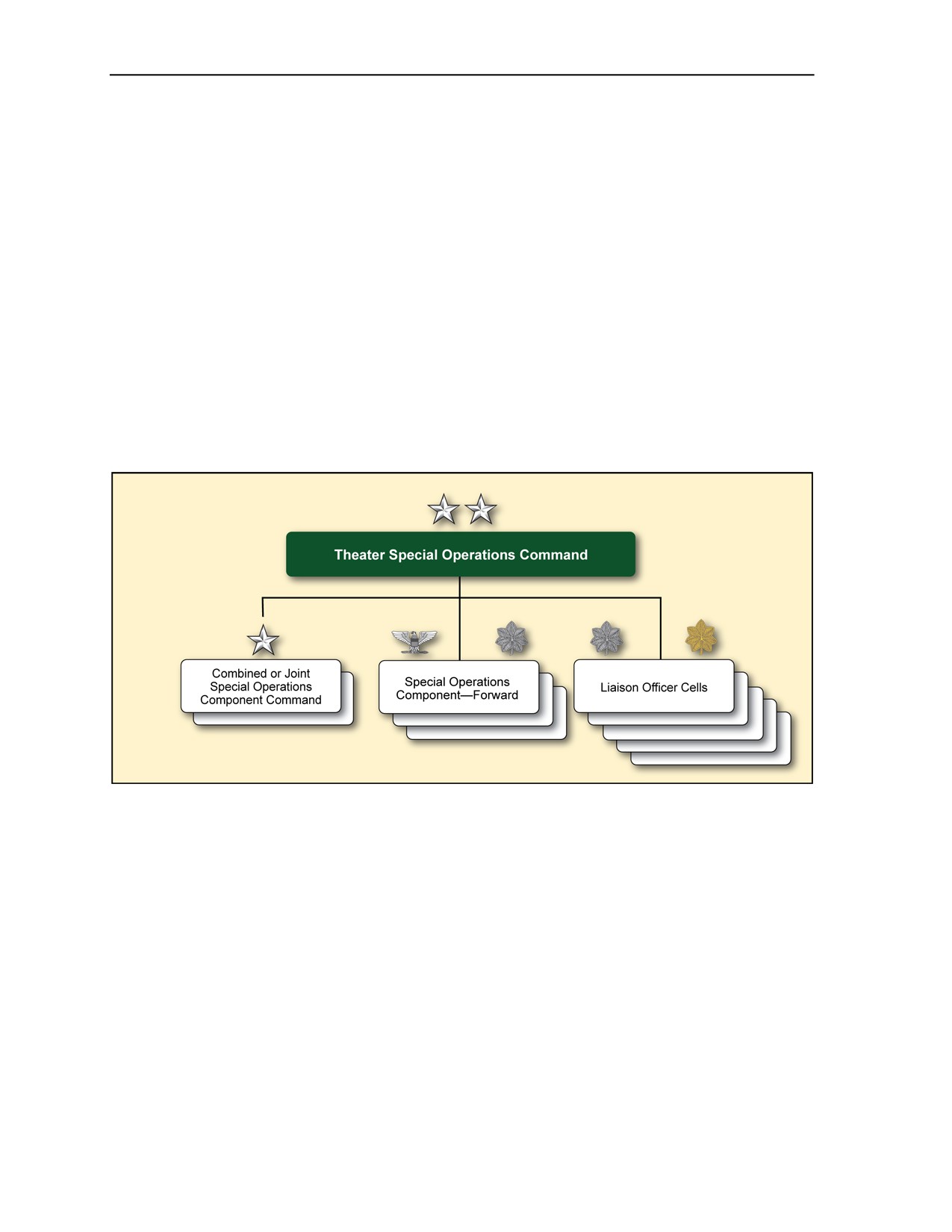
Chapter 5
5-14. The TSOC may be assigned a geographic area for conduct of special operations. This geographic area is
designated a joint special operations area. All external agencies must coordinate with the TSOC or special
operations JTF before conducting any actions that may affect operations within the joint special operations
area. In addition to U.S. SOF, other U.S. or multinational military organizations and interagency organizations
may have elements operating in the joint special operations area. The commander of the TSOC makes every
effort to identify these elements. He coordinates to establish command and support relationships and
establishes the proper degree of coordination and cooperation through liaison elements.
DISTRIBUTIVE COMMAND AND CONTROL
5-15. The post-9/11 shift away from the conventional to irregular warfare has dramatically affected the
national policy and military strategy, which, in turn, has caused both expansion and evolution of the U.S.
special operations global effort. This change has been experienced on differing scales in every geographic
combatant command area of responsibility and affected every TSOC. TSOCs are developing a theater-wide
architecture of distributive command and control in which command nodes of varying sizes are inserted into
regional campaigns to provide a special operations voice and influence to the JTFs and Chiefs of Mission.
Such an arrangement improves SOF relationships with other agency partners and allies, and it helps the TSOC
develop a cadre of campaign experts who rotate between nodes and TSOC headquarters. Figure 5-4 is an
example of distributive command and control.
Figure 5-4. Example of distributive command and control
5-16. Distributive command and control provides continuity and leadership in key locations where SOF
operate, and nodes that facilitate the surging (with force economy) of high-demand low-density enablers, if
needed. Additionally, distributive command and control enables special operations to better integrate
campaign efforts with JTF headquarters and to coordinate with Embassies and HN organizations. Further,
it relieves tactical elements from policy-level engagement tasks so that they can concentrate on the tactical
matters that are their primary purpose. Distributive command and control allows the TSOC to remain
postured to leverage its platforms in places where forces are deployed and support GCC requirements
where the forces cannot be deployed. Finally, distributive command and control ensures that the assigned
effects are achieved in country proactively and preventatively. Such a posture is the one and only
capability that can touch the whole region.
5-6
FM 3-18
28 May 2014
Employment
5-17. The following architecture’s conceptual modules are used where SOF-centric campaigns within specific
lines of operations are being executed. These modules can be grouped into the following three categories:
z
Special Operations Forces Component Command. This module exists when a JTF is present;
for example, the Combined Forces Special Operations Component Command-Afghanistan. The
SOF component command is the largest of the three types of modules and is sufficiently
functional in order to interface properly with a JTF on the JTF’s full battle rhythm. The SOF
component command will be under the command of a SOF general officer and operate in nations
where DOD leads U.S. Government efforts. The primary goals of the SOF component command
are to defeat the enemy, provide security, and conduct the full range of military operations in
concert with conventional forces. By demonstration in both Iraq and Afghanistan, relieving the
JSOTF of this interface requirement provides dividends at all levels of the chain of command.
z
Special Operations Component—Forward. These modules have been employed in key
strategic locations outside of major combat theaters/countries where there is persistent
operational activity, but no JTF. The special operations command-forward is literally a
persistent extension of the TSOC headquarters into the HN, providing a high confidence conduit
for the commander of the TSOC to partner with the U.S. country team maintaining direct
operational oversight, while providing dedicated leadership and continuity with a direct
connection to the chief of mission/embassy. Normally led by an experienced SOF Army colonel
or Navy captain, the special operations command-forward is empowered by the commander of
the TSOC with decisionmaking authorities to proactively engage with HN and U.S. mission
organizations. A special operations command-forward will operate in nations where the
Department of State leads U.S. Government efforts. In these instances, both the HN and U.S.
mission are sensitive to the footprint in size and visibility of a SOF presence in the HN. The
primary goals of the special operations command-forward are to build relationships, provide
situation awareness, coordinate operations, and apply indirect approach.
z
Liaison Officer Cells. These are used where operational activity is recurring, but still episodic
and of a smaller scale; thus, the only persistent requirement in country is for a liaison function.
Normally led by an experienced SOF Army lieutenant colonel or Navy commander, these
liaison officer cells will operate in the theater where the Department of State leads U.S.
Government efforts. Here, both the HN and U.S. Government are very sensitive to footprint in
size and visibility of a SOF presence. The primary goals are to build relationships, provide
situation awareness, and facilitate planning.
5-18. The architecture’s nodes are tethered by design and have operational reachback to the TSOC
headquarters. Use of this reachback and a rotation of personnel between the forward and rear nodes is a SOF
variation of the Afghanistan/Pakistan Hands Program. Reachback allows the TSOCs to capitalize on regional
experience and grow functional depth or “benches” of experienced personnel within many disciplines. This
has nurtured habitual relationships with their functional counterparts in a number of countries, in addition to
having operational relationships peculiar to one specific country/location. Such reachback can be efficiently
achieved if, among other things, it is enabled by an appropriate distribution of high-demand low-density
specialties that cannot reasonably be populated to each node. For that reason, it is logical to centralize a
number of capabilities at TSOC headquarters, within reach, and then make these capabilities available, as
required, to the forward nodes on a case-by-case basis. Examples of this include intelligence analysts, engineer
project managers, and SOF and contingency contracting officers. Special Operations Component, U.S. Central
Command, distributive command and control nodes, as well as those similar nodes employed by other TSOCs,
are essential to the current execution of the command’s SOF campaign plans.
5-19. Successfully achieving the engagement missions assigned to special operations requires strong
relationships with interagency, allies, and partners that are best enabled and maintained through presence in
the region and sustained, focused interaction with the partner forces. Distributive command and control is
the primary method for controlling and synchronizing widespread and simultaneous operations, activities,
and actions. Each node provides the means to influence complex environments through the development of
a long-term relationship with partner-nation leaders and the American Embassy country teams. This
capability promotes regional solutions to specific problems sets. It also extends operational reach,
enhancing capability to conduct campaign planning, and provides a special operations organizational
28 May 2014
FM 3-18
5-7

Chapter 5
platform that can rapidly transition from a peacetime to wartime footing in times of crises to execute
contingency plans.
TASK FORCES
5-20. Each GCC has tasked specified subordinate commanders with the “be prepared” mission of forming
a JTF headquarters to support area of responsibility requirements (Figure 5-5). The JTF headquarters may
be established for a short-duration mission, such as a contingency operation (for example, noncombatant
evacuation operation), or for continuous joint operations, such as JTF-Bravo in Honduras.
Figure 5-5. Notional joint task force command and control
5-21. Headquarters, USSOCOM, established a deployable JTF headquarters core staff (JTF 487). JTF 487
achieved an initial operating capability as of 31 May 2010. JTF 487’s organizational construct provides the
GCC a capability optimized for irregular warfare. It is structured and equipped to deploy within 10 days of
notification in support of a GCC’s emerging irregular warfare JTF requirements. It is ideally suited to
substitute for, sustain, or replace a deployed TSOC or other organization. JTF
487 combines three
USSOCOM elements:
z
Joint Task Force Sword. This task force provides the first echelon of the JTF headquarters
staff and within 10 days establishes an initial command and control operating capability (18 to
31 personnel).
5-8
FM 3-18
28 May 2014
Employment
z
Headquarters, United States Special Operations Command. This headquarters provides key
staff personnel to establish the second echelon within 30 days and brings joint assets and
seasoned irregular warfare experienced staff.
z
U.S. Army Special Forces Command. This command provides the commanding general and
the command element for JTF 487. Commander, USASFC, task organizes based on mission
analysis to ensure specific skill sets are tailored for the GCC, the country, and the mission, and
must be prepared to deploy within 30 days of notification.
5-22. JTF Sword is a headquarters with the mission tasking of forming a JTF. JTF Sword is a joint table of
allowances and joint table of distribution organization for the purpose of providing the Commander,
USSOCOM, the ability to deploy a special operations JTF core element to facilitate the rapid establishment
of a command and control element to support GCC requirements. JTF Sword is an organized, trained, and
equipped deployable SOCCE that will primarily execute missions at the operational level for short-duration
deployments (less than 180 days). JTF Sword is also tasked by Commander, USSOCOM, to test and
conduct combat and operational evaluations of SOF control systems. JTF Sword is organic to USSOCOM
and assigned under the USSOCOM Directorate of Operations with duty at Fort Bragg, North Carolina.
JTF Sword is the primary core element for USSOCOM’s JTF 487. Commander, USSOCOM, can also task
JTF Sword to deploy independently of JTF 487.
5-23. The TSOC is another one of the headquarters with this mission tasking. It provides the GCC a
responsive special operations JTF headquarters capability for contingencies. It is proficient in joint,
multinational, and interagency operations. In those situations where another subordinate is tasked to form
the JTF, the TSOC recommends an appropriate special operations force structure for attachment to, and
employment by, that JFC.
5-24. As described in JP 3-0, a JFC normally organizes forces with a combination of Service and
functional components and subordinate JTFs. Although all joint forces include Service components, a key
decision by the JFC is the type of functional components or JTFs required to accomplish the mission. In the
SOF environment, these two organizations are the joint force special operations component (a functional
component) or a special operations JTF (a subordinate JTF). A joint force special operations functional
component lacks the organizational flexibility and authority of a JTF. Therefore, JFCs typically establish a
special operations JTF.
Special Operations Joint Task Force
5-25. The special operations JTF is a task force through which USSOCOM will present all theater SOF
under one special operations commander. For crisis response, contingency, and major operations and
campaigns, SOF may deploy a special operations JTF where all SOF report to one special operations
commander and the packaged force includes all enabling capabilities (organic to special operations
formations and those Service-provided conventional forces capabilities) required to optimize the
effectiveness of the special operations JTF. A special operations JTF is an operational-level organization
that may have one or more subordinate JSOTFs (Figure 5-6, page 5-10).
Joint Special Operations Task Force
5-26. When deployed, SF operations are organized by a system of operational bases into task forces—the
JSOTF, the SOTF, and the AOB. Each level of SF command task organizes its task force to establish
tactical facilities at these operational bases with specific functions.
28 May 2014
FM 3-18
5-9

Chapter 5
Figure 5-6. Notional theater special operations joint task force
5-27. A JSOTF is a JTF composed of special operations units from more than one Service established to
conduct a specific special operation or to prosecute special operations in support of a campaign or other
operations. A JSOTF may have conventional non-special operations units assigned or attached to support
the conduct of specific missions in the following situations:
z
A JSOTF, like any JTF, is normally established by a JFC—for example, a combatant
commander, a subordinate combatant commander (such as a commander of a TSOC), or a JTF
commander. For instance, a GCC could establish a JTF to conduct operations in a specific
region of the area of responsibility. Then, either the GCC or the JTF commander could establish
a JSOTF, subordinate to that JTF, to plan and execute special operations. Likewise, a
commander of a TSOC could establish a JSOTF to focus on a specific mission or region
assigned by the GCC. A JSOTF may also be established as a joint organization and deployed as
an entity from outside the area of responsibility.
z
A JSOTF is established to conduct operations in a specific area of operations or to accomplish a
specific mission. If geographically oriented, multiple JSOTFs are normally assigned different
areas of operations.
z
Within a JTF, if only one JSOTF is established, the commander, JSOTF, is dual-hatted as the
joint force special operations component commander. When a JSOTF is established to support a
GCC directly, the commander of the TSOC normally acts as the JSOTF commander. Regardless, a
JSOTF commander is a JFC and exercises the authority and responsibility assigned by the
establishing authority. A JSOTF staff is normally drawn from the TSOC staff or an existing SOF
component with augmentation from other SOF or conventional units and personnel, as appropriate.
z
When a JSOTF is established and combined with elements from one or more coalition nations, it
becomes a CJSOTF and its commander becomes a CJSOTF commander.
5-28. A JSOTF headquarters can operate under a number of command relationships. It may be established
to conduct a specific special operation or to prosecute special operations in support of an operational
campaign. As stated in JP 3-0, a JFC (either a GCC or subordinate special operations JTF commander) may
organize the geographic area and forces in any manner to best accomplish assigned missions. The JFC may
direct the JSOTF commander to support another component commander, or subordinate the JSOTF under
another JFC (for example, a special operations JTF commander). The JFC may also attach other Service
forces under the control of the JSOTF for the conduct of operations. The headquarters Service composition
depends on the mission, operational environment, available capabilities and support, and composition of
forces. The JSOTF headquarters may be sourced from USSOCOM and other Service component assets, the
TSOC headquarters, or special operations command components.
5-10
FM 3-18
28 May 2014
Employment
Combined Joint Special Operations Task Force-Afghanistan
The CJSOTF-Afghanistan was established in Bagram, Afghanistan, in May 2002.
CJSOTF-Afghanistan was predominantly manned by personnel from the
headquarters elements of the SFG that was currently conducting combat operations
in Afghanistan. Personnel from other joint and combined branches of the armed
forces completed the manning for this unique organization. Once fully operational,
CJSOTF-Afghanistan assumed responsibility for the command and control of most
SOF in Afghanistan.
When established, CJSOTF-Afghanistan consisted of two U.S. Army SF battalion
SOTFs along with the SOF task forces from several partnered nations, including the
United Arab Emirates, France, Australia, Canada, and the United Kingdom. As the
mission evolved over time to support strategic objectives, CJSOTF-Afghanistan had
grown in size and (as of 2011) consisted of two U.S. Army SF SOTFs, one U.S.
Marine Corps SOTF, and one U.S. Navy Special Warfare SOTF along with United
Arab Emirates, Canadian, and French SOF task forces.
5-29. As noted, ARSOF may be tasked to form the core of an ARSOF-heavy JSOTF. The SFG is the most
likely ARSOF headquarters to form this core. The group headquarters is the preferred ARSOF
headquarters because of its organic mission command capabilities. The group has self-contained
communications and support elements. It also has area expertise, extensive experience with and knowledge of
instability, and prior operations with the foreign nation government and its military forces. However,
significant augmentation from the other Services is required to transform any ARSOF headquarters into a
JSOTF. Figure 5-7, page 5-12, depicts a notional JSOTF.
COMBINED FORCES SPECIAL OPERATIONS COMPONENT COMMAND
5-30. The combined forces special operations component command is an emergent special operations
headquarters element that has been used to provide special operations representation to interface with
appropriate campaign command and control elements. This headquarters represents theater special
operations and their with-and-through perspective in HN senior leader-level engagements, and in the
U.S./coalition boards, centers, and cells that help shape the operational campaigns, which are in many ways
very SOF-centric (Figure 5-8, page 5-13).
Special Operations Task Force
5-31. The JSOTF may consist of SOF from each of the Services. Each Service force senior commander
retains Service responsibilities (administrative control) of those Service forces. For example, in most
instances, the SFG commander exercises administrative control of Army personnel attached to the JSOTF.
Likewise, the Air Force SOF commander exercises administrative control of Air Force personnel.
28 May 2014
FM 3-18
5-11

Chapter 5
Figure 5-7. Notional joint special operations task force
Theater Special Operations Forces Expertise
In the Special Operations Component, U.S. Central Command, area of responsibility
(Iraq and Afghanistan) both had ample theater SOF expertise at the tactical level in
the form of the CJSOTF. These formations are the best at what they do; however,
what was missing was theater SOF expertise at the operational level, namely at the
International Security Assistance Force and U.S. Forces-Iraq.
To fill the void, two one-star-level commands were fielded: Joint Force Special
Operations Component Command-Iraq and Combined Forces Special Operations
Component Command-Afghanistan.
5-12
FM 3-18
28 May 2014

Employment
Figure 5-8. Example of Combined Forces Special Operations
Component Command—Afghanistan organization
28 May 2014
FM 3-18
5-13
Chapter 5
5-32. The JSOTF commander may also designate and organize operational and functional organizations
for employment of forces. The commander may designate and organize a joint special operations air
component commander to control all special operations air assets functionally. Likewise, a single SOTF
may be designated and organized to provide operational direction of ARSOF. The JSOTF commander may
also decide to designate and organize several subordinate SOTFs to conduct specific special operations
missions. In this situation, the JSOTF commander would directly exercise operational control of each task
force and the senior ARSOF commander would continue to exercise administrative control responsibilities
for all ARSOF within those task forces.
5-33. When the JSOTF commander has numerous and diverse missions and large numbers of Army forces,
he may designate multiple SOTFs and exercise direct operational control of each. Each SOTF is organized
around the nucleus of an ARSOF unit and can include a mix of ARSOF units and their support elements.
The commander, JSOTF, assigns each SOTF an area within the joint special operations area or functional
mission. Figure 5-9, page 5-15, shows a notional SOTF organization.
5-34. Since the SFG and SF battalion are multipurpose and extremely flexible organizations designed to
have self-contained mission command and support elements for long-duration missions, the SOTF
headquarters is normally based around the core of an SFG or SF battalion headquarters. The Ranger
Regiment may also form a SOTF headquarters for large-scale Ranger operations. The SOTF commander
augments a staff with appropriate special staff officers and liaison officers taken from attached and
supporting assets to integrate and orchestrate all activities of the SOTF. In the case of an extremely large
SOTF that exceeds the mission command capabilities of the organic headquarters, the commander may
have to request external staff augmentation to ensure adequate mission command.
5-35. In some situations, the SOTF or a subordinate ARSOF unit may receive operational control or
attachment of a conventional maneuver unit. This situation most likely occurs—
z
In a UW environment when an ARSOF-supported indigenous combat force needs added combat
power for a specific combined arms operation.
z
When the SOTF needs a conventional reaction or reinforcement force for its special operations.
z
In linkup or post-linkup combat operations during the combat employment phase of an
insurgency.
z
During contingency operations when the SOTF headquarters is the senior Army headquarters in
the area of operations.
TASK FORCE ORGANIZATION
5-36. The SOTF commander will normally task organize a unit into a series of centers to coordinate
operations when deployed. A center is a control facility with a supporting staff established for a specific
purpose. These centers have a narrow focus; however, the activities of these centers are interdependent.
The centers are normally the operations center, the signal center, and the support center. The operations
center revolves around operational concerns, from mission planning to intelligence and execution. The
signal center installs, operates, and maintains the unit’s internal and external systems. The support center
provides logistics support to the unit. These centers are also normally formed at the battalion or SOTF level
to mirror the group. Although the battalion SOTF or group JSOTF may form these centers, the staff
sections for these organizations are still very adept at communicating, functioning, and interacting with the
staff sections of both conventional or coalition forces that are organized in a standard staff configuration.
Operations Center
5-37. Whereas functional cells group personnel and equipment by warfighting functions, integrating cells
group personnel and equipment to integrate the warfighting functions by planning horizons. A planning
horizon is a point in time commanders use to focus the organization’s planning efforts to shape future
events. Planning horizons are situation-dependent; they can range from hours and days to weeks and
months. As a rule, the higher the echelon, the more distant the planning horizon with which it is concerned.
5-14
FM 3-18
28 May 2014

Employment
Figure 5-9. Notional special operations task force organization
5-38. The operations center is cross-functional by design and, by including representatives from almost all
staff sections within the SOTF, supervises all operational elements of mission planning and execution.
Combined with a robust communications package, the operations center is charged to plan, prepare,
coordinate, execute, control, and assess all current, mid-range, and future operations for a designated area
of responsibility. It performs the functions of a conventional unit’s tactical operations center. Figure 5-10,
page 5-16, shows the operations center organization.
28 May 2014
FM 3-18
5-15

Chapter 5
Figure 5-10. Operations center organization
5-39. The operations center director, normally the task force operations staff officer, ensures the complete
orchestration of the intelligence staff office, operations staff office, and CAO staff office activities within
the operations center. The operations center director or SOTF commander may further choose to task
organize the operations center into smaller sections or cells dependent on the current situation and mission.
5-16
FM 3-18
28 May 2014

Employment
Examples include the joint operations center, the fusion cell, the nonlethal effects cell, the special actions
cell, and the future operations cell. These centers or cells are formed and manned to perform specific
functions within the operations center, such as current operations, plans, and future operations and are
described below. Figure 5-11 shows a notional operations center.
Figure 5-11. Notional operations center
28 May 2014
FM 3-18
5-17
Chapter 5
5-40. The joint operations center will normally be directed by the task force current operations cell, and is
the focal point for all operational matters. The joint operations center will be charged to monitor, direct,
coordinate, and control all current operations and taskings. The planning horizon for the joint operations
center will be situational dependent and determined by the operations center director or SOTF commander.
It may range from hours to days. Normal manning usually consists of the operations officer or assistant
operations officer as the battle captain, the aviation officer, the fire support officer, the chemical officer,
the senior operations sergeant, the fire support sergeant, the assistant operations sergeant, the information
systems specialist, the special operations weather team, and the various liaison officers for higher, adjacent,
subordinate, supporting, and supported units operating in the designated area of responsibility. In order to
provide the task force commander with all critical and relevant information during special events or critical
situations, the joint operations center may also be further manned or supported with additional personnel
from the support center, fusion cell, nonlethal effects cell, or special actions cell, such as the medical
section, personnel staff office, the judge advocate general, the MIS officer, the CAO officer, and
intelligence or imagery analysts as necessary. This will allow the joint operations center, fusion cell, and
nonlethal effects cell to perform crisis or time-sensitive planning and determine when to implement
potential branches and sequels as current plans and operations develop to ensure success on the battlefield.
5-41. The fusion cell will normally be directed by the task force future operations cell, and will be charged
to monitor all activities on the battlefield and conduct the detailed resourcing, training, manning, and
equipping needed for future plans and future operations that will drive the fight on the battlefield. The
planning horizon for the fusion cell is also situational dependent and may range from days to weeks.
Normal manning will usually consist of the future operations cell, intelligence staff officer, military
intelligence detachment commander, operations sergeant, operations and intelligence sergeant, engineer
sergeant, intelligence analysts, imagery analysts, counterintelligence, human intelligence, and signals
intelligence personnel. By performing detailed planning, close coordination, synchronization, and
information sharing across staff sections according to lines of effect and lines of operations, the fusion cell
is able to develop effective plans, branches, and sequels that achieve the task force commander’s desired
results. During special events or critical situations, the fusion cell may support the joint operations center
by providing the task force commander with current and historical intelligence information for a specific
area or specific individual, as well as the ability to control and analyze full-motion video collected from
unmanned aircraft systems.
5-42. The nonlethal effects cell may be established within the fusion cell, or as its own cell under the
operations center. Normally directed by the task force CAO staff officer, the nonlethal effects cell will
consist of the task force CAO staff office, public affairs officer, combat camera personnel, and attached
MIS. Additional personnel from the joint operations center, fusion cell, or special actions cell may
temporarily work within the nonlethal effects cell as the situation or mission may dictate. These personnel
will contribute their subject-matter expertise to the nonlethal effects cell mission and then return to their
normal duties. The nonlethal effects cell will be charged with contributing information superiority to plans
by promoting current and future operations and by degrading or negating the threat’s operations, which
results in a distinct information advantage. This is achieved by integrating information-related capabilities
into the early stages of developing operation plans, concepts of operations, and operations orders, and
applying their capabilities across the full range of operations. Examples include overseeing various civil-
military operations projects and military deception operations, conveying the approved U.S. or coalition
task force message to the local populace, coordinating for both U.S. and foreign media events and press
releases, and managing any positive or negative consequences resulting from current operations.
5-43. The future operations cell is effectively the program manager used for future planning needed for the
expansion of current operations and programs. This cell provides the commander a wider range of
possibilities or courses of action to make more of an influence on the ever-changing world and battlefield
to come. The planning horizon for future operations may range from weeks to months. With only a small,
dedicated cell of core planners under the direction of the operations warrant officer, all staff sections,
centers, and cells assist as required, and then return to their normal duties. Whereas a JSOTF has a small
group of core planners, a SOTF is not fully resourced for a plans cell and personnel balance future
operations with other staff functions.
5-18
FM 3-18
28 May 2014

Employment
5-44. The special actions cell may be established within the fusion cell or as its own cell under the
operations center. Special actions are those functions that, due to particular sensitivities, compartmentation,
or caveats, cannot be conducted in normal staff channels and therefore require extraordinary processes and
procedures and may involve the use of sensitive capabilities (JP 3-05.1). These actions are frequently
interagency in nature, involve sensitive capabilities, and almost always are not releasable to coalition
partners or allies. The special actions cell, under the direction of the SF warrant officer or a plans officer,
may be manned with the operations and intelligence sergeant, the senior strategic debrief sergeant,
counterintelligence personnel, and the intelligence sergeant. The special actions cell does not control
intelligence functions that are normally purview to the intelligence staff officer, but coordinates special
actions closely with the intelligence staff officer functions. Generally, the special actions cell will be
responsible for the following functions:
z
Compartmented planning support.
z
Interagency/Special Mission Unit operational integration.
z
Advanced special operations.
z
Special operational support.
z
Special tactical operations.
z
Nonconventional assisted recovery.
z
Compartmented information management.
Further description and information of the special actions cell and its responsibilities is found in JP 3-05.1.
Signal Center
5-45. Under the direction of the task force signal staff officer, the signal center installs, operates, and
maintains secure, reliable, and long-range communications between the task force and higher, adjacent,
subordinate, supporting, and supported headquarters, and deployed ODBs and ODAs. The signal center
also installs, operates, and maintains internal and external communications. The signal center normally
consists of the unit signal staff section, organic signal detachment, and attached or supporting signal
elements (Figure 5-12). At the JSOTF level, the signal center director normally task organizes these assets
into a signal support coordination element, electronic maintenance section, system control section,
communications security section, communications center, multimedia section, and message center. In most
instances, no multimedia function exists at the SOTF level and the system control section may also perform
signal support coordination element functions. Additionally, the SOTF does not have an organic electronic
maintenance section and normally evacuates electronic equipment to the JSOTF for maintenance.
Figure 5-12. Signal center organization
28 May 2014
FM 3-18
5-19

Chapter 5
Support Center
5-46. When the group establishes a JSOTF, the group support operations officer serves as the support
center director and the headquarters support company commander assumes these duties when the battalion
forms a SOTF. These duties require direct interface with theater Army logistics support elements. In
coordination with the operations staff officer and headquarters commandant, the group support company
commander prepares the base defense plan and supervises the activities of the JSOTF base defense
operations cell.
5-47. The support center is the functional activity that provides logistical support to the task force and its
subordinate elements. The support center performs the functions of a conventional unit’s trains. The
support center normally consists of the task force personnel staff office, logistics staff office, forward
support company, motor pool, medical section, property book office, unit ministry team, organic support
company, and appropriate direct support-level logistics and force health protection attachments
(Figure 5-13). The support center director is normally the support company commander, who is responsible
to the task force commander for the execution of all base logistics support and force health protection
operations, base support plan, and base security.
Figure 5-13. Support center organization
5-48. The HHC commander or the group support company commander can be the headquarters
commandant at the JSOTF level. The support company commander or the executive officer assumes the
duties of the headquarters commandant at the SOTF level. The headquarters commandant is responsible for
support center details, including billeting, food service, space allocation, and internal guard duties, and also
directs base defense operations and base emergency evacuation planning. The headquarters commandant,
along with the base chemical defense officer, establishes mission-oriented protective posture for base
CBRNE defense.
5-49. At the JSOTF support center, the personnel staff office, logistics staff office, and surgeon plan and
coordinate logistics support and force health protection for the JSOTF and subordinate bases. Whenever
possible, they coordinate throughput distribution to the SOTF or the AOB level. When two bases collocate,
the JSOTF commander may decide to collocate or consolidate the support centers for mutual support. At
the SOTF support center, the personnel staff office, logistics staff office, and surgeon plan and coordinate
the logistics support and force health protection for the SOTF, its subordinate AOBs, and its deployed SF
units and SOT-As. At the AOB support center, logistics support is normally limited to unit-level functions
that support the current operations. The support center plans and controls the administrative activities of
the task force, including the coordination of facilities engineering and other base operations support. The
support center maintains the unit basic load and supplies. The support center also manages stocks,
coordinates movements, provides or arranges for maintenance, requisitions and coordinates logistics
support requirements, controls personnel management, and supports the training and preparation of
uncommitted ODAs and SOT-As.
5-20
FM 3-18
28 May 2014

Employment
Base Defense Operations Cell
5-50. The base defense operations cell, under the direction of the headquarters commandant, ensures
specific responses and procedures are established, reviewed, and practiced for base defense. The preferred
base defense option is for U.S. elements to secure the JSOTF or SOTF bases and activities. When
available, military police or infantry security elements may be attached for specific base defense duties. In
addition, the supported HN force may provide physical security to the base. The SF base commander’s last
resort option is to divert support or operational personnel for base security. SF bases employ standard
CBRNE defense measures to protect themselves in the CBRNE environment.
Advanced Operations Base
5-51. Within SF, operations are normally decentralized. For this reason, an ODB establishes a small
temporary base near or within a joint special operations area to mission command and/or support training
or tactical operations. Facilities are normally austere. The base may be ashore or afloat. If ashore, it may
include an airfield or unimproved airstrip, a pier, or an anchorage. An AOB is normally controlled and/or
supported by a main operations base or a forward operations base (JP 3-05.1). Figure 5-14 shows an AOB
organization.
Figure 5-14. Advanced operations base organization
5-52. The ODB transformed into an AOB is a multipurpose mission command element that can exercise
control over one to six ODAs. Although it will normally require augmentation from either a SOTF or
JSOTF assets to perform these missions, the ODB is normally employed in one of following three ways:
z
The ODB can serve as an AOB. In such instances, it is usually small, light, and tailored to
perform specific missions, such as mission command, forward launch and recovery, logistics,
and communications.
z
The ODB can establish an isolation facility within the framework of the SOTF to isolate and
prepare up to six ODAs for infiltration, mission execution, exfiltration, and reconstitution.
z
The ODB can establish a SOCCE or SF liaison element at a functional component or Service
force headquarters to facilitate JFC-designated command relationships between the JSOTF and
that headquarters.
5-53. The ODB plans and conducts SF operations separately or as part of a larger force. It also—
z
Trains and prepares ODAs for deployment.
z
Acts as a mission command element of all subordinate elements during the conduct of special
operations missions.
28 May 2014
FM 3-18
5-21
Chapter 5
z
Infiltrates and exfiltrates specified operational areas by air, land, or sea.
z
Conducts operations in remote and denied areas for extended periods with minimal external
direction and support.
z
Develops, organizes, equips, trains, and advises or directs indigenous forces up to regiment size
in special operations activities.
z
Trains, advises, and assists other U.S. and multinational forces and agencies.
z
Organizes, advises, and assists a UW area command in a specified joint special operations area.
z
Serves as a pilot team to assess the resistance potential in a specified joint special operations area.
z
Performs other special operations activities as directed by higher authority.
SF units will rarely conduct company-size operations. When multiple ODAs are tasked to conduct
unilateral, joint, or multinational operations together, an ODB will usually be tasked to execute mission
command and support for that specific mission.
SPECIAL OPERATIONS COMMAND AND CONTROL ELEMENT
5-54. Within a joint force, ARSOF assets are ordinarily attached to and under operational control of a
designated JSOTF commander. These ARSOF assets may often operate in proximity to other components
of the JTF or support those components as part of the JSOTF’s mission taskings and supporting
commander’s responsibilities. When possible, liaison is reciprocal between higher, lower, supporting,
supported, and adjacent organizations (that is, each one sends a liaison element to the other). In such
instances, the JSOTF commander may elect to employ SOCCEs to coordinate unilateral special operations
with conventional ground force headquarters or, if a supporting commander, facilitate his responsibilities
to the supported commander.
5-55. As a supporting commander, the JSOTF commander ascertains and fulfills the needs of the
supported commander within the parameters imposed by the JTF commander. The JSOTF commander
determines the type of force, employment, and procedures to accomplish the support, and normally
employs a SOCCE to facilitate the supporting commander’s responsibilities to a ground force commander.
The SOCCE remains under the operational control of the JSOTF commander.
5-56. The SOCCE assists the JSOTF commander in fulfilling the supporting commander’s responsibilities
in several ways. It provides a positive means for the JSOTF commander to ascertain the supported
commander’s needs. The SOCCE may provide a responsive reporting capability in those situations where
the JSOTF commander has been requested to provide information requirements of the supported
commander (for example, special reconnaissance reporting). The SOCCE can exercise command and
control of designated ARSOF units when the JSOTF commander determines the need for such a command
relationship to facilitate the supporting commander’s responsibilities. The SOCCE can also provide a
monitoring capability if the JSOTF commander decides to transfer ARSOF under a command relationship
of the supported commander—for example, the attachment of SF detachments under the control
(operational control or tactical control) of the Army forces to improve the Army forces commander’s
ability to employ subordinate multinational forces. The JSOTF commander could transfer these forces and
pass control to the Army forces with appropriate mission restrictions in accordance with a determination on
the employment of those forces, such as “no reorganization of forces authorized” or “for use only in an
advisory assistance role with the designated multinational force.”
5-57. A SOCCE is augmented with a special communications package and personnel, as required. It may
include SF, Ranger, MIS, CA, special operations aviation, and other SOF representatives. The SOCCE is
normally collocated at corps level and above, with smaller liaison teams operating at division level and
below. The supported unit provides the SOCCE the required administrative and logistics support. The
SOCCE is the focal point for synchronization with the conventional forces. At corps level, the SOCCE
coordinates with the corps operations center, fire support element, deep operations coordination cell, and
battlefield coordination detachment to deconflict targets and operations. It provides ARSOF locations
through personal coordination and provides overlays and other data to the fires cell and the battlefield
coordination detachment. Figure 5-15, page 5-23, shows a SOCCE organization.
5-22
FM 3-18
28 May 2014

Employment
Figure 5-15. Example of special operations command and control element organization
SPECIAL FORCES LIAISON ELEMENT
5-58. The SF liaison element is an SF element that conducts liaison between U.S. conventional forces and
HN or multinational forces. It is formed only as needed. SF liaison elements conduct these functions when
conventional forces or host or multinational forces have not practiced interoperability before the operation,
when the forces do not share common operational procedures or communications equipment, or when a
significant language or cultural barrier exists.
LIAISON OFFICER MISSIONS, FUNCTIONS, AND ROLES
5-59. SF liaison officers report to the special operations commander or special operations component
commander and are dispatched to applicable conventional JTF components. SF liaison officers execute
liaison and coordination activities in several capacities. Whether individually, in teams, or as organic
members of assigned staffs, liaison officers and coordination representatives perform several critical
functions that are consistent across the range of military operations. SF liaison officers ensure the timely
exchange of necessary operational and support information to aid mission execution and preclude
fratricide, duplication of effort, disruption of ongoing operations, or loss of intelligence sources. They may
assist in the coordination of fire support, overflight, aerial refueling, targeting, deception, MISO, and other
operational issues based on ongoing and projected special operations missions. Liaison elements from SF
must be trained, empowered, and resourced. Depending on the mission, it may or may not require an entire
ODA. For coordination at brigade or below, ODAs may have to coordinate directly with brigade, battalion
task forces, and companies, dependent upon the area of operations and the amount of coordination
necessary. ODAs may need to coordinate crossing area of operations boundaries, conducting operations in
specific areas of operations, or requesting support from conventional units in the area of operations in
which the ODA operates.
TRAINING PROGRAMS
5-60. Training programs include theater security cooperation plan events, joint combined exchange
training events, and counternarcoterrorism training.
THEATER SECURITY COOPERATION PLAN EVENTS
5-61. Many different units conduct theater security cooperation plan events covering a wide range of
activities. SF units are used for specific reasons with associated laws, authorities, and fund sources. These
events are tools for the GCC’s peacetime campaign strategy to gain or maintain U.S. access to strategically
important foreign countries in support of the American Embassy and U.S. security interests. Security
cooperation activities advance those interests by creating new partnerships and building the capacity of
existing partnerships. This section addresses two types of theater security cooperation plan events
conducted by SF.
28 May 2014
FM 3-18
5-23
Chapter 5
JOINT COMBINED EXCHANGE TRAINING
5-62. The joint combined exchange training program provides combatant commanders with trained and
ready SOF to execute their theater campaign plans or respond to regional crises. The joint combined
exchange training program is unique in that its requirements are based on SOF mission-essential task lists,
shaped by the theater strategy, orchestrated by TSOCs and the U.S. Ambassador
(or his or her
representative), approved by the Secretary of Defense in coordination with the Secretary of State, and
executed by the individual unit. SF has unique training requirements for core missions, such as FID,
counterinsurgency, and UW, in which SF detachments deploy to foreign nations in order to train on SOF
mission-essential task lists and develop skills in the cross-cultural environments. Joint combined exchange
training programs are primarily conducted by ODAs; however, other components of USSOCOM also
participate in the program. Joint combined exchange training programs are the primary mechanism for the
group commanders to train their ODAs on these unique core mission-essential task lists in their regionally
aligned operational environments. The joint combined exchange training program provides regional
orientation, language immersion, and combined training with potential coalition partners. Joint combined
exchange training programs are also the most scrutinized form of joint and combined training and require
more regulatory guidance than Joint Chiefs of Staff exercises.
5-63. The joint combined exchange training program deploys SF teams overseas to train with foreign
security forces. The typical joint combined exchange training is executed by an ODA; however, multiple
ODAs training under the direction of an ODB are not uncommon. Additionally, ARSOF enablers, such as
MISO, CA, and ARSOF aviation, may also participate to increase interoperability as well as train their
mission-essential task lists. These organizations generally train with the HN/partner-nation forces in
doctrinal disposition, generally training 30 to 100 HN participants per ODA. The joint combined exchange
training program is a series of joint and combined SOF deployments for bilateral training conducted in an
area of responsibility.
5-64. Joint combined exchange training events cover a wide range of activities. The primary focus of the
program is to improve unit and individual combat readiness of U.S. SOF while providing an ancillary
benefit to the friendly armed forces and enhancing bilateral relations and interoperability throughout the
region. (Military-to-military contacts are covered under Title 10, U.S. Code, Section 168, Military-to-
Military Contacts and Comparable Activities.) Secondarily, the joint combined exchange training program
directly supports regional stability throughout the theater. Training typically focuses on small-unit tactics,
marksmanship, medical skills, command and control, and other FID, counterinsurgency, and UW training
mission-essential tasks. These have specific authorities under the following:
z
Title 10, U.S. Code, Section 401, Humanitarian and Civic Assistance Provided in Conjunction
With Military Operations.
z
Title 10, U.S. Code, Section 402, Transportation of Humanitarian Relief Supplies to Foreign
Countries.
z
Title 10, U.S. Code, Section 2561, Humanitarian Assistance.
5-65. In 1991, Title 10, U.S. Code, Section 2011, Special Operations Forces: Training With Friendly
Foreign Forces, codified the “special operations forces exception” to use Title 10, U.S. Code, funds to
train with armed forces or other security forces of a friendly nation. This statute origin was based on a
1986 Comptroller General opinion recognizing a SOF requirement to train foreign forces based on U.S.
SOF FID and UW missions. Based on the culmination of several years of supported legislation by the
DOD, the Assistant Secretary of Defense for Special Operations and Low-Intensity Conflict, and the
USSOCOM, Section 2011 authorizes funding expenses directly related to deploying and training U.S. SOF
tasked with training friendly foreign forces overseas. Additionally, specific incremental expenses are
authorized for funding when training with nations listed on the Secretary of State’s Developing Country
List. USSOCOM Directive 350-3, Joint Combined Exchange Training, provides additional guidance on the
conduct of joint combined exchange training events. This authority is separate and distinct from that
contained in the Foreign Assistance Act. Training evolutions conducted under Section 2011 are called joint
combined exchange training events. Joint combined exchange training is an overseas training event for
which the primary purpose must be to train U.S. SOF. Additionally, the training events must use Section
2011 reporting procedures (commonly referred to as the “2011 report”), must support and be prioritized
5-24
FM 3-18
28 May 2014
Employment
through the GCC’s theater campaign plan, and are primarily Major Force Program-11 funded. Finally, joint
combined exchange training events are prohibited from using security assistance/security force assistance
funds, are coordinated and approved by the U.S. Ambassador and Department of State, and approved by
the Secretary of Defense.
5-66. The term joint combined exchange training cannot be used in conjunction with security
assistance/security force assistance, counterdrug, or humanitarian assistance events. SF can conduct
training with both conventional forces and civilian government agencies. Some joint combined exchange
training events have a particular focus—such as medical, air operations, airborne operations, and maritime
skills—in which SF has the opportunity to train on specific or critical mission-essential task lists.
5-67. U.S. SF teams are ideally suited for these types of engagements. They are highly trained, flexible,
and adaptable. They can adjust quickly to meet the needs of the partner nation with whom they are training.
In addition, SF units are regionally oriented, with personnel spending most of their military career with a
specified group; for example, 5th SFG operates in the Middle East region, while the 1st SFG regional
orientation is Asia. Thus, SF Soldiers not only participate in the HN’s training activities, they have learned
to respect the customs, speak the language, and often participate in HN special cultural activities and
functions.
5-68. The joint combined exchange training program provides excellent combined training opportunities
for all nations involved because it emphasizes the skills required to meet the most likely future military
scenarios at the lower end of the range of military operations. These exchanges also enhance
interoperability among the militaries of the region and promote regional stability. Thus, the joint combined
exchange training program serves many vital needs in multiple regions.
COUNTERNARCOTERRORISM TRAINING
5-69. Counternarcoterrorism training utilizes U.S. SOF in conjunction with law enforcement agencies to
provide country team-requested training to partner-nation law enforcement agencies and military units that
have a counterdrug mission. Legislation enacted in 1989 tasked the DOD to serve as lead agency in
detecting and monitoring illegal drugs entering the United States. The Armed Forces were also authorized
to provide counterdrug-related training and support to domestic and foreign law enforcement agencies. The
President outlined a comprehensive strategy for reducing illegal drug use in the United States and assisting
friendly nations in combating both consumption and trafficking. The counternarcoterrorism program
focuses on demand reduction and drug-related crimes.
5-70. The purpose of the counternarcoterrorism program is to enable (through training) foreign police and
military to act as a force multiplier in the fight against drug flow into the United States and assist partner
nations in controlling illicit activities in littoral waters and on land. All training is requested by the
American Embassy and usually sponsored by a U.S. law enforcement agency or a non-DOD entity
mandated by the Deputy Assistant Secretary of Defense for Counter Narcotics and Global Terror. Training
topics include human rights; tactical movement; marksmanship
(basic/advanced); patrolling; mission
planning (police format); tactical medicine/trauma; arrest procedures; small boat operations; visit, board,
search, and seizure (compliant/non-compliant); close-quarters battle (police format); and investigative
procedures. Counternarcoterrorism is an excellent joint, interagency, intergovernmental, and multinational
program that supports the theater security cooperation plan for the theater. Engagement with foreign police
and the military provides access and placement in regions that no other program achieves.
5-71. Counternarcoterrorism utilizes multiple funding codes for execution. For example, the Joint Interagency
Task Force-West counternarcoterrorism program utilizes Project Code 6504 directly from the Deputy
Assistant Secretary of Defense for Counter Narcotics and Global Terror through USSOCOM for
SOF-supported counternarcoterrorism. Project Code 6504 funds are budgeted by the Joint Interagency
Task Force-West and can only be used for forces subordinate to USSOCOM and only when authorized by
Joint Interagency Task Force-West. Project Code 9202 funds are used to pay for law enforcement agency
integration into counternarcoterrorism. Support includes maintenance, repair, or upgrading of equipment;
transportation of personnel and their equipment; the establishment of bases of operations or training
facilities for counterdrug activities; associated support expenses for trainees; establishment of command
and control networks; linguist services; and aerial reconnaissance. The National Defense Authorization
28 May 2014
FM 3-18
5-25
Chapter 5
Act, Sections 1021 and 1022, authorizes support and names the countries eligible to receive support for
counterdrug activities. Counternarcoterrorism is assistance provided to select countries to combat the
influence of the international criminal drug enterprise on the security and stability of sovereign nations.
Detachments conducting this training are authorized to train, advise, and assist HN military and police
elements to develop effective forces capable of countering the narcoterrorist threat.
EXERCISE PROGRAMS
5-72. Exercise programs are designed to test ARSOF capabilities to operate in realistic, stressful, joint, and
combined arms training according to joint, Army, and ARSOF doctrine. Combat Training Center programs
are events in the continental United States that integrate SOF with conventional forces and conduct
missions that are relevant to the unit mission-essential task list and the area of responsibility. Mission
command and staff training ensures currency in procedures for conventional forces interoperability and
operational synchronization and communications system technology. Programs outside the continental United
States are mission-essential task list-related training and support the GCCs and U.S. Ambassadors with
relevant training and regional expertise.
THEATER JOINT CHIEFS OF STAFF EXERCISE PROGRAM
5-73. The Theater Joint Chiefs of Staff Exercise Program provides SF units with opportunities to conduct
mission-essential task list-related training while participating in joint and combined training events in HN
countries. Joint Chiefs of Staff/GCC exercise programs are demonstrations and assessments of ARSOF
mission capabilities. Joint Chiefs of Staff exercises are developed by the GCCs and TSOCs and
coordinated with USSOCOM during USSOCOM’s semiannual Global Synchronization Conference. Joint
Chiefs of Staff exercises are included in the USSOCOM Global Force Management Allocation Plan, the
database that lists all participating units, locations, dates, and cost estimates. Modifications to the Global
Force Management Allocation Plan are published by USSOCOM as changes occur. Joint Chiefs of Staff
exercises are funded using Joint Chiefs of Staff exercise funds, which are distributed annually by
USSOCOM to USASOC for disbursement to the USASFC and the SFGs.
UNITED STATES SPECIAL OPERATIONS COMMAND JOINT NATIONAL TRAINING
CAPABILITY EXERCISE PROGRAM
5-74. The purpose of the continental United States Joint National Training Capability exercise program is
to provide SFG headquarters training in a joint environment. Generally, these exercises are sponsored by
the USSOCOM as the executive agent of DOD and Joint Chiefs of Staff to conduct joint SOF training.
USSOCOM sponsors field training/mission rehearsal exercises, which are accredited exercise programs in
support of Chairman of the Joint Chiefs of Staff Instruction 3500.01G, Joint Training Policy and Guidance
for the Armed Forces of the United States. Headquarters, USSOCOM, directs U.S. SOF, conventional
forces, and interagency participants through realistic combat training in an irregular warfare scenario. This
training is conducted in an integrated tactical and operational joint national training capability exercise
environment, leveraging previous combat operations, previous UW exercises, and other lessons learned.
USASFC uses these exercises to conduct SOTF-level joint training and appropriate force modernization
equipment testing.
5-26
FM 3-18
28 May 2014
Chapter 6
Planning Considerations for Unconventional Warfare
and Foreign Internal Defense
The strategy is one to ten; the tactics are ten to one.
Li Tso-peng commentary on Mao’s On Protracted War
SF operations are often indirect and of long duration by nature. Because of the SF
regional orientation, knowledge, language ability, and detailed cultural
understanding, they are ideal for sensitive strategic operations that require a minimal
U.S. footprint. SF units understand, anticipate, and plan for second- and third-order
effects of actions taken on the ground in HN countries. SF operations inherently
combine joint and interagency operability and require extensive deliberate planning
in order to be successful. Special warfare operations, such as UW and FID, have
national- and strategic-level implications and require an intensive amount of planning
to ensure success.
UNCONVENTIONAL WARFARE CONSIDERATIONS
6-1. Planning for UW is slightly different from planning for other special operations. Most SF principal
tasks—other than UW, FID, and counterinsurgency—are typically short-term operations that are tactically
and conceptually simple. UW, however, usually involves long-term campaigns of greater complexity. UW
campaigns require operational art to put forces in space and time; to integrate ends, ways, and means from
the tactical to the strategic levels; and to attain the desired strategic effects and U.S. political or military
objectives. The sensitivity of the planned action dictates the level of compartmentalization the United
States must use to ensure operational security. Parallel planning by all echelons helps ensure that each
echelon understands how their mission integrates with the missions of others.
6-2. The seven phases of U.S.-sponsored UW is the classic conceptual template that planners use to aid
understanding of a UW campaign effort. As a template, it merely serves as a guide for planning and
execution. The seven phases are—
z
Preparation.
z
Initial contact.
z
Infiltration.
z
Organization.
z
Buildup.
z
Employment.
z
Transition.
6-3. The seven-phase template is designed with SF as the primary actor in all phases. With the exception
of MIS forces, no other SOF will take part in all seven phases, but they may support a specific portion or
phase of the larger UW campaign. Regardless, operational personnel should understand how their efforts
integrate with and contribute to the overall campaign plan. It is possible that, in some cases, SF may not
conduct all phases unilaterally and may continue or integrate into efforts initiated by other agencies.
28 May 2014
FM 3-18
6-1
Chapter 6
INTELLIGENCE
6-4. The preparation phase begins with the President and/or Secretary of Defense approval to execute a
UW campaign. The primary purpose of this phase is to ensure that the insurgency, resistance, and the
population are
“prepared” to conduct and support a UW campaign. Years of preparation of the
environment may have set the conditions for quick transition from shaping to preparation upon approval.
This phase will include both information operations targeting specific audiences to interagency efforts to
determine goals, capabilities, and liabilities of the insurgency or resistance before making initial
contact. If, during this phase, it is determined that the insurgency, resistance, or the population are not
supportive of the effort, then the operation may be cancelled.
Political and Cultural Factors
6-5. The preparation phase must begin with a full area assessment of the operational environment. UW
operations need to include, but are not limited to, a thorough analysis of the resistance force’s strengths,
weaknesses, logistics concerns, level of training and experience, political or military agendas, factional
relationships, and external political ties. Along with this data, a thorough area study of the target area
should be done. At a minimum, the area study should include government services and political, religious,
economic, weather, standard of living, medical, and education issues.
6-6. The U.S. Government begins to shape the target environment as far in advance as possible. The
shaping effort may include operations to increase the legitimacy of U.S. operations and the resistance
movement, building internal and external support for the movement, and setting conditions for the
introduction of U.S. forces into the UW operating area. MIS assessments are particularly important during
the preparation phase because they provide the ODA with vital information on possible insurgent leaders
and key communicators that have psychological relevance with the population. Personnel could conduct
these activities proactively in areas under the control of adversarial regimes or reactively immediately
following an act of aggression against an ally’s territory, such as an invasion. The population of a recently
occupied country may already be psychologically ready to accept U.S. sponsorship, particularly if the
country was a U.S. ally before its occupation. In other cases, psychological preparation may require a
protracted period before yielding any favorable results.
6-7. Before the U.S. Government decides to render support to a resistance, it establishes contact with
representatives of a resistance organization to assess the compatibility of U.S. and resistance interests and
objectives. This assessment is largely a political negotiation between the U.S. Government and the
resistance organization. Once the U.S. Government establishes compatibility, it assesses the resistance
potential. During the initial contact, planners may arrange for the reception of a pilot team. If possible,
planners may exfiltrate a resistance representative (referred to as an asset) from the operational area to brief
the pilot team during its planning phase and possibly to accompany the team during their infiltration into
the operational area and linkup with resistance forces.
6-8. The pilot team conducts detailed area assessments to expand its understanding of the operational
environment, particularly civil considerations analysis. This analysis provides information on the degree of
support for the UW effort among the local populations. MIS planners provide the pilot team with area- and
population-specific information requests to facilitate the evaluation of indigenous information capabilities
and the determination of the level of support necessary to fully develop those capabilities and increase their
operational effectiveness. A pilot team is an ODA that may be modified or augmented as needed to meet
specific mission requirements.
6-9. It is important that the ODAs identify the strengths and weaknesses of the resistance group and
communicate these to higher headquarters so that higher headquarters can develop the UW campaign plan
to effectively leverage the strengths of the different groups while mitigating the inherent weaknesses. The
utilization of MIS assessments provides critical sources of information that aid in understanding these
strengths and weaknesses. These assessments assist in comprehending the cultural, religious, economic,
and social factors affecting the operational environment and the resistance movement. This analysis also
provides key insights into relationships and other influences affecting the behavior of targeted groups.
6-2
FM 3-18
28 May 2014
Planning Considerations for Unconventional Warfare
and Foreign Internal Defense
6-10. The first step toward determining appropriate targets, objectives, and other supporting efforts is to
establish an understanding of the enemy’s capabilities and intentions. Key questions include the following:
z
What are the enemy’s tactical, operational, and strategic capabilities and efforts to ensure
control over the population?
z
What are the enemy’s centers of gravity?
z
What are the enemy’s psychological vulnerabilities?
z
Where is the enemy vulnerable to guerrilla or underground operations?
6-11. Once U.S. advisors have an accurate assessment of the situation on the ground, a good working
relationship, and a concept for expanded operations, resistance leaders and planners work out the specifics
of the concept. The two parties work out these specifics at all levels, clearing them through the U.S.
interagency to ensure concept agreement. Depending on the length of the campaign effort, it is highly
probable that the theater campaign plan was still in development at the time of the ODA isolation
planning and infiltration. The intelligence derived from the resistance in this phase is critical to the
theater planning efforts.
Balancing Risk to Mission Vice Risk to Force
6-12. Successful planners weigh the benefits of providing support to resistance forces against the overall
strategic framework of a campaign. They must not allow a desire to conduct UW or to produce a purely
military effect to dominate their judgment. Support to resistance forces does not simply contribute to a
military effort; it undoubtedly alters the geopolitical landscape of a given region. Planners may deem a
specific insurgent effort feasible and appropriate to the military effort, but consider it strategically
unfavorable because of the political risk of the effort or the potential for increased regional instability.
6-13. Planning, therefore, remains limited until leadership validates certain assumptions. If operations
proceed without a proper feasibility assessment, the likelihood of unintended consequences is high. To gain
an accurate picture, operational personnel need to meet with indigenous personnel who represent the
resistance forces. This meeting can take place inside the denied territory, in the United States, or in a third-
party nation. Although meeting representatives in the United States or a third-party nation is safer for an
assessment team, it also provides a less reliable assessment of potential capabilities. Participation of all
components is vital to enable an accurate assessment of potential resistance capabilities.
6-14. The feasibility assessment is an assessment based on mission, enemy, terrain and weather, troops and
support available, time available, and civil considerations to determine if the necessary means and
resources are available to meet mission requirements. It analyzes the feasibility, adequacy, and
acceptability of a mission and addresses whether the potential gain or desired effect outweighs or otherwise
justifies the potential losses or cost.
Mission Command
6-15. Military commanders must understand that the mission command tactics and techniques used in
other special operations do not transfer well to UW missions. Units cannot communicate with their
headquarters in the same manner as during other types of operations. Even if the communication
architecture is available, leaders must exercise great care before placing requirements on units operating
from within enemy territory.
6-16. Unlike conventional units, UW organizations risk some degree of exposure with every
communication. Personnel must not confuse communications encryption with low electronic signature.
Leaders must balance a headquarters commander’s desire for real-time communications with the
constraints of the operational environment. Units engaging in UW must operate in a decentralized manner.
They should always operate under the assumption that the enemy is trying to locate their position using
unusual signals in urban and rural areas.
6-17. Unlike conventional operations, the acceptable size and optimum location for the unit headquarters
engaging in UW changes as the mission progresses. The headquarters should base its decision to execute
mission command from an adjacent country or from an infiltrated point in the resistance area where it can
28 May 2014
FM 3-18
6-3
Chapter 6
provide the most value added. Before entering territory under the control of the resistance, the unit
headquarters must consider if their signature will jeopardize the mission and if the resistance headquarters
could benefit from their direct interaction. In either case, a large headquarters footprint is inappropriate for
these types of operations, particularly in forward areas.
6-18. The U.S. Army specifically designed the SFG to operate in a decentralized manner, synchronizing
the efforts between displaced sector and area commands with their ODAs and ODBs. The group provides
ODAs, SF companies operating as AOBs, and SF battalions operating as SOTFs to perform tactical
functions in addition to their inherent mission command responsibilities. Each one of these headquarters
maintains the ability to operate with its equivalent resistance-force counterpart.
Relationship With Resistance Forces (Influence Versus Command)
6-19. Once U.S. advisors link up with resistance leadership, the objective is to determine and agree upon a
plan to organize the resistance for expanded operations. In addition to physical preparations, this plan
entails a confirmation of mutual objectives and prior agreements. This requires a period of rapport building
to develop trust and confidence, as well as a period of discussion of expectations from both sides.
6-20. Many guerrilla leaders may not enthusiastically accept U.S. advisors but may tolerate them as a
precondition for other U.S. support, such as logistical aid. They may harbor suspicions that the U.S.
intentions are purely self-serving or lack the resolve to maintain their commitment long term. Guerrilla
leaders are cautious of placing too much reliance in U.S. promises. It is the challenge of the ODA
leadership to gain the confidence of the resistance leadership and demonstrate the value of cooperation
toward their mutual goals. The ODA explains its capabilities and limitations and begins to assist the
resistance leadership with the development of the organization. Although rapport eases every aspect of
operations, operational personnel must not perceive rapport as the goal, but rather a means to a goal. The
goal is a strong relationship in which the SF leaders are trusted advisors who can influence the direction of
events. The amount of influence an advisor attains is directly proportional to the total sum of three factors:
rapport, credibility, and the continued belief in the value of the relationship.
6-21. The resistance leader and U.S. advisors must agree upon command and control arrangements within
the bounds of higher-level political and military agreements. The specifics of a resistance organization
depend on local conditions. UW requires centralized direction and decentralized execution under
conditions that place great demands on the resistance organization and its leadership. Armed rebellion
inherently creates an ambiguous and unstructured environment. No two resistance organizations need the
same degree or level of organization.
6-22. Before a resistance organization can successfully engage in combat operations, its leadership must
organize an infrastructure that can sustain itself in combat and withstand the anticipated hostile reaction to
armed resistance. During the organization phase, the resistance leadership develops a cadre to serve as the
organizational nucleus during the buildup phase. The ODA assists the resistance leadership in this
endeavor by providing training and advice to prepare for the eventual buildup of the resistance
organization.
Unified Action With Interagency
6-23. Because of the military and political nature of UW, the U.S. interagency involvement is critical to
achieving a holistic government approach and long-term success. The full integration of joint, interagency,
intergovernmental, and multinational communities is necessary at various stages of an unconventional
conflict. The United States conducts two types of UW—with or without the anticipation of large-scale U.S.
military involvement. The extent of interagency involvement will differ depending on the type of UW
being prosecuted.
6-24. During large-scale U.S. military involvement, UW, operations focus largely on military aspects of
the conflict because of the eventual introduction of conventional forces. The task is normally to disrupt
or degrade enemy military capabilities in order to make them more vulnerable to the pending
introduction of conventional invasion forces. The interagency plays a supporting role to the military
instrument of power when large-scale military operations are planned. This role will vary with the
6-4
FM 3-18
28 May 2014
Planning Considerations for Unconventional Warfare
and Foreign Internal Defense
degree of declared U.S. contention with the target state, and will consist largely of political influence
with surrounding states and with international opinion.
6-25. During limited-involvement missions, the overall operation takes place in the absence of overt or
eventual hostilities from the sponsor. Such operations take on a strategic aspect of heightened political
sensitivity.
6-26. Typically, the United States limits its direct involvement, which mitigates the risks of unintended
consequences or premature escalation of the conflict. During limited-involvement operations, the manner
in which forces operate significantly differs from that of large-scale involvement scenarios. Without the
benefit of a conventional invasion force, the resistance forces must limit overt exposure of their forces and
supporting infrastructure in order to sustain operations over a protracted period. Forces must conduct
operations in a manner that accounts for the enemy’s response and retaliation. In the absence of overt
hostilities, the interagency plays a leading role typical of normal peacetime engagement. In such
circumstances, supporting interagency activities will emphasize discrete and indirect efforts to shape
international opinion, and the mustering of political support and logistical aid for the insurgent causes.
Moreover, interagency access and intelligence assets may support the clandestine military effort.
MOVEMENT AND MANEUVER
6-27. Successful infiltration of ODAs and right-sized mission command ensures theater or countrywide
unity of effort and apportionment of resources. This represents a decisive point for the operation, as well as
a period of increased operational risk. Infiltration plans and tactics need to remain focused on successfully
achieving this decisive point.
Emphasis on Low-Visibility Methods and Platforms
6-28. During the infiltration phase, a pilot team clandestinely infiltrates the operational area in order to link
up with the resistance force and conduct or confirm a feasibility assessment. If the operational assessment
is favorable, the pilot team coordinates for the infiltration and reception of follow-on SF teams and
supplies. Depending on the situation, circumstances may dictate the infiltration of ODAs without the
benefit of a prior pilot-team effort, a trusted asset, or a completed feasibility assessment. In this case, the
ODA will perform many of the required functions normally accomplished by the pilot team. If this occurs,
the ODAs may need to adjust their infiltration plans to account for the higher risk of infiltration without the
benefit of a reception coordinated by other U.S. personnel.
6-29. In limited-war scenarios where the infiltration of U.S. personnel is undesirable, planners could
exfiltrate indigenous resistance personnel out of the target area, provide training in specific required skills,
and infiltrate the personnel back into the target area to function as cadre capable of conducting operations
or training other resistance forces. The enemy’s level of control over the population and the environment
affects how long planners can keep resistance personnel away from their region before they begin to
disconnect from the local population.
Clandestine Planning Considerations
6-30. Planners cannot fix the organization of the guerrilla force according to standard, conventional tables
of organization and equipment. Guerrilla force missions and tactics dictate a simple, mobile, and flexible
organization capable of rapid dispersion and consolidation. Each unit must function as an independent
organization with its own intelligence, communications, and logistical systems. Guerrilla organization
normally determines auxiliary organization. Planners should compartmentalize all auxiliary functions from
one another and from the guerrilla force that the auxiliary supports. The underground will require the most
discretion of all resistance elements, as they typically operate in urban or built-up areas under tight enemy
control and close observation. Undergrounds use a range of techniques to ensure their activities remain
compartmented, redundant, and both covert and clandestine.
28 May 2014
FM 3-18
6-5
Chapter 6
FIRES
6-31. Supporting fires, such as air strikes used by SF advisors against the Taliban in Afghanistan in 2001,
are used occasionally. Other technologies, such as naval surface fire support or missile-equipped
unmanned aircraft systems, can also be employed. Moreover, an insurgency may reach a level of
organization and strategic success where they can field their own artillery assets, as did the Chinese during
the Anti-Japanese and Chinese Civil Wars of the 1940s. However, because of the typical need for
discretion by external supporters—especially in early high-risk phases—the majority of fires in support of
UW will be nonlethal.
MILITARY INFORMATION SUPPORT TO UNCONVENTIONAL WARFARE
6-32. MISO exploit resistance or insurgency successes for their maximum psychological effect. This
exploitation can increase the morale of resistance forces and auxiliaries, which can further increase their
operational effectiveness. In addition, success brings positive attention to the movement and increases
support from the indigenous population and external supporters in terms of logistics, intelligence, and
recruitment. MISO also exploit resistance or insurgency successes to erode enemy morale and decrease
internal and external support. MISO may also increase dissension, desertion, and surrender of enemy
forces, further decreasing their operational effectiveness. MISO can further exploit enemy reprisals against
populations or the guerrillas to separate the population from the enemy government or occupying forces.
U.S. and Indigenous Assets
6-33. Physical attacks that resistance forces conduct can significantly alter psychological effects during
this phase. Planning actions for psychological effect is a deliberate process requiring thorough analysis,
detailed coordination, and careful execution. Although this process is time- and labor-intensive, the effects
can potentially shape the course of the entire UW operation in a profound manner. SF units on the ground
coordinate and synchronize these efforts to ensure a complementary effect, first with partner force and then
conventional force efforts. Other supporting efforts may include—
z
Gathering and reporting vital intelligence to coalition forces.
z
Assisting in the evasion and recovery of isolated personnel (downed aircrews).
z
Reconnoitering and receiving airborne, air assault, or amphibious invasion forces.
6-34. MISO can enhance the effects of these supporting efforts. They can increase actionable intelligence
obtained from key segments of the population through persuasive messages that increase sympathy and
support for the resistance movement. Information on rewards and other messages can persuade target
groups to aid the evasion and recovery of isolated personnel. In addition, MISO can assist in building local
networks that provide support for incoming invasion forces by consistently emphasizing the benefits of
supporting the UW effort and highlighting the negative aspects of the enemy government or occupying
power. Finally, MIS elements can act as force multipliers by training indigenous assets to integrate
information-related activities into operations to influence populations.
Nonlethal Influence on Target Population
6-35. UW operations have a fundamental psychological component in both execution and effects.
Consequently, UW planning should integrate MIS forces in all phases of the operation. MISO can develop,
maintain, and reinforce desired behaviors in target groups and individuals, while minimizing undesired
behaviors. MISO are the primary method of fulfilling the ARSOF imperative of anticipating and
controlling psychological effects. A key task of controlling psychological effects is ensuring that
populations in the UW operating area understand that operations are for their ultimate benefit, even if not
immediately so. Failure to shape popular perceptions in ways that support UW objectives leaves the
operation vulnerable to adversary information activities that can negatively affect even the best-planned
and executed missions.
6-6
FM 3-18
28 May 2014
Planning Considerations for Unconventional Warfare
and Foreign Internal Defense
PROTECTION
6-36. UW operations present some unique personnel protection challenges. Because of the low signature
of many UW operations, the normal measures for protection may be impractical or impossible. Personnel
can mitigate some aspects of the associated risk through good operational security measures and signature
reduction measures.
6-37. During the buildup phase, the resistance cadre improves the organization’s clandestine supporting
infrastructure to prepare for expanded offensive operations. When the organization begins to conduct
operations of a wider scope and across a wider area, many of these operations will draw attention from
counterguerrilla forces. The organization must have the supporting clandestine infrastructure to prepare for
and sustain these operations.
OPERATIONS SECURITY
6-38. There are numerous aspects of operations beyond the control of advisors. As such, advisors should
always employ proactive measures to protect operational information regardless of their estimate of the
actual risk at hand. Compromises of operational information may occur hundreds of miles from the
operational area. Personnel should take the following precautions:
z
Limit the use of proper names with resistance members. Soldiers should not share personal
information with indigenous resistance personnel.
z
Provide code names for all advisors. This allows secure and unsecure communication regarding
ODA personnel.
z
Keep operational information on a need-to-know basis.
z
Maintain internal communications procedures that indicate a compromise of information.
6-39. The situation may dictate that U.S. personnel reduce their distinctive appearance. This may include
the wear of articles of indigenous clothing, such as a scarf or hat; the carrying of indigenous weapons and
gear; or the adoption of normal customs of appearance, such as a mustache or beard. Signature reduction
measures can allow SF personnel to blend in with indigenous forces and prevent identification by enemy
personnel. The unit chain of command must approve any deviations from standard appearance and must
ensure they comply with the legal requirements of the operation.
6-40. Auxiliary contributions to security are also important. The auxiliary refers to that portion of the
population that provides active clandestine support to the guerrilla force or the underground. Members of
the auxiliary are part-time volunteers that have value because of their normal position in the community.
Soldiers should not think of the auxiliary as a stand-alone organization. They provide specific functions
supporting urban underground networks and guerrilla forces. Because auxiliary members conduct their
daily civilian activities out in the open, they have more ability to travel wherever they are needed than the
other components of the resistance. Therefore, the auxiliary is essential for providing outer cordons of
security and early warning for underground facilities and guerrilla bases.
SUSTAINMENT
6-41. Logistics support for UW is different from support to other types of special operations and is even
different from most other instances of special warfare. UW missions often require significant quantities of
materiel to support resistance forces, specifically guerrillas. The materiel includes lethal and nonlethal aid,
some of which may not be organic to the U.S. military supply system. Every effort must be made to
maximize the use of indigenous supply sources within the UW operating area. In addition, confiscation,
barters or trades,
“IOUs,” donations or levies, and battlefield recovery and purchase is leveraged
extensively in order to maximize demands of external resupply. Planners need to consider the ability of the
indigenous forces to make use of U.S. materiel. In some cases, introduction of some U.S. materiel may not
be compatible with other materiel found in the operational environment and may complicate resistance
forces’ efforts.
6-42. The lack of established lines of communications presents another significant challenge. Personnel
must deliver materiel in a manner that does not compromise the indigenous force’s location. For this
28 May 2014
FM 3-18
6-7
Chapter 6
reason, planners need to carefully consider and prioritize external resupply efforts, keeping resupply to
essential items only. Planners need to ensure resupply efforts do not establish a pattern. Personnel should
use various methods and locations throughout the course of the buildup and combat employment phases.
Delivery of Sustainment in Denied Areas
6-43. Once planners determine the type and scope of operations, they develop supporting capabilities
specific to those efforts. Tasks outlined in the UW campaign plan or operations order drive supporting
capabilities. The ODA may start to coordinate for specific supplies via airdrop or other resupply methods.
Planners need to prioritize resupply efforts for materials that forces cannot procure by other means. Every
resupply operation comes with the risk of exposure and potential loss of the supporting apparatus. Planners
need to develop and emplace capabilities without compromising the organization or future operations. If
resistance efforts are to support a pending coalition D-Day
(start of the coalition invasion), the
capabilities—whether guerrilla, auxiliary, or underground—need to include notification and activation
procedures that allow the synchronization of efforts with conventional forces.
6-44. There are two main categories of resupply—accompanying resupply and external resupply. External
resupply comprises of automatic, emergency, and on-call (or routine) resupply. The ODA may take
accompanying supplies into the joint special operations area at the time of infiltration. The threat in the
joint special operations area dictates the quantity and type of supplies and equipment the ODA can include.
External resupplies are procured and delivered to the UW operating area/joint special operations area by
the sponsor (JSOTF), based on the needs of the resistance force or insurgents, as well as the ODA.
Resupply is planned in isolation to be delivered after infiltration at a coordinated location and time
automatically, as requested, or based upon a no-communications trigger.
6-45. The purpose of the emergency resupply is to provide essential equipment and supplies to restore
operational capability and survivability of the ODA. Typical items contained in the bundle may be
communications equipment, batteries, weapons, ammunition, money, and handheld global positioning
systems. A coded message, a radio request, or the absence of any detachment communication over a
prearranged period can trigger an emergency resupply. The ODA and the supporting headquarters must
clearly understand the sequence of events, time required, and assets available to deliver the emergency
resupply.
6-46. When the ODA establishes communications with the JSOTF or SOTF, external supply begins on
call. Personnel use the abbreviated code of a catalog supply system contained in the signal operating
instructions to request supplies based on operational need. These supplies consist of major equipment items
that units do not consume at a predictable rate. Theater Army area command depots, the JSOTF, or the
SOTF hold these items in readiness for immediate delivery on a specific mission-request basis.
6-47. The preferred mission delivery method for external resupply is by sponsor aircraft, surface ship, or
submarine. At first, planners may determine aerial delivery by parachute is the best means of supply to a
joint special operations area. Personnel may use free-drop techniques for certain hardy items. Later, as the
joint special operations area expands and comes under greater friendly control, ODA members use air-
landed supply missions. Supply personnel normally use surface ships or submarines when joint special
operations areas are next to waterways or seas. Resupply operations require secrecy to protect the resupply
platform and the reception element. Personnel normally conduct these operations during limited visibility.
Indigenous Sources of Sustainment
6-48. Each resistance organization must develop a logistics system to meet the specific requirements of
their situation. In general, however, a resistance organization meets its logistical requirements through a
combination of internal and external means. The area complex must provide the bulk of an insurgent
organization’s logistical requirements. The area commander must balance the support requirements against
the need for civilian cooperation. Imposing excessive demands on the population may adversely affect
popular support. Logistical constraints may initially dictate the size of the resistance organization.
6-8
FM 3-18
28 May 2014
Planning Considerations for Unconventional Warfare
and Foreign Internal Defense
6-49. As the resistance organization expands, its logistical requirements may exceed the capability of the
area complex to provide adequate support. When this situation occurs, an external sponsor provides
supplemental logistical support or the resistance organization reduces the scale of its activities. External
support elements normally limit support to the necessities of life and the essential equipment and supplies
the resistance needs to conduct combat operations. Internal sources of resistance supply include the
following:
z
Battlefield recovery.
z
Purchase.
z
Levy.
z
Barter.
z
Production.
z
Confiscation.
z
Procurement of nonstandard items.
6-50. Nonstandard items describe items that are not stocked, type-classified, or safety-approved for use by
U.S. forces. The acquisition and infiltration of nonstandard items into the area of operations can be very
important to help maintain low visibility of indigenous resistance forces where foreign equipment would
otherwise draw unwelcomed attention. Military and interagency organizations have developed contact with
international providers for many items useful to the resistance organization.
LEGAL CONSIDERATIONS
6-51. SF conducts UW operations in accordance with U.S. domestic and international law. The baseline
U.S. legal authority for UW is in Title 10, U.S. Code, Section 167(j), Special Operations Activities. This
provision states that UW is one of the core activities of USSOCOM. Per Title 10, USSOCOM has the
authority to prepare, train, equip, fund, and sustain forces for UW. Personnel can only conduct actual UW
operations with specific approval and authorizations from the President or Secretary of Defense. The
foremost legal concern for UW operations is that every proposed operation receives a specific legal review
and that all aspects of planning and executing UW operations are closely coordinated with legal advisors.
6-52. UW operations involve many unusual and often unsettled legal matters, including authority to
conduct operations, funding, legal status of personnel, and a host of other issues. The legal parameters of
UW are rarely clear and depend on the specifics of a particular mission, campaign, or conflict. SF should
know the potential that individual and small-unit UW operations have to affect matters on the international
level. SF must possess awareness of the standards that apply to UW and the implications of conducting
UW under U.S. and international law. Because of its nature, UW requires close coordination with legal
advisors in all phases of planning and executing operations of this type.
6-53. Law and policy in the area of UW are subject to rapid change. New U.S. congressional legislation
and Presidential executive policy can affect and often directly address UW operations. New treaties, United
Nations actions, and shifting views among nations can dramatically change the international implications
of UW operations. Consequently, SF commanders must draw on the expertise of their legal staff and the
organic sociopolitical expertise of SF Soldiers and relevant subject-matter experts before establishing UW
plans and policy. Constant monitoring of the legal ramifications of UW operations is also necessary.
6-54. There is no special body of law for UW. The usual operational authorities govern UW by applying
the specific facts of each operation on a case-by-case basis. A baseline consideration for U.S. UW
operations is that SF cannot do anything through irregular forces that SF could not legally do alone. UW is
not a means to circumvent FM 27-10 or U.S. and international law. U.S. forces must comply with
FM 27-10 in all military operations regardless of the nature of those operations. Further, all U.S. forces
have a duty to report any violations of FM 27-10 to their chain of command, whether committed by U.S.
forces, other regular forces, or irregular forces. (More detailed information on UW legal considerations can
be found in TC 18-01.)
28 May 2014
FM 3-18
6-9
Chapter 6
FOREIGN INTERNAL DEFENSE CONSIDERATIONS
6-55. SF operating overseas conducting a FID mission must understand the Department of State is the lead
agency. JP 3-08 identifies the ambassador as the personal representative of the President to the government
of a foreign nation. The ambassador is responsible for implementing national policy and as the senior U.S.
Government official has extraordinary decisionmaking authority. The three dimensions of U.S. policy
overseas generally encompass Department of State, U.S. Agency for International Development, and DOD
efforts. Understanding the priorities and objectives of each of these stakeholders creates a basis for
integrating FID efforts and achieving desired results.
DEPARTMENT OF STATE GUIDANCE AND PLANNING RESOURCES
6-56. Guidance is the first step in any planning process. Every four years the Department of State produces
the Quadrennial Diplomacy and Development Review. This document is based on the President’s National
Security Strategy and is comparable to the Department of Defense Quadrennial Defense Review. The
Quadrennial Diplomacy and Development Review directs U.S. civilian agencies to advance national
interests abroad and guides the State Department’s Joint Strategic Plan and each of its bureaus’ plans. The
six regional bureaus of the State Department are analogous to geographic combatant commands; however,
they are not aligned in an identical geographical manner. Every three years the regional bureaus of the
State Department produce a joint regional strategy document (which replaced the Bureau Strategic and
Resource Plan) that provides priorities, goals, and strategic focus. Each ambassador develops his or her
own integrated country strategy. An annex to that document is the mission resource request, which seeks
the resources to implement the strategy. All of these documents inform the interagency security
cooperation process. Reviewing these documents and recognizing the planning horizons aid the integration
of military resources into the overall strategy.
DEPARTMENT OF DEFENSE GUIDANCE AND PLANNING RESOURCES
6-57. FID programs are a part of security cooperation, which are all DOD interactions with foreign
defense relationships and provide U.S. forces with peacetime and contingency access to the host nation.
JP 3-22, FM 3-22, and FM 3-05.2 provide a more complete discussion of security cooperation and FID.
For SF planners engaged in FID programs, key military documents providing guidance are the theater
campaign plan and the country campaign plan.
6-58. The theater campaign plan translates national strategy into operational concepts designed to achieve
regional end states. This plan is the comprehensive integration of steady-state military regional activities
(security cooperation and other shaping or steady-state activities). It also supports global campaigns such
as counterterrorism and counterproliferation.
6-59. Sometimes published as an annex to the theater plan, the country campaign plan is where all
guidance comes together in an actionable plan. The country-specific plan is usually the responsibility of the
desk officer in the plans section at the combatant command. This plan is formed in collaboration with the
security cooperation office, the country team, and the service component commands that provide the
forces. Key elements in a country plan are objectives, activities, and resource requests.
6-60. Although higher guidance is integral in planning for FID, SF planners must understand that partner
nations are sovereign and have their own strategies, capabilities, and perceived threats. U.S. influence on
another country is always limited by that nation’s desires and needs. FID plans are most successful where
the interests of all parties coincide.
LEGAL CONSIDERATIONS
6-61. For U.S. Armed Forces to conduct operations a legal basis must exist. Orders, laws, policies,
regulations, treaties, and directives influence all aspects of operations. Without a deployment or execution
order from the President, U.S. Armed Forces can only make limited contributions to operations that
involve FID. If the Secretary of State requests—and the Secretary of Defense approves—SF can participate
in FID under various programs of Title 22 and Title 10, U.S Code. Each of these programs has its own
6-10
FM 3-18
28 May 2014