Military reference books and manuals (2009-2023, Volume 5) - page 1
NATO-UNCLASSIFIED
MXP-1(D)(NAVY)(AIR)
MXP-1(D)(NAVY)(AIR)
MULTI-NATIONAL
SUBMARINE AND
ANTI-SUBMARINE
EXERCISE MANUAL
The information contained in this document shall not be
released to a nation outside NATO without following
procedured contained in C-M(2002)60.
2002
MAY BE CARRIED IN MILITARY AIRCRAFT
1(Reverse Blank)
ORIGINAL
NATO-UNCLASSIFIED
INTENTIONALLY BLANK
NATO-UNCLASSIFIED
MXP-1(D)(NAVY)(AIR)
RECORD OF RESERVATIONS
CHAPTER
RECORD OF RESERVATIONS BY NATIONS
1
NONE
2
NONE
3
FRA
4
GBR
5
NONE
6
NONE
Non-acceptance of the term “coastal
TUR
waters” re International Law.
V
ORIGINAL
NATO-UNCLASSIFIED
NATO-UNCLASSIFIED
MXP-1(D)(NAVY)(AIR)
RECORD OF RESERVATIONS (Cont’d)
NATION
RECORD OF RESERVATIONS BY NATIONS
RESERVATIONS
FRA
During NATO exercises, French SUBOPAUTHs will not approve Relaxation 8
starred NOVEMBER (8*N) and French ships equipped with VDS will receive the
order not to stop their sonar while they are trailing their VDS.
GBR
CASEX S-11. Procedures Para 1b. The purpose of the safety zone is unclear. If it
is to provide separation to the OPFOR and FRNFOR submarines when they are
both shallow, then 4nm is considered excessive. Suggest the safety area is reduced
to 1nm. If it is not for this purpose then clarification should be provided.
If the authors of CASEX S-11 or nations are unwilling to amend the safety area
dimensions, then GBR should apply a reservation so as to reduce the width to 1nm
for GBR use. The reservation is based on the fact that a FRNFOR submarine
could potentially be 16nm from an area where it could go shallow or surface. This
seems excessive.
TUR
Turkey does not accept the term “coastal waters” because it’s not included
international law. The use of the term “coastal waters” is accepted by Turkey as
agreed in MC 296/1 (That can neither have any effect nor any implication in terms
of sovereign states under international law)
COMMENTS
CAN
Release of STANAG 1052 does not automatically grant release of the publication.
ESP
Regarding the document AXP-1(D), it will not be distributed among PfP countries.
Regarding reference B (in this comment, reference B is identified as AAP-3(I)), it
is not inconvenient in distribute MXP-1(D) to PfP countries.
Estonian Navy does not have function described in STANAG.
EST
This response (GBR ratification of Change 5) also includes GBR agreement to
GBR
ratify MXP-1(D).
Lithuanian Naval Forces do not have the ships and equipment covered under the
LTU
subject STANAG (STANAG 1052).
AXP-1(D) is considered non-releasable to non-NATO Countries as AXP-1(D) is a
NLD
NATO CONFIDENTIAL document.
VI
ORIGINAL
NATO-UNCLASSIFIED
NATO-UNCLASSIFIED
MXP-1(D)(NAVY)(AIR)
RESERVED FOR NATIONAL LETTER OF PROMULGATION
VII (Reverse Blank)
NATO-UNCLASSIFIED
INTENTIONALLY BLANK
NATO-UNCLASSIFIED
MXP-1(D)(NAVY)(AIR)
RECORD OF PAGE CHECKS
Date Checked
By Whom Checked
IX
ORIGINAL
NATO-UNCLASSIFIED
NATO-UNCLASSIFIED
MXP-1(D)(NAVY)(AIR)
RECORD OF CHANGES AND AMENDMENTS
Identification of Change
Date
NATO
By Whom Entered (Signature;
or Amendment No., Reg
Entered
Effective Date
Rank, Grade or Rate; Name of
No. (if any), and Date
Command)
CHANGE 1
1 March 2004
CHANGE 2
1 March 2006
CHANGE 3
1 January 2007
CHANGE 4
18 February 2008
CHANGE 5
NYE
X
ORIGINAL
NATO-UNCLASSIFIED
NATO-UNCLASSIFIED
MXP-1(D)(NAVY)(AIR)
Multi-National Submarine and Anti-Submarine
Exercise Manual
TABLE OF CONTENTS
CHAPTER 1 INTRODUCTION TO THE EXERCISES
1000 Training Within NATO
1-1
1001 Scope of the Exercises
1-1
1002 Security
1-1
1003 Conferences/Discussions
1-1
1004 Analysis
1-2
1005 - 1009 Spare
1-2
1010 Command
1-2
1011 - 1019 Spare
1-2
1020 Definitions
1-2
1021 - 1029 Spare
1-4
1030 Relaxation of Restrictions
1-4
CHAPTER 2 SAFETY PRECAUTIONS, OPERATING RESTRICTIONS AND CASUALTY
PROCEDURES
SECTION 1 GENERAL
2100 Submarine Operating Conditions
2-1
2101 Introduction
2-1
2102 External Appearance
2-1
2103 Navigation Lights
2-1
2104 Damage Control
2-1
2105 Handling Characteristics
2-1
2106 - 2109 Spare
2-1
2110 Responsibilities When Exercising With Submarines
2-2
2111 Responsibility for Avoiding Collision Between Surface Ships and Submarines
2-2
2112 Responsibility for the Safe Navigation of the Submarine
2-3
2113 Submarines and Fishing Vessels
2-4
2114 Uniform Procedure
2-4
2115 Procedure Hooker
2-4
2116 Sonar Protective Measures
2-5
2117 Helicopter Dipping Sonar Protective Measures
2-6
2118 Explosive Echo Ranging (EER) protective Measures
2-6
2119 - 2199 Spare
2-6
SECTION 2 SAFETY AND THE CONDUCT OF UNITS DURING ASW EXERCISES
2200 Emergencies During ASW Exercises
2-7
2201 Aircraft Emergencies
2-7
2202 Submarine Emergency
2-8
2203 Submarine Surfacing in an Emergency
2-8
2204 - 2209 Spare
2-9
2210 Basic Safety Rules, Procedures and Requirements
2-9
2211 Safety Separation of ASW Forces
2-9
2212 Horizontal Safety Separation
2-9
XI
CHANGE 5
NATO-UNCLASSIFIED
NATO-UNCLASSIFIED
MXP-1(D)(NAVY)(AIR)
2213 Vertical Safety Separation/ Safe Depth Operation
2-10
2214 Visibility Requirements
2-13
2215 Minimum Submarine Acoustic Equipment Requirements
2-14
2216 Surface Ship Noise
2-17
2217 Lookouts
2-17
2218 Underwater Telephone Watch
2-17
2219 Communications and Signals
2-18
2220 Dumping of Trash, Garbage and Waste (Gash)
2-18
2221 - 2229 Spare
2-18
2230 Specific Safety Precautions
2-18
2231 Safety Precautions When Operating With Aircraft
2-18
2232 Safety Precautions When Surface Ships Approach
2-18
2233 Safety Precautions When Employing Towed Decoys
2-19
2234 Safety Precautions When Employing Helicopter Sonar
2-19
2235 Safety Precautions When Employing VDS/Towed Array Systems
2-19
2236 Additional Restrictions to Establish a Vertical Safety Separation When
Towed VDS/ DTAS is Used
2-20
2237 Additional Restrictions to Establish a Horizontal Safety Separation "Neutral
Corridor" When Towed VDS/ DTAS is Used
2-22
2238 Additional Restrictions When CATAS is Used
2-32
2239 Exercise Stovepipe
2-35
2240 The Use of Explosive Charges
2-35
2241 Electronic Sound Under-Water Signals (ESUS)
2-37
2242 - 2249 Spare
2-37
2250 ASW Exercise Restrictions
2-45
2251 ASW Investigation Restrictions
2-45
2252 ASW Exercise Attack Restrictions
2-45
2253 Not Releasable
2-47
2254 Night ASW Exercise Restrictions
2-49
2255 - 2259 Spare
2-49
2260 Positioning of Surface Ships and Helicopters While Submarines Dive
2-49
2261 - 2269 Spare
2-50
2270 Procedures for Units to Bring a Submarine From Safe to PD
2-50
2271 Responsibilities for Submarine Safety When Returning to PD
2-50
2272 Surfacing Methods and Procedures
2-50
2273 Conduct and Procedures for Surface Ships and/or Helicopters in the
Vicinity of a Submarine that is Coming to PD - Method ALFA
2-51
2274 Conduct and Procedures for Surface Ships and/or Helicopters in the
Vicinity of a Submarine that is Coming to PD - Method BRAVO
2-54
2275 Conduct of ASW Ships at Stop Time
2-55
2276 - 2279 Spare
2-55
2280 Not Releasable ……………………………………………………………………………… 2-55
2281-2289 Spare
2-58
2290 ASW Exercises in Shallow and Confined Waters
2-58
CHAPTER 3 STANDARD EXERCISES AND METHOD OF ORDERING
3000 Summary of Standard Exercises
3-1
3001 Substitution for a Submarine
3-1
3002 Method of Ordering Exercises
3-1
3003 Order Table (Table 3-1)
3-1
XII
CHANGE 5
NATO-UNCLASSIFIED
NATO-UNCLASSIFIED
MXP-1(D)(NAVY)(AIR)
3004 Relaxation Table (Table 3-2)
3-2
3005 Exercise Instructions (Table 3-3)
3-2
3006 Submarine Depth Tables (Table 3-4)
3-2
3007 Submarine Course and Speed Diagrams (Table 3-5)
3-3
3008 Long-Range Tracking Diagrams (Table 3-6)
3-3
3009 Special Instructions
3-4
3010 Issuing CASEX Standard Instructions
3-4
3011-3999 Spare
3-4
CASEX A-1
Basic Tracking Exercise
3-A1-1
CASEX A-2
Basic Coordinated Tracking Exercise
3-A2-1
CASEX A-3
Basic SAU Exercise
3-A3-1
CASEX A-4
Advanced SAU Exercise
3-A4-1
CASEX A-5
Basic Submarine Attack on a Screened or Unscreened Target
(Counter-Attack Not Allowed)
3-A5-1
CASEX A-6
Intermediate Submarine Attack on a Screened or Unscreened Target
(Counter-Attack Allowed)
3-A6-1
CASEX A-7
Not Releasable
3-A7-1
CASEX A-8
Defence of an Open Anchorage or Assault Area
3-A8-1
CASEX A-9
VDS Tracking Exercise Using Safety Zone Separation
3-A9-1
CASEX A-10
VDS Tracking Exercise Using a Submarine Area and Safety Zone
3-A10-1
CASEX A-11
Sonar Passive Tracking
3-A11-1
CASEX A-12
Sonar Passive Tracking (Multi-Ship)
3-A12-1
CASEX A-13
Passive Tracking Exercise
3-A13-1
CASEX A-21
Basic Passive Tracking Exercise
3-A21-1
CASEX A-22
Long-Range Passive Detection and Localization Exercise
3-A22-1
CASEX A-23
Not Releasable
3-A23-1
CASEX A-24
Intermediate ASW Area Search
3-A24-1
CASEX B-1
Basic Search, Homing and Attack by Aircraft
3-B1-1
CASEX B-2
Basic Localization and Attack by Aircraft
3-B2-1
CASEX B-3
Advanced Search, Localization and Attack by Aircraft
3-B3-1
CASEX B-4
Basic Air/Sub Operation Exercise
3-B4-1
CASEX B-5
Advanced Air/Sub Operation Exercise
3-B5-1
CASEX B-6
Basic Passive Tracking and Attack by Aircraft
3-B6-1
CASEX C-1
Not Releasable
3-C1-1
CASEX C-2
Basic Coordinated ASW Exercise
3-C2-1
CASEX C-3
Advanced Coordinated ASW Exercise
3-C3-1
CASEX C-4
Advanced Coordinated ASW Exercise - Protection of a Force
3-C4-1
CASEX C-5
Advanced Coordinated ASW Exercise Against Transiting/Patrolling
Submarines
3-C5-1
CASEX C-6
VDS Exercise Using Safety Zone Separation
3-C6-1
CASEX C-7
Defence of Main Body During Opposed Sortie/Entry
3-C7-1
CASEX C-8
Not Releasable
3-C8-1
CASEX C-9
ASW Forces Area Search Followed by Submarine Attack on Underway
Replenishment Group
3-C9-1
CASEX C-10
Coordinated Passive Tracking Exercise by TAS Units and Aircraft
3-C10-1
CASEX C-11
Intermediate Coordinated ASW Area Search
3-C11-1
CASEX C-12
Advanced Coordinated ASW Exercise (PROWLEX)
3-C12-1
CASEX D-1 Not Releasable …
………………………………………………………..
3-D1-1
CASEX D-2 Not Releasable
3-D2-1
CASEX D-3 Not Releasable
3-D3-1
CASEX D-4 Not Releasable
3-D4-1
CASEX D-5 Not Releasable
3-D5-1
CASEX E-1 Familiarization - Submarine and SAW Units
3-E1-1
CASEX E-2 Not Releasable
3-E2-1
XIII
CHANGE 5
NATO-UNCLASSIFIED
NATO-UNCLASSIFIED
MXP-1(D)(NAVY)(AIR)
CASEX E-3 Mutual Sensor Exercise
3-E3-1
CASEX E-4 ASW Action Against Bottomed Submarine or Target
3-E4-1
CASEX E-5 Exercise in Searching for a Simulated Submarine Casualty (SMASHEX)
3-E5-1
CASEX E-6 Coordinated Submarine Rescue Operations
3-E6-1
CASEX E-7 Not Releasable
3-E7-1
CASEX E-8 Depth Charge Exercise
3-E8-1
CASEX F-1 Basic Simulated Anti-Submarine Warfare Exercise (LINKEX)
3-F1-1
CASEX F-2 Simulated Anti-Submarine Warfare Exercise
..........................................3-F2-1
CHAPTER 4 INSTRUCTIONS, DEFINITIONS, SAFETY RULES AND PROCEDURES
APPLICABLE TO SUBMARINE ASW EXERCISES - COORDINATED SUBMARINE
OPERATIONS - “S” SERIES
4000 Instructions for Submarine ASW Exercises
4-1
4001 Purpose
4-1
4002 Minimum Requirements for Participating Submarines
4-1
4003 When Exercises may be Conducted
4-1
4004 Records
4-1
4005 Intelligence Based on Safety Signals
4-2
4006 - 4009 Spare
4-2
4010 Definitions Applicable to Submarine ASW Exercises
4-2
4011 Marked Submarine
4-2
4012 Responsible
4-2
4013 Safety Bearing
4-2
4014 Safety Circles
4-2
4015 Safety Line
4-3
4016 Safety Zones
4-3
4017 Too Close
4-3
4018 Transit Lane
4-3
4019 Transit Positions
4-3
4020 Safety Rules for Exercises Involving More than One Submarine
4-3
4021 Responsibility for Avoiding Submerged Collision
4-4
4022 Safety Circle
4-4
4023 Safety Line
4-4
4024 Safety Zones and Transit Lanes
4-5
4025 Safety Rules for Basic Exercises
4-5
4026 Safety Rules for Advanced Exercises
4-5
4027 Not Releasable
4-5
4028 Separation Between Target Submarines
4-6
4029 Spare
4-6
4030 Procedures Applicable to Submarine ASW Exercises
4-6
4031 Gridlock
4-6
4032 Procedure for Submarines Changing Depth Through Depth Zones Assigned to
Other Submarines
4-7
4033 Use of Underwater Telephone
4-7
4034 Marking Attacks
4-8
4035 Requirements When Torpedoes are Fired
4-8
4036 - 4039 Spare
4-8
4040 Method of Ordering Submarine ASW Exercises
4-9
4041 - 4049 Spare
4-9
4050 Not Releasable
4-9
XIV
CHANGE 5
NATO-UNCLASSIFIED
NATO-UNCLASSIFIED
MXP-1(D)(NAVY)(AIR)
4051 Not Releasable
4-9
4052 Not Releasable
4-9
4053 - 4999 Spare
4-9
CASEX S-1 Submarine, at or Below Safe Depth, Attacks Another Submarine
Transiting its Patrol Area at Periscope Depth
4-S1-1
CASEX S-2 Submarine, at Periscope Depth (or with Freedom in Depth Until
Detecting HE) Attacks Another Submarine Transiting its Patrol
Area at Periscope Depth
4-S2-1
CASEX S-3 Submarine With Freedom in Depth Attacks Another Submarine
Transiting Close to its Patrol Area at Periscope Depth
4-S3-1
CASEX S-4 Submarine Transiting Their Patrol Areas at Periscope Depth
(by Day Only)
4-S4-1
CASEX S-5 One or More Submarines With Freedom in Depth Attack Another
Submarine Restricted in Depth in a Transit Lane Transiting
Through Their Areas
4-S5-1
CASEX S-6 One or More Patrolling Submarines With Relative Freedom in
Depth Attack Other Submarines With Relative Freedom in Depth
Transiting Their Areas
4-S6-1
CASEX S-7 Not Releasable
4-S7-1
CASEX S-8 Not Releasable
4-S8-1
CASEX S-9 Advanced Exercise of Detection, Tracking and Attack of a Transiting
Submarine on a SUBNOTE
4-S9-1
CASEX S-10 Not Releasable
4-S10-1
CHAPTER 5 COMMUNICATIONS
5000 Introductions
5-1
5001 - 5009 Spare
5-1
5010 Communication Methods
5-1
5011 Explosive Charge Signals
5-1
5012 Submarine Pyrotechnic Signals
5-1
5013 Sonar Signal Code Table
5-2
5014 Submarine Safety and Control Signals
5-2
5015 Ship/Submarine Torpedo Attack Signals
5-2
5016 Signals by Aircraft Manoeuvre
5-2
5017 Aircraft or Surface Emergency/Contingency Distress Signals
5-3
5018 Special Signals
5-3
5019 Submarine Attack Signals
5-3
5020 Diving Messages, Surfacing Messages and Check Reports
5-4
5021 Not Releasable
....................................................... 5-4
5022 - 5999 Spare
5-5
CHAPTER 6 RECORDS AND ANALYSIS
6000 General Considerations
6-1
6001 Analysis or Assessment of Weapon Attacks
6-1
6002 Tactical Analysis
6-2
6003 Claims for Attacks by Submarines
6-3
6004 Submarine Track Message
6-3
6005 Data Forms
6-4
6006 Not Releasable
6-4
6007 - 6999 Spare
6-4
XV
CHANGE 5
NATO-UNCLASSIFIED
NATO-UNCLASSIFIED
MXP-1(D)(NAVY)(AIR)
Glossary
Glossary-1
Index
Index-1
List of Effective Pages
LEP-1
LIST OF TABLES
Table 2-1
Submarine identification Lights
2-2
Table 2-2
Depth Limitations
2-13
Table
2-3
Decoy and Towed Sonar Training Target Depth Restrictions
2-14
Table 2-4
General Authorization VDS/Towed Array
2-23
Table 2-5A VDS Specifications
2-25
Table 2-5B Towed Array Specifications
2-26
Table 2-5C Multiple Towed Array System Specifications
2-26
Table 2-5D Automatic Sequencing UWT Specifications
2-28
Table 2-6
Explosive Charges to be used in Exercises against Submarines
2-35
Table 3-1
Order Table
3-5
Table 3-2
Relaxation Table
3-9
Table 3-3
Exercise Instructions Table
3-18
Table 3-4
Depth Tables
3-30
Table 3-5
Submarine Course and Speed
3-31
Table
3-6
Tracking Exercise Diagrams
3-44
Table 3-7
CASEX A Series - Exercises Involving Ships and/or helicopters
3-46
Table 3-8
CASEX B Series - Exercises Involving ASW Aircraft
3-47
Table 3-9
CASEX C Series - exercises Involving Multiple Forces
3-48
Table 3-10
Not Releasable
3-48
Table 3-11
CASEX E Series - Exercises of a Miscellaneous Nature
3-48
Table 3-12
CASEX F Series - Synthetic Exercises
3-48
Table 4-1
Changing Depth safety Signals
4-8
Table 4-2
S’ Series CASEXes
4-10
Table
5-1
Characteristics of National Submarine Pyrotechnics
5-6
Table 5-2
Explosive Change Signals
5-7
Table 5-3
Submarine Pyrotechnics and SSS/UWT Signals by Day & Night
5-10
Table 5-4
Underwater Signal Code Table
5-13
Table 5-5
ESUS MK 48 Underwater Signal Code
5-16
Table 5-6
Ship/Submarine Torpedo Attack
5-17
Table 5-7
Signals by Aircraft
5-17
Table 5-8
Aircraft Distress Signals
5-18
Table 5-9
Range by Method MARK
5-21
Table
6-1
Brevity Code
6-6
Table 6-2
Not Releasable
6-7
LIST OF FIGURES
Figure 2-1 Not Releasable
2-1
Figure 2-2 Submarine Safe Depth Calculations
2-11
Figure 2-3 Relaxation 14*C
2-20
Figure 2-4 Relaxation 14*D
2-20
Figure 6-1 CASEX Form A - A/S Ship/Target Ship Record Form
6-9
Figure 6-2 CASEX Form B - Fixed Wing Aircraft Anti-Submarine Sortie Report
6-11
Figure 6-3 CASEX Form C - Submarine Record Form
6-18
Figure 6-4 CASEX Form D - Helicopter Anti-Submarine Sortie Report
6-20
XVI
CHANGE 5
NATO-UNCLASSIFIED
NATO-UNCLASSIFIED
MXP-1(D)(NAVY)(AIR)
CHAPTER 1
INTRODUCTION TO THE EXERCISES
1000 TRAINING WITHIN NATO
1. Training is a national responsibility and each NATO country undertakes to train its own units with
its own facilities to the limits of its own capabilities. Coordination between units of different
nationalities is facilitated if training is based on the doctrine promulgated in Allied Tactical
Publications.
2. The state of training of submarines taking part in exercises is presumed to be such that anti-
submarine operations may be undertaken. Submarines taking part in submarine versus submarine
exercises must be given prior approval for advanced anti-submarine exercises by national
commanders.
1001 SCOPE OF THE EXERCISES
1. The standard exercises listed in Chapters
3 and 4 of AXP 1 are provided to facilitate the
progressive training of different types of ASW units, both independently and in coordination, in the
various aspects of anti-submarine warfare. Exercise standards progress from the elementary stage
through the more advanced coordinated stage, and culminate in the standards required for participation
in major exercises.
2. The individual CASEX provides a framework to progress fundamental training aims (procedural
as well as tactical). It is the responsibility of CASEX planning authorities to ensure that this
framework is broadened as required to encompass the particular training requirements of individual
units. This can be achieved by the use of the appropriate relaxations, exercise instructions and special
instructions listed. ASW officers should try to address all relevant aspects of ASW in both deep and
shallow water without increasing the difficulty of an ASW training schedule too quickly.
3. Authorities and individual units should also, wherever possible, evaluate new procedures and
tactics during ASW training. Where a new tactic appears to contravene the safety rules stated in AXP
1, guidance should be obtained from higher authority and in particular, the appropriate Submarine
Operating Authority (SUBOPAUTH).
1002 SECURITY
The majority of information in this publication is, of itself, unclassified. It must be kept in mind,
however, that once a particular scenario and training objectives have been chosen, the package so
produced and its execution can reveal a great deal about current tactics and operational capabilities.
All concerned must ensure that operation orders, message traffic and exercise reports are properly
classified to guard against inadvertent release of classified information on weapon and sensor
capabilities, platform characteristics or current tactics.
1003 CONFERENCES/DISCUSSIONS
Pre-exercise conferences between the various participating units are beneficial in saving exercise time
and avoiding mistakes. Such discussions are normally held prior to more advanced exercises, but are
generally not necessary in regard to more elementary exercises. Post-exercise discussions are most
valuable if they take place immediately after an exercise. Many exercises can be analyzed on the spot,
and the lessons learned from them can be passed on immediately to the units.
1-1
ORIGINAL
NATO-UNCLASSIFIED
NATO-UNCLASSIFIED
MXP-1(D)(NAVY)(AIR)
1004 ANALYSIS
Exercise analysis may take longer if it requires the examination of records, but it is important that the
results be extracted and passed in as quickly as possible. Details of particular exercises are soon
forgotten, and valuable training lessons can be lost when post-exercise analysis is conducted late and
results are slow reaching exercise participants.
1005 - 1009 Spare
1010 COMMAND
1. Officer Scheduling the Exercise (OSE). The OSE originates the exercise and orders it to take place.
He will issue basic instructions which will include the objectives of the exercise, the designation of the
exercise areas, the allocation of forces and the necessary coordinating instructions. He will also
designate the Officer Conducting the Exercise (OCE). He will ensure that the existence of submarine
danger areas inside the exercise area are highlighted in the EXOPORDER or exercise instruction. The
OSE specifies the process for the integration and control of submarine assets in the exercise. He will
arrange the nomination of one or more SUBOPAUTH to assume operational control of all submarines
participating in the exercise.
2. Officer Conducting the Exercise (OCE). The OCE is responsible to the OSE for the conduct of
the exercise. He will issue such necessary supplementary instructions as:
a. detailed orders to all participating units;
b. Collation of records, quick-look analysis and de-brief,
c. safety precautions; and
d. conduct of the exercise as it develops.
3. Officer in Tactical Command (OTC). The OTC is the senior officer present eligible to assume
command, or the officer to whom he has delegated tactical command.
4. Officer Conducting the Serial (OCS). The OCS is the officer designated to exercise tactical
control over assigned forces for a specific exercise serial.
5. Submarine Operating Authority
(SUBOPAUTH). The SUBOPAUTH is the Command
exercising operational control over submarines, and is normally a submarine force commander. Under
special circumstances tactical control may be delegated to another shore command or to a command
afloat.
1011 - 1019 Spare
1020 DEFINITIONS
1. The definitions contained in this section are considered particularly important. Additional
definitions relevant to the exercises are also contained in the Glossary:
a. Go Time. The start of an ASW exercise period. After this time, dived submarines may be
encountered and full safety precautions must be observed until Stop Time.
1-2
ORIGINAL
NATO-UNCLASSIFIED
NATO-UNCLASSIFIED
MXP-1(D)(NAVY)(AIR)
b. COMEX. COMEX is the time of starting an ASW action. It is normally a warning to the
submarine of attacks by ASW units.
c. ASW Action. An exercise ASW action is an operation by one or more ASW units against a
particular submarine. In order to permit the necessary manoeuvres for ASW action to be safely
executed, safety precautions to be taken by the submarine(s) and ASW units may be in addition to
the safety precautions required in the exercise as a whole. In exercises, ASW action begins with
COMEX and ends with FINEX or Stop Time, whichever is earlier. If it is desired to continue the
ASW action after FINEX, then a new COMEX must be ordered, providing that this is allowed by the
exercise orders (see Article 5014.5).
d. Duration. Duration is the specified time period for an ASW action. It must be given in minutes
in the exercise orders. When relaxation 2*M is in force, duration is not required.
e. FINEX. In exercises and when duration has been established, it is the time of ending of an ASW
Action. It is equal to COMEX plus the duration of ASW action ordered.
f. Stop Time. The end of an ASW exercise period.
g. Surfacing Procedure. The method used by a submarine, ship or helicopter to bring a submarine
from Safe Depth to Periscope Depth (PD).
h. Submarine Depth. The depth of a submarine is measured from the surface to the keel depth.
i. Safe Depth. A submarine is said to be at Safe Depth when its keel depth is such as to provide the
required separation between the top of the fixed structure of the submarine and the lowest point of
any ship, other submarine assigned to a higher layer, towed ASW device and/or helicopter sonar
systems allowed in the orders for the exercise. When more than one towed device is being used in
the exercise, Safe Depth applies to the deepest device being employed.
j. Safety Course. A pre-arranged course included in the detailed orders for the exercise. It must be
one of the cardinal points of the compass, and it is always signaled as "NORTH", "SOUTH",
"EAST" or "WEST". It is the course to be steered when a submarine is coming to PD using
surfacing procedures or in an emergency.
k. Relaxation. A modification of safety precautions and operating restrict-ions laid down in this
publication in order to make the training more realistic (see Article 3004).
l. Starred Relaxation. A relaxation, which may be used subject to prior approval of the
SUBOPAUTH.
m. Time. Zone time to be used throughout the exercises (GMT is to be used whenever possible to
avoid confusion).
n. Daylight. Daylight is defined as extending from sunrise to sunset.
o. Night. Night is defined as extending from sunset to sunrise.
p. Units of Measurement. NATO publications have been amended to the following standard units
of measurement:
1-3
CHANGE 5
NATO-UNCLASSIFIED
NATO-UNCLASSIFIED
MXP-1(D)(NAVY)(AIR)
(1) range - yards,
(2) distance - nautical miles,
(3) altitude - feet, and
(4) depth of objects and water depth - metres.
NOTE:
The above mentioned standard units are not to be confused with codewords Range and Altitude. For
safety purposes during the transition period, where water depth and depth of objects were given in feet
or fathoms, the new metric figures are now followed by the figures in feet or fathoms (as appropriate)
in brackets.
q. Maximum power shall be understood to mean a power level setting, which will deliver the
maximum acoustic energy into the water. It is that power level setting just below transducer
cavitation.
r. Maximum scale shall be understood to mean the maximum range scale setting regardless of
actual water depth. On fathometers that have variable or selectable pulse length, the maximum
pulse length shall be used in conjunction with the maximum scale.
1021 - 1029 Spare
1030 RELAXATION OF RESTRICTIONS
To provide added realism in training or to enable the exercise to become progressively more realistic,
exercise rules given in Chapter 2 may be relaxed. Certain of the relaxations may be made only with
the prior approval of the SUBOPAUTH or appropriate Air Commander and are dependent on the state
of training of the participating units, their equipment and capabilities. It is important when
considering major or advanced exercises that the ASW exercise planners and the SUBOPAUTH
jointly review the relaxations to be used, since failure to allow the maximum relaxations consistent
with submarine safety may impair unnecessarily the value of the exercise. When the SUBOPAUTH
has OPCON of a submarine from another nation, approval of any starred relaxation should only be
given with the concurrence of the appropriate national authority. The Relaxation Table is contained in
Chapter 3 as Table 3-2; instructions for its use are given in Article 3004.
1-4
CHANGE 5
NATO-UNCLASSIFIED
NATO-UNCLASSIFIED
MXP-1(D)(NAVY)(AIR)
CHAPTER 2
SAFETY PRECAUTIONS, OPERATING RESTRICTIONS AND CASUALTY
PROCEDURES
SECTION 1 - GENERAL
2100 SUBMARINE OPERATING CONDITIONS
2101 INTRODUCTION
The submarine is a seaworthy and manoeuverable vessel, which when fully surfaced complies with the
International Regulations for Preventing Collisions at Sea. However, their construction differs from
that of surface ships making them vulnerable, and this must be considered, particularly when in close
proximity to ASW units during exercises.
2102 EXTERNAL APPEARANCE
Submarines have a relatively low freeboard, smooth contours, and little superstructure; consequently,
they are more difficult to detect either visually or by radar, than other ships. Furthermore, it is not easy
to estimate the course of submarines visually as their inclination is difficult to determine even under
the most favorable conditions.
2103 NAVIGATION LIGHTS
Most submarines do not carry conventional navigation lights, but are permitted to be at sea at night
under the International Regulations for Preventing Collision at Sea. Their navigation lights are low
and may be concentrated in the vicinity of the conning tower. This arrangement, when combined with
the complete lack of other upper deck lights, may be misleading and gives a submarine at night the
appearance of a much smaller ship. In accordance with the International Regulations for Preventing
Collision at Sea, some countries have authorized special submarine identification lights (see Table 2-
1). Many submarines are unable to display navigation lights until they have surfaced.
2104 DAMAGE CONTROL
A submarine's reserve of buoyancy is low. Thus any collision or other event that causes the pressure
hull or ballast tank to be pierced immediately places the submarine in danger of sinking.
2105 HANDLING CHARACTERISTICS
Diving is a safe and routine operation for a submarine. Once submerged, a submarine is
manoeuverable and can avoid danger simply and quickly by increasing depth if there is sufficient
water beneath its keel. Therefore, it is capable of taking part in all types of exercises without risk if
certain rules for safety are observed by all ASW units participating in the exercise. Exercises will not
be carried out in waters less than 77 metres (255 ft) unless Relaxations of the 12 series are authorized.
2106 - 2109 Spare
2-1
CHANGE 4
NATO-UNCLASSIFIED
NATO-UNCLASSIFIED
MXP-1(D)(NAVY)(AIR)
Table 2-1 Submarine Identification Lights
COUNTRY
LIGHT
Canada
All round rotation amber beacon showing group of 3 flashes, 10 times per
minute.
France
All round rotating yellow beacon showing 100 to 120 flashes per minute.
Germany
All round orange beacon showing about 100 flashes per minute, visible for 3
nautical miles.
Greece
All round orange beacon showing about 80 flashes per minute.
Italy
All round rotating amber beacon showing 90 flashes per minute.
Netherlands
All round rotating amber beacon showing 90 flashes per minute.
Norway
All round amber beacon showing 90 flashes per minute.
Poland
All round orange beacon showing about 100 flashes per minute, visible for 3
nautical miles.
Portugal
All round rotating beacon showing 94 flashes per minute.
Spain
All round rotating amber beacon
showing 120-180 flashes per minute.
Turkey
All round rotating amber beacon showing 90 flashes per minute.
United
All round rotating amber beacon showing 90 flashes per minute on some
Kingdom
submarines.
United States
Intermittent flashing amber (yellow) beacon with a sequence of one flash per
second for 3 seconds, followed by a 3 second period.
2110 RESPONSIBILITIES WHEN EXERCISING WITH SUBMARINES
2111 RESPONSIBILITY FOR AVOIDING COLLISION BETWEEN SURFACE SHIPS AND
SUBMARINES
1. The Commanding Officer of a submerged submarine must assume that his presence is unknown to
all participating units even when it may be assessed that such units hold positive sonar contact. The
burden of avoiding collision, therefore, when at PD, submerged, coming to PD or surfacing, rests
primarily on the submarine.
2. A submarine deeper than PD cannot be fully acquainted with the situation on the surface, since it
must depend totally on sonar to locate ships. Surface ships, therefore, must take all possible action to
ensure the safety of the submarine. Such action should include, for example:
a. Manoeuvering to avoid a submarine sighted at close range. This may include taking way off the
ship.
b. Informing the submarine of approaching deep draught vessels, or fishing vessels. See Article
2113.
c. Advising the submarine when it is safe to return to PD.
d. Informing the submarine of a significant change in the weather with particular emphasis on the
visibility.
2-2
CHANGE 4
NATO-UNCLASSIFIED
NATO-UNCLASSIFIED
MXP-1(D)(NAVY)(AIR)
e. Informing the submarine of towed sonar systems, decoys or obstructions (e.g. splash/spar targets)
which, through system malfunction or other over-riding factors, are deeper than permitted in the
CASEX rules.
f. After stop time, when inside a known submarine area, radiate on sonar or cavitate or operate other
acoustic warning devices.
3. In basic CASEXes when paragraph LL of the Order Table is specified and surface forces have to
close the initial position of participating submarines(s), a circular area of 5 NM radius centered on that
initial position must be established one hour prior to the scheduled GO TIME. These additional
measures must be taken in order to prevent collision and provide the submarine with a reliable
acoustic warning of the presence of surface forces.
(a)
Surface forces inside that circular restricted area must take the following measures:
(1) Transmit on sonar or cavitate or operate other acoustic warning devices.
(2) Keep a sharp lookout for the submarine.
(3) Maintain UWT and UHF/VHF/HF listening watch on exercise nets.
(4) Establish proper ESM/radar watch.
(b)
OCS could relax above measures once submarine position is fixed, two-way
communications are established and follow on force movements are clearly stated.
4. Submarines coming to less than Safe Depth are to take all possible steps to avoid collision. If the
submarine is in any doubt of surface ship positions or movements, it should remain at Safe Depth and
reinitiate surfacing procedures appropriate to the relaxations in force.
5. Splash/spar targets are likely to be towed by surface ships up to 600 yards astern of the ship.
Submarines at PD are not to approach these targets within 1000 yards. Submarines which are deep are
not to come to PD within 1600 yards astern of the ships.
6. When the fathometer is being used as a submarine warning device, water depth will usually be
sufficient to preclude the requirement to use the fathometer for safe navigation. However, the
fathometer settings should maximize the opportunity for a submarine to detect the fathometer.
Therefore, when used as a warning device, the fathometer will be set at maximum power, maximum
scale and, if applicable, maximum pulse length.
2112 RESPONSIBILITY FOR THE SAFE NAVIGATION OF THE SUBMARINE
1. The submarine Commanding Officer has the fundamental responsibility for the safe navigation of
his submarine.
2. In scheduled CASEXes; however, the OCE or the officer to whom he has delegated responsibility
(OTC/OCS) is responsible for taking all reasonable precautions to ensure the navigational safety of the
submerged submarine. In elementary CASEXes this may require frequent communication between
ships and submarine.
3. The OCE may require that the submerged submarine be informed by SST or UWT of its hourly
position, or more often if circumstances warrant. Changes in sea conditions or visibility should be
communicated if appropriate. If it should appear that the submarine is standing into danger, it may
be desirable to bring the submarine to PD.
2-3
CHANGE 4
NATO-UNCLASSIFIED
NATO-UNCLASSIFIED
MXP-1(D)(NAVY)(AIR)
4. Restricting Course and Speed of Submarine. In certain elementary exercises, it is necessary to
order the submarine to steer a given course and/or maintain a specified speed. These are to be taken as
through the water, without allowing for tide. Ships giving such instructions (or any alterations thereto)
are to ensure that the submarine will not be endangered by obeying such instructions. This in no way
relieves the submarine Commanding Officer of his basic responsibility for the safe navigation of his
submarine.
2113 SUBMARINES AND FISHING VESSELS
Submarines dived below PD must remain at least 4000 yards clear of any fishing vessel, whether it is
known to be fishing or not. If, for any reason, this separation cannot be achieved then the submarine
must return to PD and remain at least 1500 yards clear of all fishing vessels. (These rules can be
modified using Relaxation 26*B, 26*C or 26*D).
2114 UNIFORM PROCEDURE
1. When any participating unit considers that a close quarters situation may be developing and that a
fishing vessel may close, or already be, within 4000 yards of a deep submarine, the following
procedure is to be followed:
a. Contact the fishing vessel on VHF and warn him of the position of the submarine.
b. Transmit ‘UNIFORM UNIFORM UNIFORM’ on UWT for 2 minutes and repeat 1
minute later or drop an ESUS set to Code 5.
c. Inform other units of the situation, consider ordering sonar silence and order ships to
cavitate and steer the safety course (or reciprocal) to aid the submarine CO to clear his
plot and return to PD.
d. The submarine, on hearing the warning signal is to mark position with a white smoke or
candle, clarify the plot, return to PD and establish communications with the nearest unit
without delay.
e. When safety separation has been re-established, the serial or ASW action can
recommence.
2115 PROCEDURE HOOKER
1. To assist submarines in identifying fishing vessels and maintaining the separation distances,
participating units are to inform submarines when-ever a fishing vessel approaches within 6000 yards
of the ship or ranges as stated in Relaxation 26*C. This message is to be passed using codeword
“Hooker” repeated 3 times followed by the cardinal sector (N/E/S/W) of the fishing vessel from the
ship, e.g. SM CALLSIGN THIS IS SHIP CALLSIGN
- HOOKER, HOOKER, HOOKER
NOVEMBER - meaning there is a fishing vessel to the north of me within 6000 yards. If the position
of the submarine is known with certainty the UWT message YBA (Table 5-4) may be used. If a FV is
assessed to be within 4000 yards of the submarine UUU is to be passed in addition.
2. The message should be passed on UWT, the ship having first strangled MRS or reduced MRS to
low power, to allow clear receipt of the message. The message should be repeated at intervals not
exceeding 2 minutes (until the FV is outside 6000 yards). The submarine will not acknowledge the
message, unless further information is required. This procedure will not always be suitable for
advanced CASEX or in ocean scenarios. If the procedure Hooker is not considered applicable, the
OTC may request a relaxation from this mandatory instruction using Relaxation 26*A (see para
below). It is emphasized that this relaxation will be used infrequently and sufficient justification must
be given before it will be authorized by the SUBOPAUTH.
2-4
CHANGE 4
NATO-UNCLASSIFIED
NATO-UNCLASSIFIED
MXP-1(D)(NAVY)(AIR)
3. VHF Calls to FV. Consideration should always be given to calling the fishing vessel on VHF to
warn of the presence of submarines in his vicinity. Prior warning of submarine activity may gain
cooperation and thus obviate the need to disrupt ASW play. Ship Commanding Officers should take a
personal interest in this aspect and brief their bridge teams accordingly.
4. The submarine must not rely upon this service alone for FV safety.
2116 SONAR PROTECTIVE MEASURES
1. Notwithstanding any guidance in this section, the safety of exercise participants (e.g. If any
Relaxation 7 or 8 series are in force) shall always be paramount.
2. NATO policy (MC 0547) requires implementing appropriate protective measures to ensure the
protection of marine mammals within the framework of Alliance maritime activities. A risk mitigation
assessment should be conducted as part of planning. Generally, a risk mitigation assessment is a
review of primary marine mammal locations, environment protected areas and any other
considerations that may be necessary based on known high probability environmental factors.
Consistent with essential training requirements, Navy units should avoid training with active sonar in
areas where they will encounter conditions which in their aggregate may contribute to a marine
mammal stranding event. These conditions include: strong surface duct, significant bathymetry (steep
or complex bathymetric features such as the continental shelf break, seamounts and canyons), use of
multiple sonar over periods of time and constricted channels or limited egress for marine mammals. If
the situation arises that units must conduct training / exercises under such conditions they shall, if
practicable, seek prior approval from their appropriate chain of command or at least act in accordance
with national procedures.
3. These protective measures emphasize the use of trained lookouts and visual survey capabilities.
Therefore, when possible, plan to conduct training during daylight hours. In the event exercises will be
conducted at night, maximize use of passive acoustic monitoring radar and/or night vision equipment
to survey for protected species, coral reefs, and to clear the target or other relevant area.
4. In all cases the following protective measures apply. Surface units shall use trained lookout(s) to
survey for marine mammals (whales, dolphins, sea lions, etc.) and sea turtles prior to commencement
and during the exercise. Submarines shall monitor acoustic detection devices for indications of close
aboard marine mammals (high bearing rate, biologic contacts). When a surface combatant or a
submarine conducting active sonar training detects a marine mammal near a ship, it shall reduce sonar
transmission level to avoid harassment or secure sonar transmissions. Ships and submarines will
continue to limit ping levels until they assess the marine mammal is no longer at risk. Should the
marine mammal be detected in close proximity, consider securing active sonar transmissions.
Note: At close range, the principle risk to the mammal changes from acoustic harassment to one of
potential physical injury from collision. Accordingly, ships and submarines shall exercise prudent
seamanship and maneuver to avoid collision to the degree possible consistent with safety of the vessel.
5. Special conditions applicable for dolphins and porpoises only: If after conducting an initial
maneuver to avoid close quarters with dolphins or porpoises, the ship or submarine concludes that
dolphins or porpoises are deliberately closing on ship to ride the vessel’s bow wave, no further
mitigation actions are necessary. While in the shallow wave area of the vessel’s bow, dolphins or
porpoises are out of the main transmission axis of the mainframe active sonar and only exposed to
significantly lower power levels.
2-5
CHANGE 5
NATO-UNCLASSIFIED
NATO-UNCLASSIFIED
MXP-1(D)(NAVY)(AIR)
2117 HELICOPTER DIPPING SONAR PROTECTIVE MEASURES
Sonar dipping helicopters shall not “ go active “ when marine mammals or sea turtles are detected in
close proximity to the sonar transducer. If a marine mammal or sea turtle is detected in this area while
the helicopter has its sonar pinging actively, secure pinging.
2118 EXPLOSIVE ECHO RANGING (EER) PROTECTIVE MEASURES
Do not conduct unless water depth is sufficient (normally more than 200 meters). In addition do not
conduct exercises near or within marine mammal sanctuaries and known marine mammal breeding
areas. EER deploying aircraft shall survey the area for marine mammals (whales, dolphins, seal lions,
etc.) and sea turtles prior to and during exercises. For location specific protective measures, consult
your chain of command.
2119 - 2199 Spare
2-6
CHANGE 5
NATO-UNCLASSIFIED
NATO-UNCLASSIFIED
MXP-1(D)(NAVY)(AIR)
SECTION 2 - SAFETY AND THE CONDUCT OF UNITS DURING ASW EXERCISES
2200 EMERGENCIES DURING ASW EXERCISES
1. During ASW exercises involving ships, submarines, and aircraft, prescribed safety precautions are
to be observed to the fullest extent possible. The OTC/OCE is responsible for ensuring that such
precautions are observed and, in the event of a major accident, for determining whether an exercise is
to be continued.
2. It is the responsibility of the OSE to ensure that full details of the procedures to be carried out in
the event of an aircraft or submarine accident are known to all forces taking part in an exercise.
3. ATP-10 and ATP-57 contain full details of Search and Rescue procedures and equipment for the
event of an aircraft or submarine casualty. The procedures set forth in this article should be
supplemented by current National Search and Rescue instructions within appropriate search and rescue
areas.
2201 AIRCRAFT EMERGENCIES
1. Aircraft Incident. The following conditions indicate an imminent or actual distress incident:
a. The position of an aircraft raises doubt as to its safety.
b. Reports indicate that the operating efficiency of an aircraft is so impaired that a forced landing
may be necessary.
c. An aircraft is overdue or unreported.
d. An aircraft is reported to have made a forced landing or is about to do so.
e. The crew is reported to have abandoned an aircraft or is about to do so.
f. Emergency IFF is received at any station.
g. An aircraft emergency Link 11 message is received.
h. Aircraft Mayday or Pan Calls are heard.
2. Action by Aircraft. In the event of an aircraft emergency that requires breaking off the exercise,
or raises the possibility of a forced landing, the decision for the action to be taken rests entirely with
the Aircraft Commander. Normally one of the following procedures will be carried out:
a. Crew and passengers may immediately parachute from the aircraft.
b. An immediate forced landing in the sea may be made near a ship or surfaced submarine.
c. A deferred or forced landing may be made on or near land.
d. A deferred landing may be made at a shore or carrier base.
2-7
CHANGE 5
NATO-UNCLASSIFIED
NATO-UNCLASSIFIED
MXP-1(D)(NAVY)(AIR)
3. Action by the On-Scene Commander.
a. When an aircraft casualty occurs in the exercise area, the On-Scene Commander is normally
responsible for initiating Search and Rescue action and for informing the authority exercising
operational control of the aircraft. Rescue operations should be coordinated through the appropriate
Rescue Coordination Centre (RCC), using such forces as are necessary.
b. If a casualty makes it necessary for an aircraft to break off the exercise and carry out one of the
procedures listed in paragraph 2 above, the On-Scene Commander may at his discretion cause the
exercise to be terminated, or interrupted, and may surface any submerged submarine in the vicinity.
4. Action by Submarines. In single aircraft/submarine exercises the Air Commander is responsible
for the safety of the aircraft and for initiating Search and Rescue action. Submarines detecting any
indication of an aircraft incident (paragraph 1 above) should immediately establish communications
with the appropriate RCC.
5. Use of Distress Signals
a. Table 5-8 contains aircraft distress signals. The table details the nature of the aircraft emergency,
the distress signals the aircraft is to make and the action to be taken by a ship or submarine to effect
rescue as quickly as possible.
b. Helicopters may ditch suddenly without having time to make distress signals. Ships should,
therefore, keep cooperating helicopters under constant observation when possible.
2202 SUBMARINE EMERGENCY
1. Detailed instructions for Search and Rescue Operations, which are conducted as a result of the loss
or apparent loss of a submarine, are contained in ATP-10, ATP-57 and in appropriate national
instructions.
2. The Aim of Rescue Forces. In the event of a submarine accident, the aim of ships will be to fix
the position of the submarine accurately and, if possible, to buoy this position for rescue operations.
This ensures that Explosive Charge Signal A12 (Table 5-2) can be made not closer than 500 yards
from the submarine to indicate that ships are standing by to pick up survivors. ASW aircraft should be
employed to assist the rescue ships in such operations.
2203 SUBMARINE SURFACING IN AN EMERGENCY
1. All ASW units must be prepared for the possibility that a submarine may have to surface in an
emergency, possibly without the appropriate signal. A Red Pyrotechnic Signal (Signal B4 in Table 5-
3) released by a submarine indicates that it is surfacing or is about to surface in an emergency:
a. The sighting of this signal is a sign that the submarine is about to surface and may, in fact, already
be coming to the surface. Table 5-3 contains action to be taken by ASW units.
b. If Red signals are repeated or if the submarine fails to surface within a reasonable time, it must be
assumed to be disabled. The On Scene Commander is to coordinate marking the SM position, attempt
communication by sonar, by UWT, or by tapping the hull, and look for a submarine marker buoy.
Naval authorities are to be advised of the emergency.
2-8
CHANGE 5
NATO-UNCLASSIFIED
NATO-UNCLASSIFIED
MXP-1(D)(NAVY)(AIR)
(1) In addition to launching the Red Emergency Identification Signal, the submarine will, if
possible, repeatedly transmit the International Distress Signal -"SOS"- on UWT or SST.
(2) A submarine which fires a Red Pyrotechnic Signal must surface even if the Red
Pyrotechnic Signal was fired by accident or if the reason for firing no longer applies.
c. If an unexpected signal is sighted by ASW Units, they are to anticipate emergency surfacing and
are to act accordingly by clearing the area and taking actions contained in Table 5-3 corresponding to
signal B4 until the submarine surfaces or other direction is received.
2204 - 2209 Spare
2210 BASIC SAFETY RULES, PROCEDURES AND REQUIREMENTS
2211 SAFETY SEPARATION OF ASW FORCES
To avoid mutual interference; submarines, ships and dipping helicopters will be separated by
horizontal and/or vertical safety separation.
2212 HORIZONTAL SAFETY SEPARATION
1. Unless Relaxation
12*G has been authorized, submarines should not approach within TWO
MILES of the limits of their areas. This will achieve a FOUR MILE horizontal safety separation
between submarines operating in adjacent areas. This separation distance may be modified by the
Relaxation12*G for certain exercise areas to accommodate variances in the size and/or environmental
conditions in the exercise area.
2. Submarines are to remain TWO MILES clear or at a distance considered safe by the submarine
Commanding Officer, from underwater hazards such as wrecks, pinnacles or pipelines, where water
depth is insufficient to allow minimum safe depth operations above the hazard.
3. Submerged submarines observed to be approaching the limits of their areas or towards an
obstruction are to be advised of the hazard and if necessary given a safe course to steer. Submarines
unable to remain within their assigned areas are to surface. During more advanced ASW exercises,
when exercise unit movements are unrestricted, the OTC/OCS will not always be able to establish the
submarine's position. Therefore, the responsibility for the submarine to remain within assigned
exercise areas rests with the submarine's Commanding Officer.
4. NOT RELEASABLE
2-9
CHANGE 5
NATO-UNCLASSIFIED
NATO-UNCLASSIFIED
MXP-1(D)(NAVY)(AIR)
Figure 2-1 NOT RELEASABLE
2213 VERTICAL SAFETY SEPARATION/ SAFE DEPTH OPERATION
1. Safe Submarine and Water Depths. The Vertical Safety Separations are not adequate for major
casualties, but can be used for planning when inadvertent loss of depth control is the only
consideration. For submarines operating in shallow water areas, e.g., southern North Sea, the use of
the 12 Series Relaxations is mandatory. It may be necessary to augment these relaxations with exercise
instructions in accordance with Table 3-3 and special instructions in accordance with Article 3009.
The ordering of a CASEX in shallow water areas requires special care and knowledge of all relevant
paragraphs of this publication by the OCE/OCS and the SUBOPAUTH. The minimum charted depth
of water for an exercise can be calculated from Columns B, C, D and F, and is listed in Table 2-2,
Column G. Graphic illustration of submarine safe depth calculations is shown in Figure 2-2. Special
tables will be provided by the SUBOPAUTH for submarines operating in shallow water areas, e.g.
Baltic.
2-10
CHANGE 5
NATO-UNCLASSIFIED
NATO-UNCLASSIFIED
MXP-1(D) (NAVY)(AIR)
2. Safe Bottoming Areas. The regulations on minimum depth of water in which submarines may
bottom may be relaxed on order of the SUBOPAUTH. Prior to any bottoming exercises, specific
approval for use of specific submarines and bottoming areas must be obtained from the SUBOPAUTH
(Relaxation 12*F).
3. Upper Vertical Safety Separation
(UVSS). This is the vertical distance which must be
maintained between the top of the fixed structure of the submarine and the lowest point of any ship,
other submarine assigned to a higher layer, towed ASW device and helicopter sonar systems allowed
in the orders for the exercise. This Upper Vertical Safety Separation is the same for submarine vs.
submarine, submarine vs. ship, submarine vs. VDS or towed decoy. When this safety separation in
depth exists, the submarine is said to be at Submarine Safe Depth. This safety separation is speed
dependant and is listed in Table 2-2, Column E. Safety rules for depth separation of FRNFOR and
OPFOR submarines and rules for the employment of VDS/TAS and towed decoys will have to be
worked out for each separate exercise. These rules will vary with each type of exercise, depth of water
in exercise area, types of ships and submarines participating and relaxations (Table 3-2) approved.
4. Bottom Vertical Safety Separation (BVSS). This is the vertical distance which must be
maintained between the lowest fixed part of the submarine and the sea bed. This safety separation is
speed dependent and is listed in Table 2-2, Column F.
5. Lower Vertical Safety Separation (LVSS). This is the depth of water required between the keel
of the submarine and the Maximum Permissible Operating Depth. The Maximum Permissible
Operating Depth is defined as an absolute depth for an individual submarine below which that
submarine must not deliberately proceed. The LVSS is speed dependent and is listed in Table 2-2,
Column H.
6. Submarine Safe Depth and Minimum Charted Depth of Water Calculation. The following
example calculates submarine safe depth and minimum charted depth of water given the following
criteria (calculations based on Table 2-2):
Relaxations in Force
12*B (15) Ships draft reduced to 15m
12*C
Upper vertical safety separation is reduced to those figures in Column D (Y)
9 D (C)
ASW ships may tow NIXIE at short stay
Maximum Permitted Towed Decoy Depth: NIXIE 23m
Submarine Speed: 10-12 knots
In this example, ship's draft is reduced by Relaxation12*B from 30m to 15m. This figure is
substituted by Table 2-2 Note 7, to 23m which is the depth at which the NIXIE body is towed (see
Table 2-3).
The UVSS calculation used is 14m as Relaxation12*C is in force. Table 2-2 column D is entered
in Column Y for a submarine speed of 10 to 12 knots to obtain the figure of 14m.
Submarine height is calculated from Table 2-2 for a speed of 10-12 knots. Table 2-2 is entered at
column B where a figure of 20m is obtained.
2-11
CHANGE 5
NATO-UNCLASSIFIED
NATO-UNCLASSIFIED
MXP-1(D)(NAVY)(AIR)
Therefore, Submarine Safe Depth is calculated as follows:
Ship's Draft + UVSS + Submarine Height = Submarine Safe Depth
23m + 14m + 20m = 57m.
To ascertain the minimum charted depth of water required to conduct an exercise with the above
constraints, the following calculation is used:
Minimum charted depth of water = submarine safe depth + BVSS
57m + 37m = 94m.
Submarine Safe Depth is obtained from the previous calculation.
BVSS is obtained from Table 2-2 column F(X) where the column is entered for a submarine speed
of 10-12 knots.
Therefore to conduct the CASEX serial in accordance with the example's constraints, a minimum
depth of water of 94m is required.
7. Operating at Safe Depth. During all exercises in which a submarine is participating, ASW units
assume that a submarine is at safe depth at all times between COMEX and FINEX (or Stop Time),
except:
a. when there is positive evidence to the contrary; such as a signal from the submarine that it is not
at Safe Depth, failure of the submarine to signal as required when it has reached safe depth, or
sighting the periscope or another part of the submarine; and
b. when the relaxation(s) for the exercise permit the submarine to be at less than Safe Depth.
(Relaxations 2*J, 3*E, 3*K, 21A, 21B, 21*C and/or 21*D).
2-12
CHANGE 5
NATO-UNCLASSIFIED
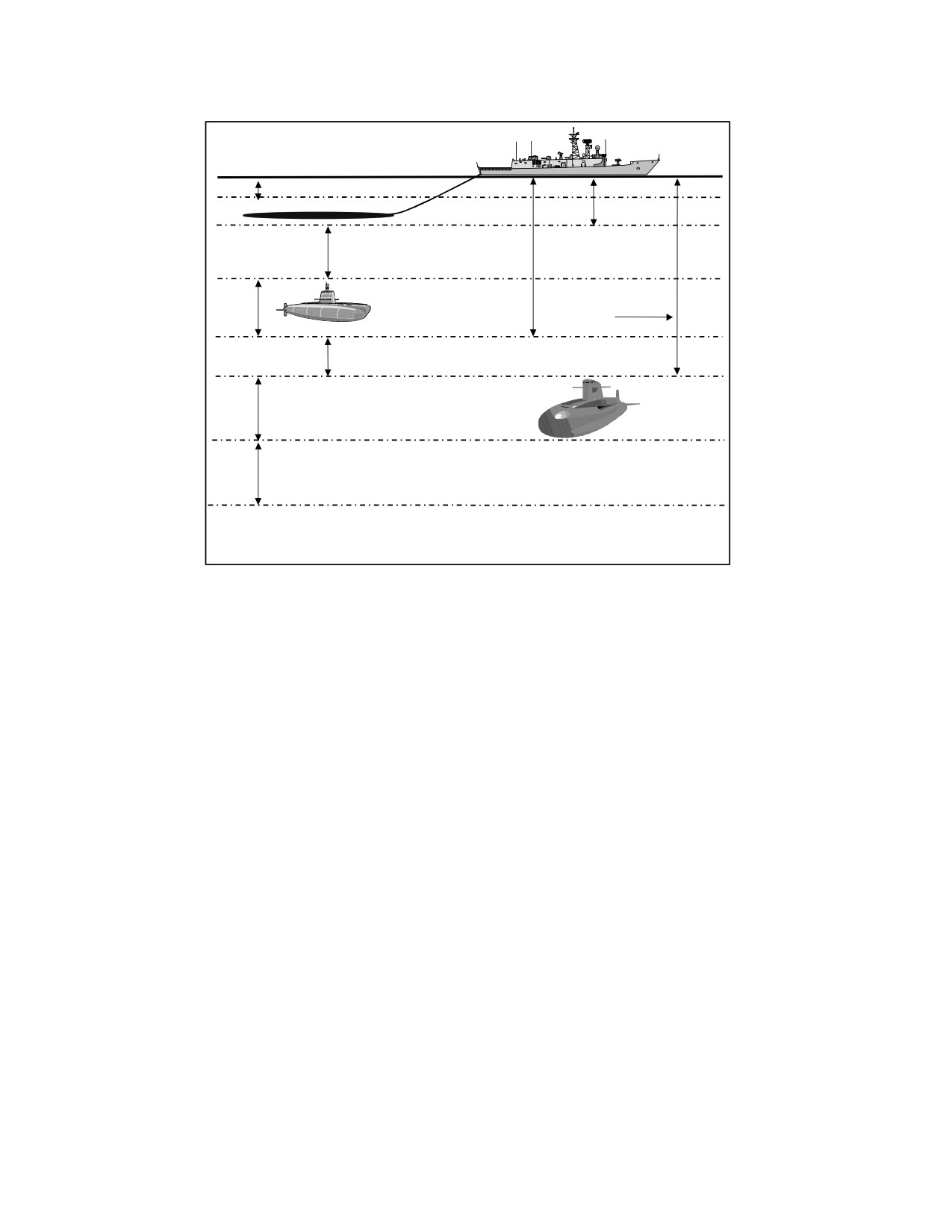
NATO-UNCLASSIFIED
MXP-1(D)(NAVY)(AIR)
10m
23m
14m
UVSS
94m Minimum
20m
Depth
57m Submarine Safe Depth
14m
UVSS
20m
LVSS
MAXIMUM PERMISSIBLE OPERATING DEPTH
Figure 2-2 Submarine Safe Depth Calculations
2214 VISIBILITY REQUIREMENTS
Visibility in which Submarines may Dive. Submarines are not to dive if the visibility through the
periscope is less than 3000 yards. This means that surfaced submarines must be visible at a distance
of not less than 6,000 yards from a ship's bridge. This rule may be relaxed at the discretion of the OSE
in concurrence with the SUBOPAUTH by using Relaxation 13*A, 13*B or 13*C (Table 3-2) to enable
exercises to be carried out. In shallow water, limitations on the maneuverability of the submarine
should also be considered. The decision as to whether the visibility is sufficient for the submarine to
dive rests entirely with the Commanding Officer of the submarine. The fact that participating surface
ships and submarines are equipped with radar in no way relaxes the visibility rules in force. The OSE
will consider the efficiency of all participating forces in deciding on any relaxation of safety rules. If a
submarine's radar becomes inoperative during darkness or reduced visibility and, as a result,
information on which its safety depends cannot be obtained, the submarine's Commanding Officer
should break off the exercise and retire from the vicinity until repairs are made. Navigation lights
should be switched on during this period. The submarine should keep the OTC or OCS (whichever is
appropriate) fully informed of its retirement and of its intention to re-enter the exercise. These
instructions may only be relaxed if Relaxation 13*C is in force. If the visibility from the bridge of a
ship participating in the exercise falls unexpectedly below that allowed for the exercise while the
submarine is submerged and no Relaxation has been ordered for the exercise, the exercise is to be
ended and the submarine surfaced when safe to do so.
2-13
CHANGE 5
NATO-UNCLASSIFIED
NATO-UNCLASSIFIED
MXP-1(D)(NAVY)(AIR)
2215 MINIMUM SUBMARINE ACOUSTIC EQUIPMENT REQUIREMENTS
Submarines are not to dive unless at least one of their sonar sets is capable of listening for Hydrophone
Effect (HE), and of transmitting on SST or communicating by UWT. Submarines taking part in
submarine versus submarine exercises must have a passive sonar and underwater communications
equipment fully operational. Submarines shall maintain a continuous guard on underwater telephone
and a continuous watch on the listening sonar at all times when submerged. In the event of failure of
the underwater telephone or passive sonar, the submarine must surface and assume an out-of-action
status until the defect is repaired.
2-14
CHANGE 5
NATO-UNCLASSIFIED

NATO-UNCLASSIFIED
MXP-1(D)(NAVY)(AIR)
Table 2-2 Depth Limitations
A
B
C
D
E
F
G
H
Sub-
Sub-
Ship's
Upper Vertical
Submarine Safe
Bottom Vertical
Minimum Charted Depth
Lower Vertical
marine
marine
Draft
Safety Separation
Depth (B & C & D)
Safety Separation
of Water (E & F)
Safety Separation
Speed
Height
Note 1
Notes
Note 3
Notes 3 & 7
Notes 4 & 9
Note 5
Notes 6 & 8
2 & 7
Knots
Metres
Metres
Metres
Metres
Metres
Metres
Metres
Metres
Metres
Feet
Fathoms
Metres
Metres
(ft)
(ft)
(ft)
(ft)
(ft)
(ft)
(ft)
(ft)
(ft)
(ft)
X
Y
X
Y
X
Y
X
Y
2 - 8
20(66)
30(98)
12(40)
-
62(205)
-
15(50)
-
77
255
45
0
0
8 - 10
20(66)
30(98)
15(50)
12(40)
65(215)
62(205)
27(90)
21(70)
92
300
50
0
0
10 - 12
20(66)
30(98)
18(60)
14(45)
68(225)
64(210)
37(120)
27(90)
105
345
60
0
0
12 - 14
20(66)
30(98)
21(70)
15(50)
71(235)
65(215)
50(165)
38(125)
121
395
65
15(50)
0
14 - 16
20(66)
30(98)
24(80)
18(60)
74(245)
68(225)
66(220)
49(160)
140
460
75
30(100)
15(50)
16 - 18
20(66)
30(98)
27(90)
20(65)
77(255)
70(230)
81(265)
61(200)
158
520
85
58(190)
39(130)
18 - 20
20(66)
30(98)
30(100)
21(70)
80(265)
71(235)
99(325)
75(245)
179
585
100
75(245)
61(200)
20 - 22
20(66)
30(98)
33(110)
23(75)
83(275)
73(240)
116(380)
87(285)
199
655
110
82(270)
70(230)
22 - 24
20(66)
30(98)
36(120)
24(80)
86(280)
74(245)
136(445)
102(335)
222
730
120
90(295)
76(250
24 - 26
20(66)
30(98)
39(130)
27(90)
89(295)
77(255)
156(510)
118(385)
245
805
135
94(310)
82(270)
26 - 28
20(66)
30(98)
42(140)
29(95)
92(300)
79(260)
174(570)
133(435)
266
875
145
101(330)
87(285)
28 - 30
20(66)
30(98)
45(150)
30(100)
95(310)
80(265)
194(635)
145(475)
289
950
160
104(340)
91(300)
NOTE: Calculations are in metres. Figures in feet are rounded to the nearest 5 feet except in Column C.
2-15
CHANGE 5
NATO-UNCLASSIFIED

NATO-UNCLASSIFIED
MXP-1(D)(NAVY)(AIR)
NOTES TO TABLE 2-2
1. Submarine height (base of keel to top of fin) is always assumed to be 20 metres (65 feet) unless otherwise
ordered by SUBOPAUTH (see Relaxation 12*A).
2. Ship's draft is assumed to be 30 metres (98 feet) but this may be reduced with the prior approval of the
SUBOPAUTH by the use of Relaxation
12*B. Columns E and G are then reduced accordingly.
3. The figures in Column X may be reduced to those in Column Y or may be reduced to figures between
brackets for speeds as indicated at the discretion of the SUBOPAUTH by the use of Relaxation 12*C.
4. The figures in Column X may be reduced to those in Column Y, or may be reduced to figures between
brackets for speeds as indicated at the discretion of the SUBOPAUTH by the use of the Relaxation 12*D.
5. The minimum charted depth of water will vary depending on the relaxations affecting Columns E and F.
6. The figures in Column X may be reduced to those shown in Column Y or may be reduced to figures
between brackets for speeds as indicated at the discretion of the SUBOPAUTH by the use of Relaxation 12*E.
7. Towed Bodies and Helicopter Sonars. When relaxations are ordered which permit the towing of
VDS/DTAS, decoys, etc., and the use of helicopter sonars to a depth greater than that used in Column C, that
figure is to be disregarded. In its place is to be substituted, in the case of VDS and helicopter sonars, the
maximum cable length to be used; and in the case of decoys, etc., the maximum depth, taken from Table 2-3.
In such cases the figures in Columns E and G must then be adjusted to a correspondingly greater total.
8. Subject to SUBOPAUTH restrictions, submarines are not to proceed below 5 knots at their maximum
permissible operating depth.
9. Subject to national operating restrictions of certain submarines.
Table 2-3 Decoy and Towed Sonar Training Target Depth Restrictions
LONG STAY
SHORT STAY
SIGNAL
TYPE OF DECOY
MAXIMUM DEPTH
LENGTH OF
MAXIMUM
LENGTH OF
DESIGNATOR
OF TOWED BODY
TOW
PERMITTED DEPTH
TOW
AND TOW
OF TOWED BODY
AND TOW
A
B
2170
170m (485 ft)
860 (2457 ft)
TBC
TBC
C
AN/SLQ-25 (NIXIE)
54 m (175 ft)
456 m (1,500 ft)
23 m (75 ft)
183 m (600 ft)
D
T MK 6 FANFARE
31 m (100 ft)
183 m (600 ft)
-
-
E
CAAT
18 m (58 ft)
183 m (600 ft)
13 m (40 ft)
92 m (300 ft)
F
FRENCH AB 1002
35 m (114 ft)
229 m (750 ft)
G
T MK 6 FANFARE (LC)
61 m (200 ft)
366 m (1,200 ft)
-
-
H
TYPE 2058
180 m (590 ft)
560 m (1,841 ft)
-
-
I
TYPE 2070
61m (200 ft)
456m (1,500 ft)
28m (90 ft)
183m (600 ft)
J
TBQT-LF
200m (656 ft)
400m (1,312 ft)
75m (246 ft)
100m (305 ft)
2-16
CHANGE 5
NATO-UNCLASSIFIED
NATO-UNCLASSIFIED
MXP-1(D)(NAVY)(AIR)
2216 SURFACE SHIP NOISE
1. Types of Surface Ship Noise. Submarines detect surface ships on sonar predominantly using one of
the following noise sources:
a. sonar transmissions;
b. cavitation; or
c. radiated noise.
2. Noise reduction programmes on board many surface ships have now significantly reduced radiated
noise. It is important; therefore, particularly within the confines of the simpler CASEX, that the ship
provides a reliable acoustic warning of its presence, i.e. sonar and/or cavitation. Ships must be aware;
however, of conflict between sonar transmissions and UWT communications and also the speed at which
cavitation occurs.
3. Surface Ship Radiated Noise Requirements. Surface ships operating with submerged submarines
must cavitate unless Relaxation 7*A, 7*B, 7*C, 7*D, 7*E, 7*G or 7*F (Table 3-2) is specifically
approved by the SUBOPAUTH. These relaxations do not apply when in the vicinity of a submarine that
is known to be coming to PD or surfacing (see Articles 2273 and 2274).
4. Modern Frigate Low Noise. To overcome the danger to submarines operating with silent modern
frigates, some frigates are fitted with a sequencer which can key UWT’s automatically at preset intervals
and with different power modes. Use of this equipment during exercise may be authorized by the
SUBOPAUTH using Relaxation 7*H. The specification of the sequencing UWT are detailed in Table 2-
5C.
2217 LOOKOUTS
Ships are to ensure that lookouts are trained in the recognition of submarine pyrotechnic signals and
profiles. Where the ship's complement allows, at least two dedicated submarine lookouts should be
posted. It should be impressed on lookouts that the safety of the submarine may at any time depend on
them and that they are responsible for immediately reporting any signals such as smoke, flares and any
emergency identification signals (such as red flares, bubbles, oil slicks), or periscope, mast or any other
portion of the submarine that is sighted. Lookouts are to be kept aware of the approximate location of
the SM and be briefed to report the presence of deep drafted vessels, FV and other hazards to underwater
navigation.
2218 UNDERWATER TELEPHONE WATCH
1. Participating units fitted with underwater telephone (UWT) are to maintain a continuous listening
watch with optimum receiver gain. Whenever practicable, the UWT should be monitored by competent
authority to ensure prompt reaction to emergency signals. ASW ships may enhance UWT clarity by
positioning so that neither ship nor submarine is communicating through its baffles/stern arcs. Ships
should reduce active sonar transmission (MRS) power during traffic on UWT.
2. In exercises when Relaxation 7*F is in force, some submarines are unable to detect echo sounders
and, to ensure safety, will transmit safety signals on UWT when returning to periscope depth in
accordance with Article 4032 and Table 4-1. Any ship hearing these signals is to reply without delay
and is to transmit a long count every 30 seconds on UWT for 3 minutes to allow the submarine to
establish a bearing.
2-17
CHANGE 5
NATO-UNCLASSIFIED
NATO-UNCLASSIFIED
MXP-1(D)(NAVY)(AIR)
2219 COMMUNICATIONS AND SIGNALS
1. The OCE is to issue instructions in the EXOPORD regarding submarine diving and surfacing signals
and check reports. Such instructions will be in accordance with ATP-10 and national requirements.
Although check reports from submarines may not be required by NATO Commanders, the
SUBOPAUTH must be prepared to accept and coordinate such reports from participating submarines
when required by national authorities. Basic methods of communication between ships, aircraft and
submarines used during exercises are listed in Chapter 5.
2. All surface ships engaged in exercises with a submarine that is at PD and restricted in course and
speed, or with one that is about to surface or come to PD, are to be prepared to warn all other shipping to
proceed with caution and keep clear by means of International Signal, CODE NE pennant
2.
2220 DUMPING OF TRASH, GARBAGE AND WASTE (GASH)
Gash should not be ditched during exercises involving submarines. Gash from participating ships may
cause confusion in the event of a submarine emergency.
2221 - 2229 Spare
2230 SPECIFIC SAFETY PRECAUTIONS
2231 SAFETY PRECAUTIONS WHEN OPERATING WITH AIRCRAFT
1. Aircraft and Ships
a. Because of poor lookout positions in helicopters, ships are responsible for avoiding collision with
helicopters in the dip.
b. Ships firing weapons are to ensure that they do not endanger any aircraft in the vicinity.
c. To prevent turbulence from affecting the helicopter, surface ships should not pass within 500 yards
of a hovering helicopter. Ships should pass downwind of a hovering helicopter.
2. Helicopters and Fixed Wing Aircraft Operating in Close Proximity. See ATP-1, Vol 1.
3. Aircraft and Submarines
a. Submarines are not to fire grenades (flares), other than red grenades (flares) in an emergency, unless
Relaxation 2L is in force.
b. For the precautions to be observed when using helicopter sonar, see Article 2234.
2232 SAFETY PRECAUTIONS WHEN SURFACE SHIPS APPROACH
The SUBOPAUTH may specify the range at which the submarine must go to Safe Depth when surface
ships, without any towed devices, approach. In this case, this range (which may be as little as 1200
yards) must be included in Special Instructions (Order Table, Para U). This safety range will increase
progressively with the depth of towed decoys and sonar, unless relaxations permit.
2-18
CHANGE 5
NATO-UNCLASSIFIED
NATO-UNCLASSIFIED
MXP-1(D)(NAVY)(AIR)
2233 SAFETY PRECAUTIONS WHEN EMPLOYING TOWED DECOYS
1. The following precautions are to be observed when towed decoys are streamed by surface ships in
exercises with submarines:
a. If towed at long stay, the type of decoy must have the prior approval of the SUBOPAUTH. When
their employment is authorized, they may be towed either silent or emitting.
b. The fact that decoys are to be streamed is to be included in the CASEX order, together with the
type of decoy and the length of stay. (See Table 2-3.) Relaxations 9B, 9*C, 9D and 9*E (Table 3-2)
apply to the use of decoys.
c. When decoys are streamed at long stay, the submarine (if not already at a Safe Depth) is to
proceed to a Safe Depth when the nearest ship approaches within 2000 yards. This range may be
reduced at the discretion of the SUBOPAUTH using Relaxation 9*A.
d. Ship's speed is not to be reduced if this involves the decoy or tow dropping below the
appropriate maximum depth figures in Table 2-3.
e. Before starting the procedures to bring the submarine up to PD, decoys are to be switched off
and raised in accordance with Articles 2273 and 2274.
2234 SAFETY PRECAUTIONS WHEN EMPLOYING HELICOPTER SONAR
1. To minimize the risk of collision between submarines and helicopter sonar, the following
precautions are to be observed:
a. The submarine is to proceed at Safe Depth (Article 2213), based on the maximum depth at which
the sonar will be employed, unless Relaxation 8C is in force.
b. When it is desired to operate the helicopter sonar transducer at the best search depth, and this
determines a Safe Depth that the submarine is unable to reach, Relaxation 8F should be ordered. The
submarine Safe Depth is then based on the initial search depth promulgated with Relaxation 8F.
c. In advanced exercises where the use of evasive tactics are desirable, the submarine is not required
to proceed to Safe Depth provided Relaxation 8C is in force. However, submarines are not to
deliberately close within 500 yards of a dipping helicopter and helicopters are not to deliberately
enter or remain in the dip if within 500 yards of the submarine.
2235 SAFETY PRECAUTIONS WHEN EMPLOYING VDS/TAS/MTAS
1. The definitions below refer to ASW exercises and submarine safety:
a. Variable Depth Sonar (VDS). A sonar whose transducer is towed at variable depths beneath
the parent ship.
b. Towed Array System (TAS). An acoustic system which uses a line of hydrophones located in
an array towed by surface ships and submarines.
2-19
CHANGE 5
NATO-UNCLASSIFIED
NATO-UNCLASSIFIED
MXP-1(D)(NAVY)(AIR)
c. Multiple Towed Array System (MTAS). A system that involves the simultaneous towing
of multiple bodies of different characteristics (VDS/CATAS/DTAS). For example a YDS
transmitter and CATAS receiver. These bodies may have different length tows and operate at
different depths.
(1) Critical Angle Towed Array System (CATAS). A towed array system whose depth
is dependent upon towing ship speed and the length and weight of the towed cable only.
(2) Depressed Towed Array System (DTAS). A towed array system which is taken to
desired depth by a towed body or depressor.
(3) Submarine Towed Array System (STAS). A towed array system where a neutrally
buoyant array is deployed directly astern of the submarine and at the same depth.
(4) Multiple Towed Array System (MTAS). A system that involves the simultaneous
towing of multiple bodies with different characteristics
(VDS/CATAS/DTAS). For
example a VDS transmitter and CATAS receiver. These bodies may have different length
tows and operate at different depths.
NOTE:
1.
Throughout this article the term "towed array" is used to describe any form of towed array
system.
2.
The terms TACTAS and SURTAS are for operational use and are defined in the Glossary.
2. General
a. For general exercise planning purposes, Table 2-4 indicates the principal authorizations for use
of specific VDS/TAS/MTAS against submarines of the different nationalities, shown in Column 3,
as follows:
A - may be used without restriction;
B - may be used with rules and relevant relaxations specified in this article and Table 3-2; or
C - may not be used.
b. When authorization B is appropriate (Table 2-4), the type of VDS/TAS/MTAS to be used and
the maximum allowed cable length to which it may be streamed must have the prior approval of
the SUBOPAUTH. In the case of MTAS, the length of tow for the body with the longest cable
length should be specified. In the interest of realism in advanced ASW exercises, the OCE may
request relaxation of VDS/TAS/MTAS restrictions as approved by the SUBOPAUTH (Table 3-2,
Relaxation 8 Section).
c. The OCE must ensure that the VDS/TAS/MTAS specified depth of cable length does not
conflict with the limitations imposed by Article 2213 - Vertical Safety Separation/Safe Depth
Operation.
d. The exercise scheduled, type of submarine assigned, and practice weapons to be employed may
impose additional restrictions on the operating depth of the submarine. In specifying the maximum
depth or cable length of the VDC/Towed Array, the OCE must ensure that the specific depth or
cable length does not conflict with the limitations imposed by:
(1) Articles 2213 - Vertical Safety Separation/Safe Depth Operation;
(2) Article 2240 - The Use of Explosive Charges; and
2-20
CHANGE 5
NATO-UNCLASSIFIED
NATO-UNCLASSIFIED
MXP-1(D)(NAVY)(AIR)
(3) NOT RELEASABLE.
e. The OCE shall ensure that the following information is promulgated in the appropriate
operation order or exercise directive:
(1) Name, Hull Number, Active Sonar frequency and Signal Designator of type
VDS/TAS/MTAS (Table 2-5) of each VDS/Towed Array ship in the exercise;
(2) Specific exercise events in which VDS/TAS/MTAS is to be streamed;
(3) All the appropriate SUBOPAUTH approved relaxations marked with an asterisk (*)
(Table 3-2, Relaxation 8 Section); and
(4) Instructions for disposition of the VDS/TAS/MTAS during the submarine surfacing
procedure, if other than those described in Articles 2273 and 2274, should national policies so
require (Table 3-2, Relaxation 8*G).
f. The fact that VDS/TAS/MTAS is to be streamed must always be included in the orders for the
exercise, together with the Signal Designator of the type VDS/TAS/MTAS (Table 2-5). Table 3-
2, Relaxation 8 Section applies to the use of VDS/TAS/MTAS.
3. Additional Restrictions
a. When one or both components of MTAS consists of a VDS or DTAS the additional restrictions
covering VDS/DTAS should be applied.
b. When VDS/DTAS is employed using vertical safety separation, see Article 2236 for additional
safety precautions and restrictions.
c. When VDS/DTAS is employed using horizontal safety separation, see Article
2237 for
additional safety precautions and restrictions.
d. When CATAS is employed, see Articles 2238, 2273 and 2274 for additional safety precautions
and restrictions.
e. If the VDS/TAS/MTAS system is not featured within Table 2-5, the parameters are to be
featured in the CASEX standard orders and the SUBOPAUTH must authorize its use with
participating submarines.
2236 ADDITIONAL RESTRICTIONS TO ESTABLISH A VERTICAL SAFETY
SEPARATION WHEN TOWED VDS/ DTAS IS USED
1. These additional restrictions apply when submarines and ASW units using VDS/ DTAS operate in
the same zone.
a. General
(1) The OCE shall ensure that all participating units acknowledge receipt of
OPORD/Exercise Orders and any changes thereto prior to Start Time in exercises involving
VDS/DTAS operations.
2-21
CHANGE 5
NATO-UNCLASSIFIED
NATO-UNCLASSIFIED
MXP-1(D)(NAVY)(AIR)
(2) In ASW exercises involving the use of VDS/DTAS, the submarine Commanding
Officer must assume that all escorts are streaming VDS/DTAS unless positively known
otherwise, and that VDS/DTAS ships do not know the submarine position.
(3) When authorization B is applicable (Table 2-4), ships with VDS/DTAS streamed must
comply with the following rules:
(a) Operate at least one sona, in the active mode continuously.
(b) If no sonar systems are able to transmit, the VDS/DTAS must be recovered as soon
as possible.
(c) If the VDS/DTAS cannot be recovered and no sonar systems are able to transmit, the
warning signal -"VDS"- shall be transmitted on UWT every 2 minutes.
(d) The above paras (a), (b) and (c) do not apply when Relaxation 8*H and/or 8*N are/is
in force. The above restrictions are; however, applicable when in the vicinity of a
submarine that is known to be coming to PD (see Articles 2273 and 2274).
(e) In addition to the above, when a VDS/DTAS is, for whatever reasons, being towed
outside its allocated depth limits, the warning signal -"VDM"- followed by depth in
metres (e.g. VICTOR DELTA MIKE NINE ZERO) shall be transmitted at intervals of not
more than two minutes on UWT.
(f) In addition to the above, ships towing VDS/DTAS by night are to show their
navigation lights at full brilliance.
(4) Ships may be authorized to lower VDS/DTAS to depths greater than the depth of the
submarine, providing the SUBOPAUTH and national authorities have agreed to the
Relaxation 8*M. The exercise schedule type of submarine assigned, and the practice or
exercise weapons to be employed may impose additional restrictions on the operating depth of
the submarine. In specifying the VDS/DTAS depth limits, the OCE/OSE must ensure that an
adequate vertical safety separation is specified. Safety signals for both VDS/DTAS and
submarine shall be specified by SUBOPAUTH/OCE.
b. Restrictions. When authorization B is applicable (Table 2-4), the following rules apply when
employing VDS/DTAS:
(1) The minimum depth separation between submarine and ship or VDS/DTAS is to be in
accordance with Table 2-2 and associated important notes.
(2) When VDS/DTAS is being employed, the submarine is to go to a safe depth when the
nearest ship approaches within:
(a)
4000 yards, if the permitted cable length does not exceed 77 metres (250 feet);
(b)
6000 yards, if the permitted cable length exceeds 77 metres (250 feet), but does not
exceed 122 metres (400 feet); and
(c)
8000 yards, if the permitted cable length exceeds 122 metres (400 feet).
2-22
CHANGE 5
NATO-UNCLASSIFIED
NATO-UNCLASSIFIED
MXP-1(D)(NAVY)(AIR)
If the submarine has positively identified the surface ship as not employing VDS/DTAS, the safe
depth applicable to the surface ship draft may be assumed. These rules may be relaxed at the discretion
of the SUBOPAUTH using Relaxation 8*A.
(3) Normally, 1500 yards is to be considered the minimum distance for use with Relaxation
8*A.
(4) Use of 8*H needs to transmit the warning signal "Victor Delta Sierra" successively on the
VDS and hull sonar UWT, or hull sonar UWT only if no practicable, every two minutes.
2237 ADDITIONAL RESTRICTIONS TO ESTABLISH A HORIZONTAL SAFETY
SEPARATION "NEUTRAL CORRIDOR" WHEN TOWED VDS/ DTAS IS USED
1. These additional restrictions shall apply when submarines and ASW units using VDS/DTAS
operate in two adjacent areas separated by means of a neutral corridor.
a.General
(1) Safety is achieved by the establishment of a "safety corridor" between the operating
areas of participating units. Therefore, accurate navigation by all participants is of
paramount importance; navigational accuracy relative to the neutral corridor should be
better than 1000 yards.
(a) The basic safety requirements for VDS are:
(i) that the exercise be limited to two hours (or as authorized by the SUBOPAUTH);
(ii) that the submarine and the VDS ship be in visual contact At the start of the
exercise; and
(iii) that the width of the neutral corridor is 4000 yards.
(b) Until specific CASEXes are promulgated for exercises between ships with DTAS and
submarines, OCEs may order individual exercises using a horizontal separation "Neutral
Corridor". The duration of the exercise, the minimum width of the corridor and the
relaxations to be used in such an exercise must have the prior approval of the
SUBOPAUTH and national authorities.
(2) Since the width of the neutral corridor and time limitation may reduce the benefits of
VDS/DTAS training, OSE/OCEs are provided with relaxations to modify this procedure
and adapt it to individual training requirements under the prevailing conditions.
(3) When participants consider that their navigation equipment is not accurate enough to
be able to comply with the safety rules in this paragraph, they should report to the OCE
forthwith, who will increase the width of the neutral corridor accordingly.
(4) When authorization B is applicable (Table 2-4), ships with VDS/DTAS streamed must
operate at least one sonar in the active mode continuously, unless Relaxation 8*H is in
force. The above restrictions are; however, applicable when in the vicinity of a submarine
that is known to be coming to PD (see Articles 2273 and 2274).
b. Modifications of Restrictions by Special Relaxations
2-23
CHANGE 5
NATO-UNCLASSIFIED
NATO-UNCLASSIFIED
MXP-1(D)(NAVY)(AIR)
(1) Relaxation 14*A
(a) This relaxation is not to be used in zones in which there are strong or variable
currents/tidal streams, or when visibility is less than 4000 yards.
(b) The number of runs to be carried out and if required, the duration of the runs is to be
specified, bearing in mind the difficulties of relocking after nightfall.
(c) After each run the submarine comes to PD or surfaces if necessary using the
procedure outlined in Article
2273 (or Article 2274 if Relaxation3*J in force), and
establishes radio contact with the OCS. The OCS refixes the lock point for the neutral
corridor.
(d) If Relaxation 14*D is also in effect, each of the participants fixes its position and
resets the plotting table from a geographic al fix.
(2) Relaxation 14*B
(a) This relaxation is not to be used in zones in which there are strong or variable
currents/tidal streams.
(b) At GO TIME plus 2 hours (or as specified), the neutral corridor is extended to 8000
yards. The extension is made into the VDS/DTAS area; the original reference point of the
neutral corridor remaining unchanged.
(2) Relaxation 14*C (Figure 2-3)
(a) This relaxation is to be used only if the exercise zone is large enough to allow the
submarine an area of at least five nautical miles both in length and width.
(b) The two parts of the neutral corridor are established at GO TIME according to
standard procedure. The submarine position at that time is the lock point common to the
two parts of the neutral corridor. It is only necessary for the OCS to signal the submarine
quadrant to de-fine the two parts of the neutral corridor. One is parallel to the Safety
Course and the other is at right angles to it, both parts extending from the lock point into
the zone reserved for the escort vessels.
(c) The Safety Course must be selected so that when coming to PD, the submarine does
not risk penetrating one of the two parts of the neutral corridor; the VDS/DTAS equipped
escort vessels are to steer the reciprocal of the Safety Course, if necessary, to remain
outside the neutral corridor (see Articles
2273 and 2274).
2-24
CHANGE 5
NATO-UNCLASSIFIED

NATO-UNCLASSIFIED
MXP-1(D)(NAVY)(AIR)
Table 2-4 General Authorization VDS/TAS/MTAS
TYPE OF
EQUIPMENT
NATIONALITY OF EXERCISE SUBMARINE
TOWED DEVICE
DESIGNATOR
CA
FR
GE
GR
IT
NL
NO
PL
PO
SP
TU
UK
US
AN/SQA-10
B
B
B
B
B
B
B
B
B
B
B
B
AN/SQA-10A
B
B
B
B
B
B
B
B
B
B
B
B
AN/SQA-13
B
B
B
B
B
B
B
B
B
B
B
B
VARIABLE DEPTH
AN/SQS-35
B
B
B
B
B
B
B
B
B
B
B
B
SONAR (VDS)
AN/SQS-504
B
B
B
B
B
B
B
B
B
B
B
B
AN/SQS-505
B
B
B
B
B
B
B
B
B
B
B
B
AN/SQS-510
B
B
B
B
B
B
B
B
B
B
DUBV 43 A/B
B
B
B
B
B
B
B
B
B
B
B
B
SONAR 199
B
B
B
B
B
B
B
B
B
B
B
B
DE 1160
B
B
B
B
B
B
B
DE 1164
B
B
B
B
B
B
B
B
B
B
B
B
DUBV 43C
B
B
B
B
B
B
B
B
B
B
B
B
FATHOM MOD 9-601
B
B
B
B
B
B
B
B
B
B
B
B
SALMON TSM 2643A
B
B
B
B
B
B
B
B
B
B
B
B
DSBX1A
B
B
B
B
B
B
B
B
B
B
DEPRESSED
AN/SQR-18A (US)
B
B
B
B
B
B
B
B
B
B
B
B
TOWED ARRAY
DSBV 61 (DTAS)
B
B
B
B
B
B
B
B
B
B
B
B
SYSTEMS (DTAS)
AN/SQR-18A (V) 1
B
B
B
B
B
B
B
B
B
B
B
B
DSBX1A
B
B
B
B
B
B
B
B
B
B
ANACONDA
A
A
B
B
B
A
B
B
B
B
A
A
CRITICAL-ANGLE
SONAR 2031
A
A
B
B
B
A
B
B
B
B
A
A
TOWED ARRAY
DSBV 61 (CATAS)
A
A
B
B
B
A
B
B
B
B
A
A
SYSTEMS (CATAS)
DSBV 62C (CATAS)
A
A
B
B
B
A
B
B
B
B
A
A
AN/SQR-501
A
A
B
B
B
A
B
B
B
B
A
A
AN/SQR-18A (V) 2
A
A
B
B
B
A
B
B
B
B
A
A
AN/SQR-19
A
A
B
B
B
A
B
B
B
A
A
DSBX1A
B
A
B
B
A
B
B
B
A
SUBMARINE
BQR/15
A
A
B
B
A
A
B
A
A
B
A
A
TOWED ARRAY
DSUV62C
A
A
B
B
A
A
A
B
B
A
SYSTEMS (STAS)
SONAR 2026
A
A
B
B
A
A
B
A
A
B
A
SONAR 2046
A
A
B
B
A
A
B
A
A
B
A
SUBTASS
A
A
B
B
A
A
B
A
2-25
CHANGE 5
NATO- UNCLASSIFIED

NATO-UNCLASSIFIED
MXP-1(D)(NAVY)(AIR)
Table 2-4 General Authourization VDS/TAS/MTAS (Cont'd)
TYPE OF
EQUIPMENT
NATIONALITY OF EXERCISE SUBMARINE
TOWED DEVICE
DESIGNATOR
CA
DA
FR
GE
GR
IT
NL
NO
PL
PO
SP
TU
UK
US
AN/UQQ2
A
B
B
B
B
B
B
B
B
B
B
CATAS-S
(Production)
AN/UQQ2
B
A
B
B
B
B
B
B
B
B
B
(Twin Line)
MTAS
SONAR 2087 - VDS
SONAR 2087 -
CATAS
2-26
CHANGE 5
NATO-UNCLASSIFIED

NATO-UNCLASSIFIED
MXP-1(D)(NAVY)(AIR)
Table 2-5A VDS Specification
SIGNAL DESIGNATOR
A
B
D
E
F
G
H
J
K
L
EQUIPMENT
DE-1160
SALMON
AN/SQS-35
AN/SQS-
DUBV43
DE 1164
DUBV
FATHOM
SLASM
TBQT-LF
DESIGNATOR
TSM
505/510
B
43C
MOD 9-601
(DSBX1A)
2643A
USER NATIONS
GR
DA
US/SP/TU
CA
FR
IT
FR
NO
FR
NL
UWT IN BODY
NO
NO
YES
YES
YES
NO
YES
NO
YES
NO
WEIGHT OF TOWED
BODY (kg)
WEIGHT OF CABLE
(max)(kg)
MAX LENGTH OF
NOT RELEASABLE
CABLE (m(ft))
DIAMETER OF VDS
CABLE(mm)
BREAKING
STRENGTH (kg)
MAX PAYOUT/MAX
INHAUL SPEED
(m/min(ft/min))
MAX OPERATIONAL
TOW DEPTH (m(ft))
MIN TIME TO
RECOVER FROM MAX
PAYOUT (min)
ASSOCIATED ARRAY
(if applicable)
FREQUENCY (kHz)
MIN LENGTH OF TOW
CABLE (m(ft))
2-27
CHANGE 5
NATO- UNCLASSIFIED
NATO-UNCLASSIFIED
MXP-1(D)(NAVY)(AIR)
Table 2-5B Towed Array Specifications
SIGNAL DESIGNATOR
M
N
O
P
Q
R
S
T
U
V
W
X
Y
Z
AA
TYPE OF ARRAY
DTAS
CATAS
CATAS
CATAS
CATAS
DTAS
STAS
STAS
CATAS
DTAS
CATAS
CATAS
STAS
STAS
CATAS
EQUIPMENT DESIGNATOR
AN/SQ
ANACONDA
DSBV
SONAR
DSBV 61
DSBV
2026
2046
AN/SQ
AN/SQR-
AN/SQR-
AN/SQR-19
DSUV62C
SUBTAS
SLASM
R-18A
62C
2031
61
R-19
18A(V)1
18A(V)2
S
(DSBX1A)
USER NATION
US
NL
FR
UK
FR
FR
UK/NL
UK
CA
US/TU
US/NL
US/SP
FR
CA
FR
UWT INCORPORATED
YES
NO
NO
NO
NA
YES
NO
NO
NO
YES
NO
NO
NA
NO
NA
NOT RELEASABLE
NOTE: Non-metric values are accurate. Metric values are rounded off to the nearest metre.
2-28
CHANGE 5
NATO UNCLASSIFIED
NATO-UNCLASSIFIED
MXP-1(D)(NAVY)(AIR)
Table 2-5B Towed Array Specifications (Cont'd)
SIGNAL DESIGNATOR
AB
AC
AD
AE
AF
AG
AH
AI
AJ
AK
AL
AM
AN
TYPE OF ARRAY
DTAS
CATAS-S
CATAS-S
DTAS
DTAS
EQUIPMENT
EQUIPMENT DESIGNATOR
SLASM
AN/UQQ2
AN/UQQ2
CAPTAS MK2
MK2
(DSBX1A)
(Production)
(Twin Line)
(see NOTE 2 below)
USER NATION
FR
US
US
NOR
NOR
NOT RELEASABLE
2-29
CHANGE 5
NATO-UNCLASSIFIED
NATO-UNCLASSIFIED
MXP-1(D)(NAVY)(AIR)
Table 2-5C Multiple Towed Array Systems Specifications
SIGNAL DESIGNATOR
BA
EQUIPMENT DESIGNATOR
2087
USER NATION
GBR
TYPE OF ARRAY
UWT INCORPORATED
FREQUENCY
TYPE OF DEPRESSOR
NOT RELEASABLE
DEPRESSOR WEIGHT (kg)
CABLE WEIGHT
TOWED BODY WEIGHT (kg)
CABLE LENGTH (max) (m(ft))
ARRAY LENGTH (m(ft)
(including connector)
DIAMETER TOW CABLE
BREAKING CONNECTOR
STRAIN (kg) ARRAY
MAXIMUM PAYOUT/INHAUL
SPEED (m/min)
MAXIMUM OPERATIONAL
TOW DEPTH (m(ft))
MINIMUM TIME TO RECOVER
FROM MAXIMUM PAYOUT
(min)
2-30
CHANGE 5
NATO-UNCLASSIFIED
NATO-UNCLASSIFIED
MXP-1(D)(NAVY)(AIR)
Table 2-5D Automatic Sequencing UWT Specifications
SIGNAL DESIGNATOR
A
B
C
D
E
F
G
H
I
J
UWT DESIGNATOR
UT 2000
2009
USER NATION
NL
UK
FREQUENCY RANGE
POWER OUTPUT LF
POWER OUTPUT HF
NOT RELEASABLE
TELEGRAPHY SIGNAL
TELEPHONY SIGNAL
PINGER SIGNAL
PULSE LENGTH
PINGER MODE
2-31
CHANGE 5
NATO UNCLASSIFIED
NATO-UNCLASSIFIED
MXP-1(D)(NAVY)(AIR)
(4) Relaxation 14*D (Figure 2-4)
(a) At GO TIME, all participants are to establish their position by visual fix or by a
combination of radar/visual fix and not only by radio-electrical means.
(b) The geographically-established neutral corridor is defined by a bearing line from a
visible landmark. The neutral corridor extends laterally from the bearing line into the
VDS/DTAS vessels zone. The bearing line; therefore, becomes the limited bearing line
between the neutral corridor and the submarine zone. This is to be specified in paragraph
U of the CASEX order as follows: "Submarine zone to the ... (e.g. northwest of the line
bearing ... from ... (e.g. lighthouse))."
(c) The bearing of the neutral corridor is not necessarily on a cardinal heading: The
safety course may not be parallel to the neutral corridor and it must be selected in such a
way that the submarine does not risk penetrating the neutral corridor when coming to PD.
(d) Units are to plot the sub-marine sector and the neutral corridor on a suitable chart and
plotting table. The exercise should not start until the submarine reports "ready".
(e) Units will remain in their respective zones navigating by dead reckoning, and the
neutral corridor is not re-established. If a significant difference is observed between the
geographical position and the dead reckoning position (strong current, for example) the
OCS must discontinue the exercise.
(f) This relaxation removes the requirement for the participants to be in visual contact at
the start of the exercise.
(5) Relaxation 14*E
(a) This relaxation is to be ordered only if the visibility is greater than 4000 yards in the
exercise area and the overall navigation system accuracy for each unit is better than 1000
yards per hour.
(b) This relaxation can be used with Relaxations 14*C and 14*D, but should never be
ordered at the same time as Relaxation14*B.
(c) If it is desirable to extend the duration of the exercise beyond two hours, Relaxation
14*A should be ordered and the neutral corridor must be re-established after each run.
2238 ADDITIONAL RESTRICTIONS WHEN CATAS IS USED
1. These additional restrictions shall apply when submarine and ASW units using CATAS operate in
the same zone.
a. General
(1) The OCE shall ensure that all participating units acknowledge receipt of
OPORD/Exercise Orders and any changes thereto prior to Start Time in exercises involving
CATAS operations.
(2) In ASW exercises involving the use of CATAS, the submarine Commanding Officer
must assume that all escorts are streaming CATAS unless positively known otherwise, and
2-32
CHANGE 5
NATO-UNCLASSIFIED
NATO-UNCLASSIFIED
MXP-1(D) (NAVY)(AIR)
that CATAS ships do not know the submarine's position.
(3) When authorization B is applicable (Table 2-4), ships with CATAS streamed must
comply with the following rules:
(a) Operate at least one sonar in the active mode continuously.
(b) If no sonar systems are able to transmit, the CATAS must be recovered as soon as
possible.
(c) If the CATAS cannot be recovered and no sonar systems are able to transmit, the
warning signal -"TAS"- shall be announced on UWT every 5 minutes.
(d) The above paras (a), (b) and (c) do not apply when Relaxation 8*J or 8*K is in force.
The above paras are; however, applicable when in the vicinity of a submarine that is
known to be coming to PD (see Articles 2273 and 2274).
b. Use of Horizontal Safety Separation "Neutral Corridor" When Authorization B is
Applicable
(1) Until specific CASEXes are promulgated for exercises between ships with CATAS
and submarines, OCEs may order individual exercises using a horizontal separation
"Neutral Corridor". The duration of the exercise, the minimum width of the corridor and
relaxations to be used in such an exercise must have the prior approval of the
SUBOPAUTH and national authorities.
2-33
CHANGE 5
NATO-UNCLASSIFIED
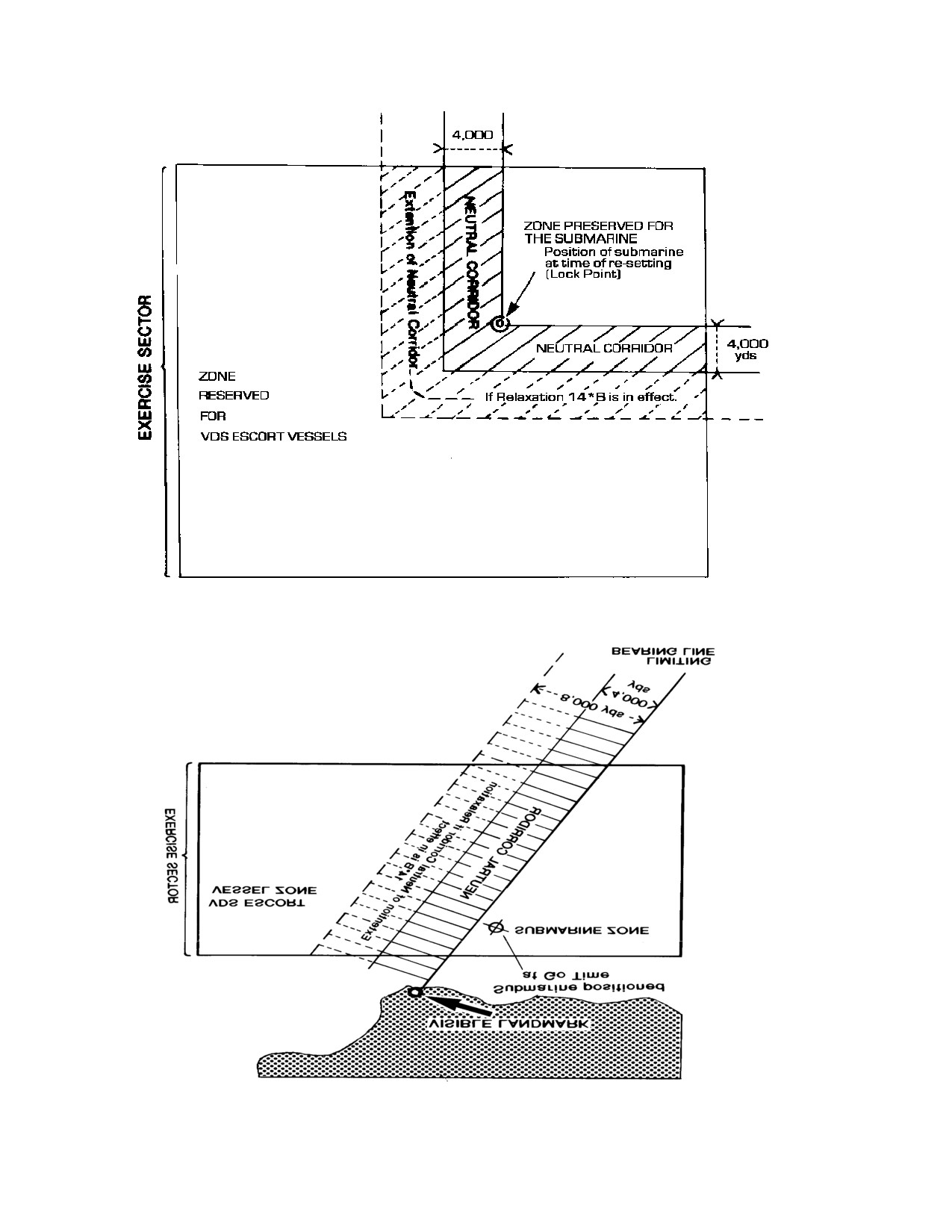
NATO-UNCLASSIFIED
MXP-1(D)(NAVY)(AIR)
Figure 2-3 Relaxation 14*C
Figure 2-4 Relaxation 14*D
2-34
CHANGE 5
NATO-UNCLASSIFIED
NATO-UNCLASSIFIED
MXP-1(D)(NAVY)(AIR)
2239 EXERCISE STOVEPIPES
1. An Exercise Stovepipe is designed to provide an exercise submarine with an enhanced level of
safety when depth zone restrictions are in force. For example, different depth zones may be in force as
a result of two or more submarines operating in the same geographical area; or when a submarine is
operating with surface forces operating VDS/DTAS (and in some cases CATAS) or helicopters
employing dipping sonar. An Exercise Stovepipe will allow a submarine to return to PD (or surface)
for safety or to copy signal message traffic, etc.
2. An Exercise Stovepipe is a geographic volume of water which extends from a specific depth (or
the sea bottom if it is not specified) to the surface. It is normally centered on a geographic position and
has a radius of 5nm from that position. This volume of water may be modified in the CASEX Standard
Orders (para PP) or Exercise Orders as appropriate.
3. An Exercise Stovepipe is for the use of a designated submarine only; other submarines,
participating surface ships and helicopters in the dip are to remain clear (unless 15 Series Relaxations
are in force). The use of sonobuoys within an Exercise Stovepipe is not restricted (unless exercise
instructions dictate otherwise).
WARNING
The purpose of an Exercise Stovepipe is to ensure submarine safety. An Exercise Stovepipe should not
be confused with a Stovepipe designated in an Operational Message or Oporder. ATP 1 details the use
of Stovepipes for operational use. The significant difference is that an operational Stovepipe does not
place the same restrictions on waterspace management and PMI on surface ships and helicopters.
Submarine crews must be aware of this fact.
4. Starred relaxations to allow participating surface forces and ASW helicopters the ability to operate
within or adjacent to an Exercise Stovepipe are designated in Table 3-2 (Series 15 Relaxations).
5. All ordered relaxations for the exercise apply in an Exercise Stovepipe, however due to the express
nature of an Exercise Stovepipe in providing for submarine safety in exercises, the Relaxation 15
Series take precedence over other relaxations in force.
2240 THE USE OF EXPLOSIVE CHARGES
1. Two important factors influence the use of explosive charges: the type of charge, and the
range/depth from the submarine.
a. Table
2-6 is the authority governing the use of explosive charges. Unless the National
SUBOPAUTH, when assigning a submarine for an exercise, specifically prohibits the use of
explosive charges, the employment of these indicated in Table 2-6 is permitted subject to the
instructions listed below:
(1) Types of Charges
(a) Subject to the restrictions given in column 7, only the charges listed in Table 2-6 may
be used against submarines of nations listed in column 5 as follows:
X - May be used against SSN or diesel-electric submarines.
2-35
CHANGE 5
NATO-UNCLASSIFIED
NATO-UNCLASSIFIED
MXP-1(D)(NAVY)(AIR)
Y - May be used against diesel electric-submarines.
Z - Not to be used without specific SUBOPAUTH approval.
N - Not to be used against any submarine.
NOTE:
A blank indicates lack of response from the nation concerned.
(b) The exercise and trial orders are to specify all the types of explosive charges that are
authorized for use (X, Y and Z) (Table 3-1, para V4).
(c) Charges that cannot be positively identified are not to be used.
(d) The use of charges other than those listed in Table 2-6 is forbidden unless specifically
authorized by the SUBOPAUTH.
(2) Range/Depth
(a) All X- and Y- rated charges may be dropped without further authorization provided
they are aimed to fall outside 1000 yards from the estimated position of the submarine.
(b) All X- and Y- rated charges may be dropped without a range restriction only if
Relaxation 10*A is in force.
(c) No Z- Rated charges are to be used unless specified in Relaxation 10*B. In this case,
those designate Z
- rated charges may be dropped OUTSIDE the range from the
submarine specified in the relaxation.
(d) Under no circumstances is a charge to be aimed to hit a submarine or aimed at the
estimated position of a submarine.
(e) No charge is to be dropped on a submarine in the act of diving or surfacing.
(f) Charges are only to be used where there is sufficient depth of water to ensure that
they detonate.
b. The following procedures are to be applied:
(1) The OSE/OCE/OTC is responsible for obtaining approval for Relaxation 10*A and
Relaxation
10*B from the SUBOPAUTH who, in turn, is responsible for obtaining
appropriate national clearance for submarines of other nations operating under its OPCON.
(2) Where national clearances result in variations in range criteria for use with Z-rated
charges, the SUBOPAUTH is to use a single range which reflects the most restrictive
condition, when approving Relaxation 10*B.
c. When nations intend to introduce new charges for inclusion in Table 2-6, full details of the charge
should be provided, including the following:
2-36
CHANGE 5
NATO-UNCLASSIFIED
NATO-UNCLASSIFIED
MXP-1(D)(NAVY)(AIR)
(1) general arrangement drawing with dimensions;
(2) full particulars of any explosive charge;
(3) detonation depth or depths;
(4) detonation depth range, also measures taken to ensure accuracy of the detonation
depth;
(5) weight of complete charge;
(6) reference or full name which clearly identifies the charge; and
(7) means of identification.
These details will be required by SUBOPAUTHs should a request be made to use in an
exercise a charge not already authorized in Table 2-6.
d. Nations are to inform the Custodian of any changes to explosive charges which may be used
against their own submarines, and the Custodian will issue a message correction to keep Table 2-6
current.
2241 ELECTRONIC SOUND UNDER-WATER SIGNALS (ESUS)
1. Electronic sound underwater signals (ESUS) are non-explosive electronic devices which are used
for signaling submerged submarines. ESUS transmits a coded acoustic signal for use in both exercise
and non-exercise operations.
2. For exercises, the meanings of the various codes are detailed in Table 5-5. The following general
instructions apply:
a. ESUS can be used any time against any submarine without prior approval of the SUBOPAUTH.
b. ESUS that cannot be positively identified are not to be used.
c. ESUS are not to be aimed to hit a submarine.
2242 - 2249 Spare
2-37
CHANGE 5
NATO-UNCLASSIFIED
NATO-UNCLASSIFIED
MXP 1(D) (NAVY)(AIR)
Table 2-6 Explosive Charges to be Used in Exercises Against Submarines
ABBREVIATIONS
ASTI: Anti-Submarine Target Indicator
RC: Reduced Charge
PDC: Practice Depth Charge
SUS: Signal Underwater Sound
RESTRICTION CODES
X: May be used against SSN or diesel-electric
Z: Not to be used without specific SUBOPAUTH
submarines
approval
Y: May be used against diesel-electric submarines.
N: Not to be used against any submarine.
NOTES
General Notes - Applicable to All Relevant Submarines
A:
May only be used provided they are hand thrown from ships/helos.
Specific Notes - Applicable to Submarines of Nationality Indicated
FR1:
Minimum water depth is 1000 metres.
GR1:
This weapon is always to be used in its deep setting.
IT1:
Only shallow setting authorized.
IT2:
Deep setting to be used when signaling COMEX. In all other circumstances only shallow setting is
authorized.
NL1:
Minimum submarine depth is 15 metres (50 feet).
TU1:
Minimum submarine depth 30 metres (100 feet).
TU2:
Minimum submarine depth 45 metres (150 feet).
TU3:
Minimum submarine depth 15 metres (50 feet).
TU4:
Used only to COMEX. Not to be dropped near submarine.
UK1:
For SSN - Minimum submarine keel depth 60 metres (200 feet).
UK2:
Only authorized for SDSKs with minimum keel depth 42 metres (140 feet).
US1:
Not authorized for submarines with maximum keel depth of less than 213 metres (700 feet).
US2:
Use of the Marine Sound Signal Mk. 2 is not allowed with US submarines. The Marine Sound Signal
Mk. 1 may be used as indicated.
US3:
Authorized for unrestricted operations from periscope to test depth against US submarines with keel
depths greater than 125 metres (412 feet).
US4:
Use is authorized against 596/637 Class nuclear submarines only.
US5:
Maximum depth setting is limited to 5 metres (15 feet). Not authorized for submarines with
maximum keep depth of less than 213 metres (700 feet).
2-38
CHANGE 5
NATO-UNCLASSIFIED
NATO-UNCLASSIFIED
MXP-1(D)(NAVY)(AIR)
Table 2-6 Explosive Charges to be Used in Exercises Against Submarines
1
2
3
4
5
6
7
Line
Made
Designation of
Explosive
Nationality of Submarines Against Which
Weapon
No.
In
Charges/ Total
Content of
Weapon or Charge May Be Used
Depth
Remarks
Weight
Charges
Setting
(See
Metres
Notes)
(ft)
CA
FR
GE
GR
IT
NL
N
PL
PO
SP
TU
U
US
O
K
1
BEL
M 50
95 grams -
Z
X
N
N
N
X
X
Y
Y
Z
X
N
4
35% TNT,
65% saltpetre
2
BEL
M 62
95 grams -
Z
X
N
N
N
X
X
Y
Y
Z
X
N
4
35% TNT,
65% saltpetre
3
BEL
Marine Sound
28 grams
Y
X
Y
Y
Y
X
Y
Y
X
Signal Mk 7
debrix
4
BEL
Marine Sound
28 grams
Y
X
X
Y
Y
X
X
Y
Y
X
N
Signal Mk 5
pentolite
5
CAN
SUS Mk 400
1.8 lb TNT
Z
N
N
N
N
Z
Z
N
N
Z
N
18(60)
Mod 0
182(600)
6
CAN
SUS Mk 400
1.8 lb TNT
Z
N
N
N
N
Z
Z
N
N
N
N
18(60)
Mod 3
183(600)
7
CAN
SUS Mk 401
1 oz tetryl
Y
X
X
Y
Y
X
X
Y
Y
X
Z
18(60)
GR1 IT1
Mod 3
182(600)
TU2
NOTES:
1.
Non-metric values in Specific Notes and in Column 6 are accurate.
2.
Metric values are rounded off to the nearest metre.
3.
Conversion table for equivalent amount or TNT.
EXPLOSIVE
CONVERSION
TNT (Trotyl)
1.00
1 lb = 454 grams
Tetryl
1.14
1 oz = 28.4 grams
Plastic Explosive
1.20
1 Kg = 2.2 lb
Pentolite
1.12
A5 (similar to Pentolite)
1.19
2-39
CHANGE 5
NATO-UNCLASSIFIED
NATO-UNCLASSIFIED
MXP-1(D) (NAVY)(AIR)
Table 2-6 Explosive Charges to be Used in Exercises Against Submarines (Cont’d)
1
2
3
4
5
6
7
Line
Made
Designation of
Explosive
Nationality of Submarines Against Which
Weapon
No.
In
Charges/ Total
Content of
Weapon or Charge May Be Used
Depth
Remarks
Weight
Charges
Setting
(See
Metres (ft)
Notes)
CA
FR
GE
GR
IT
NL
NO
PL
PO
SP
TU
U
US
K
8
CAN
SUS Mk 411
1 oz tetryl
Y
X
X
Y
Y
X
X
Y
Y
X
Z
18(60)
GR1 IT1
Mod 0
182(600)
TU2
9
CAN
Mk NC1
0.75 oz
Y
X
X
Y
N
X
X
Y
Y
X
N
GR1
Mod 1
plastic
explosive
10
DEU
SUS Marine
55 grams
Z
X
X
N
N
Z
X
Y
Y
Z
Y
Z
3(10) to
UK2
Sound Signal
tetryl
10(35)
US1
DM 109
(max)
US5
11
DEU
SUS Marine
31 grams
Y
X
Y
Y
Y
Y
Y
Y
3(10) to
Sound Signal
tetryl
10(35)
DM 119
(max)
(425 grams)
12
ITA
SUS Grenade
1.1 oz
Y
X
X
Y
Y
X
X
Y
Y
X
Z
15(50)
IT2
Mk 50
tetryl
106(350)
US3
Mod 1 RC
13
ITA
Grenade SUS
1.7 oz
Z
X
X
X
Y
X
X
Y
Y
X
Z
4 (15)
TU1
SABI
TNT
UK1 A.
(300 grams)
US1
14
ITA
SUS Mk 72
32 grams
Y
X
Y
Y
Y
X
X
Y
Y
X
Z
15(50)
US4
Mod 1
tetryl
213(700)
IT2
(200 grams)
NOTES:
1.
Non-metric values in Specific Notes and in Column 6 are accurate.
2.
Metric values are rounded off to the nearest metre.
3.
Conversion table for equivalent amount or TNT.
EXPLOSIVE
CONVERSION
TNT (Trotyl)
1.00
1 lb = 454 grams
Tetryl
1.14
1 oz = 28.4 grams
Plastic Explosive
1.20
1 Kg = 2.2 lb
Pentolite
1.12
A5 (similar to Pentolite)
1.19
2-40
CHANGE 5
NATO-UNCLASSIFIED
NATO-UNCLASSIFIED
MXP-1(D)(NAVY)(AIR)
Table 2-6 Explosive Charges to be Used in Exercises Against Submarines (Cont’d)
1
2
3
4
5
6
7
Line
Made
Designation of
Explosive
Nationality of Submarines Against Which
Weapon
No.
In
Charges/ Total
Content of
Weapon or Charge May Be Used
Depth
Remarks
Weight
Charges
Setting
(See
Metres (ft)
Notes)
C
FR
GE
GR
IT
NL
NO
PL
PO
SP
TU
UK
US
A
15
NLD
NL SUS-AX
1.1 oz tetryl
Y
X
X
Y
N
X
X
Y
Y
Y
X
Z
IT1
Mk 3
(256 grams)
16
POL
SUA - Signal
28.4 grams
Y
X
X
Y
Y
Y
X
Y
Y
Z
10.5 +/-
A.
Underwater
pentolite
1.5
Acoustic/500
(35 +/- 5)
grams
17
GBR
Marine Sound
31 grams A5
Signal Mk 8/31
18
GBR
Marine Sound
28 grams
Y
Y
Y
Y
Y
Y
Y
Y
Y
X
N
10(33)
Signal Mk 8
A5
19
USA
D.C.Marker
1.3 kg
Z
N
N
N
N
X
X
Y
Y
X
N
N
TU3
Mk 2-0
calcium
NL1
(Night)
carbide
20
USA
Grenade Mk 2
50 grams
Z
X
X
N
N
X
X
Y
Y
X
X
N
A.
TNT
21
USA
Grenade Mk
0.5 lb TNT
Z
N
N
N
N
Z
N
Z
X
N
N
TU1 A.
3A1
NOTES:
1.
Non-metric values in Specific Notes and in Column 6 are accurate.
2.
Metric values are rounded off to the nearest metre.
3.
Conversion table for equivalent amount or TNT.
EXPLOSIVE
CONVERSION
TNT (Trotyl)
1.00
1 lb = 454 grams
Tetryl
1.14
1 oz = 28.4 grams
Plastic Explosive
1.20
1 Kg = 2.2 lb
Pentolite
1.12
A5 (similar to Pentolite)
1.19
2-41
CHANGE 5
NATO-UNCLASSIFIED

NATO-UNCLASSIFIED
MXP-1(D)(NAVY)(AIR)
Table 2-6 Explosive Charges to be Used in Exercises Against Submarines (Cont’d)
1
2
3
4
5
6
7
Line
Made
Designation of
Explosive
Nationality of Submarines Against Which
Weapon
No.
In
Charges/ Total
Content of
Weapon or Charge May Be Used
Depth
Remar
Weight
Charges
Setting
ks (See
Metres
Notes)
(ft)
CA
FR
GE
GR
IT
NL
NO
PL
PO
SP
T
UK
US
U
22
USA
Grenade Mk
0.5 lb TNT
Z
N
N
N
N
Z
N
Z
X
N
N
TU1 A
3A1
23
USA
Grenade Mk 50
2.6 oz tetryl
Z
X
N
N
N
Z
Y
Y
Z
N
N
15(50)
Mod 1
91(303)
24
USA
Practice Bomb
UNK
Z
N
N
N
N
X
Z
Z
Z
X
N
AN
Mk 23
25
USA
Practice Bomb
UNK
Z
N
N
N
N
X
Z
Z
Z
X
N
AN
Mk106 Mod 3
26
USA
PDC Mk 15
2.9 oz tetryl
Z
Z
N
N
N
X
Z
Y
Z
Z
N
15(50)
Mod 1
27
USA
PDC Mk 15
UNK
Z
N
N
N
N
Z
Z
Z
Z
Z
N
15(50)
Mod 8
28
USA
SUS Mk 50
1.8 lb TNT
Z
N
N
N
N
Z
N
N
Z
N
15(50)
Mod 0
106(350)
29
USA
SUS Mk 50
1.1 oz tetryl
Y
N
X
Y
Y
X
X
Y
Y
X
N
15(50)
IT2
Mod 2
106(350)
NOTES
:1.
Non-metric values in Specific Notes and in Column 6 are accurate.
2.
Metric values are rounded off to the nearest metre.
3.
Conversion table for equivalent amount or TNT.
EXPLOSIVE
CONVERSION
TNT (Trotyl)
1.00
1 lb = 454 grams
Tetryl
1.14
1 oz = 28.4 grams
Plastic Explosive
1.20
1 Kg = 2.2 lb
Pentolite
1.12
A5 (similar to Pentolite)
1.19
2-42
CHANGE 5
NATO-UNCLASSIFIED
NATO-UNCLASSIFIED
MXP-1(D)(NAVY)(AIR)
Table 2-6 Explosive Charges to be Used in Exercises Against Submarines (Cont’d)
1
2
3
4
5
6
7
Line
Made
Designation
Explosive
Nationality of Submarines Against Which
Weapon
No.
In
of Charges/
Content of
Weapon or Charge May Be Used
Depth
Remar
Total Weight
Charges
Setting
ks (See
Metres
Notes)
(ft)
CA
FR
GE
GR
IT
NL
NO
PL
PO
SP
T
UK
US
U
30
USA
SUS Mk 57
1.8 lb TNT
Z
N
N
N
N
Z
N
Z
N
Z
N
243(800)
31
USA
Mod 0
1.8 lb TNT
Z
N
N
N
N
Z
N
N
Z
N
304
32
USA
SUS Mk 59
4.1 lb TNT
Z
N
N
N
N
Z
N
Z
N
Z
N
(1000)
Mod 0
5486
SUS Mk 59
(18000)
Mod 1
304
(1000)
5486
(18000)
33
USA
SUS Mk 61
1.8 lb TNT
Z
N
N
N
N
Z
N
Z
N
Z
N
18(60)
A.
Mod 0
243(800)
34
USA
SUS Mk 64
1.1 oz tetryl
Y
X
X
N
Y
X
X
Y
Y
X
X
Z
18(60)
GR1
Mod 0
243(800)
IT1
TU2
35
USA
SUS Mk 78
1.7 lb TNT
Z
N
N
N
N
Z
N
Z
N
Z
N
457
Mod 1
(1500)
NOTES:
1.
Non-metric values in Specific Notes and in Column 6 are accurate.
2.
Metric values are rounded off to the nearest metre.
3.
Conversion table for equivalent amount or TNT.
EXPLOSIVE
CONVERSION
TNT (Trotyl)
1.00
1 lb = 454 grams
Tetryl
1.14
1 oz = 28.4 grams
Plastic Explosive
1.20
1 Kg = 2.2 lb
Pentolite
1.12
A5 (similar to Pentolite)
1.19
2-43
CHANGE 5
NATO-CONFIDENTIAL
NATO-UNCLASSIFIED
MXP-1(D)(NAVY)(AIR)
Table 2-6 Explosive Charges to be Used in Exercises Against Submarines (Cont’d)
1
2
3
4
5
6
7
Line
Made
Designation of
Explosive
Nationality of Submarines Against Which
Weapon
Remarks
No.
In
Charges/ Total
Content of
Weapon or Charge May Be Used
Depth
(See
Weight
Charges
Setting
Notes)
Metres
(ft)
CA
FR
GE
GR
IT
NL
NO
PL
PO
SP
T
UK
US
U
36
Depth Charge
Black powder
Z
X
N
N
N
X
Z
X
N
N
TU1
(day) Mk 1
Mod 1
37
FRA
SUS HAND
90 GRAMS
Z
X
N
Z
Z
Z
5(16)
FR1
GRENADE
PENTOLITE
A
MOD
1937(297G)
NOTES :
1.
Non-metric values in Specific Notes and in Column 6 are accurate.
2.
Metric values are rounded off to the nearest metre.
3.
Conversion table for equivalent amount or TNT.
EXPLOSIVE
CONVERSION
TNT (Trotyl)
1.00
1 lb = 454 grams
Tetryl
1.14
1 oz = 28.4 grams
Plastic Explosive
1.20
1 Kg = 2.2 lb
Pentolite
1.12
A5 (similar to Pentolite)
1.19
2-44
CHANGE 5
NATO-UNCLASSIFIED
NATO-UNCLASSIFIED
MXP-1(D)(NAVY)(AIR)
2250 ASW EXERCISE RESTRICTIONS
2251 ASW INVESTIGATION RESTRICTIONS
Investigation of Contact by ASW Ships. No ship is to deliberately approach a contact closer than
1200 yards, and no ship with VDS streamed is to approach closer than 4000 yards unless Relaxation
4*E is in force. In this case it must be noted that it may be dangerous for the submarine, when
Relaxation 2J is granted, if Relaxation 4E is in force.
2252 ASW EXERCISE ATTACK RESTRICTIONS
1. Unless otherwise stated in the orders for the exercise, ASW ships and aircraft may simulate attack
on submarines subject to the restrictions contained in the paragraphs which follow:
a. Restrictions - Surface Ship Attacks
(1) No attempt or threat to ram a submarine or a submarine periscope is to be made.
(2) ASW ships are to avoid passing directly over a submarine believed to be at less than
Safe Depth.
(3) When simulated attacks are carried out with medium or long range shipborne ASW
weapons, COMEX need not be executed until surface ships close within 5000 yards.
(4) When initiating COMEX by sound signal, and to ensure that the submarine is aware of
COMEX, the signal should not normally be made at a range greater than 5000 yards from
the submarine.
(5) No ship is to deliberately approach a contact closer than 1200 yards, and no ship with
VDS streamed is to approach closer than 4000 yards, until 5 minutes after COMEX, unless
relaxations in force otherwise permit (Relaxations 2*B, 2*C or 2*M).
(6) All ship weapons and projectiles are to be placed in such a condition that both
accidental discharge or release, and exploder activation, are impossible.
(7) A distinction is to be made between practice projectiles requiring the submarine to be
at Safe Depth (hereinafter referred to as HEAVY PROJECTILES), and those for which no
special precautions are necessary when fired at dived submarine (hereinafter referred to as
LIGHT PROJECTILES). Projectiles reaching a depth in excess of the surface ship draft in
force for the exercise (see Relaxation 12*B and Table 2-2) are to be considered heavy
projectiles. If Relaxation 2D or 2*E is in force, the appropriate type of projectile may be
loaded.
(8) NOT RELEASABLE.
(9) Relaxations 2*B, 2*C or 2*M cannot be authorized unless 4*E is also authorized.
2-45
CHANGE 5
NATO-UNCLASSIFIED
NATO-UNCLASSIFIED
MXP-1(D)(NAVY)(AIR)
b. Restrictions - Aircraft Attacks
(1) Aircraft are not to carry live bombs, depth charges, homing torpedoes, or rockets (unless
it is the specific aim of the CASEX (i.e., E-8) to do so and Relaxation 2*N has been
authorized).
(2) Extraordinary precautions are to be taken by aircraft to ensure that no machine-gun is
loaded with live ammunition prior to or during practice strafing runs.
(3) Under no circumstances whatever are any sonobuoys, (depth charge) markers, practice
bombs, flares, or other missiles to be dropped on a submarine when any portion of the
submarine other than its periscope, snorkel, or radar mast is exposed above the surface of the
water. The weight of any such missile, except sonobuoys, must never exceed 4.5 kilograms
(10 pounds). Sonobuoys may be used as above with prudence, although their weight exceeds
4.5 kilograms (10 pounds).
(4) No missile shall be dropped on a target if for any reasons the aircraft commander is not
certain that the target is a submarine, or if any portion of the submarine other than its
periscope, snorkel or radar mast is exposed above the surface of the water. Explosive
weapon charges dropped by aircraft must comply with the prescriptions of Article 2240.
(5) Aircraft carrying out an attack on a submerged submarine and requiring a reply from the
submarine, are to drop two explosive charges to indicate an attack (Table 5-2). The charges
should be dropped five seconds apart. A properly coded Mk 84 ESUS may be used to
indicate an attack in lieu of explosive charges (Table 5-5). See Exercise Instruction 172
(Table 3-3).
(6) Aircraft carrying out an attack on a submerged submarine may drop one or more smoke
bombs to indicate the attack, subject to provisions of item (3) above.
(7) NOT RELEASABLE.
c. Restrictions - Submarine Attacks
(1) When attacks by submarines are to be simulated, all torpedoes will be placed in such a
condition that neither their accidental discharge nor activation is possible.
(2) Whenever exercise torpedo firings have been authorized, submarine Commanding
Officers will ascertain that those torpedo tubes from which torpedoes will be fired contain
only exercise torpedoes; all other weapons must be placed in the condition described in (1)
above. If torpedoes are to be fired by submarines, the responsibility for firing on a safe
torpedo course and at a safe torpedo depth rests entirely with the Commanding Officer of the
submarine; the target ships are responsible for assuming a suitable damage control condition
prior to the firing of the torpedo.
d. Restrictions on the Marking of Attacks
(1) It is desirable that every ASW attack on a submarine by a surface ship or aircraft be
assessed or analyzed. However, the marking of attacks in tactical exercises should not be
used as an aid to classification; for this reason, the dropping of two charges to mark attacks
should be limited to certain basic exercises, the latter periods of ASW action in tactical
exercises, and those cases in which it is required to analysis the result of VECTACs.
2-46
CHANGE 5
NATO-UNCLASSIFIED
NATO-UNCLASSIFIED
MXP-1(D)(NAVY)(AIR)
(2) Units should not drop explosive charges over the estimated position of submarines
since there is a risk of causing serious damage to the submarine if the charges explode in
contact with the hull.
e. Abandonment of Attacks. All attacks are to be broken off and the period of attack is considered
to be over as follows:
(1) Five Minutes before the scheduled time of ending each ASW action (FINEX), or five
minutes before stop time if this is earlier.
(2) At the desire of the submarine, in which case the indication to surface ships and
aircraft may be:
(a) the sighting of a Red pyrotechnic;
(b) an unexpected pyrotechnic signal for which there is no satisfactory explanation; and
(c) the reception of unexpected transmission of SST or UWT not in answer to explosive
signals. In this event, all surface ships and aircraft taking part in the exercise are to be
informed by the unit receiving the transmissions.
(3) At the desire of any surface ships or aircraft.
2253 NOT RELEASABLE
2-47
CHANGE 5
NATO-UNCLASSIFIED
NATO-UNCLASSIFIED
MXP-1(D)(NAVY)(AIR)
NOT RELEASABLE
2-48
CHANGE 5
NATO-UNCLASSIFIED
NATO-UNCLASSIFIED
MXP-1(D)(NAVY)(AIR)
NOT RELEASABLE
2254 NIGHT ASW EXERCISE RESTRICTIONS
1. Unless otherwise stated in the orders for the exercise, the following special restrictions apply
during ASW exercises by night:
a. Only sonobuoys, Mk 84 ESUS, and smoke/light markers are to be dropped by aircraft unless
Relaxation 2G is in force.
b. Ships are to show navigation lights at full brilliance unless Relaxations 6C, 6*D, 6E or 6*F are in
force (Table 3-2).
c. The exercise area is to be reasonably clear of other shipping.
d. In night encounter exercises, the target ship (and screen, if applicable) is to be limited in speed
and evasive steering. Such limits are to be agreed to by operating authorities of ships and submarines
and are dependent on the experience of the submarine Commanding Officer.
e. Only pyrotechnic signals that give visible flames are to be used by the submarine.
f. Submarines are to show navigation lights at full brilliance when on the surface unless Relaxation
6A or 6B is in force (Table 3-2).
2255 - 2259 Spare
2260 POSITIONING OF SURFACE SHIPS AND HELICOPTERS WHILE SUBMARINES
DIVE
1. In Elementary Exercises, when the submarine dives in the vicinity of ships and/or helicopters, they
should station themselves at least 1500 yards off the submarine's signaled diving course unless
otherwise specified. VDS/ DTAS ships may stream VDS/DTAS before the rendezvous for CASEXes
A1, A2, C1 and E2 provided that they remain at least 1500 yards off the submarine's signaled diving
course. The submarine is to be informed that the VDS/ DTAS is streamed and its streamed depth.
2. The submarine is required to signal her proposed diving course. This will most likely be a course
beam to sea. The submarine will signal when it is ready to dive. When the submarine reports
"READY" the OCS or delegated unit orders "DIVE FOR SERIAL ...".
3. Submarines require time to adjust their submerged trim after diving and before going to a safe
depth. This usually is done at PD to ensure that it is safe to return to the surface should this be
necessary. The submarine should show as much periscope as possible during the trimming operation,
which may take up to 10 minutes.
4. After the initial trim has been caught, subsequent dives can be made directly to Safe Depth. ASW
units must not start ASW action until the submarine reports "I am at correct depth, course and speed
and am ready to commence the exercise (KKK)" (Table 5-4).
2-49
CHANGE 5
NATO-UNCLASSIFIED
NATO-UNCLASSIFIED
MXP-1(D)(NAVY)(AIR)
5. The following procedure is to be used:
a. Establish radio communications with the submarine prior to go time.
b. Conduct time check with all units.
c. Confirm submarine's position.
d. Submarine reports intended diving course to OCS or delegated controlling unit.
e. When the diving course is established the OCS or controlling unit will order units to take station
laterally at least
1500 yards from the submarine's diving course unless otherwise specified.
f. If ships have VDS/DTAS streamed, then the OCS or controlling unit must report this to the
submarine. This report must include at what depth VDS/DTAS is streamed.
g. Submarine signals "READY" when ready to dive.
h. On receiving "READY" the submarine is ordered to dive by the OCS or controlling unit "DIVE
FOR SERIAL
".
i. When at SAFE DEPTH the submarine will report "I am at correct depth, course and speed and am
ready to commence the exercise" or "KKK" (Table 5-4).
2261 - 2269 Spare
2270 BRING A SUBMARINE FROM SAFE DEPTH TO PD
2271 RESPONSIBILITIES FOR SUBMARINE SAFETY WHEN RETURNING TO PD
1. The Commanding Officer of the submarine is responsible for submarine safety. The decision to
leave Safe Depth and proceed to PD should only be made when the submarine CO is satisfied that it is
safe to do so.
2. If it is desired that the submarine not return to PD at FINEX or STOP TIME, arrangements should
be made with the OCE prior to the start of the exercise
(see Relaxations
3A,
3B,
3*H).
2272 SURFACING METHODS AND PROCEDURES
1. The following procedures are to be used when required to bring a submarine from Safe Depth to PD.
a. Method ALFA. Surfacing method ALFA consists of the procedures described in Article 2273 and
is the standard method for a submarine to change depth from Safe Depth to PD.
b. Method ALFA is a controlled procedure which is normally used to bring submarines to PD at
FINEX or STOP TIME. Method ALFA requires communications between the ship tasked with the
procedure and the submarine in order to establish the submarine's position and pass a surface SITREP.
c. Method BRAVO. Surfacing method BRAVO is an alternative method for a submarine to
change from Safe Depth to PD at FINEX or STOP TIME, and consists of the procedures described
2-50
CHANGE 5
NATO-UNCLASSIFIED
NATO-UNCLASSIFIED
MXP-1(D)(NAVY)(AIR)
in Article 2274. It is only to be used when Relaxation 3*J is authorized for use and when ordered
in the CASEX message.
d. Method BRAVO allows the submarine Commanding Officer to bring his submarine to PD
expeditiously and safely upon completion of a CASEX. This is accomplished by surface units
clearing the immediate area in which the submarine was operating on the Safety Course or its
reciprocal while cavitating and transmitting on SRS/MRS whichever course opens from the last
known position of the submarine. Even if some ships are on the Safety Course and others are on
the reciprocal, the main concern of the submarine Commanding Officer is that ships are well clear
of his track before he brings his submarine to PD.
2273 CONDUCT AND PROCEDURES FOR SURFACE SHIPS AND/OR HELICOPTERS IN
THE VICINITY OF A SUBMARINE THAT IS COMING TO PD - METHOD ALFA
1. Conduct of the Submarine. A submarine intending to come to PD from a Safe Depth when ships
and/or helicopters are in the vicinity is to carry out the following procedures unless Relaxations 3*K,
8*E and/or 9*F are in force:
a. Turn to the Safety Course.
b. Fire two yellow/white pyrotechnic signals spaced three minutes apart ... Use yellow/white smokes
by day and white flares by night. On firing each smoke/flare, transmit "QQQ" by UWT or SST
(Table 5-4).
c. Upon receipt of "DDD" and/or five charges, the submarine returns to PD if the submarine
Commanding Officer is satisfied that it is safe to do so. Once PD has been regained, the
responsibility for avoiding collision rests entirely with the submarine. After regaining PD; therefore,
the submarine is entirely free to alter course as necessary to surface if required by exercise
instructions. This would normally be carried out into the sea/swell.
d. If signal "JJJ", signal A3, and/or MK 84 Code 2 are received, remain at safe depth. Mark position
upon receipt of signal "QQQ" or signal A2. Restart surfacing procedures after signal "PPP" is
received.
e. Once PD has been regained, inform surface units the submarine is at PD.
NOTE:
If at FINEX or STOP TIME the submarine and participating units are not in contact (for any reason),
the submarine will return to PD when the Commanding Officer considers it safe to do so. The
submarine will steer the Safety Course and fire two pyrotechnics three minutes apart to indicate the
course and that the submarine is returning to PD.
2. Conduct of Ships and Helicopters. All ASW units in the vicinity of a submarine known to be
coming to PD are to act as follows:
a.
(1) Raise helicopter sonar systems and decoys to a depth of 30 metres (98 feet) or less, or the
reduced ship's draft which may be authorized by relaxation 12*B.
(2) Raise VDS/DTAS to a cable length not exceeding 30 metres (98 feet) or the cable length
authorized by Relaxation 8*G. CATAS need not be recovered. However, it should be noted
2-51
CHANGE 5
NATO-UNCLASSIFIED
//////////////////////////