Military reference books and manuals (2009-2023, Volume 4) - page 5
Domestic Operational Law Handbook 2021
and administration of the NIMS.12 On December 3, 2003, President Bush signed Homeland Security
Policy Directive 8 (HSPD-8), “National Preparedness.” HSPD-8 is a companion to HSPD-5 and
“describes the way Federal departments and agencies will prepare for” incident response.13 “To help
ensure the preparedness of the Nation to prevent, respond to, and recover from threatened and actual
domestic terrorist attacks, major disasters, and other emergencies,” President Bush tasked the Secretary
of Homeland Security to, “in coordination with the heads of other appropriate Federal departments and
agencies and in consultation with State and local governments, . . . develop a national domestic all-
hazards preparedness goal.14 As a result, the DHS published the National Response Framework (NRF)
in January 2008, most recently updated in October 2019.15
United States Northern Command (USNORTHCOM) was activated on October 1, 2002, which
“marked the first time a single military commander has been charged with protecting the U.S.
homeland since the days of George Washington.”16 USNORTHCOM’s area of responsibility (AOR)
includes the continental United States, Alaska, Puerto Rico, The Bahamas, and the U.S. Virgin Islands,
and the territorial waters to include the Gulf of Mexico and the Straits of Florida. With the
establishment of USNORTHCOM, the Department of DefenseDefense now has Combatant
Commands whose combined geographic responsibilities cover all States and territories of the United
States.17 On September 11, 2003, USNORTHCOM reached full operational capability.
USNORTHCOM’s mission statement is:
“United States Northern Command Defends our Homeland - Deters, detects, and defeats threats to the
United States, conducts security cooperation activities with allies and partners, and supports civil
authorities.”18
This mission statement recognizes the unique dual roles for USNORTHCOM in HD, DSCA, and
Security Cooperation (SC), in addition to standard Geographic Combatant Commander-assigned
12 Id., para. 14.
13 GOVERNMENT PUBLISHING ONLINE, HOMELAND SECURITY PRESIDENTIAL DIRECTIVE 8, DECEMBER 2003 [hereinafter
HSPD-8], available at https://www.gpo.gov/fdsys/pkg/PPP-2003-book2/pdf/PPP-2003-book2-doc-pg1745.pdf (last visited
April 13, 2021).
14 The December 2003 version of HSPD-8 was replaced by Presidential Policy Directive 8 [hereinafter PPD-8] signed by
President Barack Obama on March 20, 2011, available at https://www.dhs.gov/xlibrary/assets/presidential-policy-directive-
8-national-preparedness.pdf (last visited April 13, 2021).
15 DEP’T OF HOMELAND SECURITY, NATIONAL RESPONSE FRAMEWORK, October 28, 2019 [hereinafter NRF], available at
https://www.fema.gov/emergency-managers/national-preparedness/frameworks/response (last visited April 13, 2021). The
NRF superseded the National Response Plan (NRP) published in 2005.
16 A Short History of United States Northern Command, U.S. NORTHERN COMMAND OFFICE OF HISTORY (December 31,
2012),
visited April 13, 2021).
17 The other Combatant Command with responsibility for the United States is U.S. Indo-Pacific Command
(USINDOPACOM), whose AOR includes Hawaii, Guam, American Samoa, and the Commonwealth of the Northern
Mariana Islands. It is important to note that DSCA operations in these areas fall under the authority USINDOPACOM.
(last visited April 13, 2021). The geographic area of responsibility for USNORTHCOM also contains Mexico, Canada,
Bermuda, and portions of the Caribbean. Id. The exact dimensions of this geographic area are contained in the Unified
Command Plan.
Chapter 1
3
Overview of Domestic Support Operations
Domestic Operational Law Handbook 2021
responsibilities.19 HD and SC authorities and capabilities are generally beyond the scope of this
Handbook. However, understanding how the Department of Defense and its organizations (such as
USNORTHCOM) fit in the larger emergency and disaster response framework allows for better
comprehension of the DoD’s ability to provide support to civil authorities. Because of
USNORTHCOM’s responsibility for operations in the homeland, it is engaged in nearly constant
liaison with our national leadership and with the Federal agencies that would lead civil support
operations.
B. The Role of the Department of the Defense in Civil Support
Federal military support provided to civil authorities is neither new nor unique to a single service.
DoD support has been long provided support to the States in times of major disaster or emergency.20
During the Reconstruction after the Civil War, U.S. Marshalls called on the Federal military to assist
with maintaining order in the southern States.21 In the late Nineteenth Century, the Army played a
direct role in many disaster relief operations including the great Chicago fire, the Johnstown Flood,
and the Charleston, South Carolina earthquake. When called on today, and under the proper authority,
the Department of Defense will continue to fulfill its role in providing support to civil authorities when
necessary and authorized.
Under the control of their State Governor and The Adjutant General (TAG),22 National Guard (NG)
nits are the primary military responders in all civil support operations. The use of Federal forces to
support State and local governments was, and remains, the exception rather than the rule. Federal
forces are generally used only after State and local resources are exhausted or overwhelmed, and
Federal assistance has been requested, normally in writing, by the State’s Governor or delegated
official.
The Department of Defense has unique capabilities and resources to provide support to civil authorities
if necessary. Like the NG, the Department of Defense consists of trained and disciplined personnel
and organizations capable of rapidly responding on short notice to a broad spectrum of emergencies.
Although primarily organized to conduct combat operations abroad, Federal military personnel and
equipment are effectual in domestic disaster relief operations.23 In these instances, the DoD’s role is
always one of support - civilian authorities retain primary responsibility for domestic operations.24
19 Duties and assignments for Combatant Commanders are contained in the Unified Command Plan.
20 See U.S. DEP’T OF ARMY, FIELD MANUAL 3-07, STABILITY OPERATIONS (October 2008) [hereinafter FM 3-07].
21 Id., para 1-1.
22 In “State status” National Guard personnel are under the control of the particular Governor and The Adjutant General
(TAG) of their particular State. In this context, “State status” includes “State Active Duty (SAD)” and the status
maintained by members of the National Guard under Title 32 of the United States Code. See infra Chapter 3 for further
discussion of National Guard status.
23 DoDD 3025.18] U.S. DEP’T OF DEFENSE, DIR. 3025.18, DEFENSE SUPPORT OF CIVIL AUTHORITIES (29 Dec. 2010) (19
March 2018) [hereinafter DoDD 3025.18].
24 See STRATEGY FOR HOMELAND DEFENSE AND DSCA, supra note 1, at 9, 14. See also U.S. DEP’T OF DEFENSE, INSTR.
3025.21, DEFENSE SUPPORT OF CIVILIAN LAW ENFORCEMENT AGENCIES Encl. 4 (27 Feb. 2013) (C1, 8 February 2019)
[hereinafter DoDI 3025.21] (noting “[t]he primary responsibility for protecting life and property and maintaining law and
order in the civilian community is vested in State and local governments.”)
Chapter 1
Overview of Domestic Support Operations
4
Domestic Operational Law Handbook 2021
Civil authorities may request Federal assistance, including DoD support, once it becomes clear that
their capabilities will be insufficient or have been exceeded.25
U.S. domestic law, Presidential Decision Directives (PDDs),26 National Security Presidential
Directives (NSPD), Homeland Security Presidential Directives (HSPDs), 27 Presidential Policy
Directives (PPDs),28 Executive Orders (EOs), and DoD regulations provide the framework for, and set
limits on, the use of Federal military forces to support civil authorities. While the types of domestic
support operations may vary widely, two forms of statutory restrictions, as well as policy concerns
limit the scope of Federal support provided. Judge advocates must carefully consider fiscal law
constraints29 and Posse Comitatus Act (PCA) limitations.30 From a DoD policy perspective, the “3025
series” of DoD Manuals, Instructions, and Directives are applicable.
The NG, while in State Active Duty (SAD) status, has primary responsibility for providing civil
support to State and local governments.31 When Federal forces respond in a support role, they operate
under the direction of a designated Lead Federal Agency (LFA). Federal laws recognize the
importance of interdepartmental and interagency coordination and planning in this area. For example,
the NRF is designed to maximize unity of effort when Federal agencies work together to respond to
domestic emergencies. 32
In summary, in domestic operations, NG units and personnel, in non-Federal status and under the
command of their respective governors, have primary responsibility for providing civil support to local
governments. The Department of Defense provides Federal military assistance only when civil
resources are insufficient, when requested to do so by appropriate civil authorities, and when properly
ordered to do so by DoD officials. Unless otherwise authorized by law, the Federal Government
may only provide support to civil authorities in response to an official request for assistance, and
after State and local government resources have been exhausted or overwhelmed.
C. Defense Support of Civil Authorities (DSCA)
The primary reference for the provision of all DoD support to civil authorities during domestic
operations is DoD Directive (DoDD) 3025.18, Defense Support of Civil Authorities.33 The
25 See STRATEGY FOR HOMELAND DEFENSE AND DSCA, supra note 1, at 15.
26 The PDD series was the mechanism used by the Clinton administration to promulgate Presidential decisions on national
security matters.
27 In the George W. Bush administration, the directives used to promulgate Presidential decisions on national security
matters are designated National Security Presidential Directives (NSPDs) and those on homeland security matters are
designated Homeland Security Presidential Directives (HSPDs). Unless otherwise indicated, past directives of previous
administrations remain in effect until superseded.
28 The PPD series is a mechanism that the Obama administration uses to promulgate Presidential decisions on national
security matters.
29 See infra Chapter 14.
30
18 U.S.C. § 1385 (2012). See infra Chapter 4.
31 DoDI 3025.21, supra note 24, at 28.
32 NRF, supra note 15.
33 DoDD 3025.18, supra note 23.
Chapter 1
5
Overview of Domestic Support Operations
Domestic Operational Law Handbook 2021
Department of Defense promulgated DoDD 3025.18, with changes, on March 19, 2018.34 Notably,
DoDD 3025.18 states that DSCA plans shall be compatible with the NIMS and will consider command
and control options that emphasize “unity of effort.”35
DoDD 3025.18 provides the criteria to evaluate all requests for support to civilian authorities.
Domestic operations practitioners refer to these criteria as the “CARRLL” factors.36 Commanders at
all levels should be cognizant of these factors when forwarding a recommendation for Federal military
support through the chain of command.
The CARRLL factors are:
• Cost - Who pays and the impact on DoD budget;
• Appropriateness - Whether it is in the interest of DoD to provide the requested support;
• Readiness - Impact on DoD’s ability to perform its primary mission;
• Risk - Safety of DoD forces;
• Legality - Compliance with the law; and
• Lethality - Potential use of lethal force by or against DoD forces.
DoDD 3025.18 also outlines the roles and responsibilities of each DoD component and establishes
request procedures and approval authorities for each type of domestic support operation. The
Secretary of Defense has reserved approval authority of DoD support for civil disturbances and for
responses to acts of terrorism. Various DoD Directives and Instructions cover specific types of
domestic support authorities and are set out in the respective chapters of this Handbook.
34 DoDD 3025.18 incorporated and canceled DoDD 3025.1 (Military Support to Civil Authorities) and DoDD 3025.15
(Military Assistance to Civil Authorities).
35 Id. at 4.
36 Id.
Chapter 1
Overview of Domestic Support Operations
6
Domestic Operational Law Handbook 2021
Chapter 1
7
Overview of Domestic Support Operations
Domestic Operational Law Handbook 2021
CHAPTER 2
NATIONAL FRAMEWORK FOR INCIDENT MANAGEMENT
KEY REFERENCES:
•
Homeland Security Act of 2002, Pub. L. No. 107-296, 116 Stat. 2135 (2002) as amended.
•
Robert T. Stafford Disaster Relief and Emergency Assistance Act, Pub. L. No. 93-288, 42 U.S.C. §
5121, et seq., as amended.
•
Post-Katrina Emergency Management Reform Act of 2006 (PKEMRA), Pub. L. No. 109-295, 120
Stat. 1394 (2006).
•
The Federal Water Pollution Control Act (Clean Water Act), 33 U.S.C. § 1251 et. seq. (1972), as
amended, and the Oil Pollution Act of 1990 (OPA 90) (1991), as amended.
•
Executive Order (E.O.) 12241 - National Contingency Plan (1980), as amended.
•
E.O. 12472 - Assignment of National Security and Emergency Preparedness Telecommunications
Functions (1984), as amended.
•
E.O. 12580 - Superfund Implementation (1987), as amended.
•
E.O. 12656 - Assignment of Emergency Preparedness Responsibilities, (1988), as amended.
•
E.O. 12657 - Federal Emergency Management Agency Assistance in Emergency Preparedness
Planning at Commercial Nuclear Power Plants (1988), as amended.
•
E.O. 12777 - Implementation of Section 311 of the Federal Water Pollution Control Act of
October 18, 1972, as amended, and the Oil Pollution Act of 1990 (1991), as amended.
•
E.O. 13228 - Establishing the Office of Homeland Security and the Homeland Security Council
(2001), as amended.
•
E.O. 13286 - Amendment of Executive Orders, and Other Actions, in Connection with the
Transfer of Certain Functions to the Secretary of Homeland Security (2003).
•
Homeland Security Presidential Directive (HSPD) 15/National Security Presidential Directive
(NSPD) 46 - U.S. Strategy and Policy in the War on Terror (classified directive), March 6, 2006.
•
Presidential Decision Directive (PDD) 63 - Critical Infrastructure Protection, May 22, 1998.1
•
HSPD-5 - Management of Domestic Incidents, February 28, 2003.
•
HSPD-7 - Critical Infrastructure Identification, Prioritization, and Protection, December 17, 2003.
•
HSPD-8 - National Preparedness, December 17, 2003 and HSPD 8, Annex 1 - National Planning.2
•
PPD-8 - National Preparedness, March 30, 2011.
•
Comprehensive Environmental Response, Compensation, and Liability Act (CERCLA), 42 U.S.C.
§§ 9601 - 9675 (2011).
•
Defense Production Act of 1950, as amended, 50 U.S.C. § 2061 et seq.
•
Department of Defense Directive (DoDD) 3025.18, Defense Support of Civil Authorities (DSCA),
December 29, 2010, incorporating Change 2, March 19, 2018.
1 Recommended for historical reference. President Bush promulgated HSPD 7 to update and supersede the pre-9/11 PDD-
63 dealing with the protection of critical infrastructure.
2 Recommended for historical reference. President Obama promulgated PPD-8 to update and supersede HSPD-8 and
HSPD-8, Annex 1, with the exception of paragraph 44 of HSPD-8 Annex 1, which remains in effect. Individual plans
developed under HSPD-8 and HSPD-8 Annex 1 remain in effect unless otherwise replaced or rescinded.
Chapter 2
National Framework for Incident Management
8
Domestic Operational Law Handbook 2021
• Department of Defense Instruction (DoDI) 3025.22, The Use of the NG for DSCA, July 26, 2013,
incorporating Change 1, May 15, 2017.
• Chief National Guard Bureau Instruction (CNGBI) 3000.04, NG Bureau Domestic Operations,
January 24, 2018.
• National Response Framework (NRF), Fourth Edition, October 2019.
• National Mitigation Framework (NMF), Second Edition, June 2016.
• National Prevention Framework (NPF), June 2016.
• National Disaster Recovery Framework, (NDRF), Second Edition, June 2016.
• National Incident Management System (NIMS), October 2017.
• National Oil and Hazardous Substances Pollution Contingency Plan, 40 C.F.R. § 300.
• ADP 3-28, Defense Support of Civil Authorities, July 2019.
A. The Federal Response Structure
In the 33 years since 1988, when President George H.W. Bush promulgated Executive Order (E.O.)
12656, the Federal Government has significantly changed its approach to preventing, preparing for,
and responding to major domestic incidents. This chapter addresses the Federal Government’s current
system for domestic all-hazards incident management, including the latest significant changes to the
National Preparedness System (NPS) promulgated in 2013, as well as the vital role of the Stafford Act
as the primary authority for the use of Federal resources to assist State and local governments during
major disasters and emergencies.
1. E.O. 12656: Emergency Preparedness and Response Responsibilities
E.O. 12656, as amended, assigns national security emergency preparedness responsibilities to Federal
departments and agencies, as an extension of their regular department or agency missions. It identifies
the primary and support functions of the departments and agencies during any national emergency of
the United States in order to develop plans and capabilities to execute those functions. E.O. 13228,
establishing the Office of Homeland Security and Homeland Security Council,3 amended E.O. 12656
to account for the responsibilities of the new department within the functional and legal structure of
emergency preparedness. E.O. 12656 and E.O. 13228 direct what is now the Department of Homeland
Security (DHS) to have primary responsibility for coordinating the efforts of, among other things,
Federal emergency assistance.4
As part of preparedness, E.O. 12656 mandates that the heads of Federal agencies plan for continuity of
Government in the event of a national security emergency and plan for the mobilization of agency
alternative resources. In assigning areas of responsibility for domestic preparedness, E.O. 12656
provides the foundation for the former Federal Response Plan (FRP), now superseded by the NRF
under the National Preparedness System (NPS).
3 Exec. Order No. 13228, 66 Fed. Reg. 51812 (Oct. 10, 2001).
4 Exec. Order No. 12656, 3 C.F.R. 585 (1988); see also Exec. Order No. 12148, 3 C.F.R. 412 (1979), which transferred to
FEMA responsibility for coordinating Federal response to civil emergencies at the regional and national levels.
Chapter 2
9
National Framework for Incident Management
Domestic Operational Law Handbook 2021
Table 2-1 highlights some of the major areas of responsibility for several of the agencies identified in
E.O. 12656, as amended by EO 13286.5
AGENCY
LIST OF SELECT AGENCY ROLES AND RESPONSIBILITIES
Lead Responsibilities: Ensure continuation of agricultural production, food processing,
storage, and distribution; Oversee use and handling of agricultural commodities and land
Department of
exposed to or affected by hazardous agents.
Agriculture
Support Responsibilities: Assist Secretary of Defense in formulating and carrying out
plans for stockpiling strategic and critical agricultural materials.
Lead Responsibilities: Ensure military preparedness and readiness to respond to
national security emergencies; Develop and maintain, in cooperation with the heads of
other departments and agencies, national security emergency plans, programs, and
mechanisms to ensure effective mutual support between and among the military, civil
government, and the private sector; Develop and maintain damage assessment
capabilities and assist the Director of the Federal Emergency Management Agency and
the heads of other departments and agencies in developing and maintaining capabilities
to assess attack damage and to estimate the effects of potential attack on the Nation; In
Department of
consultation with the Secretaries of State and Energy, the Director of the Federal
Defense
Emergency Management Agency, and others, as required, develop plans and capabilities
for identifying, analyzing, mitigating, and responding to hazards related to nuclear
weapons, materials, and devices.
Support Responsibilities: Development of plans and programs to support national
mobilization; Planning for the protection, evacuation, and repatriation of United States
citizens in threatened areas overseas; Coordinate with the Director of the Federal
Emergency Management Agency the development of plans for mutual civil-military
support during national security emergencies. .
Lead Responsibilities: Identify, analyze, assess, and mitigate hazards from nuclear
weapons, materials, and devices; All emergency response activities pertaining to DOE
Department of
nuclear facilities, to include recapture of special nuclear materials.
Energy
Support Responsibilities: Advise, assist, and assess the radiological impact associated
with national security emergencies.
Lead Responsibilities: Mobilize health industry and allocate resources to provide health,
mental health, and medical services to civilian and military claimants; reduce or
Department of Health
eliminate adverse health and mental health effects produced by hazardous agents;
and Human Services
Provide emergency services, e.g. social services, family reunification, mortuary services.
Support Responsibilities: Support Secretary of Agriculture in development of plans
related to national security agricultural health services.
Lead Responsibilities: Advise the National Security Council on issues of national
security emergency preparedness, including mobilization preparedness, civil defense,
continuity of government, and technological disasters; Coordinate with the other
Department of
agencies and State and local governments to implement national security emergency
Homeland Security
preparedness policies.
Support Responsibilities: Prepare plans and programs, to include plans and capabilities
related to nuclear emergencies; Promote programs for Federal buildings and installations.
5 Exec. Order No. 13286, 68 Fed. Reg. 10619 (Mar. 5, 2003) transferred key functions of FEMA to DHS. Note that Exec.
Order No. 13603, 77 Fed. Reg. 16651 (Mar. 16, 2012) revoked Sections 401(3)-(4) of Exec. Order No. 12656.
Chapter 2
National Framework for Incident Management
10
Domestic Operational Law Handbook 2021
Lead Responsibilities: Interdict and respond to terrorism incidents; advise the President
regarding national security emergency powers, plans, and authorities; Coordinate
domestic law enforcement activities related to national security emergency preparedness,
Department of Justice
respond to civil disturbances that may result in a national security emergency.
Support Responsibilities: Support the intelligence community in the planning of its
counter-intelligence and counter-terrorism programs.
Lead Responsibilities: Meet essential transportation needs; Provide direction to all
modes of civil transportation; Coordinate with State and local agencies in the
Department of
management of all publicly-owned highways, roads, bridges, tunnels; assist with
Transportation
maritime and port control.
Support Responsibilities: Assist Secretary of Energy in the transportation of energy
materials.
Table 2-1. Partial List of Agency Roles and Responsibilities during a National-Level Emergency
2. The Homeland Security Act
The Homeland Security Act of 2002 represented a watershed moment in the manner in which the
The Act established the
Federal Government organizes to respond to national level incidents.6
Department of Homeland Security, and consolidated the consequence management missions, assets,
The primary
and personnel of numerous Federal departments and agencies into a single department.7
missions of the Department of Homeland Security include: preventing terrorist attacks within the
United States, reducing the vulnerability of the United States to terrorism, and minimizing the damage
and assisting in the recovery from terrorist attacks that occur within the United States.8 It is comprised
of various directorates and components including the U.S. Coast Guard, Customs and Border
Protection, U.S. Citizenship and Immigration Services, U.S. Immigration and Customs Enforcement,
U.S. Secret Service, the Federal Emergency Management Agency (FEMA), the Transportation
Security Administration, and the Federal Law Enforcement Training Center.
FEMA maintains responsibility for “[h]elping people before, during, and after disasters.”9 Activities
pursuant to this responsibility include managing responses; directing the strategic response assets
assigned to the Department of Homeland Security; overseeing the Metropolitan Medical Response
System; and coordinating other Federal response resources in the event of a terrorist attack or major
disaster. The Homeland Security Act also directed the development of a National Incident
Management System (NIMS) to integrate the Federal, State, and local government response to terrorist
attacks, and consolidate existing Federal Government emergency response plans into a single,
coordinated National Response Plan (NRP).10
6 The Homeland Security Act of 2002, Pub. L. No. 107-296, 116 Stat. 2135 (2002) as amended [hereinafter HSA].
7 Id. § 101. The Act also established the Department of Homeland Security as the focal point for “natural and manmade
crises and emergency planning.” See§ 101(b)(1)(D).
8 Id. § 101(b).
9 FEMA mission statement as stated on the FEMA website located at https://www.fema.gov/about-agency (last visited on
Mar. 25, 2021).
10 HSA, supra note 6, § 502. As explained below, the National Response Framework, which is now part of the National
Preparedness System, superseded the NRP.
Chapter 2
11
National Framework for Incident Management
Domestic Operational Law Handbook 2021
In sum, the Homeland Security Act served as the foundation for the Government to reorganize and
consolidate incident management functions, assets, and personnel under a single Department. Further,
it served as the legal impetus for a revised approach to incident management, later set forth in
Homeland Security Presidential Directive 5 (HSPD-5), as discussed below.
3. HSPD-5
HSPD-5, “Management of Domestic Incidents,” established a new paradigm for Federal emergency
management.11 It centers on the need for all levels of government across the nation to have a single,
unified approach toward managing domestic incidents. Pursuant to the Homeland Security Act of
2002, HSPD-5 tasked the Secretary of Homeland Security to develop and administer a National
Response Plan (now replaced by the NRF) that would integrate Federal Government domestic
prevention, preparedness, response, and recovery plans into one all-discipline, all-hazards plan. It also
tasked the Secretary of Homeland Security to develop and administer a NIMS that would unify
Federal, State, and local government efforts to prepare for, respond to, and recover from domestic
events regardless of cause, size, or complexity. The NRF and NIMS intend to provide the structure
and mechanisms for establishing national level policy and operational direction regarding Federal
support to State and local incident managers.
HSPD-5 also reaffirmed the Secretary of Homeland Security’s responsibility as the Principal Federal
Official (PFO) for domestic incident management. HSPD-5 tasked the Secretary of Homeland
Security with coordinating the Federal Government’s resources in response to, or recovery from,
terrorist attacks, major disasters, or other emergencies. This coordination responsibility exists when
any one of the following four conditions applies: (1) a Federal department or agency acting under its
own authority has requested the assistance of the Secretary; (2) the resources of State and local
authorities are overwhelmed and Federal assistance has been requested by the appropriate State and
local authorities; (3) more than one Federal department or agency has become substantially involved in
responding to the incident; or (4) the Secretary has been directed by the President to assume
responsibility for managing the domestic incident.12 Table 2-2, seen below, summarizes the roles and
responsibilities established by HSPD-5.
HSPD-5 also eliminates the previous distinction, established in Presidential Decision Directive 39,
between crisis management and consequence management, treating the two “as a single, integrated
function, rather than as two separate functions.”13 Under the old FRP, the Attorney General was the
lead Federal official for the Government’s response until the crisis management phase of a response
was over. Now, under the NRF, the Secretary of Homeland Security remains the lead Federal official
for the duration of the period involving Federal assistance. Even though HSPD-5 erased the distinction
between crisis management and consequence management, it reaffirms the Attorney General’s
authority as the lead official for conducting criminal investigation of terrorist acts or terrorist threats.14
11 Homeland Security Presidential Directive 5, Management of Domestic Incidents (Feb. 28, 2003) [hereinafter HSPD-5],
available at http://www.gpo.gov/fdsys/pkg/PPP-2003-book1/pdf/PPP-2003-book1-doc-pg229.pdf (last visited on March
25, 2021).
12 Id.
13 Id.
14 Id.
Chapter 2
National Framework for Incident Management
12
Domestic Operational Law Handbook 2021
Departments & Agencies
Roles and Responsibilities Established by HSDP-5
Sec. 3. Declares that U.S. Government policy is to treat crisis management and
Federal Government
consequence management as a single, integrated function, rather than two separate
functions.
Sec. 4. Assigns Secretary of Homeland Security responsibility for coordinating Federal
operations within the U.S. to prepare for, respond to, and recover from terrorist attacks,
Secretary of Homeland
major disasters, and other emergencies.
Security
Sec. 15. Tasks the Secretary of Homeland Security to develop and administer a
National Incident Management System (NIMS).
Sec. 16. Tasks the Secretary of Homeland Security to develop and administer a
National Response Plan, or NRP (now the NRF).
Attorney General
Sec. 8. Reaffirms the Attorney General’s role as having lead responsibility for criminal
investigations of terrorist acts or terrorist threats.
Table 2-2. Roles and Responsibilities Established by HSPD-5
4. Presidential Policy Directive-8 (PPD-8)
On March 30, 2011, President Obama issued PPD-8 to update and replace HSPD-8 and HSPD-8,
Annex 1, National Planning. HSPD-8, Annex 1, was originally issued in 2007 to “further enhance the
preparedness of the United States by formally establishing a standard and comprehensive approach to
national planning.”15 PPD-8 complements HSPD-5, which remains in effect. PPD-8 aims at:
“strengthening the security and resilience of the United States through systematic
preparation for the threats that pose the greatest risk to the security of the Nation,
including acts of terrorism, cyber attacks, pandemics, and catastrophic natural
disasters. Our national preparedness is the shared responsibility of all levels of
government, the private and nonprofit sectors, and individual citizens.”16
PPD-8 specifies that the Secretary of Homeland Security is responsible for developing the National
Preparedness Goal (discussed below) and coordinating the domestic all-hazards preparedness efforts of
all executive departments and agencies, in consultation with State, local, tribal, and territorial
governments, non-governmental organizations, private-sector partners, and the general public. The
directive further states that the heads of all executive departments and agencies with roles in
prevention, protection, mitigation, response, and recovery are responsible for national preparedness
efforts, including department-specific operational plans, as needed, consistent with their statutory roles
and responsibilities. PPD-8 also specifies that nothing in the directive shall limit the authority of the
Secretary of Defense with regard to the command and control, planning, organization, equipment,
15 HOMELAND SECURITY PRESIDENTIAL DIRECTIVE 8 ANNEX 1, Purpose (2007) [hereinafter HSPD-8 Annex 1], available at
https://www.dhs.gov/hspd-8-annex-1(last visited March 25, 2021).
16 PRESIDENTIAL POLICY DIRECTIVE 8, NATIONAL PREPAREDNESS (Mar. 30, 2011) [hereinafter PPD-8], available at
http://www.dhs.gov/presidential-policy-directive-8-national-preparedness (last visited March 25, 2021).
Chapter 2
13
National Framework for Incident Management
Domestic Operational Law Handbook 2021
training, exercises, employment, or other activities of DoD forces, or the allocation of DoD
resources.17
HSPD-8, Annex 1 required the development of National Planning Scenarios.18 Consequently, the
Homeland Security Council developed fifteen scenarios depicting “a diverse set of high-consequence
threat scenarios of both potential terrorist attacks and natural disasters.”19 USNORTHCOM
subsequently developed CONPLANS that address each of the scenarios where DoD support is
necessary. USNORTHCOM must grant permission to view these CONPLANS, and any requests
should be directed via the chain of command to USNORTHCOM .20 These and other individual plans
developed under HSPD-8 and Annex 1 remain in effect until rescinded or otherwise replaced.
5. PPD-8 and the National Preparedness System (NPS)
PPD-8 specifically directed the development of a National Preparedness Goal (NPG) that identifies
core capabilities necessary for preparedness, and the development of a NPS to guide activities that will
enable the Nation to achieve the NPG.21 PPD-8 states that NPS shall include guidance for planning,
organization, equipment, training, and exercises to build and maintain domestic capabilities, and shall
provide a whole nation approach for building and sustaining a cycle of preparedness activities over
time. PPD-8 states that the NPS shall include five integrated National Planning Frameworks covering
the mission areas of Prevention, Protection, Mitigation, Response, and Recovery. These five
frameworks set the strategy and doctrine for delivering the 32 core capabilities identified in the NPG
document and “describe how the whole community works together to achieve the National
Preparedness Goal.”22 PPD-8 further directed the frameworks be built on scalable, flexible, and
adaptable coordinating structures to align key roles and responsibilities to deliver the necessary
capabilities.23
6. National Response Framework (NRF) History and Organization
The NRF predates the current NPS five-framework system. On March 22, 2008, the first NRF became
effective and superseded the National Response Plan. It established a comprehensive, national, all-
hazards approach to domestic incident management across a spectrum of activities. The NRF was
updated in 2013. It implements the new requirements and terminology of PPD-8, yet reiterates the
17 Id.
18 HSPD-8 Annex 1, supra note 16, para. 34.
19 DHS, NATIONAL PREPAREDNESS GUIDELINES, (September 2007), available at
https://www.fema.gov/pdf/emergency/nrf/National_Preparedness_Guidelines.pdf (last visited April 8, 2021).
20 USNORTHCOM CONPLANs remain in force and effect until rescinded or replaced, as specified in PDD-8.
21 The National Preparedness Goal (NPG) is “[a] secure and resilient Nation with the capabilities required across the whole
community to prevent, protect against, mitigate, respond to, and recover from the threats and hazards that pose the greatest
risk.” The NPG document identifies several core capabilities necessary to achieving the goal. The core capabilities are
grouped into the five mission areas of prevention, protection, mitigation, response, and recovery. DHS, NATIONAL
22 DHS, OVERVIEW OF THE NATIONAL PLANNING FRAMEWORKS (June 2016) 1, available at
https://www.fema.gov/national-planning-frameworks (last visited April 8, 2021).
23 PPD-8, supra note 16.
Chapter 2
National Framework for Incident Management
14
Domestic Operational Law Handbook 2021
concepts utilized in the 2008 version.24 Most recently, the “fourth edition of the NRF reorganizes and
streamlines the previous version of the NRF, expands principles and concepts to better integrate
government and private sector response efforts, and introduces the community lifelines concept and
terminology."25
The NRF organizes governmental response to natural and manmade disasters and incidents occurring
in the United States, the District of Columbia, and U.S. territories and possessions. It builds upon and
complements the NIMS.26 The NRF is designed to be used by the whole community, since engaging
the whole community is essential for the Nation’s success in maintaining resilience and preparedness.
The NRF is always in effect, and portions of it can be implemented at any time. Selective
implementation of NRF structures allows for a scaled response and an appropriate level of
coordination for each incident.27
The NRF is comprised of the base document, Emergency Support Functions (ESFs), Support Annexes,
and Incident Annexes.
• Base Document. The Base Document contains background on the scope of the NRF, describes
roles and responsibilities of both public and private entities at the local, State, and Federal level,
and specifies authorities and best practices for managing incidents and coordinating response
entities.28
• ESF Annexes. The ESF Annexes are Federal coordinating structures that group resources and
capabilities into functional areas that are most frequently needed in a national response.29 There
are fifteen ESFs in the NRF (see Table 2-3).
• Support Annexes. The Support Annexes describe other mechanisms by which support is
organized among private sector, NGO, and Federal partners. The support annexes describe the
essential supporting processes and considerations common to most incidents.30 The support annex
24 DHS, NATIONAL RESPONSE FRAMEWORK, Third Edition (June 2016).
25 DHS, NATIONAL RESPONSE FRAMEWORK, Fourth Edition (October 2019) 1, [hereinafter NRF], available at
https://www.fema.gov/pdf/emergency/nrf/National_Preparedness_Guidelines.pdf (last visited April 20, 2021).
26 DHS, NATIONAL INCIDENT MANAGEMENT SYSTEM (Oct. 2017), available at
https://www.fema.gov/sites/default/files/2020-07/fema_nims_doctrine-2017.pdf [hereinafter NIMS] (last visited April 20,
2021). The NIMS is a nationwide template enabling government and nongovernmental responders to respond to all
domestic incidents. NIMS provides the structure and mechanisms for national-level policy and operational coordination for
domestic incident management. NIMS does not alter or impede the ability of Federal, State, local, or tribal departments
and agencies to carry out their specific authorities. NIMS assumes that incidents are typically managed at the lowest
possible jurisdictional and organizational levels, and in the smallest geographical areas feasible. There is further discussion
on NIMS below.
27 NRF, supra note 25, at 4-5.
28 Id.
29 Id. at 3.
preparedness/frameworks/response#support (last visited April 18, 2021).
Chapter 2
15
National Framework for Incident Management
Domestic Operational Law Handbook 2021
topics are: financial management, international coordination, public affairs, tribal relations,
volunteer and donations management, and worker safety and health.31
• Incident Annexes. The incident annexes describe the unique response aspects of incident
categories. They describe specialized response teams and resources, incident specific
responsibilities, and other considerations specific to a particular scenario. The address the
following events: Biological Incident, Catastrophic Incident, Cyber Incident, Food and Agriculture
Incident, Mass Evacuation Incident, Nuclear/Radiological Incident, and Terrorism Incident Law
Enforcement and Investigation. These documents are now the annexes to the Response Federal
Interagency Operational Plans (FIOP) rather than as supplements to the NRF.32
a. NRF Roles and Responsibilities. The NRF specifies the roles and responsibilities of the
following parties:
• Individuals, Families, Households, and Communities;
• Non-governmental Organizations;
• Private Sector Entities;
• Local Governments including the Chief Elected/Appointed Official, Emergency Manager,
and Department or Agency Heads;
• State Governments including the Governor, State Homeland Security Advisor, State
• Emergency Management Director, and NG;
• Tribal/Territorial/Insular Area Leaders;
• Secretary of Homeland Security;
• FEMA Administrator;
• Attorney General;
• Secretary of Defense;
• Secretary of State; and
• Director of National Intelligence.
b. Core Capabilities
The core capabilities provide a common vocabulary describing the significant functions that must be
maintained and executed across the whole community to achieve the goal of a “secure and resilient
nation.”33 Response core capabilities generally must be accomplished in incident management, but
even though core capabilities are aligned with a mission area, actions in one core capabilities inform
core capabilities across mission areas.34 Points of intersection between the response mission area and
other mission areas can be found in the NRF.35
31 NRF, supra note 25, at 3.
32 DHS, RESPONSE FEDERAL INTERAGENCY OPERATIONAL PLAN, Second Edition (August 2016) 3, [hereinafter FIOP],
available at https://www.fema.gov/sites/default/files/documents/fema_response-fiop.pdf (last visited April 24, 2021).
33 NRF, supra note 25, at 12.
34 Id.
35 Id. at 13-15.
Chapter 2
National Framework for Incident Management
16
Domestic Operational Law Handbook 2021
c. NRF Coordinating Structures and Integration
Coordinating structures are used to aid preparedness and response at all governmental levels and
among the private sector, communities, and non-governmental entities. The structures help organize
and measure response community capabilities, establish and improve relationships, and foster
coordination prior to and following an incident. Examples of local coordinating structures include
local emergency planning committees (LEPCs) and community emergency response teams (CERTs).
State coordinating structures leverage capabilities and resources across the State. Examples include
State Emergency Response Commissions (SERCs), which manage State LEPCs, and State Disaster
Planning Advisory Committees. Private sector coordinating structures include NGOs and industry
trade groups, such as the American Pilots’ Association (a national association of maritime pilots of
commercial vessels). These entities often serve as a conduit to government coordinating structures.36
(1) Federal Coordinating Structures
The National Security Council (NSC). The NSC is the principal policy body for national security
policy issues requiring Presidential determination, and it advises and assists the President in
integrating all aspects of national security policy as it affects the United States. Along with its
subordinate committees, the NSC is the President’s primary method for coordinating Executive branch
departments and agencies in the development and implementation of national security policy.37
Emergency Support Functions (ESFs). The Federal Government organizes its response resources
and capabilities under the ESF construct. ESFs are groups of organizations that work together to
support a response. The Federal ESFs are the primary (but not exclusive) response coordinating
structures at the Federal level.38 Table 2-3 lists the ESFs and the designated lead Federal agencies
for each function.39
36 Id. at 15.
37 Id. at 25.
38 Id. at 21.
39 Id. at 21-22.
Chapter 2
17
National Framework for Incident Management
Domestic Operational Law Handbook 2021
ESF #
ESF
ESF Coordinator
1
Transportation
Department of Transportation
Department of Homeland Security/National Communications
2
Communications
System
3
Public Works and Engineering
Department of Defense/U.S. Army Corps of Engineers
Department of Agriculture/U.S. Forest Service/U.S. Fire
4
Firefighting
Administration (DHS/FEMA)
5
Information and Planning
Department of Homeland Security/FEMA
Mass Care, Emergency Assistance,
6
Temporary Housing, and Human
Department of Homeland Security/FEMA
Services
7
Logistics
General Services Administration and DHS/FEMA
8
Public Health and Medical Services
Department of Health and Human Services
9
Search and Rescue
Department of Homeland Security/FEMA
10
Oil and Hazardous Materials Response
Environmental Protection Agency
11
Agriculture and Natural Resources
Department of Agriculture
12
Energy
Department of Energy
13
Public Safety and Security
Department of Justice/ATF
Cross-Sector Business and
Department of Homeland Security/Cybersecurity and
14
Infrastructure
Infrastructure Security Agency
15
External Affairs
Department of Homeland Security
Table 2-3. Emergency Support Functions Specified in the NRF
ESF Coordinators. ESF Coordinators oversee the preparedness activities for a particular ESF.
Specific responsibilities include maintaining contact with ESF primary and support agencies through
meetings and other interactions, ensuring the ESF is engaged in appropriate planning and preparedness
activities, and coordinating efforts with corresponding NGOs, private entities, and local, State, and
Federal partners.40
ESFs Primary and Support Agencies. Primary agencies have numerous ESF responsibilities
including (but not limited to) orchestrating support within their functional areas for the appropriate
response core capabilities, obtaining assistance from support agencies, managing Stafford Act mission
assignments and coordinating resources needed for mission assignments, planning for incident
management, maintaining trained personnel to support interagency response teams, and coordinating
resources resulting from mission assignments. Support agency responsibilities include (but are not
limited to) providing input to periodic readiness assessments, participating in planning for incident
management, and coordinating resources needed for mission assignments.41
40 Id.
41 Id. at 38.
Chapter 2
National Framework for Incident Management
18
Domestic Operational Law Handbook 2021
ESF activation. Activation can be selectively accomplished by FEMA or as directed by the Secretary
of Homeland Security to support response activities for both Stafford Act and non-Stafford Act events.
Note, however, that not all incidents needing Federal support require ESF activation. When
departments or agencies are activated as part of ESF activation, they may assign resources at the
headquarters, regional, or incident level. Through the Stafford Act and in accordance with 6 U.S.C. §
741(4) and § 753(c), FEMA may issue mission assignments at all levels and across the ESFs to obtain
resources from Federal entities.42
Mission Assignments. Mission assignments represent the practical and operational application of
ESFs, through the FEMA organizational structure, to executive branch departments and agencies. A
mission assignment is by definition a “[w]ork order issued to a Federal agency by the Regional
Administrator, Assistant Administrator for the Disaster Operations Directorate, or Administrator,
directing completion by that agency of a specified task and citing funding, other managerial controls,
and guidance.”43 FEMA uses Mission assignments to task other Federal departments and agencies to
provide direct assistance during emergencies and disasters. Mission assignments are used to reimburse
Federal entities as well. The mission assignment process has been expanded to include Pre-Scripted
Mission Assignments (PSMAs), which are prepared in advance to facilitate a more rapid response and
standardize the process of developing mission assignments.44 Mission assignments can be issued from
three FEMA-managed entities: Joint Field Offices (JFOs), Regional Response Coordination Centers
(RRCCs), and the National Response Coordination Center (NRCC).45
(2) Federal Response Operational Coordinating Structures/Personnel and State
Response Entities
The following are several of the key NRF operational coordinating structures and personnel used to
manage emergencies and disasters. Several of these terms are derived from NIMS, which is discussed
further below.
Local/State Emergency Operations Center (EOC). The location at which an effected municipal or
State government coordinates the information and resources necessary to support the local or State
incident management activities.46
Incident Command Post (ICP). The field location at which the primary tactical-level, scene incident
command functions are performed. The ICP may be co-located with the incident base or other incident
42 Id. at 22.
43
44 C.F.R. § 206.2(a)(18) (2017). “Administrator” refers to FEMA Administrators. See 44 C.F.R. § 206.2(a)(18) (2017).
44 FEMA, PRE-SCRIPTED MISSION ASSIGNMENTS: FACT SHEET (2009), available at
http://www.fema.gov/txt/media/factsheets/2009/dod_pmsa.txt (last visited April 18, 2021).
45 U.S. COAST GUARD, COMMANDANT INSTRUCTION 3006.1, FEDERAL EMERGENCY MANAGEMENT AGENCY (FEMA)
MISSION ASSIGNMENTS: OPERATIONAL ACCEPTANCE AND EXECUTION para. 6.a(1) (13 Aug. 2012).
46 NRF, supra note 25, at 16-17.
Chapter 2
19
National Framework for Incident Management
Domestic Operational Law Handbook 2021
facilities.47 The Incident Commander or Unified Command (in the event of a multi-agency or multi-
jurisdictional response) is located at the ICP.
Area Command (Unified Area Command). An organization established to oversee the management
of multiple incidents that are being handled by separate ICPs, or to oversee the management of a
complex incident dispersed over a large area, and to broker critical resources. The Area Command
does not have operational responsibility; that authority resides with the Incident Commander. The
Area Command can become a Unified Area Command when incidents are multi-jurisdictional or
involve multiple agencies.48
National Operations Center (NOC). In the event of a major disaster or emergency declaration, the
NOC acts as the principal operations center for DHS, coordinating and integrating information from
NOC components to provide situational awareness for the Federal Government. Additionally, the
NOC serves as the national fusion center, collecting information on threats and hazards across the
entire integrated national preparedness system.49
National Response Coordination Center (NRCC). The NRCC is a multiagency coordination center
located at FEMA headquarters. When activated, its staff coordinates overall Federal support for major
disasters and emergencies. FEMA maintains the NRCC as a component of the NOC for incident
support operations.50
National Infrastructure Coordinating Center (NICC). The NICC monitors the Nation’s critical
infrastructure and key resources on an ongoing basis. During an incident, the NICC provides a
coordinating forum to share information across infrastructure and key resource sectors. It is both an
operational component of the DHS National Protection and Programs Directorate and a watch
operations element of the NOC.51
Strategic Information and Operations Center (SIOC). The SIOC is the FBI’s worldwide EOC. It
maintains situational awareness over threats and provides FBI headquarters, field offices, and overseas
legal attaches with timely notification of strategic information. It shares information with EOCs at all
other levels of government. It provides command, control, and communications connectivity and a
common operating picture for managing FBI responses worldwide. In the event of an incident, the
SIOC establishes the headquarters command post and develops connectivity to field command posts
and Joint Operations Centers (discussed further below). 52
47 FEMA, INCIDENT COMMAND SYSTEM TRAINING: ICS GLOSSARY, available at:
https://training.fema.gov/emiweb/is/icsresource/assets/glossary%20of%20related%20terms.pdf (last visited April 18,
2021).
48 Id.
49 NRF, supra note 25, at 24.
50 Id.
51 DHS, National Infrastructure Coordinating Center, available at http://www.dhs.gov/national-infrastructure-
coordinating-center (last visited April 18, 2021).
52 NRF, supra note 25, at 25.
Chapter 2
National Framework for Incident Management
20
Domestic Operational Law Handbook 2021
Joint Field Office (JFO). The JFO is the primary Federal incident management field structure. It is a
temporary facility established locally to coordinate Federal, State, tribal, and local governments, as
well as private sector and non-governmental organizations, with primary responsibility for response
and recovery. The JFO is organized and managed in a manner consistent with NIMS principles. The
JFO uses the Incident Command System (ICS) structure but does not manage on-scene operations.
Instead, the JFO provides support to on-scene efforts and conducts broader support operations that
extend beyond the incident site.53
Unified Coordination Group (UCG). This group is comprised of senior leaders from Federal and
State interests, and in certain circumstances tribal governments, local jurisdictions, and the private
sector. UCG members must have significant jurisdictional authority and responsibility over the
response at issue. The composition will vary depending on the type and scope of incident. The UCG
focuses on the JFO mission - not on managing on-scene operations, but providing support to those
operations. When incidents affect multiple jurisdictions or the entire nation, multiple JFOs and UCGs
may be established.54
Unified Coordination Staff (UCS). The UCS is led by the UCG. Personnel from State and Federal
departments and agencies and other entities (including the private sector and non-governmental
organizations) make up the UCS and may be assigned to work at various facilities (the JFO, staging
areas, field offices, etc.).55
Joint Operations Center (JOC). The JOC is the focal point for all investigative law enforcement
activities during a terrorist or other significant criminal incident. The JOC is managed by the FBI
Special Agent in Charge (SAC) (also known as the SFLEO in an incident, as described below). It
becomes a component of the JFO when the JFO is established.56
Regional Response Coordination Center (RRCC). FEMA maintains an RRCC in each of its 10
regional offices (the regional offices coincide with the 10 FEMA Regions). When activated, RRCC’s
are multi-agency coordination centers staffed in anticipation of or in response to an incident. They
operate under the direction of the FEMA Regional Administrator. The RRCC staff coordinates
response efforts and maintains connectivity with FEMA headquarters, State EOCs, and other Federal
and State coordination centers. The UCG will assume responsibility for coordinating Federal response
activities at the incident level once established, freeing the RRCC to address other incidents.57
Principal Federal Official (PFO). By Federal law and by Presidential directive, the Secretary of
Homeland Security is the PFO for coordination of all domestic incidents requiring multiagency Federal
response. The Secretary may elect to designate a single field representative to serve as his or her
53 NIMS, supra note 26, at 65.
54 NRF, supra note 25, at 19.
55 Id.
56 DHS, JOINT FIELD OFFICE ACTIVATION AND OPERATIONS: INTERAGENCY INTEGRATED STANDARD OPERATING
PROCEDURE, VERSION 8.3 (April 2006) 10 [hereinafter JFO SOP], available at:
http://www.fema.gov/pdf/emergency/nrf/NRP_JFO_SOP.pdf (last visited April 18, 2021).
57 NRF, supra note 25, at 23.
Chapter 2
21
National Framework for Incident Management
Domestic Operational Law Handbook 2021
primary representative to ensure consistency of Federal support and the overall effectiveness of the
Federal incident management.58
Federal Coordinating Officer (FCO). The FCO is a senior FEMA official who manages and
coordinates Federal resource support activities related to Stafford Act disasters and emergencies.59
The President appoints an FCO after a recommendation by the FEMA Administrator and the Secretary
of Homeland Security. The FCO executes Stafford Act authorities, including committing FEMA
resources and giving mission assignments to other Federal departments and agencies. The role of the
FCO in a Stafford Act response is discussed further below.
Senior Federal Law Enforcement Official (SFLEO). The SFLEO is the senior law enforcement
official from the agency with primary jurisdictional responsibility as directed by statute, Presidential
directive, existing Federal policies, and/or the Attorney General. The SFLEO directs the intelligence
and investigative law enforcement operations related to the incident and supports the law enforcement
component of the on-scene Unified Command. In the event of a terrorist incident, this official will
normally be the FBI Senior Agent-in-Charge (SAC).60
Federal Resource Coordinator (FRC). The FRC manages Federal resource support activities
related to non-Stafford Act incidents when Federal-to-Federal support is requested from DHS by
another Federal agency. The FRC is responsible for coordinating the timely delivery of resources to
the requesting agency. Requesting agencies will appoint a senior official to work in coordination
with the FRC as part of the UCG.61
Governor’s Authorized Representative (GAR). The GAR, who is in most cases also the State
Coordinating Officer (SCO) under a Stafford Act response, represents the Governor of the State.
The GAR/SCO is most often a senior leader in the State’s emergency response organization and is
a member of the UCG.62
Defense Coordinating Officer (DCO) . The DCO serves as DoD’s single point of contact at the JFO
for the UCG. With few exceptions, DSCA requests originating at the JFO will be coordinated with
and processed through the DCO. The DCO may have a Defense Coordinating Element (DCE)
consisting of a staff and military liaison officers in order to facilitate coordination and support to
activated Emergency Support Functions (ESFs). Specific responsibilities of the DCO (subject to
modification based on the situation) include processing requirements for military support, forwarding
58 Congress limited the Secretary of Homeland Security’s ability to designate a “field representative” during a Stafford Act
declared major disaster or emergency by barring such an appointment absent a specific waiver. The Secretary of Homeland
Security may designate a person to operate in the field that is not titled “Principal Federal Official.” The position must
report through the Federal Coordinating Officer (FCO). The Secretary of Homeland Security must notify Congress if
she/he appoints someone to function as a field representative. 2010 DHS Appropriations Act, § 522.
59
“DISASTER MANAGEMENT ROLES AND RESPONSIBILITIES,” available at
https://training.fema.gov/emiweb/downloads/is208sdmunit1.pdf (last visited July 23, 2020).
60 JFO SOP, supra note 56, at 15.
61 FEMA, OVERVIEW OF FEDERAL TO FEDERAL SUPPORT IN NON-STAFFORD ACT SITUATIONS, available at
https://www.fema.gov/pdf/emergency/nrf/nrf-fedtofed.pdf (last visited Ju1y 23, 2020).
62 JFO SOP, supra note 56, at 15.
Chapter 2
National Framework for Incident Management
22

Domestic Operational Law Handbook 2021
mission assignments to the appropriate military organizations through DoD-designated channels, and
assigning military liaisons, as appropriate, to activated ESFs. Currently, DoD has assigned DCOs at
each of the ten Department of Homeland Security/FEMA regions. (See Figure 2-1 below).
Joint Task Force (JTF) Commander. Based on the size and type an incident a combatant
commander may utilize a Joint Task Force (JTF) to command Federal (Title 10) forces responding to
the event. If a JTF is established, its command and control element will be co-located with the PFO at
the JFO to ensure coordination and unity of effort. A JTF commander exercises operational control of
all allocated DoD resources (excluding USACE resources, National Guard (NG) personnel in State
Active Duty or Title 32 status, and, in some circumstances, DoD personnel in support of the FBI). The
use of the JTF command and control element does not replace the requirement for a DCO/DCE at the
JFO interfaced with the UCG. Requests for DoD assistance must still be coordinated through the
DCO. The JTF command element will work with UCG members to ensure a clear understanding of
the Federal military roles and responsibilities during the operation.63
Figure 2-1. Map of FEMA Regions64
63 Id. at 20.
64 FEMA, FEMA Regional Offices, available at, https://www.fema.gov/fema-regional-contacts (last visited Jul. 28, 2020).
Chapter 2
23
National Framework for Incident Management
Domestic Operational Law Handbook 2021
Dual Status Commander (DSC). The National Defense Authorization Act for 201265 stated when
Federal forces and the NG simultaneously provide support to civil authorities, appointment of a DSC
should be the usual and customary command and control arrangement.66 This arrangement helps
Federal and NG personnel unify efforts in response to a major disaster or emergency. This includes
Stafford Act major disaster and emergency response missions. A DSC maintains a commission in both
a Title 10 and Title 32 capacity, and is subject to orders from both the State and Federal chains of
command. This unique status serves as a vital link between the two. The use of DSCs have become
common for incident response and special events since 2004. DSCs receive their appointment in one
of two ways. First, under 32 U.S.C. § 315, an active duty Army or Air Force officer may be detailed to
the Army or Air NG of a State. Second, under 32 U.S.C. § 325, a member of a State’s Army or Air
NG may be ordered to active duty. Regardless of method of appointment, the Secretary of Defense
must authorize the dual status, and the Governor of the effected State must consent.67
65 National Defense Authorization Act of 2012, Pub. L. No. 112-81, § 515, 125 Stat. 1298 (2011). See also 32 U.S.C. §§
315, 325 (2012 & Supp. IV 2017).
66 National Defense Authorization Act of 2012, Pub. L. No. 112-81, § 515(c), 125 Stat. 1395 (2011), 32
U.S.C. § 317, note. Despite a DSC being the usual and customary arrangement, this language “does not limit, in any way,
the authorities of the President, the Secretary of Defense, or the Governor of any State to direct, control, and prescribe
command and control arrangements for forces under their command.” Id.
67 See 32 U.S.C. §§ 315, 325 (2012 & Supp. IV 2017); and U.S. Gov’t Accountability Office, DoD Needs to Address Gaps
in Homeland Defense and Civil Support Guidance, GAO-13-128 (Oct. 2012).
Chapter 2
National Framework for Incident Management
24

Domestic Operational Law Handbook 2021
Figure 2-268
68 See JOINT CHIEFS OF STAFF, JOINT PUB. 3-28, DEFENSE SUPPORT OF CIVIL AUTHORITIES, Appendix D (29 Oct. 2018).
Chapter 2
25
National Framework for Incident Management

Domestic Operational Law Handbook 2021
Figure 2-3 outlines the interplay between these entities and organizations.
Figure 2-369
69 See JOINT CHIEFS OF STAFF, JOINT PUB. 3-28, CIVIL SUPPORT (14 Sept. 2007). This publication has been updated to a
2018 version, the diagram is based on one first seen in JP 3-28 and not in the new version or in the version published in
2013. It has been updated by the authors to reflect changes since original publication.
Chapter 2
National Framework for Incident Management
26
Domestic Operational Law Handbook 2021
7.
National Prevention Framework (NPF)
The NPF provides guidance to leaders and practitioners at all levels of government, private and non-
profit sector partners, and individuals, on how to prevent or stop a threatened or actual act of
terrorism.70 It helps achieve the National Preparedness Goal of a secure and resilient Nation that is
optimally prepared to prevent an imminent terrorist attack within the United States by:
• Describing the core capabilities needed to prevent an imminent act of terrorism;
• Aligning key roles and responsibilities to deliver Prevention capabilities in time-sensitive
Situations;
• Describing coordinating structures that enable all stakeholders to work together; and
• Laying the foundation for further operational coordination and planning that will synchronize
Prevention efforts within the whole community and across the Protection, Mitigation,
Response, and Recovery mission areas.71
As mentioned above, thirty-two core capabilities were developed and published in conjunction with the
National Preparedness Goal (NPG). Of the thirty-two, the seven Prevention core capabilities are:
• Planning;
• Public Information and Warning;
• Operational Coordination;
• Forensics and Attribution;
• Intelligence and Information Sharing;
• Interdiction and Disruption; and
• Screening, Search, and Detection.72
As with other frameworks, there are multiple coordinating structures for Prevention (some are shared
with the other mission areas). Departments or agencies, as well as private and nonprofit entities with
unique missions in Prevention, bring additional capabilities to bear through these structures.
Coordinating structures can function on multiple levels, to include national-level coordinating
70 For example, the Prevention framework describes the process through which the public is warned regarding credible
terrorist threats through National Terrorism Advisory System (NTAS) alerts. DHS, NATIONAL PREVENTION FRAMEWORK
15 (June 2016), available at https://www.hsdl.org/?abstract&did=793534 (last visited on April 18, 2021).
71 Id.
72 DHS, NATIONAL PREPAREDNESS GOAL, supra note 21.
Chapter 2
27
National Framework for Incident Management
Domestic Operational Law Handbook 2021
structures such as the DHS National Operations Center (NOC), the Federal Bureau of Investigation
(FBI) Strategic Information and Operations Center (SIOC), the Office of the Director of National
Intelligence (ODNI) National Counterterrorism Center (NCTC), the DoD National Military Command
Center (NMCC), the FBI National Joint Terrorism Task Force (NJTTF), and others. Field
coordinating structures, such as the FBI JTTFs and Field Intelligence Groups (FIGs), State and major
urban area fusion centers, State and local counterterrorism and intelligence units, and other entities,
also play a critical role as coordinating structures in preventing imminent acts of terrorism.73
8.
National Mitigation Framework (NMF)
The NMF establishes a common forum for coordinating and addressing how the Nation manages risk
through mitigation capabilities.74 It describes mitigation roles for government, NGOs, and private
entities. The NMF also addresses how the Nation will develop, employ, and coordinate mitigation
core capabilities to reduce loss of life and property due to disasters. Building on a wealth of evidence-
based knowledge and community experience, the NMF seeks to increase risk awareness and leverage
mitigation products, services, and assets across the whole community.75
The NMF advances operational planning throughout the whole preparedness community by offering a
comprehensive approach to reducing the impact of disasters through the development, implementation,
and coordination of seven mitigation core capabilities.76 The NMF seven core capabilities are:
Planning, Public Information and Warning, Operational Coordination, Community Resilience, Long-
term Vulnerability Reduction, Risk and Disaster Resilience Assessment, and Threats and Hazard
Identification.77
As with the NRF and other mission area frameworks, the mitigation mission area and NRF refer to the
multiple levels of coordinating structures already discussed. Numerous existing coordinating
structures already support the mitigation mission area, such as the National Security Council (NSC).78
The Mitigation Framework Leadership Group (MitFLG) is a coordinating structure established to
coordinate mitigation efforts across the Federal Government and to assess the effectiveness of
mitigation capabilities as they are developed and deployed across the Nation. The MitFLG includes
relevant local, State, tribal, and Federal organizations. It is chaired by FEMA in consultation with
Department of Homeland Security (DHS) leadership. Consistent with PPD 1 (Organization of the
73 DHS, OVERVIEW OF THE NATIONAL PLANNING FRAMEWORKS 3 (June 2016), available at
https://www.fema.gov/emergency-managers/national-preparedness/frameworks (last visited April 18, 2021).
74 Under PPD-8, mitigation capabilities “include, but are not limited to, community-wide risk reduction projects; efforts to
improve the resilience of critical infrastructure and key resource lifelines; risk reduction for specific vulnerabilities from
natural hazards or acts of terrorism; and initiatives to reduce future risks after a disaster has occurred.” See PPD-8, supra
note 16.
library/assets/documents/117787 [hereinafter NMF] (last visited April 18, 2021).
76 Id. at 39-40.
77 Id. at 15.
78 Id. at 33.
Chapter 2
National Framework for Incident Management
28
Domestic Operational Law Handbook 2021
National Security Council System), the MitFLG coordinates with the relevant National Security
Council Interagency Policy Committees.79
9.
National Disaster Recovery Framework (NDRF)
The NDRF was published in September 2011 as a guide to promote effective recovery from incidents.
It provides guidance that enables effective recovery support to disaster-impacted States, tribes, and
local jurisdictions. The NDRF also provides a flexible structure that enables disaster recovery
managers to operate in a unified manner. Last, the NDRF focuses on how best to restore, redevelop,
and revitalize the health, social, economic, natural, and environmental fabric of the community after an
incident.80 The NDRF defines:
• Core recovery principles;
• Roles and responsibilities of recovery coordinators and other stakeholders;
• A coordinating structure to facilitate communication and collaboration among stakeholders;
• Guidance for pre- and post-disaster recovery planning; and
• The overall process by which communities can capitalize on opportunities to rebuild stronger,
smarter, and safer.81
As with the other frameworks, the NDRF discusses the development and implementation of core
capabilities. The eight core capabilities82 for the NDRF are:
• Planning;
• Public Information and Warning;
• Operational Coordination;
• Economic Recovery;
• Health and Social Services;
• Housing;
79 Id. at 34.
80 FEMA, NATIONAL DISASTER RECOVERY FRAMEWORK 23 June 2020, available at https://www.fema.gov/emergency-
managers/national-preparedness/frameworks/recovery (last visited April 26, 2021).
81 Id.
82 DHS, NATIONAL DISASTER RECOVERY FRAMEWORK 24 (June 2016), available at https://www.fema.gov/media-library-
data/1466014998123-4bec8550930f774269e0c5968b120ba2/National_Disaster_Recovery_Framework2nd.pdf (last visited
April 24, 2021).
Chapter 2
29
National Framework for Incident Management
Domestic Operational Law Handbook 2021
• Infrastructure Systems; and
• Natural and Cultural Resources.
The NDRF introduces four new concepts and terms: Federal Disaster Recovery Coordinator (FDRC),
State or Tribal Disaster Recovery Coordinators (SDRCs or TDRCs), Local Disaster Recovery
Managers (LDRMs), and Recovery Support Functions (RSFs). The six new RSFs provide a structure
to facilitate problem solving, improve access to resources, and foster coordination. The RSFs are
similar in concept to ESFs in that each RSF has coordinating and primary Federal agencies, as well as
supporting organizations that operate together with local, State and tribal government officials, non-
governmental organizations (NGOs) and private sector partners. As with the ESFs, RSFs can be
selectively activated, as needed.83 The FDRC, SDRC/TDRC, and LDRM are three new positions that
provide focal points for incorporating recovery considerations into the decision-making process and
monitoring the need for adjustments in assistance, where necessary and feasible throughout the
recovery process.84
10. National Protection Framework
The National Protection Framework, Second Edition, was published in June 2016 and describes what
the whole community—from community members to senior government leaders—should do to
safeguard against acts of terrorism, natural disasters, and other threats or hazards.85 This Framework
helps achieve the NPG of a secure and resilient Nation that is prepared to protect against the greatest
risks in a manner that allows American interests, aspirations, and way of life to thrive.86 This
Framework provides guidance to leaders and practitioners at all levels of government; the private and
nonprofit sectors; and individuals by:
• Describing the core capabilities needed to achieve the Protection mission area and end-state of
“creating conditions for a safer, more secure, and more resilient Nation;”
• Aligning key roles and responsibilities to deliver Protection capabilities;
• Describing coordinating structures that enable all stakeholders to work together; and
• Laying the foundation for further operational coordination and planning that will synchronize
Protection efforts within the whole community and across the Prevention, Mitigation,
Response, and Recovery mission areas.87
The NPG identifies 11 core capabilities for the Protection mission area: Planning; Public Information
and Warning; Operational Coordination; Intelligence and Information Sharing; Interdiction and
83 Id. at 36.
84 Id at 44.
85 DHS, NATIONAL PROTECTION FRAMEWORK i (Jun. 2016), available at https://www.fema.gov/sites/default/files/2020-
04/National_Protection_Framework2nd-june2016.pdf (last visited April 26, 2021).
86 Id.
Chapter 2
National Framework for Incident Management
30
Domestic Operational Law Handbook 2021
Disruption; Screening, Search, and Detection; Access Control and Identity Verification; Cybersecurity;
Physical Protective Measures; Risk Management for Protection Programs and Activities; and Supply
Chain Integrity and Security. The first three core capabilities—Planning, Public Information and
Warning, and Operational Coordination—are common to all five Frameworks. The Protection and
Prevention mission areas share three core capabilities: Intelligence and Information Sharing;
Interdiction and Disruption; and Screening, Search, and Detection. The Protection Framework
provides detailed descriptions of each core capability and the relationships to the other mission areas.88
Similar to the other NPS Frameworks, the Protection Framework describes coordinating structures that
provide the mechanisms to develop and deliver the core capabilities. In the context of the National
Protection Framework, coordinating structures support protection program implementation.
Additionally, the coordinating structures strengthen the Nation’s ability to increase the protective
posture when required to augment operations that take place during periods of heightened alert,
incident response, or in support of planned events. The coordinating structures are used to conduct
planning, implement training and exercise programs, promote information sharing, shape research and
development priorities and technical requirements, address common vulnerabilities, align resources,
and promote the delivery of Protection capabilities.89
11. National Incident Management System (NIMS)
HSPD-5 directed the Secretary of Homeland Security coordinate with other Federal department and
agencies along with State, local, and tribal governments to develop a NIMS. The Secretary of
Homeland Security remains responsible for administration of the NIMS. First published in 2004,
NIMS provided a consistent nationwide template to enable Federal, State, tribal, and local
governments as well as non-governmental organizations and private entities to work together to
prevent, protect against, respond to, recover from, and mitigate the effects of incidents.90 Since then,
NIMS has been revised to reflect input from a broad variety of stakeholders. In addition, lessons
learned from recent incidents were considered in the latest version. NIMS is not an operational
management plan. Instead, it is a core set of doctrine, concepts, terminology, and organizational
processes intended to enable efficient and collaborative management of incidents.91
As with the Stafford Act, NIMS is based on the premise that most incidents begin and end locally.
Additionally, most incidents are managed on a daily basis at the lowest possible geographical,
organizational, and jurisdictional level.92 NIMS focuses on the following elements of preparedness:
planning; procedures and protocols; training and exercises; personnel qualifications and certification;
and, equipment certification.93 NIMS also stresses a unified approach to management and response
activities, and that all levels of governments and organizations must identify their capabilities before
incidents occur. NIMS comprises three major components:
87 Id. at 1-2.
88 Id. at 11-12.
89 Id. at 21.
90 NIMS, supra note 26, at iii.
91 Id. at 4.
92 Id. at 10.
93 Id. at 50.
Chapter 2
31
National Framework for Incident Management
Domestic Operational Law Handbook 2021
a. Communications and Information Management. NIMS emphasizes that well
planned,
established, and utilized communications are critical for enabling the dissemination of information
during an incident.94 Common plans, standards and communication architecture help to facilitate
interoperability and maintain a constant flow of information during an incident.95 As with incident
response in general, communication systems should be flexible and scalable to effectively manage any
situation.
b. Resource Management. According to NIMS, resource management is divided into
three sections: (1) Resource Management Preparedness; (2) Resource Management During an Incident;
and (3) Mutual Aid.96
c. Command and Coordination. NIMS incorporates the existing Incident Command
System (ICS) and Multi-Agency Coordination Systems (MACS) as the command structure for
response to all hazards at all levels of government.97 The ICS works at the tactical level, organizing
the on-scene operations.98 In comparison, MACS coordinate activities above the field level and can be
either informal or formal. Formal coordination addresses issues before an incident occurs and is the
preferred process.99
HPSD-5 authorized the Secretary of Homeland Security to establish a mechanism to ensure the
ongoing management and maintenance of NIMS. The National Integration Center (NIC) was
established to assist government and private sectors in implementing NIMS and to provide for its
refinement.100 As part of this process, NIMS notes the continued development of science and
technology as playing a critical role in improving response capabilities.
12. Other Significant Response Plans, Authorities, and Policies Related to the National
Preparedness Framework
When DHS initiates the response mechanisms of the NRF, including the ESFs, Support Annexes, and
Incident Annexes, existing interagency plans that address incident management are incorporated as
supporting plans and/or operational supplements to the NRF. For incidents not led by DHS, other
Federal agency response plans provide the primary Federal response protocol. Common interagency
plans responders may encounter during such incidents include the National Oil and Hazardous
Substances Pollution Contingency Plan, more commonly called the National Contingency Plan (NCP),
and the National Emergency Communications Plan (NECP). Agencies should note the NRF may
modify their responsibilities in the event of a major disaster or emergency.
94 Id.
95 Id.
96 Id. at 6-11.
97 Id. at 3.
98 Id. at 24.
99 Id. at 19.
100 Id. at iii.
Chapter 2
National Framework for Incident Management
32
Domestic Operational Law Handbook 2021
a. The National Contingency Plan (NCP)
The NCP101 was developed pursuant to the Comprehensive Environmental Response, Compensation,
and Liability Act of 1980 (CERCLA) and the Federal Water Pollution Control Act or Clean Water Act
of (1972). It sets out procedures for preventing and responding to oil discharges into navigable waters
and releases of hazardous substances, pollutants, and contaminants into the environment. The NCP
provides that a predesignated on-scene coordinator (OSC) shall direct response efforts at the scene of a
discharge or release. Inland, the Environmental Protection Agency (EPA) is the lead response agency
and provides OSCs for responses. In coastal areas, the U.S. Coast Guard is the lead response agency
for coordinating the Federal response. Executive Order 12580 authorizes the establishment of the
National Response Team (NRT) for planning and preparing for response actions; designates the EPA
and the Coast Guard as co-chairs; and designates responsibilities of other agencies on the NRT and on
Regional Response Teams.102 Generally, the Department of Defense or the Department of Energy
(DOE) will provide the OSC and lead the response to the release of hazardous substances, pollutants,
or contaminants when the incident is on or comes from a facility or vessel under the DoD or DOE
control, custody, or jurisdiction, respectively.103 Whether or not the NRF is activated, the OSCs apply
NIMS and Incident Command principles during a response.
ESF #10 governs the response to oil and hazardous materials. Although the EPA is the ESF #10
coordinator under the NRF, either the EPA or DHS/Coast Guard will serve as the primary agency for
ESF #10 response actions, depending on whether the incident is in the inland or coastal zone (the role
of primary agencies under the ESFs are discussed above). The NCP is considered an operational
supplement to the NRF. If the NRF or ESF #10 is activated for an oil discharge or hazardous material
release, the NCP will serve as the basis for actions taken in support of the NRF.104
b. The National Emergency Communications Plan (NECP)
Congress directed the Department of Homeland Security’s (DHS) Office of Emergency
Communications (OEC) to develop the first National Emergency Communications Plan (NECP). Title
XVIII of the Homeland Security Act of 2002,105 as amended, calls for the NECP to be developed in
coordination with stakeholders from all government levels and with members from the private sector.
DHS worked with stakeholders from Federal, State, local, and tribal agencies to develop this strategic
plan establishing a national vision for the future state of emergency communications. The vision is to
“[e]nable the Nation’s emergency response community to communicate and share information securely
across communications technologies in real-time, including all levels of government, jurisdictions,
101
40 C.F.R. § 300 (2017). The NCP is required by section 105 of the Comprehensive Environmental Response,
Compensation, and Liability Act of 1980, 42 U.S.C. 9605, as amended by the Superfund Amendments and Reauthorization
Act of 1986 (SARA), Pub. L. 99-499, and by section 311(d) of the Clean Water Act (CWA), 33 U.S.C. 1321(d), as
amended by the Oil Pollution Act of 1990 (OPA 90), Pub. L. 101-380. See 40 C.F.R. § 300.2 (2017). Executive Orders
12580 and 12777 delegated to the EPA responsibility to amend the NCP as necessary.
102 Exec. Order No. 12580, 52 F.R. 2923, (23 Jan. 1987).
103
40 C.F.R. § 300 (2017).
104 FEMA, EMERGENCY SUPPORT FUNCTION #10 - OIL AND HAZARDOUS MATERIALS RESPONSE ANNEX, (Jun. 2016),
available at https://www.fema.gov/sites/default/files/2020-07/fema_ESF_10_Oil-Hazardous-Materials.pdf (last visited
April 18, 2021).
105 HSA, supra note 6.
Chapter 2
33
National Framework for Incident Management
Domestic Operational Law Handbook 2021
disciplines, organizations, and citizens impacted by any threats or hazards event”.106 Emergency
Support Function 2 of the NRF, Communications, supplements the NECP and sets out procedures for
coordinating the provision of temporary national security and emergency preparedness
telecommunications support in areas impacted by a major disaster or emergency.
c. Nuclear/Radiological Incidents
The Nuclear/Radiological Incident Annex (NRIA) of the NRF supersedes the Federal Radiological
Emergency Response Plan (FRERP) of 1996. The NRIA describes the policies, situations, concepts of
operations, and responsibilities of the Federal departments and agencies governing the immediate
response and short-term recovery activities for incidents involving release of radioactive materials.
The incidents may result from inadvertent or deliberate acts. Pursuant to the incident annex paradigm,
when DHS exercises domestic incident management functions, it is supported by other Federal
agencies that are either “coordinating” or “cooperating” agencies.107
“Coordinating agencies” provide the leadership, expertise, and authorities to implement critical and
specific nuclear/radiological aspects of the response and facilitate nuclear/radiological aspects of the
response in accordance with those authorities and capabilities. The coordinating agencies are those
Federal agencies that own, have custody of, authorize, regulate, or are otherwise assigned
responsibility for the nuclear/radioactive material, facility, or activity involved in the incident.
“Cooperating agencies” include other Federal agencies that provide additional technical and resource
support specific to nuclear/radiological incidents to the Department of Homeland Security and the
coordinating agencies.108
When the Department of Homeland Security is not exercising domestic incident management
responsibilities, the coordinating agency, as determined by their authorities, will be the responsible
agency. The Department of Defense is the coordinating agency for incidents involving DoD-owned or
operated nuclear facilities, materials shipped by or for the Department of Defense, nuclear weapons,
and DoD satellites containing radioactive materials that impact within the United States.109
d. National Security Presidential Directive 46 (NSPD-46) and Homeland Security
Presidential Directive 15 (HSPD-15)
NSPD-46/HSPD-15 detail the policy of the United States for combating terrorism and reaffirm the lead
agencies for the management of various aspects of the counterterrorism effort.110 They recognize that
States have primary responsibility in responding to terrorist incidents, including actual events, and the
Federal Government provides assistance as required.
106 DHS, NATIONAL EMERGENCY COMMUNICATIONS PLAN, (2019), available at https://www.cisa.gov/publication/2019-
national-emergency-communications-plan (last visited April 18, 2021).
107 FEMA, NUCLEAR/RADIOLOGICAL INCIDENT ANNEX, (Oct. 2016) 1,4,7, available at
https://www.fema.gov/sites/default/files/2020-07/fema_incident-annex_nuclear-radiological.pdf (last visited April 26,
2021).
108 Id. at 22.
109 Id. at 26.
110 NATIONAL SECURITY PRESIDENTIAL DIRECTIVE 46/HOMELAND SECURITY PRESIDENTIAL DIRECTIVE 15, “U.S.
STRATEGY AND POLICY IN THE WAR ON TERROR” (classified), March 6, 2006.
Chapter 2
National Framework for Incident Management
34
Domestic Operational Law Handbook 2021
e. The Defense Against Weapons of Mass Destruction (WMD) Act111
Title 50 of Chapter 40 of the U.S. Code concerns the U.S. Government’s response to the proliferation
of and use or threat to use nuclear, chemical, or biological WMD or related materials and
technologies.112 Title 50 U.S.C. § 2313 directs the Secretary of Defense to designate an official within
the Department of Defense as Executive Agent to coordinate DoD assistance with Federal, State, and
local entities when responding to incidents involving such materials. The Secretary of Defense has
appointed the Assistant Secretary of Defense for Homeland Defense and Americas’ Security Affairs
(ASD (HD&ASA)) as Executive Agent. The Department of Energy (DOE) was directed to designate
an Executive Agent for its nuclear, chemical, and biological response, and DoD and DOE Executive
Agents are responsible for coordinating assistance with Federal, State, and local officials when
responding to threats involving nuclear, chemical, and biological weapons.113
B. The Robert T. Stafford Disaster Relief and Emergency Assistance Act (Stafford Act)
The Stafford Act provides for assistance from the Federal government to States in the event of
emergencies or natural and other disasters.114 The Stafford Act is the primary legal authority for
Federal emergency and disaster assistance to State and local governments. Congress’ intent in passing
the Stafford Act was to provide for an “orderly and continuing means of assistance by the Federal
government to State and local governments in carrying out their responsibilities to alleviate the
suffering and damage which result from such disasters.”115 The Stafford Act sought, among other
things, to:
1) broaden the scope of disaster relief programs; 2) encourage the development of
comprehensive disaster preparedness and assistance plans, programs, and capabilities of State and local
governments; and 3) provide Federal assistance programs for both public and private losses sustained
in disasters.116
Through the Stafford Act, Congress delegated to the President emergency powers that may be
exercised in the event of a declared major disaster or emergency. Generally, Federal Stafford Act
assistance is given upon request from a State Governor117 provided certain conditions are met;
111 The Defense Against Weapons of Mass Destruction Act, Public Law: 104-201, 1996, codified at 50 U.S.C. §§ 2301-
2371 (2012 & Supp. IV 2017).
112
10 U.S.C. § 12304 (2012 & Supp. IV 2017) provides the Federal authority for the mobilization of Reserve Components
in response to the use or threatened use of a weapon of mass destruction.
113
50 U.S.C. §§ 2301-2371 (2012 & Supp. IV 2017).
114 The Robert T. Stafford Disaster Relief and Emergency Assistance Act, 42 U.S.C. § 5121, et seq., as amended by the
Post-Katrina Emergency Management Reform Act of 2006, Pub. L. No. 109-295 (2007), the Sandy Recovery Improvement
Act of 2013, Pub. L. No. 113-2 (2013), and the Disaster Recovery Reform Act of 2018, Pub. L. No. 115-254 (2018)
[hereinafter The Stafford Act].
115
42 U.S.C. § 5121 (2012 & Supp. IV 2017).
116 Id.
117 An example where a request is not required is in the case of an emergency in an area where the Federal Government is
determined to have primary responsibility, as discussed below. See 42 U.S.C. § 5191(a) (2012 & Supp. IV 2017).
Additionally, 42 U.S.C. § 5170a(5) states that in a major disaster, the President may provide accelerated Federal assistance
in the absence of a request where necessary to save lives, prevent human suffering, or mitigate severe damage as long as
Chapter 2
35
National Framework for Incident Management
Domestic Operational Law Handbook 2021
primarily that the Governor certifies that the State lacks the resources and capabilities to manage the
consequences of an event without Federal assistance. The Stafford Act lists the roles and
responsibilities of Federal agencies and departments when providing both major disaster and
emergency assistance, and it outlines the types of assistance that affected State(s) may receive from the
Federal Government. (See Table 2-4 below).
FEMA operates under the Stafford Act and is the lead Federal agency for Stafford Act responses,
focusing its efforts on managing the consequences of disasters and emergencies. FEMA’s actions
under the Stafford Act are generally driven by requests from State and local governments. Figure 2-3
provides an overview of the process of providing Federal support to States under the Stafford Act.
To coordinate the relief efforts of all Federal agencies in both major disasters and emergencies, the
Stafford Act authorizes the President to appoint a Federal Coordinating Officer (FCO) immediately
after declaring a major disaster or emergency. The Stafford Act also requires the President to request
that a Governor seeking Federal assistance designate a State Coordinating Officer (SCO) to coordinate
State and local disaster assistance efforts with those of the Federal government.118
The Stafford Act applies in the event of a major disaster or emergency. It details the emergency
functions of the President, which are delegated per Executive Order 12656 and other directives.
DEPARTMENTS &
ROLES AND RESPONSIBILITIES
AGENCIES
Executive Office of the
Major Disaster Assistance—upon request of a State Governor.
President (President or
Provide specified essential services; coordinate disaster relief
as delegated)
activities; direct Federal agency assistance to States and localities;
take other action as consistent with the Act and within delegated
authority.
Emergency Assistance, upon request of a State Governor or sua
sponte: Direct Federal agencies to provide resources and
technical and advisory assistance; provide essential services;
coordinate all disaster relief assistance.
Federal Coordinating
Major Disaster and Emergency Assistance: Establish field
Officer
offices; coordinate relief efforts; take other necessary actions
within authority.
Emergency Support
Assist the Federal Coordinating Officer in carrying out his or her
Teams
responsibilities in a major disaster or emergency.
State Governor(s)
Request declaration by the President that a major disaster or
emergency exists.
Federal Agencies
Provide, consistent with appropriate authorities and upon request
from the President: Personnel for the Emergency Support Teams;
and, assistance in meeting immediate threats to life and property
prompt coordination with the State occurs. Use of this authority may impede the ability of the Federal Government to
implement the cost-share process.
118
42 U.S.C. § 5143 (2012 & Supp. IV 2017).
Chapter 2
National Framework for Incident Management
36
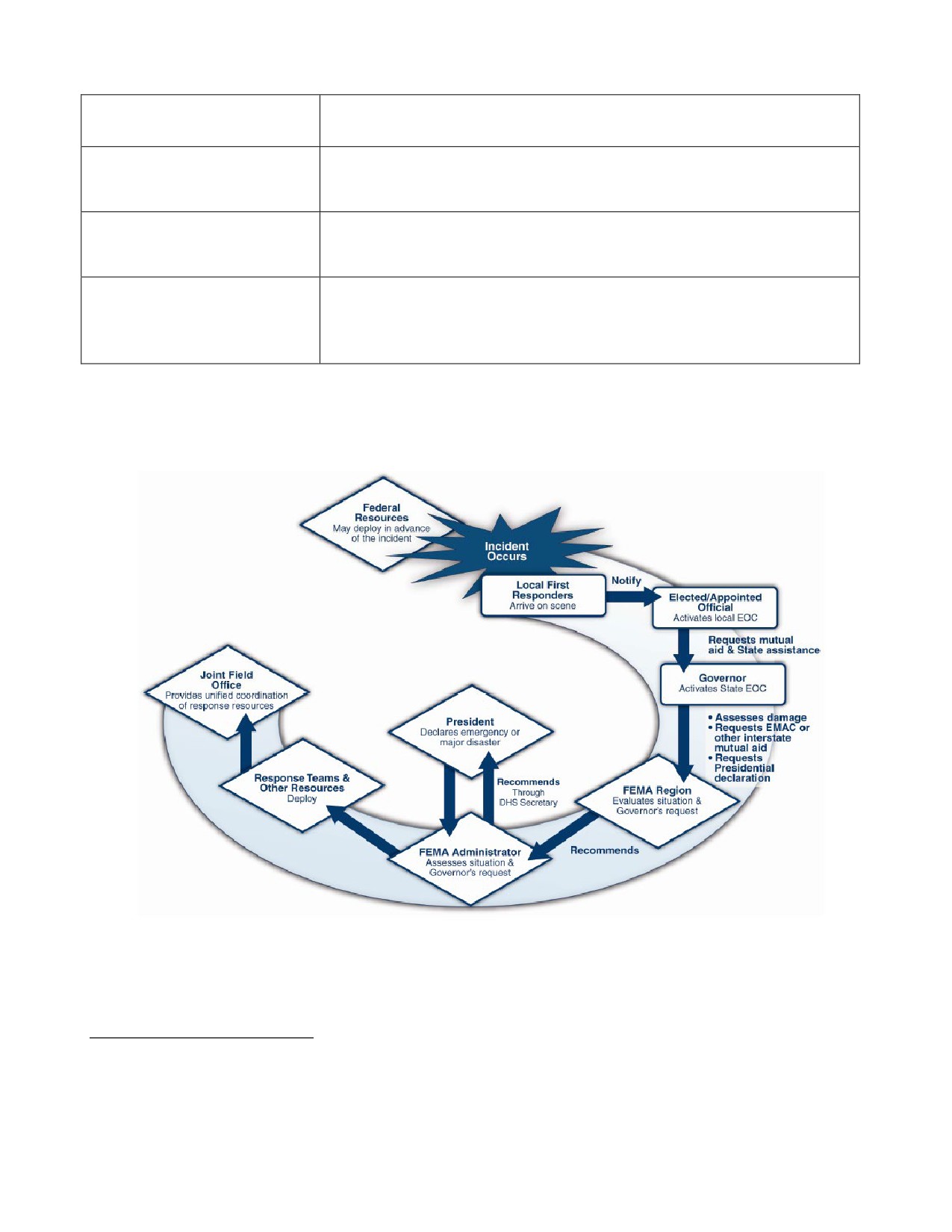
Domestic Operational Law Handbook 2021
resulting from a major disaster or emergency.
FEMA
Prepare, sponsor, and direct Federal response plans and programs
for emergency preparedness; provide hazard mitigation assistance
in the form of property acquisition & relocation assistance.
Department of Defense
Upon President’s direction, provide “emergency work” to protect
life and property prior to declaration of major disaster or
emergency.
American National Red
Major Disaster: As a condition of receiving assistance, comply
Cross and other relief
with regulations relating to non-discrimination and other
organizations
regulations as deemed necessary by the President for effective
coordination of relief efforts.
Table 2-4. Stafford Act Roles and Responsibilities
Figure 2-3.119
119 FEMA, Overview of Stafford Act Support to States, available at http://www.fema.gov/pdf/emergency/nrf/nrf-
stafford.pdf (last visited Aug. 3, 2020).
Chapter 2
37
National Framework for Incident Management
Domestic Operational Law Handbook 2021
The FCO may utilize relief organizations, such as State relief organizations and the American National
Red Cross (ANRC). The use may be for the distribution of emergency supplies, such as food and
medicine, and in reconstruction or restoration of essential services, such as housing. The FCO may
coordinate all relief efforts. However, States, localities, and relief organizations must agree with the
courses of action. The President must form Emergency Support Teams (EST) of Federal personnel to
be deployed to the area of the disaster or emergency.120 By delegation, the FCO may activate ESTs,
composed of Federal program and support personnel, which deploy into an area affected by a major
disaster or emergency.121 The EST is the principal interagency group that supports the FCO in
coordinating the overall Federal disaster assistance.
1. Requests for Emergency or Major Disaster Declarations
Under the Stafford Act, the Governor of an affected State may request the declaration of a major
disaster or emergency.122 The Governor must demonstrate, as a prerequisite for receiving assistance,
both that the State’s response plans have been activated and that State and local capabilities are
inadequate for an effective response.123 The Stafford Act’s definitions of “emergency” and “major
disaster” are referenced in many of the legal documents related to incident management and are used
consistently throughout this chapter.
a. Major Disasters
A “major disaster” is defined as follows:
[A]ny natural catastrophe (including any hurricane, tornado, storm, high water,
winddriven water, tidal wave, tsunami, earthquake, volcanic eruption, landslide,
mudslide, snowstorm, or drought), or, regardless of cause, any fire, flood, or
explosion, in any part of the United States, which in the determination of the
President causes damage of sufficient severity and magnitude to warrant major
disaster assistance under this chapter to supplement the efforts and available
resources of States, local governments, and disaster relief organizations in
alleviating the damage, loss, hardship, or suffering caused thereby.124
A major disaster encompasses fires, floods, and explosions, regardless of cause, when such acts cause
damage of sufficient severity to warrant Federal disaster assistance, as determined by the President. A
WMD event involving fire or explosion, including the detonation of a high-yield explosive, would
likely meet this threshold. Following the letter of the law strictly, a chemical, radiological, or
biological WMD event in the United States will qualify as a major disaster only if it results in a fire,
flood, or explosion. A WMD event of catastrophic proportions could warrant treatment as both a
major disaster and an emergency.
120
42 U.S.C. § 5144 (2012 & Supp. IV 2017).
121
44 C.F.R. § 206.43 (2017). These teams may also be called emergency response teams.
122
44 C.F.R. § 206.35 (2017).
123
44 C.F.R. § 206.36 (2017).
124
42 U.S.C. § 5122(2) (2018).
Chapter 2
National Framework for Incident Management
38
Domestic Operational Law Handbook 2021
Major disaster assistance is a more comprehensive grant of Federal aid for long-term consequence
management. In a major disaster, the President has broad authority to assist States and localities. To
receive Federal assistance, a Governor must not only indicate to the President that the State does not
have the capacity or resources to mount an effective response, but he or she must also furnish
information on the measures that have or will be taken at the State and local levels to mitigate the
effects of the disaster. In addition, the Governor must certify that State and local government
obligations and expenditures will comply with all applicable cost-sharing requirements of the Stafford
Act.125
The President’s powers after the declaration of a major disaster include, but are not limited to,
providing: specified technical and advisory assistance; temporary communications services; food;
relocation assistance; legal services; crisis counseling assistance and training; unemployment
assistance; emergency public transportation in the affected area; and fire management assistance on
public or privately-owned forest or grassland.126 In addition, the President is authorized to direct
Federal agencies to provide equipment, supplies and facilities to State and local governments;
distribute food and medicine to victims; and perform work and services (such as search and rescue)
necessary to save lives and protect property.127
b. Emergencies
The Stafford Act defines “emergency” as follows:
[A]ny occasion or instance for which, in the determination of the President,
Federal assistance is needed to supplement State and local efforts and
capabilities to save lives and to protect property and public health and safety, or
to lessen or avert the threat of a catastrophe in any part of the United States.128
An emergency is, more broadly, any situation in which Federal assistance is required to save lives,
protect health and property, or mitigate or avert a catastrophe. Generally, the existence or threat of a
chemical, biological, radiological, nuclear, and high-yield explosive WMD would be deemed an
“emergency,” if it overwhelms State and local authorities and warrants the assistance of the Federal
Government.
Emergency authority granted to the President is similar to that authorized for handling major disasters,
but not as extensive. Emergency assistance is more limited in scope and in time. Additionally, total
assistance may not exceed $5 million for a single emergency, unless the President determines there is a
continuing and immediate risk to lives, property, public health or safety, and necessary assistance will
not otherwise be provided on a timely basis.129 In contrast to its provisions for major disasters, The
Stafford Act authorizes the President to declare an emergency sua sponte, when the emergency
125
42 U.S.C. § 5170 (2018).
126
42 U.S.C. §§ 5171-5189 (2012 & Supp. IV 2017).
127 See id. § 5170b.
128
42 U.S.C. § 5122(1) (2018).
129 See id. § 5193.
Chapter 2
39
National Framework for Incident Management
Domestic Operational Law Handbook 2021
“involves a subject area for which, under the Constitution or laws of the United States, the United
States exercises exclusive or preeminent responsibility and authority.”130
In any emergency, the President may direct any Federal agency, with or without reimbursement, to use
the authorities and resources granted to it under Federal law in support of State and local emergency
assistance efforts to save lives, protect property and public health and safety, and lessen or avert the
threat of a catastrophe.131 The President may coordinate all emergency relief assistance and provide
technical and advisory assistance to affected State and local governments for the: performance of
essential community services; issuance of hazard and risk warnings; broadcast of public health and
safety information; and management, control and reduction of immediate threats to public safety.132
The President may also direct Federal agencies to provide emergency assistance; remove debris
pursuant to 42 U.S.C. § 5173; provide temporary housing assistance in accordance with 42 U.S.C. §
5174; and assist State and local governments in the distribution of food, medicine, and other
consumable supplies.133 The Stafford Act also authorizes the President, upon request from the
Governor of an affected State, to provide “emergency work” essential for the preservation of life and
property, by the Department of Defense for a maximum of ten days before the declaration of either an
emergency or a major disaster.134
2. Liability under the Stafford Act
The Stafford Act specifically provides for immunity from liability for certain actions taken by Federal
agencies or employees of the Federal government pursuant to the Act. 42 U.S.C. § 5148 of the
Stafford Act provides:
The Federal Government shall not be liable for any claim based upon the
exercise or performance of or the failure to exercise or perform a discretionary
function or duty on the part of a Federal agency or an employee of the Federal
Government in carrying out the provisions of this chapter.135
3. Categories of Agency Support Under the Stafford Act136
Once an emergency or major disaster is declared, it means a State has requested assistance from the
Federal Government (except in the case of the limited exception discussed above). The assistance
given will typically take one of two forms: Direct Federal Assistance or Federal Operations Support.
130 See id. § 5191(a).
131 See id. § 5192.
132 Id.
133 Id.
134 See id. § 5170b(c).
135 See id. § 5148.
136 U.S. COAST GUARD, COMDTINST 3006.1 (series), FEDERAL EMERGENCY MANAGEMENT AGENCY (FEMA) MISSION
ASSIGNMENTS: OPERATIONAL ACCEPTANCE AND EXECUTION (Aug. 13, 2012).
Chapter 2
National Framework for Incident Management
40
Domestic Operational Law Handbook 2021
a. Direct Federal Assistance is assistance where one or more Federal departments or
agencies provide goods and services to State and/or local governments. Direct Federal Assistance is
authorized and reimbursed by FEMA and is subject to Federal-State cost sharing.
b. Federal Operations Support is assistance where one or more Federal departments or
agencies provide goods or services to FEMA and/or other Federal agencies to enable them to provide
direct Federal assistance or other supplemental Federal assistance. Federal operations support is
requested by FEMA or another Federal department or agency. Federal operations support is
authorized and reimbursed by FEMA and is not subject to Federal-State cost sharing.
4. Interplay Between the Stafford Act and National Preparedness System (NPS)137
The following is a summary of how Stafford Act assistance typically occurs, with reference to relevant
NPS concepts.
As the DHS NOC monitors for potential major disasters or emergencies, it will receive advance
warning of an incident, at which time DHS may deploy representatives to State EOCs for situational
assessment. Regional Response Coordination Centers (RRCCs) and other coordinating structures
discussed above may be activated.
Immediately after the incident, local emergency personnel assess the situation.138 They may seek
additional resources through mutual aid agreements or the State. State officials will mobilize State
resources and may use mutual aid processes such as the Emergency Management Assistance Compact
(EMAC) to augment their resources.139 The Governor will activate the State emergency operations
plan, declare a state of emergency, and may request a State/DHS joint Preliminary Damage
Assessment (PDA).140 State and Federal officials conduct the PDA in coordination with tribal/local
officials as required and determine if the event warrants a request for a Presidential declaration of a
major disaster or emergency.
After a major disaster or emergency declaration, an RRCC coordinates initial activities until a JFO is
established.141 If regional resources are overwhelmed or if it appears that the event may result in
particularly significant consequences, DHS may deploy a national-level Incident Management
Assistance Team (IMAT). Depending on the scope and impact of the event, the NRCC carries out
initial activations and mission assignments and supports the RRCC. The Governor appoints a State
Coordinating Officer (SCO) to oversee State response and recovery efforts. A Federal Coordinating
Officer (FCO), appointed by the President in a Stafford Act declaration, coordinates Federal activities
in support of the State.142
137 Example provided by Overview of Stafford Act Support to States, supra note 122.
138 Id.
139 Id.
140 Id.
141 Id.
142 Id.
Chapter 2
41
National Framework for Incident Management
Domestic Operational Law Handbook 2021
A JFO may be established locally to provide a central point for Federal, State, tribal, and local
executives to coordinate their support. The UCG leads the JFO. The UCG may need to meet initially
via conference calls to develop objectives and an initial action plan.143 The UCG coordinates field
operations from the JFO. In coordination with State, tribal, and/or local agencies, ESFs are activated
to assess the situation and identify response requirements. Federal agencies provide resources under
DHS/FEMA mission assignments or their own authorities.144
As immediate response priorities are met, recovery activities begin. The Stafford Act Public
Assistance program provides disaster assistance to States, tribes, local governments, and certain private
nonprofit organizations. As the need for full-time interagency coordination at the JFO decreases, the
UCG plans for selective release of Federal resources and demobilization.145
C. Immediate Response Authority (IRA)
1. Federal Military Commanders
Federal military commanders, heads of DoD Components, and/or responsible DoD civilian officials
have IRA under DoDD 3025.18. In response to a request for assistance from a civil authority, under
imminently serious conditions and if time does not permit approval from higher authority, DoD
officials may provide an immediate response by temporarily employing the resources under their
control, subject to any supplemental direction provided by higher headquarters, to save lives, prevent
human suffering, or mitigate great property damage within the United States.146 “The civil authority’s
request for immediate response should be directed to the installation commander or other appropriate
DoD official responsible for the installation
”147 The DoD official must exercise judgement in
determining the maximum allowable distance from the installation that the immediate response may
take place and should also, unless otherwise directed by a higher authority, prioritize DoD resources
and requirements before addressing the civil authority’s request.148 IRA does not allow for actions that
would subject civilians to the use of military power that is regulatory, prescriptive, proscriptive, or
compulsory (for a detailed discussion, see the Chapters within on Military Support to Civilian Law
Enforcement and Civil Disturbance Operations).
Separately, per DoDD 3025.18., paragraph 4.i.4, any decision by an IRA to temporarily deploy
resources requires notification to the National Joint Operations and Intelligence Center (NJOIC).
Commanders may not normally continue support under IRA beyond 72 hours. When using this
143 Id.
144 Id.
145 Id.
146 U.S. DEP’T OF DEFENSE, DIR. 3025.18, DEFENSE SUPPORT OF CIVIL AUTHORITIES para. 4.i. (29 Dec. 2010) (C2, 19 Mar.
2018) [hereinafter DoDD 3025.18].
147 Id. at 5.
148 Id.
Chapter 2
National Framework for Incident Management
42
Domestic Operational Law Handbook 2021
authority, DoD commanders shall reassess whether there remains a continued need for a DoD response
as soon as practicable, but no later than 72 hours after the request for assistance was received.149
As noted in Chapter 1, Commanders must evaluate requests from civil authorities for assistance for:
• Cost - Who pays and the impact on DoD budget;
• Appropriateness - Whether it is in the interest of DoD to provide the requested support;
• Readiness - Impact on DoD’s ability to perform its primary mission;
• Risk - Safety of DoD forces;
• Legality - Compliance with the law; and
• Lethality - Potential use of lethal force by or against DoD forces.150
2. State Governors
As the principle authority during State emergencies, Governors may direct an immediate response
using NG personnel under State command and control (including personnel in a Title 32
status).151However, NG personnel will not be placed in or extended in Title 32 status to conduct State
immediate response activities.152 Additionally, State leadership must coordinate with the Chief of the
NG Bureau to approve the continued use of personnel in a Title 32 status responding in accordance
with IRA in excess of seventy-two hours.
D. Conclusion
The NPS and NIMS represent a significant shift from the pre-9/11 and pre-Hurricane Katrina approach
of the Federal Government to domestic incident management. Although the Stafford Act remains the
primary mechanism for Federal support to State and local authorities, and State requests for assistance
still formally initiate the Federal response, the manner in which the Federal Government provides the
assistance has changed. Consolidation, unification, anticipation, and systemization are the unifying
themes of these key changes. It is possible that DoD personnel153 or assets could be among first
responders to an emergency or disaster (e.g., an event near a DoD installation). In such a case, DoD
personnel and assets might be employed pursuant to immediate response authority per DoDD 3025.18
before a larger Federal response is orchestrated under the NRF. Figure 2-4 below illustrates the
process for local requests for assistance following a Stafford Act declaration and under IRA. Judge
advocates should be familiar with and prepared to advise on the various authorities under which the
Department of Defense may provide assistance to non-Federal entities.
149 Id.
150 Id. at 4e.
151 CHIEF NATIONAL GUARD BUREAU, INST. 3000.04, NATIONAL GUARD BUREAU DOMESTIC OPERATIONS (Jan. 24, 2018)
para. 4.a. [hereinafter CNGBI 3000.04].
152 DoDD 3025.18, supra note 150, at para. 4.j.
153 Under 10 U.S.C. § 12304a, the Secretary of Defense may involuntarily order military reserve members and units to
active duty to support a Governor’s request for assistance in response to an emergency or major disaster under the Stafford
Act.
Chapter 2
43
National Framework for Incident Management

Domestic Operational Law Handbook 2021
Figure 2-4
Chapter 2
National Framework for Incident Management
44
Domestic Operational Law Handbook 2021
Chapter 2
45
National Framework for Incident Management
Domestic Operational Law Handbook 2021
CHAPTER 3
STATUS AND RELATIONSHIPS BETWEEN COMPONENTS
RESPONDING TO DOMESTIC INCIDENTS
KEY REFERENCES:
• Department of Defense Instruction (DoDI) 1235.12 - Accessing the Reserve Component, June
7, 2016, incorporating Change 1, February 28, 2017.
• DoDI 6025.13 - Medical Quality Assurance (MQA) and Clinical Quality Management in the
Military Health System (MHS), February 17, 2011, incorporating Change 2, April 1, 2020.
• DoDI 1215.13 - Ready Reserve Member Participation Policy, May 5, 2015.
• DoDI 1215.06 - Uniform Reserve, Training and Retirement Categories for the Reserve
Component, March 11, 2014, incorporating Change 1, May 19, 2015.
• Department of Defense Direction (DoDD) 1200.17 - Managing the Reserve Components as an
Operational Force, October 29, 2008.
• DoDD 5124.10- Assistant Secretary of Defense for Manpower and Reserve Affairs, March 14,
2018.
A. Introduction
This chapter discusses the various Service components and the importance of their designated status to
the missions they perform. The Reserve Component (RC), which is comprised of the reserve of the
various Services and the National Guard (NG) of States, plays a significant role in domestic support
operations. The purpose of the RC is to provide trained and qualified persons available for active duty
in time of war, national emergency, or for other national security requirements.1 The RC has unique
personnel/duty categories that are important to understand because they not only determine what
benefits (e.g., medical and retirement) and protections (e.g., Federal Tort Claims Act or similar liability
rules) RC members have, but they also determine the different types of duties that Service member
may perform. The Assistant Secretary of Defense for Manpower and Reserve Affairs (ASD (M&RA))
is responsible for the supervision of RC affairs in the Department of Defense, and establishes the
directives that provide guidance on RC activation, mobilization, and training.2
Judge advocates practicing domestic operational law should also be familiar with the structure and
roles of the U.S. Coast Guard, the NG in a non-Federal status, and the Civil Air Patrol because these
entities have unique roles in domestic operations and will often work jointly with the Department of
Defense during domestic civil support missions. For example, in addition to being a branch of the U.S.
Armed Forces, the Coast Guard is also a Federal law enforcement agency and has the responsibility to
act as a lead agency for numerous domestic missions including environmental response, maritime
search and rescue, and maritime migrant interdiction.3 Additionally, while in a non-Federal status, the
Air and Army NG have different authorities and capabilities in domestic missions. Finally, the Civil
1
10 U.S.C. § 10102 (2018).
2 U.S. DEP’T OF DEFENSE, DIR 5124.10, ASSISTANT SECRETARY OF DEFENSE FOR MANPOWER AND RESERVE AFFAIRS (14
Mar. 2018).
3 14 U.S.C. §§ 102, 103 (2018).
Chapter 3
Status Relationships Between Components
46
Domestic Operational Law Handbook 2021
Air Patrol, a nonprofit corporation, also serves as an auxiliary to the United States Air Force.4
Understanding the roles of these entities ahead of time will assist judge advocates during future joint
operations.
B. Reserve Component
The RC consists of the Army NG of the United States (ARNGUS), the Army Reserve, the Naval
Reserve, the Marine Corps Reserve, the Air NG of the United States (ANGUS), the Air Force Reserve,
and the Coast Guard Reserve.5 Members of the RC are a true reflection and extension of civilian
society. The defense of the United States is dependent upon the contributions of these citizens who
prepare for active service during peacetime and enter active duty during times of national emergency.
1.
U.S. Army Reserve (USAR)6
The USAR’s mission is to meet Department of the Army contingency operations and mobilization
requirements.7 The Army Reserve makes up 20 percent of the Army’s organized units, but provides
half of the Army’s combat support, and 25 percent of the Army’s mobilization base expansion
capability.8
2.
U.S. Air Force Reserve (USAFR)9
The USAFR is composed of 35 wings that report to one of 3 Numbered Air Forces (NAFs).10 With
just over 10 percent of the Air Force’s manpower, the USAFR performs more than 30 percent of all
Air Force missions.11 Like all of the other RCs, the role of the USAFR is to provide trained and ready
forces to support its parent service. Yet the USAFR also has several unique missions. For example,
4
10 U.S.C. § 9492 (2018).
5
10 U.S.C. § 10101 (2018).
6 U.S. DEPT’ OF ARMY, REG. 140-1, MISSION, ORGANIZATION, AND TRAINING (20 Jan. 2004) [hereinafter AR 140-1]; U.S.
DEP’T OF ARMY, REG. 140-10, ASSIGNMENTS, ATTACHMENTS, DETAILS, AND TRANSFERS (25 Apr. 2018); U.S. DEP’T OF
ARMY, REG. 135-18, THE ACTIVE GUARD RESERVE PROGRAM (11 Oct. 2019); U.S. DEP’T OF ARMY, REG. 135-200, ACTIVE
DUTY FOR MISSIONS, PROJECTS, AND TRAINING FOR RESERVE COMPONENT SOLDIERS, 26 Sept. 2017). 1994).
7 AR 140-1, supra note 6, para. 1-8.
8 America’s Army Reserve, ARMY RESERVE, http://www.usar.army.mil/About-Us/ (last visited June 25, 2020).
9 U.S. DEP’T OF AIR FORCE, INSTR. 36-2110, TOTAL FORCE ASSIGNMENTS (5 Oct. 2018); U.S. DEP’T OF AIR FORCE, INSTR.
36-2619, ACTIVE DUTY OPERATIONAL SUPPORT (ADOS)—ACTIVE COMPONENT (AC) MAN-DAY PROGRAM (25 Nov.
2019); U.S. DEP’T OF AIR FORCE, INSTR., 36-2136, RESERVE PERSONNEL PARTICIPATION (6 Sept. 2019).
10 Command Structure, U.S. AIR FORCE RESERVE, https://www.afreserve.com/about (last visited April 5, 2021).
11
The unit program of the USAFR is called the “Category A” program. Personnel perform a minimum of one weekend of
inactive duty training every month, referred to as a unit training assembly (UTA), and two weeks of active duty (annual
training) for pay and points each fiscal year. The “Category B” program is the individual mobilization augmentee (IMA)
program consisting of individual reservists assigned to major commands, field operating agencies, joint organizations,
direct reporting units and outside agencies. Although some commands allow training with other units in the member’s
local area, this decision is made on a case-by-case basis by the individual command. Inactive duty training periods for pay
and points are usually performed during the week in increments of four IDTs per quarter. A day is worth two IDT points.
Members also perform a 12-14 day paid active duty training tour annually with one point awarded for each day. In the
“Category E” program, personnel do not earn pay for their service, but they do earn retirement points. Examples of this are
service with the Civil Air Patrol Assistance Program and the Chaplain reinforcement designees.
Chapter 3
47
Status Relationships Between Components
Domestic Operational Law Handbook 2021
the 731st Airlift Squadron, assigned to the 302nd Airlift Wing, Peterson Air Force Base, Colorado, is
trained in the use of modular airborne firefighting systems that support local, State, and Federal
agencies during wildland fire response.12 Additionally, the 53rd Weather Reconnaissance Squadron at
Keesler Air Force Base, Mississippi, performs hurricane reconnaissance exercises over the Atlantic,
Pacific, Caribbean, and Gulf of Mexico and is the only DoD unit tasked to perform weather
reconnaissance in support of the Department of Commerce.13
3.
U.S. Naval Reserve (USNR)14
The Naval Reserve is composed of both commissioned units (self-contained, deployable assets with
both personnel and mission equipment) and augmentation units (non-hardware units that provide
trained manpower to active Navy units). Typically, members of the U.S. Naval Reserve (USNR) serve
one weekend a month and an additional two weeks per year. However, members may also serve
fulltime as Navy Full-Time Support or Navy Individual Augmentees. USNR unique missions include
operation of a Mine Countermeasure Ships, Mobile Inshore Undersea Warfare Units, Helicopter
Warfare Support Squadrons, and Navy Expeditionary forces such as Seabees and Cargo Handlers.
4.
U.S. Marine Corps Reserve (USMCR)15
The Marine Corps Reserve is composed of one Marine division, one Marine air wing, one service
support group, and a Marine Corps Reserve support command. Marine Forces Reserve is the
headquarters command for roughly 100,000 members of the USMCR.16 Unique units in this reserve
branch include Civil Affairs Groups and Air-Naval Gunfire Liaison Companies.
5.
U.S. Coast Guard Reserve (USCGR)17
The USCGR, like its active duty counterpart, is an agency within the Department of Homeland
Security. Under Title 14 and Title 10 of the United States Code, the Coast Guard is at all times an
armed force, as well as a law enforcement agency. As an armed force, the Coast Guard is required to
maintain a state of readiness to function as a specialized service in the Navy in time of war or upon
Presidential declaration. The Coast Guard, discussed more below, is a unique member of Joint Forces
involved in civil support missions because of its mix of military, civil law enforcement, and regulatory
authorities that allow it to respond to a wide variety of threats at home and abroad.
12 Modular Airborne Fire Fighting System (MAFFS), 302ND AIRLIFT WING, http://www.302aw.afrc.af.mil/About-Us/Fact-
Sheets/Display/Article/627167/modular-airborne-fire-fighting-system-maffs/ (last visited June 25, 2020).
13
53rd Weather Reconnaissance Squadron Hurricane Hunters, 403RD WING (Mar. 23, 2011),
hurricane-hunters/.
14 U.S. DEP’T OF NAVY, CHIEF OF NAVAL OPS, INSTR. 1001.20D, STANDARDIZED POLICY AND PROCEDURE FOR THE ACTIVE
DUTY FOR OPERATIONAL SUPPORT PROGRAMS (20 Feb. 2020).
15 U.S. MARINE CORPS, ORDER 1001.52K, MANAGEMENT OF THE ACTIVE RESERVE (AR) SUPPORT TO THE UNITED STATES
MARINE CORPS RESERVE (15 Feb. 2019); U.S. MARINE CORPS, ORDER 1001.59A, ACTIVE DUTY FOR OPERATIONAL
SUPPORT (ADOS) IN SUPPORT OF THE TOTAL FORCE (19 Jan. 2011).
16 MARFORRES Media Information, U.S. MARINE CORPS FORCES RESERVE,
https://www.marforres.marines.mil/About/Media-Info/ (last visited June 25, 2020).
17 U.S. COAST GUARD, COMMANDANT INST. M1001.28C, RESERVE POLICY MANUAL, (Dec. 2016).
Chapter 3
Status Relationships Between Components
48
Domestic Operational Law Handbook 2021
Coast Guard reservists may be called in response to serious natural or man-made disasters, accidents,
or catastrophes such as hurricanes, earthquakes, tornadoes, or floods. The Secretary of Homeland
Security has the authority to order members of the Coast Guard Ready Reserve to active duty without
their consent in a domestic emergency.18 They may be used for not more than 120 days in any two-
year period to augment the Regular Coast Guard. Coast Guard reservists perform unique missions as
well. Among the most important is the staffing of Guard Port Security Units (PSUs)—specialized
deployable security units that have served both domestically and abroad during times of war.19
Additionally, under 10 U.S.C. § 12302, the USCGR provided key support to Operation Iraqi Freedom
and Operation Enduring Freedom.20
6.
NG of the United States (NGUS)
a. Overview
The terms Army NG of the United States (ARNGUS) and Air NG of the United States (ANGUS) refer
to the NG as a RC of their respective service.21 The terms “Federal service” and “Federalized” are
applied to NG members and units when ordered to active duty in their RC status or called into Federal
service in their militia status under various sections of Title 10 of the U.S. Code.22
The terms “Army NG”(ARNG) and “Air NG” (ANG) refer to the Federally-recognized (and usually
Federally trained and funded under Title 32, U.S. Code) organized militia of the various States—in
other words, members of the NG in a “State status” pursuant to Article I, Section 8, Clause 16 of the
Constitution.23 The ARNG and ANG train for their Federal military missions according to
congressionally-established disciplines under Title 32 of the U.S. Code, and they are under State
control. ARNG/ANG members also take oaths to obey their respective governors and abide by State
law.24 Upon enlistment/commissioning in the Army and Air NG, members simultaneously become
members of the ARNGUS or ANGUS respectively, and thus may be called into Federal service.
Determining whether a NG member is in a State or Federal status can be critical to defining
their roles and responsibilities. Status is also the primary factor for determining the applicability of
law for such issues as benefits, protections, and liabilities. For instance, members of the NG only
become subject to the Uniform Code of Military Justice (UCMJ) when Federalized (serving on active
duty under Title 10); while in a State status they are subject to their respective State codes of military
18 See 14 U.S.C. § 3713 (2018).
19 U.S. COAST GUARD PORT SECURITY UNIT HISTORY, https://media.defense.gov/2017/Jun/25/2001768454/-1/-1/0/USCG-
PORT-SECURITY-UNIT-HISTORY.PDF (last visited Oct 27, 2020).
20 The Center for Naval Analyses (CNA), upon request of the U.S. Coast Guard Historian, compiled a summary of Coast
Guard operations in Operation Iraqi Freedom. See BASIL TRIPSAS, ET AL., COAST GUARD OPERATIONS DURING OPERATION
IRAQI FREEDOM (2004), https://media.defense.gov/2017/Jul/01/2001772261/-1/-1/0/OIF_D0010862.PDF (last visited Apr.
5, 2021).
21
10 U.S.C. §§ 101(c), 10101 (2018). Per 10 U.S.C. §§ 10105 and 10111 (2018), the Army National Guard of the United
States (ARNGUS) and Air National Guard of the United States (ANGUS) specifically consist of (1) Federally recognized
units and organizations of the ARNG/ANG, and (2) members of the ARNG/ANG who are also members of the Army/Air
Force Reserves.
22 See 10 U.S.C. chs. 13, 1211 (2018).
23 See 10 U.S.C. § 101 (2018); 32 U.S.C. §§ 301, 307 (2018).
24 See 32 U.S.C. §§ 304, 312 (2018).
Chapter 3
49
Status Relationships Between Components
Domestic Operational Law Handbook 2021
justice. Additionally, some laws, such as the Posse Comitatus Act (PCA) only apply to the NG when
they are in a Title 10 status. NG members are usually relieved from duty in the NG when on Federal
active duty as a member of the NGUS under 32 U.S.C. § 325. However, per the National Defense
Appropriations Act for Fiscal Year 2004, 32 U.S.C. § 325 was amended to allow Federalized NG
officers to retain command authority over State forces with the approval of POTUS and the consent of
the Governor.25
Guard personnel in Title 10 and Title 32 status receive Federal pay and are covered under the Federal
Torts Claims Act.26 Title 10 personnel always receive Federal military retirement credit for the
performance of duty. It is helpful to keep in mind that the determination of whether the NG is in
Federal or State service does not rest on the entity that funds the activity, but rather which entity has
command and control.
b. History
Congress created the organized militia (i.e., the NG) in 1903,27 and further strengthened its
organization and training with The National Defense Act of 1916.28 However, during WWI, members
of the NG were still drafted to serve during wartime. As a result, Congress amended the National
Defense Act in 1933 to establish the dual status of the NG, creating the “two overlapping but distinct
organizations” - the NG of the various States and the NG of the United States.29 Members of the NG
would be relieved from their militia status while on Federal status, but would revert back to State status
at the conclusion of their Federal service. In other words, this statute created the “dual enlistment”
requirement that we know today.30
c. Federal Missions
Like the other RCs, ARNGUS/ANGUS31 members and units integrate with the Active Component as
part of a total force capability for responding to a wide range of national defense missions. To become
an ARNGUS or ANGUS member, the Service member or Service member’s unit must be “Federally
recognized;”32 and to be Federally recognized, the Service member or Service member’s unit must
25 Section (G)(6)(a) of this chapter and section (A)(6) of chapter 2 discuss Dual Status Commanders in more detail.
26 See 32 C.F.R. § 536.97 (2012).
27 Military Act of 1903 (Dick Act), 57 Pub. L. No. 33, 32 Stat. 775. See also Perpich v. Dep’t of Def., 496 U.S. 334, 342
(1990).
28 National Defense Act of 1916, 64 Pub. L. 85. See also Perpich, 496 U.S. 334, 343-44.
29 National Guard Act of 1933, 73 Pub. L. 64, § 18. See also Perpich, 496 U.S. 334, 345-46.
30 This is a system that the Perpich Court recognized as a statutory creation, causing a member of the militia to be relieved
from State status for the “entire period of Federal service.” Perpich, 496 U.S. 334, 345-346.
31 When ANG members enter Title 10 active duty, they are transferred from their ANG units and assigned to the Air
National Guard Readiness Center (ANGRC), either directly or to a detachment of the ANGRC created for the purpose of
deploying forces in support of an active duty mission. The ANGRC is a Field Operating Agency (FOA) of HQ USAF that
executes NGB policy for the ANG and ANGUS and exercises elements of command and control over ANGUS units and
members. It is a Title 10 organization with a 32 U.S.C. § 104 commander appointed on G-series orders. The ANGRC
commander, currently a brigadier general, also serves as the Deputy Director of the ANG Directorate and is on Title 10
orders. See U.S. DEP’T OF AIR FORCE, INSTR. 10-402, MOBILIZATION PLANNING, (8 Mar. 2018). (Guidance Memorandum 7
Oct. 2020), https://static.e-publishing.af.mil/production/1/af_a3/publication/afi10-402/afi10-402.pdf (last visited October
27, 2020). [hereinafter AFI 10-402].
32
10 U.S.C. §§ 10105, 10111, 10503(7), 12201, 12211, 12212 (2018); 32 U.S.C. § 105(b) (2018).
Chapter 3
Status Relationships Between Components
50
Domestic Operational Law Handbook 2021
meet prescribed Federal standards.33 NG units or members may be ordered to Federal active duty
either
(1) under various provisions of Title 10 (e.g., partial mobilization, volunteer duty, or pre-
planned Combatant Commander support)34 as members of the ARNGUS or ANGUS;35 or (2) pursuant
to the power of Congress to call out the militia to enforce Federal law, suppress insurrections, or repel
invasions. Under the latter authority the NG is “called” to duty as part of the militia of the United
States.36 Congress has given the President the authority to call the NG to active duty for these
purposes.37 As discussed in section (G)(2) of this chapter, the NG can also be utilized for “Federal
missions” in a Title 32 status under certain conditions. Authorized duty under 32 U.S.C. § 502(f)
includes support of operations at the request of the President or Secretary of Defense, for example,
natural disaster response and assistance to the Department of Homeland Security on the Southwest
border.
d. Other Title 10 Duty
In addition to duties performed when Federalized under the aforementioned authorities, members of
the NG serve in a full-time Title 10 status in other ways. Members in this category include members
of the NG Bureau (NGB), U.S. Property and Fiscal Officers (USPFO) in each State serving the NG,38
and any other NG members serving a tour of duty under Title 10 in support of NGB, Major
Commands, or other “seats of government” tours.
(1) NG Bureau (NGB)
The NGB is designated under Title 10 as a “joint activity” of the Department of Defense, serving as
the NG channel of communications between the Army and Air Force and the fifty-four States and
territories.39 While the NGB serves as the coordination, administrative, policy, and logistical center
for the ARNG and the ANG, NGB does not command and control either the Army or Air NG.
Pursuant to its charter, NGB is responsible for, among other things, implementing Army and Air Force
guidance, prescribing and monitoring training discipline and requirements, and supervising and
administering the budgets of the ARNG and ANG.40
Through the 2012 National Defense Authorization Act, the Chief, NGB (CNGB), a four-star general,
became a member of the Joint Chiefs of Staff with responsibilities advising the President, the National
Security Council, Homeland Security Council, and the Secretary of Defense.41 As a member of the
33 See NATIONAL GUARD BUREAU, REG. 10-1, ORGANIZATION AND FEDERAL RECOGNITION OF ARMY NATIONAL GUARD
UNITS (22 Nov. 2002); U.S. DEP’T OF AIR FORCE, INSTR. 38-101, MANPOWER AND ORGANIZATION (29 Aug. 2019).
34 10 U.S.C §§ 12302, 12304b (2018); see also U.S. DEP’T OF DEF., INSTR. 1215.06, UNIFORM RESERVE, TRAINING, AND
RETIREMENT CATEGORIES FOR THE RESERVE COMPONENTS app. to encl. 4 (11 Mar. 2014) (C1, 19 May 2015).
35 U.S. CONST. art. 1, § 8, cl. 12; Perpich, 496 U.S. at 334; 10 U.S.C. §§ 12301-12304 (2018).
36 U.S. CONST. art. I, § 8, cl. 15; 10 U.S.C. ch. 13 (these statutes also include the use of the Armed Forces of which the
NGUS is part); 10 U.S.C. § 12406 (2018). Although these statutes are in Title 10 of the U.S. Code, members “called up”
under these provisions retain their militia status.
37
10 U.S.C. Ch. 13 (2018).
38
32 U.S.C. § 708 (2018).
39
10 U.S.C. § 10501 (2018). The “54,” as they are often called, include the fifty States, Puerto Rico, Guam, U.S. Virgin
Islands, and the District of Columbia.
40 DEP’T OF DEFENSE, DIR. 5105.77, NATIONAL GUARD BUREAU (NGB) (30 Oct. 2015) (C1, 10 Oct. 2017).
41
10 U.S.C. § 151 (2018).
Chapter 3
51
Status Relationships Between Components
Domestic Operational Law Handbook 2021
Joint Chiefs, CNGB is responsible for matters involving non-Federalized NG forces in support of
homeland defense and civil support missions.42 CNGB also serves as the principal advisor on all NG
matters to the Secretaries of the Army and Air Force and to the Army and Air Force Chiefs of Staff.43
CNGB has executive agent responsibility for planning and coordinating the execution of NG military
support operations. The Director, ARNG, and the Director, ANG, are responsible to the CNGB and
assist in executing the functions of NGB as they relate to their respective branches. The Chief
Counsel’s office at NGB provides legal advice and assistance to the CNGB, the Directors of the Army
and Air NGs, and to the full-time judge advocates at the State level. The Chief Counsel’s office
normally employs a joint staff of military and civilian attorneys in a wide variety of disciplines,
including administrative law, contract and fiscal law, international and operational law, environmental
law, labor law, legislation, and litigation.
(2)
U.S. Property and Fiscal Officers (USPFO)
Each State has a USPFO. As Title 10 officers assigned to the NGB, a USPFO is detailed for duty to a
States and is accountable for all Federal funds and property provided to the NG of each State.44 The
USPFO and his staff also perform functions relating to supply, transportation, internal review, data
processing, contracting, and financial support for the State NG. 45 When required, the USPFO staff
can support AC or other RC forces on a reimbursable basis.
e. Other NG Authorities for Duty
Members of the NG perform Inactive Duty Training (IDT) and Annual Training (AT) in a Title 32
status. They can also perform Active Duty for Operational Support (ADOS) in a Title 10 status to
support the ANG and ARNG at Federal headquarters levels.46 As noted above, some “AGR” tours are
also in a Title 10 status. They also perform ADOS in a Title 10 status to support Active Component
requirements. Army and Air Force appropriations fund these missions.47
C. Reserve Component Categories
There are three Reserve categories: Ready Reserve, Standby Reserve, and Retired Reserve. Each
member of the NG and Reserve is assigned within one of these categories. All members of the Army
42
10 U.S.C. § 10502 (2018).
43 Id.
44
32 U.S.C. 708 (2018).
45 NATIONAL GUARD BUREAU REG. 130-6/AIR NATIONAL GUARD INSTRUCTION 36-2, UNITED STATES PROPERTY AND
FISCAL OFFICER APPOINTMENT, DUTIES, AND RESPONSIBILITIES (1 Jul. 2007).
46 See U.S. DEP’T OF ARMY, REG. 135-200, ACTIVE DUTY FOR MISSIONS, PROJECTS, AND TRAINING FOR RESERVE
COMPONENT SOLDIERS, ch. 6 (26 Sept. 2017).
47 See id. Note that ch. 2, § 521 of the FY 2001 National Defense Authorization Act, exempts reserve officers on the
reserve active-status list (RASL) serving on active duty for three years or less from placement on the active-duty list
(ADL). Previously, these soldiers were added to the ADL for promotion.
Chapter 3
Status Relationships Between Components
52
Domestic Operational Law Handbook 2021
NG and Air NG, including those in the Inactive NG (ING), are in the Ready Reserve or Retired
Reserve.48
1.
Ready Reserve
The Ready Reserve consists of three subgroups: the Selected Reserve, the Individual Ready Reserve,
and the Inactive NG. These are units and individuals subject to order to active duty to augment the
Active Forces during a time of war or national emergency.49 This chapter will primarily address the
Selected Reserve.
a. Selected Reserve
The Selected Reserve consists of Soldiers assigned to Reserve Component units, the Individual
Mobilization Augmentation (IMA) Program, the Drilling Individual Mobilization Augmentation
(DIMA) Program, and the Active Guard Reserve (AGR) Program. These individuals and units
essential to wartime missions and have priority for training and equipment over other RC categories.
(1) Drilling Unit Reservists
Sometimes called Troop Program Units (TPU), these units consist of members assigned to Tables of
Organization and Equipment or Tables of Distribution and Allowances who normally perform at least
48 Inactive Duty Training (IDT) assemblies and not less than 15 days, exclusive of travel time, of
Annual Training (AT) each year. In the alternative, they may perform Active Duty for Training (ADT)
for no more than 30 days each year, unless otherwise specifically prescribed by the Secretary of
Defense.50
(2) Individual Mobilization Augmentees and Drilling Individual Mobilization
Augmentees
IMAs and DIMAs are RC members in a Selected Reserve status and not attached to an organized
Reserve unit. The IMA Program function is to provide qualified soldiers to fill pre-designated
mobilization required positions. IMAs are assigned to AC organizations or Selective Service System
positions that must be filled to support mobilization requirements, contingency operations, operations
other than war, or other specialized or technical requirements. Drilling IMA positions are identified as
critical elements for mobilization during a Presidential Reserve Call-up (PRC) requiring an incumbent
to maintain an even higher level of proficiency than a regular IMA Soldier. Soldiers assigned to these
positions are authorized to perform 48 paid IDT periods per year. All IMAs must perform a minimum
of 12 days of AT each year.51
48 U.S. DEP’T OF DEFENSE, INST. 1215.06, UNIFORM RESERVE TRAINING AND RETIREMENT CATEGORIES, para. E5.1 (11
Mar. 2014) (C2, 19 May 2105) [hereinafter DoDI 1215.06].
49 Id. para. E.5.1.1. These individuals and units may be involuntarily ordered to active duty during war or national
emergency under the authority of 10 U.S.C. §§ 12301, 12302 (2018) and 14 U.S.C. § 3713 (2018).
50 U.S. DEP’T OF DEFENSE, INST. 1215.13, RESERVE COMPONENT MEMBER PARTICIPATION POLICY encl. 3, para. (1)(b)(2)
(5 May 2015).
51 DoDI 1215.06, supra note 48, encl. 3, para. (3)(a)(2). The Army National Guard and the Air National Guard do not
have IMA programs.
Chapter 3
53
Status Relationships Between Components
Domestic Operational Law Handbook 2021
(3) Active Guard and Reserve (AGR) Program
The AGR Program consists of Soldiers performing active duty or full-time NG duty (FTNGD) for 180
days or more for the purpose of organizing, administering, recruiting, instructing, or training the
Reserves.
b. Individual Ready Reserve (IRR)
The IRR is a pool of pre-trained individuals who have already served in Active Component units or in
the Selected Reserve and have some part of their Military Service Obligation (MSO) remaining. Some
members volunteer to remain in the IRR beyond their MSO or contractual obligation and participate in
programs providing a variety of professional assignments and opportunities for earning retirement
points and military benefits.52 IRR members are subject to involuntary active duty and fulfillment of
mobilization requirements.
c. The Inactive NG (ING)
The ING consists of NG enlisted personnel in an inactive status in the Ready Reserve, not in the
Selected Reserve, and attached to a specific NG unit. These individuals must muster once a year with
their unit, but they do not participate in training activities. They may not train for points or pay and are
not eligible for promotion.53
2. Standby Reserve
The Standby Reserve consists of personnel who are maintaining their military affiliation without being
in the Ready Reserve, but have been designated key civilian employees, or have a temporary hardship
or disability. They are not required to perform training and are not part of units. The Standby Reserve
is a pool of trained individuals who may be mobilized as needed to fill manpower needs in specific
skills.54
3. Retired Reserve
This category consists of all Reserve personnel transferred to the Retired Reserve. These individuals
may voluntarily train with or without pay.55 All members retired for having completed the requisite
52 Id. encl. 5, para. (2)(b). The IRR also may include personnel participating in officer training programs, including
Merchant Marine Academy cadets, enlisted members awaiting IADT (except for those in the National Guard) who are not
authorized to perform IDT, and members of the Delayed Entry Program. Id.
53 Id. encl. 5, para. (2)(c). The Air National Guard does not have an inactive status. Officers may not be transferred to the
ING. See 32 U.S.C. §303 (2018).
54 DoDI 1215.06, supra note 49, encl. 5, para. 3. The Standby Reserve consists of the active status list and the inactive
status list categories. Members designated as key employees and personnel who have not having fulfilled their statutory
military service obligation, or temporarily assigned for hardship reasons intending to return to the Ready Reserve, are on
the active status list. Those members who are not required to remain in an active program, but who retain Reserve
affiliation in a non-participating status and whose skill may be of future use to the Armed Force are on the inactive status
list. These members cannot participate in prescribed training and are not eligible for pay or promotion and do not accrue
credit for years of service. The Army National Guard and Air National Guard do not have a Standby Reserve.
55 Id. encl. 5, para. (4)(a). The Retired Reserve consists of the following retired categories:
(1) Reserve members who
have completed the requisite qualifying years creditable for non-regular retired pay and are receiving retired pay (at, or
after, age 60); (2) those who have completed the requisite qualifying years creditable for non-regular retired pay and are not
Chapter 3
Status Relationships Between Components
54
Domestic Operational Law Handbook 2021
years of active duty service (Regular or Reserve) may be ordered to active duty when required by the
Secretary of the military department concerned.56
D. Reserve Component Training and Support
The Service Secretaries and the Commandant of the Coast Guard are required to ensure trained and
qualified RC units and individuals are available for AD throughout the entire spectrum of
requirements, including war, national emergency, contingency operations, military operations other
than war, operational support, humanitarian operations, and at such other times as the national security
may require.57 Each military department has its own regulations and instructions that implement these
training and support duties.58
1.
Training
All RC members receive training according to their assignment and required readiness levels. This
training may be conducted in Active Duty (AD), Inactive Duty for Training (IDT), or Full-Time NG
status.
a. Active Duty
Active Duty for Training (ADT) consists of structured individual and unit training, including on-the-
job training, or educational courses to RC members. It includes Initial Active Duty training (IADT),59
Annual Training (AT), and Other Training Duty (OTD). Initial ADT includes basic military training
and technical skill training required for all enlisted accessions. AT is the minimum period of active
duty training that RC members must perform each year to satisfy the training requirements associated
with their RC assignment. By DoD policy, members of the Selected Reserve must perform AT. For
all members of Selected Reserve units, except for those in the NG, that training is not less than 14
days, and not less than 12 days for the Coast Guard Reserve. IMAs and DIMAs must perform 12 days
of AT each year and NG units must perform full-time military training for at least 15 days each year.
OTD is used to provide all other structured training, including on-the-job training and attendance at
schools. ADT is funded by the RC, but may support active component operational requirements and
missions.60
yet 60 years of age, or are age 60 and have not applied for non-regular retirement pay; (3) those members retired for
physical disability; (4) members who have completed 20 years of service creditable for regular retired pay, or are 30
percent or more disabled and otherwise qualified; (5) Reserve members who have completed the requisite years of active
service and are receiving regular retired or retainer pay (regular enlisted personnel of the Navy and Marine Corps with 20 to
30 years of active Military Service who are transferred to the Fleet Naval Reserve or the Fleet Marine Corps Reserve on
retirement, until they have completed 30 years of total active and retired or retainer service, are not included in this
category); and (6) Reserve members drawing retired pay for other than age, service requirements, or physical disability.
56
10 U.S.C. § 688 (2018).
57 DoDI 1215.06, supra note 48, encl. 2, para. 5. Combatant commanders have oversight responsibility for the training and
readiness of assigned guard and reserve forces.
58 Id.
59 Id. encl. 3, para. (3)(a).
60 DoDI 1215.06, supra note 48, encl. 3, para. 2.
Chapter 3
55
Status Relationships Between Components
Domestic Operational Law Handbook 2021
b. Inactive Duty for Training (IDT)
This purpose of this training is to provide structured individual and unit training, or educational
courses to RC members. It includes regularly scheduled training periods, additional training periods,61
and equivalent training. The Reserve Component funds IDT.62
c. Full-time NG Duty (FTNGD)
The NG performs their Federal training in a Title 32 status. Thus, while the various terms used above
also apply to the NG, there are variations. Full time NG duty (FTNGD) is training or other duty
(including support), other than inactive duty, performed by a member of the NG in a member’s status
as a member of the NG of a State, territory under 32 U.S.C. §§ 316, 502, 503, 504, 505. It is
considered “active service” pursuant to 10 U.S.C. § 101(d)(3), but it is not considered “active duty”
under Title 10. However, members on FTNGD generally receive the same pay and benefits as those
on active duty in accordance with 10 U.S.C. § 12602, subject to some exceptions.63 (For other reserve
components, some of the categories above are considered “active duty.”) In 2006, as a result of the
increasing use of the NG for domestic missions of national importance, such as the response to
Hurricane Katrina, Congress amended 32 U.S.C. § 502(f) to expressly authorize the use of the NG for
“[s]upport of operations or missions undertaken by the member’s unit at the request of the President or
Secretary of Defense.”64
2.
Support
RC members may be placed on Active Duty Other than for Training (ADOT), which includes the
categories of Active Duty for Operational Support (ADOS), Active Guard and Reserve (AGR) duty,
and involuntary AD. Support may also be provided during FTNGD, discussed above.65
a. Active Duty for Operational Support (ADOS)
The purpose of ADOS is to temporarily provide the necessary skilled manpower assets to support
existing or emerging requirements. Accordingly, total cumulative ADOS (and FTNGD) time per
service member is limited to 1,095 days within the previous 1,460 days before the Service member is
61 Additional IDT periods are for the use of drilling Reservists who are not military Technicians. They include additional
training periods (ATPs) for units, components of units, and individuals for accomplishing additional required training;
additional flying and flight training periods (AFTPs) for primary aircrew members for conducting aircrew training and
combat crew qualification training; and Readiness management periods (RMPs) to support the following functions in
preparing units for training: the ongoing day-to-day operation of the unit, accomplishing unit administration, training
preparation, support activities, and maintenance functions. Id. encl. 3, para. (2)(a)(3).
62 Id. encl. 3, para. 2. Paid IDT periods cannot be under 4 hours. A member may not perform more than two IDT periods
in any calendar day. In addition, IDT for points only (without pay) cannot be less than 2 hours with a maximum of two
points authorized in any one-calendar day. Further, one retirement point in any one-calendar day can be granted for
attendance at a professional or trade convention, with a minimum of four hours.
63 Some benefits statutes specifically exclude FTNGD, except when it meets certain conditions. See also 37 U.S.C. § 101
(2018) which defines active duty for purposes of that title as including FTNGD.
64
32 U.S.C. § 502(f)(2) (2018).
65 DoDI 1215.06, supra note 48, encl. 3, para. 4.
Chapter 3
Status Relationships Between Components
56
Domestic Operational Law Handbook 2021
counted against active duty end strength.66 The Active Component may fund ADOS to support AC
functions (ADOS-AC) or funded by the RC to support RC functions (ADOS-RC).67
b. Active Guard/Reserve (AGR)
This duty is funded by the RC and performed by an RC member of the Army, Navy, Air Force, Marine
Corps, Coast Guard, or FTNGD performed by a member of the NG under an order to active duty or
FTNGD for a period of 180 days or more. Unless a statutory exception exists, the scope of duty for
AGRs is generally limited to organizing, administering, recruiting, instructing, or training the reserve
components.68
c. Involuntary Active Duty (IAD)
IAD is used in support of military operations when the President or the Congress determines that RC
forces are required to augment the Active Component (AC). IAD is funded by the AC.69
3.
Military Technicians (Dual Status) (MT)70
Military Technicians are Federal civilian employees under 5 U.S.C. § 3101 or 32 U.S.C. § 709(b) who
are required to maintain military membership in the Selected Reserve. These individuals also perform
administration and training for that Selected Reserve unit or maintenance and repair of supplies or
equipment issued to that unit. Military and civilian positions must be compatible. Military Technician
involvement with the NG is discussed further in section (G)(4)(b) of this chapter.
E. Mobilization/Activation of Reserve Component and Calling Up the Militia
The RC provides a full-spectrum operational capability in support of the national defense strategy.71
Various authorities exist to order RC members to active/full-time duty to meet varied operational
requirements. Such activations may be voluntary or involuntary. For major regional conflicts,
66 Id. encl. 8, para. 5. It is important to note the so called “1095 Rule” is not a restriction preventing members who are on
ADOS orders from remaining on active duty for more than three years in a four-year period. As explained in DoDI
1215.06, the 1095 Rule is only a strength accounting and reporting requirement—not a limit that precludes the performance
of duty. Specifically, DoDI 1215.06, enclosure 8, paragraph (5)(b) states that, “Neither law nor DoD policy requires any
RC member to leave voluntary active duty under section 12301(d) (OS Duty) …after 1,095 days. However, consideration
will be given to documenting long-term tours as full-time requirement billets (AC, AGR, or civilian).”
67 For additional information on Army ADOS and FTNGD for Operational Support within the Army, as well as relevant
DoD references, see ASSISTANT SECRETARY OF THE ARMY MEMORANDUM TO DEPUTY OF CHIEF OF STAFF G-1, POLICY FOR
MANAGEMENT OF RESERVE COMPONENT SOLDIERS ON ACTIVE DUTY FOR OPERATIONAL SUPPORT AND FULL-TIME
NATIONAL GUARD DUTY FOR OPERATIONAL SUPPORT, (21 Feb. 2008) available at:
pdf.
68
10 U.S.C. §§ 101(d)(6)(A), 12310 (2018).
69 DoDI 1215.06, supra note 48, encl. 3, para. (b)(3). See also 10 U.S.C. §§ 12301, 12302, 12304 (2018); 14 U.S.C. §
3713 (2018).
70
10 U.S.C. § 10216 (2018).
71 U.S. DEP’T OF DEFENSE, INST. 1235.12, ACCESSING THE RESERVE COMPONENT para. (1)(a) (7 June 2016) (C1, 28 Feb.
2017) [hereinafter DoDI 1235.12].
Chapter 3
57
Status Relationships Between Components
Domestic Operational Law Handbook 2021
national emergencies and other crises, access to RC units and individuals through an order to AD
without their consent is assumed. When RC members are involuntarily Federalized, they will be kept
on AD “no longer than operationally necessary,” subject to limitations imposed by the authorizing
statute (e.g., under 10 U.S.C. §12302, no more than 24 continuous months).72
Although the terms “Federalization” and “mobilization” are sometimes used interchangeably to
describe the process that “Federalizes” members of the RC, the terms have different meanings.
Activation is an order to active duty, for units and individuals, (other than for training) in the Federal
service pursuant to statutory authority granted to the President, Congress, or the service secretaries.73
Reservists can be “Federalized” involuntarily or voluntarily (members of the NG also need the consent
of their respective Governors). Mobilization is the process of bringing all national resources to a state
of readiness for war or national emergency; it includes activating the RC.74 Levels of mobilization
include selective mobilization, partial mobilization, full mobilization, and total mobilization.
Therefore, it is more helpful to use the term “Federalize” when referring to placing a member of the
RC on AD rather than using the more encompassing term “mobilize.” The statutes below provide
authority for activating reservists, calling the militia into Federal service, and ordering reservists to
active duty voluntarily.75
1.
Full Mobilization (10 U.S.C. § 12301(a))
A full mobilization occurs through the duration of a war or emergency (plus six months). This section
may only be invoked when there is a Congressional declaration of national emergency or war, or other
authorization in law.
2.
Partial Mobilization (10 U.S.C § 12302(a))
A presidential declaration of national emergency or “when otherwise authorized by law” allows the
involuntary partial mobilization of up to one million members of the Ready Reserve for up to two
years.
“Any [Ready Reserve] unit, and any member not assigned to a unit organized to serve as a unit”
may be mobilized under this authority.
3.
Presidential Reserve Call-up (PRC) (10 U.S.C§ 12304)
PRC authority permits the involuntary activation of up to 200,000 Selected Reserves members for up
to 365 days by the President.76 Such service must be for other than training and may not exceed 365
days. This statute authorizes ordering members of the RC to active duty without their consent and
without declaration of war or national emergency for “operations other than domestic disasters.” The
statute provides two exceptions to the “operations other than domestic disasters” restriction: operations
72 Id.
73 See generally id.; JOINT CHIEFS OF STAFF, JOINT PUB. 4-05, JOINT MOBILIZATION PLANNING (23 Oct. 2018).
74 DoDI 1235.12, supra note 71.
75 Occasionally older cases, regulations, and instructions will reference former versions of these statutes and it is helpful to
know the previous citations: In Title 10 of the U.S. Code, § 672(a) is now codified at § 12301(a), § 672(b) is now codified
at § 12301(b), § 672(d) is now codified at § 12301(d), § 673 is now codified at § 12302, § 673(b) is now codified at §
12304, and § 3500 and § 8500 are now codified at § 12406.
76 These troops are excluded from active duty end strength calculations.
Chapter 3
Status Relationships Between Components
58
Domestic Operational Law Handbook 2021
involving a use or threatened use of a weapon of mass destruction, and a terrorist attack or threatened
terrorist attack in the United States that results, or could result, in significant loss of life or property.
4.
Invasions and Rebellions (10 U.S.C. § 12406)
Under 10 U.S.C. § 12406, the President can Federalize the NG under three circumstances: (1) if the
United States or any U.S. State or territory is invaded or is in danger of invasion by a foreign nation;
(2) there is a rebellion or danger of rebellion against the U.S. Government; or (3) the President is
unable to execute U.S. laws without active forces. Any orders for these purposes are to be issued
through the Governors of the States, or, in the case of the District of Columbia NG, the Commanding
General.
5.
Insurrection Act (10 U.S.C. § 251-255)
a.
10 U.S.C. § 251
If there is an insurrection in a State, the President, at the request of the State’s legislature, or the
Governor if the legislature cannot be convened, may call NGs of other States into Federal service as
well as use the Federal military to suppress the insurrection.
b.
10 U.S.C. § 252
Whenever the President considers that unlawful obstructions, combinations, or assemblages or
rebellion against authority of United States makes it impracticable to enforce the laws of the United
States in any State by judicial proceedings, the President may call into Federal service the militia of
any State and use the Federal military to enforce the laws or suppress the rebellion. Such authority
was exercised in Arkansas in 1957, Mississippi in 1962, and Alabama in 1963.
c.
10 U.S.C. § 253
The President can use the NG and/or the Federal military to suppress insurrection, domestic violence,
unlawful combination, or conspiracy if: (a) it so hinders the execution of law of that State and of the
United States and it deprives citizens of constitutional rights (e.g., due process); or (b) it opposes or
obstructs the execution of laws or impedes the course of justice. In the event of the deprivation of
rights, the State is deemed to have denied its citizens equal protection of laws.
6.
15-Day Involuntary Federal Active Duty (10 U.S.C. § 12301(b))
The Service Secretaries may order “any unit and any member not assigned to a unit organized to serve
as a unit” to a period of duty not to exceed 15 days (with the consent of the State’s Governor, or, in the
case of the District of Columbia NG, the Commanding General).
7.
Voluntary Federal Active Duty (10 U.S.C. § 12301(d))
An individual can be ordered (by an authority designated by the Secretary concerned) to active duty
with the consent of the individual (and, for members of the NG, with the consent of the State’s
Governor or, in the case of the District of Columbia, the Commanding General) for an unlimited period
of time. Congress authorizes the maximum number of RC members permitted to be on active duty
under this section in Sec. 414 of each National Defense Authorization Act.
Chapter 3
59
Status Relationships Between Components
Domestic Operational Law Handbook 2021
8.
Medical Care (10 U.S.C. §§ 12301(h) and 12322)
Reservists may be ordered to active duty for medical care, evaluation, or to complete a health care
study.
9.
Reservists Recalled for Domestic Disaster and Emergency Response (10 U.S.C. §
12304a)
The Secretary of Defense may order Army Reservists, Navy Reservists, Marine Corps Reservists, or
Air Force Reservists, without their consent, onto active duty for no more than 120 days to respond to a
major disaster or emergency under the Stafford Act.77
10. Active Duty for Preplanned Missions in Support of the Combatant Commands (10
U.S.C. 12304b)
Service Secretaries may order members of the Selected Reserve (including NG), without their consent,
onto active duty for no more than 365 days to “augment the active forces for a preplanned mission in
support of a combatant command.”
F. United States Coast Guard78
Per 14 U.S.C. §§ 101 and 102, and 10 U.S.C. § 101(a)(4), the USCG is designated as both an Armed
Force and a Federal law enforcement agency. The Coast Guard is a principal Federal agency
responsible for maritime safety, security, and stewardship. As such, the Coast Guard protects vital
economic and security interests of the United States, including the safety and security of the maritime
public, natural and economic resources, the global maritime transportation system, and the integrity of
U.S. maritime borders.
The Coast Guard has 11 statutory missions divided into 2 categories: homeland security and non-
homeland security.79 The homeland security missions are: (1) port, waterways and coastal security;
(2) drug interdiction; (3) migrant interdiction; (4) defense readiness; and (5) other law enforcement.
The non-homeland security missions include: (1) marine safety; (2) search and rescue; (3) aids to
navigation; (4) living marine resources; (5) marine environmental protection; and (6) ice operations.
Due to the multi-mission nature of the USCG, a member of the USCG performing a non-homeland
77 The full text states:
“(a) Authority- When a Governor requests Federal assistance in responding to a major disaster or
emergency (as those terms are defined in section 102 of the Robert T. Stafford Disaster Relief and
Emergency Assistance Act (42 U.S.C. 5122)), the Secretary of Defense may, without the consent of the
member affected, order any unit, and any member not assigned to a unit organized to serve as a unit, of
the Army Reserve, Navy Reserve, Marine Corps Reserve, and Air Force Reserve to active duty for a
continuous period of not more than 120 days to respond to the Governor's request.” 10 U.S.C. § 12304a
(2018).
78 Additional details about the history, unique missions, capabilities, and authorities of the Coast Guard are available in
UNITED STATES COAST GUARD, PUBLICATION 1, DOCTRINE FOR THE U.S. COAST GUARD (Feb. 2014).
79
6 U.S.C. § 468 (2018).
Chapter 3
Status Relationships Between Components
60
Domestic Operational Law Handbook 2021
security function, such as a recreational boating safety inspection, could have to perform a homeland
security function, such as drug interdiction, during the same mission.
Commonly referred to as “America’s maritime first responder,”80 the USCG operates as part of the
Department of Homeland Security.81 Presently, approximately 41,000 personnel serve on active duty
in the USCG. 82 Upon a declaration of war, if Congress so directs in the declaration or when directed
by the President, the Coast Guard will operate as a Service in the Navy. When operating as a Service
in the Navy, the Coast Guard is subject to the orders of the Secretary of the Navy who may order
changes in Coast Guard operations to render them uniform with Navy operations.83 The Coast Guard
operated as a component of the Navy in World War I and World War II. Both the Coast Guard and
Navy have the authority to exchange resources and information at all times. The Coast Guard receives
equipment, armament, and training support from the Navy, while providing the Navy vessels,
personnel, and equipment with vessel security and other support in Navy operations.
Occasionally, some are confused about the Coast Guard’s authority to operate as an Armed Force.
Some observers have assumed that the Coast Guard must switch from a Title 14 status to a Title 10
status when acting as an Armed Force of the United States, similar to the NG change from a State to a
Federal status depending on the mission. The Coast Guard is at all times both an “Armed Force” under
Title 10 and a “law enforcement agency” under Title 14. Said another way, the Coast Guard does not
switch “hats” between serving as part of the Armed Forces and serving as a law enforcement agency.
Instead, the Coast Guard performs both functions simultaneously.
As discussed earlier in this chapter, the Coast Guard has a reserve component. Presently,
approximately 7,000 members of the Coast Guard comprise the total Coast Guard Ready Reserve.84
Additionally, the Coast Guard Auxiliary is a civilian volunteer service, but one that is specifically
authorized to “assist the Coast Guard, as authorized by the Commandant, in performing any Coast
Guard function, power, duty, role, mission, or operation authorized by law.”85 The Coast Guard
Auxiliary assists both the active duty and the reserve components of the Coast Guard in search and
rescue assistance missions, environmental protection, marine safety, boater safety education programs,
and patrolling/regulating regattas and marine events.86
Unique to the Coast Guard as an Armed Force, the Coast Guard is authorized to use its personnel and
equipment to assist any Federal or State agency, to include Department of Defense, when the Coast
81
6 U.S.C. § 468 (2018).
82 Workforce, U.S. COAST GUARD, https://www.work.uscg.mil/Workforce/ (last visited June 25, 2020) [hereinafter CG
Statistics].
83
14 U.S.C. § 103 (2018).
84 CG Statistics, supra note 82.
85
14 U.S.C. § 3902 (2018).
86 It is important to note Coast Guard Auxiliary members do not have law enforcement authority. Thus, they may not
directly issue letters of warning, notices of violation, or other civil penalties, nor may they participate in law enforcement
boardings. Operators supervising Auxiliary must ensure any assistance given is in accordance with the U.S. COAST GUARD,
COMMANDANT INSTR. 16798.3 (series), AUXILIARY OPERATIONS POLICY MANUAL. Despite this limitation, the Auxiliary
can and do provide tremendous assistance to the Coast Guard active component. During a domestic emergency or disaster,
Auxiliary members may be particularly helpful in staffing an incident or unified command post, as many of them have
received extensive training in National Incident Management System (NIMS) procedures.
Chapter 3
61
Status Relationships Between Components
Domestic Operational Law Handbook 2021
Guard assistance sought is of the type that the Coast Guard personnel or facilities are especially
qualified to provide.87 Thus, Coast Guard units can be attached to the Department of Defense without
the entire Coast Guard being fully absorbed into the Navy under 14 U.S.C. § 103. In addition, 14
U.S.C. § 701 allows the Coast Guard to accept the assistance of any Federal agency in the performance
of any Coast Guard function. This unique assistance authority makes the Coast Guard a powerful
partner in domestic contingency operations.
Because the Coast Guard is at all times a Federal law enforcement agency and an Armed Force of the
United States, the Coast Guard has legal authority to conduct both Maritime Homeland Security Law
Enforcement (MHS) and Maritime Homeland Defense (MHD), depending on the circumstances.88
Coast Guard units conducting MHS operations may find themselves in an MHD situation in a matter of
minutes. The ability to handle evolving scenarios as either a Federal law enforcement agency or as an
Armed Force offers the Coast Guard tremendous flexibility.
MHS is a Federal law enforcement mission carried out by domestic law enforcement authorities,
including the Coast Guard.89 The mission is to protect the U.S. Maritime Domain and the U.S. Marine
Transportation System (MTS) and deny their use and exploitation by terrorists as a means for attacks
on U.S. territory, population, and critical infrastructure. As the lead Federal agency for MHS, the
Coast Guard engages in maritime surveillance, reconnaissance, tracking, and interdiction of threats to
the security of the United States, and responds to the consequences of such threats. Armed and
uniformed Coast Guard law enforcement operations ashore are limited to activities at waterfront
facilities, public and commercial structures adjacent to the marine environment, and, to the extent
necessary to protect life and property, in transit ashore between such facilities or structures.90
G. NG of the Several States (ANG, ARNG)
1.
Overview
Militia are authorized by the code and/or constitution of each State or territory within the United
States. The definition of “militia” in the United States Code includes both the organized and the
unorganized militia; the NG, along with the Naval Militia, is considered the organized militia.91 In the
Constitution, the President of the United States (POTUS) is the Commander in Chief of the militia
only when it is “called into actual service of the United States.”92 This section discusses the NG when
it is under the control of the Governor or in “State status,” i.e., Title 32 status or State Active Duty
87
14 U.S.C. § 701 (2018). The Coast Guard may provide such assistance with or without the requirement of
reimbursement. See 14 U.S.C. § 701(a) (2018).
88 In the event of a threat or incident requiring the exercise of national self-defense, DoD, acting through U.S. Northern
Command (USNORTHCOM) and supported by other agencies, would take the lead in carrying out MHD operations, which
involves the protection of U.S. territory, domestic population, and critical infrastructure.
89 The Coast Guard is required to perform Maritime Homeland Security law enforcement duties in support of the Ports and
Waterways Safety Act, the Espionage Act of 1917, the Magnuson Act of 1950, 33 C.F.R. § 6, Homeland Security
Presidential Directive 5 (HSPD-5), the National Security Strategy of the United States of America, the National Strategy
for Homeland Security, and The Coast Guard Maritime Strategy for Homeland Security.
90 See 33 C.F.R. § 6 (2020).
91
10 U.S.C. § 246 (2018).
92 U.S. CONST. art. II, § 2, cl. 1.
Chapter 3
Status Relationships Between Components
62
Domestic Operational Law Handbook 2021
(SAD). In a State status, members of the NG are subject to the military code of the respective State to
which they belong.93
Each of the States and territories has an Adjutant General (TAG) or equivalent (e.g., Commanding
General for the District of Columbia), a State officer whose rank may or may not be Federally
recognized.94 The Governor of the State or the TAG (depending on State law) is the Commander in
Chief of the State military unless it is Federalized under Title 10 of the United States Code. In this
instance, POTUS serves as the Commander in Chief of the State NG.95 Throughout the fifty States,
District of Columbia, U.S. Virgin Islands, Guam, and Puerto Rico (the “54”), there are roughly
107,100 members of the Air NG employed across 90 Air Wings.96 In like fashion, there are roughly
335,500 members of the Army NG employed across 8 division headquarters, 27 brigade combat teams,
56 functional support brigades, 42 multifunctional brigades, 1 Security Force Assistance Brigade, and
2 Special Forces Groups.97 Each State has a joint force headquarters (State JFHQ) to provide
command and control to its ANG and ARNG.
2.
Title 32 Status
When performing duty pursuant to Title 32, U.S. Code, a NG member is under the command and
control of the State but paid with Federal funds. The majority of NG members perform weekend drills
of IDT once per month and AT two weeks per year. These traditional members of the NG are
commonly referred to as “M-Day” (Mobilization Day). Each year, M-Day Service members are
required to perform 48 IDT drills and 15 days of AT.98 The operations of NG units in Title 32 status
are controlled by the individual States and supplemented by funding from Federal sources pursuant to
Federal regulations.99 Federal recognition of NG units and associated funding is conditional upon the
unit continuing to meet applicable Federal standards.100 ARNG and ANG Service members
performing duty in Title 32 status have Federal Tort Claims Act (FTCA) coverage as long as they are
acting within the scope of their Federal employment.
There are many instances of the NG performing operations (as opposed to training) in a Title 32 status
(e.g., post 9-11 airport security duty, Hurricane Katrina, Southwest Border operations, counter-drug
operations, and WMD-CST teams). The use of Title 32 duty for operational missions must be based
on statutory authority (for example, counter-drug authority at 32 U.S.C. § 112) or upon the request of
the President or the Secretary of Defense (see 32 U.S.C. § 502(f)(2)(A)). Ultimately, performing
Homeland Security missions in a Title 32 status, instead of a Title 10 status, may be preferable because
the Posse Comitatus Act (PCA) does not apply, NG troops can respond more rapidly because they are
93 Pursuant to 32 U.S.C. § 327 (2018), the President or active duty commanders may convene State courts-martial. In
2003, Congress ordered the preparation of a model State code of military justice.
94 The U.S. President is the Commander in Chief of the National Guard of the District of Columbia. See Exec. Order No.
11485, 34 Fed, Reg. 15411, (1 Oct. 1969) and Title 49, District of Columbia Code.
95
32 U.S.C. §§ 314, 325 (2018).
96
2020 National Guard Bureau Posture Statement, NAT’L GUARD BUREAU 18,
Statement.pdf (last visited June 25, 2020).
97 Id. at 14.
98
32 U.S.C. § 502(a) (2018).
99 See Illinois Nat’l Guard v. Fed. Labor Relations Auth,, 854 F.2d 1396, 1398 (D.C. Cir. 1988).
100
32 U.S.C. §§ 107-109 (2018).
Chapter 3
63
Status Relationships Between Components
Domestic Operational Law Handbook 2021
in the local area, and NG troops typically have more situational awareness in local, domestic areas than
their active duty counterparts. Furthermore, Homeland Security missions can enhance NG training
through “training by doing.” The benefits of performing operations under Title 32, instead of Title 10,
are continually been raised. Thus, various legislative proposals exist to modify Title 32 to improve this
capability.101
Ordinarily, NG personnel in a Title 32 status should not provide civil support to a State, such as
disaster assistance, unless such missions have legal authorization and receive funding. Accordingly,
NG members are often in a State Active Duty (SAD) status (funded by the State) when providing civil
support. If TAGs use NG members in a Title 32 status to perform civil support without appropriate
authority, the State may be required to reimburse the Federal Government for the Federal funds
expended during the operation.
3.
State Active Duty (SAD)
Of the Armed Forces of the United States, only the NG has a status entitled State Active Duty;
performance of such duty is pursuant to State constitutions and statutes.102 SAD status has no
relationship to USAR/USAFR or Active Duty (AD). In a SAD status, States control their own NG
personnel, subject to the command and control of the respective Governor and Adjutant General. NG
units perform duties authorized by State law, such as responding to emergencies or natural disasters
(floods, hurricanes, fires), and are paid with State funds. Because NG units are subject to State control
unless Federalized under Title 10 of the United States Code, they are the primary military force that
will respond to local disasters and emergencies. For these types of operations, the Governor may
declare an emergency and call any State NG unit into SAD status. Governors can directly access and
utilize the Guard’s Federally-assigned aircraft, vehicles, and other equipment as long as the Federal
government is reimbursed for the use of fungible equipment and supplies such as fuel, food stocks, etc.
Federal funds are not obligated for any personnel or units performing SAD. However, if the President
declares a major disaster or an emergency after a Governor’s request for assistance under the Stafford
Act, then the State military department may be reimbursed through FEMA for the SAD pay and
allowances it has expended.103
4.
ANG/ARNG Personnel Categories
On any given day in a particular State, members of the NG serve in a variety of duty types such as
Active Guard/Reserve (AGR), Active Duty Operational Support (ADOS), Fulltime NG Duty
(FTNGD), Inactive Duty Training (IDT), and Annual Training (AT).
101 For example, H.R. 2073/S. 215, called “Guaranteeing a United and Resolute Defense Act of 2003,” set forth a
mechanism that allows centralized Federal funding and decentralized execution of National Guard homeland security
missions.
102 For example, ARIZ. CONSTITUTION, art. 5, § 3; ARIZ. REV. STAT. § 26-101 (2020) (Governor as commander-in-chief of
State military forces when not in Federal service); ARIZ. REV. STAT. § 26-121 (2020) (composition of militia); ARIZ. REV.
STAT. § 26-172 (2020) (mobilization of militia for emergencies and when necessary to protect life and property).
103
42 U.S.C. § 5121 (2018).
Chapter 3
Status Relationships Between Components
64
Domestic Operational Law Handbook 2021
a. Title 32 AGR
Every State NG has members of the Title 32 AGR program serving under 32 U.S.C. § 502(f). Section
101(d)(6)(a) of Title 10 of the U.S. Code defines “active Guard and Reserve duty” as “active duty” or
“full-time NG duty” for a period of 180 consecutive days or more for the purpose of “organizing,
administering, recruiting, instructing, or training the reserve components.”104 Members of the Title 32
AGR program receive essentially the same benefits and pay as their active duty counterparts of the
same rank. Although they are required to perform drills with their units, they do not receive additional
pay to do so. These Service members may also be “Federalized” and placed in a Title 10 status under
appropriate sections of the Code.105 There is a material difference between the AGR program under
Title 32 and the AGR program under Title 10. Members of the NG participating in the Title 10 AGR
program (ARNGUS, ANGUS) are performing in the service of the United States, whereas those in the
Title 32 AGR program (ARNG, ANG) are performing in the service of their State. Service in the Title
10 AGR program is discussed further in section (B)(6) of this chapter.
b. NG Federal Technicians (32 U.S.C. § 709)
Each State NG may employ persons as Technicians.106 Technicians are Federal civilian employees
under the exclusive control of a State official, the Adjutant General who hires, fires, and supervises
them. In terms of their civilian employment pursuant to 32 U.S.C. § 709, they are military Technicians
(“excepted service” civilian employees) as defined in 10 U.S.C. § 10216 during the normal
workweek.107 They must also maintain membership in a State NG and maintain Federal recognition in
the military grade associated with their Technician position.108 Loss of NG membership terminates the
full-time Technician position.109
In some States, NG Technicians are members of collective bargaining agreements. Their civilian job
positions correspond with their military rank and they wear military uniforms to work. When they
perform drills and other training, they are in a Title 32 status just like traditional members of the NG.
These members are also subject to “Federalization” under Title 10 and can be called to serve in a SAD
status.
In their civilian “excepted service” capacity, NG Technicians are responsible for organizing,
administering, instructing, or training the NG and for the maintenance and repair of supplies issued to
the NG or the Federal military. They are covered under the Federal Tort Claims Act. In their civilian
capacity, their participation in civil support operations is limited because any participation must fall
within the scope of their position as a NG Technician. To perform out of scope activities, the NG
Technician may be placed in a leave status and placed on SAD orders.
104 See also U.S. DEP’T OF ARMY, REG. 135-18, THE ACTIVE GUARD RESERVE PROGRAM (11 Oct. 2019); NATIONAL
GUARD BUREAU, REG. 600-5, THE ACTIVE GUARD/RESERVE (AGR) PROGRAM, TITLE 32 FULL-TIME NATIONAL GUARD
DUTY (FTNGD) MANAGEMENT (21 Sept. 2015); and AIR FORCE NATIONAL GUARD, INSTR. 36-101, AIR NATIONAL GUARD
ACTIVE GUARD RESERVE (AGR) PROGRAM (3 June 2010).
105 For a good discussion of FTNGD status, see ex rel. Karr v. Castle, 746 F. Supp. 1231, 1237 (Del. 1990).
106
32 U.S.C § 709 (2018).
107 See Lopez v. Louisiana Nat’l Guard, 733 F. Supp. 1059, 1065 (E.D. La. 1990).
108
10 U.S.C. § 101(c)(3), (5) (2018).
109 NATIONAL GUARD BUREAU, REG. 635-100, TERMINATION OF APPOINTMENT AND WITHDRAWAL OF FEDERAL
RECOGNITION, ch. 6 (8 Sep. 1978).
Chapter 3
65
Status Relationships Between Components
Domestic Operational Law Handbook 2021
NG Technicians also have the responsibility to train and perform general military duties with their unit
and to be available to enter active Federal service when their units are Federalized. In many cases,
State headquarters principal staff officers also serve as Technicians. Because their Technician and NG
roles are very similar, these staff officers play extremely important leadership roles in civil support
operations in their non-Technician status.110
c. Full Time NG Duty - Operational Support (FTNGD-OS)111
If funding is available, NG units can place members of the NG (whether M-Day or Federal
Technicians) on FTNGD-OS orders (for as little as a day to as much as a year) to perform particular
functions necessary to support the NG. These orders are distinct from the “training” requirements of
NG members. Most members of the NG that participate in the counter-drug program are on Full Time
NG Duty - Counter Drug (FTNGD-CD) orders under 32 U.S.C. § 502(f). FTNGD-CD is similar to
FTNGD-OS but given a separate moniker because it is aligned against a specific statutory program
(i.e., 32 U.S.C. § 112). These members are also subject to “Federalization” under Title 10 and can also
be called to serve in SAD status.
d. State Civilian Employees
In addition to Federal Technicians, the State NG units employ civilians pursuant to Master Cooperative
Agreements (MCAs). These personnel are authorized to use vehicles, property, and equipment
provided to the ARNG by the Federal government to accomplish their duties under the MCA. Many
guard units employ State employees in security and in civil engineering. These employees may or may
not be members of the NG of that State. In other words, membership in the NG is not a condition of
their employment as it is for Federal Technicians.
e.
“Traditional” NG Members
The majority of the members of the NG within a State are “traditional” members. In other words, they
hold civilian jobs in the community and are only in a military status when performing drill, training, or
other military duty. These members may also be called to serve in two other statuses: (1)
“Federalized” status under Title 10, and (2) SAD status under State law. Each member of the NG can
be placed into different personnel categories, one at a time. These categories are important when
determining matters such as command authority, benefits, discipline, and immunities.
5.
Personnel with Unique HLS/HLD Missions
a. Weapons of Mass Destruction (WMD)/Civil Support Teams (CST)
Pursuant to 10 U.S.C. § 12310(c), WMD-CSTs support emergency preparedness programs to prepare
for or to respond to any emergency involving the use of a weapon of mass destruction. These DoD-
certified teams are State controlled because they perform duty pursuant to 32 U.S.C. § 502(f), although
their missions are congressionally mandated. WMD-CSTs are trained to support civil authorities at a
Chemical, Biological, Radiological, or Nuclear (CBRN) incident site by identifying the
110
32 U.S.C. § 709 (2018).
111 Similar to Full Time National Guard Duty previously described in section (D)(1)(c), above, but here specifically for
“operational support.”
Chapter 3
Status Relationships Between Components
66
Domestic Operational Law Handbook 2021
agents/substances, advising on responses, and otherwise assisting with requests for State support.
They are not first responders. Currently there are 57 full-time teams: at least one in every U.S. State,
the District of Columbia, Puerto Rico, Guam, and the U.S. Virgin Islands. By Federal statute, the
WMD-CST teams may not operate outside of the continental United States (OCONUS). Chapter 6 of
this Handbook discusses WMD-CSTs greater in depth.
b. NG CBRNE Enhanced Response Force Package (NG-CERFP)
The initial establishment of CERFPs placed at least one in each FEMA Region. There are currently 17
validated CERFPs.112 NG-CERFPs typically use M-Day Soldiers to provide Governors or a combatant
commander with the capabilities to locate and extract victims from a contaminated area, provide
patient and casualty decontamination, and perform medical triage and treatment. These response
forces may provide support to civilian first responders within the first 6 to 72 hours after a CBRN
event. NG-CERFPs may operate in SAD, Title 32, and Title 10 statuses. It is important for the judge
advocate to know the deployed status of these forces if required to provide them legal advice. Chapter
6 of this Handbook contains further discussion on CERFPs.
6. Miscellaneous Domestic Response Areas
a. Command and Control - Dual-Status Commanders (DSCs)
Pursuant to the U.S. Constitution, the militia is under the exclusive command and control of the
Governor unless and until “called into Federal service” or otherwise Federalized as a Reserve
Component. Thus, Federal status military officers cannot exercise command and control over State
status NG members, nor can State status NG members exercise command and control over Federal
troops.113 Under most circumstances, a NG officer with commission in a State or National Guard is
relieved from their duty in their State’s NG while serving on Federal active duty (Title 10 orders)
pursuant to 32 U.S.C. § 325(a)(1); however, authorities pursuant to two statutes exist that authorize
one officer to achieve unity of effort by having the ability to serve in both a Federal and State chain of
command simultaneously. These “Dual-Status Commanders” (DSC)DSCs exercise command and
control over Service members in both Federal and State statuses, under strictly prescribed
circumstances, and their Federal and State authorities are exercised in a mutually exclusive manner.114
The dual-status command option provides unity of effort and enables the maintenance of a common
operating picture for both the Federal and State military chains of command. It is of critical
importance to remain cognizant of the fact that a DSC is either exercising command authorities on
112 Homeland Response Force, NAT’L GUARD BUREAU,
%20(Dec.%202017).pdf (last visited June 25, 2020).
113 See also Perpich v. Dep’t. of Def., 496 U.S. 334, 348 (1990).
114 Though not true military “command and control,” coordinating authority has been used by the USAF to allow a Federal
status officer to control Federal and State forces. The concept works because one commander tells his forces to obey the
orders of the other commander or risk discipline. The concept has been used while fighting wildfires and it has recently
been accepted as Air Force doctrine as a method of promoting “unity of effort between Active, Federalized Air National
Guard, Reserve, civilian, contract and Auxiliary Air Force personnel operating under Title 10 U.S. Code, and non-
Federalized Air National Guard forces operating under Title 32 U.S. Code or [S]tate [A]ctive [D]uty.” It must be noted that
others contend that coordinating authority cannot be used during operations but only for planning, referencing the definition
of coordinating authority in DOD TERMS, supra note 7, at 50. Many contend that a State status officer cannot use
coordinating authority to supervise Federal troops because of Federal supremacy.
Chapter 3
67
Status Relationships Between Components
Domestic Operational Law Handbook 2021
behalf of either the State or Federal chain of command; therefore, it is of the upmost importance that it
be clear which chain of command the DSC is issuing orders on behalf of.
The first of the DSC options can be exercised pursuant to 32 U.S.C. § 315, which allows a
commissioned officer in the Army and Air Force, with the permission of the President and the consent
of the State’s Governor, to accept a NG commission and be detailed to duty with the State’s NG.115
Although 32 U.S.C. § 104(d) allows the President to detail commissioned officers of the NG, the
Regular Army, or Regular Air Force to command Title 32 troops, this detailing would not give the
officer the ability to issue direct orders to those troops unless the commanding officer was also
commissioned in that State’s NG.116 This implementation of a the DSC, whereby a Federal Title 10
Army or Air Force officer receives a commission in a state or territorial State ANG or ARNG, has
been used sparingly and is sometimes referred to as a “reverse” DSC.
The most commonly used form of DSC occurs pursuant to 32 U.S.C. § 325(a)(2),117 which allows a
commissioned officer in a State’s NG to also serve on behalf of the Federal military as a DSC, so long
as the President grants the authority and the State’s Governor consents. A DSC serving pursuant to 32
U.S.C. § 325(a)(2) sometimes referred to as the “regular” DSC. On 14 April 2011, President Obama
delegated the Presidential functions and authority under both sections 325 and 315 to the Secretary of
Defense.
Required implementation documents for a DSC are a Secretary of Defense authorization,
Gubernatorial consent, and a Memorandum of Understanding (MOU) between the two mutually
exclusive Federal and State military commands outlining the responsibilities and authority of the
115 A 1998 legal opinion of the Office of the Judge Advocate General of the Air Force notes that State law will determine
whether a Title 10 officer who accepts such a commission may be placed in command of a non-Federalized unit. Op. JAG,
AF, 1998/20, (19 Feb. 1998) [hereinafter Op. JAG, AF, 1998/20]. The legal opinion also notes that such a determination is
not necessary for Federalized National Guard members serving in their own State. It also states that active duty officers, or
guard officers in a Title 10 status, placed in command of non-Federalized Guard units will be subject to “two simultaneous
chains of command,” a “situation that is neither legally precluded nor unusual.”
116
32 U.S.C. § 104(d) does not allow such an action if it would “displace” a “commanding officer of a unit organized
wholly with a [S]tate or territory.” Op. JAG, AF, 1998/20, supra note 117, opines that there would not be a displacement if
the Governor, or other State authority, of the affected State concurred with the detailing of the Regular Air Force officer.
117 Title 32 U.S.C. § 325 currently states:
32 U.S.C. § 325. Relief from National Guard duty when ordered to Active Duty
(a) Relief required.—(1) Except as provided in paragraph (2), each member of the Army National Guard of
the United States or the Air National Guard of the United States who is ordered to active duty is relieved from
duty in the National Guard of his State or Territory, or of Puerto Rico, or the District of Columbia, as the case
may be, from the effective date of his order to active duty until he is relieved from that duty.
(2) An officer of the Army National Guard of the United States or the Air National Guard of the United States
is not relieved from duty in the National Guard of his State or Territory, or of Puerto Rico or the District of
Columbia, under paragraph (1) while serving on active duty in command of a National Guard unit if—
(A) the President authorizes such service in both duty statuses; and
(B) the Governor of his State or Territory or Puerto Rico, or the Commanding General of the District of
Columbia National Guard, as the case may be, consents to such service in both duty statuses.
….
(c) Return to State status.—So far as practicable, members, organizations, and units of the Army National Guard of the
United States or the Air National Guard of the United States ordered to active duty shall be returned to their National Guard
status upon relief from that duty.
Chapter 3
Status Relationships Between Components
68
Domestic Operational Law Handbook 2021
DSC.118 The DSC may receive orders from the two chains of command, and they must recognize and
respect that the DSC exercises all authority in a completely mutually exclusive manner, i.e., either in a
Federal or State status but never in both statuses at the same time. In a State status, the DSC takes
orders from the Governor through the TAG of the State and may issue orders to NG forces serving in a
State status (i.e. Title 32 or State Active Duty). As a Federal officer activated under Title 10, the DSC
takes orders from the President or those Federal officers the President and Secretary of Defense have
directed to act on their behalf. When acting pursuant to their Federal commission, DSCs may issue
orders only to Federal forces.
Since a DSC holds both a State NG commission, as well as a Federal commission (Title 10), the Posse
Comitatus Act, the Federal Tort Claims Act, and the Uniform Code of Military Justice are relevant for
the DSC’s actions taken while exercising Federal chain of command authorities, while State law and
authorities would be applicable to situations where the DSC is exercising their State chain of command
authorities. So called “regular” Dual-Status Commanders pursuant to 32 U.S.C. § 325(a)(2) are placed
on a Title 10 orders for Federal pay and entitlements, while “reverse” DSCs pursuant to 32 U.S.C. §
315 continue to receive their pay and entitlements through their Federal military orders. There will be
an appointment memorandum from the Combatant Commander (usually the NORTHCOM
Commander, but also potentially the INDOPACOM Commander), as well as Title 10 orders
memorializing and documenting that the DSC has command authority of Federal military forces for the
mission for which they were appointed a DSC. Similarly, with regards to the requisite State
authorities, there should be a similar corresponding State Active Duty order (or other state
documentation pursuant to State law and State requirements) memorializing in writing that the officer
appointed as a DSC for the mission at hand also has command and other required authorities over NG
State forces on mission in that State. A DSC is only on orders for pay and benefits purposes under
their Title 10 orders.
Given the fact that a DSC has command authority for both Federal (Title 10) and State (Title 32 and
SAD) forces, the DSC needs staff officers from both the Federal and the State forces providing the
DSC with relevant and accurate advice as appropriate in respect to these separate chains of command
and applicable authorities. For example, when commanding Service members in a non-Federal status,
the DSC receives legal advice from a State legal advisor and when commanding Service members in a
Federal status, the DSC receives legal advice from a Federal legal advisor. Under most circumstances,
NORTHCOM will send a Title 10 Deputy Commander, along with the rest of a Joint Enabling
Capability (JEC) team to serve as the Federal (Title 10) staff for the DSC, and the State will have a
cadre of State NG staff officers serving in a similar capacity for the DSC on state chain of command
issues and responsibilities.
The DSC concept under 32 U.S.C. § 325 has been used since 2004 and is now the usual command and
control structure when Federal (Title 10) and State (Title 32 and SAD) forces are being employed in a
state or territory simultaneously supporting a mission.119 Section 515(c)(1) and (2) of the National
Defense Authorization Act for FY12 stated that the DSC construct should be the “usual and
118 Pre-coordinated Memorandums of Understanding between each State and the Department of Defense covering the
appointment and use of qualified and vetted National Guard DSC have been executed and are available through the
National Guard Bureau.
119 The DSC concept was used during the G8 Summit at Sea Island, Georgia, in June 2004. Since then, the DoD has
appointed DSCs for numerous domestic operations most recently the mission in support of the national response to
COVID-19.
Chapter 3
69
Status Relationships Between Components
Domestic Operational Law Handbook 2021
customary” command and control arrangement when the Federal Armed Forces and the State NG
forces are employed simultaneously in support of civil authorities in the United States, including for
missions involving a major disaster or emergency as those terms are defined in section 102 of the
Robert T. Stafford Disaster Relief and Emergency Assistance Act (42 U.S.C. § 5122 et seq.).120
Additionally, when a major disaster or emergency occurs in any area subject to the laws of any State,
Territory, or the District of Columbia, the Governor of the State affected should be the principle civil
authority supported by the lead Federal agency and its supporting Federal entities. The Adjutant
General of the State military, or the appropriate person with delegated authority, should be the
principal military authority supported by the DSC when acting in his or her State capacity.
b. State law
State law provides the legal basis for each State NG. Moreover, State law provides the authority to
perform missions, the basis for pay and benefits, rules for the use of force, liability and immunity rules,
and military justice, just to name a few areas. Duty performed in a Title 32 status must also comply
with Federal laws and policies. Personnel in a Title 32 status also receive protections such as the
Federal Tort Claims Act (FTCA) and other Federal benefits.121 Additionally, Congress consented to
the Emergency Management Assistance Compact (EMAC) in 1996.122 Each State and the District of
Columbia has ratified EMAC.123
Matters become more complicated when NG personnel cross a State border in a State status. It is then
important to remember to examine the law of both the “originating State” and “receiving State.” For
example, some State codes of military justice apply even when members of a State’s NG are
performing duty in another State.124 Moreover, State law may dictate whether non-Federalized NG
units may enter or leave a State for duty, and when they can do so. For example, some States do not
allow armed NG units to enter their State without permission from the Governor or legislature.125
Some States have specific authority that allows their militias to leave the State to perform duty.126
Another very important issue to consider is that of professional licensing. Military health professionals
in a Title 10 status (physicians, dentists, clinical psychologists, nurses or others providing direct patient
care), properly licensed pursuant to 10 U.SC. § 1094, can practice in any DoD facility, any civilian
facility affiliated with DoD, or “any other location authorized by the Secretary of Defense,” to include
practice in a State, D.C., or commonwealth, territory, or possession of the United States regardless of
120 It is important to note that despite a DSC being the “usual” arrangement in such situations, this language “does not limit,
in any way, the authorities of the President, the Secretary of Defense, or the Governor of any State to direct, control, and
prescribe command and control arrangements for forces under their command.” National Defense Authorization Act of
2012, Pub. L. No. 112-81, § 515(c), 125 Stat. 1395 (2011); 32 U.S.C. § 317 (2020).
121
28 U.S.C. § 2671 (2018). Members of the National Guard in a Title 32 status are also provided limited administrative
remedies under the National Guard Claims Act, 32 U.S.C. § 715 (2018).
122 Congress ratified the EMAC in October of 1996. See Pub. L. No. 104-321, 110 Stat. 3877 (1996) [hereinafter EMAC];
123 A Congressionally sanctioned interstate compact is a Federal law subject to Federal construction. New York v. Hill,
528 U.S. 110, 111 (2000). Chapter 11, infra, contains a discussion on the impacts of the EMAC on rules for the Use of
Force for the National Guard.
124 See, e.g., 44 OKLA. STAT. § 229 (2020).
125 See, e.g., KY CONST. § 225; MONT. CONST., art. II, § 33; IDAHO CODE § 46-110 (2020); KAN. STAT.ANN. § 48-203
(2020).
126 See, e.g., CONN. GEN. STAT. § 27-16 (2020); MISS. CODE ANN. § 33-7-7 (2020); N.Y. MIL. LAW § 22 (Consol. 2020).
Chapter 3
Status Relationships Between Components
70
Domestic Operational Law Handbook 2021
where actually licensed.127 Arguably, this also applies to members of the NG who are in a Title 32
status. However, Service members in a Title 32 status must be acting within the scope of their
employment to receive FTCA protections for those actions. Thus, an analysis of their authority to
accomplish assigned tasks or duty is necessary.
For example, Federal law and directives allow Title 10 personnel to provide medical treatment to
civilians (not otherwise entitled to military medical care) during emergency situations.128 The Stafford
Act does not provide that same authority to members of the NG in a State Active Duty status. Further,
under Article VI of the EMAC, out of state practitioners are considered “agents of the requesting State
for tort liability and immunity purposes, [and] no party State or its officers or employees rendering aid
in another State pursuant to this compact shall be liable on account of any act or omission in good
faith.”129 Willful misconduct, gross negligence, or recklessness are outside the scope of the coverage
offered under EMAC. EMAC is further discussed in Chapter 11 of this Handbook.
The Good Samaritan Laws of each State, listed in Table 3-1 below, may also provide insight on the
additional protections that an out-of-State healthcare professional may have in another State.
State
Good Samaritan Legislation
Alabama
Ala. Code §§ 6-5-332 to 332.4
Alaska
Alaska Stat. §§ 09.65.090-191
Arizona
Ariz. Rev. Stat. § 32-1471
Arkansas
Ark. Code § 17-95-101
California
Cal. Health & Safety Code §
1799.102; Cal. Gov’t Code §
50086
Colorado
Colo. Rev. Stat. § 13-21-108
Connecticut
Conn. Gen. Stat. § 53-557b
Delaware
Del. Code tit. 16, §§ 6801-6802
District of
D.C. Code §§ 7-401 to 402
Columbia
Florida
Fla. Stat. § 768.13
127 U.S. DEP’T OF DEF., INSTR. 6025.13, MEDICAL QUALITY ASSURANCE (MQA) AND CLINICAL QUALITY MANAGEMENT IN
THE MILITARY HEALTH SYSTEM (MHS) (17 Feb. 2011) (C2, 1 Apr. 2020).
128 E.g., 42 U.S.C. § 5121 et seq. (2018).
129 EMAC, supra note 123.
Chapter 3
71
Status Relationships Between Components

Domestic Operational Law Handbook 2021
Georgia
Ga. Code §§ 51-1-29 to 29.2
Guam
7 Guam Code §§ 16101-16107
Hawaii
Haw. Rev. Stat. § 663-1.5
Idaho
Idaho Code § 5-330
Illinois
745 Ill. Comp. Stat. 49
Indiana
Ind. Code §§ 34-30-12, 13.5
Iowa
Iowa Code § 613.17
Kansas
Kan. Stat. §§ 65-2891, 2891b
Kentucky
Ky. Rev. Stat. §§ 411.148,
311.668
Louisiana
La. Stat. § 9:2793-2793.9
Maine
Me. Stat. tit. 14, §164
Maryland
Md. Code, Cts. & Jud. Proc § 5-
603
Massachusetts
Mass. Gen. Laws ch. 112, § 12v
Michigan
Mich. Comp. Laws §§ 41.711a,
691.1501-1507
Minnesota
Minn. Stat. §§ 604A.01-.05
Mississippi
Miss. Code § 73-25-37
Missouri
Mo. Rev. Stat. § 537.037
Montana
Mont. Code § 27-1-714
Nebraska
Neb. Rev. Stat. § 25-21, 186
Nevada
Nev. Rev. Stat. § 41.500
New
N.H. Rev. Stat. §§ 508:12,
Hampshire
508.12c
New Jersey
N.J. Stat § 2A:62A-1
New Mexico
N.M. Stat. § 24-10-3
Chapter 3
Status Relationships Between Components
72
Domestic Operational Law Handbook 2021
New York
N.Y. Pub. Health Law § 3000-a,
3013
North
N.C. Gen. Stat. § 90-21.14
Carolina
North Dakota
N.D. Cent. Code § 90-21.14
Ohio
Ohio Rev. Code § 2305.23
Oklahoma
Okla. Stat. tit. 76, § 5, 5.1, 5.9
Oregon
Or. Rev. Stat. § 30.800
Pennsylvania
42 Pa. Cons. Stat §§ 8331, 8332
Puerto Rico
2009 P.R. Laws S.B. 1091
Rhode Island
9 R.I. Gen. Laws § 9-1-27.1
South
S.C. Code §15-1-310
Carolina
South Dakota
S.D. Codified Laws §§ 20-9-4 to
4.4, 20-9-3, 36-4A-26.3
Tennessee
Tenn. Code § 63-6-218
Texas
Tex. Civ. Prac. & Rem. Code §§
74.151-154
Utah
Utah Code §§ 26-8a-601, 58-13-
12 , 78b-4-501
Vermont
Vt. Stat. tit. 12, § 519
Virgin Islands
V.I. Code tit. 27, § 42
Virginia
Va. Code §§ 8.01-225 to 225.02,
8.01-225.3
Washington
Wash. Rev. Code §§ 4.24.300-
310
West Virginia
W. Va. Code § 55-7-15
Wisconsin
Wis. Stat. §§ 448.03, 895.48
Wyoming
Wyo. Stat. § 1-1-120
Chapter 3
73
Status Relationships Between Components
Domestic Operational Law Handbook 2021
Table 3-1. State Good Samaritan Legislation
c. The District of Columbia NG
In 1802, the Congress of the United States enacted legislation officially establishing the District of
Columbia (D.C.) Militia, which is now the D.C. NG (DCNG).130 The modern DCNG is comprised of
a Joint Force Headquarters Army NG (DCARNG) and Air (DCANG) components. The overall
mission of the DCNG is to “provide mission-ready personnel and units for active duty in the armed
services in the time of war or national emergency.”131 In addition to the general civil support activities
performed by the NGs of other States and territories, the DCNG also “retains the mission as protector
of the District of Columbia,”132 which is not a State nor has a Governor.
In accordance with D.C. Code § 49-409, passed by Congress, the President of the United States is at all
times the Commander-in-Chief of the DCNG.133 E.O. 11485 delegated Presidential authority to
command, supervise, administer, and control the DCNG in a militia status to the Secretary of
Defense.134 By memorandum, the Secretary of Defense further delegated this authority as it pertains to
the DCARNG to the Secretary of the Army, and as it pertains to the DCANG to the Secretary of the
Air Force.135 The Secretaries exercise this authority through the Commanding General of the DCNG.
Both Secretaries may further delegate this authority to their Assistant Secretary for Manpower and
Reserve Affairs. Last, and in accordance with the October 10, 1969 memorandum from the Secretary
of Defense to the Secretaries of the Army and Air Force, whenever the DCARNG or DCANG are used
in militia status to support civil authorities, the Secretary of the Army, through the Commanding
General, exercises operational command over the Army and Air NG elements.
In accordance with E.O. 11485 and D.C. Code § 49-301, command of DCNG military operations is
exercised through the Commanding General of the DCNG rather than through an Adjutant General, as
is the practice in all of the States. The President appoints the DCNG Commanding General.136 An
officer appointed to serve as the Commanding General must be recognized as a general officer grade as
recognized by the U.S Senate. Last, in accordance with D.C. Code § 49-304, an Adjutant General may
also be assigned by the President. The Adjutant General is subordinate to and subject to the orders of
the Commanding General.
The D.C. Mayor has no formal command authority over the DCNG. As a matter of practice, whenever
the Mayor desires civil support from the DCNG, the Mayor submits a request to the Commanding
General, DCNG, who notifies the Secretary of the Army. Pursuant to E.O. 11485, the Department of
130 U.S. Statutes at Large, 2:215, https://www.loc.gov/law/help/statutes-at-large/6th-congress/c6.pdf.
131 Mission and Vision, D.C. NAT’L GUARD, https://dc.ng.mil/About-Us/Mission-Vision/ (last visited June 25, 2020).
132 Id.
133 D.C. CODE § 49-409 (2018).
134 Exec. Order No. 11,485, 34 Fed. Reg. 15,411 (1 Oct. 1969).
135 SEC’Y OF DEF. MEM., SUPERVISION AND CONTROL OF THE NATIONAL GUARD OF THE DISTRICT OF COLUMBIA (10 Oct.
1969).
136 D.C. CODE § 49-301 (2018).
Chapter 3
Status Relationships Between Components
74
Domestic Operational Law Handbook 2021
Defense and the Attorney General, by consultation, establish law enforcement policies to be used by
DCNG military forces when aiding the civil authority of the District.
In his advice to the Secretary of Defense and the Secretary of the Army regarding employment of the
DCNG in support of civil authorities, the Attorney General routinely refers to D.C. Code § 49-404, as
authority for the DCNG in its status as a subset of the enrolled militia as defined by the D.C. Code to
aid civil authorities.
The DCNG performs missions in either a Title 10 or Title 32 status. Currently, the DCNG does not
have a State Active Duty status. Title 49 of the D.C. Code implements the District of Columbia Militia
Act of 1889.137 It authorizes the Mayor, the U.S. Marshal for the District of Columbia, or the National
Capital Service Director, to request that the Commander-in-Chief order the militia to aid the civil
authorities in suppressing a public disturbance.138 When the DCNG is mobilized under these
circumstances, it acts in a “militia status” on behalf of the District.
Historically, the DCNG provides civil support to the District in a Title 32 training status. However,
DCNG may provide civil support in a different duty status with approval by the Secretary of the Army
pursuant to the delegated authorities from Secretary of Defense.139 The Secretary of the Army has
broad authority to determine what constitutes appropriate “training” for credit and compensation under
32 U.S.C. § 502(d)(3). The Comptroller General of the United States has also opined that, in view of
the Secretary’s broad discretion in this regard, there would be no objection should the Secretary
consider a State’s use of the NG for disaster relief as annual training under Title 32.140 The Secretary
of the Army requested a decision as to whether appropriated funds for annual training are available for
disaster relief, whereby it was determined the disaster relief duty constituted proper and adequate
annual training. Provided the Secretaries concerned first determine that the duty in question (i.e.,
disaster relief) constitutes proper and adequate training for the units involved, the execution of such
duties in a Title 32 status and the payment of participating NG personnel from Title 32 appropriated
funds, is appropriate. Consequently, the fact that the performance of such a “training” mission
produces a collateral “operational” benefit does not render the mission objectionable.
Whenever service in a Title 32 status in support of the D.C. civil authorities may involve the exercise
of law enforcement-like functions, the Secretary of the Army and the Attorney General must consent to
the provision of such support. Consent to the support is subject to the Mayor’s designation of
members of the DCNG as special police (or “special privates”) pursuant to D.C. Code § 5-129.03.
This provision of the law allows the Mayor, upon “any emergency of riot, pestilence, invasion,
insurrection, or during any day of public election, ceremony, or celebration” to appoint from among
the citizens “special privates without pay,” who while so serving possess the powers and privileges,
and perform the duties of a District of Columbia Metropolitan Police Officer.141 When performing
such duties, DCNG personnel wear an emblem authorized by the Mayor and/or designated
137 D.C. CODE, tit. 49 (2018).
139 SEC’Y OF DEF. MEM., SUPERVISION AND CONTROL OF THE NATIONAL GUARD OF THE DISTRICT OF COLUMBIA (10 Oct.
1969).
140 National Guard—Pay, Etc., Entitlement—Disaster Relief Duty by State, B-176491, 52 Comp. Gen. 35 (1972).
141 D.C. CODE § 5-129.03 (2018). For example, the DCNG and other National Guard personnel in support of Presidential
Inaugurations have received this special status.
Chapter 3
75
Status Relationships Between Components
Domestic Operational Law Handbook 2021
representative. The designated representative is usually the General Counsel from the supported LEA.
Title 32 orders issued to DCNG personnel include authority to act under the provisions of Title 5 of the
D.C. Code. Although they have “special private” status, DCNG personnel remain under the command
and control of their superior military officers at all times. The Commanding General of the DCNG and
the Chief of the D.C. Metropolitan Police Department (DCMPD) coordinate their respective command
structures and personnel with a view towards maximizing unity of effort. The designation as special
private or special deputation is not limited to the DCMPD, it applies towards the other D.C. law
enforcement agencies (e.g. United States Marshal Service, National Park Service, and United States
Capital Police). However, law enforcement authority conferred is restricted to the jurisdiction of D.C.
and for a limited duration.
Although the chain of command of the DCNG runs through the Department of Defense to the
President, the applicability of the proscriptions of the PCA, 18 U.S.C. § 1385, bears comment.
Applicability of the PCA depends on the status of the Service member. For instance, if the Service
member is serving in a Title 10 status, then the member is considered part of the active component
Army or Air Force for PCA purposes and therefore subject to the PCA’s prohibition on participation in
the execution of civil laws. On the other hand, if the Service member is in a Title 32 status, the
member is not considered part of the active component Army or Air Force and thus not subject to PCA
restrictions. Whether in a Title 10 or Title 32 status, all members of the DCNG must comply with all
applicable Department of Defense directives and instructions.
Historically, the DCNG was mobilized in a Federalized status on limited occasions. Pursuant to 10
U.S.C. § 12301, the DCNG has been Federalized in support of operations such as Operations Desert
Storm, Desert Shield, Enduring Freedom, Iraqi Freedom, Noble Eagle, and Freedom Sentinel. In
addition, the Insurrection Act was employed to order the DCNG into active Federal service to
complement Federal forces deployed to quell the disorder associated with the rioting that ensued after
the death of Dr. Martin Luther King in April 1968. During First Amendment Demonstrations following
the death of George Floyd that erupted into civil unrest 31 May 2020 through 23 June 2020, although
the Insurrection Act was not invoked, the DCNG assistance was requested by U.S. Marshals, as well as
by DCMPD and the United States Park Police. Subsequently, the Secretary of Defense also requested
additional support from “out-of-state National Guard personnel" to protect Federal properties from
destruction or defacement; protection of Federal officials, employees, and law enforcement personnel
from harm or threat of bodily injury; and protection of Federal functions, such as Federal employees’
access to their workplaces, the free and safe movement of federal personnel through the city, and the
continued operation of the U.S. mails.142
d.
“Hip-Pocket” Activation or Changing Statuses of NG Personnel
Both the Air NG (ANG) and Army NG (ARNG) have personnel that switch from Title 32 (Federally
funded, State controlled) to Title 10 status (Federally funded and Federally controlled) in order to
perform Federal active duty service in furtherance of North American Aerospace Defense Command
(NORAD) and USNORTHCOM (N&NC) missions. Pursuant to 10 U.S.C. § 12301(d), individuals
who are members of a State NG may volunteer for Federal active duty in order to execute a Federal
mission. In order for a member to volunteer for Federal service, the applicable Governor, or their
designee, must consent to their NG Service member volunteering for Federal active duty service.
142 U.S. Department of Justice, U.S. Attorney General Memo, 9 June 2020.
Chapter 3
Status Relationships Between Components
76
Domestic Operational Law Handbook 2021
For ANG Service members supporting the N&NC federal missions, Title 32 Service members convert
to Title 10 automatically upon the occurrence of a specific Title 10 trigger from higher headquarters.
Colloquially referred to as “hip pocket” orders, through a series of delegations, both the Commander of
1st Air Force (AFNORTH) and the Continental United States NORAD Region (CONR) have received
authority to activate ANG members pursuant to 10 U.S.C. § 12301(d). 1st Air Force (1st AF, a
numbered Air Force in Air Combat Command) developed a process to instantaneously “Federalize”
ANG members who, upon the occurrence of a specified event, are called upon to perform NORAD
missions. This process automatically converts consenting members of the Air NG into a Title 10 status
upon the occurrence of a “triggering” event, known by 1st AF as an “air sovereignty event.”143 On
June 11, 2003, authority “to order into Federal service . . . those members of [ANG] who have
volunteered to perform Federal active service in furtherance of the Federal mission” was delegated to
the Chief of Staff of the Air Force, who has the authority to re-delegate this authority to a MAJCOM
Commander, who can further delegate this authority.144 This “hip pocket” process is now used for
other Air Force missions. In accordance with 10 U.S.C. §12301(d), for Service members performing
alert duties, the individual consent happens prior to performing the alert duty.
Prior to the activation of members, the State(s) consents on behalf of the Governor(s) via various State
Agreements. ANG Instruction (ANGI) 10-203 states that “units will have Title 10 activation authority
on-file for the alert mission being performed. This authority will be documented on Title 32 orders for
the stated alert mission. MOAs between gaining Title 10 authority and State officials are required.”
ANGI 10-203 in conjunction with 1st Air Force Instruction 38-1 (1 AFI 38-1) prescribe command
relationships, policies and procedures for sovereignty operations, homeland defense and homeland
security events within assigned ANG units gained by CONR-1 AF. 1 AFI 38-1 applies to both the
NORAD missions of aerospace warning and control and the analogous homeland defense missions
conducted under the operational command of USNORTHCOM.
This process has been examined as a model for some ARNG missions, but at present is not utilized.
For ARNG missions, such as Ground-based Mid-course Defense (GMD), the “hip-pocket” orders
process described above is not authorized. Instead, ARNG Title 32 Service members performing Title
10 GMD missions convert from Title 32 status to Title 10 active duty upon arrival at their specified
federal duty location; they revert to Title 32 status when their commander releases them from Federal
duty. AMOA among the NG Bureau (NGB), U.S. Army Space and Missile Defense Command/Army
Strategic Command (USASMDC/ARSTRAT), and the participating States’ NGs, outlines the
specifics. The Secretary of the Army Memorandum on GMD operations also applies. Although the
100th Brigade and its subordinate units are assigned to USASMDC/ARSTRAT, the units execute the
operational mission in support of USNORTHCOM. Unlike ANG units, an unusual fact about these
units is that both the Brigade and Battalion Commanders are “dual status” pursuant to 32 U.S.C. §
325(a)(2), and they can simultaneously command Title 10 personnel and Title 32 ARNG members
143 See, e.g., ELEVENTH AIR FORCE, INSTR. 38-101, PERSONNEL STATUS WITHIN THE 176TH AIR CONTROL SQUADRON
(ANG) (14 Apr. 2005). This AFI outlines the status conversion process and defines an “air sovereignty event” as “any
event that involves the Federal mission of aerospace warning and control, and includes but is not limited to, the surveillance
of the assigned airspace, the identification of unknown aircraft, the initiation and authorization of an active air scramble,
and the control of aircraft engaged in an active air scramble or North American Aerospace Defense Command (NORAD)
mission.”
144
10 U.S.C. § 12301(d) (2018); MEMORANDUM: SECRETARY OF AIR FORCE DELEGATION OF AIR NATIONAL GUARD RE-
CALL AUTHORITY, dated 11 June 2003.
Chapter 3
77
Status Relationships Between Components
Domestic Operational Law Handbook 2021
assigned to the 100th BDE or 49th BN. The President, with the consent of the governors of Alaska,
Colorado, and California grants this authority.
e. Rules for the Use of Force (RUF)
State law will govern the rules for the use of force for members of the NG in a State status. Thus, the
rules for the use of force must adhere to State law. In some States, NG forces have the same authority
as peace officers, meaning that certain NG forces in their home State may follow RUF established for
peace officers within the State. A more detailed discussion of the RUF may be found in Chapters 10
and 11, infra.
H. Civil Air Patrol (CAP)
The CAP, a volunteer organization, is a Federally-chartered nonprofit corporation under 36 U.S.C. §
40301. It also functions as an auxiliary of the USAF in accordance with 10 U.S.C. § 9492.145
Although the CAP is not a military organization, as the USAF auxiliary it performs non-combat
missions on behalf of DoD pursuant to statute and a Cooperative Agreement. The USAF provides
policy and oversight of the CAP in its auxiliary status. It can provide personnel, logistical, and
financial support and assistance. CAP missions are limited by internal and FA regulations, as well as
by those statutes that restrict activities of military organizations (e.g., PCA). Missions accomplished
by CAP in its auxiliary role normally include disaster relief, search and rescue, and counter-drug.
Authorities are contemplating changes to statutes, doctrine and policy to better incorporate the CAP
into the USNORTHCOM Military Assistance for Civil Authorities (MACA) force structure and
thereby allow the CAP to become more active in a broader range of homeland security missions.
The CAP is organized into eight geographical regions and performs three primary programs: (1)
emergency services (assisting Federal, State, and local agencies), (2) aerospace education, and (3)
cadet education. Although the USAF has overall responsibility for the CAP when it performs search
and rescue missions, the Army provides oversight for disaster relief missions. Civil Air Patrol-United
States Air Force (CAP-USAF) is located at Maxwell AFB in Montgomery, Alabama; an Air Force
judge advocate provides legal support to the Commander of CAP-USAF.
145 See also U.S. DEP’T OF AIR FORCE, INSTR. 10-2701, ORGANIZATION AND FUNCTION OF THE CIVIL AIR PATROL (7 Aug.
2018); U.S. DEP’T OF AIR FORCE, INSTR. 10-2702, BOARD OF GOVERNORS OF THE CIVIL AIR PATROL (2 Jan. 2019), U.S.
DEP’T OF AIR FORCE, POL’Y DIR. 10-27, CIVIL AIR PATROL (2 July 2018); CIVIL AIR PATROL-UNITED STATES AIR FORCE,
INSTR. 10-2701, CIVIL AIR PATROL OPERATIONS AND TRAINING (3 Aug. 2007) (C1, 13 Jun. 2008).
Chapter 3
Status Relationships Between Components
78
Domestic Operational Law Handbook 2021
Chapter 3
79
Status Relationships Between Components
Domestic Operational Law Handbook 2021
CHAPTER 4
MILITARY SUPPORT TO CIVILIAN LAW ENFORCEMENT
KEY REFERENCES:
•
10 U.S.C. §§ 271-284 - Military Support for Civilian Law Enforcement Agencies.
•
18 U.S.C. § 1385 - Use of Army and Air Force as posse comitatus (“The Posse Comitatus Act”
(PCA)).
• Department of Defense Instruction (DoDI) 3025.21 - Defense Support of Civilian Law
Enforcement Agencies, February 27, 2013, Incorporating Change 1, Effective February 8, 2019.
• Department of Defense Directive (DoDD) 3025.18 - Defense Support of Civil Authorities (DSCA),
December 29, 2010, Incorporating Change 2, March 19, 2018.
• DoDD 5200.27 - Acquisition of Information Concerning Persons and Organizations not Affiliated
with the Department of Defense, January 7, 1980.
• DoDD 5240.01 - DoD Intelligence Activities, August 27, 2007, Incorporating Change 3,
November 9, 2020.
• AFI 10-801 - Defense Support of Civil Authorities (DSCA), January 29, 2020.
• SECNAVINST 5820.7C - Cooperation with Civilian Law Enforcement Officials, January 26,
2006.
A. Introduction
U.S. military resources include specialized personnel, equipment, facilities, and training that may be
useful to civilian law enforcement agencies. The provision of DoD resources, however, must be
consistent with the limits Congress placed on military support to civilian law enforcement through the
Posse Comitatus Act (PCA) and other laws. Judge advocates must also weigh and advise on the
political sensitivity of employing U.S. military forces in law enforcement roles involving U.S.
civilians.
This chapter begins with a discussion of the PCA. It then discusses the applicable provisions of the
U.S. Code addressing military support to civilian law enforcement and the DoD regulations that
implement this guidance. Information relating specifically to counterdrug support is discussed
separately in the Chapter 7 due to the size and complexity of this DoD mission.
B. The Posse Comitatus Act
The primary statute restricting military support to civilian law enforcement is the PCA.1 The PCA
states:
1 Posse Comitatus Act, 18 U.S.C. § 1385 (2018). The phrase “posse comitatus” is literally translated from Latin as the
“power of the county” and is defined in common law to refer to all those over the age of 15 upon whom a sheriff could call
for assistance in preventing any type of civil disorder. See United States v. Hartley, 796 F.2d 112, 114, n.3 (5th Cir. 1986).
Chapter 4
Military Support to Civilian Law Enforcement
80
Domestic Operational Law Handbook 2021
Whoever, except in cases and under circumstances expressly authorized by the
Constitution or Act of Congress, willfully uses any part of the Army or the Air
Force as a posse comitatus or otherwise to execute the laws shall be fined under
this title or imprisoned not more than two years, or both.2
The PCA was enacted in 1878 primarily in response to the military presence in the South during
Reconstruction following the Civil War.3 This military presence increased during the bitter
presidential election of 1876, when the Republican candidate, Rutherford B. Hayes, defeated the
Democratic candidate, Samuel J. Tilden, by one electoral vote. Many historians attribute Hayes’s
victory to President Grant’s decision to send Federal troops for use by U.S. Marshals at polling places
in the States of South Carolina, Louisiana, and Florida. Hayes won the electoral votes of these hotly
contested States, possibly as a result of President Grant’s actions.4 Congress responded to these
actions by enacting the PCA in 1878.5
The intent of the PCA was to limit direct military involvement with civilian law enforcement, absent
congressional or constitutional authorization. The PCA is a criminal statute and violators are subject to
fine and/or imprisonment.6 The PCA does not, however, prohibit all military involvement with
civilian law enforcement. A considerable amount of military participation with civilian law
enforcement is permissible, either as indirect support or under one of the numerous PCA exceptions.
Chapter 15 of Title 10 U.S.C (§§ 271-284), 32 C.F.R. § 182, and DoDI 3025.21, Defense Support of
Civilian Law Enforcement Agencies,7 discussed below, provide guidance regarding restrictions the
PCA places on the military when supporting civilian law enforcement agencies.8
1.
To Whom Does the PCA Apply?
On its face, the PCA only applies to active duty members of the Army and the Air Force. Accordingly,
Federal courts have consistently read the plain language of the PCA to limit its application to these two
2 Id.
3 See, e.g., Matthew C. Hammond, The Posse Comitatus Act: A Principle in Need of Renewal, 75 WASH. U. L.Q. 953, 954
(1997) [hereinafter Hammond]; H.W.C. Furman, Restrictions Upon Use of the Army Imposed by the Posse Comitatus Act,
27 MIL. L. REV. 85, 94-95 (1960).
4 Hammond, supra note 3, at 954. The states of South Carolina, Louisiana, and Florida sent in double returns. The
electoral boards of these three states, which were dominated by Republicans, certified that the states had voted for Hayes
even though it was widely believed that each state had a majority of Democrats. The Democrats sent in their own returns,
which showed that Tilden won each of the three states. Congress, which held a Republican majority, eventually appointed
an electoral commission to recount the entire vote. Hayes was declared the winner by one electoral vote. Tilden won the
popular vote with 51 percent over Hayes’ 48 percent.
5 Id.
6 Although there are harsh penalties for violators of the PCA, courts have not yet found reason to allow for the exclusion of
evidence seized during a PCA violation. Courts have not found PCA violations pervasive enough to necessitate the
application of this sanction. See United States v. Wolffs, 594 F.2d 77, 85 (5th Cir. 1979); United States v. Al-Talib, 55
F.3d 923, 930 (4th Cir 1995); United States v. Griley, 814 F.2d 967, 976 (4th Cir. 1987).
7 U.S. DEP’T OF DEF., INSTR. 3025.21, DEFENSE SUPPORT OF CIVILIAN LAW ENFORCEMENT AGENCIES (27 Feb. 2013) (C1, 8
Feb. 2019) [hereinafter DoDI 3025.21].
8 U.S. DEP’T OF NAVY, SEC’Y NAVY INSTR. 5820.7C, COOPERATION WITH CIVILIAN LAW ENFORCEMENT OFFICIALS (26
Jan. 2006) [hereinafter SECNAVINST 5820.7C]; and U.S. DEP’T OF AIR FORCE, INSTR. 10-801, DEFENSE SUPPORT OF
CIVIL AUTHORITIES (29 Jan. 2020) [hereinafter AFI 10-801] implement DoDI 3025.21.
Chapter 4
81
Military Support to Civilian Law Enforcement
Domestic Operational Law Handbook 2021
services.9 However, in 2017, Congress directed the Secretary of Defense to promulgate regulations
that prohibit “direct participation by a member of the Army, Navy, Air Force, or Marine Corps in a
search, seizure, arrest, or other similar activity unless participation in such activity by such member is
otherwise authorized by law.”10 The current iteration of that regulation is DoDI 3025.21, Defense
Support of Civilian Law Enforcement Agencies.11 It extends the congressional restrictions placed on
Army and Air Force activities through the PCA to the Navy and Marine Corps, as well.12 While the
Coast Guard may operate in the Department of the Navy during time of war, at no time does the PCA
apply to the Coast Guard.13
The PCA also applies to Reserve14 members of the Army, Navy, Air Force, and Marine Corps who are
on active duty, active duty for training, or inactive duty training in a Title 10 duty status. Members of
the NG performing operational support duties,15 active duty for training, or inactive duty training in a
Title 32 duty status are not subject to the PCA. Only when members of the NG are in a Title 10 duty
status (Federal status) are they subject to the PCA. Members of the NG may also perform duties in a
State Active Duty (SAD) status and are not subject to PCA in that capacity.16 DoD civilian employees
are only subject to the prohibitions of the PCA and the DoDI 3025.21 if they are under the direct
control of a military officer.17
Finally, the PCA does not apply to a member of the active component Army, Navy, Air Force, or
Marine Corps when they are off-duty and acting in their private capacity. A Service member is not in
a private capacity if assistance is rendered to civilian law enforcement officials under the direction or
control of DoD authorities.18
9 See United States v. Yunis, 924 F.2d 1086, 1093 (D.C. Cir. 1991) (citing congressional record that earlier version of
measure expressly extended PCA to the Navy but final version deleted any mention of application to the Navy); United
States v. Roberts, 779 F. 2d 565 (9th Cir. 1986), cert. denied, 479 U.S. 839 (1986).
10 See 32 C.F.R. § 182.6 (2017); See also Hayes v. Hawes, 921 F.2d 100, 102-103 (10 U.S.C. § 375 makes the
proscriptions of 18 U.S.C. § 1385 applicable to the Navy). See also Yunis, 924 F.2d at 1094 (“Regulations issued under 10
U.S.C. § 375 require Navy compliance with the restrictions of the Posse Comitatus Act
”). Exceptions to this
prohibition as it applies to the Navy or Marine Corps may be granted by the Secretary of Defense or the Secretary of Navy
on a case-by-case basis. See DoDI 3025.21, supra note 6, encl. 3, para.3.
11 See DoDI 3025.21, supra note 6.
12 See DoDI 3025.21, supra note 6, encl. 1; see also SECNAVINST 5820.7C, supra note Error! Bookmark not defined.,
para. 8(b).
13 See 14 U.S.C. §§ 102, 522 (2018) which describes the Coast Guard’s role as a domestic law enforcement agency. The
specific authorities of the Coast Guard can be found infra in Chapter 3.
14 The Reserve includes Ready Reserve, Standby Reserve, and Retired Reserve. The Ready Reserve is units or individuals
liable for active duty as provided in 10 U.S.C. §§ 12301-12302. The Ready Reserve consists of: (1) the Selected Reserve,
including unit members assigned to Reserve organizations and performing drill periods and annual training, Individual
Mobilization Augmentees (IMA) performing drills and annual training assigned to Active component organizations, and
active guard and reserve (AGR) on full time active duty or full time National Guard duty in Reserve organizations; (2) the
Individual Ready Reserve (IRR); and (3) the inactive National Guard (ING). All members of the Selected Reserve are in an
active status.
10 U.S.C. §§ 10142-10144. See also U.S. DEP’T OF DEF., DIR. 1215.06, UNIFORM RESERVE, TRAINING, AND
RETIREMENT CATEGORIES FOR THE RESERVE COMPONENTS (11 Mar. 2014) (C1, 19 May 2015).
15 As per 32 U.S.C. § 502(f) (2018).
16 See infra Chapter 3 for a detailed discussion of National Guard and Reserve status.
17 DoDI 3025.21, supra note 6, encl. 3, para. 2.
18 Id.
Chapter 4
Military Support to Civilian Law Enforcement
82