Military reference books and manuals (2009-2023, Volume 1) - page 18
(1) Obtain threat information. Threat information on adversary air-to-air and
surface-to-air capabilities is essential for employing appropriate tactics and planning
support assets for SUW force protection.
(2) Obtain target description, locating data, and self-defense weapon systems
information.
(3) Obtain the common operational picture (COP) or PICTURE/LOWDOWN to
include friendly and enemy surface contacts and CSG/ESG operational areas.
d. Local Air Superiority. Theater-wide air superiority or supremacy is not required to
conduct AOMSW operations; however, local air superiority is a key enabler. Air
superiority may range from local or temporary control to control over the entire
theater. Multi-role aircraft with the capability to conduct self-escort into the target
area by carrying both air-to-air and air-to-surface weapons may be necessary in the
absence of local air superiority. Range limitations, aircraft loading, or tactics may
degrade the effectiveness of aircraft in completing their mission.
e. Suppression of Enemy Air Defenses (SEAD). The SEAD level of effort is
determined by the threat level and the acceptable level of risk (ALR). It may be
necessary to destroy or disrupt all or parts of an enemy’s integrated air defense
system prior to or during AOMSW execution.
f. Effective Communications. Communication nets between C2 and AOMSW
assets must be clearly established with dedicated AOMSW frequencies considered
in the development of the communications plan. Ideally, a frequency will be
associated with each mission to enable asset coordination.
g. Weather. Weather conditions may complicate the AOMSW mission. Poor
weather conditions affect target search/ID, targeting, and post mission assessment.
See table 2.
Table 2. Weather Planning Rules of Thumb
>8000ft ceiling - 3 statute mile (sm)
visibility (vis) in most cases provides
Good Weather
adequate target acquisition for EO-IR
weapons
<8000ft ceiling - 3sm vis
Poor Weather
but > 300ft ceiling - 1sm vis may limit
search and targeting capabilities
<300ft ceiling - 1sm vis limited to
Adverse Weather
nonvisual or stand-off attacks
(fixed wing)
(1) Winds. Strong surface winds can generate rough seas that complicate low-
altitude acquisition of surface targets. Sea spray can reduce/negate the capabilities
of the electro-optical-infrared (EO-IR) systems for low-altitude operation.
(2) Sea State. Ships in heavy seas can pitch vertically as much as 30’ or more
in addition to having a roll component. Large vessel pitch and roll during heavy sea
states can have a significant impact on a weapon’s effectiveness against ships.
17 November 2008
NTTP 3-20.8 / AFTTP(I) 3-2.74
13
Decreased impact angle and moving laser spot are potential factors that must be
considered.
(3) Ceiling and Visibility Criteria. For general planning considerations in this
MTTP, the rules of thumb (ROT) for weather categories are listed in table 1.
(4) Water Temperature. Radical changes in water temperature (shallow versus
deep water, gulf stream, etc.) will affect thermal imaging systems.
h. Aircraft Capabilities. SUW missions must be able to effectively locate, positively
identify, and engage target vessels in all environmental conditions. In almost all
cases, target engagement will be against moving targets and standoff capability
(detection, identification, and targeting) is essential against a defended target.
Often, aircraft must be able to conduct AOMSW missions at significant distances
where fuel limits time on station. Typically, one type aircraft cannot conduct all of
these mission requirements simultaneously. Clear, concise communication
capability - both voice and tactical data link - is essential to mission success.
Current Air Force and Naval aircraft mission capabilities can be found in AFTTP 3-
1.2, Tactical Threat Reference Guide and Countertactics, or NTTP 3-03.4, Naval
Strike and Air Warfare.
P-3C LSRS is a new intelligence, surveillance, reconnaissance, and
targeting system not currently listed in NTTP 3-03.4. P-3C LSRS
has the capability to search and locate maritime contacts at
extended stand-off ranges using maritime moving target indicator
radar. It has the ability to classify designated tracks at extended
stand-off ranges using inverse synthetic aperture radar.
i.
Aircrew Skill Set Requirements. Aircrew proficiency will have a major impact on
mission success. The unit tasked with the SUW mission should consider the
following skill sets when selecting aircrew:
(1) Ability to create and execute complex plans integrating airborne and surface
assets.
(2) Knowledge of other platforms, weapons, sensors, and capabilities.
(3) Knowledge of surface forces, including likely dispositions and formations.
(4) Surface vessel recognition.
(5) Knowledge of potential threats.
j.
Commander’s Intent. Commander’s intent shall be detailed in a separate SUW
section of special instructions (SPINS) or conveyed in the daily intentions message
(DIM). This section should include:
(1) Objective (mobility kill, functional kill, command directed).
(2) Acceptable level of risk (ALR).
(3) Rules of engagement (ROE) and SPINS.
(4) Target priorities and restricted targets.
14
NTTP 3-20.8 / AFTTP(I) 3-2.74
17 November 2008
(5) Positive identification (PID) requirements (and method to disseminate target
identification).
k. Additional Considerations:
(1) Altitude requirement for effective threat reaction and mission performance.
(2) Airspace requirement based on number of aircraft in the area of operations.
(3) Weapons type and load.
(a) Targeting pods—laser target designator, laser spot tracker, infrared (IR)
pointers.
(b) Target marks; e.g., rockets, gun, flares.
(c) Suitable munitions and fuses.
(4) Lack of terrain, ground references, navigational aids, and refueling/divert
points.
(5) C2 line of sight limitations and/or long range missions.
(6) Surface traffic density.
(7) Air-to-air refueling.
(8) Coordinated tactics.
(9) Threat contingencies.
(10) Airborne battlespace command and control contingencies.
(11) Communications:
(a) Secure communication capabilities.
(b) Marine band capable very high frequency (VHF) - 156 MHz to 174 MHz.
(c) Channel 16 (156.8 MHz) International Distress, Safety, and Calling. All
ships are required to monitor this frequency.
(d) Maritime channels can be found on the US Coast Guard (USCG)
(e) Data link.
4. Maritime Weaponeering Considerations
a. For optimal planning, use the Joint Munitions Effectiveness Manuals (JMEMs) or
the Ship Targeting Analysis Tool in JMEM Weaponeering System (JWS) or Ship
Weaponeering Effectiveness Tool in JWS to achieve the desired weapons effect
against the target. When timelines do not allow for pre-planned weaponeering, the
following rules of thumb are listed in order of preference:
(1) Plan weapon impact at the water line near the engine room.
(a) For combatant ships, aim for the center of mass (beneath the stack)
located at center of the ship.
(b) For cargo ships, engine room is generally located at the stern.
17 November 2008
NTTP 3-20.8 / AFTTP(I) 3-2.74
15

(2) If unable to hit the water line at the center of the ship, deliver the weapon
with a steep impact angle down the stack (70º to 90º).
(3) Use 15-30 millisecond delay fusing. Longer than 30 millisecond fusing may
result in the weapon functioning outside the intended target.
(4) For air-cushioned vessels:
(a) Aim for center of mass.
(b) Use instantaneous-5 millisecond delay fusing.
b. Based on the commander’s intent, aircrews may receive instructions to achieve
the following:
(1) "Mobility kill" refers to disabling a ship’s ability to maneuver, e.g., propulsion,
steering mechanism, personnel.
(2) "Firepower kill" refers to damage inflicted on a ship that destroys the ships
weapon systems or substantially reduces its ability to deliver weapons effectively.
(3) "Catastrophic kill" (K-KILL) refers to damage inflicted on a ship that renders it
both unusable and irreparable.
c. During maritime combat operations, US Naval surface combatants will operate in
a three layered zone defense: a short-range ship engagement zone (SEZ); a
medium-range dual engagement zone (DEZ); and a long-range air engagement
zone (AEZ). Each zone will employ weapon systems tailored for optimal
performance based upon range. Additionally, shipboard weapon systems exist that
possess dual anti-surface and anti-air capabilities. In order to eliminate fratricide,
aircrew operating in the vicinity of surface combatants must understand that surface
ships may operate in a self-defense mode during maritime operations. Refer to
figure 6 for a basic illustration of the three defensive zones. Further information is
posted at the following SIPRNet link: http://www.fleetforces.navy.smil.mil/swdg
Figure 6. US Naval Surface Combatant Defensive Zones
16
NTTP 3-20.8 / AFTTP(I) 3-2.74
17 November 2008
Chapter IV
EXECUTION
1. Overview
a. This chapter provides specific guidance and checklists/procedures for engaging
maritime targets in support of SUW. Considerations for C2 platforms/agencies and
for aircraft tactics/weapons employment are presented. The generic execution/
employment checklists and tools in this publication should be effective across the
spectrum of missions, time constraints, and available assets. To the maximum
extent practicable, the goal is to enable simple and executable ―plug and play‖
employment by joint, interagency, and coalition forces to meet commander
objectives.
b. The three basic missions specific to SUW are: SSC, MAS, and AIMT. Within
each mission area the assumptions, considerations, and tactics are discussed
relative to F2T2EA. It is important to note the respective steps of the targeting
process are situation dependent for each mission area.
2. Surface Surveillance Coordination
a. SSC in maritime SUW provides reconnaissance and surveillance in support of
the maritime commander’s objectives. The SSC mission plays a critical role in
establishing/maintaining the common operational picture (COP) or PICTURE/
LOWDOWN. Although SSC may encompass all steps of the targeting process, SSC
focuses on find, fix, and track. Assets may be tasked via the ATO, CVN air plan,
ESG air plan, or re-rolled from another mission area. Typical SSC assets include
E-2, E-3, P-3, MH-60R, and tactical air wing aircraft.
b. SSC Considerations. For preplanned SSC missions, detailed unit-to-unit
coordination is critical and specific remarks should be included in the air support
request and listed on the ATO as needed. For dynamically re-tasked SSC assets,
in-flight briefings should be conducted by the controlling unit. The following
information should be briefed as a minimum:
(1) Search area.
(2) Position, course, speed, and description of contact (type, class, name, flag) if
known.
(3) Amplifying remarks (known hazards, friendly/neutral forces, and threats).
c. Command and Control. Aircraft control units (ACUs) must efficiently utilize
assets to maximize search volume and maintain deconfliction for controlled assets.
In most cases, SSC assets will be controlled by a designated ACU. Typical ACUs
include airborne platforms (E-2, E-3) and surface ships.
(1) SSC flight leads will check in to the ACU using the check-in format shown in
appendix A, ―Briefing Formats.‖
(2) Assigned search areas may be provided in any of the following formats:
(a) Sector search (bearing/range from a GEOREF/BULLSEYE).
17 November 2008
NTTP 3-20.8 / AFTTP(I) 3-2.74
17
(b) Directed (ACU will give specific coordinates or bearings to contact).
(c) Autonomous (pilot controlled search).
(d) Grid/common geographic reference system (CGRS) / global area
reference system (GARS) box.
(3) SSC assets must be prepared to transition to a MAS mission or maintain
SHADOW (follow indicated target). SSC assets will report contacts via a surface
contact report contained in appendix A, ―Briefing Formats.‖
(4) AO Deconfliction
(a) SSC assets should consult current ROE/SPINS/intelligence reports for
published standoff distances. Additionally, SSC assets should assume that all
surface contacts have a man-portable air defense system with small arms and
should honor the threat by providing a sufficient standoff distance to the maximum
extent possible.
(b) Aircraft should pay particular attention to other possible manned and
unmanned aircraft in the area which may be on Link-16 but not on the same
frequency.
(c) Confirm deconfliction methods with the airspace controller.
(d) Maintain a 10 nm minimum standoff from a CVN unless explicitly
authorized. CVNs are generally referred to as ―MOTHER‖. The onboard TACAN
(referred to as ―FATHER‖) is the primary method of locating the ship; however, the
airspace controller will provide CVN location information upon request.
(e) Method of friendly ID is thru IFF Mode 4 or Link 16 precise participant
location and identification.
(f)
SSC assets will not approach closer than 500 feet or as directed in
SPINS/ROE from any surface contact. SSC assets will avoid crossing the bow of
any surface vessel, a threatening posture, to the maximum extent possible.
(g) Friendly aircraft operating in the vicinity of Blue naval forces equipped
with the Phalanx Close-in Weapon System (CIWS) should know that certain aircraft
flight profiles may cause the CIWS to engage. Also, allied/coalition ships’ self-
defense systems may differ from those of the USN. More information on CIWS is
contained in the classified SWDG Tactical Memorandum (TM) TM SWDG 3-20.305
and available at SIPRNet link: http://www.fleetforces.navy.smil.mil/swdg
(5) Assets. SSC assets should consider flying with digital cameras and
binoculars to maximize search volume, accuracy, and documentation of surface
contacts. This consideration does not supersede command or Service guidance
which may restrict the use of digital cameras and binoculars in aircraft.
d. SSC Aircraft Tactics.
(1) SSC Search Techniques. Air-to-surface visual search techniques are similar
to air-to-air search techniques. Both require a continuous scan while avoiding
fixation. Based upon assigned search areas, SSC assets should optimize their
18
NTTP 3-20.8 / AFTTP(I) 3-2.74
17 November 2008

search techniques based on platform capabilities and limitations. Figures IV-1
through IV-3 depict three different techniques that aircraft can employ to search for
surface contacts.
(a) Bar Scan Search Technique. The visual detection range, given the
prevailing weather conditions at the time of the search operation, forms the basis for
calculating search pattern spacing requirements in a bar scan search. The visual
detection range must also be adjusted to account for the physical size of the search
object. For example, if the prevailing visibility is estimated at 6 nautical miles (nm),
and this distance is deemed an acceptable range for identifying the search object,
then search aircraft should establish 12 nm spacing (or twice the visual detection
range) between search pattern legs. See figure 7.
Figure 7. Bar Scan Search Technique
17 November 2008
NTTP 3-20.8 / AFTTP(I) 3-2.74
19

(b) Expanding Square Search Technique. The expanding square search
technique employs the visual detection range calculation noted previously in the bar
scan search technique description. However, the expanding square search pattern
typically originates directly over the last known position (LKP) of the search object.
The first two legs are flown at twice the calculated visual detection range, the next
two legs are at four times the visual detection range, and so on. Each turn to a
subsequent leg in the search pattern will be flown in the same direction (i.e., left) and
the new heading will be 90 degrees from previous. See figure 8.
Figure 8. Expanding Square Search Technique
20
NTTP 3-20.8 / AFTTP(I) 3-2.74
17 November 2008

(c) Sector Search Technique. The sector search technique is performed so
that the LKP of the search object is overflown during each leg of the pattern. Each
turn to a subsequent leg in the search pattern will be flown in the same direction
(i.e., right) and the new heading will be 120 degrees from previous. Following three
passes over the LKP, the pattern is shifted 30 degrees and flown in the same
manner as the first. See figure 9. A designation on the Link-16 situation display can
be used to assist in station keeping.
Figure 9. Sector Search Technique
(2) Classification and Identification of Surface Contacts.
(a) Classification of a surface contact includes the two categories (merchant
or combatant), type (e.g., patrol craft, destroyer), and class (e.g., Houdong, Houbei)
as provided in the theater ship recognition guide.
(b) Identification of a surface contact includes hull number, name, and flag.
The identification is typically derived from electro-optical systems or rigging. In order
to assist visual identification/reporting appendix B contains US surface ship types
and classes while appendix C contains a merchant surface vessel classification
guide.
(3) Rigging of Surface Contacts. Rigging is a close approach overt procedure
dependant on: time available, threat conditions, and commander’s intent (CCOI,
COI, or VOI requirements). Rigging procedures allow SSC aircraft to obtain critical
ID of contacts in a non-threatening manner (i.e., not crossing the contact’s bow).
17 November 2008
NTTP 3-20.8 / AFTTP(I) 3-2.74
21

(a) Full Rig: This is the preferred procedure for CCOI, COI, or VOI in a low
threat, time permissive environment. Ideally, the aircraft will take multiple pictures
from various angles, concentrating on quartering, beam, and stern to provide
maximum detail of the surface contact. Figure 10 depicts two possible approaches
for obtaining details about a surface contact.
Figure 10. Full Rig Technique
(b) Quick Rig: This is the preferred procedure in a time restrictive
environment. As a minimum, the aircraft should take at least two pictures that
capture the stern and beam of the surface contact and if able, a third picture should
be taken from a quartering aspect. Figure 11 depicts a possible quick rig approach
to a surface contact.
Figure 11. Quick Rig Technique
22
NTTP 3-20.8 / AFTTP(I) 3-2.74
17 November 2008
(4) Maritime Interception Operations Support. During boarding operations, SSC
assets may be requested to provide support. Two primary support roles for boarding
parties include reconnaissance and show of force. In the reconnaissance role,
aircraft can provide awareness and force disposition to the boarding party. In the
show of force role, aircraft may orbit in the vicinity of the vessel to be boarded.
(5) SLEDGEHAMMER Tactic. The SLEDGEHAMMER tactic is designed as a
rapid response in defense of friendly/neutral forces under attack or as a method to
identify the intention of an unknown contact. Any aircraft regardless of pre-assigned
mission may be instructed to conduct a SLEDGEHAMMER. The term
―SLEDGEHAMMER‖ is only used in an actual scenario. The term ―GANGPLANK‖ is
used for training only.
(a) Rapid Response in Defense of Forces. When SLEDGEHAMMER is
called in response to an attack, the concept is very similar to a troops in contact
(TIC) scenario. The defended unit , C2, or on-scene commander may call a
SLEDGEHAMMER. Available assets (including non-SSC assets) can be re-rolled to
provide defense for units under attack. It is imperative that the C2 or on-scene
commander deconflict the airspace and provide a complete situation report
(SITREP) to all assets.
(b) Identify Intention of an Unknown Contact. When a contact approaches
friendly forces, the intent of the approaching vessel may not be known. In order to
ascertain the vessel’s intent, SLEDGEHAMMER will consist of an escalation of
aggressive acts conducted by an aircraft as listed in table 3. The entire series of
events do not have to be conducted during a single encounter with an unknown
contact; the situation will dictate required actions.
Table 3. SLEDGEHAMMER Threat Intentions
ORBIT
Aircraft will hold at medium altitude above contact.
Aircraft will conduct a low altitude pass abeam or over the
FLY-BY
vessel. Do not cross the bow.1,2
Aircraft will conduct a low altitude, high speed pass over or
abeam the vessel. Do not cross the bow. Supersonic
THUMP
airspeed is authorized as long as damage to the vessel does
not occur.1,2
PEPPER
Aircraft will strafe 1,000 ft ahead of the bow of the vessel.
ROE, PID, coordination of forces, and commander’s
guidance requirements on the referenced target/track have
TARGET
been satisfied. Target/track correlation and collateral
damage estimation (CDE) must be accomplished prior to
employing ordnance/fires.
Notes:
1. As a naval custom while performing the FLY-BY or THUMP, aircraft should not cross the
bow of a vessel inside of 4 nautical miles unless more stringent restrictions are published in
theater.
2. The only difference between FLY-BY and THUMP is airspeed.
17 November 2008
NTTP 3-20.8 / AFTTP(I) 3-2.74
23

(c) SLEDGEHAMMER will be considered complete when the intention of
the vessel is no longer hostile to the force or the vessel location/status is not a factor
to the force.
(6) Lethal, Nonlethal, and Nonkinetic Target Considerations. In certain
scenarios (i.e., Homeland Defense) the commander’s intent may be to deter/stop
merchant/civilian vessels using gradual force escalation as needed. Specific actions
in these scenarios will be dictated locally (e.g., DIMS) but may include any or all of
the steps shown in table 4.
Table 4. Escalation of Force
Radio queries to contact crew on maritime ship-to-ship VHF
Step 1
or other frequencies.
Radio instructions for target vessel to alter course or stop
Step 2
engines.
Step 3
Dispense flares.
Step 4
Be clearly visible to the vessel’s bridge.
Disabling fire to create a mobility kill but not sink the vessel
Step 5
(aiming at stern or bridge).
(7) Responding to Queries from Surface Contacts. Refer to theater SPINS for
specific responses to queries from a surface contact when operating in international
airspace.
3. Maritime Air Support
a. MAS is air action against hostile surface targets at sea that require detailed
integration of each air mission with the fire and movement of maritime forces.
b. MAS Considerations.
(1) To conduct effective MAS, the following conditions are desired:
Local air superiority (implies effective SEAD).
Weather conditions acceptable for target acquisition and weapons
employment.
Appropriate ordnance.
(2) Mission Requests. The requesting commander identifies situations where
combat force may be employed to accomplish the mission and submits either a
preplanned or immediate request. The method employed should be based on the
tactical situation and priority of threat. Much like SSC, all requests should be as
detailed as possible.
(a) Preplanned Requests. If sufficient time allows, preplanned requests
should be dedicated missions and annotated as ―MAS‖ on air plans or ATOs when
appropriate. Depending on the scenario, the mission may become an on-call MAS
or dedicated strike sortie.
(b) Immediate Requests (mission retaskings). If assets are needed for
same-day operations, naval, joint, or coalition assets may be retasked prior to
24
NTTP 3-20.8 / AFTTP(I) 3-2.74
17 November 2008
launch or while airborne to support the requesting commander. In an emergency
situation with a vessel under attack, the order ―SLEDGEHAMMER‖ will be issued for
immediate support to the vessel.
c. Command and Control. Authority for control of MAS assets is derived from the
JFMCC. In most cases, the sea combat commander (SCC) or the SUWC will be
authorized to designate surface contacts as hostile within the link. Link combat ID
characterization does not automatically authorize engagement. The SUWC will
also typically exercise engagement authority consistent with OTC/CWC guidance
and ROE. Note that once the decision is made to engage a target, the MAC
and MAS aircrew will then use the brevity code HOSTILE which does represent
clearance to engage. The meaning of the link combat ID symbology ―hostile‖
differs from that of the brevity code ―HOSTILE‖ as spoken over tactical voice circuits
between trained controllers and strike aircrew.
(1) Maritime Air Controller (MAC). A MAC performs the role of channeling strike
assets to targets and is responsible for the tactical command and control of MAS
missions. The MAC shall coordinate and optimize all arrivals, engagements,
departures, and post-engagement assessments. MAC primary duties include:
(a) Know the location of enemy threats.
(b) Locate, identify, and track targets.
(c) Request and control maritime air support assets.
(d) Relay bomb hit assessment (BHA) or battle damage assessment (BDA)
with recommendations for follow-on strikes.
(2) MAC Assignment. The SUWC or SCC will assign a single MAC (or multiple
MACs) based on the surface or airborne platform(s) with the highest level of tactical
awareness. The SCC will clearly communicate the MAC assignment to the
appropriate ship or aircraft commander and provide all available target information,
threat indications, and friendly order of battle. If multiple MACs are assigned,
specific sectors/lanes/geographic zones will be designated for each MAC.
Considerations for MAC selection include:
(a) Airborne C2 MAC. An E-2, E-3, and in some cases an E-8 and a P-3
LSRS may act as a MAC. Airborne C2 aircraft have the ability to deconflict aircraft,
generate target coordinates, and provide the tactical air (TACAIR) picture to SUW
aircraft.
(b) Marine Patrol and Reconnaissance Aircraft (MPRA) MAC. MPRA
sensor suites (such as the P-3’s) are typically well suited and optimized to the
maritime mission and are capable of maintaining and accurately tracking a
substantial surface plot. However, MPRA MAC’s will rely on procedural control and
deconfliction as they lack airborne radars and/or tactical data links.
(c) Tactical Aircraft MAC. In addition to mission support the tactical aircraft
may be able to provide lasing capability or add FAC(A) qualified aircrew.
17 November 2008
NTTP 3-20.8 / AFTTP(I) 3-2.74
25
(d) Rotary-wing MAC. Forward-looking infrared (FLIR)-equipped
helicopters may be able to laze for target marking or laser-weapon guidance.
Helicopter crews may also be FAC(A) qualified.
(e) Shipboard MAC. A watchstander representing the SUWC or SCC
aboard the CVN or other naval vessel will be designated as a shipboard MAC.
Unless supplemented with a common data link picture, the shipboard MAC’s
sensors are limited to the horizon. However, a shipboard MAC may have better
access to the air picture and UAS data than a tactical aircraft or helicopter MAC.
(f)
MAC Assistance. In cases where P-3, MH-60R, or other MAC asset
does not have a good air picture, an ACU (E-2 or E-3) can help to coordinate
deconfliction of MAS assets and hand them off to the MAC as needed in order to
deconflict the air picture.
d. MAS Execution.
(1) Check In. On initial check in MAS assets will pass call sign, mission number,
and position with the appropriate air defense C2 (REDCROWN, GREENCROWN)
before proceeding on the mission. Table 5 provides an example of a check in brief
between an aircraft and the ADC.
Table 5. MAS Asset Check-in Example
“REDCROWN, Blade 21, mission number 1151,
MAS Asset
MARKING* MOTHER's 150/20, Angels 20.“
“Blade 21, REDCROWN radar contact, SWEET
REDCROWN
SWEET. Proceed to XXX, contact YYY.”
*“MARKING” as used in this context is a naval term to describe an aircraft’s position relative to
a vessel’s location/navigational aide.
(2) Flight leads will check in with the MAC using the check-in format shown in
appendix A. If not under positive control and transiting within 50 nm of any CVN,
contact STRIKE for deconfliction. Additionally, STRIKE is a good source of
information for location and frequencies of other assets (MAC, tanker, CSG, or
ESG).
(3) Airspace Considerations. There are numerous techniques to deconflict
arriving aircraft using vertical, lateral, timing, or a combination of the three. The
MAC should establish a deconfliction method that efficiently utilizes the available
MAS asset’s sensor/weapon capabilities and PLAYTIME while in transit, holding,
and during execution. Specific platform ROT are:
(a) Fighters: MAC should plan a minimum of a 1,000’ (2,000’ night/
degraded visibility) vertical separation and deconfliction block for a section (two
aircraft) of fighters.
2,000’ (3,000’ night/degraded visibility) vertical separation is
desired for a division (4 aircraft). A typical altitude block is 15-25K MSL with a 15
nm x 8 nm holding area.
(b) Bombers: B-52s, B-2s and B-1s have a large turn radius. Plan a
holding area of 20 nm x 10 nm. Bombers will typically hold at a higher altitude than
fighter aircraft.
26
NTTP 3-20.8 / AFTTP(I) 3-2.74
17 November 2008
(c) Helicopters: Helicopters usually operate below 500’ AGL. A
consideration when performing MAS with helicopter assets is their repositioning
time. Additionally, since helicopters often operate at low altitude, the MAC must
consider the fragmentation envelope in relation to the helicopter position. As a rule
of thumb use land based risk estimate distances found in FM 3-09.32; MCRP 3-
16.6A; NTTP 3-09.2; AFTTP(I) 3-2.6 Multi-Service Tactics, Techniques, and
Procedures for the Joint Application of Firepower.
(d) AC-130s: AC-130s will typically hold between 8,000’-12,000’ AGL, and
require a 5 nm x 5 nm area or larger.
(e) MPRA: MPRA, such as the P-3, typically hold below FL 200 and can
hold below 10,000’ AGL Due to their larger size, MPRA may require holding areas
10 nm x 10 nm or larger. When MPRAs act as a MAS asset, consideration should
be given to weapon and sensor performance before assigning holding altitudes.
Many MPRA lack Link-16 and rely heavily on procedural control. When feasible the
MAC should provide at least 2000’ vertical and several miles horizontal separation
from MPRA.
(f) UAS: UAS capability to execute MAS missions varies greatly among
UAS types and assigned UAS missions. UAS typically lack the ability to see and
avoid manned aircraft, but they may contain other onboard systems (radio, tactical
data links, IFF) which allow the MAC to use standard deconfliction (altitude, lateral,
timing) measures during MAS. Due to the limited performance of UAS, it may take
minutes to have a UAS laterally deconflict to a specific sector or change altitude.
MACs should consider deconflicting UAS early during MAS missions to prevent
slowing MAC execution later. Another major consideration when working with UAS
is the lost link plan. The lost link plan is a pre-programmed route the UAS will fly if it
loses contact with its control station. The MAC and UA operator must develop the
lost link plan to ensure proper deconfliction.
(4) Target Area Tactics. The MAC holding and deconfliction plan should take
into consideration enemy capabilities, target orientation, weather, threats, aircraft
sensors, and MAS asset capabilities. Aircraft will report ―established‖ upon arrival at
the assigned position and hold as required. Hold points may be established as fixed
points (i.e., lat/long), points referenced from Bullseye locations, or moving points
(i.e., CVN TACAN or range/bearing from a surface contact of interest); regardless,
aircrew should adjust the holding pattern to maintain station and keep their sensors
in a position to search. Two deconfliction techniques are: keyhole and sectored.
(a) Keyhole Technique. The keyhole technique is an efficient and flexible
method for designating a holding pattern or an initial point (IP). When MAS assets
are handed off to a MAC, the MAC should immediately pass target coordinates to
the MAS assets and then anchor their hold point off the target with direction and
distance. Figure IV-6 depicts cardinal directions with letters of the alphabet: A -
North, B - East, C - South, D - West, and E - Overhead Target. See figure 12.
17 November 2008
NTTP 3-20.8 / AFTTP(I) 3-2.74
27

Figure 12. Keyhole Technique
Example 1. If an IP is designated North of the target, example
holding instructions provided to MAS assets could be: MAC—“Stang
11, Dome 601, proceed Alpha 20, Angels 16. Report established.”
Example 2. The MAC may also use the keyhole technique for
deconfliction post target attack. For example, “Blade 11, Dome 601.
Egress east to B8, then south to C10, back to the 240 at 8.”
(b) Sectored Technique. A grid/CGRS/GARS box is another option for
holding and deconfliction. A GARS description is provided in the AIMT section.
MAC—“Stang 11, Dome 601. Hold at 006AB, Angels 16. Report established.”
(5) Find/Fix/Track. Typically, units who request a MAS asset or mission must
accomplish the Find/Fix/Track phases of the joint targeting process. Once the MAC
has updated the target location/information they will provide this data to the attacking
aircraft via the MAS 9-Line format as depicted in appendix A, ―Briefing Formats.‖
(6) Target. Once the MAC has updated the target location information they will
provide this data to the flight leads using the MAS 9-line brief as shown in appendix
A. Mandatory read back items are lines 5, 6, 8, and remarks. Although similar to a
CAS 9-Line, for aircrew familiarity, the MAS 9-Line is intended to focus aircrew onto
mobile targets. An abbreviated MAS 9-Line may also be used, in which the MAC will
only relay target and friendly/neutral vessel location with remarks, allowing the
aircrew freedom of action relative to those omitted items (i.e., IP, target bearing). In
the case of an abbreviated 9-Line, the MAS asset will be ―targeted‖ with read back of
lines 6 and 8 plus any remarks. The MAS asset will also be responsible for creating
the desired IP and ingress headings. While the 9-line (and perhaps data link tracks)
will provide initial target cueing for attacking aircraft, the dynamic nature of surface
28
NTTP 3-20.8 / AFTTP(I) 3-2.74
17 November 2008
vessels will require additional refinement for weapons employment. All contacts
(friendly, neutral, or threat) located within 20 nm of the target will be reported using
the target as the reference point, regardless of the full brief or abbreviated 9-Line
format. Table 6 is an example of a modified MAS 9-Line.
Table 6. Abbreviated MAS 9-Line
Dome 11
“Blade 11,TARGET”
“Group 3 Oil Tanker, Liberian Registry named Cape
5.
Antwerp, Blue with white stripe. Track 270/15 Knots”
6.
“N 31 22.400, W128 63.333”
8.
“White shipping North 10 nm track 010/10 Knots”
9.
“Egress to Charlie 20, Angels 19”
Reply
“Dome 11, Blade 11, N 31 22.400, W128 63.333, White
Blade 11
shipping North 10 nm track 010/10 Knots, Egress Charlie
20, Angels 19”
(a) IP Selection. The MAC should consider the aircraft type and weapons
loadout when assigning an IP for the target. If the MAC does not designate an IP,
the MAS asset can employ the weapon as appropriate for platform/weapon TTP.
(b) Asset Deconfliction. The MAC should use lateral, vertical, and/or time
separation to ensure the safe flow of assets and deconfliction from surface fires.
(7) Engage. Release authority will be transmitted to the weapons platform via
the MAC. MAS operations can cover large areas of open water and the environment
(nighttime, weather, sea state) or standoff distances may preclude the MAC from
maintaining visual contact on the target and/or strikers. Therefore, a MAC shall
never clear a MAS asset ―hot‖ or verify that they are attacking the correct target. A
directive call (as defined in the special instructions [SPINS]/daily intentions message
[DIM]) from the MAC in conjunction with a MAS 9-line briefing authorizes the strikers
to attack (e.g., ENGAGE, TARGET). Target correlation remains the responsibility of
the strikers to ensure they are attacking the same target specified in the MAS 9-line.
Ingress and egress flow must be carefully planned and executed to minimize risk of
fratricide. Depending upon various factors the MAC may direct a single attack or
multiple sequential attacks to accomplish the commander’s intent.
(8) Assess. MAS assets will provide the MAC with timely mission reports (see
INFLTREP format in appendix A) to include any re-strike recommendations.
4. Air Interdiction of Maritime Targets
a. AIMT in maritime SUW differs from MAS in that detailed tactical integration with
surface forces is not required. This mission shares many common similarities with
traditional air interdiction and strike coordination and reconnaissance (SCAR)
missions.
b. AIMT Considerations. Maritime surface targets are considered dynamic targets
due to their inherent mobility. Since AIMT missions do not require detailed tactical
integration with maritime surface forces, strike coordination and reconnaissance
17 November 2008
NTTP 3-20.8 / AFTTP(I) 3-2.74
29
(SCAR) missions can be tasked in the maritime domain. SCAR in the maritime
environment could be directed by a strike coordination and reconnaissance
coordinator (SCARC) or as specified by the SUWC in the SPINS/DIM. The SCARC
is responsible for directing all aircraft in the specified area for the associated SCAR
mission. A SCARC does not have to be a forward air controller (airborne) (FAC[A]).
Detailed SCAR procedures are outlined in FM 3-60.2, MCRP 3-23C, NTTP 3-03.4.3,
AFTTP(I) 3-2.72 Multi-Service Tactics, Techniques, and Procedures for Strike
Coordination and Reconnaissance.
c. Command and Control.
(1) Airborne C2 Responsibilities. Airborne C2 will build the SCARC/mission
commander’s situational awareness by providing the air/surface picture, AIMT
surface targeting information, and coordinating flow of forces. In the AIMT role,
airborne C2 will be provided by an E-2, E-3, E-8, or P-3 LSRS. In some scenarios,
airborne C2 will take charge of the overall AIMT effort and assign AIMT aircraft to
the area. Airborne C2 is also responsible for assigning target sets and
collecting/evaluating mission reports (MISREPs). Airborne C2 should pass the
surface picture via Link, BULLSEYE format, or lat/long.
(2) Tactical Aircraft C2. In permissive scenarios, a SCARC may be established
to facilitate the execution of the AIMT mission. The SCARC role can be performed
by any aircraft (including UAS) that has the ability to find/fix targets and
communicate the coordinates and description to other strike assets or C2. In a
nonpermissive scenario, a package/mission commander may be designated.
(3) Check In. AIMT assets will check in using the format in appendix A.
Airborne C2 will pass PICTURE/LOWDOWN following initial check-in and will also
check aircraft squawks and accomplish BULLSEYE checks.
(4) Airspace Coordination/Deconfliction. Following check-in, aircraft will be
directed to a holding point, initial point, control point, or a kill box/lane. If another
asset is already in the area, the asset’s frequency and call sign will passed by C2 for
situational awareness. This step may be combined with the picture/lowdown
transmission
d. Mission Type. AIMT missions are classified as permissive or nonpermissive and
can be executed using pre-planned or dynamic taskings. The degree of aircrew
familiarity and Service interoperability should be considered when flexing to more
dynamic taskings.
(1) Permissive AIMT.
(a) Assumptions.
1. Local air superiority established.
2. Standoff not required.
3. ID can be provided by own ship or off-board sensors.
(b) AIMT missions utilize the dynamic targeting process of F2T2EA.
Permissive AIMT targeting considerations include:
30
NTTP 3-20.8 / AFTTP(I) 3-2.74
17 November 2008
1. Find. Because AIMT may follow a traditional SCAR at sea role, it is
imperative that AIMT assets understand the commander’s intent and are familiar
with the joint integrated priority target list due to potential limited playtime and
ordnance.
2. Fix. Identification in the AIMT mission will generally take longer to
solve than in MAS or SSC due to an increased area and potentially greater standoff
requirements. Refinement of target location is a key factor in the use of stand-off
weapons. Refer to platform specific TTP for discussion on search and weapon
pairing.
3. Track. The AIMT asset or C2 asset will use all available sensors to
continuously track the target. The AIMT asset maintains situational awareness by
recording the target location, assigning another AIMT asset to monitor, or handing
the track off to a C2 agency. Throughout the tracking process, the target’s window
of vulnerability must constantly be evaluated. Destruction of all targets may not be
necessary or required. However, accurate and timely reporting of all targets will help
build a more accurate COP.
4. Target. Due to the range from friendly surface forces, engagement
authority should be delegated to the lowest level practical.
5. Engage. To facilitate rapid engagement of targets, the SCARC will
direct AIMT assets using INVESTIGATE, TARGET, and SMACK or as delegated by
the supported commander and stipulated in the SPINS/ROE or in real time via C2.
Smack authority is not implicit in the SCAR mission.
INVESTIGATE: Verify specified element(s) of ROE, PID, CDE, and/or
coordination of forces on the referenced target/track. This implies that neither PID
nor CDE has been accomplished by the SCARC. The AIMT asset should
investigate the target in order to satisfy these requirements. The AIMT asset reports
results of the investigation back to the SCARC.
TARGET: ROE, PID, coordination of forces, and commander’s guidance
requirements on the referenced target/track have been satisfied. Target/track
correlation and CDE must be accomplished prior to employing ordnance/fires.
Authorization to drop ordnance is granted once these conditions have been met.
SMACK: Clearance to employ ordnance/fires on surface target coordinates.
ROE, PID, CDE, coordination of forces, and commander’s guidance requirements
on the referenced target/track have been satisfied.
6. Assess. There are no significant variations in the assess phase for
permissive AIMT.
(2) Nonpermissive AIMT.
(a) Assumptions.
1. Acceptable level of risk is appropriate to support mission objectives.
2. Appropriate ordnance is available.
3. ID can be provided by own ship or off-board sensors.
17 November 2008
NTTP 3-20.8 / AFTTP(I) 3-2.74
31
(b) In a nonpermissive scenario an overall strike lead or mission
commander should be designated who will coordinate a detailed strike package for
prosecuting targets. However, if a strike lead/mission commander is not assigned,
standoff AIMT will be coordinated by airborne C2. Typical standoff weapons
employed against enemy surface vessels include AGM-84 (HARPOON and SLAM-
ER), joint stand-off weapon (JSOW), AGM-130, and the Laser Joint Direct Attack
Munition (LJDAM). In the event the threat is degraded, the strike lead or other
capable aircraft should assume the role of a SCARC and conduct permissive AIMT.
Nonpermissive AIMT targeting considerations are:
1. Find/Fix. When executing stand-off AIMT missions, the surface
picture will generally be built by off-board sensors since AIMT aircraft may not have
on-board detection of the target prior to weapons release. The picture is generally
fused in the command and control agency by an E-2, E-3, E-8, or R-3 LSRS.
Integrating platform data link capabilities will be critical to building a usable picture.
2. Track. Continuous tracking must be maintained to ensure consistent
ID. Once the contact is lost, the find/fix phases must be reinitiated to re-establish ID.
3. Target. Free fire zones, kill boxes, or exclusion zones may be used
but kill boxes are the preferred fire support coordination measure for SCAR
missions. Prior to weapons employment, operators will ensure ROE is met and their
sensors do not detect ID conflicts.
4. Engage. Prior to weapon release when employing long-range
weapons, airspace deconfliction and waterspace management tasks must be
accomplished. To the maximum extent possible, weapon and aircraft overflight of
neutral shipping and friendly forces will be avoided. If over flight is unavoidable, the
AIMT asset should request approval authority via C2 prior to weapon release or as
stipulated in the SPINS/DIM. Reference theater specific guidance/ROE for more
detail.
5. Assess. Due to employment and standoff considerations BDA/BHA
may be more difficult to collect.
e. AIMT Target Area Tactics. Examples of a lane structure and a kill box are
outlined in the following paragraphs.
(1) Lane Structure. In a lane structure scenario, the theater SPINS or ACO will
define the lane coordinates structure, control points, lane entry and exit points, and
any other applicable airspace coordination measures. Figure 13 depicts an example
lane structure positioned between the threat country/axis and a carrier strike group
with one refueling aircraft assigned to serve the strike aircraft located in each lane.
All lanes and tanker tracks are active except lane 3N and tanker track 4. The points
numbered one through five in the lanes are control points which have multiple uses
including aircraft holding pattern waypoints and lane entry/exit points.
32
NTTP 3-20.8 / AFTTP(I) 3-2.74
17 November 2008
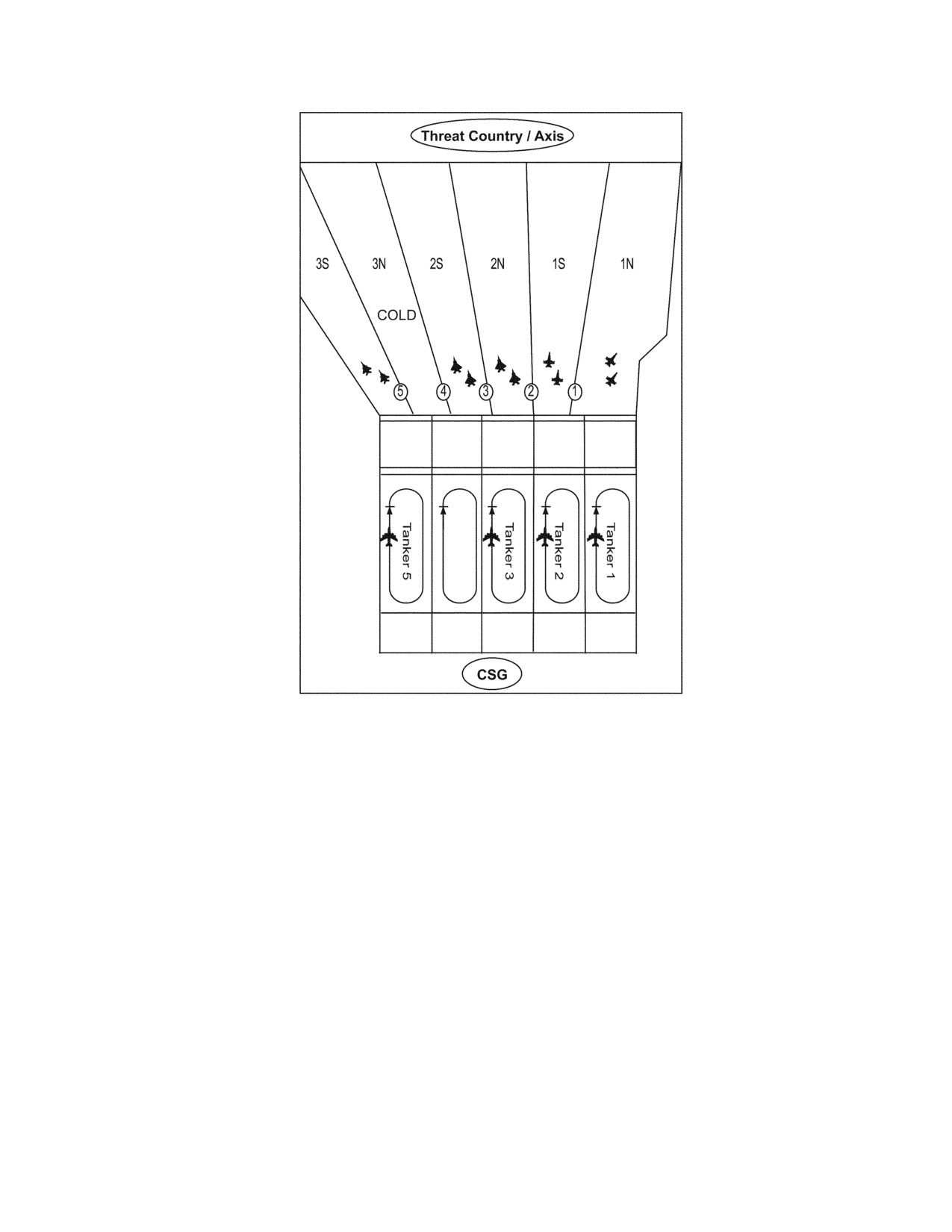
Figure 13. Lane Structure Example
(b) Kill Box. Figure 14 depicts a sample kill box format employing GARS.
When using GARS, each 30 x 30 minute area defines one kill box. The kill box is
further divided into 4 quadrants (labeled 1-4), with 5 min x 5 min keypads within
each quadrant. If attacking a target in quadrant 1, then quadrants 2, 3, and 4 may
be assigned to specific flights for geographic deconfliction. Using the kill box
example, a sample deconfliction plan employing a SCARC (Viper 1) could sound
like, “Python 35, Viper 1, hold block 16-19, 006AB, quadrant 3. Hornet 21, working
targets quadrant 1 keypad 8.” This provides an area of 15 nm by 15 nm for
deconfliction but may not be optimum for sensor coverage. For bomber aircraft, the
SCARC should assign two quadrants. SCAR assets should avoid the borders of
their assigned quadrant by enough distance to ensure deconfliction from assets
working in adjacent quadrants.
17 November 2008
NTTP 3-20.8 / AFTTP(I) 3-2.74
33

Figure 14. GARS Enabled Kill Box
(c) Timing. If the SCARC wants multiple elements to attack the same target
array/area, the SCARC should assign time on targets (TOTs) for each element to
ensure the attacks are safely deconflicted. The SCARC should attempt to assign a
2-minute TOT window to each element and separate those elements by 1 minute
minimum. Consider using 2 minutes for deconfliction if SCAR assets have
dramatically different groundspeeds. This approach serves to prevent timing
mistakes and target obscuration from impacting SCAR asset effectiveness. If slower
tempos are acceptable the SCAR may decide to employ SCAR assets one at a time
with each element working until they are WINCHESTER. If an element of the SCAR
flight is taking too long the SCARC should direct them to egress if this will allow
more capable assets to engage the target array.
(3) Target Assignment. Targets will be passed by airborne C2 or by tactical
aircraft C2.
(a) Airborne C2 only (no SCARC): Targets will be passed by airborne C2
directly to AIMT assets.
(b) Airborne C2 with Tactical Aircraft C2 (SCARC): Targets should be
passed by airborne C2 to the SCARC. The SCARC will coordinate prosecution with
AIMT assets.
(4) Engagement authority from the JFMCC may be provided by the SUWC via
the MAC, even in cases where the aircrew is beyond visual range of the target.
34
NTTP 3-20.8 / AFTTP(I) 3-2.74
17 November 2008

Engagement instructions will be passed using the MAS 9-line or modified 9-line.
Table 5 depicts engagement instructions using a modified 9-line for permissive
AIMT. Do not transmit line numbers.
(5) Employment: Aircrew will reply to the 9-line with mandatory read back items
[lines 5, 6, 8, and remarks] and communicate the appropriate brevity code (e.g.
RIFLE, LONGRIFLE, BRUISER, etc.) post weapon release.
(6) MISREPs: Table 7 lists an example MISREP. It is critical to pass BDA/BHA
in order to optimize re-attacks if required. Do not transmit line numbers.
Table 7. Mission Report Example
Blade 11
“Dome 11, Blade 11, MISREP to follow”
1.
“Blade 11”
2.
“Mission Number 1151”
3.
“Request number 1152 Oil Tanker”
4.
“N 31 22.400 W128 63.3331”
5.
“TOT: 1315Z”
6.
“K-KILL”
Remarks
“1 GBU-12 and 400 rounds 20mm expended, no re-strike
required, 1 GBU-12 remaining”
Reply
Dome 11
“Copy, switch to REDCROWN”
(7) Checkout: Check out when directed by C2 or when munitions/fuel/
vulnerability time expires.
17 November 2008
NTTP 3-20.8 / AFTTP(I) 3-2.74
35
This page intentionally left blank.
36
NTTP 3-20.8 / AFTTP(I) 3-2.74
17 November 2008
Appendix A:
BRIEFING FORMATS
1. Check-in Brief
The check-in brief is used to identify AOMSW assets and capabilities to airspace
controlling authorities. Do not transmit line numbers.
Table 8. Check-in Brief (aircraft transmits to controller)
Aircraft: ―________________, _______________________‖
(Airspace Controller Call Sign)
(AOMSW Asset Call Sign)
1. Identification / Authentication ―_______________________‖
2. Number and Type of Aircraft ―________________________‖
3. Position and Altitude ―_____________________________‖
4. Ordnance ―______________________________________‖
5. On-station Time ―__________________________________‖
6. Abort Code ―_____________________________________‖
Remarks (as appropriate): ―____________________________‖
Note: Abort code may be N/A. The AOMSW asset should expect to receive
holding and deconfliction instructions from the airspace controller.
17 November 2008
NTTP 3-20.8 / AFTTP(I) 3-2.74
37
2. Surface Contact Report
The Surface Contact Report is used when reporting standardized information on
vessel or tracks of interest. Do not transmit line numbers.
Table 9. Surface Contact Report
1. Contact/Track #: ―________________________________‖
2. Position: ―______________________________‖ (Lat/Long)
3. Course/Speed: ―_________________________________‖
4: Ship Type: ―____________________________________‖
*5. Ship Name/Hull#: ―______________________________‖
6. Ship Flag: ―_____________________________________‖
7. Time: ―___________________________________‖ (Zulu)
Remarks: ―________________________________________‖
(Ship or Deck Activity/Cargo/Homeport)
*In the absence of ship name/hull #, provide a description, example hull,
waterline, superstructure, color, distinctive features, etc.
38
NTTP 3-20.8 / AFTTP(I) 3-2.74
17 November 2008
3. MAS 9-Line
The MAS 9-line is modeled after the CAS 9-line format and has been modified for
the AOMSW mission to streamline passing target information to an AOMSW asset.
The MAS 9-Line format should be read in groups of three without transmitting line
numbers. Bold denotes read back items when requested.
Table 10. MAS Briefing Form (9 Line)
Airspace Controller: ―_________________‖, ―__________________―
(aircraft call sign)
(airspace controller call sign)
1. IP: ―___________________________________‖ (Lat/Long, GEOREF)
2. Heading (bearing): ―______________________________‖ (magnetic)
Offset: ―_____________________________________‖ (left/right)
3. Distance (range): ―__________________________‖ (IP to target in nm)
4. Target Elevation: ―________________________________‖ (feet MSL)
(usually zero in MAS scenario)
5. Target Description: ―__________________‖ (include course and speed)
6. Target Location: ―________________________________________‖
(latitude/longitude or grid coordinates or offsets or visual)
7. Type Mark: ―___________________‖, Code: ―___________‖ (laser, IR)
8. Location of friendlies or neutrals: ―_________________________‖
Position marked by: ―____________________________________‖
9. Egress: ―________________________________________________‖
Remarks (as appropriate): ‖____________________________________‖
Line 6: If attacking multiple ships in close proximity to each other, describe
each ship in line 6. (Multiple targets not in close proximity will require multiple
9-lines). Close proximity is defined as 1 nm spacing or less.
Line 7: Laser and code, or other means of marking (IR pointer, fires, etc.)
Line 8. Magnetic bearing and range in nautical miles to any friendlies and
neutrals in close proximity to target. Referenced from target location given in
line 6.
Line 9: Egress direction in magnetic heading.
17 November 2008
NTTP 3-20.8 / AFTTP(I) 3-2.74
39
4. Checkout Briefing Format
The inflight report (INFLTREP) is used to report actions taken during AOMSW
missions. Do not transmit line numbers.
Table 11. Checkout Briefing (INFLTREP)
1. Call Sign: ―____________________________________‖
2. Mission Number: ―______________________________‖
3. Request Number/Target: ―________________________‖
4. Target Location: ―_______________________________‖
5. TOT: ―________________________________________‖
*6. Results: ―_____________________________________‖
*Results: May include but not limited to ordnance expended, ordnance
remaining, re-strike, BDA/BHA, etc.
40
NTTP 3-20.8 / AFTTP(I) 3-2.74
17 November 2008

5. Surface Picture Report
The surface picture report (SURPIC) is a two-page guide used to record
standardized information about surface contacts. AOMSW assets fill out the first
page utilizing information from page two that best matches the details of the surface
contact.
Figure 15. Surface Picture Report (front side)
17 November 2008
NTTP 3-20.8 / AFTTP(I) 3-2.74
41

Figure 16. Surface Picture Report (back side)
42
NTTP 3-20.8 / AFTTP(I) 3-2.74
17 November 2008

Appendix B:
US SURFACE VESSEL IDENTIFICATION
1. US Surface Vessel Identification
The following pictures and descriptions are intended to provide the user a visual
reference to commonly encountered US surface vessels. Proper recognition of
friendly assets is useful in preventing fratricide during surface vessel engagements.
2. Aircraft Carriers
Nimitz Class Aircraft carriers are deployed worldwide in support of US interests and
commitments. They can respond to global crises in ways ranging from peacetime
presence to full-scale war. Together with their on-board air wings, the aircraft
carriers play vital roles across the full spectrum of conflict.
General Characteristics:
10 of 10 remaining in active service
1,040 feet in length, 134 feet wide
Missile and gun air defense systems
17 November 2008
NTTP 3-20.8 / AFTTP(I) 3-2.74
43

3. Cruisers
Ticonderoga Class Guided-Missile Cruisers. Modern US Navy guided missile
cruisers perform primarily in a battle force role. These ships are multi-mission
surface combatants capable of supporting carrier battle groups, amphibious forces,
or operating independently and as flagships of surface action groups. Cruisers are
equipped with Tomahawk land attack cruise missiles.
General Characteristics:
22 of 27 ships still active
567 feet long, 55 feet wide
Armament:
SM-2 Standard SAM
2 x 5 inch
Mk-45 (lightweight gun)
2 x 20 mm Phalanx CIWS
2 x SH-60 Seahawk LAMPS III helicopters
44
NTTP 3-20.8 / AFTTP(I) 3-2.74
17 November 2008
4. Destroyers
Arleigh Burke Class Guided-Missile Destroyers. The Arleigh Burke class destroyer
employs the same Aegis weapons system developed for the CG-47 class and
employs an array of weapons and sensors into a multi-mission warship. The Aegis
combat system integrates air, surface, anti-submarine warfare sensors and
engagement systems. It is capable of firing Standard SM-2 Block III/IV surface-to-air
missiles.
General Characteristics:
All 52 Arleigh Burke Destroyers are active
505 feet long, 59 feet wide
Armament
1 x 5 inch (127 mm/54 or 62) Mk-45 lightweight gun
2 x 20mm Phalanx CIWS
2 x SH-60 Seahawk LAMPS III helicopters
Note: Flight IIA (DDG-79 Oscar Austin and higher) Arleigh burke class
DDGs have one or two helicopters onboard. Flight I and II Arleigh Burke DDGs do
not have helicopters on board.
17 November 2008
NTTP 3-20.8 / AFTTP(I) 3-2.74
45
5. Frigates
Oliver Hazard Perry Class Guided-Missile Frigates. The guided-missile frigates
bring a short range anti-air warfare capability provided by their Phalanx CIWS to the
frigate mission. This class is a robust platform, capable of withstanding considerable
damage.
General Characteristics:
30 of 50 ships still active
445 feet long, 45 feet wide
Armament:
1 x 76 mm (3-inch)/62 caliber MK 75 rapid fire gun
1 x Phalanx CIWS
46
NTTP 3-20.8 / AFTTP(I) 3-2.74
17 November 2008
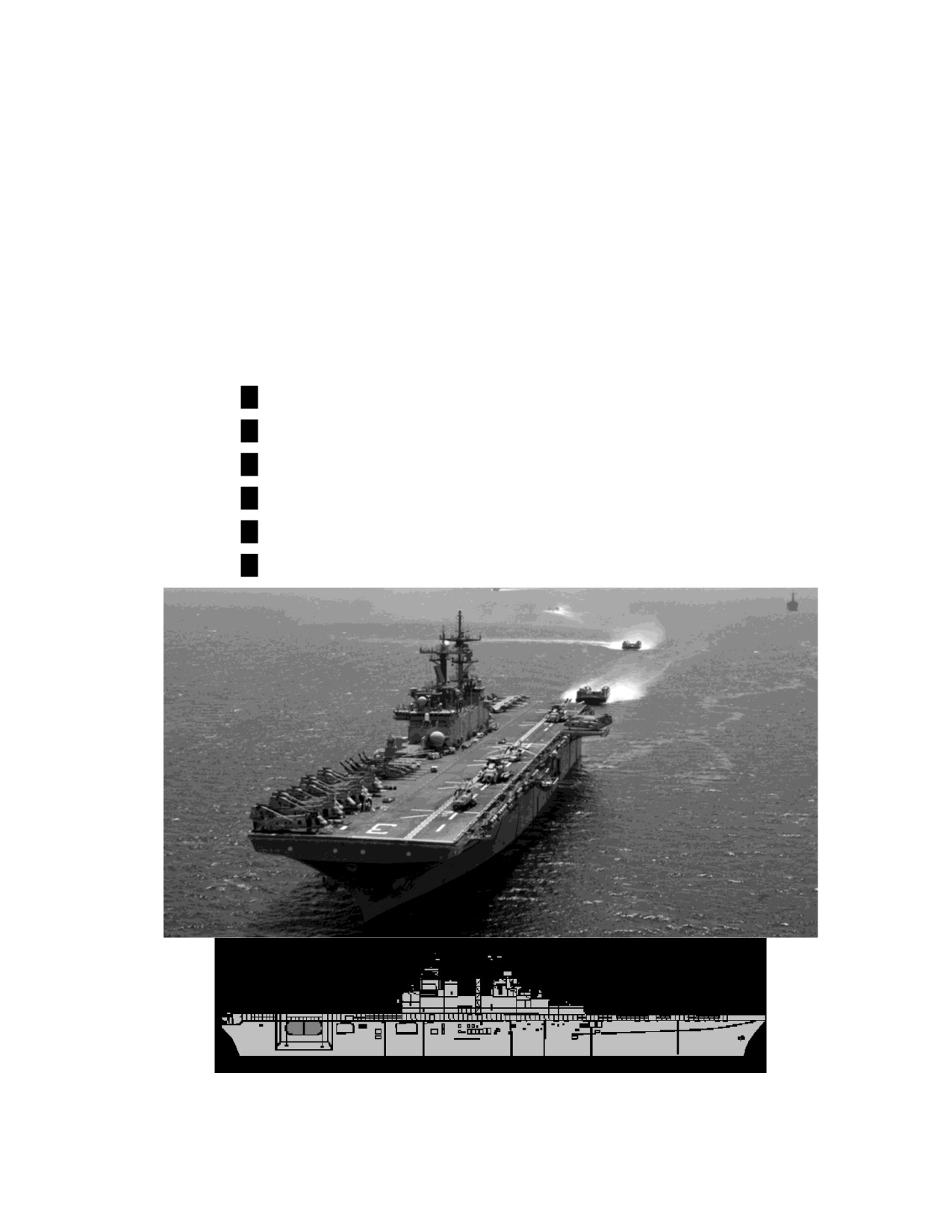
6. Amphibious Assault Ships
Amphibious assault ships are designed to land forces on hostile shores. While they
may resemble an aircraft carrier, their primary role may not be to operate fixed wing
aircraft. This class usually has a large air wing of helicopters which are dedicated to
ferrying troops and equipment ashore from the ships.
a. The Wasp class vessels are the largest amphibious ships in the world. WASP
class ships are the first to be specifically designed to accommodate the AV-8B
Harrier jump jet and the LCAC hovercraft, along with the full range of Navy and
Marine helicopters, conventional landing craft, and amphibious assault vehicles to
support a Marine Expeditionary Unit of 2,000 Marines.
General Characteristics:
All 7 Wasp class ships are active
844 feet long, 106 feet wide
Armament:
Rolling Airframe Missile
Sea Sparrow Missiles
2 x Phalanx CIWS
17 November 2008
NTTP 3-20.8 / AFTTP(I) 3-2.74
47

b. Tarawa Class Amphibious Assault Ship. These ships have the general profile of
an aircraft carrier, with superstructure to starboard. They can support a 35-aircraft
complement including AV-8B jet and AH-1, CH-53E, and CH-46D/E helicopters.
General Characteristics:
4 of 5 Tarawa class ships are active
820 feet long, 106 feet wide
Armament:
Rolling Airframe Missile
2 x Phalanx CIWS
Mk 38 Cannons
48
NTTP 3-20.8 / AFTTP(I) 3-2.74
17 November 2008

7. Amphibious Transport Docks
The amphibious transport dock is a warship that embarks, transports, and lands
elements of a landing force for expeditionary warfare missions. The ships primary
use is as a landing craft, although they have a limited airborne capability.
a. San Antonio Class. The San Antonio class is a multi-mission ship designed to
accommodate all elements of the Marine Corps landing capability. It is designed to
support embarking, transporting, and landing elements of a Marine landing force in
an assault by helicopters, landing craft, and amphibious vehicles.
General Characteristics:
3 of 9 San Antonio class LPD ships are active (6 have yet to be
commissioned)
684 feet long, 105 feet wide
Armament:
Bushmaster II 30mm guns
Rolling Airframe Missiles
17 November 2008
NTTP 3-20.8 / AFTTP(I) 3-2.74
49

b. Austin Class Amphibious Transport Dock. The Austin class is used to transport
and land Marines, equipment, and supplies by embarked landing craft or amphibious
vehicles augmented by helicopters during amphibious assault.
General Characteristics:
6 of 12 Austin class LPD ships are active
570 feet long, 84 feet wide
Armament:
Mk 38 guns
2 x Phalanx CIWS
50
NTTP 3-20.8 / AFTTP(I) 3-2.74
17 November 2008

8. Dock Landing Ship
Whidbey Island Class Dock Landing Ship. The Whidbey Island class dock landing
ship is designed to support amphibious operations. These amphibious assault ships
transport and launch amphibious craft and vehicles with their crews and embarked
personnel. They are mainly used to carry Landing Craft Air Cushions, and also
Marines.
General Characteristics:
All 7 Whidbey Island ships are active
609 feet long, 84 feet wide
Armament:
Rolling Airframe Missiles
Mk 15 Vulcan Phalanx
Mk 38 25mm guns
17 November 2008
NTTP 3-20.8 / AFTTP(I) 3-2.74
51

9. Coastal Patrol Ships
Cyclone Class Coastal Patrol Ships. The primary mission of these ships is coastal
patrol and interdiction surveillance in support of littoral operations. Outlined in the
Navy’s strategy, "Forward...From the Sea." This class of ship is particularly suited
for the maritime homeland security mission and has been employed jointly with the
US Coast Guard to help protect our nation’s coastline. This class has also been
forward deployed in support of the war on terrorism.
General Characteristics:
8 of 14 coastal patrol ships remain active with the US Navy
170 feet long, 25 feet wide
Armament:
Mk 96 machine guns
Mk 38 25mm machine guns
Various small arms
52
NTTP 3-20.8 / AFTTP(I) 3-2.74
17 November 2008

10. Mine Countermeasures Ships
Avenger class mine countermeasures ships. These ships were designed as mine
hunter-killers capable of finding, classifying, and destroying moored and bottom
mines. Their mission is to detect, classify, and neutralize all known and projected
types of influence and contact mines. They perform precise navigation and clear
minefields by sweeping moored, magnetic, and acoustic influence mines.
General Characteristics:
All 14 Avenger class ships are active
224 feet long, 39 feet wide
Armament:
Small arms only
17 November 2008
NTTP 3-20.8 / AFTTP(I) 3-2.74
53
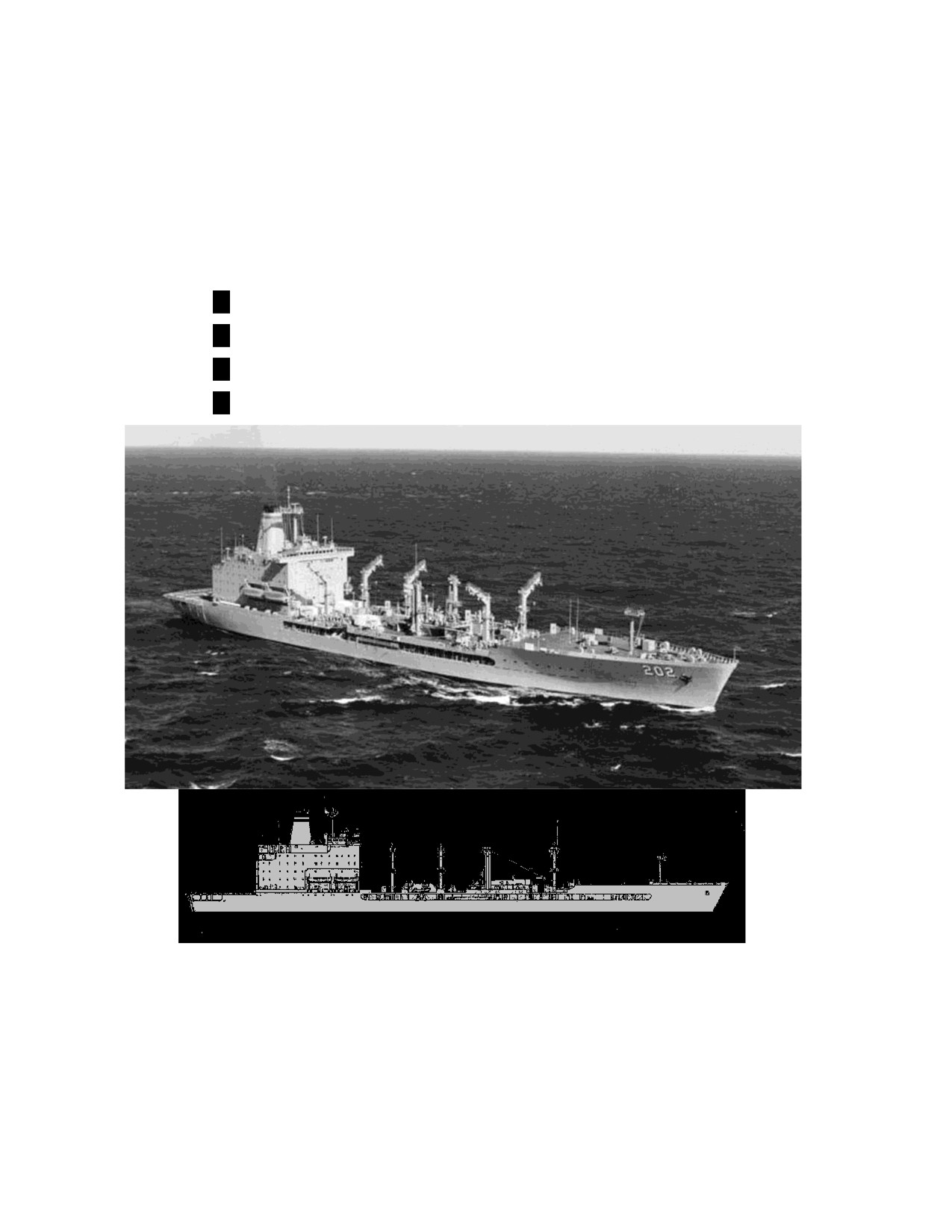
11. Auxiliary Ships
The Henry J. Kaiser class of ships is composed of fleet replenishment oilers which
began construction in August of 1984. The class is comprised of eighteen underway
replenishment oilers which are operated by Military Sealift Command to provide
underway replenishment of fuel to US Navy combat ships and jet fuel for aircraft
aboard aircraft carriers at sea.
General Characteristics:
13 of 18 are still active
677 feet long, 98 feet wide
Armament:
Small arms only
54
NTTP 3-20.8 / AFTTP(I) 3-2.74
17 November 2008
Appendix C:
MERCHANT SURFACE VESSEL CLASSIFICATION GUIDE
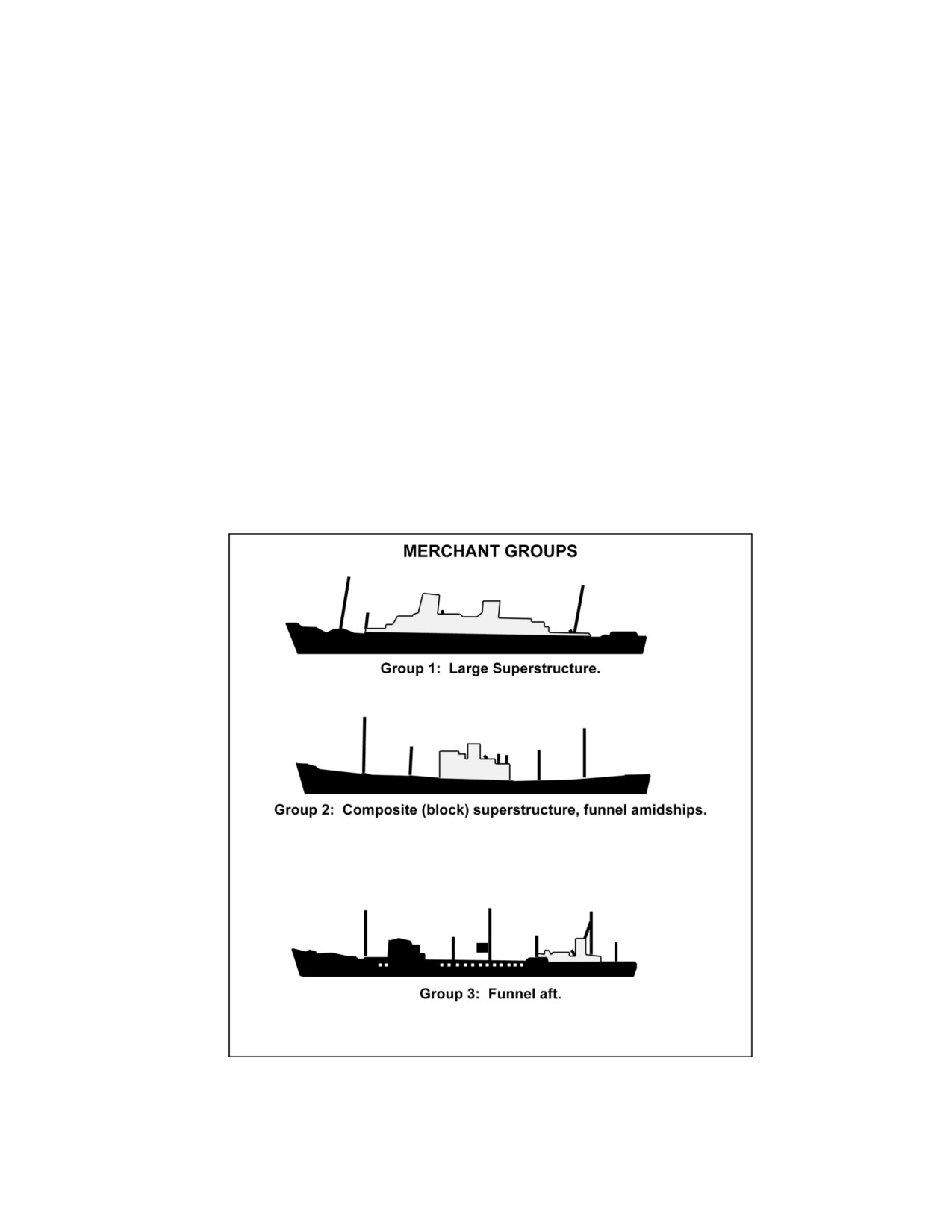
Aircrews need to be familiar with the basic visual recognition guide for groups one,
two, and three merchant ships. The recognition process is broken down into three
phases: appearance group, hull profile, and upright sequence. Additionally, general
comments about the contact of interest are provided. The three group classifications
are as follows:
Group 1: Large superstructure—superstructure exceeds one-third of the overall
length of the ship.
Group 2: Composite (block) superstructure, funnel amidships—superstructure
amidships less than one-third of the overall length of the ship. These ships generally
have a small block-like superstructure with deck space devoted to cargo-handling
equipment and hatches.
Group 3: Funnel aft—funnel is located on the aft third of the ship; however, if the
superstructure exceeds one-third of the overall length, the ship remains in group
one.
Auxiliary: Those that do not fall into the categories listed above.
Figure 17. Merchant Vessel Groups
17 November 2008
NTTP 3-20.8 / AFTTP(I) 3-2.74
55
This page intentionally left blank.
56
NTTP 3-20.8 / AFTTP(I) 3-2.74
17 November 2008
REFERENCES
Joint
JP 3-03, Joint Interdiction, 9 November 2006
JP 3-09, Joint Fire Support, 13 October 2006
JP 3-09.3, Joint Tactics, Techniques, and Procedures for Close Air Support,
2 September 2005
JP 3-30, Command and Control for Joint Air Operations, 5 June 2003
JP 3-32, Command and Control for Joint Maritime Operations, 08 August 2006
JP 3-52, Doctrine for Joint Airspace Control in a Combat Zone, 30 August 2004
JP 3-60, Joint Targeting, 13 April 2007
JMEM Weaponeering System (JWS) 1.2, Ship Targeting Analysis Tool,
October 2007
JMEM Weaponeering System (JWS) 2.0, Ship Weaponeering Effectiveness Tool,
November 2007
Air Force
AFTTP 3-1.1, General Planning and Employment Considerations, 17 June 2007
AFTTP 3-1.2, Tactical Threat Reference Guide and Countertactics,
25 December 2006
AFDDEC, Air and Space Commander’s Handbook for the JFACC, 16 January 2003
AFDD 2-1.4, Countersea Operations, 15 September 2005
AFTTP(I) 3-2.5, Multi-Service Brevity Codes, October 2007
Navy
NTTP 3-02.1.3 Amphibious/Expeditionary Operations Air Control, May 2005
NTTP 3-03.4, Naval Strike and Air Warfare (Rev. A), August 2000
NTTP 3-07.11, Maritime Interception Operations, November 2003
NTTP 6-02.1, Multi-Service Brevity Codes, October 2007
NWP 3-20.6, Surface Ship Tactical Employment in Naval Warfare, October 2003
NWP 3-56, Composite Warfare Commander’s Manual, October 2003
NDP 1, Naval Warfare, 28 March 1994
NWP 1-14M, The Commander’s Handbook on the Law of Naval Operations,
July 2007
NTRP 1-02, Navy Supplement to the DOD Dictionary of Military and Associated
Terms, August 2006
NTTP 6-02.1, Multi-Service Brevity Codes, October 2007
TB SUW-06-01, Simultaneous Aircraft and Gunnery Engagements in the Dual
Engagement Zone, January 2006
TM SWDG 3-20.305, CIWS Block 1B Tactical Employment, March 2005
17 November 2008
NTTP 3-20.8 / AFTTP(I) 3-2.74
57
This page intentionally left blank.
58
NTTP 3-20.8 / AFTTP(I) 3-2.74
17 November 2008
GLOSSARY
PART I - ABBREVIATIONS AND ACRONYMS
A
ACO
airspace control order
ACU
aircraft control unit
ADC
air defense commander
AFDD
Air Force Doctrine Document
AFI
Air Force Instruction
AFTTP
Air Force tactics, techniques, and procedures
AIMT
air interdiction of maritime target
ALR
acceptable level of risk
ALSA
Air Land Sea Application Center
AO
area of operations
AOMSW
air operations in maritime surface warfare
ATO
air tasking order
B
BHA
bomb hit assessment
C
C2
command and control
CAS
close air support
CDE
collateral damage estimation
CGRS
common geographic reference system
CIEA
classification, identification, and engagement area
CIWS
Close-in Weapon System
COI
contacts of interest
CCOI
critical contacts of interest
CONOPS
concept of operations
CONPLAN
concept plan
COP
common operational picture
CSG
carrier strike group
CVN
aircraft carrier, nuclear
CVW
carrier air wing
CWC
composite warfare commander
D
DEZ
Dual Engagement Zone
DIM
daily intentions message
DOD
Department of Defense
17 November 2008
NTTP 3-20.8 / AFTTP(I) 3-2.74
59
E
EO-IR
electro-optical-infrared
ESG
expeditionary strike group
F
F2T2EA
find, fix, track, target, engage, and assess
FAC(A)
forward air controller (airborne)
FLIR
forward-looking infrared
G
GARS
Global Area Reference System
GEOREF
geographic reference
I
ID
identification
IFF
identification friend or foe
INFLTREP
inflight report
IMC
instrument meteorological conditions
IP
initial point
IR
infrared
ISR
intelligence, surveillance, and reconnaissance
J-K
JDAM
Joint Direct Attack Munition
JFC
joint force commander
JFMCC
joint force maritime component commander
JMEM
Joint Munitions Effectiveness Manual
JP
joint publication
JSOW
joint stand-off weapon
JWS
JMEM weaponeering system
K-KILL
catastrophic kill
L
LAT
latitude
LHA
amphibious assault ship (general purpose) (multi-purpose)
LHD
amphibious assault ship (dock)
LKP
last known position
LONG
longitude
LSRS
littoral surveillance radar system
M
MAC
maritime air controller
MAS
maritime air support
60
NTTP 3-20.8 / AFTTP(I) 3-2.74
17 November 2008
MILSTRIP
military standard requisitioning and issue procedure
MISREP
mission report
MPRA
maritime patrol and reconnaissance aircraft
MSL
mean sea level
MTTP
multi-Service tactics, techniques, and procedures
N
NDP
Naval Doctrine Publication
NM
nautical mile
NTRP
Navy tactical reference publication
NTTP
Navy tactics, techniques, and procedures
NWDC
Navy Warfare Development Center
NWP
Naval Warfare Publication
O-P-Q
OPLAN
operation plan
OPTASK
operation task
OTC
officer in tactical command
PID
positive identification
POC
point of contact
PWC
principle warfare commander
R
ROE
rules of engagement
ROT
rules of thumb
S
SA
surveillance area
SAG
surface action group
SCAR
strike coordination and reconnaissance
SCARC
strike coordination and reconnaissance coordinator
SCC
sea combat commander
SEAD
suppression of enemy air defenses
SIPRNet
SECRET Internet Protocol Router Network
SITREP
situation report
SM
statute mile
SPINS
special instructions
SSC
surface surveillance coordination
SUW
Surface Warfare
SWDG
Surface Warfare Development Group
T
TACAIR
tactical air
TACAN
tactical air navigation
17 November 2008
NTTP 3-20.8 / AFTTP(I) 3-2.74
61
TACC
tactical air command center
TIC
troops in contact
TOT
time on target
TTP
tactics, techniques, and procedures
U-Z
UAS
unmanned aircraft system
US
United States
USAF
United States Air Force
USCG
United States Coast Guard
USN
United States Navy
VA
vital area
VHF
very high frequency
VOI
vessel of interest
PART II - TERMS AND DEFINITIONS
aircraft carrier—A warship designed to support and operate aircraft, engage in attacks on
targets afloat or ashore, and engage in sustained operations in
support of other forces. Designated as CV or CVN. CVN is nuclear
powered. (JP 1-02)
airspace control order—An order implementing the airspace control plan that provides the
details of the approved requests for airspace coordinating measures.
It is published either as part of the air tasking order or as a separate
document. Also called ACO. (JP 3-52)
air superiority—That degree of dominance in the air battle of one force over another that
permits the conduct of operations by the former and its related land,
sea, and air forces at a given time and place without prohibitive
interference by the opposing force. (JP 3-30)
air tasking order—A method used to task and disseminate to components, subordinate
units, and command and control agencies projected sorties,
capabilities and/or forces to targets and specific missions. Normally
provides specific instructions to include call signs, targets, controlling
agencies, etc., as well as general instructions. Also called ATO. (JP
3-30)
area of operations—An operational area defined by the joint force commander for land and
maritime forces. Areas of operation do not typically encompass the
entire operational area of the joint force commander, but should be
large enough for component commanders to accomplish their
missions and protect their forces. Also called AO. (JP 1-02)
BULLSEYE—An established reference point from which the position of an object can be
referenced by bearing (Magnetic) and range (NM) from this point.
(Multi-Service Brevity Codes)
carrier airwing air plan—A graphical representation of flight operations which lists call
signs, tactical frequencies, launch/recovery times, flight composition,
and fuel/ordnance loads.
62
NTTP 3-20.8 / AFTTP(I) 3-2.74
17 November 2008
close air support—Air action by fixed- and rotary-wing aircraft against hostile targets that
are in close proximity to friendly forces and that require detailed
integration of each air mission with the fire and movement of those
forces. Also called CAS. (JP 3-0)
command and control—The exercise of authority and direction by a properly designated
commander over assigned and attached forces in the accomplishment
of the mission. Command and control functions are performed
through an arrangement of personnel, equipment, communications,
facilities, and procedures employed by a commander in planning,
directing, coordinating, and controlling forces and operations in the
accomplishment of the mission. Also called C2. (JP 3-0)
common operational picture—A single identical display of relevant information shared by
more than one command. A common operational picture facilitates
collaborative planning and assists all echelons to achieve situational
awareness. Also called COP. (JP 3-0)
composite warfare commander—The officer in tactical command is normally the
composite warfare commander. However the composite warfare
commander concept allows an officer in tactical command to delegate
tactical command to the composite warfare commander. The
composite warfare commander wages combat operations to counter
threats to the force and to maintain tactical sea control with assets
assigned; while the officer in tactical command retains close control of
power projection and strategic sea control operations. Also called
CWC. (JP 3-02)
due regard—Military operational situations may not lend themselves to ICAO flight
procedures; e.g., military contingencies, classified missions, politically
sensitive missions, routine aircraft carrier operations, and some
training activities. Operations not conducted under ICAO flight
procedures are conducted under the ―due regard‖ or ―operational‖
prerogative of military aircraft are subject to one or more of the
following conditions:
1. Aircraft shall be operated in visual meteorological conditions.
2. Aircraft shall be operated within surveillance and radio/satellite
communications of a surface and/or airborne facility.
3. Aircraft shall be equipped with airborne radar that is sufficient to
provide separation between themselves, aircraft they may be
controlling, and other aircraft.
4. Aircraft shall be operated outside controlled airspace.
(Department of Defense Instruction 4540.01)
dynamic targeting—Targeting that prosecutes targets identified too late, or not selected for
action in time to be included in deliberate targeting.
(JP 3-0)
expeditionary strike group air plan—A graphical representation of flight operations which
lists call signs, tactical frequencies, launch/recovery times, flight
composition, and fuel/ordnance loads.
forward air controller (airborne)—A specifically trained and qualified aviation officer who
exercises control from the air of aircraft engaged in close air support
of ground troops. The forward air controller (airborne) is normally an
17 November 2008
NTTP 3-20.8 / AFTTP(I) 3-2.74
63
airborne extension of the tactical air control party. Also called
FAC(A). (JP 3-09.3)
forward-looking infrared—An airborne, electro-optical thermal imaging device that detects
far-infrared energy, converts the energy into an electronic signal, and
provides a visible image for day or night viewing. Also called FLIR.
(JP 3-09.3)
HOSTILE—A contact identified as enemy upon which clearance to fire is authorized in
accordance with theater rules of engagement. (Multi-Service Brevity
Codes)
identification—1. The process of determining the friendly or hostile character of an
unknown detected contact. 2. In arms control, the process of
determining which nation is responsible for the detected violations of
any arms control measure. 3. In ground combat operations,
discrimination between recognizable objects as being friendly or
enemy, or the name that belongs to the object as a member of a
class. Also called ID.
(JP 1-02)
identification, friend or foe—A device that emits a signal positively identifying it as a
friendly. Also called IFF.
(JP 1-02)
initial point (IP)—1. The first point at which a moving target is located on a plotting board.
2. A well-defined point, easily distinguishable visually and/or
electronically, used as a starting point for the bomb run to the target.
3. airborne--A point close to the landing area where serials (troop
carrier air formations) make final alterations in course to pass over
individual drop or landing zones. 4. helicopter--An air control point in
the vicinity of the landing zone from which individual flights of
helicopters are directed to their prescribed landing sites.
5. Any
designated place at which a column or element thereof is formed by
the successive arrival of its various subdivisions, and comes under
the control of the commander ordering the move. Also called IP. (JP
3-09.1)
intelligence, surveillance, and reconnaissance—An activity that synchronizes and
integrates the planning and operation of sensors, assets, and
processing, exploitation, and dissemination systems in direct support
of current and future operations. This is an integrated intelligence and
operations function. Also called ISR. (JP 2-01)
joint force maritime component commander—The commander within a unified
command, subordinate unified command, or joint task force
responsible to the establishing commander for making
recommendations on the proper employment of assigned, attached,
and/or made available for tasking maritime forces and assets;
planning and coordinating maritime operations; or accomplishing such
operational missions as may be assigned. The joint force maritime
component commander is given the authority necessary to
accomplish missions and tasks assigned by the establishing
commander. Also called JFMCC. (JP 3-0)
kill box—A three-dimensional area used to facilitate the integration of joint fires. (JP 3-09)
LOWDOWN—A request to provide tactical ground information pertinent to the mission in a
digital bullseye format.
(Multi-Service Brevity Codes)
64
NTTP 3-20.8 / AFTTP(I) 3-2.74
17 November 2008
PICTURE—A request to provide air information pertinent to the mission in a digital bullseye
format unless briefed otherwise. (Multi-Service Brevity Codes)
positive identification—Identification criteria established in the rules of engagement that
requires a potential target to be identified as a valid target prior to
engagement. Positive identification criteria may vary from operation
to operation because the joint force commander and subordinate
commanders will establish requirements for positive identification prior
to combat operations, in order to achieve the required confidence of
target identification for engagement. Also called PID.
principle warfare commander—Under the composite warfare commander (CWC) concept
and subordinate to the officer in tactical command and CWC are six
principal warfare commanders: Air Defense Commander (ADC),
Antisubmarine Commander (ASWC), Information Warfare
Commander (IWC), Strike Warfare Commander (STWC), Sea
Combat Commander (SCC), and Surface Warfare Commander
(SUWC). The SUWC and SCC are sometimes combined under one
warfare commander. Also called PWC. (NTRP 1-02)
rules of engagement—Directives issued by competent military authority that delineate the
circumstances and limitations under which United States forces will
initiate and/or continue combat engagement with other forces
encountered. Also called ROE. (JP 1-02)
SHADOW—Follow indicated target. (Multi-Service Brevity Codes)
SOUR—Invalid/no response to an administrative IFF/SIF check.
(Multi-Service Brevity Codes)
strike coordination and reconnaissance—A mission flown for the purpose of detecting
targets and coordinating or performing attack or reconnaissance on
those targets. Strike coordination and reconnaissance missions are
flown in a specific geographic area and are an element of the
command and control interface to coordinate multiple flights, detect
and attack targets, neutralize enemy air defenses, and provide battle
damage assessment. Also called SCAR. (JP3-03)
strike coordination and reconnaissance coordinator—The individual that is responsible
for directing all aircraft in the specified area for that associated SCAR
mission. The SCARC does not have to be a FAC(A). Also called
SCARC.
SWEET—Valid response to an administrative IFF/SIF check request. (Multi-Service Brevity
Codes)
suppression of enemy air defenses—Activity that neutralizes, destroys, or temporarily
degrades surface-based enemy air defenses by destructive and/or
disruptive means. Also called SEAD. (JP 3-01)
time on target—1. Time at which aircraft are scheduled to attack/photograph the target. 2.
The actual time at which aircraft attack/photograph the target. 3. The
time at which a nuclear detonation as planned at a specified desired
ground zero. Also called TOT. (JP 3-09.3)
unmanned aircraft system—That system, whose components include the necessary
equipment, network, and personnel to control an unmanned aircraft.
Also called UAS. (JP 3-03)
17 November 2008
NTTP 3-20.8 / AFTTP(I) 3-2.74
65
waterspace management—The allocation of surface and underwater spaces into areas
and the implementation of agreed procedures to permit the
coordination of assets. The intention is to prevent mutual interference
between submarines or between submarines and other assets, while
enabling optimum use to be made of all undersea warfare assets
involved. Also called WSM. (NTRP 1-02)
WINCHESTER—No ordnance remaining. (Multi-Service Brevity Codes)
66
NTTP 3-20.8 / AFTTP(I) 3-2.74
17 November 2008
NTTP 3-20.8
AFTTP(I) 3-2.74
17 November 2008
By Order of the Secretary of the Air Force
STEPHEN J. MILLER
Major General, USAF
Commander
Curtis E. LeMay Center for Doctrine Development and Education
ACCESSIBILITY: Publications and forms are available on the e-Publishing website
RELEASABILITY: Distribution authorized to DOD and DOD contractors only to
protect technical or operational information from automatic dissemination under the
International Exchange Program or by other means. This protection applies to
publications required solely for official use and to those containing valuable technical
or operational information. This determination was made on 22 Feb 2008.
17 November 2008
NTTP 3-20.8 / AFTTP(I) 3-2.74
67
LAS VEGAS METROPOLITAN POLICE DEPARTMENT
FORCE INVESTIGATION TEAM REPORT
CONTINUATION
Event: 171001-3519
TABLE OF CONTENTS
I.
INTRODUCTION
3
II.
INCIDENT DETAILS
3
III.
VICTIMS
15
Deceased
15
Living Victims
23
IV.
SUSPECT
23
V.
WITNESS INTERVIEWS
24
VI.
SCENE DESCRIPTIONS
31
Route 91 Venue
31
Mandalay Bay 32nd Floor
36
100-Wing Hallway
37
Room 32-135
37
Foyer Inside Room 32-135
37
West Bedroom (Master Bedroom)
38
Sitting Area
38
Decedent Stephen Paddock
39
Bar/Kitchenette
39
Living Room
40
Room 32-134
40
VII.
EVIDENCE RECOVERY
41
Physical Evidence
41
DNA
45
Digital
45
VIII.
SUSPECT AUTOPSY
48
IX.
INVESTIGATION
49
Mandalay Bay Hotel Room
49
Paddock's Vehicle
50
Paddock's Mesquite Residence
51
Paddock's Reno Residence
51
Search Warrants and Legal Notices
51
Law Enforcement Tips and Leads
52
X.
PRELIMINARY FINDINGS FROM THE 1 OCTOBER INVESTIGATION
52
Appendix A
54
LVMPD Internal Oversight & Constitutional Policing
Page 2 of 81
Force Investigation Team
LAS VEGAS METROPOLITAN POLICE DEPARTMENT
FORCE INVESTIGATION TEAM REPORT
CONTINUATION
Event: 171001-3519
I.
INTRODUCTION
On October 1, 2017, over 22,000 people came together to enjoy a country music festival in Las
Vegas, Nevada. On the third and final night of the festival, a lone gunman opened fire into the
crowd from the 32nd floor of the Mandalay Bay Resort and Casino. The gunfire continued for
over ten minutes, resulting in the deaths of 58 innocent concert goers and injuring more than
700. With law enforcement closing in, the suspect took his own life.
It is not standard practice for the Las Vegas Metropolitan Police Department (LVMPD) to issue
an investigative overview related to an open case. Due to the magnitude of this investigative
response and the number of victims associated with this incident, Sheriff Joseph Lombardo felt
it was important to author an overview of all investigative work accomplished in the aftermath of
1 October. This report is not intended to be a comprehensive and final account of the facts and
evidence gathered but rather an overview of the investigation. The investigation into this incident
is on-going and a full comprehensive report will be released upon its completion.
This report will reflect the number and identities of victims known to the Las Vegas Metropolitan
Police Department to date. This information is vital in order to grant assistance, properly
categorize the level of crime and most importantly, honor those who fell prey to this horrific act
of violence.
The Las Vegas Metropolitan Police Department would like to recognize and thank all our local,
state and federal law enforcement partners for their assistance with this investigation.
II.
INCIDENT DETAILS
On October 1, 2017 Stephen Paddock began shooting into the crowd attending the Route 91
Music Festival from his hotel room on the 32nd floor of the Mandalay Bay. As a result, 58 people
died and over 700 were injured. An extensive, joint investigation involving the LVMPD and the
Federal Bureau of Investigation (FBI) began immediately after the incident. Every facet of
Paddock’s life was explored.
At the time of the incident Paddock was 64 years old. He owned residences in Mesquite and
Reno, Nevada and lived with his girlfriend, Marilou Danley. Paddock had limited law enforcement
contact and no criminal history.
Paddock embarked on numerous international trips beginning in 2012, these included trips to
Europe, Asia and South America. Most of Paddock’s international travel was unaccompanied.
Paddock also took multiple cruises with destinations in the Bahamas, Alaska and Mexico.
Through interviews with Paddock’s relatives and acquaintances investigators learned Paddock
lived a seemingly normal life. He was married at least once and divorced. He worked as an
accountant and in the family real estate business.
LVMPD Internal Oversight & Constitutional Policing
Page 3 of 81
Force Investigation Team

LAS VEGAS METROPOLITAN POLICE DEPARTMENT
FORCE INVESTIGATION TEAM REPORT
CONTINUATION
Event: 171001-3519
From 1982 through September of 2016, Paddock purchased 29 firearms. These purchases
consisted of handguns, shotguns and one rifle. From October 2016 through September 2017,
Paddock purchased over 55 firearms. Most of the firearms purchased from 2016 through 2017
were rifles in various calibers along with over 100 firearm related items through numerous
retailers. The firearm related items included scopes, cases, bump stocks and ammunition.
The Ogden
On September 17, 2017, Paddock checked into The Ogden where he was booked through
September 28, 2017 which overlapped his reservation at Mandalay Bay. The Ogden is a
condominium complex located in downtown Las Vegas, Nevada. Paddock stayed in three
different units during this time.
Paddock’s stay at The Ogden coincided with the Life is Beautiful music festival. Similar to the
Route 91 Music Festival, the Life is Beautiful event was held in an open air venue from
September 22, 2017, through September 24, 2017.
While staying at The Ogden, Paddock exhibited behavior which was similar to his time spent at
Mandalay Bay. Paddock left for long periods of time, returning to Mesquite, Nevada, flying to
Reno, Nevada and traveling to Arizona. Paddock was observed numerous times gambling at
downtown Las Vegas casinos. Paddock was also observed moving numerous suitcases from
his vehicle to the various units he rented.
Mandalay Bay Hotel & Casino
On Monday, September 25, 2017, Paddock checked into room 32-135 of the Mandalay Bay
Hotel and Casino with a scheduled check-out date of October 2, 2017. On Friday September 29,
2017, Paddock checked into room 32-134 which connected with room 32-135 via connecting
doors.
From September 25, 2017, through October 1, 2017, Paddock transported multiple suitcases to
his room on several occasions. Paddock also left the Mandalay Bay on multiple occasions for
long periods of time, often returning to Mesquite, Nevada.
LVMPD Internal Oversight & Constitutional Policing
Page 4 of 81
Force Investigation Team
LAS VEGAS METROPOLITAN POLICE DEPARTMENT
FORCE INVESTIGATION TEAM REPORT
CONTINUATION
Event: 171001-3519
Route 91 Harvest Festival
October 1, 2017, was the final day of the Route 91 Harvest Festival held at the Las Vegas Village
concert venue located at 3901 S. Las Vegas Boulevard. The site is an open air concert venue
approximately 15 acres in size. It is bordered by Las Vegas Boulevard to the west, Reno Avenue
to the north, Giles Street to the east and Mandalay Bay Road to the south.
The festival was a three day country music concert with multiple entertainers. On October 1,
2017, the concert began at 1500 hours. Jason Aldean, the last performer, was scheduled to take
the main stage at 2140 hours. Over 22,000 people were attending the final day of the festival.
Incident
On October 1, 2017, at approximately 2118 hours, Mandalay Bay Security Officer Jesus Campos
was assigned to check several Hotel Service Optimization System (HotSOS)1 alarms from
various rooms inside the hotel. Room 32-129 was the last of the rooms Security Officer Campos
was assigned to check.
Security Officer Campos was on the 30th floor and responded to the 32nd floor via the stairwell in
the north end of the 100 wing. Security Officer Campos attempted to enter the hallway to the
100 wing but the door would not open. He took the stairs to the 33rd floor and used the guest
1 A HotSOS Alarm is triggered by a guest room door that is left ajar for a predetermined amount of time.
LVMPD Internal Oversight & Constitutional Policing
Page 5 of 81
Force Investigation Team
LAS VEGAS METROPOLITAN POLICE DEPARTMENT
FORCE INVESTIGATION TEAM REPORT
CONTINUATION
Event: 171001-3519
elevator to access the 32nd floor. Once on the 32nd floor, Security Officer Campos entered the
foyer leading to the stairwell. He discovered an “L” bracket screwed into the door and door frame
which prevented it from opening. Security Officer Campos called his dispatch center with the
house phone located in the foyer to report the discovery. The security dispatch center then called
the engineering section to have the door checked.
Security Officer Campos heard what he described as a rapid drilling sound coming from room
32-135 after he hung up the phone. As he walked down the 100 wing hallway, Campos heard
what he described as automatic gunfire coming from the area of room 32-135 and realized he
had been shot in the left calf. He took cover in the alcove of rooms 32-122 and 32-124 and
utilized both his cellular phone and radio to notify his dispatch he was shot. Security Officer
Campos advised he was shot with a BB or pellet gun. While waiting for other security personnel
to arrive Security Officer Campos continued to hear gunfire coming from the room.
Engineer Stephen Schuck finished fixing a leak in room 62-207 when he was directed to respond
to the 32nd floor reference the bracket preventing the stairwell door from opening. Engineer
Schuck used the service elevator in the 200 wing to access the 32nd floor. When he arrived on
the 32nd floor, he gathered his tools and equipment and walked from the 200 wing to the 100
wing.
As Engineer Schuck walked up the hallway of the 100 wing, he observed Security Officer
Campos poke his head out of an alcove. Engineer Schuck then heard rapid gunfire coming from
the end of the 100 hallway which lasted approximately 10 seconds. When the gunfire stopped,
he heard Security Officer Campos tell him to take cover. Engineer Schuck stepped into an alcove
and gunfire again erupted down the hallway coming from room 32-135. The gunfire lasted a few
seconds then stopped. The gunfire started again after a brief pause but Engineer Schuck
believed it was directed outside and not down the hallway.
Inside the Las Vegas Village over fifty LVMPD personnel were on overtime assignments for the
Route 91 Harvest Festival. The initial gunshots were heard on an officer’s Body Worn Camera
(BWC). Officers and concertgoers initially believed the gunfire to be fireworks. As Paddock
targeted the concertgoers with gunfire, officers quickly determined they were dealing with an
active shooter and broadcast the information over the radio.
The crowd inside the Las Vegas Village started reacting to the gunfire and Jason Aldean ran off
the stage. Officers and concertgoers began treating victims who were struck by gunfire. They
also tried to get concertgoers out of the venue in a safe manner. Officers determined the gunfire
was coming from an elevated position, possibly from the Mandalay Bay Hotel. Medical personnel
were requested for multiple people struck by gunfire.
As the active shooter incident was occurring, two LVMPD officers were in the security office of
the Mandalay Bay handling a call for service reference two females who were in custody for
trespassing. The officers heard the radio broadcast of gunfire at the Route 91 Harvest Festival.
Both officers, along with security personnel, exited the security office and responded towards
the Las Vegas Village. As they were making their way through the casino, security personnel
advised the officers of an active shooter on the 32nd floor of the hotel.2 The officers then directed
2Information obtained from LVMPD BWC.
LVMPD Internal Oversight & Constitutional Policing
Page 6 of 81
Force Investigation Team
LAS VEGAS METROPOLITAN POLICE DEPARTMENT
FORCE INVESTIGATION TEAM REPORT
CONTINUATION
Event: 171001-3519
security to escort them to that location. The officers and security personnel entered the Center
Core guest elevators and were again advised the shooter was on the 32nd floor. The officers
made a tactical deciscion to respond to the 31st floor and take the stairwell to the 32nd floor.
LVMPD officers converged on the Las Vegas Village and Mandalay Bay. Officers formed
multiple Strike Teams and entered the Mandalay Bay from various entrance points. A team of
officers including a Special Weapons and Tactics (SWAT) Operator reached the 32nd floor via
the stairwell in the 100 wing. Officers did not hear gunfire coming from room 32-135. Officers
were able to manually breach the “L” bracket on the stairwell door and gain access to the
hallway. Officers immediately observed a food service cart which had wires running from it to
room 32-134 and prepared themselves for the possibility of an Improvised Explosive Device
(IED). The decision was made to use an explosive breach to make entry into room 32-135.
After a successful breach of the doors to room 32-135, officers entered the room and found
Paddock deceased on the floor. Paddock appeared to have a self-inflicted gunshot wound to the
head. Officers cleared the remainder of the room and observed multiple rifles in various locations
throughout the room as well as hundreds of expended casings. A second explosive breach was
utilized to gain access to room 32-134 through the connecting doors. Immediately after the
breach a SWAT officer negligently discharged his rifle. Officers cleared room 32-134 finding
several rifles in the room.
Officers, medical personnel, and concertgoers continued the evacuation of victims in the Las
Vegas Village venue. Several triage sites were established in the venue and surrounding area.
Injuries ranged from being minor in nature to fatal. Hundreds of wounded were transported to
area hospitals by ambulance and privately owned citizen vehicles.
Sequence of Events
The details listed below were gathered from several different sources3. For the purpose of this
section, the sequence of events will begin on September 25th when Paddock checked into the
Mandalay Bay and end with the LVMPD officers making entry into Paddock’s room. All times
in this section are approximates based upon different time sources and different time
stamps which were all utilized to document this section of the report. All dates and times
listed below occurred in the year 2017.
On or around September 9th Paddock made his room reservation for a Vista Suite ending in 235
but not a specific floor. On September 20th Paddock was internally4 assigned to room 33-235.
On September 21st Paddock was internally changed to room 32-235. On September 24th
Paddock was assigned to room 32-135.
3 LVMPD Officer Body Worn Cameras; UBER Video; Interviews to include officers, civilians & Mandalay Bay
Employees; Mandalay Bay Video Surveillance; Lock Interrogation Documents; Cell Phone Videos & Records.
4 All internal changes to Paddock’s rooms were done by a Mandalay Bay computer without Paddock’s
knowledge.
LVMPD Internal Oversight & Constitutional Policing
Page 7 of 81
Force Investigation Team
LAS VEGAS METROPOLITAN POLICE DEPARTMENT
FORCE INVESTIGATION TEAM REPORT
CONTINUATION
Event: 171001-3519
September 25th through October 1st
September 25th
Overview:
At approximately 1533 hours, Paddock checked into room 32-135 of the Mandalay Bay under
his name. Paddock booked the connecting room (32-134) for September 29th through October
2nd. When Paddock checked into room 32-134 on September 29th, he did so under his girlfriend,
Danley’s, name. Paddock was set to check out of both rooms on October
2nd. From
approximately 1603 to 1656 hours, Paddock was seen at Mizuya Sushi (inside the Mandalay
Bay), he then drove his vehicle from self-park to valet5, and returned to the front desk with five
suitcase bags.
At approximately 1656 hours, a bellman met Paddock and escorted him to room 32-135.
Paddock requested to go through the service elevators and not through the guest
elevators. According to interviews, this request is not uncommon for guests of the hotel.
Paddock rolled one bag and a bellman used a luggage cart for the other four bags.
From approximately 2137 to 2140 hours, Paddock had his vehicle removed from valet
and Paddock left the Mandalay Bay.
At approximately 2300 hours, Paddock arrived in Mesquite, Nevada.
September 26th
Overview:
Paddock spent time at his home in Mesquite, Nevada, Downtown Las Vegas and Mandalay Bay.
From approximately 1012 to 1455 hours, according to cell phone records, Paddock’s cell
phone showed in Mesquite, Nevada.
At approximately 1535 hours, Paddock completed a wire transfer in Mesquite, Nevada of
$50,000 from his Wells Fargo account to an account in the Philippines.
From approximately 2012 to 2100 hours, Paddock drove from Mesquite, Nevada to The
Ogden.
From approximately 2102 to 2216 hours, Paddock walked around and gambled at the El
Cortez Hotel.
At approximately 2223 hours, Paddock returned to The Ogden.
At approximately 2234 hours, Paddock departed The Ogden and drove to Mandalay Bay.
From approximately 2245 to 2252 hours, Paddock valeted his vehicle at Mandalay Bay
and took six suitcases (located on a luggage cart) and one rolling suitcase (Paddock
rolled the suitcase himself) up to room 32-135 by way of the service elevator with help of
a bellman. (The bellman who escorted Paddock on the September 25th was different than
the bellman who escorted Paddock on the September 26th.)
At approximately 2218 hours, Paddock began gambling at Mandalay Bay and continued
gambling into the next morning.
5 Confirmed by valet ticket #275263147
LVMPD Internal Oversight & Constitutional Policing
Page 8 of 81
Force Investigation Team
LAS VEGAS METROPOLITAN POLICE DEPARTMENT
FORCE INVESTIGATION TEAM REPORT
CONTINUATION
Event: 171001-3519
September 27th
Overview:
Paddock spent several hours gambling at Mandalay Bay. Paddock spoke with his VIP host
reference wanting the “Vista Suite” at the end of the hall with the double doors. Paddock was
insistent on the suite and connecting room. Paddock wanted to be in the 200 wing as it had a
better view, according to him. Paddock was upset about the room, but was not angry. Paddock
never mentioned the reason why he wanted a connecting room.
At approximately
0713 hours, Paddock stopped gambling, which he was doing
continuously since the previous night.
At approximately 1556 hours, Paddock placed a room service order for two entrees
totaling $94.33.
At approximately 1632 hours, room 32-135 was cleaned by hotel staff. Paddock remained
in the room as it was cleaned.
At approximately 2003 hours, Paddock was seen in the valet area of Mandalay Bay with
two rolling suitcases. Paddock had his vehicle removed from valet and left the Mandalay
Bay at approximately 2015 hours.
At approximately 2029 hours, Paddock arrived at The Ogden and entered a room at
approximately 2031 hours.
From approximately 2045 to 2200 hours, Paddock left The Ogden and drove to Mesquite,
Nevada, where he arrived at approximately 2200 hours.
At approximately 2300 hours, Paddock arrived at the Walmart in Mesquite, Nevada. He
purchased luggage, razor blades, fake flowers, a vase, and a styrofoam ball.
September 28th
Overview:
In Mesquite, Nevada, Paddock purchased a .308 bolt action rifle, deposited $14,000 into a Wells
Fargo account, and wire transferred $50,000 to an account in the Philippines. Paddock visited a
gun range in Mesquite, Nevada, before traveling back to the Mandalay Bay.
From approximately 0227 to 1420 hours, Paddock’s cell phone was located in Mesquite,
Nevada according to cell phone records.
From approximately 1444 to 1501 hours, Paddock made a $14,000 deposit at Wells
Fargo and transferred $50,000 to a bank in the Philippines.
At approximately 1523 hours, Paddock purchased a .308 bolt action rifle from a gun store
in Mesquite, Nevada.
From approximately 1723 to 1803 hours, Paddock was seen driving in the area of the City
of Mesquite Landfill / gun range located at 3200 Mesquite Heights Road, in a rural area
of Mesquite, Nevada.
From approximately 2042 to 2146 hours, Paddock traveled from Mesquite, Nevada to the
Mandalay Bay and parked in valet. Paddock was seen entering the Mandalay Bay with
two rolling suitcases and a laptop bag.
At approximately 2218 hours, Paddock began gambling at Mandalay Bay and continued
gambling into the next morning.
LVMPD Internal Oversight & Constitutional Policing
Page 9 of 81
Force Investigation Team
LAS VEGAS METROPOLITAN POLICE DEPARTMENT
FORCE INVESTIGATION TEAM REPORT
CONTINUATION
Event: 171001-3519
September 29th
Overview:
A second refrigerator was delivered to Paddock’s room (32-135). Staff was asked to only change
linen’s and take out the trash in room 32-135. A staff member was told by Paddock not to vacuum
32-135 and not to remove the food service cart from the room. Staff was asked specifically to
change sheets and towels in room 32-134 and inform Paddock when room 32-134 was
completed. Paddock remained in room 32-135 and used his laptop as the rooms were being
cleaned.
At approximately
0543 hours, Paddock stopped gambling, which he was doing
continuously since the previous night.
From approximately 1228 to 1314 hours, Paddock ate at Mizuya Sushi Sake and then
returned to room 32-135.
At approximately 1400 hours, rooms 32-135 and 32-134 were cleaned by hotel staff.
At approximately 1506 hours, Paddock checked into room 32-134 (under Danley’s name)
from the VIP check in counter at the Mandalay Bay.
At approximately 1508 hours, Paddock took the guest elevator to the 32nd floor.
At approximately 1509 hours, Paddock entered room 32-134.
From approximately 1509 to 0100 (September 30th) hours, Paddock remained inside
rooms 32-134 and 32-135.
At approximately 2311 hours, a room service ticket totaling $102.99 was charged to room
32-134.
September 30th
Overview:
Paddock traveled to Mesquite, Nevada twice from Mandalay Bay. Paddock placed “Do Not
Disturb” signs on both 32-135 and 32-134. Paddock gambled for a couple of hours and brought
more suitcases up to his room.
At approximately 0100 hours, Paddock drove to Mesquite, Nevada.
At approximately 0556 hours, Paddock returned to the Mandalay Bay with four suitcases.
From approximately 1204 to 1215 hours hotel staff serviced the private mini bar of room
32-134. (Paddock placed the “Do Not Disturb” signs on the room doors sometime after
1215 hours.)
Between approximately 1300 to 1400 hours, Paddock was asked if he would like rooms
32-135 and 32-134 cleaned. Paddock declined.
From approximately 1452 hours to 1508 hours, Paddock removed his vehicle from valet
and parked in the self-parking garage.
At approximately 1512 hours, Paddock was observed exiting the parking garage elevator
with two suitcase rolling bags.
At approximately 1520 hours, Paddock was seen in a guest elevator with the two rolling
suitcases and took them to his room.
At approximately 1952 hours, Paddock drove from Mandalay Bay to Mesquite, Nevada
and arrived at approximately 2057 hours.
LVMPD Internal Oversight & Constitutional Policing
Page 10 of 81
Force Investigation Team
LAS VEGAS METROPOLITAN POLICE DEPARTMENT
FORCE INVESTIGATION TEAM REPORT
CONTINUATION
Event: 171001-3519
October 1st
Overview:
From approximately 0206 to 2040 hours, Paddock departed Mesquite, Nevada and returned to
Mandalay Bay. He spent several hours gambling, brought more suitcases to his room, and
ordered room service.
At approximately 0206 hours, Paddock left Mesquite, Nevada.
At approximately 0305 hours, Paddock arrived at the self-parking garage at the Mandalay
Bay.
From approximately 0324 to 0734 hours, Paddock walked around the casino and
gambled. Paddock used both his own and Danley’s players cards.
At approximately 0737 hours, Paddock returned to his room.
From approximately 1222 to 1226 hours, Paddock moved his vehicle from the self-park
garage to valet6. This valet transaction was the only parking transaction during his stay
at Mandalay Bay that was completed in Danley’s name.
At approximately 1229 hours, Paddock was observed waiting for an elevator with two
rolling suitcases. There was also a third bag hanging from one of the rolling suitcases.
At approximately 1233 hours, a room service ticket was opened for room 32-134.
At approximately 1317 hours, Mandalay Bay valet parked Paddock’s vehicle in “Garage
East”, space #317.7
At approximately 1337 hours, the room service ticket8 was closed out for room 32-134 in
Danley’s name. The check totaled $67.60 and included two entrees.
From 1423 to 1940 hours, the doors for rooms 32-134 and 32-135 were manipulated
multiple times. For example, the doors were opened, closed and the dead bolt locks were
engaged and disengaged several times.
From approximately 2040 to 2205 hours, a series of events led up to the mass shooting
conducted by Paddock:
At approximately 2040 hours, a HotSOS alarm was generated for room 32-129.
At approximately 2118 hours, the HotSOS call was assigned to Security Officer Campos
via his cellphone. Security Officer Campos was assigned five HotSOS calls during the
2118 hours cellphone call. According to interviews of hotel staff, it is common practice to
assign HotSOS calls to security officers and then immediately close out the HotSOS
tickets prior to a security officers actually checking out the room. Security Officer Campos
handled the HotSOS call for room 32-129 last.
At approximately 2136 hours, the dead bolt to room 32-135 was engaged.
At approximately 2140 hours, Jason Alden started his performance at the Route 91
Festival.
At approximately 2146 hours, the dead bolt to room 32-134 was engaged.
6 Valet ticket #275274484
7 This is the same space detectives located the vehicle in after the shooting
8 Room service ticket #51592684
LVMPD Internal Oversight & Constitutional Policing
Page 11 of 81
Force Investigation Team
LAS VEGAS METROPOLITAN POLICE DEPARTMENT
FORCE INVESTIGATION TEAM REPORT
CONTINUATION
Event: 171001-3519
Approximately 2146 to 2204 hours
Security Officer Campos entered the service elevator at approximately 2146 hours and
got off on the 30th floor at approximately 2147 hours.
Security Officer Campos walked to the stairwell in the 100 wing of the 30th floor and
walked up to the 32nd floor.
Security Officer Campos could not gain entry to the 32nd floor due to the door being
barricaded.9
Security Officer Campos walked up the stairs to the 33rd floor. Security Officer Campos
walked down the 100-Wing of the 33rd floor to Center Core. He took a guest elevator to
the 32nd floor.
At approximately 2200 hours, Security Officer Campos exited the guest elevator and
walked up the 100 Wing toward room 32-129. Security Officer Campos checked room 32-
129 and found it was secure. Security Officer Campos walked into the foyer leading to
the stairwell and observed the “L” bracket screwed into the door and frame.
At approximately 2204 hours, Security Officer Campos picked up a house phone located
inside the small foyer leading to the stairwell and called security dispatch to report the “L”
bracket on the door to the stairs. Security dispatch transferred the call to maintenance
dispatch. The maintenance dispatcher then transferred Security Officer Campos to the
maintenance supervisor’s cell phone.
From approximately 2205 to 2216 hours, Paddock committed a mass shooting that left 58 people
dead and over 700 hundred injured:
Approximately 2205 hours
Engineer Schuck was contacted by the maintenance dispatcher via his radio.
Paddock fired two single gunshots into the Las Vegas Village area.
Paddock fired an undetermined amount of gunshots into the Las Vegas Village area.
Approximately 2206 hours
Security Officer Campos ended the phone call and hung up the house phone. After
hanging up the phone, Security Officer Campos heard what he described as rapid drilling
noises.
Paddock fired approximately 100 rounds into the Las Vegas Village area.
Security Officer Campos began walking down the 100-wing toward Center Core.
Engineer Schuck was told by his supervisor to go to the 32nd floor.
LVMPD unit 169SE broadcast over the Convention Center Area Command (CCAC) radio
channel, “169SE, we got shots fired, 415A at the Route 91. Sounded like an automatic
firearm.”
Paddock fired rounds down the hallway at Security Officer Campos. Security Officer
Campos was struck in the left calf with a bullet fragment. He took cover in the alcove
between rooms 32-124 and 32-122.
9 The investigation would reveal the door leading from the stairwell to the 32nd floor was barricaded by an “L”
bracket screwed into the door and the door frame.
LVMPD Internal Oversight & Constitutional Policing
Page 12 of 81
Force Investigation Team
LAS VEGAS METROPOLITAN POLICE DEPARTMENT
FORCE INVESTIGATION TEAM REPORT
CONTINUATION
Event: 171001-3519
Security Officer Campos told his dispatcher via his radio, “Hey there’s shots fired in, uh,
32-135.”
Engineer Schuck’s dispatcher told him specifically where to go on the 32nd floor. Engineer
Schuck left room 62-207 and walked to the service elevators with his equipment cart. The
service elevators are located in the 200-wing of the hotel.
Approximately 2207 hours,
Paddock fired approximately 95 rounds into the Las Vegas Village area.
LVMPD Officers Varsin and Hendrex left the Mandalay Bay Security Office with two
armed Mandalay Bay Security Officers.
Paddock fired approximately 100 rounds into the Las Vegas Village area.
Paddock fired approximately 94 rounds into the Las Vegas Village area.
Approximately 2208 hours
Paddock fired the 1st round at the fuel tank. (Missed tank)
LVMPD CAD event# 171001-3519 was generated for the shooting incident.
Approximately 2209 hours
Paddock fired the 2nd round at the fuel tank. (Missed tank)
Paddock fired the 3rd round at the fuel tank. (Missed tank)
Paddock fired the 4th round at the fuel tank. (Missed tank)
Paddock fired the 5th round at the fuel tank. 1st strike into the fuel tank. (Top strike)
Paddock fired the 6th round at the fuel tank. 2nd strike into fuel tank. (Lower strike) The
investigation was unable to determine when the 7th and 8th rounds were fired at the fuel
tank.10
Paddock fired an undetermined number of rounds into the Las Vegas Village area.
Approximately 2210 hours
Engineer Schuck arrived at the Center Core of the 32nd floor and walked up the 100-wing
toward room 32-135. As he walked, Engineer Schuck heard what he believed to be a jack
hammer sound in the distance. Engineer Schuck quickly realized it was automatic
gunfire.11 After the gunshots stopped, Security Officer Campos yelled at Engineer Schuck
to take cover.
Engineer Schuck turned and took cover in the alcove between rooms 32-119 and 32-117.
Paddock fired rounds down the hallway at Engineer Schuck. He was not struck by gunfire.
Engineer Shuck attempted to open room 32-117 with his master key card however the
dead bolt lock was engaged and he was unable to gain entry into the room.
Engineer Schuck stated over his radio, “Shannon, call the police. Someone’s firing a rifle
on the 32nd floor down the hallway.”
10 There were eight .308 casings located inside of room 32-134
11 The investigation determined at the time Engineer Schuck heard the gunfire, Paddock fired the
approximately 21 rounds, referred to above, at the Las Vegas Village area.
LVMPD Internal Oversight & Constitutional Policing
Page 13 of 81
Force Investigation Team
LAS VEGAS METROPOLITAN POLICE DEPARTMENT
FORCE INVESTIGATION TEAM REPORT
CONTINUATION
Event: 171001-3519
Approximately 2211 hours
LVMPD Officers Varsin and Hendrex arrived at the Center Core area of the 31st floor and
began walking up the 100-wing along with armed security officers from Mandalay Bay.
Paddock fired approximately 80-100 rounds into the Las Vegas Village area.
Paddock fired approximately 95 rounds into the Las Vegas Village area.
Approximately 2212 hours
Two armed Mandalay Bay security officers exited the guest elevator on the 32nd floor and
went to the Center Core.
Paddock fired approximately 80-90 rounds into the Las Vegas Village area.
Paddock fired an unknown number of rounds into the Las Vegas Village area. LVMPD
Officers Clarkson and Cook were struck by gunfire during this volley.
A Mandalay Bay security officer who was with LVMPD Officers Varsin and Hendrex
advised over his radio, “We can hear rapid fire above us. We are on the 31st floor. We
can hear it above us.”
Approximately 2213 hours
Paddock fired an unknown number of rounds into the Las Vegas Village area.
Approximately 2215 hours
Paddock fired two seperate volleys of an unknown number of rounds into the Las Vegas
Village area.
Approximately 2216 hours
LVMPD Officers Varsin and Hendrex along with Mandalay Bay security officers made
entry into the stairwell on the 31st floor.
Approximately 2218 hours
The heat detection indicator from inside room 32-135 detected no further readings from
inside of the room.
Approximately 2241 hours
A Strike Team which included K9 Sergeant Bitsko, K9 Officer Newton, SWAT Officer
Hancock and Detective Walford ascended the stairs from the 30th floor. The Strike Team
made entry and cleared the 31st floor.
Approximately 2256 hours
The Strike Team reentered the stairwell from the 31st floor and walked up to the 32nd floor.
Approximately 2257 hours
K9 Sergeant Bitsko and SWAT Officer Hancock manually breached the door barricaded
with the “L” bracket.
LVMPD Internal Oversight & Constitutional Policing
Page 14 of 81
Force Investigation Team
LAS VEGAS METROPOLITAN POLICE DEPARTMENT
FORCE INVESTIGATION TEAM REPORT
CONTINUATION
Event: 171001-3519
Approximately 2320 hours
The Strike Team conducted an explosive breach into room 32-135 and made entry. The
Strike Team reported Paddock was down from an apparent self-inflected gunshot wound
to the head.
Approximately 2326 hours
The Strike Team made a second explosive breach from inside of room 32-135 into room
32-134 through the connecting doors. Immediately after the explosive breach an LVMPD
SWAT Officer negligently fired a three round burst from his rifle. The rounds fired from
the SWAT officer’s rifle struck a chair, an entertainment center/cabinet and a wall.
After the Strike Team finished rendering rooms 32-134 and 32-135 safe, the scene was secured
until investigative personnel arrived and assumed control of the 32nd floor.
III.
VICTIMS
Deceased
Victims 1-31 were pronounced deceased by the coroner investigator who responded to the Las
Vegas Village venue and surrounding areas. The remaining victims were pronounced by the
attending physician at the corresponding medical facility they were transported to. After all
autopsies were performed, the Clark County Office of the Coroner Medical Examiner (CCOCME)
ruled the cause and manner of death for all deceased victims to be gunshot wound(s) and
homicide.
1. Jack Reginald Beaton
Age 54
Clark County Coroner’s Office Case Number: 17-10060
Clark County Coroner’s Office Seal Number: 727327
Time of Death: 10-02-2017 at 0545 hours
2. Christopher Louis Roybal
Age 28
Clark County Coroner’s Office Case Number: 17-10061
Clark County Coroner’s Office Seal Number: 727302
Time of Death: 10-02-2017 at 0545 hours
3. Lisa Marie Patterson
Age 46
Clark County Coroner’s Office Case Number: 17-10062
Clark County Coroner’s Office Seal Number: 732484
Time of Death: 10-02-2017 at 0545 hours
LVMPD Internal Oversight & Constitutional Policing
Page 15 of 81
Force Investigation Team
LAS VEGAS METROPOLITAN POLICE DEPARTMENT
FORCE INVESTIGATION TEAM REPORT
CONTINUATION
Event: 171001-3519
4.
Adrian Allan Murfitt
Age 35
Clark County Coroner’s Office Case Number: 17-10063
Clark County Coroner’s Office Seal Number: 737364
Time of Death: 10-02-2017 at 0545 hours
5.
Hannah Lassette Ahlers
Age 34
Clark County Coroner’s Office Case Number: 17-10065
Clark County Coroner’s Office Seal Number: 732473
Time of Death: 10-02-2017 at 0545 hours
6.
Austin William Davis
Age 29
Clark County Coroner’s Office Case Number: 17-10066
Clark County Coroner’s Office Seal Number: 727385
Time of Death: 10-02-2017 at 0545 hours
7.
Stephen Richard Berger
Age 44
Clark County Coroner’s Office Case Number: 17-10067
Clark County Coroner’s Office Seal Number: 732488
Time of Death: 10-02-2017 at 0545 hours
8.
Stacee Ann Etcheber
Age 50
Clark County Coroner’s Office Case Number: 17-10068
Clark County Coroner’s Office Seal Number: 727388
Time of Death: 10-02-2017 at 0545 hours
9.
Christiana Duarte
Age 22
Clark County Coroner’s Case Number: 17-10069
Clark County Coroner’s Seal Number: 732404
Time of Death: 10-02-2017 at 0545 hours
10. Lisa Romero-Muniz
Age 48
Clark County Coroner’s Case Number: 17-10070
Clark County Coroner’s Seal Number: 732458
Time of Death: 10-02-2017 at 0545 hours
11. Heather Lorraine Alvarado
Age 35
Clark County Coroner’s Office Case Number: 17-10071
Clark County Coroner’s Office Seal Number: 732423
Time of Death: 10-02-2017 at 0545 hours
LVMPD Internal Oversight & Constitutional Policing
Page 16 of 81
Force Investigation Team
LAS VEGAS METROPOLITAN POLICE DEPARTMENT
FORCE INVESTIGATION TEAM REPORT
CONTINUATION
Event: 171001-3519
12. Denise Cohen
Age 58
Clark County Coroner’s Case Number: 17-10072
Clark County Coroner’s Office Seal Number: 732474
Time of Death: 10-02-2017 at 0545 hours
13. Kurt Allen Von Tillow
Age 55
Clark County Coroner’s Office Case Number: 17-10073
Clark County Coroner’s Office Seal Number: 732489
Time of Death: 10-02-2017 at 0545 hours
14. Brennan Lee Stewart
Age 30
Clark County Coroner’s Case Number: 17-10074
Clark County Coroner’s Seal Number: 732414
Time of Death: 10-02-2017 at 0545 hours
15. Derrick Dean Taylor
Age 56
Clark County Coroner’s Office Case Number: 17-10075
Clark County Coroner’s Office Seal Number: 732445
Time of Death: 10-02-2017 at 0545 hours
16. Kelsey Breanne Meadows
Age 28
Clark County Coroner’s Office Case Number: 17-10076
Clark County Coroner’s Office Seal Number: 732486
Time of Death: 10-02-2017 at 0545 hours
17. Jennifer Topaz Irvine
Age 42
Clark County Coroner’s Office Case Number: 17-10077
Clark County Coroner’s Office Seal Number: 727384
Time of Death: 10-02-2017 at 0545 hours
18. William W. Wolfe Jr.
Age 42
Clark County Coroner’s Office Case Number: 17-10078
Clark County Coroner’s Office Seal Number: 732415
Time of Death: 10-02-2017 at 0545 hours
19. Carly Anne Kreibaum
Age 33
Clark County Coroner’s Office Case Number: 17-10079
Clark County Coroner’s Office Seal Number: 732478
Time of Death: 10-02-2017 at 0545 hours
LVMPD Internal Oversight & Constitutional Policing
Page 17 of 81
Force Investigation Team
LAS VEGAS METROPOLITAN POLICE DEPARTMENT
FORCE INVESTIGATION TEAM REPORT
CONTINUATION
Event: 171001-3519
20. Laura Anne Shipp
Age 50
Clark County Coroner’s Office Case Number: 17-10080
Clark County Coroner’s Office Seal Number: 732451
Time of Death: 10-02-2017 at 0545 hours
21. Carrie Rae Barnette
Age 34
Clark County Coroner’s Office Case Number: 17-10085
Clark County Coroner’s Office Seal Number: 727391
Time of Death: 10-02-2017 at 0545 hours
22. Jordyn Nicole Rivera
Age 21
Clark County Coroner’s Office Case Number: 17-10101
Clark County Coroner’s Office Seal Number: 732469
Time of Death: 10-02-2017 at 0545 hours
23. Victor Loyd Link
Age 55
Clark County Coroner’s Office Case Number: 17-10102
Clark County Coroner’s Office Seal Number: 732497
Time of Death: 10-02-2017 at 0545 hours
24. Candice Ryan Bowers
Age 40
Clark County Coroner’s Office Case Number: 17-10103
Clark County Coroner’s Office Seal Number: 732417
Time of Death: 10-02-2017 at 0545 hours
25. Jordon Alan McIldoon
Age 23
Clark County Coroner’s Office Case Number: 17-10053
Clark County Coroner’s Office Seal Number: 732487
Time of Death: 10-02-2017 at 0545 hours
26. Keri Lynn Galvan
Age 31
Clark County Coroner’s Office Case Number: 17-10054
Clark County Coroner’s Office Seal Number: 732499
Time of Death: 10-02-2017 at 0545 hours
27. Dorene Anderson
Age 49
Clark County Coroner’s Office Case Number: 17-10057
Clark County Coroner’s Office Seal Number: 727313
Time of Death: 10-02-2017 at 0545 hours
LVMPD Internal Oversight & Constitutional Policing
Page 18 of 81
Force Investigation Team
LAS VEGAS METROPOLITAN POLICE DEPARTMENT
FORCE INVESTIGATION TEAM REPORT
CONTINUATION
Event: 171001-3519
28. Neysa C. Tonks
Age 46
Clark County Coroner’s Office Case Number: 17-10058
Clark County Coroner’s Office Seal Number: 727306
Time of Death: 10-02-2017 at 0545 hours
29. Melissa V. Ramirez
Age 26
Clark County Coroner’s Office Case Number: 17-10059
Clark County Coroner’s Office Seal Number: 732407
Time of Death: 10-02-2017 at 0545 hours
30. Brian Scott Fraser
Age 39
Clark County Coroner’s Office Case Number: 17-10056
Clark County Coroner’s Office Seal Number: 732408
Time of Death: 10-02-2017 at 0545 hours
31. Tara Ann Roe
Age 34
Clark County Coroner’s Office Case Number: 17-10055
Clark County Coroner’s Office Seal Number: 732441
Time of Death: 10-02-2017 at 0545 hours
32. Bailey Schweitzer
Age 20
Clark County Coroner’s Office Case Number: 17-10051
Clark County Coroner’s Office Seal Number: 732420
Time of Death: 10-01-2017 at 2307 hours
33. Patricia Mestas
Age 67
Clark County Coroner’s Office Case Number: 17-10049
Clark County Coroner’s Office Seal Number: 727390
Time of Death: 10-01-2017 at 2250 hours
34. Jennifer Parks
Age 36
Clark County Coroner’s Office Case Number: 17-10052
Clark County Coroner’s Office Seal Number: 727359
Time of Death: 10-01-2017 at 2300 hours
35. Angela Gomez
Age 20
Clark County Coroner’s Office Case Number: 17-10050
Clark County Coroner’s Office Seal Number: 732413
Time of Death: 10-01-2017 at 2253 hours
LVMPD Internal Oversight & Constitutional Policing
Page 19 of 81
Force Investigation Team
LAS VEGAS METROPOLITAN POLICE DEPARTMENT
FORCE INVESTIGATION TEAM REPORT
CONTINUATION
Event: 171001-3519
36. Denise Burditus
Age 50
Clark County Coroner’s Office Case Number: 17-10082
Clark County Coroner’s Office Seal Number: 731590
Time of Death: 10-02-2017 at 0047 hours
37. Cameron Robinson
Age 28
Clark County Coroner’s Office Case Number: 17-10083
Clark County Coroner’s Office Seal Number: 732437
Time of Death: 10-01-2017 at 2301 hours
38. James Melton
Age 29
Clark County Coroner’s Office Case Number: 17-10084
Clark County Coroner’s Office Seal Number: 727311
Time of Death: 10-01-2017 at 2320 hours
39. Quinton Robbins
Age 20
Clark County Coroner’s Office Case Number: 17-10046
Clark County Coroner’s Office Seal Number: 731535
Time of Death: 10-01-2017 at 2315 hours
40. Charleston Hartfield
Age 34
Clark County Coroner’s Office Case Number: 17-10086
Clark County Coroner’s Office Seal Number: 727353
Time of Death: 10-01-2017 at 2230 hours
41. Erick Silva
Age 21
Clark County Coroner’s Office Case Number: 17-10087
Clark County Coroner’s Office Seal Number: 725563
Time of Death: 10-01-2017 at 2230 hours
42. Teresa Nicol Kimura
Age 38
Clark County Coroner’s Office Case Number: 17-10088
Clark County Coroner’s Office Seal Number: 725567
Time of Death: 10-01-2017 at 2230 hours
43. Susan Smith
Age 53
Clark County Coroner’s Office Case Number: 17-10089
Clark County Coroner’s Office Seal Number: 725552
Time of Death: 10-01-2017 at 2230 hours
LVMPD Internal Oversight & Constitutional Policing
Page 20 of 81
Force Investigation Team
LAS VEGAS METROPOLITAN POLICE DEPARTMENT
FORCE INVESTIGATION TEAM REPORT
CONTINUATION
Event: 171001-3519
44. Dana Leann Gardner
Age 52
Clark County Coroner’s Office Case Number: 17-10090
Clark County Coroner’s Office Seal Number: 725569
Time of Death: 10-01-2017 at 2250 hours
45. Thomas Day Jr.
Age 54
Clark County Coroner’s Office Case Number: 17-10091
Clark County Coroner’s Office Seal Number: 725591
Time of Death: 10-01-2017 at 2341 hours
46. John Joseph Phippen
Age 56
Clark County Coroner’s Office Case Number: 17-10092
Clark County Coroner’s Office Seal Number: 725568
Time of Death: 10-02-2017 at 0244 hours
47. Rachel Kathleen Parker
Age 33
Clark County Coroner’s Office Case Number: 17-10093
Clark County Coroner’s Office Seal Number: 725561
Time of Death: 10-01-2017 at 2230 hours
48. Sandra Casey
Age 34
Clark County Coroner’s Office Case Number: 17-10094
Clark County Coroner’s Office Seal Number: 725550
Time of Death: 10-01-2017 at 2230 hours
49. Jessica Klymchuk
Age 34
Clark County Coroner’s Office Case Number: 17-10095
Clark County Coroner’s Office Seal Number: 727322
Time of Death: 10-01-2017 at 2230
50. Andrea Lee Anna Castilla
Age 28
Clark County Coroner’s Office Case Number: 17-10096
Clark County Coroner’s Office Seal Number: 727381
Time of Death: 10-01-2017 at 2301 hours
51. Carolyn Lee Parsons
Age 31
Clark County Coroner’s Office Case Number: 17-10097
Clark County Coroner’s Office Seal Number: 727382
Time of Death: 10-01-2017 at 2300 hours
LVMPD Internal Oversight & Constitutional Policing
Page 21 of 81
Force Investigation Team
LAS VEGAS METROPOLITAN POLICE DEPARTMENT
FORCE INVESTIGATION TEAM REPORT
CONTINUATION
Event: 171001-3519
52. Michelle Vo
Age 32
Clark County Coroner’s Office Case Number: 17-10098
Clark County Coroner’s Office Seal Number: 727355
Time of Death: 10-01-2017 at 2244 hours
53. Rocio Guillen
Age 40
Clark County Coroner’s Office Case Number: 17-10099
Clark County Coroner’s Office Seal Number: 732409
Time of Death: 10-01-2017 at 2318 hours
54. Christopher Hazencomb
Age 44
Clark County Coroner’s Office Case Number: 17-10105
Clark County Coroner’s Office Seal Number: 732444
Time of Death: 10-02-2017 at 1044 hours
55. Brett Schwanbeck
Age 61
Clark County Coroner’s Office Case Number: 17-10081
Clark County Coroner’s Office Seal Number: 732471
Time of Death: 10-03-2017 at 1328 hours
56. Rhonda M. LeRocque
Age 42
Clark County Coroner’s Office Case Number: 17-10045
Clark County Coroner’s Office Seal Number: 542385
Time of Death: 10-02-2017 at 0023 hours
57. Austin Cooper Meyer
Age 24
Clark County Coroner’s Office Case Number: 17-10047
Clark County Coroner’s Office Seal Number: 540045
Time of Death: 10-01-2017 at 2257 hours
58. Calla-Marie Medig
Age 28
Clark County Coroner’s Office Case Number: 17-10048
Clark County Coroner’s Office Seal Number: 539069
Time of Death: 10-01-2017 at 2246 hours
LVMPD Internal Oversight & Constitutional Policing
Page 22 of 81
Force Investigation Team
LAS VEGAS METROPOLITAN POLICE DEPARTMENT
FORCE INVESTIGATION TEAM REPORT
CONTINUATION
Event: 171001-3519
Living Victims
Documenting the living victims in this case has been a work in progress since October 1st. Source
material poured into the LVMPD’s Force Investigation Team (FIT) office post October 1st and is
still being received.12
LVMPD recognizes that the approximate 22,000 people who attended the Route 91 festival are
all victims. That number does not take into consideration the hundreds and possibly thousands
that were walking along the Las Vegas Strip at the time of the shooting outside the Las Vegas
Village venue. The goal of the FIT team was to document those who actually sustained any type
of physical injury, no matter the degree. As previously stated in the introduction to this report,
this information is vital in order to grant assistance, properly categorize the level of crime and
most importantly, honor those who fell prey to this horrific act of violence..
IV.
SUSPECT
An extensive joint investigation involving the LVMPD and the Federal Bureau of Investigation
(FBI) began immediately after the incident into the life of Paddock. Every facet of Paddock’s life
was explored.
At the time of the incident Paddock was 64 years old. He owned residences in Mesquite and
Reno, Nevada and lived with his girlfriend Marilou Danley. Danley was in the Philippines at the
time of the incident. She left the country on September 14, 2017, and returned on October 3,
2017. Upon arriving in the United States, Danley was interviewed by investigators several times.
Interviews were also conducted with other relatives and acquaintances reference Paddock’s
backg2round.
Danley stated Paddock’s demeanor changed over the course of the last year. According to her,
Paddock had become “distant” and their relationship was no longer intimate. Paddock was
described as “germaphobic” and had strong reactions to smells. Over the course of the last year
Paddock began to buy firearms and Danley believed it was a hobby of his.
During a stay at the Mandalay Bay in the beginning of September 2017, Danley recalled Paddock
behaving strangely. The two were staying in room 60-235 and she observed Paddock constantly
looking out the windows of the room which overlooked the Las Vegas Village venue. Paddock
would move from window to window looking at the site from different angles.
Paddock’s ex-wife, Peggy Reiko Paddock, described Paddock as intelligent and great with
numbers. She further stated he worked as an Internal Revenue Service Agent. Paddock later
worked as an auditor for Lockheed Martin and Boeing. According to her, Paddock began
purchasing real estate properties with his mother and renovating them. Paddock bought and
sold numerous properties throughout the years and, as far as she knew, sold the last property
in 2010.
12 Source material consisted of information from local area hospitals, notes taken by Crime Scene Analysts
who responded to local area hospitals to document the injured, voluntary statements from actual victims and
witnesses, and lastly, incident crime reports filed by hundreds of victims who sustained injury but waited to
travel home to receive medical care. Also included was a separate listing of victims provided by the FBI.
LVMPD Internal Oversight & Constitutional Policing
Page 23 of 81
Force Investigation Team
LAS VEGAS METROPOLITAN POLICE DEPARTMENT
FORCE INVESTIGATION TEAM REPORT
CONTINUATION
Event: 171001-3519
Paddock made numerous claims to friends and family that he consistently felt ill, in pain or
fatigued. An interview was conducted with a physician in Las Vegas who identified himself as
Paddock’s primary care physician since 2009. He last saw Paddock as a patient on or around
October 2016 for an annual checkup. He recalled the only major ailment Paddock had was a
slip and fall accident at a casino approximately 3 years earlier, which caused a muscle tear.
The physician described Paddock as “odd" in behavior with “little emotion” shown. He believed
Paddock may have had bipolar disorder however, Paddock did not want to discuss that topic
further with him. Paddock also refused anti-depressant medication but accepted prescriptions
for anxiety. He noted Paddock seemed fearful of medications, often refusing to take them. He
did not believe Paddock was abusing any medications.
Most of the people interviewed acknowledged Paddock’s gambling habits. Paddock was known
to gamble tens of thousands of dollars at a time and played at numerous casinos. Paddock was
often given complimentary rooms and meals at the casinos he frequented due to the amount of
money he gambled.
From 1982 through September of 2016, Paddock purchased approximately 29 firearms. These
purchases consisted of handguns, shotguns and one rifle. From October
2016 through
September 2017, Paddock purchased over 55 firearms along with firearm related accessories.
Most of the firearms were rifles of various calibers. With the exception of the revolver, every
firearm recovered in the Mandalay Bay was bought after September 2016.
During the course of the investigation it was learned Paddock had very limited contact with law
enforcement. Paddock was stopped by police on occasion for traffic related offenses receiving
only traffic citations. No arrest history was found for Paddock.
V.
WITNESS INTERVIEWS
The following information was taken from witness statements and compiled into a chronological
description of the events.
On 10-01-2017, LVMPD had 51 personnel assigned to work special events overtime for the
Route 91 Festival. The personnel staffing consisted of one lieutenant, five sergeants, forty-four
officers and one civilian. The event had officers staffed from 1300-0100 hours with officers
arriving and securing at various times.
The specific assignments for the event were West Traffic (1 sergeant, 10 officers), East Traffic
(1 sergeant, 10 officers), Interior Entry / Gates (1 sergeant, 6 officers), Interior Early Squad (1
sergeant, 8 officers), Interior Late Squad (1 sergeant, 8 officers), Event Coordinator (1 officer)
and Command Post (1 officer, 1 civilian). The assignments were supervised by Lieutenant
Spencer who was designated as the Incident Commander for the festival.13
13 Specific officers and assigned locations can be found on the Assignment List, ICS Form 204 for the event.
LVMPD Internal Oversight & Constitutional Policing
Page 24 of 81
Force Investigation Team
LAS VEGAS METROPOLITAN POLICE DEPARTMENT
FORCE INVESTIGATION TEAM REPORT
CONTINUATION
Event: 171001-3519
At approximately 2118 hours, Mandalay Bay Security Officer Campos was working his normal
duties when he was notified of several HotSOS calls in the 100 Wing tower that he was assigned
to monitor. The standard operating procedure for the Mandalay Bay security staff once an alarm
is received is to call the room and attempt to contact the guest. If there is no answer, a security
officer will be sent to check the door. These HotSOS calls are common and occur numerous
times throughout the day. The security dispatcher will typically close the alarm out once a
security officer is assigned. Security Dispatcher Brett Buck notified Security Officer Campos to
check several HotSOS calls. Room 32-129 was last on his list to check.
Security Officer Campos was on the 30th floor and en-route to room 32-129 via the stairwell
located at the north end of the 100 wing. Security Officer Campos attempted to enter the hallway
of the 32nd floor through the small foyer and discovered the door was locked. The doors are
always open due the stairwell being a fire escape and county codes require they remain
unlocked at all times. The door has a handle but no locking mechanism.
Security Officer Campos stated he walked down the stairwell to the 31st floor, entered the hallway
and walked to the Center Core. He used the guest elevator to go to the 32nd floor. Video
surveillance showed Security Officer Campos actually went to the 33rd floor, then took a guest
elevator down to the 32nd floor.
Security Officer Campos proceeded directly to the end of the 100 wing hallway, opened the inner
door of the foyer entrance to the stairwell and observed the “L” bracket screwed into the door
frame and door that opens into the stairwell. He realized this is what kept the door secured.
Security Officer Campos utilized the house phone mounted inside the foyer to notify the security
dispatcher of the bracket. The security dispatcher passed the call to the engineering section.
Security Officer Campos hung up the phone, heard what he described as a loud rapid drilling
sound coming from room 32-135. He recalled the drilling sounded like it was coming from deep
inside the room.
While walking toward the Center Core, Security Officer Campos heard gunfire coming from room
32-135 and ran down the hallway. Security Officer Campos realized he was shot in his left calf
as he took cover in the alcove of rooms 32-122 and 32-124. Using both his radio and cell phone,
Security Officer Campos advised the security dispatcher he had been shot in the leg with a BB
/ Pellet gun and was injured. He stayed in this position on the phone with the dispatcher while
waiting for help. Security Officer Campos heard more gunshots coming from inside 32-135, but
no rounds were coming down the hallway.
As country music singer Jason Aldean performed on stage, LVMPD officers working the interior
of the event heard what they described as fireworks going off. Officer Hutchason and Special
Events Coordinator Rodriquez, who were in the Command Post with security personnel, used
the video monitors to look for the source of the noise. Upon recognizing the source of the noise
to be gunfire, Coordinator Rodriguez directed all officers to change their radios to the CCAC
radio channel. Coordinator Rodriguez monitored both the Events radio channel and CCAC radio
channel throughout the incident.
LVMPD Internal Oversight & Constitutional Policing
Page 25 of 81
Force Investigation Team